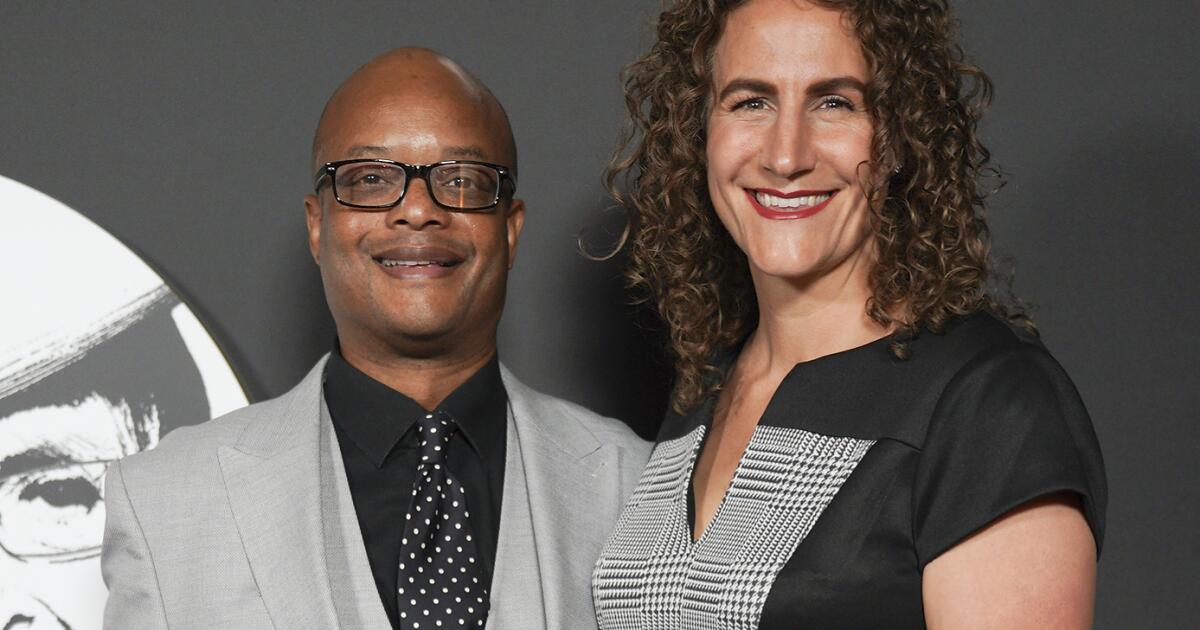
Todd Bridges has taken steps to make his split from Bettijo Hirschi official after announcing in January that he and his spouse had separated.
The former “Diff’rent Strokes” actor, 60, filed paperwork asking to end his marriage Tuesday in Arizona, Us Weekly reported Thursday. This will be the second divorce for both parties.
A representative for Bridges didn’t respond immediately to The Times’ request for confirmation and comment.
“This was not an easy choice, and it comes with a heavy heart, but also with love and gratitude for the life we shared,” he said in a statement to The Times. “I thank God for the time we’ve had together, the lessons we’ve learned, and the family we’ve built. Even in this season of change, I trust He is guiding us both toward healing, peace, and new beginnings.”
Bridges said at the time that he would “continue to lift my former partner up in prayer, wishing them joy and fulfillment in the chapters ahead.”
The two met in January 2022; they married nine months later, after a brief engagement. Hirschi told Tamron Hall last year that a friend who wrote a new dating profile for her showed it to Bridges as “market research.” The friend then told Hirschi that Bridges wanted to get in touch.
“She’s a lot like my mom,” Bridges told Hall.
During a contentious spousal support dispute in 2025, Hirschi described the “Everybody Hates Chris” veteran as “semi-retired,” Us Weekly reported in February. The documents came as part of a battle Hirschi fought with first husband Heath Hirschi after marrying Bridges. At the time, Us said that Bettijo was claiming monthly expenses of around $16,550 and said Bridges made only “about $700” a month in 2024 unless he obtained “contract work.”
The Hirschis, who divorced in 2020, share four children, two of them minors, the outlet said. Heath Hirschi wanted out of paying $2,700 a month in spousal support payments after his ex married someone his legal team called a “well-known Hollywood actor.” Us said that in December 2025, the court revised the former couple’s agreement to $1,206 per month in child support, with $43,401.96 due for unpaid past support.
Bridges, meanwhile, has about a dozen acting credits since 2020, according to IMDb, which also says he worked on several new projects in various stages of production.
He also has two adult offspring: Daughter Bo is from a previous relationship with Amanda Rushing; he shares son Spencir, 27, with his first wife. Spencir Bridges was, like his dad, a child actor, with roles in the 2007 movie “Daddy Day Camp” and, in 2005, the TV series “ER.” Spencir’s most recent acting credits were in 2009 when he appeared in the series “iCarly” and in the TV movie “The Three Gifts.”
Todd Bridges is the last surviving original cast member of the hit sitcom “Diff’rent Strokes,” which ran from 1978 to 1986. Conrad Bain played Phillip Drummond, a wealthy Park Avenue businessman and father of Kimberly (Dana Plato). Drummond adopted sons Arnold (Gary Coleman) and Willis (Bridges), who were from Harlem. The character of housekeeper Edna Garrett, played by Charlotte Rae, was spun off in 1979 into a second hit series, “Facts of Life,” which ran until 1988.
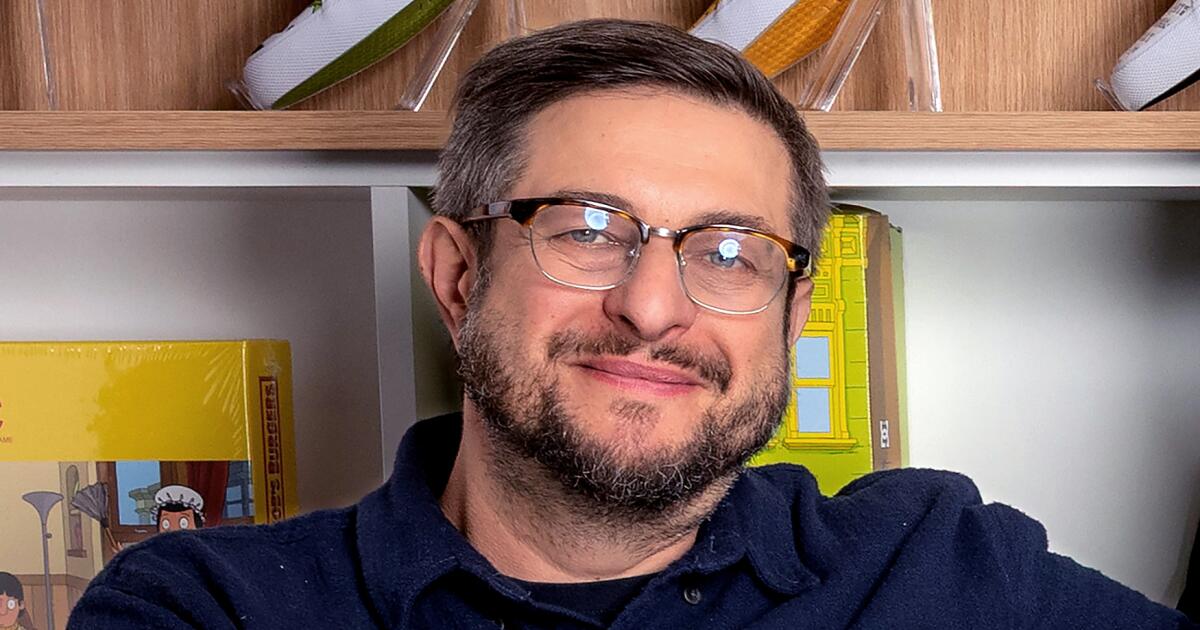
“Bob’s Burgers” voice actor and comedian Eugene Mirman was pulled from a fiery car crash and hospitalized with serious injuries.
Before noon on Tuesday, Mirman’s Lucid Gravity struck the Bedford Toll Plaza in New Hampshire as he was traveling northbound on the F.E. Everett Turnpike. Callers reporting the crash said the vehicle had caught fire and the driver appeared to be trapped inside. New Hampshire State Police said that while units were responding to the 911 calls, Gov. Kelly Ayotte and her security detail came upon the crash and stopped to help.
A trooper assigned to the governor’s detail and two others pulled Mirman from the burning car through a window before first responders arrived. Gov. Ayotte retrieved a fire extinguisher, according to State Police Col. Mark Hall.
“Certainly, their actions were heroic in what they did,” Hall said. “Without hesitation, they put themselves in danger to render aid to someone who was in need of it.”
The actor was transported by ambulance to a nearby hospital with serious injuries. Videos of the incident show the vehicle badly damaged and engulfed in flames.
“Eugene was in a very scary car accident,” Mirman’s agent, Jay Glassner, confirmed in a statement Wednesday. “He wants to thank the bystanders, state police, first responders and hospital staff who saved him. He is grateful to be on the mend. At this time, we kindly ask for privacy for Eugene and his family as he focuses on recovering from his injuries.”
The crash remains under investigation.
The animated series “Bob’s Burgers,” which centers on a family that runs a restaurant, celebrated its 300th episode, titled “Grand Pre-Pre-Pre-Opening,” when the Fox favorite premiered its 16th season in the fall.
Often referred to as a “comfort show,” the series features Mirman as kid brother Gene Belcher.
“It’s just a mix of warmhearted and funny and sort of grounded,” the actor told The Times last year.
“There’s a sibling camaraderie that is really lovely,” Mirman continued. “It reminds me of the camaraderie on TV and movies in the ’80s. That era of the stuff I grew up watching.”
The Associated Press and Times staff writer Tracy Brown contributed to this report.
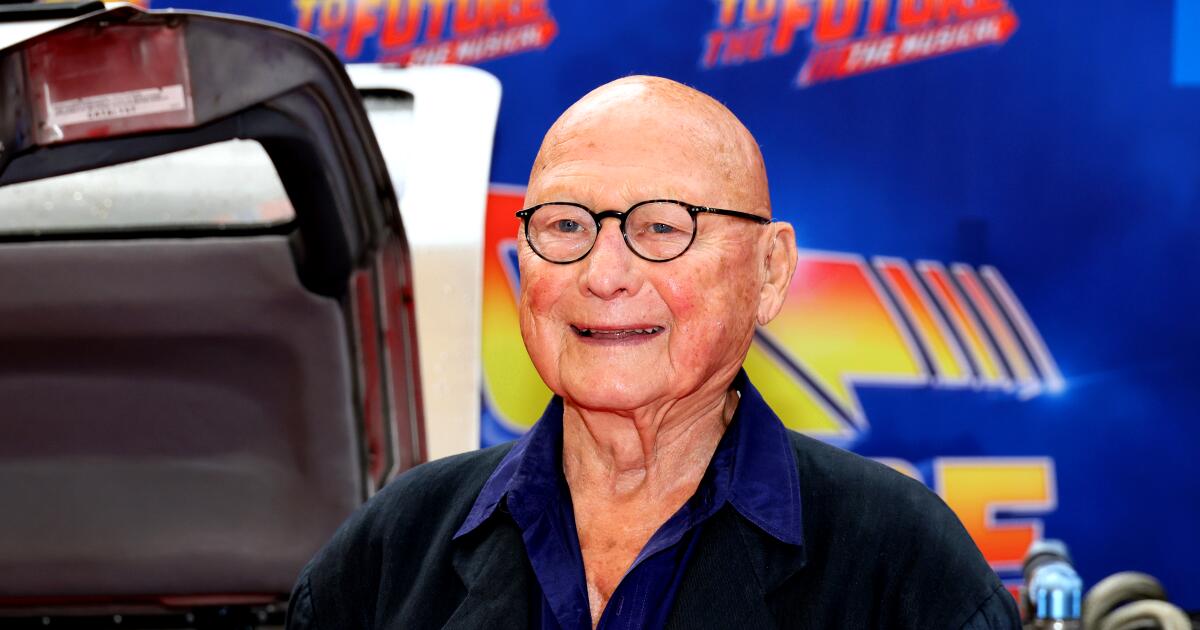
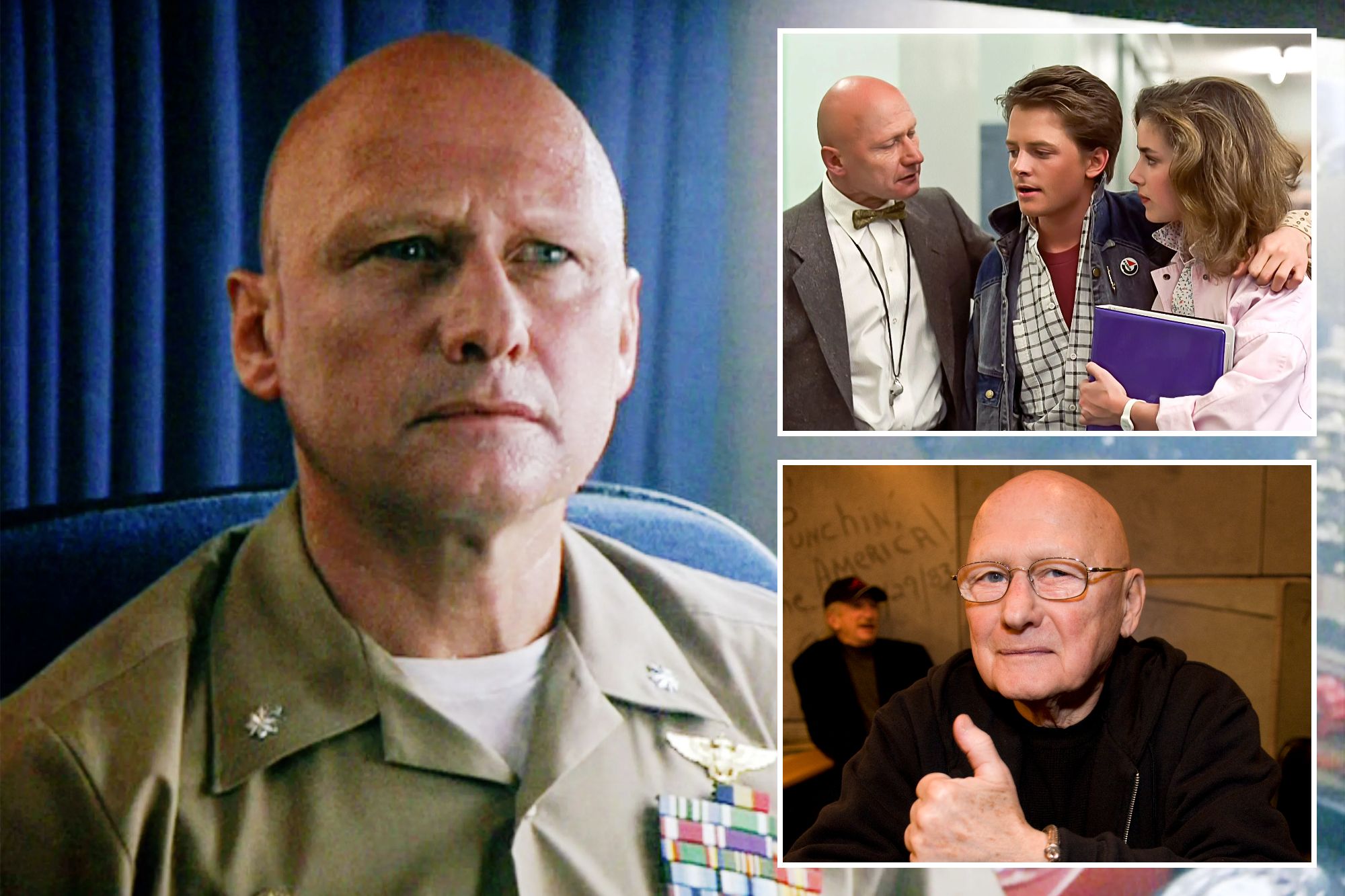
Actor James Tolkan, known for his role as the Hill Valley High principal in “Back to the Future” and the no-nonsense commanding officer in “Top Gun” has died. He was 94.
Tolkan died Thursday in Lake Placid, N.Y., where he lived, his booking agent, John Alcantar, told the Associated Press on Saturday.
In “Back to the Future,” Tolkan portrayed Vice Principal Gerald Strickland, who surveyed the school’s halls with a whistle around his neck and a tardy slip burning a hole in his pocket.
“You got a real attitude problem, McFly,” Tolkan’s character snaps at Michael J. Fox’s character, Marty McFly, in the cult classic 1985 film. “You’re a slacker. You remind me of your father when he went here. He was a slacker, too.”
The line became one of Tolkan’s most famous, and mega-fans would flock to Comic-Cons around the country to ask the star to call them a slacker, requests he typically obliged.
The actor had a number of film and television gigs through the 1960s and ’70s, but he was doing David Mement’s Broadway play “Glengarry Glen Ross” when he got the offer to play Strickland in “Back to the Future.”
“I always said, ‘I’m never going to Hollywood until they send for me,’ ” he told T.C. Restani during a 2015 interview. “And I said, OK, this is my chance. And of course, nobody realized that it was going to be such an important picture. But it was. It was one of those marvelous events where all the planets were aligned and ‘Back to the Future’ became this shooting star of a movie.”
Tolkan was also well known for drilling Maverick and Goose with swift reprimands and tough love between puffs of his cigar as their commanding officer, Tom “Stinger” Jardian, in the 1986 blockbuster “Top Gun.”
“That was very special, because when you make a movie you never know, but in ‘Top Gun,’ everybody felt like it was going to be a success,” Tolkan told Bob McCarthy during a 2016 Comic-Con interview. “ They just felt it, knew it right from the first day.”
Born June 20, 1931, in Calumet, Mich., Tolkan was the son of a cattle dealer — Ralph M. Tolkan. He moved around in his adolescence, spending time in Chicago and landing in Arizona after his parents’ divorce. It was there that his athletic skills got him noticed by the Eastern Arizona College football coach. Tolkan landed a scholarship to the college, but his academic career was short-lived, and he left to enlist in the U.S. Navy.
After a year of service during the Korean War, he was discharged due to a heart ailment, and with $75 to his name he set out for the Big Apple to try his hand at acting. In New York, Tolkan studied under Stella Adler and Lee Strasberg at the famed Actors Studio and started landing stage roles before working his way to the big screen.
Although his experience in the military informed the types of roles Tolkan would play — Army office, Air Force commander, police lieutenant, attorney — his work as an actor was his passion. “If you choose to be an actor, you have to choose to be an actor, and you have to stick with it through thick and thin,” he told a FanX audience member during a 2023 panel at the Salt Lake City pop-culture convention. “When things get tough, you can’t think about doing something else. You’ve got to say to yourself, ‘I’m gonna do this.’ ”
Other notable acting projects of Tolkan’s include the 1973 film “Serpico,” starring Al Pacino; the 1981 movie “Prince of the City”; the role of Napolean in Woody Allen’s 1975 film, “Love and Death”; and the 1983 film “WarGames,” in which he acted alongside Matthew Broderick.
Tolkan is survived by his wife of 54 years, Parmelee Welles.
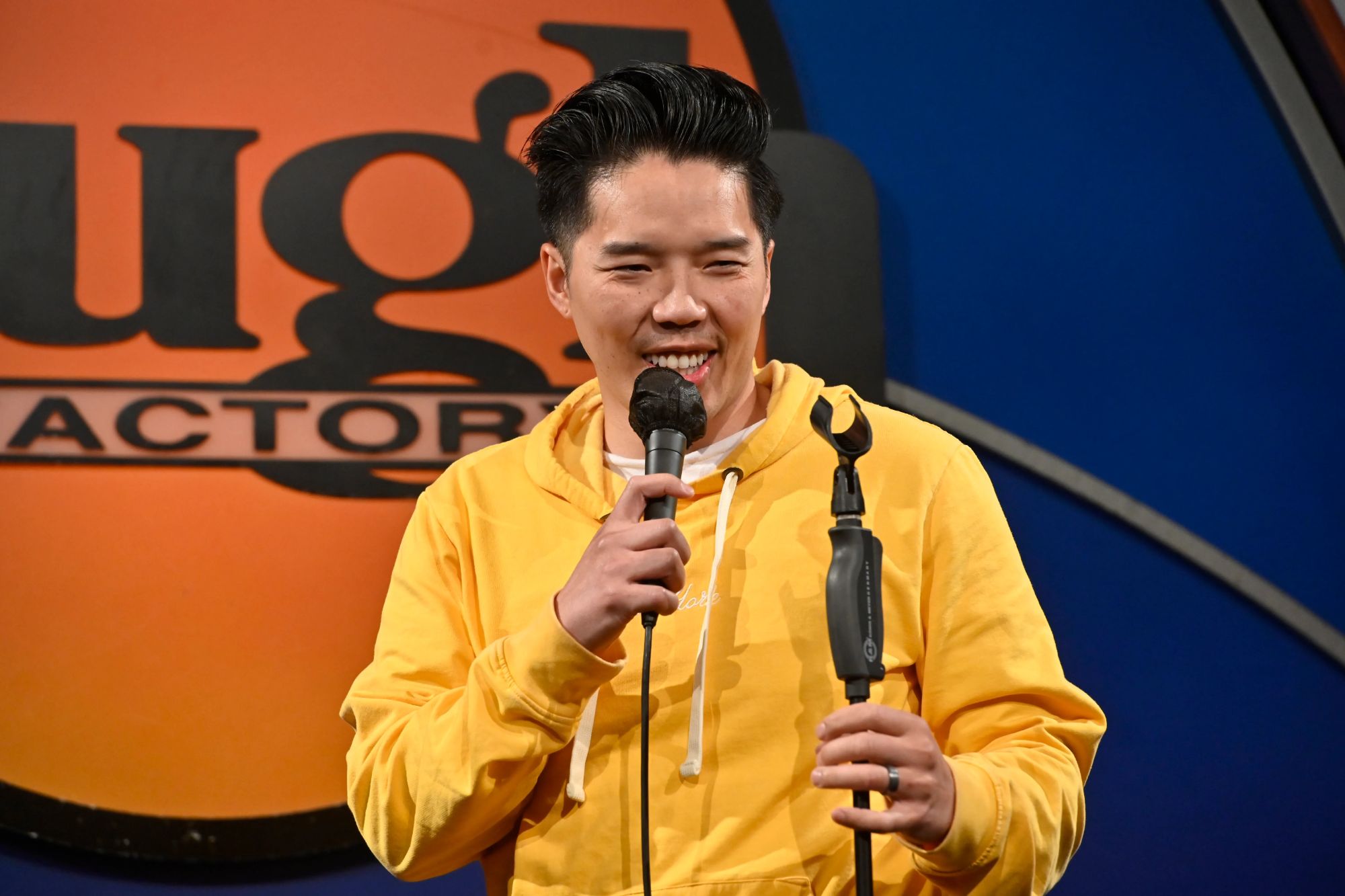
COMEDIAN and actor Alex Duong has died aged 42 after a year-long battle with cancer.
The funny man was known for his appearances on Jeff Ross Presents Roast Battle and Blue Bloods.
Sign up for the Showbiz newsletter
Thank you!
Comedian Alex Duong has sadly passed awayCredit: GettyHe spent a year battling cancerCredit: Getty
A close friend who was by his side confirmed to TMZ that Duong passed away 11am Saturday at St. John’s Hospital in Santa Monica, California, surrounded by family and friends.
Duong reportedly went into septic shock Friday night.
He was diagnosed with alveolar rhabdomyosarcoma – a rare and aggressive cancer – last year.
A biopsy found an extremely aggressive tumour after he had experienced headaches behind his eye.
He eventually lost sight in his left eye.
In August, his comedians contemporaries hosted the The Alex Duong Has Cancer In His Eye Comedy Benefit Show in LA.
Ronny Chieng and Atusko Okatsuka were among the comedians involved.
He leaves behind his wife Cristina and daughter Everest, 5.
Most read in Entertainment
Duong grew up in Dallas, Texas as the youngest of six children.
He graduated high school and went on to pursue medicine before finding success in the creative industries.
His writing about the Vietnam War gained him meetings with producers in California, according to IMDB.
Duong left school to pursue a feature development deal with Melody Phan of Zenoost Media.
More to follow… For the latest news on this story keep checking back at The Sun Online.
Thesun.co.uk is your go-to destination for the best celebrity news, real-life stories, jaw-dropping pictures and must-see video.
The “Harry Potter” team did not need a divination expert to know its cast would encounter some “unpleasant and aggressive behavior.”
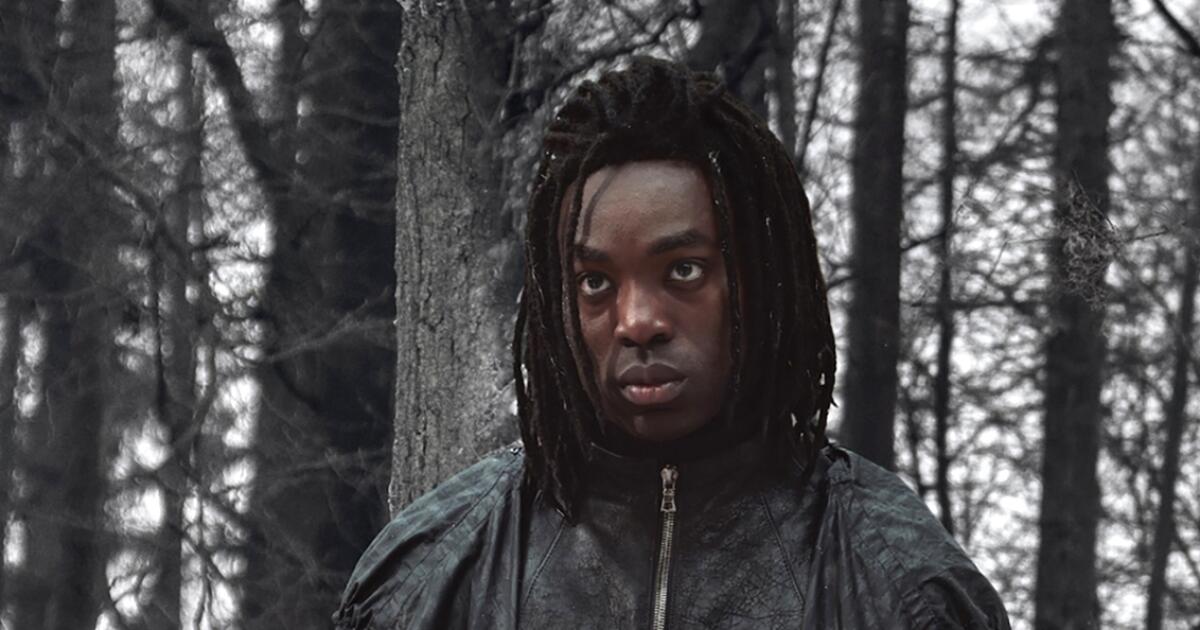
HBO boss Casey Bloys told multiple outlets this week that the network had taken precautions anticipating the vitriol the “Harry Potter and the Philosopher’s Stone” actors would face. Ghanian-English actor Paapa Essiedu recently spoke out about the racist abuse and death threats he has received since the announcement that he had been cast as potions professor Severus Snape.
“With all actors on any kind of big IP shows — and this is obviously one of those where you’ve got, you know, passionate fans, people with a lot of opinions — it can get scary in places,” Bloys told Variety in an interview published Tuesday. “So for any show like that, we anticipated it and tried to have training, you know, best practices in terms of social media and how to handle it. And obviously we’ve got a serious security team.”
Essiedu, who is portraying the enigmatic but ultimately heroic Hogwarts professor first brought to life by Alan Rickman in the original “Harry Potter” films, has opened up about the racist abuse he has received from those who believe a Black man should not be playing the fictional wizard.
“I’ve been told, ‘Quit or I’ll murder you,’” he said in an interview with the Times of London. “The reality is that if I look at Instagram, I will see somebody saying, ‘I’m going to come to your house and kill you.’”
“[N]obody should have to encounter this for doing their job … And I’d be lying if I said it doesn’t affect me emotionally,” Essiedu added.
This is not the first time that fans of J.K. Rowling’s Wizarding World novels expressed outrage over the casting of a Black actor in an adaptation. There was a similar outcry in 2016 when Noma Dumezweni was cast to play Hermione Granger in the original London production of “Harry Potter and the Cursed Child.”
Bloys also told Deadline in an interview published Wednesday that they had “anticipated there would be a lot of interest in all of [the actors], and interest can tip over into more unpleasant and aggressive behavior.”
“We talked to them about what to expect, what to expect on social media and how we handle it, but any kind of security that’s needed is an unfortunate aspect of doing IP shows,” he said. “We just try to be mindful and monitor it.”
Essiedu also told the Times of London that “the [racist] abuse fuels” him.
“[It] makes me more passionate about making this character my own, because I think of how I felt as a kid,” he said. “I would imagine myself at Hogwarts on broomsticks, and the idea that a kid like me can see themselves represented in that world? That’s motivation to not be intimidated by someone saying they’d rather I died instead of doing work I’m going to be really proud of.”
There’s a lot of chatter around reality TV right now and the hazards of leaning into mess for the sake of potential viewership. Before Utah-based reality star and social media influencer Taylor Frankie Paul was making national headlines over domestic violence allegations brought against her by former boyfriend Dakota Mortensen — putting “The Bachelorette” and “The Secret Lives of Mormon Wives” series under interrogation — The Times was working on a group of stories that captured the longevity and cultural impact of the unscripted format.
Sign up to get recommendations for the TV shows and streaming movies you can’t miss, plus exclusive interviews with the talent behind your favorite titles, in your inbox every Friday
By continuing, you agree to our Terms of Service, which include arbitration and a class action waiver. You agree that we and our third-party vendors may collect and use your information, including through cookies, pixels and similar technologies, for the purposes set forth in our Privacy Policy such as personalizing your experience and ads.
Speaking of reality TV — Valerie Cherish and “The Comeback” have returned for another round of the showbiz satire. The HBO comedy, which blends scripted comedy with a mockumentary format, originally premiered a year before the “Real Housewives of Orange County” and lampooned the effects of the early-2000s reality TV boom. It followed Valerie (Lisa Kudrow), a former sitcom star from the ’90s, as she attempts to revive her career by starring in a new sitcom while allowing a reality TV crew to document her journey. When the short-lived series was revived in 2014, it poked fun at the rise of prestige TV and the evolution of celebrity culture in the social media era. Now, its third and final season finds our favorite leading lady navigating Hollywood’s AI revolution. Michael Patrick King, who developed the series with Kudrow, stopped by Guest Spot to discuss the show’s latest timely exploration.
Also in this week’s Screen Gab, we take a breather from current programming and dust off two bygone titles. One is an animated sitcom that revolves around a mild-mannered therapist and his sessions with a notable clientele of real-life comedians playing exaggerated versions of themselves; the other is a mid-aughts thriller (of the Lifetime TV variety) that follows a heroic doctor who moonlights as a dangerous predator — its Letterboxd rating spread is something to behold. And it’ll make you wonder what Valerie Cherish might have brought to camp like that.
Let it all be incentive to spend some extra time on the couch this weekend — it’ll cut down on trips to the gas pump! Until next week.
— Yvonne Villarreal
Turn on
Recommendations from the film and TV experts at The Times
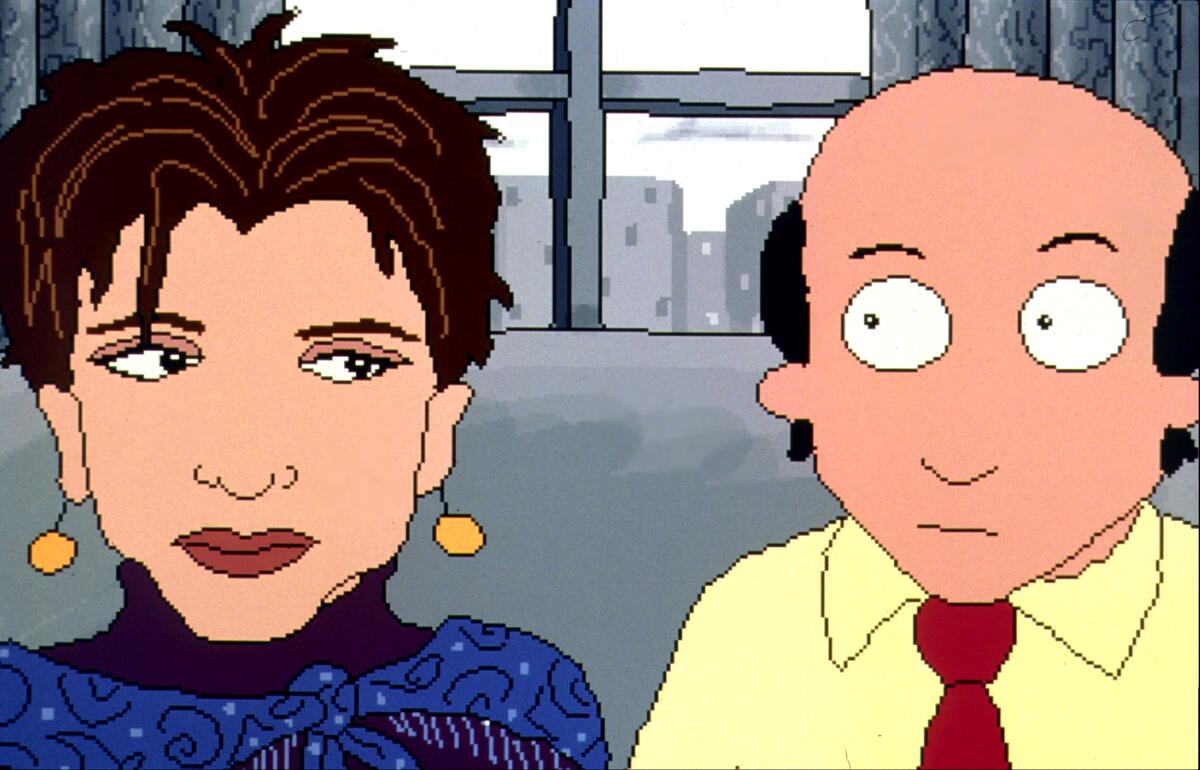
Dr. Katz, played by creator Jonathan Katz, invites his ex-wife, Roz, played by actor/author Carrie Fisher, to indulge in a dysfunctional family Thanksgiving on “Dr. Katz, Professional Therapist.”
(Comedy Central)
“Dr. Katz, Professional Therapist” (YouTube)
Once in a while the algorithms that rule our lives do us an actual favor, and so it was that YouTube alerted me that the entirety of this great turn-of-the-century cartoon lives there, hosted unofficially on a variety of channels. (Just type in the title.) Created by star Jonathan Katz with Tom Snyder, the inventor of an animation workaround called Squigglevision — in which vibrating outlines give a crude effect of action — and co-produced by Loren Bouchard, who would go on to co-create “Bob’s Burgers,” this six-season, semi-improvised, Peabody Award-winning Comedy Central series is founded on the notion that a comedian’s patter can resemble the neurotic unloading one might encounter in a psychotherapist’s office. And so onto Katz’s couch comes a parade of future comedy elder statespersons, naively but recognizably rendered, including Ray Romano, Lisa Kudrow, Dave Chappelle, Garry Shandling, Marc Maron, Catherine O’Hara, Margaret Cho, Wanda Sykes, Patton Oswalt, Sandra Bernhard, Paul F. Tompkins, David Cross, Jim Gaffigan, Steven Wright and Conan O’Brien. Rodney Dangerfield, already an elder comedy statesperson, has some things to say about his wife. Framing the therapy sessions are the domestic misadventures of Katz and his adult child son, Ben (H. Jon Benjamin, the Mel Blanc of adult animation, if Mel Blanc only used his own voice). Can’t-be-bothered secretary Laura (Laura Silverman, recently seen as Jane the documentarian on the new season of “The Comeback”), fills out the regular cast. — Robert Lloyd
“Stalked by My Doctor” (Tubi)
Last weekend, the Museum of Home Video hosted an interactive game at Vidiots where the sold-out crowd watched the first five minutes of 10 films and then voted on which flick to finish. “Stalked by My Doctor” won in a landslide. This 2015 Lifetime TV movie is one of the most bizarrely watchable trash films of the 21st century. Eric Roberts stars as Dr. Beck, a lovelorn, egotistical California cardiologist who is convinced he’s a catch. This graying bachelor falls for his patient, a high schooler named Sophie (Brianna Joy Chomer) and, when rejected, threatens to clobber her disabled boyfriend (Carson Boatman) with the guy’s own crutch. Filmmaker Doug Campbell makes B-pictures like a plastic surgeon does liposuction: He hacks off all the fat. Subtle? Absolutely not. Yet, there’s not a single dull scene and the characters make smarter moves than you’d expect. By the end, I was hooting and clapping, and giddy to hear that this top-notch schlock launched a five-film franchise. Some night soon, you can bet I’ll put on “Stalked by My Doctor: Patient’s Revenge.” — Amy Nicholson
Guest spot
A weekly chat with actors, writers, directors and more about what they’re working on — and what they’re watching
Lisa Kudrow as Valerie Cherish in “The Comeback.”
(Erin Simkin / HBO)
Could ChatGPT deliver a script worthy of Valerie Cherish’s talents? More than 11 years after it was last revived, “The Comeback” returned this month with a third season that explores the fear of technology replacing artists, and the ethical compromises that arise, through its sharp and uncomfortable comedic touch. Valerie is offered the lead in a new sitcom, “How’s That?,” on a faltering streaming service called the New Net. But there’s a catch. It’s the first-ever TV series to be written by AI — a fact that network brass wants to keep secret to avoid industry backlash. Valerie is initially resistant to the idea, but a humiliating experience on an indie shoot has her reconsidering. Is she about to be part of the new future of TV? A new episode of “The Comeback” drops Sunday on HBO and HBO Max. Over email, King shared his worries over how AI may transform the entertainment business and the series he’d pick to join the comeback circuit. — Y.V.
This season has Valerie Cherish starring in the first sitcom written by artificial intelligence. The series has always hilariously explored industry shifts. What concerns or curiosities do you have regarding AI, and did those evolve as you worked on the season?
Concerns — yes, many. They range from young writers with nowhere to learn their craft to no writers, young or seasoned, anywhere but the Coffee Bean & Tea Leaf. And yes I’m curious — white-knuckle curious — to see how the threat of AI (Season 3) will change how we make TV compared to how way the threat of reality TV (Season 1) and the threat of prestige cable and streaming (Season 2) did. Spoiler alert …television and TV writers are still here. When is this being published?
Without spoiling anything, there’s a scene in this week’s second episode where Valerie takes a meeting with some Hollywood folks — and it’s an odd experience. Do those meetings feel any more confusing or bizarre to you, in terms of how network brass thinks about the landscape, than they did a decade or two ago?
That billion-participant Zoom scene in the episode is very reflective of the “pitch process” today — in fact more than reflective — it’s a documentary … minus the occasional “pop-up pet.” What’s missing from this current Zoom pitch process is the in-person connection, which also accounts, I think, for why you no longer hear the phrase: “I sold it in the room.” No room, more people — less sales?
What does your writing process with Lisa Kudrow look like? Place me in those weeks of writing the first episode of this season.
The first and every episode has the same process. We talk, we laugh, we eat, we improv, we take turns writing it down — you know, things human writers do.
In addition to this third go with “The Comeback,” you worked on multiple seasons of “… And Just Like That.” What have you found interesting about the process of revisiting characters at a different stage in your life? Has one felt easier to navigate than the other in the current entertainment landscape?
I’m fascinated by a character’s personal evolution — how they can grow over the years. Who they were, who they might be now, what they’ve let go of — how they’ve changed. I’m also fascinated by how some fans of these characters don’t want them to change. In the current TV landscape — the fans are very vocal.
What have you watched recently that you are recommending to everyone you know?
“The Pitt” [HBO Max]. In addition to the good characters, it’s the thrill of being introduced to new actors.
As a viewer, which show — excluding those in your catalog — do you think would be worthwhile to revisit in 2026?
“Freaks and Geeks” [Prime Video, Paramount+]. One season only. Sometimes … a special show that was canceled — deserves a comeback.
BACK to the Future and Top Gun actor James Tolkan has sadly died aged 94.
The Hollywood star passed away peacefully at his New York state home on Thursday after a celebrated TV and stage career spanning 55 years.
Sign up for the Showbiz newsletter
Thank you!
Hollywood actor James Tolkan has passed away aged 94Credit: GettyTolkan as tough teacher Mr. Strickland in Back to the FutureCredit: AlamyThe actor was also known for his role as Commander “Stinger” Jardian in Top GunCredit: Getty
His death was announced on the Back to the Future website as well as by writer-producer Bob Gale, but a cause was not provided.
Tolkan played the slacker-hating teacher Mr. Strickland in the first two films of the iconic 80s franchise, returning as the grandfather of his character in the third.
He was also known for his performance as air group commanding officer “Stinger” Jardian in the 1986 blockbuster Top Gun, alongside stars Tom Cruise, Val Kilmer and Meg Ryan.
Tolkan’s five-decade-long career started in the 1960s series Naked City and called it a day after the 2015 film Bone Tomahawk.
He was born on June 20, 1931 in Calumet, Michigan and served in the brutal Korean War as part of the United States Navy.
The young sailor was discharged due to a heart condition and set his sights on becoming an actor, earning a BA in drama from the University of Iowa.
An obituary on the Back to the Future website says that he then “got on a bus for New York City with $75 in his pocket, went to work on the docks and enrolled with both Stella Adler and Lee Strasburg to learn the art of acting.
“He spent 25 years in New York theater, from off off Broadway to the great White Way.
Most read in Entertainment
“Notably, he was a member of the original ensemble cast of the ‘Glengarry Glen Ross’.”
Tolkan moved his career from New York to California and Canada in 1983 when he was cast in War Games.
After his roles in Back to the Future and Top Gun, Tolkan had a dual role in Woody Allen’s Love and Death.
Tolkan is survived by his wife of 54 years, Parmelee – whom he met in the off-Broadway play Pinkville in 1971 – and his three nieces in Des Moines, Iowa.
The late actor adored animals and the obituary asked for donations in his memory to your local animal shelter, animal rescue organisation or Humane Society chapter.
Singer-songwriter FKA twigs is suing her ex-boyfriend, actor Shia LaBeouf, claiming that he is trying to “silence” her from speaking out against sexual abuse through the use of an “unlawful” nondisclosure agreement.
The complaint, filed in Los Angeles Superior Court on Wednesday, seeks a court order to prohibit LeBeouf from enforcing sections of an NDA which Tahliah Barnett — the Grammy Award-winning singer’s legal name — says violates California law.
“Shia LaBeouf has tried to control Tahliah Barnett for the better part of a decade,” the filing states.
“This action was taken in response to Mr. LaBeouf’s attempt to bully and intimidate twigs through a frivolous and unlawful secret arbitration he filed against her in December in which he sought to extract money from her,” said the singer’s attorney Mathew Rosengart, national co-chair of media & entertainment litigation at Greenberg Traurig in Century City, in a statement.
Rosengart added that twigs “refuses to be bullied anymore. She is instead standing up for herself and other survivors of sexual abuse who have improperly been silenced. This is the unusual case that is not about money but about justice and upholding and enforcing California law and policy designed to protect survivors by nullifying illegal NDAs.”
LaBeouf’s attorney Shawn Holley of Kinsella Holley Iser Kump Steinsapir denied the claims.
“When Ms. Barnett and Mr. LaBeouf both decided to resolve their differences and move on with their lives, no one forced her or ‘bullied’ her to stay silent,” Holley said in a statement. “As a woman with agency, she decided to settle the case and accepted money to dismiss her lawsuit.”
In a response to the suit, the actor told the New York Times that “many of these allegations are not true.”
But he added, “I am not in the position to defend any of my actions. I owe these women the opportunity to air their statements publicly and accept accountability for those things I have done.”
In the statement Thursday, Holley added that the claim of sexual battery “was disputed, as were the other claims made in Ms. Barnett’s lawsuit.”
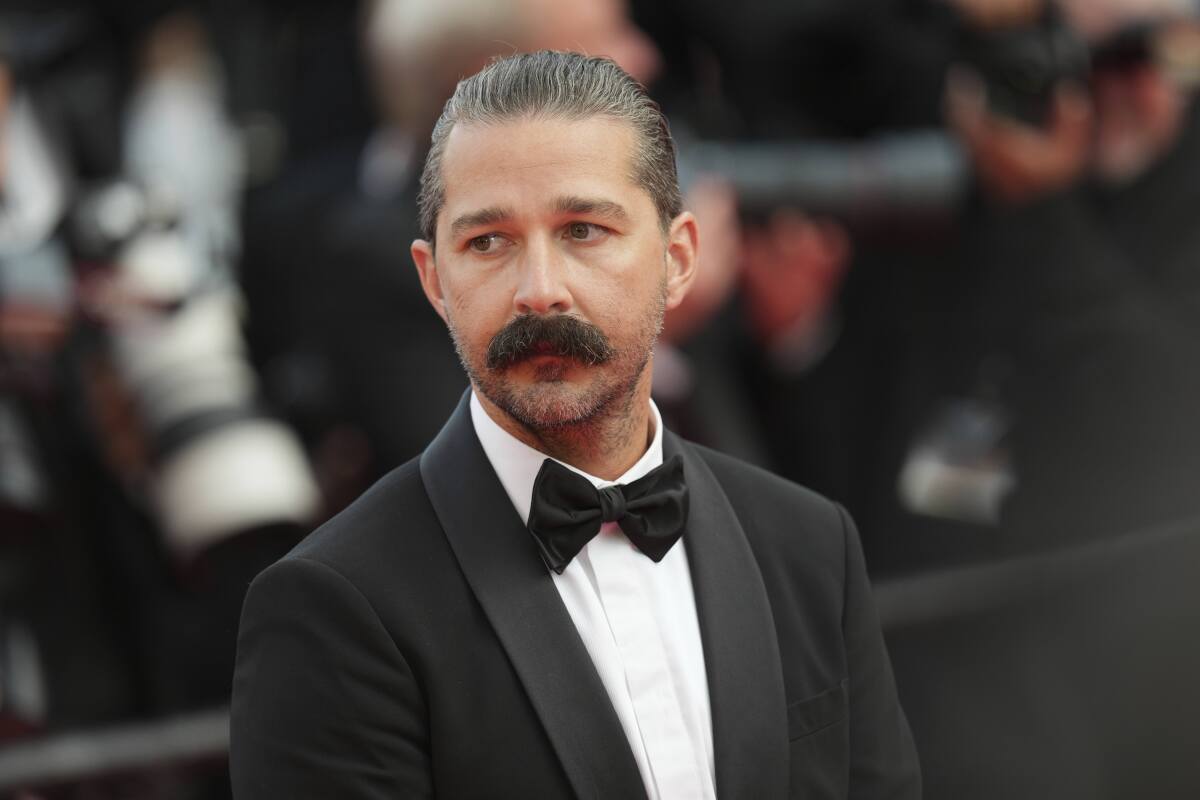
Shia LaBeouf poses for photographers upon arrival at the premiere of the film “The Phoenician Scheme” at the 78th annual Cannes Film Festival May 18, 2025.
(Lewis Joly / Invision / AP)
According to the new lawsuit, LaBeouf filed a secret arbitration complaint and “improperly sought exorbitant monies” from Barnett last December, claiming she had breached their agreement by violating its nondisclosure provisions after she gave an interview to the Hollywood Reporter in October.
In the interview, Barnett was asked if she felt safe and answered that as a woman of color in the entertainment industry, she “wouldn’t feel safe” and discussed her involvement with organizations that support survivors, saying, “I think it’s less about me at this point and more about looking forward. Just, you know, moving on with my life.”
The agreement Barnett reached with LaBeouf “contained a deficient and unlawful NDA that is unenforceable,” under California’s Stand Together Against Non-Disclosure Act, according to the complaint. The law forbids NDAs from being used to silence victims of sexual misconduct.
“As the California Legislature has made clear, survivors should have the right to tell their stories without fear or coercion, and California law does not and must not allow abusers and bullies to silence them through secret agreements containing unconscionable, unlawful gag orders,” the complaint states.
The lawsuit further alleges that while LaBeouf has sought to prohibit Barnett from talking about her abuse, he has “repeatedly brought up his relationship with Ms. Barnett—on his own and without being directly asked about her—materially breaching the very confidentiality provisions that he had just contended were fully enforceable against Ms. Barnett.”
While the actor agreed to drop the arbitration in February, he has “refused to acknowledge, however, that the NDA provisions are illegal and unenforceable,” the filing states.
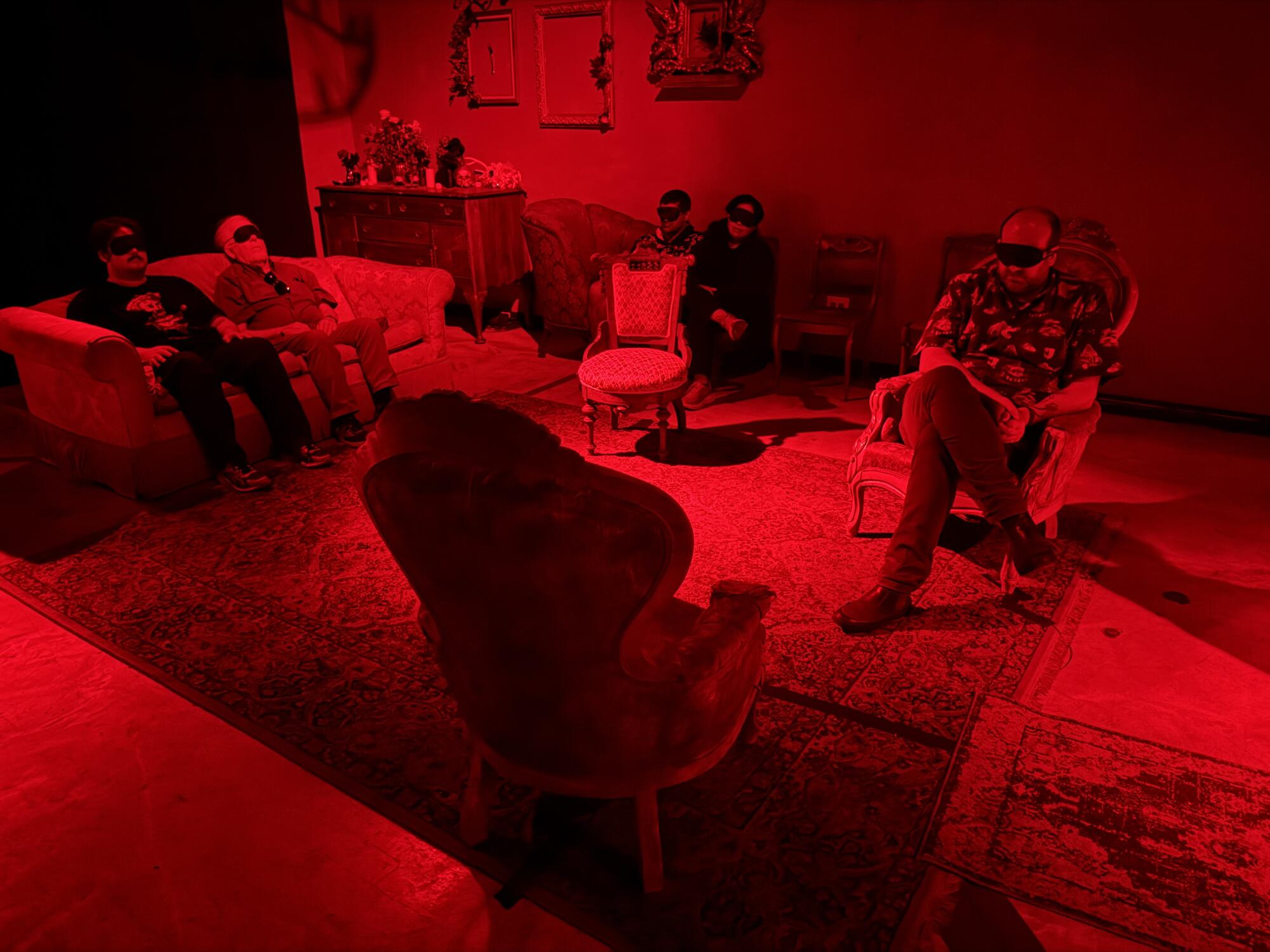
I am blindfolded and seated in a vintage armchair set in the center of a darkened, red-lit room with Gothic accents. An actor is performing nearby. I hear their voice, but cannot, of course, see them. I suddenly spring upward in my seat, alarmed at the touch of some sort of cloth — or perhaps a feather? — across my ankles.
I’ll never be entirely sure. For wearing the small veil across my eyes was a requirement to participate in “Poe: Pulse & Pendulum,” the debut offering from new troupe Theatre Obscura L.A. The company’s initial performance contains two one-act plays, modern interpretations of Edgar Allan Poe’s “The Pit and the Pendulum” and “The Tell-Tale Heart.”
While the stories are familiar to many, Theatre Obscura increases the levels of discomfort. In this room, I am at times unsettled, at once tracking the movements of the actors while attempting to remain hyper aware of any sudden touch or scent. “The Pit and the Pendulum,” the first half of the program, translates especially well to this setting, its dark sense of demented confinement keeping my nerves on high alert.
Conjuring such a state of anxiety was the point.
“If you take the visual away, it’s going to make you feel uneasy,” says Paul Millet, who devised the concept.
There are jump scares. Downtown event space the Count’s Den has been outfitted with about 50 speakers for the Obscura shows, which run through April 12. Some are visible before one puts on the blindfold. Many, though, are hidden under seats or couches, as the audio will trail the actors around the room, or perhaps a sudden crash or door opening will have me jolting my attention elsewhere.
“The Pit and the Pendulum” is a story of torture, and as the narrator, here played by Melissa Lugo, desperately speaks of a blade swinging above, actors will fan us, timing their waves with each swoosh of the audio. I was prepared for that one, as a fellow theatergoer nearby let out a soft yelp when the unseen gestures first arrived above their head.
For many, sight is the most coveted sense. “If you take that away, you’re already naturally uncomfortable,” Millet says. “So we lean into that. We know you’re going to be uncomfortable. We know this is not the norm. But get on that ride with us. Be willing to be uncomfortable. Discomfort, I think, helps to heighten the experience, and ideally allow it to trigger the emotional reactions that the story does.”
“Poe: Pulse & Pendulum” is two one-act, audio-focused performances of Edgar Allan Poe stories.
(Joe Camareno / Theatre Obscura)
Still, touch is limited in the show. Occasionally a rattling of a chair, but little more. The fluttering I felt near my ankles was to mimic the sensation of a running critter. The troupe will ask for audience consent, and participants can opt out. While I went in wondering if “Poe: Pulse & Pendulum” would seek to recall more extreme haunt experiences with lengthy waivers, Millet wanted to keep it light — an audio play, primarily, with just a few in-the-flesh signals.
“We want people to feel unease, but I don’t want anyone taken out of the story because a boundary or line was crossed,” Millet says.
Scent, too, is used with restraint. There are moments when guests will get a whiff of a fragrance that pairs with the storyline. Millet considers the first run of Theatre Obscure to be an experiment in how much touch and scent audiences may want to endure. Smell, he says, is tricky, as the aroma may linger and become a distraction.
Millet has been honing the concept since 2023. Previously, he was part of the team behind Wicked Lit, which ended in 2019 after running for a number of years at unique locations such as Altadena’s Mountain View Mausoleum. Those immersive performances would feature casts and guests walking the venue. Theatre Obscura, however, is fully seated.
“Poe: Pulse & Pendulum” focuses on the fear that something may happen to us when stripped of sight.
(Joe Camareno / Theatre Obscura)
And while the stories of Poe lend themselves to the Halloween season, spooky events increasingly occur year round. Long-running production “The Willows” is set to wrap in early April, and “Monster Party,” a period piece that takes guests to a devilishly extravagant cocktail party, is re-launching in mid-April. Millet, a longtime theater producer who has a day job in television editing, is hoping to stand out by avoiding “the glut” of horror events that occur each September and October.
Theatre Obscura may face challenges, namely persuading potential guests that “The Pit and the Pendulum” is more than simply a live reading with audio effects.
“You can feel the movement of the characters around you,” Millet says. “You’re in the environment with the story as it unfolds. You can experience it on a more visceral level.”
Blindfolded, I felt Theatre Obscura was mostly playing off our fears rather than giving in to them, largely keying in on our anticipation that something may happen to us when stripped of sight. Lugo in much of “The Pit and the Pendulum” circles guests, who are seated sporadically around the room, allowing each of us to imagine how close or far we may be from the hole we are told is at its center. Each show deals with claustrophobia in some way, either of a space, or of a mind.
“The Tell-Tale Heart” is louder, more crowded. The sounds of crashing glass and creaky floorboards had my head working overtime to draw a floorplan, only to then have it distorted when actors would unexpectedly whisper in both of my ears to bring forth the protagonist’s nightmares. While I expected Theatre Obscura to be slightly more aggressive in its uses of touch and scent, it’s a show that asks us to live in our heads, and to sit in our own feeling of trepidation.
“I was intrigued,” Millet says, “with really trying to engage the audience’s imagination.”
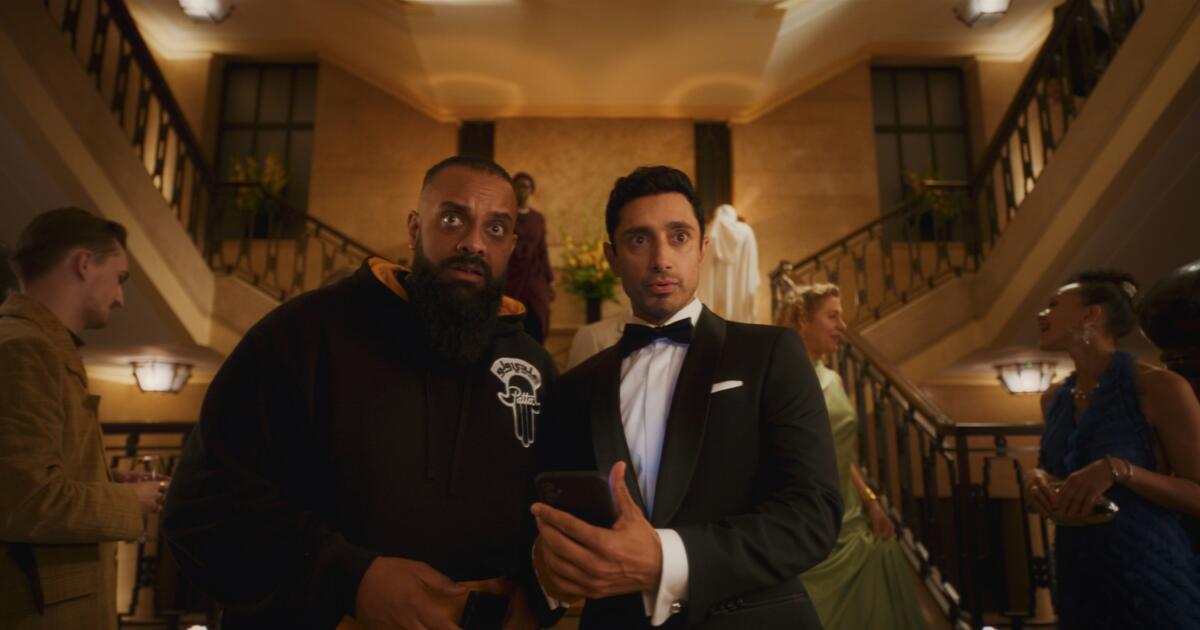
Riz Ahmed has created and stars in a marvelous new series, “Bait,” premiering Wednesday on Prime Video. There are no worms in it, though viral video plays a part, and fame — the pursuit of which is a subject — is a lure.
But what’s in a name? A comedy by any other name would be as funny — if it was funny, and this one very much is, in a way that’s crazy and serious and human, built around a character in crisis who refuses to believe his life is out of control and is so invested in putting up a front that he’s begun to believe his own lies. Almost. It’s a series in which hallucinations, dreams, magical realism and memories, which punctuate and interfere with the “normal” business of the story, all amount the same thing, and in which the style of the filming shifts with the action.
Ahmad plays Shah Latif, a British Pakistani actor, who, owing to the exertions of his faithful, often frustrated agent, Felicia (Weruche Opia), is improbably auditioning to be the next James Bond. But he repeatedly forgets his line when his scene partner, a girl with a gun, asks, “Tell me, when it’s just you all alone, how do you live with yourself? Do you even know who you are?” establishing a theme. (The line he can’t recall: “I don’t live with myself, I live with whoever you need me to be.” Spies and actors!)
Leaving the audition, he contrives to be photographed by one of the paparazzi lurking outside, sniffing for a Bond scoop; his picture is published, which creates a stir and some racist blowback, culminating in a package thrown through the front window of his parents’ home. (It is not a window that opens.) What’s inside the package I’ll leave for you to discover, but it will play a part through the rest of the show.
The recurring question of who will be the next James Bond generates a lot of pop cultural heat in our world; just type “next James Bond” into your search engine of choice. At one point, you may recall, Idris Elba was regularly bruited as a potential 007, which occasioned enough anti-Black reaction that he officially took himself out of the unofficial running. It may have been on Ahmed’s mind here — Shah claims high purpose for his Bondean aspirations, that he wants “to show them that this too is what British looks like.”
On the one hand, Shah has had enough of a career to have been made into a “limited edition collectible action figure,” starred in a well-regarded but underseen small film, played “the translator in ‘Homeland’ series seven” and earned a rising star award from some French festival; on the other, he is, professionally speaking, no Idris Elba — not a nobody, but not too many rungs above it. (He’s not Dev Patel, either, with whom he’s repeatedly confused.)
At the top of the second episode, Shah is seemingly being interviewed on a podcast, “Sir Chatwick Stewart, with me, Sir Patrick Stewart” — played by the man himself, whom we hear but never see — about his ambitions, though it’s soon clear that Stewart is a mental projection, an inner critic and inquisitor. He’ll stick around through the series, offering barbed commentary and something like support: “If I humiliate you, it’s to save you from the bigger humiliation of remaining as you are.”
As a protagonist continually getting in his own way, Shah is a classic sort of comic character. He creates opportunities only to squander them; finds himself voiceless after forcing himself onstage at a black-tie gala or in an underground club (he was once a politically provocative MC). After a newsworthy mishap, his agent advises him to lie low, which is impossible for him to do; there is no itch he won’t scratch, and no good advice he’ll actually follow. Apart from a rival actor (Himesh Patel) he’s a protagonist without antagonists, excepting himself. He’s insufficiently grateful to the people he owes, and insufficiently apologetic to those he’s wronged.
Shah’s self-involvement will be challenged by ex-girlfriend Yasmin (Ritu Arya), encountered first by accident, then sought out — a writer, she has published an op-ed headlined, “No, Shah Latif, We Don’t Need a Brown Bond” — in which she accuses him of “exchanging his political art for vanilla distraction.” His family, whom he neglects to visit for months, includes warm-hearted cousin Zulfi (Guz Khan), who has started a Muslim ride share company; a no-nonsense sister (Aasiya Shah) — the name of her character is rendered as “Q” on IMDb and elsewhere, but in the series itself she’s called Ainy — doting mother Tahira (Sheeba Chaddha); and his skeptical father, Parvez (Sajid Hasan), who has not been keeping his doctor appointments and asks Shah, “What do you even do? I watch TV all day — you’re never on it.”
Appropriate to a character who lives for being onscreen, “Bait” plays with the language of film — gritty procedural, a burst of Bollywood, romantic comedy — though not necessarily to the usual ends. Frame-filling titles identify the London neighborhoods where the action takes place — Wembley, Kentish Town, Brick Lane, Ladbroke Grove — as Paris, Moscow and Mexico City might appear in an international thriller. The series is at once satirical and celebratory; “Bait” feels abundant, both in its presentation of a culture, which has the ring of documentary truth, and as a beautifully realized work of art.
Victoria Pedretti was fresh out of Carnegie Mellon University’s School of Drama when she was cast in Mike Flanagan’s acclaimed 2018 horror series, “The Haunting of Hill House.”
In her breakout role as Nell Crain, the youngest and most sensitive of five adult siblings reckoning with wounds from a childhood summer spent in a cursed home, Pedretti became the undisputed heart of “Hill House,” anchoring the show with a spellbinding performance that christened her as a scream queen. Her subsequent appearances in “The Haunting of Bly Manor” and “You” were characterized by a similar dramatic intensity, solidifying her renown in the horror genre.
But in Pedretti’s new “Forbidden Fruits,” a horror-comedy directed by Meredith Alloway making her feature debut and produced by “Jennifer’s Body” screenwriter Diablo Cody, the actor shines in all-new soapy splendor.
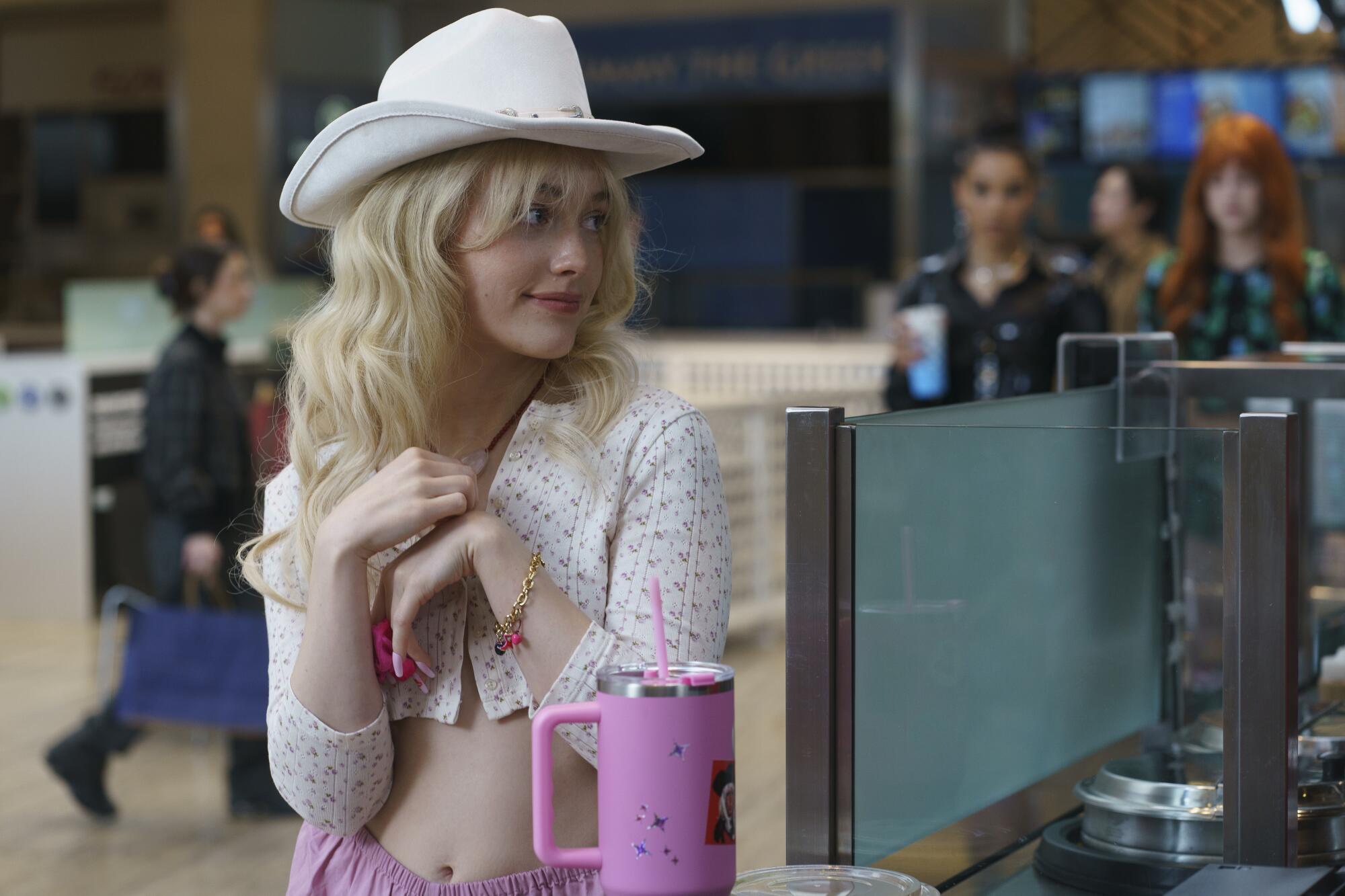
Set in a Dallas shopping mall, “Forbidden Fruits” revolves around an elite clique of retail employees who run a witches’ coven out of the basement of their boho boutique Free Eden. Pedretti stars alongside Lili Reinhart, Lola Tung and Alexandra Shipp.
Victoria Pedretti in the movie “Forbidden Fruits.”
(Sabrina Lantos / Independent Film Company and Shudder)
Initially asked to look at both the roles of whimsigoth physics buff Fig and the bubbly yet emotionally complex Cherry, described by Alloway as a “Texas Brigitte Bardot,” Pedretti fell hard for the latter.
“She really popped off the page,” Pedretti, 31, says on a recent Zoom interview she takes while on a sandwich run in L.A. “I entered into this glorious flow state.”
“I can’t say I’ve had any experience quite like it, where I really didn’t spend a lot of time questioning myself,” the actor says. “She kind of took over.”
That confidence was perhaps the product of Pedretti performing in two stage plays before “Forbidden Fruits” — or maybe it was the nighttime filming schedule. Either way, Pedretti says she improvised constantly and always kept swinging until somebody said, “Cut.”
The result: Pedretti in Alloway’s instant cult classic is a laugh-out-loud-funny unending well of charm, packing humor into even her most routine dialogue. In her best quotable moments, she seamlessly infuses her sometimes shrill timbre with a dash of Southern drawl. One of her most iconic facial expressions in the film is already circulating as a reaction meme online.
“I was enjoying being in this character so much, I just wouldn’t stop,” Pedretti says, adding that Alloway, who was sensitive to cast members’ interpretations of their roles, supported experimentation.
Alloway praises the Philadelphia-born Pedretti for nailing Cherry’s comedic moments yet also grounding the character in a traumatic backstory — a balancing act the director knew she was capable of after watching “Hill House.”
“I saw her in that show and I was like, ‘Who is that?’” Alloway says. “She is magnificent and so raw. I didn’t feel like I was watching someone acting. I was worried for her.”
After later watching Pedretti nail her role in “You” as Love Quinn, a wealthy, charismatic chef who hides a psychopathic nature, Alloway was convinced of her star power.
Victoria Pedretti in the movie “You.”
(John P. Fleenor / Netflix)
Cody was most familiar with Pedretti’s performance in “You,” pegging the actor as an “intense brunet” that didn’t square at first with her interpretation of Cherry as an Anna Nicole Smith type.
“Then I see the movie and I’m like, oh my God, she has that fragility,” Cody recalls. “She has that humor. She has that sexuality. She has all of it.
“Victoria brought all of those layers and I’m really blown away by her,” the Oscar-winning “Juno” screenwriter adds.
Cody says she wasn’t surprised that the film drew such talent. From the moment Alloway and Lily Houghton, who wrote the play “Forbidden Fruits” is based on and cowrote the film’s screenplay, brought the material to Cody and her producing partner Mason Novick, she became obsessed.
“It feels spiritually like a film that I would want to be part of my body of work,” Cody says. She remembers being especially delighted by the echoes of “Jennifer’s Body” present in Alloway and Houghton’s screenplay.
“Jennifer’s Body” was widely considered a box-office flop and critical failure upon its release in 2009 — grossing only $31 million worldwide against a $16-million budget — but in recent years has enjoyed a reappraisal as a stealth-feminist essential, reclaimed by superfans.
“I don’t think that the world was ready for these kinds of themes,” Cody says of the movie’s ideas, including the cost of toxic femininity, the nuances of female friendship and the pervasiveness of the male gaze.
When it came to promoting “Jennifer’s Body,” the producer adds, “there was a huge emphasis on trying to market it to straight men, based on Megan [Fox] being attractive, and that was not at all the point of the film, so that was frustrating.” Conversely, “Forbidden Fruits” speaks intimately to the female experience and “doesn’t attempt to pander to any other demographic.”
“The current zeitgeist is a great place for a movie like this,” she says. “This movie is for the girls, gays and theys, as they say.”
Alloway, a trained actor who worked as a film journalist before moving into directing, was struck with a similar feeling when she first discovered Houghton’s play, right around the time she was consuming copious media about women criminals, such as Tori Telfer’s 2017 book “Lady Killers: Deadly Women Throughout History.”
“I was so entrenched in why women commit acts of crime,” Alloway said, adding that she was disappointed to find that revenge films on the subject still often revolved around men.
Picking up Houghton’s script, the director recalls feeling relieved. “Oh, this is just about women,” she says, her face brightening. “This is about women friendships, women being pitted against each other.”
In an early meeting with Houghton, Alloway told the playwright she’d like to bring a genre lens to “turn up the dial on the emotions that you feel reading the play and make them accessible to people who haven’t had these experiences — or validate people who have.”
Outside of the opportunity to work with so many other young women, Pedretti said she was drawn to “Forbidden Fruits” because of its use of style and tone.
“It asks a lot of people to try to step into a world like this one,” the actor says of the unabashedly histrionic screenplay. “And as nerve-racking as it may be to take that big swing, you gotta take the big swing.”
“She has that fragility,” says producer Diablo Cody of Pedretti. “She has that humor. She has that sexuality. She has all of it.”
(Evelyn Freja / For The Times)
And swing she does: Pedretti plays up Cherry’s emotional volatility, giving her a full-bodied form of expression. The actor even did her own onscreen makeup (as did Reinhart) and collaborated heavily with costume designer Sarah Millman on Cherry’s wardrobe and styling. Plus, she performed her first topless scene — in a sequence that doesn’t involve men or even sex.
“I’m really proud of the way we use nudity to show a certain kind of unspoken comfortability among women,” she continues. “I remember always getting such a thrill at the comfort level of a girl being like, ‘We’re going to the bathroom together,’ and to me, that is that moment.”
It’s a perfect example of a scene that doesn’t try to speak to anyone except those it’s specifically written for, and one that you only get with women at the helm of a production.
Reflecting on the agency she had to shape Cherry, Pedretti says she is more inspired to explore directorial projects of her own.
“I am so interested in protecting these spaces to be positive, creative experiences for everyone involved,” she says.
Whenever Pedretti does make her feature debut behind the camera (she’s already made a short or two), perhaps Cody will pick up the phone.
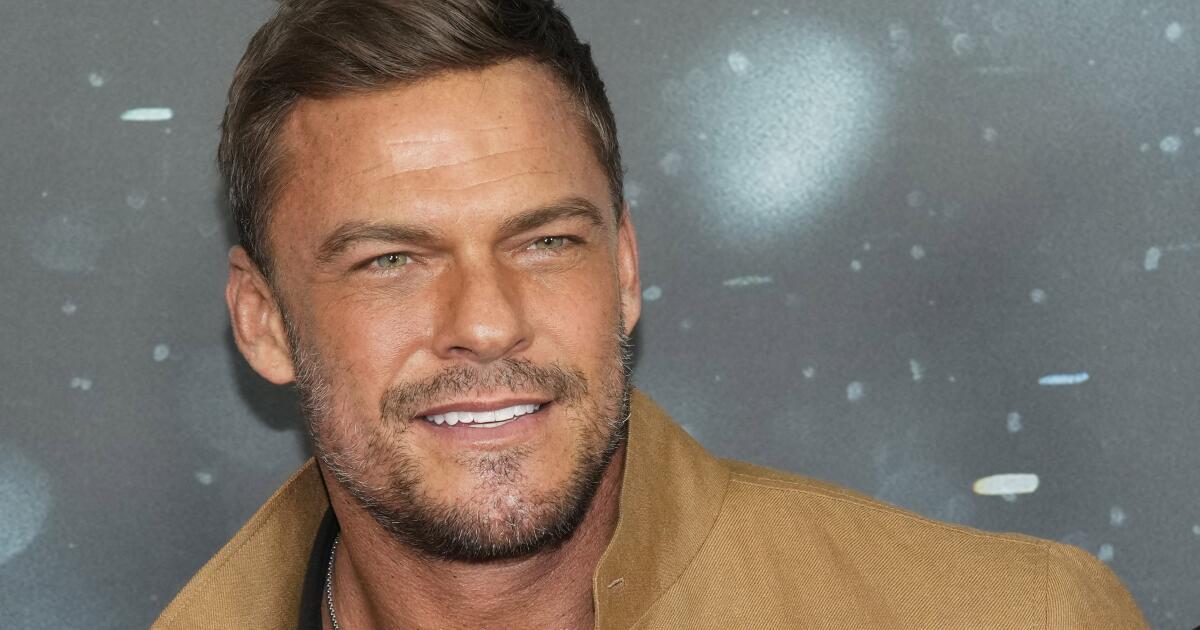
Alan Ritchson, star of the series “Reacher,” appears to have engaged in a violent altercation with his neighbor over the weekend, though it’s not entirely clear who began the brawl.
The confrontation broke out Sunday in the suburban city of Brentwood, Tenn., and allegedly included the 43-year-old actor punching a man down to the ground multiple times, according to TMZ, which published video of the squabble. The video, seemingly recorded by a witness from their home window, also shows Ritchson attempting to pick up his motorcycle, which then veers onto the grassy patch by the sidewalk while his two sons, also on motorbikes, watch the confrontation play out. The other man, after getting to his feet, appears to continue scolding Ritchson before the actor and his family drive off.
A representative for Ritchson did not immediately respond to a request for comment Monday.
According to TMZ, the man on the receiving end of Ritchson’s punches was neighbor Ronnie Taylor, who accused the actor of speeding on his Kawasaki motorbike through the affluent suburb, revving his engine and “disturbing the peace.” Taylor told the outlet he flashed an obscene hand gesture at Ritchson, who allegedly returned it.
Tensions between the neighbors allegedly came to a head Sunday when the actor and his sons rode their motorbikes through the neighborhood, TMZ reported. Taylor reportedly approached Ritchson, pleading to “stop this please.” That reportedly led to the altercation, which allegedly left Taylor with bruises and swelling. Taylor said he reported the incident to police. The Brentwood Police Department did not immediately respond to a Times request for comment.
A source close to Ritchson denied Taylor’s claim that the actor began the altercation, telling TMZ that Taylor had pushed Ritchson off his bike twice and and ran into the street in an attempt to stop the actor’s bike in a “really aggressive manner.” The source also told the outlet Ritchson crashed, fell off his motorcycle and incurred cuts and bruises.
Ritchson, according to the source, attempted to defuse the situation after Taylor allegedly dared him to get physical. However, the source claims Taylor shoved Ritchson to the ground first, prompting the actor to throw punches.
TMZ reported that Ritchson “has been cooperative with the police” and that no arrests have been made in this case.
Ritchson, a former model and “American Idol” hopeful, is best known for portraying the powerful and highly intelligent leading man of Prime Video’s “Reacher.” The show, an adaptation of Lee Child’s “Jack Reacher” book series, premiered in 2022 and is set to return this year for its fourth season, according to Ritchson.
Though the actor has not publicly addressed the brawl, in the days before the incident, he posted several videos detailing his struggles with jet lag.
“The second best time to vlog … is after 48 hours of work and travel with no sleep,” he joked in one late-night video, “I think that’s how the saying goes.”
Valerie Perrine, the Las Vegas showgirl turned Oscar-nominated actor best known for playing Lenny Bruce’s wayward wife Honey Harlow in “Lenny” and Lex Luthor’s secretary Eve Teschmacher in the 1978 and 1980 “Superman” films, died Monday morning. She was 82.
Perrine’s death was confirmed by Stacey Souther, her close friend and the director of the 2019 documentary “Valerie,” which followed the star’s debilitating battle with Parkinson’s disease.
“It is with deep sadness that I share the heartbreaking news that Valerie has passed away,” Souther announced on social media. “She faced Parkinson’s disease with incredible courage and compassion, never once complaining. She was a true inspiration who lived life to the fullest — and what a magnificent life it was. The world feels less beautiful without her in it.
“I love you, Valerie. I’ll see you on the other side.”
Souther also shared a GoFundMe link and a note that Perrine’s final wish was to be laid to rest at the Hollywood Hills Forest Lawn Cemetery. “After more than 15 years of fighting Parkinson’s, her finances are exhausted.”
Perrine was born Sept. 3, 1943, in Galveston, Texas, to parents Renee and Kenneth, a dancer and a U.S. Army lieutenant colonel. A military brat growing up, Perrine moved frequently and spent time in Japan, Paris and Scottsdale, Ariz.
She attended the University of Arizona, but her academic aspirations were short-lived. She skipped town, trading her textbooks for a feather headdress and G-string in Las Vegas. Soon she was a lead dancer in the star-spangled Lido de Paris show at the Stardust Hotel. She told the New York Times in 1974 that she spent some of her $800 weekly paycheck on experimenting with drugs: acid, mescaline, peyote, cocaine — you name it, she tried it.
Eight years after her foray into Vegas showbiz, her movie career kicked off unexpectedly during a visit to Hollywood. An agent at a friend’s dinner party took a liking to her, she told the Los Angeles Times in 2013. He asked if she had any publicity photos. The only one she had was in her topless Lido costume.
The sexy picture made its way to the desk of Monique James, the head of new talent at Universal. “She called me in and asked if I had ever acted before and I said ‘no,’” Perrine said. “She arranged a screen test.”
Paul Monash, the producer of “Slaughterhouse-Five,” which was based on Kurt Vonnegut’s acclaimed novel about World War II and time travel, directed the screen test. “They told me to wear a bikini because they wanted to see what my body looked like. I didn’t have a bikini. I wore my G-string and that was it.”
“I had been working in Vegas all the time and had been on the beach in St. Tropez, so being [naked] didn’t mean anything to me,” she told The Times. “It was my attitude that sparked his interest and the way I read the line, ‘Oh, you’re a moon child.’ He hired me.”
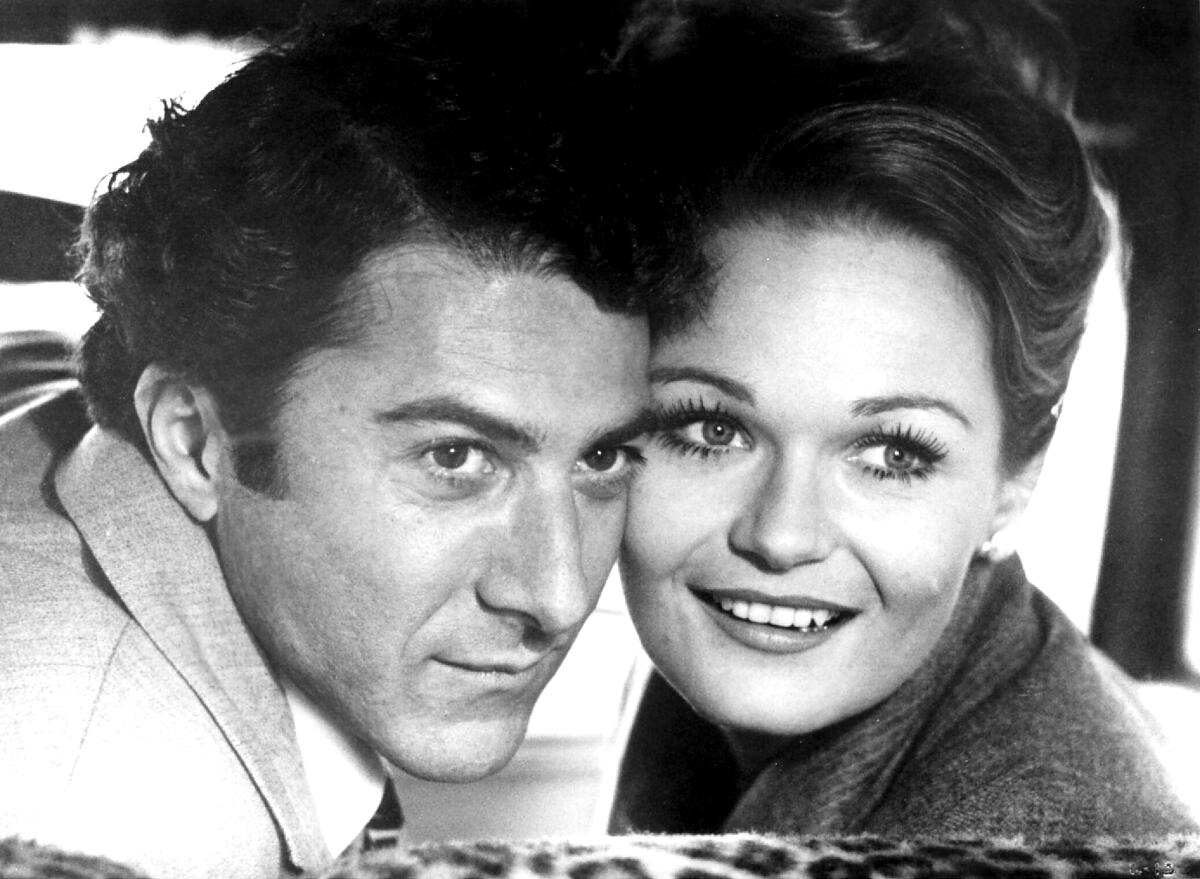
Dustin Hoffman as Lenny Bruce, left, and Valerie Perrine as Honey Harlow in a scene from the 1974 movie, “Lenny.”
(United Archives via Getty Images)
Soon after, she portrayed the love interest of NASCAR driver Junior Johnson opposite Jeff Bridges in the 1973 sports drama “The Last American Hero.” Perrine and Bridges dated briefly while working on the film. The same year she became the first woman to bare her breasts on television in the PBS telefilm “Steambath.”
Bridges described Perrine in the 2019 documentary “Valerie” as having a “real sense of fun and play.”
“She was excited about life and excited where she was and it’s a contagious feeling,” he said. “Growing up in a military family and traveling all over the world made her a really interesting person and as an actress, she had the ability to bring all of that into her performances.”
In 1974, she tapped into her showgirl background to portray the drug-addled stripper Honey Harlow opposite Dustin Hoffman as Lenny Bruce in the biopic “Lenny.” Her performance garnered rave reviews. She nabbed the lead actress award at the Cannes Film Festival, BAFTA named her most promising newcomer and she was nominated for an Oscar.
Perrine was perhaps best known for her portrayal of Eve Teschmacher, Lex Luthor’s secretary and love interest in the 1978 “Superman” starring Christopher Reeve, Gene Hackman and Marlon Brando. She played the role again in 1980’s “Superman II.”
She also starred in the 1980 disco flick “Can’t Stop the Music” alongside the Village People and Caitlyn Jenner. The movie flopped and Perrine was so mortified by the film’s poor reception that she moved to Europe. She didn’t officially retire from acting until around 2010, and by 2015 she had gone public with her Parkinson’s disease diagnosis.
The 2019 documentary short “Valerie,” directed by Souther, dropped the veil on Perrine’s battle with the illness, with her loss of bodily autonomy captured in the film. She said “the shakes” caused her to struggle and the level of care she required made her feel like a baby.
Still intact, though, were her sharp wit and self-deprecating sense of humor. In the film a doctor explains that there are times when physicians aren’t able to pin down a diagnosis or there are multiple diagnoses.
“The doctors don’t know what’s going on with me,” Perrine says. “They can’t figure it out.”
“What do you think it is?” the doctor asks Perrine.
Ben Keaton, who is best known for playing Father Austin Purcell in the iconic Channel 4 sitcom, has died at the age of 70 – tributes have poured in for the ‘wonderful actor’
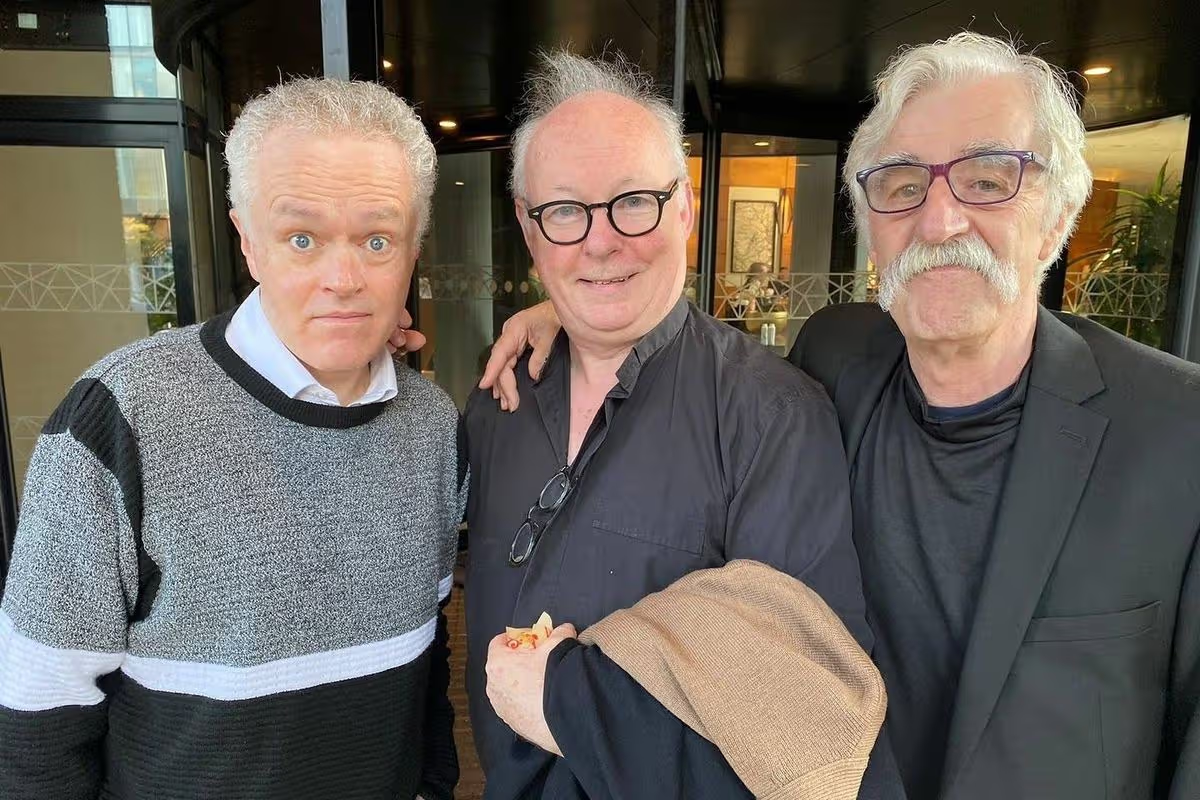
Patrick McDonnell, Paddy Ward and Ben Keaton (centre) at Comic Con in Belfast
Father Ted actor Ben Keaton has passed away aged 70. Keaton, who portrayed Father Austin Purcell in the beloved comedy series, alongside appearances in Casualty and Doctors, died at Lincoln County Hospital on Friday, it has been announced.
His death notice reads: “Ben will be forever greatly missed, loved and fondly remembered by his ex-wife Polly, son Waldo and daughter Daisy, brothers Des and Thom, sister Jeanette.”
In tribute, the Nottingham Playhouse said: “We are so sorry to hear of the death of Ben Keaton, a wonderful actor who is fondly remembered in our 2008 production of Vertigo. Sending our deepest sympathies to his family and friends.”
Ensure our latest headlines always appear at the top of your Google Search by making us a Preferred Source. Click here to activate or add us as your Preferred Source in your Google search settings.
Meanwhile, a Father Ted fan X account shared: “Saddened to hear of the passing of actor Ben Keaton. We knew him as Father Austin Purcell (one of my favourite one-off characters). He was a regular at ComicCon events, so I imagine many got to meet him over the years. My thoughts are with his family, friends, and many fans.”, reports the Daily Star.
Outside his television work, the Irishman was a distinguished stage performer. He dedicated much of his professional life to The Royal Exchange Theatre in Manchester, appearing in an eclectic array of productions from American Buffalo to Hay Fever.
A versatile artist, he co-established the improv group South Of The River and served in a senior position at the Creative Academy. His awards collection showcased his range, including the 1986 Perrier Comedy Award and two Best Actor accolades from the Manchester Evening News, culminating in a nomination for the esteemed Laurence Olivier Awards.
Honouring him in a message on X (formerly Twitter), one admirer wrote: “RIP Ben Keaton. A great actor and comedian – there can be little praise higher (if at all) in that he stole the scene every time he appeared in Father Ted. Off to the great parochial house in the sky.”
In 2022, Keaton witnessed an unexpected surge in digital popularity after being surrounded by fans seeking autographs at the CovCon event in Coventry. The frenzy intensified when he joined forces with fellow Father Ted cast members Joe Rooney (Father Damo), Michael Redmond (Father Stone), and Patrick McDonnell (Eoin McLove) to film an impromptu TikTok video.
Looking back on the viral sensation, Keaton told The Irish Sun: “The video went from 500 views to 50,000 and up and up. Joe now says we are up at half a million views on TikTok. It’s incredible.” He confessed he was frequently astonished by the lasting impact of his fleeting, scene-stealing turn as the world’s most tedious priest.
Drawing comparisons to his other roles, Keaton remarked: “I appeared in Casualty for three years, nobody cares. I did three minutes on Father Ted and it’s all people want to talk about and something which just sails through time.”
CHUCK Norris’ heartbreaking final post after his death has been revealed.
The 86-year-old actor died on Thursday after beinghospitalized in Kauai for an undisclosed medical incident.
Sign up for the Showbiz newsletter
Thank you!
Chuck Norris shared a heartbreaking final post just the week before his deathCredit: Instagram/chucknorrisChuck shared a final message with fans just before he was taken to the hospital in HawaiiCredit: Instagram/chucknorrisChuck rose to fame in the 1970s with martial arts rolesCredit: Getty
“I don’t age. I level up,” the actor captioned a video of him sparring with boxing gloves on.
“I’m 86 today! Nothing like some playful action on a sunny day to make you feel young. I’m grateful for another year, good health and the chance to keep doing what I love.
“Thank you all for being the best fans in the world. Your support through the years has meant more to me than you’ll ever know.”
The medical emergency that landed him in the hospital reportedly happened suddenly and unexpectedly.
TMZ reported earlier in the weekChuckwas training in Hawaii with friends, as shown in his final video.
The actor’s family confirmed his death in a social media statement.
“It is with heavy hearts that our family shares the sudden passing of our beloved Chuck Norris yesterday morning,” the statement, posted on his Instagram, began.
Most read in Entertainment
“While we would like to keep the circumstances private, please know that he was surrounded by his family and was at peace.
“To the world, he was a martial artist, actor, and a symbol of strength. To us, he was a devoted husband, a loving father and grandfather, an incredible brother, and the heart of our family.”
The family continued, “He lived life with faith, purpose, and an unwavering commitment to the people he loved. Through his work, discipline, and kindness, he inspired millions around the world and left a lasting impact on so many lives.
“While our hearts are broken, we are deeply grateful for the life he lived and for the unforgettable moments we were blessed to share with him.
“The love and support he received from fans around the world meant so much to him, and our family is truly thankful for it. To him, you were not just fans, you were his friends.
More to follow… For the latest news on this story, keep checking back at The U.S. Sun, your go-to destination for the best celebrity news, sports news, real-life stories, jaw-dropping pictures, and must-see videos.
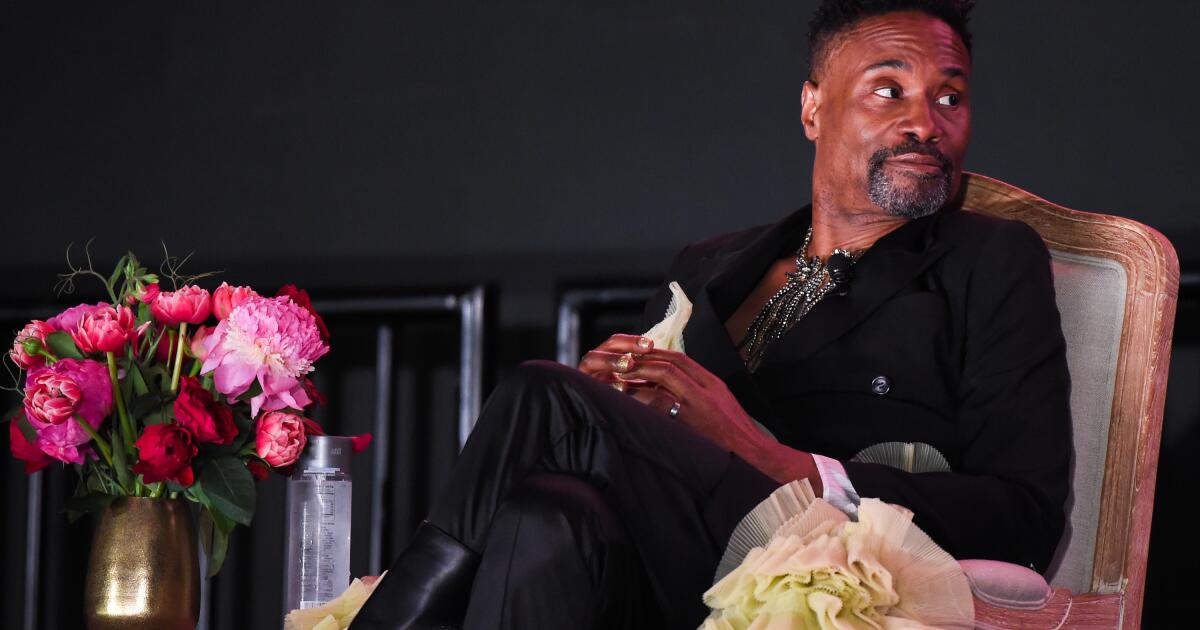
Billy Porter says a poorly treated urinary infection nearly killed him.
On Wednesday, the 56-year-old Broadway icon appeared on “Today” to promote his new children’s book, “Songbird in the Light,” and discussed a recent health scare that’s given the actor a new outlook on life.
“I am on the road to complete recovery,” he said, tearing up. “It is a gift to be alive. It’s still emotional to talk about it.”
Last year, Porter crossed the pond and made his West End debut starring as the Emcee in the musical “Cabaret,” which ran Jan. 28 through May 24 at London’s Playhouse Theatre. The Tony-winning actor said he was having a ball and living his purpose, but then he got a urinary infection.
“The medicine in the U.K. is trash,” he told “Outlaws” podcast host TS Madison earlier this month. “Four rounds of antibiotics and 10 to 12 weeks later, it’s a kidney infection with kidney stones.”
Porter eventually thought the infection had cleared up and returned to New York, where last fall he was gearing up for a Broadway revival of the musical starring as the production’s first Black Emcee, but his history-making run was cut short.
“I go into rehearsals for ‘Cabaret’ on Broadway … and everything seems fine, and a month in, the kidney stone pain comes back,” he told Madison.
On a Tuesday in September, Porter checked himself into the hospital due to debilitating pain, and then the “Pose” star subsequently fell into a coma and woke up days later on a Saturday evening.
“They went in to do a routine check. They saw that the kidney stone was trapped in my urethra, and they went in to put a stent in, redirect the urine, blast me with real antibiotics — not U.K. antibiotics — and blow up the kidney stones. When they got in there, there was so much pus and bile and infection behind the stone, it bubbled up and I went uroseptic in minutes.”
“I was dead for three days,” Porter said.
Porter said he was placed on an ECMO (extracorporeal membrane oxygenation) machine, which, according to Mayo Clinic, pumps blood outside of the body to a heart-lung machine, removes carbon dioxide from the blood and sends oxygen-rich blood back to the body. It’s essentially a life-support system.
While Porter was in a coma, he said, one of his legs went into compartment syndrome, which happens when there’s too much pressure around your muscles, causing reduced blood and oxygen flow and possibly leading to necrosis. “They had to cut me open on either side of my leg while I was in a coma, from my knee to my hip, and leave it open for two days so they could save my leg,” he told Madison, visibly choked up over the ordeal.
Porter told “Today” that the experience was mind-altering yet also inspiring. “My work here on this earth is not done, and that gives me hope.”
His new children’s book, “Songbird in the Light,” which follows a young boy who grapples with bullying while learning to embrace his talent and love himself, hit bookshop shelves this week.
PEAKY Blinders star Annabelle Wallis is expecting her first child with boyfriend Sebastian Stan, it has been reported.
According to TMZ, the actress and Hollywood heartthrob are bracing themselves to become first-time parents.
Sign up for the Showbiz newsletter
Thank you!
Sebastian and Annabelle are said to be expecting their first childCredit: Getty ImagesThe couple went public with their relationship in 2022Credit: WireImage
Annabelle and Sebastian went public with their relationship in 2022 after being spotted on holiday together in Greece.
While the couple have yet to confirm the news, insiders told TMZ they’re keeping the due date and gender under wraps.
It’s going to be a busy year for the stars with Sebastian gearing up for the release of two movies, Fjord and Avengers: Doomsday.
Meanwhile Annabelle is starring alongside Jason Statham in action film Mutiny which is set to be released in August.
Sebastian and Annabelle are known for keeping their private life out of the public eye and last year he shared their reason for doing so.
Speaking to Vanity Fair, he said: “I feel like it’s really difficult nowadays to be able to have any privacy whatsoever.”
Sebastian added that their relationship “is not something either of them discuss” publicly.
As well as being known for playing Grace Burgess in Peaky Blinders, Annabelle also starred as Jane Seymour in drama series The Tudors.
Sebastian got his big break in 2007 when he took on the role of lovable rogue Carter Baizen in Gossip Girl, starring alongside huge names including Blake Lively.
Sebastian and Annabelle are known for keeping their relationship privateCredit: FilmMagic
An Oscars slugfest for the ages ran its course, with “Sinners” and “One Battle After Another” duking it out and tallying up wins while the low but steady hum of host Conan O’Brien’s patented brand of weirdness tied the room together. A few unnecessarily curt speech interruptions threatened the calm, but mainly, this was a smoothly run machine of a show, devoid of mishaps. Even the rare circumstance of a tie was handled expertly by live-action-short award presenter Kumail Nanjiani, never bringing to mind the immortal confusion of “Moonlight” vs. “La La Land.”
But what didn’t make it to the telecast? Here are some flavorful takeaways — small yet memorable — that stick in mind from our several reporters in the room on Sunday.
A parade of praise for Jessie Buckley
Jessie Buckley arrives on the red carpet at the 98th Annual Academy Awards.
(Myung J. Chun / Los Angeles Times)
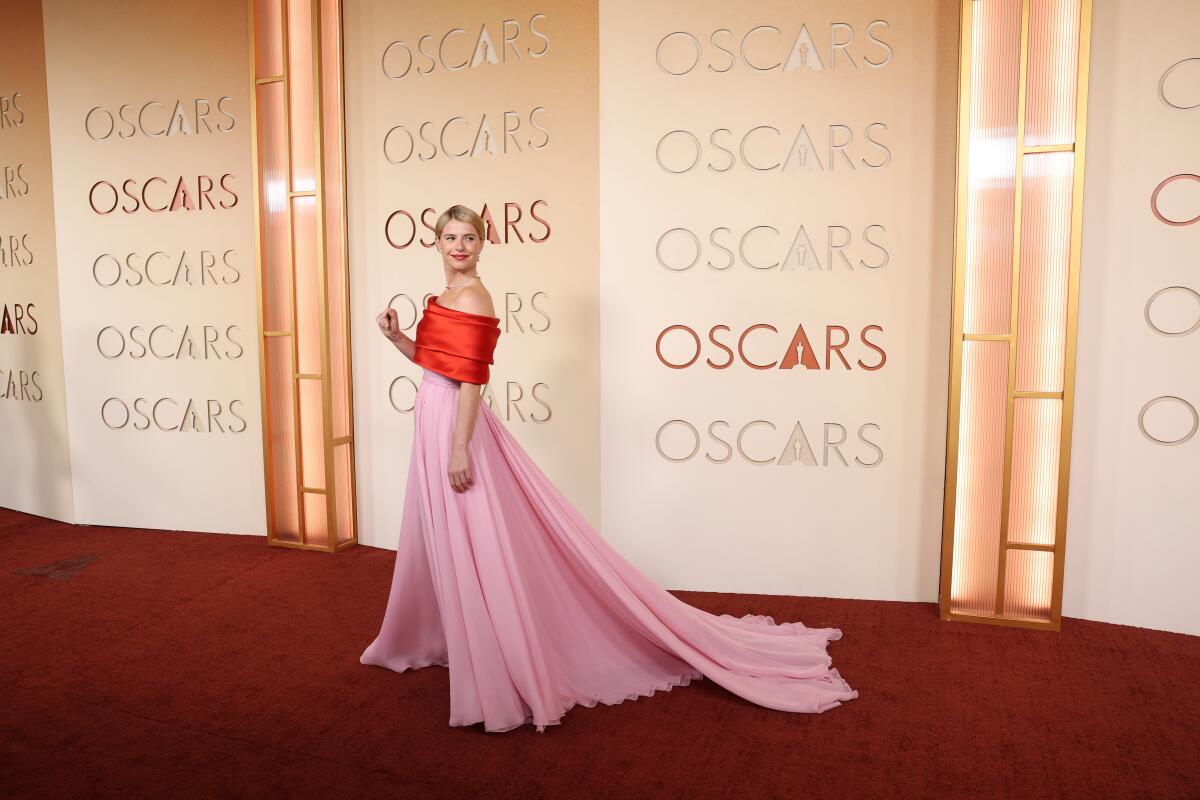
As she strode through the lobby of the Dolby Theatre pre-show, Jessie Buckley, nominated for lead actress for her role in “Hamnet,” was fanned with praise by other attendees. Even in the restroom, she couldn’t escape the well-wishers. On her way back to the buzzing lobby, she held the train of her red and pink Chanel gown graciously saying, “Thank you, thank you.” — Brittany Levine Beckman
The pressure’s off for stars during commercial breaks
Elle Fanning and Demi Moore hug during the 98th Academy Awards.
(Robert Gauthier / Los Angeles Times)
During the telecast’s first commercial break, supporting actress nominee Elle Fanning of “Sentimental Value” took her loss in stride and leaned over her seat to chat with former “A Complete Unknown” costar Timothée Chalamet, nominated this year for “Marty Supreme,” and his partner, Kylie Jenner.
Across the aisle, “One Battle After Another’s” Leonardo DiCaprio stood up and reached over to lock fingers with Benicio Del Toro. — Yvonne Villarreal
The Oscars address inflation with a goodie box
A note from Conan O’Brien left for attendees in snack boxes.
(Jessica Gelt / Los Angeles Times)
Each year, guests at the Academy Awards are given a small cardboard box of snacks left beneath their seats to get them through the always lengthy ceremony. A note from the host is generally inside. This year’s note, signed by Conan O’Brien, read, “I hope you enjoy this Conan O’Brien ‘Moderately Happy Meal’ ™. These snacks may not look like much but in any movie theater they would run you $85.” The snacks in question were a box of Junior Mints (Times reporter Josh Rottenberg got Raisinets), a small bag of Skinny Pop and a tin bottle of water. — Jessica Gelt
Jesse Plemons won’t succumb to ‘peer pressure’
Kirsten Dunst and Jesse Plemons arrive at the 98th Academy Awards at the Dolby Theatre in Hollywood.
(Myung J. Chun / Los Angeles Times)
“Bugonia” star Jesse Plemons stood near the main lobby bar talking with friends and posing for pictures with fans while finishing the dregs of a drink. A server approached him and asked if he’d like another. Plemons politely declined and the server laughed, saying, “Sorry, I didn’t mean to give you any peer pressure.” — Jessica Gelt
Amy Madigan inquires about press room rules; ‘Is it like bingo?’
Amy Madigan after winning the Oscar for supporting actress for “Weapons.”
(Kayla Bartkowski / Los Angeles Times)
After taking the stage to accept her first Oscar win for “Weapons” on Sunday, Amy Madigan paused operations in the press room to ask how moderators decide who gets to ask questions of the night’s winners.
“Is it like bingo?” the actor asked. As laughter swelled across the crowd in response, she clarified hers was a “serious question.” — Malia Mendez
After a loss, Stellan Skarsgård knows the meaning of ‘Sentimental Value’
Megan Everett-Skarsgård and Stellan Skarsgård at the 98th Annual Academy Awards.
(Myung J. Chun / Los Angeles Times)
Stellan Skarsgård, of “Sentimental Value,” enjoyed a cocktail in a VIP room just off the main auditorium fresh off of losing the Oscar for supporting actor to Sean Penn for his performance in “One Battle After Another.”
Fans rushed Skarsgård anyway, shaking his hand and telling him how much his performance as a troubled alcoholic father and artist resonated with them. “We had four actor nominations on an international film,” Skarsgård told one of them. “That’s never happened before.” — Jessica Gelt
Two of this Oscar season’s tallest figures share a moment
During a commercial break, 6-foot-5 “Frankenstein” star Jacob Elordi and 6-foot-6 Oliver Laxe, director of international feature nominee “Sirāt,” greeted one another at the lobby bar. The pair, who have been impossible to miss as two of the tallest people at various events throughout awards season, shared a warm, high-altitude embrace and Elordi introduced the French-born Laxe to his date for the Oscars: his mother, Melissa. — Josh Rottenberg
‘The Singers’ and ‘Two People Exchanging Saliva’ winners are happy to share their Oscars success
From left, producer Jack Piatt and director Sam A. Davis, makers of “The Singers,” pose with Natalie Musteata and Alexandre Singh, co-directors of “Two People Exchanging Saliva.” All of them won Oscars for live-action short.
(Kayla Bartkowski / Los Angeles Times)
Gasps erupted in the press room after presenter Kumail Nanjiani announced the seventh-ever tie in Academy Awards history Sunday evening, between live-action shorts “The Singers,” directed by Sam A. Davis and produced by Jack Piatt, and “Two People Exchanging Saliva,” directed by Alexandre Singh and Natalie Musteata.
Speaking to the press room after the ultra-rare event, Piatt was unbothered and even enthused by the outcome, saying he wished there could be a “five-way tie” among all the category’s nominees.
Davis agreed, confiding that he’d previously told the “Two People Exchanging Saliva” team “in confidence, that if we lost, I hope we lost to them.”
Shortly thereafter, Musteata said tying with “The Singers” folks was “such a dream.”
“Someone on Reddit asked us if we would be happy to share the award, and we were like, ‘Heck yeah, we would love to share it with another film that is equally beautiful and totally different.’ ” — Malia Mendez
Elle Fanning soothes Timothée Chalamet after lead actor Oscar goes to Michael B. Jordan
Elle Fanning talks with Stellan Skarsgård during the 98th Academy Awards. Timothée Chalamet was seated in front of Fanning during the show.
(Robert Gauthier / Los Angeles Times)
When Michael B. Jordan walked off stage and the show went to commercial break, Timothée Chalamet, who was up against Jordan in the lead actor category, took a sip of his drink as Elle Fanning, sitting behind him, gave him a pat on the back.
Fanning talked to her “A Complete Unknown” co-star throughout the night, who barely turned around to look at her. Kylie Jenner kept rubbing and patting Chalamet’s hand while he nervously jiggled his right leg. — Yvonne Villarreal and Jessica Gelt
Autumn Durald Arkapaw receives standing ovation in press room after historic win
Autumn Durald Arkapaw accepts the Oscar for cinematography for “Sinners” — the first woman to win the award.
(Robert Gauthier / Los Angeles Times)
“Sinners” shooter Autumn Durald Arkapaw on Sunday became the first woman to win the Oscar for cinematography. As she arrived backstage following her historic win, the press room erupted into applause, with many reporters delivering a standing ovation.
Arkapaw was equally thrilled, telling the room, “A lot of little girls that look like me will sleep really well tonight.”
“I heard Karen O say once at a concert… ‘You have to see you to be you,’” she said. “Ryan gives us, the women on this film, and our heads of department, he gives us those opportunities to shine and be ourselves and work in a creative environment where we’re leading.”
Such trust is rarely extended by directors, Arkapaw said, and she is grateful. — Malia Mendez
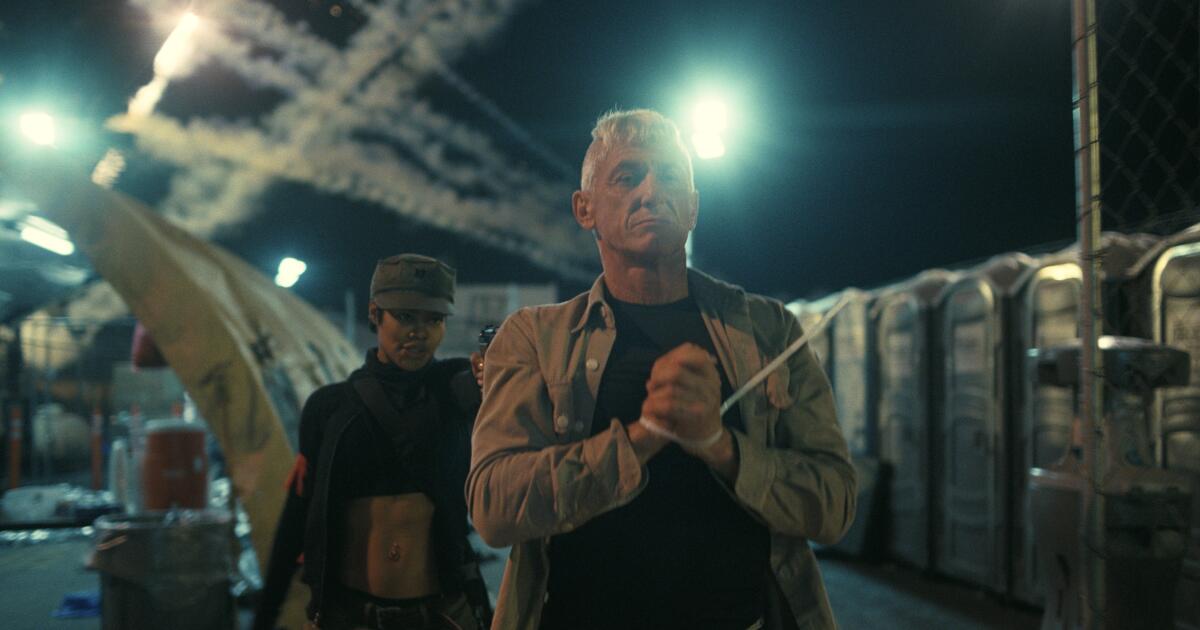
Sean Penn won the supporting actor Oscar on Sunday night for his performance as the ruthless, racist Col. Steven J. Lockjaw in Paul Thomas Anderson’s “One Battle After Another.”
The win marks the third Academy Award for the 65-year-old Penn and his first in the supporting category. He previously earned lead actor Oscars for “Mystic River” (2003) and “Milk” (2008), and had been nominated three other times in leading roles before this year. He beat out fellow nominees Benicio Del Toro for “One Battle After Another,” Jacob Elordi for “Frankenstein,” Delroy Lindo for “Sinners” and Stellan Skarsgård for “Sentimental Value.”
With his victory, Penn joins Meryl Streep, Jack Nicholson, Ingrid Bergman, Daniel Day-Lewis, Frances McDormand and Walter Brennan as three-time Oscar winners for acting. Katharine Hepburn is the only four-time acting winner.
Penn, who delivers a volatile, darkly comic performance in Anderson’s sprawling political thriller, emerged as the race’s front-runner after a surprise victory at the BAFTA Awards and the Actor Awards, whose voting body overlaps heavily with the motion picture academy.
Sean Penn did not attend the Oscars, so presenter Kiernan Culkin accepted the award on Penn’s behalf.
AUSTIN, Texas — “The Sun Never Sets” is filmmaker Joe Swanberg’s 10th indie to premiere at SXSW but his first to play the event since 2017. The astonishing pace with which he made his early work — loose, idiosyncratic stories that were progenitors of the emergent style known as mumblecore — has slowed significantly, but also given way to a newfound maturity as both a person and an artist.
Introducing “The Sun Never Sets” at its world premiere on Friday night to a sold-out crowd at the Zach Theater, Swanberg called his latest “my favorite film I’ve ever made.” Shot on 35mm in Anchorage, the movie follows a 30-ish woman, Wendy (Dakota Fanning in a vibrant turn), torn between pursuing a fresh romance with a reckless old flame (Cory Michael Smith) or continuing on with the settled-in-his-ways divorced father of two (Jake Johnson) she’s been seeing for a few years.
Dakota Fanning in Joe Swanberg’s “The Sun Never Sets,” filmed in Alaska.
(SXSW)
“I guess this is what they tell you about getting older and doing this job longer,” said a thoughtful Swanberg in a video interview from his home in Chicago shortly before the South by Southwest festival. “You get better at it and you sort of mature and all of this.”
The film marks Swanberg’s fourth collaboration with Johnson, a partnership that goes back to 2013’s “Drinking Buddies.” (The actor partly financed the new project along with his brother.) Following completion of the third season of the Netflix anthology series “Easy” in 2019, for which he wrote and directed all the episodes, Swanberg was planning to take a break. A divorce and the pandemic caused that pause to grow even longer.
In the intervening years Swanberg produced a number of projects for other filmmakers, did some acting and opened a small video store in Chicago. Swanberg knew Anchorage-based producer Ashleigh Snead, who encouraged him to consider shooting something there. The scenic location would give Swanberg the opportunity to expand his visual style from his usual couches, bars and apartments of much of his work. (There still are a surprising number of scenes on couches and in bars.)
“Joe’s a real filmmaker,” says Johnson in a separate interview. “And I think sometimes he doesn’t get that credit because he can make movies with nothing. This is a real adult movie. This is a film about how complicated breakups are and how messy they get. And it’s in beautiful Alaska.”
Swanberg, center, on the set of “The Sun Never Sets.”
(SXSW)
Swanberg has now gone from someone making talky, provocative and at times controversial films about the lives of post-collegiate 20-somethings to exploring the nuances and specifics of being a 44-year-old divorced father of two still trying to figure out his place in the world. His original cohort of SXSW-affiliated filmmakers, many of whom also fell under the rubric of mumblecore — nobody much liked the name, but no one ever came up with anything better, so it stuck — included Greta Gerwig, Lena Dunham, Barry Jenkins, Ti West and others who have gone on to more conventional mainstream success.
But Swanberg doesn’t seem to feel left behind. Rather, he only sees doors opening.
“It’s gone so much better than I thought it was going to go for me,” he says. “I mean, when I was making these really tiny, sexually explicit 71-minute movies, I was like, I’m just grateful to be here. I can’t even believe these festivals are showing this work and it’s so cool that there’s a space for me in this ecosystem.
“And so to watch my friends go off to do these giant movies, to see Greta doing ‘Barbie’ and stuff like that, to me it just opens up the possibilities,” he adds. “Each time a friend of mine sets some new record or moves into some new space, I’m kind of like: Oh, that just opened up for all of us now.”
His earlier work often featured raw sex scenes, sometimes featuring Swanberg himself. From practically the start of his career, well predating the #MeToo-era reckoning that began in 2017, Swanberg weathered accusations that he was exploitative and manipulative of his female performers. His stepback from productivity coincided with a moment when his explorations of sexual power dynamics fell out of favor. It would be easy to interpret that Swanberg preemptively soft-canceled himself to avoid a broader scandal. He doesn’t see it that way.
“Certainly in Chicago, where I’ve spent the last five years, I’m not unwelcome places,” he says, drawing a distinction between himself and “people who lose jobs or are capital-C canceled. But also my work has always pushed those boundaries and always attracted some amount of positive and negative attention.”
Though “The Sun Never Sets” has numerous kissing scenes, it doesn’t go too much further than that.
“I won’t do it,” Johnson says of more graphic scenes. “When I worked with Joe early on, I was like, ‘I love you, man — I’m not doing this.’”
For her part, Fanning had no reservations about working with Swanberg. He offered both Fanning and Smith the opportunity to work with an intimacy coordinator, but neither felt it was necessary.
“There was no planet where you’d ever be asked to do anything you were uncomfortable with,” Fanning says. “If there was ever a moment like, ‘I don’t want to do that,’ he’d be like, ‘Oh, then let’s not.’ There was a day where there was a scene and it was pouring rain outside. And we both looked at each other and he was like, ‘We’re not going to do it. The scene’s cut.’ He’s just open. And I just trusted him implicitly.”
Jake Johnson and Dakota Fanning in the movie “The Sun Never Sets.”
(SXSW)
Swanberg has long worked in an unusual style in which the script is essentially a detailed outline and the actors work to come up with their own dialogue during rehearsals. For “The Sun Never Sets,” Swanberg and Johnson developed the longest, most complete outline Swanberg has ever used, including some dialogue exchanges. Then the actors were allowed to make it their own.
Fanning recalled an early Zoom call with Swanberg and Johnson on which they explained the process.
“It’s still made like a real film,” Fanning says. “And Jake and Joe promised it’s not like we’re just flying by the seat of our pants: ‘You will know what to say, I promise.’ And then friends that know me asked, ‘Are you so nervous?’ And I was, but for some reason, I don’t know why, I just knew that it was going to be fine. And that just proved to be true.”
Even though it takes places in Anchorage, Swanberg calls “The Sun Never Sets” “extremely personal.”
“I was definitely writing a movie about a divorced mid-40s guy dating a younger person,” he says. “The questions of marriage and having children were sort of an amalgam of two real relationships that I merged into one onscreen.” He describes the material as “questions that I had and have about what my own relationships are going to look like post-divorce.”
That comes through in Fanning’s rich, layered performance, which might rank among the best of her already lengthy career. Swanberg’s style draws both an ease and an intensity from Fanning, who captures a woman at a pivotal moment of figuring out what she wants amid the emotional whirlwind she is going through. (At the film’s premiere, Fanning said, “I’ve never put so much of myself into a role before.”)
“I think the goal of Joe’s films, and I think at least my goal with this film, is trying to make everything feel real,” she says. “Things are just a mess some of the time.”
Dakota Fanning and Cory Michael Smith in “The Sun Never Sets.”
(SXSW)
Swanberg himself appears in a small role as the new husband of the ex-wife of Johnson’s character. And the characters of the two kids in the movie are named after the director’s own children. With a newfound maturity and emotional depth, Swanberg is continuing to make movies that are part diary, part generational markers.
“It’d be really cool in my 40s to make movies about characters in their 40s,” he says, “and in my 50s, 60s and 70s. It’d be neat to be making sexually explicit movies about 70-year-olds in their dating lives and sex lives and stuff. It’s really exciting to have movies about characters at this phase of their life, whether they’re finally settling down in their 40s or whether they’re getting out of relationships and reexamining their life. It’s where my head is at.” .
THE OSCARS is back for another year, and will see the crème de la crème of Hollywood clamouring to snatch one of those famous golden statues.
But despite the prestigious nature of the Academy Awards, they don’t always guarantee an A-list life forever in Tinseltown – as these past winners have found out…
Sign up for the Showbiz newsletter
Thank you!
Mo’Nique
Mo’Nique was riding high in her career when she scooped the Best Supporting Actress gong for PreciousCredit: AlamyHowever, shortly after winning the gong, the actress says she was ‘blacklisted’ from HollywoodCredit: Getty
Let’s kick off our look at forgotten Oscar winners with Mo’Nique, who claimed she was “blacklisted” after her win at the Academy Awards.
When she won the Oscar for Best Supporting Actress in 2010 for her performance in Precious it was her acceptance speech that got people talking, which began: “First, I would like to thank the Academy for showing that it can be about the performance and not the politics.”
Mo’Nique was referring to a fallout which started long before the Oscars.
It came when she refused to travel the world to promote the film – against the advisement of director Lee Daniels and producers Tyler Perry and Oprah Winfrey – despite the movie having “Oscar buzz”.
Following this fallout, Mo’Nique declined to thank filmmaker Lee during her acceptance speech, leading to a HUGE Hollywood feud – during which the actress alleged that he had “blackballed” her from the industry.
And shortly after winning the coveted statue she practically vanished from Tinseltown.
The star has since reflected on being a victim of so-called “Oscarscurse” – where stars suffer bad luck in their career after winning an Academy Award.
Speaking to CNN in 2020, Mo’Nique said: “I believe winning that Oscar award, just as Hattie McDaniel, she said, ‘I felt like I was cursed instead of winning something that should be congratulated’.
“That award was something that I did not ask for, but because I didn’t respond the way people thought that I should have responded, as Lee Daniels said, I was blackballed.”
Mercedes Ruehl
Mercedes Ruehl won the Academy Award for The Fisher King in 1992Credit: AlamyThe actress returned to the stage after the movie roles failed to pour in after her Oscar winCredit: Getty
At the 1992 Oscars, Mercedes Ruehl was having the time of her life after scooping the Best Supporting Actress gong.
Despite her movie The Fisher King being led by Hollywood heavyweights Robin Williams and Jeff Bridges, Mercedes was the one who took home that coveted gold statue.
But even though she won such a huge award, the movie roles failed to pour in after her night of glory and the actress “vanished” from Hollywood.
Reflecting on the “curse” of winning such a top prize, she told the HuffPost: “It’s hard to get a job after that.
“People think you want more money.”
Instead, Mercedes returned to the stage and went on to win a Tony award the same year as her Oscar – she has remained a fixture of Broadway ever since.
Harold Russell
Harold Russell (centre) won the Best Supporting Actor gong for The Best Years of Our LivesCredit: AlamyHarold was the first non-professional actor to win an OscarCredit: Getty
Harold Russell’s Oscars tale is very different to the others.
The late star lost both his hands in World War II and had them replaced by hooks.
Harold had never acted before when he played the role of Homer Parrish in The Best Years of Our Lives in 1946.
He was cast after the director of the film saw him in Diary of a Sergeant, an Army film about rehabilitating war veterans.
Despite his lack of acting experience, Harold proved to be a huge hit in The Best of Our Lives, and he won not one, but TWO Oscars for his role.
At the 1947 Academy Awards he was awarded the Best Supporting Actor and a special Honorary Academy Award for bringing hope and courage to fellow veterans.
Harold was also the first non-professional actor to ever win an Oscar.
But despite all this glory, he took a step back from acting and didn’t appear in another film until 1980.
Instead, he decided to get a business degree and devoted his life to charity.
Speaking about why he didn’t continue his Hollywood career, he told the Los Angeles Times in 1996: “Wyler (the director) told me I should go back to college because there wasn’t much call for a guy with no hands in the motion picture industry.
“I figured he was right. [In the handful of roles I’ve taken since then,] I always play a disabled veteran.
“And this is what Wyler said, ‘After a while they’re going to run out of ideas’—and he was absolutely right. How many times can you play the same role?”
Harold died in 2002 at the age of 88.
Roberto Benigni
Italian actor Roberto Benigni scooped the Best Actor gong and Best Foreign Film at the 71st Academy Awards in 1999Credit: AlamyThe actor is seen here at the Venice Film Festival in 2021Credit: Getty
Next up we have Italian actor Roberto Benigni, whose double Oscar win in 1999 caused quite a reaction.
The star won two gongs for the foreign film La Vita è Bella (Life is Beautiful), taking home the statues for Best Actor and Best International Feature Film – as he directed the movie too.
The film was the first non-English speaking picture to win the Best Actor award.
But Roberto, who was up against Tom Hanks, Ian McKellen, Nick Nolte and Ed Norton for the award, faced a huge backlash for his “over the top” reaction to winning the coveted gong.
He was seen climbing over audience seats to accept the award, which was slammed as being “chaotic”.
Roberto was also criticised for his “disingenuous” acceptance speech, where he appeared to make light of winning such a huge award.
“This is a terrible mistake. I used up all my English!” he joked, upon being handed the award.
Despite his big win, the actor retreated back to his native-Italy to make films instead of in Hollywood.
Speaking about life as a two-time Oscar winner, Roberto once told The Guardian: “The most important thing is to continue to be yourself.
“The day after the Oscars, you have to get on with your life. To be honest and true to yourself. I could have made a small film and kept all the money from Life is Beautiful. Instead, I spent more money than I had on Pinocchio, a very risky film.”
The actor is referring to his 2002 movie Pinocchio, which was only released in Italy and received mixed reviews from critics, with one calling it “the worst movie ever made”.
Marcia Gay Harden
Marcia Gay Harden won the Best Supporting Actress award for Pollack in 2000Credit: AlamyThe actress later called her win ‘disastrous on a professional level’Credit: Getty
Marcia Gay Harden beat the odds to scoop the Best Supporting Actress award for Pollack in 2000.
Critics were also shocked that Marcia won the Oscar as she hadn’t been nominated for any other major award in the run-up to the ceremony.
Despite the actress’s huge win, her movie career stalled and she headed back to the small screen.
Reflecting on being a victim of the “Oscar curse”, Marcia once told the LA Times: “It’s disastrous on a professional level.
“Suddenly the parts you’re offered and the money become smaller. There’s no logic to it.”
Mira Sorvino
In 1996, Mira Sorvino was the toast of the OscarsCredit: AlamyHowever, these days she is best known for Romy and Michele’s High School ReunionCredit: Getty
Mira Sorvino
Fans of the quirky movie Romy and Michele’s High School Reunion may be surprised to know that the film’s co-leading actress, Mira Sorvino, actually won an Oscar before starring in the cult classic movie.
A few years before, the actress won a huge amount of praise when she played a prostitute in Woody Allen’s Mighty Aphrodite.
She wowed so much, she scooped the Academy Award for Best Supporting Actress in 1996 for the role.
Despite going on to star in Romy and Michele’s High School Reunion the following year, the movie roles after that failed to pour in and she has switched her focus to TV.
Marisa Tomei
Film fans may be surprised to know that Marisa Tomei won an OscarCredit: Corbis Historical – GettyThe actress faced some backlash over her Oscar win, with a rumour going around that she was ‘given it by mistake’Credit: Getty
It may come as a surprise to film fans to find out that the actress won an Oscar in 1993 – but that is nothing compared to what happened on the actual night.
Shockwaves went through the prestigious ceremony when the relatively-unknown actress at the time scooped the gong for Best Supporting Actress, beating veteran stars like Joan Plowright and Vanessa Redgrave.
But it didn’t stop there, as poor Marisa, who won the award for her role in My Cousin Vinny, faced rumours that she had been given the Oscar “by mistake”.
Vicious gossip began to circulate that suggested that presenter Jack Palance had misread the envelope and mistakenly given the Oscar to Marisa instead of “its rightful owner”, Vanessa.
However, the Academy addressed the conspiracy theory and denied that she had been given it by “mistake.”
Speaking about the cruel rumour, Marisa once said: “That was really hurtful at first.”
Despite the fall out from her Oscar three decades ago, she has been nominated for two more since.
These days Marisa is best known for playing Spider-Man‘s mum in the famous franchise.
AN unexpected Brit name has been thrown into the ring to play the next James Bond.
Bookmaker Coral has announced the surprising news about who is currently in the lead to scoop the iconic role.
Sign up for the Showbiz newsletter
Thank you!
Daniel Craig’s role as the MI5 agent is up for grabsCredit: RexBack To Black star Jack O’Connell is the current frontrunnerCredit: Alamy
It has been revealed that Jack O’Connell’s name is flying high after seeing support rise over the last 48 hours.
The SAS: Rogue Heroes star is a big contender to jump into James Bond‘s boots with odds to 8-1 (from 33-1).
“Jack O’Connell’s next James Bond odds have collapsed over the last couple of days, with the British actor now just single figures in our betting for the iconic role,” said Coral’s John Hill.
The new movie will be written by Oscar-nominated filmmaker Steven Knight – who was behind iconic TV show Peaky Blinders.
The 28 Years Later actor has come a long way since his days in the Skins cast.
O’Connell has played a variety of roles since he starred in the TV teen drama as James Cook from 2009 to 2010 – and for the show’s final season in 2013.
Ever since Daniel Craig said goodbye to the role in 2021 release No Time To Die, the role of super spy 007 has been up for grabs, with speculation rife over who should take over.
Coral stated the odds: 4-5 Callum Turner, 3-1 Aaron Taylor-Johnson, 3-1 Theo James, 6-1 Henry Cavill, 8-1 Jack O’Connell, 10-1 Anthony Boyle, 12-1 Harris Dickinson, 16-1 Jack Lowden, 16-1 James Norton.
Jack as James Cook in E4s Skins from 2009-2010Credit: E4Jack starred in movie SAS: Rogue HeroesCredit: BBCCould Callum Turner be the next 007?Credit: AlamyJacob Elordi of Wuthering Heights fame is a favouriteCredit: AlamyPeaky Blinders boss Steven Knight will be behind the movie and has worked with JackCredit: Getty
Who will be the next James Bond?
Names in the mix to play 007 include:
Tom Holland
Fans have come up with a theory that Hollywood producer Amy Pascal – who has worked with Tom for years – could be involved in casting the new 007 film.
Henry Cavill
After playing legend Superman, Henry Cavill is now being tipped to be the next James Bond.
The former superhero would step into the role with ease.
James Nelson-Joyce
The actor first impressed audiences with his acting skills when he starred in Little Boy Blue alongside the legendary Stephen Graham.
After the release of his new flick, Jacob is now said to hold high odds.
Callum Turner
The London-born star was top of the list and has previously dodged questions on whether he’d take on the role.
Harris Dickinson
The newcomer actor’s stock has risen greatly over the past few years with appearances in Where The Crawdads Sing and steamy flick Babygirl, opposite Nicole Kidman.