Trump hasn’t deleted embarrassing tweets and Twitter keeps him accountable
Here’s a theory: It’d sure be easier for politicians to get away with flip-flops if there weren’t a bunch of their old tweets lying around like crime-scene DNA.
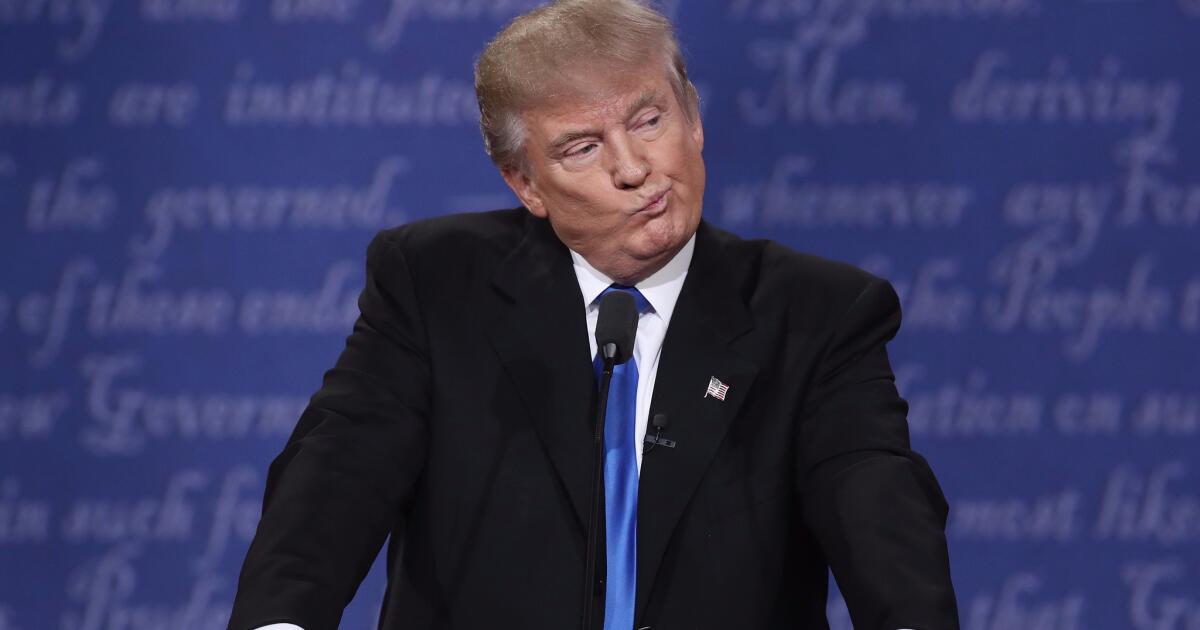
Check out this exchange from Monday night’s presidential debate.
HILLARY CLINTON: “Donald Trump thinks climate change is a hoax perpetrated by the Chinese. I think it’s real.”
DONALD TRUMP: “I did not. I did not. I do not say that. I do not say that.”
Except there’s this.
Even though it was four years old, Trump’s old tweet began picking up tens of thousands of retweets as the presidential debate raged on. (Reports that Trump’s team had deleted the tweet mid-debate were inaccurate. Also, while we’re here, the evidence is overwhelming: Climate change is real.)
It’s hard to imagine similar mass-sharing happening with a hard copy of a newspaper article, a years-old clipping suddenly passing through thousands of curious hands again. But thanks to Twitter, one of this election’s great accountability machines, what was old became new(s) again.
The phenomenon is also thanks in part to Trump himself, a prolific social-media user who, throughout this election, could have avoided storms of unfriendly retweets by deleting his old tweets — but he hasn’t, leaving himself a little more vulnerable to the searching eyes of his opponents.
Social media has been a dominant campaign medium in 2016, not just for the candidates but also for professional and amateur fact-checkers who have been doing their work with ferocious speed.
For gumshoes, it’s an arena of political argument aided by keyword searches, hyperlinks and screenshots, the kind of work that can be done on a smartphone while sitting on the couch. Opposition researchers, journalists and nonprofessionals alike have seen their handiwork go viral.
That means, for casual Twitter users, a candidate’s real-time remarks at a rally or a debate might appear in their feeds side-by-side with other users posting footage or transcripts of contradictory past statements.
Trump, who fact-checkers say routinely peddles fake information — like the lie that President Obama was born in Africa — has disproportionately seen his old tweets become targets, emerging again and again as objects of criticism, renewed with as little effort as hitting the retweet button. (Retweets are definitely not always endorsements.)
Twitter in particular has long been known as a place where professionals can lose their jobs or come under international pressure for saying something — well, often something pretty stupid, if not merely controversial. In recent years, online guides have offered recommendations for how regular users can delete old tweets lest they become liabilities.
The pressure is much higher on public figures. When comedian Trevor Noah won the job of hosting “The Daily Show,” he soon drew heat for old politically incorrect Twitter jokes; the same thing happened last week to new “Saturday Night Live” cast member Melissa Villasenor.
Some politicians have also gone on tweet-deleting escapades when a political situation suddenly goes sideways. Several lawmakers who welcomed Army Sgt. Bowe Bergdahl home from captivity in Afghanistan in 2014 later backtracked when information emerged suggesting Bergdahl may have deserted from his platoon. (Bergdahl goes to trial in 2017.)
Hoping to prevent politicians from editing the historical record, the Sunlight Foundation, a D.C.-based transparency advocacy group, runs a tool called Politwoops that tracks and preserves a record of when politicians delete tweets.
Many of the deleted tweets snared by Politwoops are innocuous typos. But a few reveal statements withdrawn after second thoughts, like U.S. Rep. Jeff Miller’s (R-Fla.) 2012 tweet, “Was Obama born in the United States?”
Yet Trump has not scrubbed his own notorious “birther” tweets, which he only recently publicly disavowed. (Trump’s campaign did not respond to a request for comment.)
For a politician who has routinely made news with his tweets — from retweeting white supremacists to congratulating himself after the Pulse nightclub mass shooting in Orlando, Fla. (“for being right on radical Islamic terrorism”) — Trump’s history of Twitter deletions in Politwoops is mostly for mispellings and bygone media appearances, rather than withdrawing substantive remarks.
Trump, for example, drew criticism in August for tweeting: “Dwayne Wade’s cousin was just shot and killed walking her baby in Chicago. Just what I have been saying. African-Americans will VOTE TRUMP!”
Critics accused Trump of using a person’s death to pander to black voters, pointing out he hadn’t even bothered to offer condolences, and the Trump account soon deleted the tweet — so it could put up a new version of the same tweet, this time with NBA star Dwyane Wade’s name spelled correctly.
It’s still there.
Clinton’s Twitter account deletes a few tweets a month, though in each instance it’s not clear why. Clinton is better known for her tweet to Trump, “Delete your account” — a popular Internet joke — which has earned nearly 500,000 retweets.
Now, the question arises of how Trump changes — or doesn’t change — after the election, win or lose.
“In this election, we’re talking more about the tweets that aren’t deleted than the tweets that are, and that’s an interesting reflection on where we are and how we view social media,” said Josh Stewart, a spokesman at the Sunlight Foundation. “It would be interesting to see if the use of social media by politicians changes after this election, or if he’s an outlier.”
Email: matt.pearce@latimes.com
Follow me on Twitter: @mattdpearce
ALSO:
What people around the world thought of the first U.S. presidential debate
Transcript: The most important exchanges of the presidential debate, annotated