access

South Koreans split with experts on North Korea website access

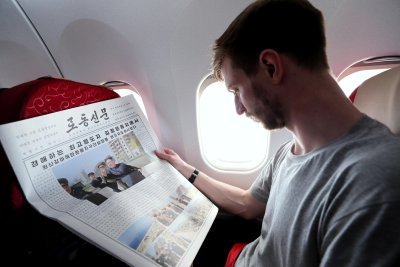
A foreign journalist who covered North Korea’s Punggye-ri nuclear test site demolition reads the Rodong Sinmun, the official newspaper of the country’s Workers’ Party, on a North Korean chartered flight heading to Beijing, China. File. Photo by YONHAP / EPA

April 24 (Asia Today) — Nearly two-thirds of South Koreans oppose allowing access to North Korean websites, while most experts support the idea, the Presidential Advisory Council on Democratic and Peaceful Unification said Friday.

According to the council’s first-quarter public opinion survey on unification, 63.6% of respondents said they did not agree with a proposal to allow access to North Korean websites to help the public better understand North Korean society.

In contrast, 71.3% of 149 experts on unification and North Korea issues said they supported the proposal, showing a sharp gap between the general public and specialists.

The survey also found that 59.2% of respondents supported President Lee Jae-myung’s proposal, presented in a March 1 Independence Movement Day speech, to ease tensions between the two Koreas and work with relevant countries to transform the armistice system into a peace regime.

A separate 61.6% said they supported continuing the government’s policy of peaceful coexistence on the Korean Peninsula.

On the need for reunification, 65.9% said it was necessary, down 2.1 percentage points from the previous quarterly survey. Respondents cited eliminating the threat of war, at 29.2%, and economic development, at 26.3%, as the top reasons for reunification.

Views were mixed on North Korea’s “two hostile states” doctrine.

Among respondents, 27.7% said they do not recognize the North Korean regime but recognize inter-state relations with the North. Another 24.9% said they recognize both the North Korean regime and inter-state relations.

A separate 24% said they recognize neither the North Korean regime nor inter-state relations, while 16.7% said they recognize the regime but do not recognize inter-state relations.

The survey was conducted by Korea Research from March 27-29 on 1,200 adults nationwide. It had a confidence level of 95% and a margin of error of plus or minus 2.83 percentage points.

— Reported by Asia Today; translated by UPI

© Asia Today. Unauthorized reproduction or redistribution prohibited.

Original Korean report: https://www.asiatoday.co.kr/kn/view.php?key=20260424010007858
Source link

Milei administration in Argentina blocks journalist access to Casa Rosada | Freedom of the Press News

Press freedom advocates have warned of hostile rhetoric towards journalists and increasingly restrictive policies under Milei.

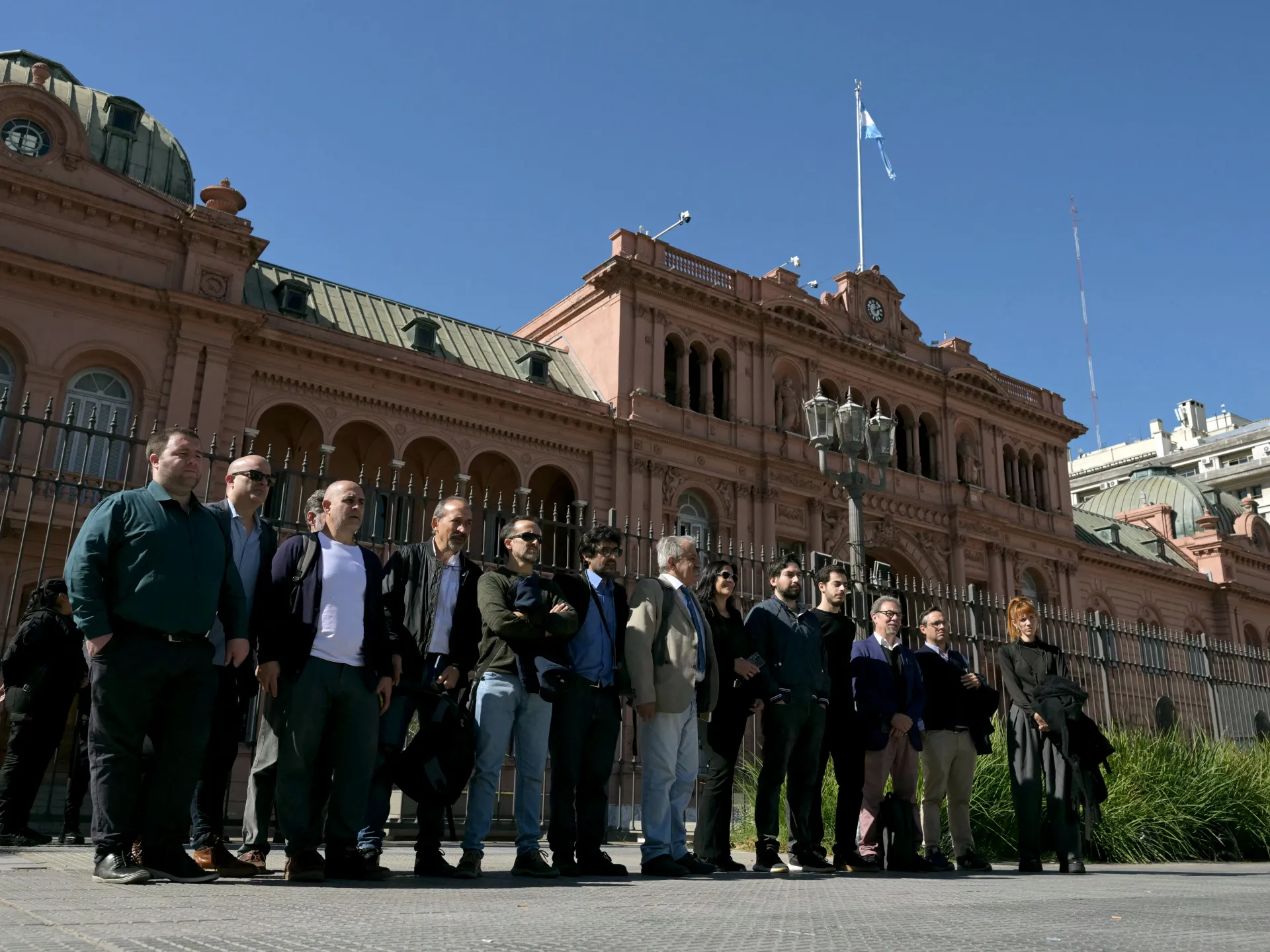
The administration of Argentina’s Javier Milei has restricted access to the presidential palace, the Casa Rosada, as part of an escalating feud with the country’s journalists.

Accredited journalists reportedly arrived at the Casa Rosada on Thursday and attempted to enter the building through fingerprint scanning, as they usually would.

Recommended Stories

list of 3 itemsend of list

But they were unable to pass the scan. As confusion hit the news corps, the head of Argentina’s Secretariat of Communication and Press issued a clarification that their press accreditation had not been revoked.

“The decision to remove the fingerprints of journalists accredited to the Casa Rosada was taken as a preventive measure in response to a complaint filed by the Military Household regarding illegal espionage,” Secretary Javier Lanari wrote on social media.

“The sole objective is to guarantee national security.”

Lanari’s post cites an incident wherein two journalists from the Argentinian channel TN were accused of secretly filming inside the government palace.

After their report was broadcast, the Milei administration accused the journalists of endangering government security by showing parts of the Casa Rosada that were reportedly off limits.

On Wednesday, Milei himself took to social media to call the journalists “repugnant trash”. He then challenged other members of the news media to justify their actions.

“I would love to see that filthy scum — the 95% who carry press credentials — come out and defend what these two criminals did,” Milei wrote on X.

Since then, the president has repeatedly reposted messages critical of the news media, often accompanied by the acronym “NOLSALP” or “NOL$ALP”. It stands for: “We don’t hate journalists enough.”

“Someday, that filthy journalistic scum (95%) will have to understand that they are not above the law. They abused legal precedent. It does not come without a price,” Milei added in one of his posts on Thursday, as he continued to slam the news media.

This week’s actions are the latest in a series of policy changes under Milei designed to tighten restrictions on journalists.

Last year, for instance, his government capped entry to certain rooms in the Casa Rosada and placed other areas out of bounds.

Critics say the policies are part of a wider broadside against journalism in Argentina. The media advocacy group Reporters Without Borders (RSF) has said that, since Milei took office in 2023, the country has seen “a sharp decline in press freedom”.

And PEN International, an organisation for writers, warned last year of a “serious deterioration” in free-speech rights.

It pointed to legislation that further restricted which government documents could be made public and to Milei’s dismantling of public media, as well as the installation of a “mute” button to silence journalists during news conferences.

Already, the decision to bar journalists from entry into the Casa Rosada has faced pushback, including from Argentinian lawmakers.

Marcela Pagano, a former journalist turned deputy in Argentina’s legislature, announced on Thursday that she had filed a criminal complaint against Milei.

“The Casa Rosada is not private property,” Pagano wrote in a statement.

“Still less does a head of state — or his henchmen officials — have the authority to decide whether the press may access the building.”

She called Thursday’s incident “an unprecedented occurrence since the return of democracy” in Argentina in 1983.

“Prohibiting journalists from exercising their freedom of expression is the first step toward silencing any dissenting voice — a situation that we in Argentina have experienced during our country’s darkest moments,” she added. “THEY WILL NOT SILENCE US.”

Source link