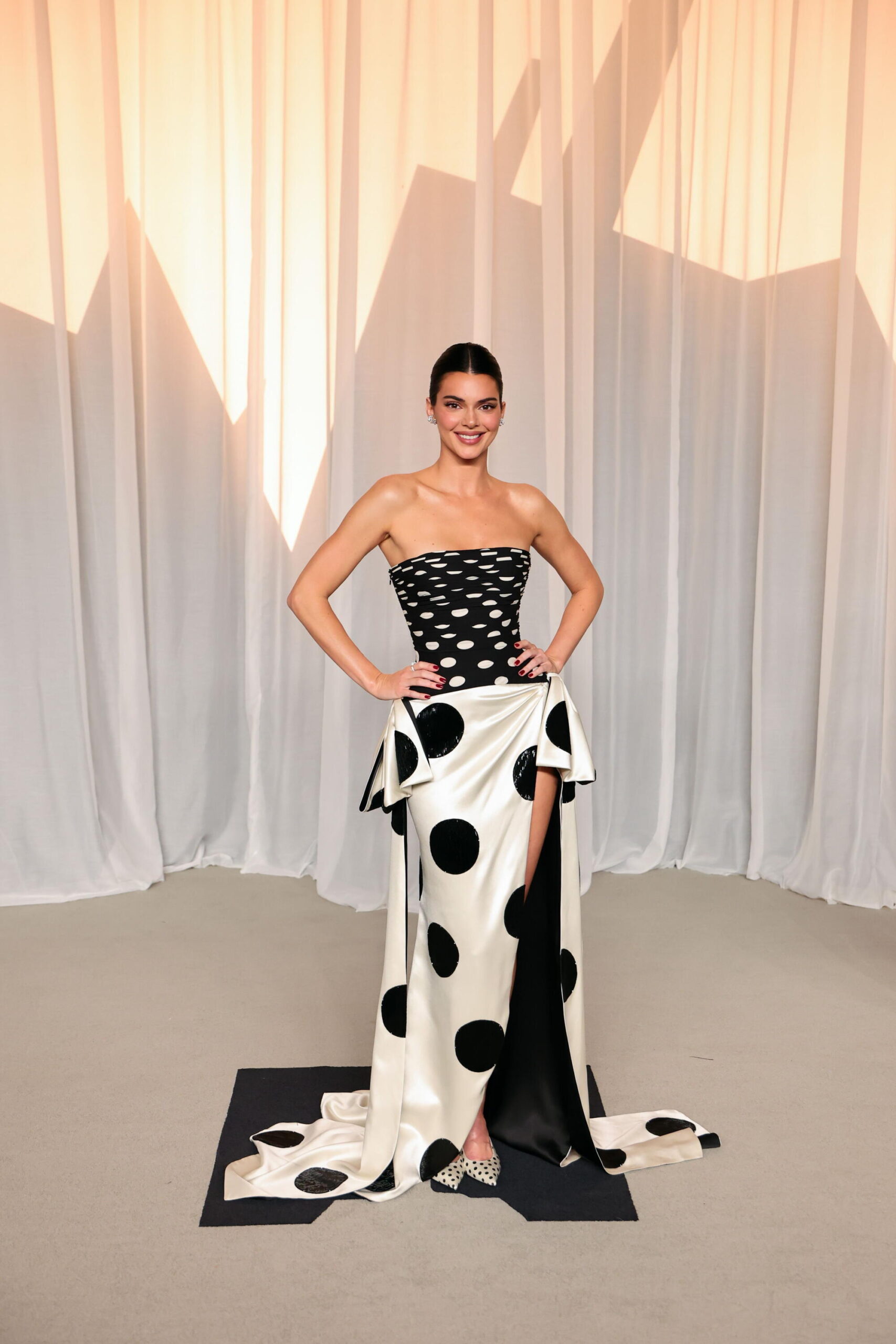
In a year chock-full of museumgalas, the Academy Museum of Motion Pictures’ Saturday night soiree was especially star-studded.
The sixth annual fundraiser honored Oscar winner Charlize Theron with the Icon Award, filmmaker and composer John Carpenter with the Luminary Award and Academy Award nominee Colman Domingo with the Vantage Award. Theron, who starred this year in presumed best picture frontrunner “The Odyssey,” and Domingo, who appeared in “Disclosure Day” and “Michael,” stole the red carpet spotlight. Other red carpet standouts included Kendall Jenner, Jessica Biel and Teyana Taylor.
The gala, which raised over $14 million for the Academy Museum’s exhibitions, screenings and education programs, also tapped one of the biggest entertainers in the world to perform: Taylor Swift.
The gala was co-chaired by Tom Ford, Robert Rodriguez, Steven Spielberg and Kate Capshaw. The host committee included Jessica Alba; Judd Apatow and Leslie Mann; Autumn Durald Arkapaw; Adrien Brody and Georgina Chapman; Jon M. Chu; Kirsten Dunst; Nicholas Galitzine; Ludwig and Serena Göransson; Regina Hall; Kate Hudson; Jessica Lange; Greta Lee; John Legend and Chrissy Teigen; Rami Malek; Demi Moore; Olivia Munn; Gina Prince-Bythewood; Questlove; Da’Vine Joy Randolph; Seth Rogen and Lauren Miller Rogen; Bird Runningwater; and Teyana Taylor. Chu was a co-chair for last year’s event.
Here are the 10 best looks from the red carpet.
Kendall Jenner
Kendall Jenner was decidedly absent from Sunday’s Victoria’s Secret Fashion Show, but commanded the Academy Museum Gala on Saturday in a black-and-white polka-dotted Valentino gown.
(Emma McIntyre / Getty Images for Academy Museum)
Sabrina Carpenter
Sabrina Carpenter brought a pop of color to the beige carpet in a custom Giorgio Armani Privé gown with side cutouts and crystal tassels cascading down the back.
(Emma McIntyre / Getty Images for Academy Museum)
Jessica Biel
Jessica Biel brought sexy back in a black velvet halter gown with a thigh-high slit.
(Emma McIntyre / Getty Images for Academy Museum)
Alexa Demie
Alexa Demie is a goddess in another standout feather-trimmed look: a mint green custom Chanel gown.
(Emma McIntyre / Getty Images for Academy Museum)
Eiza Gonzalez
Eiza Gonzalez looked timeless in Ralph Lauren.
(Emma McIntyre / Getty Images for Academy Museum)
Kate Hudson
No one does Old Hollywood glamour quite like Kate Hudson, who was radiant in custom Armani Privé.
(Emma McIntyre / Getty Images for Academy Museum)
Taylor Swift
Taylor Swift dazzled in Dior — her best look to date.
(Emma McIntyre / Getty Images for Academy Museum)
Colman Domingo
Honoree Colman Domingo sparkled in a Valentino sequin blazer.
(Emma McIntyre / Getty Images for Academy Museum)
Teyana Taylor
Teyana Taylor turned heads in a robin’s egg blue Schiaparelli bustier dress.
(Emma McIntyre / Getty Images for Academy Museum)
Adria Arjona
Adria Arjona looked elegant in a strapless black dress with a white neckline.
Saracens have sacked Totoa Auvaa, the academy player who was involved in a nightclub incident with England cricketers Ben Stokes and Gus Atkinson in June.
The English Prem club have confirmed that the 21-year-old Samoan forward has left with immediate effect following another incident in St Albans on Saturday.
Auvaa had originally been stood down from all club duties while Saracens investigated the matter.
“The club has determined that his conduct falls short of the standards expected of everyone who represents Saracens, both on and off the pitch,” read a club statement., external
“We take our responsibilities to our supporters, young people and partners seriously and we remain committed to upholding the standards of our conduct expected across the club.”
A disciplinary hearing by the England and Wales Cricket Board (ECB) found that then England captain Stokes and pace bowler Atkinson breached “contractual obligations” but were blameless for “violent conduct” in an incident in June.
Both were present in a London nightclub when a member of England’s security staff was left bloodied and in need of medical attention after being struck by Auvaa.
Stokes and Atkinson were made unavailable for England’s second Test defeat by New Zealand while Auvaa was not sanctioned.
NBA says its focus is on new global academy opening in Abu Dhabi as Africa, Mexico and Australia hit by closures.
Published On 2 Oct 20262 Oct 2026
The NBA has closed its only elite training academy in Africa, less than a decade after it was launched in Senegal to prepare promising young African players for professional leagues in the United States and elsewhere.
The decision to close NBA Academy Africa was a blow to students and young players across the continent, two former employees said.
Recommended Stories
list of 4 itemsend of list
Michel Chikwanine, who had been the academy’s performance and lifestyle adviser, said late Thursday that the news discouraged African players just beginning to build confidence.
“From the moment we told them, their confidence waned, their confidence dropped,” he said.
Michael Abbott, former head of academic planning at the academy, said it showed a lack of commitment to the students.
“They weren’t invested in them as kids as much as they were invested in the business model,” he said.
In response to questions from the Reuters news agency, the NBA said the decision reflected a shift in global basketball development strategy. It has previously closed academies in Mexico and Australia. All training will be run out of a new global academy to open soon in Abu Dhabi in the United Arab Emirates, it said.
In its statement, the NBA added that it is continuing to invest in African talent through other programmes and closing the academy does not signal a diminished commitment to the continent.
It cited examples such as the creation of a Basketball Africa League, which has concluded six seasons, and Basketball Without Borders, which organises elite training camps for young people worldwide, including in Africa.
NBA success in Africa followed by closure
NBA Academy Africa has trained about 110 students since launching in Senegal in 2018, Abbott said, and many have moved on to elite schools and universities in the US. The most successful students were drafted into the NBA.
Graduate Ulrich Kamka Chomche of Cameroon became the first player to be drafted into the NBA in 2024 and played for the Toronto Raptors. Former academy student Khaman Maluach of South Sudan plays for the Phoenix Suns.
Chikwanine said closing the academy will limit opportunities for African players, who often come from challenging backgrounds and need specific support. All African prospects will have to compete globally for spots in the UAE.
He said the NBA’s decision reinforced a message felt by many Africans that big companies come to the continent claiming to want to invest in people but in reality just want to make money.
“They come in with an extraction mindset,” he said. “That has always been a reality on the continent of Africa. … There is a huge mistrust that has been built.”
The NBA denied that closing the academy would limit opportunities for young African players. It said training all young players at a single location would give them greater exposure to professional coaches and scouts worldwide.
“We’re incredibly proud of the impact that NBA Academy Africa has had and remain committed to developing the next generation of African players,” Troy Justice, NBA senior vice president, said in a statement, adding that several other youth development initiatives still operate on the continent.
Russian forces have again struck the Ukrainian capital, Kyiv, hours after a drone hit the National Academy of Sciences in the historic centre of the city, killing at least two people.
Explosions were heard across Kyiv early on Tuesday, with Mayor Vitali Klitschko saying missile debris had fallen in the courtyard of one building while a second had caught fire in another part of the city.
Recommended Stories
list of 3 itemsend of list
The attacks come as Russia has begun hitting Kyiv and other Ukrainian cities with faster, high-flying jet drones.
Emergency officials said the strike on the National Academy of Sciences on Monday killed two people, with one person’s body recovered from the rubble later in the evening.
Video shared online appeared to show a fast-moving drone slamming into the building at a steep angle and exploding, sending smoke into a clear sky. People were seen leaning out of windows as bright orange flames engulfed part of the building.
Volodymyr Horbulin, a former secretary of Ukraine’s National Security and Defence Council, told the public broadcaster Suspilne that he was at work at the academy when it came under attack. He said his assistant, who was near the building, was killed and that he was also slightly wounded.
The academy is near the German Embassy, a cathedral, the national opera and government buildings.
In a statement, the academy called the attack “Russian terror” and “barbarity” aimed at “peaceful people who were simply at their workplaces”.
Foreign Minister Andrii Sybiha accused Russia of cynicism for hitting a scientific institution during the workday.
“Russia is deliberately expanding the boundaries of what it believes the world will tolerate,” he said in a statement, urging Ukraine’s allies to provide more air defences.
Jet-powered drones
Ukrainian President Volodymyr Zelenskyy said Russian forces also hit a medical facility in Kyiv on Monday. He said at least nine people had been killed in Russian drone strikes throughout the country, while more than 80 people were wounded.
In his nightly video address, Zelenskyy said Ukraine was still having difficulty countering the faster, high-flying Russian jet-powered drones.
“New interceptors are being actively tested,” he said. “Some combat groups are using them, but, of course, some details still need to be refined to achieve enough effectiveness and scale. We are speeding up the developers.”
According to the Ukrainian president, 90 of 120 drones fired on Ukraine on Monday were jet-propelled, rather than propeller-driven, with an interception rate for this type of drone at 57 percent.
Widening targets
Officials said the Russian strikes on Kyiv also targeted a pharmaceutical company and petrol stations. In other cities and regions, civilian facilities, businesses and communications infrastructure were hit.
In the southeastern city of Dnipro, a Russian drone attack on a business centre killed three people and wounded 19, according to officials. Another person was killed in a logistics office in Synelnykove, southeast of Dnipro, the regional governor said.
Emergency services said an attack on infrastructure in the southeastern city of Zaporizhzhia wounded 32 people.
Al Jazeera’s Jonah Hull, reporting from Kyiv, said Russia has been hitting economic targets across Ukraine “in a rolling series of strikes that have been ongoing for six days now”, during the day and night.
“Data centres increasingly being hit, as well as digital and communications infrastructure,” he said. “Kyiv Star, the country’s biggest cell provider, was hit on Sunday, as was the second biggest, Vodafone Ukraine. The government is said to be preparing for the worst: a total blackout in communications should that come.”
The Russian attacks have brought Kyiv “firmly into the eye of this war”, Hull added.
Ukraine has also increased attacks on Russia, targeting oil refineries as well as online retailers to try to undermine revenues and support for Moscow’s war effort.
Zelenskyy said on Monday that Ukraine struck Russian oil facilities in the Krasnodar region and two defence plants.
Both sides have denied deliberately targeting civilians.
When it comes to scary movies, the motion picture academy has historically been a bit squeamish. Horror has been a cornerstone of the industry since the beginning, but Oscar voters have rarely embraced it. Only one horror film has ever won best picture: 1991’s “The Silence of the Lambs.” Even “Sinners,” which made history this year with a record 16 nominations, couldn’t close the deal.
Now, though, horror has gotten inside the house.
Opening Saturday and running through July 25, 2027, the Academy Museum of Motion Pictures’ new exhibition, “The Horror Show,” explores more than a century of horror, from silent-era landmarks “The Cabinet of Dr. Caligari” (1920) and “Nosferatu” (1922) through “Psycho” (1960) and “The Exorcist” (1973) to “Midsommar” (2019) and “Weapons” (2025). Drawn from the academy’s collection and 62 private lenders around the world, it brings together costumes, props, prosthetics, creatures and production art.
An original facehugger from Ridley Scott’s “Alien” (1979), part of the exhibition’s collection of creatures and production materials from the sci-fi series.
(Kayla Bartkowski / Los Angeles Times)
Introducing the exhibition at Thursday’s press preview, Robert Englund, who played the razor-fingered Freddy Krueger in the “Nightmare on Elm Street” films, recalled how the genre was once regarded in Hollywood. “Back when I started, we would sort of get the lousy table in the commissary by the kitchen door,” he said. Now, with the academy mounting an exhibition devoted to horror and the genre continuing to thrive at the box office, Englund added, “I think we’re getting some respect.”
Rather than a simple chronological tour through the genre’s history, the exhibition is organized into six themed “chambers” devoted to Gothic horror, psychological horror, science, slashers, religion and ghosts, with settings ranging from a shadowy crypt to a killer’s house and a haunted living room.
Storyboards from 1973’s “The Exorcist,” a clapperboard from 1976’s “The Omen” and the original Necronomicon from 1987’s “Evil Dead II” are among the artifacts in the exhibition’s religion-themed chamber.
(Kayla Bartkowski / Los Angeles Times)
Senior exhibitions curator Jessica Niebel says the idea was to walk a line between a traditional museum exhibition and a haunted-house experience.
“Horror films are about evoking an emotional response and we’re hoping the exhibition will do the same,” she says. “These are all original objects and they tell a story. We wanted to place them in an environment that brings them to life and activates them.” (The museum advises parental guidance; a smaller, family-friendly “Zombies!” exhibition is next door.)
So what’s lurking inside? Here are 10 sights worth braving. Read on, if you dare.
See Bela Lugosi’s original Dracula cape
Bela Lugosi’s original cape from 1931’s “Dracula,” on public display for the first time after undergoing an extensive restoration.
(Kayla Bartkowski / Los Angeles Times)
Nearly a century after Bela Lugosi first swept it around his shoulders, Dracula’s cape doesn’t need much introduction. Worn by Lugosi in Universal’s 1931 “Dracula,” the simple black cape became as inseparable from the character as his hypnotic stare and Hungarian accent, establishing the visual language of the screen vampire for generations to come. Lugosi, who had first played the Count onstage in 1927, kept the cape after filming and continued wearing it for stage and public appearances until his death in 1956. Now part of the Academy Museum’s collection, the nearly century-old garment underwent an extensive restoration before “The Horror Show.” Remarkably, this is the first time it has ever been put on public display.
Come face-to-face with Hannibal Lecter
Anthony Hopkins’ Hannibal Lecter costume and restraints from 1991’s “The Silence of the Lambs” are on display, including the serial killer’s unmistakable mask.
(Kayla Bartkowski / Los Angeles Times)
Anthony Hopkins’ Hannibal Lecter, the brilliant psychiatrist and cannibalistic serial killer at the center of Jonathan Demme’s “The Silence of the Lambs,” is unsettling enough standing perfectly still. When he has to be moved, the precautions are extreme. Hopkins wore this orange prison uniform, straitjacket and muzzle when Lecter is transported under heavy security, strapped upright to a hand truck. Costume designer Colleen Atwood devised the ensemble, while Ed Cubberly created the famous fiberglass muzzle, deliberately leaving it uncoated to evoke the look of dried, taut skin. Seeing the outfit up close is a reminder of just how little Hopkins needed to work with: Even with virtually his entire body immobilized and much of his face obscured, Lecter somehow became more frightening.
Trace the evolution of the Xenomorph
A towering Xenomorph created by Legacy Effects for 2024’s “Alien: Romulus” offers an up-close look at one of horror’s most enduring monsters.
(Kayla Bartkowski / Los Angeles Times)
Nearly half a century after Ridley Scott’s “Alien” introduced H.R. Giger’s nightmarish vision to moviegoers, the creature still looks like nothing else in science fiction. The exhibition brings together original Giger artwork depicting the alien egg and an original facehugger from the 1979 film, the spidery parasite whose method of reproduction helped make “Alien” a landmark of body horror. There’s also an original drawing by James Cameron, who took over the franchise with 1986’s “Aliens.” But the hardest thing to miss is a towering Xenomorph created by Legacy Effects for 2024’s “Alien: Romulus.” Up close, its elongated head, skeletal body and glistening double set of jaws reveal just how much unsettling detail goes into a creature often glimpsed onscreen in darkness.
See Dracula’s armor go from page to screen
Eiko Ishioka’s blood-red armor for Gary Oldman’s Count Dracula in Francis Ford Coppola’s 1992 “Bram Stoker’s Dracula.”
(Kayla Bartkowski / Los Angeles Times)
Before Gary Oldman’s Dracula became a pale, bewigged count, he was Vlad the Impaler, encased in one of the most striking costumes in Francis Ford Coppola’s 1992 “Bram Stoker’s Dracula.” Eiko Ishioka designed the blood-red battle armor with a ribbed surface evoking both exposed human musculature and an armadillo’s shell, while the pointed helmet foreshadows the wolf Dracula later becomes. Displayed alongside several of Ishioka’s original design drawings, the armor offers a fascinating look at how her ideas evolved from pencil on paper into something almost anatomical. Ishioka, a celebrated Japanese graphic designer making her first foray into Hollywood costume design, won an Oscar for her work on the film.
Log on to the original ‘Blair Witch’ website
Visitors can explore the groundbreaking viral promotional website for 1999’s “The Blair Witch Project,” which blurred the line between the film’s fictional story and reality.
(Kayla Bartkowski / Los Angeles Times)
Long before viral marketing had a name, 1999’s “The Blair Witch Project” was using the still-young internet to convince moviegoers that three student filmmakers might actually be missing in the woods. Directors Daniel Myrick and Eduardo Sánchez created the film’s promotional website in 1998, filling it with fake police reports, evidence photographs and an elaborate mythology while carefully avoiding any suggestion that their story was fictional. They posted on message boards and continually updated the site before the film’s release, helping turn a tiny found-footage horror movie into a grassroots phenomenon. Here, you can sit down at a chunky late-’90s computer and explore the original site yourself. Nearby is one of the movie’s crudely constructed stick figures — a reminder that sometimes a few twigs and some twine are all it takes to lodge an image permanently in the culture.
Meet the slashers
Costumes and props from some of horror’s most notorious killers fill the exhibition’s slasher chamber, including Candyman, Ghostface, Michael Myers, Freddy Krueger and Art the Clown.
(Kayla Bartkowski / Los Angeles Times)
Slasher movies have always depended on a memorable killer, and the genre has produced some of horror’s most instantly recognizable figures. Freddy Krueger, Michael Myers, Ghostface and Art the Clown are gathered here in full costume, looking less like museum pieces than a welcoming committee you’d rather not encounter. Nearby cases turn slasher movies’ grisly tools of the trade into artifacts, with masks and weapons from “Saw,” “Us,” “M3GAN,” “The Black Phone” and other films. It’s a reminder of how little a slasher movie really needs to get under your skin.
Open the Babadook’s book
The handmade “Mister Babadook” pop-up book created by illustrator Alex Juhasz for Jennifer Kent’s 2014 “The Babadook.”
(Kayla Bartkowski / Los Angeles Times)
Sometimes the scariest special effect is a pop-up book. In Jennifer Kent’s 2014 “The Babadook,” the sinister children’s book “Mister Babadook” heralds the arrival of the top-hatted creature that terrorizes a widowed mother and her young son, while giving physical form to the grief consuming them. Kent turned to illustrator Alex Juhasz to create the handmade book, drawing inspiration from the eerie silhouetted animation of German filmmaker Lotte Reiniger from the 1920s. Opened to one of its more elaborate spreads, the original prop is both beautifully crafted and deeply unsettling, its seemingly innocent children’s-book mechanics revealing a grinning black figure and the ominous command: “LET ME IN.”
Take a selfie with Norma Bates
A re-creation of the mummified Mrs. Bates from Alfred Hitchcock’s immortal “Psycho” gives visitors a chance to pose with Norman Bates’ dearly departed mother.
(Kayla Bartkowski / Los Angeles Times)
The Academy Museum wanted the original mummified Mrs. Bates head from Alfred Hitchcock’s “Psycho,” but there was one problem: She was too fragile to travel. The Cinémathèque Française, which owns the 1960 prop, declined the museum’s loan request. “I was really disappointed about that, but it’s totally understandable,” Niebel says. “We probably wouldn’t have lent her if she were in our collection.” So the museum commissioned Oscar-winning makeup artist and sculptor Mike Hill, fresh off his work on Guillermo del Toro’s “Frankenstein,” to research and create a full-body Mrs. Bates instead. Unlike the many delicate original artifacts elsewhere in the exhibition, this one was made to let visitors get close and take home their own slightly unsettling family portrait. Just don’t get too close. As a nearby sign warns, “Mother isn’t quite herself today — do not touch, she needs her space.”
Get grossed out by Monstro Elisasue
The spectacularly gross Monstro Elisasue bust, created by makeup and special-effects artist Pierre-Olivier Persin for Coralie Fargeat’s 2024 “The Substance.”
(Kayla Bartkowski / Los Angeles Times)
By the time Coralie Fargeat’s 2024 “The Substance” reaches its gloriously grotesque climax, Demi Moore’s Elisabeth Sparkle and Margaret Qualley’s Sue have effectively fused into the spectacularly deformed creature known as Monstro Elisasue. The exhibition puts designer Pierre-Olivier Persin’s bust of the creature alongside the syringes, vials and other medical paraphernalia from the mysterious Substance kit that sets the movie’s nightmare in motion. Fargeat has described body horror as a “weapon of expression” for confronting the pressures placed on women’s bodies, particularly as they age. As Fargeat puts it in the exhibition’s wall text, she wanted audiences to see that women’s “pearly smiles are made of so many horrendous things that we have to keep within ourselves.”
Make your escape through the Blood Room
The Blood Room, streaked and splattered with cinematic gore, provides the only way out of “The Horror Show.”
(Kayla Bartkowski / Los Angeles Times)
Fittingly, there is no clean getaway from “The Horror Show.” Every visitor must exit through the Blood Room, a gruesomely immersive space whose walls are streaked, smeared, splattered and practically dripping with the red stuff. To get the gore just right, Niebel turned to Oscar-winning special makeup effects artist Howard Berger, a veteran of such splatterific films as “Evil Dead II” and “Kill Bill.” Berger worked with the museum and its fabricators to create the room’s layers of fake blood, varying the colors and consistencies to suggest everything from dark, dried stains to fresh blood still running down the walls. Just when you think you’ve made it through, the exhibition has one last gruesome touch: To escape, you have to push your way through a set of bloody butcher curtains.