Hi, and welcome to another edition of Dodgers Dugout. My name is Houston Mitchell and my second favorite announcer is the great Harry Doyle.
Get our Dodgers Dugout newsletter for insights, news and much more.
By continuing, you agree to our Terms of Service, which include arbitration and a class action waiver. You agree that we and our third-party vendors may collect and use your information, including through cookies, pixels and similar technologies, for the purposes set forth in our Privacy Policy such as personalizing your experience and ads.
Who is the best at ABS challenges?
A friend of mine, Tom Black, asked me the other day why Freddie Freeman never makes an ABS challenge. It made me wonder who makes a lot of challenges, who’s the best at it, etc., which led to this newsletter.
The majors instituted the Automated Ball-Strike challenge system this season, which allows a batter, pitcher or catcher to challenge an umpire’s ball or strike call.
First, some quick ABS rules:
1. Only the batter, pitcher or catcher can make a challenge. No one else.
2. Challenges must be made immediately after the umpire’s call, without assistance from the dugout or other players.
3. The player taps his cap or helmet to alert the umpire to his desire to challenge the call. Players are also encouraged to verbalize their challenge, to leave nothing to doubt, but the cap/helmet tap represents the official challenge.
4. A team gets two challenges per game. If a challenge is successful, they retain their challenge. Theoretically, you could challenge every pitch as long you were correct every time. Once you are wrong twice, you are out of challenges.
5. If a game goes into extra innings, any team that starts the extra inning out of challenges will get one challenge for the 10th inning. If they exhaust that challenge, they will then get another challenge for the 11th, and so on. If a team has challenges remaining at the start of the 10th inning, they will not get an additional challenge for that inning, though they will for any subsequent inning if they are out of challenges at the start of the inning.
There has been an average of 4.1 challenges per game.
From MLB.com:
How is the ABS strike zone measured?
Like the plate, it is 17 inches wide. The top end of the zone is at 53.5% of the player’s height, while the bottom is at 27% of the player’s height. The depth of the zone is 8.5 inches from both the front and back of the plate to its center.
All position players in Spring Training had their heights measured by a team of independent testers conducting manual measurements and by representatives from a research institute using biomechanical analysis to confirm the manual measurements and safeguard against potential manipulation. Players are measured standing straight up without cleats.
And now that the technical stuff is out of the way, let’s look at who is good and bad at challenges (all numbers through Tuesday and courtesy of baseball-reference.com):
Teams that are most successful at getting calls overturned:
1. Arizona, 60.2% (68 of 113)
2. Cincinnati, 59.9% (85 of 142)
3. Detroit, 59.5% (78 of 131)
4. Chicago Cubs, 59.4% (82 of 138)
5. Texas, 58.7% (64 of 109)
6. Dodgers, 58.4% (73 of 125)
The five worst:
1. Pittsburgh, 42.4% (53 of 125)
2. Cleveland, 44.7% (68 of 152)
3. Washington, 45.8%, (60 of 131)
4. Chicago White Sox, 47.2% (76 of 161)
5. San Francisco, 48.1% (65 of 135)
Minnesota has made the most challenges with 179, Boston the fewest with 105.
Best challenge overturned % by hitters (minimum seven challenges):
CJ Abrams, Washington, 100% (7 for 7)
Nick Kurtz, Athletics, 85.7% (6 for 7)
Xander Bogaerts, San Diego, 75% (9 for 12)
Davis Schneider, Toronto, 75% (9 for 12)
Aaron Judge, Yankees, 75% (6 for 8)
Teoscar Hernández, Dodgers, 70% (7 for 10)
Brent Rooker, Athletics, 70% (7 for 10)
Jose Altuve, Houston, 69.2% (9 for 13)
The worst
Trea Turner, Philadelphia, 12.5% (1 for 8)
Spencer Horwitz, Pittsburgh, 14.3% (1 for 7)
Andrés Giménez, Toronto, 14.3% (1 for 7)
James Wood, Washington, 20% (3 for 15)
Mauricio Dubón, Atlanta, 22.2% (2 for 9)
Most challenges by a batter
Sal Stewart, Cincinnati, 29 (65.5%, 19 for 29)
Gary Sánchez, Milwaukee, 19 (42.1%, 8 for 19)
Cam Smith, Houston, 17 (41.2%, 7 for 17)
José Caballero, Yankees, 16 (56.3%, 9 for 16)
Ronald Acuña Jr., Atlanta, 16 (43.8%, 7 for 16)
Best challenge overturned % by catchers, minimum 10 challenges
Carson Kelly, Chicago Cubs, 84.4% (27 for 32)
Mitch Garver, Seattle, 81.8% (18 for 22)
J.T. Realmuto, Philadelphia, 80.8% (21 for 26)
Travis d’Arnaud, Angels, 80% (8 for 10)
Sandy León, Atlanta, 77.8% (14 for 18)
Salvador Perez, Kansas City, 75% (33 for 44)
Worst challenge overturned % by catchers, minimum 10 challenges
Bo Naylor, Cleveland, 33.3% (4 for 12)
Jhonny Pereda, Seattle, 35% (7 for 20)
Samuel Basallo, Baltimore, 36.4% (8 for 22)
Drew Millas, Washington, 38.9% (14 for 36)
Elias Díaz, Texas, 40% (4 for 10)
Most challenges by a catcher
William Contreras, Milwaukee, 81 (60.5%, 49 for 81)
Edgar Quero, White Sox, 66 (48.5%, 32 for 66)
Nick Fortes, Tampa Bay, 58 (58.6%, 34 for 58)
Patrick Bailey, Cleveland, 55 (58.2%, 32 for 55)
Shea Langeliers, Athletics, 53 (58.5%, 31 for 53)
Pitchers don’t make very many challenges. The most is five by Freddy Peralta of the Mets.
How Dodgers batters have done:
Freddie Freeman, 100% (1 for 1)
Mookie Betts, 75% (3 for 4)
Teoscar Hernández, 70% (7 for 10)
Miguel Rojas, 62.5% (5 for 8)
Alex Call, 60% (3 for 5)
Alex Freeland, 50% (1 for 2)
Max Muncy, 50% (2 for 4)
Will Smith, 50% (1 for 2)
Kyle Tucker, 40% (2 for 5)
Andy Pages, 33.3% (3 for 9)
Shohei Ohtani, 33.3% (1 for 3)
Dalton Rushing, 33.3% (1 for 3)
Hyeseong Kim, 0% (0 for 1)
Dodgers catchers
Will Smith, 66% (31 for 47)
Dalton Rushing, 61.1% (11 for 18)
Dodgers pitchers
Tyler Glasnow, 100% (1 for 1)
Edwin Diaz, 0% (0 for 1)
Kyle Hurt, 0% (0 for 1)
Big milestone for Freeman
Freddie Freeman got his 2,500th hit during the rout of Pittsburgh on Tuesday.
“It means a lot,” Freeman told reporters after the game. “And then when your manager and teammates appreciate what you’ve done over the course of your career, it does mean a lot. Yeah, there’s always another goal to get to. But to step back and realize how long you have to play … to play at a high level over many, many years to get there, it does mean a lot.”
Freeman became only the 102nd player in history to get 2,500 hits. He is on pace to finish with 167 hits this season, which would give him 2,598 hits in his career, letting him pass the following players on the all-time hits list: Jimmy Ryan, Buddy Bell, Joe Morgan, Todd Helton, Heinie Manush, Garret Anderson, George Van Haltren, Steve Finley, Willie Davis, Manny Ramirez, Richie Ashburn, Ernie Banks, Reggie Jackson, Julio Franco, Vladimir Guerrero and Luis Gonzalez. He would be in 85th place, just one hit behind Steve Garvey.
Through Tuesday, Freeman had 796 of his hits with the Dodgers. Up next in his career is the magical 3,000-hit milestone.
“I would love to,” Freeman said. “I’m not going to deny that. But do I know if I’m going to get there? I don’t know.”
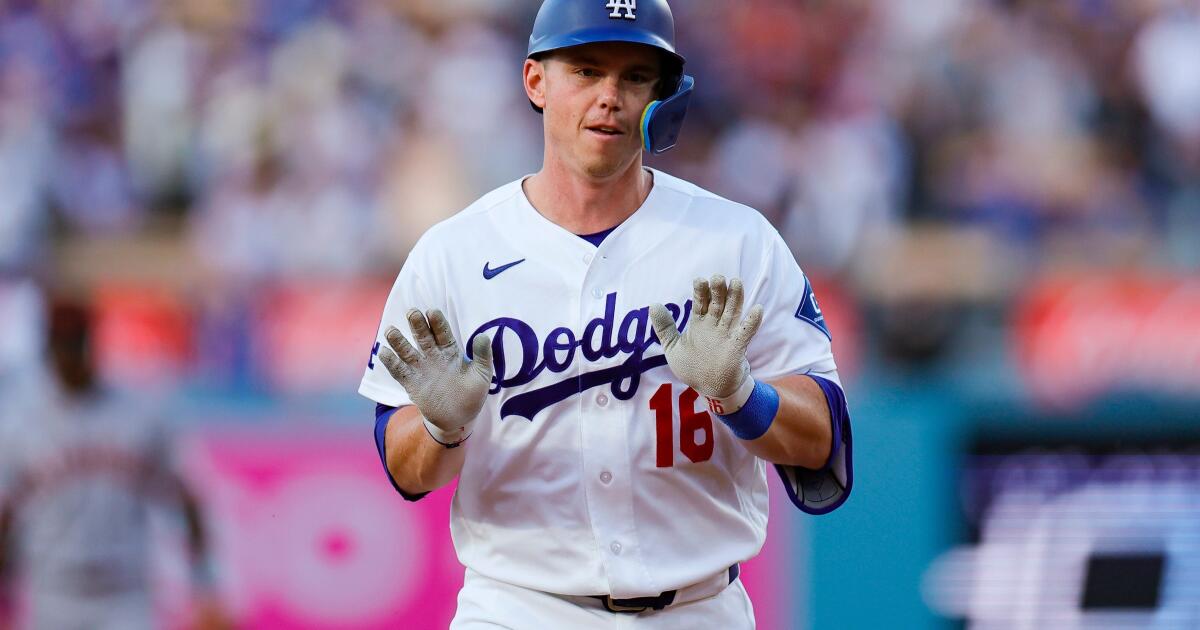
Will Smith to IL
The Dodgers put Will Smith on the injured list because of an inflamed disk in his neck and recalled catcher Chuckie Robinson from the minors. Smith will be eligible to come off the IL next Friday.
“Hopefully, the day I’m able to come off,” Smith told reporters, “I can come back and play, that’s the plan for now.”
Robinson had one at-bat with the Dodgers last season and in 52 games in the majors he is hitting .131.
Ohtani, Wrobleski hurt?
Thursday’s win over Pittsburgh could have proved costly. Shohei Ohtani left the game because of an inflamed left knee, and pitcher Justin Wrobleski left early after getting hit on the inside of his right leg by a liner. He left because of a sore hamstring.
The Dodgers were very optimistic that both would be fine, but we’ll see how they feel on Friday. Ohtani had surgery on that knee in 2019, but this is in a different part of the knee. Not sure if that’s a good thing or bad thing.
“[Friday], he’ll get there, do his routine, play catch, push off, land on it, see how it reacts,” Roberts said. “And then obviously take swings and see how it reacts too.”
Up next
Friday: Dodgers (Roki Sasaki, 3-3, 4.03 ERA) at Chicago White Sox (Sean Burke, 3-3, 3.88 ERA), 4:40 p.m., Sportsnet LA, AM 570, KTNQ 1020
Saturday: Dodgers (Yoshinobu Yamamoto, 6-4, 2.68 ERA) at Chicago White Sox (TBA), 1:10 p.m., Sportsnet LA, AM 570, KTNQ 1020
Sunday: Dodgers (Emmet Sheehan, 3-3, 4.70 ERA) at Chicago White Sox (Erick Fedde, 1-5, 4.69 ERA), 11:10 a.m., Sportsnet LA, AM 570, KTNQ 1020
All times Pacific
*-left-handed
In case you missed it
How the Dodgers plan to shuffle catchers with Will Smith on the injured list
Dodgers Debate: The pitching blues of the summer
And finally
Vin Scully discusses the history of Friday the 13th. Watch and listen here.
Until next time …
Have a comment or something you’d like to see in a future Dodgers newsletter? Email me at houston.mitchell@latimes.com. To get this newsletter in your inbox, click here.