aboard

F-35C Makes First Arrested Landing Aboard A Ford Class Carrier

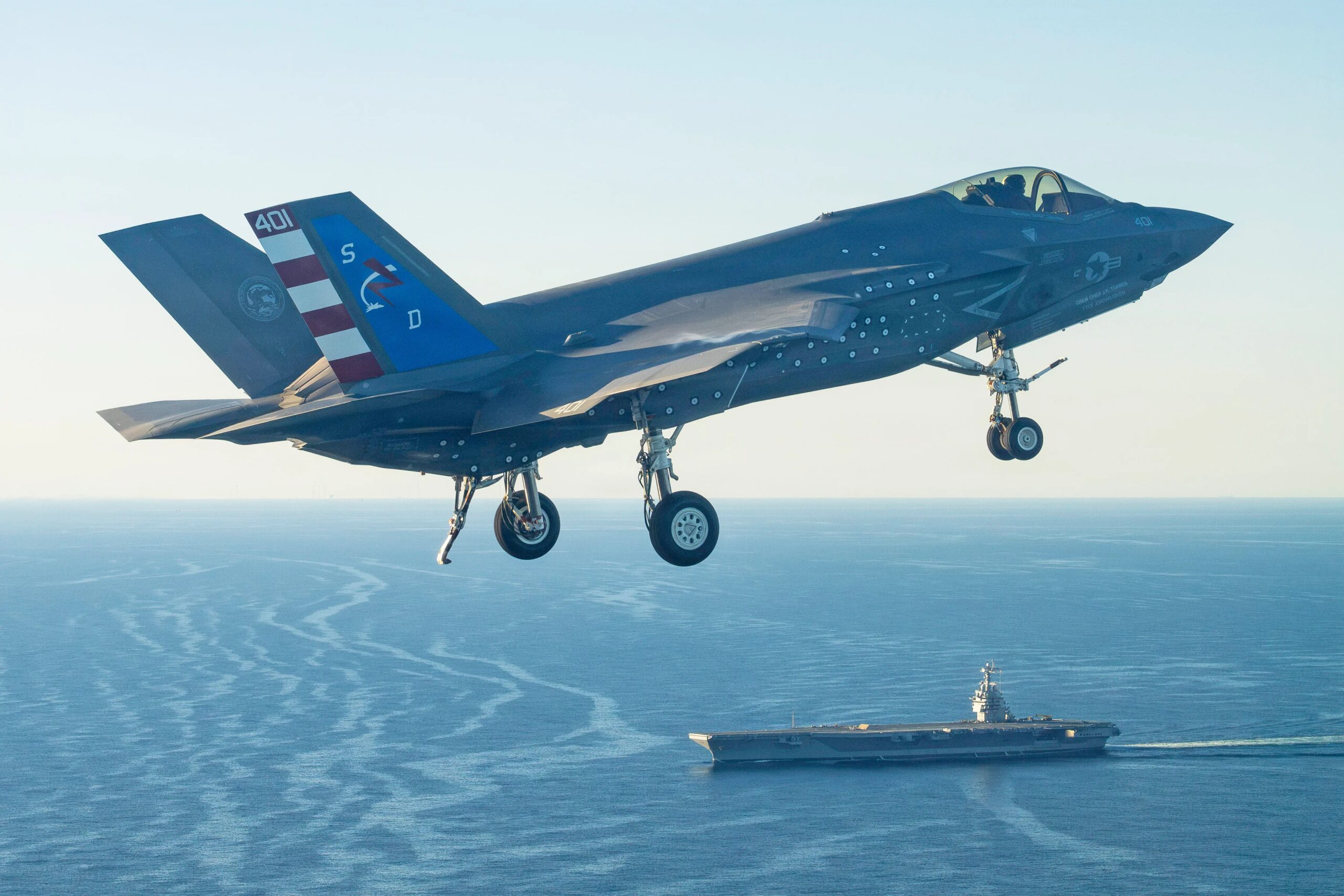
A U.S. Navy F-35C has made the first arrested landing for the type aboard a Ford class aircraft carrier, with the milestone taking place aboard the future USS John F. Kennedy (CVN 79) in the Western Atlantic on October 13, 2026. The milestone marks a major step in testing the Navy’s stealth fighter aboard its newest carrier class, following years of challenges integrating advanced launch and recovery systems.

Two F-35C test pilots assigned to Air Test and Evaluation Squadron 23 (VX-23), part of the Naval Air Warfare Center Aircraft Division (NAWCAD), flew to the carrier as part of an ongoing Aircraft Compatibility Testing (ACT) campaign. A team from the Patuxent River-based F-35 Integrated Test Force (ITF), detached to the ship, is conducting the evaluation using a specially instrumented example of the carrier-capable stealth fighter. The imagery released shows two jets, although only one is seen landing on the flattop. The other is seen carrying inert Joint Direct Attack Munition (JDAM) bombs externally.

An F-35 test pilot from Air Test and Evaluation Squadron Two Three (VX-23), Naval Air Warfare Center Aircraft Division (NAWCAD), flies an F-35C Lightning II fighter aircraft to the PCU John F. Kennedy (CVN 79) in the Western Atlantic Oct. 13, 2026. This is the first time an F-35C has landed on a Ford-class aircraft carrier. A Patuxent River F-35 Integrated Test Force (ITF) team detached to the ship is conducting Aircraft Compatibility Testing (ACT) with the specially instrumented carrier variant of the stealth jet. ACT assesses the operational capabilities of the ship's aircraft launch and recovery equipment with U.S. Navy aircraft.
An F-35 test pilot from Air Test and Evaluation Squadron Two Three (VX-23), Naval Air Warfare Center Aircraft Division (NAWCAD), flies an F-35C overhead the PCU John F. Kennedy in the Western Atlantic on Oct. 13, 2026. U.S. Navy

The Navy took preliminary acceptance of the carrier from Newport News Shipbuilding on September 29, following successful acceptance trials in August. That development allows the ship and its crew to conduct at-sea testing and build underway proficiency while the shipbuilder completes final systems testing ahead of formal delivery, scheduled for spring 2027.

Two F-35 test pilots from Air Test and Evaluation Squadron Two Three (VX-23), Naval Air Warfare Center Aircraft Division (NAWCAD), fly F-35C Lightning II fighter aircraft to the PCU John F. Kennedy (CVN 79) in the Western Atlantic Oct. 13, 2026. This is the first time an F-35C has landed on a Ford-class aircraft carrier. A Patuxent River F-35 Integrated Test Force (ITF) team detached to the ship is conducting Aircraft Compatibility Testing (ACT) with the specially instrumented carrier variant of the stealth jet. ACT assesses the operational capabilities of the ship's aircraft launch and recovery equipment with U.S. Navy aircraft.
Two F-35 test pilots from VX-23 fly F-35Cs to the PCU John F. Kennedy in the Western Atlantic on Oct. 13, 2026. U.S. Navy

The test is an important step in validating the integration of the F-35C with the Ford class. The Navy’s newest carriers use electromagnetic catapults and advanced arresting equipment, replacing the steam-powered launch systems and conventional arresting machinery found aboard the preceding Nimitz class.

Aircraft Compatibility Testing assesses the operational capabilities of a ship’s aircraft launch and recovery equipment with U.S. Navy aircraft. The process helps engineers evaluate how the carrier’s systems interact with individual aircraft and collect data needed to validate their performance.

A U.S. Navy F-35C Lightning II, attached to the "Salty Dogs" of Air Test and Evaluation Squadron (VX) 23, makes an arrested landing on the flight deck aboard PCU John F. Kennedy (CVN 79), marking the first time an F-35C lands on a Ford-class aircraft carrier. John F. Kennedy is underway conducting Aircraft Compatibility Testing, which assesses the operational capabilities of the ship's aircraft launch and recovery equipment with U.S. Navy aircraft. (U.S. Navy photo by Mass Communication Specialist Seaman Kaitlyn Bailey)
A U.S. Navy F-35C of VX-23 makes an arrested landing on the flight deck aboard PCU John F. Kennedy. U.S. Navy photo by Mass Communication Specialist Seaman Kaitlyn Bailey
A U.S. Navy F-35C Lightning II, attached to the "Salty Dogs" of Air Test and Evaluation Squadron (VX) 23, makes an arrested landing on the flight deck aboard PCU John F. Kennedy (CVN 79), marking the first time an F-35C lands on a Ford-class aircraft carrier. John F. Kennedy is underway conducting Aircraft Compatibility Testing, which assesses the operational capabilities of the ship's aircraft launch and recovery equipment with U.S. Navy aircraft. (U.S. Navy photo by Mass Communication Specialist Seaman Kaitlyn Bailey)
A U.S. Navy F-35C of VX-23 catches the wire on the flight deck aboard PCU John F. Kennedy. U.S. Navy photo by Mass Communication Specialist Seaman Kaitlyn Bailey

The F-35C is specifically designed for carrier operations, with larger wings, reinforced landing gear and a beefier tail hook compared with the Air Force’s F-35A. Its ability to launch from a carrier and recover through an arrested landing is central to its role in the Navy’s carrier air wings, which also include F-35Cs operated by the U.S. Marine Corps.

The use of a specially instrumented aircraft is particularly relevant to the test campaign. Instrumentation allows test teams to record data during flight-deck operations, helping them assess system performance and identify any issues requiring further evaluation.

A U.S. Navy F-35C Lightning II, attached to the "Salty Dogs" of Air Test and Evaluation Squadron (VX) 23, makes an arrested landing on the flight deck aboard PCU John F. Kennedy (CVN 79), marking the first time an F-35C lands on a Ford-class aircraft carrier. John F. Kennedy is underway conducting Aircraft Compatibility Testing, which assesses the operational capabilities of the ship's aircraft launch and recovery equipment with U.S. Navy aircraft. (U.S. Navy photo by Mass Communication Specialist Seaman Kaitlyn Bailey)
A U.S. Navy F-35C of VX-23 with its airframe liberally adorned with telemetry markings — these act as precision visual references used during flight testing to capture exact spatial data. U.S. Navy photo by Mass Communication Specialist Seaman Kaitlyn Bailey
A U.S. Navy F-35C Lightning II, attached to the "Salty Dogs" of Air Test and Evaluation Squadron (VX) 23, makes an arrested landing on the flight deck aboard PCU John F. Kennedy (CVN 79), marking the first time an F-35C lands on a Ford-class aircraft carrier. John F. Kennedy is underway conducting Aircraft Compatibility Testing, which assesses the operational capabilities of the ship's aircraft launch and recovery equipment with U.S. Navy aircraft. (U.S. Navy photo by Mass Communication Specialist Seaman Kaitlyn Bailey)
A close-up of one of the U.S. Navy F-35Cs of VX-23 reveals a full set of underwing stores pylons and a load of three inert 500-pound JDAM-series weapons. U.S. Navy photo by Mass Communication Specialist Seaman Kaitlyn Bailey

The first arrested landing aboard John F. Kennedy demonstrates that the ship has reached an important F-35C compatibility milestone. It does not, however, establish that all testing, certification, or operational qualification requirements have been completed.

The milestone comes against the backdrop of the Ford class program’s difficulties integrating some of its advanced aviation systems. The lead ship, USS Gerald R. Ford (CVN 78), introduced the Electromagnetic Aircraft Launch System (EMALS) and Advanced Arresting Gear (AAG), technologies intended to improve aircraft-launch flexibility, recovery performance, and overall sortie generation. Development and reliability challenges with both EMALS and AAG have contributed to delays in the class’s progress. In a 2019 report, TWZ highlighted concerns that Ford class carriers would not be ready to operate the F-35C for years.

A U.S. Navy F-35C Lightning II, attached to the "Salty Dogs" of Air Test and Evaluation Squadron (VX) 23, makes an arrested landing on the flight deck aboard PCU John F. Kennedy (CVN 79), marking the first time an F-35C lands on a Ford-class aircraft carrier. John F. Kennedy is underway conducting Aircraft Compatibility Testing, which assesses the operational capabilities of the ship's aircraft launch and recovery equipment with U.S. Navy aircraft. (U.S. Navy photo by Mass Communication Specialist Seaman Kaitlyn Bailey)
A U.S. Navy F-35C makes an arrested landing on the flight deck aboard PCU John F. Kennedy for the first time. U.S. Navy photo by Mass Communication Specialist Seaman Kaitlyn Bailey

USS Gerald R. Ford was designed and built before the F-35C’s full carrier-integration requirements were sufficiently mature, so the Navy deferred several upgrades to a later modernization period rather than delaying the ship’s delivery. Following congressional pressure, the Navy adopted a single-phase delivery approach for USS John F. Kennedy, incorporating these modifications during construction instead.

The USS Gerald R. Ford completed its Aircraft Compatibility Testing in January 2020, following 16 days at sea, during which the crew launched and recovered 211 aircraft, testing five different airframes — but the F-35C was not included.

A U.S. Navy F-35C Lightning II, attached to the "Salty Dogs" of Air Test and Evaluation Squadron (VX) 23, makes an arrested landing on the flight deck aboard PCU John F. Kennedy (CVN 79), marking the first time an F-35C lands on a Ford-class aircraft carrier. John F. Kennedy is underway conducting Aircraft Compatibility Testing, which assesses the operational capabilities of the ship's aircraft launch and recovery equipment with U.S. Navy aircraft. (U.S. Navy photo by Mass Communication Specialist Seaman Kaitlyn Bailey)
A U.S. Navy F-35C, attached to VX-23, after an arrested landing on the flight deck aboard PCU John F. Kennedy. U.S. Navy photo by Mass Communication Specialist Seaman Kaitlyn Bailey

Beyond EMALS and AAG, integrating the F-35C on Kennedy requires modifications to the carrier’s maintenance infrastructure and support systems. These include specialized spaces for handling the aircraft’s sensitive mission systems and classified data, computer networks and interfaces linking its maintenance and logistics systems with the Navy’s existing infrastructure, and facilities and equipment to support the upkeep of its low-observable coatings and materials. The Navy has also identified the need for more robust jet blast deflectors (JBDs), which protect flight-deck personnel and equipment from the F-35C’s intense engine exhaust.

Earlier F-35C integration work aboard Nimitz class carriers included JBD modifications to improve heat resistance and cooling, while planning for John F. Kennedy explicitly included both JBD upgrades and changes to maintenance spaces and information systems.

An F-35 test pilot from Air Test and Evaluation Squadron Two Three (VX-23), Naval Air Warfare Center Aircraft Division (NAWCAD), flies an F-35C Lightning II fighter aircraft to the PCU John F. Kennedy (CVN 79) in the Western Atlantic Oct. 13, 2026. This is the first time an F-35C has landed on a Ford-class aircraft carrier. A Patuxent River F-35 Integrated Test Force (ITF) team detached to the ship is conducting Aircraft Compatibility Testing (ACT) with the specially instrumented carrier variant of the stealth jet. ACT assesses the operational capabilities of the ship's aircraft launch and recovery equipment with U.S. Navy aircraft.
An F-35 test pilot from VX-23 flies an F-35C to the PCU John F. Kennedy in the Western Atlantic on Oct. 13, 2026. U.S. Navy

The latest test represents progress toward resolving the compatibility question, although the full scope of the remaining work will depend on the results of the ongoing evaluation.

The development also comes as China advances its own carrier aviation capabilities. Unlike the U.S. Navy, its Fujian aircraft carrier has demonstrated electromagnetic catapult launches and arrested recoveries involving several aircraft types, including the J-35 stealth fighter.

A J-35 is prepared for takeoff on Fujian. via Chinese internet

In contrast to the U.S. Navy, which accumulated decades of experience with steam-powered catapults before adopting electromagnetic launch technology, China chose electromagnetic catapults for its first catapult-equipped carrier.

Although China’s demonstrations aboard Fujian and the F-35C compatibility testing aboard Kennedy involve different aircraft, ships, and stages of development, both underscore the technical demands of integrating advanced aircraft with modern carrier launch and recovery systems.

For the U.S. Navy, the immediate priority is to demonstrate that the Ford class can reliably support its intended aircraft. The F-35C’s first arrested landing aboard Kennedy is a significant step in that process, with further testing — not least an EMALS takeoff — needed before the milestone can begin to translate into an operational capability.

Contact the author: thomas@thewarzone.com
Thomas Newdick is a staff writer at TWZ, where he covers military aviation, defense technology, weapons systems, and international security. Based in Berlin, Germany, he reports on conflicts, military modernization efforts, and emerging aerospace technologies around the world, with a particular interest in airpower and its role in contemporary warfare. His reporting is informed by deep expertise in modern and historical airpower, particularly in Europe, with a focus on military aviation, air campaigns, and aerospace developments across the continent and beyond.


Source link

Claims Swirl Around U.S. Marines Injured Aboard Mystery Vessel Attacked In The Strait Of Hormuz

On Sunday, NBC News reported that Marines were injured during an Iranian cruise missile attack while transiting the Strait of Hormuz on Sept. 14. The network’s sources said the Marines were not on a U.S. Navy ship, but they did not identify which vessel they were on. However, a former Royal Mail vessel that at one point was being converted into a floating armory stands out as a strong possibility.

While much remains unclear about the Sept. 14 incident, there was only one vessel known to have been struck that day, according to the United Kingdom Maritime Trade Operations (UKMTO) and a maritime security official we spoke with. The ship was eventually identified by several maritime media outlets as the M/V St. Helena. Again, the St. Helena’s involvement remains unconfirmed, but the ship’s interesting background is of particular note.

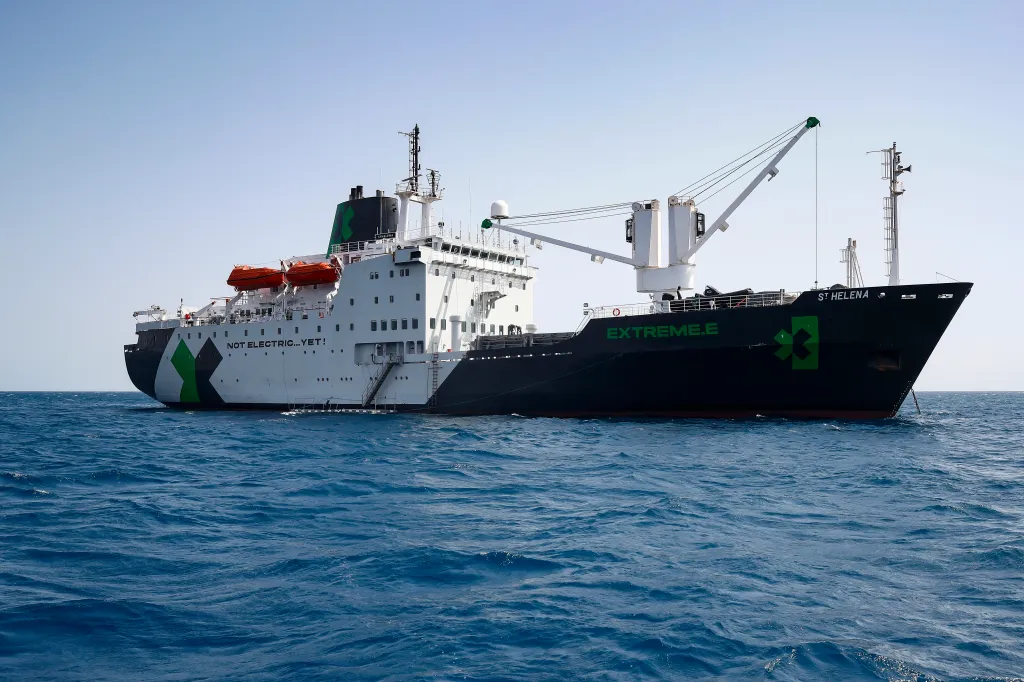
MARCH 30: The St Helena logistics ship during the Saudi Arabia on March 30, 2021. (Photo by Colin McMaster/LAT Images for Extreme E)
The St Helena logistics ship during the Saudi Arabia on March 30, 2021. Photo by Colin McMaster

“Eight U.S. Marines were injured two weeks ago when an Iranian cruise missile attacked the ship they were operating on in the Strait of Hormuz,” NBC reported, citing three U.S. officials. “The Marines were not seriously injured, but they sustained smoke inhalation and possibly traumatic brain injuries, as they had symptoms of concussions, such as headaches, the officials said.”

“The Marines, seven of them enlisted and one officer, all returned to duty soon after the Sept. 14 attack, the U.S. officials said,” according to the network. “The officials said the Marines were operating as part of a battalion landing team during the Iranian anti-ship cruise missile attack.”

TWZ cannot independently confirm that Marines were on board the St. Helena or that they were injured. We reached out to the Pentagon and U.S. Central Command (CENTCOM) for more information. The Pentagon referred us to CENTCOM, and CENTCOM declined comment.

The incident took place amid an uneasy truce between Iran and the U.S. broken up by sporadic Iranian attacks on ships transiting the Strait of Hormuz. At the same time, the U.S. military is enforcing a blockade on Iranian ships, during which it has struck several for trying to bypass that effort as well as in retaliation for Iranian attacks on shipping. Negotiations between Washington and Iran have ebbed and flowed, and U.S. President Donald Trump is once again mulling a choice between continuing talks or renewing large-scale attacks.

As we noted earlier in this piece, after the vessel was struck, several maritime industry trade publications identified it as the St. Helena.

“Iran has attacked a historic former British Royal Mail passenger ship in the Strait of Hormuz,” TradeWinds News reported on Sept. 15, a day after the incident. “Maritime security sources identify the 6,800-gt St Helena (built 1989) as the latest vessel to be hit by an ‘unknown projectile’ in the war-torn waterway. The attack was reported late on Monday, according to UK Maritime Trade Operations, which cited a ‘verified source’ for the incident without identifying the vessel.”

JULY 04: Aerial view of the St Helena transport ship in the sea off Porto Pino during the Sardinia on July 04, 2022. (Photo by Sam Bagnall/LAT Images for Extreme E)
Aerial view of the St Helena transport ship in the sea off Porto Pino during the Sardinia on July 4, 2022. Photo by Sam Bagnall

“UKMTO has received a time late report of an incident within the Strait of Hormuz,” the organization reported on Sept. 15, citing an incident that took place a day earlier. “A verified source has reported that a vessel has been struck by an unknown projectile.”

“There is no reported damage or environmental impact,” UKMTO added. “Authorities are investigating.”

According to Lloyd’s List, the ship was being operated by the Ambrey maritime security firm at the time it was struck. Ambrey declined to comment. 

Shipping expert Sal Mercogliano and open-source investigator Tom Bike were among those suggesting the St. Helena could have been the vessel at the heart of the NBC report.

Exactly what the St. Helena was doing at the time it was struck is unclear; however, the ship has had a very unusual past.

The vessel entered into service in 1990 and “sailed between Cape Town, South Africa and Saint Helena and Ascension Islands, carrying both passengers and cargo, some of which was Royal Mail, earning her the rare RMS designation,” according to Cruise Arabia and Africa.

The St. Helena was Britain’s last working postal ship, according to Maritime Executive. After it was retired in 2018 because it was no longer needed for that function, things got really interesting.

Two different organizations took over the vessel, including, as we noted earlier in this story, a company that was planning to use it as a floating armory in the Middle East.

“Renamed MNG Tahiti, the 103-meter (340-foot) ship is being readied by her new owner MNG Maritime to become a floating armory working in the Gulf of Oman,” Maritime Executive wrote on April 22, 2018. “She will deliver security guards and weapons to vessels sailing through the region and is expected to be operational in her new role in the next few months.”

It is unclear what happened to that plan. However, two years later, an off-road racing series called Extreme E said that it “secured exclusive use of the former Royal Mail ship in 2018.” After that, the ship underwent “an extensive refurbishment process, which has included total overhaul of steelwork, engines, generators, propellers, interior and cabin space, and more, making it not only fit for purpose, but also as efficient as possible ahead of its new mission.” 

JULY 04: Aerial view of the St Helena transport ship in the sea off Porto Pino during the Sardinia on July 04, 2022. (Photo by Sam Bagnall/LAT Images for Extreme E)
Aerial view of the St Helena transport ship in the sea off Porto Pino during the Sardinia on July 4, 2022. Photo by Sam Bagnall

The ship was “specifically designed to transport all the infrastructure and equipment the Extreme E needs for their race weekends,” the organization stated. The plan was to have the ship serve “as its freight and logistics hub due to her versatility and ability to carry and unload a mixture of cargo, like all 10 of the championship’s ODYSSEY 21’s [electric off-road racecar], as well as team members and guests. This was also fit with a Science Laboratory so research can be conducted enroute to the race locations.”

Both the St. Helena and MNG Tahiti have the same international shipping identification number of IMO 8716306, according to the MarineTraffic website.

On Sept. 17, 2024, the St. Helena was put up for sale, according to Horizon Ship Brokers. The current ownership is unclear. We reached out to Horizon Ship Brokers for more details.

Horizon Ship Brokers

Last year, the saga of the St. Helena took a new turn. A company called Terra Nova Expeditions chartered the vessel for Antarctic cruises, but those plans were scrubbed last month because the vessel was stuck in the Persian Gulf and was no longer available for the Antarctic sailing season.

It was last tracked via its transponder near Dubai nearly two months ago, according to MarineTraffic.

While we can’t confirm that Marines were onboard when St. Helena was hit, Marines have been training for this exact mission set. USNI News reported in 2023 that a “force of 100 Marines, newly trained by Navy personnel,” stood ready “to respond, if ordered, to provide armed security aboard foreign commercial ships transiting the Strait of Hormuz.”

Those Marines were members of the 26th Marine Expeditionary Unit (MEU) embarked on the three-ship Bataan Amphibious Ready Group (ARG), USNI added at the time.

It is unclear if those plans are still in place and if Marines in the region have actually been ordered to provide armed security for foreign vessels sailing through or near the strait. Regardless, Marines could be quickly trained to take on this mission set and have drilled for ship boarding and searches for years, especially special operations and specially-tasked units. CENTCOM declined to comment when we asked if there are U.S. personnel embarking on commercial ships transiting the Strait of Hormuz.

At the same time, it is possible that the unique attributes of St. Helena made it a convenient host ship for sea base operations for U.S. forces in the region specifically for this crisis. Adapting commercial vessels for exactly this purpose has a long history around the Strait of Hormuz, as it was a central facet of the Tanker Wars during the 1980s, that saw U.S. forces operate from barges in the region. Today, commercial vessels remarkably similar to St. Helena operate in similar roles, especially in support of special operations and interdiction operations.

211024-N-KY668-1208
 CARIBBEAN SEA - (Oct. 24, 2021) – The special mission ship U.S. Motor Vessel Kellie Chouest steams in the Caribbean Sea while participating in a passing exercise (PASSEX), with the Dominican Republic Navy and USS Billings (LCS 15) Oct. 24, 2021. Kellie Chouest is deployed to the U.S. 4th Fleet area of operations to support Joint Interagency Task Force South’s mission, which includes counter-illicit drug trafficking missions in the Caribbean and Eastern Pacific. (U.S. Navy photo b
The special mission ship U.S. Motor Vessel Kellie Chouest steams in the Caribbean Sea while participating in a passing exercise (PASSEX), with the Dominican Republic Navy and USS Billings (LCS 15) Oct. 24, 2021. Kellie Chouest is deployed to the U.S. 4th Fleet area of operations to support Joint Interagency Task Force South’s mission, which includes counter-illicit drug trafficking missions in the Caribbean and Eastern Pacific. Photo by Petty Officer 2nd Class Austin C

Once again, we have no idea what the ship’s mission was at the time of the incident and if Marines were simply helping it transit safely out of the Persian Gulf or something more, but the attack did expose the fact that individual Marines are more involved with activities in this tumultuous body of water than it may seem.

Contact the author: howard@twz.com.

Howard is a Senior Staff Writer for TWZ. He writes frequently about conflict, focusing heavily on the Middle East and Ukraine, and interviews with military and intelligence officials and industry leaders from around the globe. He lives near Tampa, Florida, home of U.S. Central Command, U.S. Special Operations Command.


Source link