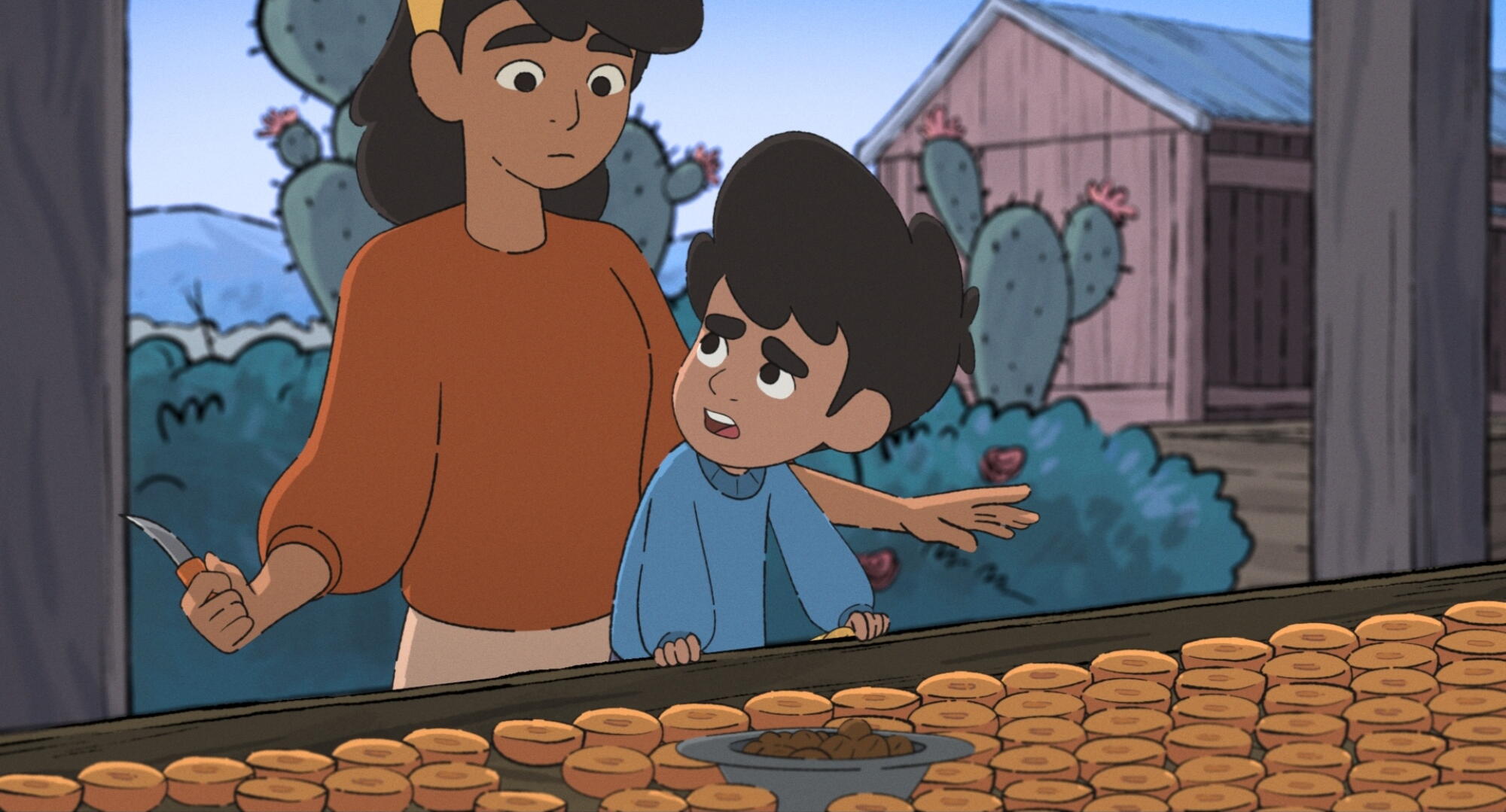
Alex Avila’s ‘The Apricot’ inspired by Studio Ghibli
“Princess Mononoke” first stunned Alex Z. Avila when he was in middle school, after he watched Hayao Miyazaki’s striking environmentalist sagaon a DVD he borrowed from a neighbor.
“I didn’t know that animation could be more than just Disney fairy tales. That started me exploring other animation that was not just specifically for children,” Avila said at Vidiots in Eagle Rock during a recentevent hosted by LatinX in Animation, an L.A.-based organization that supports and promotes Latino professionals working in the medium.
The work of legendary Japanese outfit Studio Ghibli has strongly influenced Avila, 31, since that first encounter. Now, with his personal short film “The Apricot”— you can watch here — the Mexican American filmmaker raised in Merced, Calif., has channeled that love for hand-drawn animation into a story based on his family.

In “The Apricot,” 10-year-old Alex travels to his family’s farm in Hollister, Calif., during the summer of 2005 to work with aunts and uncles halving apricots to remove the pit. Struggling to keep up, young Alex loses heart until his loving grandfather steps in.
Avila said Alex was based on both him and his younger brother.
Thanks to its success at film festivals, “The Apricot” is Oscar-qualified, meaning it’s officially in the running for the Academy Award in the best animated short category.
For Avila, the film recontextualizes the summers spent working with his family and the relationships he forged with his relatives, particularly his late maternal grandfather, Jose Guadalupe Arredondo, originally from Guanajuato, Mexico. Even then, Avila understood his experience differed from that of kids featured in American media.
“I wanted to hang out with friends and spend summers the way you would see in traditional films like, ‘It’s summer, you’re going to bike around with your friends and go to the arcade. It’s going to be all fun and cool.’ I didn’t experience that,” he says. “I was going to work with my family. I wanted to show my version of what a summer looked like as a kid.”

Alex Z. Avila as a child at his family’s apricot farm in Hollister, Calif.
(Courtesy of Alex Z. Avila)
Avila doesn’t begrudge his upbringing. On the contrary, he cherishes the time it gave him to spend with his grandfather, who died 13 years ago. Avila uploaded “The Apricot” on Nov. 14, the anniversary of his passing.
“Even though he wasn’t talkative and we wouldn’t have lengthy conversations with each other, there was still a lasting bond there that existed and that I carry with me to this day,” Avila said.
To call “The Apricot” a family affair would be an understatement. Nearly all the characters are voiced by Avila’s family members, including young Alex, voiced by his nephew Vincent Herrera. Avila recorded his relatives saying the lines in both English and Spanish and then picked the best takes from each language to create the bilingual banter. The result is dialogue that rings impressively true with authentic emotion.
“I built those performances to reflect how I talk with my parents and my tíos in real life. I talk to them in English and they respond to me in Spanish,” he says. “Sometimes you watch films that try to incorporate Spanish into English dialogue and it feels very forced. They randomly throw a random Spanish word in the middle of the sentence, and it sticks out to you.”
Avila created “The Apricot” with the support of the Latino Film Institute’s Spark Animation Fellowship. After receiving that grant, he enlisted producer Carlo Padilla, also a first-generation Mexican American. Together they founded their own studio, Fishboy Animation. Between 30 and 40 artists in the U.S. worked on the preproduction of “The Apricot,” while Mexico City-based studio ¡Viva Calavera! handled the animation process.
“We were both really inspired by Studio Ghibli and their slice-of-life stories,” said Padilla, 35. “And we also had a very similar upbringing. My family came here and they started their own business. As a child, I would have to help out in the business, similar to Alex with the farm.”
As for the substantial influence of Studio Ghibli’s films on “The Apricot,” Avila notes there are specific scenes from those beloved animated classics that he adapted into his narrative.
“The moment where Alex is in the orchard, I specifically was thinking of ‘Spirited Away’ when Chihiro is sitting in the field of flowers overwhelmed by everything,” Avila said. “But it was less trying to copy the imagery and more so the emotional impact of how I felt when I watched that film..”

Avila’s late grandfather, Jose Guadalupe Arredondo, at his apricot farm in Hollister.
(Courtesy of Alex Z. Avila)
Meanwhile, a heartfelt and expressive embrace between Alex and his grandpa recalled a similar moment in “Ponyo,” when the young hero Sōsuke reunites with his goldfish-like friend. The hug in “The Apricot,” Avila said, is a visual representation of all the emotions that have built inside young Alex during the film, much like the embrace in “Ponyo.”
“I thought about what it would feel like to actually get a chance to hug my grandpa again in real life. It would feel magical,” Avila said. “We created that magic by bringing in the howling wind, the rustling trees, and the leaves dancing around them in the sunlight. It’s my favorite scene in the film. And not just because of the emotion behind it. It showed me the power of animation as a medium.”