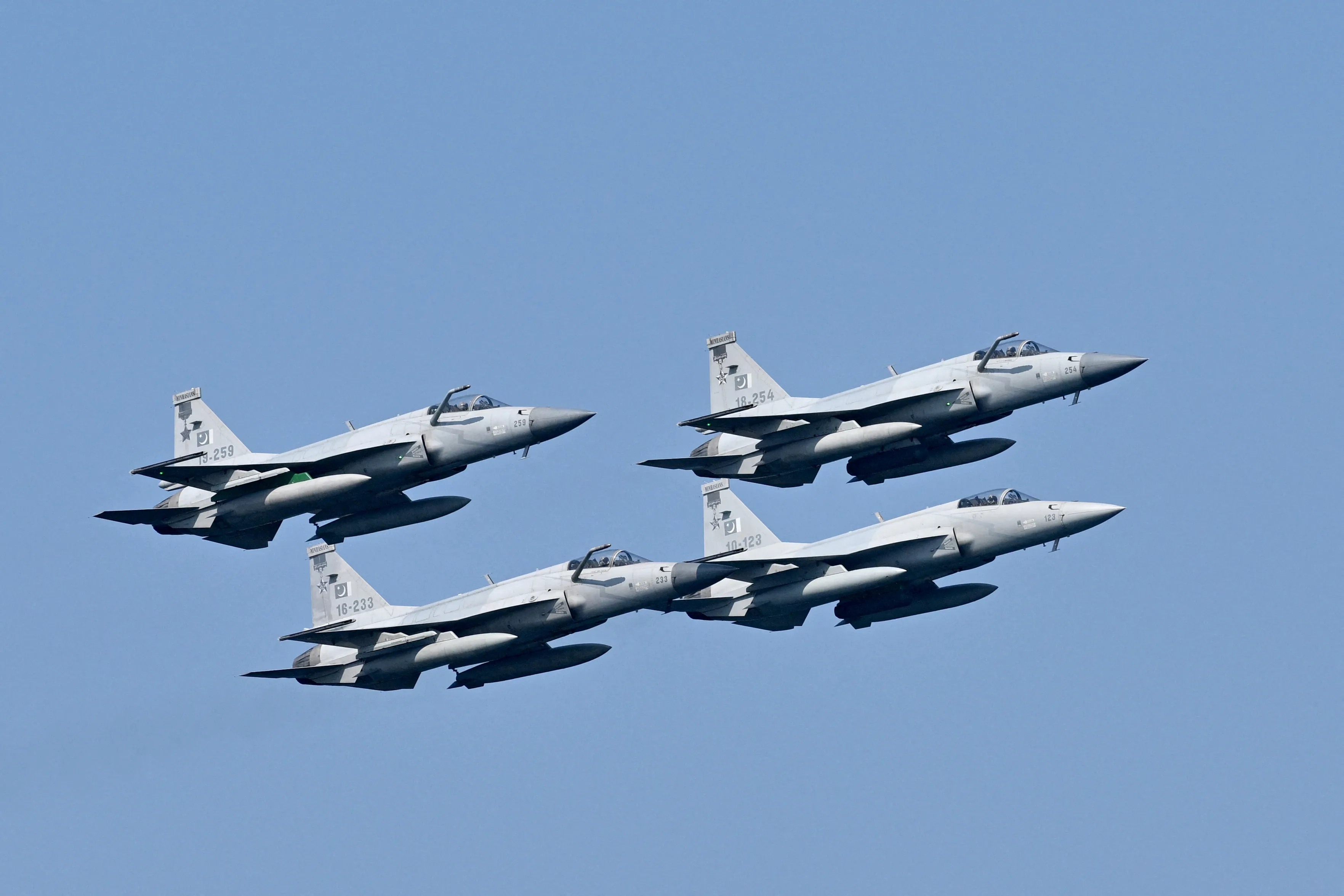
The Sino-Pakistani JF-17 Thunder has emerged as a surprise candidate for Saudi Arabia’s next fighter jet, according to a recent report. While a mutual defense pact signed with Pakistan would help open the door to the transfer of JF-17s to Saudi Arabia, the fighter faces very strong competition. Furthermore, it isn’t clear if the Saudis even would want a light fighter like this at all, especially considering it could cause a rift with the U.S. at a critical time. In the past months, the kingdom has been offered the U.S.-made F-35, as you can read about here, and has been linked with several other multirole fighters.
According to a report today from Reuters, talks are now underway between Saudi Arabia and Pakistan, with a view to the kingdom obtaining an undisclosed number of JF-17s. These would be paid for by converting some of the billions of dollars of Saudi loans taken out by Islamabad, a sign of the deepening relationship between the two countries, including at a military level. The report cites two different Pakistani sources, one of whom says the talks are limited to the JF-17, while the other claims that the jets are the “primary option,” but that different military equipment could also be made available.

Reportedly, the deal would be worth $4 billion in terms of offsetting the loan, while Saudi Arabia would also spend $2 billion on top of that.
This week, Pakistan’s Air Chief Zaheer Ahmed Baber Sidhu was in Saudi Arabia to discuss what the Pakistani military described as “bilateral defense cooperation, the regional security environment, and future avenues of collaboration” with his Saudi counterpart, Lieutenant General Turki bin Bander bin Abdulaziz.
The JF-17 was developed jointly by China’s Chengdu and the Pakistan Aeronautical Complex (PAC), and the first prototype took to the air in 2003. The aircraft is powered by a single Russian-designed RD-93 turbofan engine, an improved version of the RD-33 that is found in the twin-engined MiG-29 Fulcrum.

The Thunder has been steadily improved since the first series-built JF-17s began to come off the PAC line at its Kamra facility in 2008. After the first 50 JF-17s were delivered to Pakistan, production switched to the enhanced JF-17 Block 2 version, with improved avionics, strengthened wing roots for additional stores carriage, and an in-flight refueling probe, among other changes.
The latest Block 3 version of the jet has an active electronically scanned array (AESA) radar, as well as an improved fly-by-wire flight-control system, infrared search and track system, helmet-mounted display, and a larger holographic wide-angle head-up display for the pilot.

Pakistan Air Force JF-17 participates in Virtual Air Tattoo 2021
In terms of performance and specifications, the Block 2 version has a maximum takeoff weight of a little over 27,000 pounds, a maximum speed of Mach 1.6, and an unrefueled range of 840 miles. It can carry 3,300 pounds of stores carried on seven external hardpoints. This puts it broadly in the same class as the Saab Gripen C/D.
The unclassified version of an annual Pentagon report to Congress on China’s military stated that, as of May 2024, the JF-17 had been sold to Azerbaijan, Burma, and Nigeria — as well as Pakistan. The report also says that, as of 2024, negotiations were underway regarding a possible JF-17 transfer to Iraq.
That same story stressed heavily the growing presence of the JF-17, as well as other Chinese-made fighters, on the export market, as you can read more about here.
Last month, Pakistan reportedly struck a weapons deal worth more than $4 billion with the Libyan National Army, which is also said to include JF-17. Additionally, Pakistan has held talks with Bangladesh on the possible sale of the same jets.
As for Saudi Arabia, the claimed interest in the JF-17 comes after it signed a mutual defense pact with Pakistan last September. This is the latest development in a long-running security partnership between the two nations, which has seen extensive provision of defense equipment to the kingdom, as well as training.
“The agreement states that any aggression against either country shall be considered an aggression against both,” the office of the Pakistani prime minister said in a statement about the pact. This raised questions of whether the Pakistani nuclear umbrella might even be extended to protect Saudi Arabia, too.

For its part, Saudi Arabia has regularly provided Pakistan with economic support. In 2018, Riyadh agreed on a support package for its ally that included a loan worth $6 billion. Since then, it has allowed Islamabad to defer payments.
Were it to happen, a deal involving JF-17s and potentially other arms could help balance the books between the countries.
While the JF-17 is less advanced than other fighters that Saudi Arabia has been looking at buying, most notably the F-35, the Thunder’s status has been enhanced by claims of its performance during Pakistan’s clashes with India last year. Pakistan has long pitched the JF-17 as a cheaper and more sustainable fighter option, but now it is combat-proven too, although the results of its performance against the Indian Air Force are hard to verify.
Last month, it became clear that the Trump administration intended to sell up to 48 F-35s to Saudi Arabia, which marked a significant policy shift. Previously, Washington had been unwilling to export these jets to Arab states in the region, for fear of upsetting the strategic balance in relation to Israel — also an F-35 operator.
As we noted at the time:
Even without the F-35, the Royal Saudi Air Force (RSAF) operates an extremely modern and advanced fleet of fighters. It received 84 of the new-build F-15SA, which was the most advanced variant of the Strike Eagle family available until the appearance of the Qatari F-15QA and the U.S. Air Force’s F-15EX Eagle II. Meanwhile, the 68-strong fleet of earlier F-15S aircraft has been upgraded locally to a similar standard, known as F-15SR (for Saudi Retrofit).
The RSAF also received 72 Eurofighter Typhoons. Older, but still capable, are around 80 British-supplied Panavia Tornado IDS swing-wing strike aircraft, which continue in service in the strike role.

Other fighters have been linked with a sale to Saudi Arabia, as it seeks to further boost its fighter fleet.
For a long time, more Typhoons were seen as the most likely option, but a potential deal has been frustrated by Germany — which has a stake in Eurofighter via the German arm of Airbus — which has consistently blocked further sales of the jets to Saudi Arabia, citing human rights concerns.
Saudi Arabia also entered talks to buy 54 Dassault Rafale multirole fighters, as we reported back in 2023.
More recently, Boeing confirmed that it was offering the F-15EX Eagle II to Saudi Arabia.
The JF-17 is far less capable than these options, but it is not irrelevant, especially in its Block 3 version with AESA radar and Chinese-made PL-15 air-to-air missiles.

At the same time, the Thunder would be a far less expensive option and could be acquired in greater numbers, creating a high-low force mix.
Still, the idea that Saudi Arabia would actually be interested in Pakistan’s proposal seems remote due to multiple factors.
Whether the JF-17 could be operated alongside the F-35 is highly questionable, on the grounds that its sensitive technologies might be exposed to Chinese intelligence. On the other hand, even without the JF-17, Saudi Arabia has long been a customer of Chinese-made defense equipment, including drones and ballistic missiles. But these are not fighter platforms with sensors that can give away critical capabilities, as well as weapon systems that need highly integrated tactics across a force in order to be effective. The very idea that a deal like this could even threaten the long-awaited acquisition of the F-35 seems to disqualify it on its face.
There is also the question of why Saudi Arabia would even want this aircraft when they have access to far more capable fighters that accommodate the weapons and networks their force already uses? A high-low mix may hold some relevance, but we have seen no indication that Saudi Arabia believes this to be the case.
It also comes at a time of extremely close ties between the kingdom and the U.S., with the Trump administration seeing Saudi Arabia as a top ally and economic partner. Risking that for a cheap fighter aircraft seems remote.
At the same time, Islamabad sees arms sales, including to non-traditional clients, as critical to helping address its economic troubles.
“Our aircraft have been tested, and we are receiving so many orders that Pakistan may not need the International Monetary Fund in six months,” Pakistani Minister of Defense Khawaja Asif recently told local media.
However, as has been the case in earlier Saudi procurements, the most important dimension in selecting a new fighter may well be the political one.
Contact the author: thomas@thewarzone.com