Today Disneyland is so fully formed that it‘s taken for granted. We debate ticket prices and crowd calendars, strategizing the optimal time to visit.
The new documentary “Disneyland Handcrafted” hits pause on all of that.
Culled from about 200 hours of mostly unseen footage, director Leslie Iwerks’ film takes viewers back to the near beginning, tracing the largely impossible creation of the park from a year before its opening.
“Can you imagine L.A. without Disneyland?” Iwerks asks me during an interview.
To begin to answer that question cuts to the importance of “Disneyland Handcrafted,” which premieres Thursday on Disney+. For while Disneyland is corporately owned and managed, the park has become a cultural institution, a reflection of the stories and myths that have shaped America. Disneyland shifts with the times, but Iwerks’ film shows us the Walt Disney template, one that by the time the park opened on July 17, 1955, was so set in place that it would soon become a place of pilgrimage, a former Anaheim orange grove in which generations of people would visit as a rite of passage.

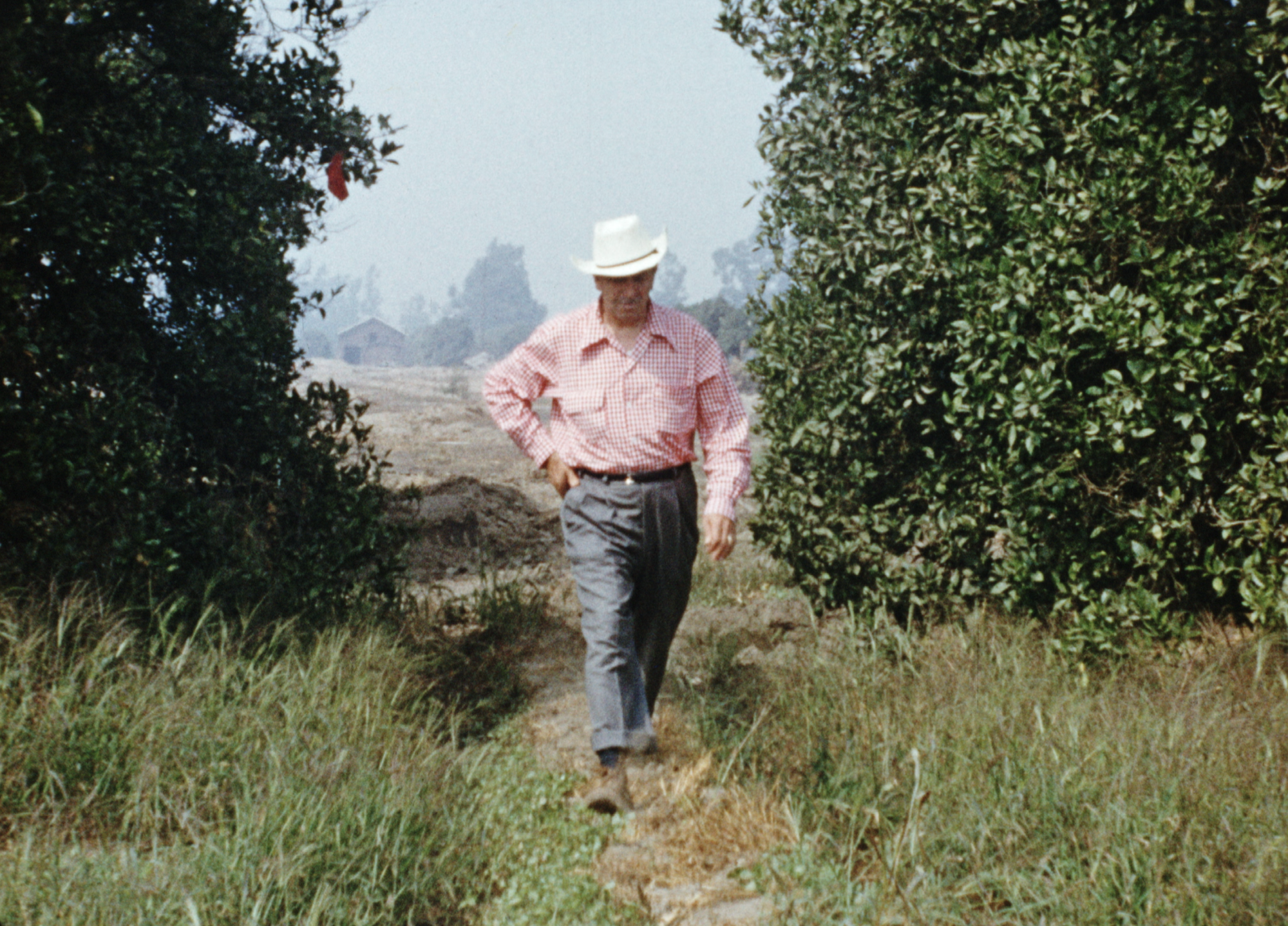
Walt Disney surveying the Anaheim land that would become Disneyland, as seen in Leslie Iwerks’ film “Disneyland Handcrafted.”
(Disney+)
Iwerks comes from a family of Disney royalty. Her grandfather, Ub, was a legendary animator instrumental in the development of Mickey Mouse. Her father, Don, was a cinematic and special effects wizard who worked on numerous Disney attractions, including the Michael Jackson-starring film “Captain EO.” As a documentarian, Iwerks has explored Disney before as the director of “The Imagineering Story” and has a long career of films that touch on not just Hollywood but also politics and environmental issues.
Here, Iwerks reveals just how fragile the creation of Disneyland was.


1. A worker applies gold detailing to the ornate spires of Sleeping Beauty Castle, showcasing the elegance and precision that defined the centerpiece of Disneyland Park. 2. A craftsperson applies paint to the stone facade of Sleeping Beauty Castle. 3. A glimpse of Sleeping Beauty Castle under construction. (Disney+)
Having watched the film now numerous times, there are many small moments that stick with me. A worker, for instance, carefully sculpting the concrete on Sleeping Beauty Castle just months before opening while a narrator speaks of the park’s rising cost. A construction vehicle toppling, with its driver escaping a life-changing accident by jumping out just in the nick of time as Disney himself talks up how there have been very few accidents. And the mistakes, such as frantically learning — and failing — at how to build a river.
That Disneyland is as popular today as it was in 1955 — the film reveals that more than 900 million people have visited the park — is no accident. We live in stressful, divisive times, and Disneyland was not only born of such a moment but built for them, arriving in 1955 in a post-World War II America that was adjusting to more internalized, less-overtly-visible fears. The specter of nuclear annihilation was now forever a reality, and the Cold War heightened the sense of uncertainty.
A fake world inspired by a real one that never existed, don’t mistake Disneyland for nostalgia. Disneyland seeks to reorient, to show a better, more optimistic world that only exists if we continue to dream — to imagine a walkable street, for instance, in which a fairy tale castle sits at its end. Disneyland isn’t so much an escape from our world as it is a place where we go to make sense of it, a work of live theater where we, the guests, are on a stage and can play at idealized versions of ourselves.
“Why do we care? Why does it matter?” asks Iwerks. “I think what matters, for Disneyland, is that Walt set out to create the happiest place on Earth. Right there, putting that stake in the ground. That’s so impressive. That’s so risky. And yet he did it by sheer belief that he wanted families to come together and experience a place they could come back to time and again, a place that would continue to grow and always be evolving through cultures, through time, through generations.”

The front gates of Disneyland under construction.
(Disney+)
What makes the film so poignant is that Iwerks essentially gets out of the way. The footage was initially commissioned by Disney and shot for use in the company’s then weekly ABC series, which was funding the park. Some of the clips have appeared in episodes of “Walt Disney’s Disneyland,” but very few. For that show, Disney was selling the public on the park. With the public having long been sold, Iwerks can show us the park in shambles, a dirt path entering a wood-strewn Frontierland while Harper Goff, then Disneyland’s art director, speaks of a frustrated Disney lamenting that half the park’s money is gone and it remains nothing but a pile of muck.
“This is what worry is,” Goff says in the narration.
“What rose to the surface was how much pressure there was during this one year,” Iwerks says. “It was impossible. It was building what ultimately was a mini city in less than a year, pulling together all those construction workers, all those people who handcrafted this whole park in record time using their own skills, artistry and storytelling.”
Adds Iwerks, “You can’t remodel your kitchen right now in a year.”
Since the film is a light cinéma vérité style, Iwerks doesn’t editorialize as to how it all did get done. But we see workers, for instance, straddling beams in Tomorrowland with no support, making it clear this was an era with fewer regulations. Iwerks herself points to the ABC funding, acknowledging that the arrangement simply necessitated the park being completed in a year. But when it opened, it was far from finished. Disneyland’s struggles on opening day have long been mythologized, be it stories of weak asphalt or plumbing disasters.


A craftsperson works on the yellow decorative trim of King Arthur Carousel in Fantasyland.
(Disney+)
Iwekrs is more interested in showing us the race against time, especially for a park that deviated from the light theming and simple rides of amusement parks of the era. Throughout the film’s hour and a half running time, Iwerks is making the argument that Disneyland simply wasn’t practical. Two months before opening we see a concrete-less Main Street while we’re told of a debate as to whether Disneyland should delay its planned July date. The decision was made not to, as the park was running out of money and there was a fear any push would ultimately kill it.
And in some ways it’s a surprise we’re seeing any of this. Iwerks notes the film was completed years ago, but sat on the shelf. She credits Disney executive Jason Recher with pushing it through. “I showed him a link, and he said, ‘This has to be seen.’ It takes someone with a vision to see that this could get out there and be appreciated by audiences,” Iwerks says. “I was thinking this would never see the light of day.”
The end result is a film that will likely be cherished by Disney fans but also admired by anyone interested in the making of an American classic. One of the most striking moments in the film is that of the cars of the Disneyland Railroad being ferried on trucks past downtown’s City Hall, a reminder that Disneyland, no matter its influences, its stewards or its changes, is a Southern California original.