TOP NEWS

From breaking news to significant developments in politics, business, technology, entertainment, and more, we deliver the stories that shape our global landscape.

Mexican influencer kidnapped in Sinaloa; car camera records attack

Mexican influencer Nicole Pardo Molina, known online as “La Nicholette,” was kidnapped in broad daylight in Culiacán, the capital of Sinaloa. File Photo by Ulises Ruiz Basurto/EPA

Jan. 23 (UPI) — Mexican influencer Nicole Pardo Molina, known online as “La Nicholette,” was kidnapped in broad daylight Tuesday in Culiacán, the capital of Sinaloa, one of the regions most affected by violence linked to organized crime.

The abduction occurred in the afternoon as the content creator exited her vehicle and was intercepted by several armed men who forced her into another car, according to authorities and local media.

The attack was captured by the security camera of her Tesla Cybertruck. Footage that quickly spread on social media shows a masked man carrying a long gun blocking her path while another individual forces the woman into a white sedan.

Following the report, the Sinaloa State Attorney General’s Office said it opened an investigation and activated search protocols for a disappearance under violent circumstances. In an official statement, prosecutors warned that “the victim’s physical integrity could be at risk.”

Mexican Army personnel were deployed to the area, though authorities have not reported any arrests or released official information on the influencer’s whereabouts.

Sinaloa is widely regarded as one of Mexico’s most violent states and has long been identified as a stronghold of the Sinaloa Cartel, one of the country’s most powerful criminal groups. The state records high levels of homicides, kidnappings and other high-impact crimes amid internal disputes and ongoing federal security operations.

La Nicholette, 25, has more than 160,000 followers on Instagram and over 100,000 on TikTok, where she shares lifestyle content focused on business ventures and luxury vehicles. She is also active on Twitch, YouTube, Snapchat and OnlyFans.

According to reports, the influencer has ties to Phoenix, where she spends part of the year. Her public profile expanded in 2023 following the release of the corrido “La Muchacha del Salado,” performed by Grupo Arriesgado. Corridos are a traditional Mexican music genre that narrates social stories and, in recent years, has been used to portray figures linked to the drug trade.

The case has sparked concern in both Mexico and the United States, where followers and social media users are calling for progress in the investigation amid persistent violence in the country’s northwest.

Source link

Talks between Russia, Ukraine, United States get underway in Abu Dhabi

Russian President Vladimir Putin (L) greets Jared Kushner (R), President Trump’s son-in-law, as U.S. Special Envoy Steve Witkoff (C) looks on at the Kremlin in Moscow on Thursday night. Photo by Alexander Kazakov/Kremlin Pool/EPA

Jan. 23 (UPI) — Tri-lateral talks on ending the Ukraine war between Russia, Ukraine and the United States were due to get underway in Abu Dhabi on Friday evening, the first time all three countries have been at the same table since Russia’s full-scale invasion in 2022.

The meeting follows four hours of late-night talks between U.S. negotiators, led by Special Envoy Steve Witkoff, and Russian President Vladimir Putin in Moscow that the Kremlin said had been “substantive, constructive and very frank.”

Ukrainian President Volodymyr Zelensky, who has dispatched a negotiating team to Abu Dhabi for the meeting, which he said would last for two days, described the talks as “a step — hopefully towards ending the war.”

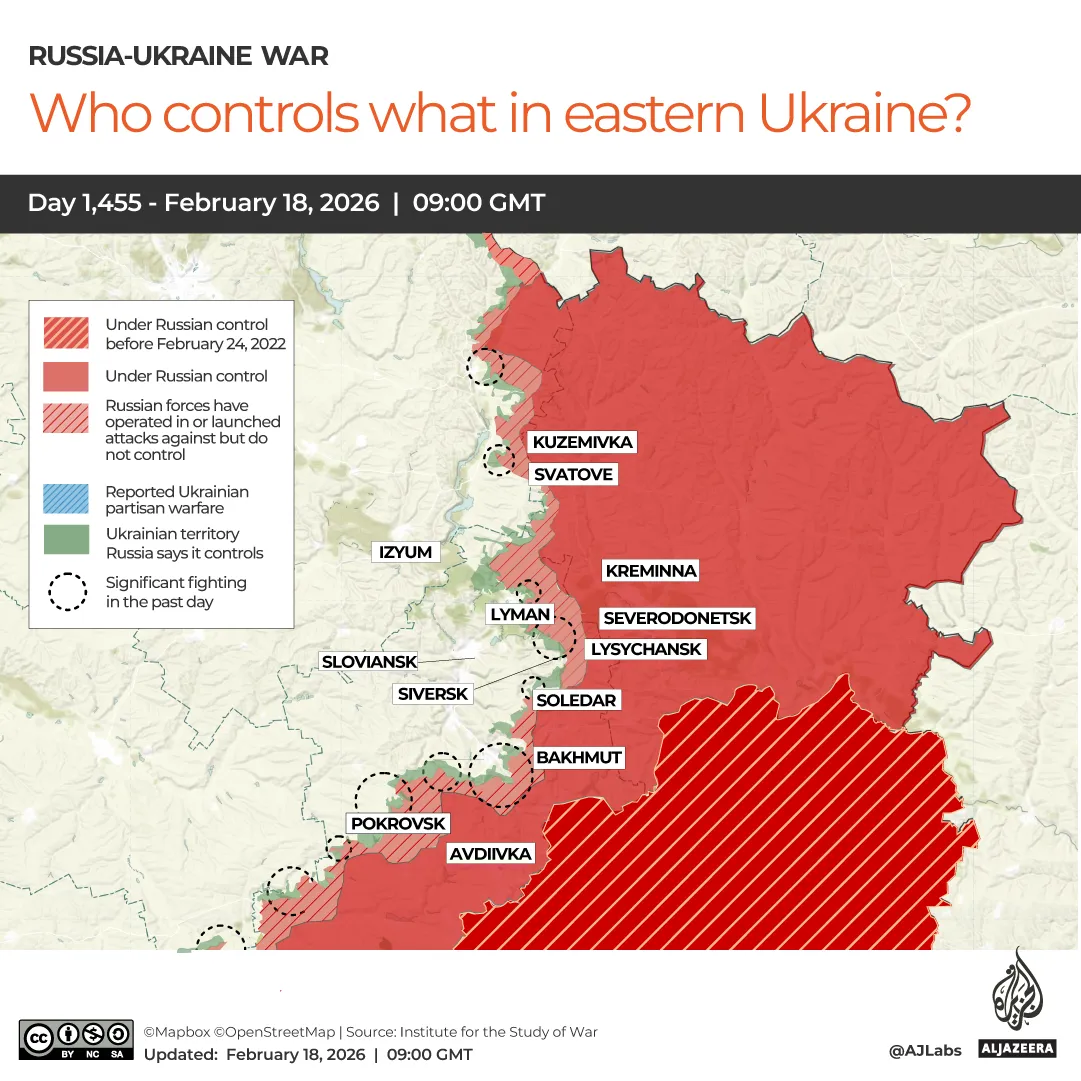
Both sides cautioned that there could be no durable peace until there was a resolution to thorny territorial issues, notably the Donbas, where Russia is demanding Ukraine relinquish the remaining land it still controls — about 25%.

Kremlin aide Yuri Ushakov said the Russian side had made it clear to Witkoff that no long-term solution should be expected to be achieved in the absence of a territory deal based on the “formula” agreed at the U.S.-Russia summit in Anchorage in August.

U.S. President Donald Trump called the summit to get a cease-fire but ended up with a loose agreement to end the war through Ukraine giving up territory in exchange for Russia agreeing to accept NATO-style security guarantees for Ukraine — putting the onus on Kyiv.

Ushakov said Russia was genuine in its desire to resolve the conflict through “political and diplomatic means” but until then it fully intended to continue to pursue the goals of its “special military operation” on the battlefield, where it was winning.

Speaking in Davos on Thursday, Zelensky also said the whole process hinged on land.

“It’s all about the land. This is the issue which is not solved yet. The Russians have to be ready for compromises, not only Ukraine,” Zelensky said after meeting with Trump on the sidelines of the World Economic Forum, where he claimed post-war security guarantees had been finalized.

He said Friday’s Russia-Ukraine-U.S. talks might produce “variants” on how to solve the issue, referencing the Russian demand for Kyiv to pull back its troops from parts of its Donetsk and Luhansk provinces (the Donbas), on one side, and a U.S. proposal for those areas to form a demilitarized “economic” zone in exchange for security guarantees for Ukraine.

With Russia ruling out a cease-fire in the interim, an end to the fighting could be some way off.

Ukraine’s constitution requires that any deal of such consequence as ceding land must be ratified by Ukrainian lawmakers, and possibly the Ukrainian people in a referendum, while a security guarantee involving the United States would have to be authorized by Congress.

Source link

Why is Rodman signing and highest female soccer salary controversial? | Football News

Forward Trinity Rodman’s new three-year deal to remain with the Washington Spirit has brought to an end months of speculation about the Olympic gold medallist’s future in the National Women’s Soccer League (NWSL). It has also shattered the wage record for a female footballer.

The Spirit announced the signing in a statement on Thursday evening, calling it “one of the most significant contracts in the NWSL and the women’s game worldwide, reflecting both Rodman’s elite status and the Spirit’s role as a global standard-bearer in women’s football”.

Recommended Stories

list of 4 itemsend of list

The deal has not been without controversy, though. The furore over Rodman’s future with the Spirit spurred criticism of the NWSL salary cap and whether it hampered the league from attracting and maintaining top players.

Al Jazeera Sport takes a look at the deal that split the sport in the United States, but has now set a new bar for women’s football across the world.

How did Rodman’s NWSL deal hit the headlines?

The 23-year-old Rodman became a free agent at the end of last season after five years with the Spirit. One of the biggest stars in the NWSL, keeping her in the league was considered vitally important as other US national team stars, including Naomi Girma and Alyssa Thompson, opted to play in Europe.

As the failure to agree to a new deal dragged on last year, with her previous contract ending on December 31, Rodman, too, drew interest from European teams that don’t have a salary cap. Months of speculation ensued, in particular that teams from England were heading the list of suitors on the continent who were prepared to step in and meet her wage demands.

What is the value of Rodman’s new Washington Spirit deal?

The financial terms of Rodman’s contract were not disclosed.

It is understood, however, that Rodman’s deal is worth more than $2m annually, including bonuses.

“Trinity is a generational player, but more importantly, she represents the future of this club and the future of women’s soccer,” Spirit owner Michele Kang said. “This agreement reflects our belief that elite talent deserves elite commitment.”

How did Rodman’s deal first court controversy in the NWSL?

The Spirit and Rodman had previously struck a multi-year deal that both parties maintained was in compliance with the salary cap, but it was rejected by the league.

The NWSL’s salary cap is $3.5m for each team for the 2026 season, which brought Rodman’s salary sharply into the spotlight and remains an awkward sum, although the cap will increase each year until it hits $5.1m in 2030.

NWSL commissioner Jessica Berman, who vetoed the deal at the time, reportedly believed it violated the “spirit” of league salary rules.

With the initial rejection, the National Women’s Soccer League Players Association filed a grievance claiming that the NWSL’s rejection of the contract violated Rodman’s free agency rights and violated the collective bargaining agreement.

How was Rodman’s deal resolved with the NWSL?

To address the salary cap issue, the NWSL in late December adopted a “High Impact Player” mechanism that allowed teams to spend up to $1m over the cap to sign players that meet certain criteria. Those included metrics like national team minutes, inclusion among the 30 candidates for the Ballon d’Or or player rankings by outlets like The Guardian or ESPN.

The NWSLPA filed a grievance over the rule, claiming it violated the collective bargaining agreement and federal labour law because player compensation must be negotiated. The NWSLPA maintains the league had no authority to “unilaterally create a new pay structure”.

Spirit President of Soccer Operations Haley Carter said the High Impact Player rule figured into the contract Rodman ultimately agreed to. Carter also said the grievances would not alter Rodman’s deal.

Trinity Rodman (front left) of the Washington Spirit signs a contract extention during a press conference at BMO Stadium
Trinity Rodman (front left) of the Washington Spirit signs a contract extension under the watchful eye of the club’s owner, Michele Kang [Kiyoshi Mio/Reuters]

What have Rodman and Washington Spirit said about the deal?

“I think I’ve always had a vision and an idea of what I wanted my legacy to be,” Rodman said at Thursday evening’s event in Los Angeles to announce her new deal. “And for me, we’re doing that and I’m so grateful for that.”

For Washington Spirit, losing Rodman was an unpalatable scenario.

“I can’t think of the Washington Spirit without her,” Spirit owner Michele Kang said of the new deal. “And I hope she can’t think about her career without the Washington Spirit. So this is really monumental and it was really important, not only for the Spirit, especially for our fans who expect to see her. They come to Audi Field and that’s where Rowdy Audi clearly came out.”

Was a move away from the NWSL a real possibility for Rodman?

“Making my decision, the one question I was asked was: ‘Do you feel like you’re finished with the Spirit? Can you say that and feel confident leaving?’” Rodman said.

“I didn’t even need half a second, and I was like, ‘No, I’m not. I don’t feel ready to make a different decision.’ That’s just, again, getting drafted here and developing and maturing and learning – and failing – at the Spirit, in DC, it’s become so much of my legacy and my story. But on top of that, I still feel like there’s so much more I have to give and so much more that I want to do.”

Is Trinity Rodman the daughter of NBA legend Dennis?

Yes. Rodman, whose Olympic gold was secured with the United States at the Paris Games in 2024, is the daughter of former NBA star Dennis Rodman.

She was drafted at the age of 18 in 2021 and earned Rookie of the Year honours as the Spirit won their first NWSL title.

Rodman has since won 47 appearances and 11 goals with the US national team, more than any other player on the latest roster. She only played in one US match last year, a 2-0 victory over Brazil in April, because of injuries.

Rodman is currently with the national team in their annual January training camp in Carson, California. The team plays a match there against Paraguay on Saturday and then plays Chile on Tuesday in Santa Barbara.

Source link

Japanese PM Takaichi dissolves lower house, calls Feb. 8 snap election

Japanese Prime Minister Sanae Takaichi (C) listens to lawmakers before the announcement of the dissolution of the lower house of the parliament, in Tokyo on Friday. Photo by Franck Robichon/EPA

Jan. 23 (UPI) — Japanese Prime Minister Sanae Takaichi formally dissolved the House of Representatives on Friday, triggering a snap general election scheduled for Feb. 8 in a move aimed at securing a public mandate for her administration’s policy agenda just months after she took office.

The dissolution of the lower house came at the opening of the regular Diet session, a step not seen at the start of a session in roughly 60 years, according to news agency Kyodo.

In an official statement released by the Cabinet Secretariat, Takaichi argued that major policy shifts — including her administration’s economic measures to counter persistent inflation, structural fiscal reforms and national security initiatives — require direct public endorsement.

“Now that we have implemented immediate measures, we need to step up our efforts to realize a major policy shift,” Takaichi said in the statement. “If we do not begin implementing bold policies and reforms now, it will be too late.”

Following the Cabinet decision, the House speaker read the imperial dissolution proclamation at a plenary session, formally disbanding the 465-seat lower chamber. Official campaigning is expected to begin Jan. 27, setting one of the shortest election timetables in postwar Japanese history.

Takaichi is Japan’s first female prime minister. She took office late last year after winning a leadership contest within the ruling Liberal Democratic Party following the resignation of former Prime Minister Fumio Kishida, whose public approval had fallen sharply.

Since assuming office, Takaichi has sought to consolidate her authority within the party and its governing coalition, projecting a more assertive leadership style while pushing to advance her economic and security agenda.

The hardline conservative leader has maintained high approval ratings of around 70% amid a rightward shift in Japan, although the LDP’s support lags significantly below that of her personal numbers.

Opposition parties criticized the timing of the dissolution, accusing Takaichi of placing political strategy ahead of parliamentary deliberations on the fiscal 2026 budget. They argue the accelerated schedule leaves voters little time to assess competing policy proposals.

The ruling coalition, comprising Takaichi’s Liberal Democratic Party and the Japan Innovation Party, holds only a razor-thin majority in the lower house and remains a minority in the upper chamber, forcing it to rely on opposition cooperation to pass legislation.

Public broadcaster NHK reported that inflation and cost-of-living pressures are expected to dominate campaign debates. Political funding scandals that have dogged the LDP in recent years are also likely to feature prominently, alongside debates over foreign residents, tourism policy and Japan’s security posture amid heightened tensions with China.

The previous lower house election was held in October 2024.

Source link

NBA: Tyrese Maxey’s clutch shots push 76ers past Rockets in OT | Basketball News

Tyrese Maxey scored 36 points, including clutch plays late in regulation and at the end ‌of overtime, lifting the Philadelphia 76ers to a 128-122 home win over the Houston Rockets on Thursday.

Maxey added 10 assists for Philadelphia, while Joel Embiid put up some impressive stats of his ‍own with 32 points, 15 rebounds and ‍10 assists. Kelly Oubre Jr chipped in 26 points on 10-of-14 shooting for the Sixers.

Recommended Stories

list of 4 itemsend of list

Kevin Durant spurred Houston’s offence with 36 points, although he also committed eight of the team’s 17 turnovers. Amen Thompson pitched in with 17 points and nine assists for the Rockets, who had their three-game winning streak halted.

Houston led 107-101 before Maxey scored 11 points in the final four minutes of regulation to draw Philadelphia even at 115-115, with 40.1 seconds left.

Nuggets 107, Wizards 97

Peyton Watson scored a career-high 35 points to go along with eight rebounds, leading ⁠visiting Denver to a victory over Washington.

Watson made 10 of 16 shots from the floor – including 6 of 8 from 3-point range – and added four blocks. Denver’s Jamal Murray scored 24 points, and Jonas Valanciunas added ​16 to go along with nine rebounds in his return from an 11-game absence due to a right calf strain.

Kyshawn George collected 20 points, 12 rebounds and seven ‍assists, and rookie Tre Johnson scored 19 points for the reeling Wizards, who have lost eight in a row.

Mavericks 123, Warriors 115

Naji Marshall posted 30 points and nine assists as Dallas extended its winning streak to four with a victory over visiting Golden State.

Cooper Flagg paired 21 points with 11 rebounds, Max Christie added 21 – including 5-of-12 shooting from deep – and Brandon Williams had 19 off the bench.

Stephen Curry scored 38 points, shooting 8-of-15 from 3-point range, while De’Anthony Melton contributed 22 for the ‍Warriors, who lost Jonathan Kuminga with ⁠3:52 remaining in the second quarter with left knee soreness, when he landed awkwardly on a dunk attempt.

Trail Blazers 127, Heat 110

Shaedon Sharpe scored 24 of his 27 points in the second half to help Portland post a victory over visiting Miami.

Caleb Love scored 20 points off the bench as the Trail Blazers won their fourth consecutive game and moved above .500. Portland standout Deni Avdija had 20 points, seven rebounds and four assists in 17-plus minutes before exiting with back soreness early in the third quarter. Avdija recently returned from a three-game absence due to lower-back issues.

Bam Adebayo had 32 points and 10 rebounds for the Heat, who are 1-2 on a five-game road trip. Miami’s Norman Powell had 18 points but missed all seven of his 3-point attempts, Simone Fontecchio scored 17 points off the bench, and Andrew Wiggins had 14 for the Heat.

Clippers 112, Lakers 104

Kawhi Leonard scored 24 points, Ivica Zubac added 18 points with 19 rebounds, and the ​Los Angeles Clippers continued their red-hot run with a victory over the visiting Los Angeles Lakers at Inglewood, California.

James Harden scored 18 points with 10 assists, ‌Jordan Miller had 14 points, and John Collins added 13 as the Clippers improved to 14-3 since December 20, in a run that started with a home victory against the Lakers.

Luka Doncic scored 32 points with 11 rebounds and eight assists, while LeBron James added 23 points as the Lakers dropped to 3-6 since January 7. Rui Hachimura scored 12 points for the Lakers, who are 1-1 to start an eight-game road trip.

Spurs 126, Jazz 109

De’Aaron Fox hit four 3-pointers in the fourth ‌quarter and had a game-high 31 points as San Antonio overcame a triple-double by Jusuf Nurkic and defeated Utah in Salt Lake City.

Ace Bailey, a rookie out of Rutgers, had a career-high 25 points for Utah, while Nurkic posted 17 points, 14 assists and 11 rebounds. Nurkic became the first player in franchise history ‌with consecutive triple-doubles since Pete Maravich with the New Orleans Jazz in 1975.

Victor Wembanyama had 26 points and 14 rebounds for ⁠the Spurs, who have won four of five and hold the second-best record in the Western Conference. Utah has lost five of its last six.

Bulls 120, Timberwolves 115

Coby White scored a team-high 22 points, and Chicago finished with a 9-0 run to post a victory over Minnesota in Minneapolis.

Josh Giddey added 21 points after missing the last 11 games with a left hamstring strain. Jalen Smith scored 17 points, and Matas Buzelis and Tre Jones each had 12. Isaac Okoro and Nikola Vucevic finished with 10 points apiece for ‌the Bulls, who have won four of their last five.

Julius Randle’s 30 points paced Minnesota, while Anthony Edwards and Naz Reid scored 20 apiece. Jaden McDaniels chipped in 16 points for the Timberwolves, who dropped their fourth straight game. Rudy Gobert collected 10 points and 11 rebounds in the loss.

Hornets 124, Magic 97

Brandon Miller scored 20 points to lead eight players in double figures as visiting Charlotte beat Orlando.

Collin Sexton had ‍19 points, LaMelo Ball added 16 and Kon Knueppel had 13 points and 10 rebounds for the Hornets, who led by as many as 33 and shot 54.4% from the field and 47.2% (17 of 36) from 3-point range.

Paolo Banchero scored 23 points, and Desmond Bane added 21 to lead the Magic, who took a 3-0 lead on a Bane 3-pointer and never led again. Moritz Wagner had 14 points, ‌Noah Penda scored 13, and Jett Howard had 10.

Source link

Vietnam’s To Lam wins second term, extends top position for 5 more years | Politics News

General Secretary To Lam will continue to lead Vietnam’s Communist Party amid pledges to continue rapid reforms.

Vietnam’s Communist Party ⁠has ​re-appointed To ‍Lam as its ‍general ⁠secretary, extending his top leadership position in the Southeast Asian nation for the next five years.

To Lam was “unanimously” re-elected to the post of general secretary, according ‌to an announcement made ‌at ‌the conclusion of the party’s five-yearly ⁠congress in the capital Hanoi on Friday.

Recommended Stories

list of 4 itemsend of list

The party central committee “absolutely unanimously elected Comrade To Lam to continue holding the position of General Secretary”, the party said in a statement.

Tran Thanh Man, chairman of Vietnam’s National Assembly, said the party chief had received 180 votes out of 180 to remain in the top job.

Lam’s re-election as party chief will send a reassuring message to foreign investors who regularly cite political stability as a key factor in Vietnam’s appeal as a pro-business environment.

Lam, 68, is also seeking to become president, with a decision on that position ‌expected to be announced later.

Vietnam's relected Communist Party General Secretary To Lam is seen on a screen as he speaks during the closing session of the Communist Party of Vietnam's (CPV) 14th National Congress at the National Convention Centre in Hanoi on January 23, 2026. Vietnam's Communist Party "unanimously" re-elected To Lam to the post of general secretary on January 23, it said on its website, confirming he will remain the country's top leader for the next five years. (Photo by Nhac NGUYEN / AFP
Vietnam’s re-elected Communist Party General Secretary To Lam is seen on a screen as he speaks during the closing session of the Communist Party of Vietnam’s (CPV) 14th National Congress, at the National Convention Center in Hanoi, on Friday [Nhac Nguyen/AFP]

Earlier this week, addressing hundreds of congress delegates seated in red-upholstered chairs in a red-carpeted conference hall under a towering statue of the Communist Party’s founder and liberation struggle hero, Ho Chi Minh, Lam promised to continue fighting corruption and ensure annual growth above 10 percent through to 2030.

Speaking at the end of ‌the ‌congress and his reappointment on Friday, Lam committed to ⁠working hard to meet the expectations ‌of Vietnam’s people.

Lam’s retaining of the top party position follows his implementation of sweeping reforms since taking over as Communist Party General Secretary in late 2024, which have shocked the country with their speed and severity for some sectors.

He has eliminated whole layers of government bureaucracy, abolished eight ministries or government agencies and cut nearly 150,000 jobs from the state payroll, while pushing ambitious rail and power projects as well as weeding out corruption.

Lam said in a speech this week that he wants to change the country’s economic growth model, which has hinged for decades on cheap labour and exports, instead turning Vietnam into a high-middle-income economy by 2030 by focusing on innovation and efficiency.

He also warned of the overlapping threats Vietnam faces “from natural disasters, storms and floods to epidemics, security risks, fierce strategic competition, and major disruptions in energy and food supply chains”.

Vietnam, a nation of 100 million people, is both a repressive one-party state and a regional economic bright spot, where the Communist Party has sought to deliver rapid growth to bolster its legitimacy domestically and internationally.

Source link

3 civilian suspects banned from leaving nation over alleged drone flights to N. Korea

Investigators transport seized objects from the office of suspects accused of flying drones into North Korea at a university in Seoul on Wednesday. Photo by Yonhap

A joint team of police and military investigators has imposed travel bans on three civilian suspects accused of involvement in alleged drone flights to North Korea, sources said Friday.

The suspects include a graduate student in his 30s, surnamed Oh, who claimed to have flown the drones, an individual, surnamed Jang, suspected of building them, and a third person known to have worked at a drone manufacturing company set up by the other two, according to the sources.

The joint investigation was launched last week after North Korea claimed South Korea infringed on its sovereignty with drone incursions in September and on Jan. 4. South Korea’s military has denied involvement, saying it does not operate the drone models in question.

The suspects are accused of flying a drone bound for North Korea from Ganghwa County, just west of Seoul. The aircraft reportedly took pictures of a South Korean Marine Corps base as it flew across the inter-Korean border.

Investigators seek to press charges against the suspects for violating the Aviation Safety Act and the Protection of Military Bases and Installations Act.

The joint team has stepped up investigative efforts after Oh claimed to have sent the drones to North Korea on the dates alleged by Pyongyang in a media interview aired last Friday

Investigators have widened the probe following revelations that Oh and Jang worked at the presidential office under former President Yoon Suk Yeol, as well as allegations that Oh operated online news outlets suspected of being linked to a military intelligence official.

The Defense Intelligence Command later confirmed the link between them, in a briefing to ruling party Rep. Boo Seung-chan, saying the online news outlets were used to issue fake identification cards to help agents conduct intelligence activities.

The command, however, said it has yet to be verified whether military intelligence officials were involved in the alleged drone flights, according to Boo’s office.

Copyright (c) Yonhap News Agency prohibits its content from being redistributed or reprinted without consent, and forbids the content from being learned and used by artificial intelligence systems.

Source link

Trump administration completes U.S. withdrawal from World Health Organization

The Trump administration on Thursday said it has completed the United States’ withdrawal from the World Health Organization, which is led by Director General Tedros Adhanom Ghebreyesus. File Photo by Fabrice Coffrini/EPA-EFE

Jan. 23 (UPI) — The United States has completed its exit from the World Health Organization, the Trump administration said, one year since it began the withdrawal process.

“Like many international organizations, the WHO abandoned its core mission and acted repeatedly against the interests of the United States,” Secretary of State Marco Rubio and Secretary of Health and Human Services Robert F. Kennedy Jr. said in a joint statement on Thursday.

“Although the United States was a founding member and the WHO’s largest financial contributor, the organization pursued a politicized, bureaucratic agenda driven by nations hostile to American interests.”

Trump initiated the process to withdraw the United States from the United Nations’ intergovernmental health body on the first day of his second term in office via executive order.

Under U.S. law, the United States could withdraw from the WHO after a one-year notice. It also requires the United States, the WHO’s largest financial contributor, to fulfill its financial obligations to the organization for the fiscal year in which the notice was given.

Rubio and Kennedy said the WHO has refused to return the American flag that hung outside its headquarters, asserting that the organization has not approved the United States’ withdrawal due to outstanding payments.

The pair neither confirmed nor denied whether the United States was negligent on its bills but said that on its way out, “the WHO tarnished and trashed everything that American has done for it.”

“From our days as its primary founder, primary financial backer and primary champion until now, our final day, the insults to America continue,” they said.

The U.S. engagement with the WHO will be limited to completing the withdrawal and “to safeguard the health and safety of the American people.”

“All U.S. funding for, and staffing of, WHO initiatives has ceased,” they said.

UPI has contacted the WHO for comment.

Trump originally withdrew the United States from the WHO during his first term in office, accusing the organization of allegedly enabling China to cover up the origins of the COVID-19 pandemic and its early outbreak of the disease.

President Joe Biden reversed Trump’s decision on his first day in office in January 2021.

Then, on his first day of his second term in the White House, Trump, via executive order, pulled the United States from the WHO, citing its “mishandling” of the pandemic as well as its seeking “unfairly onerous payments from the United States, far out of proportion with other countries’ assessed payment.”

Trump has sought to distance the United States from the United Nations and its affiliated agencies, and more broadly from multilateral institutions and forums and intergovernmental engagement, under his America First international policy.

Earlier this month, the White House announced the U.S. withdrawal from 35 non-U.N. entities and 31 entities under the U.N. umbrella. Rubio said the organizations affected were deemed “contrary to the interests of the United States.”

Critics and Democrats have chastised Trump and his administration for seeking to pull the United States from the greater global community.

Ronald Nahass, president of the Infectious Diseases Society of America, called the U.S. withdrawal from the WHO “a shortsighted and misguided abandonment of our global health commitments.”

“Withdrawing from the World Health Organization is scientifically reckless,” Nahass said in a statement. “It fails to acknowledge the fundamental natural history of infectious disease. Global cooperation is not a luxury; it is a biological necessity.”

On the other hand, Mike Waltz, the U.S. Ambassador to the U.N., celebrated the move.

“We stand proud in our commitment to American sovereignty,” he said on X.

Source link

Feet dragging, division and obstruction: What Israel really wants for Gaza | Israel-Palestine conflict News

Israel has spent more than two years attacking Gaza in its genocidal war on the Palestinian enclave. It has destroyed the majority of its housing and infrastructure, and killed more than 70,000 Palestinians, leaving the rest of Gaza’s population facing a harsh winter with inadequate food, medicine, and shelter.

And yet Israeli Prime Minister Benjamin Netanyahu – for whom the International Criminal Court has issued an arrest warrant for war crimes committed in Gaza – this week joined US President Donald Trump’s “Board of Peace”, established to oversee the reconstruction and governance of Gaza.

Recommended Stories

list of 4 itemsend of list

It opens up the question of what Netanyahu – and Israel – actually want from the Palestinian territory, and whether they want the territory to rebuild or just want a continuation of the status quo.

Ahead of Netanyahu lies a difficult journey, observers say. With Israeli elections looming later this year, he must appear to the world and the Israeli public as working with US ambitions for Gaza.

But he also needs to maintain his governing coalition, which relies in part on elements, such as his Finance Minister Bezalel Smotrich, who are not just opposed to the reconstruction of Gaza, but also opposed to the ceasefire in a territory that he and his allies – as religious Zionists – regard themselves as divinely entitled to settle upon.

So far, things do not seem to be going entirely Netanyahu’s way. He has failed to delay the transition to the second phase of Trump’s three-phase ceasefire plan, despite Hamas’s refusal to disarm. Similarly, despite his objections, Gaza’s Rafah crossing is due to open in both directions, allowing people in and out of the enclave, next week. Lastly, his protestations against Turkiye and Qatar joining the Board of Peace, and potentially deploying forces to Gaza as part of a proposed International Stabilisation Force, also appear to have been overruled by the US.

Settlement or security

At home, Netanyahu’s cabinet remains divided on Gaza. On Monday, Smotrich not only slammed US proposals as “bad for Israel”, but on Monday, called for the US base in southern Israel responsible for overseeing the ceasefire to be dismantled. Meanwhile, others in the Israeli parliament have primarily focused on the upcoming elections, aiming only to galvanise their political base, regardless of ideology.

Netanyahu continues to insist that Hamas will be disarmed, and the Israeli military is working on razing territory all along the border with Gaza, creating a buffer zone deep into the coastal enclave.

Even if Hamas does not completely lose all its weapons, it has been weakened, and pushing Palestinians further away from the Israeli border allows the Israeli government to project the image of security for its population.

The Israeli public, exhausted after more than two years of war, largely relegates the consequences of Israel’s actions to the back pages of national media.

“The public is deeply divided on Gaza and the Board of Peace,” said American-Israeli political consultant and pollster Dahlia Scheindlin. “Though there’s a minority bloc favouring resettling Gaza, most of Israeli society is splintered. People typically view Gaza with a mixture of fear and a need for security, driven entirely by the events of October 2023. They want Israel to remain in Gaza in some form and don’t trust outsiders to handle it. At the same time, there’s hope that US involvement could achieve what two years of war couldn’t.”

“However, nearly everyone starts from the same point: Anything is better than going back to war,” Scheindlin said.

“They don’t have a strategy, and everything is chaos,” peace campaigner Gershon Baskin said, referring to Israel’s leaders. “They’re in election mode and only speaking to their base. I went to the Knesset yesterday. It’s like watching lunatics in a house of madness. It’s a disaster.”

For much of the public, Palestinians remain invisible. “They don’t exist. Israel has probably killed more than 100,000, but the majority of Israelis don’t know or care what’s going on the other side of the border. We even dispute there’s a border; it’s just ours,” Baskin said. “We don’t even see it on TV. All they show are old clips on loop. You can find images of Gaza on social media, but you have to go looking for it.

“Most Israelis don’t.”

Palestinians walk through the destruction caused by the Israeli air and ground offensive in the Al-Shati camp, in Gaza City, Friday, Oct. 24, 2025. (AP Photo/Abdel Kareem Hana)
Palestinians walk through the destruction caused by the Israeli air and ground offensive in the al-Shati camp, in Gaza City [Abdel Kareem Hana/AP]

Divided politics

Many Israeli leaders agree on one thing – that there will not be a Palestinian state.

How to reach that goal, or the details that accompany it and how Gaza fits into it all, are open to interpretation.

Irrespective of the outcome of the US-backed Gaza ceasefire process, Israel will remain alongside a territory, Gaza, against whose population it is accused of genocide. Currently, according to analysts within Israel, there appears to be no plan for the coexistence that geography dictates, only the unspoken suspicion that outside powers, in this case the US, are not really capable of determining how best to achieve it.

Even Israel’s commitment to US plans is open to question, with Netanyahu – when safely outside of Trump and his team’s earshot – framing the ceasefire’s second phase as a “declarative move”, rather than the definite sign of progress described by US envoy Steve Witkoff.

“The genocide hasn’t stopped. It’s continuing; it’s just moved from active to passive,” said Israeli lawmaker Ofer Cassif. “Israel is not bombing Gaza as before, but now it is leaving the people there to freeze and starve. This isn’t happening on its own. This is government policy.”

Israeli politician Ofer Cassif, centre, holds a Palestinian flag
‘The genocide hasn’t stopped. It’s continuing; it’s just moved from active to passive,’ Israeli lawmaker Ofer Cassif told Al Jazeera [Ahmad Gharabli/AFP]

Numerous analysts, including political economist Shir Hever, questioned Israeli leaders’ capacity for long-term planning.

Decisions, such as the attacks on Iran and Qatar, Hever said, were driven as much by domestic politics as overarching strategy. The Iran attack in June, for instance, coincided with a pending vote of no confidence in the government, while the Qatar strike in September may have been an attempt to refocus public attention away from Netanyahu’s ongoing corruption trial, he told Al Jazeera.

“There is no plan. Long-term planning is not how Israeli governments work,” Hever told Al Jazeera. “Smotrich and others have a long-term plan – they want to settle Gaza and expel Palestinians – but in real politics, there is no plan. Everything is short-term.”

Uncertain future

“I’m more optimistic than I have been for a long time,” Baskin, whose mediation between Israel and the PLO in the ’90s proved pivotal during the Oslo Accords, “There’s a new factor in play that hasn’t been there before: a US president that the Israeli government can’t say no to,” he continued, referring to the US decision to override Israeli objections against moving into phase two before Hamas’s disarmament, the inclusion of Qatar and Turkiye in the Board of Peace and the decision to open the Rafah crossing.

Cassif was less hopeful. “I don’t have any faith in this Board of Peace,” he said, “I think it’s now government policy to keep frustrating and delaying plans to form a stabilisation force; to just let people die while that happens.

“People accuse me of saying these things for politically cynical reasons, but of course, that’s not true,” he said, “I wish I didn’t have to say them at all.”

“It’s painful,” he continued, “And it’s painful to me not just as a humanist and a socialist, but as a Jew.”

Source link

Trump withdraws Canada’s Board of Peace invitation after Davos clash

Jan. 22 (UPI) — President Donald Trump late Thursday announced he withdrew Canada’s invitation to join the U.S.-led Board of Peace, as relations between the longtime allies continue to deteriorate during his second term.

“Please let this Letter serve to represent that the Board of Peace is withdrawing its invitation to you regarding Canada’s joining, what will be, the most prestigious Board of Leaders ever assembled, at any time,” Trump said in a statement posted to his Truth Social media platform.

The note was addressed to Prime Minister Mark Carney.

Trump formally launched the Board of Peace initiative earlier Thursday at the World Economic Forum in Davos, Switzerland. More than 50 world leaders reportedly received invitations, with about 25 joining the board, though additional countries are expected to follow.

The board was initially conceived to aid in the peace process in Gaza, though questions over whether it has larger ambitions have been raised by the absence of mention of the Palestinian enclave in its charter. Controversy also swirls over those who have been invited to join, including President Vladimir Putin of Russia.

Tensions between Trump and Carney spiked during Davos, beginning with Carney giving a 16-minute special address that attracted international attention for emphasizing that the era of a rules-based international order was coming to an end and was being replaced by a world of “great power rivalry” where “the strong can do what they can, and the weak must suffer what they must.”

Carney said that Canada was among the first nations to “hear the wake-up call” that the old world was over and began to shift its strategic posture, and called on middle powers to come together, “because if we’re not at the table, we’re on the menu.”

Trump, speaking at Davos on Wednesday, hit back at Carney, accusing him of being ungrateful.

“They should be grateful to U.S., Canada. Canada lives because of the United States,” Trump said.

“Remember that, Mark, the next time you make your statements.”

Carney then responded in a speech on Thursday.

“Canada doesn’t live because of the United States. Canada thrives because we are Canadian,” he said.

“We choose to build a bright future worthy of the ground on which we stand. We choose Canada.”

Trump issued his statement hours later.

Canada and the United States have seen their relationship sour amid the second Trump administration.

Trump’s threats to annex Canada and make it the 51st state and his imposition of tariffs on Canadian goods, which ignited a trade war, prompted Carney to foster relations with Europe and other nations while distancing itself from the United States.

Carney has previously said that Trump’s stance toward Ottawa is a “betrayal” and his tariffs a “direct attack” on Canada, and has repeatedly signaled that he will seek to lessen Canada’s dependency on Washington.

Canada had indicated a willingness to join, but said it would not pay the $1 billion Trump is requesting as a fee.

While many so-called middle powers have joined the board, notable U.S. allies and Western nations, including France, Britain and Germany, have either declined to join or are uncommitted.

Source link

Coast Guard carried over 22.7B won in 2025 project funds

A member of the Korea Coast Guard (KCG) rappels from a helicopter toward a ferry in waters off the National Maritime Museum of Korea, in the port city of Busan, South Korea, 21 November 2025. The Korea Coast Guard conducted a disaster drill simulating a ferry fire and subsequent rescue operations. File. Photo by YONHAP / EPA

Jan. 22 (Asia Today) — South Korea’s Coast Guard did not execute 22.7 billion won ($17.5 million) in project funds by year-end 2025, according to data submitted to the National Assembly, raising questions over whether budget execution and fund allocation were properly managed.

The figures, obtained by opposition People Power Party lawmaker Kim Tae-ho, show the Coast Guard carried over 22.73431 billion won ($17.5 million) in project funds as of Dec. 31, 2025. The projects include spending tied to maintenance depot operations, vessel construction and establishment of Vessel Traffic Service centers.

More than 45 of 56 projects were classified as “contract period not yet expired,” the data showed. The Coast Guard has said payments could not be made because work was not completed. However, some observers said that under annual project structures that can include advance and progress payments, at least part of the funding could have been disbursed by the end of the year.

The Coast Guard rejected the “unpaid” characterization, saying the issue stems from contracts still being in effect rather than overdue payments. It also said the situation differs from cases involving the Defense Ministry where payments were reportedly not made even after completion and invoicing.

Still, the Coast Guard’s explanations appeared inconsistent. In a call with this publication, a Coast Guard spokesperson described a system that includes advance payments and interim payments with execution tied to project progress. The following day, the Coast Guard emphasized a typical “80% advance payment and 20% final payment” structure and said some contracts are paid in full after completion, without clearly addressing whether the 22.7 billion won figure reflected interim payments or final payments.

Asked whether the amount involved interim or final payments, a Coast Guard official said the agency would need to review individual projects, signaling further verification is required.

A political source said even official documents submitted to the National Assembly contain inconsistent descriptions of the execution structure and called for a parliamentary review of the Finance Ministry’s overall fund allocation and execution management.

— Reported by Asia Today; translated by UPI

© Asia Today. Unauthorized reproduction or redistribution prohibited.

Source link

Jeong merger proposal sparks rift inside Democratic Party

Democratic Party leader Jeong Cheong-rae leaves after an emergency news conference at the National Assembly in Seoul on Thursday. Photo by Asia Today

Jan. 22 (Asia Today) — South Korea’s Democratic Party split into competing camps Thursday after party leader Jeong Cheong-rae abruptly proposed a merger with the Rebuilding Korea Party, drawing praise from some lawmakers and backlash from others who said the move bypassed internal procedure.

Jeong announced the proposal at an emergency news conference at the National Assembly, saying the merger was needed to support President Lee Jae-myung’s administration and win the June 3 local elections.

Chief spokesperson Park Soo-hyun said the party had held prior discussions with the Rebuilding Korea Party and reached an understanding Wednesday afternoon on making the proposal public.

Critics inside the Democratic Party said there was no internal deliberation despite the scale of the decision.

Rep. Jang Cheol-min wrote on Facebook that even members of the party’s supreme council learned of the plan only about 20 minutes before the news conference, saying decisions that determine the party’s future should not be made through surprise announcements.

Rep. Kim Yong-min said the leader should not decide the issue alone. Supreme Council member Han Jun-ho and Rep. Mo Kyung-jong also stressed procedural legitimacy, saying the party should first confirm the will of its members.

Supporters framed the move as a step toward consolidating the progressive bloc. Rep. Park Ji-won said the party must take risks to secure victory, while Rep. Choi Min-hee said she welcomed the proposal as a way to build a stronger progressive force.

Cho Kuk, who leads the Rebuilding Korea Party, said Jeong’s proposal carried significant weight and that his party would gather views through its party affairs committee.

Presidential office spokesperson Kang Yu-jeong said the office was monitoring developments as an issue for the National Assembly, adding there had been no prior discussion.

— Reported by Asia Today; translated by UPI

© Asia Today. Unauthorized reproduction or redistribution prohibited.

Source link

Did the US give Greenland back to Denmark? Trump omits history at Davos | Donald Trump News

On Wednesday, United States President Donald Trump made clear to other world leaders in Davos, Switzerland, that he was unflinching in his demand to acquire Greenland, even as he said for the first time that he did not plan for the US to take the land by force.

Trump, who talked up his tariff-based negotiation strategy, cited Greenland’s strategic position between the US, Russia and China as the main reason he wants to acquire the territory.

Recommended Stories

list of 3 itemsend of list

Retelling the US history with Greenland and Denmark, Trump said, during World War II, “we saved Greenland and successfully prevented our enemies from gaining a foothold in our hemisphere”.

This much is accurate: After Germany invaded Denmark, the US assumed responsibility for Greenland’s defence and established a military presence on the island that remains today, albeit in diminished scope.

But Trump overstepped when he said, after World War II, “we gave Greenland back to Denmark”.

“All the United States is asking for is a place called Greenland, where we already had it as a trustee, but respectfully returned it back to Denmark not long ago,” he said.

Although the US defended Greenland during World War II, it never possessed the nation, and so could not have given it back. Experts have told PolitiFact that Greenland’s status as part of Denmark is not in question, and has not been for more than a century.

Denmark’s colonisation of Greenland dates to the 1720s. In 1933, an international court settled a territorial dispute between Denmark and Norway, ruling that as of July 1931, Denmark “possessed a valid title to the sovereignty over all Greenland”.

After the 1945 approval of the United Nations Charter – the organisation’s founding document and the foundation of much of international law – Denmark incorporated Greenland through a constitutional amendment and gave it representation in the Danish Parliament in 1953. Denmark told the UN that any colonial-type status had ended; the UN General Assembly accepted this change in November 1954. The US was among the nations that voted to accept Greenland’s new status.

Since then, Greenland has, incrementally but consistently, moved towards greater autonomy.

Greenlandic political activists successfully pushed for and achieved home rule in 1979, which established its parliament. Today, Greenland is a district within the sovereign state of Denmark, with two elected representatives in Denmark’s Parliament.

What about Iceland?

Four times in the Davos speech, Trump referred to Iceland instead of Greenland.

“Our stock market took the first dip yesterday because of Iceland,” Trump said. “So Iceland has already cost us a lot of money, but that dip is peanuts compared to what it’s gone up, and we have an unbelievable future.”

US markets reacted negatively to Trump’s Greenland comments the day before his Davos speech, falling about 2 percent in value.

But in recent weeks, Trump has said nothing about acquiring Iceland, an independent island nation with nearly 400,000 residents, located east of Greenland.

In an X post following Trump’s Davos address, the White House press secretary criticised a reporter for posting that Trump “appeared to mix up Greenland and Iceland” several times. Karoline Leavitt said Trump’s “written remarks referred to Greenland as a ‘piece of ice’ because that’s what it is”. Although Trump did call Greenland a “very big piece of ice”, he also separately mentioned “Iceland”.

Traditionally, Icelanders have maintained strong ties to the US, dating back to World War II, when Reykjavik invited US troops into the country. In 1949, Iceland became a founding member of NATO, and in 1951, the two countries signed a bilateral defence agreement that still stands.

Its location – between the Arctic and North Atlantic oceans, a strategic naval choke point in the Greenland-Iceland-United Kingdom gap – means that Iceland, despite its lack of a standing military, is geographically important for both North America and Europe.

In 2006, the US gave up its permanent troop presence at the Keflavík airbase – a 45-minute drive south of the capital, Reykjavik – but US troops still rotate through. Icelandic civilians now handle key NATO tasks such as submarine surveillance and operations at four radar sites on the nation’s periphery. Iceland also makes financial contributions to NATO trust funds and contributes a small number of technical and diplomatic personnel to NATO operations.

Trump’s pick for ambassador to Iceland, former Republican Congressman Billy Long, attracted criticism earlier this month when he was overheard saying Iceland should become a US state after Greenland, and that he would serve as governor.

Long apologised during an interview with Arctic Today.

“There was nothing serious about that. I was with some people, who I hadn’t met for three years, and they were kidding about Jeff Landry being governor of Greenland, and they started joking about me. And if anyone took offence to it, then I apologise,” Long told the publication. Trump has tapped Landry, Louisiana’s Republican governor, to be the US envoy to Greenland.

Silja Bara R Omarsdottir, an international affairs professor who now serves as rector, or president, of the University of Iceland, told the Tampa Bay Times in August that newfound attention to Iceland’s security, including concerns over Russia’s invasion of Ukraine for the rest of Europe, is “definitely very noticeable at the political level”.

Multiple analysts in Iceland told the daily, only half-jokingly, that the key to surviving the Trump era has been to remain out of sight, something Greenland, for whatever reason, was unlucky enough not to be able to do.

“You could say Icelandic policy towards the US has been to try to keep under the radar,” said Pia Elisabeth Hansson, director of the Institute of International Affairs at the University of Iceland.

Source link

Trump sues JPMorgan and CEO Dimon over alleged ‘debanking’ | Donald Trump News

The $5bn lawsuit alleges JPMorgan abruptly closed multiple accounts in 2021 cutting off Trump & his firms from access to funds.

United States President Donald Trump has sued banking giant JPMorgan Chase and its CEO Jamie Dimon for $5bn, accusing JPMorgan of debanking him and his businesses for political reasons after he left office in January 2021.

The lawsuit was filed on Thursday in Miami-Dade County court in Florida. It alleges that JPMorgan abruptly closed multiple accounts in February 2021 with just 60 days’ notice and no explanation. By doing so, Trump claims JPMorgan cut the president and his businesses off from millions of dollars, disrupted their operations and forced Trump and the businesses to urgently open bank accounts elsewhere.

Recommended Stories

list of 4 itemsend of list

“JPMC debanked [Trump and his businesses] because it believed that the political tide at the moment favored doing so,” the lawsuit alleges.

In a statement, JPMorgan said that it “regrets” that Trump sued them but insisted they did not close the accounts for political reasons.

“We believe the suit has no merit,” a bank spokesperson said. “JPMC does not close accounts for political or religious reasons. We do close accounts because they create legal or regulatory risk for the company.”

The White House said it will refer the matter to the president’s outside counsel.

Banks have faced growing political pressure in recent years, particularly from conservatives who argue that lenders have improperly adopted “woke” political positions and, in some cases, discriminated against certain industries, such as firearms and fossil fuels.

That pressure has intensified during Trump’s second term, with the Republican president claiming in interviews that some banks refused to provide services to him and other conservatives. The banks have denied the allegation.

A US banking regulator said last month that the nine largest US banks in the past had placed restrictions on providing financial services to some controversial industries in a practice commonly described as “debanking”.

Last year, JPMorgan said it was cooperating with inquiries from government agencies and other entities regarding its policies and procedures in light of the Trump administration’s push to scrutinise banks over alleged debanking.

Reputational risk

US regulators have examined themselves to see if overly strict supervisory policies discouraged banks from providing services to certain sectors.

Trump-led officials have also moved to loosen oversight, with federal bank regulators last year saying they would stop policing banks based on so-called “reputational risk”.

Under that approach, supervisors could penalise institutions for activities that were not explicitly prohibited but could expose them to negative publicity or costly litigation.

Banks have increasingly complained that the reputational risk standard is vague and subjective, giving supervisors wide discretion to discourage firms from providing services to certain people or industries.

The industry has also argued that regulators need to update anti-money laundering rules, which can force banks to close suspicious accounts without giving customers an explanation.

Source link

Paramount Skydance extends Warner Bros takeover bid offer | Media News

The Ellison-owned media giant will now give investors until February 20 to consider its bid.

Paramount Skydance has extended the deadline for its hostile tender offer for Warner Bros Discovery by a month, buying time to persuade investors that its bid is superior to one from Netflix.

The Ellison-owned media company on Thursday moved the deadline to February 20 to consider its $77.9bn offer to buy Warner shares for $30 apiece in cash. The bid has a total enterprise value of more than $108bn, including debt.

Recommended Stories

list of 4 itemsend of list

The extension marks the second time Paramount has pushed out the deadline since challenging Warner’s merger agreement with Netflix last month.

Earlier this month, Warner’s board rejected an amended Paramount bid that included $40bn in equity personally guaranteed by Larry Ellison, Oracle’s co-founder and father of Paramount CEO David Ellison. Larry Ellison is also a close ally of US President Donald Trump.

As of late Wednesday, Paramount said more than 168.5 million Warner shares had been tendered in support of its offer. That remains far below the 50 percent threshold needed to gain control of the company, which has about 2.48 billion shares outstanding in its Series A common stock.

“Once again, Paramount continues to make the same offer our Board has repeatedly and unanimously rejected in favor of a superior merger agreement with Netflix,” Warner said in an emailed statement on Thursday, adding that it is “clear our shareholders agree”, as more than 93 percent have so far rejected “Paramount’s inferior scheme”.

In December, Netflix agreed to buy Warner’s studio and streaming business for $72bn. This week, it switched its offer from a cash and stock combination to an all-cash deal that the companies say is more straightforward and will speed the path to a shareholder vote by April. Including debt, the enterprise value of that deal is about $83bn, or $27.75 per share.

Paramount, however, argues its offer is better and has accused Warner’s leadership of a lack of transparency with shareholders.

On Thursday, the company said Warner’s board was “rushing to solicit shareholder approval” for the Netflix merger, warning that debt from a previously announced spinoff of Warner’s networks business could reduce the eventual payout to shareholders.

The battle for Warner is complicated by the fact that Netflix and Paramount are seeking different assets.

A successful deal would reshape Hollywood by handing control of franchises from Friends to Batman, along with the HBO Max streaming service, to a single buyer.

Netflix deal lingers

Netflix’s bid covers only Warner’s studio and streaming business, including HBO Max and its TV and film production arms. Paramount’s offer, by contrast, is for the entire company, including its news and cable operations, potentially putting CNN under the same roof as CBS.

If Netflix prevails, Warner’s networks would be spun off into a separate company called Discovery Global under a previously announced plan.

A sale of Warner Bros Discovery is expected to be lengthy and face intense antitrust scrutiny. Politics are likely to play a role under Trump, who has made unprecedented suggestions about his personal involvement in the approval process.

The Ellisons have argued that their relationship with Trump gives them an easier regulatory path. Netflix co-CEO Ted Sarandos said on a post-earnings call on Tuesday that the company has made progress toward securing the necessary approvals.

On Wall Street, Paramount Skydance is up 1.9 percent, Warner Bros Discovery is down 0.4 percent. Netflix is tumbling down 2.5 percent in midday trading.

Source link

Two popular Tunisian journalists handed three-year jail terms | Freedom of the Press News

Press rights campaigners slammed the case against Bohran Bssaies and Mourad Zghidi as “legal persecution”.

‍A Tunisian court has handed new prison terms to two well-known media figures in what critics say is the government’s latest attempt to punish dissent.

The criminal chamber of the Tunis Court of First Instance sentenced radio journalists Bohran Bssaies and Mourad Zghidi to three and a half years in prison on Thursday for “money laundering”, a judicial source told Tunisia’s state TAP news agency.

Recommended Stories

list of 3 itemsend of list

The conviction adds to a growing list of cases against opposition figures, journalists, and other perceived critics of President Kais Saied, who rights groups say has overseen a wide-reaching rollback on freedoms since taking office in 2019.

Bssaies and Zghidi were first jailed in May 2024 on charges of “spreading false news” under Tunisia’s controversial Decree Law 54 against cybercrime. Press rights group Reporters Without Borders (RSF) said the journalists’ “only ‘crime’ was to comment on and criticise political decisions” by Saied.

Before serving their eight-month sentence, Tunisia’s judiciary brought additional tax-related charges, which the journalists’ defence says are based on routine tax matters.

RSF described the case as “legal persecution” and urged Tunisian authorities to immediately release Bssaies and Zghidi.

“So long as journalists are put behind bars for their work, the Tunisian public’s right to information will remain seriously threatened, along with their legitimate expectation to be properly informed,” said RSF’s North Africa director, Oussama Bouagila.

The case follows the arrest in December of the country’s top opposition figure, Ahmed Nejib Chebbi.

Chebii, 81, was sentenced to 12 years for plotting against the state, in a trial denounced by rights groups as a politically motivated “sham”.

The month prior, dozens more opposition figures were sentenced to as many as 45 years in prison in a so-called “conspiracy case”.

Tunisian courts have also ordered the release of several high-profile detainees in recent months – including lawyer and Saied critic Sonia Dahmani and journalist Chatha Belhaj Mubarak.

“Chadha Hadj Mbarek’s release must not remain an isolated act. On the contrary, it should pave the way towards respect for press freedom,” said RSF’s Bouagila.

In 2025, Tunisia fell 11 places in media watchdog RSF’s World Press Freedom Index, dropping from 118th to 129th out of 180 countries.

Source link

Trump says ‘framework’ of a Greenland deal has been made

Jan. 22 (UPI) — Securing mineral rights in Greenland could be part of a future deal being negotiated regarding Greenland and the entire Arctic region, President Donald Trump said.

The president told a CNBC on Wednesday that he met with NATO Secretary Gen. Mark Rutte, who helped to draft the framework of a potential deal involving Greenland, while both were attending the World Economic Forum in Davos, Switzerland.

Mineral rights and a Golden Dome aerial defense system in Greenland were among issues being discussed that could become part of a future agreement, he said.

“This solution, if consummated, will be a great one for the United States of America and all NATO nations,” Trump said in a Truth Social post.

“Additional discussions are being held concerning the Golden Dome as it pertains to Greenland,” the president added. “Further information will be made available as discussions progress.”

He also said he will not move forward with tariffs on European nations that oppose Trump’s proposed U.S. annexation of Greenland, which remains a territory of Denmark.

Danish Prime Minister Mette Frederiksen said Danish officials “cannot negotiate on our sovereignty,” which Greenland’s Prime Minister Jens-Frederik Nielsen seconded, the BBC reported.

Trump said any deal that is made will be permanent and is focused on national security, but he did not provide additional details.

While mineral rights are a potential part of any agreement, experts told The Hill that Greenland’s icy landscape greatly complicates potential mining operations there.

Greenland’s distance from U.S. supply chains further hinders potential mining and distribution of minerals, and many U.S. firms already have secured mining agreements in Greenland.

President Donald Trump holds a list of his accomplishments as he joins the White House press briefing in the James S. Brady Press Briefing Room of the White House on Tuesday. The day marked the one-year anniversary of Trump’s second inauguration. Photo by Aaron Schwartz/UPI | License Photo

Source link

Trump hosts Board of Peace signing ceremony at Davos

Jan. 22 (UPI) — President Donald Trump held a signing ceremony for his new Board of Peace at the World Economic Forum in Davos, Switzerland, Thursday, calling it one of the “most consequential bodies” ever created.

“As everyone can see today, the first steps toward a brighter day for the Middle East and a much safer future for the world are unfolding right before your very eyes,” Trump said. “Together we are in a position to have an incredible chance — I don’t even call it a chance, I think it’s going to happen — to end decades of suffering, stop generations of hatred and bloodshed and forge a beautiful, ever-lasting and glorious peace for that region.”

About 25 countries have accepted his invitation to join the board, but some of the United States’ closest allies have rejected it.

Some countries have asked whether an alternative to the United Nations is necessary.

Trump sent invitations over the weekend to more than 50 leaders around the world, U.S. officials have said. A White House official told ABC News that more than 30 countries are expected to join.

“I think the Board of Peace will be the most prestigious board ever, and it’s going to get a lot of work done that the United Nations should have done,” Trump said Wednesday. “And we’ll work with the United Nations. But the Board of Peace is going to be special. We’re going to have peace.”

Trump was asked by a reporter on Tuesday if the body would replace the United Nations, and Trump responded, “It might.”

France, Norway, Denmark, Slovenia and Sweden, have declined or expressed reservations about the board. Germany, the United Kingdom and Italy are noncommittal. There were 19 countries with him in Davos, but Hungary and Bulgaria were the only European countries by his side.

“Once this board is completely formed, we can do pretty much whatever we want to do, and we’ll do it in conjunction with the United Nations,” Trump said. “You know, I’ve always said the United Nations has got tremendous potential, has not used it, but there’s tremendous potential in the United Nations.”

On Jan. 7, Trump announced he would withdraw the United States from 66 international organizations, conventions and treaties deemed “contrary to the interests of the United States,” and many of them were United Nations-related agencies that focus on climate, labor, migration and other issues the administration has claimed were catering to diversity.

The initial scope of the board was to focus on peace in the Middle East, but the administration has since signaled it will have wider impact.

The White House’s list of members of the Board of Peace includes Belgium, but Maxime Prevot, deputy prime minister of Belgium, said on X Thursday that it wasn’t true.

“Belgium has NOT signed the Charter of the Board of Peace. This announcement is incorrect,” his post said. “We wish for a common and coordinated European response. As many European countries, we have reservations to the proposal.”

Russian President Vladimir Putin and Ukrainian President Volodymyr Zelensky have been invited.

“Russia is our enemy. Belarus is their ally,” The Washington Post reported Zelensky said Tuesday. “It is very difficult for me to imagine how we and Russia can be together in this or that council.” Poland has expressed similar concerns.

President Donald Trump holds a list of his accomplishments as he joins the White House press briefing in the James S. Brady Press Briefing Room of the White House on Tuesday. The day marked the one-year anniversary of Trump’s second inauguration. Photo by Aaron Schwartz/UPI | License Photo

Source link

Rights group says detention centers continue to operate in Venezuela

A woman lights a candle during a vigil outside the Helicoide in Caracas, Venezuela, on Saturday. Relatives gathered in hope of the release of their family members after announcements made by the head of the Venezuelan Parliament, Jorge Rodriguez. Photo by Ronald Pena/EPA

Jan. 22 (UPI) — The Inter-American Commission on Human Rights said Venezuela continues to carry out a systematic pattern of politically motivated arbitrary detentions, accompanied by serious violations of due process and the human rights of people deprived of liberty.

Gloria Monique de Mees, the commission’s special rapporteur for Venezuela, said before the Organization of American States Permanent Council in Washington on Wednesday that the group has information that indicates “clandestine detention centers” still are operating in the country.

“The persistence of these facilities highlights the structural nature of the violations and the absence of effective institutional oversight,” de Mees said, according to a report by Infobae.

Despite the release of some political prisoners by the interim government of Delcy Rodriguez after the Jan. 3 capture of Nicolas Maduro in a U.S. military operation, the human rights situation in Venezuela remains alarming, the commission said. Its members have not been able to visit the country since 2002.

During the session, the United States called for the “unconditional release” of the 1,000 political prisoners it estimates are being held in Venezuelan jails.

“Approximately 1,000 people remain unjustly detained,” U.S. Ambassador Leandro Rizzuto said during the OAS session convened to address the issue of political prisoners, according to El Mercurio Online.

He said the United States “urges the unconditional release of all unjustly detained political prisoners.”

U.S. pressure after Rodriguez becoming interim president led to authorities agreeing to release political prisoners. However, families and human rights groups in Venezuela say the process has been slow and lacks transparency.

According to the human rights group Foro Penal, 777 political prisoners were held in Venezuela as of Monday. Only 143 have been freed from incarceration, but they remain subject to criminal proceedings and severe restrictions, which the commission said do not amount to full releases.

More than 18,700 political detentions have been recorded since 2014, according to the group.

According to a report presented to the OAS by rights agency Commissioner Stuardo Ralon, criminal law is being used as a tool of persecution and control through abusive pretrial detention, indefinite postponement of hearings, frequent changes of prosecutors and lack of access to effective legal defense.

The commission also warned about deplorable detention conditions, including isolation, incommunicado detention, lack of medical care, limited access to drinking water and food, prolonged restrictions on family visits, and reports of torture and cruel, inhuman and degrading treatment, without effective investigations by the state.

The commission stressed the human impact of these practices, which affect not only detainees but also their families, including children, and cause lasting physical and psychological harm.

The rights group reiterated its call for the immediate and unrestricted release of all people detained for political reasons, an end to the use of the criminal justice system as a tool of repression, guarantees of an independent judiciary and the investigation and punishment of torture and ill-treatment.

Source link