From breaking news to significant developments in politics, business, technology, entertainment, and more, we deliver the stories that shape our global landscape.
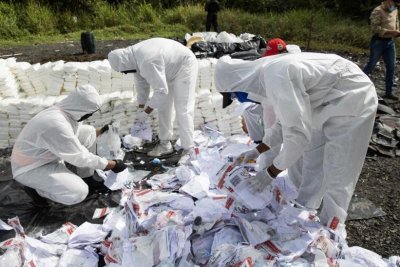
Members of the National Institute of Forensic Sciences organize packages of confiscated cocaine in Santo Domingo, Dominican Republic, on February 26 before incinerating 5,038 pounds of the drug after seizures made under the U.S.-led Operation Southern Spear, an international initiative to combat drug trafficking in Latin America. Photo by Orlando Barria/EPA
Feb. 27 (UPI) — The global cocaine market is the fastest-growing segment of the illicit drug trade, driven by rising production in South America and increasing demand in Africa and Asia, according to a United Nations report released this week.
Ecuador, meanwhile, has become one of the countries most affected by violence and the expansion of drug trafficking routes, the report said.
Global cocaine production exceeded 3,700 metric tons in 2023, a 34% increase compared with 2022, according to the control board.
The expansion is largely attributed to Colombia, where both the area under illicit coca cultivation and the production capacity of clandestine laboratories increased.
“The global cocaine market continues to expand and diversify,” the board said, warning that trafficking routes now reach “all regions of the world.”
While Western and Central Europe and North America remain the main destination markets, the report highlights rising consumption and seizures in Africa and parts of Asia.
In Africa, seizures rose 48% in 2023 compared with the previous year, which the report said reflects an expanding market rather than merely a transit region.
Between 2013 and 2023, the number of cocaine users worldwide increased from 17 million to 25 million, according to U.N. data.
Against this backdrop, Ecuador has emerged as a critical hub.
“In South America, the impact of increased cocaine trafficking has been felt particularly in Ecuador, which in recent years has experienced a wave of lethal violence caused by both local and transnational criminal groups,” the control board said.
Ecuadorian authorities seized more than 290 metric tons of cocaine in 2024, an unprecedented figure and approximately 30% higher than in 2023.
The surge in trafficking has coincided with a deterioration in security. The country recorded 6,964 violent deaths in 2024, with a homicide rate of 38.76 per 100,000 inhabitants, meaning the rate has quintupled over five years.
The report notes that Ecuador has become a major maritime export hub for cocaine shipments bound for the European Union.
In March 2025, Ecuadorian and European authorities dismantled an intercontinental criminal network that shipped tons of cocaine in maritime containers from South America to Europe.
In that operation, 73 metric tons of cocaine were seized in Ecuador and several European Union countries. Authorities arrested 14 people in Germany and Spain and 36 in the port city of Guayaquil, according to the report.
The control board also warned that traffickers are using increasingly sophisticated concealment methods to evade controls, including chemically altering cocaine to hinder detection during routine inspections, embedding the drug in plastics and textiles and using double-bottom compartments in legitimate goods.
Offshore deliveries coordinated through geolocation systems have also been seen.
As an example, the report cited the 2024 seizure of 13 metric tons of cocaine at the port of Algeciras in Spain, hidden in a shipment of bananas from Ecuador and described as the largest cocaine seizure in the country’s history.
The report further warns that sustained increases in production and the diversification of routes reflect a structural transformation of the global cocaine market, with criminal networks operating in an increasingly transnational manner and with greater logistical capacity.
The board stressed that the phenomenon is no longer limited to traditional production or consumption regions but now involves multiple continents at different stages of the drug trafficking chain.
Feb. 27 (UPI) — Secretary of State Marco Rubio will visit Israel Monday and Tuesday to discuss Iran and other issues, the State Department announced Friday.
The visit comes amid concern that the United States will attack Iran, despite continued negotiation between the two. On Thursday, the U.S. embassy in Israel told its staff that they could leave because of “safety risks,” though there is no emergency.
“Persons may wish to consider leaving Israel while commercial flights are available,” the State Department said in its new guidance. “In response to security incidents and without advance notice, the U.S. Embassy may further restrict or prohibit U.S. government employees and their family members from traveling to certain areas of Israel, the Old City of Jerusalem, and the West Bank.”
CNBC reported Friday that Omani Foreign Minister Badr al-Busaidi will meet Friday with Vice President JD Vance and other officials in Washington for “previously unreported talks in an effort to stave off war with Iran.”
Al-Busaidi has mediated talks between American and Iranian officials to ease tensions over President Donald Trump‘s demands that Iran abandon its nuclear program.
Rubio’s visit to Israel is to “discuss a range of regional priorities including Iran, Lebanon and ongoing efforts to implement President Trump’s 20-Point Peace Plan for Gaza,” State Department spokesperson Tommy Pigott said in a statement.
Democrats are speaking out against a potential strike.
“The American people are still waiting for the strategic justification for a war with Iran that puts thousands of American personnel across the region in harm’s way,” Sen. Chris Coons, D-Del., said on X. “What is the evidence of an imminent threat?”
Trump said in his State of the Union speech Tuesday that he is still planning to work the differences out diplomatically.
“My preference is to solve this problem through diplomacy, but one thing is certain: I will never allow the world’s No. 1 sponsor of terror — which they are by far — to have a nuclear weapon,” he said.
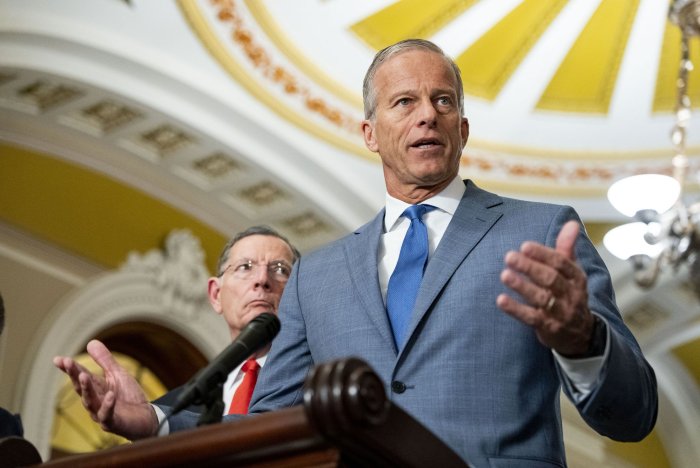
Senate Majority Leader John Thune, R-S.D., speaks during a press conference after the weekly Republican Senate caucus luncheon at the U.S. Capitol on Wednesday. Photo by Bonnie Cash/UPI | License Photo
Argentine President Javier Mile’s administration has launched a new U.S. dollar bond aimed at raising up to $2 billion. Photo by Matias Martin Campaya/EPA
BUESOS AIRES, Feb. 27 (UPI) — Argentina’s government took a new step in its strategy to meet upcoming dollar-denominated debt maturities without again relying on international markets. In a challenging financial context, President Javier Milei’s administration launched a new U.S. dollar bond aimed at raising up to $2 billion.
The goal is to get ahead of payments scheduled for July, when about $4.2 billion in private loans come due. Instead of seeking funds on Wall Street or using the swap line negotiated with the United States, the Economy Ministry chose to raise those dollars domestically.
The decision comes amid a recent increase in Argentina’s sovereign risk, an indicator that reflects how investors perceive a nation’s ability to repay its debt and that, when it rises, makes external borrowing more expensive.
With that roadmap, the economic team faced the first test of the new instrument on Wednesday. In the initial issuance, it placed $150 million at an annual rate of 5.89%, below what market analysts had estimated.
The response exceeded official expectations. The Finance Secretariat reported receiving bids totaling $868 million, nearly six times the amount ultimately taken by the government. For the government, that level of interest confirms there is demand for Argentine dollar debt even in a volatile environment.
The bond, which can only be subscribed to and paid for in U.S. dollars, will be included in the regular biweekly auctions alongside peso-denominated securities. In each initial auction, up to $150 million will be offered, with the possibility of expanding by another $100 million in a second round the following day, until the planned program is completed.
Identified as BONAR 2027 or AL27 in some markets, the security will mature on Oct. 29, 2027, after Argentina’s 2027 presidential election. It offers a 6% nominal annual rate, with monthly interest payments, and will repay principal in a single installment at maturity.
The initiative comes at a key moment for Argentina, which faces heavy foreign-currency commitments midyear. In that context, securing dollar financing without turning abroad becomes central to organizing the payment schedule and maintaining investor confidence.
Financial adviser Gastón Lentini, founder of consulting firm Doctor de tus Finanzas, told UPI that the dollar bond launched by Argentina has sparked strong interest among local investors.
“Unlike almost any bond issued before, this one pays interest every month,” he said.
In practice, this means that if someone invests $10,000, they will receive $50 each month until October 2027, when the bond matures and the invested principal is returned.
Economist Elena Alonso, co-founder of consultancy Esmerald Capital, noted that anyone can invest in this bond.
“The minimum amount is one dollar. Anyone who has never invested before only needs to open an investment account,” she said.
Lentini explained that in July the government faces a debt payment of about $4.2 billion, which includes interest and principal repayments on certain bonds.
“The limited level of international reserves and restricted access to dollars forces the government to be creative in raising the necessary funds and meeting payments,” he added.
Regarding the decision to finance domestically instead of going to international markets, the specialist said the current sovereign risk level would require Argentina to offer rates above 9% if it turned to foreign investors.
“Taking advantage of the restrictions that still exist on taking foreign currency out of the country, the economy minister is managing to finance with Argentines’ own dollars at a rate close to 6%, which is an achievement for the government,” he said.
On the currency swap line with the United States, Lentini said it will not be necessary. According to him, the combination of agro-industrial exports, oil, gas, minerals and incentives from the RIGI program allows the country to gather enough dollars to meet its obligations.
“The swap line serves as an additional backstop, but the strategy of paying with its own money strengthens investor confidence in respect for contracts,” he added.
Finally, Lentini said it would be positive for sovereign risk to decline to facilitate a debt rollover — a restructuring or refinancing of maturities — though if that does not happen, he does not see a risk of default this year, noting that Argentina is one of the few countries in the world with a surplus.
Alonso agreed that resorting to the swap line will not be necessary, as the country’s dollar reserves are growing. She also noted that, for the first time in years, private debt issuances and repurchase agreements with banks helped cover maturities.
“The swap line with the United States remains available as a backstop, but the government seeks to build credibility by using its own resources first,” she said.
SEOUL, Feb. 27 (UPI) — OCI Energy, a U.S. affiliate of South Korea’s OCI Holdings, said its joint venture with Arava Power has secured nearly $400 million for Project SunRoper, a 347-megawatt solar project in Wharton County, Texas.
OCI Energy joined with Israel’s Arava Power for the project. As sole lead arranger, ING Capital will underwrite the financing package, which includes a mix of loans and letters of credit.
The total investment is estimated to be about $394 million, according to OCI Energy. The construction financing is backed by a 20-year power purchase agreement with a Fortune 100 company, whose identity OCI Energy did not disclose.
Situated some 60 miles southwest of Houston, Project SunRoper is expected to begin commercial operation in the third quarter of next year, supporting grid reliability and emissions reduction.
“The close of construction financing for Project SunRoper represents an important milestone for OCI Energy and our partners,” OCI Energy CEO Sabah Bayatli said in a statement.
“This transaction reflects our continued commitment to delivering high-quality, utility-scale solar projects that strengthen grid reliability and provide affordable energy infrastructure,” he said.
ING Capital Managing Director Sven Wellock said the new initiative would deliver reliable, affordable clean energy for years to come.
“This project exemplifies the high-quality renewable infrastructure we seek to finance — a strong sponsor partnership, a long-term contracted revenue profile and a well-located asset in one of the most dynamic power markets in the United States,” he said.
This is not the first time that OCI Energy has collaborated with ING. They previously worked together on financing for the Alamo City Battery Energy Storage System project in Texas.
Dr Hussam Abu Safiya has been held in an Israeli prison for more than a year without charges or trial. Recently, he’s been subject to a smear campaign claiming he is a Hamas colonel. Al Jazeera’s Yasmeen Aboujabal looks at how such campaigns are being used to discredit Palestinian health workers.
Feb. 27 (UPI) — Netflix has decided to let go of its attempt to buy Warner Bros. Discovery after Paramount Skydance raised its purchase offer.
On Wednesday, Paramount raised its cash offer from $30 per share to $31 per share. On Thursday, WBD decided the offer was superior to Netflix’s offer, prompting the drop out.
“This transaction was always a ‘nice to have’ at the right price, not a ‘must have’ at any price,” said co-CEOs Ted Sarandos and Greg Peters in a statement.
Netflix’s bid was for $27.75 per share for the studios and streaming, while Paramount’s bid is for the entirety of the company.
“We’re super-disciplined buyers,” The New York Times reported Sarandos said earlier this month. “I’m willing to walk away and let someone else overpay for things.”
Netflix and Paramount have been duking it out over WBD since October. They had a bidding war, and WBD accepted Netflix’s offer on Dec. 5. Soon after, Paramount launched a hostile bid to buy WBD, but the board wasn’t interested. Then, Paramount announced that billionaire Oracle creator Larry Ellison would back the deal with $40 billion in equity. On Jan. 20, Netflix changed its offer to all cash, then on Feb. 10, Paramount did the same and added some extras.
Netflix granted WBD a seven-day pause on the deal to evaluate Paramount’s offer, and during that time, Paramount raised the bid even more to $31 per share.
If the deal doesn’t pass federal regulatory scrutiny, Netflix could come back and try again.
“We are pleased WBD’s Board has unanimously affirmed the superior value of our offer, which delivers to WBD shareholders superior value, certainty and speed to closing,” David Ellison, Paramount CEO, said in a statement Thursday.
Warner Bros. CEO David Zaslav expressed gratitude to Netflix.
“Netflix is a great company, and throughout this process Ted [Sarandos], Greg [Peters], [CFO Spencer Neumann] and everyone there have been extraordinary partners to us. We wish them well in the future,” CNBC reported Zaslav said in a statement. “Once our Board votes to adopt the Paramount merger agreement, it will create tremendous value for our shareholders. We are excited about the potential of a combined Paramount Skydance and Warner Bros. Discovery, and can’t wait to get started working together telling the stories that move the world.”
Netflix stock rose 10% in extended trading Thursday, while Paramount stock jumped 5%, CNBC reported. Shares of Warner Bros. Discovery dropped 2%.
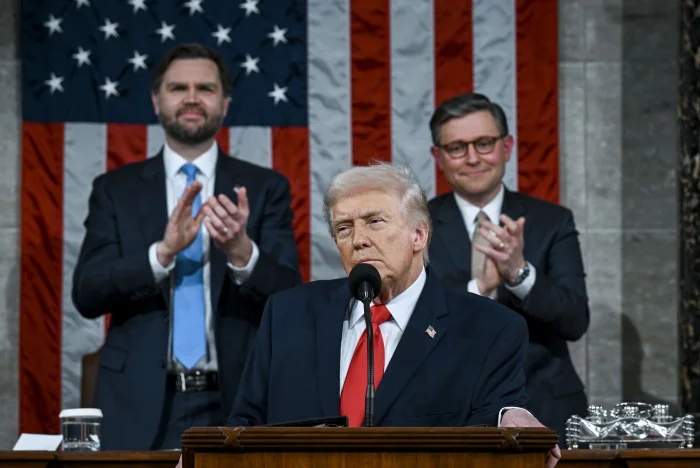
President Donald Trump delivers his State of the Union address during a joint session of Congress in the House Chamber at the U.S. Capitol in Washington, on February 24, 2026. Pool photo by Kenny Holston/UPI | License Photo
Green Party candidate Hannah Spencer give a victory speech to supporters in Manchester early Friday after being declared the winner of the Gorton and Denton byelection to choose a new Member of Parliament. Photo by Adam Vaughan/EPA
Feb. 27 (UPI) — Britain’s Green Party won the Gorton and Denton byelection in southeast Manchester with a more than 4,000-seat majority, beating the ruling Labour Party into third place, and 12 points clear of Reform UK.
The Greens’ new Member of Parliament, Hannah Spencer, a plumber from a neighboring suburb of Manchester, produced a convincing win in Thursday’s poll, overturning the 13,000-seat majority won in the 2024 general election by the previous Labour holder of the seat who is standing down due to ill-health.
Spencer won 14,980 seats, or 40.7% of the vote, Reform’s Matt Goodwin, 10,578 and Labour’s Angeliki Stogia trailing in third place with 9,364. The Conservative Party’s candidate came in a distant fourth with just 706 votes. Turnout was 47.6%.
The win, a first for the Green Party in a byelection, takes the party’s contingent in the House of Commons to five.
Speaking in the early hours of Friday after the results were announced, 34-year-old Spencer vowed to “fight” for the people of Gorton and Denton “who feel left behind and isolated.”
“There is an appetite here for change, and there are people across this constituency and much further beyond who are rejecting the old political parties and who are coming together to fight for something better, but who are doing it positively and in a really hopeful way.”
Spencer said her victory proved there was “no longer any such thing as a safe seat” and that there was “no part of the country where the Green Party cannot win.”
Asked if the Greens’ intention was to “eviscerate” Labour, Party leader Zack Polanski said that taking a seat Labour had held for more than 100 years showed it was “beginning already.”
“If we see a swing like this at the next general election, there will be a tidal wave of new Green MPs. This is an existential crisis for the Labour Party,” he said.
Labour’s second-straight loss of a byelection with Prime Minister Keir Starmer at the helm, and with local elections just around the corner in May, could prove highly consequential for his future.
Speaking to reporters Friday, a defiant Starmer rejected any suggestion he might be considering his position, saying he would never quit.
“I came into politics late in life to fight for change for those people who need it. I will keep on fighting for those people for as long as I’ve got breath in my body,” he said.
Starmer played down the loss saying that while it was “very disappointing,” voters often took out frustrations on sitting administrations in mid way through their terms.
However, Strathclyde University Politics Professor John Curtice said the Green Party was now challenging Labour’s stranglehold on the left of British politics in a way that would cause the parliamentary wing of the party to seriously question whether Starmer was still the right person to lead the country.
Reform UK chairman David Bull, telling the BBC he was “absolutely thrilled” with his party’s performance,” echoed that analysis.
“Keir Starmer is in big trouble now — it is not a matter of if he leaves office, it’s when he leaves.”
Party leader, MP Nigel Farage, warned the Greens’ win would embolden the radical left and said opposition Conservative Party leader Kemi Badenoch should apologize for leading the party to the worst result in its history.
“Roll on the elections on May 7. It will be goodbye Starmer and goodbye to the Tory [Conservative] party,” he wrote on X.
Badenoch, who is Black, called on Starmer to quit immediately.
“Our country is not broken, but this byelection showed that Labour, Reform and the Greens are trying very hard to break it. Labour trying to buy people off with more and more benefits spending, Reform telling people you can’t be British if you’re not white. The Greens running a nasty, sectarian campaign while simultaneously wanting to legalize crack-cocaine,” she wrote in a statement.
“The result shows Keir Starmer’s premiership is finished. He lost authority a long time ago, a mere hostage at the mercy of a divided Labour Party that cannot decide who to replace him with. He has lost the support of his MPs and the country. He is in office but not in power. If had any integrity he would go,” said Badenoch.
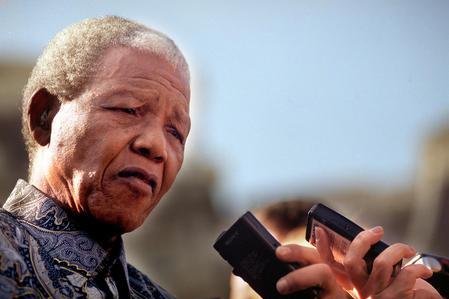
Former South African president Nelson Mandela speaks to reporters outside of the White House in Washington on October 21, 1999. Mandela was famously released from prison in South Africa on February 11, 1990. Photo by Joel Rennich/UPI | License Photo
Elsewhere, Barcelona will face Newcastle, Tottenham will play Atletico Madrid, and Arsenal will take on Bayer Leverkusen.
Published On 27 Feb 202627 Feb 2026
Share
Real Madrid will play Manchester City while defending champions Paris Saint-Germain will face Chelsea in the pick of the 2025/26 Champions League last 16 games after the draw was made by UEFA in Nyon, Switzerland.
The draw for European football’s biggest club competition on Friday determined that City will face Madrid for the fourth consecutive season in a knockout Champions League clash.
Recommended Stories
list of 4 itemsend of list
Meanwhile, PSG and Chelsea will repeat their FIFA 2025 Club World Cup final, which the Premier League side won 3-0.
Elsewhere, Barcelona will face Newcastle United, Tottenham Hotspur will play Atletico Madrid, and Arsenal will take on Bayer Leverkusen.
Liverpool will renew hostilities with Galatasaray in a rematch of their league phase game, which the Turkish giants won 1-0 in Istanbul.
Norwegian minnows will face Portugal’s Sporting Lisbon, while the only Italian side left in the competition face a daunting encounter with German champions Bayern Munich.
The first legs will be played on March 10-11 and the second legs will be played on March 17-18.
The eight seeded teams – who finished in the top eight spots in the league phase – will be at home for the second legs against the eight teams who qualified through the playoff round.
The last 16 draw in full:
Paris Saint-Germain vs Chelsea
Galatasaray vs Liverpool
Real Madrid vs Manchester City
Atalanta vs Bayern Munich
Newcastle vs Barcelona
Atletico Madrid vs Tottenham Hotspur
Bodo/Glimt vs Sporting
Bayer Leverkusen vs Arsenal
Familiar foes
Real Madrid knocked City out in the last 16 last season, as they did in the 2024 quarterfinals and 2022 semifinals.
City beat Madrid in the 2023 semifinal en route to lifting the Champions League trophy for the first time.
The two clubs have played each other on 15 occasions, with each team winning five games and the rest ending as draws.
City and Madrid have already faced each other in the league stage this season, with City coming from behind to win 2-1 in December.
PSG will be eager to take revenge on Chelsea after the Blues stunned the French champions to win the inaugural the Club World Cup title in a bad-tempered game last year.
The clubs have previously faced each other in the Champions League, with Chelsea triumphing in a 2014 quarterfinal and PSG eliminating the Blues in the last 16 in 2015 and 2016.
Chelsea’s Cole Palmer celebrates scoring against PSG in the Club World Cup final with Joao Pedro [Hannah Mckay/Reuters]
The draw on Friday also mapped out the potential route to the final, to be held in Budapest on May 30, as every team now knows their possible quarterfinal and semifinal opponents.
In the quarterfinals, City or Madrid will face the winner of Bayern Munich vs Atalanta, while PSG or Chelsea will take on either Liverpool or Galatasaray.
Quarterfinal draw
Paris Saint-Germain or Chelsea vs Liverpool or Galatasaray
Real Madrid or Manchester City vs Bayern Munich of Atalanta
Newcastle or Barcelona vs Tottenham or Atletico Madrid
Sporting Lisbon or Bodo/Glimt vs Arsenal or Bayer Leverkusen
Semifinal draw
Paris Saint-Germain, Chelsea, Liverpool or Galatasaray vs Real Madrid, Manchester City, Bayern Munich of Atalanta
Newcastle,Barcelona, Tottenham or Atletico Madrid vs Sporting Lisbon, Bodo/Glimt, Arsenal or Bayer Leverkusen
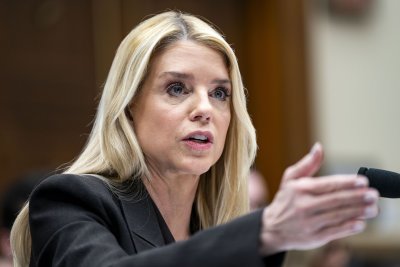
Feb. 27 (UPI) — The Justice Department has sued another five states, including three led by Republicans, for their unredacted voter registration lists, amid the Trump administration’s the information ahead of November’s midterms.
The Trump administration has now sued 29 states and the District of Columbia for voter information, heightening Democrats’ concerns that it is seeking to meddle in the elections.
The five states sued Thursday were Utah, Oklahoma, Kentucky, West Virginia and New Jersey. The litigation effort has so far disproportionately targeted Democratic-led states, with Utah, Oklahoma and West Virginia among the few GOP-led states sued for their voter registration lists.
Attorney General Pam Bondi argues she is charged by Congress with authority to request the sensitive election data under the Civil Rights Act of 1960, though courts have ruled against the government in the three cases that have reached decisions: California in mid-January and Michigan and Oregon earlier this month.
Courts that have so far rejected Bondi’s argument found either that she lacks the authority to compel disclosure of the unredacted voter lists, as in Oregon, or the laws she cites do not permit the government to obtain them, as in Michigan. The judge in the California case also ruled her demand “stands to have a chilling effect on American citizens like political minority groups and working-class immigrants” worried about how their information will be used.
“As several courts have already held, the Department of Justice’s request for voters’ personal information, including their driver’s license numbers and Social Security numbers, is baseless,” New Jersey Attorney General Jennifer Davenport said in a statement Thursday rejecting the Trump administration’s lawsuit.
“We are committed to protecting the privacy of our state’s residents, and we will defend against this lawsuit in court.”
Lt. Gov. Deidre Henderson of Utah said the Justice Department sued her state after federal prosecutors declined Utah’s previous offer to share publicly available lists with them. The Trump administration’s lawsuit was expected, she said.
“Neither state nor federal law entitles the Department of Justice to collect private information on law-abiding American citizens,” she said in a statement. “Utahns can be assured that my office will always follow the Constitution and the law, protect voters’ rights and administer free and fair elections.”
Attorney General Gentner Drummond of GOP-led Oklahoma even responded to the lawsuit by stating that they are willing to “fully cooperate with any lawful requests related to voter fraud.”
“Oklahomans should have confidence that their state remains firmly committed to both election integrity and the protection of personal information,” he said in a statement.
The Trump administration has argued it requires the lists for election integrity purposes, raising concerns from Democrats already concerned about Trump attempting to interfere in the midterm elections as he has repeatedly expressed worries that he will be impeached if his Republican Party loses control of Congress.
Democrats and civil rights organizations, including the American Civil Liberties Union, Common Cause and the NAACP, have each echoed warnings that the Trump administration wants to use voter registration lists to undermine the upcoming election.
Assistant Attorney General Harmeet Dhillon of the Justice Department’s Civil Rights Division acknowledged Thursday that many states are choosing to fight them in court, but they will not be dissuaded.
“We will not be deterred, regardless of party affiliation, from carrying out critical election integrity legal duties,” Dhillon said in a statement.
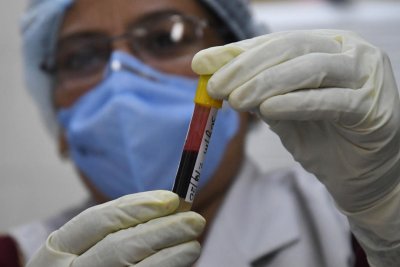
Alzheimer’s disease researchers say they have developed a way to predict when a unimpaired person may develop dementia symptoms within three to four years through a single blood test. File Photo by EPA
ST. PAUL, Minin., Feb. 27 (UPI) — A team of U.S.-based scientists say they have developed a model using a “biological clock” to predict — with just a simple blood test — when someone is likely to develop symptoms of Alzheimer’s disease.
The results of a study published this month in the journal Nature Medicine demonstrate how, by measuring blood plasma levels of a protein in people who are not yet impaired by Alzheimer’s symptoms, researchers can predict when cognitive decline will begin within a margin of three to four years.
While there is no single, stand-alone test to diagnose Alzheimer’s today, the new method works by leveraging how levels of the protein “p-tau217” in the blood closely reflect how much amyloid plaque has built up in the brain over time. This provides doctors with a “clock” that points to when a patient may begin to experience symptoms.
Amyloid buildup in the brain may begin up to 20 years before a person starts to experience symptoms of memory and thinking issues. The plaques are a key pathological hallmark and contributing factor in Alzheimer’s disease, and, much like looking at the rings of a tree, p-tau217 levels can reveal the age of the buildup.
The authors, based at the Washington University School of Medicine in St. Louis, say their new blood test method will have immediate applications in ongoing clinical trials seeking answers to the vexing questions about what causes and what can prevent Alzheimer’s and dementia, which affect more than 7 million Americans at an estimated cost of nearly $400 billion in 2025.
Eventually, with further refinement, researchers hope the blood test could one day be used in clinical settings to easily and quickly provide predictions about the timeline of symptom onset for individual patients. The only feasible ways of doing so now are through costly brain imaging scans and invasive spinal fluid tests.
The study was part of a project headed by the Foundation for the National Institutes of Health Biomarkers Consortium, a public-private charitable partnership established by Congress in 1990 whose roster includes schools such as Washington University, life science companies including Johnson & Johnson and the Alzheimer’s Association.
Dr. Suzanne Schindler, senior author of the study and associate professor in the WashU Medicine Department of Neurology, said that while current blood tests for p-tau217 are already capable of identifying cognitively unimpaired people who might develop Alzheimer’s symptoms, they have no ability to estimate when.
Thus, they are used only for research studies and clinical trials due to legal and ethical considerations, such as the risk of causing undue stress from uncertain results.
“Our study, however, suggests it’s possible to predict when symptoms might develop using blood p-tau217,” she told UPI. “The prediction is very rough and so is still only useful in research or trials.
“We believe these predictions can be refined, but it’s unclear if they’ll become reliable enough for individual guidance without more invasive tests like spinal fluid analysis,” she cautioned.
Still, the potential of uses of the blood test are immediate when it comes to Alzheimer’s research. For instance, they could allow clinical trials of potentially preventive treatments to be performed within a shorter time period.
“Clinical trials are currently underway that are treating cognitively unimpaired individuals who test positive for blood p-tau217,” Schindler noted. “We must wait to see if these treatments delay or prevent symptom onset, but I’m hopeful based on our understanding of the disease’s biology.”
Beyond clinical trials, the blood test will aid broader Alzheimer’s research “by linking p-tau217 levels to specific brain changes, helping us disentangle whether those changes are driving cognitive impairment amid its overall complexity,” she added.
The new study “provides evidence that plasma p‑tau217 may be a reliable tool for estimating the future onset of Alzheimer’s disease symptoms,” agreed Rebecca Edelmayer, vice president of scientific engagement for the Alzheimer’s Association.
“This could transform how researchers design clinical trials and, eventually, how clinicians identify people at highest risk for cognitive decline associated with Alzheimer’s years before decline begins,” she told UPI.
While the blood test method represents a “very intriguing discovery,” it’s important to note it is not yet ready for everyday use by doctors or patients, Edelmayer cautioned, noting that its three- to four-year margin of error effectively rules out its utility for individual decision-making.
Broadly speaking, blood tests are not yet recommended for cognitively unimpaired individuals outside research settings, but even so, “this finding is an important research step because a blood test is generally much less expensive and easier to administer than a brain scan or spinal‑fluid test,” she said.
“In the future, it could help doctors and researchers identify people who may benefit from early treatments, and make clinical trials for new Alzheimer’s therapies run faster and more efficiently.”
The possibility of making a difference in the long-running battle against one of the most feared and intractable diseases in the world holds a special meaning for Schindler.
“As a memory specialist, I’ve diagnosed over 1,000 people with Alzheimer’s and witnessed firsthand its devastating effects on patients and families,” she said. “These results make me hopeful, and it’s rewarding to think this research could improve diagnosis and treatment of Alzheimer’s.”
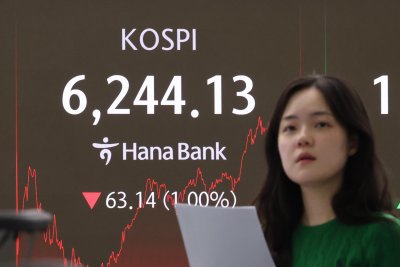
This photo taken on Friday shows the trading room of Hana Bank in central Seoul, with the benchmark Korea Composite Stock Price Index down 1 percent to close at 6,244.13. Photo by Yonhap
Seoul shares closed lower Friday, snapping a six-session winning streak as investors locked in profits in technology and other large-cap stocks following recent gains. The Korean won sharply fell against the U.S. dollar.
The benchmark Korea Composite Stock Price Index (KOSPI) fell 63.14 points, or 1 percent, to finish at 6,244.13. The index still enjoyed a weekly gain of 7.5 percent.
Trading volume was heavy at 1.14 billion shares worth 52.94 trillion won (US$36.8 billion), with decliners far outnumbering gainers 625 to 264.
The KOSPI has remained in a bullish phase since the start of the year, surpassing the 4,500-point level for the first time on Jan. 6 and crossing the 5,000-point mark on Jan. 27. It broke through the 6,000-point level Wednesday, less than a month later.
On Thursday, the index jumped 3.67 percent to finish at a record high of 6,307.27.
Institutional and retail investors purchased a net 491.99 billion won and 6.08 trillion won worth of shares, respectively, while foreign investors sold a net 6.83 trillion won.
Analysts said the decline mirrored overnight losses in U.S. technology stocks, where investors engaged in profit-taking despite strong earnings from Nvidia Corp.
The tech-heavy Nasdaq Composite fell 1.18 percent, while the Dow Jones Industrial Average edged up 0.03 percent.
“Some investors sold shares to lock in profits after the market had rallied sharply over the past six sessions,” Lee Seong-hoon, an analyst at Kiwoom Securities Co., said.
Technology stocks led the declines.
Market bellwether Samsung Electronics fell 0.69 percent to 216,500 won, and its chipmaking rival SK hynix declined 3.46 percent to 1,061,000 won.
Leading shipbuilder HD Hyundai dropped 1.02 percent to 292,500 won, and leading shipping firm HMM shed 4.26 percent to 21,350 won.
Among gainers, top carmaker Hyundai Motor jumped 10.67 percent to an all-time high of 674,000 won, and defense firm Hanwha Aerospace climbed 0.08 percent to 1,195,000 won.
Leading steelmaker POSCO Holdings jumped 1.35 percent to 413,000 won, and No. 2 steelmaker Hyundai Steel surged 19.85 percent to 46,500 won.
The Korean won was quoted at 1,439.70 won against the U.S. dollar at 3:30 p.m., down 13.9 won from the previous session.
Bond prices, which move inversely to yields, closed higher. The yield on three-year Treasurys fell 2.1 basis points to 3.041 percent, and the return on the benchmark five-year government bonds declined 3.6 basis points to 3.278 percent.
Copyright (c) Yonhap News Agency prohibits its content from being redistributed or reprinted without consent, and forbids the content from being learned and used by artificial intelligence systems.
Cape Town, South Africa – Two ominous letters are spray-painted on a wall at the entrance to Tafelsig, a township in Mitchells Plain on the outskirts of Cape Town: HL – the insignia of the Hard Livings gang, which has threatened communities there for five decades.
It’s a February day soon after the president’s state of the nation address, in which Cyril Ramaphosa boldly announced he’d be deploying the army to communities across South Africa to tackle the growing crisis of crime, drugs and gangs. But in Tafelsig, which will likely be part of the new military operation, most people seem unbothered by the news.
Recommended Stories
list of 3 itemsend of list
Mitchells Plain is on the Cape Flats – a series of densely populated, impoverished townships about 30km (19 miles) southeast of the wealthy city centre where the president made his speech. While the city boasts hordes of tourists and some of the most expensive real estate on the continent, the Cape Flats accounts for the highest rate of gang-related killings in the country.
“When it was at its worst, [there was a shooting] almost every day,” said Michael Jacobs, the chairperson of a local community police forum.
“Whether it’s day or whether it’s night, they’re shooting somewhere on the Cape Flats,” he added on a drive through the settlement of run-down houses and corrugated iron shacks.
Around him, residents made their way to a home-grown tuck shop, known as a spaza, or sat on street corners while toddlers ran about.
“How is this conducive to raising children?” he asked, recounting the horrors of life in Mitchells Plain.
In the past week, four people, including a nine-month-old, had been shot and killed in a drug den in Athlone, about 17km (10 miles) away.
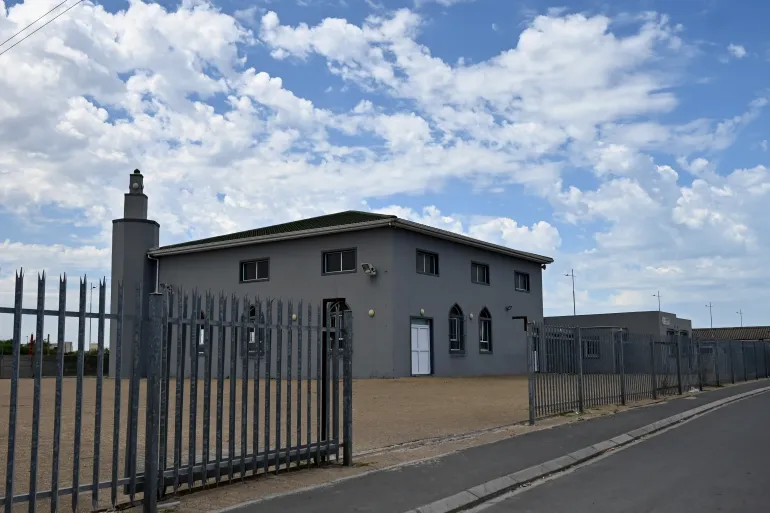
A beloved Muslim cleric who is rumoured to have angered a gang leader over a personal dispute was also shot dead on the first day of Ramadan as he was leaving the Salaamudien Mosque on a nearby street.
As Jacobs spoke, reports of other shootings filtered through on the many crime groups he is part of on WhatsApp. A few days later, he shared with Al Jazeera a video of two schoolgirls and a taxi driver shot outside a school in Atlantis, about 40km (25 miles) north of Cape Town. One of the girls died.
The Salaamudien Mosque, where a cleric was gunned down on the first day of Ramadan [Otha Fadana/Al Jazeera]
Tafelsig residents now await the probable arrival of uniformed soldiers and armed vehicles in their neighbourhood, but have little hope that it will make a difference.
Despite his weariness with the violence, Jacobs is far from enthusiastic about a decision to deploy the army.
Other critics of the government’s decision said it is window dressing more than a real solution while some question the wisdom of such a drastic step in a country where the military has a history of brutality and where recent explosive allegations about police corruption at the highest levels have surfaced.
‘Do our lives not matter?’
In his speech on February 12, Ramaphosa said he would deploy the army to the Western Cape, the province that includes the Cape Flats, and Gauteng, home to the country’s largest city, Johannesburg, to tackle gang violence and illegal mining. On February 17, Acting Police Minister Firoz Cachalia announced that the Eastern Cape would be added to the list and a deployment would take place in 10 days – although no soldiers have so far been deployed.
The president’s decision followed pressure from civil society groups and the Democratic Alliance (DA) party, which runs the Western Cape, to take drastic action to curb widespread gang-related violence in the three provinces.
A day before its province was added to the deployment schedule, the DA joined residents in Gqeberha, the largest city in the Eastern Cape, for a “Do Our Lives Not Matter?” protest to demand that Ramaphosa take urgent action.
In Gauteng, neighbourhoods surrounding the province’s once-lucrative abandoned mines have often been turned into battlegrounds, resulting in shootouts between police and illegal artisanal miners, known as zama zamas.
Gauteng and the Western Cape frequently appear at the top of the country’s organised crime lists while the Eastern Cape made headlines last year for a series of killings linked to extortion syndicates.
In the latest crime statistics, police announced the arrests of 15,846 suspects nationwide and the seizure of 173 firearms and 2,628 rounds of ammunition from February 16 to Sunday alone.
Gauteng took up the most space in the police’s crime highlights, which included a 16-year-old arrested in Roodepoort for possession and distribution of explosives and the seizure of counterfeit clothing and shoes worth 98 million rand ($6.1m).
Overall, South Africa has some of the world’s most violent crime with an average of 64 people killed every day, according to official statistics.
The three provinces selected for military deployments have a turbulent history with the armed forces, not least during the apartheid era when the regime used soldiers to unleash deadly crackdowns on antiapartheid activists.
“They were the enemy,” Jacobs said, recalling his own arrest in September 1987 during a student protest on the Cape Flats opposing the racist government, which was replaced in the country’s first democratic elections in 1994.
Michael Jacobs at his office in Cape Town [Otha Fadana/Al Jazeera]
Today after three decades of democracy, poverty, unemployment and violent crime remain a major challenge in the area.
But Jacobs, like other critics of the military police, believes the new move will do little to cure the ills that he said gangs exploit to increase their influence. Children as young as eight years old are recruited into their ranks.
The Town Centre, a shopping mall that was once a hub of economic activity, has been reduced to a ghost town where the drug trade thrives despite the fact that it is right next to a police station, according to Jacobs.
For him, there is a direct link between the country’s economic decline and the flourishing of gang activity over the past decade on the Cape Flats, where working-class people have seen their livelihoods stripped away as the manufacturing sector shrank.
On an average weekday when children should be at school, he said, you see children and even women in their 60s in Mitchells Plain digging through rubbish bins to find glass, plastic or other things they can recycle and turn into income. “At least it will put something on the table.”
Plugging a ‘haemorrhage’
Social issues and not simply military intervention should be put at the heart of government anticrime efforts, analysts say.
“There’s no other way to describe it other than plugging a hole that is haemorrhaging at the moment with regards to these forms of organised crime,” said Ryan Cummings, director of analysis at Signal Risk, an Africa-focused risk management firm.
Irvin Kinnes, an associate professor with the University of Cape Town’s Centre for Criminology, pointed out that constitutionally the army is limited in the duties its members may perform among the civilian population. Their role will be largely to support police, who will retain control of all operations.
He fears the government has not learned lessons from previous army deployments in South Africa’s democratic era.
The army was dispatched to the Western Cape in 2019 during a previous spike in gang violence and was again sent in to help with the enforcement of COVID-19 restrictions the following year.
“It’s a very dangerous thing to bring the army because there’s an impatience with the fact that the police are not doing their job. And so they come in with that mentality and want to beat up everybody and break people’s bones,” Kinnes said.
“We saw what happened in COVID. They killed people as the army. It’s not as if the police don’t kill people, but the point is, you don’t need the army to do that.”
To the government’s detractors, summoning the army is nothing more than an attempt at political heroics before local elections due to be held this year or in early 2027.
Kinnes pointed out that, according to police statistics, crime has been decreasing without the help of the army.
“It’s very much political. It’s to show that the political leaders have kind of heard the public. But the call for the army hasn’t come from the community. It’s come from politicians,” he said.
Police stand guard while South African President Cyril Ramaphosa visits crime-ridden Hanover Park in Cape Town in 2018 [File: Mike Hutchings/Reuters]
‘The military is ready’
Ramaphosa, who has yet to reveal details of the military deployment, has defended his decision. On Monday in his weekly newsletter, the president sought to separate the South African armed forces from their troubling past, listing several operations that benefitted communities, such as disaster relief efforts and law enforcement operations at the border.
He made it clear that the army’s role would merely be a supporting one “with clear rules of engagement and for specific time-limited objectives”.
Its presence may free up officers to focus on police work and would take place alongside other measures, such as strengthening antigang units and illegal mining teams, he said.
“Given our history, where the apartheid state sent the army into townships to violently suppress opposition, it is important that we do not deploy the [military] inside the country to deal with domestic threats without good reason,” Ramaphosa wrote.
Cummings said it was clear the president’s hand was forced amid an unrelenting wave of violence. “The rhetoric of the president up until now suggests that this was a directive that he was not necessarily too keen on implementing.”
On the ground, soldiers appear equally reluctant about their pending engagement.
Ntsiki Shongo is a soldier who was deployed in 2019 and during the COVID-19 pandemic. He told Al Jazeera, using a pseudonym, that any operation involving the police was almost certainly doomed.
“We [in the army] become so negative when we are working with them [the police] because always we don’t get what we need,” he said.
“We know how easy it is to get these gangsters, to get these drug lords, but unfortunately, the police, they are not cooperating with us because some of them are in cooperation with these criminals,” he charged. “Maybe they are scared for their lives because they are staying in the same areas with them.”
“So this operation, … is it going to be a success? I don’t know. It all depends on the police,” he said, adding that he and his fellow soldiers long for the day the government lets the military solve the problem on its own.
“Even when we are just sitting having lunch as soldiers, we talk about the police. We pray that one day the state can say, ‘Let’s take the military inside the country and clean out all these weapons, all these guns, all these gangsters,’” he said.
“The military is ready, and they want to prove a point because we’ve been hungry for these things.”
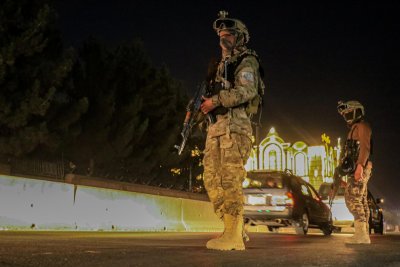
Taliban security inspect a vehicle at a checkpoint in Kabul, Afghanistan, on Friday, February 26, 2026. Photo by Samiullah Popal/EPA
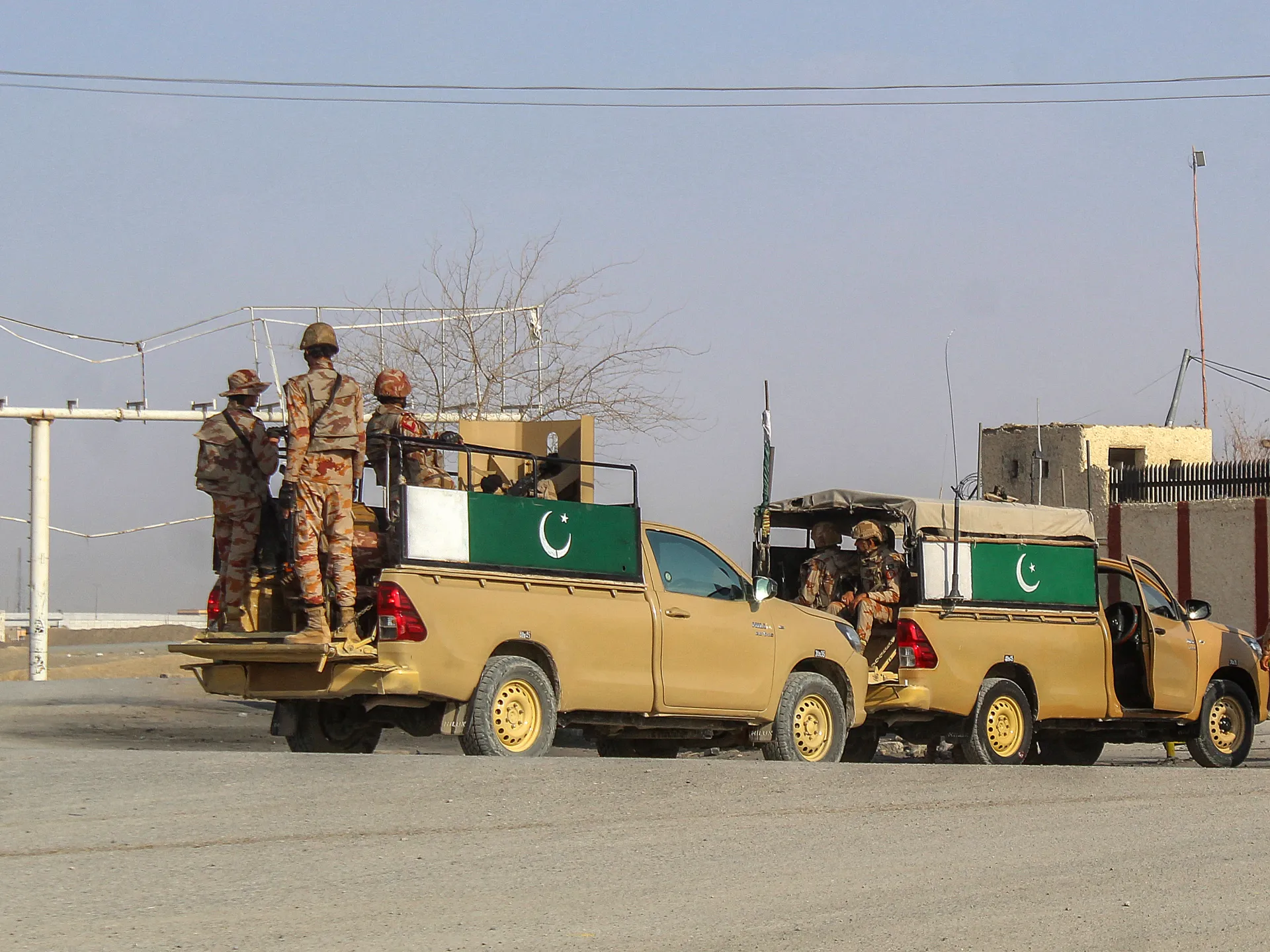
Feb. 26 (UPI) — Pakistan conducted airstrikes in areas of Kabul, Kandahar and Paktia overnight, officials from both countries said, as Islamabad’s defense minister early Friday declared Pakistan was in “open war” with Afghanistan.
Pakistani warplanes struck areas of the Afghan capital Kabul and its second-largest city, Kandahar, and Paktia province, Zabihullah Mujahid, spokesman for Afghanistan’s ruling Taliban, said in a statement, claiming there were no casualties — which Pakistan disputes.
Mosharraf Zaidi, spokesman for Pakistan’s prime minister, said Afghan military targets were hit, and claimed 133 Afghan Taliban fighters were killed and more than 200 wounded. The figures could not be independently verified.
Twenty-seven Afghan military posts were destroyed and nine captured in the assaults, he said.
“Our cup of patience has overflowed. Now it is open war between us,” Pakistan Defense Minister Khawaja Asif said in a statement.
“Pakistan’s army did not come from across the seas. We are your neighbors; we know your ins and outs.”
The airstrikes were carried out after Afghan forces attacked Pakistani border positions late Thursday, according to Afghanistan’s Ministry of National Defense, which said the assault was retaliatory for Pakistan’s fatal strike on seven militant camps and hideouts last week.
The latest explosion in violence follows months of escalating tensions between the two countries, with Pakistan repeatedly accusing Afghanistan of harboring terrorists, in particular the Tehreek-e-Taliban Pakistan, an Islamist group seeking to overthrow the Islamabad government.
Afghanistan has repeatedly denied the allegations Pakistan has leveled since the Taliban returned to power in August 2021.
Pakistan blames TTP and other Afghan-based terrorists for a series of brutal attacks over the years, and has carried out repeated airstrikes in Afghanistan in response, including in October.
Staff members display Samsung’s Galaxy S26, S26 Plus and S26 Ultra smartphones at a KT retail store in Seoul on Wednesday. Photo by Asia Today
Feb. 26 (Asia Today) — Samsung Electronics President Roh Tae-moon said the company aims for the new Galaxy S26 to surpass its predecessor’s sales, highlighting upgraded artificial intelligence features despite higher retail prices.
Speaking Tuesday at a Galaxy Unpacked press briefing in San Francisco, Roh said the Galaxy S25 series exceeded the prior model’s sales, citing improved real-world user feedback over time.
Market researcher Counterpoint Research said Galaxy S25 sales from February through December rose 5% from the previous generation. Industry estimates place total sales in the high 30 million range.
Roh said the Galaxy S26 features more advanced “agentic AI” capabilities and strengthened practical tools such as Photo Assist. He added that tighter integration between software and hardware, including a privacy-focused display feature, has drawn positive responses from global partners.
Samsung has expanded its AI platform beyond Bixby and Google Gemini to include additional services, and introduced a new AI operating system developed in cooperation with Google to enable smoother AI-driven functions. Roh described the strategy as a “hybrid AI” approach allowing users to choose optimized AI tools for different tasks.
The company is also positioning AI as a differentiator across product tiers, from flagship to entry-level smartphones.
Samsung raised domestic launch prices for its latest Galaxy S series by as much as 300,000 won, about $225, after keeping prices unchanged for three years, citing rising component costs. Counterpoint has projected Samsung’s smartphone shipments could decline about 2% this year amid higher prices.
Roh acknowledged cost pressures but said Samsung’s long-established supply chain gives it flexibility. He said the company will pursue innovation that maintains performance even with fewer components, using AI to offset hardware constraints and limit the impact of cost increases.
“As AI evolves, the importance of devices will only grow,” Roh said, adding that smartphones remain the primary interface through which users generate data and interact with AI services.
Feb. 26 (UPI) — The Department of Defense shot down a Customs and Border Protection drone, Democratic House lawmakers said Thursday, prompting the Federal Aviation Administration to expand its no-fly zone near El Paso, Texas.
Little information about the shootdown has been made public. UPI has contacted the Pentagon and CBP for comment.
“Our heads are exploding over the news that DoD reportedly shot down a Customs and Border Protection drone using a high-risk counter-unmanned aircraft system,” Reps. Rick Larsen, D-Wash., Andre Carson, D-Ind., and Bennie Thompson, D-Miss., said in a statement.
“We said MONTHS ago that the White House’s decision to sidestep a bipartisan, tri-committee bill to appropriately train C-UAS operators and address the lack of coordination between the Pentagon, [the Department of Homeland Security] and the FAA was a short-sighted idea.
“Now, we’re seeing the result of its incompetence.”
The FAA told UPI that it expanded the temporary flight restriction in place over Fort Hancock, located about 50 miles southeast of El Paso.
The TFR has been in place since Dec. 23 for “Special Security Reasons.” It has been “expanded to include a greater radius to ensure safety,” the FAA told UPI. The restriction is in place through 8 p.m. local time on June 23, according to the Notice to Air Missions.
The statement was distributed by the House Transportation and Infrastructure Committee, on which Larsen serves as the ranking member. Carson is ranking member of the Aviation Subcommittee and Thompson is ranking member of the House Homeland Security Committee.
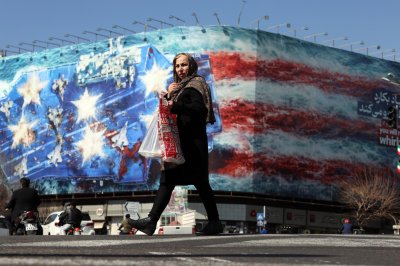
1 of 2 | An Iranian woman walks near a huge anti-U.S. billboard in a street in Tehran, Iran, on Thursday, February 26, 2026, the day Iran and the U.S. held their third round of nuclear talks in Geneva. Photo by Abedin Taherkenareh/EPA
Feb. 26 (UPI) — The third round of U.S.-Iran nuclear talks concluded Thursday in Geneva with signs of progress and plans for further negotiations, amid heightened tensions between Tehran and Washington as President Donald Trump threatens military action if a deal is not reached.
Oman said after the day-long talks that progress had been made and more talks are needed.
“We have finished the day after significant progress in the negotiation between the United States and Iran,” Minister Badr bin Hamad Albusaidi of Oman said in a statement.
“We will resume soon after consultation in the respective capitals.”
Minister Abbas Araghchi of Iran concurred with his Omani counterpart. Further progress had been made, he said.
“This round of talks was the most intense so far,” he said in a statement.
“It concluded with the mutual understanding that we will continue to engage in a more detailed manner on matters that are essential to any deal — including sanctions termination and nuclear-related steps.”
Technical-level discussions are scheduled to start in Vienna on Monday, officials said.
Representatives from the United States did not immediately comment.
The negotiations were indirect, with Iran and the United States communicating through Omani mediators.
There was a four-hour meeting in the morning followed by more than two hours of discussions in the afternoon, according to Araghchi, who said IAEA Director General Rafael Grossi’s involvement “was valuable for the technical discussions.”
“Regarding some issues, there is no understanding, and on others, it’s natural that we have differences,” Iran’s top diplomat said.
“However, there was perhaps more seriousness on both sides than before, with the aim of reaching a negotiated solution.”
Trump is seeking to secure a long-term deal aimed at preventing Iran from securing a nuclear weapon, a decades-long fear of Washington and Israel, and has threatened military action if negotiations falter.
The removal of sanctions appears to be Iran’s most pressing issue for Iran, as its economy has been under severe strain from years of sanctions imposed amid the years-long impasse over its nuclear program.
Ahead of the Thursday talks, Foreign Ministry spokesman Esmaeil Baghaei of Iran told reporters that Tehran’s delegation had come fully prepared.
“Right now, the relevant experts in the fields of sanctions relief and economic issues, as well as nuclear and legal matters, are with us, and we are prepared to continue these talks as long as necessary,” he said, the Islamic Revolutionary Guard Corps-affiliated Fars News Agency reported.
“As far as we are concerned, we are here with full preparedness and seriousness in order to realize the country’s national interests.”
He added that they will be watching for “contradictory statements” between what U.S. officials say in the meetings and what they tell the press.
“These contradictions do not help advance this diplomatic process and increase doubts and suspicions about their purpose and intentions,” he said.
Grossi and Oman’s Albusaidi held a meeting Thursday before the talks officially kicked off on technical matters related to Iran’s nuclear dossier.
| عقد معالي السيد بدر بن حمد البوسعيدي @badralbusaidi وزير الخارجية لقاءً في مدينة جنيف مع معالي رافاييل غروسي المدير العام للوكالة الدولية للطاقة الذرية، وذلك في إطار التشاور وتبادل وجهات النظر حول المسائل الفنية ذات الصلة بالملف النووي الإيراني والأفكار الجديدة التي هي محل… pic.twitter.com/RrjA28bfuU— وزارة الخارجية (@FMofOman) February 26, 2026
The second round of talks was held earlier this month, with Araghchi stating that an agreement had been reached “on general guiding principles.”
However, significant gaps remained between the United States and Iran.
Though it officially began Thursday, Iran’s Foreign Ministry said in a statement that Araghchi met with Albusaidi on Wednesday night and conveyed Tehran’s views on nuclear-related issues and the lifting of sanctions.
Araghchi stressed to the representative of Oman that “the success of the negotiations depends on the seriousness of the other side and its avoidance of contradictory behavior and positions.”
Trump has pursued a new nuclear deal with Iran since early in his first term, when in 2018 he unilaterally withdrew the United States from a landmark Obama-era multinational accord aimed at preventing Tehran from securing a nuclear weapon.
The first Trump administration applied a maximum pressure campaign of sanctions and economic pressure to coerce Tehran back to the negotiating table. Under the economic coercion, Iran began breaching its nuclear commitments and advanced its enrichment program.
Then, under the Biden administration, the United States attempted to revive negotiations with Iran — an effort that stalled by the fall of 2022 and was shelved when Iran-backed Hamas attacked Israel on Oct. 7, 2023.
Last June, after Trump was elected to a second term, he ordered strikes on three known nuclear sites as the United States joined Israel’s military campaign against Tehran. The White House later claimed Iran’s facilities had been “obliterated,” though international inspectors have not been able to gain access to them to verify the extent of the damage.
Despite the assertion, Trump has expanded the United States’ military presence in the Middle East in recent weeks ahead of the talks, sparking worries it may precede another attack if negotiations falter.
During his State of the Union address to a joint session of Congress on Tuesday night, Trump said Iran is seeking to restart its program but also wants to make a deal with the United States.
“They are at this moment again pursuing their sinister ambitions,” he said without providing proof. “My preference — my preference is to solve this problem through diplomacy. But one thing is certain, I will never allow the world’s No. 1 sponsor of terror — which they are by far — to have a nuclear weapon. Can’t let it happen.”
Third round of Iran-U.S. nuclear talks begins with meeting Between Iranian, Omani Foreign Ministers
Seyed Abbas Araghchi, Foreign Minister of the Islamic Republic of Iran, who has traveled to Geneva for the third round of Iran-U.S. nuclear negotiations, met on Wednesday evening… pic.twitter.com/rlufNwgm4p— Foreign Ministry, Islamic Republic of Iran (@IRIMFA_EN) February 26, 2026
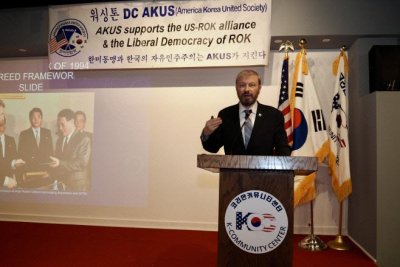
Greg Scarlatoiu, executive director of the Committee for Human Rights in North Korea, speaks at an event hosted by the Washington chapter of the Korean American Union Society at the Washington Korean Community Center in Alexandria. File. Photo by Asia Today
Feb. 26 (Asia Today) — North Korea’s Reconnaissance General Bureau operates as a “complex threat entity” that merges military operations, cybercrime and terrorism under a single command structure reporting directly to leader Kim Jong Un, according to a new report from a Washington-based human rights organization.
The Committee for Human Rights in North Korea released the report Sunday, titled Reconnaissance General Bureau: The Kim Regime’s Precious Treasured Sword. It offers one of the most detailed public examinations to date of the agency’s structure, financing and global reach.
The report was authored by Robert Collins, a former U.S. Army strategist with extensive Korea-related experience, including serving as chief of strategy at the ROK-U.S. Combined Forces Command – the joint military structure that oversees the defense of South Korea.
Collins argues that the RGB defies easy comparison to conventional intelligence agencies. Unlike South Korea’s National Intelligence Service or the U.S. Central Intelligence Agency, which operate within defined mandates, the RGB consolidates military reconnaissance, special operations, cyberwarfare, espionage, psychological operations and operations targeting South Korea under one centralized chain of command.
The bureau reports to North Korea’s State Affairs Commission and ultimately to Kim Jong Un, who the report says treats it as a core instrument of regime survival. Kim has personally referred to its cyber units as a “precious treasured sword,” according to the report.
Seven Bureaus, One Command
Established in February 2009 through the merger of several intelligence and operations units, the RGB currently operates through six main bureaus and a seventh logistics unit.
The first bureau oversees agent training and infiltration missions. The second conducts military reconnaissance along the Demilitarized Zone and coastal areas. The third manages overseas intelligence and alleged international operations. The fourth handles inter-Korean dialogue and related policy support. The fifth directs cyber operations, including hacking and communications interception. The sixth provides technical support and electronic warfare capabilities, while the seventh handles rear services and logistics.
Taken together, the report assesses that the RGB maintains operational capacity across land, sea, air and cyberspace – a multi-domain reach that few comparable organizations possess.
Cyber Operations as a Revenue Engine
A substantial portion of the report is devoted to North Korea’s cyber activities, which Collins describes as both strategically and financially central to the regime.
The report estimates that North Korea maintains approximately 5,900 cyber personnel and identifies hacking groups Lazarus, Andariel and Bluenoroff as operating under the RGB’s organizational umbrella. These groups have been linked by U.S. and international authorities to some of the most significant state-sponsored cyberattacks in recent years.
Drawing on international assessments, the report alleges that North Korean-linked hackers stole approximately $1.7 billion in cryptocurrency in 2022 alone – funds it says are funneled into the country’s nuclear and missile programs, helping Pyongyang sustain its weapons development despite sweeping international sanctions.
The report also raises concern about reported cooperation between North Korean operatives and foreign cybercriminal networks, suggesting the bureau’s reach may extend further into the global criminal ecosystem than previously documented.
Human Rights in the Crosshairs
The report draws an explicit connection between the RGB’s security operations and human rights, an angle that sets it apart from purely strategic assessments of the bureau.
It argues that cyber intrusions, surveillance and information disruption campaigns may violate international covenants protecting privacy and freedom of expression. It further contends that revenue generated through cybercrime – redirected to weapons programs rather than civilian welfare – could breach obligations under international agreements on economic and social rights.
The report also revisits a series of past incidents attributed to North Korean operatives, including armed infiltrations, bombings and assassinations, characterizing them as violations of the right to life and other fundamental protections under international law.
A Threat Beyond the Peninsula
In its conclusion, the report warns that the RGB can no longer be viewed solely as a regional security concern. The integration of its cyber capabilities with emerging technologies – including drones and advanced reconnaissance systems – could significantly complicate the security environment in coming years, the report said.
The committee said the study is intended as a reference for policymakers, researchers and security specialists seeking to understand the bureau’s expanding operational scope.
No response from the North Korean government was immediately available. Pyongyang does not typically comment on reports issued by foreign organizations.
Science and ICT Minister Bae Kyung-hoon, who doubles as deputy prime minister for science affairs, speaks during a meeting of science and technology-related ministers at the government complex in Seoul, South Korea, 28 January 2026. Photo by YONHAP / EPA
Feb. 26 (Asia Today) — A presidential advisory body has recommended that South Korea reconsider the uniform application of its 52-hour workweek, proposing limited exceptions for startups and companies in national strategic technology sectors.
The National Advisory Council on Science and Technology, which advises the president, said firms founded within the past five years and those engaged in key strategic technologies should be allowed greater flexibility in managing working hours.
South Korea introduced the 52-hour workweek cap in 2018 as part of broader labor reform efforts aimed at improving work-life balance and reducing long working hours that had long been a hallmark of the country’s rapid industrialization. The law applies to most businesses and limits total weekly working hours, including overtime, to 52.
The council said building a competitive innovation ecosystem requires a regulatory shift toward greater autonomy and flexibility. It proposed allowing technical personnel at eligible firms to calculate working hours on a quarterly or semiannual basis rather than weekly, depending on project needs. Under the proposal, any exemption would require written consent from individual employees and safeguards to protect workers’ health.
Business groups have long called for expanding exceptions to the 52-hour limit, but the recommendation carries added weight because it comes directly from a presidential advisory body rather than an industry lobby.
In the council’s written opinion, a first-generation venture founder said the 52-hour system conflicts with the nature of startups, which often depend on intensive, time-sensitive work to scale quickly. Another founder cited in the report argued that uniform rules designed around traditional manufacturing no longer reflect the needs of the modern startup ecosystem.
The council noted that other sectors face similar constraints. In semiconductors, companies often experience surges in workload tied to delivery schedules and research timelines, making continuous R&D difficult to sustain under fixed weekly caps. Game developers likewise face concentrated workloads in the months leading up to major releases.
The debate comes amid growing concern about South Korea’s technological competitiveness. According to a 2024 technology level assessment submitted to the council by the Ministry of Science and ICT, the number of national strategic technologies – a government-designated list of critical fields including semiconductors, artificial intelligence, and advanced materials – in which South Korea leads China fell from 17 to just six over the past two years.
The council’s report referenced China’s widely known “996” work culture – 9 a.m. to 9 p.m., six days a week – as a factor that may be contributing to the pace of R&D there. Interest in similar intensive work models is reportedly growing in Silicon Valley as competition with China intensifies.
The National Assembly passed a special semiconductor law in January, but a provision that would have exempted the industry from the 52-hour workweek was stripped out before final passage. It remains unclear whether the government intends to pursue standalone legislation to address the exemption. No official response from the government or labor groups was immediately available.
The council is calling on lawmakers to introduce more flexible working hour arrangements at minimum across the broader science and technology sector.
Feb. 26 (UPI) — A new Kansas law requiring transgender residents’ state-issued identification to reflect their “sex at birth” went into effect Thursday, immediately invalidating hundreds of driver’s licenses and birth certificates.
KCUR-TV in Kansas City, Kan., reported that people began receiving notices this week from the Kansas Department of Revenue instructing them to request new identification cards and birth certificates if they had ever updated the gender marker on the documents.
The requirement is a result of legislation known as SD 244 going into effect Thursday. It bans transgender people from using bathrooms that match their gender identity. It also gives citizens the ability to sue transgender people for $1,000 if they encounter them breaking that law.
Other states ban transgender people from changing the gender marker on their IDs, but Kansas’ new law also nullifies any changes previously made legally.
State Rep. Abi Boatman, a transgender woman, shared a copy of the KDOR letter dated Monday on Facebook on Wednesday. It said those receiving the letter will have their identification records nullified.
“Additionally, please note that the Legislature did not include a grace period for updating credentials,” the letter reads. “This means that once the law is officially enacted, your current credential will be invalid immediately, and you may be subject to additional penalties if you are operating a vehicle without a valid credential.”
In a separate Facebook post Monday, Boatman said each person who must change their license will have to pay a $26 fee for a standard license.
“Be sure to thank your Republican representatives for not only cancelling the driver’s licenses of 1,700 transgender Kansans but also making them pay for a new one,” she wrote.
“It’s a wild time when Kansas can erase human beings while simultaneously making $45,000 off of them.”
Kansas’ Republican-majority Legislature used a process known as “gut and go” to pass SB 244 earlier this month, The Guardian reported. It allowed lawmakers to replace the text of one bill with entirely new language and to bypass committee review and expedite the voting process.
Democratic Gov. Laura Kelly vetoed the bill, calling it “poorly drafted legislation,” but the Legislature overrode her veto with a supermajority vote.
Attorney General Kris Kobach, who supported SB 244, said in a Facebook post about the signing of the legislation that he was “thankful for Kansas lawmakers who stand firm on this.”
“No more confusion on official IDs — biology matters, and truth wins.”
After the passage, Anthony Alvarez, who works for Loud Light Civic Action and is a transgender man, said the new law deputizes citizens and gives them financial incentive to turn against transgender Kansans.
“Every aspect of my public life will be subject to policing — from when I show my ID to vote or go to the bank to when I want to visit my friends in their dorm room or when I was my hands before I eat,” he said in a statement shared by the American Civil Liberties Union in Kansas.
The ACLU said it plans to challenge the law in court.
The Ecuadorian government has declared that it will significantly raise tariffs on imports from Colombia, increasing the rate from 30 percent to 50 percent starting March 1.
The decision, announced on Thursday, represents a major escalation in the intensifying trade and security dispute between the two neighbouring Andean countries.
Recommended Stories
list of 3 itemsend of list
Ecuador’s right-wing president, Daniel Noboa, has been pressuring his left-wing counterpart in Colombia, Gustavo Petro, to crack down on border security.
Since the start of the COVID-19 pandemic in 2020, Ecuador has seen a surge in violence linked to the expansion of organised crime in the country.
Noboa, echoing President Donald Trump in the United States, has blamed Petro for not acting aggressively enough to combat narcotics trafficking. Colombia has, for many years, been the world’s largest source of cocaine.
And like Trump, Noboa has increasingly relied on tariffs against Colombia to force adherence to Ecuador’s national security strategy.
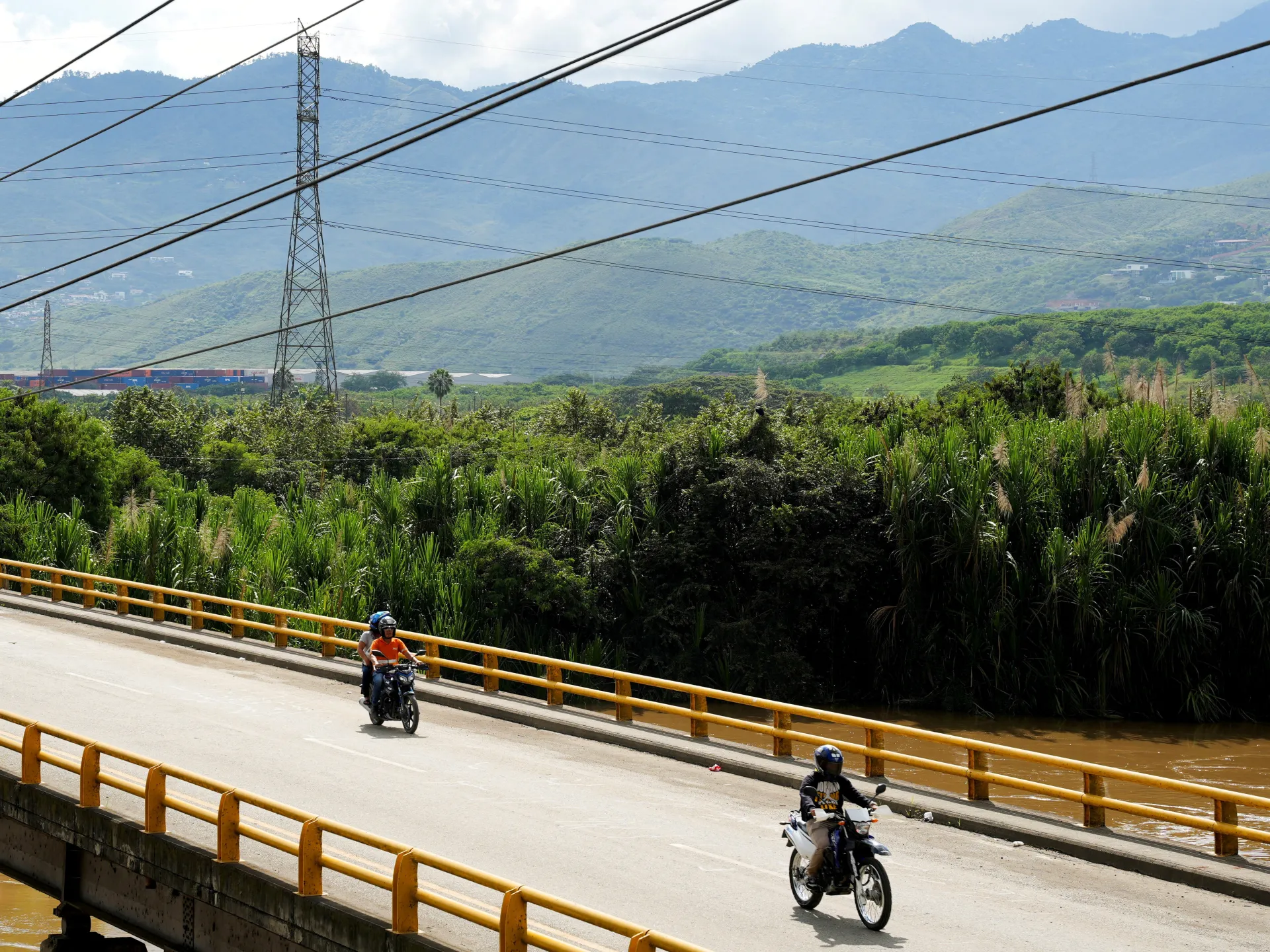
His government has accused Petro’s of failing to cooperate with border security measures. The two countries both sit on the Pacific coast, and they share a land border that stretches roughly 586 kilometres, or 364 miles.
Questions about electricity
Thursday’s announcement follows an initial 30 percent tariff imposed by Quito in early February.
Ecuadorian officials have also justified the protectionist measures by citing a growing trade deficit.
According to the Observatory of Economic Complexity, a data analysis firm, nearly 4 percent of Colombian exports go to Ecuador, worth roughly $2.13bn. Ecuador imports significant quantities of medicines and pesticides from Colombia.
Fewer exports go from Ecuador to Colombia, though. Roughly 2.3 percent of Ecuador’s exports abroad go across the shared border, amounting to a value of $863m.
Ecuador’s trade deficit with Colombia sits at roughly $1.03bn through 2025, according to government data, excluding oil.
But in spite of the anticipated tariff hike, it is unclear whether Ecuador will apply the new tariffs to Colombian electricity — a critical resource for the country.
In a retaliatory move following the initial tariffs, Colombia suspended all energy sales to its neighbour.
That suspension risks fuelling tensions in Ecuador against Noboa’s government. Recent droughts have created disruptions to Ecuador’s hydroelectric dams, which provide nearly 70 percent of the country’s power.
Those disruptions have caused widespread power outages in recent years, which in turn have prompted antigovernment protests. In the past, Noboa has responded by buying electricity from Colombia.
Pipeline standoff
The transportation of fossil fuels has also become a flashpoint between Ecuador and Colombia in the aftermath of February’s tariffs.
Noboa’s government has hiked fees for Colombian crude delivered through the Trans-Ecuadorian System Oil Pipeline (SOTE) by 900 percent.
That raises the cost to approximately $30 per barrel. Colombia has responded by halting all oil shipments through the line.
Despite high-level diplomatic efforts, tensions between the neighbouring countries remain at an impasse.
Officials representing foreign policy and security held a meeting this month in Ecuador, but the gathering concluded without a breakthrough.
In announcing the latest tariff hike, Ecuador’s Ministry of Production and Foreign Trade levelled criticism at Colombia for failing to implement “concrete and effective” measures to curb drug trafficking along the border.
Once considered a bastion of stability, Ecuador has seen a spike in homicide and other violent crimes.
According to the Geneva-based Organized Crime Observatory, the Andean nation recorded a homicide rate of approximately one murder every hour last year.
One killed and 29 others wounded in latest Israeli attack in violation of ceasefire.
Published On 26 Feb 202626 Feb 2026
Share
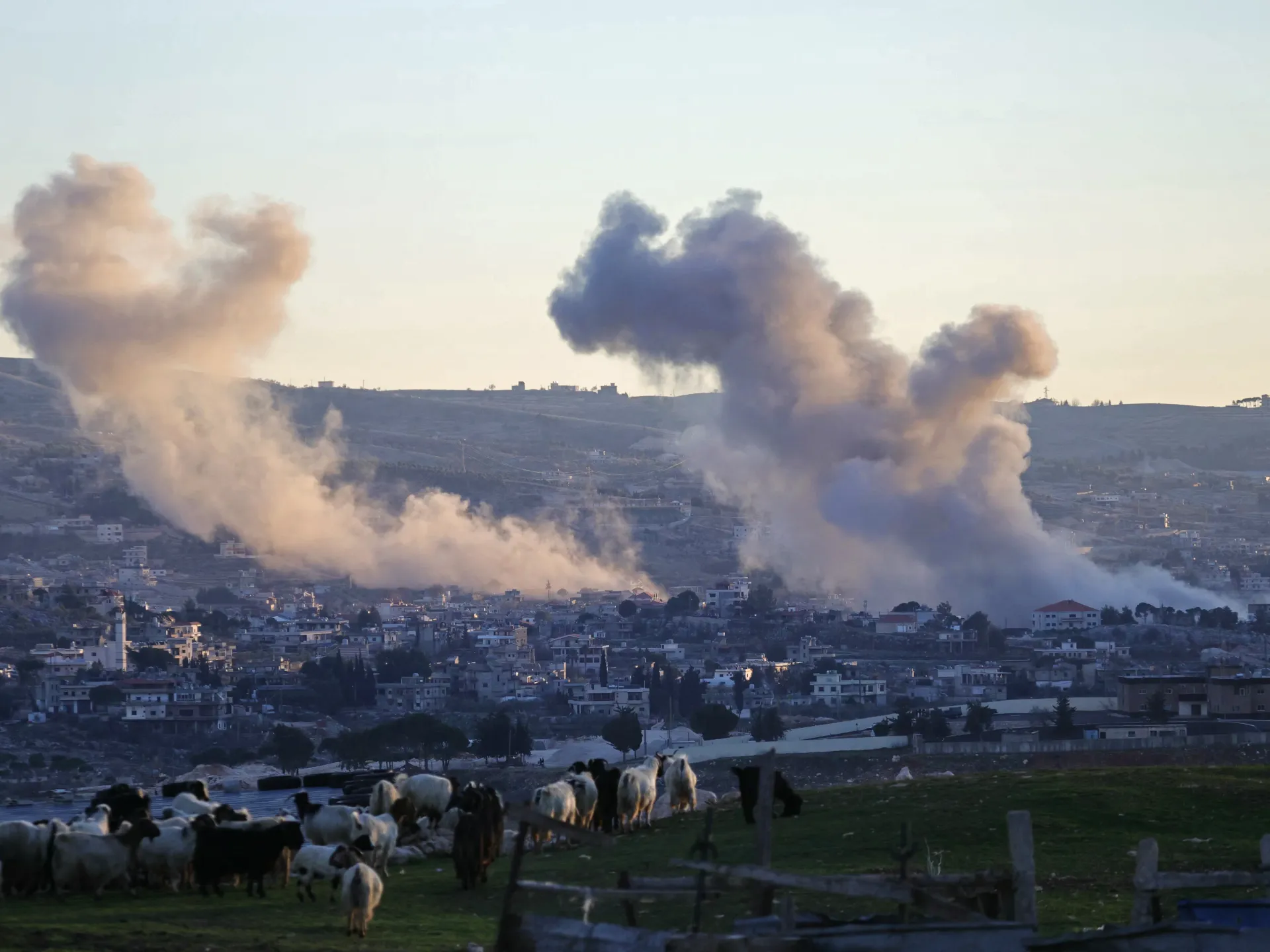
Israeli strikes on Lebanon’s Bekaa Valley have killed one person and wounded 29 others, the latest in a series of ceasefire violations.
Lebanon’s Ministry of Health announced that a “16-year-old Syrian boy was killed”, the National News Agency (NNA) reported on Thursday. He was named as Hussein Mohsen al-Khalaf and was killed in a strike on Kfar Dan near Baalbek, the L’Orient news outlet reported.
Recommended Stories
list of 3 itemsend of list
At least 13 air strikes were recorded, four in Shmestar, five in Boudai, two in Harbata and two in the Hermel and Nabi Chit mountains, according to NNA. Several shops were damaged in the Baalbek Souk in Tallet al-Ajami.
The Israeli military said it targeted eight camps belonging to Hezbollah’s special operations unit, the Radwan Force. It said weapons and missiles were stored there and training was conducted “as part of preparations for emergency situations, and to plan and execute terrorist plots”. It said this activity was a “violation of the understandings between Israel and Lebanon”.
Ceasefire violations
Israel’s military has continued to carry out attacks in Lebanon, despite a November 2024 ceasefire with the Lebanese armed group Hezbollah that sought to bring an end to more than a year of fighting. More than 300 people have been killed since then, including 127 civilians, according to the United Nations.
Last week, at least 12 people were killed in Israeli strikes on the Bekaa Valley and the Ein el-Hilweh Palestinian refugee camp near the city of Sidon. Israel said it was targeting Hezbollah and Hamas command centres.
Lebanon filed a complaint with the UN in January, detailing a total of 2,036 Israeli violations between October and December 2025 alone. It called on the UN Security Council to compel Israel to end these actions and to fully withdraw from its borders.
Israel continues to occupy parts of Lebanon, blocking the reconstruction of border villages and preventing people from returning to their homes.
Lebanon’s government has said it has almost completed its ceasefire commitment to disarm Hezbollah south of the Litani River. It said it will need four months to complete the second phase.
However, Hezbollah has rejected this, saying it believes the disarmament in the ceasefire agreement only applies to areas south of the river.