POLITICS

Stay informed about the latest developments in politics with our comprehensive political news coverage. Get updates on elections, government policies, international relations, and the voices shaping the political landscape.

Cuban-American Bloc May Be Splitting : Politics: Powerbroker’s kind words for Clinton have caused an uproar. Some say shift away from GOP has been under way for some time.

A statement issued by Cuban-American powerbroker Jorge Mas Canosa after a meeting earlier this week with Democrat Bill Clinton has caused a furor among Republicans here while fueling speculation that defectors from what was once considered the most solid of Republican voting blocs could help give Florida’s 25 electoral votes to the Democrats for the first time since 1976.

Mas, chairman of the Cuban American National Foundation, went to Tampa on Tuesday to thank Clinton for his support of the anti-Castro Cuban Democracy Act. In a statement signed by Mas and three other CANF directors, Mas went on to say: “Any fears that the Cuban-American community may have had about a Clinton Administration with regard to Castro’s Cuba have dissipated today.”

Many interpreted Mas’ remarks as all but blessing Cuban-Americans who wanted to vote for Clinton. Republican stalwarts expressed surprise and dismay over what some characterized as a betrayal.

“I have a serious problem with (the statement),” said Alberto Cardenas, co-chairman of the Bush-Quayle campaign in Dade County and a co-founder of CANF. “Advising the Cuban-American voter that Clinton is an acceptable choice is without merit, and at best premature, and doesn’t speak well for 12 years of Republican support. I told that to Mr. Mas.”

Democrats downplayed Mas’ influence, insisting a slight shift was under way long before the meeting.

“Cuban-American voters could make the difference, could be that swing vote,” said Grace Prieto, a coordinator with the Clinton-Gore campaign in Dade County. “Dukakis got about 7% of the Cuban-American vote in 1988. I am sure that this time the Democrats will get 25% to 30%.”

Statewide, the race between the Arkansas governor and President Bush is rated pretty much a tossup, and Cuban-American voters make up only 4% of the Florida total.

Still, according to a poll released Tuesday by Mason-Dixon Political/Media Research, what was once an overwhelming majority for Bush among Cuban-Americans has begun to erode, from 73% to 55%. Meanwhile, Clinton’s support among the same group rose from 19% to 36%.

Those poll results were released about the same time that Mas was meeting privately with Clinton in Tampa, and do not reflect the subsequent political fallout from his statement.

Mas, along with several CANF directors, met with Clinton after the Democratic candidate addressed 18,000 people at a rally. Also present at the meeting were Rep. Dante B. Fascell (D-Fla.) and Maria Arias, Clinton’s Cuban-born sister-in-law.

Mas’ overture to Clinton was widely seen as a political hedge by an ambitious man who has made no secret of his intention to be a leading player–perhaps even president–in a post-Castro Cuba.

But his conciliatory statement caused such an uproar among so many Cubans here that Mas went on a Spanish-language radio station Thursday to affirm his support for Bush. “My affiliation is Republican, my vote is for President Bush, but my work for Cuba is much more important than my partisan preferences,” he said during an interview over radio station WQBA.

Mas’ political maneuvering “is the topic in the Cuban community,” said Los Angeles-based political pollster Sergio Bendixen, working here for the Univision television network. “Many people feel it was treason for (Mas) to suggest it might to OK to vote for Democrats, perceived for many years as next to Communists. Others accept that Mas’ one objective is the liberty of Cuba, and see it as a genius move.”

Prieto said she has been busy assuring Cuban-American Democrats that the controversial Mas “will not control the Clinton Administration.” Mas’ goal, added Prieto, “is to persist as leader if Bill Clinton wins, and keep power and control.”

Arias, a Miami attorney married to Hugh Rodham, Hillary Clinton’s brother, said: “We welcome any statements from Mas or anyone else who says they believe in Bill Clinton. My reading is that he does have impact. I don’t think (his statement) can hurt.”

Tomas Garcia Fuste, news director of WQBA, said he believes that Bush’s son, Jeb, a Miami businessman, is the difference. “He is a good friend here. Cuban-Americans are Republicans, no matter what happens.”

In its report on the controversy, the Miami Herald mentioned rumors that before traveling to Tampa to meet with Clinton, Mas was confronted at his home by an angry Jeb Bush, who demanded that he not go. In the same account, Jeb Bush denied that any confrontation took place.

Source link

What the candidates for California governor

You’re reading the L.A. Times Politics newsletter

Anita Chabria and David Lauter bring insights into legislation, politics and policy from California and beyond. In your inbox three times per week.

By continuing, you agree to our Terms of Service and our Privacy Policy.

To be elected governor of California, a candidate needs six vital assets.

Maybe not the entire six-pack, but almost. They include:

–A salable message. How’s the candidate going to make life better for the voter? Specifics, not just poll-generated platitudes. And beating up on President Trump isn’t going to be enough for Democrats next year.

Voters will probably be getting migraine headaches from listening to both Trump and his critics.

–Curb appeal. It greatly helps to have matinee-idol looks like Gov. Gavin Newsom. But that gift is rare. Average appearance, verbal skills and a good message will usually suffice.

–Boatloads of money. It costs tens of millions of dollars to market a gubernatorial aspirant’s message in far-flung, heavily populated and diverse California.

–A strong desire to win, also known as “fire in the belly.” Rather than relaxing in a recliner while watching the Rams or 49ers, the willingness to fly off to beg strangers for campaign donations.

–A thick skin. Top-tier candidates are constantly attacked by rivals and often covered by the news media in ways deemed unfair. But overreacting can destroy a candidacy.

–A strong record of public service to show voters you’re committed and won’t need lots of time with training wheels.

There also are other assets that can help. For example: youth.

“We are, in fact, going through a generational change in American politics,” says longtime Democratic strategist Darry Dragow. “That’s inevitable. New generations of voters have not been widely represented in government. The boomers have held political power for a very long time.”

Baby boomers are roughly ages 60 through 79 — born after World War II, between 1946 and 1964.

Another plus is political incumbency — the ability for a candidate to be identified on the ballot label as, for example, attorney general or lieutenant governor. That denotes credibility and a record. You’re not allowed to call yourself a “former” anything.

Democratic strategist Garry South calls the current crop basically “a field of formers” and says that saddles them with an extra burden.

So far, the 2026 race to replace the termed-out Newsom has been a boring trot.

That’s largely because the public’s political focus has been on Trump and the toady Republican Congress. But it’s also because none of the gubernatorial candidates possesses the full six-pack of vital assets.

For months, the contest was frozen in waiting mode: Waiting for former Vice President Kamala Harris and Sen. Alex Padilla to decide whether they wanted to run. Either would have been an early favorite, but not a shoo-in. They’d have faced a fight. And neither apparently felt the job was worth it. No fire.

Democratic donors and activists also were focused on Proposition 50 and waiting for the Nov. 4 redistricting election to be over. Most money and effort were going there.

Now that’s all behind us and the real race is underway.

“It’s a total free-for-all,” Sragow says. “None of these candidates is really on anybody’s radar.”

There’s no actual front-runner.

“You can’t read anything into the polls,” Democratic consultant Gale Kaufman says. “Just because somebody is a few points ahead doesn’t make them a front-runner. We don’t even know who all the candidates are yet.”

A late October poll of registered voters by the UC Berkeley Institute of Governmental Studies showed that 44% were undecided. Former Orange County Rep. Katie Porter led Democratic candidates with a scant 11%. Former U.S. Health Secretary Xavier Becerra was second at 8%.

Riverside County Sheriff Chad Bianco, a Republican, was first overall with 13%. But never mind. No Republican has been elected to statewide office in California since 2006. And one won’t be 20 years later.

Last week, two more Democrats leaped into the race:

Billionaire hedge fund founder Tom Steyer, 68, who ran for president in 2020 and got nowhere. He has a good populist, anti-Sacramento message and tons of money to voice it. But he has never held elected office. And Californians have historically rejected mega-rich, self-financing candidates attempting to begin their political career at the highest level.

Rep. Eric Swalwell, 45, from the San Francisco Bay Area, who also ran unsuccessfully for president in 2020. He has a good message for progressives. But right now it may be too focused on Trump and not enough on Californians’ needs.

Aside from Steyer, none of the other Democratic aspirants are independently wealthy. They’ll need to raise barrels of money — ”24 hours a day, seven days a week,” Sragow says. That takes fire.

Other Democratic candidates:

–Porter, 51. She has curb appeal. But she publicly showed a thin skin with a contentious, rude performance during a TV interview in October. The nasty episode probably wasn’t fatal. But it apparently dropped her in polls, and that hurts fundraising.

–Becerra, 67. He has a respectful record as Health secretary, California attorney general and congressman. But questions were raised recently about Becerra’s judgment when federal prosecutors revealed the then-secretary didn’t notice that a top aide had raided his dormant political account for $225,000. Becerra wasn’t implicated. The aide pleaded guilty.

–Antonio Villaraigosa, 72, former Los Angeles mayor and state Assembly speaker. No one is more qualified to be governor. And he lets voters know where he stands. But they may be looking for someone younger.

–Betty Yee, 68, former state controller, Board of Equalization member and chief state budget honcho. She knows every inch of state government’s fiscal quagmire and has good ideas about unraveling it. But she’s short on curb appeal.

–State Supt. of Public Instruction Tony Thurmond, 57, the lone incumbent in the field. But he missed an opportunity to shine as state schools chief.

One of these people will probably be our next governor, although others could still enter the race. So, maybe it’s time to start paying attention.

What else you should be reading

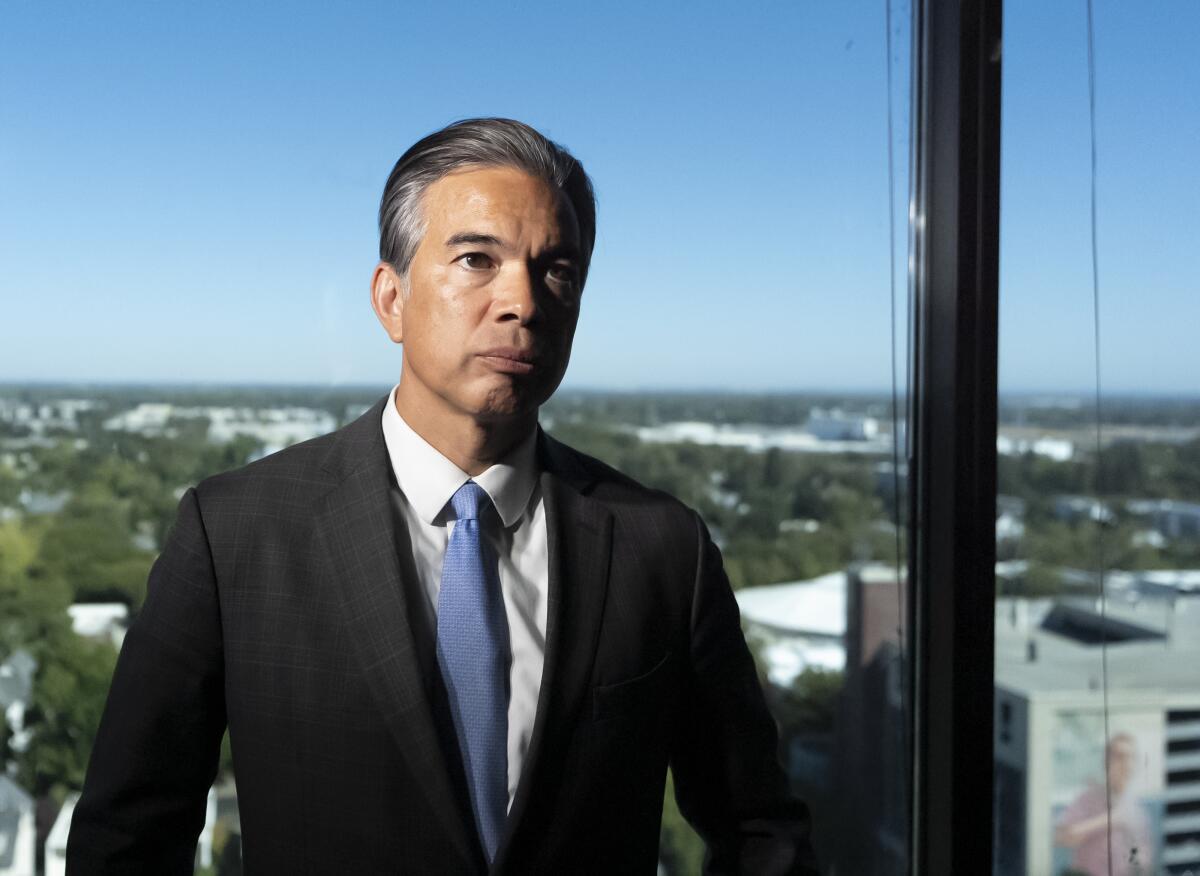
The must-read: Pondering a run for governor, Atty. Gen. Rob Bonta faces questions about legal spending
C.A. vs. Trump: ‘Played with fire, got burned’: GOP control of House at risk after court blocks Texas map
The L.A. Times Special: California’s child farmworkers: Exhausted, underpaid and toiling in toxic fields

Until next week,
George Skelton


Was this newsletter forwarded to you? Sign up here to get it in your inbox.

Source link

Trump, the anti-globalist, declares America ‘open for business’ in Davos speech to globalists

President Trump gave his salesman’s pitch for America on Friday before an international crowd of corporate and political titans, and took credit for its economic success, even as he was shadowed by fresh clouds from home about his heightened jeopardy in the Russia investigation and opposition to his immigration plan.

Contrary to predictions that Trump might use his keynote address to the World Economic Forum in Davos to bash multilateral trade deals and international alliances, as he did during his campaign, he appeared to soften the edges of his “America First” policy in his speech to the elites who gather in this glitzy Alpine resort each winter to champion free trade and global cooperation.

“America is open for business and we are competitive once again,” Trump told several hundred attendees, reading his speech from teleprompters. “Now is the perfect time to bring your business, your jobs and your investments to the United States.”

Given the complaints here about Trump’s aggressive trade policies and worries that America is withdrawing from its global leadership role, Trump received general credit for showing up and hobnobbing with fellow world leaders and moguls at an event that has not seen a U.S. president since Bill Clinton in 2000.

Some in the crowd booed and hissed when Trump, during a question-and-answer session that followed his speech, said it “wasn’t until I became a politician that I realize how nasty, how mean, how vicious, and how fake the press can be.”

While Trump’s anti-media remarks are familiar to Americans, they struck a dissonant note on the international stage since U.S. presidents historically have been global clarions for a free press.

Although the evidence was scant, Trump dropped at least one hint he might be moderating other views.

Earlier this week, Canadian Prime Minster Justin Trudeau announced here that his country would join 10 others that have agreed to move forward on the Trans-Pacific Partnership trade pact without the United States. Trump withdrew from the proposed accord shortly after taking office, calling it a “horrible deal.”

In his comments here, Trump cracked the door slightly to reentering the TPP in some way, saying he was open to negotiating trade deals with the 11 countries “either individually, or perhaps as a group.”

That sparked a buzz of comment here and on social media. Trump vowed to withdraw from the North American Free Trade Agreement during the campaign, but his administration is seeking to renegotiate it with Mexico and Canada. In contrast, the White House has shown no sign it is reconsidering its decision on TPP.

And while global challenges like climate change and poverty dominate the agenda here, the CEOs and other top executives Trump met in his 36-hour visit publicly applauded the corporate tax cuts he signed into law last month.

All that put Trump in a good mood.

“I’ve been a cheerleader for our country,” Trump said in his speech, which largely echoed familiar White House talking points. “And everybody representing a company or a country has to be a cheerleader, or no matter what you do, it’s just not going to work.”

Trump said he will put America first just as other leaders should put their countries first, a line he used in a harder-edged address he delivered at the Asia-Pacific Economic Cooperation summit in Vietnam in November.

Trump accused “some countries” of exploiting the international trading system at the expense of others. He said he supports free trade, but it “needs to be fair and it needs to be reciprocal.”

“The United States will no longer turn a blind eye to unfair economic practices, including massive intellectual property theft, industrial subsidies, and pervasive state-led economic planning,” he said, probably a reference to China.

At his raucous political rallies back home, that sentiment often generates loud cheers. The crowd at Davos stayed silent, saving polite applause for the end of his remarks.

As he often does, Trump claimed credit for the booming U.S. economy, citing growth numbers and the removal business regulations. That message was partly diluted by news Friday that U.S. growth slowed slightly in the fourth quarter to 2.6%, which was short of Trump’s projections.

The Davos conference is considered the premier event for the world’s wealthy glitterati, a familiar group to the billionaire owner of Mar-a-Lago and other high-end hotels and resorts. In his speech, Trump nodded to his working-class supporters, saying that “when people are forgotten, the world becomes fractured.”

Trump also couldn’t resist taking a jab at Hillary Clinton despite the American tradition of steering clear of partisan politics while on foreign soil. In the question-and-answer session, Trump said the stock market would have dropped 50% if “the opposing party” had won instead of him.

The audience scored the tone of Trump’s speech carefully, given his antagonism to international organizations and pacts, such as the Paris climate accord, trade agreements and the Iran nuclear deal that are generally celebrated at the conference.

It was partly overshadowed at home after the New York Times reported late Thursday that Trump tried to fire special counsel Robert S. Mueller III last June, halting the effort only after White House Counsel Donald McGahn threatened to resign.

Nor could Trump escape fallout here from reports that he had labeled African nations “shithole countries” during a recent Oval Office meeting with several members of Congress. The comments sparked widespread condemnation around the globe.

Trump ignored reporters’ questions about the crude language when he met early Friday with Paul Kagame, longtime president of Rwanda and incoming chairman of the African Union. Kagame is the first African leader Trump has met since his comments were reported on Jan. 11.

The African Union had called on Trump to apologize for the remarks, which he has denied making. It is not known whether the dispute came up in Trump’s private discussion with Kagame. A subsequent statement from the White House summarizing the meeting did not mention the issue.

“It’s a great honor to be with President Kagame,” Trump told reporters as he sat beside Kagame and several aides, including Secretary of State Rex Tillerson. “We have had tremendous discussions.”

Kagame also tried to smooth over the dispute, thanking Trump “for the support we have received from you … and your administration.”

Trump also dismissed a shouted question about the Mueller development as “fake news.” Instead, he boasted of how his appearance had swelled the crowd at Davos this year.

“We have a tremendous crowd, and a crowd like they’ve never had before. It’s a crowd like they’ve never had before at Davos,” Trump bragged as he entered the hall with Klaus Schwab, the Germany founder of the forum.

Then, in a rare burst of modesty, he quipped, “I assume they’re here because of Klaus.”

[email protected]

Twitter: @noahbierman


UPDATES:

1:20 p.m.: This article was updated with additional details from Trump’s meetings in Davos.

6 a.m.: This article was updated with Trump’s comments.

This article was originally published at 2:10 a.m.


Source link

Epstein’s accusers grapple with complex emotions about promised release of Justice Department files

For Marina Lacerda, the upcoming publication of U.S. government files on Jeffrey Epstein represents more than an opportunity for justice.

She says she was just 14 when Epstein started sexually abusing her at his New York mansion, but she struggles to recall much of what happened because it is such a dark period in her life.

Now, she’s hoping that the files will reveal more about the trauma that distorted so much of her adolescence.

“I feel that the government and the FBI knows more than I do, and that scares me, because it’s my life, it’s my past,” she told the Associated Press.

President Trump signed legislation last week that will force the Justice Department to release documents from its voluminous files on Epstein.

“We have waited long enough. We’ve fought long enough,” Lacerda said.

It isn’t clear yet how much new information will be in the files, gathered over two decades of investigations into Epstein’s alleged sexual abuse of many girls and women.

Some of his accusers expect the files to provide a level of transparency they had hardly allowed themselves to believe would materialize, but the release of the documents will be a more complicated moment for others.

Two federal investigations cut short

The FBI and police in Palm Beach, Fla., began investigating Epstein in the mid-2000s after several underage girls said he had paid them for sex acts. He pleaded guilty in 2008 to charges including procuring a minor for prostitution, but a secret deal with the U.S. attorney in Florida — future Trump Cabinet member Alex Acosta — allowed him to avoid a federal prosecution. He served little more than a year in custody.

Jena-Lisa Jones says she was abused by Epstein in Palm Beach in 2002, when she was 14. She did not report the abuse to the police at the time, but she later became one of many accusers to sue the multimillionaire.

The Miami Herald published a series of articles about Epstein in 2018 that exposed new details about how the federal prosecution was shelved. A year later, federal prosecutors in New York, where Epstein owned a mansion, revived the case and charged him with sex trafficking.

Jones said she was interviewed during that federal investigation and was prepared to testify in court.

“It was very important for me to have my moment, for him to see my face and hear my words, and me have that control and power back,” Jones said.

But that day never came.

Epstein killed himself in a federal jail cell in New York City in August 2019.

In lieu of her day in court, Jones and others are hoping for a public reckoning with the publication of the government files on Epstein.

While the government only ever charged two people in connection with the abuse case — Epstein and his longtime confidant Ghislaine Maxwell, who is in prison for her related crimes — at least one of Epstein’s accusers has claimed she was instructed to have sex with other rich and powerful men.

Jones didn’t make similar claims, but said she believes the documents could map out a “broad scheme” involving others.

“I’m hoping they’re shaking a little bit and that they have what’s coming for them,” Jones said.

Filling in the gaps

Lacerda, now 37, is also hoping the files will clarify her own personal experience, which is muddled by the pain she said she endured at that time in her life.

“I was just a child and it’s just trauma. That’s what trauma does to your brain,” Lacerda said.

An immigrant from Brazil, Lacerda said she was working three jobs to support herself and her family the summer before 9th grade when a friend said she could make $300 if she gave Epstein massages.

The first time she massaged Epstein, he told her to remove her shirt, she said.

Lacerda said she was soon spending so much time working for Epstein that she dropped out of school. The sexual abuse persisted until she turned 17, when Epstein informed her that she was “too old,” she said.

Lacerda wondered whether the files might include videos and photographs of her and other victims at Epstein’s properties.

“I need to know — for my healing process and for the adult in me — what I did as a child,” Lacerda said. “It will be re-traumatizing, but it’s transparency — and I need it,” she said.

Accusers wonder, why now?

For Lacerda, the elation around the upcoming release of the files gave way to familiar feelings for many women who survive abuse: fear and paranoia.

“In the heat of the moment, we were like, ‘Wow, this is like, everything that we’ve been fighting for.’ And then we had to take a moment and be like, ‘Wait a minute. Why is he releasing the files all of a sudden?’ ” Lacerda said.

The abrupt change in the political momentum made her uneasy. She wondered whether the documents would be doctored or redacted to protect people connected to Epstein.

Others echoed her concerns, and wondered if the government would sufficiently protect victims who have remained anonymous, who fear scrutiny and harassment if their names were to become public.

“For the rest of my life, I will never truly trust the government because of what they’ve done to us,” Jones said.

Haley Robson, who says she was abused by Epstein when she was 16, has the same concerns.

Robson was a leading voice in advocating for the Florida legislation signed in 2024 that unsealed the grand jury transcripts from the 2006 state case against Epstein.

She said the political maneuvering in recent months about the files led to nonstop anxiety, reminiscent of how she felt when she was abused as a teenager.

“I guess it really comes from the trauma I’ve endured, because this is kind of what Jeffrey Epstein did to us. You know, he wasn’t transparent. He played these manipulation tactics,” she said. “It’s triggering for anybody who’s been in that situation.”

Still, Robson said she is trying to savor the victory while she can.

“This is the first time since 2006 where I don’t feel like the underdog,” she said.

Riddle writes for the Associated Press.

Source link

Putin may escalate, intelligence officials tell House panel

Director of National Intelligence Avril Haines told lawmakers Tuesday morning that Russian President Vladimir Putin did not expect the level of Ukrainian resistance to his invasion, nor the level and speed of sanctions imposed by countries around the world.

“Our analysts assess that Putin is unlikely to be deterred by such setbacks and instead may escalate, essentially doubling down,” she said.

The comments from Haines and other intelligence officials came in an unusually candid public hearing with members of the House Intelligence Committee. The hearing was expected to focus on the intelligence community’s annual global threat assessment, but it was instead largely dominated by questions about Russia’s two-week-old invasion of its neighbor Ukraine. The House panel will get a classified assessment in the afternoon.

Haines said Putin likely expected the conflict to last a matter of days at most and predicted Russia will be hard pressed to hold any ground it gains.

“We assess Putin feels aggrieved the West does not give him proper deference and perceives this as a war he cannot afford to lose, but what he might be willing to accept as a victory may change over time given the significant costs he is incurring,” she said.

CIA Director William Burns agreed, saying Putin initially believed Ukraine was weakened and easily intimidated, and that the Russian leader had modernized his military to the point of ensuring a quick victory. Burns added that Putin had been confident early on that he had sanction-proofed his economy, and that the Europeans were too distracted to pay much attention to the invasion.

“He’s been proven wrong on every count,” Burns said.

Still, Burns said the invasion is a “matter of deep personal conviction” for Putin.

“He has been stewing in a combustible combination of grievance and ambition for many years,” Burns said.

Putin’s plan was premised on seizing Kyiv within the first two days of the campaign, Burns said, and he is getting increasingly frustrated at the lack of progress.

“He’s likely to double down and try to grind down the Ukrainian military with no regard for civilian casualties,” Burns said. “He has no sustainable political endgame in the face of what is going to continue to be fierce resistance from Ukrainians.”

At this point, Burns said he cannot see how Putin can stand up a puppet regime in the face of massive opposition from the Ukrainian people, warning there is an “ugly next few weeks” ahead.

Defense Intelligence Agency Director Lt. Gen. Scott Berrier estimated that 2,000 to 4,000 Russian soldiers have died in the less than two weeks since the invasion began, a number that far exceeds what the Russian government has acknowledged. For context, the United States suffered more than 7,000 military deaths over two decades in Iraq and Afghanistan.

Berrier said Russia appears to be attempting to cut off food and water to Kyiv as a strategy.

“It will become somewhat desperate in I would say 10 days to two weeks,” he said.

Intelligence Committee Chairman Rep. Adam Schiff (D-Burbank) told reporters after the hearing that as Putin doubles down on Ukraine, it remains difficult to see how the conflict ends.

“What’s the offramp? I think what we can do is just to continue to escalate the price that he and Russia have to pay for this,” Schiff said. “I think until he feels that his own regime is at risk, it’s hard to see him looking for an exit ramp.”

Congressional lawmakers are debating how much additional aid to send to Ukraine, and what additional economic measures to take against Russia, which is already seeing unprecedented sanctions on its financial systems, top leaders and businesses. On Tuesday, President Biden announced a ban on the import of Russian oil and energy products into the United States.

Senate Majority Leader Charles E. Schumer (D-N.Y.) has called for some $12 billion in aid, and urged passage this week, saying it “will provide both humanitarian and military assistance for Ukraine: funding for refugees, medical supplies, emergency food supplies, as well as funding to support weapons transfers into Ukraine, and help for our eastern flank NATO allies.”

House Speaker Nancy Pelosi (D-San Francisco) has said Congress is looking to pass $10 billion in emergency aid for Ukraine as part of a larger government funding measure. A vote could occur as soon as today.