POLITICS

Stay informed about the latest developments in politics with our comprehensive political news coverage. Get updates on elections, government policies, international relations, and the voices shaping the political landscape.

About 15 Latin American deportees from the U.S. arrive in Congo

Around 15 people deported from the United States landed in Congo’s capital Kinshasa early Friday, one of their lawyers told the Associated Press.

It was the latest example of the Trump administration using agreements with African countries to accelerate migrant removals that have raised questions about respect for the migrants’ rights.

An official at the Congolese migration agency confirmed the arrivals but didn’t provide details.

The deportees are all from Latin America and the Congolese government plans to keep them in the country for a short period, said U.S. attorney Alma David, who represents one of the deportees. She has been speaking with her client since arriving in Kinshasa.

All the deportees are believed to have legal protection from U.S. judges shielding them against being returned to their home countries, David said. The deportees are believed to be staying at a hotel in Kinshasa.

The International Organization for Migration, a United Nations-affiliated agency, will be involved to offer “assisted voluntary return,” David told AP.

“The fact that the focus is on offering them ‘voluntary’ return to their home country when they spent months in immigration detention in the U.S. fighting hard to not have to go home is very alarming,” she said.

An International Organization for Migration spokesperson said the organization was providing humanitarian assistance to the deportees at the request of the Congolese government. It said it may also offer assisted voluntary return, which is “strictly voluntary and based on free, prior and informed consent.”

Congo’s Ministry of Communications said in a statement earlier this month that it will receive some migrants as part of a new deal under the Trump administration’s third-country program.

It described the arrangement as a “temporary” one that reflects Congo’s “commitment to human dignity and international solidarity.” It would come with zero costs to the government with the U.S. covering the needed logistics, it said.

The statement said no automatic transfer of the deportees is planned, adding: “Each situation will be subject to individual review in accordance with the laws of the Republic and national security requirements.”

The U.S. has struck such third-country deportation deals with at least seven other African nations, many of them among countries hit hardest by the Trump administration’s policies restricting trade, aid and migration.

The Trump administration has spent at least $40 million to deport about 300 migrants to countries other than their own, according to a report released recently by the Democratic staff of the Senate Foreign Relations Committee.

Lawyers and activists have raised questions over the nature of the deals with countries in Africa and elsewhere. Several of the African nations that have signed such deals have notoriously repressive governments and poor human rights records — including Eswatini, South Sudan and Equatorial Guinea.

Kamale and Banchereau write for the Associated Press. Banchereau reported from Dakar, Senegal. AP writer Saleh Mwanamilongo in Bonn, Germany contributed to this report.

Source link

France’s foreign minister says 85-year-old widow detained by ICE returns home

French Foreign Minister Jean-Noël Barrot said an 85-year-old French widow of an American military veteran who was in immigration custody in the United States returned home on Friday.

U.S. Immigration and Customs Enforcement agents detained Marie-Thérèse Ross in Alabama on April 1 after she overstayed her 90-day visa, according to the U.S. Department of Homeland Security.

“She returned to France this morning, this is a satisfaction for us,” Barrot told reporters during a visit to the southern city of Montpellier on Friday.

Barrot said he would not comment on the specific case, but said some of ICE methods are “not in line” with French standards and “not acceptable to us.” Barrot referred to “violence that raised our concerns,” without elaborating.

Ross was being held at a federal immigration detention facility in Louisiana.

She was among the thousands of people targeted by the Trump administration’s mass deportation agenda that has detained the spouses of U.S. soldiers and military veterans who previously received greater leniency under scrapped policies.

Ross married Alabama resident William Ross in April last year, Calhoun County marriage records show. Ross died in January, according to an obituary from his family, which says he was a former captain in the U.S. Army.

Source link

Democratic Senate hopefuls put California cash in the bank

Democrats who once saw retaking the U.S. Senate as a long shot in 2026 have newfound hope thanks to an unpopular president and a California donor machine that has snapped into action.

Californians provided the most out-of-state cash to Democrats in nearly every hotly contested race, and in several cases gave more than in-state donors, according to a Times analysis of campaign finance filings covering the first three months of 2026.

Sen. Jon Ossoff of Georgia, who took in more than $14 million overall, received nearly as much from California backers as from supporters in his home state among donors who contributed at least $200 and whose identities were disclosed.

James Talarico, a Democratic Senate candidate in Texas, has raised a staggering $27 million so far this year, with California donors contributing just under $1.2 million to back his campaign — second only to Texas supporters among those donors whose names were disclosed.

Donors who give less than $200 are not required to be identified in campaign finance reports and made up a significant share of the donors to Ossoff’s and Talarico’s campaigns.

Republicans currently have control of the Senate with 53 of the chamber’s 100 seats. This year 35 seats are at play, including special elections in Florida and Ohio.

GOP still winning a key cash race

While more of the seats up for grabs are in Republican hands, polling showing the potential for tight races in several of them has given Democrats hope that they might be able to shrink or reverse their deficit in November.

Top Democratic candidates have out-raised their GOP rivals in the most competitive Senate races, but Republicans are winning the cash race among big-money committees that can accept checks far larger than the $7,000 cap on donations to candidate committees.

Those Democratic candidates have continued a tradition of relying on donors in the country’s most populous state to bankroll their campaigns.

“California has been a rich gold mine for many a candidate and continues to be that,” said Michael Beckel, director of money in politics reform at Issue One, a bipartisan advocacy group.

Democratic Senate candidates in a few races raised more from California donors than from donors in their home states, according to campaign finance reports filed Wednesday.

Democratic former Rep. Mary Peltola of Alaska, who is challenging incumbent Republican Sen. Dan Sullivan, brought in nearly $900,000 from California donors who had contributed at least $200. Alaska donors contributed just over $520,000 to Peltola in the same time period.

Two of the three leading Democratic hopefuls in Michigan’s open Senate race, Rep. Haley Stevens and physician Abdul El-Sayed, reported taking in more from California donors than from donors in Michigan. California was the second biggest bank of support for the other top Democratic contender, state Sen. Mallory McMorrow.

And in Nebraska, independent Dan Osborn, who is challenging incumbent Republican Sen. Pete Ricketts, took in $80,000 more from disclosed California donors than from Nebraskans.

Dozens of California donors gave to at least five Senate candidates across the country, according to The Times’ analysis of the filing data.

Burbank playwright and screenwriter Winnie Holzman has donated to Democratic candidates in nine key races and said she has been inspired to give to them — and other candidates and political groups — because of concerns about the policies of President Trump’s administration and what she sees as its violation of the law.

“This isn’t just about who is in the Senate,” said Holzman, who wrote the script for the play “Wicked” and co-wrote its movie adaptations. “But if enough Democrats were in the Senate right now, there would be a lot more ability to push back on this.”

The impressive fundraising hauls by Democrats come with a significant caveat.

The two most prominent political committees that support Republican Senate candidates — the party-affiliated National Republican Senatorial Committee and the Senate Leadership Fund super PAC, have both outraised rival Democratic groups by a significant margin this cycle.

For the NRSC, an $11.5-million fundraising advantage since the start of 2025 has translated to a modest $2-million advantage in cash in the bank through the end of February compared with the Democratic Senatorial Campaign Committee.

But the Senate Leadership Fund, which can accept unlimited amounts of cash from donors, had $91.6 million more to spend at the end of March than the Democratic rival Senate Majority PAC.

And the pro-Trump super PAC MAGA Inc. had a stunning $312 million in the bank at the end of February.

Money raised by candidate campaign committees does, however, bring some advantages over money raised by other committees. Most significantly, candidates are able to buy advertising at cheaper rates than other political committees.

That is an important distinction in a year when advertising spending in Senate races is expected to top $2.8 billion.

The Senate map

While political analysts expect that Democrats will likely perform well in congressional races — with early signs pointing to a strong possibility that the party regains control of the House — winning control of the Senate would be a much taller order.

“The Senate is going to be won or lost in red states,” said Kyle Kondik, managing editor of Sabato’s Crystal Ball at the University of Virginia’s Center for Politics.

Even in the best-case scenario for Democrats, to retake control of the chamber they would probably need to win in at least two states such as Iowa, Alaska, Ohio or Texas, all of which went to Trump in the 2024 presidential election by double-digit margins.

With the vast sums likely to be raised — and spent — by both sides, Kondik said that fundraising can reach a point of diminishing returns.

“You’d rather have more than less, obviously, but the actual effect is pretty debatable,” he said.

And history shows that fundraising prowess doesn’t necessarily translate to electoral success in November.

Take the example of Texas Democrat Beto O’Rourke.

In his 2018 challenge of incumbent Republican Ted Cruz, O’Rourke brought in more than $80 million, more than double Cruz’s fundraising haul of $35 million.

But it wasn’t enough to put the then-congressman from El Paso over the top.

O’Rourke lost the race by about 2.5 percentage points.

Source link

Senate extends surveillance powers until April 30 after longer renewal collapsed in House

The Senate approved a short-term renewal until April 30 of a controversial surveillance program used by U.S. spy agencies, following a chaotic, post-midnight scramble in the House to keep the authority from expiring.

The measure cleared the Senate by voice vote, without a formal roll call, as Congress raced to meet a Monday deadline. It now heads to President Trump, who had pushed for a clean 18-month extension, for his signature.

GOP leaders in the House rushed lawmakers back into session late Thursday with a series of back-to-back votes that collapsed in dramatic failure, before they quickly pushed ahead the stopgap measure as they race to keep the surveillance program running past Monday’s expiration date.

First they unveiled a new plan that would have extended the program for five years, with revisions. Then they tried to salvage a shorter 18-month renewal that Trump had demanded and Speaker Mike Johnson had previously backed. Some 20 Republicans joined most Democrats in blocking its advance.

Shortly after 2 a.m. they quickly agreed to the 10-day extension, which was agreed to on a voice vote without a formal roll call. It next goes to the Senate, which is gaveling for a rare Friday session, as Congress races to keep the surveillance program running.

“We were very close tonight,” said Johnson after the late-night action.

But Democrats blasted the middle-of-the-night voting as amateur hour. “Are you kidding me? Who the hell is running this place?” said Rep. Jim McGovern, D-Mass., during a fiery floor debate.

At the center of the standoff that has stretched throughout the week is Section 702 of the Foreign Intelligence Surveillance Act, which permits the CIA, National Security Agency, FBI and other agencies to collect and analyze vast amounts of overseas communications without a warrant. In doing so, they can incidentally sweep up communications involving Americans who interact with foreign targets.

U.S. officials say the authority is critical to disrupting terrorist plots, cyber intrusions and foreign espionage.

Surveillance program fight is a debate over privacy and security

Its path to passage has teetered all week in a familiar fight, as lawmakers weigh civil liberties concerns against intelligence officials’ warnings about national security risks.

Opponents of the surveillance tool point to past misuses. FBI officials repeatedly violated their own standards when searching intelligence related to the Jan. 6, 2021, attack on the Capitol and racial justice protests in 2020, according to a 2024 court order.

Trump and his allies had lobbied aggressively all week for a clean renewal of the program, without changes.

A group of Republicans traveled to the White House on Tuesday, and on Wednesday CIA Director John Ratcliffe spoke directly with GOP lawmakers. House Majority Leader Steve Scalise said Thursday there had “been negotiations late into the night with the White House and some of our members.”

“I am asking Republicans to UNIFY, and vote together on the test vote to bring a clean Bill to the floor,” Trump wrote on Truth Social this week. “We need to stick together.”

The result of days of negotiations

Thursday’s proceedings came to a standstill as lawmakers retreated behind closed doors and Johnson reached for an agreement to resolve the standoff.

Shortly before midnight GOP leaders announced a new proposal, a five-year extension, with revisions. The changes were designed to win over skeptics of the surveillance program who have demanded greater oversight to protect Americans’ privacy.

Among the changes are new provisions to ensure that only FBI attorneys can authorize queries on U.S. persons, and to require the Office of the Director of National Intelligence to review such cases, said Rep. Austin Scott, R-Ga., during the debate.

But the final product, a 14-page amendment, did not go far enough for some holdouts in either party.

With Johnson controlling a slim majority, he has little room for dissent. As the Republicans fell short on both efforts before the short extension, a handful of Democrats stepped in to try to help them advance the longer extensions, but most Democrats were opposed.

“We just defeated Johnson’s efforts to sneak through a 5-year FISA authorization tonight,” said Democratic Rep, Ro Khanna of California. “Now, they will have to fight in daylight.”

Cappelletti and Mascaro write for the Associated Press.

Source link

California bans local soda taxes

California cities and counties won’t be allowed to tax soda for the next 12 years after Gov. Jerry Brown signed fast-moving legislation Thursday.

The bill, which was first unveiled Saturday evening, prohibits local governments from imposing new taxes on soda until 2031. It comes after a deal was struck between legislators and business and labor interests who agreed to remove an initiative from the Nov. 6 statewide ballot that would have restricted cities and counties from raising any taxes without a supermajority vote of local citizens.

In a signing statement, Brown said soda taxes “combat the dangerous and ill effects of too much sugar in the diets of children.” But he added that mayors across the state called him to support the deal because they were alarmed by the tax initiative.

Brown also reacted strongly to another part of the initiative, which would have restricted the state’s ability to raise certain fees without a two-thirds vote of the Legislature.

“This would be an abomination,” Brown wrote.

Many lawmakers shared Brown’s mixed emotions toward the soda tax ban.

During debate on the legislation, Assembly Bill 1838, legislators said they reluctantly voted to impose the moratorium because the ballot measure, for which signatures were gathered by a political campaign financed by more than $7 million from the beverage industry, would have been worse for state and local government coffers.

Assemblyman Kevin McCarty (D-Sacramento) said he was against both the soda tax ban and how the beverage industry used the threat of an initiative to force the Legislature’s hand, but ultimately supported it.

“I think this is a terrible decision that we’re making,” McCarty said during a state Capitol hearing on the bill Thursday morning.

Sen. Scott Wiener (D-San Francisco) voted against the deal, but said he understood the choice his colleagues were making.

The beverage “industry is aiming basically a nuclear weapon at governing in California and saying if you don’t do what we want, we’re going to pull the trigger and you are not going to be able to fund basic government services,” Wiener said. “This is a pick-your-poison kind of situation, a Sophie’s choice. What the Legislature is doing is perfectly reasonable.”

Coverage of California politics »

Minutes after Brown signed the soda tax ban, proponents formally withdrew their initiative from the statewide ballot. The deadline to do so was Thursday.

The initiative wouldn’t have banned local soda or other tax increases. But it would have made them much harder to pass. It would have required all local tax hikes to pass by a two-thirds supermajority vote, making it significantly more difficult for cities and counties to raise revenue for a variety of projects.

Currently, any local sales, hotel-room or other tax increase needs a simple majority of local ballots that are cast — provided that the money goes to a city’s day-to-day operating budget. Roughly half of the local tax measures approved by voters since 2012 — raising hundreds of millions of dollars annually — did not receive supermajority approval, according to the state’s nonpartisan Legislative Analyst’s Office.

Public health advocates have been pushing for soda taxes across the United States for years, saying that higher prices would reduce consumption amid growing rates of obesity and diabetes while also generating more revenue for local governments. By contrast, the beverage industry has argued such taxes make it harder for low-income residents to buy groceries and unfairly single out soda as the cause of health problems.

Thirty cities and states attempted to pass soda taxes before Berkeley became the first to succeed in November 2014, charging a penny-per-ounce tax. Since then, three other Bay Area cities — San Francisco, Oakland and Albany — have passed soda taxes. The soda tax ban leaves those measures intact, but prohibits others that would have taken effect this year. Earlier this week, Santa Cruz city officials voted to put a 1.5-cent-per-ounce soda tax on the November ballot, an effort that will be blocked under the new state legislation.

California Legislature nears deal to temporarily ban soda taxes »

Activists were stunned by the quick action on the soda tax ban. Carter Headrick, director of state and local obesity policy initiatives at the American Heart Assn., said using a ballot initiative to leverage lawmakers to prohibit soda taxes in communities across California was “blackmail.”

“I don’t think the [beverage industry] ought to be forcing legislators to be taking away the rights of people to vote,” Headrick said.

Some lawmakers attacked the deal because they supported the initiative. Sen. Jeff Stone (R-Temecula) said that Thursday’s decision subverted the will of Californians who wanted to keep their taxes low.

“This bill tells 1 million people that signed this petition to make it harder to raise their taxes that their voices don’t matter,” Stone said.

The American Beverage Assn., which represents soda companies and other nonalcoholic drink manufacturers, contributed 85% of the initial $8.3 million raised by backers of the ballot measure.

A spokesman for the association said that the legislation would keep grocery prices lower and that the industry was working to find alternatives to reduce sugar consumption.

“We believe the legislation approved today will allow us to work toward these goals,” association spokesman William M. Dermody Jr. said in a statement.

Labor interests added momentum to the eleventh-hour soda tax ban legislation, saying the initiative would be far more damaging to the state.

“A temporary pause on further local soda taxes gives California the opportunity to work on a statewide approach to the public health crisis of diabetes,” Alma Hernandez, executive director of SEIU California, said in a statement.

liam.dillon@latimes.com

Twitter: @dillonliam


UPDATES:

6:30 p.m.: This article was updated with comments from a beverage industry spokesman.

3:55 p.m.: This article was updated with Gov. Jerry Brown approving the soda tax ban and details about the withdrawal of a local tax ballot initiative.

This article was originally published at 12:45 p.m.


Source link

Lawmakers Override Veto of Stem Cell Bill

The Legislature voted in Boston to overturn Gov. Mitt Romney’s veto and approved a bill designed to propel the state to the forefront of embryonic stem cell research.

The bill immediately became law over Romney’s objections, after both chambers exceeded the two-thirds vote needed to override a veto. The vote was 112-42 in the House and 35-2 in the Senate.

The Republican governor vetoed the bill last week because it allowed the cloning of human embryos for use in stem cell experiments — a practice Romney said amounted to creating life in order to destroy it.

Source link

Here’s why Eric Swalwell escaped accountability for so long

The implosion of Eric Swalwell’s gubernatorial campaign and his once-promising political career has left a great many questions rising from the smoldering wreckage.

Questions about his character, judgment and staggering recklessness.

The question — as misguided as it is inevitable — of why his accusers hadn’t come forward sooner. (My columnizing colleague, Anita Chabria, incisively addressed that one, discussing the nature of suppressed trauma and the believability hurdle that many victims of sexual assault unduly face.)

Then there’s the question of how and why Swalwell’s creepy and allegedly criminal behavior stayed hidden from public view for so long — especially when the impossible-to-miss fixture of cable TV embarked on a high-profile campaign to lead the nation’s most-populous state.

Swalwell, 45 and married, had a widely whispered about reputation for showering inappropriate and unwelcome attention on younger women. Rumors — vague, unsubstantiated — were a source of incessant dirt-dishing among political insiders and also circulated extensively online. (Not, however, the more serious allegations of sexual assault.)

The veil was finally pierced last week when the San Francisco Chronicle published a graphic account of a woman alleging sexual encounters with Swalwell while the Democratic lawmaker was her boss. She said he sexually assaulted her twice when she was too intoxicated to consent.

A few hours later, CNN followed up with a report that three other women had recounted various kinds of sexual misconduct. On Tuesday, yet another alleged victim came forth, saying she was drugged and raped by Swalwell in 2018.

The former congressman has flatly and vigorously denied criminal wrongdoing while acknowledging and apologizing for unspecific “mistakes.”

Those vociferous, flat-out denials had been enough to sway the politicians and union leaders who endorsed Swalwell’s gubernatorial bid, until the weight of evidence made Swalwell’s assertions untenable.

If the allegations are true and Swalwell is, in fact, a liar, lecher and sexual assailant, why wasn’t that widely reported up until now? Was it negligence, or gullibility on the part of the political press corps? The short answer is that a wide gulf exists between rumor and fact and Swalwell lurked in that gray space, living and thriving in the shadows between provability and denial.

It’s not unusual for rumors about financial, sexual or other peccadilloes to attend a campaign. They’re often trafficked by political rivals, which automatically raises suspicion and invites particular skepticism.

Much of the chatter never moves past a relatively small, dishy circle of political gossips because the supposed misdeeds, while titillating, can’t stand up to rigorous scrutiny. Or a legal challenge. That’s the baseline for many news outlets to broadcast or publish a story. Call them what you will — legacy, corporate, mainstream, lamestream — many of the largest, most influential sources of news and information won’t pass along allegations they can’t independently verify and, if necessary, defend in court.

The challenge is verifying all that loose talk.

Politicians don’t wear body cams, or broadcast their lives 24/7. (OK, Beto O’Rourke did livestream from a Texas laundromat during his 2018 Senate bid, holding up a soggy pair of underwear when he addressed the “boxers or briefs” question. But he’s an exception.)

Journalists don’t have subpoena power and can’t force people to tell them what they know. A reporter is only as good as his or her sources, their knowledge, truthfulness and credibility.

Reporting on misdeeds of an intimate nature can be especially difficult and complex. There’s rarely black-and-white documentation, such as a money trail leading to a hotel bedroom. It’s hard to find an eyewitness or reliable third party who can vouch for what took place between people behind closed doors. It takes time and trust to develop sources who can substantiate incidents of sexual misconduct, assault or abuse.

Swalwell apparently did an excellent job deceiving those around him, including some congressional and campaign staffers who’d known him for years and worked closely with the seven-term lawmaker, day in, day out. They were shocked by the statements of his alleged victims; the words “double life” have come up many times.

If Swalwell managed to hoodwink those closest to him, it’s easy to see why journalists had a hard time wrangling the firsthand accounts and other facts they needed to make their findings public.

When it comes to reporting on scandal, there is often the question of timing.

In 2003, The Times was widely criticized for publishing an account of Arnold Schwarzenegger’s misconduct — touching women in a sexual manner without their consent — just days before California’s gubernatorial recall election. Despite the report, which Schwarzenegger did not contest, voters kicked Gray Davis out and replaced him with the Hollywood super-duper star.

In 1992, the Washington Post and Portland Oregonian were widely criticized for their failure to publish accounts of Sen. Bob Packwood’s misconduct — unwanted sexual advances and touching women without their consent — until weeks after he was elected to his fifth term. Packwood resigned in 1995 after the Senate Ethics Commission voted unanimously to expel him.

The allegations against Swalwell were revealed well before the June 2 primary. Not soon enough for those asking how he managed to get away for so long with his predatory behavior. But plenty of time to inform California voters before they weighed in on his candidacy.

Public attention will soon shift. But for Swalwell, the legal and other ramifications are just beginning.

Source link

Powerful California institutions backed Swalwell’s rise. Now they’re facing questions

Before it all came crashing down, Eric Swalwell appeared on the cusp of rising to the top of the Democratic field in the California governor’s race.

Swalwell had just announced a statewide tour and aired his first ad. The former prosecutor and Dublin city councilman launched his campaign on “Jimmy Kimmel Live!” in November, a comfortable setting for a politician who’d built a national reputation by appearing on cable news shows to attack President Trump.

Influential forces in Sacramento had begun coalescing behind the then-Bay Area congressman, including some consultants and advisors close to Gov. Gavin Newsom. Newsom hasn’t endorsed, but his associates’ involvement lent credibility to Swalwell.

Swalwell’s campaign quickly collapsed with the explosive allegations that he sexually assaulted a former staffer and had acted inappropriately with other women who were just beginning political careers. Swalwell denies the allegations but dropped out of the race for governor and resigned his seat in the House.

The whiplash over Swalwell’s rapid rise and fall has Democratic leaders facing questions about whether they had a blind spot about his alleged behavior.

His onetime allies in Congress are being asked whether they knew about his conduct, which has been described as an open secret on Capitol Hill. Unions who backed Swalwell have fled, and political consultants are returning donations.

A woman holds and speaks into a microphone.

Lorena Gonzalez, president of the California Federation of Labor Unions, speaks to Kaiser Permanente nurses and healthcare workers at the Kaiser Permanente Zion Medical Center in San Diego on Jan. 26.

(K.C. Alfred / San Diego Union-Tribune via Getty Images)

California Federation of Labor Unions President Lorena Gonzalez, whose group endorsed Swalwell and three others in the race, said she confronted Swalwell more than a month ago after hearing rumors about womanizing and illicit photos.

“He’s a liar,” Gonzalez said. “He’s just a very skillful politician who did not tell the truth even when asked directly.”

Though he was little known in much of California, Swalwell, 45, was a youthful and fresh face in a field of candidates, many of them veteran politicians, when he entered the contest.

A little more than a week ago, his campaign was on an upward trajectory. His first statewide ad emphasized his hometown roots and concerns faced by Californians, including rising costs at his favorite doughnut shop in his hometown of Dublin. He rolled out new endorsements from state and federal elected officials almost daily.

Former and current advisors close to Newsom were also helping Swalwell’s campaign, multiple sources told The Times. Others associated with the governor are also helping rival candidates.

“He’s a liar. He’s just a very skillful politician who did not tell the truth, even when asked directly.”

— California Labor Federation president Lorena Gonzalez

Other Democrats in the race said the warnings about Swalwell should have been investigated more thoroughly by the powerful California politicians and interest groups that backed him.

Antonio Villaraigosa, the former mayor of Los Angeles, called him a “flash in the pan” — someone who lacked substance.

“People thought just because he was popular on TV that maybe he had been vetted,” Villaraigosa said. “He had not been vetted.”

A seated woman links toward a man seated next to her.

Gubernatorial candidates Katie Porter and Antonio Villaraigosa share a moment while participating in a candidate forum in Los Angeles on Jan. 10.

(Christina House / Los Angeles Times)

Swalwell’s entrance into the race last fall came at a time when elected officials and leaders of powerful interest groups in Sacramento were unimpressed by the field, particularly after big-name Democrats including former Vice President Kamala Harris, Sen. Alex Padilla and state Atty. Gen. Rob Bonta had passed on running.

Steven Maviglio, a Sacramento-based Democratic consultant, said there was pressure to find the “perfect candidate” for the state’s most powerful office.

“Democrats are looking for a fighter against Trump, and he fit the bill,” Maviglio said. “That was enough for most people.”

As with most members of California’s congressional delegation, Swalwell was an unfamiliar figure to many Californians living outside his Alameda County district, even though he had a lighthearted, robust presence on social media.

He’d never held statewide office when he was elected to Congress after a career that included serving on the Dublin City Council and working as a criminal prosecutor for Alameda County.

But he appeared to be close to former House Speaker Nancy Pelosi (D-San Francisco), who selected him to be an impeachment manager for the case against President Trump in 2021.

A woman speaks into microphones at a lectern.

Former House Speaker Nancy Pelosi (D-Calif.) addresses the crowd at the California Democratic Party State Convention in San Francisco on Feb. 21, 2026.

(Christina House/Los Angeles Times)

At a forum in Washington this week, Rep. Pelosi rejected suggestions that Democrats looked past the accusations.

“None whatsoever,” she said, when asked what allegations she’d heard about.

Sen. Adam Schiff (D-Calif.), who previously worked alongside Swalwell on the House Judiciary Committee and endorsed him, said on MS NOW that he felt betrayed and “sickened” by the allegations.

“My paramount feeling is that I’m grateful these women came forward,” Schiff said. “I’m grateful that they did so when they did — it prevented our state from making a potentially terrible mistake.”

Sara Azari, an attorney for Swalwell, said in a statement that he denies all of the allegations of sexual misconduct and assault and will pursue “every legal remedy” against those making the claims.

“These accusations are false, fabricated and deeply offensive — a calculated and transparent political hit job designed to destroy the reputation of a man who has spent twenty years in public service,” Azari said.

A  woman standing behind a seated woman points to a picture of a woman and a man.

Attorney Lisa Bloom reaches toward a photo at a news conference where Lonna Drewes, left, is seen with former Rep. Eric Swalwell, at a news briefing in Beverly Hills on Tuesday. Drewes detailed a 2018 encounter in which she claimed Swalwell drugged and sexually assaulted her after offering professional mentorship.

(Myung J Chun/Los Angeles Times)

On Tuesday, Lonna Drewes accused Swalwell of drugging and raping her in 2018 while she worked as a model, an allegation now being investigated by the Los Angeles County Sheriff’s Department.

Azari, in an interview on NewsNation, said of Drewes’ allegation: “Two adults consenting, which is our position is, is not against the law.”

California Democratic Party Chairman Rusty Hicks declined to answer questions this week about whether the scandal hurts the party’s credibility, saying only that the allegations are “clear for voters: [Swalwell] is not a suitable choice.”

In an interview with The Times, Hicks said the party relies on delegates to vet candidates before endorsement votes at the party convention. While no gubernatorial candidate reached the necessary level of support to earn the endorsement at the February gathering, Swalwell had the largest share with 24%.

Gonzalez, of the labor federation, said she called Swalwell in the first week of March after being contacted by several people about his sexually inappropriate behavior.

She described the awkward conversation — and his immediate denials. None of it was true, he said. If there was anything sordid to find in his past, it would have been dug up by Trump and conservatives who went after him when he was helping to try and impeach the president, he said.

At the union group’s endorsement meeting, members grilled Swalwell about several issues, including his claimed residency in Livermore, his involvement with a nonunion film production, and his ability to manage his own finances.

The issue of inappropriate sexual behavior never came up at the endorsement, Gonzalez said.

“We were in a position, like so many, of trying to figure out who this guy was with all these red flags, but being told by a lot of surrogates that they were his choice — whether it’s people in Congress or folks who knew him from home,” Gonzalez said.

Other institutional players also threw in their support. The California Medical Assn. endorsed Swalwell early in February. The group represents more than 50,000 physicians in the state and spends heavily in elections.

“It definitely was a nod that that’s where the establishment should head,” Maviglio said.

California Medical Assn. spokesperson Erin Mellon said the group met with candidates and backed Swalwell “based on the information available to us” at the time.

Behind the scenes, Swalwell was courting attention. He began hanging out at the Grange, a favorite hotel bar in Sacramento for state lawmakers and lobbyists, trying to make connections, according to a source who ran into him there.

Months earlier, he sent a text to a California political consultant with questions about who should help his campaign. He asked about the well-known firm of Bearstar Strategies, according to the text exchange, which was viewed by The Times.

Swalwell texted, “would you recommend having our IE go to them?” to the consultant, a reference to an “independent expenditure,” which is an outside committee that raises money in support of candidates but is barred from coordinating with their campaigns.

Bearstar Strategies ultimately launched an independent committee to support Swalwell, which in recent weeks raised more than $7 million from political action committees for the California Medical Assn., DaVita and other medical industry groups, as well as Uber.

A standing man shakes hands with a seated man.

Antonio Villaraigosa, left, shakes hands with Tom Steyer during a gubernatorial candidate forum in Sacramento on April 14, 2026.

(Godofredo A. Vásquez / Associated Press)

Bearstar Strategies, whose members have long advised Newsom, also provides media consultants for a committee running attack advertisements against environmentalist Tom Steyer, another candidate in the race. Swalwell would have benefited from the committee’s spending.

Jim DeBoo, a consultant and Newsom’s former chief of staff, is helping on the anti-Steyer committee, according to multiple sources, which has raised $14 million from real estate agents’ and utility industry groups. DeBoo didn’t respond to a request for comment, and a representative for Bearstar declined a request for an interview.

No one has claimed that any of those consultants or individuals knew about Swalwell’s alleged behavior. Bearstar Strategies said in a statement last week that it had suspended all activity on Swalwell’s independent expenditure.

Jamie Court, president of the nonprofit Consumer Watchdog, said institutional groups backed Swalwell because they thought he could win and they wanted to maintain the status quo in Sacramento.

“They picked the wrong guy,” Court said.

Source link

Contributor: Trump’s empty bluster worked until he took on the pope and Iran

Until recently, President Trump always found a way to fail forward, through a combination of spin, threats, payoffs and bluster.

OK, that’s the simplistic interpretation. The fine print tells a less-glamorous story: a man born on third base who spent decades insisting he’d hit a triple.

Still, it’s hard to argue with success. When Trump entered politics, he redefined the rules of the game. Rivals who tried to outflank him on policy detail, ideological consistency and institutional norms found themselves either vanquished or assimilated by the Borg.

By my lights, only once during Trump’s admittedly chaotic first term did he run into something that his playbook couldn’t at least mitigate or parry: the COVID-19 pandemic. For the final year of his presidency, reality refused to negotiate, and political gravity reasserted itself. It turns out, viruses aren’t susceptible to the Art of The Deal.

But then, miraculously, Trump wriggled through legal jeopardy, bulldozed his way past more conventional Republicans and Democrats, and re-emerged victorious in 2024.

If anything, that comeback reinforced the idea that Trump could survive anything by virtue of his playbook.

By the start of his second term, he’d made impressive headway in co-opting not only individuals but also major institutions within big tech, the media and academia.

Even in foreign affairs, Trump’s sense that any problem could be solved via force, intimidation or money was confirmed when he captured Venezuelan President Nicolás Maduro and installed Maduro’s vice president, Delcy Rodríguez, as a sort of puppet leader. Everyone has a price, right?

Unfortunately for Trump, no. Not everyone does.

Lately, the president has encountered a different kind of resistance — adversaries motivated by something bigger and more transcendent than money, power or the avoidance of pain.

In dealing with Iran, for instance, Trump has confronted people operating under a wholly different set of incentives. It’s a regime guided by a mix of ideology, radical religious doctrine and long-term strategic interests that don’t always align with short-term material gain.

(Now perhaps, having punished Trump enough already, Iran will finally come to the negotiating table. But even if that happens, it will have occurred after exacting a steep price — so steep, in fact, that it may already be too late for Trump to plausibly claim a win.)

It turns out, you can’t easily intimidate or pay off a true believer who isn’t afraid to die and believes they have God on their side.

A similar (though obviously not morally equivalent) dynamic is now also on display in the form of Trump’s skirmish with Pope Leo XIV, a man who commands moral authority. He opposes the war in Iran (“Blessed are the peacemakers”) and has demonstrated a stubborn refusal to back down to Trump’s attempts at bullying.

“Woe to those who manipulate religion and the very name of God for their own military, economic and political gain, dragging that which is sacred into darkness and filth,” Leo said during a tour of Africa. It’s a remark that the American pope seemed to implicitly be aiming at the American president.

Here’s what Trump doesn’t understand: There are still pockets of the world where concepts like faith and national identity outweigh tangible incentives. Where sacrifice and suffering are an accepted part of the plan.

When facing these sorts of foes, Trump’s usual operating system starts to look less like a cheat code and more like a category error.

But he can’t see this because Trump is always prone to a sort of cynical projection — of assuming everyone views the world in the same base, carnal, corrupt way he sees it.

Whether it was his incredulity that Denmark wouldn’t sell Greenland, rhetoric that seemed to discount the motivations of those who serve and sacrifice in the military, or his affinity for nakedly transactional gulf states, the pattern is familiar: a tendency to view decisions through a cost-benefit lens that not everyone shares.

To be fair, that lens has often served him well. In arenas where power, money and leverage dominate, Trump’s approach is eerily effective.

But after years of taming secular, “rational” opponents, he is fighting a two-front war against people who see their struggles as moral and spiritual.

They aren’t stronger in a conventional sense. But they are, in a very real sense, less susceptible to Trump’s methods.

For perhaps the first time in his life, Donald Trump finds himself facing adversaries who aren’t just immune to his usual Trumpian playbook but are playing a different game altogether.

Matt K. Lewis is the author of “Filthy Rich Politicians” and “Too Dumb to Fail.”

Source link

Trump’s budget director defends White House plan for massive boost in military spending

An effort to ramp up U.S. weapons production and build more ships, planes and drones will require a massive upfront investment, President Trump’s budget director told a House committee Wednesday.

The testimony from Russell Vought jump-starts the White House’s push to increase defense spending to nearly $1.5 trillion in the next budget year, up from nearly $1 trillion this year, while cutting health research, heating assistance and scores of other domestic programs by about 10% overall. Such cuts do not cover mandatory spending, which includes such programs as Social Security and Medicare.

The debate over Trump’s proposal underscored the sharp divide that will shape some of the most significant policy debates going into a midterm election that will give voters the ultimate say on the direction of the country.

“For the industrial base to double or triple and build more facilities, not just add shifts, it requires multiyear agreements to purchase into the future,” Vought told lawmakers. “That cost has to be booked in this first year.”

The White House is calling for about $1.1 trillion for defense through the regular appropriations process, which typically requires support from both parties for approval. An additional $350 billion would come through a separate bill that Republicans can accomplish on their own, through party-line majority votes.

Rep. Brendan Boyle of Pennsylvania, the ranking Democratic member of the committee, said he believes in a strong national defense. But he said the idea of increasing defense by more than 40% while cutting programs that people need shows that the Republican administration’s priorities are “out of whack.”

The committee chairman, Rep. Jodey Arrington (R-Texas), predicted the hearing would be more “amped up” than usual, and that proved to be true, beginning with his opening statement focused on criticizing Democrat Joe Biden’s presidency. Arrington said he did not know of any president in his lifetime who “inherited such a complete and utter mess as President Trump did in January of last year.”

Since then, Arrington said, Trump has secured the border, cut taxes and constrained nondefense spending.

It was the beginning of several back-and-forths at the hearing.

“You know how bad this economy is when we hear Joe Biden being invoked, we hear trans people being invoked. I was waiting for Jimmy Carter to be blamed next,” Boyle said in response to Arrington’s opening remarks.

Boyle said consumer confidence is plummeting under Trump and noted a gas station he passed in Philadelphia recently was selling gas at $4.11 a gallon versus less than $3 a gallon some six weeks ago because of Trump’s “war of choice in Iran.”

Rep. Becca Balint (D-Vt.) called the proposed defense spending increase shocking.

“We’ve never in the history of this country seen spending like this, paid for by slashing healthcare, education and housing,” Balint said. “Mr. Vought, yes or no, is $350 billion for the war in Iran lowering costs for Americans?”

“It is certainly not defunding child care. We fully fund child care in this budget,” Vought said, not directly answering the question.

Balint went on to incorporate Trump’s “America first” mantra in her questioning.

She said that $350 billion could pay for an enhanced health insurance tax credit for 10 years and that her constituents are asking how the country can continue to spend money on wars and not find a solution to helping people afford healthcare.

Vought said the president has made clear he was not going to let Iran have nuclear weapons, missiles and a navy that affect U.S. national security.

“He is doing what is necessary to keep us safe, while at the same time trying to pursue diplomacy so that we can get out of wars and lower those costs over time,” Vought said.

Vought said it was unclear how much the administration would seek to fund the war during the current budget year, which ends Sept. 30. That money would be part of an emergency supplemental spending bill and would be on top of the funds the White House is seeking to boost defense spending next year.

“Would it be more than $50 billion?” asked Rep. Veronica Escobar (D-Texas).

“We’re still working on it,” Vought said. “I don’t have a ballpark for you.”

Freking writes for the Associated Press.

Source link

House passes a bill to protect Haitian immigrants, in slap back to the Trump administration

In a rare bipartisan moment, the House passed legislation Thursday that would extend temporary protections for Haitian immigrants, a long-shot effort fighting back against President Trump’s attempts to end the program.

The bill, pushed forward by House Democrats with a group of Republicans over the objections of the GOP leadership, would require a three-year extension of temporary protected status for Haitians by the Trump administration. That would allow hundreds of thousands of qualifying immigrants to remain in the United States without fear of deportation.

The vote was 224-204, drawing applause in the chamber. But it faces uncertainty in the Senate, and the Republican president would almost certainly seek to veto it.

“I know firsthand how important our Haitian neighbors are to our communities, to our civic life, to our culture, to our workforce, to our economy,” said Democratic Rep. Ayanna Pressley of Massachusetts, who is co-chair of the House Haiti Caucus and represents one of the largest Haitian communities in the country.

During the debate, she recounted the number of Haitian immigrants working in healthcare, housing construction and other industries. Haitians with temporary legal status “are not the problem, quite the contrary, they are part of the solution,” she said.

Pressley has said deporting Haitians back to the troubled Caribbean country would be a “death sentence,” given the effects of natural disasters and gang violence. “Congress can do the right thing,” she said.

Ten Republicans, many from districts with large numbers of Haitian residents, joined all Democrats and one independent in voting for passage.

Congress tries to act before the Supreme Court does

The effort to help 350,000 Haitians living lawfully in the United States comes as the administration is working to end the temporary legal status for several groups, exposing them to deportation.

In less than two weeks, the Supreme Court is prepared to consider a fast-track case that would end the protected status for Haitian and Syrian immigrants in a challenge widely seen as threatening the broader program. The administration filed emergency appeals after lower courts stopped the immediate end of the program.

It is part of the administration’s efforts to strip certain immigrant groups of legal status as the White House works to fulfill Trump’s campaign promise of conducting the largest mass deportation operation in history. Some 1.3 million people fleeing countries around the world have been granted temporary protected status in the U.S.

The protections for Haiti, first approved after a devastating 2010 earthquake, have been extended multiple times. The State Department warns Americans not to travel to Haiti “due to kidnapping, crime, terrorist activity, civil unrest.”

Guerline Jozef, executive director of the Haitian Bridge Alliance, an advocacy organization, fought back tears as she described the fear of deportations coursing through the community.

“We are asking, where will you be? On the right side of history?” she said at a news conference outside the Capitol. “Or continuing to cause trauma to people who are asking for nothing other than safety and protection?”

Trump has described migrants from poorer countries in vulgar terms, and he has falsely accused Haitian migrants in Ohio of eating their neighbors’ cats and dogs.

The conservative majority court has allowed the end of temporary legal status for a total of 600,000 people from Venezuela while lawsuits play out, leaving them to face potential deportation.

Lawmakers debate whether to help Haitians or stick with Trump

Rep. Laura Gillen (D-N.Y.) whose district includes Long Island’s Haitian community, said she promised constituents she would work to protect their status. She introduced the legislation with Republican Rep. Mike Lawler of New York as soon as she took office last year.

“It’s cruel to expect Haitians to be forced to return to these deadly, dangerous conditions,” she said at a news conference. “Human lives are at risk.”

Lawler said there are differences of opinion on immigration policy, but that Haitian immigrants have become vital to his community and forcing them out would be unjust and unwise.

“They are small business owners, they are nurses, they are caregivers, they participate in our economy and take care of American citizens,” he said. “Congress has a responsibility to act.”

But Rep. Jim Jordan (R-Ohio) decried the number of immigrants, including Haitians, who have entered the U.S., and cited Democratic efforts to halt funding for enforcement and deportation efforts.

“Make temporary permanent,” he said, “that’s their plan.”

Rep. Brandon Gill (R-Texas) said the program was “backdoor amnesty” for foreigners.

To Rep. Tom McClintock (R-Calif.), the temporary status first granted under the Obama administration has become “an open-ended invitation” for immigrants to enter the country, including some illegally, and remain.

“The Trump administration has heeded the cries of the American people,” he said.

Using a discharge petition to force votes

The vote was the latest effort by House Democrats to maneuver past the Republican majority using a discharge petition — once a rare tool, but now used increasingly to form bipartisan coalitions.

The discharge petition process forces the bill to the House floor for consideration, powering past House Speaker Mike Johnson (R-La.) and GOP leaders. It was used to help pass legislation that required the Justice Department to release the files of the sex trafficking investigation of Jeffrey Epstein.

Republicans hold a slim majority in the House and are typically able to swat back such efforts from Democrats. But Democrats and Republicans have formed bipartisan alliances to reach the majority needed on the discharge petitions.

Pressley’s effort to discharge the bill won support from four Republicans on the initial petition, and several more once it came to the floor vote.

Mascaro writes for the Associated Press.

Source link

A vaccine standoff and other key moments from RFK Jr.’s first congressional hearing in months

Health Secretary Robert F. Kennedy Jr. on Thursday faced federal lawmakers for the first time since September as he sought to defend a more than 12% proposed cut to his department’s budget and dodge arrows from angry Democrats along the way.

In his testimony before the House Ways and Means Committee, kicking off an expected sprint of seven budget hearings he’ll attend across congressional committees and subcommittees over the next week, Kennedy emphasized the administration’s work to reform dietary guidelines and crack down on waste, fraud and abuse.

Republicans on the committee praised Kennedy as a “breath of fresh air” and asked him to promote his department’s recent actions. Democrats, who have been furious over Kennedy’s sweeping overhaul of the U.S. Department of Health and Human Services, largely had a different agenda.

They needled Kennedy on what they viewed as the Trump administration’s hypocrisy on fraud, demanded to know why he was cutting budgets for various programs and slammed his efforts to pull back vaccine recommendations and messaging, which they said have caused unnecessary deaths.

Kennedy fired back, often raising his voice as he accused the Democrats of misrepresenting his work and past statements.

Here are three standout moments from Thursday’s hearing:

A standoff over measles

One heated exchange early in the hearing came between Kennedy and Rep. Linda Sanchez. The California Democrat decried recent measles outbreaks across the U.S. and asked Kennedy to answer for the fact that under his leadership, the Centers for Disease Control and Prevention pulled back public health messaging supporting vaccination.

“As a mother, this horrifies me,” Sanchez said. “Did President Trump approve your decision to end CDC’s pro-vaccine public messaging campaign?”

Kennedy repeatedly refused to answer, saying first he wanted to respond to the “misstatements that you’ve made” and later praising the Trump administration’s record on preventing measles, although protections against the disease have eroded in some parts of the country as vaccination rates have dropped.

“That’s not answering my question,” Sanchez said as the two talked over each other.

But Sanchez also got Kennedy, a longtime anti-vaccine activist before he entered politics, to acknowledge that a 6-year-old who died of measles last year in West Texas could have potentially been saved with vaccination.

“Do you agree with the majority of doctors that the measles vaccine could have saved that child’s life in Texas?” she asked.

“It’s possible, certainly,” Kennedy said.

RFK Jr. denies talking about Black children being ‘re-parented’

A fight erupted between Kennedy and Rep. Terri Sewell, a Democrat from Alabama, when Kennedy vehemently denied making remarks he’d said in 2024.

The comments dated back to when Kennedy was a presidential candidate. On the “High Level Conversations” podcast last July, he said, “Psychiatric drugs — which every Black kid is now just standard put on Adderall, SSRIs, benzos, which are known to induce violence, and those kids are going to have a chance to go somewhere and get re-parented to live in a community where there’ll be no cellphones, no screens, you’ll actually have to talk to people.”

“Have you ever re-parented, or parented, I should say, a Black child?” Sewell asked, as her staff held up a poster featuring an abbreviated version of the quote.

“I don’t even know what that phrase means,” Kennedy said. “I’m not going to answer something I didn’t say.”

“You’re making stuff up,” he later claimed.

A recording of the podcast shows he made the comments during a conversation about free rehabilitation facilities he was proposing opening at the time in rural areas around the country.

Health and Human Services spokesperson Emily Hilliard said Kennedy before joining the administration was referring to spaces where young people facing alienation, mental health challenges and despair could get re-parented, which she said was a psychotherapy term for “developing the emotional regulation, discipline, boundaries, and self-worth that may not have been established in childhood.”

For Kennedy and his former party, civility is the exception

Kennedy spent most of his life as a Democrat, the scion of one of the nation’s most famous political families. Both Republicans and Democrats during the hearing began their remarks by expressing their admiration of Kennedy’s relatives, among them former President John F. Kennedy.

But again and again throughout Thursday’s hearing, the fraying of bonds between Kennedy and his former party was on full display as spiteful comments were passed back and forth.

The Health secretary grew defensive and visibly agitated. He repeatedly criticized Democratic lawmakers for not giving him a word in edgewise.

“They’ve all shut me up,” Kennedy said at one point. “They give a little speech that they can go and market, you know, for fundraising, and they don’t allow me to answer the question.”

On a few rare occasions, the exchanges were civil. One representative, Gwen Moore of Wisconsin, used humor to make that happen.

“I promise to give you easy, comfortable questions if you don’t yell at me and hurt my feelings,” she told Kennedy. He promised he wouldn’t.

Swenson writes for the Associated Press.

Source link

Trump rails against court decision that once again stalls his White House ballroom project

President Trump railed against a federal judge’s decision on Thursday that continues to block above-ground construction of a $400-million White House ballroom, allowing only below-ground work on a bunker and other “national security facilities” at the site.

U.S. District Judge Richard Leon’s latest ruling comes in response to an appeals court’s instruction to clarify an earlier decision on the 90,000-square-foot ballroom planned for the site where the East Wing of the White House once stood.

Trump on social media called Leon, who was nominated to the bench by Republican President George W. Bush, a “Trump Hating” judge who “has gone out of his way to undermine National Security, and to make sure that this Great Gift to America gets delayed, or doesn’t get built.”

The administration filed a notice that it will ask the U.S. Court of Appeals for the District of Columbia Circuit to review Leon’s latest decision, too.

Carol Quillen, president and chief executive of National Trust for Historic Preservation, whose group sued to challenge the project, said in a statement that the group is pleased with the court’s ruling.

Leon said that below-ground work on security measures is exempt from his order suspending above-ground construction. Government lawyers have argued that the project includes critical security features to guard against a range of possible threats, such as drones, ballistic missiles and biohazards.

Leon’s latest ruling comes several days after a three-judge panel from the D.C. appeals court instructed him to reconsider the possible national security implications of stopping construction.

In his previous order, Leon barred above-ground work on the ballroom from proceeding without congressional approval. The judge also ruled on March 31 that any construction work that’s necessary to ensure the safety and security of the White House is exempt from the scope of the injunction. Leon said he reviewed material that the government privately submitted to him before concluding that halting construction wouldn’t jeopardize national security.

Leon had suspended his March 31 order for two weeks. He stayed his latest decision for another week, which gives the administration more time to seek Supreme Court review.

Leon said he is ordering a stop only to the above-ground construction of the planned ballroom, apart from any work needed to cover or secure that part of the project. Otherwise, the Trump administration is free to proceed with the construction of any excavations, bunkers, military installations, and medical facilities below the ballroom.

“Defendants argue that the entire ballroom construction project, from tip to tail, falls within the safety-and-security exception and therefore may proceed unabated,” the judge wrote. “That is neither a reasonable nor a correct reading of my Order!”

On Saturday, the appeals court panel said it didn’t have enough information to decide how much of the project can be suspended without jeopardizing the safety of the president, his family or the White House staff.

Leon said he recognizes the safety implications of the case, but stressed that “national security is not a blank check to proceed with otherwise unlawful activity.” He also said he has “no desire or intention to be dragooned into the role of construction manager.”

On April 2, two days after Leon’s previous ruling, Trump’s ballroom won final approval from the 12-member National Capital Planning Commission, which is charged with approving construction on federal property in the Washington region.

The preservation group sued in December, a week after the White House finished demolishing the East Wing to make way for a ballroom that Trump said would fit 999 people. Trump says the project is funded by private donations, although public money is paying for the bunker construction and security upgrades.

Kunzelman writes for the Associated Press.

Source link

Trump nominates Erica Schwartz, former deputy surgeon general, to serve as CDC director

President Trump on Thursday nominated Erica Schwartz, a former deputy surgeon general, to be the next director of the Centers for Disease Control and Prevention.

In a social media post, Trump described Schwartz as “incredibly talented” and said, “She is a STAR!”

The Atlanta-based CDC, which is charged with protecting Americans from preventable health threats, has been in turmoil since Trump returned to office more than a year ago, with a succession of mostly temporary leaders.

The agency is overseen by Health Secretary Robert F. Kennedy Jr., who had promised not to change the nation’s vaccination schedule. But shortly after taking office, Kennedy said he was going to investigate the childhood vaccine schedule and went on to attempt a substantial rewrite of vaccine recommendations for kids. Some of those efforts were put on hold recently by a federal judge.

The administration’s first pick to run the CDC was former Florida congressman Dr. David Weldon, but his March 2025 Senate confirmation hearing was canceled an hour before it was to begin. Weldon said at the time that he’d been told not enough senators were willing to vote for him.

The White House then moved on to Susan Monarez, who had been serving as the CDC’s acting director. Monarez was confirmed by the Senate, but she was ousted in less than a month. Trump administration officials said she wasn’t aligned with their agenda so they terminated her.

Several key CDC scientific leaders resigned in protest, saying Monarez’s dismissal dashed their hopes that a CDC director would be able to guard against political meddling in the agency’s scientific research and health recommendations.

Since then, there’s been a revolving door in agency leadership, with the short-term role of acting director being passed from one Washington-based Health and Human Services official to another. National Institutes of Health Director Jay Bhattacharya has been overseeing the CDC the past several weeks.

During a House Appropriations Committee hearing Thursday, Kennedy said the new CDC team was “extraordinary.”

“I think this new team is really going to be able to revolutionize CDC and get it back on track,” he said.

Schwartz holds multiple academic credentials, including both medical and law degrees. Her career has largely been spent in military uniform, including in a leadership position at the U.S. Coast Guard where she oversaw the organization’s system of 41 clinics and 150 sick bays.

She later served as deputy surgeon general, where she helped lead uniformed medical and health professionals posted at the CDC and government health agencies that serve the general public.

Schwartz could not be reached for comment.

Trump also announced the appointment of Sean Slovenski, a former Walmart executive, as CDC deputy director and chief operating officer. Dr. Jennifer Shuford, Texas health commissioner, was named the CDC’s deputy director and chief medical officer. And Dr. Sara Brenner, a former Food and Drug Administration administrator, was designated as a senior counselor for public health to Kennedy.

In a social media post Thursday, Kennedy congratulated Schwartz and the other appointees and said he looks “forward to working together to restore trust, accountability, and scientific integrity” at the CDC.

But Aaron Siri, a lawyer and ally of Kennedy in attacking vaccines and pharmaceutical companies, criticized Schwartz’s selection. In a social media post, Siri lambasted Schwartz’s past promotion of vaccinations and said “she lacks the basic ethics and morals to lead the CDC.”

Schwartz’s nomination comes as Dr. Casey Means, Trump’s pick for another key health-related role, U.S. surgeon general, has had difficulty getting confirmed.

Means’ languishing nomination after appearing for a confirmation hearing in February reflects the skepticism that lawmakers of both parties have expressed toward the direction in which Kennedy has taken his department.

Stobbe writes for the Associated Press. AP writer Ali Swenson contributed to this report.

Source link

Orbán Down: María Corina’s Dream Scenario Unfolds in Hungary

On Sunday night, tens of thousands of Hungarians packed the banks of the Danube waving flags, crying of joy, popping bottles. Celebrating something that political analysts had spent years telling them was almost impossible: the electoral defeat of Viktor Orbán, the autocrat whose ploys and manipulations made him a uniquely disturbing force in the European Union. After 16 years in power, Hungary’s self-proclaimed architect of “illiberal democracy” conceded defeat within hours of the polls closing.

His rival, Péter Magyar (the equivalent of Pedro Veneco), had won 137 seats in a 199-seat parliament, a two-thirds supermajority that gave him not just a government, but the ability to rewrite the very constitution Orbán had rigged to protect himself. This appears to be the plan.

Venezuelans watching from afar could be forgiven for feeling two things at once: genuine joy, and a familiar, creeping doubt. 

Sure, but that’s Hungary.

The doubt is understandable. It’s also, at this particular moment in Venezuelan history, worth interrogating.

To understand whether Hungary provides a useful lesson, we need to venture farther than our diasporic links, like La Danubio, Catherine Fulop and Shirley Varnagy. You first need a category distinction that political scientists call the difference between a closed authoritarian regime and a competitive one. A closed autocracy doesn’t bother with the pretense of real elections. Or when it does, it simply invents the results. Especially after July 2024, Venezuela had become exactly this: we all know what happened. Politically, there was no game to play unless you played by the regime’s rules. The game was a charade. 

Orbán’s Hungary was something different, more insidious. Similar to what Chávez did to the institutions in the 2000s, while using hyper-ideological and reactionary rhetoric. The European Parliament had classified it as a “hybrid regime of electoral autocracy.” Orbán bent every institution he could reach: the judiciary, the media, the electoral rules themselves.

The scene on the Danube on Sunday night was a piece of great news in a political era that doesn’t offer many of them. The scenes in Budapest matter to us. But it shouldn’t be mistaken for a mirror.

He gerrymandered the system to favor the largest single party, confident that party would always be his. But he never quite crossed the line into fabricating vote counts, à la Maduro or Lukashenko. The game was still real, even if the playing field was tilted.

That distinction is now relevant because Venezuela’s political reality has shifted in ways that were unimaginable five months ago. The current regime Delcy Rodríguez leads is not identical to that of 2024 and 2025. Under US pressure, a few hundred political prisoners have been released and an amnesty law was approved in February. albeit with mixed results (more than 500 political prisoners are still behind bars, and amnesty has been formally denied to high-profile politicians and NGO leaders like Javier Tarazona). Overall, we see gestures that try to transmit magnanimity, but are moves meant to look like compliance while chavismo waits for Washington’s attention to wander.

But here’s the thing: even performative openings create real cracks, and the cracks are showing. In February alone, Venezuela has recorded dozens of protests, an exponential increase compared to the same month in 2025. Workers and students have taken to the streets of Caracas four times this year demanding salary increases, openly calling on the Rodríguez siblings to answer for their pleas. Last weekend in Valencia, in a football game between Carabobo and Universidad Central (a game which has enough backdrop to make a book about it), football fans directed chants against the son of Alexander Granko Arteaga (who plays for UCV): “¡Dónde están que no se ven, los enchufados de la UCV,” loud enough so it could be hear transmission (that would translate roughly to “nowhere to be seen, the UCV cronies are nowhere to be seen”). In 2025, that chant would have landed them in jail. That was exactly the outcome in the last domestic football final.

Waiting for the opportunity

Venezuela is still not a democracy. But the differences remain significant: a regime slowly, reluctantly slipping out of its authoritarian fortress, coming to terms with the fact that it will eventually have to face a reckoning at the ballot box. That’s what happened to Orbán. He controlled the courts, the media, the electoral geometry, and still got swept out because of the accumulated weight of economic failure, corruption, and sheer exhaustion that eventually overwhelmed the machinery he had built.

The lesson is not that rigged systems are beatable through optimism. It is that rigged systems have structural limits, and that opposition alliances which survive long enough, and build broad enough coalitions, tend to be standing when those limits are reached. In our case, we’ve seen all possible iterations of what an opposition can be. In 2024, the Maria Corina-led movement became the most formidable electoral force the country has seen in a while. That should have been our Orbán down moment. Nonetheless, the inertia we have seen since the beginning of the year is too good to let it slip away.

Political scientist Yascha Mounk, writing about Magyar’s victory, made an interesting observation that some might believe applies to Venezuelan democratic forces: the Hungarian opposition ousted Orbán on its fourth try, after years of humiliation, internal divisions and strategic errors. Patience, he argues, is its own form of political discipline.

This is Mounk’s post-populist dilemma, live, and a miniature preview of what a potential democratic government in Caracas would have in front of itself.

Again, the Venezuelan opposition doesn’t need that lesson. It already learned it, the hard way, and on a harder playing field. In 2015, it won a supermajority in the Asamblea and watched its powers get neutered one by one. In July 2024, it beat Maduro overwhelmingly and proved its victory with the official tally sheets. Edmundo González Urrutia did not become president because the movement backing him lacked organization, or coalition-building, or the kind of credible leadership that Magyar built from scratch since leaving Orban’s party two years ago. González Urrutia failed to take power because the regime decided that electoral results were optional.

The question was never whether the Venezuelan opposition could win an election. They already did in a way that should clarify the terrain for future opportunities. The actas and the popular support are powerful symbols that should endure. The question is whether they can repeat that performance, seizing the minimal opening they have in front of them whatever the broader circumstances. Then yes, the patience Mounk mentions is relevant.

The post-autocracy trap

Mounk is right to poop the party a little bit with a warning he calls the “post-populist dilemma.” Even with his supermajority, Magyar inherits a State that Orbán hollowed out and refilled with loyalists. He has two options: either fire them and bring about an anti-Fidesz purge; or leave them in place and be sabotaged from within. In his first week in power, Magyar is showing he wants to go for the first option. He has already called for the resignation of several key ministers of the Orban regime.

Venezuela would face this dilemma on steroids. Chavismo has had 27 years to embed itself across nearly everything. Rodríguez herself operates within a questionable agency on security forces (a certain someone remains interior minister and vice president for security). Any future Venezuelan government elected under competitive conditions would inherit an institutional landscape far more captured and complex than anything Magyar faces in Budapest.

This is not a reason for despair, but it does require confronting an uncomfortable asymmetry. When Magyar navigated Hungary’s post-populist transition, he did so with the EU at his back, a bloc that had spent years dangling billions in frozen funds as an incentive for democratic reform, and whose membership gave Hungarian voters a concrete, tangible alternative to Orbán’s model. Venezuela’s external anchor is the Trump administration, which has been explicit about its priorities: oil first, stability second, elections somewhere further down the list. Rubio’s three-phase roadmap (stabilization, economic recovery, reconciliation and transition) is not an explicit democratic transition plan. It is a business plan with democracy on the side.

Preparation, then, means the opposition must be the one holding the democratic line demanding verifiable electoral conditions, refusing to let institutional reform become a performance to please DC, and cementing a coalition broad enough that can translate the popular inertia and mood towards a margin so big it can’t be tweaked. The EU didn’t save Hungary. Hungarians did. The lesson travels.

Magyar won because Hungarians were organized, patient and ready when the moment arrived. Venezuelans have already proven they can do the same.

Magyar isn’t waiting. Within 72 hours of his victory, he demanded that Hungary’s president resign immediately, and sent the same message to the heads of the Supreme Court, the Constitutional Court, the State Audit Office and the media authority calling them “puppets who have been in power for the past 16 years.” On Wednesday morning, in his first radio interview in over a year and a half, he told the State broadcaster its news operation would be shut down and relaunched as a true public service. Some are already calling it a witch hunt. Others call it the bare minimum required to transform the country.

This is Mounk’s post-populist dilemma, live, and a miniature preview of what a potential democratic government in Caracas would have in front of itself. If Magyar, armed with a two-thirds supermajority and the EU at his back, is already navigating accusations of overreach on day three, imagine what a Venezuelan opposition government would face trying to dismantle 27 years of institutional occupation in the police, intelligence agencies, the military, the public media, the judiciary. The task ahead is massive, and solving the dilemma probably requires an orderly phase-out agreed before the next presidential vote.

The scene on the Danube on Sunday night was a piece of great news in a political era that doesn’t offer many of them. The scenes in Budapest matter to us. But it shouldn’t be mistaken for a mirror.

Venezuela is not Hungary. Delcy is not Orbán, she is arguably more pragmatic, but also more constrained. Orbán was a standalone autocrat who built his system around his own political survival. Rodríguez governs by a permanent balancing act: between Washington’s demands, the military high command, the hardline faction and other peripheral actors. The competitive opening, if it comes, will be narrower, more fragile and more dangerous than anything Magyar navigated.

These are reasons to take the Hungarian lesson seriously without taking it literally. Magyar won because Hungarians were organized, patient and ready when the moment arrived. Venezuelans have already proven they can do the same. The question now is simpler, and harder: when the moment comes again, can the popular will (and not just the results) be allowed to stand?

Source link

Hegseth recites ‘Pulp Fiction’ speech at Pentagon prayer service

Defense Secretary Pete Hegseth, leading a Pentagon prayer meeting, quoted a fictional bible verse taken from a violent monologue in Quentin Tarantino’s 1994 film “Pulp Fiction,” originally delivered by actor Samuel L. Jackson just before his character shoots a helpless man to death.

The secretary used the prayer to frame the war in Iran as an act of divine justice, the same justification Jackson’s character cites in the film before pulling the trigger.

Hegseth told the audience at a monthly Pentagon worship service held Wednesday that he learned the prayer from the lead mission planner of a team called “Sandy 1,” which recently rescued downed Air Force crew members in Iran.

Hegseth said the verse is frequently spoken by combat search-and-rescue crews, who call the prayer “CSAR 25:17, which I think is meant to reflect Ezekiel 25:17” from the Bible.

“And I will strike down upon thee with great vengeance and furious anger those who attempt to capture and destroy my brother,” Hegseth recited. “And you will know my call sign is Sandy 1, when I lay my vengeance upon thee.”

The infamous Ezekiel 25:17 speech from “Pulp Fiction” is almost entirely a screenwriter’s creation; only the final refrain is loosely inspired by the actual biblical verse. The majority of the monologue in Tarantino’s film is adapted from the opening of the 1976 Japanese martial arts film “The Bodyguard,” with action star Sonny Chiba.

Hegseth’s minute-long prayer closely followed those scripts, with only the last two lines resembling language from the Bible. In Hegseth’s version, he replaced “and they shall know that I am the Lord,” from the book of Ezekiel with the call sign for a U.S. A-10 Warthog aircraft.

Chief Pentagon Spokesman Sean Parnell said some outlets accused Hegseth of mistaking Jackson’s Golden Globe-winning performance with actual scripture, and called that narrative “fake news.”

“Secretary Hegseth on Wednesday shared a custom prayer, referenced as the CSAR prayer, used by the brave warfighters of Sandy-1 who led the daylight rescue mission of Dude 44 Alpha out of Iran, which was obviously inspired by dialogue in Pulp Fiction,” Parnell wrote on X. “However, both the CSAR prayer and the dialogue in Pulp Fiction were reflections of the verse Ezekiel 25:17, as Secretary Hegseth clearly said in his remarks at the prayer service. Anyone saying the Secretary misquoted Ezekiel 25:17 is peddling fake news and ignorant of reality.”

Hegseth has frequently used his prayer sessions to call for violence in the ongoing Iran war. In last month’s sermon, he asked God to “grant this task force clear and righteous targets for violence.”

The services are not mandatory, a senior defense analyst with knowledge of Pentagon operations told The Times, but some who work closely with Hegseth’s office feel an “implied pressure” to attend and “fill seats.”

The effect — some feel — is less attention on the Pentagon’s wartime efforts, and more on supporting political stunts, according to the source, who is not authorized to speak to the media and requested anonymity.

“We have managers and leaders that are missing mission critical work to go listen to ‘Pulp Fiction’ quotes,” the source said. “It delays our ability to make operational, mission related war-fighting decisions.”

The prayer came amid an ongoing clash between the Trump administration and Pope Leo XIV, who has spoken out in recent weeks against the U.S.-Israeli war in Iran. Statements from the Vatican were met with a series of reprisals from President Trump, who said he doesn’t “want a pope” who criticizes the president of the United States.

On Thursday, the pope released a statement against military leaders who conflate war with divinity.

“Woe to those who manipulate religion and the very name of God for their own military, economic, and political gain, dragging that which is sacred into darkness and filth,” he said.

Source link

FDA to weigh looser rules on unproven peptides touted by RFK Jr., MAHA

The Food and Drug Administration will hold a meeting in the summer to consider easing restrictions on more than a half-dozen peptide injections, a group of unapproved therapies that have become popular among wellness influencers, fitness gurus and celebrities.

The meeting announcement Wednesday follows repeated pledges by Health Secretary Robert F. Kennedy Jr. to loosen regulations on peptides, which are often pitched as a quick way to build muscle, heal injuries or appear younger. There’s little research behind those claims and most peptides have not been reviewed for safety by the FDA.

Kennedy has discussed using peptides for his own injuries. And some major supporters of his Make America Healthy Again movement are big proponents of them, including Gary Brecka, a self-described “longevity expert” who sells various peptide formulas through his website.

The FDA said in a federal notice Wednesday that it will ask a panel of outside advisors to review seven peptides at a meeting in July, specifically whether they should be added to a list of substances that can be safely produced by pharmacies. In the meantime, the agency said it would soon remove the chemicals from a restrictive list reserved for unapproved, high-risk drugs. The peptides under discussion include some of the most popular among influencers, such as BPC-157, which is marketed to heal injuries and reduce inflammation.

“The Wild West is about to become wilder,” said Dr. Peter Lurie, a former FDA official who now leads the Center for Science in the Public Interest. In an interview, Lurie said allowing peptides on the market without clinical testing poses a “profound threat” to FDA’s decades-old system for vetting drugs.

“I don’t see why one would take the path of a proper drug approval if there is now this less rigorous, alternative path to market,” he said.

Under President Biden, the FDA added nearly 20 peptides to the federal list of substances that should not be produced by compounding pharmacies — businesses that mix medications that aren’t available from drugmakers.

At the time, the FDA’s panel of pharmacy advisors voted overwhelmingly that the peptides did not meet the criteria for substances that can be safely compounded. And FDA regulators agreed, saying later that the substances “present significant safety risks,” because most have not been extensively tested in humans.

Many of the FDA advisors and internal staff who oversaw those decisions no longer work for the agency. The FDA’s pharmacy panel currently has a number of vacancies, which Kennedy could fill before the July meeting.

Kennedy previewed Wednesday’s move in an interview with podcast host Joe Rogan. Both men have repeatedly spoken about peptides and claimed to have benefited from their use.

RFK Jr. claims personal benefit from peptides

“I’m a big fan of peptides,” Kennedy told Rogan. “I’ve used them myself and with really good effect on a couple of injuries.”

Given Kennedy’s statements, Lurie said it was doubtful the drugs would receive real scrutiny from FDA.

“Everybody knows the outcome that the secretary wants,” Lurie said. “I don’t believe for one moment that what’s going on here is an honest investigation of whether these products should be compounded.”

Scott Brunner of the Alliance for Pharmacy Compounding said the coming meeting will be the start of a “protracted process.” Even if the panel votes to make the peptides available, and the FDA agrees, the agency will still have to draft and publish rules on the change, he noted.

Peptides are essentially the building blocks of more complex proteins. Inside the human body, peptides trigger hormones needed for growth, metabolism and healing.

In recent years peptides have become widely known through the blockbuster success of GLP-1 medications, which the FDA has approved for treating obesity and diabetes. Other FDA-approved peptides include insulin for diabetics and hormone-based drugs for several medical conditions.

But many of the peptides promoted online have never been approved, making them technically illegal to market as drugs. Several peptides, such as BPC-157 and TB-500, are banned by international sports authorities as doping substances.

But that has not stopped them from gaining a foothold in the burgeoning marketplace for wellness hacks and alternative remedies.

“I think this is a disaster in the works,” said Dr. Eric Topol of Scripps Research Translational Institute, who has studied the issue. “These peptides have no data to support their safety and efficacy.”

Meanwhile, some dietary supplement makers have begun mixing peptides into capsules, protein powders and gummies. At a recent FDA meeting, the industry argued for expanding the federal definition of supplements to permit the use of newer ingredients such as peptides in their products.

Safety risks were cited previously

When the FDA added a number of injectable peptides to its list of restricted substances in 2023, it cited safety risks including cancer and liver, kidney and heart problems.

That triggered pushback from wellness entrepreneurs, compounding pharmacies and their allies in Washington.

Last year several members of Congress, including Republican Sen. Tommy Tuberville of Alabama, sent letters to Kennedy asking him to lift limits on peptide production.

Some in the compounding industry argue that FDA restrictions have given rise to an illicit market of imported chemicals from China and other countries, which are not subject to U.S. drug standards.

Kennedy has echoed those concerns.

“With the gray market you have no idea if you’re getting a good product,” Kennedy told Rogan. “And a lot of this stuff that we’ve looked at is just very, very substandard.”

Perrone writes for the Associated Press.

Source link

County prosecutor charges ICE agent with assault for pointing gun at people on Minneapolis highway

An ICE agent is charged with assault for allegedly pointing his gun at people in a car while driving on a Minneapolis highway, prosecutors in Minnesota said Thursday.

An arrest warrant in Hennepin County, which includes Minneapolis, says Gregory Donnell Morgan Jr. is charged with two counts of second-degree aggravated assault. The warrant says Morgan was working as an Immigration and Customs Enforcement officer in the Minneapolis area on Feb. 5 when he pointed a gun at the occupants of a vehicle on Minnesota State Highway 62.

Hennepin County Atty. Mary Moriarty said she believes it is the first criminal case brought against a federal immigration officer involved in the Trump administration’s crackdown on immigration enforcement that surged federal authorities into cities including Los Angeles, Chicago, Portland and New Orleans.

Department of Homeland Security and Justice Department officials didn’t immediately respond to emails seeking comment. The Associated Press called a number associated with Morgan and sent a message to his possible email address but did not receive any immediate response.

Moriarty said during a news conference that Morgan was driving a rented, unmarked SUV on the shoulder of the highway when a car on the road moved into the shoulder to try to slow Morgan down, not knowing he was a federal officer. After the car returned into the legal lane, Morgan pulled up alongside and pointed his service weapon at the people in the car.

Morgan, 35, and his partner, who was not charged, were on their way to the federal building to end their shift when they were caught in traffic. Charging documents note Morgan did not say the incident occurred during an enforcement action.

According to the charging documents, Morgan told a Minnesota State Patrol officer that he pulled up alongside the victim’s vehicle, drew his firearm and yelled “Police Stop.” The warrant says the victims couldn’t hear him because their windows were up.

Morgan is charged with two counts of assault because he threatened both people in the vehicle, and there is a warrant out for his arrest, Moriarty said.

The charges could intensify a clash between the Trump administration and Minnesota officials over the crackdown. Todd Blanche, the acting attorney general, has warned that the Justice Department could investigate and prosecute state or local officials who arrest federal agents for performing their official duties.

Moriarty said she is not concerned about blowback from the Trump administration and that her office’s goal is to “hold people accountable if they violate the laws of the state,” she said.

She said Morgan’s actions were beyond the scope of a federal officers’ authority.

“There is no such thing as absolute immunity for federal agents who violate the law in the state of Minnesota,” she said.

In Minnesota, felony second-degree assault is punishable by up to seven years in prison, or up to 10 years imprisonment if the assault inflicted “substantial bodily harm.”

The Department of Homeland Security deployed about 3,000 federal officers to the Minneapolis-St. Paul area from December through February in what the agency called its “largest immigration enforcement operation ever.” The Minnesota operation led to thousands of arrests, angry mass protests and the fatal shootings of two U.S. citizens.

Backlash over the aggressive tactics mounted, and two of the crackdown’s most high-profile leaders were soon gone. Trump fired Homeland Security Secretary Kristi Noem in March shortly after the Minnesota surge ended. That same month, Gregory Bovino, the Border Patrol sector chief who led immigration operations in several large cities, announced his retirement.

In a letter to California officials last year, then-Deputy Atty. Gen. Blanche wrote that “the Justice Department views any arrests of federal agents and officers in the performance of their official duties as both illegal and futile.”

“Numerous federal laws prohibit interfering with and impeding immigration or other law-enforcement operations,” Blanche wrote. “The Department of Justice will investigate and prosecute any state or local official who violates these federal statutes (or directs or conspires with others to violate them).”

Sullivan and Bynum write for the Associated Press. Bynum reported from Savannah, Ga. AP reporter Alanna Durkin Richer in Washington, contributed to this report.
Source link

From dropping bombs to pressuring banks: U.S. pivots to economic warfare on Iran

If the U.S. and Iran aren’t able to soon come to a deal to end the war or extend the ceasefire that expires next week, the Trump administration is setting the stage to shift its war campaign toward a more economic-focused effort aimed at choking Tehran into submission rather than relying on bombs alone.

Treasury Secretary Scott Bessent told reporters at a White House briefing Wednesday that the U.S. plans to ramp up economic pain on Iran, and said the new moves will be the “financial equivalent” of a bombing campaign.

The threat of secondary economic sanctions on countries doing business with people, firms, and ships under Iranian control — including allies like the United Arab Emirates and competitors like China — represents an escalation of sanctions that the U.S. is already employing.

Bessent said the administration has “told companies, we have told countries that if you are buying Iranian oil, that if Iranian money is sitting in your banks, we are now willing to apply secondary sanctions, which is a very stern measure. And the Iranians should know that this is going to be the financial equivalent of what we saw in the kinetic activities.”

Treasury Department warns China, Hong Kong, the UAE and Oman

The warning comes the day after the Treasury Department sent a letter to financial institutions in China, Hong Kong, the UAE, and Oman, threatening to levy secondary sanctions for doing business with Iran, and accusing those countries of allowing Iranian illicit activities to flow through their financial institutions.

It’s part of an economic playbook that President Trump still can use to pressure Iran to accept U.S. proposals to limit its nuclear ambitions, a person familiar with the administration’s thinking told the Associated Press. The person spoke on the condition of anonymity because they were not authorized to discuss private discussions on the record.

Privately, the argument being made to Trump is that the Iranians think they can weather the storm — but if they cannot pay their loyalists, that could pressure Iran to the table.

And some in the administration believe there are still more economic targets that can be hit that would put the economic hurt on Iran, including bonyads, the charitable trusts that account for a significant percentage of the Iranian economy.

Bessent told reporters that two Chinese banks have received warnings about handling Iranian money. Trump is preparing to visit Beijing next month for talks with Chinese President Xi Jinping.

Bessent also said that Iran’s Gulf neighbors are now willing to look at freezing Iranian money in their banks because of Iran’s aggression during the war.

Daniel Pickard, a sanctions attorney, said imposing secondary sanctions could result in “diplomatic and economic blowback” from allies that could hurt efforts to build coalitions against Tehran.

“A lot of our trading partners have been outspoken in regard to their opposition to the conflict in Iran,” Pickard said. “Most economic sanctions professionals would agree that when you get more people on the team, the chances of your economic sanctions being effective are greater.”

On Wednesday, the U.S. imposed sanctions on an oil smuggling network connected to the deceased senior Iranian security official Ali Shamkhani, who was a close advisor to the former Supreme Leader of Iran. Sanctions include dozens of individuals, companies, and vessels involved in secretly transporting and selling Iranian and Russian oil through front companies, many of which are in the UAE.

“Treasury will continue to cut off Iran’s illicit smuggling and terror proxy networks,” Bessent said in a statement. “Financial institutions should be on notice that Treasury will leverage all tools and authorities, including secondary sanctions, against those that continue to support Tehran’s terrorist activities.

The administration believes the momentum has shifted

Trump administration officials have also signaled growing confidence that the ceasefire and a blockade of shipments from Iranian ports in the Strait of Hormuz have shifted momentum in Trump’s favor.

Iran has endured tens of billions of dollars in damage during the bombardment to the country’s infrastructure — including setbacks to its oil industry, the heart of its fragile and long-isolated economy — that could take years to repair.

Vice President JD Vance on Tuesday said Trump “doesn’t want to make, like, a small deal. He wants to make the grand bargain.”

“That’s the trade that he’s offering,” Vance said. “If you guys commit to not having a nuclear weapon, we are going to make Iran thrive.”

The president’s deputy chief of staff, Stephen Miller, offered a more caustic assessment of the moment, suggesting that Trump had “played the checkmate move” on Iran by implementing the blockage in the strait.

“If Iran chooses the path of a deal that’s great for the world, that’s great for everybody. If Iran chooses the path of economic strangulation by blockade, then the world will pass Iran by,” Miller said in a Fox News appearance Tuesday evening. “New energy routes will be established. New supply chains will be established. Other nations throughout the region — throughout the world, and especially America — will power the world and Iran will become a footnote.”

Some Republicans are skeptical that more sanctions will work

Some Republicans believe that any tactic to exert more pressure on Tehran is worth trying.

“I would support anything,” said Sen. Thom Tillis (R-N.C.). “If the administration came up with the ideas, I would support all of the above. More pressure, the better.”

Others were skeptical, noting that Tehran was already facing a litany of economic penalties that had little impact on its behavior.

“I’m not sure if it’s sanctions that’ll do it. I think we’re putting some pretty heavy sanctions on right now,” said Sen. Mike Rounds (R-S.D.), a member of the Banking and Armed Services Committees. “I personally am just not optimistic that we actually can fix this thing without a regime change.”

Trita Parsi, executive vice president of the Quincy Institute, a think tank that has been critical of Trump’s decision to launch the war, says that Trump had been “politically cornered and strategically constrained” before he announced the ceasefire. But now, Parsi argues, Trump may have altered the difficult dynamic and created a situation where “Iran now appears to need an agreement more than the United States does.”

“The window now open offers Tehran a chance to convert battlefield leverage into lasting strategic gain,” Parsi wrote in a new analysis. “To let it close would mean forfeiting not just incremental progress, but the possibility of reshaping its economic and geopolitical position. By contrast, the United States, having already secured a tenuous exit ramp through the ceasefire, has less at stake in the short term.”

Hussein, Madhani, Weissert and Kim write for the Associated Press.

Source link

Federal agency approves concept for Trump’s plan for a Triumphal Arch in Washington

President Trump’s design for the Triumphal Arch he wants built at an entrance to the nation’s capital moved a step forward Thursday after a key agency reviewed the proposal for the first time. One commissioner suggested changes, including losing the Lady Liberty-like statue and pair of eagles that would sit on top of the arch and add to its height.

The arch is one of several projects that the Republican president is pursuing alongside a White House ballroom to leave his lasting imprint on Washington.

The U.S. Commission of Fine Arts voted to approve the concept design for the arch. The seven commissioners, all appointed by Trump, will review an updated version of the design before taking a final vote at a future meeting.

Trump said last week on social media that the arch “will be the GREATEST and MOST BEAUTIFUL Triumphal Arch, anywhere in the World” and a “wonderful addition to the Washington D.C. area for all Americans to enjoy for many decades to come!”

Also on the agenda for the commission’s monthly meeting was his plan to paint the gray granite exterior of the Eisenhower Executive Office Building, which is next to the White House, white.

A third White House-related project, construction of an underground center to conduct security screenings of tourists and other guests, was also up for consideration.

Triumphal Arch

The arch would stand 250 feet tall from its base to a torch held aloft by a Lady Liberty-like figure atop the structure. That figure would be flanked up top by two eagles and guarded at the base by four lions — all gilded. The phrases “One Nation Under God” and “Liberty and Justice for All” would be inscribed in gold lettering atop either side of the monument.

The commission’s vice chairman, architect James McCrery II, said he preferred the arch without the figure and eagles on top. McCrery also objected to the lions on the base.

The arch would be built on a human-made island managed by the National Park Service on the Virginia side of the Potomac River at the end of Memorial Bridge from the Lincoln Memorial in Washington. The arch would dwarf the Lincoln Memorial, which is 99 feet tall, and be close to half the height of the Washington Monument, an obelisk that is about 555 feet tall.

White House press secretary Karoline Leavitt said Wednesday that the arch’s 250-foot height will honor America’s 250 years of existence.

A group of veterans and a historian has sued in federal court to block construction on the grounds that the arch would disrupt the sightline between the Lincoln Memorial and Arlington House at Arlington National Cemetery, among other reasons.

Underground screening center for White House visitors

The U.S. Secret Service, Interior Department, National Park Service, and the Executive Office of the President want to start construction in August on a 33,000-square-foot (3,066-square-meter) center to screen tourists and other visitors to the White House.

It would be built beneath Sherman Park, federal land southwest of the White House, to provide a more secure place to screen those going on White House tours or attending events. The new facility would have seven lanes to ease processing and reduce wait times.

Officials want it operating by July 2028, six months before Trump’s term ends.

Eisenhower Executive Office Building paint job

Trump said the Executive Office Building is beautiful, but he does not like its gray exterior.

“It’s one of the most beautiful buildings anywhere in Washington,” Trump said in August. “I think it’s just incredible, but you have to get past the color because the stone they used was a really bad color.”

Two proposals were given to the commission: Cover the entire building in bright white or paint most of it white while leaving untouched the granite on the exposed basement and subbasement.

In written materials, the White House said the building has been largely neglected since its construction. It said the building’s color, design and massing do not “align visually with the surrounding architecture” and lack ”any symbolic cohesion with the White House.”

The paint job is also the subject of litigation in federal court.

The building sits across a driveway from the West Wing. It was completed in 1888 after 17 years of construction, and its granite, slate, and cast iron exterior makes it one of America’s best examples of the French Second Empire style of architecture.

It originally housed the departments of State, War and Navy. It currently houses offices for the vice president and the National Security Council, among others.

The building is a National Historic Landmark and is also listed on the National Register of Historic Places.

Superville writes for the Associated Press.

Source link

Lawyer says guards beat and pepper-sprayed detainees at Florida’s ‘Alligator Alcatraz’

Guards severely beat and pepper-sprayed detainees at a state-run immigration detention center known as “Alligator Alcatraz” in the Florida Everglades this month, according to a lawyer for two detainees.

The guards targeted Katherine Blankenship’s clients and other detainees at the facility after they complained about not having phone access on April 2, Blankenship said in a court declaration.

The phones, which weren’t functioning, are the primary way for detainees to communicate with family and their attorneys while in the detention center. The guards began taunting the detainees, who were in a cell, then became “more aggressive and were yelling and threatening to enter the cage,” Blankenship wrote.

When one detainee approached a guard, he was punched in the face. The guards then started beating other detainees in the cell. One of Blankenship’s clients was punched in the right eye, thrown to the floor and beaten by several guards. He was kicked in the head and his shoulder and arm were injured. A guard put his knee on the detainee’s neck while restraining him, according to the attorney’s declaration, which included a photo made during a video call almost a week later showing the detainee with a bruised eye.

“The officers beat several people during this incident and broke another detained individual’s wrist,” Blankenship wrote. The detainee whose wrist was broken is not one of her clients.

Phone service was restored the next day without any explanation for why it was cut off.

The Florida Department of Emergency Management didn’t respond to questions emailed Wednesday about the incident.

Blankenship’s declaration was included in a court filing accusing state and federal officials of failing to comply with a federal judge’s preliminary injunction last month ordering detention center officials to provide access to timely, free, confidential, unmonitored and unrecorded outgoing legal calls. U.S. District Judge Sheri Polster Chappell in Fort Myers, Florida also said facility officials must provide at least one operable telephone for every 25 people held in the facility.

The judge’s order came in a response to a lawsuit that claimed detainees’ First Amendment rights were being violated.

State officials have denied restricting detainees’ access to their attorneys and cited security and staffing reasons for any challenges. Federal officials who also are defendants denied that detainees’ First Amendment rights were violated. State officials last week filed a notice that they plan to appeal the judge’s order.

The Everglades facility was built last summer at a remote airstrip by Republican Gov. Ron DeSantis’ administration to support President Trump’s immigration policies. Florida also has built a second immigration detention center in north Florida.

During a visit last week to the detention center, U.S. Rep. Debbie Wasserman Schultz, a Florida Democrat, said she wasn’t given the chance to talk to detainees. She described conditions at the detention center as “inhumane.”

“The way the detainees are housed is cruel and unnecessary,” she said.

Schneider writes for the Associated Press. AP journalist Gisela Salomon in Miami contributed to this report.
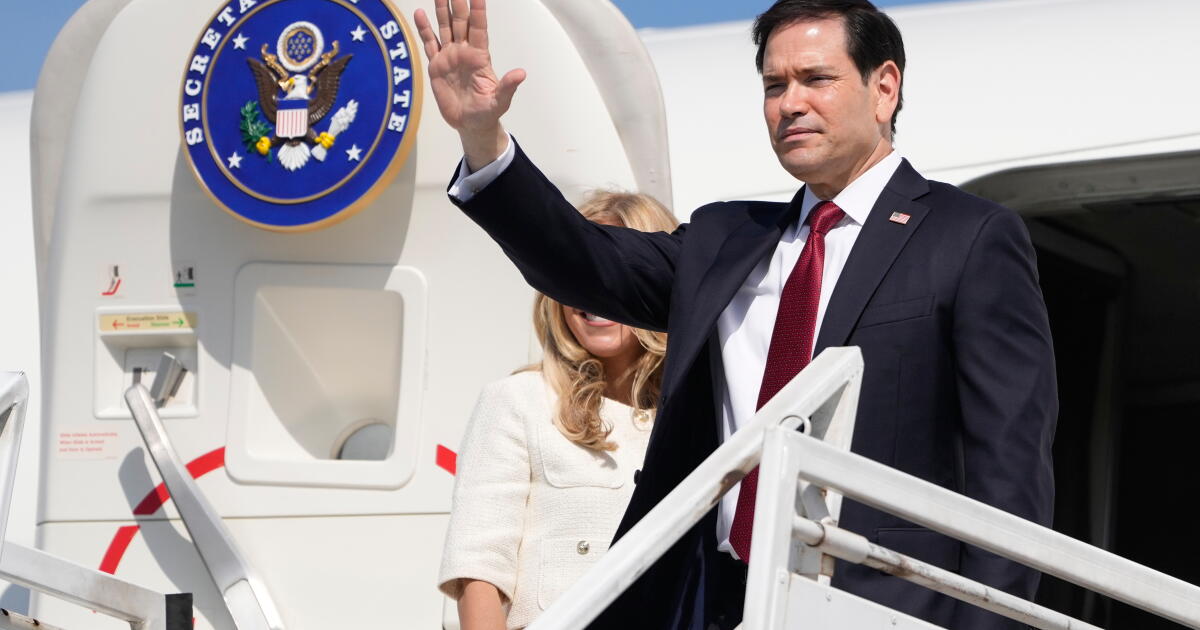
Source link

Brian Williams signs on to Netflix to host a weekly podcast

Brian Williams, the veteran former anchor for NBC News and MSNBC, is joining Netflix where he will host a weekly podcast.

Netflix announced Thursday that “We’re Back! With Brian Williams” will debut later this year. The format will feature Williams in extended interviews with pop culture figures and newsmakers in a casual setting.

“With scientists predicting that every American will have a podcast by 2030, I thought it was time to get in the game,” Williams said in a statement.

Williams – long a stalwart of traditional TV news – will be the biggest name from that arena to join a major video streaming platform.

Williams has been off TV since he departed MSNBC (now MS NOW) in 2021. He the anchor of the nightly program “The 11th Hour” and handled major breaking news coverage for the network.

Before joining MSNBC in 2015, Williams spent 10 years as anchor of “NBC Nightly News.” He left the broadcast after being suspended for making false statements about his experiences covering the Iraq war.

Williams tested the streaming waters when he anchored extended coverage of the presidential election in 2024 on Amazon Prime Video. While Amazon was said to be pleased with the program, which earned an Emmy, but the company has made no further commitment to live news programming.

“We’re Back!” will likely emphasize the playful side of Williams, who once hosted “Saturday Night Live” during his NBC years. He occasionally told colleagues he harbored a desire to become a late night talk show host or a forum where he could work in a more conversational style.

“After 40 years in the news business whee an in-depth interview gets four minutes of airtime at best, I just want to have interesting conversations with creative, funny, smart, talented and consequential people – like the shows we all grew up watching and listening to,” he said. “Netflix is the perfect home.”

jonathan Wald, a veteran TV news executive who worked with Williams at NBC and MSNBC, will be the executive producer for “We’re Back!”

Netflix has moved aggressively into the podcast business. Sports columnist Bill Simmons, who helped popularize the format, recently moved his podcasts to the platform in January as part of a deal with Spotify. Currently Netflix is carrying 51 video podcasts.

Source link