Stay informed and up-to-date with the latest news from around the world. Our comprehensive news coverage brings you the most relevant and impactful stories in politics, business, technology, entertainment, and more.
Manchester United have reached an agreement with Michael Carrick to become the club’s permanent head coach.
The formal process of exchanging contracts is now under way, with an announcement expected inside the next 48 hours.
As things stand there is some doubt over whether the formalities can be completed before Sunday’s match against Nottingham Forest, but there is a will to have it done in time for the club’s final home game of the season.
Carrick will sign an initial two-year deal with the option of an additional 12 months.
An armed Israeli settler blindfolded and detained a Palestinian man near the village of Beit Iksa in the occupied West Bank, dragging him onto a road as Israeli forces stood nearby. The Palestinian farmer was reportedly trying to reach his land before he was captured.
Putin and Chinese President Xi Jinping plan to ‘further strengthen the comprehensive partnership’, the Kremlin says.
Published On 16 May 202616 May 2026
Russia’s President Vladimir Putin will pay an official visit to China from May 19 to 20, the Kremlin has announced.
Putin and his Chinese counterpart, President Xi Jinping, plan to “further strengthen the comprehensive partnership and strategic cooperation” between Moscow and Beijing, the Kremlin said in a statement.
Recommended Stories
list of 4 itemsend of list
Putin is also scheduled to discuss economic and trade cooperation with Chinese Premier Li Qiang.
Russia’s TASS news agency reported that the visit is timed to commemorate the 25th anniversary of the signing of the Treaty of Good-Neighborliness and Friendly Cooperation, a key Moscow-Beijing agreement signed in 2001.
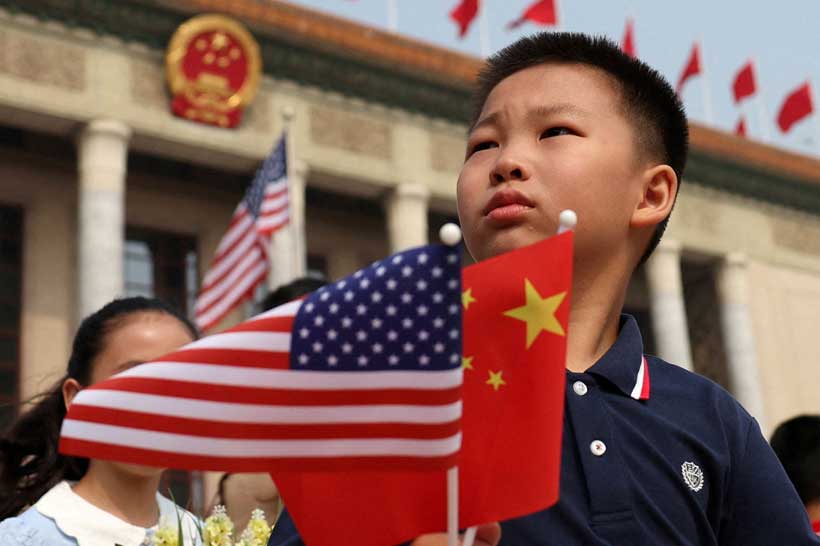
News of Putin’s forthcoming trip arrives one day after United States President Donald Trump departed China following the first presidential visit to Beijing in almost a decade.
Although Trump and Xi touted several broad trade deals, they appeared to make little public progress on key sticking points related to Taiwan or the US-Israel war on Iran.
They also touched on the Russia-Ukraine war, in which China is officially neutral and Xi has presented himself as a mediator.
Still, Xi’s “no limits” alliance with Putin – announced just before the full-scale Russian invasion of Ukraine in 2022 – has undercut that stance.
China has also denied reports from Reuters and other news agencies showing that Chinese firms have single-handedly sustained Russian drone production, in part by shipping engines mislabelled as “industrial refrigeration units” to drone assembly plants.
“We discussed – well, it’s one that we’d like to see settled,” Trump said in remarks reported by the Kyiv Post.
Trading partners
As Washington and Beijing’s relationship has been beset by tension, Chinese-Russian relations have only appeared to deepen in recent months.
Although the duo are not formal military allies, they maintain extremely close political and economic ties, with China stepping in to buy Russian oil and goods after Western nations cut ties with Moscow.
Before a four-day trip to China last August, Putin decried “discriminatory” Western sanctions and heaped praise on Beijing.
China is now by far Russia’s biggest trading partner by volume, and transactions are almost entirely carried out in Russian roubles and Chinese yuan, Putin said at the time.
Last month, Xi pressed for “closer and stronger strategic coordination” between Beijing and Moscow in a meeting with Russian Foreign Minister Sergey Lavrov.
Xi also visited Russia in May last year and pledged to stand with Moscow against “unilateralism and hegemonic bullying”.
Weekly insights and analysis on the latest developments in military technology, strategy, and foreign policy.
An especially large motorcade ferried President Donald Trump around Beijing during his trip to meet with Chinese leader Xi Jinping this week. However, a pair of heavily-laden Chinese SUVs with huge custom roofs, a configuration that does not appear to have been previously seen, were of particular interest. The motorcade also featured several other vehicles with interesting, but far less substantial additions to their roofs.
The unusual SUVs were first spotted as Trump’s motorcade moved through the Chinese capital on May 13, as can be seen in the video in the social media post immediately below. They continued to be a feature of the motorcade throughout the U.S. President’s state visit, which wrapped up today.
The U.S. Secret Service has confirmed to TWZ that it was not the operator of any of the vehicles discussed in this piece, but it could not say whether they belonged to the U.S. Embassy or the Chinese government. The Secret Service and other U.S. authorities bring large numbers of vehicles and other assets to support any presidential visit overseas, especially very high-profile ones like Trump’s trip to meet with Xi this week. State Department and other U.S. government resources already in the destination country — or region — are leveraged, as well. Local security forces also help protect American presidents during these occasions.
One of the high-top SUVs that was part of President Trump’s motorcade while visiting China this week. capture via XA stock picture of a Hongqi SUV, in this case an LS7, for comparison. IHKA Auto
There were two other SUVs with notable modifications to their roofs – a Chevy Suburban and a Lincoln Navigator. There was also a Ford E-series van with a prominently modified roof.
All of the American-designed vehicles in question are available in China, and they were all seen with Chinese license plates. However, the Suburban had a black plate with white lettering, a type issued for foreign-owned vehicles, which might point to it belonging to the U.S. Embassy in Beijing. At the same time, China has issued specific diplomatic plates over the years that are black and white, but also include red kanji, which was not seen in this case. A general example of this is seen in the social media post below. We will come back to this later on.
The licence plate “132 021” appears to be a Chinese diplomatic one. The first character in red may be 使 which represents the Embassy. “132” refers to the Mission, which could actually be Czech — though this needs corroboration with other open sources. https://t.co/Y2kvTTD4Wxpic.twitter.com/VQnI1jVMQa
The purpose of the custom tops on the Hongqi SUVs is unknown, but they would offer space to fit additional outsized equipment. Possible options might include an electronic warfare system, directed energy weapon, or a communications array. On the subject of advanced electronic warfare systems and directed energy weapons, these capabilities are set to become increasingly commonplace in VVIP motorcades, in general, due to the danger of drone attacks.
A new high-top roof could allow individuals to stand up fully while still inside the vehicle, but the benefit that would provide in this case is unclear. There are no obvious apertures or firing ports. It is unknown whether any part of the very top retracts to allow for the deployment of something inside. There is something of an upper fairing visible on the front, but it could be there for a number of reasons.
A close-up look at the custom roof the SUVs. capture via X
Whatever the case, the modified Hongqi SUVs are definitely very heavy-set, with the vehicles running visibly low on their rear axles in particular. There is also some kind of feature attached to the rear of the vehicles. However, without a full view from the rear, whether this might be a lift or something else is not clear. A lift would make some sense considering whatever is inside appears to be very heavy.
Close-up views of the rear features on both of the high-top SUVs seen in Trump’s motorcade on May 13. captures via X
There was also clearly some value to having one of the SUVs in this configuration positioned at different points in the motorcade simultaneously. One at the front and one at the rear are seen the main video posted above.
The modified Lincoln Navigator has a far smaller, but still interesting addition to its roof, which could contain an electronic warfare and/or satellite communications systems. It also has what may be a small electro-optical sensor turret on top of the front end of the roof. Several whip-type antennas mounted on top of the vehicle are also seen.
This Lincoln Navigator, also seen in Trump’s motorcade in Beijing on May 13. capture via X
It is worth noting here that marked Chinese Police Ford F-150 pickups were also seen deployed in Beijing during Trump’s visit with a roughly similar configuration, including the sensor turret on top.
The Chevy Suburban also has a slightly raised roof with an array of antennas, including an X-shaped type commonly associated with UHF satellite communications arrays. Interestingly, this SUV looks similar in some broad respects to Suburbans configured as command, control, and communications support vehicles that the White House Communications Agency (WHCA) and certain elements of the U.S. military have operated over the years. These are more commonly referred to as “Roadrunners” and are a staple in U.S. presidential motorcades, as you can read more about here. As already noted, this particular SUV had a type of license plate pointing to a foreign owner. While we know that this is not a U.S. Secret Service vehicle, the WCHA or another U.S. government operator could still be a possibility.
A side-by-side comparison of the Suburban SUV seen in Trump’s motorcade in Beijing, at left, and an ex-WHCA Roadrunner transferred to the US Military’s Special Operations Command North, at right. capture via X/USAFThe tops of one of the high-top SUVs, the Lincoln Navigator, and the Chevy Suburban can be seen here poking out above other vehicles in President Trump’s motorcade in Beijing on May 13. Kevin Frayer/Getty Images
Last, there is the Ford E-series van. The available views of this vehicle are more limited, but it does have a modified roof with what look to be work lights positioned at various points around the edges. This is in addition to the red and blue emergency lights along the front edge. There is also an unknown feature at the top left corner of the roof, which has a cone-shaped protrusion at the front. Its purpose is not immediately clear.
This Ford E-series van appeared in Trump’s motorcade at least today. capture via X
Vans are inherently multi-purpose vehicles by design, and Chinese policies are known to use marked E-series types for various purposes, including riot control. It is possible this particular example could be part of a rapid response team, or serve some other function.
If the vehicles seen during Trump’s recent trip to China, especially the Hongqi SUVs with the huge custom tops, continue to be features of motorcades during state visits by prominent leaders to Beijing, more details about their configuration and functions may emerge.
Special thanks to Newsweek‘s Ryan Chan for bringing this to our attention.
Foreign ministers from the BRICS nations ended a two day meeting in New Delhi without issuing a joint statement, highlighting deep divisions within the bloc over the ongoing conflict involving Iran, the United States, and Israel.
The diplomatic gathering brought together representatives from an increasingly diverse and politically complex alliance that now includes both Iran and the United Arab Emirates, two regional rivals currently on opposite sides of the escalating Middle East crisis.
Because member states could not agree on language regarding the war, host country India released only a chair’s statement summarizing discussions rather than a unified declaration endorsed by all participants.
Iran Pushes for Stronger Condemnation
Iran reportedly sought a stronger collective position condemning the United States and Israel for military operations against it.
Tehran also accused the UAE, a close American partner in the Gulf region, of involvement in military activities linked to the conflict.
Iranian Foreign Minister Abbas Araqchi stated that one BRICS member blocked sections of the proposed statement, although he did not directly name the UAE.
Araqchi attempted to soften tensions publicly by emphasizing that Iran did not view the UAE itself as a direct target in the conflict. He argued that Iranian strikes had focused only on American military facilities located on Emirati territory.
At the same time, he expressed hope that relations inside BRICS could improve before the leaders’ summit later this year.
India’s Carefully Balanced Position
India’s final chair statement revealed the difficulty of managing competing geopolitical interests within the expanded BRICS bloc.
The document acknowledged that member countries held different perspectives regarding the Middle East crisis. According to the statement, discussions included calls for diplomacy, respect for sovereignty, protection of civilian lives, and the importance of maintaining secure maritime trade routes.
However, the absence of a formal joint declaration demonstrated that BRICS members remain divided on critical geopolitical questions.
India’s approach reflected its broader diplomatic strategy of balancing relations with multiple global powers simultaneously. New Delhi maintains close ties with the United States and Gulf countries while also preserving strategic partnerships with Russia, Iran, and China.
Gaza and Palestine Also Cause Disagreement
Divisions were not limited to the Iran conflict.
The chair statement noted that BRICS ministers reaffirmed support for Palestinian self determination and described Gaza as an inseparable part of the occupied Palestinian territories.
The document also supported efforts to unify Gaza and the West Bank under the Palestinian Authority and backed the establishment of an independent Palestinian state.
However, the statement acknowledged that one unnamed member state held reservations regarding aspects of the Gaza section as well.
This further illustrated the challenge of building unified foreign policy positions within a grouping that includes countries with vastly different regional interests and diplomatic alignments.
BRICS and the Global South Narrative
Despite internal disagreements, BRICS members emphasized the importance of cooperation among developing nations.
India’s statement described the Global South as an important force for positive international change during a period marked by rising geopolitical tensions, economic uncertainty, technological disruption, protectionism, and migration pressures.
The expanded BRICS bloc now includes:
Brazil
Russia
India
China
South Africa
Ethiopia
Egypt
Iran
UAE
The expansion of the bloc has increased its global economic and political weight but has also introduced more ideological and strategic divisions.
The Economic Impact on India
The Middle East conflict has had serious economic implications for India.
As one of the world’s largest oil importers, India depends heavily on energy shipments passing through the Strait of Hormuz. The disruption of maritime traffic in the region has increased energy costs and raised concerns about inflation and supply stability.
Indian personnel have reportedly been killed in incidents linked to the regional conflict, while an India flagged vessel was sunk during the recent escalation.
Against this backdrop, Indian Prime Minister Narendra Modi visited the UAE and publicly condemned attacks targeting the Gulf nation.
Modi praised the UAE’s restraint and described attacks against it as unacceptable, signaling India’s effort to maintain strong ties with key Gulf partners despite its participation alongside Iran in BRICS.
Analysis
The failure of BRICS foreign ministers to produce a joint statement highlights the growing contradictions inside the expanded organization.
Originally conceived as an economic coalition of major emerging powers, BRICS increasingly aspires to become a broader geopolitical platform representing the Global South. However, the inclusion of regional rivals and states with conflicting strategic interests makes unified diplomacy increasingly difficult.
The Iran conflict exposed these tensions clearly. Iran sought solidarity against the United States and Israel, while Gulf states inside the bloc maintain close security relationships with Washington and face direct security threats from Tehran.
India’s cautious wording reflected the reality that BRICS currently functions more as a flexible diplomatic forum than a cohesive political alliance.
The episode also demonstrates a larger shift in global politics. As Western led institutions face criticism from many developing nations, alternative groupings like BRICS are gaining visibility. Yet these organizations must still overcome major internal disagreements if they hope to shape global governance effectively.
For India, the situation illustrates the complexity of its foreign policy position. New Delhi seeks leadership within the Global South while simultaneously maintaining relations with competing regional and global powers.
Ultimately, the Delhi meeting showed both the growing importance and the structural limitations of BRICS. The bloc may continue expanding economically and politically, but achieving consensus on major international crises will remain a significant challenge as geopolitical rivalries deepen across the world.
At least seven Palestinians were killed when Israeli air strikes hit a residential building and a civilian vehicle in Gaza City Friday night. Israel says it was targeting the head of the armed wing of Hamas in Gaza. Al Jazeera has not independently verified Israel’s claims.
After months of tension over the Iran war, markets finally got something to feel good about. President Trump and Chinese President Xi Jinping met in Beijing on May 14 and agreed the Strait of Hormuz “must remain open,” along with a shared stance that Iran “can never have a nuclear weapon.” Easing tensions in the Middle East usually means one thing for crypto: risk-on sentiment comes back.
That’s why the search for the best crypto to buy now is heating up again. This article looks at three picks worth a closer look while the mood is shifting: Poly Truth ($PTRUE), Meme Punch ($MEPU), and Bittensor (TAO).
Why the Trump-Xi Meeting Matters for Crypto
Crypto pays close attention to global news, and this one is a big deal.
Approximately one-fifth of all oil shipments worldwide pass through the Strait of Hormuz. When it’s in danger, markets become anxious, oil prices increase, and inflation pressure increases. The opposite happens when it’s safe. Money often returns to more volatile investments, such as cryptocurrency.
That is the change that is currently beginning to take shape. The direction has shifted, but the war is still ongoing and the ceasefire is still unstable. Generally speaking, markets are more interested in future trends than current conditions.
Therefore, it makes sense that more buyers are considering cryptocurrency once more. Also, smaller picks usually move first when the mood improves.
Best Crypto to Buy Now in 2026
While sentiment is changing, these three choices are worth a closer look. One is a well-known AI infrastructure project. The other two, which have more potential for growth and lower entry costs, are still in presale.
1. Poly Truth ($PTRUE)
Prediction markets are growing fast, but most people still bet on instinct. Poly Truth steps in with a research tool that does the heavy lifting.
Drop in a prediction event, anything from a presidential race to a Champions League final, and the platform scans news, market data, historical records, and social signals. An AI layer checks everything, weighs the patterns, and returns a probability score for each outcome along with the reasoning behind it.
$PTRUE is the access token. Holders get tiered access to the tool, plus staking rewards and a vote on future updates.
The token is in Stage 1 of its presale at $0.001190, with the next price step at $0.001216. Audits are done with SolidProof and Coinsult, team tokens are locked, and 40% of supply goes to presale buyers.
The majority of meme coins do nothing more than sit in your wallet and wait for a pump. That is changed by Meme Punch. In this play-to-earn battle game, you take action.
Five iconic meme characters, Pepe, Doge, Floki, Brett, and Pudgy Penguin, are dressed in medieval armor and spawned into a PvP arena. Pick your knight, fight other players, climb the leaderboard, and earn $MEPU as rewards. The token also unlocks weapons, skins, and special powers inside the game.
$MEPU runs on Ethereum, with a total supply of 10 billion. The presale takes 40%, with another 14.5% set aside for staking and 9.5% for in-game rewards. Payment options are ETH, BNB, SOL, USDT, USDC, and card.
Check memepunch.io for the current presale price and staking APY.
3. Bittensor (TAO)
Bittensor runs a decentralized network where machine learning models compete to provide AI services, with TAO tokens rewarding the best performers. The network is split into subnets, each one a marketplace for a specific type of AI task.
The price action tells a useful story. TAO spent most of April trading sideways between $240 and $255 while markets digested the Iran war and the fragile ceasefire. Then, in early May, the breakout came. TAO climbed to around $326 on May 10 and now sits near $306, up over 20% in a month.
It’s a clear example of what happens when tensions decrease. Capital flows back into infrastructure plays, and AI is one of the strongest narratives going.
What to Watch Next
The mood can shift fast, so a few things are worth keeping an eye on:
The Israel-Lebanon talks: New peace talks kicked off in Washington this week. A real deal would push sentiment further into risk-on territory.
The ceasefire holding: The Iran ceasefire has been in place since April 8, but it’s fragile. Any breakdown would pull money back to safety fast.
US-China follow-through: The Trump-Xi meeting was a positive signal, but the real test is what gets done in the weeks after.
ETF flows: Spot ETFs for AI tokens like TAO are pending. Approvals or strong inflows would add fuel to the AI narrative.
Conclusion
When sentiment shifts, crypto usually feels it first. The Trump-Xi meeting isn’t a fix for everything happening in the region, but it’s the kind of news that turns the mood around, and the market’s already starting to react.
If you’re looking at the best crypto to buy now, the three picks above cover different angles. Poly Truth ($PTRUE) for the AI tool with a real use case. Meme Punch ($MEPU) for the meme coin you can actually play. Bittensor (TAO) for the established AI infrastructure pick is already moving on the news.
Take a look, read up on each, and only put in what you’re okay risking.
FAQ’s
Which cryptocurrency is best to invest now?
It depends on your risk appetite. Bittensor (TAO) is the safer AI pick, while presales like Poly Truth ($PTRUE) and Meme Punch ($MEPU) offer more upside for those willing to take on early-stage risk.
What is the best buy in crypto right now?
Sentiment is shifting back to risk-on after the Trump-Xi meeting, which usually helps small-cap tokens move first. $PTRUE and $MEPU are two presales catching attention while TAO leads on the AI side.
What crypto under $1 will explode?
No one can guarantee explosions, but presale tokens priced well under a cent, like $PTRUE and $MEPU, have the most room to run if the market keeps warming up.
Which crypto has 1000x potential?
1000x runs almost always come from tiny market caps with a real product behind them, which is why presales like $PTRUE are where most of those bets land, while TAO offers steadier exposure to the same AI story.
Disclaimer: This article is for informational purposes only and does not constitute financial or investment advice. ModernDiplomacy.eu is not a licensed crypto-asset service provider under EU regulation (MiCA). Cryptocurrencies are highly volatile and involve significant risk. Always conduct your own research and consult a licensed advisor before making any investment decisions.
British artist Matthew Collings says his exhibition “Drawings Against Genocide”, depicting Israeli violence against Palestinians, has been falsely portrayed as anti-Semitic. After outrage and protests, the London show has been cancelled.
Dogecoin is trading near $0.116 in May 2026, with a market cap of around $17.9 billion and a 24-hour volume of over $2.37 billion.
The latest Dogecoin price prediction data shows room for a move toward the $0.13 to $0.25 range in 2026, but DOGE still needs stronger meme coin demand before a larger rally becomes realistic.
For traders looking beyond older meme coins, Meme Punch and Poly Truth add two newer presale stories through P2E gaming and prediction market data.
This article breaks down DOGE’s 2026 outlook, the main rally drivers, and how $MEPU and $PTRUE compare with Dogecoin’s meme coin setup.
How Dogecoin Is Performing in May 2026
Dogecoin still has one of the strongest brands in crypto. It ranks inside the top 10 by market value, and CoinGecko shows DOGE up 22.2% over 30 days, which keeps it active on trader watchlists.
Daily volume also supports the short-term case. DOGE’s 24-hour trading volume was about $2.37 billion, which shows a recent rise in market activity and gives traders enough liquidity for short-term moves.
However, DOGE is no longer a small coin. A market cap near $18 billion means each major price move needs real buying pressure, not only social media noise.
Dogecoin Price Prediction for 2026
CoinCodex gives DOGE a short-term target of $0.1302 for one month and $0.1491 for three months. Its near-term table also shows a 5-day target around $0.1142, which keeps DOGE close to its current range before any stronger move develops.
Changelly gives a wider full-year 2026 range. Its analysis places DOGE between $0.0957 and $0.142, with an average price near $0.119. For May 2026, Changelly estimates a range between $0.108 and $0.131, with an average near $0.120.
Binance’s prediction page takes a different approach because its figures are based on user input and shown on an “as is” basis. The page also states that the data does not represent Binance’s own view or advice, which makes it useful as crowd input rather than a firm forecast.
Can DOGE Stay a Top Meme Coin in 2026?
Dogecoin still has the main ingredients that keep meme coins alive. It has deep liquidity, wide exchange access, a long trading history, and a community that can bring quick attention during bullish periods.
The harder part is growth from here. DOGE already has a large market cap, so a 2x or 3x move requires much more capital than it would for a smaller meme coin or early-stage presale.
The $0.13 to $0.15 zone is the first area to watch because CoinCodex’s one-month and three-month targets sit near that range. A cleaner move above those levels would make the 2026 outlook stronger.
What Could Push Dogecoin Higher?
Dogecoin’s next rally needs more than past fame. DOGE can still move sharply, but only if volume, social demand, and wider market strength return together.
The strongest DOGE drivers are easy to track.
Bitcoin strength can bring traders back into higher-risk crypto.
Meme coin rotation can lift DOGE, SHIB, PEPE, and other large meme assets.
Higher daily volume can confirm that buyers are returning.
Social attention can turn DOGE into a retail-led trade again.
Clean breakouts above near-term resistance can make short-term targets more realistic.
If those signals line up, DOGE can stay one of the main meme coins to watch in 2026. Without them, the price may stay close to the current forecast range.
Why New Meme Coin Presales Are Getting More Attention
Dogecoin gives traders liquidity and recognition, but newer presales can move on smaller starting bases. They also have more room to shape a fresh story before wider market exposure.
Meme Punch and Poly Truth show two different directions for presale demand. Meme Punch builds around meme coin gaming, while Poly Truth focuses on prediction market intelligence.
Meme Punch ($MEPU)
Meme Punch turns meme coin culture into a medieval P2E battle arena. Players choose meme-inspired knights, fight rivals, climb the leaderboard, and earn $MEPU rewards.
The game loop is easy to scan.
Players choose from meme fighters such as Pepe, Doge, Floki, Brett, and Pudgy Penguin.
Arena battles decide leaderboard progress.
Winners earn $MEPU rewards.
$MEPU can be used for weapons, skins, and special powers.
Staking adds another token use inside the project.
$MEPU has a total supply of 10 billion tokens.
Presale: 40%
DEX/CEX liquidity: 12%
Marketing: 16.5%
Game rewards: 9.5%
Staking: 14.5%
Project funds: 7.5%
Poly Truth ($PTRUE)
Poly Truth gives the presale market a data-led angle through prediction market intelligence. The project uses AI-powered analysis to help users read active events across crypto, sports, politics, and other markets.
Its system has three parts.
The Runners collect data from active prediction events across the internet.
The Starlet compares sources, finds patterns, and calculates probability scores.
The Presenter turns the analysis into event reports that show which outcome has stronger data support.
$PTRUE has a total supply of 11.5 billion tokens.
Presale: 40%
Liquidity pool: 17%
Development: 13%
Team: 10%
Staking rewards: 10%
Marketing: 8%
Community and airdrops: 2%
DOGE vs. $MEPU and $PTRUE
Dogecoin is still the established meme coin in this group. It has the liquidity and name recognition that smaller tokens usually need years to build.
Meme Punch offers a more active meme coin angle because $MEPU is tied to gameplay, battle rewards, upgrades, and staking. Poly Truth moves away from meme culture and gives traders a presale tied to data, prediction markets, and event analysis.
The comparison is simple.
DOGE gives traders an established meme coin with deep liquidity.
$MEPU adds P2E gaming to meme coin demand.
$PTRUE adds prediction market data to the presale market.
DOGE may stay the safer meme coin benchmark because it already trades across major markets. $MEPU and $PTRUE offer earlier-stage exposure to newer stories that are still building attention.
Is DOGE Still One of the Best Meme Coins to Buy Now?
The Dogecoin price prediction for 2026 still supports a measured bullish case, but it does not point to an easy return to old highs.
CoinCodex’s one-month and three-month targets keep DOGE in the $0.13 to $0.15 area, while Changelly’s full-year range stays between $0.0957 and $0.142.
DOGE still has the liquidity, brand power, and community needed to lead another meme coin move. The stronger rally case needs rising volume, better market sentiment, and a broader meme coin rotation.
For traders comparing old and new meme coin stories, Dogecoin still holds the benchmark spot. Meme Punch brings a playable meme coin model through $MEPU, while Poly Truth adds a different presale route through $PTRUE and prediction market intelligence.
Disclaimer: This article is for informational purposes only and does not constitute financial or investment advice. ModernDiplomacy.eu is not a licensed crypto-asset service provider under EU regulation (MiCA). Cryptocurrencies are highly volatile and involve significant risk. Always conduct your own research and consult a licensed advisor before making any investment decisions.
US President Donald Trump concluded a two-day summit in Beijing with Chinese leader Xi Jinping. The high-profile visit, in which Trump aimed to reset relations with Beijing, saw discussions on trade, Taiwan, and the war on Iran.
Several women sexually violated in the Democratic Republic of Congo (DRC) have come forward to report the war crimes committed against them by the M23 rebels amid the ongoing war in the country. The women spoke to Human Rights Watch researchers, but asked to be kept anonymous out of fear of retribution from the predators.
The international organisation documented it in a report the atrocities committed by the rebels and Rwandan soldiers against the Congolese women. The report, published on May 13, revealed how the duo summarily executed men and raped women during raids on civilian communities. Victims described being raped under threat of death and at gunpoint in their homes or in fields while searching for food, according to the HRW report. The attackers assaulted or killed relatives who attempted to stop them from sexually violating women. The absence of operational healthcare services in Uvira during the violent operations deprived survivors of crucial medical attention, including access to post-exposure prophylaxis (PEP) to prevent HIV infection.
A woman who was allegedly raped by a combination of the M23 rebels and Rwanda soldiers in Uvira told HRW researchers about the hell she was put through by the invaders in Uvira.
“They stripped me completely naked, tied my hands behind my back with my clothes and then raped me. They continued doing so for a long time, and when my husband tried to intervene, they took him outside our house and shot him dead, ” the woman whose identity is being withheld in order to maintain her dignity told HRW.
The woman eventually lost consciousness and later consulted a health professional, receiving analgesics and a post-exposure prophylaxis (PEP) kit. She says she still suffers from a persistent infection. The woman is one of eight individuals identified in the recent HRW report.
According to the report, survivors of the atrocities identified their torturers as M23 combatants and soldiers of the Rwandan army, notably because they spoke the Kinyarwanda language and wore uniforms of the Rwandan army. They also carried military hardware which could easily be recognised and linked to the Rwandan army.
Another woman cited in the report revealed how she was sexually violated on the same day, while she was working on her farm in Katala, situated in Uvira territory. She said two fighters approached her, one of them pointed a gun at her and declared in Kinyarwanda: “If you don’t do what I tell you, I will kill you”. The men, whom she identified through their Rwandan army uniforms, then went ahead to rape her. She eventually went to the Kavimvira health centre in Uvira for treatment, but she received no medical attention.
A third woman revealed that she was also sexually assaulted in December when she went to search for food, as provisions have been dwindling since the arrival of the M23 rebels in the zone. She said a Congolese and a Rwandan assaulted her sexually.
“The Rwandan man said he wanted to kill me, but the Congolese said ‘no, rape her’,” the woman revealed. She said after having been raped, she was afraid to go to a hospital for treatment and rather opted to go buy drugs from a pharmacy which only sold antibiotics to her. She stated that she continues to experience pain and has ongoing bleeding, but she has been unable to undergo medical tests, including an HIV test.
Another woman told HRW that she was sexually assaulted on January 3, 2026, while she was on her farm on the periphery of Uvira. She said an M23 combatant and a Rwandan soldier who were pretending to be searching for water accosted her, and one of them ordered, “If you shout, we will kill you”, adding that they had not been with a woman for over six months, during which time they were in the bush. Since the rape incident, she has been bleeding and sick.
The woman revealed that during the occupation of Uvira by the M23 rebels, hospitals were not providing treatment for sexual violence, so she did not benefit from the medical kit necessary within 72 hours following sexual violence.
“In all the accounts rendered, the survivors underlined the almost total absence of accessible health services during the M23 and Rwandan occupation, and in particular, the absence of post-rape treatment at the appropriate time, as well as adequate treatment for wounds and infections provoked by sexual violence. Other essential services, including psycho-social support, the collection of proofs and judicial assistance were also not available”, the HRW report reveals.
The United Nations Population Fund, on its part, notes that sexual violence committed by the belligerent parties in the Eastern DR Congo has increased, with more than 80,000 cases of rape reported between January and September 2025, which is a 32 per cent increase compared to the same period in 2024.
The sudden and chaotic cuts in international aid introduced by the American government at the beginning of 2025 abruptly halted emergency medical treatment and various forms of support for thousands of survivors of sexual violence.
The survivors have been confronted by a bigger risk of contracting HIV or unplanned pregnancies because the clinics and hospitals in the Eastern DR Congo no longer have stocks of post-exposure prophylactic (PEP) kits, which were hitherto mostly supplied by projects financed by the United States. These kits are supposed to be administered 72 hours after exposure in order to prevent infections like HIV.
The strategic town of Uvira has, since the M23/AFC rebels occupied Bukavu at the beginning of December 2025, become the provisional capital of South Kivu province despite the signing of the Washington Accords by Felix Tshisekedi and Paul Kagame in the presence of Donald Trump. Supported by Rwanda, the M23/AFC rebels launched a rapid offensive, resulting in the capture of the town.
Several women in the Democratic Republic of the Congo reported war crimes committed by M23 rebels and Rwandan soldiers, including rape and executions, as documented in a Human Rights Watch report.
Victims were assaulted in their homes, fields, or farms, with attackers threatening death or killing those who intervened. Due to the occupation of Uvira, essential healthcare services, including post-exposure prophylaxis (PEP), were unavailable, leaving survivors without necessary medical attention.
The report highlights the identification of perpetrators based on language and military attire, with survivors facing heightened risks of HIV and unplanned pregnancies without access to PEP kits. A significant increase in sexual violence cases was noted, exacerbated by cuts in international aid that halted emergency treatments. Despite peace accords, the strategic town of Uvira fell under the control of the M23/AFC rebels, further destabilizing the region.
Russia launched more than 1,400 drones and 56 missiles into Ukraine on Wednesday and Thursday.
Much of the onslaught was aimed at the capital Kyiv, days after Russia threatened to do so only if Ukraine attacked its Victory Day parade in Moscow’s Red Square on May 9. It is a major Russian holiday commemorating the end of the Second World War.
Recommended Stories
list of 4 itemsend of list
Ukraine President Volodymyr Zelenskyy had proposed a ceasefire, beginning as early as May 5.
Moscow did not respond until May 7, and presented its peace proposal as a unilateral initiative, accompanied by threats to punish Kyiv if it did not respect its terms.
Moscow said Russian front line units would “launch a massive missile strike” on central Kyiv if attacked.
(Al Jazeera)
Forty-three Russian drones and a number of ballistic missiles were launched into Ukraine on May 9, and another 27 drones on May 10. It was not until May 11 that Ukraine had a day of peace.
Moscow justified these attacks as reciprocity for Ukrainian assaults. Kyiv accused Moscow of breaking its own ceasefire.
Once the ceasefire was over, on the night of May 11, Russia launched 216 drones and followed up with a massive strike involving 892 drones overnight on May 12 and during the day on May 13.
The night of May 13-14 was worse with 675 drones accompanied by 56 missiles.
(Al Jazeera)
Official Ukrainian reports recorded strikes in at least 20 locations in the capital, including a nine-storey apartment building where 12 people were killed in the collapse.
“These are ordinary residential buildings, a school, a veterinary clinic, and other purely civilian infrastructure,” wrote Zelenskyy on his Telegram messaging channel. “These are definitely not the actions of those who believe that the war is coming to an end.”
Throughout the week, Ukraine said it shot down 92 percent of the 1,930 drones launched, close to Zelenskyy’s 95 percent kill target, with 41 out of 57 missiles downed.
Russia’s army slows down
Russia’s onslaught of came as its armies in eastern Ukraine slowed down.
The Institute for the Study of War, a Washington-based think tank, estimated they had advanced by an average of 2.9 sq km (1.1 sq miles) in the first four months of 2026, compared with 9.76 sq km (3.76 sq miles) a day in the first third of 2025 and 14.9 sq km (5.8 sq miles) a day between October 2024 and March 2025.
Two weeks into May, that daily average had already dropped to 2.63 sq km (1 sq mile), suggesting Russia’s advance is slowing almost daily.
(Al Jazeera)
The ISW recently estimated that Ukraine made net territorial gains of 116 sq km (45 sq miles) in April – its first such advance since a September 2023 counteroffensive.
Some of that success is attributed to Ukraine’s successful use of drones behind the front lines.
On May 8, the Azov Corps of Ukraine’s National Guard announced it had “returned to Mariupol”, four years almost to the day since it surrendered control of the city to Russian forces.
The Corps filmed drone strikes on Russian diesel tankers, army trucks and other logistics 160 km (99 miles) behind the front line along the T-0509 highway, which feeds the Russian war effort in the Donetsk region.
“The strike depth will increase,” said the Azov Corps.
Their strikes are part of a broader Ukrainian campaign to hit Russian logistics at middle ranges of about 120-150 km (75-90 miles) from the front line as announced by Zelenskyy at the end of April.
“This primarily involves military logistics, enemy warehouses and headquarters, air defence systems and other components,” he said, adding that Ukraine had increased its strikes at this depth five-fold during the past year.
“We’re already carrying out about five thousand successful strikes at a depth of 20 plus km (12 miles) every month,” said Ukrainian Defence Minister Mykhailo Fedorov this week.
Also this week, a Russian military reporter said Ukrainian Hornet drones were targeting Russian logistics on roads closer to the frontlines.
“Although the front line is more than 35 km away from the M-30, it is currently paralysed due to enemy [First Person View drone] surveillance,” wrote the Russian reporter.
“In 2014-2015 the front line was closer, but the M-30 was safer,” he added. “This is because many people think that if the front line moves away from large cities and logistics routes they become safer, but for some reason no one takes into account that the range of enemy drones, even FPV surveillance, increases more rapidly relative to the movement of the front line.”
Russia’s declining performance is not due to lack of effort.
“The enemy has intensified offensive actions along almost the entire front and is regrouping its troops,” said Ukrainian commander-in-chief Oleksandr Syrskii on May 8. “The most tense area is currently the Pokrovsk direction, where the Russian aggressor has concentrated about 106,000 personnel,” he said.
Since March, Ukraine has increased strikes against Russian oil infrastructure as many as 1,700 km (1,056 miles) inside Russia, in an effort to starve its war machine of diesel and export revenue.
Andriy Kovalenko, the head of Ukraine’s Center for Countering Disinformation, said the Ukraine Security Service (SBU) hit the Yaroslavl oil refinery and Perm oil pumping station on May 8 – Perm sends oil in four directions across Russia to refineries and export terminals.
Russian media reports said the fire from a previous strike on the pumping station was not put out until May 11.
Rescue workers carry an injured woman after a Russian attack on a residential neighbourhood in Kyiv, May 14, 2026 [Evgeniy Maloletka/AP]
The SBU also said it hit the Perm refinery that day.
During the week, Ukrainian forces struck drone bases and a radar research centre in Rostov-on-Don, the Bryansk chemical plant, an explosives warehouse in Nizhny Novgorod and other targets.
Fedorov on Monday thanked Germany for investing $1bn in Ukraine’s deep strike capabilities, when his German counterpart, Boris Pistorius, visited Kyiv.
“Overall, Ukraine’s positions right now – on the front line, in our long-range sanctions, and in our joint results with partners – are the strongest they have been in years,” said Zelenskyy.
Weekly insights and analysis on the latest developments in military technology, strategy, and foreign policy.
The Pentagon has outlined plans to acquire at least 10,000 lower-cost cruise missiles over the next three years, as well as a similar number of relatively ‘cheap’ Blackbeard hypersonic missiles. The new framework deals are part of a broader strategy to dramatically bolster America’s stockpiles of standoff strike munitions and prime the industrial base to sustain those inventories going forward. This is all seen as especially critical for supporting the demands of future high-end fights, such as one in the Pacific against China, and doing so in a cost-effective manner.
“The Department of War has reached new framework agreements with a slate of disruptive new entrants and commercial innovators to aggressively expand the United States military’s strike capabilities,” the Pentagon declared in a press release today. “Agreements with Anduril, CoAspire, Leidos, and Zone 5 will launch the Low-Cost Containerized Missles [sic; Missiles] (LCCM) program, while a parallel agreement with Castelion advances an initiative to scale low-cost hypersonic solutions.”
The @DeptofWar has reached new framework agreements with a slate of disruptive new entrants to aggressively expand the United States military’s lethal cruise missile and hypersonic missile strike capabilities.
“The new frameworks for LCCM will drive a fast-paced experimentation and assessment campaign that will culminate in a Military Utility Assessment by the sponsoring Service Components. Designed to move at the speed of commercial industry, the agreements establish the terms for future firm-fixed-price production contracts,” the release adds. “This effort positions the Department to procure over 10,000 low-cost cruise missiles across these portfolios in just three years, starting in 2027. The Department is creating a pathway for rapid and repeatable production of high-volume, lethal strike capabilities. The agreements include firm fixed material-unit costs for production lots in 2027 through 2029.”
The Pentagon has not yet explicitly defined what it means by “containerized” in this context, or how exactly these munitions might be fielded. However, there is already a clear focus on designs that could be fired from containerized launchers on land or loaded on ships. As TWZ has reported on many occasions, containerized systems offer immense operational flexibility, as well as the ability to blend in with standard shipping containers, creating targeting challenges for opponents. The LCCM munitions could be adapted for air launch, if they are not expected to also be employable in that mode already. Common munitions that could be employed from launch platforms across domains would offer additional benefits in terms of logistics and production, as well as helping to keep costs down through economies of scale.
The Navy’s Mk 70, one of which is seen here firing a Standard Missile-6 (SM-6), is an example of a containerized missile launcher already in U.S. military service. USN
Anduril has already announced that its contribution will be the surface-launched version of its Barracuda-500M design, a weapon that can also be air-launched. The company says it plans to deliver a minimum of 1,000 of these weapons to the U.S. military each year for the next three years.
Anduril has signed a production agreement with @DeptofWar to rapidly deliver Surface-Launched Barracuda-500M at scale.
Affordable missiles designed for long-range precision strikes.
Leidos says it will supply an LCCM design that leverages existing work on its air-launched AGM-190A Small Cruise Missile (SCM), also known as Black Arrow, originally developed for U.S. Special Operations Command (SOCOM). The company plans to deliver 3,000 of these units under the new framework deal.
Leidos completes successful test launch of a Small Cruise Missile
“At approximately twice the size of the AGM-190A, the LCCM offers increased mission effectiveness and fuel capacity to maximize range. Building on the Leidos Small Cruise Missile’s heritage, the LCCM leverages key design features including a modular airframe and a common Weapon Open Systems Architecture (WOSA) to enable rapid integration, upgrades and mission adaptability,” Leidos’ press release adds. “The design also utilizes Leidos’ established supply chain and scalable production approach. While initially ground-launched, LCCM’s modular design could also support maritime platform integration and air-launched variants.”
RAACM Cruise Missile Video Long Range Flights Summer 2025 Cleared for Public Release
A Rusty Dagger missile is seen under the right wing of the US Air Force F-16D Viper, just outboard of the drop tank, during a test. USAF/Tech. Sgt. Thomas M. Barley
ERAM is also now feeding into the Air Force’s Family of Affordable Mass Missiles (FAMM) program. That service’s proposed budget for the 2027 Fiscal Year had already laid out plans to buy nearly 28,000 FAMM munitions over the next five years.
In FY 2027, the US Air Force is requesting $55 Million in discretionary and $300 Million in mandatory (reconciliation) funds for the Family of Affordable Mass Missile (FAMM) to procure 1,000 All Up Rounds covering both the Palletized (FAMM-P) and Lugged (FAMM-L) variants. The… pic.twitter.com/EgVaefmJgY
CoAspire has talked in the past about surface-launched versions of its RAACM and its new longer-range RAACM-ER. Zone 5 could similarly look to adapt its existing Rusty Dagger missile to meet the specific LCCM requirements.
CoAspire’s RAACM-ER design. Jamie Hunter
“Concurrently, once Castelion achieves testing and validation, the Department will award a two-year multi-year procurement contract for a minimum of 500 Blackbeard missiles annually, with options to extend for up to five years,” the Pentagon’s press release today also notes. “To further encourage Castelion’s self-funded facility expansion, the Department is actively seeking the necessary authorizations and appropriations to purchase over 12,000 Blackbeard missiles over five years.”
Looking back at Castelion’s most important 2025 test flight on our path to deliver credible deterrence. Thanks to @Saronic for providing autonomous shipborne telemetry support that enabled critical data capture.
“The experimentation and assessment campaign for LCCM will be led by the Office of the Under Secretary of War for Research and Engineering, with the Army Program Acquisition Executive Fires serving as the transition partner and acquisition lead for procurement,” according to the Pentagon. “To kickstart this initiative, the Department will procure test missiles from all four LCCM companies starting in June 2026, laying the groundwork for the assessment phase of the program. These agreements were developed in close coordination with the United States Air Force Program Acquisition Executive Weapons, the Test Resource Management Center and multiple components across the War Department, including the Office of the Under Secretary of War for Acquisition and Sustainment.”
It should be stressed here that the problem set that LCCM and the tangential framework arrangement with Castelion are intended to address, that of a critical need for production of cost-effective strike munitions at scale, is not new. Expenditures of critical air-to-surface and surface-to-surface munitions, as well as anti-air interceptors, by the U.S. military, as well as its allies and partners, in conflicts in recent years have only underscored the vital need to bolster these inventories. Demand for stand-off munitions, in particular, would be far greater in any future high-end fight against a near-peer adversary like China. That is a scenario where American forces could easily find themselves tasked to prosecute tens of thousands, of targets, just in the opening phase.
Furthermore, existing munitions are often exquisite in design, and take months, or more often years, of lead time to produce. The Pentagon’s focus on “disruptive new entrants and commercial innovators,” rather than any of America’s long-established prime defense contractors, with its newly announced framework deals, is extremely significant in its own right. This is the latest example of a major shift away from awarding high-profile contracts to large legacy providers, helping to diversify the industrial base and promote competition. This also means moving away from companies accustomed to very long lead procurement and production arrangements.
The LCCM effort follows years of work in the pursuit of lower-cost stand-off munitions, especially by the U.S. Air Force. This is underscored by the fact that all of the companies named today already have relevant designs that they have been working on under contract to the U.S. military. This, in turn, has already led to an explosion in the market for munitions in this general category, many of which increasingly blur the line between long-range kamikaze drones, traditional cruise missiles, and decoys. It should also be noted that the new lower-cost munitions are not intended to replace existing exquisite designs, but instead to form a valuable high-low capability mix that offers a more cost-effective and flexible blend of options for striking targets.
Kratos’ Ragnarok, examples of which are seen here loaded on an XQ-58 Valkyrie drone, is just one of several other lower-cost cruise missile designs in development today, just in the United States. Kratos
US Navy Mk 70 launchers are seen here in a trailer-based configuration, underscoring the flexibility that containerized systems offer. USN
If the frameworks announced today produce the promised results, they could be instrumental in laying the foundation for the production of lower-cost strike munitions for years to come.
Update: 6:20 PM EST –
Zone 5 has now provided a statement regarding today’s announcement from the Pentagon.
“Zone 5 is proud to partner with the Department of War on the Low-Cost Containerized Missiles program to deliver affordable, scalable strike capacity to our warfighters needed to deter and defeat emerging threats,” Thomas Akers, CEO of Zone 5 Technologies, said. “This program reflects exactly where American defense innovation must go: faster development, on-demand production, and high-volume weapons that can be fielded at the pace of relevance. We are honored to be a part of this effort to expand the munitions industrial base and strengthen America’s arsenal.”
US President Donald Trump said he discussed US arms sales to Taiwan with Chinese leader Xi Jinping during talks in Beijing. Trump also said he is considering lifting sanctions on Chinese companies that buy Iranian oil.
Weekly insights and analysis on the latest developments in military technology, strategy, and foreign policy.
Israel is moving to enhance the capabilities of its F-35I Adir fighter, funding a new external fuel tank upgrade that will boost the Israeli Air Force’s potential for conducting long-range strikes. The announcement comes after the jets saw extensive action striking targets in Iran during the campaigns this year and last. In the process, the fleet ran at a tempo of operations that raised questions about Israel’s ability to provide adequate refueling support. The new modification for the F-35I will help address that.
The Israeli Ministry of Defense confirmed today that the development and integration of the external fuel tanks on the F-35I will be carried out by Elbit Systems’ Cyclone subsidiary. Elbit says the deal is valued at over $34 million and will involve tanks based on an existing Cyclone design originally developed for the F-16.
𝐄𝐱𝐭𝐞𝐧𝐝𝐢𝐧𝐠 𝐫𝐚𝐧𝐠𝐞 𝐟𝐨𝐫 𝐥𝐨𝐧𝐠-𝐫𝐚𝐧𝐠𝐞 𝐦𝐢𝐬𝐬𝐢𝐨𝐧𝐬.@Israel_MOD has signed a contract with Cyclone, a wholly owned subsidiary of Elbit Systems, to develop and integrate an extended-range capability for the F-35 “Adir” fighter aircraft, manufactured by… pic.twitter.com/cTRsjawIR9
“The new capability is expected to extend the aircraft’s operational range, reduce reliance on aerial refueling, and enhance operational flexibility across long-range missions,” the company added.
Based on the reference to the F-16, the announcement has been widely taken to refer to external drop tanks, but it remains possible, although improbable, that the F-35I is getting some kind of conformal, flush-mounted fuel tank. This could have a reduced impact on stealth and overall performance, but would likely also involve significant shape change and alterations to the airframe. Integrating and clearing tanks of this kind for operational service would be a complex and potentially very lengthy process, since they would disrupt the highly quantified low-observable moldline of the aircraft. However, Israel has experience in operating both F-15s and F-16s with conformal tanks.
An Israeli F-16I shows off its conformal fuel tanks, mounted above the wing roots. Alexandra Aksyutich/Israeli Air Force
Obviously, adding external fuel tanks of any kind to the stealthy F-35I will degrade its low-observable features. However, with the Israeli Air Force putting a premium on its ability to conduct long-range strikes, this is clearly seen as a worthwhile tradeoff. If the upgrade does involve drop tanks, they are also likely to be jettisonable, possibly together with their pylons, meaning they could be discarded before penetrating a hostile air defense system, for example. This would only be the case on extremely high-risk long-range missions, and could not be sustained for long campaigns. They could also be dropped when under threat, giving the F-35I back critical agility and providing a lower radar signature.
There are also means of mitigating the penalty that drop tanks impose on a stealth aircraft. This is best evidenced by the new fuel tanks for the U.S. Air Force F-22 Raptor, which are seen as a critical addition to ensure that the fighter is able to better cover the vast distances involved in a potential future conflict in the Indo-Pacific.
Stealthy drop tanks (fitted inboard) on an F-22 scale model seen at the Air & Space Forces Association’s annual Warfare Symposium earlier this year. Jamie Hunter
The new faceted, low-drag tanks for the F-22, like the older ones, can be jettisoned from the jet to restore the full scope of its performance and further reduce its radar cross-section. However, Lockheed Martin says it expects the Raptor to go into direct combat, at least in some scenarios, with the tanks fitted.
There have also been steady signals that some kind of range extension was in the works for the Israeli F-35I.
Back in 2021, a cryptic announcement from Lockheed Martin confirmed that the company was working with an unnamed foreign buyer to develop a modification of the F-35 to the tune of tens of millions of dollars in engineering support work. An Israeli fuel-carriage enhancement was a possibility, as you can read more about this here.
Then, in 2022, separate reports emerged suggesting that Israel had developed an unspecified means of extending the range of its F-35Is, allegedly providing them with enough reach to hit targets in Iran without needing aerial refueling. The 2022 reports might have involved a prototype version of the tanks mentioned in the announcement today, some other kind of external fuel carriage, or they might have been erroneous.
Israeli Air Force F-35I Adirs. Israeli Air Force Israeli F-35I Adirs. Israeli Air Force
More recently, just before the latest campaign against Iran, Israeli Ambassador to the United States Yechiel Leiter provided what was likely the first official confirmation that range-extending fuel tanks for the F-35I are already in service. In an interview in mid-February, he stated: “We developed fuel tanks that extend the aircraft’s range without compromising stealth.” Exactly how this was achieved was not revealed, but even small internal tanks may be a possibility, while also presenting a serious engineering challenge.
In the United States, range-extending external fuel tanks for the F-35 also re-emerged in 2025 as part of the ongoing Block 4 modernization effort for those aircraft, years after a requirement for streamlined drop tanks was eliminated. The Pentagon confirmed it will explore the feasibility of all forms of external fuel tanks, including underwing tanks, for all three variants of the F-35.
Overall, the idea of integrating external fuel tanks on the F-35 is far from new. Back in 2019, TWZreported on how Lockheed Martin was looking at adding two 600-gallon drop tanks under the F-35’s wings as part of a larger range-extension study. This would have increased total fuel capacity by around 40 percent. Prior to that, studies had looked at adding smaller 480- and 460-gallon tanks.
Renderings of an early 480-gallon drop tank design for the F-35, at left, and the 460-gallon design that Lockheed Martin had originally planned to certify on the Joint Strike Fighter, at right. AIAA
Of these, the original 480-gallon drop tank was abandoned after aerodynamic and stores separation issues emerged. The subsequent 460-gallon design was also not ultimately pursued, and it was found that additional drag also eroded the range increase.
It is notable that Aviation Week previously reported that Israeli Aerospace Industries (IAI) and Cyclone had worked on both a conformal tank design for the F-35I and the 600-gallon drop tank.
As an Israeli-specific version of the conventional takeoff and landing F-35A, the Adir already incorporates some significant Israeli-developed systems. Many of these have been tested on a specially outfitted one-off version of the aircraft, which arrived in the country in 2020. Israeli additions include electronic warfare systems and also weaponry. The F-35I fleet is expected to be armed with the Rafael SPICE precision-guided bomb, but may eventually include air-to-air missiles and other weapons, too.
The test F-35I on the flight line, together with an F-15I. Amit Agronov/Israeli Air Force
At the same time, the F-35’s inboard stores hardpoints are still plumbed for the carriage of external fuel tanks, suggesting that introducing this capability, including on the Israeli-specific F-35I variant, might not be too complicated.
The Israeli requirement for the F-35I to be less reliant on aerial refueling is especially important. The Israeli Air Force currently operates a fleet of only around seven aging Boeing 707 tankers. The overreliance on these aging tankers for long-range missions has led to previous speculation that the Israeli Air Force has relied upon U.S. Air Force refueling support when it has gone into combat. The Pentagon denied this.
One of the Israeli Air Force’s Boeing 707-based tankers demonstrates the refueling of a trio of F-15s. Yonatan Zalk/Israeli Air Force
At the same time, a strike package that doesn’t require tanker support is in some ways more flexible and more survivable. Moreover, the survivability of traditional refueling jets in or near contested airspace is becoming a growing concern. Meanwhile, Israel is now starting to modernize its tanker fleet, with the first of its more modern KC-46s having begun flight trials earlier this month.
The first Israeli KC-46 refuels from a U.S. Air Force KC-46. Israeli Ministry of Defense
Israel has also previously shown that it is willing to degrade the stealth characteristics of the F-35I to increase its strike capacity. The type has been seen flying strike sorties with external ordnance, demonstrating the F-35’s so-called ‘beast mode,’ featuring loads on underwing pylons.
A photo published by the Israeli Air Force shows the unique instrumented F-35I assigned to the Flight Test Center carrying four external 2,000-pound-class GBU-31 JDAMs, plus AMRAAMs. Israeli Air Force via X
Israel has repeatedly used its F-35Is in strikes on targets both closer to Israel and much further afield. In 2018, it became the first operator to use the jet on offensive operations. Meanwhile, it has also recorded success in aerial combat against hostile drones.
Last year, the Adir was involved in strikes on Iran’s nuclear infrastructure. There were reports that Israeli fighters often landed on fumes after their initial sorties during this conflict. With these jets operating to the edge of their endurance, fuel starvation was a serious threat, and it is perhaps surprising that none were lost. External drop tanks were also found in multiple locations in eastern Iraq, pointing to their use to maximize long-range sortie rates early in the conflict.
The F-35I also played an important role in striking Iranian targets during the joint U.S.-Israeli campaign launched at the end of February this year.
The Israeli effort against Iran, Operation Lion’s Roar, also saw an Israeli Adir claim the first aerial victory for any F-35 against a crewed aircraft. On March 4, in an incident that you can read more about here, an F-35I brought down an Iranian Yak-130 Mitten combat trainer over Tehran.
Air Force Commander Tomer Bar congratulates F-35I “Adir” pilot who carried out the first-ever shoot-down of an Iranian fighter jet over Tehran pic.twitter.com/hBTisPSo0s
Earlier this month, it was confirmed that the Israeli Air Force is set to receive a fourth F-35I squadron, bolstering its fighter inventory with another 25 of the aircraft.
In 2023, Israel opted to buy a third squadron of F-35Is, covering 25 more jets. This batch is scheduled to be delivered starting in 2028.
Once all four squadrons are stood up, Israel will have a total of 100 F-35Is.
Before long, we are likely to see at least some of these jets sporting the long-range upgrade announced today. At that point, the precise nature of these external fuel tanks will finally be revealed.
Weekly insights and analysis on the latest developments in military technology, strategy, and foreign policy.
The U.S. Navy’s near-total abandonment of surface combatants with nuclear propulsion after the end of the Cold War is “one of the largest mistakes” it’s ever made, according to the service’s top officer. Chief of Naval Operations Adm. Daryl Caudle made this remark today while voicing support for the recently announced decision that the future Trump class battleships will be nuclear-powered. He also explicitly highlighted challenges the Navy has faced when it comes to fueling conventionally-powered ships taking part in operations against Iran, something TWZ recently reported on in detail.
Adm. Caudle, as well as Acting Secretary of the Navy Hung Cao and Commandant of the Marine Corps Gen. Eric Smith, testified before members of the House Armed Services Committee today. The focus of the hearing was on the Department of the Navy’s 2027 Fiscal Year budget request. The Navy disclosed that it had decided the Trump class warships will feature nuclear propulsion in its latest long-term shipbuilding plan, which was released on Monday.
Chief of Naval Operations Adm. Daryl Caudle, left, speaks at a separate budget-related hearing before members of the House Appropriations Committee on May 12, 2026. USN
“I know there have been many conversations and questions over the past few days regarding the news that the Trump class battleship will be nuclear powered. And, as you know, Virginia has a long history of nuclear shipbuilding. What specific design plans can you share at this point and can [you] speak to how nuclear power would enable this system to be successful?” Rep. John McGuire, a Virginia Republican and former U.S. Navy SEAL, asked Adm. Caudle directly.
A model of a Trump class battleship. Eric Tegler
“Sir, we walked away from surface nuclear power decades ago, and that was one of the largest mistakes the Navy ever did, and we’re bringing it back,” the Chief of Naval Operations said in response. “We need nuclear-powered surface ships to sustain combat operations with our nuclear-powered aircraft carriers.”
Though a major operator of nuclear-powered submarines, the Navy’s aircraft carriers are currently its only nuclear-powered surface ships. The service previously had a mixture of nuclear-powered surface combatants. This included three one-of-a-kind ships, the cruiser USS Long Beach, the destroyer USS Truxtun (later recategorized as a cruiser), and the frigate USS Bainbridge. There were also two California class and four Virginia class cruisers, the latter not to be confused with the subsequent Virginia class of attack submarines. All of these ships entered service in the 1960s and 1970s. Expensive and complex to operate compared to similar conventionally-powered ships, they were all retired in the 1990s as part of post-Cold War drawdowns across the U.S. military.
A trio of nuclear-powered Navy surface warships sail together in 1964. From left to right, the aircraft carrier USS Enterprise, the cruiser USS Long Beach, and the frigate USS Bainbridge. USN
As Caudle highlighted, the central benefit of nuclear propulsion is functionally unlimited range since naval reactors can operate for decades without needing to be refueled. In the context of modern ships packed with ever-more advanced weapons and other systems, it can also offer an important boost in onboard power generation. As noted, this does come at a cost. Today, Russia is the only country anywhere in the world with a nuclear-powered surface combatant, the Kirov class battlecruiser Admiral Nakhimov. In terms of nuclear-powered surface naval ships of any kind, the French aircraft carrier Charles de Gaulle is the only other example. Russia also has several nuclear-powered icebreakers, but these are operated by the state-run nuclear company Rosatom.
“Imagine what that would have looked like in the Arabian Gulf if I’d had a nuclear-powered battleship there to give the air and defense and fires [sic] power that it could sustain – rotate ships that roll, that need gasoline around it,” Caudle continued today in his response to Rep. McGuire’s question. “So the imperative for this is crucial to develop that level of payload capacity.”
Navy officials have already acknowledged that Iranian attacks on friendly countries in the Middle East in the course of recent operations significantly disrupted established logistics chains. In particular, this impacted how the service delivered fuel to conventionally-powered warships in the region, as you can read more about here.
Threats to fuel supplies would be something the Navy would have to take into account in any future conflict, especially a high-end fight against China across the broad expanses of the Pacific. There are other logistics requirements that nuclear ships do still have in common with their conventionally-powered counterparts, as well, such as food for the crew and fuel for any embarked aircraft. Even with nuclear propulsion, maintenance and other requirements mean that ships cannot stay at sea indefinitely.
One of the US Navy’s conventionally-powered Arleigh Burke class destroyers receives fuel during a replenishment-at-sea operation. USN
“We intend to, with all we can do, use pull-through technologies, [including] things from that we’ve worked on with DDG(X),” the Navy’s top officer added, speaking about the plans for the Trump class specifically. “It will have the SPY-6 radar. It will have the Baseline 10 Aegis combat system. It will pull through, of course, the A1B Ford class reactor plant and all the design that goes with that. The only thing inherently new to it will be the actual hull itself, and so most of the fixtures in it. And I would say the directed energy [weapons] and up gunning, that will also be new.”
Multiple types of laser-directed energy weapons, as well as an electromagnetic railgun, are core elements of the planned armament package on the future Trump class warships. They are also set to be loaded with a mix of nuclear and conventional missiles, including hypersonic types, in several large vertical launch system (VLS) arrays, and have a pair of traditional 5-inch naval guns.
An annotated graphic highlighting various capabilities set to be found on the Trump class design. Note that the mention here of “28 Mk 41 VLS” cells appears to be a typo, as other official information from the US Navy says the ships will have 128 such cells. USN via USNI News
The Navy has previously stated that the battleships, now also referred to as BBGNs, will displace approximately 35,000 tons. This is very roughly three times that of the newest Flight III subvariant of the Arleigh Burke class destroyer. The Trump class vessels are expected to be between 840 and 880 feet long, have a beam (the widest point in the hull) between 105 and 115 feet, and be able to reach a top speed greater than 30 knots, as well.
It is worth noting here that Caudle’s comments today represent a huge change in tone from how he had previously talked about the prospect of nuclear propulsion for the Trump class. Speaking to the press at the Surface Navy Association’s (SNA) main annual symposium back in January, he had notably appeared to downplay the possibility.
“I think it’s a logical question to think, hey, here’s a big capital ship. It’s going to be carrying a lot of load, you know, in places that we don’t necessarily need a strike enforcement air wing as a large ship there that’s in command of a flotilla,” he said at that time. “Wouldn’t it be logical to be nuclear powered? And that brings a tail to the construction of that that [sic] just really fell outside the scope of what we want to do on the speed to get this thing in the water. And so what you trade off with, with persistency that only nuclear power can do, is you end up having, you know, the ability to go produce that — it pushes the battleship into a timeframe that just didn’t meet the operational need of the ship.”
A rendering of a future Trump class battleship. White House/USN
Just last month, former Secretary of the Navy John Phelan had also said making the Trump class ships nuclear-powered was unlikely, citing the need to balance cost and complexity against aggressive schedule demands. Phelan was fired unexpectedly just two days after making those comments. There have been reports that disagreements over plans for the battleships, specifically, as well as other friction within the Trump administration, factored into his dismissal.
“He’s a very good man. I really liked him, but he had some conflict with, not necessarily with [Secretary] Pete [Hegseth], but with some other[s],” President Trump said about Phelan while speaking to the press on April 23. “He’s a hard charger, and he had some conflicts with some other people, mostly as to building and buying new ships. I’m very aggressive in the new shipbuilding.”
BREAKING: President Trump speaks about the firing of Navy Secretary John Phelan:
“He’s a very good man. I really liked him, but he had some conflict, not necessarily with Pete. He’s a hard charger, and he had some conflicts with some other people, mostly as to building and… pic.twitter.com/xJOhYygka4
As it stands now, the Navy still does not expect to order the first Trump class battleship until Fiscal Year 2028 and or see that ship enter service before Fiscal Year 2036. The first example, at least, currently has an estimated unit cost of around $17 billion, which is considerably more than the projected price tag of any of the next four Ford class aircraft carriers.
Even before the nuclear propulsion decision was announced, TWZ had raised numerous questions about the plans for these warships, including their exact operational utility, as well as the costs and risks involved. Caudle’s comments today about leveraging pull-through notwithstanding, nuclear-powered ships are inherently complex and expensive, which are the tradeoffs for the aforementioned boost in capability. A specialized workforce and supply chains are required to build such vessels. Newport News Shipbuilding in Virginia, a division of Huntington Ingalls Industries, is the only yard in the United States currently building surface ships with nuclear propulsion, in the form of new Ford class carriers, all of which have suffered delays.
The U.S. naval shipbuilding industry, collectively, has other demands to keep churning out conventionally-powered warships like Arleigh Burke class destroyers, as well. This is an industry that has contracted to a worrisome degree, overall, since the end of the Cold War, especially when compared to the completely opposite trend that has been observed in China. Efforts to reinvigorate America’s shipyards, and the continued challenges the Navy is facing in doing so, were key points of discussion at today’s House Armed Services Committee hearing.
Adm. Caudle’s broad statement of support today for a nuclear-powered surface Navy raises the additional question now of whether the service might be interested in expanding this capability beyond the Trump class. Some of the Navy’s prior nuclear-powered surface combatants were derived from conventionally-powered designs. At the same time, any such decision would run up against the same shipbuilding capacity and other questions facing the new battleships.
Just when it comes to the Trump class, the plans for the ships could easily still evolve further, or even come to an end entirely. The timeline laid out now has the battleship program continuing well into the next presidential administration, where the fortunes of a new nuclear-powered surface navy could change dramatically.
Finnish authorities scramble fighter jets; defence chief says false alarm but warns of potential repeats while Russian war persists.
Finland has stood down its defence forces after sounding an alarm over suspected drone activities in its airspace.
The authorities said on Friday that suspected drone activity above the Helsinki region no longer posed a threat and that the situation was returning to normal hours after launching an emergency response, including the launch of fighter jets and closure of the capital’s airport.
Recommended Stories
list of 4 itemsend of list
The alarm illustrates the tension stalking the region as Finland and the Baltic states eye Russian aggression and daily missile and drone attacks amid Moscow’s continued war on Ukraine.
The Helsinki City Rescue Department had warned the nearly 2 million inhabitants of Finland’s Uusimaa region to stay indoors starting about 4am local time (1:00 GMT), as fighter jets were scrambled. Helsinki’s airport was also closed for about three hours.
Later, President Alexander Stubb wrote on X that authorities had “demonstrated their readiness and capacity to react”, adding that the country was now facing “no direct military threat”.
Kimmo Kohvakka, director general for rescue services at the Ministry of the Interior, called the response a “precautionary measure” and said “daily life can continue.”
The incident arose amid growing concerns about regional spillover from the Ukraine war.
The Baltic states of Estonia, Latvia and Lithuania have reported a series of suspected Ukrainian drones headed for Russia entering their airspace, prompting domestic criticism over their ability to respond to military threats.
The situation has led to a full-blown government crisis in Latvia. Prime Minister Evika Silina resigned on Thursday after a coalition partner pulled support. The move followed the ousting of the defence minister after a drone crashed at a fuel storage facility.
In March, two drones crossed into Finnish territory and crashed after flying low over the sea and southeastern Finland.
Finnish authorities did not indicate the source of Friday’s drone activity.
However, defence forces operations chief Kari Nisula suggested that Finland had received information from Ukraine about drones potentially straying into the country, according to the Reuters news agency.
The military head added that there was no evidence that drones had entered Finland, but that such situations could happen again as long as Russia continues its war on Ukraine.
Prisoner swap
The incident in Finnish airspace unfolded as Ukraine maintained its drone attacks on Russian oil and energy infrastructure, and Kyiv continued counting the costs of a huge strike that killed two dozen people.
Russia’s Ministry of Defence said on Friday that its air defence systems shot down 355 Ukrainian drones targeting Moscow overnight, as well as the border regions of Belgorod, Bryansk and Kursk.
Among the targets was an oil refinery in the central city of Ryazan, about 200km (125 miles) southeast of Moscow, according to the commander of Ukraine’s drone forces.
Fire and a plume of smoke rise in the vicinity of the Ryazan oil refinery, May 15, 2026 [Reuters]
The attack killed three people and wounded 12, regional Governor Pavel Malkov wrote on Telegram. Two high-rise apartment buildings were struck, he said, while debris fell on the grounds of an industrial enterprise.
Meanwhile in Kyiv, the death toll from a Russian barrage on an apartment building on Thursday rose to at least 24 people, including three children, Ukrainian President Volodymyr Zelenskyy said. Forty-eight people were wounded.
Amid the ongoing violence, Russia and Ukraine have moved ahead with a prisoner swap that saw 205 POWs repatriated on each side on Friday. It was the first step of a swap that is planned to ultimately see 1,000 people on each side return home.
The two sides also conducted an exchange of those killed in the fighting, with Russia handing 526 bodies to Ukraine and receiving 41 in return. Both Kyiv and Moscow thanked the United Arab Emirates for mediating the swap.
Zelenskyy wrote on social media that most of the prisoners returned to Ukraine had been in Russian captivity since 2022.
“We will continue to fight for every single person who remains in captivity,” he said.
Ukrainian President Volodymyr Zelenskiy strongly condemned Russia after a missile strike on a residential apartment building in Kyiv killed at least 24 people, including three children.
The attack occurred during one of the heaviest aerial bombardments on the Ukrainian capital this year and further intensified international concern over the continuing war between Russia and Ukraine. Rescue operations continued for more than a full day before emergency workers completed searches through the destroyed structure in Kyiv’s Darnytskyi district.
The strike formed part of a broader wave of Russian drone and missile attacks across Ukraine that officials say targeted multiple regions over consecutive days.
Zelenskiy Visits the Site of the Attack
Zelenskiy visited the destroyed apartment building on Friday, laying red roses at the site and meeting rescue workers who had spent more than twenty eight hours searching for survivors beneath the rubble.
In remarks shared through social media, the Ukrainian president praised emergency responders for their continuous efforts and accused Russia of deliberately destroying civilian lives.
According to Zelenskiy, the missile strike effectively destroyed an entire section of the residential building. Ukrainian officials stated that initial analysis suggested the attack involved a recently manufactured Russian Kh 101 cruise missile.
The Ukrainian leader once again appealed to international allies for stronger air defence support and increased pressure on Moscow.
Heavy Civilian Casualties
Kyiv authorities declared Friday a day of mourning in memory of the victims. Flags across the capital were lowered to half mast, and public entertainment events were cancelled or postponed.
The Interior Ministry reported that rescue teams removed approximately 3,000 cubic meters of rubble during the operation. Hundreds of emergency personnel participated in the search efforts.
Officials confirmed that 24 bodies were recovered from the site, while approximately 30 people were rescued alive. Nearly 50 individuals were injured, and hundreds required psychological support following the attack.
The deaths of children among the victims further intensified public grief and anger across Ukraine.
Russia Intensifies Air Campaign
Ukrainian authorities stated that Russia launched more than 1,500 drones along with dozens of missiles during attacks carried out over two consecutive days this week.
The strikes extended beyond Kyiv and affected western regions of Ukraine located far from active frontline combat zones. Officials reported that six people were killed during attacks in western Ukraine on Wednesday.
The scale of the aerial assault highlights Russia’s continuing ability to conduct large coordinated attacks despite prolonged international sanctions and battlefield losses.
Moscow did not immediately comment specifically on the apartment building strike. Russia consistently denies deliberately targeting civilians, although residential buildings, hospitals, schools, and energy infrastructure have repeatedly been damaged throughout the conflict.
Ukraine Also Conducts Cross Border Attacks
The conflict has increasingly involved reciprocal long range attacks by both sides.
Russian regional officials stated that Ukrainian drone strikes killed four people, including a child, in the Russian city of Ryazan. Authorities reported damage to apartment buildings and an industrial facility during the incident.
Ukraine has expanded drone operations against targets inside Russia over the course of the war, aiming to disrupt military infrastructure, industrial production, and logistical operations linked to Moscow’s military campaign.
These developments reflect the increasingly transnational nature of the conflict, with civilian populations on both sides facing growing security risks.
The Continuing Humanitarian Crisis
The attack on Kyiv underscores the severe humanitarian consequences of the war, which began with Russia’s full scale invasion of Ukraine in February 2022.
Millions of Ukrainians have been displaced since the start of the conflict, while repeated strikes on civilian infrastructure have damaged homes, hospitals, schools, transportation systems, and energy networks across the country.
International organizations and human rights groups have repeatedly raised concerns about civilian casualties and the destruction of non military targets during the war.
At the same time, the prolonged conflict has placed enormous economic and psychological pressure on Ukrainian society as cities continue to face the threat of missile and drone attacks.
Analysis
The deadly strike on Kyiv demonstrates how the war between Russia and Ukraine continues to evolve into a prolonged campaign involving large scale aerial warfare and attacks far beyond frontline battle zones.
For Ukraine, the attack reinforces the urgent need for stronger air defence systems capable of intercepting missiles and drones before they reach urban areas. Zelenskiy’s renewed appeals to allies reflect growing concerns that Ukraine’s defensive capabilities remain under intense strain as Russia increases the scale and frequency of aerial assaults.
For Russia, sustained missile and drone attacks appear aimed at weakening Ukrainian morale, exhausting defence systems, and increasing pressure on the government through continued civilian disruption.
However, such attacks also carry significant international consequences. Civilian casualties, especially involving children and residential buildings, strengthen global criticism of Moscow and may encourage additional military and financial support for Ukraine from Western allies.
The conflict additionally illustrates the changing character of modern warfare, where advanced missiles, drones, and long range strikes allow both sides to target infrastructure and urban centers far from traditional battlefields.
Despite ongoing diplomatic discussions in various international forums, there remains little indication of a near term political settlement. Instead, the war increasingly appears locked in a prolonged phase of escalation, attrition, and humanitarian suffering.
The strike on Kyiv therefore stands not only as a tragic individual event but also as a broader symbol of the continuing devastation caused by one of the most consequential conflicts in modern Europe.
United States President Donald Trump concluded his final round of discussions with Chinese President Xi Jinping in Beijing while attempting to present the visit as a major economic success. The summit came at a sensitive moment for both countries as tensions over trade, Taiwan, artificial intelligence technology, and the Iran conflict continue to shape relations between the world’s two largest economies.
Trump emphasized trade agreements and commercial cooperation during the visit, hoping to strengthen his political standing ahead of important midterm elections in the United States. China, however, used the occasion to deliver clear warnings regarding Taiwan and to criticize the ongoing Iran conflict, signaling that major strategic disagreements remain unresolved despite the positive diplomatic atmosphere.
Trump Highlights Economic Progress
During meetings at the Zhongnanhai leadership compound in Beijing, Trump promoted what he described as successful trade negotiations between Washington and Beijing. He stated that both sides had reached agreements that would benefit their economies and help stabilize commercial relations after years of tariff disputes and economic uncertainty.
The United States announced several proposed agreements involving agricultural exports, beef, and energy sales to China. Officials also discussed mechanisms to manage future trade disputes and identified billions of dollars in potential goods trade between the two countries.
One of the most closely watched announcements involved aircraft manufacturer Boeing. Trump claimed China had agreed to purchase 200 Boeing aircraft, marking China’s first major order of American commercial planes in nearly ten years. However, investors reacted negatively because markets had anticipated a significantly larger agreement. Boeing shares declined after the announcement, reflecting disappointment over the scale of the deal.
The summit also failed to produce a breakthrough regarding advanced artificial intelligence technology exports. Expectations had been growing that restrictions on the sale of advanced AI chips from NVIDIA to China might ease, especially after company chief executive Jensen Huang joined the trip. No major agreement emerged on that issue.
China Pushes Back on Iran Conflict
While Trump focused publicly on economic achievements, China used the summit to voice frustration over the war involving Iran. Beijing stated that the conflict should never have started and called for diplomatic efforts to restore peace.
The Iran crisis has become a major international concern because of its impact on global energy markets. Rising instability in the Middle East has pushed oil prices upward and increased fears about disruptions to energy supplies traveling through the Strait of Hormuz, one of the world’s most critical shipping routes.
China’s position reflects both economic and strategic interests. Beijing relies heavily on stable energy imports and also views Iran as an important geopolitical partner that can balance American influence in the Middle East. Analysts believe China is unlikely to pressure Tehran aggressively because maintaining strong relations with Iran supports Beijing’s broader strategic goals.
Although Trump stated that he and Xi shared similar views on Iran, Chinese officials avoided publicly endorsing Washington’s approach. This difference highlighted the continuing gap between the two powers on international security issues.
Taiwan Remains the Most Sensitive Issue
Despite the friendly diplomatic setting, Taiwan emerged as one of the summit’s most serious areas of tension. Xi warned that mishandling the Taiwan issue could lead to conflict, reinforcing Beijing’s longstanding position that the island is part of China.
Taiwan remains one of the most dangerous flashpoints in global politics. China has repeatedly stated that it does not rule out the use of military force to bring Taiwan under its control, while the United States continues to support Taiwan’s defensive capabilities under American law.
American officials maintained that United States policy toward Taiwan had not changed. Secretary of State Marco Rubio emphasized that Washington continues to support regional stability while maintaining its established position on Taiwan.
The issue remains highly sensitive because any military escalation involving Taiwan could severely disrupt global trade, semiconductor production, and international security across the Indo Pacific region.
A Fragile Trade Truce Continues
One of the summit’s most important outcomes may simply be the continuation of the fragile trade truce reached during earlier talks between the two leaders. Previous negotiations had temporarily paused extremely high tariffs and reduced tensions over rare earth mineral exports that are essential for modern technology manufacturing.
However, uncertainty remains about whether the current trade arrangements will continue beyond the end of the year. American officials indicated that no final decision had been made regarding the future of tariff suspensions and broader economic cooperation.
This uncertainty reflects the deeper structural rivalry between the United States and China. While both countries benefit economically from stable trade relations, they remain competitors in technology, military influence, and geopolitical leadership.
Human Rights Concerns Surface
Human rights issues also appeared during the summit. Trump reportedly raised the case of Hong Kong media businessman and democracy advocate Jimmy Lai, who was sentenced to prison under Hong Kong’s national security law.
American officials expressed hope that Lai could eventually be released, while China maintained that Hong Kong affairs are internal matters and rejected foreign criticism.
The discussion demonstrated that human rights disputes continue to complicate relations between Washington and Beijing even during periods of economic cooperation.
Analysis
The Trump Xi summit demonstrated the increasingly complex nature of United States China relations. Both sides attempted to project stability and cooperation, particularly on trade and economic matters, yet major disagreements remained visible beneath the surface.
Trump sought to frame the visit as proof of economic leadership and diplomatic success. However, the relatively modest scale of announced agreements and the lack of major breakthroughs on technology exports limited market enthusiasm.
China, meanwhile, used the summit to reinforce its strategic priorities. Beijing signaled that Taiwan remains a non negotiable issue, defended its relationship with Iran, and resisted external pressure on human rights matters.
The summit ultimately reflected a broader reality in global politics. The United States and China are deeply interconnected economically, but they are also strategic rivals competing for influence across multiple regions and industries. Cooperation may continue in trade and commerce, but tensions over security, technology, and global power are unlikely to disappear soon.






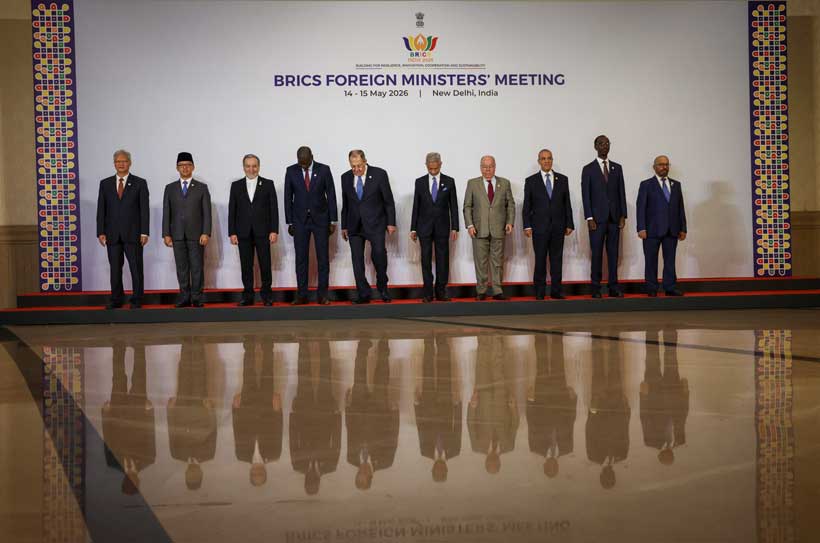
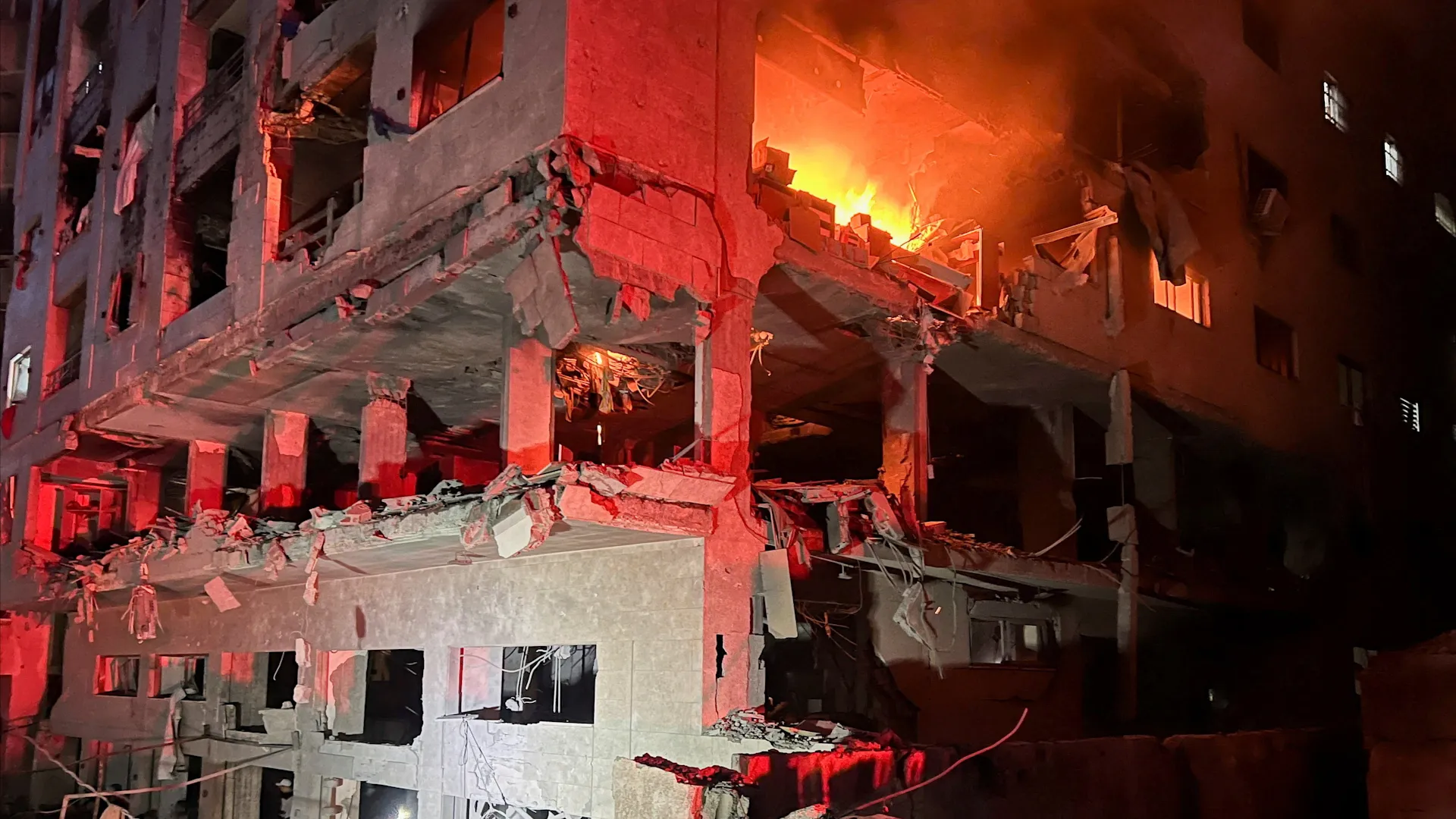







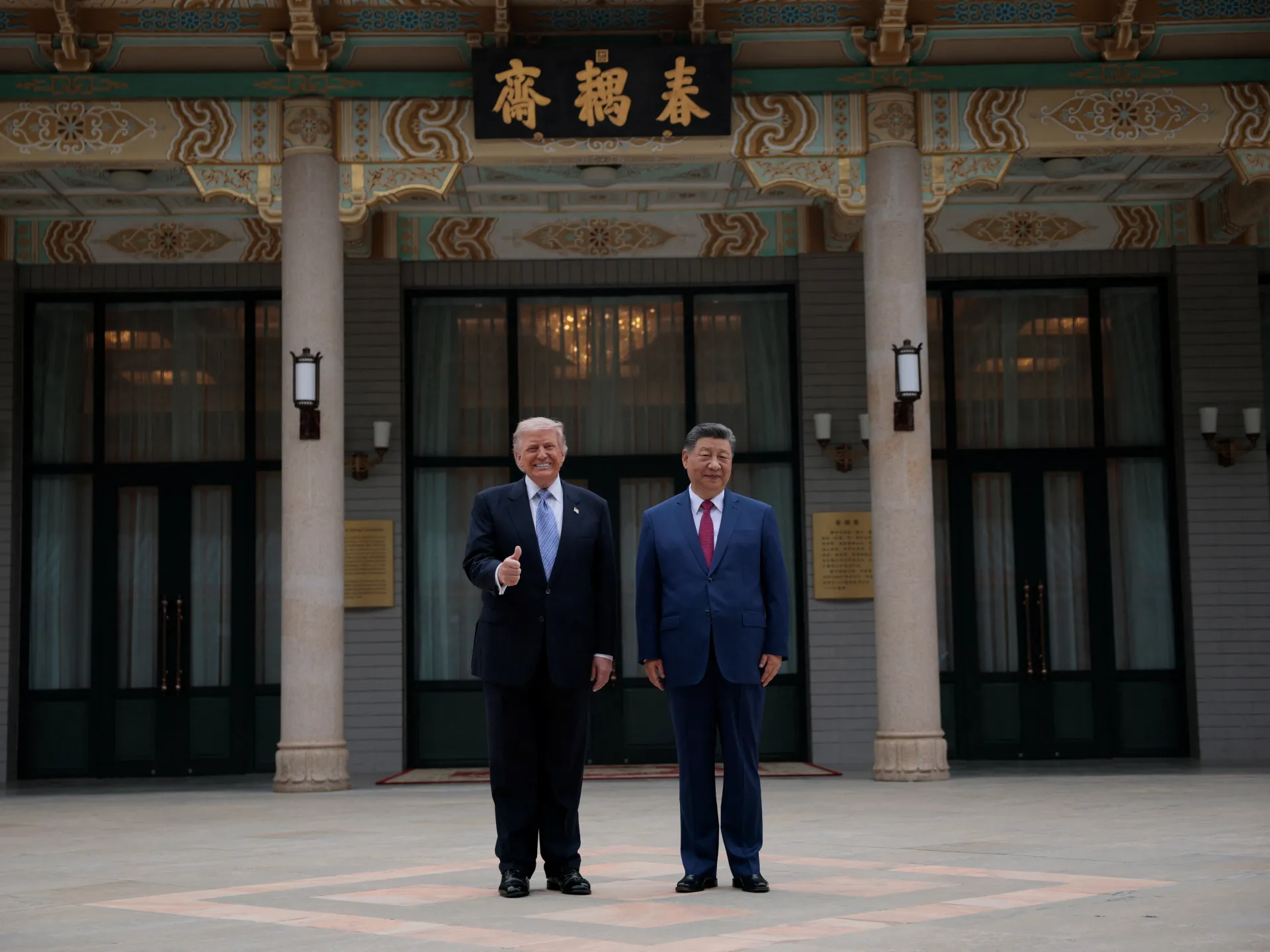


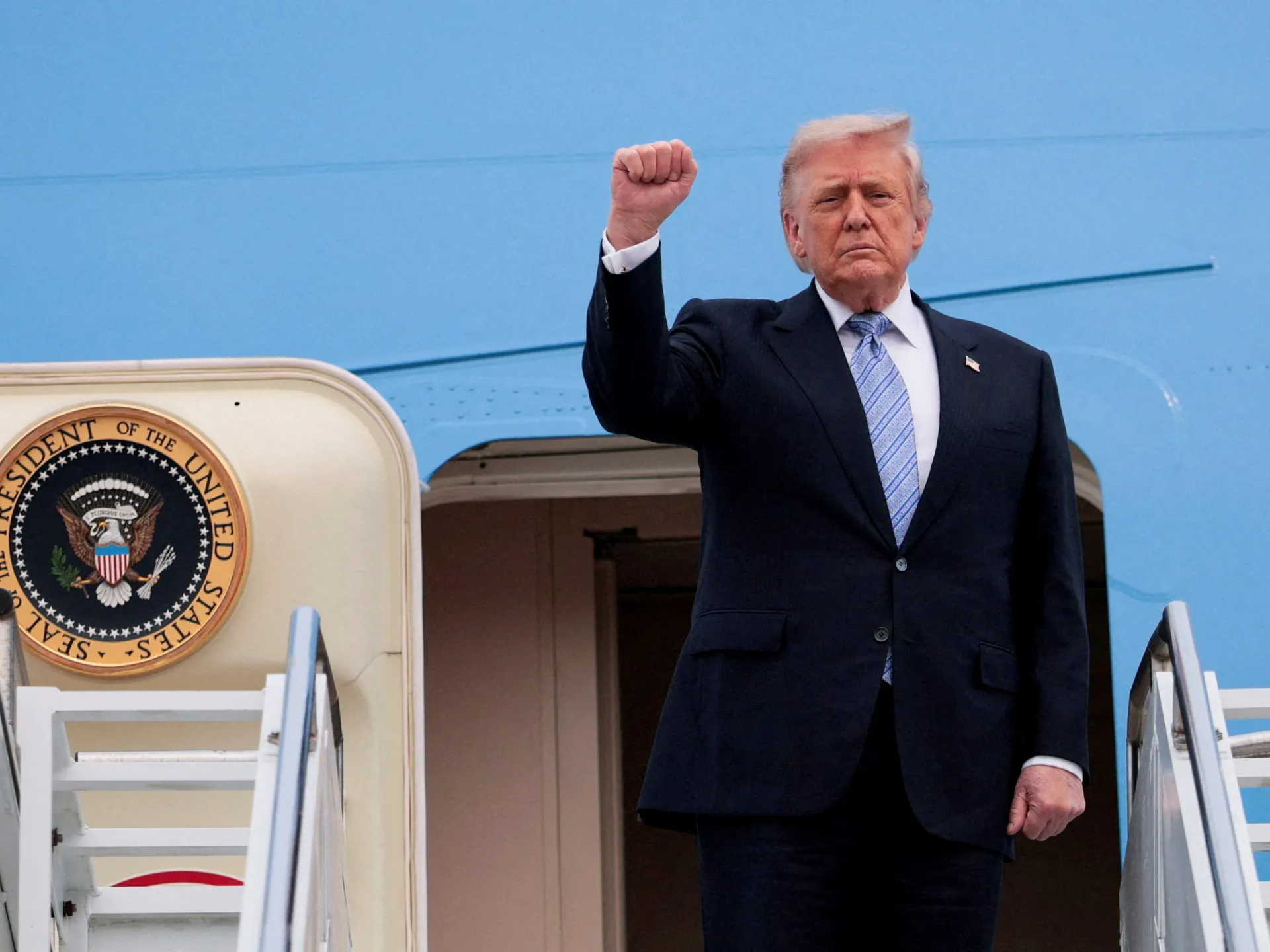
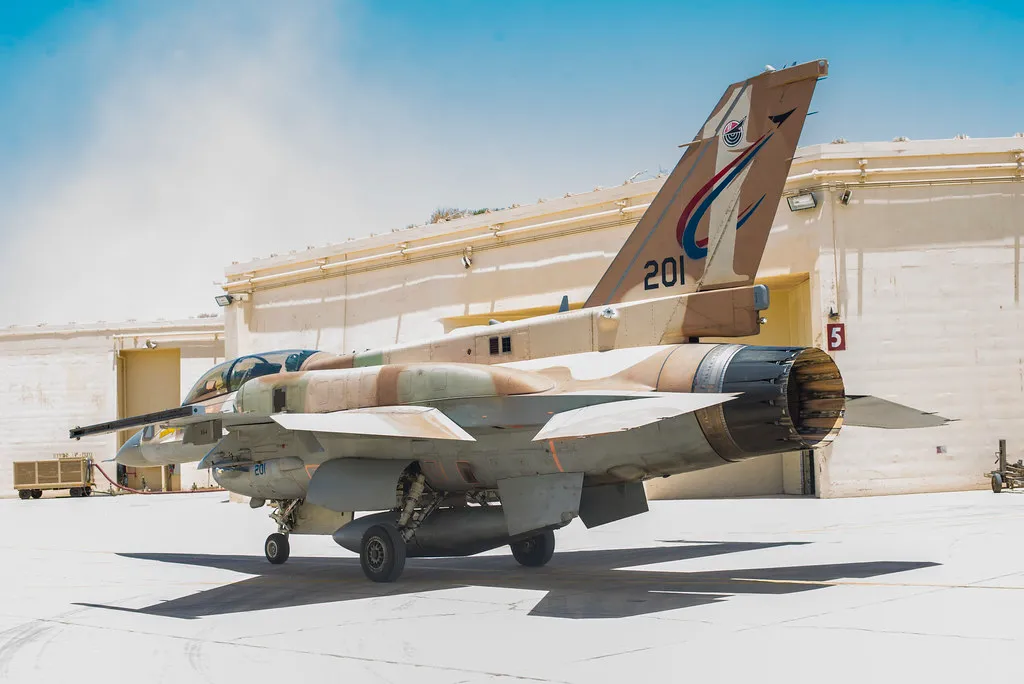





![Fire and a plume of smoke rise in the vicinity of the Ryazan oil refinery, May 15, 2026. [Supplied via Reuters]](https://i0.wp.com/www.aljazeera.com/wp-content/uploads/2026/05/2026-05-15T083203Z_1005115005_RC2K9LASNB6E_RTRMADP_3_UKRAINE-CRISIS-1778833986.jpg?w=640&ssl=1)