Stay informed and up-to-date with the latest news from around the world. Our comprehensive news coverage brings you the most relevant and impactful stories in politics, business, technology, entertainment, and more.
Iranian opposition leader calls on Trump administration to ‘stay the course’ as the US and Israel continue to wage war on Iran.
Published On 28 Mar 202628 Mar 2026
Amid questions about the future of Iran’s government, the son of the former shah has pitched himself to a right-wing summit in the United States and received a raucous welcome.
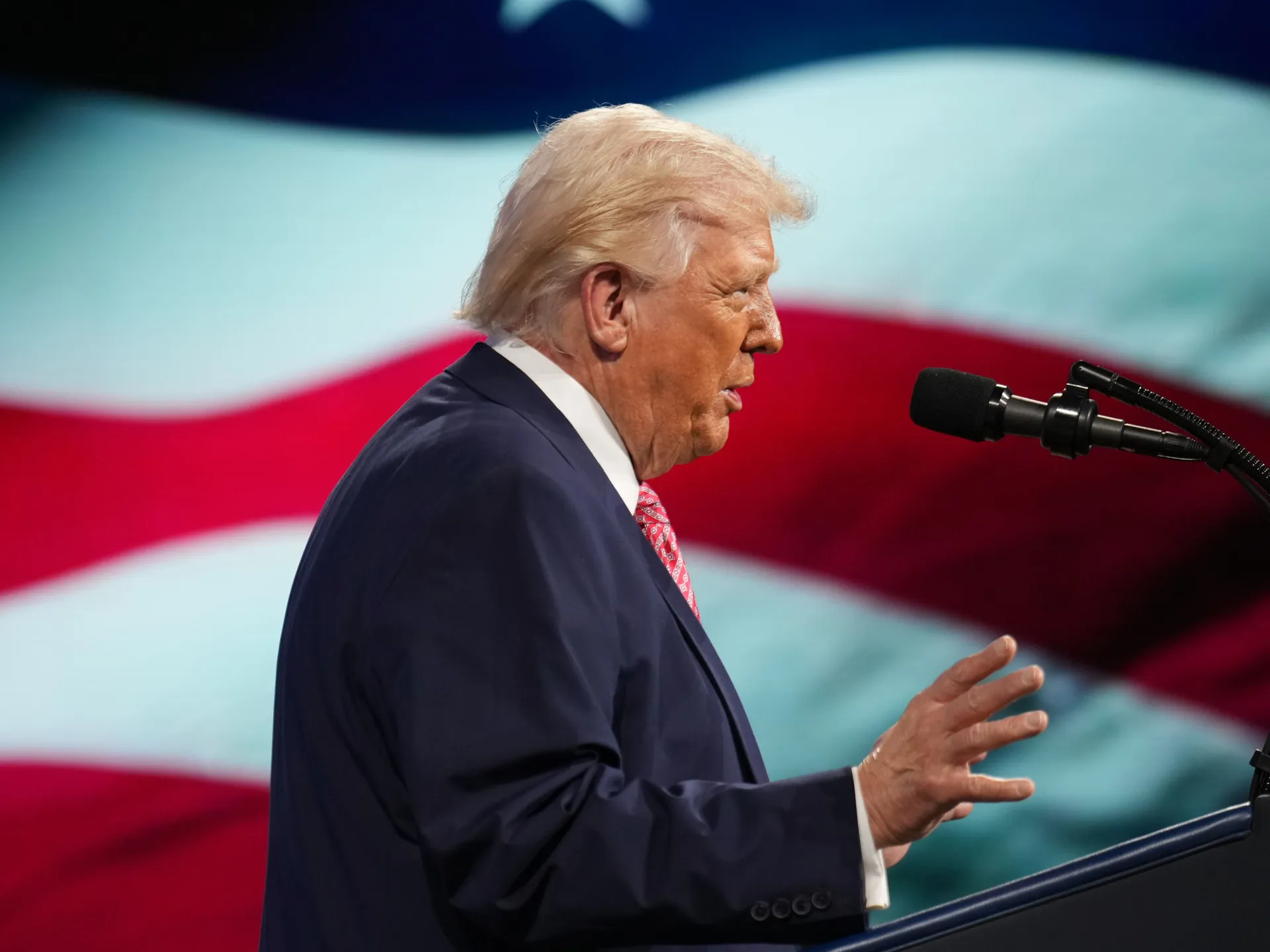
Reza Pahlavi spoke at the Conservative Political Action Conference (CPAC) in Texas on Saturday, urging US President Donald Trump not to cut a deal with Iran and instead seek regime change.
Recommended Stories
list of 3 itemsend of list
“Can you imagine Iran going from ‘Death to America’ to ‘God Bless America’?” the self-styled crown prince asked his audience in Grapevine, Texas.
“President Trump is making America great again. I intend to make Iran great again,” he added, receiving a standing ovation from the crowd.
His remarks came on the one-month anniversary of the US and Israel’s decision to launch a war against Iran. As the conflict enters its second month, at least 1,937 people in Iran have been killed, and tens of thousands more injured, with no end to the fighting in sight.
Pahlavi has become a central opposition figure in the Iranian diaspora, with a loyal base of supporters who often carry his image, along with Iran’s pre-revolutionary flag, at protests around the world.
During his speech, some in the audience chanted, “Long live the king!”
Audience members wrapped in Lion and Sun flags, symbolising Iran’s deposed monarchy, listen to a speech from Reza Pahlavi, the exiled son of Iran’s last shah [Callaghan O’Hare/Reuters]
While some in the Iranian diaspora have expressed reservations about the US-Israeli attacks and their effect on the future of Iran, Pahlavi has emerged as an outspoken supporter of Trump, aligned with the administration’s most hawkish figures.
“This regime in its entirety must go,” he said on Saturday.
Analysts have warned that the Iranian government is not likely to collapse and could emerge from the conflict more hardened than before. Some exiles, meanwhile, have been criticised for lending their voices to support the US-Israeli war despite the heavy toll on Iranian civilians.
Trump has himself previously downplayed the possibility that the son of the former shah, who was expelled from Iran during the country’s 1979 revolution, could play a central role in Iran if the current government were to collapse.
Earlier this month, Trump said that Pahlavi “looks like a very nice person“, but indicated that the shah’s son lacks popularity in Iran.
“It would seem to me that somebody from within, maybe, would be more appropriate,” Trump had said.
Divides within the US right over the war in Iran were also in evidence at CPAC. Polls suggest that, while the war is widely unpopular among US voters, Republicans support it by large margins.
In a Pew Research Center poll, for instance, 71 percent of Republican voters felt the US had made the right decision to attack Iran. Overall, among voters regardless of party, 59 percent opposed the initial strikes.
Still, a handful of influential voices on the US right, such as Tucker Carlson and Steve Bannon, have emerged as vocal critics of the war. Younger activists have also expressed frustration with what they see as a betrayal of Trump’s promise to avoid military adventures overseas.
“We did not want to see more wars. We wanted actual America First policies, and Trump was very explicit about that,” Benjamin Williams, a 25-year-old marketing specialist for Young Americans for Liberty, told The Associated Press. “It does feel like a betrayal, for sure.”
Arrests come days after force announced U-turn, saying that despite High Court ruling, ‘terror’ ban remains in place.
Published On 28 Mar 202628 Mar 2026
London’s Metropolitan Police have arrested 18 supporters of Palestine Action, days after the force promised to resume arrests in a reversal of policy.
The protesters had sat on the steps of New Scotland Yard, the Met’s headquarters, on Saturday, holding signs that read: “I oppose genocide. I support Palestine Action.”
Recommended Stories
list of 3 itemsend of list
Officers made the arrests under “terrorism” legislation.
Following the High Court’s ruling in February that banning Palestine Action as a “terrorist group” was unlawful, the force had said it would adopt a “proportionate approach” and stop arresting the group’s supporters and focus instead on gathering evidence.
But on Wednesday, Deputy Assistant Commissioner James Harman said that since any “impact of that judgement will not take effect until the government’s appeal has been considered, which could take many months”, it would resume arrests. “We must enforce the law as it is at the time, not as it might be at a future date,” he said.
As she was led away by two officers on Saturday, one woman, in footage posted to social media, can be heard saying: “I’m being arrested for holding a cardboard sign, whereas our government feels the need to sell weapons and use our airbases to commit genocide in Palestine.”
Critics say the Met’s U-turn defies the court ruling.
Palestine Action is a direct action campaign group which has targeted weapons manufacturers linked to Israel and an RAF base.
The government proscribed it as a “terrorist organisation” in July 2025, placing it alongside groups including al-Qaeda and Hezbollah. The High Court called the move “disproportionate” and in breach of freedom of expression.
The government was granted a stay pending an appeal, meaning the ban technically remains in force.
Home Secretary Shabana Mahmood, who said she would fight the High Court ruling in the Court of Appeal, said in February that supporting Palestine Action was not the same as supporting the Palestinian cause.
Chief Magistrate Paul Goldspring has since ordered that hundreds of related prosecutions be paused until after that appeal is heard.
Nearly 3,000 people have been arrested for holding signs in support of the group, contributing to a 660 percent rise in UK “terrorism” arrests in the year to September 2025, Defend Our Juries said.
On the day of the High Court ruling, about 150 people held the same placards outside the court and not a single person was arrested.
The scale of the crackdown has drawn sharp international criticism, including from the UN.
When the ban was first imposed, UN Human Rights Chief Volker Turk said it appeared “disproportionate and unnecessary”, warning it risked criminalising the legitimate exercise of free expression.
In January, US Undersecretary for Public Diplomacy Sarah Rogers told the news platform Semafor that “censoring that speech does more harm than good”.
Amnesty International, which intervened in the court case, said thousands had been “arrested for something that should never have been a crime.”
Eight activists linked to the group staged a lengthy hunger strike in prison, with four held on remand for 15 months before being bailed in February. Four others remain imprisoned.
Earlier this week, Al Jazeera reported that released detainees are now pursuing legal action against the prisons over alleged mistreatment.
Defend Our Juries has called a mass sign-holding event, titled Everyone Day, at Trafalgar Square on April 11, as the government’s appeal heads to court.
Saturday’s arrests took place as the rest of the city was filled with demonstrators who came out to march against the far right.
Weekly insights and analysis on the latest developments in military technology, strategy, and foreign policy.
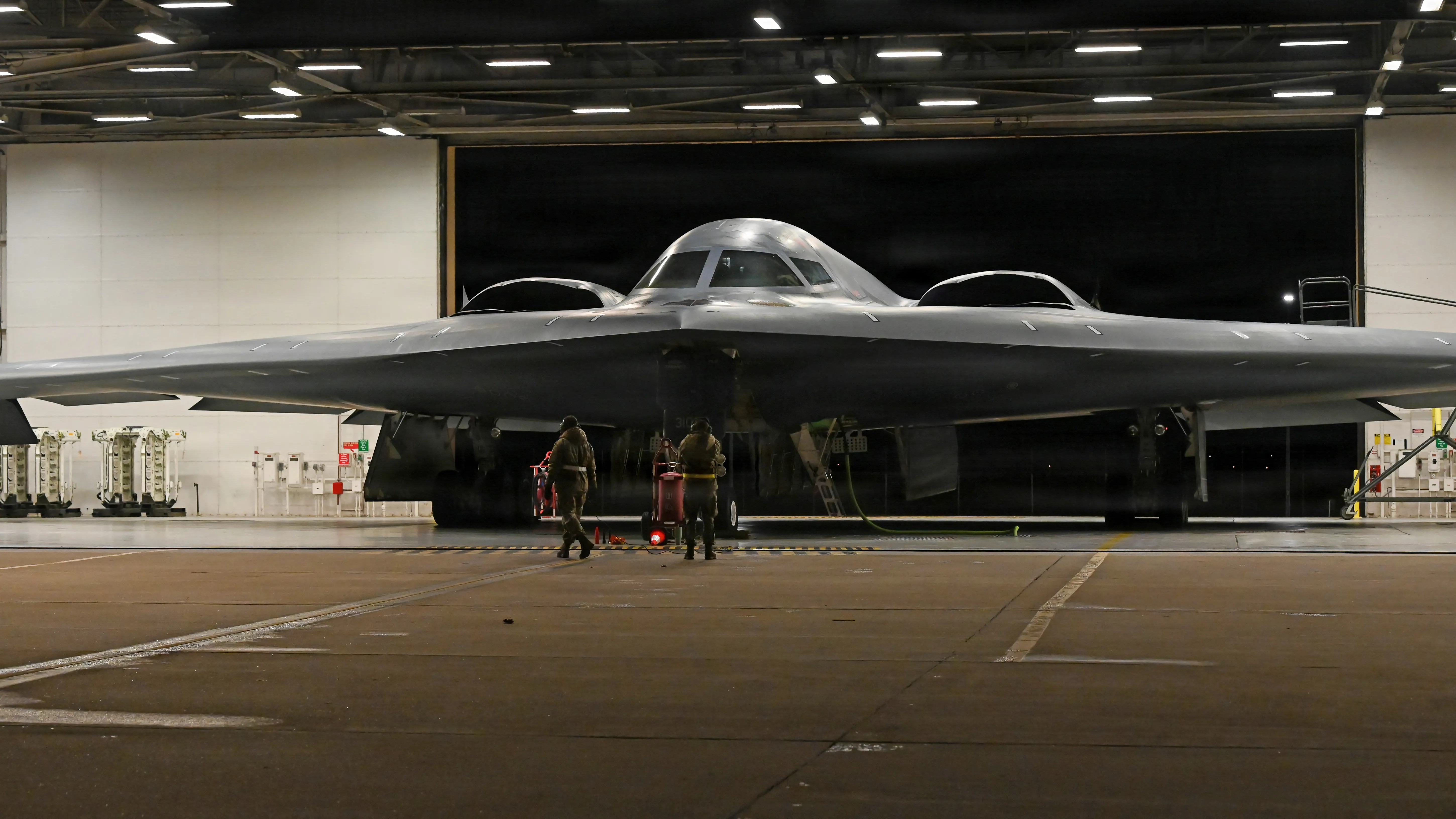
The B-2 Spirit has done what no other asset can do during the war with Iran — flying into dangerous airspace to release heavy weapons capable of penetrating even the most hardened targets. While B-1Bs and B-52Hs have forward deployed to the United Kingdom for their missions over and near Iran, the B-2s have flown smaller numbers of missions from their home at Whiteman Air Force Base in Missouri. At this time, there is no evidence that B-2s are operating out of Diego Garcia or anywhere else for the war effort. Still, they are delivering punishing blows, as represented in art on at least one of their gear doors. Beyond mission markings, some new features that just appeared along the aircraft’s huge leading edges are puzzling to say the least.
U.S. Air Force crew chiefs perform pre-flight checks on a B-2 Spirit stealth bomber during Operation Epic Fury, March 17, 2026. (U.S. Air Force photo) (U.S. Air Force photo)
We spotted these white rectangles with black borders that are sealed onto the B-2’s leading edges in images released today by U.S. Central Command (CENTCOM), showing a pair of the stealth bombers about to launch from Whiteman on another global airpower mission to Iran on March 17, 2026. The rectangles mirror themselves near the upper and lower leading edges and appear to use the typical tape method of sealing to keep the jet’s radar cross-section as low as possible.
The white squares are very loosely reminiscent of test marks the B-2 has worn at different times during its first decade of flying, when it was deep in trials. Why anything like that would be present on a combat mission, and on two separate aircraft, is puzzling. The possibility that they augment and mask the B-2’s radar signature is also worth bringing up, but the aircraft has other ways of doing that and why would B-2s fly missions without their stealth benefit, especially all the way from the United States, when other platforms are forward deployed for those applications? Delivering the Massive Ordnance Penetrator in permissive airspace is one potential reason, but again, why go through all the trouble when the aircraft can just hit its targets in standard configurations? The threat of losing signature data to threat systems is always a possibility, but whether it would drive such a modification is unclear.
(Public Domain) (Northrop Grumman)
It’s also possible that this is some kind of new sensor or electronic warfare installation, and that these are small apertures for whatever lies beneath. Enhancing the B-2’s ability to sense threats in its combat environment and react in real time to them, including by avoiding, attacking or jamming them, would be very important to its survivability over future battlefields. Also, making the Spirit more capable of communicating with assets even while keeping as stealthy as possible would be key. All these kinds of upgrades are important to making sure the B-2 remains relevant for the rest of its service life.
The byproducts of a new coatings upgrade for the Spirit are another possibility. The B-2’s radar-absorbent material (RAM) coatings are absolutely critical to its success, but are also one of the major drivers of its immense operating costs. Improvements to the coating’s materials and processes of applying them have been constant throughout its life as the USAF seeks to increase its availability rate and lower its cost per flight hour. This has changed the appearance of the B-2 over the decades. New technologies from the B-21 Raider program, for instance, are being applied to the B-2 in order to help address these issues.
So, we just don’t know what these new features are for, or if they will remain a staple on B-2s that receive them going forward.
How the B-2’s leading edge normally looks. (U.S. Air National Guard photo by 2nd Lt. Chris Bishop) 2nd Lt. Christopher Bishop
Also of interest is the aforementioned mission markings on one of the B-2’s nose gear doors. It shows 15 bombs. While we cannot say for certain what exactly this represents, it’s more likely that it denotes combat missions rather than individual weapons dropped. That still seems like way too many long-range strike flights from this operation for this aircraft, especially considering the image was taken a week ago, but it probably includes combat missions from last year, as well.
U.S. Air Force crew chiefs perform pre-flight checks on a B-2 Spirit stealth bomber during Operation Epic Fury, March 17, 2026. (U.S. Air Force photo)
Another possibility some may raise is that it could denote how many GBU-57/B Massive Ordnance Penetrators (MOP) this B-2 has dropped, but again, this number seems like far too many. In fact, it is not even clear if any MOPs have been employed in this campaign, and 15 would equal more than the total dropped by all the B-2s involved during Operation Midnight Hammer last June.
Like so many things Spirit, we just don’t know what we are looking at. The aircraft is an American icon and has now entered the backend of its operational career, with its successor and legacy, the B-21 Raider, waiting in the wings. At the same time, much about the B-2 remains a secret and likely will for years after it finally flies its last operational sortie.
This is also something of an abstract indicator of just how far ahead of their time Northrop’s engineers were when they gave birth to the world’s first stealth bomber, an aircraft that is more prized now as a national asset than anytime in its three-decades-long career.
A B-2 Spirit stealth bomber prepares to take off to conduct a mission during Operation Epic Fury, March 17, 2026. (U.S. Air Force photo)
Demonstrators are hitting the streets of cities across the United States for the first “No Kings” protest since the joint US and Israeli war against Iran began one month ago.
Saturday’s marches and rallies mark the third round of nationwide “No Kings” protests since President Donald Trump took office for a second term.
According to the “No Kings” website, more than 3,300 events are planned across all 50 states, with large crowds expected in cities such as New York, Los Angeles and Washington, DC. Parallel events are happening internationally in cities such as Rome, Paris, and Berlin.
Organisers, however, are aiming to rally voters outside of the US’s major metropolises, in areas that tend to skew conservative. They say that roughly two-thirds of participants are expected to take part in events outside of major city centres.
“The defining story of this Saturday’s mobilisation is not just how many people are protesting, but where they are protesting,” said Leah Greenberg, cofounder of the progressive nonprofit Indivisible, which started the “No Kings” movement last year.
The main event, however, is set to take place in the Minneapolis-St Paul area of Minnesota, known as the Twin Cities.
The midwestern state became a focal point for Trump’s hardline immigration crackdown in December, when he launched Operation Metro Surge.
That operation saw more than 3,000 of federal immigration agents descend on the Twin Cities, where they were accused of using excessive force to conduct deportation raids.
In January, agents shot and killed two US citizens, Alex Pretti and Renee Nicole Good, prompting nationwide outrage and calls for reform. Dozens of lawsuits have been filed as a result of the operation, which was wound down in February.
Saturday’s protest will commemorate those deaths in Minnesota, with speeches, concerts and appearances from activists, labour leaders and politicians.
Progressive Senator Bernie Sanders is expected to address attendees, and rock icon Bruce Springsteen will perform at the event, along with folk singer Joan Baez.
Already, early on Saturday, marchers in Washington, DC, gathered around landmarks such as the Lincoln Memorial and the Washington Monument, holding signs and waving papier-mache effigies of the Trump administration.
The previous two “No Kings” marches took place in June and October and drew millions of people. Trump responded to the October protest by posting an AI-generated video depicting himself dumping faeces on the protesters.
The US is currently in the midst of campaigns for its pivotal midterm elections in November, which will see Trump’s Republican Party seek to defend its majorities in both chambers of Congress.
Weekly insights and analysis on the latest developments in military technology, strategy, and foreign policy.
Short-range kamikaze drones operated by an Iran-backed militia appear to have successfully targeted a U.S. military Black Hawk helicopter and a critical air defense radar at an American base in Iraq. This is the first known example of a successful attack of this kind on a U.S. military aircraft. It’s also not the first time we have seen evidence of these kinds of drones zipping over the same installation in recent weeks.
The incidents underscore the reality of the threat posed by small drones in the Middle East, where a wide variety of nefarious players have already employed these systems for surveillance and attacks against U.S. forces on multiple occasions, for years now. It is also a preview of what the U.S. could end up facing on its own homefront as it grapples with constant and sometimes highly perplexing drone incursions over sensitive bases and facilities. Even since the war began, there have been very alarming drone incursions over one of America’s most important bases that houses nuclear weapons and B-52 bombers that carry them. You can read all about these developments here.
One of the videos that began circulating yesterday, filmed from a first-person view (FPV) drone, shows a pair of Black Hawk helicopters sitting in a compound, protected only by a low blast wall. The video feed cuts out just before detonation, on or close to the main rotor, but the assumption is that one of these helicopters (at least) was struck.
An Iranian-backed militia carried out a successful FPV drone strike on Camp Victory in Iraq yesterday, successfully hitting multiple targets.
The location has been identified as the Victory Base Complex (VBC), a cluster of U.S. military installations surrounding Baghdad International Airport close to the Iraqi capital.
As for the helicopter, this appears to be a medical evacuation (medevac) configured HH-60M, emphasized by the video editing, in which it seems the prominent identification panels marked with red crosses have been obscured.
Noticing they blurred out a portion of their attack video (green). I think they were trying to hide the fact they attacked a medevac helo. Note white mark circled in orange.
These are actually US Army HH-60M CASEVAC helicopters. Not UH-60s. Assigned to Charlie Company, 2nd Battalion (General Support), 4th Regiment, 4th Infantry Division Combat Aviation Brigade. https://t.co/OIjvcxagz6
Whether the helicopter was damaged or even destroyed by the drone is unclear at this point, but most significant is the fact that such a target was able to be engaged by a relatively simple, low-cost threat. The same goes for the second video, where the extent of the damage is much clearer.
The target in this case is a container-based AN/MPQ-64 Sentinel radar, a system used to alert and cue short-range air defense (SHORAD) weapons, including the National Advanced Surface-to-Air Missile System (NASAMS). The radar is in operating mode, its antenna clearly rotating.
A video showing a U.S. Army AN/MPQ-64 Sentinel radar in action with the 10th Combat Aviation Brigade:
Sentinel Radar
This footage includes the perspective from another drone, which confirms that the radar was hit, after which it is seen burning.
While it’s clear that more than one drone was in the vicinity of the radar during the attack, there have also been unconfirmed reports that the militia used some kind of swarming tactics, or at least multiple kamikaze drones to perpetrate this attack, with some degree of coordination.
Reportedly, the attacks on the Black Hawk and Sentinel radar occurred yesterday. In both cases, it is apparent that there is no degradation in the video feeds as they drop very low over the ground, even behind structures. This might be the result of the drones having been launched very close to their targets, or that they used fiber-optic control links. Both those scenarios are alarming, but a fiber-optic FPV drone would explain why passive sensor systems would not have detected them as they approached the base.
Wow, for the first time, fiber-optic drones have been spotted in use by the Azawad Liberation Front (FLA) in Mali, who are fighting against both the Malian Armed Forces and Russia’s Africa Corps/Wagner Group. The drones and training were likely provided by Ukraine, with previous… pic.twitter.com/OxemaEbWwO
The drone strikes are notable for a number of other reasons.
First, there is no sign of air defenses attempting to engage the incoming drones.
Of course, a response to the drones in the form of electronic warfare and cyber warfare, or other ‘soft-kill’ options, is a possibility. In regards to other counter-drone capabilities, there is no indication that the limited number of directed-energy weapons the U.S. has were deployed to this facility, while surface-to-air interceptors are not generally suitable for engaging such small drones. Other options would include gun-based systems, as well as drone-based systems, like the Coyote, and the laser-rocket-slinging VAMPIRE. On the other hand, we also know there is a chronic scarcity of many of these systems.
Video footage shows Block 2+ Coyote drones engaging drones in an undated demonstration:
Raytheon Missiles & Defense proves counter-UAS effectiveness against enemy drones
It should also be noted that, for all their relative simplicity and low cost, FPV drones are very hard to spot and target, especially when they are moving quickly at very low level. In many cases, they will evade detection by traditional radars, while even microwave radars, tailored for counter-drone work, can provide sporadic coverage at very low altitude.
The apparent vulnerability of the Victory Base Complex is all the more surprising since this is not the first time that the same installation has been targeted by FPV drones.
Earlier this month, videos emerged showing drones purportedly belonging to the Iran-backed Kataib Hezbollah group.
A screenshot from a video released by the Iran-backed Iraqi militia Kataib Hezbollah showing an FPV drone approaching a hardened shelter at the Victory Base Complex earlier this month. via X
There have been suggestions that all of these various videos may have been recorded during the same (complex) attack, although the latest footage appears to come from a separate attack on a different date.
Thirdly, the threat posed by drones of this kind, while proliferating significantly since the start of Russia’s full-scale invasion of Ukraine, has been recognized long before that.
Last year, we reported on how U.S. Defense Secretary Pete Hegseth had created a new task force specifically to counter the growing threats posed by small drones at home and abroad.
“There’s no doubt that the threats we face today from hostile drones grow by the day,” Hegseth stated at the time. “Emerging technologies — we see it in battlefields, in far-flung places, and we see it on our own border in small unmanned aerial systems. [These drones] target and bring harm on all warfighters, our people, our bases, and frankly, the sovereignty of our national airspace.”
Hegseth said the Pentagon “must focus on speed over process” when it came to new counter-drone efforts.
Soldiers from 2-130th Infantry Regiment hone their skills in a counter-drone training exercise at McGregor Range, New Mexico, last year. U.S. Army Staff Sgt. Raquel Birk
While there have been various regulatory barriers that have prevented the fielding of more robust drone defense of key installations and assets in the United States, this is not such a problem in Iraq, and especially in the course of a regional conflict.
It is notable, too, that there have been reports that some type of quadcopter-type drones may have been used for surveillance ahead of the Iranian strike on a U.S. logistics operations center in Kuwait on March 1. That attack led to the deaths of six U.S. service members, and more were wounded.
The incidents also underscore the very real risk faced by military infrastructure in the United States, a point that TWZhas repeatedly raised in the past. In particular, near-field attacks like these pose a huge threat and one that is hard to stop. Compared to a combat theater, something like this could be far more successful at home, where there are fewer defenses and more limited surveillance. As in Iraq, aircraft parked on the ground and radars are highly vulnerable, and the same threat even extends to traditional air defenses.
On June 1, the Security Service of Ukraine carried out a brilliant operation— on enemy territory, targeting only military objectives, specifically the equipment used to strike Ukraine. Russia suffered significant losses.
We have reached out to U.S. Central Command for more information about exactly what happened at the Victory Base Complex, and what kind of defensive measures are in place there.
As we wait for more details to emerge, to paint a fuller picture of these attacks on American assets in Iraq, it is clear that there are still questions to be asked about the resilience of the U.S. military in the face of kamikaze drones and similar threats.
Mendoza Potellá situates the recent oil reform in the historical context of foreign influence over Venezuela’s energy sector. (Venezuelanalysis)
Carlos Mendoza Potellá is an economist and university professor with vast experience and expertise regarding the Venezuelan oil industry. In this exclusive interview with Venezuelanalysis, Mendoza Potellá offers his analysis on the recent reform of the Hydrocarbon Law, the longstanding influence of Western conglomerates over Venezuela’s energy sector, and the struggle for sovereignty.
In late January, the Venezuelan National Assembly approved a reformof the Hydrocarbon Law. What are your views on the new law?
In broad terms, it is the relinquishing of our condition as a sovereign nation, plain and simple. We are not a nation anymore. We are a territory with some delegate administrators implementing decisions made abroad. Who decides? Emperor Trump, who has his proconsul Marco Rubio.
The approved law meets the maximum demands that the Venezuelan right and the oil conglomerates have been making for at least the last 25 years. The 2002 coup against Chávez was to impose something like this, the return to the old concession model. It is the fulfillment of all the dreams of the old “meritocratic” leadership of [state oil company PDVSA], the people who did everything to minimize the fiscal contributions to the country, whether that meant buying 37 refineries abroad or other disasters that wrecked the country.
The reform is a victory for international oil capital, alongside a discourse that hands over the destiny of the industry to major corporations and diminishes national participation as some unproductive “rentierism.”
The Venezuelan oil industry has gone through various stages, with varying degrees of influence from major transnational corporations, whether that is the period prior to the formal nationalization in 1976 or the Oil Liberalization (Apertura Petrolera) of the 1990s. How do we situate the new law within that context?
I believe this is a step backward beyond the apertura or the pre-nationalization period –perhaps it’s a return to 1832! In 1829, Simón Bolívar issued a decree transferring the Spanish crown’s mining rights to Gran Colombia. This, in turn, was based on old medieval law, essentially establishing that mines were the property of the sovereign, the king. In fact, that is where the term “royalty” comes from –as a tribute to the king. And in 1832, when Venezuela separated from Gran Colombia, that decree ratified the nation’s ownership of its mines.
Obviously, oil didn’t emerge until 30 or 40 years later, but by 1866 concessions were already being granted. For a time, people spoke of “material that comes from the subsoil,” even though everyone already knew it was oil.
Our first boom was with asphalt. In 1883, Guzmán Blanco granted the Lago Guanoco concession to his buddy Horacio Hamilton, who later transferred it to the New York & Bermúdez Company, a subsidiary of the US firm General Asphalt. The asphalt boom lasted 50 years, and with it, streets and highways were built all over the United States.
But the example of New York & Bermúdez is significant because when Cipriano Castro came to power in 1899, he found out that the company had not paid taxes and attempted to collect them. What did the corporation do? It financed the so-called Revolución Libertadora led by Manuel Antonio Matos, a banker from La Victoria, which was ultimately defeated after two bloody battles. It was the first instance of foreign hydrocarbon interests seeking to control national politics. And it was always linked to the United States.
In the 1920s, then-dictator Juan Vicente Gómez tasked his minister, Gumersindo Torres, with drafting a hydrocarbons law, but the foreign companies did not like it. And Gómez told them, “Well, then, write the law yourselves!” Later, in 1936, the López Contreras administration drafted a very good law, but since it wasn’t retroactive, the companies did not mind because they already had their concessions granted.
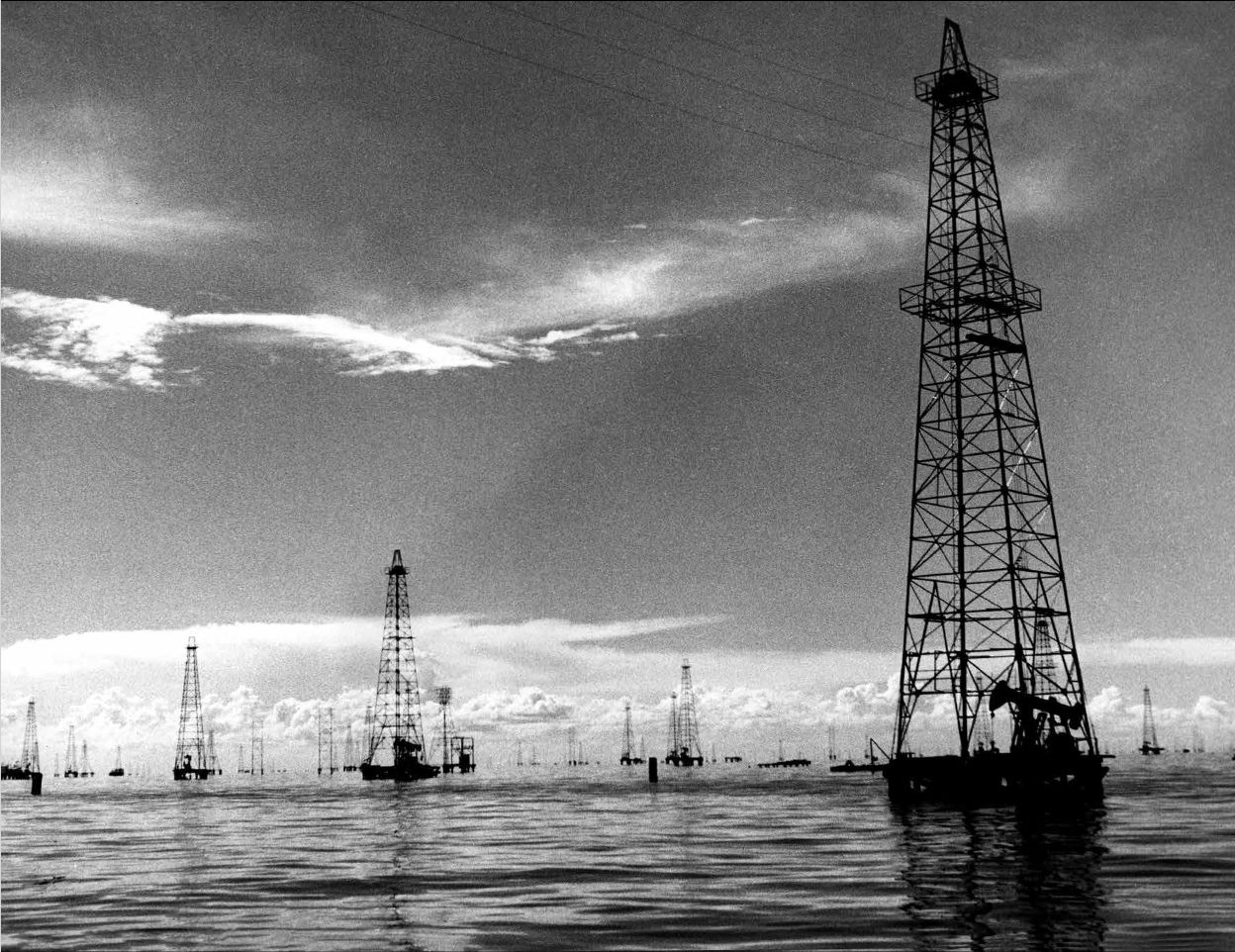
Lake Maracaibo was one of the main hubs of the Venezuelan oil industry in the 20th century. (Archivo Fotografía Urbana)
When do we start seeing the first steps toward Venezuelan oil nationalism?
It was precisely in 1941 that Medina Angarita took office and commissioned a massive dossier on all the concessions in the country, informing the US government that Venezuela was aware of the importance of its oil. This was during World War II, and the oil companies were haunted by the specter of the 1938 Mexican nationalization under the government of Lázaro Cárdenas.
What was [Franklin D.] Roosevelt’s response? He sent a delegation from the State Department, not to intercede on behalf of the oil companies, but to convince them to accept Medina’s reform, because Venezuelan oil was vital to the war effort. The law passed in 1943 was quite progressive. Its first article stated that hydrocarbons are a matter of national public interest, and as such, concessions were granted for a maximum term of 40 years. Eighty percent of the concessions were granted at that time, to expire in 1983.
Venezuelan production grew through the 1970s, but as the end of the concessions approached, the transnational corporations began implementing policies to somewhat ease the hostility toward foreign investment.
Thus, a policy of “Venezuelanization” of the industry’s management was put into effect. That is why, when the so-called nationalization took place (1976), companies such as Shell and Creole, a subsidiary of Standard Oil-Exxon, had Venezuelans serving as president or vice president. These executives later assumed leadership of the newly created national companies. Their passports were Venezuelan, but their hearts belonged to foreign corporations!
Historically, how was the relationship between foreign corporations and Venezuelan authorities? And how did they respond to the 1976 nationalization?
The corporations grew accustomed to the idea of an industry tailored to their interests. I mentioned how they were the ones who drafted the first Hydrocarbons Law. Oversight bodies, such as the Technical Office of Hydrocarbons, were constantly undermined in their efforts to regulate oil activities. And so the companies could extract oil without paying royalties, violate technical standards for field exploitation, or export gasoline instead of fuel oil.
The 1970s were a turbulent time for the oil sector, marked by geopolitical tensions and the 1973 crisis in the Arab countries. In 1973, James Akins, the Nixon administration’s Director of Energy at the State Department, wrote an article in Foreign Affairs titled “The Oil Crisis; This Time the Wolf Is Here.” He argued that Venezuela could be key to reducing dependence on the Middle East, and that in the face of growing oil nationalism, it was necessary to cede some ground and consider other models of participation, while maintaining control over critical areas such as refining and commercialization.
Put differently, it was possible to offer some token concessions to the nationalist aspirations of oil-producing countries like Venezuela. And that rhetoric spread to the transnational corporations. The president of Shell said at the time, “Venezuela is going to have to take action regarding its oil industry,” while the head of Creole spoke of “the Venezuelans’ oil”!
There were growing signs of how the nationalization would take shape and how the transnationals were restructuring. A good example is the Venezuelan Petroleum Corporation (CVP), created in 1960. Juan Pablo Pérez Alfonzo, whom I consider a visionary and a deeply nationalist figure, had conceived it as a company that would develop until the time came for the state to take over production. But the governments did not let it grow; they did not assign concessions it was entitled to, and by the time of nationalization, the CVP was simply one more operator among 13 or 14.
In contrast, [Petróleos de Venezuela, SA] PDVSA, created with the nationalization, did have a very clear vision from the start. I remember hearing senior PDVSA executives talking among themselves, discussing how one came from the “Exxon culture,” which was more vertical, and the other from the “Shell culture,” which was more horizontal. And these were the managers! They were the leaders of the Venezuelan oil industry, which had very little “Venezuelan” about it. What we are seeing now is the reconstitution of all these things.
Mendoza Potellá has long criticized “grandiose” plans surrounding the Orinoco Oil Belt. (El Universal)
Circling back to the current reform, we have seen that sovereignty is a central issue. How is it affected on different fronts?
For me, a fundamental issue is the return of concessions. Because that means going back decades, handing control back to transnational conglomerates. With taxes and royalties, the problem is not whether the rate is 30% or 15%; that flexibility existed in the past. But now it is the transnational corporations that tell the government what their operating costs are and how much goes to the Venezuelan state. There is no oversight body to verify this; instead, the company says, “I need you to lower royalties to this level” for the project to be profitable.
The return of international arbitration is also a brutal setback, because it means that disputes are not settled in Venezuelan courts, but in other bodies that have a history of defending corporate interests. There is no role left for the Public Solicitor’s Office (Procuradoría General), which is essentially the nation’s attorney.
For months we were told we were ready to confront imperialism, but the truth is that everything is being imposed on us. Even the National Assembly is castrating itself. It has enacted a law stating that oil projects no longer require the parliament’s approval; they need only be notified. And on top of all that, there is also the constitutional issue. The reform conflicts with Articles 1, 12, 150, 151, and several others of the Constitution. But this is not merely a constitutional violation; it is a total surrender. A surrender of sovereignty that calls into question our status as a republic.
One of the issues under debate is the distinction between a country that owns oil and a country that produces oil. How should we understand the difference?
Of course, that’s fundamental. A country that owns oil simply collects royalties, and it does so according to its political capabilities. At the moment, Venezuela’s capabilities are limited, because the military cannot confront the enemy, and allies like Russia and China have not shown themselves willing to take any risks. So, there is little room to impose conditions on the US.
But this is a country that has grown used to the multinational corporations having free rein over its oil sector. Unfortunately, there are many people, within the industry itself, who believe that “the foreign conglomerates developed this and therefore have a right to these privileges.” Curiously, that is the same rhetoric Trump uses!
This struggle for sovereignty is fundamental in oil-producing countries. We have seen this with the countries of the Middle East, which try to assert themselves but remain highly dependent on the United States. Obviously, they have the advantage of not being as close as we are. But in my opinion, historically we have lacked nationalism on this issue.
Trump Energy Secretary Chris Wright recently toured Chevron’s facilities in Venezuela alongside Acting President Delcy Rodríguez. (EFE)
One of the arguments in favor of reforming the Hydrocarbon Law was the need to attract investment to so-called “green fields,” on the grounds that when the previous law was passed in 2001, there were many mature fields ready for development and this is no longer the case. However, major corporations have not shown much enthusiasm. What is your reading on this?
Those are fantasies about oilfields that have always been unviable; it is the obsession with the Orinoco Oil Belt. Humberto Calderón Berti, minister of mines in the 1980s and a major proponent of PDVSA’s internationalization, was already talking about green fields back then. By the way, Calderón Berti is now talking about the possibility of fracking in Lake Maracaibo, which would make the lake’s environmental disaster even worse.
The idea that an avalanche of investment is coming is an illusion, and the oil companies themselves know it. Trump talks about investments of $100 billion, but transnational corporations like ExxonMobil use the word “uninvestable.” With market volatility, no one is thinking about investing in oil with extremely high production costs. There is a study that concludes that increasing production to 2.6 million barrels per day based on the Orinoco Belt would require US $90 billion in investments and $122 billion in operating expenses over the next 10 years to drill 13,000 new wells! In other words, it is completely unfeasible.
On top of that, OPEC’s forecasts for oil demand over the coming decades aren’t particularly ambitious. (1)
So who stands to benefit from this new landscape? On the one hand, small “rogue” companies that can take on a well here and there. But above all, the conglomerates that are already here, like Chevron, which know the lay of the land and can expand their operations or make their current operations more profitable. The same goes for Eni and Repsol, which have some crown jewels, like the offshore Perla natural gas field. The corporations that come will be betting mostly on conventional fields, not the Orinoco Belt.
It is very commonplace to hear about US refineries in the Gulf of Mexico that are built to receive Venezuelan crude. That is true, but it is not oil from the Orinoco Belt! It is oil from the Oriente (East) and Occidente (West) oil-producing regions.
Let us stay for a moment on the Orinoco Oil Belt, since that is where the talk of the “largest oil reserves on the planet” centers, as well as the prospects for a massive increase in production. What are the myths and realities surrounding these deposits?
The Orinoco Belt is a geological miracle. Eighty million years ago, 10–15 percent of all life that existed on the planet was fossilized north of the Orinoco River. It is something to cry out to the heavens. But that is not exploitable oil. It is extra-heavy crude, a sticky mess that needs to be upgraded. First it must be converted into liquid petroleum so it can flow through pipelines, and then taken to be refined and turned into gasoline.
In the 1970s, the United States saw the energy crisis coming and asked, “When conventional oil runs out, where can we find oil around the world?” In three places: the Soviet Union, Canada, and Venezuela. And where in Venezuela? In the Orinoco Oil Belt. Pérez Alfonzo spoke of the belt as “something for the future,” but the United States wanted to accelerate exploitation and sent a delegation in 1971 to convince President Rafael Caldera to begin the process. In fact, the name was changed from “Tar Belt” to “Oil Belt” to make it more attractive.
The US Geological Survey estimates that there are 513 billion barrels of “technically recoverable” oil. But that is absurd, because there is no capacity. What makes a reserve recoverable has to do with economic ability, the market, and the available technology. Nevertheless, the Orinoco Belt has been at the center of grandiose projections over the past few decades, alongside the highly lucrative business of certifying reserves.
Former President Hugo Chávez imposed the state’s sovereignty over the oil industry in the 2000s. (Archive)
The oil reform took place in a specific context, following years of economic sanctionsthat have left PDVSA in a very difficult situation. What would be an alternative path? How can the industry recover without surrendering sovereignty?
There are no magic solutions, obviously. We are facing imperialism in the Trump era; we see all its destructive potential. It is a phase where the US, paradoxically, recognizes its weakness and is entrenching itself in its “backyard.” But we must be aware that the industry’s current course is one of total capitulation.
Whether we can recover, whether it is possible or not, we must think about it rigorously, in a sovereign manner. And above all, we must have a serious plan; we cannot be dreaming of 5 or 6 million barrels a day.
There are 17,000 conventional oil wells, with the capacity to produce, abandoned around the country. Of the 35,000 wells in Venezuela, only half are currently producing. The others require investment, though not particularly large ones. And what kind of oil will these wells produce? Crude grades ranging from 20 to 30 degrees. But we need a plan, to examine wells one by one. These are wells that will produce 20, 50, or 100 barrels a day, but it is light and medium crude—the “classic” Venezuelan oil.
So, from a nationalist perspective, what does the future hold for Venezuela’s oil industry?
The future is to build a post-oil Venezuela. This was already being discussed by theorists such as Francisco Mieres and Pérez Alfonzo in the 1970s. Then, in recent years, many began talking about a post-oil or post-rentier country, but mostly to cover up their incompetence and inability to maintain production levels.
There is no magic solution, and the oil industry will have to play an important role. But the current situation is dire. We are in a new phase of absolute political dependence. It’s not just about oil, or that the US controls revenues, imposes concessions, and so on. It is that the country has lost the ability to make its own decisions.
There are also expectations of the people, who to a large extent have become accustomed to the idea that their oil will last forever. That creates the illusion that things can improve very quickly. The path will be slow, but it has to start with regaining sovereignty.
Note
(1) The interview was conducted before the launch of the US-Israeli war against Iran.
Weekly insights and analysis on the latest developments in military technology, strategy, and foreign policy.
The Army’s revamped system for getting gear and weapons to the fight faster has already been put to work in support of the war the U.S. is waging on Iran, a service leader said Tuesday.
Speaking at the Association of the United States Army’s Global Force Symposium in Huntsville, Ala., Brig. Gen. David Phillips, deputy portfolio acquisition executive for Maneuver Air, revealed the Army was trying to innovate in real time as the conflict approaches the end of its first month.
“As I look back on the past 30 days in Operation Epic Fury, we had some immediate requests from the field in the first week,” Phillips said. “Those immediate requests in the field returned on a requirements document with the [Army Future Capabilities Directorate] and [Army Transformation and Training Command] in about 48 hours, who turned on a contract in about 72 hours. And I can say that we’ve had soldiers out training and testing the capabilities they’re going to deploy with in real time in the past 10 days. So we’ve got industry fully engaged.”
Phillips did not go into detail on what capabilities were sourced or needs identified in that short timeframe. Notably, the Pentagon has shown willingness to deploy new tech to the fight from day one, debuting the Low Cost Uncrewed Combat Attack System (LUCAS), a reverse-engineered American version of the Iranian Shahed-136 kamikaze drone, in the initial barrages.
A Low-cost Unmanned Combat Attack System (LUCAS) launches from the flight deck of the Independence-class littoral combat ship USS Santa Barbara (LCS 32) while operating in the Arabian Gulf, Dec. 16, 2025. Prior to the launch, shipboard weapons integration assessments helped ensure the system could be safely stored, moved, and handled at sea. Task Force 59 operated the LUCAS drone as part of Task Force Scorpion Strike operations. (U.S. Army photo by Spc. Kayla McGuire) NAVCENT Public Affairs
On Tuesday, the Army formally announced the creation of an “Unmanned Aircraft Systems Marketplace” in partnership with Amazon Web Services and the Army Enterprise Cloud Management Agency that purports to be a “digital one-stop shop” for procuring drones fast for Army units and their allies.
Phillips urged defense industry members, as well as academics and units currently in the field, to tell leaders what was working in the fight and what needed to change.
“We want your engagements. We want your feedback at PAE Expanded Maneuver Air, and we want to have you as a part of our team. Because we know we don’t bend the metal, we don’t really go out and talk to the sub-tier suppliers as much as you all do, but we need this to be a team sport,” Phillips said.
In a panel discussion helmed by Phillips, Army leaders who have worked with Ukraine and with mobile brigade combat teams within the 101st Airborne Division did exactly that, discussing needs and vulnerabilities with rare candor.
U.S. Army Soldiers with the 25th Infantry Division monitor a handheld controller and review sensor data during Joint Pacific Multinational Readiness Center (JPMRC) rotation 26-01, Nov. 6, 2025, at Schofield Barracks, Hawaii. JPMRC integrates U.S. forces, along with military members from France, Malaysia, Maldives, Philippines, Singapore, and Thailand, alongside New Zealand Staff Observers to refine joint capabilities and rehearse tactics, techniques, and procedures required to dominate jungle and archipelagic terrain during large-scale combat operations. The exercise underscores the U.S. Army’s commitment to ensuring regional security and strengthening partnerships in the Indo-Pacific area of responsibility. (U.S. Army photo by Sgt. Taylor Gray) Sgt. Taylor Gray
Col. Burr Miller, a former innovation advisor with the Army-led Security Assistance Group-Ukraine, warned that U.S. systems were sometimes not strong enough to sustain attacks on position, navigation and timing (PNT) capabilities. These are technologies that aid in navigation, like GPS, that are absolutely essential to modern warfighting.
“The PNT environment is incredibly corrosive,” Miller said, adding that he had observed many U.S. systems that “did not survive first contact” with a Russian adversary. “… In the same kind of tenor, we do not test a representative environment in the United States; nowhere can we test what the representative environment is … That’s not only a government responsibility, vendors; that’s your responsibility.”
“The Russians and the Ukrainians use mass,” he said. “We have forgotten how to fight mass.”
Russian fiber-optic FPV drone strikes a US-made M1A1SA Abrams main battle tank operated by the Armed Forces of Ukraine.
The tank was driving on a road covered by an anti-drone net tunnel, yet the Russian drone managed to snuck into it and hit the vehicle in the rear. pic.twitter.com/QsxlJekDdr
Leaders with the 101st Airborne added concrete numbers to the picture. For a company to attack and defeat an enemy platoon, it had to be able to take down 20 attack drones per day; accordingly, a brigade needed to be able to take out 200, or 1,000 per week, said Col. Ryan Bell, commander of the 101st’s 3rd Mobile Brigade Combat Team. For that reason, he added, the Army was beginning to issue roughly 30 reusable drones to each company training at the Joint Readiness Training Center at Fort Polk, La., allowing them to simulate the mass they’d need to be competitive in a fight.
“We need drones that are good enough to work, but not exquisite,” Bell said. “We have to get them fast. They have to be cheap enough that they compete with artillery and economies of scale; that’s the challenge. I’m shooting 1,000 of these a day. I am looking at these munitions like they are artillery racks, and I have to resupply them like artillery racks, and that is a change in how we’ve been treating them.”
Bell said his units are also working to combine effects – for example, using Starlink-connected ground intelligence, surveillance and reconnaissance robots for all-weather sensing to determine when best to employ AeroVironment Switchblade loitering munitions.
A U.S. Army Soldier with the 25th Infantry Division inspects a Switchblade launch tube during Joint Pacific Multinational Readiness Center (JPMRC) rotation 26-01, Nov. 6, 2025, at Schofield Barracks, Hawaii. JPMRC integrates U.S. forces, along with military members from France, Malaysia, Maldives, Philippines, Singapore, and Thailand, alongside New Zealand Staff Observers to refine joint capabilities and rehearse tactics, techniques, and procedures required to dominate jungle and archipelagic terrain during large-scale combat operations. The exercise underscores the U.S. Army’s commitment to ensuring regional security and strengthening partnerships in the Indo-Pacific area of responsibility. (U.S. Army photo by Sgt. Taylor Gray) Sgt. Taylor Gray
“And he can also protect his rifleman, if he has to modify the [drone] to deliver a breaching charge, an aerial breaching charge,” Bell said. “And then using two ground robots as a tertiary mechanism with 28 pounds of C4 to open up the breach before that first rifle squad makes contact.”
Col. Duke Reim, commander of the 101st’s 2nd Mobile Brigade Combat Team, also described innovating in training by pairing the Army’s small medium-range reconnaissance (MRR) drones with loitering munitions in operations to shrink down the time lag between scouting a target and raining steel down on it.
U.S. Army Soldiers assigned to the 1st Battalion, 29th Infantry Regiment, 316th Cavalry Brigade, based at Fort Moore, Ga., use the Hunter WOLF, an unmanned ground vehicle, to retrieve simulated casualties during a military capability demonstration as part of Project Convergence – Capstone 4 at Fort Irwin, Calif., March 17, 2024. The Hunter WOLF is a 6×6 robotic vehicle with a hybrid diesel/electric drivetrain, which can hold two litters on deck and can be rigged to side-carry an additional two litters for prolonged field care. (U.S. Army photo by Spc. Hunter Grice) Sgt. Hunter Grice
“The battlefield today doesn’t have time for eventually, and what we’re doing now by pairing these systems is quickening the pace at a rate that we’ve never seen before,” he said. “Our enemy is adapting. They can move quicker, they can hide and, heaven forbid, they can shoot just as fast as we can. So we’ve got to be able to take this initiative and continue to evolutionize it.”
Weekly insights and analysis on the latest developments in military technology, strategy, and foreign policy.
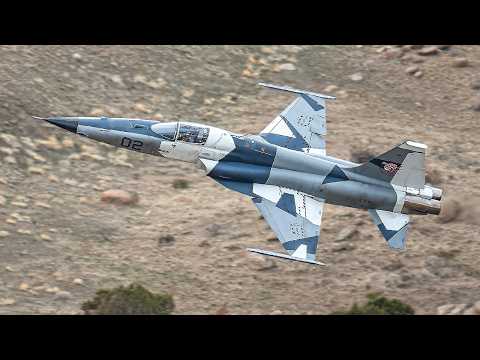
On this episode of TWZ: Special Access, Jamie Hunter visited TacAir to learn about their heavily upgraded F-5AT fighters and how they replicate enemy aircraft to keep U.S. fighter aircrews sharp.
Tactical Air Support, better known as TacAir, is a Reno, Nevada-based private ‘red air’ commercial adversary support contractor that aims to efficiently simulate enemy capabilities to better prepare U.S. and allied aircrews for future conflicts. They support all branches in various training and testing events, but they’re most known for the contract they fulfill out of NAS Fallon in Nevada, where Topgun is based and where air wings spin-up for deployments.
TacAir’s fleet is made up of ex-Jordanian and Saudi F-5E/Fs airframes that have been equipped with tailored upgrades to create a “4th generation adversary platform with 3rd generation economy,” as described by the company. The latest configuration includes an AESA radar, datalink, Garmin wide-area display open architecture avionics, Scorpion helmet mounted display, and internal IRST. You can read more about TacAir and their F-5ATs here: https://www.twz.com/category/tac-air
Watch the full video here:
Private F-5 Adversary Jets Taking The Fight To Navy Fighter Pilots
Pakistan’s Naseem Shah under fire for slamming politician’s presence at start of closed-doors PSL game in Lahore.
Published On 28 Mar 202628 Mar 2026
The Pakistan Cricket Board has attacked fast bowler Naseem Shah for criticising a politician’s presence at the start of the opening game of the Pakistan Super League, which is being played behind closed doors.
Fans are barred from attending games at the country’s premier domestic tournament, which was originally scheduled for six venues but now reduced to just two — Lahore and Karachi.
Recommended Stories
list of 3 itemsend of list
The Middle East conflict has resulted in exorbitant fuel hikes in the region, and Pakistan’s government is urging people to restrict travel and to work from home.
Chief Minister of Punjab Maryam Nawaz was invited to Lahore’s Gaddafi Stadium on Thursday, along with other dignitaries, and was introduced to officials of the eight franchises and players ahead of the opening game of the tournament between defending champion Lahore Qalandars and first-timers Hyderabad Kingsmen.
Shah commented on a tweet about the opening game by the PCB, with the bowler saying on X, “Why is she treated like the queen at Lord’s?” in an apparent reference to Nawaz’s presence at the stadium. He deleted the post soon afterwards and later said his account had originally been hacked.
A view inside the Gaddafi Stadium, where the opening cricket match of the Pakistan Super League between Lahore Qalandars and Hyderabad Kingsmen took place without spectators [KM Chaudary/AP]
The PCB said in a statement that Shah had been issued a notice for violating the terms of his central contract as well as media policy and regulations.
“The show-cause notice has been served in accordance with the PCB’s disciplinary framework,” the PCB said. “Naseem Shah is required to provide a response within the stipulated time. Upon receipt and review of his response, the PCB will decide on any further action in line with the regulations.”
Last year, Pakistan all-rounder Aamer Jamal was slapped with a fine of $4,000 for displaying a slogan in favour of cricket great Imran Khan, Pakistan’s imprisoned former prime minister.
Shah is scheduled to play for new PSL franchise Rawalpindi Pindiz in Saturday’s game against Peshawar Zalmi, led by former Pakistan all-formats captain Babar Azam.
Shah, a right-arm fast bowler, has taken a total of 152 wickets while representing Pakistan in 20 Test matches, 34 one-day internationals and 37 T20 games.
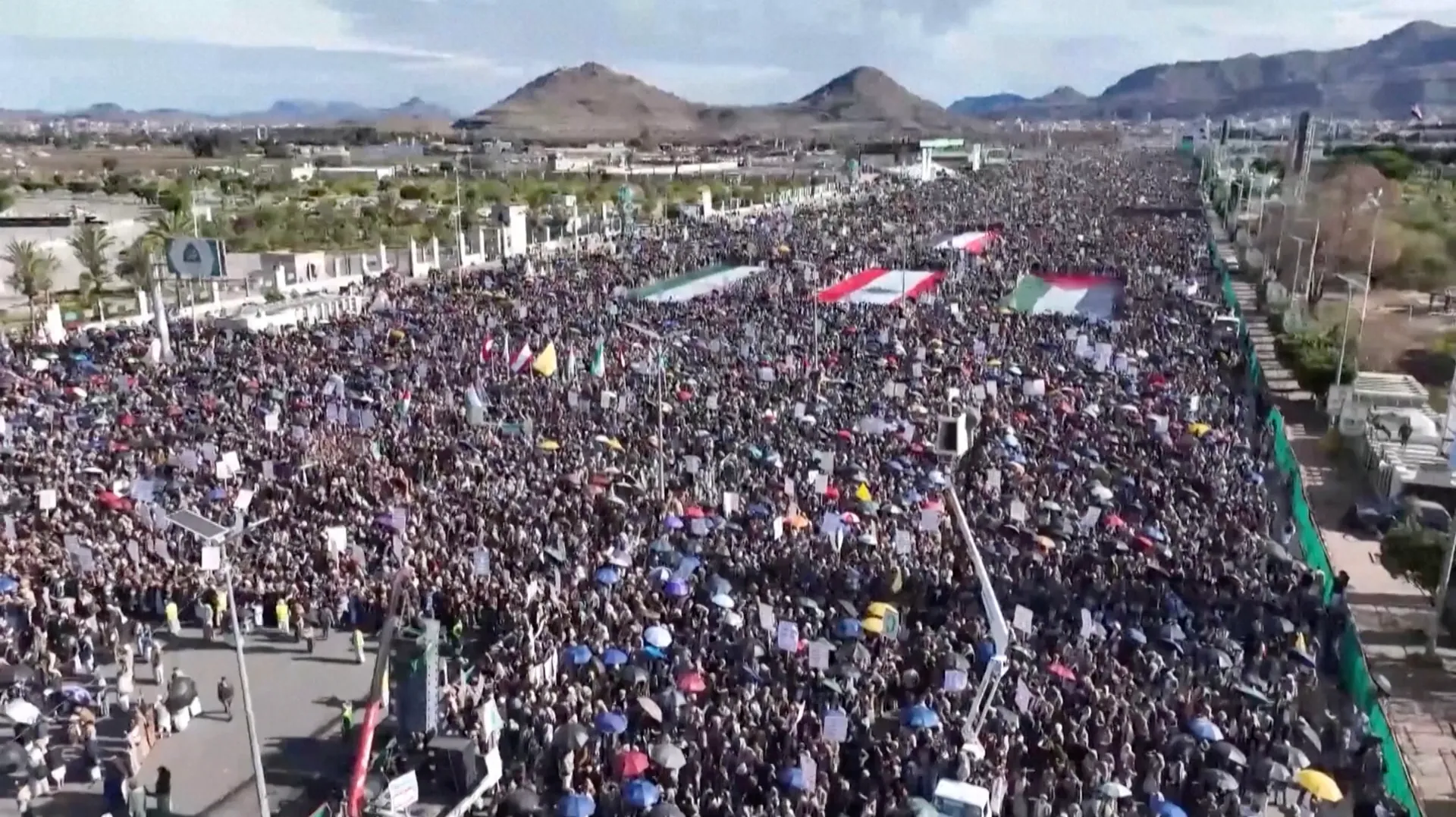
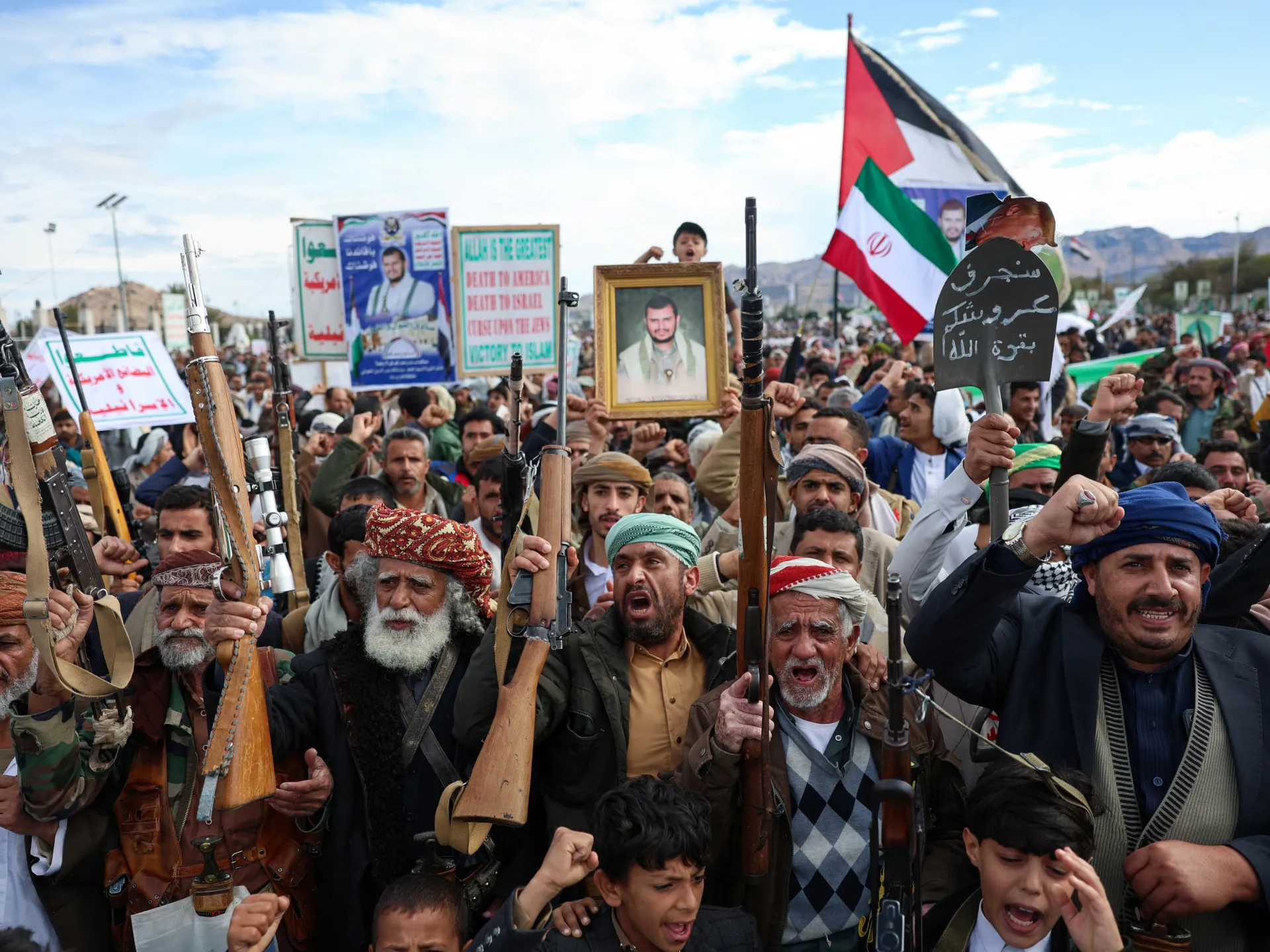
Protesters in Yemen took to the streets to voice support for Iran, Palestine, and Lebanon amid ongoing US and Israeli attacks. Houthi representatives expressed their readiness to intervene militarily.
Four weeks into the war on Iran, the White House continues to confuse the public and the press with constant pivots and contradictions.
Now the administration faces even more pressure as many of its own supporters have started to turn against it. This war has split up the MAGA movement, with an intriguing debate currently happening outside the mainstream and in the midst of their own media sphere.
Contributors: Jamal Abdi – President, National Iranian American Council Jude Russo – Managing editor, The American Conservative Ben Lorber – Senior research analyst, Political Research Associates
On our radar
This week, the Israeli parliament approved the first vote on a bill that introduces a mandatory death penalty by hanging. This applies to any Palestinian convicted of killing Israelis in attacks defined as “terrorism” or motivated by “hatred”. Ryan Kohls reports on how this bill has been promoted in the media.
Memes, trash talk and AI – the online war between Washington and Tehran
The propaganda war in the ongoing war on Iran has taken a new form.
Beyond the traditional tactics, both the US and Iran are increasingly using memes and trash-talk mockery of the adversary through AI-driven animations, designed with virality in mind. We look at the strategies behind the different messaging coming out of Washington, Tel Aviv and Tehran.
Featuring: Meredith Clark – Professor, University Of North Carolina Roger Stahl – Documentarian and author, Militainment, Inc. Marc Owen Jones – Associate professor, Northwestern University In Qatar
Tensions continue to rise with Iran warning a ‘heavy price’ will be paid after Israeli attacks on nuclear and industrial sites.
Published On 28 Mar 202628 Mar 2026
President Donald Trump said he is “very disappointed” with NATO’s response to the United States-Israeli war on Iran, accusing the alliance of failing to support Washington despite years of US military spending on its allies.
Meanwhile, Iran warned a “heavy price” will be paid after Israeli attacks on nuclear and industrial sites, with Tehran accusing the US and Israel of “playing with fire” by targeting energy infrastructure. Iran also said there was no radioactive leak following attacks on two nuclear facilities.
The warnings come as fighting and tensions continue to escalate across the Middle East, with growing fears of a wider conflict.
Here is what we know:
In Iran
Israel hits Tehran: Israel’s military said it launched attacks on Iranian “regime targets” early Saturday.
Hopes for Iran talks this week: US envoy Steve Witkoff said he expects meetings with Iran “this week” and is waiting for Tehran’s response to a 15-point peace plan.
Iran pledges “heavy price” for plant strikes: Iran’s Foreign Minister Abbas Araghchi said Tehran would exact a “heavy price for Israeli crimes” after attacks on nuclear sites and two of the country’s largest steel factories.
Iran feels “forced” into talks: Al Jazeera’s Mohamed Vall, reporting from Tehran, said many Iranians believe they are being pushed into negotiations that are not in their favour, with the sense that “the Americans are bombing their way towards a negotiation table.” Rather than relying on US or Israeli promises, he said Iran is relying on “its missiles, its drones, and the resolve of its soldiers”.
Russia likely aiding Iran with satellite intelligence: Al Jazeera’s Mansur Mirovalev reported Iran is likely receiving data on US military assets from Russia’s Liana spy satellite system, according to a space programme expert.
War diplomacy
Trump criticises NATO over Hormuz: Trump said NATO allies “weren’t there” when asked to help secure the Strait of Hormuz, despite the US spending “hundreds of billions” protecting them. “I’ve always said NATO is a paper tiger. And I always said we help NATO, but they’ll never help us.”
Possible Pakistan meeting: Turkiye said talks with Pakistan, Saudi Arabia, and Egypt could take place in Pakistan this weekend as Islamabad mediates between Iran and the US.
UN nuclear watchdog urges “restraint”: The International Atomic Energy Agency repeated its call for “restraint” in the Middle East war after Israel struck two Iranian nuclear facilities, including a uranium processing plant.
“Regime change” unlikely: The war is unlikely to lead to “regime change” in Iran, said German Chancellor Friedrich Merz. “If that’s the goal, I don’t think you’ll achieve it. It’s mostly gone wrong” in past conflicts, he said, pointing to the Afghanistan war.
In the Gulf
Saudi Arabia intercepts missile: Saudi Arabia said it “intercepted and destroyed” a missile targeting the capital Riyadh. Meanwhile, at least 12 US military personnel were wounded, including two seriously, in an Iranian attack on an airbase in the kingdom, The Associated Press and Reuters news agencies reported on Friday.
United Arab Emirates: The UAE’s Ministry of Defence reported that air defence systems and fighter jets intercepted and shot down incoming missiles and drones from Iran.
Kuwait: Though experiencing some slower nights recently, residents in Kuwait say they have grown accustomed to the disruption of alarms sounding throughout the night.
In the US
US aims to finish war in “weeks”: Secretary of State Marco Rubio said Washington expects to complete its Iran war objectives in the “next couple weeks”, leaving Iran “weaker”.
US soldiers wounded: More than 300 American soldiers have been wounded since the start of the war on February 28, US Central Command said.
In Israel
Direct attacks: Israel continues to face significant incoming fire on multiple fronts. Iran launched a missile salvo that struck a busy commercial street in Tel Aviv.
Man killed: Israeli emergency responders said a man was killed in Tel Aviv on Friday, and several others were wounded across the country after the military reported missiles fired from Iran.
In Lebanon, Yemen, occupied West Bank
Houthis warn they’ll join the fight: Yemen’s Houthi rebels warned they would enter the war if attacks on Iran continue or if more countries join the conflict. The Houthis have in the past attacked shipping in the Red Sea in response to regional conflicts, but have so far not intervened in this war.
Israel expands ground war in Lebanon: Israeli troops entered Khiam and clashed with Hezbollah near Tyre as Israel pushes to create a “security zone” up to the Litani River. Hezbollah said it attacked Israeli tanks and fired at a warplane over Beirut.
Israel cites Hezbollah threat: Al Jazeera’s Rob McBride, reporting from Amman, said Israel is using the threat from Hezbollah in the north to justify expanding its ground incursion into southern Lebanon to push Hezbollah back and create a “buffer zone”.
Hezbollah escalation: Hezbollah forces have fiercely resisted the Israeli advance, claiming to have carried out 82 operations against Israeli troops within 24 hours.
West Bank violence continues: Israeli forces killed three Palestinians in the occupied West Bank, including a 15-year-old boy in Dheisheh refugee camp and two men in Qalandiya.
Oil, food, and gas crises
Strait of Hormuz: To prevent a “massive humanitarian crisis”, the United Nations has established a new task force led by Jorge Moreira da Silva. It aims to ensure ships carrying fertiliser and raw materials can safely cross the strait, warning that maritime trade disruptions could severely affect global agricultural production and humanitarian needs.
Egypt imposes business curfew: Egypt has ordered shops, restaurants, and shopping malls to close at 9pm (19:00 GMT) from Saturday, hoping to curb energy bills that have more than doubled because of the Iran war.
Overnight queues in Ethiopia: Many Ethiopians slept in their cars in hours-long queues for petrol as shortages caused by the war began to take their toll. The Horn of Africa country is particularly vulnerable as it imports all its petrol, primarily from the Gulf.
Tea stuck in Kenya: Between 6,000 and 8,000 tonnes of tea worth $24m is stuck at Kenya’s port of Mombasa because of the war, trade officials said. About 65 percent of the East African tea market has been affected by the war that began on February 28. This is happening because the war is disrupting shipping routes through the Red Sea and the Strait of Hormuz, which are key routes for trade between Asia, the Middle East and Europe.
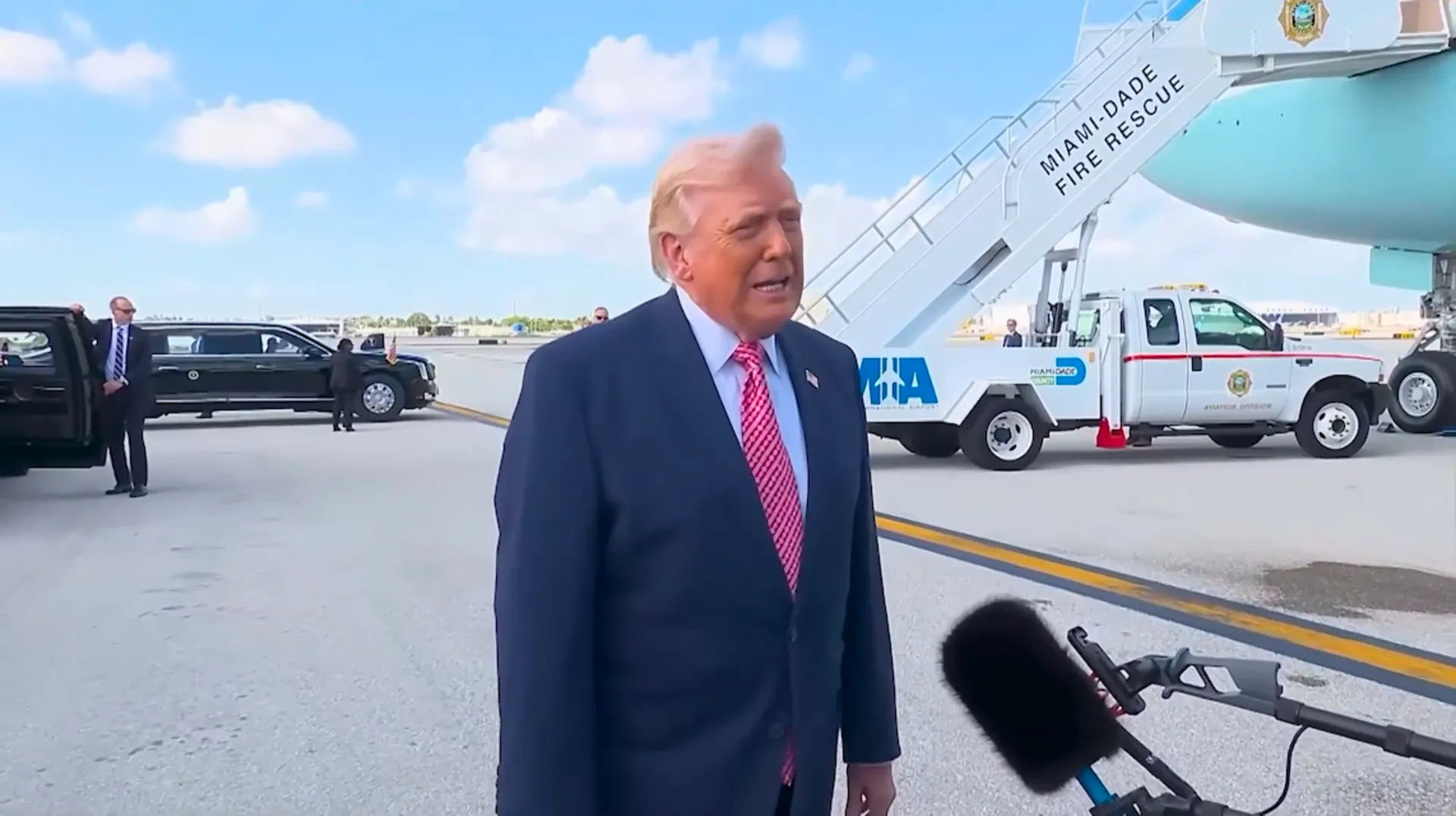
US President Donald Trump said Iran is ‘being decimated’ and signaled that talks are underway, claiming Tehran is seeking a deal while praising the strength of the the US military.
Beirut, Lebanon – It is four weeks into the United States-Israeli war on Iran, and millions of civilians are suffering in Lebanon, now facing a second large-scale Israeli attack on their country in less than two years.
About a quarter of Lebanon’s population has been displaced after Israel’s mass forced evacuation orders from the country’s south and Beirut’s southern suburbs, known as Dahiyeh.
Recommended Stories
list of 3 itemsend of list
Many of the displaced are extremely frustrated and fatigued. And even those who are not displaced are feeling the pressure, with deadly Israeli attacks continuing, petrol prices increasing, business in general slowing down, and little sign that the conflict will end any time soon.
Samiha, a Palestinian teacher who had been living near Tyre, in southern Lebanon, but recently relocated to Beirut, said the experience was “not good at all”. However, with the previous Israeli campaign in Lebanon not long ago, her family came into this round more prepared.
“It’s not the first time for us. Now we know more about where to go.” Still, she maintained, “we don’t know how long this will last and if there is a solution”.
Foreigners most vulnerable
Israel intensified its war on Lebanon again on March 2, after Hezbollah responded to Israeli attacks for the first time in more than a year.
Hezbollah – a close ally of Iran – claimed the attack was retaliation for Iranian Supreme Leader Ayatollah Ali Khamenei’s assassination two days earlier. A ceasefire between Israel and Hezbollah had ostensibly been in effect since November 27, 2024, despite the United Nations counting more than 10,000 Israeli ceasefire violations in that period, and hundreds of Lebanese deaths.
After Hezbollah’s reply, Israel intensified its attacks on the south and declared its intention to occupy southern Lebanon. Israel also issued forced evacuation orders for areas of southern Lebanon, Beirut’s southern suburbs, and a few villages in the eastern Bekaa Valley, leading to a massive displacement crisis of at least 1.2 million people, according to the Lebanese government. Now, Israel has also stated its intent to occupy southern Lebanon and set up a so-called security zone, while destroying more villages along the southern border.
The crisis has hit people who live in Lebanon severely, particularly the country’s most vulnerable people.
“The most vulnerable cases that we’re coming upon are happening, either migrant workers, either Syrians, foreign bodies, basically,” Rena Ayoubi, a volunteer who has organised aid near Beirut’s waterfront, Biel, told Al Jazeera.
She said other people who have suffered deeply in this period include: people with chronic diseases, cancer patients on dialysis, people who cannot access insulin, and displaced people who don’t have access to a fridge to store their medicine.
‘Different in scale and speed’
A series of catastrophes is unfolding, with women, children and those suffering with psychological issues suffering the most, according to a variety of sources, including aid workers, volunteers and UN workers. The humanitarian crisis in 2024 was severe, they said, but 2026 is on a whole different level.
“Now is significantly different in the scale and speed and number of people impacted,” Anandita Philipose, the UN sexual and reproductive health agency (UNFPA)’s representative in Lebanon, told Al Jazeera. “The mass evacuation orders are new. The scale of displacement is new. The fact that civilian infrastructure was targeted is new.”
Many women, in particular, have been displaced not only from their homes but from their healthcare networks, including offices or support systems that will help them through pregnancies.
“Pregnant women do not stop giving birth in the middle of conflict, and women don’t stop having periods in the middle of conflicts,” Philipose said.
Israel’s latest war on Lebanon has so far killed 1,094 people and wounded another 3,119 in Lebanon, according to the country’s Ministry of Public Health. Among the dead are 81 women and 121 children, in just over three weeks.
“Children have yet again been caught up in this escalation, Heidi Diedrich, national director of World Vision in Lebanon, told Al Jazeera. “Children are deeply affected by the violence regardless of their protected status as civilians under international humanitarian law, and regardless of their rights as children. We are deeply concerned that this escalation will continue to impact children in Lebanon for weeks or even months to come.”
Never-ending trauma
At an office building in Beirut, two volunteers sit behind desks waiting for phones to ring. The volunteers are closely monitored by clinical psychologists. On the other end are people calling in for help, many in some of their darkest moments.
This is the office for the National Lifeline in Lebanon (1564) for Emotional Support and Suicide Prevention Hotline, a collaboration between the National Mental Health Programme and Embrace, a nonprofit focused on mental health. 1564 is the phone number that people who require psychological support can dial.
“We’ve been in the worst situation for the past two years,” Jad Chamoun, operations manager at the National Lifeline 1564, told Al Jazeera from the Lifeline centre in Beirut.
“Even when there was a ceasefire, people were still living under the conditions, they were still displaced.”
Even before March 2, about 64,000 people in Lebanon were displaced, according to the International Organization for Migration. According to a March 2025 report from Lebanon’s National Mental Health Programme, three in five people in the country “currently screen positive for depression, anxiety, or PTSD”. And that was before the current intensification.
“The living conditions we’re in is a continuous trauma, because it’s never ending,” Chamoun said. Lebanon went through one of the world’s worst economic crises in 2019, which continues today. In the following years, people in Lebanon experienced the COVID-19 pandemic, the Beirut explosion, mass emigration, and now two Israeli large-scale military campaigns in short succession.
Amid the current violence, the number of calls has increased substantially, Chamoun said, from about 30 a day during 2024’s Israeli attacks to almost 50 a day now. But, he added, that the peak for calls tends to be a few months after the end of a conflict or crisis. Currently, people are in survival mode.
The cascading series of disasters and brutal Israeli aggression has left many in Lebanon near, or well past, their breaking points. Many are falling through the cracks. Volunteers and professionals at efforts like this one are doing what they can to catch as many people as they can.
“We try to sit with them in the darkness, which is what’s heavy around us. We try to share with them this pain,” Chamoun said. “And this is what’s been the heaviest nowadays.”
The Iran-aligned Yemeni group have the ability to target key shipping lanes around the Arabian Peninsula.
Published On 27 Mar 202627 Mar 2026
Yemen’s Iran-allied Houthis say they are prepared to intervene militarily if other countries join the United States and Israel in their war against Iran, or if the Red Sea is used to launch attacks on their ally.
“We confirm that our fingers are on the trigger for direct military intervention” if any new alliances join Washington and Israel against Iran and its allies, or if the Red Sea is used for “hostile operations” against Iran, the group’s military spokesperson Yahya Saree said in a televised speech on Friday.
Recommended Stories
list of 3 itemsend of list
Saree also said the Houthis were prepared to act if what he called the escalation against Iran and the “axis of resistance” continued, but did not say what form any intervention would take.
The warning raises the prospect of a broader regional war, particularly given the Houthis’ ability to strike targets far beyond Yemen and disrupt shipping lanes around the Arabian Peninsula.
The Yemeni rebel group has controlled the capital Sanaa and much of the country’s northwest since 2014.
After Israel launched its genocidal war on Gaza in October 2023, the Houthis targeted vessels in the Red Sea and carried out drone and missile attacks against Israel, saying that they are acting in solidarity with Palestinians under fire in Gaza.
Israel and the US have regularly struck the war-torn country, targeting civilian infrastructure, including residential buildings and the main international airport, while killing dozens at a time.
But in May, the Houthis and the US agreed to a truce, which included a Houthi agreement to stop attacks on US shipping in the Red Sea.
The group later stopped attacks on Israel and Israeli-linked shipping after the October Gaza ceasefire deal.
In his speech on Friday, Saree also said the group would not allow the Red Sea to be used to carry out “hostile operations” against Iran or any Muslim country.
He warned against any further tightening of what he described as “the blockade on Yemen”.
Saree called for an immediate halt to US and Israeli attacks on Iran, the Palestinian territory, Lebanon and Iraq.
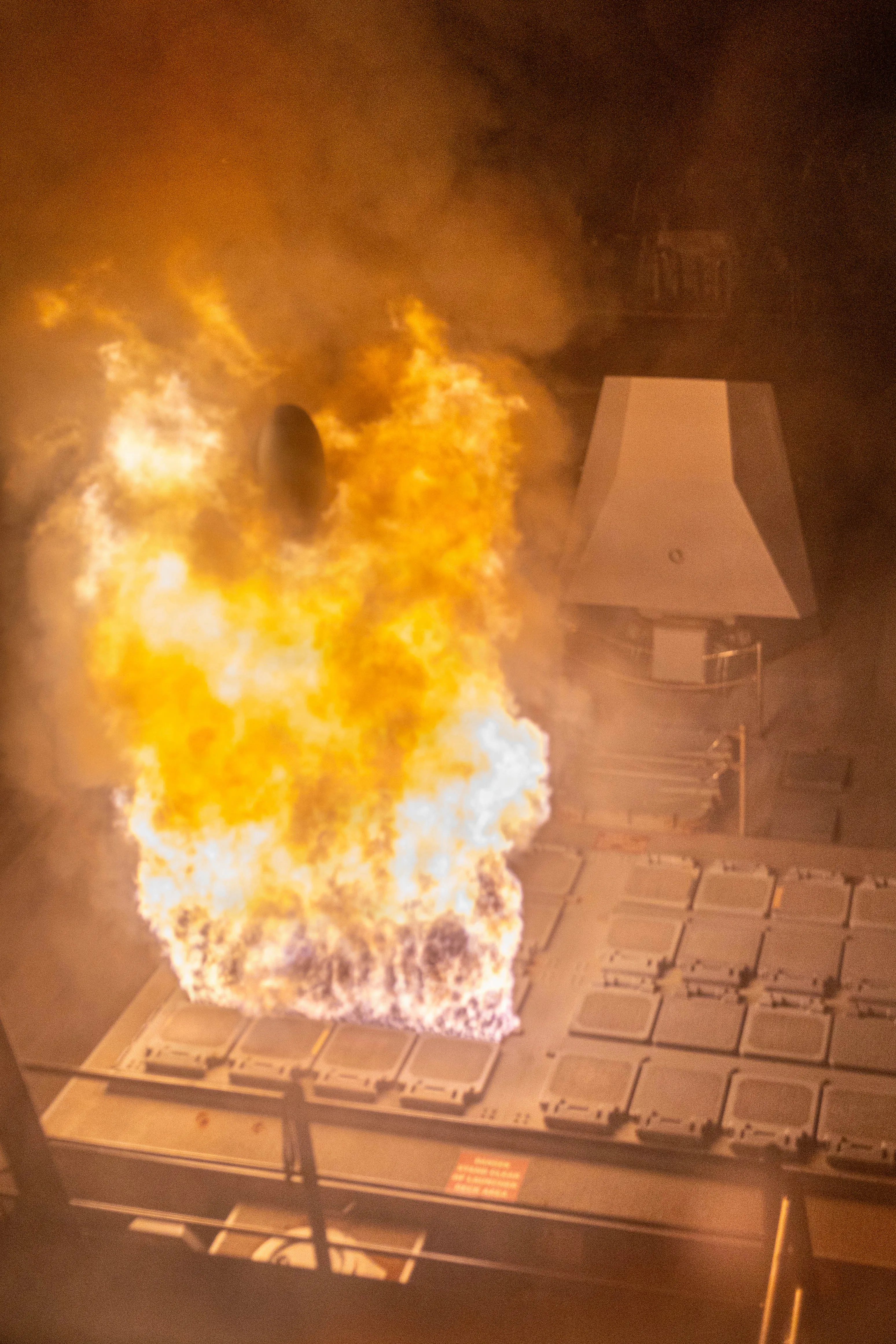
So far, the U.S. Navy has fired more than 850 Tomahawk missiles in the war with Iran, officials familiar with the matter told TheWashington Post. This has prompted discussions about how more missiles could be made available.
The Arleigh Burke class destroyer USS Bainbridge (DDG 96) fires Tomahawk missiles from the forward missile deck while underway in the Eastern Mediterranean Sea, in support of Operation Epic Fury, March 3, 2026. U.S. Navy Photo U.S. Central Command Public Affa
As it stands, only a few hundred examples of the critical long-range strike weapon are manufactured each year, meaning the global supply is limited. The exact number available to the U.S. military at any given time is a closely guarded secret, although the article suggested a higher-end figure of between 4,000 and 4,500 Tomahawk missiles on hand at the start of Epic Fury, and a lower-end figure closer to 3,000 missiles. Again, the Tomahawk would be a primary weapon system used in a conflict with China, where the target sets can range into the tens of thousands, and the country’s anti-access umbrella will require the use of standoff munitions like none other in history.
“The Pentagon has tracked the number of Tomahawks used with an increasing focus on what the burn rate will mean for not only a sustained campaign against Iran but for future military operations as well,” the report states.
I’ve posted nearly every TLAM launch video released by the DOD, major launch salvoes had continued until at least the weekend of the 14th. https://t.co/xYP9yaVySs
One official told TheWashington Post that the number of Tomahawks left in the Middle East was “alarmingly low,” while another said that without intervention, the Pentagon is closing in on “Winchester” — military slang meaning out of ammunition — for its supply of the missiles in the region.
The Tomahawk also comes with a hefty price tag: up to $3.6 million for some of the more recent versions, and each round can require up to two years to build. The Navy also faces a problem in that, in recent years, only small batches have been purchased: just 57 examples were included in last year’s defense budget.
At the same time, the Trump administration has repeatedly claimed that critical munitions stockpiles have not been dangerously depleted in the Iran war.
White House press secretary Karoline Leavitt said earlier this month that the U.S. military “has more than enough munitions, ammo and weapons stockpiles to achieve the goals of Operation Epic Fury laid out by President Trump — and beyond.”
Every indication we have seen is that for some munitions, that is not reality. The war in Ukraine and constant crisis in the Middle East have depleted those stockpiles, and many of the weapons take years to build, with finite caps on how many can be delivered in any given year. This is a story we have been covering for years. The Trump administration is working to greatly expand production of advanced munitions, but even the fruits of those efforts will take years to realize.
UPDATES:
We have concluded updates for the day.
UPDATE: 10:37 PM EST-
A missile and drone attack on Prince Sultan Air Base in Saudi Arabia has led to significant injuries to U.S. personnel. 10 American service members were wounded, two of which were seriously injured. It isn’t clear what damage was done to aircraft, but we have seen at least one tanker destroyed in recent satellite imagery. This is in addition to the attack that damaged multiple tankers and destroyed another earlier in the war.
Ten American service members were wounded in an Iranian drone and missile attack on Prince Sultan Airbase earlier today-Multiple US and Arab officials to the WSJ
“The injured service members were inside a building on the base that was struck in the attack, the officials said…At least one missile struck the base, as well as several unmanned aerial vehicles…The missile strike is at least the second to strike the base during the war… pic.twitter.com/bI5MrwmEDE
Trump is threatening to abandon NATO after member nations did not pitch in with opening the Strait:
NOW – Trump suggests the U.S. may abandon NATO countries: “We would’ve always been there for them [NATO], but now based on their actions I guess we don’t have to be.” pic.twitter.com/NKgO72FUvf
As expected, the USS George Washington and its strike group are deploying to the Middle East:
New: The USS George H.W. Bush aircraft carrier will deploy to U.S. Central Command’s area of responsibility, the major combatant command overseeing American military operations against Iran, sources told @JimLaPorta@ellee_watson and me. @CBSNews
Reuters is reporting that Arab states in the Gulf are urging the United States to ensure that any deal with Tehran should do more than end the war. Instead, it must ensure Iranian missile and drone capabilities are “permanently curbed” and that Iran will never again be able to “weaponize” global energy supplies. The agency cites four unnamed Gulf sources.
Meanwhile, it appears that Qatar, Oman, and Kuwait are prioritizing a quick end to the war, while the UAE, Saudi Arabia, and Bahrain are more willing for the fighting to continue, if their longer-term aims are met in any deal to end the war.
Qatar, Oman and Kuwait are pushing behind closed doors for a swift end to the war. The UAE, Saudi Arabia and Bahrain say they are ready to absorb an escalation of the war and will not accept a post-war Iran that is still able to use the Strait of Hormuz as a bargaining chip. https://t.co/LI26CkM40E
The Iranian foreign minister, Abbas Araghchi, has confirmed that Israel struck two of its most important steel production facilities, as well as nuclear sites — presumably including the Khondab Heavy Water Complex (see previous updates).
Araghchi said that Friday’s strikes contradicted President Donald Trump’s pledge to postpone attacking Iran’s energy infrastructure for 10 days after he claimed talks were “going well.” He further said that Tehran would exact a “heavy price” for the attacks.
Iran’s Foreign Minister Abbas Araghchi:
Israel has hit 2 of Iran’s largest steel factories, a power plant and civilian nuclear sites among other infrastructure. Israel claims it acted in coordination with the U.S.
Attack contradicts POTUS extended deadline for diplomacy.
Saudi Arabia wants the U.S. military to ramp up its attacks on Iran, according to a Saudi intelligence source, and the kingdom is meanwhile reportedly also considering joining the fight directly, alongside the United States and Israel. Whether or not Saudi Arabia also starts launching strikes against Iran remains to be seen, but it is the clearest indication so far that the kingdom might become more deeply involved in the conflict, at least at some level.
A Saudi intelligence source confirmed to The Guardian that Riyadh was urging the United States to both continue and intensify the military campaign against Iran. The same source confirmed similar reporting in The New York Times, which states that Saudi Arabia’s de facto leader, Crown Prince Mohammed bin Salman, had called upon Trump to not curtail Operation Epic Fury, and that the U.S.-Israeli campaign represented a “historic opportunity” to remake the Middle East.
U.S. President Donald Trump meets with Crown Prince and Prime Minister Mohammed bin Salman of Saudi Arabia during a bilateral meeting in the Oval Office of the White House on November 18, 2025. Photo by Win McNamee/Getty Images Win McNamee
Earlier this week, Trump told journalists that the crown prince is “a warrior. He’s fighting with us.”
At this point, however, there are no reports of active Saudi military involvement in the conflict, but the kingdom is now at least weighing up that option, if peace efforts fail.
This week, The Wall Street Journal and Jerusalem Post both reported that Saudi Arabia has decided to open up additional military bases for the use of the U.S. military in its operations against Iran. Reportedly, the facilities include King Fahd Air Base in Taif in western Saudi Arabia.
If Saudi Arabia were to begin strikes on Iran, the powerful Royal Saudi Air Force fleet of F-15 Eagles would likely figure prominently. These examples are taxiing at King Faisal Air Base, in the Kingdom of Saudi Arabia. U.S. Air Force photo by Senior Airman Leala Marquez Senior Airman Leala Marquez
Saudi Arabia has come under direct Iranian attack since the start of Epic Fury, including a drone strike last week on the oil refinery in Yanbu on the Saudi Red Sea coast.
At the same time, Saudi oil exports are not as vulnerable as those of other countries in the region, so it has not suffered to the same degree as other Gulf states. Much of Saudi Arabia’s oil exports are carried by a pipeline to the Red Sea, purposefully avoiding the Strait of Hormuz.
There is also the threat that the Iran-backed Houthis in Yemen, which have long waged a separate war with Saudi Arabia, could be drawn into the current conflict if the Saudi position changes.
Were that to happen, the vital Red Sea oil pipeline could become a very prominent target for Iran and the Houthis.
Iran’s Islamic Revolutionary Guard Corps (IRGC) declared today that shipping “to and from ports of allies and supporters of the Israeli-American enemies” is prohibited through any corridor or to any destination, Iranian state media reported.
The IRGC added that the Strait of Hormuz remains closed and any attempted transit through the strategic waterway will face “harsh measures.”
There have been reports today of three container ships of various nationalities turning back from the Strait of Hormuz, after warnings were issued by the IRGC Navy.
IRGC:
This morning, following the lies of the corrupt president of America regarding the openness of the Strait of Hormuz, three container ships of different nationalities moved toward the designated corridor for the transit of ships with permits, which were turned back with a… pic.twitter.com/uIvDmzpBQJ
Following COSCO’s announcement to resume booking acceptance to Gulf destinations, new developments overnight suggest the situation in the Strait of Hormuz remains highly unstable.
As we reported in our previous rolling coverage, Trump threatened last Saturday that he would destroy Iranian power plants if Tehran did not reopen the Strait of Hormuz within 48 hours.
On Monday, the U.S. leader postponed his threat for five days (until Friday), citing “very good and productive conversations” with Iran on ending the war — something that Tehran has described as “fake news.”
Now, Trump is pushing that deadline back again, pausing his threat to attack Iran’s energy infrastructure for 10 days until April 6, claiming that the request came from Tehran and that talks were going “very well.”
At the same time, there are suggestions that the Iran war, in general, may be of diminishing interest to the U.S. president.
“[Trump] is getting a little bored with Iran,” a senior White House official told Jake Traylor of MS NOW. “Not that he regrets it or something — he’s just bored and wants to move on.”
There are suggestions of something of a rift between Israel and the United States, as to the course the conflict should take.
According to Israeli journalist Barak Ravid, U.S. Vice President JD Vance had a “difficult” call with Israeli Prime Minister Benjamin Netanyahu earlier this week.
Reportedly, Vance said that Israeli assessments for toppling the Iranian regime were not realistic enough, saying, “You were too optimistic in your assessments regarding the overthrow of the regime in Iran.”
According to Barak Ravid, U.S. Vice President JD Vance had a difficult call with Israeli Prime Minister Benjamin Netanyahu on Monday where he said that Israeli assessments for toppling the Iranian regime were not realistic enough, saying “You were too optimistic in your… pic.twitter.com/KfEuGbUkzt
As we reported earlier this week, F-35Cs from the U.S. Marine Corps are the latest fighters poised to deploy to the Middle East region for Operation Epic Fury. The movement of these aircraft to RAF Lakenheath in England signals what is set to be the first land-based combat deployment for the F-35C, the carrier variant of the Joint Strike Fighter flown by both the Navy and Marine Corps. We now have some better imagery of the first visit of these aircraft to a base in the United Kingdom.
🇺🇸 The Tomcats / VMFA-311
Four Lockheed Martin F-35Cs of Marine Fighter Attack Squadron 311 (VMFA-311) based at MCAS Miramar departed RAF Lakenheath on the 26th March as MAZDA 31-34.
This is the first time ever that F-35Cs have visited the United Kingdom.
The United Arab Emirates has told allies that it would participate in a multinational maritime task force intended to reopen the Strait of Hormuz, as it pushes to form a coalition to ensure shipping can pass through the vital waterway, the Financial Timesreports.
According to the FT, the UAE has told the United States and other Western nations that it would take part, and that Abu Dhabi would deploy assets from its own navy.
Like Saudi Arabia, the UAE is taking a harder line on Iran, as it comes under regular attack by Tehran’s retaliation strikes.
The same report also states that the UAE is working on a UN Security Council resolution with Bahrain to provide any future task force with a mandate.
The UAE is pushing to form a multinational naval force to reopen the Strait of Hormuz.
It’s willing to deploy its own navy and is lobbying allies and the UN for support.
Only Bahrain has backed the plan so far, while others remain cautious.
According to an assessment from the Center for Strategic and International Studies (CSIS) in Washington, D.C., the U.S. strike campaign has settled into a “sustainable pace of bombing,” striking between 300 and 500 targets per day. U.S. forces are also now mainly using stand-in weapons, rather than more expensive standoff munitions. As a result of the “munitions transition,” the costs of running the war have been greatly reduced — although not without risk to aircraft and airmen.
“The U.S. strike campaign has settled into a sustainable pace of bombing between 300 and 500 targets per day. U.S. forces also now predominantly use far less expensive, short-range munitions.” https://t.co/iQm636cWwO
The Pentagon is looking at sending up to 10,000 additional ground troops to the Middle East, the Wall Street Journal has reported, quoting Defense Department officials. Having more troops in the region would give Trump more military options and greater bargaining power, as he seeks to bring Tehran to the negotiating table.
House Speaker Mike Johnson has said that “it should not be necessary” for U.S. forces to invade Iran. “I think we can get this resolved without it,” he added.
House Speaker Mike Johnson tells @BretBaier, “It should not be necessary” for U.S. forces to invade Iran. “I think we can get this resolved without it.”
Secretary of State Marco Rubio has also suggested that the U.S. military will not need to deploy ground troops to accomplish U.S. objectives in the war, although he also reflected on the importance of giving Trump “maximum optionality” for any contingency.
NEW: Secretary of State Marco Rubio tells me at the airport before leaving France that the US does NOT need to deploy ground troops to accomplish its objectives in the #IranWar.
But part of the cabinet’s job is to always give President Trump maximum optionality, he adds. pic.twitter.com/oYQrmF6Fdy
So far, it seems that Iran’s new Supreme Leader, Mojtaba Khamenei, has not yet agreed to negotiations.
Should the U.S. military conduct some kind of ground operation, various energy infrastructure within the United Arab Emirates (UAE) would come under Iranian attack, with a target list published by Iran’s state-backed Fars News Agency. Designated targets include desalination plants, nuclear power plants, and other power hubs across the UAE.
Iran’s state-backed Fars News Agency has released a target list of energy infrastructure within the United Arab Emirates (UAE) that they plan to strike if the U.S. conducts a ground operation against the strategically and economically important Kharg Island or any other Iranian… pic.twitter.com/PbwM14SPIZ
The Israel Defense Forces (IDF) say they carried out further strikes on targets in Tehran early on Friday. A brief military statement said Israeli forces “completed a wide-scale wave of strikes targeting infrastructure of the Iranian terror regime in the heart of Tehran.”
In a separate statement, the IDF said that it had also struck “ballistic missiles and aerial defense systems production sites across Iran.” It reported hitting missile launchers and storage sites in western Iran, as well as missile production sites in the capital. Other targets apparently included Iran’s primary facility for the production of naval cruise missiles and sea mines in Yazd, Iran.
“The site was used for the planning, development, assembly, and storage of advanced missiles intended for launch from cruise platforms, submarines, and helicopters toward both mobile and stationary maritime targets,” the IDF said.
🎯🌊 STRUCK: Iranian Regime’s primary facility for the productions of missiles and sea mines in Yazd, Iran
The site was used for the planning, development, assembly, and storage of advanced missiles intended for launch from cruise platforms, submarines, and helicopters toward…
The latest round of U.S.-Israeli strikes hit a heavy water reactor in central Iran, Iranian media reported today.
“The Khondab Heavy Water Complex was targeted in two stages by aggression from the American and Zionist enemy,” the Fars News Agency reported, citing Hassan Ghamari, an official in the central Markazi province. Fars and other media said there were no casualties or radiation leaks from the site.
The facility is intended to produce the heavy water used to cool nuclear reactors. As a byproduct of this process, plants of this kind also produce plutonium, which can potentially be used in nuclear weapons. This would offer another route to procuring a nuclear warhead, other than enriched uranium.
There are reports out of Iran that recent U.S. and Israeli airstrikes targeted key steel production facilities. The semi-official Iranian Mehr news outlet claims that steel plants were hit in the central Iranian city of Isfahan, with separate attacks on the Khuzestan Steel and Mobarakeh Steel factories.
In response to an inquiry from The Jerusalem Post, the Israeli military said that it was not aware of any Israeli strikes on the facilities.
Reports from Iran suggest that all three of Iran’s largest steel production plants were struck in a coordinated targeted strikes.
This could substantially affect the national steel industry and manufacturing pic.twitter.com/mmrnyDS8UX
The U.S. military has deployed uncrewed surface vessels (USVs) for patrols as part of its operations against Iran, the Pentagon has said, according to the Jerusalem Post. The specific type of drone boats that have been deployed was not reported, although this is not the first time that the U.S. military has used USVs in the region, notably in the Persian Gulf and the Strait of Hormuz.
The Iranian foreign minister, Abbas Araghchi, has accused the U.S. military of using Persian Gulf citizens as human shields.
“From outset of this war, U.S. soldiers fled military bases in GCC [Gulf Cooperation Council] to hide in hotels and offices. They use citizens as human shield. Hotels in U.S. deny bookings to officers who may endanger customers. GCC hotels should do same,” Abbas Araghchi said in a post on his X account.
IRGC:
The cowardly American and Zionist forces, who lack the courage and ability to defend their own military bases, are attempting—out of fear of the firepower of Islamic fighters—to use civilian locations and innocent people as human shields.
As we reported yesterday, Iranian bombardment of U.S. military facilities in the wider region does appear to be driving the relocation of soldiers, although there is no suggestion of a human shield policy.
According to a report from The New York Times, citing military personnel and American officials, a significant number of U.S. troops have been forced to relocate from their bases to hotels and office spaces throughout the region.
Iranian Foreign Minister Abbas Araghchi claims that since the start of the war, US troops have left military bases in the GCC to shelter in civilian spaces, effectively using residents as human shields, and urges Gulf hotels to follow US counterparts in denying accommodation to… pic.twitter.com/MJrUht8Di1
Reports in the Lebanese media suggest that an Israeli strike hit Beirut’s southern suburbs early today. Several explosions were heard in the area, which is considered a Hezbollah stronghold. Israel has previously issued evacuation warnings for the area but provided no specific warning in advance of Friday’s strike, AFPsaid.
An Israeli M109 self-propelled howitzer artillery fires rounds towards southern Lebanon from a position in the upper Galilee in northern Israel near the border on March 26, 2026. Photo by Jack GUEZ / AFP JACK GUEZ
Kuwait’s Shuwaikh port was hit by drones, causing material damage with no injuries reported, the Kuwait Ports Authority said today.
The international airport in Kuwait City also appears to have been on the receiving end of recent Iranian attacks, with a significant blaze there today, after a reported drone strike.
🔥 Fire breaks out at fuel tanks at Kuwait International Airport following an Iranian drone attack on Thursday
Iran-linked hackers today claimed they had accessed FBI Director Kash Patel’s personal email inbox, Reutersreports. The group claims to have published photographs of the director and other documents on the internet.
Satellite imagery of the Yazd missile complex, one of the most important in Iran, from earlier this month, reveals the shadow of an apparent Khorramshahr missile before being launched toward Israel. The original Khorramshahr first emerged publicly in 2017, and it is assessed to be derived, at least in part, from a North Korean design. It is a liquid-fuel medium-range ballistic missile (MRBM) with a claimed range of around 1,250 miles (2,000 kilometers).
Recent analysis from ThePrint, an Indian digital news platform, suggests that Iran has launched around 4,300 missiles and drones since the start of the current conflict, with the majority of these targeting Gulf nations, rather than Israel. The analysis states that Tehran has launched at least 1,815 drones and 372 missiles at the UAE since the start of the war. Israel, in comparison, has faced roughly 930 missile and drone attacks in the same period.
Interesting number crunching by my colleague @Keshav_Paddu
4,300 missiles & drones since day 1 of war: Gulf nations, not Israel faced brunt of #Iran’s retaliation#Israel, in comparison, has faced roughly 930 missile, drone attacks in the same period.https://t.co/WLOancpE8z
In related news, Reuters today published an assessment stating that, so far, the Pentagon can only confirm that about a third of the Iranian missile arsenal has been destroyed.
Satellite imagery from yesterday indicates that the aircraft carrier USS Gerald R. Ford has left Naval Support Activity Souda Bay in Crete, Greece, escorted by three patrol boats. The supercarrier went to Souda Bay for repairs after a fire broke out in the laundry area while underway in the Middle East on March 12, injuring two sailors.
Ukrainian President Volodymyr Zelensky says that his country has “reached an important arrangement” with Saudi Arabia on defense cooperation. The agreement between the defense ministries of the two countries is almost certain to involve counter-drone technologies and expertise.
“We are ready to share our expertise and systems with Saudi Arabia and to work together to strengthen the protection of lives,” Zelensky wrote on X. “Now into the fifth year, Ukrainians are resisting the same kind of terrorist attacks — ballistic missiles and drones — that the Iranian regime is currently carrying out in the Middle East and the Gulf region. Saudi Arabia also has capabilities that are of interest to Ukraine, and this cooperation can be mutually beneficial.”
We have reached an important Arrangement between the Ministry of Defense of Ukraine and the Ministry of Defense of the Kingdom of Saudi Arabia on defense cooperation. The document was signed ahead of our meeting with the Crown Prince of Saudi Arabia, Mohammed bin Salman Al Saud.… pic.twitter.com/j3aXzLXSNr
— Volodymyr Zelenskyy / Володимир Зеленський (@ZelenskyyUa) March 27, 2026
Police are charging professional golfer Tiger Woods with driving under the influence for a second time after he rolled his Land Rover SUV near his Florida home.
Donald Trump touted the US-Israel war on Iran as “bold” and “historic,” telling a Saudi investment conference that the Middle East will soon be free from Iranian “nuclear blackmail.”