Stay informed and up-to-date with the latest news from around the world. Our comprehensive news coverage brings you the most relevant and impactful stories in politics, business, technology, entertainment, and more.
When a state’s political leadership announces a ceasefire and its military keeps firing, the instinct is to reach for deception as the explanation. In Iran’s case, the more unsettling answer may be structural. The gap between what Iranian presidents say and what Iranian forces do reflects not a coordinated lie but a command architecture deliberately engineered to operate without central direction. In a serious conflict, the consequences of that architecture would be felt well beyond Iran’s borders.
A Command Architecture Designed to Survive Decapitation
In September 2008, IRGC Commander General Mohammad Ali Jafari oversaw a sweeping restructuring that divided the force into thirty-one provincial corps, each empowered to conduct military operations within its zone without requiring authorization from the center. As Michael Connell of the Center for Naval Analyses noted in his analysis for the United States Institute of Peace, the intent was to strengthen unit cohesion and ensure operational continuity under degraded command conditions. He flagged explicitly that the decentralization could produce unintended escalation dynamics, particularly in the Persian Gulf.
That warning deserves serious attention. The IRGC’s Mosaic Defense doctrine was not designed to make Iran more responsive to political leadership in a crisis. It was designed to ensure that military operations could continue regardless of what happened to that leadership. A force structured that way does not stop firing because a president gives a speech.
The Apology That Wasn’t
The internal contradiction becomes clearest when traced through a hypothetical cascade. A president announces a ceasefire and attributes the directive to an Interim Leadership Council. A fellow council member publicly declares that heavy strikes will continue. A hardline cleric addresses the president directly, calling his position untenable. By the time the president’s original statement is reposted, the ceasefire language has been quietly removed.
The IRGC’s own posture in this scenario resolves the ambiguity on structural grounds. It endorses the president’s language, then appends a caveat that renders it inoperative: all US and Israeli military bases and interests across the region remain primary targets. Since every GCC state hosts American forces, that framing preserves full operational freedom while allowing the presidency to project restraint. The contradiction is not incidental. It is the doctrine functioning as designed.
The Theological Dimension
Iran is not simply a military organization. It is a theocratic state whose constitutional legitimacy flows from velayat-e faqih, the guardianship of the Islamic jurist, which vests supreme authority in a single clerical figure whose religious and political mandates are inseparable. Remove that figure, and the system’s legitimating architecture is suspended rather than transferred. The Assembly of Experts is constitutionally mandated to elect a successor, but wartime conditions would disrupt that process at precisely the moment its resolution matters most.
A RAND Corporation analysis prepared for the Office of the Secretary of Defense identified the IRGC as the institution best positioned to shape any post-Khamenei transition, with the organizational reach and economic weight to determine outcomes that civilian institutions cannot contest. The result, in a decapitation scenario, is a theocratic state operating without its theological anchor and a military operating under pre-delegated authority with no one capable of recalling it.
Durability Without Effect
The Mosaic Defense doctrine would prove, above all, durable. A decentralized force can survive catastrophic leadership losses and sustain operations. But durability is not the same as capability, and sustained fire is not the same as strategic effect.
Iran’s theory of regional attrition, the calculation that sustained strikes against Gulf infrastructure and American basing would fracture GCC cohesion and coerce Arab neighbors toward neutrality, has produced no evidence of working. The GCC bloc has held. Individual member states have coordinated their responses rather than fractured under pressure. The country absorbing the sharpest volume of Iranian strike activity, the UAE, has demonstrated air defense performance that has exceeded even optimistic prewar assessments. Publicly available figures suggest UAE systems have defeated upward of ninety percent of inbound threats, a result that reflects years of sustained investment, deep integration with American and Israeli platforms, and an operational tempo that has stress-tested those systems at genuine scale.
The picture that emerges is not one of Iran winning a war of attrition. It is one of an Iran burning through accessible inventory, losing launch infrastructure faster than it can regenerate, and discovering that the regional architecture it spent years attempting to destabilize has proven considerably more resilient than it calculated.
That resilience carries its own strategic meaning. A weakened force operating under pre-delegated authority, without a supreme leader to set limits, remains dangerous in a narrow tactical sense. But it is operating without a coherent end state, and the environment it faces is not the one it anticipated. The GCC’s collective posture and the demonstrated effectiveness of layered air defense across the Gulf have closed off the strategic outcomes Iran’s doctrine was written to achieve.
The scenario is instructive for what it reveals about the limits of decentralized military design. A force built to keep firing regardless of political direction is also a force that cannot be steered toward an exit. But the Gulf states have demonstrated something of equal importance in response: that resilience, properly built and consistently resourced, can outlast a doctrine designed for chaos, and that the regional order Iran sought to unravel has shown itself capable of absorbing the blow.
Modern wars are fought not only with weapons but with assumptions—and the most dangerous assumptions are often invisible to those making them. Donald Rumsfeld’s distinction between known unknowns (questions we recognize but cannot answer) and unknown unknowns (risks we have not even framed as questions) captures something essential about the current confrontation between the United States, Israel, and Iran.
The Nuclear Material Problem
The June 2025 12-day war struck several of Iran’s nuclear facilities but left the most consequential question unanswered: where is the material? The March 2026 campaign has struck deeper, targeting hardened and dispersed sites that June’s operations left intact. Yet the fundamental uncertainty has not resolved—it has compounded. Iran reportedly retains roughly 400 kilograms of uranium enriched to 60%, approaching weapons-grade, and the precise location of that stockpile is now more opaque than before. On March 2, the International Atomic Energy Agency (IAEA) reported the entrance buildings of Iran’s underground Natanz enrichment plant had been bombed, but without inspection access, the agency cannot reconstruct a monitoring baseline.
The strategic paradox is acute. Any Iranian government—this one or a successor—must now confront a nuclear-armed Israel and a United States willing to strike Iranian territory twice in nine months. Under those conditions, nuclear capability looks less like a provocation and more like a rational insurance policy. The war may have permanently entrenched the very incentive it was designed to dismantle. A further risk of escaping conventional arms-control frameworks is if Iranian institutions fragment, specialized nuclear expertise disperses internationally, potentially becoming available to states or non-state actors.
Regime Change and What Follows
The war’s stated objective rests on uncertain ground. Intelligence assessments before the conflict reportedly concluded that even a large-scale assault was unlikely to produce regime collapse—yet the campaign proceeded anyway. The Iranian state has shown remarkable institutional resilience, with no visible defections among senior leadership, a government operating under its constitutional framework, and a regime that has absorbed the Iran-Iraq War, the Green Movement, and decades of sanctions.
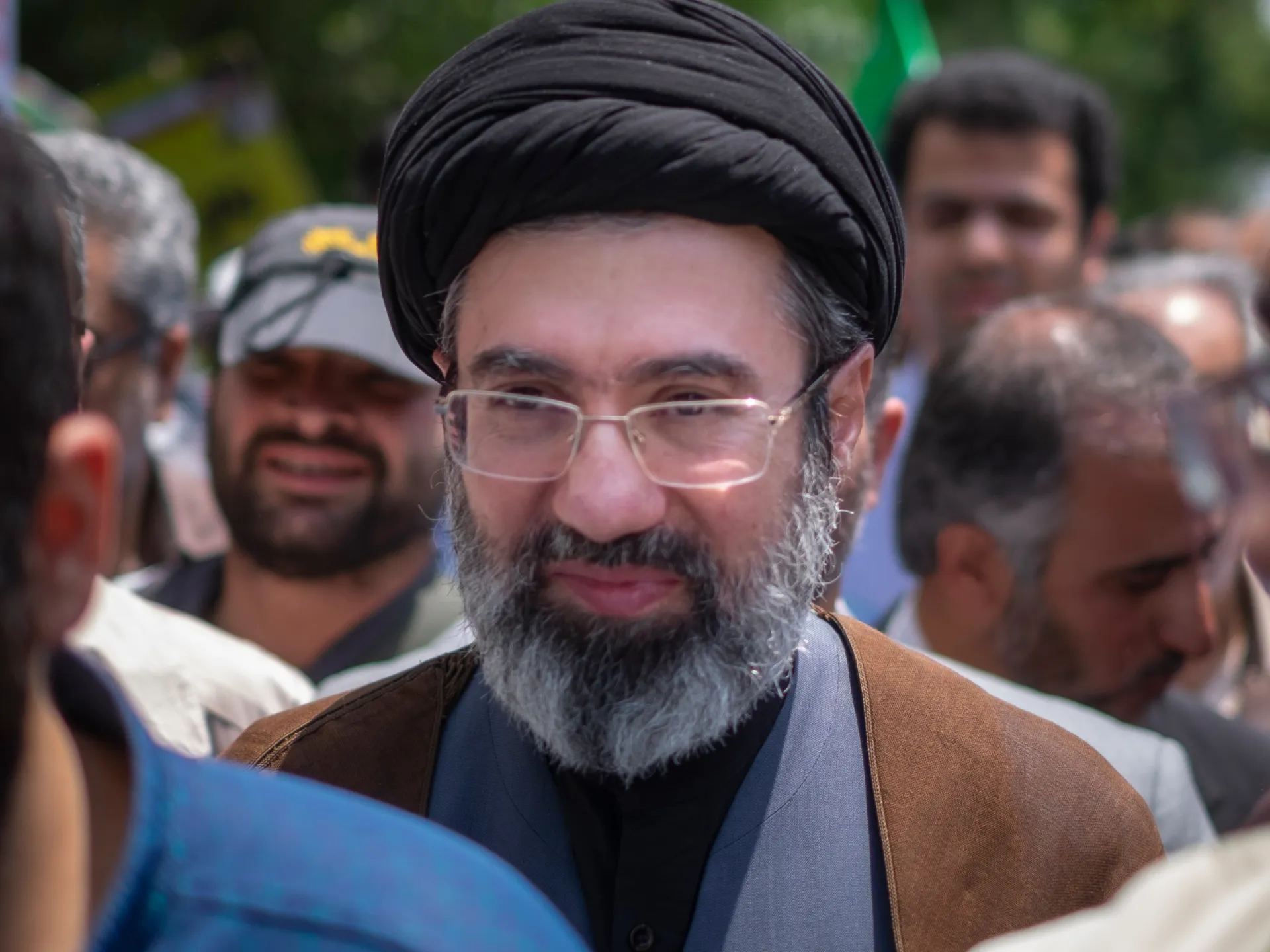
War has accelerated the succession question around Ali Khamenei. One trajectory involves Mojtaba Khamenei, whose rise would mean dynastic continuity rather than transformation; another sees the IRGC consolidating power—equally misaligned with Western hopes. The question of what comes after was not answered before the bombs fell.
Retaliation, Major-Power Shadows, and Strategic Incoherence
Iran’s retaliation has demonstrated its asymmetric reach. The IRGC claims attacks on at least 27 bases hosting American troops across the region, alongside Israeli military facilities. Tehran appears to be pacing its response, sustaining an attrition campaign designed to exhaust interceptor stocks rather than overwhelm them in a single strike.
The major power dimensions compound this. Russia has reportedly been providing intelligence on American naval deployments; Chinese-linked entities have allegedly tracked US forces via satellite. Meanwhile, strategic incoherence in Washington compounds every other risk. Vice President J.D. Vance and Secretary of Defense Pete Hegseth have framed this as a limited campaign against nuclear infrastructure; Trump has simultaneously floated regime change on social media.
The Munitions Race
The deepest structural vulnerability may not lie on the battlefield but in the arithmetic of an industrial system never designed to fight this kind of war. The first 36 hours consumed more than 3,000 precision-guided munitions and interceptors. Joint Chiefs Chairman General Dan Caine had warned that stockpiles were already significantly depleted before the first strike. Secretary Marco Rubio subsequently acknowledged that Iran produces an estimated 100 missiles a month versus roughly six or seven high-end interceptors that American industry can manufacture in the same period.
The drone dimension adds a layer officials have been slow to acknowledge. Hegseth and Caine admitted in a closed-door briefing that Iran’s Shahed drones present a challenge US air defenses cannot fully meet. The Shahed flies low and slow—hard to detect and poorly matched to the high-end interceptors THAAD and SM-3 are optimized to defeat. Intercepting a drone can cost roughly five times what it costs to manufacture one.
The search for emergency solutions has produced one remarkable geopolitical inversion. The Pentagon has approached Ukraine about purchasing drone interceptors. They are low-cost systems Ukrainian manufacturers developed specifically to hunt Shaheds, built from years of adapting to exactly the threat now confounding American air defenses in the Gulf. The US is buying drone killers from a country it recently all but abandoned! The implications extend to the Indo-Pacific. Every interceptor fired over the Gulf of Bahrain is one fewer available in the Taiwan Strait.
The Energy Shock
The Strait of Hormuz has moved from a textbook chokepoint to a live emergency. Tanker traffic has come to a near standstill. War-risk insurance premiums have made commercial passage unviable even where it remains physically possible. At least five tankers have been struck across the Gulf, the Gulf of Oman, and nearby waters. Approximately 20 million barrels of oil per day—a fifth of global consumption—normally transit the strait, alongside roughly 20% of global LNG trade. Traders are warning that oil prices could surge past $100 a barrel if the conflict in Iran continues to escalate. Goldman Sachs Research estimates that a full one-month closure would add $15 per barrel, assuming no compensating measures like spare pipeline utilization or releases from strategic petroleum reserves. Bank of America sees tail risk far higher, estimating a prolonged shutdown could add $40–$80 per barrel above current prices.
The LNG dimension may prove more immediately damaging than oil. QatarEnergy has halted production at Ras Laffan, the world’s largest LNG facility, after Iranian drone attacks. This has already caused European natural gas futures to spike. If global LNG tightens, Europe must compete with Asian buyers on price. That competition may, in turn, force Europe back toward Russian gas, quietly reversing one of the most consequential geopolitical achievements of the post-Ukraine sanctions era.
The fertilizer dimension compounds the energy shock with a slower fuse. Nitrogen fertilizers are manufactured from natural gas; roughly a third of globally traded urea transits Hormuz. QatarEnergy’s halt removes fertilizer output simultaneously with LNG. Urea prices have already surged $60 to $80 per ton at New Orleans, with the spring planting window closing. The food-price consequences will not appear in grocery stores for months. But they are already locked in.
The Gulf Security Paradox
For decades the Gulf states managed their rivalry with Iran below the threshold of open confrontation, relying on the American security umbrella while avoiding direct entanglement. The war has collapsed that strategy. The Gulf states did not arrive at this crisis as Iran’s adversaries but rather as reluctant bystanders who had invested enormous diplomatic capital in preventing it. They gave ironclad assurances to Tehran, both before the war and up to its eve, that their territories would not serve as launchpads. That Iran responded by striking these same neighbors is a strategic miscalculation of historic proportions and a moral failure that may poison relations for a generation.
This has opened a structural debate now conducted in public. Is American military presence a protective shield or a magnet for retaliation? Citizens and analysts are asking why Gulf states should bear the risk of hosting US forces when Washington appears unable to protect them. Undoubtedly, Tehran understands this dynamic. Drone strikes on UAE-based data centers targeted Gulf publics’ confidence in the connectivity model as much as American commercial interests. The UAE and Saudi Arabia have staked their post-oil futures on projecting stability and attracting mobile capital. Intercepting most of the incoming fire is not sufficient when global firms are deciding where to invest next decade.
The crisis confronts the Gulf Cooperation Council with a strategic fork. One path leads toward deeper collective security, featuring integrated missile defense, expanded intelligence sharing, and coordinated maritime protection that could reduce dependence on any single external patron. The other leads toward renewed fragmentation as internal rivalries re-emerge.
Former Qatari prime minister Hamad bin Jassim bin Jaber Al Thani warned that the Gulf “must not be dragged into a direct confrontation with Iran,” arguing that such a clash would “deplete the resources of both sides and provide an opportunity for outside forces to control us under the pretext of helping us escape the crisis.” Yet the same crisis that could finally catalyze genuine Gulf collective security could just as easily deepen the divisions that have historically prevented it.
The Mediator’s Dilemma and the Meta-Unknown
The conflict has also damaged the diplomatic architecture that previously helped manage US-Iran tensions. Oman and Qatar built genuine credibility as intermediaries through years of patient back-channel work. Effective mediation requires neutrality. When conflict spreads into the territory of potential mediators, that credibility erodes. Iran’s decision to strike the very states whose neutrality made diplomacy possible may have burned the bridges needed to end the war—which is perhaps the most consequential unknown unknown in the entire conflict, second only to the US twice striking Iran in the span of nine months while negotiations were still ongoing.
At the deepest level lies a question no intelligence assessment can answer: whether the strategic logic of the war is coherent at all. Negotiations failed because each side demanded outcomes the other could not accept. The same incompatibility that made diplomacy impossible may make military victory equally elusive. Iran cannot surrender unconditionally without ceasing to be the Islamic Republic. And the conditions that make nuclear deterrence attractive to any Iranian government—this one or a successor—have not been removed by the strikes; they have been reinforced.
Conclusion
In sum, the US-Israeli campaign against Iran has illuminated the limits of military certainty. Known unknowns—munition shortages, asymmetric retaliation, and energy vulnerabilities—interact with unknown unknowns—nuclear dispersal, regime succession, and Gulf fragmentation—to create a conflict whose trajectory is inherently unpredictable. Rather than eliminating threats, the strikes may have entrenched incentives for nuclear retention, incentivized strategic caution, and stressed regional and global systems. The coherence of the war itself is in question, as military action and diplomacy pull in contradictory directions. Ultimately, the conflict underscores that modern warfare is as much about managing uncertainties as it is about destroying targets.
The reported idea of a special operation to seize Iran’s uranium should alarm anyone who still thinks there is a line between pressure and recklessness. Sending foreign forces into Iranian territory to capture nuclear material would be far beyond coercion. It would be war in plain sight. That risk looks even sharper when it is paired with talk of unconditional surrender and a revived maximum pressure campaign. Officials call that flexibility. In practice, it often creates confusion and a dangerous illusion of control.
Strategic Ambiguity Has Limits
Trump has long preferred threat inflation as a negotiating tool, and his administration’s National Security Presidential Memorandum on Iran makes clear that Washington wants to deny Tehran every path to a bomb. But there is a difference between pressure meant to shape diplomacy and rhetoric that drifts toward occupation logic. A raid assumes the United States can enter a sovereign state, take possession of fissile material, and leave without igniting a larger conflict. That is not strategy. It is a gamble.
A Raid Would Not Stay Small
Iran is not an isolated militia camp. It is a large state with layered security organs, missile capacity, regional partners, and a long memory of external intervention. Any attempt to seize uranium by force would expose American troops, bases, shipping lanes, diplomats, and partners to retaliation across several fronts. Even before talk of a raid, Washington and Tehran had been engaged in indirect nuclear talks in Oman. Replacing diplomacy with a ground mission would not create leverage. It would destroy what remains of a controlled bargaining space.
This is the contradiction hawks avoid. Military action may damage buildings, but it can also damage the inspection system needed to track what survives. The IAEA chief said that returning to Iranian sites was the top priority after the attacks because the agency had lost visibility. Reuters warned even before the war that any new Iran deal would have to address serious watchdog blind spots. Rafael Grossi had already reminded the Security Council that nuclear facilities must never be attacked and later stressed that inspectors must be allowed to do their job. Once oversight is broken, claims about perfect control become less credible.
Pressure Without Diplomacy Can Harden Iran
Advocates of seizure argue that urgency changes the rules. Their point is easy to grasp. If material has been moved, hidden, or split across sites, then delay is dangerous. But urgency cuts both ways. The less certainty there is, the more any raid grows in scope. A supposedly limited mission can quickly expand into repeated searches, broader strikes, and pressure for a longer presence. That trajectory sits uneasily with both the basic ban on the use of force in the UN Charter and the logic of the Nuclear Non-Proliferation Treaty, which depends on verification and compliance, not theatrical confiscation. Reuters has also shown that the damage from earlier strikes was difficult to measure and that U.S. officials later said there was no known intelligence that Iran had moved the uranium. That uncertainty is exactly why fantasies of a clean raid should be treated with suspicion.
Containment Is Less Dramatic, but Safer
There is another reason to reject this path. Public overstatement can create policy traps. Trump has already brushed aside internal caution, including when Reuters reported that he said his own intelligence chief was wrong about Iran’s program. Tehran, for its part, has insisted through officials speaking to Reuters that it will not give up enrichment under pressure. That is not a recipe for surrender. It is a recipe for concealment and hardening. Serious policy should focus on intelligence work, restored IAEA access, sustained diplomatic pressure backed by credible penalties, and a clear effort to prevent a regional war that would leave the uranium question even murkier.
The appeal of seizure is obvious. It sounds decisive and final. But nuclear crises rarely yield to cinematic solutions. They are managed through verification, containment, bargaining, and steady pressure, not through fantasies of absolute control. If this idea is truly being weighed in Washington, it should be rejected before rhetoric turns into mission planning. A ground effort to capture uranium inside Iran would not settle the problem. It could widen the war, shatter what diplomacy still exists, and leave the world with the same material, less oversight, and far more bloodshed.
Weekly insights and analysis on the latest developments in military technology, strategy, and foreign policy.
The war is now in its 10th day, and Israel and the United States continue to trade blows with Iran, with further missile and drone strikes across the Middle East. Meanwhile, the U.S. military’s ability to execute more rapid heavy airstrikes against Iranian targets was stepped up further today, with the arrival at RAF Fairford in England of three U.S. Air Force B-52H Stratofortress bombers. The aircraft are from the 5th Bomb Wing at Minot Air Force Base, North Dakota.
The bombers arrived at Fairford after U.K. Prime Minister Sir Keir Starmer approved so-called defensive U.S. actions against Iranian targets from British bases. This includes striking Iranian missile sites prior to them launching attacks.
NEW: At least three U.S. B-52 bombers have landed at RAF Fairford in the U.K., signaling preparations for potential sustained heavy bomber strikes against Iran.
11:56 HOOKY 21 flt x3 USAF B-52/H Stratofortress’s Inbound to RAF Fairford from Minot AFB(?) #HOOKY21 is proceeding inbound to RAF Fairford, #HOOKY22 will follow 10 mins behind and #HOOKY23 is unconfirmed but holding with 22. wkg Swanwick 278.600 / FOXTROT ops / A2A 323.750 pic.twitter.com/m4giROHiCV
The B-52s are part of a growing fleet of U.S. bombers at Fairford. The base received a single B-1B Lancer on Friday, and another two of the swing-wing bombers arrived on Saturday.
RAF Fairford about to get real Noisy
Barons are back in town, the first USAF B-52’s from Minot AFB 23rd BS are on the Ground at RAF Fairford.
Plenty of support flights from Ellsworth, Dyess, and Minot still to come into this fog ridden base in Gloucestershire over the next 24… pic.twitter.com/g5CEBK9DeR
As well as making use of RAF Fairford to strike Iran, the change in U.K. government policy covers Diego Garcia in the Indian Ocean. Satellite imagery from today that TWZ has reviewed via Planet Labs shows no sign of bombers on the island, but heavy transport aircraft continue to show up there, along with the handful of tankers and five F-16s currently operating from the Indian Ocean outpost.
B-52s have already flown missions against Iran from bases in the United States, delivering AGM-158 JASSM stealthy cruise missiles. These missiles would have launched from outside Iranian airspace, likely over Iraq or another friendly Arab country. You can read more about the implications of standoff strikes such as these in our previous analysis of the enduring Iranian air defense threat here.
Remains of an American AGM-158 JASSM cruise missile, reportedly downed by Iranian air defenses over Markazi Province.
USAF B-52s have been carrying out cruise missile strikes with JASSMs over the past few days. pic.twitter.com/r3Uu9WTltW
As we have discussed repeatedly in recent weeks, having the bombers forward deployed to England and/or Diego Garcia will drastically increase sortie rates and decrease wear-and-tear on the precious bomber fleet compared to flying from the U.S. and back. This will become even more relevant if the B-1 and B-52 force move from making standoff strikes to direct attacks on Iranian targets, even if just over limited parts of the country where air supremacy is more guaranteed.
LATEST UPDATES
We have concluded our rolling coverage in this piece.
UPDATE: 7:30 PM EST –
Trump held a Monday evening press conference to address the situation in the Middle East. Among other things, Trump hinted, without offering specifics, that lasers are now being used for air and missile defense. CENTCOM pushed us to the White House for more details and we are awaiting their response.
Trump also said that Iran has Tomahawk missiles, which it doesn’t.
Here are some of the key takeaways from the briefing—
On when the war will be over:
Very soon. Look, everything they have is gone, including their leadership. In fact, they have two levels of leadership. And even actually, as it turns out, more than that. But two levels of leadership are gone. Most people have never even heard about the leaders that they’re talking about….We’re achieving major strides toward completing our military objective. And some people could say they’re pretty well complete.
On the use of lasers for air and missile defense:
So as you probably saw, they had a tremendous number of missiles, most of which have now been used or destroyed and very unsuccessfully used, because we have been able, for the most part, to shoot them all down. What incredible technology. The Patriots have been unbelievable. And other things. And the laser technology that we have now is incredible. It’s coming out pretty soon. Where literally lasers will do the work of, at a lot less cost, do the work of what the Patriots are doing or what other things are doing.
On whether U.S. Tomahawk missiles destroyed an Iranian girls’ school and whether the U.S. will take responsibility for that.
I will say that the Tomahawk, which is one of the most powerful weapons around, is used by, you know, sold and used by other countries. You know that, and whether it’s Iran who also has some Tomahawks, I wish they had more. But whether it’s Iran or somebody else, the fact that a Tomahawk – a Tomahawk is very generic. It’s sold to other countries, but that’s being investigated right now.
Responding to a reporter about why he is the only one in the administration suggesting that “Iran somehow got its hands on a Tomahawk and bombed its own elementary school on the first day of the war.”
Because I just don’t know enough about it. I think it’s something that I was told is under investigation, but Tomahawks are used by others. As you know, numerous other nations have Tomahawks. They buy them from us. But I will certainly – whatever the report shows – I’m willing to live with that report.
On whether the new Supreme Leader “has a target on his back.”
I don’t want to say whether or not he does, because that would be inappropriate.
On how many U.S. troop deaths he is willing to accept in this war.
Well, as I said before, when you have conflicts like this, you always have death. And I was in Dover yesterday, I met the parents, and they were unbelievable people. They were unbelievable people, but they all had one thing in common. They said to me, one thing every single one, finish the job. Sir, please finish the job. And I’ll leave you at that.
UPDATE: 5:40 PM EST –
“We’re crushing the enemy in an overwhelming display of technical skill and military force,” Trump told the Republican House leaders.
“We’re crushing the enemy in an overwhelming display of technical skill and military force,” says @POTUS on Operation Epic Fury.
— Rapid Response 47 (@RapidResponse47) March 9, 2026
He also extolled the virtues of the B-2 Spirit stealth bombers, saying “Israel would have been wiped out” without them.
NOW – Trump on going to war with Iran: “You know, if we didn’t do that B-2 attack, Israel would have been wiped out. They would have had a nuclear weapon within two weeks after that… I think they were looking to take over the Middle East.” pic.twitter.com/fkV99M9Zvm
Australia will deploy a surveillance aircraft and supporting ADF personnel to the Middle East for at least a month, as well as provide air-to-air missiles to the United Arab Emirates, Australian Prime Minister Anthony Albanese said.
Albanese said an E-7 Wedgetail radar jet would help provide long range reconnaissance capability to help “secure the airspace above the Gulf.”
“The Wedgetail and supporting Australian Defence Force personnel will be deployed for an initial four weeks in support of the collective self defence of Gulf nations. Additionally, in response to a request, my government intends to provide advanced, medium range air to air missiles to the United Arab Emirates,” he explained.
#BREAKING: One of Australia’s most sophisticated military surveillance planes will be deployed to the Middle East after a request from the United Arab Emirates. Follow live. https://t.co/pONDEt2JBj
CENTCOM released its latest operational update. So far, more than 5,000 targets have been hit, including 50 Iranian vessels damaged or destroyed, the command stated.
CENTCOM
UPDATE: 4:58 PM EST –
Speaking to Republican leaders today, Trump called Epic Fury “a short-term excursion.”
“We’re making America great again,” the president proclaimed. “We’re doing it much faster than we thought, and it’s better, stronger. Our country is doing really well, at a level that nobody thought. We took a little excursion because we felt we had to do that to get rid of some people. And I think you’ll see it’s going to be a short term excursion. How good is our military? In my first term, we rebuilt our military, and I didn’t know I’d be using it so much in the second term. But we have a military like no other as not even close.”
PRESIDENT TRUMP ON IRAN:
“We took a little excursion because we felt we had to do that to get rid of some evil. I think you’ll see it’s going to be a short-term excursion. Short term!” pic.twitter.com/IiMlaANEH8
— The Kobeissi Letter (@KobeissiLetter) March 9, 2026
With Trump hinting that the war could soon be over, Israeli officials are racing to hit as many targets as possible, I24 News Diplomatic Correspondent Guy Azriel stated on X.
As President Trump says today he thinks “the war is very complete, pretty much. They have no navy, no communications, they’ve got no Air Force.” A a senior Israeli official tells me: “nothing is complete. We initially estimated we will have two weeks. I’m bally.” And of course,…
The Lebanese government “proposed direct negotiations with Israel — through the Trump administration — aimed at ending the war and reaching a peace agreement,” Axios reported, citing five sources with knowledge of the matter.
If the war ended today, it would take two weeks to restore Persian Gulf shipping, and another two months to get oil production back to normal levels, The Wall Street Journal reported.
If the war ended today with Iran’s complete and total surrender, Strait of Hormuz shipping traffic would take two weeks to return to normal and Gulf oil production two months to get back to pre-war levels. And that’s optimistic. https://t.co/o3CKt61EZn
Iran says it is prepared to form a joint team with Turkey to investigate “allegations” of Iranian missile attacks on Turkey.
IRAN’S PRESIDENT SAYS DURING PHONE CALL WITH TURKEY’S ERDOGAN THAT IRAN IS PREPARED TO FORM JOINT TEAM TO INVESTIGATE “ALLEGATIONS” OF IRANIAN MISSILE ATTACKS ON TURKEY – IRANIAN STATE MEDIA
The White House posted a video on X showing what appears to be targets hit by F-22 Raptor stealth fighters. The video opens up with the aircraft flying, followed by several targets hit. The White House titled the post “If you don’t know, now you know.”
UPDATE: 4:17 PM EST –
Russia’s President Vladimir Putin and U.S. President Donald Trump discussed the Iran war and Ukraine conflict during a “frank and constructive” telephone call today, the Kremlin said.
The one-hour call, the first since December, was sought by Washington, Putin’s diplomatic advisor Yuri Ushakov claimed, according to Russian media.
“The accent was placed on the situation surrounding the conflict with Iran and the bilateral negotiations underway with the representatives of the United States on settling the Ukrainian question,” Ushakov proclaimed.
טראמפ שוחח עם פוטין על המלחמה באיראן, כך נמסר מהקרמלין
The Israeli Air Force (IAF) bombed six Iranian military air bases during a wave of strikes in Iran last night, according to the IDF.
The Israeli Air Force bombed six Iranian military airbases during a wave of strikes in Iran last night, the IDF says.
Some of the airports were previously targeted by the IAF amid the war.
As part of the strikes, the military says it destroyed numerous aircraft, including… pic.twitter.com/oKHD5P9KrA
— Emanuel (Mannie) Fabian (@manniefabian) March 9, 2026
IRGC Gen. Ebrahim Jabbari said Iran is ready for 10 years of war with America and that its “weapons stockpiles are full and the production of missiles and drones continues.”
⚡️BREAKING
IRGC GENERAL JABBARI:
We are ready for 10 years of war with the Americans
Our weapons stockpiles are full, and the production of missiles and drones continues pic.twitter.com/MnNozB6mDq
In a phone interview with CBS News senior White House correspondent Weijia Jiang, Trump said the war could be over soon.
“I think the war is very complete, pretty much,” Trump told the network, according to a post on X. “They have no navy, no communications, they’ve got no Air Force.”
The U.S. is “very far” ahead of his initial 4-5 week estimated time frame, the president added.
NEW—In a phone interview, President Trump told me the war could be over soon: “I think the war is very complete, pretty much. They have no navy, no communications, they’ve got no Air Force.” He added that the U.S. is “very far” ahead of his initial 4-5 week estimated time frame.
Still, the Department of War stated on X that “We Have Only Just Begun To Fight.”
During a broadcast, Fox News caught Israeli interceptors firing at missiles launched toward Tel Aviv.
Fox cameras capture Israeli interceptor missiles neutralizing incoming threats in the sky over Tel Aviv, followed by a wave of additional launches, as Israel’s air defense system responds to enemy fire. @TreyYingstpic.twitter.com/jJi2ZxtUFt
Hezbollah has initiated “preliminary feelers to start negotiations for a ceasefire,” Israel’s N12 News reported on X. “Discussions are underway in Israel on the matter, with the key question being whether to launch a broad operation to eliminate the organization or to achieve a strategic gain in the form of severing the connection between Iran and the Lebanese terror group, which Iran has financed at a rate of one billion dollars per year.”
Exclusive report: Hezbollah has initiated preliminary feelers to start negotiations for a ceasefire. Discussions are underway in Israel on the matter, with the key question being whether to launch a broad operation to eliminate the organization or to achieve a strategic gain in…
Pilots participating in long missions over Iran as part of Operation Roaring Lion “have admitted to using stimulant pills to maintain concentration,” The Jerusalem Post reported. This is leading doctors “to warn against the phenomenon spreading from the tightly controlled system in the IDF to the general public, where it could end in cardiac arrhythmias and seizures.”
Doctors warn against civilians using stimulant pills after IDF pilots admit to taking them during long missions over Iran. https://t.co/drQILizjnk
— The Jerusalem Post (@Jerusalem_Post) March 8, 2026
More video is emerging of the remnants of Tomahawk Land Attack Cruise Missiles (TLAMs) found in Iran.
The French Embassy shared video of President Emmanuel Macron aboard the aircraft carrier Charles de Gaulle in the Mediterranean.
From 🇫🇷 President Emmanuel Macron, on board the Charles de Gaulle aircraft carrier in the Mediterranean. pic.twitter.com/E5vWSOoH0c
— Embassy of France in the U.S. (@franceintheus) March 9, 2026
The U.K. MoD provided its latest assessment of operations in the Middle East.
The U.K. stated that its military aircraft “operated over the UAE alongside our Emirati hosts.”
UPDATE: 2:59 PM EST –
Trump has told aides “he would back the killing of new Iranian Supreme Leader Mojtaba Khamenei if he proves unwilling to cede to U.S. demands, such as ending Iran’s nuclear development,” The Wall Street Journal reported, citing current and former U.S. officials.
Mojtaba Khamenei was wounded in an airstrike, according to Iranian TV.
“The anchors read reports describing him as ‘janbaz,’ or wounded by the enemy, in the ‘Ramadan War,’ which is how media in Iran refer to the current conflict,” according to the Times of Israel.
The reports do not elaborate on Khamenei’s condition or say how or when he was wounded.
U.S. Secretary of State Marco Rubio laid out the goals of Epic Fury.
SECRETARY RUBIO: The goals of the mission against the Iranian regime are clear: – Destroy their ability to launch missiles – Destroy factories making these missiles – Destroy their navy pic.twitter.com/KPUpMGNtDf
Israeli strikes on Iran have killed more than 1,900 Iranian commanders and troops, IDF spokesman Brig. Gen. Effie Defrin told the media.
More than 1,900 Iranian soldiers and commanders have been killed in Israeli strikes in Iran, IDF Spokesman Brig. Gen. Effie Defrin says in a press statement.
He says thousands more have been wounded.
— Emanuel (Mannie) Fabian (@manniefabian) March 9, 2026
German Chancellor Fredrich Merz continues to back the strikes against Iran.
German Chancellor Merz on Iran:
Iran is the center of international terrorism, and this center must be shut down.
In a post on Truth Social, Trump announced a 5:30 p.m. address to the nation. The topic is not immediately known.
Beachgoers in the UAE witnessed a wild scene of an Iranian Shahed-136 drone being chased down at a low level by an Emirate Air Force F-16E, which fired at least one munition at the drone.
1:44 PM EST –
The U.S. Embassy in Kurait is being evacuated as the result of Iranian attacks on that country.
The American Embassy is being evacuated in Riyadh because of sustained attacks by Iran against the Kingdom of Saudi Arabia.
It is my understanding the Kingdom refuses to use their capable military as a part of an effort to end the barbaric and terrorist Iranian regime who has…
CENTCOM highlighted the use of the Army High Mobility Rocket Systems (HIMARS) attacks on Iran. The post, on X, includes an image of a HIMARS firing an Army Tactical Missile System (ATACMS) warhead.
U.S. Army High Mobility Artillery Rocket Systems (HIMARS) provide unrivaled deep-strike capability in combat against the Iranian regime. pic.twitter.com/Onsp1FUrz4
CBS News posted video of the remnants of an Iranian ballistic missile with a cluster munition warhead that landed in Tel Aviv.
IRANIAN MISSILE UP CLOSE: Standing beside the fuel tank of an Iranian missile that landed in Tel Aviv, Israel, CBS News’ @CBSMATTGUTMAN shows us the sophistication and sheer size of the missiles Iran has been firing at Israel and the Gulf states. Gutman explains how these sorts… pic.twitter.com/88v7zV1cJA
High-ranking Iranian official Ali Larijani said on X that “It is unlikely that any security will be achieved in the Strait of Hormuz amid the fires of the war ignited by the United States and Israel in the region, especially if that is by the design of parties that were not far removed from supporting this war and contributing to its fanning.”
من المستبعد أن يتحقق أيُّ أمنٍ في مضيق هرمز في ظلِّ نيران الحرب التي أشعلتها الولايات المتحدة وإسرائيل في المنطقة، ولا سيّما إذا كان ذلك بتصميم أطرافٍ لم تكن بعيدةً عن دعم هذه الحرب والإسهام في تأجيجها. https://t.co/Fn2tcbLhDT
— Ali Larijani | علی لاریجانی (@alilarijani_ir) March 9, 2026
Watching oil prices spike during Epic Fury, Russian President Vladimir Putin is reportedly considering trying to export oil to Europe. Crude oil prices hovering near $100 a barrel could be very beneficial for the Russian economy, which relies heavily on energy exports.
Putin says Russia should take advantage of the sky-high oil prices after US-Israeli attacks on Iran.
Russia should redirect supplies to Europe elsewhere, he adds. “If we shift our focus right now to the markets that need more supplies, we might get a foothold there.” pic.twitter.com/FZAHksP2p6
The planes that entered Iran at the beginning of Operation Roaring Lion “did so at great risk and with partially reestablished air defenses, a senior Israel Air Force officer told Israeli media on Monday.
“The planes that entered Iran first were at very high risk,” the officer explained. “I was there. I led the people from the air, the pilots took this risk out of a deep understanding that we would be able to attack a surface-to-surface missile squadron that could hit Israel and its citizens.”
The planes that entered Iran at the beginning of Operation Roaring Lion did so at great risk and with partially reestablished air defenses, a senior Israel Air Force officer said.https://t.co/QwoQSm2gNS
— The Jerusalem Post (@Jerusalem_Post) March 9, 2026
Hezbollah reportedly launched a new wave of missiles deep into Israel and hit a satellite communications site.
The Lebanese group “claims to have targeted the IDF Home Front Command headquarters in Ramle, known as Rehavam Base, as well as a ‘satellite communications station’ in Haela Valley near Beit Shemesh, in its missile attack on central Israel this afternoon,” the Times of Israel reported. “The missile fire marks the deepest attack in Israel carried out by Hezbollah since hostilities intensified last week.”
The IDF only acknowledged that missiles were fired from Lebanon.
“Following the sirens that sounded in several areas in Israel, several projectiles that crossed from Lebanon into Israeli territory were identified,” the IDF stated. “The Israeli Air Force intercepted several launches and several additional launches fell in an open area. Additionally, a report was received regarding an impact in central Israel.”
💢 NEW: Hezbollah missiles strike deep inside Israel, hit satellite communications site
Hezbollah launched a barrage of long-range missiles that struck multiple locations in Israel, including a direct hit on military SATCOM dishes at the SES Satellite Station in the Ha’Ela… pic.twitter.com/H4MhdydFGU
A few senior officials in Israel “are starting to voice concern about the escalating, open-ended attack on Iran — and suggesting possible exit ramps that might halt the war before it further damages the region and the global economy,” David Ignatius opined in The Washington Post.
“Talk of an endgame is early, and a decision about whether to stop the attacks rests largely with President Donald Trump, who continues to seek all-out victory,” he wrote. “But in a telephone conversation Sunday, a senior Israeli official familiar with the planning and strategy for the Iran war discussed alternatives to Trump’s call for “unconditional surrender.” The official requested anonymity because of the sensitivity of the Iran situation.”
NEW: Israeli officials “growing concerned” about escalating war with Iran and now seeking possible exit ramps according to the Washington Post.
— Dominic Michael Tripi (@DMichaelTripi) March 9, 2026
Reports are emerging that despite Iranian claims that it has closed the Strait of Hormuz, at least one ship has passed through by turning off its transponders. There are questions about whether Iran still has the sensor capability to track ships given constant U.S. and Israeli attacks.
Ships are reportedly crossing the strait of Hormuz. They are reportedly turning off their transponders before passing through, and switch them back on afterward.
The U.S. has intercepted encrypted communications believed to have originated in Iran that may serve as “an operational trigger” for “sleeper assets” outside the country, ABC News reported, citing a federal government alert sent to law enforcement agencies.
The alert cites “preliminary signals analysis” of a transmission “likely of Iranian origin” that was relayed across multiple countries shortly after the death of Ayatollah Ali Khamenei. Khamenei, the supreme leader of Iran, was killed in a U.S.-Israeli attack on Feb. 28.
NEW: The U.S. has intercepted encrypted communications believed to have originated in Iran that may serve as “an operational trigger” for “sleeper assets” outside the country, according to a federal government alert sent to law enforcement agencies. https://t.co/3LK66mTlJG
CBS News broke down targets hit across the Middle East since Epic Fury was launched.
Iranian Foreign Minister Seyed Abbas Araghchi posted a list of oil prices that have spiked since the launch of what he calls “Operation Epic Mistake.”
“…oil prices have doubled while all commodities are skyrocketing,” Araghchi stated on X. “We know the U.S. is plotting against our oil and nuclear sites in hopes of containing huge inflationary shock. Iran is fully prepared.”
It should be noted that prices are volatile and subject to frequent change.
9 days into Operation Epic Mistake, oil prices have doubled while all commodities are skyrocketing. We know the U.S. is plotting against our oil and nuclear sites in hopes of containing huge inflationary shock. Iran is fully prepared.
“I don’t see any room for diplomacy anymore,” Kamal Kharazi, Foreign Policy Advisor to the office of the Supreme Leader, told CNN in an exclusive interview in Tehran. He also said he believes the regime can continue with the war for a long time.
“I don’t see any room for diplomacy anymore,” Kamal Kharazi, Foreign Policy Advisor to the office of the Supreme Leader, tells @fpleitgenCNN in an exclusive interview in Tehran.
He also said he believes the regime can continue with the war for a long time. pic.twitter.com/tQetUT8lkW
The IDF posted images it said were from the aftermath of an Iranian cluster munition attack on the city of Rishon Lezion.
Pictured is the Iranian terror regime’s strategy: targeting civilians.
Last night, the Iranian regime fired a cluster bomb at the Israeli city of Rishon Lezion—damaging multiple areas including a children’s playground. This is what we’re operating against. pic.twitter.com/YQZHCeHBTd
The Trump administration has discussed seizing Kharg Island, a strategic terminal responsible for roughly 90% of Iran’s crude oil exports, according to Axios.
Axios reports that the Trump administration is discussing seizing Kharg Island, a key Iranian oil terminal in the Persian Gulf. pic.twitter.com/4JBtB14RLY
Trump took to his Truth Social platform to say that short-term oil price hikes are worth the long-term removal of the Iranian nuclear threat.
U.S. officials were reportedly surprised by Iran’s sustained response to Epic Fury.
NEW: US officials surprised by Iranian military response, did not expect retaliatory strikes to be extensive or sustained, planned for operations in Iran to go similarly to Venezuela according to NYT.
— Dominic Michael Tripi (@DMichaelTripi) March 9, 2026
Gulf states have been surprised that Iran has carried out widespread attacks across the region.
“We surely didn’t think Iran would actually go after the entire Gulf and throw our ties with it out of the window,” a senior Saudi official says – WSJ
Iran’s Isfahan Optics plants was reportedly leveled by U.S.-Israeli airstrikes this morning.
American allies “are watching in disbelief as the Pentagon reroutes weapon shipments to aid the Iran war, angry and scared that arms the U.S. demanded they buy will never reach them,” Politico reported.
European nations that have struggled to rebuild arsenals after sending weapons to Ukraine “fear they won’t be able to ward off a Russian attack,” the outlet added. “Asian allies, startled by America’s rate of fire, question whether it could embolden China and North Korea. And even in the Middle East, countries aren’t clear if they will get air defenses from the U.S. for future priorities.”
NEW: U.S. allies are watching in disbelief as DOD reroutes weapons to aid the Iran war, worried long-promised American arms will never come.
“The munitions that have been and will be fired are the ones that everybody needs,” said one European official.https://t.co/7EGts4hHMk
U.S. military transport planes have flown out of South Korea in recent days, after Seoul confirmed it was discussing the possible redeployment of American military assets as the Iran conflict escalates, Bloomberg News reported, citing flight tracking data.
“Data from the Flightradar24 website indicated that US military transport planes, including C-17 and C-5, flew out of South Korea’s Osan Air Base in Pyeongtaek, one as recently as Saturday,” the news outlet stated. “It wasn’t immediately clear what the aircraft were carrying.”
US military transport planes have flown out of South Korea, after Seoul confirmed it was discussing the possible redeployment of American military assets https://t.co/6nTQCsXpw8
France will deploy an aircraft carrier, two helicopter carriers and three other warships for an international defensive naval mission to reopen the Strait of Hormuz after the most intense part of Epic Fury subsides, French President Emmanuel Macron announced.
French president Macron announced plans with international partners for a defensive naval mission to reopen the Strait of Hormuz and escort vessels once the most intense stage of the Middle East conflict subsides. France to deploy 8 warships, an aircraft carrier and 2 helicopter… pic.twitter.com/7VN9Hmmb7D
The UAE MoD said Iran launched 15 ballistic missiles and 18 drones overnight, adding that all but one were intercepted, Fox News reported on X. That represents a sharp decline of drone attacks on the Gulf nation, which had been averaging 124 a day over the past week.
UAE says Iran launched 15 ballistic missiles and 18 drones overnight: MoD. All but one drone successfully intercepted.
Sharp decline in Iranian drone attacks on UAE, which had been averaging 124 per day over the past week.
U.S. Central Command has previously released a video confirming the employment of ground-launched Army Tactical Missile System (ATACMS) short-range ballistic missiles as part of the strikes on Iran. Now, there appears to be evidence that at least some of the missiles are being fired from Kuwait. We have seen another video showing a HIMARS launcher fire from a beach in Bahrain, as well.
Empty ATACMS missile container found in the deserts of Kuwait, suggesting the U.S. may be launching HIMARS strikes on Iran from Kuwaiti territory.
ATACMS is a U.S. short-range tactical ballistic missile launched from HIMARS, capable of striking targets up to ~300 km. pic.twitter.com/aVJvdAv1w6
Among the targets of recent U.S. strikes are what is left of the Islamic Republic of Iran Navy. There have been more attacks against Iranian vessels in coastal waters, one of them being struck while anchored off the coast of Bandar Lengeh earlier today. The warship in question has been widely identified as a Shahid Soleimani class missile corvette. One of these unusual catamaran vessels had been sunk in an earlier U.S. strike, as you can read about here.
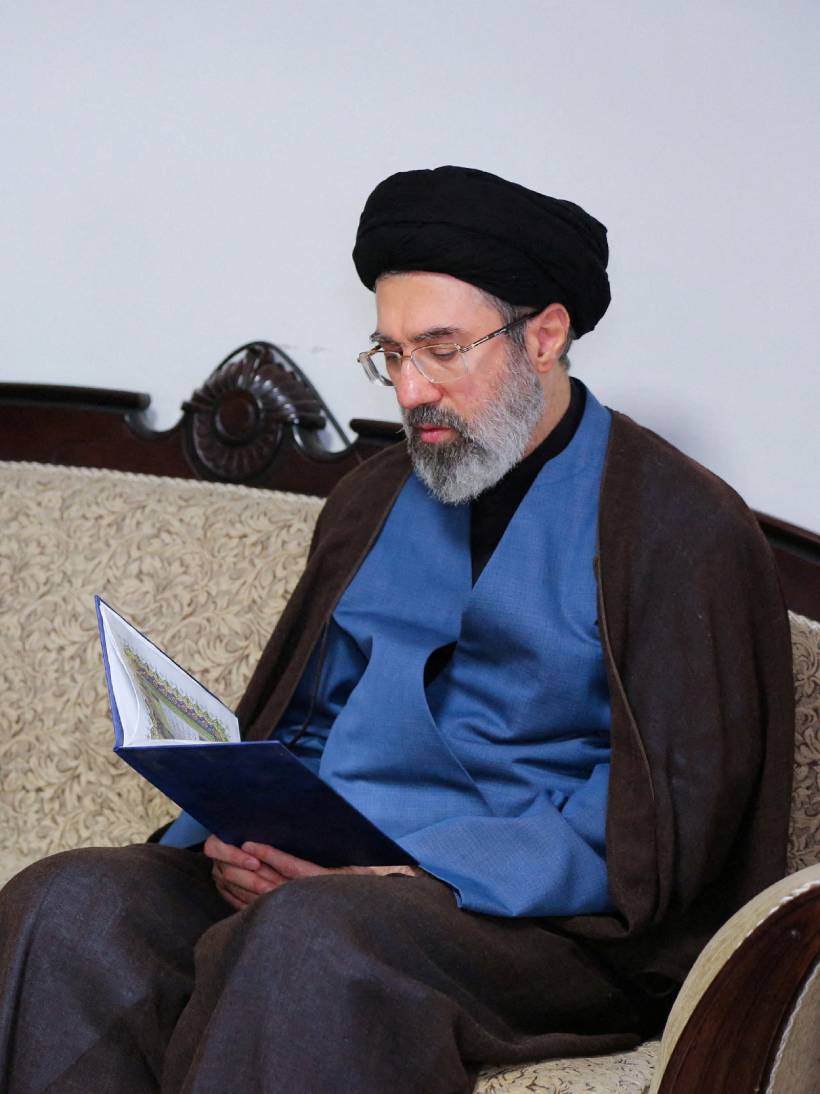
Iran has named its new supreme leader, Mojtaba Khamenei, who is succeeding his father, Ali Khamenei, after he was killed on February 28, as part of a series of Israeli airstrikes around Tehran aimed at high-ranking Iranian officials. While the Iranian regime remains under the highest level of pressure from continued U.S. and Israeli attacks, the appointment of Mojtaba Khamenei represents continuity for the regime and signals that hardliners remain in charge — for now.
Security forces deploy to guard a rally in support of the new Iranian supreme leader at Enghelab Square in central Tehran on March 9, 2026. Photo by Atta KENARE / AFP ATTA KENARE
Iran’s new Supreme Leader Mojtaba Khamenei • More hardline than father • He’s the IRGC candidate • Relatively young: 56 • Avoids public • Trusted by father, clerics • Was in military during Iraq-Iran war • His wife, Zahra, killed in Israeli airstrike w his father
The Israeli military said today that it had begun a new wave of attacks against targets in Tehran, Isfahan, and elsewhere in central and southern Iran.
The Israeli Air Force has launched a new wave of “extensive” airstrikes in Tehran, Isfahan, and in southern Iran, the IDF announces.
The IDF says the strikes are targeting Iranian regime infrastructure.
— Emanuel (Mannie) Fabian (@manniefabian) March 9, 2026
The IDF says it struck several military bases of Iran’s Basij paramilitary force and internal security forces in the city of Isfahan, along with missile sites in other areas of the country.
During the wave of strikes in Isfahan, the IDF says it hit the headquarters of Iran’s… pic.twitter.com/q3PmMWFlvx
— Emanuel (Mannie) Fabian (@manniefabian) March 9, 2026
✈️ The IAF completed a wave of strikes, in which numerous munitions were dropped on 400+ military infrastructure targets including ballistic missile launchers & additional weapons production sites.
Since the beginning of Operation Roaring Lion, the IAF carried out ~190 strike… pic.twitter.com/3c85CUrDJg
It also said that it struck targets associated with the Iran-backed Hezbollah militant group in Beirut.
Five top commanders in Iran’s Islamic Revolutionary Guard Corps were killed in an Israeli Navy strike targeting a hotel room in Beirut overnight, the IDF announces.
According to the military, the commanders who were killed “while hiding in a civilian hotel” served in the IRGC… https://t.co/O8jOM0t453
— Emanuel (Mannie) Fabian (@manniefabian) March 8, 2026
According to Hezbollah, its fighters are meanwhile engaged with Israeli forces who entered eastern Lebanon via helicopter. Hezbollah said it detected “the infiltration of approximately 15 Israeli enemy helicopters” from the Syrian side of the border into Lebanon. The Iran-backed militant group said in a statement that its fighters “engaged the helicopters and the infiltrating force with appropriate weapons” and that the confrontation was ongoing.
Lebanon’s state-run National News Agency described “fierce clashes … towards the outskirts of the town of Nabi Sheet to repel Israeli forces that carried out a landing by helicopters” in the area. Two Hezbollah officials told AFP that an Israeli helicopter was downed, but this has not been independently verified.
⭕️IDF troops began a targeted and limited raid in an area in southern Lebanon to locate and eliminate terrorists and dismantle Hezbollah infrastructure.
Prior to the entry of ground forces, numerous terror targets were struck from the air and ground.
A previous Israeli commando raid was launched into Lebanon overnight on Friday. Among its aims was the recovery of the remains of Ron Arad, an Israeli airman missing since 1986. The fighting left three Lebanese soldiers and 41 residents of the Bekaa Valley dead, according to the Lebanese Ministry of Health.
The Israeli military confirmed that two of its soldiers were killed in southern Lebanon.
The Israel Defense Forces (IDF) today issued a new warning in Lebanon, calling for residents of the southern suburbs of Beirut to evacuate the area. An IDF spokesman said that the Israeli military will act “forcefully” against terrorist infrastructure in “the coming hours.”
The IDF says it intercepted dozens of Hezbollah drones and struck dozens of the terror group’s rocket and missile launchers in southern Lebanon in recent days.
It publishes footage showing the interceptions of Hezbollah drones by a fighter jet, a helicopter, and a ground-based… pic.twitter.com/K1uuVQxbBT
— Emanuel (Mannie) Fabian (@manniefabian) March 9, 2026
The IDF also said it conducted targeted strikes against the Iranian Lebanon Corps in Beirut over the weekend.
Human Rights Watch (HRW) has accused Israel of unlawfully using white phosphorus munitions in the town of Yohmor in southern Lebanon. HRW verified and geolocated various images that confirmed the airburst use of white phosphorus munitions over a residential part of the town last week.
“The Israeli military’s unlawful use of white phosphorus over residential areas is extremely alarming and will have dire consequences for civilians,” Ramzi Kaiss, Lebanon researcher at Human Rights Watch, said in a statement.
White phosphorus is not a chemical weapon, as sometimes described, since it is primarily an incendiary weapon, although it’s also regularly used for making smokescreens and for target marking. Burning at around 1,500 degrees Fahrenheit, white phosphorus can obviously inflict terrible injuries, and its use in densely populated areas violates international law.
As we discussed last week, Israel may be using a version of the Joint Direct Attack Munition (JDAM) that includes white phosphorus in its warhead. However, this particular weapon was designed to attack chemical and biological weapon stockpiles.
Iran and its proxies launched more attacks across the region over the weekend and into Monday.
Gulf nations reported missile and drone attacks Sunday, while Iran vowed to press on with strikes against neighbouring countries as the regional war enters its second weekhttps://t.co/S0cZrTC5I0
There are reports that strikes targeted a U.S. diplomatic facility near Baghdad’s international airport but were apparently intercepted.
Another successful drone interception reportedly occurred east of Saudi Arabia’s northern Al-Jawf region. The Saudi Ministry of Defense has released footage showing Iranian drones being taken out by Royal Saudi Air Force (RSAF) F-15 and Typhoon fighters. The RSAF has plenty of practice in this, having targeted drones launched by the Houthis in Yemen for many years.
However, Iran was more successful in its targeting of the Bapco (Bahrain Petroleum Company) oil refinery — the only one in Bahrain.
Videos show smoke rising from the refinery, where operators declared a state of emergency.
Footage shows massive fires raging at Bahrain’s only oil refinery after it was struck by an Iranian Shahed-136 one-way-attack (OWA) drones.
Following the strike, Bapco Energies, Bahrain’s state-owned oil company, declared force majeure on its deliveries later in the day, citing… pic.twitter.com/cVUKY3AbVy
A statement from the company said it “hereby serves notice of force majeure on its group operations which have been affected by the ongoing regional conflict in the Middle East and the recent attack on its refinery complex.”
The Bahrain Ministry of Interior earlier today said that the fire at the refinery had been brought under control, with no casualties reported.
Civil Defence: The fire that broke out in a facility in the Ma’ameer area, as a result of Iranian aggression, has been brought under control. No injuries or loss of life were reported. pic.twitter.com/9T6hh7Qny9
Earlier today, Bahrain said an overnight Iranian drone attack on the island of Sitra injured 32 people.
At least 32 Bahrainis were injured in an Iranian drone attack on the island of Sitra including four who were in critical condition, Bahrain’s state news agency said.
Other countries in the region have also reported being targeted by more retaliatory Iranian strikes.
In central Israel, a man was killed, and several more were injured in an airstrike, according to local emergency services. It is unclear who launched the attack, but several people were reportedly injured as they made their way to a shelter.
Further to the scene at a construction site in central Israel, MDA EMTs and paramedics pronounced the death of a man, approximately 40 years old, and evacuated to Sheba Tel Hashomer Hospital a man, approximately 40 years old, in serious and unstable condition. pic.twitter.com/cmKg8rkk4u
Iran on Monday fired its first barrage of missiles toward Israel after the appointment of Ayatollah Mojtaba Khamenei as the Islamic Republic’s new supreme leader – State media pic.twitter.com/KSUWCDMFRY
The recent Iranian missile strikes on Israel reportedly also involved the use of warheads carrying cluster munitions.
From the scenes of some of the cluster munition impacts in central Israel following Iran’s latest ballistic missile attack. pic.twitter.com/Pqp9HQCJgs
— Emanuel (Mannie) Fabian (@manniefabian) March 9, 2026
Footage shows two of the Iranian cluster bomb munitions’ impacts in central Israel during the ballistic missile attack this morning.
A total of six cluster munition impact sites were reported across central Israel, killing one and seriously injuring two others. pic.twitter.com/8QEXYcuQXT
— Emanuel (Mannie) Fabian (@manniefabian) March 9, 2026
In the United Arab Emirates, authorities reported two people injured in two separate locations in Abu Dhabi. Both are said to have been hit by debris from intercepted airstrikes.
تعاملت الجهات المختصة في إمارة أبوظبي مع حادثين نتيجة سقوط شظايا على موقعين، عقب الاعتراض الناجح من قبل الدفاعات الجوية. أسفر الحادث الأول عن تعرض شخص من الجنسية الأردنية لإصابة بسيطة، وأسفر الحادث الثاني عن تعرض شخص من الجنسية المصرية لإصابة متوسطة.
ونهيب بالجمهور استقاء…
— مكتب أبوظبي الإعلامي (@ADMediaOffice) March 9, 2026
Meanwhile, the fallout from an attack last week on the Fujairah Oil Industry Zone in the UAE is threatening to further disrupt the flow of oil out of the region.
This is significant to shipping as Fujairiah is not just a loading port but a MAJOR bunkering port for ships.
Without it, this will force refueling around the world where stocks are limited and more expensive. https://t.co/s9t68n7MPU
— Sal Mercogliano (WGOW Shipping) 🚢⚓🐪🚒🏴☠️ (@mercoglianos) March 9, 2026
The United Arab Emirates is now using AH-64 Apache attack helicopters in a counter-drone role. The footage below shows Apaches from the UAE Joint Aviation Command — reportedly the latest AH-64E versions, rather than the earlier AH-64Ds — using their 30mm guns to bring down Iranian UAVs. While the U.S. Army and other operators using AH-64s to swat down lower-end long-endurance drones might be relatively new, it’s worth noting that Israel has been using the Apache in an air defense role for this purpose for many years.
The UAE military is using Apache attack helicopters to shoot down Shahed drones over water. This will save a significant number of expensive interceptors as these are practically free kills – just using a few 30mm rounds. A wise evolution of the country’s defensive strategy. https://t.co/7GMkLcssVS
AFP reports several explosions heard today in the Qatari capital of Doha.
Qatar’s defense ministry said that its forces had intercepted and destroyed two drones heading toward the Shaybah oil field in the southeast of the country. These were just a fraction of a much larger barrage of ballistic missiles and drones sent toward Qatar, according to the defense ministry.
UAE air defences intercept 12 ballistic missiles, 17 UAVs.
UAE air defences on Monday detected 15 ballistic missiles, of which 12 were destroyed, while 3 missiles fell into the sea. A total of 18 UAVs were also detected, with 17 intercepted, while 1 fell within the country’s… pic.twitter.com/7l2tjyclK5
Cyprus, which has also been on the receiving end of drone strikes, received six Turkish Air Force F-16 fighters today. The jets were deployed to the breakaway Turkish Republic of Northern Cyprus to bolster local defenses for the Turkish Cypriot state.
6 x Turkish F-16 fighter jets deployed to Northern Cyprus, conducting a show-of-force flight after arriving in the region.
Turkey has also reportedly come under attack from at least one Iranian ballistic missile, which the local defense ministry said was brought down by “NATO air and missile defense assets” based in the eastern Mediterranean.
Turkish MoD warns Iran:
Türkiye places great importance on good neighborly relations and regional stability.
However, we reiterate that any threat directed at our territory or airspace will be met with all necessary measures, taken decisively and without hesitation.
In a statement provided to TWZ, a NATO spokesperson added:
“In less than 10 minutes, NATO service members identified a threat to Allies, a ballistic missile, confirmed its trajectory, alerted land- and sea-based missile defence systems, and launched an interceptor to defeat the threat and protect our territory and its people.”
The U.S. military has confirmed the death of a seventh American soldier due to injuries sustained during Iran’s initial counterattack. The Department of War said that Sgt. Benjamin N. Pennington, 26, of Glendale, Kentucky, died of his wounds yesterday. He had come under enemy attack on March 1, 2026, at Prince Sultan Air Base, Saudi Arabia, where he served with the 1st Space Battalion, 1st Space Brigade.
CENTCOM Update
TAMPA, Fla. – Last night, a U.S. service member passed away from injuries received during the Iranian regime’s initial attacks across the Middle East. The service member was seriously wounded at the scene of an attack on U.S. troops in the Kingdom of Saudi Arabia…
However, unverified reports of the death of an eighth U.S. service member during the current campaign have proven to be erroneous.
This is not accurate. The Marine who is referenced here died before the U.S. and Israeli bombing of Iran started and from non combat injuries, an official told me. His remains were not flown into Dover until March 4. https://t.co/WWM1jiFOl3
According to a report from Axios, U.S. President Donald Trump, together with envoys Steve Witkoff and Jared Kushner, plans to travel to Israel tomorrow for talks with Israeli Prime Minister Benjamin Netanyahu.
However, reports from Israel suggest that the visit has been postponed.
Regardless, Trump has said that the end of the war will be a “mutual” decision to be made with Netanyahu, the Times of Israel reported.
“I think it’s mutual…a little bit. We’ve been talking. I’ll make a decision at the right time, but everything’s going to be taken into account,” Trump said.
In a telephone interview with the Times of Israel on Sunday, Trump said that Iran would have destroyed Israel if it weren’t for his and Netanyahu’s actions.
“Iran was going to destroy Israel and everything else around it…We’ve worked together. We’ve destroyed a country that wanted to destroy Israel,” the U.S. president said.
Multiple outlets have now reported on deliberations within the U.S. and Israeli governments over a ground raid targeting Iran’s enriched uranium stocks this past weekend, citing unnamed sources. It is unclear whether the mission being considered would be carried out by U.S. or Israeli forces, or be conducted jointly by both parties.
Members of the US Army seen using nuclear material detection tools during an exercise. US Army
“People are going to have to go and get it,” Secretary of State and acting National Security Advisor Marco Rubio said at a congressional briefing back on March 3 in response to a question about securing Iran’s enriched uranium, according to a report from Axios on Saturday.
“We’re going to find out about that. We haven’t talked about it, but it was a total obliteration. They haven’t been able to get to it. And at some point, maybe we will,” President Donald Trump also told reporters on Air Force One on Saturday. “You know, that’d be a great thing, but right now we’re just decimating them. We haven’t gone after it, but it’s something we can do later on. We wouldn’t do it now. Maybe we’d do it later.”
Reporter: Mr. President, don’t you need ground troops to secure the enriched uranium at the nuclear sites?
Trump: We’re going to find out about that. We haven’t talked about it, but it was a total obliteration. They haven’t been able to get to it. And at some point, maybe we… pic.twitter.com/f9LR6BzIdn
NBC News reported last week that President Trump had “privately expressed serious interest” in sending “a small contingent of U.S. troops that would be used for specific strategic purposes” into Iran.
The U.S. government says that preventing Iran from developing a nuclear weapon is a core goal of its current operations targeting the country. If the Iranian government were to collapse, and do so suddenly, there would be additional concerns about the proliferation of the country’s nuclear material, including to regional proxies and terrorist groups, as well as other potential buyers on the black market.
What we know about Iran’s enriched uranium stockpile
By its last firm estimate, as of June 2025, the International Atomic Energy Agency (IAEA) assessed that Iran had just over 972 pounds (just under 441 kilograms) of uranium enriched to 60 percent purity. This stockpile has long been a proliferation concern and evidence of Iranian authorities maintaining the option of rapidly pursuing a nuclear weapon even in the absence of an active development program.
It is understood to be a relatively quick process, in technical terms, to get uranium from 60 percent to 90 percent purity, at which point it is considered highly enriched or weapons-grade. Per the IAEA, 92.5 pounds of 60 percent uranium is sufficient to be enriched into enough 90 percent material for one nuclear bomb. Using this metric, Iran’s declared stockpile of enriched uranium is enough for at least 10 bombs.
“In that first meeting, both of the Iranian negotiators said to us directly, with no shame, that they controlled 460 kilograms of 60 percent, and they were aware that that could make 11 nuclear bombs,” Steve Witkoff, U.S. Special Envoy to the Middle East, who had been leading talks with Iranian officials head of the current conflict, said in an interview with Fox News’ Sean Hannity on March 2. “They have 10,000, roughly, kilograms of fissionable material. That’s broken up into roughly 460 kilograms of 60 percent enriched uranium, another thousand kilograms of 20 percent enriched uranium, and the balance is at 3.67 [percent purity].”
Steve Witkoff, U.S. Special Envoy to the Middle East, at left, shakes hands with Israeli Prime Minister Benjamin Netanyahu at the White House in 2025. White House
Uranium that is not pure enough for a nuclear weapon could still be fashioned into a so-called ‘dirty bomb’ designed just to spread radioactive contamination across an area. Even if the immediate impacts of the detonation of such a device are minimal, it could cause widespread panic and would require significant effort to clean up. This is a threat that has also often been associated with non-state actors in the past.
Iran’s underground nuclear site at Isfahan has long been understood to be the primary storehouse for its stockpile of enriched uranium. That facility was among those targeted in U.S. strikes last June, dubbed Operation Midnight Hammer. Though access to any uranium there was subsequently curtailed, the U.S. Intelligence Community has more recently assessed that Iranian authorities have regained entry, at least to a degree, according to a report from The New York Times over the weekend.
NEW: High resolution satellite imagery taken yesterday shows the extent to which Iran has covered the tunnel entrances at the Esfahan nuclear complex with soil. The middle and southern entrances are unrecognizable and fully covered in soil. The northernmost tunnel entrance which… pic.twitter.com/baYI2zCuN0
NEW: Satellite imagery of the Esfahan nuclear site taken today shows new activity at the tunnel entrances. As of today, Iran has re-buried the middle entrance with soil and is adding more fresh soil to the southernmost entrance. The northernmost entrance, which was reworked after… pic.twitter.com/7ujiku8VRg
There are lingering questions about the degree to which Iran may have dispersed its enriched uranium beyond Isfahan. The day before the current conflict erupted, the AP reported that the IAEA had been circulating a report saying that it could not “verify whether Iran has suspended all enrichment-related activities” or the “size of Iran’s uranium stockpile at the affected nuclear facilities,” and was unable to “provide any information on the current size, composition or whereabouts of the stockpile of enriched uranium in Iran.”
“Publicly, U.S. officials have projected confidence that they know where the uranium is stored. Privately, there is said to be less certainty,” according to a report from Bloomberg today.
Options for a ground raid
In terms of the specifics of how a ground raid would neutralize Iran’s enriched uranium stockpile, multiple options are reportedly being considered.
“The first question is, where is it? The second question is, how do we get to it and how do we get physical control?” a U.S. official said, according to Axios. “And then, it would be a decision of the president and the Department of War, CIA, as to whether we wanted to physically transport it or dilute it on premises.”
“The mission would likely involve special operators alongside scientists, possibly from the International Atomic Energy Agency (IAEA),” Axios‘ report added.
U.S. Army soldiers with the 128th Chemical Company, 337th Engineer Battalion, conduct site reconnaissance in an underground tunnel during the Engineer Thunder 2025 exercise in Lithuania. US Army/Pfc. Gabriel Martinez
“U.S. special operations units are ideally suited to rapidly and discreetly infiltrate into a target area to extract items of interest from an objective like a nuclear facility in Iran. If the items in question are too large to be moved by the special operations force, depending on what they are, they could then be destroyed in place or secured until a larger follow-on force arrives. Conventional supporting forces and interagency elements offering unique capabilities could accompany special operations forces on initial raids, as well.”
“Special operations forces are also well-positioned to help intercept high-value targets on the move, including nuclear material that might make its way out of Iran, or threaten to do so, as the conflict with Israel continues. This could potentially include operations on land or at sea.”
U.S. special operations forces, especially so-called “tier one” units like the U.S. Army’s Delta Force and the U.S. Navy’s SEAL Team Six, train regularly to conduct exercises centering on counter-weapons of mass destruction (WMD) scenarios and others involving chemical, biological, nuclear, and radiological hazards. U.S. Special Operations Command (SOCOM) was formally designated the lead entity for the Counter Weapons of Mass Destruction (CWMD) mission set in 2016. An array of specialized conventional U.S. military units, as well as personnel from other ends of the U.S. government, such as the Department of Energy, are also expected to take part in these operations and are often integrated directly into relevant training events alongside special operations elements. You can read more about all of this here.
Members of the US Army’s Nuclear Disarmament Team 1 (NDT 1), a conventional unit specializing in neutralizing nuclear and radiological threats, seen in the control room of a nuclear power plant during an exercise that also involved Green Berets. US Army
As one particularly spectacular example, in 2024, Israeli forces destroyed an underground ballistic missile factory in Syria, which had been built with Iranian assistance. The raiding party was on the ground for approximately two and a half hours, during which time 660 pounds of explosives were rigged throughout the site. “A planetary mixer, numerous weapons, and intelligence documents,” were also extracted, according to the Israel Defense Forces (IDF). TWZ noted at the time that this operation sent a clear signal to Iran that its underground facilities were not untouchable.
100 Shaldag soldiers raid and dismantle Syrian missile factory in secret operation
There is the potential that Israel might have launched ground raids against Iran’s nuclear sites at Fordow, Natanz, and/or Isfahan unilaterally last year if the U.S. military had not conducted Operation Midnight Hammer. There would have been few, if any other options for Israel to have gone after those underground facilities. This, in turn, raises the possibility that Israeli forces may have prepared more explicitly to execute these operations just in the past year.
Risk and complexities
Executing any special operations raid targeting Iran’s stockpile of enriched uranium, wherever it might be held, would not be without immense challenges.
For one, there are real questions about what it would take to move nearly 1,000 pounds of enriched uranium out of Iran, even if it is largely located at one site. The material would be even heavier and bulkier when taking into account the secure containers it is likely to be stored in.
Similar questions have been raised about the feasibility of neutralizing the stockpile in place if it is determined to be impractical to move it. Experts and observers have highlighted the immense time and resources that would be required to try to dilute the purity of any nuclear material on-site, processes that typically require industrial machinery under normal conditions.
A picture showing work within a processing unit at the Isfahan Uranium Conversion Facility in Iran back in 2005. Getty Images / Stringer
Unlike conventional weapons, or even other key aspects of Iran’s nuclear program, like centrifuges, fissile material cannot simply be blown up to destroy it in place, either.
Having to carry out any such operation, however long it might take, in an active conflict zone and likely under enemy fire, would only add to the complexities of a ground raid. As already noted, Iran looks to have taken steps to physically hamper access to Isfahan and other sites, adding to the time it would take friendly forces to gain entry to their objectives in the first place. Heavy machinery could be required to dig into these facilities.
The longer friendly forces are on the ground, the more time Iran has to put together a response. Airpower can help keep hostile forces at bay, but Iranian security forces could eventually muster significant firepower, including artillery. Keeping nuclear facilities safe from attack has been a top priority for the regime in Tehran, and Iranian security forces will have reaction plans in place.
There is also simply the matter of getting the raiding force to and from the objective. As has been established, we are talking about what would have to be a relatively large contingent, burdened with specialized equipment, along with a typical array of weaponry and other gear.
Members of the US Army and South Korean Army in chemical, biological, nuclear, and radiological protective gear seen during a training exercise in a mock underground facility. US Army
The U.S. military, specifically, has a very complicated relationship with these kinds of operations, dating back to the failed attempt to rescue hostages being held in the American embassy in Tehran following the revolution that put the current Iranian regime into power in the first place. That operation exposed deficiencies that did lead to the development of new capabilities, as well as tactics, techniques, and procedures, and continues to be a key case study in special operations planning today.
We did get to see a demonstration of the U.S. military’s current capability and capacity to launch a major special operations raid in January with Operation Absolute Resolve, which resulted in the capture of Venezuelan dictator Nicolas Maduro from the middle of a fortress-like military facility. At the same time, it also showed the immense resources required to ensure the success of a mission like that, with hundreds of aircraft, ships offshore, and an array of other assets involved. The main raiding force consisted of 200 special operators. You can read more about what is known about the extensive preparations for the mission, including having forces specifically poised to destroy three airfields if it looked like Venezuelan Air Force fighters were attempting to scramble, here.
In addition, the Venezuela operation had the benefit of surprise, rather than coming in the middle of already ongoing major combat operations against an enemy that says it is actively prepared to respond to any kind of ground incursion. Iran’s military capabilities and overall capacity have been seriously degraded by U.S. and Israeli strikes in the past week, but significant threats remain, as TWZ regularly stresses.
Even under the most optimal conditions, launching a major special operations raid into Iran amid the ongoing hostilities would be extremely risky.
A question of timing and alternatives
Axios‘ report notably said a special operations raid against Iran’s enriched uranium stockpile “would likely only take place after both countries [the United States and Israel] are confident Iran’s military can no longer mount a serious threat to the forces involved.” This would also align with President Trump’s comments on Saturday.
However, other factors could still influence that decision-making process. As has been made clear, there are already serious questions about where all of Iran’s enriched uranium may be hidden away now. This is compounded by the reports that the Iranians may have regained access to where material was being stored in Isfahan, which could then allow them to move it elsewhere.
Even if persistent surveillance gives a good sense of where the material is being moved, dispersal can only increase the total number of sites that would have to be secured. It would also reduce any guarantees of neutralizing even the majority of the stockpile in one fell swoop.
Members of the US Army’s 75th Ranger Regiment and conventional supporting forces seen during a training exercise in 2024 involving a mock raid on a nuclear facility. US Army
As mentioned earlier, interdicting nuclear shipments on the move would still require a ground force of some kind to secure the material. Simply kinetically targeting vehicles carrying enriched uranium from the air would not be sufficient and would risk scattering nuclear material in an uncontrolled manner, making such a strike an absolute last resort option.
As pointed out earlier, there could also be a concern that regional proxies, terrorists, or other third parties might attempt to exploit the current conflict to spirit away a portion of Iran’s stockpile from Isfahan or sites for their own nefarious uses. This, in turn, could further drive a demand for action to secure that material on a timetable that does not allow for waiting for ideal conditions to emerge.
In the meantime, the United States and Israel could seek to carry out new strikes to try to seal entrances to underground facilities at Isfahan and other locations. Strikes last week on Iran’s nuclear site at Natanz look to have been intended to do just this. Those sites could then be surveilled to watch for any further attempts on the part of the Iranians to dig them out. Additional action, including more strikes or launching a ground raid, could then be taken, as necessary.
We have prepared an overview slide summarizing the visible damage at the Natanz uranium enrichment site from the recent attack, pulling together multiple images showing before and after satellite images of the two personnel entrances and the sole vehicle entrance with comparable… pic.twitter.com/mMGvOyHgkQ
On top of everything else, not being able to definitely find, fix, and secure Iran’s stockpile of enriched uranium would make it difficult for the U.S. government to say it has achieved its core objective of preventing the country from building a nuclear weapon. Inversely, doing so could be seen as essential, especially by the Trump administration, for creating the conditions necessary to end the current conflict.
Altogether, it remains to be seen whether or not the United States and Israel decide that mounting a major special operation targeting Iran’s enriched uranium outweighs the risks.
Iran’s new Supreme Leader Mojtaba Khamenei has never held a formal position in government, but his appointment as his late father’s successor amid the US-Israeli war on his country was not unexpected.
Iran’s Assembly of Experts appointed the 56-year-old mid-ranking religious scholar to the position on Sunday, just over a week after his late father, Ayatollah Ali Khamenei, was killed in United States-Israeli strikes.
Recommended Stories
list of 3 itemsend of list
Khamenei, who has strong ties with the Islamic Revolutionary Guard Corps (IRGC) and his late father’s still-influential office, is seen as a hardliner who will provide continuity in the country.
His appointment, which came after he lost both his father and his wife in strikes, was interpreted as a defiant choice signalling continuity as the Islamic Republic faces the biggest crisis in its 47-year history.
Khamenei received immediate backing from figures in Iran’s political and security establishment, including IRGC leaders, President Masoud Pezeshkian and Ali Larijani, secretary of the Supreme National Security Council.
Outside the country, reactions were mixed:
Oman
Oman was a mediator in recent talks between Iran and the United States, which collapsed when the US and Israel unleashed their war on Iran last month.
Oman’s Sultan Haitham bin Tariq Al Said on Monday sent a “cable of congratulations” to Khamenei on his appointment as Iran’s new supreme leader, according to the official Oman News Agency.
Iraq
Iraqi Prime Minister Mohammed Shia al-Sudani also congratulated Khamenei on his appointment on Monday.
“We express our confidence in the ability of the new leadership in the Islamic Republic of Iran to manage this sensitive stage, and continue to strengthen the unity of the Iranian people in facing the current challenges,” al-Sudani said in a statement.
He reaffirmed Iraq’s solidarity and support for Iran and “all steps aimed at ending the conflict and rejecting military operations against its sovereignty, in order to preserve the stability of other countries in the region”.
United States
US President Donald Trump had previously dismissed Mojtaba Khamenei as a “lightweight”, and insisted he should have a say in appointing a new Iranian leader, which Tehran rejected.
On Monday, Trump told NBC News, “I think they made a big mistake. I don’t know if it’s going to last. I think they made a mistake.”
Later on Monday, he told CBS News: “I have no message for him.”
Trump said he has someone in mind to lead Iran, but did not elaborate.
Israel
The Israeli military has already threatened to kill any replacement for the late Ali Khamenei.
Israel’s Foreign Ministry said Monday that Mojtaba Khamenei was a “tyrant” like his slain father, and would continue what it described as the Iranian “regime’s brutality”.
In a post on X featuring a picture of Mojtaba Khamenei and his father Ayatollah Ali Khamenei, holding guns, the ministry wrote: “Mojtaba Khamenei. Like Father Like Son”.
“Mojtaba Khamenei’s hands are already stained with the bloodshed that defined his father’s rule. Another tyrant to continue the Iranian regime’s brutality,” said the ministry.
Russia
Russian President Vladimir Putin on Monday pledged “unwavering support” to Iran.
“I would like to reaffirm our unwavering support for Tehran and solidarity with our Iranian friends,” Putin said in a message to Khamenei, adding that “Russia has been and will remain a reliable partner” to Iran.
“At a time when Iran is confronting armed aggression, your tenure in this high position will undoubtedly require great courage and dedication,” the Russian leader said.
China
China’s Foreign Ministry spokesman Guo Jiakun told reporters on Monday that Iran’s decision to appoint the younger Khamenei was “based on its constitution”.
“China opposes interference in other countries’ internal affairs under any pretext, and Iran’s sovereignty, security, and territorial integrity should be respected,” he said when asked about the threats against the new leader.
Beijing is a close partner of Tehran and condemned the killing of the former supreme leader, but it has also criticised the Iranian counterstrikes against Gulf states.
Yemen’s Houthis
Yemen’s Houthi rebels on Monday welcomed the appointment of the new supreme leader.
“We congratulate the Islamic Republic of Iran, its leadership and people, on the selection of Sayyid Mojtaba Khamenei as Supreme Leader of the Islamic Revolution at this important and pivotal juncture,” the group said in a statement on Telegram.
It called his selection “a new victory for the Islamic Revolution and a resounding blow to the enemies of the Islamic Republic and the enemies of the nation”.
More than half of the 62 million people in the six Gulf Cooperation Council (GCC) countries are foreign workers.
Nearly 62 million people living in the six Gulf Cooperation Council (GCC) countries have been caught in the crossfire of the latest US-Israel war on Iran.
Known for their economic opportunities, these countries, including Bahrain, Kuwait, Oman, Qatar, Saudi Arabia and the United Arab Emirates (UAE), collectively host nearly 35 million foreign workers from around the world, predominantly from South Asia.
Recommended Stories
list of 4 itemsend of list
With the exception of Saudi Arabia and Oman, foreign workers make up the bulk of the populations of people living in the remaining four GCC countries.
The map below illustrates the national and non-national populations in each of the GCC countries.
Where do GCC foreign workers come from?
Generations of foreign workers in the GCC countries have significantly contributed to the workforce, including labourers, construction workers, household staff, security personnel, and cleaners, all vital to building the modern infrastructures that Gulf nations are known for.
Millions consider the Gulf their home, despite holding nationalities from other countries.
Additionally, highly skilled foreign workers have a long history in industries such as banking, finance, technology, engineering, aviation, medicine and the media.
Saudi Arabia is the largest of the six GCC countries, with a population of nearly 37 million.
Aerial view of Riyadh city is seen from Mamlaka tower, a 99-story skyscraper, in Riyadh, Saudi Arabia [Amr Nabil/AP Photos]
The oil-rich country has a local population of about 20.5 million and an additional 16.4 million foreign residents.
The five largest groups of non-nationals living in Saudi Arabia are people from:
Bangladesh: 2,590,000
India: 2,310,000
Pakistan: 2,230,000
Yemen: 2,210,000
Egypt: 1,800,000
Sudan: 1,000,000
The UAE
The United Arab Emirates has the second-largest population in the GCC, totaling some 11.3 million people.
Dubai skyline is visible with the Burj Khalifa, the world’s tallest building, during the COP28 U.N. Climate Summit, in Dubai, United Arab Emirates, Thursday, November 30, 2023 [Kamran Jebreili/ AP Photo]
It consists of seven emirates, including the capital Abu Dhabi, Dubai, Sharjah, Ajman, Umm Al Quwain, Ras Al Khaimah, and Fujairah.
Emiratis make up nearly 12 percent of the population, with foreigners at almost 88 percent.
The five largest groups of non-nationals living in the UAE are from:
India: 4,360,000
Pakistan: 1,900,000
Bangladesh: 840,000
Philippines: 780,000
Iran: 540,000
Egypt: 480,000
Kuwait
With a population of 4.8 million, Kuwait has the third-largest population in the GCC.
A drone view shows Kuwait City in Kuwait, February 28, 2026 [Stephanie McGehee/Reuters]
Approximately 1.56 million are Kuwaiti citizens, and 2.16 million are foreign workers.
The five largest groups of non-nationals living in Kuwait are from:
India: 1,000,000
Egypt: 700,000
Bangladesh: 350,000
Philippines: 250,000
Pakistan: 200,000
Nepal: 120,000
Oman
Oman’s population stands at approximately 4.7 million people. Oman’s 2.5 million citizens account for nearly 59 percent of the population, while the remaining 2.05 million (or 41 percent) are foreign workers.
General view of old Muscat the day after Oman’s Sultan Qaboos bin Said was laid to rest in Muscat, Oman, January 12, 2020 [Christopher Pike/Reuters]
The five largest groups of non-nationals living in Oman are from:
India: 766,735
Bangladesh: 718,856
Pakistan: 268,868
Egypt: 46,970
Philippines: 45,213
Uganda: 20,886
Qatar
The Doha skyline, seen here [Showkat Shafi/Al Jazeera]
Qatar has a population of some 3.2 million people, with 2.87 million foreign workers accounting for about 88 percent of them. Qatari citizens number around 330,000, making up 12 percent.
The five largest groups of non-nationals living in Qatar are from:
India: 700,000
Bangladesh: 400,000
Nepal: 400,000
Egypt: 300,000
Philippines: 236,000
Pakistan: 180,000
Bahrain
With a total population of 1.58 million, Bahrain has the smallest population in the GCC. Bahraini citizens make up just under half of the population.
A general view of residential buildings in the Juffair district of Manama, Bahrain, June 22, 2025 [Hamad I Mohammed/Reuters]
The five largest groups of non-nationals living in Bahrain are from:
Mojtaba Khamenei replaces his assassinated father Ayatollah Ali Khamenei.
A new supreme leader in Iran – Mojtaba Khamenei – has replaced his assassinated father.
His selection sends a defiant message to the United States and Israel as they attack the country.
So, who is Iran’s new leader – and what does his appointment mean?
Presenter: Tom McRae
Guests:
Hassan Ahmadian – Associate professor at the University of Tehran
Mehran Kamrava – Professor at Georgetown University in Qatar and director of the Iranian Studies Unit at the Arab Center for Research and Policy Studies
Alex Vatanka – Senior fellow at the Middle East Institute in Washington, DC
Tedros Adhanom Ghebreyesus says children, the elderly at particular risk after damage to Iranian petroleum facilities.
Published On 9 Mar 20269 Mar 2026
Share
The head of the World Health Organization has warned that recent Israeli attacks on oil facilities in Iran could have negative effects on public health, with Iranian children and the elderly among the most vulnerable.
Tedros Adhanom Ghebreyesus said in a statement on Monday that damage to Iranian petroleum facilities “risks contaminating food, water and air”.
Recommended Stories
list of 3 itemsend of list
Those hazards “can have severe health impacts especially on children, older people, and people with pre existing medical conditions”, Tedros warned in a post on X. “Rain laden with oil has been reported falling in parts of the country.”
The Iranian authorities said oil facilities in the capital, Tehran, and the nearby province of Alborz were targeted on Saturday in the United States-Israeli war against the country, the Fars news agency reported.
Israel said it struck “a number of fuel storage facilities in Tehran” that were used “to operate military infrastructure”.
The strikes sent massive flames and clouds of thick, black smoke into the sky above Tehran, with Al Jazeera’s Tohid Asadi reporting that black raindrops fell early on Sunday morning.
The attacks on Iran’s energy infrastructure came as the US and Israeli governments had vowed to continue to bombard the country despite mounting international concern over the widening conflict.
Iran has retaliated to the US-Israeli strikes by launching missiles and drones at targets across the Middle East, including energy infrastructure in nearby Arab Gulf states.
Human rights groups have condemned both Iran and the US and Israel for targeting civilian infrastructure.
Agnes Callamard, the head of Amnesty International, said on Monday that “Israel should have taken all feasible precautions to avoid or minimize the risks to civilians when targeting oil refineries” in Iran.
“The incidental harm to civilians, including the release of toxic substance, appears to indicate that too little precautions were taken and that the incidental harm to civilians is disproportionate,” she wrote on X.
“The scenes of catastrophe described by Iranians after Tehran’s oil depots were bombed are yet another demonstration that ultimately, whatever they may say, the US and Israel’s attacks on Iran are harming first and foremost civilians, including children.”
Thick clouds of smoke rise over Tehran after the attacks on Iranian oil infrastructure, on March 8, 2026 [Majid Asgaripour/WANA via Reuters]
French President Emmanuel Macron has said France and its allies are preparing a “purely defensive” mission to escort vessels through the Strait of Hormuz once the “most intense phase” of the US-Israeli war on Iran ends.
Speaking in Cyprus on Monday, Macron said the “purely escort mission” must be prepared by both European and non-European countries.
Recommended Stories
list of 3 itemsend of list
Its purpose “is to enable, as soon as possible after the most intense phase of the conflict has ended, the escort of container ships and tankers to gradually reopen the Strait of Hormuz”, the French president said, without providing further details.
Macron’s comments come as global oil prices have surged amid continued attacks by the United States and Israel against Iran, as well as retaliatory Iranian missile and drone strikes across the wider region.
The war has effectively shut down the Strait of Hormuz, a strategic Gulf waterway through which about 20 percent of the world’s oil supplies pass, while Iranian attacks on energy infrastructure in the Middle East also have raised concerns.
Responding to Macron’s comments, top Iranian security official Ali Larijani said, “It is unlikely that any security will be achieved in the Strait of Hormuz amid the fires of the war ignited by the United States and Israel in the region.”
Larijani added in a social media post that security is also unlikely to be restored as a result of plans designed by “parties that were not far removed from supporting this war and contributing to its fanning”.
While European countries have been largely sidelined as the war escalates, several – including France, the United Kingdom and Greece – have sent military assets to Cyprus following an Iranian-made drone attack on a British base on the island.
Greece has dispatched four F-16 fighter planes to the Paphos airbase and its two state-of-the-art frigates Kimon and Psara are patrolling offshore Cyprus, tasked with intercepting any missiles or drones.
Last week, Macron ordered the French frigate Languedoc to waters off Cyprus to bolster the country’s anti-drone and anti-missile defences.
“When Cyprus is attacked, then Europe is attacked,” Macron said after meeting with Cypriot President Nikos Christodoulides and Greek Prime Minister Kyriakos Mitsotakis in Paphos on Monday.
The French president said he would also deploy a total of eight warships, two helicopter carriers and the nuclear-powered aircraft carrier Charles de Gaulle to the Eastern Mediterranean and the wider Middle East region, calling the move “unprecedented”.
France’s objective “is to maintain a strictly defensive stance, standing alongside all countries attacked by Iran in its retaliation, to ensure our credibility, and to contribute to regional de-escalation”, Macron said.
“Ultimately, we aim to guarantee freedom of navigation and maritime security.”
With the closure of the Strait of Hormuz sending oil prices soaring, finance ministers from the Group of Seven (G7) countries met in Brussels on Monday to discuss how to respond.
Crude oil prices have increased by about 50 percent since the US and Israel launched the war last month, with international benchmark Brent crude prices surpassing $100 a barrel on Monday.
French Finance Minister Roland Lescure told reporters that the G7 ministers did not make a decision on the potential release of emergency oil stocks amid the war. “What we’ve agreed upon is to use any necessary tools if need be to stabilise the market, including the potential release of necessary stockpiles,” Lescure said.
Paul Hickin, editor-in-chief and chief economist at Petroleum Economist, said getting the Strait of Hormuz reopened is the main priority. “That’s not going to happen in any shape or form until there’s a resolution to the conflict,” Hickin told Al Jazeera.
He explained that several countries in the Middle East, such as Kuwait and Iraq, are dependent on the strait to get their energy supplies to market.
“Kuwait and Iraq and those producers, they are really having a shut-in, and it will take a little bit of time to get back up and running,” said Hickin.
“That is the big risk, the knock-on effect … Getting those ships back, getting that infrastructure back up and running, it’s a slow process. So prices won’t come back down as quickly as many may think.”
Ministry of National Defence says no casualties or damage after missile shot down over southern city of Gaziantep.
Published On 9 Mar 20269 Mar 2026
Share
The Turkish Ministry of National Defence says NATO air defences have intercepted a ballistic missile launched from Iran towards Turkiye as concerns grow that the United States-Israel war against Iran will escalate.
The missile was intercepted on Monday over the Sahinbey district of Gaziantep in southern Turkiye, the ministry said in a statement. No casualties or damage were reported.
Recommended Stories
list of 3 itemsend of list
“Ankara emphasized its capability and determination to protect national airspace and border security, while warning that further escalation in the region must be avoided,” the statement said.
The ministry also urged all sides, especially Tehran, “to refrain from actions that could endanger civilians or undermine regional stability”.
Monday’s incident was the second time an Iranian ballistic missile was fired towards Turkiye since the US and Israel launched a war against Iran on February 28, according to local authorities.
The US-Israeli attacks have prompted a wave of Iranian missile and drone strikes across the wider region, including on targets in Arab Gulf countries.
Iran did not immediately comment on the Turkish ministry’s statement.
NATO spokesperson Allison Hart confirmed that the military alliance had intercepted “a missile heading to Turkiye”. “NATO stands firm in its readiness to defend all Allies against any threat,” Hart said in a post on X.
Iran denied firing a ballistic missile towards Turkiye on Wednesday after Turkish authorities said NATO air defences shot down a projectile over the Eastern Mediterranean.
NATO condemned that launch, expressing its “full solidarity” with Turkiye.
“This is a tangible demonstration of the Alliance’s ability to defend our populations against all threats, including those posed by ballistic missiles,” NATO said of the interception.
Article 5 of the alliance’s North Atlantic Treaty says an attack on one NATO country will be considered an attack on all. It also commits each NATO member state to taking action deemed necessary “to restore and maintain” security.
In an interview with the Reuters news agency last week after the first ballistic missile heading towards Turkiye was shot down, NATO chief Mark Rutte said there was no talk of invoking Article 5.
Iranian authorities have said they are firing at US military bases and other US- and Israel-linked targets across the region in self-defence, but civilian infrastructure has also been attacked.
“Iran’s targets are not just US bases; they are, in fact, primarily large-scale infrastructure and civilian targets as well,” said Rob Geist Pinfold, a lecturer in defence studies at King’s College London.
“This is not a mistake. This is by design,” Pinfold told Al Jazeera, explaining that Tehran is seeking to “unleash as much chaos as possible to destabilise the region and global markets” in an effort to force Washington to abandon the war.
“We’ve seen that Iran is targeting every single [Gulf Cooperation Council] state. It’s prepared to burn its bridges with all of them to pursue this very uncertain and high-risk strategy,” he said.
“It really shows you how Iran feels like it’s facing an existential threat. For them, this is a real do-or-die moment.”
Palestinian journalist Amal Shamali, who worked as a correspondent for Qatar Radio, has been killed in an Israeli air strike on the Nuseirat refugee camp in central Gaza, the Palestinian Journalists Syndicate (PJS) says.
Shamali, who was killed on Monday, also “worked with several Arab and local media outlets and was among the journalists who continued performing their media mission despite the ongoing assault and war on the Gaza Strip”, the PJS said in a statement.
Recommended Stories
list of 3 itemsend of list
More than 270 journalists and media workers have been killed in Gaza since Israel launched a genocidal war against Palestinians in the territory on October 7, 2023, in response to Hamas-led attacks on southern Israel.
“This represents one of the bloodiest periods for journalists in modern history, reflecting the scale of the deliberate targeting of Palestinian journalism in an attempt to silence the voice of truth and prevent the documentation of the crimes and violations committed against the Palestinian people,” the PJS said.
The PJS also said: “Targeting journalists will not succeed in breaking the will of the Palestinian journalistic community or deterring it from fulfilling its professional and humanitarian mission of conveying the truth and documenting the crimes and aggression faced by the Palestinian people.”
A woman mourns over the body of journalist Ahmed Mansur at Nasser Medical Complex in Khan Younis in the southern Gaza Strip on April 8, 2025 [File: AFP]
Gaza’s Government Media Office released a statement after Shamali’s killing, saying it “strongly condemns the systematic targeting, killing, and assassination of Palestinian journalists by the Israeli occupation”.
The office also said it “holds the Israeli occupation, the U.S. administration, and the countries participating in the crime of genocide – such as the United Kingdom, Germany, and France – fully responsible for committing these heinous and brutal crimes”.
It called on international and regional media associations, the international community and human rights organisations to condemn “the crimes” committed against Palestinian journalists and media professionals working in Gaza and to work towards holding Israel accountable for its “ongoing crimes” against Palestinian journalists.
Israeli attacks have killed about 13 journalists every month over more than two years of war, according to a tally by Shireen.ps, a monitoring website named after Al Jazeera journalist Shireen Abu Akleh, who was shot and killed by Israeli forces in the occupied West Bank in 2022.
Israel’s war on Gaza has been the single deadliest conflict for journalists.
Dozens of protesters condemn Israel’s attacks on journalists in Gaza in the Syrian capital, Damascus [File: Izz Aldien Alqasem/Anadolu]
According to Brown University’s Costs of War project, more journalists have been killed in Gaza since the war began on October 7, 2023, than in the US Civil War, World Wars I and II, the Korean War, Vietnam War, the wars in the former Yugoslavia and the post-9/11 war in Afghanistan – combined.
As per a report released early this year by the International Federation of Journalists (IFJ), Palestine was the deadliest place to work as a journalist in 2025.
The IFJ said the Middle East was the most dangerous region for media professionals, accounting for 74 deaths last year – more than half of the 128 journalists and media workers killed.
The Middle East was followed by Africa with 18 deaths, the Asia Pacific (15), the Americas (11) and Europe (10), according to the report.
Since a US- and Qatar-brokered “ceasefire” came into effect in October, 640 Palestinians have been killed and at least 1,700 wounded, according to Gaza’s Ministry of Health. At least 72,123 Palestinians have been killed since October 2023 while 171,805 people have been injured. At least 1,139 people were killed in the Hamas-led attacks on Israel on October 7, 2023.
Hezbollah reported on Monday that its fighters engaged Israeli troops in eastern Lebanon during an overnight airborne raid, marking the second such operation in the area in recent days. The conflict between Israel and the Iran-backed group has drawn Lebanon deeper into the regional war, which began after Hezbollah opened fire to avenge the killing of Iran’s former supreme leader.
The Israeli military has not immediately commented on the latest Hezbollah claim. In previous operations, the military carried out airstrikes across Hezbollah-controlled southern Beirut, including targeting financial institutions like Al-Qard Al-Hassan. Lebanese authorities report nearly 400 people have been killed in the country since March 2, including 83 children and 42 women, though the toll does not distinguish combatants from civilians. Israel confirmed two soldier deaths in southern Lebanon—the first Israeli military casualties since the outbreak of hostilities.
Expanding Operations
Hezbollah stated that around 15 Israeli helicopters flew over eastern Lebanon after midnight, deploying troops observed approaching Lebanese territory from Syria. The region, the Bekaa Valley, is a stronghold of Hezbollah’s political and security apparatus. This follows a similar Israeli raid near Nabi Chit on March 2–3, which Lebanese officials said killed 41 people. Israel described that previous operation as an attempt to recover the remains of Ron Arad, a navigator missing since 1986.
Civilian Displacement and Urban Strikes
The war has prompted mass displacement, with hundreds of thousands fleeing southern Lebanon and Beirut’s southern suburbs, known as Dahiyeh. Israeli strikes have also hit locations outside Hezbollah strongholds. On Sunday, a drone strike in Beirut’s Rouche seafront district reportedly killed five senior commanders of Iran’s Revolutionary Guards Quds Force, illustrating the widening geographic and operational scope of the conflict.
Strategic Posturing
Israel has reinforced its military presence in southern Lebanon, establishing forward defensive positions in anticipation of potential Hezbollah attacks into Israel. The military maintains troops at five positions in the region, a posture originating from the 2024 war with Hezbollah.
Analysis: Escalation Risks
The repeated incursions and airstrikes signal a deepening and increasingly unpredictable phase of the Israel-Hezbollah conflict. Hezbollah’s engagement of Israeli forces in eastern Lebanon demonstrates its capacity to operate beyond the southern front, potentially broadening the battlefield.
For Israel, the operations appear aimed at both tactical objectives such as neutralizing high-value targets—and broader deterrence, signaling its intent to strike Hezbollah assets and Iranian-linked operatives throughout Lebanon. For Lebanese civilians, however, the widening conflict exacerbates humanitarian pressures, including casualties, mass displacement, and infrastructure destruction.
The situation underscores the risk of further regional escalation, with Syria and Iran-linked actors already drawn into the conflict, raising the possibility of a protracted war with extensive human and geopolitical costs.
The ongoing U.S.-Israeli conflict with Iran has sent oil prices soaring, rattling global financial markets and prompting governments to implement urgent measures to protect their economies and citizens from energy shortages and rising costs. As the war disrupts critical supply routes through the Strait of Hormuz, countries heavily reliant on oil imports are scrambling to stabilize domestic fuel supplies and mitigate inflationary pressures.
South Korea Caps Fuel Prices
In a historic move, South Korean President Lee Jae Myung announced that the government would cap domestic fuel prices for the first time in nearly 30 years. Authorities are also seeking alternative energy sources beyond shipments through the Strait of Hormuz. To support the measure, a 100 trillion won ($67 billion) market-stabilization program may be expanded if necessary, reflecting the severity of the supply shock.
Japan Prepares Strategic Oil Reserves
Japan has instructed a national oil reserve storage facility to prepare for a possible release of crude oil, according to opposition party lawmaker Akira Nagatsuma. While precise details and timing remain unclear, this measure underscores Japan’s reliance on strategic reserves to manage sudden spikes in global energy prices.
Vietnam Removes Fuel Import Tariffs
Vietnam is temporarily eliminating import tariffs on fuels to ensure continued domestic supply amidst global disruptions. The government expects this measure to remain in effect until the end of April, aiming to reduce cost pressures on both businesses and consumers.
Indonesia Boosts Fuel Subsidies and Biodiesel Plans
Indonesia is increasing budget allocations for fuel subsidies, currently totaling 381.3 trillion rupiah ($22.5 billion), to offset rising energy costs and maintain affordable electricity and fuel prices. The government may also revive plans to expand the B50 biodiesel program, blending 50% palm oil-based biodiesel with conventional diesel, as a longer-term strategy to reduce dependency on imported oil.
China Halts Fuel Exports
China has directed refiners to suspend new fuel export contracts and attempt to cancel previously committed shipments. This policy excludes jet fuel for international flights, bonded bunkering, and supplies to Hong Kong or Macau. The move is designed to secure domestic fuel availability amid soaring global prices.
Bangladesh Closes Universities and Rations Fuel
Bangladesh, which depends on imports for 95% of its energy, has implemented emergency measures including university closures and rationing fuel sales to conserve electricity and fuel. Daily fuel sale limits were imposed after panic buying and stockpiling, highlighting the country’s vulnerability to regional energy disruptions.
Analysis: A Coordinated Global Response
These measures illustrate the unprecedented economic ripple effects of the Middle East conflict. Countries with high import dependency are balancing immediate crisis management such as subsidies, price caps, and rationing with longer-term energy strategies, including strategic reserve releases and alternative fuel initiatives.
The rapid policy responses also underscore the fragility of global energy markets in the face of geopolitical conflicts. Central banks and governments must navigate a complex trade-off: containing inflation while ensuring sufficient energy supply to prevent industrial slowdowns and social unrest.
As the conflict persists, global energy markets remain highly volatile, and governments may need to continue adjusting policy tools to stabilize domestic economies, with potential implications for trade, inflation, and energy security worldwide.
Iran on Monday named Mojtaba Khamenei as its new supreme leader following the killing of his father, Ali Khamenei, in strikes on the first day of the current war. The move signals that Iran’s ruling establishment intends to maintain its hardline course despite the dramatic loss of the country’s most powerful figure.
Mojtaba Khamenei, a 56-year-old Shi’ite cleric with strong connections to Iran’s security apparatus, was quickly endorsed by political leaders, military bodies and religious institutions. Public ceremonies and declarations of loyalty were organised across the country, reflecting a rapid effort by the political system to demonstrate continuity and stability at a moment of intense external pressure.
The appointment is widely seen as closing off any near-term possibility of a negotiated end to the conflict that has engulfed the region. With a figure closely aligned with Iran’s powerful security institutions now leading the state, analysts expect Tehran to maintain a confrontational stance rather than seek quick concessions.
Consolidation of power within the system
Iran’s political and military leadership rallied quickly behind the new leader. Statements from the defence establishment pledged unwavering loyalty to Mojtaba Khamenei, describing him as commander-in-chief and promising to follow him “until the last drop of our blood.”
The swift consolidation of authority highlights the enduring strength of the Islamic Republic’s institutional framework. The supreme leader sits at the top of Iran’s political hierarchy, exercising ultimate control over the military, judiciary and key elements of the state.
Supporters of the government described the succession as a demonstration that the system could withstand even the killing of its long-serving leader. Some Iranians interviewed by media outlets expressed pride and relief that the leadership transition had occurred quickly during wartime, viewing it as a sign of national resilience.
Others, however, reacted with disappointment or anxiety. Many critics of the government had hoped that the death of the elder Khamenei might open the door to political change. Instead, the elevation of his son long considered close to the security establishment suggests continuity rather than reform.
Divided reactions inside Iran
Public reactions within Iran have reflected the country’s deep political divisions. Supporters of the authorities praised Mojtaba Khamenei’s appointment as a defiant response to foreign pressure and an affirmation that the Islamic Republic remains intact.
Critics, however, say the change offers little hope for political liberalisation. Many opposition figures and activists have remained quiet, in part because of fears of repression during wartime. The government recently suppressed widespread protests, and security forces maintain a strong presence across major cities.
Observers note that Iran’s powerful security institutions including the Islamic Revolutionary Guard Corps retain extensive resources and influence. The Guard and associated networks also control major sectors of the economy, reinforcing the system’s ability to maintain power even during crises.
International pressure and escalating conflict
The leadership change comes amid escalating hostilities involving Israel and the United States. U.S. President Donald Trump has demanded Iran’s unconditional surrender and has suggested Washington should have influence over the selection of Iran’s supreme leader.
Trump has previously warned that any successor to Ali Khamenei could face the same fate if Iran continued what he described as hostile policies. Israeli officials have also indicated that senior Iranian leaders could remain targets unless Tehran abandons its military programmes and regional alliances.
Israel’s stated war aims include dismantling Iran’s missile and nuclear capabilities, and some officials have also spoken of ending the country’s clerical system of rule. Washington’s position initially focused on military capabilities but has hardened during the conflict.
Meanwhile, Israeli operations have expanded across the region, including strikes in Beirut and other areas linked to Iranian-backed groups such as Hezbollah. Fighting and airstrikes have resulted in significant casualties in Iran, Lebanon and Israel.
Energy shock and global economic impact
The war has triggered one of the most severe energy disruptions in decades. Shipping through the Strait of Hormuz, a narrow waterway near Iran’s coast through which roughly a fifth of global oil and liquefied natural gas supplies pass, has been effectively halted.
With tankers unable to move for more than a week, producers have faced storage shortages and in some cases have been forced to halt pumping. The supply shock sent Brent crude prices surging sharply, briefly approaching $120 per barrel before settling above $100.
The surge has rattled financial markets worldwide, pushing stock indexes in Asia and Europe sharply lower and raising fears of inflationary pressure in major economies. Rising fuel costs also carry political implications in the United States, where gasoline prices are closely watched by voters ahead of upcoming elections.
Regional fighting intensifies
Military operations have continued across multiple fronts. Israeli forces have struck targets in central Iran and carried out attacks on infrastructure, including an oil refinery that sent thick black smoke rising over the capital, Tehran.
At the same time, Iranian-aligned forces have launched attacks elsewhere in the region. A refinery in Bahrain was damaged in a strike that forced the national oil company to declare force majeure, further highlighting the widening scope of the conflict.
Casualties have mounted rapidly. Iranian officials say more than 1,300 civilians have been killed in U.S.-Israeli strikes, while deaths have also been reported in Lebanon and Israel. Israeli authorities confirmed fatalities from Iranian missile attacks, and several soldiers have been killed in fighting along the Lebanese border.
Iran’s system of rule
The role of supreme leader was created following the Iranian Revolution of 1979, which established the Islamic Republic under clerical leadership. The position combines religious authority with ultimate political power.
Ali Khamenei held the office for more than three decades, shaping Iran’s foreign policy and domestic governance during periods of sanctions, regional conflict and diplomatic negotiations with world powers. His death in wartime marked one of the most dramatic moments in the country’s modern political history.
Mojtaba Khamenei has long been viewed as an influential figure behind the scenes, particularly within security institutions. Though less publicly prominent than other clerics, he has been widely considered close to the Revolutionary Guard and to key power brokers within the political establishment.
Analysis: Hardline continuity and a longer war
The rapid elevation of Mojtaba Khamenei suggests that Iran’s ruling system is prioritising continuity and cohesion over reform or compromise. By choosing a figure closely aligned with the security establishment, the leadership appears determined to project strength during wartime.
This choice reduces the likelihood of immediate diplomatic concessions that might have opened a path to de-escalation. A leader closely tied to Iran’s military institutions is more likely to emphasise resistance and national defence rather than negotiation under pressure.
At the same time, the succession demonstrates the resilience of Iran’s political structure. Despite the loss of its long-time leader and ongoing military attacks, the state apparatus has moved quickly to stabilise authority and present a unified front.
For the wider region and the global economy, the implications are significant. If Iran continues to pursue a confrontational strategy under its new leader, the conflict could become prolonged, keeping energy markets volatile and increasing the risk of further escalation across the Middle East.
When Catherine Bello received a text message from the World Food Programme (WFP) in August 2025, she was excited. She had been anticipating it ever since she applied for the Anticipatory Action Response (AAR), a WFP programme that provides “multipurpose cash assistance” to reduce the humanitarian impact of flooding in vulnerable communities.
Catherine lives in the Jimeta-Yola metropolis, an area in Adamawa State, northeastern Nigeria, that has experienced repeated flooding. A mother of four, she is a retired public-school teacher who now sells kunun zaki (Hausa for corn juice) to make ends meet.
She had hoped that the ₦208,184 AAR support would help her expand her business and save more to support her family.
However, that excitement faded when she arrived in Yola for data capture.
Officials asked Catherine to provide her National Identification Number (NIN) for verification. To her shock, the system flagged a mismatch. The name on the beneficiary list appeared as “Bello O. Catherine”, while her NIN record read “Catherine Bello”.
“It was the same NIN I gave them while filling the form,” she says. “They told me the name they saw didn’t match, so I couldn’t be captured.”
A missing middle-name initial was enough to exclude her from receiving assistance. Instead, she was advised to reconcile her records with the National Identity Management Commission (NIMC).
Across Nigeria, thousands of people, like Catherine, are locked out of essential services because of missing initials, misspelt names, and minor inconsistencies that trigger verification failures.
Nigeria’s digital identity system was built to include and connect millions of citizens to welfare, banking, education, and other opportunities. But for a growing number of Nigerians, the same system is becoming a barrier to accessing those services.
Identity as the backbone
Nigeria’s emerging digital public infrastructure (DPI) rests on three foundational pillars: digital identity (NIN); digital payments and financial inclusion (Bank Verification Number (BVN) and the Nigeria Inter-Bank Settlement System (NIBSS)); data exchange; and verification infrastructure.
At the centre of this system is the NIN, managed by NIMC. By late 2025, Nigeria had issued about 127 million NINs, roughly 60 per cent of the population, but millions remain unregistered or mismatched. Under the World Bank–supported Identification for Development programme, Nigeria aims to scale capacity to 250 million records and reach 85 per cent population coverage by 2027.
Digital identity is no longer optional. It is now increasingly required for SIM card registration, bank account linkage (NIN–BVN integration), social protection enrolment, scholarship applications, and access to tax and government services.
In theory, this integration promises efficiency, transparency, and inclusion. In practice, data inconsistencies, limited interoperability, and infrastructure gaps expose citizens to the risk of exclusion.
Experts warn that when people lack a valid digital ID, they can literally be locked out of basic services. Dennis Amachree, a national security analyst and former Assistant Director at the Department of State Security, notes that the rural-urban divide and the lack of enrolment infrastructure leave many, especially the elderly and rural populations, without the documentation they need to fully participate in banking, travel, and government services.
Meanwhile, the World Bank notes that Nigeria still has “a considerable gap” in identity coverage, especially among women, persons with disabilities, and other vulnerable groups. The global financial body observed that the lack of any recognised ID “prevents individuals from accessing critical government services, participating in the digital economy, and financial inclusion”.
For instance, Catherine’s hope of benefiting from the welfare package was dashed; a tiny database error translated into lost hopes.
SIM-NIN linkage – Security births exclusion
Alpha Daniel, a trader in Jimeta Modern Market, faced a different but related problem.
In 2024, the Nigerian Communications Commission, the country’s telecom regulator, demanded that all mobile phones be linked to NIN or risk being shut off. In September of the same year, millions of Nigerians woke up to find their SIM cards blocked. Alpha was one of them.
“I did everything right,” he says. “I went to the MTN shop, gave them my NIN, but after two tries, my line was still blocked.”
This was a familiar pattern. By mid-2024, telecoms reported that 13.5 million lines were barred for NIN non-compliance (8.6 million on MTN, 4.8 million on Airtel). By August 2024, Nigeria had linked 153 million SIMs to NIN (96 per cent of active lines). But that last 4 per cent represented some 6–7 million SIM connections that could no longer send or receive calls. Many complained that even after they finally registered or re-registered, their lines remained locked.
Get our in-depth, creative coverage of conflict and development delivered to you every weekend.
Subscribe now to our newsletter!
As one subscriber with Airtel put it, “Painfully, I have done this linkage at least twice, but still the line was barred”.
The government’s goal was to reduce phone-based fraud and make the digital economy safer, but for many Nigerians, losing a phone line means losing opportunities and even contact with relatives.
Signpost of SIM services outpost in Jimeta-Yola. Photo: Obidah Habila Albert/HumAngle
Ruth James, a graduate of Modibbo Adama University, Yola, had a scholarship application derailed when Nigeria’s ID system struck again. In early 2024, Ruth logged onto the Petroleum Technology Development Trust Fund (PTDF) scholarship portal and entered her details. The portal displayed a “NIN validation failed” message and locked her out.
“I filled out the form perfectly,” she says. “Then it said my NIN verification failed. I kept trying different browsers, but nothing worked. There was a help icon for failed verification on the portal. I clicked and sent several emails, but there was no response.” In the end, Ruth missed the deadline and lost a chance at much-needed financial aid.
Many federal programmes, from scholarship funds to youth training schemes, now require NIN verification. Online forums are filled with frustrated applicants: Jobs Inform noted dozens of “Not eligible” errors from a NIN mismatch or “verification failed” during registration.
These stories show how minor technical issues in Nigeria’s ID system can translate to a lack of access to education, banking, and social support, all of which are increasingly tied to digital identity.
Government policies and infrastructure gaps
The Nigerian government is aware of these issues. In 2024 and 2025, it rolled out several projects to strengthen Nigeria’s DPI, the foundational systems that underpin services. For example, the revised National Digital Identity Policy for SIM Card Registration explicitly ties SIM-NIN linkage to curb fraud.
The authorities also launched a NINAuth smartphone app in late 2025, which President Bola Tinubu hailed as “a milestone in our nation’s digital public infrastructure journey”. Tinubu has repeatedly emphasised that a “credible and inclusive National Identity Management System is fundamental to our national development goals”. In practice, the NINAuth app is meant to simplify identity checks for banks, hospitals, and government agencies, thereby reducing the need to manually look up each person’s NIN. However, the platform has not seen widespread adoption.
On the data side, Nigeria enacted a new Data Protection Act in June 2023, replacing the previous regulation. The new law imposes stricter rules (including special protections for children and a “duty of care” on data controllers). It was also a condition for the World Bank–supported Digital ID4D project.
These efforts are already yielding results: linking NIN with financial systems (NIN/BVN linkage) coincided with a jump in financial inclusion from 56 per cent in 2020 to 65 per cent by 2023. However, digital experts note that Nigeria’s DPI remains fragmented. Many government platforms and private services do not fully share data, forcing citizens to repeatedly verify their identity. Network outages and limited registration centres (especially in rural areas) still slow down NIN enrollment.
Worse, some Nigerians distrust the system after reports of lax data security. Khadijah El-Usman, a Senior Programme Officer for Anglophone West Africa at Paradigm Initiative, a digital rights group, warn that “the NIMC’s role is to secure this data. They have failed to do so”, referring to recent incidents where NIN data were allegedly sold on private websites.
Turning challenges into opportunities
Experts in digital governance say Nigeria must turn these challenges into opportunities for reform. Vincent Olatunji, National Commissioner and CEO of the Nigeria Data Protection Commission (NDPC), stresses that effective identity management must be built on harmonised policies, secure technologies, and inclusive systems to strengthen national digital trust. “Effective identity management requires harmonised policies, secure technologies, and inclusive systems,” he noted, linking strong governance with citizens’ confidence in digital IDs.
Likewise, Iremise Fidel-Anyanna, Head of Application Security, Governance, and Security Operations at the Nigeria Inter-Bank Settlement System (NIBSS), warns that “data privacy is the foundation of digital trust,” noting that privacy and security are essential to citizens’ willingness and ability to participate in digital services.
Chy Ameh, a digital identity expert based in Abuja, stresses the need for stronger privacy and trust protections, arguing that “to ensure the privacy and security of individual personal information, implement robust data protection measures such as strong encryption, secure authentication, consent and control over personal data, compliance with regulations, and regular audits” to distribute responsibility between both government and private actors.
Several other experts also highlight infrastructure bottlenecks and low public awareness: “Network glitches, poor connectivity, and limited registration centres impede effective ID rollout,” they note. In addressing this, experts urge large-scale outreach and education programmes to help people understand how and why to register for a NIN.
In simple terms, these experts say Nigeria needs to make digital ID registration easier by opening more NIMC centres in underserved areas and reducing unnecessary bureaucracy. There should also be clear public information campaigns, in local languages, to explain what the NIN is and why it matters. To build trust, the government must fully enforce data protection laws and ensure people’s personal information is safe.
Finally, better coordination among the government, banks, and telecom companies is needed so that systems work together smoothly and people do not have to repeat the same processes.
Best practices and cautionary tales
Globally, there are lessons for Nigeria. India’s Aadhaar programme, the world’s largest biometric ID system, now covers about 95 per cent of India’s population. Aadhaar made government transfers and SIM registration much smoother, but not without controversy; it has faced numerous legal challenges over data privacy and mandatory linking. Nigeria can learn from India’s experience by building strong privacy safeguards before demanding universal linkage.
In Kenya, the Huduma Namba initiative aimed to create a single ID for all services, but was suspended by the courts in 2020. Privacy advocates there won a ruling saying that collecting biometric data (even GPS or DNA) without adequate legal protection was unconstitutional. Kenya’s case shows that inclusion programmes can backfire if citizens fear their data will be mishandled. Nigeria’s reforms, such as the new Data Protection Act and the planned changes to the NIMC Act, seem aimed at avoiding such mistakes.
In Estonia, nearly 100 per cent of adults have a government-issued electronic ID card, and all state services are accessible online. This allows citizens to vote, pay taxes, and use healthcare portals seamlessly. Achieving this took decades of investment in both technology and public trust. For Nigeria, such a level of integration is a distant goal, but it shows what’s possible if the digital ID becomes reliable and user-friendly.
Bridging the divide
Catherine, Alpha, and Ruth all share a sense of being stranded by a system that was supposed to help them. Their stories reveal that digital infrastructure failures can be as damaging as physical ones. As President Tinubu himself put it, Nigeria must “eliminate unnecessary bottlenecks and ensure that every Nigerian has access to essential services without the frustration of bureaucratic delays”.
To avoid leaving people like Catherine on the sidelines, experts say the government needs to act on multiple fronts: fix the glitches, protect people’s data, and make the system easy to use. Only then can Nigeria’s grand digital ID ambitions translate into real help for its people.
This report is produced under the DPI Africa Journalism Fellowship Programme of the Media Foundation for West Africa and Co-Develop.
President Volodymyr Zelensky has said Ukrainian drone experts will arrive in the Middle East this week to help Gulf states under attack from Iran.
In recent days, Iran has fired a number of Shahed drones across the Middle East – and some air defences in the region have struggled to cope.
Ukraine has spent the last four years inventing cheap but effective ways of defending their skies from similar Russian strikes, and now some countries have come knocking on their door to ask for help.
The BBC’s Diplomatic Correspondent, James Landale, is in Ukraine and has been to see the latest anti-drone technology the country has to offer.
In 1948, as the foundations of the Israeli state were being laid upon the ruins of hundreds of Palestinian villages, Albert Einstein wrote a letter to the American Friends of the Fighters for the Freedom of Israel (AFFFI), condemning the growing Zionist militancy within the settler Jewish community. “When a real and final catastrophe should befall us in Palestine the first responsible for it would be the British and the second responsible for it the terrorist organisations built up from our own ranks. I am not willing to see anybody associated with those misled and criminal people.”
Einstein — perhaps the most celebrated Jewish intellectual of the 20th century — refused to conflate his Jewish identity with the violence of Zionism. He turned down the offer to become Israel’s president, rejecting the notion that Jewish survival and self-determination should come at the cost of another people’s displacement and suffering. And yet, if Einstein were alive today, his words would likely be condemned under the current definitions of anti-Semitism adopted by many Western governments and institutions, including the controversial International Holocaust Remembrance Alliance (IHRA) definition, now endorsed by most Australian universities.
Under the IHRA definition, Einstein’s outspoken criticism of Israel — he called its founding actors “terrorists” and denounced their betrayal of Jewish ethics — would render him suspect. He would be accused not only of delegitimising Israel, but also of anti-Semitism. His moral clarity, once visionary, would today be vilified.
That is why we must untangle the threads of Zionism, colonialism and human rights.
Einstein’s resistance to Zionism was not about denying Jewish belonging or rights; it was about refusing to build those rights on ethno-nationalist violence. He understood what too many people fail to grasp today: that Zionism and Judaism are not synonymous.
Zionism is a political ideology rooted in European colonial logics, one that enforces Jewish supremacy in a land shared historically by Palestinian and other Levantine peoples. To criticise this ideology is not anti-Semitic; it is, rather, a necessary act of justice and a moral act of bearing witness. The religious symbolism that Israel uses is irrelevant in this respect. And yet, in today’s political climate, any critique of Israel — no matter how grounded it might be in international law, historical fact or humanitarian concern — is increasingly branded as anti-Semitism. This conflation shields from accountability a settler-colonial state, and it silences Palestinians and their allies from speaking out on the reality of their oppression. Billions in arms sales, stolen resources and apartheid infrastructure don’t just happen; they’re the reason that legitimate “criticism” gets rebranded as “hate”.
To understand Einstein’s critique, we must confront the truth about Zionism itself. While often framed as a movement for Jewish liberation, Zionism in practice has operated as a colonial project of erasure and domination. The Nakba was not a tragic consequence of war, it was a deliberate blueprint for dispossession and disappearance. Israeli historian Ilan Pappé has detailed how David Ben-Gurion, Israel’s first Prime Minister, approved “Plan Dalet” on 10 March, 1948. This included the mass expulsion and execution of Palestinians to create a Jewish-majority state. As Ben-Gurion himself declared chillingly: “Every attack has to end with occupation, destruction and expulsion.”
This is the basis of the Zionist state that we are told not to critique.
Einstein saw this unfolding and recoiled. In another 1948 open letter to the New York Times, he and other Jewish intellectuals described Israel’s newly formed political parties — like Herut (the precursor to Likud) — as “closely akin in… organisation, methods, political philosophy and social appeal to the Nazi and Fascist parties.”
Einstein’s words were not hyperbole, they were a warning. Having fled Nazi Germany, he had direct experience with the defining traits of Nazi fascism. “From Israel’s past actions,” he wrote, “we can judge what it may be expected to do in the future.”
Einstein warned about what many still refuse to see: a state established on principles of ethnic supremacy and expulsion could never transcend its foundation ethos. Israel’s creation in occupied Palestine is Zionism in practice; it cannot endure without employing repression until resistance is erased entirely. Hence, the Nakba wasn’t a one-off event in 1948; it evolved, funded by Washington, armed by Berlin and enabled by every government that trades Palestinian blood for political favours.
Zionism cannot be separated from the broader history of European settler-colonialism. As Patrick Wolfe explains, the ideology hijacked the rhetoric of Jewish liberation to mask its colonial reality of re-nativism, with the settlers recasting themselves as “indigenous” while painting resistance as terrorism.
The father of political Zionism, Theodor Herzl, stated in his manifesto-novel Altneuland, “To build anew, I must demolish before I construct.” To him, Palestine was not seen as a shared homeland, but as a house to be razed to the ground and rebuilt by and for Jews alone. His ideology was made possible by British imperial interests to divide and dominate post-Ottoman territories. Through ethnic partition and military alliances embellished under the 1917 Balfour Declaration to the ironic Zionist-Nazi 1933 Haavara Agreement, the Zionist project aligned perfectly with the West’s goal, as per the 1916 Sykes-Picot Agreement.
Zionism is a global power structure, not a monolithic ethnic identity.
Many Jews around the world — rabbis, scholars, students and Holocaust survivors and their descendants — continue Einstein’s legacy by saying “Not in our name”. They reject the co-option of Holocaust memory to justify genocide in Gaza. They refuse to be complicit in what the Torah forbids: the theft of land and the murder of innocents. They are not “self-hating Jews”. They are the inheritors of a prophetic tradition of justice. And they are being silenced.
Perhaps the most dangerous development today is, therefore, Israel’s insistence on linking its crimes to Jewish identity. It frames civilian massacres, apartheid policies and violations of international law as acts done in the name of all Jews and Judaism. By tying the Jewish people to the crimes of a state, Israel risks exposing Jews around the world to collective blame and retaliation.
Einstein warned against this. And if Einstein’s vision teaches us anything, it is this: Justice cannot be compromised for comfort and profit. Truth must outlast repression. And freedom must belong to all. In the end, no amount of Israel’s militarisation of terminology, propaganda or geopolitical alliances can suppress a people’s resistance forever or outlast global condemnation. The only question left is: how much more blood will be spilled before justice prevails?
The struggle for clarity today is not just academic, it is existential. Without the ability to distinguish anti-Semitism from anti-Zionism, we cannot build a future where Jews and Palestinians all live in dignity, safety and peace. Reclaiming the term “Semite” in its full meaning, encompassing both Jews and Arabs, is critical. Further isolation of Arabs from their Semitic identity has enabled the dehumanisation of Palestinians and the erasure of shared Jewish-Arab histories, especially the centuries of coexistence, the Jewish-Muslim golden ages in places like Baghdad, Granada/Andalusia, Istanbul, Damascus and Cairo.
Einstein stood up for the future for us to reclaim it.
The way forward must be rooted in truth, justice and accountability. That means unequivocally opposing anti-Semitism in all its forms, but refusing to allow the term to be manipulated as a shield for apartheid, ethnic cleansing and colonial domination. It means affirming that Jewish safety must never come at the price of Palestinian freedom, and that Palestinian resistance is not hatred; it is survival.
And if Einstein would be silenced today, who will speak tomorrow?
Weekly insights and analysis on the latest developments in military technology, strategy, and foreign policy.
Less than a week into Operation Epic Fury, we have seen a wide variety of munitions used by the U.S. and Israeli militaries and have previously looked at how their employment evolved as the conflict has progressed. We have also gotten a look at an apparently mysterious version of the widely used Joint Direct Attack Munition (JDAM) in Israeli Air Force (IAF) service.
The imagery in question, showing two unusually marked 2,000-pound GBU-31 series JDAMs under the wing of an F-16C/D Barak jet, was posted on the IAF’s official X account earlier this week. It appears some of the photos may have been subsequently taken down. The photos were presented alongside an account of missions flown deep into Iranian territory and over its capital city, Tehran, in the form of a statement from the commander of Ramat David Air Base, identified only as “Col. A.” However, no explanation of the bomb appears to have been given.
״אנו טסים לעומק שטח האויב ומעל עיר הבירה שלו, טהרן, בנחישות ועם תחושת שליחות עמוקה. לא נעצור. צוותי האוויר מבצעים את משימתם הרחק מישראל, בסיכון גבוה, גם כשמערך ההגנה האווירי של האויב שיגר עליהם עשרות טילי קרקע-אוויר.
The standout feature of the JDAM seen in the photos is its markings. These include a red band around the nose of the weapon, as well as a red-painted nose plug. There is also a more familiar yellow band, which on U.S.-standard munitions indicates that they contain high explosives, around the nose.
Another view of the unusual JDAM under the wing of an F-16. IAF
A red band, however, is far more unusual and rarely — if ever — seen on a JDAM.
Based on U.S.-standard munitions markings, a red band can indicate an incendiary payload, while dark red on a gray panel “indicates the ammunition contains an irritant (riot control) agent.” There is a good chance that the JDAM might be an incendiary type.
The OSMP has added Israeli 2,000-pound-class air-delivered bombs with distinct red and yellow markings.
This suggests the munitions likely contain an incendiary and high-explosive payload. The best known of these is the BLU-119/B CrashPAD which contains white phosphorous. pic.twitter.com/MWkudRFKlb
— Open Source Munitions Portal (@MunitionsPortal) March 5, 2026
One of the few fielded examples of a JDAM with an incendiary payload that we are readily aware of is the 2,000-pound BLU-119/B Crash PAD (Prompt Agent Defeat), a weapon that doesn’t seem to have been shown before.
Crash PAD was intended to be used exclusively with the JDAM guidance package. Before looking at this weapon in more detail, the basic JDAM kit consists of the guidance package and control section, tailfins for steering, and strakes attached to the bomb for stability and a limited gliding capability. This kit is then mated to an existing bomb body, normally a variant or derivative of the ubiquitous Mk 80 series of weapons.
A standard 2,000-pound JDAM arming an Israeli F-16. IAF
The Crash PAD was developed in 2002 as a quick reaction capability for use in Operation Iraqi Freedom in 2003. It was designed to attack chemical and biological weapon stockpiles. It does this by using a combined payload of approximately 145 pounds of PBX-109 high explosive and 420 pounds of white phosphorus.
A poor-quality but rare diagram showing the contents of the BLU-119/B Crash PAD. DoD
In this way, the high-explosive blast-fragmentation warhead penetrates the weapon containers, and the white phosphorus warhead defeats the agents by literally incinerating them. This is intended to minimize effects on the civilians and the environment.
Weapons load crew loads a standard 2,000-pound GBU-31 JDAM on an F-16CJ of the 22nd Expeditionary Fighter Squadron at a forward-deployed air base during Operation Iraqi Freedom. U.S. Air Force photo by Staff Sgt. DERRICK C. GOODE/RELEASED Staff Sgt. Derrick C. Goode
There was also a similar type of weapon named Shredder, which was based on the bunker-busting BLU-109 bomb body, as used in the GBU-31 JDAM, for deeper penetration, and also with WP content, but it does not seem to have been produced. There could be other such weapons, too, also based on the JDAM, that we don’t know about.
As for white phosphorus, this remains a controversial and misunderstood weapon.
White phosphorus is not a chemical weapon, as sometimes described, since it is primarily an incendiary weapon, although it’s also regularly used for making smokescreens and for target marking. Burning at around 1,500 degrees Fahrenheit, white phosphorus can obviously inflict terrible injuries, and its use in densely populated areas violates international law.
The warhead for Crash PAD was developed by Alliant Techsystems (ATK), which received a $4-million contract in October 2003 from the U.S. Air Force Research Laboratory (AFRL) at Eglin Air Force Base, Florida. Sled-track testing took place in late January 2003, and flight test occurred in late February 2003, just ahead of the invasion of Iraq.
Details of the use of Crash PAD in Iraq are very scarce, but the weapon seems to have been retained in the U.S. Air Force inventory and, in Fiscal Year 2011, the Defense Threat Reduction Agency initiated concept studies for a BLU-119/B conversion that would use a safer, lower- cost payload fill.
Interestingly, during the Gaza-Israel conflict, the IAF released a photo of one of its AH-64D Apache attack helicopters armed with a mysterious version of the Hellfire air-to-ground missile with a prominent red stripe painted around the middle of its body, all the more intriguing.
An Israeli AH-64 with one of the Hellfire missiles carried in a four-round cluster on the outer station of the right-hand stub wing, marked with a red-colored band. This is in obvious contrast to the more usual (three) yellow bands seen on live Hellfire missiles, including the others loaded onto this helicopter. IAF
As we discussed at the time, this may well have been a version of the Hellfire with a thermobaric warhead, another type of incendiary, designed for destroying enclosed targets.
As internet chatter about the possible meaning behind the red-banded Hellfire spiked, the IAF quietly deleted the post in question, replacing it with a similar photo, this time showing a different AH-64D taking off with standard-looking Hellfires fitted.
Perhaps the red-banded JDAM was another social media slip-up, although at least one of the images is still found on the IAF’s X account.
Two of the unusual JDAMs under the wings of an F-16 Barak in its shelter, apparently at Ramat David Air Base. IAF
Since the Israel Defense Forces (IDF) has generally been extremely discriminating about the kinds of photos and videos that it releases for public consumption, the red stripes on the JDAM might also indicate something different altogether.
Israel has a long history of adapting U.S.-made and other weapons to its very particular needs, and the marking in question may be entirely specific to the IDF, pointing to a different, novel version of the JDAM.
Regardless, there could certainly be a role in the current conflict for Crash PAD or another agent-defeating munition.
Iranian soldiers wearing gas masks sit in foxholes during Operation Badr, in the Iran-Iraq War, in March 1985. Iranian state media www.mehrnews.com
In 2025, the U.S. Department of State reported unresolved questions surrounding Iran’s chemical and biological activities, including around experiments with pharmaceutical-based agents, and stated that Iran “has not abandoned its intention to conduct research and development of biological agents and toxins for offensive purposes.”
There could be other reasons to use a weapon like Crash PAD in Iran, possibly tied to targets that produce volatile rocket fuel and other dangerous compounds.
In a report last month, the U.K.-based International Institute for Strategic Studies (IISS) think tank assessed that “Iran’s nuclear facilities hold a range of chemical and toxic hazards.” This includes certain nuclear materials that are also highly toxic.
In the course of time, and despite the secrecy surrounding the details of Israeli combat operations, we might still learn more about what is, for now, something of a mystery munition.
The international community has a structural problem in reading conflicts: it treats silence as neutrality, when in fact silence is a manufactured condition. When international monitors report the absence of civil protests or testimonies from conflict zones, they are not documenting consensus; they are documenting the success of propaganda operations. This article argues that conflicting parties are now actively exploiting the spiral of silence as a strategic weapon, and the international community’s failure to recognize this results in a structurally flawed diplomatic response even before analysis begins. This argument will be constructed in three layers: how the spiral is engineered, how Sudan proves it, and why the international interpretive framework must be updated immediately.
Elisabeth Noelle-Neumann (1974), in her theory Spiral of Silence, describes how individuals suppress their minority opinions to avoid social isolation. This theory is built on the assumption of a free society, where silence is an organic social choice. In conflict zones, this assumption collapses completely. Silence is not chosen; it is engineered. Propaganda actors flood information channels with dominant narratives not to convince audiences that these narratives are true, but to signal which voices are safe and which are not. The result appears to be consensus. But it is not.
Social media has transformed this architecture of silence into something almost invisible. Platforms give users real-time visibility into how much public response a particular view receives. When opposing content is systematically silenced through algorithmic deprioritization and coordinated mass reporting campaigns, people conclude that speaking out is pointless, or worse, dangerous. Jowett and O’Donnell (2019) note that bandwagon propaganda does not require audiences to believe in the dominant narrative, only to believe that others already believe it. At that point, the spiral becomes self-sustaining: it no longer needs external enforcement because the target population has internalized it themselves.
The agenda-setting theory proposed by McCombs and Shaw (1972) adds another layer to this problem and makes it much more difficult to detect. The media and information channels do not merely reflect reality; they determine what is considered worthy of discussion from the outset. When warring parties dominate the information space, they not only shape international perceptions. They also determine which testimonies are considered safe for local residents to give and which silences are necessary for survival. This is not a side effect of conflict. It is a deliberate targeting of the information environment itself, and the international community has been consistently slow to recognize this as such.
Two technical mechanisms make all this work, and neither requires direct violence to be effective. First, bandwagon propaganda floods channels with coordinated content until dissent appears marginal and irrelevant. Second, fear appeals work without needing to be explicitly stated. In conflict environments, people have witnessed what happens to those who oppose the dominant narrative, so self-censorship becomes a rational choice, not a sign of weakness. The combination of the two is the most dangerous: the spiral no longer requires external enforcement because its targets are already silencing themselves. This is not the moral failure of individuals who choose to remain silent; it is a system designed to work exactly as intended.
The case of Sudan illustrates this most clearly. Both the SAF and the RSF launched coordinated information operations from the early days of the conflict. RSF channels spread a narrative of civilian protection, while the SAF network framed the war solely as a counter-terrorism operation. These two narratives, although contradictory, both served to narrow the space for independent civilian testimony. Civilians in Khartoum and Darfur faced an information environment that made disclosure a risk calculation rather than a right. The internet blackouts recorded at various periods of the conflict were not merely technical obstacles; they were a very clear signal of the price to be paid for speaking out.
Zeitzoff (2017) shows that users in environments close to conflict significantly alter their disclosure behavior under perceived surveillance, even without direct threats. In Sudan, the threat is anything but hypothetical. The diplomatic consequences are immediately apparent: the UN’s initial assessment of the Sudanese conflict has been repeatedly criticized by humanitarian organizations for underestimating civilian casualties and displacement figures. This is not a methodological failure. It is the intended result of a deliberate information architecture, a condition in which the most relevant data is already missing before the verification process even begins.
What makes this a diplomatic crisis, not merely an information crisis, is that the international response is built on what is reported. When open-source assessments treat civilian silence as a neutral baseline, they are not accessing the truth on the ground. They are accessing whatever has made it through the spiral. This pattern repeats itself in various conflicts because it consistently works in Syria, in Myanmar, and in Ethiopia. In each case, the international community finds itself working with records that have been curated by the parties most interested in concealing crimes.
The solution is not more monitoring infrastructure. What is needed is a different interpretative framework. Silence must be treated as a data point that requires explanation, not as a default condition that requires nothing. When there are no reports from conflict zones, it does not mean that nothing is happening; rather, it means that the conditions for speaking out have been destroyed first. Protected witness pathways, verification networks from the diaspora, and analysis of anomalies in information flows are all useful, but only after a fundamental recognition that the problem is not a lack of information, but rather that engineered silence is constantly misinterpreted as the absence of anything worth investigating.
The Spiral of Silence was originally a theory about how even free societies can slowly and unconsciously silence themselves. In the hands of modern propaganda architects, the theory has been repurposed as a method to ensure that the most credible witnesses to crimes never speak out and that their silence is interpreted by the international community as proof that there are no crimes to investigate. The arguments in this article, from the mechanisms of spiral engineering to the role of social media to the case of Sudan, all point to the same conclusion: as long as silence is interpreted as absence, the international community is not conducting independent analysis. They are confirming the narrative of those most interested in concealing the truth. The loudest voices are not the most honest; they are simply the ones allowed to speak.
Iran has named Mojtaba Khamenei as its new supreme leader, just over a week after the assassination of his father, Ayatollah Ali Khamenei, in joint United States-Israeli strikes that have plunged the entire region into a sprawling war.
The 56-year-old, who will now be charged with leading the Islamic Republic through the biggest crisis in its 47-year history, was named by clerics as his father’s successor on Sunday.
Key leaders, Iran’s powerful Islamic Revolutionary Guard Corps (IRGC), and the armed forces were quick to pledge their backing to the new leader.
Ali Larijani, secretary of the Supreme National Security Council, who has been tasked with steering Iran’s security strategy since the US and Israel launched their all-out offensive, called for unity around the new supreme leader.
Parliament Speaker Mohammad Bagher Ghalibaf welcomed the choice, saying that following the new supreme leader was a “religious and national duty”.
Mojtaba Khamenei has never run for office or been subjected to a public vote, but has for decades been a highly influential figure in the inner circle of the supreme leader, cultivating deep ties to the IRGC.
In recent years, Khamenei has increasingly been touted as a top potential replacement for his father. His selection could be a sign that more hardline factions in Iran’s establishment retain power, and could indicate that the government has little desire to agree to a deal or negotiations in the short term as the war enters its second week.
Al Jazeera’s Ali Hashem described Khamenei as his “father’s gatekeeper”.
“He adopts the positions of his father with respect to the United States, with respect to Israel. So we are expecting a confrontational leader. We’re not expecting any moderation,” he said.
“However, if this war comes to an end and he is still alive, and he is able to continue running the country, there is going to be big potential… to find new routes for Iran,” Hashem said.
Rami Khouri, a distinguished public policy fellow at the American University of Beirut, said Khamenei’s appointment signals “continuity” and that it remains to be seen whether the new supreme leader will push for negotiations to end the war.
Either way, he said, the appointment was “an act of defiance”. Iran is “telling the Americans and Israelis, ‘You wanted to get rid of our system? Well … this is a more radical person than his father who was assassinated,’” he said.
Heidari Alekasir, a member of the Assembly of Experts that was tasked with choosing the supreme leader, said the candidate had been picked based on the late Khamenei’s advice that Iran’s top leader should “be hated by the enemy” instead of praised by it.
“Even the Great Satan [US] has mentioned his name,” the senior cleric said in reference to US President Donald Trump’s earlier statement that Mojtaba Khamenei would be an “unacceptable” choice for him to lead Iran.
Israel’s military had previously warned any successor that “we will not hesitate to target you”.
On Sunday, Trump again promised to exert influence over who is selected as Iran’s next supreme leader, saying that, without Washington’s approval, whoever is picked for the role is “not going to last long”.
The selection of Khamenei’s son is certain to enrage Trump.
Supreme leader not decided by ‘Epstein’s gang’
The 88-member Assembly of Experts said on Sunday that it “did not hesitate for a minute” in choosing a new supreme leader, despite “the brutal aggression of the criminal America and the evil Zionist regime”.
Earlier, the clerical body had indicated it had reached a majority consensus on its choice, without naming who it was, with one member saying, “The path of Imam Khomeini and the path of the martyr Imam Khamenei has been chosen. The name of Khamenei will continue.”
Mojtaba Khamenei studied under conservative clerics in the seminaries of Qom, the heart of Shia theological learning, and holds the clerical rank of hojjatoleslam, a mid-level clerical ranking.
Ali Khamenei, who led Iran for 37 years, succeeding Ayatollah Ruhollah Khomeini, who had led the 1979 revolution, was killed in a US-Israeli strike on Tehran on February 28, at the outset of the war, which has now unleashed chaos throughout the Middle East.
The Israeli military has already threatened to kill any replacement for Khamenei, while Trump said the war may only end once Iran’s military and leaders have been wiped out.
“He’s going to have to get approval from us,” Trump told ABC News. “If he doesn’t get approval from us, he’s not going to last long,” Trump said on Sunday of any new supreme leader.
Iranian officials have rejected Trump’s push to be involved in the selection of the next leader, insisting that only Iranians can decide the future of their country.
On Friday, Iranian Parliament Speaker Mohammad Bagher Qalibaf appeared to ridicule the US president’s demands.
“The fate of dear Iran, which is more precious than life, will be determined solely by the proud Iranian nation, not by [Jeffrey] Epstein’s gang,” Ghalibaf wrote on X, referring to the late sex offender who had ties to rich and powerful figures in the US.
Dark skies
As clerics selected the new supreme leader, a dark haze hung over Tehran after Israel struck five oil facilities in and around the capital city overnight, setting them ablaze and filling the skies with acrid smoke.
As the war extended into its ninth day, the IRGC said they had enough supplies to continue their drone and missile attacks across the Middle East for up to six months.
IRGC spokesman Ali Mohammad Naini said Iran had so far used only first- and second-generation missiles, but would use “advanced and less-used long-range missiles” in the coming days.
Trump again refused to rule out sending American ground troops into Iran, but continued to insist that the war was all but won, despite the ongoing Iranian missile and drone strikes.
Analysts warn there is no clear path to ending the conflict, which US and Israeli officials say could last a month or longer.
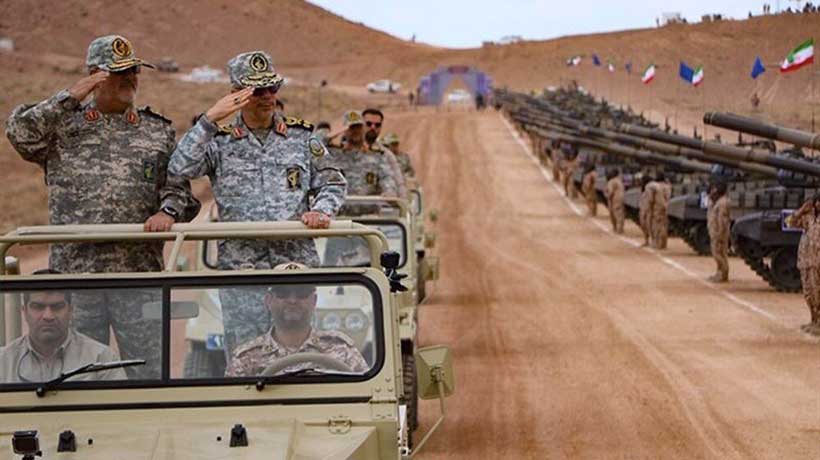
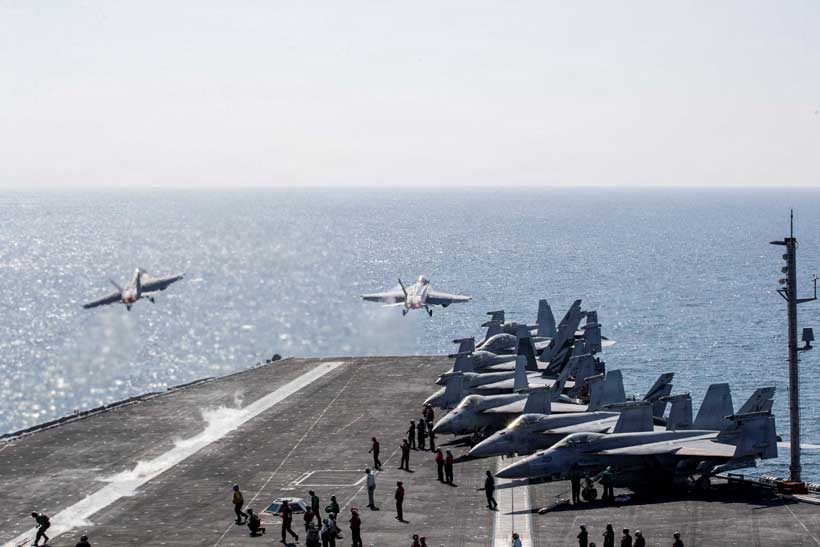

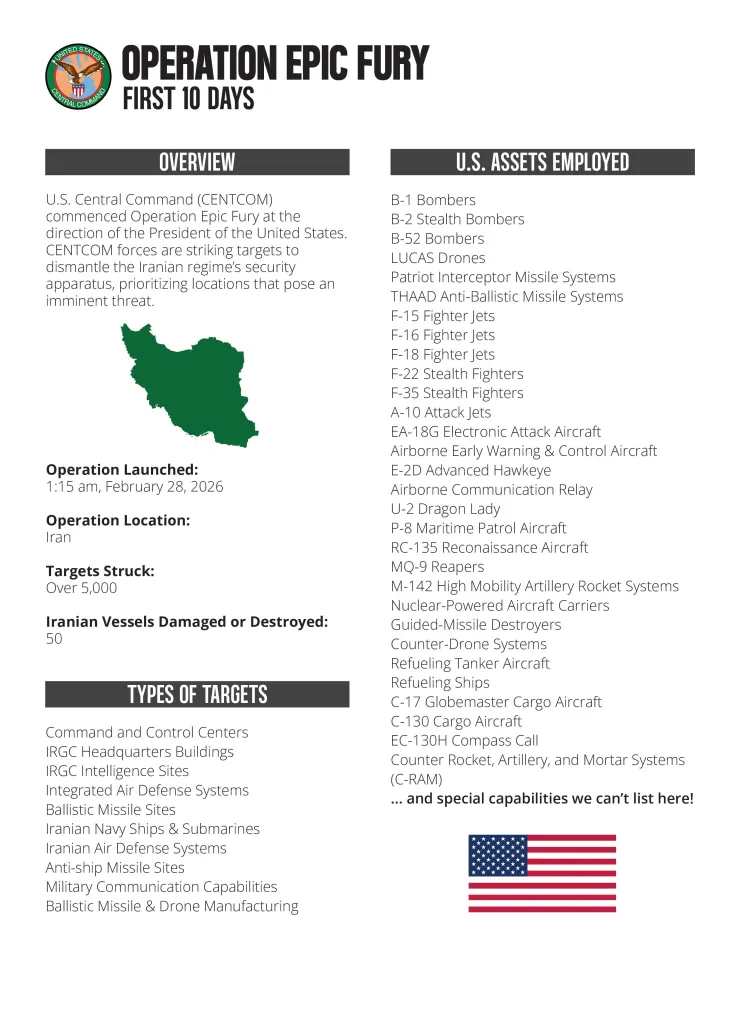


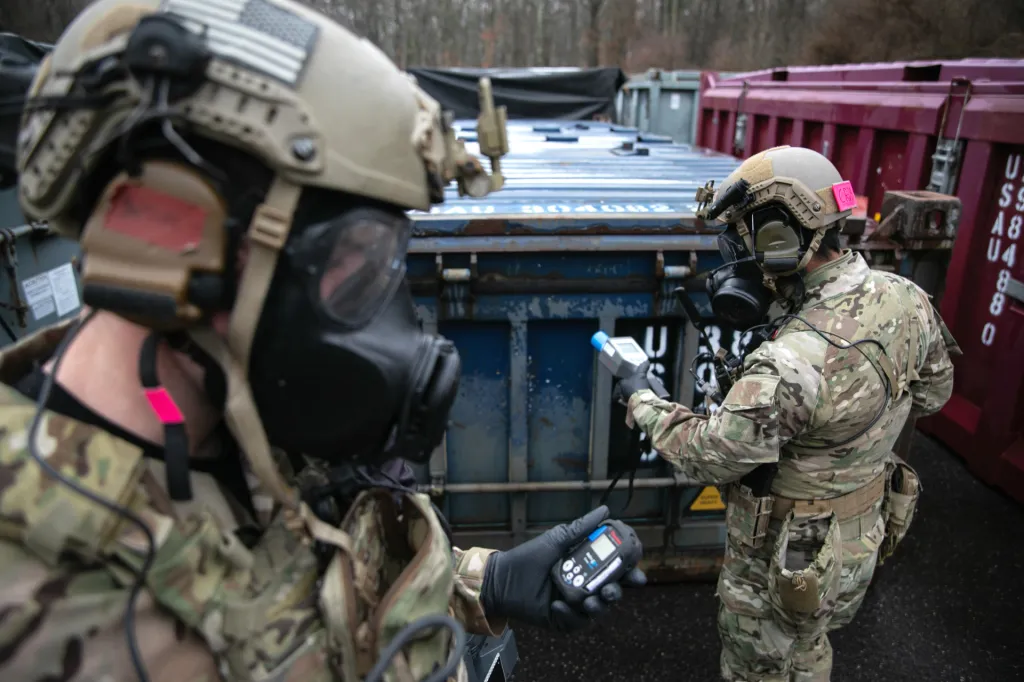


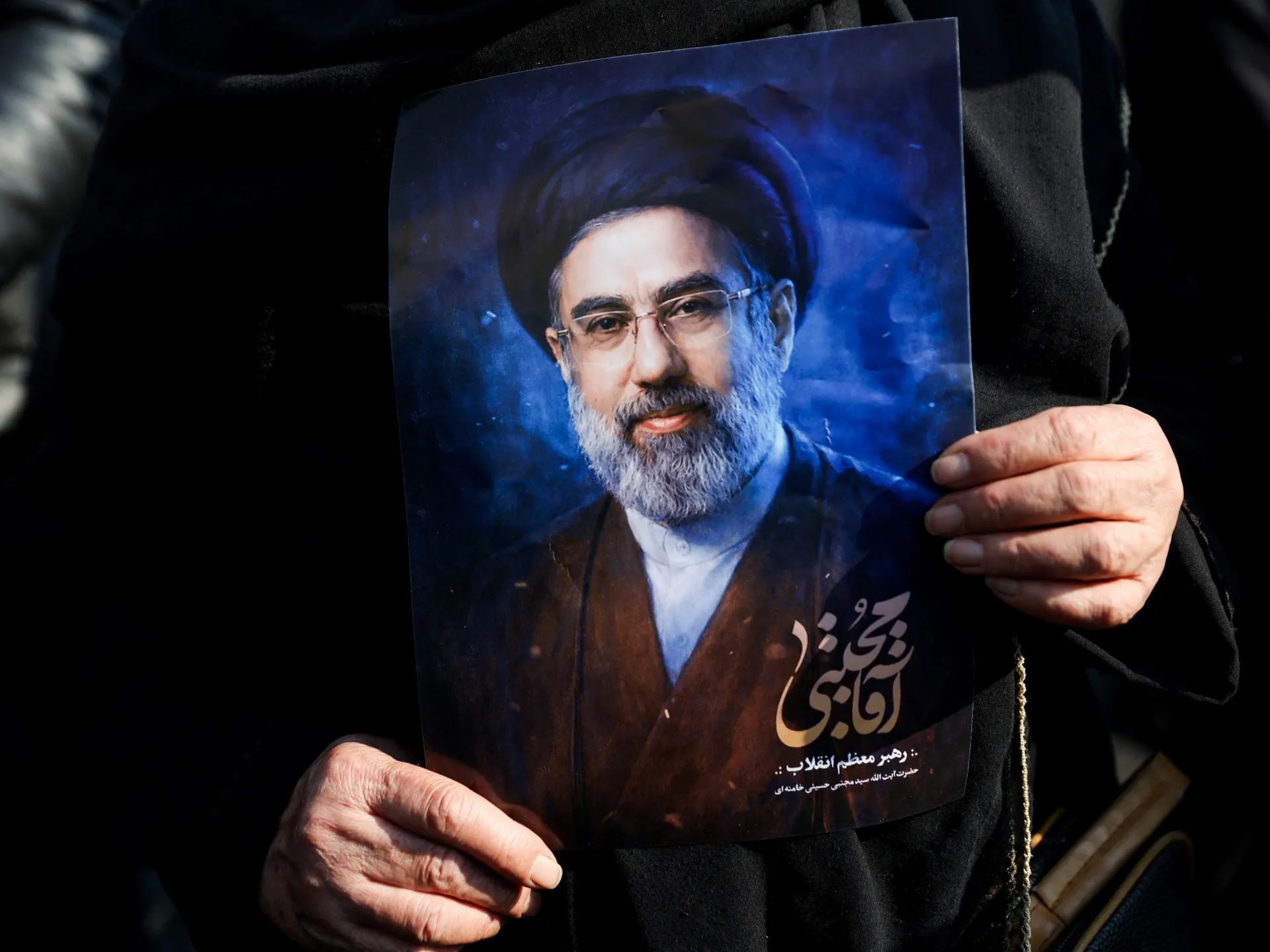
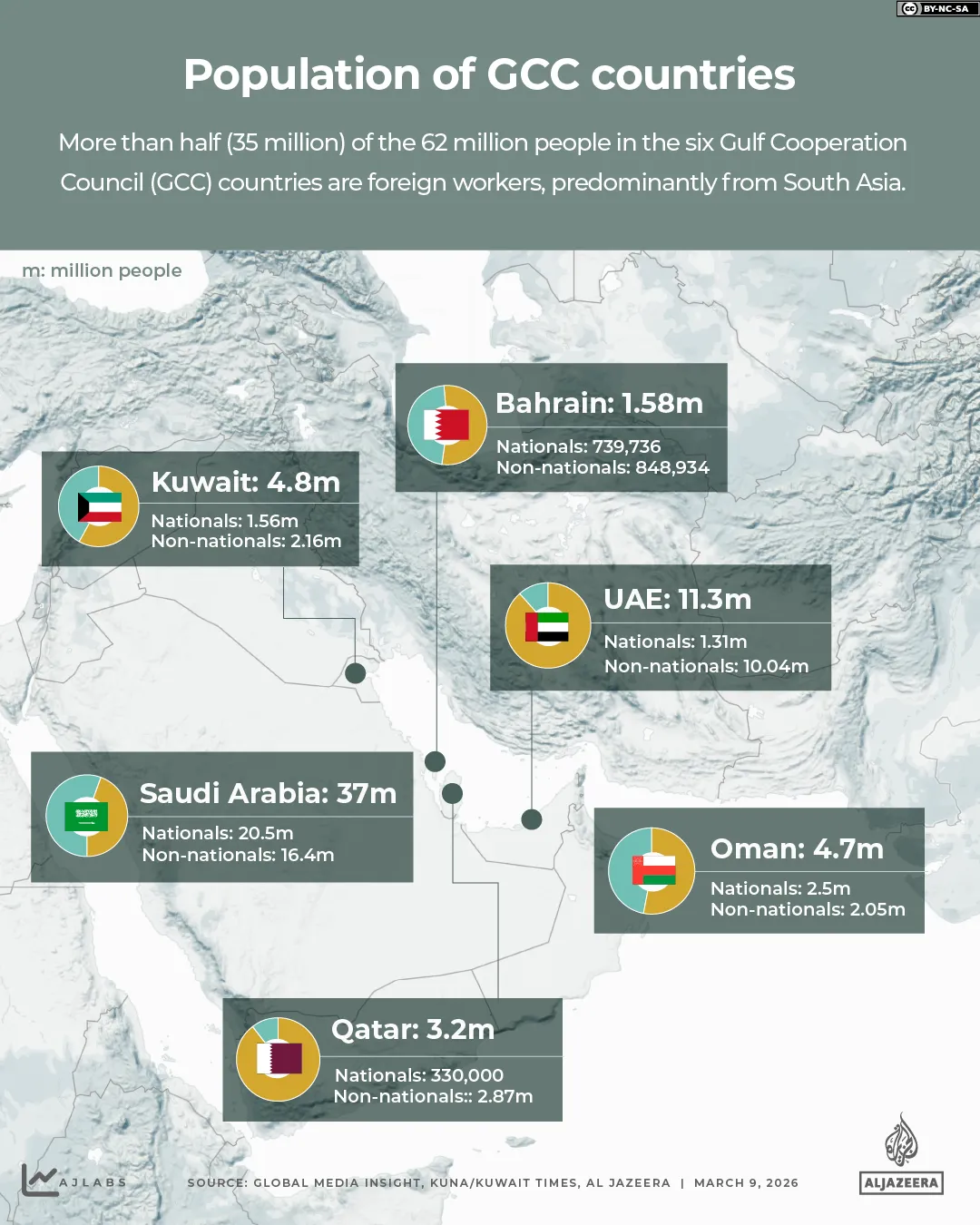


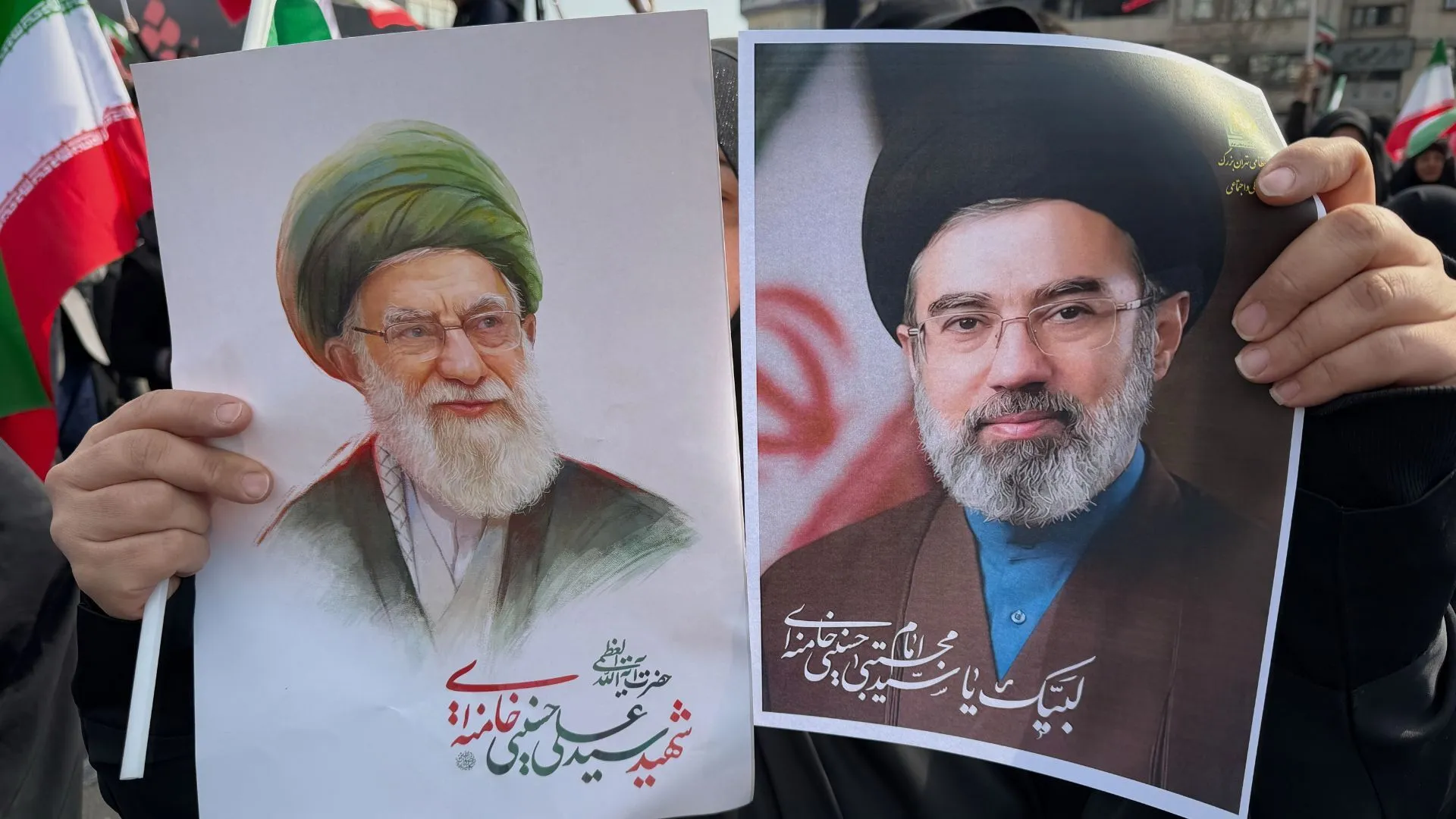


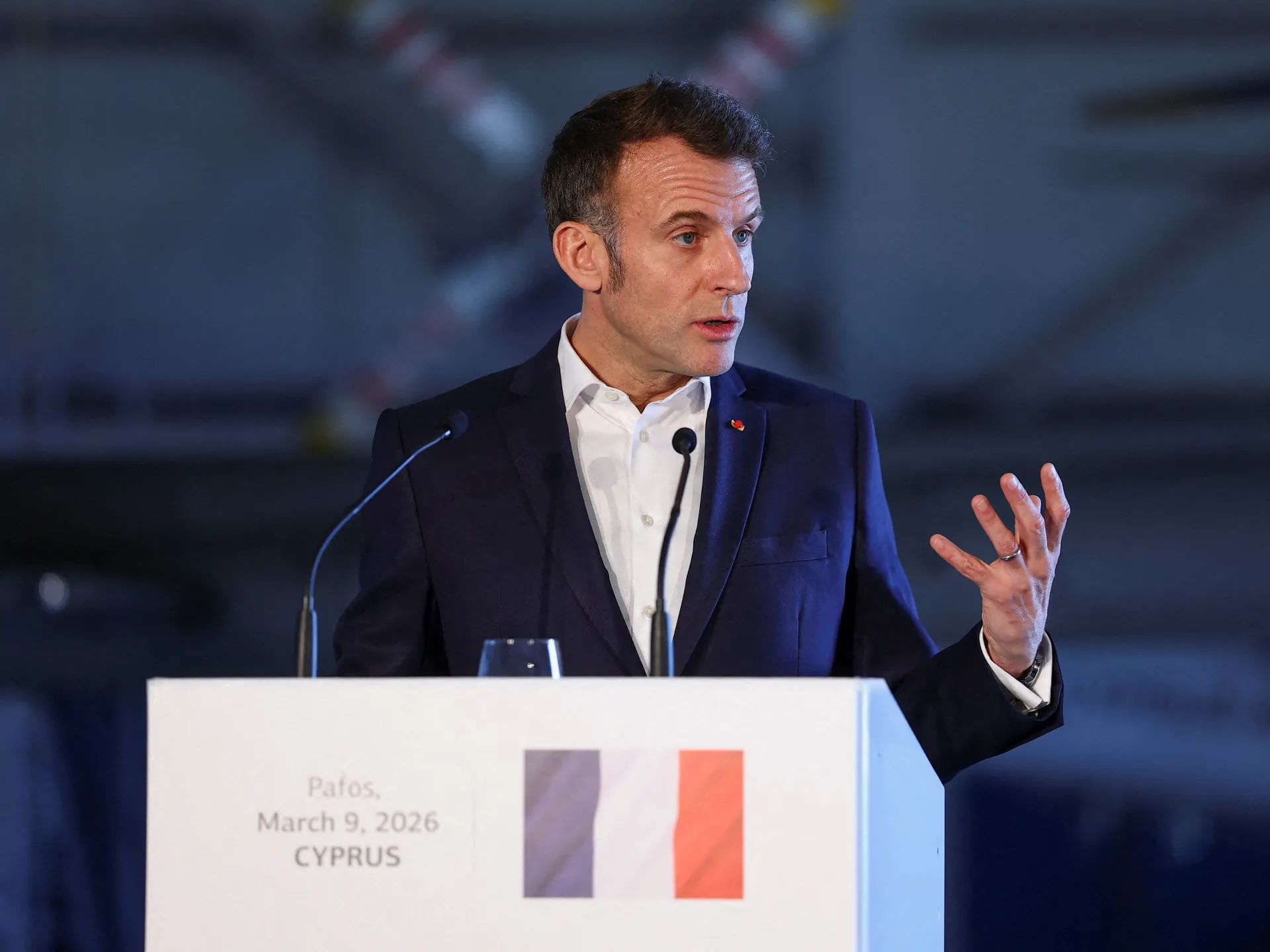
![A woman mourns over the body of journalist Ahmed Mansur at Nasser Medical Complex in Khan Yunis in the southern Gaza Strip on April 8, 2025. [AFP]](https://i0.wp.com/www.aljazeera.com/wp-content/uploads/2025/09/AFP__20250408__39HB7LK__v1__HighRes__PalestinianIsraelConflictGazaPressFuneral-1-1756701660.jpg?w=640&ssl=1)