Stay informed and up-to-date with the latest news from around the world. Our comprehensive news coverage brings you the most relevant and impactful stories in politics, business, technology, entertainment, and more.
A strike on the heavily fortified United States embassy compound in Baghdad caused a fire and damage to the complex. It is the second attack on the embassy since the United States and Israel launched strikes on Iran on February 28.
Weekly insights and analysis on the latest developments in military technology, strategy, and foreign policy.
U.S. President Donald Trump says there “will be no deal” with Iran unless it surrenders unconditionally, a day after Iran’s Foreign Minister said the country was prepared to stand up to a ground invasion. Trump has also said that any new leadership of the country would have to be “acceptable” to the United States. This follows what has now been seven days of heavy U.S.-Israeli bombardment, including a new major wave of strikes by Israel targeting Iranian leadership in Tehran overnight.
You can catch up with our past coverage of ongoing operations against Iran here.Latest updates on the war are down the page of this article.
Trump’s statement was made via a post on his Truth Social social media network.
“There will be no deal with Iran except UNCONDITIONAL SURRENDER!,” he wrote. “After that, and the selection of a GREAT & ACCEPTABLE Leader(s), we, and many of our wonderful and very brave allies and partners, will work tirelessly to bring Iran back from the brink of destruction, making it economically bigger, better, and stronger than ever before. IRAN WILL HAVE A GREAT FUTURE. “MAKE IRAN GREAT AGAIN (MIGA!).”
BREAKING: Trump on Iran:
There will be no deal with Iran except UNCONDITIONAL SURRENDER!
After that, and the selection of a GREAT & ACCEPTABLE Leader(s), we, and many of our wonderful and very brave allies and partners, will work tirelessly to bring Iran back from the brink of… pic.twitter.com/6Q6TqyHTbt
Trump has increasingly talked about changing the regime in Tehran in recent days, and his desire to be personally involved in that process. This comes despite pushback from other U.S. officials about regime change being an explicit goal of what has been dubbed Operation Epic Fury.
“We want to go in and clean out everything,” Trump told NBC Newsin a phone call on Thursday. “We don’t want someone who would rebuild over a 10-year period.”
“We want them to have a good leader,” the president added. “We have some people who I think would do a good job.”
Trump declined to offer any names, but said he was taking steps to make sure the people on his list make it through the war alive.
EXCLUSIVE: Trump says he wants Iran’s leadership structure gone and wants to ensure his own list of possible leaders survive the war. https://t.co/KRwAmgz2tN
Trump acknowledged that Khamenei’s son, Mojtaba Khamenei, is the most likely successor, but finds that outcome unacceptable and insists he play a role in determining Iran’s next leader, Axios reported.
“They are wasting their time. Khamenei’s son is a lightweight,” Trump told Axios. “I have to be involved in the appointment, like with Delcy in Venezuela.”
Trump was referring to the Venezuelan Vice President Delcy Rodriguez, who took over after the capture of dictator Nicolas Maduro in a dramatic U.S. operation in January.
🚨 EXCLUSIVE: Trump says he must be involved in picking Iran’s next leader.
He said that Mojtaba Khamenei, son of assassinated supreme leader Ali Khamenei, is the most likely successor — and finds that unacceptable.https://t.co/73b4PVOLW2
Trump had also called for Iran’s unconditional surrender during the 12 Day War between Israel and Iran last year, before helping broker a ceasefire agreement between the parties.
The last time Trump demanded Iran’s “unconditional surrender” was during the 12-Day Israel–Iran war (June 13–24, 2025).
Trump twice demanded Iran’s “unconditional surrender” back then.
Before Trump made his unconditional surrender demand, U.S. Navy Adm. Brad Cooper, commander of U.S. Central Command (CENTCOM), laid out how destructive Epic Fury has been to Iran’s military.
“Over the last 24 hours of the operation, compared to where we were at the start, ballistic missile attacks have decreased by 90%, drone attacks have decreased by 83% since day one,” he told reporters, including from The War Zone, during a press conference at CENTCOM headquarters in Tampa, Florida, on Thursday evening. Cooper added that these attacks have also wiped out a large chunk of Iran’s Navy, destroying 20 ships so far.
U.S. Admiral Brad Cooper gives update on Iran: “We are now starting our sixth day of a historic mission to eliminate Iran’s ability to threaten America. The president and Secretary Hegseth have been crystal clear in their expectations and we are at a high level of execution.” pic.twitter.com/Acr4WpQJpc
Overnight, the Israeli Defense Forces (IDF) said it carried out a massive 50-jet raid on Tehran, targeting an underground bunker complex intended for use by Supreme Leader Ali Khamenei and other top leaders. Khamenei was killed elsewhere in the opening phase of what the IDF called Operation Roaring Lion.
The bunker “spanned multiple streets in the heart of Tehran and contained numerous entrances and meeting rooms” for senior Iranian leaders, the IDF explained. It was intended to be used by Khamenei as “a secure emergency command center,” but after his death, “the compound continued to be used by senior Iranian regime officials,” the IDF claimed.
הבונקר התת-קרקעי, נבנה מתחת למתחם והיה נכס חירום מאובטח לניהול הלחימה על ידי המנהיג, שחוסל טרם הספיק להשתמש בו במבצע ‘שאגת הארי’. לאחר חיסול ח’אמנהאי, המתחם המשיך לשמש את בכירי המשטר האיראני.
לאורך שנים, המשטר השקיע את מאמציו להקמת המתחם התת-קרקעי, במטרה לבסס עבורו מקום לקידום… pic.twitter.com/LlPmHSFlR7
The “senior commander” targeted by these Israeli air strikes was Asghar Hijazi, Times of Israel military correspondent Emanuel “Mannie” Fabian reported on X, citing Israeli defense sources.
“Hijazi is said to be the acting head of the supreme leader’s office, following the killing of Ali Khamenei,” Fabian added.
The “senior Iranian commander” targeted in an Israeli airstrike in Tehran a short while ago is Asghar Hijazi, according to Israeli defense sources.
Hijazi is said to be the acting head of the supreme leader’s office, following the killing of Ali Khamenei. https://t.co/7T58UKmkLp
— Emanuel (Mannie) Fabian (@manniefabian) March 6, 2026
Videos emerging from Tehran showed multiple explosions and ensuing fireballs rising in the distance. Local residents described the attack as “the worst, strongest, and most horrifying ever.”
For their part, Iranian officials have been publicly rejecting the possibility of new talks and/or a ceasefire with the United States and Israel amid the ongoing conflict. Iran’s Foreign Minister Sayed Abbas Araghchi also said yesterday that his country was prepared for a ground invasion.
“Relying on its defensive capabilities and the support of the Iranian nation, the Islamic Republic defends the country’s national sovereignty and territorial integrity within the framework of its inherent right to legitimate self-defense and will respond decisively to any aggressive act,” Araghchi told his Cuban counterpart today.
Significant pressure is clearly being put on the regime in Tehran to capitulate, at least to some degree. Top Iranian leadership figures are being actively targeted, as are individuals who could step in to fill the resulting voids. What the U.S. government, as well as its Israeli allies, may actually be willing to accept in order to bring the conflict to an end remains to be seen.
We have concluded our rolling coverage in this piece.
UPDATE: 5:33 PM EST –
After a meeting with major defense contractors called as the U.S. continues to burn through munitions during Epic Fury, Trump said they were boosting weapons production.
“They have agreed to quadruple Production of the ‘Exquisite Class’ Weaponry in that we want to reach, as rapidly as possible, the highest levels of quantity,” the president proclaimed. “Expansion began three months prior to the meeting, and Plants and Production of many of these Weapons are already under way.”
In his post, Trump again asserted that there is “a virtually unlimited supply of Medium and Upper Medium Grade Munitions, which we are using, as an example, in Iran, and recently used in Venezuela. Regardless, however, we have also increased Orders at these levels.”
Air Force Chief of Staff Gen. Ken Wilsbach posted a message on X praising airmen for their efforts during Epic Fury.
U.S. Treasury Secretary Scott Bessent said “tonight will be our biggest bombing campaign” against Iran.
“We will do the most damage to the Iranian missile launchers and the factories that built them.”
INTERESTING: U.S. Treasury Secretary Scott Bessent on Iran:
Tonight will be our biggest bombing campaign.
We will do the most damage to the Iranian missile launchers and the factories that build the missiles. pic.twitter.com/zCYvaytdeC
Videos have emerged on social media claiming to show attacks across Iraq.
Some purport to show an attack on Camp Victory, a facility housing U.S. forces near Baghdad’s international airport. You can see explosions followed by fireballs and smoke in the video. It is not clear who is attacking.
🇮🇶🇮🇷🇺🇲‼️ FEROZ BOMBARDEO IRANÍ: REPORTAN QUE LA BASE CAMPO VICTORIA (EEUU) EN BAGHDAD ESTARÍA EN LLAMAS POR ATAQUE CON 2 MISILES Y DRONES pic.twitter.com/a7VAMWrBpv
— (FRAPP) ANTIFASCISTA #AntiKast #OrgullosoDel42% (@Informa3Chile) March 6, 2026
Another video shows a claimed strike by U.S. helicopters on an Iranian-backed militia group in Mosul. We cannot independently confirm any of these claims and have reached out to CENTCOM for more information.
US helicopters struck at least twice a Kataeb Seyyed a-Shuhadaa’ HQ in al-Rashidiya, Mosul, tonight. KSS is an Iranian-backed militia that has carried out attacks against Iraqi Kurdistan & US interests in Iraq under the facade group Awliyaa’ a-Damm. pic.twitter.com/JdG9u5nqWt
There is also a video claiming to depict an Iranian drone strike on energy facilities in Basra.
Iranian drone strikes hit energy infrastructure in Burjesia/Basra, including a Baker Hughes facility, the Rumaila oil field, and Basra airport. pic.twitter.com/CeeHpKKFSk
The IRGC offered a threatening response to Trump’s order to have U.S. Navy vessels escort commercial ships through the Strait of Hormuz. Iran has previously claimed it had shut down the Strait, and the IRGC said it welcomes these escorts, with a reference to the American supertanker Bridgeton, which hit a mine in the Persian Gulf while being escorted by U.S. Navy warships in 1987. That incident took place in the so-called “Tanker War” that took place during the Iran-Iraq War.
IRGC Spox:
Iran strongly welcomes US’ willingness to escort oil tankers and the claim of the presence of US forces for passage through the Strait of Hormuz, and in fact, the IRGC is waiting for their presence.
Amid all the turmoil, the French aircraft carrier Charles de Gaulle has passed through the Strait of Gibraltar and is now in the Mediterranean.
France’s aircraft carrier Charles de Gaulle has passed through Gibraltar into the Mediterranean Sea and is moving toward the Middle East. pic.twitter.com/TCK9Wuv5i6
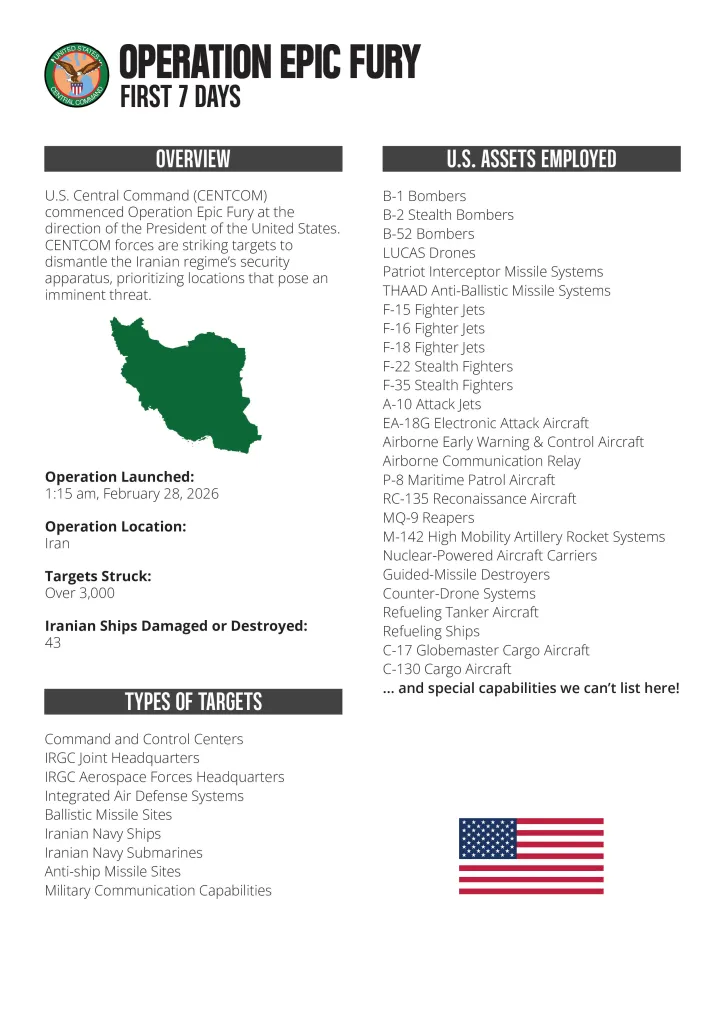
CENTCOM released its latest Epic Fury graphic update showing targets hit and assets deployed. So far, more than 3,000 targets have been hit, including 43 Iranian ships that have been destroyed or damaged, according to the command.
(CENTCOM)
The aircraft carrier USS Gerald R. Ford has transited the Suez Canal and is now in the Red Sea, according to the Navy. Images posted on the Pentagon’s video and image distribution site show the carrier and one of its escorts, the Arleigh Burke class guided missile destroyer USS Bainbridge in the canal.
The world’s largest aircraft carrier, USS Gerald R. Ford (CVN 78), transits the Suez Canal, March 5, 2026. (U.S. Navy photo) U.S. Central Command Public AffaArleigh Burke class guided-missile destroyer USS Bainbridge (DDG 96) transits the Suez Canal, March 5, 2026. (U.S. Navy photo) U.S. Central Command Public Affa
A Chinese satellite image emerged of the Ford and two of its escorts crossing through the canal. This move makes sense considering that the ballistic missile threat against Israel that the carrier strike group was helping defend against has diminished. Being in the Red Sea would provide assets needed to defend against any attacks from the Houthis of Yemen should that Iranian proxy decide to get into the fight.
The Pentagon also released photos of B-52 Stratofortress bombers that took part in Epic Fury.
Aircrew members board a B-52H Stratofortress prior to taking off in support of Operation Epic Fury, March 4, 2026. (U.S. Air Force photo) U.S. Central Command Public Affa
There are claims that Iran struck a Patriot air defense site in the UAE, however we cannot confirm this. We reached out to CENTCOM for more details.
“There may be other countries to join action against Iran and its interests in the region,” the outlet noted.
These claims come days after Azerbaijani officials vowed they would retaliate for an Iranian drone strike on their territory that wounded four people.
We cannot confirm that, however, video emerged earlier today showing Azerbaijani military equipment being moved closer to that nation’s border with Iraq.
The U.K. Defense Ministry (MoD) issued its latest update on operations in the Middle East.
Iran’s intelligence ministry said on Thursday that “separatist terrorist groups” planned to enter the country from its western borders and carry out attacks in urban and border areas, taking advantage of wartime conditions, Iran International reported. “A joint preemptive operation by the intelligence ministry and the Islamic Revolutionary Guard Corps destroyed a significant portion of the groups’ positions and capabilities and inflicted heavy losses,” the ministry said in a statement.
UPDATE 1:07 PM EST –
White House Press Secretary Karoline Leavitt offered an explanation of what Trump means by his unconditional surrender demand on Iran.
“When Trump, as Commander in Chief, determines that Iran no longer poses a threat to the US and the goals of Operation Epic Fury have been fully realized, then Iran will essentially be in a place of unconditional surrender, whether they say it themselves or not,” she explained.
Karoline Leavitt on Iran:
When Trump, as Commander in Chief, determines that Iran no longer poses a threat to the US and the goals of Operation Epic Fury have been fully realized, then Iran will essentially be in a place of unconditional surrender, whether they say it themselves… pic.twitter.com/RMQpAJxx4E
The Army in recent days abruptly canceled a major training exercise for the headquarters element of the 82nd Airborne Division at Fort Bragg, North Carolina, according to The Washington Post.
“This is fueling speculation within the Defense Department that soldiers specializing in ground combat and a range of other missions may be sent to the Middle East as the conflict with Iran widens,” the publication posited.
SCOOP: The Army in recent days canceled a training exercise for the headquarters element of the 82nd Airborne Division, fueling speculation among soldiers that they may be called upon for a still undefined mission as the war with Iran widens.
Ukraine is in talks with the U.S. and Gulf allies about replicating Kyiv’s acoustic detection network to counter Iranian attack drones, Financial Times is reporting, citing people familiar with the matter. Consisting of thousands of acoustic sensors across Ukraine, this system helps detect and track incoming Russian kamikaze drones, alert traditional air defenses in advance, and also dispatch ad hoc drone hunting teams to shoot them down.
New: Ukraine is in talks with the US and several Gulf states about replicating Kyiv’s acoustic detection network to counter Iranian attack drones, according to people familiar with the matter. w/ @fabrice_deprezhttps://t.co/ME2ErGPq8X
Air Force Gen. Dan Caine, chairman of the Joint Chiefs of Staff, posted a message on X honoring six soldiers killed in Kuwait by an Iranian drone on March 1.
“It is with profound sadness that we mourn the loss of six American heroes from the 103rd Sustainment Command U.S. Army Reserves out of Des Moines, Iowa,” Caine noted. “Major Jeffrey R. O’Brien, Captain Cody A. Khork, Chief Warrant Officer 3 Robert M. Marzan, Sergeant First Class Nicole M. Amor, Sergeant First Class Noah L. Tietjens, and Sergeant Declan J. Coady.”
A message from the Chairman of the Joint Chiefs of Staff Gen. Dan Caine:
It is with profound sadness that we mourn the loss of six American heroes from the 103rd Sustainment Command U.S. Army Reserves out of Des Moines, Iowa: Major Jeffrey R. O’Brien, Captain Cody A. Khork,…
Secretary of State Marco Rubio told Arab foreign ministers in a series of phone calls Thursday that the war is expected to last several more weeks, Axios is reporting, citing “sources with direct knowledge of the conversations.”
Rubio said the current military focus is on Iran’s missile launchers, stockpiles and factories, the outlet reported, adding that the secretary “told the ministers the U.S. goal is not regime change — while simultaneously making clear Washington wants different people running the country.”
U.S. Secretary of State Marco Rubio told Arab foreign ministers in calls Thursday that the war with Iran is expected to last several more weeks, according to sources familiar with the conversations. Rubio said the current military focus is on Iran’s missile launchers, stockpiles…
At least one B-1B Lancer bomber landed at RAF Fairford in the U.K. today. This is part of an ongoing buildup of U.S. forces as Epic Fury drags on.
UPDATE: 12:58 PM EST –
“The Iranian terrorist regime has attacked 12 different countries and continues to deliberately target civilians through the Middle East,” CENTCOM commander Adm. Brad Cooper has said in a new statement. “Last night, Iranian forces fired seven attack drones at civilian, residential neighborhoods in Bahrain. This is unacceptable and will not go unanswered. We will continue work with regional partners to address this threat to innocent people across the region.”
There are as-yet unconfirmed reports that U.S. B-1 bombers are headed to RAF Fairford in the United Kingdom, and that they will begin flying strikes on Iran from that base. In a press conference late yesterday, Secretary Pete Hegseth and Adm. Cooper both talked about the continued flow of U.S. forces, including bombers, to support Operation Epic Fury.
USAF B-1B bombers from Dyess AFB are expected to deploy to RAF Fairford in the near term.
Their arrival would significantly increase the tempo of long-range strike operations against targets in Iran. The B-1B carries one of the largest conventional payloads in the U.S. arsenal,…
Restricted airspace around RAF Fairford for the next month (at least) shows the USAF will be deploying bombers to the airfield shortly. Note: NOTAMs are on the www. Credit JS below. https://t.co/i0qiHSGs0m
French authorities have denied that U.S. aircraft are using bases in the country to support operations over Iran, but are instead operating from them to aid in “the defense of our partners in the region.”
✖️No U.S. assets deployed on French bases in the Middle East.
✔️Yes: U.S. assets accepted on Istres Airbase (France) as part of a routine NATO procedure. They are not involved in U.S. operations in Iran but strictly supporting the defense of our partners in the region. https://t.co/NcZ1TyWc8z
It has now been reported that the U.S. Navy submarine that torpedoed the Iranian frigate IRIS Dena in the Indian Ocean was the Los Angeles class USS Charlotte. Separately, another Iranian ship has now sought refuge in India. This is in addition to the IRIS Bushehr, which is now impounded in Sri Lanka.
7th Fleet Los Angeles-class fast-attack sub USS Charlotte (SSN 766) fired the single Mk 48 torpedo that sunk Iranian frigate IRIS Dena (75), @JimLaPorta reports.
One of 30+ Iranian vessels destroyed this week and the first enemy ship sunk by a U.S. sub since WW2. Periscope view: pic.twitter.com/gAGc9I7BjY
BREAKING: Iranian Navy warship IRIS Lavan docked in Kochi with its 183 member crew on March 4, the same day that IRIS Dena was torpedoed. The ship had requested accommodation on Feb 28 and received permission on March 1. The crew is being accommodated in Indian Navy facilities. pic.twitter.com/yLVwPvu54L
The vessel requested entry into Sri Lankan waters on March 4 citing mechanical issues, hours after U.S. forces sank companion vessel IRIS Dena off Galle, killing almost 100 Iran sailors https://t.co/T1wF2qvz2Ipic.twitter.com/13ljHDPTn7
The satellite image below is said to show the aftermath of an attack on an Iranian underground ballistic missile facility.
The video below is said to show an Iranian ballistic missile attack on Prince Sultan Air Base in Saudi Arabia, though it is currently unconfirmed.
Video footage purported to show an Iranian ballistic missile strike on Prince Sultan Air Base in Al-Kharj, Saudi Arabia, with the missile impacting very close to several U.S. servicemembers, thankfully said to have resulted in only minor injuries to personnel at Prince Sultan. pic.twitter.com/Nlju8TCZ22
Pictures and videos showing Iranian ballistic missiles with cluster munition payloads being employed continue to appear online. Images of the submunitions themselves have also now been emerging following the use of these missiles.
The Ministry of Defense of the United Arab Emirates (UAE) says the country’s forces intercepted another nine ballistic missiles and 109 drones fired by Iran today. UAE authorities say they have now intercepted 190 ballistic missiles, eight cruise missiles, and 1,110 drones since the conflict began.
UAE air defences intercept 9 ballistic missiles, 109 drones
The UAE Ministry of Defence announced that the country’s air defence systems detected 9 ballistic missiles today (6th March 2026), all of which were intercepted and destroyed.
MS NOW‘s “Morning Joe” is reporting that authorities in the UAE have now frozen billions of dollars in Iranian assets held in the country.
BREAKING NEWS: #morningjoe has learned that the UAE has frozen billions of dollars in Iranian assets. The move will likely have crippling effects on an already weakened Iranian economy. https://t.co/Da41RisQqY
What is said to be the first U.S. State Department-facilitated evacuation flight from Israel has arrived in Greece, according to JewishInsider.
New from me: The first State Department evacuation flight from Israel landed in Athens on Friday afternoon, where its passengers were greeted on the tarmac by U.S. Ambassador to Greece Kim Guilfoyle.https://t.co/ICBx7NpaHH
U.S. Central Command (CENTCOM) has now released a video showing a strike on the Iranian ‘drone carrier’ Shahid Bagheri, an unusual ship you can read more about here. At a press conference late yesterday, U.S. Navy Adm. Brad Cooper, head of CENTCOM, said an unnamed “Iranian drone carrier ship, roughly the size of a World War II aircraft carrier” had been targeted in “just the last few hours.” In a post on X on March 2 denying claims of an attack on a U.S. carrier, CENTCOM said “the only carrier that has been hit is the Shahid Bagheri.” It remains unclear whether the Shahid Bagheri was struck multiple times.
U.S. forces aren’t holding back on the mission to sink the entire Iranian Navy. Today, an Iranian drone carrier, roughly the size of a WWII aircraft carrier, was struck and is now on fire. pic.twitter.com/WyA4fniZck
A video clip, taken from the shore, has now also emerged that is said to show the Shahid Bagheri on fire following a strike. The U.S. military has made clear that the destruction of Iran’s naval capabilities is a core objective of Operation Epic Fury.
U.S. Central Command continues to release other footage from ongoing strikes on targets in Iran.
Iranian targets are being decimated by U.S. forces, paving the way for continued delivery of overwhelming American military firepower. pic.twitter.com/wQUER9cXWw
✈️⛽️ Additional USAF Tankers (6) heading to Ben Gurion airport/airbase, Tel Aviv.
There were around 30 of them already parked there yesterday. Their role is to refuel different fighter jets in the region attacking Iran. pic.twitter.com/YJ6yBr6mRJ
The Israel Defense Forces have shared a video taken in the cockpit of a fighter flying over Iran.
The Israeli Air Force publishes footage from the cockpit of IAF fighter jets flying over Iran.
“We continue to fight, as required around the clock, and feel your support all the time. We wish you, Israeli citizens, a safe and quiet Shabbat,” a pilot is heard saying in a… pic.twitter.com/cvljwuAJ02
— Emanuel (Mannie) Fabian (@manniefabian) March 6, 2026
Deputy Prime Minister of the United Kingdom David Lammy has said the country would be within its rights to take “defensive action” in response to Iranian threats, including taking “down sites [Iran] that are anticipating attacking our people.” There are no indications that British forces have struck targets in Iran yet.
Publicly available data continues to show a decline in the number of Iranian ballistic missiles and drones launched in retaliatory attacks over the course of the conflict so far.
Day 8 👇
Iran Missile launches during the first 8 days of conflict:
🚀 Ballistic Missiles: 🔴 Day 1 — 350 🔴 Day 2 — 175 🔴 Day 3 — 120 🔴 Day 4 — 50 🔴 Day 5 — 40 🔴 Day 6 — 32 🔴 Day 7 — 28 🔴 Day 8 — 15
CBS News has reported that quadcopter-type drones may have conducted surveillance of U.S. facilities in Kuwait ahead of an attack that killed six American servicemembers.
Iranian intelligence utilized various means to track service members after they left the base.
➡️ In anticipation of the offensive and expected retaliation to include strikes on Camp Arifjan, the Tactical Ops Center (TOC) was moved to the same facility at the port used during… https://t.co/R8VcPGIESm
Qatari authorities say an Iranian attack struck facilities housing its naval personnel in Bahrain.
Qatar Condemns Iranian Attack on Buildings in Bahrain Housing Qatari Amiri Naval Forces Personnel
Doha | March 06, 2026
The State of Qatar condemns, in the strongest terms, the Iranian attack that targeted buildings in various areas of the sisterly Kingdom of Bahrain housing… pic.twitter.com/9Zd8lihCEi
— Ministry of Foreign Affairs – Qatar (@MofaQatar_EN) March 6, 2026
The Washington Post has reported that Russia may be providing Iran with information to help with targeting American forces in the Middle East, citing unnamed officials.
Exclusive: Russia is providing Iran with targeting information to attack American forces in the Middle East, the first indication that another major U.S. adversary is participating — even indirectly — in the war. https://t.co/SfBeKxq7zC
— The Washington Post (@washingtonpost) March 6, 2026
The video below is said to show the remains of an Iranian ballistic missile and its transporter-erector-launcher inside a structure following a strike.
A ballistic missile launcher concealed inside a hay storage site was struck today by U.S. and Israeli aircraft.
The boy who filmed the aftermath wrote: “It doesn’t matter where the launchers are, the Americans and Israelis will find them and target them heavily. Kudos to them.” pic.twitter.com/swI0PvEH6a
The videos below are said to show strikes on targets in the Iranian city of Ilam.
The satellite imagery below is said to show the aftermath of Iranian attacks earlier this week on facilities in Fujairah in the United Arab Emirates (UAE).
🇦🇪 Satellite images of oil facilities in Fujairah, UAE.
❗️UAE is considering freezing billions of dollars in Iranian assets held in the country and possibly seizing Iranian ships, – WSJ
🇶🇦 Qatar says the ongoing war could force Gulf countries to stop energy exports if it… pic.twitter.com/K5U49eikL0
South Korea’s Chosun newspaper has reported that 1,000 guidance kits for Paveway-series laser-guided bombs were moved from storage at Osan Air Base in December, possibly in support of preparation for Operation Epic Fury. However, the sourcing for the story is unclear, and it says that officials in the country have declined to comment.
The U.S. moved 1,000+ Paveway guided-bomb kits from Osan Air Base to the U.S. in Dec 2025, possibly later used in strikes on Iran.
Seoul says the transfer happened without prior consultation.
South Korean media outlets are also reporting that the Cheongung-II surface-to-air missile system, which is in service in the UAE, has made its combat debut, citing members of the country’s National Assembly and unnamed military officials.
S Korea’s Cheong-Gung air defense system in service since 2015.
It made its combat debut with UAE air defense forces, successfully intercepting several Iranian ballistic missiles on 3 March 2026. pic.twitter.com/OT3Pzj1UVk
— Christopher Wipper (@SGTWipper1Each) March 5, 2026
Pro-Iranian Iraqi militants claim to have launched kamikaze drones aimed at Jordanian military bases.
#USA / #Iraq / #Jordan 🇺🇸🇮🇶🇯🇴: Iraqi group “Rijal Al-Bas Al-Shadid” (Men of Great Strength) carried out attacks on Jordanian military bases.
Group seemingly launched several #Iran-made 🇮🇷 X-Tail “Shahed-101” Kamikaze Drones (OWA-UAVs) towards Jordan. pic.twitter.com/QT2ERJ7IJL
There are reports that ships continue to come under attack in and around the Strait of Hormuz. Maritime traffic through this highly strategic waterway continues to be at a virtual standstill due to the ongoing conflict.
While MOST vessels are waiting out the situation at the Strait of Hormuz, the Cook Islands flagged bitumen tanker PUSHPAK just sailed right through with AIS active. pic.twitter.com/FHiP76R8E9
Qatari Energy Minister Saad Sherida Al Kaabi has warned that all Gulf energy producers could halt production “within weeks and drive oil to $150 a barrel” if the ongoing conflict continues unabated in an interview with the Financial Times newspaper. Some oil fields are already cutting back production as available storage capacity in the country fills up as exports slow, according to The Wall Street Journal.
“Qatar expects all Gulf energy producers to shut down exports within weeks and drive oil to $150 a barrel, the country’s Energy Minister Saad al-Kaabi told the Financial Times in an interview published on Friday. “Everybody that has not called for force majeure we expect…
The U.S. government is reportedly easing sanctions on Russian oil exports to India amid disruption in global markets as a result of ongoing operations against Iran, the Financial Times has also reported.
The US is temporarily easing sanctions on Russian oil sales to India to address supply shortages and reduce the impact of the surge in prices in the wake of US and Israeli attacks on Iran. The decision to ease sanctions represents a major shift in policy:https://t.co/v5X5lhptE4
The U.S. Embassy in Baghdad has issued a new alert saying U.S. nationals are “strongly encouraged to depart as soon as they are safely able to do so” and advising them to use overland routes given regional airspace closures. The Embassy has suspended regular consular services.
Security Alert – U.S. Embassy Baghdad, Iraq – March 6, 2026 – Update 1 Location: Iraq Event The U.S. government cares about your safety and will continue to share information you need to make informed decisions about your security. The U.S. government is assessing all options to… pic.twitter.com/MbEhCFSmGj
— U.S. Embassy Baghdad (@USEmbBaghdad) March 6, 2026
The Japan Self-Defense Forces will deploy a transport aircraft to the Republic of Maldives in the Indian Ocean as part of an effort to aid Japanese nationals in departing the Middle East.
“The Ministry of Foreign Affairs has reported that, with regard to supporting the departure of Japanese nationals, transportation for those staying in Kuwait, Bahrain, Qatar, and the United Arab Emirates will be carried out sequentially starting as early as tomorrow onward. In light of this, the Ministry of Defense is proceeding with preparations for the Self-Defense Forces as a precaution, in preparation for unforeseen circumstances such as the inability to operate civilian charter flights,” Japanese Defense Minister Shinjiro Koizumi wrote on X, according to a machine translation of the post below. “The one Air Self-Defense Force transport aircraft moving to and positioning in the Republic of Maldives will be operated by pilots, maintenance personnel, and others from the Air Support Command (the Air Self-Defense Force unit that conducts air transport of supplies and air traffic control), with medical officers also on board.”
Sri Lankan authorities have released a video showing Iranian sailors from the frigate IRIS Dena being rescued after it was torpedoed by a U.S. submarine in the Indian Ocean earlier this week.
New video released by the Sri Lankan navy shows Iranian sailors being rescued after a US submarine attack sank their ship in international waters. pic.twitter.com/LnbsLxlMWB
Reuters has reported that U.S. officials are increasingly of the view that American forces were responsible for a strike on a primary school for girls in Mindab, Iran, but that the investigation is ongoing. Iranian officials have said that 150 students died as a result. The school directly abuts an Islamic Revolutionary Guard Corps (IRGC) facility in Mindab, which is believed to have been the target of the strike.
The girls’ school in Minab, in southern Iran, was hit on Saturday during the first day of U.S. and Israeli attacks on the country. Iran’s ambassador to the U.N. in Geneva, Ali Bahreini, said the strike killed 150 students. Reuters could not independently confirm the death toll.
At a presser Wed morning, SecDef Pete Hegseth said that the U.S. investigating. “”All I know, all I can say, is that we’re investigating that,” Hegseth said. “We, of course, never target civilian targets.”
The Pentagon has not yet responded to an additional request for comment.
Italian teenager breaks an 18-year-old record in China to become the youngest pole sitter in Formula One history.
Published On 14 Mar 202614 Mar 2026
Share
Italian teenager Kimi Antonelli said it was “just the beginning” after he set a pole record in China with Mercedes predecessor and seven-times world champion Lewis Hamilton lavishing praise on him.
At 19 years, six months and 17 days Antonelli became the youngest Formula One driver ever to take pole position for a full Grand Prix on Saturday.
Recommended Stories
list of 4 itemsend of list
“A great record. It’s going to take a while for someone to ever get close to that one,” Ferrari driver Hamilton, whose seat Antonelli took in 2025, told a news conference after qualifying third.
The previous record was set by now-retired German driver Sebastian Vettel when he put Red Bull-owned Toro Rosso (now Racing Bulls) on pole at the age of 21 and 72 days at the 2008 Italian Grand Prix.
Pundits questioned whether the then-18-year-old could live up to Hamilton’s legacy, even as Mercedes team boss Toto Wolff consistently touted the Italian as a top-tier talent.
“He took my seat! And he hit it hard from the get-go, so it’s really great to see him progressing and he really deserves it,” a beaming Hamilton said while sat next to Antonelli.
The Italian was his country’s first pole sitter since Giancarlo Fisichella for Mercedes-powered Force India, the team that is now Aston Martin, in Belgium in 2009.
“I’m very happy because at the end, you know, it’s just the beginning,” said Antonelli, who had a sprint pole in Miami last year but has yet to win a race.
“Obviously there’s a lot more to come. And, yeah, really looking forward to tomorrow … the car is feeling really good, the car is strong so, yeah, a lot to play for tomorrow.”
Antonelli was helped by Russell having no battery and getting stuck in gear at the start of the final phase and then getting only one flying lap for pole, which he converted into second place on the grid.
“Many said the kid was too young to be in a Mercedes, we should have prepared him otherwise. He did good today,” said Mercedes team boss Toto Wolff.
“It’s a shame that George couldn’t do the lap.”
Former champion Max Verstappen was only eighth fastest, continuing an unhappy weekend in a clearly struggling Red Bull.
Sunday’s Grand Prix will be raced over 56 laps of the 5.451km (3.387-mile) Shanghai International Circuit.
Who: Manchester United vs Aston Villa What: English football’s Premier League Where: Old Trafford, Manchester, United Kingdom When: Sunday March 15, at 2pm (14:00 GMT) How to follow: Al Jazeera’s live coverage begins at 11:00 GMT
Manchester United and Aston Villa face a crunch clash on Sunday in the race for UEFA Champions League qualification.
Recommended Stories
list of 4 itemsend of list
The pair hold third and fourth spots respectively in the Premier League, with United edging Villa on goal difference, while Chelsea and Liverpool sit three points behind the pair in fifth and sixth.
With only the top four being guaranteed a place at the top table of European football, the encounter at Old Trafford holds huge value to both with nine games to go of the season.
Al Jazeera Sport takes a closer look at the match.
Man Utd look to bounce back from first defeat under Carrick
Manchester United’s interim manager Michael Carrick on Friday said his players were “itching to get going” again, after suffering their first defeat under his leadership.
Last week, 10-man Newcastle United ended Carrick’s unbeaten run since he replaced Ruben Amorim in January.
“I understand the first defeat feels different but it was going to come at some point. Most teams have suffered that at some point,” Carrick told reporters.
“It has been a really good week in some ways, we have put ourselves in a position where there is a lot to play for.”
Carrick brushes off Scholes dig at Man Utd
United’s defeat by Newcastle prompted a dig from former player Paul Scholes, who wrote on Instagram: “Michael has definitely got something special about him … cos Utd have been crap last four games.”
Asked about his former teammate’s comment, Carrick said: “It was nothing really, nothing to say about it really.
“I think that is just where we are in terms of social media and things, and captions and quotes. It can be taken in different ways, so just be calm about it and understand the real meaning of things.
“Listen, there are different opinions out there and it’s fine. People can have different opinions.
“It’s just things get taken from one extreme to another. It is what it is. I am not worried about it and don’t make a big deal of it either.
“There’s nothing to say about it, really,” he said.
How have Aston Villa fared in the Premier League this season?
Villa had a turbulent start to the campaign, as they failed to register a win in their first five league matches – losing two. A run of 12 league wins in 13, however, propelled them into a title challenge by the turn of the year.
A 4-1 defeat at Arsenal on New Year’s Eve marked the start of another downturn, though, with only three wins recorded in 11 games starting with the defeat in London.
The midlands club have lost three of their last five on the road in the league, recording only one win in that time.
Last up for Man Utd
United suffered their first defeat under Carrick in their match at Newcastle United on March 4.
The home side were reduced to 10 men when Jacob Ramsey was sent off on the stroke of half-time.
It came in a frantic end to the first half that saw Anthony Gorden give Newcastle an injury-time lead from the penalty spot, only for Casemiro to head home an equaliser to send the sides in level.
William Osula netted the winner in the 90th minute to give Eddie Howe’s side all three points despite their numerical disadvantage.
“It was disappointing the way the game ended (against Newcastle) but we have digested that, looked at it and learned from it,” Carrick said ahead of the Villa match.
“We have trained really well this week and the boys are itching to get going.”
Last up for Aston Villa
Villa were 1-0 winners at Lille in the UEFA Europa League on Thursday, ending a four-game winless streak that included three defeats.
Ollie Watkins scored the only goal of the game in the 61st minute.
The return leg will be played at Villa Park on Thursday.
What happened the last time Man Utd played Aston Villa?
Villa recorded a 2-1 win in the reverse Premier League fixture at Villa Park in November, despite an encouraging display for Ruben Amorim’s United.
Morgan Rogers scored both goals for Villa – his first was scored in the 45th minute but United were level in first-half stoppage time through Matheus Cunha.
What happened in the corresponding fixture between Man Utd and Villa last season?
United were 2-1 winners in the Premier League match at Old Trafford last season.
The Red Devils were greatly aided by the sending off of Villa keeper Emiliano Martinez just before the break.
Amad Diallo and an 87th minute Christian Eriksen penalty sealed the win for the home side.
Head-to-head
This will be the 202nd meeting between the clubs with Manchester United winning 107 of the matches. Aston Villa have won 52 of the encounters, which date back to November 1892 and a 2-0 home win for United in the old Division One.
Manchester United team news
Carrick said Mason Mount had taken a “big step” and could return from a two-month absence against Villa this weekend.
The midfielder missed their last six league games due to injury.
“He is an important player for us,” he said.
“He is not 100 percent and he has only trained for a small period of time. But he is back and that’s good for us. We will see if he is involved on Sunday. That is it in terms of the players coming back.”
Matthijs de Ligt, Patrick Dorgu and Mason Mount all remain absent though, and Lisandro Martinez has been added to that list with a calf injury, while there remains an injury doubt over Luke Shaw.
The defender was forced off with injury in the defeat by Newcastle, but Noussair Mazraoui, who also came off injured in that game, is set to be available.
Aston Villa team news
Midfielder John McGinn returned to action at Lille on Thursday night and could be in line for a start at Old Trafford.
Youri Tielemans and Boubacar Kamara remain absent through injury, leaving a gaping hole in the middle of the Villa lineup.
Right-back Matty Cash is also a doubt having missed the Lille match after picking up a knock in Villa’s last Premier League outting.
Weekly insights and analysis on the latest developments in military technology, strategy, and foreign policy.
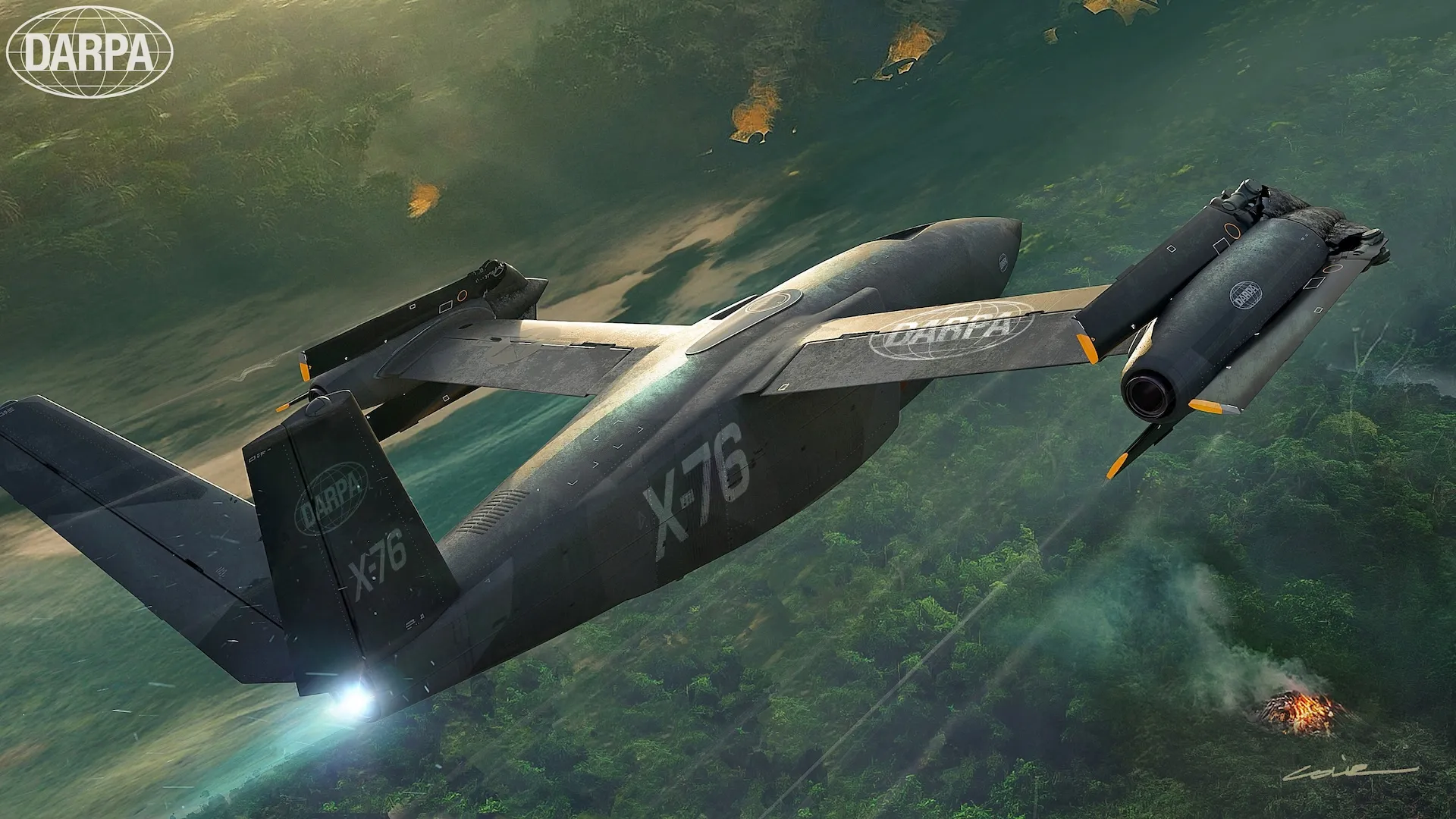
The latest addition to the legendary X-plane family is Bell Textron’s demonstrator for the Speed and Runway Independent Technologies (SPRINT) program. The chosen X-76 designation (for the year 1776) is intended to reflect the 250th anniversary of the United States.
“Bell is honored to receive the X-76 designation and continue the spirit of American innovation, honoring the founding of the United States in 1776,” said Jason Hurst, Bell SVP, Engineering, in a company media release. “This is an important milestone as the Bell and DARPA team advances to a historic first in aviation history and fulfills our mission of developing next-generation vertical-lift aircraft.”
A DARPA artist’s concept for the X-76. The latest DARPA renderings likely incorporate a degree of artist’s license but make an interesting comparison with Bell renderings. DARPA
SPRINT, which we have discussed in the past, is a Defense Advanced Research Projects Agency (DARPA) effort that is being run in conjunction with the U.S. Special Operations Command. Last year, DARPA selected Bell in favor of Boeing subsidiary Aurora Flight Sciences to move to the next phase of SPRINT — an experimental flying demonstrator. It should also be noted that SPRINT is paired with the High-Speed Vertical Takeoff and Landing (HSVTOL) program, something that Bell has discussed with TWZ in depth in the past.
The core goal of SPRINT is to demonstrate a concept for a vertical takeoff and landing (VTOL) aircraft that can cruise at speeds between 400 and 450 knots. In the words of DARPA, the aim is to “[eliminate] one of the battlefield’s most difficult choices — between the high speed of an aircraft that needs a runway and the go-anywhere flexibility of a slower helicopter.”
Bell’s X-76 design centers on wingtip proprotors with blades that fold away after the transition from hover to level flight, as you can read more about here. The company calls this the Stop/Fold rotor system.
At its most basic, the Stop/Fold concept is intended to offer vertical takeoff and landing capability, as well as the ability to hover, but with a tilting rotor system that can be stowed in a lower-drag configuration to allow for higher-speed level flight. A separate traditional jet propulsion system provides forward thrust in the latter mode.
A wind tunnel model of one of Bell’s fold-away rotor design concepts. Bell
DARPA announced today that the X-76 had successfully completed its critical design review (CDR) and has now entered production. CDR followed Bell’s selection in May 2025, after which SPRINT entered Phase 2 of the program.
Once built, the X-76 demonstrator is planned to mature technologies necessary for the following capabilities:
Achieve cruise at speeds exceeding 400 knots
Hover in austere environments
Operate in and out of unprepared surfaces
“For too long, the runway has been both an enabler and a tether, granting speed but creating a critical vulnerability,” said Cmdr. Ian Higgins, U.S. Navy, program manager for DARPA SPRINT. “With SPRINT, we’re not just building an X-plane; we’re building options. We’re working to deliver the option of surprise, the option of rapid reinforcement, and the option of life-saving speed, anywhere on the globe, without needing any runway.”
Eventually, Phase 2 will be followed by a flight-test program, known as Phase 3, which is planned for early 2028.
In its announcement today, DARPA also released a rendering showing the X-76, apparently uncrewed. It was presented together with a rendering showing a potential production aircraft (seen below) based on the X-76/SPRINT, this time optionally crewed.
A DARPA artist’s concept for a future operational aircraft based on the X-76. This operational platform is described as optionally piloted. DARPA
These renderings are broadly similar to those (crewed and uncrewed) that Bell released in 2024 and which we discussed at the time.
Crewed and uncrewed design concepts utilizing fold-away proprotor technology that Bell unveiled in 2024 as part of its work on DARPA’s SPRINT program. Bell
While it’s not immediately clear how the crewed and uncrewed aircraft in the latest renderings differ in size, it’s worth noting that Bell previously showed two different sizes of crewed Stop/Fold rotor concepts, plus one uncrewed.
An earlier (2021) Bell rendering showing three related design concepts with fold-away rotor blades. Bell
Beyond the aspiration to demonstrate cruising speeds in excess of 400 knots, DARPA’s press release does not include any other details about expected flight performance or other capabilities. Previously, Bell has said the technology is scalable, so it could apply to designs with gross weights ranging from 4,000 to 100,000 pounds. In contrast, Air Force Special Operations Command’s (AFSOC) CV-22B version of the Osprey tiltrotor has a maximum gross weight of 60,500 pounds and a top speed of 280 knots.
A CV-22B Osprey receives fuel off the coast of Greenland from an MC-130H Combat Talon II. U.S. Air Force/Senior Airman Laura Yahemiak
Other missions could include combat search and rescue (CSAR), intelligence, surveillance, and reconnaissance (ISR), air-to-air combat, and air-to-surface strike.
Of these, CSAR is currently of particular relevance, with growing questions about how this highly demanding mission will be conducted going forward, especially when it comes to high-end conflicts against adversaries with more capable air defense networks. An X-76-derived platform could be a suitable basis for a future CSAR aircraft.
More generally, the U.S. military is looking at ways to advance its runway-independent capabilities. Runway-independent aircraft, as well as platforms with more limited runway requirements, both crewed and/or uncrewed, are increasingly seen as critical to being able to take on China in a future high-end conflict in the Indo-Pacific region. In Europe and the Middle East, too, where traditional runways can also be targeted by a growing range of threats, the kinds of technologies that the X-76 will explore could also be highly relevant.
A computer-generated image of a Bell future tiltrotor carrying out a personnel recovery mission over the sea. This was schemed under the HSVTOL project, which is closely related to SPRINT. Bell
Regardless of theater or mission, VTOL is a central part of the X-76 and SPRINT. The ability to operate from a greater number of locations, including austere ones close to the battle, would help reduce vulnerability and increase overall flexibility, as well.
As well as freedom from conventional runways and infrastructure, the high speed of the X-76 would bring considerable benefits in terms of being able to rapidly deploy over longer distances, improved response time, and enhanced survivability, which is always a major factor for conventional rotorcraft.
While Bell is confident in the potential of its Stop/Fold rotor system, and DARPA has identified it as a concept worth exploring with a demonstrator aircraft, it is not the only option on the table when it comes to meeting growing demands for new VTOL-capable special operations airlift and other runway-independent capabilities.
Beyond the technical hurdles that lie ahead of the X-76 in particular, and new-generation VTOL concepts in general, it should also be recalled that, despite decades of interest and multiple research efforts, the U.S. military has, as far as we know, so far only fielded one tiltrotor platform. While multiple efforts to develop a truly high-speed VTOL platform in this class have so far failed to yield an operational aircraft, the X-76 should, at the very least, demonstrate whether the Stop/Fold rotor system could be one answer to this requirement.
Over the first 10 days of Operation Epic Fury, American forces destroyed 50 Iranian naval vessels “using a combination of artillery, fighters, bombers, and sea-launched missiles,” Chairman of the Joint Chiefs of Staff U.S. Air Force Gen. Dan “Razin” Caine said at a press conference at the Pentagon this morning. U.S. officials have consistently stressed that the neutralization of Iran’s naval capabilities is a core objective of the ongoing campaign against Iran.
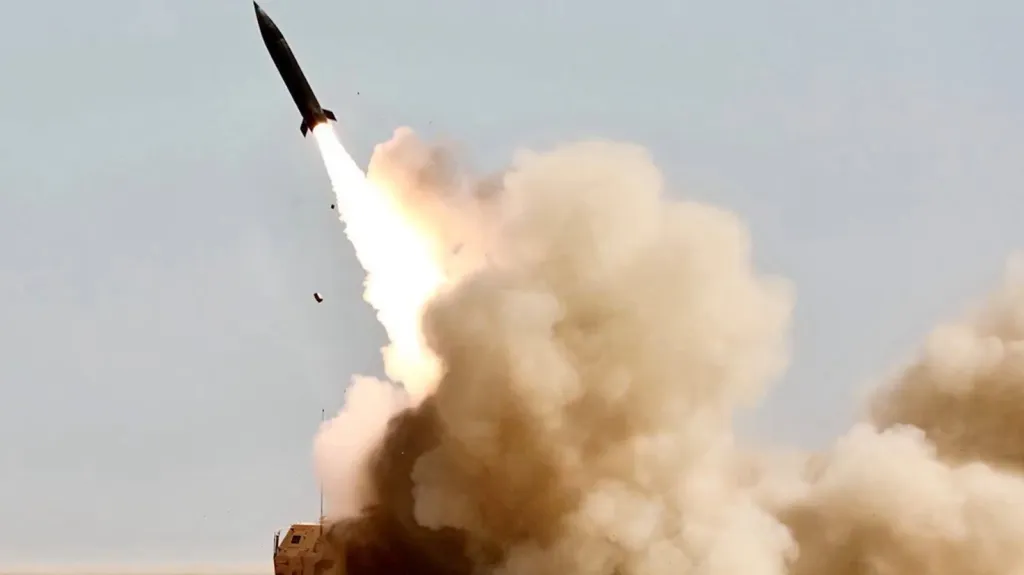
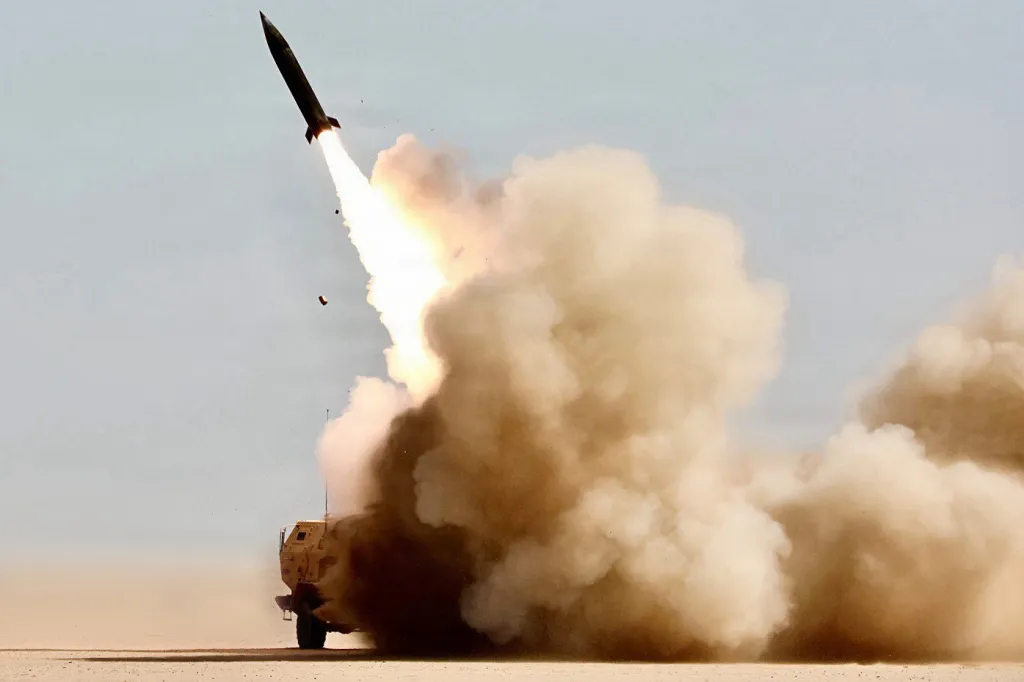
A PrSM missile seen being fired from an M142 HIMARS in support of Operation Epic Fury. CENTCOM
TWZ subsequently reached out for further clarification about what Caine was referring to here when he said “artillery” and for any additional information about the use of those assets against the Iranian Navy. A U.S. official told TWZ that HIMARS were used against Iranian Navy ships, but would not comment on what type of munitions they had fired or which ships were attacked that way.
However, U.S. Central Command (CENTCOM) has released several videos and pictures showing HIMARS operating in support of Operation Epic Fury. As noted, that imagery has only shown them firing ATACMS and PrSM ballistic missiles. CENTCOM has also now explicitly touted the first-ever combat use of PrSM in the current conflict. U.S. officials have yet to confirm where specifically ATACMS or PrSM missiles are being fired from.
In a historic first, long-range Precision Strike Missiles (PrSMs) were used in combat during Operation Epic Fury, providing an unrivaled deep strike capability.
“I just could not be prouder of our men and women in uniform leveraging innovation to create dilemmas for the enemy.”… pic.twitter.com/bydvIv5Tn5
U.S. Army High Mobility Artillery Rocket Systems (HIMARS) provide unrivaled deep-strike capability in combat against the Iranian regime. pic.twitter.com/Onsp1FUrz4
Imagery also began circulating on social media yesterday that is said to show an empty ATACMS ammunition ‘pod’ in Kuwait discovered by locals in the midst of ongoing operations against Iran. Wheeled HIMARS launchers, as well as tracked M270 Multiple Launch Rocket Systems (MLRS), fire ATACMS, PrSM, and 227mm guided artillery from pods with standardized dimensions. ATACMS are loaded one to a pod, while pods for PrSM contain two missiles.
Empty ATACMS missile container found in the deserts of Kuwait, suggesting the U.S. may be launching HIMARS strikes on Iran from Kuwaiti territory.
ATACMS is a U.S. short-range tactical ballistic missile launched from HIMARS, capable of striking targets up to ~300 km. pic.twitter.com/aVJvdAv1w6
A video also emerged online this past weekend showing two HIMARS being employed from a beach in Bahrain. When the footage was captured is unknown. What munitions they see are also unclear.
Geolocation of a U.S. M142 HIMARS launcher seen in the footage confirms it was operating in Bahrain at 26°17′18.48″N, 50°36′40.07″E, from where it was launching strikes against targets in Iran. pic.twitter.com/NjkExpwYkD
No evidence has emerged so far that HIMARS are being used to fire 227mm guided artillery rockets, which come six to a pod, in support of Operation Epic Fury. Even new extended-range variants of these rockets can only fly out to around 93 miles (150 kilometers) away, severely limiting the areas in and around Iran they could reach from available launch points in the region, to begin with. For example, the shortest distance between Bahrain and Iranian soil across the Persian Gulf is around 120 miles. The longest ranged variants of ATACMS can hit targets out to around 186 miles (300 kilometers), with PrSM’s maximum range at least 310 miles (500 kilometers).
It should also be noted that there is no known operational variant of ATACMS capable of engaging moving targets, meaning that it would have to be used against stationary ships. This is very possible, as we’ve seen multiple examples of Iranian ships struck in port or while appearing to be at anchor offshore already.
U.S. forces aren’t holding back on the mission to sink the entire Iranian Navy. Today, an Iranian drone carrier, roughly the size of a WWII aircraft carrier, was struck and is now on fire. pic.twitter.com/WyA4fniZck
There have been indications that the U.S. Army has already begun to field PrSMs that can hit ships on the move, though it is unclear if this represents the full planned Increment 2 capability. In 2024, the service announced it had successfully hit a moving vessel with an unspecified version of PrSM in a test exercise in the Pacific. In a report released in 2025, the Pentagon’s Office of the Director of Test and Evaluation (DOT&E) disclosed that the Army had actually “shot two PrSM EOC [early operational capability] missiles at a maritime target in June 2024.” At that time, the service was only known to have reached early operational capability with the baseline version of PrSM, also known as Increment 1.
The US Army previously released this low-resolution picture of a PrSM being launched during the test in the Pacific in 2024. US Army
It is possible that the Army has begun to field Increment 2 PrSMs, at least on a limited level, as well. The Army announced that it had begun initial flight testing of the new seeker system in 2023. Whether or not Increment 1 missiles can be readily converted into Increment 2 versions is also unknown. Like ATACMS, PrSMs without a moving target capability could still be fired at ships that are stationary, as well.
Regardless, Operation Epic Fury looks to be the first known instance of the U.S. military using ballistic missiles to target ships, at anchor and/or on the move, in real combat.
In general, ballistic missiles are especially well-suited to long-range standoff strikes against time-sensitive and well-defended high-value targets based on the speed at which they fly. They also reach especially high velocity as they come down in the terminal phase of flight. This all, in turn, creates additional challenges for enemy defenders attempting to intercept them compared to other kinds of missiles, including some subsonic air-breathing cruise missiles, and compresses the overall time available to react in any way. That speed also gives ballistic missiles an inherent ability to burrow more deeply into hardened targets. This could be particularly valuable when engaging larger and better-armored warships.
If nothing else, HIMARS has now been used in real combat to target enemy naval vessels, very likely with ballistic missiles. In doing so, experience is gained that could be very relevant beyond the current conflict with Iran.
Weekly insights and analysis on the latest developments in military technology, strategy, and foreign policy.
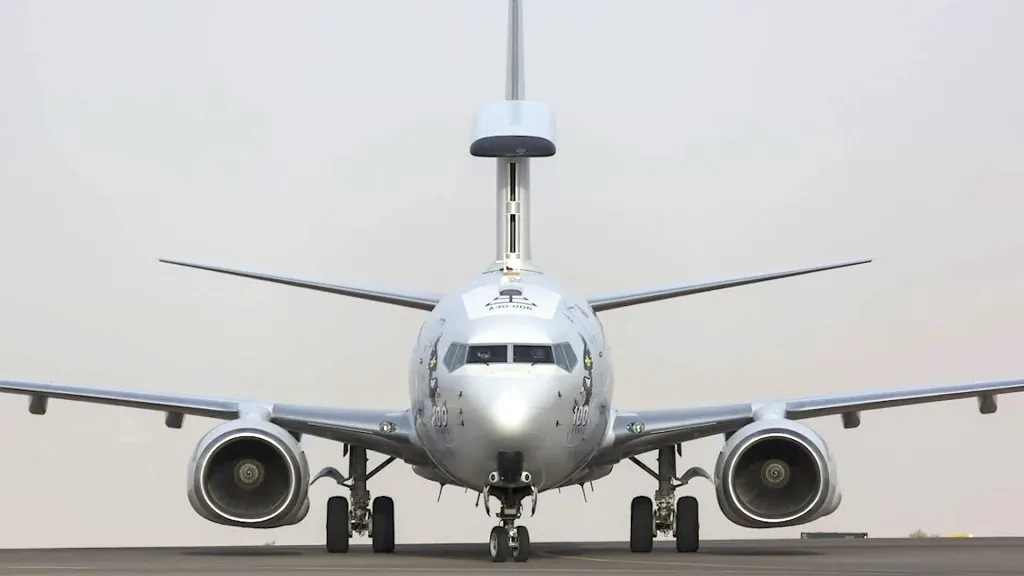
An Australian E-7A Wedgetail airborne early warning and control plane is headed for the Persian Gulf. This comes as Gulf Arab states continue to be subjected to Iran’s attacks in retaliation for ongoing U.S. and Israeli strikes. The E-7A is arguably the best airborne look-down sensor platform in the world at present, and will provide a particularly important boost in capability for spotting low-flying Iranian kamikaze drones and cruise missiles.
Australian Prime Minister Anthony Albanese announced the impending deployment of the E-7A to the Middle East at a press conference yesterday. The Royal Australian Air Force (RAAF) currently operates a fleet of six Wedgetails.
One of the RAAF’s six E-7s. RAAF
“Twelve countries across the region, from Cyprus through to the Gulf are continuing to be targeted. The United Arab Emirates alone has been forced to shoot down over 1,500 rockets and drones,” Albanese said. “This growing wave of dangerous and destabilising attacks from Iran puts civilian lives at risk, of course including Australian lives, of which there are more than 20,000 people based in the UAE.”
“In responding to requests, following a conversation that I had with the President [of the UAE,] Mohammed bin Zayed [Al Nahyan; also Crown Prince of Abu Dhabi], and other requests, Australia will deploy an E-7A Wedgetail, to the Gulf to help protect and defend Australians and other civilians,” Albanese continued. “The Wedgetail will provide long-range reconnaissance capability, which will help to protect and secure the airspace above the Gulf. The Wedgetail and supporting Australian Defence Force personnel will be deployed for an initial four weeks in support of the collective self-defense of Gulf nations.”
The E-7A is based on the Boeing 737-700 Next Generation airliner airframe. Its most prominent feature is the Northrop Grumman Multi-role Electronically Scanned Array (MESA) sensor installed on top of the fuselage, which offers 360-degree coverage and can scan for aerial and maritime threats. It also has an extensive suite of communications and data-sharing capabilities, backed by modern processing power, allowing for the rapid exchange of information with other friendly assets in the air and in other domains. You can read more about the aircraft here.
Northrop Grumman MESA Radar – Boeing E-7 AEWC
“As the Prime Minister has said at the request of the UAE, we will be deploying an E-7 Wedgetail to the Gulf. This is one of the leading capabilities in the world in terms of airborne long-range reconnaissance and command. And we are one of the leading nations in the use of the E-7,” Richard Marles, Deputy Prime Minister of Australia and the country’s Minister for Defense, also said at the press conference yesterday. “There will be in the order of 85 personnel who will go with this airframe and that’s the normal crew. The airframe will be leaving Australia today and the expectation is that it will be in the region in the middle of the week and operational by the end of the week.”
Albanese and Marles also said the Australian government planned to send a tranche of AIM-120 Advanced Medium Range Air-to-Air Missiles (AMRAAM) to the UAE. In addition to ground-based air defense, Emirati fighters have been working to intercept incoming Iranian threats.
As noted, the biggest boost in capability the RAAF’s E-7A will bring to the Gulf is its look-down sensor capability. From the aircraft’s high perch, the MESA sensor has an excellent field of view to spot low and slow-flying targets, even if they are relatively small. Wedgetail would also be able to see threats as far out into the Persian Gulf, or even possibly beyond.
So much garbage being passed around here in long jargon filled threads that sound like AI about E-7 Wedgetail and the potential RAAF deployment to the Middle East. Here is all you need to know:
it’s arguably the best low flying drone and CM detection sensor on earth.
Having another eye in the sky to provide additional alerts about incoming threats and more overall situational awareness will be a boon for defenders in the air and on the ground, in general. The E-7A can also be refueled in flight, meaning it can stay on station longer.
The UAE, which is the clear focus of the Australian deployment, does have a fleet of 5 Saab GlobalEye airborne early warning and control aircraft, but the extent to which they are operating now is unknown. While a modern and capable design, GlobalEye does not provide the same level of coverage and capability as the E-7A, and is also based on the smaller Bombardier Global 6000 business jet, which cannot refuel in flight.
GlobalEye on operational mission
There is more airborne warning and control coverage elsewhere in the Gulf, including six U.S. Air Force E-3 Sentry Airborne Warning and Control System (AWACS) aircraft forward-deployed to Saudi Arabia just ahead of the current conflict with Iran. Saudi Arabia has its own E-3s and GlobalEye jets. How effective the aging Cold War-era E-3, in particular, is at this point at spotting and tracking low-flying kamikaze drones is unclear. In general, the E-7’s active electronically-scanned array MESA sensor offers clear advantages over the Sentry’s older radar, especially when it comes to smaller, slower, and lower-flying targets.
For years now, the U.S. E-3 fleet, overall, has struggled with readiness issues, which you can read more about here. As an aside, the strain on the E-3 fleet, now magnified by the current conflict, together with Australia’s deployment of an E-7 to the region, makes the Pentagon’s attempt last year to cancel the U.S. Air Force’s Wedgetail program seem even more bizarrely short-sighted.
A US Air Force E-3 Sentry seen at Prince Sultan Air Base in Saudi Arabia in 2022. USAF
In speaking yesterday, Australia’s Marles drew a comparison between sending the E-7A to the Middle East now and the past deployment of a Wedgetail to Poland to provide coverage along that country’s border with Ukraine. However, that mission was ostensibly focused on watching for threats to cross-border transfers of aid to the government in Kyiv.
The need for E-7A in the Gulf now is substantially more pressing.
Since the current conflict began, the UAE has been providing particularly granular data about incoming Iranian missile and drone attacks, as well as interception rates, offering a good sense of the current threat ecosystem in the Gulf. As of the last official tally from the UAE’s Ministry of Defense, the country’s forces have intercepted 1,385 kamikaze drones, 241 ballistic missiles, and eight cruise missiles since February 28.
Overall, Iranian retaliatory attacks have notably slowed in recent days across the region, but they have not stopped. Based on its own data, the UAE saw a notably high number of Iranian drones get past its defenses yesterday. This comes amid persistent media reports of concerns among several Gulf Arab states, as well as the U.S. military, about the dwindling stockpile of anti-air interceptors and what has turned into a war of attrition with Iran. Publicly, American and regional authorities have pushed back on this reporting. At the same time, Australia’s plan to rush AIM-120s to the UAE is certainly evidence of demand for additional munitions.
Reasonable to ask what the raw numbers for ballistic missile and drone attempts vs. hits are, which are plotted in these figures. Again, all figures are from UAE MOD. pic.twitter.com/dhj86h6DbD
There is also a question of where the Australian E-7A will be based and what threats there might be as a result to the aircraft, aircrew, and the rest of the 85-person contingent. Albanese and Marles do not appear to have explicitly said where the jet will be flying from to provide coverage over the UAE and other parts of the Gulf region.
With Iran showing no intention of halting its drone and missile attacks across the Gulf, Australia’s E-7A Wedgetail, wherever it might be stationed, looks set to bring immensely valuable added look-down surveillance coverage to the region.
Weekly insights and analysis on the latest developments in military technology, strategy, and foreign policy.
A submarine is among the Iranian naval vessels that U.S. forces have struck with Army Tactical Missile System (ATACMS) short-range ballistic missiles. ATACMS cannot hit moving targets, so the submarine would have had to have been stationary in port when struck. TWZ was first to report earlier this week that M142 High Mobility Artillery Rocket System (HIMARS) launchers firing ATACMS, as well as Precision Strike Missile (PrSM) short-range ballistic missiles, had been aiding in the destruction of Iran’s Navy as part of Operation Epic Fury. The conflict has also marked the first combat use of PrSM, which brings a major boost in range over ATACMS.
Chairman of the Joint Chiefs of Staff U.S. Air Force Gen. Dan “Razin” Caine put a particular spotlight on the contributions of field artillery units in current operations against Iran at a press conference at the Pentagon this morning.
A M142 HIMARS launcher fires a PrSM short-range ballistic missile in support of Operation Epic Fury. CENTCOM
“Today, I’m going to talk about our incredible artillery force, comprised of American soldiers and Marines who’ve been sinking ships, [and] destroying depots,” Caine said. “Our Army and Marine artillerymen are hitting sites that Iran relies on to project power beyond their borders and protect our deployed [forces].”
“In just the first 13 days of this operation, our artillery forces have made history. They fired the first Precision Strike Missiles ever used in combat, reaching deep into enemy territory,” the Chairman continued. He also said that soldiers from the Army’s 3rd Battalion, 27th Field Artillery, part of the 18th Field Artillery Brigade based at Fort Bragg, North Carolina, were the ones to fire the first PrSMs against targets in Iran.
In a historic first, long-range Precision Strike Missiles (PrSMs) were used in combat during Operation Epic Fury, providing an unrivaled deep strike capability.
“I just could not be prouder of our men and women in uniform leveraging innovation to create dilemmas for the enemy.”… pic.twitter.com/bydvIv5Tn5
“They used Army ATACMS to sink multiple ships, including a submarine,” Caine added. “And they’ve done all of this with the precision and determination that comes from relentless training and trust in each other and in their weapon systems.”
“We’ve rendered the Iranian Navy combat ineffective,” but “continue to attack naval vessels,” Caine also said, speaking generally.
Caine did not name the Iranian submarine that was destroyed using ATACMS, nor did he say what class it was. TWZ has reached out for more information. There is no known operational version of ATACMS capable of hitting moving targets, so, as already noted, the missile would also have had to have been employed against a submarine in port or one that was otherwise stationary.
A review of satellite imagery in Planet Labs’ archive does show one of Iran’s three Russian-made Kilo class diesel-electric submarines sunk at Bandar Abbas as of March 4. The submarine had looked to be untouched in an earlier Planet Labs image taken on March 2 in the aftermath of a wave of strikes, as TWZ previously reported. Bandar Abbas is the Iranian Navy’s main base and occupies a particularly strategic position along the Strait of Hormuz.
In a video address on March 5, U.S. Navy Adm. Brad Cooper, head of U.S. Central Command (CENTCOM), had also said that “the most operational Iranian submarine … now has a hole in its side.” What submarine Cooper was referring to here remains unclear, but it may have been the Kilo class submarine struck at Bandar Abbas. At that time, his comments were also taken by many to be a reference to the IRIS Fateh, a domestically-produced diesel-electric coastal attack submarine that entered Iranian service in 2019. The fate of that boat remains unconfirmed.
The IRIS Fateh seen ahead of its launch in 2019. IRNA
On March 10, CENTCOM released the video seen below, showing strikes on various Iranian vessels at sea and in port, including what looks to be a Ghadir class diesel-electric midget submarine. That boat was struck by an AGM-114 Hellfire missile, a U.S. official told TWZ. How many Ghadir class submarines were in Iran’s inventory before the current conflict is not clear, but prior estimates had generally put the size of that fleet at between 16 and 20 hulls.
U.S. forces are degrading the Iranian regime’s ability to project power at sea and harass international shipping. For years, Iranian forces have threatened freedom of navigation in waters essential to American, regional and global security and prosperity. pic.twitter.com/gIBN02mowh
Regardless, it makes good sense that the U.S. military would focus on neutralizing Iran’s submarine force, and doing so in port if possible, as part of the larger objective of neutering the country’s naval capabilities. Finding, fixing, and engaging submerged submarines, even older and louder designs, can take significant time and effort, as you can read about in more detail in this past TWZ feature. Iranian submarines could have been used to discreetly lay mines, as well as to attempt attacks on friendly warships or commercial vessels. As it stands now, maritime traffic in and out of the Persian Gulf through the Strait of Hormuz has still ground to a virtual halt over concerns about mines and other remaining Iranian threats, which is already having global ramifications.
Chairman Caine’s comments today also reinforce the role that ATACMS and PrSM have been playing in the current conflict, in general. TWZ previously noted that this is a preview of what one would expect to see from U.S. forces in other future conflicts, especially when it comes to using ballistic missiles in the anti-ship role as part of a high-end fight with China in the Pacific. PrSM, which only began entering service in the past two years or so, offers significantly greater reach than ATACMS, allowing it to hold a much broader swath of territory at risk from any launch position.
Just yesterday, Lockheed Martin also announced the first test launch of a full-up Increment 2 PrSM, an anti-ship optimized version in development now. In that test, a HIMARS launcher fired the Increment 2 missile, which flew out to a range of around 217 and a half miles (350 kilometers), according to a company press release. The Increment 2 PrSM features an additional multi-mode seeker specifically designed to allow it to engage moving targets at sea. Lockheed Martin also released the rendering below as part of its announcement yesterday, which looks to show apertures for the seeker system around the nose.
Lockheed Martin released this rendering along with its announcement about the successful PrSM Increment 2 test launch. Lockheed Martin
Questions do remain about the anti-ship and/or moving target capabilities that might be found on baseline Increment 1 PrSMs. A pair of “early operational capability” PrSMs – a term generally understood to refer to Increment 1 missiles – were fired at what was described as a moving maritime target during a test in the Pacific back in 2024.
In the meantime, the older ATACMS, which PrSM is set to eventually replace, has now scored a hit against an enemy submarine, albeit one not on the move.
Weekly insights and analysis on the latest developments in military technology, strategy, and foreign policy.
The makers of the Ukrainian Sting interceptor drone told The War Zone that despite growing interest in the Middle East for their product, they are not yet allowed to sell them outside the country. Other Ukrainian drone manufacturers, like SkyFall, are also reportedly interested in providing interceptors to the region.
However, “the Ukrainian government is engaged in bilateral discussions with partner countries about supplying drones,” he added.
Should the law change, Wild Hornets has the capacity to provide drones to foreign nations, Roslin explained.
“As part of those discussions, the Wild Hornets are ready to fulfill whatever need may fall on us to help Ukraine’s strategic partners if called on to do so.”
There seems to be a willingness to make key changes to the law to make it happen. Ukrainian President Volodymyr Zelensky stated that Ukrainian military experts were in the Middle East to share their experience after four years of bombardment by Russian Shaheds and that 11 nations are interested in obtaining these interceptors and other counter-drone systems.
President Zelenskyy:
More than ten countries have already turned to us for support in defending against Iranian Shahed drones.
“These are, in fact, the same attack drones that the Iranian regime supplied to Russia and trained Russians to use against the civilian population of… pic.twitter.com/b0sxTwg0kz
It is no surprise that there would be wide interest in counter-drone drones. With a price tag of roughly between $1,000 and $2,500 a piece, they are a small fraction of the cost of the multi-million dollar Patriot interceptors or even less expensive types, still costing a million dollars or more, being used by the U.S. and allies.
Beyond cost, the interceptor drones, 3-D printed weapons that look like 1950’s-era toy rockets, are far easier and quicker to produce than surface-to-air missiles.
Small enough to fit inside a backpack, they can reach speeds of up to 173 miles an hour, according to Wild Hornets. Some of Ukraine’s interceptors “combine thermal imaging with radar tracking and AI-assisted guidance, with a human operator taking manual control for the final seconds of the intercept,” Military Times noted. Sting interceptors are manually operated by pilots, Roslin stated.
Meet STING: the 3D-printed interceptor that looks like a DIY hobbyist project but is currently disrupting global defense massively. With the #IranWar intensifying, the UAE and Qatar are placing massive orders for this tiny Ukrainian drone. It’s a specialized anti-drone solution… pic.twitter.com/cTUQNknqe6
In a post on X, Wild Hornets denied it was in direct negotiations with Saudi Arabia to sell the Sting drones, a claim made Thursday by The Wall Street Journal.
“Recent reporting by The Wall Street Journal, citing anonymous sources, suggested that Saudi Aramco, the world’s largest oil company, is in negotiations with Wild Hornets regarding the purchase of interceptor drones to protect oil facilities from Iranian UAV attacks. This information does not reflect the current position or activities of our company. “
Wild Hornets “regularly receives inquiries from representatives of countries across the Middle East and the European Union regarding potential exports of the STING interceptor system, which has proven highly effective against Shahed-type drones in real combat conditions,” the X post continued.
Ukrainian defense company Wild Hornets, the manufacturer of the highly successful STING interceptor drone used against Shahed-type UAVs, states that it is not currently engaged in export negotiations with any country or… pic.twitter.com/GMk00EoRrH
Wild Hornets is reportedly one of at least two Ukrainian companies whose interceptors are garnering interest in the Middle East in the wake of Iranian Shahed attacks.
Today Iran launched military drones (likely Shahed-type) at Saudi Aramco’s Ras Tanura refinery, causing fires and forcing a temporary shutdown of one of the world’s biggest oil plants. The attack comes amid intensified Iran-US/Israel conflict.#SaudiArab#ARAMCO#IranWarpic.twitter.com/Tj1gh6wlWD
Earlier this week, another large Ukrainian drone producer called SkyFall said its manufacturing capacity had outgrown Ukraine’s ability to purchase its systems and the company was ready to export, according to Reuters.
“We have had interest and inquiries from our (allies) and countries in the Middle East,” a company representative told the outlet.
The SkyFall Shahed interceptor drone. (SkyFall)
While these small drone interceptors have proven successful in Ukraine and show real promise for applications elsewhere, their baseline capabilities are quite different from an actual surface to air missile, especially medium and long-range types. They have to be distributed far more broadly in order to be able to effectively respond to incoming drone threats, whereas a SAM can cover a much larger area and respond far quicker to the threat due to their high-speeds.
The lack of response speed also means that early warning is more critical, especially for area defense duties, as opposed to defending a specific facility or small area of a population center. Regardless, their cost differential and ease of deployment can overcome many of these drawbacks, especially when paired with tailored tactics, in order to get the price of interceptors far down and putting more defenses in more areas.
There are other inexpensive alternatives to costly interceptors that have taken center stage in conflicts as of late.
A U.S. Air Force F-15E Strike Eagle down-range in the Middle East with an air-to-air loadout that includes six seven-shot 70mm rocket pods, as well as four AIM-9X and four AIM-120 missiles. (CENTCOM) CENTCOM
The U.S. also has a ground-based system, called Vampire, that also uses these APKWS rockets. This system is deployed in small numbers to the Middle East and in larger numbers to Ukraine.
The Vampire ground-based interceptor system. (L3Harris) L3Harris
In addition, the U.S. reportedly sent 10,000 interceptor drones used in Ukraine to the Middle East.
“It is small enough to fit in the back of a midsize pickup truck, can identify drones and close in on them, using artificial intelligence to navigate when satellite and electronic communications are jammed,” according to the wire service.
A Polish soldier is seen as he operates an interception drone of the American MEROPS counter drone system during tests at the Nowa Deba military training ground, southeastern Poland, on November 18, 2025. (Photo by Wojtek RADWANSKI / AFP) WOJTEK RADWANSKI
“I’m not familiar with the particular offer, but the interceptors in general, we’ve had a number of new capabilities being fielded,” Cooper told us during a press conference held at CENTCOM headquarters in Tampa. “Obviously, I’m not going to talk about it from the operational perspective of what those are, but I think you have seen over a period of time us kind of get on the other side of this cost curve on drones in general.”
“If I just walk back a couple of years, remember what you used to always hear, we’re shooting down a $50,000 drone with a $2 million missile,” he added. “These days, we’re spending a lot of time shooting down $100,000 drones with $10,000” weapons.
Meanwhile, President Donald Trump has dismissed the need for Ukrainian help in combating Iranian drones and War Secretary Pete Hegseth on Friday downplayed the threat from Iranian drones and missiles. He proclaimed that one of Epic Fury’s main goals is diminishing Iran’s capacity to launch and build these weapons.
“Their missile launchers and drones being destroyed or shot out of the sky,” he told reporters, including from The War Zone. “Their missile volume is down 90%. Their one way attack drones yesterday down 95%.”
Hegseth: Iran has no real air defenses, air force, or navy left. Their missiles, launchers, and drones are being destroyed.
Missile attacks are down about 90%, and one-way attack drones dropped about 95%.
Still, the interest in the Middle East for Ukrainian drone interceptors remains high.
“This phone has been ringing off the hook,” Oleg Rogynskyy, the chief executive of Uforce, a conglomerate of Ukrainian defense technology start-ups, told The New York Times.
Rights groups have slammed United States Secretary of Defense Pete Hegseth for saying that “no quarter” will be shown to Iran, as the US and Israel continue their military campaign against the country.
“We will keep pressing. We will keep pushing, keep advancing. No quarter, no mercy for our enemies,” Hegseth told reporters on Friday.
Recommended Stories
list of 3 itemsend of list
Under the Hague Convention and other international treaties, it is illegal to threaten that no quarter will be given.
Domestic laws, such as the 1996 War Crimes Act, also prohibit such policies. US military manuals likewise warn that threats of “no quarter” are illegal.
Brian Finucane, a senior adviser at the International Crisis Group, a think tank, said Hegseth’s comments appear to run afoul of those standards.
“These comments are very striking,” Finucane told Al Jazeera over a phone call. “It raises questions about whether this belligerent, lawless rhetoric is being translated into how the war is being conducted on the battlefield.”
But Hegseth has publicly dismissed concerns about international law, claiming he would abide no “stupid rules of engagement” and no “politically correct wars”.
His rhetoric has provoked concern among some experts that measures designed to prevent civilian harm are being ignored in favour of a campaign of “maximum lethality”.
Hegseth’s remarks also come after a US strike on a girls’ school in southern Iran that killed more than 170 people, most of them children. The war has left at least 1,444 Iranians dead and millions more displaced.
‘Inhumane and counterproductive’
Prohibitions against declaring “no quarter” go back more than a century, part of an effort to impose restraints on conduct during war.
The Nuremberg trials after World War II upheld that legal standard, as Nazi officials were prosecuted, in some cases, for denying quarter to enemy forces.
“The basic idea is that it’s both inhumane and counterproductive to execute people who have laid down their arms,” said Finucane.
He added that the “mere announcement” of “no quarter” from a government official can itself be a war crime.
The US and Israel have already faced allegations of violating international law during their war against Iran. Experts have condemned their initial strike on February 28 as “unprovoked”, deeming the conflict an illegal war of aggression.
Iranian officials also protested after a US submarine sank a military vessel, the IRIS Dena, off the coast of Sri Lanka, as it returned from a ceremonial naval exercise in India. That attack killed at least 84 people.
While warships are considered legal military targets, Iran has said that the ship was not fully armed, raising questions about whether it could have been interdicted rather than sunk.
US forces also purportedly declined to help rescue sailors from the Dena, even though the Geneva Convention largely requires aid to the shipwrecked. The Sri Lankan navy ultimately helped collect survivors from the wreckage.
Responding to the attack, Hegseth described the sinking of the ship as a “quiet death”. He also told reporters, “We are fighting to win.”
US President Donald Trump himself remarked that he asked why the ship had been sunk, not captured.
“One of my generals said, ‘Sir, it’s a lot more fun doing it this way,’” Trump said.
‘Serious red flag’
The US military has faced criticism for killing civilians in military operations for decades.
That includes during the so-called “global war on terror”, when airstrikes resulted in thousands of civilian deaths, including a 2008 attack on a wedding party in Afghanistan.
Even before the war with Iran, the Trump administration had faced accusations that it violated international law by attacking alleged drug-trafficking vessels in the Caribbean Sea and eastern Pacific Ocean.
At least 157 people have been killed in those attacks since they started on September 2.
The Trump administration, however, has never identified the victims nor presented evidence against them. Scholars have condemned the attacks as a campaign of extrajudicial killings.
Analysts say that the Pentagon’s policies of emphasising lethality at the expense of human rights concerns has carried over into its war against Iran.
“Death and destruction from the sky all day long. We’re playing for keeps. Our warfighters have maximum authorities granted personally by the president and yours truly,” Hegseth said during a briefing on March 4.
“Our rules of engagement are bold, precise and designed to unleash American power, not shackle it.”
Sarah Yager, the Washington director at Human Rights Watch, called such rhetoric alarming.
“I’ve been engaging with the US military for two decades, and I’m shocked by this language. Rhetoric from senior leaders matters because it helps shape the command environment in which US forces operate,” Yager said.
“From an atrocity-prevention perspective, language that dismisses legal restraints is a serious red flag.”
While the impact of Hegseth’s rhetoric on combat operations is not certain, a recent report from the watchdog group Airwars found that the pace of the US and Israeli assault on Iran has far outstripped other military operations in modern history.
Reports indicate that the US dropped nearly $5.6bn worth of munitions in the first two days of the war alone. Airwars says the US and Israel hit more targets in the first 100 hours of the Iran war than in the first six months of the US campaign against ISIL (ISIS).
Following Hegseth’s remarks on Friday, Senator Jeff Merkley condemned the Pentagon chief as a “dangerous amateur”. He cited the attack on the Iranian girls’ school as an example of the consequences.
“His ‘no hesitation’ engagement rules set the stage for failing to distinguish a civilian school from a military target,” Merkley wrote in a social media post.
“The result, more than 150 dead schoolgirls and teachers from an American missile.”
Weekly insights and analysis on the latest developments in military technology, strategy, and foreign policy.
The Pentagon is reportedly moving a Marine Expeditionary Unit and additional warships to the Middle East, as the war with Iran continues. The move, reported by The Wall Street Journal, will help respond to the Iranian campaign of attacks against shipping in the Strait of Hormuz. So far, Tehran has remained committed to its pledge of paralyzing oil tanker traffic through the strategic waterway.
The WSJ reports that U.S. Secretary of Defense Pete Hegseth has approved a request from U.S. Central Command (CENTCOM) for an element of an Amphibious Ready Group and attached Marine Expeditionary Unit, citing three U.S. officials. An Amphibious Ready Group (ARG) typically includes an assault ship, two transport docks, and a support vessel that carries an embarked Marine Expeditionary Unit (MEU) of at least 2,200 Marines.
MEU on the move in the Pacific. (USN)
Two of those officials said that the ARG would be centered around the amphibious assault ship USS Tripoli, said to be now headed for the Middle East from its normal base in Japan.
Sailors aboard the USS Tripoli (LHA 7) conduct a live-fire exercise, March 12, 2026.
Routine live-fire training sharpens warfighting proficiency and ensures U.S. naval forces remain ready to operate across the Indo-Pacific. 🌏⚓
It’s possible other Amphibious Ready Groups could also deploy to the Middle East, if called upon.
The U.S. Navy at war | Carrier update:
– George H.W. Bush CSG completed workups and is deploying soon to join the war against Iran, per @LucasFoxNews – Gerald R. Ford CSG chopped into U.S. 5th Fleet/CENTCOM AOR (DVIDS) – Abraham Lincoln CSG conducting 24/7 combat ops (DOW/PAO) pic.twitter.com/nxWL4vOCVk
A Marine Expeditionary Unit (MEU) is a highly versatile, self-sustained, rapid-response force. Embarked aboard amphibious assault and landing ships, each MEU has fully integrated air, ground, and logistics components. Its four key elements are as follows:
Command Element: Serves as the headquarters for the entire unit and allows a single command to exercise control over all ground, aviation, and combat service support forces.
Ground Combat Element: Provides the MEU with its main combat punch. Built around a Marine infantry battalion, and reinforced with artillery, amphibious vehicles, engineers, and reconnaissance assets.
Aviation Combat Element: The ACE consists of a composite medium helicopter squadron containing transport helicopters of various models and capabilities, attack helicopters and jets, air defense teams, and all necessary ground support assets.
Logistics Combat Element: Providing the MEU with mission-essential support such as medical assistance, motor transport, supply, equipment maintenance, and landing.
A U.S. Marine Corps F-35B assigned to Marine Fighter Attack Squadron (VMFA) 121, 31st Marine Expeditionary Unit, takes off from the USS Tripoli in the U.S. 7th Fleet area of operations. U.S. Marine Corps photo by Lance Cpl. Victor Gurrola Lance Cpl. Victor Gurrola
A MEU would bring a wide range of capabilities to the fight. This can include additional aircraft to strike targets inland, including F-35Bs, and to execute sea control missions, going after Iranian small boats for instance. The latter can be done by embarked AH-1Z and UH-1Y helicopters, as well as F-35Bs. Then there is the assault component, with the ability to airlift Marines anywhere within the reach of its rotary wing component, which also includes MV-22s and CH-53s. The Aviation Combat Element can be tailored to the mission. This can include loading the deck with F-35s or putting a much higher priority on air assault capabilities. The USS Tripoli, which is aviation-focused and lacks a well deck, is specifically built for this kind of augmented air combat element, including being turned into a F-35 “Lightning Carrier.” You can read all about this here.
The MEU can also support beach landing and heavy surface logistical support. The Expeditionary Strike Group (ESG) that makes up the entire flotilla also includes surface combatant escorts that can lend their Aegis capabilities to the fight and launch Tomahawks on demand.
While the carrier strike groups get the most attention for their ability to hit hard from a distance, the MEU/ESG is truly America’s most versatile maritime capability.
In other news, in his latest update on the war on Iran, Secretary Hegseth claims that Iran’s new supreme leader, Mojtaba Khamenei, has been “wounded and likely disfigured” in the ongoing U.S.-Israeli attacks. The defense secretary also pushed back on claims that Iran has begun mining the Strait of Hormuz as it continues its campaign against international shipping in the strategic chokepoint.
In a press conference today, the defense secretary said, “We know the new so-called not-so-supreme leader is wounded and likely disfigured. He put out a statement yesterday — a weak one, actually — but there was no voice, and there was no video. It was a written statement.”
Iranian leadership has “gone underground” and Iran’d newly-appointed Supreme Leader Mojtaba Khamenei has been “wounded, and likely disfigured,” according to Defense Secretary Pete Hegseth. pic.twitter.com/zY5qveWUAv
As to why a written statement was issued, and Mojtaba Khamenei didn’t appear in person, Hegseth added: “I think you know why.”
Hegseth also promised that today will see the highest number of U.S. strikes so far against Iranian targets.
“Their production lines, their military plants, their defense innovation centers; defeated,” Hegseth claimed. “Iran’s leadership is in no better shape. Desperate and hiding, they’ve gone underground, cowering — that’s what rats do.”
Hegseth said the Iranian regime will only see the stars and stripes of the United States and Israel’s star of David, which he describes as “their worst nightmare.”
The Iranian regime has been the number one threat to peace and stability in the Middle East for years. U.S. forces continue to take decisive steps to neutralize Iran’s power projection capabilities. pic.twitter.com/JOT7rRGH7L
In the Strait of Hormuz, Hegseth said that the U.S. military is “dealing with” Iran’s attacks on shipping, and that this is not something it needs to be worried about.
Hegseth dismissed suggestions that Iran has mined the strait, through which around a fifth of the world’s oil passes.
“We’ve heard them talk about it just like you’ve reported recklessly and wildly about it. But … we have no clear evidence of that,” he explained.
Hegseth says there is “no clear evidence” Iran has placed mines in the Strait of Hormuz.
Asked when the Strait of Hormuz might become operational again, Hegseth said: “The only thing prohibiting traffic in the strait at the moment is Iran shooting at shipping.” He said that the United States “has a plan for every option” and that it will not allow the strait to remain “contested.”
Hegseth: “The only thing prohibiting transit in [Hormuz] right now is Iran shooting at shipping.”
According to a report in The New York Times, at least 16 oil tankers, cargo vessels, and other commercial ships have been attacked in the Persian Gulf since the war against Iran began nearly two weeks ago.
Iran has claimed responsibility for several of the attacks. Hegseth also criticized as “bad reporting” the suggestion that Iran could launch a drone attack on California.
“There’s a lot of things Iran has said it could do for a long time, including engaging their proxies and getting them involved in the fight, which they haven’t been able to do. So, we’re watching that very closely,” he said.
Citing multiple sources familiar with the matter, CNN reports that the Pentagon and National Security Council “significantly underestimated” Iran’s willingness to close the Strait of Hormuz in response to U.S. military strikes while Operation Epic Fury was being planned.
“Top Trump officials acknowledged to lawmakers during recent classified briefings that they did not plan for the possibility of Iran closing the strait in response to strikes.”https://t.co/dgNukmCUA9
BREAKING: The Trump administration planned for missile retaliation, proxy attacks, and cyber operations. It did not plan for Iran to weaponize the most important energy chokepoint on Earth.
The headline in the Hezbollah-linked Lebanese newspaper Al-Akhbar this morning reads: “Iran Activates the Hormuz Weapon. Going All the Way.”
הכותרת הבוקר של העיתון אל-אח’באר הלבנוני המזוהה עם חיזבאללה: “איראן מפעילה את נשק הורמוז. הולכים עד הסוף” pic.twitter.com/2xS9cuTTo7
— roi kais • روعي كايس • רועי קייס (@kaisos1987) March 13, 2026
SCOOP: President Trump told G7 leaders this week that Iran is “about to surrender.”
The Iranian regime has shown no signs of imminent surrender or collapse — and on Day 14 of the war, is moving to gain more leverage by choking off the Strait of Hormuz. https://t.co/qHzPkisGKe
In an interview with Fox News, U.S. President Donald Trump said that the U.S. military planned on hitting Iran “very hard” over the next week. A similar comment was posted on Trump’s Truth Social today, in which he said: “Watch what happens to these deranged scumbags today. They’ve been killing innocent people all over the world for 47 years, and now I, as the 47th President of the United States of America, am killing them,” he wrote. “What a great honor it is to do so!”
Gen. Dan Caine, the Chairman of the Joint Chiefs of Staff, today commented on the use of the new Precision Strike Missile (PrSM) short-range ballistic missile, which he confirmed saw its combat debut in the operation against Iran.
Caine said that the PrSM “reaching deep into enemy territory”. He said he spoke to one member of the crew of the system. “I asked him to walk me through a fire mission, not just what they do but what they feel,” he explained. “One of them just looked at me and said: ‘It’s awesome.’”
According to Caine, the U.S. military has hit 6,000 targets so far. In the process, Iran’s naval forces have been rendered “ineffective,” although Tehran still has the capability to harm “friendly forces” and commercial shipping.
More B52 Stratofortress long range bombers have arrived at RAF Fairford. Three landed this morning. There are now six on the ground. They join a fleet of 12 B1 Lancers. Two B1 bombers took off this morning. Supplies of JDAM bunker busting bombs continue to be moved around the… pic.twitter.com/XxwfWSRKQD
Air defenses in the United Arab Emirates intercepted 27 drones and seven ballistic missiles today, the UAE defense ministry said. Since the start of the conflict, UAE air defenses have shot down 285 ballistic missiles, 15 cruise missiles, and 1,567 drones heading toward their territory.
In Oman, two people were killed today after air defenses intercepted a drone over the Al Awahi industrial area, according to state media. The drone was one of two that were shot by air defences on Friday, but the second one did not cause any injuries.
The Israeli military has launched a new campaign across Iran, the Israel Defense Forces (IDF) said today.
The IDF said its most recent wave of strikes included targets in Tehran, Shiraz, and Ahvaz. The IDF had earlier issued evacuation warnings for parts of Tehran and Qazvin, northwest of the capital.
Iranian state TV today reported explosions heard across Tehran.
It appears that at least some of the strikes on the capital may have been deliberately timed to coincide with large-scale demonstrations against Israel and the United States, which have also involved some key regime figures.
Iran’s Foreign Minister Abbas Araghchi:
Today is Quds Day in Iran, and despite the brutal attacks by the Zionist regime and the United States, millions of Iranians have taken to the streets in Tehran and other cities, demonstrating their strong will and determination.
Strikes reported in Tehran near the “Al-Quds Day” march. Iranian officials Ali Larijani and police chief Ahmad-Reza Radan attend the march pic.twitter.com/eZOxK5Da5p
BREAKING: A large explosion struck a square filled with demonstrators in Iran’s capital, Tehran, Iranian state television reported. The cause of the blast was not immediately known. Israel warned it could strike in the area just before the blast. https://t.co/YBy6NTDrj8
Funerals of eight Basijis militiamen were being held in southeastern neighborhood of Khavaran in Tehran today when a Israeli/Us drone struck – Hamshahri newspaper pic.twitter.com/hnJQ8DuIEh
Speaking yesterday, Israeli Prime Minister Benjamin Netanyahu had reportedly said that one of the Israeli goals of the war is to create the conditions for regime change, rather than forcing it directly. Whether regime change is achieved depends on the Iranian people, Netanyahu reportedly asserted.
President Trump has also urged Iranians to take to the streets once the bombing stops, but has also acknowledged that it will be very difficult for them to overthrow the regime.
“I really think that’s a big hurdle to climb for people that don’t have weapons. I think it’s a very big hurdle… It’ll happen, but… maybe not immediately,” Trump told Fox News Radio.
Trump:
Iran’s regime will fall, “but maybe not immediately.”
Former U.S. Secretary of State Condoleezza Rice added her thoughts on the matter of regime change, noting that this was always very hard to achieve from the air, “and it is also very hard to shape the politics afterwards from the air.”
Former U.S. Secretary of State Condoleezza Rice:
It’s very hard to change a regime from the air, and it is also very hard to shape the politics afterwards from the air. pic.twitter.com/YSKPmUVOC9
Dubai has also been on the receiving end of Iranian attacks. There were reports of in Dubai, where videos posted to social media showed a large cloud of smoke over a central area of the financial hub. Authorities there confirmed a fire in an industrial area.
🚨🚨 دبي .. اندلاع النيران في أحد أبراج منطقة كريك هاربور عقب استهدافها بطائرة مسيّرة pic.twitter.com/sW9S6iEQ3E
Israel continues fighting on a second front in Iran, with the latest targets including the Zrarieh Bridge spanning the Litani River.
The IDF says it struck a bridge on the Litani River that was being used by Hezbollah as a “key crossing” to move from northern to southern Lebanon.
The Zrarieh Bridge was struck a short while ago.
According to the military, Hezbollah used the bridge “to move from the north to… pic.twitter.com/7Fq8nvrt0H
— Emanuel (Mannie) Fabian (@manniefabian) March 13, 2026
Israeli Minister of Defense Israel Katz vowed today that the Lebanese government “will pay increasing costs through damage to infrastructure and loss of territory” until Hezbollah is disarmed. “This is only the beginning,” Katz said, according to a report from Reuters.
🎯STRUCK: Hezbollah’s infrastructure across southern Lebanon:
📍Beirut: Assets of the “Al-Quard Al-Hassan”” Association and other significant financial assets of Hezbollah were struck. The recent strikes against the association have effectively and completely disrupted its… pic.twitter.com/g6BRa5LHjD
NATO air and missile defence assets have shot down another Iranian missile fired into Turkish airspace, Turkey’s defense ministry confirmed today. “All necessary measures are being taken decisively and without hesitation against any threat directed at our country’s territory and airspace,” the ministry said in a statement.
Turkey’s Defense Ministry says “a ballistic munition launched from Iran and entering Turkish airspace” was intercepted by NATO air defenses in the Eastern Mediterranean. The statement does not explicitly mention the reported incident near Incirlik Air Base last night. https://t.co/KxSV3uNEwq
The video below purports to show the Iranian ballistic missile over Incirlik Air Base in Turkey.
Another video showing what appears to be a ballistic missile, likely launched by Iran, in the sky tonight over NATO’s Incirlik Air Base, located near Adana, Turkey. pic.twitter.com/Tyb79Rg99Q
According to Jake Epstein of Business Insider, the Iranian ballistic missile was brought down by the Arleigh Burke class destroyer USS OscarAustin, using a Standard Missile-3 (SM-3) anti-missile interceptor. This is said to be the third time in the last two weeks that a U.S. Navy destroyer has used SM-3s to intercept an Iranian missile in Turkish airspace. SM-3 series interceptors are capable of engaging ballistic missiles outside of the Earth’s atmosphere during the mid-course portion of their flight.
New: A defense official tells me the USS Oscar Austin launched an SM-3 interceptor to shoot down the Iranian ballistic missile.
It’s a third time in the last two weeks that a US Navy destroyer in the Eastern Med has used SM-3s to intercept an Iranian missile in Turkish airspace. https://t.co/gHxjdyLirZ
French President Emmanuel Macron confirmed the first French military death of the war. He said that said a French soldier had been killed in an attack in Erbil in Iraq’s autonomous Kurdistan region. Several other soldiers were wounded, he said. French Army soldiers had been engaged in training with Iraqi partners during the drone attack in the region.
Je m’incline devant la mémoire de l’adjudant-chef Arnaud Frion, mort pour la France cette nuit, lors d’une attaque dans la région d’Erbil, en Irak. ⁰Belle figure de soldat et de chef, il incarnait les plus hautes vertus d’un combattant de l’armée de Terre.⁰Mes pensées vont à sa… pic.twitter.com/cBXnGpJbJf
— Chef d’état-major de l’armée de Terre (@CEMAT_FR) March 13, 2026
Yesterday, Reuters reported that at least six French soldiers were wounded in a drone attack targeting a joint Peshmerga-French base in the Makhmour area of Iraq.
Reports out of India suggest that New Delhi is set to repatriate the 183 crew members of the Iranian naval vessel IRIS Lavan as early as today. The sailors had been in the Indian port of Kochi since the Iranian amphibious vessel docked there on March 4 as tensions in the Middle East escalated.
India to repatriate 183 Iranian sailors from warship IRIS Lavan in Kochi. Repatriation can happen as early as today.
The United Kingdom Maritime Trade Operations (UKMTO) office has provided an update on an incident in which a cargo vessel was reported to have been hit by an unknown projectile in the Strait of Hormuz, which resulted in a fire onboard. The incident is said to have occurred 11 nautical miles north of Oman. The vessel had requested assistance, and the crew was previously said to be evacuating the vessel. While the fire onboard the vessel has been extinguished, as of today, at least some of the crew remain unlocated.
Footage has emerged showing the demise of the unique KC-747 aircraft formerly used by the Islamic Republic of Iran Air Force (IRIAF) during an attack on Mehrabad Air Base last week. The tanker version of the 747 was not flown anywhere else in the world, and Iran had just one flying example. You can read all about the aircraft in this past article.
An unnamed IDF official talking to the Israeli N12 news channel provided their assessment of the interdiction campaign against Iranian missile launchers.
“We destroyed between 160 and 190 launchers, disabled another 200, and around 150 remain active,” the official claimed, noting that the United States “didn’t believe we would succeed in the decapitation strike.”
A senior military official:
“The Americans didn’t believe we would succeed in the decapitation strike. We destroyed between 160–190 launchers, disabled another 200, and around 150 remain active. The missile crews are afraid to go out; there are desertions and refusals to…
Noteworthy, however, is an assessment from Bloomberg today, which states that the number of Iranian missile launchers has held steady after a week of unrelenting airstrikes, based on Israeli and Western estimates. “Finding the vehicles in such a large country, especially when some airspace is still dangerous for U.S. and Israeli aircraft, poses a huge challenge,” the article says.
There are rumors that the Iranian missile attack on Ali Al Salem Air Base last week may have destroyed three Kuwait Air Force Typhoon fighters that were based there. This remains unverified at this stage, although satellite evidence confirms that the facility was struck.
I’m hearing the attack on Ali Al Salem air base last week – 5/6 March – destroyed three Kuwait Air Force Typhoons. Those Iranian missiles appear to be very accurate. Doesn’t bode well for those without effective ballistic missile defences…
In a post on X, the House Select Committee on China railed against the Chinese AI firm MizarVision’s assistance to Iran.
The company owns no satellites, but “pulls imagery from multiple commercial providers, including VANTOR Technologies, Airbus Defence and Space, and China’s Jilin-1 satellite constellation, according to Military AI.
MizarVision’s AI software “scans vast volumes of satellite imagery, automatically identifying equipment ranging from aerial tankers like the KC-135 to missile defense systems like the Patriot,” the outlet noted.
Chinese AI firm @MizarVision is reportedly compiling satellite imagery from providers like @vantortech and @AirbusSpace to map U.S. military deployments across the Middle East.
Companies tied to the CCP are turning AI into a battlefield surveillance tool against America. The…
— Select Committee on China (@ChinaSelect) March 13, 2026
Vice President JD Vance told reporters it is unclear whether the new Supreme Leader of Iran was wounded in an attack by the U.S. or Israel.
NEWS: @VP tells us it’s not clear if the wounds that the new Supreme leader of Iran suffered are from a US strike, given much fire in this war, but it was likely from either Israel and US. “We know that he’s hurt. We don’t know exactly how bad, but we know that he’s hurt,” Vance… pic.twitter.com/5l9BwmYW1J
Earlier today, U.S. military officials said tonight would see the most intense bombardment of the war. Now the Israelis are making that claim.
An Israeli leading military journalist is saying that tonight is going to be a very intense night in #Iran in terms of airstrikes, adding “might be the most significant one since the beginning of the war”. He also says that the attack again Iran’s top intel leadership seems to… https://t.co/HSBIqt9aT7
Video emerged on social media showing massive attacks on Tehran.
Meanwhile, there is also video of Iranian ballistic missiles striking central Israel.
3:44 PM EST –
The Tripoli ARG, reportedly tapped to join Epic Fury, is speeding toward the Middle East from Asia, notes open-source investigator MT Anderson.
HIGH-SPEED SURGE: USS Tripoli ARG Sprints for the Middle East
OSINT Update (Mar 12 imagery): Following the announcement that the Tripoli Amphibious Ready Group is heading to the Middle East for Operation Epic Fury, visual evidence confirms she wastes no time.
In a YouTube video, the Economist offers some insights into how the war in Iran has widespread implications across the globe.
“The effective closure of the Strait of Hormuz—a slim waterway between Oman and Iran through which a large proportion of global oil and gas supply flows—has consequences for much of the world,” the publication noted. “The fall-out will not be felt evenly. Russia has a lot to gain from the escalating conflict.”
Is Russia the real winner from the war in Iran? | The Economist
A cyber attack by Iran-linked hackers “has paused the supply of essential medical equipment to UK hospitals,” TheIPaper reports. “Handala – a hacktivist group linked to Iranian intelligence – successfully breached the IT systems of a global medical technology firm supplying the NHS, pausing orders of mouth swabs and defibrillators to UK hospitals.”
NEW: A cyber attack by Iran-linked hackers has paused the supply of essential medical equipment to UK hospitals.
Handala – a hacktivist group linked to Iranian intelligence – successfully breached the IT systems of a global medical technology firm supplying the NHS, pausing…
— Richard Holmes 🕵🏻♂️ (@Richard_AHolmes) March 13, 2026
Despite proclamations from Hegseth to the contrary, the number of Iranian missile launchers has held steady after a week of unrelenting airstrikes, Bloomberg News reported, citing Israeli and western estimates. This highlights “the difficulty of finding small, mobile targets without having complete control of the skies,” the outlet explained.
3:00 PM EST—
CENTCOM has published this video showing B-2 Spirit bombers taking off for a raid on Iran. Flying global non-stop missions from their home base in Whiteman, Missouri, America’s stealth bombers have so far targeted Iran’s missile caves. These facilities are built deep under mountains and are primarily used for storage, but some of them actually have the ability to launch ballistic missiles through apertures in their ceilings.
B-2 stealth bombers takeoff to conduct a mission during Operation Epic Fury, delivering long-range fire to not only eliminate the threat from the Iranian regime today, but also eliminate their ability to rebuild in the future. pic.twitter.com/ebyUYNnOLo
The U.K. Ministry of Defence says that a British counter-drone unit shot down “multiple drones overnight” following recent strikes on coalition bases in Iraq. Meanwhile, U.K. Royal Air Force Typhoon fighters flew air defense operations over Bahrain for the first time, the MoD said in an update shared on X.
It added: “British Typhoon and F-35 jets are now flying in defence of British interests and allies across Qatar, Cyprus, UAE, Jordan, and Bahrain. U.K. defences in the eastern Mediterranean now include Typhoon and F-35 jets, air defense and counter-drone units, Wildcat and Merlin helicopters, and a further 400 air defense personnel are currently deployed to protect British lives and interests.”
2:30 PM EST—
Sri Lanka today repatriated the remains of 84 Iranians killed in the U.S. attack on the frigate IRIS Dena, sunk by a U.S. Navy submarine, local officials said.
The sailors were killed when the IRIS Dena was torpedoed on March 4 just off the coast of Sri Lanka, in an incident that you can read more about here.
An Airbus A340 chartered by Iran “left a short while ago carrying the remains of the sailors,” an airport official at Mattala International Airport in the island’s south told AFP earlier today.
The destination of the flight was not disclosed.
This is the Turkish Antalya A340, chartered by Iran to repatriate the remains of 84 sailors killed in a US submarine attack on March 4 just off Sri Lanka’s southern coast. The aircraft has landed at Mattala,- often dubbed Sri Lanka’s ‘ghost airport’ and the world’s emptiest. https://t.co/Yn6ryI9H18pic.twitter.com/n8Gy5SfTnf
Only 77 ships have so far crossed the Strait of Hormuz this month, as the war continues to disrupt one of the world’s most vital shipping routes. This data was provided today by Lloyd’s List Intelligence. Significantly, Lloyd’s said that most of these vessels belonged to the so-called ‘shadow fleet’ — ships used to evade Western sanctions and regulations, typically linked to Russia and Iran.
The 77 transits recorded so far this month compare with 1,229 passages in the same period last year, according to Lloyd’s List.
🚨 Shipping through the Strait of Hormuz has collapsed amid the Middle East war.
Just 77 ships have crossed so far in March, compared to 1,229 during the same period last year, according to Lloyd’s List Intelligence.
There are reports that India has cut a deal with Iran to allow their energy shipments to pass through the Strait.
Iran and India cut a deal: two LPG tankers get through the strait.
That countries are engaging in bilateral discussions with Iran points to the success of the Iranian strategy–as well as the ongoing failure of the US to resolve the security crisis in the strait.…
The Ford is still in the Red Sea and gaining destroyer escorts. It isn’t clear what the plan is for the carrier, but it could move through the tumultuous Bab el Mandeb Strait, which the Houthis again threatened, in order to be in a better striking position in the Arabian Sea. The ship suffered a fire in a laundry facility and is on its second deployment extension. How long it can stay on station remains a major question.
THE BUILDUP CONTINUES: 3rd Destroyer Joins the Ford
OSINT Update (Mar 12 imagery): Tracking the USS Gerald R. Ford (CVN-78) as she continues to hold off the coast of Al Wajh in the Northern Red Sea.
She has shifted her box slightly to ~100km offshore, but the critical tactical… pic.twitter.com/lR1p6qSbmI
Some commentary on the Marine deployment to the Middle East from TWZ‘s editor:
When you think of a Marine Expeditionary Unit in the context of this conflict, one target comes to mind: Kharg Island, where the majority of Iran’s oil exports flow. Untouched by the conflict yet, due to its strategic value and critical infrastructure. Seizing it would be a huge deal and would be a risky operation. Not just the seizing, but more so the staying. If Iran thought it was lost, they could bombard it with pretty much everything they have. Also, unlikely to push the MEU into the Persian Gulf. Would be an aerial operation, also not without risks.
There are also a number of islands in and around the Strait of Hormuz that could be used to help put up a screen against shipping attacks, etc. Also risky for obvious reasons.
There are also a number of islands in and around the Strait of Hormuz that could be used help put up a screen against shipping attacks etc. Also risky for obvious reasons. pic.twitter.com/0nolqdew9J
Weekly insights and analysis on the latest developments in military technology, strategy, and foreign policy.
Welcome to Bunker Talk. This is a weekend open discussion post for the best commenting crew on the net, in which we can chat about all the stuff that went on this week that we didn’t cover. We can also talk about the stuff we did or whatever else grabs your interest. In other words, it’s an off-topic thread.
This week’s second caption reads:
CHEYENNE MOUNTAIN AIR FORCE STATION, Colo.—Runners participating in the North American Aerospace Defense Command 5k Tunnel Run exit the Cheyenne Mountain Complex through the north portal at Cheyenne Mountain Air Force Station, Colorado, May 10, 2018. The run was open to all local military personnel, friends and family and was held to celebrate the 60th Anniversary of NORAD and the U.S. Canadian binational NORAD agreement.. (U.S. Air Force photo by Senior Airman Dennis Hoffman)
Also, a reminder:
Prime Directives!
If you want to talk politics, do so respectfully and know that there’s always somebody that isn’t going to agree with you.
If you have political differences, hash it out respectfully, stick to the facts, and no childish name-calling or personal attacks of any kind. If you can’t handle yourself in that manner, then please, discuss virtually anything else.
No drive-by garbage political memes. No conspiracy theory rants. Links to crackpot sites will be axed, too. Trolling and shitposting will not be tolerated. No obsessive behavior about other users. Just don’t interact with folks you don’t like.
Do not be a sucker and feed trolls! That’s as much on you as on them. Use the mute button if you don’t like what you see.
So unless you have something of quality to say, know how to treat people with respect, understand that everyone isn’t going to subscribe to your exact same worldview, and have come to terms with the reality that there is no perfect solution when it comes to moderation of a community like this, it’s probably best to just move on.
Finally, as always, report offenders, please. This doesn’t mean reporting people who don’t share your political views, but we really need your help in this regard.
ABC Newsfirst reported on the alert on March 11. The FBI had sent out the notice to members of a Joint Terrorism Task Force last month, ahead of the current conflict in the Middle East. The United States and Israel began launching strikes on Iran on February 28.
The main body of the alert, which the FBI has now released, reads:
“We recently acquired unverified information that as of early February 2026, Iran allegedly aspired to conduct a surprise attack using Unmanned Aerial Vehicles (UAVs) from an unidentified vessel off the coast of the United States homeland, specifically against unspecified targets in California, in the event the U.S. conducted strikes against Iran. We have no additional information on the timing, method, target, or perpetrators of this alleged attack.”
FBI
The alert is marked as unclassified, but also as “law enforcement sensitive.” It declares up front that “NOT FOR DISSEMINATION TO THE PUBLIC OR PRESS” and that “THIS MESSAGE CONTATINS [sic] RAW INFORMATON [sic] SUBJECT TO REVISION AND IS PROVIDED FOR YOUR SITUATIONAL AWARENESS ONLY.”
Subsequent reporting from the Los Angeles Times, citing anonymous California law enforcement sources, said that the alert was based on intelligence the U.S. Coast Guard had received.
Additional context
Overall, much still remains unknown about the underlying intelligence behind the FBI’s drone attack alert. For unclear reasons, ABC‘s original report, which has since been updated, also did not note that the warning was the product of unverified intelligence or that it had been sent out as a precautionary measure.
For its part, the FBI had initially declined to comment in response to queries for more information from multiple outlets, including ABC and TWZ. We also reached out to U.S. Northern Command (NORTHCOM), the principal U.S. military command for defense of the homeland, which directed us to contact the FBI. We contacted the Department of Homeland Security (DHS) and the White House, as well.
“No such threat from Iran to our homeland exists, and it never did,” White House Press Secretary Karoline Leavitt wrote in a post on X on Wednesday, which also called for a full retraction of ABC‘s piece.
This post and story should be immediately retracted by ABC News for providing false information to intentionally alarm the American people.
They wrote this based on one email that was sent to local law enforcement in California about a single, unverified tip. The email even… https://t.co/jKey9ahsNk
“I am in constant coordination with security and intelligence officials, including at @Cal_OES [California Governor’s Office of Emergency Services], to monitor potential threats to California – including those tied to the conflict in the Middle East,” California Gov. Gavin Newsom wrote in his own post on X on March 11. “While we are not aware of any imminent threats at this time, we remain prepared for any emergency in our state.”
I am in constant coordination with security and intelligence officials, including at @Cal_OES, to monitor potential threats to California — including those tied to the conflict in the Middle East.
While we are not aware of any imminent threats at this time, we remain prepared…
“It’s all-around intelligence collecting, and it’s all about a posture of preparedness for the worst-case scenario,” Gov. Newsom said in response to ABC’s initial reporting, as well, according to TheSacramento Bee. “We have been gaming those out for some time as it relates to, again, what the FBI has been warning of. Again, it’s not a surprise, and it’s sort of a large part of the larger spectrum of considerations that we have as it relates to doing what we can to support our federal partners and local partners at the state level, in terms of what could happen next.”
“Law enforcement sources experienced in intelligence said such alerts are cautionary in nature,” the Los Angeles Times had also reported. “The source is experienced in counter-terrorism and said ‘that it’s not been deemed credible at this time.’ The sources stressed the warning was cautionary and there was no indication Iran was planning an attack or that it could successfully launch one.”
“This is not actionable,” a “California-based federal law enforcement official” separately told CBS News.
“All this means is we got this information and we want to get it out to law enforcement executives to make sure they’re up to speed on it,” a second law enforcement official from California also said, per that outlet. “There is absolutely nothing more to it.”
🚨Multiple US and state law enforcement and intel officials told @CBSNews there is no credible intelligence underpinning the bulletin distributed on the unverified possibility that Iran could retaliate for American attacks by launching drones at the West Coast. “This is not… https://t.co/gcdUBdgDX6
Generally speaking, there are long-standing concerns that Iran and/or other actors operating on its behalf could seek to launch asymmetric attacks on targets in the United States, as well as elsewhere outside of the Middle East, in retaliation for large-scale strikes. The risks of Iranians deciding to take such action have historically been seen as especially high in any scenario where they might be an existential threat to the regime in Tehran.
Earlier this week, ABC News also reported that U.S. federal authorities had issued another alert to law enforcement agencies after they “intercepted encrypted communications believed to have originated in Iran that may serve as ‘an operational trigger’ for ‘sleeper assets’ outside the country.”
“Although a large-scale physical attack is unlikely, Iran and its proxies probably pose a persistent threat of targeted attacks in the Homeland, and will almost certainly escalate retaliatory actions — or calls to action – if reports of the Ayatollah’s death are confirmed,” the DHS’s Office of Intelligence and Analysis also warned in a threat assessment published on February 28 also said, according to a story last week from Reuters.
On Wednesday, U.S. President Donald Trump had said “no, I’m not,” when asked about whether he was worried that Iran might attempt to attack targets in the United States in response to ongoing U.S.-Israeli operations, per Reuters.
Trump says he is not worried about Iran-backed attacks on US soil
“It’s being investigated, but you have a lot of things happening, and all we can do is take them as they come,” Trump also said later in the day.
“I have been,” the President added at the time when asked if he had been briefed about Iranian “sleeper cells” in the United States. “We know where most of them are. We’ve got our eye on all them, I think.”
Doocy: What have you heard about this bulletin about an Iran revenge plot in California — some kind of boat offshore launching drones?
DOOCY: If Iran tries to hit us back, have you been briefed about how many Iran sleeper cells there could be inside the US right now?
TRUMP: I have been, and a lot of people came in through Biden with his stupid open border. But we know where most of them are. pic.twitter.com/3mKVmq1uh9
Trump had previously downplayed concerns about attacks on the U.S. homeland in retaliation for the ongoing conflict against Iran in an interview with Time, which was published last week.
“I think they’re worried about that all the time. We think about it all the time. We plan for it,” he said. “But yeah, you know, we expect some things. Like I said, some people will die. When you go to war, some people will die.”
Long-range one-way attack drones with endurance measured in many hundreds of miles, if not more than a thousand miles, are increasingly a staple in military arsenals globally, and have also been proliferating to larger non-state actors.
This graphic from the Defense Intelligence Agency (DIA) showing the reach of certain kamikaze drones in the inventory of Iranian-backed Houthi militants in Yemen gives a good sense of the immense reach of this threat. DIA
A Shahed-136 kamikaze drone. Photo by Anonymous / Middle East Images / Middle East Images via AFP
In addition to being relatively low-cost, many of these kamikaze drones are very flexible in terms of where and how they can be launched. Iran and the U.S. military have notably demonstrated how Shahed-136-type and other kamikaze drone designs can be readily fired from ships, even smaller ones, and do not require significant deck space to be employed in this way. This also makes it easier to conceal the drones and their launchers before use. A warship with a purpose-built launch system is definitely not required. Even smaller commercial vessels could fire off multiple long-range one-way attack drones.
Iran Navy unveils its first drone division in the Indian Ocean
“Bravo Zulu. U.S. Navy forces in the Middle East are advancing warfighting capability in new ways, bringing more striking power from the sea and setting conditions for using innovation as a deterrent.” – Adm. Brad Cooper, CENTCOM Commander https://t.co/TgQ4WLbph3pic.twitter.com/WUiAVojTht
Once launched, the drones fly relatively low and slow, under the long-range radar horizon, creating complications for defenders. They are also relatively small and can be difficult to spot on radar, as well as by their infrared and acoustic signatures, making them even harder to spot and track. These complexities would be further amplified by a surprise attack launched from anywhere in the massive swaths of ocean ranging out many hundreds of miles from America’s shores.
Cruise missile threats to the homeland from rogue states and actors were a major factor in the U.S. Air Force deciding to install new active electronically-scanned array radars on F-15C Eagles primarily belonging to the Air National Guard. Up until recently, Guard F-15C units were tasked with guarding America’s ocean borders. Today, F-35As share that responsibility. Over a decade later, F-16 Viper fighters charged with the homeland defense mission also began getting AESAs, in part due to the need to better defend against drones and cruise missiles. The F-16 radar upgrade effort has since expanded to hundreds of other jets. This was also the key driver behind the abortive Joint Land Attack Cruise Missile Defense Elevated Netted Sensor System (JLENS) radar blimp program.
Now-retired US Air Force Lt. Gen. Michael Loh, then Director of the Air National Guard, listens to details about the new AN/APG-83 radar installed on the F-16 at a ceremony to mark the completion of upgrades to 72 Vipers in 2017. Northrop Grumman
So, yes, for many years the military has been very concerned with surprise standoff attacks coming from far off its shores from non-traditional platforms, enough for that threat to drive critical procurement initiatives. And all this was before the long-range one-way attack munition became a primary threat.
“Our potential adversaries have created significant capacity to reach us asymmetrically. Our forward layers, our allies, our partners, our forward combatant commands and geographic commands, have largely kept those threats away from the United States,” U.S. Air Force Col. Kristopher Struve, then Vice Director of Operations for the North American Aerospace Defense Command (NORAD), said during a virtual roundtable the Missile Defense Advocacy Association (MDAA) hosted back in 2021. “As we look into threats from cyber actors, space threats, as well as kinetic conventional cruise missiles, which have [seen] significant improvement on the part of China and Russia in recent years, those create avenues that can create havoc in the homeland while we are trying to project our power forward to potentially a regional conflict.”
Struve also said at that time that the U.S. homeland was “not a sanctuary any longer” and called for expanded defenses, including new surface-to-air missile batteries, to protect domestic critical infrastructure.
A Patriot PAC-3-series surface-to-air missile is seen being launched. US Military
TWZ has noted in the past that the line between traditional cruise missiles and long-range kamikaze drones, as well as decoys, is increasingly blurry. Long-range one-way attack drones are definitely more accessible, and often have greater reach, than most traditional cruise missiles.
“We’re behind. I’ll just be candid. I think we know we’re behind,” Lt. Gen. Charles Costanza, commander of the U.S. Army’s V Corps, said at a panel discussion at the Association of the U.S. Army’s (AUSA) main annual symposium last year. “We’ve been talking about counter-UAS [uncrewed aerial systems] and UAS capability for a better part of a decade, since, really, we watched the war in Armenia and Azerbaijan [in 2020] go on, and saw very much the beginning of the drone UAS capabilities.”
“We aren’t moving fast enough,” Costanza continued. “And it really took Russia’s invasion of Ukraine [in 2022], and the way they’re innovating, and Ukrainians are innovating, to realize, hey, we need to move fast.”
“Now, long-range one-way-attack drones, as well as increasingly capable cruise and ballistic missiles, continue to proliferate steadily, including to smaller nation-state armed forces and even non-state actors. An attack could even come from a small drone with a C4 charge launched from a fishing trawler 10 miles away from one of these critical radar installations. The threat of these kinds of near-field attacks has largely been overlooked for years, even as the low-end drone threat has exploded and ‘democratized’ precision-guided weaponry, as they did not fit the established aerial threat matrix and the countermeasures used to repel those threats.“
The potential for shorter-range drone attacks to come from vessels offshore, specifically, is also not simply an academic assessment of the available technology and its accessibility. U.S. authorities at least explored the possibility that a Hong Kong-flagged bulk carrier, the M/V Bass Strait, might have been tied to still mysterious drone swarms that harassed U.S. Navy ships off the coast of southern California back in 2019, which TWZ was first to report. Whether the Bass Strait or another nearby ship was the source of the harassment, or when it came from somewhere else, potentially further away, remains unknown, at least publicly.
A US Navy briefing slide discussing an interaction with the M/V Bass Strait on July 15, 2019. This says that at least at that time the bulk carrier was assessed to be “likely using UAVs to conduct surveillance on US Naval Forces while transiting to [a] scheduled port of call, [in] Long Beach, CA.” USN via FOIA
From what is known now, the FBI’s warning about a potential Iranian drone attack on California does not appear to have reflected an imminent cause for concern, and it remains unclear exactly what triggered it. Still, even if this specific threat has not turned out to be credible, the danger of such an attack is certainly well within the realm of possibility.
Brazilian President Luiz Inacio Lula da Silva says Darren Beattie was ‘prohibited from visiting’ Bolsonaro in prison.
Published On 13 Mar 202613 Mar 2026
Share
The government of Brazil has revoked the visa of Darren Beattie, a far-right adviser to United States President Donald Trump who had planned to visit ex-President Jair Bolsonaro in his prison cell in Brasilia.
Brazilian President Luiz Inacio Lula da Silva confirmed on Friday that Beattie’s visa has been pulled. He equated it to the US pulling visas from Brazilian officials in Washington, DC.
Recommended Stories
list of 3 itemsend of list
Among them was Brazilian Health Minister Alexandre Padilha, whose US visa was revoked last year.
“That American guy who said he was coming here to visit Jair Bolsonaro was prohibited from visiting, and I forbade him from coming to Brazil until they release the visa for my health minister,” Lula said during an event in Rio de Janeiro.
Separately, Brazilian officials told news services, including the AFP, that Beattie had lied about the purpose of the visit on his visa request.
Bolsonaro is a far-right ally of President Trump, and he is currently serving a 27-year sentence for his role in a coup plot after Brazil’s 2022 election.
Friday’s decision shows the continued tension between the Brazilian and US governments, even as Trump and Lula have enjoyed warming relations.
Last August, Trump placed Brazil under heavy tariffs — some of the highest in the world — in protest against Bolsonaro’s prosecution. He demanded that the country’s legal system drop the case against Bolsonaro and accused Brazil of persecuting right-wing voices.
After Trump met Lula at the United Nations General Assembly in September and again at a summit for the Association of Southeast Asian Nations (ASEAN) in October, relations between the two leaders improved.
Lula also reached out by telephone in October in a bid to ease the cumulative 50-percent tariffs on certain Brazilian products. On November 20, Trump responded by issuing an executive order “modifying the scope of tariffs” on Brazilian exports like beef and coffee.
But speculation has remained high that Trump could again intervene in the country’s domestic politics to boost the prospects of the Brazilian right.
Brazil is set to hold a new presidential election in October, where Lula is facing off against Bolsonaro’s eldest son, Flavio.
Lawyers for the imprisoned Bolsonaro had asked the Brazilian Supreme Court to approve a visitation request from Beattie this week, but the court rejected that request on Thursday.
Beattie, a strong critic of Lula’s government, was fired during Trump’s first term in office following reports that he had attended a white nationalist conference.
Bolsonaro, meanwhile, was placed in intensive care on Friday, with hospital officials saying the 70-year-old had a “high fever, a drop in oxygen saturation, sweating and chills” linked to pneumonia.
A Lebanese father mourned the death of his four daughters, mother, father, brother-in-law and nephew, after they were killed in an Israeli attack. Israel has killed at least 770 people in Lebanon since last Monday. Around 750,000 have been forcibly displaced.
In a very short period of time, there was an avalanche of drone reports from all over the region and a crush of media coverage from around the globe. As we frequently noted, the vast majority of these so-called drones were reported by civilians and turned out to be misidentified manned aircraft and even stars and planets. In fact, we saw no visual evidence of any mass drone incursions or strange objects over New Jersey during this prolonged series of events. Shortly after President Donald Trump returned to the White House in January 2025, his administration announced that the Jersey drones were approved by the FAA “for research and various other reasons.”
That isn’t to say that nothing occurred, but drone mania was clearly sweeping amongst the populous, with every aircraft in the sky suddenly becoming a spooky drone. The mainstream media did not help at all here, either. Videos from local and national news reports showing 737s and helicopters, but being passed off as mysterious craft, became the norm, not the exception. There were also government drones deployed during this period that were surely seen by some as possibly hostile. The lack of understanding about drones and their varied capabilities and configurations among local governments and officials also added to the confusion and fear.
However, there were still sightings that can’t be easily explained as planets or low-flying cargo feeder aircraft. The cache of documents we reviewed, which were obtained by the Freedom of Information Act and local Open Public Records Act, contains thousands of pages and are mostly emails, police reports and internal memos that began being created on Nov. 18, 2024, a day before our Picatinny Arsenal story.
Upwards of a Dozen Large Drones have been spotted tonight over Morris County in Northern New Jersey, with them being tracked by Law Enforcement and Fire Officials. A AW139 Helicopter with the New Jersey State Police was tracking the Drones to the North of Dover, but has since… pic.twitter.com/A3lJWOosbx
Unusual activity reported over Morris County,NJ: multiple large drones spotted flying from the Somerset County border northward and back. Law enforcement has been advised to notify their communications centers of any sightings. Photo taken in Morristown (📸 Josh Wolfson) pic.twitter.com/pSqe6KnwQj
The documents show how police departments and government agencies were alarmed as reports of “rogue drones” started to pour in. They also offer first-hand accounts of sightings by law enforcement officers out in the field. These direct observations include reports of drones flying over military installations, swarms interfering with airport operations and helicopter rescue flights and a host of other issues. There are also claims of the drones disabling police communications and jamming air traffic control radars, although these have to be taken as highly speculative, as we don’t have any info on further investigations into potential electronic warfare effects from any unidentified craft.
We have chosen some of the most interesting reports and documents to share, published here for the first time. While they do not represent a ‘smoking gun’ as to what occurred over the Northeastern United States during the winter of 2024, they do offer additional color as to what law enforcement at least thinks they saw and how local governments reacted to these sightings.
Some of them have been lightly edited for clarity.
Nov. 18, 2024
Watchung Police Department (WPD) 6:41 PM
From Sherif Zalton to all WPD members:
Subject: Re: Rogue Drone Flights
All,
There have been reports county wide of rogue drone flights (multiple drones flying in pattern over sensitive sites). Due to the nature of President-elect Trump frequenting our county, if we receive or observe any reports of this type, please notify me. If I’m not available please reach out for Carolyn Solon.
Thanks,
Captain Sherif Zaiton
Nov. 19, 2024
Peapack and Gladstone Police Department 3:49 PM
From: Police Chief Stephen Ferrante to several other police officials.
Subject: Drone Form
All,
I just sent a form with information regarding drones. As I advised last night… there were multiple reports of large drones in our area. The info on the paperwork I emailed has important information regarding operating drones, information we need to gather if we locate these individuals, etc.
Please carry a couple of copies with you.
Stephen C. Ferrante
Chief of Police
—–
Watchung Police Department 4:02:04 PM
From Chief Scott Anderle to all WPD members
Subject: Re: Rogue Drone Flights
Members,
The County, NJSP, and the FBI are all working together on this. If we get reports of drone or other UFO activity, notify County Communications in addition to the Command Staff. These drones are reported to be far bigger than typical hobbyist models and require special licensing from the FAA. If you encounter someone operating, landing, or possessing a drone, especially in the dark, you can detain and ask them to provide licensing information using the attached Drone Operator Sheet. There is also a specific 2C charge that is applicable for operating unlicensed drones. Please be alert, especially over the next few evenings. These events are extremely concerning.
In the event you locate a landed drone, consider contacting NJSP to have it cleared by the Bomb Squad as the size of the recent drones encountered make them potentially military grade.
This information is Law Enforcement Sensitive. Direct all inquiries to the Captain.
Reach out if you have any questions.
Chief Scott Anderle
Watchung Police Department
——
Watchung Police Department. 4:29 PM
From: Sherif Zaiton to Scott Anderle
Subject: Re: Rogue Drone Flights
All,
The latest update we just received suggests these drones were purposely operating around County radio towers. The tower on Johnston Drive is a County radio tower. Please keep this in mind.
Additionally, as the Chief said, we are being told to very much consider that these drones could be carrying an explosive payload and to treat them as such. If one lands or crashes, please keep this in mind.
Any questions please let me know.
Captain Sherif Zaiton
Watchung Police Department
Executive Officer
—–
Raritan Boro Police 5:33 PM Eastern:
D/Sgt Benjamin Griffin observed a fixed wing drone approximately 400ft in the air traveling from South West to North East towards Somverille. At [5:39 PM], I observed a second fixed wing drone traveling in almost the same flight path. I observed a smaller, possibly a quad drone, flying North to South from Raritan towards Hillsborough in the area of River Road. County [Office of Emergency Management] OEM was notified.
Given all the reports, Morris County law enforcement leaders felt compelled to issue a statement.
morris county
Nov. 21, 2024
Bedminster Township Police 7:31 AM
From Chief Francesco Bernardo to several township officials.
Subject: Re: Drones
We have federal, state, county, and local agencies all involved investigating these incidents. Tom and I are attending a briefing today for an update. As per the FBI, we are not to issue any press releases. I also don’t want to discuss this in any [Township Council] meetings because it could have national security implications and there would be nothing that I could disclose anyway.
If we ever get any intel that there is a real or active threat to Bedminster we will obviously act accordingly. Rest assured, there are a lot of resources being dedicated to this.
Respectfully,
Chief Francesco Bernardo
Bedminster Twp Police Department
Middlesex County Prosecutor’s Office. 3:53 PM
From: Sergeant Andrew J. Winter, Counterterrorism Coordinator to county officials
Subject: ALERT Suspicious NJ UAS Activity – PLEASE NOTIFY ALL PATROL UNITS
The FBI and [Joint Terrorism Task Force] JTTF is requesting assistance regarding suspicious unmanned aircraft in New Jersey. Please see the alert and notify all patrol units to document and make notification as outlined below –
Thanks,
Andrew
FBI
Nov. 23, 2024
Branchburg Township Police Department. 11:57 PM
On November 23, 2024, at approximately [11:57 PM] I observed that both my portable radio and the radio in my patrol vehicle were “Out of Range.” At the same time, I was contacted by Ofc. Conforti inquiring about this same issue with his radios. I contacted Somerset County Communications and advised them of what was occurring. They initially advised that they did not notice any radio issues and placed me on a brief hold.
Then they advised me that all police departments utilizing the Somerset County Communications Center were all experiencing the same issue with all radios in county being “Out of Range.” The radio signal was out for approximately three to five minutes before resuming normally. At this time Sgt. Cronce was on an alarm call with an open door when he lost radio communication while clearing the building. Our police department’s OEM Coordinator, Ofc. Russoniello was notified of this issue as well as the remainder of the Somerset County OEM Coordinators.
After the radio issue was resolved, I spoke with Ofc. Magos who advised me that he was at police headquarters when the radio issues occurred. He noted that when this occurred, observed a drone flying near police headquarters in the sky. He did not obtain an image or video of the drone.
I then notified the New Jersey Office of Homeland Security and Preparedness via email to their Counter-Terrorism Watch of this incident. I also notified Chief Buck, Captain Edgar and Lt. Jepsen of this matter via email.
Nov. 24, 2024
Parsippany Police Department. 6:39 PM
Sgt. Lesiak, Ptl. Sisco and I responded in the areas of the Reservoir Rt 46 W and Greenbank Rd on a report of drone activity flying over the reservoir. Upon arrival at the Rockaway Sewage Plant, I observed more than 13 drones flying through the area in a Northerly direction. Sgt. Lesiak and Ptl. Sisco arrived on scene. Officers were unable to identify the style and size of the drones. Officers observed the drones in the area for approximately 30 minutes. Ptl. Sisco made contact with CT watch and a [suspicious activity report] SAR report was generated. The NJ State Police were requested to monitor the 287 Corridor due to the critical infrastructure areas of the reservoir and water treatment plants. Sgt. Lesiak was later informed that the FBI, US Marshals and [Morris County] MC Sheriff’s Office were currently tracking the suspicious drones.
Nov. 25, 2024
Middlesex County Prosecutor’s Office.
From: Sergeant Andrew J. Winter, Counterterrorism Coordinator to county officials.
Subject: ALERT Suspicious NJ UAS Activity – PLEASE NOTIFY ALL PATROL UNITS
Hi All,
Please accept this an update to my earlier alert –
There have continued to be unexplained drone sightings around high tension wires, power stations, and military bases in New Jersey. These alerts are being released almost daily from NJ [Regional Operations Intelligence Center] ROIC per [New Jersey Suspicious Activity Reporting] NJSARS notifications. Please remain alert and ask that patrol divisions make immediate notification should a sighting be confirmed in Middlesex County, NJ. Some of these unknown fix wing drones have been quite large. These aircraft have flown over critical infrastructure in the State of New Jersey and there is a concern this could be “out of country” nations. At the current time, there have NOT been any sightings in Middlesex County, NJ to my knowledge, but that may change.
I have received several calls on this from our local jurisdictions. Please heighten awareness and, if possible, attempt to enhance regular patrols around areas of substations and critical infrastructure. The FBI is requesting immediate notification on sightings. Please call me as well to make appropriate notifications to NJ ROIC and for the NJSAR. I hope all of you have a great Thanksgiving with your families!
Be safe,
Andrew
FBI
Branchburg Police Department 7:26 AM
A quad propeller drone that was hovering within the perimeter of the switching station approximately 150 feet above a pole near Route 202. The estimated altitude of the drone at approximately 300 feet. As I approached the gate at the switching station the drone appeared to turn off its flashing red and green lights and leave the immediate area. Cpl. Martin and Det. Sgt. Decandia then arrived on location to assist with the investigation.
After about a minute the drone along with 2 others were visible on the back side of the property and leaving the area to the North.
—–
Branchburg Police Department 6:34 PM
Officer Juan Polanco
On November 26, 2024, at approximately [6:34 PM] [New Jersey State Police] NJSP NorthStar [emergency medical helicopter] was requested to land at Raritan Valley Community College (118 Lamington Road) to medevac an injured male from a motor vehicle crash. At approximately [6:39 PM] as North Branch Fire Department was arriving at the landing zone, 3 drones were observed just east of the landing zone. North Branch Fire relayed this information to Somerset County Communications to advise NorthStar of the drone activity.
As NorthStar was approaching the landing zone at approximately [6:43 PM], multiple more drones were spotted in the area. This information was relayed to NorthStar via radio. Due to the numerous drones in the immediate area, NorthStar was unable to land. A new landing zone was established at Somerset Airport in Bedminster. As NorthStar was flying towards the Somerset Airport, 3-4 drones appeared to follow NorthStar.
A New Jersey State Police NorthStar helicopter flight had to be waived off because of drones according to police. (NorthSTAR & SouthSTAR Medevac)
—–
Fair Hills Police Department 10:22 PM
On the above date and time, while on routine patrol, I observed numerous low-flying UASs maneuver along the US Hwy 202 corridor traveling N/B. Between the span of [10:20 PM and 10:40 PM] I observed approximately 10 UASs follow the general direction of US Hwy 202 N/B towards Bernardsville. I estimated the flight altitudes to range from approximately 200 to 400 feet from the ground. The UASs were of atypical size (significantly larger than standard civilian-model drones), triangular in shape, had strobing white/red LEDs, and solid red/green lights affixed to the wing tips. I advised SCC, who notified OEM director Joe Schardien. I also notified Cpl. Kamieniecki via text message.
Mercer County Sheriff’s Office 12:30 AM
Officer Mattia
On Wednesday November 27, 2024 at approximately 0030 hours, I was parked at 1100 Terminal Circle Drive, Ewing, NJ on the driveway leading to Station 34 when a vehicle approached me occupied by Detective Dilea (NJSP). Det. Dilea asked me if I had seen any drones flying over the airport. Before I could answer he pointed out a drone flying from the direction of I-295 at approximately two hundred feet in the air over the terminal and baggage claim then out of sight towards Capital Health. At this time Ofc. Salvatore #285 notified Sgt. Caruso and we conducted an exterior patrol to try and follow the drone. When we could not locate the drone and returned to the terminal. At that time we were approached by Detective Garzio (TPD) who stated that they have been trying to track multiple drones in the area and that they aren’t normal consumer drones but military style drones with fixed wings and motors. He also stated that the drones “can jam signals.”
—–
Branchburg Police Department: 10:19 PM
Officer Nick Magos
On the above date and time while conducting routine patrol of Route 202, I was conducting a U-turn at Route 202 and Old York (Centerville), when I observed an unidentified drone hovering over the [Public Service Electric & Gas] PSEG Switching Station, 1389 Route 202. The drone appeared to be a quad propeller drone that was hovering within the perimeter of the switching station approximately 150 feet above a pole near Route 202. The estimated altitude of the drone at approximately 300 feet. As I approached the gate at the switching station the drone appeared to turn off its flashing red and green lights and leave the immediate area. Cpl. Martin and Det. Sgt. Decandia then arrived on location to assist with the investigation. After about a minute the drone along with 2 others were visible on the back side of the property and leaving the area to the North.
Dec. 3, 2024
Mercer County Sheriff’s Office 6:50 PM
Sgt. Shane Coderoni
I was informed by Station 34 Captain Corey Platt about drone activity in the Trenton-Mercer Airport airspace. Captain Platt relayed information from Trenton Air Traffic Control (TATC), who reported observing “three to four primary targets in the Delta Airspace at 600 feet and five operating in the southeast.” I immediately dispatched officers on duty contact with TATC Brandon Dominguez…Dominguez reported that in addition to the radar tracking, he visually observed several drones operating in the runway departure zones. The radar data, which could track the speed of the drones, confirmed their presence in the airspace. The fastest speed recorded for the drones was 150 knots (172.6 miles per hour).
As a result of this drone activity, flight operations at Trenton-Mercer Airport were affected. All training flight operations were grounded. Other arriving and departing aircraft were advised to proceed with caution. To address the situation, Dominguez contacted Airport Operations Employee Ed Berry, who issued a NOTAM (Notice to Airmen), which stated:
-TTN 12/002 TTN AIRSPACE UAS W I AN AREA DEFINED AS 4.5NM RADIUS OF TTN SFC-2500FT AGL 2412040017-2412041100-
The NOTAM was valid until [6 AM] Wednesday, December 4, 2024.
I inquired with Dominguez regarding the impact of the drone activity on the inbound Frontier Airlines flight, scheduled to arrive at approximately [9:40 PM]. Dominguez confirmed that, at that time, the flight would not be diverted but advised to proceed with caution due to the ongoing drone activity.
I instructed Dominguez to contact Mercer County Sheriff’s Office Dispatch should any further drone activity impact flight operations. A still photograph was taken of the Trenton Air Traffic Control Radar Unit. TATC Dominguez stated that the blue dots without a designation, were the “primary targets” (drones). I observed several drones flying in and out of radar during my interview with Dominguez… No further information or drone sightings were reported after this discussion.
At approximately [7:59 PM], I was contacted by NJSP Sgt. Wisniewski, attached to the Regional Operations Intelligence Center. Sgt. Wisniewski stated that he received reports of drone activity affecting flight operations at TTN. I advised him of the ongoing investigation and actions taken.
He advised to contact him if anything further was reported.
At approximately [8:12 PM] , Lt. Corban was contacted and notified of the incident.
A Suspicious Activity Reporting Form was submitted to the New Jersey Office of Homeland Security and Preparedness CT Watch Unit on Tuesday, December 3 , 2024, at [10:40 PM].
Trenton-Mercer Airport (Trenton-Mercer Airport)
—–
Chatham Township Police 10:35 PM
Ptl. Brian McGrath
On December 3, 2024, at [10:35 PM], Officer Colette Murphy and I deployed the Chatham Township Police Department Drone from headquarters due to possible unauthorized unmanned aerial vehicle (UAV) activity in the area. During my initial scan, at approximately 190 feet in height, I did not observe any drone activity in the immediate area.
To the southwest of headquarters, I observed several UAVs that were flying in a coordinated fashion and appeared to be moving back and forth in a grid pattern. Their formation changed several times during my 30-minute flight before dispersing in a nonunified way.
Due to an unknown reason, I was unable to capture photographs or video using our drone.
—–
Raritan Township Police 11:08 PM
Patrol observed a low flying (large) drone, hovering over the Raritan Train Station. The drone remained hovering over the train station for a period of time before proceeding towards the Somerville Circle at a higher altitude.
Dec. 4, 2024
Readington Township Police 9:47 AM
From Lieutenant Steven Rindock to other police officers
Now that we’ve had significant involvement with these suspicious drones, I’m thinking that we should utilize our own drones and conduct counter-surveillance. While it’s true that we don’t know when or if they will return to Readington, haven’t heard of any agencies being proactive in their attempts to investigate these drones.
I’m thinking that we should have a drone detail with our certified pilots that can either be an overtime detail, or modified work schedule. If we have a pilot (or multiple) on this detail, they can monitor the CAD and respond to areas where they’re receiving reports. Ideally these reports would be in Readington but I would encourage the pilots to pursue all leads no matter the jurisdiction.
And if one of our drones were to get too close and cause one of the suspect drones to fall out of the sky, we would call our Federal partners and turn over all intel to them. We have insurance for our equipment.
Let me know your thoughts, thanks.
Lieutenant Steven Rindock
Readington Township Police Department
Readington Township Police 10:27 AM
From Detective Sergeant Jason Phares to Lieutenant Steven Rindock and other police officers.
I am not opposed. A few considerations on both sides so that we come to a sound decision:
We are somewhat unique in that we have a [Certificate of Authorization] COA and operate under Part 91, meaning we can legally fly at night, which is generally prohibited otherwise. I assume this is why others have not attempted to investigate using their own drones.
Our drones broadcast an identifier. We could be identified as trying to intercept these unknown drones by other investigating agencies. Again, we are legally allowed to operate, but it is something to consider. We should try to deconflict before moving forward. There probably are Federal agencies/military using their capabilities to monitor already, which I would not want to interfere with. We are able to observe and photograph/record from a lengthy distance because of zoom and IR capabilities, so that is an option also. Those recordings could be passed along.
These operate at night and usually stay in the area. It could be handled as a callout to try to get a recording when we get reports that they are in the area. I don’t think response time would have an impact if last night’s events gave any indication.
Dec. 5, 2024
Clinton Township 7:34 PM
Officer John J. Tiger
A report of drones near 45 Deer Hill and Petticoat and Briar. I observed what appeared to be at least three separate 4 drone formations. One was moving west over Runkle Road, another was over Exxon Research, also moving west, and one appeared to be over the north end of town. These appeared to be 4 units moving in a pattern. I am familiar with the air traffic in the area and these were not consistent with that traffic. I observed one unit hovering directly over top of the portion of Exxon Research that has their refinery equipment. I drove through the Exxon Research property attempting to get a better view of the drone, but it moved away. I reached out to their security through dispatch to attempt to have them use their cameras to get video of the drones. While driving through the property one went almost directly over top of my patrol vehicle. The unit was high enough that I could not get enough light pushed out to it to get a visual other than the red/green/white lights it was running. This one did not seem to be making a lot of noise and I believed this unit was a fixed wing version.
From Cokesbury at Glencree Lane I could see numerous drones. I called dispatch to advise them. They told me that FBI agents were in Readington actively looking. I directed them to this location due to the elevation and clear field of view. From that location, with an approximate 200 degree field of view and clear skies I could see dozens of similar drones all around. Some of them were flying in patterns, others were hovering, and some were moving in group formations. Most of these drones appeared to be at least a half mile from my location with many more well beyond that.
—–
Dec. 6, 2024
Freehold Township Police 8:25 PM
Lt. Kenneth S. Kleinmann
On 12/06/2024 between [6 PM and 6:30 PM] while in the area of State Route 33…I observed an unmanned aircraft suspected to be a drone hovering in the area. The drone in question continued in a western direction following SR 33 business ultimately flying in the area of a [Jersey Central Power & Light] JCPL substation and US Army National Guard Armory. The drone continued in a western direction until I lost sight of same. At the time of the incident Fightradar24 showed no registered aircraft in the immediate area and drone scanner yielded no results for RemoteID.
It should be noted, the drone was emitting a green and white light and appeared to have the structure of a large quad-copter.
Incident was documented with Homeland Security through their UAS Sightings Information.
A New Jersey Army National Guard Soldier, with the 1-114th Infantry Regiment, 44th Infantry Brigade Combat Team, carries gear after returning home from Washington D.C. at the Freehold Armory in Freehold, N.J., March 14, 2021.(U.S. Army National Guard photo by Spc. Michael Schwenk)
—–
Jefferson Township Police 9:58 PM
Incident Report
Dispatch received a call regarding potential drone activity in the Saffins Pond Dam area approximately one hour prior. The caller had responded home to research what they had seen and once they suspected it to be a drone, they notified dispatch. Patrol responded to the area. PO Ryan and I responded and parked our patrol vehicles at the gate and proceeded to the area described by the caller on foot.
While proceeding to the area on foot, I scanned the area utilizing my thermal device. In the area of the dam, consistent with the caller’s information, I observed a figure that appeared to be a person standing straight up. From my perspective to the left of the figure, appearing to be in the vicinity of the bridge was a flashing white light. A shape could not be made out. We alerted dispatch to the findings.
While scanning the area, we observed what appeared to be a person shining a flashlight down the path leading toward Weldon Road. We alerted other units to check the area, but they could not locate the person. The light was moving in a manner not consistent with headlights from the roadway. Coincidentally, while approaching the area, our portable radios and cellular devices were operational. While within close proximity to where the person and device was suspected, our radios stopped working. We attempted to transmit, but no signal was relayed. After we left the suspected area, our radios became operational again.
After we cleared the area, we returned to our cars and the radios were operational in the area that they were previously not. [Morris County Sheriff’s Office] MCSO was notified and responded out and checked the surrounding area with other patrol units but did not locate anything. While we were in the area, we did not observe any drone or aircraft flying in our proximity.
—–
Dec. 6, 2024
West Caldwell Police 6:31 PM
Officer Kevin Antero
Headquarters received multiple calls regarding drone activity in the area. Officers also observed multiple drones flying in the area in our jurisdiction. I contacted the Essex County Airport tower and reported the above incident. Employees from the Essex County Airport tower advised they also observed four drones flying above the airport and were not able to observe them using their radar and were also not receiving a remote identification from the drones. Employees advised they believe the drones are using a sophisticated radar jamming technology for the tower to not be able to see them on radar.
Essex County Airport. (Essex County Airport)
Clinton Township Police 7:34 PM
Officer John J. Tiger
I made contact with FBI special agent Sierputowski. He responded out to confirm what I was seeing. While on scene with me he confirmed that the lights I suspected to be drones did match the description of the units that the ongoing reports around the state have involved. I can only estimate the number of drones due to the extremely clear visibility and their constant movements but there were at least 20 drones visible at any given time. I believed there to be more than that amount actually in the air, but they were at times obscured by ground features.
Dec. 7, 2024
Carteret Township Police 8:20 PM
Lt. Robert Wargocki
On Saturday December 7th, 2024, I was on patrol eastbound of Industrial Highway in Car # 01 when I observed an unidentified object, which appeared to be a drone, flying in the air over Kinder Morgan [Carteret Terminal] which is a critical infrastructure in the Borough of Carteret. I was unable to determine the approximate size or any distinguishing markings but observed that it had red and white lights that were dimming and reactivating as it slowly flew in an eastbound direction towards the Arthur Kill waterway and Staten Island New York.
I proceeded to drive onto Roosevelt Avenue towards the east end of the Kinder Morgan facility past Lafayette Street and exited my patrol unit in order to photograph the drone using the shift Commandez’s cell phone. I then observed a second unidentified object / drone flying from the south in a northeast direction paralleling the Arthur Kill waterway with the same type of lights (red/white) that kept dimming and reactivating which I photographed as well. I radioed dispatch to advise them of my findings and create a CAD entry.
I then drove towards the Carteret Waterfront and observed an additional three unidentified flying objects / drones slowly flying from the south and in a northeast direction and photographed them as well.
I returned to my patrol unit and proceeded back towards Kinder Morgan to further investigate any additional drones in that area and observed two flying in the vicinity of the NJ Turnpike (Exit 12) and the Amazon Warehouse. Photographs of those drones were also taken using the Shift Commanders cell phone and all are attached to this report.
In all, ten drones were observed between my first observation at [7:56 PM], until the last one at [8:17 PM]. over the NJ Turnpike.
Dec. 8, 2024
East Rutherford Township Police 5:30 AM
Lt. McCann of the Federal Reserve Bank contacted headquarters to report that three (3) drones were observed flying over their building this morning at approximately 5:30AM. According to Lt. McCann, one large drone (approximately the size of a motor vehicle) and two smaller drones were observed by officers approximately 100 feet above the parking lot, located at 100 Orchard Street in East Rutherford. Lt. McCann submitted pictures taken by his officers at the time and were attached to the report. Surveillance video of the drones taken by the Federal Reserve is also available upon subpoena. Incident was documented with the Emergency Response Bureau (North Region) as well as the Bergen County Prosecutor’s Office Intel Unit.
One of the photos taken by the East Rutherford Police Department of objects over the Federal Reserve Bank. (East Rutherford Police records)
—-
Mercer County Sheriff’s Office 7:30 PM
Sgt. Shane Calderoni
I…was notified by Mercer County Sheriff’s Office Dispatch that Captain Nunn of Trenton-Mercer Airport Fire Station 34 had reported multiple drones/UAV operating around the airfield, specifically flying over runway 24.
At approximately [8:32 PM], I contacted Captain Nunn. Captain Nunn stated that he had visually observed approximately a dozen suspected drones passing through and around the airfield, but these drones were not detected on radar. He had notified Trenton Air Traffic Control (TATC) and Airport Operations. At the conclusion of our conversation, I exited the Sheriff’s Office at 10 Grumman Ave. and observed several suspected drones hovering over the Sheriff’s Office and Signature Aviation, at an altitude of approximately 500 to 600 feet.
At approximately [8:38 PM, I arrived at Trenton Air Traffic Control (TATC) on the airfield. Upon entering, I observed a rotary-style drone/UAV, approximately the size of a truck, operating over the Trenton-Mercer Airport Terminal at an altitude of approximately 400 to 500 feet. The drone crossed into the airfield’s airspace and then took off toward Capitol Health Hopewell….
In TATC, I met with Air Traffic Controller Robert Casey, who confirmed multiple suspected drones were operating around the airfield’s airspace. At that time, no Notice to Airmen (NOTAM) had been issued to warn arriving and departing aircraft. Given the situation, Casey advised that a NOTAM was warranted. I then contacted Airport Operations Jeff Ritter to inform him of the drone activity and recommend issuing a NOTAM. Ritter agreed, and the following NOTAM was issued:
AIRSPACE UAS WI AN AREA DEFINED AS 4.5M RADIUS OF TIN SFC-2500FT AGL. 09 DEC 02:04 UNTIL 09 DEC
11:00 2024. CREATED: 09 DEC 02:04 2024
Casey clarified that no flights would be grounded or diverted unless a specific operational safety concern arose. Arriving and departing aircraft were advised to use caution due to the ongoing drone/UAV activity.
At approximately [8:44 PM], Casey requested an NJSP Helicopter Unit conduct a sweep around the perimeter of the airfield, specifically near Signature Aviation. By approximately [8:54 PM] after several sweeps of the area, no drone activity was detected in the airfield’s immediate airspace. The NJSP Helicopter Unit then landed safely on the NJSP Ramp.
Casey stated that no “false positives” were detected on radar, but the multiple visual sightings of drones were consistent with the lack of radar signals. I advised Casey to notify Mercer County Sheriff’s Dispatch if any further safety concerns arose.
At approximately [9:19 PM], Mercer County Dispatch informed that Ewing Police had reported spotting a drone flying over Fisher Middle School (1325 Lower Ferry Rd), heading in the direction of the airport.
TATC noted several suspected drones in the distance, but none were detected crossing into the Airport’s airspace. At approximately [11:51 PM], an arriving commercial Frontier Airlines Flight #FFT2742 from Orlando, FL, carrying approximately 182 passengers, landed safely and did not report any drone activity.
—–
Carteret Township Police 7:40 PM
Officer Sarah Abdelnabi
I was dispatched to the area Spruce St. for a report of multiple drones in the area. Upon arrival, I observed several unidentified objects, appeared to be drones flying around the area of Spruce St. and Arthur Ave, and disappeared heading towards the area of possibly Police HQ.
As I was making my way towards the area of Police HQ, Lt. Hart reported observing possibly the same 4-5 drones flying in the area of Dule Pyle ( 5000 Industrial Ave.) down the waterway heading towards Kinder Morgan.
Dec. 9, 2024
Howell Township Police 10:22 PM
Ptl Alex Peltzman
Aircraft incident: Manasquan Reservoir
Responded to the above area for the report of drones flying over the reservoir. Upon arrival to the [New Jersey Water Supply Authority] NJWSA gate access off of Southard Ave, two un-identifiable flying objects with blinking lights could be seen in the air flying South from my location directly over the body of water.
Howell NJ – Manasquan Reservoir (4K)
Dec. 10, 2024
There were so many drone sightings that the New Jersey State Police called a special statewide meeting to discuss the issue.
state
The New Jersey Regional Intelligence & Operations Center (NJ ROIC) also put out information about the drone sightings.
Screenshot
Dec. 12, 2024
Howell Township Police 8:55 PM
Ptl. Chandler Reed
Aircraft Incident – 102 East Florence Circle
Responded to the above for a report of drones. Upon canvassing the area, I observed multiple Unmanned Aircraft Systems (UASs) in the airspace. While canvassing, Michael Steiger (W/M/44/Howell) flagged me down and advised that over Naval Weapons Station Earle (NWSE) he saw a drone turn into a “white sparkle” and believes that it crashed into the property of NWSE West of Colts Neck Road. A search of aviation flight records for ADS-B yielded negative results. NJSP notified via their UAS sighting platform. NWSE notified of the possible uncontrolled flight into terrain (UFIT).
Naval Weapons Station Earle (USN)
Howell Township Police 9:14 PM
Ptl. Chandler Reed
Aircraft Incident Snow Chief Court
Caller reporting drones or possible christmas lights in the sky…concerned for her dog to go outside.
Responded to the above for a report of possible “christmas lights in the sky” or drones. Upon canvassing the area, I observed multiple Unmanned Aircraft Systems (UASs) in the airspace. A search of aviation flight records for ADS-B yielded negative results. NJSP notified via their UAS sighting platform.
—–
Lakewood Township Police 9:41 PM
Officer E. Micallef
On Thursday, 12/12/2024, at [9:41 PM] I was traveling North on Airport Rd approaching Oak St when I observed a large drone flying lower than any other drone I have seen to-date. NOTE: there have been drone sightings across NJ and the Federal Government provided statements to the public that they are not aware of who is operating the drones, but they do not believe they are dangerous to the public.
I followed the drone as long as I could but it was traveling at a high rate of speed. It was very large, dark colored metal framing, and very long beams from the center area that extended to four or more propellers. This drone was the at the lowest altitude of all the drones observed today (a total of approximately 10 from my assigned zone). It also appeared to be similar or exactly the same as the other drones that were in the area.
—–
Galloway Township Police 9:44 PM
Officer Stephen Vernon
On Thursday, December 12, at approximately [9:44 PM], dispatched advised me that the air traffic control tower at the Atlantic City Airport called advising of a drone in the area of the airport.
They advised that it was above 5500 feet and falling rapidly. They also reported a blue laser near the airport shinning down from up high. The tower requested we check the area.
I responded to the area of the White Horse Pike and Pomona Rd and began scanning the sky. I immediately observed a very slow-moving flying object heading northeast towards my location. It had a red and green flashing lights and appeared to be around 1000 feet off the ground. It continued towards my location and passed directly over me. As it did, I observed that it was a very large drone comparable to the size of a small car. It continued traveling northeast very slowly. It should be noted that it did not emit sound like an airplane or helicopter.
Prior to clearing the area, I observed two more drones east of my location also moving northeast. A fourth drone was observed stationary hovering over the airport.
I responded to the station after clearing the area and contacted the air traffic control tower. I spoke to FAA employee, Mike…I advised him of what I observed, and he advised me that he was reporting it to the DEN. Mike said the DEN was similar to the ROIC but on a federal level. I advised Mike I would report the incident to the ROIC via a SARS notification along with my report.
The Atlantic County Prosecutors Office, Homeland Security, personal where also notified.
Dec. 13, 2024
Plainview Township Police 8:08 PM
Cpl. Daniel Kanaley
On the above date and time, dispatch received a phone call from staff at Princeton Plasma Physics Lab [PPPL] regarding possible drone sightings over their restricted area. I spoke with Lt. Chris Pietsch (Site Protection Division) who reported that at approximately[8:02 PM] they observed approximately 11 drones flying in the area of the PPPL property for approximately 20-25 minutes. Specifically, 5 of the drones flew through their federal restricted air space and came as close as 100-200 hundred yards from them. They were described as fixed wing drones with one red, one green and one white light on each drone (all flashing). Lt. Pietsch provided cell phone video of one of the drones from a distance, which was attached to this case.
Contact was later made with Sgt. Winters of the MCPO CTC via telephone and this report was later emailed to him with the video.
Dec. 14, 2024
Middlesex County Prosecutor’s Office
Sergeant Andrew J. Winter
Counterterrorism Coordinator
Middlesex County Prosecutor’s Office
Intelligence, Counterterrorism, & Bias Unit
Hi All,
Please accept this as an update to the ongoing drones –
I thought the recent patterns over the past two nights were interesting to share with all of you. We had many drone sightings over Middlesex County, NJ in recent days. It appears that those sightings were focused on areas above or around our medical centers. This includes Princeton Medical Center, Robert Wood Johnson, and JFK Medical Center – in terms of a pattern. In addition, there were drones sighted over Princeton Plasma Lab in Plainsboro, NJ which is federally restricted airspace. Lastly, through multiple counties to include Middlesex there were several laser (green color) interactions with pilots flying both commercial and cargo flights over New Jersey. These interactions appeared, based on reports, to be higher in elevation, but the green laser is consistent with the green colored light reported on the UAS drones. It is not confirmed if those interactions were in fact drones or independent laser to aircraft interactions.
I just wanted to send out this short update. The reporting has highlighted patterns of activity throughout the county.
Updates will be provided as pertinent and available. Have a great weekend!
Respectfully,
Andrew
By this point, Congressman Tom Kean weighed in. His office sent an email to local officials letting them know he was calling on then-President Joe Biden and other federal and state officials to provide answers about the unidentified lights in the sky.
(Congressman Tom Kean)
In closing: there have been no arrests made in the Jersey drone investigation and no drones recovered that we know of. The vast majority of these incidents, as we noted earlier in this story, were misidentifications. However, these first-hand reports from law enforcement officers and government officials are interesting credible witness datapoints and underscore just how little we still know about what actually happened, or didn’t happen, over New Jersey during the Winter of 2024.
Tens of thousands of people have gathered around the world for al-Quds Day, an annual event on the final Friday of Ramadan demonstrating solidarity with Palestine and opposition to Israeli occupation.
Rallies took place across numerous countries, including Iran, Malaysia, Indonesia, Kashmir and Yemen. In Tehran, thousands marched, chanting “death to Israel” and “death to America” as the United States-Israeli military campaign entered its 14th day of conflict.
The event has long been associated with Iran, and was established by the country’s first supreme leader, Ayatollah Ruhollah Khomeini, in 1979.
This year’s observance coincided with the US-Israel attack on Iran that has killed at least 1,444 people, including the Iranian supreme leader, Ali Khamenei.
Crowds turned out in Tehran and other cities, despite ongoing US and Israeli strikes in the region during the commemoration, state media reported.
Demonstrators worldwide expressed solidarity with both Palestinians and Iranians. In Kashmir, protesters burned mock coffins bearing images of US President Donald Trump and Israeli Prime Minister Benjamin Netanyahu while shouting slogans against the United States and Israel.
For the first time in 40 years, the United Kingdom banned London’s al-Quds Day march, citing risks of public disorder related to the “volatile situation in the Middle East” and potential confrontations between opposing groups. This marks the first protest ban since 2012, when authorities prohibited marches by the far-right English Defence League.
According to Iran’s Health Ministry, another 18,551 people have been injured in US-Israeli attacks on Iran since February 28.
Ghana international Thomas Partey faced initial charges of rape just days after leaving Arsenal last summer.
Published On 13 Mar 202613 Mar 2026
Share
Former Arsenal player Thomas Partey intends to plead not guilty to two new charges of rape, his lawyer told a London court on Friday.
The 32-year-old Ghana midfielder, who now plays for Spanish club Villarreal, is separately awaiting trial on five counts of rape related to two women and one count of sexual assault involving a third woman.
Recommended Stories
list of 4 itemsend of list
The new charges were brought after a different woman alleged Partey twice raped her on the same day in December 2020. According to a court hearing on Friday, the new allegations arose after the first set of charges were publicised.
Partey was not required to attend Friday’s preliminary session at Westminster Magistrates’ Court. His lawyer, Emma Fenn, indicated he intends to plead not guilty to both charges. The next court date for the case is April 10.
Partey pleaded not guilty to the first set of charges and faces trial in November at Southwark Crown Court. Those alleged offences were between 2021 and 2022, prosecutors have said.
The midfielder had joined Arsenal in 2020 from Atletico Madrid.
He was initially charged last July, just days after his Arsenal contract expired. Villarreal signed him in August, two days after he was granted bail.
Ghana has qualified for the World Cup and is in the same group as England, Croatia and Panama.
Partey played in three World Cup qualifying games in September and October. He has made more than 50 appearances for Ghana.