Stay informed and up-to-date with the latest news from around the world. Our comprehensive news coverage brings you the most relevant and impactful stories in politics, business, technology, entertainment, and more.
The Iran-aligned Yemeni group have the ability to target key shipping lanes around the Arabian Peninsula.
Published On 27 Mar 202627 Mar 2026
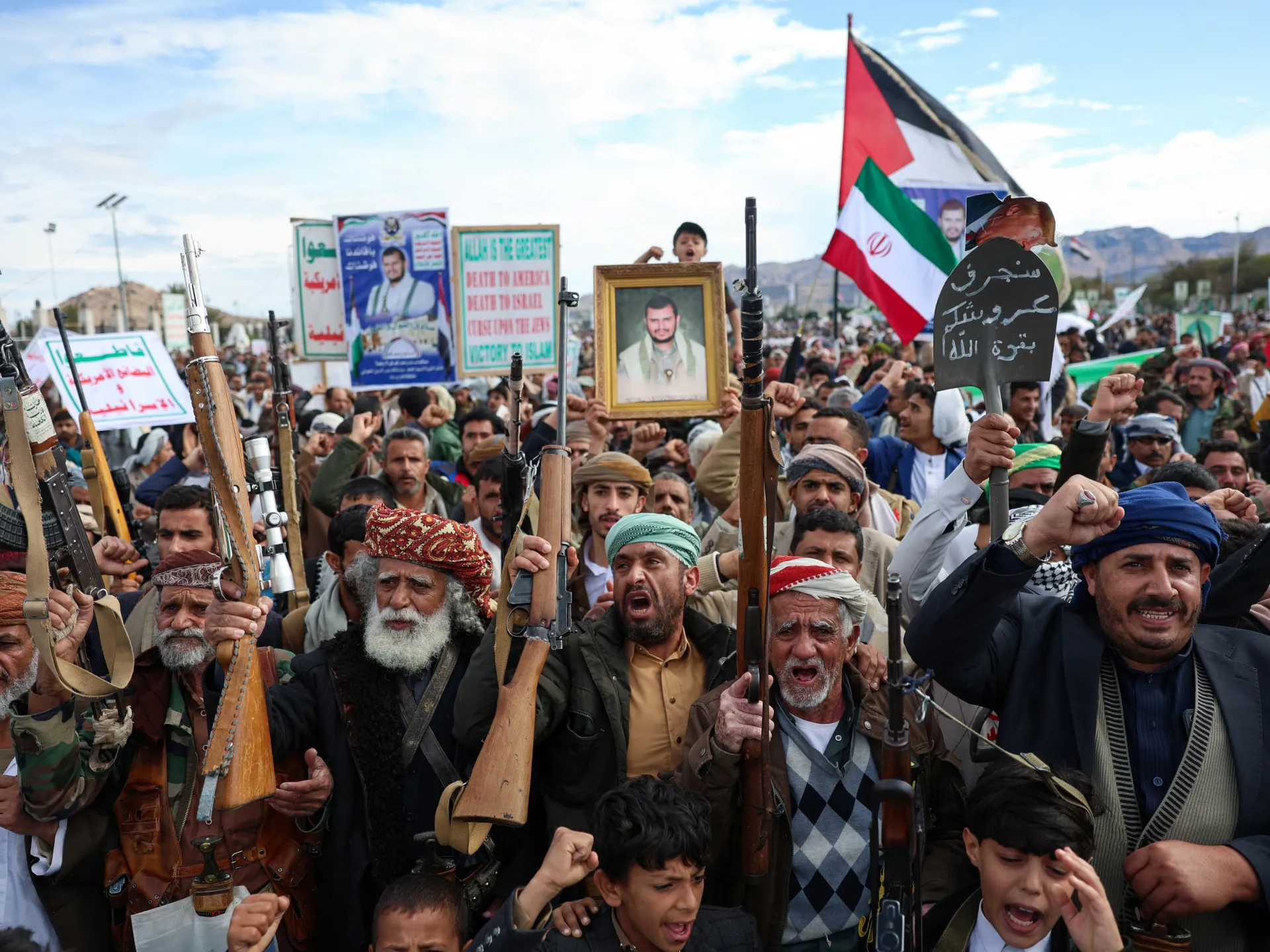
Yemen’s Iran-allied Houthis say they are prepared to intervene militarily if other countries join the United States and Israel in their war against Iran, or if the Red Sea is used to launch attacks on their ally.
“We confirm that our fingers are on the trigger for direct military intervention” if any new alliances join Washington and Israel against Iran and its allies, or if the Red Sea is used for “hostile operations” against Iran, the group’s military spokesperson Yahya Saree said in a televised speech on Friday.
Recommended Stories
list of 3 itemsend of list
Saree also said the Houthis were prepared to act if what he called the escalation against Iran and the “axis of resistance” continued, but did not say what form any intervention would take.
The warning raises the prospect of a broader regional war, particularly given the Houthis’ ability to strike targets far beyond Yemen and disrupt shipping lanes around the Arabian Peninsula.
The Yemeni rebel group has controlled the capital Sanaa and much of the country’s northwest since 2014.
After Israel launched its genocidal war on Gaza in October 2023, the Houthis targeted vessels in the Red Sea and carried out drone and missile attacks against Israel, saying that they are acting in solidarity with Palestinians under fire in Gaza.
Israel and the US have regularly struck the war-torn country, targeting civilian infrastructure, including residential buildings and the main international airport, while killing dozens at a time.
But in May, the Houthis and the US agreed to a truce, which included a Houthi agreement to stop attacks on US shipping in the Red Sea.
The group later stopped attacks on Israel and Israeli-linked shipping after the October Gaza ceasefire deal.
In his speech on Friday, Saree also said the group would not allow the Red Sea to be used to carry out “hostile operations” against Iran or any Muslim country.
He warned against any further tightening of what he described as “the blockade on Yemen”.
Saree called for an immediate halt to US and Israeli attacks on Iran, the Palestinian territory, Lebanon and Iraq.
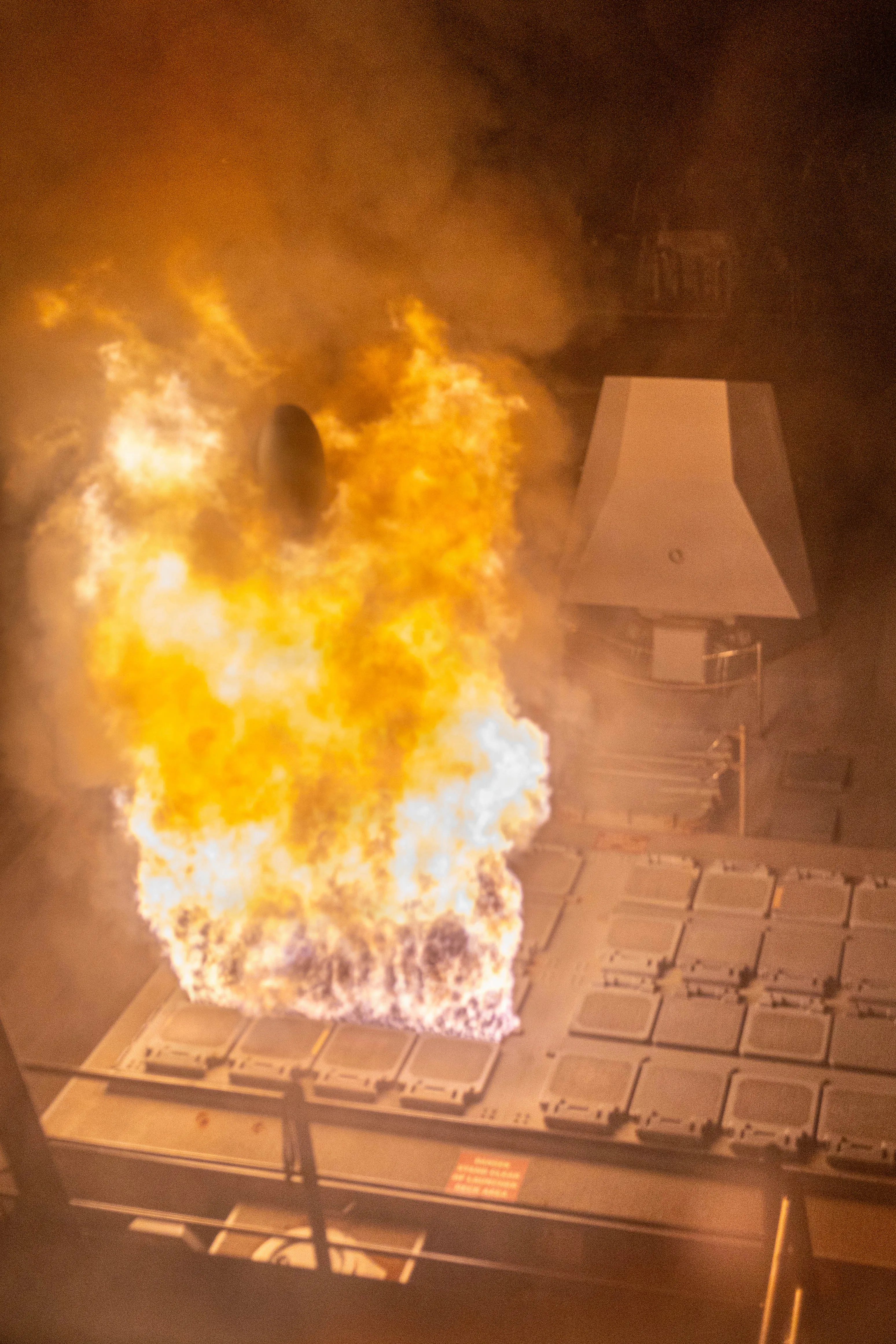
So far, the U.S. Navy has fired more than 850 Tomahawk missiles in the war with Iran, officials familiar with the matter told TheWashington Post. This has prompted discussions about how more missiles could be made available.
The Arleigh Burke class destroyer USS Bainbridge (DDG 96) fires Tomahawk missiles from the forward missile deck while underway in the Eastern Mediterranean Sea, in support of Operation Epic Fury, March 3, 2026. U.S. Navy Photo U.S. Central Command Public Affa
As it stands, only a few hundred examples of the critical long-range strike weapon are manufactured each year, meaning the global supply is limited. The exact number available to the U.S. military at any given time is a closely guarded secret, although the article suggested a higher-end figure of between 4,000 and 4,500 Tomahawk missiles on hand at the start of Epic Fury, and a lower-end figure closer to 3,000 missiles. Again, the Tomahawk would be a primary weapon system used in a conflict with China, where the target sets can range into the tens of thousands, and the country’s anti-access umbrella will require the use of standoff munitions like none other in history.
“The Pentagon has tracked the number of Tomahawks used with an increasing focus on what the burn rate will mean for not only a sustained campaign against Iran but for future military operations as well,” the report states.
I’ve posted nearly every TLAM launch video released by the DOD, major launch salvoes had continued until at least the weekend of the 14th. https://t.co/xYP9yaVySs
One official told TheWashington Post that the number of Tomahawks left in the Middle East was “alarmingly low,” while another said that without intervention, the Pentagon is closing in on “Winchester” — military slang meaning out of ammunition — for its supply of the missiles in the region.
The Tomahawk also comes with a hefty price tag: up to $3.6 million for some of the more recent versions, and each round can require up to two years to build. The Navy also faces a problem in that, in recent years, only small batches have been purchased: just 57 examples were included in last year’s defense budget.
At the same time, the Trump administration has repeatedly claimed that critical munitions stockpiles have not been dangerously depleted in the Iran war.
White House press secretary Karoline Leavitt said earlier this month that the U.S. military “has more than enough munitions, ammo and weapons stockpiles to achieve the goals of Operation Epic Fury laid out by President Trump — and beyond.”
Every indication we have seen is that for some munitions, that is not reality. The war in Ukraine and constant crisis in the Middle East have depleted those stockpiles, and many of the weapons take years to build, with finite caps on how many can be delivered in any given year. This is a story we have been covering for years. The Trump administration is working to greatly expand production of advanced munitions, but even the fruits of those efforts will take years to realize.
UPDATES:
We have concluded updates for the day.
UPDATE: 10:37 PM EST-
A missile and drone attack on Prince Sultan Air Base in Saudi Arabia has led to significant injuries to U.S. personnel. 10 American service members were wounded, two of which were seriously injured. It isn’t clear what damage was done to aircraft, but we have seen at least one tanker destroyed in recent satellite imagery. This is in addition to the attack that damaged multiple tankers and destroyed another earlier in the war.
Ten American service members were wounded in an Iranian drone and missile attack on Prince Sultan Airbase earlier today-Multiple US and Arab officials to the WSJ
“The injured service members were inside a building on the base that was struck in the attack, the officials said…At least one missile struck the base, as well as several unmanned aerial vehicles…The missile strike is at least the second to strike the base during the war… pic.twitter.com/bI5MrwmEDE
Trump is threatening to abandon NATO after member nations did not pitch in with opening the Strait:
NOW – Trump suggests the U.S. may abandon NATO countries: “We would’ve always been there for them [NATO], but now based on their actions I guess we don’t have to be.” pic.twitter.com/NKgO72FUvf
As expected, the USS George Washington and its strike group are deploying to the Middle East:
New: The USS George H.W. Bush aircraft carrier will deploy to U.S. Central Command’s area of responsibility, the major combatant command overseeing American military operations against Iran, sources told @JimLaPorta@ellee_watson and me. @CBSNews
Reuters is reporting that Arab states in the Gulf are urging the United States to ensure that any deal with Tehran should do more than end the war. Instead, it must ensure Iranian missile and drone capabilities are “permanently curbed” and that Iran will never again be able to “weaponize” global energy supplies. The agency cites four unnamed Gulf sources.
Meanwhile, it appears that Qatar, Oman, and Kuwait are prioritizing a quick end to the war, while the UAE, Saudi Arabia, and Bahrain are more willing for the fighting to continue, if their longer-term aims are met in any deal to end the war.
Qatar, Oman and Kuwait are pushing behind closed doors for a swift end to the war. The UAE, Saudi Arabia and Bahrain say they are ready to absorb an escalation of the war and will not accept a post-war Iran that is still able to use the Strait of Hormuz as a bargaining chip. https://t.co/LI26CkM40E
The Iranian foreign minister, Abbas Araghchi, has confirmed that Israel struck two of its most important steel production facilities, as well as nuclear sites — presumably including the Khondab Heavy Water Complex (see previous updates).
Araghchi said that Friday’s strikes contradicted President Donald Trump’s pledge to postpone attacking Iran’s energy infrastructure for 10 days after he claimed talks were “going well.” He further said that Tehran would exact a “heavy price” for the attacks.
Iran’s Foreign Minister Abbas Araghchi:
Israel has hit 2 of Iran’s largest steel factories, a power plant and civilian nuclear sites among other infrastructure. Israel claims it acted in coordination with the U.S.
Attack contradicts POTUS extended deadline for diplomacy.
Saudi Arabia wants the U.S. military to ramp up its attacks on Iran, according to a Saudi intelligence source, and the kingdom is meanwhile reportedly also considering joining the fight directly, alongside the United States and Israel. Whether or not Saudi Arabia also starts launching strikes against Iran remains to be seen, but it is the clearest indication so far that the kingdom might become more deeply involved in the conflict, at least at some level.
A Saudi intelligence source confirmed to The Guardian that Riyadh was urging the United States to both continue and intensify the military campaign against Iran. The same source confirmed similar reporting in The New York Times, which states that Saudi Arabia’s de facto leader, Crown Prince Mohammed bin Salman, had called upon Trump to not curtail Operation Epic Fury, and that the U.S.-Israeli campaign represented a “historic opportunity” to remake the Middle East.
U.S. President Donald Trump meets with Crown Prince and Prime Minister Mohammed bin Salman of Saudi Arabia during a bilateral meeting in the Oval Office of the White House on November 18, 2025. Photo by Win McNamee/Getty Images Win McNamee
Earlier this week, Trump told journalists that the crown prince is “a warrior. He’s fighting with us.”
At this point, however, there are no reports of active Saudi military involvement in the conflict, but the kingdom is now at least weighing up that option, if peace efforts fail.
This week, The Wall Street Journal and Jerusalem Post both reported that Saudi Arabia has decided to open up additional military bases for the use of the U.S. military in its operations against Iran. Reportedly, the facilities include King Fahd Air Base in Taif in western Saudi Arabia.
If Saudi Arabia were to begin strikes on Iran, the powerful Royal Saudi Air Force fleet of F-15 Eagles would likely figure prominently. These examples are taxiing at King Faisal Air Base, in the Kingdom of Saudi Arabia. U.S. Air Force photo by Senior Airman Leala Marquez Senior Airman Leala Marquez
Saudi Arabia has come under direct Iranian attack since the start of Epic Fury, including a drone strike last week on the oil refinery in Yanbu on the Saudi Red Sea coast.
At the same time, Saudi oil exports are not as vulnerable as those of other countries in the region, so it has not suffered to the same degree as other Gulf states. Much of Saudi Arabia’s oil exports are carried by a pipeline to the Red Sea, purposefully avoiding the Strait of Hormuz.
There is also the threat that the Iran-backed Houthis in Yemen, which have long waged a separate war with Saudi Arabia, could be drawn into the current conflict if the Saudi position changes.
Were that to happen, the vital Red Sea oil pipeline could become a very prominent target for Iran and the Houthis.
Iran’s Islamic Revolutionary Guard Corps (IRGC) declared today that shipping “to and from ports of allies and supporters of the Israeli-American enemies” is prohibited through any corridor or to any destination, Iranian state media reported.
The IRGC added that the Strait of Hormuz remains closed and any attempted transit through the strategic waterway will face “harsh measures.”
There have been reports today of three container ships of various nationalities turning back from the Strait of Hormuz, after warnings were issued by the IRGC Navy.
IRGC:
This morning, following the lies of the corrupt president of America regarding the openness of the Strait of Hormuz, three container ships of different nationalities moved toward the designated corridor for the transit of ships with permits, which were turned back with a… pic.twitter.com/uIvDmzpBQJ
Following COSCO’s announcement to resume booking acceptance to Gulf destinations, new developments overnight suggest the situation in the Strait of Hormuz remains highly unstable.
As we reported in our previous rolling coverage, Trump threatened last Saturday that he would destroy Iranian power plants if Tehran did not reopen the Strait of Hormuz within 48 hours.
On Monday, the U.S. leader postponed his threat for five days (until Friday), citing “very good and productive conversations” with Iran on ending the war — something that Tehran has described as “fake news.”
Now, Trump is pushing that deadline back again, pausing his threat to attack Iran’s energy infrastructure for 10 days until April 6, claiming that the request came from Tehran and that talks were going “very well.”
At the same time, there are suggestions that the Iran war, in general, may be of diminishing interest to the U.S. president.
“[Trump] is getting a little bored with Iran,” a senior White House official told Jake Traylor of MS NOW. “Not that he regrets it or something — he’s just bored and wants to move on.”
There are suggestions of something of a rift between Israel and the United States, as to the course the conflict should take.
According to Israeli journalist Barak Ravid, U.S. Vice President JD Vance had a “difficult” call with Israeli Prime Minister Benjamin Netanyahu earlier this week.
Reportedly, Vance said that Israeli assessments for toppling the Iranian regime were not realistic enough, saying, “You were too optimistic in your assessments regarding the overthrow of the regime in Iran.”
According to Barak Ravid, U.S. Vice President JD Vance had a difficult call with Israeli Prime Minister Benjamin Netanyahu on Monday where he said that Israeli assessments for toppling the Iranian regime were not realistic enough, saying “You were too optimistic in your… pic.twitter.com/KfEuGbUkzt
As we reported earlier this week, F-35Cs from the U.S. Marine Corps are the latest fighters poised to deploy to the Middle East region for Operation Epic Fury. The movement of these aircraft to RAF Lakenheath in England signals what is set to be the first land-based combat deployment for the F-35C, the carrier variant of the Joint Strike Fighter flown by both the Navy and Marine Corps. We now have some better imagery of the first visit of these aircraft to a base in the United Kingdom.
🇺🇸 The Tomcats / VMFA-311
Four Lockheed Martin F-35Cs of Marine Fighter Attack Squadron 311 (VMFA-311) based at MCAS Miramar departed RAF Lakenheath on the 26th March as MAZDA 31-34.
This is the first time ever that F-35Cs have visited the United Kingdom.
The United Arab Emirates has told allies that it would participate in a multinational maritime task force intended to reopen the Strait of Hormuz, as it pushes to form a coalition to ensure shipping can pass through the vital waterway, the Financial Timesreports.
According to the FT, the UAE has told the United States and other Western nations that it would take part, and that Abu Dhabi would deploy assets from its own navy.
Like Saudi Arabia, the UAE is taking a harder line on Iran, as it comes under regular attack by Tehran’s retaliation strikes.
The same report also states that the UAE is working on a UN Security Council resolution with Bahrain to provide any future task force with a mandate.
The UAE is pushing to form a multinational naval force to reopen the Strait of Hormuz.
It’s willing to deploy its own navy and is lobbying allies and the UN for support.
Only Bahrain has backed the plan so far, while others remain cautious.
According to an assessment from the Center for Strategic and International Studies (CSIS) in Washington, D.C., the U.S. strike campaign has settled into a “sustainable pace of bombing,” striking between 300 and 500 targets per day. U.S. forces are also now mainly using stand-in weapons, rather than more expensive standoff munitions. As a result of the “munitions transition,” the costs of running the war have been greatly reduced — although not without risk to aircraft and airmen.
“The U.S. strike campaign has settled into a sustainable pace of bombing between 300 and 500 targets per day. U.S. forces also now predominantly use far less expensive, short-range munitions.” https://t.co/iQm636cWwO
The Pentagon is looking at sending up to 10,000 additional ground troops to the Middle East, the Wall Street Journal has reported, quoting Defense Department officials. Having more troops in the region would give Trump more military options and greater bargaining power, as he seeks to bring Tehran to the negotiating table.
House Speaker Mike Johnson has said that “it should not be necessary” for U.S. forces to invade Iran. “I think we can get this resolved without it,” he added.
House Speaker Mike Johnson tells @BretBaier, “It should not be necessary” for U.S. forces to invade Iran. “I think we can get this resolved without it.”
Secretary of State Marco Rubio has also suggested that the U.S. military will not need to deploy ground troops to accomplish U.S. objectives in the war, although he also reflected on the importance of giving Trump “maximum optionality” for any contingency.
NEW: Secretary of State Marco Rubio tells me at the airport before leaving France that the US does NOT need to deploy ground troops to accomplish its objectives in the #IranWar.
But part of the cabinet’s job is to always give President Trump maximum optionality, he adds. pic.twitter.com/oYQrmF6Fdy
So far, it seems that Iran’s new Supreme Leader, Mojtaba Khamenei, has not yet agreed to negotiations.
Should the U.S. military conduct some kind of ground operation, various energy infrastructure within the United Arab Emirates (UAE) would come under Iranian attack, with a target list published by Iran’s state-backed Fars News Agency. Designated targets include desalination plants, nuclear power plants, and other power hubs across the UAE.
Iran’s state-backed Fars News Agency has released a target list of energy infrastructure within the United Arab Emirates (UAE) that they plan to strike if the U.S. conducts a ground operation against the strategically and economically important Kharg Island or any other Iranian… pic.twitter.com/PbwM14SPIZ
The Israel Defense Forces (IDF) say they carried out further strikes on targets in Tehran early on Friday. A brief military statement said Israeli forces “completed a wide-scale wave of strikes targeting infrastructure of the Iranian terror regime in the heart of Tehran.”
In a separate statement, the IDF said that it had also struck “ballistic missiles and aerial defense systems production sites across Iran.” It reported hitting missile launchers and storage sites in western Iran, as well as missile production sites in the capital. Other targets apparently included Iran’s primary facility for the production of naval cruise missiles and sea mines in Yazd, Iran.
“The site was used for the planning, development, assembly, and storage of advanced missiles intended for launch from cruise platforms, submarines, and helicopters toward both mobile and stationary maritime targets,” the IDF said.
🎯🌊 STRUCK: Iranian Regime’s primary facility for the productions of missiles and sea mines in Yazd, Iran
The site was used for the planning, development, assembly, and storage of advanced missiles intended for launch from cruise platforms, submarines, and helicopters toward…
The latest round of U.S.-Israeli strikes hit a heavy water reactor in central Iran, Iranian media reported today.
“The Khondab Heavy Water Complex was targeted in two stages by aggression from the American and Zionist enemy,” the Fars News Agency reported, citing Hassan Ghamari, an official in the central Markazi province. Fars and other media said there were no casualties or radiation leaks from the site.
The facility is intended to produce the heavy water used to cool nuclear reactors. As a byproduct of this process, plants of this kind also produce plutonium, which can potentially be used in nuclear weapons. This would offer another route to procuring a nuclear warhead, other than enriched uranium.
There are reports out of Iran that recent U.S. and Israeli airstrikes targeted key steel production facilities. The semi-official Iranian Mehr news outlet claims that steel plants were hit in the central Iranian city of Isfahan, with separate attacks on the Khuzestan Steel and Mobarakeh Steel factories.
In response to an inquiry from The Jerusalem Post, the Israeli military said that it was not aware of any Israeli strikes on the facilities.
Reports from Iran suggest that all three of Iran’s largest steel production plants were struck in a coordinated targeted strikes.
This could substantially affect the national steel industry and manufacturing pic.twitter.com/mmrnyDS8UX
The U.S. military has deployed uncrewed surface vessels (USVs) for patrols as part of its operations against Iran, the Pentagon has said, according to the Jerusalem Post. The specific type of drone boats that have been deployed was not reported, although this is not the first time that the U.S. military has used USVs in the region, notably in the Persian Gulf and the Strait of Hormuz.
The Iranian foreign minister, Abbas Araghchi, has accused the U.S. military of using Persian Gulf citizens as human shields.
“From outset of this war, U.S. soldiers fled military bases in GCC [Gulf Cooperation Council] to hide in hotels and offices. They use citizens as human shield. Hotels in U.S. deny bookings to officers who may endanger customers. GCC hotels should do same,” Abbas Araghchi said in a post on his X account.
IRGC:
The cowardly American and Zionist forces, who lack the courage and ability to defend their own military bases, are attempting—out of fear of the firepower of Islamic fighters—to use civilian locations and innocent people as human shields.
As we reported yesterday, Iranian bombardment of U.S. military facilities in the wider region does appear to be driving the relocation of soldiers, although there is no suggestion of a human shield policy.
According to a report from The New York Times, citing military personnel and American officials, a significant number of U.S. troops have been forced to relocate from their bases to hotels and office spaces throughout the region.
Iranian Foreign Minister Abbas Araghchi claims that since the start of the war, US troops have left military bases in the GCC to shelter in civilian spaces, effectively using residents as human shields, and urges Gulf hotels to follow US counterparts in denying accommodation to… pic.twitter.com/MJrUht8Di1
Reports in the Lebanese media suggest that an Israeli strike hit Beirut’s southern suburbs early today. Several explosions were heard in the area, which is considered a Hezbollah stronghold. Israel has previously issued evacuation warnings for the area but provided no specific warning in advance of Friday’s strike, AFPsaid.
An Israeli M109 self-propelled howitzer artillery fires rounds towards southern Lebanon from a position in the upper Galilee in northern Israel near the border on March 26, 2026. Photo by Jack GUEZ / AFP JACK GUEZ
Kuwait’s Shuwaikh port was hit by drones, causing material damage with no injuries reported, the Kuwait Ports Authority said today.
The international airport in Kuwait City also appears to have been on the receiving end of recent Iranian attacks, with a significant blaze there today, after a reported drone strike.
🔥 Fire breaks out at fuel tanks at Kuwait International Airport following an Iranian drone attack on Thursday
Iran-linked hackers today claimed they had accessed FBI Director Kash Patel’s personal email inbox, Reutersreports. The group claims to have published photographs of the director and other documents on the internet.
Satellite imagery of the Yazd missile complex, one of the most important in Iran, from earlier this month, reveals the shadow of an apparent Khorramshahr missile before being launched toward Israel. The original Khorramshahr first emerged publicly in 2017, and it is assessed to be derived, at least in part, from a North Korean design. It is a liquid-fuel medium-range ballistic missile (MRBM) with a claimed range of around 1,250 miles (2,000 kilometers).
Recent analysis from ThePrint, an Indian digital news platform, suggests that Iran has launched around 4,300 missiles and drones since the start of the current conflict, with the majority of these targeting Gulf nations, rather than Israel. The analysis states that Tehran has launched at least 1,815 drones and 372 missiles at the UAE since the start of the war. Israel, in comparison, has faced roughly 930 missile and drone attacks in the same period.
Interesting number crunching by my colleague @Keshav_Paddu
4,300 missiles & drones since day 1 of war: Gulf nations, not Israel faced brunt of #Iran’s retaliation#Israel, in comparison, has faced roughly 930 missile, drone attacks in the same period.https://t.co/WLOancpE8z
In related news, Reuters today published an assessment stating that, so far, the Pentagon can only confirm that about a third of the Iranian missile arsenal has been destroyed.
Satellite imagery from yesterday indicates that the aircraft carrier USS Gerald R. Ford has left Naval Support Activity Souda Bay in Crete, Greece, escorted by three patrol boats. The supercarrier went to Souda Bay for repairs after a fire broke out in the laundry area while underway in the Middle East on March 12, injuring two sailors.
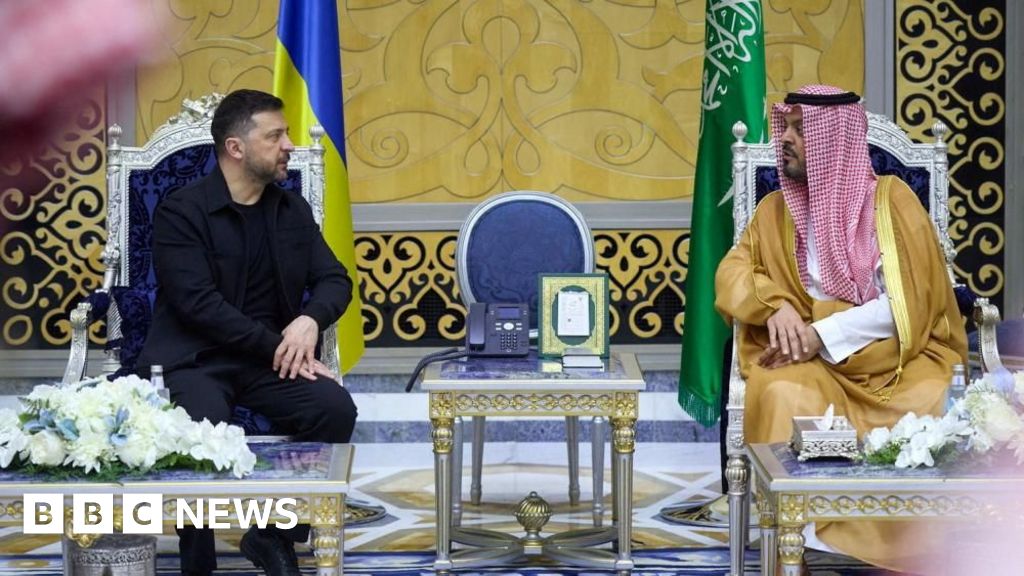
Ukrainian President Volodymyr Zelensky says that his country has “reached an important arrangement” with Saudi Arabia on defense cooperation. The agreement between the defense ministries of the two countries is almost certain to involve counter-drone technologies and expertise.
“We are ready to share our expertise and systems with Saudi Arabia and to work together to strengthen the protection of lives,” Zelensky wrote on X. “Now into the fifth year, Ukrainians are resisting the same kind of terrorist attacks — ballistic missiles and drones — that the Iranian regime is currently carrying out in the Middle East and the Gulf region. Saudi Arabia also has capabilities that are of interest to Ukraine, and this cooperation can be mutually beneficial.”
We have reached an important Arrangement between the Ministry of Defense of Ukraine and the Ministry of Defense of the Kingdom of Saudi Arabia on defense cooperation. The document was signed ahead of our meeting with the Crown Prince of Saudi Arabia, Mohammed bin Salman Al Saud.… pic.twitter.com/j3aXzLXSNr
— Volodymyr Zelenskyy / Володимир Зеленський (@ZelenskyyUa) March 27, 2026
Police are charging professional golfer Tiger Woods with driving under the influence for a second time after he rolled his Land Rover SUV near his Florida home.
Donald Trump touted the US-Israel war on Iran as “bold” and “historic,” telling a Saudi investment conference that the Middle East will soon be free from Iranian “nuclear blackmail.”
Weekly insights and analysis on the latest developments in military technology, strategy, and foreign policy.
With its facilities in the Middle East frequently targeted by Iranian missiles and drones, U.S. Central Command is looking for better ways to protect its troops and capabilities. This week, the command and its subordinate units put out two calls for information from companies that can design and provide hardened infrastructure, including underground facilities, as well as shelters. The need for hardened shelters is something that The War Zone has been raising for years, especially when it pertains to aircraft.
The attacks have been so intense that they’ve forced “many American troops to relocate to hotels and office spaces throughout the region,” The New York Times reported on Thursday, citing military personnel and American officials. “So now much of the land-based military is, in essence, fighting the war while working remotely, with the exception of fighter pilots and crews operating and maintaining warplanes and conducting strikes.”
You can see video from one of those Iranian attacks, on the U.S. Navy base in Bahrain, below.
The troop relocations spurred Iran’s powerful Speaker of the Parliament Mohamed Bagher Ghalibaf to mock the U.S. war effort in a post on X.
How can the US, which can’t even protect its own soldiers at its bases in the region and instead leaves them stashed away in hotels and parks, protect them on our soil?
— محمدباقر قالیباف | MB Ghalibaf (@mb_ghalibaf) March 27, 2026
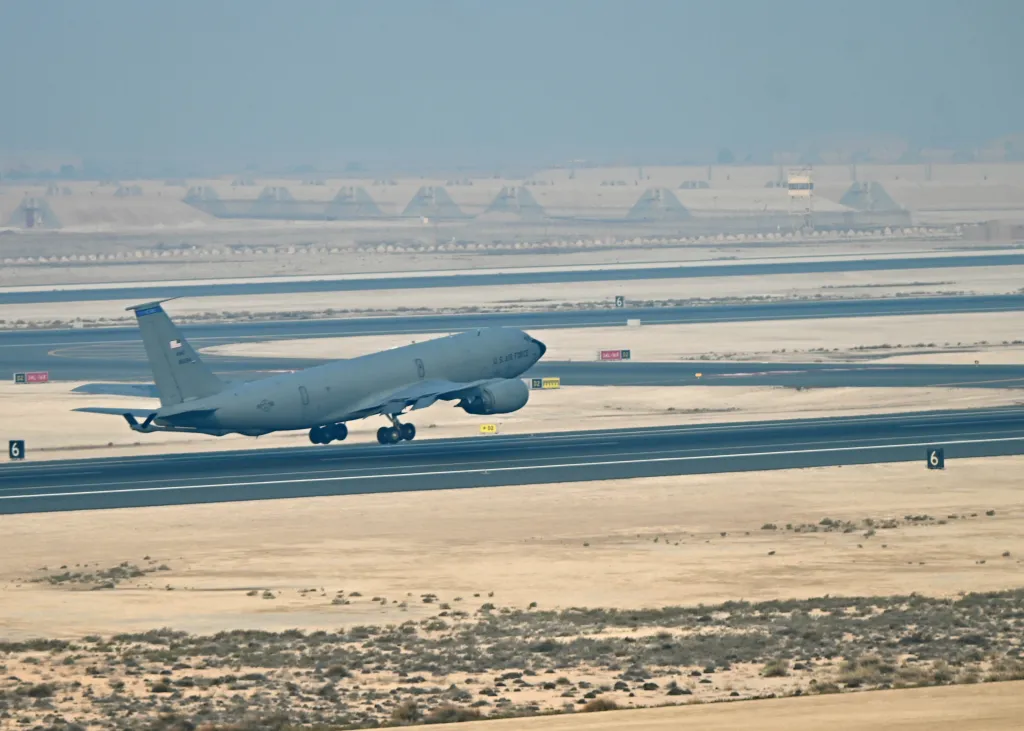
On Wednesday, U.S. Air Forces Central (AFCENT) put out a call for vendors who are able to help bolster force protection at Al Udeid Air Base in Qatar, the largest American military installation in the Middle East. Like many other bases in the region, it has come under frequent attack from Iran. AFCENT is seeking information from companies able to plan and design “a hardened, underground, secure, Combat Center Building…and squadron operations buildings supporting a variety of airframe and missions to include, but not limited to, bombers, fighters, and unmanned aircraft systems for intelligence, surveillance, and reconnaissance (ISR).”
The sources sought solicitation, which could lead to a sole-source contract award, states that the plan may also seek construction of additional facilities, including administrative offices, command and control facilities, operational readiness and life support facilities for specialized personnel, elevators, and a parking garage. However, there is a long lead time for this project, even if it gets approved. A contract solicitation won’t be issued until April 2027, with the award anticipated in January 2028.
CENTCOM is looking for companies who can design a hardened, underground sheltered command center at Al Udeid. (U.S. Air Force photo by Senior Airman Sarah Williams) Senior Airman Sarah Williams
The underground shelter plan for Al Udeid is part of Strategic Master Plan 2040 (SMP2040), “a portfolio of over 170 Qatar-funded projects worth $10 billion that will be carried out from the first quarter of 2026 until 2040,” according to AFCENT. “Most of the projects are designed and will be constructed by Qatar with a few being U.S.-designed and constructed.”
It is unclear whether the new shelter project was spurred by current events, but a Feb. 3 AFCENT release on SMP2040 makes no mention of such structures. That fact that the plan will take years to come to fruition also raises questions about why it had not been unveiled sooner, given that Al Udeid has long been known to be a target of potential Iranian attacks. It is also not publicly known whether the proposed Combat Center Building at Al Udeid will replace or augment the current Combined Air Operations Center (CAOC) that serves as a command and control headquarters for U.S. and allied aircraft operating across the Middle East. We’ve reached out to AFCENT for clarification, but they deferred us to CENTCOM, which declined comment.
Attacks on and damage to Al Udeid from Iranian missiles can be seen below.
This satellite imagery is noteworthy. It appears to show at least two precise impact points on a large bunker used by U.S. forces at Al Udeid Air Base in Qatar 🇶🇦, located at 25°06’45.71″N 51°20’43.17″E.
In a more immediate request, CENTCOM is looking for vendors capable of providing “prefabricated, transportable, hardened shelter systems designed to protect personnel from blast and fragmentation threats,” according to a sources sought posting on Monday. “All proposed solutions must be deliverable to the Aqaba Air Cargo Terminal at King Hussein International Airport in Aqaba, Jordan.”
Unlike the Al Udeid plan, CENTCOM is looking for a quick turnaround on these shelters, asking that vendors submit “three potential delivery options reflecting estimated timelines of 3 days, 15 days, and 30 days.”
“Responses shall include a comprehensive description of the materials used in fabrication, including composition, structural design, and any reinforcement features,” according to the solicitation. “Vendors must also clearly identify the protection level of each proposed bunker, including the highest level of threat (e.g., blast force, fragmentation, or ballistic impact) the system is designed to withstand.”
The total quantity of these shelters is currently unknown and vendors are being asked to provide pricing structures “that reflect any available economies of scale.” The timeline for this project is unclear. Responses are due today, but there is no contract award deadline listed in the solicitation. CENTCOM declined our request for details, citing operational security concerns.
“Vendors are requested to submit three potential delivery options reflecting estimated timelines of 3 days, 15 days, and 30 days.”
“The USG’s review of documentation priorities are delivery timeline first, followed by protection level of the bunker systems.”
The most recent incident took place earlier this month when Barksdale Air Force Base in Louisiana experienced waves of drone incursions. The base is home of B-52 Stratofortress bombers and nuclear weapons storage facilities, and is a key part of the airborne leg of America’s nuclear triad.
I have spent a good part of my career just getting people to believe this was actually happening. Now we are here. With 15 drones, you can lose roughly 1/4 of the B-52 force as it sits idle on the ground. This was always the most concerning scenario. Time to move to hardening.… https://t.co/bBgE5taas9
One of the biggest concerns we have raised over the years is the lack of shelters at the massive and highly strategic Andersen Air Force Base on the island of Guam. The base, a key location for U.S. power projection in the Pacific, will be a prime target for Chinese long-range missiles in the event of a war.
Friday morning, retired Air Force Lt. Gen. David Deptula, now dean of the Mitchell Institute, concurred with our concerns about the lack of shelters and other hardened infrastructure.
“It absolutely has been needed and I made that case back when [Al Udeid] was being built,” Deptula told us. “But it’s all about money. That, along with not hardening aircraft shelters in Guam.
Deputla added that he tried to get hardened shelters built in Guam back when he was Director of Air and Space Operations for Pacific Air Forces more than 20 years ago.
“We were passed over due to other priorities at the time,” he explained.
As for the concept for hardened infrastructure at Al Udeid, Deptula said he was not aware of the plan, “but it is too little too late for this war.”
The reluctance about hardened shelters may be starting to change. Last year, the U.S. Army Corps of Engineers (USACE) announced anti-drone updates to the Modular Protective System-Overhead Cover (MPS-OHC). MPS-OHC was originally developed during the Global War on Terror era in response to indirect fire threats like artillery shells, rockets, and mortar rounds that U.S. forces were facing in Afghanistan and Iraq. The modular shelters, while still hardened, could provide a more temporary and cost-effective way to protect aircraft, other equipment and personnel from drones.
A Modular Protective System-Overhead Cover. (US Army Corps of Engineers)
Meanwhile, weeks before Epic Fury was launched, the Pentagon released new guidelines for hardening civilian and military facilities in the homeland from the growing threat from small drones that The War Zone has long warned about. These concerns have been spurred by years of incursions over U.S. bases and critical facilities and were hammered home by Ukraine’s 2025 near-field attack, dubbed Operation Spider Web, that wiped out a large number of Russia’s bombers with concealed arrays of drones stashed near airbases.
Epic Fury, of course, presents a different threat as U.S. bases get hit by ballistic missiles and large drones like Shahed-136s, in addition to first-person view (FPV) drones. Regardless, this conflict has once again highlighted the need to find better ways of protecting American troops and assets.
Weekly insights and analysis on the latest developments in military technology, strategy, and foreign policy.
Welcome to Bunker Talk. This is a weekend open discussion post for the best commenting crew on the net, in which we can chat about all the stuff that went on this week that we didn’t cover. We can also talk about the stuff we did or whatever else grabs your interest. In other words, it’s an off-topic thread.
This week’s second caption reads:
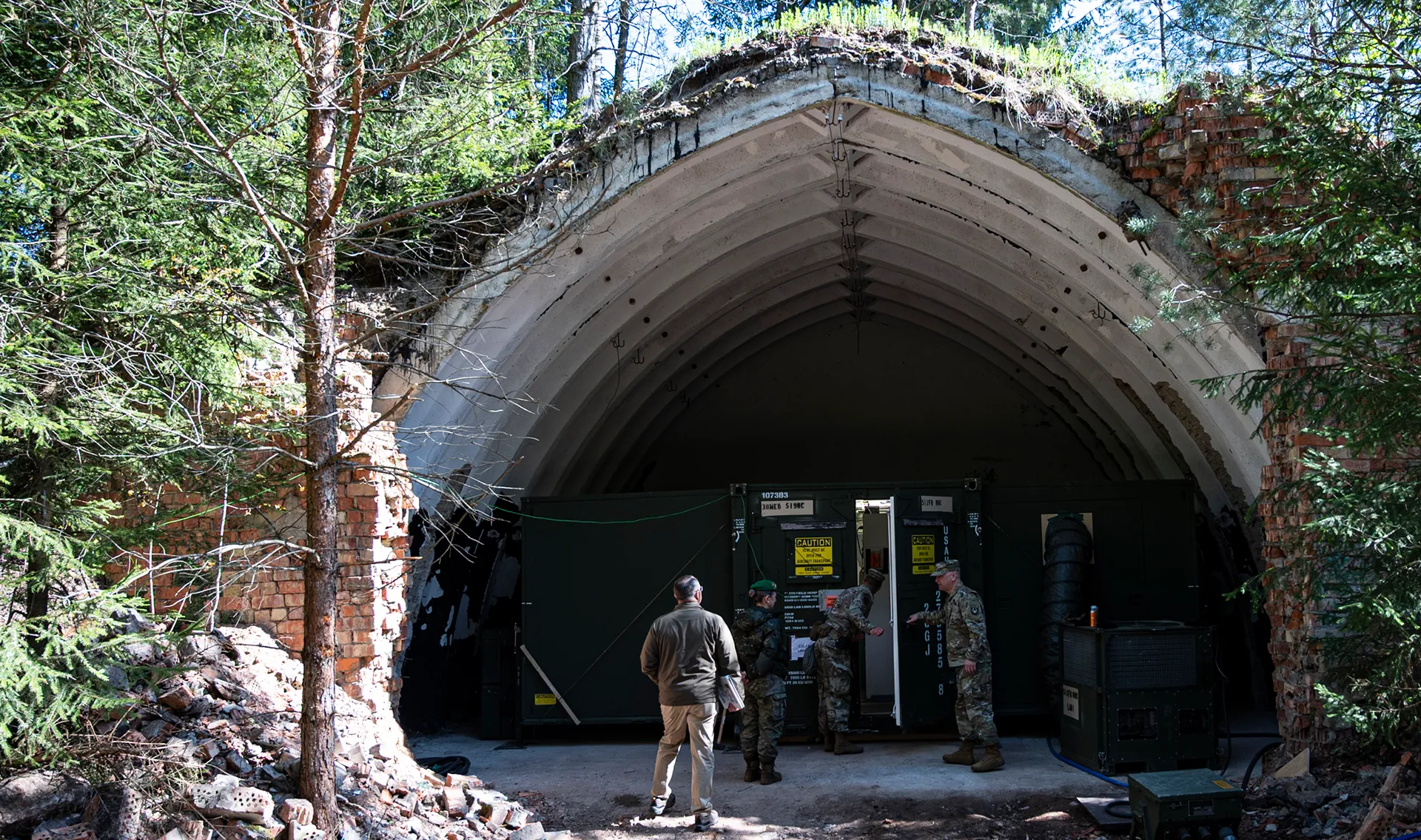
A field medical laboratory belonging to the 512th Field Hospital sits inside an old Soviet-era bunker as part of Exercise Dynamic Employment of Forces to Europe for NATO Deterrence and Enhanced Readiness (DEFENDER) 2025, Vepriai Rocket Base, Lithuania, May 12, 2025. During Swift Response, the initial phase of DEFENDER 25, the Defense Health Agency’s Force Health Protection team is providing essential support and expertise to U.S. Army medical providers assigned to the 512th Field Hospital, 519th Hospital Center, 30th Medical Brigade, and 68th Theater Medical Command. As part of DHA’s Operational Medical Systems Program Management Office, FHP works with combatant commands and regulatory experts across the globe to rapidly provide a treatment, diagnostic, or preventive medical countermeasure against high-consequence threats to the Warfighter when a Food and Drug Administration-approved product is not available. (Defense Health Agency Photo by T. T. Parish/Released)
Also, a reminder:
Prime Directives!
If you want to talk politics, do so respectfully and know that there’s always somebody that isn’t going to agree with you.
If you have political differences, hash it out respectfully, stick to the facts, and no childish name-calling or personal attacks of any kind. If you can’t handle yourself in that manner, then please, discuss virtually anything else.
No drive-by garbage political memes. No conspiracy theory rants. Links to crackpot sites will be axed, too. Trolling and shitposting will not be tolerated. No obsessive behavior about other users. Just don’t interact with folks you don’t like.
Do not be a sucker and feed trolls! That’s as much on you as on them. Use the mute button if you don’t like what you see.
So unless you have something of quality to say, know how to treat people with respect, understand that everyone isn’t going to subscribe to your exact same worldview, and have come to terms with the reality that there is no perfect solution when it comes to moderation of a community like this, it’s probably best to just move on.
Finally, as always, report offenders, please. This doesn’t mean reporting people who don’t share your political views, but we really need your help in this regard.
Tehran, Iran – Heavily armed state forces continue to control Iran’s streets, despite the United States and Israel launching more strikes and preparing for a potential ground attack, as the nearly one-month war proceeds with no clear end point on the horizon
Checkpoints, roadblocks and patrols, some manned by masked forces wielding assault rifles and machine guns mounted on pick-up trucks, have become a common sight in Tehran.
Recommended Stories
list of 4 itemsend of list
Many of the checkpoints, operated by the paramilitary Basij force of the Islamic Revolutionary Guard Corps (IRGC), police or plainclothes forces, have been targeted by deadly drone strikes over the past two weeks. They are, therefore, often on the move, or positioned on highways, in tunnels, and under bridges.
“I counted 40 cars moving through my neighbourhood late last night while honking, flashing their blinkers, waving flags and escorting a pick-up truck that had massive speakers fitted at the back and somebody shouting religious slogans from inside,” a resident of western Tehran told Al Jazeera on Friday, asking to remain anonymous for security reasons.
He said local residents have been invited from the loudspeakers on multiple occasions to join gatherings at the neighbourhood’s mosque to denounce the US and Israel and express support for the theocratic establishment that has been in power since Iran’s 1979 Islamic revolution.
Such state-backed gatherings are taking place in numerous mosques, as well as city squares and streets. But they come as the US and Israel urge Iranians to stay in their homes and wait for a “clear signal” to take to the streets and overthrow the Islamic Republic.
For their part, Iranian state television and other state-affiliated media outlets have encouraged supporters to maintain control on the streets, and have been increasingly releasing footage of armed pro-state people, including women, carrying guns.
Rahim Nadali, the IRGC’s deputy for cultural affairs in Tehran, claimed on state television on Wednesday night that people of all ages have expressed readiness to join intelligence and security patrols and checkpoints.
“We have brought the age limit [down] to over 12 years. So now, children aged 12 or 13 years are going to participate in this space,” he said.
‘Sinking feeling in your gut’
A series of new air raids landed across Iran on Friday afternoon, hitting a civilian nuclear site, as well as power posts and production lines for steel and other industrial factories, according to Iranian authorities.
Washington has also deployed thousands more soldiers to the region while signalling that an attempt to occupy one or more islands on Iran’s southern shores may be imminent.
Iranian officials have promised to retaliate strongly if that happens, including by striking critical infrastructure across the region.
Javad Mogoei, a prominent IRGC-linked media personality, released a video from the island of Qeshm earlier this week, suggesting that the IRGC could launch missiles and drones at Iranian islands if they were occupied by the US.
Despite that potential for even further escalation, and while numerous areas in Tehran have been struck by bombs dropped from Israeli and US warplanes, the city continues to function as people try to practise a semblance of a normal life.
Some people visit friends and loved ones indoors, while others go on daytime walks to hold a routine or work out at gyms that are open for limited hours.
“It looks like the war will last for weeks, if not months, so we can’t afford to get drowned in all the anxieties and fears that come with it,” said another resident of the capital, who had sought safety in one of Iran’s northern provinces earlier in the war, but returned last week.
“But you still can’t help but get that sinking feeling in your gut for a moment, not knowing whether you will be next when you hear the jets flying over,” he said.
Another resident, a woman who lives in the more affluent northern areas of Tehran where multiple senior officials have been assassinated in residential buildings since the start of the war, said she finds herself worried.
“My mind sometimes automatically goes back to the concern that some official might be living in an adjacent alley or a nearby home, and my family could become collateral,” she said, adding that she has only been outside her home three times over the past month to buy essentials or visit immediate family.
Iranian authorities have said nearly 2,000 people have been killed since February 28 by US and Israeli attacks, and a large number of residential units, hospitals, schools and civilian vehicles have been affected.
Economy under strain
More businesses are expected to reopen when the country’s official working week starts on Saturday, following the holidays for Nowruz, the Persian New Year.
But the internet has been completely blocked to the civilian population for nearly a month, the longest recorded shutdown in Iran. The internet shutdown has tormented the country’s more than 90 million population and further squeezed an economy plagued by an inflation rate of about 70 percent.
State media released footage of President Masoud Pezeshkian personally visiting a hypermarket in Tehran on Friday to make sure that all essential goods are available to the population, and ensure that vendors refrain from jacking up prices or engaging in hoarding.
The government also continues to hand out a small cash subsidy, which it began doing after nationwide protests initially driven by the country’s economic situation in January.
The United Nations and international human rights groups say many thousands of protesters were killed by state forces, mostly on the nights of January 8 and 9, amid another total internet shutdown, but the Iranian government blames “terrorists” and “rioters” backed by the US and Israel for the unrest.
Iranian authorities have warned that anyone who takes to the streets to protest the establishment during the ongoing war will be treated as an “enemy”. They have also announced multiple war and protest-related executions, many hundreds of arrests over security charges, and confiscation of assets belonging to Iranians found to be dissidents inside or outside the country.
Iran’s judiciary announced asset seizures on Thursday for Ali Sharifi Zarchi, a former professor of bioinformatics and artificial intelligence at Iran’s top institution of higher education, the Sharif University of Technology.
He was found by authorities to have “transformed into an anti-Iran element and supporter of the Zionist regime”, in reference to Israel, due to his tweets and interviews in recent months in opposition to the Islamic Republic while based outside the country.
“The modest belongings you confiscated were the result of 25 years of teaching adolescents and young people, and of striving for Iran. They are a small sacrifice for even a single smile from the families of the children and youths whom you unjustly massacred” during nationwide protests in January 2026, late 2022 and early 2023, and November 2019, Sharifi Zarchi said in a post on X in response.
An off-duty Metropolitan Police officer was among a group filmed confronting Al Jazeera journalists reporting on a suspected arson attack in north London, the force has confirmed. The incident is raising questions about press freedom.
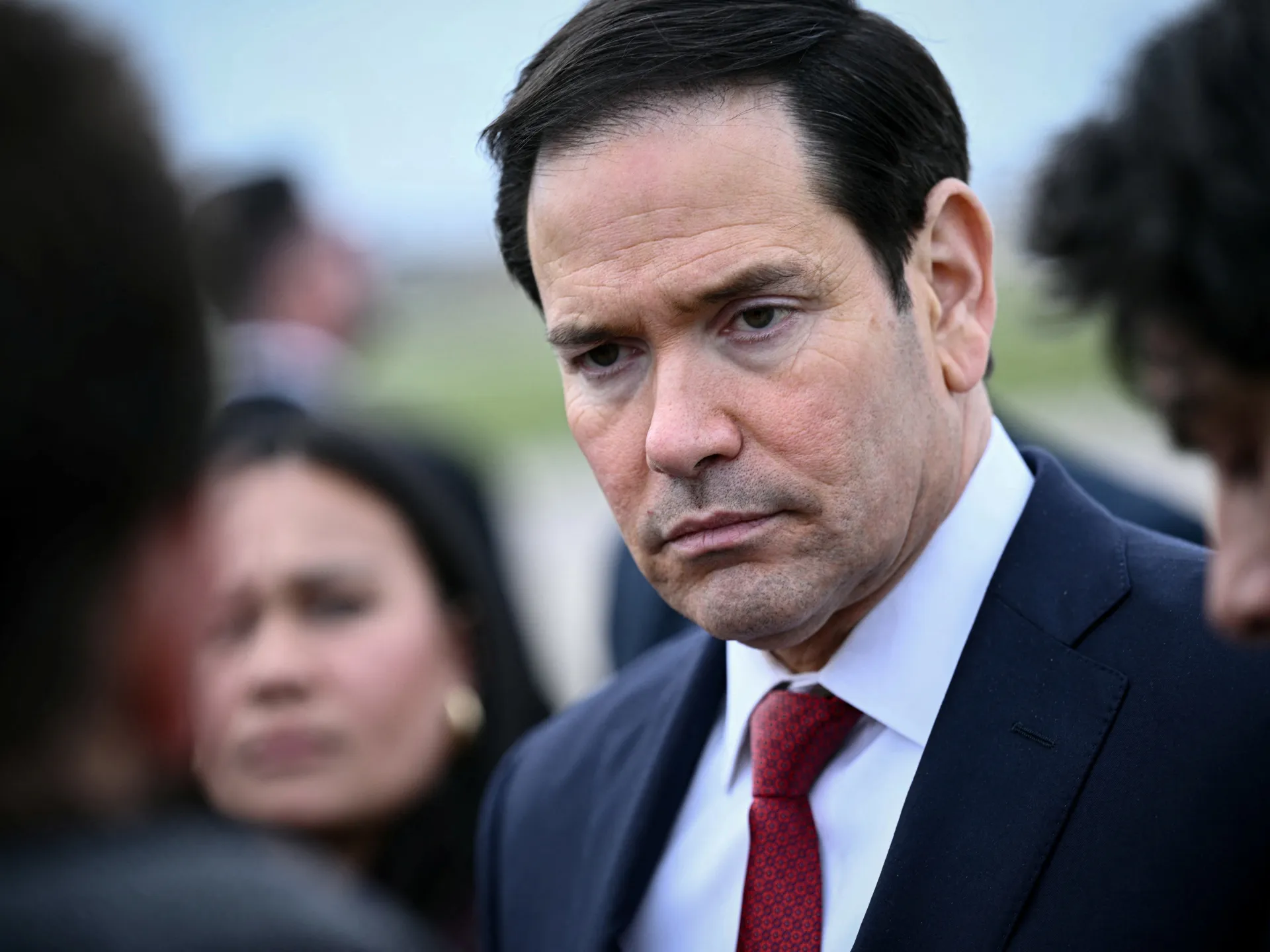
United States Secretary of State Marco Rubio has offered wide-ranging remarks upon his departure from the latest Group of Seven (G7) ministers’ meeting in France, denouncing Iran’s continued chokehold on the Strait of Hormuz as well as settler violence in the occupied West Bank.
Standing on an airport tarmac on Friday, Rubio fielded questions from journalists about reports that Iran plans to implement a tolling system in the strait, a vital waterway for the world’s oil supply.
Recommended Stories
list of 3 itemsend of list
Rubio used the topic to double down on pressure for countries to participate in securing the Strait of Hormuz, a demand US President Donald Trump has repeatedly made.
“One of the immediate challenges we’re going to face is in Iran, when they decide that they want to set up a tolling system in the Strait of Hormuz,” Rubio said.
“Not only is this illegal, it’s unacceptable. It’s dangerous for the world, and it’s important that the world have a plan to confront it. The United States is prepared to be a part of that plan. We don’t have to lead that plan, but we are happy to be a part of it.”
He called on the G7 members — among them, Japan, Canada, France, the United Kingdom, Italy, Germany and the European Union — as well as countries in Asia to “contribute greatly to that effort”.
Rubio calls toll plan ‘unacceptable’
The Strait of Hormuz is a key artery for the global transport of oil and natural gas, and prior to the start of the US and Israel’s war against Iran on February 28, an average of 20 million barrels of oil per day passed through the waterway.
That amounted to roughly 20 percent of the world’s liquid petroleum supply.
But since the outbreak of war, Iran has pledged to close the Strait of Hormuz, which borders its shores. The threat of attacks has ground most of the local tanker traffic to a standstill, though a few vessels, some linked to Iran or China, have been allowed to pass through.
Media reports suggest that Iran is setting up a “tollbooth system” that would require passing ships to put in a request through Iran’s armed forces, the Islamic Revolutionary Guard Corps (IRGC). There would also be a fee to secure passage.
“ They want to make it permanent. That’s unacceptable. The whole world should be outraged by it,” Rubio said on Friday.
He added that he conveyed a warning about the polling scheme to his colleagues at the G7.
“All we’ve said is, ‘You guys need to do something about it. We’ll help you, but you guys are going to need to be ready to do something about it,’” Rubio said.
“Because when this conflict and when this operation ends, if the Iranians decide, ‘Well, now we control the Strait of Hormuz and you can only go through here if you pay us and if we allow you to, that’s not only is it illegal under international law and maritime law. It’s unacceptable, and that can’t be allowed to exist.”
The Trump administration, however, has struggled to rally allies and world powers to join the US in its offensive against Iran.
Legal experts have criticised the initial strikes against Iran as an unprovoked act of aggression, though the Trump administration has cited a range of rationales for launching the attack, including the prospect that Iran may develop a nuclear weapon.
Many of the US allies in Europe have maintained that they would limit their involvement to defensive actions. Trump, meanwhile, has accused members of the NATO alliance of being “cowards”, adding in a social media post, “We will REMEMBER.”
In a statement following the G7 meeting, member countries reiterated their stance that there should be an “immediate cessation of attacks against civilians and civilian infrastructure”.
They also underscored the “absolute necessity to permanently restore safe and toll-free freedom of navigation in the Strait of Hormuz”. But the statement fell short of pledging any resources or aid to the US and Israeli war effort.
Achieving goals ‘without any ground troops’?
It is unclear when the war might end. On Saturday, it reaches its one-month anniversary, having stretched for four weeks.
Rubio on Friday echoed Trump’s assessment that the war was going as planned and that the US was achieving its objectives, including to destroy Iran’s navy, missile stockpiles and uranium enrichment programme.
“ We are ahead of schedule on most of them, and we can achieve them without any ground troops, without any,” he said, addressing an oft-raised concern about the prospect of US troops being deployed to Iran.
Rubio also briefly addressed the increasing levels of Israeli settler violence against Palestinians in the occupied West Bank.
On March 19, the United Nations estimated that more than 1,000 Palestinians have been killed in the West Bank since Israel began its genocidal war in Gaza in October 2023. The international body underscored that a quarter of the victims were youths.
“ Well, we’re concerned about that, and we’ve expressed it. And I think there’s concern in the Israeli government about it, as well,” Rubio responded, adding that it was a “topic we follow very closely”.
He suggested that the Israeli government may take action to stop the violence, though critics argue that Israel has largely turned a blind eye to settler violence.
“Maybe they’re settlers, maybe they’re just street thugs, but they’ve attacked security forces, Israelis, as well. So, I think you’ll see the government going to do something about it,” Rubio said.
Upon taking office for a second term in January 2025, President Trump also moved to cancel sanctions against Israeli settlers accused of grave abuses in the West Bank.
Iranian football players laid backpacks on a football pitch in Turkey to pay tribute to the children killed in a US-Israeli strike on Minab elementary school last month. The tribute came ahead of a friendly match against Nigeria.
Weekly insights and analysis on the latest developments in military technology, strategy, and foreign policy.
The U.S. Navy has unveiled a “marketplace” model for acquiring future fleets of uncrewed surface vessels (USV), which could be owned and/or operated by the service or contractors. The Navy is applying this approach first to the procurement of medium-sized designs, or MUSVs, which could be configured for a variety of missions with the help of containerized payloads. The new strategy, which supplants the Modular Surface Attack Craft (MASC) plan laid out just last year, and aims to cut down on lengthy prototyping requirements, is the latest in a series of Navy efforts to try to speed up the fielding of new USV capabilities at scale.
“The character of warfare is changing rapidly. The Department of the Navy is adapting its acquisition system to deliver capability to our warfighters faster,” Secretary of the Navy John Phelan wrote in a post on X this morning, marking the official roll-out of the new USV acquisition plan. “We are harnessing the talent and ingenuity of the American tech sector by launching a market competition for the Medium Unmanned Surface Vessel (MUSV) Family of Systems. This new approach will leverage private investment and accelerate the delivery of real capabilities to the Fleet. We will reward the companies who are able to deliver capability at the speed of relevance.”
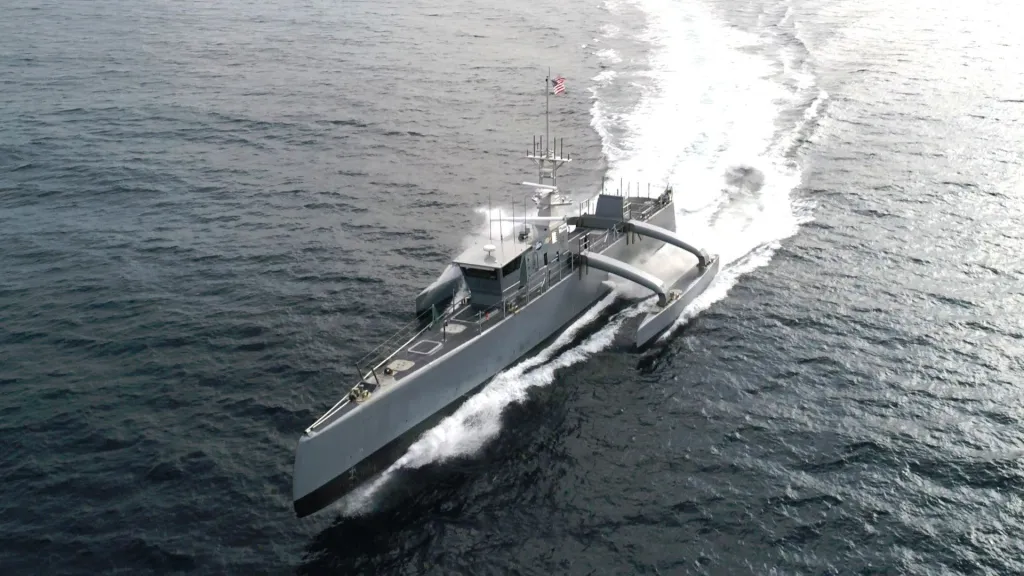
The Sea Hunter seen here is an MUSV-type design that the US Navy has been experimenting with for years now already. USN
“Our goal is to create a regular, recurring marketplace, not just for the MUSV, but for other classes of vessels, as well, over time, designed to match the growing demand for unmanned systems across a range of missions,” Rebecca Gassler, the Navy’s first-ever Portfolio Acquisition Executive for Robotic and Autonomous Systems (PAE RAS), also told TWZ and other outlets during a press call today. “This model that we’ve posted rewards demonstrated performance at sea, not just development, and is not another prototyping award. And it creates a direct path from what’s demonstrated on the water to putting those vessels into the fleet.”
The use of “marketplace” here should not be confused with how the U.S. Army is also now using that term to describe an actual online storefront-style system for ordering small uncrewed aerial systems. “I don’t know how many customers other than PAE RAS there are right now that actually have the funding to go buy or lease an MUSV,” Gassler said in response to a question about whether any kind of comparison between the two might be appropriate.
The Navy also posted a contracting notice regarding what it is now calling the Medium Unmanned Surface Vessel (MUSV) Family of Systems (FoS) program, specifically, online today. Potential offers only have another three weeks or so to submit proposals that involve designs that can be ‘on the water’ by the end of September, underscoring the service’s interest in already highly mature capabilities.
In terms of the actual uncrewed vessels the Navy is seeking through this effort, threshold requirements include a range of at least “2500 nm [nautical miles] at 25 knots while carrying a 25 MT [metric ton] load on the payload deck in NATO STANAG 4194 Sea State 4.” Per this NATO standard, Sea State 4 is characterized by wind speeds of 17 to 21 knots and wave heights between four and eight feet.
The MUSVs also need to be able to carry forty-foot equivalent units (FEU) containerized payloads and to refuel at sea at a rate of “2,000 gallons per minute of fuel through deck connections,” according to the contracting notice. We’ll come back to what might be in those payloads later on.
The Navy also wants designs that are “capable of fully autonomous operations both day and night in varying weather conditions complying with COLREGs [Convention on the International Regulations for Preventing Collisions at Sea], can prescribe keep out and keep in zones, and perform pre-defined behaviors,” per the notice. They also have to be “capable of restricting all Radio Frequency (RF) emissions when commanded while continuing to autonomously operate, perception system for autonomy has a passive mode with no RF emissions.”
The full list of threshold requirements from the MUSV FoS contracting notice released today. USN
In addition, the Navy has outlined a number of desired attributes, including “interfaces between C2, Perception, Machinery Control System, and Autonomy Control System software and hardware systems [that] conform to an open architecture standard with Interface Control Documents (ICD)” and an overall “autonomous system solution [that] enables integration with third party applications, modular upgrades, and component-level interoperability.” The service is also interested in the ability of the MUSV to monitor “health and status and autonomously reports conditions to the offboard C2 station, providing situational awareness of the condition of the vessel to the operator.”
“Vessel can execute 5 days of pre-planned maneuvers without communication connection” and “vessel provides emergency stop functionality to the offboard operator,” defined as “the rapid shutdown of propulsion engines putting the USV into a drift,” are also on the desired attributes list. There are production and operational aspects the Navy is also interested in, such as the ability of a selected contractor to supply between five and 10 operational MUSVs by the end of Fiscal Year 2027 and designs that can be “nested five abeam when moored.”
The complete list of desired attributes for the MUSV FoS from today’s contracting notice. USN
“We believe a number of them [potential offers] will test on production representative, but not full production[-ready designs,] or they’ll test in [sic] surrogate boats, so that we can see the autonomy that they’re bringing, even if it’s not the full production vessel,” Gassler noted today. So, acceptance of a finalized design will include a requirement “to do the full endurance test again, and any additional mission profiles that we have gotten from the Fleet, we will test at the time. And then we will do a full regression test on the autonomy now that it has been connected into the production boat controls.”
Overall, many of the stated threshold requirements for the MUSV FoS are similar, if not identical, to what the Navy had previously outlined for the initial baseline MASC design. The MASC plan was a three-tier approach that also included larger and smaller types, all of which would be configurable for different missions using containerized systems.
At the same time, the new strategy laid out today “is a replacement for MASC, absolutely,” PAE RAS Gassler stressed. MASC “was tailored towards a very specific mission and a very specific ask from the Fleet, [and a] very specific quantity. And we have a much wider variety of requirements for these vessels and missions that they need to accomplish as part of the Golden fleet. And so this is a replacement for that.”
“So, I won’t talk about specifically what mission we’re going after now that kind of gets out of the unclassified realm, but know that we are looking at specific mission profiles,” Gassler added. “For example, some require more complexity in their autonomy features than others, and so when we put these vessels through their tests, those tests will be a superset of those requirements such that we understand they will meet each of those missions.”
“Honestly, inside you could have a sensor, you could have repair equipment for ships,” she also said, speaking more generally about containerized payloads. “You could have any number of payloads inside those, and you basically are able to just swap them on.”
It should be noted here that the Navy did say its initial focus for MASC was on Intelligence, Surveillance, Reconnaissance, and Targeting (IRS&T), Counter-ISR&T, and Information Operations missions. At the same time, the three-tier approach and focus on containerized systems had certainly pointed to additional missions, including surface-to-surface strike and electronic warfare, down the line. The Navy already has a containerized launcher capable of firing SM-6 multi-purpose missiles and Tomahawk land-attack cruise missiles that it has been working to field on crewed ships, as well as in a ground-based configuration. The Navy has test-fired that launcher from an optionally crewed ship in the past.
See the game-changing, cross-domain, cross-service concepts the Strategic Capabilities Office and @USNavy are rapidly developing: an SM-6 launched from a modular launcher off of USV Ranger. Such innovation drives the future of joint capabilities. #DoDInnovatespic.twitter.com/yCG57lFcNW
“As we look across how the Golden Fleet capability, or the Golden Fleet concept, has matured, and we look across where we could use these vessels as part of CNO’s [Chief of Naval Operations Adm. Daryl Caudle] tailored offsets and tailored forces, we bring ourselves to realize there’s a number of missions that we could immediately use these vessels for,” Gassler said. “That is, that is part of the strategy now, is that we will now have a scalable way to procure vessels that meet specific mission profiles.”
Adm. Caudle publicly announced that the Navy would be moving toward a more flexible deployment model using tailored force packages at the Surface Navy Association’s (SNA) annual conference in January. At that same event, he also laid out a new “Hedge Strategy” to try to better maximize Navy resources through a major overhaul of how existing forces are utilized and how new capabilities are acquired and fielded. You can read more about all of this here.
Last week, Caudle also rolled out another new initiative, the Containerized Capability Campaign Plan, which puts new emphasis on containerized weapons and other capabilities, specifically, as a means to help the Navy achieve these broader goals.
Chief of Naval Operations Adm. Daryl Caudle. USN
Perhaps the biggest change the Navy is hoping to see with its USV marketplace strategy is in the processes through which it acquires and fields USVs. This reflects a broader push by the service to shake up how it buys vessels, crewed and uncrewed, to try to avoid the kinds of serious setbacks that have plagued Navy shipbuilding programs in recent years.
From what Gassler said today, the MASC program had been progressing along largely traditional lines, with plans to issue contracts to multiple vendors for a prototyping phase ahead of choosing one or more designs for production. She made clear that the new strategy aims to skip the prototyping phase to the fullest extent possible.
“Industry has leaned forward and has built boats or has built the technology already,” leading to the assessment that “we no longer needed to go through the prototyping phase,” she said. “So this will allow us to test the capability on water and go straight into production. And that will save us approximately on the order of a year, and we will get capability to the fleets faster.”
The Sea Hunter MUSV seen during early testing. DARPA
“What we want to do is capitalize on that investment. So the marketplace will look for several things,” she added. Beyond the “technical design that meets the specifications,” the Navy is also “looking for a variety of business models. So in this case, the [MUSV FoS] solicitation asks for what does a government-owned, government-operated model look like, types of data, rights, things like that, as well as a contractor-owned, contractor-operated model.”
Then there’s “manufacturing readiness. When we go through a normal development program, you don’t consider that until much further into the life cycle of development. Here we’re considering it up front,” she continued. “So we’ll be looking at your staffing, the supply chain, and whether you’ve got any fragility in the supply chain. We’ll be looking at facilities and capacity. So if you say you can produce X number of boats per year, can we really see that in the laydown of your facility, or that of those who you’ve partnered with.”
Gassler says that vendors that successfully complete the on-water test requirements will receive a fixed-price payment as a “reward” to help foster competition. The Navy will then have the option of entering into a production or leasing agreement for the design in question.
With all this being said, as mentioned, this is not the first time the Navy has attempted to accelerate the acquisition and fielding of USV capabilities, especially when it comes to larger types. The service already has a number of smaller USVs with speed boat and jet ski-type designs in service today.
When it was rolled out last year, MASC was presented as finally offering a path forward after more than a decade of prototyping and experimentation efforts that have yet to lead to meaningful operational capabilities. As a prime example of how things have progressed previously, in January, the Navy triumphantly declared its intention to employ two MUSV-type vessels it has in inventory now – Sea Hunter and Seahawk – operationally. Sea Hunter has been sailing since 2016. The Navy acquired Seahawk in 2021.
Sea Hawk and Sea Hunter Participate in Unmanned Systems Exercise
With MASC, the Navy had also hoped to leverage those prior investments, including work that had been led by the Defense Advanced Research Projects Agency (DARPA) and the Defense Innovation Unit (DIU). DARPA’s ongoing No Manning Required Ship (NOMARS) program, which the Navy is also involved in, continues to be particularly relevant in terms of the new operational and production concepts it is seeking to prove out. The NOMARS test ship, the USX-1 Defiant, was designed to be a lower-cost and readily producible design capable of operating without humans ever being on board, as you can read more about here.
USX-1 Defiant At-Sea Overview – No Manning Required Ship (NOMARS)
“All of this comes as USVs have now long been seen as a key way for the Navy to bolster its surface fleets. Distributed fleets of USVs configured for strike and ISR missions, and capable of operating independently or in groups, as well as together with crewed warships, open a door to significant new operational possibilities. Members of the MASC family could also help reduce risks to crewed assets. Modular designs that can be readily configured and reconfigured for different missions using containerized payloads also present targeting challenges for opponents.“
The Navy is clearly hoping that it has found the right formula with its new marketplace strategy to finally get larger and more capable USVs into service.
As the United States-Israeli war on Iran enters its fourth week this weekend, pressure on oil and gas markets continues to mount due to severe disruption to shipping traffic through the Strait of Hormuz as well as attacks on and around key energy facilities in the Gulf.
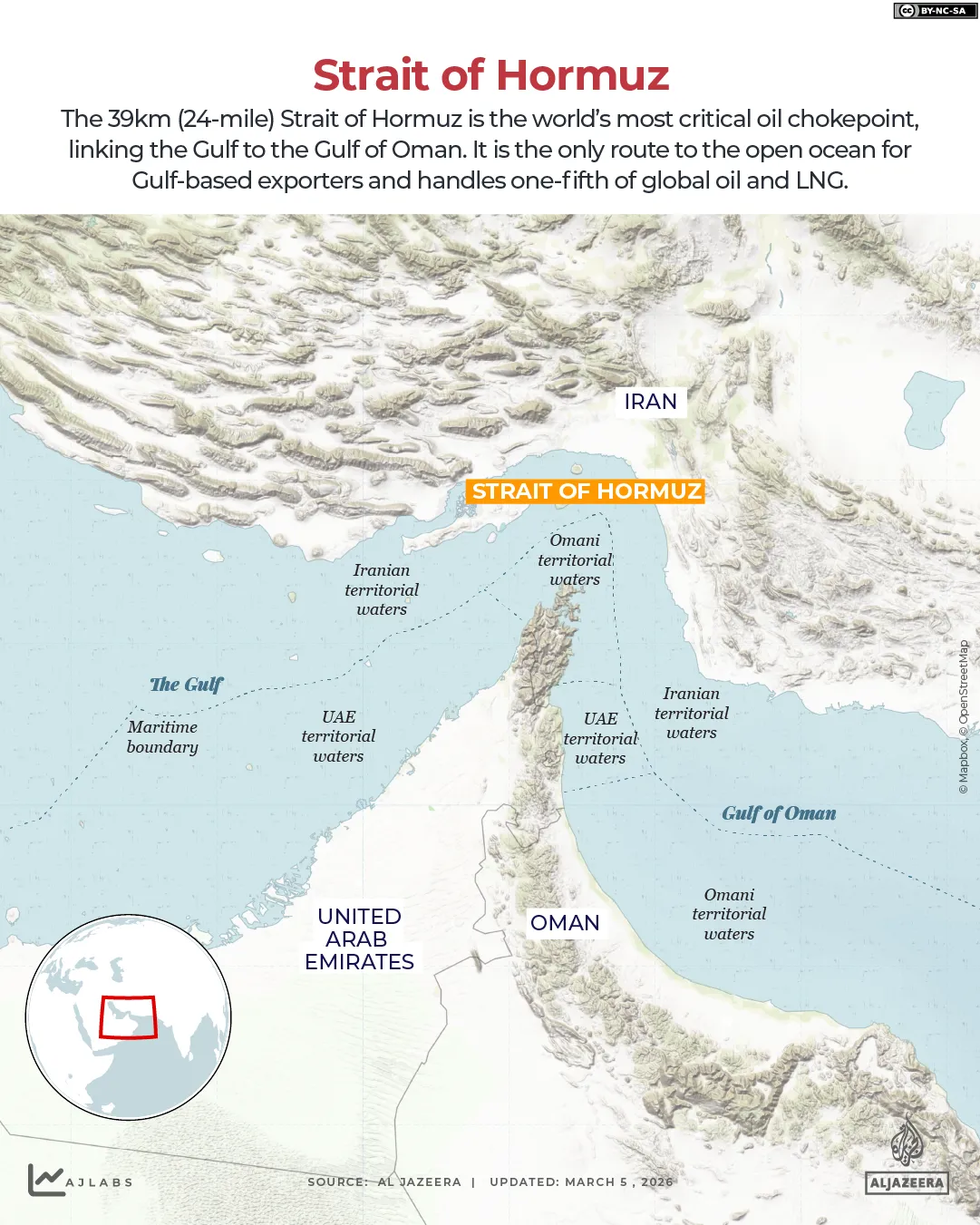
In peacetime, 20 percent of the world’s oil and gas is shipped from producers in the Gulf through the Strait of Hormuz – the only route to the open ocean – including 20 million barrels of oil per day.
To bridge the shortage its closure has caused, countries in the Middle East are exploring alternative routes to get energy exports out.
In this explainer, we look at three major pipelines in the Middle East that producers may be pinning their hopes on, and whether they can fill the gap.
What has happened in the Strait of Hormuz?
On March 2 – two days after the US and Israel began strikes on Iran – Ebrahim Jabari, a senior adviser to the commander-in-chief of Iran’s Islamic Revolutionary Guard Corps (IRGC), announced that the strait was “closed”. If any vessels tried to pass through, he said, the IRGC and the navy would “set those ships ablaze”. Since then, traffic through the strait has plunged by more than 95 percent.
Iranian officials have most recently stated that the strait is not completely closed – except to ships belonging to the US, Israel and those who collaborate with them – but have also laid down new ground rules. Any vessel must secure Tehran’s approval to transit through the narrow waterway.
As a result, over the past fortnight, countries have been scrambling to do deals with Iran to secure safe passage and a few, mostly Indian, Pakistani and Chinese-flagged tankers have been allowed to pass.
On Thursday, Malaysian Prime Minister Anwar Ibrahim thanked Tehran for granting Malaysian vessels “early clearance” through the strait.
Meanwhile, about 2,000 ships flying the flags of other nations are stuck on either side of the strait.
(Al Jazeera)
Which oil pipelines could serve as alternate routes?
The only alternative to shipping oil is piping it across land or under the sea. Three oil pipelines could work as ways around the Strait of Hormuz, including:
Saudi Arabia’s East-West Pipeline
The East-West pipeline is also known as the Petroline and is operated by Saudi oil giant Aramco. Aramco is one of the world’s largest companies, with a market capitalisation exceeding $1.7 trillion and annual revenues of $480bn. The oil giant controls 12 percent of global oil production, with a capacity of more than 12 million bpd.
It is a 1,200km (745-mile) pipeline which runs from the Abqaiq oil processing centre close to the Gulf in Saudi Arabia to the Yanbu port on the Red Sea, on the other side of the country.
However, the pipeline does not have the capacity to fully make up for the Hormuz closure.
In 2024, about 20 million barrels per day (bpd) passed through the Strait of Hormuz, according to data from the United Nations. Crude oil and condensate made up 14 million bpd of this, while petroleum was the remaining 6 million bpd.
The East-West pipeline has the capacity of transporting up to 7 million bpd. On March 10, Aramco said about 5 million bpd could be made available for exports, while the rest could supply local refineries.
Since the US-Israeli war on Iran began at the end of February, Saudi Arabia has ramped up its oil flow through this pipeline. In January and February, an average of 770,000 bpd flowed through the pipeline, according to data from Kpler, a data and analytics company. By Tuesday this week, this had increased to an average of 2.9 million bpd.
However, using the Saudi pipeline still carries a risk.
The Houthis, an Iran-backed Yemeni armed group whose attacks on ships in the Red Sea caused global shipping chaos during Israel’s genocidal war in Gaza from 2023 to 2025, could target the Bab al-Mandeb Strait, which connects the Red Sea to the Gulf of Aden, and the Indian Ocean beyond.
An unnamed Houthi leader told the Reuters news agency that the Houthis remain ready to attack the Red Sea again in solidarity with Tehran, the agency reported on Thursday.
“We stand fully militarily ready with all options. As for other details having to do with determining zero hour they are left to leadership and we are monitoring and following up with the developments and will know when is the suitable time to move,” the Houthi leader said.
The Bab al-Mandeb is the southern outlet of the Red Sea, situated between Yemen on the Arabian Peninsula and Djibouti and Eritrea on the African coast.
It is one of the world’s most important routes for global seaborne commodity shipments, particularly crude oil and fuel from the Gulf bound for the Mediterranean via the Suez Canal or the SUMED pipeline on Egypt’s Red Sea coast, as well as commodities bound for Asia, including Russian oil.
The Bab al-Mandeb is 29km (18 miles) wide at its narrowest point, limiting traffic to two channels for inbound and outbound shipments.
Iran could open a new front in the Bab al-Mandeb Strait if attacks are carried out on Iranian territory or its islands, Iran’s semiofficial Tasnim cited an unnamed Iranian military source as saying on Wednesday.
(Al Jazeera)
UAE’s Abu Dhabi Crude Oil Pipeline
The Abu Dhabi Crude Oil Pipeline is also called the ADCOP or the Habshan-Fujairah pipeline.
The 380km pipeline runs from Habshan, an oil and gasfield in the southwestern area of Abu Dhabi, United Arab Emirates, to the port of Fujairah on the Gulf of Oman.
The pipeline, which became operational in 2012, has a capacity of about 1.5 million barrels per day (bpd). It is unclear how much is now being transported through the pipeline.
However, oil exports from Fujairah do appear to have risen in the past month despite the closure of the strait, averaging 1.62 million bpd in March compared with 1.17 million bpd in February, according to Kpler analyst Johannes Rauball, who spoke to Reuters.
Iraq-Turkiye Crude Oil Pipeline
The Iraq-Turkiye Crude Oil Pipeline, also called the Kirkuk-Ceyhan Pipeline, links Iraq to the Mediterranean coast of Turkiye.
The pipeline, which has the capacity of 1.6 million bpd, currently carries about 200,000bpd.
Iraq is among the top five global producers of oil and is the second largest within the Organization of the Petroleum Exporting Countries (OPEC), exceeding 4 million bpd.
Can these pipelines replace the Strait of Hormuz?
No. While these pipelines can take on some of the capacity of Hormuz, their combined capacity is only about 9 million bpd, compared with about 20 million bpd for the strait.
Additionally, these pipelines are land-based and within the range of Iranian missiles and drones, which makes them just as vulnerable to attacks and damage in the ongoing conflict as ships travelling through the strait. Throughout the war, energy infrastructure all over the Gulf has suffered strikes.
Are there other options?
Theoretically, oil can be transported on trucks, but this is costly, slow and inefficient.
A standard truck can carry anywhere between 100 to 700 barrels per day, depending on the number of trips. Hundreds of thousands of barrels would be needed to meet needs, requiring thousands of trucks, which could also be targeted in strikes.
The meeting held in Washington, DC reviewed the ‘close strategic cooperation’ between Doha and Washington, Qatar’s foreign ministry said.
Published On 27 Mar 202627 Mar 2026
Qatar’s prime minister has held talks with senior US officials in Washington, DC, amid the ongoing US-Israeli war on Iran and fallout across the Gulf.
Sheikh Mohammed bin Abdulrahman bin Jassim Al Thani, who also serves as Qatar’s foreign minister, met US Vice President JD Vance and US Secretary Scott Bessent, Qatar’s Ministry of Foreign Affairs said on Friday.
Recommended Stories
list of 4 itemsend of list
They reviewed ways to strengthen the “close strategic cooperation” between Doha and Washington, “especially the defence partnership in light of the conditions the region is experiencing”, the ministry said.
Both sides stressed “ensuring the sustainability of energy supplies and maintaining the continued flow of liquefied natural gas from the State of Qatar to global markets”, in a way that “supports global energy security”, it added.
Vance hailed the “robust strategic partnership”, praising Qatar’s “active role in promoting regional stability and enhancing global energy security”.
The Gulf has been in a state of heightened tension since February 28, when the US-Israeli war on Iran began, which has killed more than 3,000 people across the region, a vast majority of them in Iran and Lebanon.
Tehran has since launched drone and missile attacks aimed at Israel, as well as Jordan, Iraq, and Gulf states. Iran insists it is targeting US assets in the Gulf, but the region’s leaders have urged Iran to cease attacks as they endanger civilians.
The war has created an unprecedented global energy crisis as Iran has effectively closed off the Strait of Hormuz, through which one-fifth of the world’s oil passes.
Meeting with Hegseth
On Thursday, Sheikh Mohammed also held a meeting in Washington with US Secretary of Defense Pete Hegseth, the Foreign Ministry said.
“The meeting took place in Washington on Thursday and focused on ways to support and develop defence and security collaboration amid regional challenges,” it added.
“Both sides stressed the importance of continued coordination and consultation on regional issues to promote security and stability locally and internationally.”
On Wednesday, the Qatari Cabinet renewed its condemnation of Iranian attacks on Qatar and its neighbours, calling for an immediate halt.
Austrian officials highlight addiction and ill-health while advocating for stricter age restrictions.
Published On 27 Mar 202627 Mar 2026
Austria plans to ban children under 14 from using social media, with an official saying certain online sites are addictive and making young people “sick”.
“Austria is introducing a compulsory minimum age of 14 for the use of social media platforms,” conservative junior minister for digitisation, Alexander Proll, told a joint news conference on Friday.
Recommended Stories
list of 3 itemsend of list
Proell added that draft legislation would be drawn up by June. Cabinet members from Austria’s two other governing parties were also in attendance.
“We will decisively protect children and young people in future from the negative effects of social media,” Vice Chancellor Andreas Babler of the Social Democrats said.
“We will no longer stand by and watch while these platforms make our children addicted and often also sick … The risks associated with this use were ignored for long enough, and now it is time to act,” he added.
Babler said the government would not list individual platforms the ban would apply to, but would decide based on how addictive their algorithms are and whether they include content such as “sexualised violence”.
The announcement comes days after a Los Angeles jury found Alphabet’s Google and Meta liable for $6m in damages in a landmark social media addiction lawsuit.
The case involved a 20-year-old woman who said she became addicted to the apps at a young age due to their platform design. Meta says it plans to appeal the decision.
Also on Friday, the United Kingdom advised parents of children under five to limit screen time to a maximum of one hour per day.
Similar to Austria, other nations in Europe and elsewhere have banned the use of social media for children.
In January, the French parliament voted in favour of banning children aged below 15 from social media, amid growing concerns about online bullying and mental health risks.
Countries including the UK, Denmark, Spain and Greece are also studying a ban.
The European Parliament has called for the European Union to set minimum ages for children to access social media, although it is up to member states to impose age limits.
Balendra Shah, 35, and his three-year-old Rastriya Swatantra Party won a landslide after Gen-Z protests toppled the former government.
Published On 27 Mar 202627 Mar 2026
Balendra Shah, Nepal’s youngest prime minister, has been sworn in after his party’s landslide election victory following protests led by young people that toppled the government in September.
A rapper-turned politician, Shah was appointed prime minister by President Ram Chandra Paudel on Friday, after his three-year-old Rastriya Swatantra Party (RSP) won 182 seats in the 275-member parliament in the March 5 vote, the first election since anticorruption Gen Z-led protests in which 76 people were killed.
Recommended Stories
list of 4 itemsend of list
The 35-year-old wore black trousers, a matching jacket, his signature black Nepali cloth cap and sunglasses as he was sworn in at the President House, in the presence of diplomats and senior government officials.
A day earlier, the new premier, better known as Balen, released his first public statement since the historic vote with a rap song shared on social media.
“Nepal is not scared this time, the heart is full of red blood … Laughter and happiness will reach every household this time,” Shah raps in the song titled Jay Mahakaali (Victory to Goddess Mahakali).
His music video, which features visuals of large crowds cheering him during his election campaign, has racked up nearly three million views.
“The strength of unity is my national power,” his lyrics continue.
Rastriya Swatantra Party (RSP) leader Balendra Shah (2R) takes oath as prime minister [AFP]
A former mayor of the capital, Kathmandu, Shah is Nepal’s first Madhesi premier – people of the southern plains bordering India – to lead the Himalayan nation.
China extended its congratulations to Nepal on the swearing-in of Shah, the Chinese Ministry of Foreign Affairs said on Friday, adding it will support its Himalayan neighbour in safeguarding its independence, sovereignty and territorial integrity.
Protests had raged over a lack of jobs and endemic corruption in the country of 30 million, where a fifth of the population lives in poverty and an estimated 1,500 people leave the country daily for work abroad.
Although he did not directly participate in the protests, Shah publicly expressed support for the largely Generation Z demonstrators who led the movement.
Political instability has been an uphill challenge for Nepal, with 32 governments taking office since 1990 and none of them completing a five-year term.
The Nepali Congress party, the country’s oldest party, became a distant second group in parliament with just 38 seats. The Communist Party of Nepal (Unified Marxist-Leninist) of KP Sharma Oli, who was forced to resign after the Gen Z unrest, controls 25 members.
Former Chief Justice Sushila Karki led the nation through the interim period up to the parliamentary election.
On Thursday, in a video message to the Joint Expeditionary Force, a security alliance which held a summit meeting in Helsinki, Zelensky said: “The key is not only producing new weapons – especially drones – not just technology, but also real experience in using it, and integrating it with radars, aviation, and other air defence systems. We have this experience,” he added.
Solidarity activists gathered outside the courthouse and demanded the release of Maduro and Flores. (Katrina Kozarek / Venezuelanalysis)
Caracas, March 26, 2026 (venezuelanalysis.com) – US Judge Alvin Hellerstein ruled out dismissing the case against Venezuelan President Nicolás Maduro and First Lady Cilia Flores in a hearing on Thursday in Brooklyn.
The defense team for Maduro and Flores—who face charges including drug trafficking conspiracy and weapons possession—requested that the case be thrown out after the US Treasury’s Office of Foreign Assets Control (OFAC) denied them authorization to use Venezuelan state funds to pay for legal counsel. OFAC had initially granted the license on February 9 but revoked it three hours later.
New York Southern District Judge Hellerstein declined to throw out the charges due to the blockaded funds, calling it “a serious step based on hypotheticals.” However, he did not formally rule and left the door open to revisit the decision in the future.
US Justice Department prosecutor Kyle Wirshba argued that allowing access to Venezuelan state funds would undermine existing sanctions policy, adding that if the defendants are unable to hire private attorneys, court-appointed counsel could be assigned. Maduro attorney Barry Pollack countered that such a measure would violate their Sixth Amendment right to choose their own legal representation.
During the hearing, Hellerstein challenged the prosecutors’ arguments, adding that OFAC’s personal sanctions against Maduro and Flores would also block them from using personal funds. The judge likewise disagreed with the prosecution’s claims that the blocking of funding for the defense was a matter of national security, stating that Maduro and Flores “no longer represent a threat.”
He further remarked that “things have changed” and that the United States is already “doing business” with Venezuela.
According to observers in the courthouse, Maduro and Flores, both in beige prison uniforms and handcuffed, appeared calm throughout the hearing, using headphones for simultaneous translation. Neither spoke. Observers noted that Maduro appeared thinner. Flores’ attorney, Mark Donnelly, made an urgent request for a medical evaluation, specifically an electrocardiogram, citing a pre-existing condition. The judge approved the request.
Hellerstein will set a new court date in the coming days. Maduro and Flores have not requested bail and were returned to the Metropolitan Detention Center in Brooklyn after the hearing.
Maduro and Flores, who is also a lawmaker, were kidnapped by US special forces during a military attack against Caracas on January 3. They pleaded not guilty at their arraignment two days later. Despite recurring “narcoterrorism” accusations over the years, US officials have not presented evidence tying high-ranking Venezuelan leaders to narcotics activities. Specialized agencies have consistently found Venezuela to play a marginal role in global drug trafficking.
Trump calls for additional ‘charges’
Prior to the hearing, US President Donald Trump argued before reporters that additional charges should be brought against the Venezuelan president.
“He emptied his prisons into our country, and I expect that at some point he will be charged for that,” he said. Trump has repeatedly raised unfounded claims that the Venezuelan government “emptied” prisons and mental institutions into US territory.
Outside the courthouse, a heavy police presence separated Venezuelan opposition supporters from solidarity activists demanding the release of Maduro and Flores and an end to US attacks against the Caribbean nation.
In Caracas, social movements gathered at Plaza Bolívar to express support for the president and first lady. The demonstration followed another mobilization earlier in the week demanding the lifting of US economic sanctions against Venezuela.
Speaking at the rally, lawmaker Nicolás Maduro Guerra—the president’s son and also facing US Justice Department charges—described his father as “a worker” who identifies “as a son of God above any political office.” Days earlier, in a social media post, Maduro Guerra had said his father would appear “in high spirits” and “in good shape” due to regular exercise.
He was joined by Caracas Mayor Carmen Meléndez, while the ruling United Socialist Party of Venezuela (PSUV) also called for Maduro’s release in a public statement.
For her part, Acting President Delcy Rodríguez has yet to comment on Thursday’s hearing. Venezuelan authorities have also not publicly addressed US efforts to block the funding of Maduro and Flores’ legal expenses.
Since January 3, the Rodríguez administration has led a diplomatic rapprochement with Washington, with several White House officials visiting Venezuela in recent weeks. A Venezuelan government delegation arrived in the US capital on Thursday, led by Vice Minister Oliver Blanco, who reported meetings with State Department officials to boost “mutually beneficial” relations.
“A bit” is what United States President Donald Trump thinks about the scale of Russia’s military aid to Iran.
Moscow “might be helping them a bit”, he told Fox News on March 13.
A day later, Iran’s Foreign Minister Abbas Araghchi stated laconically that Moscow’s military cooperation with Tehran was “good”.
His words seemed to confirm earlier media reports that Russia is providing Iran with satellite and intelligence data on the locations of US warships and aircraft.
It may not sound like much, given the superiority of Western military satellites and Russia’s battlefield losses and communication problems after Elon Musk’s SpaceX company switched off smuggled Starlink satellite Internet terminals.
But data on US military assets Iran is receiving most likely comes from Liana, Moscow’s only fully functional system of spy satellites, according to an expert on Russia’s space programme and military.
“The [Liana] system has been created to spy on US carrier strike groups and other navy forces and for identifying them as targets,” Pavel Luzin, a senior fellow at the Jamestown Foundation, a US think tank, told Al Jazeera.
Eyes in the sky
Russia also played a key role in the development of Iran’s space programme and its key satellite, the Khayyam.
Launched in 2022 from Russia’s Baikonur cosmodrome, the 650kg (1,430 pound) satellite orbits the Earth at 500 kilometres (310 miles) and has a resolution of one metre (3.3 feet).
Moscow “can, in theory, receive and process data from Iran’s optical imaging satellite and share data from its own several satellites”, Luzin said.
On Wednesday, Tehran claimed to have struck the Abraham Lincoln carrier with multiple cruise and ballistic missiles, but the Pentagon called the claim “pure fiction”.
On Sunday, Iranian media claimed that a “massive blaze” was caused by a strike on a US destroyer refuelling in the Indian Ocean.
Washington did not comment on that strike.
Russia has, for decades, supplied weaponry to Iran, including advanced air defence systems, trainer and fighter jets, helicopters, armoured vehicles and sniper rifles, worth billions of dollars.
Since Washington and Tel Aviv began their strikes on February 28, Russia has continued aiding Iran with “intelligence, data, experts and components” for weaponry, Lieutenant General Ihor Romanenko, former deputy chief of Ukraine’s general staff of armed forces, told Al Jazeera.
While Moscow and Tehran loudly proclaim their strategic partnership, they do not have a mutual defence clause, and Moscow has not intervened in the conflict directly.
But the arms supplies have been mutual. Since Russia’s 2022 invasion of Ukraine, Tehran has provided Moscow with ammunition and artillery shells, firearms and short-range ballistic missiles, helmets and flak jackets.
Flashes appear in the sky over RAF Akrotiri, as seen from Pissouri, Limassol District, Cyprus, in this screengrab taken from a handout video obtained on March 2, 2026 [KitasWeather/Handout via Reuters]
Drones with ‘comets’
And then there are the Shahed kamikaze drones – slow, noisy, yet cheap to manufacture – which have been launched on Ukrainian cities in swarms of dozens and then hundreds. Ukraine became so adept at bringing these down – now mass-producing cheap interceptor systems specifically to target Shaheds – that it is now providing its own know-how to Gulf states where US military assets have come under fire from Iran in recent weeks.
In the course of its war with Ukraine, Moscow has manufactured and modernised Shaheds, making them faster and deadlier, and equipping them with cameras, navigators and, occasionally, artificial intelligence modules.
And now, some of the upgrades have made their way back to Iran.
A Shahed drone with a pivotal Russian component launched by Iran-backed Hezbollah from southern Lebanon was able to hit a British airbase on Cyprus on March 1, the UK’s Times newspaper reported on March 7.
It reportedly contained Kometa-B (Comet B), a Russian-made satellite navigation module that also acts as an anti-jamming shield, making drones more resistant to interference.
Russia has also perfected the tactic of sending waves of real and decoy drones to exhaust and overwhelm Western-supplied air defence systems in Ukraine.
These days, the scheme helps Iran hit targets in the Gulf, Western officials say.
“I think no one will be surprised to believe that Putin’s hidden hand is behind some of the Iranian tactics and potentially some of their capabilities as well,” British Defence Secretary John Healey said on March 12 after Iranian drones struck a base used by Western forces in Erbil, northern Iraq.
However, if Iran is suffering a shortage of drones – as some analysts believe it is – that would render the use of Russian tactics, as well as Russia-supplied satellite data useless, experts say.
“Russia does supply data, it’s obvious, the data helps Iran, but not much,” Nikita Smagin, a Russian expert who has written extensively on ties between Moscow and Tehran, told Al Jazeera.
After four days of intensive strikes using up to 250 drones a day in early March, Iran has been launching only up to 50 drones a day, according to Nikolay Mitrokhin, a researcher with Germany’s Bremen University.
“Iran ran out of steam really fast,” he told Al Jazeera.
[Al Jazeera]
‘A goodwill gesture’
Moreover, Moscow is not necessarily particularly interested in an Iranian military victory, as the war is benefitting Russian President Vladimir Putin’s own conflict in Ukraine.
Skyrocketing oil prices make “Putin financially capable of further hostilities,” Lieutenant General Romanenko said.
As Iran strangles shipping through the Strait of Hormuz, the price of Brent crude – the international benchmark – has soared past $100 a barrel in the past three weeks. US President Donald Trump was forced to temporarily suspend sanctions on shipped Russian oil to ease the economic backlash. The result has been tankers laden with Russian oil bound for China making U-turns in the open ocean to divert to India, as countries scramble to grab Russian oil cargoes out at sea. The price of Urals crude has bounced.
Putin “hasn’t achieved his goals in Ukraine and will therefore use anything, including the war [in Iran] and lies to achieve his vision, press with his ultimatums,” Romanenko said.
The Kremlin “doesn’t pursue a breakthrough in this war, doesn’t help Iran break the United States and Israel,” Ruslan Suleymanov, an associate fellow at the New Eurasian Strategies Center, a US-British think tank, told Al Jazeera.
The current intelligence and military aid is “more of a goodwill gesture, an attempt to create an illusion of help, to show Tehran that despite the lack of formal commitments, Russia doesn’t leave its friend in need”, he said.
And Tehran fully understands how insufficient Moscow’s aid is – and therefore relies on its own stratagem of expanding hostilities to the entire region through strikes on neighbouring states and of crippling the global economy with soaring oil prices.
“Iranians understand that the forces are not equal and it’s impossible to defeat the United States and Israel on the battlefield, and no Russian aid is going to help,” he said.
It seems that Trump’s assessment that Moscow “might be helping them a bit” may not be too far wide of the mark.
Weekly insights and analysis on the latest developments in military technology, strategy, and foreign policy.
Operation Epic Fury will hit a month old by the weekend. It and the massive military build-up to it were made possible by a global logistics chain that only the Pentagon can supply. At the heart of it is the aerial refueling fleet. These aircraft have flown thousands of sorties to get materiel where it needs to be and fast. These have included stuffing the fuel tanks of C-17s with cargo holds full of Patriot missiles to dragging stealth fighters across the globe. Epic Fury has been one of many operations to heavily tax the tanker fleet in recent years. To get a much better insight into the tanker portion of the war and its impacts, we talked to one man with an extreme level of experience behind the controls of USAF tankers.
For more than 20 years, Troy Pananon, a retired Air Force colonel, served in the aerial refueling community. He flew KC-10 Extender and KC-135 Stratotanker refueling jets and served as deputy commander of the 6th Air Mobility Wing at MacDill Air Force Base in Tampa, Florida (now 6th Air Refueling Wing), and later as commander of the 100th Air Refueling Wing at RAF Mildenhall in England. Both of these installations and their KC-135s are instrumental in the ongoing war in Iran.
In a two-hour, wide-ranging exclusive interview, Pananon offered insights into the strain of the war on the jets and personnel and the challenges of keeping the aging KC-135s flying as they perform hundreds of sorties gassing up fighters, airlifters and other aircraft. One of those missions resulted in the deaths of six airmen after a suspected midair collision over Iraq. Pananon also addressed a whole host of other issues, including how Epic Fury is affecting readiness for a fight against China, the scourge of drone incursions and much more, which will be addressed in future installments.
Pananon, who began his career as an enlisted Marine, retired from the Air Force in 2023 and is now a 737 first officer with United Airlines. The first installment of our conversation focuses on Epic Fury and the toll on the tankers, crews and maintainers. Some of the questions and answers have been lightly edited for clarity.
U.S. Air Force Col. Troy Pananon, 100th Air Refueling Wing commander, poses for a photo at RAF Mildenhall, England, July 9, 2019. Pananon served five years as an enlisted Marine prior to receiving his commission from Embry-Riddle Aeronautical University, Daytona Beach, Fla., in 1996. He was initially assigned as a maintenance officer at Hurlburt Field, Fla., and then attended Undergraduate Pilot Training at Columbus Air Force Base, Miss. (U.S. Air Force photo by Senior Airman Benjamin Cooper) Tech. Sgt. Benjamin Cooper
A: I would categorically say that there’s a huge strain on the entire ecosystem. The KC-135s were rolling off the assembly line in the 50s and 60s. Some of the technology, and we called it technology back then, was graduated from the Wright brothers technology. Parts on that aircraft are still reminiscent of some of the things that were invented by the Wright brothers. So it’s amazing to me that the KC-135 is able to operate, and it’s due in large part to the maintainers and the relentless effort that they follow through to keep those aircraft air worthy.
If you think about the [airmen], how they’re operating in places you mentioned all over the world, they’re there. We’ve broken their normal routine. They’re away from home, away from their family and friends. So that’s a mental and physical stressor, because they’re in environments that they’re not accustomed to.
We don’t know how long this conflict could last. We’re approaching a high heat of summer in that region, and so depending on where some of these personnel are based or stationed, they’re certainly out of their normal circadian rhythm, their normal environmental routines. It is a huge strain on those maintainers and the airframes that we’re placing in different parts of the world, exposed to different elements than they may have been exposed to at their normal pace. Maintaining these aging aircraft is a strain on the entire ecosystem, and we are operating them at a high operations tempo, and surely that puts a lot of a significant strain on the KC-135.
We do have the KC-46 that is helping to fill some of that void, but we just retired the KC-10, which was a tremendous workhorse. And so I would say that there’s a significant strain on the ecosystem.
U.S. Air Force 100th Maintenance Squadron, aircraft maintainers conduct maintenance on the KC-135 Stratotanker at RAF Mildenhall, England, Dec. 10, 2025. (U.S. Air Force photo by Airman 1st Class Iris Carpenter) Airman 1st Class Iris Carpenter
Q: What are the biggest challenges in keeping these Cold War-era jets like the KC-135 flying? How difficult is it to find parts, and what do you do when you can’t?
A: That’s 100% accurate. There have been some breakthroughs in technology. I know that they’ve used 3D printing to help source some parts. They’ve even gone back to the boneyard and pulled parts off of older KC-135s. So resources will always be a great puzzle for our entire team to source.
There’s no new assembly line. They shut that assembly line down back in the ’50s and ’60s. Some of the parts for those aircraft in general were from the ’60s, ’70s and ’80s. And then, you have to take those back and refurbish those certain parts. There’s not a lot of new technology that’s going on to these core platforms. The avionics, for sure, is newer. But everything that you add to this aircraft, I call it the Frankenstein effort – taking bolt-on technology to try and help modernize the fleet. And by modernizing that means that you’re also helping with the parts availability. But going back to the age of these aircraft, some of these parts were developed back in the ’40s and machined back in the ’50s and ’60s. Our teams have to get creative with the acquisition. And that’s a huge, huge challenge. But they currently have done a great job of putting new engines on the aircraft. And so that means that the parts availability is better in some cases, but it’s not a solution.
Davis Monthan AMARG Boneyard tour with KC-135s and Boeing 707s
Q: What are some of the old parts you’re talking about that go back to the ’40s, or to the Wright brothers era?
A: Just think about the flight controls. If you, for whatever reason, need to replace certain pulleys or elements within the flight control system, those parts were thought-up and developed way back in the ’40s. Machined maybe back in the ’50s and ’60s. It’s still not a fly-by-wire aircraft like some of the modern aircraft that we have nowadays. And so you have to go back and machine some of these parts if they get wear and tear.
Two guardsmen from the 171st Maintenance Group, 171st Air Refueling Wing, Pennsylvania Air National Guard, work on top of a KC-135 Stratotanker aircraft while it undergoes an isochronal inspection, Aug. 17, 2021, in Pittsburgh, Pennsylvania. (U.S. Air National Guard photo by Staff Sgt. Zoe M. Wockenfuss) Tech. Sgt. Zoe Wockenfuss
Q: What are the complexities of supporting such a high tempo operation like the war against Iran with aerial refueling? We’ve heard that the airspace over Iraq is chaotic and that the lack of onboard situational awareness is a major issue with tanker crews and receivers. What have you heard about this?
A: Obviously I haven’t operated over there in a number of years, but I do go back to the times when I was operating aircraft in that theater. That puts me back into the Enduring Freedom, Iraqi Freedom timeframe. We have deconfliction procedures. We have airspace procedures that we study and that we follow. We have aircraft in there that help us deconflict the airspace and ensure that we have safe separation. And it goes to training, it goes to situational awareness.
Back then, we didn’t have some of the avionics and software suites that we have available to us today, so our situational awareness wasn’t as high, but yet we had good, solid procedures and processes that ensured clear deconfliction and separation in the airspace that they’re operating in. Now, I would assume that it’s congested and it’s contested, and so having the ability to have higher situational awareness with onboard avionics suites that are connected is probably more and more essential as we go forward.
A view from inside the cockpit of a Block 45 KC-135R during a land approach. The wide-area digital multi-function display in the center of the cockpit is another key feature of the upgrade package. (USAF)
Q: But have you heard anything about the chaotic nature of the current airspace and lack of onboard situational awareness? Is it a major issue right now with the tanker crews and receivers?
A: I really can’t comment on it, because I don’t have firsthand knowledge. What I can say is that it’s in a contested environment, and our crews are definitely trained to operate in these kinds of environments. And you know, it’s just like anything there. There are elements that we have little control over, and I call it the fog and friction of warfare. But I have 100% absolute trust in the personnel. They’ve been trained. They are equipped. Could they be equipped better? Could they be resourced better? Sure. But again, it still goes back to the fact that even if we resource them with the newest technology, they then have to go back and be trained to understand how to integrate it and how to use it effectively.
There is still an opportunity here. You can’t solve it overnight, but it does need to happen so it would help. I’m certain that if we ever get into conflict with a near peer, it’s going to be even more challenging.
A U.S. Navy F/A-18F Super Hornet aircraft refuels from a U.S. Air Force KC-135 Stratotanker aircraft during a mission in support of Operation Epic Fury over the U.S. Central Command area of responsibility, March 8, 2026. (U.S. Air Force photo) U.S. Central Command Public Affa
Q: When was the last time tanker crews flew in contested airspace against adversaries with more robust air defenses than we have seen in past conflicts?
A: I would like to say that any time that you’re operating within a conflict zone, that’s considered contested airspace, right? The tankers are considered a high-value, low-density. We don’t have an infinite number of tankers, so they’re going to tend to operate outside the reach of the adversary’s missiles, or fighter aircraft that would try to reach and take down one of these tankers. So they’re really going to try and operate within a safe, safe zone. I would frankly say that in a conflict, tankers operate in contested airspace all the time, and it’s really contingent on the ability of our joint force to clear that airspace and to allow our tankers to move closer to the tip of the spear, but generally speaking, it is really sacrosanct to keep tankers an arm’s reach away from an adversary’s ability to take them down.
U.S. Air Force airmen prepare for aerial refueling on a KC-135 Stratotanker aircraft during Operation Epic Fury over the U.S. Central Command area of responsibility, March 20, 2026. (U.S. Air Force photo) U.S. Central Command Public Affa
Q: Do you have any sense of what happened in the fatal March 12 KC-135 crash in Iraq that led to the deaths of Maj. John “Alex” Klinner, 33, of Auburn, Alabama; Capt. Ariana G. Savino, 31, of Covington, Washington; Tech. Sgt. Ashley B. Pruitt, 34, of Bardstown, Kentucky; Capt. Seth R. Koval, 38, of Mooresville, Indiana; Capt. Curtis J. Angst, 30, of Wilmington, Ohio; and Tech. Sgt. Tyler H. Simmons, 28, of Columbus, Ohio?
A: There’s an investigation taking place and it’d be wrong of me to comment on what I think took place. These crews are highly trained. They have a process. They have procedures. I don’t know what was taking place on the flight decks of both of those aircraft. There was probably some confusion as to who and where each aircraft was supposed to be, but I don’t know what led to that. There’s a lot of speculation out there. It’d be hard for me to really say what I think actually did happen.
A: Well, I have a deep background in the KC-10, and that also gives gas and takes gas. So I’ve been within 10 feet of another aircraft, operating at close to 350 miles an hour. It’s an inherently dangerous occupation when you’re trying to receive fuel from another aircraft. I don’t think that was the case in this particular incident over Iraq. But at all times, everything we do is inherently dangerous because we operate within safe operating margins, but they’re tight. So, a simple split-second decision or maybe error puts you in a precarious position. But we have procedures that, if we make a mistake and we come close to another aircraft – there is a term that we use, which is ‘breakaway.’ And that tells both aircraft, ‘hey, we’re in a situation where we need to create some space between our aircraft,’ and we follow our procedures. It’s a safe maneuver, but probably makes the hair on the back of your neck stand up a little bit. I’ve been in this, I’ve been in situations where I’ve had to rapidly escape from another aircraft.
But again, we get trained for this. We are highly trained. And I think because of the training, when a situation like that occurs, your instinct kicks in and you know what to do. And so, I don’t recall instances where two KC-135s had a midair collision, but certainly, we have had air-to-air collisions, just none in my recent memory.
Aerial refueling missions, which require close contact between aircraft traveling at high speeds, are inherently dangerous. (USAF) (USAF)
Q: The air refueling tanker community is tight. You served at MacDill Air Force Base in Tampa, Florida, with Tech. Sgt. Pruitt, one of the airmen who was killed in the crash. Tell me about how the crash affected the community. Tell me a little bit about Pruitt.
A: From my time at MacDill, I do remember her family. In general, losing anyone is just a shock to the system. And especially somebody that you may have worked with in the past, and you know. I just feel for their families. And we have a community. The tanker community – it’s just a system, a brotherhood and sisterhood. We are just one big family. Anytime we have a tragedy that strikes our community, especially like this, it’s tough.
I know that there are teams of people out there that are remorseful for the loss and that are doing anything in their power to support the families of these airmen. And I know there’s a lot of effort right now within our tanker community and outside of our tanker community with Go-Fund-Me pages. This is critical, because the families that have been affected by this lost a parent, right? A brother or sister or a spouse. I really do feel for these families, and I applaud the efforts of the supporters out there that are contributing to help with some of the things that are going to end up financially costing these families; but emotionally, you know that they will need support, probably for the rest of their lives. And so it’s a huge, huge loss.
U.S. Air Force airmen attend a vigil held by the 909th Air Refueling Squadron at Kadena Air Base, Japan, March 20, 2026. The vigil brought airmen together in remembrance of six airmen who died in a KC-135 Stratotanker crash while supporting Operation Epic Fury. (U.S. Air Force photo by Senior Airman James Johnson) Senior Airman James Johnson
Q: What can you tell me about Tech. Sgt. Pruitt?
A: Ashley was full of energy and was extremely bright, tenacious, and had an unmatched work ethic. She was a real, genuine people person. When you walked into a room, you knew she was there. But she was incredibly talented and someone that you could rely upon to help others, and she was absolutely an incredible boom operator and highly skilled and her death is this huge, huge loss. For her legacy, she impacted so many people and so many of these airmen and their families were certainly enriched by her being in their lives. At the time, I was the vice commander of the [then-6th Air Mobility Wing] at MacDill. And on occasion, I would go out and go fly with the KC-135 crews. I didn’t have a daily interaction with her, but everybody knew her, and everybody knew of her. And that’s the important part. There are many other airmen that are in our ranks right now that have benefited from being introduced to her and being taught by her and being mentored by her. So she’s surely missed.
An undated photo of Tech. Sgt. Ashley B. Pruitt, 34, of Bardstown, Ky., assigned to the 6th Air Refueling Wing at MacDill Air Force Base, Fla. Pruitt was one of six airmen who died March 12, 2026, when a KC-135 aircraft crashed in western Iraq while supporting Operation Epic Fury. (Courtesy photo)
Q: Give me a sense of how RAF Mildenhall and other bases in Europe and elsewhere keep these aircraft flying to generate sorties and deploy to combat zones like the Middle East.
A: The best part about having a forward operating base like Mildenhall is that you have all the resources in place, and in this particular case, they’re closer to where the conflict is. You don’t have as much of a long logistical chain, but you still have a logistics chain that you have to support. And so operating at a place like Mildenhall, a round the clock operation every day of the year, you do have weather to contend with on occasion, and you do have airspace constraints that you do have to contend with. But again, all of these crews are highly trained and so I would say that the operations tempo at a place like Mildenhall is extremely high.
Just being able to have the support of the government there and the host nation that there is, and the local community is a big deal. I enjoyed my time there. Of course, we were there during COVID, during the global pandemic, and the lengths and support that we received from the host nation to ensure the safety of our community and our airmen was incredible.
Seven U.S. Air Force KC-135 Stratotanker aircraft line up on the flight line at Royal Air Force Station Mildenhall, United Kingdom, on March 13, 2006. (DoD photo by Staff Sgt. Jeanette Copeland, U.S. Air Force. (Released)) Staff Sgt. Jeanette Copeland
Q: The 100th Air Refueling Wing has 15 tankers and more transit through. What are the concerns and checklists of objectives for a Mildenhall commander during a major contingency operation like Epic Fury?
A: It’s just our ability to support, right? You mentioned there are 15 tankers, but the airfield itself was able to surge to support twice as many. I currently don’t know how many aircraft that we’re currently supporting out of Mildenhall, but the ability to support that means that you have to be able to flex to the surge of the operation that you’re encountering. You have personnel that are helping to fuel the aircraft. You need personnel to maintain and sustain the aircraft. And so I would assume that we are getting support from bases in the United States. And they’re deployed there from all parts of our country and major units. The tanker fleet is a total force effort. Nearly half of the force resides in the [Air Reserve Component] ARC, and so personnel from Reserve, Guard, active duty, I’m sure, have been sent to help support operations like that.
In our next installment, Pananon talks about the KC-46’s lack of a boom pod, how Epic Fury is affecting the ability to potentially fight China and the dangers of flying long distances over the Pacific against an adversary with robust and plentiful modern air defenses.
Weekly insights and analysis on the latest developments in military technology, strategy, and foreign policy.
Videos have emerged showing an apparent very close call for a U.S. Navy F/A-18E/F Super Hornet after it was targeted by an Iranian man-portable air defense system (MANPADS) while conducting a low-level strafing run during an Operation Epic Fury mission. The persistent threat posed by Iranian air defenses, whatever is left of them, is something that we have repeatedly drawn attention to.
The videos have been geolocated to the port of Chabahar in Iran’s Sistan and Baluchestan province, which is located along the country’s eastern shore, near the Pakistan border. This would explain, at least to a degree, why the Super Hornet is operating so low over hostile territory. This coastal area was hit hard by strikes from the start of the war, and the near proximity to the ocean means combat search and rescue would be easier to execute in a pinch. There is also a better understanding of what air defense threats remain than, say, in the eastern part of the country.
GeoConfirmed Iran.
A U.S. Navy F/A-18 was hit near the Iranian city of Chabahar after being targeted with what appears to be a MANPADS system. He was flying near or above the Imam Ali Independent IRGC Naval Base.
The date of the incident is unconfirmed, but it is reported to have occurred yesterday.
Better video of a U.S. Navy F/A-18 Super Hornet fighter jet being targeted by the Iranians with a surface-to-air missile, perhaps fired from MANPADS, over the city of Chabahar in southern Iran on Wednesday.
— Status-6 (War & Military News) (@Archer83Able) March 25, 2026
Previously, we have seen plenty of evidence of Super Hornets conducting strafing runs with their M61A1 Vulcan rotary cannons in coastal areas of Iran. Some of these are seen in the videos posted directly below.
Strafing run happened last week, but Navy Super Hornets have continued to operate at low level over Chabahar since. https://t.co/J5JT3FaywK
In the sequence, the distinctive zipping sound of the cannon can be heard, as well as a puff of smoke as the rounds are unleashed.
The F/A-18 makes a left-hand turn before the missile comes into view. It is unclear if the pilot was aware of the threat and maneuvered to avoid it or was unaware of the missile. There is no obvious sign of infrared countermeasures being deployed, although BOL IR-type countermeasures can be harder to see in daylight.
The missile is then seen exploding behind the aircraft, leaving shrapnel in its wake.
While it is not immediately obvious whether or not the F/A-18 was struck, it appears to have escaped relatively unscathed, suggesting this may have been a very lucky near-miss for the crew of the jet.
The Islamic Revolutionary Guard Corps (IRGC) claimed that the Super Hornet crashed in the Indian Ocean. Iran’s Fars News Agency published the statement from the IRGC:
“The enemy F-18 fighter jet was accurately hit in the sky of Chabahar by missiles from the IRGC Navy’s advanced modern air defense system, under the command of the country’s integrated air defense network, and crashed in the Indian Ocean.”
U.S. Central Command responded by denying that any U.S. fighter aircraft had been shot down by Iran, but its statement on X did not immediately rule out a near-miss or damage to the aircraft.
🚫FALSE: The Islamic Revolutionary Guard Corps announced a U.S. F/A-18 fighter was struck over Chabahar using new advanced air defense systems.
There have been multiple Iranian claims of U.S. aircraft being hit by air defenses. So far, however, there is credible evidence for only one previous such incident.
This was the U.S. Air Force F-35A that the IRGC claimed was hit over Iran, and which U.S. officials confirmed made an emergency landing, with the pilot having sustained shrapnel injuries. The IRGC released a video that they claimed shows the F-35 being hit by a missile, as seen through a forward-looking infrared (FLIR) system.
Iran’s IRGC released a footage reportedly showing U.S. F-35 jet being hit over Iran.
As we have explained in the past, while the U.S. has claimed air supremacy over Iran, it certainly does not yet possess it across the entire country. There remain very real risks, especially as the air campaign moves more toward increasing direct attacks farther east in the country, bringing aircraft closer to potential lingering threats.
U.S. forces continue to eliminate threats presented by the Iranian regime, striking over 10,000 targets since the start of Operation Epic Fury. pic.twitter.com/6rTIWG9NBC
For all the defense-suppression missions that have been flown, Iran still possesses road-mobile air defenses as well as more exotic types that can pop up virtually anywhere and give aircrews very little time to react. These systems can be easily hidden and will remain a threat on the battlefield long after static air defenses are destroyed. Beyond that, there are MANPADS, which, while less of a menace in terms of outright performance and engagement envelopes, are impossible to entirely remove from the battlespace.
UPDATES:
We have ended our rolling coverage on Epic Fury for the day.
UPDATE: 4:30 PM EST –
The open-source researchers at the Bellingcat organization say they have identified the mines found overnight in Kafari, Iran, as U.S.-made BLU-91/B anti-tank mines, usually associated with the Gator Scatterable Mine System.
Bellingcat identified the mines found overnight in Kafari, Iran as US BLU-91/B anti-tank mines from the Gator Scatterable Mine System. At least two people were reportedly killed.
There have been suggestions that the mines may have been dropped along roads to try to prevent Iranian mobile missile launchers from deploying out of their mountain bases and heading to launch sites.
It looks as if President Trump has suspended his ultimatum on the Strait of Hormuz for another 10 days. Trump, under increasing domestic pressure as oil prices soar, had last week warned that the U.S. military would “obliterate” Iranian power plants if the strait is not open before a 48-hour deadline.
UPDATE: 4:00 PM EST –
U.S. Secretary of State Marco Rubio stated today that a “growing amount of energy” is flowing through the Strait of Hormuz as indirect contacts between the United States and Iran show progress.
“There’s a growing amount of energy that’s been flowing through the strait, not as much as should be flowing, but some of it has picked up. There’s been some progress in regards to the exchange of messages, but that’s an ongoing and fluid process, and not one we’re going to negotiate or talk about in the media,” Rubio explained to reporters.
Marco Rubio on Iran:
Some concrete progress has been made, as you’ve seen and as has been documented already.
There’s a growing amount of energy that’s been flowing through the Strait — not as much as should be flowing, but some of it has picked up. pic.twitter.com/du9zZ5AEgt
President Donald Trump today reiterated his estimated timeline for ending the war with Iran, saying that he still plans for it to last just four to six weeks.
Trump made the statement during a Cabinet meeting at the White House, telling reporters that the U.S. is already “way ahead of schedule” on the conflict.
“We estimated it would take approximately 4 to 6 weeks to achieve our mission, and we’re way ahead of schedule. If you look at what we’ve done in terms of the destruction of that country, I mean, we’re way ahead,” Trump said.
UPDATE: 3:50 PM EST –
President Trump has slated the U.K. Royal Navy’s Queen Elizabeth class aircraft carriers as “toys” compared to the flattops of the U.S. Navy.
In his latest spat with the United Kingdom, Trump said America “doesn’t need” British help in the conflict, despite repeatedly criticizing its reluctance to get involved.
Relations between Trump and U.K. Prime Minister Keir Starmer have been tense ever since Starmer refused America permission to launch its initial strikes on Iran from RAF bases.
UPDATE: 3:40 PM EST –
Trump has revealed the nature of the “present” from Iranian officials, which he alluded to earlier this week.
Trump said that Iran has allowed 10 oil tankers through the Strait of Hormuz as a sign of good faith for talks to end the war. Trump told reporters: “[Iran said] we’re going to let you have eight boats of oil, eight boats, eight big boats of oil. This was two days ago. And they’ll sail up tomorrow. That was three days ago. And I didn’t think much about it. And then I watched the news, and they said, a very good anchor actually happened to be Fox. But I watched it, and they said something unusual is happening. There are eight boats that are going right up the middle of the strait. Eight big tankers are going loaded up with oil right through. And I said, well, I guess, I guess they were right. And they were they were real. And I think they were Pakistani-flagged. And, I said, well, I guess we’re dealing with the right people. And, actually, they then apologized for something they said, and they said, we’re going to send two more boats. And we ended up being 10 boats.”
Today, however, publicly available ship-tracking data revealed only two Iran-linked LPG carriers were seen leaving the Persian Gulf, possibly the “extra two” vessels Trump referred to.
Bloomberg tanker data shows no sign of the eight oil ships Trump mentioned in the Hormuz Strait.
Only two Iran-linked LPG carriers were seen leaving the Persian Gulf Thursday, possibly the “extra two” he referred to.
In its latest update on the situation in the Middle East, the U.K. Ministry of Defense claims that Russia was likely providing intelligence and training to the Iranian military ahead of the United States and Israel launching their operations. Russian expertise for Iran likely encompassed drone technology and electronic warfare, drawing from their own experience in Ukraine.
The commander of U.S. Central Command (CENTCOM), Adm. Brad Cooper, has provided his view on the death of Iran’s Islamic Revolutionary Guard Corps (IRGC) Navy commander in an Israeli airstrike.
According to Cooper, under Adm. Alireza Tangsiri’s command for eight years, the IRGC Navy “harassed thousands of innocent merchant mariners, attacked hundreds of vessels with one-way attack drones and missiles, and killed countless innocent civilians.”
We are seeing a major airlift operation underway at the remote American outpost in the Indian Ocean, Diego Garcia. Five C-17s and a C-5 were visible on the main ramp at the airfield today. This is a sudden uptick in aerial logistics on the island.
There has been a contingent of KC-135R tankers that have been using the island, as well as a handful of F-16s protecting it. And while a transport or two would be seen coming and going, this is an airlift operation that is much larger. There had been some talk that air defenses were being moved from Asia to the island after Iran supposedly took two ballistic missile shots at it. The Navy also continues to use its port facilities there to support ships that are taking part in Epic Fury. The USS Tripoli and its escorts just stopped by there on their way to the Middle East, for instance. But this could also be the logistics surge before a bomber deployment. While B-52s and B-1s operate at a high tempo from RAF Fairford in the UK, the B-2s are still flying missions from the United States. This could be about to change.
Planet Labs
Russia is close to completing a phased shipment of drones to Iran, according to Western intelligence reports about Moscow’s efforts to keep its embattled partner in the fight against Israel and the United States. As well as drones, Moscow is set to provide Tehran with medicine and food, the Financial Timesreports. However, Russia appears to have turned down Iranian requests for long-range air defense systems.
The British newspaper cites two officials who were briefed on the intelligence report. They state that senior Iranian and Russian officials began secret discussions on the delivery of drones only days after Israel and the United States attacked Iran.
The first shipment of Russian-made drones reportedly began to be delivered to Iran in early March and was due to be completed at the end of the same month.
The reports provide the first firm indication since the start of the war that Moscow is providing Iran with lethal, as well as non-lethal, support. Russia is also understood to provide Iran with other critical military capabilities, including satellite imagery, targeting data, and intelligence support.
Although the types of drones included in the deal are not disclosed, they very likely include the Geran-2, which is a Russian-based version of the Iranian Shahed-136.
Inside a Russian factory where licensed production of the Iranian Shahed-series one-way attack drone is taking place. via X
Asked about Moscow sending drones to Iran, Kremlin spokesperson Dmitry Peskov told the FT: “There are a lot of fakes going around right now. One thing is true — we are continuing our dialogue with the Iranian leadership.”
Russian support for Iran is not just about ensuring that Iran remains able to hit back at Israel and the United States, but also about securing its own interests: namely, keeping a pro-Kremlin regime in control in Tehran.
Publicly, Moscow has voiced its support for Tehran but has presented its support as humanitarian, rather than military. In particular, Russia has publicized its provision of humanitarian aid to Iran since the start of the conflict.
On the other hand, the Russian provision of Geran-series drones makes a lot of sense for Iran. So far, Tehran has relied heavily on long-range one-way attack drones to hit targets across the Middle East. Reportedly, it has fired more than 3,000 of these drones since the start of the fighting.
While the Shahed-136 is notably cheap to manufacture, Iran is clearly burning through its accessible stocks of the drones, while its production capacity is also coming under attack by Israel and the United States. With a production line already up and running in Russia, and reportedly churning out thousands of Geran drones each month, Iran would clearly benefit from tapping into this supply.
Russia has also been producing more advanced versions of the one-way attack drones for use in its own war in Ukraine. Modifications include measures to better evade air defences and to carry heavier and more varied payloads, as well as more precise navigation systems. Such developments would likely be of interest to Iran, as well.
Ultimately, in the next stage of the deepening Russia-Iran relationship, Tehran could start to manufacture drones incorporating some of the advances that have been introduced and combat-tested by Russia.
Regardless, Israel is already actively interdicting shipments between Iran and Russia on the Caspian Sea via airstrikes. Moving large volumes of drones across that waterway will be an increasing challenge as those shipments will be a top target of the IAF and Mossad.
At the same time, Tehran looks set to miss out on advanced air defense capabilities that it had requested from Russia.
Russia has declined, however, Iranian requests for the S-400, the FTreports, based on information provided by current and former Western officials. It is assumed that Moscow wants to avoid further escalation with the United States, especially if Iran were to use the S-400 to target U.S. military jets.
However, Russia did close a deal last December to deliver 500 Verba man-portable air defense systems (MANPADS) as well as 2,500 of the associated 9M336 missiles over three years. The Verba was developed as a replacement for the widely used Igla. Its primary advantage is its advanced multispectral seeker, operating in the ultraviolet, near infrared, and mid-infrared bands, for improved discrimination between targets and decoys.
An official marketing video showing the Verba (SA-29 Gizmo) MANPADS:
Verba MANPADS
U.S. President Donald Trump has issued another warning to Iran, while repeating his claim that Tehran is “begging” for a deal to end the war.
Trump warned that Tehran “better get serious soon, before it is too late.”
It is unclear whether Iran is serious about negotiations, after reports that the Trump administration offered Tehran a 15-point ceasefire plan earlier this week. The plan was reportedly presented to Iranian officials via Pakistan.
In public, Tehran has said it rejects the proposal, although there have been suggestions that Iranian officials are at least reviewing it.
Iranian Foreign Minister Abbas Araghchi told state media that his government has not engaged in talks to end the war and that it does not plan on any negotiations. While he acknowledged the United States had tried to send messages to Iran through other nations, he said that was “not a conversation nor a negotiation.”
Writing on his Truth Social app, Trump said: “The Iranian negotiators are very different and ‘strange.’ They are ‘begging’ us to make a deal, which they should be doing since they have been militarily obliterated, with zero chance of a comeback, and yet they publicly state that they are only ‘looking at our proposal.’ WRONG!!! They better get serious soon, before it is too late, because once that happens, there is NO TURNING BACK, and it won’t be pretty!”
The White House has reiterated this hard line, with a warning that the U.S. military was prepared to “unleash hell” if Iran did not accept defeat. Press secretary Karoline Leavitt said the U.S. president preferred a peaceful path but was prepared to “hit [Iran] harder than they have ever been hit before” if necessary.
‘President Trump does not bluff and he is prepared to unleash hell. Iran should not miscalculate again’
Negotiations as soon as this weekend seem less likely, at least according to Ishaq Dar, the foreign minister and deputy prime minister of Pakistan. In a statement on X, he wrote:
“There has been unnecessary speculation in the media regarding peace talks to end the ongoing conflict in the Middle East. In reality, U.S.-Iran indirect talks are taking place through messages being relayed by Pakistan. In this context, the United States has shared 15 points, being deliberated upon by Iran. Brotherly countries of Turkiye and Egypt, among others, are also extending their support to this initiative. Pakistan remains fully committed to promoting peace and continues to make every effort to ensure stability in the region and beyond. Dialogue and Diplomacy is the only way forward!”
Options for what the U.S. military might do next include deploying ground forcesand/or a massive bombing campaign, according to Axios, which cites two U.S. officials and two sources with knowledge of the ongoing discussions.
In terms of ground forces, the United States is looking at the option of invading or blockading Kharg Island; invading the island of Larak, another strategic outpost in the Strait of Hormuz; seizing the strategic island of Abu Musa and two smaller islands, which lie near the western entrance to the strait; and blocking or seizing ships that are exporting Iranian oil on the eastern side of the Hormuz Strait.
Axios: The Pentagon is developing military options for a “final blow” in Iran that could include the use of ground forces and a massive bombing campaign, according to two U.S. officials and two sources with knowledge. pic.twitter.com/M1ozZbZUPA
The possibility of the U.S. military seizing one or more islands belonging to Iran or taking control of the Strait of Hormuz is also unlikely to find favor with Israeli officials.
Operations of this kind would be “complex and fraught with danger,” and would likely trigger “massive Iranian attacks on energy infrastructure, the laying of mines, and, in any case, a severe escalation.” This is the assessment of unnamed Israeli security officials speaking to journalist Nadav Eyal.
Exclusive – Israeli security officials: The option of seizing islands in Iran (Kharg or others) or the Strait of Hormuz is “complex and fraught with danger,” and would likely trigger “massive Iranian attacks on energy infrastructure, the laying of mines, and, in any case, a…
Trump has also lashed out at NATO allies for doing “absolutely nothing” to assist the United States in the conflict.
Adopting all caps for his Truth Social post, Trump wrote: “NATO NATIONS HAVE DONE ABSOLUTELY NOTHING TO HELP WITH THE LUNATIC NATION, NOW MILITARILY DECIMATED, OF IRAN. THE U.S.A. NEEDS NOTHING FROM NATO, BUT ‘NEVER FORGET’ THIS VERY IMPORTANT POINT IN TIME!”
Trump: “NATO NATIONS HAVE DONE ABSOLUTELY NOTHING TO HELP WITH THE LUNATIC NATION, NOW MILITARILY DECIMATED, OF IRAN. THE U.S.A. NEEDS NOTHING FROM NATO, BUT ‘NEVER FORGET’ THIS VERY IMPORTANT POINT IN TIME! President DONALD J. TRUMP” pic.twitter.com/E7eqLHUXMg
Israel has announced the latest senior Iranian military official to have been killed in an airstrike: the commander of the Islamic Revolutionary Guard Corps (IRGC) Navy.
Prime Minister Netanyahu:
“We continue to forcefully strike the targets of the Iranian terrorist regime.
Last night, we eliminated the Commander of the IRGC Navy. This man had a great deal of blood on his hands; he was also the one who led the closure of the Strait of Hormuz. pic.twitter.com/XZPXK4ivXt
According to the Israeli defence minister, Israel Katz, the Iranian naval commander of the IRGC, Alireza Tangsiri, was killed along with other “senior officers of the naval command” in an overnight strike in southern Iran. Tangsiri was “directly responsible for the terrorist operation of mining and blocking the Strait of Hormuz” and has been “blown up,” Katz said in a video statement. Iran has yet to comment.
According to The New York Times, citing three Israeli officials, Tangsiri was targeted while he was in an apartment hideout alongside other IRGC officers. Some Israeli media outlets report that Tangsiri was killed in a strike in the southern Iranian city of Bandar Abbas.
BREAKING:
The IRGC Navy Commander Alireza Tangsiri has been eliminated in an Israeli airstrike in Bandar Abbas.
Israel’s military said today that it had carried out a wave of strikes across Iran, including extensively in the central city of Isfahan. It said Israeli forces “completed a wide-scale wave of strikes targeting infrastructure” of the regime.
Meanwhile, Iran has launched further attacks on Israel, with reports of explosions in Jerusalem, as well as in the central town of Kafr Qasim. Both those areas have seen non-stop air raid alerts today, with reports that Iran launched at least six missiles, including some apparently carrying cluster munitions.
Reports indicate that missile fragments or cluster munitions struck the outskirts of Jerusalem, while more missile debris reportedly came down in the Modiin area, just outside Jerusalem.
An Iranian missile attack on Kafr Qasim reportedly left six people “lightly injured by blast effects.” The city’s mayor, Haitham Taha, said the blast this morning was caused by cluster munitions. A video purportedly taken in Kafr Qasim this morning showed a car being flipped over by a nearby blast.
Iranian bombardment of U.S. military facilities in the wider region appears to be having a significant effect, according to a report from The New York Times.
Citing military personnel and American officials, the newspaper states that many U.S. troops have been forced to relocate from their bases to hotels and office spaces throughout the region.
“So now much of the land-based military is, in essence, fighting the war while working remotely, with the exception of fighter pilots and crews operating and maintaining warplanes and conducting strikes,” the article contends.
NYT: Iran’s missile and drone attacks have driven U.S. forces from U.S. military bases, “forcing many American troops to relocate to hotels and office spaces throughout the region.”
The need to keep the U.S. military and its allies in the Middle East supplied with weapons could be bad news for Ukraine. The Washington Postreports that the Pentagon is considering whether to divert to the Middle East critical munitions earmarked for Ukraine. The report cites three people familiar with the matter, but notes that a final decision to redirect the equipment has not yet been made.
The weapons that could be diverted away from Ukraine would almost certainly include air defense interceptor missiles, badly needed by Kyiv, but also by allies in the Middle East that continue to come under Iranian drone and missile attack.
‘The Pentagon is considering whether to divert weapons intended for Ukraine to the Middle East as the war in Iran depletes some of the U.S. military’s most critical munitions, according to three people familiar with the matter.⁰….⁰The weapons that could be diverted away from…
The Israel Defense Forces (IDF) remain heavily engaged on a second front in Lebanon. Israeli Prime Minister Benjamin Netanyahu has said that Israel will expand its occupation of southern Lebanon, creating what he described as a “larger buffer zone” to push back the threat of Hezbollah.
Today, the IDF confirmed that another Israeli soldier has been killed in combat in southern Lebanon, amid ongoing fighting with Hezbollah militants along the border. Reportedly, the soldier, part of the Golani Brigade’s Reconnaissance Unit, was killed in an exchange of fire with Hezbollah gunmen, during which another Israeli soldier was lightly hurt.
This brings the number of Israeli soldiers killed in southern Lebanon to three, after the military said two were killed on March 8.
Hezbollah chief Naim Qassem has said any negotiations with Israel would amount to “surrender,” and the Iran-backed group is continuing to launch attacks on Israel.
Hezbollah chief Naim Qassem says negotiations with Israel under fire would amount to “surrender,” as the #Iran-backed group launched attacks and #Israel said it is expanding a “buffer zone” inside #Lebanon.https://t.co/NvOLxb3J7M
In Abu Dhabi, the capital of the United Arab Emirates, two people were killed by falling debris after an Iranian missile was intercepted, according to local media. In a post on X, the official Abu Dhabi Media Office said three others were injured in the incident. Since the war began, at least 10 people have been reported killed in the UAE from Iranian attacks.
Abu Dhabi authorities have responded to an incident involving falling debris in Sweihan street, following the successful interception of a ballistic missile by air defence systems. The incident resulted in the deaths of two unidentified individuals, three injuries, and damage to…
Kuwait has said it had arrested six people over an alleged Hezbollah plot to assassinate leaders in the Gulf state. The interior ministry said five of those arrested were Kuwaiti citizens. It added that 14 more members of the group had fled the country.
Kuwait says it has uncovered a Hezbollah plot to assassinate state leaders.
The Interior Ministry reported that six suspects, five of them Kuwaiti, confessed to espionage and terrorist activities, including assassination training. pic.twitter.com/Qc80Brf7y7
An Iranian envoy has said South Korean ships could pass through the Strait of Hormuz only after coordinating with Tehran, the Yonhap News Agencyreported.
Iranian Ambassador to South Korea Saeed Koozechi said that his country has asked Seoul to provide details of the vessels stranded in the key waterway. Reportedly, 26 South Korean ships with about 180 crew members aboard remain stranded in the shipping lane, effectively blocked by Iran following attacks by the United States and Israel.