HOLIDAYS

Get the latest updates on public holidays and national celebrations to cultural festivals, our reliable public holiday news keeps you in the know

Saturday 7 February Independence Day in Grenada

Before the Europeans arrived in the Americas, Grenada was home to the Indigenous peoples. Christopher Columbus sighted it during his third voyage to the Americas in 1498.

Grenada had been occupied by various European nations since the start colonization of the new world in the sixteenth century. In 1649, France took full control of the island becoming one of the wealthiest colonies due to its sugar production.

Following French defeat in the Seven Years’ war, the Paris of Treaty ceded Grenada to Great Britain in 1763. Having overcome a brief rebellion by pro-French forces, Grenada remained a British colony for over two hundred years.

Movements toward independence had begun in the 1950s and in March 1967, Grenada became an Associated State and was granted full autonomy over its internal affairs.

Independence from the United Kingdom was granted on 7 February 1974. Eric Gairy became the first Prime Minister of Grenada.

Grenada produces a third of the world’s nutmeg. The odd-looking blob on the left of the flag? That’s a nutmeg kernel.

Friday 6 February Waitangi Day in New Zealand

The Treaty made New Zealand a part of the British Empire, guaranteed Māori rights to their land and gave Māori the rights of British citizens.

The treaty was signed in Waitangi, a town in the Bay of Islands, by a group of Maori chiefs and the British Government, as represented by Lieutenant-Governor Hobson.

In February 1840, it was at Te Tii marae where Ngāpuhi (the largest Māori iwi – tribe) hosted around 10,000 Māori to debate the agreement for several days. On February 6th, Te Tiriti o Waitangi was signed by around 40 Māori rangatira (chiefs) and representatives of the British Crown outside British Government Representative James Busby’s house (now known as Treaty House) on the Waitangi grounds.

The treaty (‘te Tiriti’) was subsequently signed by another 500 Māori chiefs in various locations throughout the country.

The Māori are the Indigenous Polynesian people of New Zealand, which they called Aotearoa (“land of the long white cloud”). They arrived from Polynesian islands sometime before 1300 AD. They are the first known inhabitants before the Europeans arrived in the early 1800s.

Thursday 5 February Unity Day in Burundi

Burundi gained full independence from Belgium in 1962. This began a period of instability in the fledgling landlocked nation.

It moved from a constitutional monarchy to a republic and lurched into civil war and ethnic cleansing. In 1987, Major Pierre Buyoya led a military coup d’état to overthrow Col. Bagaza, who himself had come to power in a military coup.

Before returning to a democratically elected government, Buyoya instigated a Charter of National Unity. The charter was intended to abolish ethnic discrimination and give a mandate for the government to write a new constitution.

A referendum on the charter was held in Burundi in February 1991.  It was approved by 89.77% of voters with a 96% turnout.

Following the referendum, work began on the drafting of a new constitution which was approved in a referendum and promulgated on March 13th 1992.

Following the referendum, President Buyoya declared February 5th as National Unity Day in an attempt to reconcile the warring ethnic groups of the Tutsi and the Hutu.

At the time, the new constitution did little to dampen the ethnic tensions in the country with the newly-elected President being assassinated in 1993 and widespread ethnic killing of Tutsis taking place a year later.

And even though there are still some ethnic tensions in the country, the public holiday endures as the attempt to introduce the Charter of National Unity is seen as an important milestone on Burundi’s journey to peaceful modernity.

Wednesday 4 February Liberation Day in Angola

Portuguese colonisation of this west African country began with coastal settlements and trading posts founded in the 16th century., though it wasn’t until the 1920s when Portugal could claim control of the whole region now known as Angola.

By the start of the 1960s, several African nations had gained independence from colonial control, such as Ghana and Angola’s neighbour, Congo. While the movement for African nationalism seemed unstoppable, one European nation instead tightened its grip on its overseas colonies – Portugal.

With the demand for Angolan nationalism increasing, tensions over the forced cultivation of cotton erupted into violence in February 1961.

In Luanda, On the morning of February 4th, black militants ambushed a police patrol-car and stormed the Civil Jail of São Paulo, the Military Detection House and police barracks, to attempt to free political prisoners that were being held in those facilities.

This marked the start of the Angolan War of Independence which would continue as part of the Portuguese Colonial War until April 1974, when a new more-liberal regime came to power in Portugal and declared a cease-fire.

Tuesday 3 February Heroes’ Day in Mozambique

Europeans first visited Mozambique during the voyages of the Portuguese explorer, Vasco Da Gama at the end of the fifteenth century. By 1530, Portugal had established a strong presence in the region effectively controlling the area.

In September 1964, growing unrest amongst many Mozambicans together with similar movements in other Portuguese territories led to the start of an armed guerrilla campaign against the Portuguese.

The anticolonial struggle was led by Eduardo Mondlane of the Mozambique Liberation Front (Frelimo).

Frelimo launched a guerrilla war against targets in northern Mozambique, claiming to have established its own administrative, educational, and economic networks in the northern districts.

On February 3rd 1969, a bomb was planted in a book sent to Mondlane at the FRELIMO Headquarters in Dar es Salaam, Tanzania. When he opened the package, it exploded and killed him. Although nobody was ever charged with the killing, most historians believe that it was the work of the Portuguese government rather than political in-fighting within Frelimo.

It is estimated that up to 10,000 Mozambiquans died in the conflict that lasted almost ten years, before a ceasefire with Portugal in 1974. Mozambique gained its independence the following year.

Monday 2 February St. Brigid’s Day in Ireland

St. Brigid is one of the three Patron Saints of Ireland, the other two are St. Columba and of course, St.Patrick.

Brigid is a Catholic and Orthodox saint. She was a pupil of St. Patrick and became famous for her kindness, mercy, and her miracles. In addition, Brigitte founded Ireland’s most famous mixed (male and female) monastery in County Kildare.

In The Life of Brigid, her biographer, Cogitosus, recorded that Brigid formed an alliance with the hermit Conleth and, together, they created a double monastery from the Early Christian tradition. She was abbess and he was bishop. Within 100 years of her death, there was a thriving, egalitarian monastery of men and women, living and practicing their spirituality equally, side by side.

Perhaps the most famous story about St. Brigid surrounds the legend of her cloak. When Brigid was refused by the King of Leinster the land to build a convent, she asked if she could have as much land as her cloak would cover. The King allowed this, but was surprised to see Brigid’s cloak grow and grow, as four of her friends took a corner each and walked pulled the cloak to cover many acres. The King then granted St. Brigid the land, and any other supplies she required, before converting to Christianity soon after.

According to another legend, Brigid gave her father’s jeweled sword to a needy man for him to barter for food.

Brigid was believed to have been buried at her monastic church in Kildare. Around the ninth century, her remains were moved to the northern town of Downpatrick in hopes of avoiding the pillages of Vikings and others. That shrine was later destroyed by English troops during the Protestant Reformation.

Sunday 1 February Guru Ravidas Jayanti in India

Guru Ravidas was born at the end of the 14th century in Seer Govardhanpur village, Uttar Pradesh, India. He was born into a low caste family who were regarded as untouchables.

Guru Ravidas was one of the first people to argue that all Indians should have a set of basic human rights. He became an eminent figure in the Bhakti Movement and taught spirituality and tried to bring forward a message of equality message based on freedom from the oppression of the Indian caste system.

41 of his devotional songs and poems are included in the Sikh Scriptures, Guru Granth Sahib.

Meera bai, a revered figure in Hindu spiritualism is said to have considered Guru Ravidas as her spiritual Guru.

The Guru’s teachings now form the basis of the Ravidassia religion. Ravidassias believe that Guru Ravidas should be treated as a saint just like the other gurus, as he lived before the first Sikh Guru and his teachings were studied by the Sikh Gurus. In recent years, this has caused conflict with Sikhs and had led to Ravidassia breaking away from the orthodox Sikh structure.

Saturday 31 January Me-dam-me-phi in Assam

This has been one of the most important festivals of the Ahom since at least their arrival in Assam in the 12th century.

It is a festival to show respect to the departed ancestors and remember their contribution to society.

The word ‘Me’ means offerings. ‘Dam’ means ancestors and ‘Phi’ means gods. So while this festival is seen as ancestor worship, the name reflects the Ahom belief that ancestors soon turn to gods, when an individual’s immortal soul joins with the soul of the supreme being.

During Me-dam-me-phi, three Gods: Grihadam, Dam Changphi, and Me Dam Me Phi, the god of heaven, are worshipped and offered gifts.

For families, the ceremony remains intimate and usually takes place in the kitchen. A pillar called Damkhuta is created, which becomes the focus for worship and to place offerings such as homemade wine, mah-prasad (beans and chickpeas), and rice with meat and fish.

A public ceremony for Me-dam-me-Phi has taken place in Charaideo, Assam for over 400 years. Charaideo was the first permanent capital of the Ahom kingdom from the 13th century and was the burial site for the kings of the Ahom dynasty.

Friday 30 January The Three Holy Hierarchs in Greece

During the 11th century, a debate raged in Christian churches over which of the three hierarchs was indeed the greatest. Some people believed it was Saint Basil, while others were firmly in the corner of John Chrysostom. Each of these saints had their own feast day in January—with St. Basil having his on January 1st, Saint Gregory on January 25th, and John Chrysostom on January 27th. The Eastern Churches declared that each was equal before God. That’s when all three feast days were combined and celebrated on January 30th.

Wednesday 28 January National Army Day in Armenia

In September 1991, a referendum for independence in Armenia ended nearly 70 years of Soviet rule.

By December 1991, the State Committee of Defense was established by the order of the President of the Republic of Armenia, Vazgen Sargsyan became the Minister of Defense.

The Armenian National Army was established on January 28th 1992, by decree of President of Armenia Levon Ter-Petrosyan.

Army Day was first observed in 2001, after the President of Armenia, Robert Kocharyan, signed Army Day into law as an official holiday.

Marking  Army Day in 2016, President Serzh Sargsyan reiterated the importance of the Armenian armed forces, saying ” It’s been a quarter of a century that we have a free and independent statehood. Throughout this time, we never doubted that our twenty-five-year long journey would be possible without the Army which we created. The Armed Forces of Armenia became the cornerstone which was laid in the foundation of our statehood.”

The day is marked by a military parade in Yerevan, the capital of Armenia.

An award ceremony also takes places to honour servicemen for their dedication, courage and outstanding service rendered in the course of their military duty.

Tuesday 27 January Saint Dévote’s Day in Monaco

According to tradition, Devota was born in Corsica in about 283AD. She was a Christian and had decided to devote herself to the service of god. 

Devota was imprisoned and tortured for her faith during the Diocletian persecution of Christians and was martyred for her faith by either being stoned to death or racked in 303 AD.

Following her death, the governor of Corsica ordered that her body be burnt so that her remains would not become venerated. Her body was saved from the fire by Christians and put on a boat bound for Africa, where she would receive a proper Christian burial. During the journey, there was a raging storm and it is said that a dove appeared to guide the boat to the coast, landing safely in the Principality of Monaco on January 27th. 

Over the centuries, the tale of Saint Devota has become one of the oldest and best-loved traditions in Monaco, and it is believed that Saint Devota has protected the Principality in its times of need.

Saint Devota is also the Patron Saint of Corsica.

Sunday 25 January Betico Croes Day in Aruba

This official holiday in Aruba marks the birthday of Betico Croes, known as the father of the Aruban nation.

Born on January 25th 1938, Gilberto Francois (Betico) Croes was an Aruban political activist who was a proponent of Aruba’s separation from the rest of the Netherlands Antilles.

Betico Croes helped Aruba with attaining the “Status Aparte”. With its new status Aruba was given autonomy from the Netherlands Antilles, and was allowed to function as a commonwealth within the Dutch kingdom.

On December 31st 1985, the evening before Aruba was due to secede from the Netherlands Antilles, Croes had an accident and slipped into a coma, from which he never regained consciousness. He passed away on November 26, 1986.

This official holiday features several cultural, sports and musical events throughout the island and there is a national celebration at Plaza Betico in Oranjestad.

Saturday 24 January Unification Day in Romania

Since the 14th century, Moldavia and Wallachia had been principalities in Eastern Europe. In 1859, Alexandru Ioan Cuza was elected as ruler in both principalities, creating the Union of the Romanian Principalities.

The official name of the country after the union was The Romanian United Principalities. In 1866, it was renamed Romania and then the Kingdom of Romania in 1881.

This unification is seen as a key event in the formation of the Romanian national state. On December 1st 1918, Transylvania, Banat, Crisana and Maramures joined Romania. This second union event is commemorated by Grand Union Day, the National holiday of Romania.

This day only became a public holiday in 2015.

In the 80s, Romanian President Nicolae Ceausescu banned the game Scrabble. He described it as “overly intellectual” and a “subversive evil”.

The Day of the Unification of the Romanian Principalities is also celebrated in Moldova.

Friday 23 January Vasant Panchami in India

On this day Hindus worship Saraswati Devi, the goddess of wisdom, knowledge, music, art, and culture. Legend has it that Lord Brahma had created the earth and humans, but felt it was all a bit too quiet, so on this day, he created Saraswati by sprinkling some water in the air. As she came from water, she is also called the water deity. Saraswati then filled the world with beautiful music and blessed the world with her voice.

Saraswati has four hands which symbolize ego, intellect, alertness and the mind. She is often pictured seated on a lotus or a peacock, wearing a white dress.

A popular legend associated with Vasant Panchami is a story about a poet called Kalidasa. Kalidasa had somehow ended up marrying a beautiful princess, who kicked him out when she realised he was foolish.

In despair, Kalidasa was planning to kill himself when Saraswati emerged from the river and told him to bathe in the waters. When he did, the water gave him wisdom and led to him writing poetry.

The colour yellow is strongly associated with Vasant Panchami, representing the fields of mustard which a common sight in the Punjab and Haryana areas at this time of year. People wear bright yellow clothes and cook colourful food to mark the beginning of spring, with many of the dishes cooked being yellow, such as “meeth chawal”, sweetened rice, flavoured with saffron.

Like Markar Sankranti, Kite flying is a popular custom associated with this festival, particularly in Punjab and Haryana. Flying kites on this day signifies freedom and enjoyment.

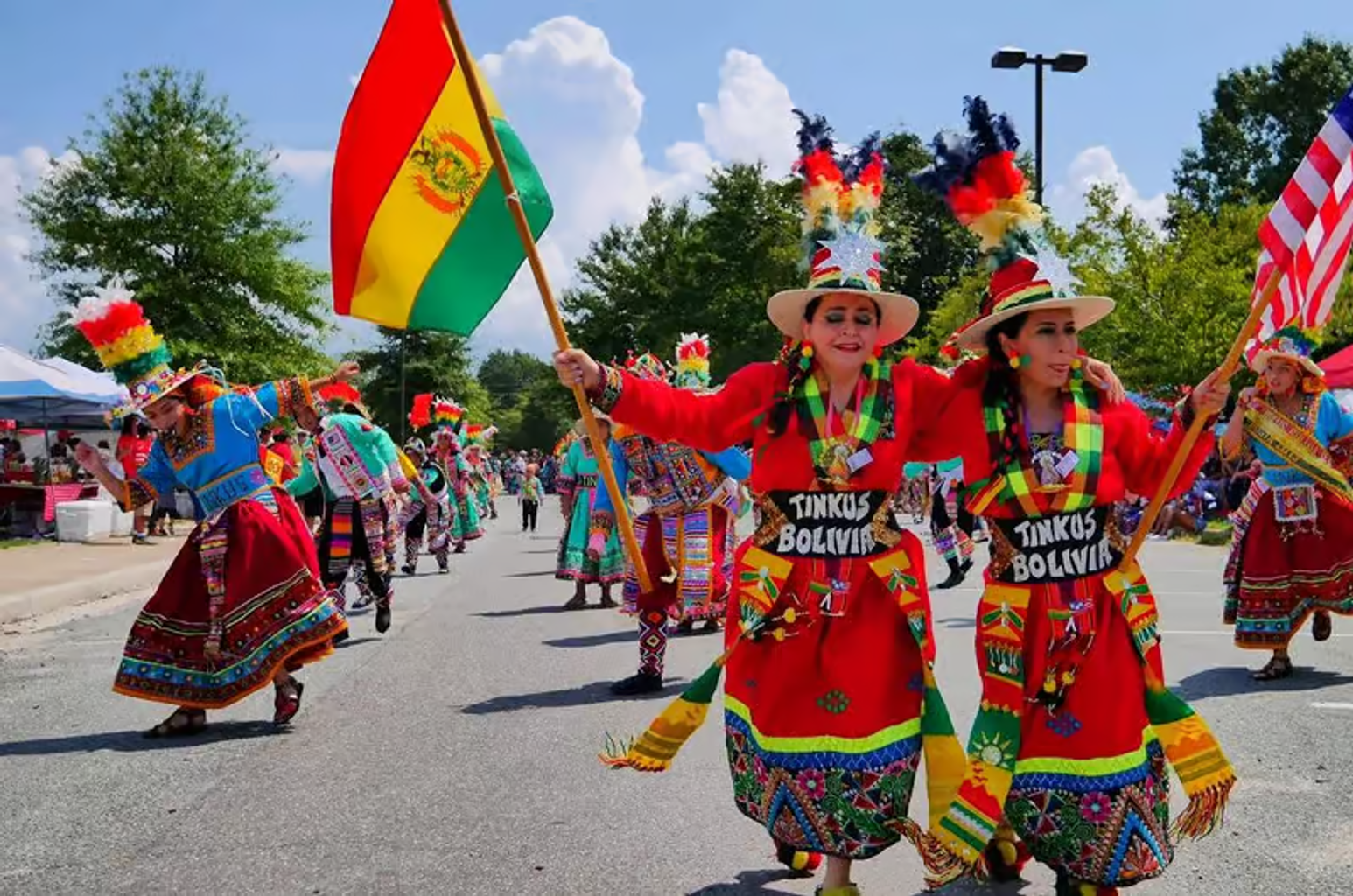
Thursday 22 January Plurinational State Foundation Day in Bolivia

In 2005, Evo Morales won the Bolivian general election and became the first President to come from the indigenous population. His inauguration was on January 22nd 2006.

In 2009, a change to the constitution of Bolivia was promulgated by President Morales, recognising in statute the multi-cultural nature of modern Bolivia.

The new constitution changed the official name of the country to the Plurinational State of Bolivia.

The new constitution was enacted on January 22nd 2010, when President Morales was inaugurated for a second term as President.

On the same date, Morales also signed a decree declaring January 22nd as the Plurinational State Foundation Day and a national holiday to be celebrated annually.

President Morales resigned on November 10th 2019 following weeks of protests organized by opposition political organizations.

The government announced that it will stay open during the holiday when Interim President Jeanine Áñez is expected to give a management report on government activities.

Wednesday 21 January Errol Barrow Day in Barbados

Born on January 21st 1920, Errol Walton Barrow served in the RAF during the Second World War, flying in over 40 bombing missions over Europe.

According to BajanThings.com, Barrow was an RAF Navigator in 88 Squadron, 2nd Tactical Air Force (TAF). He saw active service supporting the Allied ground forces, bombing German communication infrastructure positions and airfields where he accrued 48 bombing sorties giving him 103 hours and 25 mins combat flying time.

After the war, he earned his law degree in England before returning to Barbados.

His political career began in 1951 when he was elected as a member of parliament for the Barbados Labour Party. In 1955, he became a founding member of the Democratic Labour Party, becoming its leader in 1958. He became Premier of Barbados in 1961.

Barrow was a key figure in the movement for independence and became the first Prime Minister of Barbados on 30 November 1966. During his time as prime minister, he is credited for introducing free education, National Insurance, improving health care and expanding the tourism sector.

After two terms as Prime Minister, he lost the election in 1976. He became Prime Minister for the second time in 1986 but died suddenly while in office on September 8th 1987.

His birthday was made a public holiday in 1989 and at the same time, he was further honoured by his portrait being put on the Barbadian $50 dollar note and a key highway from the airport named after him.

It can be said that Errol Barrow is remembered in two public holidays as he was declared as one of 10 Bajan National Heroes in 1998 and National Heroes Day is a public holiday in Barbados on April 28th.

Tuesday 20 January National Heroes’ Day around the world

Amílcar Lopes Cabral was born in Portuguese Guinea in 1924. Educated in Cape Verde and Lisbon, he developed his political theories regarding colonialism, becoming a leading figure in the liberation movement in West Africa.

In 1956, Cabral established the African Party for the Independence of Guinea and Cape Verde (PAIGC). At first, the PAIGC pushed for independence through peaceful means. In 1963, disillusioned by Portugal’s use of force to suppress local demonstrations, the PAIGC launched a military campaign beginning the war of independence.

On 20 January 1973, Cabral was shot dead by a disgruntled former PAIGC rival Inocêncio Kani.

Cabral died before seeing his country achieve independence only a few months later, with his brother becoming President. Cape Verde followed with independence in July 1975.

The two countries chose 20th January as their National Heroes’ Day because it falls on the anniversary of Cabral’s death and although the day is to honour all national heroes, choosing this date is a fitting way to celebrate and commemorate the life of an important figure in the independence of both countries.

Monday 19 January Sonam Lhosar around the world

The word Lhosar means New Year or beginning of a new era and Sonam Lhosar is the Tamang New Year.

Tamangs are indigenous people from Nepal. They have their own culture and dialects which distinguish them from other ethnic groups. Tamang means Horse Traders. In Nepal, the main Tamang community is located in the central highlands as well around Kathmandu Valley

Tamangs divide their years into 12 cycles, each represented by a zodiac animal, following the same order as Lunar New Year. In Nepal when there was no calendar, the 12 rotation system was used to calculate peoples’ ages.

Like other communities, the Tamangs celebrate their new year festival with great joy and religious fervour which lasts for five to fifteen days from place to place.

The Tamang community believes that Lord Buddha was born on the first day of the new moon, in the month of Magha. Therefore the first day of the festival is believed to be the most significant one. On this day, the main celebrations and dances take place.

Sonam Lochar is marked by offering prayers at monasteries. People also visit their relatives to seek blessings from the elders of the family. People wear colourful traditional outfits to mark the importance of the day in their lives.

The festival also sees Tamangs display their cultural heritage by engaging in traditional music and dance performances. Tamang Selo, a special group dance of the community, is performed with great enthusiasm. Many of the dances are performed to the beat of the damphu, a traditional drum.

Sunday 18 January Isra’a Wal Miraj in Kuwait

Isra and Mi’raj Night marks the Prophet Muhammad’s (PBUH) journey from Mecca to Jerusalem and ascent into heaven, sometime around the year 621, according to Islamic belief.

The details come from the Quran and other teachings from the Prophet Muhammad (PBUH).

The Night Journey starts with the appearance of the angel Gabriel who takes the Prophet Muhammad (PBUH) to Jerusalem on a winged horse.

In Jerusalem, the Prophet Muhammad (PBUH) met and prayed with many prophets including Moses, Abraham and Jesus. This part of the journey is known as ‘Isra’.

The Prophet Muhammad (PBUH) was then carried by Gabriel to heaven, ascending through the seven heavenly realms until he reached paradise where he spoke to god.

God told the Prophet Muhammad (PBUH) about the importance of prayers. On the return journey to Mecca, Moses asked Muhammad (PBUH) how many prayers God had commanded to be said daily. Muhammad (PBUH) said fifty. Moses said this was a very high obligation and told him to go back and ask for the number to be reduced. Initially, this was reduced to forty. 

Muhammad (PBUH) went back to God several times, with the number of daily prayers eventually settling at five, which remains the duty of a Muslim today.

This second part of the journey is known as the Mi’raj, which means ladder in Arabic.

The celebrations of Isra and Mi’raj include prayers during the night and many Muslim cities will keep their lights on all night.

Saturday 17 January Israa & Miaraj Night around the world

Isra and Mi’raj Night marks the Prophet Muhammad’s (PBUH) journey from Mecca to Jerusalem and ascent into heaven, sometime around the year 621, according to Islamic belief.

The details come from the Quran and other teachings from the Prophet Muhammad (PBUH).

The Night Journey starts with the appearance of the angel Gabriel who takes the Prophet Muhammad (PBUH) to Jerusalem on a winged horse.

In Jerusalem, the Prophet Muhammad (PBUH) met and prayed with many prophets including Moses, Abraham and Jesus. This part of the journey is known as ‘Isra’.

The Prophet Muhammad (PBUH) was then carried by Gabriel to heaven, ascending through the seven heavenly realms until he reached paradise where he spoke to god.

God told the Prophet Muhammad (PBUH) about the importance of prayers. On the return journey to Mecca, Moses asked Muhammad (PBUH) how many prayers God had commanded to be said daily. Muhammad (PBUH) said fifty. Moses said this was a very high obligation and told him to go back and ask for the number to be reduced. Initially, this was reduced to forty. 

Muhammad (PBUH) went back to God several times, with the number of daily prayers eventually settling at five, which remains the duty of a Muslim today.

This second part of the journey is known as the Mi’raj, which means ladder in Arabic.