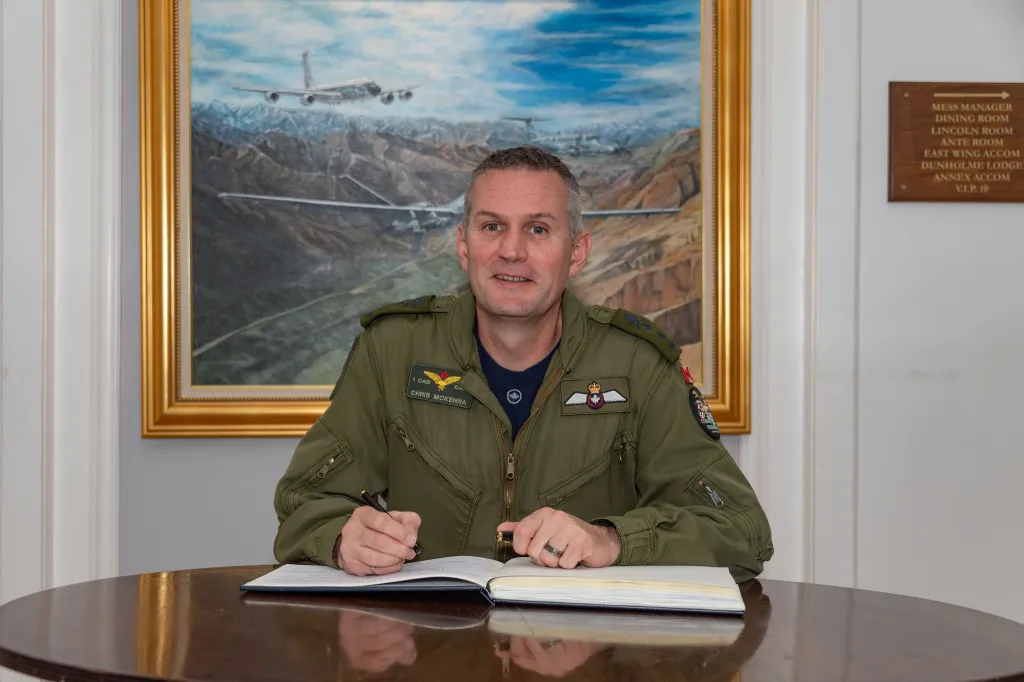
The ability to sense and understand activities in the air and on the sea is one of Royal Canadian Air Force (RCAF) Maj. Gen. Chris McKenna’s main responsibilities as operational commander for the Canadian North American Aerospace Defense Command (NORAD) Region (CANR). However, he faces a number of hurdles to accomplish that mission. Canada has no organic airborne early warning and control aircraft and is relying on an aging satellite system with many users competing for its products.
In the third installment from our exclusive interview last month, McKenna gives us a candid view of what Canada needs to do to modernize its sensing capabilities to get a better handle on the myriad threats NORAD is facing. He also talks about Canadian deliberations over the Trump administration’s Golden Dome missile defense system and how to defend against the threat to military installations from drones. You can catch up with the previous installments here and here.
Some of the questions have been slightly edited for clarity.

Q: Are there any updates to the Trump administration’s Golden Dome missile defense initiative from Canada’s point of view? And does Canada back the placement of kinetic interceptors in space?
A: I think that’s a political decision. So I’m not going to speak to the space-based interceptor piece. That’s up to my politicians to answer that. But certainly, the advocacy that I do is all about integrated missile defense. And how does Canada become a bigger player, a more reliable player, in how we sense things in the Arctic?
From an integrated missile defense point of view, I think we need to be looking at what ground-based effectors look like. And how do we protect ourselves from an integrated missile defense point of view? How do we be more additive in the NORAD partnership with more capability?
Q: How do you do that?
A: Well, I think one is the recapitalization and modernizing our command and control and modernizing the way that we sense. I think there’s a lot of opportunity in the space domain as well. Canada signed a partnership between two Canadian companies, MDA and Telsat, that I think will bear fruit, from a polar communications point of view, in the next number of months. We have a project ongoing for space-based ISR [intelligence, surveillance and reconnaissance], which is likely to progress in the next month or two, and there’ll be some news on that. So there’s, there’s a lot of money moving, finally, on defense spending.

Why Telesat is expanding in Canada
Q: Are you able to provide any details about the space-based ISR?
A: We currently operate a government-of-Canada-owned constellation of four satellites called RADARSAT Constellation Mission. All the orbital axes are based on [the] Arctic, [but] obviously, it’s global. It’s a Low Earth Orbit constellation and it’s radar.
It’s all about looking through clouds. And for us, it’s about looking at dark ships [with the AIS transponders turned off] with an actual picture of what ships are out there, and figuring out what ships are being non-compliant, and then queuing either ISR assets or the Coast Guard to go and have a look at those ships.
That was launched in 2019, and its service life is expected to last until about 2026. It’s still giving us good data, and likely will give us good data until the 2030s. So DESSP, or the Defense Enhanced Surveillance of Space Project, is anchored on having a defense-only constellation of satellites, because you can imagine those are satellites are being looked at for, ‘hey, where are the whales?’ ‘Where’s the ice?’ Environmental pollution control. There’s a lot of demand on it. We do get sort of primacy over it, but we do need more ISR in the Arctic, and I think we need our defense-only constellation. So part of the NORAD modernization project was funded that very significantly.

Q: Back to Golden Dome. Are there any updates from the Canadian point of view?
A: So we look at it as Continental Shield. Golden Dome is the U.S. brand on it. From our point of view, it’s great air missile defense and what we will put on the table to defend the continent with. And so I think there are ongoing negotiations between our governments with respect to what the specific investments will be. We’ve got a good head start, though, with our NORAD [modernization], and I think there’s more to come.
Q: Let’s switch topics for a minute. Has Canada experienced drone incursions over critical facilities like the U.S. and Europe have?
A: Not to the same extent. I’m obviously very attuned to what is going on in Europe and what has been going on in the States, and I talked about it with my commander quite a bit. We’re taking counter-UAS very seriously. As we onboard exquisite things like the F-35, we need to have a better system. We’ve purchased a system called the Leonardo Falcon Shield system. That’s the same one that the RAF uses, and we can place it at two of our wings right now, and I’m rolling it at all my wings as the deliveries roll in. And it’s an RF [radio frequency] sensing, RF interception capability. It’s not kinetic as of yet, but that can be added pretty easily. And I think we need to be thinking about this as a baseline capability. Every one of our air bases to be able to deny airspace for hobbyists and state actors who may wish to fly drones over top.

Falcon Shield – Operationally proven drone mitigation system
Q: Why do you think that Canada hasn’t experienced drone incursions to the extent that the U.S. and Europe are experiencing them?
A: I honestly don’t have an opinion on that. We do have drone issues. We do detect drones once in a while, but I have not had massive incursions in any of my NORAD bases as of yet. That doesn’t mean it’s not coming, though. And I think we can’t be naive about this. The U.S. talks about Golden Dome, and [NORAD/NORTHCOM commander] Gen. [Gregory] Guillot, in front of Congress, has talked about the three domes, with the last, the smallest dome, being counter-UAS domes around the U.S. infrastructure. We see it the same way, in the sense that I need limited air defence around my key infrastructure to protect the assets that I wish to protect.
Q: You talked about your counter-UAS equipment having radio frequency detection and intercept capabilities. What’s Canada’s policy on kinetic counter-drone systems?
A: I think there’s other optionality, right? And I think this becomes a policy and a legal discussion. What are the boundaries for our authorities? And if we need more authorities, we have to go back to the government to get them. We do have some exemptions from [Innovation, Science and Economic Development Canada] that manages our spectrum. It’s like the FCC in the States, so we’ve got a bunch of dispensations from them to conduct the interceptions we need for defense installations, which is good news. But I do think there’s probably more to come. I do think kinetic, directed energy, drone-on-drone type [of defenses] would be very useful. I think it’ll depend on what the legal framework we’re allowed to use to protect our facilities.

Q: What are the limitations on your counter-UAS actions?
A: It’s an emerging space now in terms of we’re just getting the installs done, and we’re scratching at the authorities, and having the analysis is fine, but right now, in terms of what we’re going to be able to do, I can do some things. I’m not going to get into the details on that – but I can do some things to deny access to my airspace right now. I do think there’s going to have to be a discussion about the aggregation of additional authorities.
Q: Can you tell me more about the domestic counter-UAS strategy to help mitigate the threats, particularly posed by smaller, lower-end drones?
A: Well, one of the keys is domain awareness to begin with, like understand the problem you’re facing and then pair your defensive design against that. And that really is the basis of integrated air and missile defense. But zoom down into the sub-tactical, force protection lens around each of our bases, and we’re going through that process right now to get that laid down. The good news is I’ve got some systems installed. We’re learning with them, and we’re pushing the policy space to make sure we’re having the right authorities.

Q: Have you had to use any of these defensive systems against drones yet?
A: Not yet.
Q: What space-based capabilities are needed for the mission that you don’t have right now?
A: The one that’s in development is the space-based air moving target indicator. The U.S. is going quite heavily on that. I’m really interested in what that could bring. It would be a nice layer on top of the Over the Horizon radar picture.
The key question is, how small a thing can it see? That’s the overriding discussion we have now. And you know, could it ever supplant a thing like an airborne early warning aircraft? I think at the current time, no. Maybe 15 or 20 years from now, very much potentially. We’ll see. I think we still need AWACS-like aircraft. So that third basket of policy authorities was received in 2024, they [provided] a bunch of money to us to go and conduct an options analysis, and we are in the middle of that right now, looking at airborne early warning aircraft that would be contributive to the NORAD mission set.

Q: What kind of airborne early warning aircraft are you considering in your review?
A: There are really three options. You could say four with an E-2D as well. But I think that may not fit for the purpose of the Arctic mission set. We are looking at the Boeing advanced E-7 Wedgetail. We’re looking at the Phoenix [L3Harris airborne early warning and control (AEW&C) aircraft]. And we’re looking at the GlobalEye, or variants that Saab has built. Two of them, L3Harris and the Saab offering, are both based on a Canadian biz jet. They’re based on the Global 6500 aircraft that Bombardier produces.

GlobalEye walk-around tour with Saab
Q: When will you make a decision?
A: That’s a good question for my government. We owe them the results of our options analysis. We’re near the end of options analysis (OA). The way that Canada appropriates money is by buying years, almost like your mortgage. It’s very boring, but that’s how you get money apportioned to you. And I believe it was sort of in the early 2030s. I’ll be honest, I have a need almost immediately for it. To think about the state of the E-3 fleet around the world, both in NATO and the U.S., there’s a need.

Q: Has the need for look-down radar capability pushed your airborne early warning aircraft program forward?
A: Because of the austerity of the radar landscape in Canada, I do need a movable, high-power radar in which to be able to cue my fighters and to take electronic custody of anything that was coming close to the approaches to North America, so I have a need for it, absolutely.
Q: So that’s what’s driving your options for the airborne early warning aircraft?
A: I feel quite strongly that we need that. We advocated to the government that we needed it. We made a good case. There are obviously lots of questions, but they bought our analysis, and they obviously provided us with policy coverage and funding to get after that.
Contact the author: howard@thewarzone.com