Keeping and maintaining friends as an adult is hard, especiallywith the demands of life, travel and work. In volunteering, I encounter more people like myself, which is nice, but sometimes it’s difficult to participate without a lot of commitment to the organizations. I’m wanting to explore smaller, intimate groups to build community with people who I share similar values with. I’m interested in self-growth, psychology, games, mindfulness and yoga. I loved the L.A. Times story “Awaken your inner child at this welcoming collage club for adults” and I would love to know about similar activities. Thanks! —Marlen I.
Looking for things to do in L.A.? Ask us your questions and our expert guides will share highly specific recommendations.
Here’s what we suggest:
Marlen, I couldn’t agree more. As we get older, it can feel more and more difficult to sustain friendships, especially in Los Angeles, where people live so far apart and have busy lives. This struggle is exactly why so many social clubs have been sprouting up in L.A. over the last few years. From board game clubs to junk journaling meetups, there’s so many different ways to connect and maybe try something new. I’ve compiled a list of social clubs and community spaces that I think you’ll enjoy.
Since you’re already familiar with Art+Mind Studios, you should definitely check out Junk Journal Club. Junk journaling is essentially a craft practice that combines elements of collaging, journaling and scrapbooking. With the rise of junk journaling content on social media, the once solo pastime has turned into a lively social scene. Junk Journal Club, dubbed “the original junk journal club,” hosts monthly meetups, which can be found on its Instagram page. When my colleague Malia Mendez went to an event recently, people told her that attending Junk Journal Club “has made befriending strangers easy,” and many of them stay in touch.
Another craft-centered event that’s worth exploring is the Crafters Clubhouse, which founder Victoria Ansah calls “a creative third space for adult makers.” She hosts monthly arts and crafts workshops including activities like scrapbooking, punch needle embroidery and clay art.
Given that you’re interested in yoga and mindfulness, you may like WalkGood LA, a community-centered wellness organization that hosts a variety of activities including a run club and accessible yoga classes. During the pandemic, I found solace in attending their weekly yoga classes called BreatheGood. The outdoor sessions take place every first Sunday at Kenneth Hahn State Recreation Area and feature free chiropractic adjustments and healthy food vendors. The vibe of the intergenerational event feels warm and welcoming. All you have to do is show up with your yoga mat. The organization also hosts various classes including yoga, breath work, mindful meditation, mat Pilates and step aerobics at their studio, the WalkGood Yard, in Arlington Heights.
Another social club I recommend is Love, Peace & Spades, which my friend Kevin Clark started in 2022, to create a space where people could play the card game with others. With music provided by a live DJ, the monthly game night feels like being at a family cookout. Spades can be extremely intimidating to start as a beginner playing with pros. But don’t worry. Love, Peace & Spades has instructors who can teach you how to play.
If you’re interested in chess, L.A. Chess Club is “an event with the laid-back ease of a chill game night and all the social and romantic possibility of a night out on the town,” according to Times contributor Martine Thompson, who wrote a story about the event. At the weekly gathering, which features a food vendor, cocktails, tattoo artists and DJs, you can “competitively play chess, learn the game, meet new friends or mingle as a single person,” Thompson shares. Another fun event is RummiKlub, a monthly Rummikub game night that takes place in elevated, design-forward spaces across the city.
L.A. also has several fun creative venues that regularly bring people together, such as Junior High, a nonprofit art gallery and inclusive gathering space that hosts artist showcases, comedy nights, pottery workshops and more. There’s also Nina in Atwater, which holds a variety of gatherings including a monthly series that focuses on mindfulness called “Be Here Now: Simple Tools for an Everyday Nervous System Reset.”
I hope that these suggestions are a good starting point for finding the group, or several groups, that are an ideal fit for you. Just by putting yourself out there and being open, you are bound to build and find community. Best of luck on your journey!
United Airlines is the latest to confirm that it would be cutting five per cent of flights in the second and third quarters of 2026.
With up to 5,000 flights a month – working out to around 4,000 domestic and 800 international routes – this means it affects around 250 flights a month.
And with this set to last until the end of summer, it means thousands of passengers will be affected.
While the affected flights haven’t been confirmed, it will mainly affect the “less profitable” routes so including midweek flights, as well as overnight and Saturday routes.
United Airlines has the world’s largest airline fleet with more than 1,075 aircraft.
United Airlines‘ Chief Executive Scott Kirby said the cancellations were due to fears of oil rising to as much as $175 (£131) a barrel, and remaining above $100 (£75) until the end of next year.
This would mean the airline’s fuel costs would rise to $11billion (£8.2billion) – double the profit of their best year which was $5billion (£3.7billion).
They warned: “There’s no point in burning cash in the near term on flying that just can’t absorb these fuel costs.”
It’s not just the cost of fuel but how much is being used by airlines as well.
The closure of airspaces and Middle East airports, particularly Dubai which is one of the world’s busiest, has forced airlines to fly alternative – and longer – routes, which burn more fuel.
Other airlines have already confirmed they would be cancelling flights due to expected fuel costs.
The waymarked quartzite path glimmers in the sun, flanked by amber-gold grassland. Beyond, one of Scotland’s finest landscapes opens up before me, a woodland of ancient Caledonian pines leading my eye to the metallic glint of Loch Maree. On the other side of the water, a winding river separates the steep, stacked rocks of Beinn a’Mhùinidh from Slioch, one of the great mountains of Wester Ross, rising to a knuckle ridge of Torridonian sandstone.
I’m walking the four-mile mountain trail looping through Beinn Eighe national nature reserve (NNR), Britain’s first NNR, which celebrates its 75th anniversary this year. In a crowded list, you’d be hard pushed to find a more soul-stirring landscape in all of Scotland.
“The mountain path gives you a real flavour for Beinn Eighe,” the reserve manager, Doug Bartholomew, told me earlier. “It takes you right through the heart of the ancient Caledonian pinewood, then you climb steeply up to this rocky upland with views of Beinn Eighe mountain itself.”
When I reach the high point, at about 550m (1,805ft), I’m awed by the views across a lonely valley to the jagged ridgeline of mountain, which surges and falls like Atlantic waves locked in stone.
Beinn Eighe NNR stretches 48 sq km from Loch Maree to the eponymous mountain summit. When it was created in 1951, a key mission of the NNR was to protect Coille na Glas Leitir (the Wood of the Grey Slope), which is the largest remaining fragment of ancient Caledonian pinewood in north-west Scotland. The woodland was felled by some of Scotland’s earliest ironworks in the 1600s, and forestry and farming took its toll over the generations, but it is believed to have been here for the last 8,000 years.
After the Highland clearances, the lower slopes of Beinn Eighe were increasingly used for grazing. Deer-stalking, grouse-shooting and muirburn (when old growth is burnt off to encourage new growth for grazing) followed. The final exploitation happened during the second world war, when lumberjacks were brought in from Newfoundland and British Honduras to fell the trees for ammunition boxes. But thanks to pioneering landscape restoration work, namely deer management and tree planting, woodland cover has increased by more than 40% in the 75 years since the reserve was created.
Today, it’s a rare Scottish landscape where you can walk beneath twisted and gnarled pine branches hundreds of years old, but also alongside younger, conical trees.
Stuart Kenny in the ancient pinewoods on the mountain trail. Photograph: Isabelle Erbacher
“In the past, we had a tree nursery; so we collected seeds from the reserve, grew them in our nursery and planted them,” said Bartholomew. “We’ve now got continuous woodland linked from Glas Leitir all the way through to Coulin Estate, where you’ve got other remnants of ancient woodland, and we’re moving more to natural processes – conditions that will allow the woodland to regenerate and expand naturally.”
I soon descend into Coille na Glas Leitir on the mountain trail, passing a mosaic of birch and pines, draped in lichen. This path was a public access landmark when it opened in the early 70s, encouraging visitors to explore the mountain, and it’s still perfectly marked (though snowfall can obscure it in winter). Stags roar from the other side of Loch Maree as I walk. Tougher to pick out are the crossbills, with crossed mandibles to prise open pine cones. In warmer months, dragonflies with magical names – northern emerald, azure hawker – nose around rare mosses.
While steep, the mountain trail isn’t technical. Along with the easier woodland path, which showcases the ancient forest, and short loops from the excellent visitor centre, the beauty of this reserve really is accessible. Local providers such as Shieldaig Outdoor Adventures also offer days out exploring the islands of Loch Maree by canoe or kayak in warmer months.
I’m staying in Torridon youth hostel, at the head of Upper Loch Torridon, south-west of the Beinn Eighe massif. It’s a 20-minute drive from Coille na Glas Leitir via the village Kinlochewe, passing beneath the bulky mass of Beinn Eighe before Liathach, an icon of Glen Torridon, is revealed. The hostel is tucked beneath this mighty mountain, not in the nature reserve itself, but in an ideal place to explore it and the Torridon hills beyond.
The view from Torridon youth hostel. Photograph: Stuart Kenny
“When we mention that we live in Torridon, people get misty eyes,” jokes Debbie Maskill, manager of the youth hostel. “For us, it’s the best part of Scotland. A real jewel.” It’s true that few place names roll so sweetly off the tongue of a hillwalker as Torridon. This is a place of grandeur – of immense, intimidating mountains set on some of the oldest rocks in Britain; of shifting light and uncompromising ferocity – with a beauty verging on myth.
The hostel – which itself turned 50 last year – is a pilgrimage site for hikers; it’s in close reach of some of Scotland’s finest scrambles, as well as the family-friendly nature reserve. Walkers and climbers trade stories and photographs in the communal kitchen and dining area. Floor-to-ceiling windows in the cosy lounge allow you to watch the weather roll over the Wester Ross peaks.
I stay in a comfy private room, and regret my early bedtime when a French guest shows me the photographs he took of the aurora shimmering above Loch Torridon the next morning. “Winter really captures the far north essence here, but by February, it’s getting lighter,” says Paul Thompson, duty supervisor at the hostel. “In the middle of winter, we don’t see the sun here, but in February it’s above the hills for quite some time. Then you get to May, a stunning time of year, when everything is fresh and you’ve got almost endless daylight. I love it all.”
Loch Maree seen from Beinn Eighe. Photograph: Stuart Kenny
On a six-mile loop of Loch Clair and Loch Coulin, just outside the reserve, I stroll beneath more tall pines, looking on to the Torridon beasts. The grey, dotted ridge of Beinn Eighe looks like it has a snow leopard’s coat draped over it, and the pyramidal mass of Liathach reflects back off the water.
I plan to walk to the Triple Buttress of Coire Mhic Fhearchair on my final day (three glacial rock towers in a corrie of Beinn Eighe), but heavy rain arrives. It’s all the excuse I need for a venison lunch at Bo & Muc, a field-to-fork restaurant at the swanky five-star The Torridon hotel.
I leave Torridon via the road to Achnasheen, stopping at the Glen Docherty viewpoint for one last look over the road to Kinlochewe, the lapping mountains and Loch Maree.
After centuries of deterioration, it’s heartwarming to see the fragments of ancient pinewood reconnecting here, in this immediately spellbinding landscape. In another 75 years, the young pines of Beinn Eighe will stand taller and, if all goes to plan, those who pass by them will be walking through a fully regenerative forest.
Accommodation was provided byHostelling Scotland. Torridon youth hostel has private rooms for two from £52 a night, dorm beds from £20.50. The Beinn Eighe NNR trails are open year-round and are free to visit. The Beinn Eighe NNR visitor centre (with info on the reserve) is open April to October, 10am to 5pm
The Peak District village was systematically demolished and submerged in the 1940s to provide water for the industrial industries during the second world war – but it’s ruins remain
Passers-by have no idea what lies beneath (Image: Steve_Bramall via Getty Images)
It lies beneath a beloved hiking destination in Derbyshire, but this was once a thriving community before it was deliberately flooded and lost forever.
During the 1940s, the picturesque village of Derwent was methodically demolished and submerged beneath what is today known as Ladybower Reservoir.
The expansive, stunning expanse of water frequently serves as a stopping point for visitors admiring the scenery whilst exploring the Peak District, yet few realise what rests beneath its surface.
The reason for its submersion was to supply water to the booming industrial centres throughout the East Midlands during World War Two.
Locals were relocated, and by 1945 the valley had been flooded, with remnants of the former settlement now resting underwater.
Best Derbyshire holiday cottage deals
This article contains affiliate links, we will receive a commission on any sales we generate from it. Learn more
Derbyshire is known for its dramatic Peak District landscapes, historic market towns and stately country houses. Sykes Cottages has hundreds of places to stay, with prices from £32 per night.
Derwent before it drowned
Prior to the outbreak of war across Britain, Derwent had seemed like a permanent fixture in the moorlands, characterised by its century-old structures and tight-knit community.
Two initial dams were constructed after the water board selected a remote section of the valley. This decision impacted numerous residents. Those who owned farms or smallholdings were relocated to safer areas including Derwent and the neighbouring village of Ashopton.
What they couldn’t have anticipated was that this stretch of the valley, and their cherished village which they’d made their home, would shortly vanish entirely.
The village church conducted its final service for parishioners on March 17, 1943, before being submerged beneath the reservoir. Remnants of the church can be found scattered throughout Derby, with the bell now rehung at St Philip’s Church in Chaddesden.
Whilst nearly the entire area was deliberately flooded, a small number of homes survive above the waterline. Reports indicate that five properties from the original village endure, including several farms and the former village hall.
Mabel, a former Bamford resident who was 92 at the time of her interview, spoke to BBC Travel about growing up nearby and her memories of Derwent.
She revealed: “I may be the last person who remembers Ashopton and Derwent,” explaining that her school was located in Derwent, which she attended whilst the reservoir was being built.
The village emerged
During periods of extreme heat or reduced water levels, the reservoir has receded, and hauntingly, remnants of the village have surfaced. This phenomenon has been documented on several occasions, with the first instance occurring in 1976, leaving locals astounded.
The most recent, and consequently most significant, reappearance of the village occurred in 2018, when reservoir levels dropped dramatically and visitors flocked from across the region to witness the extraordinary spectacle.
An enormous crowd assembled, and the attention drawn to the old structures – which are largely piles of rubble and bricks – resulted in various complications.
On 3 November that year, a man found himself in a sticky situation, requiring mountain rescue assistance after becoming severely stuck in the dense mud surrounding the ruins of Derwent.
In a similar vein, due to the influx of visitors, the remnants were defaced with graffiti, prompting park rangers to discourage further visits as additional items were also taken from the site.
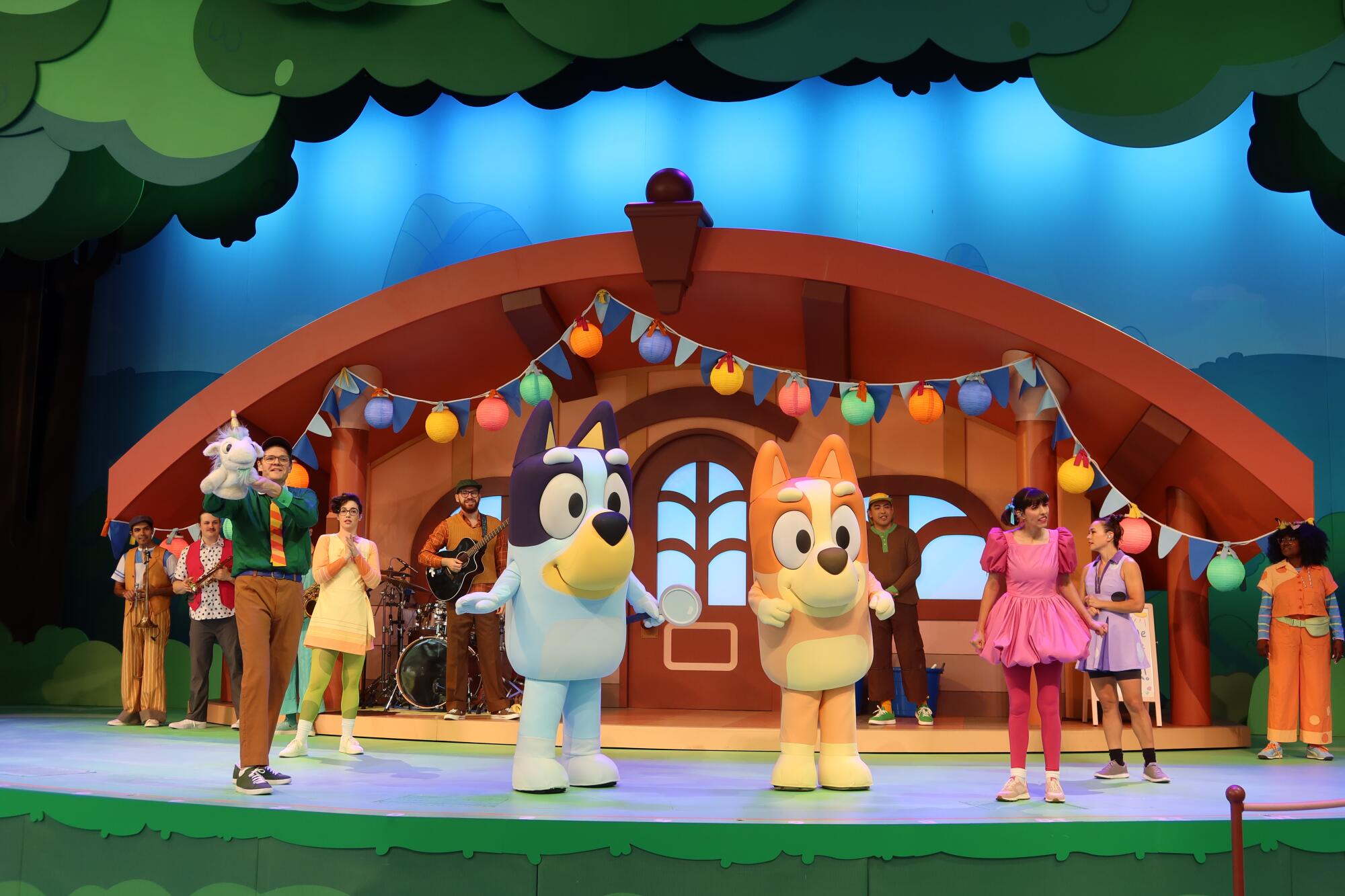
Animated Australian sensation “Bluey” has arrived in Disneyland, and the titular anthropomorphic pastel-coated canine has come ready to play. And dance. And to race some “barky boats.”
The Walt Disney Co. first teased that the Blue Heeler puppy and her younger sister Bingo would be coming to the Anaheim theme park in 2024. Bluey is now the star of a performance-focused takeover of the park’s Fantasyland Theatre, which officially opened Sunday.
Two shows, games and spontaneous dance parties are hallmarks of the experience, as Disneyland’s live entertainment team sought to translate the show’s particular broadcast-based appeal to the real world.
“Bluey” works because it’s charmed children and grown-ups alike, emphasizing imaginative parenting skills as much as it does Bluey’s playful spirit. Though only about seven minutes, each core “Bluey” episode unfolds patiently, often centered on make-believe, wonder and childlike ingenuity. Subtle life lessons, such as cooperation, understanding one’s self-worth, overcoming a fear of the unknown and much more, dot seemingly simple scenarios.
In many episodes, Bluey’s mom (Chilli) and dad (Bandit) indulge in their daughters’ penchant to play pretend, so much so that a friend of mine with a young girl joked that she needed to watch the show to learn how to be a better mom.
I arrived at “Bluey’s Best Day Ever!” as a childless columnist, and yet I came away enchanted by what Disneyland’s live entertainment team, led by Susana Tubert, had concocted. It’s a little silly and corny, yes, but manages to vary the tempo and can even tug at one’s heartstrings by showing the bond between siblings.
Theme park fare, especially when aimed at a preschool set, tends to fall back on high-energy, photo-op-based treatments, and while there’s plenty of amped-up goofiness here, “Bluey’s Best Day Ever!” understands that’s not why the series was the most-streamed program in 2025, according to data from research firm Nielsen.
Two core shows are featured in the experience, and some “Bluey” regulars make an appearance. The overbearing, bratty hand-puppet Unicorse, for instance, plays key roles in launching each performance. Set to play continuously throughout the day, with breaks for Bluey and Bingo to appear on stage and dance or play with youngsters, each has a slightly different tone and feel.
One emphasizes an adventure story, its themes encouraging Bluey to flash some bravery and dispel stereotypes. The other takes a lighter touch, with some of the softer, almost ballad-like songs from the show, such as “Rain (Boldly in the Pretend),” highlighted, seeking to emphasize the bond between Bluey and Bingo. Here, I thought of Bluey’s more tender moments — those, for instance, that emphasize becoming comfortable with growing older and letting go.
“Bluey’s Best Day Ever!” features live music, puppets and dance breakouts.
(Mark Potts / Los Angeles Times)
“We try to hit the humor, the play — shared play — and some of the more profound experiences that these characters go through,” Tubert says. “At the end of the second show, you’ll see a moment that is really quite beautiful. It’s a tribute to sisterhood, and how these two characters of Bluey and Bingo connect with one another.”
While one can certainly sit in the Fantasyland Theatre’s stands and simply take in the two shows, there are plenty of moments geared at getting audiences moving. Dances, for instance, may mimic animal behaviors, or reference popular moments from the series, such as getting grannies to floss.
A nod to the attention-seeking fairies — here, less Tinker Bell and more a metaphor for being noticed — inspires a “Riverdance”-like breakout. The five-piece, brass-heavy band gets a workout when Bluey’s impossible-to-control toy Chattermax has a cameo. The squawking plaything can test even Bluey’s patience.
Throughout, performers walk a line between teaching the maneuvers to the crowd and getting lost in the moment themselves. The challenge for Disney choreographer Taylor Worden was to create dance moves that also doubled as audience encouragement.
Spin, for instance, like a flower in the wind, or lightly snap your fingers to recall the sound of rain. Bounce with your hands in front of you as if you’re driving a car down a rocky street, or put your hand above your head and try for an elegant, ballerina-inspired twirl.
“It actually was letting go of all of those technical things that I’ve learned and letting that inner child come out,” Worden says. “As imaginative as Bluey and Bingo are, I wanted to hone in on that. I want everybody to enjoy, have fun and play. Play is at the forefront of everything. It’s so easy to get set in our ways, and even as an adult, it’s so hard to actually play nowadays. This has been such an experience to get to a childlike state.”
“Bluey’s Best Day Ever!” references many show moments from the series, including one with nods to the fairies.
(Mark Potts / Los Angeles Times)
There’s more, however, to “Bluey’s Best Day Ever!” than the two performances. The Fantasyland Theatre has been outfitted with pop-up installations. Some are purely photo ops, such as an opportunity for little ones to take a class photo with Bluey and her pals, while others aim to inspire exploration, such as a mini gnome village or fairy garden.
Taken as a whole, the feel is something of a fair, like hanging out with Bluey and Bingo at a backyard barbecue. The theater’s walk-up food window is serving pizza-inspired baked potatoes, a colored chocolate pretzel meant to mimic an asparagus pretzel wand, and more.
There’s also a place to race some “barky boats.” In the show, barky boats is a game that takes place on a tiny stream with tree bark, but there’s no water here. Instead, look for a track in a nook above the seating area, where one can race wooden blocks affixed with wheels — think Pinewood Derby — down a track painted to mimic a waterway. Throughout the theater, the colors are springlike and muted, pastels that are lightly bright and storybook-inspired. Even the dance costumes adopt this soft, crayon-like color palette.
“Bluey’s Best Day Ever!” at the Disneyland Resort invites audience participation.
(Mark Potts / Los Angeles Times)
“The color palette works perfectly with the set,” says Trevor Rush, a manager with costume design and development. “Lots of pastel colors. ‘Bluey,’ that world, focuses very much in that primary world. You won’t see a lot of black represented.”
“Bluey’s Best Day Ever!” does not currently have an end date, but is expected to be a Disneyland staple throughout the spring and summer seasons, with showtimes currently set for the late morning and early afternoons. For Tubert, who has an extensive background in theater, “Bluey’s Best Day Ever!” is meant to highlight the theme park as a place of play, where one can be a bit silly, and maybe even a little vulnerable.
“There’s a nonjudgmental safe space that we’ve created in ‘Bluey’s Best Day Ever!’ that invites everyone to feel uninhibited and the joy of playfulness,” Tubert says.
The provided text serves as an informational overview regarding Bihar Divas, an annual event commemorating the establishment of the Indian state of Bihar. This holiday traces its roots back to 1912, when the territory was officially separated from the Bengal Presidency during British rule. Beyond its administrative history, the source highlights the region’s rich cultural heritage, noting its significance to both Buddhists and Hindus through ancient landmarks and symbols. Modern celebrations involve large-scale festivals and government-sponsored cultural showcases designed to foster public participation and honor local traditions. Overall, the article functions as a historical and cultural guide …
Plus, every time you drive, you can see the escalating average cost for a gallon of gas throughout the state that ranges from $5.77 in Orange County, $5.78 in San Diego County, $5.80 in Los Angeles County and $5.86 in San Francisco County to the high of $6.57 in Mono County, according to AAA.
It can easily make anyone think having fun is unaffordable.
Fortunately, our Travel and Experiences team has put together a list of 75 fun things to do for under $20.
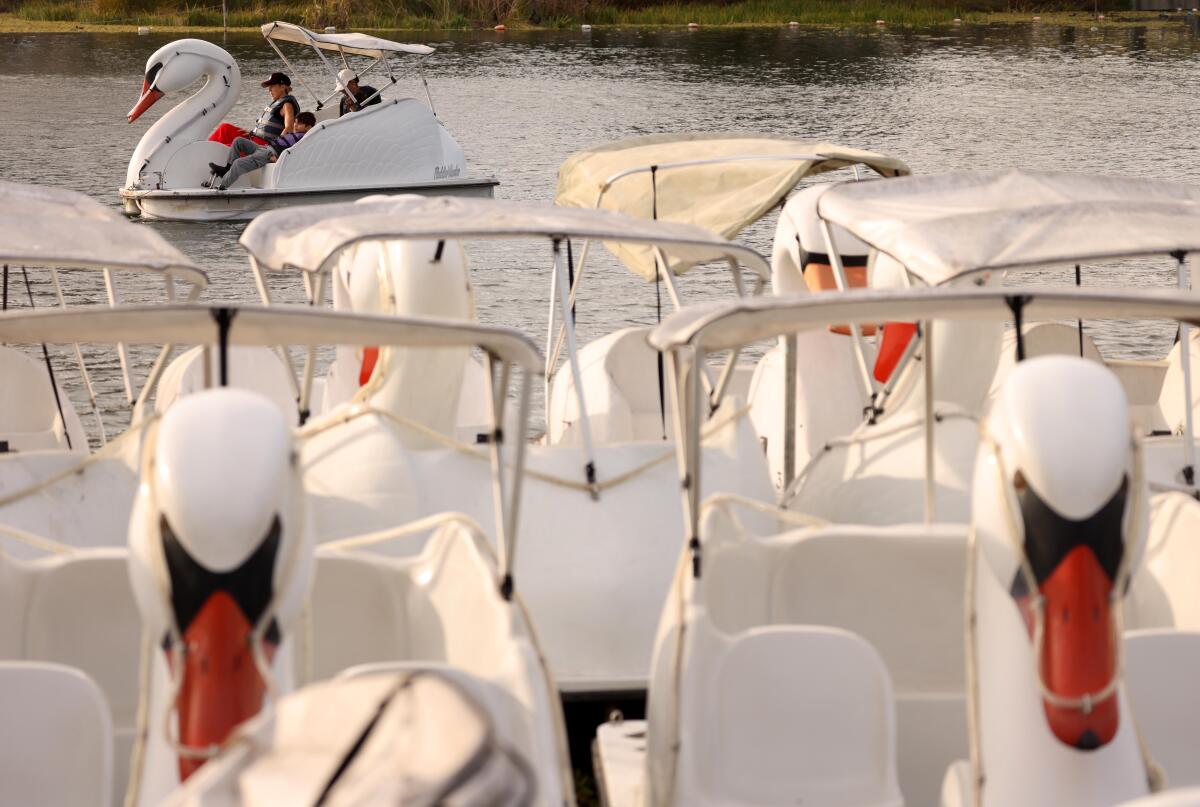
On warm days, it’s hard to beat a ride on the swan boats at Echo Park.
They’re powered by foot paddles, and the pedaling is easy because you’re in no hurry. Maybe you’ll want to do a circuit of the lake (really a man-made reservoir). Maybe you’ll sidle up to the towers of whitewater rising from the mid-lake fountain.
Maybe you’ll wait until after dark (because the swans light up).
(Christina House / Los Angeles Times)
Experience L.A.’s esoteric history at the Philosophical Research Society (Los Feliz)
Cost: Free to visit, workshops and lectures from $10 and up.
Located at the intersection of Los Feliz and Griffith Park boulevards, the Philosophical Research Society has long been a place of mystery, intrigue and, for some, apprehension.
The Mayan Revival campus painted in Southwestern shades of clay, cream and sage was built in 1935 by the celebrated author and esoteric lecturer Manly P. Hall.
Today, it hosts a dizzying array of events each week including poetry readings, death cafes, sound baths, a weekly class on Buddhism, tarot and astrology salons and musical performances — some of which have a suggested donation of just $10.
If you visit, make sure to make time to browse the excellently curated metaphysical bookstore.
(Gina Ferazzi / Los Angeles Times)
Find the perfect meditation spot at the Self-Realization Fellowship Lake Shrine (Pacific Palisades)
Cost: Free.
Whether or not you’re familiar with the work of Paramahansa Yogananda, who founded the Self-Realization Fellowship in 1920, if you live in Los Angeles you owe him a debt of gratitude for the smattering of lush, meditative gardens in Southern California that are still open to the public today.
Among those is Lake Shrine, a beautifully landscaped 10-acre property in the Pacific Palisades surrounding a spring-fed lake that is dotted with quiet meditation spots.
It is free to visit, but you will need to make a reservation online before you go. (Reservations open each Saturday at 10 a.m. for the week ahead, and they can fill up quickly.)
(Wally Skalij / Los Angeles Times)
Cozy up with a flick at the Paramount Drive-In Theater (Paramount)
Cost: $14 per adult, $7 per kid (ages 3-11).
For a night out that feels as cozy as a night in, head to the Paramount Drive-In Theater. In the comfort of your own car, you can spread out, munch popcorn and make all the commentary you want without getting looks from other moviegoers.
Tickets are purchased on arrival, and the parking lot is huge, so you’re bound to secure a good view of the big screen. There is a concession store on site with candy, chips and drinks, but you are free to bring all the snacks you want from home. Recline your seat all the way back, relax and enjoy the show.
You’re reading the Essential California newsletter
Sign up to start every day with California’s most important stories.
By continuing, you agree to our Terms of Service, which include arbitration and a class action waiver. You agree that we and our third-party vendors may collect and use your information, including through cookies, pixels and similar technologies, for the purposes set forth in our Privacy Policy such as personalizing your experience and ads.
The week’s biggest stories
(Irfan Khan / Los Angeles Times)
Heat wave and environmental news
Los Angeles mayor, city council news
Cesar Chavez fallout
California governor’s race
Crime, courts and policing
What else is going on
Must reads
Other meaty reads
For your downtime
(Illustrations by Lindsey Made This; photograph by Myung J. Chun / Los Angeles Times)
Going out
Staying in
L.A. Affairs
Get wrapped up in tantalizing stories about dating, relationships and marriage.
Have a great day, from the Essential California team
Jim Rainey, staff reporter Hugo Martín, assistant editor, fast break desk Kevinisha Walker, multiplatform editor Andrew J. Campa, weekend writer Karim Doumar, head of newsletters
A FERRY route connecting the UK to Scandinavia could return after almost 20 years.
Brits could get a direct link to the ‘Gateway to the Fjords’ without setting foot on a plane.
Sign up for the Travel newsletter
Thank you!
A ferry route connecting Newcastle to Bergen could restartCredit: AlamyDFDS Seaways was the last company to operate the service which ended in 2008Credit: Alamy
There are talks of restarting a ferry route that could link Newcastle to Bergen in Norway for the first time in 18 years.
Historically, this route existed for over 140 years, and is being looked into being brought back by Newcastle City Council.
DFDS Seaways was the last company to operate the service – but this ended 18 years ago on September 1, 2008.
The crossing was usually overnight and the sailing lasted up to 22 hours – depending whether or not it stopped at Stavanger.
In 2022 Bergen Cruise Line revealed that it was hoping to re-introduce a ferry service between Newcastle, Stavanger and Bergen starting this year.
The Newcastle City Council leader Karen Kilgour said in January of this year that she would “love to see the return of the ferry.”
The service was first introduced in 1890, just two weeks before World War Two.
It continued on and off for over 140 years which resulted in a special relationship forming between the two cities with Bergen even providing Newcastle with a Christmas tree each year.
This tradition continued right up until 2022 – the giving of a Christmas tree stopped, but the cities’ mayors now swap baubles each festive season.
Talks about bringing back the ferry route are still in the works.
Despite a journey across the seas not being available, Jet2 has direct flights from Newcastle to Bergen, taking just one hour and 25 minutes.
One-way flights in April with Jet2 start from £69.
She said: “If you take a stroll around the cobbled streets you will find an array of quirky gift shops, cafes and bars, as well as the vibrant Bryggen Nightclub.
“And the one-day Norway In A Nutshell tour is a must (£192pp, see fjordtours.com), showcasing the best of this country’s breathtaking nature.
“The carefully curated experience begins early, taking you straight from the city centre through more than 60 miles of wild mountain terrain on the Bergen Railway.”
When it comes to eating, Emily says to head to the Skyskraperen restaurant at the top of Mount Ulriken.
Here you can try ‘traditional Nordic food surrounded by nature’ – like grilled trout or a duo of beef.
There’s plenty of places to stop for a drink too – grab a pint of locally brewed lager from Ægir at the Flåmsbrygga Hotel.
GET ready to rock ’n’ roll – there are more thrills and spills at our favourite theme parks.
The new season has launched and families are guaranteed exhilarating new rides, amazing attractions and sensational shows.
Sign up for the Travel newsletter
Thank you!
Rubble the dog at PAW Patrol Land in Chessington World Of AdventuresCredit: Chessington World of Adventures
Disneyland Paris’s World Of Frozen is making headlines but other favourite kids’ TV characters are being celebrated with coasters, heart-stopping swing rides and even a new historical theme park.
Trisha Harbord picks top parks with something new for 2026, at home and abroad.
A replica of the show’s Lookout Tower will form part of Chase’s Mountain Mission coaster.
And families can join a rescue mission while flying high on Skye’s Helicopter Heroes.
Other rides include Zuma’s hovercraft, which will slide, drift and skid, and Marshall’s rolling and rocking fire truck.
There will be pup meet-and-greets and themed play areas, along with PAW Patrol rooms at the park’s hotel.
GO: New season started on Friday. Tickets from £37. B&B for a family of four from £155. See chessington.com.
PAULTONS PARK
A THRILLING rollercoaster and swing ride are the highlights of Paultons Park’s new £12million themed world.
Valgard: Realm Of The Vikings features Drakon, the park’s first inverted coaster, which has a vertical lift hill and two twists taking riders upside down.
A viking in Valgard at PaultonsCredit: Supplied
It will intertwine with the coaster known as Cobra, reborn as Raven, which is an exciting bobsled adventure.
Nearby stands the massive Vild Swing — the first wild swing of its kind in the UK — which will swirl riders 40ft in the air.
Valgard, opening at the Hampshire park on May 16, will also have a Feasting Hall restaurant and Viking-inspired playground.
There will now be more than 80 rides and attractions in six themed worlds, including Peppa Pig World.
GO: New season starts Wednesday. Tickets from £46.75. Those under one metre go free. See paultonspark.co.uk.
Bluey and her sister Bingo, dressed as mischievous grannies Janet and Rita, take families on an adventure through the TV characters’ back yard.
It’s Bluey The Ride at Alton TowersCredit: Supplied
Fans can also meet the lovable pup at showtime and the CBeebies Land Hotel has Bluey-themed rooms — as well as Hey Duggee themed ones, which are new for 2026.
The Staffordshire park celebrated Bluey’s arrival by creating a giant portrait on the lawn.
It’s made from 11,000 cans of beans because they feature in the TV Grannies episode.
Alton Towers Resort has more than 40 rides and attractions, including thrilling roller coasters and a waterpark.
GO: Now open, with After Dark extended openings today and on March 27 and 28. Tickets from £32. See altontowers.com.
FUTUROSCOPE
A MAJOR new immersive experience that this park based on the marvels of science and nature will allow visitors to walk among the flora and fauna of the world.
After investing nearly 300million euros in new attractions, Futuroscope has again used amazing technology to create The Greenhouse Of Worlds, a colourful visual experience.
You wander through a massive dome to discover a professor’s collection of plants from all around the globe, which you can touch and smell as they are projected around you.
Also new at the French park, just north of Poitiers, is T.Rex — where a laser projection of images takes you back 67million years to get close to the legendary monster.
The park has also partnered with EDF to open an energy theatre with workshops and activities next month.
GO: Tickets from around £40. B&B and two-day tickets for a family of four from £250. See futuroscope.com.
KYNREN
AWARD-WINNING live-action night experience Kynren is becoming the UK’s first historic show park.
There will be no roller coasters at Kynren — The Storied Lands.
Instead, it will offer immersive live performances and large-scale shows depicting historical periods and legends.
Set within County Durham’s Kynren Park, it combines storytelling with cinematic music and breathtaking stunts.
The first phase, opening on July 18, features five attractions, including The Lost Feather, with 250 birds filling the sky above you.
Medieval knights charge into combat on horseback, a vast lake is turned into a stage, Vikings clash while fires rage, and a maze is full of surprise characters.
The night show Kynren — An Epic Tale of England continues on Saturday nights from July 18 to September 12.
GO: Tickets on sale next month. Night show tickets are £30 for adults and £20 for children. See kynren.com.
The Frozen Ever After boat ride, closed for super technology changes, has reopened at Epcot — with the famous sisters looking even more life-like as they appear to the soundtrack of the hit movie song, Let It Go.
Big Thunder Mountain Railroad has had a makeover and opens at Magic Kingdom this spring, along with Buzz Lightyear’s Space Ranger Spin.
In the summer, Hollywood Studios launches two new live shows, where you will be able to dance along with Mickey and Minnie, while Animal Kingdom welcomes two new creatures to play with — Bluey and Bingo.
GO: Seven nights’ room-only at the Disney All-Star Movies Resort, including seven-day park tickets and flights from Heathrow to Tampa on September 2, costs from £1,250 per person. Check out virginatlantic.com.
Aviktas, a 138ft gyro swing — the UK’s tallest — opens at the town’s Pleasure Beach this summer as the attraction celebrates its 130th birthday.
Aviktas, the 138ft gyro swing at the Pleasure Beach in BlackpoolCredit: Supplied
The ride can seat 40 people at a time on a spinning circle at the end of a pendulum, which then swings to arc 120 degrees over Blackpool’s seafront.
It’s not for the faint-hearted, but there should be some great views from up there.
Aviktas joins other thrill rides including ten roller coasters, such as the Big One, which drops 235ft, and ICON, where you can feel the G-force of an F1 driver.
There’s also Nickelodeon rides for younger children, featuring favourite characters, plus water rides and shows.
NEW space adventure Lego Galaxy has blasted off, featuring the indoor Galacticoaster, with speeds of up to 40mph, and spectacular lighting and sound effects.
Rookie cadets are briefed by a moving, talking Lego engineer before designing their own digital spacecrafts, linked to the ride-by wristbands.
Legoland’s new GalacticoasterCredit: Supplied
With up to 625 ride combinations, the coaster navigates twists, turns and dynamic launches.
Throughout Lego Galaxy — also open in Legoland California — there’s brick-building opportunities and galactic-themed food.
The park in Winter Haven has more than 60 rides, shows and attractions.
GO: Seven nights’ B&B at the Legoland Florida Hotel, including flights from Gatwick and two-day park tickets, is from £1,065 per person. See travelplanners.co.uk.
LIGHTWATER VALLEY
YOU’LL get an idea about this new ride from its name, Spinning Racer.
The roller coaster opens at the park, near Ripon in North Yorkshire, for the start of the new season on March 28.
Climb aboard and speed up to 45mph on the colourful track as the carriages whirl, twist and turn.
Lightwater, in 175 acres of countryside, prides itself on being a family-friendly park and has more than 35 rides and attractions including a swinging pirate ship, beautifully decorated chair swings, waterslides and an express train.
Easter events, including meet-and-greets with Ebor the resident dragon, are also planned, from the opening day.
GO: Tickets from £22, children under 90cm free. Special offer for opening weekend from £17. See lightwatervalley.co.uk.
THORPE PARK
THE legendary home of big-thrill rides, Thorpe Park is unveiling its very first recharge zone, The Launch Pad.
The dedicated space, in the heart of the Surrey theme park, is designed for guests to relax, refuel and rest before their next adrenalin hit.
Set on the site’s former Amity Beach, the new zone will be a vibrant space where you can take a breath before diving back into the action.
And there’s plenty of that, with the Big Six coasters to experience — led by Hyperia, the UK’s tallest, fastest, most weightless coaster.
Standing 236ft tall, it can reach up to 81mph.
Add to that Stealth, The Swarm, SAW — The Ride, Nemesis Inferno and Colossus, and you’ve got a thrilling half dozen.
GO: The season starts on March 27. Tickets from £32pp, see thorpepark.com.
Storm Therese is battering the Canary Islands with heavy rain, 100km/h winds and snow at high altitudes, causing flight cancellations and travel disruption, with some holidaymakers even cancelling their breaks
Samantha Bartlett Assistant Editor, Social News
11:02, 22 Mar 2026Updated 12:32, 22 Mar 2026
Many people have branded Tenerife South Airport as ‘chaos’ (stock image)(Image: DESIREE MARTIN, AFP via Getty Images)
Many people book a holiday to Spain for some much-needed sunshine, however some are now choosing to cancel their trips as Storm Therese is currently causing chaos across the Canary Islands, particularly Tenerife and La Palma.
The storm is currently delivering an unusual combination of heavy rain, 100 km/h (62 mph) winds, and substantial snow at high altitudes. Authorities have declared a full-scale emergency in Tenerife, describing it as one of the most severe storms to hit the archipelago in over a decade. Spain’s meteorological agency, AEMET, has issued several alerts that will stay active throughout the weekend. Orange (high risk) warnings have been dispatched for northern Tenerife and parts of La Palma due to wind gusts reaching 90–100 km/h and heavy rainfall.
Meanwhile, yellow warnings are in effect across all seven islands for rain, thunderstorms, and choppy seas with waves reaching up to 6 metres (20 feet).
Content cannot be displayed without consent
Unusually for this time of year, significant snowfall has also covered Mount Teide and surrounding peaks above 1,800–2,000 metres.
One Tenerife resident, known as @theknightstrider1 on TikTok, took to his account on Saturday (March 21) to discuss the ‘wild’ weather in the area.
The car hire and bar owner filmed himself as he said: “The Tenerife weather is just wild at the moment. It’s on for another at least four days this crazy weather. He explained the Santa Cruz de Tenerife area had just experienced a “torrential downpour”, but then he turned the other way to reveal “blue skies with the sun shining”. However, he noted, within the next minute, the rain is “bouncing down” again.
The Tenerife resident also mentioned the drains “just can’t handle” the rainfall and they end up “bursting up” fairly regularly.
He continued: “The good news is, it is mixed. I suppose that’s kind of good news, you can get a bit of sunshine, but it was absolutely hammering it down a minute ago.
“So there you go, another four days or so of this. If you’re here, expect a mixed bag – heavy rain, a bit of sunshine now… towards Las Americas looks alright. But you’re going to want to do your indoor activities.”
He stated when the sun is out, it’s “about 22 degrees”, but it’s “around 18 degrees” in the shade, the rain and the wind.
Numerous followers amongst his 115,000-strong audience who were heading on Tenerife holidays confessed they were concerned about their break.
One person commented: “When will it be finished? We come Friday.”
Content cannot be displayed without consent
Whilst another added: “Praying it passes by Tuesday.”
A third chimed in: “I’m coming Monday, really hope it picks up!”
Nevertheless, others admitted they were calling off their breaks as the Tenerife resident posted another clip of the rainfall, with one person writing: “We cancelled our week away at the last minute.”
Another replied: “Snap – we’ve rebooked for April 12 onwards.” The storm has resulted in widespread cancellations and safety shutdowns across the islands. Over 40 flights were cancelled or diverted by Friday, 20 March, mainly at Tenerife North and South airports. Travellers are urged to verify their flight status via Flightradar24 or their airline.
Numerous individuals on TikTok and Facebook have branded Tenerife South Airport as ‘chaos’, claiming that the luggage queue is taking hours and some people are missing their flights.
Others have also alleged that the E-gates aren’t functioning and hundreds of people have been queuing “to see one passport officer who was having to re-scan face/finger prints”.
Sharing another video from Tenerife South Airport, @theknightstrider1 described it as “rammed” in the caption and said arrivals was particularly crowded so holidaymakers should “be prepared”.
He added in the clip: “If you’re wondering if Tenerife is busy, it certainly is. This is the arrivals area and it’s absolutely rammed. People are still pouring in.
“If you come to the airport, I do recommend you get here nice and early if you’re leaving, there’s bound to be queues when you’ve got this many people around.”
Aena said in a comment: “In Spain border control is the responsibility of the National Police, not the airport. The airport has provided the necessary infrastructure for the implementation of the Entry Exit System but its availability depends primarily on the number and performance of police officers at the border post.”
When will Storm Therese be over?
Storm Therese is expected to subside across most of its affected areas by Monday, 23 March 2026. While the worst of the weather occurred between Thursday and Saturday, some impacts and weather warnings will persist through early next week.
Storm effects are currently continuing today (Sunday March 22) with rain and strong winds. Orange wind warnings (up to 100 km/h) remain in place for Tenerife, La Gomera, El Hierro, and western La Palma.
Weather is forecast to “ease off” on Monday (March 23) with wind speeds dropping and rainfall decreasing significantly. However, yellow and orange warnings remain active for several islands, and some schools in El Hierro, La Gomera, and parts of Tenerife will stay closed as a precaution. Conditions are expected to improve throughout the week.
“Then they arrive on Pag and feel like they’ve landed on the Moon, or even Mars. It’s raw, dramatic and completely unexpected.”
The Mars comparison can be seen via the ‘Life On Mars Trail‘ which starts at the village of Metajna, with multiple trails around the island passing bays and beaches along the way.
One hiker said: “I loved it, it’s just magnificent” and added “bring something to swim in because it is hard to resist.”
While the island is known for its otherworldly natural beauty, the northern part of the island is also famous for nightlife.
Zrće Beach in particular, which is near the main town of Novalja has even been called “Europe‘s party beach”.
Some of the most famous and biggest clubs includePapayawhich is open-air on the beach – it has multiple pools, bars, and dancefloors, and holds summer festivals.
Aquarius is another, which is a bar and restaurant during the day, but from 3pm, hosts huge beach parties.
Papaya is an open-air beach club that opens during the summertimeCredit: TripAdvisor
Meanwhile, the southern side is more peaceful and family-friendly.
Grad Pag, also known as Pag town, is the largest destination in the south and is known for being much more quiet and calmer than the northern town of Novalja.
Vlašići Beach is on the south of the island – it’s quieter than beaches in the north and is known for having pretty clear waters.
When it comes to getting to Pag, the easiest way to visit is by heading to Zadar where visitors can then take an hour car or bus ride.
The cheapest ticket price for a bus trip is as little as £5.
If you hire out a car, you can reach the island by driving across the Pag Bridge from the mainland to the south side.
For anyone wanting to stay on the island, there are Airbnbs starting from £52 per night.
April is a great time for Brits to visit, as the weather is milder than in the height of summer with temperatures around 18C.
It’s when flights are cheap too – in April, flights to Zadar are as little as £15 with Ryanair from London Stansted.
TWO towns are back on the railway map for the first time in 60 years after new stations finally opened.
New stops have welcomed passengers again following a massive £185million project to restore long-lost rail links across the West Midlands.
Sign up for the Travel newsletter
Thank you!
Two Black Country towns are back on the railway map
Willenhall and Darlaston stations now sit on the line between Shrewsbury and Birmingham New Street via Wolverhampton — giving locals a direct route into the city.
The first train pulled in early on Thursday morning, marking the end of decades without rail services.
Both stations were shut in 1965 during the infamous Beeching cuts, when more than 2,000 stations across the UK were shut down.
Services will now run roughly every hour on weekdays and Saturdays, with no trains stopping there on Sundays.
Commuters can expect to pay around £8.90 for a peak return from Willenhall to Birmingham, or £6.40 off-peak, while Darlaston passengers will pay slightly less.
From Darlaston, a peak return costs £8 and an off-peak ticket is £5.90.
The stations come with lifts, shelters, ticket machines and cycle racks, plus parking for 300 cars at Darlaston and 33 at Willenhall.
Pat McFadden, the MP for Wolverhampton South East which covers Willenhall, used the new trains recently, describing them as “clean, modern and easy to use”.
He added: “This is going to save people a massive amount of time. It’s going to enable people to take up jobs they probably couldn’t have taken up.
“It’s a transport boost, it’s a morale boost and it’s an economic boost to both towns.”
Walsall Council leader Mike Bird said the openings are “a major milestone for communities and a real boost for the borough’s future”.
Before we enter the clouds on snow-capped Helvellyn, I glance back down at Ullswater. The early morning sun is bursting around the dark corners of High Dodd and Sleet Fell, sending a flush of light across the golden bracken and on to the hammered silver of the lake.
Further away to the south, ragged patches of snow cling to the high gullies. The nearest village, Glenridding, can barely be seen behind the leafless trees and all I can hear is the gurgle of the stream. It is the quintessential Lakeland scene: the steep slopes above the water, the soft colours and hard rock, all combining into something inimitable. And judging by the photographic and artistic record, it is one that has hardly changed since the Cumbrian wind first ruffled a Romantic poet’s curls.
Our best loved national parks – the Lake District, Peak District, Eryri (Snowdonia) and Dartmoor – all officially opened 75 years ago, in 1951. It was the result of a long campaign, arguably begun by one of those Romantics, William Wordsworth, a poet whose particular love for the Lakes led him to observe that the area should be “a sort of national property, in which every man has a right and an interest who has an eye to perceive and a heart to enjoy”. The resident of Dove Cottage at Grasmere fought, successfully, against railway building, noting the stupidity of destroying something precious in the pretence of increasing its influence.
That niggling dilemma has dogged the national parks ever since, but if Wordsworth were here now, I think he might approve, at least at first glance. The fate of some Alpine beauty spots has been avoided: no high-rise buildings break through the trees, no sports infrastructure litters the summits, and engineers have not blasted tunnels for bigger, faster, road and rail connections.
The planning process is tortuous, and woe betide anyone who likes a colour not in the Farrow & Ball catalogue, but our national parks survive, without sacrificing too much of their original charm.
Back in the 1970s my dad began taking me on his hiking trips. In those days, I didn’t share his excitement at “the views”, but I instantly grasped the magic of swimming under waterfalls, scrambling along ridges and sitting on mountain tops to eat hard-boiled eggs dipped in salt. He took us to all the national parks, and introduced us to their highlights. It was the start of a lifetime of exploration.
Dartmoor
Hiking through mossy Lydford Gorge on Dartmoor, in Devon. Photograph: Jack Jango/Alamy
The only area in England and Wales that has legal wild camping, Dartmoor is also the most threatened. A recent report detailed the sorry decline in biodiversity on its sites of special scientific interest (SSSI), but the truth is it remains in a better state than many other places. What makes Dartmoor special is the sheer extent of heathland: over 11,000 hectares of heather, gorse, bilberry and moor grasses, inhabited by birds, lizards, snakes and some rare butterflies. The top bird here is the red grouse, recently recognised as a distinct species, making it only the second reliably identifiable endemic British bird species.
Dartmoor’s reputation for other, more controversial species, is firmly established. On my first visit as a boy, I was reading The Hound of the Baskervilles and also glued to reports of escaped large cats. When we hiked past the infamous prison, and dad told us about “the Mad Axeman” inside, Dartmoor was firmly established in my head as the single most exciting area of Britain. I’ve never had reason to change that view.
Arguably the most evocative place is Wistman’s Wood, which is accessed from Two Bridges hotel, but popularity tends to destroy mystery and this is now an Instagrammed honeypot. Other excellent woodlands can be found down the Lydford Gorge near Tavistock or the Bovey Valley near Lustleigh, a village of thatched roofs where a cream tea is the acme of snackery. Try the Primrose Tearooms.
Nearby is Haytor Rocks, a magnet for climbers, and everyone else. It’s beautiful but popular. For tranquillity, try the military firing ranges: there’s nothing like an M115 Howitzer to deter most hikers, or perhaps it’s simply the need to check live firing times. It does seem to put visitors off, and there are wonderful viewpoints to be found, such as Yes Tor and High Willhays.
Eryri
Scrambling above Cwm Idwal in Eryri, where the renowned ‘staircase’ begins. Photograph: Andy Teasdale/Alamy
In Eryri, the hunt for peace and tranquillity has one rule: avoid Yr Wyddfa (Snowdon). Any other peak will be quiet in comparison. If you must go up Wales’s highest mountain, I suggest taking a less-frequented path, like the Watkin or Rhyd Ddu and go early – and I mean headtorch early. Another good option is the Ranger Path (Cwellyn), where the wind blew me off my feet as a nine-year-old. You might escape the crowds, but you can’t escape the weather.
Yr Wyddfa’s Crib Goch, one of Britain’s greatest ridge scrambles, can be a bit of a trial when oversubscribed, but there are many fine alternatives. Try Crib Lem on Carnedd Dafydd, accessible from Bethesda, or the Idwal Staircase, a tougher challenge that some might prefer to do roped up. Steve Ashton’s book Scrambles in Snowdonia is the essential guide.
One feature I love about Eryri is the way its industrial heritage has been repurposed to contemporary needs: the various slate mine attractions and the steam railways go from strength to strength. Bala Lake Railway has started work on extending its line into Bala town, a significant addition.
Lake District
The Lake District village of Grasmere, home of the Romantic poet William Wordsworth. Photograph: Andrew Roland/Alamy
The opening of the first parks triggered a wave of interest in hiking and a demand for route information. Like many others, my dad discovered Alfred Wainwright, whose hand-drawn pictorial guides are still a good way to find routes. Wainwright’s own favourite was Haystacks Fell, with an ascent from Buttermere via Scarth Gap. My own initiation into the joys of scrambling started with Wainwright routes up Lord’s Rake on Scafell Pike and Jack’s Rake on Pavey Ark, both serious undertakings.
Scrambling and its sister sports, fell-running and scree-racing, have a proud history in Lakeland. Over in Wasdale, sheep farmer Joss Naylor was an inspiration. As a teenager, I witnessed his hell-for-leather approach to scree slopes, transforming them from places to be avoided into a new challenge.
Wasdale, with its historic inn, remains a favourite. If the trail to Scafell Pike is often busy, look out for classic treks like the Mosedale Horseshoe, taking in Pillar, a stiff challenge when torn shreds of cloud are whistling around your ears. For the sure-footed, the climbers’ trail passing beneath Napes Needle is another gem. The Needle is a satisfying climb with historic importance. Photos of early pioneers the Abraham brothers, standing on top in their 1890s hobnail boots, fuelled interest in the new sport of rock climbing.
Across to the east, the 17½-mile trek from Pooley Bridge to Troutbeck over High Street is an absolute gem, with sustained panoramas on a clear day. Another classic is theKentmere Round, which normally starts at St Cuthbert’s church, near Staveley. For sheer delight in Cumbrian topographical names, the Kentmere Round is a must: Yoke Fell is followed by Wander Scar, Toadhowe Well and Shipman Knotts, among others. The best advice is to find a fell with an unfamiliar name, get the OS map and devise a route. Asking a local also usually pays off.
After an epic day of snow and ice on Helvellyn, I take my own advice. I am staying at Another Place hotel along the Ullswater north shore. The lakeside panorama tells the tale of changing times: there are paddleboards and kayaks on the water; groups heading off on wild swims; and a mobile sauna by the shore. Hotel director and local man David Vaughan tips me off about a favourite walk, on nearby Gowbarrow Fell.
The path starts at Aira Force waterfall, a well-known attraction, and the car park is busy. Beyond the falls, however, things are quieter. At 481 metres, the Gowbarrow summit is not high, but the panorama is superb. Further on comes the real climax: a balcony walk around the contours and above the lake.
A kestrel swoops past, close enough to see the wind ruffle its chestnut feathers. At the end, the path drops down to the woods and there’s a young woman, hesitating. Her kit looks fresh from the packet.
“Is there any scrambling up there?” she asks nervously.
“No,” I say, noticing her immaculate nails. “But there’s lots of mud.”
She takes a deep breath and grins. “OK.” Then sets off. Joss Naylor, my dad and the Romantic poets would all be proud. Our parks are still doing their best for us.
Some surprising items are restricted under airport security rules when travelling with hand luggage only
Vita Molyneux and Ketsuda Phoutinane Spare Time Content Editor
04:52, 22 Mar 2026
Double check the rules before you fly(Image: Jose A. Bernat Bacete via Getty Images)
If you’re jetting off this Easter and planning to cram your essentials into a carry-on bag, there are certain items that could land you in hot water without you even realising.
Hand luggage liquids generally need to be under 100ml to pass through airport security, including water bottles, face oils, moisturisers and hand gel.
However, some items that aren’t technically liquids can still cause issues at security. Fulton Umbrellas have put together a list of some surprising items you can and can’t take with you on your journey.
First up is soft cheese, which if you’re travelling back to the UK from the EU, falls under the 100ml limit. The same applies for jams, chutneys, sauces and anything sold in liquid form like antipasti or olives, reports the Express.
Some countries have even stricter rules when it comes to travelling with food, so always check before you pack.
Another item to avoid packing in your carry-on is protein powder. This is because powders can interfere with x-ray machines and will therefore need to be manually checked by staff.
This can be a time-consuming process, so it’s quickest and safest to just leave it at home. And if you really can’t do without it, pop it in your checked bag.
Surprisingly, in the UK, there is one item you are permitted to take on board that you might not expect. If you’re only taking carry-on luggage but fancy indulging in a bit of arts and crafts on the plane, you are allowed to bring a small pair of scissors on board.
The standard guideline in the UK is that any pair of scissors with a blade length less than 6cm is permissible.
For anything larger, it’s advisable to pack them in your checked luggage. Different airlines may have varying regulations regarding items with blades, so it’s wise to verify if you need to carry scissors with you.
Jet2 boss Steve Heapy has issued an update to industry experts
Maria Ortega and Robert Rowlands Deputy editor, money and lifestyle, content hub
04:31, 22 Mar 2026
A Jet2 Boeing 737 lands at Newcastle Airport(Image: Getty)
Jet2’s boss has warned of a sharp drop in bookings to Cyprus and Turkey but said tourists could get special offers. CEO Steve Heapy said flights on these routes are becoming “empty” due to the uncertainty caused by the Middle East conflict.
The boss said demand is instead moving to destinations such as Spain and Italy. TTG reported that he spoke about the issue via video link at the airline’s annual conference in Cádiz in Spain.
He also warned hotel partners to not ‘get greedy’ in Spain and Italy and keep prices competitive. And he vowed to protect customers where that happened.
He said he expects holidays to Cyprus and Turkey to recover quickly once the war in Iran ends. “I think we should all be prepared for a fairly rapid end to the conflict and a fairly sharp recovery when that happens,” he said.
Heapy said: “Bookings to Cyprus and Turkey are drying up, cancellations are up and our aircraft are emptying.” He said Jet2 was working to cross-sell customers to western Mediterranean destinations where demand “seems to be OK”.
Heapy added that Cyprus remained a safe destination despite a drop in demand to the island, which has been targeted by Iran since America and Israel launched airstrikes on the Middle Eastern nation.
He said: “Cyprus is still far enough away that you can still travel. We’re doing what we can to understand what’s going on and how we can work our way through it.”
‘Special offers’ to lure more travellers to Cyprus and Turkey
He expects hotels in Cyprus and Turkey to introduce special offers in the weeks ahead to lure more tourists in. Speaking to travel agents at the conference, he said: “We’ll do what we can to work with you and fight to get through this the best we can,” he said. “Our job is to put our customers’ fears to one side and reassure them that these destinations are safe.
“We’re a very resilient industry. These events happen every couple of years, and I’ll do whatever I can to help all our of businesses navigate through this.”
TTG also reported that Phil Nuttall, CEO of Travel Village Group, said it is too early to offer a full assessment of the crisis’s impact. Yet he said possible price rises could create problems for many families.
Jet2’s head of overseas operations, Lee Davies, also said the operator was putting more resource into challenges arising from the conflict, TTG said. “We’ve had to adapt our service, especially across Turkey and Cyprus at the moment. We have our red team, we’ve increased our presence, we’re visiting hotels, reassuring customers.
“We’ve expanded our visiting times and ring-fenced our 24/7 team in the UK. We’re contingency planning in terms of disruption management, you always have to have a very solid plan behind the scenes ready to activate.”
He reportedly added: “You’ve got to understand why in their minds, wherever that destination is, that they possibly don’t want to travel.” He added that by helping customers now, even if they do not then travel, “they will come back”.
The Peak District National Park is one of the most beautiful areas Britain has to offer, and this town, paired with this tour, gives you the ultimate experience of it
‘I had the ultimate Peak District experience – with all the views and none of the walking’
The Peak District National Park in Derbyshire is a sight to behold, but with over 300,000 acres worth of land and some pretty sheer climbs, it can be overwhelming to know where to start. If caught by such doubt, there’s only one real answer.
One of the best ways to see the heights of the peaks and immerse yourself in their splendour is to ditch the hiking boots altogether. And the best place to begin, I’d argue, is at the very top, in Buxton – England’s highest market town.
When staying at The Buxton Crescent Hotel, the real heart of the town and a hub for a truly tranquil escape to Derbyshire, you can be assured that there’s a fantastic range of trails on your doorstep. There are a number of routes to take, so I hopped on a bike courtesy of PeakePedals and cycled out.
Best Derbyshire holiday cottage deals
This article contains affiliate links, we will receive a commission on any sales we generate from it. Learn more
Derbyshire is known for its dramatic Peak District landscapes, historic market towns and stately country houses. Sykes Cottages has hundreds of places to stay, with prices from £32 per night.
Bike Tours
Specifically designed for guests staying at the hotel and catering for those travelling in at Buxton Station is White Peak Adventure. This is a route created by the cycling experts at PeakePedals to help visitors experience the villages, valleys and hills of the White Peak, just south of Buxton.
Many guests opt to hire their e-bikes and a Garmin GPX navigation device with their chosen route pre-programmed. This means they can have their own day out, with clear directions, and none of the fuss.
However, we were lucky to have a tour guide in Dan, a team member and local expert, who took us through the winding roads and hills, pointing out the areas of interest along the way.
Touring on a bike means you can see a hell of a lot more of the Peaks than you naturally would on foot. We ended up going over 20 miles around the national park, winding through villages and along pretty country roads. This is perfect for someone who only has a day or a short weekend to explore and is keen to make the most out of that time – with all the views and none of the blisters.
Passing through the stunning ‘Dragon’s Back’ limestone reef was a true highlight of the ride for me, and having previously climbed it, I can assure you it was far less difficult and even more beautiful from below. The bike certainly offered a fresh perspective on the Peaks.
We stopped and gawped periodically, while our guide recommended pubs, cafés or the best villages we might want to spend a moment in. But Dan was happy to take our lead, as he would remind us: “It’s your day.” We opted for two stops, one in Longnor and the other in Hartington – two quintessentially English villages.
As a big coffee lover, this was ideal, as I can never get enough of stumbling upon a cosy coffee spot and sampling some homemade bakes. Of course, here in Buxton, the local delicacy is the Bakewell Tart, which is a must-try when in the Derbyshire area.
As charming a day as it was, it being Britain and March, cold and thick fog descended, obscuring the beauty of the hills a little.
Of course, it’s hard to come to the Peaks and not take on somewhat of a hike, and for a short hike with ease near Buxton, Lud’s Church is the perfect choice. Sitting less than a 20-minute drive outside of the town, it’s a popular route, proven by the groups of walkers we saw heading that way.
The terrain is easy, and the route isn’t steep. The hidden paradise that you reach is certainly a treat.
Beginning at The Roaches Gradbach Car Park, we were able to park up and begin the walk, following the signposts along the way. It took us past the scout camp, down a rocky path alongside farmers’ fields, before reaching a tranquil little bridge.
As you walk, you wind through forests and find yourself at the mysterious gorge, illuminated by green moss. When I stepped down into the chasm, I felt as though I’d stumbled across a hidden gem, like something out of Jurassic Park or Jumanji, with tropical-looking plants growing in between rocks, covered in layers of the brightest green moss.
Once you reach the other side of it, climbing out of the gorge, it’s mostly flat, and we had a carefree walk through the trees, slowly making our way back down in a circular route, back to the car. All in all, the walk typically takes two hours, but we were able to complete it in an hour and a half, driven on as we were by a desire to eat lunch.
Book it
Emily stayed at Champneys Buxton Crescent Hotel & Wellness Spa start from £185 including bed and breakfast. For general hotel bookings, please visit: buxtoncrescent.com and contact Email: info@buxtoncrescent.com Tel: +44 1298 808 999
Take a trip to the “most fairytale castle in the UK” which is a short trip away from London on train. It offers breathtaking views and a Bridgerton-meets-fairytale vibe
Christine Younan Deputy Editor Social Newsdesk
04:02, 22 Mar 2026Updated 08:14, 22 Mar 2026
The castle looks like it’s out of a fairytale(Image: Getty Images/iStockphoto)
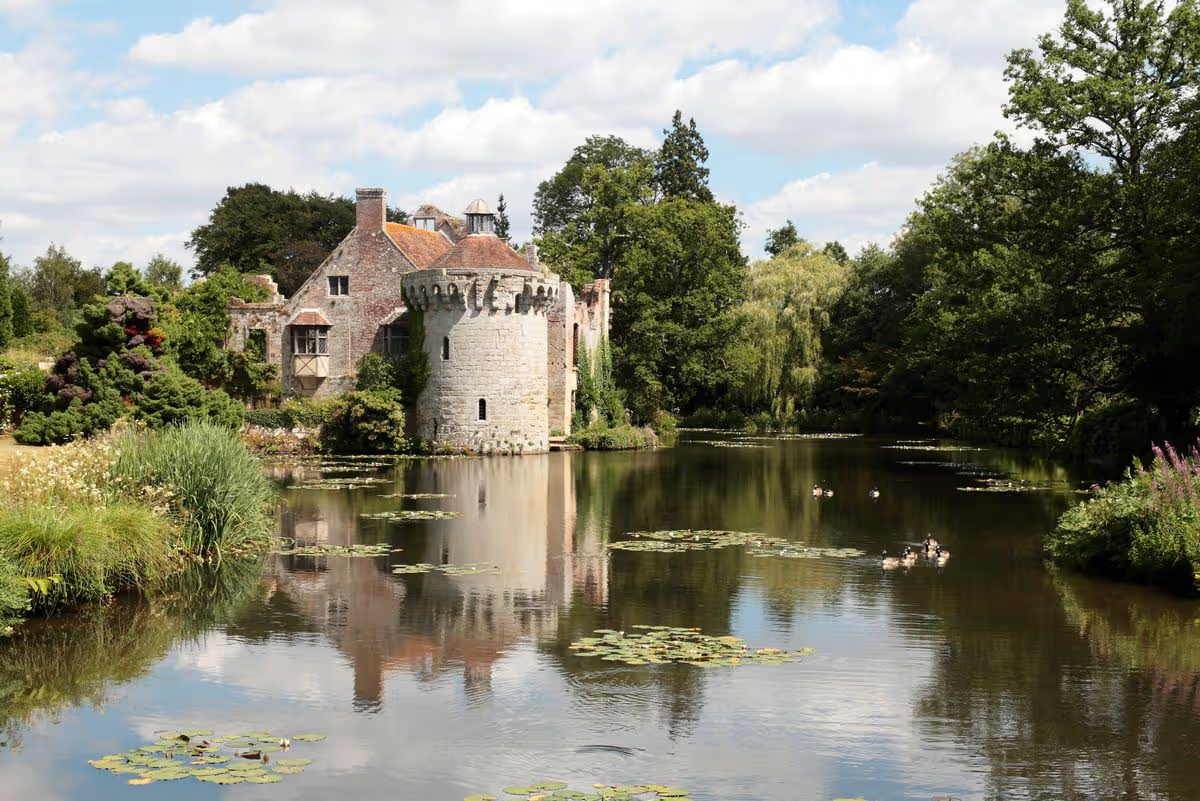
Embark on the most magical adventure of your life by visiting this fairytale castle – just 45 minutes away from London. If you fancy a trip outside of the city today, this location is a must for your bucket list.
It boasts breathtaking views, hidden pathways and is perfect for Bridgerton fans as it gives you that feel once you’re there. Whether you fancy a peaceful walk or a romantic picnic, why don’t you add Scotney Castle, in Tunbridge Wells, Kent, to your list now? It’s open daily from 10am all the way through to 5pm, which is ideal now that we’re blessed with more sunshine in the day.
One woman, who shares travel and lifestyle content on TikTok, recently paid a visit to the castle which has been dubbed the “most fairytale in the UK”.
In the video, she said: “The most fairytale castle in the UK – 45 minutes train from London Bridge, Scotney Castle – Royal Tunbridge Wells.”
Sharing her trip, the content creator took a 45-minute train journey from London Bridge to Tunbridge Wells then a 20-minute taxi ride to the entrance as there were no buses on Sunday.
She gushed: “Once there, you’ll be rewarded with breathtaking views, hidden pathways and a true Bridgerton-meets-fairytale vibe. Perfect for a peaceful photo walk or romantic picnic.”
Content cannot be displayed without consent
How to get to Scotney Castle:
If you’re travelling from London will have to drive for about 1 hour and a half, around 52.7miles, depending on where you are.
Otherwise some parts of the capital could take you about an hour. You will have to book as it’s likely the car park might be full which means you won’t be able to leave your vehicle on site.
As for trains, they frequently run from London Bridge to Tunbridge Wells which could cost around £20.
Alternatively, you can take a 50-55 minute train journey to Wadhurst, then a 15-minute taxi journey to Scotney Castle.
Wadhurst is the nearest station to the attraction, where it’s 7 miles, although Tunbridge Wells is also nearby (9 miles).
What to do at Scotney Castle:
The National Trust property offers a 14th-century moated castle ruin, a Victorian country mansion, and 770 acres of woodland and parkland.
You can explore the romantic gardens, check out the 1950s-style mansion, walk the estate trails, and visit the tea room.
There are also family activities available, like a “Summer of Play” area in the meadow with various activity zones which typically run through August.
The best time to visit is spring for blooming flowers, alternatively there are vibrant colours in autumn.
Tickets are approximately £22 per adult, £11 per child with gift aid and £4.50 for parking.
National Trust members can enjoy free entry and parking.
The picturesque village, with its postcard-worthy mountain views, rolling hills, and charming houses, may seem like a dream, but anyone hoping to land the cash incentive should be aware of a major catch
Ben was clearly impressed after making his way to the village by car(Image: Ben Morris/YouTube)
A travel vlogger who visited a picturesque European village offering people £24,000 to relocate there has highlighted a significant drawback. Ben Morris travelled to the Swiss Alps to explore a location faced with declining population numbers, which has introduced a financial incentive for anyone willing to make the village their permanent home.
Tucked away in southwestern Switzerland in the canton of Valais, the picture-perfect village of Albinen appears straight out of a postcard, boasting breathtaking mountain vistas, undulating hills, and quaint houses set against a lush green backdrop.
With a reported population of just 262 residents, Albinen’s inhabitants voted to enact a residency scheme offering CHF 25,000 (approximately £24,000 at the time of writing) to those prepared to relocate to the mountains, the BBC reports.
Ben was evidently impressed during his journey to the village by car, describing the scenery as “incredible” whilst driving in. Upon his arrival, he observed the village was “dead silent”, but as he wandered the narrow lanes and soaked up the panoramic views, he was blown away.
In the video, shared on his eponymous YouTube channel, he said: “I actually wasn’t going to come to this town. I just felt so tired and miserable this morning. But just being able to sit here right now and take in this view. It’s worth this alone.”
It appeared baffling that somewhere so stunning would need to provide financial incentives, but he subsequently highlighted the snag: relocating to Albinen comes with a set of requirements that must be adhered to.
He said: “I know what you’re all thinking. This village seems amazing. How do you sign up to receive your money? There is, unfortunately, a few requirements. That’s what makes it slightly less appealing.”
Ben continued: “Here are the requirements for moving to Albinen and getting your money. It’s 25,000 Swiss francs, which is actually a lot more than $25,000.
“You need to purchase, build, or substantially renovate a primary home in Albinen with a minimum value of 200,000 Swiss francs. This home has to be a main residence. It can’t be a holiday home. This one is pretty crazy as well.
“You have to commit to living in the village for at least 10 years. This one’s probably going to let down the majority of you guys watching. You must either be a Swiss citizen or hold a Swiss C permit for permanent residence.”
A seemingly deflated Ben added that once you learn these details, you realise it’s “not as attractive” as it first seemed. According to House Beautiful, you will also need to be under 45.
It explained that these stipulations, as outlined in the 2023 housing regulations, aim to “promote the retention and permanent residence of young people and families in the municipality of Albinen”.
Its historic cathedral, central attractions and pedestrian-friendly streets make it perfect for a UK staycation, especially now that it’s starting to warm up.
Nicola Roy Multimedia content creator and Esther Marshall
03:00, 22 Mar 2026
The city is very easy to walk around (Image: Teamjackson via Getty Images)
Spring has almost sprung, and now that the weather is getting slightly better here in the UK, there are more chances to get out and explore and enjoy the sun. You can’t beat a day or weekend trip somewhere new, and if you haven’t visited York before, consider this your sign to go this spring.
The stunning historic city earned the title of the UK’s most walkable city in 2023, according to LateRooms. Since then, it’s still considered one of the most pedestrian-friendly places in Britain, reports the Express.
There’s so much to do and see in York, from quaint cobbled streets lined with independent shops and eateries to a rich historical scene and plenty of green spaces too.
Among York’s highest-rated attractions is York Minster, which was previously crowned England’s most beautiful building.
One visitor wrote on Tripadvisor: “Tremendous place to visit and to marvel at what humans can achieve. You could spend a lifetime here and still find new pieces of craftsmanship.”
Visitors can also see one of the UK’s finest pieces of Royal history at the remarkable British landmark. York Minster houses one of the UK’s only statues of Queen Elizabeth II, which was installed to commemorate the Platinum Jubilee.
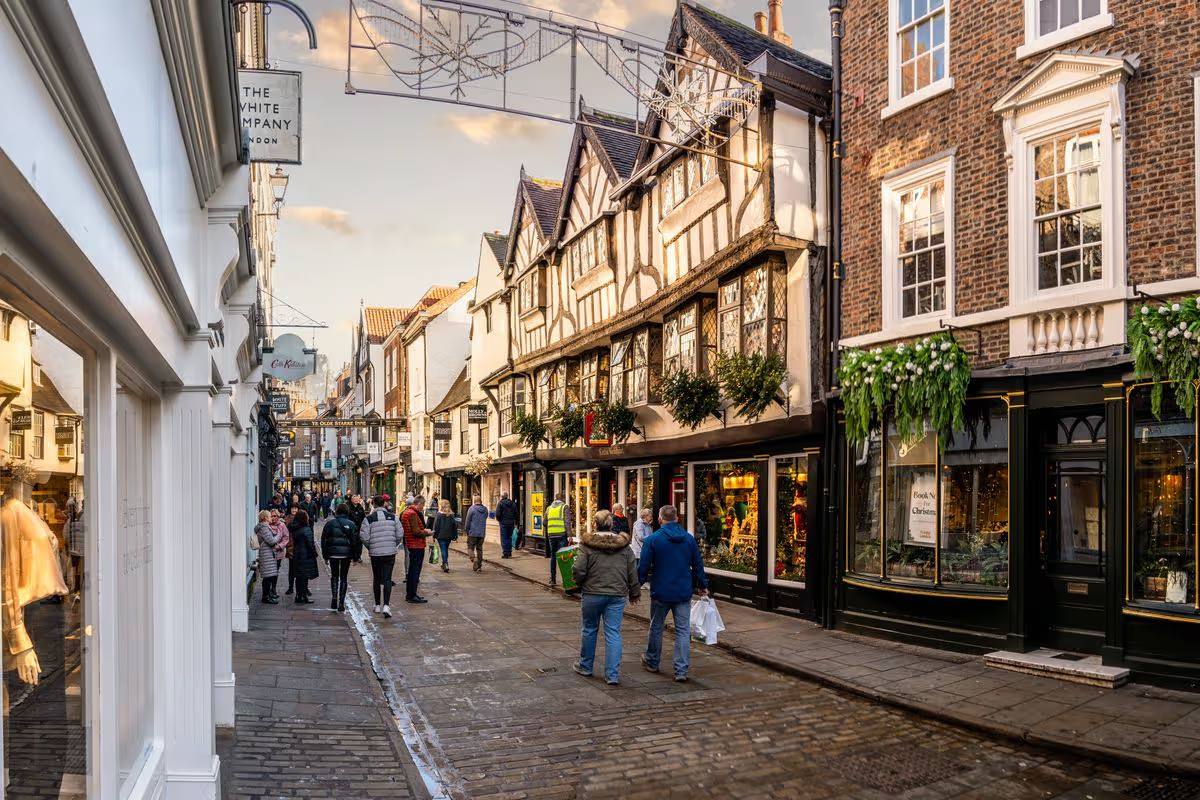
Also in York, you’ll find the Shambles – a medieval preserved street lined with timber-framed buildings and shops that feels like being frozen in time.
If you’re keen to spend some time in nature, Rowntree Park is a must-visit. With play parks for kids, tennis courts, skate parks and a gorgeous lake, it’s the perfect place to relax and soak up the sun this spring.
Taking to Tripadvisor, one fan wrote: “A beautiful well kept Victorian park with lots to do and see. Children’s areas, flower beds, arboretums, statues, and ponds. Lots of local wildlife. Excellent for a picnic.
“Cafe and toilets, all just a stone throw from York city centre and the racecourse. Well worth a visit.”
Brighton secured the second position on the list of walkable cities. Visitors can wander the seaside city’s Lanes before heading for an invigorating stroll along the promenade. Following a lengthy walk, there’s nothing better than a fish and chip supper on the beach with stunning sea views.
Bath claimed third spot on the list and is renowned for its remarkable Roman history and ancient baths. While tourists can’t bathe in the Roman baths, they will be able to unwind at the city’s spa instead.
Bristol was the greenest city on the list whilst London boasted some of the most city-centre attractions. Brighton, Inverness and Cambridge had the lowest levels of air pollution of any of the cities in the rankings.
Matt Fox, CEO and co-founder of LateRooms.com, said: “UK city breaks are as popular as ever and with spring around the corner, impromptu weekends away offer a great way to see and experience somewhere new.
“Getting to see all of the best sights somewhere has to offer in a short space of time can be hard work, but doing it on foot guarantees you’ll see so much more and stay active in the process too.
“All of Britain’s varied and historic cities offer something different and you can pack so much in without needing to set foot in a vehicle in almost all of them.”
Meanwhile Glasgow, Cardiff, Newcastle and Coventry were the least walkable cities in the top 20 rankings.
The Narvik Stockholm night train, officially known as Nattåg 94, connects the Swedish capital with Narvik in Norway, covering more than 1,500 kilometers each way
Inside the 18-hour night train to the Arctic Circle
From my bunk, I watched my wife ease herself from her bed onto the cabin floor before spinning on the spot to face the toilet door. The track lights of somewhere in the Midlands filtered and crept around the edge of the blind, providing enough illumination for her to find the handle and enter.
Unbeknownst to either of us, in stacking our bags inside the cubicle, we’d primed the above-toilet shower to soak my wife and our possessions with an unwanted blast of water the moment she squeezed in.
My half-waking dreams were cut short by her waterlogged wails as the reality of the Caledonian Sleeper quickly put to bed my night train delusions.
I recall this experience not to say the Sleeper, which connects London with the great cities and Highlands of Scotland, is a bad service. In fact, you’d be hard pressed to find a greater joy than looking out the window after a night’s kip on the northbound route to see snowcapped mountains and glistening lochs. Not just that, but it compares very favourably cost-wise to a flight and hotel, while being much less environmentally damaging.
But it is to say that returning to my pillow damp, in a bed far too close to a standard issue National Rail toilet (which the private cabins really don’t need) isn’t the classy, James Bond adjacent experience I’d been expecting. Nor was lifting the blind to a crowd of commuters on a Euston platform at 6am, staring back at my pyjamaed self.
So, two years on, it was with a similar sense of trepidation that my wife and I clambered aboard the SJ night train at Stockholm Central Station to take on one of Europe’s longest train journeys.
The Narvik Stockholm night train, officially known as Nattåg 94, connects the Swedish capital with Narvik in Norway, covering more than 1,500 kilometers each way. Departing from Stockholm Central Station in the evening, it takes about 18 hours to complete the trip.
Rather than tacking up the west along the coast of the Gulf of Bothnia, the train shoots straight up from Stockholm, trundling through some of Sweden’s 28 million hectares of forests, as well as flatlands and swamps.
The final stop on the line may be familiar to war history buffs. During WW2, the British Navy entered the Norwegian fjords through the ice-free, Gulf Stream-warmed port of Narvik in pursuit of Nazi ships. They launched a dramatic and comprehensive assault that would be Hitler’s first major strategic defeat of the war.
The reason the Allied and Axis powers threw resources at this far-flung patch of Lapland is iron ore. The northernmost Swedish city of Kiruna is home to the world’s largest underground iron ore mine, which now delivers 90% of all of Europe’s supply. Securing the ore and the trainline that has been delivering it to Narvik since 1902 was crucial for powering both sides’ war machines.
In March, 124 years after the route first opened, I hopped aboard the sleeper to Kiruna – two hours shy of the final stop, but well into the Arctic Circle.
It was, in a word, fantastic.
Upon entering my second-class private cabin, I was worried it’d be a little cramped for my wife and me. However, unlike the Caledonian Sleeper, which has two unmovable beds, the SJ’s three bunks can be flipped back into the wall. When you’re not kipping, the middle can be folded away, making way for a hidden backrest below and turning the bottom bunk into a comfy sofa.
My wife and I lounged in this set-up for the majority of our trip, reading our books and watching the Swedish countryside trundle on by, including the amusingly named town Bastuträsk (sauna swamp).
I would not be as bold as to argue that the Swedish landscape is as beautiful as the Highlands. Its lakes may be bigger and its mountains significantly higher, but there are few places as moving as Rannoch Moor or as stunning as the peak of Mam Ratagan Pass.
But equally, Sweden is no slouch in the beauty stakes, and it’s surprisingly varied. In riding up two-thirds of the country, you’ll see glistening blue lakes turn to great frozen expanses; the four mighty, free-flowing national rivers Torne, Kalix, Pite, and Vindel; more ancient forest than almost anywhere else in Europe; and finally the Kölen mountain range.
The train is certainly not new, but it has a solid, vintage feel that contrasts with some of the slightly flimsy modern trains I’ve ridden on. There was something unusually soothing about the reassuring clunk of the door and the Scandi-design approved clothes hooks. The addition of a Bakelite radio alarm clock above each bed was the cherry on the 70s cake.
Unlike in the Sleeper, where we’d stacked our bags in the bathroom due to a lack of cabin space, two storage racks just below the ceiling kept the gangway clear and the room spacious-feeling.
A similar design divergence came with the toilet. The Caledonian Sleeper’s en-suite option sounds luxurious, but in reality, it’s an unwanted, even unpleasant feature. The shower room doubles as a lavatory, with a heavy, workmanlike lid covering the toilet and serving as a place to perch beneath the stream. There was something a little alarming about sleeping so close to a mechanical, seemingly suction-powered WC, and claggy about steam and shower drizzle drifting into the bedroom.
On the SJ, the idea of an ensuite is abandoned. Instead, the cabins have a mechanical shower keycard, which can be used to open the shower at the end carriage. They have a changing area, a stack of thick, fresh towels, impressive water pressure, and even a hairdryer.
After a surprisingly good night’s sleep and a spruce up in the best on-the-move bathroom I’ve ever experienced, I was feeling fresh and ready to check out the buffet car.
The carriage is divided into four seating areas around solid tables, with windows along the length of the carriage. This, and the ‘påtår’ bottomless tea or coffee system in play, meant there was little else to do but sit back, relax and watch the Arctic slip by.
Book it
The starting price of the SJ night train from Stockholm to Kiruna is 1,125 SEK (£90) for a couchette and 1,695 SEK (£136) for a 2nd class sleep carriage.
This seaside town has been named the best in the country and has a resort pedigree that stretches back well over 150 years, but it also has plenty of modern day challenges
This article contains affiliate links, we will receive a commission on any sales we generate from it. Learn more
Blackpool in winter: grey skies, bright spirit
Everyone has a story to tell about Blackpool. Usually a bad one.
Whether it’s tales of optimistic family holidays that turned into washouts, hotels mysteriously burning down, or stag-dos that bump into far-right protests, it’s the kind of place that people enjoy dunking on.
“What’s going on around here?” I asked the bartender of one town centre pub on my first evening in town.
“F*** all!” he said joyfully, before handing over my £3 pint.
In one, quite literal way, he was onto something. Blackpool has a big problem with emptiness. Specifically, empty shops. Wander five minutes down the road from the Tower, and there are rows of crumbling units with boarded-up windows, clearly long vacated. Others seem occupied but shuttered against the winter winds and lack tourists. It’s a jarring experience, walking from the flashing lights and boinging sounds of the mega-arcades into a deserted lot piled with rubble.
The statistics don’t make for good reading. The town of 144,000 has the third-highest rate of empty shops in the country, according to the Centre for Cities, with 17.6% closed. In some areas, like Central Drive, the figure is 30%. Blackpool also has the second-most abandoned buildings, with one for every 45 people.
Some, such as the £7.6m easyJet Hotel on the prom that never materialised, or the vast, long-empty Odeon, are particularly annoying for residents. And for the newly elected Labour MP for Blackpool North, Chris Webb, who beat Tory Scott Benton partly by promising to tackle the problem.
“I am greatly concerned about it. There are far too many empty properties in the town,” he told the Mirror.
“Once you go past South Pier, you get to Bloomfield. It is the most deprived place in the county. The boarded-up shops there have an impact on whether people travel further out to great places like Waterlow Road and Bond Street.”
While a lot needs to be done, progress is being made. When I visited, builders were hammering away inside the Odeon building, which was adorned with a ‘Coming Soon – June 2026’ banner promising a family entertainment megaplex. An ‘Empty Properties Task Force’ was launched last month to target landlords of long-term vacant properties with Compulsory Purchase Orders, while cash is being splashed on modern retail units and green spaces in Central Drive. Under the new ‘High Street Rental Auctions’ initiative, the council can now sell off five-year leases for shops that have remained empty for over a year, which should help to inject a bit of life into the harder-hit areas.
As much as a lick of paint and Pride of Place funding won’t fix all of Blackpool’s deeply rooted deprivation issues or significantly lower its crime rate, it could help to bring the two versions of the town closer together.
In the summer, Blackpool is the same buzzing pleasure resort that has been enthralling millions of beach-dwelling, rock-chomping Brits since the Victorian age.
In the winter, however, it is a different story.
As soon as I stepped off the train on a dark February afternoon, a frosty gust of wind doused me in the famous North West precipitation. Somehow, I’d arrived in the only part of the country that wasn’t enjoying the first sunny shoots of Spring.
The combination of crumbling properties and miserable weather creates a stark vibe, utterly different from the sandcastle-and-donkey-rich summer months.
“It’s dead quiet out,” the Holiday Inn hotel receptionist remarked as we watched a few hunched raincoated figures push through the wind. For a town that relies on tourism to bring in £2 billion a year and support 30% of its jobs, becoming a relative winter wasteland is a big problem. And one that Blackpool might finally be answering.
Trainline data show that Blackpool is at the beginning of an off-season popularity boom.
Sajjad Motamed, the firm’s UK country manager, explained: “We’ve seen winter rail trips to Blackpool rise by more than 90% compared to last year, with particularly strong demand for weekend breaks. What’s striking is that the growth isn’t just coming from the North West – we’re seeing demand from right across the UK, for example, bookings from Edinburgh have more than tripled year-on-year. It suggests people nationwide are rediscovering classic seaside destinations outside of the traditional summer season, whether for a short getaway or to explore somewhere they may not have previously considered.”
Although the particular Thursday afternoon I’d turned up on was grim to the point that everyone sensible decided to stay inside, the spike in train bookings to a town recently named the country’s best by the Telegraph is borne out by official council figures. In 2023, Blackpool welcomed a record 21.5million visitors, a 5.3% rise in just a year. There are high hopes that 2024 and 2025 will increase the numbers further, once the stats are in.
So why are people coming in the winter?
One reason is cost. Blackpool was recently crowned the UK’s cheapest seaside resort, thanks to delights such as £1 burgers at Higgitt’s Las Vegas Arcade, £3.90 fish and chips at Bentley’s on Bond Street, and £6 breakfasts at Peekaboos. Come winter, room rates are slashed as hotels fight to fill the thousands of rooms in a town with the third cheapest property prices in England and Wales, according to Land Registry data.
Another is the growing selection of off-season activities.
I dropped into the 2024 opened Showtown Museum, which tells the story of Blackpool’s entertainment history through highly interactive exhibits and tapdancing staff members. Until April, a fascinating exhibition is telling the story of little people in the entertainment industry. It is difficult to imagine today, but the Blackpool Tower’s skygardens were once converted into a miniature village “populated” by little people.
Now visitors to the town can stop off at Showtown before heading up the Tower and down into the dungeons on the same Blackpool BIG Ticket that delivers 50% savings and costs £31
Throughout the year, there are plenty of free exhibitions on show at the listed Central Library, home to the Grundy Art Gallery.
After soaking up a bit of culture, you can head to the town’s iconic, year-round Coral Island. I’d bet a tub of 2ps that there is no bigger, more impressive or absurd arcade in the country. Stretching across a good number of football pitches’ worth of lurid carpeting, Coral Island is packed with one-armed bandits, coin droppers, the latest VR tech, and an indoor rollercoaster that wheels over the heads of the gamblers below.
Who cares if the Pleasure Beach is shut for the winter when you’ve got that?
As much as Mr Webb insists the town’s “reputation for stag and hen dos is greatly diminished”, it’s hard to argue that Blackpool isn’t a booze town. Whatever the season, across its 166 bars and pubs, you’ll find dozens of drinks deals cheap enough to make any Up From Londoner swoon. For a quiet but affordable pint, the Churchill is a good bet. For something a bit more late-night and rowdy, the Galleon delivers live music and a great atmosphere most nights.
For Mr Webb, the “missing piece” to the winter tourism slump puzzle would be an all-purpose indoor arena, designed for expos and eSports. Its arrival is uncertain and some way off yet, but talks with the owners of a Premier League football club are promising, the MP says.
This seems like a natural step for a town with a deep-rooted entertainment pedigree. From Strictly to George Formby, people have long come to Blackpool for a show. When I visited, Derren Brown was at the Grand as part of his Only Human tour. At the start of the performance, he uncorked several big cannisters of laughing gas into the auditorium to lull the crowd into a pliable state before having his mystifying, merry way with us.
Whether the gas was real or not, what wasn’t fake was the uproarious laughter of the audience throughout his two-hour set. Lancastrians are a friendly bunch. Whether it’s the charming staff in Stefani’s Pizza joint, a smily mum who stopped her pram for an impromptu chat, or the jovial reaction of an audience member publicly outed as a thief by Brown, there’s a good chance Blackpool will offer you a warm welcome, however miserable the weather.
In search of the perfect reset, Deputy Editor Ellie O’Mahoney and Art Director Laura Cunningham both tried different adults-only retreats.
The spiritual getaway with Kim Kardashian’s psychic in St Lucia proved magical for Ellie, while Ibiza offered the perfect couple time for Laura and her husband.
Sign up for the Travel newsletter
Thank you!
LUCIA SELF
St Lucia is a Caribbean island paradiseCredit: Alan CopsonDine with your feet in the sand at Malabar Beach ClubCredit: Mikael Lamber
FLYING into the Caribbean island paradise of St Lucia, I can see why it’s been chosen as the destination for a psychic retreat.
The mystical double mountains of the Pitons loom out of the mist, and I wonder what I’m going to discover about myself.
I’ve signed up to a four-day Spiritual Awakening retreat at adults-only, all-inclusive resort StolenTime, a sister property to St Lucia’s famous wellness resort, the BodyHoliday.
Set on the island’s longest white-sand beach, on its north-west coast and within seven acres of beautiful tropical gardens, StolenTime has 100 guest rooms and my veranda suite offers the most unreal view over the palm trees.
The bed is absolutely gigantic and one of the comfiest I’ve ever tried, plus there’s a super-spacious bathtub, too.
As I sit on the love seat on the huge veranda, I gaze at the sky-blue sea while tropical birds chirrup, and it strikes me that this is my idea of total heaven.
READING THE ROOM
After waking early and making the most of my jet lag by heading straight to the beach to jump into the bath-warm sea, it’s time for the group’s first session.
The retreat is run by Jayne Wallace, one of the UK’s leading psychics, who has performed readings for both Kim Kardashian and Kylie Jenner, at home, no less.
Workshops include aura drawings and how to connect with crystalsCredit: francescoridolfi.comHead to the beach to jump into the bath-warm sea
She’s far from your stereotypical woo-woo type – 6ft tall with a Cockney London accent, she’s straight-talking, and our group of six are all champing at the bit for a personal reading from her.
But first up is a workshop on flower psychometry, AKA flower readings. We each pick a flower and give it to a partner, who then has to describe what the bloom tells us about the picker.
It’s obviously not the most scientific process, but after a stressful few months, it is incredibly restorative staring at petals and trying to find out more about my fellow travellers.
Other workshops include aura drawings, how to connect with crystals and, my favourite, moon manifestation, which involves writing down our heart’s desires, then lighting bits of paper and sending them skywards in lanterns.
We cackle as the lanterns don’t quite do what we want them to. I’m pleased to say, my personal reading with Jayne was worth the wait in the end.
And while I’m not going to divulge all the juicy details, there were a few things she got spot-on, including how wonderful my daughter is! Her readings also really seemed to comfort other members of the group.
JURASSIC JAUNTS
When we’re not tuning into our psychic selves, the hotel offers everything for the stressed-out soul – from yoga and Pilates to water-skiing, pickleball and archery.
There are two swimming pools and a lazy river, and each morning I head to the beach to grab fresh coconut water straight from the source, before digging into pastries, freshly made omelettes and delicious papaya at the buffet breakfast.
There are two swimming pools and a lazy riverCredit: Supplied by hotel PRThe bed was absolutely giganticCredit: ALEX LUKEY
Come dinner, I dine with my feet in the sand at Malabar Beach Club and feast on treats like jerk pork rillettes with prunes and pancetta, and chips, of course!
Puds include roasted cashew nut tart with amaretto and beetroot ice cream, which sounds odd, but is divine.
On the last day, we take a four-hour boat trip, £56 per person, to spy the Pitons – think Jurassic Park views – and snorkel in coves. I gasp as I see a squid swim among the coral and coloured shoals of fish.
Later, we head to StolenTime’s champagne bar for a final toast. As I sit on a swing chair suspended from a 150-year-old samaan tree, its huge branches adorned with fairy lights, it feels as if I’ve found magic.
MORE THAN ALL WHITE
As the sky turns golden, we paddle into an atmospheric coastal cave, and I can’t help but mouth “wow” to my husband Barney, before promptly toppling off my paddleboard and splashing into the warm waters of the Med.
We’re on a two-hour guided sunset tour from our dreamy digs, the adults-only retreat of Cala San Miguel in northern Ibiza.
Cala San Miguel in northern IbizaCredit: SuppliedThe resort offers a host of complimentary wellbeing activitiesCredit: Supplied
Just hours in, we’re already feeling more zen than we have in months – as two exhausted parents of three children under 10, we’re enjoying some much-needed couple time here.
The resort offers a host of complimentary wellbeing activities, including painting, guided hikes and mornings of yoga and sound healing.
Succumbing to the sound of gentle bongs and rain sticks make for the perfect start to any day.
The decor is all soft linens and natural wood tones, and a short stroll through lush gardens brings us to the private sandy beach – we spend our days flitting between here, the three pools and the seven eateries.
For lunch, poolside bar Calido serves up Asian-fusion dishes, such as crispy prawns with kimchi sauce, £16.
By night, its terrace transforms into La Savina, with succulent roasted poussin, £28, that we pair with sangria, £14 a glass.
The decor is all soft linens and natural wood tonesCredit: Supplied
But high above the bay sits Italian restaurant Da’mar, which wins for its stunning views and its gorgeously garlicky fettuccine puttanesca, £21.
Our favourite afternoons are spent at the Beach House right on the sand, tucking into fried squid, £21, creamy omelette with the freshest of red prawns, £19.50, and huge cuttlefish paella served straight from the pan, £28.
On our last evening, as we sink into a massive bean bag for a movie night under the stars, there’s the bonus soundtrack of waves lapping the shore, and we’re already planning our return.
B&B stays at Cala San Miguel Ibiza Resort cost from £193 per night (Calasanmiguelresort.com).
FYI
All-inclusive stays at StolenTime cost from £430 per night. The next Psychic Sisters StolenTime retreat is planned for August 2026 (Stolentime.com/psychicsisters).