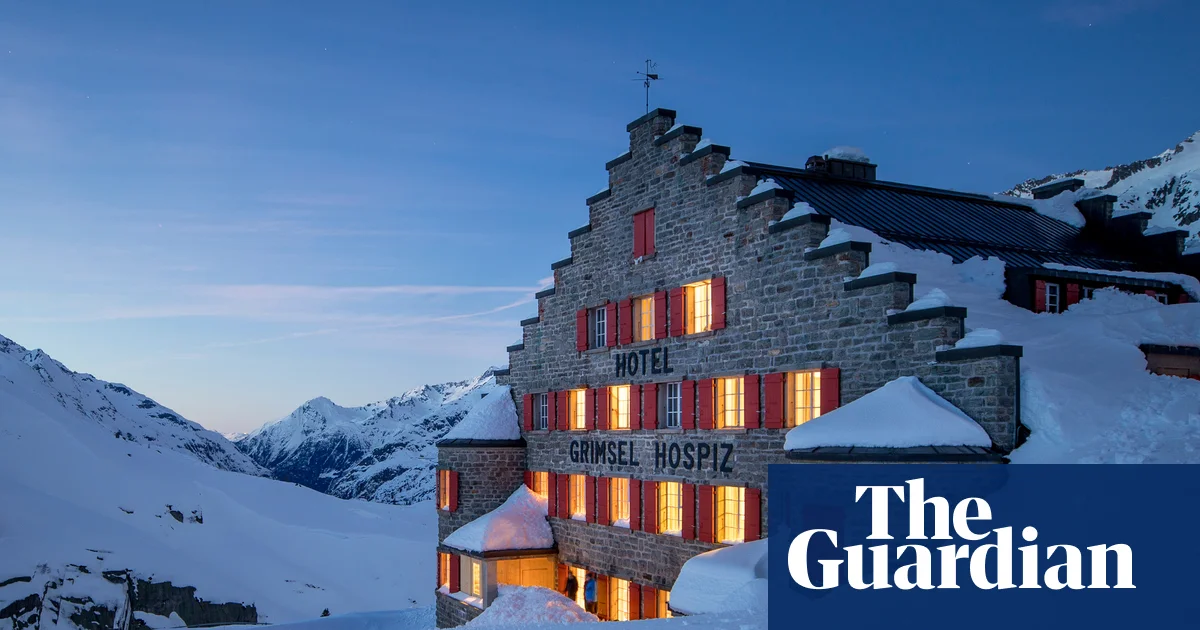
Near the top of the Grimsel Pass in Switzerland’s Bernese Oberland, a small crowd had gathered to take photographs. We were surrounded by bulky mountains and rippling glaciers, but all eyes were focused on a silvery granite chalet with apple-red shutters, its foundations deep in snow.
It was early February and, one after another, we posed in front of it as if standing beside a celebrity. Which in a way we were, because the proud building was the Grimsel Hospiz, the country’s oldest recorded mountain inn and a place that predates Westminster Abbey.
First documented in 1142 and originally built as a simple hostel – either by the Order of Saint Lazarus or the Augustinian monastery of Interlaken, no one is quite sure – today’s much-modernised Grimsel Hospiz is marooned on a spur of sheer rock and snow at 2,000 metres (6,562 ft). Over the centuries it has been inhabited by monks, used by shepherds, needy travellers and soldiers, ravaged by fire and buried by an avalanche. The mountains reach up, but it is surrounded on three sides by plunging ravines and the frozen Grimselsee, which thaws to turquoise ice floes in spring. The scenery is stupendous.
Grimselsee reservoir and Spitallamm Dam, with Grimsel Hospiz above, in autumn. Photograph: David Birri
My visit began on a PostBus, the yellow stagecoaches that reach the parts of Switzerland that the railways can’t. I was south-east of the village of Meiringen, having taken a train to Innertkirchen Kraftwerk, a station built 100 years ago to service the hydroelectric power plants hidden deep in the mountains. The towering stone pines, the tumbling cliffs, the dripping snow, the sky only peeking through – it might have been the landscape of JRR Tolkien’s Middle-earth.
As the bus worked its way higher up the Aare Gorge, we saw that the road ahead was closed for winter. Instead, we were dropped at a high-security shutter leading to an underground hydropower station operated by Kraftwerke Oberhasli AG. The renewable energy plant opens for public tours and, moments later, a minibus appeared from behind the steel door to take us deeper into the mountains. We hopped on board.
A road blasted into the granite, dark and narrow, then crept through a maze of tunnels, ending four miles (6.4km) later at a tiny cable car station that opened to daylight. We looked up at the Grimselsee reservoir and Spitallamm Dam, a 113 metre-tall arch of stone above which we were soon to soar. For a century, the high-altitude lake has stored glacier meltwater to generate green electricity. Now, for visitors like me, it forms part of Grimselwelt, a Swiss Alpine tourist region, serving as a backdrop to a great tract of lonely winter wilderness.
The Grimsel Hospiz in 1950: Photograph: Fox Photos/Getty Images
The picture of the Grimsel Hospiz developed as we rose on the cable car, like a photo going from faded to sharp. The uninhabited valleys beyond led to the Unteraargletscher, an eight-mile leviathan of ice and the Alps’ fifth-largest glacier. From the cable car, I made out a group of horned ibex as they clambered with ease over the col.
It was the Celts, then Romans, who first used the Grimsel Pass, but it has been an important locus in Alpine culture for centuries: a trade route between Berne and Upper Valais in the middle ages, a strategic camp for raids and war campaigns between Swiss, French, German and Austrian armies, a setting for pioneering glacier research. All these aspects combine in a single story at the Grimsel Hospiz.
What lends the mountain inn so much credibility today is its environmental outlook. Located within the Unesco World Heritage Swiss Alps Jungfrau-Aletsch region, the 28-room hotel is in the midst of a critical wildlife habitat, meaning all winter sports are banned. Ski gear is prohibited by the hotel’s management and it cannot be transported on the cable car. The Alps have always been the preserve of travellers keen on activities that take serious effort, but here is an antidote to every other winter destination, a rare meditative place where doing nothing is the only thing to do.
The only activity on offer is snowshoeing and even that is restricted to a 500-metre loop around the inn’s tower-like granite porches and wooden and copper-roofed chapel. It might be “the shortest winter trail in Switzerland”, as manager Markus Meier put it, but it still took me an hour as I kept stopping to take photos.
‘A fantasy of a mountain inn.’ A cosy lounge at the Grimsel Hospiz.
Inside is a fantasy mountain inn, the result of sensitive restorations: a huge wooden door creaks open and you step into corridors leading to cosy double rooms, intimate lounges, fireplaces and a restaurant where dinner is accompanied by one of 250 bottles from one of Europe’s highest-altitude wine cellars. Back in 1932, the guesthouse caused a sensation as the continent’s first electrically heated hotel. Now, the building is sustainably powered by clean energy and waste heat from the hydroelectric plant below.
As evening fell, it was time for the inn’s only other activity: staring at the flaring sunset and night sky from its outdoor wooden barrel sauna and hot tub. The air was bracingly cold, the constellations appeared and it was just me, the burbling water and the mountains stretching away into darkness. Forget any thoughts of Alpine heroes such as George Mallory or Edward Whymper. That night, down to my cossie in -10C (14F), tiptoeing across the snow in a pair of felt slippers and dwarfed by mountains, I was the bravest man in the Alps.
‘The bravest man in the Alps’ … Mike MacEacheran soaking in the outdoor hot tub
At nearly 2,000 metres, dinner is another event. The four-course menu produced by Slovakian chef Roman Crkon is hardly the stuff of traditional refuges. I’ve had my share of mountain meals, but I’ve never had veal sweetbreads, scallops, chicken with truffle cream and a cheese board at high altitude. In 1544, a local chronicler wrote that the Grimsel Hospiz was all about “good wine, brought by pack animals across the mountains”. Looking at the card games and excessive drinking around me, little had changed.
Later, just before bed, I slipped outside to gaze again at the stars. It was pine needle-drop quiet. Though I was separated from some of Switzerland’s most popular resort towns by only a few miles as the eagle flies, I felt engulfed by the Alps in their entirety. Tomorrow, another day with nothing to do beyond the confines of the inn awaited. But in a landscape like this, I was thrilled to have fallen off the map, out of time, into winter’s grasp.
The trip was provided by Jungfrau Regionand Historic Alpine Hotel Grimsel Hospiz (Wednesday to Sunday only; grimselwelt.ch). Rooms from £165pp a night, including breakfast, afternoon tea, hot tub and wooden barrel sauna. A four-course dinner costs £85. Return bus, tunnel and cable car transfers cost £70
THE top 50 cities to visit in 2026 have been revealed, and the UK hasn’t done too badly.
Time Out has teamed up with Intrepid for its annual Best Cities of 2026, speaking to 24,000 people living in cities around the world.
Sign up for the Travel newsletter
Thank you!
Time Out’s annual Top Cities study has named Melbourne as the best in the worldCredit: AlamyLondon squeezed into the top five best citiesCredit: Alamy
A panel of 100 Time Out city experts were also asked about the most exciting cities in the world, looking at data from 44 different criteria.
This includes food and drink, green spaces, culture, sense of community and Gen Z appeal.
While Melbourne came out on top, Edinburgh came in third, followed by London in fourth.
Edinburgh was praised for its famous Fringe Festival, as well as its “cherry-blossom-lined parks, cobbled alleyways and distinctive neighbourhoods that offer hours of exploration”.
It was also one of the happiest cities in the survey, with it highly rated for both food and green spaces.
When it comes to London, its the new attractions that were praised such as the Museum of London in Smithfield.
And 99 per cent of Londoners praised its art and culture.
Bath snuck into the full top 50 at number 26, praised for its new hotels, good community feel and the celebration of 20 years of the Thermae Bath Spa.
Time Out Travel Editor Grace Beard said: “Every year, we survey locals in cities all over the planet to create our definitive annual ranking.
“Now in its tenth anniversary year. Time Out’s Best Cities with Intrepid Travel is not only a global snapshot of city living, but a celebration of the fun, culture and community that defines urban life.
“For 2026, we expanded our survey to reach 150 cities and added questions that dig deeper into the everyday lives of locals, including new categories for love, romance and community feel.
“The result is a truly diverse and exciting list of destinations, deeply informed by local insight and Time Out expertise, with smaller and second cities slotted between the world’s major metropolises.”
Outside of the UK, the highest rated city in mainland Europe was Zurich, coming in 11th place.
This was followed by Copenhagen (13), Krakow (16) and Porto (17).
Zurich was the highest rated city in mainland EuropeCredit: AlamyThe best Spanish city was Madrid, in 19th placeCredit: Alamy
Top 50 Best Cities in the World, according to Time Out
Melbourne, Australia
Shanghai, China
Edinburgh, United Kingdom
London, United Kingdom
New York, United States
Cape Town, South Africa
Mexico City, Mexico
Bangkok, Thailand
Seoul, South Korea
Tokyo, Japan
Zurich, Switzerland
Rio de Janeiro, Brazil
Copenhagen, Denmark
Sao Paolo, Brazil
Hong Kong, Hong Kong
Krakow, Poland
Porto, Portugal
Guadalajara, Mexico
Madrid, Spain
Valencia, Spain
Sydney, Australia
Paris, France
Singapore, Singapore
Marrakesh, Morocco
Hanoi, Vietnam
Bath, United Kingdom
Bilbao, Spain
Berlin, Germany
Adelaide, Australia
Beijing, China
Antwerp, Brussels
Chiang Mai, Thailand
Naples, Italy
Amsterdam, Netherlands
Medellin, Colombia
Lima, Peru
Vancouver, Canada
Ho Chi Minh City, Vietnam
Osaka, Japan
Athens, Greece
Chicago, United States
Cairo, Egypt
Buenos Aires, Argentina
Vienna, Austria
Dublin, Ireland
San Francisco, United States
Lagos, Nigeria
Auckland, New Zealand
Lisbon, Portugal
Bogota, Colombia
The Spanish cities of Madrid and Valencia snuck into the top in 19th and 20th, respectively.
For long-haul destinations, New York, Bangkok and Tokyo all made the top 10.
Shanghai was praised for being easier to travel to this year, following the scrapping of visas until the end of 2026, while Seoul was one of the most popular with Time Out staff.
Sitting in a glacial valley surrounded by vast farmland is an area that offers tranquillity and a true sense of England’s countryside with historic villages and walking trails
It’s a paradise for walkers and cyclists (Image: Philip Silverman via Getty Images)
For those seeking a sense of peace and tranquillity, this glacial valley, encircled by expansive farmland, delivers precisely that – an authentic taste of England’s rural heartland.
Littondale is a small and peaceful dale in Yorkshire, nestled in a classic u-shape, with deep historical roots and a flavour of country living from a bygone era.
Visitors to the dale experience a feeling that time has stood still, as its hamlets and way of life remain quintessentially English in every respect.
Indeed, archaeologists have discovered numerous prehistoric and later settlements that once inhabited the length of the valley. Their extensive findings also showed that throughout the mediaeval period the dale was predominantly managed by several monastic houses.
The dale now consists of several settlements, including Hawkswick, Arncliffe and Litton. Each is characterised by farmhouses dating back to the 17th century.
Save on the best holiday cottages in Yorkshire
This article contains affiliate links, we will receive a commission on any sales we generate from it. Learn more
Famous for its dramatic landscapes, historic cities, hearty food, and rich cultural heritage Yorkshire is just waiting to be explored. Sykes Cottages has a large number of properties to choose from with prices from £31 per night.
Contributing to its peaceful atmosphere is the stunning river which famously winds through the valley before eventually merging with the larger River Wharfe.
Shallow yet flowing with remarkably clear waters, the River Skirfare meanders through the farmlands and valley floor, vanishing for portions of the year.
As seasonal conditions shift, the stream trickles away and disappears beneath the ground, near Litton, revealing an unusual limestone landscape below.
Arncliffe
Arncliffe stands as one of the principal villages in the region, and despite its compact size, it boasts considerable fame. Recognised by countless households across Britain, it served as the original backdrop and filming location for the much-loved soap Emmerdale Farm.
The village pub, called the Falcon, was even featured as the Woolpack Inn. The traditional inn, according to visitor feedback, has seen better days.
However, one guest commented on TripAdvisor: “We had read about this tiny pub. It had been featured on the TV soap Emmerdale many moons ago, and it did not disappoint! The landlord was straight out of central casting.”
The area still comprises the most enchanting stone cottages, alongside a delightful church, the Church of St Oswald. Constructed sometime between the 16th and 18th centuries, the building remains a listed structure, believed to have been developed from an original Saxon place of worship.
Positioned at the centre of the village, the church continues to attract curious visitors and was once a location regularly visited by the renowned poet and novelist Charles Kingsley.
His time there during the Victorian period was believed to have influenced his celebrated children’s story, The Water Babies, penned in 1873.
Walking
Many people choose to treat the area as a base for rambling, parking in one of its villages and tackling the Yorkshire Dales terrain. Most of these trails are circular, returning you directly to your starting point, whilst exploring the valleys and peaks en route.
The Littondale to Kettlewell walk is a well-loved route, starting in the village of Arncliffe, leading you across the shoulder of Birks in Kettlewell, where you can pause for refreshments, before returning into Littondale.
Alternatively, some choose the slightly over five-mile walk that takes you from Arncliffe to Litton and loops back round.
The two-hour ramble provides a leisurely countryside stroll as you soak up the picturesque beauty of Yorkshire, with the chance to make a stop, or two, at the charming village pubs.
Located an hour from London, this National Trust village features half-timbered Tudor buildings and a grand castle with world treasures
06:00, 11 Mar 2026Updated 08:26, 11 Mar 2026
You’ll feel like a time traveller strolling its cobbled streets(Image: Tim Graham/Getty Images)
Venture just an hour from London to discover this fairytale village, transporting you backwards through time as its period buildings recreate a world from centuries past that has largely vanished today.
Chiddingstone stands as one of Britain’s finest preserved Tudor villages, making it an exceptional discovery for heritage enthusiasts and anyone seeking respite from life’s relentless pace.
The settlement is largely owned and maintained by the National Trust, helping safeguard its centuries-old structures and character which consistently attract inquisitive travellers.
This Kent village is cherished for its unmistakably English charm and period architecture, featuring half-timbered properties with stone-hung gables and red-tiled roofs. What’s more, it boasts an impressive castle and a bustling high street, perfect for leisurely wandering.
Best UK holiday cottage deals
This article contains affiliate links, we will receive a commission on any sales we generate from it. Learn more
Sykes Cottages offers a wide range of handpicked holiday homes across the UK and Ireland, from cosy countryside retreats to stunning coastal escapes. Prices start from £27 per night
The castle
Whilst the castle’s exterior presents stunning architecture, typical of what you’d anticipate seeing across England, its interior offers quite the juxtaposition.
What renders the structure so distinctive is its museum, which houses collections from across the globe spanning different eras and civilisations – Japanese, Egyptian, Stuart and Jacobite and Buddhist. Everything is accessible to visitors between March and October, allowing them to experience an entire world under one roof.
Beyond its impressive collections, the venue itself is steeped in history and magnificence, as guests explore the corridors of a 16th-century residence. Within, they can admire the Great Hall, discover a Victorian kitchen, library, and servant’s hall, and delve into its fascinating past in the Streatfeild room.
Henry Streatfeild was the figure who dramatically transformed the property during the 1800s, moving away from its Tudor design to mirror that of a mediaeval fortress.
Though, it was collector Denys Eyre Bower whose stewardship of the castle witnessed it evolve into a cultural landmark, sharing his passion with visitors worldwide.
One guest commented on TripAdvisor: “What a lovely property, from the massive holdings on display throughout the home to the acres of relaxing grounds. The reception gal was quite informative upon our arrival as to the layout for our self-guided tour as well as answering our questions post-tour. Don’t miss this gem.”
This year, guests can purchase a day ticket and enjoy complimentary returns for an entire year. Current door prices are £15.25 for an adult and £10.50 for a child, with reduced rates available for those who book online beforehand.
High street and village
With its genuine half-timber Tudor structures and cobbled walkways, wandering along the high street of Chiddingstone Road feels like stepping back through the centuries. Notable highlights include a café, shop and the 15th-century pub.
The historic Chiddingstone Stores and post office, which dates back to 1453, is situated within a traditional Tudor building and continues to function as such today.
Similarly unchanged is the village pub, known as the Castle Inn, boasting a welcoming atmosphere and superb beer garden.
It retains its Grade II*-listed status with numerous original features intact, including delightful fireplaces, tiled floors, oak panelling and bars. One visitor described their experience at the Castle Inn as ‘atmospheric’.
They commented: “If you’re looking for a traditional, friendly, country pub, this is it. Clean and friendly, with everything you need on your doorstep that goes with a village pub. Highly recommend.”
The village name, Chiddingstone, is believed to originate from the enormous sandstone located outside the settlement. Whilst unconfirmed, the ‘Chidding Stone’ is thought to mark where it all started, with several folklore tales surrounding its origins.
A lesser-known Spanish resort is shaping up to be one of the more affordable escapes, with £3 pints and £15 flights, combined with its allure of reliable sunshine and dramatic landscapes
This Spanish region offers a sun-soaked getaway with a cheaper price tag(Image: First Choice/2015 lunamarina/Shutterstock)
A beautiful Spanish region that enjoys a tropical climate is ‘cheaper than Costa del Sol’ with £3 pints and £15 flights, just three hours from the UK.
Costa del Sol is a popular tourist destination, with the city of Marbella attracting thousands of holidaymakers each year, yet it’s not always the cheapest. While there are more affordable areas to visit in Costa del Sol, there’s another beautiful resort in Spain while worth exploring, and it could save you almost £300.
Known as the ‘desert coast’, Costa de Almería offers almost year-round sunshine and is one of the driest climates on the continent, so you’ll rarely need to worry about the weather. With stunning volcanic beaches, azure waters and desert landscapes, it’s a haven for travellers seeking a quieter escape from the tourist crowds.
Often overlooked by Brits, Costa de Almería has been hailed by the experts at First Choice as “significantly cheaper than Spain’s main holiday hotspots”. First Choice found that a seven-night stay at the four-star Best Oasis Tropical hotel in Almería during early May costs £281 per person, including flights – that’s around £290 cheaper per couple than a similar break in the Costa del Sol.
The travel experts also found that a beer could set you back just £3 (€3.50) in Almería, compared to the holiday hotspots of Marbella, which could cost as much as £5.19 (€6) per beer.
They also found that a three-course meal for two in Almería would typically cost between £25 (€30) and £30 (€35). This is in stark contrast to the same meal in Marbella, which could range from £51 (€60) to £86 (€100), saving around £61 (€70) per meal in Almería, and a total of £427 (€493) during a seven-night stay.
If that wasn’t enough to tempt you, Costa de Almería welcomes more than 3,000 hours of sunshine a year and only sees around 26 days of rainfall a year. It also receives 93 per cent less rain in May than the Costa del Sol, averaging just 1mm compared to 15mm.
Thanks to its location near the Tabernas Desert, the experts at First Choice say the region enjoys a warmer climate and sun-soaked rays “weeks before neighbouring areas.” Alongside its tropical climate and cost-cutting benefits, Almería offers plenty to explore, including diverse landscapes and golden-sand beaches.
The protected Cabo de Gata-Níjar Natural Park is well worth a visit, with its volcanic cliffs, hidden coves and some of the most picturesque Spanish beaches. There’s also the stunning Tabernas Desert to explore on a guided day tour, as well as the charming whitewashed hilltop village of Mojácar.
Some may recognise Mojácar, which was famously used as the backdrop for major Hollywood movies, including Indiana Jones, as well as the hit TV series Game of Thrones. For film buffs, there’s the opportunity to visit the preserved Wild West film set of MiniHollywood Oasys, with shows and attractions, to feel as though you’ve stepped directly into Indiana Jones.
As a lesser-known destination compared to the Costa del Sol, there are few high-rise hotels towering over the beach, and quieter beaches, so you’ll often be able to find the perfect sun-soaked spot. What’s more, flights from London Stansted to Almería start from as little as £15 one-way, according to Sky Scanner.
Kevin Nelson, Managing Director at First Choice, said: “Costa Almería quietly delivers some of the most reliable spring sunshine in mainland Europe, yet it hasn’t caught up in price. That gap between weather and cost is what makes it stand out”
Do you have a travel story to share? Email webtravel@reachplc.com
IF YOU told me there was a place that had the streets of Paris but in England, I wouldn’t believe you.
But there is, and after years of living in London, New York and Los Angeles, I decided to move back to the storied cosmopolis that is Canterbury.
Sign up for the Travel newsletter
Thank you!
Canterbury has been named the best small city in the UK by The TelegraphCredit: Sarah Ivens
Canterbury has just been named the best small city in the UK by The Telegraph, and it isn’t hard to see why.
With a wealth of glorious green spaces, museums, ‘traditional meets trendy’ pubs, inviting restaurants and unique shops, the UNESCO World Heritage Site city in The Garden of England leaves me with a grateful heart.
I first fell in love with its cobbled, meandering streets and willowy riverbank walks as a student at the university here in the 1990s, where I met my husband.
When we finally decided it was time to bring our family home to the UK after two decades living in the US, there was only one place on our list.
And three years after our return, I still get a buzz walking past the hodgepodge of medieval taverns and churches immortalised in the novels of one of the city’s biggest fans, Charles Dickens.
Here’s my insider guide to get the best out of this glorious city, whether you’re coming for the day or a week.
Canterbury technically invented tourism when it started making the most of the martyrdom of Saint Thomas Becket, who was murdered in the cathedral in 1170, encouraging people to travel to the site for miracles and blessings, and stay for the fine ale and feasts.
Today, the UK’s oldest cathedral and the Mother Church of the worldwide Anglican community, is still a beautiful place to spend a peaceful few hours.
You can admire the breathtaking stained-glass windows, gawp at the tombs of The Black Prince and Henry IV, or explore the wildflower gardens that surround the Gothic cloisters.
And with the first female archbishop in the cathedral’s 1400-year history being enthroned this month, there’s never been a more meaningful time to visit.
Tickets start from £18 per person and include exhibitions, mini talks and activity trails.
Under 18s can go free when accompanied by one paying adult (max two children per adult).
Social media had recently been alive with comparisons between Canterbury and Paris, thanks to both cities’ abundance of pavement cafes and tree-lined streets.
The cities are only being 177 miles apart and my car even picks up French radio stations.
“For me, Canterbury feels like a tiny English version of a Paris arrondissement… a storybook full of historic wonders,” agreed my friend Marie, a Parisian who has called Canterbury home for the last five years.
Canterbury feels like a tiny English version of a Paris arrondissementCredit: Sarah Ivens
“I fell in love with its quirky tea rooms, independent boutiques, traditional pubs and cathedral bells.
“Plus, this place has really friendly locals, who are way more welcoming and laid-back than the people you will find in most French cities!”
For the best of France right here in England, wander The King’s Mile and pop to local gourmands for sweet treats, including Madame Oiseau Chocolatiers for handmade truffles.
Or head into Café Turquoise for delicately fragrant macaroons, and there’s A. T. Patisserie as well, which has inventive eclairs that make your mouth scream hallelujah.
There is even a famous haunted Crooked House BookshopCredit: Sarah Ivens
Our shopping definitely compares in originality to the greatest global metropolises.
From the rare gems waiting to be discovered in the infamously wonky and haunted Crooked House Bookshop (where every penny made goes to support a local charity, Catching Lives), to the made-and-glazed-onsite teapots designed by a husband-and-wife team in Canterbury Pottery.
Another spot worth exploring is The Goods Shed – an indoor farmer’s market which boasts farm-fresh soups and stews.
Thanks to Canterbury having the UK’s biggest student-to-resident ratio, the vintage shops are abundant and full of quirky finds.
Check out the Cathedral Quarter’s Superstore, Retro Remix and Karma too.
You’ll leave with a head full of history and a bag full of pre-loved treasures for much less than you’d pay in a bigger city.
Every penny the bookshop makes goes to charityCredit: Sarah Ivens
Spring is the perfect time to visit, thanks to its plethora of free parks and gardens.
Toddler’s Cove is an action-packed mecca for the under-eight-year-olds, which is just along from Westgate Gardens, with its award-winning flower displays and views of 12th-century towers – the oldest surviving gateway in the country.
Inside the towers is now a museum, escape room and a kid-friendly restaurant called The Pound (don’t miss the spicy chicken sandwich).
Entrance to the old gaol (jail) museum is free with every meal.
After people-watching on the patio, walk past the controversial new statue of a drowning Ophelia (Shakespeare was inspired to write her character after being transfixed with a similar local scandal).
It is next to The Guildhall – where a young Mozart performed – which houses a great coffee shop.
You can also jump onboard a chauffeured punt for a dreamy historic tour along the River Stour.
Back on dry land, head to local boyOrlando Bloom’s favourite restaurant, Café des Amies, which serves the best Tex-Mex I’ve ever tasted (and I lived in Austin for seven years).
If you’re up for more action, rent your own paddleboard or kayak from Canoe Wild for a sunset paddle along the river to gaze upon the resident beavers (from £40 per person).
You can go on a chauffeured punt for a dreamy historic tour tooCredit: Alamy
The brand-new Canterbury Tales Experience is a state-of-the-art interactive, immersive journey through the stories of Geoffrey Chaucer – with holograms and actors, sounds and smells of the 13th century.
The experience ends up in a pub too, where you can meet the Father of English Literature himself.
A family ticket for two adults, three kids costs £60.
Other cultural must-dos include the Roman Museum, which gives a family friendly insight into life in Roman Britain, built around the remains of an original Roman
Another option is Town House, which is complete with stunning mosaics (Adults, £11; children £5.50) and the free Beaney House of Art & Knowledge, which hosts workshops, art shows and exhibitions for all ages throughout the year.
It is also the home of a few of Canterbury’s most beloved fictional characters, including Rupert the Bear and Bagpuss.
At the crumbling colonial farm buildings in Porto Real, agricultural worker Kimilson Lima, 43, has signed the agreement and he’s happy. “With this money we can have a proper floor in the house,” he said. “And an inside toilet.”
Lima is part of a ground-breaking experiment on the West African island of Príncipe, where villagers who agree to follow an environmental protection code will reap a quarterly dividend. To date nearly 3,000 have joined the Faya Foundation’s project, more than 60% of the adult population. The first payment of €816 (£708) has just been delivered, a large amount of money on the island. “This will be truly transformative, both for nature and for the people,” said the president of the self-governing region, Felipe Nascimento.
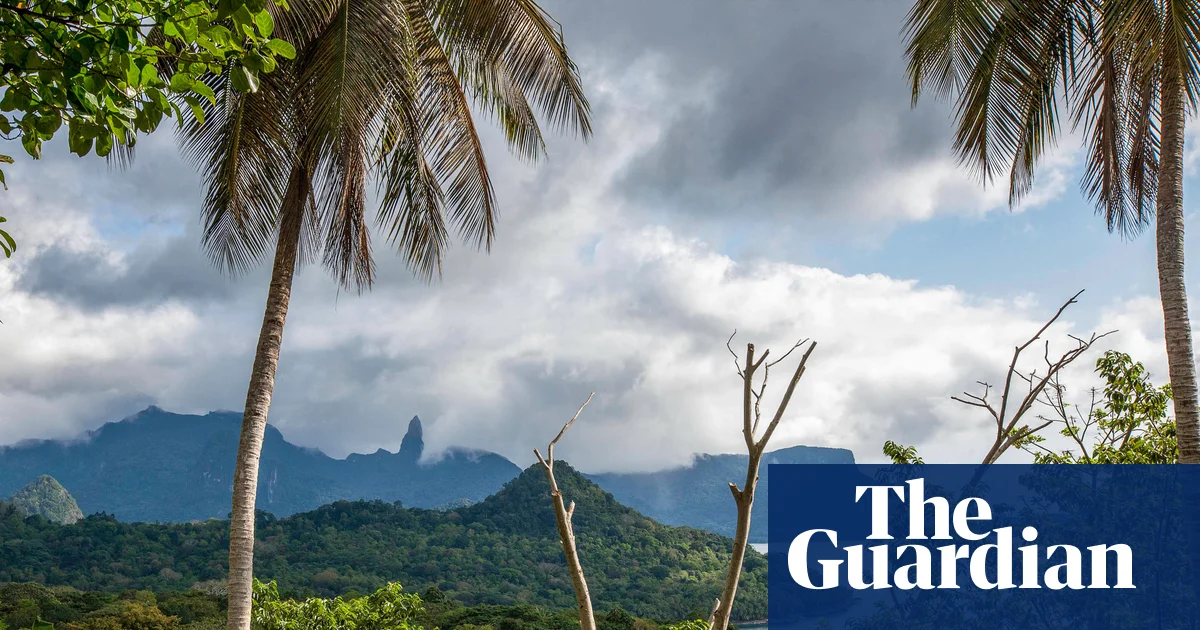
The special nature of Príncipe’s flora and fauna has been known since the 20-mile-long island was stumbled upon by Portuguese navigators in 1471. Uninhabited and separated from the African mainland by over 160 miles of ocean, both Príncipe and its larger southern neighbour, São Tomé, had evolved unique rainforests where giant land snails and crabs were among the top predators. Even now, new species are still being discovered, leading to the nickname “African Galapagos”.
The Portuguese started a cacao plantation economy, but after independence in 1975, that business fell apart. On Príncipe, the descendants of slaves and labourers from Angola and Cabo Verde became tight-knit communities of subsistence farmers, camping out in the increasingly decrepit colonial-era buildings. For the occasional visitor, it was picturesque, but problems were mounting for residents who were being pushed deeper into unexplored parts of the island, cutting trees and foraging.
Príncipe kingfisher, which are endemic to the island. Photograph: Kevin Rushby
Then, in 2010, South African billionaire Mark Shuttleworth arrived, looking for somewhere to build a house, an idea that was soon replaced by a philanthropic urge to help. One former plantation house was converted into a hotel with locals retrained as staff, but Shuttleworth did not stop there. His quest was to fund the type of sustainable development that also protected and improved the environment. “The normal path to development for Príncipe would be to cut down forest and grow ‘fair trade’ peppercorns,” Shuttleworth said. “But we want to reward them as stewards of their precious environment.”
That dream has now reached fruition, much to the surprise of local sceptics. “They’ve been let down in the past,” says Faya project CEO, Jorge Alcobia. “They didn’t expect us to keep our promises.”
There is still, however, a learning process about how to help the environment. “We have to explain that it’s not free money,” said Alcobia, “Dividends are reduced, for example, if there’s unauthorised tree-felling.” Faya is funding school improvements, organising the moribund cacao business, and giving financial advice. “A lot of people here have no bank account and little experience of handling money.”
So far, however, all the money comes from Shuttleworth’s fortune, a past and future commitment that totals about £87m. Among the developments is a new village, home to Clara Gomes and her daughter. “My money is going on a new kitchen and training in carpentry,” she said.
Clara Gomes at her house in a new village built by the Faya Foundation. Photograph: Kevin Rushby
Her neighbour, Edmundo, is selling cacao to the project. “I had no one to buy it before,” he said. “I’m hoping they might take vanilla next.” He has signed up for the dividend, but others remain sceptical. “It’s a monopoly,” shouted a bystander, “Is that good? And what if everyone buys motorbikes and chainsaws?”
For one man, years spent foraging in the forest have now blossomed into a career as wildlife guide. Yodiney dos Santos now leads scientific expeditions into the forest, discovering several new species, including a previously unknown owl. He knows only too well how fragile this environment is. “My ancestors came here from Angola,” he said. “And, for food, they brought the edible West African snail, which then escaped. Now those snails are pushing out the endemic Príncipe snails.”
This unique social experiment will be watched closely. “If it’s successful,” said Shuttleworth, “I hope other irreplaceable ecosystems might benefit from the idea at scale.”
RAIL passengers commuting over the Easter period can expect major disruptions to services.
The UK’s biggest intercity line will be closed for six consecutive days early next month.
Sign up for the Travel newsletter
Thank you!
Rail passengers planning to travel on Britain’s busiest intercity line can expect disruptions to services this Easter (stock image)Credit: PA
Engineering work has been planned for the busy route, which carries over 75 million passengers a year, from Good Friday (April 3) to Wednesday, April 8.
There will be no west coast mainline services between London Euston and Milton Keynes on these dates, with services between Preston and Lancaster halted on Easter weekend (Saturday, April 4 and Sunday, April 5).
The upgrade works are part of a wider £400 million project, which will see improvements to the line’s reliability as well as repairs to tracks.
Jake Kelly, Network Rail’s regional director for the north-west and central region spoke to the Guardian about the latest upgrade.
“The four-day period at Easter gives us a valuable opportunity to complete projects that simply can’t be delivered during a normal weekend,” he said.
“This ensures we maximise the time our teams are out working on the tracks.”
While the north London neighbourhood of Willesden, north London will see new tracks laid, there will also be repairs and upgrades at Harrow and Wealdstone station.
And a historic bridge in Ledburn, Buckinghamshire, which gained international notriety in the Great Train Robbery, is also scheduled for upgrades over Easter.
Kelly added that Network Rail is working hard “to keep as much of the network open as possible while carrying out these vital upgrades”.
Avanti West Coast will run services between Preston and Carlisle via the Settle-Carlisle line over the Easter period, while Anglo-Scottish services will be diverted via Dumfries and Kilmarnock between Good Friday and Easter Monday.
Network Rail has advised passengers to check before they travel on these dates.
Over 270 other upgrade projects are planned for various rail routes over the Easter period this year.
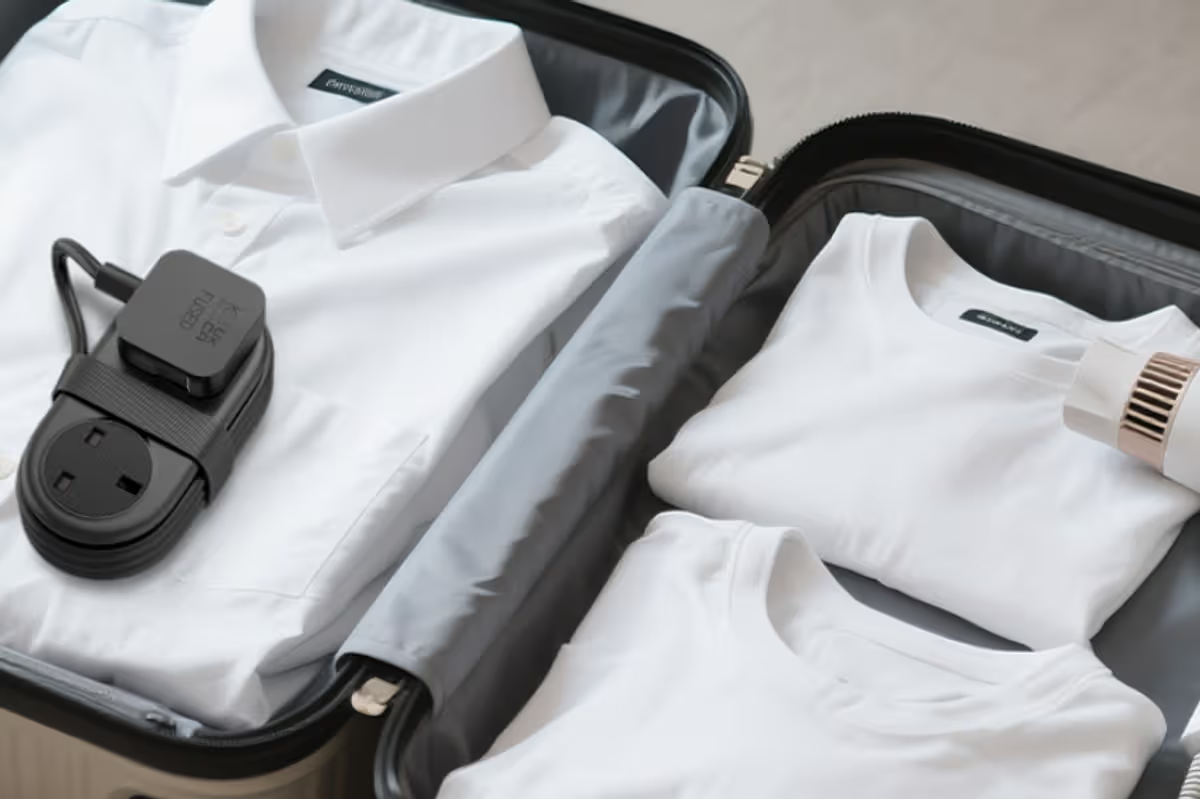
The ORICO small power strip is smaller than a mobile phone and features a wrap-around design that can fit into any package suitcase
This article contains affiliate links, we will receive a commission on any sales we generate from it. Learn more
The travel plug is perfect for hotels, using on trains, or in busy cafes without taking up multiple sockets(Image: Amazon)
For anyone who regularly travels, be it for work or pleasure, they’ll know the familiar frustration of arriving at a hotel room to discover there are barely any plug sockets – and the ones that do exist are often hidden behind beds, miles away from a mirror or in awkward corners. With most people now travelling with multiple devices, from phones and smartwatches to tablets, cameras and laptops, an extension cable has become a travel essential, and we’ve found one on offer for under £15.
For a limited time, the ORICO Travel Extension Lead has been reduced from £21.99 to £14.99 in the Amazon spring sale. Designed specifically with travel in mind, the small power strip is roughly the size of a smartphone and features a wrap-around cable so it packs neatly into a suitcase or hand luggage without taking up valuable space.
Despite its compact design, it still manages to offer plenty of charging options. The device includes two traditional plug sockets alongside two USB-A ports and a USB-C port, allowing travellers to power up to five gadgets at once. That means you can charge your phone, laptop, camera and other devices from a single wall socket without needing multiple adapters, especially if travelling abroad.
READ MORE:
One feature shoppers have praised is how flat it is, meaning it can fit into tighter spaces than traditional plugs. The staggered socket layout also prevents one plug from blocking another, making it easier to use every available port.
Safety features have also been built into the design, including protection against overheating, overcharging and short circuits, while the extension cord itself uses thick copper wiring designed to handle higher currents. The casing is also flame-retardant, adding an extra layer of reassurance when charging multiple devices overnight.
ORICO small power strip is smaller than a mobile phone and features a wrap-around design that can fit into any package suitcase.
For travellers looking for alternatives, there are a few other compact charging solutions worth considering. The Anker Tower Extension Lead is another popular option, offering a similar combination of standard plug and USB ports. However, this is more expensive at £29.99.
Meanwhile, the Belkin 8-Outlet Surge Protector Power Strip is £39.99 down from £44.99, with room for 12 plugs plus 2 USB-C ports – though no USB-A ports on this particular design.
Shoppers who have already bought the ORICO extension lead say it’s become a go-to travel accessory thanks to its size and practicality. One reviewer said: “Great travel pack! Comes with a really handy tie to keep the wires nice and neat. Two USB ports and two plugs, really good to charge all your devices on the move.”
Another wrote: “Very convenient and compact! I love how this wraps up perfectly for travel or for my work bag. I have had no issues with it, and all the ports work well. I use this to charge my MacBook Pro.”
Of course, not every experience has been perfect. One reviewer said their extension lead stopped working after several trips, though they added that the company rectified the issue. They said: “Bought it in July for travel use but stopped working in November after about four trips. Update: After posting my review, the company reached out and offered a refund or replacement.”
One said it was ‘brilliant for packing for holiday’, adding: “Took up little space. Had USB ports for all devices.”
Another shopper commented: “ It’s the best for travelling. My kids travel and I bought one for each of them. It also makes a good gift. Something people don’t think about but need. Most people have multiple devices to plug in and having one power strip is awesome! It is also the perfect size.”
Whether it’s the train station, airport, holiday home or busy cafe, this nifty extension cable has become essential for many who need plenty of power on the go, without needing to sit right next to a socket. Shoppers can find the deal here.
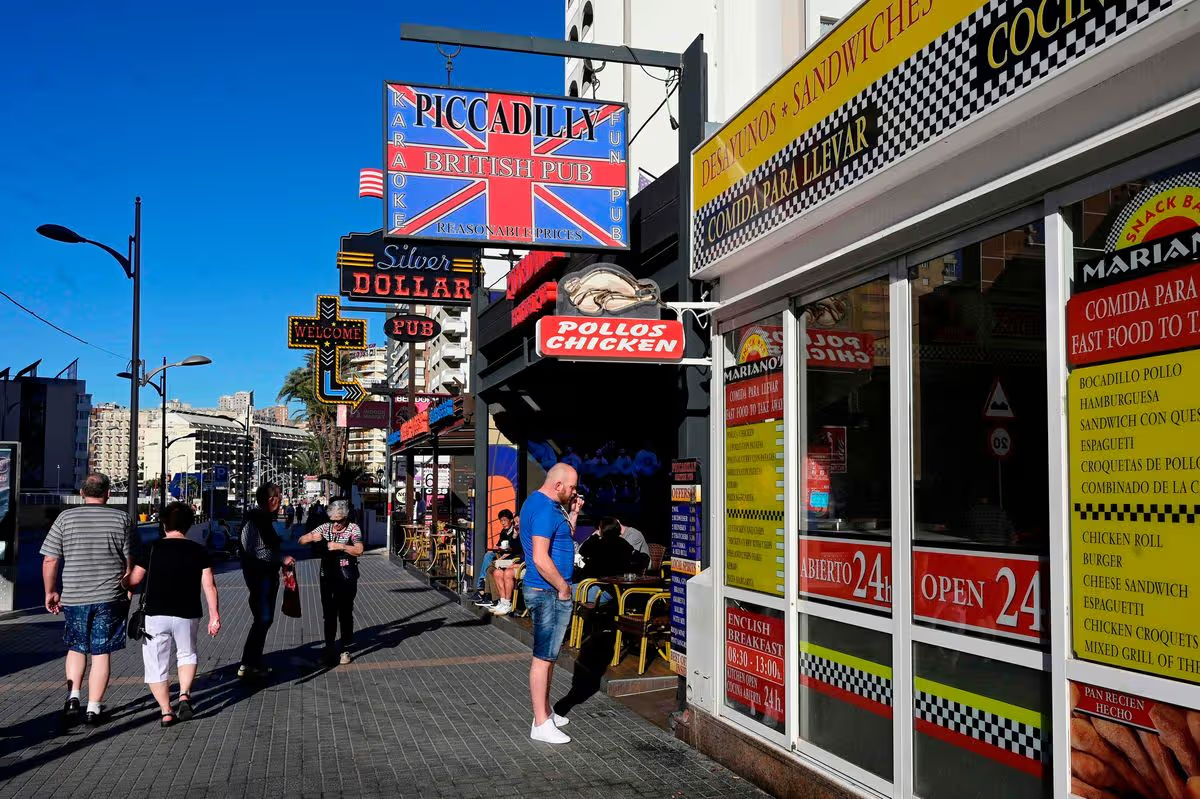
Harry Poulton, who moved to the Alicante region from the UK, visited the Duke of Wellington pub and Ray’s Chippy in Benidorm to find out if they serve the best fish and chips in the city
Alan Johnson Social News Reporter and Alan Johnson
15:45, 10 Mar 2026Updated 15:45, 10 Mar 2026
A Brit living in Benidorm has delivered his verdict on fish and chips in the Spanish resort (stock)(Image: JOSE JORDAN/AFP via Getty Images)
A Brit living in Benidorm has voiced his astonishment at the cost of fish and chips in the popular holiday spot after popping into a takeaway in the Spanish tourism hotspot. Harry Poulton, who provides travel tips and insights into the Alicante region, paid a visit to the Duke of Wellington pub in the Costa Blanca resort, which also houses Ray’s Chippy.
“I’m here to find out if this really is the best fish and chips in the whole of Benidorm,” he kicked off in a TikTok video. Settling down, Harry chose cod and chips, served with a pot of curry sauce and a can of Coca-Cola to wash it down.
Once his meal arrived, he complimented the waitress, saying it looked “absolutely amazing” before tucking in.
Sprinkling salt on the chips and dunking one in the curry sauce, Harry expressed his delight: “Oh, proper chip shop fries. It’s really nice. You can’t beat a chip shop fry, can you?”
Turning his attention to the fish, meanwhile, Harry, who selected the smaller option from the menu, described it as looking “gorgeous” before taking a bite.
Content cannot be displayed without consent
“That is amazing,” he proclaimed. “Super crunchy – the batter is really nice and it’s proper fresh. Really, really tasty – it’s absolutely gorgeous.”
Harry headed to the till to pay the bill afterwards which, at €13.50 (£11.69), he hailed as an “absolute bargain”.
On TripAdvisor, The Duke of Wellington and Ray’s Chippy boasts a rating of 3.8 out of five based on 289 reviews.
Reacting to Harry’s post, one TikTok user commented: “Great place, we go every time we are in Benidorm.”
A second visitor praised: “Very good when we both went. 10/10 Good prices too.”
While a third recommended: “You should try Gwen’s Bar in La Cala on a Friday tea time. Their fish and chips are unbelievable.”
Harry also offered guidance to Brits heading to Benidorm while the Cheltenham Festival is taking place back home. The annual horse racing spectacular is being held at Cheltenham Racecourse from today (March 10) through to Friday.
“It’s a little bit cloudy here at the moment,” Harry cautioned those planning to watch the races while abroad. “It’s quite cold as well – currently just 13 degrees and it looks there is more rain and wind on the way.”
He concluded by urging those travelling to the Costa Blanca this week to pack jumpers and jackets alongside summer clothing. “You know what Benidorm is like,” he remarked. “Cloudy one minute, but blue skies the next. It’s good to be prepared.”
A MEDITERRANEAN destination nicknamed ‘the land of jasmine’ will soon have an even bigger airport with space for millions more passengers.
Plans have been revealed to expand and modernise Tunis-Carthage International Airport in Tunisia, Africa as it aims to quadruple its passenger numbers in just five years.
Sign up for the Travel newsletter
Thank you!
Tunis-Carthage International Airport will undergo a £743million upgradeCredit: Alamy
The airport – which is the 10th busiest in Africa – will undergo a major £743million makeover over the next five years.
The country’s Transport Ministry shared that the plans will include building a new passenger terminal as well as the existing terminal being renovated.
Between the two terminals, the Transport Ministry aims to increase passenger numbers from five million people per year to 18.5million passengers by 2031.
There will also be a new technical building and the air traffic control tower will be upgraded.
Some reports suggest that the broader project will involve adding VIP lounges as well.
In addition, the Transport Ministry hopes that it will improve connectivity placing Tunisia as a gateway to the Mediterranean with links to Africa, Europe and emerging destinations.
The upgrade could also pave the way for new airline partnerships and flight routes.
News of the makeover follows original plans for building a new airport being put on hold.
Known as ‘the land of jasmine’ for its use of jasmine flowers in festivals, cultural traditions and perfumes, Tunisia takes about three hours to fly to from the UK.
The Sun’s Deputy Digital TV Editor Jill Robinson recently visited the city and said: “Winding my way through narrow streets, the smell of jasmine and mint tea fills the air as I pass craftsmen, locals doing their shopping and an abundance of cats.
“It would have been easy to think I was in the souks of Marrakech, but I’m in Tunis, the capital of Tunisia.
“While its Medina is not as chaotic as its Moroccan counterpart, the historic streets bustle with locals selling their wares as tourists like me squeeze through.
Tunisia is around three hours from the UK with flights in April costing as little as £30 one-wayCredit: Getty
“From traditional clothing to jewellery, perfume to sweet treats, there’s any amount of treasures to be found just as long as you’re prepared to haggle.
“The Medina was built around the big mosque — nicknamed the Olive Tree Mosque due to the trees there in the 8th century — but it is also home to 100 smaller mosques.
“While Tunisia is an Islamic country, its history and influences are vast — including Arab, Andalucian, Turkish and Berber — and are visible to see as you take in the colourful arched doorways, former palaces and humble homes.
“On a day trip from my hotel, I learned about the rich culture of Tunis and the ancient ruins of Carthage, whose most famous son Hannibal (of elephants fame) became one of history’s most celebrated generals and took on the might of the Roman Empire in the Second Punic War.”
If you fancy a beach day, head to La Marsa where you will find a number of calm beaches, with cosy cafes and crystal clear waters.
Nearby, you can also head to the blue-and-white village of Sidi Bou Said, which sits on a clifftop and is often compared to Santorini in Greece.
Near the capital Tunis, you can head to the blue-and-white village of Sidi Bou SaidCredit: Alamy
There’s Djerba Island as well, which is loved for its sandy beaches and vibrant nightlife.
The temperature can reach up to 20C in March and 22C in April, making it the ideal destination to grab a bit of warmth while the UK remains around 10C.
Nouvelair Tunisie offers direct flights from London Gatwick to Tunis-Carthage Airport and Tunisair offers direct flights from both London Heathrow and Gatwick Airports.
IF you’re planning your next holiday but you’re on a strict budget, the experts have stepped in to help you save hundreds.
TUI‘s Commercial Director, Chris Logan – who has worked there for 17 years – as shared some of his top tricks to shave hundreds of pounds off your holidays.
Sign up for the Travel newsletter
Thank you!
The experts have weighed in on how to save hundreds on your next holidayCredit: AlamyGreek holidays are better in shoulder seasonCredit: Alamy
One of those is forgetting that Saturday departure.
He explained: “Mid‑week departures offer a sweet spot of value and convenience for travellers.”
“Flying midweek, especially Monday to Wednesday, could save you hundreds on the exact same holiday.
” For example, this week there’s a deal for a 7-night all-inclusive stay at the 4T TUI Suneo Kenzi Europa in Agadir, Morocco for just £523pp.
“Travelling on May 4 (Monday) instead of May 3 (Sunday) currently saves you nearly £300 per person.”
Not only that, but travelling just a month out of the busy season can save you loads.
He continued: “May and September offer gorgeous weather without the peak prices.
“You’ll get balmy temperatures upwards of 20 degrees in destinations like the Canaries and Greece but pay a fraction of the cost.”
When it comes to what board you want to book, he also advises not always going for the all-inclusive.
He explained: “If you’re not a big drinker, you don’t need to splash out on all-inclusive.
“Half board could work out as much better value for money.
“And if you love exploring local restaurants and heading into town for dinner, self-catering or bed and breakfast are your best bets.”
He added: “The best hack is to always scroll down on our holiday pages – there’s a calendar that breaks down prices by departure date, so you can instantly see which days are cheapest.”
Otherwise TUI has a secret “under £500” page for all holidays that are less than that, if you don’t mind where you travel to,
Chris finished by saying: “The ‘Holidays under £500‘ page brings together all the best deals in one place – you can filter by your local airport, star rating and board type.
“It’s how customers can find some incredible deals for five-star hotels for under £500.”
One of the cheapest deals we found was seven nights in Greece in May for just £265 each.
Otherwise there are a number of five star holiday packages in Spain, Bulgaria and Tunisia that just come under £500 each.
Chris says his inside advice could save holidaymakers huge amounts on their next trip – but his hacks come with a warning: “Bargain hunters really need to act fast – my biggest tip is to lock in your next trip asap to secure the best rates, as the deals are constantly updating and changing.”
Agadir in Morocco is an affordable choice tooCredit: Alamy
As we inch closer to spring, the best UK destinations for a day out have been revealed, thanks to their sprawling gardens, historic landmarks and charming riverside walks
The best UK destinations for a Spring escape have been revealed(Image: Getty Images)
The UK boasts stunning cities that provide a perfect day out, especially as we edge closer to spring, with the prospect of brighter days and milder weather.
Organising a day out, whether it’s with your partner, family, or on your own, can occasionally feel daunting. Some destinations are just around the corner, others require a road trip, and many can be reached by train, which only enhances their appeal as we get to relax before arriving.
In an effort to help Brits make the most of the sunnier weather and the magnificent locations the UK has to offer, LNER has revealed the ‘UK’s best spring days out’ that can be reached by train, reports the Express.
To identify the best UK destination for a day out during spring, the train operator examined historical weather data, the proportion of green and blue spaces, land and woodland, and the number of walking trails available in each area. From Norwich, Colchester and Plymouth, here are the UK destinations that could be the ideal getaway during spring.
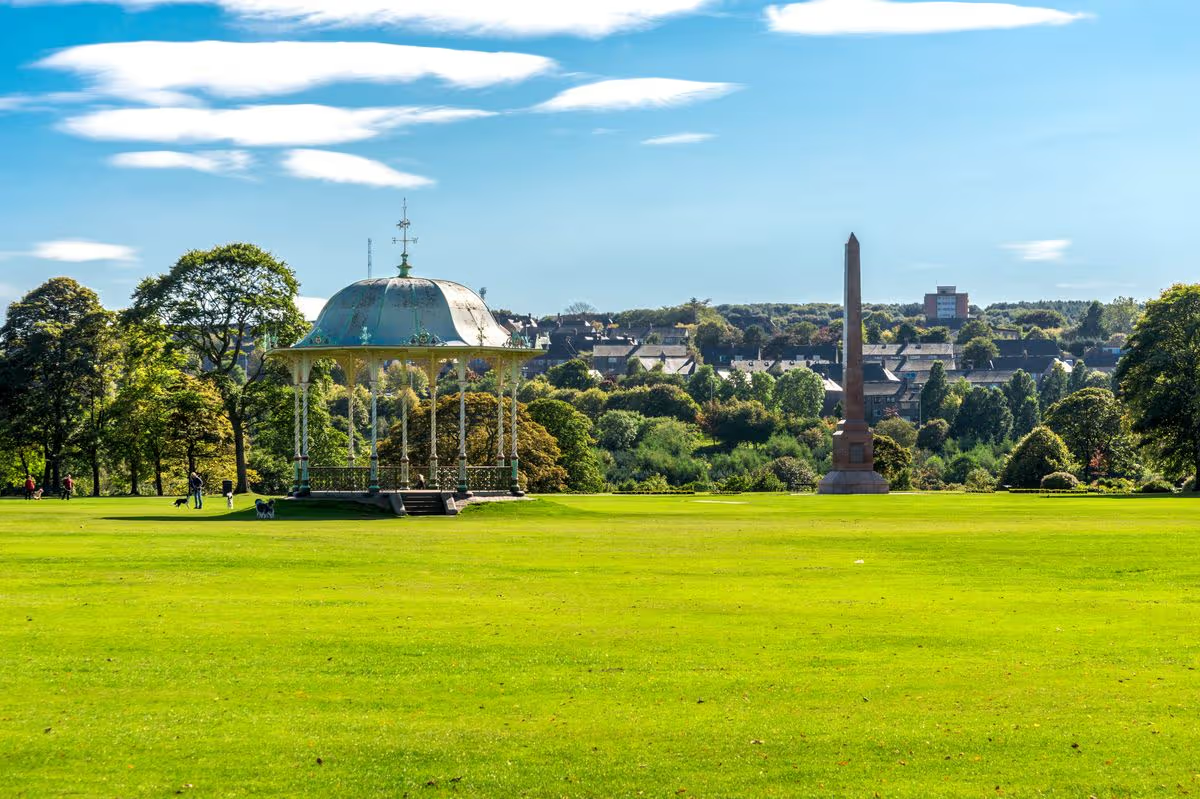
Recognised as one of the sunniest cities in Scotland, Dundee tops the LNER list. One of its standout attractions is the University of Dundee Botanic Garden, featuring beautiful gardens that flourish in spring, along with water gardens and glasshouses brimming with tropical plants.
There’s also the Dundee Law landmark that offers a steady climb where you’ll be rewarded with views across Dundee and the River Tay, and the over 400-acre park, Camperdown Country Park – perfect for a picnic! Or perhaps a trip to the V&A Dundee is more your cup of tea to explore Scotland’s design museum.
Maidstone
Kent’s largest town, Maidstone, is, somewhat surprisingly, among the destinations LNER suggests visiting. This is largely thanks to its Mote Park, which boasts expansive green spaces and a peaceful lake. It provides waterside walks, pedal boat hire, plus climbing walls and high ropes – perfect for keeping youngsters occupied.
Telford
This delightful Shropshire town truly comes into its own during springtime when over 170,000 daffodils burst into bloom at Telford Town Park, which also features 450 acres of green space, gardens, and lakes. LNER highlighted that guests can pick up a coffee and enjoy a leisurely walk whilst taking in the vibrant colours that transform the park.
Aberdeen
This Scottish port city has plenty to discover on a day trip, from its seaside panoramas and period architecture to the Cruickshank Botanic Garden in Old Aberdeen. The park covers 4.5 hectares and includes rose gardens, water features, and tree-lined pathways.
There’s also one of Scotland’s most cherished gardens, Duthie Park, to explore, alongside the impressive St Machar’s Cathedral. However, a visit to Aberdeen wouldn’t be complete without experiencing its breathtaking coastlines at Greyhope Bay, where bottlenose dolphins can occasionally be seen.
Edinburgh
It comes as no shock that the beloved capital of Edinburgh has secured its place on the LNER list, given its wealth of attractions and beautiful landscapes that come alive with colour throughout spring. There’s the famous Edinburgh Castle, Arthur’s Seat offering sweeping views across the city, the Royal Botanic Garden and Princes Street Gardens.
For those wanting to delve deeper into its past, there are the Georgian House and Lauriston Castle. The Union Canal is also an ideal location to discover the tucked-away corners of the city, whether strolling along the waterfront or cycling along the dedicated path.
Lincoln
The East Midlands city boasts plenty to discover during a spring day out, from Lincoln Castle and Hartsholme Country Park to the Whisby Nature Park. However, Lincoln Arboretum is unquestionably a highlight, with its refurbished gardens, fountains, duck pond and play area, all paying tribute to its Victorian heritage.
Norwich
The vibrant city of Norwich is another destination absolutely worth visiting, whether for a day trip or weekend getaway. The Cathedral Close has been praised as ‘one of the best places to spend your spring day out’ with its magnolia trees, daffodils and verdant lawns coming into bloom beneath the city’s medieval skyline.
There’s also the opportunity to take in panoramic views across the city and explore the hilltop landscapes surrounding the Norman keep.
Colchester
The UK city is distinctive for its Roman Walls, described as the ‘longest and best-preserved town walls in Britain’. There is a circular route stretching back almost 2,000 years, providing a picturesque spring walk amongst the ancient stonework, with Castle Park the ideal spot to stop for a picnic.
Ipswich
Characterised by LNER as ‘slow and scenic’, the Suffolk town boasts low rainfall and the ‘highest spring sunshine hours’. It’s home to a waterfront that sparkles in the sunshine, where there are cafés and bars to savour a drink or lunch outdoors, or to simply observe the activity of the harbour.
Plymouth
Last but not least is the Devon port city, with The Hoe overlooking Plymouth Sound as its most recognisable landmark. This makes an excellent starting point for a day in Plymouth, with its expansive lawns and seafront promenade providing the ideal spring walk, before treating yourself to an ice cream or scaling Smeaton’s Tower.
For further information or to book your spring day trip, you can visit the LNER website.
Do you have a travel story to share? Email webtravel@reachplc. com
It’s filled with thick exhaust fumes and lacking proper lighting or ventilation
World’s darkest tunnel connecting 2 major cities where breathing is painful(Image: Getty)
The Anzob Tunnel in Tajikistan, Asia, also known as the “Tunnel of Death,” is regarded as the darkest and most treacherous tunnel on the planet. Situated on the M34 highway at an elevation of 2,700 metres in the Tajikistan mountains, the 5km tunnel lacks lighting or ventilation systems.
The pitch-black tunnel is shrouded in dense smoke, making breathing “hard and painful due to the thick mixture of exhaust gases”, according to specialists at Dangerous Roads.
The frightening underpass features massive potholes and lacks adequate lighting and ventilation, rendering it exceptionally hazardous.
The Anzob Tunnel links Dushanbe, the nation’s capital, and Khujand, the country’s second-largest city, and was constructed in 2006 to accommodate heavy traffic, reports the Express.
There are also no traffic signals to manage the thousands of vehicles passing through it daily; instead, just complete darkness.
The tunnel underwent partial renovation in 2018, with drainage systems installed and potholes repaired, but it still requires substantial improvement, according to specialists.
Dangerous Roads stated: “The tunnel is dark and dangerous with hardly any lights inside, and it’s suffocating as there’s no ventilation but one fan.”
“Locals have shared stories of a number of people dying inside it due to traffic jams that leave people trapped, where they succumbed to carbon monoxide. The poisonous air in the tunnel is barely shifted by one solitary fan somewhere in the middle of the tunnel, which gives some, but not sufficient, movement to the air.
“Expect huge, axle-snapping potholes threatening to swallow up the car, along with flooding that almost turns them into tunnel ponds. Your whole SUV can submerge if you drive in the wrong place.
“There are no road markings, so driving on the left or the right are optional, with the middle being the common choice.
“Halfway along the tunnel, water floods the road as a result of an engineering fault. Oncoming cars and trucks emerge in the darkness with headlights flashing for the other drivers to get out of their way.”
One visitor detailed their experience on Tripadvisor, writing: “We went through this tunnel twice with no ill effects other than fear!”
“The traffic was two-way, and the darkness and lack of ventilation were scary, but we survived. The drive was scenic and fabulous and well worth the risk.”
The scale of the disruption to aviation caused by the US and Israeli attack on Iran has been enormous. Of the 38,193 flights that were scheduled to fly out or into the Middle East since February 28, 21,915 have been cancelled
15:02, 10 Mar 2026Updated 15:27, 10 Mar 2026
BA has cancelled flights to several Middle Eastern cities (Image: AFP via Getty Images)
This afternoon, the UK’s flag carrier announced it would reduce its flight schedule across the region and cancel flights to certain cities. BA bosses have decided to ground all flights to Abu Dhabi in the United Arab Emirates until “later this year”.
Although the airline hasn’t said how many services have been cancelled, given its daily services to Abu Dhabi prior to the war, the total number of flights grounded comfortably stretches into the hundreds.
“Due to the continuing uncertainty of the situation in the Middle East and airspace instability, we’ve had to temporarily reduce our flying schedule in the region. We’ve cancelled all flights to and from Amman, Bahrain, Doha, Dubai and Tel Aviv until later this month and to and from Abu Dhabi until later this year. We’re keeping the situation under constant review and are in touch with our customers to offer them a range of options,” the statement from BA reads.
“We have limited seats remaining on our repatriation flights from Oman (Muscat) to London Heathrow on 11 and 12 March for customers with an existing booking. Following these dates, the flights will pause due to reduced demand but will be kept under continuous review.”
The scale of the disruption to aviation caused by the US and Israeli attack on Iran has been enormous. Of the 38,193 flights that were scheduled to fly out or into the Middle East since February 28, 21,915 have been cancelled. The latest figures show that most routes are getting back to close to normal. Of the 4,783 flights scheduled for today, 1,107 were or are expected to be cancelled.
If you are due to fly from or to the Middle East in the coming days, make sure you check your airline’s website for instructions and the Foreign Office website for the latest advice.
What have the airlines said?
Aegean Airlines – Greece’s largest carrier cancelled flights to Tel Aviv until March 20; Beirut, Erbil and Baghdad until March 25; Dubai and Abu Dhabi until March 19; and Riyadh until March 14.
Air France–KLM – Air France cancelled flights to Tel Aviv and Beirut through March 13, and to Dubai and Riyadh until March 12. KLM suspended flights to Dubai, Riyadh and Dammam until March 10, and to Tel Aviv for the rest of the winter season.
Cathay Pacific – Cancelled all flights to and from Dubai and Riyadh until March 31.
Delta – Cancelled flights from New York to Tel Aviv until March 22 and from Tel Aviv to New York until March 23.
Emirates – Operating a reduced flight schedule but expects to return to full operations within days, depending on airspace availability and operational requirements.
Etihad Airways – Resumed a limited commercial flight schedule between Abu Dhabi and several key destinations.
Iberia Express cancelled all flights to and from Tel Aviv through March 10.
Lufthansa Group – Lufthansa, Austrian Airlines, Swiss and Brussels Airlines suspended Tel Aviv flights through April 2 and Beirut flights through March 28. Flights to Tehran are suspended until April 30, and to Amman, Erbil, Dammam, Dubai and Abu Dhabi until March 15.
Norwegian Air – Now plans to start flights to Tel Aviv and Beirut on June 15, instead of the previously scheduled April 1 and April 4.
Qatar Airways – Operating a limited schedule to and from Doha, with some flights resuming from March 9 following temporary authorisation from Qatar’s civil aviation authority.
Saudia Airlines – Suspended flights to Amman, Kuwait, Abu Dhabi, Doha and Bahrain until March 10, and to Moscow and Peshawar until March 15. Limited operations to Dubai have resumed.
Wizz Air – Suspended flights to Israel until March 29, and flights from mainland Europe to Dubai, Abu Dhabi, Amman and Jeddah until mid-September.
Thousands of Brits were left stranded following the outbreak of the Middle East conflict but now British Airways has announced it will suspend its daily rescue flights from Muscat
SOCIAL media is a great place for discovering hacks, but sometimes they don’t always work.
To save you the time and money, we have tried and tested some of the viral travel hacks that have popped up on our social media.
Sign up for the Travel newsletter
Thank you!
The Sun Travel team has tried and tested a number of travel hacksCredit: Getty
Whether it is grabbing an item you already have and using it for another purpose to save yourself some money or a specific product that can make travelling better, we know what works and doesn’t.
Tried and tested and would recommend
New toys for the journey
One of the best tips I’ve followed is to buy a couple of new toys and keep them out of sight until the plane journey, if you’re travelling with young kids.
Wiki sticks were recommended to me and went down a treat with my son.
You can mould them into different pieces of art, then pack them away for the next trip.
A small box of Lego works very well too, and you can even pick these up in duty free at most airports.
If you’re looking to save money, a kids’ magazine with several naff plastic toys on the front works equally well – they have often kept my child entertained for the journey and the whole trip.
CBeebies magazine, Lego magazine and Pokemon magazine have held attention for a particularly long time.
– Caroline McGuire, Head of Travel (Digital)
Snoozeband
Any hack that promises to improve sleep will pique my interest and the Snoozeband did not disappoint me.
Essentially, it makes using headphones much more comfortable, particularly when you are trying to catch some kip.
I’ve used my band on many overnight flights – and it’s pretty much the only way I can ensure I’ll get some shut eye.
It looks a little like a sweatband or running headband in that it’s made from elasticated material that wraps around the circumference of your head, over the ears.
A Snoozeband is an elastic headband with earphones inCredit: Supplied
Built into the band are two mini speakers that line up with your ears and connect to your device via Bluetooth.
They most definitely save you that horrible discomfort that you get with traditional earbuds or AirPods-style headphones, particularly if you are leaning on a surface trying to catch some Zs or even when on a pillow.
– Sophie Sweitochowski, Assistant Travel Editor
Have an iPad for holidays-only
We have an old iPad that my child is only allowed to use on holiday.
Before the trip, I download audiobooks and Netflix shows and he’s allowed to watch as much TV as he wants on the actual flight.
He also has some apps that he is allowed to use on the holiday.
A big favourite at the moment is Simply Draw, with video tutorials on how to draw different things.
– Caroline McGuire, Head of Travel (Digital)
For kids, an iPad on the plane can help keep them occupiedCredit: Getty
Universal plug adaptors over single country ones
Plug adapters are a travel essential that often prove to be more frustrating than you’d think.
It’s difficult to remember which countries use which type, and even if you think you know, you can sometimes still end up packing the wrong one.
Some countries will catch you out, too.
For example, even though Switzerland is in Europe it doesn’t use the standard EU Type C plug – it uses the Type J instead.
So the easiest way I’ve found to get around all of this is by packing a universal travel adaptor.
One simple block with prongs that fold in and out depending on which plugs and sockets you’ll need to use – nice and easy.
I often leave one in my suitcase: readily prepared for the next trip, no thinking required.
– Jenna Stevens, Travel Reporter
A universal plug adaptor alleviates the stress of having the wrong adaptor when on holidayCredit: Getty
Inflatable booster seats
Hiring a booster seat from a car rental company can be astronomically expensive, costing up to £15 a day.
But you can buy an inflatable booster seat by BubbleBum for under £40 and take it on multiple holidays for years.
You’ll make the money back in just one trip.
Plus it’s also helpful for if you take taxis to the airport or go on coach transfers.
– Caroline McGuire, Head of Travel (Digital)
An inflatable booster seat is a great way to save money spent on hiring a car seatCredit: BubbleBum
Balloons to cover bottles
If travelling with liquids, my biggest worry is always, what if they leak?
But a while ago whilst carrying out my daily doom-scroll session, a video came up of a woman cutting the stem off of a balloon, just to be left with the bit that would have been the spherical part of the balloon.
She then stretched this over a bottle of fake tan.
I was sold, and sure enough on my next trip I tried it out and it worked.
A bag of 20 plus balloons will set you back a couple of quid, which is well worth it when you could be saving your suitcase from being an entire ooey-gooey mess.
– Cyann Fielding, Travel Reporter
If you cover your bottles with balloons, it should help to stop them from leakingCredit: Getty
TikTok underseat bag for budget flights
Ever since I had to fork out £65 in excess baggage fees at the Ryanair departures gate, I’ve made sure never to make that expensive mistake again.
I realised just before boarding that you can’t simply eyeball your travel backpack and hope for the best – especially since the eye-watering fee cost me more than my return flights to Dublin.
So when I saw the perfect underseat bag pop up on my TikTok For You Page – black, collapsible and barrel-shaped – I knew I had to grab it.
Since my purchase I’ve been able to stuff my new bag to the brim – and it still slides perfectly into the baggage sizer at the gate.
And at £11.99, this one-off purchase has saved an over-packer like me from endless extra luggage fees!
– Jenna Stevens, Travel Reporter
For Ryanair, it is worth getting a cabin bag you know fits their requirementsCredit: Getty
Ditching tours for Google Lens
A friend introduced me to the wondrous Google Lens a while back and it’s saved me hundreds on guided tours over the years.
Strolling around an unknown city and curious to know what a particular landmark is?
Snap it on your camera with Google Lens and it will be identified in a matter of seconds – and if you want to learn more about that monument’s story or historical significance, you can expand the description through use of Google’s integrated AI tools.
The Lens feature is built into the Google app, so it won’t take up an unnecessary storage on your phone.
It doesn’t just work on well known buildings either.
I often use it to identify unusual plants that I don’t recognise in tropical climates or even items of food and old artefacts in museums.
– Sophie Sweitochowski, Assistant Travel Editor
Google Lens can essentially act as a your tour guideCredit: Alamy
Packing cubes
If there is one thing I never do on holiday, I never check in a suitcase.
And trying all the hacks over the years, my failsafe?
The good old packing cube.
I’ve managed to cram in 10 days worth of clothes into just four packing cubes, which all fit into my hand luggage-size suitcases.
It also makes it so much easier finding my clothes, as everything is separated into tops, bottoms, jumpers and underwear.
You don’t need to spend too much on them either – certainly less than having to check in a suitcase, anyway.
– Kara Godfrey, Deputy Travel Editor
Packing cubes allow you to organise your clothesCredit: Amazon
Solid shampoo and conditioner bars
If you’re anything like me, packing your liquids bag often feels like an impossible challenge of fitting a million make-up items into one tiny pouch.
And once you’ve got your mascara, concealer, foundation and perfume in there, suddenly there’s no more room for your actual shower essentials.
So instead of buying a large (and often more expensive than you’d hope) shampoo and conditioner abroad, I recommend packing a solid shampoo and conditioner bar.
These won’t affect your liquids allowance, which is especially great when you’re travelling with hand luggage only.
My personal favourites are from Lush – the Squeaky Green shampoo is packed with fragrant herbs and flowers, and the ‘Big’ conditioner leaves my hair beachy and shiny with a coconut oil and vanilla scent.
– Jenna Stevens, Travel Reporter
Solid shampoo is great if you are worried about bottles leaking in your bagCredit: Alamy
Free calculator currency converter
Trying to work out if that Moroccan souk bag is really a bargain? Not sure if that cheap glass of wine is really so cheap?
You don’t need any fancy currency converter apps.
Did you know that the iPhone calculator app can be used instead?
Simply click the button at the top right and change it from Basic to Convert.
And there we go – every currency you can think of at your fingertips, so you don’t end up paying £1,000 for that rug you thought was £100 instead…
– Kara Godfrey, Deputy Travel Editor
If you have an iPhone, then you can convert currencies on a calculatorCredit: Getty
Tried and tested and wouldn’t recommend
Foot hammock
With an old knee injury, long haul flights in economy can be pretty unbearable.
So when everyone was raving about ‘foot hammocks’ which you can tie underneath the plane seat, I was intrigued.
The mini hammock is meant to raise your legs to a higher, more comfortable position to ease pressure on your knees and back.
However, I found it didn’t help at all, instead just making my feet slide together and feel even more crammed in.
My cheaper, easier hack?
Just put a small bag on the floor underneath the seat in front of you, and rest your feet on that instead. Voila.
– Kara Godfrey, Deputy Travel Editor
Foot hammocks are not worth the money according to Kara GodfreyCredit: Amazon
Mobile phone straps
A strap for your phone that hangs around your neck, allowing you to go hands free, sounds great. In reality, however, it falls short.
I don’t think you’ll ever feel fully secure parading one of your most valuable possessions around on display for the world to see, especially in city or festival environments.
The only thing standing between you and a thief is your neck.
And I’m not sure I’d fancy putting my neck on the line (quite literally).
The one time I did use a mobile strap, I found that I wasn’t able to wear it for long as my neck started to ache – and wearing it across the body, on one shoulder, defeats the purpose of having your phone easily accessible as I’d have to remove it from under my arm to use my device.
The one time I did find it useful was at a theme park, when on a roller coaster – although many places don’t allow this.
In general, though, a cross body bag is much more practical. You can carry a shed load more, too.
– Sophie Sweitochowski, Assistant Travel Editor
Mobile phone straps sit around your neck which can be uncomfortableCredit: Shutterstock
Elastic band phone strap
I love taking photos and videos on my phone when away, but in some spots I am stressed about losing it forever.
For example, let’s say you are on a boat tour and want to lean over the edge of the boat to take photos of the vibrant blue water.
The fear is that you’ll drop your phone in the sea, right?
Well, if you have an elastic band or hairband, you can loop this through the bottom of your phone case and pop it around your wrist for a makeshift wristband.
After seeing this on Instagram, I thought it was a great idea.
That was until the hairband snapped and my phone plummeted to the ground. Luckily, I wasn’t there.
– Cyann Fielding, Travel Reporter
Mini toiletries
So-called ‘travel-sized’ toiletries are not suitable for travel at all – unless you’re planning on only showering once on your holiday.
These often overpriced minis can set you back £3 to £5 per tiny bottle, or even more if you opt for the luxury brands.
I often find that I can only get one use out of mini shampoos and conditioners, especially when you have longer hair.
And when it comes to the mini spray deodorants, it soon seems like you’re only spraying air from these aerosols.
Other than the disappointing contents, these mini toiletries are also not the most sustainable option.
Plus it can save you both time and money to simply refill a set of reusable 100ml bottles each time you go away, rather than repeatedly fork out on minis.
It’s also worth checking the toiletries your hotel already provides ahead of time.
Most hotel bathrooms are stocked up with shampoo, conditioner and body wash as standard.
So once you’ve simply topped up your refillables with your holy grail products, you’re all set.
– Jenna Stevens, Travel Reporter
Mini toiletries, especially when bought at the airport, can cost a lot of moneyCredit: Getty
Paper to stop clothes creasing
When packing a suitcase, it is slightly heartbreaking to think the next time you open it you’ll see the clothes you meticulously packed, but now with loads of creases.
So you can imagine when I saw someone on social media saying that acid-free tissue paper helps to prevent clothes from creasing, I was thrilled.
You are meant to place a sheet between each folder layer of clothes and essentially, the paper acts as a buffer to stop creases.
Though, having now tried this a couple of times, it hasn’t worked for me.
In the future, I think I’ll stick to using the hotel iron…
– Cyann Fielding, Travel Reporter
When it comes to packing, acid-free tissue paper is meant to keep your clothing crease-freeCredit: Alamy
Boarding the plane first
You know that announcement at the beginning of the flight that says families with young children can board first? Ignore it.
Unless you have masses of cabin suitcases and are worried about there being enough space on the plane, wait until the end of boarding to get onto the plane.
Because the last thing kids need is MORE time stuck in a seat.
I’d also add that if you’re child can possibly walk to the boarding gate, do away with the buggy and let them.
WHEN I told my friends about my recent European getaway, many met me with two questions in quick succession: firstly, “Where?” and then pointedly “Why?”
I’m not surprised. I hadn’t heard of the city – a two-and-a-half-hour flight from London – until I decided to whisk my wife away on a romantic weekend there. What I found was meals out for less than £10, posh Airbnbs for only £50-a-night, and drinks at about half the price we pay at home.
This European city is like something from a fairytaleCredit: GettyA view of it’s famous city gateCredit: AlamyAnd it boasts a stunning castleCredit: Alamy
In recent years, we’ve had weekend breaks in Paris, Barcelona, Berlin, Vienna, Lisbon, Rome and Amsterdam – but they can often feel too big to truly explore over a weekend.
Add in long airport journey times, expensive hotels and pricey restaurants, and you come home knackered and empty pocketed.
Increasingly, I’ve found that it’s simply more enjoyable to head somewhere smaller: instead of Paris, try Toulouse; instead of Barcelona, try Grenada. So, when we decided on a trip to Poland, we picked a trip to Lublin, rather than Warsaw or Krakow.
We wanted to go on a “couple weekend” – like a date night for married people, but conducted over 48 hours somewhere well away from home.
Except for Vienna, all our previous minibreaks were in Western Europe – this time, we wanted something more exotic, perhaps to the East or North.
Plus, we were seriously skint. Anything in Scandinavia was prohibitively expensive.
One friend had just been to the chic Arctic Circle town of Tromso in Norway and warned: “For even a very average bottle of wine in a bog standard restaurant you are looking at eighty quid”.
I thought he must have mis-typed, but no, that number did indeed have a Y on the end – eighty.
So Norway was out. Sweden and Finland didn’t sound much better when it came to price.
So when a friend suggested an affordable alternative, Poland, I was interested. Which is how we came to settle on Lublin.
In the east of the country, with a population of around 327,000, Lublin is closer to the border with Ukraine than the capital, Warsaw.
The city featured prominently in one of our favourite films of last year, A Real Pain, which won Kieran Culkin a Best Supporting Actor Oscar.
It came across as both fascinating and charming.
We then found we could get a smart Airbnb double room in the heart of this pretty city for £50 a night – and return flights out of Luton on Wizz Air for just £37 each. Sold!
Lublin is a tiny airport – just four gates – so easy and quick to navigate, then there’s a little single carriage tram-like train to ferry you very cheaply the few miles into the city to find that double room.
Our rental was an absolute steal for the price: views from two large windows looking directly at the dramatic castle with ramparts that dominate the old town, and it also features as a backdrop in A Real Pain
The Market Place in the old town, Mandragora restaurantCredit: AlamyJust outside Lublin is a concentration camp, Majdanek, where 78,000 diedCredit: John SturgisAn Airbnb double room in the heart of the city cost £50 a night and return flights out of Luton on Wizz Air cost £37Credit: John Sturgis
A bottle here for the price of a glass there
The food and drink were a steal too; the wine in particular was a lot, lot cheaper than you’d find in the UK.
A bottle here for the price of a glass there.
In both restaurants, the food was less than half the price for something comparable at home – generous mains for under a tenner.
In fact, everything from Uber rides to gallery tickets seemed to have this “less than half” aspect, which left us thinking it might be even more financially advantageous to simply move here.
Lublin was beautiful, intense, constantly interesting and surprisingly romantic- but also very, very cheap – perfect for the couple with no money.
Even though Lublin is the largest city in eastern Poland, there are far fewer crowds than Krakow, making it the ideal family destination too.
The movie A Real Pain – starring Jesse Eisenberg, pictured, – is set in LublinCredit: YouTubeChurch in front of apartment buildings in Lublin, PolandCredit: Alamy
Of course, we wanted to check out the locations features in A Real Pain too.
The film, a mix of comedy and tragedy, told the story of two cousins, Culkin and Jesse Eisenberg, visiting the city where their Jewish grandmother had grown up before being caught up in – and narrowly escaping – the Holocaust.
That historic atrocity looms large in Lublin.
Until 1939, the city was one of the great Jewish centres in all of Europe, comparable to Oxford for its cultural reach.
First, we headed to the Old Jewish Cemetery – but it was closed for the sabbath so we could only peer in at the atmospheric stone monuments.
At a hotel around the corner, a travel group leader told me that the building had been the largest Jewish academy in the world when it opened in 1930.
But barely a decade later, its entire library burned in what is now the hotel carpark and its students were systematically slaughtered.
Just outside Lublin is a concentration camp, Majdanek, where 78,000 died.
But of course, it wasn’t just Polish Jews who were murdered.
Outside that cemetery, for example, a sign proclaimed: “This place is hallowed by the blood of Poles, prisoners of Lublin Castle, executed by the Nazis on 23 December 1939.”
The fairytale castle we were looking at from our room had a dark past.
The other film location we tried was a restaurant, Mandragora, in the old town, where Culkin’s character plays the piano.
On our visit to this delightfully old-fashioned place, there was also music, from a small band with accordion, fiddle and clarinet that seemed to give a pre-war atmosphere.
Even more retro-atmospheric was a restaurant not in the film, Zaczarowana, where a gothic interior of shadows, black curtains and candlelight made it feel like we were on the set of some composite film mash-up of the Frankenstein and Dracula stories.
Like travelling back in time
There’s lots to see in the city too.
If travelling with kids, you can head to the Open Air Village Museum, which is an immersive museum with historic farmhouses and of course, farm animals too.
There’s also a water fountain and light show in Litewski Square to watch in awe.
In the Old Town you will find pastel coloured houses, neatly lined up and there is also the castle – one of the oldest royal castles in the country – which has great views across the city.
Lublin, Poland, is a great destination for a cheap breakCredit: John Sturgis
According to Backpack Adventures, it is even like “travelling back in time” with a number of gates leading onto narrow alleys.
The city has over 150 trolleybuses to get around the city, which were introduced back in 1953.
And it is the perfect time to visit, as the city has been named one of Europe’s Capitals of Culture for 2029.
Hungry? Head to U Szewca in the Old Town, where you an discover a pub with sport-themed rooms, pizza for just £6 and Bolognese for around £7.50, and a beer for about £4.25.
When it comes to grabbing something to drink, head to Nocny Portier where you will find “upside-down pot plants, absurd monkey portraiture and terrific cocktails from a movie-inspired menu”, according to The Times.
You even need a password to head downstairs to the speakeasy and once inside, you will be able to grab a cocktail for just £6 delivered on a toy railway.
UK passport holders are being urged to check theirs now
Many people often don’t know where in the home their passports are(Image: Westend61 via Getty Images)
UK passport holders are being urged to check the whereabouts of their documents now, particularly if they’ve got any holidays on the horizon.
Many of us have mislaid our passports at some point, so it’s wise to store yours in a specific spot, such as a lockable drawer or cabinet. The Passport Office advises that you must cancel a lost or stolen passport immediately, to minimise the risk of someone else using your passport or stealing your identity. You can also report a lost or stolen passport on behalf of someone else if they’re unable to do so themselves.
However, it’s crucial to search your home thoroughly for your passport before declaring it lost. This is because once you notify the authorities that it’s lost or stolen, you won’t be permitted to use it if it turns up and regardless of how much validity it has remaining.
This is because, when you report a passport as lost or stolen, all the information on the document is forwarded to the National Crime Agency. If you try to travel with it, you’ll be stopped at the border and it will be seized.
If you do locate your lost passport, you should instead cut off the top right-hand corner and post it to the Passport Office alongside a Recovered British Passport Form. You’ll then need to apply for a new passport if you wish to travel abroad.
The current estimated processing time is a maximum of three weeks, though government officials warn it can occasionally take longer “if we need more information, or we need to interview you”. If this applies to you, you’ll receive notification within the three-week timeframe.
A standard adult passport, for those aged 16 and above, costs £94.50 when you apply online, or £107 if you use the paper application form. However, if you require a replacement passport urgently, a one-week fast track document costs up to £191 for an adult.
BULLDOZERS have moved in on one of Britain’s most iconic seaside amusement parks, but thrillseekers have been thrown a lifeline.
Generations of holidaymakers have flocked to the legendary amusement park for more than a century of candyfloss and white-knuckle rides.
Sign up for the Travel newsletter
Thank you!
Coney Beach is being demolished after operating for 107 yearsCredit: Alamy Stock PhotoThe attraction first opened way back in 1918Credit: Alamy
But Coney Beach Amusement Park in Porthcawl, South Wales, is now being reduced to rubble after bosses padlocked the famous gates for the very last time in October.
The park hosted a farewell fireworks display as it bowed out of the UK holiday scene for good.
The beloved attraction first opened way back in 1918 to entertain returning American WW1 troops, taking its legendary name from the iconic pleasure beach in New York.
Now, the massive plot is being completely flattened to make way for a mega-money waterfront regeneration project backed by the Welsh Government.
This sweeping revamp will see the vintage arcades and dodgems replaced by up to 980 new homes, alongside a string of modern cafes and restaurants.
While gutted locals have mourned the loss of a true seaside legend, council chiefs insist the drastic facelift is the only way to secure the resort’s booming economic future.
However, devastated fans of traditional fairground magic won’t be left high and dry when the summerholidays roll around.
A new seasonal funfair is set to pitch up at the nearby Salt Lake site to ensure Porthcawl keeps its crown as a top tourist magnet.
Launching just in time for the Easter break, the brand-new family attraction will boast an epic big wheel, classic rides, and mouth-watering food stalls.
Run by the veteran showmen at Studt’s Events, the fully-stewarded site will even share its prime waterfront spot with the dazzling NoFit State circus this April.
It means that while the historic Coney Beach might be gone forever, the brilliant British tradition of seaside thrills is very much here to stay.
The amusement park had seen millions of visitors on its rides over the yearsCredit: GettyDemolition of Coney Beach amusement park began in JanuaryCredit: Google Maps
This news digest primarily highlights International Wig Day, an annual event held every March 10th to celebrate diverse headwear while honoring a deeper mission. Founded by a Danish organization in 2016, the holiday aims to support cancer patients by raising awareness about the hair loss associated with medical treatments. While some participants use the day to showcase flamboyant styles, it also offers a moment of solidarity for those who wear hairpieces out of necessity. In addition to this feature, the publication briefly touches on global current events, such as geopolitical tensions in the Middle East and legislative debates regarding social media regulations. These snippets provide a snapshot of the
Amid the ongoing conflict in the Middle East, the Foreign, Commonwealth and Development Office (FCDO) has provided travel updates, including for Cyprus, Turkey and Egypt
11:13, 10 Mar 2026Updated 11:18, 10 Mar 2026
There is travel advice and warnings in place for Cyprus, Turkey and Egypt(Image: Getty Images)
The Foreign Office has provided travel advice for Cyprus, Turkey and Egypt amid the Middle East conflict.
The three countries are popular holiday destinations among Brits, thanks to their sand beaches, crystal-clear blue waters, diverse landscapes and sprawling resorts along the coastlines. They also deliver sunshine and warm weather from early Spring right through until Autumn, and are typically an affordable option for those seeking a sun-soaked getaway.
Many Brits have already secured their getaways to Cyprus, Turkey and Egypt, whether that’s for a stay over Easter or during the summer holidays, or have plans to hit ‘book’. However, the location of the holiday hotspots closer to the conflict in the Middle East than other popular destinations has made the latest Foreign, Commonwealth and Development Office (FCDO) travel advice all the more important.
As of Tuesday, 10 March, the Foreign Office has not added Cyprus, Turkey or Egypt to its ‘no travel’ list. However, there have been several updates that Brits should be aware of. Here’s everything you need to know…
Cyprus
The latest update from FCDO on Thursday, 5 March, which remains in place today, warned that “terrorist attacks in Cyprus cannot be ruled out”. It read: “There is a high threat of terrorist attack globally affecting UK interests and British nationals, including from groups and individuals who view the UK and British nationals as targets. Stay aware of your surroundings at all times.”
The advice adds that terrorist attacks “could be indiscriminate, including in places visited by foreign nationals.” Following the update, the FCDO said the UK Counter Terrorism Policing has information and advice on staying safe abroad and what to do in the event of a terrorist attack.
Despite this, there is currently no advice against travel to Cyprus. However, the Foreign Office warned that the “regional escalation poses significant security risks and has led to travel disruption,” and that “no travel can be guaranteed safe.”
Turkey
The Foreign Office has warned against travel to some areas of Turkey, “due to fighting and a heightened risk of terrorism”. This ‘do not travel’ warning applies within 10km of Turkey’s border with Syria, which was in place before the Middle East conflict. However, there is no FCDO guidance against travel to any of the popular tourism areas such as Antalya, Bodrum, Dalaman and Izmir, which are 1500-1600km from the border with Iran.
There is also a country-wide warning of “high threat of terrorist attack globally affecting UK interests and British nationals”. The FCDO said most of these attacks have taken place in southeast Turkey, Ankara and Istanbul. It should be noted that similar warnings have been in place for a number of other countries long before the Iran war.
In an update last week, the FCDO warned that the “regional escalation poses significant security risks and has led to travel disruption”. However, it does not advise against travel to other areas in Turkey, with most flights and holidays currently going ahead.
Egypt
As it stands, the Foreign Office “advises against all travel to parts of Egypt” and “against all but essential travel to parts of Egypt”. One warning in place is against travel to within “20km of the Egypt-Libya border, except for the town of El Salloum”, where the FCDO advises “against all but essential travel.”
There are also travel restrictions in place for other parts of Egypt, including North Sinai, the Northern part of South Sinai, the Eastern part of Ismailiyah Governorate, the Western Desert, the Hala’ib Triangle and the Bir Tawil Trapezoid.
The FCDO has also warned of a “heightened risk of regional tension” and “escalation that could lead to travel disruption and other unanticipated impacts” for Egypt. There is also a “high threat of terrorist attack” warning in place for Egypt, which was in place prior to the Middle East conflict.
However, the Foreign Office does not advise against all travel to Egypt. They added that around one million Brits travel to Egypt each year and “most visits are trouble-free.”
If you’ve got a holiday on the horizon, it’s best to keep in contact with your holiday provider – although they are currently focusing on those with imminent travel plans. However, given the ever-changing nature of the situation, travel guidance can shift rapidly, and it’s important to check any restrictions before travelling or booking a holiday.
The above travel advice remains current as of Tuesday, 10 March, but it’s best to consult the most recent Foreign Office advice for your destination before finalising any travel arrangements. You can visit the Foreign Office website for information on travel restrictions for each country.
Have you been impacted by travel disruptions? Email webtravel@reachplc.com