BOSTON — Reid Detmers struck out nine and gave up one hit over six shutout innings, Zach Neto was four for five with a two-run homer, and the Angels beat the Red Sox 6-1 on Tuesday night to end Boston’s five-game winning streak.
Vaughn Grissom and Jose Siri hit RBI singles and the Angels scored twice on double-play grounders, providing ample offense for Detmers (5-8), who got his first win since a 1-0 decision over Kansas City on Aug. 15.
Detmers struck out at least one in all six innings he pitched and allowed only three runners. He retired the last 10 batters he faced after hitting Jahmai Jones with a pitch in the third, then was pulled before the seventh after throwing a career-high 112 pitches.
The Angels outhit Boston 15-4 and won for the just the third time in their last 15 games. They also avoided a potential season sweep, improving to 1-4 against the Red Sox.
Boston went without a hit from Wilyer Abreu’s single in the first until Trevor Story led off the seventh with a double off of José Fermin, who gave up Boston’s run when Nick Sogard drove in Story with a single.
Neto gave the Angels a cushion in the eighth with his 24th homer to left-center off Raymond Burgos.
Patrick Sandoval (1-5) struck out seven in six innings for Boston, but also gave up four runs, 10 hits and two walks. His two-out walk of Mike Trout in the third helped lead to two runs when Siri and Grissom followed with consecutive singles to put the Angels up 3-1.
SINGAPORE: Six cargo ships transited the Strait of Hormuz yesterday, Tuesday, compared to nine ships the previous day and an average of about 12 ships over ten days, according to shipping data released today, Wednesday.
These numbers may change, as some ships typically choose not to operate their transponders during the voyage.
Preliminary data from Kpler at 0200 GMT showed that five of the six ships entered the strait while one exited, and the group included a Panamax-sized tanker and a medium-sized tanker.
The US-Israeli war on Iran escalated yesterday, Tuesday, as Houthi militia in Yemen, allied with Tehran, launched attacks on Saudi cities, further involving the kingdom in the conflict.
Simultaneously, US forces targeted several Iranian oil tankers, while Iran struck a US base in Jordan.
Meanwhile, 25 cargo ships transited the Bab El-Mandeb Strait yesterday, Tuesday, with 11 ships entering and 14 exiting the other vital Middle Eastern waterway.
This compares to an average of about 27 ships transiting the Bab El-Mandeb Strait over the past ten days.
Among the ships that transited the Bab El-Mandeb Strait were two Suezmax tankers, eight Aframax tankers, and a Very Large Crude Carrier.
Unseeded Michelsen came into the match in fine form, having not dropped a set at the tournament prior to facing Tiafoe, and grasped the momentum in the first set.
After the pair traded breaks of serve early in the match, Michelsen got the deciding break at 6-5 in a set where he fired 15 winners to Tiafoe’s four.
Michelsen continued to have the upper hand, with his backhand proving decisive on key points and, after taking the second set, he went up a break early in the third.
It was not until Michelsen was serving for the match at 5-4 that nerves began to hit. He served two double faults and Tiafoe broke to level, won the set and took the opening three games of the fourth set.
After holding Michelsen off, Tiafoe took the match to a deciding set where the pair traded multiple breaks of serve – invigorating the spectators on Arthur Ashe Stadium.
A fan favourite, Tiafoe thrived off the energy of the New York crowd as he then got the better of the tie-break to seal his fourth five-set victory at a major in 2026.
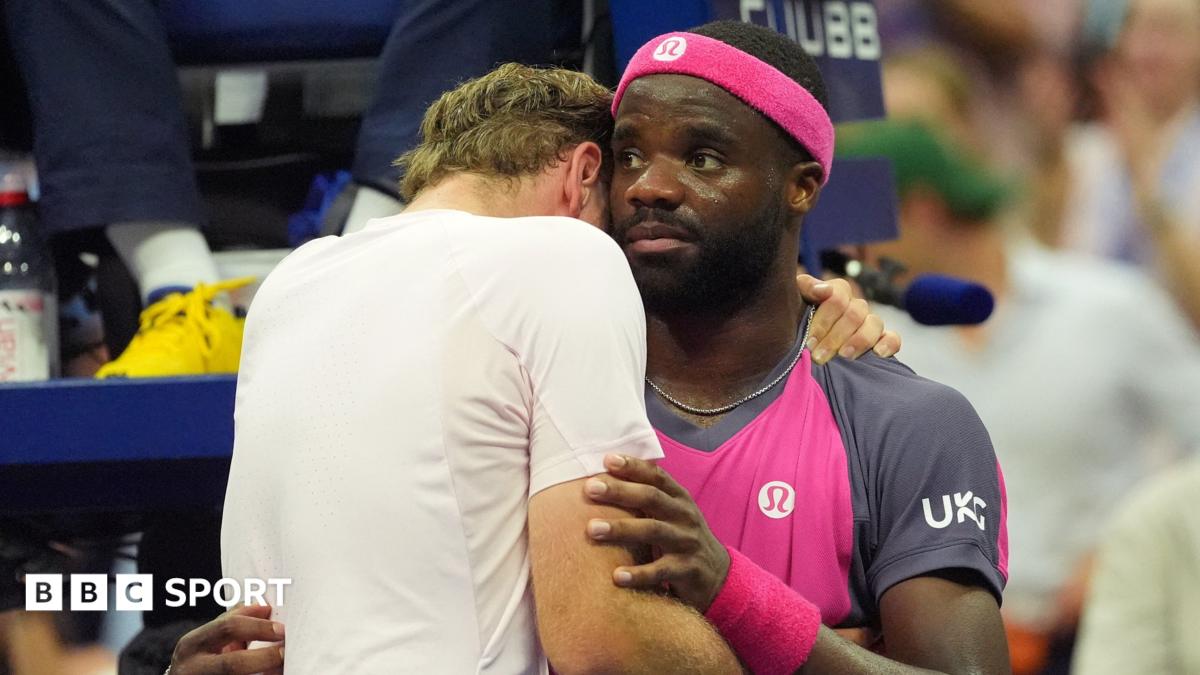
“He’s a great guy for consoling me in that moment,” said Michelsen of their post-match embrace.
“I was trying to keep it together, and I didn’t do a good job of that. He was saying a lot of nice personal things.
“I’ve got a lot of time to grow physically and mentally. I’m going to be here again. I know it.”
Tiafoe is hoping to reach the final at Flushing Meadows for the first time, following defeats by Alcaraz in 2022 and Taylor Fritz in 2024.
JEDDAH: His Royal Highness Prince Mohammed bin Salman bin Abdulaziz Al-Saud, Crown Prince and Prime Minister, received princes, scholars, senior officials, and a group of citizens who came to greet him at Al-Salam Palace in Jeddah on Tuesday.
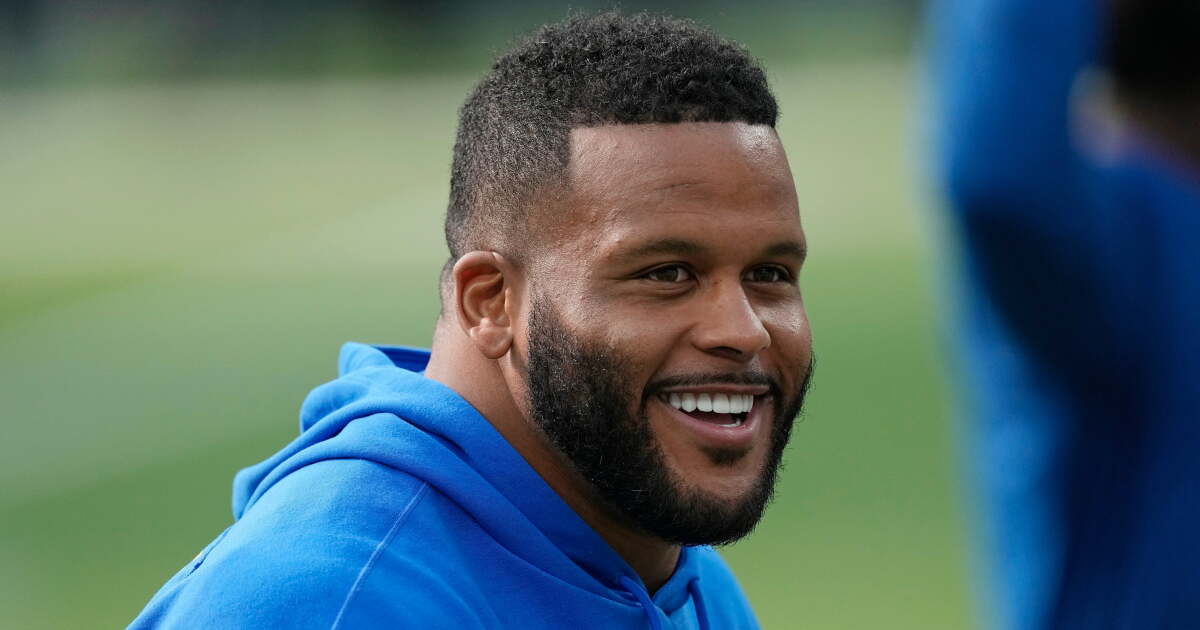
Defensive lineman Aaron Donald will not travel with the Rams to Melbourne to play in their season opener against the San Francisco 49ers, coach Sean McVay said Tuesday.
Donald, who rejoined the Rams last month after a two-year retirement, wouldn’t confirm if he was planning to play in the season opener when asked multiple times by reporters on Monday, only saying he was “feeling really good. Feeling great.”
The development isn’t surprising considering McVay and his assistants weren’t pushing Donald to play. Rams defensive coordinator Chris Shula said Monday that the team was taking a “day-to-day” approach regarding Donald’s status.
“I think he’ll be ready to go sooner rather than later, but we’re making a decision that we think is best for him and for our team,” McVay said. “He’s attacked this the right way, but it would have been a really quick turnaround.”
One person who might be surprised about Donald not playing is 49ers coach Kyle Shanahan. He told reporters Sunday he “definitely” expected Donald to play.
Rams players and staff are scheduled to leave Los Angeles for Melbourne on Tuesday night, arriving in Australia on Thursday morning. The game will take place on Friday at 10:35 a.m. local time (5:35 p.m. PDT Thursday), with the Rams planning to fly back to L.A. soon afterward.
Barring any setback, Donald should play Sept. 21 when the Rams face the New York Giants at SoFi Stadium.
One player who is expected to take the field at Melbourne Cricket Ground is Myles Garrett. McVay said the star defensive end will be “ready to go” after a left knee problem kept him out of practice for multiple weeks before he returned Sunday.
“We’ve been smart with Myles … but his impact has been tremendous, his overall vibe, what kind of teammate he’s been,” McVay said. “And so looking forward to getting him out there with the guys and being a great factor for us.”
Garrett did not practice Tuesday, but said he feels “ready” to play.
In addition to Garrett, cornerback Jaylen Watson also appeared on the Rams’ first injury report of the season after not practicing because of a toe injury.
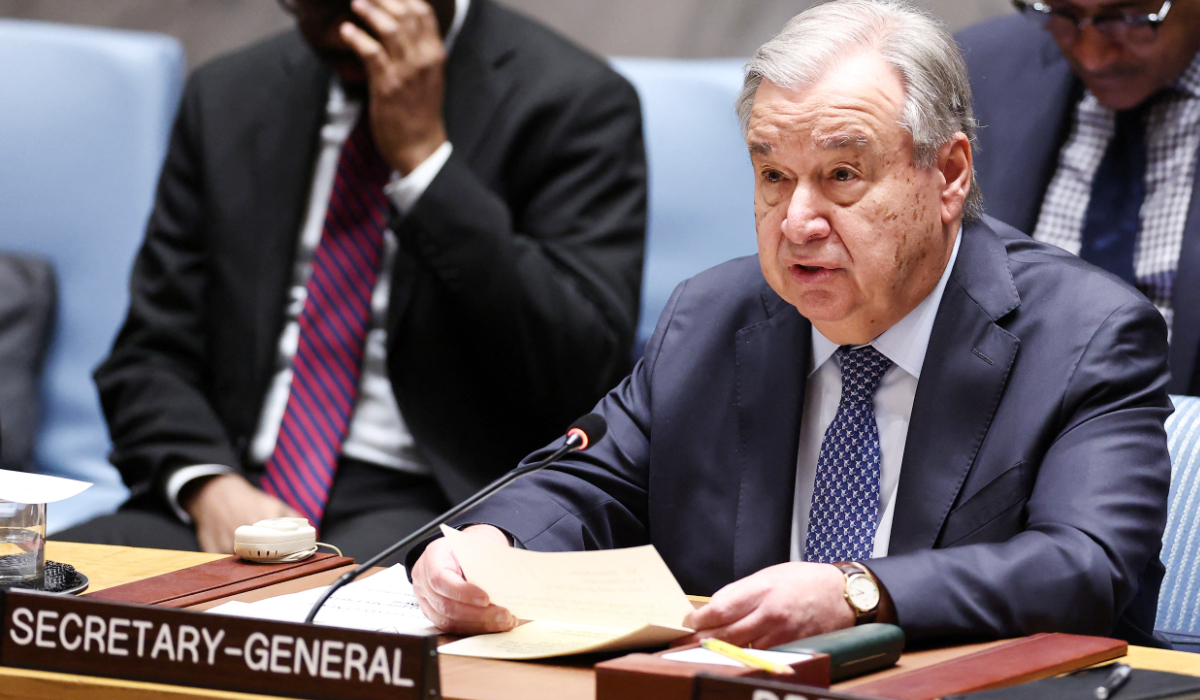
NEW YORK: The UN closed the books on the 80th session of the General Assembly on Tuesday and opened the 81st in a single day of ceremony, amid warnings from its outgoing and incoming leadership that the world body must reform itself or face erosion.
Secretary-General Antonio Guterres, who was addressing the assembly for what he noted was his final time as UN chief, painted a bleak picture of the present moment in the world: wars that carry a risk of nuclear escalation; worsening climate chaos; advances in artificial intelligence without adequate governance; and human suffering that is intensifying even as aid funding has been slashed.
“Geopolitical mistrust and suspicion continue to block the effective solutions we need — and erode people’s faith in the possibilities of global cooperation,” Guterres said.
Still, he told delegates, he has “enormous hope,” pointing in particular to the UN’s Pact for the Future and the UN80 reform initiative as “a blueprint for action, solutions and bold reforms.”
The UN80 Initiative is a reform drive launched by Guterres in March last year, the organization’s 80th anniversary. It aims to overhaul overlapping structures and outdated mandates that officials say have rendered the UN slow and bureaucratic.
The departing president of the General Assembly, Annalena Baerbock, described the initiative as unfinished business that she and her successor, Khalilur Rahman, were carrying into the 81st session.
Baerbock described the 80th session one that had found itself at “a crossroads” over whether a handful of states could effectively impose a veto on the General Assembly’s consensus. Member states, she said, had answered by refusing “to allow compromise to become compromising,” by pushing through 317 resolutions, holding 116 plenary meetings and opening a new chapter on AI governance, despite the challenges and only a few processes concluding through consensus.
“Not a single day, not a single country would be better off without the United Nations,” Baerbock told the assembly as she rejected the argument that the body had become irrelevant.
She credited Guterres with forcing the question of reform onto the agenda through the UN80 Initiative, including cuts to mandates and a merger of the UN System Staff College, which provides personnel and partners with the knowledge, skills and tools to act collaboratively and effectively, with UN Institute for Training and Research.
“If we are not capable of freeing this organization from overlapping structures and mandates, as well as a heavy bureaucratic mentality, it will erode over time,” she warned, describing the upcoming selection of a new secretary-general, a process she formally handed over to her successor, as “the credibility test of this institution for this decade.”
Rahman was then sworn in. He is from Bangladesh and told reporters he intended to run an open, media-engaged presidency built around the theme “Restoring Trust, Managing Transformation.”
During his formal address to the assembly he lamented that the UN “has often fallen short of the expectations placed upon us,” citing in particular a “widening trust deficit” that member states must work to close through the delivery of results, not rhetoric.
“Trust cannot simply be requested, it must be earned,” he added.
Rahman outlined six priorities for the coming 12-month session: peacekeeping-driven conflict prevention; acceleration of the Sustainable Development Goals, with just four years left to achieve them and only 36 percent of targets on track; climate adaptation ahead of the UN Climate Change Conference, COP31, in November, and a high-level meeting this month on rising sea levels; human rights, including the anniversaries of the Durban Declaration to combat racism and other forms of discrimination and intolerance, and the Declaration on the Right to Development, an issue he described as personal, given that Bangladesh hosts more than a million displaced Rohingya; inclusive governance of AI; and institutional solvency, as he appealed to member states to pay their assessed dues “in full, on time and without conditions.”
Rahman also inherits oversight of the selection process for the next secretary-general, under Article 97 of the UN Charter, to replace Guterres, whose term ends on Dec. 31. He pledged to run it “fairly, inclusively and transparently,” alongside the Security Council.
He said he had built his office to reflect the opening words of the Charter — “We the peoples,” not “We the states” — and noted that women make up 60 percent of his cabinet.
Guterres closed the day with a separate, more somber commemoration: a wreath-laying ceremony for Dag Hammarskjold, the second secretary-general of the UN, who was killed in the course of his duties, along with 15 others, in plane crash on Sept. 18, 1961.
Citing a new report from investigator Mohammed Chande Othman, Guterres renewed his appeal for undisclosed records relating to the crash in what is now Zambia, and said he would soon send recommendations to the General Assembly.
He also noted that UN personnel had been killed “in record numbers” over the past three years and added: “Their sacrifice reminds us of all the women and men who have lost their lives while serving the United Nations.”
Sanctions announced by the British government on Tuesday targeting West Bank settlements have upended the UK’s decades-long balancing act and provoked furious condemnation from the Israeli government that has all but severed relations between the two.
Coming a year on from recognizing Palestinian statehood, the Labour-led UK government confirmed it was tightening restrictions on arms exports to Israel and was placing bans on the import of all goods from settlements and on some services, including construction, financing, infrastructure, real estate, and settlement advertising.
Addressing Parliament, Foreign Secretary Ed Miliband, who is of Jewish heritage and lost multiple members of his family during the Holocaust, labeled the settlers “terrorists” who had received tacit support for their practices by an Israeli government.
UK Foreign Secretary Ed Miliband announces the policy in the British Parliament. (AFP)
“There is ethnic cleansing of Palestinians in areas of the West Bank perpetrated by settler terrorists, and all too often, the Israeli government has turned a blind eye to this, and worse, members of it have made statements and taken actions to support the forced displacement of Palestinians,” Miliband added.
The move marks part of a broader international pushback on settlement activity, with Canada and France also announcing on Tuesday they would join Belgium, Denmark, Finland, Iceland, Ireland, Norway, Poland, Portugal, Spain, Sweden, and the UK in enacting bans.
Against a backdrop of looming Israeli elections, questions are now being asked: Does the news out of London mark a long-term structural shift in its relationship with Israel, or is it part of a coordinated effort to put pressure on the government of Prime Minister Benjamin Netanyahu ahead of elections in late October?
In Israel, early political response was definitive, with National Security Minister Itamar Ben-Gvir leaning into a global call by right-wing governments as he urged the country to “publicly recognize that the Malvinas Islands (Falklands) are Argentine territory under occupation.”
He added: “The British are not content with merely occupying the territory; they also carry out oil drilling there and steal money from the Argentine people.”
Israel’s Finance Minister Bezalel Smotrich, meanwhile, claimed “we will not be a doormat trampled by an antisemitic government, in a country conquered by radical Islam, trying to save itself from economic and social decline.”
Addressing the media shortly after Miliband’s announcement, Israeli Foreign Minister Gideon Saar stated plainly that the UK was engaging in election interference as he warned that the Israeli population “emphatically” rejected Palestinian statehood.
Smotrich speaks during the official inauguration ceremony of a new Israeli settlement in the occupied West Bank. (AFP file)
Announcing countermeasures, Saar said Israel would close the British Consulate in Jerusalem; remove British representatives from the International Gaza Support Center in Kiryat Gat in southern Israel; terminate the UK’s role in training Palestinian Authority forces in the West Bank; and deny 12 elected officials entry to Israel.
These include former Labour leader Jeremy Corbyn, Zarah Sultana, Fahad Ansari, director of Riverway to the Sea, Naz Shah, Diane Abbott MP, Hannah Spencer, Carla Denyer, Sian Berry, Ellie Chowns, John McDonnell, Richard Burgon, and Adrian Ramsay.
Chris Doyle, director of the Council for Arab-British Understanding, said that Ben-Gvir and Smotrich’s history of offensive comments would likely mean these remarks were not “seen as serious” in and of themselves, but warned that they could not be wholly ignored.
“They (Gvir and Smotrich) are viewed with the sort of contempt that is necessary. It’s one of the many reasons that they are sanctioned,” Doyle told Arab News.
“But clearly, the concern will remain that somehow whatever they say could become official Israeli government policy, not least in an election cycle.”
Burcu Ozcelik, senior research fellow at the Royal United Services Institute, told Arab News the real threat from Israel surrounded the potential that it could downgrade aspects of intelligence-sharing and defense cooperation with the UK.
Doing so, Ozcelik said, would prove “significant” and was “exactly why” she expected to see the UK go to great pains in the days and weeks ahead to “telegraph that the settlement trade ban is legally and diplomatically defensible because it is consistent with its recognition policy, but that the UK seeks to preserve substantial security and economic ties with Israel.”
However, according to observers who spoke to Arab News, the UK appears to have reached a point at which it is willing to take that gamble, with Doyle noting that after meeting with Miliband on Monday, he was convinced the ban was indicative of a broader structural shift.
“I’m quite convinced that Ed Miliband is genuine when he says that this will be a reset in relations with Israel,” said Doyle.
“It’s a phrase he’s used in public and repeated. So I think that imposing a ban on trade with settlements is certainly part of that. But I think that there needs to be other measures, and I expect that there will be.”
Concurring, Husam Zomlot, the Palestinian ambassador to the UK, described the decision as “long overdue,” writing on X that the sanctions marked a “turning point in UK-Palestine relations,” with Britain moving “from condemnation to consequences, from words to action.”
Protesters march through central London to oppose the war in Gaza. (AFP file)
Stressing that the development marked neither a “wholesale rupture with Israel” nor a “blanket trade ban” with Israel, Ozcelik said the Labour government was adding consistency to last September’s recognition of Palestine and the country’s “continued commitment to a two-state solution.”
“It is distinguishing between Israel’s legitimate security concerns, which the UK fully recognizes, and the settlement expansion in the West Bank, which the UK considers illegal under international law,” Ozcelik said.
“The UK government’s calculation is that if it recognizes a Palestinian state while taking no action against settlements that undermine the territorial viability of a future state, there is an obvious credibility gap. These measures need to be read as an attempt to give practical meaning to the UK’s support for a two-state solution.”
Ben-Gvir wants Israel to “publicly recognize that the Malvinas Islands (Falklands) are Argentine territory under occupation.” (AFP file)
Public support for a ban has been steadily climbing since a recommendation for one last July from the Foreign Affairs Select Committee, with an August YouGov poll pointing to 50 percent support, with just 16 percent opposed, while Caabu research noted 246 MPs were in favor.
Trustee of the Britain Palestine Project, which seeks equal rights for Israelis and Palestinians, and former UK Consul-General to Jerusalem Sir Vincent Fean said that with “no peace process” and a “genocide in Gaza and apartheid, state-controlled settler violence and ethnic cleansing in East Jerusalem and the rest of the West Bank,” action was necessary.
“This is a necessary reset of UK government policy, wholly consistent with UK recognition of the State of Palestine on Sept. 21, 2025, and respect for international law, which the Labour government came into office committed to uphold,” Fean told Arab News.
“It exerts UK leverage over Israeli illegal settlements for the first time. The UK has joined the international virtual consensus in condemning settlements as illegal, undermining prospects for peace. But nothing was done to stop them.
“With this policy step change, the UK is giving a lead to like-minded partners. The UK is not powerless in this regard.”
Noting that the UK move was “inevitable” amid a “deterioration of the security situation in the West Bank,” which followed the Israeli government overturning a 20-year settlement ban in Jenin, Yossi Mekelberg said he wanted to see words matched with action.
Settler violence has escalated in the West Bank since the Oct. 7, 2023, attack on Israel triggered the war in Gaza. (AFP file)
“Taking measures against the trade with the settlements is one thing, but we also need to see a drive toward a two-state solution,” Mekelberg, a senior consulting fellow on the Middle East and North Africa program at Chatham House, told Arab News.
“Do you support the two-state solution on both sides? Do you support the process? If so, you need to fill it with content, with substance.”
Asked to provide a metric for measuring the ban’s success, Ozcelik said this would ultimately be measured in whether it deters implementation of the contentious E1 plan, which critics say will sever Palestinian territory in such a way that a contiguous state is no longer possible.
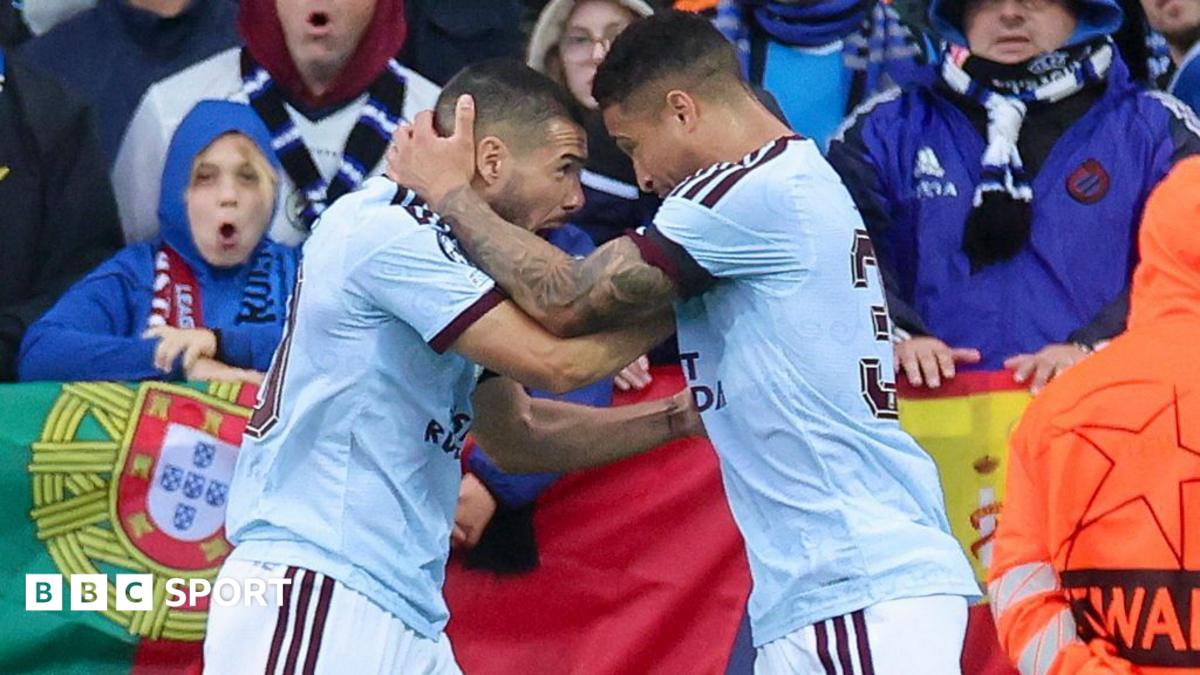
The visitors were in a commanding and deserved position at half-time, McGinn’s opener making him the club’s all-time record European goalscorer with 12.
Buendia’s strike and Jackson’s first Villa goal – benefiting from Yann Sommer’s rush of blood – had them cruising.
Brugge were poor and George Hemmings, Villa’s first Champions League/European Cup teenage starter in 43 years, could have had at least one.
Yet the hosts made it uncomfortable for Emery’s men with Nicolo Tresoldi’s penalty after Aaron Wan-Bissaka’s blatant handball setting up an anxious last half an hour, during which Tresoldi hit the post.
It can be viewed as a blessing in disguise that Villa had to battle their way through and ride out the hosts’ pressure to earn their first win of the season. Adding the grit and determination to the quality of the opening half to prove they can get the job done.
Not that they needed the evidence themselves, Emery and his squad always have that faith and the internal desire to progress no matter the obstacle.
It was the same last season. A below-par 1-0 win over limited Bologna – thanks to another McGinn goal – got Villa going and they hardly looked back.
The victory kicked off the staggering run of 17 wins in 20 games which formed the backbone of returning to the Champions League and giving Villa momentum to win the Europa League.
Since then, of course, Villa’s spine has been torn out and Emery has to integrate 10 new players into his methodical methods.
Three points in Brugge may not spark another relentless run but it gives Emery and Villa the foundations of this new era.
“It’s a new Villa and it was a big test for the new players to dig in,” McGinn told Uefa.
“It was Joao Gomes and George Hemmings’ first Champions League game. It’s not easy to go away at a place like this in difficult weather conditions. Club Brugge were pushing and pushing and pushing and we had to stand strong. We managed to do that.
“It was so important to show a real gritty performance and get a victory at a very, very tough place to play.”
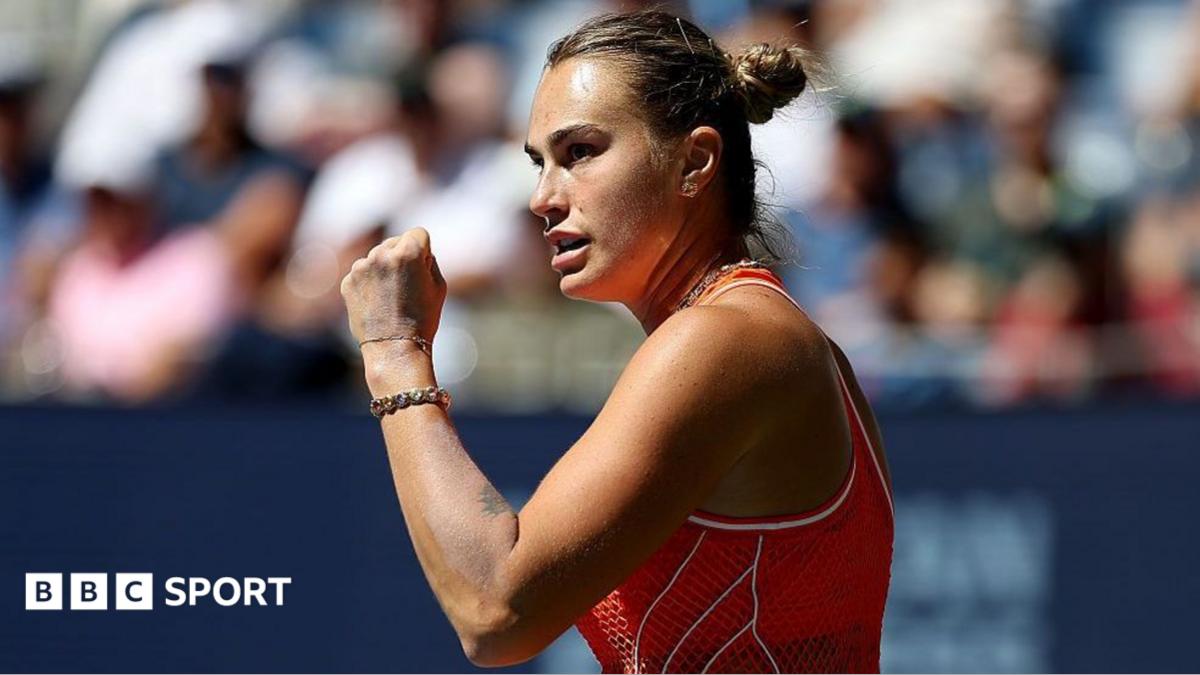
Sabalenka began the match in cruise control, breaking in sixth seed Noskova’s opening service game and racing into a 5-2 lead, before being broken as she served for the set.
Although she dominated the subsequent tie-break, the double fault she hit in her last service game – one of four in the match – would prove a feature of her performance, as would her failure to convert break points.
She wasted three early in the second set before conceding a break in the sixth game with a double fault at 30-40 as Noskova forced a decider.
After hitting two more double faults to be broken for a third time, she looked down and out after Noskova held to love for a 4-2 lead, but won the next three games to turn the match around.
She then won the tie-break – for a 10th successive time at the US Open, in a run dating back to 2021 – to complete her comeback, sealing the victory with a nerveless second-serve ace.
This was only Sabalenka’s second quarter-final victory since March, with the top seed unable to replicate her early season hard-court success – which included titles in Brisbane, Indian Wells and Miami – on the clay or grass.
She suffered last-16 exits in Toronto and Cincinnati in the build-up to the US Open, but has rediscovered something approaching her best form at the tournament where she is yet to lose a quarter-final in six attempts.
For Noskova, this defeat, during which she hit more winners, fewer unforced errors, and saved seven of her nine break points, ends a run of 11 consecutive singles wins at Grand Slams.
Matthew Brennan emerged victorious in the 16th stage of the Vuelta a Espana to claim his fourth stage win of this year’s race.
The British Visma Lease-a-bike rider sprinted to victory ahead of Bryan Coquard and Vito Braet in Palos de la Frontera.
Brennan, 21, held up four fingers to celebrate each of his four stage wins in his first Grand Tour.
“It’s unbelievable, four victories here and the plan was for one,” Brennan said after the 181km stage.
Stage 16 was expected to be another chance for the sprinters.
A five-man breakaway got up the road early on, but with 100km remaining the peloton started to reel them in. The break was caught with around 23km remaining, setting up the bunch sprint finale.
Spanish rider Enric Mas of Team Movistar maintained his 2min 6sec general classification lead on Felix Gall, with Primoz Roglic a further four seconds behind.
The next stage takes place on Wednesday, consisting of 185km from Dos Hermanas to Seville, offering another sprint finale.
Businesswoman Hayley Parsons had already called for them to stand down before Davies did the same, while former Principality Building Society chief operating officer Rob Regan has offered to oversee an interim board.
The board also doubled down on its commitment to cut the number of professional teams from four to three by 2028, with WRU-owned Cardiff and privately-backed Dragons set to be given licences.
That announcement has plunged the futures of Scarlets and Ospreys into doubt, with the west licence either being awarded to the Llanelli-based side or their Swansea-based rivals.
Asked whether he still had faith in those running the game in Wales, Williams, who coaches in west Wales, said: “No, I don’t have much faith, to be honest with you.”
“I think we’re still none the wiser.
“I think they just took a little break in deciding what was going to happen, but knowing deep down in their hearts that they wanted it to be three regions.
“We as coaches know the uncertainty of who’s going to remain as a region next year and that is very difficult.
“But what we are trying to do and what we do need is a bit more support in the pathway side of the rugby.
“We talk about the regions, we talk about the national team, but where do they think these players come from?
“I can answer that for you straight away. That is schools and colleges.”
In its response the WRU stated: “The schools game in Wales is an integral part of our future strategy and we already provide significant funding and support in this area.
“After restructuring our community rugby department in 2025 we are now able to provide dedicated support to all clubs and schools throughout the country.
“We fund and run a number of competitions for schools including those which culminate in National Finals days held at either Principality Stadium or Rodney Parade each year.”
Lamine Yamal is one of six Spain players that won the World Cup to be included.
Having scored the winning goal in the final, Paris St-Germain forward Ferran Torres, who joined the French club from Barcelona in the summer, makes the cut.
Back-to-back Champions League winners Paris St-Germain have nine players – excluding new signing Torres – nominated, including last year’s winner Ousmane Dembele.
Real Madrid forwards Kylian Mbappe and Vinicius Jr also make the shortlist, as do Arsenal defenders Gabriel and William Saliba.
The award is celebrating its 70th anniversary, having been created by France Football in 1956, and the winner will be announced at an ceremony in London on 26 October.
The “symbolic choice of venue” is in tribute to former England player Sir Stanley Matthews, who won the first Ballon d’Or.
From the moment they arrive at school, Dos Pueblos High seniors Ruby Streatfeild and Brooklyn Hedricks are practically inseparable.
Whether in class, at lunch or in practice, the two spend so much of their time together they can finish each other’s sentences, and that synergy is one reason the Chargers are in the hunt for a CIF flag football championship. Their competitiveness is another.
“Me and Brooklyn are besties,” Streatfeild said. ”The biggest thing we have in common is we both want to win.”
Streatfeild began the season as a receiver but transitioned to quarterback when Ava Taiji sustained a tricep strain at the Chargers Invitational. She has flourished in her new role, passing for 823 yards and 18 touchdowns.
“It’s a lot harder, but I like it,” said Streatfeild, who has also rushed for 248 yards and five touchdowns. “I like getting the ball every play and being able to make more plays. It’s taught me to be a leader. It’s not just about being vocal, it’s about the energy you bring to the field and not letting a loss bring you down.”
The Chargers are 10-2 and have shut out five opponents. Their only defeats came within hours of each other at the Chargers Invitational, to reigning Southern Section Division I champion JSerra and Bonita Vista, the second-ranked team in the San Diego Section. They have won seven straight, giving up only 25 points in the process.
Naturally, Hedricks is Streatfeild’s favorite target.
“Brooklyn has the best hands and really good speed,” Streatfeild said. “If I throw her the ball, it’ll be caught.”
Hedricks, a receiver on offense and a linebacker on defense, has mutual trust in her quarterback. She already has 27 receptions for 355 yards and eight touchdowns.
“I know when Ruby throws it, it’s going to get there,” she said.
Both grew up playing soccer and their AYSO teams were once matched against each other at a tournament in Bakersfield when they were 12, although neither knew it at the time.
Dos Pueblos quarterback Ruby Streatfeild throws on the run during a 31-0 win over Santa Barbara.
(Steve Galluzzo / For The Times)
“My family figured it out later,” said Streatfeild, who ended the first drive of last week’s nonleague game at Santa Barbara by rolling to her left and zipping a perfect pass to Hedricks in the corner of the end zone. Hedricks later scored on a 40-yard interception return in the team’s 31-0 victory.
“Ruby and Brooklyn have been with us since Day 1, they’re both three-sport athletes and both have sisters who also play,” said Dos Pueblos coach Doug Caines, who started the program in 2023. “It’s incredible for Ruby to be clicking this fast at a new position. As for Brooklyn, she’s so gifted at reading the quarterback. She had two pick-sixes at the Ventura Showcase.”
In the winter, the two play on the varsity soccer team (Hedricks plays forward; Streatfeild left back) under the guidance of Hedricks’ father George, who is also the head baseball coach.
“I don’t think we’ve ever assisted each other in soccer,” said Hedricks, who tallied six goals and three assists last season.
Asked which is more exhilarating — scoring a goal or a touchdown — the two looked at each other and said in unison: “A touchdown!”
Hedricks plays outfield in softball and will move from right field to center in the spring.
“I got a promotion,” she joked.
1
2
1.Dos Pueblos receiver Brooklyn Hedricks catches a pass.2.Dos Pueblos quarterback Ruby Streatfeild runs with the ball.(Steve Galluzzo / For The Times)
Hedricks had 30 hits, 23 RBIs and 20 runs with 26 putouts in 26 chances last season as Dos Pueblos advanced to the Division 3 semifinals.
Streatfeild’s spring activity is track and field, where she competes in the 100-meter dash, long jump and both relays. She ran the anchor leg as the Chargers set a school record in the 4×100 meters with a time of 48.66 seconds at the Division 2 prelims last year.
However, both consider flag football their primary sport and have received offers to play in college.
“My dad encouraged me to try out and I loved it from the start,” said Hedricks, who is the school’s all-time leader in interceptions with 45. “I’ve never struggled learning plays.”
Hedricks’ sister Reagan is a freshman linebacker and punter on the junior varsity team.
Streatfeild’s inspiration was her sister Sterling, who was a tailback and free safety and now attends Vanderbilt. Last June, the sisters helped the Conquer Chargers’ U17 team win the inaugural Roma Bowl in Italy after Sterling’s graduation. Ruby was named the tournament MVP.
“She was in ninth grade and came to watch her older sister try out and after that first day she said ‘I want to do that,’” Caines said of Ruby, who caught a team-best 104 passes for 1,101 yards and 18 touchdowns last fall.
Ruby Streatfeild has thrown for 823 yards and 18 touchdowns since switching from receiver to quarterback early in the season.
(Steve Galluzzo / For The Times)
Streatfeild and Hedricks’ bond grew even stronger as teammates on the Conquer Chargers, which won the high school girls division at the NFL Flag championships in July in Westfield, Ind. That roster also featured Kacey Hurley, who quarterbacked Dos Pueblos to the Southern Section semifinals last fall and is now a freshman at Cal Poly San Luis Obispo.
“We tried out in November and were with the team for eight months prior to nationals,” Hedricks said. “We trained once or twice a week in Camarillo and some days we carpooled.”
“It was fun experience but that was five-on-five not seven-on-seven, which is a whole different format,” added Streatfeild, who was thrilled to learn the next morning that a play she made — diving to catch the ball before it hit the ground — was No. 1 on the ESPN “SportsCenter Top 10.” She also made the list for her 60-yard touchdown catch in the playoffs last season against Edison.
“That just shows what a game-changer Ruby is,” Caines said. “I mean, to make an ESPN highlight not once but twice? Amazing!”
While they do not socialize much off campus, the hours they spend together on it have forged a close friendship.
“It’s harder to hang out after school because of where we both live,” said Hedricks, who has a 45-minute commute from Lompoc to Goleta. “Not a big deal — I’m used to it by now.”
Caines is grateful for the attention his stars have brought to Dos Pueblos, located in the foothills across the 101 Freeway from UC Santa Barbara.
Dos Pueblos’ Brooklyn Hedricks, left, celebrates with teammate Kindah Ahmad-Reda after returning an interception for a touchdown against Santa Barbara.
(Steve Galluzzo / For The Times)
“We’re not in Orange County or San Diego, we’re the northernmost school in the Southern Section and we don’t get as much exposure but we’re fighting for relevancy,” he said. “It was so cool seeing 805 [area code] girls beat more established club teams from Texas and Florida. It shows we have good teams up here.”
Dos Pueblos finished 24-3 last season and played even with JSerra for almost three quarters before losing 20-0 in the Division 1 semifinals. This year’s goal is to make it to the finals.
“We’ve had a different quarterback every season, so this is nothing new,” Streatfeild said. “We’re still progressing but beating Westlake was huge. We have the best coach, so I think we can make the top division. We’re going to give it our all.”
MOSCOW: Russian authorities said Tuesday they have detained a suspect in last week’s shooting that wounded a senior military officer, the latest in a series of attacks on personnel and figures linked to the war in Ukraine.
The Federal Security Service said a 21-year-old Moldovan national was detained for being allegedly “involved in an assassination attempt on a senior military officer of the Russian Defense Ministry” at the behest of Ukrainian intelligence services. He faced charges of attempted murder and illegal arms trafficking, it said.
The officer was shot at least six times on Sept. 3 in the Probuzhdenie settlement on the outskirts of Engels, a city in the Saratov region, said Svetlana Petrenko, a spokeswoman for Russia’s Investigative Committee, which is also involved in the case.
The region is home to a large air force base that hosts Russia’s strategic bombers and has carried out attacks on Ukraine.
The victim, who has not been identified by Russian authorities, survived the shooting and remains hospitalized.
The FSB alleged that the suspect was recruited by Ukrainian intelligence services in 2025 and arrived in Russia in June. He was detained in the southern Astrakhan region as he was trying to leave the country and return to Moldova, the agency said.
Petrenko said he was allegedly offered $70,000 for carrying out the attack.
There was no immediate comment from either Ukrainian or Moldovan officials. Ukrainian President Volodymyr Zelensky alluded to the attack on the day it happened, saying: “Wherever Russian criminals hide, they will be found, and today there is further confirmation of this fact – confirmation in the Saratov region.”
Last week’s attack follows a series of bombings in Russia targeting people involved in the 2022 full-scale invasion of Ukraine. Moscow has blamed Kyiv for some of the blasts.
In late August, a serviceman was killed and his wife was injured by a car bomb on the outskirts of St. Petersburg. Three weeks before that, the director of a factory supplying drones to the Russian military was badly injured and his driver was killed when their car exploded just outside Yekaterinburg, 1,400 kilometers (about 870 miles) east of Moscow.
In those cases, the authorities did not immediately say who they believed carried out the attacks.
Earlier this year, President Vladimir Putin directed the FSB and other agencies to tighten security around military and government officials.
Kyiv has claimed responsibility for some attacks inside Russia. Ukraine’s SBU security service said in 2024 that it had organized the killing of Lt. Gen. Igor Kirillov, who headed the Russian military’s nuclear, biological and chemical protection forces.
Kirillov was killed by a bomb hidden in a scooter outside his apartment building in Moscow, a day after Ukraine’s security service leveled criminal charges against him.
Napoli have said Scott McTominay’s heart surgery “was a complete success” and expect the Scotland midfielder to resume training this month.
The 29-year-old’s ablation procedure – a minimally invasive operation to correct irregular heart rhythms – took place at Spire Manchester Hospital on Tuesday morning.
McTominay was substituted after 56 minutes of Napoli’s 2-1 Serie A defeat by Como on 30 August.
A mild benign arrhythmia was discovered, prompting the corrective treatment.
Napoli, who said in statement, external that “McTominay will rest for two weeks and then resume training”, had expected the former Manchester United player to return to action after the international break in early October.
When his heart issue was announced, McTominay posted on Instagram: “See you soon Napoli. I won’t take long.”
Sebastien Pocognoli’s first four games as Scotland head coach – home and away against Slovenia as well as matches with North Macedonia and Switzerland in the Nations League – are scheduled for the end of September and early October.
According to the NHS,, external an arrhythmia is when the heart beats too quickly or too slowly, or the heartbeat is not steady.
The British Heart Foundation explains, external a cardiac arrhythmia ablation involves using heat or cold energy to create tiny scars in the heart to block faulty signals and restore a typical heartbeat.
Way back in the 1970s, the City Section ruled in top quarterbacks. In the city of Granada Hills alone, there were two future NFL quarterbacks competing: John Elway at Granada Hills and Tom Ramsey at Kennedy. Add another future NFL quarterback, Jay Schroeder, and the City Section could compare itself to anyone in the nation.
This season, City teams have been going to the air to take advantage of their experienced, athletic quarterbacks.
From Chris Fields III at Carson to super sophomore Thaddeus Breaux at Hamilton, these quarterbacks know what they are doing. Let’s look at others.
South East’s Bryce Johnson has 743 yards passing and five touchdowns in three games. Jered Smith of Verdugo Hills has 462 yards passing and six touchdowns in two games. Noa Tuvalu of Banning has thrown for 837 yards and seven touchdowns with only one interception.
Seth Solorio of San Pedro set a school record with seven touchdown passes last week against Westchester. Freshman Exavier Johnson of Birmingham came through with 171 yards passing and two touchdowns last week in a loss to Moorpark. Robert Holohan of Palisades has five touchdown throws. Danniel Flowers of Crenshaw has led his team to a 3-0 start with his versatility to run and pass.
Gerald Torres of King/Drew has 800 yards passing and seven touchdowns. Nathaniel Cadet of Marshall has passed for nine touchdowns.
It’s a good sign that teams are getting their offensive lines to provide enough protection to let quarterbacks shine.
This is a daily look at the positive happenings in high school sports. To submit any news, please email eric.sondheimer@latimes.com.
Former Chargers coach Brandon Staley and former Atlanta coach Raheem Morris — now defensive coordinators with New Orleans and San Francisco, respectively — also parlayed stints with McVay into head coaching opportunities.
“The development of the coaches who have worked for him — that’s not an accident,” O’Connell said. “That is something he’s purposeful about, and that he genuinely does care about.”
As always, McVay is quick to acknowledge the early NFL opportunities he was afforded and the lessons learned from his grandfather, John McVay, and the Gruden and Shanahan families.
“What I would hope is that the most helpful thing for them is that they get exposed to everything,” McVay said of helping assistants become head coaches. “Because I try to be as inclusive as possible, so when they get that role, they’ve kind of been in a lot of those scenarios already because they’re helping me navigate those things.”
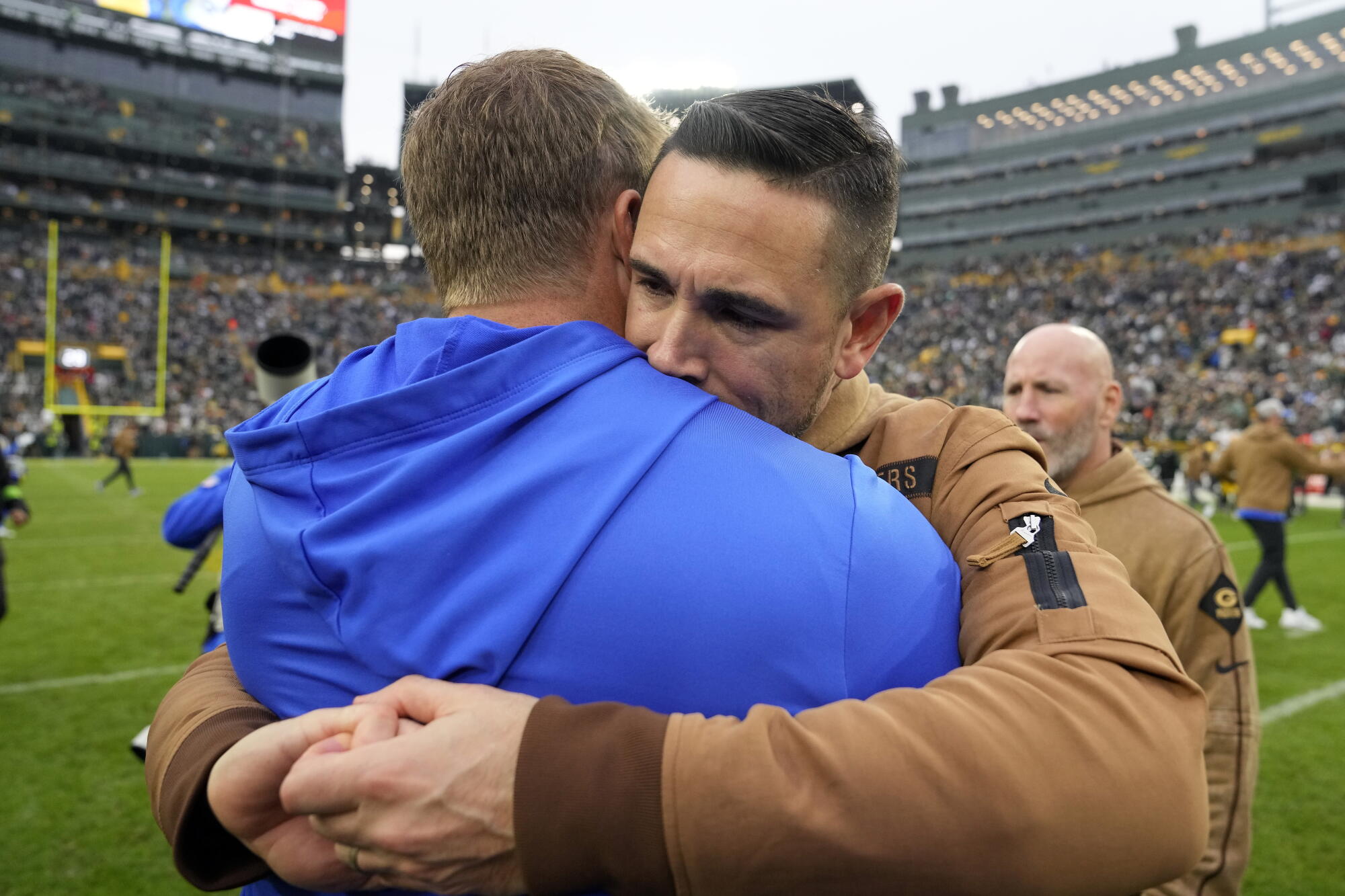
Green Bay Packers coach Matt LaFleur, right, hugs Rams coach Sean McVay following a game at Lambeau Field in November 2023.
(Patrick McDermott / Getty Images)
“That was a huge learning experience for me, just being so close to Sean and seeing all the stuff he had to deal with.”
— Matt LaFleur, Green Bay Packers coach, on the influence Sean McVay had on igniting his head coaching career
Matt LaFleur said he knew McVay would become an NFL head coach within 10 minutes of McVay interviewing for a quality control job with Washington in 2010.
Seven years later, after the Rams made the then-30-year-old McVay the youngest head coach in modern NFL history, McVay hired LaFleur as offensive coordinator. To that point, LaFleur said, becoming an NFL head coach himself was not at the forefront of his mind.
“It wasn’t until I was with Sean and you got kind of a front-row seat,” LaFleur said. “That was a huge learning experience for me, just being so close to Sean and seeing all the stuff he had to deal with. That’s where it kind of intrigued me and piqued my interest.”
After the 2017 season, and the Rams’ first playoff appearance since 2004, LaFleur interviewed to become the Tennessee Titans’ head coach. The Titans ultimately hired him as offensive coordinator and playcaller.
2026 NFL season preview
In 2019, the Packers hired LaFleur as head coach, and he has since guided teams to five playoff appearances and two NFC championship games.
Taylor also was a member of the Rams’ 2017 staff as an assistant receivers coach. The next season, he coached quarterbacks.
McVay empowers all coaches, said Taylor, who had previous experience as a coordinator. Taylor’s initial role with the Rams was a step back, but McVay and other staff members did not make it feel like one.
A month after the Packers hired LaFleur, the Bengals hired Taylor. Two years later, Taylor guided his team to a matchup against the Rams in Super Bowl LVI.
“Sean just shows you this is the model you can follow that works well,” Taylor said. “You take it to your own place, you tweak it. And certainly, over eight years, tweaked it drastically. … But I think there’s just belief when you work there, that this is something you can model off of and win championships with.”
The Chargers hired Staley after the 2020 season. The Chargers requested to interview O’Connell to become offensive coordinator and playcaller, but McVay blocked it, citing it as a lateral move.
“He had different plans,” O’Connell said, “and he’s entitled to do that. But he followed that up with: ‘We’re going to go get Matthew Stafford, we’re going to win a Super Bowl, and you’re going to become a head coach.’
“When all three of those things became true a little over a year later — I love him to death, and I would love to not give him that kind of credit. But I absolutely need to.”
The Vikings hired O’Connell after McVay led the Rams to their Super Bowl victory.
Rams coach Sean McVay, left, and Minnesota Vikings coach Kevin O’Connell greet one another after a game at SoFi Stadium in October 2024.
(Kyusung Gong / Associated Press)
“There were countless times where he brought me into his office for circumstances that went beyond the role of a coordinator — to really pull back the curtain and let me understand,” O’Connell said, adding, “He wanted to help my development, and that’s something I’ve now taken very seriously with some of the coaches who have coached for me.”
Coen joined the Rams’ staff in 2018 as an assistant wide receivers coach. He left in 2021 to become Kentucky’s offensive coordinator, but returned to the Rams in 2022 as offensive coordinator.
The Rams suffered the worst Super Bowl hangover in NFL history, and Coen returned to Kentucky before becoming the Tampa Bay Buccaneers’ offensive coordinator. The Jaguars hired him in January 2025.
Coen said the lessons he learned from McVay in 2022, when injuries decimated the Rams’ roster, were among the most valuable.
“He challenges every aspect of who you are as a coach,” Coen said.
Coen and McVay talked for close to three hours in the days after the Rams sent the Jaguars to a loss that dropped their record to 4-3. Coen then led his team to nine victories in their last 10 games en route to the playoffs.
“He mentioned something like, ‘Look, you can get frustrated with jersey number X or Y, but we still need to love the name on the back,’” Coen said. “And that was helpful for me because sometimes you can get caught up in the assignment and the execution that you forget, ‘Man, like I really care about that player. His last name, that means something to me as a coach,’ and to lean into that and to make sure that when you come in the building every day and your players come in the building every day, they genuinely want to be there.”
Jacksonville Jaguars coach Liam Coen stands on the sideline during a preseason game against the Tampa Bay Buccaneers on Aug. 28.
(Parker S. Freedman / Getty Images)
The Falcons hired Morris in 2024, and the Cardinals last February made Mike LaFleur, Matt’s younger brother, a head coach for the first time.
During three seasons as the Rams’ offensive coordinator, Mike LaFleur said McVay established strong foundations but also used his tireless energy to encourage assistants to tear down tried-and-true concepts and build them back, sparking innovation.
“It’s long, it’s tiring, but it’s necessary,” LaFleur said, adding that lessons learned from McVay have served him and others well.
”You look at Kevin [O’Connell], you look at my brother, I do think you just kind of naturally take that with you.
“And in my opinion, it just gives you a leg up.”
McVay laments, usually lightheartedly, the loss of staff members that have ascended to become head coaches.
But said he was grateful for the opportunity to help them achieve their goals.
And there is an added benefit.
“What I think has been really cool is that if you are fortunate to see guys go on and do well, it attracts really high-level coaches as well,” McVay said. “When you show that you’re willing to invest in people, there’s really good coaches that become available on a year-to-year basis.”
First-year offensive coordinator Nate Scheelhaase, a Rams assistant since 2024, appears on track to be the next head coach from McVay’s staff. During the offseason, several teams interviewed Scheelhaase for head coaching vacancies.
If this season plays out as anticipated — the Rams are favorites to win the Super Bowl — McVay’s tree likely will have another branch.
Staff writer Sam Farmer contributed to this story.
BOSTON — Adley Rutschman hit a three-run homer off the Pesky Pole in right field, Brayan Bello pitched five scoreless innings in his first start since early June and the Boston Red Sox beat the Angels 5-2 on Monday for their fifth straight victory.
Jarren Duran hit his 20th homer, a solo shot, to spark a four-run second inning for Boston, which improved to an MLB-best 34-17 since the All-Star break and closed to two games behind the Yankees for the American League’s top-wild card spot. New York owns the tiebreaker by winning the season series.
Moisés Ballesteros hit a solo homer for the AL West’s last-place Angels, who have lost 12 of 14 games.
Making his first start since giving up a career high-tying eight runs on June 4 before he was sent to triple A for nearly a month, Bello (6-7) worked around a high pitch count to keep the Angels (54-90) to four hits with seven strikeouts.
The 27-year-old Bello, who had a solid run out of the bullpen the past two months, started because interim manager Chad Tracy decided to move back every starter.
Garrett Whitlock, the third reliever, pitched the ninth for his third save.
Duran hit the first pitch from Grayson Rodriguez (4-7) deep into the right-field seats to open the big second inning. Rutschman hooked his down the line, smacking the pole to make it 4-0.
Eli White added an RBI single in the third.
Boston (80-65) swept a three-game series against the Angels in Anaheim in early July.
Rodriguez gave up three earned runs or fewer in six of his previous seven starts before surrendering five over four innings Monday.
Up next: LHP Reid Detmers (4-8, 3.44 ERA) is set to start for the Angels against LHP Patrick Sandoval (1-4, 4.41) on Tuesday night in the middle game of the series.
Explore the holy city of Madinah with City Sightseeing on the iconic red double-decker buses. Enjoy the comfort of touring the city with its rich history and religious significance.
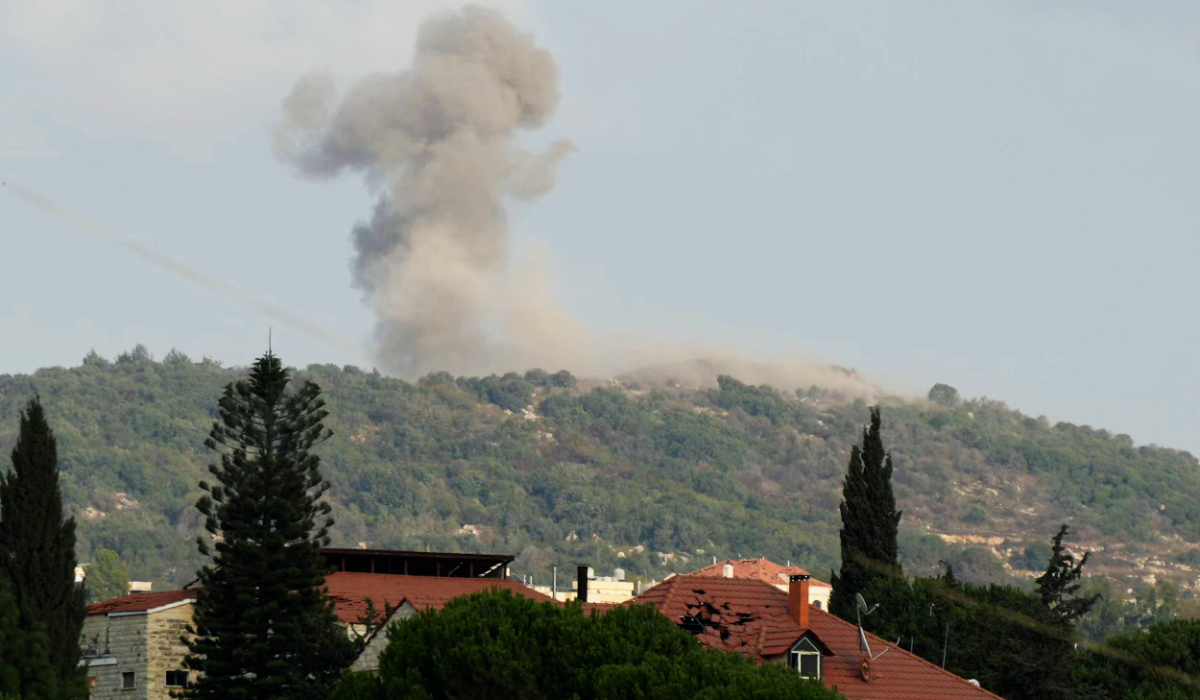
BEIRUT: Since a ceasefire went into effect between Israel and Hezbollah more than two months ago, fighting has stopped in much of Lebanon, but not on a strategic hill overlooking parts of a main southern city.
In recent weeks, Ali Taher hill has been the scene of daily shelling and airstrikes by Israel’s military. Hezbollah, a militant group backed by Iran, has repeatedly attacked Israeli forces in the area with drones.
The United States, which is mediating talks between Lebanon and Israel, had wanted Hezbollah to hand over the hill to the Lebanese army as part of larger plan to disarm the militant group and dismantle its infrastructure. But Hezbollah has refused.
Lebanon and Israel reached a framework agreement in June stating Israel will withdraw from Lebanon as Hezbollah is disarmed. The militant group was not a party to the negotiations and has rejected calls to disarm in areas north of the Litani river, which is where Ali Taher is located.
A full-on battle over this hill near the city of Nabatiyeh could escalate fighting across the country, and unrest in Lebanon complicates efforts to resolve the war in Iran.
On Thursday night, Israel’s military announced it had taken “operational control” of Ali Taher and a network of tunnels beneath it that Hezbollah uses to shelter its fighters and weapons. It is unclear how far Israel’s control extends. Just before Israel’s announcement, its air force was still targeting the hill, according to Lebanese state media.
There has been no official statement from Hezbollah since Israel’s announcement.
US pushes Lebanon to pressure Hezbollah
Hezbollah firmly rejected a proposal from the Lebanese government to hand over Ali Taher to the country’s army. It fears Israel would then seize control of the hill from the Lebanese army and then demand the handover of more territory.
Israel had occupied Ali Taher for 18 years before it withdrew from Lebanon in 2000.
The hill has a strategic location overlooking several villages as well as main roads leading to Nabatiyeh. Losing full control of it would disrupt Hezbollah’s presence and supply lines in the area.
The Israeli military says the site is also important to Hezbollah because of tunnels it built there, with funding from Iran.
Israel said in its statement Thursday that the hill housed underground command centers, weapons storage rooms, generators, living quarters, showers and a kitchen. Israel said it cleared Ali Taher of Hezbollah fighters and was working to “neutralize underground infrastructure sites.”
Hezbollah legislator Ihab Hamadeh questioned why the Israeli military was still attacking the hill if it was really in control of the area, according to the Arabic-language version of Russia’s state-funded news outlet Sputnik. An Associated Press photographer who visited the nearby village of Kfar Rumman on Friday saw no sign of Israeli military presence on the hill.
The hill, topped with a shrine to a Muslim scholar, sits north of the Litani river, which has become the de facto boundary of the area captured by Israel since its latest war with Hezbollah began in early March.
Fighting in the area has heated up in recent weeks
Israel has been conducting military operations around Ali Taher since July, said Nasser Khdour, a Middle East researcher at the Armed Conflict Location & Event Data Project, or ACLED, a US-based group that tracks conflicts around the world.
Hezbollah official Mahmoud Qamati told a Lebanese podcaster in late August that the group’s fighters were repelling attempts by Israeli troops to take Ali Taher. But he, and others, downplayed the significance of the site should Israel take it.
“Ali Taher is important, but if it is lost it does not mean the end of Hezbollah,” Qamati said.
In mid-August, Israel carried out a series of airstrikes on southern Lebanon that it described as retaliation for a Hezbollah drone attack on Ali Taher that seriously wounded three soldiers. The Israeli strikes, which killed 11 people, including women and children, were the deadliest since the US-brokered ceasefire went into effect in late June.
On Aug. 27, Israel carried out a series of airstrikes, killing one person and wounding six, after the military said Hezbollah fired two explosive drones at Israeli troops in the area. Hezbollah did not claim responsibility for any of the attacks.
Lebanon says Israel is hindering its army
Lebanon’s Deputy Prime Minister Tarek Mitri told an Arab TV station in late August that the Lebanese army was ready to take over Ali Taher.
He accused Israel of blocking the army due to its own political considerations ahead of Israeli national elections on Oct. 27.
“The problem is not in the Lebanese army’s readiness but in Israel’s stance,” he said.
Lebanese and Israeli officials are set to meet for negotiations in Rome later this month. Meanwhile, Hezbollah, which has always refused to speak directly to the US, appears to be changing its policy after the major setbacks it has suffered during its wars with Israel since 2024.
A Lebanese official told The Associated Press that indirect contacts are going on between the US and Hezbollah, but refused to give any details. He spoke on condition of anonymity in line with regulations.
The US ambassador to Lebanon, Michel Issa, said recently that Washington is ready to speak with Hezbollah if the group agrees to disarm.
Still, Hezbollah is not likely to take any move forward regarding talks with the US without a green light from its main backer, Iran. While talks with the US over their war have stalled, Iran has sought guarantees that Israel will halt its attacks on Hezbollah as part of any permanent deal.
Capture of Ali Taher could lead Israel to other Hezbollah strongholds
The capture of Ali Taher would open the way to Nabatiyeh and also lead to the nearby Apple Province and Rihan Mountain, where Hezbollah has been building up its presence since the late 1990s.
Israeli leaders have repeatedly pledged to leave troops in Lebanon and threatened to escalate military pressure until Hezbollah disarms.
“Israeli control of the area is an operational and military setback for Hezbollah,” said Khdour of ACLED. He said clearing these sites helps Israel protect towns in the northern part of its country, and increases pressure on Hezbollah.
“This will strengthen Israel’s position in any future negotiations over its withdrawal,” said Khdour.
As Shohei Ohtani strode up to the plate Monday, Michael Bublé’s voice crooned over the Dodger Stadium speakers as always. But after four games out of the lineup, the song seemed to be asking fans to believe:
“I’m feeling … good.”
Ohtani at least looked more comfortable in the batter’s box than he did Wednesday, when pain in his biceps had him shaking his right arm. But his performance at the plate still remains in a slump — he went 0 for 3 with a walk in the Dodgers’ 6-3 win over the Cincinnati Reds.
“It’s hard to really feel 100% at any time in the season,” Ohtani said through interpreter Will Ireton. “So I wouldn’t say I’m there.”
Roberts will continue to closely monitor Ohtani, saying he’ll see how the superstar designated hitter feels Tuesday before finalizing any decisions about playing time.
The Dodgers and Ohtani have all but ruled out his return to the mound this season.
“Disappointing,” Ohtani said. “But I want to make sure that when I look back at this season, that I used this as an experience, a learning experience and make sure that I use that as something to improve upon for next season.”
Roberts said he hoped Ohtani could improve his offensive production by not pitching.
“That’s one part of the thought, to sort of take the pitching off of his plate and really try to let him lock in on being a hitter and get on track,” Roberts said. “Because the last couple of weeks he just hasn’t been himself in the box.”
In the six games before Roberts sat Ohtani because of health concerns, he only had two hits.
“I’m confident that my overall performance should be better moving forward,” Ohtani said. “I think the thing that I was more focused on was making sure that the pitching wouldn’t cause the worst scenario, which was for me to not be able to play at all.”
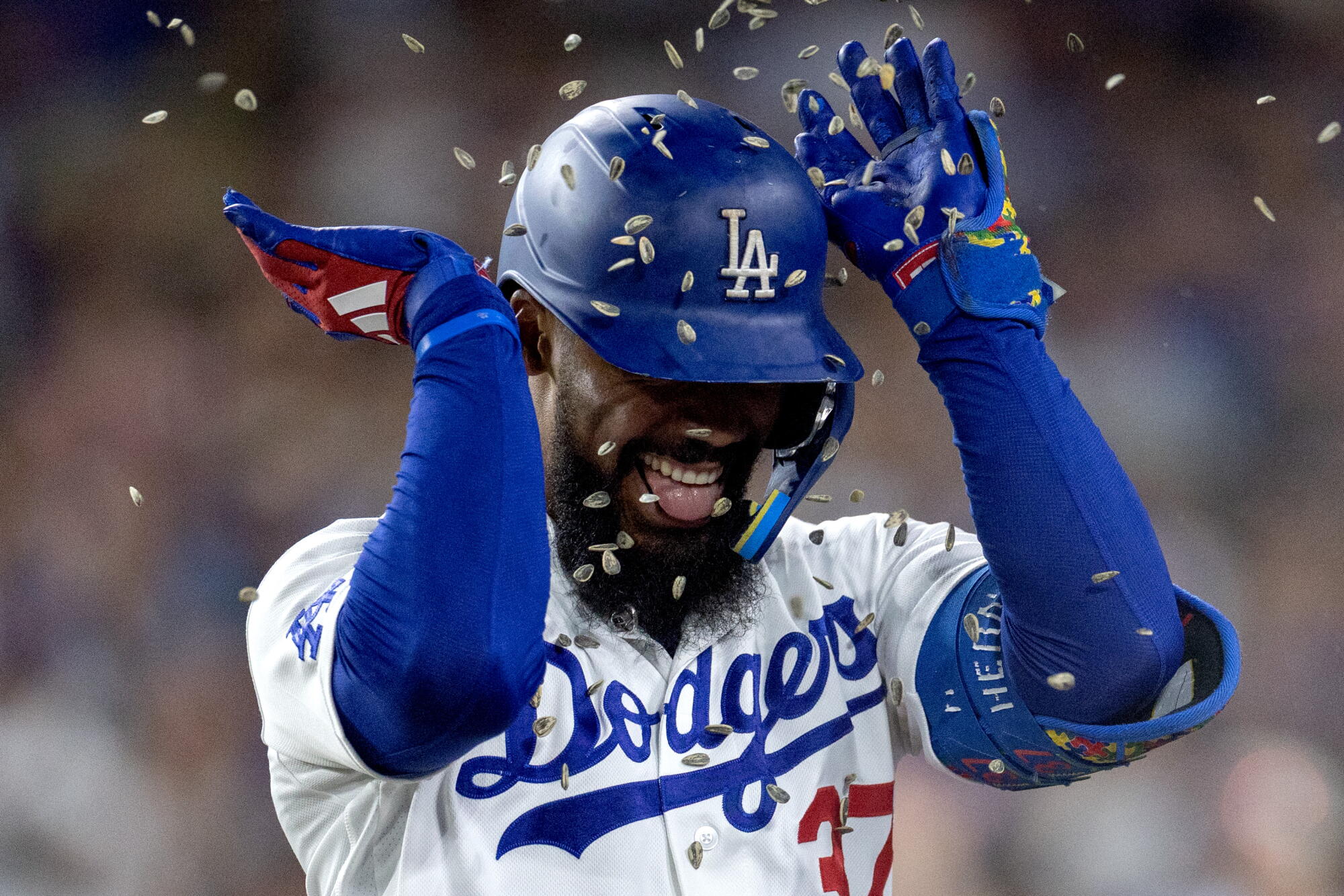
Teoscar Hernández is showered with sunflower seeds after hitting a three-run home run in the sixth inning Monday against the Reds.
(Eric Thayer / Los Angeles Times)
Ohtani flew out in his first at-bat, and then struck out on a Chase Burns slider below the zone. He struck out again against Brandon Williamson to end the fifth before reaching base in the seventh on a walk.
“It was certainly good to get him back out there, but there was certainly nothing to kind of write home about,” Roberts said. “I think the main thing is that there was nothing alarming from the at-bats. To take four days off, to come out of it feeling good, I think that’s a win in itself.”
The Dodgers (87-57) caught a break with Burns — considered a top-five National League Cy Young candidate — since the Reds (69-75) had him on a pitch limit in an effort to manage his workload.
Burns held the Dodgers hitless through three innings, striking out Ohtani as his last act before handing duties to the bullpen.
Dodgers starter Emmet Sheehan, recalled on Monday as the Dodgers optioned right-hander Bobby Miller, gave up a home run to Elly De La Cruz in the first before outdueling the Reds’ bullpen. He gave up three hits, one run and struck out 10 over 5⅔ innings.
Sheehan will remain in the rotation and is scheduled to start Sunday in Miami, Roberts said.
Against Williamson in the fifth inning, Teoscar Hernández lined a leadoff single into left field. After Alex Call was hit in the right foot with a pitch, Miguel Rojas chopped a grounder to Reds third baseman Ke’Bryan Hayes, whose errant throw allowed two runs to score as Rojas dashed to third.
The next inning, Hernández punctuated his recent hot streak by lining a three-run homer into the Dodgers’ bullpen — with the highest exit velocity (112.6 mph) of any ball he’s put in play since 2024, according to Statcast.
Dodgers pitcher Emmet Sheehan delivers during the third inning against the Reds on Monday.
(Eric Thayer / Los Angeles Times)
Though Dodgers relievers Seth Halvorsen and Jack Dreyer each gave up a run, the Dodgers tacked on insurance in the eighth inning with a bases-loaded sacrifice fly from pinch-hitting Will Smith. And the team extended its winning streak to five games.
Ohtani didn’t play a part in any of the Dodgers’ scoring, but at least he was back in the batter’s box.
BILBAO, Spain: Athletic Bilbao thumped Atletico Madrid 3-0 in La Liga on a miserable Saturday afternoon for Diego Simeone’s side.
Nico Williams, Robert Navarro and Oihan Sancet’s goals gave the Basque hosts a resounding victory at their San Mames stadium.
Elsewhere promoted side Deportivo La Coruna earned an exciting 3-2 win at Villarreal to climb provisionally fourth.
Athletic secured back-to-back wins under former Borussia Dortmund coach Edin Terzic, after losing their first two matches of the campaign.
Simeone’s Atletico fell to their first defeat of the season, putting up little fight in the second half after Athletic made the breakthrough with two quick strikes from Williams and Navarro.
“Their two goals, in the blink of an eye, did us a lot of damage,” Atletico’s Pablo Barrios told Movistar.
Atletico must pick themselves up for Wednesday’s visit to face Liverpool in the Champions League at Anfield.
“(We had) two minutes of inattention and poor decision-making in situations we should have handled better,” said Simeone. “Bilbao capitalised on that lapse.”
Striker Julian Alvarez, who tried to leave the club to join Barcelona this summer, returned as a substitute after illness in an ineffective second half appearance.
The visitors had the better of the opening period, although they failed to create many clear-cut chances after an early opportunity for Lee Kang-In.
The South Korean international struck a shot against the post in the third minute after the hosts were carved open.
Athletic goalkeeper Unai Simon saved from Alex Baena as Atletico threatened, while Sancet came close at the other end with a blast into the side-netting.
Pablo Barrios hit the post before the break for Atletico, who were sucker-punched early in the second half by Terzic’s side.
The Williams brothers combined for Athletic’s first, with Inaki’s deflected shot headed home by younger sibling Nico after 46 minutes.
Navarro doubled Athletic’s lead in the 48th minute, steering home after Inaki Williams played him in.
“We were good in the first half but the game got away from us in those (couple of) minutes,” said Simeone.
“We lacked in the second half everything that we had in the first.”
No impact for Alvarez
Simeone rang the changes, including sending on want-away striker Alvarez to little effect.
The Argentina international struggled to get involved in the game, and produced just one shot from the edge of the box, saved comfortably by Simon.
Sancet wrapped up Athletic’s victory in the 90th minute when he stroked home a loose ball after a blocked cross.
“It’s always good to win games, especially at home,” said Terzic.
“Today we are happy and we are going to be very satisfied when we go to bed tonight, and then from tomorrow onwards we’ll prepare everything to go for the next (game).
“We have six points from the last two games, but this won’t help us to reach all our targets by the end of the season.”
Pierre-Emerick Aubameyang scored for the fourth match running and set up two more as the former Arsenal and Barcelona striker excelled in Depor’s surprise win at Villarreal.
Another ex-Arsenal attacker Nicolas Pepe put the hosts ahead but Luismi Cruz levelled for the Galicians before the interval.
Adama Traore’s own goal gave Villarreal the advantage once more but Zakaria Eddahchouri and Aubameyang, 37, struck to claim Depor a superb victory.
Sergio Camello netted twice for Rayo Vallecano in an entertaining 3-2 win over Racing Santander.
On Sunday, La Liga leaders Barcelona visit Valencia looking to move clear of Real Madrid, who lost 1-0 at Real Betis on Friday, among other fixtures.