Politics Desk

L.A. police cases ending in dropped charges, losses and plea deals

A probation officer who was caught on video bending a teen in half.

A Torrance police officer who shot a man in the back as he walked away from a crime scene.

Seven California Highway Patrol officers who piled atop a man screaming “I can’t breathe” as he died following a drunk driving stop.

All three cases had similar outcomes: charges dropped or reduced to no time behind bars after a plea deal.

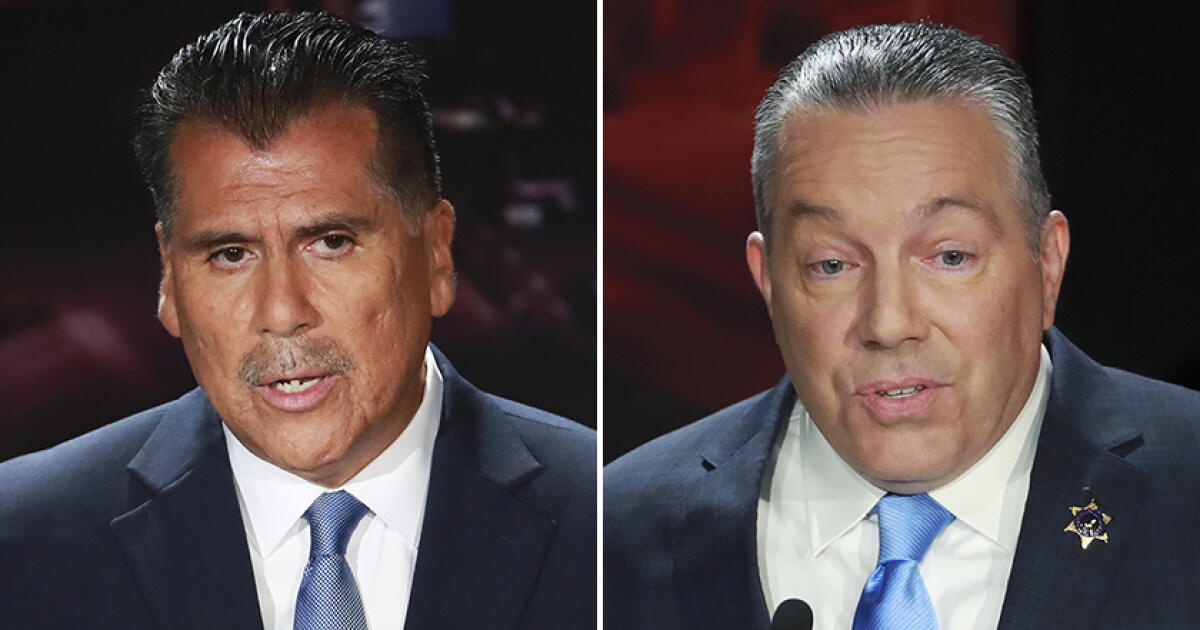
After a year in office, a pattern has emerged for L.A. County Dist. Atty. Nathan Hochman, who found himself saddled with a number of misconduct and abuse cases against police officers filed by his predecessor, George Gascón.

During his 2024 campaign, Hochman often chastised Gascón for filing cases he claimed wouldn’t hold up before a jury — while also promising to continue bringing prosecutions against police when warranted.

In recent months, Hochman has downgraded or outright dismissed charges in many high-profile cases that Gascón filed. In the two misconduct cases Hochman’s prosecutors have brought to trial, the district attorney’s office failed to win a conviction.

Those outcomes have infuriated the loved ones of victims of police violence, local activists and even former prosecutors, who say Hochman’s backslide on the issue was predictable after he received millions in campaign contributions from police unions.

Greg Apt, a former public defender who served under Gascón as second-in-command of the unit that prosecutes police cases, said he quit last year out of frustration with the new leadership.

“I had concerns that the cases were not going to be treated the same way under Hochman that they were under Gascón, that alleged police wrongdoing would not be given the same level of oversight,” he said.

Hochman has scoffed at the idea that he’s too cozy with cops to hold their feet to the fire, saying his campaign’s war chest reflected bipartisan support that included Democrats who have been critical of police.

The district attorney said he’s made decisions based on what he can actually prove in court, and argued case reviews within the Justice Systems Integrity Division have become even more rigorous under his leadership.

“I’m going to look at the facts and the law of any case. I don’t believe in the spaghetti against the wall approach where you throw the spaghetti against the wall, and see if anything sticks, and let the jury figure it out,” he said. “That would be me abdicating my responsibility.”

Hochman’s supporters argue he has restored balance to an office that was often filing cases against police that were either legally dubious or flat out unwinnable.

Tom Yu, a defense attorney who often represents cops accused of wrongdoing, said Hochman is handling things in a more fair and objective manner.

Former Torrance Police Officers Cody Weldin, center, and Christopher Tomsic, right, are seen in court.

Former Torrance Police Officers Cody Weldin, center, and Christopher Tomsic, right, pleaded guilty last year in a conspiracy and vandalism case in which they allegedly spray painted a swastika on a car. Attorney Tom Yu, defense for Weldin, is seen listening to the proceedings.

(Genaro Molina / Los Angeles Times)

“By and large, he’s not going after the cops. But he didn’t dismiss all the cases either. I’m OK with that,” Yu said. “On a personal level, I think he’s doing a very difficult job in the police cases, because someone is always going to be unhappy with the decisions he made.”

It is difficult to win a guilty verdict for an on-duty shooting, with no such convictions in Los Angeles County since 2000. Laws governing use-of-force give officers great latitude, often protecting them even when they shoot someone who is later found to be unarmed or in situations where video evidence shows no apparent threat.

Hochman questioned why he is being criticized when the California attorney general’s office has reviewed dozens of fatal shootings of unarmed persons throughout the state since 2020 and filed no criminal cases.

“If you bring weak cases and you lose, it undercuts your credibility of being any good at your job,” Hochman said. “It undercuts your credibility in saying that we believe in the facts and the law and bringing righteous cases.”

Hochman brought 15 cases against police officers in 2025, according to documents provided to The Times in response to a public records request, compared with 17 filed by Gascón in his final year in office.

But while Gascón had a strong focus on the kinds of excessive force cases the public was clamoring to see charged when he was elected in 2020, Hochman has more often filed charges for offenses such as fraud and evidence tampering.

Hochman’s recent dismissal of charges against most of the officers involved in the death of Edward Bronstein has drawn outcry from his family and at least one former prosecutor.

Bronstein died after screaming in agony as six California Highway Patrol officers piled on top of him in Altadena in 2020. The officers were trying to get a court-ordered blood draw after Bronstein was pulled over on suspicion of drunk driving.

Video from the scene shows Bronstein arguing with the officers while handcuffed and on his knees.

The officers warn Bronstein they’re going to force him down to get a sample. Right before they do, Bronstein mumbles that he’ll “do it willingly,” but they shove him face down while a seventh officer, Sgt. Michael Little, films the encounter. A minute passes. Then Bronstein’s body goes limp.

Officers can be seen trying to revive Bronstein, calling his name and slapping the side of his head, according to the video. But several minutes elapse before officers attempt to deliver oxygen or CPR. He was pronounced dead at the scene.

Flanked by family and staff, Los Angeles County Dist. Atty. George Gascón speaks.

Los Angeles County Dist. Atty. George Gascón announces he will ask a judge to resentence Erik and Lyle Menendez for the killing of their parents in 1989, a decision that could free the brothers.

(Allen J. Schaben / Los Angeles Times)

In 2023, Gascón filed manslaughter charges against the seven officers, as well as the nurse who carried out the blood draw. But late last year, Hochman dismissed charges against all except Little, whose case was reduced to a misdemeanor, for which he received 12 months of probation. Little is no longer a CHP officer, according to an agency spokesman.

Prosecutors are still pursuing manslaughter charges against the nurse at the scene, Arbi Baghalian. His defense attorney, Joe Weimortz, said Baghalian had no control over the officers’ actions or the decision to pursue the blood draw. Weimortz also said he believed the officers were innocent.

Bronstein’s daughter, Brianna Ortega, 26, said in a recent interview that Hochman’s decision to drop the charges felt like a betrayal.

“It just seems like because they’re cops … they must get away with it,” Ortega said. “How are you going to put the blame on one person when all of you are grown men who know better? You have common sense. You have human decency. He is literally telling you he can’t breathe.”

The Los Angeles County coroner’s office could not conclusively determine Bronstein’s cause of death but attributed it to “acute methamphetamine intoxication during restraint by law enforcement.” Bronstein’s family was paid $24 million to settle a wrongful death suit in the case.

Hochman said his office reviewed depositions from the civil case — which he said Gascón did not do before filing a case — and did not believe he could win a manslaughter case because it was impossible to say any officer specifically caused Bronstein’s death. Hochman said the officers had no intent to harm the man and were following orders of a superior officer.

“We looked at each officer, what they knew, what their state of mind was at the time. Understanding that there was both a sergeant there and a nurse, who was in charge of not only taking the blood draw but obviously doing it in a safe manner, and then deciding whether or not we could meet the legal standard of involuntary manslaughter for each officer,” he said.

Edward Tapia, the father of Edward Bronstein, speaks at a news conference.

Edward Tapia, the father of Edward Bronstein, speaks at a news conference about his son, a 38-year-old Burbank man who died while being restrained by California Highway Patrol officers in 2020 after refusing to have his blood drawn after a traffic stop. The family received a $24-million civil rights settlement in 2023 after filing a lawsuit against the state.

(Jason Armond / Los Angeles Times)

Bronstein’s killing was one of three cases in which Hochman assigned new prosecutors in the months before a trial started or a plea deal was reached. Aside from the Bronstein case, the others ended in an acquittal or a hung jury. All three prosecutors who were removed from the unit that handles police misconduct cases had either been appointed by Gascón or had a political connection to the former district attorney.

“When somebody’s lived that case for years, and then you take them off, it suggests that you’re less than serious about winning that case,” said Apt, the former prosecutor on the Bronstein case.

Hochman said he was simply bringing in staff with more trial experience on each case, insisting politics had nothing to do with the transfers. One of the cases, which involved allegations of perjury against L.A. County sheriff’s deputies Jonathan Miramontes and Woodrow Kim, ended with a lightning fast acquittal. Records show jurors deliberated less than an hour before coming back with a not guilty verdict.

In the other case, Hochman’s staff came closer to convicting a cop for an on-duty shooting than anyone else has in L.A. County in a quarter-century.

Ex-Whittier police officers Salvador Murillo, left, and Cynthia Lopez, are photographed during their arraignment.

Former Whittier police officers Salvador Murillo, left, and Cynthia Lopez during their arraignment at the Clara Shortridge Foltz Criminal Justice Center in Los Angeles. Murillo was charged in a 2020 shooting that left an unarmed man paralyzed. Murillo’s trial ended with a deadlocked jury in November 2025.

(Mel Melcon / Los Angeles Times)

Former Whittier Det. Salvador Murillo stood trial in November for shooting an unarmed man in the back as he fled down an alley in 2023. Nicholas Carrillo ran away on foot from a vehicle stop and was leaping over a fence — unarmed — when Murillo squeezed off four rounds. Two severed Carillo’s spine, paralyzing him.

The jury came back deadlocked, although a majority of the panel was leaning toward a conviction. Hochman said it is likely he will ask prosecutors to take Murillo to trial a second time, though a final decision has not been made.

This year, Hochman will have to weigh in on a pair of politically charged police killings.

Keith Porter Jr., a 43-year-old father of two, was shot to death by an off-duty U.S. Immigration and Customs Enforcement agent on New Year’s Eve, a case that has gained national attention following outcry over on-duty shootings by ICE officers in Minnesota and elsewhere.

The Department of Homeland Security said the off-duty ICE agent was responding to an “active shooter.” Porter’s family has said he was firing a rifle into the air as a celebration to ring in the new year.

Melina Abdullah, the co-founder of Black Lives Matter L.A., was part of a group that met with Hochman about Porter’s killing and other cases last month in South L.A.

She described the encounter as confrontational — and a disaster.

“I don’t know how we can expect any safety and accountability with this man in office,” Abdullah said.

Hochman must also decide how to proceed with the case of Clifford Proctor, a former LAPD officer charged for shooting an unarmed homeless man in the back in 2015.

Proctor left the LAPD in 2017 and was not indicted on murder charges until 2024. Gascón reopened the case in 2021, after prosecutors previously declined to file charges.

On Monday, The Times revealed Proctor was able to fly overseas and live at home for a year without the district attorney’s office making any attempt to arrest him on an active murder warrant in 2025.

Hochman has not said if he intends to take Proctor to trial.

Hochman said that while he knows cases of police violence drive emotional reactions, he has to constrain himself to a cold analysis of the facts in front of him.

Reflecting on his confrontational meeting with Black Lives Matter activists, which centered on his recent move to dismiss charges in the 2018 killing of Christopher Deandre Mitchell by Torrance police officers, Hochman said he can’t pursue cases just because people are upset.

“They couldn’t point out anything in that analysis that they disagreed with,” he said. “Other than the result.”

Source link

Trump’s response to ACA price spike: Lower premiums, higher out-of-pocket costs

The Trump administration has unveiled a sweeping set of regulatory proposals that would substantially change health plan offerings on the Affordable Care Act marketplace next year, aiming, it says, to provide more choice and lower premiums.

But it also proposes sharply raising some annual out-of-pocket costs — to more than $27,600 for one type of coverage — and could cause up to 2 million people to drop insurance.

The changes come as affordability is a key concern for many Americans, some of whom are struggling to pay their ACA premiums since the Republican-led Congress allowed enhanced subsidies expired at the end of last year. Initial enrollment numbers for this year fell by more than 1 million.

Healthcare coverage and affordability have become politically potent issues in the run-up to November’s midterm elections.

The proposed changes are part of a 577-page rule that addresses a broad swath of standards, including benefit packages, out-of-pocket costs and healthcare provider networks. Insurers refer to these standards when setting premium rates for the coming year.

After a comment period, the rule will be finalized this spring.

It “puts patients, taxpayers, and states first by lowering costs and reinforcing accountability for taxpayer dollars,” Mehmet Oz, the Centers for Medicare & Medicaid Services administrator, said in a news release Monday.

One way it would do so focuses heavily on a type of coverage — catastrophic plans — that last year attracted about only 20,000 policyholders, according to the proposal, although other estimates put it closer to 54,000.

“This proposal reads like the administration has found their next big thing in the catastrophic plans,” said Katie Keith, director of the Health Policy and the Law Initiative at the O’Neill Institute for National and Global Health Law at Georgetown University Law Center.

Such plans have very high annual out-of-pocket costs for the policyholder but often lower premiums than other ACA coverage options. Formerly restricted to those under age 30 or facing certain hardships, the Trump administration allowed older people who lost subsidy eligibility to enroll in them this year. It is not known how many people did so.

The payment rule cements this move by making anyone eligible if their income is below the poverty line ($15,650 for 2026) or if they’re earning more than 2½ times that amount but lost access to an ACA subsidy that lowered their out-of-pocket costs. It also notes that a person meeting these standards would be eligible in any state — an important point because this coverage is now available in only 36 states and the District of Columbia.

In addition, the proposal would require out-of-pocket maximums on such plans to hit $15,600 a year for an individual and $27,600 for a family, Keith wrote this week in Health Affairs. (The current out-of-pocket max for catastrophic plans is $10,600 for an individual plan and $21,200 for family coverage.) Not counting preventive care and three covered primary care doctor visits, that spending target must be met before a policy’s other coverage kicks in.

In the rule, the administration wrote that the proposed changes would help differentiate catastrophic from “bronze” plans, the next level up, and, possibly, spur more enrollment in the former. Currently, the proposal said, there may not be a significant difference if premiums are similar. Raising the out-of-pocket maximum for catastrophic plans to those levels would create that difference, the proposal said.

“When there is such a clear difference, the healthier consumers that are generally eligible and best suited to enroll in catastrophic plans are more motivated to select a catastrophic plan in lieu of a bronze plan,” the proposal noted.

However, ACA subsidies cannot be used toward catastrophic premiums, which could limit shoppers’ interest.

Enrollment in bronze plans, which have an average annual deductible of $7,500, has doubled since 2018 to about 5.4 million last year. This year, that number likely will be higher. Some states’ sign-up data indicate a shift toward bronze as consumers left higher-premium “silver,” “gold” or “platinum” plans following the expiration of more generous subsidies at the end of last year.

The proposal also would allow insurers to offer bronze plans with cost-sharing rates that exceed what the ACA law currently allows, but only if that insurer also sells other bronze plans with lower cost-sharing levels.

In what it calls a “novel” approach, the proposal would allow insurers to offer multiyear catastrophic plans, in which people could stay enrolled for up to 10 years, and their out-of-pocket maximums would vary over that time. Costs might be higher, for example, in the early years, then fall the longer the policy is in place. The proposal specifically asks for comments on how such a plan could be structured and what effect multiyear plans might have on the overall market.

“As we understand it thus far, insurers could offer the policy for one year or for consecutive years, up to 10 years,” said Zach Sherman, managing director for coverage policy and program design at Health Management Associates, a health policy consulting firm that does work for states and insurance plans. “But the details on how that would work, we are still unpacking.”

Matthew Fiedler, senior fellow with the Center on Health Policy at the Brookings Institution, said the proposed rule included a lot of provisions that could “expose enrollees to much higher out-of-pocket costs.”

In addition to the planned changes to bronze and catastrophic plans, he points to another provision that would allow plans to be sold on the ACA exchange that have no set healthcare provider networks. In other words, the insurer has not contracted with specific doctors and hospitals to accept their coverage. Instead, such plans would pay medical providers a set amount toward medical services, possibly a flat fee or a percentage of what Medicare pays, for example.

The rule says insurers would need to ensure “access to a range of providers” willing to accept such amounts as payment in full. Policyholders might be on the hook for unexpected expenses, however, if a clinician or facility doesn’t agree and charges the patient the difference.

Because the rule is so sweeping — with many other parts — it is expected to draw hundreds if not thousands of comments between now and early March.

Pennsylvania insurance broker Joshua Brooker said one change he would like to see is requiring insurers that sell the very high out-of-pocket catastrophic plans to offer other catastrophic plans with lower annual maximums.

Overall, though, a wider range of options might appeal to people on both ends of the income scale, he said.

Some wealthier enrollees, especially those who no longer qualify for any ACA premium subsidies, would prefer a lower premium like those expected in catastrophic plans, and could just pay the bills up to that max, he said.

“They’re more worried about the half-million-dollar heart attack,” Brooker said. It’s tougher for people below the poverty level, who don’t qualify for ACA subsidies and, in 10 states, often don’t qualify for Medicaid. So they’re likely to go uninsured. At least a catastrophic plan, he said, might let them get some preventive care coverage and cap their exposure if they end up in a hospital. From there, they might qualify for charity care at the hospital to cover out-of-pocket costs.

Overall, “putting more options on the market doesn’t hurt, as long as it is disclosed properly and the consumer understands it,” he said.

KFF Health News is a national newsroom that produces in-depth journalism about health issues and is one of the core operating programs at KFF — the independent source for health policy research, polling, and journalism.

Source link

L.A. Mayor Karen Bass directed Palisades fire damage control, email shows

A day after federal prosecutors announced that the catastrophic Palisades fire was caused by the rekindling of a smaller arson fire days earlier, Los Angeles city officials were in damage control mode.

The ultimate authority on how to handle the deluge of media inquiries was Mayor Karen Bass, according to an internal email reviewed by The Times.

The carefully coordinated approach led by Bass also involved the release of the highly anticipated Palisades fire after-action report, hours after the prosecutors’ announcement and as the Los Angeles Fire Department was facing criticism for not putting out the earlier blaze.

“Any additional interviews with the Fire Chief would likely depend on the Mayor’s guidance,” LAFD spokesperson Capt. Erik Scott wrote in an Oct. 9 email to a Bass aide, then-interim Fire Chief Ronnie Villanueva and others. “Regarding a press conference, I would be cautious as it could invite a high volume of challenging questions, and this would also be contingent on the Mayor’s direction.”

The behind-the-scenes perspective into the city’s media strategy comes as Bass has denied a story published in The Times last week in which unnamed sources said she directed changes to the after-action report over concerns about legal liabilities. Revisions that downplayed failures by the city and the LAFD in handling the disaster were first revealed in a Times investigation published in December.

In one instance, LAFD officials removed language from the “failures” section saying that the decision not to fully staff up and pre-deploy all available crews and engines ahead of a forecast of dangerously high winds “did not align” with the department’s policy and procedures during red flag days.

The final report said that the LAFD “balanced fiscal responsibility with proper preparation for predicted weather.” Elsewhere, it said that the number of engine companies rolled out ahead of the fire “went above and beyond the standard LAFD pre-deployment matrix.”

That passage in the “failures” section, which was renamed “primary challenges,” was being revised by LAFD officials up until at least two days before the report was released on Oct. 8, according to emails reviewed by The Times.

“I added Chief Robert’s verbiage to replace CHALLENGES 1 on page 44. I made some other formatting edits,” an LAFD administrative aide wrote in an Oct. 6 email to several people, including an LAFD official named Eric Roberts. Roberts did not respond to an email from The Times requesting comment.

Yusef Robb, an advisor to the mayor, said Thursday that Bass is customarily involved with the decision-making of city departments. She has criticized the LAFD’s pre-deployment decisions and would have no reason to soften the after-action report’s language on that topic, Robb said.

“From Animal Services to the Zoo, the Mayor’s Office is in contact with every city department on issues large and small, and so obviously and appropriately the Mayor’s Office engaged with LAFD about the rollout of the report,” Robb said in an email. “What did not happen is the illogical and false assertion that the Mayor sought to soften critiques in a report that she herself demanded and on issues of which she has been publicly critical for more than a year.”

Scott said Thursday that he did not “have anything further to add beyond what was already shared.”

Two sources with knowledge of Bass’ office said that after reviewing an early draft, the mayor told Villanueva that the report could expose the city to legal liabilities. The sources said Bass wanted key findings about the LAFD’s actions removed or softened before the report was made public.

The sources told The Times that two people close to Bass informed them of the mayor’s role in watering down the report, which was meant to spell out mistakes and to suggest measures to avoid repeating them. One source spoke to both of the people; the other spoke to one of them. The sources requested anonymity to speak frankly about the mayor’s private conversations with Villanueva and others.

Bass last week called the Times story “completely fabricated.”

“There was no cover up on my part,” she said. “There was absolutely no reason or desire that I would want to water down this report.”

She added: “I do not have the technical expertise to make any sort of substantive changes to anything.”

Last summer, LAFD officials formed an internal crisis management team and brought in a public relations firm — paid for by the nonprofit LAFD Foundation — to help shape its messaging about the fire, which killed 12 people and destroyed thousands of homes. The emails reviewed by The Times show that the firm, the Lede Co., had a role in reviewing and suggesting edits to the after-action report.

Other internal emails reviewed by The Times show that Bass met with Villanueva about the after-action report in mid-July.

“The FC had a meeting with the Mayor this afternoon where she discussed the Palisades internal AAR,” Kairi Brown, Villanueva’s chief of staff, wrote on July 17, referring to the fire chief and the after-action report. “She asked for him to put together … answers to other questions.”

Scott’s Oct. 9 email, whose recipients also included at least one member of the LAFD’s crisis management team and the outside public relations consultants, sought guidance on how to manage the “abundance of requests” from news reporters, referencing a shared Google document where all “current inquiries and notes” were compiled.

He suggested a “three-prong approach” to contextualizing the topic of “holdover” fires. The Palisades fire was a holdover from the Jan. 1 Lachman fire, which continued to smolder and burn underground until kicked up by heavy winds on Jan. 7.

Scott said that the team should outline the LAFD’s efforts to extinguish the Lachman fire, define the “holdover phenomenon” and highlight new policies and procedures to prevent it from happening in the future.

LAFD leaders had already been under intense scrutiny for missteps before the Palisades fire, while commanders had insisted that they did everything they could to put the Lachman fire out.

Weeks after the Oct. 8 announcement about the Lachman fire by federal prosecutors, The Times reported that a battalion chief ordered firefighters to roll up their hoses and leave the burn area on Jan. 2, even though crews warned that the ground was still smoldering. The LAFD also decided not to use thermal imaging technology to detect heat underground.

The author of the after-action report, Battalion Chief Kenneth Cook, declined to endorse the final version because of changes that altered his findings and made the report, in his words, “highly unprofessional and inconsistent with our established standards.”

Even with the deletions and changes, the report delivered a harsh critique of the LAFD’s performance during the Palisades fire, pointing to a disorganized response, failures in communication and chiefs who didn’t understand their roles. The report found that top commanders lacked a fundamental knowledge of wildland firefighting tactics, including “basic suppression techniques.”

A paperwork error resulted in the use of only a third of the state-funded resources that were available for pre-positioning in high-risk areas, the report said. And when the fire broke out the morning of Jan. 7, the initial dispatch called for only seven engine companies, when the weather conditions required 27.

There was confusion among firefighters over which radio channel to use. The report said that three L.A. County engines showed up within the first hour, requesting an assignment and receiving no reply. Four other LAFD engines waited 20 minutes without an assignment.

As Scott looked to the mayor for guidance on whether Villanueva would participate in more media interviews, he wrote in the Oct. 9 email that on social media, the LAFD should consider highlighting favorable coverage of interviews with the fire chief.

A day later, the LAFD notified The Times that Villanueva and other top fire officials “are not planning any additional interviews regarding the incident.”

Robb said Thursday that Bass did not restrict Villanueva from doing interviews.

“The Mayor’s Office, as it frequently does with all city departments, made it clear that LAFD needed to make sure the information it provides was accurate and that the personnel providing information were well prepared to provide accurate information,” Robb said. “Ultimately, how they did that was up to them.”

Former Times staff writer Paul Pringle and Times staff writer David Zahniser contributed to this report.

Source link

Contributor: Nation’s challenge after Trump will be to seek justice, not retribution

President Trump’s aura of invincibility is starting to vanish. Three new polls — including the usually Trump-hospitable Rasmussen — suggest that Joe Biden did a better job as president.

Worse still (for Trump), he’s underwater on immigration, foreign policy and the economy — the very trifecta that powered his return. An incumbent taking on water like that is no longer steering the ship of state, he’s bobbing in the deep end, reaching for a Mar-a-Lago pool noodle.

To be fair, Democrats have a proud tradition of snatching defeat from the jaws of victory. But suppose — purely hypothetically — that this sticks. Suppose Democrats win the midterms. And suppose a Democrat captures the White House in 2028.

Then what?

Trumpism isn’t a political movement so much as a recurring event. You don’t defeat it; you board up the windows and wait.

Even if Trump does not attempt a third term (a gambit the Constitution frowns upon), he will remain the dominant gravitational force in Republican politics for as long as he is sentient and within Wi-Fi range.

Which means any Democratic administration that follows would be well-advised to consider it is governing on borrowed time. In American politics, you are always one scandal, one recession or one deepfake video away from packing your belongings into a cardboard box.

Trump’s MAGA successor (whoever he or she might be) will inherit millions of ardent believers, now seasoned by experience, backed by tech billionaires and steeped in an authoritarian worldview.

So how exactly does the country “move on” when a sizable slice of its elite class appears to regard liberal democracy as more of an anachronism than a governing philosophy?

This is not an entirely new dilemma. After the Civil War, Americans had to decide whether to reconcile with the rebels or punish them or some mix of the two — and the path chosen by federal leaders shaped the next century through Reconstruction, Jim Crow and the long struggle for civil rights.

At Nuremberg, the Allies opted for trials instead of firing squads. Later, South Africa’s post-apartheid government attempted to achieve reconciliation via truth.

Each moment wrestled with the same problem: How do you impose consequences without becoming the very thing you were fighting in the first place — possibly sparking a never-ending cycle of revenge?

Which brings us to even more specific questions, such as where does Trumpism fit into this historical context — and should there be any accountability after MAGA?

Start with Trump himself. Even if he is legally immune regarding official acts, what about allegations of corruption? Trump and his family have amassed billions since returning to office.

It is difficult to picture a future Democratic administration hauling him into court, especially if Trump grants himself broad pardons and preemptive clemency on his way out of office.

So if accountability comes, it would probably target figures in his orbit — lieutenants, enablers, assorted capos not covered by pardons. But is even this level of accountability wise?

On one hand, it is about incentives and deterrence. If bad actors get to keep the money and their freedom, despite committing crimes, they (and imitators) will absolutely return for an encore.

On the other hand, a Democratic president might reasonably decide that voters would prefer lower grocery bills to more drama.

Trump himself offers a cautionary tale. He devoted enormous energy to retribution, grievance and settling scores. It is at least conceivable that he might have been in stronger political shape had he devoted comparable attention to, say, affordability.

There is also the uncomfortable fact that the past Trump indictments strengthened him politically. Nothing energizes a base like the words “They’re coming for me,” especially when followed by the words “and you’ll be next,” next to a fundraising link. Do Democrats want to create new martyrs and make rank-and-file Americans feel like “deplorables” who are being persecuted for their political beliefs?

So perhaps the answer is surgical. Focus on ringleaders. Spare the small fry. Proceed in sober legal tones. Make it about the law, not the spectacle.

Even this compromise would invite a backlash. Democrats, it seems, are damned if they do and damned if they don’t.

The good news is that smart people are actively debating this topic — far better than trying to improvise a solution on Inauguration Day — just as similar questions were asked after Trump lost in 2020. A few weeks ago, for example, David Brooks and David Frum discussed this topic on Frum’s podcast.

Unfortunately, there is no tidy answer. Too much punishment risks looking like vengeance. Too little risks sparking another sequel.

It may sound melodramatic to say this might be the most important question of our time. But while this republic has endured a lot, it might not survive the extremes of amnesia or revenge.

Choosing the narrow path in between will require something rarer than a landslide victory: justice with restraint.

But do we have what it takes?

Matt K. Lewis is the author of “Filthy Rich Politicians” and “Too Dumb to Fail.”

Source link

A Shock to the System : Few people paid much attention to Carol Moseley Braun in the Illinois Democratic primary. But no one is ignoring her Senate campaign now.

Before she had toppled the moneyed and the mighty, back when perhaps a dozen people thought she had a chance to be a U.S. senator, Carol Moseley Braun went to Washington to drum up support for her ragtag campaign.

Waiting in the drafty outer hallways of power, she was treated like a poor relation. And the results were pathetic.

The official gatekeepers of money and political advice simply dismissed Braun and her candidacy for the Democratic Senate nomination from Illinois, recalls Tony Podesta, a college friend who is now is a Washington political consultant. He walked her through receptions, and she got nothing more than a few polite hellos. And although established women’s groups said, “Right on, keep going,” they kept their pocketbooks closed.

“Talk about your underdogs,” Podesta says, laughing. “I couldn’t even find a professional fund-raiser who she could pay to work for her.”

But with no organization, little money and a quintessentially Chicago political title as the Cook County Recorder of Deeds, Braun knocked out a three-term senator, Alan J. Dixon, in the March 17 Democratic primary.

This week, Braun went back to Washington for money and backing. And this time, it was the difference between the Prince and the Pauper.

With the head of the Illinois State Democratic Party in tow, she met with party powerbrokers, including Senate Majority Leader George J. Mitchell of Maine and Massachusetts Sen. Edward M. Kennedy. All are members of the white man’s club she ran against, but the reception was ecstatic.

Such is the nature of power in Washington. Braun had just eliminated one of their entrenched cohorts, “Al the Pal” Dixon, 64, who has been winning elections for 42 years. But now she stands a fair chance of making history as a double outsider: If she wins against Republican nominee Richard Williamson in November, she’ll be the first black woman in the Senate and only the fourth black to serve in that august chamber.

Although she dismisses political post-mortems that credit anything but her determination, there is evidence she was also buoyed by luck, timing and a third candidate, Al Hofeld, a 55-year-old personal-injury attorney who spent $4.5 million of his own personally injuring Dixon in negative TV advertisements.

“I think it’s fair to say that if this were hockey, Hofeld would get an assist,” quips Hofeld’s media consultant, David Axelrod.

Braun may have had one other unlikely man on her team: Supreme Court Justice Clarence Thomas. In fact, without him she might never have entered the race.

Last autumn she was so disgusted by the tone and substance of the Senate Judiciary Committee hearings on Thomas’ nomination to the high court–before and after the allegations of sexual harassment by Prof. Anita Hill–that she decided it was time to break into the men’s club on Capitol Hill.

“I was completely focused on how badly the process had failed,” she says. “If the Senate had done its job right from the start, we all would have been spared the mess. And who were these guys anyway? Where were the women, the minorities and the regular working people?”

She said as much, twice, on a public television talk show and was overwhelmed with letters, phone calls and friends urging her to take on Dixon, who had voted for Thomas. After several meetings, Chicago women activists identified three potential female candidates to challenge Dixon; it was decided that Braun, a University of Chicago Law School graduate who had served 10 years in the state Legislature, had the best qualifications and the best shot.

But she was not a shrinking violet thrust forward into the limelight. Now 44, she has been in the cut and thrust of Chicago politics since her early 20s, and she knew the risks. When a friend warned her that she could be a sacrificial lamb, she reportedly retorted: “If the best my party can do for me is recorder of deeds, then I don’t care about the future.”

With the backing of a coalition of women activists, suburban liberals and her most critical base, blacks throughout Chicago, Braun garnered 38% of the vote compared to Dixon’s 35% and Hofeld’s 28%. Less than two weeks before the upset, Braun had been 12 percentage points behind Dixon.

Hers was a last-minute sprint that came together through a confluence of events, including a television debate in which Hofeld hammered Dixon for his conservative voting record. For the first time, a broader spectrum of the public saw Braun demonstrate her speaking savvy and natural warmth.

In addition, Gloria Steinem came twice to Chicago on Braun’s behalf, attracting attention and contributions to the campaign. And the network of liberals in the suburbs–mostly white women–mounted a word-of-mouth effort to turn Braun into a winner.

In fact, women did well up and down the ballot in the Illinois primary. “I think women, more than men, are convincing elements of change,” says Axelrod. “That will give Carol an edge in November.”

But the “women’s vote” has never materialized consistently in past elections, and it’s still too early to tell whether Braun can make a convincing argument in November that she is a “change agent,” as Washington insiders are fond of saying.

“She’s got to broaden her base beyond blacks and some women and focus, focus, focus, on economic issues,” advise Axelrod and others.

Both Braun and Williamson are positioning themselves as outraged outsiders and setting each other up as a symbol of what catapulted America into an economic morass.

“The fundamental difference between my opponent and myself is that she has made her living for the past 14 years as a career politician and voted 13 times to raise taxes,” says Williamson, 42, a partner in a Chicago law firm who serves on President Bush’s General Advisory Committee on Arms Control.

Speaking from a car phone as he made an eight-city campaign swing last weekend, he added: “I’m not saying it’s always evil to be a career politician–George Bush certainly is. It’s just among the elements that makes differences between my opponent and myself so stark.”

Although exhausted from her sudden status as a political phenomenon–already she’s done “Nightline” and the “Today” show–Braun last week offered her assessment of those differences:

“He’s a typical Reaganite and will have to answer for the policies of the new federalism that screwed up this country. He was part of it.”

Braun doesn’t expect this race to be more challenging than the primary seemed last November–but she does see land mines.

“It’ll be a tough race only to the extent that Williamson (who is white) plays the racial card, directly or subtly, by manipulating symbols like talking about my views on welfare reform,” she says.

Illinois has elected blacks statewide, but many more have been defeated. “If the election was held next week, she’d probably win because of the post-primary euphoria around her,” says Don Rose, a Chicago political consultant. “But we have a way to go, and we don’t know how the wild card–race–plays, and we don’t know how the national ticket plays.”

Williamson insists that he’ll fire anyone in his campaign who uses racism to attack his opponent.

“I won’t hold my opponent accountable for the race of her parents if she doesn’t hold me accountable for the race of mine,” says Williamson, who grew up and lives with his wife and three children on Chicago’s wealthy North Shore.

As he describes it, Williamson has spent most of his career in “public service,” although he has never run for office. He was an aide to the most conservative congressman in the Illinois delegation, Rep. Philip Crane, and later worked for the Reagan Administration as intergovernmental affairs director and for the Bush campaign in 1988.

A fiscal conservative who has etched out more moderate positions on social issues, Williamson is known as an intellectual who reads Hermann Hesse and gives windy speeches on public policy.

So far, he says, his status as a novice campaigner has created the biggest hurdles for him in formulating positions on the spot. For example, while the former Princeton University religion major personally opposes abortion, he decided after consulting “with my wife and others” that he was pro-choice–although he does not support federal funding for abortion. If Roe vs. Wade is overturned, Williamson would support legalizing abortion. But when asked how that law should be defined, on a state or federal level, he bristled: “I’m not going to say any more; I think (reporters) are more interested in this subject than the public.”

The Braun-Williamson competition is as much a horse race for the locals made blase by the oddities of Chicago politics as it is for the national touts who haven’t seen its like since Shirley Chisholm ran for President in the 1970s.

Already, local pundits are joking on the radio that for the first time the Bridgeport neighborhood, home to the late Mayor Richard J. Daley and his son Richard M., the current mayor, may support a black candidate.

“Carol will get the vote,” says the radio announcer, “because Daley wants her out of town and safe in Washington, where she can’t run for mayor.”

The daughter of a policeman and a medical worker, Braun grew up in Hyde Park, an integrated neighborhood near the University of Chicago, admiring such women as Amelia Earhart and Bessie Coleman, a black aviator. After graduating from law school, Braun married a classmate and joined a Republican-controlled federal prosecutor’s office.

Her initiation into politics came in 1977, when she was pushing her young son in his stroller on Hyde Park Boulevard and ran into Kay Clement, a neighbor. Clement was on a search committee to find a replacement for Robert Mann, a well-known liberal state legislator who was among a group that called itself the “Kosher Nostra” and prided itself on being a constant burr in the elder Daley’s side. Clement asked Braun if she’d run.

“She was well-spoken, congenial, and I thought she had the character to continue on in the tradition of us Young Turks,” recalls Mann, now retired.

Braun served 10 years in the Illinois House, eventually becoming assistant majority leader and Chicago Mayor Harold Washington’s floor leader in the mid-1980s.

In the Legislature, she dealt with Democratic politics skillfully but not always defiantly, which angered some of her radical black supporters. Similarly, she riled her white liberal cohorts at times and had problems with Mayor Washington when she formed alliances with his enemies and attempted to run without his approval for lieutenant governor.

“Carol is an ambitious woman, and that’s a sin in our society,” says Mann. “It’s OK for everybody else to be trading horses, making deals, being rainmakers–but not her.”

Braun left the Legislature to be the Chicago recorder of deeds in part to spend more time closer to home; she had been divorced and had a young son and an ill mother to care for.

As an administrator, she updated the deeds system with modern technology and created committees to eliminate patronage. Speaking of the deeds office, a Realtors association spokesman recently told the Chicago Tribune: “It’s not a dungeon anymore. You don’t have to carry your own candle.”

But the administration of Braun’s grass-roots primary campaign did not win as much praise; several members of her staff quit amid reports of conflict over the leadership of campaign manager Kgosie Matthews. And although Braun is likely to draw on the Chicago Establishment, organization is considered her weak point.

Kay Clement, who is on Braun’s committee, says the candidate has confidence in Matthews but plans to bring in more professionals once the money starts rolling in–which is expected at any moment.

Emily’s List, a fund-raising group for women Democratic candidates, gave $5,000 to Braun in the last weeks of the primary campaign and has vowed to support her further. “We will be in the mail for her in the next two weeks and plan to raise an incredible amount of money for her,” vows Ellen Malcolm, the group’s president.

And Chicago women such as Susan P. Kezio are determined that this time around, Braun will get the full respect due her in her hometown.

Kezio, 37, founder of the company Women in Franchising, says she tried during the primary to get Braun as a lunchtime speaker at the city’s Rotary One, the first Rotary Club in America.

“After Dixon spoke to us, I ran up to our director and proudly said, ‘Hey, I can get Carol Moseley Braun to speak,’ ” Kezio recalls. The director suggested they wait until after the primary. Then, a few weeks later, Hofeld came to speak.

Kezio was furious. She complained to the director, who said Hofeld had asked to address the Rotarians and Braun hadn’t. Apparently, Kezio’s request for Braun hadn’t registered.

But this week, according to Kezio, the Rotary director hunted down Braun and eagerly invited her to be a speaker. She said she’d be honored.

“Believe me,” Kezio says, “this time nobody is going to ignore Carol Moseley Braun.”

Source link

Judge blocks Trump administration move to cut $600 million in HIV funding from states

A federal judge on Thursday blocked a Trump administration order slashing $600 million in federal grant funding for HIV programs in California and three other states, finding merit in the states’ argument that the move was politically motivated by disagreements over unrelated state sanctuary policies.

U.S. District Judge Manish Shah, an Obama appointee in Illinois, found that California, Colorado, Illinois and Minnesota were likely to succeed in arguing that President Trump and other administration officials targeted the U.S. Centers for Disease Control and Prevention funding for termination “based on arbitrary, capricious, or unconstitutional rationales.”

Namely, Shah wrote that while Trump administration officials said the programs were cut for breaking with CDC priorities, other “recent statements” by officials “plausibly suggest that the reason for the direction is hostility to what the federal government calls ‘sanctuary jurisdictions’ or ‘sanctuary cities.’”

Shah found that the states had shown they would “suffer irreparable harm” from the cuts, and that the public interest would not be harmed by temporarily halting them — and as a result granted the states a temporary restraining order halting the administration’s action for 14 days while the litigation continues.

Shah wrote that while he may not have jurisdiction to block a simple grant termination, he did have jurisdiction to halt an administration directive to terminate funding based on unconstitutional grounds.

“More factual development is necessary and it may be that the only government action at issue is termination of grants for which I have no jurisdiction to review,” Shah wrote. “But as discussed, plaintiffs have made a sufficient showing that defendants issued internal guidance to terminate public-health grants for unlawful reasons; that guidance is enjoined as the parties develop a record.”

The cuts targeted a slate of programs aimed at tracking and curtailing HIV and other disease outbreaks, including one of California’s main early-warning systems for HIV outbreaks, state and local officials said. Some were oriented toward serving the LGBTQ+ community. California Atty. Gen. Rob Bonta’s office said California faced “the largest share” of the cuts.

The White House said the cuts were to programs that “promote DEI and radical gender ideology,” while federal health officials said the programs in question did not reflect the CDC’s “priorities.”

Bonta cheered Shah’s order in a statement, saying he and his fellow attorneys general who sued are “confident that the facts and the law favor a permanent block of these reckless and illegal funding cuts.”

Source link

Culver City, a crime haven? Bondi’s jab falls flat with locals

Conversations about Culver City — the vibrant enclave on Los Angeles’ Westside often called “the Heart of Screenland” — usually include phrases such as “walkable” and “green spaces” and “Erewhon.”

So when U.S. Atty. Gen. Pam Bondi insinuated the city of 39,000 residents is a crime haven during a heated exchange with Rep. Sydney Kamlager-Dove (D-Los Angeles) Wednesday, local officials and personalities responded with statistics, memes and wry mockery.

Bondi slipped in the jab near the end of an arduous House hearing largely focused on the Department of Justice’s handling of the Jeffrey Epstein investigation. Kamlager-Dove, whose district includes Culver City, hammered Bondi over deleted Department of Justice data linking far-right ideology with political killings, asserting that “there are violent, dangerous people out there with real threats.”

“There are — in your district,” Bondi responded. “Her district includes Culver City, and she’s not talking about any crime in her district. Nothing about helping crime in her district. She’s not even worth getting into the details.”

Hometown names stepped up to defend the burg by posting photos of clean streets, manicured parks and humming community events.

Political commentator and Angeleno Brian Taylor Cohen called the city “one of the most non-controversially safe” places in L.A., while Culver City-based comedian Heather Gardner said: “The worst crime of the century is that this woman had made a mockery of our justice system. Release the un-redacted files. Prosecute the REAL crimes.”

Kamlager-Dove shrugged off Bondi’s comment, saying Culver City was known for “breakfast burritos — not crime.”

The Justice Department did not immediately respond to a request for Bondi to clarify her statements.

Crime in Culver City declined 9.7% in 2024 and was down an additional 6.1% in the third quarter of 2025 compared with the same period of 2024, according to the Culver City Police Department. Violent crime declined 3.9% in 2024 — the last full year of available data.

Over that period, murders dropped to zero while aggravated assault, kidnapping and robbery also fell. There were 26 cases of sexual assault in the city in 2024, compared with 25 in 2023. The only violent crime that saw a significant increase were simple assaults, which rose 8.1%.

The California Department of Justice and the FBI reported in 2024 that crime in the state had fallen to “among the lowest levels ever recorded.”

Mayor Freddy Puza, in an interview Thursday, described Culver City as a “strong and vibrant community” of people with no shortage of job opportunities at small businesses and corporations alike, including TikTok, Pinterest and entertainment giants Apple, Amazon and Sony.

He said the local government has been able to lower crime rates through community-based policing and by providing housing and social services to its unsheltered population. The mayor characterized Bondi’s retort as a “knee-jerk reaction” from an attorney general faced with damaging public trust concerns at her department.

“My read of it is that she’s trying to deflect,” he said. “I think she could really spend her time prosecuting the people in the Epstein files and making sure that information from the federal government is transparent.”

The city had seen no ideological violence, he said, adding, “but the potential for it is right around the corner. There’s no doubt that it is on the rise and the president is stoking it. People are becoming further and further polarized.”

At the hearing, Bondi faced sharp criticism over the Justice Department’s Epstein investigation — specifically over redaction errors in the release millions of case files last month. In one instance, the attorney general refused to apologize to Epstein victims in the room, saying she would not “get into the gutter” with partisan requests from Democrats.

Her performance has already prompted a volley of bipartisan demands for her resignation, including from conservative pundits including Megyn Kelly, Nick Fuentes and Kyle Rittenhouse.

Culver City was not Bondi’s only target Wednesday. She called Rep. Jamie Raskin (D-Md.) a “washed-up loser lawyer,” accused Kentucky Republican Rep. Thomas Massie of suffering from “Trump derangement syndrome,” and branded former CNN anchor Don Lemon a “blogger.”

Since the hearing, however, she has stayed silent as locals continue to question her intel and chuckle over images of the pylon-protected war zone of Culver City.

“The worst crime in Culver City,” Gardener joked again on TikTok, “is that they charge $24 for a smoothie at Erewhon.”

Source link

Federal authorities announce an end to the immigration crackdown in Minnesota.

The immigration crackdown in Minnesota that led to mass detentions, protests and two deaths is coming to an end, border policy advisor Tom Homan said Thursday.

Democratic Gov. Tim Walz said Tuesday that he expected Operation Metro Surge, which started in December, to end in “days, not weeks and months,” based on his conversations with senior Trump administration officials.

“As a result of our efforts here, Minnesota is now less of a sanctuary state for criminals,” Homan said at a news conference.

“I have proposed and President Trump has concurred, that this surge operation conclude,” he continued.

Federal authorities say the U.S. Immigration and Customs Enforcement sweeps focused on the Minneapolis-St. Paul metro area have led to the arrest of more than 4,000 people. While the Trump administration has called those arrested “dangerous criminal illegal aliens,” many people with no criminal records, including children and U.S. citizens, have also been detained.

“The surge is leaving Minneapolis safer,” Homan said. “I’ll say it again, it’s less of a sanctuary state for criminals.”

Homan announced last week that 700 federal officers would leave Minnesota immediately, but that still left more than 2,000 on Minnesota’s streets. Homan said Thursday that the drawdown began this week and will continue next week. He said he plans to stay in Minnesota to oversee the drawdown.

Minneapolis Mayor Jacob Frey said he had a “positive meeting” with Homan on Monday and discussed the potential for a further drawdown of federal officers.

Homan took over the Minnesota operation in late January after the second fatal shooting by federal immigration agents and amid growing political backlash and questions about how the operation was being run.

“We’re very much in a trust but verify mode,” Walz said, adding that he expected to hear more from the administration “in the next day or so” about the future of what he said has been an “occupation” and a “retribution campaign” against the state.

Walz said he had no reason not to believe Homan’s statement last week that 700 federal officers would leave Minnesota immediately, but the governor added that that still left 2,300 on Minnesota’s streets. Homan at the time cited an “increase in unprecedented collaboration” resulting in the need for fewer federal officers in Minnesota, including help from jails that hold deportable inmates.

Karnowski writes for the Associated Press.

Source link

Super Bowl ads show the U.S. has abandoned green-energy transition

These days, almost every cultural or news event seems fleeting. But there’s one thing that feels nearly as momentous as it did 20 years ago: the Super Bowl.

From a personal point of view, I can say that despite basically divesting myself from football (I haven’t watched a non-Super Bowl NFL game in well over a decade, and haven’t played fantasy football for just as long), I still participate in what has become, essentially, a national holiday. Maybe that’s just it: In the ideologically fractured world of 2026, there’s something to be said for having at least one relatively universal experience.

You’re reading Boiling Point

The L.A. Times climate team gets you up to speed on climate change, energy and the environment. Sign up to get it in your inbox every week.

By continuing, you agree to our Terms of Service and our Privacy Policy.

In any case, such a uniquely shared media event inevitably reflects the cultural milieu of the moment. That’s why, for a while now, I’ve been tracking how many of the commercials that air during each year’s Super Bowl have some relation to the environmental issues that I’ve been covering for most of my career as a journalist. I started this project when I was an editor at Time magazine, and thought it merited revisiting this year. Here’s what I found.

During Super Bowl LX on Sunday, there were just two commercials that focused in a meaningful way on products that would advance a transition to a fossil-fuel-free economy. One was for the 2026 Jeep Cherokee Hybrid. The other was for a Chinese supercar made by a vacuum-cleaner company.

It wasn’t long ago that domestic manufacturers were marketing a future based on electric vehicles of all shapes and sizes. During the 2022 Super Bowl, the second year of Joe Biden’s presidency, seven different ads focused specifically on existing and new EV models. Those were in some ways the halcyon days of American EV manufacturing, following the passage of the Biden administration’s Inflation Reduction Act, which, in part, offered a $7,500 tax credit to anyone who bought a new electric car.

The second Trump administration quickly put an end to that; the credit was nixed as of Sept. 30 last year. That was just one of many moves Trump has made since retaking office to anesthetize the United States’ nascent green economy. Over the last year, the Trump administration has tried to shut down offshore wind energy projects while demanding the growth of the coal industry; reversed key policies that previously established legal precedent for the public health impact of greenhouse gases; and generally tried to undermine efforts by many states, California especially, to establish and regulate policies meant to make their infrastructure less dependent on fossil fuels.

So it’s no surprise that in 2026, the second year of Trump’s second presidency, there was just one Super Bowl ad for a domestically produced green product — and it wasn’t even entirely green. Indeed, it reflects a recent trend across the U.S.: Since the federal clean-vehicle tax credits expired in September, sales of purely electric vehicles have plummeted, while those of hybrids have continued to grow, according to the U.S. Energy Information Administration.

Tellingly, four different companies — Cadillac, Toyota, Volkswagen and Chevrolet — had ads that showed an EV but didn’t mention it. It’s become more something to hide than to promote.

Then there’s the one other green-energy ad this year, which, honestly, you could quibble with categorizing it as “green.” It’s a reportedly $10-million spot for an electric sports car, theoretically to be made by the Chinese company Dreame, which to date has primarily produced robotic vacuum cleaners. I say theoretical because it seems somewhat unlikely that an outfit that made its nut building knockoff Roombas will be selling an electric super car anytime soon. (As of writing, Dreame has not responded to emailed questions.)

Nevertheless, it is indicative of another trend: Tesla is down; BYD is up. U.S. car companies like Ford can’t seem to figure out how to transition to a gas-less (or, at least, less gas-forward) future, while many Chinese firms, some without any automotive heritage, such as the consumer-tech company Xiomai, are already driving laps around U.S. and European competitors in what is clearly the race for the future of global car-manufacturing dominance.

In 2025, more than half the cars made in China were EVs. And China is working to power those electric cars with renewable energy, while the U.S. is largely swimming against the tide. In 2025, China installed an estimated 315 gigawatts of solar and 119 gigawatts of wind capacity; the U.S. added an estimated 60 gigawatts of solar and 7 gigawatts of wind capacity in the same time.

Green tech doesn’t seem to have much cultural currency right now in the U.S., at least based on the Super Bowl ad lineup. What does, though, is artificial intelligence. There were at least eight different Super Bowl commercials for AI products, and many more that obviously used AI in their production.

Even setting aside the many intellectual-property and ethical issues they raise, there’s the reality that these AI tools rely on data centers that, in turn, require a huge amount of energy to operate — energy that should, ideally, be coming more and more from renewable sources.

Maybe it’s not all that sexy to advertise solar panels or wind turbines — but it also wasn’t that long ago that a pitch about talking to your hand-held computer to help with your scheduling would have seemed pretty lame.

More in climate and culture

One more thing about the Super Bowl: In this pretty cool video, Pearl Marvell, an editor at Yale Climate Connections, broke down the climate change references in Bad Bunny’s halftime performance.

In other sports+climate news, my colleague Kevin Baxter, reporting from Italy, wrote about the impact climate change is having on this — and future — Winter Olympics. The bottom line: Athletes are going to have to expect less fresh powder, and deal with more dangerous, icy conditions.

Last sports-related story of the week: My former colleague Sammy Roth recently wrote a nice profile of Jacquie Pierri, who plays for the Italian women’s hockey team and moonlights as a sustainable-energy engineer and climate activist. Italy plays the U.S. in the quarterfinals on Friday.

On a different note, on the podcast Zero, Akshat Rathi this week interviewed composer Julia Wolfe about how she uses classical music to work through, and communicate, her feelings about the climate crisis.

A couple of last things in climate news this week

California created a program meant to encourage the development of electric semi-trucks. But, as my colleague Tony Briscoe reported a few days ago, Tesla took advantage of it, claiming most of the money while failing to deliver and essentially bullying smaller manufacturers out of the space.

The Trump administration has indicated that it plans this week to rescind the so-called endangerment finding, a policy establishing the fact that greenhouse gases endanger public health, and that essentially acts as the legal underpinning for many climate regulations passed in recent years. Stay tuned — our reporters will have more on this as the story develops.

This is the latest edition of Boiling Point, a newsletter about climate change and the environment in the American West. Sign up here to get it in your inbox. And listen to our Boiling Point podcast here.

Source link

Trump’s deportations are losing him the ‘Mexican Beverly Hills’

Carlos Aranibar is a former Downey public works commissioner and remains involved in local Democratic politics. But until a few weeks ago, the son of Bolivian and Mexican immigrants hadn’t joined any actions against the immigration raids that have overwhelmed Southern California.

Life always seemed to get in the way. Downey hadn’t been hit as hard as other cities in Southeast L.A. County, where elected officials and local leaders urged residents to resist and helped them organize. Besides, we’re talking about Downey, a city that advocates and detractors alike hyperbolically call the “Mexican Beverly Hills” for its middle-class Latino life and conservative streak.

Voters recalled a council member in 2023 for being too wokosa, and the council decided the next year to block the Pride flag from flying on city property. A few months later, Donald Trump received an 18.8% increase in voters compared to 2020 — part of a historic shift by Latino voters toward the Republican Party.

That’s now going up in flames. But it took a while for Aranibar to full-on join the anti-migra movement — and people like him are shaping up to be a real threat to President Trump and the GOP in the coming midterms and beyond.

On Jan. 27, Aranibar saw a Customs and Border Protection truck on the way home from work. That jolted Aranibar, an electrician with the International Brotherhood of Electrical Workers’ Local 11, into action.

“It’s not something like that I was in a bubble and I was finally mad — I’ve been mad,” the 46-year-old said. “But seeing [immigration patrols] so close to my city, I thought ‘That’s not cool.’”

He Googled and called around to see how best to join others and resist. Someone eventually told him about a meeting that evening in a downtown Downey music venue. It was happening just a few days after Border Patrol agents shot and killed Minneapolis resident Alex Pretti after he tried to shield a fellow protester from pepper spray, and a few weeks after immigration agents tried to detain two Downey gardeners with legal status before residents hounded them away and recorded the encounter.

Aranibar joined more than 200 people standing shoulder to shoulder for the launch of a Downey ICE Watch group. They learned how to spot and track immigration agents and signed up for email updates. A box of whistles was passed around so people could alert their neighbors if la migra was around.

“Who here has been a member of a patrol?” an organizer asked from the stage.

Only a few people raised their hands.

“I saw familiar faces and new faces, energized — it was really nice,” Aranibar said afterward. “I got the sense that people in Downey have been fired up to do something, and now it was happening.”

A similarly unexpected political awakening seemed to be happening just down the street at Downey City Hall, on the other side of the political aisle.

Mayor Claudia Frometa set tongues wagging across town after video emerged of her whooping it up with other Latino Trump supporters the night he won his reelection bid. Activists since have demanded she speak out against the president’s deportation deluge, protesting in front of City Hall and speaking out during council meetings when they didn’t buy her rationale that local government officials couldn’t do much about federal actions.

“Mayor Frometa is not a good Californian right now,” councilmember Mario Trujillo told me before the Jan. 27 council meeting. During the previous meeting, Frometa cut off his mic and called for a recess after Trujillo challenged Frometa to talk to “her president” and stop what’s going on. “It’s not a time to deflect, it’s not a time to hedge — it’s a time to stand up. She’s giving us a bulls—t narrative.”

Downey Mayor Claudia Frometa listens to public testimony

Even Downey Mayor Claudia Frometa, a supporter of President Trump, has called out his immigation policies.

(Ronaldo Bolanos/Los Angeles Times)

That night, Frometa listened to critics like Trujillo slam her anew while wearing a wearied smile. When it was her turn to speak at the end of the night, she looked down at her desk as if reading from prepared remarks — but her voice and gesticulations felt like she was speaking from somewhere deeper.

“This issue [of deportations] which we have been seeing unfold and morph into something very ugly — it’s not about politics anymore,” Frometa said. “It’s about government actions not aligning with our Constitution, not aligning with our law and basic standards of fairness and humanity.”

As she repeatedly put on and removed her glasses, Frometa encouraged people to film immigration agents and noted the council had just approved extra funding for city-sponsored know-your-rights and legal aid workshops.

“This is beyond party affiliation,” the mayor concluded, “and we will stand together as a community.”

Suddenly, the so-called “Mexican Beverly Hills” was blasting Trump from the left and the right. Among Latinos, such a shift is blazing around the country like memes about Bad Bunny’s Super Bowl halftime show. Trump’s support among former voters has collapsed to the point that Florida state senator Ileana Garcia, co-founder of Latinas for Trump, told the New York Times that the president “will lose the midterms” because of his scorched-earth approach to immigrants.

Former Assembly member Hector de la Torre said he’s not surprised by what’s happening in a place like Downey.

“When it hits home like that, it’s not hypothetical anymore — it’s real,” he said. De La Torre was at the Downey ICE Watch meeting and works with Fromenta in his role as executive director of the Gateway Cities Council of Governments, which advocates for 27 cities stretching from Montebello to Long Beach to Cerritos and all the southeast L.A. cities.

“People are coming out the way they maybe didn’t in the past “ he continued. “It’s that realization that [raids] can even happen here.”

Mario Guerra is a longtime chaplain for the Downey police department and former mayor who remains influential in local politics — he helped the entire council win their elections. While he seemed skeptical of the people who attended the Downey ICE Watch — “How many of then were actual residents?” — he noted “frustration” among fellow Latino Republicans over Trump and his raids.

“I didn’t vote for masked men picking people up at random,” Guerra said before mentioning the migra encounter with the gardeners in January. “If that doesn’t weigh on your heart, then you’ve got some issues. All this will definitely weigh on the midterms.”

Even before Frometa’s short speech, I had a hint of what was to to come. Before the council meeting, I met with the termed-out mayor in her office.

The 51-year-old former Democrat is considered a rising GOP star as one of the few Republican Latino elected officials in Los Angeles and the first California Republican to head the nonpartisan National Assn. of Latino Elected and Appointed Officials. Her family moved to Downey from Juarez, Mexico when she was 12. Whites made up the majority of the suburban city back then, and it was most famous in those days as the land that birthed the Carpenters and the Space Shuttle.

Now, Downey is about 75% Latino, and four of its five council members are Latino.

So what did Frometa expect of Trump in his second term?

“I was expecting him to enforce our laws,” she replied. “To close our border so that we didn’t have hundreds of thousands coming in unchecked. I was expecting him to be tough on crime. But the way it’s being played out with that enforcement and the tactics is not what we voted for. No. No.”

Over our 45-minute talk, Frometa described Trump’s wanton deportation policy as “heartbreaking,” “racial profiling,” “problematic,” “devastating” and “not what America stands for.” The mayor said Republicans she knows feel “terrible” about it: “You cannot say you are pro-humanity and be OK with what’s happening.”

Asked if she was carrying a passport like many Latinos are — myself included — she said she was “almost” at that point.

Neighbors walk past a home with signs showing support for then president-elect Trump

A home in Downey shows support for Trump in 2024.

(Gina Ferazzi/Los Angeles Times)

Frometa defended her relative silence compared to other Latino elected officials over the matter.

“We live in a time that is so polarizing that people want their elected officials to come out fighting,” she said. “And I think much more can be accomplished through different means.”

Part of that is talking with other Southern California Republicans “at different levels within the party” about how best to tell the Trump administration to “change course and change fast,” although she declined to offer details or names of other GOP members involved.

I concluded our interview by asking if she would vote for Trump again if she had the chance.

“It’s a very hard — It’s a hard question to answer,” Frometa said with a sigh. “We want our communities to be treated fairly, and we want our communities to be treated humanely. Are they being treated that way right now? They’re not. And I’m not OK with that.”

So right now you don’t know?

“Mm-hmm.”

You better believe there’s a lot more right-of-center Latinos right now thinking the same.

Source link

Secrecy surrounds hiring of LAPD messaging guru with Hollywood resume

Last year, LAPD leaders quietly brought on a temporary consultant to advise on how to give the department’s battered public image a spit shine.

In a proposal reviewed by The Times, the consultant wrote that the LAPD’s standing as “one of the most prominent and visible law enforcement agencies in the world” was on the line.

The name of the person offering to help chart the path forward was not mentioned when the contract went before the Police Commission for approval. Nor did it come up Feb 3. when, after a heated debate, the City Council approved the creation of a new LAPD communications strategist role with an annual salary of $191,000.

LAPD Deputy Chief Jonathan Pinto, head of the Human Resources Bureau, acknowledged under questioning from council members that the department already had someone in mind for the role — but declined to say who.

Numerous department sources, who were not authorized to speak publicly about the confidential personnel matter, identified the candidate as the consultant: Robert Port, a filmmaker, writer and director who has worked for decades in Hollywood.

Port declined to comment, as did an LAPD spokesperson.

Winner of a 2003 Academy Award for his documentary short “Twin Towers,” about a pair of brothers — a policeman and a fireman — who responded to the World Trade Center on 9/11, Port has served as an executive producer or written for shows ranging from Amazon Prime’s “Jack Ryan” to “Numb3rs” on CBS.

A biography attached to his consulting proposal says he has been a reserve Los Angeles County sheriff’s deputy for the last decade. His ties to LAPD Chief Jim McDonnell and the city’s former top cop, William Bratton, date back years through shared East Coast roots.

In his consulting proposal, Port said he would “outline a forward-looking plan that strengthens messaging, builds trust, supports officer morale, and protects the LAPD’s image as the most professional and polished agency in the country.”

“In other words, let’s bring some luster back to the badge!” he wrote.

But the secrecy around Port’s hiring has already triggered fresh criticism, along with questions about whether the LAPD — which already has multiple officers working in its press shop — really needs more help communicating.

During the City Council hearing last week, Pinto said the department’s press shop would continue focusing on dealing with outside media inquiries, but that the new civil service-exempt role would draft “comprehensive integrated communication plans.”

Reporting directly to McDonnell, the position would allow the department to present a clear, unified message to the agency’s 8,700-some officers, said Pinto, while building “brand awareness” and boosting recruitment.

Several council members questioned how the new position might influence the LAPD’s messaging, noting that McDonnell has been out of lockstep with city leaders on issues such as the response to federal immigration enforcement and the use of force against protesters.

Others on the council pressed Pinto about what they saw as a lack of clarity on the job description.

“If we’ve got nothing to hide, then we shouldn’t be acting like we have something to hide,” said Councilmember Monica Rodriguez, adding that she was uncomfortable approving such a high salary given the city’s financial straits and the possibility of other civilian employees being furloughed.

The council eventually voted 10 to 5 to approve the position.

Port has kept a relatively low public profile since he started his consulting work last fall, mostly operating behind the scenes. Images posted on social media showed him walking around the crime scene at the Brentwood home of Rob Reiner, where authorities say the filmmaker and his wife were murdered by their son in December.

In his consulting proposal, Port cited conversations with McDonnell, Assistant Chief Dominic Choi and other department leaders in which they “emphasized the need for outside expertise in shaping the department’s image, both within the organization and to the public in all aspects of communication, video, and media.”

Among his proposals was to create a more “centralized” social media strategy rather than continuing to let the LAPD’s 21 stations spread across the city each handle their own online accounts.

“The goal is to maintain strong community engagement while also giving the LAPD a single, recognizable voice across all platforms and portraying its positive messaging to fellow Angelians.”

For decades, Hollywood helped sell the LAPD’s nationwide image as the epitome of professional law enforcement with shows such as “Dragnet,” “Adam-12” and “T.J. Hooker.” Today, Port said, that relationship was “less structured.” Using his industry background, he said, he could help the department better vet proposals, including a recent pitch from a major production company for a “ride-along”-style reality series.

He also suggested that he could advise a public relations firm previously hired by the LAPD to overhaul its marketing strategy. “Port’s experience in storytelling and award-winning creative expertise in advertising enable him to review these materials with a critical eye,” the proposal said.

Port’s four-month media consulting contract was paid for by a $20,000 donation from the Police Foundation, a nonprofit group that raises funds for LAPD equipment and offers other forms of support. The paperwork around the donation did not include Port’s name but said that the money would go to pay for a consultant “to develop forward-looking, integrated communications plan that strengthens messaging, builds trust, and supports officer morale.”

Then-Commissioner Erroll Southers voted against the contract, saying at the time he was uncomfortable with the department’s unwillingness to share details about the position — even with its civilian bosses.

The decision to try to bring on Port marks the latest shakeup of the department’s press office. The unit has had four different police captains in as many years, and the chief civilian spokesperson job has been vacant since the abrupt resignation of Jennifer Forkish last October.

Source link

Can State Win Its Pension Gamble?

David Crane is a gifted investment banker who shared his expertise with government until he was dumped from a state board that invests teacher retirement funds.

Lawmakers bounced him from the board, one of the biggest players on Wall Street, after he repeatedly questioned whether state pension funds could earn enough to keep paying retirement benefits to teachers and other politically powerful employees.

Democratic legislators, who receive millions in campaign donations from teachers unions and other government labor groups, said it wasn’t Crane’s job to meddle in investment forecasts. California’s numbers are in line with those of other states, they note, and its pension investments have beat projections over the last 20 years.

But Crane, a close friend of Gov. Arnold Schwarzenegger, represents a cadre of market gurus who see investment profits flattening. They worry that state pension systems are heading down the same path as corporate retirement plans that hit trouble after failing to meet rosy earnings projections.

Several government pension plans are already deep in the red. Standard & Poor’s reported in February that 13 states are likely to have less than 75% of the cash needed for promised benefits.

In Crane’s corner are such financial heavyweights as investor Warren Buffett; John C. Bogle, founder of investment giant Vanguard Group Inc.; and William Bernstein, author of “The Four Pillars of Investing.”

The stakes are huge — especially for California, which has more than $350 billion in retirement funds covering teachers and other public employees. Falling short of the nearly 8% return that state money managers project for those funds could create deficits of tens of billions of dollars.

Taxpayers would have to ante up; retirees’ benefits are locked in by contract. Elected officials could be forced to raise taxes, cut services or borrow money. California’s teacher retirement fund already has a projected $20-billion shortfall.

“It is a very real problem,” Bogle said. “The financial consequences are staggering.”

A decade of returns at the rate Buffett has set for retirement plans at his companies — 6.4% — would leave California short more than $90 billion. That is more than the entire state budget for health and human services this year, and several times what the state is spending on its university system.

The Legislature has spurned such restrained forecasts.

Lawmakers in June rejected Crane’s appointment to the teacher retirement board by Schwarzenegger, after he had served almost a year. State Senate leader Don Perata (D-Oakland) said the job of trustees is “only to protect members’ benefits” — not to worry about the long-term effects of the benefits on the state budget.

Crane, who helped build a San Francisco investment firm that has arranged $250 billion in financings, said at his confirmation hearing: “Bless them if they can make it” to 8%. “I would assume a lower number. And I think there is a lot of evidence to back up my view.”

Bogle said he thinks California officials “are dreaming.”

Opponents of Crane, a Democrat, called him the operative of an administration eager to undermine the political power of public employee unions. Schwarzenegger, a Republican, campaigned last year to eliminate pensions for all new government workers and replace them with 401(k)-style accounts. The unions fought him, and he dropped the issue.

Many labor leaders and pension officials characterize as bogus the alerts being raised about the funds’ soundness.

“This is another way that folks who would like to see these benefits go away can undermine the plans,” said Pat Macht, spokeswoman for the California Public Employee Retirement System.

Macht notes that state pension investments have yielded returns averaging 9.2% over the last decade. That includes the 12 months that ended June 30, when profits on state investments exceeded 12%.

Stanford University professor William F. Sharpe, who won a Nobel Prize in economics, helped California develop its forecasts. And the state’s assumptions are in line with the predictions of economist Roger Ibbotson, whose predictions over the last 30 years have been uncannily accurate.

But author Bernstein, who is also a portfolio manager for wealthy individuals, is troubled that those who question the state’s numbers are brushed aside as partisans.

“This is not a right- or left-wing issue,” said Bernstein, a Democrat. “This is an issue of whether or not you can add.”

Bernstein notes that as the outlook for domestic stocks dims, California and other states are moving more of their money into risky places, such as high-tech start-ups, real estate and hedge funds. Returns on such investments are erratic, he said, and could easily fall short of standard stock market index funds over time.

Meanwhile, as corporate America has scaled back retirement benefits in recent years, California has headed in the opposite direction, enhancing benefits through legislation and contract negotiations with public employee unions. The result is the most generous public pensions of any state.

Under former Gov. Gray Davis, who received millions in campaign donations from unions, retirement packages for state workers were sweetened.

Davis signed legislation that based the pensions for many California workers on the highest annual income they earn while government employees; other states use an average of the top three years of earnings.

In addition, the age at which some employees could begin collecting was dropped to 50, and annual retirement payments were increased substantially.

When Schwarzenegger ousted Davis in the 2003 recall election, he made changing the pension system a centerpiece of his agenda, highlighting what he characterized as runaway costs.

Yet the 18 labor contracts negotiated by his administration have left in place most of the benefits the governor said the state can’t afford; the few concessions that union officials traded for pay increases did little to lower future retirement costs.

Long-serving state employees in California “can receive more annual income in retirement than when they worked,” according to a legislative report released last year.

The report said that when Social Security payments are factored in, “It takes just 20 to 30 years of work (that is, less than a full career) to have retirement income … equal to working pay.”

A typical 55-year-old government employee who earns $60,000 and has worked for the state for 20 years is entitled to $25,000 a year, plus Social Security and lifelong healthcare benefits. In most other large states, the pension for the same employee, if eligible at 55, would be less than $15,000 a year — thousands less in some states — plus health benefits.

Defenders say the state is well positioned to cover these costs.

“Reasonable people disagree about what the markets can do long-term,” said John Meier, a managing partner at Strategic Investment Solutions, a San Francisco firm that helps the state make projections.

Forecasts are made through a collaboration of actuaries, economists and investment experts from state government and private firms. They gauge the historical returns of various investment types, the outlook for growth in those places and the assumptions being used by other institutional investors.

“Our organization and a lot of other organizations believe that

Arizona and Virginia project an 8% return. Colorado and Pennsylvania anticipate 8.5%.

That’s all fine, said Zvi Bodie, a professor at Boston University School of Management, but there are no guarantees — and there’s the rub. Some experts are predicting a period of long-term market instability, he notes, and the state can’t afford to be off by a percentage point or two.

“Every study we have of stock market behavior says one thing we know for sure is: We don’t know for sure,” he said. “It is risky. There is no free lunch here.”

Bodie says the pressure for state number-crunchers to project strong earnings indefinitely is intense.

Optimistic projections free lawmakers from having to pull billions of dollars out of other state programs to increase the taxpayer contribution to the pension funds.

Meanwhile, officials at the California State Teachers Retirement System announced at a recent meeting that they are poised to raise investment in such risky areas as high-tech start-ups by roughly 67%.

“If they lose money, someone is going to have to bear that risk,” said Olivia S. Mitchell, executive director of the University of Pennsylvania Wharton School’s Pension Research Council. “Politicians today have promised benefits without explaining what will happen down the road if the system runs short.”

Times staff writer Dan Morain contributed to this report.

Source link

California, other states sue over Trump administration’s latest cuts to HIV programs

California and three other states sued the Trump administration Wednesday over its plans to slash $600 million from programs designed to prevent and track the spread of HIV, including in the LGBTQ+ community — arguing the move is based on “political animus and disagreements about unrelated topics such as federal immigration enforcement, political protest, and clean energy.”

“This action is lawless,” attorneys for California, Colorado, Illinois and Minnesota said in a complaint filed in federal court in Illinois against several Trump administration departments and officials, as well as President Trump himself.

The U.S. Centers for Disease Control and Prevention funding had been allocated to disease control programs in all four states, though California Atty. Gen. Rob Bonta’s office said California faces “the largest share” of the cuts.

That includes $130 million due to California under a Public Health Infrastructure Block Grant, which the state and its local public health departments use to fund their public health workforce, monitor disease spread and respond to public health emergencies, Bonta’s office said.

“President Trump … is using federal funding to compel states and jurisdictions to follow his agenda. Those efforts have all previously failed, and we expect that to happen once again,” Bonta said in a statement.

Health and Human Services Secretary Robert F. Kennedy Jr., one of the named defendants, has repeatedly turned his agency away from evidence-backed HIV monitoring and prevention programs in the last year, and the Trump administration has broadly attacked federal spending headed to blue states or allocated to initiatives geared toward the LGBTQ+ community.

The White House justified the latest cuts by claiming the programs “promote DEI and radical gender ideology,” but did not explain further. Health officials have said the cuts were to programs that did not reflect the CDC’s “priorities.”

Neither the White House nor Health and Human Services immediately responded to requests for comment on the lawsuit Wednesday.

The Los Angeles County Department of Public Health said the cuts would derail an estimated $64.5 million for 14 different county grant programs, resulting in “increased costs, more illness, and preventable deaths,” the department said.

Those programs focus on response to disasters, controlling outbreaks of diseases such as measles and flu, preventing the spread of diseases such as West Nile, dengue and hepatitis A, monitoring and treating HIV and other sexually transmitted diseases, fighting chronic illnesses such as diabetes and obesity, and supporting community health, the department said.

Those cuts would also include about $1.1 million for the department’s National HIV Behavioral Surveillance Project, which is focused on detecting emerging HIV trends and preventing outbreaks.

Dr. Paul Simon, an epidemiologist at the UCLA Fielding School and former chief science officer for the county’s public health department, said slashing the program was a “dangerous” and “shortsighted” move that would leave public health officials in the dark as to what’s happening with the disease on the ground.

Considerable cuts are also anticipated to the City of Long Beach, UCLA and nine community health providers who provide HIV prevention services, including $383,000 for the Los Angeles LGBT Center’s community HIV prevention programs, local officials said.

Leading California Democrats have railed against the cuts. Sen. Alex Padilla (D-Calif.) said the move was an unlawful attempt by Trump to punish blue states that “won’t bend to his extremist agenda.”

“His message to the 1.2 million Americans living with HIV is clear: their lives are not a priority, political retribution is,” Padilla said in a statement.

The states argue in the lawsuit that the administration’s decision “singles out jurisdictions for disfavor based not on any rational purpose related to the goals of any program but rather based on partisan animus.”

The lawsuit asked the court to declare the cuts unlawful, and to bar the Trump administration from implementing them or “engaging in future retaliatory conduct regarding federal funding or other participation in federal programs” based on the states exercising their sovereign authority in unrelated matters.

Source link

Pentagon-FAA dispute over lasers to thwart cartel drones led to airspace closure, AP sources say

The sudden and surprising airspace closure over El Paso, Texas, stemmed from the Pentagon’s plans to test a laser for use in shooting down drones used by Mexican drug cartels, according to three people familiar with the situation who were granted anonymity to share sensitive details.

That caused friction with the Federal Aviation Administration, which wanted to ensure commercial air safety and the two agencies sought to coordinate, according to two of the people.

Despite a meeting scheduled later this month to discuss the issue, the Pentagon wanted to go ahead and test it, prompting the FAA to shutter the airspace. The laser was used at some point, one of the people said.

Transportation Secretary Sean Duffy said earlier that a response to an incursion by Mexican cartel drones had led to the airspace closure and that the threat had been neutralized. Drone incursions are not uncommon along the southern border.

Officials at the White House, FAA and Department of Transportation did not respond immediately Wednesday to request for comment about the dispute. The Pentagon said it had nothing to add to its statement that largely mirrored Duffy’s comment.

The FAA had originally announced a 10-day closure of the airspace, confusing travelers at the airport in the border city with a population of nearly 700,000 people. The order was lifted a few hours later. No Mexican airspace was closed.

Duffy said in a post on X that the FAA and the Defense Department “acted swiftly to address a cartel drone incursion. The threat has been neutralized and there is no danger to commercial travel in the region.” Duffy said normal flights were resuming Wednesday morning. He did not say how many drones were involved or what specifically was done to disable them.

Rep. Veronica Escobar, a Democrat whose district includes El Paso, said neither her office, the city of El Paso nor airport operations received advance notice. She said she believed the shutdown was not based on Mexican cartel drones in U.S. airspace, saying that “is not what we in Congress have been told.”

Pentagon officials declined to comment on Escobar’s remarks and Texas Gov. Greg Abbott’s office referred questions to the FAA.

“I believe the FAA owes the community and the country an explanation as to why this happened so suddenly and abruptly and was lifted so suddenly and abruptly,” Escobar said during a news conference. The shutdown had been expected to create significant disruptions given the duration and the size of the metropolitan area around El Paso.

“The information coming from the federal government does not add up,” Escobar said.

Cross-border drone activity is not new

Rep. Tony Gonzales, whose district covers an area that stretches for about 800 miles along Texas’ border with Mexico, said cartel drone sightings are common.

“For any of us who live and work along the border, daily drone incursions by criminal organizations is everyday life for us. It’s a Wednesday for us,” Gonzales said.

Asked about the drone explanation provided by U.S. officials, Mexican President Claudia Sheinbaum said she had “no information about the use of drones on the border.” She noted that if U.S. authorities have more information they should contact Mexico’s government.

Steven Willoughby, the deputy director of the counter-drone program at the Department of Homeland Security, told lawmakers in July that cartels are using drones nearly every day to transport drugs across the border and surveil Border Patrol agents.

More than 27,000 drones were detected within 1,600 feet of the southern border in the last six months of 2024, he testified, mostly at night. Homeland Security has said agents have seized thousands of pounds of methamphetamine, fentanyl and other drugs in recent years that cartels were trying to fly across the border using drones.

Mexican officials head to Washington

El Paso is hub of cross-border commerce alongside Ciudad Juárez. The Mexican city is home to about 1.5 million people, and some of its residents are accustomed to taking advantage of facilities including airports on both sides of the border. That easy access to the U.S. has also made Juarez, like other border cities, attractive to Mexico’s drug cartels seeking to safeguard their smuggling routes for drugs and migrants headed north and cash and guns moving to the south.

El Paso International Airport said in an Instagram post after the closure was announced that all flights to and from the airport would be grounded through Feb. 20, including commercial, cargo and general aviation flights. Local newscasts showed stranded travelers with luggage lining up at airline ticket counters and car rental desks at the El Paso airport hours after flights were grounded.

The airport posted later Wednesday morning that its operations had resumed and encouraged travelers to contact their airlines for the most up-to-date flight information.

Mexican defense and navy secretaries planned to meet with Northern Command officials in Washington on Wednesday in a meeting scheduled to be attended by representatives of several other countries, Sheinbaum said during a news conference. Sheinbaum said the Mexican officials would “listen” in the meeting and that her government would look into “the exact causes” of the closure.

‘This was a major and unnecessary disruption’

El Paso Mayor Renard Johnson said at a news conference that he didn’t hear about the closure until after the alert was issued and he called the failure to communicate that to the city unacceptable.

“Decisions made without notice and coordination puts lives at risk and creates unnecessary danger and confusion,” Johnson said. “This was a major and unnecessary disruption, one that has not occurred since 9/11.”

The airport describes itself as the gateway to west Texas, southern New Mexico and northern Mexico. Southwest, United, American and Delta all operate flights there, among others.

A similar 10-day temporary flight restriction for special security reasons remained in place Wednesday morning around Santa Teresa, N.M., which is about 15 miles northwest of the El Paso airport. FAA officials did not immediately explain why that restriction remained in place.

U.S. Sen. Ben Ray Lujan of New Mexico, a Democrat, said in a statement: “Keeping our communities informed and safe is critical. I’m demanding answers from the FAA and the administration about why the airspace was closed in the first place without notifying appropriate officials, leaving travelers to deal with unnecessary chaos.”

Shutdown and restart creates confusion for travelers

The airspace closure upset travel plans on both sides of the border.

María Aracelia was pushing two roller suitcases across the pedestrian bridge from Ciudad Juarez to El Paso on Wednesday morning. She had a round-trip flight to Illinois scheduled for the afternoon.

After receiving a text at 4 a.m. telling her about the 10-day closure, she scrambled to try to find other options, even how to get to another airport. Then came a notification that the El Paso airport had reopened.

“This is stressful and there isn’t time to make so many changes, especially if you need to get back for work,” Aracelia said.

Kim, Finley, Jalonick and Lee write for the Associated Press. Lee reported from El Paso, Texas. AP writers Jim Vertuno in Austin, Texas; Josh Funk in Omaha; Darlene Superville, Mike Balsamo and Konstantin Toropin in Washington; Kathy McCormack in Concord, N.H.; María Verza in Mexico City, and Christian Torres Chávez in Ciudad Juarez contributed to this report.

Source link

Gov. Gavin Newsom approves $90 million for Planned Parenthood

Gov. Gavin Newsom signed a bill on Wednesday to provide $90 million to Planned Parenthood, a move intended to help offset the losses from recent federal cuts targeting abortion providers.

“These cuts were designed to attack and assault Planned Parenthood,” said Newsom, speaking at a news conference near the Capitol. “They were not abortion cuts; they were attacks on wellness and screenings and they were attacks on women’s healthcare.”

The Republican-backed “One Big Beautiful Bill Act,” signed last year by President Trump, blocked federal Medicaid funding from going to Planned Parenthood. More than 80% of the nearly 1.3 million annual patient visits to Planned Parenthood in California were previously reimbursed by Medi-Cal, the state’s version of Medicaid.

Sen. John Laird, who authored the legislation for the funding, Senate Bill 106, said the measure showed that California won’t back down. “This is us standing up to the immediate cut that was in that bill,” said Laird, (D-Santa Cruz). “This is how we are fighting back.”

Jodi Hicks, chief executive officer of Planned Parenthood Affiliates of California, thanked legislators for their support and said the organization could not survive without support from the state. She said Planned Parenthood would always fight against federal attacks but “needed an army” this time to stand beside them.

During the news conference, First Partner Jennifer Siebel Newsom expressed frustration with reporters for asking off-topic questions and said the media should be more concerned about women’s issues.

“All of these questions have really been about other issues,” she said. “This happens over and over and over again — (and we) wonder why we have such a horrific war on women in this country.”

Planned Parenthood offers a range of services, including abortions, birth control, cancer screenings and testings for sexually transmitted diseases. A coalition of states, including California, filed a lawsuit last year against the Trump administration over the cuts to the nonprofit. The states argue in the ongoing lawsuit that the measure violates the spending powers of Congress by singling out Planned Parenthood for negative treatment.

Senate Bill 106 has drawn ire from Republicans, who question why funding is going to Planned Parenthood when many hospitals in the state need more financial support.

“For rural Californians, this conversation is about access to care,” Sen. Megan Dahle (R-Bieber) said in a statement from the Senate Republican Caucus. “Hospitals are cutting services or facing closure, forcing families to drive hours for life-saving treatment. State lawmakers should prioritize stability for these communities.”

Source link

One Month That Lasted a Year, in Under an Hour

“Hi, I think we’re under attack.”

This movie begins with the relatable sense of astonishment the people in Caracas and La Guaira felt as US helicopters hit the ground to whisk away Nicolas Maduro and Cilia Flores to a Brooklyn jail. A proper opening to a situation that has not ceased to dazzle us and to overwhelm with more questions than answers: Venezuela at the wee hours of January 3. 

Frontline, a multiawarded PBS channel specialized in documentaries, came back to Venezuelan recent history to provide a hot take, a bit shorter than an hour, that covers all you need to know from the military incursion to the release and re-arrest of Juan Pablo Guanipa, and the painful wait for the Amnesty Law. Crisis in Venezuela: An Uncertain Future is perfect to gather the most relevant facts of the new context if you are Venezuelan and drowning in a sea of information, or if you are not and need a good synthesis of this mess.

This is the same team that made A Dangerous Assignment, the documentary about Alex Saab and the journalistic research that led to the arrest of Maduro’s moneyman in Cape Verde. Venezuelan filmmaker Juan Ravell directs again, and we get the AP’s Joshua Goodman as a traveling companion, narrating crazy developments like their scoop of the DEA’s investigation into Delcy Rodriguez. The documentary is packed with characters from the Maximum Pressure to Donroe including Biden’s negotiating table. A synthesized pill of Venezuelan contemporary history, with enough time to pack the events of Venezuela’s January in detail—like having professor Francisco Monaldi explain how the reform of the hydrocarbon law means the dismantlement of Hugo Chavez’s oil policy, despite the BS Delcy’s telling the chavista grassroots.

Some scenes about political prisoners and how all this is felt on the terrain will shock you, in a good way. With so many stories and interviews imposing predetermined readings on our country as if it was an empty canvas to project someone’s ideology or stance, this documentary shines with its accuracy and access to sources. Don’t miss it.

Source link

Bondi clashes with Democrats over Epstein, political retribution claims

U.S. Atty. Gen. Pam Bondi repeatedly sparred with lawmakers on Wednesday as she was pressed over the Justice Department’s handling of the Jeffrey Epstein investigation and faced demands for greater transparency in the high-profile case.

Bondi accused Democrats and at least one Republican on the House Judiciary Committee of engaging in “theatrics” as she fielded questions about redaction errors made by the Justice Department when it released millions of files related to the Epstein case last month.

The attorney general at one point acknowledged that mistakes had been made as the Justice Department tried to comply with a federal law that required it to review, redact and publicize millions of files within a 30-day period. Given the tremendous task at hand, she said the “error rate was very low” and that fixes were made when issues were encountered.

Her testimony on the Epstein files, however, was mostly punctuated by dramatic clashes with lawmakers — exchanges that occurred as eight Epstein survivors attended the hearing.

In one instance, Bondi refused to apologize to Epstein victims in the room, saying she would not “get into the gutter” with partisan requests from Democrats.

In another exchange, Bondi declined to say how many perpetrators tied to the Epstein case are being investigated by the Justice Department. And at one point, Rep. Thomas Massie (R-Ky.) said the Trump administration was engaging in a “cover-up,” prompting Bondi to tell him that he was suffering from “Trump derangement syndrome.”

The episodes underscore the extent to which the Epstein saga has roiled members of Congress. It has long been a political cudgel for Democrats, but after millions of files were released last month, offering the most detail yet of Epstein’s crimes, Republicans once unwilling to criticize Trump administration officials are growing more testy, as was put on full display during Wednesday’s hearing.

Among the details uncovered in the files is information that showed Commerce Secretary Howard Lutnick had closer ties to Epstein than he had initially led on.

Rep. Becca Balint (D-Vt.) asked Bondi if federal prosecutors have talked to Lutnick about Epstein. Bondi said only that he has “addressed those ties himself.”

Lutnick said at a congressional hearing Tuesday that he visited Epstein’s island, an admission that is at odds with previous statements in which he said he had cut off contact with the disgraced financier after initially meeting him in 2005.

“I did have lunch with him as I was on a boat going across on a family vacation,” Lutnick told a Senate panel about a trip he took to the island in 2012.

As Balint peppered Bondi about senior administration officials’ ties to Epstein, the back and forth between them got increasingly heated as Bondi declined to answer her questions.

“This is not a game, secretary,” Balint told Bondi.

“I’m attorney general,” Bondi responded.

“My apologies,” Balint said. “I couldn’t tell.”

In another testy exchange, Rep. Ted Lieu (D-Torrance) pressed Bondi on whether the Justice Department has evidence tying Donald Trump to the sex-trafficking crimes of Jeffrey Epstein.

Bondi dismissed the line of questioning as politically motivated and said there was “no evidence” Trump committed a crime.

Lieu then accused her of misleading Congress, citing a witness statement to the FBI alleging that Trump attended Epstein gatherings with underage girls and describing secondhand claims from a limo driver who claimed that Trump sexually assaulted an underage girl who committed suicide shortly after.

He demanded Bondi’s resignation for failing to interview the witness or hold co-conspirators to account. Other Democrats have floated the possibility of impeaching Bondi over the handling of the Epstein files.

Beyond the Epstein files, Democrats raised broad concerns about the Justice Department increasingly investigating and prosecuting the president’s political foes.

Rep. Jamie Raskin of Maryland, the top Democrat on the House Judiciary Committee, said Bondi has turned the agency into “Trump’s instrument of revenge.”

“Trump orders up prosecutions like pizza and you deliver every time,” Raskin said.

As an example, Raskin pointed to the Justice Department’s failed attempt to indict six Democratic lawmakers who urged service members to not comply with unlawful orders in a video posted in November.

“You tried to get a grand jury to indict six members of Congress who are veterans of our armed forces on charges of seditious conspiracy, simply for exercising their 1st Amendment rights,” he said.

During the hearing, Democrats criticized the Justice Department’s prosecution of journalist Don Lemon, who was arrested by federal agents last month after he covered an anti-immigration enforcement protest at a Minnesota church.

Bondi defended Lemon’s prosecution, and called him a “blogger.”

“They were gearing for a resistance,” Bondi testified. “They met in a parking lot and they caravanned to a church on a Sunday morning when people were worshipping.”

The protest took place after federal immigration agents fatally shot two U.S. citizens, Renee Good and Alex Pretti, in Minneapolis.

Six federal prosecutors resigned last month after Bondi directed them to investigate Good’s widow. Bondi later stated on Fox News that she “fired them all” for being part of the “resistance.” Lemon then hired one of those prosecutors, former U.S. Atty. Joe Thompson, to represent him in the case.

Bondi also faced questions about a Justice Department memo that directed the FBI to “compile a list of groups or entities engaged in acts that may constitute domestic terrorism” by Jan. 30, and to establish a “cash reward system” that incentivizes individuals to report on their fellow Americans.

Rep. Mary Gay Scanlon, (D-Pa.) asked Bondi if the list of groups had been compiled yet.

“I’m not going to answer it yes or no, but I will say, I know that Antifa is part of that,” Bondi said.

Asked by Scanlon if she would share such a list with Congress, Bondi said she “not going to commit anything to you because you won’t let me answer questions.”

Scanlon said she worried that if such a list exists, there is no way for individuals or groups who are included in it to dispute any charge of being a domestic terrorists — and warned Bondi that this was a dangerous move by the federal government.

“Americans have never tolerated political demagogues who use the government to punish people on an enemy’s list,” Scanlon said. “It brought down McCarthy, Nixon and it will bring down this administration as well.”

Source link

L.A. County labor coalition backs Karen Bass, slams Raman as a ‘political opportunist’

The head of the powerful Los Angeles County Federation of Labor, AFL-CIO, blasted Nithya Raman on Wednesday, calling the city council member an “opportunist” for launching a campaign to unseat Mayor Karen Bass after previously signaling her support for Bass.

Federation president Yvonne Wheeler said in a statement that her organization, which represents an estimated 800,000 workers, will “use every tool” in its arsenal to get Bass reelected.

“With Donald Trump’s ongoing war against the people of Los Angeles, our working families and immigrant communities, now is not the time for distractions from a political opportunist — especially one who backed the Mayor’s re-election campaign just weeks ago,” Wheeler said.

Raman, whose district stretches from Silver Lake to Reseda, was announced as one of the mayor’s endorsers on Jan. 27 in a campaign press release listing Bass’ San Fernando Valley supporters. Two days later, she appeared in a second campaign press release as one of Bass’ female endorsers.

Raman launched her own last-minute mayoral bid on Saturday, saying that City Hall is unable to “manage the basics.”

The primary election is June 2, followed by a November runoff if no candidate secures a majority of the vote.

Raman’s campaign team did not immediately respond to Wheeler’s assertions after being contacted by The Times.

In her statement, Wheeler described Bass as a “lifelong progressive” while suggesting that Raman, whose council campaigns were backed by the Democratic Socialists of America and several other progressive groups, falls short on that front.

“You can’t truly be progressive unless you are a true champion of working people,” she said. “Karen Bass is the only candidate in this race who meets that criteria.”

The federation represents about 300 labor organizations in L.A. County, including unions representing teachers, social workers, construction trades and entertainment industry workers. In previous city elections, the group has spent big on its favored candidates, paying for campaign materials, door-to-door canvassers and other expenses.

Raman broke with the labor federation and her colleagues in September, voting against the $2.6-billion expansion of the Los Angeles Convention Center.

Before that vote, labor unions said the upgrade would generate much-needed construction jobs at a time when housing production has been down. Raman and Councilmember Katy Yaroslavsky warned the project was too financially risky and would saddle the city with significant budget shortfalls starting in 2031 — after Bass is out of office.

“What I fear is that we’re going to have a beautiful new Convention Center surrounded by far more homelessness than we have today, which will drive away tourists, which will prevent people from coming here and holding their events here,” Raman said at the time.

Bass supported the project, as did a majority of the council.

Raman also drew the ire of some construction union leaders last month by drafting a last-minute proposal to ask voters to change Measure ULA, a tax on property sales of $5.3 million and up. Raman, who described herself as a supporter of Measure ULA, brought her proposal to the council floor one day before the deadline to take action.

Raman, who backed Measure ULA in 2022, said she now believes it has had unintended consequences, putting a major damper on real estate development and inhibiting the production of much-needed housing.

Source link

Grand jury refuses to indict Democratic lawmakers in connection with illegal military orders video

A grand jury in Washington refused Tuesday to indict Democratic lawmakers in connection with a video in which they urged U.S. military members to resist “illegal orders,” according to a person familiar with the matter.

The Justice Department opened an investigation into the video featuring Democratic Sens. Mark Kelly and Elissa Slotkin and four other Democratic lawmakers urging U.S. service members to follow established military protocols and reject orders they believe to be unlawful. All the lawmakers previously served in the military or at intelligence agencies.

Grand jurors in Washington declined to sign off on charges in the latest of a series of rebukes of prosecutors by citizens in the nation’s capital, according to the person, who spoke on the condition of anonymity because they were not authorized to publicly discuss the matter. It wasn’t immediately clear whether prosecutors had sought indictments against all six lawmakers or what charge or charges prosecutors attempted to bring.

Grand jury rejections are extraordinarily unusual, but have happened repeatedly in recent months in Washington as citizens who have heard the government’s evidence have come away underwhelmed in a number of cases. Prosecutors could try again to secure an indictment.

Spokespeople for the U.S. attorney’s office and the Justice Department didn’t immediately respond to requests for comment Tuesday.

The FBI in November began contacting the lawmakers to schedule interviews, outreach that came against the backdrop of broader Justice Department efforts to punish political opponents of the president. President Trump and his aides labeled the lawmakers’ video as “seditious” — and Trump said on his social media account that the offense was “punishable by death.”

Besides Slotkin and Kelly, the other Democrats who appeared in the video include Reps. Jason Crow of Colorado, Chrissy Houlahan of Pennsylvania, Maggie Goodlander of New Hampshire and Chris Deluzio of Pennsylvania.

Slotkin, a former CIA analyst who represents Michigan, said late Tuesday that she hopes this ends the Justice Department’s probe.

“Tonight we can score one for the Constitution, our freedom of speech, and the rule of law,” Slotkin said in a statement. “But today wasn’t just an embarrassing day for the Administration. It was another sad day for our country,” she said.

Kelly, a former Navy pilot who represents Arizona, called the attempt to bring charges an “outrageous abuse of power by Donald Trump and his lackies.”

“Donald Trump wants every American to be too scared to speak out against him,” Kelly said in a post on X. “The most patriotic thing any of us can do is not back down.”

In November, the Pentagon opened an investigation into Kelly, citing a federal law that allows retired service members to be recalled to active duty on orders of the defense secretary for possible court-martial or other punishment. Defense Secretary Pete Hegseth has censured Kelly for participating in the video and is trying to retroactively demote Kelly from his retired rank of captain.

The senator is suing Hegseth to block those proceedings, calling them an unconstitutional act of retribution. During a hearing last week, the judge appeared to be skeptical of key arguments that a government attorney made in defense of Kelly’s Jan. 5 censure by Hegseth.

Richer and Tucker write for the Associated Press.

Source link

How to Corner Delcy Rodríguez in Her Own Ring

In a previous article, we suggested that the opposition activate street mobilization to secure a safe seat at the negotiating table of the transition—where, for now, only Delcy Rodríguez and Trump seem to have a voice. The goal is not to derail the transition, but to make it impossible to move forward without guarantees that it will culminate in a genuinely democratic regime.

To avoid draining popular energy through a call for street demonstrations around a goal that may seem implausible, the opposition should focus on rebuilding trust within the broader social base through periodic, predictable, and sustained mobilizations. Once a week, for example, on a fixed day. Such a strategy would also serve to test how willing chavismo is to repress, using less combative slogans and instead pushing for modest concessions that the Rodríguez regime might already be prepared to grant.

A possible example of this type of demand was the call for the release of political prisoners loudly voiced by student movement activists, human rights groups and associations of relatives. Mobilizations have become recurrent over the past couple of weeks. The anticipated repression has not arrived, and scenes such as UCV student representatives directly confronting Delcy Rodríguez seem to signal a renewal of Venezuelan society’s defiant spirit. The unexpected announcement of an Amnesty Law and the closure of El Helicoide as a political prison are beginning to feel like hard-won gains for a sector of the country long accustomed to the sterility of its struggle.

These gains, however, have limits. The re-incarceration of Juan Pablo Guanipa as a disciplinary gesture toward the opposition’s leadership continues to reveal the regime’s sensitivities—but also its internal fractures (clashes between moderate and hardline factions) and openings for further struggle.

With the Hate Law still in force, NGOs outlawed, uncertainty over the final wording of the Amnesty Law, the persistence of state-terror structures and other detention centers, one cannot be certain that the current process of political liberalization will not suffer setbacks should the whims of the Executive shift. Even so, these remain victories that inspire other sectors. A group of workers demanding an update to the minimum wage managed to protest outside the Supreme Tribunal of Justice without facing repression.

The opposition must embrace a strategy less rooted in open confrontation and more in applying political aikido to the regime.

There is, however, a glaring absence: political parties and María Corina Machado, who, being abroad, has not managed to forge a genuine connection with these mobilizations. Without party-based political organization behind these demands, there is a risk of missing the opportunity to build a true movement capable of pressuring the government toward re-democratization.

What is lacking is the activation of leadership and a national organization capable of proposing a political program in which these demands can be recognized as interconnected. One where the strength of multiple social sectors affected by state neglect can reinforce one another.

For the opposition, the risk is not only being left behind when the ‘transition train’ departs, but also that the Rodríguez-led economic reforms—encouraged by US oil interests—could generate a new consumption and welfare boom that eventually dampens political protest. If the most skeptical sectors begin to believe that economic liberalization without political liberalization is an acceptable arrangement after decades of social decline, the space for democratic struggle could narrow significantly.

So how can this missing piece in the national political moment be recovered?

In search of political parties

For now, Machado’s return to Venezuela is unlikely without security guarantees. Nor do we believe her physical return is strictly necessary to produce an organized democratic movement. What matters is restoring grassroots organizational structures which, as the example of the Comanditos showed, are possible in our country. Especially when the cost of repression appears to be rising.

In this context, the opposition must embrace a strategy less rooted in open confrontation and more in applying political aikido to the regime. Aikido, as a martial art, centers on using your opponent’s force against them. Politically speaking, the opposition does not need to impose an alternative transition agenda on chavismo at this moment. Instead, it should take the agenda that Delcy and Jorge Rodríguez are proposing and deepen it. Where it sees a small crack open, it should place its foot in the gap until the door opens wide enough to pass through. And chavismo is already offering such an opportunity with the reorganization of the party system.

Jorge Rodríguez, as president of the National Assembly, announced that the PSUV would seek to reform the Electoral Code. A few days later, the National Electoral Council (CNE) announced the temporary suspension of the party registration and revalidation period. One hypothesis is that, in response to US demands for some degree of political liberalization, chavismo may facilitate the normalization of parties previously intervened by the judiciary and lift disqualifications barring political leaders from running for office.

Whether or not this proves true, opposition parties must seize this window of opportunity to reactivate their militant structures by convening neighborhood assemblies, open town halls, and even engaging in dialogue with communal councils to bring the legislative agenda proposed by chavismo itself into public debate.

By targeting the National Assembly as the focal point of mobilization, the opposition would not only pressure the regime but also force the hand of those lawmakers who call themselves opposition.

This requires political pedagogy from the opposition: demonstrating that this is not simply capitulation, but rather an acknowledgment that the transition to democracy is a gradual process that demands strategy, shrewdness, maturity—and, crucially, organization and active civic commitment as new pockets of freedom are won and the struggle progressively deepened. Such mobilization should aim to re-oxygenate party cadres and lend legitimacy to the proposals that might emerge during parliamentary debates over reform.

Naturally, tensions arise. The opposition deemed legitimate in the eyes of the public earned that status precisely by completely refusing to compete in the 2025 legislative elections, and therefore holds no seats in the Assembly. Conversely, opposition lawmakers that chavismo tolerates lack credibility among the broader opposition base. Yet this doesn’t need to be an obstacle for democratic forces, which can continue to pressure the Legislative branch from the outside. For instance, Machado’s leadership could call mobilizations on the days of parliamentary debate—not to oppose the discussions outright, but to demand that the people’s demands be heard in the reforms to come.

On the one hand, there is clearly no guarantee that all demands will be incorporated or that reforms proposed by the opposition-outside-the-Assembly will translate into effective legislation. But the return in militant energy and organizational capital for political parties may outweigh the legislative outcome itself, since that strengthened organization becomes the new foundation for future mobilizations.

On the other hand, by targeting the National Assembly as the focal point of mobilization, the opposition would not only pressure chavismo but also force the hand of those lawmakers who call themselves opposition yet face credibility issues. Politics is, after all, a game. The moral maximalism with which the legitimacy of opposition leaders is often judged can become an obstacle to recognizing that the Capriles Radonskis of the 2025 Assembly do not need to be wholehearted opposition figures.

One effect of January 3 was that Capriles himself—a detractor of Machado—praised her leadership position, likely driven by political calculation. Yet it is precisely these political interests that democratic forces can exploit. These positioning lines are openings the opposition can deepen, twisting not only the government’s arm but also that of these lawmakers, pressuring them to answer to the organized groups outside the Assembly. Establishing channels of communication with such lawmakers would not contaminate the democratic struggle if approached from a standpoint of strategic pragmatism.

So long as the means employed do not undermine the ultimate objective—the consolidation of a democracy grounded in memory, truth, and justice—the opposition would do well to weigh its alternatives with less moral timidity and greater political maturity.

Source link

Trump, Mike Johnson spread California election falsehoods

Is Mike Johnson stupid?

The five-term Louisiana congressman earned a law degree and maneuvered his way to become speaker of the House. That requires a certain mental aptitude.

However, wanting that job, which entails bowing and scraping to President Trump while herding an unruly GOP conference with an eyelash-thin majority, does tend to land on the stupid side of the scale.

But maybe Johnson isn’t stupid. Maybe he’s just willfully ignorant, or uninformed. Perhaps he simply doesn’t know any better.

How else to explain his persistent claim there’s something sinister and nefarious about the way California casts and counts its election ballots?

Just last week, Johnson once again repeated one of the sophistries the president uses to dump all over the country’s elections system and explain away his oft-verified loss in the 2020 presidential campaign.

With an apparent eye toward rigging the 2026 midterm election, Trump suggested Republicans should “take over the voting” in at least “15 places,” which, presumably, would all be Democratic strongholds. Johnson — bowing, scraping — echoed Trump’s phony claims of corruption to justify the president’s latest treachery.

“In some of the states, like in California, for example. I mean, they hold the elections open for weeks after election day,” Johnson told reporters. “We had three House Republican candidates who were ahead on election day in the last election cycle, and every time a new tranche of ballots came in, they just magically whittled away until their leads were lost. … It looks on its face to be fraudulent.”

Fact check: There was no hocus-pocus. No “holding open” of elections to allow for manipulation of the result. No voting or any other kind of fraud.

California does take awhile to count its ballots and finalize its elections. If people want a quicker count, then push lawmakers in Sacramento to spend more on the consistently underfunded election offices that tally the results in California’s 58 counties.

That said, there are plenty of reasons — none involving any kind of partisan chicanery — that explain why California elections seems to drag on and vote totals shift as ballots are steadily counted.

For starters, there are a lot of ballots to count. Over the last several decades, California has worked to encourage as many eligible citizens as possible to invest in the state and its future by engaging at election time and voting.

That’s a good thing. Participatory democracy, and all that.

More than 16 million Californians cast ballots in the last presidential election. That number exceeds the population of all but 10 states.

Once votes are cast, California takes great care to make sure they’re legitimate and counted properly. (Which is exactly what Trump and Johnson want, right? Right?)

That diligence takes time. It may require looking up an individual’s address or verifying his or her signature. Or routing a ballot dropped off at the wrong polling location to its appropriate county for processing.

In recent years, California has shifted to conducting its elections predominantly by mail. That’s further extended the counting process. The state allows those ballots to arrive and be counted up to seven days after the election, so long as they are postmarked on or before election day. Once received, each mail ballot has to be verified and processed before it can be counted. That prolongs the process.

County elections officials have 30 days to tally each valid ballot and conduct a required postelection audit. That’s been the time frame under state law for quite some time.

What’s changed in recent years is that California has had several closely fought congressional contests — a result of more competitive districts drawn by an independent redistricting commission — and the nation has had to wait (and sometimes wait and wait and wait) for the results to know the balance of power in a narrowly divided Congress.

“For that reason, we get an outsized amount of criticism for our long vote count, because everyone’s impatient,” said Kim Alexander, president of the nonpartisan California Voter Foundation.

As for why the vote in congressional races has tended to shift in Democrats’ favor, there’s a simple, non-diabolical explanation.

Republican voters have generally preferred to cast their ballots in person, on election day. Democrats are more likely to mail their ballots, meaning they arrive — and get counted — later. As those votes were tallied, several close contests in 2024 moved in Democrats’ direction.

(In 2022, in Riverside County, Democratic challenger Will Rollins led Republican Rep. Ken Calvert for several days after the election before a batch of Republican votes erased Rollins’ lead and secured Calvert’s reelection. You didn’t hear Democrats raise a stink.)

There are plenty of reasons to bash California, if one is so inclined.

The exorbitant cost of housing. Nightmarish traffic. High rates of poverty and homelessness.

But on the plus side, a comprehensive study — the 2024 Cost of Voting Index, published in the Election Law Journal — ranked California seventh in the nation in the ease of casting a ballot. That’s something to be proud of.

As for Johnson, the evidence suggests the speaker is neither dumb nor uninformed when it comes to California and its elections. Rather, he’s scheming and cynical, sowing unwarranted and corrosive doubts about election integrity to mollify Trump and thwart a free and fair election in November.

Which is much worse than plain old stupidity.

Source link

Contributor: Mexico’s elections are a role model for the U.S.

Voting is fundamental to democracy, but here in the U.S. people don’t vote very much. In December, Miami held a runoff election for mayor, and all of 37,000 voters turned out. This was 2,000 fewer people than voted in comparable off-cycle elections in Apizaco, a small city in the mountains of central Mexico. It was no blip: The median turnout in U.S. city elections is 26% of the voting age population. In Mexico, by contrast, turnout rarely dips below 50%, and unglamorous small-town elections attract higher numbers, often more than 70% of the citizenry.

Nevertheless, the United States disdains Mexico as a pale shadow of its own democracy. Mexican elections are written off as corrupt, violent and unrepresentative. This was part-true for much of the last century, when versions of the Partido Revolucionario Institucional ruled without interruption for 71 years. Mexicans were “oriented” to vote by party managers, fined if they didn’t, violently dissuaded from voting for dissidents, disenfranchised with stuffed ballot boxes. Impressive turnouts were coerced. Even today, decades after the arrival of a competitive democracy, the violence persists. Thirty-four candidates were murdered in the 2024 elections.

Yet Mexicans also vote in impressive numbers because they have always cared profoundly about representative politics, and particularly at a local level. Many of those large turnouts in authoritarian Mexico were crowds of everyday people struggling to elect legitimate authorities in the teeth of a rigged system. Those struggles meant that sometimes they won.

Historical outcomes are revealing. More than 200 years of elections in Mexico have given results significantly more diverse and representative than those of the United States. In 2024 Mexicans elected the first female president in North American history, climate scientist Claudia Sheinbaum. In 1829 Mexicans elected the first Black president in North American history, mule driver Vicente Guerrero. In 1856 they elected lawyer Benito Juárez as the only Indigenous president in North American history.

The United States was born committed to rule by freely elected representatives. “We the people” is a good start to a piece of political writing and a good start to a country. When the French sociologist Aléxis de Tocqueville visited New England in the 1820s he was struck by how the citizens of small towns argued out their differences and came up with solutions together. The federal republic was a scaling up of those habits. The sum of those people’s beliefs, institutions and bloody-mindedness, Tocqueville wrote, was democracy in America.

The peoples of the United Mexican States, founded in 1824 after gaining independence from Spain, shared those ambitions. Mexico was likewise a federal republic, its rulers elected, its powers divided among executive, legislature and judiciary. As in the U.S., the female half of the population was excluded. But Mexico’s founders were ahead of ours in one sine qua non of genuine democracy: racial equality. In the Federalist Papers, Alexander Hamilton claimed that “to all general purposes we have uniformly been one people; each individual citizen everywhere enjoying the same national rights, privileges, and protection.” That was a self-evident untruth, because Black and Indigenous peoples were not included.

In Mexico, people of color had some standing from the founding onward. Mexican history has its own wrenching tragedies of race: the slavery of West Africans, the ethnocides of the North, the systematic impoverishment of peoples like the Maya of Chiapas, a eugenic hunger for white migration. But from the colonial outset Black people were acknowledged to be fully human, their enslavers’ abuses punished, their lynching unknown. Many Indigenous peoples preserved their language, lands and governments over centuries. Asians joined them; the first Japanese ambassador arrived in 1614. Mexico was the world’s first great melting pot.

So the founders of the United Mexican States made no formal distinction among the multitudes they contained. Their leaders in the War of Independence abolished slavery. Their post-independence congress mandated “the equality of civil rights to all free inhabitants of the empire, whatever their origin.” The 1824 Constitution extended the vote to every adult male. All would be free, all equal under law and all voters with a stake in the outcome.

In 1917 Mexicans passed the most progressive constitution in the world following their own revolution. It mandated an eight-hour working day, a minimum wage, equal salaries for men and women, and paid maternity leave. While women didn’t get the vote until the 1950s, they exercised notable power behind the scenes; even the most conservative parties had female organizers and supporters. Progressive social policies inspired leaders across the hemisphere, including Franklin D. Roosevelt.

Three core beliefs inspire Mexicans to vote. They believe that face-to-face freedom, embedded in the power and autonomy of the municipio libre, the free county, is sacrosanct. And they believe that to preserve communal freedom, whether from federal abuse or oligarchs, requires two things, sufragio efectivo y no reelección; in historian John Womack’s translation, “a real vote and no boss rule.”

Historically enough Mexicans — of all political stripes, from conservatives to anarchists — cared about those three beliefs to fight in elections tooth and nail.

Alongside the belief that voting is a duty comes clear-eyed rejection of boss rule. While Mexican Mayor Daleys are historically ubiquitous — they sparked the Mexican Revolution — there are none of the national dynasties that beset U.S. politics. The great dictator Porfirio Díaz left his ambitious nephew struggling to make army captain for eighteen years. Dynastic power befits monarchies, not democracies, and Mexicans know it.

Neither do Mexican politicians enjoy the unfettered power of their American counterparts to buy elections. Parties are publicly funded, under a system designed to promote fairness. Each party gets a certain amount from the state: 30% of that amount is the same for all, the remaining 70% proportional to their success in the previous elections. Private donations are transparent, regulated and capped at a very low level, on paper at least. The system unduly favors incumbents, and illegal, off-books funding is rife. Yet the need for sizable contributions to be covert keeps election results out of the hands of the likes of Elon Musk. A national watchdog and a diverse and competent press ensure it.

Sheinbaum spent $18 million winning her presidential election. In losing New York City’s mayoral election, Andrew Cuomo spent three times as much. A single oligarch, Michael Bloomberg, chipped in $13 million. Mexican elections are sometimes bought and sold, but never with the obscene unconcern prevalent in the U.S. since the Supreme Court’s Citizens United ruling.

Republics that endure rely on egalitarian beliefs, hard-nosed pragmatism, unwritten rules of decency and written rules of institutions — and unrelenting struggle against all who break those rules. Democracy relies on people of all races being recognized as fully human and guaranteed access to the ballot. It then relies on those people turning up to vote whenever given the chance. Mexicans have repeatedly demonstrated how deeply they know that across their history, against sometimes heavy odds. Their government documents come stamped with the revolutionary slogan sufragio efectivo y no reelección, a real vote and no boss rule, as a reminder. We could use one ourselves.

Paul Gillingham, a professor of history at Northwestern University, is the author of “Mexico: A 500-Year History.”

Source link