Politics Desk

Bass has a new goal for the LAPD: Forget growing, just stop shrinking

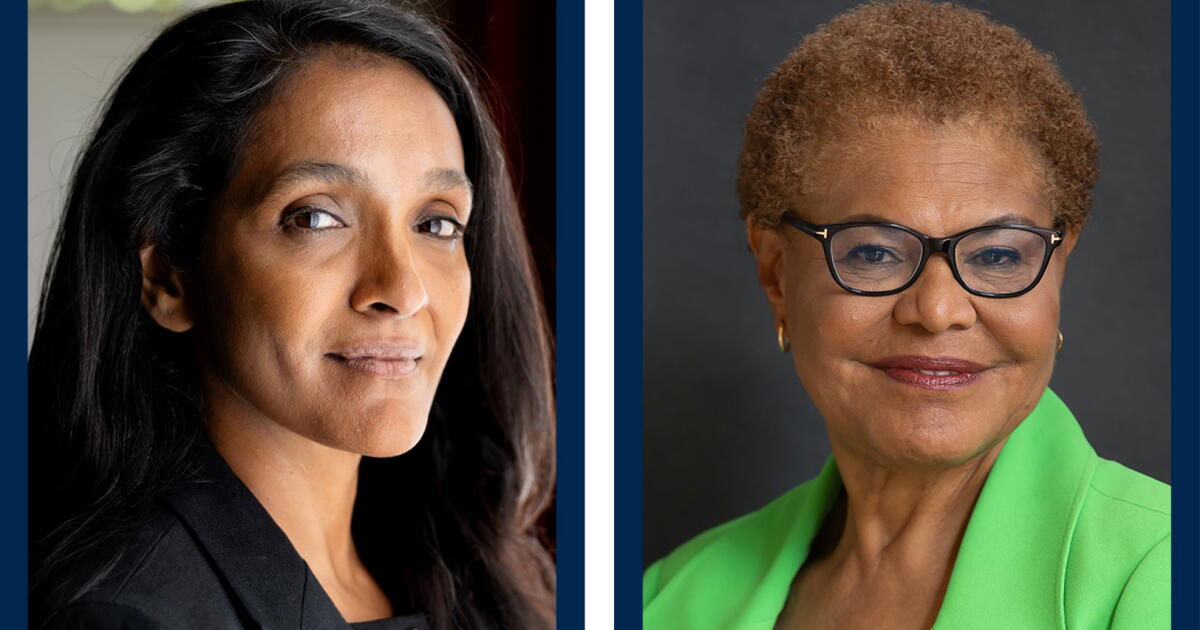
When she ran for mayor four years ago, Karen Bass said she wanted to regrow the Los Angeles Police Department to the 9,500-officer force it was before the ranks began to shrink. Now up for reelection — and facing a budget crunch — Bass says her plan has shifted.

The aim going forward, she told The Times in a recent interview, is to simply stop the department from getting smaller.

As of this week, the department had 8,677 sworn personnel — the lowest total in nearly a quarter-century. Even after efforts under Bass to streamline hiring and boost recruitment, some officials are concerned there won’t be enough new cops to replace those projected to leave or retire in the coming years.

“My goal changed, unfortunately,” Bass said. “I do hope that one day we get to the expansion, but we are not there now.”

A Bass spokesperson said after the interview that the mayor remains committed to reaching the 9,500-officer benchmark in the long run, but did not provide a timeline for getting there.

On April 20, Bass will release her spending plan for the upcoming fiscal year, which starts on July 1. She and the City Council will spend the coming months working out how to balance the city’s books in a way that avoids deep cuts to other services and the layoffs of city employees. A projection by the city administrative officer estimates the city’s budget deficit to be “several hundred million.”

Bass said she had spent years addressing a years-old administrative bottleneck within the city’s personnel department, which runs the background process for police hires.

The efforts were targeted “at every level: at the top, as well as internal to the department,” said Bass. “At least the impediments that kept us from retaining recruits, to get them in the academy, that has changed.”

The mayor called the old hiring process “archaic,” and said similar issues exist with other city departments. At the LAPD, she said, “We expanded recruitment and had a record number of recruits, and then we couldn’t get them hired, so we had to revamp the hiring process.”

Despite attrition at the LAPD in recent years, crime has plummeted, with homicides in the city falling to levels not seen since the 1950s. Yet public safety remains an issue in the mayor’s race, where Bass faces a challenge from City Councilmember Nithya Raman.

A recent survey co-sponsored by The Times found that more than half of voters view Bass unfavorably in the race. The same poll found that 39% of Angelenos think the LAPD needs to increase in size, with 29% saying the department should stay the same size and 19% saying it should shrink.

Raman came out ahead of Bass in a recent poll that only identified candidates in the mayoral race by their platforms, but not their names, though other surveys that identified them by name showed Bass in the lead.

Raman has said that she believes the police force is the right size at around 8,700 officers. Bass’ onetime ally has argued the mayor has thrown too much money at the LAPD, an approach Raman claims has come at the expense of other basic services such as park maintenance and street paving.

Raman has accused the mayor of signing off on raises for police officers with a contract that has done little to make a dent in the department’s recruitment struggles and only made worse the city’s financial picture. She and other critics say that with the dwindling number of cops, officials need to start investing more in community-led efforts that prioritize prevention over punishment in order to further reduce crime.

Bass said she had embraced a crime-fighting strategy that balances traditional policing with a more public health-oriented approach, pointing out that she had opened an Office of Community Safety to support gang interventionists who help defuse neighborhood conflicts before they explode into violence. Her administration also spearheaded sending mental health teams or other unarmed responders to emergency calls that were once fielded by police.

It’s no accident, she said, that killings in some of the most crime-impacted neighborhoods had fallen by 27%. So far this year, police say that most crime categories are down compared to where they were at this point in 2025.

LAPD Chief Jim McDonnell has said that without addressing police staffing the city’s progress on crime is at risk, especially as L.A. gets set to host large-scale sporting events like the World Cup and the 2028 Olympics.

During his briefing to the Police Commission on Tuesday, McDonnell said roughly 8% of the department’s employees are unavailable to work because they are on sick leave or other work restrictions. McDonnell and other police officials have said staffing shortages are limiting the department’s ability to respond quickly to low-level crimes, leading to high officer burnout rates, and driving up overtime expenses.

Asked to assess McDonnell’s first year-and-half as the city’s top lawman, Bass issued a written statement that said she considered McDonnell a strong partner “lowering crime, hiring more officers, and reversing longstanding trends.”

She added: “I will always keep pushing every City leader to do better by the people of Los Angeles.”

Bass said she would continue working with the chief to “identify measures” to reduce the number of police shootings, particularly those involving people in crisis.

Such changes would go hand in hand with an overhaul of the department’s much-maligned disciplinary system, which has faced criticism from some corners for not meting out harsh enough punishments when officers shoot unarmed people. The union that represents the department’s rank-and-file members has long complained of a double standard that lets well-connected officers and senior leaders off the hook.

Bass said that based on her conversations with officers, “the internal part of the disciplinary system has gotten a little better.”

Broader reforms have also been under discussion, with the council weighing new limits on so-called police pretextual stops, in which officers use a minor violation as justification to pull someone over and then investigate whether a more serious crime has occurred. Bass said she is in favor of further changes to tighten LAPD policies.

A recently published report by Catalyst California, a group that advocates for racial justice, found that such stops have continued to disproportionately affect Black and Latino drivers, even as the LAPD has scaled back their use over the past decade.

“Certainly, when I was younger, I experienced pretextual stops, and they are terrifying,” Bass said, adding that she believed the department’s culture was already changing. “I will tell you that as many roll calls as I’ve been to, a lot of officers already feel like they can’t do pretextual [stops] anymore — so I think there’s been progress there, but clearly more, more to go.”

Times staff writers David Zahniser and Noah Goldberg contributed to this report.

Source link

Texas talk of swallowing eastern New Mexico is an old impulse

When the speaker of the Texas House recently outlined his priorities for the next legislative session, he mentioned tax relief, the development of data centers and a notion that sent many eyebrows skyward.

Dustin Burrows, a Republican from Lubbock, directed the chamber’s governmental oversight committee to study the legal and economic implications of Texas absorbing one or more counties in eastern New Mexico.

The “conversation,” Burrows told the Dallas Morning News, “is ultimately about culture, opportunity and the right to choose a path that reflects the shared values of the Permian and Delaware basins,” a vast desert expanse awash in oil and natural gas.

Apparently, Texas lawmakers have time and money to burn.

The notion of the swaggering state swallowing a chunk of its resistant neighbor is completely far-fetched. Just four states have been carved from the territory of others: Kentucky, Maine, Vermont and West Virginia. And it’s been quite a spell since the last time that happened. West Virginia split off from Confederate Virginia in 1863.

Realistically, there is no end of hurdles — legal, political, practical — that would have to be surmounted for a partial Texas-New Mexico merger to occur. Both states would need to agree — New Mexico is a hard no — and Congress would also have to approve.

But the impulse to bust up, break away and move on is as old as America itself and, at the same time, as fresh as the latest provocation to pass the lips of the nation’s frothing commander-in-chief.

“Calexit,” the idea of California breaking away from the U.S. and becoming its own nation, took root during President Trump’s turbulent first reign and gained renewed support as soon as he returned to power. Texas toyed with the idea of secession when Barack Obama was president.

“The driver,” said Syracuse University professor Ryan Griffiths, an author and expert on secession, “is politics and polarization.”

The notion being if you don’t like it, then leave.

Or, at least, make noise about doing so.

Eastern New Mexico — dry, desolate — looks and feels very much like an appendage of West Texas. Its residents have long been estranged from the rest of their state and, especially, the Democratic leadership in Santa Fe, the state capital. That is not to say, however, the slightest inch of New Mexico territory will be going anywhere anytime soon.

Earlier this year, two Republican state lawmakers introduced a measure to give voters a say on whether they wanted their counties to break away — or, as one of the legislators put it, “Get the hell out of New Mexico.” The constitutional amendment died without a hearing.

When Burrows renewed talk of a takeover, Javier Martinez, speaker of the New Mexico House, responded without equivocation. “Over my dead body,” he said.

But the notion has garnered Burrows plenty of attention in the Lone Star State, a place with no lack of self-regard. And it certainly hasn’t hurt his standing with Texas’ arch-conservative Republican base, which has sometimes viewed Burrows with suspicion.

“People in Texas have a lot of fun with the idea that Texas … is entitled to secede and that maybe it can restore lost lands in New Mexico, Kansas, Colorado and beyond,” said Cal Jillson, a longtime student of Texas politics at Southern Methodist University. “It [appeals to] the conservative base, but also to everyone who loves to chuckle.”

Serious or not, secession — or independence, as some prefer to call it — has long been the dream of dissenters, of the discontented and those who feel put upon or politically unrepresented. America, after all, was birthed by divorcing itself from Britain and King George III.

For the longest time, residents in the ruddy north of blue California have agitated for a breakaway state called Jefferson. In recent years unhappy conservatives in eastern Oregon have spoken of splitting from their Democratic state and becoming a part of Republican Idaho. (Lawmakers in Boise passed a measure in 2023 inviting Oregon to the negotiating table; Oregon has so far declined to show.)

Since 2020, voters in 33 rural Illinois counties have voted to separate from their state and its Democratic leadership, a move welcomed in a measure passed by the Republican-run Indiana Legislature and signed by the state’s GOP governor, Mike Braun. (Illinois Gov. JB Pritzker dismissed the 2025 legislation as “a stunt.”)

Which, indeed, it appeared to be.

But Richard Kreitner said there is a certain logic behind secession movements, as governments from Washington to the statehouse are seen as increasingly unresponsive and dysfunctional.

“As people become more disenfranchised … more disillusioned from the political process, you’re going to start looking outside of the political process, the political structure, the constitutional structure, for a possible solution,” said Kreitner, who hosts a history podcast, “Think Back,” and has also written a book on secession. “If you’re going to do that in a country founded with a secessionist manifesto, the Declaration of Independence, at some point people are going to start thinking about that.”

Legitimate grievance grounded in serious concern is certainly worthy of attention. But exploiting that discontent to draw notice or score cheap political points — as Burrows seems to be doing in Texas — is something altogether different.

The chance of New Mexico ceding a part of itself to Texas is precisely zero, meaning the legislative study is less about “culture” and “opportunity” than the speaker and fellow Republicans evidently looking to troll their blue-state neighbor.

There are better, more productive ways for lawmakers to spend their time.

And their taxpayers’ dime.

Source link

Calm at the Eye of the Storm

Gov. Gray Davis sat in his campaign office in West Los Angeles, reading scribbled updates from aides and phoning supporters.

A few hours earlier, Sen. Dianne Feinstein, the San Francisco Democrat, had ruled out a run in the recall election, inspiring enormous relief in the Davis camp. Then, as rumors circulated that a pair of Democrats were poised to put their names on the Oct. 7 special election ballot, a political bombshell struck: Arnold Schwarzenegger was launching a Republican candidacy.

“He was surprised, but he’s a seasoned enough professional that he just doesn’t ride the roller coaster on these things,” said Davis campaign manager Larry Grisolano, one of those with the governor at the Pico Boulevard office on Wednesday evening.

“In politics, you learn to expect unusual things to come your way, and he rolls with them.”

After a dizzying week, the 60-year-old Davis confronts an uphill struggle that seems to rival, if not surpass, his improbable 1998 feat when he came from last place to win the Democratic nomination for governor and then the election.

By all accounts in the Davis camp, the governor has taken the surprising news of Schwarzenegger’s entry into the race, and the less surprising Democratic candidacies of Lt. Gov. Cruz Bustamante and Insurance Commissioner John Garamendi, in typical Davis style: calm, dispassionate, disciplined and focused on what he needs to do to defeat the recall effort.

A few weeks ago, as the recall campaign gained momentum and talks over a state budget remained deadlocked, “he was a little down,” said David Doak, a longtime Davis campaign advisor. “He’s pretty steady, but you could tell.”

Now, though, “I think his mood is better since he has sort of confronted this thing and said, ‘Let’s go get ‘em,’ ” Doak added. “This guy is not a quitter. He may not always look it or act like he’s tough, but internally he’s tough.”

In a conversation with at least one aide, Davis told a joke that drew comparisons of his seemingly hopeless political plight with that of Democratic President Harry Truman, whose defeat was widely — and erroneously — predicted heading into the 1948 election against Republican Thomas Dewey.

In the two days since the Schwarzenegger news broke, Davis has held political discussions by telephone with former President Clinton. Recently, the two have been talking three or four times a week, aides said. They met for about 40 minutes in Chicago on Monday, where Davis sought and received commitments of financial and logistical support from the AFL-CIO.

Schwarzenegger’s bombshell and Bustamante’s decision to get in the race whipped the news media into a frenzy on Wednesday. But the response was more measured inside the suites of the Davis headquarters, aides said.

In white shirt and tie, Davis spent several hours cloistered in his office there, calling state senators, advisors and supporters and meeting with Grisolano and others. Davis tried but failed to reach Senate President Pro Tem John L. Burton (D-San Francisco), a frequent Davis critic.

Art Pulaski, leader of the California Labor Federation, talked briefly with Davis and found him as calm “as he always is.”

“He was like, OK, new reality,” said Steve Smith, who is directing the Davis campaign.

While Davis was phoning around the state, Smith and other campaign officials were calling and fielding calls from supporters in the labor movement, environmental groups, women’s organizations and other groups.

Occasionally, Smith and others would slip Davis notes, letting him know the latest news and rumors they were hearing about other Democrats getting in the race, he said.

“At one point we were all using our cell phones because the incoming calls were just burying our phone system,” Smith said.

Davis left sometime after 9 p.m. His campaign staff worked the phones, plotted strategy and prepared talking points for Thursday media appearances by supporters until around midnight, said Peter Ragone, communications director for the Davis campaign.

Before leaving the office, Ragone — who handled press relations during Andrew Cuomo’s failed gubernatorial campaign in New York and Al Gore’s Florida recount effort — called his wife in San Francisco and summed up the day.

“I’ve had a lot of extraordinary days in politics. This one might have been the most extraordinary of all,” he recalled saying.

While the media frenzy continued in Los Angeles, Davis aides met in the early evening with about 50 administration officials, including resources secretary Mary Nichols and appointments secretary Michael Yamaki, at the California Nurses Assn. offices in Sacramento to bolster morale and answer questions.

“It was pretty sober, but with bursts of feistiness,” said Davis spokesman Steven Maviglio, who attended the meeting. “People were still in shock over Arnold’s announcement. There were shouts and yells like, ‘We’re going to fight this.’ People who worked for this guy for five years are beside themselves that all their hard work could be reversed because the governor made some difficult decisions that made him unpopular.”

While throngs of television cameras and screaming fans converged on Schwarzenegger’s Thursday appearance at the Norwalk offices of the Los Angeles County Registrar-Recorder, where he took out papers for his candidacy, Davis attended the memorial service for slain Los Angeles County Sheriff’s Deputy Stephen Sorensen in Lancaster, answered questions from reporters and addressed the California School Employees Assn.’s annual conference in Anaheim.

Back at headquarters, Doak set the day’s tone during the senior campaign staff’s morning strategy call: “We’re going to beat this thing,” he growled.

Much of Thursday’s campaign analysis focused on how the changed set of candidates would affect voter turnout, a crucial element for Davis, who must push the “yes” vote for a recall below 50% to keep his office, campaign advisors said.

As Schwarzenegger kept up his media blitz on morning TV talk shows Friday, Davis spent much of the day on the phone, seeking campaign donations and discussing health and environmental issues with his Sacramento advisors.

On Friday night, Davis talked about his mood in a taped interview on HBO’s “Real Time With Bill Maher.”

“It’s not a lot of fun,” he said of the effort to recall him from office. “But I try not to let negative emotions consume me, because I am privileged to be the governor.”

For all the talk of Davis’ impending political demise, there was no sense of panic in the governor’s inner circle.

“People’s moods run the gamut,” Doak said.

“I think people who are maybe closer to the stuff every day, it goes up and down. I’ve always been confident we’re going to win. You get a lot of these campaigns where you don’t see any way where you can get where you want to go. This one, you look at it and there’s some things out there you can say that move people.”

No one was suggesting that Davis would easily escape his predicament, but the campaign’s message in public and private was that, even with other Democrats on the ballot, Davis could achieve the 50% “no” vote he needs to defeat the recall.

To Davis strategists, Schwarzenegger is a less potent threat than Feinstein or former Los Angeles Mayor Richard Riordan, who took his name out of contention Thursday.

They also propose that the more crowded the candidate field gets, the better Davis looks as a rational choice.

“Gray’s been written off and underestimated his entire political career,” said Garry South, the governor’s longtime campaign strategist.

“He has persevered through lots of adversity. I think he has a very good chance of beating this recall, which happens to fly in the face of conventional wisdom. He is a very tough competitor and he doesn’t give up.”

Source link

Federal judge could halt Nexstar-Tegna TV station merger

A federal judge appears willing to block a $6.2-billion merger of two large TV station groups as he evaluates whether Nexstar Media Group’s takeover of a rival violates U.S. antitrust laws.

At the conclusion of a two-hour hearing in Sacramento on Tuesday, U.S. District Court Chief Judge Troy L. Nunley signaled he was preparing to issue a preliminary injunction that would prevent Nexstar and Tegna from combining operations amid an ongoing legal challenge.

Nunley said he would draft a written order, which is expected by Friday.

Previously, Nunley had issued a temporary restraining order to pause the merger.

Last month, Nexstar raced to finalize its blockbuster purchase of Tegnadespite a lawsuit filed by California Atty. Gen. Rob Bonta and seven other state attorneys general. The state officials, all Democrats, claimed the massive merger would give Nexstar too much control over local TV stations, ultimately hurting consumers by diminishing the diversity and quality of their newscasts.

California Deputy Attorney General Laura Antonini argued that when news consolidates, it results in a loss of diverse viewpoints.

“That’s extremely harmful to democracy and to the citizens of this state,” she said at the hearing.

President Trump has championed the Nexstar-Tegna merger, suggesting it would diminish the clout of the major TV networks, including those he often gripes about: ABC and NBC. Nexstar, based in Irving, Texas, owns dozens of network affiliate stations.

Nexstar, which also owns KTLA-TV Channel 5 in Los Angeles, already is the nation’s largest station group. The deal was expected to reshape the local television industry by extending Nexstar’s reach to 265 television stations, up from 164.

If the acquisition is finalized , Nexstar stations would cover 80% of the U.S. population, exceeding a 39% ownership cap set by Congress.

El Segundo-based DirecTV separately sued, alleging the combination of the nation’s two largest television station groups would do irreparable harm to its pay-TV business by raising prices and potentially increasing programming blackouts.

Representatives of Nexstar, DirecTV and Bonta’s office declined to comment after Tuesday’s hearing.

During the hearing, Nexstar attorney Alexander Okuliar, argued against an injunction, saying the plaintiffs had failed to demonstrate that the merger posed an immediate threat to the public. He said DirecTV and the attorneys general had only offered proposed financial harms.

In court documents, the state attorneys general and DirecTV alleged the deal would give Nexstar multiple TV stations in dozens of markets. That raised concerns about layoffs in an industry that has sustained significant downsizing in recent years as viewers and advertisers migrate to streaming options and social media platforms like TikTok.

Nexstar could “shut down local newsrooms in dozens of markets, reducing the amount, variety, and quality of local broadcast news that Americans rely on for trusted information about their communities,” DirecTV alleged.

For example, Nexstar owns the Fox station in Sacramento, while McLean, Virginia-based Tegna owns the ABC affiliate.

Okuliar pushed back, saying there was no evidence that local newsrooms would be shuttered.

“One of the reasons for this deal is to protect local broadcasters, to protect local journalism,” he told the judge.

Nexstar contends the deal would strengthen TV station economics, allowing stations to bolster their news gathering and expand the number of newscasts. The company cited dozens of awards won by Nexstar journalists, including in Oklahoma City.

In addition to Bonta, the plaintiffs include state attorneys general in Colorado, Connecticut, Illinois, New York, North Carolina, Oregon and Virginia.

Nearly two dozen lawyers attended the hearing on behalf of the other plaintiffs. Eight lawyers represented Nexstar and Tegna.

Nexstar Chief Executive Perry Sook and Chief Operating officer Michael Biard also attended.

In its complaint, DirecTV argued that it would suffer financial harm because Nexstar would use its increased heft to demand significantly higher fees for the rights to carry its network-affiliate stations, which carry local news, primetime shows and professional sports, including NFL football. Such programming disputes can lead to blackouts which infuriate customers.

Nexstar’s lawyers disputed such allegations, telling the judge the merger would ultimately increase the value of content. The company suggested the deal could lower prices for distributors like DirecTV, which has about 10 million customers nationwide.

Nunley recently combined the DirecTV and state attorneys general lawsuits into one.

The judge, who was elevated to the federal bench by President Obama, had already expressed concerns about the merger.

In his March 27 order granting the temporary restraining order, Nunley said DirecTV had demonstrated that it could prevail at a trial due to the merits of its arguments.

He then instructed Nexstar to “immediately cease all ongoing actions relating to integration and consolidation of Nexstar and Tegna.”

Instead, the Tegna unit must continue to operate independently as “an ongoing, economically viable, and active competitor,” the judge wrote.

The Nexstar-Tegna merger took on political overtones in early February after Trump threw his weight behind it, writing in a post on Truth Social that the proposed union was among the “good deals,” because it would provide competition against “THE ENEMY, the Fake News National TV Networks.”

“GET THAT DEAL DONE!” Trump wrote.

The state attorneys general sued to block the merger on March 18, when the transaction was still pending at the U.S. Justice Department, which is tasked with conducting anti-trust reviews, and the Federal Communications Commission, which oversees TV station licenses.

The DOJ and FCC blessed the deal the following day.

Within an hour, Nexstar announced that it finalized the transaction and that Tegna had been disbanded.

“It’s very rare to do what Nexstar did here,” DirecTV’s attorney Glenn Pomerantz said.

Nexstar had asked the judge to require the plaintiffs to post a $150 million bond to compensate it for damages it would suffer from any delays in closing the deal.

Source link

On Hungary visit, Vance urges voters to support Orbán days before pivotal election

Vice President JD Vance on Tuesday urged Hungarians to back Prime Minister Viktor Orbán in upcoming elections, dubbing the populist leader a defender of “Western civilization” during a visit to Hungary meant to help push Orbán over the finish line.

Vance’s two-day visit to Budapest was the clearest sign yet that President Trump’s administration is going all in for an Orbán victory when Hungarians go to the polls on Sunday. With only five days until the vote, Orbán, the European Union’s longest-serving leader and a close Trump ally, is trailing in the polls.

Speaking before over 1,000 Orbán supporters at an election rally at a sports arena in Budapest, Vance campaigned openly for the autocratic leader, telling the crowd: “We have got to get Viktor Orbán reelected as prime minister of Hungary, don’t we?”

Orbán is running for his fifth-straight term as prime minister. He and his nationalist-populist Fidesz party are facing their toughest race in two decades against a center-right challenger, the Tisza party led by Péter Magyar, that could bring an end to his 16 years in power.

Orbán has bristled at the slightest mention of the Hungarian election by any of his EU partners, decrying any expressions of support for his opponent as a grave breach of Hungary’s sovereignty and meddling in the election.

Yet Vance’s appearance alongside Orbán at the election rally — dubbed a “Day of Friendship” event — was an unusual step from a foreign leader, and a break with most politicians who avoid taking an active role in the political campaigns of other countries.

To loud applause, Vance asked rally attendees: “Will you stand for Western civilization? Will you stand for freedom, for truth, and for the God of our fathers?”

“Then, my friends, go to the polls in the weekend. Stand with Viktor Orbán, because he stands for you, and he stands for all these things,” Vance said.

‘I love that Viktor’

Long accused by critics of taking over Hungary’s institutions, clamping down on press freedom and overseeing entrenched political corruption — charges he denies — Orbán has become an icon in the global far-right movement.

Trump has repeatedly endorsed Orbán’s candidacy for reelection, and many in the Make America Great Again movement approve of the Hungarian leader’s opposition to immigration, curtailing of LGBTQ+ rights, and capture of the media and academia.

But with most independent polls showing a double-digit deficit for Fidesz among decided voters ahead of the vote, Orbán has sought to boost his profile by appearing publicly with his international admirers.

Vance spoke at length on Tuesday about what he views as the civilizational dangers posed by progressivism, “faceless bureaucrats” and censorship. He lauded Orbán for his strong stand against immigration, and his adversarial approach to the EU.

“I admire what you’re fighting for,” Vance said. “I am here because President Trump and I wish for your success, and we are fighting right here with you.”

Vance used his phone to call Trump from the lectern, to loud applause. After first reaching an automated message about the caller’s voicemail box not being set up yet, Trump answered the call and told the crowd through a microphone: “I love Hungary and I love that Viktor, I tell you he’s a fantastic man.”

Trump said Orbán had not allowed migrants “to storm” and “ruin” Hungary.

“He’s kept Hungarian people in your country,” Trump said.

Hungarian ‘reconquista’

The Trump administration’s embrace of Orbán reflects its affinity for European far-right parties broadly, and the admiration, from Spain to France to Germany and the Netherlands, has been mutual.

Orbán has long been a thorn in the side of the EU, and has tested the bloc’s system of governance by frequently using his veto power to paralyze decision-making in order to leverage concessions.

Last month, he vetoed a major, 90-billion euro ($104-billion) EU loan to Ukraine, angering the bloc’s leaders who accused him of hijacking the critical aid while undermining the EU in an effort to win his election.

At the rally on Tuesday, Orbán declared that “freedom-loving Americans and Hungarians must unite and save Western civilization.”

“To do this, we must fight the progressives that nest in Brussels,” the EU’s de-facto capital, he continued. He declared that Hungary had launched a “reconquista” of EU institutions which “will bring new patriotic governments to power.”

Late last month, Orbán hosted dozens of allies from around Europe and beyond at the Hungarian iteration of the Conservative Political Action Conference, and at a meeting of the far-right Patriots for Europe party family, the third-largest group in the European Parliament.

Trump sent a video message to Conservative Political Action Conference Hungary, saying Orbán had his “complete and total endorsement” and was a “fantastic guy.”

Still, Trump’s recent approach to foreign affairs has reverberated in Europe, with his actions over Greenland, Venezuela and Iran straining those relationships. Some commentators have suggested support from Vance and Trump may not help boost Orbán’s popularity at home.

Orbán, however, has remained deferential, and echoed Trump’s false claims that he won the 2020 election.

Russian energy

Orbán’s government has broken with most EU countries by refusing to assist Ukraine with financial aid or weapons to ward off Russia’s full-scale invasion. Meanwhile, it has remained firmly committed to purchasing Russian energy despite EU efforts to wean off such supplies.

In November, Hungary received an exemption from U.S. sanctions on Russian oil and gas after a White House meeting between Orbán and Trump.

Yet at a joint news conference with Orbán earlier on Tuesday, Vance seemed to contradict U.S. efforts to push its allies to break with Russian energy, excoriating other EU countries for moving to cease their imports of Russian fossil fuels in response to the war.

“It’s funny to watch prime ministers and leaders in some of the Western European capitals talk about the energy crisis when frankly they should have been following the policies of Viktor Orbán,” he said.

Despite his clear endorsement of Orbán, Vance lashed out at the EU for what he said was “one of the worst examples of foreign election interference that I’ve ever seen or ever even read about.”

Vance did not address numerous recent reports that Russian secret services are meddling in Hungary’s election to tip it in Orbán’s favor.

Spike writes for the Associated Press. Mike Catalini in Morrisville, Pa., contributed.

Source link

L.A. election shadow hearing: Democrats, experts defend voting systems

House Democrats and a panel of elections experts expressed unwavering confidence in state voting systems and dismissed Trump administration claims of widespread fraud and other vulnerabilities during a special “shadow hearing” in Los Angeles on Tuesday.

They accused President Trump and his Republican allies of pushing sweeping federal reforms — including stricter voter ID laws and new restrictions on voting by mail — that would disenfranchise millions of eligible Americans, especially low-income, rural and elderly voters, as well as voters of color and those with disabilities.

“They are taking us backward, and not to a good place,” said Rep. Nancy Pelosi (D-San Francisco), who helped lead the hearing at the Daniel K. Inouye National Center for the Preservation of Democracy in Little Tokyo.

They also stressed that they and their allies were working hard to prevent such backsliding.

“While Republicans are expecting Democrats to just sit idly by as they attempt to steal yet another election, Democrats are getting out in the community, raising the alarm bells about the GOP’s efforts to rig these elections and fighting back in the courts, in Congress and in our communities,” said Rep. Pete Aguilar (D-Redlands), chair of the Democratic Caucus. “We won’t let Republicans get away with their anti-democratic and un-American schemes.”

Such “shadow hearings” allow Democrats to highlight issues their majority-Republican counterparts won’t schedule for formal hearings in Washington. This week’s discussions — a second is scheduled Thursday in San Francisco — follow others in California in recent months, including on Trump’s immigration raids.

Pelosi, the former House speaker, led the hearing alongside Aguilar and Rep. Joseph Morelle of New York, the ranking Democrat on the House Administration Committee, which has oversight of elections. Joining them were fellow Democratic Reps. Nanette Barragán of San Pedro, Judy Chu of Monterey Park, Gil Cisneros of Covina, Laura Friedman of Glendale, Luz Rivas of North Hollywood, Linda Sánchez of Whittier, Norma Torres of Pomona and Maxine Waters of L.A.

Pelosi noted the setting on the grounds of the Japanese American National Museum, where Japanese Americans were detained before being unconstitutionally stripped of their belongings and taken to internment camps during World War II.

“To be here on a day when the president of the United States has talked about destroying the civilization of a country is so appalling. It’s so appalling, and I don’t think we can ignore comments like that, especially in a setting like this,” Pelosi said.

She also said that securing the nation’s elections against Trump’s threats and getting out the Democratic vote was the surest way of restoring order to U.S. relations abroad — and far more likely than getting Trump’s Cabinet to remove him from office by invoking the 25th Amendment.

“We have to make sure that the mentality that would obliterate a civilization, undermine a democracy by fighting free and fair elections, just cannot prevail,” she said.

The hearings were designed to challenge a narrative Trump has pushed for years — that U.S. elections are badly compromised by widespread fraud, that mail ballots such as those used in California are a particularly large source of abuse, and that noncitizens are voting in large numbers — none of which he has supported with evidence.

Trump tried unsuccessfully to challenge his 2020 loss to Joe Biden using similar arguments. When he returned to the White House, he immediately directed his administration to pursue the claims anew, including under executive orders he issued asserting new and sweeping federal authority over elections, which by law are controlled by the states.

The Justice Department in September sued California and other states for their voter rolls, which courts rejected. The FBI in January raided and seized 2020 election records from an elections office in Fulton County, Ga., where Trump rejected 2020 results. Trump in February said Republicans “ought to nationalize the voting.” Last week, he issued an executive order purporting to give federal agencies control over ballot processing by the U.S. Postal Service, which followed a previous order seeking to place new federal requirements on voter identification and proof of citizenship.

Trump has said his efforts are “common sense” steps average Americans support to secure elections against noncitizens voting and other threats.

Experts who provided testimony at Tuesday’s hearing roundly rejected that argument, saying the measures address problems that don’t existand are more geared toward securing wins for Republicans than ensuring election safety.

Jenny Farrell, executive director of the League of Women Voters of California, said that Americans are “more likely to be struck by lightning” than to commit voter fraud, and that many recent proposals framed around election integrity are really designed to narrow access to voting for certain groups. She also said California’s elections are particularly strong.

“We’re like the Dodgers of elections,” she said.

Darius Kemp, executive director of Common Cause California, said the state’s elections “are safe and secure,” and the Trump administration is threatening democratic participation in novel and alarming ways that his organization is watching carefully.

Justin Levitt, a Loyola Law School professor, said Trump is trying to project power over elections “that he simply does not have,” and if local and state officials, the courts and pro-democracy groups stand their ground, he will fail.

“If we keep calm and carry on, we can make our voices heard loud and clear,” he said.

Hector Villagra, vice president of policy advocacy and community education at MALDEF, or the Mexican American Legal Defense and Educational Fund, said “the evidence could not be more clear — noncitizen voting is exceedingly rare,” and Trump’s proposals would simply “raise the cost of lawful voting” for groups already underrepresented at the polls.

“The question is not whether we can verify eligibility. We already do that,” he said. “The question is whether we will impose new barriers that will prevent eligible citizens from participating at all.”

Sonni Waknin, senior staff attorney at the UCLA Voting Rights Project, said “democracy is under attack” across the nation, and that the photo identification requirement Trump and other Republicans are pushing would disenfranchise a million eligible voters in California alone.

When Cisneros asked about what could be done to prepare for the inevitable claims of fraud from Trump and other Republicans after the midterms, Levitt said that such claims must be called out for what they are.

“We call those lies, because they are lies,” he said.

When Waters asked the experts about the effect of federal immigration agents being deployed to polling places, as some in Trump’s orbit have suggested, Villagra said damage was already being done just from the rumors of such action — whether agents show up or not.

“It’s the threat that’s really what’s powerful here,” he said, as people — especially Latino voters — are already intimidated, and leaders should do more to reassure voters and offer alternatives to showing up to polls, such as voting by mail.

Source link

Swalwell campaign denies online claims that congressman behaved inappropriately with staffers

A spokesman for Rep. Eric Swalwell, a leading Democratic candidate for California governor, on Tuesday denounced online claims that the congressman had inappropriate relationships with young congressional staff members.

“This false, outrageous rumor is being spread 27 days before an election begins by flailing opponents who have sadly teamed up with MAGA conspiracy theorists because they know Eric Swalwell is the frontrunner in this race,” spokesman Micah Beasley said in a statement that was first reported by Politico.

Allegations that Swalwell (D-Dublin) acted sexually inappropriately with young women have been swirling online for weeks, with the tempo growing in recent days as Democratic strategists, Washington, D.C., insiders and social media influencers posted about the allegations, including that he made these women sign nondisclosure agreements.

“In 13 years, no one in Eric Swalwell’s Congressional office has ever been asked to sign an NDA. Ever,” Beasley said. “In 13 years, not a single ethics complaint by any staff in his office or any other office has ever been lodged. Ever.”

The Times has not independently corroborated reports of inappropriate behavior.

Swalwell, 45, did not respond to requests for comment.

He entered the campaign to replace termed-out Gov. Gavin Newsom in November, and recent opinion polls show he is among the Democratic front-runners. Swalwell had the support of 13.7% of voters in an average of recent polling compiled by Real Clear Politics, behind only Republican Steve Hilton, a conservative commentator who had an average of 14.7%

This is the second controversy Swalwell has faced in recent days.

Late last month, he accused President Trump of trying to sway the governor’s race based on reports that the FBI could release documents related to a decade-old investigation about his association with an alleged Chinese spy.

The investigation centered on Swalwell’s ties to a suspected intelligence operative, Christine Fang, or Fang Fang, who worked as a volunteer raising money for his congressional campaign. Swalwell cut off ties to Fang in 2015 after intelligence officials briefed him and other members of Congress about Chinese efforts to infiltrate the legislative body.

Swalwell was never accused of wrongdoing. In an interview with The Times in November, he said he was cleared by the FBI and a GOP-led House Ethics Committee of any impropriety in his ties to Fang.

FBI Director Kash Patel directed agents in the bureau’s San Francisco office to redact the case files for public release, according to a report by the Washington Post, a highly unusual move to release case files tied to a investigation that did not result in criminal charges.

Swalwell’s attorneys filed a cease and desist letter with Patel and the FBI. No documents have been released as of Tuesday afternoon.

Times staff writer Melody Gutierrez contributed to this report.

Source link

‘Gladiator fight’ cases against L.A. juvenile hall staffers fall apart

More than a year after California Atty. Gen. Rob Bonta announced indictments against 30 probation officers accused of coordinating or allowing so-called “gladiator fights” between youths inside L.A. County juvenile halls, almost half of the criminal cases are falling apart.

In recent weeks, state prosecutors dismissed charges against at least 10 of the 30 officers from the initial indictment, according to court documents and interviews with defense attorneys. An additional four officers entered into plea deals Tuesday that will end with their cases dropped after completing community service.

Attorneys for the officers and probation union officials said the prosecutions were an overreaction to a video — first published by The Times in 2024 — that showed officers standing by as several youths pummeled a fellow inmate at Los Padrinos Juvenile Hall in Downey.

“I believe the case was a reactionary case that was overcharged,” said attorney Adam Koppekin, who represents an officer whose case was dismissed. “They swept in a bunch of truly innocent probation officers who were following directives and doing their jobs.”

Two officers at the center of the Los Padrinos fight video — identified in court filings as Taneha Brooks and Shawn Smyles — remain charged with multiple counts of child abuse and conspiracy to commit willful cruelty against children. In the security video, the two officers can be seen laughing and shaking hands with the assailants. The 17-year-old who was attacked in the video suffered a broken nose and a concussion, according to a summary of his grand jury testimony contained in a motion filed in the case.

Brooks has repeatedly declined to speak to Times reporters. She showed up in court Tuesday in support of the other officers. E-mails to her attorney and a lawyer representing Smyles were not immediately returned.

Taneha Brooks, an L.A. County probation officer listed as the top defendant in the "Gladiator Fight" case

Taneha Brooks, an L.A. County probation officer listed as the top defendant in the “Gladiator Fight” case, leaves the Clara Foltzridge Criminal Justice Center on Tuesday, April 7, 2026 in Los Angeles, CA. Brooks has been accused of orchestrating and allowing many of the fights between juveniles in L.A. County detention centers that sparked the California Department of Justice’s investigation. Her case will be heard in May.

(Genaro Molina/Los Angeles Times)

Bonta said when announcing charges last year that his office had identified 69 other fight incidents involving nearly 150 youths between the ages of 12 and 18. The 30 officers were indicted on 71 counts of conspiracy, battery and child abuse.

But many of those other fights were different from the 2023 video in that they lasted only seconds, involved minimal injuries and ended after probation officers intervened, according to defense motions and video reviewed by The Times.

The Times confirmed that state prosecutors dismissed charges against 10 officers in recent weeks through interviews with attorneys and two law enforcement sources who spoke on the condition of anonymity to discuss an ongoing investigation.

Court documents reviewed by The Times showed that some of the cases were dismissed “in the interest of justice” after motions filed by the state attorney general’s office. Records of those officers’ arrests were then ordered sealed, the documents show.

In a statement Tuesday, the attorney general’s office said it adjusts its treatment of defendants “based on our continued consideration of all evidence developed before, during and after criminal charges were initiated.”

“Some defendants were appropriately dismissed from the case based on the law as applied to their factual circumstances,” the statement said.

Amid the dismissals and plea deals, Bonta’s critics questioned his fitness to take over the probation department to enforce needed reforms, a move the attorney general has been seeking court permission to make since last year.

“What we are seeing raises real questions about a rush to judgment, one that has already had the effect of maligning an entire profession without the facts being fully vetted,” Curtis Chambers, president of the union that represents rank-and-file probation officers, said in a statement. “When cases begin to fall apart after being advanced so publicly, it is fair to ask whether the process itself was flawed from the outset.”

Motions to dismiss charges in the case paint some of the officers as rookies deferring to their superiors. Defense attorneys for others questioned why state prosecutors charged officers who failed to intervene in fights that were in effect over before they began.

The Times reviewed video of one incident that showed a fistfight between two youths that lasted 20 seconds. In the brief dust-up, the teens throw a series of wild hooks at each other with few of the punches actually making contact. The officer charged in that incident briefly paused before joining a crowd of other officers who pulled the two apart. That officer, whose case has since been dismissed, was charged with two counts of willful cruelty to a child.

The indictments — along with a civil lawsuit and grand jury testimony referenced in motions to dismiss the charges — portray Brooks and Smyles as the main drivers of the fights.

They told other officers who were present, all of them rookies in the juvenile halls, “not to say anything, write down anything, and just watch when youth fights occurred,” according to the charges.

One juvenile told grand jurors he was “incentivized to fight” by Brooks and claimed both officers “rewarded him for fighting by giving him extra snacks,” according to a motion to dismiss filed on behalf of one officer.

According to the court filing, the juvenile told the grand jury that Brooks awarded special jobs to kids she favored.

“He testified Ms. Brooks would pick the ‘KP’ or kitchen patrol person based upon that person’s fighting prowess,” the motion said.

A Times investigation last year found the practice of probation officers rewarding teens who beat up other youths in custody was a problem that predated the “Gladiator Fight” scandal, with one attorney calling it an “open secret.”

Jonathan Evans, who represents Officer Isaiah Goodie, said his client was specifically told by Brooks and Smyles not to break up fights.

“They were seeing that these kids from different neighborhoods were going to fight anyway and they were finding a way to get it out of their system,” Evans said of the senior officers’ training of his client.

Two law enforcement officials told The Times that Brooks and Smyles had been investigated for allowing fights to happen years earlier while assigned to Central Juvenile Hall. It was unclear what, if any, discipline they faced.

One of the cases that will be dismissed after a plea agreement involved a high-ranking officer, 54-year-old Ramses Patron. He was charged with child abuse for failing to stop a fight that lasted less than 10 seconds, according to a motion to dismiss. His attorney, Tom Yu, argued that the state had wrongly accused many officers of planning fights that either occurred spontaneously or were arranged by Brooks and Smyles.

Patron must serve 40 hours of community service and then his case will be dismissed. Yu said his client has served the Probation Department for 30 years with a “spotless record” and the indictment upended his life.

“There’s no words to describe what my client and his family went through,” Yu said.

Indicted probation officer Ramses Patron, center, stands with his attorney

Indicted probation officer Ramses Patron, center, stands with his attorney Tom Yu, right, pleading no contest in the “Gladiator Fights” case.

(Genaro Molina/Los Angeles Times)

Advocates for the officers whose cases were dismissed said they had suffered serious harm to their finances and reputations, with each placed on leave without pay for more than a year.

“County employees are entitled to due process. To the extent that charges are reduced or dismissed, employees may have the right to seek reinstatement or back pay,” said Vicky Waters, communications director for the Probation Department.

Several defense attorneys credited the state prosecutors for scrutinizing the charges more thoroughly and ultimately deciding that some of the cases did not pass the smell test.

“Everybody would love an apology letter,” said defense attorney Bart Kasperowicz. “They did this giant witch hunt sweep and effectively changed the lives of 30 people and all the people that depend on them.”

Source link

U.S. soldier tries to halt wife’s deportation after she was detained on Louisiana military base

A U.S. Army staff sergeant is trying to halt his wife’s deportation after she was detained inside a Louisiana military base where the couple was planning to live together just days after their wedding.

The effort to remove the soldier’s wife, who was born in Honduras and remained in a federal immigration detention center Monday, has drawn criticism from military family advocates who called the detention demoralizing in a time of war and warned that deporting spouses could undermine recruitment.

Staff Sgt. Matthew Blank said he brought his wife, Annie Ramos, 22, to his base in Fort Polk, La., last Thursday so that she could begin the process to receive military benefits and take steps toward a green card. The couple married in March.

Federal immigration agents detained Ramos as part of the Trump administration’s mass deportation agenda, which legal experts say has dispensed with the U.S. Department of Homeland Security’s practice of leniency toward families of military members.

“I never imagined that trying to do the right thing would lead to her being taken away from me,” said Blank, 23, in a statement to the Associated Press. “What was supposed to be the happiest week of our lives has turned into one of the hardest.”

Ramos’ detention was first reported by The New York Times.

Ramos entered the U.S. in 2005, when she was younger than 2 years old. That same year, her family failed to appear for an immigration hearing, leading a judge to issue a final order of removal, according to the Department of Homeland Security.

“She has no legal status to be in this country,” Homeland SEcurity said in an emailed statement. “This administration is not going to ignore the rule of law.”

In 2020, Ramos applied to receive Deferred Action for Childhood Arrivals, also known as DACA, but her husband says her application has remained “in limbo” amid legal fights to end the Obama-era program.

Last April, Homeland Security eliminated a 2022 policy that considered military service of an immediate family member to be a “significant mitigating factor” in deciding whether or not to pursue immigration enforcement. The administration’s new policy states that “military service alone does not exempt aliens from the consequences of violating U.S. immigration laws.”

Prior to the Trump administration’s mass deportation push, Homeland Security generally allowed the spouses of active-duty military members to gain legal status through policies like parole in place and deferred action that military recruiters promote, according to Margaret Stock, a military immigration law expert.

Ramos’ case would have been easy to resolve in the past, Stock said, but instead Homeland Security now appears to be focusing on detaining members of military families whenever the opportunity arises — including when, like Ramos, they are attempting to apply for legal status.

“It doesn’t make any sense — they’re going to get arrested for following the law? That’s stupid,” Stock said. “It’s bad for morale, it disrupts the soldiers’ readiness.”

In September, more than 60 members of Congress wrote to the Homeland Security and Defense Departments warning that arrests of military personnel and veterans’ family members was “betraying its promises to service members who play a key role in protecting U.S. national security.”

The Pentagon declined to comment.

Lydiah Owiti-Otienoh, who runs an advocacy group called the Foreign-Born Military Spouse Network, said she’s anecdotally seen an increase in cases where the lives of military families have been upended by tightening immigration restrictions. She believes the federal government is undermining its own interests by attempting to deport military spouses.

“It just sends a really bad message — we don’t care about you, about your spouses, anything you are doing,” Owiti-Otienoh said. “If military families are not stable, national security is not stable.”

Blank’s mother, Jen Rickling, told the AP in a statement that her daughter-in-law, a Sunday school teacher and biochemistry major, had been everything she hoped for — someone who “loves my son with her whole heart.”

“We absolutely adore her,” Rickling said. “I believe in this country. And I believe we can do better than this — for Annie, for other military families, and for the values we hold dear.”

Blank says he had been eager to start building a life and with Ramos on the base while he served his country.

“I want my wife home,” Blank said. “And I will not stop fighting until she is back where she belongs, by my side.”

Brook writes for the Associated Press.

Source link

Georgia congressional election pits Trump-backed Clay Fuller against Shawn Harris

Republican Clay Fuller will try to close the deal with Georgia voters on Tuesday to succeed Marjorie Taylor Greene in Congress, while Democrat Shawn Harris seeks an upset.

Harris led a first round of voting on March 10 with 37% in the district that stretches across 10 counties from suburban Atlanta to Tennessee. While Fuller came in second in the 17-candidate all-party special election with 35%, the Republican candidates combined won nearly 60% of the vote. The 14th District is rated as the most Republican-leaning district in Georgia by the Cook Political Report.

President Trump in February endorsed Fuller, a district attorney who prosecuted crimes in four counties, to succeed Greene in Georgia’s 14th Congressional District. Greene, once among Trump’s most ardent supporters, resigned in January after falling out with the president.

Fuller has backed Trump to the hilt, finding no issue on which he disagreed with the president when asked in a March 23 debate.

“We need an America First fighter to stand strong for northwest Georgia,” Fuller said March 23. He was a White House fellow in the first Trump administration and is a lieutenant colonel in the Georgia Air National Guard.

Trump reiterated his support for Fuller on Monday night.

“I am asking all Republicans, America First Patriots, and MAGA Warriors, to please GET OUT AND VOTE for a fantastic Candidate, Clay Fuller, who has my Complete and Total Endorsement!” the president wrote on social media.

Harris, a cattle farmer and retired general who lost to Greene in 2024, has contrasted himself with Greene’s bomb-throwing style. He said he’s a “dirt-road Democrat” with common sense, and practical-minded Republicans should vote for him because he will focus on the district’s interest.

“He has sold his soul to Donald Trump,” Harris said of Fuller on March 23. “The reality of it is he cannot fight for you because he cannot go against the president.”

The winner will serve out the remaining months of Greene’s term. A Republican win would bolster the party’s slim majority in the House, where Republicans control 217 seats to Democrats’ 214, with one independent.

But if the winner wants to remain in Congress beyond January, he will have to run again. Republicans seeking a full two-year term are set for a May 19 party primary, and possibly a June 16 party runoff, before advancing to the general election in November. Harris is the only Democrat running, meaning he faces no primary election.

Greene was one of the most well-known members of Congress until she left in January. She remained loyal to Trump after he lost to Democrat Joe Biden in 2020, promoting Trump’s falsehoods about a stolen election. When Trump ran again in 2024, she toured the country with him and spoke at his rallies while wearing a red “Make America Great Again” hat.

But Greene began clashing with Trump last year after he and other Republicans pushed back against her running for U.S. Senate or governor. Greene criticized Trump’s foreign policy and his reluctance to release documents involving the Jeffrey Epstein case. The president eventually had enough, saying he would support a primary challenge against her. Greene announced a week later that she would resign.

Amy writes for the Associated Press.

Source link

How big of a tent do Democrats want? Michigan’s Senate primary is testing the limits

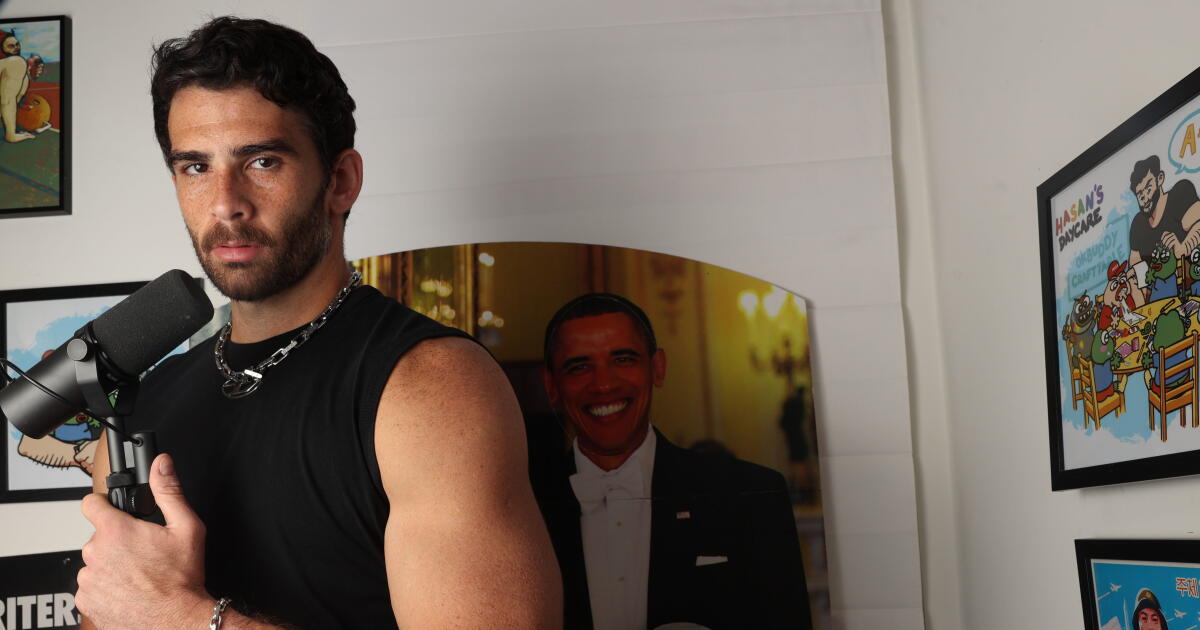
By the time Hasan Piker takes the microphone at two campaign events with a Senate candidate in Michigan on Tuesday, the popular but controversial online streamer will have already generated plenty of noise inside the Democratic Party.

Some have pitched him as a gateway to young people — particularly young men — who have drifted to the right in recent years. Others fear he is a sign of the party beholden to its extremes, pointing to inflammatory rhetoric like “Hamas is a thousand times better” than Israel, describing some Orthodox Jews as “inbred” and that “America deserved 9/11.”

Piker’s scheduled appearances with Abdul El-Sayed, a progressive candidate in the Democratic primary for U.S. Senate in Michigan, have catalyzed questions of how big a tent the party wants to build as it works to regain power in the midterm elections and win back the White House.

In an interview with the Associated Press, Piker cast the reaction as part of a broader fight for the party’s future.

“There is definitely, I think, a battle right now for who gets to be more representative of the national Democratic Party,” he said.

Piker remains largely unapologetic for his past remarks, although he’s said some were poorly worded. He called the renewed focus on them “totally ridiculous, especially considering that there are far more consequential things happening in the world right now.”

“The super wealthy are picking apart the scraps of the American carcass like a bunch of vultures, and some of the Democrats are talking about their affiliations with a Twitch streamer,” Piker said. “I think Americans understand that this is totally ridiculous.”

The 34-year-old Turkish American streamer has 3.1 million followers on Twitch and 1.8 million on YouTube, making him an influential voice in a shifting media landscape where mainstream outlets are losing clout. Unlike traditional podcasts, his livestreams are often unscripted and interactive. He has hosted prominent Democrats, including Rep. Alexandria Ocasio-Cortez and New York City Mayor Zohran Mamdani.

Piker said he is a “megaphone” for an angry electorate, and he believes the criticism that he faces is less about him personally and more about what he represents — a younger, more populist wing of the party.

“I think they find me to be a more appropriate target than to just actively disparage the voters,” he said.

El-Sayed, who has been backed by progressive Sen. Bernie Sanders, is attempting to channel that appeal in appearances at Michigan State University and the University of Michigan on Tuesday. A physician and former county health official, he is locked in a competitive Senate primary with U.S. Rep. Haley Stevens and state Sen. Mallory McMorrow. It’s a critical race for a seat being vacated by Democratic Sen. Gary Peters and the winner of the primary will likely face former Republican Rep. Mike Rogers.

The three candidates have differing views on U.S. foreign policy toward Israel. Both El-Sayed and McMorrow have described the war in Gaza as a genocide. El-Sayed wants to stop all military assistance while McMorrow has pushed for a two-state solution. Stevens has described herself as a “proud pro-Israel Democrat.”

McMorrow told Jewish Insider that Piker was someone who “says extremely offensive things in order to generate clicks and views and followers,” and she compared him to white supremacist Nick Fuentes. Trump’s decision to dine with Fuentes between his presidencies ignited a firestorm of controversy over his association with extreme voices on the right. Stevens said El-Sayed is “choosing to campaign with someone who has a history of antisemitic rhetoric.”

El-Sayed responded to the backlash over Piker by saying “if we want to have a conversation where we’re actually bringing people together about the things that we need and deserve, we’re gonna have to go to unlikely and uncommon places.”

Not everyone in the party wants to go to those places. Rep. Brad Schneider of Illinois, who chairs the moderate New Democratic Coalition and co-chairs the Congressional Jewish Caucus, called Piker “an unapologetic antisemite.”

“We are deeply disappointed by the decision to host a speaker at the University of Michigan with a documented record of antisemitic rhetoric,” said Rabbi Davey Rosen, the CEO of Michigan Hillel. “Such invitations normalize hate and contribute to a hostile environment for Jewish students.”

Piker said he is not antisemitic and describes himself as anti-Zionist. Hostility toward Israel has risen across the political spectrum and became a fault line within the Democratic Party during the war in Gaza.

Criticism has centered on Piker’s past remarks. After the Oct. 7 attack on Israel, Piker argued that whether reports of sexual violence are accurate “doesn’t change the dynamic” of the conflict. He has repeatedly said the core issue is Israel’s conduct in Gaza.

Piker has drawn backlash for a comment in which he said “America deserved 9/11,” made during a 2019 livestream while discussing U.S. foreign policy. Piker has said the remark was poorly worded and added in the AP interview that he “didn’t mean that Americans deserved to die.”

Cappelletti writes for the Associated Press.

Source link

Iran attempting cyber attacks against U.S. critical infrastructure, officials say

U.S. intelligence agencies are “urgently warning” private sector companies throughout the nation that Iranian actors “are conducting exploitation activity” that has resulted in “disruptions across several U.S. critical infrastructure,” according to a government notice reviewed by The Times.

The Iranian cyberactivity comes as President Trump is threatening to target Iran’s critical infrastructure in the coming hours, particularly its bridges and power plants.

Iran’s attack targeted products by Rockwell Automation’s Allen-Bradley, one of the most widely used industrial automation brands, according to the notice, which said that cyber actors affiliated with Iran were exploiting “programmable logic controllers across U.S. critical infrastructure.”

Tehran’s targeting campaigns against U.S. organizations “have recently escalated, likely in response to hostilities between Iran,” the notice warned.

“Iran-affiliated advanced persistent threat (APT) actors are conducting exploitation activity targeting internet-facing operational technology (OT) devices, including programmable logic controllers (PLCs) manufactured by Rockwell Automation/Allen-Bradley,” the notice reads.

“U.S. organizations should urgently review the tactics, techniques, and procedures (TTPs) and indicators of compromise (IOCs) in this advisory for indications of current or historical activity on their networks,” it continues.

The advisory was issued Tuesday jointly by the FBI, the Cybersecurity and Infrastructure Security Agency, the National Security Agency, the Environmental Protection Agency, the Department of Energy, and Cyber Command.

Top executives from companies at the core of the nation’s ability to function — those leading America’s largest energy, water, transportation, and communications corporations — had already been taking it upon themselves to increase their vigilence over potential attacks, concerned that Trump’s willingness to target Iran’s critical infrastructure inadvertently put a mark on their backs.

Some fear Iran’s ability to conduct cyber operations that could take down transformers or power inverters, if not a wide-scale power system. Others are concerned by threats to brick and mortar sites from proxies of Tehran — physical attacks against facilities such as nuclear plants, or power management systems, the crown jewels of the sector.

Larger, even more capable actors, particularly Russia and China, may also take advantage of the fog of war to launch strikes themselves.

“There remains concern about Iranian cyber capabilities and retaliation if the U.S. carries through on threats to attack their infrastructure,” said Ernest Moniz, former U.S. secretary of energy under President Obama who helped negotiate the 2015 nuclear deal with Iran. “There may already be backdoors, Trojan horses and malware hidden in our infrastructure.”

“I have to believe that the government cyber experts — or what’s left of them — are working closely and indeed overtime with the power companies and other infrastructure operators on cyber defense and intrusion detection and warning,” Moniz added.

Iran has demonstrated an ability to penetrate networks tied to critical U.S. infrastructure before.

In 2015, Iran-backed hackers accessed data associated with Calpine Corp., one of California’s largest power producers, obtaining detailed engineering diagrams and credentials related to power plant systems. Some were labeled “mission critical.” U.S. officials feared at the time that the breach would allow Tehran to initiate blackouts nationwide.

Since that time, companies at the center of the U.S. energy and telecommunications sectors have markedly improved their defenses. But Iran’s offensive capabilities have improved, as well.

Large players in the energy sector are operating with “a watchful eye and an elevated posture right now,” said Pedro J. Pizarro, president and chief executive officer of Edison International, the parent company of Southern California Edison, one of the nation’s largest electric utilities.

Companies like Edison have been operating under persistent threat for over a decade. In 2024, a pair of devastating cyberespionage attacks targeting U.S. critical infrastructure attributed to Chinese hackers, Volt Typhoon and Salt Typhoon, were discovered after avoiding detection for at least three years.

The threat of a similarly latent attack — where malware lies dormant in critical infrastructure systems, waiting for a signal to activate — is a real cause for concern in the sector, despite its best efforts and technological advances, experts and insiders said.

“The threat of cyber and physical attacks targeting critical infrastructure is not new,” said Jennifer DeCesaro, senior vice president of industry operations at the Edison Electric Institute, “which is why we partner with the government through the Electricity Subsector Coordinating Council to share actionable intelligence and prepare to respond to incidents that could affect our ability to provide electricity safely and reliably.”

The ESCC works closely with the National Security Council and its intelligence arms, particularly the intelligence agencies and CISA, to coordinate regular briefings on safety standards, best practices and intelligence tips.

The CIA declined to comment. A spokesperson with CISA, listed as out of office due to the ongoing federal funding hiatus for the Department of Homeland Security, could not be reached for comment.

Last summer, announcing a 40% cut to the workforce of her office, Director of National Intelligence Tulsi Gabbard eliminated the Cyber Threat Intelligence Integration Center, previously seen as a critical fusion hub of information by private sector partners.

Asked to respond to the potential of retaliatory attacks against U.S. infrastructure, Karoline Leavitt, the White House press secretary, repeated the president’s threats.

“The Iranian regime has until 8PM Eastern Time to meet the moment and make a deal with the United States,” she said. “Only the president knows where things stand and what he will do.”

Trump has threatened to destroy every bridge and power plant in Tehran if they fail to come to an agreement that ends its control over the Strait of Hormuz.

Ultimately, corporate executives shoulder much of the burden as the first line of defense for the country’s critical infrastructure, roughly 85% of which is owned by private sector companies.

Tom Fanning, former CEO of Southern Co. and now executive committee chairman at the Alliance for Critical Infrastructure, said the threat from Iran is “credible.”

“I have not seen what I would describe as the existential threat, to take down a wide-ranging power system,” Fanning said. “Could those things be turned on? Sure. Is the United States critical infrastructure prepared to act? I think so.”

Last month, early on in the war, the Los Angeles Metro transit system was forced to shut down a portion of its network due to a hack. Authorities say it is still unclear who was behind the breach, but a source told The Times that Iran-backed hackers are being investigated as the potential culprit.

The transportation agency said its security team had “discovered unauthorized activity,” and were making sure its roughly 1,400 servers were secure before bringing them back online. The agency has emphasized the hack did not impact passengers’ commute time.

The FBI said it was aware of the hack. DHS is working with local partners “to address cyber threats to critical infrastructure,” an official said.

“The reality is that the threats are here and now,” Fanning added. “The truth is, the bad guys are already here.”

Times staff writers Kevin Rector, Richard Winton and Rebecca Ellis, in Los Angeles, contributed to this report.

Source link

Environmental groups urge appeals court panel to lift halt on closing Florida’s ‘Alligator Alcatraz’

Environmental groups on Tuesday asked a federal appellate court panel to drop its temporary halt of a lower court’s order instructing state officials to close an immigration detention center in the heart of the Florida Everglades known as “Alligator Alcatraz.”

The Everglades facility remains open, still holding detainees, because the appellate court in early September relied on arguments by Florida and the Trump administration that the state had not yet applied for federal reimbursement, and therefore wasn’t required to follow federal environmental law. State officials opened the detention center last summer to support President Trump’s immigration crackdown.

Questions by the three appellate judges during oral arguments in a Miami courtroom focused on how much control the federal government had over the state-built facility and under what circumstances an environmental review was required to be in compliance with federal law. The judges did not indicate when they would rule.

Jesse Panuccio, an attorney for the Florida Department of Emergency Management, told the judges federal funding and federal control of the facility were the two criteria for determining if the federal environmental law would apply and the federal agencies had no control over the state-run detention center.

Florida was notified in late September that FEMA had approved $608 million in federal funding to support the center’s construction and operation.

“You need both,” Panuccio said. “Even with funding, I don’t think that would follow because they don’t have federal control.”

An attorney for the environmental groups said the law requiring a review applied to the facility because the Department of Homeland Security had authorized the funding and immigration was a responsibility of the federal government, not the state.

“What is different about this property is that immigration is constitutionally a federal function,” said Paul Schwiep,” an attorney representing the Friends of the Everglades and the Center for Biological Diversity. “The state has no role.”

The federal district judge in Miami in mid-August ordered the facility to wind down operations over two months because officials had failed to do a review of the detention center’s environmental impact according to federal law. That judge concluded that a reimbursement decision already had been made. The appellate court halted the order on an appeal.

The environmental lawsuit was one of three federal court challenges to the Everglades facility since it opened. In the others, a detainee said Florida agencies and private contractors hired by the state had no authority to operate the center under federal law. The challenge ended after the immigrant detainee who filed the lawsuit agreed to be removed from the United States.

In the third lawsuit, a federal judge in Fort Myers, Fla., ruled the Everglades facility must provide detainees there with better access to their attorneys, as well as confidential, unmonitored, unrecorded outgoing legal calls.

Schneider writes for the Associated Press.

Source link

Democrats hope to increase liberal control of battleground Wisconsin’s Supreme Court

Democrats hoped to increase liberal control of the state Supreme Court in Wisconsin on Tuesday in an election that has focused largely on abortion rights as cases affecting congressional redistricting, union rights and other hot button issues also await in the perennial battleground state.

This year’s Supreme Court election stands in stark contrast to the swing state’s previous two, where national spending records were set in battles over majority control. Spending and national attention is down dramatically this year without control of the court at stake.

Democrats are looking to tighten their control of the court just months before a November election in which they seek to keep the governor’s office and flip the state Legislature, where Republicans have held the majority since 2011. Democrats aspire to undo a host of Republican-enacted laws that made Wisconsin a focal point for the nation’s conservative movement in the 2010s.

In Tuesday’s Supreme Court race, Democratic-backed Chris Taylor, a former state lawmaker who also worked for Planned Parenthood, faces Republican-supported Maria Lazar. Both Taylor and Lazar are state Appeals Court judges.

Liberals would increase their majority on the court to 5-2 from 4-3 with a Taylor win. That would lock in the liberal majority until at least 2030.

Liberals took control of the state’s top court in 2023, ending 15 years under a conservative majority. They held onto their majority with last year’s victory in a race that drew involvement from President Trump and billionaires George Soros and Elon Musk, who personally handed out $1 million checks to voters in the state.

Liberals argued that democracy was at stake in the 2025 election, noting that when the court was controlled by conservative justices in 2020 it came just one vote shy of siding with Trump in his attempt to invalidate enough votes to overturn his loss in that year’s presidential election.

Since liberals took control, the court has reversed several election-related rulings, including one that overturned a ban on absentee ballot drop boxes, and it is poised to once again be in the spotlight around the 2028 presidential election.

Races for the court are officially nonpartisan, but support for candidates breaks down mostly along partisan lines.

Taylor has focused much of her campaign on abortion rights, with one TV ad saying that “abortion is on the ballot.” In another ad, she criticized Lazar for calling the U.S. Supreme Court’s overturning of Roe v. Wade in 2022 “very wise.”

Lazar, who was supported by anti-abortion groups in her run for the appeals court, tried to brand Taylor as nothing more than a politician who will push a partisan agenda on the court.

They sparred over each other’s partisanship during the campaign’s sole debate last week.

Lazar accused Taylor of being a “radical, extreme legislator” and a “judicial activist.” Taylor said that Lazar would bring “an extreme, right-wing political agenda to the bench.”

Lazar has had a much harder time getting her message out. Taylor had a large fundraising advantage and spent about nine times as much as Lazar on television ads, based on a tally by the Brennan Center for Justice.

The liberal-controlled court has already struck down a state law banning abortion and ordered new legislative maps, fueling Democrats’ hopes of capturing a majority this November.

Taylor has been a judge since 2020 and before that she spent 10 years as a Democrat representing the liberal capital city of Madison in the state Assembly.

Lazar, a judge since 2015, previously worked four years under a Republican attorney general in the state Department of Justice. In that role, she defended a law enacted under former Republican Gov. Scott Walker that effectively ended collective bargaining for most public workers.

A circuit court judge ruled in December that the law is unconstitutional, a decision expected to ultimately land before the state Supreme Court.

Lazar also defended laws passed by Republicans and signed by Walker implementing a voter ID requirement and restricting abortion access.

Democrats are optimistic given the past two Supreme Court elections, which saw candidates they backed winning by double digits.

The seat is open due to the retirement of a conservative justice. Another conservative justice is retiring next year, giving liberals a chance to take 6-1 control of the court if they win on Tuesday.

Bauer writes for the Associated Press.

Source link

Trump’s message to Iran on deadline day: ‘A whole civilization will die tonight’

President Trump warned that a “whole civilization will die” on Tuesday night if Iran does not meet his deadline to fully reopen the Strait of Hormuz, escalating tensions as diplomatic talks to end the war remain underway.

“A whole civilization will die tonight, never to be brought back again,” Trump wrote Tuesday morning on Truth Social. “I don’t want that to happen, but it probably will.”

The extraordinary threat signaled Trump’s willingness to authorize U.S. military strikes on Iranian infrastructure — including bridges and power plants —- if the United States and Tehran are unable to reach a ceasefire deal by a Trump-imposed deadline of 5 p.m. PDT on Tuesday.

Trump has a history of issuing deadline in diplomatic standoffs, only to quietly walk them back when they pass without resolution. But Trump’s warning on Tuesday stood apart as it invoked apocalyptic language that goes well beyond his previous ultimatums.

The threat came a day after Trump indicated that a ceasefire proposal communicated by mediators in the Middle East ahead of the deadline was insufficient. He called the offer “not good enough,” but acknowledged it as a “significant step” in negotiations.

Trump declined to provide details on the ceasefire negotiations on Monday, but he has made clear that a core part of the negotiations hinges on the reopening of the Strait of Hormuz, a crucial waterway through which roughly a fifth of the world’s oil passes flows through daily.

On Tuesday morning, Iranian leaders remained defiant ahead of the looming deadline.

Iranian President Masoud Pezeshkian wrote on X that “more than 14 million proud Iranians have so far registered to sacrifice their lives to defend Iran.”

“I too have been, am, and will remain devoted to giving my life for Iran,” Pezeshkian wrote ahead of the looming deadline.

Trump on Monday mused about taking control of the waterway and charging tolls for passage, as well as taking control of Iranian oil.

“If it were up to me, I’d take the oil, keep the oil and make plenty of money,” Trump told reporters at the annual White House Easter Egg Roll.

Iranian officials on Monday rejected a ceasefire proposal, calling American demands “both highly excessive and unusual, as well as illogical.”

The ceasefire proposals have been communicated through mediators from Egypt, Pakistan and Turkey, according to the Associated Press.

After Iranians rejected the American proposal, Trump said at a news briefing on Monday that the U.S. military was prepared to strike Iran’s vital infrastructure if a deal cannot be reached.

The president has also dismissed questions that targets to infrastructure would amount to war crimes because it would impact civilians.

“You know what’s a war crime? Allowing a sick country with demented leadership to have a nuclear weapon,” Trump said.

Source link

State Controller May Freeze Payroll Until Budget Passes : Legislature: Official says some Medi-Cal payments could also stop if agreement isn’t reached by Saturday.

Attempting to force a state budget agreement, California Controller Kathleen Connell said Monday she is considering withholding lawmakers’ salaries, and cannot pay 35,000 state employees if the Legislature and Gov. Pete Wilson fail to approve a budget by Saturday’s constitutional deadline.

Without a budget, Connell said, she also will have no choice but to delay payments of some Medi-Cal bills, such as prescriptions, for elderly people–a step that would add pressure on lawmakers to approve a spending plan.

Under the state Constitution, California must have a new budget by the July 1 start of the 1995-1996 fiscal year. But Wilson and the Legislature remain far apart and seem to be in no rush to approve a budget.

In recent years, it has become common for the deadline to pass without a budget. In 1992, the state went more than 60 days without a budget, leading state government to pay its employees and vendors with IOUs.

Connell, who is in her first year in office and who issues the checks for the state, said California has the cash to pay its bills. However, without agreement on a budget measure authorizing state spending in the new fiscal year, Connell said she will have no choice but to delay paying vendors, some medical bills for the elderly, the blind and the disabled, and as many as 35,000 state employees, including management officials.

“I don’t think any taxpayer is going to be sympathetic to the idea that we have the cash but are not paying our bills,” said Connell, a Democrat.

Connell last week suggested that she would withhold lawmakers’ pay starting July 1 if they had not approved a budget by the deadline. But she softened her position after concluding that there may be a constitutional requirement that she issue their checks. However, Connell said she is still studying the question.

“I’m raising a moral issue here,” Connell said after a speech in Sacramento. “If there are [state] employees who are not going to be paid because we have partisan politics dominating the Legislature, then there has to be a question of who else should accept responsibility.”

In the Legislature, the Senate-Assembly budget conference committee met Monday afternoon. But Wilson and top legislative leaders have not scheduled budget talks to resolve differences.

Wilson has proposed a $56-billion budget that includes deep welfare cuts and requires 10% increases in state college and university tuition. Wilson also is pushing for a 15% income tax cut over three years–an idea opposed by many Democrats.

“We fully expect to have a budget in the month of July,” Wilson spokesman Paul Kranhold said. “We are hopeful that the Legislature will forward us a budget by Saturday, or soon afterward.”

The amount separating Democrats and Republicans is relatively small–$1.8 billion–compared to other years of the Wilson Administration, when the gap between Wilson’s proposals and what the Legislature proposed ranged from $5 billion to $14 billion. But rancor is so dividing the Assembly this year that partisans in the budget fight have yet to take the first steps toward a solution.

“It can happen by Saturday,” said Assembly Republican Leader Jim Brulte. “There is no reason that it couldn’t or shouldn’t happen by Saturday. But I don’t know if it will.”

Past court orders require that, even without a budget, the state pay to keep schools open and issue checks to welfare recipients. The state also will continue to meet its bond debt and pension payments, Connell said.

But starting Saturday, Connell said, the state will not pay vendors who perform various services for the state, or deliver goods to state prisons and state hospitals. Without a budget, she said, state agencies that lease space will be unable to pay rent and cannot pay utility bills. Payments for services such as nursing home care or food deliveries to prisons would be delayed until a budget is approved.

“The effect of having no budget begins immediately. It begins on July 1, and the damage will grow with each day,” Connell said.

If the state goes without a budget through July, the missed payments would total at least $360 million for Medi-Cal and state assistance to counties to operate trial courts. The total for employees was not known.

Unlike 1992, the last time there was a lengthy budget deadlock, the state cannot use IOUs to pay its workers who fall under the Fair Labor Standards Act.

A federal judge, acting on a lawsuit brought by state employees, ruled last year that the state acted illegally in 1992 by issuing the IOUs, and that roughly 120,000 workers covered by the Fair Labor Standards Act must be paid even if there is no budget.

But between 33,000 and 35,000 state workers are not covered by the act, raising the possibility that they will not be paid on time for work done after July 1.

The employees whose pay is in jeopardy include Wilson’s political appointees, and heads of departments and middle-level managers. Professionals such as deputy attorneys general and state physicians and dentists also may have their paychecks delayed. An aide to Connell said the controller’s office is reviewing the law to determine whether judges and other judicial officials can be paid.

The first state employees to miss a paycheck would be in the Department of Transportation, where 50 management employees would miss July 15 paychecks for work done after July 1.

Gov. Pete Wilson has criticized the commission’s findings, and Sens. Barbara Boxer (D-Calif.) and Feinstein have urged the President to throw out the panel’s work entirely. Rep. Vic Fazio (D-West Sacramento), whose district includes the threatened Air Force base, wants Clinton to send the report back and ask the commission to redraft it without the McClellan closure recommendation.

Source link

Essential Politics: Republican defections and crying babies

What do babies, profanity and a lawsuit saga have in common?

If it’s 2016, the answer is the Republican presidential nominee.

I’m Christina Bellantoni, and this is Essential Politics, a guide to the newsy — and sometimes wacky — happenings in the political world.

The biggest thing that happened to Donald Trump came late Tuesday when the San Diego judge who has been the target of the politician’s repeated criticism blocked the release of Trump’s testimony videos in the Trump University legal battle.

U.S. District Judge Gonzalo Curiel denied the request from news organizations for transcripts and video of Trump’s depositions. He said there might be legitimate public interest, but the likely media frenzy that would come had a greater potential for harm.

Also making headlines Tuesday were a cursing child at a Trump rally, and a crying baby that the billionaire real estate mogul at first called “beautiful” and then added when it didn’t stop, “Actually … You can get the baby out of here.”

DEFECTING REPUBLICANS

President Obama suggested Tuesday that Republicans should pull their endorsements of Trump, calling him “unfit to serve” in the White House.

That’s probably not the reason a top aide to Gov. Chris Christie said Tuesday that she’ll be voting for Hillary Clinton. “I’m voting for her because I don’t believe it’s enough to say you aren’t for Donald Trump,” said Maria Comella.

Also opting out was retiring New York Rep. Richard Hanna.

But the biggest defection of the day was Meg Whitman, the Hewlett-Packard chief executive who ran unsuccessfully for governor of California in 2010. “As a proud Republican, casting my vote for president has usually been a simple matter. This year is different,” she wrote on Facebook. “Donald Trump’s demagoguery has undermined the fabric of our national character.”

Meanwhile, Trump declined to endorse Sen. John McCain or Speaker Paul Ryan for re-election.

BACK TO THE BANK

Clinton returns to California to raise money for the campaign later this month.

The marquee event is a star-studded $33,400-per person luncheon at the Los Angeles home of Oscar winning actor Leonardo DiCaprio on Aug. 23. According to an invitation obtained by The Times, DiCaprio’s other hosts include Jennifer and Tobey Maguire, Jennifer Aniston, Scooter and Yael Braun, Shonda Rhimes and Chris Silbermann.

There is an Aug. 22 evening fundraiser in Beverly Hills chaired by Megan and Peter Chernin, Willow Bay and Bob Iger, Marilyn and Jeffrey Katzenberg, Cheryl and Haim Saban, Alba and Thomas Tull, Ellen and Jon Vein and Laura and Casey Wasserman. Minimum contribution levels are $2,700. Co-hosts get a reception with the candidate and must give or raise $27,000. Hosts must give $100,000 per couple, and they get a photo and dinner with Clinton.

There are two Aug. 23 fundraisers in Laguna Beach. One is hosted by Frank Barbaro, Mike Levin and Melahat Rafiei and has similar contribution levels to the Beverly Hills event. Proceeds first go the campaign, then a Democratic National Committee fund, then state parties.

The other Laguna Beach fundraiser that day is a lunch hosted by Janet Keller and Chantal and Stephen Cloobeck. It costs $33,400 or $100,000 per couple.

Clinton announced Tuesday she raised $90 million in July for her campaign and other Democrats.

Get the latest from the campaign trail on Trail Guide and follow @latimespolitics. Check our daily USC/Los Angeles Times tracking poll at the top of the politics page.

DNC WOES CONTINUE

The fallout from leaked emails that cost Debbie Wasserman Schultz her job as chairwoman of the Democratic National Committee continued Tuesday, with the departures of three other high-profile party officials. Chief Executive Amy Dacey, Chief Financial Officer Brad Marshall and Communications Director Luis Miranda all left their posts at the DNC, departures tied to the emails, a source told The Times.

OOPS, WRONG WINNER!

Secretary of State Alex Padilla’s office accidentally told two congressional candidates that they would be on the November ballot, despite finishing in third place, Sarah Wire reports.

Democrat Joe Shammas said he bought signs and posters, and even resumed campaigning before he found out it was a mistake.

For the latest on California politics, watch our our Essential Politics news feed.

HAPPENING IN L.A.

Billionaire Democratic political activist and potential gubernatorial candidate Tom Steyer toured skid row Tuesday with Los Angeles County Supervisor Mark Ridley-Thomas, who said afterward that he is courting Steyer’s support for a potential March sales tax initiative for homeless services.

And Los Angeles County voters will be asked in November to approve a half-cent sales tax increase that would continue indefinitely to fund a major expansion of Southern California’s transit network.

TODAY’S ESSENTIALS

— Trump said Tuesday he has no regrets for taking on the Khan family.

— Continuing the national trend, South Bay GOP assemblyman David Hadley (R-Manhattan Beach) says says he won’t vote for Clinton or Trump in November, calling his own party’s nominee a “recurring litany of insults, provocation and polarization.”

— Democratic congressional challenger Bryan Caforio called on Republican Rep. Steve Knight to disavow Trump after the Khan dust-up. Knight’s campaign would only say the congressman has not endorsed anyone in the presidential contest. He may not endorse before November, the campaign said.

— The Supreme Court has its first chance this week to weigh in on the legal controversy over transgender students, as a Virginia school board seeks an emergency order exempting it from the Obama administration’s policy to allow students to use bathrooms “consistent with their gender identity.”

— Who will win the November election? Give our Electoral College map a spin.

LOGISTICS

Miss yesterday’s newsletter? Here you go. Did someone forward you this? Sign up here to get Essential Politics in your inbox daily. And keep an eye on our politics page throughout the day for the latest and greatest. And are you following us on Twitter at @latimespolitics?

Please send thoughts, concerns and news tips to politics@latimes.com.


Source link

California senator sues Sacramento, alleging ‘retaliatory’ DUI arrest

A California state senator alleges that police officers fabricated evidence to falsely accuse her of driving under the influence after she was T-boned at an intersection near the state Capitol.

Their motive, she claims, was discriminatory bias and a piece of legislation she wrote that law enforcement agencies did not like.

Now, she is suing the city of Sacramento alleging “a deliberate and unlawful campaign to falsely accuse, arrest, and discredit her.”

On Monday, state Sen. Sabrina Cervantes (D-Riverside) filed a federal lawsuit against the city as well as the police officers who cited her for driving under the influence in May. The Sacramento district attorney’s office declined to file charges after a blood test showed there were no traces of drugs or alcohol in her system.

Cervantes accuses officers of pushing forward with an arrest despite lacking probable cause and building a case against her based on false statements. She said officers submitted false information to the DMV, forcing her to retain a lawyer to stop her license from being suspended or revoked, according to the complaint.

The Riverside County legislator alleges that this conduct was in retaliation for a bill she authored seeking to restrict how law enforcement agencies store and use data from automatic license plate readers. She claims that officers discriminated against her as an LGBTQ Latina woman and provided more respectful treatment to the white woman who was at fault in the crash.

Cervantes further alleges that unknown parties within the Sacramento Police Department leaked news of her arrest to the press in a deliberate attempt to tarnish her reputation. Representatives for both the city and the Police Department said Monday that they were unable to comment on pending litigation.

“This case is about the abuse of power,” Cervantes’ attorney James Quadra said in a statement Monday. “Officers ignored the facts, fabricated evidence, and tried to turn a victim into a criminal.”

In September, Cervantes filed a government claim against the city, a necessary precursor to taking further legal action. Her lawsuit, filed in the District Court for the Eastern District of California, seeks damages for violations of federal civil rights and state law, including false arrest, unlawful search and seizure, and defamation.

The crash took place at 12:55 p.m. on May 19, 2025, when Cervantes’ car was hit by a driver who failed to yield to the right of way at an intersection in downtown Sacramento. The state senator was transported to a nearby hospital for treatment where officers met and interviewed her for hours, according to the complaint.

The complaint alleges that “despite clear damage to the vehicles showing that the other driver, a young white woman, had t-boned Senator Cervantes’ vehicle” the responding officer “treated the at-fault driver with a deference and respect which was not accorded to Senator Cervantes.”

At the hospital, one of the officers requested that Cervantes submit to a “subjective sobriety test” that included measuring her eye’s response to stimuli, according to the complaint. Cervantes said she was troubled by this request given that she broke no traffic laws and was the victim of a dangerous driver.

In order to obtain a warrant to obtain a blood draw, the officer “falsely claimed that Senator Cervantes had an unsteady gait, slurred speech, and an appearance of drowsiness,” the complaint alleges.

After news of the crash became public, a spokesperson for the Sacramento Police Department told reporters that “based on the objective signs, officers believed that Cervantes was under the influence of a central nervous system depressant.” Redacted test results Cervantes chose to share with the media showed she had a near-zero blood alcohol level, and the district attorney declined to file charges later that month.

Her lawsuit accuses parties within the Police Department of falsely telling the media she was driving under the influence “with the intent to harm Senator Cervantes because of her sponsorship of SB Bill 274 and her status as a Latina member of the LGBTQ+ community.”

The bill sought to restrict law enforcement’s use of automatic license plate readers, following concerns that the technology was being used to violate driver’s privacy and that data was being unlawfully shared with agencies outside of the state.

Civil liberty groups such as the ACLU have demanded that California police stop sharing automatic license plate reader data with out-of-state agencies that could use it to prosecute women traveling to seek abortion care.

In June, an investigation by Calmatters found that law enforcement agencies across Southern California, including the Los Angeles Police Department, violated state law by sharing information from automated license plate readers with Border Patrol and Immigration and Customs Enforcement agents.

Senate Bill 274 passed the state Senate and Assembly but was vetoed in October by Gov. Gavin Newsom, who sided with law enforcement agencies that expressed concerns over how the bill could hinder their ability to solve crimes.

The bill would have limited the lists agencies could use to monitor for certain cars, required enhanced data security and privacy training for officers and mandated that certain data be deleted after 60 days.

In a letter explaining his veto, Newsom wrote that the bill “failed to strike the delicate balance between protecting individual privacy and ensuring public safety.” He noted that, in instances such as cold cases, license plate data are needed to solve crimes beyond a 60-day window.

Source link

U.S. rescue in Iran used dozens of aircraft and subterfuge, Trump says

The United States relied on dozens of aircraft, hundreds of personnel, secret CIA technology and a dose of subterfuge to rescue a two-man F-15E fighter jet crew downed deep inside Iran, a risky mission that President Trump and his top defense aides detailed Monday.

U.S. forces rescued the pilot within hours of the jet going down late Thursday, surging helicopters, midair refuelers and fighter aircraft deep into Iran after confirming his location, Trump said in a valedictory news conference at the White House, describing the military operation in an unusual level of detail.

The second aviator aboard the aircraft — the weapons systems officer — was rescued nearly two days later.

An A-10 Warthog, which was the attack aircraft primarily responsible for keeping in contact with the downed pilot on the ground, was hit by enemy fire while engaging Iranian forces, said Gen. Dan Caine, chairman of the Joint Chiefs of Staff.

The A-10 was “not landable,” Caine told reporters, but the pilot continued fighting before flying to a friendly country and ejecting. He was quickly rescued and is doing fine, Caine said.

The rescue of the F-15 pilot occurred before the Iranians could marshal a comprehensive search of their own, but finding and bringing home the weapon systems officer was an even more complicated endeavor.

The officer, who rode in the backseat of the F-15 flying under the call sign Dude-44 Bravo, was injured but followed his training to get as far from the crash site as possible. He managed to climb mountainous terrain and hide inside a cave or crevice. He contacted U.S. forces Saturday.

When a plane crashes in hostile territory, “they all head right to that site, you want to be as far away as you can,” Trump said.

CIA Director John Ratcliffe said the spy agency used “exquisite technologies that no other intelligence service” possesses to locate the aviator. At the same time, the CIA mounted a deception operation to mislead Iranians who also were trying to find him.

Ratcliffe said the search and rescue operation was “comparable to hunting for a single grain of sand in the middle of a desert.”

The CIA declined to respond to questions Monday about the kind of technology used to locate the airman.

Protected by an “air armada” of drones, strike aircraft and more, rescuers moved in on Sunday to pick up the weapons officer and bring him home.

Many of the dozens of aircraft that were part of the operation were there for deception, Trump said.

“We were bringing them all over, and a lot of it was subterfuge,” Trump said. “We wanted to have them think he was in a different location.”

Back in Washington, national security officials coordinated on a call, keeping the phone line open for nearly two days straight.

“From the moment our pilots went down, our mission was unblinking,” Defense Secretary Pete Hegseth said. “The call never dropped. The meeting never stopped, the planning never ceased.”

Cooper, Toropin and Amiri write for the Associated Press. Cooper reported from Phoenix and Amiri from New York. AP writer Josh Boak contributed to this report.

Source link

DeSantis signs Florida law to label groups as terrorists and expel student supporters

Gov. Ron DeSantis signed a measure into law Monday that gives him along with other Florida leaders the ability to label groups as domestic or foreign terrorist organizations and expel state university students who support them.

The law, criticized by free speech advocates, allows a top official at the Florida Department of Law Enforcement to designate a group as a domestic or foreign terrorist organization, with the governor and three other members of the Florida Cabinet approving or rejecting the designation. Besides the governor, the Cabinet is made up of the attorney general, the chief financial officer and the agriculture commissioner, all of whom are elected separately.

Once designated a terrorist organization, a group can be dissolved and it can no longer receive any state funding through school districts or state agencies. Universities also would have to report the status of expelled students attending on visas to U.S. Immigration and Customs Enforcement.

“So this will help the state of Florida protect you. It’ll help us protect your tax dollars,” DeSantis said at a news conference in Tampa. “It’ll help us protect things that should not be happening in the United States of America, but certainly shouldn’t be happening in the free state of Florida.”

DeSantis in December designated the Council on American-Islamic Relations and the Muslim Brotherhoods as foreign terrorist organizations. A federal judge last month temporarily blocked the enforcement of DeSantis’ executive order.

PEN America, a free speech advocacy group, said the new law has vague language that could restrict education programs deemed to be “promoting” terrorism and that it could target student protesters who criticize Florida officials.

The new law “could chill education at every level,” said William Johnson, PEN America’s Florida director. “The implications are fraught.”

Source link

Trump administration terminates agreements to protect transgender students in several schools

The Education Department said Monday it has terminated agreements that previous administrations reached with five school districts and a college aimed at upholding rights and protections for transgender students.

The decision means the department will no longer play a role in enforcing those agreements, which called for schools to take steps to comply with federal civil rights law. The districts affected are Cape Henlopen School District in Delaware, Fife School District in Washington, Delaware Valley School District in Pennsylvania, and La Mesa-Spring Valley School District, Sacramento City Unified and Taft College in California.

Under the Biden and Obama administrations, the department interpreted Title IX, which prohibits sex discrimination in education, to include protections for transgender and gay students.

The Trump administration has penalized schools that have made efforts to accommodate students based on their gender identity. It has filed lawsuits in California and Minnesota over state policies permitting transgender students to participate in interscholastic sports, and opened civil rights investigations into schools and universities over their policies on transgender students.

But the announcement Monday appeared to involve the first known cases of the administration terminating civil rights settlements that had been negotiated with schools.

Assistant Secretary for Civil Rights Kimberly Richey said the action reflects the administration’s efforts to keep transgender students from participating in girls’ and women’s sports teams and accessing shared locker rooms.

“Today, the Trump Administration is removing the unnecessary and unlawful burdens that prior Administrations imposed on schools in its relentless pursuit of a radical transgender agenda,” she said in a written statement.

Ma writes for the Associated Press.

Source link

Maduro’s Lawyers: To Pay or Not To Pay

As has been widely reported, Nicolás Maduro has moved to dismiss the criminal charges of narco-terrorism conspiracy, cocaine importation conspiracy, and weapons-related offenses brought against him in the Southern District of New York, because the Bolivarian Republic of Venezuela has not been able to pay the fees of the high-profile lawyer Maduro has chosen: Barry J. Pollack. At this point, Maduro is not asking the federal court in Manhattan to declare him innocent. What he is asking for right now is something narrower, but still potentially powerful: he wants the court to dismiss the criminal charges against him because, according to his lawyers, the United States is blocking the money he says is needed to pay the lawyer he chose to defend him.

That sounds technical, but not necessarily complicated. In a criminal case in the US, a defendant has a constitutional right to a fair chance to defend himself. Part of that right, in many circumstances, includes the right to be represented by counsel of his own choosing, so long as that lawyer is qualified and there is no conflict. Maduro says the government, through OFAC sanctions, first allowed his lawyer, Pollack, to be paid by the Venezuelan state and then quickly reversed itself, leaving him unable to fund the defense he wants. Maduro’s motion to dismiss the charges says that this kind of interference violates the Sixth Amendment and due process (protected by the Constitution of the United States).

The criminal case itself is serious and very concrete. It alleges that for years senior Venezuelan officials worked with major criminal and armed organizations to move large quantities of cocaine toward the United States. The indictment also names Cilia Flores de Maduro, Diosdado Cabello Rondón, Ramón Rodríguez Chacín, Nicolás Ernesto Maduro Guerra, and Héctor Rusthenford Guerrero Flores (the main leader of Tren de Aragua).

The present legal dispute is over whether the United States can prosecute Maduro while at the same time prevent the funding arrangement on which his chosen defense depends. That is why Maduro’s motion relies so heavily on the case of United States v. Stein, the Second Circuit case decided in 2006, cited as 435 F.Supp.2d 330 (S.D.N.Y. 2006), which affirmed dismissal after government pressure effectively cut off payment of legal fees by a third party. That precedent does not mean Maduro automatically wins, but it is not a frivolous citation either. It is the strongest case he has at this point.

An unusual case

Barry Pollack, Maduro’s lawyer, is not just any lawyer. He is a well-known white collar and national security defense attorney, and he represented Julian Assange and negotiated the plea agreement that secured Assange’s release. Maduro is not complaining about the quality of available appointed counsel (public defenders) in the abstract. He is claiming a right to keep the specific lawyer he retained.

Still, Maduro’s argument has an obvious weakness. The money he wants to use is not his own personal money. It is money that the current Venezuelan authorities, i.e., Delcy Eloina Rodriguez et al., say they are willing to use for his defense, and Maduro’s defense says Venezuelan law and practice require that support.

But that underlying proposition is not something the New York court necessarily has to decide in any definitive way. The judge may conclude that even if there is a dispute under Venezuelan public law about whether the Republic should pay to defend a former ruler accused of running a criminal enterprise, that is not the immediate federal constitutional question before him. The immediate question is narrower: has the United States, by its own OFAC sanctions, interfered with Maduro’s ability to have the lawyer of his choice?

Can the Executive Branch of the United States selectively block a payment source in a way that undermines the fairness of the criminal process?

That distinction is crucial. A Venezuelan lawyer, taxpayer, legislator, or court might frame the issue one way: can public money legally be used to defend a former head of state accused of crimes that, if true, look personal, corrupt, and far outside any legitimate official duty? Things could be different for acts like war crimes or crimes against humanity carried out through the use of state power, such as directing the armed forces. Those types of conduct are often treated as acts performed in an official capacity for purposes of attribution to the State, even though they can also give rise to individual criminal responsibility. Maduro is not currently being prosecuted for those.

A US federal judge, however, may frame the question entirely differently: once the United States has brought this defendant into an American courtroom, can the Executive Branch of the United States selectively block a payment source in a way that undermines the fairness of the criminal process?

Public law systems generally do not treat the treasury as an open-ended insurance policy for any conduct by any officeholder. A serious argument can be made that the state should defend officials for acts tied to the exercise of public office, but not for allegedly private criminal enterprises carried out under cover of office. If the accusation is that an official used the state as a shell for drug trafficking, bribery, or cartel protection, then the argument for mandatory public funding becomes much weaker. That does not make the issue easy. It just means it is not nearly as obvious as Maduro’s motion to dismiss suggests.

There is another layer too. The legitimacy of Maduro’s political authority matters in the background, even if it may not control this problem. The Carter Center said the 2024 Venezuelan presidential election did not meet international standards and could not be verified or corroborated. Reuters reported the same at the time. There are strong public grounds to reject the idea that Maduro’s continued hold on power after the 2024 election reflected a democratic mandate.

But even that does not end the question. US courts often care less about democratic theory than about practical recognition and real-world control. And here the geopolitical situation moved quickly. Washington recognized Delcy Rodríguez’s government in March 2026 and then lifted personal sanctions on her on April 1, 2026. That change is relevant because it undercuts any simplistic claim that all Venezuelan state funds remain equally untouchable in all contexts.

The cleanest way out for the government would be to authorize payment from a clearly identified, untainted funding source subject to tight conditions and reporting. 

That is part of why Judge Alvin Hellerstein pressed the government at the March 26 hearing. Public reports show that he did not dismiss the indictment on the spot. In fact, he signaled the opposite. But he also questioned the coherence of the government’s position and wanted more explanation for why a government now being courted for commercial engagement by the Trump afdministration could not fund a criminal defense. The judge was not ready to throw the case out, but was also not fully satisfied with the prosecution’s answer.

OFAC’s public conduct cuts both ways. Sanctions law often does restrict dealings with blocked governments and blocked persons. However, OFAC publicly issued a series of Venezuela related general licenses in February 2026, including General License 47 on diluents, updated General Licenses 30B, 46A, and 48 on port and airport operations, Venezuelan origin oil, and oil and gas support, and then General Licenses 49 and 50 on contingent investments and certain oil and gas sector operations. Maduro’s lawyers use that sequence to say, in essence: if the Treasury Department can authorize business, investment, and energy transactions involving Venezuela, why can it not authorize payment for criminal defense fees that implicate an express constitutional concern?

The prosecutors, of course, have their own answer. Public reporting says they argued Maduro and Flores could use personal funds, but not Venezuelan state funds, because those public funds are tied to the sanctions framework and, in their view, to illicit proceeds or national security concerns. That position is not irrational. If the government believes the Venezuelan state under Maduro was itself part of the alleged criminal machinery, then letting that same state bankroll the defense may look, from the prosecution’s perspective, like forcing the United States to tolerate the use of tainted sovereign resources to resist prosecution in an American court.

Even so, the government’s position has vulnerabilities. The strongest is not political but doctrinal. The U.S. Supreme Court has treated wrongful denial of counsel of choice as a structural problem, not just an ordinary trial error. And Stein remains a serious Second Circuit precedent where government interference with third party fee payments led to dismissal. Maduro’s legal team is therefore not asking for some exotic new rule. It is trying to fit this unusual case into an existing line of Sixth Amendment and Due Process law.

Maduro’s case involves sanctions, foreign policy, blocked sovereign funds, and a defendant accused of using state power as part of the criminal conduct itself. A judge could reasonably decide that the Stein precedent is relevant but not controlling. A judge could also decide that the proper remedy, if there is a constitutional problem, is not dismissal now but some narrower effort to clarify what funding sources are actually available, whether untainted personal or third-party funds exist, and whether appointed counsel would eliminate any immediate prejudice. That appears to be why Judge Hellerstein has so far resisted the defense’s request for instant dismissal.

This is where the “indigent defendant” point needs to be stated carefully. If Maduro truly had no usable money at all, the court could appoint a public defender under the Criminal Justice Act. That would solve one problem, but not necessarily the one Maduro wants to litigate. His claim is not merely that he wants a lawyer. It is that the government unlawfully blocked the lawyer he picked. Those are related but different ideas. In constitutional terms, appointed counsel is not always a complete answer to an alleged denial of retained counsel of choice.  At the March 26, 2026 hearing, judge Hellerstein offered Maduro’s lawyer an easy off-ramp: should Pollack quit the case, the judge would simply appoint a public defender and carry on with the proceeding.  Pollack, naturally, did not take that off-ramp. And here, again, what Maduro and Delcy are saying is that they (or rather, Venezuelan taxpayers) indeed have the funds, but are being improperly prevented from using such funds.

A process under the American rule of law

So where does that leave matters? In practical terms, somewhere in the middle. Maduro has not shown, at least not yet in public, that dismissal is proper. But the government also has not made the issue disappear by pointing to the possibility of appointed counsel (a public defender). The more OFAC authorizes broad commercial re-engagement with Venezuela while continuing to refuse this narrow defense related authorization, the more uncomfortable the constitutional optics become. I do not believe that Venezuela should pay for Maduro’s legal defense; the problem, however, is that Venezuela wants to pay.

The cleanest way out for the government would be to authorize payment from a clearly identified, untainted funding source subject to tight conditions and reporting. That would preserve the prosecution, avoid turning this pretrial funding dispute into the central drama of the case, and reduce the risk that any eventual conviction is shadowed by a serious Sixth Amendment (Due Process) fight. If the government refuses to do that, it keeps feeding the argument that it wants to control not only the prosecution but also the defense.

The larger irony is hard to miss. Maduro now invokes constitutional protections that his own regime routinely denied to political prisoners, dissidents, and disappeared persons. But American courts are not supposed to ration constitutional rights according to moral sympathy. If the United States has chosen to bring him before a federal court, it must be prepared to give him the process the Constitution requires. The real question is not whether Maduro deserves indulgence.

At least for now, Judge Hellerstein seems unwilling to end the case on that basis alone. But he also seems unwilling to accept a lazy answer. And that may be the most important point of all. This is no longer just a sanctions issue or a Venezuela issue. It is a rule of law issue inside an American courtroom.

Source link