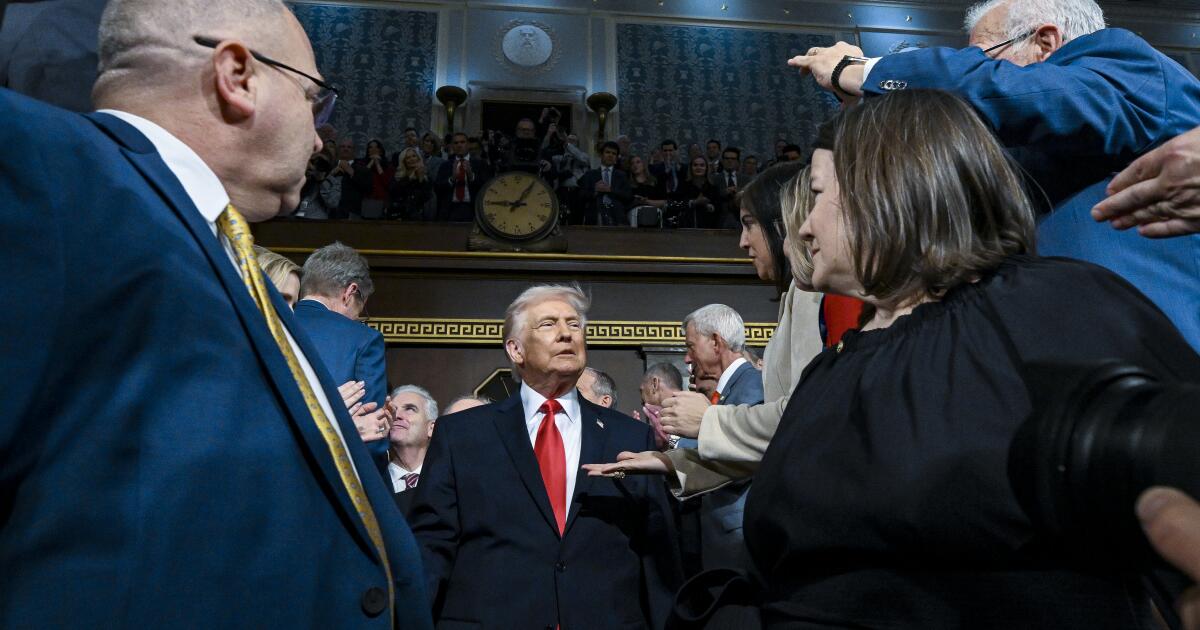
Politics Desk

The Republicans who made Reagan president mourn the party they once knew

It was a cool and rainy day when elders of the Republican tribe recently gathered to honor one of their own.

The honoree, Stuart K. Spencer, was unmistakable in his white duck pants and a lime-green sport coat so bright it almost hurt to see. A reformed chain-smoker, he snapped merrily away on a wad of chewing gum.

The event marked Spencer’s 90th birthday, but the mood beneath the surface conviviality was unsettled and gray, like the clouds fringing the mountains outside.

If the occasion was intended as a personal celebration, it also had the feel of a wake for a time in politics long passed.

Spencer — savvy, irreverent, profane — spent decades as one of the most successful and admired consultants in the campaign business. The hundreds, both Democrat and Republican, who paid homage at a desert country club included the alumni of several past GOP administrations, in both Washington and Sacramento.

Along with former Vice President Dick Cheney and former California Gov. Pete Wilson, veterans of the Reagan years turned out in force. It was Spencer, more than anyone, who took a political long shot and washed-up B-movie actor and helped transform him into the Reagan of legend.

“This is the gang that could actually shoot straight,” said one longtime GOP operative, peering at the largely silver-haired assembly.

Inevitably, private conversation turned to the current occupant of the White House, a member, nominally, of the same political party as those Republicans present.

Feelings ranged from horror to perplexity. Not from jealousy; most of those in attendance had long ago held the reins of power and were comfortably settled in their memories. Rather, it was the startling dysfunction of the fledgling Trump administration.

Yes, said one veteran of the Reagan White House, there was infighting and jockeying early on then too, but not the public knife-fighting of competing Trump factions.

“We weren’t going on the Sunday TV shows to grandstand,” he said, requesting anonymity, still finding it uncomfortable to criticize a fellow Republican on the record. “We were nose to the grindstone, focused on policy” — which grew out of Ronald Reagan’s deep-seated philosophy, not the whims of a blustery, seemingly improvisational president.

When the time came for testimonials, there was plenty of impertinent humor and fond reminiscing: about midnight phone calls from Nancy Reagan, drinking North Carolina moonshine, and the time Spencer dropped an F-bomb in the Oval Office to advise President Ford to stick to the Rose Garden and not try to out-campaign Jimmy Carter.

“Stu called them as he saw them,” said former Gov. Wilson, dryly.

Jerry Lewis, not the comedian but a former congressman from the Inland Empire, offered one of several elegies.

Today, half of America is holding its breath. I’m one of them.

— Veteran GOP strategist Stuart K. Spencer

Once among the most powerful members of Congress, he was known during 30-plus years representing Riverside and San Bernardino counties for a willingness to work across the partisan aisle, a facility — along with a desire to legislate and not just obstruct — that now seems almost quaint.

“I’d love to see us return to a time when people actually talked to each other,” Lewis said, to a ripple of applause.

Taking his turn at the microphone, Spencer was funny and poignant.

The thing he really likes about living a long life, he said, is that all of his enemies are now dead. Then he saluted some of them: liberals like Jesse Unruh, the legendary Assembly speaker, and Phillip Burton, the formidable San Francisco congressman, who fiercely battled Reagan and his policies. They were men of honor and principle, Spencer said, and he misses them.

His brand of Republicanism — support for legal abortion, certain gun controls and, most urgently, a need to reach out to voters who are not white or conservative — has grown largely out of fashion in the political party to which he devoted his life. He spent 70 years laboring on behalf of the GOP only to be called a RINO, or Republican In Name Only, Spencer said with wonder.

Among the behaviors he models is discretion — Spencer is one of the few insiders who didn’t cash in on his Reagan years — and an abiding respect for the political process and its practitioners. Though no fan of President Trump, he was measured in his critique.

“Today, half of America is holding its breath,” he said. “I’m one of them.”

He warned against lashing out in anger, or turning disappointment into hatred, even as he challenged some of Trump’s more preposterous claims, including the falsehood that he was victimized by millions of illegal votes cast for Democrat Hillary Clinton.

“You need to win with class and lose with class,” Spencer said.

He took particular umbrage at those wrapping Trump — another political amateur who improbably made his way to the White House — in the Reagan mantle. The late president “had class and a totally different belief system,” Spencer said.

He wished Trump well. But, he said, “he is President Trump, not President Reagan.”

There was no audible dissent.

The program ended with a Sinatra impersonator singing a customized version of “My Way.” Then the guest of honor quietly slipped out the sliding glass doors, riding past Gerald Ford Drive as he made his way home.

[email protected]

@markzbarabak on Twitter

ALSO

Love or hate President Trump? It may all be in your head

Republicans think they’ve found the ideal candidate for governor. So why isn’t Kevin Faulconer interested?

A Californian for president in 2020? It could happen


Source link

Pushing an end to the Russia-Ukraine war, Trump looks to his Gaza ceasefire playbook

President Trump’s efforts to broker an end to the Russia-Ukraine war closely mirrors the tactics he used to end two years of fighting between Israel and Hamas: bold terms that favor one side, deadlines for the combatants and vague outlines for what comes next. The details — enforcing the terms, guaranteeing security, who pays for rebuilding — matter less.

“You know what the deadline is to me? When it’s over.” Trump told reporters aboard Air Force One Tuesday.

The formula has worked so far in the tense Middle East, though its long-term viability remains in question. Trump got his moment to claim credit for “peace” in the region from the podium of the Israeli parliament. Even there, he made clear that next on his priority list was resolving the largest armed conflict in Europe since World War II.

“Maybe we set out like a 20-point peace proposal, just like we did in Gaza,” U.S. special envoy Steve Witkoff told Yuri Ushakov, Russian President Vladimir Putin’s foreign policy adviser in a phone call the day after Trump’s speech, on Oct. 14. A recording of that call leaked to Bloomberg News.

They did just that, issuing a 28-point plan heavily tilted toward Russia’s interests that set off alarms in Europe, which had not been consulted. Trump insisted Ukraine had until Nov. 27 — Thanksgiving in the U.S. — to accept it.

But by Tuesday, Trump had eased off the hard deadline. It seemed clear, even to Trump, that the Israel-Gaza model doesn’t fully apply in Russia and Ukraine as long as Putin refuses to be flattered, pushed or otherwise moved to take the first step of a ceasefire, as Israel and Hamas consented for different reasons on Oct. 9. Making the point, Putin launched waves of bombings on Ukraine Tuesday and Wednesday even as American negotiators renewed Trump’s push to end the war.

“I thought (a Russia-Ukraine deal) would have been an easier one, but I think we’re making progress,” Trump said during the annual White House turkey pardon to mark the Thanksgiving holiday. Hours later, he told reporters that the 28-point plan actually “was not a plan, just a concept.”

The president’s goal may not be a formal, long-lasting peace treaty, one expert said.

“Trump’s approach emphasizes the proclamation of a ceasefire, not its observance,” Mariia Zolkina, a political analyst at the Kyiv-based Ilko Kucheriv Democratic Initiatives Foundation, wrote on Liga.net, a Ukrainian news outlet, adding: “Donald Trump is not interested in whether the ceasefire will be sustainable.”

Similarities to the tactics and style used in the Israel-Gaza talks

Fresh off the Gaza deal and coveting the Nobel Peace Prize, Trump named his next priority before he’d even left the Israeli Knesset.

“If you don’t mind, Steve, let’s focus on Russia first, All right?” Trump said, turning to Witkoff.

Where the Gaza ceasefire agreement had 20 points, the Russia-Ukraine proposal would start with 28 items and include more detail on who would pay for reconstruction. They envision “peace” boards headed by the president to lead and administer the aftermath. Both lack detail on incentives for complying and enforcement. And both depend on a ceasefire.

Fabian Zuleeg, chief executive of the Brussels-based European Policy Centre think tank, said the proposals for Gaza and Ukraine show a kind of “naivete by believing that by intervening at that level, by imposing your will on something like this, that you will reach some form of long-term conclusion.”

He said both proposals reflect Trump’s political and personal self-interest.

“In the end, the focus is solely on what Trump thinks he will get out of this in terms of reputation and money,” Zuleeg said.

Each Trump administration plan to end the wars heavily favor one side.

The Trump plan for Gaza leans to Israeli terms. It makes disarming Hamas a central condition for any progress in rebuilding the devastated territory. It also lays out no strict timetable for a full Israeli troop withdrawal, making it conditional on deployment of an international security force.

For Russia and Ukraine, Witkoff looked to open peace plan talks with terms skewing toward Russia. He quietly hosted Kirill Dmitriev, a close ally of Putin’s, for talks in south Florida to help launch the plan that opened talks in Geneva, according to a senior administration official and a U.S. official familiar with the matter who were not authorized to comment publicly and spoke on the condition of anonymity. The White House insists that the plan was U.S.-authored with input from both the Ukrainians and Russians.

But that’s where the similarities end. The differences are buy-in — and Putin

The draft that was formally presented to Ukrainian President Volodymyr Zelensky decidedly favored the Russians, with no European input. In contrast, the Gaza ceasefire talks got buy-in from Egypt, Qatari, Jordanian, Saudi and other regional powers.

The 28-point Russia-Ukraine plan called for Ukraine to give up land in the industrial Donbas region that the Russians currently don’t control and dramatically shrink the size of its military. It also effectively gave Russia oversight of both NATO and EU expansion. The draft has narrowed by a few points since it was first presented, and Trump is sending his envoys on a bit of shuttle diplomacy to “sell it,” as he said. He said Witkoff will visit Moscow next week — perhaps joined by his son-in-law, Jared Kushner, who was also involved in the Gaza plan. Army Secretary Dan Driscoll will meet with the Ukranians.

European leaders worried that Trump is leaving them out of high-level discussions and vulnerable to Russian aggression.

“He appears perfectly ready to sacrifice Ukraine’s security and Europe’s in the process,” Hannah Neumann, a German member of the European Parliament, said of Trump on Tuesday.

Israeli Prime Minister Benjamin Netanyahu resisted Trump’s pressure to agree to a ceasefire, for a time. But Putin refuses to concede anything on Ukraine.

He’s appeared to be considering the matter, notably when Trump rolled out a red carpet for the Russian leader at a summer summit in Alaska — an old front line of the Cold War. Trump left without an agreement from Putin to end the bloodshed. The Russian leader walked off with long-sought recognition on the world stage.

To the horror of Ukraine and the vexation of Trump, Putin has stood firm.

As the envoys flew home from Geneva last week without any agreement, the White House scrambled to explain. One U.S. official argued that the 28-page plan, which calls on Ukraine to cede the Donbas region and bar Ukraine from joining NATO, represents considerable concessions from Putin because he would be agreeing to give up on his claim, once and for all, that all of Ukraine should be part of Russia.

Putin, the official noted, has long grumbled that the West doesn’t respect Russia’s position in the global world order. The official added that the Trump White House in its approach is not affirming Putin’s position but trying to reflect the Russian perspective is given its due in the emerging peace plan.

It’s not for the administration to judge Putin’s positions, the official said, but it does have “to understand them if we want to get to a deal.”

Kellman, McNeil and Madhani write for the Associated Press. McNeil reported from Brussels and Madhani from Washington. AP writer Lee Keath in Cairo contributed to this report.

Source link

Assemblyman Sees No Humor in Web Prank

Assemblyman Lloyd Levine of Van Nuys wants his constituents to know that white supremacy is not a plank in his platform, no matter what the World Wide Web suggests.

Levine and other politicians in California and across the nation have felt compelled in recent weeks to take political stands they normally would consider unnecessary — denouncing racism, bestiality and the conversion of women’s breast milk into cheese — because someone has registered Web sites in their names and directed the traffic to politically unpopular organizations.

Levine, a freshman Democrat, learned last week about the existence of a site called lloydlevine.com. Initially, the Internet address pointed to the National Assn. for the Advancement of White People, which the Southern Poverty Law Center identifies as a hate group founded by former Ku Klux Klan grand wizard David Duke. By Tuesday, lloydlevine.com had become a gateway to the Raelians, a religious organization that recently claimed to have cloned a human.

“I would hate for one of my constituents to enter my name into a search engine … and think I in any way condone any of the views espoused here,” Levine said. “My name is Lloyd Levine, and I ought to have full control of it.”

The Legislature’s lawyers are trying to determine whether lawmakers have that right.

Claiming responsibility for these cyber-shenanigans is Jeremy Stamper, who calls himself president of the Seattle-based Council on Political Accountability.

Stamper says he has registered Web domains in the names of more than 100 governors, members of Congress and state legislators from California, Florida, New York and nine other states.

Stamper’s group is selling the domains on EBay and invites political activists — not the politicians — to “use them to criticize, to sound off, to hold politicians accountable … use your imagination.” The EBay page for the sale promises that 25% of the proceeds will go to the American Cancer Society.

Stamper said his group launched the “act of protest” this month to “make a statement about racial politics in the United States.”

“Republicans and Democrats are both complicit in fostering an atmosphere of bigotry,” he wrote in an e-mail to The Times.

Besides, Stamper said, people in the public eye should know to protect their identity online.

“The fact that these politicians didn’t have the foresight to register their own domain names makes me wonder whether they’ll have the competence necessary to jump-start the economy and safeguard our future,” he said.

At $99, the asking price, Levine’s name is a steal compared with colleagues whose Web addresses are listed at $149. Domains for several U.S. representatives and senators are priced at $499. As of Tuesday afternoon, there had been no bids.

An EBay spokesman said any lawmaker feeling maligned can ask to have his name pulled off the auction block.

Speaking for the National Assn. for the Advancement of White People, Vice President Rich Faraone said the group does not condone the confusion Stamper has created.

“We would never do something like that,” he said. “We would never mislead people like that.”

Source link

California rural hospitals face risk of closure, including one in Willows

As hospital staff carted away medical equipment from abandoned patient rooms, Theresa McNabb, 74, roused herself and painstakingly applied make-up for the first time in weeks, finishing with a mauve lipstick that made her eyes pop.

“I feel a little anxiety,” McNabb said. She was still taking multiple intravenous antibiotics for the massive infection that had almost killed her, was unsteady on her feet and was unsure how she was going to manage shopping and cooking food for herself once she returned to her apartment after six weeks in the hospital.

But she couldn’t stay at Glenn Medical Center. It was closing.

The hospital — which for more than seven decades has treated residents of its small farm town about 75 miles north of Sacramento, along with countless victims of car crashes on nearby Interstate 5 and a surprising number of crop-duster pilots wounded in accidents — shut its doors on October 21.

McNabb was the last patient.

A nurse checks on a patient using a stethoscope

Registered nurse Ronald Loewen, 74, checks on one of the last few patients. Loewen, a resident of Glenn County and a former Mennonite school teacher, said the hospital closing is “a piece of our history gone.”

Nurses and other hospital workers gathered at her room to ceremonially push her wheelchair outside and into the doors of a medical transport van. Then they stood on the lawn, looking bereft.

They had all just lost their jobs. Their town had just lost one of its largest employers. And the residents — many of whom are poor— had lost their access to emergency medical care. What would happen to all of them now? Would local residents’ health grow worse? Would some of them die preventable deaths?

These are questions that elected officials and policymakers may soon be confronting in rural communities across California and the nation. Cuts to Medicaid funding and the Affordable Care Act are likely rolling down from Washington D.C. and hitting small hospitals already teetering at the brink of financial collapse. Even before these cuts hit, a 2022 study found that half of the hospitals in California were operating in the red. Already this fall: Palo Verde Hospital in Blythe filed for bankruptcy and Southern Inyo Hospital in Lone Pine sought emergency funds.

But things could get far worse: A June analysis released by four Democrats in the U.S. Senate found that many more hospitals in California could be at risk of closure in the face of federal healthcare cuts.

“It’s like the beginning of a tidal wave,” said Peggy Wheeler, vice president of policy of the California Hospital Association. “I’m concerned we will lose a number of rural hospitals, and then the whole system may be at risk.”

1

Medical assistant Kylee Lutz, 26, right, hugs activities coordinator Rita Robledo on closing day. Lutz, who will continue to work in the clinic that remains open, said through tears, "It's not going to be the same without you ladies."

2

Rose Mary Wampler, 88, sees physician assistant Chris Pilaczynski at the clinic

1. Medical assistant Kylee Lutz, 26, right, hugs activities coordinator Rita Robledo on closing day. Lutz, who will continue to work in the clinic that remains open, said through tears, “It’s not going to be the same without you ladies.” 2. Rose Mary Wampler, 88, sees physician assistant Chris Pilaczynski at the clinic. Wampler, who lives alone across the street from Glenn Medical Center, said, “Old people can’t drive far away. I’m all by myself, I would just dial 9-1-1.”

Glenn Medical’s financing did not collapse because of the new federal cuts. Rather, the hospital was done in by a federal decision this year to strip the hospital’s “Critical Access” designation, which enabled it to receive increased federal reimbursement. The hospital, though it is the only one in Glenn County, is just 32 miles from the nearest neighboring hospital under a route mapped by federal officials — less than the 35 miles required under the law. Though that distance hasn’t changed, the federal government has now decided to enforce its rules.

Dot plot graphic shows seven of California's Critical Access Hospitals closest to 35 miles driving distance from another hospital. Using Google's Routes API, The Times measured up to three route options per hospital. In order for a hospital to qualify for certain Medicare reimbursements, it must be more than 35 miles from its nearest hospital. There are other ways a hospital may also qualify for the designation. Glenn Medical Center has routes between 32 miles and just over 35 miles. Three other hospitals have routes under 35 miles: Mountains Community Hospital, Sutter Lakeside Hospital and Eastern Plumas Hospital - Portola. Three other had routes exceeding 35 miles: Mendocino Coast District Hospital, Mercy Medical Center Mt. Shasta and John C. Fremont Healthcare District.

Local elected officials and hospital administrators fought for months to convince the federal government to grant them an exception. Now, with the doors closed, policy experts and residents of Willows said they are terrified by the potential consequences.

“People are going to die,” predicted Glenn County Supervisor Monica Rossman. She said she feared that older people in her community without access to transportation will put off seeking care until it is too late, while people of all ages facing emergency situations won’t be able to get help in time.

A woman with her head in her hands

Kellie Amaru, a licensed vocational nurse who has worked at Glenn Medical Center for four years, reacts after watching a co-worker leave after working their final shift at the hospital.

But even for people who don’t face a life or death consequence, the hospital’s closure is still a body blow, said Willows Vice Mayor Rick Thomas. He and others predicted many people will put off routine medical care, worsening their health. And then there’s the economic health of the town.

Willows, which sits just east of I-5 in the center of the Sacramento Valley, has a proud history stretching back nearly 150 years in a farm region that now grows rice, almonds and walnuts. About 6,000 people live in the town, which has an economic development webpage featuring images of a tractor, a duck and a pair of hunters standing in the tall grass.

“We’ve lost 150 jobs already from the hospital [closing],” Thomas said. “I’m very worried about what it means. A hospital is good for new business. And it’s been hard enough to attract new business to the town.”

Dismantling ‘a legacy of rural healthcare’

From the day it started taking patients on Nov. 21,1950, Glenn General Hospital (as it was then called) was celebrated not just for its role in bringing medical care to the little farm town, but also for its role in helping Willows grow and prosper.

“It was quite state-of-the-art back in 1950,” said Lauren Still, the hospital’s chief administrative officer.

When the hospital’s first baby was born a few days later — little Glenda May Nieheus clocked in at a robust 8 pounds, 11 ounces — the arrival was celebrated on the front page of the Willows Daily Journal.

But as a small hospital in a small town, the institution struggled almost immediately. Within a few years, according to a 1957 story in the local newspaper, the hospital was already grappling with the problem of nurses leaving in droves for higher-paying positions elsewhere. A story the following year revealed that hospital administrators were forcing a maintenance worker to step in as an ambulance driver on weekends — without the requisite chauffeur’s license — to save money.

In a sign of how small the town is, that driver was Still’s boyfriend’s grandfather.

1

A customer walks into Willows Hardware store in Willows

2

Cheerleaders perform during Willows High School's Homecoming JV football game

3

The press box at Willows High School's football field

1. A customer walks into Willows Hardware store. 2. Cheerleaders perform during Willows High School’s Homecoming JV football game against Durham at Willows High School. 3. The press box at Willows High School’s football field is decorated with previous Northern Section CIF Championship wins.

Still, the institution endured, its grassy campus and low-slung wings perched proudly on the east end of town. Generations of the town’s babies were born there. As they grew up, they went into the emergency room for X-rays, stitches and treatment for fevers and infections. Their parents and grandparents convalesced there and sometimes died there, cared for by nurses who were part of the community.

“They saved my brother’s life. They saved my dad’s life,” said Keith Long, 34, who works at Red 88, an Asian fusion restaurant in downtown Willows that is a popular lunch spot for hospital staff.

Glenn Medical’s finances, however, often faltered. Experts in healthcare economics say rural hospitals like Glenn Medical generally have fewer patients than suburban and urban communities, and those patients tend to be older and sicker, meaning they are more expensive to treat. What’s more, a higher share of those patients are low-income and enrolled in Medi-Cal and Medicare, which generally has lower reimbursement rates than private insurance. Smaller hospitals also cannot take advantage of economies of scale the way bigger institutions can, nor can they bring the same muscle to negotiations for higher rates with private insurance companies.

Across California, in the first decades of the 20th century, rural hospitals were running out of money and closing their doors.

T-Ann Pearce  sits in the medical surgical unit during her shift

T-Ann Pearce, who has worked at Glenn Medical Center for six years, sits in the medical surgical unit during one of her last shifts with only a few remaining patients left to care.

In 2000, Glenn Medical went bankrupt, but was saved when it was awarded the “Critical Access” designation by the federal government that allowed it to receive higher reimbursement rates, Still said.

But by late 2017, the hospital was in trouble again.

A private for-profit company, American Advanced Management, swooped to the rescue of Glenn Medical and a nearby hospital in Colusa County, buying them and keeping them open. The Modesto-based company specializes in buying distressed rural hospitals and now operates 14 hospitals in California, Utah and Texas.

The hospital set about building back its staff and improving its reputation for patient care in the community, which had been tarnished in part by the 2013 death of a young mother and her unborn baby.

“We’ve been on an upswing,” Still said, noting that indicators of quality of care and patient satisfaction have risen dramatically in recent years.

Then came the letter from the federal Centers for Medicare & Medicaid Services. On April 23, the federal agency wrote Glenn Medical’s management company with bad news: A recent review had found that Glenn Medical was “in noncompliance” with “distance requirements.” In plain English, federal officials had looked at a map and determined that Glenn Medical was not 35 miles from the nearest hospital by so-called main roads as required by law — it was just 32. Nor was it 15 miles by secondary roads. The hospital was going to lose its Critical Access designation. The hit to the hospital’s budget would be about 40% of its $28 million in net revenue. It could not survive that cut.

Map shows Glenn Medical in Glenn County and its nearest hospitals, Colusa Medical Center in Colusa County and Enloe Health in Chico County. The route to Colusa Medical Center, the nearest of the two hospitals, is via Interstate 5 and California State Route 20 is just over 35 miles in driving district. The alternative route that the Centers for Medicare and Medicaid Services is using is  just under 35 miles via Interstate 5, Maxwell Road and State Route 45.

At first, hospital officials said they weren’t too worried.

“We thought, there’s no way they’re going to close down hospitals” over a few miles of road, Still, the hospital’s chief executive, said.

Especially, Still said, because it appeared there were numerous California hospitals in the same pickle. A 2013 federal Inspector General Report found that a majority of the 1,300 Critical Access hospitals in the country do not meet the distance requirement. That includes dozens in California.

Still and other hospital officials flew to Washington D.C. to make their case, sure that when they explained that one of the so-called main roads that connects Glenn Medical to its nearest hospital wasn’t actually one at all, and often flooded in the winter, the problem would be solved. The route everyone actually used, she said, was 35.7 miles.

“No roads have changed. No facilities have moved,” administrators wrote to federal officials. “And yet this CMS decision now threatens to dismantle a legacy of rural health care stability.”

Without it, the administrator wrote, “lives will be lost for certain.”

But, Still said, their protestations fell on deaf ears.

In August came the final blow: Glenn Medical would lose its Critical Access funding by April 2026.

The news set off a panic not just in Glenn County but at hospitals around the state.

1

A bicyclist passes by Glenn Medical Center

2

T-Ann Pearce signs a farewell board on closing day

1. A bicyclist passes by Glenn Medical Center. First opened to patients on November 21, 1950, the center was called Glenn General Hospital then. 2. A member of the staff signs a farewell board on closing day at Glenn Medical Center on October 21, 2025.

At least three other hospitals got letters from the Centers for Medicare & Medicaid saying their Critical Access status was under review, Wheeler said: Bear Valley Community Hospital in Big Bear Lake, George L. Mee Memorial in Monterey County and Santa Ynez Valley Cottage Hospital in Solvang. The hospitals in Monterey and Big Bear Lake provided data demonstrating they met the requirements for the status.

Cottage Hospital, however, did not, despite showing that access in and out of the area where the hospital is located was sometimes blocked by wildfires or rockslides.

Cottage Hospital officials did not respond to questions about what that might mean for their facility.

Asked about these situations, officials at the Centers for Medicare & Medicaid said the law does not give the agency flexibility to consider factors such as weather, for example, in designating a critical assess hospital. They added the hospital must demonstrate there is no driving route that would make it ineligible based on driving distances included in the statute.

Jeff Griffiths, a county supervisor in Inyo County who is also the president of the California Assn. of Counties, said he has been following the grim hospital financing news around the state with mounting worry.

The hospital in his county, Southern Inyo, came close to running out of money earlier this year, he said, and with more federal cuts looming, “I don’t know how you can expect these hospitals to survive.”

“It’s terrifying for our area,” Griffiths said, noting that Inyo County, which sits on the eastern side of the Sierra, has no easy access to any medical care on the other side of the giant mountain peaks.

‘This is the final call’

In Willows, once word got out that the hospital would lose its funding, nurses began looking for new jobs.

By late summer, so many people had left that administrators realized they had no choice but to shutter the emergency room, which closed Sept. 30.

Helena Griffith, 62, one of the last patients, waves goodbye as patient transport Jolene Guerra pushes her wheelchair

Helena Griffith, 62, one of the last patients, waves goodbye as patient transport Jolene Guerra pushes her wheelchair down the hallway on October 20, 2025.

Through it all, McNabb, the 74-year-old patient receiving intravenous antibiotics, remained in her bed, getting to know the nurses who buzzed around her.

She became aware that when they weren’t caring for her, many of them were trying to figure out what they would do with their lives once they lost their jobs.

On the hospital’s last day, nurse Amanda Shelton gifted McNabb a new sweater to wear home.

When McNabb gushed over the sweetness of the gesture, Shelton teared up. “It’s not every day that it will be the last patient I’ll ever have,” she told her.

As McNabb continued to gather her things, Shelton retreated to the hospital’s recreation room, where patients used to gather for games or conversation.

With all the patients save McNabb gone, Shelton and some other hospital staff took up a game of dominoes, the trash talk of the game peppered with bittersweet remembrances of their time working in the creaky old building.

Registered nurse Ronald Loewen, 74, looks out the window on closing day

Registered nurse Ronald Loewen, 74, looks out the window on closing day at Glenn Medical Center on October 21, 2025. Loewen, who grew up and attended school in Willows, had four children delivered at Glenn Medical, two of them survived, and took care of former classmates at this hospital, says the hospital closing is, “a piece of our history gone.”

Shelton said she is not sure what is next for her. She loved Glenn Medical, she said, because of its community feel. Many people came for long stays or were frequent patients, and the staff was able to get to know them — and to feel like they were healing them.

“You got to know people. You got to know their family, or if they didn’t have any family,” you knew that too, she said. She added that in many hospitals, being a nurse can feel like being an extension of a computer. But at Glenn Medical, she said, “you actually got to look in someone’s eyes.”

The building itself was in dire shape, she noted. Nothing was up to modern code. It didn’t have central air conditioning, and it was heated by an old-fashioned boiler. “I mean, I have never even heard of a boiler room” before coming to work there, she said.

And yet within the walls, she said, “It’s community.”

Bradley Ford, the emergency room manager, said he felt the same way and was determined to pay tribute to all the people who had made it so.

At 7 p.m. on the emergency room’s last night of service, Ford picked up his microphone and beamed his voice out to the hospital and to all the ambulances, fire trucks and others tuned to the signal.

He had practiced his speech enough times that he thought he could get through it without crying — although during his rehearsals he had never yet managed it.

“This is the final call,” Ford said. “‘After 76 years of dedicated service, the doors are closing. Service is ending. On behalf of all the physicians, nurses and staff who have walked these halls, it is with heavy hearts that we mark the end of this chapter.”

Nurses and other staff members recorded a video of Ford making his announcement, and passed it among themselves, tearing up every time they listened to it.

In an interview after the hospital had closed, Ford said he was one of the lucky ones: He had found a new job.

It was close enough to his home in Willows that he could commute — although Ford said he wasn’t sure how long he would remain in his beloved little town without access to emergency medical care there.

Rose Mary Wampler, 88, waits to have blood drawn at the lab beside a cordoning off, signaling the closure of the hospital

Rose Mary Wampler, 88, waits to have blood drawn at the lab beside a cordoning off, signaling the closure of the hospital side of Glenn Medical Center, on October 22, 2025. Wampler lives alone across the street from the hospital.

Rose Mary Wampler, 88, has lived in Willows since 1954 and now resides in a little house across the street from the hospital. Her three children were born at Glenn Medical, and Wampler herself was a patient there for two months last year, when she was stricken with pneumonia and internal bleeding. She said she was fearful of the idea of driving more than 30 miles for healthcare elsewhere.

She looked out her window on a recent afternoon at the now-shuttered hospital.

“It looks like somebody just shut off the whole city, there’s nowhere to go get help,” she said.

Glenn Medical Center patient Richard Putnam, 86, closes the window

Glenn Medical Center patient Richard Putnam, 86, closes the window in his hospital room. A month shy of it’s 75th year, the hospital closed on Oct 21, 2025.

(Christina House/Los Angeles Times)

Times photographer Christina House contributed to this report.

Source link

Citing wildfires, LAFD requests 15% budget increase

The Los Angeles Fire Department is requesting a budget of more than $1 billion for the coming year, arguing that the additional funding is necessary to be prepared for wildfires like the one that devastated Pacific Palisades in January.

The request, which represents a more than 15% increase over this year’s budget, includes money for 179 new firefighting recruits and a second crew dedicated to fighting wildfires, as well as helitanker services to battle fires from the air.

In the immediate aftermath of the Palisades fire, which killed 12 people and destroyed thousands of homes, top LAFD officials blamed a lack of resources and extraordinarily high winds for their failures in combating the flames.

United Firefighters of Los Angeles City Local 112, the union that represents the city’s firefighters, has long argued that the department is severely underfunded and is pushing for a half-cent sales tax that, if approved by voters, would generate hundreds of millions of dollars annually.

Fire Chief Jaime Moore, who was appointed to his post earlier this month, wrote in a memo to the Board of Fire Commissioners last Friday that “the proposed budget will reinforce and accelerate operational enhancements implemented following the devastating Palisades wind-driven vegetation fire in January 2025.”

Moore’s request is the first step in a lengthy process to hammer out a city budget that requires approval by the City Council and the mayor. This year, the city had to close a nearly $1-billion shortfall caused largely by rising personnel costs, soaring legal payouts and a slowdown in the local economy.

City department heads often request amounts far higher than they eventually receive. With the city still in a budget crunch, the outlook for the LAFD’s request is unclear.

“The budget process is in its early stages. Reforms must continue to be implemented at the department and Mayor Bass looks forward to working with Chief Moore to strengthen the city’s emergency preparedness,” said Clara Karger, a spokesperson for Mayor Karen Bass.

Genethia Hudley Hayes, who heads the civilian Board of Fire Commissioners, said Tuesday that she had not yet seen the request but that she generally supports a 15% increase in the LAFD budget.

“We need it,” she said. “The smart thing would be to let the public know what you are going to do with that money.”

In the days leading up to Jan. 7, LAFD officials decided not to order firefighters to remain on duty for a second shift — which would have required paying them overtime — and staffed just a few of the more than 40 engines available to aid in battling wildfires, despite warnings of life-threatening winds, a Times investigation found.

Then-Fire Chief Kristin Crowley said that commanders had to be strategic with limited resources while continuing to handle regular 911 calls.

An LAFD after-action report released last month cited “financial constraints” as a factor in pre-deployment decisions.

The Times also found that an LAFD battalion chief ordered firefighters to leave the site of the Jan. 1 Lachman fire, despite firefighters’ complaints that the ground was still smoldering. That fire later reignited into the Palisades fire.

Moore’s budget memo tied many of his requests to the Palisades fire.

The second wildland hand crew, which would include 32 positions for $2 million, would supplement a hand crew formed this year, after the Palisades fire. The crew’s 26 recruits, who are trained in wildfire fighting and management, establish fire lines to stop flames from spreading. Throughout the year, they do brush clearance around the city.

The helitanker lease, costing slightly less than $1 million, would support aerial attacks of flames that are difficult for crews on the ground to reach.

Moore’s budget request includes the reinstatement of the LAFD’s emergency incident technicians, who help coordinate responses to fires — positions that were cut in the last budget cycle. The after-action report described the LAFD’s disorganized response to the Palisades fire, citing major issues with staffing and communications.

In the fire’s aftermath, the LAFD’s budget was a subject of public debate, with some saying that Bass had reduced it. The 2024-25 budget actually increased slightly after firefighters received raises and the city invested in new firetrucks and other purchases. The budget increased again in 2025-2026.

Bass said she has committed additional resources to the Fire Department in each year she has been mayor.

The half-cent sales tax proposed by the firefighters union would go before city voters as a ballot measure next November.

By 2050, the sales tax would raise at least $9.8 billion, funding at least 30 new fire stations and new fire trucks, as well as adding 1,400 Fire Department employees, according Doug Coates, the acting president of UFLAC, and Councilmember Traci Park, whose district includes Pacific Palisades.

Source link

Politically diverse group uses ‘Liberty Vans’ to document ICE actions

As the Liberty Van rolled into the Home Depot, its driver slowed, lowered the window and waved at day laborers standing around the parking lot.

It had rained all morning and the overcast clouds trapped a chill in the air. Still, on a recent Friday, day laborers milled around even as it began to drizzle again. A pastor, a Navy veteran, an immigration lawyer and cameraman got out of the Liberty Van — camioneta de la libertad in Spanish — and greeted the day laborers while offering them water and snacks.

Since June in Los Angeles, federal immigration agents have destabilized daily life by raiding neighborhoods, worksites and Home Depots — popular gathering spots for day laborers who often lack U.S. citizenship. In turn, several “rapid-response” organizations have surged into action to aid those targeted in the raids, and document their treatment.

One of these organizations is the Save America Movement, which runs the Liberty Vans and includes a bipartisan leadership that is far more politically connected than that of many grassroots organizations. The group was founded by Steve Schmidt, a former top aide to Republican Sen. John McCain of Arizona, and Mary Corcoran, a longtime public relations specialist, with a steering committee that includes law professors, pastors and strategists.

On this particular Friday, Fabian Núñez — a member of that steering committee who previously served as speaker of the California Assembly — was one of those who hopped out of the Liberty Van. He chatted with a day laborer who stopped by to grab a snack, and explained they were there to film any interactions with federal agents, as part of their national rapid-response effort.

The day laborer said Immigration and Customs Enforcement agents have previously detained other workers at the Panorama City Home Depot and have returned frequently. “Many times,” he said. “Five or six.”

Despite the repeated raids, the laborer said workers like himself have little choice but to keep showing up.

“They have to keep coming,” he said. “One has to pay the bills.”

The Save America Movement launched the vans first in L.A. and then in Chicago and Charlotte, N.C., where federal immigration agents were raiding heavily Latino areas. The motivation behind the project was to provide support and help people understand the impact of the daily immigration raids, Corcoran said in an interview. Outside California, she said, many people don’t get it.

“If they did, I believe there would be much more urgency around what’s happening,” she said.

The vans were inspired by the Liberty ships and Victory ships during World War ll that provided supplies and other relief to the U.S. and its allies.

The teams that run the vans document and record video, with the footage published online so the public can watch the enforcement actions and hear testimonies from affected local residents, she said.

For months, the Trump administration has argued that it is merely enforcing the law — and fulfilling a campaign promise — by detaining and deporting immigrants who lack documentation. But some enforcement actions by ICE and Border Patrol agents have resulted in U.S. citizens being detained. Others have been criticized for being unnecessarily violent and traumatizing.

A man talks to another man.

Fabian Núñez, a Save America Movement steering committee member who previously served as speaker of the California Assembly, talks with a laborer who stopped by the Liberty Van for some snacks in the parking lot of a Panorama City Home Depot on Nov. 21, 2025.

(Myung J. Chun/Los Angeles Times)

In Los Angeles, the Save America Movement first launched its vans in MacArthur Park in September, just two months after immigration agents on horses and armored vehicles descended on the area carrying rifles and tactical gear.

City Councilmember Eunisses Hernandez — whose district spans from Highland Park, Chinatown and south to Pico-Union — welcomed the group’s effort, which she described as a tool in a movement of resistance.

Alejandro Maciel, the L.A. bureau chief for the organization and a former Los Angeles Times journalist, takes the van out roughly five times a week, starting around 6 a.m. and wrapping up late into the afternoon. Maciel and volunteers drive to Home Depots across Southern California, going north to Ventura County, east to the Inland Empire and south to Orange County.

On Friday, the van ride included the Rev. Madison Jones McAleese, Navy veteran Brian Kelly and immigration lawyer Juan Jose Gutierrez, who can offer legal support to families or offer “know your right” basics to laborers. And to capture it all was cameraman René Miranda, who started covering raids when a large protest broke out in Paramount, where he lives.

For McAleese, she said she felt it was her duty to be part of the effort to stand against the raids because of what she views as unlawful actions being taken by ICE enforcement. McAleese carries holy water and offers to pray with any one who seeks prayer.

“I don’t feel like I have a choice,” she said. “God is reflected in the face of every immigrant, documented and undocumented.”

As they headed to the next location, Maciel pulled up on his phone StopIce.Net, a website on which people submit reports of ICE activity. Just the day before, there was a raid in Long Beach, later confirmed by local media reports, and nine people were detained by masked agents, an L.A. County official said.

The San Fernando Valley was quiet that Friday, but Maciel said it has been important to establish and maintain relationships with both workers and organizers who have created rapid response networks. When he drives the van to a site, he said, he greets such organizers and makes sure the laborers understand they are there to help.

Ernesto Ayala, the site coordinator at the Van Nuys Day Labor Center in the Home Depot parking lot, said ICE agents have been to the site several times, as recently as a few weeks ago. At the Van Nuys Home Depot, volunteers monitor each entry point of the parking lot and alert the center of any suspicious vehicles that could contain federal agents.

“It’s very traumatic,” Ayala said of the continuing raids. Ayala himself was detained and sprayed with an irritant by agents after they held him down and accused him of interfering. He was arrested but never charged with any crime, he said.

Organizations such as the Save America Movement help with videos and other documentation that could be used in potential litigation against ICE in the future, Ayala said. He said his arrest was recorded from a distance by a witness.

In October, the organization said video by a Save America Movement photojournalist in Chicago recorded federal agents deploying tear gas against protesters and pointing weapons at journalists, which at the time violated a federal court order. The organization made that footage available online with time stamps and annotations.

Along with documenting interactions, Núñez said, the group hopes to remind ICE agents of the human impact and make them question their actions, and to move viewers. Such footage, he said, could help Americans see “that these Gestapo-like tactics are happening and they’re being utilized with our tax dollars.”

“We think we can convince them to move, to think more compassionately about people and think: Is this the America I signed up for?”

Source link

California’s first partner pushes to regulate AI as Trump threatens to forbid regulations

California First Partner Jennifer Siebel Newsom recently convened a meeting that might rank among the top sweat-inducing nightmare scenarios for Silicon Valley’s tech bros — a group of the Golden State’s smartest, most powerful women brainstorming ways to regulate artificial intelligence.

Regulation is the last thing this particular California-dominated industry wants, and it’s spent a lot of cash at both the state and federal capitols to avoid it — including funding President Trump’s new ballroom. Regulation by a bunch of ladies, many mothers, with profit a distant second to our kids when it comes to concerns?

I’ll let you figure out how popular that is likely be with the Elon Musks, Peter Thiels and Mark Zuckerbergs of the world.

But as Siebel Newsom said, “If a platform reaches a child, it carries a responsibility to protect that child. Period. Our children’s safety can never be second to the bottom line.”

Agreed.

Siebel Newsom’s push for California to do more to regulate AI comes at the same time that Trump is threatening to stop states from overseeing the technology — and is ramping up a national effort that will open America’s coffers to AI moguls for decades to come.

Right now, the U.S. is facing its own nightmare scenario: the most powerful and world-changing technology we have seen in our lifetimes being developed and unleashed under almost no rules or restraints other than those chosen by the men who seek personal benefit from the outcome.

To put it simply, the plan right now seems to be that these tech barons will change the world as they see fit to make money for themselves, and we as taxpayers will pay them to do it.

“When decisions are mainly driven by power and profit instead of care and responsibility, we completely lose our way, and given the current alignment between tech titans and the federal administration, I believe we have lost our way,” Siebel Newsom said.

To recap what the way has been so far, Trump recently tried to sneak a 10-year ban on the ability of states to oversee the industry into his ridiculously named “Big Beautiful Bill,” but it was pulled out by a bipartisan group in the Senate — an early indicator of how inflammatory this issue is.

Faced with that unexpected blockade, Trump has threatened to sign a mysterious executive order crippling states’ ability to regulate AI and attempting to withhold funds from those that try.

Simultaneously, the most craven and cowardly among Republican congresspeople have suggested adding a 10-year ban to the upcoming defense policy bill that will almost certainly pass. Of course, Congress has also declined to move forward on any meaningful federal regulations itself, while technology CEOs including Trump frenemy Musk, Apple’s Tim Cook, Meta’s Zuckerberg and many others chum it up at fancy events inside the White House.

Which may be why this week, Trump announced the “Genesis Mission,” an executive order that seemingly will take the unimaginable vastness of government research efforts across disciplines and dump them into some kind of AI model that will “revolutionize the way scientific research is conducted.

While I am sure that nothing could possibly go wrong in that scenario, that’s not actually the part that is immediately alarming. This is: The project will be overseen by Trump science and technology policy advisor Michael Kratsios, who holds no science or engineering degrees but was formerly a top executive for Thiel and former head of another AI company that works on warfare-related projects with the Pentagon.

Kratsios is considered one of the main reasons Trump has embraced the tech bros with such adoration in his second term. Genesis will almost certainly mean huge government contracts for these private-sector “partners,” fueling the AI boom (or bubble) with taxpayer dollars.

Siebel Newsom’s message in the face of all this is that we are not helpless — and California, as the home of many of these companies and the world’s fourth-largest economy in its own right, should have a say in how this technology advances, and make sure it does so in a way that benefits and protects us all.

“California is uniquely positioned to lead the effort in showing innovation and responsibility and how they can go hand in hand,” she said. “I’ve always believed that stronger guardrails are actually good for business over the long term. Safer tech means better outcomes for consumers and greater consumer trust and loyalty.”

But the pressure to cave under the might of these companies is intense, as Siebel Newsom’s husband knows.

Gov. Gavin Newsom has spent the last few years trying to thread the needle on state legislation that offers some sort of oversight while allowing for the innovation that rightly keeps California and the United States competitive on the global front. The tech industry has spent millions in lobbying, legal fights and pressure campaigns to water down even the most benign of efforts, even threatening to leave the state if rules are enacted.

Last year, the industry unsuccessfully tried to stop Senate Bill 53, landmark legislation signed by Newsom. It’s a basic transparency measure on “frontier” AI models that requires companies to have safety and security protocols and report known “catastrophic” risks, such as when these models show tendencies toward behavior that could kill more than 50 people — which they have, believe it or not.

But the industry was able to stop other efforts. Newsom vetoed both Senate Bill 7, which would have required employers to notify workers when using AI in hiring and promotions; and Assembly Bill 1064, which would have barred companion chatbot operators from making these AI systems available to minors if they couldn’t prove they wouldn’t do things like encourage kids to self-harm, which again, these chatbots have done.

Still, California (along with New York and a few other states) has pushed forward, and speaking at Siebel Newsom’s event, the governor said that last session, “we took a number of at-bats at this and we made tremendous progress.”

He promised more.

“We have agency. We can shape the future,” he said. “We have a unique responsibility as it relates to these tools of technology, because, well, this is the center of that universe.”

If Newsom does keep pushing forward, it will be in no small part because of Siebel Newsom, and women like her, who keep the counter-pressure on.

In fact, it was another powerful mom, First Lady Melania Trump, who forced the federal government into a tiny bit of action this year when she championed the “Take It Down Act, which requires tech companies to quickly remove nonconsensual explicit images. I sincerely doubt her husband would have signed that particular bill without her urging.

So, if we are lucky, the efforts of women like Siebel Newsom may turn out to be the bit of powerful sanity needed to put a check on the world-domination fantasies of the broligarchy.

Because tech bros are not yet all-powerful, despite their best efforts, and certainly not yet immune to the power of moms.

Source link

Californians sharply divided along partisan lines about immigration raids, poll finds

California voters are sharply divided along partisan lines over the Trump administration’s immigration raids this year in Los Angeles and across the nation, according to a new poll.

Just over half of the state’s registered voters oppose federal efforts to reduce undocumented immigration, and 61% are against deporting everyone in the nation who doesn’t have legal status, according to a recent poll by UC Berkeley’s Possibility Lab released to The Times on Wednesday.

But there is an acute difference in opinions based on political leanings.

Nearly 80% of Democrats oppose reducing the number of people entering the United States illegally, and 90% are against deporting everyone in the country who is undocumented, according to the poll. Among Republicans, 5% are against reducing the entries and 10% don’t believe all undocumented immigrants should be forced to leave.

An October 2025 poll shows a stark partisan divide in Californian's support for federal immigration enforcement. Half of voters say they oppose current efforts to reduce the number of undocumented imigrants enterting the U.S. illegally (78% Dem, 5% Rep.).

“The big thing that we find, not surprisingly, is that Democrats and Republicans look really different,” said political scientist Amy Lerman, director of UC Berkeley’s Possibility Lab, who studies race, public opinion and political behavior. “On these perspectives, they fall pretty clearly along party lines. While there’s some variation within the parties by things like age and race, really, the big divide is between Democrats and Republicans.”

While there were some differences based on gender, age, income, geography and race, the results largely mirrored the partisan divide in the state, Lerman said.

One remarkable finding was that nearly a quarter of survey respondents personally knew or were acquainted with someone in their family or friend groups directly affected by the deportation efforts, Lerman said.

“That’s a really substantial proportion,” she said. “Similarly, the extent to which we see people reporting that people in their communities are concerned enough about deportation efforts that they’re not sending their kids to school, not shopping in local stores, not going to work,” not seeking medical care or attending church services.

The poll surveyed a sample of the state’s registered voters and did not include the sentiments of the most affected communities — unregistered voters or those who are ineligible to cast ballots because they are not citizens.

A little more than 23 million of California’s 39.5 million residents were registered to vote as of late October, according to the secretary of state’s office.

“So if we think about the California population generally, this is a really significant underestimate of the effects, even though we’re seeing really substantial effects on communities,” she said.

Earlier this year, U.S. Immigration and Customs Enforcement launched a series of raids in Los Angeles and surrounding communities that spiked in June, creating both fear and outrage in Latino communities. Despite opposition from Gov. Gavin Newsom, Los Angeles Mayor Karen Bass and other elected Democrats, the Trump administration also deployed the National Guard to the streets of the nation’s second-largest city to, federal officials said, protect federal immigration officials.

The months since have been chaotic, with masked, armed agents randomly pulling people — most of whom are Latino — off the streets and out of their workplaces and sending many to detention facilities, where some have died. Some deportees were flown to an El Salvador prison. Multiple lawsuits have been filed by state officials and civil rights groups.

In one notable local case, a federal district judge issued a ruling temporarily blocking federal agents from using racial profiling to carry out indiscriminate immigration arrests in the Los Angeles area. The Supreme Court granted an emergency appeal and lifted that order, while the case moves forward.

More than 7,100 undocumented immigrants have been arrested in the Los Angeles area by federal authorities since June 6, according to the Department of Homeland Security.

On Monday, Rep. Robert Garcia (D-Long Beach), Bass and other elected officials hosted a congressional hearing on the impact of immigration raids that have taken place across the country. Garcia, the top Democrat on the House’s oversight committee, also announced the creation of a tracker to document misconduct and abuse during ICE raids.

While Republican voters largely aligned with Trump’s actions on deportations, 16% said that they believed that the deportations will worsen the state’s economy.

Lerman said the university planned to study whether these numbers changed as the impacts on the economy are felt more greatly.

“If it continues to affect people, particularly, as we see really high rates of effects on the workforce, so construction, agriculture, all of the places where we’re as an economy really reliant [on immigrant labor], I can imagine some of these starting to shift even among Republicans,” she said.

Among Latinos, whose support of Trump grew in the 2024 election, there are multiple indications of growing dissatisfaction with the president, according to separate national polls.

Nearly eight in 10 Latinos said Trump’s policies have harmed their community, compared to 69% in 2019 during his first term, according to a national poll of adults in the United States released by the nonpartisan Pew Research Center on Monday. About 71% said the administration’s deportation efforts had gone too far, an increase from 56% in March. And it was the first time in the two decades that Pew has conducted its survey of Latino voters that the number of Latinos who said their standing in the United States had worsened increased, with more than two-thirds expressing the sentiment.

Another poll released earlier this month by Somos Votantes, a liberal group that urges Latino voters to support Democratic candidates, found that one-third of Latino voters who previously supported Trump rue their decision, according to a national poll.

Small business owner Brian Gavidia is among the Latino voters who supported Trump in November because of financial struggles.

“I was tired of struggling, I was tired of seeing my friends closing businesses,” the 30-year-old said. “When [President] Biden ran again I’m like, ‘I’m not going to vote for the same four years we just had’ … I was sad and I was heartbroken that our economy was failing and that’s the reason why I went that way.”

The East L.A. native, the son of immigrants from Colombia and El Salvador, said he wasn’t concerned about Trump’s immigration policies because the president promised to deport the “worst of the worst.”

He grew disgusted watching the raids that unfolded in Los Angeles earlier this year.

“They’re taking fruit vendors, day laborers, that’s the worst of the worst to you?” he remembered thinking.

Over a lunch of asada tortas and horchata in East L.A., Gavidia recounted being detained by Border Patrol agents in June while working at a Montebello tow yard. Agents shoved him against a metal gate, demanding to know what hospital he was born at after he said he was an American citizen, according to video of the incident.

After reviewing his ID, the agents eventually let Gavidia go. The Department of Homeland Security later claimed that Gavidia was detained for investigation for interference and released after being confirmed to be a U.S. citizen with no outstanding warrants. He is now a plaintiff in a lawsuit filed by the ACLU and immigrant advocacy groups alleging racial profiling during immigration raids.

“At that moment, I was the criminal, at that moment I was the worst of the worst, which is crazy because I went to go see who they were getting — the worst of the worst like they said they were going to get,” Gavidia said. “But turns out when I got there, I was the worst of the worst.”

Source link

Final Budget Bills Stall as Senate Tries to Alter Measures : Finances: The holdup involves suspension of the renters tax credit. A new tax on tobacco that would strip local governments of ability to regulate smoking is also under consideration.

The final pieces of a multi-bill legislative package needed to implement a $52.1-billion state budget stalled in the state Senate on Monday as lawmakers made last-minute efforts to change or derail several measures.

The major issues still on the table include a proposed suspension of the renters tax credit and legislation to allow local governments to implement cheaper retirement plans for their workers.

The Senate shut down late Monday afternoon without taking major action. Senate President Pro Tem David A. Roberti (D-Van Nuys) said members would return at noon today, and “we will go until all business is completed, exhausted or until all hope is dead.”

In one late maneuver that was outside the framework of the bipartisan budget agreement, a proposal was emerging to give local governments the proceeds of a new statewide tax on tobacco while stripping them of much of their authority to regulate smoking.

Gov. Pete Wilson was awaiting passage of the package to which he had agreed last week with Democratic and Republican leaders of the Assembly and Senate. The new fiscal year begins Thursday.

“The governor will sign the budget as soon as he has the entire package on his desk,” said Dan Schnur, Wilson’s chief spokesman. “Every piece of the budget package is critical. You take out one piece and the package doesn’t fit together anymore.”

There was disagreement, however, over just what constituted the agreed-upon package.

Wilson Administration officials have said all five members of the leadership group agreed to suspend the renters tax credit for two years. The Assembly passed a bill to do that last week.

But the legislation has hit a snag in the Senate, where Roberti insists that the deal included an agreement to place a measure on the ballot next year that, if approved by the voters, would embed the renters credit in the state Constitution. Such a move would make it impossible for the Legislature to tamper with it again.

Roberti and Wilson appeared to be on the verge of a compromise late Monday, although it was not clear if there was sufficient support in the Legislature. The new deal would put the issue to the voters, as Roberti wants, but would reinstate the $60 credit only for tenants who have a state tax obligation. The credit now goes–in the form of a refund–even to renters who pay no taxes.

Senate Democrats also appeared to be dragging their feet on the local government retirement issue. That bill, passed by the Assembly, would allow local governments to implement pension options for new employees that would save the governments money over time.

In holding up the bill, which is opposed by organized labor, Democrats appeared to be gambling that Wilson would look the other way because the measure produces no immediate savings to any level of government. But Schnur said the governor would not give up any piece of the package, no matter how minor.

“Even if the specific legislation doesn’t have direct fiscal impact, it is still the part of an overall agreement,” Schnur said. “We want to get this signed before midnight Wednesday. But we need the whole package in place before he can sign it.”

Schnur said the retirement bill, and another measure pending to allow counties to reduce general assistance welfare payments by as much as 27%, helped provide the rationale for the governor’s proposed shift of $2.6 billion in property tax revenue from local government to schools.

The so-called mandate relief, he said, was intended to give counties more control of their shrinking budgets.

The tobacco tax proposal floated Monday, although not part of the package, would address the same issue.

Local government reportedly could realize about $300 million annually through the 15-cent per pack tax. But in return, they would have to agree to strict limits on their ability to control smoking, perhaps leading to a state-imposed repeal of anti-smoking ordinances in place.

Several sources said Monday that the proposal had the tacit support of the tobacco industry and of Los Angeles County, which would stand to gain several millions dollars.

Sen. Charles M. Calderon (D-Whittier) confirmed that he was pushing the tobacco tax legislation. He said it made sense to restrict local government’s regulatory powers at the same time–a goal long sought by the tobacco industry.

“If we’re going to dedicate a revenue source, we have to make sure that the locals cannot circumvent or cut down the revenue source by continuing to impact the sales of cigarettes,” Calderon said.

But anti-smoking activists were out to kill the plan before it could even become an official proposal.

“Everybody wants to do something for (Los Angeles) County, but not under these conditions,” said Sen. Diane Watson (D-Los Angeles). “This is the most dishonest, diabolical scheme. It’s the worst kind of politics.”

Times staff writer Dan Morain contributed to this report.

State Budget Watch

Less than three days before the end of the fiscal year, these were the key developments in Sacramento:

THE PROBLEM: The state will end the year with a $2.7-billion deficit and faces a $9-billion gap between anticipated tax revenues and the amount needed to pay off the deficit and provide all state services at the current levels for another 12 months.

THE LEGISLATURE: Final legislative approval of the last handful of bills to complete the 1993-94 state budget was making no progress by late afternoon. The Senate met in the morning but recessed without voting on four budget bills, the stickiest of which would suspend the renters tax credit for two years.

GOV. PETE WILSON: Wilson was holding fast to his vow not to sign a new budget until all companion measures are passed by the Legislature.

KEY DEVELOPMENTS: Senate President Pro Tem David A. Roberti (D-Van Nuys) was one of those holding up his approval of legislation reducing the renters tax credit. He was seeking as a condition assurances in the form of a proposed constitutional amendment, to be considered by voters, that the credit would be protected and fully funded in future years.

Source link

Supreme Court strikes down key section of Voting Rights Act

WASHINGTON — The Supreme Court struck down a key part of the historic Voting Rights Act on Tuesday, ruling that Southern states may no longer be forced to seek federal approval before making changes in their election laws.

The ruling came on a 5-4 vote, with Chief Justice John G. Roberts Jr. speaking for the court.

Roberts said the 1965 law had been a “resounding success” and has ensured that blacks now register and vote at the same rate as whites.

But he said it was no longer fair or rational to subject these states and municipalities to special scrutiny based on a formula that is more than 40 years old.

“States must beseech the federal government for permission to implement laws that they would otherwise have a right to enact and execute on their own,” he wrote. This conflicts with the principle that all the states enjoy “equal sovereignty” and cannot be subjected to different federal laws, he said.

PHOTOS: 2013’s memorable political moments

“Our country has changed in the last 50 years,” the chief justice said. He said that Congress needs to “speak to current conditions.”

As it currently stand, nine states are covered by the law based on voting data from the 1960s and early 1970s.

Justices Antonin Scalia, Anthony Kennedy, Clarence Thomas and Samuel A. Alito Jr. joined with the chief justice.

The decision may have an immediate impact. Texas has been fighting federal courts over its voter ID law and plans to redistrict its congressional districts. Those state actions were halted under the part of the law struck down Tuesday.

The decision leaves open the possibility that Congress could adopt a new formula to target states or municipalities for special scrutiny.

The decision leaves intact the rest of the Voting Rights Act, which makes it illegal to adopt or enforce laws that have a discriminatory effect on minority voters. But civil rights advocates say the provision struck down Tuesday was still needed because it stopped discriminatory measures before they could take effect.

Justice Ruth Bader Ginsburg spoke for the four dissenters. She said the court had made an “egregious” error by striking down a law that had been extended in 2006 by a near unanimous vote in Congress.

Follow Politics Now on Twitter and Facebook

[email protected]


Source link

Spreading the wealth – Los Angeles Times

The gap between the wealthiest Americans and the poorest is bigger than at any time since the 1920s — just before the Depression. According to an analysis this year by Edward Wolff of New York University, the top 20% of wealthy individuals own about 85% of the wealth, while the bottom 40% own very near 0%. Many in that bottom 40% not only have no assets, they have negative net wealth.

A gap this pronounced raises the politically divisive question of whether there is a need for wealth redistribution in the United States. This central question underlies such hot-button issues as whether the Bush tax cuts should be allowed to expire and whether the government should provide more assistance to the poor. But before those issues can be addressed, it’s important to understand how Americans feel about the country’s increasing economic polarity.

We recently asked a representative sample of more than 5,000 Americans (young and old, men and women, rich and poor, liberal and conservative) to answer two questions. They first were asked to estimate the current level of wealth inequality in the United States, and then they were asked about what they saw as an ideal level of wealth inequality.

In our survey, Americans drastically underestimated the current gap between the very rich and the poor. The typical respondent believed that the top 20% of Americans owned 60% of the wealth, and the bottom 40% owned 10%. They knew, in other words, that wealth in the United States was not distributed equally, but were unaware of just how unequal that distribution was.

When we asked respondents to tell us what their ideal distribution of wealth was, things got even more interesting: Americans wanted the top 20% to own just over 30% of the wealth, and the bottom 40% to own about 25%. They still wanted the rich to be richer than the poor, but they wanted the disparity to be much less extreme.

But was there consensus among Americans about their ideal country? Importantly, the answer was an unequivocal “yes.” While liberals and the poor favored slightly more equal distributions than conservatives and the wealthy, a large majority of every group we surveyed — from the poorest to the richest, from the most conservative to the most liberal — agreed that the current level of wealth inequality was too high and wanted a more equitable distribution of wealth. In fact, Americans reported wanting to live in a country that looks more like Sweden than the United States.

So, if Americans say they want a country that is more equal than they believe it to be, and they believe that the country is more equal than it actually is, the question becomes how we lessen these disparities. Our survey didn’t ask what measures people would be willing to support to address the wealth gap. But to achieve the ideal spelled out by those surveyed, about 50% of the total wealth in the United States would have to be taken from the top 20% and distributed to the remaining 80%.

Few people would argue for an immediate redistribution of 50% of the nation’s wealth, and such a move would unquestionably create chaos. In addition, despite the fact that individual Americans give large amounts to charitable causes each year — in effect, a way of transferring wealth from the rich to the poor — the notion of government redistribution raises hackles among many constituencies.

Despite these reservations, our results suggest that policies that increase inequality — those that favor the wealthy, say, or that place a greater burden on the poor — are unlikely to reflect the desires of Americans from across the political and economic spectrum. Rather, they seem to favor policies that involve taking from the rich and giving to the poor.

Michael I. Norton is an associate professor of business administration at the Harvard Business School; Dan Ariely is the James B. Duke Professor of Behavioral Economics at Duke University and the author of “The Upside of Irrationality: The Unexpected Benefits of Defying Logic at Work and at Home.”

Source link

CALIFORNIA ELECTIONS : PROPOSITION 162 : Boards Seek Authority Over Pension Funds

“This is one of the most obscure issues the California voter has ever been asked to decide.”

That was how Fred Main, vice president and general counsel for the California Chamber of Commerce, described Proposition 162 on the Nov. 3 ballot, a measure that would give governing boards of public employees retirement systems more authority and independence.

Obscure though the initiative may be, supporters say it is needed to protect the $70-billion Public Employees Retirement System (PERS) fund and other public employee pension funds from political “raids.”

They cite the deal that allowed Gov. Pete Wilson and the Legislature to use $1.9 billion in supplemental pension funds to balance the 1991-92 state budget and also to Wilson’s attempt last year to place more gubernatorial appointees on the PERS governing board.

However, opponents argue that the measure does little to prevent raids but instead makes pension fund governing boards more autonomous and less accountable to the Legislature and other elected bodies.

Proposition 162 would change the state Constitution to:

* Give the governing board of a public employee pension fund “sole and exclusive authority” over investment decisions and management of the system.

* Require governing boards to place more emphasis on providing benefits to the system’s participants and less on the costs to taxpayers. The state, using taxpayer funds, makes an annual contribution to PERS.

* Allow the PERS board to hire its own actuaries–experts who calculate the contributions needed to keep the fund sound–instead of using those named by the governor, as state law requires.

* Maintain the present composition of PERS and other public pension fund governing boards.

The measure is supported by the California State Employees Assn., the state School Employees Assn. and other public employee unions. It is opposed by the California Taxpayers Assn., the state Chamber of Commerce and the League of California Cities.

Backers of the initiative raised $1.6 million by Sept. 30, Common Cause reported, while there is no organized financial effort in opposition.

Although there are more than 100 public employee pension systems in the state, most attention is focused on PERS because of last year’s budget maneuvering.

Jeff Raimundo, communications director for Californians for Pension Protection, said giving governing boards sole authority to manage the funds would “keep it away from the Legislature, keep their hands out of the cookie jar.”

Raimundo acknowledged that future governors, Legislatures and PERS governing boards still could reach agreements similar to last year’s $1.9-billion deal but said the Legislature “won’t be able to grab these funds unilaterally. They’ll have to negotiate with the governing board whether this use of the money is in the best interests of the trust fund.”

Ron Roach of the California Taxpayers Assn. said the change would “create a lack of accountability and give public employee pension boards–which often are dominated by public employee unions–control over the amount of taxpayer contributions, which are in fact taxpayer dollars.”

Wilma Krebs, a retired economics professor and a supporter of the initiative, said restoring the PERS board’s right to name its actuaries was important because “if the governor makes the appointment, we feel that spells political control.”

The actuaries study the pension system’s assets and liabilities each year and determine what the state contribution to the fund should be.

Wilson was given the authority, subject to approval by the Legislature, to name the PERS actuaries in legislation passed last year. Wilson’s nominees were approved by the Senate but rejected by the Assembly, and the pension system has continued to use its own actuaries.

“Over time, there could be a big cost to taxpayers” if PERS names the actuaries, Roach said. “The fund is so large that a change in the estimate (of state contributions) by one-half of 1% could mean hundreds of millions of dollars.”

Source link

Coronavirus-drug hopes push up stocks. Oil prices surge

Stocks around the world whipped higher Wednesday, riding a wave of optimism on encouraging data about a possible treatment for COVID-19.

The upswell of hope was so strong that investors completely sidestepped a report showing the coronavirus outbreak drove the U.S. economy to its worst quarterly performance since the Great Recession. The Standard & Poor’s 500 index jumped 2.7%, extending a rally that has brought the U.S. stock market to the brink of its best month in 45 years.

The spark for Wednesday’s rally was a report that an experimental drug proved effective against the coronavirus in a study run by the National Institutes of Health. The nation’s top infectious diseases expert said the drug reduced the time it takes patients to recover, raising hopes that life around the world may eventually tiptoe back toward the way it was before the pandemic.

The S&P 500 index rose 76.12 points to 2,939.51. It has surged 13.7% in April, and it’s a day away from closing out its best month since late 1974.

The Dow Jones industrial average rose 532.31 points, or 2.2%, to 24,633.86. The Nasdaq climbed 306.98 points, or 3.6%, to 8,914.71.

What’s happening now is a “debate between optimism and realism,” said Adam Taback, chief investment officer for Wells Fargo Private Wealth Management.

The Federal Reserve said Wednesday that it expects the health crisis to weigh on the economy “over the medium term,” as it promised to keep in place massive amounts of aid and interest rates at nearly zero. Oil prices, bonds and other markets besides stocks have also been dominated in recent weeks by worries about the economic effects of the virus outbreak.

“Everything except equities is telling you things are not great,” Taback said. “This market is overly optimistic.”

Gilead Sciences’ release about its drug remdesivir hit markets at the same moment as a government report showing that the U.S. economy shrank at a 4.8% annual rate in the first three months of the year.

Job losses have exploded since early April, as layoffs sweep the nation following widespread stay-at-home orders, and economists expect to see even worse numbers for the second quarter of the year.

The first-quarter figure was “merely the tip of the iceberg,” said Michael Reynolds, investment strategy officer at Glenmede.

But stocks have been rallying over the last month as investors look beyond the current economic devastation and focus instead on the prospect of economies gradually reopening. Some U.S. states, as well as some nations around the world, have laid out plans to relax restrictions keeping people at home and businesses bereft of customers. Any new treatment for COVID-19 could also lower the dread so prevalent among households and businesses around the world.

But what got the 31.4% rally for the S&P 500 started in late March was massive aid from the Federal Reserve and Congress. The Fed said Wednesday that it wouldn’t pull back on the aid anytime soon.

The market’s easing pessimism about the economy’s path is perhaps most clear in how the smallest stocks have been performing.

When recession worries were at their height, investors punished small-cap stocks and sent them to sharper declines than the rest of the market, in part on worries about their more limited financial resources. But the Russell 2000 index of small-cap stocks jumped 4.8% on Wednesday. It’s up 10.4% this week alone, more than twice as much as indexes of bigger stocks.

The market’s gains were widespread and accelerated through the day. Big tech and communications stocks helped lead the way after Alphabet, Google’s parent company, said its revenue was stronger in the first three months of the year than Wall Street expected.

Alphabet shares jumped nearly 9%. That helped communications stocks in the S&P 500 rise 5%, one of the biggest gains among the 11 sectors that make up the index.

Gilead Sciences shares climbed 5.7%.

In Europe, the French CAC 40 rose 2.2% after being down before the Gilead report. The German DAX returned 2.9%, and the FTSE 100 in London added 2.6%. In Asia, Hong Kong’s Hang Seng added 0.3%, and the Kospi in Seoul advanced 0.7%.

Many professional investors are skeptical of the U.S. stock market’s big rally. There’s still a lot of uncertainty about how long the recession will last.

Stocks’ vigorous rise over the last month also implies investors see a relatively quick rebound for the economy and profits after the current devastation. But it may take awhile for households and businesses to get back to how things used to be.

“My concern is that the market is starting to get a little bit more focused on the rewards and less focused on the risks right now,” said Sal Bruno, chief investment officer at IndexIQ. “Maybe investors are getting a little too enthusiastic.”

“I don’t think you just flip the switch and everybody goes back to work right away,” he said.

The yield on the 10-year U.S. Treasury rose to 0.62% from 0.61%. Yields tend to rise when investors are upgrading expectations for the economy and inflation.

Oil prices are continuing their extreme swings after a collapse in demand has sent crude storage tanks close to their limits. Benchmark U.S. crude oil for June delivery jumped $2.72, or 22%, to $15.06 a barrel Wednesday. Brent crude, the international standard, climbed $2.08, or 10.2%, to $22.54 a barrel.

Source link

Villaraigosa and Newsom want to build more houses in California than ever before. Experts see the candidates’ goal as an empty promise

Two of California’s leading candidates for governor say they’re going to end the housing shortage, a driver of the state’s affordability crisis.

Lt. Gov. Gavin Newsom and former Los Angeles Mayor Antonio Villaraigosa both have said they want developers in California to build a half million homes in a year — something that’s never happened, at least in modern history. And they want builders to do it for seven straight years, resulting in 3.5 million new homes from the time the next governor takes office through 2025.

Those numbers are so out of scale with California’s history that they might be impossible to achieve. Practical concerns, including developers lining up enough financing and construction workers to build so many homes so quickly, could stymie the effort. Meeting the goals could also require rolling back decades of popular state policies on growth, taxation and the environment, according to housing academics and economists.

Without specific plans to transform how housing gets approved in California, said Christopher Thornberg, founding partner of Los Angeles-based consulting firm Beacon Economics, Newsom and Villaraigosa’s promises are empty.

“You’re just saying it,” Thornberg said of the homebuilding goals. “You don’t really mean it.”

Newsom and Villaraigosa said in separate statements to The Times that setting the 3.5-million home goal ensures they’ll be held accountable to whatever needs to be done to attain it.

Here’s why the two candidates’ goals will be so difficult to achieve and how they say they’re going to do it.

How many houses are we actually talking about?

For decades, not enough homes have been built in California to accommodate a growing population, leading to a spike in housing costs. Since 2011, for instance, the Bay Area has added about 627,000 new jobs but only 138,000 homes, according to the Building Industry Assn. of the Bay Area.

Newsom and Villaraigosa’s homebuilding goals would address that problem, but they’re without precedent.

Only twice since 1954 — the year the state building industry began tracking permits — have developers built more than 300,000 homes in a year. The highest year on record is 1963, when 322,018 home permits were issued.

To reach 500,000 homes in a year, the state would need to replicate its largest production in modern history plus an additional 178,000 homes, a number the state has surpassed just three times in the past 27 years.

Overall, the state’s rate of homebuilding would have to triple the historical average, quadruple last year’s production and reach nearly seven times the pace of building in the last decade.

Where do these numbers come from?

The goal of 3.5 million homes originated in a 2016 report on California’s housing problems by the McKinsey Global Institute, a private think tank.

The report found that California ranked 49th in the country in housing production per capita and estimated the state would need 3.5 million new units through 2025 to build homes at a per capita rate equivalent to New Jersey and New York.

California could achieve that goal, the report said, through a dramatic increase in development near transit, increasing building on parcels already zoned for apartments and condominiums and adding some units to single-family parcels.

But there’s a crucial difference between the McKinsey report and the pledges from Newsom and Villaraigosa. The McKinsey report sets a goal for California to build 3.5 million homes from 2015 through 2025, an 11-year period. The gubernatorial candidates want to do it in only seven years, a period that would begin when the new governor takes office in 2019.

How do they plan to get there?

Housing affordability has emerged as one of the most prominent issues in the gubernatorial campaign, and all major candidates have pledged to address the problem. State Treasurer John Chiang, also a Democrat, has set a goal of having developers build 1.6 million homes for low-income Californians by 2030 through a mix of state bond funding, tax credits and other subsidies.

Newsom and Villaraigosa, however, are the only ones to have set the 3.5-million home goal.

Newsom’s proposal relies on spending hundreds of millions of dollars more on low-income homes, approving some development through regional governments rather than solely at the local level and financially rewarding cities and counties that approve housing, especially near transit, and punishing those that don’t.

Villaraigosa emphasizes sequestering property tax dollars to finance low-income housing, making loans to homeowners who want to build a second unit on their lots and making unspecified changes to the California Environmental Quality Act, or CEQA, the 1970 law that requires developers to analyze and lessen a project’s effect on the environment.

Neither of them, though, have specified how many homes they expect each part of their housing plans to produce to add up to 3.5 million homes. Instead, they contend that simply setting a bold goal will require them to allocate funding and reduce the red tape needed to meet it.

“A crisis of this magnitude requires ambitious goal setting matched with focused leadership and bold, innovative policy initiatives,” Newsom said in a statement responding to questions from The Times. “It requires an affordable housing ‘moonshot.’”

“Housing has to be delivered at the local level, and building consensus is the only way to get there,” Villaraigosa said in a statement. “It comes down to having the courage and experience to lead on this issue, and I am committed to getting it done.”

What would it actually take?

As governor, Newsom or Villaraigosa would have to reshape how housing gets permitted to make the process faster and more likely to result in approval.

Doing so, experts said, could require taking on three of the most substantial barriers to large-scale housing production, all of which have had long enjoyed broad support

Proposition 13, the 1978 ballot initiative that restricts property tax increases, which gives cities incentives to approve commercial and hotel development instead of housing because those projects generate more local tax revenues. It has also helped protect homeowners from rising taxes.

— The California Environmental Quality Act, which creates a lengthy process for assessing the effects of new housing and leaves projects vulnerable to litigation. Environmental groups also credit the law with preserving the state’s natural beauty.

— Local control over development decisions. Cities and counties determine what is built in their communities, and desirable coastal locales often prefer restrictions on growth. Los Angeles, for instance, had in 1960 zoned enough housing to accommodate 10 million people, a figure that’s since been reduced to a little over 4 million. Residents like to shape how their neighborhoods look.

Michael Lens, an associate professor of urban planning and public policy at UCLA, said the candidates would need to make substantial changes to all three policies, potentially even scrapping them, if they wanted to reach the homebuilding targets.

“You could take away one of those pillars and have a wobblier table of housing resistance,” Lens said. “But [removing] all three would be more useful.”

The housing production goal also could conflict with other promises. Newsom and Villaraigosa support California’s ambitious greenhouse gas reduction targets, which require concentrating homes near jobs and transit so people drive less. That means the state couldn’t count on large, single-family developments, such as suburban projects built during an early 2000s surge in production, to meet the 3.5-million home target.

Even if it were politically possible to supercharge housing production, there are practical problems that the candidates would have less control over. After a long period of growth, Gov. Jerry Brown has warned that the state economy should expect a slowdown in the coming years, which could also decelerate development.

In addition, it takes time for builders to secure land and financing, no matter how quickly a government approves blueprints and permits. Changes implemented on the first day of a Newsom or Villaraigosa administration might take years before they’d lead to ribbon cuttings for new homes.

“Depending on the size of the project, the stuff that starts in 2019 might not even come online until somewhere around 2025,” Lens said.

There have to be enough construction workers to build all those homes, too. California contractors already are having trouble finding labor, and that’s before spending ramps up on more than $5 billion annually in road repairs and transit upgrades coming after the Legislature approved a gas tax hike last year, said Peter Tateishi, CEO of the Associated General Contractors of California.

“We don’t see a path to building 500,000 homes in one year on top of all the other infrastructure projects that are on the docket,” Tateishi said.

[email protected]

Twitter: @dillonliam

ALSO

Gov. Brown just signed 15 housing bills. Here’s how they’re supposed to help the affordability crisis

California won’t meet its climate change goals without a lot more housing density in its cities

California lawmakers have tried for 50 years to fix the state’s housing crisis. Here’s why they’ve failed

Updates on California politics


Source link

Cheney talks trash – Los Angeles Times

Things are getting complicated. In the same week that a black man clinched the Democratic nomination for president, the current white, Republican vice president was forced to apologize for making a crack that played on the myth that poor white folks like having sex with their cousins.

It probably wouldn’t have been a big deal had Dick Cheney not singled out West Virginia, the bluest of the red states. He was talking about having Cheneys on both sides of his family and, he said, “we don’t even live in West Virginia.” As director John Waters said in 1994, talking trash about “white trash” is “the last racist thing you can say and get away with.” After all, there’s no political action committee for hillbillies. (And no, the National Rifle Assn. doesn’t count.)

It turns out that West Virginia officials did protest the vice president’s remarks. Democratic Sen. Robert Byrd lamented Cheney’s evident “contempt and astounding ignorance toward his own countrymen.” But he and other politicians were clearly more offended by the targeting of their state than with the fact that Cheney was propagating the old canard that poor white Southerners were biologically tainted by inbreeding. That a generally humorless vice president would dare make such a joke in an election year shows how acceptable it really is to disparage lower-class whites from the South and beyond. But why?

Think of it this way: If a black politician made fun of poor blacks, or a Latino official made fun of poor Latinos, he’d likely be roundly denounced as a sellout. Indeed, politicians and all other upper-middle-class Latinos and blacks are generally assumed to bear a responsibility to improve the lot of the most downtrodden among them. So why do privileged white people like Cheney have greater license to distance themselves from poor whites? Aren’t they also responsible for helping to lift their brothers and sisters up the socioeconomic ladder?

The term “white trash” seems to have emerged in the 1820s in Baltimore. It was slang, used by both free and enslaved blacks, to put down the poor whites with whom they sometimes found themselves in economic competition. Middle-class and elite whites then borrowed and popularized the term for their own purposes, one of which was to solidify their racial dominance.

That process started with the ideology of black inferiority, which emerged as a justification for slavery, and the concomitant ideology of white supremacy. In pre-Civil War Southern society, the presence of poor, uneducated and uncouth whites presented something of a problem for the advocates of slavery: They were living, breathing proof that whiteness and superiority were not the same.

By the 1850s, poor whites found themselves caught in the debate over slavery. In 1854, abolitionist author Harriet Beecher Stowe argued that “white trash” were the victims and byproducts of slavery, in which the planter class monopolized tillable soil and left poor whites struggling to survive. For their part, pro-slavery advocates retorted that the source of the white underclass was not slavery but the tainted blood that ran through these depraved people’s veins.

In other words, in order to maintain the idea of white supremacy, white elites had to de-racialize their poor — remove them from the group. They were “white” in skin color only. Just as the one-drop rule — which held that any person with any amount of African blood would be considered black — kept the white racial category “pure,” so did the creation and disowning of “inferior” whites. “The term ‘white trash’ gave a name to people who were giving ‘whiteness’ a bad name,” said Matt Wray, a Temple University sociologist and the author of “Not Quite White: White Trash and the Boundaries of Whiteness.” “It meant that they were behaving in ways that didn’t suggest that they were the master race.”

By the turn of the century, eugenicists were studying poor rural whites and documenting their social dysfunctions. They eventually made the fatuous connection between Southern white poverty and “consanguinity,” or shared blood — which meant incest. The accusation stuck, and many poor whites were labeled feeble-minded and became the victims of the forced-sterilization programs that began in the 1920s.

Cheney was probably not fully aware of the whole sordid history he conjured. But his casual joke suggests not only that political correctness does not apply to all groups equally but that there are corrosive, nonracial social divisions in this nation that are easily ignored and even tolerated. For too long, we’ve spoken of social tensions almost exclusively in terms of race. Perhaps the nomination of a black man for president will let that story line fade so that we can finally focus on the ever-present, easy-to-miss issues of class.

Source link

Some DACA recipients have been arrested in Trump’s immigration crackdown

Yaakub Vijandre was preparing to go to work as a mechanic when six vehicles appeared outside his Dallas-area home. Federal agents jumped out, one pointed a weapon at him, and they took him into custody.

Vijandre is a recipient of Deferred Action for Childhood Arrivals, the Obama-era program that has shielded hundreds of thousands of people from deportation since 2012 if they were brought to the United States as children and generally stayed out of trouble. The Trump administration said it targeted Vijandre over social media posts. The freelance videographer and pro-Palestinian activist described his early October arrest to his attorneys, who relayed the information to reporters.

His arrest and several others this year signal a change in how the U.S. is handling DACA recipients as President Trump’s administration reshapes immigration policy more broadly. The change comes as immigrants have face increased vetting, including of their social media, when they apply for visas, green cards, citizenship, or to request the release of their children from federal custody. The administration also has sought to deport foreign students for participating in pro-Palestinian activism.

DACA was created to shield recipients, commonly referred to as “Dreamers,” from immigration arrests and deportation. It also allows them to legally work in the U.S. Recipients reapply every two years. Previously if their status was in jeopardy, they would receive a warning and would still have a chance to fight it before immigration officers detained them and began efforts to deport them.

In response to questions about any changes, Homeland Security spokesperson Tricia McLaughlin issued a statement saying that people “who claim to be recipients of Deferred Action for Childhood Arrivals (DACA) are not automatically protected from deportations. DACA does not confer any form of legal status in this country.” DACA recipients can lose status “for a number of reasons, including if they’ve committed a crime,” she said.

McLaughlin also claimed in a statement that Vijandre made social media posts “glorifying terrorism,” including one she said celebrated Abu Musab al-Zarqawi, Al Qaeda’s leader in Iraq who was killed in a U.S. strike in 2006.

An attorney for Vijandre, Chris Godshall-Bennett, said Vijandre’s social media activity is “clearly” protected speech. He also said the government has not provided details about the specific posts in court documents.

Vijandre is among about 20 DACA recipients who have been arrested or detained by immigration authorities since Trump took office in January, according to Home is Here, a campaign created by pro-DACA advocacy groups. The administration is seeking to end his DACA status, which could result in his being deported to the Philippines, a home he has not visited since his family came to the U.S. in 2001, when he was 14.

DACA survived the first Trump administration’s attempt to rescind the program when the Supreme Court ruled in 2020 that the administration did not take the proper steps to end it.

There have been other attempts to end the program or place restrictions on recipients.

This year, the 5th Circuit Court of Appeals issued a ruling that would deny work permits for DACA recipients who live in Texas. The Trump administration recently presented its plans to a federal judge who is determining how it will work.

The administration also has issued new restrictions on commercial driver’s licenses that would prevent DACA recipients and some other immigrants from getting them. Last year, 19 Republican states stripped DACA recipients’ access to health insurance under the Affordable Care Act. And the number of states where immigrant students can qualify for in-state tuition has dwindled since the Justice Department began suing states this year.

“This administration might not be trying to end DACA altogether the way that they did the first time around, but they are chipping away at it,” said Juliana Macedo do Nascimento, spokesperson for United We Dream, which is part of Home is Here, the coalition keeping track of public cases of DACA recipients who have been detained.

Detained DACA recipients question their arrests

Catalina “Xóchitl” Santiago Santiago, a 28-year-old activist from El Paso, was arrested in August despite showing immigration officers a valid work permit obtained through DACA.

Days later, federal officers arrested Paulo Cesar Gamez Lira as the 28-year-old father was arriving at his El Paso home with his children following a doctor’s appointment. Agents dislocated his shoulder, according to his attorneys.

Both Santiago and Gamez Lira were held for over a month while their attorneys petitioned for their release.

Marisa Ong, an attorney for Santiago and Gamez Lira, said the government failed to notify either of her clients of any intention to terminate their DACA status.

“DACA recipients have a constitutionally protected interest in their continued liberty,” Ong said, adding that “the government cannot take away that liberty without providing some valid reason.”

DACA recipients can lose their status if they are convicted of a felony, significant misdemeanors like those involving harming others, driving under the influence or drug distribution, or three or more misdemeanors. They can also lose their status if they pose a threat to national security or public safety.

DHS claimed in a statement that Santiago was previously charged with trespassing, possession of narcotics and drug paraphernalia and that Gamez Lira was previously arrested for marijuana possession.

Ong said that when attorneys sought their release “the government presented no evidence of any past misconduct by either individual.”

Vijandre, the Dallas-area man who was arrested in October, remains in a Georgia detention facility. His attorneys say he received notice two weeks before his arrest that the government planned to terminate his DACA status but that he wasn’t given a chance to fight it.

“I think that the administration has drawn a very clear line and at least for right now, between citizen and noncitizens, and their goal is to remove as many noncitizens from the country as possible and to make it as difficult as possible for noncitizens to enter the country,” Godshall-Bennett, Vijandre’s attorney, said.

Gonzalez writes for the Associated Press.

Source link

Meet the richest member of Congress: California’s Issa earned it as car alarm mogul

Rep. Darrell Issa (R-Vista) is the richest member of Congress, topping an annual ranking with an estimated minimum net worth of $254.7 million — nearly $150 million more than the second-richest lawmaker.

Issa made most of his fortune in the 1990s while leading Directed Electronics Inc., a Vista-based manufacturer of vehicle antitheft devices that he created. His is the voice of the Viper car alarm system, which warns, “Please step away from the car.”

He’s perhaps best known to Californians for bankrolling the recall of Democratic Gov. Gray Davis in 2003, and also emerged on the national stage as he challenged the Obama administration from his role as chairman of the House Oversight and Government Reform Committee.

This is the third straight year Issa earned the top position on the annual Roll Call ranking of lawmakers by minimum net worth. The Los Angeles Times is using the data and for the first time has published a deep dive listing every asset and liability disclosed by the 55 members of the state’s congressional delegation.

HOW MUCH is your member of Congress worth? See the list >>

As much as 95% of Issa’s wealth is in investments, including several high-yield bond accounts potentially worth more than $50 million each and seven high-yield bond funds worth between $25 million and $50 million.

Lawmakers are allowed to use broad ranges to classify assets and liabilities on the annual personal financial disclosure reports. The ranges start at between $1 and $1,000 and top out at $50 million or more, giving an imprecise figure.

That means Issa’s net worth could be much larger than estimated. The $254.7-million figure, calculated by subtracting the minimum value of liabilities from the minimum value of assets disclosed for calendar year 2014, is down from last year’s $357 million. That could be attributed more to how data is reported on the forms than to any actual financial loss.

The form appears to double count his biggest liability, a potentially more than $50-million personal loan. Issa appears to have paid off what he owed Merrill Lynch in September 2014, the same day he borrowed the same amount from UBS.

Issa’s office did not respond to an interview request.

Lawmakers are not required to disclose property owned unless it is earning income, and they also do not need to list their $174,000 annual salaries, putting each and every one of them above the average Californian.

[email protected]

Follow @sarahdwire on Twitter

For more, go to latimes.com/politics.

ALSO:

Meet the poorest man in Congress

Pelosi’s vineyard makes her fourth-richest Californian in Congress

Interactive: How much are they worth?

Democrats ask Obama to fund earthquake early warning system

Central Valley Republicans want immigration reform despite speaker’s promise

Congressional Republicans demand plan for collecting El Niño water

Covering the 55


Source link

Here’s what the path ahead on Comey, James cases may look like

A federal judge’s dismissal of criminal cases against former FBI Director James Comey and New York Attorney General Letitia James, two political foes of President Trump, won’t be the final word on the matter.

The Justice Department says it plans to immediately appeal a pair of rulings that held that Lindsey Halligan was illegally appointed interim U.S. attorney for the Eastern District of Virginia. It also has the ability to try to refile the cases, though whether it can successfully secure fresh indictments through a different prosecutor is unclear, as is whether any new indictments could survive the crush of legal challenges that would invariably follow.

A look at the possible next steps:

What exactly did the rulings say?

At issue is the slapdash way the Trump administration raced to put Halligan in charge of one of the Justice Department’s most elite offices. A White House aide with no prior experience as a federal prosecutor, Halligan was named interim U.S. attorney in September after the veteran prosecutor who held the job, Erik Siebert, was effectively forced out amid Trump administration pressure to charge Comey and James.

U.S. attorneys, top federal prosecutors who oversee regional Justice Department outposts across the country, are typically nominated by the president and confirmed by the Senate, though attorneys general do have the authority to directly appoint interim U.S. attorneys who can serve in the job for 120 days.

But lawyers for Comey and James argued that the law empowers only one such temporary appointment and that, after that, federal judges in the district have say over who fills the vacancy until a Senate-confirmed U.S. attorney can be installed.

Since Halligan replaced an interim U.S. attorney who had already served for more than 120 days, the lawyers said, her appointment was invalid and the indictments she secured must be dismissed as a result.

U.S. District Judge Cameron McGowan Currie overwhelmingly agreed. Currie, an appointee of President Bill Clinton who was assigned to hear the dispute despite serving in South Carolina, not only dismissed the cases but also concluded that Halligan had been serving illegally in her position since the day she was sworn in.

Could the Justice Department appeal?

Yes, and Atty. Gen. Pam Bondi indicated that the department would do exactly that.

Any appeal would first be considered by the Richmond, Va.-based 4th U.S. Circuit Court of Appeals, but theoretically could go all the way up to the Supreme Court and present a fresh constitutional test about the Justice Department’s appointment authority.

Interestingly, Currie implied that her interpretation of the law might be well-received by at least one current conservative member of the Supreme Court.

In a footnote, she cited a 1986 legal memo from Samuel Alito, then a deputy assistant attorney general in the Justice Department’s Office of Legal Counsel, that concluded that the Justice Department could not make another temporary appointment after a first 120-day period expired.

Can the cases be filed again?

Since the cases were dismissed “without prejudice,” the Justice Department is clearly able to seek a new indictment against James using a different prosecutor with lawful authority to present to the grand jury.

The question, however, is much trickier in Comey’s case. It’s complicated by the fact that the five-year statute of limitations — or the limited time in which charges can be filed — expired at the end of the September, just days after Halligan raced to present to the grand jury.

Federal law allows prosecutors to return a new indictment within six months of dismissal even after the statute of limitations has passed. But Comey’s lawyers said they will argue the judge’s ruling makes the indictment “void,” and therefore “the statute of limitations has run and there can be no further indictment.”

The judge noted in her ruling that the deadline had passed and suggested that the statute of limitations is not tolled — or paused — in the case of an “invalid indictment.” Quoting from an earlier ruling, the judge wrote that “if the earlier indictment is void, there is no legitimate peg on which” to extend the deadline.

Regardless, the Justice Department in either case would have to convince a new grand jury to return new indictments, and that may be harder given the intense publicity around the cases. Widespread media coverage of the allegations and the defense claims of improper conduct by prosecutors could make it more difficult to find grand jurors who can view the cases impartially.

What happens to the other challenges to the indictments?

For now, those arguments are all moot as the Justice Department labors to salvage the indictments.

But in the event prosecutors do succeed in getting new indictments, they’ll likely have to fend off some of the same challenges that Comey and James had already raised and that remain pending as of Monday’s rulings.

Comey is charged with lying to Congress about whether he authorized an associate to serve as an anonymous source for the news media. James was charged with bank fraud and making false statements to a financial institution in connection with a home purchase in Norfolk, Va., in 2020.

Both have pleaded not guilty and had urged judges to throw out their indictments on grounds that the prosecutions were illegally vindictive and emblematic of a Justice Department that’s been weaponized to pursue the president’s adversaries. Those arguments would presumably be revived in the event of any new indictments.

Comey, for his part, has challenged a series of irregularities in Halligan’s presentation to the grand jury after a different judge who reviewed a record of the proceedings said he had identified a series of flaws — including the fact that the prosecutor apparently suggested to the panel that Comey did not have a Fifth Amendment right to not testify at trial.

He has also said that the testimony he gave to the Senate Judiciary Committee that underpins his criminal case was truthful and that, in any event, the question he was responding to was so vague and ambiguous as to make a false statement prosecution a legal impossibility.

Tucker and Richer write for the Associated Press.

Source link

Best Chance for Arms Pact–Wright : War Is ‘Common Enemy,’ Visiting Speaker Tells Soviets

Speaker of the House Jim Wright, winding up a weeklong visit to the Soviet Union, said Saturday that he will advise President Reagan that the United States has its best chance in 50 years to make an acceptable agreement with the Kremlin to reduce nuclear arms.

Wright (D-Tex.), who headed a delegation of 20 members of the House of Representatives, made the statement at a news conference.

Later, in a rare address on Soviet television, he declared that the United States and the Soviet Union are each spending nearly $300 billion a year for military purposes.

“What waste that is for both of us when human wants go unmet in both our countries,” he said. “We do have a common enemy–and the enemy is war itself.”

Wright gave highly favorable appraisals of Soviet leader Mikhail S. Gorbachev and Yegor K. Ligachev, considered the second most powerful member of the ruling Politburo, both of whom met with the congressional delegation last week.

“We believe they have been frank and honest and open with us,” he told reporters. “We think this moment in history presents the best opportunity we have had in the past 50 years to produce an agreement, mutual and verifiable, on reduction of arms . . . .”

‘An Acceptable Number’

Wright said later that he got “a feeling” after talks with Gorbachev that an agreement could be reached to remove medium-range nuclear missiles from Europe and reduce shorter-range missiles (those with a range of 350 to 1,000 miles) to “an acceptable number” deployed in Europe by the Soviets and the United States.

Rep. Dick Cheney of Wyoming, chairman of the Republican Policy Committee in the House and ranking GOP member of the delegation, also said prospects are bright for agreement on removing medium-range missiles from Europe.

“We’re close to agreement . . . and should be able to resolve the differences in the next few months,” Cheney said.

Wright and Cheney both said that they pressed hard on human rights issues during their private discussions with Soviet leaders.

“We suggested, for example, that the Soviet Union conduct a re-examination of people refused (an exit visa) for having knowledge of secrets,” Wright said.

Many refuseniks have been barred from emigrating on grounds that they were exposed to state secrets as long as 30 years ago. Wright said that Gorbachev has, in the past, suggested that the visa barrier should not apply for more than five or 10 years after exposure to secret information.

Rep. Steny H. Hoyer (D-Md.) said Soviet refusal to give exit visas to Soviet spouses of Americans is undermining efforts to achieve accords in other areas.

Source link

Gingrich Scoffs at Inquiry Into Course Funding

House Republican Whip Newt Gingrich, in line to become the next Speaker of the House, dismissed as a “nonsense issue” allegations that his political action committee improperly developed and financed a college course he taught last year.

Gingrich confirmed Saturday that the House Ethics Committee is examining questions about whether the course was educational or constituted political activity aimed at helping GOP candidates. The panel is to hold a hearing on the issue Nov. 29.

“This is the most bizarre thing I’ve been involved in in my career,” Gingrich said on CNN’s “Evans & Novak.” But he said his political action committee, GOPAC, did offer “ideas” on the initial financing of the course.

“In order to make the course available on television and . . . on video takes a fairly large amount of financing,” Gingrich said.

“Now, GOPAC provided some initial ideas on who might be interested in financing the course; that’s all they did.”

Gingrich first offered the course at Kennesaw College, a publicly funded school in his Georgia congressional district.

But he said the state Board of Regents acted to “drive me out” by ruling that elected officials were ineligible to teach at state-funded institutions.

Donors who contributed funds for the course were able to take tax deductions because the money went to the college’s educational foundation, which is forbidden to engage in partisan political activity.

Gingrich has said previously that the aim of the course was to offer intellectual underpinnings for a conservative drive to demolish Great Society social welfare programs and that “liberal” ideas opposed to that course were not welcome.

He asserted that while no nonprofit foundation can contribute to GOPAC or any other political action committee, “there’s nothing at all illegal or inappropriate about any political organization” helping such a foundation.

The original allegations were filed with the ethics committee by Democrat Ben Jones, whom Gingrich defeated in last Tuesday’s election.

“The fact is that every lawyer we’ve talked to says it is a nonsense issue,” Gingrich said.

Gingrich led the Republican drive that led to the resignation in 1989 of then-House Speaker Jim Wright on ethics charges, and he asserted that has inspired politically motivated attacks against him ever since.

Gingrich’s 10-week course, entitled “Renewing American Civilization,” was made available to Republican groups and a few other college campuses by satellite relay. Gingrich now teaches it at Reinhardt College, a private school in Waleska, Ga.

In his complaint, Jones said the Gingrich political action committee raised more than $300,000 to finance and distribute the course, which he said violates House rules.

Twenty-six corporations and individual citizens gave more than $300,000 to pay for the project, with large donors given a chance to help develop the content of the course.

Jones asserted that most of the contributors were simply trying to find a way to further help Gingrich financially.

“The fact they found a way to make their contribution tax-deductible only sweetened the pot,” he said.

Source link