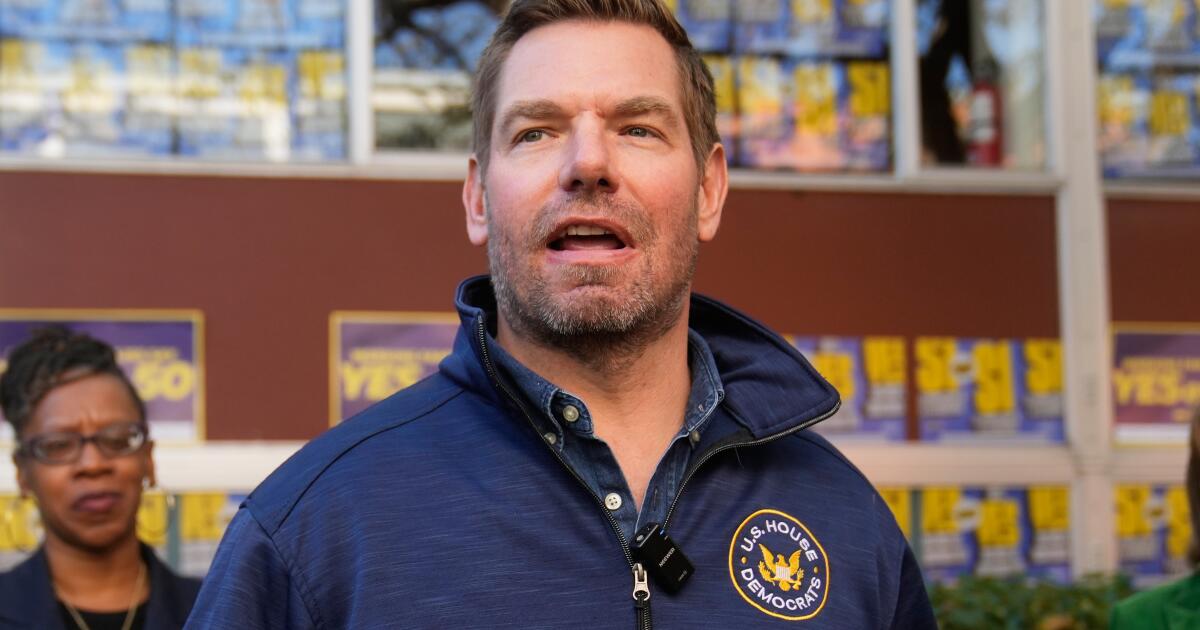
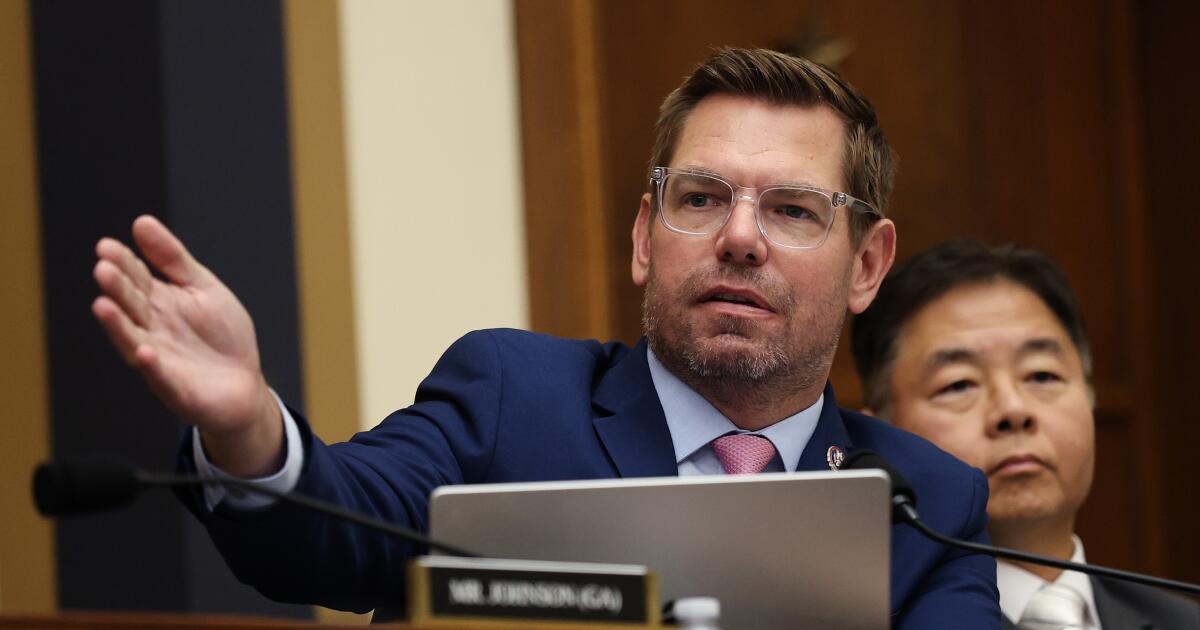
SACRAMENTO — Embattled Rep. Eric Swalwell suspended his campaign for California governor on Sunday but continued to deny he sexually assaulted anyone.
His campaign to succeed Gov. Gavin Newsom has all but collapsed as key Democratic supporters, including Rep. Nancy Pelosi and Sen. Adam Schiff, abandon him.
“To my family, staff, friends, and supporters, I am deeply sorry for mistakes in judgment I’ve made in my past,” Swalwell wrote on social media Sunday.”
“I will fight the serious, false allegations that have been made — but that’s my fight, not a campaign’s.”
House ethics rules bar members from having sex with a subordinate, and House Democratic Leader Rep. Hakeem Jeffries from New York is seeking an investigation into the allegations.
Rep. Anna Paulina Luna (R-Fla.) announced plans to force a House vote to expel Swalwell, a motion supported by some House Democrats. Rep. Jared Huffman, a Democrat representing Northern California, is among those calling on him to resign.
The Manhattan district attorney’s office opened an investigation into sexual assault allegations against Swalwell by the former staffer, and the Alameda County District Attorney’s Office on Saturday said the office was in the process of evaluating “whether any alleged criminal conduct occurred” in the agency’s Bay Area jurisdiction.
The 45-year-old Democratic candidate established himself as a frontrunner in the race to succeed Gov. Gavin Newsom, despite not having a broad base of supporters in California.
A one-time member of the House Intelligence Committee and a savvy social-media user, Swalwell relished his role as a foil to President Donald Trump, using his many platforms to attack and taunt the twice-impeached, criminally convicted president.
He previously worked as a criminal prosecutor, and was elected to Congress in 2012 after he defeated Rep. Pete Stark, a fellow Democrat.
He cast himself as a centrist middle-class guy and featured his wife and three young children prominently in his campaign for governor. In an interview with the Times last year, he talked about his decision to continue in politics, despite the toll on his family.
Reports published in the San Francisco Chronicle and CNN offered a stark contrast to Swalwell’s wholesome image, alleging that he forced himself on a young staffer and sent women pictures of his penis and sexy messages.
CNN also reported on another woman’s alleged account of a sexual encounter with Swalwell that involved fending off his advances over drinks, and then waking up in his hotel room with no memory of how she got there.
Swalwell and his team threatened legal action against several individuals, Swalwell’s attorney Elias Dabaie confirmed to the Times. Swalwell himself took to social media on Friday night and called the allegations “lies” intended to hurt him in the race.
But campaign staffers resigned, his fundraising website went offline and even his self-described “best friend” in Congress, Sen. Ruben Gallegos from Arizona, withdrew his endorsement. Powerful labor groups, including the California Labor Federation, SEIU California and the California Police Chiefs Assn., withdrew their support.
Other Democrats in the race include billionaire Tom Steyer; former Orange County Rep. Katie Porter; State Supt. Tony Thurmond; former U.S. Health and Human Services Secretary Xavier Becerra,; San José Mayor Matt Mahan; former Los Angeles Mayor Antonio Villaraigosa, and former state Controller Betty Yee.
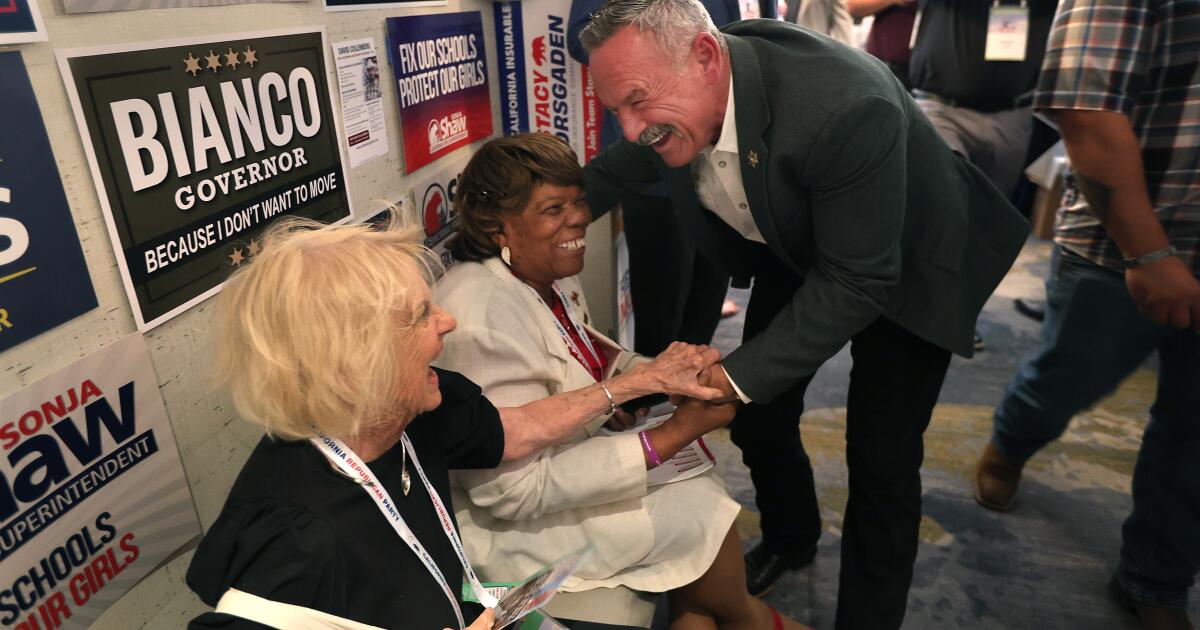
The top GOP gubernatorial candidates are Steve Hilton, a former Fox News commentator, and Riverside County Sheriff Chad Bianco.
SAN DIEGO — While their spring convention was held beneath mostly sunny San Diego skies, delegates and leaders of the California Republican party basked in a different sort of glow over the weekend as the campaign for a leading Democratic candidate for governor imploded because of allegations of sexual assault and misconduct.
The party did not endorse a candidate for governor on Sunday because neither of the top Republicans — Riverside County Sheriff Chad Bianco and former Fox News host Steve Hilton — received the support of 60% of delegates. Bianco won 49% while Hilton had 44%; 7% of delegates voted not to endorse in the race.
“We’re very happy,” Bianco said after the vote. “We got the popular vote here, right? Ultimately, our goal is to win California, and you win California with the popular vote … Californians are looking for a leader. Californians are looking for integrity. Californians are looking for honesty. And they want someone that they know is going to be looking out for them, working for them, and that’s why I won this vote.”
Hilton also said he was pleased by his showing.
“Chad came into this convention thinking he had it in the bag,” Hilton said. “I think we made a lot of progress this week and I think the endorsement of President Trump is the one that’s gonna be decisive in the primary.”
The convention took place as a former staff member for Rep. Eric Swalwell (D-Dublin) accused him of forcing himself on her twice when she was too intoxicated to consent, according to reports published by the San Francisco Chronicle and CNN. Three other women also accused Swalwell of misconduct that included sending and soliciting explicit photos and messages.
Swalwell has not withdrawn from the race, but within hours of the allegations top supporters withdrew endorsements of the East Bay Area congressman, including Sen. Adam Schiff, campaign co-chairs Reps. Jimmy Gomez and Adam Gray, and prominent labor unions including the California Teachers Assn.
The collapse of Swalwell’s campaign brought a surge of energy to leaders and hundreds of die-hard members of a state Republican Party that holds a superminority in the state Legislature and no statewide elected offices. The news broke Friday, just as the party convention was getting underway at the bayside Sheraton San Diego Resort and hours before the Artemis II crew splashed down off the nearby coast.
Sean Spicer, a former press secretary during President Trump’s first term who is promoting a new book, joked during a Saturday brunch panel about landing in San Diego just in time to see “the fall.”
“Sorry, I was talking about Swalwell,” he said to laughter. “It was also cool to see Artemis come back down.”
“Quite frankly, Californians are, by and large, looking for viable alternatives. They’re looking towards the California Republican Party,” Chairwoman Corrin Rankin told reporters.
Republicans running to succeed Democratic Gov. Gavin Newsom shared similar visions during five-minute speeches at a Saturday afternoon candidate forum.
“We meet here today, full of energy and hope and optimism, with a spring in our step on this beautiful spring day. Why? Because every party has its season, and for the California Democrats, the leaves are cascading from the trees,” Hilton told delegates.
Hilton, who served as a top political advisor to U.K. Prime Minister David Cameron, argued that 16 years of Democratic rule has led to dysfunction, chaos and scandal that alarmed voters in the overwhelmingly blue state even before the Swalwell scandal.
“And now, it’s been a couple of hours, so I think we’re due for another Eric Swalwell intern eruption,” he said.
Hilton touted Trump’s endorsement, describing it as a “tremendous asset for us, the energy, the resources, the precious gift of having the boost that makes the biggest difference in a midterm year turnout.”
Bianco emphasized his decades serving in law enforcement in the state, one of his main selling points to Californians concerned about liberal criminal justice policies of past Democratic administrations.
“I have spent every day serving California residents, making our lives better and safer. I have fought for you, and I have bled for you,” Bianco said.
Bianco refuted Hilton’s allegations that he coddled undocumented immigrants, sympathized with Black Lives Matter protesters and threatened county residents with punishment if they did not abide by mask mandates during the pandemic. He said he was the first law-enforcement official in the nation to defy a lockdown order after the pandemic. Bianco said that while he prayed with protesters in the aftermath of George Floyd’s death, he also “forcefully” expelled “rioters and domestic terrorists” from his county.
Bianco also obliquely referred to attacks Hilton has lobbed against the sheriff on the campaign trail.
“This was never supposed to be about a dishonest smear campaign and bullseyes,” Bianco said, referring to a mailer Hilton’s campaign sent to voters that pictured Bianco’s head with circles around it that resemble a shooting target.
As Bianco walked through the bayfront convention hotel after the forum, he was swarmed by supporters chanting his name.
Saturday night, Bianco hosted a western-saloon themed party for delegates. Attendees wearing cowboy hats line danced, petted fluffy white calves and posed for pictures in front of an inflated cactus.
A Hilton-hosted party took on the feel of a candidate forum as he and Republican allies running for other statewide offices gave another round of speeches, often punctuated by shushing attendees who chattered in the back of the room.
Under California’s top-two primary system, the two leading candidates advance to the general election regardless of party affiliation. For weeks, Hilton and Bianco have led polls while eight prominent Democrats including Swalwell split the support of liberal voters, stoking anxiety among Democrats that the party could end up shut out of the November election.
The chances of that happening diminished with Swalwell’s fall from grace and Trump’s endorsement of Hilton, political experts said, but those in the conservative wing of California politics celebrated the apparent downfall of the once-powerful Democrat.
Swalwell is “in denial right now, but once he realizes he doesn’t have any friends left and his campaign team is leaving him, people are laughing at him in the restaurant, I think, and I hope for his sake, he has enough self-awareness that he’ll quietly drop out and go to the south coast of France and put on a wig,” said Republican National committeeman Shawn Steel.
One of the convention’s celebrated speakers, Sen. Ted Cruz (R-Texas) took shots at other California Democrats during a Saturday evening banquet, describing Los Angeles Mayor Karen Bass as “the Democrats’ national ambassador for disaster management” and Newsom as a contender for “Texas Realtor of the year, because no person in human history has sold more homes in the state of Texas.”
“Look, as a Texan, I gotta say, just isn’t fair. [You have] an economy that has been a monstrous engine driving America forward for decades, and yet you were cursed with idiot politicians,” Cruz said.
While Hilton‘s and Bianco’s campaigns have sparred about their respective records, the candidates largely avoided direct confrontation until a debate earlier this month in Rancho Mirage. The two GOP candidates tore into each other about issues such as immigration, their credentials and their honesty.
Delegates also sparred about Bianco and Hilton’s records in the halls of the convention.
Shiva Bagheri, a Bianco supporter from Beverly Hills, said that Hilton’s political positions are not constitutional.
“Steve said that anybody that makes under $100,000 shouldn’t pay [income] taxes,” said Bagheri, 52. “That’s against the 14th Amendment. I’m a constitutionalist.” She said she preferred Bianco’s plan to cut income taxes for everyone to avoid class warfare.
Celeste Greig, a Hilton supporter from Northridge, initially supported Bianco and donated to his campaign. But she grew troubled after hearing about Bianco’s comments about immigration, seeing images of the sheriff taking a knee alongside BLM protesters and learning of what she believes was an unlawful arrest of a person outside of President Trump’s 2024 rally in the Coachella Valley.
Some Republicans longed for a return to a bygone era when state lawmakers regularly worked across the aisle. State Sen. Tony Strickland (R-Huntington Beach) described teaming up with Democratic Sen. Alex Padilla when they served in the Legislature, adding that he still considers Padilla, now the state’s senior U.S. senator, a friend.
“We’re in a divided era right now,” Strickland said. “If we actually pick up a few more seats, I think it will give more comfort to some of those moderate Democrats to come over and work with us.”
WASHINGTON — Kevin Dellicker stays away from politics when he reports for duty at the National Guard armory in Harrisburg, Pa. But out of uniform, the captain in the Pennsylvania National Guard does everything he can to persuade the people he served with in Iraq to reelect President Bush.
Shaking some of the same hands as Dellicker is Jonathan Soltz, a former Army captain recently returned from Iraq who spends his days pleading with soldiers to vote for Sen. John F. Kerry of Massachusetts, the Democratic presidential nominee.
In the swing state of Pennsylvania, where both live, the votes of those in the military — including more than 15,000 reservists — who are serving or have served in Iraq or Afghanistan are much in demand.
But which way the people fighting the war will vote in Pennsylvania and elsewhere is anybody’s guess.
Tight restrictions on seeking the votes of active-duty military personnel, along with taboos in the military culture against the open expression of political views, make it tough for candidates to target military voters — and make it tough for pollsters to figure them out.
Historically, military turnout in elections has been low.
With more than 400,000 troops overseas now, many living in difficult and dangerous conditions, it is not clear whether those who want to vote this fall will succeed. A Pentagon initiative meant to make it easier for troops to cast absentee ballots via the Internet and by fax is being criticized as vulnerable to tampering.
All that has left the Bush and Kerry campaigns working the edges of a potential voting bloc that could be significant in a tight election.
“It’s very hard to get a read on how the active-duty personnel are reacting to the war politically, because they are so busy reacting on the ground,” Soltz said. “So what I do — I talk to my friends, tell them to e-mail their friends about Kerry; I talk to people like me who are out of the service now. I’m not going to go give a speech to a group of soldiers. It’s not the thing they want to hear while they’re just trying to keep their lives together.”
Political activity in the military is — like much else — strictly regulated.
Troops are not prohibited from expressing political opinions, but they are not allowed to work for partisan political organizations while in the military. Campaigning is prohibited at military facilities, and the rules for conducting polls among active-duty troops are so cumbersome that pollsters have generally given up.
“As a society, we rely on the apolitical loyalties and professionalism of the military — we entrust them with capabilities that we don’t give anyone else — and in exchange for that we demand total political neutrality from them,” said Peter Feaver, a political science professor at Duke University who studies military voting patterns.
“We seek to avoid creating a partisan voting bloc in the military that is wooed or courted the way that soccer moms are. So for that reason the government doesn’t ask questions itself, and they restrict the access of anyone else to do so.”
More is known about how veterans lean politically: Polls show they tend to vote Republican.
Because of that, it has long been presumed that the active military also leans Republican. A poll by Army Times of its readers in December found that more supported the administration than did not. But the poll did not ask respondents for whom they would vote. Its pollsters acknowledged that its readers tended to be older, career soldiers, rather than enlisted personnel, 35% of whom are black and Latino — groups that among civilians tend to vote Democratic.
This year, both presidential campaigns have infused their efforts with military imagery, and the experience of both Bush and Kerry during the Vietnam War era is under scrutiny.
A parade of retired generals at the Democratic and Republican conventions endorsed one candidate or the other. Kerry opened his speech with a salute. Bush and Vice President Dick Cheney have regularly visited military bases, and Kerry meets with veterans, reservists and military families. Elizabeth Edwards, the wife of Democratic vice presidential nominee John Edwards, parlays her background as the daughter of a career soldier into regular chats with military families.
“The political appeals to this broad category of people somehow associated with the military [have] not been this overt in decades,” said Carroll Doherty of the Pew Research Center for the People and the Press. “But of the leanings of active-duty military, the people in the fight, the candidates are as stumped as the pollsters.”
Both parties are pushing overseas voter registration, including that of military personnel. The Bush campaign is deeply aware that military absentee ballots may have helped swing Florida — and the election — for Bush in 2000. Democrats, meanwhile, are predicting that more of the military vote will go their way this November because long tours of duty and heavy casualties have antagonized a growing number of military families.
“This time around, the Democrats are convinced that the advantage among military voters won’t be nearly as big for the GOP,” said Curtis Gans, director of the Committee for the Study of the American Electorate. “They also think that in a post- 9/11 election, how can the Democrats show that they’re tough on national security? If they can win the military and veterans endorsement race, then that can serve symbolically as proof that they are good on national security.”
Pentagon attempts to improve voter turnout among soldiers overseas have generated considerable controversy.
In February, the Pentagon dropped a $22-million plan to test Internet voting for 100,000 military workers and civilians overseas. After a panel of experts cited security concerns, the agency said it could not ensure the legitimacy of online votes.
Subsequently, the Defense Department said that members of the military would be allowed to vote by faxing or e-mailing their vote, but only after waiving their right to a secret ballot. Under the Pentagon plan, a contractor, Omega Technologies, will accept the ballots on a toll-free line, then send them to appropriate local elections offices.
But under that system, the contractor, the Pentagon and county officials would all know which candidates individual military voters had chosen.
Critics have pointed out that Omega’s chief executive, Patricia Williams, has donated $6,000 in this election cycle to the National Republican Congressional Committee and serves on the committee’s business advisory council. They say such partisanship leaves open the possibility that votes will be tampered with, as does the nonsecret ballot.
Missouri and North Dakota will allow e-mail voting by the military. Twenty other states will permit faxed ballots, also to be handled by Omega.
In Pennsylvania, which has sent more reservists to Afghanistan and Iraq than all but five other states, and which has had more war deaths than any other presidential swing state, the Bush and Kerry campaigns are pulling hard for the military vote.
Dellicker, the guardsman, said the local Bush campaign organization he volunteers for had compiled an extensive e-mail list, primarily through word of mouth, of active-duty troops. The campaign uses the list to send regular updates on campaign events and issues.
“I don’t pester my colleagues at my base, because that would be inappropriate. But if I have colleagues, you’d better believe that I’m going to talk to them about [the election] when out of uniform and in an appropriate setting,” Dellicker said.
Soltz, the Army veteran, said he arranged for Iraq veterans in Pennsylvania to speak in favor of Kerry at veterans halls.
“I talk all the time to these guys. I have friends who aren’t even back from Iraq yet who wish they could get back and tell people what they’ve seen, what they know,” Soltz said. “I know there are people like me working for Bush driving these roads too. The question is, who are soldiers listening to?”
WASHINGTON — President Trump responded to the collapse of high-stakes negotiations with Iran by escalating the conflict on Sunday, ordering a full blockade of shipping through the Strait of Hormuz — a risky move that could drive global oil prices higher and provoke confrontation with a far more formidable adversary.
No country relies more heavily on the strait than China, which receives nearly half of its oil imports through the international waterway. In recent days, Beijing has warned that access to its shipping lanes “must be guaranteed.”
Trump administration officials believe the blockade could compel China to pressure Tehran into making further concessions, following Beijing’s crucial role earlier this month in convincing Iran to accept an initial ceasefire.
But the decision by U.S. diplomats to tie negotiations over the status of the strait to those over the fate of Iran’s nuclear program — a matter of torturous diplomacy for the last quarter-century — could make it harder to secure a breakthrough.
In the meantime, a full blockade of the strait could force China to become more directly involved in a conflict that is already heightening tensions with Washington.
On Saturday, reports that Beijing could be preparing to send advanced missile and air defense systems to Iran prompted anger from the White House.
It is a high-stakes moment in the world’s most important bilateral relationship, ahead of a closely watched summit between Trump and Chinese President Xi Jinping in Beijing next month that both sides had hoped would help stabilize relations.
The United States and Iran agreed to a two-week ceasefire in the war on Tuesday — on the condition that Iran would allow full freedom of navigation through the strait, a vital commercial artery that was treated for decades as an open, international waterway.
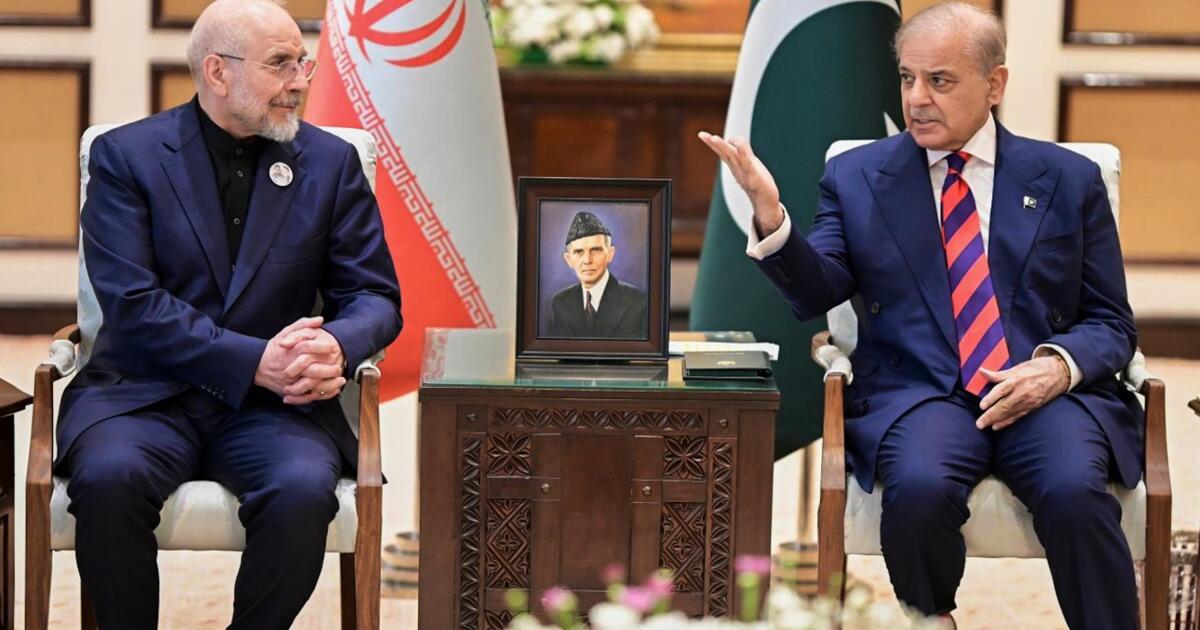
Marathon negotiations in Islamabad, Pakistan, over the weekend between senior U.S. and Iranian officials failed to secure a long-term agreement.
Vice President JD Vance said the central sticking point was Iran’s insistence on maintaining its nuclear program. But Tehran also signaled that shipping through the strait would not return to prewar conditions, pledging to control traffic and impose transit tolls — a scenario that could result in permanently higher global oil prices, a political nightmare for the Trump administration entering the midterm elections.
Trump’s threat to completely shut down traffic through the strait on Sunday may also lead to a temporary spike in oil prices, with experts warning the market could experience barrels costing $150 or more if a blockade persists.
Describing his plans to Fox News on Sunday, Trump said there would be no exceptions to the U.S. blockade for Tehran’s “friends.” Throughout the war, Chinese-bound vessels were granted special passage by Iranian authorities.
“We’re putting on a complete blockade. We’re not going to let Iran make money on selling oil to people that they like and not people that they don’t like, or whatever,” Trump said.
“It won’t be a percentage,” he added. “It won’t be a friend of yours, like a country that’s an ally or a country that’s your friend. It’s all or nothing.”
Trump also wrote on social media that he had ordered the Navy to “seek and interdict every vessel in International Waters that has paid a toll to Iran” — and to “blow to hell” any Iranian assets that open fire on ships.
Beijing did not immediately respond to the proposal. But it has walked a fine line over six weeks of war in the region, describing open waters in the strait as of global interest, while avoiding any condemnation of Iran’s assertion of control.
China’s main energy trading partners in the gulf — Saudi Arabia, the United Arab Emirates and Kuwait — have all advocated for a return to the status quo ante for the passage, pressing allies to reject Iranian control as the new normal.
“Keeping the area safe and stable and ensuring unimpeded passage serves the common interest of the international community,” a Chinese official said last week.
“We hope that all sides can work together,” the official added, “for the early resumption of normal traffic at the strait.”
SACRAMENTO — There has never been a California governor’s race like this one. And that was even before the leading Democrat was shoved aside by shocking accusations of sexual assault.
For months, the contest has been uninspiring, unexciting and unwatchable. It really shouldn’t have been called a “race.” It was more like a slow trot. No candidate has drawn even 20% of voters’ support in independent polling. Half the 10 main candidates have been stuck in single digits.
And in less than a month, voters will start casting mail-in ballots.
“I have certainly made mistakes in judgment in my past, but these mistakes are between me and my wife. And to her I apologize deeply for putting her in this position.”
Sorry, congressman, but if someone is running for governor of the nation’s largest state, the mistakes aren’t just between him and his wife.
Former House Speaker Nancy Pelosi of San Francisco told Swalwell, in essence, that it’s his right to fight the accusations, but he should do it on his own time, not the Democratic Party’s. She was among the first of party leaders to call on him to abandon the race.
Bye, bye Eric. Might as well depart the House, too.
A leading candidate for California governor has never crumbled so fast. It was like a dam bursting.
Powerful interests and major politicians had been coalescing behind the 45-year-old congressman because he charmed them or they were loyal colleagues or — most important — he seemed like a potential winner.
Political players, including campaign donors, seek to invest their capital in anticipated victors. Their expected return is access and favors. And Swalwell had been racking up lots of endorsements.
Marital infidelity is one thing, but alleged sexual assault — rape — cannot be tolerated, especially by a party dominated by female voters.
Labor unions, other interests and influential politicians began backing off their endorsements. Many urged Swalwell to fold his campaign. And with his support collapsing, he really was left ultimately with no other choice.
So, now the most pertinent question is which candidate will replace Swalwell as the Democrat with the best chance of surviving the June 2 top-two primary and winning a spot on the November ballot.
If it’s a Democrat against a Republican in November–the most likely matchup–the Democrat is a virtual cinch to succeed the termed out Gov. Gavin Newsom. No Republican has won a statewide race in California in 20 years.
State Democratic Chairman Rusty Hicks — as part of his effort to pressure lagging candidates to exit the race and make more room for faster runners — released a nonpartisan, party-paid poll last week. It was conducted before Swalwell’s collapse.
It showed two Republicans tied for the lead with 14% each: Riverside County Sheriff Chad Bianco and conservative commentator Steve Hilton.
Among Democrats, Swalwell led with 12%, slightly ahead of billionaire hedge fund founder Tom Steyer at 11%. Former Orange County Rep. Katie Porter had 7%. Then came former U.S. Health Secretary Xavier Becerra, San José Mayor Matt Mahan and former Los Angeles Mayor Antonio Villaraigosa, each with 4%.
Former state controller Betty Yee and state schools chief Tony Thurmond barely registered at 1% each.
For weeks, it has been deemed conceivable that both Republican candidates would finish ahead of all Democrats in the June 2 primary. Democratic voters would splinter their support among the party’s crowded field. That would lock out Democrats from the November ballot and guarantee the election of a Republican.
But President Trump seemed to botch that for the GOP last week by endorsing Hilton. Trump presumably will help the former British politico draw votes from Bianco and indirectly assist a Democrat in finishing second.
There’s a new twist, however. Where will Swalwell’s votes go? If enough go to the Democratic laggers rather than the party frontrunners, both Republicans could still wind up one-two.
No gubernatorial contest in modern times has been this wide open.
These candidates’ failure to make waves isn’t all their fault. Some were slow diving into the water. But even those who tried to make a splash were inundated by Trump.
Practically all the public’s attention has been on the president and his oddball or vengeful or unprincipled actions.
Now the Democratic race is more wide open than ever.
Steyer — a liberal climate fighter — has run an energetic campaign, spending more than $100 million of his own money on TV ads. But will Californians elect a mega-rich governor? They never have.
Porter has been running better in polls than the latest Democratic survey showed. She’s straight forward on all the issues, but a bit too liberal and feisty for some establishment Democrats. Swalwell’s fall is her opportunity to rise.
Becerra — a former state attorney general and congressman — has an impressive resume, but was too slow out of the starting gate. This is his chance to sprint, if he can.
No candidate is more qualified to be governor than centrist Villaraigosa, a former state Assembly speaker. But voters apparently are looking for someone younger. He’s 73.
Mayhan is a moderate who started too late and has fallen far short of expectations. He now has a second chance.
It soon will all be in the hands of voters, whether they’re interested or not.
You’re reading the L.A. Times Politics newsletter
George Skelton and Michael Wilner cover the insights, legislation, players and politics you need to know. In your inbox Monday and Thursday mornings.
By continuing, you agree to our Terms of Service, which include arbitration and a class action waiver. You agree that we and our third-party vendors may collect and use your information, including through cookies, pixels and similar technologies, for the purposes set forth in our Privacy Policy such as personalizing your experience and ads.
SACRAMENTO — The fallout over sexual misconduct allegations against Rep. Eric Swalwell grew Saturday as his fellow gubernatorial candidates faced a new race and Democrats were forced into a rapid test of how they respond to accusations of sexual misconduct.
Within hours of the accusations against Swalwell being made public, the Northern California congressman’s campaign began to unravel and a chorus of top Democrats urged him to drop out. Staff members resigned, his fundraising website went offline and allies moved quickly to distance themselves from a candidate who had been gaining momentum as a front-runner in the race to lead the Golden State.
The repercussions extended beyond Swalwell’s campaign for governor. The Manhattan district attorney’s office opened an investigation into sexual assault allegations against Swalwell by a former staffer and issued a statement Saturday that urged “survivors and anyone with knowledge of these allegations to contact our Special Victims Division.” Rep. Anna Paulina Luna (R-Fla.) posted a video on X saying that she plans to force a House vote next week to expel Swalwell.
Swalwell has denied the allegations, calling them “flat [out] false.”
The upheaval has created an opening for lesser-known contenders to gain traction just as voters are beginning to turn their attention to the race — a spotlight now intensified by the controversy.
The speed and severity of the response underscores how quickly political support can erode — and reflects a broader shift in how such allegations are handled in the post-#MeToo era, which has been intensified by the scrutiny surrounding the late financier and convicted sex offender Jeffrey Epstein.
“Ask any woman staffer over the age of 45 what her experience was like, and this was a fairly prevalent sort of situation,” said Elizabeth Ashford, a veteran Democratic strategist. “It was allowed. I really think it shows a lot of growth on the part of political professionalism, that these things are taken seriously.”
As of Saturday afternoon, Swalwell ignored calls to drop out of the race and resign from Congress, even as outrage and criticism swelled. A Bay Area fundraiser was canceled and major institutional backers abandoned the campaign. The California Labor Federation withdrew its endorsement, SEIU California rescinded its backing and urged Swalwell to exit the race, and the California Police Chiefs Assn. suspended its support.
Speculation swirled Saturday about Swalwell’s whereabouts after the congressman announced that he intended to spend time with his wife.
A man who opened the door of Swalwell’s rental home in Livermore early Saturday refused to talk to a Times reporter. Swalwell has claimed that he rents space in the one-story house, located on a quiet cul-de-sac. He also owns a home in Washington, D.C., but no one inside responded when a reporter rang Saturday.
Livermore residents couldn’t escape news of the scandal. “Swalwell faces assault claims,” read the front page of the East Bay Times, stacked up at the Lucky grocery story around the corner from Swalwell’s rental home.
The most serious allegation against Swalwell is from a woman who worked for the congressman who said their relationship was at times consensual, but that he sexually assaulted her twice when she was too intoxicated to consent, according to the San Francisco Chronicle. Three other women have also accused Swalwell of sexual misconduct, including sending unsolicited nude photos, according to CNN.
The allegations prompted several members of his campaign to abruptly walk away from their jobs. One senior campaign staffer said they resigned after hearing the seriousness of the allegations, adding that they didn’t want to be put in a position where they were using their own credibility to defend Swalwell.
Former staffers in Swalwell’s congressional office traded messages in group texts after the news reports, with many expressing shock and horror at the allegations, according to two former employees.
A group of senior staff in Swalwell’s congressional office and campaign said in a statement Saturday that they “stand with our former colleague and the other women who have come forward” and that others “should stand with them, too.”
Kyle Alagood, an attorney who worked for Swalwell’s congressional office and his short-lived presidential campaign, told The Times he was “disgusted and pissed off.”
“I pray he has the decency to resign for the sake of his wife and kids,” said Alagood, adding that Swalwell must also “face the full legal consequences of his actions.”
Rob Stutzman, a longtime GOP strategist, said the impact of Swalwell’s political advisers quitting and his endorsements being yanked has sunk his chances in the governor’s race whether he stays in or not.
Stutzman advised former Gov. Arnold Schwarzenegger during the 2003 recall when The Times reported allegations of inappropriate behavior with women during his bodybuilding and film career. Stutzman said the severity of the allegations against Swalwell makes the situation very different from that involving Schwarzenegger, who didn’t lose endorsements.
“If this had been the circumstances … I would have quit,” Stutzman said. “They’re just not the same.”
While Swalwell’s political future hangs in the balance, political insiders are closely watching who will be the beneficiary of the chaos. There are eight Democrats running: billionaire Tom Steyer, former Orange County Rep. Katie Porter, state schools Supt. Tony Thurmond, former U.S. Health and Human Services Secretary Xavier Becerra, San José Mayor Matt Mahan, former Los Angeles Mayor Antonio Villaraigosa, former state Controller Betty Yee and Swalwell. There are two GOP candidates: Steve Hilton, a former Fox News commentator, and Riverside County Sheriff Chad Bianco.
Loyola Marymount University law professor Jessica Levinson said that with key endorsements, such as labor, now back up for grabs, anyone can jump to the front of the pack. She said the safest bet on who will gain an advantage is Porter and Steyer, who with Swalwell have been the top candidates in recent opinion polls.
“But, I think this is a race where there is no heir apparent,” Levinson said. “You can’t rule out surprises anymore in this race.”
Paul Mitchell, a veteran Democratic strategist, agreed that the upheaval benefits Porter and Steyer, adding that Swalwell’s chances have been reduced to zero.
“First off, I think that staying in the race is not tenable,” Mitchell said. “And so if he does drop out of the race, what it means is that you’re going to have a lot of progressive voters looking for somebody else to go to and the primary beneficiaries should be Porter and Steyer right now, because they’re the other two that are in that kind of first tier of Democratic candidates that have been splitting up that progressive base.”
Allegations of inappropriate behavior by Swalwell had circulated for weeks on social media and in political circles. Once the San Francisco Chronicle and CNN posted stories with details from women accusing Swalwell of sexual misconduct, including rape, the swift rebuke was likened by one political strategist to a bomb detonating.
Those media outlets reported that the staff member accusing Swalwell of rape was 21 when she began working for him in 2019 in his Castro Valley district office. She said Swalwell, who is nearly two decades older, quickly began sending her messages and then nude pictures on Snapchat, a platform in which messages and images disappear after being viewed.
She said that in September 2019 she had drinks with the congressman, blacked out and could tell she had had intercourse when she woke up naked in Swalwell’s hotel bed, according to the report. In a separate encounter years later, she said he forced himself on her while she was too intoxicated to consent and despite her protests.
She said she did not report the incidents to police, citing fears she would not be believed and concerns about professional repercussions.
Another woman who began messaging with Swalwell about her interest in Democratic politics last year said she met him for drinks and that she was attempting to fend off his advances without hurting potential job opportunities when she began feeling “really fuzzy” and intoxicated, according to CNN. She told the outlet that she ended up in Swalwell’s hotel room without a memory of how she got there.
Social media creator Ally Sammarco said Swalwell sent her unsolicited nude pictures in 2021, when she was 24 years old. Another woman in her 20s, who works in marketing, said the congressman sent her unsolicited videos of his penis.
Swalwell, who is married with three young children, posted a video on Instagram on Friday in which he called the accusations of inappropriate behavior “flat [out] false,” while also acknowledging unspecified poor behavior.
“I don’t suggest to you in any way that I am perfect or that I am a saint,” he said in the video. “I’ve certainly made mistakes in judgment in my past. But those mistakes are between me and my wife. And to her I apologize deeply for putting her in this position.”
Elias Dabaie, an attorney representing Swalwell, sent cease-and-desist letters to at least two people demanding that they stop accusing the congressman of sexual assault, according to CNN. Dabaie was asked by CNN whether the congressman’s comments can be construed as acknowledging that he cheated on his wife, while denying doing anything illegal.
“I’m not going to get into the details of that,” Dabaie said.
Times staff writers Melody Peterson and Gavin Quinton contributed to this report.
Good morning, and welcome to L.A. on the Record — our City Hall newsletter. It’s Alene Tchekmedyian, with an assist from Rebecca Ellis, giving you the latest on all things local government.
Last summer, the Los Angeles Fire Department enlisted a public relations firm to help shape the narrative around its response to the Palisades fire as it geared up to release its long-awaited after-action report.
The optics around the devastating fire hadn’t been good.
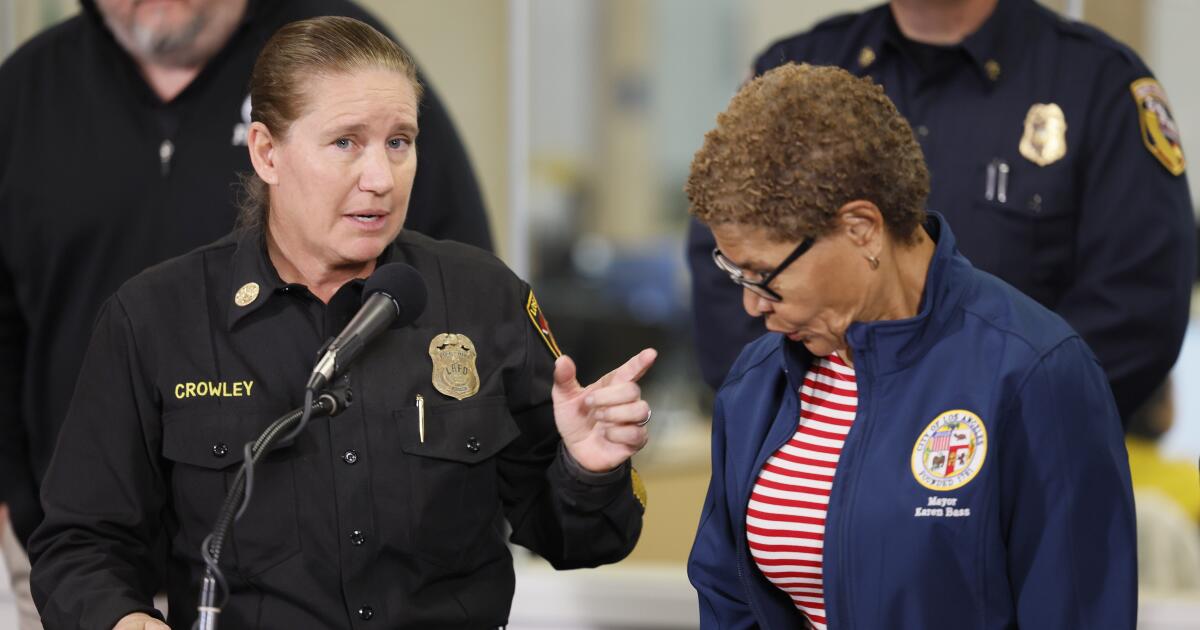
A Times investigation revealed that top LAFD officials failed to pre-deploy engines in Pacific Palisades, despite forecasts of dangerously high winds. Mayor Karen Bassousted the fire chief. The thousands of residents who lost their homes were growing increasingly angry. City and LAFD officials were concerned about how the report, which was intended to examine what mistakes the department made and how to avoid repeating them, would land.
“While we have a section that deals with press inquiries, media, and interview requests, they are not equipped to deal with what I call a ‘Crisis,’” LAFD Deputy Chief Kairi Brown wrote to the Lede Company in July.
The Times obtained the email and other materials this week through the California Public Records Act. Brown wrote in the email that his brother, Jay Brown, who co-founded the entertainment company Roc Nation with Jay-Z, recommended the firm.
At the time, LAFD’s public information director position was vacant, but a staff roster shows that two captains and four firefighters were assigned to the Community Liaison Office. The captains, Erik Scott and Adam Van Gerpen, each made more than $200,000 in overtime alone last year, on top of their roughly $200,000 base salaries, payroll data show.
Scott and Van Gerpen did not immediately respond to a question about what the overtime was for.
Fire officials also met with and considered another PR firm called Cielo Strategic Communications, but ultimately selected Lede for the job. Lede bills itself as a “full-service strategy, communications and social impact consulting firm,” with high-profile celebrity clients like Kerry Washington and Emma Stone, according to its website.
The Los Angeles Fire Department Foundation, which calls itself “the official nonprofit arm of the LAFD” that provides “vital equipment and funds critical programs to help the LAFD save lives,” took care of the $65,000 bill.
The Times has described efforts by Bass and others to water down the after-action report. Lede’s role, according to internal documents, was to shield the LAFD and the mayor’s office from “reputational harm” associated with the report’s release.
Bass also was involved in media spin, with Scott writing in an Oct. 9 email that “any additional interviews with the Fire Chief would likely depend on the Mayor’s guidance.”
The documents obtained by The Times this week reveal that Lede embarked on “Media 101” training for interim Fire Chief Ronnie Villanueva, including basic tips such as: “While reporters aren’t always out to get you, they’re not your friends either.”
“Tricks” that reporters use to get people talking, according to a Lede slideshow, include: “Speculate,” “Stir the pot,” “The long pause/silence” and “Act like your friend.”
Other advice from Lede: “Stay on message and don’t volunteer information that is not asked.” Don’t “offer information to fill the silence (this is a reporter tactic).”
The Lede Company previously declined to comment on its work for the LAFD, citing client confidentiality. An LAFD spokesperson did not immediately respond to a request for comment Friday.
Other records previously released show that Lede also analyzed news articles before and after the Palisades fire — the goal was to get a sort of vibe check of LAFD from the public — and found criticism of department leadership as well as support for the rank and file.
And a communications plan developed in the event that the after-action report was leaked to reporters involved convening an “emergency briefing between LAFD, Lede, and the Mayor’s Office within 60 minutes of discovery,” as well as embargoed briefings within a day “to control the narrative and reinforce lessons learned and key actions coming out of the LAFD.”
Lede worked with the LAFD until about mid-November, when Jaime Moore took over as fire chief. A couple of months later, the agency hired a public information director, Stephanie Bishop, to lead the Community Liaison Office.
You’re reading the L.A. on the Record newsletter
Sign up to make sense of the often unexplained world of L.A. politics.
By continuing, you agree to our Terms of Service, which include arbitration and a class action waiver. You agree that we and our third-party vendors may collect and use your information, including through cookies, pixels and similar technologies, for the purposes set forth in our Privacy Policy such as personalizing your experience and ads.
State of play
— SB CANDIDATE: Los Angeles mayoral candidate Spencer Prattacknowledged this week that he’s living in Santa Barbara County after the Palisades fire destroyed his home. He’s allowed to use his Palisades address to vote and run for office, as long as he intends to return, election officials said.
— BASS BUCKS: Bass and City Councilmember Ysabel Jurado say they want to allot more than $360 million to developers and nonprofits creating affordable housing. The money, which comes largely from the “mansion tax,” would fund 80 projects.
— REVOLVING DOOR: A Times analysis found the longer the mayor’s signature program to battle homelessness exists, the worse its metrics are. As Inside Safe finished its third year in December, roughly 40% of the people who had gone indoors were back on the street.
— CHANGE AGENT: Everyone running for L.A. mayor wants to be a champion of change. As her first term comes to an end, Bass is campaigning on change, vowing to tackle decades-old problems. So is City Councilmember Nithya Raman, who says her decision to run was based on “a sense of urgency that things needed to change.”
—FIGHT FLOP: More than a year after California Atty. Gen. RobBonta charged 30 probation officers with facilitating so-called “gladiator fights” among youths inside the county’s juvenile halls, almost half of the criminal cases are falling apart. State prosecutors dismissed charges against one-third of the officers, and four more entered into plea deals Tuesday that will end with their cases dropped.
— BADGE BREACH: Sensitive police records, including personnel files, were seized by hackers in a breach involving the L.A. city attorney’s office. A group known for conducting ransomware attacks on large entities took credit for the hack, which involves 337,000 files.
— OLYMPIC OOPS: Los Angeles officials are worried that taxpayers could be on the hook for budget-busting costs to support the 2028 Olympic Games, if the profit promised by LA28 doesn’t materialize. City Atty. Hydee Feldstein Soto and Councilmember Monica Rodriguez both want a contract pledging that LA28 cover any future costs incurred by the city.
— VANISHING BLUES: Up for reelection and facing a budget deficit, Bass says she’s shifting from her original plan to grow the L.A. Police Department to the 9,500-officer force it once was. Her new goal: making sure the department doesn’t shrink from its current total of 8,677 officers, which is the lowest in nearly a quarter-century.
— PRICEY PROTESTS: A well-known LAPD critic and two attorneys are suing the LAPD after officers allegedly fired less-lethal rounds at them during a protest last summer. Activist Jason Reedy says he was shot in the groin after confronting an officer outside LAPD headquarters.
QUICK HITS
Where is Inside Safe? The mayor’s signature homelessness program monitored 126 encampment sites across the city and visited an interim housing site.
On the docket next week: L.A. County officials will unveil their budget for the upcoming fiscal year Monday, with the supervisors weighing in at their Tuesday board meeting.
Stay in touch
That’s it for this week! Send your questions, comments and gossip to LAontheRecord@latimes.com. Did a friend forward you this email? Sign up here to get it in your inbox every Saturday morning.
ISLAMABAD — The United States and Iran began face-to-face negotiations Saturday in Pakistan, days after a fragile, two-week ceasefire was announced, as the war that has killed thousands of people and shaken global markets entered its seventh week.
The White House confirmed the direct nature of the talks, a rare instance of high-level U.S. government engagement with the Iranian government.
Iran’s state-run news agency said three-party talks including Pakistan had begun after Iranian preconditions, including a reduction in Israeli strikes on southern Lebanon, were met, and after U.S. and Iranian officials met separately with Pakistani Prime Minister Shehbaz Sharif.
The U.S. delegation led by Vice President JD Vance and the Iranian delegation led by Parliament Speaker Mohammad Bagher Qalibaf were discussing how to advance the ceasefire already threatened by deep disagreements and Israel’s continued attacks against the Iranian-backed Hezbollah in Lebanon.
Since the Islamic Revolution in Iran in 1979, the most direct U.S. contact had been in September 2013 when President Obama called newly elected President Hassan Rouhani to discuss Iran’s nuclear program. The recent highest-level meetings were between Secretary of State John Kerry and counterpart Mohammad Javad Zarif during negotiations over the program.
Iran sets ‘red lines’ including compensation for strikes
Iran doubled down on parts of its earlier proposal, with its delegation telling Iranian state television it had presented some of the plan’s ideas as “red lines” in meetings with Sharif. Those included compensation for damage caused by the U.S.-Israeli strikes that launched the war on Feb. 28 and releasing Iran’s frozen assets.
The war has killed at least 3,000 people in Iran, 1,953 in Lebanon, 23 in Israel and more than a dozen in Gulf Arab states, and caused lasting damage to infrastructure in half a dozen Middle Eastern countries. Iran’s chokehold on the vital Strait of Hormuz has largely cut off the Persian Gulf and its oil and gas exports from the global economy, sending energy prices soaring.
Reflecting the high stakes, officials from the region said Chinese, Egyptian, Saudi and Qatari officials were in Islamabad to indirectly facilitate the talks. The officials spoke on condition of anonymity to discuss the sensitive matter.
In Tehran, residents told the Associated Press they were skeptical yet hopeful about the talks after weeks of airstrikes left destruction across their country of some 93 million people. Some said the path to recovery would be long.
“Peace alone is not enough for our country, because we’ve been hit very hard, there have been huge costs,” 62-year-old Amir Razzai Far said.
Meanwhile, Israel pressed ahead with strikes in Lebanon after saying there is no ceasefire there. Iran and Pakistan have disagreed. The Lebanese state-run news agency reported at least three people killed.
Officials posture over key issues ahead of talks
Ahead of the talks, President Trump accused Iran of using the Strait of Hormuz, a key artery for global energy supplies, for extortion, and told reporters Friday it would be opened “with or without them.”
Iran’s closure of the strait has proved its biggest strategic advantage in the war. Around a fifth of the world’s traded oil had typically passed through on over 100 ships a day. Only 12 have been recorded transiting since the ceasefire.
Iran has floated the idea of charging ships, though the idea has been widely rejected by countries including the United States and Iran’s neighbor Oman.
On Saturday, Trump said on social media that the U.S. had begun “clearing out” the strait, but it was unclear whether he was referring to the reported use of mines there or Iran’s broader ability to control the area.
Iranian Foreign Minister Abbas Araghchi had said Tehran was entering negotiations with “deep distrust” after strikes on Iran during previous rounds of talks. Araghchi, part of Iran’s delegation in Pakistan, said Saturday that his country was prepared to retaliate if attacked again.
Iran and the United States outlined competing proposals ahead of the talks.
Iran’s 10-point proposal called for a guaranteed end to the war and sought control over the Strait of Hormuz. It included ending fighting against Iran’s “regional allies,” explicitly calling for a halt to Israeli strikes on Hezbollah.
The United States’ 15-point proposal includes restricting Iran’s nuclear program and reopening the strait.
Israel and Lebanon will have direct negotiations
Negotiations between Israel and Lebanon are expected to begin Tuesday in Washington, Lebanese President Joseph Aoun’s office said Friday, after Israel’s surprise announcement authorizing talks despite the countries lack of official relations.
Israel wants the Lebanese government to assume responsibility for disarming Hezbollah, much like was envisaged in a November 2024 ceasefire. But it is unclear whether Lebanon’s army can confiscate weapons from the militant group, which has survived efforts to curb its strength for decades.
Israel’s insistence that the ceasefire in Iran does not include a pause in its fighting with Hezbollah has threatened to sink the deal. The militant group joined the war in support of Iran in the opening days. Israel followed up with airstrikes and a ground invasion.
The day the Iran ceasefire deal was announced, Israel pounded Beirut with airstrikes, killing more than 300 people in the deadliest day in Lebanon since the war began, according to the country’s Health Ministry.
Energy pressures grow
The spot price of Brent crude, the international standard for oil prices, was above $94 on Saturday, up more than 30% since the war started.
And new pressures emerged in Europe for travelers.
The head of Airports Council International-Europe, Olivier Jankovec, warned the European Union that a ″systemic jet fuel shortage’’ could come within three weeks because of the blockage of the Strait of Hormuz.
Jankovec said in a letter obtained by the Associated Press that the crunch could impact the summer travel season and ″significantly harm the European economy.’′
Ahmed, Metz, Castillo and Magdy write for the Associated Press. Metz reported from Jerusalem, Castillo from Beijing and Magdy from Cairo. Associated Press writer Josh Boak contributed to this report.
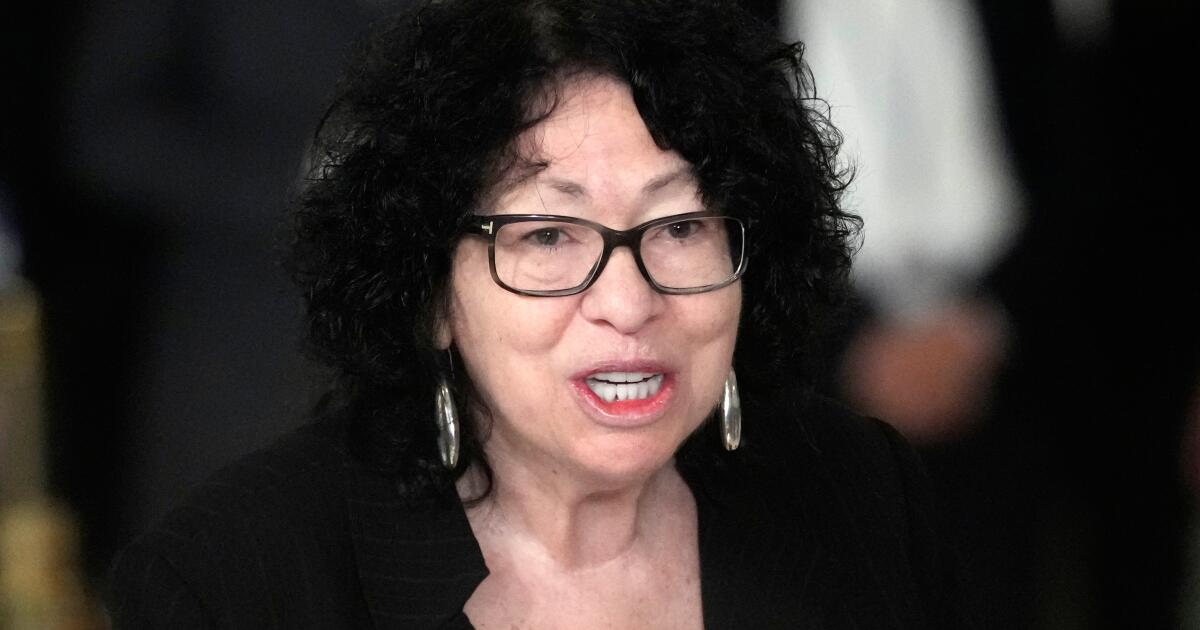
WASHINGTON — President Trump has notched a string of wins on the Supreme Court ’s emergency docket, in part because the conservative justices believe that blocking executive policies is a blow that can’t be easily fixed, Justice Sonia Sotomayor said Thursday.
The increase in emergency appeals by the Trump administration is “unprecedented in the court’s history,” she said in a speech at the University of Alabama School of Law.
The high court sided with the Trump administration in about two dozen decisions last year, often lifting the orders of lower court judges who found their policies were likely illegal on topics as diverse as immigration and steep federal funding cuts.
While designed to be short-term, those orders have largely allowed Trump to move ahead for now with key parts of his sweeping agenda.
The emergency docket, which is made up of appeals seeking quick intervention from the justices in cases that are still playing out in lower courts, is itself a source of disagreement among the justices. That spilled into public view when two other justices, liberal Ketanji Brown Jackson and conservative Brett M. Kavanaugh, publicly sparred over the emergency docket in an unusual exchange last month.
Sotomayor has disagreed with many of the decisions in Trump’s favor, but the conservatives who form the court’s majority often reason that blocking those policies — or laws passed by Congress — causes legal harm that can’t be easily fixed, she said. It’s a bar that’s tough for the other side to overcome, even for plaintiffs like immigrants who could be newly exposed to deportation or states where schools are losing teacher-training funding.
“If you start with the presumption that there is irreparable harm to one side, then you’re going to have more grants of emergency relief. Because the other side is going to have a much harder time,” she said. “It has changed the paradigm on the court.”
Her comments provided a window into the Supreme Court decisions that are often released with little explanation. While many emergency docket orders have gone Trump’s way, the court also struck down his sweeping tariffs, a central plank of his economic platform, after a longer process of full briefing and oral arguments.
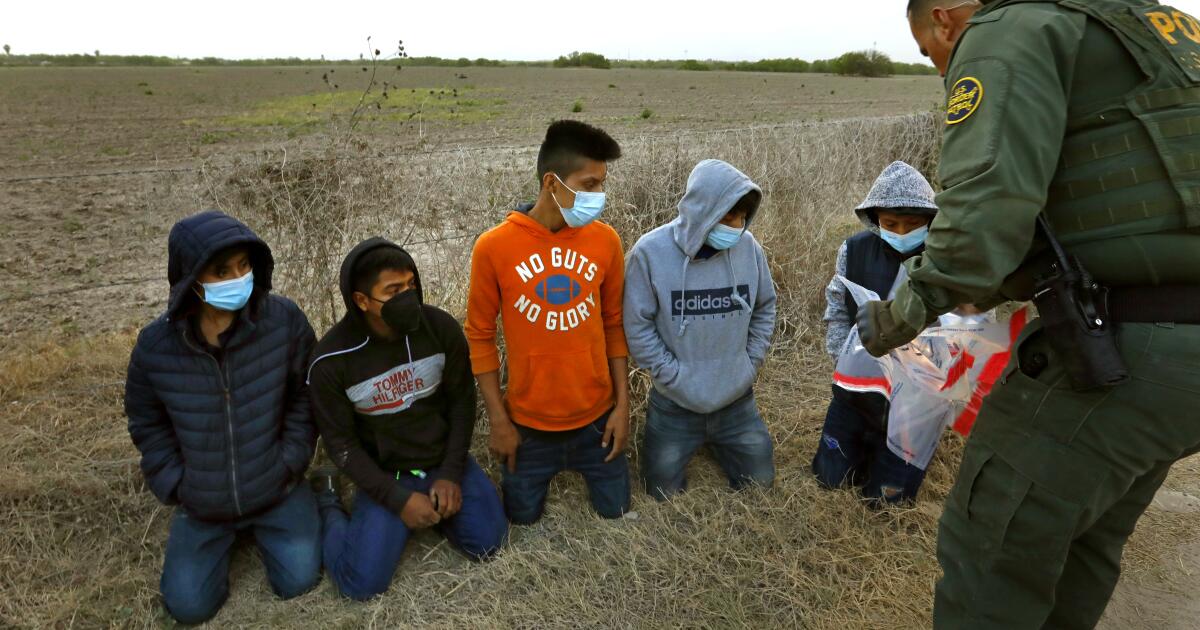
WASHINGTON — Last September, the Department of Homeland Security started advising unaccompanied immigrant children that they could either self-deport or expect to face long-term detention.
But a federal judge in Los Angeles on Mondayordered the government to stop using such “blatantly coercive” language, ruling that the new advisals, as they are known, violated a 40-year-old court order that bans immigration agents from pressuring unaccompanied children to give up asylum claims and leave the U.S.
According to court documents, the legal advisal was given to recently detained immigrant children. Unaccompanied children are those in the country without a parent or legal guardian.
The minors were told they had the option to return to their country, that doing so would result in no administrative consequences and that they still could apply for a visa in the future.
But the children also were told that if they chose to seek a hearing with an immigration judge or indicated that they were afraid to leave the U.S., they could expect to be held at a detention facility “for a prolonged period of time.”
Those who turned 18 while in custody would be turned over to Immigration and Customs Enforcement for deportation, they were told. The advisal, though generally passed on verbally, was written out in court documents by lawyers representing the immigrant children, which the government did not dispute.
“If your sponsor in the United States does not have legal immigration status, they will be subject to arrest and removal,” the advisals continued. “The sponsor may be subject to criminal prosecution for aiding your illegal entry.”
U.S. District Judge Michael W. Fitzgerald said that “such a threat disturbingly mirrors” the testimony of Jose Antonio Perez-Funez, a plaintiff in a 1980s class-action lawsuit challenging the tactics of immigration officers.
Perez-Funez, who was 16 when he was arrested near the Mexican border, testified in 1985 in Los Angeles federal court that he agreed to self-deport because federal officers said he would face lengthy detention if he didn’t return to El Salvador.
Perez-Funez’s case originally led the court to establish due process safeguards for immigrant children, giving them the right to speak with a relative or attorney before signing forms that waive their pursuit of legal protection.
“The Government was thus already on notice that such a statement delivered in this environment is precisely the kind of inappropriate persuasion the Injunction sought to prevent,” Fitzgerald wrote.
Fitzgerald, a judge in the Central District of California, also denied a request by the federal government to end the permanent court-mandated safeguards for immigrant children.
In response to a request for comment, U.S. Customs and Border Protection provided a statement, attributed to a spokesperson who wasn’t named, that the agency is following the law and protecting children. The agency said the advisal document explains to unaccompanied children their options available under federal law.
“Many unaccompanied minors are brought to the border by smugglers and face real risks of exploitation, which is why providing a clear, lawful advisal is essential,” the statement said. “It ensures they understand their rights and options — and for many who were trafficked or coerced, returning home to their family is the safest path.”
Unaccompanied children are first held by Homeland Security before being turned over to the Office of Refugee Resettlement, which is within the Department of Health and Human Services, for long-term housing. Federal law requires ORR to provide them with a legal consultation within 10 days.
“It is difficult to imagine a scenario more coercive than the one faced by [unaccompanied immigrant children] in the 72 hours before they are transferred into ORR custody, particularly for noncitizen children who likely do not know whether they possess any rights at all,” Fitzgerald wrote in his order.
In declarations to the court, children wrote that they felt threatened by the government’s advisals. One minor, identified as D.A.T.M., said the threats to prosecute their parents and of long-term detention caused them to sign voluntary departure papers.
Mark Rosenbaum, an attorney at the pro bono law firm Public Counsel, helped secure the 1986 court order. He said his legal team discovered Homeland Security had changed the advisals only after a government attorney notified him in November that the agency was going to seek to end the court-mandated safeguards.
“I consider this a war on children — the most vulnerable population,” he said.
The government has until Thursday to decide whether it will appeal the judge’s ruling. Regardless, Rosenbaum said, his goal is to establish more aggressive monitoring of unaccompanied children’s cases to ensure their rights aren’t violated again.
A few years ago, some were predicting the demise of Spanish-language television.
Most of the Latino population growth over two decades has come from U.S. births, outpacing the arrival of immigrants. The thinking was that because most U.S.-born Latinos speak English and can consume a wide array of media, Spanish-language TV would recede in relevance.
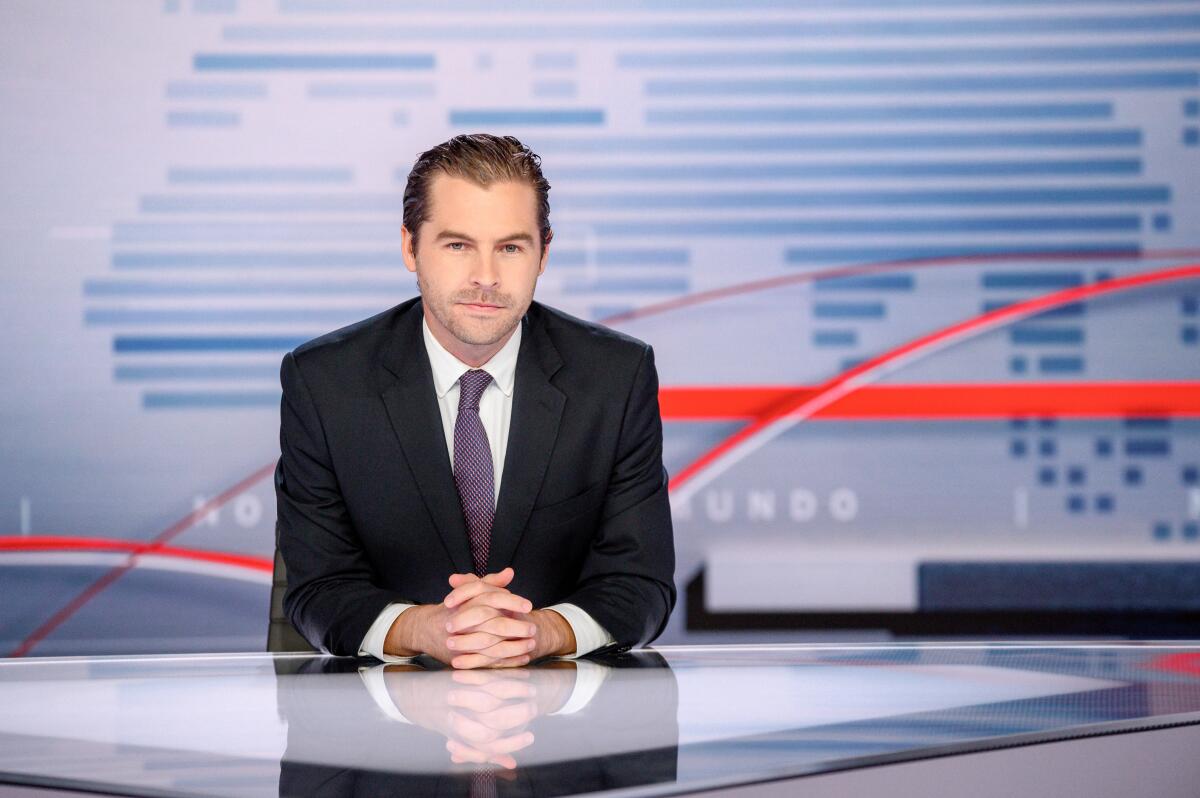
But Telemundo has defied such forecasts to become one of the nation’s hottest news outlets.
Last year, Telemundo increased its audience for its evening news, anchored by Julio Vaqueiro, by 11% over the previous year, according to Nielsen data. Its Los Angeles station, KVEA Channel 52, has surpassed entrenched giants Walt Disney Co.’s KABC and Univision’s KMEX, attracting more viewers for its local evening and late-night newscasts.
The Miami-based division has a strong social media presence. Its Telemundo Noticias (News) account boasts 16 million followers on TikTok, topping ABC News, CNN and Fox News.
Cultural and demographic shifts have helped fuel Telemundo’s rise. After more than a decade of immigration declines, border crossings surged during President Biden’s tenure — a tide that turned with President Trump’s return to the White House. Instead, Trump brought a torrent of significant news events, including immigration raids that reverberated through Latino communities.
“We are growing because we are telling the stories that are important to our audience,” Gemma Garcia, Telemundo’s executive vice president for news, said. “We are very audience-driven.”
When U.S. military forces seized Venezuela’s then-president Nicolás Maduro in January, Telemundo quickly flew its main news anchor, Vaqueiro, to report from Colombia, which borders Venezuela. The network interrupted its usual Sunday night fare for a news special that scored solid ratings.
The younger journalist brings a softer tone to his reports. He was promoted to Telemundo’s main news anchor in 2021 after several assignments, including working at KVEA in L.A. He loves stepping out from behind the anchor desk in Miami to cover big stories.
“We’re very focused on being out there and reporting on the ground,” Vaqueiro said in an interview. “Being close to our audience, that’s a big part of what we are doing at Noticias Telemundo.”
Another key to Telemundo’s momentum has been its commitment to the Spanish language.
Media companies a decade ago raced to engage young, bilingual Latinos by launching start-ups, including a joint venture between ABC News and Univision called Fusion that flopped.
“With Bad Bunny’s rise and the Super Bowl, it felt like a shift in values towards the Spanish language,” said Mark Hugo Lopez, Pew Research Center’s director of race and ethnicity research. “It has become a source of cultural pride … and it seems to be impacting the ways in which English-speaking Latinos also think about their identity.”
Bad Bunny performed the Super Bowl halftime show in Spanish in February.
(Eric Thayer / Los Angeles Times)
That increased affinity suggests that Spanish isn’t going away anytime soon.
“Our data has shown that Latinos say it’s important that Latinos in the future speak Spanish here in the United States,” Lopez said.
A slow build to a news leader
Telemundo’s rise was a slow build, coming nearly a quarter-century after NBC bought the network for nearly $2 billion.
Years of effort took root after NBCUniversal agreed in 2011 to spend big for the U.S. Spanish-language media rights to the FIFA World Cup, dethroning Univision, which had long televised the prestigious soccer event. This year, Telemundo is poised “to deliver the largest coverage in Spanish-language media history,” the network said in a statement.
It will provide live coverage for all 104 matches, including on the Telemundo and Peacock streaming apps.
NBCUniversal integrated its English and Spanish-language news units at its television stations. In Los Angeles, KVEA’s newsroom is in the same building on the Universal lot as KNBC-TV Channel 4. The same managers run both divisions.
“All of these things have evolved,” said Millie Carrasquillo, a Hispanic media consultant and former Telemundo research senior vice president. “It’s an alignment of the audiences, an alignment of how technology is evolving — and also the way that news is being delivered.”
Telemundo’s national newscast, anchored by Vaqueiro, averages 1.2 million viewers, its largest audience in years.
But audiences, particularly younger ones, are less likely to watch TV news, so network executives have tapped the potential of TikTok, Instagram and YouTube to boost their reach.
On TikTok, Telemundo reporters broadcast live from outside the U.S. Supreme Court last week as justices heard oral arguments on Trump’s push to end birthright citizenship for babies born to parents who are in the country unlawfully. Telemundo featured live coverage of the traditional Easter egg roll at “La Casa Blanca” (the White House) and frequent reports about NASA’s Artemis II mission, which scored millions of views.
“Radio and television hasn’t gone away,” said Mari Castañeda, University of Massachusetts Amherst’s Commonwealth Honors College dean. “But Telemundo has recognized that [cellphones] are where most of their audience is located and they leaned into that.”
Social media posts are easy to share, serving as a viral expansion of the network’s audience.
“Telemundo has emerged as a leader because it has modernized,” added Castañeda, a native of La Puente in Los Angeles County.
The U.S. Latino population nearly doubled between 2000 and 2024, rising from 35 million to 68 million, according to the Pew Research Center. Since the Great Recession, the growth has largely come from U.S. births, and the median age of U.S.-born Latinos is about 21.
The trend line bent during the Biden years as U.S. births roughly equaled the arrival of immigrants, Lopez said.
“Immigrants are still a very large part of the Latino story,” he said.
Noticias Telemundo anchor Julio Vaqueiro talks to a child living in a makeshift migrant camp along the Rio Grande near the Ciudad Juarez-El Paso border on Feb. 28, 2024.
(Telemundo)
‘This is a country we really love’
Telemundo’s brightest star — Vaqueiro — was born in San Juan del Río, north of Mexico City and came to the U.S. when he was 26 with his wife, who was also born in Mexico.
“We have three American kids,” Vaqueiro said. “All we know as a family is the U.S. This is a country that we really love and we’re grateful to it.”
In many ways, Vaqueiro’s journey is the story of U.S. Latinos.
“He’s Mexican but he’s also a U.S. Latino and he understands the context and issues that communities are feeling,” said Castañeda. “There’s a sense of authenticity and care that comes through.”
Vaqueiro wrote a book, “Río Bravo. México, Estados Unidos y el regreso de Trump, (Rio Grande: Mexico, the United States, and the Return of Trump),” to explore the political mood during a period of tumult and often tense relations between the countries.
Telemundo strives to stay out of the political fray, Garcia said.
“We don’t think about politics,” Garcia said. “We cover what is happening within our community, and now more than ever, we are on top of our community’s stories.”
Vaqueiro added: “We have to be very careful reporting the facts and verifying every information that comes to us.”
Political divisions course through Latino communities, including in South Florida where Telemundo is headquartered.
“We’ve always known that Latinos are not a monolith,” Vaqueiro said. “This is a complex community that is constantly growing. It’s diverse: geographically, culturally and generationally.”
Interest in news has swelled since Trump began his second term. Ratings are also up for ABC’s “World News Tonight with David Muir,” which is drawing 8.4 million viewers per telecast this season, outpacing NBC, Fox News and CBS.
In national news, Univision still tops Telemundo. In local news, Telemundo’s KVEA has continued to build on its lead this year, although KMEX remains competitive and Disney’s KABC remains dominant among English-language stations.
“I just hope that we meet the moment,” Vaquerio said. “This is a critical moment for Latinos who are navigating very difficult times under a lot of pressure.”
He has another goal, too.
“I want to lift Latino voices who are moving forward — opening new businesses and graduating from college,” Vaqueiro said. “I want to talk about the positive side of this community that brings huge contributions to the United States.”
A federal judge on Thursday dismissed a lawsuit from the U.S. Department of Justice seeking Massachusetts’ state voter rolls, marking the latest setback in a wide-ranging effort by the Trump administration to collect detailed data on the nation’s voters.
The ruling from U.S. District Court Judge Leo Sorokin marks at least the fifth time a judge has rejected similar attempts by the Justice Department. Sorokin, an appointee of former President Barack Obama, said the U.S. attorney general’s office did not take the necessary steps required to access voter rolls, as outlined in federal law.
“Put simply, the statute requires a statement of why the Attorney General demands production of the requested records,” Sorokin wrote. That statement has to be factual, “not just a conceivable or possible basis.”
In an emailed response, the Justice Department said it “does not comment on ongoing litigation.”
It has said it’s seeking the voter data as part of an effort to ensure election security, but Democratic and Republican officials in several states have refused, saying the demand violates state and federal privacy laws. Some have raised concerns that federal officials will use the sensitive data for other purposes, such as searching for potential noncitizens.
During a hearing last month in Rhode Island, a Justice Department attorney told a federal judge that the department was seeking unredacted voter roll information so it could be shared with the Department of Homeland Security to check citizenship status. Homeland Security over the past year has beefed up the Systematic Alien Verification for Entitlements, or SAVE, program, for just this purpose.
“Our intention is to run this against the DHS SAVE database,” Department of Justice attorney Eric Neff told U.S. District Judge Mary McElroy during a March 26 hearing challenging the federal government’s authority to access the voter data.
The Justice Department has sued at least 30 states and the District of Columbia seeking to force release of the data, which includes dates of birth, addresses, driver’s license numbers and partial Social Security numbers.
At least 12 states have either provided or promised to provide their detailed voter registration lists to the department, according to the Brennan Center: Alaska, Arkansas, Indiana, Louisiana, Mississippi, Nebraska, Ohio, Oklahoma, South Dakota, Tennessee, Texas and Wyoming.
In the Massachusetts case, the the judge found that the Justice Department failed to follow the requirements for demanding the voter rolls set by a 1960 civil rights law.
That law, enacted as part of an effort to end racial discrimination in elections, says state voter records must be made available for inspection by the U.S. attorney general if the office includes a statement outlining why the information is being demanded and how it will be used.
The department’s letter demanding Massachusetts’ voter data made no reference to the Civil Rights Act and didn’t cite any concerns about the way Massachusetts complied with federal voting laws, the judge said. Most importantly, it didn’t include any factual basis for the demand, Sorokin wrote.
In court documents, the Justice Department said it was demanding the data to check for “Massachusetts’ possible lack of compliance” with federal voter registration list requirements. It also said the Civil Rights Act was designed to be an investigatory tool to identify federal election law violations and argued that the U.S. attorney general can’t be required to prove a violation before seeking evidence of one.
“These arguments miss the point,” Sorokin wrote.
Massachusetts Atty. Gen. Andrea Joy Campbell called the ruling a decisive win for voters and the rule of law.
“The privacy of our voters is not up for negotiation, and I will continue to defend the integrity and security of our elections from the Trump Administration’s cruel and harmful agenda,” she said in a news release.
Four federal judges in other states have dismissed similar lawsuits from the Department of Justice.
A federal judge in Michigan found the laws cited by the Justice Department do not require the disclosure of the voter records sought by the federal government. A federal judge in California said the administration “may not unilaterally usurp the authority over elections,” which the Constitution gives to the states and Congress. A federal judge in Oregon said the federal government was not entitled to unredacted voter registration lists containing sensitive data.
A federal judge in Georgia dismissed a Justice Department lawsuit because he found it had been filed in the wrong city. The federal government then refiled the lawsuit in the city specified by the judge; that case is ongoing.
The Justice Department has appealed the Oregon, California and Michigan dismissals.
Boone writes for the Associated Press. Boone reported from Boise, Idaho. AP writer Kimberlee Kruesi in Providence, R.I., contributed to this report.
SACRAMENTO — An attorney for Rep. Eric Swalwell, a leading Democratic candidate for California governor, on Thursday sent a cease and desist letter to an unknown individual demanding that they stop accusing the congressman of sexual assault.
Swalwell’s attorney Elias Dabaie of the law firm Dabaie Kelley, in Los Angeles, confirmed Friday that he sent the cease and desist letter, which tells the recipient that they could be sued for defamation. A copy of the letter was posted online by a social media influencer on Friday, and Dabaie confirmed it was authentic.
Swalwell (D-Dublin) and his representatives earlier this week denied allegations made by social media influencers and repeated by political insiders in recent weeks that he behaved inappropriately toward young staffers and others.
Dabaie’s letter sent Thursday states that it “has come to our attention that you have made false statements accusing Mr. Swalwell of sexual assault and non-consensual sexual encounters…”
“We write to demand that you immediately and permanently cease and desist from continuing your wrongful conduct, including by stopping any further publication of such information or allowing it to be disseminated in any form, whether oral, written, electronic or otherwise,” the letter stated.
Dabaie confirmed to The Times that he sent the letter via text. He declined to say whether other cease and desist letters had been sent.
“I can tell you that there have been multiple baseless allegations made against the Congressman and we are attacking them on all fronts,” he said.
A spokesperson for Swalwell’s campaign didn’t immediately respond to a request for comment.
Cheyenne Hunt, a Laguna Hills attorney and executive director of a progressive advocacy group who has said she is helping organize a group of women who allege inappropriate behavior toward Swalwell, posted a screenshot of Dabaie’s letter online on Friday.
“This is the first page of the cease and desist letter from Swalwell’s team — it has has been shared with permission from the recipient,” she wrote on social media.
The name of the individual who received the letter was redacted.
Hunt told The Times on Friday that she was aware of two individuals who received cease and desist letters from Swalwell’s team.
Swalwell earlier in the week denied any inappropriate behavior, including allegations that his office required interns to sign nondisclosure agreements. “It’s false,” he told reporters.
Swalwell said he never behaved inappropriately with female staff members or had a sexual relationship with a staff member or an intern.
NEW YORK — President Trump’s administration this week acknowledged it made a significant error in figures it used to help justify a fraud probe into New York’s Medicaid program, a glaring mistake that undercuts a federal campaign to tackle waste, mostly in Democratic-led states.
The error, which the administration admitted first to the Associated Press, prompted health analysts to question how many of the Republican administration’s sweeping anti-fraud efforts around the country were based on faulty findings. One of a few mischaracterizations the administration made about New York’s Medicaid program, the error also reflected a common criticism that’s been made of Trump’s second administration — that it tends to attack first and confirm the facts later.
“These numbers could have been cleared up in a phone call, so it’s really slapdash,” said Fiscal Policy Institute senior health policy adviser Michael Kinnucan, whose recent analysis called attention to the Trump administration’s inaccurate claim.
The mistake appeared in comments made last month by Dr. Mehmet Oz, the administrator of the Centers for Medicare & Medicaid Services, or CMS, in a social media video and in a letter to New York’s Democratic governor announcing the fraud investigation.
Oz claimed that New York’s Medicaid program last year provided some 5 million people with personal care services, which assist people in need with basic activities like bathing, grooming and meal preparation. That would add up to nearly three-fourths of the state’s 6.8 million Medicaid enrollees.
“That level of utilization is unheard of,” Oz said in the video, adding in his post that New York needs to “come clean about its Medicaid program.”
But the real number of New Yorkers who used those services last year was about 450,000, or between 6% and 7% of total enrollees, CMS spokesman Chris Krepich told the AP this week. He said the agency misidentified New York’s approach to applying billing codes and had since refined its methodology.
“CMS is committed to ensuring its analyses fully reflect state-specific billing practices and will continue to work closely with New York to validate data and strengthen program integrity oversight,” he said in an emailed statement.
Krepich said the probe was ongoing as the administration still has concerns with New York’s oversight of personal care services and the Medicaid program and is reviewing the state’s response to last month’s letter. CMS had raised other flags about New York’s program, including that it spends more per beneficiary and per resident than the average state, has high personal care spending and employs so many personal care aides that the job category is now the largest in the state.
Health analysts said the state’s high spending reflected both high costs for services in New York and a policy choice to provide robust at-home care. Cadence Acquaviva, senior public information officer for the New York Department of Health, called Oz’s initial mischaracterizations “a targeted attempt to obscure the facts.”
“New York State remains committed to protecting and preserving vital Medicaid programs that deliver high-quality services to New Yorkers who depend on them,” she said.
In a statement, a spokesperson for Gov. Kathy Hochul said, “The initial claim by CMS was patently false, and we are glad they now admit it.”
“Governor Hochul has been clear that New York has zero tolerance for waste, fraud and abuse in Medicaid, or any other state programs, and will continue her efforts to root out bad actors, protect taxpayer dollars, and safeguard the critical programs that New Yorkers rely on,” spokesperson Nicolette Simmonds said.
New York probe is part of a larger crackdown
The Trump administration’s investigation into New York comes as it has similarly approached at least four other states, including California, Florida, Maine and Minnesota, with investigations into potential healthcare fraud. The anti-fraud effort appears to be expanding as voters in the upcoming midterm elections say they’re concerned about affordability.
Trump last month signed an executive order to create an anti-fraud task force across federal benefit programs led by Vice President JD Vance. As part of that project, Vance announced the administration would temporarily halt $243 million in Medicaid funding to Minnesota over fraud concerns, a move over which the state has since sued.
Kinnucan, the analyst with expertise in New York’s Medicaid program, said he’s concerned that the Trump administration’s adversarial approach to targeting fraud in some states “politicizes” a conversation that should be a team effort.
“We want to think collaboratively among all the stakeholders in the program about how we can actually fix it,” Kinnucan said. “We don’t want to have fraud be this political football.”
Oz made other claims New York advocates say are inaccurate
In his video, Oz made at least two other claims about New York that Medicaid advocates and beneficiaries say distorted the facts.
In one instance, he said the state recently made its screening for personal care eligibility “more lenient by allowing problems like being ‘easily distracted’ to qualify for a personal care assistant.”
Rebecca Antar, director of the health law unit at the Legal Aid Society, said the opposite was true — that the state in a rule change that went into effect last September instead made its program requirements more stringent. She said being “easily distracted” doesn’t appear anywhere among them.
Krepich said the administrator was referring to whether New York’s standard for personal care services was “sufficiently rigorous.”
“When standards are overly permissive, it risks diverting resources away from individuals with the highest levels of need and placing long-term pressure on the sustainability of the Medicaid program,” he said.
Oz in the video also referred to personal care services as “something that our families would normally do for us, like carrying groceries.”
Kathleen Downes, a 33-year-old who has quadriplegic cerebral palsy and uses personal care services in New York’s Nassau County, said she was offended by the notion that all Medicaid beneficiaries have family members who are willing and able to help.
Downes, who has been disabled since birth and needs personal care help for things like showering, using the toilet and eating, said she hires both her mother and outside assistants for personal care services, so her aging mother doesn’t have to take on those tasks full time. She said her mother did the labor unpaid for years, precluding her from pursuing other career opportunities.
“He’s assuming that everybody wants to and can just do it for free forever,” Downes said. “And that’s not feasible for a lot of people.”
Swenson writes for the Associated Press. AP writer Anthony Izaguirre contributed to this report.
WASHINGTON — Former Vice President Kamala Harris said Friday she was considering running for president in 2028, offering the clearest signal yet that she could seek to lead Democrats back to the White House.
“I might, I might,” she told an audience in New York. “I’m thinking about it.”
Harris was asked about her plans by the Rev. Al Sharpton during a conversation at a convening of his civil rights organization National Action Network, where several other likely Democratic hopefuls also were appearing this week. Some in Harris’ audience chanted “Run again!” before Sharpton asked whether she might do so.
“I served for four years being a heartbeat away from the presidency of the United States,” Harris said. “I know what the job is and I know what it requires.”
Harris’ loss to President Trump in 2024 was gutting for Democrats, who have faced persistent questions about the party’s direction and what type of candidate would be best positioned to retake the presidency.
Democrats have notched some wins against Republicans in recent state-level races as Trump’s popularity has declined and have set their sights on gains in this year’s midterm elections. Even if the party’s popularity rises, however, the 2028 race likely will be a tooth-and-nail fight as the country determines who will succeed Trump.
“Democrats can win in the midterm through protest votes against [Trump’s] direction of the country, but they’ll clearly need a vision for 2028 and beyond to win the presidency,” said Thad Kousser, a political science professor at UC San Diego.
The number of Democrats vying to put forth that vision is set to be high. Other potential 2028 candidates, including Gov. JB Pritzker of Illinois, Gov. Josh Shapiro of Pennsylvania, Sen. Mark Kelly of Arizona and former Transportation Secretary Pete Buttigieg, also spoke or were scheduled to speak with Sharpton before the conference ends Saturday.
California Gov. Gavin Newsom, who is considering a presidential run, was not on the convention schedule. A recent poll found that Newsom would have a wide lead over Harris among Democratic voters in California for the party’s next nominee.
Whether Harris would seek the nation’s highest office again after a fast, truncated 2024 campaign following former President Biden’s withdrawal from the race has been the subject of speculation for months.
She announced in July that she would not run for California governor — leaving the door open for a presidential run or something else — then published a book in September rehashing her campaign.
Voters’ familiarity with Harris gives her both a strength and a liability — her name recognition and experience have helped put her at the top of recent national polls, Kousser said, but voters often turn to fresher faces by the time primary elections come around. Her loss to Trump also could cause voters to balk ahead of an election that will be largely a referendum on his leadership.
At a time when Democrats are in particular need of a bold vision, that ultimately could give Harris a challenge, Democratic strategist Joe Caiazzo said.
“Elections are about the future, and I think it’s really tough for people who are part of our past to make that case. There’s a yearning for something fresh, new, exciting,” he said.
On Friday, Harris said she was considering who could do the best job for the American people.
NEW YORK — Former New York City Mayor Eric Adams announced Friday that he had become a citizen of Albania, putting him one step closer to his oft-repeated dream of leaving politics behind for a life abroad.
Adams, a Democrat, received the honorary citizenship “at his request,” according to an official decree from the country’s president, Bajram Begaj.
The news was first reported in the Albanian press and confirmed by a spokesperson for Adams, who said the ex-mayor had “long been a friend and ally of the Albanian-American community.”
“The decision by the Republic of Albania to grant Mayor Adams citizenship reflects that enduring relationship and mutual respect,” the spokesperson, Todd Shapiro, said in a text message, adding that the recognition “further strengthens the bond between New York and Albania.”
Adams, who once described himself as an “international mayor,” has previously expressed an affinity for the small Balkan nation. His adult son lived in the country while competing in Albania’s version of “American Idol” and Adams traveled there himself in October — one of several international trips taken in his final months in office.
The purpose, he said at the time, was “to say hello to a friend and learn from a friend and build a relationship with the friendship that would not allow our oceans or seas to divide us.”
It wasn’t immediately clear what, if anything, Adams planned to do with his new citizenship. But he has previously expressed a desire to move far from his hometown of New York City.
“When I retire from government, I’m going to live in Baku,” Adams, then Brooklyn borough president, said at an event honoring the Azerbaijan community in 2018. A few years later, in an interview with a Jewish publication, Adams said he would like to retire in the Israeli-occupied Golan Heights.
As mayor, Adams’ penchant for international trips to Turkey prompted a federal indictment focused, in part, on allegations that he accepted improper travel benefits from foreign nationals.
Adams denied the allegations, and the case was later ordered dropped by President Trump’s Justice Department. Adams later met with Trump administration officials about the possibility of taking an ambassadorship, which did not materialize.
Shortly after dropping his ailing bid for reelection, Adams embarked on a four-day trip to Albania, meeting with the country’s Prime Minister Edi Rama and members of his Cabinet, along with local business leaders. The trip was paid for in part by the Albanian government.
Since leaving office, Adams has been spotted in Dubai and the Democratic Republic of Congo, though his day-to-day activities remain a source of some speculation.
In January, he launched a cryptocurrency coin that he said would beat back antisemitism and “anti-Americanism,” but it drew scrutiny after losing millions of dollars in value.
Living outside the community they want to represent can be a handicap for political candidates, but it’s not likely to be a problem for Los Angeles mayoral hopeful Spencer Pratt, who until recently was living in Carpinteria in Santa Barbara County, analysts say.
That’s because Pratt’s home burned in the January 2025 Palisades fire, making him a sympathetic figure among many voters — especially those living in his Westside base, they say.
“I don’t think this is going to be electorally consequential,” said Zev Yaroslavsky, a former Los Angeles County supervisor and L.A. City Council member who now runs the UCLA Luskin School of Public Affairs. “He’s a victim of the Palisades fire that doesn’t have a home to live in because it burned down.”
Pratt filed to run for mayor in February and was in second place behind Mayor Karen Bass in a recent poll by the Luskin school. He was certified by the Los Angeles city clerk on March 2 as one of 14 candidates in the June 2 primary election.
While some observers have raised questions about his eligibility, a state memorandum following the fires said that voters who were temporarily displaced from their homes can use their prior address as their permanent residence as long as they “intend to return” in the future.
Los Angeles mayoral candidate Spencer Pratt currently resides in a private community in Carpinteria, Calif.
(Myung J. Chun / Los Angeles Times)
Michael Sanchez, a spokesperson for the Los Angeles County Registrar-Recorder/County Clerk, said this also applies to candidates.
“In situations where a candidate has been temporarily displaced (such as the 2025 wildfires), their eligibility to run for office is not impacted, provided they maintain domicile in their district,” Sanchez said in a statement.
He explained that domicile is determined by a person’s primary residence and their intent to return to that residence. “Temporary relocation during rebuilding or recovery does not, by itself, change a person’s domicile.”
The Times asked the L.A. city clerk’s office last week about Pratt’s residency and eligibility.
“We cannot comment on the specifics of a candidate’s address due to confidentiality. Any matter concerning a candidate’s eligibility or residency, such as this situation, can be formally challenged through the court,” said Josue Marcus, a spokesperson for the city clerk’s office.
Any potential challenge to Pratt’s eligibility based on residency would turn on the question of whether he had intent to return, said Jessica Levinson, a Loyola Marymount University law professor. “Those are tricky inquiries because it depends on someone’s state of mind,” she said.
Pratt and his campaign aides didn’t respond to requests for comment. Pratt released a video Monday, following inquiries from The Times, defending his decision to move to Carpinteria but saying he now intends to live in a trailer placed on his burned-out lot in Pacific Palisades.
The city of Los Angeles sprawls across roughly 500 square miles, creating logistical hurdles if nothing else for a candidate seeking citywide office from a remote location, noted Democratic political consultant Mike Trujillo.
“Anyone that has done the drive from San Pedro to Sylmar knows that L.A. is a big place,” said Trujillo, who isn’t affiliated with any of the candidates in the June 2 mayoral primary. “To add another hour and a half to the drive is not advantageous if you’re trying to campaign in every corner of the city.”
Pratt, a former reality TV star, has millions of followers on social media, but Trujillo said that Pratt will need to show a strong presence in the community to wage a successful campaign.
Pratt is a Republican running in a Democrat-majority city. Developer Geoffrey H. Palmer, a major campaign donor to President Trump, plans to host a reception for Pratt at his Beverly Hills home April 28, according to a document the Pratt campaign filed with the city Ethics Commission.
The UCLA Luskin poll released this month showed Pratt with the support of 11% of likely voters, behind Bass with 25% and ahead of City Council member Nithya Raman with 9%.
Mayoral candidate Adam Miller, who polled at 3% in the survey, said Pratt’s party affiliation is his biggest hurdle to winning the mayoral race.
“I sympathize with Spencer for losing his home and feeling outrage toward the city, but he is not a viable candidate. It doesn’t matter where he lives, a Republican hasn’t been elected mayor in 30 years in this city, and he isn’t going to change that now,” said Miller, a tech executive.
Others say party affiliation is less of an issue.
“This is a nonpartisan race,” said Roxanne Hoge, the chair of the Los Angeles County Republican Party. “There’s no letter accompanying anyone’s name. … I personally support him because he’s an intelligent alternative.”
Some think Pratt will also hold appeal for some Democratic voters.
“There are people I speak to who I know to be Democrats who really, really like him,” said Maryam Zar, who heads the Palisades Recovery Coalition. “To the extent that people are disappointed in this recovery, they pin their hopes on Spencer. That’s not a bad place for him to be.”
MIAMI — President Trump shared video of a deadly attack allegedly by a Haitian immigrant accused of bludgeoning a woman with a hammer at a Florida gas station, portraying the killing as justification for his administration’s mass deportation agenda.
Rolbert Joachin, 40, was arrested and charged with killing a woman on April 2 in Fort Myers, about 160 miles northwest of Miami. Authorities said the man was from Haiti and arrived in the U.S. in 2022. The woman who was killed was identified as a 51-year-old immigrant from Bangladesh and a mother of two adult daughters.
Trump, who posted the video late Thursday to his Truth Social account, has often sought to portray immigrants as bringing crime to the U.S., and the video emerging from the Florida attack presented him with a new, particularly graphic opportunity to do so. Trump also often paints Democrats and his predecessor, former President Joe Biden, as allowing in immigrants who posed a criminal or national security threat to the U.S.
Critics say the president unjustly paints all immigrants as criminals in an effort to bolster his immigration agenda, when studies have found that people living in the U.S. illegally are less likely than native-born Americans to have been arrested for violent, drug and property crimes.
“The video of her brutal slaying is one of the most vicious things you will ever see,” Trump said in his post, describing the man as an “animal.”
Graphic video captured woman’s killing
The woman who was killed was working as a clerk at the convenience store of the gas station, according to court documents. The killing happened outside the store and the man was arrested the same day.
In security camera footage of her killing posted on the Department of Homeland Security’s X feed, the man can be seen repeatedly slamming the hammer into a black vehicle parked in front of the gas station. Eventually a woman in black pants and a pink shirt comes out and appears to question him.
The man, wearing a yellow shirt and black shorts, walks up to the woman and immediately swings the hammer at her head. The woman falls down on the sidewalk in front of the gas station’s front doors. The man attacks the woman with the hammer multiple times before stepping over her unmoving body and walking away, out of the frame of the camera.
The victim was later identified in a police report as Nilufa Easmin, 51. A GoFundMe started by Samir Bahadur Syed, the President of the Bangladesh Association of Southwest Florida, described her as a “devoted mother who worked tirelessly to provide for her two young daughters.”
Syed said that Easmin arrived in the United States about three decades ago and resided in Miami and Palm Beach before moving to Florida’s west coast. She was a single mother, and her two daughters — one 23 years old and the other about 26 — were born in the U.S., Syed told the Associated Press.
He added that Easmin had been working at the convenience store for nearly five months and that she also held another job.
Fort Myers police said they responded to a report of a woman being hit with a hammer at a Chevron gas station. When officers arrived they found a woman on the ground with blood around her head and multiple cuts.
Officers later located Joachin walking on the street and took him into custody. The police said he has confessed. He was charged with murder and property damage and appeared in court on Wednesday. His arraignment is set for May 4.
An email message sent to the public defender listed in court records as Joachin’s lawyer seeking comment was not immediately returned.
Trump blamed Biden for granting the man temporary protection to stay in the U.S.
Kelly Walker, acting field office director for ICE enforcement and removal operations for the Miami field office, said during a news conference Friday that Joachin arrived in a “water vessel” near Key West, Fla., in August 2022. He was arrested and given Temporary Protected Status in 2023. That status was revoked this week, Walker said.
The Trump administration has harshly criticized the use of Temporary Protected Status, or TPS, which can be granted by an administration to citizens of a country going through turmoil or strife. Immigrants who qualify are allowed to stay in the U.S. and work for a temporary period, although Republican critics contend that the Biden administration misused its TPS authorities to broadly allow hundreds of thousands of people to stay in the country.
There are several lawsuits at the federal courts challenging Trump’s efforts to terminate TPS for more than one million people, including 350,000 Haitians. In March, a federal appeals court sided with a lower judge’s ruling against the end of temporary status for Haiti and the U.S. Supreme Court will hear arguments on April 29.
The Department of Homeland Security and the Trump administration have often highlighted crimes committed by immigrants and created a website where one can look up people arrested by Immigration and Customs Enforcement and the crimes they’ve committed in the U.S.
The administration often highlights “Angel Families” who have lost family members to crimes committed by immigrants.
On Thursday, ICE held an event marking the one-year anniversary of the reopening of an office dedicated to assisting those families, including emotional testimony from some of the surviving family members.
Salomon, Bellisle and Santana write for the Associated Press. Bellisle reported from Seattle and Santana from Washington.
Rep. Eric Swalwell, a Democratic front-runner in the hotly contested California governor’s race, was accused of sexual assault and misconduct by a former staff member and other women, according to reports published on Friday.
The woman who worked for the Northern California congressman said she had a consensual relationship at times, but that he sexually assaulted her twice when she was too inebriated to consent, according to a report by the San Francisco Chronicle. Three other woman also have accused Swalwell of sexual misconduct, including receiving unsolicited nude photos from the Democrat, according to CNN.
The allegations against Swalwell has his campaign teetering on collapse, with powerful labor organizations and other major supporters pulling their endorsements and dropping political ads promoting the once-promising candidate. U.S. Sen. Adam Schiff, one of many prominent Democrats who supported Swalwell, and others have called on him to drop out of the race.
Swalwell had been gaining traction in the crowded field, and the controversy completely upends the race just as voters are starting to pay attention.
“It’s like a bomb went off,” said Mike Madrid, a Republican strategist who runs the research nonprofit Latino Working Class Project.
Swalwell’s staff member was 21 years old when she started working for the congressman, who is nearly two decades her senior, and said she did not report the incidents to police because of fears she would not be believed.
“I have no skin in the game of who becomes governor of California, but I feel people have a right to know whether the person who leads a state that is a safe haven for so many women actually treats women with dignity and will protect their rights,” the woman, who was not identified because she is the alleged victim of sexual assault, told the Chronicle. “No one protected me from him, and so I have to protect the other young women like me who aspire to work in this field and he could prey upon.”
Swalwell on Friday denied the accusations.
“These allegations are false and come on the eve of an election against the front-runner for governor,” he said in a statement. “For nearly 20 years, I have served the public — as a prosecutor and a congressman and have always protected women. I will defend myself with the facts and where necessary bring legal action. My focus in the coming days is to be with my wife and children and defend our decades of service against these lies.”
State Supt. Tony Thurmond and San José Mayor Matt Mahan, other Democrats running for governor, immediately called on Swalwell to drop out of the race. Multiple staff members working for Swalwell’s campaign have resigned, according to a source close to the candidate who was not authorized to speak about the matter. .
Allegations of inappropriate behavior by the congressman have been circulating on social media and in political circles for weeks. On Thursday, an attorney representing Swalwell sent a cease-and-desist letter to at least one person demanding that they stop accusing the congressman of sexual assault.
Two days earlier, the congressman denounced online claims that he had inappropriate relationships with young congressional staff members.
“It’s false,” he told reporters after a town hall in Sacramento, saying he had never behaved inappropriately with female staff members or had a sexual relationship with a staff member or an intern, and denied allegations that his staff members were asked to sign nondisclosure agreements or entered into legal settlements.
In 2025, another woman said after drinking with Swalwell, she ended up in his hotel room without recollection of how she got there and that her memory of what happened is “a blur,” according to CNN. Two other women told the cable network’s reporters that the congressman sent them unsolicited photos of his penis and other sexual messages on Snapchat.
The allegations come at a pivotal time in the race to replace termed-out Gov. Gavin Newsom. The primary is June 2, but ballots start landing in voters’ mailboxes in less than a month.
The race to lead the nation’s largest state remains up for grabs, with eight prominent Democrats and two top Republicans jockeying to finish in first or second place in the primary and advance to the November election.
Swalwell, 45, is among the leading Democrats with the support of 13% of likely voters in a recent UC Berkeley poll co-sponsored by the Los Angeles Times. That places him tied for first place among Democrats with former Orange County Rep. Katie Porter, with billionaire Tom Steyer not far behind.
Swalwell has won the support of powerful unions, including the California Teachers Assn., along with Schiff (D-Calif.) and many of his Democratic colleagues in Congress.
CTA President David Goldberg called the allegations “incredibly disturbing and unacceptable.”
“We are immediately suspending our support,” he said. “Our elected board will be meeting as soon as possible to follow our union’s democratic process to determine next steps.”
Rusty Hicks, the chairman of the California Democratic Party, said victims must be believed and also reiterated his call for Democratic candidates to gauge their viability.
“The allegations against Congressmember Swalwell are deeply disturbing,” he said in a statement. “Any person engaged in misconduct must take responsibility and be held accountable for their actions — including a Member of Congress and candidate for Governor. Finally, my call for all — repeat, all — candidates for Governor to ‘honestly assess the viability of their candidacy and campaign’ still stands. In fact, that call is more important now than ever before.”
The woman told the Chronicle that she was hired in 2019 to work in Swalwell’s Castro Valley district office when she was 21. He quickly began sending her messages and then nude pictures on Snapchat.
In September of that year, she said she had drinks with the congressman, blacked out and could feel the effects of intercourse when she woke up naked in Swalwell’s hotel bed, according to the report. In 2024, when she no longer worked for Swalwell, she said she attended a charity event honoring the congressman and met him for drinks afterward. She was intoxicated, but recalled Swalwell forcing himself upon her, and pushing him away and saying, “No,” according to the Chronicle.
The Chronicle corroborated her report with texts she sent a friend at the time and interviews with the friend and the woman’s then-boyfriend. The Chronicle’s reporters also reviewed medical records about a pregnancy and tests for sexually transmitted diseases a week after the alleged assault. She told them she had kept quiet about the alleged assaults because of fears about professional and personal repercussions.
Concern began brewing among Democrats before the allegations were published.
Cheyenne Hunt, a Laguna Hills attorney and executive director of a progressive advocacy group, and social media influencer Arielle Fodor, known online as Mrs. Frazzled, are among those publicizing the allegations online. Republican Rep. Anna Paulina Luna of Florida, who has sparred with Swalwell in the past, has amplified the allegations on social media as well.
The Times has not independently corroborated reports of sexual misconduct.
Many politicians have survived serious allegations of sexual misconduct, including President Trump, who was accused of rape before winning the White House in 2016.
Others have seen a swift reckoning. In the hours and days after the late farmworkers rights leader César Chávez was accused of sexual abuse, his name and image were stripped from schools, streets and murals.
Two recent California governors have been accused of sexual impropriety; former Gov. Arnold Schwarzenegger admitted to behaving improperly during his movie career and Gov. Gavin Newsom acknowledged an affair with a married staffer while mayor of San Francisco.
Swalwell, a former prosecutor, is married and has three children. The Iowa native briefly ran for president in 2020. On Thursday, he canceled a town hall in Palm Desert, reportedly because he was sick.
He has previously spoken out against sexual misconduct, most recently in support of women who told the New York Times that they were assaulted by Chávez.
“The women who have come forward are carrying years of pain. Speaking about that takes real courage,” Swalwell wrote in a tweet last month. “Ana Murguia, Debra Rojas and Dolores Huerta are speaking with clarity and strength. I stand with them and condemn all instances of sexual assault.”
The congressman also defended women who accused Brett Kavanaugh, then a nominee to serve on the U.S. Supreme Court, of sexual misconduct in 2018.
“The more and more cases that are separate and independent that look the same, pretty soon a prosecutor starts to say to a jury … that the arrows are pointing in the same directions and what are the chances that three or four women independently, who never met each other, would have similar experiences with one person,” he said on MSNOW’s Ari Melber in September 2018 amid Kavanaugh’s confirmation hearings.
In Congress, Swalwell has been a prominent critic of President Trump, serving as a manager of the second impeachment of the president and frequently blistering Trump on cable news shows.
In late March, the Washington Post reported that FBI Director Kash Patel may release documents about a decade-old investigation about Swalwell’s connections with a suspected Chinese spy. Swalwell cut off ties with Christine Fang, or Fang Fang, in 2015 after intelligence officials warned him and other members of Congress about Chinese efforts to infiltrate legislators’ offices. Swalwell was not accused of impropriety.
After news of the potential release of the files broke, Swalwell accused Trump of trying to sway the gubernatorial election and weaponizing the federal government against his political enemies.
Swalwell’s attorneys filed a cease-and-desist letter with Patel and the FBI. No documents have been released as of Friday.
He was previously accused of mortgage fraud by Federal Housing Finance Agency Director Bill Pulte. Swalwell sued Pulte last year but dropped the suit this month.
In the gubernatorial race, Swalwell has faced criticism from fellow Democrat Tom Steyer that he was ineligible to run for governor because he did not truly live in California. Earlier this year, a Sacramento County judge ruled against a similar claim made by a conservative filmmaker.
Times staff writer Melody Gutierrez in Sacramento contributed to this report.
NEW YORK — Calls inside Congress for investigations into the prediction market platform Polymarket are increasing after the latest instance in which groups of anonymous traders made strategic, well-timed bets on a major geopolitical event hours before it occurred.
On Wednesday, the Associated Press reported that at least 50 new accounts on Polymarket placed substantial bets on a U.S.-Iran ceasefire in the hours, even minutes, before President Trump announced it late Tuesday. These were the sole bets made on Polymarket through these accounts.
In January, an anonymous Polymarket user made a $400,000 profit by betting that Venezuelan leader Nicolás Maduro would be out of office, hours before Maduro was captured. In the hours before the start of the Iran war, another account made roughly $550,000 in a series of trades effectively betting that the U.S. would strike Iran and that Ayatollah Ali Khamenei would be removed from office.
Such prescient wagers have raised eyebrows — and accusations that prediction markets are ripe for insider trading. And the issue goes beyond these three geopolitical events, according to at least one report.
Researchers at Harvard University released a paper last month in which, using public blockchain data, they estimated that $143 million in profits have been made on Polymarket by individuals who potentially had insider information about events ranging from Taylor Swift’s engagement to the awarding of the Nobel Peace Prize last year.
Rep. Ritchie Torres, D-N.Y who sits on the House Financial Services Committee as well as the subcommittee on digital assets and financial technology, sent a letter Thursday to the Commodity Futures Trading Commission demanding the regulator review and investigate these well-timed trades. The CFTC regulates the derivatives markets, which includes prediction markets.
“This pattern raises serious concerns that certain market participants may have had access to material nonpublic information regarding a market-moving geopolitical event,” Torres wrote. The letter was shared exclusively with AP.
“What is the statistical likelihood that of anyone other than an insider trader placing a winning bet 12 minutes before a market-moving presidential announcement?” Torres said in an interview with AP. “There are two answers: God, or an insider trader. And something tells me that God is not placing bets around Donald Trump’s posts on Truth Social. “
Prediction market platforms like Kalshi and Polymarket allow users to bet on everything from whether it will rain in Phoenix, Ariz., next week to whether the Federal Reserve will raise or lower interest rates.
Americans have limited access to Polymarket, which was banned from the U.S. in 2022. The company has moved to reenter the country by acquiring a CFTC-licensed exchange and clearinghouse, giving it a legal pathway to start offering contracts domestically. The company has begun a limited rollout in the U.S.
Polymarket also operates a separate, crypto-based platform offshore that remains outside U.S. jurisdiction. That platform accounts for most of its activity.
Sen. Richard Blumenthal, D-Conn., sent a letter to Polymarket on Thursday demanding the company explain why it continues to allow trades on war and violence as well as whether the company is making efforts to keep insiders from trading on the platform.
“Polymarket has become an illicit market to sell and exploit national security secrets unlike any in history, and by extension a potential honeypot for foreign intelligence services watching for those same suspicious bets and wagers,” Blumenthal wrote.
Republicans also have criticized these platforms and called for bans on these sorts of bets. There are at least two bills pending in Congress co-signed by both parties, one in the House and one in the Senate.
“We don’t want to imagine a world where America’s adversaries use prediction markets to anticipate our next move,” Rep. Blake Moore, R-Utah, said after the release of AP’s findings on the ceasefire wagers.
Polymarket did not immediately reply to a request for comment.
The stakes are high for both Polymarket and Kalshi as they seek approval to operate nationwide, particularly in the lucrative sports betting market.
Kalshi, which already is regulated in the U.S., and its executives have a goal of making the company the nation’s dominant prediction market. Kalshi has leaned heavily into sports, which critics have said effectively makes it a sports betting platform that dabbles in event-based contracts on the side. Both companies also announced partnerships with sports teams and even news organizations to broaden their reach as well. AP has an agreement to sell U.S. elections data to Kalshi.
The competition also carries political overtones. Donald Trump Jr. is an investor in Polymarket through his venture capital firm, 1789 Capital, and separately serves as a paid strategic adviser to Kalshi.
WASHINGTON — President Trump’s plans for a new triumphal arch in the capital, unveiled on Friday, include a towering winged figure with a Lady Liberty-like torch and crown, flanked by two eagles and guarded by four lions — all gilded.
The 12-page plan released by the U.S. Commission on Fine Arts shows the arch will stand 250 feet tall from its base to the tip of the winged figure’s torch, with “One Nation Under God” and “Liberty and Justice for All” inscribed in gold atop either side of the monument.
The plan indicates the structure would stand between the Lincoln Memorial in the east and Arlington National Cemetery toward the west and within a traffic circle connecting Washington with northern Virginia. The arch would dwarf the Lincoln Memorial, which stands at 99 feet tall.
Trump has said he wants to build the arch near the Lincoln Memorial and argued that the nation’s capital first sought such a monument 200 years ago.
“It was interrupted by a thing called the Civil War, and so it never got built,” Trump said in February. “Then, they almost built something in 1902, but it never happened.”
Trump has said that major cities around the world have such monuments, and Washington is the only one without one.
The arch is one of several architectural changes Trump is making in his second term. In addition to building a large ballroom at the White House, he’s also made changes to the Oval Office and converted the Rose Garden into a stone-covered patio.
The arch goes beyond the White House, giving Trump a chance to leave another lasting monument in a city known for them. It would expand on his earlier talk of sprucing up the city by replacing its “tired” grasses, and broken signage and street medians.
For weeks, salacious talk swirled in campaign circles, ricocheted through email chains and was served up, like a buzzy side dish, over gossipy lunches from Sacramento to San Diego.
The talk revolved around Eric Swalwell, the 45-year-old congressman from the East Bay and one of the top Democratic contenders for California governor. The rumors involved allegations of inappropriate behavior with young staffers.
Pressed by rival camps, pursued by the political press corps, the claims were largely confined to unvetted corners of the internet until this week, when Swalwell’s campaign — knowing the whispers were getting louder — issued a public statement denying any wrongdoing.
The move was a prebuttal. Strategists figured it better to get out front of the chatter and address the online innuendo, even if it meant exposing the allegations to a much wider audience. The campaign’s statement was followed hours later by a categorical denial from the congressman.
“It’s false,” Swalwell told reporters Tuesday night in Sacramento. He said he never behaved inappropriately with female staff members or had a sexual relationship with any staffer or intern. There were no quiet legal settlements, he said. No hiding behind nondisclosure agreements.
Then, on Friday, the San Francisco Chronicle published a lengthy report — filled with highly specific and graphic details — quoting a woman who worked nearly two years for Swalwell, stating she had sexual encounters with him while he was her boss. Twice, she alleged, he sexually assaulted her when she was too intoxicated to consent.
The woman, who is 17 years younger than Swalwell, said the congressman began pursuing her within weeks of her hiring at age 21 to work in his district office in the East Bay Area. That was in 2019.
The woman said she largely kept quiet about Swalwell’s behavior out of fear she would suffer personal and professional consequences. She told the Chronicle she did not share her account with authorities because she was afraid they would not believe her. The newspaper said medical records show the woman obtained pregnancy and STD tests a week after one of the alleged assaults.
Swalwell issued another categorical denial.
“These allegations are false and come on the eve of an election against the front-runner for governor,” he said in a statement, somewhat overstating his status in the neck-and-neck gubernatorial race. “For nearly 20 years, I have served the public — as a prosecutor and a congressman and have always protected women.
“I will defend myself with the facts and where necessary bring legal action,” Swalwell said. “My focus in the coming days is to be with my wife and children and defend our decades of service against these lies.”
Even before the Chronicle published its article, once the privately bandied rumors were suddenly the open, you could almost hear the sound of a dam bursting. Swalwell’s competitors were quick to amplify the assertions, grappling for advantage in a race that remains stubbornly knotted up.
“Very, very troubling,” said fellow Democrat Katie Porter. “Deeply troubling,” echoed Betty Yee, another of the Democratic hopefuls.
A third Democrat running, Antonio Villaraigosa, was more inventive, accusing Swalwell “of skipping town” — he did not attend a Wednesday candidate forum in Sacramento — “as more and more women come forward with sexual harassment allegations.”
At that point no one with firsthand knowledge had come forward to contradict Swalwell’s denial of wrongdoing.
But with Friday’s article in the Chronicle, opponents escalated their attacks. San Jose Mayor Matt Mahan and state schools superintendent Tony Thurmond both called on Swalwell to quit the race.
One of his highest-profile backers, Democratic Arizona Sen. Ruben Gallego, withdrew his endorsement and expressed regret he had defended Swalwell on social media prior to the Chronicle’s account. Democratic Rep. Jimmy Gomez of Los Angeles also withdrew his endorsement and urged Swalwell to abandon his candidacy.
Behind closed doors, other major Swalwell backers were reassessing their support.
It’s understandable — and probably necessary — for the congressman to retreat, as he suggested, to spent time with his wife and family.
But in light of the Chronicle’s report, and its damning allegations, he’ll need to do more than issue strongly worded statements on threatened legal action if he has any hopes of salvaging his gubernatorial candidacy and political career. (Swalwell gave up his congressional seat to run for governor.)
If the allegations are false, he needs to refute each and every detail in thorough, incontrovertible fashion. If they’re true, then what could Swalwell possibly have been thinking — not just forcing himself on his alleged victim, but running for governor knowing what he’d done? Was he convinced his behavior would never come to light? Did he believe that adamant denials would allow him to brazen his way through?
Swalwell has a lot of explaining to do — about his behavior, his disclaimers, his judgment.
And even though the June primary is still many weeks away, he has very little time to do so.