The Palestinian prisoners in Israel’s Shatta Prison are medically neglected and enduring unprecedented maltreatment, the Palestinian Commission of Detainees’ and Ex-Detainees’ Affairs said on Thursday.
The Commission described the conditions of the Palestinian prisoners in Shatta as “horrifying,” reported the Palestinian Information Centre. “They are exposed constantly to brutal beatings and pepper spray attacks, and served raw and unsalted food.”
According to the Commission’s lawyer who visited the prisoners in Shatta recently, they are medically neglected and not provided with any treatment. The lawyer specifically mentioned Waleed Musallam, who suffers from severe psoriasis, and Fadi Raddad, who has been suffering from sharp pains in his back and right shoulder since Israeli jailers assaulted him.
The detainees appealed to rights groups to intervene with the Israel Prison Service to allow them to practice their religious rituals during the holy month of Ramadan without restrictions, to improve the quality of food, and to provide them with copies of the Holy Qur’an and clocks.
Bright yellow T-shirts reading, in raspberry type, “¡Bienvenido Gustavo!” marked Gustavo Dudamel’s first concert as music director of the Los Angeles Philharmonic the first Saturday afternoon of October 2009 at the Hollywood Bowl. Eighteen thousand tickets were distributed free for a performance of Beethoven’s Ninth Symphony, an Angeleno “Ode to Joy” broadcast worldwide. The exultant young Venezuelan conductor’s message was: There is no North, South or Central America. We are one.
We are now in “Gracias Gustavo” season, and times, we are daily reminded, they are a-changin’. But what remains consistent is that Dudamel begins again, in the first month of his six-month homestretch as L.A. Phil music director, by dwelling on the composer he says has meant the most to him since his earliest days as a kid conductor in Caracas. His first major recording boasted startlingly propulsive performances of Beethoven’s Fifth and Seventh Symphonies, with the uproarious Simón Bolívar Youth Orchestra of Venezuela, recorded 20 years ago this month. In August, Dudamel will end his L.A. Phil tenure as he began it, with Beethoven’s Ninth at the Bowl.
Through these two decades, thick and COVID-lockdown thin, Beethoven has been Dudamel’s composer of uplift. This weekend he confronts, for the first time, Beethoven’s daunting mystical and mystifying “Missa Solemnis.” In following weeks, he will pair Beethoven symphonies with two of the most arresting and original of the dozens of new works he has premiered in Los Angeles — Gabriela Ortiz’ Glitter Revolution ballet score, “Revolución Diamantina,” and the first part of Thomas Adès “Dante” ballet.
To begin the Beethoven month at Walt Disney Concert Hall, however, Dudamel turned to another Beethoven work that has long obsessed him, the rarely heard complete incidental to Goethe’s tragedy, “Egmont,” which has the ever-relevant theme that matters most to Dudamel — the profound joy that arises from victory over injustice. For this, he had the assistance of actress Cate Blanchett and playwright Jeremy O. Harris.
Here, too, Beethoven serves as a musical, spiritual and political touchstone. “Egmont” comes in the middle of Beethoven’s career, his heroic period. The historic Egmont was a Flemish general, a hero to his people in the Netherlands who attempts to serve the 16th century Spanish emperor, Philip II, and rife for Goethe’s romanticizing. A remarkable polymath, Goethe himself served as an advisor to Weimar’s Grand Duke, brilliantly balancing political compromises with literature’s highest spiritual callings. He admired the spirit of liberty, for instance, yet opposed the French Revolution and supported Napoleon, believing that ensuing populist disorder would then, as it turned out, require autocracy.
Goethe’s Egmont must learn to love before he can act to defend his people against Philip. The hero goes to his death at the point of self-realization that only in sacrifice may he ascend to and become a symbol for glory.
In the play, which begins as historic epic and becomes, for Goethe, increasing personal and interior, Egmont gains perspective on the complexities of his place in politics by contemplating nature and being. Among Goethe’s many passions were scientific study. He immersed himself in the natural world and befriended the pioneering German environmentalist, Alexander von Humboldt.
It could, thus, have been hardly coincidence that Dudamel opened the program with the premiere of “Humboldt’s Nature” by Venezuelan composer Ricardo Lorenz. The five-part, 25-minute symphonic poem for a large orchestra rife with percussion follows Humboldt’s account of his journey to Venezuela in 1799.
Symphonic glitter sets the stage of New Andalusia. Guacharo birds shriek. Latin rhythms take us to coastal regions. Sandy percussion accompanies a journey up the Orinoco River. Throughout, Lorenz’s orchestra, imaginatively colored, reflects vast nature. But the score ends with the shock of humanity, as Humboldt encounters enslaved Cubans.
The one thing Goethe lacked was a sophisticated ear for music (and possibly sound). But Humbolt’s account could practically be the starting place for Beethoven’s “Egmont,” begun a decade after the Venezuelan encounter. In the popular overture, elicitation of tumult concludes, with startling exhilaration, in the kind of grand Beethovenian triumph that never fails to excite. The incidental music, though, offers needed theatrical context. That includes two songs for Egmont’s love, Klärchen, four entr’actes, a melodrama for Egmont as he approaches his execution and, powerfully as only Beethoven can, a battle cry.
Goethe has never lost relevance. Matthew Bell’s new biography, “Goethe’: A Life in Ideas,” has given Germany’s Shakespeare new attention. One of the greatest plays of our time, Tom Stoppard’s “Arcadia,” confronts Goethe’s “Elective Affinities” with our own elective affinities. One of the greatest operas of our time, John Adams’ “Doctor Atomic,” contemplates the creation of nuclear weapons as the functioning of a latter-day Faust, Goethe’s most lasting creation.
“Egmont,” too, readily speaks to us and it has been on Dudamel’s agenda for years. While performances of the complete play with the incidental music are rare, a half-hour concert version, also rare but less so, proves effective. Dudamel did it with the Berlin Philharmonic in June, a performance of which can be viewed on the orchestra’s Digital Concert Hall. The narrator is a young Austrian actor, Felix Kammerer, who is riveting (as he is in Guillermo del Toro’s “Frankenstein”). He adds a slight introduction revealing Egmont’s indecisiveness, but otherwise sticks to Goethe.
Cate Blanchett narrates Beethoven’s incidental music to “Egmont” with Gustavo Dudamel conducting the Los Angeles Philharmonic at Walt Disney Concert Hall.
(Elizabeth Asher / Los Angeles Philharmonic)
Harris, who is the author of “Slave Play,” has other elective affinities. He has created a new, effusively angry text for Blanchett. It begins as a dirge. Battalions are gathered on the banks of Portland, Ore.; Bethlehem; Charlotte, N.C.; Tehran; Minneapolis; Brussels. The Egmont Harris references is the historical one, not Goethe’s. The text become a bald call for action.
Much of it was lost to the audience, since reverberant amplification gave heroic heft to Blanchett’s voice at the cost of intelligibility. But her intensity, whether seated on the lip of the stage, where she begins, or standing in the organ loft where she winds up at the end, spoke for itself.
Beethoven’s music improves Goethe, extracting its humanity and frailty, and Dudamel’s performance probed its profound inevitability of good triumphing over evil. Soprano Elena Villalón added lithe touch to Klärchen’s songs, sung in their original German.
But Beethoven can do little for Harris’ and Blanchett‘s agitprop. Theirs is the necessity of the moment to act rather than indulge an Egmont who has to feel before he can respond. Although Blanchett was the joyless conductor in the film “Tár,” her curious little dance in the organ loft at the moment of musical triumph may have meant recovered joy or simply that the world, in which we are no longer one, has gone crazy.
Equally peculiar was a performance of Schumann’s Piano Concerto that served as transition from “Humboldt” to “Egmont.” One of the concerto highlights of Dudamel’s music directorship in L.A. is a performance, eight years ago, of the concerto’s mood-shifting eloquence, for which he and Mitsuko Uchida were in wondrous accord.
This time, the soloist was the stellar emerging pianist Yunchan Lim, who keeps to himself, either lost in dreamy reverie or, like a jumpy teenager, in ferocious attack mode. Having little choice, Dudamel let Lim be. Like Egmont, Lim’s glory may one day arrive when he can express purpose for his actions.
“Another gateway to the occupation of Palestine.” Many Palestinians in Gaza reacted to the inaugural meeting of Donald Trump’s so-called “Board of Peace” with deep scepticism, seeing it as a way to further Israel’s illegal occupation of the territory.
Donald Trump announces pledges to a Gaza reconstruction fund during the first meeting of his Board of Peace.
Donald Trump has told the first meeting of his Board of Peace that nine member nations have pledged $7bn to a reconstruction fund for the Gaza Strip, with five countries agreeing to deploy troops to an international stabilisation force for the Palestinian territory.
Addressing the board in a meeting in Washington, DC, on Thursday, the United States president said the US will make a contribution of $10bn to the Board of Peace, although he didn’t specify what the money will be used for.
Recommended Stories
list of 4 itemsend of list
Kazakhstan, Azerbaijan, the United Arab Emirates, Morocco, Bahrain, Qatar, Saudi Arabia, Uzbekistan and Kuwait have raised an initial down payment for Gaza reconstruction, Trump said.
“Every dollar spent is an investment in stability and the hope of a new and harmonious [region],” said Trump. He added, “The Board of Peace is showing how a better future can be built right here in this room.”
The funds pledged, while significant, represent a fraction of the estimated $70bn needed to rebuild the Palestinian territory that has been decimated after more than two years of Israel’s genocidal war.
Proposed stabilisation force
Meanwhile, Indonesia, Morocco, Kazakhstan, Kosovo and Albania have pledged to send troops for the Gaza stabilisation force, part of Trump’s 20-point plan to end Israel’s war on Gaza. Egypt and Jordan have committed to training police officers.
Indonesian President Prabowo Subianto announced his country would contribute up to 8,000 troops to the proposed force “to make this peace work”.
The force, led by a US general with an Indonesian deputy, will start in the Israeli-controlled city of Rafah and train a new police force, eventually aiming to prepare 12,000 police and have 20,000 troops.
While the disarmament of Hamas was a part of Trump’s 20-point plan for Gaza, the group has been reluctant to hand over weaponry as Israel continues to carry out daily attacks on Gaza.
Hamas spokesperson Hazem Qassem said any international force must “monitor the ceasefire and prevent the [Israeli] occupation from continuing its aggression.” Disarmament could be discussed, he said, without directly committing to it.
Trump first proposed the board last September as part of his plan to end the war. But since the October “ceasefire”, Trump’s vision for the board has morphed, and he wants it to have an even more ambitious remit to tackle other conflicts worldwide.
The board has faced criticism for including Israeli representatives but not Palestinians.
Reporting from Gaza City, Al Jazeera’s Hani Mahmoud said that Palestinians want to see concrete solutions rather than pledges.
“Past experiences with conferences, with regard to reconstruction, with regard to the peace process, all ended up with large needs for funding that were delayed or [plans] that were not implemented,” he said.
“Palestinians don’t want to see this again; they don’t want to see the Board of Peace as another international body that falls into the category of crisis management rather than finding a tangible solution to this longstanding problem, the Palestinian problem,” Mahmoud noted.
More than 40 countries and the European Union confirmed they were sending officials to Thursday’s meeting. Germany, Italy, Norway, Switzerland and the United Kingdom are among more than a dozen countries that have not joined the board, but are taking part as observers.
★★★★★ Man on the Run, a documentary directed by Academy Award winner Morgan Neville, chronicles Paul McCartney’s post-Beatles solo career with previously unseen footage
19:13, 19 Feb 2026Updated 19:21, 19 Feb 2026
Paul McCartney attends the UK Special Screening of Prime Video’s ‘Paul McCartney – Man on The Run(Image: Prime Video)
Sir Paul McCartney gave director Morgan Neville a blank piece of paper and told him ‘no notes’ after watching documentary Man on the Run for the first time.
Ahead of it being unleashed to fans next week, The Beatles legend has found a few more words to describe the two-hour film calling it ‘madcap’, ’embarrassing’ at times and often ‘overwhelming’ to watch, “But I come out of it thinking, ‘Yeah I’m OK,” says Paul at a very special screening.
The room of family, friends and rock royalty certainly agree. Paul Weller, Noel Gallagher and Sharon Osbourne are among those turning out to the film’s UK debut on a rainy night in Soho. Actor Paul Mescal, who is playing the mop-topped musician at the peak of Beatles-mania in a brand new four part film release, is also in attendance at the Ham Yard hotel.
While Mescal could be seen to be doing his homework, this brand new documentary from Academy Award winner Neville focuses on Paul’s life as he navigates the demise of the Fab Four and the ascension of Wings in its wake.
So what do you do when you quit the biggest band the world has ever seen? If you’re Paul McCartney you start another one.
Paul admits his boundless enthusiasm has led him into trouble at times, but turning a group of musicians practising at a remote farmhouse into a credible 70s rock band makes a gripping plotline for this joyous documentary showcasing a fascinating upheaval in his life, alongside a great love of his life.
Much of the never before seen clips that tell Paul’s story in intimate and raw detail are are thanks to his late wife Linda.
‘Next to a presidential library, Paul McCartney has the best personal archives,’ Neville was told of his subject before they set to work. “It also helped that Paul married a photographer because Linda takes pictures of everything and there are so many home movies too,” the grateful filmmaker says at a Q+A following the screening. “I thought I lost it all,” Paul says. “You know this was the 60s and 70s, you’d have a lot of break ins, you didn’t really bother locking your door too much. Fans would come in and nick a load of stuff. It was how it was. I kind of automatically just thought it’s all gone, but the kids at my office were fantastic. They looked in every little storage unit and every little drawer and they found it all and logged it. There’s amazing stuff there.”
For Paul, the most special memories he sees on screen are the moments of him and late wife Linda together.
“Seeing me and Linda interacting is very special because you know she’s not here anymore. It’s me and Linda, the kids. The music. Me and John. These memories it’s like a life flashing in front of you. There are so many cool things. All the stuff with the kids and Linda is lovely to see. Obviously it’s emotional because she looks so beautiful. She’s so cool.”
Daughter Stella who is in the theatre gives an approving cheer from her seat. “So that comes over,” notes Paul. “You know and the kids aren’t little anymore and they have kids of their own now.”
Paul married New York photographer Linda in March 1969, in a quiet civil ceremony at Marylebone Register Office in London with Ringo Starr among a select group of guests. Less than a year later, after a decade together the four Beatles went their separate ways – which for Paul was straight to a remote 183 acre farm on the Kintyre Peninsula in Scotland.
Talking on camera, a now 83-year-old Paul says all he wanted to do after the Beatles finished was ‘grow up’. Months into setting up his young family into chaotic country living, the call to create music couldn’t be ignored even from his rural retreat.
First came debut album McCartney, followed up months later by 1971’s Ram as he formed a double act with Linda.
“What am I doing singing with Paul McCartney?” Linda asks in the early home footage, admitting she can’t sing and could play only one note on the keyboard. “It’s a start,” Paul replies.
Ram was released just as Paul launched legal action to dissolve the Beatles’ partnership. It was poorly received. Undeterred, Paul set about forming a larger group this time recruiting Denny Laine, a friend from his time in 60s rock group the Moody Blues to join him and Linda. The trio took on more members, naming themselves Wings as they recorded experimental new material and set off to play in the type of tiny venues that had become a distant memory for superstar Paul.
“We’d show up at universities, not bother to book hotels, just take the kids and dogs in a van and for some reason we thought that was a great idea,” says Paul.
But at the start the enthusiasm was not reciprocated. The band were initially received as a ‘dud’ from fans and critics, with even Paul’s collaborator Lennon mocking his music.
After an early mauling from the industry who had once revered him, it was a slow road to success before Wings’ live shows developed into must-see tours and they produced some of the biggest selling singles and albums of the decade, including number one hit Mull Of Kintyre, Jet, Silly Love Songs and Live And Let Die, the theme to the 1973 James Bond film of the same title.
Paul said Linda’s responses to his boundless energy continues to inspire him today. “Anything crazy I would say, ‘Should I do that? Could I do that?’ And she’d say ‘Yeah, it’s allowed!’ It’s a great philosophy to have.”
The film is not just a family portrait, but also an insight into Paul’s complicated relationship with Lennon. Paul admits he felt he was punished most for the demise of the band and even bought into the blame himself.
“I thought that’s the kind of bastard I am, it leaves you in this kind of no man’s land, but the truth, John had come in one day and said he was leaving The Beatles, he said, ‘it’s kind of exciting, it’s like telling someone you want a divorce’.”
The film also sees Paul reflect on John’s ‘diss track’ about him following their break-up, How Do You Sleep?, which featured on 1971’s Imagine album with the Plastic Ono Band.
“The only thing you did was Yesterday (one of the song’s lyrics), was apparently (former Beatles manager) Allen Klein’s suggestion, but (at) the back of my mind I was thinking, ‘but all I ever did was Yesterday, Let It Be, The Long And Winding Road, Eleanor Rigby, Lady Madonna, f*** you, John,” says Paul. “How do I sleep at night? Well, actually, quite well, but you’ve got to remember, I’d known John since he was a teenager, and that’s kind of what I loved about John. He’s a crazy son of a bitch, he’s a lovely, lovely, crazy guy.”
Paul says one of his ‘greatest blessings’ is that he got to reconcile with John before his death in December 1980. Their children recall the last meeting of the two families in John’s New York City apartment, as ‘one big reunion’.
Stella and sister Mary also recall hearing the fateful moment Paul got the call that his best friend was gone. Stella says she heard a wave of commotion before seeing her dad rush out of their home and out onto the farm alone. The famous ‘Drag, isn’t it?’ clip of Paul reacting publicly to John’s death is shown in the film with Sean Ono Lennon defending the response as coming from a place of pure shock and grief, far from the Paul he recognised.
Reflecting on the period of life captured in the archive film, photo and audio recordings, Paul says: “It’s a heck of a story. It would be nice if people took away the fact that in my craziness and my enthusiasm, we stuck with it and we made it work. There’s something brave about that. It didn’t have to work out, you know, but it did.”
Giving their verdict immediately after the London premiere are two men who know exactly what it’s like to launch a solo career in the shadow of an iconic British band. Noel Gallagher and Paul Weller spoke to the Mirror following the screening. Weller hailed the movie as ‘fantastic.’ “It’s great to see that period of time ,the early 70s again, on screen like that.” Lifelong Beatles fan Gallagher called the project ‘amazing’ as the theatre lights came up.
Sharon Osbourne, who also posed for photos with Paul ahead of the screening, said she could see a movie of late husband Ozzy’s life being depicted on screen one day and was moved to tears by the film at several points. “It was incredible… very emotional. Especially the family moments with Linda. It was beautiful.”
*Paul McCartney Man On The Run airs on Prime Video on February 27*
Feb. 19 (UPI) — The Commission of Fine Arts has unanimously approved plans for President Donald Trump‘s almost 90,000-square-foot White House ballroom plans, the first hurdle in starting the building project.
The commission, whose members were all appointed by Trump, including his executive assistant, Chamberlain Harris, 26. The original architect of the ballroom recused himself from the vote. Trump fired all the previous members in October.
But now, the project must win approval from the National Capital Planning Commission, which could vote on March 5.
“This is a facility that is desperately needed for over 150 years, and it’s beautiful,” The Washington Post reported Commission Chair Rodney Mims Cook Jr. said.
But the CFA’s secretary said comments have been negative.
“In two decades of casework here, I’ve never seen as much public engagement on this. We’ve literally gotten, in the past week or so, more than 2,000 various messages,” said Thomas Luebke, CFA secretary, CBS News reported. “The vast, vast majority is negative, in general.”
Trump initially said the construction would cost $200 million and would be funded by private donations. He later said the project could cost twice that amount, but donors would pay for it. Officials from the National Trust for Historic Preservation challenged the construction in federal court and sought an injunction to stop the build. The judge refused the injunction but ordered the administration to undergo a review process.
The Capital Planning Commission is led by Will Scharf, a White House staff secretary appointed by Trump. Two other White House officials — James Blair and Stuart Levenbach — are also on the commission.
Luebke read a summary of the comments to commissioners, CBS reported. He cited demolition without permits or oversight, a scale that will “dwarf the White House,” lack of transparency in funding and contracts and a “fundamental miscarriage of democratic principles.”
“The ballroom seems to shout power,” one commenter wrote, Luebke said.
Harris responded, “This is sort of like the greatest country in the world. It’s the greatest house in the world and we want it to be the greatest ballroom in the world.”
The public comments, Luebke said, were “overwhelmingly in opposition — over 99%.”
President Donald Trump speaks alongside Administrator of the Environmental Protection Agency Lee Zeldin in the Roosevelt Room of the White House on Thursday. The Trump administration has announced the finalization of rules that revoke the EPA’s ability to regulate climate pollution by ending the endangerment finding that determined six greenhouse gases could be categorized as dangerous to human health. Photo by Will Oliver/UPI | License Photo
Weekly insights and analysis on the latest developments in military technology, strategy, and foreign policy.
Private adversary air company Top Aces has now begun flying its F-16 Vipers, the only ones currently in the hands of a private operator, with the ubiquitous military data link capability known as Link-16. The addition of Link-16 completes a vision started years ago for an adversary aircraft that truly represents the current 4th-generation-plus fighter threat. Equipped with Top Aces’ open architecture Advanced Aggressor Mission System (AAMS), these aircraft can now replicate the high-end threats that U.S. military pilots may soon face in the Pacific and elsewhere.
The War Zone was on hand as the newly integrated aircraft (N854TA) performed adversary missions with other Top Aces F-16s during a large force exercise known as Sentry South 26.1. The private aggressor support firm actually led the entire ‘red air’ operation for the exercise, which is a unique arrangement that puts immense trust on an entity that exists outside of the Department of War.
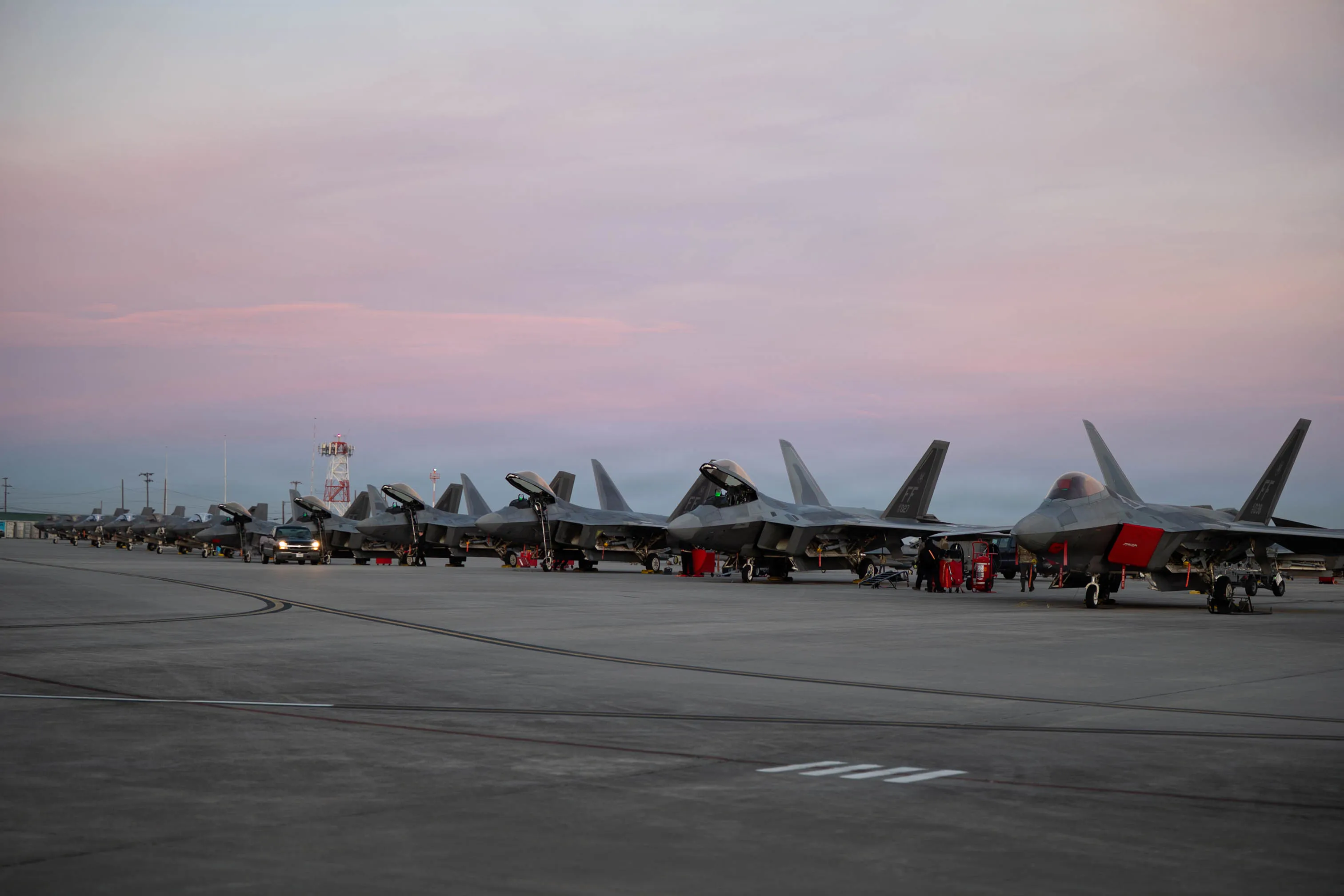
U.S. Air Force F-22 Raptors assigned to the 1st Fighter Wing, Joint Base Langley-Eustis, Virginia, and F-35 Lightning II’s assigned to the 33rd Fighter Wing, Eglin Air Force Base, Florida, sit on the flightline of the Georgia Combat Readiness Training Center (CRTC) during exercise Sentry South 26.1 at the Savannah Air National Guard Base, Georgia, Jan. 23, 2026. Sentry South 26.1 in Savannah is an Air National Guard-led counterair exercise held at the Georgia CRTC, also known as the Air Dominance Center, that trains hundreds of participants annually in offensive and defensive counterair missions with 4th- and 5th-generation aircraft to enhance combat readiness and joint integration. (U.S. Air National Guard photo by Staff Sgt. Josiah Meece). Staff Sgt. Josiah Meece
Sentry South 26.1 and the Air Dominance Center (ADC), which acts as a hub for the exercise, were created to help Air National Guard (ANG) pilots have the best fighter training available. Located in Savannah, Georgia, at the southern end of the Savannah/Hilton Head International Airport, the ADC’s footprint is small, but its training impact is huge for both ANG pilots and their active-duty counterparts. The exercise was developed by fighter pilots to provide 5th-generation fighter integration through a focused, tailored, cost-effective approach. The airspace they have, just 30 miles off the coast, runs 200 miles north to south and 120 miles east to west. That box is among the best military flying areas anywhere in the country, and it’s ideally suited for fighter training.
This iteration of Sentry South involved over 75 aircraft from the Air Force, Navy, and Marines. It was a mix of both 4th and 5th-generation fighters. Over 700 sorties were flown over the two-week exercise, focusing on both offensive and defensive counter-air missions. For many of the pilots, it was their capstone exercise for their initial training on the F-22. It is a multi-day, high-intensity scenario designed to test trainees or validate operational concepts in simulated, contested environments. Its goal is to validate the combat readiness of student pilots while improving their tactical decision making.
A Top Aces pilot about to launch from Savannah, Georgia, on a Red Air mission over the Atlantic. Note the Scorpion HMD monocle over his right eye. (JAMES DEBOER)
Matthew ‘Bang’ Belle is the adversary air program manager for Top Aces. He is in charge of all Top Aces operations in the United States, as well as for any foreign partners trained here on U.S. soil. He has been with the company for about 18 months after retiring from the USAF, where he flew the F-16 as an aggressor, accumulating over 2,000 hours during his career.
Belle told The War Zone, “We got some great reviews from all of the forces that participated in Sentry South 26.1. They really enjoyed having us take over the red air lead and run the mission commander spot from the aggressor side. It was the culmination of everything we have been doing to the aircraft over the last few years. The exercise is all about challenging blue air’s thinking in the air-to-air domain. It is meant to complicate things that they do not see at their home station.”
“The vision when we first started was that we were going to be the legacy bearers from the aggressors. Russ ‘Puck’ Quinn (former Top Aces president) saw a niche that needed to be filled. He knew there were a bunch of 3rd-generation fighters throughout the market and believed there was a place for 4th-generation fighters. So he made that happen, and so we got this 1978 jet (early block F-16A/B), and we saw that we could provide the Air Force and allies a good representation of what our adversaries are doing right now. It’s not just a jet with wings and a cool motor that makes it go really fast and really high. These current 4th-generation fighters are fully integrated, so they have near-5th-generation avionics but in a 4th-generation body. Puck saw that is where we needed to go.”
Top Aces F-16A and Draken Mirage F-1, different contractors flying different generation fighters in the adversary mission. (JAMES DEBOER)
The AAMS and the AESA radar, along with the Scorpion helmet and Link-16, have really upped the game in terms of quality adversary support in a crowded adversary air services provider (ADAIR) market. The Scorpion helmet allows the pilot to avoid turning the aircraft’s nose towards the enemy aircraft to target it when employing certain weapons and sensors. This is especially true when employing simulated heat-seeking missile shots. The helmet also displays basic flight and navigational data and can also project objects from the aircraft’s new Link 16 datalink system out into the visual space all around the aircraft. In other words, if a friendly is 30 miles away at 10 o’clock high, it can shoot that in augmented reality to the pilot.
Top Aces is also using the Air Force’s AN/ALQ-188 jamming pod. The AN/ALQ-188 is a common sight at U.S. air combat exercises and can simulate certain types of hostile electronic countermeasures systems. Top Aces F-16s have controls inside their aircraft that allow the pilots to scale the electronic attack to whatever the blue air wants, whether it be just a nuisance or a full scale ‘melt your face off’ EW attack. Top Aces is also the only ADAIR company that is authorized to refuel from USAF KC-135 tankers, which helps them stay in the fight longer and provides more presentations for blue forces.
Top Aces F-16A with an AN/ALQ-188 on its centerline station. (JAMES DEBOER)
Belle states, “The key that has unlocked everything in the past month was that our engineering section here at Top Aces and our chief test pilot were able to get a provisional approval (from the Federal Aviation Administration) to operate Link-16 on our AAMS aircraft. That was the missing key we now have that ties it all together, so we can present this integrated solution that we think closely resembles a 4th-gen-plus adversary aircraft. It’s a real game-changer. The fact that I can be well outside of normal influence ranges on blue air, have them on my scope with Link-16, where they don’t know that I have that situational awareness (SA), and then transition that SA to the IRST pod, and they still don’t know they are being targeted. So they are making decisions like they are not targeted and not vulnerable. As they get closer, I have all of my weapon solutions cued up and ready to shoot with the AESA radar. Link-16 enables all of that to happen.”
“It also allows us to fly red air tactics with the F-35. It is just like we are one of them. We are replicating 5th and 4th gen packages. It gives blue air not just reps in the gym for blocking and tackling, it affects training outcomes completely and that is what we are really excited about. Link-16 ties it all together.”
What the pilot sees on his center pedestal display showing the Link 16 data is also totally customizable, which is critical for achieving highly-tailored training goals. For instance, the system can easily filter out information that would give the red air team too big of advantage or that would not accurately reflect the capabilities of an enemy. This scalability based on the training objectives makes it far more than just a datalink system for the red air force, it can dramatically boost the fidelity of the threat being presented.
Private aggressors of a very different flavor on the ramp in Savannah. One replicated 4.5 and 5th generation fighter threats, the other simulates long-range one-way attack drones like the Shahed-136. Click on the photo to learn more about these planes in our recent feature. (JAMES DEBOER)
Chris ‘Bluce’ Wee is Top Aces chief test pilot and flew several missions with the upgraded jet during Sentry South 26.1. Wee was a former test pilot in the USAF and was in charge of a host of modernization projects for both the F-16 and all variants of the F-15, including the F-15EX.
Wee told The War Zone, “I’ve been doing modernization and development, making fighters better for the better part of the past 12 or 13 years, and so it was really cool to jump in at Top Aces and look at what we’ve got and look at where we wanted to be and find things that we can improve on. A couple of things that I jumped into right away was really the optimization of our systems together. The idea that we could take old Israeli airplanes and make them high-end aggressors was really fascinating to me.”
“I first learned of Top Aces sometime in 2022. I was out at Black Flag at the 442 (422nd Test and Evaluation Squadron), the OT test organization out there at Nellis, when I came around the corner and saw some old pilots I knew from my aggressor days. I had no idea what they were doing, but when I got talking to them, I was amazed. There is nothing as maneuverable as this airplane (the F-16A, the agility of which you can read about here), and then you stack on top of that modern equipment, it’s amazing. There are limitations; no company in the world is, from a regulatory standpoint or even a monetary standpoint, able to go out there and buy an APG-83 or APG-82 (AESA radar) or any frontline fighter radar or some of, you know, ‘exquisite’ technologies that are protected by classified information. The fact that we’re doing that to the best of our ability was really intriguing to me.”
Wee was able to jump into the chief test pilot position and immediately review the systems and begin providing recommendations to improve integration.
Wee added, “We were able to tweak some things here in the software and really go out and develop that to the point where you know it’s really optimized. You get in this airplane and you know the between the helmet, the Link-16, the AESA radar, the IRST, you just have all these tools available to you to do this really important mission that is training the next generation of fighter pilots that are going to be out there, you know, protecting the nation for the rest of my life, at least, which is [a] pretty neat thing to be a part of.”
A pair of Top Aces F-16As launch for a red air sortie. One is equipped with the full AAMS suite, including the IRST pod, the other packs the AN/ALQ-188 electronic countermeasures pod. Top Aces often flies their F-16s without fuel tanks for maximum performance. (JAMES DEBOER)
During Sentry South 26.1, Wee flew four missions in the updated AAMS jet, accumulating over 10 hours, and conducted several aerial refuelings from KC-135s.
Speaking about the new Link-16 capability, Wee explained:
“Datalink, from a very basic standpoint, is when you can look at the picture in your jet and immediately see what everyone’s doing and where they are; you don’t have to be looking outside necessarily to do that. In fact, I would really prefer my wingman to be like miles away from me because we’re probably not gonna hit each other if he’s miles away from me, and I don’t have to worry about him as much. I can just look at my screen, and I know where my wingman is, and what he’s doing. I can see that he’s targeting something because I can see data being passed between our airplanes, which is really helpful to know, not only within our own airplanes but also with the joint force airplanes. We were flying with Marines, F-35s, and guard F-16s. Being able to see where people are and what they’re doing and if they’re doing what I’ve told them to do, just by looking at the link, is a huge capability.”
Top Aces flew twice a day for four days during the exercise. During the first and last day, they focused on defensive-counter-air missions. Blue air students were tasked with defending the target area during a 90-minute vulnerability period (vul), and so they wanted to maximize the number of red forces across the ‘lane,’ so they could challenge their ability to defend a geographical area.
Top Aces led the aggressors for Sentry South, a huge achievement for a private contractor facing off against the best the USAF has to offer. (JAMES DEBOER)
Wee explained, “As red air, we were trying to get in and protect the strikers. We were using the T-38 as strikers and were trying to help them get into the target area. If we could get to the target band, that would drive the debrief focus points on why the blue forces did not properly protect the lane for the period of time required. Were they allocating their radars to the right spot, and were they looking with the right modes on their radars? We were operating as MiG-1 (lead aggressor) for all sorties, which was really cool for us because we were able to lead the red package in all eight vuls we supported. We were able to manage our forces to align with the blue forces’ learning objectives. We worked very closely with the mission commanders as to what kind of threat they wanted and when they wanted to see it.”
On Wednesday and Thursday, the roles reversed to offensive counter air (OCA), and blue forces were trying to fight their way into the target band and hit targets on land and then fight their way out. Wee led a red force presentation that fought the blue air on the way in, then regenerated from pretend airfields to fight the blue forces on the way out of the target area.
A Top Aces pilot prepares to launch on Sentry South sortie in his F-16A. (James Deboer) JAMES DEBOER
Lt. Col. Joseph ‘Stone’ Walz, who flew F-16s and F-35s and is now part of the Georgia Air National Guard, is the exercise director for Sentry South. Speaking about the value of having aircraft like Top Aces F-16s in his exercise, he told us, “I had the opportunity to bring in Top Aces to Sentry South 26.1. They normally support the 33rd Fighter Wing at Eglin. I like to build something that represents what pilots would expect if they were to go out and fly an operational plan. It’s about honing and shaping our pilots into the most combat-ready force we could be if we had to go to war. How Top Aces factors into that is if we get real aircraft and actual fighter jets that can prosecute errors and punish errors in the training environment, and now when my pilots have those errors, they get shot and can now go into the debrief and learn those lessons in a training environment so they don’t make the same mistakes in war. We can do that with other aircraft, but every aircraft I bring here, if I have to put them as red air, that is one less person who can fly blue air. Red air is a tax we all have to pay, but having these guys gets us more training, and you never know the lesson that someone will learn that will save their life someday.”
Being asked to lead red air forces as ‘MiG-1’ during Sentry South 26.1, Top Aces is proving that experience matters, which is their motto.
Belle explained, “We are mostly all former aggressor pilots who have done the really big exercises at Nellis and in Alaska. We have handled 100 aircraft LFEs (large force exercises) and know how to build scenarios that really stress blue air’s weak points. We know where their change-outs are going to be, so we are a thinking adversary that brings in all the other red air like the F-35s and F-22s and puts it all together and says what would the Chinese do? We replicate that. We put the 4th and 5th-gen packages together, led by an experienced aggressor who knows how to exploit weaknesses. I can tell you from being on the blue side that when your bulletproof game plan is completely exploited and torn apart, you leave humbled, knowing you have to up your game. We are not there just to win, we are there to teach. We are there to have you leave the debrief with an outcome that says, I have to go back to the drawing board because what I thought works against my normal red air at Langley or Eglin didn’t work today. Why not?”
A Top Aces F-16A recovers after a Sentry South sortie. (JAMES DEBOER)
Top Aces has recently done much more software development to optimize what’s presented to the pilot and how the pilot interacts with the radar, the link, and the IRST pod, along with the helmet. It is all about placing information in the right place to make the pilot safer and more effective. Looking at human factors optimization, Top Aces is looking to make an even more threatening aggressor.
The IRST system that Top Aces flew during Sentry South 26.1 consists of a Northrop Grumman OpenPod, a modular, open-architecture design, equipped with Leonardo’s SkyWard, a long-wave IRST sensor. It is a scannable IRST pod, which means it has the ability to identify multiple contacts inside of a very large search area.
Wee explained, “IRST is difficult for everyone. It is very susceptible to the conditions of the day whether it be humidity or clouds. We have some longer-range goals to improve our IRST system and achieve more accurate tracks through exquisite means. Right now, we only have one pod but we are actively seeking more. You can imagine having azimuth and elevation from one pod is pretty good, but having azimuth and elevation from more than one pod makes the solutions get better, especially if you leverage Link-16 and are able to pass some of that data between airplanes (triangulating range). These are all things we want to do to better replicate the threat.”
The SkyWard IRST pod mounted on the F-16A’s centerline station. (JAMES DEBOER)
Another major training capability that Top Aces Link-16-enabled aircraft are now providing is called Constructive Wingman. This gives the upgraded aircraft the ability to lay out synthetic tracks of non-existent aircraft.
Belle explained, “When the blue air looks at us, no longer do they see just one contact. They may now see two or three contacts and that is just complicating the training and driving better outcomes for their learning. The pilot pushes a few buttons to place an aircraft on my right at two miles and one on my left at two miles. I have a series of 10 commands that I can give it. I can tell it to go 50 miles from blue air and then reform behind me at 20 miles. Or better yet, I am going to turn around as the live fighter and these two contacts will continue going so blue air now thinks he has a bigger problem. But really, he/she is concentrating on synthetic tracks.”
This capability will help new F-35 student pilots as they will now see a more complicated tactical picture during their training. Currently, Top Aces provides aggressor training through the Air Force’s Combat Air Force Contracted Air Support (CAFCAS) program to F-35 pilots going through Formal Training Units (FTUs) at both Eglin Air Force Base in Florida and at Luke AFB in Arizona. The basic course lasts eight months and provides pilots with the training to accomplish a variety of missions.
The last few months have been extremely busy for Top Aces. Last summer, they went to Nellis AFB to participate in a large-force exercise at the end of weapons school, called Weapons School Integration (WSINT). WSINT is a series of complex, large-force employment missions that serve as the capstone portion of Weapons School classes. With their ability to air refuel, they participated in three- to four- hour missions. They also participated in Sentry North at Volk Field before flying to Mountain Home AFB to support training for the Dutch F-35As and the resident F-15E Strike Eagles.
We will be sure to keep you updated as Top Aces continues to add new capabilities to its unique AAMS F-16s.
Kerry Katona’s boyfriend Paolo left Dubai ‘urgently’ hours after being struck by Katie Price’s husband Lee AndrewsCredit: InstagramKerry and Paolo met Katie and Lee in Dubai last week, as the latter couple were enjoying their honeymoonCredit: wesleeeandrews/InstagramKerry and Katie have been pals for over two decades, with the former meeting Katie’s new man for the first time in DubaiCredit: wesleeeandrews/Instagram
In her most recent New! Magazine column, Kerry revealed that Paolo had to leave their Dubai getaway ‘urgently’ after just a day in the country.
Despite the star describing it as a “work emergency”, The Sun’s revelation about Paolo and Lee’s bust up means that the former left just hours later.
Kerry wrote in her column: “Paolo and I travelled to Dubai for a romantic getaway for our first Valentine’s Day, where we had a mega-quick 20-minute catch up with Katie Price and her husband Lee.
“But unfortunately, during the trip, Paolo had to go back to the UK for a work emergency.
“I got to spend literally 14 hours with him before he had to leave, which meant I was left alone in Dubai, which we were both gutted about.“
Earlier today, we told how during Paolo’s 14 hours in Dubai, he crossed wires with Lee.
An onlooker said: “Lee was having some cross words with Katie. He was acting in what appeared to be an aggressive manner.
“Paolo then appeared and stepped in. Lee seemed to be very angry and was shouting at him.
“It all got very heated and Lee threw some punches and one of them landed Paolo square on the head.”
The incident happened in a public part of the hotel where Kerry and Paolo had been staying, with Kerry thought to not have been present at the time of the altercation.
An onlooker added: “It was crazy to see this play out. The situation seemed to be pretty heated but then it erupted very quickly. It all happened so fast.
“Paolo looked very shocked by what had happened and walked away. Katie didn’t look in a great way either, she seemed shocked.”
The Sun understands the relationship between Katie and Kerry has been strained since the incident.
Things appeared off to a good start on the trip, before the bust upCredit: wesleeeandrews/InstagramKerry revealed in her weekly column that Paolo returned home to the UK ‘urgently’ after just 14 hours in the UAECredit: Splash
Feb. 19 (UPI) — A massive blackout left nearly five million people without electricity in Paraguay amid a heat wave that pushed temperatures above 108 degrees Fahrenheit across large parts of the country and as high as 116 degrees Fahrenheit in some areas, according to local meteorological reports.
The outage affected 90% of customers of the National Electricity Administration, or ANDE, the state-run company that supplies nearly the entire population of 6.4 million people.
The interruption on Wednesday also disrupted drinking water services in urban areas due to reliance on electric pumping systems. Nearly 24 hours after the blackout, service had not been fully restored.
The lack of power also impacted health centers and hospitals in cities across the country’s interior. In those cases, emergency infrastructure and generators failed, and doctors and nurses were forced to perform surgical procedures, including a cesarean section, using the light from their cell phones.
Following the blackout, ANDE attributed the interruption to transmission lines going out of service within the system that connects to the Itaipú hydroelectric plant. The company later denied any malfunction at its facilities and said generation operated normally.
Paraguay is one of the world’s largest producers of hydroelectric power thanks to dams such as Itaipú and Yacyretá, which generate surpluses that are even exported to neighboring countries.
In January, Itaipú covered more than 80% of national electricity demand. However, the transmission and distribution system faces scrutiny over recurring failures and a lack of investment.
Specialists argue that the problem does not lie in energy generation but in the limitations of the transmission and distribution system.
“If we continue growing at the current pace, the system will not withstand it,” engineer Guillermo Krauch of the Paraguayan Institute of Electrical Sector Professionals told UPI.
The blackout comes as President Santiago Peña and Foreign Minister Rubén Ramírez Lezcano are scheduled to hold meetings in the United States with executives from the U.S. International Development Finance Corporation to analyze potential investment projects related to data centers and artificial intelligence developments in Paraguay.
The government of President Santiago Peña approved special electricity tariffs for large consumers, including data centers, cloud computing, artificial intelligence and high-energy industrial projects.
The Ministry of Industry and Commerce seeks to position Paraguay as a regional technology hub supported by its renewable energy, abundant water resources and comparative cost advantages.
However, technical organizations warn that the accelerated expansion of high-consumption industries could worsen service deterioration if transmission infrastructure is not strengthened.
Víctor Giménez, special projects adviser at the Yacyretá dam, said Paraguay lived for decades under a “false sense of energy security.”
“That time is over. Companies now arrive with the intention to invest, but they leave once they understand there is no guarantee of electricity supply for the next five years,” he said.
Peña is currently in Washington to participate in the Board of Peace and hold meetings with business leaders interested in installing data centers in Paraguay.
The heat wave has lasted several days, and Paraguay ranked among the locations with the highest temperatures recorded globally this week.
We’re in something like award season no man’s land right now: the whirlwind of the Oscar nominees luncheon is behind us, but most of the major precursors have yet to be handed out. Which leaves less for the pundits to chew on, perhaps, though it also means there’s finally some spare time to catch up on your reading.
I’m Matt Brennan, editor in chief of The Envelope. Let me be of some assistance.
Cover story: ‘Sentimental Value’
(Christina House / For The Times)
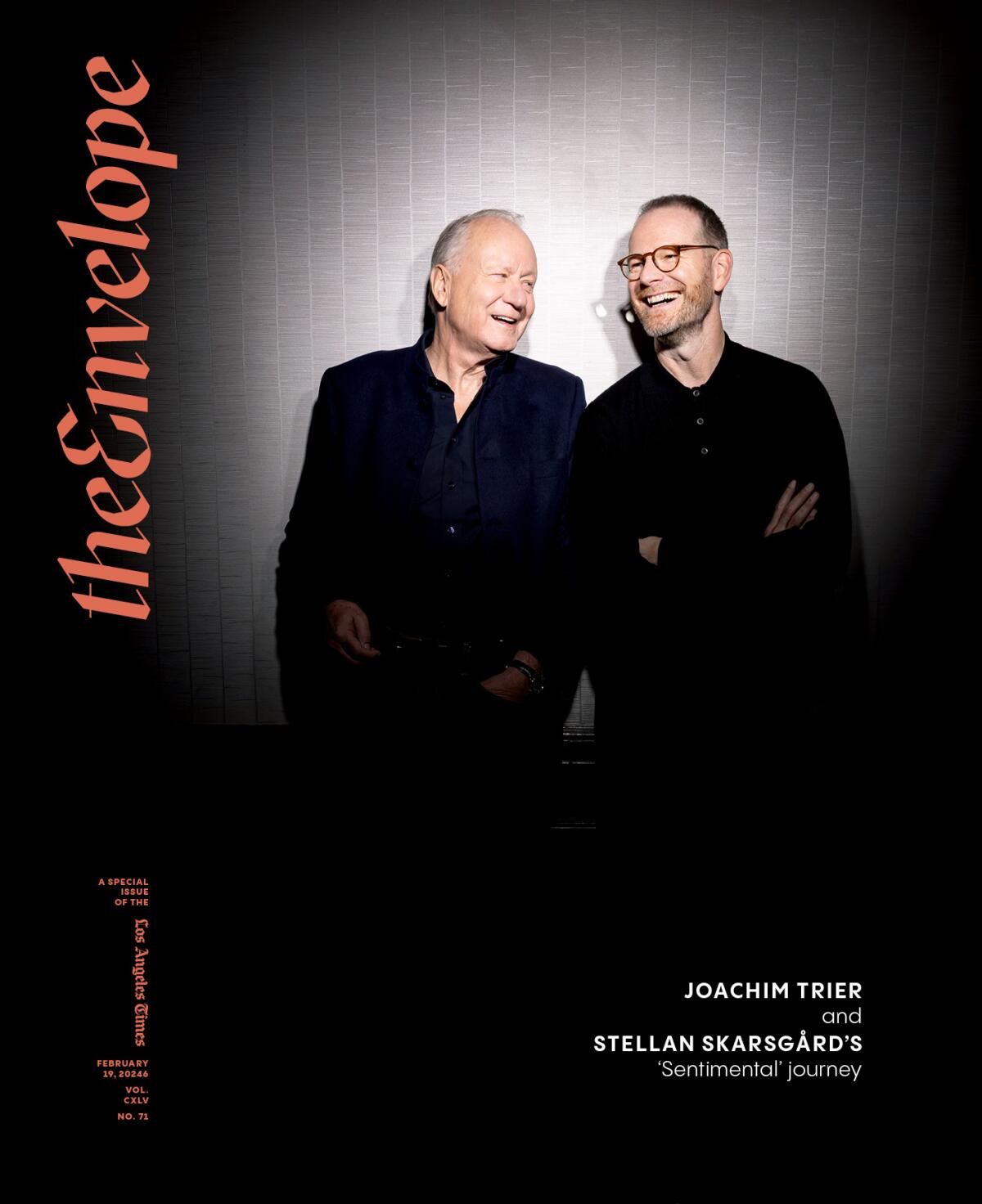
After an entire award season’s worth of conversations about one of the top contenders, it’s rare to hear a new one this late in the game. But when I ran in “Sentimental Value” director Joachim Trier last week, he happily shared his point of view on an anecdote his editor, Olivier Bugge Coutté, recently shared with The Envelope about killing one of Trier’s darlings. “He was right,” Trier admitted with a half-rueful smile, after describing the elaborate aerial shot over a theater audience with which he originally intended to open the film.
Such candor is also a mark of contributor Bob Strauss’ interview with Trier and star Stellan Skarsgård about making the year’s most-nominated international feature, from their discussion of the stroke that permanently altered the actor’s process to bon mots about the film’s depiction of Netflix, demanding directors and more. I was most tickled by Skarsgård’s, um, unvarnished description of the small screen: “The narrative form of television is based on you not watching,” he tells Strauss. “It explains everything through dialogue so you can make pancakes at the same time.”
Digital cover: Kate Hudson
(Christina House / Los Angeles Times)
When contributor Amy Amatangelo sent me her pitch for a story on “Song Sung Blue,” it swiftly answered the question I want every pitch to answer: Why are you the right person to write this story?
“I am a lifelong Neil Diamond fan,” she wrote. “My dad loved him. I saw him in concert as a child. My dad and I danced to ‘Beautiful Noise’ at my wedding.”
So it was a no-brainer to set her up with this week’s digital cover star, nominated for playing one half of the film’s Neil Diamond tribute band. “Although she’s had a slew of successes in the interim,” Amatangelo writes of the 25 years since “Almost Famous,” “it can sometimes seem that we’ve underappreciated, and perhaps underestimated, Kate Hudson.”
‘Train Dreams’’ not-so-secret weapon
(Lauren Fleishman/For The Times)
Speaking of pitches, the most frequently suggested subject for coverage since the Oscar nominations (not-named-Chalamet-or-DiCaprio division) may be “Train Dreams” cinematographer Adolpho Veloso. Which already made the Brazilian’s wizardry one of the industry’s worst-kept secrets. Count contributor Emily Zemler’s profile among the final nails in the coffin.
“Capturing the enormous trees that would have existed in the early 20th century was a challenge,” she writes of the film, which spans the life of an itinerant logger in the Pacific Northwest. “The production went to protected parks, where they had to be cautious about not affecting the environment. ‘How do you shoot a movie where they’re supposed to be cutting those trees, but they cannot even get close to those trees?’ Veloso says. ‘It was almost like shooting stunts.’”
US president says at inaugural Board of Peace summit that Washington and Tehran should make a ‘meaningful deal’.
Donald Trump has renewed his threats against Iran, suggesting that Tehran has about 10 days to reach a deal with Washington or face further military strikes.
Speaking at the inaugural Board of Peace meeting in Washington, DC, on Thursday, the United States president reiterated his argument that the joint Israeli-US strikes against Iran in June of last year paved the way to the “ceasefire” in Gaza.
Recommended Stories
list of 3 itemsend of list
Trump argued that without the US attack on Iran’s nuclear facilities, the “threat” of Iran would have prevented countries in the region from agreeing to “peace in the Middle East”.
“So now we may have to take it a step further, or we may not,” Trump said. “Maybe we’re going to make a deal. You’re going to be finding out over the next probably 10 days.”
Trump’s comments come days after the US and Iran held a second round of indirect talks.
On Wednesday, Iran’s Minister of Foreign Affairs Abbas Araghchi said the two sides made “good progress in the negotiations” in Geneva and “were able to reach broad agreement on a set of guiding principles” for an agreement.
But the US has continued to amass military assets in the Gulf region, including two aircraft carriers and dozens of fighter jets.
Iran, which denies seeking a nuclear weapon, has said it would agree to curbing its uranium enrichment and placing it under rigorous international inspection.
But the Trump administration has said that it would oppose any Iranian enrichment. Washington has also sought to place limits on Tehran’s missile arsenal, but Iranian officials have ruled out any concessions over the issue, which they say is a non-negotiable defence principle.
On Thursday, Trump said his diplomatic aides Steve Witkoff and Jared Kushner have had “very good meetings” with Iran’s representatives.
“We have to make a meaningful deal. Otherwise, bad things happen,” he said.
Last week, Trump said the US and Iran should come to an agreement “over the next month”, warning Tehran with “very traumatic” consequences.
But Iranian officials have expressed defiance against the US president’s threats.
“The Americans constantly say that they’ve sent a warship toward Iran. Of course, a warship is a dangerous piece of military hardware,” Iranian Supreme Leader Ali Khamenei wrote on X on Thursday.
“However, more dangerous than that warship is the weapon that can send that warship to the bottom of the sea.”
Tensions between the Washington and Tehran have been escalating since late 2025, when Trump – while hosting Israeli prime minister Benjamin Netanyahu in December – vowed to strike Iran again if attempts to rebuild its nuclear or missile programmes.
Days later, antigovernment protests broke out in Iran. Trump encouraged the demonstrators to take over state institutions, promising them that “help is on the way”.
Trump appeared to step back from the brink of attacking Iran last month, saying that the country agreed to halt the execution of dissidents under US pressure.
The two countries later renewed negotiations with the first round of talks since the June war taking place in Oman on February 6.
But threats and hostile rhetoric between Washington and Tehran have persisted despite the ongoing diplomacy.
In 2018, during his first term Trump nixed the multilateral nuclear deal that saw Iran scale back its nuclear programme in exchange for lifting international sanctions against its economy.
DANNIELLA Westbrook has finally revealed the full extent of her recent surgery makeover after undergoing a full face, neck and brow lift.
The former soap star underwent multiple facial surgeries weeks ago in Dubai and was spotted looking swollen and bruised as she emerged from surgery.
Sign up for the Showbiz newsletter
Thank you!
Danniella has unveiled the results of her facial operations – but couldn’t resist adding a filter or twoCredit: BackGridDanniella showed off her new face in a series of snaps but ensured they were filtered so she was looking her bestCredit: BackGridThe star pictured leaving her operations earlier this monthCredit: BackGridDanniella pictured in 1995 before undergoing any surgeriesCredit: Getty
But now the ‘results’ have been revealed with Danniella sharing a slew of new snaps post-surgery but ever the perfectionist, the star couldn’t resist adding a filter or two to the images before she posted them online.
The star’s new images featured a helping hand in order to enhance her appearance even more post-surgery.
The axed EastEnders star could be seen posing on a towel as she enjoyed the Dubai heat.
Wearing a blue bikini, Danniella showed off her filtered face and her body in the images.
She pulled a series of sultry poses in which evidence of her recent nose operations could be seen thanks to some slight bruising still visible around the nostril area.
In another image, Danniella opted to wear a pair of glasses as she laid back and relaxed in the sunshine.
Danniella had a full face, neck and brow lift in addition to a lip and nose reconstruction.
Following the operation, she left the facility in a wheelchair with a facial compression garment wrapped around her head.
A full recovery for a face, neck and chin lift can take up to nine months.
The star popped a filter on her selfies for good measureCredit: BackGridShe wasn’t shy about showing off her body either in the imagesCredit: BackGridDanniella’s face has changed drastically over the years thanks to surgery and heavy drug abuseCredit: Shutterstock
The surgery was performed by Danniella’s trusted Surgeon Dr Parviz Sadigh, who has carried out operations on her in the past.
Danniella became hooked on drugs at the age of 14 after beginning to take cocaine after shooting to fame as Sam Mitchell in the BBC soap opera, EastEnders.
The former star estimates that she has spent a whopping £250,000 on cocaine in her lifetime and was using at least five grams a day throughout her entire pregnancy with son, Kai.
Danniella was addicted to drugs throughout the 1990s and early 2000.
She then managed to stay clean before a number of relapses including in 2017 – the year after she last appeared on EastEnders.
Her latest known drug relapse was in 2021.
This abuse led to the collapse of her nose and cheekbones, with her septum – the cartilage that separates the two nostrils – falling out.
At the time, the star admitted she was hoping to rebuild her face so that she can kick start her acting career once again.
On the day of her surgery, she said: “Big day for me heading down for a very long surgery right now to rebuild my face.
“Then I can get back to work.”
Danniella on-set of EastEnders during her last appearance in 2016Credit: BBCThe star pictured on Celebrity Big Brother in 2016Credit: GettyHer face changed drastically just a couple of years laterCredit: Splash
Feb. 19 (UPI) — The United States has put military forces in place in the Middle East for a potential strike on Iran but President Donald Trump has not decided whether to attack or continue negotiations on Thursday.
A strike could occur as early as this weekend, with naval and air forces quickly coming into place. National security officials met in the Situation Room on Wednesday to discuss courses of action against Iran.
U.S. armed forces have been assembling in the Middle East in recent weeks as the United States and Iran have negotiated a scaling back of Iran’s nuclear program. The latest conversations took place in Geneva on Tuesday, sans Trump who said he would be involved “indirectly.”
The negotiations between the United States and Iran ended without a resolution on Tuesday. Trump has called for Iran to end its nuclear program.
Iranian officials said they agreed with U.S. negotiators on a “set of guiding principles.” White House press secretary Karoline Leavitt said to expect more details about these negotiations to come forward in the weeks to come. She did not say whether Trump would take action before that happens.
“I’m not going to set deadlines on behalf of the president of the United States,” she said.
In recent weeks, the United States has moved warships to the Indian Ocean while Trump warned Iran over the killings and detainments of thousands of protesters against the Iranian regime.
Israeli Prime Minister Benjamin Netanyahu has an interest in Iran drawing down its missile capabilities as well. Israeli forces have been on alert over the possibility of an open conflict as tensions have continued to heighten.
Secretary of State Marco Rubio is slated to meet with Netanyahu in Israel on Feb. 28, to provide an update on the negotiations with Iran.
The United States launched strikes against Iranian nuclear facilities in June, causing what Iranian officials called “serious and significant damage.”
President Donald Trump speaks alongside Administrator of the Environmental Protection Agency Lee Zeldin in the Roosevelt Room of the White House on Thursday. The Trump administration has announced the finalization of rules that revoke the EPA’s ability to regulate climate pollution by ending the endangerment finding that determined six greenhouse gases could be categorized as dangerous to human health. Photo by Will Oliver/UPI | License Photo
Weekly insights and analysis on the latest developments in military technology, strategy, and foreign policy.
As the U.S. flows assets toward the Middle East, including the Gerald R. Ford Carrier Strike Group (CSG) now reportedly off the Moroccan coast, Iran, China and Russia will hold their recurring joint naval training exercise in the Strait of Hormuz, according to Iranian media. Moscow and Tehran see the Maritime Security Belt 2026 exercise as particularly relevant in light of current events, and there are reasons for the White House and Pentagon to take note. Having Russian or Chinese warships in these waters amid a U.S. attack on Iran could have military and political implications planners must address. At the same time, the timing of the still ongoing U.S. buildup and the exercise point to it having more of a messaging effect than an operational one.
The exercise, first held in 2019, is being hosted in the southern Iranian port city of Bandar Abbas, located on the Strait of Hormuz. Russian, Chinese, and Iranian naval units “are expected to participate with various ships and operational capabilities to test coordination, tactical readiness, and rapid-response procedures in the Strait of Hormuz,” the official Iranian Mehr news outlet reported.
U.S. Central Command (CENTCOM) declined to comment on the exercise.
As Iranian and Russian officials gathered Wednesday aboard the Russian corvette Stoiky, a top Iranian official issued a new threat against the growing U.S. Navy presence in the region, which includes the Abraham Lincoln CSG and at least eight other surface combatants. The Ford could arrive in the region in the next four or five days given its location posted by the MarineTraffic ship tracking website. The Navy said only that the ship is now in the Atlantic Ocean.
If the USS Gerald R. Ford keeps her current speed, she will be off the coast of Israel and be able to assist in the defense against an Iranian retaliation by Sunday morning. pic.twitter.com/7OhMJDRxwZ
“The Islamic Republic of Iran has faced threats, noise, propaganda and the presence of extra-regional fleets in West Asia for 47 years, Iran’s Navy Commander Rear Adm. Shahram Irani warned. “The presence of extra-regional fleets in West Asia is unjustified.”
“If the extra-regional fleet feels it has come with power, it should know that the Iranian people will confront them with greater power,” he added. “The faith of the people and missiles are the Islamic Republic of Iran’s deterrent weapons against the enemy.”
Nikolai Patrushev, a top aide to Russian President Vladimir Putin, framed the exercise as part of a larger struggle between the U.S. and the BRICS alliance, an informal group of 21 nations that includes Russia, China and Iran. Patrushev took aim at the ongoing U.S. and NATO efforts to seize tankers containing Russian oil as well as the ongoing tensions between Washington and Tehran.
“We will tap into the potential of BRICS, which should now be given a full-fledged strategic maritime dimension,” Patrushev posited. “The Maritime Security Belt 2026 exercises in the Strait of Hormuz, where Russia, China, and Iran [will send] their ships, proves to be relevant.”
Both Russia and Iran say the exercise will increase their ability to work together.
“The level of existing interactions and cooperation shows that we can manage and resolve many maritime and coastal issues together,” Captain First Rank Alexey Sergeev, commander of the Russian naval group, said, according to The Telegraph. “We are ready to hold joint exercises in any region, including specialised drills such as anti-maritime terrorism operations that will be executed with vessels and boats from both sides.”
Bandar Abbas is a key Iranian military site located on the strategically and economically important Strait of Hormuz. (Google Earth)
Experts we spoke with say the presence of a small number of Russian and Chinese ships in the Strait of Hormuz and Gulf of Oman does not pose a significant threat to U.S. interests, but could complicate efforts to attack Iran. They also note that this exercise was likely planned months ago, well before U.S. President Donald Trump started threatening Iran over its harsh treatment of anti-regime protesters.
“I don’t believe it increases in any significant way the likelihood of conflict with Russia and China, but it probably would introduce additional considerations for any planned strikes against Iran,” Tom Shugart, an adjunct senior fellow at the Center for a New American Security (CNAS) think tank and a retired U.S. Navy submarine warfare officer told us Wednesday morning.
“For starters, you’d want to make sure that their sensors don’t give advanced warning of your strike to the Iranians, and you’d want to make sure that those Russian and Chinese platforms aren’t in the way,” he explained. “You’d also of course want to ensure that there is no way they could be inadvertently struck a la USS Stark during the Iraq-Iran Tanker Wars of the 1980s.”
The Stark, an Oliver-Hazard Perry class guided-missile frigate, was hit by two Iraqi Exocet missiles while in the Persian Gulf on May 17, 1987. The strike killed 37 sailors and wounded 21 others.
The USS Stark after it was struck by two Iraqi Exocet anti-ship missiles in 1987. (U.S. Navy)
Shugart downplayed the timing of the exercise, given that its planning has been in the works for a while.
“I also don’t think that the small number of Russian and Chinese ships involved amount to much militarily relative to U.S. naval forces in the region – though their presence might matter politically, should the administration decide it wants to take military action against Iran,” he explained.
“I don’t think this fundamentally changes anything,” former CENTCOM commander Joseph Votel told us. “It is an easy way for Russia and China to show support after having abandoned Iran last summer.”
“Certainly the timing makes it seem more provocative,” Votel added. “There is likely also an internal message for regime supporters – pushing back on the U.S. and Israel.”
“I don’t think it raises the threat of conflict,” the former CENTCOM commander surmised. “I view it as a form of great power competition.”
The presence of Russian and Chinese ships near Bandar Abbas, a major center of Iranian military activity, could complicate U.S. targeting if they remain in the area. The coastal city would be a prime target to take out many types of kinetic capabilities, sensors, and other assets, especially Iran’s naval forces. Still, the Chinese and Russian ships should leave at some point and the U.S. would know their location and it doesn’t appear the U.S. is in a place to strike yet. Unless the exercise goes on for weeks, the Russian and Chinese ships will likely have moved on by the time all the pieces are in place for a U.S.-led kinetic operation to begin.
Dubbed “Smart Control of the Strait of Hormuz,” the drills began Monday and include firing anti-ship cruise missiles at targets and IRGC naval drone and submarine units carrying out operations originating from the three Iranian islands, according to Iranian media.
“The armed drones used in the exercise—capable of engaging both air and sea targets—are among the IRGC Navy’s newest strategic platforms and are deployed in significant numbers, though their names and technical specifications remain classified,” the official Iranian FARS News outlet claimed.
We’ll have to wait and see how the exercises unfold, especially as the U.S. buildup fully matures. But at this time it seems that the presence of these vessels is more of a political factor than an operational one, at least for the time being.
For more than a century, South Los Angeles has been an anchor for Black art, activism and commerce — from the 1920s when Central Avenue was the epicenter of the West Coast jazz scene to recent years as artists and entrepreneurs reinvigorate the area with new developments such as Destination Crenshaw.
Now, the region’s legacy is receiving formal recognition as a Black cultural district, a landmark move that aims to preserve South L.A.’s rich history and stimulate economic growth. State Sen. Lola Smallwood-Cuevas (D-Los Angeles), who led the effort, helped secure $5.5 million in state funding to support the project, and last December the state agency California Arts Council voted unanimously to approve the designation. The district, formally known as the Historic South Los Angeles Black Cultural District, is now one of 24 state-designated cultural districts, which also includes the newly added Black Arts Movement and Business District in Oakland.
Prior to this vote, there were no state designations that recognized the Black community — a realization that made Smallwood-Cuevas jump into action.
“It was very frustrating for me to learn that Black culture was not included,” said Smallwood-Cuevas, who represents South L.A. Other cultural districts include L.A.’s Little Tokyo and San Diego’s Barrio Logan Cultural District, which is rooted in Chicano history. Given all of the economic and cultural contributions that South L.A. has made over the years through events like the Leimert Park and Central Avenue jazz festivals and beloved businesses like Dulan’s on Crenshaw and the Lula Washington Dance Theatre, Smallwood-Cuevas believed the community deserved to be recognized. She worked on this project alongside LA Commons, a non-profit devoted to community-arts programs.
Beyond mere recognition, Smallwood-Cuevas said the designation serves as “an anti-displacement strategy,” especially as the demographics of South L.A. continue to change.
“Black people have experienced quite a level of erasure in South L.A.,” added Karen Mack, founder and executive director of LA Commons. “A lot of people can’t afford to live in areas that were once populated by us, so to really affirm our history, to affirm that we matter in the story of Los Angeles, I think is important.”
The Historic South L.A. Cultural District spans roughly 25 square miles, situated between Adams Boulevard to the north, Manchester Boulevard to the south, Central Avenue to the east and La Brea Avenue to the west.
Now that the designation has been approved, Smallwood-Cuevas and LA Commons have turned their attention to the monument — the physical landmark that will serve as the district’s entrance or focal point — trying to determine whether it should be a gateway, bridge, sculpture or something else. And then there’s the bigger question: Where should it be placed? After meeting with organizations like the Black Planners of Los Angeles and community leaders, they’ve narrowed their search down to eight potential locations including Exposition Park, Central Avenue and Leimert Park, which received the most votes in a recent public poll that closed earlier this month.
As organizers work to finalize the location for the cultural district’s monument by this summer, we’ve broken down the potential sites and have highlighted their historical relevance. (Please note: Although some of the sites are described as specific intersections, such as Jefferson and Crenshaw boulevards, organizers think of them more as general areas.)
Few places in Ukraine have been spared from the impact of the Ukraine war, including the radioactive exclusion zone around the Chernobyl nuclear plant. Al Jazeera’s Nils Adler has been seeing how the site of the world’s worst nuclear disaster has been affected by the war.
A new United Nations Human Rights Office report says Israel’s military campaign and blockade of Gaza have created living conditions “increasingly incompatible with Palestinians’ continued existence as a group in Gaza” as it presses its genocidal war on the enclave.
The report released on Thursday states that “intensified attacks, the methodical destruction of entire neighbourhoods and the denial of humanitarian assistance appeared to aim at a permanent demographic shift in Gaza”.
Recommended Stories
list of 3 itemsend of list
“This, together with forcible transfers, which appear to aim at a permanent displacement, raise concerns over ethnic cleansing in Gaza and the West Bank.”
Covering the period from November 1, 2024 to October 31, 2025, the report documents Israel’s security forces’ “systematic use of unlawful force” in the occupied West Bank and occupied East Jerusalem.
It highlights “widespread” arbitrary detention and the “extensive unlawful demolition” of Palestinian homes, stating that the measures seek to “systematically discriminate, oppress, control and dominate the Palestinian people”.
These policies are altering “the character, status and demographic composition of the occupied West Bank, raising serious concerns of ethnic cleansing”.
In Gaza, the report condemns the killing and maiming of “unprecedented numbers of civilians”, the spread of famine and the destruction of the “remaining civilian infrastructure”.
At least 463 Palestinians, including 157 children, starved to death during the 12-month period, according to the findings.
“Palestinians faced the inhumane choice of either starving to death or risking being killed while trying to get food,” it says, adding that the famine and “foreseeable and repeatedly foretold” deaths directly resulted from actions taken by the Israeli government.
Israel’s ongoing attacks on Gaza
Israeli forces launched new air strikes and artillery attacks across the Gaza Strip, as families in the besieged enclave woke to begin their Ramadan fast under bombardment.
Shelling struck areas east of Khan Younis in southern Gaza at dawn on Thursday, where Israeli troops remain deployed. Warplanes also hit Rafah and areas east of Gaza City, according to Al Jazeera’s correspondent.
A day earlier, medical officials at Nasser Medical Complex confirmed that two Palestinians were killed by Israeli fire near the so-called “yellow line” in Bani Suheila, east of Khan Younis.
Israeli forces continue to demolish homes and infrastructure in areas they control, flattening entire neighbourhoods and entrenching displacement.
The attacks form part of Israel’s repeated breaches of the ceasefire that began on October 10, 2025.
Gaza’s Ministry of Health says those violations have killed 603 Palestinians and wounded 1,618 others as of Monday.
‘Partnership between settlers and the occupation forces’
Violence has also intensified in the occupied West Bank.
On Wednesday evening, the Palestinian Ministry of Health announced the death of 19-year-old Nasrallah Mohammad Jamal Abu Siam, who succumbed to wounds sustained during a settler assault on Mukhmas, northeast of occupied East Jerusalem.
Settlers, operating under the protection of Israeli forces, opened fire and stole dozens of sheep from Palestinian farmers. Three of the wounded were shot with live ammunition.
With Abu Siam’s killing, the number of Palestinians shot dead by settlers alone since October 7, 2023 has risen to 37, according to the Wall and Settlement Resistance Commission.
Moayad Shaaban, head of the commission, described events in Mukhmas as a “dangerous escalation in organised settler terrorism”, citing a “full partnership between settlers and the occupation forces”.
Israeli troops also raided the town of Arraba, south of Jenin, wounding two young men with live fire, one critically. Soldiers detained several others during the incursion.
In Jerusalem, Ramadan has brought further restrictions at Al-Aqsa Mosque. The mosque’s imam, Sheikh Akrama Sabri, said Israeli authorities are “imposing a reality by force” by limiting worshippers while allowing extremist Jewish incursions into the compound.
Occupation authorities have issued more than 100 deportation orders barring young Jerusalemites from entering the mosque and restricted West Bank worshippers to 10,000 permits under strict age and security conditions. Al-Aqsa can hold up to half a million people.
Sheikh Sabri said Israeli forces question worshippers during tarawih prayers in what he described as “provocation upon provocation”.
Kelvin Washington: Welcome to The Envelope. I’m Kelvin Washington, alongside the usuals, Yvonne Villarreal, we got Mark Olsen as well. Everybody doing well?
Yvonne Villarreal: Doing good!
Mark Olsen: Terrific!
Washington: Good, good. Last time we discussed Oscar nominations. Obviously a big deal. Folks were excited. Certain films, certain directors, actors as well. We went over that a little bit. But I also want to talk about something you, my friend, brought up. You mentioned the Oscar nominee luncheon last episode. I want to hear more about this, you know, [as] someone who’s never been. So I have to live vicariously through you two. Tell me more about it.
Olsen: Well, exactly as it sounds, it is a luncheon for all of the Oscar nominees. So from the biggest stars down to, you know, relatively unknown craftspeople, all get invited to this luncheon at the Beverly Hilton hotel. And it’s really one of those kind of, like, secret highlights of award season. It’s not televised, and so everyone’s feeling loose and there are drinks in the afternoon and also, at this point, everyone is a winner. Nobody’s lost anything yet. And so everybody’s kind of on equal footing, even in their categories, and people seem to really enjoy it.
We were not actually in the room for the luncheon. Our esteemed colleague, Josh Rottenberg, was there and wrote about it. We were in a press area in a ballroom, sort of backstage-ish to do the interviews that we did, but even there — I always get such a kick out of the fact that publicists are coming by with all this talent — other outlets will do much shorter interviews than we do — and kind of like, “Hey, do you want to talk to so-and-so?” And it just is so funny to me to see them kind of being showcased in this way. Yvonne, what stood out this year for you?
Villarreal: So it takes place at the Beverly Hilton, and I was there a few weeks back for the Golden Globes. And so in some ways it felt like a more subdued — like it was the luncheon version of that. The star power was as insane, but they’re maybe a little more casual in the vibe. At one point I’m walking down the corridor and you have Emma Stone or people walking by looking at the security guard dogs. It is interesting thing because they’re all sort of coming together and loose and talking with each other, taking the selfies. You’re seeing, like, Elle Fanning reuniting with Timothée Chalamet — they starred in a movie last year together. It was interesting to have everyone come together, but also do these interviews in a much rowdier setting than we were last year, and having to concentrate on our guests while a lot of commotion is happening. But I think we did well.
Washington: Well, I tell you what, I know how that is. It can be trying to do an interview when it’s loud in the background. Our producer, Matt, was saying that it was chaotic. Said he was a few feet away from you and couldn’t even hear you. But you all are pros. So you got it done. And speaking of, we get a chance to hear your conversation you had with Amy Madigan. Tell me a little bit more about this role, Aunt Gladys, and, of course, “Weapons.” I was terrified. And it’s in a complimentary way. She played the heck out of that role.
Olsen: She’s obviously a veteran actress. She was nominated for an Oscar once before, for the film “Twice in a Lifetime.” It came out in 1985. She was nominated in 1986. And so that 40-year gap actually is the longest gap ever for an actress in between nominations. And it’s just exciting to see how she’s really enjoying this moment. She’s really enjoyed the attention that the character of Aunt Gladys has brought. So in “Weapons” — spoiler alert — she plays this kind of eccentric witch, essentially, who comes to this town, creates all this mischief, but there is still something kind of, like, rambunctious and almost weirdly lovable about her. She is somehow — and we talked about this in the interview — she’s somehow both the funniest and the scariest thing in “Weapons.” She has this very outrageous look. She has this specific kind of form of witchcraft that she performs to sort of take control of people’s minds and bodies. It was really exciting to see Amy as someone who’s just like taking in this moment, really enjoying it. And it was just a really fun conversation. And also she gave a little bit of the backstory of a moment I’ve always been curious about. In 1999, at the Oscars, Elia Kazan was given a lifetime achievement award, and Amy and her husband, Ed Harris, did not stand, did not applaud during the standing ovation. And she actually spoke quite a bit about what was behind that moment, and it was something I’d never heard her talk about before.
Washington: You got to get it firsthand. All right, here’s Mark’s conversation with Amy Madigan, take a look.
Amy Madigan in Los Angeles last fall.
(Ian Spanier / For The Times)
Mark Olsen: For the Los Angeles Times and The Envelope, I’m Mark Olsen. I’m here today with Amy Madigan, an Oscar nominee for her role in “Weapons.” Thank you so much for joining us.
Amy Madigan: I’m very happy to be here, thanks.
Olsen: And now we’re here this afternoon at the Oscar nominees luncheon. You just stepped out of the event. What was it like? I always want to ask, who was at your table?
Madigan: Wagner Moura. Because we’re traveling around together, when you’re on the awards circuit, we became friends, which is just so nice. Miles Caton from “Sinners,” the wonderful Sandra Chang, who is my manager and fighter for me, I brought her with me today. So it was just just really nice. Jerry Bruckheimer was there, who I’ve known for a while. They don’t want everybody from the same films together, so they mix everybody up. So it was really nice. A woman who is in charge of the Telluride Film Festival, which is a fantastic festival. So yeah, it was really nice.
Olsen: That’s terrific. I have to say, I noticed on a streaming site, a little portrait of Aunt Gladys is the image they use to sell “Weapons.” And to start talking about the movie, did you expect for this character to take off in the way that it has?
Madigan: Not at all. The best thing about it is that I know people really dig the film. It’s just a really smart, cool film and very well written, very well directed. And I thought people would really have a good time with Aunt Gladys. But the night that we opened it was, “Boom.” So this was all a surprise to me.
Olsen: What was it like for you watching the movie for the first time? Spoiler alert for anyone who hasn’t seen the movie, what is it like to see yourself torn limb from limb?
Madigan: I was actually looking forward to that, because we had this group of kids who traveled around with us for the whole film, working, and I got to know them very well, and I made sure that they weren’t frightened about tearing the dummy apart. So it was great. But seeing it in the movie theater — and there were a lot of horror fans there — was kind of an overwhelming experience for me. I didn’t really know what to expect and, boy, I was kind of shocked and very happy, very happy.
Olsen: I’ve heard you say how when Zach Cregger first came to you with the project, he spoke about it in very personal terms, the grief he had over the loss of a friend, the specter of alcoholism in his childhood.
Madigan: Very much so.
Olsen: What was it about that pitch that made you want to take part in this movie? The two don’t necessarily intuitively sync up.
Madigan: I think grief is a weapon. I think alcoholism is a weapon. And I think that he took all those things and put it in the film. And I could just tell how sincere he was about this movie. He knew how to make this movie. And I had seen “Barbarian,” which is his first film, which really scared me. And it’s quite amazing that he made that kind of on a shoestring. So I knew this man could just do it. And we just kind of clicked.
Olsen: One of the things I really appreciate about the movie is the way that it sort of dares to be enigmatic. It doesn’t try to explain everything to you.
Madigan: I’m so happy of that. I don’t want to explain things to you. People, of course, they have to ask me questions, you know, “Where is Gladys from?” or “How old is she?” I said, “I don’t have answers for those things.” I have my own answers. I like that there’s no big montage explanation of who she is and what she is. She’s just there.
Olsen: But I have to ask, what is your interpretation of the floating machine gun?
Madigan: Every single person I’ve talked to, on the street, here, I’m just holding it in of what I think about it, because it means so much to so many people. It is a weapon, as we know, and it’s such a giant thing to have floating in the sky. I would really like people to just take what they do from it. It really hits people in the heart and the guts, and jolts people, and I think that’s a good thing.
Olsen: And now, as an actor, do you have to answer those questions for yourself, for your performance, or can you live with the uncertainty?
Madigan: Well, the millions of questions I have for myself interpreting Gladys, some I answer, some I kind of answer, some as I’m working through it I go, “Well, I kind [of] thought that, but I think it could be this.” Gladys is very malleable. If Plan A is not working, she’s got Plan B. And if that doesn’t work, she can improvise and she will kill you with Plan C. So I kind of like to take that with me.
Olsen: Because one of the things I find so remarkable about the character and your performance is she is somehow both the funniest and the scariest person in the movie. What was it like for you finding that balance? How did you kind of get that alchemy right that she could be both those things at once?
Madigan: Well, I have to go back to the script, because when I read it I knew that there was a lot of humor. Aunt Gladys, she’s funny. She’s lethal and dangerous, so it’s a fine edge that you have to walk. You have to be really careful. Gladys can be animated and kind of cutesy, and when she wants to drill you down she will do that. So I felt very free to kind of play both those things, when I’m by myself or when I am with little Cary Christopher, when I am manipulating him, as opposed to when I was out in the world with the police or the principal. So the scenes really led me, which is really nice.
Olsen: What did you learn about her, I don’t know what to call it, her practice? I’m so curious with the twig and the hair and the blood and the bell — Is that a thing? What is all that?
Madigan: Well, I can’t say that I’ve read 1,500 books about alchemy and quote-unquote witchcraft and things like that. I have my own ideas. I think Zach had his own ideas, but there are certain things like salt on the ground or a bell, but we didn’t want to make it derivative. The whole thing with dropping it in a bowl of water, it’s like, what is that? But it doesn’t have to be explained. It works. It works.
Olsen: The scene at Benedict Wong’s house, you get this sense that she has this kind of routine that she does, this little show she puts on.
Madigan: I gotta get in that house. That is my mission. Every actor will tell you, what is my intention? My intention is to get in that house, get off the front stoop, bring them into the house, and then I got them. Then I got them. I know if I can wander around the house. Oh, it’s the kitchen. Let’s go in there.
Olsen: But you do get the sense that she’s done this a lot before. She knows what she’s doing.
Madigan: She knows what she’s doing, but she’s dealing with a different set of characters and in a different milieu and a different problem. So the foundation might be the same, but she has got to kind of play the game for a while and she’s got to find out information from them first. Like, “Did you do this? Did you tell people about this?” Oh, you didn’t. OK, well this is going to be a breeze now.
Olsen: I think that’s why people are so taken with the idea of a Gladys prequel movie. There is something about the character you just do want to know more.
Madigan: Yes, I understand that and I’m hoping that we get to somehow continue something with Gladys. And Zach and I have talked about it, and certainly Zach has been very open about it to the press. What that will be, I don’t know. I like mystery in things, and Gladys is a mystery, but I trust Zach implicitly. So I’m very curious if we get to make it and what will happen.
Olsen: Her look is so specific and so outrageous. Do you often find that costume and the look of a character is a way that you like to enter a working on a character?
Madigan: Well, definitely for Gladys, my entree into the film is when I come to Benedict Wong’s principal’s office and the shot is on his face where he goes like that, pushes his head back. Her look is very, very calculated. She loves the way she looks. She loves her jewelry, she loves her big giant handbag. She thinks she looks fantastic. So that was very freeing for me. I mean, it took us a while, you know, with special effects and our hair and makeup and wig and costumes. It was a real team effort to do that, Zach overseeing it all. So that just made me feel so free, just so relaxed in being Gladys.
Olsen: Do you think that’s another aspect of the character people are responding to? She doesn’t tone down for anybody.
Madigan: Oh no, why would she? She doesn’t care what that person thinks. She doesn’t care what you think. She’s just in her whole being, which is a nice feeling.
Olsen: Tell me a little bit about the finale of the movie, the sort of chase scene where the kids are running after you.
Madigan: That was so much fun to shoot!
Olsen: As I understand, for the most part, that’s you.
Madigan: I did all the running myself, which I talked to Zach and I said, “No, I can do it, I really want to do it.” I did have a wonderful stuntwoman, and at the very end when I get tackled, I did not get tackled because I probably would have broken my nose, let’s face it. And then I flipped over and then it’s me. But I really wanted to do it, and Gladys has a physical-humor side of her. So the way I would run would be different than the way somebody else would run, and Zach was totally down for it.
Olsen: You’ve been pretty open about the fact that in the period before you got offered “Weapons,” you hadn’t been getting a lot of offers. Roles don’t come to you as much as they used to.
Madigan: That’s the ups and downs of being in this business. I’ve been in it a long time. I’ve always continued working. I’ve done three different independent films, and often they don’t get the love or the recognition that some of the larger films do, and that’s just part of it. Listen, you’ve talked to a lot of actresses. You know what it’s like for women in this business, it’s still very unequal, [especially] for women of a certain age. You’re gonna hear no a lot of the time. And I still am myself. I love acting, I love my work. So that’s just who I am. Not totally; I have a family and I have friends, but that’s who I just am. So this was a real chance [and] I’m just grabbing it by the throat.
Olsen: Do you feel like there was just something about this role that made you really kind of go for it?
Madigan: Zach provided that ground for it. He wrote it. He knew she had to be this and this and scary and funny, and yet she still had to talk to the little boy, Alex, and get him to do what she wanted him to. It was very delicate in that sense. But I knew as soon as I read this, I said, “Oh, I know who this is.” I really like this person. I’m not that person, but I have those sides in me. Everybody’s got that stuff in them where they manipulate, where they’re nice and they’re pretending, where they are horrible. So I was like, “Yeah, I can do that.”
Olsen: I think it’s never been easy to be an actor, but have you found that the business of being an actor, the career aspect of it, has it gotten harder over the years?
Madigan: The business has changed. We just have to read any of the trades and it’s become centralized by corporations and giant entities. So certainly that’s changed, but people still are making movies and want to make movies. Something that’s very original and creative people will go see. They want that. I know everybody, myself included, watches a lot of things [on] streaming. But the theater is still a place to see a lot of films. The independent market struggles to find enough money to get their films out, but they’re still being made. So I’m guardedly hopeful. But the business is not very fair. You know that. It’s just not. So when you’re younger, you have to grind a lot more. The opportunities are difficult, I think, for young people coming up. And I try to really foster that with any young creative person, because I’m not going to be around — they are. I want to see what their dreams are, I want [to] see what their movies are.
Olsen: You were nominated for an Oscar once before for “Twice in a Lifetime.” What do you remember about that night?
Madigan: My husband and I, Ed [Harris], we just went, you know what I mean? I was so surprised with “Twice in a Lifetime.” This is a family drama, I was surprised that I got a nomination. And then it was not like it is now. There was no social media, there was no TikTok, there were no podcasts. People weren’t saying, “Gee, I’d really like to talk to Madigan.” No, that didn’t exist. So it was a much calmer type of situation. And I was a lot younger, so I was kind of looking around and seeing people that I really admired. And it was fun. This is a completely different personality of this.
Olsen: That year you were up against Oprah Winfrey and Margaret Avery for “The Color Purple,” Meg Tilly for “Agnes of God,” and Anjelica Huston, who won for “Prizzi’s Honor.” That is quite a lineup to be a part of.
Madigan: Yes, it is. That’s why I was very surprised. As I am in this lineup this year. The performances are stunning. This is the best of women in film, I think, for the actresses in both categories. And that’s a great feeling. They’re all different. They’re all unique. How somebody votes is like — I don’t know how you do it. I don’t know how you compare. And finally, one is asked to compare. So that’s a little difficult, I think, for a lot of actors to kind of wrap their head around, but we know that’s what it is.
Olsen: And there’s another Oscar moment that you’re sort of were a part of —
Madigan: [Crosses arms] This?
Olsen: Exactly. Tell me about it. So in 1999, Elia Kazan was given a lifetime achievement award. You and your husband, Ed Harris, kind of pointedly did not stand or applaud during a standing ovation. Now, was that something that the two of you had talked about before?
Madigan: No, not at all.
Olsen: Did you go in knowing that was going to be your response?
Madigan: I knew he was going to get this special award from the academy, which I did not agree with. My dad was a newspaperman, a journalist, a political analyst, and he, as a very young man, covered the McCarthy hearings, and it really affected him, and he didn’t talk about it too much, and I have pictures from it, and I’m very familiar with that period of time and what happened during that period of time, especially to people in my industry. So I had very definite feelings about it, and I thought it was wrongheaded and really somewhat shameful of the academy to do that. And I think somehow Ed’s picture and mine, because we’re together, got really prominently displayed. But there were other people in the audience who felt that way too. And fair enough if someone wanted to look at the work, but I could not disassociate him naming from his work. That’s me personally.
Olsen: That’s maybe something of an extreme example, but do you see the life of an artist as a political act? Can you unravel your own personal politics from your work?
Madigan: I think if you look at things I have done, yes, I’ve done some political things. I worked on a television event, it was in the 1980s, called “Roe v. Wade,” which now that right has been repealed. And it was on network television. No one would advertise it, nobody bought it. ABC had the guts to put it on. That piece was very important to me. Holly Hunter, who’s a dear friend of mine, we were in that together. I worked on “The Laramie Project.” I think there are certain things that have come to me that I opened myself to. … Everything doesn’t have to be that. Gladys isn’t political. But if there’s an opportunity, I don’t think I would do something that really went against my own moral code. I think a lot of people are that way. I hope they are.
Olsen: Because I think it’s a question a lot of people are asking themselves today. “What would I do when my back’s against the wall?” Or, “What would I do when I’m in a situation where I feel like I have to make a real decision?”
Madigan: Well, let’s say you were in the joint. You would probably do, I would do, whatever it took to survive being there. I really would. I don’t know what that would be for me. I think human beings are good, but they’re really horribly bad. So I think that we can tap into those things. It’s a survival mechanism. You have to look at “One Battle After Another,” it’s an appropriate political film for right now. You look at “Secret Agent.” It’s very appropriate political film for now. As is “Sinners,” as is a lot of things. So that’s why I think it’s kind of a good year for the films. Aside from the ones that are great, like “KPop Demon Hunters” and the funny ones. There’s room for all of them. “Avatar,” there’s room for that. I mean, “Avatar’s” about the environment. It’s the most political statement Mr. Cameron and people can make right now.
Olsen: Do you mind if I ask you about your relationship with Ed, with your husband? The two of you have been together for more than 40 years, and it seems like you’re both just so dedicated to the craft of acting, the life of the artist. What has it meant to you for the two of you to be going through this together?
Madigan: I mean, Ed, he’s been through this [nominated for an Oscar] four different times, so he’s just thrilled for me. He’s just got my back, he’s just happy for me. We both still continue to work. We met working on a play in a theater that was just a little bigger than this. You really get to know somebody when you’re on the boards with them, when you are acting with them. So we’ve been able to work a lot together, and I hope to continue that. We just carry that with us. It’s very important to us. And our daughter, her name is Lily Harris, she’s a young actress coming up. So we’ll see what happens for her.
Olsen: And then you mentioned that you lost your house last year in the fires.
Madigan: January 7th.
Olsen: What has it been like to have the low of that contrast with the high of what you’ve been going through with “Weapons”? That just seems like a lot to happen all at once.
Madigan: When the anniversary was coming up, that really triggered me. Especially around Thanksgiving, because our house was where everybody came. Sometimes there’d be 15 people, sometimes there’d be 30, and it was just a really small, funky little house. I don’t have that anymore, and my friends don’t. I don’t have pictures like when I was on the road. So those are the hard things. I’m displaced now — not to compare myself with the millions of people internationally displaced. I mean just emotionally I am. People have been very kind. People really saved us. We stayed at one place, then another friend gave us the keys to a house he has. That was a very humbling experience. But it’s difficult. We’re leasing a place right now, we’re trying to rebuild, we’re trying to wait for a permit, we’re trying to maneuver red tape, and that’s going to be years. It’s truly just taking it a day at a time, which is hard. So it’s been kind of crazy making. And then Gladys! All the joy of that, and the worry about it. It’s been a weird juxtaposition.
Olsen: How do you think you’ve been handling award season?
Madigan: Well, with the help of the people I’m working with, I think I’m doing pretty well. But it’s still overwhelming to me. But people like yourself, they’ve been very generous and they’re interested in cinema and they don’t call everything “content” and people have good questions, and I’ve met a lot of great actors that I didn’t know before. So that’s been [a] total upside. But the rigor of it, you have all these things to go to, and you have to have an outfit, and you to have your hair done, you have your makeup done. I’m not that person in my life. So, it’s been a challenge, let me put it that way.
Olsen: At this point in your career, it’s probably unpredictable for you which of your previous movies people are gonna ask you about. Like, “Oh, are they gonna ask me a ‘Field of Dreams’ question?”
Madigan: Everybody always asks me about it. Because “Field of Dreams” turned into this iconic thing. I’ll be in an airport and some man will come up to me and just say, “That scene when Kevin Costner’s with his dad,” they start getting choked up, “My dad, we were estranged” and this and that. So it’s touched people. And then I’ll have the man say, “I’d love to have a wife like Annie Kinsella.” I said, “I would too, that’d be great. But this is a fantasy.” But that movie, people love that movie. That’s a nice compliment.
Olsen: But also I would imagine that maybe it’s unpredictable what people are going to mention, like last summer I saw the movie “Streets of Fire” that you were in, and I know that film did not do well when it…
Madigan: It was a bomb and now it is a cult classic.
Olsen: Because I saw it at a packed house at the Academy Theater here in Los Angeles. What are your recollections of making that movie?
Madigan: Well, first of all, I love Walter Hill. I saw all of his films, so I was excited to work with him and that I got this part. It was written for a guy, and I kind of convinced him that McCoy could be me. And you know, it was Willem Dafoe’s first film, I believe … Rick Moranis was there. It was wild. We shot 58 nights in a row or something insane. And I worked with all the dudes, Stoney and all those guys, and Diane Lane, who was, I don’t know, 19 years old or something. But we had a great time making it, and then it went thunk, but now I still get fan mail about it. It’s crazy.
Olsen: Now, before I let you go, in one interview that you did, you mentioned how every day you read three newspapers, you read the Washington Post.
Madigan: I feel stricken by what’s happening with the Washington Post, stricken.
Olsen: But then also the New York Times, and then only for the sports section, you read the Los Angeles Times.
Madigan: Well, I read the California section because I’m very interested in local politics, but unfortunately, the L.A. Times is not what it used to be. And because I am an avid sports person, they go to bed so early with the print that everything’s a half-a-day behind. So I’m like, “I know this. I watched the game.” So it’s a little nutty, but I do go to the sports section.
Olsen: What can we do to win you over to reading our arts and culture coverage of the town that you live in?
Madigan: I always read the entertainment section, always, every single day. And I also love the comics. I’ve been reading the comics since I’ve been that big. And I read them every day. So please don’t misunderstand. I think I’m talking more about the front page.
Olsen: OK, that’s a relief.
Madigan: Not you guys!
Olsen: Well, Amy Madigan, congratulations again and thank you so much for joining us today.
Madigan: Thank you. This was really nice. I appreciate it. I really am interested in writers and interested in people’s beat to treasure cinema. So this has been really nice. Thank you.
An employee enters the Samsung C&T construction division headquarters in Seongnam, Gyeonggi Province. Samsung C&T plans to invest up to $6.5 billion during the next three years to foster future growth engines. File Photo by Yonhap.
SEOUL, Feb. 19 (UPI) — South Korea’s Samsung C&T said Thursday it would invest up to $6.5 billion during the next three years to nurture future growth engines.
Samsung C&T is a diversified Samsung affiliate that builds major infrastructure, trades global materials and energy, and operates fashion and resort businesses.
Through 2028, the Seoul-based company is scheduled to allocate between $4.5 billion and $5.2 billion to next-generation growth areas, including energy and bio. However, it did not disclose further details.
In addition, Samsung C&T plans to spend a maximum of $1.3 billion to beef up competitiveness in its existing operations by shifting toward a high-margin business model and expanding into overseas markets.
The firm also unveiled a three-year plan to raise its dividend per share by 25%.
“Over the next three years, we will focus on delivering results from growth businesses centered on energy and bio while strengthening our existing portfolio,” Samsung C&T said in a regulatory filing.
“On the back of a stable financial structure, we strive to pursue investments in future growth areas alongside shareholder returns,” it added.
The construction unit is one of the country’s leading contractors. It was lead builder of Dubai’s Burj Khalifa in the United Arab Emirates, the world’s tallest skyscraper.
The company saw its 2025 operating profit rise 10.4% to $2.27 billion, while annual sales edged down 3.2% to $28 billion year-on-year.
The share price of Samsung C&T climbed 0.47% on the Seoul bourse Thursday.
Real Madrid’s Brazilian forward Vinicius Jr alleges he was racially abused by Benfica’s Gianluca Prestianni.
Published On 19 Feb 202619 Feb 2026
Share
Real Madrid has sent UEFA, football’s governing body in Europe, “all available evidence” of an alleged racist insult against Vinicius Jr in a Champions League match against Benfica.
“Our club has actively collaborated with the investigation opened by UEFA following the unacceptable episodes of racism experienced during that match,” the Spanish club said on Thursday without elaborating on the evidence.
Recommended Stories
list of 4 itemsend of list
UEFA appointed a special investigator on Wednesday to gather evidence about what happened in Lisbon on Tuesday in Madrid’s 1-0 win at Benfica in the first leg of the knockout round of the Champions League.
Vinicius accused Benfica player Gianluca Prestianni of calling him “monkey” after the Brazilian scored the only goal. Prestianni was among the Benfica players upset with Vinícius after the forward celebrated by the Benfica corner flag.
Prestianni covered his mouth with his shirt when he allegedly spoke to the Brazilian player and denied racially abusing Vinicius, who is Black and has been subjected to repeated racist insults in Spain.
“Real Madrid appreciates the unanimous support, backing, and affection that our player Vinicius Jr. has received from all areas of the global football community,” the club said. “Real Madrid will continue working, in collaboration with all institutions, to eradicate racism, violence, and hate in sports and society.”
Benfica said Prestianni was the victim of a “defamation campaign” and welcomed the investigation opened by UEFA, saying it “fully supports and believes the version presented” by Prestianni.
FIFA President Gianni Infantino said on Wednesday he was “shocked and saddened to see the incident of alleged racism” and praised the referee for activating the antiracism protocol during the match, which was halted for nearly 10 minutes at the Stadium of Light.