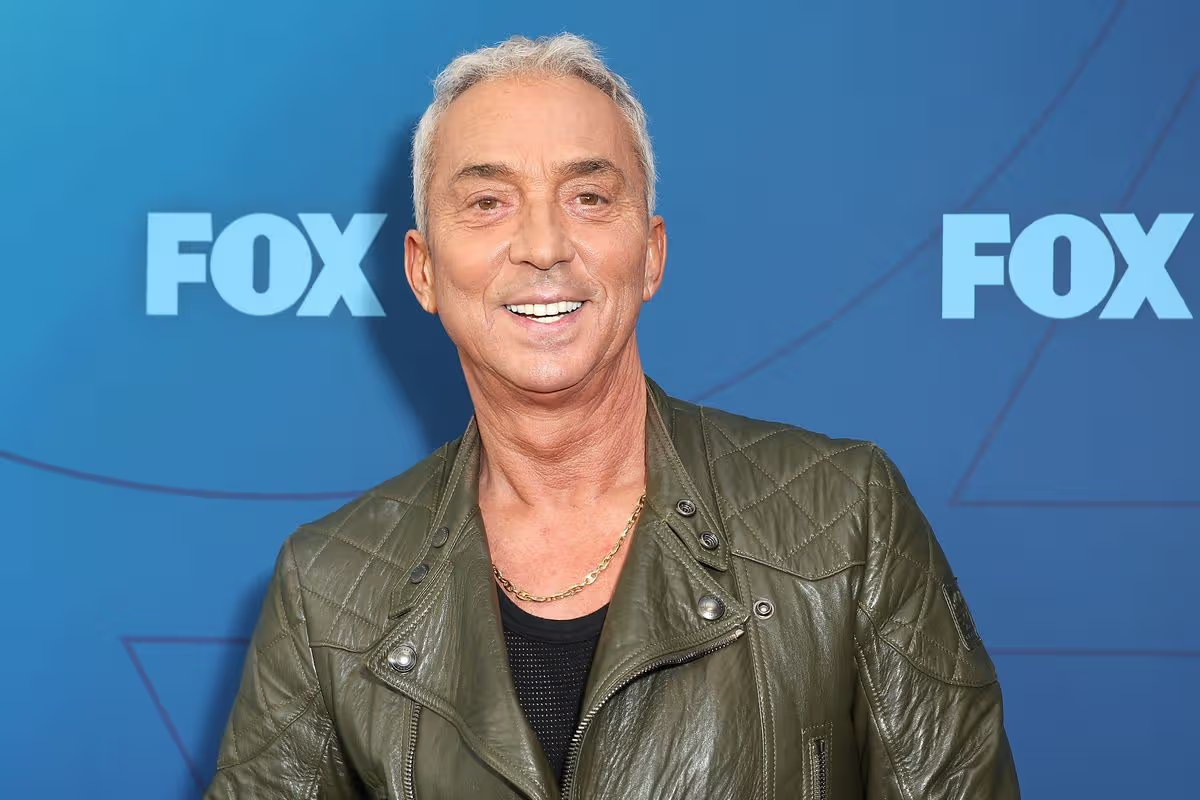
The former England player appeared on Michael McIntyre’s Big Show on Saturday night
Michael McIntyre’s Big Show returned on Saturday night (Image: BBC)
Michael McIntyre’s Big Show took an emotional turn on Saturday night, leaving a famous footballer fighting back tears.
The beloved family series returned on February 21 with famous faces, including Peter Crouch and Abbey Clancy, who took on the Remember Me segment. The couple was tasked with identifying people from their past whom they haven’t seen in years.
Everyone from their wedding singer to Peter’s childhood crush made an appearance. But it was the former England footballer’s first professional coach, Barry Quinn, who left him utterly stunned.
Upon hearing Barry’s voice, Peter immediately became emotional, and Abbey quickly noticed, pointing out, “He’s crying.”
Although the sports star didn’t break down into tears, the surprise left him teary-eyed.
Speaking of his close bond with the coach, he said, “I’ll never forget him. When I was a kid, I genuinely believed that my technique came from the grounding I had with Barry Quinn.”
The duo knew each other when Peter was finding his feet in the sport at around 10 years old.
The footballer went on to add: “I just think at that time, at that age, it’s such a time for you to develop. I was so lucky to have a coach like Barry, who I felt got me to the next level, really. And I know that grounding was what shaped the player I became.”
For the latest showbiz, TV, movie and streaming news, go to the new **Everything Gossip** website.
Barry also opened up about their relationship, praising the striker: “He had a fantastic attitude.
“He had natural talent but always wanted to progress, always wanted to get better. Worked harder than everybody else and had great family support. So he was an absolute coach’s dream.”
The 45-year-old striker played for the likes of Liverpool, Stoke City, Tottenham Hotspur, and Burnley throughout his impressive career.
Michael McIntyre’s Big Show is available to stream on BBC iPlayer
Ensure our latest headlines always appear at the top of your Google Search by making us a Preferred Source.Click here to activateor add us as your Preferred Source in your Google search settings.
Hundreds of Britain First protesters faced larger antifascist crowds in a tense Manchester city centre standoff.
Manchester, United Kingdom – Chants of “send them back” echoed through a damp underpass as hundreds of far-right anti-Islam protesters prepared to march through the streets.
Union Jacks fluttered in the wind as protesters – some visibly under the influence of alcohol – chanted a series of anti-immigration slogans and derisive comments about British Prime Minister Keir Starmer.
Recommended Stories
list of 4 itemsend of list
In response to the demonstration organised by Britain First, a far-right political party that calls for mass deportation and the removal of migrants and Muslims from the UK, a counterprotest was also planned for midday on Saturday.
It formed a much larger crowd made up of antifascist protesters who gathered a few streets away, carrying antiracist banners and waving an array of flags, including the Palestinian flag.
Ruby, 20, a student from South London, took a five-hour coach ride to show her support for the counterprotest and told Al Jazeera that attending was a “no-brainer”. She asked that her surname not be published, fearing repercussions.
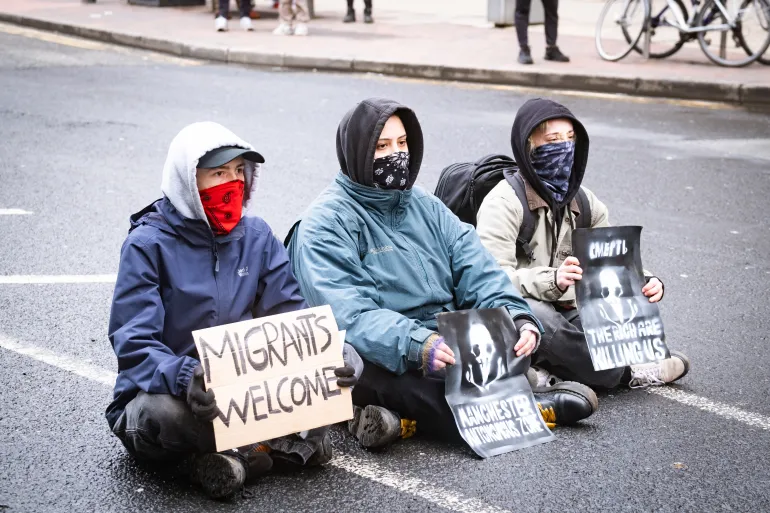
Three counter-protesters face the oncoming Britain First demonstrators [Nils Adler/Al Jazeera]
‘A master race’
Ruby said her grandparents, originally from Montserrat, were part of the Windrush generation – immigrants invited to the UK between 1948 and 1971 from Caribbean countries – and, despite having given so much to their adopted country, are now feeling increasingly unwelcome.
She said her grandparents had told her they were witnessing a return to the levels of racism they experienced when they came to the country in the 1950s.
It was a sentiment echoed by Llowelyn, 16, a counter-protester from Wales who said her father, who is British Guyanese, has received more verbal abuse based on his race in the past few years than at any other point.
The tension was palpable before the two marches were due to begin, with far-right agitators livestreaming to their followers as they entered the area assigned to the counterprotest.
John – a stocky, tenacious counter-protester from Wales – confronted them with arms outstretched as police officers looked on.
“They come here to cause a ruckus and make money of it online, but I come here to protect the left. These guys [far-right agitators] try and intimidate … minorities because they think they are a master race”, he told Al Jazeera.
As the Britain First march began, flanked by police and led by Paul Golding, a portly, combative far-right activist who has previously been imprisoned for religiously aggravated harassment, the celebratory mood quickly turned aggressive as they came across counter-protesters in the city centre.
“Leftie scum,” screamed one member of the Britain First crowd as they harassed three young people who staged a sit-down, forcing riot police to encircle and pull them to safety.
Far-right agitators turn up at a counterprotest [Nils Adler/Al Jazeera]
‘Divisive, racist positions’
The two marches finally met in an expletive-ridden crushendo as police struggled to hold ranks.
Britain First protesters prodded counter-protesters with flag poles, and some slipped through the porous police lines as they shouted anti immigration and anti-Palestine slogans.
A number of counterprotesters and bystanders expressed frustration that the police allowed the march to go ahead.
“We, as Jews and internationalists, are having to confront Britain First, the fascists who are organising on the streets, who have been permitted to market their divisive, racist, dictatorial positions on our streets,” Pia Feig, of Jewish Action for Palestine, told Al Jazeera.
Audrey, a teacher and counterprotester who was pushed away by police after being shoved by a Britain First protester, said the police always “protected” the far-right groups.
A police officer told Al Jazeera that the day required extensive planning and was a particularly difficult operation, as the two groups kept changing their planned route.
He said on condition of anonymity that handling the two conflicting protests, a rally in support of Ukraine, and managing crowds at large football fixtures held this weekend had stretched the local police force thin.
Artemis 2 is a precursor to the US space agency’s planned astronaut moon landing with Artemis III scheduled for 2028.
Published On 21 Feb 202621 Feb 2026
Share
NASA chief Jared Isaacman says Artemis 2 – the first crewed flyby mission to the moon in more than 50 years – will not launch next month because of technical problems.
Workers detected an issue with helium flow to the massive Space Launch System (SLS) rocket that will “take the March launch window out of consideration”, Issacman said in a post on social media Saturday.
Recommended Stories
list of 4 itemsend of list
Solid helium flow is essential for purging the rocket’s engines and pressurising its fuel tanks.
“I understand people are disappointed by this development. That disappointment is felt most by the team at NASA who have been working tirelessly to prepare for this great endeavor,” Isaacman said.
NASA’s next opportunity for the launch would be at the beginning or end of April.
The US space agency hopes to put humans back on the moon as China forges ahead with a rival effort that is targeting 2030 at the latest for its first crewed mission.
China’s uncrewed Chang’e 7 mission is expected to be launched in 2026 for an exploration of the moon’s south pole, and testing of its crewed spacecraft Mengzhou is also set to go ahead this year.
Multiple postponements
NASA surprised many late last year when it said Artemis 2 could happen as soon as February – an acceleration explained by the administration of US President Donald Trump’s wish to beat China to the punch.
But the programme has been plagued by delays. The uncrewed Artemis 1 mission took place in November 2022 after multiple postponements and two failed launch attempts.
Then, technical problems in early February – which included a liquid hydrogen leak – cut short a so-called wet dress rehearsal for the Artemis 2 launch. That was finally completed earlier this week.
The wet dress rehearsal was conducted under real conditions – with full rocket tanks and technical checks – at Cape Canaveral in Florida, with engineers practising the manoeuvres needed to carry out an actual launch.
The space agency revealed the latest technical problem just one day after targeting March 6 for the launch of the Artemis 2 mission.
The towering SLS rocket and Orion spacecraft will be rolled back into the Vehicle Assembly Building at the Kennedy Space Center in Florida to investigate the technical issues and make any necessary repairs, Isaacman said. He said a bad filter, valve, or connection plate could be to blame for the stalled helium flow.
Isaacman added that a complete briefing will follow in the coming days.
The goal of the Artemis 2 mission, a 10-day flight around the moon and back, is to “explore the Moon for scientific discovery, economic benefits, and to build the foundation for the first crewed missions to Mars”, according to NASA.
The planned Artemis 2 crew includes three US astronauts – Reid Wiseman, Victor Glover, and Christina Koch – and Canadian astronaut Jeremy Hansen. The mission is poised to be the farthest human flight into space ever, and the first crewed moon mission since the US Apollo programme more than half a century ago.
Artemis 2 is a precursor to NASA’s planned astronaut moon landing with Artemis 3, which is scheduled for 2028.
Willie Colón, a legendary trombonist and pioneer of salsa music, has died. He was 75.
His death on Saturday was confirmed in a Facebook post by his longtime manager, Pietro Carlos.
News of the singer’s condition circulated on the web in recent days. Yonkers Voice News reported Colón was admitted to NewYork-Presbyterian Westchester hospital in Bronxville, N.Y., on Tuesday with respiratory problems and he appeared fragile.
:
Born William Anthony Colón Román on April 28, 1950, to Puerto Rican parents in New York City, Colón first picked up the trumpet in school. It seemed like a natural choice for the former bugle-playing Boy Scout, who attended the youth program at the suggestion of his grandmother.
“So I could learn how to be a good boy,” said Colón in a 1988 interview with Associated Press.
By age 13, Colón had started a band and played at some weddings and in the bustling nightclubs of New York City. At one point, he forged a cabaret card, a mandated ID for musicians and entertainers between 1940 and 1967 who worked in establishments serving alcohol, which required individuals to be 18 years and older.
The thrilling 1960s Latin music scene in New York consumed Colón, who was deeply inspired by Latin jazz pioneer and bandleader Eddie Palmieri, once part of a main act at the Palladium Ballroom who went on to form La Perfecta, a Cuban conjunto that revolutionized the New York Latin music scene with its inclusion of two trombones, played by Barry Rogers and Jose Rodriguez, instead of the costly four-set trumpets.
But Colón’s instrumental preference changed once he heard the bodied timbre of Mon Rivera’s all-trombone brass lineup marching to a bomba beat. “It would knock my socks off,” said Colón in a 1988 interview with Associated Press, leading the singer to teach himself how to play the instrument.
By age 15, Colón was signed to Fania Records. Two years later at age 17, he went on to release his debut album, “El Malo,” a record that defined the fierce sounds of New York’s salsa scene, which Colón later described as the Latin equivalent of rap.
According to his former label, the name of “El Malo” was bestowed upon Colón by older musicians who sought to mock his trombone range at the time, though the young bandleader would find a way to use the label to his advantage.
On the LP, Colón’s sound moved away from the polished mambo sounds of orchestral bands decades prior, in large part due to Puerto Rican singer Héctor Lavoe, whose vocals can be heard in tracks like the gritty “El Malo” that vows to knock out any wanna-be street phony.
The pair would go on to record a total of 14 albums through 1973, with Lavoe’s talents for improvisation complementing Colón’s raw, aggressive trombone.
“Salsa came from the same kind of situation that rap does,” Colon said in a 1992 interview with The Times. “It was kind of a hybrid of a bunch of different elements. Hector had just come from Puerto Rico and didn’t speak English. I didn’t speak much Spanish, I was a little New York kid. We got together and just started with the same kind of irreverent, rebellious attitude, writing songs about the baddest guy on the block, drugs and sex. Before that, the lyrics and whole attitude of Latin music was, ‘Look at me dance, listen to those drums, I’m cutting sugar cane.’ It was a rural, folkloric emphasis; we changed it to an inner-city kind of culture.”
Colón’s impact went beyond live music. The album cover of “El Malo,” which showed two serious profiles of Colón, depicted the singer as a sly bad boy, and ultimately gave rise to his gangster persona, which would be a throughline in future projects, including his sophomore 1968 album, “The Hustler” which featured the band with fitted suits, smoking cigars and placing bets in a pool hall. His 1970 album “Cosa Nuestra” featured Colón smoking a cigar while overlooking a dead body in broad daylight in Manhattan’s East River Bikeway. Most famously, his 1971 album, “La Gran Fuga,” depicted the singer on a fake FBI “Most Wanted” poster.
These mob-like depictions occurred long before cult-favorite films like Francis Ford Coppola’s 1972 “The Godfather” and Brian De Palma 1983’s “Scarface” became the prominent gangster storylines various male acts venerate in their music.
By 1973, Colón and Lavoe split — allegedly due to Lavoe’s drug addiction leading to many missed concert performances — although the two would remain frequent collaborators until the latter’s death in 1993 due to complications of AIDS.
The Nuyorican musician would introduce Blades as the new singer of his orchestra, whom he had met years prior while visiting Panama during carnivals. They collaborated briefly on Colón’s 1975 LP “The Good, the Bad, the Ugly,” cementing their partnership in the 1977 album “Metiendo Mano,” which delved into socio-political themes, notably in their track “Pablo Pueblo,” which shares the story of a working class man with broken dreams halted by toils of daily life. Other tracks like “Plantación Adentro,” detailed the story of Camilo Manrique, a fictionalized enslaved character who died at the hands of a Spanish colonizer in 1745.
Many considered this album Colón’s first foray into intellectual salsa — in large part because of Blades, who had a knack for storytelling and political interests (he unsuccessfully ran for president of Panama in 1994) — that addressed colonialism and class disparities. Together they released three albums, including their 1978 “Siembra,” one of the bestselling salsa albums at that time; from the start, their track “Plastico” fused the popular disco music of the moment while addressing superficial beauty standards and colorism in Latin America.
According to 1996 reporting by The Times, “Siembra” delivered pulsating salsa rhythms that “carried messages of freedom at a time when most of Latin America was oppressed by military dictatorships.”
By 1982, Blades and Colón parted ways, but they collaborated again on projects like their 2005 LP “Tras La Tormenta” — which led the bandleader to sing for the first time in his career, “I had to start from zero, and it took me many years to feel comfortable,” Colón said.
This newfound independence gave rise to some of Colón’s most famous songs, including his 1995 track “Talento de Televisión,” an upbeat song with his signature trombone wailing in the backdrop as he sang about an attractive woman with a lack of talent.
Many across Latin America might be familiar with his 1989 song “El Gran Varon” — which narrated the story of a trans woman who is rejected by her father and presumably dies of AIDS — a landmark salsa song that brought awareness to LGBTQ+ themes during the AIDS crisis. Colón would later serve as a member of the Latino Commission on AIDS. “El Gran Varon” is an anthem to this day.
Colón released more than 40 albums in all.
He also acted, taking roles in films including 1982’s “Vigilante,” the 1983 sports drama “The Last Fight,” as well as one-episode stints in TV shows like “Miami Vice” and “The Cosby Show.” He was even featured in Bad Bunny’s “Nuevayol” music video, cutting a slice of cake; the 31-year-old superstar pays homage to the singer in its lyrics: “Willie Colón, me dicen el malo, ey. Porque pasan los años y sigo dando palo”/ “Willie Colón, they say I’m bad, because the years come and I’m still hitting.”
In his later years, he became more involved in politics. In 1994, he unsuccessfully went up against U.S. Rep. Eliot Engel of the Bronx in the Democratic primary. He also ran as a Democrat for Public Advocate in 2001, focusing on community issues, education and AIDS awareness, but failed to gain the popular vote. In 2008, he endorsed Hillary Rodham Clinton over Barack Obama in the primary election.
On May 26, 2014, after graduating from Westchester County Police Academy, Colón was sworn in as a deputy sheriff for the Department of Public Safety, later becoming deputy lieutenant.
As President Trump took office in his first term, Colón’s politics shifted in support of the right-wing candidate, and he said he would be open to performing at his inauguration in 2017.
Slovakia and Hungary vexed after Russian oil flows via Ukraine halted by alleged Russian drone strike last month.
Published On 21 Feb 202621 Feb 2026
Share
Slovak Prime Minister Robert Fico has issued Ukraine a two-day deadline to resume the pumping of Russian oil through its territory, threatening to cut off electricity to the war-torn country if this demand is not met.
Fico issued his ultimatum to Ukrainian President Volodymyr Zelenskyy on Saturday, warning on X that he would ask state-owned company SEPS to halt emergency supplies of electricity if flows of Russian crude via the Soviet-era Druzhba pipeline crossing Ukraine are not resumed by Monday.
Recommended Stories
list of 3 itemsend of list
Slovakia and neighbouring Hungary, which have both remained dependent on Russian oil since the Kremlin launched its invasion of Ukraine almost four years ago, have become increasingly vocal in demanding Kyiv resume deliveries through the pipeline, which was shut down after what Ukraine said was a Russian drone strike hit infrastructure in late January.
The Slovak leader accused Zelenskyy of acting “maliciously” towards his country, alluding to Ukraine’s earlier halting of Russian gas supplies after a five-year-old transit agreement expired on January 1, 2025, which he claimed is costing Slovakia “damages of 500 million [euros; about $589m] per year”.
Describing Zelenskyy’s actions as “unacceptable behaviour”, he said that his refusal to “involve the Slovak Republic in the latest 90 billion euros ($105bn) military loan for Ukraine” had been “absolutely correct”.
Slovakia is a major source of European electricity for Ukraine, needed as Russian attacks have damaged its grid. Energy sector experts say Slovakia provided 18 percent of record-setting Ukrainian electricity imports last month.
EU loan in peril
Hungary, Slovakia and the Czech Republic all opposed the interest-free European Union loan package, which was agreed to by the bloc’s member states back in December to help Ukraine meet its military and economic needs over the coming two years.
While the three nations opposed the package, which replaced a contentious plan to use frozen Russian assets that ran aground over legal concerns, a compromise was reached in which they did not block the initiative and were promised protection from any financial fallout.
However, as tensions mounted over the interrupted supply of Russian oil this week, Hungarian Prime Minister Viktor Orban threatened on Friday to overturn December’s deal by vetoing the EU loan package.
“As long as Ukraine blocks the Druzhba pipeline, Hungary will block the 90‑billion-euro Ukrainian war loan. We will not be pushed around!” the Hungarian leader wrote on Facebook.
Slovakia and Hungary both received a temporary exemption from an EU policy prohibiting imports of Russian oil over the war in Ukraine.
Ukraine responds
The Ukrainian Ministry of Foreign Affairs slammed Slovakia and Hungary on Saturday for what it called their “ultimatums and blackmail” over energy issues, saying the two countries are “playing into the hands of the aggressor [Russia]”.
The ministry said that Ukraine had provided information on the damage that resulted from “Russian attacks” on the Druzhba pipeline to Hungary and Slovakia, and that repair work is under way.
In the meantime, it said, it has “also proposed alternative ways to resolve the issue of supplying non-Russian oil to these countries”.
Youtuber KSI is the newest judge to the Britain’s Got Talent panel, joining the show permanently this year after a successful guest stint covering for Bruno Tonioli last year
KSI booed by Britain’s Got Talent audience as he breaks unofficial rule(Image: ITV)
KSI‘s first episode as a permanent member of Britain’s Got Talent’s judging panel didn’t get off to the best start, as a rule-breaking act led the audience to boo him.
During the show, one wowed the audiences and three of the judges, but not KSI. Dom and his dog Ninja were a parkour double act, and while their opener to the act – a video in which they did flips and jumps off of the Blackpool benches and landmarks – impressed KSI, he was unhappy with the rest.
The other judges were happy with the performance, and as such, KSI was the only one to say no to Dom and Ninja. When it was revealed that KSI has cats, the audience started to boo.
Ensure our latest headlines always appear at the top of your Google Search by making us a Preferred Source. Click here to activate or add us as your Preferred Source in your Google search settings.
This got the YouTuber riled up, and he began to shout back at the audience, loudly telling them: “Don’t boo my cats!” Meanwhile, Dec Donnelly, one half of the hosting duo Ant and Dec, said KSI had broken an unofficial rule on the show. “You don’t say no to dogs on Britain’s Got Talent, KSI,” he said to a camera. “It’s the rules.”
KSI is the newest judge on the panel, as this year is his first on the show. He filled in for Bruno Tonioli last year and has now taken over following Bruno’s departure.
Another guest judge on the show last year was Stacey Solomon, who filled in for Simon Cowell after he had a fall and injured his head. Judge Amanda Holden, who took over as the head judge when Simon was off, was thrilled to welcome Stacey to Britain’s Got Talent, praising her for bringing a great deal of warmth to the panel and drawing on her past experience from The X Factor in 2009.
“She’s so lovely, and I think we’ve got quite a similar style of judging,” Amanda reveals. “She’s warm, she’s super funny, she has a great understanding of what it’s like to be on the other side, because she obviously auditioned for The X Factor all those years ago.”
However, she was less pleased to be a head judge. “I must admit I hated sitting in that seat,” confessed Amanda. “I’ve been on the show the longest, so I understand why I probably need to sit in that seat, but when I was there, I felt very outcast on the end.”
Amanda concedes she felt vulnerable without a fellow judge on either side. “It’s OK if your team are sitting to the left of you – Simon’s got dozens of staff and family watching from the side and communicating with him.
“Mine all decided to eat my snacks and sit in the dressing room, paying no attention to the show or me whatsoever!” Amanda quipped.
“Simon said to me, ‘You must have loved it. Did you feel powerful?’ I said I hated it because I had to keep leaning in to be part of the conversation. I never want to sit in that seat again! I’m juicy in the middle, it’s such a good spot.”
Persistent rain in Colombo forces abandonment of Pakistan’s game with New Zealand, which was to open Super Eights stage.
Published On 21 Feb 202621 Feb 2026
Share
Pakistan and New Zealand’s Super Eights match to open the second phase of the 2026 T20 World Cup was abandoned because of rain without a ball being bowled.
The rain started at Colombo’s R Premadasa Stadium as soon as Pakistan captain Salman Ali Agha won the toss and chose to bat first on Saturday.
Recommended Stories
list of 4 itemsend of list
The post-toss interviews were completed, but with the forecast suggesting the game would be in doubt, there was little surprise when the teams ran for cover.
More than 60 ground staff were on hand to cover the square and the majority of the playing surface.
The persistent rain eventually led to the umpires calling the Group 2 match off at 9:05pm local time (15:35 GMT).
Not even a five-over match was possible by the 10:16 pm (16:46 GMT) cut-off time, giving the two teams one point each.
Tournament co-host India plays South Africa in Ahmedabad in the first Group 1 match on Sunday, when co-host Sri Lanka and England meet in Group 2 in Pallekele.
Tandy’s response to heavy opening defeats against England and France, in which Wales conceded 15 tries and 102 points, was to make four changes.
Uncapped Leicester wing Gabriel Hamer-Webb, Scarlets fly-half Sam Costelow , Dragons second-row Ben Carter and Scarlets flanker Taine Plumtree coming in for Ellis Mee, Dan Edwards, Adam Beard and Olly Cracknell.
Wales made shocking starts in the opening two games but ensured that was not the case on this occasion.
Plumtree and Hamer-Webb both picked up injuries in the opening two minutes. Hamer-Webb was forced off briefly with a bloody nose before Plumtree was permanently replaced by James Botham because of a shoulder problem.
Wales’ discipline was again poor in the opening exchanges with two soft penalties, before Joe Hawkins was sent to the bunker for a high tackle on Scotland flanker Gregor Brown, who had moved from lock to the back row from the victory over England to replace the injured Jamie Ritchie.
Wing Josh Adams made a couple of important early interventions with a crucial tackle on Scotland centre Huw Jones followed by a vital interception.
Wales rallied with 14 men and after a searing break from scrum-half Tomos Williams, the home side produced an identical successful tap penalty move to last week when Carre dived over after the initial drive from Lake.
Hawkins’ card remained yellow as it was deemed a passive tackle but it was still an 11th sin-binning in Tandy’s seven games in charge.
Scotland took advantage of the extra back with a sweeping move that was finished by Steyn.
Hawkins returned and his fellow Scarlets centre Eddie James, along with Lake, Carre and flanker Alex Mann, laid the foundations for Adams to cross for his 24th Wales try.
Costelow, who was starting his first game since July 2025 with Edwards having played the past seven games, converted from the touchline.
Botham was outstanding after his early introduction and a turnover laid the foundations for a Costelow penalty.
Scotland made a couple of early tactical substitutions as prop Pierre Schoeman and back rower Josh Bayliss came on for Nathan McBeth and Max Williamson, with Brown reverting to lock.
After another storming Steyn break, a vital Mann turnover forced a penalty as Wales led 17-5 at half-time, the first time the home side had led under Tandy at the interval.
A sparkly pink electric guitar hangs on a wall of the recording studio where Hilary Duff made her new album. The cozy, gear-filled joint near the Van Nuys Airport belongs to her husband, Matthew Koma, who produced “Luck… or Something,” the singer and actor’s first LP in more than a decade. But as Duff points out on a recent afternoon, the paisley-print guitar is all hers.
“I got it for my 16th birthday,” she says proudly — a gift from the Fender company. “I found it in the storage unit and Matt was like, ‘Oh, that’s going up there.’”
Before Miley Cyrus, before Sabrina Carpenter, before Olivia Rodrigo, Duff arrived in the early 2000s as a Disney kid with pop-idol ambitions. She broke out in the endearingly awkward title role of the Disney Channel’s “Lizzie McGuire” then went on to star in family-friendly movies like “Agent Cody Banks” and “Cheaper by the Dozen.” By the time she received that guitar, she’d topped the Billboard 200 with her album “Metamorphosis,” which sold 4 million copies and spawned hit singles like “So Yesterday” and “Come Clean.”
Duff stepped away from music for most of her 20s to focus on acting and starting a family. (An attempted comeback album in 2015, “Breathe In. Breathe Out.,” didn’t really go anywhere.) Now, at 38, she’s returned with a bracingly honest record full of the texture and detail of her life as a wife, sister and mother of four.
In frank yet wordy songs that layer guitars and synths over shimmering grooves, Duff sings about trying to overcome old habits and about her fear that her best times are behind her. “We Don’t Talk” appears to address her estrangement from her older sister, Haylie, while “Weather for Tennis” describes her tendency to keep the peace as a child of divorce. In “Holiday Party,” she recounts a recurring dream in which Koma cheats on her with her friends.
“I wake up in a rage and he’s like, ‘I didn’t do anything!’” she says with a laugh. “And I’m like, ‘But you want to.’ A lot of this stuff came out of the hormonal boom of: I’ve just had a baby and I’m nursing and I’m trying to get my two feet back on the ground again.” (Duff and Koma have three daughters aged 7, 4 and 1, while Duff shares a 13-year-old son with her ex-husband, former hockey player Mike Comrie.)
Asked how he hopes the album fares commercially, Koma says, “I don’t [care]. Public perception or sales, that’s all cool, but it’s a separate experience from why we did it.” The producer, who’s known for his work with Zedd and Shania Twain, adds, “The whole purpose was to make something that Hilary could feel good about stepping into.”
Yet early-2000s nostalgia led to a recent run of sold-out theater gigs, and this summer it’ll carry her into arenas around the world, including Inglewood’s Kia Forum on July 8 and 9. (Less happily for Duff, it also made a viral sensation of an essay in the Cut by her fellow millennial Ashley Tisdale in which Tisdale wrote about leaving a “toxic mom group” that allegedly included Duff and Mandy Moore.)
Curled on a sofa in the studio’s control room, Duff says, “I’m finally at this place where I’m zero percent ashamed of my past and any of the things that used to embarrass me” — one reason she made the bold choice to open her set at the Wiltern last month with two of her biggest hits, “Wake Up” and “So Yesterday.”
After those songs came “Roommates,” perhaps the most vulnerable track on Duff’s new album. It’s about navigating a dry patch in a marriage, and the language is as vivid as it is unsparing: “I only want the beginning / I don’t want the end,” she sings, adding that she longs to be in the “back of a dive bar, giving you h—.”
A surprising word choice. How would you have said it? Sometimes you need to make the lyrics fit — you need it to rhyme with something. [Laughs] It’s meant to be polarizing because it’s such a desperate plea. I can say I haven’t actually given h— in the back of a dive bar. But it’s just trying to capture the feeling of a time when you felt alive.
Like all teen stars, you had to figure out how to grow up and talk about sex as a public figure. Now there’s the idea that it’s better left to the young. I finally feel like I know a lot about sex. My whole 20s, sex was not always enjoyable — it was so much to figure out. Now I finally understand it. Maybe that’s a female thing, but I’m not ready to be put out to pasture. People come up to me all the time and they’re like, “Wow, you aged really well.” I’m like, “I’m only 38! Just because you’ve known me since I was 9…”
You’re handling senior citizenship well. When do I start getting the discounts? I feel like 38 is not old, although when I thought about my parents at 40, they looked so different than we look now.
I always stop at those TikToks where it shows what 35 looked like in 1982. I don’t think anyone drank water back then. They were, like, dusty-crusty.
Hilary Duff, left, and Matthew Koma at Apple Music Studios in Los Angeles in December.
(Amy Sussman / Getty Images for Apple Music)
You borrow the chorus of Blink-182’s “Dammit” for your song “Growing Up.” Why? Blink is one of my favorite bands. I remember getting my driver’s license, and that was what was playing on my iPod. “Growing Up” is such a deeply personal song to me, talking about sitting in the backyard with one of my best friends and just needing to drink too much wine and unload about life. But it also feels like a love letter to my fans. I don’t like saying that word, but I genuinely feel like I’ve had fans for 25 years, and getting to see them now in adulthood — I didn’t know I was going to have this opportunity.
What’s the problem with “fan”? It puts me on a pedestal that makes me feel uncomfortable. If you were to talk to Matt or someone close to me, they’d probably say, “Hilary doesn’t understand what she’s meant to some people.” And I think that’s true. When I think of myself, I’m not like a grand pop star — I feel more like a woman of the people.
A woman of the people? Am I allowed to say that? [Laughs] Is that offensive in any way? My feet hit the ground in the morning, and I’ve got a million things to do. Sometimes my baby’s still sleeping. And I have a teenager to get ready for school that we’re always all waiting on.
Why do you have four children? I know — we’re sick.
Did you expect to have four? I thought I would have at least three. I always wanted a big family because I come from a super small family and I always wanted more siblings. I had Luca obviously pre-Matt, and then we had Banks before we got married. Then the pandemic hit — we had a pandemic baby like everybody else. The fourth was just a crazy-a— decision. Matt was like, “Everybody’s gonna think we’re really Christ-y if we go for No. 4.” We also have three dogs, two cats and eight chickens.
As two artists, how do you sort out the work of child-rearing? I don’t know if I’ve actually said this out loud — to Matt I have for sure — but I think that part of my wanting to make a record was coming out of having my fourth child. I love motherhood, obviously — I wouldn’t have four kids if I didn’t. But I think I felt really jealous that he got to go to work every day and just be alone with his thoughts. I was like, I need to stretch. That’s what it felt like after the fourth baby: I’m either gonna lose myself completely and just become a stay-at-home mom and wait for the phone to ring, or I’m gonna go make something that moves me.
You don’t need me to tell you that our culture is always happy to make moms feel guilty. Was it a journey to accept that it’s OK to do something for yourself? That’s what the healthy part of the brain says. But the other part that’s wired to be with the children you birthed — sometimes that part overshadows it. And it’s very hard to fight that. I could probably cry right now thinking about all the things I’m gonna miss this year.
Hilary Duff in the studio where she recorded her new album.
(Jay L Clendenin / For The Times)
You’ve got a line in “Roommates” where you say, “Life is life-ing and pressure is pressuring me.” At the shows you just played, did you think of your audience as being at the same place in life as you? For sure. When they were scream-singing it back to me, I was like, “Oh, you know.” That doesn’t mean you have to be a parent. “Life is life-ing” is the bills and the monotony and the traffic and the family — it’s all the things. I knew that if it’s bumping around inside my head, and I’ve been living a pretty normal life for 10 years — normal as I can get — then people would see themselves in it.
Twenty-five years ago, you were playing to 10-year-olds. Would a 10-year-old today be interested in your new songs? I don’t think so. But I mean, I used to sing Natalie Imbruglia’s “Torn” all the time, and I had no idea what it was about.
The last decade has been a golden age for young female songwriters: Taylor Swift, Billie Eilish, Olivia Rodrigo. You forgot Chappell Roan.
“Luck… or Something” feels aligned with that deepening craft. But maybe your early stuff felt sophisticated to you. I don’t think the intent back then was sophisticated songwriting. There was no Taylor Swift yet — it’s like before Christ and after Christ.
She changed the game? On all the levels.
How’d you end up on Atlantic Records? I wondered whether this was a product of personal friendships — the Elliot Grainge and Sofia Richie and Good Charlotte of it all. We’re more personally friends with them now. I finished making the record and for the first time ever was like, “It’s done — do you like it?”
You weren’t looking for notes from the label. I’m not saying I didn’t have meetings with A&R. But pretty much the record was created, and that was that. I didn’t go shopping anywhere else, which was fantastic because I hate a dog-and-pony show.
Did you feel like you’d been chewed up by the record industry in any way? After “Breathe In. Breathe Out.,” it was very easy to be like, “RCA forced me to lead with this song when I knew it should’ve been this song.” But that was me not having [courage], you know what I mean? It was a joint effort of [messing] it up. But I learned a lot from that. I don’t think I would’ve made this record if I hadn’t fumbled the ball a little.
The story about the toxic mom group blew up just as you were launching this album. Did that experience give you pause about reentering the pop world? I mean, this is not new for me. I’ve had this since I was maybe 15 and starting to get followed around by paparazzi. Everything starts getting documented and everyone knows my life and all the players in it. So the stories that get news pickup — it’s not what happens to a normal person who maybe became an actor as an adult. And now it’s escalated by the talking heads on TikTok that need clickbait. It’s hard because you’re like, “Wait, whoa, that person kind of got it right,” and “Whoa that person doesn’t know what they’re talking about.” I saw something that was like, “None of the moms at school actually like her and neither do the teachers,” and I was like, “First of all…”
Is it hard or easy for you to tune out — By the way, the women at school are lovely and I’m obsessed with all of them.
But can you ignore the chatter about you on social media? It just depends on the day. Knowing that I get to open up the backdoors and play soccer as a family and take a hot tub and go get our chicken eggs — that’s the purpose of life. On the days when crazy s— happens, I go home and quiet the noise.
1 of 3 | Nearly 250 million gallons of untreated wastewater on Jan. 19 spilled into the Potomac River, pictured in 2022 in Washington, D.C., near The Kennedy Center. Photo by Pat Benic/UPI | License Photo
Feb. 21 (UPI) — President Donald Trump approved an emergency declaration that will mobilize the Federal Emergency Management Agency to assist in the clean-up of millions of gallons of sewage in the Potomac River.
The declaration comes five weeks after nearly 250 million gallons of sewage spilled into the river after a sewage line collapsed.
The Potomac River runs between Maryland, Virginia and Washington, D.C.
“The President’s action authorizes FEMA to coordinate all disaster relief efforts to alleviate the hardship and suffering caused by the emergency on the local population and to provide appropriate assistance to save lives, to protect property, public health and safety and to lessen or avert the threat of a catastrophe,” FEMA said in a press release.
The spill started when the Potomac Interceptor, a 72-inch in diameter pipe that carries up to 60 million gallons of wastewater per day from Maryland and Virginia to a treatment plant in Washington, D.C., ruptured on Jan. 19, spilling 243 million gallons of untreated wastewater into the river.
DC Water, which operates the pipe, installed a temporary bypass on Jan. 24, stopping more wastewater from leaking into the river.
Washington, D.C., Mayor Muriel Bowseron Feb. 18 formally declared a major disaster in the District and directly requested that Trump mobilize FEMA to help with cleaning up the waterway as work starts on a permanent fix, which could take as long as 10 months to complete.
On Feb. 16, Trump said that he would send FEMA to assist with the clean-up and, with his approval of Bowser’s declaration, the agency will now be mobilized to provide equipment and resources necessary.
Show host Thalía Sodi walks the red carpet at the Univision 2026 38th edition of Premio Lo Nuestro award show at the Kaseya Center in Miami, on Thursday. Photo by Gary I Rothstein/UPI | License Photo
Latest Israeli attacks bring total death toll in Gaza since October ‘ceasefire’ to 614.
Published On 21 Feb 202621 Feb 2026
Share
Israeli air strikes killed at least two Palestinians in Gaza on the third day of Ramadan in the latest breach of the truce deal signed with Hamas more than four months ago.
The attacks on Saturday occurred in northern Gaza’s Jabalia camp and the Qizan an-Najjar area in southern Gaza.
Recommended Stories
list of 4 itemsend of list
The total death toll from Israel’s attacks since the “ceasefire” came into effect has risen to 614, with 1,640 more Palestinians wounded, according to the Palestinian news agency Wafa.
Israel’s military appeared to acknowledge one of the attacks in a post on X, claiming its forces killed a fighter who crossed onto Israel’s side of the demarcation line in northern Gaza and approached its troops “in a manner that posed an immediate threat”.
The army said it would “continue to act to remove any immediate threat”.
‘Board of Peace’ deliberations
Saturday’s attacks come two days after US President Donald Trump’s Board of Peace held its first-ever meeting addressing reconstruction, security, and governance in the war-battered Strip.
Trump announced at the gathering that nine countries committed $7bn for Gaza reconstruction efforts, on top of a $10bn contribution from the United States. While significant, the total is far short of the estimated $70bn needed to rebuild the devastated Palestinian territory.
Trump also said five countries pledged to send troops to participate in an eventual 20,000-strong International Stabilization Force (ISF), which is to take over security from Hamas. But the task of disarming Hamas – called for in the next stage of the deal – is still unresolved, threatening to delay or derail the entire process.
Israeli Prime Minister Benjamin Netanyahu has insisted Hamas must disarm before any reconstruction begins. Last week, a top Netanyahu aide said Israel planned to give Hamas a 60-day deadline to comply before resuming its war, an ultimatum the group rejected.
Hamas has said it will not relinquish its weapons as long as Israel continues occupying the Strip and discussions on any political process in Gaza “must start with the total halt of aggression”.
The group has said it is open to a peacekeeping force, but with caveats.
“We want peacekeeping forces that monitor the ceasefire, ensure its implementation, and act as a buffer between the occupation army and our people in the Gaza Strip, without interfering in Gaza’s internal affairs,” said Hamas spokesperson Hazem Qassem on Friday.
‘Unclear in vision’
Along with Hamas’s disarmament, the next stage of Trump’s plan for Gaza calls for the gradual withdrawal of the Israeli military and the ISF’s deployment, with a transitional Palestinian technocratic committee overseeing day-to-day governance.
Many Palestinians told Al Jazeera they are deeply sceptical about the plan’s prospects for success, citing Israel’s continued deadly attacks and lingering aid shortages.
“Israel kills, bombs, violates the ceasefire agreement daily and expands the buffer zone without anyone stopping it,” said Awad al-Ghoul, 70, a Palestinian displaced from Tal as-Sultan in southern Rafah and who now lives in a tent in the town of az-Zawayda.
“So this project is a failure from the start and unclear in vision.”
Imelda Marcos’ fetish for fiendishly expensive shoes was a running gag in the 1980s. But did you know that she was also something of a disco queen?
The image of a jet-setting Marcos in her Beltrami pumps boogieing with arms dealers at fashionable New York nightspots is one of the inspirations of David Byrne’s musical about the notorious former first lady of the Philippines, who sang on the campaign trail for her husband, Ferdinand E. Marcos, and ruled with an iron fist alongside him after he declared martial law and plunged his nation into a brutal dictatorship.
“Here Lies Love,” which is having its Los Angeles premiere at the Mark Taper Forum, traces the political power couple’s rise and fall through a series of dance cuts that capture the irrational hold charismatic leaders can have on a public — at least while the music is blasting.
Byrne, the ingenious Talking Heads co-founder, conceived the show and wrote the music and lyrics. Fatboy Slim, a Grammy Award-winning DJ, musician and record producer, contributed to the music. The score, a mix of lush disco and synth pop with hints of island breezes and karaoke camp, brings a club-like energy to the stage.
Aura Mayari and the company of “Here Lies Love” at the Mark Taper Forum.
(Jeff Lorch)
I first saw “Here Lies Love” at New York’s Public Theater in 2013, when the production, directed by Alex Timbers, was staged as an immersive dance party. Audience members moved along a shifting dance floor as the love story between Imelda, a beauty queen from the provinces, and Ferdinand, an ambitious senator accustomed to getting what he wants, sourly played out amid the backdrop of a traumatic national story.
This sung-through musical pulled off something of a coup of its own. As Ferdinand, now president and philandering husband, and Imelda, his embittered wife dripping in compensatory luxury, shore up their “conjugal dictatorship,” theatergoers discovered that, while partying to the seductive beat, a political dystopia was solidifying around them.
Imagine if, in “Evita,” audience members were invited to sing back up on the balcony as Eva Perón belts out “Don’t Cry for Me Argentina,” accompanying her in her last manipulative hurrah. “Here Lies Love” seemed to want its audience to leave with an aftertaste of cognitive dissonance.
Audiences don’t usually like being duped. But voters need to be continually reminded that when they go to bed with a strongman, they’ll likely wake up without healthcare or voting rights.
“Here Lies Love” at the Taper doesn’t follow the Public Theater’s staging or the similarly immersive Broadway production by Timbers that followed in 2023. It’s a more straightforward presentation that keeps audience members in their seats, except for a moment when uprising is in the air and a few theatergoers are conscripted to join the ecstatic rebellion.
Jeff Lorenz Garrido, from left, Joshua Dela Cruz, and Garrick Goce Macatangay in “Here Lies Love” at the Mark Taper Forum.
(Jeff Lorch)
Snehal Desai’s direction is politically clear-eyed and scrupulous. Corruption, authoritarianism and censorship, as we’re learning firsthand, scandal after constitutional scandal, are no laughing matter. The question is whether “Here Lies Love” can bear the scrutiny of a more traditional musical.
There’s not a traditional libretto, so the story is transmitted mostly through song lyrics. But stump speeches, rallying cries and the theatrical guidance of Imeldific (Aura Mayari, alum of Season 15 of “RuPaul’s Drag Race”) help flesh out the chronicle.
This emcee figure, a Taper innovation, replaces the DJ role of previous productions and establishes the show’s metatheatrical frame. The opening number, “American Troglodyte,” underscores the American imperial role in the story and provides Imdeldific with a satiric banner that doesn’t let a smiling superpower off the hook.
William Carlos Angulo’s choreography is unfailingly kinetic, but participating in a party is more energizing than watching one at a remove. Yet the political case of Ferdinand and Imelda Marcos, a tale of celebrity and tyranny marching in lockstep, speaks so directly to our own time that I found myself gripped by the object lesson of this public saga, even if it’s not always easy to connect all the fragments, never mind distinguish between hard fact and fictional license.
I was particularly fascinated by the portrayal of Imelda (Reanne Acasio), whose political character seems to be shaped by personal disappointments and run-of-the-mill humiliations. Imelda is wounded not only by the philandering of Ferdinand (Chris Renfro) but by an even more painful injury inflicted by her first love, Ninoy Aquino (Joshua Dela Cruz), a politician determined to become the voice of his people.
Ninoy recognizes an essential incompatibility between them. Imelda lives for love while he has political work to do. He bids her adieu in the song “Opposite Attraction,” though fate will bring them together after Imelda and her husband gain power and Ninoy, as the leading opposition figure, becomes their prisoner and eventual victim of the chaos unleashed by their regime.
Joan Almedilla and the company of “Here Lies Love” at the Mark Taper Forum.
(Jeff Lorch)
Unfolding under the theatrical auspices of Imeldific, “Here Lies Love” retells the history of the Marcos years as a musical pageant. Imelda’s transformation, from shy, lowly country girl to “Iron Butterfly,” covering up her shame with jewelry from Tiffany and revealing a will every bit as hard as the diamonds she flaunts, is presented with music so catchy and compulsive that it has the force of historical inevitability
The grooves supplied by Byrne and Slim take not just the characters but the audience on a ride through a brutal anti-democratic period. Does the disco spectacle aesthetic treat this history too lightly?
The production seems wary of this criticism. A program note from dramaturg Ely Sonny Orquiza, attuned to the sensitivities of the large Filipino diaspora in Los Angeles, notes that the production, “featuring an all-Filipino cast and majority-AAPI creative team, is not intended as a definitive or comprehensive history, but as an entry point for dialogue and inquiry.”
The scale of damage perpetrated by the regime is still being collectively processed. One victim, Estrella Cumpas (Carol Angeli), makes the mistake of confronting Imelda, a childhood friend, and is taken into custody. She will have to stand in for thousands of others.
The design scheme certainly doesn’t want to spoil anyone’s good time. Arnel Sancianco’s sets, Marcella Barbeau’s lighting and the more glittering of Jaymee Ngernwichit’s costumes seem to place us in a retro Euro-style disco world, where fun is typically a function of the strength of the cocktails consumed.
But there’s a countermovement in the show, the People Power Revolution that gains momentum after the assassination of Nimoy. The funeral speech of his mother (Joan Almedilla) is turned into the galvanizing protest song, “Just Ask the Flowers,” in which something as basic as maternal love wakes the country to the madness around them. Desai, whose directorialwork at the Taper thus far has brought together rave and rebellion, smoothly merges the Dionysian frenzy of the music with the nonviolent revolution that ended Ferdinand Marcos’ protracted dictatorship in 1986.
Dela Cruz’s stirring Ninoy standing tall against the patriarchal savagery of Renfro’s Ferdinand and the petty vindictiveness of Acasio’s well-drawn Imelda is a powerful call to action. Byrne and Slim’s score insists that not even death can stop the beat of this democratic spirit.
The production points out at the end that another Marcos, Ferdinand “Bongbong” Marcos Jr., Ferdinand and Imelda’s son, is now president. Perhaps the show’s final number can shed light: “God draws straight, but with crooked lines.”
‘Here Lies Love’
Where: Mark Taper Forum, 135 N. Grand Ave., L.A.
When: 7:30 p.m. Tuesdays-Thursdays, 8 p.m. Fridays, 2 and 8 p.m. Saturdays, 1 and 7 p.m. Sundays. (Check for exceptions.) Ends April 5
Kim Kyung-man, director of the Artificial Intelligence Policy Office at the Ministry of Science and ICT, announces additional selections for the Independent AI Foundation Model project at the Seoul Government Complex in Jongno-gu, Seoul, on Feb. 20. Photo by Asia Today
Feb. 20 (Asia Today) — Motif Technology’s consortium has been selected in an additional call to join South Korea’s government-backed effort to build an “independent” artificial intelligence foundation model, as officials said a second evaluation in August will continue to weigh whether teams meet the project’s originality standard.
The Ministry of Science and ICT said Motif was chosen for its experience designing models with its own architecture and for achieving performance it said could compete with leading global systems despite operating in a limited data environment.
The Motif consortium includes the company, startup More, Seoul National University’s industry-academia cooperation foundation and the Korea Advanced Institute of Science and Technology.
The group plans to build an inference-focused large language model with 300 billion parameters and later expand work into vision-language models and vision-language-action models, the ministry said.
Motif will develop its model from this month through July and then compete in an August stage evaluation against LG AI Research, Upstage and SK Telecom. The ministry said it will extend the development timeline for the existing three teams by one month, setting the deadline at the end of July, and will provide Motif with support comparable to the other teams, including 768 graphics processing units and data.
The August stage evaluation will narrow the field to three teams and will include the originality requirement, officials said. Two teams are to be selected for final support by the end of the year.
Kim Kyung-man, director of the ministry’s AI policy office, said the four teams will discuss how to apply the originality assessment and that more detailed criteria will be developed with input from industry and academia.
The project drew attention last month after Naver Cloud failed to meet the originality requirement in an initial evaluation and NC AI was eliminated after scoring lowest on other criteria, raising questions in some quarters about the program’s momentum.
The ministry said the project’s priority is building a domestic AI ecosystem through teams capable of developing an independent foundation model.
Maryna Bondarenko, a 51-year-old journalist, has three packed suitcases in her apartment in Poland, hopeful for the return of peace in Ukraine. She fled Kyiv with her son and mother when Russia invaded on February 24, 2022, expecting to be away for just a month or two. Now, four years later, she continues to work in a Ukrainian language newsroom serving over 1.5 million Ukrainians in Poland. Bondarenko recounts many moments of anticipation for returning home, having even packed her belongings multiple times, convinced the war would soon end.
The ongoing war has resulted in Europe’s largest refugee crisis since World War Two, with over 5 million Ukrainians dispersed across Europe, particularly in Central and Eastern regions. Most refugees are women and children due to martial law in Ukraine that prevents military-age men from leaving. Bondarenko expresses a strong desire to reunite with her husband, Andrij Dudko, who works as a drone operator on the front line. However, the harsh conditions in Kyiv, including devastating air strikes and bitter winter, keep her from returning with her child.
In Poland, large Ukrainian communities have formed in cities like Warsaw and Krakow, but this has sometimes led to tensions with local residents over jobs and welfare benefits. Bondarenko wishes to return home but acknowledges that Ukraine will be significantly changed. Ukrainian President Volodymyr Zelenskiy hopes that 70% of Ukrainians abroad will go back after the war, but surveys indicate that many want to stay away, particularly among younger generations. Her 11-year-old son, Danylo, finds it hard to remember life in Ukraine and finds Poland more familiar, though he has faced some hostility at school.
Additionally, Iryna Kushnir and Olga Yermolenko, who were high school friends in Kharkiv, found each other again in Istanbul, where they moved at the start of the war. Kushnir had hoped for a quick return home but remains in Turkey, now married and employed as a teacher at Istanbul University, while she left her 19-year-old daughter Sofia to study in Ukraine. Yermolenko works remotely for Ukrainian clients and stays in touch with her mother who still lives in Kharkiv. Despite her efforts to adapt to life in Turkey, she feels caught between her past and an uncertain future. Both women follow the war closely, with Yermolenko expressing fear when seeing news of missile strikes in Kharkiv and making sure to check on her mother’s safety.
Britain’s Got Talent returns on Saturday night – but without former Strictly star Bruno Tonioli as he quit the show in 2025 after just two years of service
Bruno Tonioli quit Britain’s Got Talent in 2025 after two years and three seasons of work(Image: GettyImages)
Britain’s Got Talent fans will notice Bruno Tonioli is missing from the line-up when the show returns to ITV on Saturday night. The former Strictly Come Dancing judge exited the series after just two years.
Head judge Simon Cowell will be joined as usual by presenter Amanda Holden and singer Alesha Dixon as the long-running series returns for a 19th season. And the Bruno-shaped hole has been seamlessly filled by YouTube sensation KSI, who BGT fans will recall appeared on the 2025 season as a guest judge.
Fans of the ITV talent show were surprised when Bruno ditched rival BBC show Strictly to join the panel in 2023, replacing controversial judge David Walliams, who appeared on the panel from 2012 until 2022. After just two years and three seasons of red and golden buzzer bashing, Bruno decided it was time to vacate his Got Talent chair – but reportedly left the show on good terms. Here is a look back at the reason Bruno quit Britain’s Got Talent.
Ensure our latest headlines always appear at the top of your Google Search by making us a Preferred Source. Click here to activate or add us as your Preferred Source in your Google search settings.
Why did Bruno Tonioli quit Britain’s Got Talent in 2025?
Despite appearing on BGT for three seasons, Bruno Tonioli is arguably still best known for being a judge on the BBC’s Strictly Come Dancing from 2004 until 2019. The Italian TV star is also a judge on the American version of Strictly – Dancing With The Stars – and has appeared on the panel across the Atlantic since 2005.
While Bruno had been able to balance judging both Strictly and DWTS, the filming schedule for Britain’s Got Talent proved to be too challenging – with clashes ultimately forcing Bruno to walk away. In a statement released last year, Bruno explained why he was leaving the ITV show – and threw his support behind his replacement.
The 70-year-old star said: “After three incredible series, I’ve sadly had to walk away from a job which has opened my eyes to so much incredible talent and step down as a judge on BGT.
“And whilst I look forward to filming a new series of Dancing with the Stars in the US, I will miss the chaos and joy that BGT brings, as well as all the wonderful people I’ve had the privilege of working with. They truly are a brilliant team who make brilliant television, and I know KSI will be a fantastic judge too, as he’s already proven this year.”
Bruno previously opened up to the Daily Mail about the strain the constant travel between the UK and the USA was having on him. He revealed: “There is no animosity, it was a mutual decision with both of us saying, ‘Listen, this is not going to work like it used to.’ I just couldn’t do the flying anymore. I don’t know how I survived that schedule. To be honest, it’s a miracle.”
What has KSI said of replacing Bruno as a BGT judge?
Britain’s Got Talent fans will recall seeing YouTube star and rapper KSI – real name Olajide Olatunji, 32 – filling in for Bruno at certain points during the 2025 season as his busy schedule kept him away from the UK. After wowing audiences as well as the fellow judges, KSI seemed like an obvious choice to take over from Bruno full-time.
The rap star has been enthusiastic about his promotion as a full-time judge – and vowed to help the panel uncover more undisputable talent via the ITV show. He said in a past statement: “I’m so grateful and happy to be a part of Britain’s Got Talent team for another season.”
He added: “I had such a good time last year, and I can’t wait to see some more top talent. I’m full of energy, ready to go, and can’t wait to make this the most entertaining BGT season ever. Let’s do this.”
What has Simon Cowell said about losing Bruno as a judge?
While head judge Simon Cowell, 66, has not explicitly commented on Bruno’s BGT exit, it has been reported that he supported the dance expert’s decision to leave – and consulted his young son Eric, 12, before announcing KSI as a replacement. A source told The Sun last year: “Simon’s been friends with Bruno for over 35 years and loved working with him on BGT.
“It was really tough knowing he had to let Bruno go because they couldn’t get the filming dates to work out with his commitments on Dancing with the Stars. Simon is always looking for new ways to keep the show evolving and loves to get the opinion of his young son. Eric was a big influence for Simon in choosing Bruno’s replacement. He’s obsessed with him and adores him. KSI is Eric’s favourite influencer. Plus, he’s been such a hit as a guest judge, and Simon recognises they need to keep the show different by moving forward to keep attracting the younger audience.”
The source added: “Bruno was popular with the grannies, but KSI is for the youngsters. KSI has a huge social media presence and Simon knows how important it is to keep the show more modern.”
Britain’s Got Talent returns to ITV and ITVX on Saturday night at 7pm.
Indian Prime Minister Modi hailed the agreement on critical minerals and rare earths as a ‘major step towards building resilient supply chains’.
Brazil and India have signed an agreement to boost cooperation on critical minerals and rare earths, as the Indian government seeks new suppliers to curb its dependence on China.
Brazilian President Luiz Inacio Lula da Silva met Indian Prime Minister Narendra Modi in New Delhi on Saturday and discussed boosting trade and investment opportunities.
Recommended Stories
list of 3 itemsend of list
Modi said in a statement that the agreement on critical minerals and rare earths was a “major step towards building resilient supply chains”.
China dominates the mining and processing of the world’s rare-earth and critical minerals, and has increased its grip on exports in recent months as the United States attempts to break its hold on the growing industry.
Still, for Brazil, which follows China as the world’s second-largest holder of critical minerals, its resources are used across a range of fields, including electric vehicles, solar panels, smartphones, jet engines, and guided missiles.
In a statement, Lula said, “increasing investments and cooperation in matters of renewable energies and critical minerals is at the core of the pioneering agreement that we have signed today.”
While few details have emerged about the mineral deal so far, demand for iron ore, a material for which Brazil is the second-largest producer and exporter after Australia, in India has grown amid rapid infrastructure expansion and industrial growth.
Rishabh Jain, an expert with the New Delhi-based Council on Energy, Environment and Water think tank, told the AFP news agency that India’s growing cooperation with Brazil on critical minerals follows recent supply chain engagements with the US, France and the European Union.
“Global South alliances are critical for securing diversified, on-ground resource access and shaping emerging rules of global trade”, Jain told AFP.
India’s Prime Minister Narendra Modi shakes hands with Brazil’s President Luiz Inacio Lula da Silva before their meeting at the Hyderabad House in New Delhi [Sajjad Hussain/AFP]
Trade agreements
India’s Foreign Ministry spokesperson announced that, along with the critical minerals and rare earths deal, nine other agreements were signed, including a memorandum of understanding that ranged from digital cooperation to health.
Moreover, Modi called Brazil India’s “largest trading partner in Latin America”.
“We are committed to taking our bilateral trade beyond $20bn in the coming five years,” he said.
“Our trade is not just a figure, but a reflection of trust,” Modi said, adding that “When India and Brazil work together, the voice of [the] Global South becomes stronger and more confident.”
India’s Foreign Minister Subrahmanyam Jaishankar also said he was confident that Lula’s talks with Modi “will impart a new momentum to our ties”.
According to the Observatory of Economic Complexity (OEC) in 2024, Indian exports to Brazil reached $7.23bn, with refined petroleum being the main export. On the other hand, Brazilian exports to India reached $5.38bn, with raw sugar being the main export.
The Israeli Knesset is pushing through a bill that, if passed, would allow the occupation authorities to legally execute Palestinians. This development has attracted hardly any international attention, but for Palestinians, it is yet another looming horror.
The bill is part of the deal that allowed the formation of Benjamin Netanyahu’s coalition government in late 2022. It was demanded by Itamar Ben-Gvir, now national security minister, who has led a reign of terror across the West Bank for the past three years.
In November, the bill passed its first reading, and in January, its provisions were revealed: execution carried out within 90 days of sentencing, no appeals, and death by hanging. Palestinians charged with planning attacks or killing Israelis would face the death penalty. Ben-Gvir has repeatedly called for the execution of Palestinians, most recently during his visit to Ofer Prison, where he filmed himself overseeing the abuse of detainees.
That we got to this point is hardly surprising. For decades, the international community has neglected the fate of Palestinian prisoners. In the past two and a half years, there has been almost no global reaction to the mass brutalisation of Palestinians held in Israeli jails with or without charges. Israeli efforts to legalise executions of Palestinian is the logical next step in eliminating the Palestinian question.
‘Prisoners’ or captives?
The use of the term “prisoners” to refer to Palestinians held by Israel is deceptive. It strips this cruelty of its context – the military occupation and colonisation Palestinians live under. Prisoners of war or captives are much more accurate terms. That is because Palestinians are taken away either for resisting the occupation or for no reason at all – for the sake of terrorising their families and communities.
Currently, more than a third of the Palestinians Israel is holding are under “administrative detention” – ie, they are being held without charge – and some are women and children. Palestinians are also “tried” in military courts, which are blatantly biased against the occupied population.
I, myself, was a victim of this system of oppression through unjust detention.
In November 2015, Israeli soldiers burst into my home in Ramallah and took me away. They tortured and isolated me for weeks without even telling me what I was accused of.
Eventually, they came up with an accusation of “incitement”, for which they did not produce any evidence. They kept me under their “administrative detention”, or what is really an arbitrary arrest. The abuse continued, and during one interrogation session, an Israeli officer threatened me with rape.
They treated me like an animal without rights or legal protection. Representatives from the International Committee of the Red Cross were prevented from visiting me. I was released only after I went on a hunger strike for three months and my condition deteriorated to a dangerous level.
This happened to me 10 years ago, long before October 7, 2023. Back then, the international community was turning a blind eye to Israel’s violations of international law through administrative detention and abuse.
After October 7, the conditions in Israeli military prisons worsened, with rampant torture, starvation and medical neglect. At least 88 Palestinians have been killed in Israeli detention since then. The international community has remained silent, issuing an occasional weak condemnation.
Legalising the illegal
Israel’s brutal mistreatment of detained Palestinians is in direct violation of the Geneva Conventions, which it is a party to. By virtue of being under occupation, Palestinians are considered a protected population and have rights which the Israeli authorities have systematically denied.
Nevertheless, the international community has accepted these flagrant violations. Under the guise of anti-terrorism, the international discourse has transformed Palestinians from an occupied people to threats to Israeli and international security.
Not even the shocking images and testimonies of mass rape at Israeli detention centres managed to overturn this flawed framing.
In this context, the death penalty bill is not an extremist proposal; it fits right into the pattern of the brutalisation of Palestinian detainees.
From the perspective of the Palestinians, this bill is yet another tool of Israeli revenge. If passed, it would spread more fear and further diminish any peaceful resistance against the Israeli settlers’ violent assaults on the Palestinian people and their property.
The bill is also a nightmare for every family that has a member in an Israeli prison. They have already been pushed to the edge by the lack of information about their loved ones since a ban on visiting amid the spike in deaths in detention.
Even more horrific is the prospect that the bill may be applied retroactively. This means anyone with the charges of planning or causing the death of an Israeli could be executed.
There are currently reports in Israeli media that supposedly, the Israeli government is under pressure not to push forward with this law. There have been some suggestions to amend the text to make it more palatable. But we know that Israel will eventually get to executing Palestinians. Just as it has done with other laws, it will deceptively manoeuvre to minimise reactions but still proceed with what it wants to do.
As Israel is well on its way to bulldozing through yet another international legal norm, the most it will likely get is “calls for restraint” or “statements of condemnation”. Such weak rhetoric has enabled its onslaught against international law for the past few decades, and especially during the past two and a half years.
If the international community wants to salvage what is left of the international legal regime and save face, it is time to radically change its approach.
Instead of making weak statements about respect for international law, they must impose sanctions on Israel. Israeli officials who have been accused of committing crimes against Palestinians should not be hosted but held to account.
Only then can there be hope for the safe and peaceful return of all Palestinian prisoners – something that was already agreed upon during the Oslo Accords. And only then can there be hope that Israeli efforts to dismantle international law so it can do as it pleases in Palestine will be stopped.
The views expressed in this article are the author’s own and do not necessarily reflect Al Jazeera’s editorial stance.
Our present podcast era has bred a new generation of interlocutors from the public sphere, veteran interviewees turned journalists. Harper Simon is among the many pro musicians who have taken on the role of insatiably curious interrogator. The singer-songwriter, who is the son of Paul Simon, has made four solo albums and toured the country both as a solo artist and sideman, but it wasn’t until he was tapped by music manager Michael Lustig in 2016 to host an internet series called “Talk Show” that Simon found his new avocation.
The cream of Simon’s interviews have now been collected in “Thinking Out Loud,” which is published by L..A. imprint Hat & Beard Press. I chatted with Simon about the art of the interview, Pink Floyd and Ed Snowden.
You’re reading Book Club
An exclusive look at what we’re reading, book club events and our latest author interviews.
I have found that people who have been interviewed a lot are good at interviewing others. They know how to avoid the banal and obvious questions.
I’m not a trained journalist, so the conversations were closer to what Andy Warhol’s “Interview” magazine used to be. More of a casual back-and-forth, rather than me trying to ask questions or having someone promote their product. So the book is really a combination of folks that I’ve known my whole life and others that I just asked to interview.
Interviewing public figures can be a very stilted experience. And then you wind up not getting much of anything.
Interviews with journalists are a funny thing. There is always this weird, uncomfortable hierarchical relationship, where the journalist might feel superior, or the subject feels that way. It creates this strange imbalance. The journalist might feel the need to wrest some hot information from the subject, or find some aha moment and then the subject gets their guard up. I feel like the interviews in my book are very relaxed. You’re going to get some truth, even if it’s a modest truth. There were some interviews I left out of the book because the subjects seemed too media trained or too guarded.
Some of your interviewees, like Eric Idle and Buck Henry, are people you’ve known your entire life, having grown up with your dad in that kind of very stimulating artistic milieu. Does that help or hurt?
I think I might get better material from folks like that. There’s a warmth there, but I’m also a huge fan of their work, so I want to hear about Eric Idle’s work with Monty Python, or Buck Henry hosting “Saturday Night Live.” There are still plenty of stories that I’ve never heard.
Harper Simon, the artist and son of Paul Simon, has released three solo albums and toured the country. His latest project is a collection of interviews.
(Demme)
Someone like Pink Floyd’s David Gilmour has been interviewed hundreds of times in his career. What is there left to ask?
It’s kind of like my father, where the legacy is so familiar and well-known, what is there left to be said? What is there left to say about “Dark Side of The Moon”? But it turned out to be a really good interview. He had some great things to say about [Pink Floyd founder] Syd Barrett, how Gilmour felt like the other members had behaved callously towards him at times. He also speaks with great warmth about his own family.
Harry Dean Stanton is in the book, and I have to empathize. He was by far the most difficult interview subject I’ve ever had to deal with. A man of few words.
It’s funny, because I wound up doing some projects with Harry Dean, like this big tribute event to help raise money for Vidiots in Eagle Rock, but even after all of that, we didn’t get any closer. He was a very hard person to know.
You interviewed James Woolsey, and you guys were definitely not on the same page, but the tone remains civil. Don’t you think it’s important to have a reasoned discourse with someone you don’t agree with politically?
Absolutely, but that was one that definitely became contentious at times. James Woolsey had been the former head of the CIA under Clinton. So I came into the interview feeling very outgunned. I’m not a trained political journalist. But somehow I had gotten it in my head that I was Abbie Hoffman and he was J. Edgar Hoover or something. This was 10 years ago, and Edward Snowden was the big story in the news. So I led with that, and Jim Woolsey, being a good CIA man with very strong convictions, felt that Snowden was a traitor. But then he said he would like to see him hung by his neck, which felt aggressive. Then things really went off the rails when we somehow got locked into a discussion about Israel and Palestine. I remember him saying to me, “You’re just parroting the talking points of the Muslim Brotherhood.” Now I found those words echoing in my thoughts when I listen to some people discuss the current situation. I respected him and enjoyed the conversation but it was intense. I thought I held my own reasonably well but he was a tough guy to get in the ring with.
(This Q&A was edited for length and clarity.)
📰 The Week(s) in Books
“‘Second Skin’ is more sociological than sexy; more anthropological than animalistic,” writes Meredith Maran.
(Los Angeles Times illustration; book jacket from Catapult)
Meredith Maran thinks Anastasiia Fedorova’s book “Second Skin” does a great job of busting open the taboo of what is commonly regarded as deviant sexual desire. The book “advocates for a person’s right to like what they like and to get it consensually,” writes Maran.
Victoria Lancaster has a chat with Emily Nemens about her new novel “Clutch” and the challenges of writing about midlife among a clutch of close female friends. “I was cognizant of balance and understanding the lazy-Susan of it,” says Nemens. “Making sure I was spinning all the way around the table and touching each piece in each storyline.”
Two new novels about game-changing women in history — Janet Rich Edwards’ “Canticle” and Paula McLain’s “Skylark” — find favor with Bethanne Patrick. What these books “get right about their very different heroines and time periods is that change doesn’t happen overnight. … [But] change can and does happen, one determined woman at a time.”
Finally, on the occasion of the new screen adaptation of “Wuthering Heights,”six authors weigh in on their love of Emily Brontë’s enduring romance novel.
📖 Bookstore Faves
Skylight Books on Vermont is a staple of the Los Feliz literati.
(Joel Barhamand/For the Times)
Let us praise Skylight Books, which for over 30 years has remained a pillar of its Los Feliz community, with the main shop and the arts annex just a few doors away from each other on Vermont Boulevard. Store manager Mary Wiliams tells us what her customers are sweeping off the shelves right now.
What is selling right now?
“Vigil” by George Saunders is our biggest seller right now. Aside from that, it seems like great recent fiction in paperback is dominating the bestseller list — “Rejection” by Tony Tulathimutte, “The City and Its Uncertain Walls” by Haruki Murakami, “Martyr!” by Kaveh Akbar, and “All Fours” by Miranda July all are books that keep on selling really well for us, month after month.
Do you sell more fiction than nonfiction, or is it a tie?
We sell a good amount of both, but fiction is the bigger seller. Especially literary fiction, which is our bread and butter. On the nonfiction front, “Everything Now” by Rosecrans Baldwin is a perennial bestseller out of our Regional section — it’s a great collection of essays about Los Angeles. And everything Patti Smith touches turns to gold, so her book “Bread of Angels” is also a hit here.
Your arts annex is unlike anything else in L.A. I suppose there is still a market for cool periodicals and expensive art books that the internet hasn’t knocked out?
Our goal with the annex is for it to be a place of discoverability — where you can find the weird cool art book, comic or magazine you didn’t know you needed. We hope even our customers who are well-versed in art books find something new every visit. A fair amount of what we carry isn’t widely available online in the U.S., so when we put it on our website in our Annex Picks section and advertise it in our newsletter, we get orders from around the country.
Skylight Books in Los Angeles is located at 1818 North Vermont Ave.
(Please note: The Times may earn a commission through links to Bookshop.org, whose fees support independent bookstores.)
More than 150 giant tortoises have been released on Ecuador’s Floreana Island in the Galapagos, nearly 150 years after they disappeared. The reintroduction is part of a long-term effort to restore the island’s ecosystem.
Kharkiv regional administration head, Oleh Syniehubov, reported that 175 ‘combat clashes’ were recorded over the past 24 hours.
Published On 21 Feb 202621 Feb 2026
Share
A Russian attack on the Kharkiv region killed two police officers Saturday during an evacuation in the village of Seredniy Burlyk, as Moscow and Kyiv continue trading attacks.
The head of Kharkiv’s regional administration, Oleh Syniehubov, reported that the city and 10 populated areas had been subjected to Russian attacks over the past 24 hours.
Recommended Stories
list of 3 itemsend of list
In Seredniy Burlyk, five people were also wounded by shelling.
“Over the past 24 hours, 175 combat clashes were recorded. On the South-Slobozhansky direction, the enemy four times stormed the positions of our units in the areas of the populated settlements of Staritsa, Lyman, Vovchansky Khutory, and Krugle,” Syniehubov wrote.
Moreover, three people were injured, including a woman, after a Russian air strike targeted one of the private sectors of Sumy, the National Police of Sumy Oblast reported.
According to the police, the Russian attack destroyed two residential buildings and damaged at least 10 neighbouring houses and a gas pipe.
It added that three people who were injured included two children aged five and 17, as well as a 70-year-old woman who was hospitalised.
Attack on an industrial site
Ukrainian drones targeted an industrial site in Russia’s Udmurt Republic, injuring 11 people, three of whom were hospitalised, according to the local health minister, Sergei Bagin, who issued an update on Telegram.
The head of the Udmurt Republic, Alexander Brechalov, also wrote in a Telegram post that “one of the republic’s facilities was attacked by drones”, adding that injuries and damage were reported.
Brechalov did not elaborate on what the targeted facility was responsible for. However, an unofficial Russian Telegram channel, ASTRA, reported after analysing footage from residents that the strike targeted the Votkinsk Machine Building Plant, a major state defence enterprise.
The Votkinsk factory produces Iskander ballistic missiles, which are often used against Ukraine, as well as nuclear-capable intercontinental ballistic missiles.
Ukraine’s military confirmed the attack on the Votkinsk factory and said in a post on Facebook that a “fire was recorded on the territory of the object. The results are getting real.”
The army added that its troops hit a Russian gas processing plant in the Samara region, which caused a fire.
Separately, Russia’s TASS state news agency reported that Ukrainian drones were attempting to attack production facilities in Almetyevsk in Russia’s Tatarstan region, citing the head of the city as saying that defence systems were operating.
Russia’s RIA news agency also reported, citing the defence ministry, that Moscow’s forces took control of the village of Karpivka in the eastern Donetsk region of Ukraine.
Fans of the iconic group were left heartbroken when Jesy announced she was quitting the band in 2020, citing mental health reasons.
She left her bandmates Leigh-Anne Pinnock, Perrie Edwards and Jade Thirlwall to continue carrying the torch, but they soon went on a hiatus in 2022.
The X Factor winners’ legacy is still carried by their catchy tunes, which still attract over 16 million monthly listeners on Spotify.
In light of Jesy sharing behind-the-scenes truths about the band, let’s take a look at where they are today.
Jesy Nelson
Jesy has recently opened up about her life since leaving the band in a new Prime Video docuseries, Life After Little Mix.
The 34-year-old had a short-lived solo music career because her first single sparked backlash. She released ‘Boyz’ featuring Nicki Minaj in 2021, and followed it up with a music video.
Fans accused Jesy of ‘Blackfishing’ in the video, which featured her wearing makeup and fake tan that they claim made her appear Black or mixed-race. This scandal caused so much headache for the star that she vowed to never return to music in her new documentary.
Outside of music, Jesy was in a long-term relationship with ex fiancé Zion Foster, which came to an end earlier this month. The former couple welcomed twin daughters Ocean Jade and Story Monroe in May 2025.
Following their birth, the singer discovered they had a life-threatening condition called Spinal Muscular Atrophy (SMA) Type 1. The rare genetic condition causes progressive muscle weakness. Jesy is now campaigning to raise awareness about the condition.
Perrie Edwards
Perrie focused on her family life following the group’s hiatus in May 2022, as she had just welcomed her first son Axel months prior.
The 32-year-old has since welcomed daughter Alanis with footballer fiancé Alex Oxlade-Chamberlain. But she hasn’t forgotten about music. The mum-of-two released her debut album ‘Perrie’ last year and dropped new single ‘Woman in Love’ earlier this month.
The lyrics delve into the pain of losing a close friendship and how these losses can be just as devastating as romantic break ups.
For the latest showbiz, TV, movie and streaming news, go to the new **Everything Gossip** website.
Leigh-Anne Pinnock
Leigh-Anne also married a famous footballer named Andre Gray. The couple share twins but have kept their identities private.
As for her music career, Leigh-Anne has just dropped her first studio album ‘My Ego Told Me To’ and will be touring this April.
Announcing her tour to fans, she wrote: “I’m going on tour baby!!! I can’t tell you how excited I am to perform this album live for you! Get me back to my happy place nowww! This one’s going to be so special!”
Jade Thirlwall
Jade is also embarking on a tour, which spans across the UK, Europe and the US. It comes after her first album ‘That’s Showbiz Baby!’ dropped in September.
The 33-year-old bagged two BRIT Award nominations for Best Pop Act and Artist of the Year following her debut.
As for her personal life, Jade is in a long-term relationship with Rizzle Kicks members Jordan Stephens.
Jesy Nelson: Life After Little Mix is streaming now on Prime Video.
Ensure our latest headlines always appear at the top of your Google Search by making us a Preferred Source.Click here to activateor add us as your Preferred Source in your Google search settings.