
Rihanna's Beverly Hills home hit by gunfire, police say
A suspect was arrested after the shooting on Sunday afternoon, Los Angeles officers say.
Source link
A suspect was arrested after the shooting on Sunday afternoon, Los Angeles officers say.
Source link
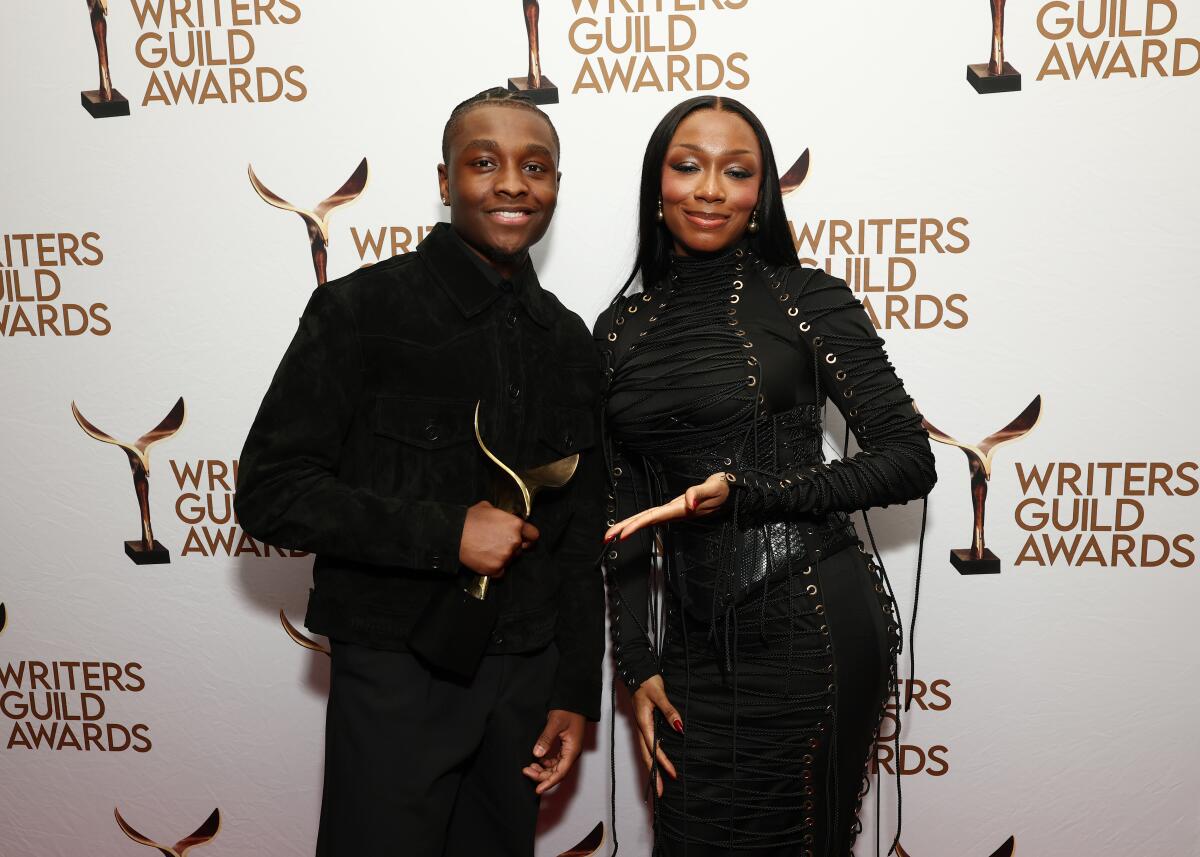
The already highly decorated “Sinners” was among the top winners at the 78th Writers Guild Awards on Sunday in New York City.
The Ryan Coogler-directed horror film won the award for original screenplay, and its primary Oscars best picture opponent, Paul Thomas Anderson’s “One Battle After Another,” clinched the win for adapted screenplay. “Sinners” star Miles Caton accepted the award for the former, and “One Battle” cast member Shayna McHayle for the latter.

“Sinners” star Miles Caton and “One Battle After Another” actor Shayna McHale accepted the awards for original and adapted screenplay, respectively.
(Cindy Ord / Getty Images for Writers Guild of America East)
In the TV realm, “The Pitt” made a splash with awards for drama series, new series and episodic drama.
As for lifetime achievement honors, Robert Smigel presented Stephen Colbert with the Walter Bernstein Award for critiquing the power elite on his late-night show, which will air its final episode in May. Terry George received the Ian McLellan Hunter Award for Career Achievement from Don Cheadle, and Diana Son the Richard B. Jablow Award for Devoted Service to the Guild from last year’s recipient, Kathy McGee.
Most years, the Writers Guild holds simultaneous ceremonies in New York and Los Angeles. But the East Coast edition became a solo affair after WGA West canceled its ceremony amid an ongoing strike by its own staff union, who claimed guild management had “surveilled workers for union activity, terminated union supporters, and engaged in bad faith surface bargaining.”
The L.A. ceremony was set to honor James Cameron with the Laurel Award for Screenwriting Achievement, Don Reo with the Paddy Chayefsky Laurel Award for Television Writing Achievement and Mstyslav Chernov with the Paul Selvin Award for “2,000 Meters to Andriivka,” which won the award for documentary screenplay Sunday evening.
While WGA West’s board of directors said the ceremony was postponed to give members “an uncomplicated celebration of their achievements,” the Writers Guild Staff Union characterized the cancellation as an attempt to sow division between management and unionized staff, which is ill-timed given upcoming contraction negotiations between the WGA and the Alliance of Motion Picture and Television Producers, which represents Hollywood studios and streamers. In 2023, the WGA went on its longest-ever strike, lasting 148 days.
Comedian and Emmy-nominated producer Roy Wood Jr., who this year hosted the WGA’s East Coast ceremony for the third time, during his opening monologue offered (in jest) his predictions for the negotiations, which begin later this month.
“First, I predict somebody’s gonna lose their s—,” the host said. “Cooler heads are gonna prevail, and then somebody else is gonna lose their s—.”
Here is the full list of Writers Guild Award winners:
Original screenplay: “Sinners,” written by Ryan Coogler; Warner Bro. Pictures
Adapted screenplay: “One Battle After Another,” screenplay by Paul Thomas Anderson, screen story by Paul Thomas Anderson, inspired by the novel “Vineland” by Thomas Pynchon; Warner Bros. Pictures
Documentary screenplay: “2,000 Meters to Andriivka,” written by Mstyslav Chernov; Frontline Features
Drama series: “The Pitt,” written by Cynthia Adarkwa, Simran Baidwan, Valerie Chu, R. Scott Gemmill, Elyssa Gershman, Joe Sachs, Noah Wyle; HBO Max
Comedy series: “The Studio,” written by Evan Goldberg, Alex Gregory, Peter Huyck, Frida Perez, Seth Rogen; Apple TV
New series: “The Pitt,” written by Cynthia Adarkwa, Simran Baidwan, Valerie Chu, R. Scott Gemmill, Elyssa Gershman, Joe Sachs, Noah Wyle; HBO Max
Limited series: “Dying for Sex,” written by Sheila Callaghan, Harris Danow, Madeleine George, Elizabeth Meriwether, Amelia Roper, Kim Rosenstock, Sasha Stewart, Sabrina Wu, Keisha Zollar; FX/Hulu
TV & Streaming Motion Pictures: “Deep Cover,” written by Derek Connolly and Colin Trevorrow; Prime Video
Animation: “Shira Can’t Cook” (“Long Story Short”), written by Mehar Sethi; Netflix
Episodic drama: “7:00 A.M.” (“The Pitt”), written by R. Scott Gemmill; HBO Max
Episodic comedy: “Prelude” (“The Righteous Gemstones”), written by John Carcieri, Jeff Fradley, Danny R. McBride; HBO Max
Comedy/variety series – talk or sketch: “Last Week Tonight with John Oliver,” senior writers: Daniel O’Brien, Owen Parsons, Charlie Redd, Joanna Rothkopf, Seena Vali; writers: Johnathan Appel, Ali Barthwell, Tim Carvell, Liz Hynes, Ryan Ken, Sofía Manfredi, John Oliver, Taylor Kay Phillips, Chrissy Shackelford; HBO Max
Comedy/variety specials: “Marc Maron: Panicked,” written by Marc Maron; HBO Max
Quiz and audience participation: “Celebrity Jeopardy!”, head writer: Bobby Patton; writers: Kyle Beakley, Michael Davies, Terence Gray, Amy Ozols, Tim Siedell, David Levinson-Wilk; ABC
Daytime drama: “The Young and the Restless,” associate head writers: Jeff Beldner, Marla Kanelos, Dave Ryan; writers: Susan Banks, Amanda L. Beall, Marin Gazzaniga, Rebecca McCarty, Madeleine Phillips; CBS/Paramount+
Children’s episodic, long form and specials: “When We Lose Someone” (“Tab Time”), written by Sean Presant; YouTube
Short form streaming: “The Rabbit Hole with Jimmy Kimmel,” writers: Jimmy Kimmel and Jesse Joyce; YouTube
Documentary script – current events: “Trump’s Power & the Rule of Law” (“Frontline”), written by Michael Kirk and Mike Wiser; PBS
Documentary script – other than current events: “Forgotten Hero: Walter White and the NAACP” (“American Experience”), written by Rob Rapley; PBS
News script – regularly scheduled, bulletin or breaking report: “Devastating Flooding in Texas” (“World News Tonight with David Muir”), written by David Muir, Karen Mooney and Dave Bloch; ABC News
News script – analysis, feature or commentary: “Remembering Palestinian Journalists Killed by Israeli Forces” (“Ayman”), written by Lisa Salinas; MSNBC
Digital news: “An Isolated Boarding School Promised to Help Troubled Girls. Former Students Say They Were Abused.,” written by Sebastian Murdock and Taiyler Mitchell; HuffPost
Radio/audio documentary: “Jerry Lewis’ Lost Holocaust Clown Movie” (“Decoder Ring”), written by Max Freedman; Slate
Radio/audio news script – regularly scheduled, bulletin or breaking report: “ABC News Radio Top of the Hour News”, written by Robert Hawley; ABC News Radio
Radio/audio news script – analysis, feature or commentary: “The Life and Legacy of Jimmy Carter,” written by Gail Lee; CBS News Radio
On air promotion: “CBS Comedy,” written by Dan Greenberger; CBS
Times staff writers Stacy Perman and Cerys Davies contributed to this report.

Marches on 115th anniversary of IWD place focus on issues like US-Israeli war on Iran and Donald Trump’s links with sex offender Jeffrey Epstein.
Thousands of demonstrators have taken to the streets around the world to mark International Women’s Day, taking a stand on a number of issues including the US-Israeli war on Iran and gender-based violence.
In Spain, where the government drew the ire of the United States for refusing to allow it to use Spain’s military bases for strikes against Iran, thousands of women took to the streets of major cities to call for an end to the war.
list of 3 itemsend of list
“It is within our power to stop the war, to stop the barbarity, and to win rights,” said Yolanda Diaz, Spain’s second deputy prime minister. “We proclaim ourselves in defence of peace, in defence of the Iranian people, in defence of Iranian women.”
On the first day of the joint US-Israeli war on Iran, strikes on a primary school in the city of Minab killed 165 girls, most between the ages of seven and 12, during class hours – the deadliest single attack on civilians so far.

In France, where more than 150 demonstrations were held, 73-year-old rape survivor Gisele Pelicot led a march calling for an end to sexual violence, telling a crowd in Paris, “We won’t give up”.
Pelicot became a global symbol in the fight against sexual violence after she waived her right to anonymity during the 2024 trial of her ex-husband and dozens of strangers who raped her while she was unconscious.
Across the Atlantic, activists gathered at Zorro Ranch in the US town of Albuquerque, New Mexico, where the late convicted sex offender Jeffrey Epstein is alleged to have sexually abused and trafficked underage girls and young women.
“The years-long cover-up and protection of Jeffrey Epstein’s allies and co-conspirators exposed a culture of impunity that tells survivors their pain is negotiable when powerful men are involved,” said Rachel O’Leary Carmona, executive director of Women’s March.
In New York, protesters gathered outside Trump Tower for a “Believe Survivors” demonstration after this week’s publication of FBI documents by the US Justice Department describing interviews with a woman who alleged President Donald Trump sexually assaulted her when she was a minor.

In Puyo, an Amazonian town in Ecuador, members of various Indigenous groups gathered to raise their voices about the degradation of the environment, and oil and gas expansion. “We want to live in a healthy environment and in harmony with the forest, so we are asking for respect and that public policies for nature are put in place,” said Ruth Penafiel, 59, from the Kichwa community in the northern Amazon.
In Brazil, Sunday’s marches channeled outrage over the alleged gang rape of a 17-year-old girl in Rio de Janeiro’s Copacabana neighbourhood in January. The case gained national attention this week when four suspects handed themselves over to authorities.

In Pakistan’s capital, Islamabad, police briefly detained several women’s rights activists attempting to hold a rally in defiance of a government ban on public gatherings imposed amid a surge in militant violence in the country. Aurat March, a network of women’s rights activists, condemned the crackdown, saying participants had been peacefully exercising their right to protest.
Women’s rights activists shouted slogans during a protest in Istanbul, Turkiye. In China and Russia, vendors sold flowers wrapped in pink. And in Phnom Penh, Cambodia, local workers lifted fists and umbrellas as they celebrated.
International Women’s Day, officially recognised by the United Nations in 1977, marks its 115th anniversary this year.
Iran’s military and political leaders pledge allegiance to Mojtaba Khamenei as Saudi Arabia reports two deaths amid Iranian counterattacks.

Published On 9 Mar 20269 Mar 2026
Share

Author Diana Gabaldon knew readers had been mentally casting the timeless main couple at the center of her “Outlander” book saga since the first novel’s release in the early ‘90s — particularly its leading man, a tall and burly Scottish Highlander with striking red hair. She recalls a 50-year-old German actor who, she says, “always looked like he’d been dipped in cooking oil” among the imaginary candidates. Another was a 5-foot-4-inch race car driver. She quickly learned not to weigh in.
“They would keep asking me who I’d like to play Jamie — ‘Nobody,’ I kept saying because on the rare occasion when I mentioned some possibility, the immediate response would be shrieks of dismissive outrage and heapings of scorn that went on for days (online),” she says over email. Besides, she felt the whole notion of considering prospects was pointless because, as she puts it, it’s not like Hollywood would want to adapt a 300,000-word book anyway.
However, Ronald D. Moore and Maril Davis, longtime collaborators through their Tall Ship Productions banner under Sony Pictures Television, did. And Gabaldon was thrust back into the casting debacle, watching test videos and learning not to judge a book by its cover — or actors (in this case, Sam Heughan and Caitriona Balfe) by the photos that pop up in a Google search: “Sam doesn’t look like Jamie, and Caitriona doesn’t look like Claire, but both of them can be those people, and that’s all that matters,” she says. And they were those people.
In 2014, the duo brought to the screen the epic story of Claire Randall, a British combat nurse who is mysteriously transported back to 1743 Scotland and marries Scottish warrior Jamie Fraser to survive. Together, they ignite a passionate romance that traverses decades and endures brutal separations, wars and time travel. After spinning its own sweeping narrative for more than a decade, the Starz series is launching its eighth and final season on Friday.

In “Outlander,” Claire Randall (Caitriona Balfe) is a British combat nurse who is mysteriously transported back to 1743 Scotland and marries Scottish warrior Jamie Fraser (Sam Heughan) to survive.
(Ed Miller / Starz)
And it won’t exactly be a by-the-book ending. The final season pulls from the remaining material in Book 8, as well as Book 9 — Gabaldon is working on a 10th installment, “A Blessing for a Warrior Going Out” — leaving Matthew B. Roberts, the showrunner, and the writing team to craft an original ending for television. In a signal of how much pressure there was to do right by the beloved fictional couple, four endings were written and filmed.
“Diana’s been involved since Day 1 — she reads everything, she sees everything,” Roberts said by video conference. “I told all the endings that were going to be written. She briefed me a little bit of where she might be going, not the ending of the books, but just where the book might be going. I wanted to at least incorporate some of that in some of the endings that were written.”
Can it be anything other than a happy ending? Maybe the clue is in “I Love Lucy.” Lucy and Ricky Ricardo‘s love story was often a reference point for Roberts throughout his time on “Outlander.”
“No matter what trouble Lucy got in, no matter what she was doing, never did you think they were ever going to break up,” he says. “That’s Jamie and Claire, no matter what happens, no matter what he goes through or what she goes through, no matter what trouble or what they tell each other sometimes, we’ll never think they break up. And the audience knows that too, and we knew, if you just stayed true to that, then that love story would be successful.”
Ahead of the show’s final season premiere, The Times spoke with Balfe and Heughan to get their thoughts on bringing the historical romance to life and the journey to reach the final chapter.
In the spirit of the Season 8 premiere, which has a moment where Claire and Jamie reflect on the early days of their story, let’s travel back in time. Do you remember how this series was first presented to you and what went through your mind?
Balfe: I think the logline I saw was “nurse goes back to Scotland and then goes back 200 years in time and meets a Highlander.” I think I had two lines. That was all I had.
Heughan: It sounded like it was never gonna work. I found out it was a book series, and I think we both read it, didn’t we?
Balfe: Yeah, I read the book in four days before we tested. You’d already been cast at that point … I was living in L.A. I had tiny bit parts in a few films, and I was definitely struggling. I had booked to go on a trip to India, sent my passport into the Indian embassy. Of course, that’s exactly when I found out that maybe I had to travel to London for this test.
Heughan: At the time, I had failed attempts at pilot season, and I was back in London working in a bar and thinking, “I can’t afford to do this and I’m 34 years old. I should probably think about giving up.” Because there was no way I could support myself. I wasn’t loving it.
Balfe: You were 33, by the way.
Heughan: Oh, yes. I was younger. Then this thing came through. And actually, to be honest, the logline and perhaps the dialogue, when I read it, I just thought, “I know this guy.” There just was something very familiar.


“At the time, I had failed attempts at pilot season, and I was back in London working in a bar and thinking, ‘I can’t afford to do this and I’m 34 years old. I should probably think about giving up,’” says Heughan. (Sophia Spring / For The Times)
Tell me about the decision to say goodbye to this show and these characters. Does it feel like the right time?
Balfe: By the time we got to Season 7, that was our last season that we were contracted for, and there were conversations going around that they — the writers — felt that they had eight seasons [for this story]; that that was sort of an organic finish to it. But we were more than halfway through Season 7 before anyone came to talk to us. Actually, we had all scripts, bar the last two. And it wasn’t ending. Before they came to us, it was like, “How is this gonna happen? Are they going to wrap it up in two episodes or are they coming to us?” It was a lot of pressure in a very short amount of time to decide, “OK, do we just wrap this up in two episodes or do we try and give it a season to properly say goodbye?” There’s a lot of people’s jobs, and there’s a lot of people’s livelihoods, and there’s a whole ecosystem around it. We felt that it needed that kind of time.
Heughan: A lot of thought went into it. I think we were ready to move on or do something else. But also, there was this itch, like we hadn’t finished it and it didn’t feel satisfying for us and for the fans. We wanted to come back and really tie it up properly.
The final season focuses on Claire and Jamie’s struggles during the Revolutionary War, with the war having followed them home. What intrigued you about this final onscreen chapter of their story?
Heughan: Jamie’s concerned about himself in the foremost because he has this information that he’s going to die. But they’ve fought for eight seasons to stay together and to protect everyone they love and the greater community and I think that continues, but there’s so many more distractions or more challenges along the way in this season from the inside.
Balfe: And the Revolutionary War has been circling them for a very long time. It was time for the culmination —
Heughan: [Laughs] Instead of saying “War is coming,” it’s “War is here.’

“There’s a lot of people’s jobs, and there’s a lot of people’s livelihoods, and there’s a whole ecosystem around it. We felt that it needed that kind of time,” says Caitriona Balfe, right, with Sam Heughan, about finishing the “Outlander” story with an eighth season.
(Sophia Spring / For The Times)
The fandom around this property is active and devoted. There’s good that can come from that — the engagement, the creativity — but some bad too, like when things get toxic. What was the learning curve of playing this beloved fictional couple and navigating the fandom?
Balfe: It was a bit of a baptism of fire.
Heughan: We were both quite green when we were thrust into it and engaged wholeheartedly.
Balfe: The landscape is very different. Twitter was Twitter before it was death pit, Instagram was far more innocent as well. In the beginning, it was really nice. I wasn’t a mom. I had loads of time on my hands — well, not really, because we were shooting all the time — but anytime I did, it used to be nice and we would do these quick Q and As. That one-on-one connection with the fans was really, really lovely. I do think there was a moment where … the tide shifted, and this sort of shipper-dom got very intense. I was getting married, and that was having an impact on the people in my life and and I think I had to then step away because I was like, “OK, this doesn’t feel good for everyone in my life.”
Heughan: Look, I think it’s still there. It is a strange one to get your head around. People, in one way, are uber fans of the show, but in other ways, they’re overtly intrusive in your life. But it is a small minority. I think … perhaps we’ve done our job that well? It’s not just about Jamie and Claire, it’s about that person behind it and their life behind it, and their family behind it, that people want to get invested in. I don’t know if it’s a great thing for actors, to be honest, but in this current environment, we’re always asked to give more of ourselves to engage with fans, but it’s been something we’ve had to learn on the job.
Balfe: And I think there are times in your life when you have more capacity to be more open, and there’s times in your life where you need to shut off a little bit more. The overall reception from the fans have been so positive and so supportive of things that we’ve done in our lives, and that is the thing that I choose to focus on with it.
“Outlander” isn’t strictly a romance, but that’s what gives it power. You’ve spent more than a decade in this space. What have you learned about how that romance space functions and what the fans seek from these stories?
Balfe: I was sort of unaware of the need and the appetite that people have for it. Nowadays it’s served an awful lot better, but I think it was an underserved demographic. Or it was not given the due that people needed. It’s sometimes looked on as the second-class citizen of storytelling, in many ways, but I think it’s a genre that allows you to really look at the beauty of humanity and … the core things that we care about, which is love and family and connection.
Heughan: And comfort. It’s comforting. This show proves that there’s a real appetite.
Balfe: There’s many more shows now. Everybody’s talking about “Heated Rivalry.” There’s “Bridgerton.” Maybe it’s the emancipation of women in the last 50 years. It’s like they are finally like, “Well, we want our TV that speaks to us as sexual beings and as mothers and as matriarchs and as professionals and whole round of people.” Our show did that a lot.


“There’s many more shows now,” Balfe says of series that serve up romance. “Everybody’s talking about ‘Heated Rivalry.’ There’s ‘Bridgerton.’ It’s like they are finally like, ‘Well, we want our TV that speaks to us as sexual beings and as mothers and as matriarchs and as professionals and whole round of people.’ Our show did that a lot.” (Sophia Spring / For The Times)
Have you taken stock of just how much Claire and Jamie have gone through as a couple?
Balfe: How many near-death experiences?
Heughan: Yeah, how many times they’ve nearly died or been attacked or assaulted.
Balfe: How many people they’ve killed. Claire, she’s like a serial killer.
I was wondering, because it’s the last season, you can’t get in trouble now, where would Caitriona or Sam have called it quits in this relationship? Like, this is too much, I need to move on.
Balfe: I don’t know if Caitriona would have gone back 200 years in time.
Heughan: When she fixes his shoulder — that’s pretty painful. She gets him in a lot of trouble and he puts himself in a lot of trouble. I wouldn’t have gone past Episode 1 [he mumbles].
Balfe: See! I would have gone to Season 3.
Heughan: No, I think when he sends her through the stones and is like, “That’s it. She’s gone.” But she keeps coming back. I thought I got rid of her, finally!
Caitriona, you make your directorial debut on the show this season with Episode 2. Tell me about that experience.
Balfe: It was so fun. They gave me Episode 2, which allowed me to do my prep before we started. I was so lucky that Jan Matthys, who is the director of Episode 1, was an incredible mentor to me throughout the process. I just got to work with these guys in a totally new way, which was so amazing. I was buzzing. The whole first 10 weeks [of this season] felt like the very first 10 weeks again because you’re learning all these new skills and you’re just in such high operating point; you have to make decisions on the fly, I was also in scenes. It was just mad, but brilliant.
Heughan: You were also probably happy to take the corset off.
Balfe: To be able to walk around in proper wet weather gear and trousers and be able to go to the bathroom — not to be TMI, but it was so good.
They did not give me the easiest episode. Every day had its thing — obviously, the bear attack sequence. Three days before we were filming that, that was a cougar; we were going to have a live cougar. There was a whole thing planned. And a cougar attacks in a very different way than a bear does. So my whole shot list had to go out of the window and I had to rethink the whole thing. But that was kind of fun.

The final season of “Outlander” focuses on Claire (Balfe) and Jamie’s (Heughan) struggles during the Revolutionary War, with the war having followed them home.
(Robert Wilson / Starz)
Finales can be tough, given how viewers chime in on social media. You can’t please everyone. But what was your vision for the ending of “Outlander”?
Balfe: I didn’t really have one. I would not want to have had Matt’s job because that’s a really heavy load to bear, trying to finish this out. But I would say the season was unusual. Normally, we would get an overview of the season before we start. This season, we went into it blind so we weren’t getting sort of any info about what was going to happen. Through the whole season, it was like finding out as the scripts came what was happening. And to be honest, we still don’t really know the ending. We know bits that were filmed, but [not] how he’s going to edit it.
Heughan: I definitely had a firm belief about a certain element of it. I spoke to a few people — few other execs and producers — and there was a common consensus, and I think that might be one of the directions, but it’s going to be a surprise for us when we watch it. I don’t know when we are going to watch it.
Multiple endings were filmed.
Balfe: There was a few different things filmed.
Heughan: Hard to know what’s [going to make it] — it’s all in a same direction. But what direction that is …
Would you call it a happy ending?
Heughan: I don’t know. It was such a secret on the call sheets and stuff.
Balfe: There was different versions of scripts that went out.
Heughan: There were fake people put in. There was a reduced crew.
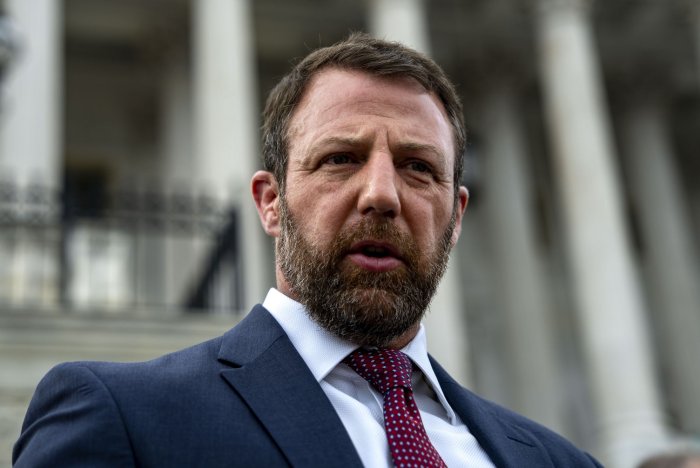
March 8 (UPI) — The Pentagon on Sunday afternoon announced that a seventh U.S. service member has died during the U.S. and Israeli conflict with Iran.
The service member was seriously wounded during an attack on U.S. troops in Saudi Arabia on March 1, military officials said.
“Last night, a U.S. service member passed away from injuries received during the Iranian regime’s initial attacks across the Middle East,” U.S. Central Command said in a post on X.
“Major combat operations continue. The identity of the fallen warrior will be withheld until 24 hours after next of kin notification,” CENTCOM said.
The seven service members have been killed during the first week of Operation Epic Fury, which the United States and Israel launched on Feb. 28.
Since the beginning of the onslaught, Iran has launched retaliatory strikes at its neighbors, some of which host U.S. bases and assets that are being used in the war.
A March 1 retaliatory strike on an Army sustainment unit based in Kuwait killed six service members and injured 18 others, whose remains returned to the United States on Saturday.
Overall, Iran’s retaliatory strikes have killed at least 20 people across the region, The New York Times reported, while between 800 and 1,300 hundred people in Iran have died during the widening conflict.

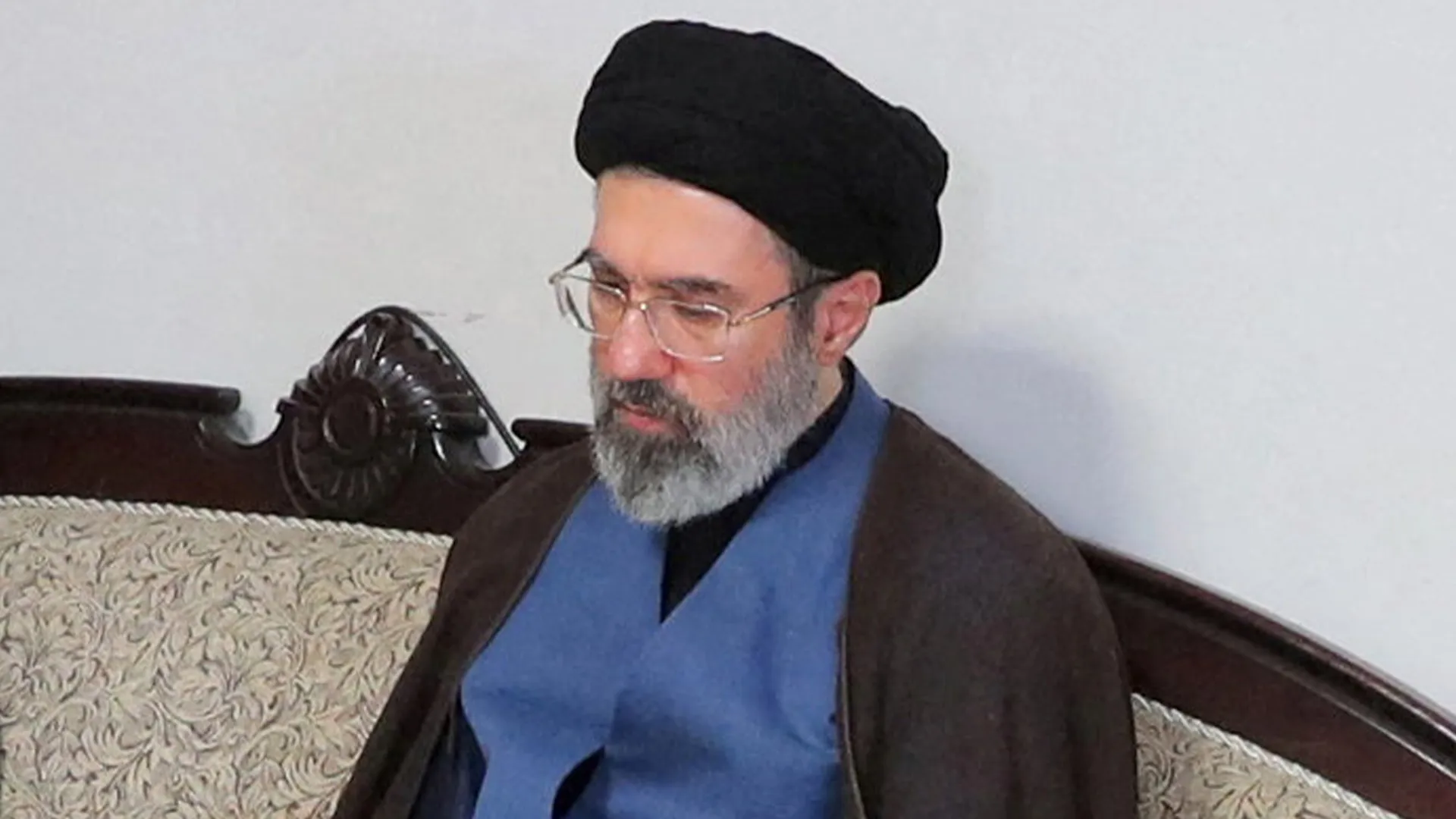
Iranian state television has announced that the Assembly of Experts has chosen Mojtaba Khamenei as supreme leader after a “decisive vote”. He’s the son of Ayatollah Ali Khamenei who was killed by the United States on February 28.
Published On 8 Mar 20268 Mar 2026
Share

VICKY Pattison and her husband Ercan Ramadan are making their way back to the UK after becoming stranded in Dubai amid the Iran war.
Last Saturday (February 28), Iran launched a barrage of rockets at nations across the Middle East after vowing revenge for Trump and Israel’s huge blitz on the rogue nation.
Among their targets was Dubai, where black smoke was seen billowing across the skyline after debris from Iran’s missile blitz hit a hotel on the Palm Jumeirah.
Vicky was en-route with Ercan for a planned trip to Australia and New Zealand, and had a planned stop in Dubai when the attacks started.
She’s since only given small updates, noting how she didn’t want to speculate to scare her followers and was “limiting time spent on social media due to a growing amount of misinformation that feels really counterproductive to staying calm.”
However, she returned to Instagram today to share “a little update” on where she and Ercan were, after Dubai airport was also subject to a drone attack amid the evening of strikes, with both Iranian and Iraqi airspace closed as the conflicts intensify.
Sharing a photograph of herself and Ercan with a group of other people on a mini-bus this afternoon, she apologised for the “radio silence” over the past week, noting things were “changing so rapidly” and she didn’t want to say anything that could be deemed insensitive.
“We really appreciate all your messages of concern and just wanted to reassure everyone that we’re fine,” she wrote.
“After three cancelled flights and the realisation that we definitely weren’t going to make it on to Australia and New Zealand we wanted to try and get home as quickly and safely as possible.
“I understand that there are a lot of people still in Dubai feeling really calm and safe however, we wanted to be back to our babies, work and normality and we felt like Oman was our best option.”
The star went on to explain that she had arranged a public transfer van with friends, with the team driving for 11 hours to get to Oman – including two to three hours to cross the border.
“For anyone stuck in Dubai and wanting to get home via Oman, I will put more information on @vickysvacays,” she said. “I just don’t want to overwhelm or bore anyone on here.
“We are going to try and enjoy our last days away and explore Oman hopefully 🥹”
“The last week has been quite unsettled and we understand people feeling unsafe and uncertain,” she added. “We have experienced moments like that, but ultimately feel like it’s important we acknowledge our position of privilege.
“We are extremely grateful to be making our way home and are thinking of anyone feeling fearful or unsettled, anywhere in a world that is rapidly becoming an increasingly scary place to be.”
“Finally just a little Thankyou to @addressbeachresort and [the UAE government] for keeping us safe, calm and informed when possible 🩵”
Friends and fans were quick to send their well-wishes to the star, saying they were glad she and Ercan were somewhere safe.
“Glad you’re both okay! Not what you had planned, but such is life. Not long until you’re reunited with the boys” wrote one.
Candice Brown added: “So glad you are on your way back darling x”
“So happy you’re both safe, sending you all the love” wrote another.
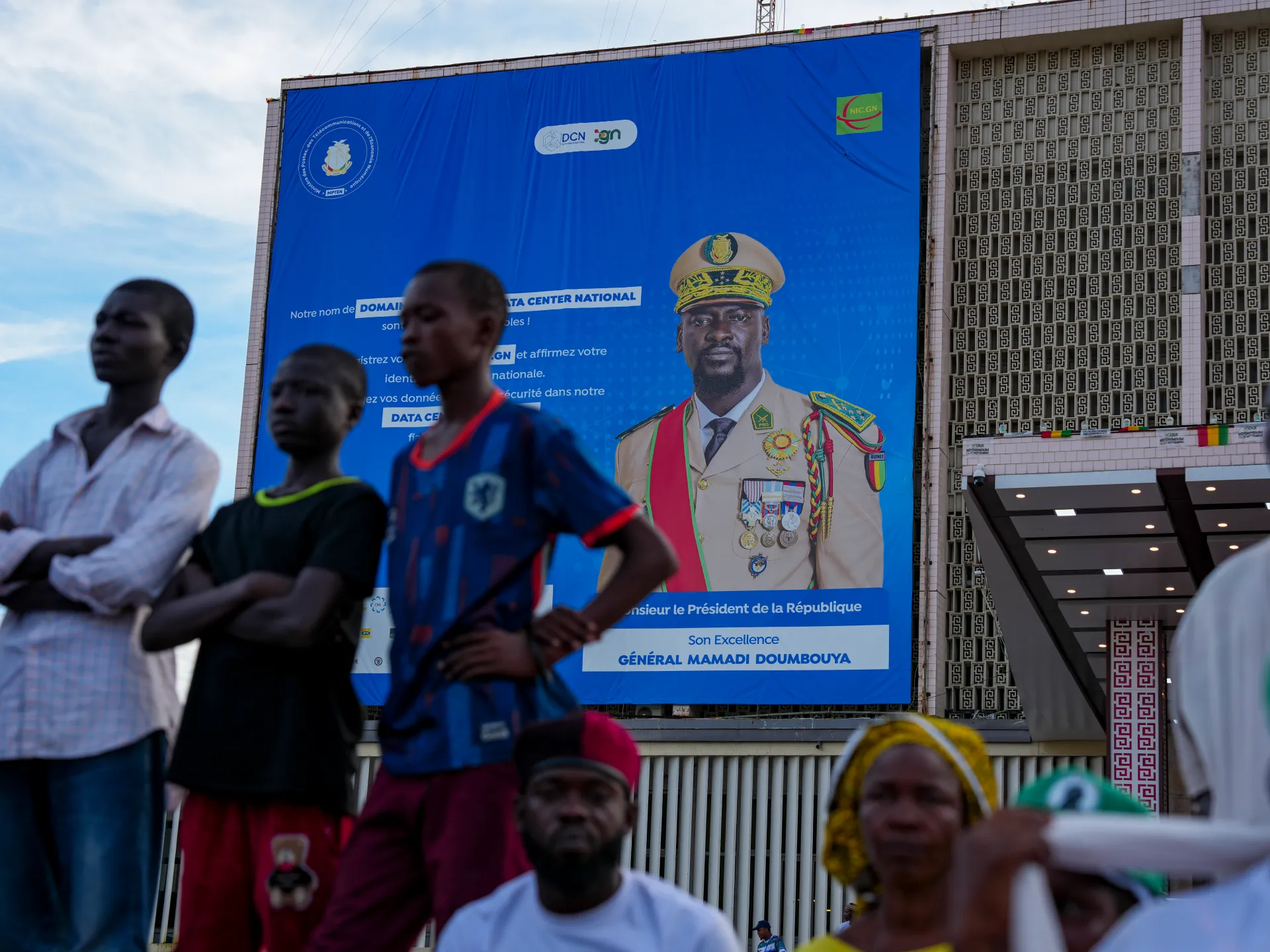
Decree strips parties of legal status and assets, as opposition leader calls on Guineans to resist
By AFP and The Associated Press
Published On 8 Mar 20268 Mar 2026
Share
Guinea’s government has dissolved 40 political parties, including the country’s three main opposition groups, in a move critics say marks the final step towards a one-party state under President Mamady Doumbouya.
The Ministry of Territorial Administration and Decentralisation issued the decree late on Friday, citing the parties’ failure to meet their legal obligations.
list of 2 itemsend of list
Beyond stripping them of their legal status, the order froze their assets and banned the use of their names, logos and emblems, with a government-appointed curator assigned to oversee the transfer of their holdings.
The three most prominent parties dissolved are the Union of Democratic Forces of Guinea (UFDG), the Rally of the Guinean People (RPG) – the party of ousted former President Alpha Condé – and the Union of Republican Forces (UFR).
All three had already been suspended last August, weeks before a constitutional referendum that cleared the way for Doumbouya to stand in December’s presidential election.
UFDG leader Cellou Dalein Diallo, speaking from exile, accused Doumbouya of dismantling democratic life to entrench his grip on power. In a video posted to Facebook on Sunday, he said the dissolution was part of a deliberate drive to build a “party-state” and urged supporters to “rise as one” against a government that had lasted “far too long”.
He said that dialogue and legal routes had been exhausted, while his party’s communications coordinator went further, describing the decree as “the final act of a true political farce” aimed at cementing single-party rule.
Ibrahima Diallo, a leader in the pro-democracy National Front for the Defence of the Constitution, said the move had “formalised a dictatorship” and warned that Guinea was sinking into “profound uncertainty”.
The crackdown is the latest in a sustained campaign against dissent under Doumbouya, who seized power in a 2021 coup before winning a presidential election in December, a vote from which all major opposition figures were barred.
Since taking power, his government has shut down media outlets, banned protests and arrested or driven into exile scores of opposition figures and civil society activists.
Several relatives of prominent dissidents have also been abducted, and two well-known pro-democracy activists have been missing since July 2024.
A wave of coups has brought military leaders to power in Africa, across a belt stretching from the Atlantic through the Sahel region to the Red Sea since 2020, while an attempted coup in Benin failed in late 2025.
The development has led to what analysts have described as a “coup belt“.
Madagascar’s and Guinea-Bissau’s armies most recently removed civilian leaders in their respective countries from power in late 2025, underscoring growing discontent with elected governments.
Although often carried out with popular backing, the military takeovers have also seen civil liberties clawed back.
A 2025 study found that while military takeovers have declined globally, the risk of coups in Africa remains comparatively high.
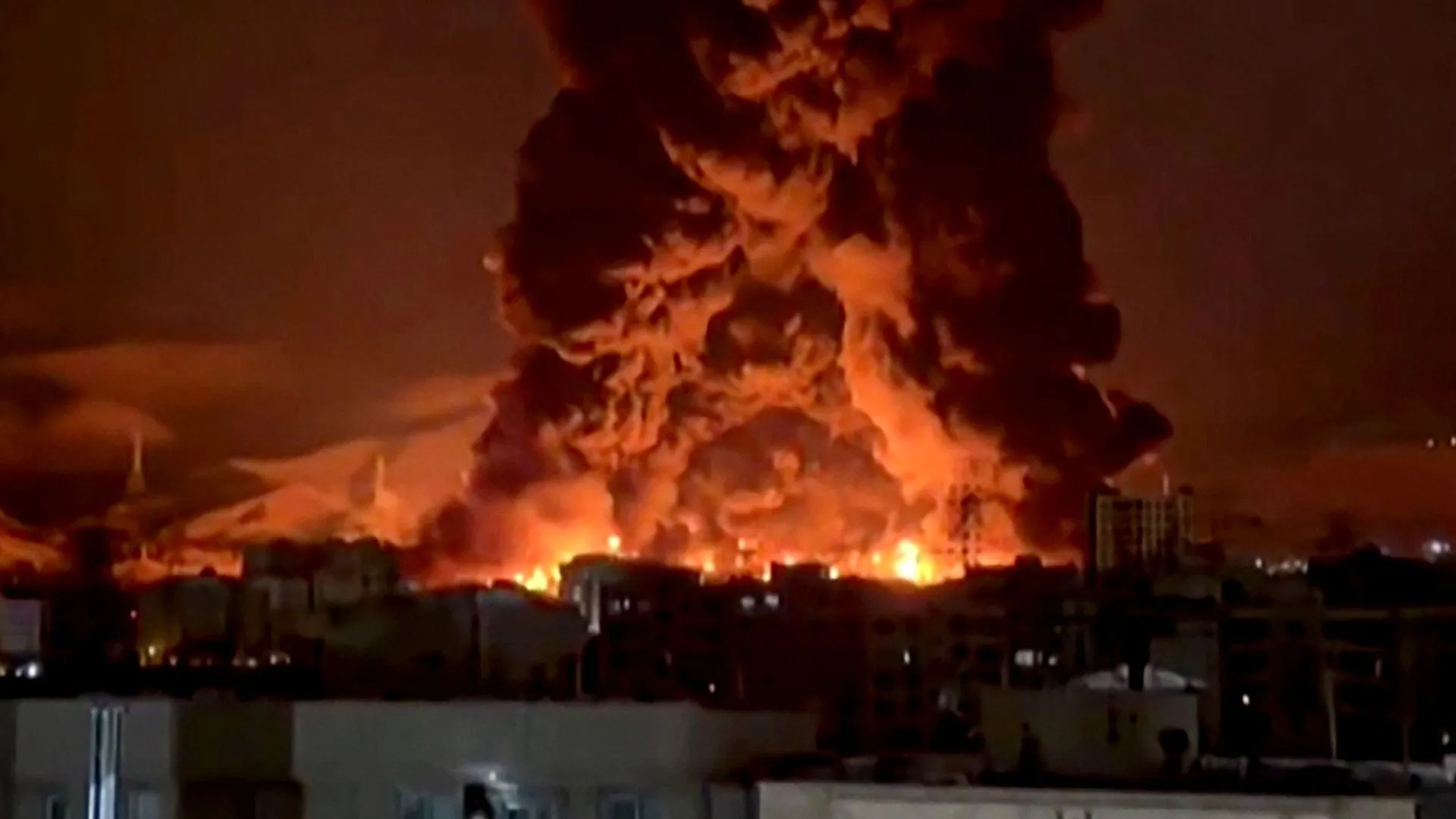
An apology comes from Iran’s president, yet missiles are still hitting neighbours.
Tehran has carried out more attacks on Gulf states – despite an apology by the president to Iran’s neighbours.
Civilian targets have been hit, including airports and vital infrastructure.
Who’s in control in Iran – and how will Gulf states react as the attacks continue?
Presenter: James Bays
Guests:
John Brennan – Former director of the Central Intelligence Agency under the administration of US President Barack Obama
Bader Al-Saif – Professor at Kuwait University and fellow at Chatham House, specialising in Middle East history and politics
Trita Parsi – Executive vice president of the Quincy Institute for Responsible Statecraft
Published On 8 Mar 20268 Mar 2026
Share

Walt Disney Co. and Pixar’s “Hoppers” took the box office crown this weekend in an encouraging sign for the company’s original animated films.
The film generated $46 million in ticket sales in the U.S. and Canada, marking the highest domestic opening for an original animated movie since 2017’s “Coco,” according to studio estimates. The global box office total for “Hoppers” was $88 million.
The zany movie features a young environmental advocate who “hops” her consciousness into a robotic beaver and bands together with other woodland creatures to stop a planned freeway expansion through a glade.
The film is directed by Daniel Chong, who created the Cartoon Network animated series “We Bare Bears.”
The muscular debut for “Hoppers,” as well as the strong performance from Sony Pictures Animation’s “Goat” last month, has been a positive sign for audience interest in original animated films.
Since the pandemic, theatrical returns for animated sequels have far surpassed that of original films. Disney’s “Zootopia 2,” for instance, has now grossed more than $1.8 billion in global box office revenue, with more than $426 million domestically. Disney and Pixar’s 2024 hit “Inside Out 2” also crossed more than $1.6 billion globally.
By contrast, Disney and Pixar’s 2025 original film “Elio” brought in about $154 million in worldwide box office revenue.
Original films are vital to Pixar’s future, as the Emeryville-based studio built its reputation on its string of nearly uninterrupted original blockbuster hits, including 1995’s “Toy Story” and 2004’s “The Incredibles.”
Paramount Pictures and Spyglass Media Group’s “Scream 7” came in second at the box office with $17.3 million in its second weekend in theaters. Warner Bros. Pictures’ “The Bride!,” Sony’s “Goat” and Warner Bros.’ “Wuthering Heights” rounded out the top five at the box office, according to data from Comscore.
With several strong releases, as well as popular holdover films from 2025 that continue to bring in revenue, the first few months at the box office have been a notable improvement over last year’s dismal first quarter.
Domestic box office revenue so far is up more than 12% compared to the same time period in 2025, according to Comscore.
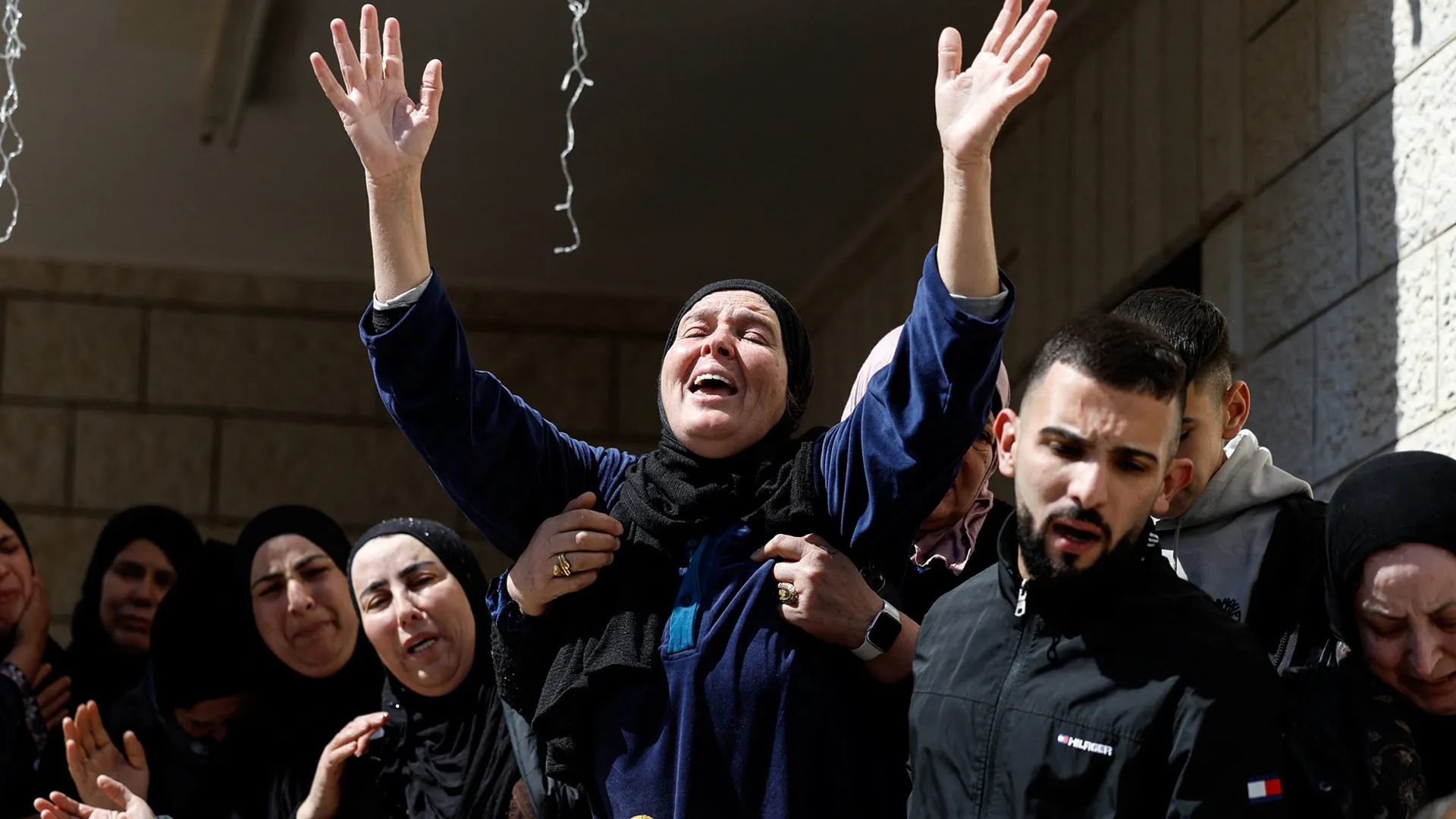
Several Palestinians were killed after armed Israeli settlers attacked the village of Abu Falah in the occupied West Bank. Witnesses say the settlers carried out the attack under the protection of Israeli forces.
Published On 8 Mar 20268 Mar 2026
Share
The TWZ Newsletter
Weekly insights and analysis on the latest developments in military technology, strategy, and foreign policy.
Over the last seven days, we have watched a joint air campaign unlike what we have ever seen before. New capabilities and evolved threats have made headlines as the world watched much of the Middle East become a free-fire zone. At the same time, many questions surrounding how long the war will take and its true scope and goals grow louder. These calls for clarity are becoming more pronounced globally, as well, as the Strait of Hormuz is experiencing a heart attack of sorts, with energy shipments stopped on the strategic waterway’s northern edge.
While missile and drone launches have decreased significantly, these weapons continue to score major hits. Beyond U.S. military-related sites in Gulf Arab states, Iran continues to pummel energy production infrastructure. There are real concerns about the ability to defend against these attacks over the long term as interceptor stocks dwindle.
The London insurance market is willing and able to cover vessels looking to transit the Strait of Hormuz, according to Gallagher https://t.co/rUogubsv6g
— Bloomberg (@business) March 5, 2026
All this is occurring while Iran is experiencing a power vacuum the likes of which it has never experienced. As the U.S. and Israel ramp up strikes across the country during the transition from standoff to direct attacks, what will come of Iran’s fractured government remains a total unknown. Fears are growing that the default control of Iran could fall to its most well-armed and fanatical arm, the Islamic Revolutionary Guard Corps (IRGC), a top possibility we laid out in our feature published before the strikes commenced.
So much has happened in one week, and we were right there providing rolling coverage and breakouts nearly around the clock. Now, once again, we look at the present. Here’s what’s going on as we flow through day eight of the war.
We have concluded our rolling coverage in this piece.
UPDATE: 4:29 PM EST-
Check out our feature on the major alarm bells that should be ringing after Iran successfully targeted multiple missile defense radars in the region.
Iranian Attacks On Critical Missile Defense Radars Are A Wake-Up Call
Iran’s successful targeting of prized missile defense radars in the Middle East highlights global vulnerabilities.
Feature:https://t.co/CkleCjkKBB
— The War Zone (@thewarzonewire) March 7, 2026
More video has emerged from the dignified transfer of the remains of six soldiers killed in Kuwait on March 1.
U.S. President Donald J. Trump and First Lady Melania Trump attended the dignified transfer at Dover Air Force Base of the 6 U.S. Army soldiers killed during an Iranian strike on their operations center.
🇺🇸Capt. Cody Khork
🇺🇸Sgt. 1st Class Noah Tietjens
🇺🇸Sgt. 1st Class Nicole… pic.twitter.com/akSQntnUnM— OSINTdefender (@sentdefender) March 7, 2026
Ali Larijani, Iran’s de facto wartime leader in the wake of the death of Supreme Leader Ali Khamenei, issued a direct threat against Trump via X.
We will relentlessly avenge the blood of our of our Leader and our people. Trump must pay and will pay. #Trumpmustpay
— Ali Larijani | علی لاریجانی (@alilarijani_ir) March 7, 2026
Meanwhile, in Iraq, pro-Iranian members of parliament are shouting the long-familiar phrases “America is the Great Satan” and “Death to America.”
Members of parliament from the pro-Iranian factions in the Iraqi parliament are shouting “America is the Great Satan” and “Death to America” https://t.co/78WrtfLsvK
— Guy Elster גיא אלסטר (@guyelster) March 7, 2026
Hezbollah, the Lebanon-based Iranian proxy group, is launching volleys of rockets at Israel.
UPDATE: 2:35 PM EST –
Trump arrived in Dover for the dignified transfer of six soldiers killed by an Iranian drone attack in Kuwait on March 1.
Today, we honor six American heroes who made the ultimate sacrifice in service to our nation.
Capt. Cody Khork
Sgt. 1st Class Noah Tietjens
Sgt. 1st Class Nicole Amor
Sgt. Declan Coady
Maj. Jeffrey O’Brien
Chief Warrant Officer 3 Robert MarzanMay God hold them in His eternal… pic.twitter.com/pNMHg7MdPz
— Rapid Response 47 (@RapidResponse47) March 7, 2026
Turkish Foreign Minister Hakan Fidan said Saturday that U.S. Secretary of State Marco Rubio told him Washington has no intention of arming Kurdish groups in Iran, a direct response to reports that have rattled Ankara as the U.S.-Israeli military campaign against Tehran enters its second week.
Given the ambiguity of the situation, the Kurds say they are not rushing into Iran.
“Certainly, we are staying neutral as Iraqi Kurds b/c there’s no clarity for us on US policy,” a KRG official said. “Our assessment is there can’t be regime change w/o boots on the ground and that the US is not sending [them].” @BarakRavid, @MarcACaputohttps://t.co/kKj6GWOCHs
— Shalom Lipner (@ShalomLipner) March 7, 2026
To counter Iranian drone and missile fire, a U.S. Counter Rocket, Artillery and Mortar (C-RAM) system was activated near the American embassy in Baghdad.
A Counter Rocket, Artillery, and Mortar (C-RAM) system was activated a short time ago in the area of the American embassy in Baghdad, Iraq, due to reported drone and missile fire. pic.twitter.com/f2VOtE1ZbU
— Joe Truzman (@JoeTruzman) March 7, 2026
U.S. IndoPacific Command took to X to dispute some claims about the recent sinking of the Iranian frigate IRIS Dena by a USN fast attack submarine.
🚫 Iran claims IRIS Dena was unarmed – FALSE
✅ Law of Armed Conflict authorized the use of force to target and destroy valid military targets – TRUE
✅ U.S. forces planned for and Sri Lanka provided life-saving support to survivors in accordance with the Law of Armed Conflict -… pic.twitter.com/DdY5RNFUYf— U.S. Indo-Pacific Command (@INDOPACOM) March 7, 2026
The IDF said it is continuing to strike Iranian ballistic missile production sites.
🎯 STRUCK: 2 main ballistic missile production sites in Parchin and Shahrud.
Over the past week, hundreds of IAF fighter jets struck the Iranian regime’s production industries, which are used for the development and production of missiles and weapons.
Among the targets struck:… pic.twitter.com/sF3rRCvWqb
— Israel Defense Forces (@IDF) March 7, 2026
The IDF launched strikes Saturday evening on Iran’s national oil facilities in Tehran for the first time since the start of the war, targeting dozens of fuel storage tanks, YNET News reported, citing Israeli officials.
“The attack was carried out under directives from the political leadership and with IDF support, marking a significant escalation in Israel’s campaign against Iranian regime infrastructure,” the outlet explained.
An Israeli security official says recent strikes targeted fuel tanks used by Iran’s regime, adding pressure on the government is increasing and it may soon struggle to provide citizens with basic necessities. “We have not said the last word,” the official said. – N12 https://t.co/5yX69pUMl2
— Faytuks Network (@FaytuksNetwork) March 7, 2026
The Israel Defense Forces says it’s demolished a majority of Iran’s ballistic-missile launchers, causing the number of missiles targeting Israel and other countries in the region to fall throughout the week, Bloomberg News reported.
More than 60% of such launchers have been “neutralized and destroyed,” Eyal Zamir, chief of the general staff of the IDF, said in a televised statement on Thursday. Zamir did not say how many had been struck, but the IDF had cited the number as 300 earlier that day.
Israeli assessments say Iran now has about 100 operational missile launchers remaining out of roughly 420 before the war.
Around 150 launchers were destroyed, while another 150 were struck and buried in underground sites, leaving them currently unusable. pic.twitter.com/LnYpNdGIm0
— Open Source Intel (@Osint613) March 7, 2026
UPDATE: 1:45 PM EST—
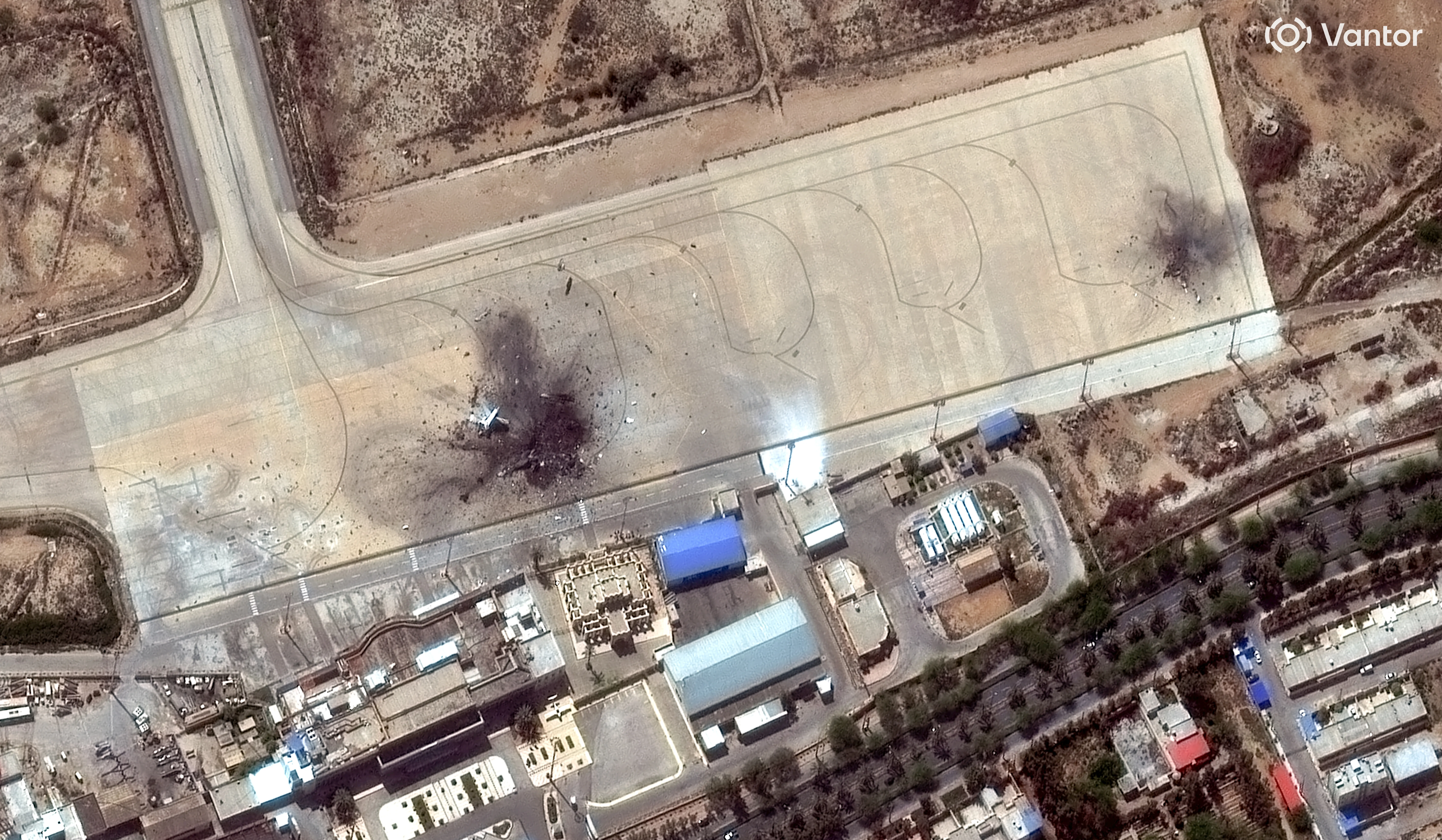
We are getting new satellite images of bomb damage in Iran from Vantor. The images show the airport and port in the city of Bushehr, which sits along the northeastern shore of the Persian Gulf. We also get a shot of the tunnel entrances at the underground facility in Natanz and what looks like a vehicle destroyed nearby, possibly a short-range air defense system.


The entrance to the naval base doesn’t look to inviting anymore:
We are also getting a satellite view of the destruction at Tehran International from the IAF’s strikes there last night:
Satellite imagery shows that at least 17 aircraft, most of which appear to be passenger planes, were destroyed in last night’s US and Israeli attacks on Mehrabad International Airport.
Credit: @planet pic.twitter.com/ov1OBa1Ks3
— Farzad Seifikaran (@FSeifikaran) March 7, 2026
Another drone strike on a highrise tower in Dubai:
UPDATE: 1:20 PM EST—
Israel is now clarifying its attack on Iran’s international airport, stating they targeted aircraft used by the IRGC for weapons transfers to proxies. These aircraft are well known and include some of the country’s last airworthy 747s.
STRUCK: 16 IRGC Quds Force aircraft used to transfer weapons to Hezbollah.
The IAF conducted a wave of precise strikes in Tehran, targeting military infrastructure at Mehrabad Airport, a central hub used by the IRGC to arm and fund its terror proxies across the Middle East.… pic.twitter.com/ZbZJMvikI6
— Israeli Air Force (@IAFsite) March 7, 2026
Looks like a lot of aircraft destroyed:
Aftermath of the Israeli air raid that hit Tehran’s Mehrabad International Airport last night, reportedly destroying 16 aircraft.
Burnt out wrecks and plane parts can be seen scattered around. pic.twitter.com/l2yQGjXQez
— OSINTtechnical (@Osinttechnical) March 7, 2026
South Korea is rushing deliveries of SAMs to the UAE as the interceptor crunch deepens:
South Korea announced that it will send around 30 ballistic missile interceptors to the UAE via C-17 right tomorrow. It would appear that they brought ROKAF’s reserves. Among the 10 batteries under contract, currently, two M-SAM-II batteries are operating in the UAE. The… pic.twitter.com/WIA3bQE0oo
— Mason ヨンハク (@mason_8718) March 7, 2026
The scarcity of interceptors continues to raise alarms amongst allies around the globe:
Bloomberg: “Several European Union states warned at a closed-door meeting in Brussels this week that there is a shortage of interceptors across the world, according to people familiar with the matter.”https://t.co/UNB27op4nb
— Vivian Nereim (@viviannereim) March 7, 2026
Another round of B-2 strikes appears to be on the way. It will be interesting to see if they recover in Diego Garcia this time instead of the United States:
Emirati fighters are seen prowling over the Gulf Of Oman in search of Iranian drones to kill.
Emirati Vipers and Mirages on counter-UAS patrols in vicinity of Fujairah Port and the surrounding oil infrastructure. These are also flown much farther out for forward intercepts. pic.twitter.com/6DQuvimTTO
— Abd (@blocksixtynine) March 7, 2026
More indications that the Kurds are going to go into Iran, but just how shallow those movements would be isn’t clear.
BREAKING: The Secretary-General of Khabat, a Kurdish organization based in Iraq, tells Al Jazeera that Kurdish fighters in Iraq will “likely” stage a ground operation in Iran, confirming communication with the US
— Faytuks Network (@FaytuksNetwork) March 7, 2026
The Iranian drone attack on Dubai’s international airport may have been targeting the air traffic control tower. It is possible that this radar is tied into the military’s air defense architecture, but even if it is not, it would be another blow to the economy of the country as it would impact air travel.
An unconfirmed report states that the US warned the Iranian warship Dena to abandon ship multiple times before the Los Angeles class fast attack submarine sunk it via torpedo. This is supposedly coming from one of the sailors aboard that survived.
An Iranian sailor who was killed when the warship Dena was struck by the US near Sri Lanka had called his father shortly beforehand, saying American forces had issued two warnings for the crew to abandon the vessel, a source close to the family told Iran International.
The… pic.twitter.com/ujm2NJej76
— Iran International English (@IranIntl_En) March 7, 2026
UPDATE 12:25 PM EST—
Iran is going after the heart of Saudi oil production.
Saudi Arabia says it intercepted and destroyed 16 drones heading toward the Shaybah oil field, one of the kingdom’s largest energy sites producing about 1 million barrels per day. The defense ministry did not say where the drones came from.https://t.co/MuYLumDuPY
— Clash Report (@clashreport) March 7, 2026
There are additional indications that America’s involvement in this conflict will be longer than some anticipated:
A joint letter from the Commanding General and Command Chief of the Air National Guard have published a letter to their subordinates indicating that their continued support will be necessary in the weeks ahead.
This is following reports yesterday that CENTCOM is requesting the… pic.twitter.com/bPJyMvvn0P
— TheIntelFrog (@TheIntelFrog) March 6, 2026
NBC News reports that Trump has a high interest in deploying ground troops for the war effort.
It appears that U.S. Army AH-64 Apache attack helicopters are active in countering Iranian-aligned militias in Iraq.
Reported footage of a US Army AH-64 Apache attack helicopter targeting Iranian-backed milita positions outside of Mosul, Iraq tonight.
Seen here firing Hydra 70mm rockets. pic.twitter.com/HsZgPtJYuw
— OSINTtechnical (@Osinttechnical) March 6, 2026
IAF states it has intercepted over 110 long-range drones launched from Iran since the war began.
מטוס קרב של חיל-האוויר יירט כלי טיס בלתי מאויש מאיראן לפני שחצה לשטח מדינת ישראל
מתחילת המבצע יורטו יותר מ-110 כלי טיס בלתי מאוישים ששוגרו מאיראן
חיל-האוויר ממשיך להסיר איומים על אזרחי מדינת ישראל במקביל להעמקת הפגיעה בכלל מערכיו של משטר הטרור האיראני.
צפו בתיעוד: pic.twitter.com/fxkhN8H53K
— Israeli Air Force (@IAFsite) March 7, 2026
The Israel Defense Forces have posted a video from one of its aerial assets running down what it says are missile launch operators and bombing them:
‼️هر فردی که در سامانه پرتاب موشکها فعالیت میکند باید بداند: شما تحت تهدید هستید.
ما به هر عامل پرتاب موشک بالستیک که تهدیدی علیه شهروندان اسرائیل باشد خواهیم رسید -در میدان، در پایگاهها، در مراکز فرماندهی و حتی در خانه.
هر فردی که میخواهد زنده بماند باید فوراً سلاح خود را… pic.twitter.com/sjMDUD2eSS
— ارتش دفاعی اسرائیل | IDF Farsi (@IDFFarsi) March 7, 2026
Israel also says the chief of the Israeli Air Force (IAF) just flew a combat mission over Iran.
There are reports of additional US wounded from Epic Fury, but CENTCOM tells us that the tally still stands at six troops killed and 10 seriously wounded. This could be due to a delay in information or just erroneous reports, and we will keep you posted.
What appears to be a HIMARS launcher firing a rocket (likely PrSM ballistic missile, the first of which was used operationally in this war) from the beach in Bahrain. It hasn’t been clear where the United States is firing these weapons from, but it would appear that, assuming this video is authentic, Bahrain is one of those locales. It is just 125 miles from Bahrain to Iran, so PrSM would be able to reach nearly two hundred miles into Iran from this distance.
Footage confirms a U.S. M142 High Mobility Artillery Rocket System (HIMARS) launching a Precision Strike Missile (PrSM) toward Iran from Bahrain. pic.twitter.com/aQBubFQEYS
— Egypt’s Intel Observer (@EGYOSINT) March 7, 2026
Israel says it destroyed Iran’s central hub of its air defense efforts:
⭕️The IDF dismantled the air defense situation room of the IRGC Air Force, responsible for the aerial situational assessment and to defend Iran’s airspace.
Additionally, the Israeli Air Force struck air defense systems, a site used to manufacture & launch ballistic missiles,… pic.twitter.com/DYNKhz03e3
— Israel Defense Forces (@IDF) March 7, 2026
B-1B bombers are now operating out of RAF Fairford in the United Kingdom. This comes after the U.K. government denied US access to Fairford and Diego Garcia. We should expect bombers in Diego Garcia soon. These will likely include B-2 and possibly B-52s. Forward deploying the bombers will drastically increase sortie rates and put less stress on aerial refueling assets.
USAF B-1B Lancer heavy bomber landing in Britain, following a mission that saw it take off from the U.S. and strike Iran. pic.twitter.com/idujAR9eeY
— OSINTtechnical (@Osinttechnical) March 7, 2026
A fairly unique bomber mission #FreeIran
— Operation EPIC FURY —Yesterday, a total of 4x B-1B “Lancer” bombers departed the USA heading towards Europe. 1 airframe, which used the callsign “PIKE72” (86-0120 #AE6BFA) went to RAF Fairford, while the other 3 aircraft… pic.twitter.com/XMFgf2mwFv
— DefenceGeek 🇬🇧 (@DefenceGeek) March 7, 2026
While Iranian launches have decreased, they certainly are far from stopping. Just overnight alone, Iran launched nearly 140 weapons at the UAE alone.
Iran fired 16 ballistic missiles and 121 drones at UAE overnight. Fifteen of the missiles were shot down, one fell into the sea. All drones intercepted except two: MoD
One drone slipped through and hit Dubai’s international airport.
— Lucas Tomlinson (@LucasFoxNews) March 7, 2026
Multiple MQ-9s have been lost over Iran in the conflict so far, but they have been extremely effective in taking out all types of Iranian targets, from missile launchers to drones to fighter aircraft to vessels. As we noted in our previous update, they are also far more expendable and less risky to deploy deep in Iran than crewed alternatives. But as we have explored in depth, air supremacy over Iran has not been achieved and won’t for some time.
Another US MQ-9 Reaper UCAV was shot down by IRGC Aerospace Force air defense over Hormozgan province. Some sources write that this is an Israeli Hermes-900, but this is clearly US MQ-9 with Hellfire missiles pic.twitter.com/7nvOEEoGUz
— Yuri Lyamin (@imp_navigator) March 7, 2026
Iran’s new leadership has stated that the country will stop attacking its neighbors if they do not participate in attacks on Iran. Iranian officials have also made clear that they see the basic act of hosting U.S. bases as contributing to the current campaign. The drones and missiles have continued to be launched at Arab Gulf states, regardless.
This is a misinterpretation, btw, which the President’s office corrected.
“President Pezeshkian’s message is clear: If the regional countries do not participate in US attacks on Iran, we will not attack them.” https://t.co/cD18bCugv4 pic.twitter.com/H4S8e9YTWM
— Hassan Mafi (@thatdayin1992) March 7, 2026
#Iran’s President has issued a new video message: The idea of Iran surrendering unconditionally is a dream they will take to their graves… Interim Leadership Council decided yesterday to end strikes on neighboring countries unless Iran is attacked from those territories. pic.twitter.com/TPyMSVPLWz
— Iran Nuances (@IranNuances) March 7, 2026
Some in the Iranian parliament are not pleased with even indicating the country may cease its retaliation efforts aimed at Arab countries across the Persian Gulf:
Iranian parliament member is furious about the remarks made by Iran’s president, Pezeshkian, today.
Iranian MP says:
“Mr. Pezeshkian’s weak, unprofessional, and publicly unacceptable televised address has made it the definitive duty of the Presidium and members of the Assembly… https://t.co/D1tF98QV4D— Arya – آریا (@AryJeay) March 7, 2026
U.S. intel agencies warned prior to Operation Epic Fury that favorable regime change in Iran is unlikely to occur regardless of the military operation used to achieve it, according to The Washington Post.
NEW: A classified report by the National Intelligence Council, representing the collective wisdom of America’s 18 intelligence agencies, found that even a large-scale assault on Iran would be unlikely to oust its entrenched military and clerical establishment 🧵
— John Hudson (@John_Hudson) March 7, 2026
The lack of preparedness by the Uited Kingdom in responding to the conflict is becoming an issue back home and internationally.
EXC: The US first asked about the use of UK bases to attack Iran on February 11, SIXTEEN days before the first missiles flew. The first warship HMS Dragon will not sail until next week, by which point at least 26 days will have passed https://t.co/tXRyQ2Gq5A
— Tim Shipman (@ShippersUnbound) March 5, 2026
Jordan was “fucking furious,” a former minister with friends in Amman says. “The Emiratis, Kuwaitis, and even the Canadians are all asking, ‘What the fuck are you doing? Whose side are you on?’” The Emiratis pointed out that Britain was failing to help protect the 240,000 British… https://t.co/648pMme7C8
— Mark Dubowitz (@mdubowitz) March 7, 2026
The United Kingdom is moving ahead with its deployment of Wildcat helicopters to Cyprus to help in the counter-drone mission after a successful attack on the RAF’s base there that originated in Lebanon.
The RAF has also shared imagery of Typhoon fighters operating in Qatar to help defend against drone attacks.
Four RAF Typhoon aircraft have deployed from RAF Coningsby to Qatar, strengthening the UK’s air presence in the Middle East.
Operating alongside 12 Squadron and the Qatari Typhoon squadron, the aircraft will support Bahraini and Emirati air defence. pic.twitter.com/3rzhN7UMB0
— Royal Air Force (@RoyalAirForce) March 7, 2026
Turkey may also deploy fighters to Cyprus to defend against any possible drone attacks.
🇹🇷 BREAKING: Turkiye is considering deploying F-16 fighter jets to Northern Cyprus, according to a Defence Ministry source.
Source: Reuters pic.twitter.com/u4wltMKRrb
— Defence Index (@Defence_Index) March 7, 2026
We could also be seeing the deployment of a Royal Navy carrier very soon.
Drones continue to hit civilian areas in the Gulf Arab states, including a drone attack on the UAE’s international airport:
Watch the moment a drone struck Dubai International Airport’s runway, forcing the suspension of all flights on Saturday. pic.twitter.com/uU2msQeSX1
— Al Jazeera English (@AJEnglish) March 7, 2026
A stunning image of the destroyed AN/TYP-2 anti-ballistic missile radar, one of a number of prized radars that have been struck by Iranian weapons. We have a major story coming on this and its implications today. This is a scenario we have been warning about for years. Stay tuned.
Photos have now confirmed the destruction of a AN/TPY-2 Forward Based X-band Transportable Radar operated by the U.S. Army, following an Iranian drone attack earlier this week targeting Muwaffaq Salti Air Base in Jordan. The AN/TPY-2 is the primary ground-based air surveillance… pic.twitter.com/54QyQCxNVW
— OSINTdefender (@sentdefender) March 7, 2026
Another commercial vessel appears to have been attacked in the Persian Gulf:
Israel is back to fighting on two fronts, with major operations in Lebanon ongoing since Hezbollah broke the ceasefire in retaliation for Israel’s air campaign against Iran.
Local sources tell me that the IDF have reportedly conducted an air assault near the village of Al-Nabi Shayth in Lebanon’s Beqaa Valley.
Intense fighting underway. pic.twitter.com/3A0j42sVF2
— GMI (@Global_Mil_Info) March 6, 2026
Reports state that China is working with Iran to get safe passage of oil tankers through the Strait. China has a high degree of dependence on energy resources from the Middle East.
China in talks with Iran to allow safe oil and gas passage through Hormuz, sources say
https://t.co/hJ1KsNsQ68— Sal Mercogliano (WGOW Shipping) 🚢⚓🐪🚒🏴☠️ (@mercoglianos) March 6, 2026
Trump again lauded the achievements of the air war so far, highlighting how the country’s conventional fighting capabilities have been ‘wiped out.’
🚨 JUST IN — PRESIDENT TRUMP ON IRAN: “Their army is gone. Their navy is gone. Their communications are gone. Their leaders are gone. Two sets of their leaders are gone. They’re down to their third set. Their Air Force is wiped out entirely. Think of it.”
“They have 32 ships.… pic.twitter.com/xxhdzYqHu1
— Eric Daugherty (@EricLDaugh) March 6, 2026
Iran’s attack on the CIA’s station in Saudi Arabia appears to have put it completely out of action:
Airstrikes overnight pummeled Iran, including its largest airport:
Massive cloud of smoke rising over the port city of Bushehr in southern Iran following American/Israeli airstrikes on Saturday afternoon. pic.twitter.com/Cf0AGhGtuy
— Status-6 (War & Military News) (@Archer83Able) March 7, 2026
Contact the author: Tyler@twz.com

JESY Nelson has shared an adorable video of her daughter’s “ballerina” leg exercises amid her twins’ SMA diagnosis.
The singer gave birth to her little girls prematurely at 31 weeks last year.
And, back in January, Jesy bravely revealed the twins, Ocean Jade and Story Monroe, have since been diagnosed with Spinal Muscular Atrophy Type 1 (SMA1).
It is a genetic condition that weakens the muscles by damaging motor nerve cells in the spinal cord.
It leads to progressive muscle wasting, and if untreated, the life expectancy of a baby with SMA Type 1 is just two years.
Jesy and her ex-fiancee Zion Foster have been told it is unlikely the girls will ever walk, and may face serious breathing and swallowing difficulties.
The brave mum-of-two has been keeping her fans updated on the twins condition on social media.
Jesy, 34, has now shared a sweet clip of the twins doing their “ballerina” exercises to keep their legs mobile.
Speaking to one of the twins in the video, she said: “Are you gonna show them how you move your legs? Your a little ballerina, come on.
“Good girl. Little ballerina, yes you are.”
Progressive resistance training (PRT) with a little resistance band has the potential to increase strength and increase motor function in children and young adults with SMA, according to the National Institute of Health.
Jesy panned the camera up to her daughter’s face and she seemed super chilled as she bent and unbent her leg.
The tot was spotted with her feeding tube in her nose as it helps to clear their chests.
The former Little Mix singer recently released a fly-on-the-wall Amazon Prime documentary.
The series, which climbed to number one in Amazon’s viewing charts, follows her shock departure from Little Mix in 2020 and her journey to motherhood with her now ex-boyfriend Zion.
Since revealing her twins’ diagnosis, Jesy is now campaigning for the NHS to expand the standard heel prick test to screen for SMA1.
She says the test, which costs around £1, could have “saved their legs” by giving them access to treatment sooner.
If the twins had been tested and treated in time, there was a chance they would have avoided disability.
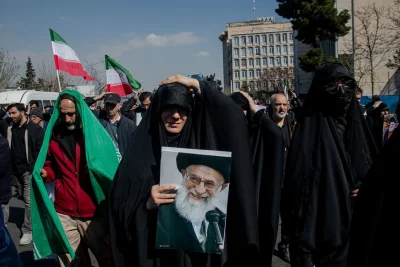

March 8 (UPI) — Members of the Iranian body charged with selecting the country’s new supreme leader said a candidate has been chosen, but no name has been revealed.
Mohsen Heydari, a member of the selection body, told Iran’s state-run ISNA news agency that a decision has been made on the successor to supreme leader Ali Khamenei, who was killed in joint U.S.-Israeli air strikes Feb. 28.
“The most suitable candidate, approved by the majority of the Assembly of Experts, has been determined,” Heydari said.
Mohammad Mehdi Mirbagheri, another member of the assembly, confirmed Heydari’s statement to the state-run Fars news agency.
Israeli forces have pledged to target Khamenei’s successor, as well as anyone involved in appointing a new supreme leader.
Israeli Defense Minister Israel Katz revealed Sunday that Abu-al-Qasem Baba’iyan, who was appointed last week as the new head of the supreme leader’s military bureau, has been killed.
An Iranian missile strike injured five people Sunday in central Israel. One person was reported killed in an Iranian strike in Dubai on Saturday. Sunday morning strikes were also reported in Kuwait, Bahrain, Saudi Arabia and Qatar.
The strikes came just one day after Iranian President Masoud Pezeshkian issued a pre-recorded statement apologizing to neighboring countries targeted in Iranian strikes, and pledged to suspend such attacks, unless attacks on Iran originated from those locations.
Meanwhile, two Israeli soldiers were killed Sunday morning in Lebanon, marking the country’s first fatalities in its campaign against Iran-aligned Hezbollah.
Lebanese health minister Rakan Nasreddine said at least 394 people have been killed in the country since Israeli strikes began last week.
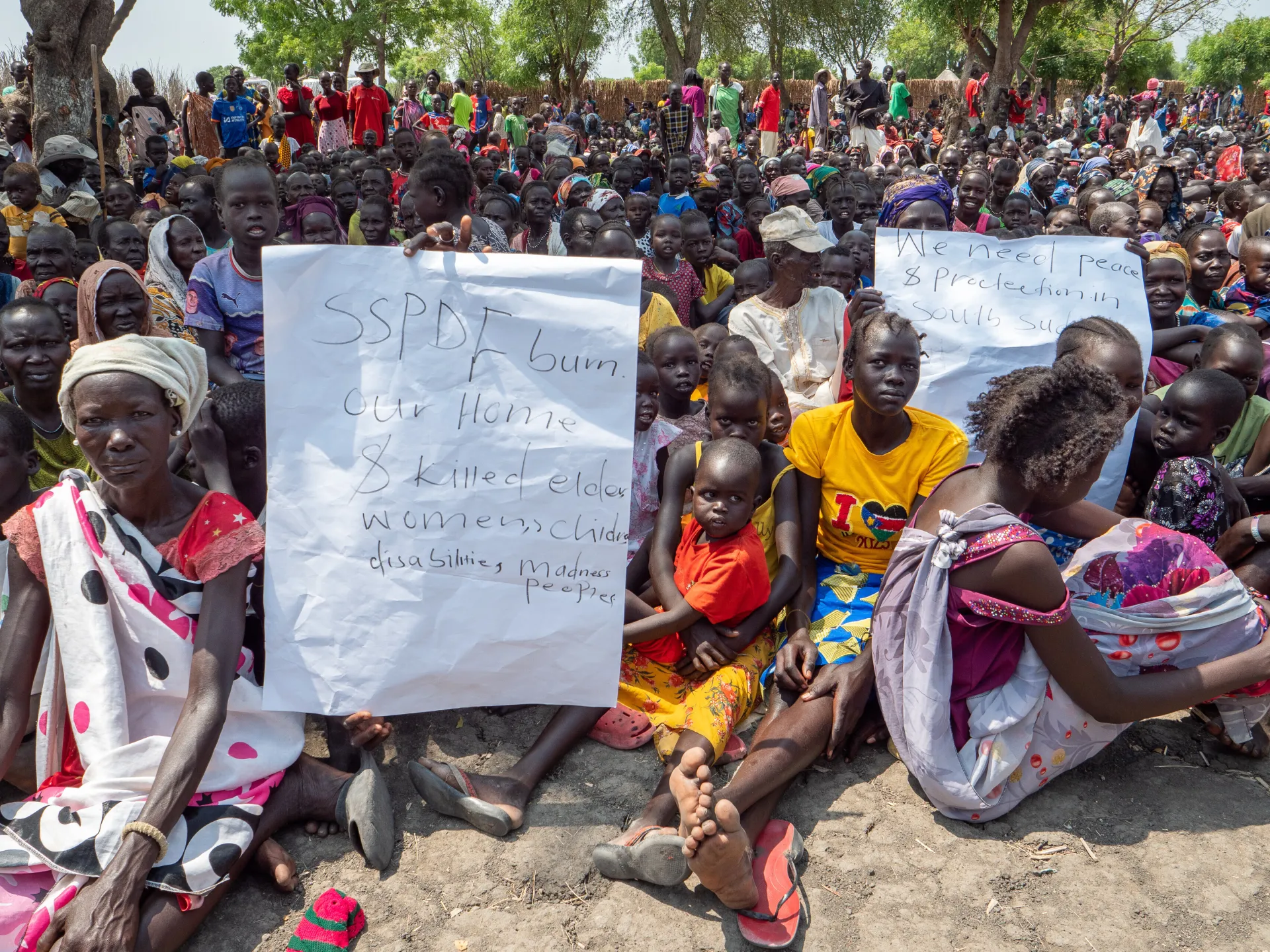
Thousands of civilians have fled an opposition stronghold in eastern South Sudan after the army ordered evacuations to clear the way for a military offensive, the latest sign that the country’s fragile peace is unravelling, as fears of a return to all-out civil war haunt the world’s youngest nation.
The town of Akobo, near the Ethiopian border, was almost completely emptied by Sunday after the South Sudan People’s Defense Forces issued an ultimatum on Friday demanding that civilians, aid workers and United Nations peacekeepers leave ahead of a planned assault.
list of 2 itemsend of list
“The town is now almost empty,” said Nhial Lew, a local humanitarian official. “Women, children and the elderly have left and crossed into Ethiopia.” By Sunday evening, he could hear the conflict closing in. “We are hearing the sound of machine guns approaching,” he told the Associated Press news agency.
The army’s deadline was set to expire Monday afternoon.
The order extends a government counteroffensive, launched in January and dubbed Operation Enduring Peace, that has already displaced more than 280,000 people across Jonglei state since December, when opposition forces began seizing government positions.
The UN’s Commission on Human Rights in South Sudan warned of a possible “return to full-scale war” if the country’s leadership didn’t take the challenges it faces more seriously.
“Preventing further mass atrocity crimes, institutional collapse, and the destruction of South Sudan’s fragile transition requires urgent coordinated national, regional and international re-engagement,” the report said.
Akobo, which had been considered a relatively safe haven and sheltered more than 82,000 displaced people, is one of the last remaining strongholds of the Sudan People’s Liberation Movement-in-Opposition, or SPLM-IO, the armed movement loyal to South Sudan’s detained former vice president, Riek Machar.
Two UN flights evacuated most humanitarian staff on Sunday, though the International Committee of the Red Cross had not yet pulled its personnel from a surgical unit it runs at the local hospital, where wounded patients were still being treated.
“We are worried for our patients,” said Dual Diew, the county health director. “We tried to make a plan to take them to a safer location, but we don’t have enough fuel.”
The offensive comes amid a wider breakdown of the 2018 peace agreement that ended a civil war between forces loyal to President Salva Kiir and those backing Machar, a conflict that killed an estimated 400,000 people and forced millions from their homes.
Machar has been under house arrest in the capital, Juba, since March 2025, facing charges of treason and murder that his supporters say are politically motivated.
His detention coincided with a sharp rise in armed opposition activity, and a UN inquiry has since found that South Sudan’s leaders have been “systematically dismantling” the accord.
Conflicts have taken place across the country among groups associated with the two factions, said Jan Pospisil, a South Sudan researcher who spoke to Al Jazeera.
On Sunday, at least 169 people were killed, among them 90 civilians, including women and children, when armed men stormed a village in Abiemnom county in the country’s north.
The local administrator blamed the attack on elements of the White Army, a militia historically allied to Machar, alongside SPLM-IO-affiliated forces. The group denied any involvement. More than 1,000 people sought shelter at a UN base in the area.
“Such violence places civilians at grave risk and must stop immediately,” said Anita Kiki Gbeho of the UN mission in South Sudan.
Aid organisations operating in the conflict zone have also been targeted, with Doctors Without Borders, known by its French initials, MSF, saying on Monday that 26 of its staff remain unaccounted for, a month after a government air strike destroyed its hospital in the town of Lankien and a separate facility in Pieri was looted.
Staff who had been reached described “destruction, violence and extreme hardships”. It was the 10th attack on an MSF facility in 12 months.
“Medical workers must never be targets,” said Yashovardhan, the charity’s head of mission in South Sudan, who uses only one name.
Pospisil said the crisis had exposed the fragility of Kiir’s hold on power.
“The state is literally falling apart,” Pospisil said, referring to the convergence of conflict in the country and the elderly state of the president, whose condition has raised questions.
Pospisil added that the outcome of Machar’s ongoing trial would likely shape what comes next.

HARRY STYLES has reason for plenty more disco dancing after scoring the biggest opening week of sales for a UK artist since Adele four years ago.
He released his album Kiss All The Time. Disco, Occasionally on Friday and I can reveal he sold 125,000 copies in the UK in the first two days alone.
The massive figure means he has already eclipsed the first week sales of his last album Harry’s House, which sold 113k copies in seven days in 2022.
It’s likely to be the third fastest selling British album of the last decade and the biggest since Adele’s 30 which shifted 261k in its first week in 2021.
Over on the singles chart, he looks set to occupy all three top spots with American Girls currently in the lead at No1, followed by former chart topper Aperture at No2 and Ready, Steady, Go! at No3.
And the figures globally are massive too, as Harry scored the biggest album debut of 2026 on Spotify worldwide with 63million streams on Friday.
The killer news comes after former One Direction star Harry smashed his One Night Only performance in Manchester’s Co-op Live on Friday night.
Fans who didn’t manage to get their hands on the £20 tickets, which were sold in a ballot, can now watch the show back on Netflix after it premiered on there last night.
Following the gig, Harry flew to the US to be in the audience for Saturday Night Live, where he will perform and host the show this weekend.
Chatting with Ryan Gosling, who was in the hot seat, Harry, who previously hosted and sang during an episode in 2019, said: “It’s been awhile, so I wanted to watch, get a feel for it.”
Insiders said the stripped back set, which saw Harry performing his new album from start to finish, will be ramped up for his upcoming 12 Wembley Stadium shows.
A source said: “Harry is celebrating this new era with an incredible stage set up.
“His team are building an epic set for the Wembley residency. Because he’s not moving around, they can really go to town.
“There will be enormous big screens and likely fireworks at the end of the shows.
“Harry gave his fans a taste of what is to come from the shows during the Brit Awards when he did an amazing choreographed routine as he sang Aperture.
“These shows are going down in history.”
I was lucky enough to be in Manchester’s Co-op Live to see Harry in action on Friday night and can confirm this album sounds incredible live.
His decision to lock away camera phones was masterful, as I could see the 20,000-odd fans properly connecting with his music – rather than watching him through an iPhone screen.
I think Harry should keep the ban in place when it comes to his Wembley shows, which kick off on June 12.
Enjoying music in the moment is the best feeling in the world — and Harry has reminded everyone, myself included, of that.
LIZZO is back and she’s riding higher than ever.
The About Damn Time singer headlined the Houston Livestock Show and Rodeo’s Black Heritage Night six years after her performance there was cancelled because of Covid.
And she made up for lost time and entered the ring to the sounds of the Texas Southern University Ocean of Soul marching band playing Chamillionaire’s 2005 hit Ridin.
During her set, Lizzo whisked punters through her hits including Truth Hurts and Good As Hell and gave fans a thrill as she pulled out her flute to play the melody of Houston native, American rapper Mike Jones’s song Still Tippin’.
Speaking after her set, Lizzo said: “You have no idea how much this night means to me.
“This night will forever change my life.”
I’m a massive fan of Lizzo’s and last saw her on stage at Glastonbury back in 2023.
Please can she come back soon?
LOLA YOUNG is showing no signs of slowing down.
Just last week she performed a near sell-out show at the London Palladium and now I can reveal she’s back in the studio.
Insiders tell me Lola has been getting to work with James Blake with the pair recording after a chance meeting last year.
A source said: “James and Lola have been in the studio working on a few songs and hopefully at least one of the tracks will end up on her next album.”
After being forced to cancel her tour last year to focus on her health, Lola has also announced she will play Manchester, Birmingham, Glasgow and London in June.
It’s great to see her back.
RITA ORA isn’t a woman who does things by halves.
And when she performed at the Formula 1 Australian Grand Prix in Melbourne over the weekend she dressed up like a chequered flag.
Rita teamed her black and white jacket with a pair of tiny black pants and stockings for her performance, which saw her singing some of her biggest hits – including her 2012 breakout song Hot Right Now.
Over the weekend, Basement Jaxx also performed a headline set at the race – which was won by British racing driver George Russell – with DJ Duke Dumont putting on the final show last night with an epic turn on the decks.
BOY GEORGE is to appear on Eurovision – but will be representing San Marino instead of the United Kingdom.
The Culture Club legend will feature on the tune Superstar, performed by Italian singer Senhit, who has qualified for the tiny nation.
He didn’t appear at the regional selection event on Friday night, in which Senhit won her place, but I’m told he does intend to be on stage in Vienna at the contest in May.
She previously represented San Marino in 2021 with the track Adrenalina, which had another famous feature, as American rapper Flo Rida joined her on stage.
Despite the special guest that year she finished 22 out of 26, so Boy George will be hoping to improve on that.
But given the UK came 19th last that year, perhaps George has the right idea singing for somebody else.
LADY GAGA has hinted she will marry fiancé Michael Polansky any day now.
Gaga, whose tour ends in the US on April 13, sent a note into pal Bruno Mars’s iHeartRadio livestream.
She said: “Me and my fiancé have been travelling all year, but we’re getting married soon. We were hoping you could choose a special song for us.”
ALAN CARR has called his upcoming comedy tour, Have I Said Too Much, and I can confirm he has.
But it’s bloody hilarious. During a small gig at the Soho Theatre in London on Saturday night, he took pops at his Celebrity Traitors co-stars – and had the crowd in stitches.
Alan said: “Wasn’t I good in The Traitors? Was I good or were the other celebrities just s**t?
“They were thick as mince and as stupid. When I laughed in their face and said: ‘I’m a faithful,’ I went home and packed.
“What more could I have done? I could have come down in that cloak with the severed head of CLAUDIA WINKLEMAN and they still would have gone: ‘I think it’s JOE MARLER.’”
Alan added: “Do you think I killed Paloma Faith first? No – I killed Clare Balding. We shoved her in the coffin but could not get the lid down because of that quiff.”
HE went from playing foul-mouthed Malcolm Tucker in The Thick Of It to becoming Doctor Who, and then trying his hand at music.
And after his second album, Sweet Illusions, was released last year, I’m told Peter Capaldi is already lining up his third record.
Peter worked with Blow Monkeys frontman Dr. Robert for album two and now they’re teaming up again, following the end of Peter’s debut run of headline shows.
A source said: “Peter finished his final show at the 100 Club in London last night, and the plan is to get back into a studio and lay down some new tracks.
“He has been blown away by the response to his first ever live shows with his band, and he already has a host of tracks for a new record.
“More than anything he finds making music fun.
“Peter doesn’t need to get to the top of the charts for this all to be a success for him.
“He would never have even recorded one track if it wasn’t for his friend Dr. Robert urging him to remember his student days as a punk and write some new songs.
“He trusts Dr. Robert and can’t wait to get to work with him again.”
Peter’s first foray into music was when he was at art college and he was the lead singer and guitarist in a punk rock band called the Dreamboys.
His biggest music moment so far came last year when Franz Ferdinand frontman Alex Kapranos pulled Peter up on stage at Glastonbury to perform Take Me Out with them.
TODAY: Ryan Gosling will be on the red carpet in London’s Leicester Square for the premiere of sci-fi comedy Project Hail Mary.
WEDNESDAY: Fundraising gig Trans Mission: A Solidarity Concert will take place at London’s Wembley Arena with appearances from Sugababes, Sophie Ellis-Bextor and Olly Alexander.
FRIDAY: The three-day Country To Country Festival will kick off simultaneously in Belfast, Glasgow and London with performances from Keith Urban, Zach Top and Brooks & Dunn.
SUNDAY: The tuxedos and fancy frocks will be out in force for the Oscars in Los Angeles, where Sinners is up for a record 16 awards.


1 of 3 | Large police resources are in place at the U.S. embassy in Oslo, Norway, Sunday, after an explosion was reported at the site. No injuries were reported. Photo by Javad Parsa/EPA
March 8 (UPI) — Norwegian police are investigating whether an early morning explosion that caused minor damage to the U.S. embassy in Oslo was linked to terrorism.
Oslo police said the explosion occurred about 1 a.m. local time at the embassy’s public entrance, causing minor damage but no injuries.
Police said they are working closely with the embassy to determine the cause of the explosion, and who was behind it.
Frode Larsen, head of the joint investigation and intelligence unit, told a news conference it is “natural to view this in the context of the current security situation, and that it is a targeted attack against the American embassy. But we have not locked ourselves into just that one hypothesis.”
Larsen said police are investigating whether the blast was linked to terrorism, but other possibilities are also being probed.
Police conducted a search of the surrounding area, but did not locate any further explosive devices.
Iran’s IRGC had earlier said they targeted radar systems in locations including Al-Kharj, home to Prince Sultan base.

Published On 8 Mar 20268 Mar 2026
Share
At least two people have been killed after a projectile fell on a residential location in Saudi Arabia‘s Al-Kharj city, Saudi authorities reported, as Iranian counterattacks on Gulf nations hosting US military assets entered a second week.
The Saudi civil defence said in a post on X on Sunday, without mentioning Iran, that an unspecified “military projectile” had hit a residential area in Al-Kharj, killing two foreign nationals – one Indian and one Bangladeshi – and injuring 12 people.
list of 3 itemsend of list
Iran’s Islamic Revolutionary Guard Corps (IRGC) had said earlier that it had targeted radar systems in locations including Al-Kharj governorate, which is home to the Prince Sultan airbase used by United States forces, and has come under repeated attack over the past week in the US and Israeli war against Iran.
Reporting from Doha, Al Jazeera’s Laura Khan said the projectile had landed on a residential site belonging to a maintenance and cleaning company.
“This is getting very volatile and dangerous for people across the Gulf,” she said. “It’s really important to emphasise that over 200 nationalities live and work across the Gulf nations. Many of these could be labourers.”
On Sunday, the Saudi Defence Ministry reported intercepting 15 drones, including an attempted attack in the diplomatic quarter of the capital Riyadh.
Kuwait, meanwhile, said an attack hit fuel tanks at its international airport, and Bahrain reported a water desalination plant had been damaged.
Sunday’s attacks came after Israeli warplanes hit five oil facilities around the Iranian capital, killing several people, according to a state oil executive, and blanketing the city in acrid smoke.
A spokesperson for the IRGC said Iran would retaliate if US-Israel attacks on its energy infrastructure did not let up.
“If you can tolerate oil at more than $200 per barrel, continue this game,” said the spokesperson.
As the war extended into its ninth day, the IRGC said it had enough supplies to continue drone and missile attacks across the Middle East for up to six months.
Ahmed Aboul Gheit, secretary-general of the Arab League, said Iran’s attacks on several member states were “reckless”, urging Tehran to reverse what he called a “massive strategic mistake”.
Iran’s Health Ministry said Sunday that at least 1,200 civilians had been killed and around 10,000 wounded since the US and Israel launched their war on Iran on February 28.

LIZ Hurley has barely aged a day in 27 years – and strutted out in a gown from 1999 to prove it.
The star gave fans a blast from the past during her latest trip to India for an event, bringing out a plunging black dress with a thigh high split.
Initially worn to the 1999 Met Gala in New York City, which celebrated ‘Rock Style’ that year, Elizabeth’s dating look was given a pop of colour with a bejeweled red and pink embellishment across the stomach, resembling a bursting firework.
She wrote alongside the comparison pic: “Viva Versace! For this weekend’s adventure in India, I dug into my archives and unearthed one of my favourite pieces, which I last wore to the Met Gala in 1999 😳
“27 years may have passed, but some loves never fade.”
The look got the seal of approval from Donatella Versace, who commented emojis of a kissing face, a bang, and stars.
Boyfriend Billy Ray Cyrus also approved, posting a string of hearts to her.
Her son, Damian Hurley, commented: “Hell yeaaaaaa ❤️”
While other fans also praised her incredible look and how after 27 years, she still knows how to show off her style.
“Elizabeth Jane time stopped for you still as gorgeous as always” wrote one.
“GORGEOUS!!!!!! And timeless! 🔥” noted another.
While a third wrote: “that’s insane… you look incredible 🙌”
Elizabeth is never one to shy away from a killer look and a jetset lifestyle, and has vowed to not stop taking bikini pictures anytime soon.
Last year, she credited stretching as the secret to taking flattering pics.
“If in doubt, arms up or lie down ♥️ (and remember your sun block),” she joked.
Kicking off the year in style, Liz posed with a gun slipped into her bikini bottoms as she rung in 2026 at a wild party with her boyfriend Billy Ray Cyrus.
In January, she showed off her rock-hard abs in a bikini while on holiday in the Maldives with her son, Damian.


Balendra Shah (C), former mayor of Kathmandu, appears poised to become Nepal’s next prime minister after his party scored a landslide victory in national elections. Photo by Narendra Shrestha/EPA
March 8 (UPI) — Former rapper Balendra Shah appears poised to be Nepal’s next prime minister, after his party won the general election by a landslide.
Shah’s Rastriya Swatantra Party, or RSP, captured 117 out of the 165 directly-voted seats in the Federal Parliament of Nepal and is currently leading in eight more contested seats. Final results, including seats appointed by proportional representation, are expected to be announced in the coming days.
Shah, 35, transitioned from a rapper to a politician in 2022, when he was elected mayor of Kathmandu.
The former musician became a figurehead of the September 2025 movement that saw young people take to the streets to protest Nepalese Prime Minister Sharma KP Oli’s law banning social media use. The protests expanded into criticism of government corruption and the country’s political system as a whole.
A government crackdown on the protests resulted in the deaths of 19 protesters, and led to public unrest resulting in 70 deaths and the resignation of Oli’s government.
Shah’s party has pledged to create 1.2 million jobs, reduce forced migration, raise the per capital income from $1,447 to $3,000 and provide social safety nets including health insurance.
For two overs, it appeared things could have been just like 2023 when India were far too tentative on, quite literally, cricket’s biggest stage.
There were five dot balls in the first over, bowled by seamer Matt Henry, and only five runs in the second, off Glenn Phillips’ part-time spin.
But Samson and Abhishek took 15 from Jacob Duffy’s first over and 24 from the next bowled by Lockie Ferguson as the innings, and the crowd, roared into life.
Even with that slow start, Abhishek and Samson took 92 runs from the best powerplay ever seen at a World Cup. In comparison, the Black Caps were 52-3 after their first six overs – a crucial difference.
Abhishek had only made one score over 15 in this tournament but flogged the ball to all parts. Samson was again supreme, backing up his 97 not out against West Indies and 89 against England with another innings that mixed flair with a classical technique.
Together he and Abhishek hit 12 of the innings’ 18 sixes, which took India’s tournament total to 106 – 30 more than any other team here and a record for a T20 World Cup.
When left-hander Kishan followed in raising his bat it was the first time the top three had reached fifty in a men’s T20 World Cup. They had 203 runs after 15.1 overs and Dube’s late burst – after a run of 28 runs in 24 balls – ensured India charged beyond a par score.
They took all the momentum, a batting paradise capitalised upon. Afterwards the chase was a slow coronation.
India were beaten by South Africa in the Super 8s stage but have responded brilliantly with three scores in excess of 250. This was a night of glory for a new generation, after the T20 retirement of superstars Virat Kohli, Rohit Sharma and Ravindra Jadeja.


