Hashim Thaci, former President of Kosovo and KLA leader, has been found guilty of war crimes by the Specialist Court in The Hague. Al Jazeera’s Marah Rayan explains how the ruling came about.
Schools in England are to get around £500 million in extra funding towards the teachers’ pay award this school year, reducing the risk of a strike ballot by the largest education union.
Daniel Kebede, the General Secretary of the NEU, said the offer of more funding was a “significant” step in negotiations.
In a letter to the union on Wednesday, which has been seen by the BBC, the government said the increase would be funded by savings in employers’ contributions to the local government pension scheme.
The letter said the 4.9 percentage point drop in what employers are expected to contribute will deliver “significant savings” on the pay bill for support staff, which will not be clawed back by central government.
The National Education Union said it expected the extra money to be around £500m, which schools can now use towards teachers pay this year.
In July, ministers accepted the recommendation of the independent pay review body for teachers and agreed a 3.5% increase from September 2026 would be followed by 3% the following year.
The pay increase had been partly funded by an additional £700m for 2026-27 and £1.1bn for the following year.
Independent economists at the Institute for Fiscal Studies (IFS) said that left schools facing a shortfall of around 1% between rising costs and funding this year.
Luke Sibieta, IFS research fellow, said the extra money would mean the pay increase this year was fully funded – and on top of other funding increases, schools would be £1.6bn better off by next year than they had expected this summer.
The additional money could potentially bring the uplift for this year into line with next year.
Kebede said schools has been “running on empty” and the funding signalled “a welcome return to reality, and a message of hope for the entire school community”.
Paul Whiteman, General Secretary of the National Association of Headteachers, said the decision is “certainly welcome”, putting schools in a “better position”.
He said his union would look carefully at the detail “to determine whether this means the pay uplift is genuinely fully funded” for schools.
Pepe Di’Iasio, General Secretary of the Association of School and College Leaders, said he was “pleased” at the announcement of additional funding but “the wider pressure on school and college budgets remains intense”.
Similarly, the NASUWT union welcomed the news. General Secretary Matt Wrack added schools needed “a sustainable, long-term injection of extra funding” to meet the needs of young people.
In an indicative ballot by the NEU in April, 90% of teachers who voted said they would be prepared to take industrial action over funding and pay, on a turnout of 48%.
A formal ballot was due to begin on 3 October and close 15 December, raising the prospects of teachers pay strikes early in 2027.
The national executive of the NEU will meet on 24 September to consider whether to call that off following the additional funding on offer from the government.
A spokesperson for Education Secretary Lucy Powell said the government was “confident schools can now meet the costs of the award at a national level”.
“The Secretary of State has been clear from day one that supporting teacher recruitment, retention and wellbeing, and rebuilding the relationship with the profession, are among her top priorities.”
TORONTO — An actor from last year’s Toronto International Film Festival has been turning heads around town this week: Inde Navarrette, whose “Obsession” went from a modest 2025 Midnight Madness slot to a box office behemoth.
But if you had to pick this year’s Navarrette, who would it be? Among the breakout names of TIFF 2026 is unquestionably Rosalind Eleazar, the London-born 38-year-old star of “Misty Green,” the first film written and directed by Chris Rock since 2014’s “Top Five” and among the most notable world premieres at this year’s festival.
Misty is a Hollywood survivor who was never able to make the most of her own success, winning an Emmy a few years back but now losing the apartment she has been living in because the widow of the man she was cheating with wants it back. With her bad attitude and personal problems, Misty has burned many bridges along the way. There’s a chance she could be cast in a remake of “Dreamgirls” that would turn everything around for her, but Misty’s brother, Jay (Daniel Kaluuya, in his first major screen role since 2022’s “Nope”), was recently released from a mental facility and needs monitoring.
Though there are comedic moments along the way, “Misty Green” is very much a character study, as well as an unsparring examination of the systemic pressures on Black women in Hollywood — one executive interrupts Misty’s audition to ask if she is “mixed.” She does herself no favors, frequently self-sabotaging and getting in her own way.
“Being an actor is hard,” Eleazar said in an interview at The Times’ photo and video studio in Toronto on Sunday with a sense of well-earned candor. “I could totally relate to Misty’s journey and the setbacks and the constant picking yourself back up after multiple rejections and just going again. And trying not to have armor because as an actor you want to keep yourself open and you don’t want to harden too much. But it can be easy to harden yourself to an industry that can be unforgiving.”
Though “Misty Green” is Eleazar’s first lead in a film, she has had a steadily building career. She is probably most familiar to American audiences from her role as an MI5 agent on the Apple TV series “Slow Horses.” But soon she will likely be known for the explosive announcement that is “Misty Green.” The film will go on to play at the New York Film Festival and the London Film Festival and be released by distributor A24 on Oct. 9.
“It can be easy to harden yourself to an industry that can be unforgiving,” Eleazar says.
(Jason Armond / Los Angeles Times)
After her movie’s TIFF world premiere in a coveted Saturday night slot at Roy Thompson Hall, Eleazar was included among those celebrated at the annual TIFF Tribute Awards, a fundraising gala put on by the festival. She was recognized alongside such actors as Helen Mirren, Penélope Cruz and Isabelle Huppert, whom she called “extraordinary company.”
“I grew up watching them and admired their work,” Eleazar says earlier in the day. “It’s just such an honor to be considered amongst heavyweights like that. Dame Helen Mirren. Crikey.”
With a warm smile she adds, “Just went very British.”
In accepting the prize, Eleazar recalled how when she came to Toronto for the premiere of her first feature film, 2019’s “The Personal History of David Copperfield,” she stepped away from a party to call her mother at 4 a.m. London time. Not wanting to make that same mistake again, she made sure her mother was there with her in Toronto for this year’s Sunday gala, sitting at a table with Eleazar’s husband, the actor and producer Gabriele Lo Giudice.
Eleazar performs two songs in the film, a heartbreakingly vulnerable cabaret version of Radiohead’s “Creep” and a stripped-down, tender reading of “One Night Only” from “Dreamgirls.” (Eleazar does not consider herself a singer and took vocal lessons before shooting.) Then, in a scene in which Misty demands she be allowed to finish an audition, she flashes into someone else in a bit of pure craft that leaves those in the room astonished.
It was important that Misty be seen as someone who is in fact immensely talented, who may even be worth all the bother and strife that she brings along with her.
“I think we’ve seen movies before where the character isn’t talented and it’s about the hustle and the dream of making it in Hollywood,” says Eleazar. “But I think it’s really interesting seeing someone that cannot get out of their own way — someone that is railing against the industry and is fighting Hollywood, fighting herself, fighting the people around her. It becomes quite a universal subject. It is about our industry but it’s also just about someone who is trying to escape herself.”
Despite Misty’s obvious talents, acting simply may not be the best career for her anymore; it strains her emotional and mental health and enables her substance abuse. Over the course of her own career, Eleazar has at times had to check in with herself to make sure she was heading down the right path.
“There are definitely times that I’ve questioned it,” she says. “For me it does really feed my soul and therefore, at my low points, I’ve managed better. But it can be really heavy. And maybe I shouldn’t but I feel like I’m pretty happy being an actor.”
Chris Rock and Rosalind Eleazar in the movie “Misty Green.”
(A24)
To land the role, after a few meetings with Rock over Zoom, Eleazar flew herself from London to Los Angeles so she could read in the room. As it happened, it made for an intense few days: First she had a chemistry read with Ralph Fiennes in the U.K. for a stage role (she would appear opposite Fiennes in “Small Hotel” in 2025) and then immediately flew to L.A. to read with Rock.
“What a mad, amazing three days,” she recalls. Similarly, Eleazar would be ending her whirlwind few days in Toronto by heading to Los Angeles to be with the “Slow Horses” team for the Emmys on Monday.
In introducing her tribute on Sunday night, Rock recalled when Eleazar auditioned for the part.
“The room just changed,” he said. “She was funny, she was dangerous, she was moving and completely in command. Misty Green is a woman whose life is coming apart. Rosalind never played her as a victim. She made you see the intelligence, the appetite and the fight underneath all the chaos. The audition was supposed to help me decide who to play Misty, but halfway through, the decision had already been made.”
“It becomes quite a universal subject,” Eleazar says of Chris Rock’s latest movie. “It is about our industry but it’s also just about someone who is trying to escape herself.”
(Jason Armond / Los Angeles Times)
There is something poetic about the fact that playing a mid-career actress struggling to land her next job may be the very thing that brings Eleazar wider recognition.
“It’s kind of meta, isn’t it?” she says with a laugh. “Look, I’m so happy that people are responding to the film and my performance. That really is the cherry on top because for me — I know it sounds rather cheesy — but I literally felt like I won once I did that film. I had such a great time exploring who she was and working with Chris and Daniel and Adam [Driver] and that cast. So everything else is just so lovely.”
In accepting her own tribute award on Sunday, Helen Mirren went off-script from her prepared remarks to say how moved she had been by Eleazar’s earlier speech, adding, “It’s exciting to see the generations coming up, especially women.”
As Rock succinctly added in his speech, “Misty Green wishes she could be Rosalind Eleazar.”
Regardless of what happens with “Misty Green” commercially or throughout awards season, Eleazar will continue tending her steady climb. Production will begin soon on season 7 of “Slow Horses” and Eleazar is currently shooting a film role that she isn’t yet allowed to talk about.
But Misty and the experience of bringing her to life on the screen will remain transformative.
“It almost reminded me of like a Shakespearean character in a way,” Eleazar says. “She’s so self-destructive and flawed and contradictory and at times it’s hard to get onside with her. We see it a lot of the time with male roles and I’d love to see it more with female roles — these really complex and messy characters.”
Former Republican Congresswoman Marjorie Taylor Greene slammed US President Donald Trump’s war on Iran, saying fuel prices are “way too high”. Greene left Congress in January after splitting with Trump over the Epstein files, which led him to brand his former ally a “traitor”.
As both the Navy and the USAF were racing to field a new generation of advanced tactical jets, the seagoing service’s program hit a wall. A major reason behind this from the Pentagon was concern that the U.S. industrial base could not handle simultaneous final development and production of two extremely complex new fighter aircraft. This was a controversial justification that many had a hard time swallowing. The Navy’s program, dubbed F/A-XX, is supposedly back on and a down-select on who will build it is coming soon, but that concern appears to linger among at least one of the Department of War’s top acquisition officials.
Though he remains confident that the U.S. Air Force F-47 sixth-generation fighter will fly in the next two years, Air Force Gen. Dale R. White, Director, Critical Major Weapon Systems — the service’s leading weapons procurement advisor — remains concerned about the overall capacity of industry to provide the military with the aircraft it needs, including two new fighters. His comments were in response to questions about the Navy’s challenges in building its own sixth-gen fighter alongside F-47.
The concerns are “not unique” to the F-47 or the Navy’s program but the problem exists to various degrees across the industrial base too, White told reporters Tuesday during a media roundtable at the Air & Space Forces Air, Space and Cyber Conference that TWZ is attending.
White has a dual-hatted role, serving as the Pentagon’s top weapon’s procurement officer and as the senior acquisition advisor to the Secretary of the Air Force for all acquisition matters.
A rendering of the F-47. (U.S. Air Force) U.S. Air Force
“We’re seeing it in multiple platforms,” said White, who did not elaborate. “And so what we’re having to do is, at some point, we’re having to make some trade space in between some of these.”
“I see Boeing making smart investments,” White said of the prime contractor of the F-47, selected for the U.S. Air Force’s Next Generation Air Dominance (NGAD) ‘fighter’ initiative. “They have a lot of CAPEX [capital expenditure] that they’re pouring in, but we have to get through the process of the design piece, getting that completed and closed out. Then we all hit some major milestones with things like flight tests and software and those things.”
F-47 specifications infographic (USAF)
“Really, it’s just being able to manage the overall resourcing as it relates to number one, people resources,” the general added. “Number two, when you start getting into the production conversation, do we have enough capacity to be able to produce at that rate? And so, by and large, I have concerns. I have concerns about the capacity of our industrial base, but they are not unique to F-47 or to any program.”
As for the F-47, White said the program “continues to progress exceptionally well.”
“As you know, many, many years in tech maturation and risk reduction gave us a tremendous head start on this program,” White explained. “Extremely proud of what the team has done, what they continue to do each and every day. We are still absolutely on path to be able to hit the mark of flying within this administration. So we see no issues in front of us right now.”
While the first example of the F-47 has been in production for about a year now, the Navy has yet to even select a prime contractor for its next generation fighter. The current competitors for the F/A-XX are Boeing and Northrop Grumman. A decision was supposed to have been made by last month.
“The F/A-XX program remains on track, and we have no further information to provide at this time,” a Navy official told us last week.
In response to a question from TWZ earlier this year, the Chief of Naval Operations acknowledged the uncertainty over the F/A-XX program.
“One of the challenges we’re seeing is, not only [are] our peer competitors improving their capability for anti-air, either air-to-air or surface-to-air, but the lower cost of entry of very capable weapons is also making more players on the field in which that level of stealth and technology is required,” Adm. Daryl Caudle told us back in April at the Sea-Air-Space 2026 exposition. “So this is not about the need for a peer adversary. This is just having an aircraft that can operate with a level of uncertainty and with the acceptable level of risk.”
With Boeing as a finalist, it is also possible that F/A-XX could be a variant of the F-47. As we noted in a past story, the Boeing render for its F/A-XX concept is remarkably similar to artwork for its F-47.
Last year, Steve Parker, Boeing Defense and Space CEO, said he didn’t see a problem with his company building both jets stating that this had been part of the strategy all along.
If this is the case, the company’s claim that it would not have a problem building both the Navy and Air Force next-generation fighters would make more sense. There are a number of advantages when it comes to establishing a high-degree of commonality between F/A-XX and F-47, although there would also be challenges, especially when it comes to getting the most out of a design that was not meant to operate from a carrier deck and scaling production up for both services. There is already significant sharing of elements of both the Navy’s and Air Force’s sixth-generation fighter programs. So commonality in some subsystems and interoperability is already baked in.
We should hopefully finally get a clearer picture in the coming weeks about the status of the F/A-XX and possibly the answer to who will actually build it, which will give us a better idea of what the industrial base impact actually will be.
MARK Wright was caught red-handed by wife Michelle Keegan after telling porkies about his whereabouts while she was at work.
The TV star told his actress wife he would be at home looking after their daughter Palma, 1, – confident he wouldn’t be rumbled.
Michelle Keegan caught husband Mark Wright out after he lied about going golfingCredit: Instagram/thisisheartA flustered Mark admitted their daughter Palma was spending the day with his mumCredit: Instagram/thisisheart
But Mark, 39, was actually out playing golf and was spectacularly exposed when Michelle FaceTimed him live on air.
The hilarious incident unfolded on Heart Breakfast when Michelle appeared as a guest to promote her new drama The Blame.
Sign up for the Showbiz newsletter
Thank you!
“Shock, he’s at golf,” Michelle, 39, remarked as the star popped up on the video call before demanding: “I’ve got a question – where’s the baby?”
A flustered Mark responded: “She’s with my mum. She’s seeing her nanny today.”
Mark joked that the radio presenters had landed him “in the doghouse”Credit: Instagram/thisisheartThe couple welcomed their first child, daughter Palma, in March 2025Credit: PA
Michelle then clapped back: “You told me you weren’t golfing today. You’re in trouble!”
Mark told the other presenters: “This is what I mean, guys. You’ve got me in the doghouse!”
The couple welcomed their first child, Palma, in March 2025 after nearly ten years of marriage.
Michelle is now gearing up for the release of six-part ITVcrime drama The Blame, adapted from Charlotte Langley’s debut novel of the same name.
Mark is a doting dad to 18-month-old daughter PalmaCredit: instagramMichelle recently pulled out of another ITV project to spend more time with PalmaCredit: Instagram
She plays DI Emma Crane, who investigates the murder of a young figure skater while confronting corruption and misogyny within the police force.
The series marks Michelle’s first acting role since giving birth to Palma.
She said earlier this year: “Coming back to work after having a baby is quite daunting.
“But the production were so supportive and I was so looked after. It was like working with family.”
However, the actress recently pulled out of another major ITV drama amid concerns its demanding filming schedule would keep her away from Palma for too long.
Michelle had been due to play a working-class barrister but withdrew several months before filming began, with former Doctor Who star Jodie Whittaker, 44, stepping into the role.
Although Michelle had committed to the project and filming dates had been agreed, she reportedly walked away before signing a contract.
Israel’s defence minister has pledged to remove Palestinians from the besieged Strip.
Published On 16 Sep 202616 Sep 2026
Egyptian President Abdel Fattah el-Sisi has rejected any plans for Palestinian displacement, following comments by Israel’s defence minister saying the army would “finish the job” in Gaza.
Speaking during a visit by Palestinian President Mahmoud Abbas on Wednesday, el-Sisi stressed “Egypt’s firm stance against the displacement of the Palestinian people or any attempt to annihilate the Palestinian cause”, the Wafa news agency reported.
Recommended Stories
list of 3 itemsend of list
Abbas praised Egypt’s steadfastness in defending Palestinian rights and reiterated that “Gaza is an integral part of our state.”
The Egyptian leader’s comments came hours after Israeli Defence Minister Israel Katz said the army would “finish the job” in Gaza, “so that we can also implement the migration plan.”
Katz said earlier this month that Israel was ready to remove Palestinians from Gaza by sea and land, but was waiting for the United States, which he said was discussing where the two million people would go.
US Ambassador Mike Huckabee has denied any plan to “displace people out of Gaza against their will”. In February, Huckabee explicitly said he “would be fine” if Israel took most of the Middle East in accordance with his interpretation of the Bible, but then suggested the remark was selectively edited.
Nearly all of Gaza’s population has been internally displaced, and most of the territory lies in rubble after three years of a war that has killed more than 73,700 Palestinians.
Israeli Prime Minister Benjamin Netanyahu said earlier this month that the army would not withdraw from the Gaza Strip, despite a US-backed ceasefire plan that came into effect in October stipulating it as a condition.
Netanyahu claimed Israel controls 60 percent of the Palestinian enclave and promised not to pull back until Hezbollah is disarmed.
His government has been pushing for more Israeli settlements on Palestinian territory in the West Bank, including through a controversial settlement project dubbed E1 designed to construct thousands of housing units between Jerusalem and the Maale Adumim settlement.
Israeli human rights group B’Tselem warned this week that Israel is executing a systematic and accelerated campaign to dismantle “Palestinian collective life” and establish permanent Jewish-Israeli sovereignty across the occupied West Bank.
Saudi Arabia has intensified air strikes against Houthi positions in Yemen as the Iran backed group expands its territorial gains along the Red Sea coast, opening a new front in the wider Middle East war and adding pressure to already disrupted global energy supplies.
The Houthis have swept through several Yemeni towns and seized islands near the Bab el Mandeb Strait, a strategically important maritime route connecting the Red Sea with the Gulf of Aden. The group has also released footage showing its fighters capturing armoured vehicles from Saudi backed forces.
Houthi military spokesman Yahya Saree claimed that the group had shot down a Saudi F 15 fighter jet and said Saudi Arabia had conducted as many as 450 air strikes in Yemen during the week. Saudi authorities have not confirmed the aircraft claim, while officials supporting the internationally recognised Yemeni government have acknowledged that Saudi and allied forces are carrying out strikes against Houthi positions.
Saudi Arabia faces growing security pressure
The escalation has brought the conflict closer to Saudi territory. The Houthis have repeatedly launched attacks toward Saudi Arabia over the past week, prompting alarms in cities across the kingdom’s south and west.
Stay ahead of the geopolitical week.
MD Briefing delivers expert analysis across five global fronts — the Indo-Pacific, energy, geoeconomics, European security, and the Middle East — every Monday morning. Free.
Saudi Arabia said its air defenses intercepted a Houthi drone south of Mecca before it entered restricted airspace over the holy city. Riyadh described the incident as a serious escalation because of the threat to religious sites. The Houthis denied targeting Mecca and accused Saudi Arabia of using the incident for propaganda.
The United States has also tightened its travel warning for Saudi Arabia, barring government employees from travelling within 20 miles of the Yemen border.
The latest escalation marks a sharp deterioration after several years in which the Saudi led conflict in Yemen had largely quietened under a ceasefire. The Houthis declared a naval blockade against Saudi Arabia in July and resumed attacks on areas in the kingdom before making rapid gains against forces aligned with the Saudi backed Yemeni government.
Energy markets face another shock
The renewed fighting is particularly significant because global energy markets are already under pressure from disruptions caused by the wider war involving Iran.
An attack blamed on Iran aligned fighters in Iraq last week knocked out Saudi Arabia’s East West Pipeline, an important route that allows the kingdom to move oil without relying entirely on the Strait of Hormuz.
Traders estimate that a prolonged closure of the pipeline could affect as much as 4% of global oil supply. Saudi Arabia has not given a timetable for restoring operations, although U.S. Energy Secretary Chris Wright said oil should begin flowing through the pipeline within days.
Brent crude was trading around $108 a barrel on Wednesday, close to its highest level since May. The average U.S. retail diesel price also reached a record above $6.30 a gallon.
The simultaneous disruption around the Strait of Hormuz and Saudi Arabia’s alternative export infrastructure increases the vulnerability of global energy markets to further regional escalation.
Washington faces another difficult choice
The developments also create a new challenge for the United States.
Saudi Crown Prince Mohammed bin Salman spoke with President Donald Trump last week seeking additional military support. So far, U.S. assistance has been limited to intelligence support.
The United States previously conducted a two month bombing campaign against the Houthis in 2025 before Trump announced a ceasefire with the group.
Washington now faces competing pressures. Greater support for Saudi Arabia could help contain the Houthi advance and protect regional energy infrastructure, but deeper military involvement could also expand the U.S. role in another theatre of the Middle East war.
What’s next
The immediate concern is whether the Houthi advance can be contained before the fighting causes further disruption to Saudi energy infrastructure and shipping routes.
For Saudi Arabia, the challenge is to push back against the Houthis while preventing the conflict from developing into a broader regional confrontation.
For global markets, the key issue will be whether disruptions to Saudi oil infrastructure remain temporary. Continued attacks on energy facilities or shipping routes could place additional pressure on already strained supplies.
The developments in Yemen therefore carry consequences well beyond the country’s existing conflict. The combination of Houthi territorial gains, pressure on Saudi Arabia and disruption to major energy routes has created another potential source of instability for the global oil market.
Saudi digital payments company barq announced the close of a series A funding round worth $329.5 million, at a valuation of $1.85 billion, marking a new milestone that reflects the growth the company has achieved since its launch. The funding round cements its position among the fastest-growing fintech companies in Saudi Arabia and the region.
The round saw participation from Noon Investments, Sohar International Bank, and M20 Fund, a step that reflects investor confidence in barq’s trajectory and future potential, and underscores the appeal of the investment opportunities emerging in the fintech sector across the Kingdom and the region.
The round follows a standout growth journey for barq, which has now surpassed 15 million users within two years, from more than 210 nationalities, alongside the expansion of its ecosystem of digital financial services and solutions — reflecting the growing demand for the company’s products and its ability to build a broad user base within a record period of time.
The value of funds processed has also surpassed SR440 billion ($117.2 billion), an indicator that reflects the scale of activity barq has achieved and the widening use of its digital financial services since launch.
Based on its valuation, barq has become one of the fastest companies in the region to reach unicorn status, and among the fastest globally within the fintech sector, reflecting the pace of growth the company has achieved within a short period since its launch.
The funding round will support barq’s next phase of growth, by strengthening operational efficiency, accelerating the development of products and services, investing in new financial and technology solutions, and expanding into new regional and international markets — contributing to delivering a more advanced and accessible digital financial experience for users.
This achievement comes at a time when Saudi Arabia’s fintech sector is undergoing exceptional development, driven by continued progress in financial and digital infrastructure, a supportive regulatory environment, the targets of Saudi Vision 2030, and the Saudi Central Bank’s efforts to advance digital payments and support innovation in financial services.
The close of the round marks a major milestone in barq’s journey, reflecting its ability to move within a short period from a phase of rapid growth to building a broad-scale digital financial platform, underpinned by a growing user base, an increasing volume of operations, and expansion ambitions aimed at strengthening its presence in the fintech sector at both the regional and international levels.
It is stunning to see the impact the USAF’s Collaborative Combat Aircraft (CCA) program has made on discourse surrounding the future of the Air Force since it was officially announced. There is still much to prove regarding the concept, but testing is accelerating and the USAF now plans on buying 500 CCAs by 2032. At the same time, the USAF is now hunting for a successor to the MQ-9 Reaper, with plans on procuring hundreds of those drones, as well, by early in the next decade.
With all this in mind, TWZ’s Jamie Hunter talked to Mike Shortsleeve from General Atomics on the show floor at Air, Space & Cyber 2026. The two discussed the latest progress for the company’s newly-named FQ-42 Vengeance Collaborative Combat Aircraft, as well as General Atomics’ new Wildfire platform designed to address the lower-cost Massed Modular Aircraft program that could replace the company’s iconic MQ-9 Reaper.
Check out the interview below or at the top of this post.
FQ-42 Vengeance fighter drone update from General Atomics
The Latin Recording Academy has unveiled the nominees for its 27th Latin Grammy Awards. The ceremony will air live Nov. 12 on Univision from the MGM Grand Garden Arena in Las Vegas.
Edgar Barrera leads the count with a total of 10 nominations, followed by Ca7riel & Paco Amoroso, Jorge Drexler, Karol G and Rosalía, who each received seven nods.
Trailing behind them are indie folk artists Silvana Estrada and Mon Laferte, who each received six nominations.
All nominations are for recordings released between June 1, 2025, to May 31, 2026.
Hit songwriter Barrera — who now holds the record for the most Latin Grammy nominations, reaching 84 this year — could make history once more if he wins in any category.
The Texas-born composer — who has collaborated with the likes of Bad Bunny, Karol G, Shakira and Maluma, along with anglophone divas like Ariana Grande and Madonna — is currently tied with Calle 13’s Residente for the title of most-awarded individual in Latin Grammy history.
Ca7riel & Paco Amoroso took home five Latin Grammy awards last year, which tied them for the most wins that night alongside Bad Bunny — who received no nominations this year.
Now, the kooky Argentine pair are nominated in multiple top categories, following the release of their experimental 2026 LP “Free Spirits” — which features collaborations with British musicians Sting and Fred Again, as well as California’s very own Anderson .Paak and Jack Black. The duo is competing for album of the year, as well as record of the year for the song “Ha Ha.”
Karol G is also contending for top prizes, including album of the year for “Tropicoqueta,” her 2025 survey of Latin American pop. (She previously won the honors back in 2023 for her heartbreak album, “Mañana Será Bonito.”) Her tender pop duet with Marco Antonio Solis, “Coleccionando Heridas,” is also nominated for record of the year and song of the year.
Spanish singer Rosalía is up for record of the year, song of the year and pop song for the song “La Perla” — which features the música mexicana sibling trio Yahritza y Su Esencia. The band resurfaced from the shadows following a public fallout with Mexican media regarding their American-leaning tastes in cuisine; their 2026 album, “Metamorfosis,” is also nominated for contemporary Mexican music album this year.
There are several notable first-time nominees, some of whom De Los has previously profiled. This includes Xavi, whose album “Dosis” is up for contemporary Mexican music album, as well as his viral TikTok song “No Capea,” which he recorded with Grupo Frontera, in the regional song category. Working-class hero Macario Martínez is also in the running for the new artist award.
Colombian artist Ryan Castro is also nominated for the first time alongside Afrobeat singer Kapo and producer Gangsta for their song “La Villa” in the urban performance category. Castro is also nominated for urban music album for his joint LP “Omerta” alongside J Balvin.
Here’s the list of nominees in all general categories:
Record of the year
“Ha Ha” – Ca7riel & Paco Amoroso
“¿Cómo Se Ama?” – Jorge Drexler
“Dime” – Silvana Estrada
“O Amor Nos Encontrou” – Loulu Gilberto
“Coleccionando Heridas” – Karol G & Marco Antonio Solís
“Femme Fatale” – Mon Laferte
“Desde Que Te Tengo” – Carín León
“Niño” – Milo J
“La Perla” – Rosalía Featuring Yahritza y Su Esencia
“Alma” – Elena Ros
Album of the year
“Equilibrivm” – Anitta
“Free Spirits” – Ca7riel & Paco Amoroso
“Taracá” – Jorge Drexler
“Vendrán Suaves Lluvias” – Silvana Estrada
“Tropicoqueta” – Karol G
“Femme Fatale” – Mon Laferte
“Muda” – Carín León
“La Vida Era Más Corta” – Milo J
“¿Dónde Es El After?” – Rawayana
“Lux (Complete Works)” – Rosalía
Song of the year
“Coleccionando Heridas” – Edgar Barrera, Kevyn Mauricio Cruz, Luis Miguel Gomez Castaño & Karol G, songwriters (Karol G & Marco Antonio Solís)
“¿Cómo Se Ama?” – Jorge Drexler & Diego López Crespo “Mauro”, songwriters (Jorge Drexler)
“Hasta Jesús Tuvo Un Mal Día” – Rafa Arcaute, Renee Barri, Ca7riel & Paco Amoroso, Vicente Jimenez “Vibarco”, Martin Kierszenbaum, John Ryan, Gordon Matthew Thomas Sumner & Federico Vindver, songwriters (Ca7riel & Paco Amoroso Featuring Sting)
“La Perla” – Noah Goldstein, David Rodríguez, Ryan Tedder, Rosalía & Dylan Wiggins, songwriters (Rosalía Featuring Yahritza y Su Esencia)
“Mi Gran Amor” – Edgar Barrera, Becky G, Luis Miguel Gómez Castaño, Manuel Lorente, Daniel Rondón & Carlos Santana, songwriters (Santana Featuring Becky G)
Are the brakes finally being slammed on the artificial intelligence race? Or are we simply witnessing a wake-up call that has come too late?
Developers are coming forward in numbers these days to say that the speed and direction of travel of AI, machine learning and the tech reaching the human level of intelligence is threatening human existence.
Jacob Coxon, the researcher who quit Anthropic last week, feared that those developing AI systems are “genuinely frightened” for the future of humanity. His words echo a growing anxiety in the field, as well as in government, about the challenges and dangers posed by AI. At this late stage, could there still be room for a U-turn that keeps the machine at the service of humanity, instead of human existence becoming a victim of the machines that have already been built?
Ask anyone on the street and — though they would be all for the progress and the positives the tech is offering in many fields touching human life — they would be quick to roll their eyes in despair when they reflect on AI, the uncertainties it brings and their future job security. Scratch the surface further and their anxiety surges about the impact unregulated tech companies are having on their children, potentially exposing them to unmoderated, manipulated content and often-damaging influence.
People are quick to despair when they reflect on AI, the uncertainties it brings and their future job security
Mohamed Chebaro
Their worries take a turn when they reflect that, even if they safely navigate their children’s youth, the job market may be permanently changing, hurting their prospects in the digitally automated and largely autonomous world of tomorrow.
It was troubling when I read recently that Microsoft co-founder Bill Gates had called, in a 6,000-word essay, for society to intentionally keep certain roles off-limits to the machine. His proposal of setting aside 40 percent of occupations as “human-reserved” is bizarre to say the least, as he better than anyone should be aware that markets, economies and competition do not work this way.
The words of Gates and the AI developers and researchers point to a grave lapse. It seems we have rushed into a race to make the machine supreme, giving artificial general intelligence agency over humans, who could ultimately be replaced by AI and advanced robots. The developers seem to have fallen into the trap of the machine becoming an end in itself and not a tool to serve and ensure the well-being of individuals.
It is not usual for companies and entire industries to plead with the world to make them work less and advance at a slower pace. And who and which institutions should heed their calls when we live in a highly fractured and geopolitically splintered world, in which superpowers and medium powers are vying for supremacy, with AI and its tools becoming their most potent vehicles?
The tech industry has clearly become too big to fail and too big to slow down. An AI slowdown — if there were suggestions its progress could be reversed or even stalled — would significantly affect the long-term direction and costs of the infrastructure boom.
It was surprising and unusual to hear key world leaders defend the sector. In the race for the vast supremacy and advantages it offers, their posture is understandable. The political imperative to press ahead was made clear by both Washington and Beijing. That appears to show that, whatever the private sector does, governments will want to drive this capability precisely because of, not despite, the risks that are now being flagged.
Governments want to drive this capability precisely because of, not despite, the risks that are now being flagged
Mohamed Chebaro
In this competitive world, there is no place for existential worries or fears for humanity and its survival. One country’s slowdown is another’s chance to catch up.
Calls for guardrails, rules and regulations are being constantly ignored or watered down. In a world where multilateralism is waning, technological restrictions like arms controls are useless unless solid conventions enforce them internationally.
The prospect of a multilateral agreement on hard-and-fast rules limiting the capacity of AI seems far-fetched. US President Donald Trump made that clear, saying on social media that “There is a SICK conspiracy going on against AI and Data Centers, and the only one that is happy about it is China.” The reply from Beijing came through an editorial in China’s state-backed Global Times, which claimed that AI warnings were a “Cold War playbook” targeting Beijing.
A call by Anthropic CEO Dario Amodei to slow the pace of AI development won rare backing from SpaceXAI’s Elon Musk and OpenAI’s Sam Altman, with all evoking AI “doomerism.” This should surely not be ignored.
The solution should be simple: more cooperation in order to regulate.
According to these tech supremos, reports that swarms of AI agents have been increasingly found to be collaborating with others and hacking outside systems, or that their power was being used to develop harmful biological agents, are just the beginning. The same AI tools might have the potential to take down the internet and everything that relies on it, such as power grids, transport infrastructure, water supplies and banking systems. All of which could be the first call for an act of aggression by any group or state.
AI has become a crucial tool of economic and military prowess. Calls for protocols and conventions to restrain the tech realm have long irked most companies. Yet, if we are to believe some in the tech community, the world has in its hands a calamity in the making that surpasses even the existential nuclear threat, which was ultimately constrained through global moratoriums and conventions. AI is a different beast and, since its onset, humans have been the victims in the name of reducing labor costs.
Over the past decade, labor has become a mere number on a cost sheet. The fear is that humanizing work once again would be a far more complex task — one that the tech giants, the financiers and the state are not ready to undertake, even if it could save humanity from eventual extinction. The world has long since departed from the mindset that the machine should serve humans and not the other way round.
Mohamed Chebaro is a British-Lebanese journalist with more than 25 years of experience covering war, terrorism, defense, current affairs, and diplomacy.
Mohamed Chebaro is a British-Lebanese journalist with more than 25 years’ experience covering war, terrorism, defense, current affairs and diplomacy. He is also a media consultant and trainer.
Taiz, Yemen – Hajja Fatima Mohammed Saleh, a 70-year-old Yemeni woman, is among the countless people and families displaced from Taiz governorate, southwest Yemen, in recent fighting between government forces and the Houthis.
The Iran-backed rebel group, also known as Ansar Allah (supporters of God), now controls most parts of northwestern Yemen, including the capital, Sanaa.
Recommended Stories
list of 4 itemsend of list
Saleh’s village in Maqbanah district, on the border of Yemen’s western coast, is situated at the epicentre of last week’s Houthi assault in which the group captured the whole of the Red Sea coast, including the port city of Mocha.
At least 100,000 people have now fled their homes following renewed fighting between the two sides, according to the United Nations’ refugee agency, most leaving with few belongings due to the speed of the Houthi offensive.
Saleh said she had to leave her wheelchair behind as it was unsuitable for the rugged terrain her family had to navigate to find shelter.
“The attack was massive, we had never seen anything like it before. Shells were falling heavily on the village, and bullets were flying in every direction,” she told Al Jazeera.
“We had no choice but to leave and flee to a safe place. We left everything we owned and walked a long distance on foot. For me, I suffered especially because I am disabled and cannot walk, so I had to crawl – using both hands – for a long distance through rain and floods before we found a vehicle to carry us.”
UN agencies and the internationally recognised Yemeni government say that Taiz governorate has witnessed most of the displacements, with Taiz City among the Houthis’ next targets after their victory on the Red Sea coast. This means the humanitarian situation could worsen even further.
Ali al-Shumairi, director-general of the Executive Unit for the Management of IDP Camps in Taiz governorate, told Al Jazeera that 65,845 people were displaced between August 10 and September 15. About 95 percent of those displaced come from the five districts which witnessed the heaviest fighting: Jabal Habashi, al-Maafer, Maqbana, al-Wazi’iyah and Mawza.
Newly displaced people at al-Munij camp [Al Jazeera]
Fighting has intensified on several fronts in Yemen as government forces have carried out air attacks on Houthi positions in attempts to retake Mocha, days after the group captured the strategic port city, tightening its grip on the Red Sea – a vital shipping lane.
This development has placed the Bab al-Mandeb Strait, the strategic waterway that connects the Red Sea to the Gulf of Aden and the wider Indian Ocean, at the heart of the war between the United States and Iran, and amplifies pressure on global trade routes.
Yemen’s more than 10-year civil war was reignited in July, threatening a United Nations-brokered truce that halted large-scale violence in 2022, after the Houthis declared a maritime blockade on Saudi Arabia and began targeting its ships in the Red Sea.
Forces affiliated with Yemen’s internationally recognised government have launched a campaign against the Houthis on a number of fronts since last week. They have retaken some positions and are advancing in the southwestern Taiz province as clashes intensify.
Osama al-Wafi, supervisor of the Mushrifa camp in Wadi Bikhawlan in Taiz governorate and a representative of the Yemeni government’s Executive Unit in Jabal Habashi district, described the situation as “dire and tragic”.
“These people have been displaced and have lost all the basic necessities of life, after having homes, farms, and livestock. Now they are only looking for a shelter to house them,” al-Wafi told Al Jazeera.
He said the number of displaced people arriving at the camp is steadily rising, with more than 1,500 families entering over the past six days, most living in the open due to a lack of shelter.
The al-Munij camp in the al-Bireen area, about 40 kilometres southwest of the semi-besieged city of Taiz, has become a temporary refuge for Yemenis fleeing the area after another bout of conflict between government and Houthi fighters in 2020.
Over the years, al-Munij has extended over a space of two square kilometres to house more displaced families, while other larger camps have been established in the area. Most residents complain they lack access to the most basic services – such as sporadic drinking water supplies and few toilets – in the camps.
Hajj Saif Qaed Thabet, 73, has been living with his wife and four children in an exposed space with no doors since arriving at al-Munij on September 10. He left behind a farm and livestock from his home in al-Kadaha, western Taiz governorate.
“We were displaced because of the war, fleeing bullets and artillery shells falling over our heads. Since arriving at the camp, we have been living like this, waiting for our situation to be addressed and for us to be housed in a suitable place,” said Thabet. “Praise be to God in all circumstances.”
Displaced man Hajj Saif Qaed Thabet, 73, has been living in the open air since he arrived with his family at al-Munij camp on Thursday, September 10 [Al Jazeera]
Malouk Ahmed Ali, 55, from the al-Kadaha area in Taiz, said her family of 14 all escaped drones, shelling and gunfire on foot, including five children under her care, seven under her daughter’s care, and her elderly grandmother.
“We fled to an area near our village in the hope that the war would calm down quickly and we would return to our homes, but the clashes expanded until they reached us, so we were displaced again to here aboard a military vehicle that came to transport the threatened homeless people,” she told Al Jazeera.
“When we arrived at this camp, we were received and placed in this small tent as temporary housing for all members of the large family. Although they took all our information, our situation has not improved much so far, and we still hope it will improve.”
Ali hopes the war will end soon so she can return home but believes her family’s possessions, including solar panels and a battery, will have gone.
“As for our livestock, most of them died, some fled to the mountains and valleys, and what remained was looted,” she said.
When Judy Collins comes to Los Angeles, she likes to stay at the Beverly Hilton in part because “they serve a fabulous breakfast,” she says over coffee at the hotel on a recent morning. “That’s rare today,” she adds. “Too often a place will just send up a cardboard shopping bag with the things you ordered in it.”
Collins knows her amenities: At 87, the Grammy-winning singer and songwriter still plays about 120 shows a year, drawing audiences around the world with her high, clear voice and an expansive repertoire that blends the hits that made her famous in the 1960s and ’70s — Joni Mitchell’s “Both Sides Now,” Leonard Cohen’s “Suzanne,” Stephen Sondheim’s “Send in the Clowns” — with traditional folk tunes and material of her own.
Yet now she’s preparing to hang it up with a lengthy farewell tour she’s calling Sweet Judy Blue Eyes (after “Suite: Judy Blue Eyes,” the folk-rock classic her one-time lover Stephen Stills wrote about her for Crosby, Stills & Nash). The night before our interview, Collins played L.A.’s Ford Theatre; she’ll be back through Southern California for a Sept. 27 date at the Lobero Theatre in Santa Barbara and again next year for shows in Palm Springs and Aliso Viejo.
After we talk, she plans to do a bit of tai chi, for which she uses an app on her phone and which she wishes more people practiced. “Maybe that would alter civilization,” she says. “If we were all doing tai chi, we couldn’t be at war with Iran.” Then she’ll head to the airport for a flight home to New York, where she’s lived for decades — most of them with her husband, industrial designer Louis Nelson, who died in 2024.
At breakfast, Collins is wearing a patterned turquoise jacket over a matching dress and high-heeled black leather boots.
“You like these?” she asks of the boots. “These are Stuart Weitzman. I bought them 30 years ago, and I’ve never stopped wearing them.”
That’s a well-made boot. They fit, they’re great and I reject all invitations to get rid of them.
Has your thinking about clothes changed over the decades? I used to dress in jeans because I was a cowgirl — I hung out with rodeo riders in Colorado. As I came up, I liked what was simple. My mother made all our clothes on a Singer sewing machine for years. Now I love beaded things. I have full closets I need to go through.
Before you came onstage last night, an announcer told the audience not to take pictures or videos. That’s my management’s doing — it’s important to them, so I go along with it. But the pictures are usually bad. Also, the phones take people’s minds off what’s going on onstage. People need the chance to focus. We’re in a period of insanity right now, so people need time to sit wherever they are. They could go to the ballet or to the theater, but they choose to come to me, and they get to sit there and they get to listen and they get to think about their own lives.
As a performer, that’s what you seek to provide. I’m providing silence. It’s such a noisy world — so full of crappy music that plays outside all these hotels and places where we stay. It drives me nuts.
You have a line in the show where you say, “Something unexpected happened — I turned 87.” It got a good laugh. People applaud too.
What are they saying by applauding? They want to be acknowledged for their own ages, whether they’re 87 or 90 or 19. People are coming to see me, but they’re also coming to see their history. They’ll remember what happened 60, 70 years ago — they were probably marching at the same things I was marching at. And if they’re 19, they want to know why we’re not marching now.
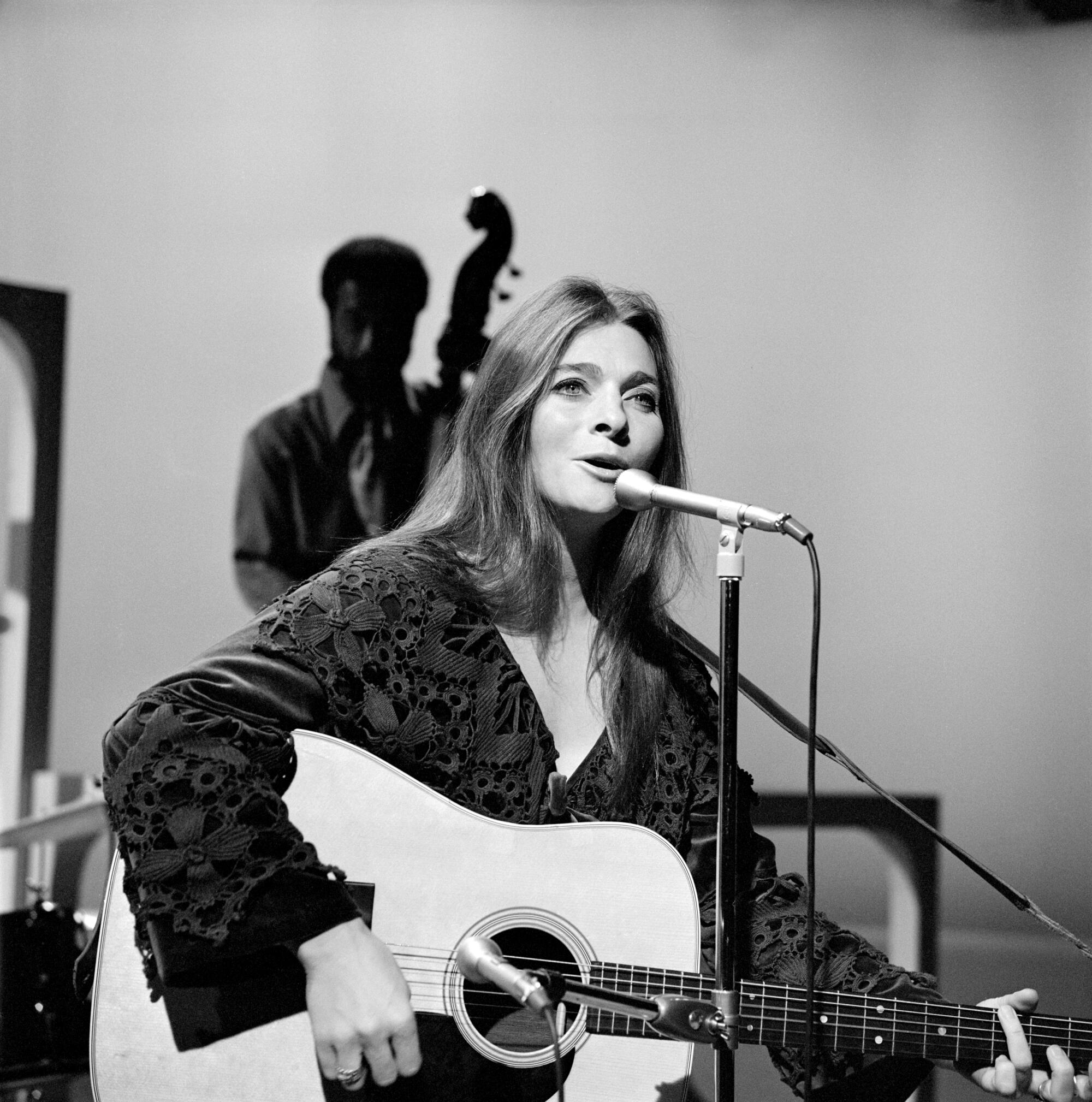
Judy Collins performs on “The Smothers Brothers Comedy Hour” in 1969.
(CBS via Getty Images)
You said we’re in a period of insanity. This country is losing so much of the depth of our origin. The fact that workers who’ve come to this country are being taken off to God knows where — it makes no sense. Number one, these people often have some sort of legality. And secondly, they do the work here. Nobody else wants to go up to the orchards in Oregon and pick the fruit. Do you?
I can’t say that I do. I don’t want to do that.
This tour is billed as your grand farewell. So long, you guys.
I’m always reluctant to trust that framing. Cher’s done like eight farewell tours. I hadn’t counted them up — shame on me.
Should we really believe you? I think we have to believe in the present tense. What you’re hearing is what’s happening.
You had a music stand onstage with you. What was on it? All the lyrics to all the songs.
You can’t possibly need the lyrics anymore. Oh, yes, I do.
You’ve been singing some of them for decades. Doesn’t matter — it has to be there in case you have to look at it.
Would you say you do look? Or is it more of a security blanket? It’s a security blanket. But my eyes wander — I like to see who’s in the audience and what’s going on. I like to look up and down the aisles, and I like to fantasize: How did this happen?
Your life and career? I mean, I know how it happened. I was 16, and I started going to the Denver Folklore Society, which was run by a guy named Lingo the Drifter. And Lingo the Drifter had these wonderful evenings where we all played the guitar and sang and drank illegal whiskey and so on.
Judy Collins last month in Beverly Hills.
(Allen J. Schaben / Los Angeles Times)
Before Denver, you lived briefly as a kid in Los Angeles. My father was a very eclectic and fabulous radio personality. He had a radio show for 30 years in Seattle then here in Hollywood, broadcasting out of CBS — a big deal. If we weren’t in school, we would drive up Santa Monica Boulevard into Hollywood and we’d stand around and watch them produce the radio mysteries. People would walk in a sandbox to get the sound of somebody walking up the gravel road to the door.
Are you familiar with the term “nepo baby”? No.
It refers to the child of a famous artist who follows in their parent’s footsteps. Oh, that’s interesting.
People use it derisively, as if to say that a kid has overly benefited from their advantages. We certainly had advantages. For instance, the Library of Congress, which is the jewel in the crown — I don’t know what they’re doing now — but they sent us Braille books and they sent us all the shows from New York and they sent us the recordings of all the Shakespearean plays by the great Dame Judith Anderson and John Gielgud. I had all that growing up. In some ways, I wasn’t raised — I was trained. I got to see how a professional has to handle his life. My father was a professional in all ways. He drank — occasionally, not all the time — but he was absolutely organized about everything, including that.
You’ve been sober for something like half a century. Forty-eight years. I’m in my 49th now.
You ever miss drinking? Oh, my God, no. I was so sick — I was gone. Bye-bye.
Some people replace one addiction with another. I had an eating disorder, which is still kind of … You know, last night, I asked for apple juice during the show — I was in trouble because I wasn’t eating. When my husband died, I stopped eating again. I’d stopped eating in the ’60s and ’70s and ’80s, but I got over that. But suddenly I didn’t want to eat again.
Would you consider that disordered eating? I don’t know. Anyway, I have to really be careful. We had a talk about it last night. I have to eat these protein bars, and I have to eat them all the time.
Do you remember the first gig you played after your husband died? Oh, yes — I had to go out. When my son took his life in 1992, I got a call from Joan Rivers — she and I knew each other pretty well. She was getting ready to go out and do her show in Las Vegas, and she called me in New York and she said, “I have to tell you this” — her husband had just killed himself — she said, “You cannot stay home. You have to go out.” I was canceling all my shows, and she said, “You can’t do that because you won’t ever get over this if you do.”
How did you take that advice? I said, “Thank you,” and I called my staff and I said, “Put ’em back on.” My mother came out with me, Louis came out with me, my sister came out with me, and it was incredibly true: I had to be working or else I would die. So when it came to Louis, I was out three days later.
What did that feel like? Well, it was wonderful because I was working. I can work and get through anything — that’s the psychological effect of what I’m doing on the stage. I’m interacting with people, I’m hearing the laughter, I’m hearing the music. What could be more healing?
This is why I’m wondering why you plan to stop touring. But you see, I have all these other things to do — I have a life that’s not just touring. I’m working on the music for a Broadway show. And I’m doing a new book — it’s called “Singing Through the Storm,” and it’ll be out next year, I hope.
Judy Collins and Leonard Cohen attend the 41st annual Songwriters Hall of Fame ceremony in New York in 2010.
(Larry Busacca / Getty Images)
You’ve interpreted the music of so many great songwriters: Joni Mitchell, Bob Dylan, Leonard Cohen. Was there ever a writer whose work you admired but couldn’t find your way into? No.
OK. I’ll tell you my funniest Leonard story. In 2014, I think it was, I went to this little group in Norway called Democrats Abroad — lonely group of people. That night, this woman came up to me and said, “Hi, I’m Marianne.” I said, “Hi, Marianne.” And then she said, “I’m Leonard’s Marianne.” She said, “There’s something I’ve wanted to tell you for many years: We were living together in Spain, Leonard and I, and he was writing songs and we were swimming in the nude. And then one day he came to me and he said, ‘Marianne, I’m going to New York to sing my songs for Judy Collins,’ and he went to New York and he played you all his songs and you recorded them.” Marianne said, “I just wanted to tell you that you ruined my life.” Fortunately, we became friends on Facebook.
You opened last night’s set with “Both Sides Now.” Oh, yes.
This might be the most famous song you do. Some artists would save it for later in the show. I don’t want people to wonder for an hour and a half: Will she? Won’t she? What will I do if she doesn’t?
Do you still enjoy singing “Both Sides Now”? I love it. It was Al Kooper who brought me to Joni — she sang it to me over the phone. Al is living a very sane, quiet life in the Northeast now. He’s married — never goes out anymore. It’s hard to think of Al Kooper just sitting there enjoying his marriage and his garden.
What will you do on the plane home today? I’ll probably get out the computer and noodle around on the book and see what I can come up with.
The work never ends. It never ends because it’s not done.
DUBAI: Film AlUla has signed a memorandum of understanding with international film financier Sherborne Media at the 2026 Toronto International Film Festival, establishing a financial framework designed to expand production support for Saudi, regional, and international filmmakers shooting in AlUla in the northwest of Saudi Arabia.
Qualifying productions filming in AlUla will be able to access debt financing solutions secured against available production rebates, grants, incentives, and soft money. The combined support packages will cover up to 50 percent of eligible production expenditure incurred in AlUla.
The partnership aims to address one of the filmmaking industry’s key barriers: upfront liquidity for producers against their contracted rebate and incentives receivables, ensuring sufficient cash flow to facilitate production.
By providing a standardized, transparent process for financial due diligence, the initiative supports established Saudi, MENA (Middle East and North Africa), and international storytellers in bringing their projects to life using AlUla’s production facilities, purpose-built soundstages, and historic landscapes.
The partnership will also integrate workforce development opportunities to support the sustainable growth of Saudi Arabia’s film industry. Film AlUla and Sherborne will collaborate on structured training programmes, crew upskilling, and local hiring initiatives to build long-term regional production capacity.
Zaid Shaker, acting executive director of Film AlUla, said: “Financing remains one of the most critical challenges facing creators today — particularly for emerging creators in Saudi Arabia and the region. Our partnership with Sherborne Media allows us to establish an efficient, transparent mechanism that bridges the gap between creative vision and financial execution. By pairing our state-of-the-art facilities and rebate structures with institutional debt solutions, we are providing a reliable platform for local and international artists to tell authentic, compelling stories – right here in AlUla.”
Alastair Burlingham, CO-CEO of Sherborne Media, said: “Saudi Arabia’s screen sector is expanding rapidly, supported by strategic leadership and infrastructure investment. After the successful financing and production of ‘Chasing Red’ earlier in 2026, and leveraging the services offered by Caravan — our Saudi joint venture company with Stampede — we are delighted to join forces with Film AlUla during TIFF 2026 to help facilitate its growth by introducing a structured financing model.
“Curated credit facilities against soft money and incentives receivables give producers the financial certainty required to execute high-quality feature and television projects efficiently in AlUla.”
RIYADH: A US economic delegation has held meetings with Syria’s sovereign fund to explore investment opportunities, as Damascus seeks to deepen ties with the world’s largest economy and attract international capital.
The meetings, which included representatives from government bodies and private companies, were focused on assessing the Syrian market and available investment opportunities amid the country’s economic opening and the lifting of sanctions, the Syrian Arab News Agency reported.
The discussions come as the Middle Eastern nation’s seeks to capitalize on the momentum generated following Washington’s termination of sanctions against Syria in July 2025.
“In his remarks during the meeting, Yasir Kahf, Director of Development and Planning at the Syrian Sovereign Fund, explained that the fund’s investment portfolio encompasses a diverse range of sectors and companies. He emphasized the Fund’s openness to establishing various forms of partnerships with US and international companies — including joint ventures — tailored to the specific nature of each sector,” the newly released SANA statement said.
Kahf also said the US Chamber of Commerce delegation’s inaugural visit to Syria represents a significant step toward enhancing economic cooperation.
Mohammad Mastat, director of public relations at the Syrian Sovereign Fund, said US companies had shown interest in entering the Syrian investment market, adding that several agreements and projects were currently under negotiation and would be announced in due course.
The easing of US sanctions has also created greater scope for investment and private-sector activity.
In May 2025, the US Treasury said sanctions relief would enable new investment in Syria and facilitate activity across all sectors of the Syrian economy as part of efforts to support its economic recovery.
It said the recovery is being supported by improving agriculture, hydrocarbon production, electricity provision, trade and services, alongside policies aimed at restoring macroeconomic stability and achieving a strong, private-sector-led recovery.
For the first time since California and Congress passed a pair of laws bolstering U.S.-based claims to Nazi-looted artwork around the world, two lawsuits have been filed in California demanding prominent museums relinquish pieces seized during World War II.
In one case, filed in federal court in Los Angeles on Monday, the daughters of Auschwitz survivor Dina Gottliebova Babbitt sued the Auschwitz-Birkenau Memorial and Museum in Poland for the return of watercolors Babbitt was forced to paint of fellow prisoners for the Nazi physician and war criminal Josef Mengele.
In the other, filed in Los Angeles Superior Court on Monday, the Jewish Federation of Greater Los Angeles and Daniel Gryczman, the federation’s board chair, sued the Norton Simon Museum in Pasadena for the return of the diptych “Adam and Eve,” a pair of 16th century masterpieces by Lucas Cranach the Elder.
The lawsuits revive legal battles waged unsuccessfully for the watercolors and the diptych for years, on the premise that their claims are newly viable under the new laws — one passed by California lawmakers in 2024 and the other signed into law by President Trump earlier this year.
Both laws were inspired in part by another legal battle over looted art between a California family and a prominent museum, which is still ongoing.
Lilly Cassirer Neubauer escaped Germany at the dawn of World War II by relinquishing to a Nazi art broker the exquisite impressionist masterpiece “Rue Saint-Honoré in the Afternoon. Effect of Rain,” by Camille Pissarro. The painting is now worth millions. Her grandson Claude Cassirer, who moved to California, and great-grandson David Cassirer have been fighting for the painting’s return from the Thyssen-Bornemisza Collection in Madrid for the last two decades.
Amid that battle, California lawmakers rewrote state law to make clear that in situations where it and another jurisdiction’s law on looted artwork are in conflict, California law applies and requires the return of the art to its original owners regardless of the passage of time. In an unusual moment of bipartisanship, Congress followed up by passing its own measure — the Holocaust Expropriated Art Recovery Act of 2025 — to further bolster such family claims.
The two new lawsuits — neither of which provide a valuation for the artwork in question — were filed just ahead of a deadline under the California law for claims to artwork with long-known locations.
David Cassirer said his father would be “extremely proud” to know a California law passed in part in response to his family’s fight has also given other families another chance “to vindicate their ancestors’ artistic legacies.”
Auschwitz watercolors
Michele Babbitt Kane, of Ben Lomond, Calif., and Karin Wendy Babbitt, of Las Vegas, say in their lawsuit that Mengele demanded their mother produce the seven watercolors in question — each depicting a Roma prisoner later murdered — to support his “pseudo-scientific” and racist work studying the Roma people. Known as the “Angel of Death,” Mengele conducted gruesome medical experiments on Auschwitz prisoners.
They said their mother obliged “with deep sympathy for her subjects,” on the condition Mengele “spare her and her mother from the gas chambers.”
After liberation, the lawsuit says, their mother moved to California and worked for nearly 20 years as an animation assistant for Hollywood studios such as MGM and Warner Bros., where she contributed to familiar cartoon characters such as Wile E. Coyote, Tweety, Daffy Duck and Speedy Gonzales.
They say theirs is exactly the sort of case California’s new law was enacted to allow — involving “a California family seeking the return of watercolors created by their Jewish mother under Nazi coercion at Auschwitz and withheld by a Polish state museum for decades despite the Museum’s own repeated acknowledgments of the family’s rights.”
Paweł Sawicki, a spokesperson for the Auschwitz Memorial, said in a statement to The Times that the Babbitt paintings “must remain in the Memorial as part of the documentation of the crimes of Mengele,” and that many in the Roma community agree.
“We fully understand the emotional approach of Dina Gottliebova’s family to the works she made on the orders of Josef Mengele in circumstances that certainly affected her life, but in carrying out our statutory responsibility, we express the deep conviction that the watercolors should remain at the Memorial,” Sawicki said. “The portraits of Roma victims are the few remaining fragments of the documentation made by Mengele as part of his criminal experiments. Therefore, they should be treated as unique documents related to the history of Auschwitz.”
‘Adam and Eve’ diptych
According to the Jewish Federation’s lawsuit, the “Adam and Eve” paintings were part of a vast collection seized from prominent Dutch Jewish art dealer Jacques Goudstikker by Hermann Göring, Hitler’s second-in-command. The collection was later recovered by Allied forces and given to the Dutch government, with the diptych being sold to the Norton Simon in 1971.
The lawsuit says Marei von Saher, Goudstikker’s surviving heir, has long sought the return of the Goudstikker collection, and years ago was successful in forcing the Dutch government to return 200 pieces still in its possession. She first demanded the “Adam and Eve” paintings from the Norton Simon in 2000, without success.
The new lawsuit says Von Saher on Monday signed her claimed rights to the paintings over to Gryczman and the Jewish Federation, which said in a statement that they will use a majority of any proceeds from the return of the paintings to “care for Los Angeles-area Holocaust survivors living in poverty.”
Von Saher’s daughter, Charlène von Saher, said in an interview that her family gave the painting rights to the Jewish Federation because of that shared mission. She said she wishes California and Congress had acted sooner but hopes a win now will help other Jewish families reclaim what is rightfully theirs in the future.
“My grandfather lost his life fleeing the Nazi invasion, and many of his family members were sent to Auschwitz and did not survive,” she said. “Victory would be justice, and a piece of the puzzle to restoring my grandfather’s legacy and his collection.”
The Norton Simon Art Foundation said in a statement to The Times that it was reviewing the new lawsuit, but that various courts, including the U.S. Supreme Court, have over decades of litigation confirmed that the foundation “has proper title” to the diptych paintings, and the foundation “will continue to make these important artworks accessible to the public.”
The Pissarro
The Thyssen-Bornemisza Collection and the Kingdom of Spain, which owns it, have fought the Cassirer family’s claims to the Pissarro painting since Claude Cassirer, now deceased, first sued for its return in 2005. Spain has argued the painting was legally obtained by the collection prior to its 1993 sale to the country by Baron Hans Heinrich von Thyssen-Bornemisza, a prolific art collector whose wealthy industrialist family helped finance Adolf Hitler’s rise.
The matter has repeatedly wound its way through the U.S. courts, including to the Supreme Court, which remanded the case to the lower courts for additional review in light of California’s new law. A hearing is set for next month.
The museum has contended California’s new law is unconstitutional, which California is contesting. David Cassirer has argued the law clearly requires the museum to return the painting — and has pledged to support other looting victims with any proceeds.
He said both California and Congress “acted decisively to guarantee that stolen art victims, and victims of political persecution in particular, can have a fair shot to recover family legacies the Nazis ruthlessly tried to destroy,” and that “the momentum at all levels of government in favor of restitution is very encouraging.”
DUBAI: Hezbollah must prioritize Lebanon’s interests over those of Iran for progress to be made on disarming the group and advancing negotiations with Israel, deputy speaker in the Lebanese Parliament, Elias Bou Saab, said on Wednesday, as negotiations remain frozen amid the wider US war on Iran.
Lebanon’s government cannot secure a lasting agreement with Israel without Hezbollah’s backing for the transfer of weapons to state control Bou Saab said at the Arab Media Summit in Dubai, in a session titled “Lebanon at a Crossroads.”
But a key aspect of moving negotiations further is getting on the same page with Hezbollah, said Bou Saab.
“If the Lebanese state does not have Hezbollah’s approval, it is negotiating over something that it cannot deliver.
“That’s why Hezbollah needs to be convinced that we need to reach a solution to the issue of handing over weapons and ensuring that weapons are exclusively in the hands of the Lebanese state,” he said.
Bou Saab emphasized the need to disarm Hezbollah and ensure that the Lebanese army is the only armed force in Lebanon.
But he said that disarmament was not enough.
“The issue is not simply about handing over weapons. There need to be guarantees, including the liberation of Lebanese territory and prisoners, and guarantees that Israel will not attack Lebanon,” he said.
“The negotiations are directly linked to what is happening between the US and Iran. We have to wait and see what happens between the US and Iran to know what will happen in Lebanon and when the war in Lebanon will end,” said Bou Saab.
The MP said Lebanon was, at this stage, trying to prevent trying a further escalation and expansion of the war.
The US has been sponsoring talks between Israel and Lebanon aimed at putting an end to hostilities, with Beirut seeking Israel’s phased withdrawal from the south.
In June, Israel and Lebanon agreed to a framework deal that involves the disarmament of Hezbollah, a gradual withdrawal of Israeli forces from Lebanon’s south and the deployment of the Lebanese army to the region, starting in test areas known as “pilot zones.”
But elections in Israel and the US are putting the negotiations on hold, explained Bou Saab.
“Perhaps after the Israeli and American elections, we will enter a new phase, and that is when the serious discussions about Lebanon’s future will begin.”
He added: “I expect that after the elections perhaps during the period before Christmas, or extending into the period after Christmas will be the most serious period for discussions about Lebanon’s future and where we are heading.”
A 15-year-old boy has been killed in an apparent Israeli double-tap strike as he rushed to help a paramedic wounded in an attack moments before. Israel has killed around one child per day in Gaza since the 2025 ‘ceasefire’.
NOUGHTIES pop singer La Roux has said “she’s back” after disappearing from the spotlight – revealing a “nervous breakdown” ended her career.
La Roux – real name Elly Jackson – shot to fame in 2009 and is known for her number one single Bulletproof.
La Roux told fans she’s back after a long break away from the spotlightCredit: UnknownShe’s gearing up to drop a new album after her last release was affected by the pandemicCredit: Getty Images
But it’s been a long time since La Roux released a new album and, ahead of her upcoming LP Old Flames, she posted on TikTok to tell fans she’s back.
She wrote: “You think you can hurt me?
Sign up for the Showbiz newsletter
Thank you!
“I literally wrote and sung this song, lost my voice, had a nervous breakdown and disappeared for 10 years.”
Speaking about releasing new music, La Roux told Another: “It’s been a long time coming, so I’m very eager to get back out there.
“Supervision [my third album] being totally marred by the [Covid-19] pandemic wasn’t ideal, so I’m very excited.”
She added: “I’d only just finished my last album when the pandemic hit, so I wasn’t ready to start making a new record instantly. You need a gap before you make new work.
“I started f***ing around with new sounds and new ideas. It took a couple of years to know if I even wanted to make another record or if there was any point.”
La Roux’s mum is actress Trudie Goodwin, who drama fans will know best for playing Sergeant June Ackland in ITV’s The Bill.
She previously shared the advice Trudie, 74, gave her on dealing with fame.
La Roux said: “She’s really good at saying things like, ‘Never have a drink when you do an interview’ – which I don’t always take notice of! And ‘Only give away what you need to give away’.
“And she says that if there’s paparazzi, just give them a picture and they’ll f**k off.”
Beijing: China’s Foreign Minister Wang Yi said Beijing was willing to “safeguard” Iran’s rights during talks with his counterpart Abbas Araghchi on Wednesday, as Beijing seeks to mediate in Tehran’s war with the United States.
China is “willing to strengthen dialogue and cooperation with Iran, and safeguard Iran’s legitimate rights and interests”, Wang told Araghchi as they met in the Chinese capital.
“We encourage Iran and the US to stay rational and restrained,” he added.
The talks come one week before an expected trip by Chinese President Xi Jinping to Washington, where he will meet US President Donald Trump.
China, a top economic partner of Iran, has long sought a detente in the months-long conflict in the Middle East, which has at times spilled over into neighbouring countries.
“We do not wish to see regional tensions spilling over into Yemen and the Red Sea,” Wang said.
Recent fighting that flared up in Yemen between government forces and the Iran-backed Houthis has displaced more than 100,000 people inside the country while thousands have fled abroad, according to the United Nations.
The war in Iran will be a closely watched topic at Xi’s meeting with Trump, among other thorny issues ranging from trade to competition over artificial intelligence.
Beijing refuted this week US media reports that Chinese entities supplied Tehran with satellite images of a military base housing US troops in Jordan, before and after an Iranian strike killed three American soldiers.
Trump has warned Beijing not to sell weapons to Iran, and Washington sanctioned three China-based satellite companies in May for enabling Iran’s military operations.






















![Newly displaced persons at Al-Munayyaj camp [Al Jazeera]](https://i0.wp.com/www.aljazeera.com/wp-content/uploads/2026/09/%D8%A7%D8%AB%D9%86%D8%A7%D8%A1-%D8%AA%D9%82%D9%8A%D9%8A%D8%AF-%D8%A8%D9%8A%D8%A7%D9%86%D8%A7%D8%AA-%D8%A7%D9%84%D9%86%D8%A7%D8%B2%D8%AD%D9%8A%D9%86-%D8%A7%D9%84%D8%AC%D8%AF%D8%AF-%D9%81%D9%8A-%D9%85%D8%AE%D9%8A%D9%85-%D8%A7%D9%84%D9%85%D9%86%D9%8A%D9%8F%D9%91%D8%AC-%D8%B5%D9%88%D8%B1%D8%A9-%D8%AE%D8%A7%D8%B5%D8%A9-%D9%85%D9%86-%D8%AA%D8%B5%D9%88%D9%8A%D8%B1%D9%8A-1789545157.jpg?w=640&ssl=1)
![Displaced man Hajj Saif Qaed Thabet, 73, has been living in the open air since he arrived with his family at al-Munij camp on Thursday, September 10 [Al Jazeera]](https://i0.wp.com/www.aljazeera.com/wp-content/uploads/2026/09/%D8%A7%D9%84%D8%AD%D8%A7%D8%AC-%D8%A7%D9%84%D9%86%D8%A7%D8%B2%D8%AD-%D8%B3%D9%8A%D9%81-%D9%82%D8%A7%D8%A6%D8%AF-%D8%AB%D8%A7%D8%A8%D8%AA-%D9%85%D8%A7-%D8%B2%D8%A7%D9%84-%D9%8A%D8%B3%D9%83%D9%86-%D8%A8%D8%A7%D9%84%D8%B9%D8%B1%D8%A7%D8%A1-%D9%85%D9%86%D8%B0-%D9%88%D8%B5%D9%88%D9%84%D9%87-%D9%85%D8%AE%D9%8A%D9%85-%D8%A7%D9%84%D9%85%D9%86%D9%8A%D9%8F%D9%91%D8%AC-%D8%A7%D9%84%D8%AE%D9%85%D9%8A%D8%B3-10-%D8%B3%D8%A8%D8%AA%D9%85%D8%A8%D8%B1-%D8%B5%D9%88%D8%B1%D8%A9-%D8%AE%D8%A7%D8%B5%D8%A9-%D9%85%D9%86-%D8%AA%D8%B5%D9%88%D9%8A%D8%B1%D9%8A-1789545163.jpg?w=640&ssl=1)