Following his run topping display at the IPL, Vaibhav Sooryavanshi is being lined up as India’s youngest player.
Published On 5 Jun 20265 Jun 2026
The 15-year-old batting sensation Vaibhav Sooryavanshi is likely to be named in India’s T20 squad, while skipper Suryakumar Yadav could get the axe when selectors meet on Saturday.
Sooryavanshi had a stellar Indian Premier League (IPL) for Rajasthan Royals, finishing top of the batting charts with 776 runs, including a hundred and five half-centuries.
Recommended Stories
list of 4 itemsend of list
It is understood that the left-handed opener is in line to be picked for two T20 matches in Ireland, followed by five games in England.
He would be the youngest debutant for India in history.
Batting great Sachin Tendulkar played his first Test for India at 16 years and 205 days in 1989.
Sooryavanshi has also been included in a 30-member of probables for the Asian Games in September-October in Japan, Indian media says.
He was named most valuable player in the IPL, despite his team narrowly failing to reach the final.
He also scooped the Orange Cap for leading the batting charts, and was named emerging player of the season, among other prizes.
The India T20 team is expecting a leadership change, with Suryakumar likely to be removed from the captaincy nearly three months after he led the country to World Cup glory at home.
Suryakumar has struggled with the bat, scoring just 242 runs in nine World Cup innings, with his unbeaten 84 against the United States the only significant knock.
Playing for Mumbai Indians in the IPL, the 35-year-old managed only 270 runs in 13 innings at an average of 20.76. His team ended ninth in the 10-team table.
Indian media have predicted Suryakumar will lose his place in the T20 squad, with insiders calling it a “tough call”.
Suryakumar is likely to be replaced by Shreyas Iyer, who last played a T20 for India in December 2023 but has been an IPL-winning captain.
He led Kolkata Knight Riders to the title in 2024 and then captained Punjab Kings to a runners-up finish in 2025 and into the playoffs this year.
Ishan Kishan and Tilak Varma are also in contention for the captaincy, with selectors set to name the squad over the weekend in Mumbai.
A BOND Girl has been spotted on rare outing 50 years after her sizzling scenes aired in one of the most iconic 007 movies.
Former Bond Girl Gloria Hendry, who played CIA agent Rosie Carver, was seen out and about looking amazing this week while running some errands.
Sign up for the Showbiz newsletter
Thank you!
Former Bond Girl Gloria Hendry, who appeared opposite Roger Moore in the James Bond movie Live and Let Die, was recently seen out and about in Las VegasCredit: BackGridShe wore a casual outfit for a lowkey outing to run some errandsCredit: BackGrid
50 years after starring opposite Roger Moore in the iconic flick Live and Let Die, Gloria, now 77, was spotted in Las Vegas.
The model and actress wore a casual brown and black top with some black leggings and slip on shoes for the low-key trip.
Looking youthful and content, Gloria wore her hair in a short light brunette bob, which was very different to the afro she sported in the movie.
Florida-born Gloria shot to fame in her 20s when she became 007‘s first African-American woman to become romantically involved with James Bond.
Gloria, seen above in her heyday, shot to fame in the Live or Let Die James Bond flickCredit: Rex FeaturesShe starred alongside Roger as she became the first African-American woman to become romantically involved with 007Credit: InstagramIn one photo from her recent outing, Gloria was seen beaming as she went about her dayCredit: BackGridShe chatted on the phone at one point as she walked along the sidewalkCredit: BackGrid
In the 1973 movie, she was fresh-faced and vibrant, showcasing a voluminous afro that framed her face.
The model-turned-actress played the part of Rosie Carver, who famously gets shot and killed in Bond’s arms.
Her steamy scenes with Roger Moore catapulted her into the spotlight in the Ian Fleming classic.
Gloria began her career as a Playboy bunnyCredit: BackGridRoger Moore wrote about Gloria in his memoir and noted how their on-screen chemistry caused issues in his marriageCredit: BackGrid
The movie theme of Live and Let Die was famously written by Paul McCartney.
In his memoir, 007 star Roger described how the passion between himself and Gloria impacted his marriage.
“As Bond, I make love to Rosie Carver, played by the beautiful black actress Gloria Hendry, and my wife Luisa has learned from certain Louisiana ladies that if there is a scene like that they won’t go to see the picture,” he penned.
He added: “I personally don’t give a damn, and it makes me all the more determined to play the scene.”
Before her Bond Girl fame, she was a model and spent time at the Playboy Club.
She worked as a Playboy Bunny at the New York Playboy Club from 1965 until 1972.
Her model past led to her acting debut in Sidney Poitier’s For Love of Ivy, which then led to her bagging the James Bond role.
Following her Bond Girl fame, she has maintained a relatively low profile in Hollywood.
However, she did enjoy a moment in the spotlight as the writer and director of Glamour Girls, which was showcased at the Barbara Morrison Performing Arts Center in Los Angeles in October 2011.
Away from the screen, Gloria was married to Phillip W. Wright from 1995 until his passing in 2022.
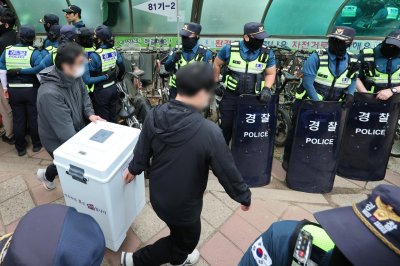
Officials remove ballot boxes from a polling station in southern Seoul on Friday after breaking up protesters who had gathered in protest of a shortage of ballots during the June 3 local elections. Photo by Yonhap
Police on Friday secured remaining ballot boxes at a polling station in southern Seoul, two days after protesters gathered to prevent election officials from removing them in protest of a shortage of ballots during the June 3 local elections.
Police officials broke through a crowd of protesters to remove the two ballot boxes at the polling station in Jamsil, Songpa Ward, after deploying around 1,000 officers to the scene earlier in the day to break up the rally.
The boxes, said to contain around 2,000 ballots, were transported to a ballot counting center at nearby Olympic Park.
Authorities said multiple people suffered minor injuries at the polling station and the vote counting center, where protesters also gathered to demand election officials to stop the count.
The polling station was one of over a dozen locations in Seoul that experienced ballot shortages Wednesday, prompting the temporary suspension of voting at the affected stations.
Angry protesters gathered at the Jamsil polling station, accusing the election watchdog of having committed election fraud and blocking election officials from removing the ballot boxes.
The standoff had prevented the National Election Commission from completing vote counting and officially declaring election winners in the affected areas.
A group of protesters attempted to block the police from entering the polling station, resulting in physical clashes as officers dragged them out. Some protesters claimed the police used excessive force.
Fire authorities said they had treated six people for minor injuries at the polling station and the vote counting center since Thursday night.
Three of them, including a woman in her 40s who complained of a headache, were sent to the hospital.
Copyright (c) Yonhap News Agency prohibits its content from being redistributed or reprinted without consent, and forbids the content from being learned and used by artificial intelligence systems.
YouTuber Jesse Ridgway and his wife, Ashley, shared that they terminated their pregnancy following a Down syndrome diagnosis. What happened online afterward has shocked the couple, but Jesse said he is hopeful that sharing their experience may help other couples feel less alone.
The YouTuber, who’s been a content creator for 20 years and has more than 4.3 million subscribers on his main channel, shared a video on his personal YouTube channel last week that featured he and his wife receiving the results of an amniocentesis — a test for certain genetic abnormalities, chromosomal conditions, and fetal infections — and the results were consistent with Trisomy 21, or Down syndrome.
After the couple read the results, Jesse said that they’d discussed beforehand whether they’d consider terminating the pregnancy. “I know this is traumatic for the whole community. Now that we have a definitive result, we’ll talk with the counselors, and we’re gonna have some hard conversations,” he said. Both Jesse and Ashley were emotionally distraught and crying throughout the video.
Jesse told The Times over a phone call on Thursday evening, with Ashley beside him as she recovered from her procedure, that sharing the diagnosis online happened accidentally. The couple was in the middle of a gender reveal video when they spotted the preliminary markers for Trisomy 21 on the same report.
“We were filming and ready to celebrate with our audience and we were blindsided,” he said. “What do we tell people? How do we navigate this? I reverted to being honest, and yes, that led us to the last 48 hours.”
On Wednesday, Jesse posted a lengthy statement that disclosed the couple’s decision to terminate the pregnancy. Ashley reposted the statement to her own Instagram.
“This week, my wife and I made the very difficult decision to terminate the pregnancy due to Trisomy 21,” the since-expired Instagram story read.
Jesse continued that the decision was “not made lightly” and said he appreciated the messages of support he and Ashley received. “I know some of you may be very disappointed to hear this news. We are devastated. This has been extremely traumatic for both of us, especially Ashley. She underwent the procedure earlier this week and is on the mend. Thankfully, everything went smoothly, but emotionally we are drained.”
The YouTuber continued the series of posts explaining: “When I first confronted this news, I was shocked but optimistic. … I signed on to be a parent, come what may … but I just didn’t fully understand what Down Syndrome entailed. Once we made it public, it became clear that MOST people don’t know what Down Syndrome entails (and no, it’s not the same as Autism).
“50% of babies with DS have heart defects. 75% will have hearing challenges. Over 50% will have vision problems. Impaired immune function, developmental disabilities, learning disabilities, delayed physical development, poor muscle tone, structural issues with face, decreased lifespan, etc. … Sadly, the list is long, feel free to look it up … Down Syndome isn’t a “blessing”, it is objectively sh— from a health perspective. I didn’t realize just how rough it is for the child, let alone the family.”
According to the National Institutes of Health, about 6,000 babies are born in the U.S. each year with the condition, affecting about 1 out of every 700 babies. “[W]ith appropriate support and treatment, many people with Down syndrome lead happy, productive lives,” the agency notes, but there are often significant lifelong health challenges and risks.”
Ashley had the abortion on Monday. Jesse said he spent the beginning of the week tending to her, and on Wednesday he crafted the post to explain what the couple had decided and why.
“I put it out there for my audience, and then it took on another life. Because it’s a contentious topic, I figured there would be some level of like flak or differing opinions, but to see what it’s become has been pretty shocking,” he said. “There are a million abortions every year, and I’m just shocked that one couple deciding to abort for Trisomy 21 is mainstream news. This is happening every day, and it’s just not talked about.”
Jesse said that his and Ashley’s DMs had been flooded not only with messages of support but also dozens of confessions from strangers who had been through the same experience. And while the supportive messages felt “validating,” Jesse said the couple had received a “tremendous amount of death threats. People saying we’re murderers.”
According to Healthline, nearly 100% of women in Iceland who receive a positive test for Down syndrome terminate their pregnancy. In Denmark, 98% are terminated, in France 77%, and in the United States it’s 67%.
When the Ridgways had finished filming the results of the amniocentesis, they debated whether they should share the video. They said they didn’t even want to watch the tape.
“But I kept coming back to, there are so many people out there like us dealing with these things, and nobody’s talking about it,” he said. “I think if we share this, it will have a net positive for other people, and they can feel more comfortable and less shame confronting these things. … I hope other people can see that, that there is some value in this, but I can’t push it any more than I have. People are going to cast their judgments.”
Karachi, Pakistan – Over a few breezy winter weeks in Karachi, boxing coach Younus Qambrani sent a steady stream of WhatsApp messages from his neighbourhood of Lyari – videos, photos, old newspaper clippings that together formed an extensive archive of how he teaches girls to throw a punch.
In one of the videos, the bearded and skullcap-clad Qambrani, 60, uses the palms of his hands and ducks as his young students practice throwing their punches. The thuds of the colliding boxing gloves and the scuff of the sneakers against the concrete floor of Qambrani’s Pak-Shaheen boxing club mask the din on the street.
Outside, motorcycles speed and sputter on narrow, labyrinthine roads, past omelettes sizzling on outdoor skillets in the many kebab bun stalls that pepper the neighbourhood of nearly 950,000 people: that is the population of Amsterdam packed into about three percent of the Dutch city’s land area.
To millions of followers of Bollywood, the Indian film industry across the border, Lyari is synonymous with brutal gang warfare waged against a perpetually grey background. It is where Bollywood’s highest grossing film of all time, Dhurandhar and its recently released sequel, Dhurandhar The Revenge are set.
The films — about a fictionalised covert mission conducted by India’s Research and Analysis Wing (R&AW) on Pakistani soil — have each earned more than $100m. In the first film, an Indian spy infiltrates Lyari’s criminal underworld and neutralises threats to India’s national security. In the sequel, the same agent continues his deep-cover operation inside Pakistan’s crime networks, again moving through Lyari’s streets.
But to Lyari locals, the neighbourhood is much more than the backdrop to blood and gore: It is a melting pot of cultures and tradition, rooted in history far deeper than Bollywood has dared to explore. It has an emerging rap and hip-hop scene, launching acts such as hip hop group, Lyari Underground, and masked rapper, Eva B, onto the national stage. The neighbourhood has also earned the nickname of Mini Brazil for being Pakistan’s mecca of football.
To be sure, Lyari has had a past rife with gang violence and unrest. Armed groups held significant influence from the mid‑2000s into the early 2010s, when battles between rival syndicates were at their peak. Gangs led by figures such as Rehman Dakait and, later, Uzair Baloch – both depicted in the Dhurandhar film and its sequel – turned parts of the neighbourhood into a militarised conflict zone. At the height of the violence, human rights groups reported about 800 people killed in Karachi in a single year, many of them in and around Lyari.
In 2012, the government launched what became known as Operation Lyari, a major crackdown in which police, backed by the Sindh Rangers paramilitary force, moved against armed groups in the area. The operation, and subsequent security campaigns, dismantled the main gang hierarchies and largely ended the era of open, large‑scale gang warfare in Lyari, even if other forms of crime persisted.
But Lyari, said social anthropologist Adeem Suhail, has always been about much more than that period of violence.
“Think of Naples or Sicily in Italy, which are among the major cultural hubs of the country (food, literature, music, etc) despite having long been associated with Mafia violence,” Suhail, an assistant professor at Pennsylvania-based Franklin and Marshall College, told Al Jazeera.
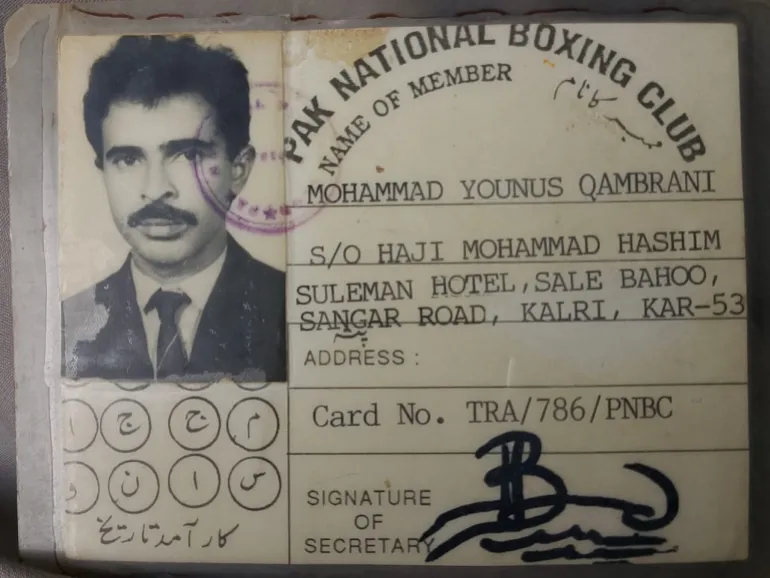
An undated picture of Qambrani’s membership card for Pak National Boxing Club. [Courtesy of Younus Qambrani]
‘Preparing for war’ — of a different kind
Qambrani has been boxing alongside his brothers for as long as he can remember. He began when he was five years old, and was introduced to the sport by his father, uncles and brothers — all boxers. Throughout his childhood, Qambrani says he was a sick and frail child. But he was determined to build muscle and throw punches like the men who had inspired him as he was growing up.
Boxing is so popular in Lyari that in 1989 boxing legend Muhammad Ali visited the neighbourhood, when he was a special guest at the Asian Games in the capital, Islamabad.
Qambrani’s high school, Haji Abdullah Haroon Government College, opened its own boxing club while he was there. He joined, but the club shut down in a few years. So he found another club a little further away and began cycling there to train.
After honing his skills there, Qambrani founded Pak Shaheen Boxing Club in 1992. “I wanted to open a club in my own area,” Qambrani said. At Pak Shaheen, he started out by teaching young boys, aged seven to 16, how to box.
A recent photo at his boxing club. [Courtesy of Younus Qambrani]
A sports enthusiast, Qambrani built friendships with coaches across the city, often visiting their training centres. At a friend’s karate classes at the YMCA (Young Men’s Christian Association) in central Karachi, he noticed young girls practicing kicks and elbow strikes shoulder-to-shoulder with boys. “If girls can do karate, why not boxing?” he wondered.
Qambrani’s students train to spar [Wania Farhan/Al Jazeera]
Soon he began voicing this question to his peers in the local boxing community, saying he wanted to start training young girls. One of them told him that “little girls have weak brains” — a remark that left Qambrani silent.
Then he went home and began looking through news reports featuring stories of girls and women boxing internationally. He would cut out the news clippings and paste them into a notebook. “My eyes were on the whole world,” he recalled. “Girls are boxing in the outside world, why not here?” he would wonder.
So he started at home: when his daughter Anum turned three, he began playfully sparring with her. She would gaze at the many photos of her father and uncles at boxing championships, slip on his medals, and traipse into the living room, mimicking the victorious poses he struck in those pictures. “She couldn’t even run properly, but she would box,” Qambrani said.
Then, in 2013, he opened the doors of his club to young girls. Anum was 16 at the time, and became its first female member.
In 2015, several of Qambrani’s students participated in the South Asian Games, the biennial multi-sport event where athletes from Bangladesh, Bhutan, India, Maldives, Nepal, Pakistan and Sri Lanka compete against each other.
A year later, Anum won a district level championship called the Jinnah First Ever Karachi Women Boxing Championship held at a Lyari stadium. In the same year, she attended a training camp for women organised by the Sindh Boxing Association. Local media reports described this camp as the country’s first government-supported boxing event held for women.
It was Qambrani’s club where Aliya Soomro, Pakistan’s first woman to win a world boxing title, began her training. Last year, Soomro took a mere 45 seconds to knock out her opponent from Thailand to win the WBA (World Boxing Association) Asia 105-pound category.
For Qambrani, though, boxing is about more than medals and trophies. To him, it’s a vital defensive skill.
“Whoever is prepared for war is prepared for peace,” he told Al Jazeera, adding that the defenceless are the ones most likely to be attacked.
With its legion of young boxers, Lyari’s not defenceless. As its reputation and image are mangled by Bollywood, those who know the neighbourhood also turn to its history for support.
An undated childhood photo of son, Munir (L) and daughter Anam [Courtesy of Younus Qambrani]
Lyari’s colonial history
It is not just the Dhurandhar films and Bollywood that Suhail, the social anthropologist, blames for what he describes as “terrible and exploitative” representations of Lyari. Journalistic and scholarly literature have been guilty too, he said.
Lyari is Karachi’s oldest recorded settlement — the earliest inhabitants of the neighbourhood came in 1728. The neighbourhood has survived British colonialism, the partition of the subcontinent, and nearly eight decades in independent Pakistan.
Suhail said Lyari had been a diverse working-class cultural hub since before the 1947 partition of British India.
Some of those working class communities were Baloch and Sindhi, because Karachi is at the tip of the southern Sindh province, which neighbours Balochistan province. Others were Marathi, Gujarati, Afghan and Siraiki migrants from labouring and artisan classes.
“This was because the British required labourers and artisans to develop Karachi into a burgeoning Indian Ocean port city.”
Suhail said that most of these labourers settled on the unplanned sides of the Lyari river, a small 50km-long seasonal river originating in the hills of Sindh, which flows through Lyari before emptying into the Arabian Sea.
“These cosmopolitan working class populations brought with them culinary traditions, dances, religious practices (multi-religious, multi-caste), songs, sports and more,” Suhail said.
He added that Lyari has a “strong cultural memory of East Africa and the Arabian Gulf, which adds to its uniqueness.” The neighbourhood is home to both Baloch and Afro-Baloch communities—people of African ancestry living in Balochistan.
Suhail explained that Lyari’s long history as a cultural hub of Karachi is often forgotten “because, after partition, the city’s demographics shifted drastically and Karachi became an Urdu-speaking Muhajir-majority city.” Muhajirs are Urdu‑speaking Muslims who migrated to Pakistan from India during and after the 1947 partition.
Sarwat Viqar, a professor of humanities at John Abbott College in Montreal, Canada, echoed Suhail’s views.
“Because Lyari has been represented one-dimensionally in the media as only a hotbed of criminality, drugs and the gang wars, what has been overlooked are the rich cultural practices that have always been part of life here,” Viqar told Al Jazeera.
Suhail added that Lyari had also consistently been at the heart of labour movements, and a base of support for reformers, anti-colonial activists and later campaigns for the rights of Pakistan’s various ethnic groups, including the Baloch, Sindhi and Pashtun communities.
“Lyari — because it was the first, most diverse, and most vibrant working-class zone as Karachi was becoming a city — also became the hub of working-class politics,” he told Al Jazeera.
But the neighbourhood’s own fortunes have also oscillated over the years.
“The degree of ‘development’ in Lyari has always been a function of how strong the working-class movement in Karachi was,” Suhail said. “When it was strong—such as in the 1930s and again in the 1970s—Lyari saw development. When ruling elites were strong, it did not.”
What Dhurandhar gets wrong
In the film, Lyari first comes into focus when a long-haired Ranveer Singh, playing undercover Indian RAW [Research and Analysis Wing] agent Jaskirat Singh Rangi, eyes the “Welcome to Lyari town” gate.
The gate looks very similar to the real one in Karachi. Other elements on screen ring familiar too: juice shop owners chanting idiosyncrasies to cajole customers; quick and garbled salams; and the somewhat unkempt colonial era architecture of old Karachi.
But then, the three-hour film’s dusty colour grading seems to wash out Lyari’s cultural depth and its vibrant subcultures.
“We can see how the obscene fetishisation of Lyari and the Baloch with violence and criminality is evident” in the film, Suhail said.
Describing Dhurandhar as “mediocre”, he said it lacks the depth of other Indian gangster films.
For example, in Ram Gopal Varma’s Satya 1998 and Anurag Kashyap’s Gangs of Wasseypur 2012, we see “culturally dense but non-apologetic depictions of Mumbaikar or Bihari gangs that understand the political economy of colonial and post-colonial state formation and how it crystallises in the gangsters portrayed,” Suhail opined.
Satya unpacks the criminal underworld of India’s metropolis Mumbai, following the titular character who arrives in Mumbai seeking a job but is falsely imprisoned and subsequently introduced to the underworld. Gangs of Wasseypur is set in a time before India’s independence in 1947 and follows power struggles, mafias and generational cycles of revenge in India’s eastern state of Jharkand.
In contrast to these films, Dhurandhar, has “heavy-handed homophobic, Islamophobic, hyper-masculine jingoism” and “the characters themselves appear to have no history at all,” Suhail added.
Unlike Lyari
Back at Qambrani’s club, 10 girls aged eight to 16 gather for an hour of sparring every day except Sunday, training for city tournaments that they compete in every two months.
Qambrani is looking to buy a folding, portable boxing ring to take school to school. His dream: to make boxing accessible to as many girls in the neighbourhood as possible. His challenge: he is struggling to find a portable ring in Pakistan and needs funding.
Dhurandhar and Bollywood do not matter at his Lyari club. Qambrani has a new generation of girl boxers to train.
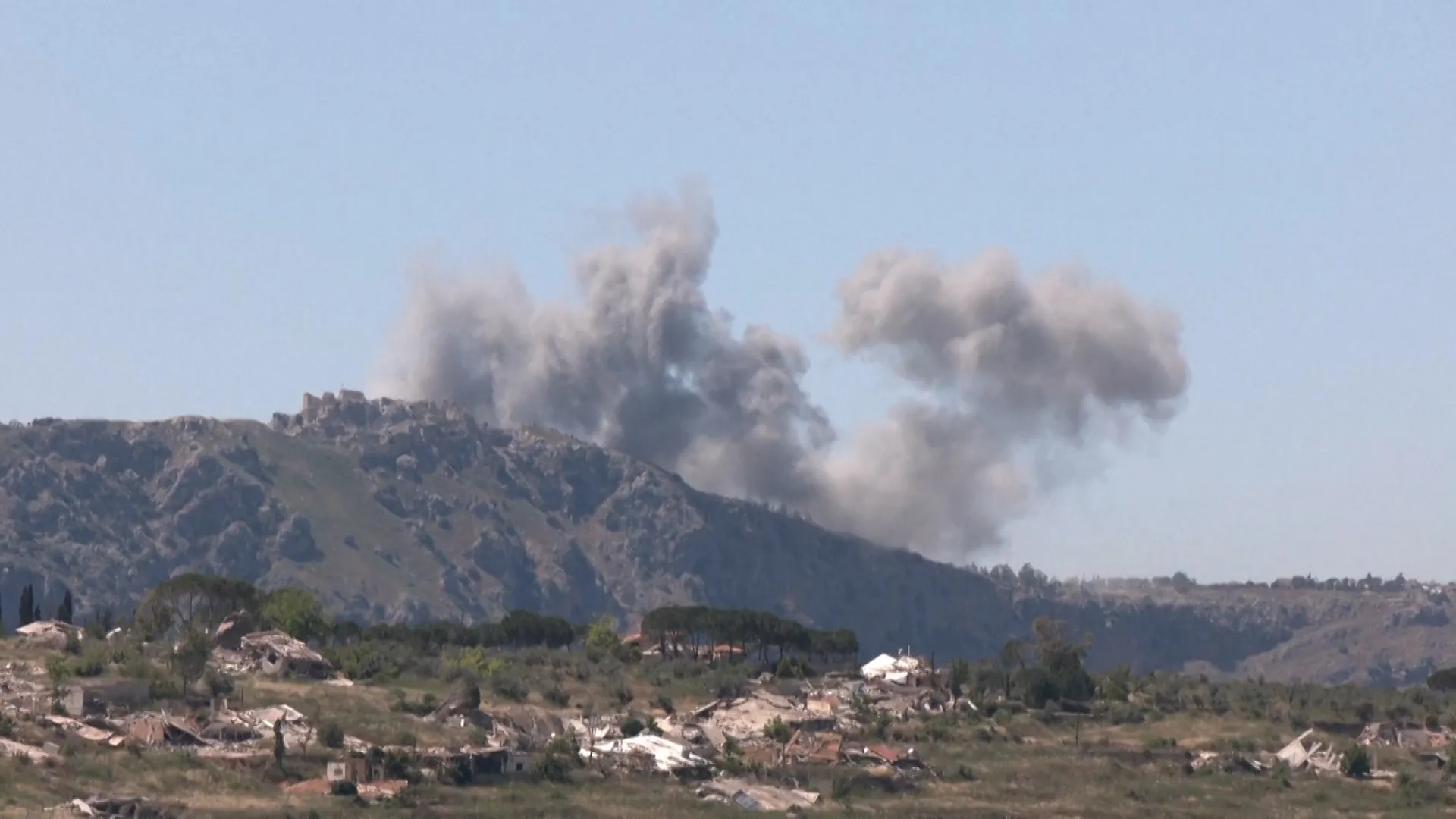
Israel strikes Lebanon despite ceasefire, while Hezbollah rejects deal as death toll tops 3,500.
Published On 5 Jun 20265 Jun 2026
Israel has continued to carry out deadly strikes across Lebanon despite the announcement of a new US-brokered ceasefire agreement reached by Lebanese and Israeli officials in Washington, DC.
The violence has pushed the number of casualties higher, with Lebanon’s Ministry of Public Health reporting that at least 3,526 people have been killed and 10,733 wounded in Israeli attacks since March 2.
Meanwhile, Hezbollah leader Naim Qassem has dismissed the ceasefire as a “farce”, warning that northern Israel will remain a target as long as Israeli forces continue bombing Lebanon, raising more doubts about the prospects for a lasting truce.
Here is what we know:
In Iran
Iran adviser flags concerns over draft deal: Mohsen Rezaei, an adviser to Iran’s Supreme Leader Mojtaba Khamenei, said the draft memorandum of understanding being negotiated to end the war still contains “ambiguities” that need to be clarified. Speaking to Iranian state television, Rezaei also accused US President Donald Trump of trying to pressure Tehran into accepting Washington’s terms while keeping Iran’s own conditions “in a vague state”.
War diplomacy
Questions over US strategy: Reporting from Washington, DC, Al Jazeera’s Kimberly Halkett said the White House is facing growing questions over why a negotiated agreement with Iran is still needed after President Donald Trump repeatedly claimed US military action had “obliterated” Iran’s nuclear programme. Halkett said critics are asking: “If these military objectives have been achieved, then is there still a need for talks?” She added that “with each passing week that this war drags on” and negotiations remaining stalled, it is becoming increasingly difficult for the administration to reconcile its claims of success with the continued push for diplomacy.
Hezbollah rejects conditional ceasefire: Hezbollah leader Naim Qassem rejected the limited truce agreed to by Lebanese and Israeli representatives in the US, demanding a complete ceasefire and a full Israeli pullout from the country. Qassem also warned of more attacks on northern Israel, highlighting the difficulties in reaching a lasting peace. Both sides have blamed each other for breaking a previous ceasefire announced in April.
The Gulf
Oman oil terminal disruption: Reuters reported that Oman has suspended crude oil loading operations at its key Mina al-Fahal terminal after an explosion near its single-buoy mooring (SBM) berths. Citing unnamed sources, the agency said the blast occurred between SBM 1 and SBM 2 and was allegedly caused by a drone attack.
In the US
Trump says US does not need a deal to access Iran’s uranium: The US president said Washington could access Iran’s enriched uranium without reaching an agreement with Tehran, arguing the material is effectively “entombed”. Trump also said he does not plan to meet Iran’s Supreme Leader Mojtaba Khamenei, but he suggested a meeting could be possible if a deal is eventually reached, adding that “if it happened … I’d be respectful”.
In Israel
Ultra-Orthodox protest blocks major highway: Hundreds of ultra-Orthodox Israelis blocked Highway 1 in protest against the government’s enforcement of military conscription for religious students, according to Israel’s Channel 10. The demonstrations began after police stopped two ultra-Orthodox students and transferred one to military authorities. Large numbers of police and border guards were deployed to clear the highway and disperse protesters.
In Lebanon
Hezbollah rejection raises fears of escalation: Reporting from Beirut, Al Jazeera’s Ali Hashem said Hezbollah remains the key actor on the Lebanese side when it comes to decisions about fighting and any potential halt to hostilities with Israel, “regardless of what the Lebanese government says”. Given Hezbollah’s rejection of the US-brokered ceasefire, Hashem warned that further escalation is likely from both Hezbollah and Israel. He noted that southern Lebanon and the western Bekaa Valley experienced significant Israeli air and ground attacks on Thursday, adding that Hezbollah’s position suggests “it is going to be a very difficult situation” in the days ahead.
TOP Gun: Maverick actor James Handy has been stabbed to death with his girlfriend’s son telling cops in a 911 call: “I just killed the man”.
The 81-year-old, who also starred in Logan and Jumanji, was found unconscious with multiple stab wounds to his chest on his front yard.
Sign up for the Showbiz newsletter
Thank you!
James Handy, pictured in TV series NYPD Blue, has been stabbed to deathCredit: GettySurveillance footage from outside the home caught an unknown man walking past around the time of the stabbingCredit: FOX 11
Authorities rushed to the scene in Tarzana, Los Angeles on Wednesday morning at around 9.30am after receiving a chilling 911 call.
Police revealed a voice at the end of the line said: “I am the son of man, I just killed the man of sin.”
Officials rushed to James’ home on Erwin Street and raced him to hospital where he was pronounced dead.
Some time later, 44-year-old Michael Gledhill – the son of James’ partner – waved down officers as they searched near the home.
James, pictured in TV show X files, was found with multiple stab wounds outside his homeCredit: Channel 4Police swarmed round James’ home early on Wednesday morning after receiving a chilling 911 callCredit: ABC7Police are continuing to investigate the deathCredit: ABC 7The actor (far left) also starred in Arachnophobia in 1990Credit: Alamy
Gledhill confessed to carrying out the fatal attack and said he was the one who phoned the police, according to the Los Angeles Police Department.
Gledhill was arrested for murder and taken to Van Nuys Jail with his bail set at $2,000,000.
The LAPD statement said: “Detectives believe this is an isolated incident and there appears to be no danger to the public at this time.”
A motive for the attack remains unclear.
Most read in Entertainment
James (far right) in NYPD BlueCredit: GettyJames (center) had a major role in 1986’s Popeye DoyleCredit: Alamy
Neighbors have claimed Gledhill and James were overheard arguing overnight.
The star’s talent agent, Pam Ellis-Evenas, paid tribute saying: “With great sadness I can confirm that the gentleman who was attacked and killed on Wednesday in Tarzana was the actor James Handy.”
James’ career spanned almost five decades with his most recent major role being in Tom Cruise’s Hollywood sequel Top Gun: Maverick in 2022.
He played the role of bartender Jimmy.
Another memorable role for James came in 2017 superhero flick Logan as he played the doctor who treated lead man Hugh Jackman.
James also starred in 1995 cult classic Jumanji alongside Robin Williams, Bonnie Hunt and Kirsten Dunst.
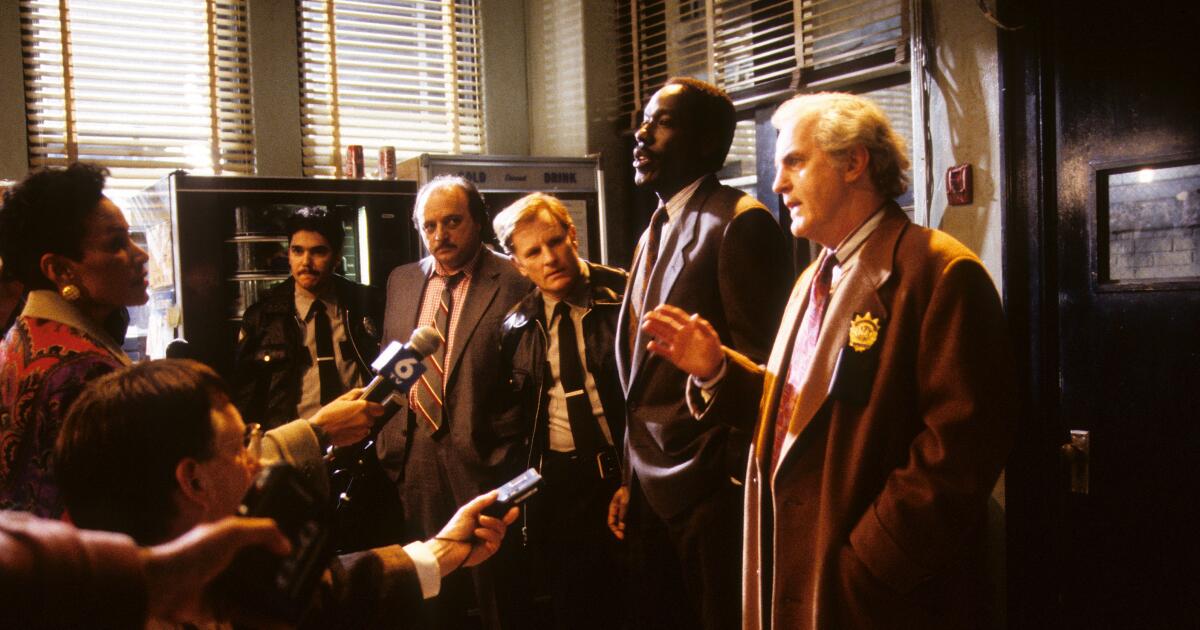
His career featured several TV credits such as the role of Arthur Devlin in eight episodes of Alias and recurring stints on Melrose Place and NYPD Blue.
South Korean Unification Minister Chung Dong-young speaks to reporters at a press briefing in Seoul, South Korea. File. Photo by YONHAP / EPA
June 4 (Asia Today) — South Korean Unification Minister Chung Dong-young on Thursday proposed resuming four-way talks among South Korea, North Korea, the United States and China to help establish peace in Northeast Asia.
Chung, who is visiting Mongolia, also called for expanding the framework to include Mongolia, Japan, Russia and other regional countries. He made the proposal during a special address at the 11th Ulaanbaatar Dialogue in Mongolia.
Chung said Northeast Asia needs to build a new “peace identity” by restoring trust between South and North Korea and rebuilding peace on the Korean Peninsula.
It was the first visit to Mongolia by a South Korean unification minister. The trip was made at the invitation of the Mongolian government.
The Ulaanbaatar Dialogue is a regular international forum that covers security issues in Northeast Asia. It began in 2014 as a private academic conference and was upgraded in 2017 to a Track 1.5 forum involving government and nongovernment participants. North Korea has not attended the forum since 2019.
On the Korean Peninsula peace process, Chung said, “A four-party dialogue among the Republic of Korea, the Democratic People’s Republic of Korea, the United States and China is possible.”
“We should expand this framework so that other Northeast Asian countries, including Mongolia, Japan and Russia, can also join,” he said.
Chung also referred to the Sept. 19 Joint Statement adopted during the six-party talks in 2005. He said the six parties had agreed to promote lasting peace and security in Northeast Asia.
“It is time to apply that experience to today’s reality and rekindle the flame of dialogue,” Chung said.
Chung also proposed strengthening cooperation under the Greater Tumen Initiative, a multilateral platform for development and economic cooperation in Northeast Asia.
He called for connecting regional railway networks, including the Trans-Siberian Railway, Trans-China Railway, Trans-Mongolian Railway and a proposed Seoul-Beijing high-speed rail link, with the Arctic shipping route.
“By connecting transportation networks with regional markets and trade flows, we can build an innovative logistics network across Eurasia,” Chung said.
“To turn these ideas into reality, I urge the Democratic People’s Republic of Korea to rejoin the Greater Tumen Initiative as a full member,” he said. “They would be the biggest beneficiary of this vision.”
North Korea was an early member of the Greater Tumen Initiative but withdrew in 2009.
Chung said three goals must move forward together: rebuilding trust between the two Koreas, institutionalizing a peace regime on the Korean Peninsula and advancing multilateral dialogue in Northeast Asia.
“If these three pillars move forward together, we can build a new peace order across Northeast Asia,” he said.
After his special address, Chung met separately with Mongolian Foreign Minister Battsetseg Batmunkh and President Ukhnaa Khurelsukh. Chung left South Korea on Wednesday to attend the forum and is scheduled to return Friday.
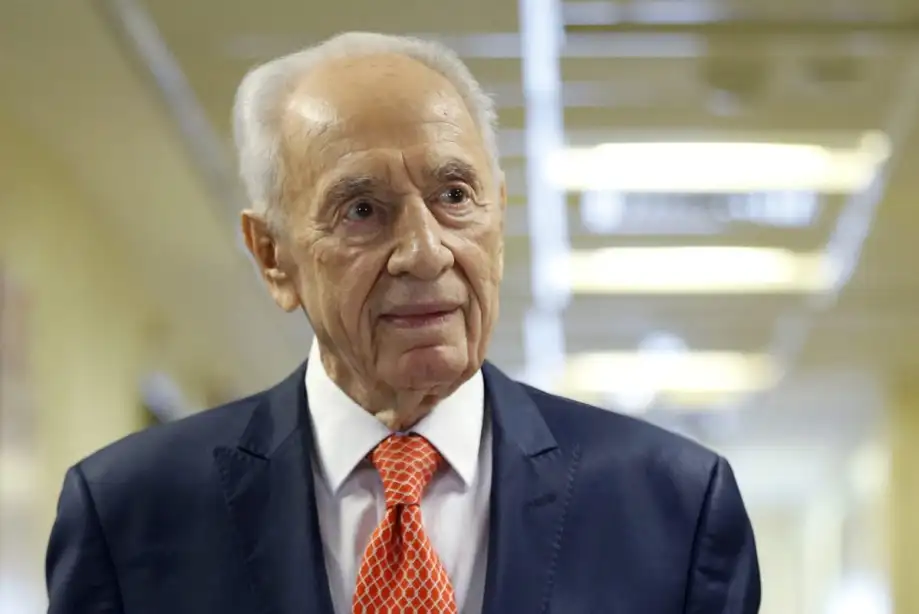
Shimon Peres, who passed away Wednesday aged 93 after suffering a stroke on 13 September, epitomised the disparity between Israel’s image in the West and the reality of its bloody, colonial policies in Palestine and the wider region.
Peres was born in modern day Belarus in 1923, and his family moved to Palestine in the 1930s. As a young man, Peres joined the Haganah, the militia primarily responsible for the ethnic cleansing of Palestinian villages in 1947-49, during the Nakba.
Shimon Peres (1923-2016)
Best known in the West for role in Oslo Accords
Family moved to Palestine in the 1930s
Fought with the Haganah during the Nakba
Described as the architect of Israel’s clandestine nuclear programme
Saw Palestinian citizens as a ‘demographic threat’
Played key role in early days of West Bank settlements
Responsible for Qana massacre in Lebanon in 1996
Defended Gaza blockade and recent Israeli offensives
Despite the violent displacement of the Palestinians being a matter of historical record, Peres has always insisted that Zionist forces “upheld the purity of arms” during the establishment of the State of Israel. Indeed, he even claimed that before Israel existed, “there was nothing here”.
Over seven decades, Peres served as prime minister (twice) and president, though he never actually won a national election outright. He was a member of 12 cabinets and had stints as defence, foreign and finance minister.
He is perhaps best known in the West for his role in the negotiations that led to the 1993 Oslo Accords which won him, along with Yitzhak Rabin and Yasser Arafat, the Nobel Peace Prize.
Yet for Palestinians and their neighbours in the Middle East, Peres’ track record is very different from his reputation in the West as a tireless “dove”. The following is by no means a comprehensive summary of Peres’ record in the service of colonialism and apartheid.
Nuclear weapons
Between 1953 and 1965, Peres served first as director general of Israel’s defence ministry and then as deputy defence minister. On account of his responsibilities at the time, Peres has been described as “an architect of Israel’s nuclear weapons programme” which, to this day, “remains outside the scrutiny of the International Atomic Energy Agency (IAEA).”
In 1975, as secret minutes have since revealed, Peres met with South African Defence Minister PW Botha and “offered to sell nuclear warheads to the apartheid regime.” In 1986, Peres authorised the Mossad operation that saw nuclear whistle-blower Mordechai Vanunu kidnapped in Rome.
Targeting Palestinian citizens
Peres had a key role in the military regime imposed on Palestinian citizens until 1966, under which authorities carried out mass land theft and displacement.
One such tool was Article 125 which allowed Palestinian land to be declared a closed military zone. Its owners denied access, the land would then be confiscated as “uncultivated”. Peres praised Article 125 as a means to “directly continue the struggle for Jewish settlement and Jewish immigration.”
Another one of Peres’ responsibilities in his capacity as director general of the defence ministry was to “Judaise” the Galilee; that is to say, to pursue policies aimed at reducing the region’s proportion of Palestinian citizens compared to Jewish ones.
In 2005, as Vice Premier in the cabinet of Ariel Sharon, Peres renewed his attack on Palestinian citizens with plans to encourage Jewish Israelis to move to the Galilee. His “development” plan covered 104 communities – 100 of them Jewish.
In secret conversations with US officials that same year, Peres claimed Israel had “lost one million dunams [1,000 square kilometres] of Negev land to the Bedouin”, adding that the “development” of the Negev and Galilee could “relieve what [he] termed a demographic threat.”
Supporting illegal settlements in the West Bank
While Israel’s settlement project in the West Bank has come to be associated primarily with Likud and other right-wing nationalist parties, it was in fact Labor which kick-started the colonisation of the newly-conquered Palestinian territory – and Peres was an enthusiastic participant.
During Peres’ tenure as defence minister, from 1974 to 1977, the Rabin government established a number of key West Bank settlements, including Ofra, large sections of which were built on confiscated privately-owned Palestinian land.
Having played a key role in the early days of the settlement enterprise, in more recent years, Peres has intervened to undermine any sort of measures, no matter how modest, at sanctioning the illegal colonies – always, of course, in the name of protecting “peace negotiations”.
The Qana massacre
As prime minister in 1996, Peres ordered and oversaw “Operation Grapes of Wrath” when Israeli armed forces killed some 154 civilians in Lebanon and injured another 351. The operation, widely believed to have been a pre-election show of strength, saw Lebanese civilians intentionally targeted.
According to the official Israeli Air Force website (in Hebrew, not English), the operation involved “massive bombing of the Shia villages in South Lebanon in order to cause a flow of civilians north, toward Beirut, thus applying pressure on Syria and Lebanon to restrain Hezbollah.”
The campaign’s most notorious incident was the Qana massacre, when Israel shelled a United Nations compound and killed 106 sheltering civilians. A UN report stated that, contrary to Israeli denials, it was “unlikely” that the shelling “was the result of technical and/or procedural errors.”
Later, Israeli gunners told Israeli television that they had no regrets over the massacre, as the dead were “just a bunch of Arabs”. As for Peres, his conscience was also clean: “Everything was done according to clear logic and in a responsible way,” he said. “I am at peace.”
Gaza – defending blockade and brutality
Peres came into his own as one of Israel’s most important global ambassadors in the last ten years, as the Gaza Strip was subjected to a devastating blockade and three major offensives. Despite global outrage at such policies, Peres has consistently backed collective punishment and military brutality.
In January 2009, for example, despite calls by “Israeli human rights organisations…for ‘Operation Cast Lead’ to be halted”, Peres described “national solidarity behind the military operation” as “Israel’s finest hour.” According to Peres, the aim of the assault “was to provide a strong blow to the people of Gaza so that they would lose their appetite for shooting at Israel.”
During “Operation Pillar of Defence” in November 2012, Peres “took on the job of helping the Israeli public relations effort, communicating the Israeli narrative to world leaders,” in the words of Ynetnews. On the eve of Israel’s offensive, “Peres warned Hamas that if it wants normal life for the people of Gaza, then it must stop firing rockets into Israel.”
In 2014, during an unprecedented bombardment of Gaza, Peres stepped up once again to whitewash war crimes. After Israeli forces killed four small children playing on a beach, Peres knew who to blame – the Palestinians: “It was an area that we warned would be bombed,” he said. “And unfortunately they didn’t take out the children.”
The choking blockade, condemned internationally as a form of prohibited collective punishment, has also been defended by Peres – precisely on the grounds that it is a form of collective punishment. As Peres put it in 2014: “If Gaza ceases fire, there will be no need for a blockade.”
Peres’ support for collective punishment also extended to Iran. Commenting in 2012 on reports that six million Iranians suffering from cancer were unable to get treatment due to sanctions, Peres said: “If they want to return to a normal life, let them become normal.”
Unapologetic to the end
Peres was always clear about the goal of a peace deal with the Palestinians. As he said in 2014: “The first priority is preserving Israel as a Jewish state. That is our central goal, that is what we are fighting for.” Last year he reiterated these sentiments in an interview with AP, saying: “Israel should implement the two-state solution for her own sake,” so as not to “lose our [Jewish] majority.”
This, recall, was what shaped Labor’s support for the Oslo Accords. Rabin, speaking to the Knesset not long before his assassination in 1995, was clear that what Israel sought from the Oslo Accords was a Palestinian “entity” that would be “less than a state”. Jerusalem would be Israel’s undivided capital, key settlements would be annexed and Israel would remain in the Jordan Valley.
A few years ago, Peres described the Palestinians as “self-victimising.” He went on: “They victimise themselves. They are a victim of their own mistakes unnecessarily.” Such cruel condescension was characteristic of a man for whom “peace” always meant colonial pacification.
Emmerdale will not air in its usual slot tonight, and isn’t on ITVX owing to the football, and fans of the long-running ITV soap have slammed the decision to take it off air
Emmerdale has been pulled from the schedules to make way for the football and soap fans are furious
Emmerdale will not air in its usual slot on Friday night, and isn’t on ITVX either.
The long-running ITV soap, which began in 1972, has been a weeknight staple for much of its time on air, and, earlier this year joined forces with fellow soap Coronation Street to launch the “power hour” amid budget cuts at ITV.
Whilst it normally airs Monday to Friday at 8pm, the Yorkshire-based serial has been pulled to make way for the Women’s World Cup Qualifiers, which will from 7:30pm until 9pm and see Spain go head-to-head with England.
In recent years, ITV has made Emmerdale and Coronation Street available on ITVX from 7am on the day of linear broadcast, and, in this case, the new edition will be released on Sunday morning.
With numerous inevitable schedule changes set to take place over the forthcoming World Cup, soap fans flooded social media with complaints. One wrote on Reddit: “Can’t they just stick all the football on, oh I don’t know, the football channel?
“So silly that broadcasters just ignore loyal viewers, some of whom who have been with them for decades, just to shove a sport on – the results of which will be beamed across every platform in real life. TV bosses always treat soaps as bottom of the pile when it comes to these things.” Another said: “Four weeks of disruption nightmare,” and added a string of rolling eyes emojis.
A third raged: “Yes I love the football but as a soap opera fan it’s gonna piss off a lot of people especially who hate football and like Emmerdale and Coronation street and EastEnders and of course Hollyoaks who won’t be affected by this and yes I get it important for the whole world but don’t u think we should have a channel for the world cup not on BBC or ITV.”
Another wrote: “International football should remain on free to view channels and not hidden behind a pay wall like the Premier league and champions league has become,” and a third suggested: “The simple solution is they just air the episodes on streaming regardless if it goes out over the airwaves. It’s kinda defeating the point if streaming platforms follow a schedule where only one thing can be on at once.”
It comes as fans recently predicted something of a bombshell could crop up in the relationship between Robert Sugden and Aaron Dingle, known as Robron, as little has been said since they got engaged in the Corriedale crossover. While viewers will likely have to wait to find out, Robert’s faced backlash from Aaron’s family and friends, and other villagers, due to the drama with Joe Tate and the farm.
One of those people currently against him is Aaron’s best friend Mackenzie Boyd. But in a bizarre turn of events, a new theory from a viewer has sparked much confusion.
A soap fan took to Reddit to ask when Robert and Mack’s affair was going to air. Naturally, the post that seemed so sure it was on the cards left fans confused, as it’s not something that has been remotely hinted at, let alone confirmed on the show. Fans ended up replying, with some needing answers as others questioned if a mix-up had occurred. The original post read: “When do Robert and Mack have their affair?
“Have been hearing about it for ages that it’s happening. Guess they’re waiting for things to blow up with the baby.” Again, as fans pointed out, there has been no suggestion on or offscreen that this is happening.
So where the “talked about” theory has come from, no one knows. This led to fans actually asking the poster what they had heard, to which there was no reply.
Emmerdale airs weeknights at 8pm on ITV1 and ITVX.
Oh Se-hoon, center, the People Power Party’s winning candidate in the Seoul mayoral race, celebrates Thursday at his campaign office in Jongno district, Seoul. Photo by Asia Today
June 4 (Asia Today) — The biggest upset of Wednesday’s local elections came in Seoul, where People Power Party candidate Oh Se-hoon overcame early expectations of defeat and won a dramatic late comeback victory in the mayoral race.
Oh’s win allowed the conservative bloc to hold South Korea’s capital despite a strong nationwide showing by the Democratic Party. The result immediately raised Oh’s standing as a potential conservative contender in the next presidential race.
Oh narrowly defeated Democratic Party candidate Jung Won-oh after an extremely close vote count that continued into early Thursday morning, becoming the first person to win a fifth term as Seoul mayor.
“Citizens have once again upheld the democratic principle of checks and balances,” Oh said at a press conference Thursday. “They have left Seoul as the last safeguard of democracy so that South Korea does not tilt completely to one side.”
Political observers said Oh’s victory significantly changes his political status. Holding the capital while the People Power Party struggled nationwide could become a major asset for a future presidential bid.
Oh’s campaign strategy also drew attention because he kept some distance from the party leadership under Jang Dong-hyeok and focused on his own record as incumbent mayor. Analysts said that approach may allow Oh to emerge as an independent center of gravity in any future conservative realignment.
A People Power Party official said Oh had now fully risen as a national political figure representing the conservative camp.
“This Seoul victory is virtually close to a ticket toward the presidency,” the official said.
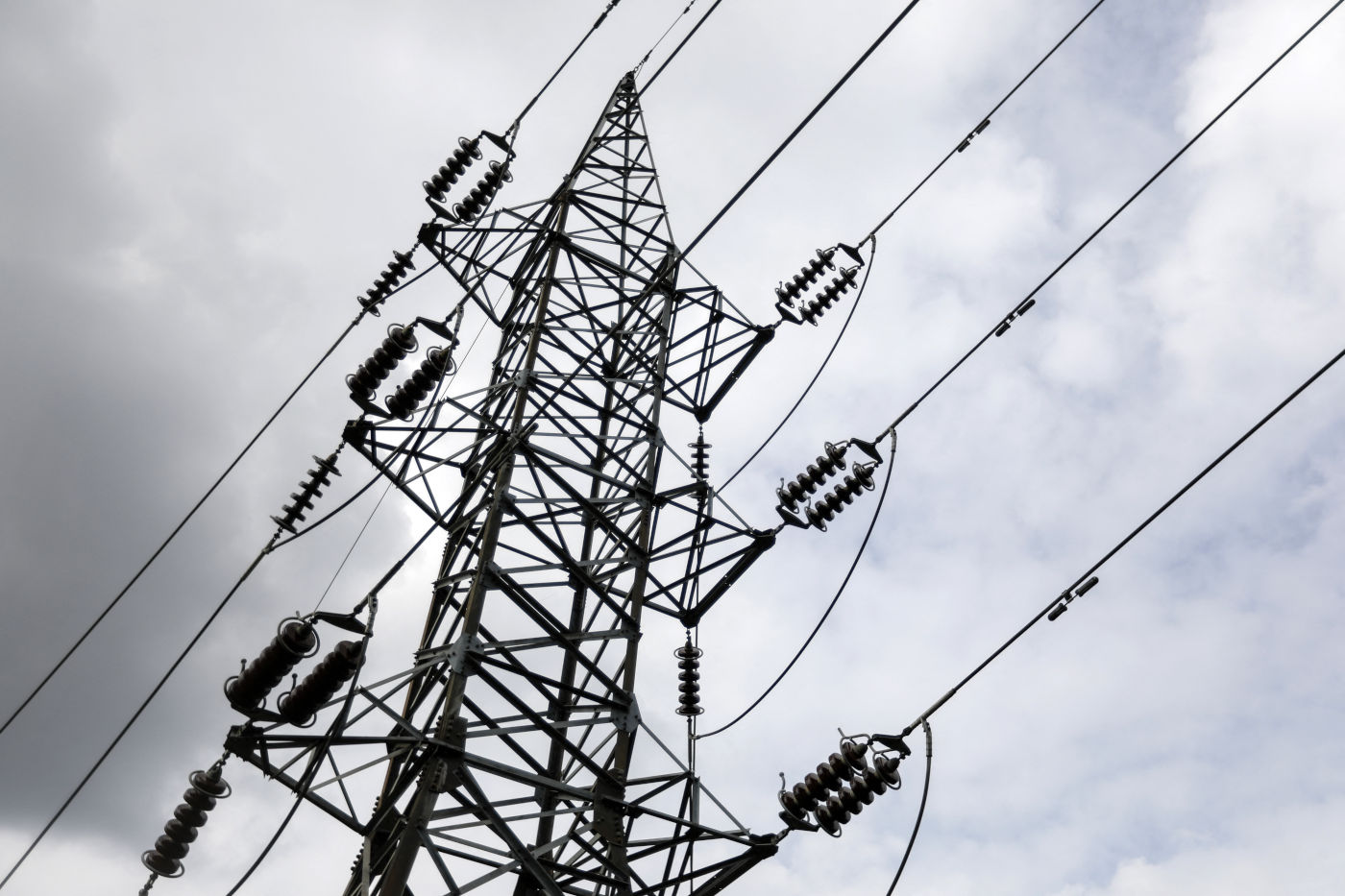
Private and mixed companies will be allowed to participate in electricity generation, transmission, distribution, and commercialization. (AFP)
Caracas, June 4, 2026 (venezuelanalysis.com) – The Venezuelan National Assembly preliminarily approved on Tuesday a reform to the country’s Organic Law of the National Electricity System and Service, proposing a structural overhaul of the National Electricity System (SEN).
One of the most significant changes is the incorporation of the private sector in electricity generation, transmission, distribution, and commercialization activities, breaking with two decades of state monopoly through the National Electric Corporation (Corpoelec).
According to the draft text seen by Venezuelanalysis, private corporations and joint ventures will be able to operate in the electric grid in what is termed a “diversification of actors in the service chain.” The mixed ventures, where the state can hold majority or minority stakes, will be approved directly by the government and not by the National Assembly.
“In recent decades, the electric system has showcased structural and financial limitations […] as a result of the productive reality and the negative impact of unilateral coercive measures,” the proposed law reads. “Faced with this reality, the Venezuelan state must assume an institutional and judicial reengineering.”
The bill establishes concessions with a maximum duration of 25 years, renewable for a further 15 years under specific conditions. Once a concession expires, all infrastructure, assets, substations, and data will automatically revert to the state in good condition and without compensation.
The proposed legislation announces the creation of a new tariff scheme “based on real costs and a reasonable return for investors.” Electricity, like most public services, has been heavily subsidized in recent decades in the Caribbean nation. The bill additionally introduces obligations for electricity distributors to compensate users for damages caused by blackouts or other failures.
The reform likewise establishes the possibility for the executive branch to grant tax exemptions to projects linked to renewable energy, rural electrification, or strategic investments in the electricity sector.
The 42-article legislation will now be subject to discussions and amendments before a second and decisive vote.
If approved, it would repeal the Organic Law for the Reorganization of the Electricity Sector, enacted by former President Hugo Chávez on July 31, 2007, which merged the country’s seven existing electricity companies through the creation of the National Electric Corporation. The legislation also defined all stages of electricity generation and distribution as “strategic for the nation.”
During Tuesday’s parliamentary session, United Socialist Party (PSUV) lawmaker Orlando Miranda argued that the electricity reform represented a “mixed and private capital strategy under a rigorous regime of concessions and public supervision.”
He noted that government plans to reinforce the grid with thermoelectric plants in the past 15 years were hampered by US economic sanctions. Miranda went on to add that increased tariffs are being studied to reflect the “real costs” of the system.
For his part, opposition legislator Ezio Angelini (Un Nuevo Tiempo) demanded that the reform address corruption, which he identified as a key factor behind Venezuela’s recurring power outages.
Angelini stated that in 2019 Venezuela generated around 20,000 megawatts (MW) while consuming approximately 12,000. Today, he claimed, the country produces close to 12,000 MW, roughly 40 percent of installed capacity, while demand has risen to 14,000. On May 11, Interior Minister Diosdado Cabello stated that electricity demand had surpassed 15,500 MW due to increased oil production.
Zulia state, considered the cradle of Venezuela’s oil industry, and other western regions have experienced daily blackouts lasting between eight and twelve hours in recent weeks. Supply instability also affects other services such as water pumping and cooking gas distribution.
Frequent power outages have also gripped oil fields in the Orinoco Belt, as crude extraction relies on electric motors that are vulnerable to tension fluctuations. According to Bloomberg, the Venezuelan government is urging international energy companies to generate their own electricity for oil and natural gas projects in an effort to shield the grid from the additional load.
Delegations from Siemens and General Electric visited the country in April and held talks with the Venezuelan government headed by Acting President Delcy Rodríguez. However, the two corporate giants are reportedly “hesitant” to take part in major projects due to doubts over Caracas’ financial capabilities.
Additionally, in mid-May, US Chargé d’Affaires in Venezuela John Barrett held a meeting with Electricity Minister Rolando Alcalá to discuss plans to “restore a reliable energy supply through US investment and collaboration.”
Electricity generation in Venezuela depends heavily on the 10 MW-capacity Guri hydroelectric complex in Bolívar state, making the system particularly vulnerable to climatic factors such as the high temperatures affecting the country. Venezuela suffered nationwide blackouts in 2019, with authorities blaming US-led cyberattacks.
The electricity reform follows legislative overhauls to the hydrocarbon and mining sectors that likewise curtailed the state’s role and responsibilities while granting private corporations expanded control over operations and sales, slashed royalties and taxes, and the ability to bring disputes to international arbitration bodies.
More than 20 years after Michael Jackson was acquitted on charges of child molestation — and two months since the global superstar’s record-breaking biopic skirted any mention of abuse allegations — a new Netflix docuseries brings his trial and the aftermath to the foreground.
“Michael Jackson: The Verdict,” a three-part documentary directed by Nick Green and released Wednesday, chronicles his 2005 trial in Santa Maria that began with a search raid of the pop star’s sprawling Neverland Ranch and ended with a jury finding him not guilty on 10 counts, including four counts of child molestation. At the center of the case was Gavin Arvizo, a then-15-year-old cancer survivor from Los Angeles.
Because recording was not allowed in the courtroom, the documentary relies heavily on archival footage from media surrounding the trial and firsthand accounts of key figures involved, including prosecutor Ron Zonen, Jackson family attorney Brian Oxman, journalist Diane Dimond, two trial jurors, and friends and supporters on both sides of the case.
The episodes also delve into the 2003 documentary “Living With Michael Jackson,” in which the pop star is interviewed by British journalist Martin Bashir, that sparked questions about his behavior, leading to the charges against Jackson. Jackson’s historically questionable relationships with children, the media circus surrounding the trial and the effect it had on fans, the family at its center and Jackson himself are explored, too.
Here are six key takeaways from “The Verdict.”
Jackson allegedly had his personal assistant order child pornography
One of the docuseries’ most revealing interviews came from Vincent Amen, a former Jackson associate who worked at Neverland Ranch from 2002 to 2003. He said he was put in charge of taking care of the Arvizo family during their stay at the property following media backlash from Gavin Arvizo’s appearance in “Living With Michael Jackson.”
At that time, Amen said, he “wholeheartedly” believed in Jackson’s innocence, especially because Jackson’s friend Frank Tyson, also known as Frank Cascio, a member of the family who filed a lawsuit against Jackson’s estate in April detailing alleged sexual abuse, vouched so strongly for him. Cascio, who met Jackson when he was 5 years old and later became his personal assistant, told Amen, “Michael would never do this with a child.”
Amen’s conviction shifted, however, after he discovered a disturbing magazine that apparently belonged to Jackson in Cascio’s possession.
“Frank cleaned out his house of anything that came from the Neverland Ranch. And he hands me a Nike bag,” Amen said in the docuseries. “I took the bag and I’m driving home, and I felt, ‘Something’s a little suspicious.’ And I said, ‘Let me take a look in this bag.’ I start taking videos to document this. I open the bag. I start looking, and I see a magazine.”
The series shows shaky footage of Vincent apparently finding a nudist magazine called “Naturally.” He flips to a video ordering section with titles circled in black marker, including videos called “Nudist Youth Weekend” and “Euro-Nudist Family.”
“I confronted Frank, I said, ‘Frank, what is this magazine? Because, you know, there’s circles around videos with naked children,’” Amen recounted. “He said, ‘That’s just a phase that Michael and I went through. He circled the videos that he wanted, I ordered them, and it was a phase that we went through.’ They watched them together.”
The Arvizo children called Jackson ‘daddy’ and had their own bizarre nicknames
Along with footage of the nudist magazine, Amen held on to other evidence of his time with Jackson and the Arvizo family, including a set of Polaroid pictures featuring Gavin’s mom, Janet, and younger brother, Star.
In one, Star points directly into the lens. It’s captioned, “You my daddy Michael.” Another photo of a smiling Janet and Star includes a handwritten caption from Janet that says, “Dearest loving Michael, we appreciate you being our family. What God brings together, no man can undo. We love you.”
Under a photo of Star with a cross-eyed expression, he wrote, “I love you, my daddy Michael. Your son, Blowhole.”
“These are the nicknames that Michael would give these young boys,” Amen said.
Bashir documentary marked a pivotal shift in the perception of Jackson
Martin Bashir in “Michael Jackson: The Verdict.”
(Netflix)
Though the first allegations of child molestation against Michael Jackson emerged in 1993, it was footage from Bashir’s “Living With Michael Jackson” that ignited public concern about Jackson’s relationship with Gavin.
In a pivotal scene from the 2003 documentary, Jackson brings Gavin in as an example of a child with cancer that he helped. Gavin, 13 at the time, leans his head on Jackson’s shoulder and holds his hand. Jackson tells Bashir that the two often share a bed at the Neverland Ranch, though in another scene he stresses that it’s not sexual.
“I realized that we had something that was hugely significant, but I didn’t realize the extent of the bombshell until the broadcast,” Bashir recalled in “The Verdict.”
“You can see it. You can look at that moment in the Martin Bashir documentary and you can actually pin the end of his life to that very moment,” J. Randy Taraborrelli, Jackson’s childhood friend and biographer, said in the docuseries.
Given Jackson’s stardom, news and tabloid media swarmed the scene of the trial along with droves of dedicated fans (and a much smaller contingent of detractors). And the archival footage from “The Verdict” shows the extent to which fandom and media frenzy influenced the proceedings.
Jackson’s fans stationed themselves throughout the route he’d take to the Santa Maria courthouse with signs showing their support, sometimes standing and shouting and other times driving alongside him and honking. Jackson had his director of security, Kerry Anderson, film these drives while he waved and engaged with supporters.
As many as 1,000 fans showed up on the first day of the trial, and many would line up starting at 5 a.m. for raffle tickets that would allow them to enter the courtroom. One fan interviewed for the docuseries, Sheree Wilkins, said she quit her job as a preschool teacher to move to Santa Maria for the trial. When the “not guilty” verdicts were announced, she fainted and had to receive medical attention.
TV news stations from around the world, including Taiwan, Japan and Mexico, sent crews to cover the trial.
Even inside the courtroom, where cameras were not allowed, enthusiasm for Jackson’s music could not be contained. Attendees recalled everybody, from the jury to the judge and even the prosecution, “swaying in their seats” when songs played as part of an evidence display.
“I remember me moving in time to his music,” prosecutor Ron Zonen said. “At one point Tom [Sneddon, the District Attorney leading the prosecution] jabbed me and said, ‘Would you stop moving your foot?’ ”
Jackson’s mental and physical health deteriorated
Mark Geragos briefly served as Jackson’s defense attorney.
(Netflix)
According to numerous interviews in “The Verdict,” Jackson’s substance use was problematic before and during the trial.
Jackson was not at Neverland during the raid that predated his charges. According to journalist Dimond, her sources said he was in Las Vegas “having wild parties.”
“There were cigarette burns in the leather couches and chairs. There were empty liquor bottles on every table. And this is where Michael Jackson had been for several days, entertaining young teenage boys, who all spoke German,” she said.
Later, Jackson’s well-publicized physical pain became the catalyst for controversy when he was hospitalized overnight, where he was allegedly given enough pain medication “to tranquilize an elephant,” and failed to show up on time for court the next day. The judge threatened to issue a warrant for his arrest if he didn’t make it to the courthouse within the hour, leading Jackson’s team to speed there at 90 mph.
Throughout the trial, stress took an enormous toll on Jackson, defense attorney Mark Geragos said in the docuseries.
“I watched him just disintegrate, literally disintegrate. The ingestion of substances was just astronomical. There was a time when I actually saw him in the fetal position on the floor, and I thought, ‘What do we do?’ I mean, you don’t want his death to be on your hands because you took some inaction,” he said. “We had genuine concerns whether he could even withstand a trial — physically, mentally.”
The prosecution’s case fell apart at the hands of key witnesses
“The Verdict” lays out, step by step, how the trial ended in Jackson’s full acquittal. One major contributor, the docuseries seems to argue, is the downfall of the prosecution at the hands of its own witnesses.
Defense attorney Tom Mesereau was an expert at discrediting witnesses, subjects told the filmmakers, but certain key witnesses, like Janet Arvizo, struggled to connect with the jury on their own.
“I called her Janet from another planet,” admitted juror Melissa Herard. “Sorry, but that’s just how she acted.”
Jackson’s ex-wife Debbie Rowe was meant to take the stand as a smoking gun for the prosecution but instead revealed no new information and came to Jackson’s defense.
The prosecution also partially hinged its case on past allegations of child sexual abuse against Jackson, but conflicting testimony caused these efforts to backfire. A former Neverland employee claimed to witness Jackson molest Wade Robson when he was a child, but Robson took the stand and denied anything happened.
“It’s hard to convince a jury when the subject of the act itself said it didn’t happen,” Zonen said.
In 2013, Robson reversed his stance and filed a lawsuit against the Jackson estate alleging sexual abuse. His allegations, along with those of James Safechuck, were the subject of the 2019 documentary “Leaving Neverland.”
A graphic shows where United Airlines Flight 169 clipped a 15-foot-high light post along the New Jersey Turnpike as it was approaching Newark Liberty International Airport on May 3. Image courtesy National Transportation Safety Board
June 4 (UPI) — The pilots of a United Airlines flight that flew low enough to shear off a light pole on the New Jersey Turnpike as it landed in May knew they were flying too low but were unable to compensate in time, a preliminary report stated Thursday.
The first officer of United Airlines Flight 169 from Venice, Italy, to Newark Liberty International Airport called out, “Hey you are slow,” just before the Boeing B767-424ER clipped a light pole along the turnpike while approaching Newark’s runway 29, according to the National Transportation Safety Board’s initial report of the May 3 accident.
The incident resulted in debris from the light pole impacting a tractor-trailer traveling southbound on the turnpike.
The aircraft was just 19 feet above the busy highway when it connected with the 15-foot-high light post.
Following the impact, the airplane landed and taxied to the gate without further incident, after which the three flight crew members, eight cabin crew members and 220 passengers deplaned at the gate without any injury.
The driver of the tractor-trailer sustained minor injuries, the NTSB said, while the damage to the aircraft was called “substantial.”
The safety agency’s report found that moments after the first officer voiced an initial alarm about the plane being too low, he followed it by saying, “You are still slow and a little low.”
The pilot said at that point he looked outside and recalled, “I thought we were low,” but since they were about to touch down, it was too late to order a “go-around” and abort the landing.
The captain stated that just before touchdown “he heard a thump,” the report said, while the first officer recalled feeling a “mild jolt” as they neared the runway.
After the flight landed, the purser reported that the aft flight attendants heard “a loud bang” just prior to landing.
Hezbollah has condemned a US-brokered ceasefire framework accepted by Israel and Lebanon, describing it as harmful to Lebanon’s interests. The plan would establish Lebanese army-controlled security zones near the border, contingent on Hezbollah withdrawing its fighters.
FIGHTING fit model Rosie Huntington-Whiteley puts others in the shades as she arrives for a gym workout — in sunglasses.
The toned British actress, 39, looked like a real-life Lara Croft posing in a pink lycra two-piece and weight-lifting gloves.
Sign up for the Showbiz newsletter
Thank you!
Rosie Huntington-Whiteley arrives for a gym workout in sunglassesCredit: rosiehw/InstagramThe toned British actress posed in a pink lycra two-piece and weight-lifting glovesCredit: rosiehw/Instagram
Mad Max: Fury Road star Rosie has two children with her fiancé, Hollywood hardman Jason Statham, 58.
Rosie with her fiancé, Hollywood hardman Jason StathamCredit: GettyMad Max: Fury Road star Rosie has two children with JasonCredit: Getty
Building work has been going on for some time, with experts estimating a further £5million is being spent.
Public records show Jason, 58, who starred in the Fast and Furious franchise, Snatch and Lock, Stock and Two Smoking Barrels, paid £20million for the site in 2024.
Several high-profile celebrities also own homes in the area. Jason also has extensive properties in Hollywood and Cornwall.
The couple, who have a home in London, met at a party in 2009 and got engaged in 2016.
Rosie, 39, has fashions collaborations with M&S and Burberry and acting roles in Transformers: Dark of the Moon and Mad Max: Fury Road.
She recently revealed she was moving to the countryside, saying: “I’ve been dreaming of this since I left home.”
June 4 (UPI) — Acting Director of National Intelligence Bill Pulte, whose new assignment has drawn bipartisan criticism, won’t be the “permanent” choice for the job, President Donald Trump said Thursday.
Trump, speaking to reporters Thursday the White House, said Pulte’s role as acting director of DNI to replace Tulsi Gabbard, which began Tuesday, would not be “permanent.”
Rather, the president said Pulte will be “very good” as he takes the job on for a “little while,” while also asserting he will be able to “figure it out quickly.”
Gabbard announced her resignation in May, saying she will step down June 30, and Trump’s pick of Pulte to replace her two days ago ignited a backlash among lawmakers of both parties.
A former housing developer and currently director of the Federal Housing Finance Agency, Pulte — a staunch Trump loyalist — has no experience in foreign intelligence work, a fact that has sparked criticism from both sides of the political aisle.
Sen. Thom Tillis., R-N.C., on Wednesday blasted Pulte as an “incendiary attack dog” for Trump who likely wouldn’t pass Senate muster for confirmation.
“I don’t think he has a prayer” of becoming the permanent DNI, Tillis told CNBC, adding that Pulte’s presence could hurt the GOP congressional majority’s efforts to reauthorize the part of the Foreign Intelligence Surveillance Act governing warrantless surveillance.
Similarly, Sen. Ron Wyden, D-Ore., a long-serving member of the Senate Intelligence Committee, decried the choice of Pulte for DNI director, saying Trump is “appointing his top political henchman to one of the most important positions for protecting the safety of Americans and preventing terrorist attacks like September 11th.”
Pulte, he said, “appears to be unscathed by intelligence or any semblance of ethics,” noting he has already used his post at a housing agency “to persecute Trump’s political opponents, including Senator Adam Schiff, New York Attorney General Leticia James and Federal Reserve Board member Lisa Cook.”
Pulte has alleged fraud against several of Trump’s foes in their mortgage applications, including Cook for claiming two different homes as her primary residence. She has appealed her firing by Trump to the U.S. Supreme Court.
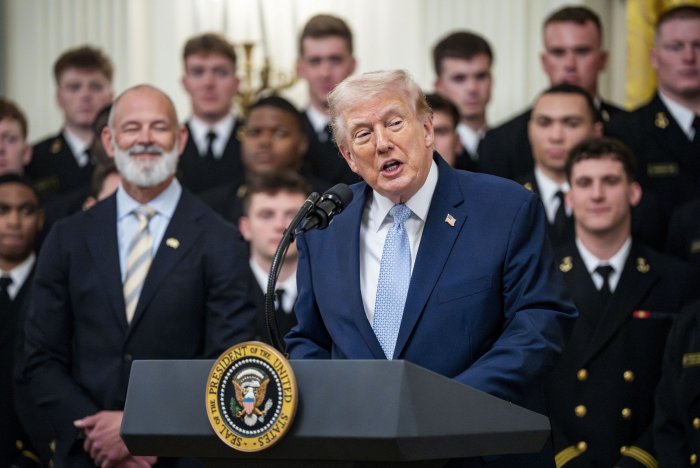
President Donald Trump presents the Commander in Chief’s Trophy to the Navy Midshipmen football team during a ceremony in the East Room of the White House on Friday. The award is presented annually to the winner of the football competition between the Navy, Air Force and Army. Navy has won the trophy back to back years and 13 times over the last 23 years. Photo by Bonnie Cash/UPI | License Photo
Republicans in the United States Senate have renewed their push to pass a controversial $70bn immigration-enforcement funding bill, a top policy priority for President Donald Trump.
But the effort on Thursday faced a series of hurdles, with Democrats forcing votes on several amendments that highlighted controversies related to the Trump presidency.
Recommended Stories
list of 3 itemsend of list
The rapid-fire votes on the amendments were dubbed a “vote-a-rama“, and they are slated to include issues ranging from Trump’s White House ballroom to his tariff policies and the US-Israel war on Iran.
“Amendment after amendment, vote after vote, Republicans are going to have to answer to the American people,” Senate Minority Leader Chuck Schumer said.
Early on, Republicans were forced to confront a topic that has dominated headlines in recent weeks: Trump’s proposed $1.776bn “anti-weaponisation” fund.
The fund has been controversial on both sides of the aisle, with critics calling it a slush fund for Trump’s allies.
Several Republicans indicated that the optics of such a fund could be politically catastrophic ahead of November’s midterm elections, and the Department of Justice has since backed away from the scheme.
But Trump himself has avoided saying whether the fund was dead, or just on hold.
It was created as part of a settlement following a lawsuit Trump filed against the Internal Revenue Service (IRS), a part of his government, and it was designed to award payouts to alleged victims of politically motivated prosecution.
Senate Democrats have repeatedly called for such a fund to be banned outright, rather than relying on the Trump administration’s commitment not to revive it.
Nevertheless, on Thursday, Senate Republicans rejected the Democrats’ measure to permanently block the fund.
Republican Tom Tillis introduced a second amendment, which would have also banned the settlement fund. Instead, the legislation would have redirected the allocated funds to a separate anti-fraud fund within the Justice Department. That, too, was rejected.
Thursday’s votes on the “anti-weaponisation” fund were just the start of several rounds of voting on issues uncomfortable to the Republican Party.
Schumer, the top Democrat, signalled that other amendments would tackle another part of the IRS settlement: the permanent immunity from tax audits that Trump had secured for himself and his family.
Trump’s controversial immigration enforcement campaign and other issues were also scheduled to be taken up in the day’s amendments.
Senate Majority Leader John Thune said he was not sure whether Republicans would defeat every measure, with some members of the party showing an increasing willingness to stand up to Trump.
“I can’t predict how it comes out,” he said.
Immigration funding bill
The situation on Thursday was the result of a standoff between Democrats and Republicans over the Trump administration’s approach to immigration enforcement.
Democrats had pledged not to approve further funding for Immigration and Customs Enforcement (ICE) and Customs and Border Protection (CBP), following the killing of two US citizens during immigration operations in Minneapolis, Minnesota.
Republicans control 53 seats in the 100-seat chamber, short of the 60-vote threshold needed to overcome a filibuster.
They have instead been forced to pursue a lengthy procedural manoeuvre to bypass the filibuster, which has taken weeks.
The $70bn funding bill had been stalled by the Trump administration’s demand to include $1bn for security upgrades for Trump’s White House ballroom project.
The request came after the president had repeatedly said that no taxpayer dollars would go towards the project.
The security funding, which roiled several Republicans, was subsequently dropped before the voting started.
The Senate’s parliamentarian, an official who interprets the chamber’s rules, had previously ruled that adding ballroom funding to the $70bn bill would make it ineligible for the budget reconciliation process, which allows the passage of fiscal-related bills with a simple majority.
If Senate Republicans remain unified, they are expected to pass the funding bill late Thursday night or early Friday.
The Republican-controlled House of Representatives is expected to take up the bill shortly after.
Los Angeles police are investigating the fatal stabbing of actor James Handy, who officials said was killed by his girlfriend’s son Wednesday at a home in Tarzana. The suspect was apprehended after he made a bizarre 911 call.
On Thursday, authorities identified the 81-year-old stabbing victim as the actor, who appeared in the films “Logan,” “Jumanji,” “Top Gun: Maverick” and “Arachnophobia.”
Representatives for the actor confirmed the news to The Times.
On Wednesday morning around 9:30 a.m., West Valley area patrol officers responded to an emergency call in a residential neighborhood of Tarzana. The 911 caller stated, “I am the son of man. I just killed the man of sin.”
When police arrived, they found Handy in the front yard of the Erwin Street home, unconscious and suffering from a stab wound to his chest. According to law enforcement, Handy was taken to a local hospital by paramedics, where he was pronounced dead.
A news release said that Michael Gledhill, the man suspected of stabbing Handy, flagged down officers who were responding to the incident and told them he was the one they were looking for.
Gledhill, 44, lives at the Erwin Street home with his mother, who police said was in a relationship with Handy.
Detectives said they believed this was an isolated incident and there appeared to be no danger to the public at this time.
Gledhill was arrested and transported to Van Nuys Jail, where he was booked on suspicion of murder. His bail was set at $2 million.
Handy has more than 150 acting credits to his name and had acted across television and film since the 1970s. Most recently, he played a bartender alongside Jennifer Connelly in the 2022 sequel “Top Gun: Maverick.” In 2017, he played opposite Hugh Jackman in “Logan” as a doctor who pleads with Wolverine to heal up.
In 2021, he portrayed Father MacGuffin in the comedy “Senior Entourage.” The film’s director, Brian Connors, posted on Facebook last year that Handy was one of the “finest character actors I know.”
Handy also acted in numerous television crime dramas, including “Alias,” “Criminal Minds,” “NCIS: Los Angeles,” “Rizzoli & Isles,” “CSI: NY,” “Cold Case” and more.
The police are asking anyone with additional information about this incident to contact the Robbery-Homicide Division, Valley Section, Dets. Simonyan or Lopez, at (818) 374-9550.
Cuban President Miguel Diaz-Canel was slapped with sanctions by the United States on Thursday as Washington continued to ratchet up pressure of the island nation’s communist government. File Photo by Ley Royero/EPA-EFE
June 4 (UPI) — The United States on Thursday leveled sanctions against Cuban Miguel Díaz-Canel, members of former President Raul Castro‘s family, the Cuban military and other organizations as it continued a crackdown on the country’s communist government.
Secretary of State Marco Rubio announced the measures against Diaz-Canel the others in a statement, asserting they are being targeted because they “fund the [Cuban] regime and its efforts to mobilize its radical revolutionary movements in the United States and around the world.”
The Cuban president, Rubio said, poses a threat to U.S. national security, while the Ministry of the Revolutionary Armed Forces of Cuba, with its “many majority holdings and subsidiaries,” is also now “considered blocked.”
Other organizations newly added to the sanctions list are the Cuban Institute of Friendship with the Peoples, or ICAP, Amistur Cuba S.A., Committees for the Defense of the Revolution and Minera La Victoria S.A.
The individuals sanctioned include Alejandro Castro Espin, the former head of the Cuban intelligence services and the son of Raul Castro, and Raul Alejandro Castro Calis, Castro Espin’s son.
“For decades, Cuba has been the world capital for radical left-wing terrorism,” Rubio asserted. “The regime in Havana has recruited, trained and backed violent Marxist and ‘third-worldist’ movements across our hemisphere and beyond.
“Today, we are targeting the network that enables and funds Cuba’s subversive and radical operations.”
In a stated response, Diaz-Canel said the latest sanctions are “illegitimate” and are “aimed at reinforcing the blockade measures and the scenario of conflict between Cuba and the United States.
“This political blindness is added to the coercive measures applied in recent weeks against our country, designed to harm the Cuban people,” he added. “The aggressiveness and perversity of the Yankee government will clash with our determination to confront the worst scenarios and resist the imperialist onslaught.”
The newly issued sanctions are the latest in a series of moves designed to ratchet up pressure on the Cuban government.
The Trump administration has set a Friday deadline for foreign companies to sever ties with GAESA, the business conglomerate run by Cuba’s Armed Forces, sparking a mass exodus of tourism-related businesses from the island nation.
Meanwhile, Cuba is struggling with the effects of a January 2026 executive order issued by U.S. President Donald Trump imposing a fuel blockade against the nation on national security grounds.
The move has resulted in shortages of electricity, fuel, medicine and medical supplies across Cuba, according to the U.N. Office for the Coordination of Humanitarian Affairs and the World Health Organization, which says emergency care, blood banks, laboratories, immunization programs and maternal and child health services have all been “severely disrupted.”
Mogadishu, Somalia – Mustafa, 33, dreads election time in Somalia. He drives a bajaj — a three-wheeled taxi — and says that when tensions rise, as they always do when polls are near, the whole city feels it, and drivers like him are among the first.
On Wednesday, he was passing through the Hawl Wadaag district when heavy gunfire between government and opposition forces erupted all around him.
Recommended Stories
list of 2 itemsend of list
“I couldn’t even think. Everyone was shouting and running for their lives, and we all fled from the bullets,” he told Al Jazeera. “We haven’t seen fighting this bad in years.”
The shooting that began that afternoon around the homes of former Prime Minister Hassan Ali Khaire and, later, former President Sheikh Sharif Sheikh Ahmed, came as opposition figures were planning to organise protests against what they describe as an illegal term extension by incumbent President Hassan Sheikh Mohamud.
Khaire and Sharif Sheikh Ahmed were among opposition leaders spreadheading the planned protests amid rising tensions with the federal government.
The government said the planned protests would undermine security in a city still grappling with persistent armed violence.
Hundreds of families fled neighbourhoods near the fighting, and by the next day, many of the capital’s central areas had emptied. The sudden eruption of violence ended a period of improving security in Mogadishu, shattering the perception that the city had begun turning a corner.
“The most frustrating thing is that we have nothing to do with it, and it impacts so many of us,” Mustafa said. “We make our living in this city”.
Security forces sealed Maka al-Mukarama Road, one of Mogadishu’s main arteries, while Bakara market, the largest commercial hub in the city, was effectively closed for business.
Maka al-Mukarama Road, Mogadishu’s main thoroughfare, is usually a bustling commercial hub, but recently, it has been largely empty, with the exception of military vehicles [Faisal Ali/Al Jazeera]
“Look, it’s midday, and there’s almost no one here, shops are closed, and usually by this time the place is jammed,” Ahmed, a street vendor at Bakara market, told Al Jazeera, gesturing at shuttered stalls.
Ali Wardheere, the deputy central bank governor, estimated the direct cost to businesses and services at $3.8m, though he stressed the figure was a model-based projection, not an official or final tally.
Like most Somalis, Mustafa has never voted for a president or a member of parliament. The country has not held a direct election for national leadership since the late 1960s.
Since the state was re-established in 2012 after its 1991 collapse, leaders have been selected through an indirect system negotiated by clan elders and political elites.
As presidential terms near their end, low trust among political actors often leads to intense competition over power — and at times violence — as disputes over the electoral timetable come to a head.
At a press conference in late May, Sharif warned that the political deadlock could turn violent if negotiations failed.
“Where do things stand? [We say] Leave, and [you say] I won’t leave. What comes next? Bullets.”
The warning echoed events in 2021, when then-President Mohamed Abdullahi Farmaajo remained in office more than a year beyond the end of his term, triggering clashes in Mogadishu before a political agreement was reached.
Higher stakes this election
This time, the political standoff carries higher stakes.
President Hassan Sheikh Mohamud says that constitutional amendments approved by parliament extended his mandate by an additional year from May 15. The opposition rejects that and has begun referring to him as a “former president”.
Two of Somalia’s most influential federal states also reject the amendments, leaving the country divided over the constitutional framework governing the next election, with no constitutional court to resolve the dispute.
After parliament approved the changes, Mohamud declared that the “provisional constitution, and the provisional era, was a sun which set yesterday,” signalling that his administration would press ahead despite objections from its opponents.
Tensions had been building for days. Ahead of a protest planned for Thursday, opposition leaders left the heavily fortified “green zone” near Mogadishu’s airport and returned to their residences across the city.
Some opposition figures said they would deploy their own armed guards at the demonstration, a proposal Mohamud rejected. The dispute heightened fears of a confrontation before fighting eventually broke out.
Both sides blame the other for starting the clashes. Khaire accused Mohamud of directing a “sustained and indiscriminate military assault” that lasted more than 20 hours, a claim Sharif echoed after fighting reached his own residence.
Ahmed Moalim Fiqi, the defence minister, accused the opposition of militarising the standoff, likening it to Sudan’s Rapid Support Forces and alleging that opposition figures had “distributed mortars and artillery across the capital”.
“Force and militias,” he said, would no longer be allowed to “seize power or block the state.”
How it came to this
The roots of the crisis run back to the 2012 provisional constitution, which set up a federal, parliamentary system built on broad consensus and clan-based power-sharing, which every government since has promised to achieve and failed to attain.
This year, after a long review, parliament amended the constitution through a disputed process that split the political class. The government has insisted that the new constitution advances the statebuilding process and that the Somali public should be allowed to directly elect its representatives.
For Ahmed Abdi Koshin, a federal MP who boycotted the draft, the danger is that the whole settlement comes apart. The process, he said, “clearly doesn’t have buy-in,” and the original constitution, for all its faults — “an imperfect product of compromise” — was the “only glue holding Somalia together”.
Koshin is not against a direct vote in principle, he said, but does not believe the country is ready for one. “We don’t have legislation for a direct vote; censuses and the security situation remains compromised. It really is up to the president to either reach a deal and save Somalia, or watch it fall apart,” he said.
The opposition, organised as a coalition known as the Somali Future Council and including two serving federal-state presidents, former prime ministers and a former president, has pressed Mohamud to accept that his mandate has ended and negotiate a new electoral framework, as in past transitions.
It alleges that his push for a direct vote is a pretext for extending his term and potentially securing another.
The government rejects that, casting a national one-person, one-vote election — the first since the 1960s — as essential to a drawn-out state-building project. When electoral talks collapsed on May 15, the Ministry of Information accused the opposition of bringing demands that ran counter to “the citizen’s fundamental right to vote and to be voted for”, and vowed to press ahead.
Mohamed Ibrahim Moalimuu, a lower-house MP who backed the amendments, said further delay could not be justified. “We’ve waited for more than 12 years,” he told Al Jazeera.
“If they had arguments against them, they should have taken part in the process and raised their issues. A constitution isn’t a Quran, and they should come back and work through parliament to make their views clear.”
A whole generation of Somalis, he noted, have never cast a ballot, and a real election “would be a major milestone and would bring some hope”.
The old indirect system, he added, was notoriously corrupt, with parliamentary seats changing hands for anywhere from $100,000 to as much as $1.3m. “This system is too dirty and keeps people out,” said Maliumuu. “It needs to be changed.”
A deeper problem
A regional official, speaking on condition of anonymity because he was not authorised to talk to the media, described an elite “divided strategically over what type of country they want, whether a strong centralised state or a weak decentralised one, and tactically over who the right candidate is to take them there”.
Mohamud, the official said, had moved from a decentralised vision for Somalia that embraces federalism towards a stronger executive, and his early, promising relationships with the federal-state leaders had since soured.
Those fractures have opened on several fronts at once.
Somaliland, which declared independence in 1991 and has stayed out of the constitutional review entirely, was recognised by Israel late last year after earlier courting Ethiopia.
Puntland and Jubaland, two of Somalia’s six federal states, have withdrawn from the federal system over the new constitution, while more than 100 MPs and senators from both boycotted the final vote.
Broader regional crises, from Sudan’s civil war to disease outbreaks elsewhere on the continent, have pushed Somalia further down the list of international priorities, leaving international engagement more fragmented and inconsistent.
The country is also grappling with a deepening humanitarian crisis and aid cuts, prompting famine monitors to warn of a heightened risk of hunger in parts of Somalia.
Yusuf Aynte, a veteran religious leader and former MP, said Somalia’s leaders needed to build consensus rather than push through changes that risk deepening divisions.
“The president says what he is doing is good, and that may be so,” he told Al Jazeera. “But the most important thing is what everyone can agree on.
“At the moment, Somalia has too many problems, and can’t afford to be distracted like this.”
Jamal Shiil, a youth activist, told Al Jazeera that Somalia’s large youth population would ultimately bear the cost of the persistent instability.
“Young people want to make a living here, for Somalia to be peaceful and not to have to leave because of the problems,” he said. “But if things don’t change it won’t leave them much of a choice”.