It was made public as Fury walked to the ring to fight Hall.
The name comes from the Greek legend King Midas of Phrygia, with the story leading to the phrase “midas touch”, which refers to someone with a knack of being successful or profitable.
What do you think of Molly-Mae and Tommy’s name choice? Have your say in our exclusive poll.
Israel has bombed the southern suburbs of Beirut, saying it targeted Hezbollah ‘infrastructure’ in response to cross-border fire. The strikes come as Israel continues to violate a supposed ceasefire with incursions and daily bombardment in southern Lebanon. Trump has said a deal to end the war on Iran will be signed on Sunday.
Vinicius Junior scored a brilliant goal to dig Brazil out of trouble after Ismael Saibari had put Morocco ahead.
A moment of magic from Vinicius Junior salvaged Brazil a point against Morocco in New Jersey, as the five-time World Champions made a shaky start to the tournament.
Ismael Saibari ran through to give Morocco a 21st-minute lead with a clever scoop in the Group C opener on Saturday, but a solo effort from Vinicius ensured the points were shared in this much-anticipated group match.
Recommended Stories
list of 4 itemsend of list
Here are the biggest takeaways from the 1-1 draw at New York New Jersey Stadium.
Brazil coach Carlo Ancelotti at half time [Jeenah Moon/Reuters]
Brazil make a slow start
Brazil are chasing a record sixth World Cup title, 24 years after last lifting the trophy, but this performance suggests there is a lot of work to be done by Carlo Ancelotti’s side.
They showed signs of nerves during the early stages of the game and struggled to cope with a lively Morocco attack.
A fifth-placed finish in South American qualifying underlined the scale of the challenge facing Ancelotti, and this performance has done little to ease concerns about the quality of the Brazil squad.
A number of their players struggled to cope with the intensity of the Moroccan team, with midfielder Casemiro subbed off at half-time after a difficult opening 45 minutes in the heat.
The World Cup final is a long way off in New Jersey, but Brazil will have to vastly improve if they are to have any hope of making it.
Morocco look like the real deal
The Atlas Lions stunned the world of football in 2022 as they made it all the way to the semifinals in Qatar.
Four years later, Morocco have the chance to show that it was not a one-off run to the last four and they are the real deal.
Judging by their performance in New Jersey on Saturday, the North African nation are truly a force to be reckoned with.
They arrived in North America as African Cup of Nations champions, after being retrospectively awarded the title following a controversial final defeat to Senegal, and they continued their strong form with a commanding performance against Brazil, playing with a high level of confidence and plenty of attacking threat.
Morocco appear set for another strong tournament showing.
Vinicius Junior showed his importance to Brazil with a brilliant solo goal in the first half [Jewel Samad/AFP]
Vinicius shows his top quality
If Brazil are to make it to the latter stages of this tournament, they will rely heavily on Vinicius to provide goals and assists in North America.
The Real Madrid man has consistently scored for his club this season, including 16 goals in La Liga and five in the Champions League, and it now appears that he is bringing this form to the world stage.
With Brazil struggling in the first half, Vinicius received the ball from Bruno Guimaraes on the left side of the area before cutting back onto his right foot and hammering into the far corner past Yassine Bounou.
It was the kind of magic moment that he regularly produces for Real Madrid, and the Selecao will be looking for more individual brilliance in their coming games.
Neymar injury hangs over Brazil
The Neymar soap opera is set to dominate another tournament for Brazil, with the 34-year-old on the sidelines for yet another major tournament match.
Brazil’s all-time record goalscorer is still recovering from a calf injury, having not played for his country since 2023.
He was dramatically recalled to the national squad, despite not featuring in Ancelotti’s plans during the Italian’s year in charge, but he remains under scrutiny over his fitness and form following years of injury trouble and an underwhelming spell back at Santos.
It is unclear exactly when Neymar will be fit enough to return to first-team action, but judging by the media’s focus on him during Saturday’s match, this saga is set to dominate discussion around Brazil.
Brazil’s Neymar Jr reacts after the match in New Jersey [Caean Couto/Reuters]
Draw leaves Group C wide open
Brazil and Morocco are the clear heavyweights in their group, but Saturday’s draw in New Jersey has left Group C somewhat in the balance.
Scotland currently sit top of the table after a 1-0 victory over Haiti in Boston, and they will now be eyeing the chance to reach the knockout stages for the first time in their history.
Morocco and Brazil remain heavy favourites to finish in the top two automatic qualification spots, but Scotland know that any points in their final two group games will almost certainly book their spot in the round of 32.
Béla Guttmann may be the most consequential soccer coach you’ve never heard of. But if it weren’t for Guttmann, you may never have heard of Pelé.
And Brazil may never have become the greatest soccer-playing country on Earth.
That’s because Guttmann changed the shape of modern Brazilian soccer — and changed the sport forever — when he imported the revolutionary 4-2-4 system from Hungary to Sao Paulo in 1957. A year later, Brazil won the first of five World Cups and the joga bonito was born.
But what Guttmann brought to Brazil isn’t nearly as interesting as how he got it there. That’s just one of the fascinating stories in “The Beautiful Game … The Untold Story,” the exhibit that will open the Holocaust Museum LA on Sunday at the Goldrich Cultural Center, a $70-million expansion that will double the size of the Pan Pacific Park museum’s campus to 70,000 square feet.
A soccer ball from the holocaust is among the items on display in the exhibit “The Beautiful Game … The Untold Story” at the Holocaust Museum LA.
(Eric Thayer/Los Angeles Times)
The exhibit was unveiled during a private reception on Saturday followed by a free preview day open to the public from 10 a.m. to 5 p.m. The grand public opening will take place in August.
The show’s launch coincides with eight local World Cup matches, which kicked off with the United States’ 4-1 win over Paraguay on Friday at SoFi Stadium, and it shines a light on the important but largely overlooked relationship between Jewish life and the global game, as well as how Jewish innovators like Guttmann shaped the modern rhythm, style and culture of the sport.
“It was in the same intellectual level as jazz, as art and everything modern and progressive,” journalist Allon Sander, who helped curate the exhibit, said of Jewish participation in European soccer in the years before World War II.
“The origin of the game and how it intersects with Jews and the Holocaust and the impact that these Jewish footballers and coaches had to shape the game and help popularize the sport is so fascinating,” added Beth Kean, the museum’s CEO. “And it’s an unknown history.”
Much of that story can be told through Guttmann, who was born in Budapest in the final year of the 19th century and developed into one of the sport’s first Jewish stars, representing Hungary in the 1924 Olympics and playing for nine teams in two countries before retiring to become a coach.
But none of that success mattered when the Hungarian government began introducing anti-Jewish laws in 1938, costing Guttmann his job and nearly his life when he was sent to a Nazi forced-labor camp, where he was tortured. Just days before he believed he would be shipped to Auschwitz, which meant certain death, he escaped alongside Erno Erbstein, another Jewish coach.
Erbstein revolutionized soccer in Italy before dying in 1949, along with the entire Torino team, when their plane crashed into a hilltop outside Turin. Four years ago, he was inducted into the Italian soccer hall of fame. Guttmann, meanwhile, who lost much of his family in the Nazi death camps, would go on to coach for 42 years in 14 countries, winning championships in six of them yet only staying in a single place for more than two years just once.
“He’s running away from his demons,” said Ronen Dorfan, a journalist and sports historian based in Budapest whose research was instrumental in putting the exhibit together. “His father was murdered, his sister was murdered. You never know how you survived in Budapest during the war so he had guilt feelings.”
A jersey worn by player Max Wozniak and a jersey from the 1930s are displayed in an exhibit called “The Beautiful Game … The Untold Story.”
(Eric Thayer/Los Angeles Times)
The exhibit was designed in three sections, the first devoted to the years before World War II, the second is about the Holocaust and the third is the postwar years. And while it details Jewish participation in, and influence on, global soccer, it also challenges the cliché that Jews were intellectuals, artists and laborers but not athletes.
“We are always trying to challenge stereotypes. Stereotypes that we might have about ourselves and even stereotypes that we believe about others,” said Jordanna Gessler, the museum’s vice president of education and exhibits who helped curate the show. “It’s crucial to help people find their place and their voice and really see the unity, the similarities between people.
“This is a story that was lost in time and we’re really bringing it out,” Gessler added. “To really have this conversation and encourage people to explore stories that they might not know.”
One thing people might not know is that in the 1920s and ‘30s, Europe’s best teams weren’t in England, Germany or France, but in Austria and Hungary, where they were led by Jewish players and coaches such as Hugo Meisl, Jozsef Braun, Arpad Weisz, Marton Bukovi, Gusztav Sebes and Gyula Mandi. Weisz and Braun were both killed by the Nazis.
A soccer ball from the 1974 World Cup is displayed at an exhibit called “The Beautiful Game … The Untold Story.”
(Eric Thayer/Los Angeles Times)
The surge of antisemitism and fascism in Germany, Italy and Eastern Europe helped spread the influence of those revolutionary players and coaches around the world.
“With the rise of the Reich and the Holocaust, the coaches ran away,” Dorfan said. “And they ran to every corner of the world, to Brazil, to Argentina, to Portugal [and] provided coaches to Real Madrid, to Barcelona, to Benfica, to Flamengo.
“There isn’t one of these clubs that doesn’t owe its tactical development in the ‘40s and ‘50s to the Jewish coaches, which came primarily from Hungary.”
The primary tactical development was the shift from the popular but rigid 2-3-5 formation, which required immense physical endurance and tactical discipline, to the fluid 4-2-4, which spread the wingers to the touch line and allowed for improvisation and creativity on the attacking end, a formation pioneered in Budapest in the 1920s.
“They developed a more refined game of passing the ball, keeping it on the carpet rather than the English kick and run, and really put thought into tactical thinking,” Dorfan said.
Guttmann, who played or coached for more than two dozen teams in his career — including one, in Romania, that paid him in vegetables during the postwar period — brought the Hungarian approach to Brazil in 1957 when he coached Sao Paulo to a championship. After Vicente Feola, the manager Guttmann replaced at Sao Paulo, took over the national team a year later, he brought the formation with him, popularizing many of the tactics still used in modern soccer, such as fluid defensive wingers, overlapping full backs, the use of a withdrawn striker and an attacking midfield.
The soccer team at the Theresienstadt concentration camp’s flag is displayed in a Holocaust Museum LA exhibit called “The Beautiful Game … The Untold Story.”
(Eric Thayer/Los Angeles Times)
“He is the whole exhibition in one man,” Dorfan said of Guttmann.
“Obviously if we wouldn’t have had the Holocaust, those [coaches] wouldn’t be kept out of Europe, Europe would be much stronger, much more developed. [And] then the development of Brazil or the success of Brazil would be coming much later,” Sander said.
Dorfan spent the better part of two years tracking down many of the more than 100 trophies, uniforms, photos and trinkets that make up “The Beautiful Game” exhibit, a search that required determination, perseverance and more than a little luck. Many of the items, because of their ties to Jewish athletes and teams, were hidden during the war and presumed lost. Others resurfaced only through detective work that sent Dorfan following leads that spanned decades and crossed more than a dozen borders.
That also cost money. So Alan Rothenberg, the man who, as president of the U.S. Soccer Federation, first brought the World Cup to Los Angeles 32 years ago, stepped up to lead an effort that raised more than $1 million to fund the exhibit.
“The story really needs to be told, particularly with what’s going on right now with respect to antisemitism,” Rothenberg said. “It’s really important for people to realize what can happen. And soccer is a great vehicle to draw them in. The one main thing in the museum is bringing schoolkids in.”
The Nazis and their collaborators failed in their attempt to erase the history of Jewish soccer pioneers; in fact, they inadvertently popularized both the men — and women — and their ideas. But the sport also helped other Jews survive a dark period and Kean said that may be the most beautiful and uplifting part of “The Beautiful Game.”
“The main reason we decided to do this exhibition in the first place is because for years so many survivors, when they talk about their life before the war, so many of them talk about soccer. So many of them were passionate and fond of the sport,” she said.
“We knew the exhibit opening was going to coincide with the World Cup. L.A. is going to be on the world stage. This is a great opportunity for the museum to get these stories out.”
SpaceX and xAI CEO Elon Musk speaks during a panel discussion during the 56th annual meeting of the World Economic Forum (WEF), in Davos, Switzerland, 22 January 2026. File Photo by GIAN EHRENZELLER / EPA
June 12 (Asia Today) — Hanmi Semiconductor said Friday it will invest about 50 billion won, or $32.9 million, in SpaceX as part of a strategic move tied to future cooperation in artificial intelligence chip manufacturing.
The South Korean semiconductor equipment maker said in a regulatory filing it plans to acquire shares in SpaceX on Monday. SpaceX, founded by Elon Musk, is a private aerospace company known for rocket technology and its Starlink satellite communications service.
Hanmi Semiconductor said the investment was made with an eye toward potential cooperation related to Musk’s Terafab project, an AI semiconductor manufacturing plan involving SpaceX, Tesla and xAI.
The project is aimed at building chip production capacity for Musk’s companies, including SpaceX, Tesla and xAI, as demand grows for AI semiconductors, satellite data services and global network infrastructure.
Market expectations for SpaceX have grown ahead of its expected public listing, with some estimates putting the company’s value at about 2,600 trillion won, or roughly $1.7 trillion.
Hanmi Semiconductor said it made the investment to position itself early in the expansion of AI infrastructure from semiconductors and data centers into aerospace, satellite communications and data industries.
The company has previously invested in businesses with future growth potential. Hanmi Semiconductor Chairman Kwak Dong-shin has pursued several investments connected to his relationship with Peter Thiel, the co-founder of Palantir.
Crescendo Equity Partners, a global private equity firm backed by Thiel, invested in Hanmi Semiconductor in 2013, marking the first investment of its kind in a Korean company. Hanmi Semiconductor said its latest investment in SpaceX also stems from that connection.
Kwak and Hanmi Semiconductor jointly invested in semiconductor equipment maker HPSP in 2021, generating a return of about 639% from the original investment. In 2024, Kwak personally invested 31 billion won, or about $20.4 million, in Line Next, a global Web3 company affiliated with LY Corp., acquiring an 8.5% stake.
A Hanmi Semiconductor official said the company decided to invest in SpaceX, a participant in Musk’s Terafab project, as AI industry growth expands beyond semiconductors and data centers into aerospace, satellite communications and data businesses.
The company said it plans to reinvest expected returns from the SpaceX investment into its core semiconductor equipment business to support sustainable growth and increase corporate and shareholder value.
Adrian Vestea nominated as prime minister after previous choice, Eugen Tomac, withdraws.
Published On 14 Jun 202614 Jun 2026
Romanian President Nicusor Dan has nominated Adrian Vestea, a National Liberal Party member and former mayor, as prime minister to form a new government after the previous choice for the post withdrew.
“Eugen Tomac withdrew his mandate this morning and as such I nominate Adrian Vestea as prime minister,” Dan, a centrist, said in a post on X on Sunday.
Recommended Stories
list of 3 itemsend of list
Vestea, 52, is the county council president of the central Romanian county of Brasov. Eugen Tomac had been seeking to lead a government of technocrats but lacked support from the parties in parliament.
Vestea, who served as a development minister from 2023 to 2024, said in a statement that he wants a “political government that will undertake real reforms and keep Romania on a pro-Western path”.
“We are the sixth largest country in Europe, and we need to put a major emphasis on development. Which I will do from day one,” he said.
Dan’s two nominations for the prime ministerial role this month come after a no-confidence vote toppled former Prime Minister Ilie Bolojan in May. A general election is not scheduled until 2028.
Dan said Vestea was suitable for the role because he had “gone through all the administrative stages” throughout his political career.
“He was a successful mayor, a successful county council president, a successful minister, and he attracted European funds, being focused on development, for example the Brasov airport, which is a success,” Dan said.
Parliamentary parties have previously said a minority government, whose members do not hold a majority of the seats in parliament, would be better than a government of technocrats.
Vestea will have 10 days to form a government and must win a parliamentary vote of confidence to take up his new post.
Romania has one of the highest budget deficits in the European Union and suffers from rampant inflation and a technical recession.
When a coalition government came to power in June 2025, it made reducing the budget deficit a priority. Bolojan was sworn in with the aim of ending one of Romania’s worst political crises in its post-communist history, but his government lasted less than a year.
David Beckham can’t keep away from his Hollywood Walk of Fame starCredit: InstagramHe unveiled the iconic star on Friday in a formal ceremonyCredit: Getty
And it seems that Sir David still can’t get over the exciting honour.
He was seen posing with it the day after it was unveiled at a formal event attended by his famous family.
Crouching down to see it while donning casual clothes, the sporting legend looked proud as punch as she took a selfie with the star.
His wife Victoria then snapped a photo of her husband as he took the selfie, with her sitting several feet away from him.
At the formal event, David was supported by sons Romeo and Cruz, daughter Harper, and wife VictoriaCredit: GettyVictoria and David shared a smooch after the unveiling of his starCredit: Getty
She then uploaded the snap to her own Instagram story and wrote: “Spotted. @davidbeckham fan.”
David’s wife Victoria Beckham and three of their children, Harper Seven, Cruz and Romeo were all in attendance at the formal event that saw the iconic star unveiled on Friday.
David’s eldest child Brooklyn failed to show up to the very special event, despite living down the road from the Los Angeles location that the unveiling took place.
As David gave his speech before unveiling the star, he mentioned his children – but did not name them individually.
“My beautiful children who are the reason I get out of bed in the morning,” he said while choking back tears.
“Kids, I hope you bring my grandchildren here one day and tell them about a boy who dreamed big,” he added.
After the star’s unveiling, the Beckham’s youngest child Harper visited eldest sibling Brooklyn’s Los Angeles home.
In a scathing statement, Brooklyn told how he grew up with “overwhelming anxiety” having been “controlled” by his parents most of his life.
His initial statement read: “I have been silent for years and made every effort to keep these matters private.
“Unfortunately my parents and their team have continued to go to the press, leaving me with no choice but to speak for myself and tell the truth about only some of the lies that have been printed.
“I do not want to reconcile with my family. I’m not being controlled, I’m standing up for myself for the first time in my life.”
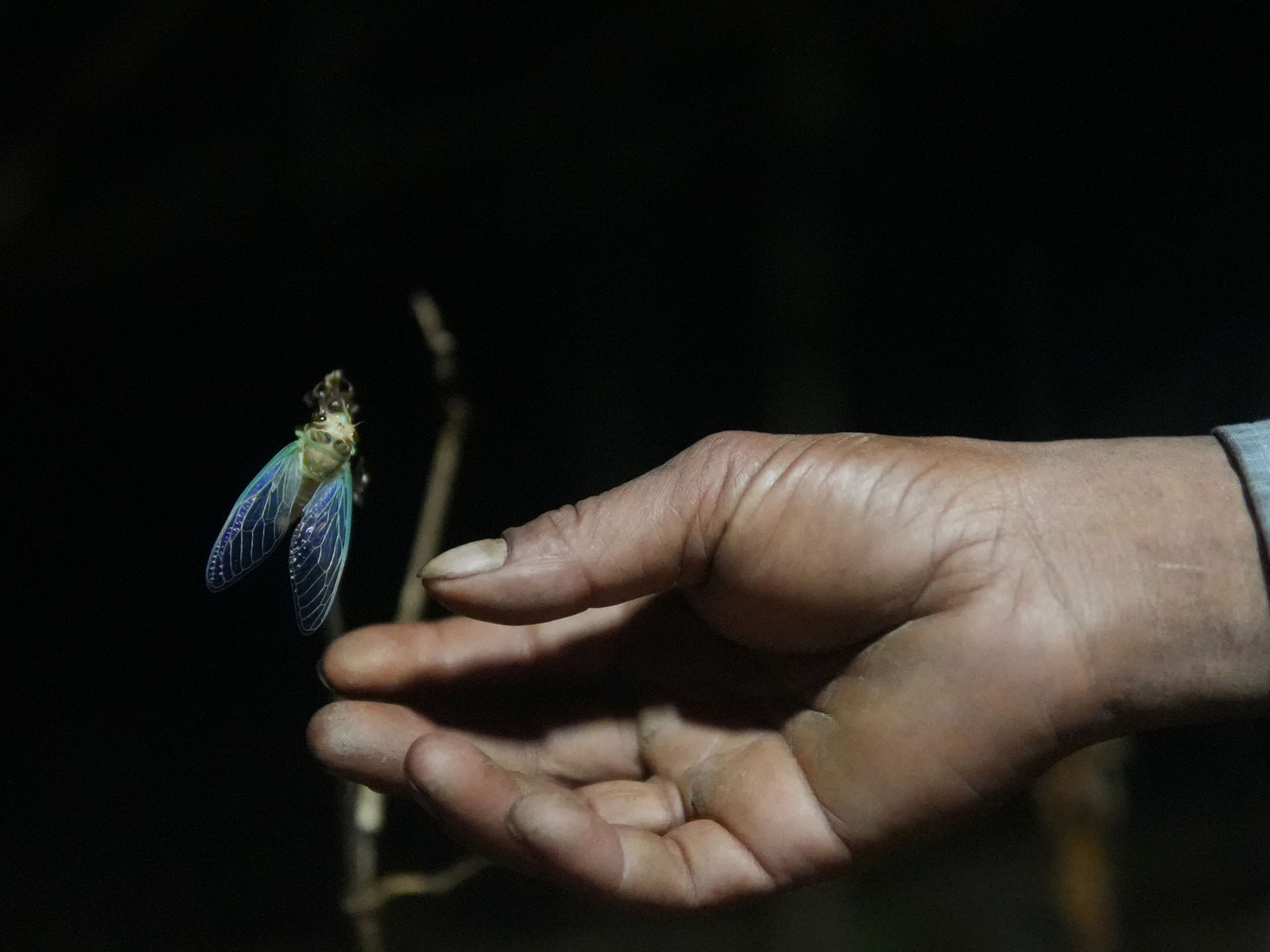
The mature cicadas, dark-shelled and spent, begin flying towards the Umrong River in large numbers and drop into the rapids. The river fills with them. Along the banks, dead cicadas collect against wet stones and bamboo roots, their wings plastered flat by the current.
Locals call it niangtaser suicide. Hajong offers a simpler explanation: Cicadas are naturally drawn to sound and movement, and the fast-moving river may trigger that instinct in their final hours.
For the fish below the surface, it is a feast. For the forest above, closure.
The journey that began four years earlier beneath the ground ends in the same river that separates Livi’s home from the sanctuary.
Not everyone has watched that cycle for as long as Kewstar Majaw.
At 92, he has witnessed more emergences than almost anyone alive in the village. He served in the Indian Army. He loves watching football. And every four years, without fail, he waits for his noisy visitors.
For Kewstar, the passing of the cicadas has become another way of measuring life. World Cups came and went. Governments changed. Forests retreated. But every four years, if the rains arrived on time and the bamboo still held, the forest sang.
As a boy, he would follow his parents into the forest carrying bamboo containers, the sound reaching them before the insects came into view. In those days, the niangtaser was everywhere. Behind houses. In the trees along village paths. Young ones, mature ones – the forest floor was alive with them.
The chorus was so loud, he recalls with a laugh, that people stuffed cotton into their ears to bear it.
The insect did not need to be searched for. It found you.
Kewstar sits quietly for a moment. At his age, he has watched the forest retreat, the bamboo thin, and the chorus fade with each passing emergence. The insect that once appeared on his doorstep now requires a torch and a walk in the dark to be found.
“It was everywhere,” he says softly. “Now you have to go looking for it.”
In a few weeks, the cicadas will disappear beneath the earth once more, keeping time in darkness until the cycle begins again. By the next emergence, another football World Cup will be under way somewhere else in the world.
Whether Saiden’s forests will still sing with them depends on what survives until then.
The war film, which follows a young British soldier’s journey to the D-Day landings, is being praised by viewers as a more authentic and moving portrayal of WWII than Saving Private Ryan — and it’s currently available to stream in the UK
07:10, 14 Jun 2026Updated 07:12, 14 Jun 2026
One fan hailed the film as ‘overwhelmingly moving’(Image: Joswend)
A “moving” and largely forgotten film from the 1970s depicting the D-Day landings is being hailed as “more realistic” than modern representations of the historic battle.
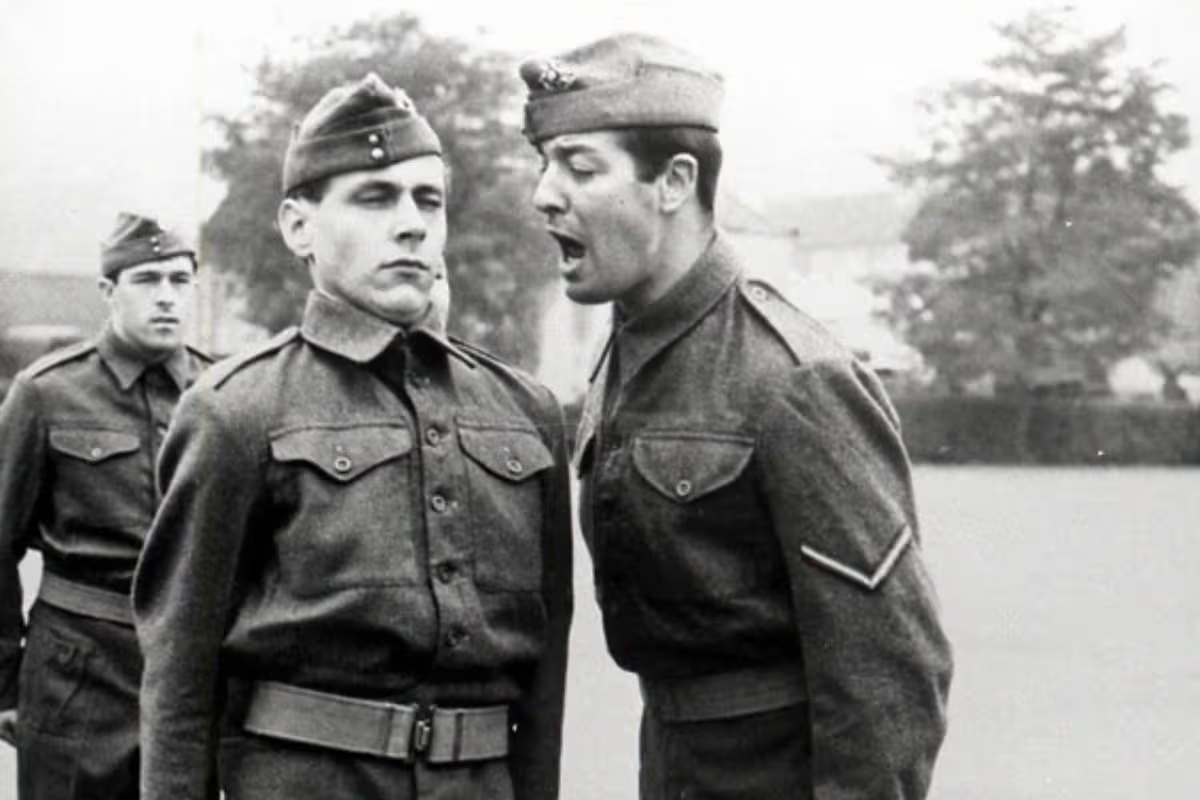
Overlord (1975) charts the experience of Thomas Beddows (Brian Stirner), a young British serviceman from his enlistment into the East Yorkshire Regiment, through initial training and ultimate participation in the Allies’ landmark amphibious invasion of German-held Normandy in June 1944 (codenamed Operation Overlord).
The picture, directed and co-written by Stuart Cooper, blends authentic archive material of the momentous military operation with sequences of Tom reflecting on his own death and the horrors awaiting him.
Screenrant writer Tommy Lethbridge observed that while it lacks the brutal, visceral intensity of the D-Day scenes featured in Steven Spielberg’s groundbreaking 1998 picture Saving Private Ryan, Overlord ultimately provides a more “authentic” depiction of the clash between Allied and German troops.
This, he argued, stems from Overlord’s deployment of archival footage, combined with the incorporation of “extensive detail from real soldiers’ diaries, clips from British Army training missions”, and seized German material, all of which grant the work “unrivalled authenticity”.
Fans have flocked to IMDb to lavish praise on the lesser-known war epic, with one saying: “The archival footage which makes up much of the film’s most stunning imagery is meticulously chosen and edited.
“It frequently becomes Tom’s dreams and visions of the War as it unfolds, and for the viewer, it is a vision of what WWII was, seen from both German and British sides.”, reports the Express.
“Cooper so masterfully situates Tom, an everyman, in visions of the surrounding war, that by the end of this surprisingly short, yet incredibly rich film, the magnitude of the toll the war took on the individuals fighting it becomes overwhelmingly moving.”
Another added: “If you watched Saving Private Ryan, go and see this film too. It’s totally different, but it deals with the personal feelings of a private much better, no battle scenes, just the perfect backdrop about a normal soldier going off to war, knowing what will happen.”
A third described it as “not your average war film”, noting: “There’s very little in the way of dramatised battle scenes as it shows one soldier’s path to one of the most important, pivotal battles of all time: his farewells with family, his journey to his unit, his training, his preparation for Overlord.
“No heroics, no jingoism, just the reality of what soldiers go through in becoming soldiers and how they handle the fact that eventually they’ll need to use this training in deadly earnest.”
A fourth viewer said: “It’s a sad tale, one of the forgotten men in a conflict long ago, but its universality still stands strong.”
Overlord, which carries a 15 certificate, is available to buy or rent on both Amazon Prime and Apple TV.
Qatar has earned its first-ever FIFA World Cup point in dramatic fashion against Switzerland. An injury time own goal put Qatar level with the Swiss in San Francisco. Al Jazeera’s Paul Rhys was there.
MOLLY-Mae Hague and Tommy Fury have finally revealed the unusual name they have picked for their newborn son.
The couple announced the arrival of their second child on Wednesday evening, sharing a black-and-white family photo alongside the caption: “…and then there were four.”
Sign up for the Showbiz newsletter
Thank you!
Molly-Mae Hague and Tommy Fury has revealed their baby boy’s nameCredit: InstagramTommy revealed it on his shorts and jacket as he took to the ring to fight Eddie Hall in Manchester on Saturday night
Influencer Molly, 27, had previously hinted that fans would “hate” the baby’s name.
Tommy finally revealed their son’s name – Midas – during his boxing match with Eddie Hall on Saturday night, sporting it on his jacket in gold writing while walking out to the song Midas Touch.
Tommy also had the name Midas on his black shorts as another tribute to his newborn son.
Molly-Mae was in the audience to support Tommy, despite the fact the match was delayed and didn’t get underway until close to midnight.
Tommy proudly revealed his son’s name after the couple kept fans guessing for daysNew mum Molly-Mae was in the crowd to support Tommy, even though the fight didn’t start til close to midnightCredit: Peter Byrne/PAThe pair previously faced criticism for calling their daughter BambiCredit: InstagramMolly recently revealed the shortlisted baby names she had ruled outCredit: Instagram/Mollymae
The choice follows the naming of their daughter Bambi, which sparked criticism online due to its unconventional nature.
In April, Molly revealed the shortlisted baby names she’d ruled out and said their newborn was going to have a distinctive moniker.
She said in a vlog post: “In my opinion, you get one opportunity to name your child something that is going to make them be remembered by,” she said.
“There was so much controversy around Bambi’s name but, thank God, because I wanted to give Bambi a name people are going to remember and that no one else in her classroom was going to have.
“What I’m so triggered by, in my class, there were three Mollys and we were all best friends…
“I really think it’s an opportunity for you to set your kid apart. I think there’ll appreciate it, it’s a conversation starter.”
Giving an indication of the sorts of names she’d been considering, Molly said: “I have loads of girls names I love. I think boys names are a lot harder. I really really love, we won’t be using this, but I do love the name Bunny.
“I actually loved the girl name Goldie, but I feel Goldie now is too used. Goldie was always a top contender for me, even with Bambi.”
Continuing the metallic theme, Silver and Sylvie also made the list.
She continued: “I also love the name Junie for a boy. Junior, TJ — Tommy Junior. It’s not gonna be a Tommy Junior.”
Molly and Tommy shared the birth news yesterday.
Boxer Tommy, Molly and Bambi all gathered around the babe as they lay sleeping on a hospital bed.
Stunning Molly was still in her hospital gown in the picture but she looked utterly overjoyed, beaming down at the baby.
She captioned the post: “…. and then there were 4.”
Announcing the news with a sweet video, the star shared a clip of her daughter Bambi with a “big sister” jumper on.
In the black and white montage of clips, Molly-Mae’s bump was seen for the first time as she giggled in the mirror while Tommy placed a supportive hand on her stomach.
She captioned the post: “Soon to be four”.
The pregnancy news came after Tommy and Molly-Mae rekindled their relationship following a shock split in summer 2024.
1 of 5 | Construction workers build a scaffolding near the sign for the Donald J. Trump and John F. Kennedy Memorial Center for the Performing Arts in Washington, D.C., on Friday. The Kennedy Center board sought an emergency appeal to block a court order requiring the removal of Trump’s name from the Kennedy Center, but a judge denied their request. Photo by Aaron Schwartz/UPI | License Photo
June 13 (UPI) — Trump’s name has been completely removed from the John F. Kennedy Center for the Performing Arts, the executive director told the court Saturday.
Executive Director Matt Floca told the court in documents that the name was changed before the extended deadline of noon Saturday, CNN reported. The court had allowed an extension after the center missed the midnight Friday deadline due to thunderstorms, Justice Department attorneys said.
Workers began removing the name from the building early Saturday, and documents confirming the name change were filed around 11 a.m. EDT.
Since December, the center has been named the Donald J. Trump and John F. Kennedy Center for the Performing Arts, after the center’s board, whose members Trump installed, voted to rename the venue.
Trump claimed that naming the center after him was a surprise, but the name was added to the sign the next day.
Rep. Joyce Beatty, D-Ohio, filed a lawsuit on Dec. 23 against Trump and others alleging that renaming the center was illegal.
And on May 29, a judge agreed. U.S. District Judge Christopher Cooper ruled that the center’s board had overstepped its authority when it voted to add Trump’s name to the center.
“Congress gave the Kennedy Center its name, and only Congress can change it,” Cooper said.
On Friday, a court denied the center’s last-minute request to stop the name change while the case gets appealed.
President Donald Trump speaks to reporters about restoring commercial fishing access to areas of the Pacific during a signing ceremony in the Oval Office of the White House on Thursday. Photo by Jim Lo Scalzo/UPI | License Photo
Weekly insights and analysis on the latest developments in military technology, strategy, and foreign policy.
In another indication of the growing military and economic importance of the Arctic, Russia and NATO are increasing their buildup of forces and facilities in the region. Recent media investigations found that Russia is constructing new bases near Finland to eventually house tens of thousands of troops while NATO on Saturday stood up a long-planned new battalion battlegroup. It is a force that will operate in Finland and Sweden as a deterrent against Russia.
While Russia remains totally bogged down and suffering high attrition in Ukraine with little chance of moving masses of troops to the Arctic at the moment, concern over the future has spurred NATO to bolster its presence along the Finnish border. Having moved to a wartime economy during the full-on conflict with Ukraine, Russia could leverage that in a post-Ukraine war future to threaten NATO’s borders.
A NATO official told us Friday morning that while the alliance assesses that the chances of a near-term conflict are low given the war in Ukraine, “Moscow could seek to expand westward into the Nordic and Baltic nations after a ceasefire with Ukraine.”
Swedish soldiers take part in training on the Finland/Norway border during the Nordic Response military exercise on March 09, 2024 in Kivilompolo, Finland. (Photo by Leon Neal/Getty Images) LEON NEAL
Russia appears to be investing in infrastructure in preparation of such a contingency. A joint report by several Nordic and Baltic media outlets published earlier this week has found that Russia is expanding military facilities along its borders with Norway and Finland to accommodate tens of thousands of new troops.
“New satellite images show that Russia is increasing its armament in [the] vicinity,” the report stated. “SVT, together with media partners in several countries, has examined how Russia is preparing for 80,000 soldiers… It is a threat that we should take seriously, says Thomas Nilsson, head of Sweden’s military intelligence service (MUST).”
The images “show new barracks for thousands of soldiers, long lines of military vehicles and ammunition storage,” the report further noted. “All winter, Russia has been building new military structures in several places on the other side of the Finnish border.”
“We expect to have 80,000 soldiers on our border and that can be compared to the fact that we previously had 20,000,” Finnish Army Chief Pasi Välimäki told the joint investigation.
A joint investigation by Nordic and Baltic media outlets found that these developments could enable Russia to deploy a force of up to 115,000 military personnel in the Northern European and Baltic regions. pic.twitter.com/ZiVpsP3fEz
A separate report by the Finnish Yle media outlet found that the Russians are expanding a base in the town of Novaya Vilga to hold as many as 6,000 Russian troops. It is located about 100 miles east of the Finnish border.
Breaking News: Where exactly is Russia building its massive new military garrison? 🛰️
“NATO has monitored a buildup of military infrastructure in Russia along NATO’s Eastern Flank, particularly along Finland’s border,” the NATO official told us earlier this week. “The real question is what becomes of the infrastructure? Will, for example, Russian troops now in Ukraine be relocated there after the war? It’s something we certainly need to consider, and we do.”
“That’s why NATO and nations are working to deliver real military capabilities to the alliance now, not five to ten years from now, which is so very, very important,” the official added.
A Swedish soldier takes part in a training exercise during the Nordic Response military exercise on March 09, 2024, in Kivilompolo, Finland. LEON NEAL
One of those efforts, as we noted earlier in this story, was stood up on Saturday, involving NATO’s two newest members.
NATO’s Forward Land Forces (FLF) Finland began operations in Finland and Sweden, according to the alliance. The FLF will include NATO’s newest multinational battlegroup, led by Sweden, “to support the defense of NATO’s northeastern flank.”
The establishment of FLF Finland places a Swedish battlegroup based in Boden, Sweden, and a Multinational Staff Element in Rovaniemi, Finland, under the command of the Supreme Allied Commander Europe (SACEUR) and NATO.
The NATO Forward Land Forces Finland (FLF) was established on June 6, 2026. (NATO Photo by OR-7 Dennis Sattler) MSgt OR-7 Dennis Sattler; DEU Army
“Sweden is contributing a battalion battlegroup that, together with a Multinational Staff Element in Rovaniemi, will form the core of FLF Finland,” NATO added. “The Swedish battalion battlegroup is prepositioned in Boden, with capacity to operate in the North Calotte and, where necessary, rapidly reinforce the presence in northern Finland. In 2026, Sweden’s contribution to FLF Finland will total around 600 personnel, with the option to expand to 1,200 personnel if needed.”
“This region is one of the most strategically significant and environmentally challenging areas in the world,” said U.S. Air Force Gen. and SACEUR Alexus G. Grynkewich. “FLF Finland, just like Arctic Sentry, will leverage NATO’s strength to defend our territory and ensure the Arctic and High North remains secure, especially considering Russia’s military activity and China’s growing interest there.”
Activated: NATO Multinational Battlegroup (FLF Finland)
The U.S. too is working to improve its presence and operations in the region. During last month’s SOF Week symposium in Tampa, Florida, the head of U.S. Northern Command (NORTHCOM) announced the formation of Nordic Bridge to “tie together” the work of U.S. European Command, North American Aerospace Defense Command (NORAD) and SACEUR.
Air Force Gen. Gregory Guillot provided no real details about Nordic Bridge at the time, so we reached out to NORTHCOM for additional details.
“The Nordic Bridge concept seeks to enhance Arctic integration between U.S. Northern Command and U.S. European Command and enhance cooperation between NORAD and NATO in order to expand domain awareness, strengthen deterrence, and improve interoperability,” a NORTHCOM spokesperson told us last month. “It envisions increased participation in each other’s training and exercises, increased data sharing (such as air pictures), deconflicting conferences to maximize personnel availability and participation, etc.”
Last month, Guillot visited Grynkewich “to discuss opportunities under this concept,” the NORTHCOM spokesperson told us.
U.S. Marine Corps Lance Cpl. Thomas Teague, a motor vehicle operator assigned to Combat Logistics Battalion 6, Combat Logistics Regiment 2, 2nd Marine Logistics Group, provides security for a convoy during offensive and defensive operations in Syndalen, Finland during exercise Freezing Winds 23 (FW23), Nov. 30, 2023. (U.S. Marine Corps photo by Lance Cpl. Christian Salazar) Cpl. Christian Salazar
All this is taking place, of course, against the backdrop of President Donald Trump’s frequent insistence that the U.S. subsume Greenland to provide better Arctic protection for the U.S. homeland. The issue reached a fever pitch earlier this year, causing a serious rift with NATO after the president threatened to invade the world’s largest island. You can read more about that in our story about the crisis here.
While there are no indications that the Arctic region is about to break out into open conflict, there are several indications that Russia, NATO and the U.S. are increasing preparations for such an eventuality.
There was a time in the beginning of Sublime’s recent revival when Jakob Nowell, the son of the band’s late singer Bradley Nowell, saw himself simply as a good son trying to help his adoptive uncles — drummer Bud Gaugh and bassist Eric Wilson — restart his dad’s iconic Long Beach trio. The goal wasn’t to take the place of his frontman father who died of an overdose in 1996. “I’ll never look at it as my band. Sublime is my dad’s band, and I’m helping out, that’s all,” he told The Times in 2024. Luckily, he was wrong.
The journey of finding his own voice through his father’s sly, shambolic poetry and reggae rock anthems, along with his determination on the road with Gaugh and Wilson through a barrage of festivals and tour dates helped him eventually step into his own as a songwriter and Gen Z rock star. It’s all been done with the mission to preserving his dad’s legacy and having fun while doing it. Now it feels as natural as the trio sitting together on the waterfront in LBC’s shoreline marina within earshot of the bellowing horn of the Queen Mary earlier this year as they were finishing the recording of “Until the Sun Explodes,” the first album under the Sublime moniker in 30 years.
Just like the band’s original recipe of shoving punk, dub reggae, hip-hop and ska into a blender, the new songs dutifully stick to the formula along with Jakob’s soulful caterwauls that sound scarily similar to his dad. But what emerges from the 21-song tracklist is the evolution of a trademark sound that gives a nod to the past while standing strong on its own, just like Jakob, despite coming to the interview on crutches while healing from a performance-related knee injury. The band members chatted with The Times about recapturing the effortless essence of their immortal beach-ready sound and looking forward to a second chance to chase an endless summer.
This interview was edited for length and clarity
It’s kind of a rare thing for all three of you guys to be in one place at the same time. What was it like working in the studio together to finish the new album?
Bud Gaugh: Magical. Things are just coming together. We showed up, Jake had an idea for another song, and he sent us a little demo and said “Hey, this is what I’ve been thinking about.” And then we get down to the studio [in San Pedro], and he’s like, “Oh yeah, so I had another idea,” and kind of changed it. We jumped in there [and by the end of our sessions, we had written] brand new songs to the list of songs that we already had.
The band’s revival has been a long time in the making. I remember when you guys had your first show together, a surprise gig a couple years ago as part of a benefit show for the Bad Brains frontman H.R. Do you feel you’ve come a long way since then?
Eric Wilson: I never thought the chemistry would be like it was with Bradley.
Jakob Nowell: Especially now that we’ve been playing together this long, the chemistry is very much there. We’re just comfortable and having fun. Jamming together is the best. We get in there to do a take for a song, and I’m always like “Let’s just do like three more!” It’s just that much fun, and that’s how it feels playing live too.
When did the idea for creating a new album come about?
Gaugh: It was pretty much just while we were playing shows, At first, the idea was that we were getting together to do this benefit for H.R. [at Teragram Ballroom in December 2023]. We went from “How’s this going to work?” and then [after the show] it was like, “Wow, this is something special. We should definitely go out and play some more shows, and get this music out there and get the opportunity to bring the music to the people in the purest form that we possibly could.” As we’re doing that, it’s like we’re seeing the reaction in the fans, and we were feeling it emotionally. We realized this is going to be bigger than we ever thought. That’s when we really decided where it was going to go.
Jakob Nowell, right, once thought Sublime was only his late father’s band; now, fronting the Long Beach trio, he’s leading a new chapter that still honors Bradley Nowell’s legacy.
(Allen J. Schaben / Los Angeles Times)
Were any of the songs on the new album mined from previously unreleased material or did you start fresh?
Nowell: There was that song we did with Stick Figure [“Feel Like That”], so I think that kind of inspired us. [We realized] “Oh s—, there really is some meat on the bone.” And then I had found some old recordings of stuff that were just like jams without even like vocals or whatever. Then it became just this thing during sound check or maybe in the middle of sets, we’d just start jamming these random progressions and stuff, and it kind of just evolved from there naturally.
The new songs that I’ve heard fit right in the vein of what people love about Sublime. What was it like putting some of those new songs in the setlist as you were building them?
Nowell: It was like magic. We were joking yesterday that sometimes we’ll play a new song for the first time just randomly and I’d see people try mouthing the lyrics and stuff and I’ll say “you’ve never even heard this before! I know you haven’t. We don’t even really know what the hell we’re saying.”
Gaugh: You frontin’! [Laughs]
Nowell: But [the new material] sounded like it was supposed to be there, so it was kind of a rad little test in a lot of ways. We almost don’t even have to think about it. That’s always going to be the guiding goal of any band trying to make fun music that’s relatable.
Wilson: What if you’re Slayer? That’s not true if you’re Slayer.
Jakob, it seems like you’ve gotten a lot more comfortable in the frontman role since joining the band. What’s it like just taking the lead, not just for the sake of your dad, but for the fans?
Nowell: Oh, dude, it’s the best. I don’t even have to think about it. We really feel like this is — we’re a band, you know?
Gaugh: It’s [Jakob’s] band too. Now it’s our band. It’s us.
Nowell: It feels like that whenever we’re hanging out, just doing stuff, or at the studio or at these shows. So, this upcoming year feels like a really rad adventure. We got all these different eras [of fans] — people who were in their 50s when [Sublime’s] first stuff dropped, who are still alive, and then their kids and their grandkids and great grandkids. Everybody finds a piece of the discography they can relate to. That’s what is most exciting. It’s not just one or two songs, people sing along to everything.
I was at Warped Tour in Long Beach last year when you guys played and —
Nowell: That was my favorite set!
To me that felt like it encapsulated what you were talking about with the multigenerational groups of fans that have enjoyed you guys and associate you with Long Beach.
Gaugh: It was like a homecoming for me. I remembered playing the Chili Cook off, you know, right over there in the same area [as Warped Tour], and it was just bringing me back 30 years. It’s so meaningful to be in our backyard playing our music again, right there. This is where it all started. It’s come full circle.
Nowell: It was like playing at a local bar in a cool way. I had this huge group of people up front, they were just talking and shouting and saying stuff, like f–ing with us and joking around. I was like “Damn this is great!”
How about you, Eric? How’d you feel playing Warped?
Wilson: [Mumbles] It was f–ing awesome.
Now that you’ve played all these festival shows, from Coachella to No Values, you’ve got your own festival going on. Can you talk a little bit about Sublime Fest and your Sublime Reef Madness Cruise and how you came up with it?
Nowell: We could put on a bunch of the bands we love, and some of our boys, like Vandals, and make it our own vibe.
Gaugh: You walk around Coachella and there’s so many different elements there. Wouldn’t it be neat if we could make like all this like a Long Beach element, a Sublime element. Looking at this thing, it’s like “Oh wow. So we can actually get some of our friends and set up like a tattoo booth, and have our idea of art and everything out there, and mix it all together — food, art, music — bringing all these different elements, and friends of ours that play music. We get to decide who’s going to share the stage with us, so it’s really neat. It’s like planning a high school party or something like that.
Nowell: The biggest backyard party ever seen.
You guys always had your own sound going on, what’s it like to see that the fans still want it?
Wilson: It took a lotta years to catch on, but it did.
Nowell: Yeah, the kids really want that, like ‘90s, Y2K kind of vibe. That was the last era of like cool authenticity and stuff. You can see it when young people make stuff to look retro … when things get so high fidelity, we’re almost losing a little element, so I think these festivals kind of seek to bring some of that back in a way that everybody can get into.
With “Until the Sun Explodes,” Sublime’s first album in three decades, Jakob Nowell, Bud Gaugh and Eric Wilson rediscover their studio chemistry, jamming new songs that feel instantly familiar onstage.
(Allen J. Schaben / Los Angeles Times)
You guys also have the timeless iconography of the Sublime sun logo. The title of the album is “Until the Sun Explodes.” Does that title have any particular meaning to you?
Nowell: It’s almost just another way of saying “forever,” like “Oh baby I’m gonna love you till the sun blows up.” That’s gonna happen in billions of years, if at all. The fact that [Sublime’s] lasted this long and has this many fans is evidence to me that we wanna be here forever. I think that’s what everybody wants for themselves.
Jake, you’ve taken steps to advance your own aspirations and music with your label, Sunburnt Records, how does that fit into where Sublime is right now?
I was inspired by the whole Skunk Records thing [Sublime’s first label], Evan Zinger with [his lifestyle brand] SRH, and just all the local brands I grew up with when I was a kid. So just trying to do a cool, chill local thing that has that vibe of putting on small shows and kind of getting to use this new notoriety to be like, man, I have so many friends in these small bands like Strange Case and Eight Ball, and other bands up and down Southern California. Let’s put on shows and sneak them on a Sunburnt Stage at [Sublime Fest] and if people really like that Sublime sound here’s a bunch of kids who are carrying the torch like Slightly Stoopid did when they started out. Mike Watt always said “start your own band!” So the more we can inspire people to do that and be some small part of that, it’s a dream come true.
Do you feel like this version of Sublime is something Brad would be proud of?
Gaugh: We all kind of brought our own element to the music orignally. So we just kind of followed that recipe. Jake’s his own person, he’s got his own influences, and we just kind of stick with that idea. Jake brings in his feelings, and Eric brings in his and we sat there and recorded this song, and then as we were recording it, we’re coming up with ideas. It’s like, “Oh wait, we should do this here, slow that down there, stop here,” it’s all a conglomeration of ideas, everyone does their part, brings in their own spices and we mix it in a pot like gumbo.
June 13 (UPI) — Reality TV star-turned-Los Angeles mayoral candidate Spencer Pratt says he does not expect to advance to the general election after projections from primary voting suggest he will rank third behind incumbent Karen Bass and challenger Nithya Raman.
The Hills alum ran on a platform of making the city’s streets cleaner and safer, and speeding up the rebuilding of homes and businesses destroyed by wildfires in the Pacific Palisades more than a year ago.
Pratt, who lost his home in the blaze, released a 3-minute video Friday, stating the “campaign portion of my mission to save Los Angeles is coming to a close and I’m moving on to the next, more interesting phase.”
The spot already has gotten more than 8.6 million views on X.
It appears to be a mix of real and AI-generated footage, as well as movie clips.
In the video, Pratt said he plans to keep fighting to improve the lives of Los Angeles residents using the national social media following he has amassed in recent months.
He added that he has evidence that could damage one of the candidates as they head to the general election in November.
“We have some recordings of one of your exalted candidates doing and saying something that would make her resign in shame. I was saving it for the general election,” Pratt said.
“So, Karen, Nithya, ask yourself, ‘Is it possible that one of your employees may have a recording of you doing or saying something that would force you to resign in disgrace?’ Hope you sleep well at night over the next five months.”
The Los Angeles Times said the Bass and Raman campaigns have declined to comment on Pratt’s remarks.
According to the votes tallied Bass is in first place with 34 percent of the vote, Raman earned 29 percent and Pratt scored 26 percent.
If Pratt had won, he would have been the first Republican mayor of Los Angeles since Richard Riordan served two terms, ending in 2001.
Evacuated residents and those who lost their homes in the Eaton wildfire find supplies, resources and aid at the Clay House of Pasadena, which was turned into a donation center in Altadena, Calif., on January 12, 2025. Photo by Jim Ruymen/UPI | License Photo
Scotland’s players and fans sing Flower of Scotland at a World Cup for the first time in 28 years before their match against Haiti at the Boston Stadium.
In this week’s episode of The Envelope podcast, Riz Ahmed talks about drawing on his own experience for “Bait,” his Prime Video series about a British Muslim actor whose life is upended when he’s rumored to be the next James Bond.
Kelvin Washington: Hello, everyone, and welcome to the next episode of The Envelope. Kelvin Washington, Yvonne Villarreal, we have Mark Olsen. And Mark, I’ll stay with you for a second. You had a chance to speak with Riz Ahmed, who is the creator and the star of “Bait,” which centers around the idea of who could be the next James Bond. So then, dang it, I’m asking you two the same question: Who could be, should be the next James Bond? Is there somebody or somebodies that you’ve thought about for a while and said, “Well, that would fit, that could work”?
Mark Olsen: It was recently announced that they have begun the casting process to replace Daniel Craig in the beloved and long-running James Bond franchise. And there have already been at least one sort of confirmed person, the actor Tom Francis, auditioned. But then there’s a lot of other names being thrown around, like Callum Turner, Jacob Elordi, Aaron Taylor-Johnson. Kind of everybody about that age bracket you could think of. You know, it’s funny, in the last movie, “No Time to Die,” Lashana Lynch was given the number 007, so she was not James Bond, but she was 007. And I always thought, actually, in the last couple of movies, that Léa Seydoux would make a perfect [00 agent] — she’s cool, she feels kind of dangerous. She would have seemed to me like a great person for that kind of role. But then also, that’s obviously not James Bond. So who knows who it could be. Yvonne, what do you think? Do you have anybody in mind?
Yvonne Villarreal: Can it be a toss-up between you two? How would you fare?
Olsen: I don’t know if I’d pass basic training.
Washington: They have doubles, OK? They got stunt doubles and CGI and AI for all of that and for you, OK.
Villarreal: It’d be like the Leslie Nielsen version.
Washington So it’d be like 007 with a question mark: 007?
Villarreal: More seriously — not that I don’t take you two seriously as candidates — I would throw my enthusiasm around Jonathan Bailey or Damson Idris.
Washington: I’m gonna one-up your Idris and just go [with] the obvious, Idris Elba. It’s been sitting there for the last 15 years or so.
Villarreal: That’s why I didn’t [say that], because I’m like, “It’s been sitting there and they still haven’t.”
Washington: But sometimes it just makes sense. Sometimes it’s just sitting smacking you in the face, or shooting you with a silent 9mm — whatever he uses, James Bond. It just makes sense, and to be honest, it’s one of those, he’s probably passing [on the role] because you wanna have a franchise you can hold on to for 20 years with a particular actor, give or take, and he seems like he’d be probably too senior for that at a certain point. The podcast, the conversation behind what really happened there is going to be fascinating because, to your point, it just seems like the momentum was building for it and it didn’t happen. So it would be interesting to hear what actually comes out of that. But those are my are my guesses right there.
All right, Mark, you had a chance to speak with Riz Ahmed, obviously the creator and the star of “Bait.” Fascinating to me, just the concept of the show as a whole.
Olsen: Riz Ahmed is someone who, he’s so thoughtful about his own career, but also his place in the world. And so he does such a great job with this show and taking this idea of like, “Could an actor like Riz Ahmed, could he be James Bond? Should he be James Bond? Why not?” And so the show is just so thoughtful and finds all these really inventive ways of exploring that idea. He’s playing a little-known actor who it becomes public that he’s auditioned for the role and that throws his whole life into tumult both within the industry, with sort of like online hate towards him, but then also with his own family. And the show is also meant to be kind of a real love letter to the South Asian communities of London. Riz in the conversation talks about how they went out of their way to shoot in parts of London that you don’t normally see. So the show, it’s just so inventive and fun in a lot of really terrific ways.
Washington: Well, let’s hear more of your conversation with Riz now.
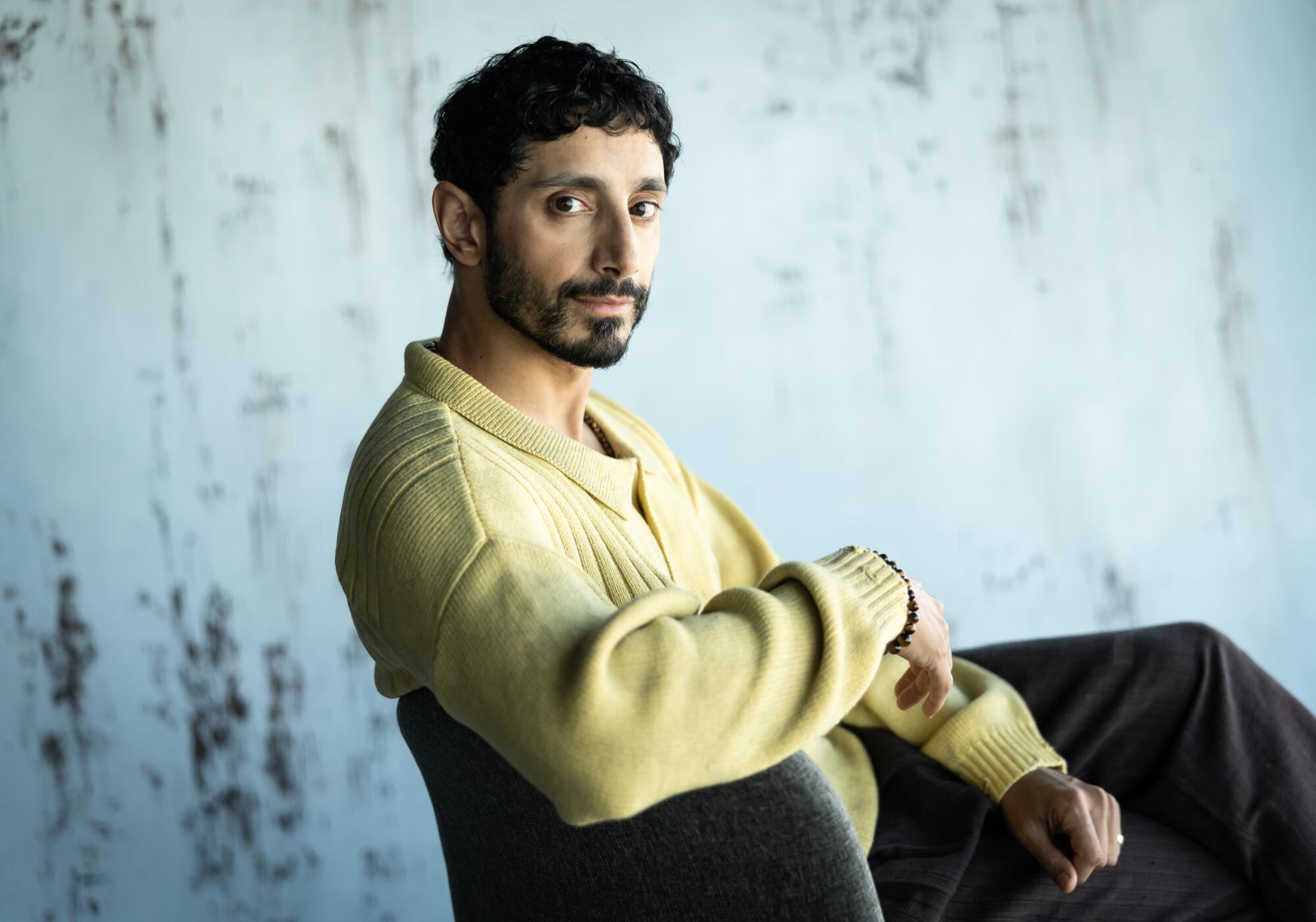
Riz Ahmed.
(Christina House / Los Angeles Times)
Mark Olsen: On the show, you play an actor who auditions for the part of James Bond. It leaks to the press, and then his whole world turns upside down. For you, is the premise of the show predicated on the idea that someone like you would never get that part, or is it that, of course you should get that? Which end of the telescope are you looking at it from?
Riz Ahmed: Kind of neither, really. The premise of the show was something a bit more emotional than that. The James Bond thing came right at the end, to be honest, of the creative process. Really, the heart of the show is the idea of auditioning. James Bond really serves as a symbol in the show, a symbol of aspiration, pinnacle of achievement in this industry and also of alpha masculinity and all this kind of stuff. And so it’s really the idea of trying to be that guy, which on some level, we’re all trying to be this kind of preferred version of ourselves, right? We’re all performing. We’re actually all always auditioning. So it’s about that feeling, [which] I think extends outside this industry. We’re doing that on LinkedIn or social media, on this podcast right now. We’re performing a version of ourselves. When actually the true version of ourselves is kind of messy, chaotic and vulnerable. So it’s that distance between the public and private self that I was really interested in, and James Bond just served as an aspirational symbol of that public way that you would love to be seen.
Olsen: But Bond, because of the specific cultural baggage that comes with that franchise, did you feel like it fit thematically with what you were trying to do?
Ahmed: Oh, perfectly. It was a godsend. It was like one of those moments where it’s like, “OK, so we want to do something about, like, aspiring to be anything but yourself. We want to do something about feeling like life is one big audition, but we need something that encapsulates success and cultural acceptance.” And it was like … Of course: Bond. And because the process of making this show was one of pulling so much from my own personal life, there was a moment or two when my name was mentioned in that conversation. I mean, along with, you know, everyone and their dog. But it was an interesting kind of thought experiment, it was an interesting, as I said, kind of vessel to place all of the themes into. And so when that idea came about, it was like, “This is perfect. We can talk about everything we want to talk about using this symbol.” We’re like, “OK, now how are we gonna get it?” And everyone told us Barbara Broccoli would never let us use it. Rightly so, she was very protective of this IP. But I wrote her a letter, sat down with her, showed her the scripts and she understood. She understood that it’s not really about Bond. It’s a show about self-love, and she really kind of vibed with that. Shout out Barbara Broccoli, thank you for letting us use Bond exactly how we wanted to.
Olsen: You recently hosted the new “SNL UK” and in your monologue, you made this joke that you don’t just play intense roles, that there’s this image of you that it’s all that you do. Did you purposely want to make “Bait” as a way to break you out of that perception?
Ahmed: It wasn’t that careerist and calculating, to be honest. I was just trying to make something that was authentically me. And I think the people who know me know that I’m a lover of comedy. My first rap song was a comedy rap song. I got banned on British radio back in the day because it was a quite an acerbic kind of satire. And actually it’s funny because I think that’s an American perception of me. In the UK, nine times out of 10, when I get stopped is for a British comedy I did called “Four Lions.” Which is like a kind of cult classic British movie. It’s a very British comedy. That’s like me, that’s like how I am in real life. And so when I wanted to make my own show, it just stands to reason it would be a reflection of my taste. So the overall frame was comedy, but I kind of have quite a maximalist sensibility. I want to have my cake and eat it. So I also wanted it to be a spy thriller and a family drama and quite surreal and psychological thriller and all of these elements kind of put together, but the frame of it all, I would say, is comedy. And yet it was really actually important to us that we tried to defy genre and defy categorization in that way.
Olsen: Did you feel like this was a role that, like, nobody was going to give you, like you had to write this for yourself?
Ahmed: It wasn’t so much out of a kind of frustration or a desire to create work for myself or break out of a pigeonhole or anything like that. Honestly, I just tried to make something as honest and authentic and vulnerable as possible, if that doesn’t sound too eye-rolly. I guess I reached a point in my life as a creative where I realized, actually, performance isn’t about putting on the mask, it’s about taking it off. It’s about sharing with the world who you are, sharing your privacy and your insanity. And if you do that, people will connect with it because it’s honest. And if you name your pain and your craziness, there’s something healing in that for yourself and others. I had kind of gotten to that place in my life. And so I wanted to kind of follow that through to a place that felt quite scary and pull on the most personal aspects of my own neuroses and my life and my neighborhood that I grew up in — so many locations are literally where I’ve grown up. So many moments in the show I pulled very directly from my life experience. My character has a panic attack at the end of Episode 1 at this particular music venue in North London. I had a panic attack in that venue in North London when I was supporting Wu-Tang Clan. My character is approached by MI5 and MI6. They say, “Hey, you’re a rising actor, do you wanna work with us, help with messaging?” That happened to me specifically once I started to become a bit more well known. There’s just so many things that kind of came from that place, and it was all based on this idea of like, “If I wanna make a show about a character who needs to learn how to take off the mask, then I need to do that as well.” And we kind of had a mantra in the room, which was like, “If it feels scary and it’s true, do it.” And there were times when I didn’t want to do it, definitely times when I wanted to kind of hide, but I just increasingly have this feeling that if you can offer up a part of yourself, then that’s one of the most liberating things you can do as an artist. And also for an audience, it just feels honest. That’s where you can connect most with people, if you’re willing to share that vulnerability.
Olsen: What was the writing process of the show like for you? Was there a moment where you had like a whiteboard with a list of awkward things that had happened to you?
Ahmed: That whiteboard would be very, very big, very, very large. Let’s say we’ve got a lot left in the tank if we ever do another season. The writing process was a learning curve for me, never having been in an American writers’ room system before. Hugely grateful to my co-showrunner, Ben Karlin, who’s got himself a really eclectic background. He’s one of the founding writers of the Onion, the satirical website. He has this track record, “The Daily Show With Jon Stewart” and “The Colbert Report,” but also “Modern Family.” And so I wanted someone who had that eclectic background, and we had a writers’ room that was similarly very eclectic. We had stand-up comedians. We had novelists. We had playwrights. We had experienced TV writers. We had U.S. [people], we had UK people. I just knew that I wanted this to feel quite eclectic, and as I say, kind of genre-bending. And so I wanted that breadth. So actually the writing process for this was like, “How do we make this feel as chaotic and messy and unpredictable as possible?” That requires a crazy amount of craft. And there were a lot of late nights, there was a lot of hair being pulled out. And it was, I think, one of the most intense periods, more so than the shoot, even. It was just trying to figure out what this show was. And I came to this realization, which is, Shah Latif, my character, is having an identity crisis. He’s trying to work out who he is. So it stands to reason the show should also be trying to work out what it is. The show needs to be having an identity crisis. So then we gave up on this mission of trying to make it feel coherent and consistent. And we said, “Of course, he’s an actor trying to work out who he is. Every episode should be a different genre. We should have our James Bond-goes-to-the-gala-in-a-tux episode. We should to have our Bollywood-proper episode. We should have our Linklater walk and talk. We should have our Greengrass does a spy thriller.” So we really deliberately and really defiantly tried to embrace the identity crisis of the character in how we told the story. And when we did that, everything fell into place. We would stop trying to straitjacket this into something more predictable.
Olsen: And what was it like for you to be filling this role of not just actor but also writer, producer, showrunner? How did you feel about taking on all those roles?
Ahmed: I felt scared. I felt out of my depth. I felt like I needed the help of people much smarter than me. Luckily, I had that help. And more than that help, their patience. I continually said, “No, we’ve got to go back and do it again. We’ve got to rewrite that episode. We’ve gotta redo this whole section,” as it felt so personal to me. Not just because it’s my personal experiences, but because there’s a world that hasn’t quite been put on screen before in this show, and I felt a tremendous sense of responsibility and emotional connection to that world and these characters. So at times it felt overwhelming. ButI’m of this philosophy that usually when you’re making something, you kind of end up feeling how the character is feeling. The character feels out of his depth, feels overwhelmed, feels like he does not quite know what he’s doing, it stands to reason I should feel like that. If I really feel like I’ve got it all worked out and I’m in control, we’re doing something wrong. So as far as possible, I tried to remind myself that that was a sign of almost being in touch with the material. At least that’s how I tried to talk myself off the ledge, man.
Olsen: Can you just talk to me a little bit about the title? As I understand it, “Bait” is UK slang?
Ahmed: The title actually has many different layers to it. I always say this is a show that’s hard to sum up in a sentence, but it’s really easy to sum up in one word, and that word is bait, because it has like five or six different meanings. So one key meaning is British slang. It means really blatant and in your face. So if you’re blowing up someone’s spot, you’re baiting them up. You’re being really kind of, “Look at me, look at me,” you’re being bait. So that speaks to Shah Latif, the character, and his attention seeking. But bait also means, online, trolling. It also means, in Urdu, your loyalty or your allegiance. It also mean in Arabic, in Hebrew, home. And it also, in literal meaning, it’s something used as part of a trap, which speaks to the spy thriller element to the show. So all these different layers to the word bait correspond to a different layer of show, correspond to each different episode. That’s exploring that meaning. And I wish I could tell you we had this all worked out upfront, but we struggled with the title for so long and it kind of like hiccuped itself up into the ether in a late-night kind of hair-pulling session. We realized, “Oh, my God, that’s it. That’s exactly what it should be.” So yeah, the title I think encapsulates how we’re trying to explore these different genres and all the different narrative threads in the show.
Olsen: All the things that your character of Shah Latif is going through trying to move forward in his career as an actor, remaining true to his community and his sense of self, how much of those are your own issues? Are there things that you feel like you’re on the other side of now? Are those things that you’re sort of constantly trying to figure out for yourself?
Ahmed: Of course, like this idea of searching for your identity in a world that either commodifies it or punishes it, that’s something I relate to. But I also kind of feel like that’s something we all relate to. There’s a lot of me in Shah Latif, but I actually think there’s a lot of Shah Latif in all of us. This idea of feeling as though you’re not enough. This idea of trying to cultivate a public version of yourself because you’re ashamed of the private version of your self. I think that’s such a universal feeling right now in this performative culture that we live in. We all wanna be looked at, but we don’t wanna be seen. And somebody once told me that the distance between your public and private self is the amount of shame that you carry. I think it’s true, more or less. I’m not saying you shouldn’t have a private life and some things shouldn’t be kept private. It probably should. But in a kind of deeper sense, I think there’s a truth in that. So I wanted to make a comedy in this playground of shame because it’s something that I can relate to, but I just had a sense that this is a very universal feeling.
Olsen: How much of these are issues or things you were going through in your career maybe five years ago, 10 years ago? What are the the sort of top-line things that you feel like you’re struggling with now?
Ahmed: This is where it becomes a full-blown therapy session. I would say that there was a period of time when I was just really desperate to be in the room. And now I’m in a place where I’m really excited to try and build my own room. And that, in a way, is a journey that the character goes on. I think it’s a journey that I’ve gone on, and the show, in a way, is a culmination of that journey. You know, it was just such a privilege to be able to create a playground and bring together this kind of ensemble. I don’t think there’s ever quite been a brown ensemble like this on screen before and [to] showcase all that talent and create that sense of family and specificity. And yeah, as I said, kind of build my own room rather than asking for a seat at someone else’s table. So I think that journey is one that I’ve been on and one that, I think, the show is exploring.
Olsen: There are these title cards throughout the series that give you these neighborhoods and locations, and I don’t know London super well, but like, it feels like it’s a very specific version of London. What was the importance of those locations for you?
Ahmed: The shows that I really adore and the ones that really inspired me on this journey are ones that are unapologetically specific. The Holy Trinity in my mind was “Atlanta,” “I May Destroy You” and “Fleabag.” These half-hour shows that are super personal, but also super specific in the world they’re exploring, whether they’re a city like Atlanta or a certain kind of Black London, or a very particular kind of white, middle-class British family in “Fleabag.” And so I wanted that unapologetic specificity. I wanted it to be a love letter to my London. And so I wanted to shout out these neighborhoods that really mean something to me. But more than that, I wanted to give a nod to the spy genre with those title cards. You know, in a Bond movie it says like, “Somewhere in the Caribbean,” you know, “Mexico City.” I wanted do that with Kentish Town, with Brick Lane, with Wembley. I wanted to elevate our daily experience and those neighborhoods to that kind of grand stage and those epic stakes and say, “Actually, this is as magical, as important, as exotic, as thrilling as any of those locations within that kind of genre.” Jordan Peele, when he made “Get Out,” said, “Being Black in America is like living in a horror movie. That’s why I made ‘Get Out.’” I can add this thesis that being brown in the West is like being in a spy thriller. And that’s why we made this. So I wanted those neighborhoods to feel like those chyrons you have in a spy thriller.
Olsen: You’ve often mentioned in the past, it’s a phrase I’m very taken with, “stretching culture,” expanding the idea of what’s possible. And I’m just curious, like, how is that going for you?
Ahmed: There’s the idea that the universe is expanding in all directions at the same time. I feel like that with culture. I feel like things are getting crazier and better at the same time simultaneously at an accelerating pace. You know, that’s kind of how I feel about it. And it’s like our consciousness, right? You get a little bit crazier, even as you get smarter. It’s that kind of feeling. For whatever it’s worth, it may sound pretentious, but I kind of feel it’s important to try and anchor myself in some sense of purpose. And I think that’s the purpose of storytelling, is to kind of constantly expand horizons of who is considered human and what is considered human. And I think for me, at least in this moment in my journey, I want that to be about telling stories that haven’t been told before, portraying worlds and communities and characters that maybe we haven’t been that familiar with.
Olsen: You’ve expressed some frustration recently with the phrase “representation” — that it’s become kind of a hollow gesture. What would you like to see happen moving forward?
Ahmed: Well, I was really proud to be part of the conversation, when we were kind of collectively coining that term, right, going from diversity to representation. But I do think it’s not an end in itself. Like I said, being in the room doesn’t necessarily change anything. It’s what are you allowed to do in that room? Does the room change you, or do you change it? It’s what the show’s exploring. And so at least for me right now, the kind of representation I’m interested in is how authentically we can represent ourselves. Do you know what I mean? Like, do I have to code switch? Do I have put on a mask or do I get to take it off? That to me is, I think, the most exciting kind of knot to unpick right now. And as I said, that’s kind of at the heart of the show.
Olsen: I want to be sure to ask you about some of the other cast on the show, specifically Guz Khan. I feel like I could watch the two of you just driving around in a car together for hours.
Ahmed: I’ll send you the rushes.
Olsen: Did you two have an immediate chemistry?
Ahmed: Can I tell you, the story of me and Guz is its own bizarre bromance. Here’s how I thought I knew Guz. Guz went viral in the UK because he did a joke, kind of like [a] shout-out against Steven Spielberg, right? Because there’s a kind of dinosaur in his “Jurassic Park” reboot that sounds like a racial slur in the UK. I’m just gonna let people check it out for themselves. I’m not gonna say more than that. This is like 10 years ago, something like that. He goes viral, he starts blowing up, people start offering him his own TV show. He DMs me on Twitter and he’s like, “Bro, like, what’s the industry like? Is it like crazy Illuminati vibes?” I was like, “Yes, but the Illuminatis are actually very fun, come and join us.” And just started this banter with him, and he goes on his journey, becomes one of the most beloved comedians. I’m on set with him, shooting “Bait.” And he goes, “You don’t remember the first time we met and we spoke, do you?” I said, “I remember, you DM’d me like a crazy guy.” And he was like, “No, no. We met 20 years ago.” I was like, “What are you talking about?” I was doing a spoken-word performance in the Midlands in the UK. No one was coming to see it. It was a completely empty club. So I take it upon myself to go outside and start flyering passers-by. Down a dark alley, I see guys with some of his friends engaged in a business of some sort. His legal team have asked me to refer to it as “selling tulips.” They were selling tulips, OK? I go down to this alleyway, I hand him flyers, him and his friends. I’m like, “How are you doing there, gentlemen? Would you like to come and see me do some spoken word?” They’re like, “What the hell? We’re in their mid-tulip transaction.” He decides out of the kindness of his heart with his boys to come and watch me do spoken word at Coventry Student Union. And he said it was the first time he saw someone that looked like him doing something like that in a space like that. … Twenty years later, we’re on set together. We met when we were like 20 years old and I’d completely forgotten him, but he remembered. We have like a brotherhood and a friendship in real life. I wrote that role for him. He is someone who constantly reminds me that as an artist, your art can only be as expansive as your heart is. He’s just that guy on set you want to be around. He brings the positive energy, he reminds you this is meant to be fun. And actually, when you’re having fun, you’re feeling relaxed and loose, you do great work. He’s evidence of that. And so I just have so much love for him, but I would only say that because he’s not here. If he was here, I would be making fun of him aggressively.
Olsen: Now that to me seems like this notion of stretching culture, where you’ve had this influence on him that you kind of didn’t even know.
Ahmed: I would love it if he would say that publicly, rather than me having to tell the world that I’m responsible for his career. Thank you for saying it. If we can clip that bit, that would be great. Send it to Guz, yeah? Email that to him. I don’t know, man. I kind of feel like we’re all in this relay race, right, and we’re just fumbling the ball to one another and trying to move forward. And one of the great things about this show was being in community in that way. I think for some people, particularly in the UK, they’re familiar with the world that’s portrayed here. I think, for a lot of Americans, they’re really not. Interestingly, I’ve had a lot of Latin viewers and Latina viewers approach me saying, “That’s my family, I get that, I know what that is.” And so I don’t know, I just think it’s kind of exciting. One of the things I love most about storytelling on screen is we can bring people into worlds they haven’t been to before. That’s what I remember falling in love with when I watched “Goodfellas” and “Mean Streets” in that world that Scorsese creates. So yeah, I think as long as we’re all leaning into this specificity, doing so in community, maybe that’s how we get to stretch culture.
Olsen: In a recent profile on you, the actor Sandra Hüller, who you work with on the upcoming movie “Digger,” she said that one of the things she most admires about you is that you take yourself and your work seriously. And I think I feel the same way, like there’s an intentionality to what you do, there’s a sense of purpose to what do.
Ahmed: It sounds so boring, though, when you put it like that. Doesn’t it? I hope I don’t take myself too seriously. I guess I take it seriously that I’ve got this opportunity to try and tell stories, and I believe that they matter. But I actually hope I don’t take myself seriously, very seriously. I hope this show in a way is evidence of that. That’s Exhibit A. Yeah, you got Hüller’s testimony here and then you got “Bait” over here. Who do you believe?
Olsen: Is there anything you can tell me about “Digger”? It’s a new film from Alejandro González Iñárritu, it stars Tom Cruise, and it has quickly become, I think, one of the most anticipated movies of the year. People are very excited about it. And there’s very little known about it, is there anything you can say about it?
Ahmed: It’s funny you should say that because I spoke to Alejandro today and he gave me permission to reveal something exclusively to you on this podcast. No, not really. There’s nothing. Absolutely nothing. I actually might get assassinated for just saying that even.
Olsen: And have you seen it?
Ahmed: I feel like anything I say, there’s like a bomb on my leg that might go off. I’ll say this, it was a really unique and incredible experience. Alejandro is this crazy genius and being around that level of — Tom Cruise as well — they’re all obsessive perfectionists that have just like endless rocket fuel in them. It’s just inspiring to be around, honestly. Really, really unique. I don’t know if I’ll ever have an experience like that again.
Olsen: And then you were nominated for an Academy Award for acting for “Sound of Metal,” but you won an Academy Award for the short film “The Long Goodbye” that was based on an album that you put out. As you’ve become busier in your acting career, has it become difficult for you to still make time for your music?
Ahmed: The projects that I have out right now with “Hamlet” and “Bait” are things that I’ve built. I’m not saying this is the way, necessarily, it’ll always be, but at least over the last several years, acting is like this cherry on the cake. I’m spending all this time building these other things and writing these things and producing these things. And in a way making music is part of that. It’s like being in a writers’ room, with musicians in a studio. And one of the things that I’ve enjoyed most is bringing the development of stories together with the development of albums. “The Long Goodbye” short film is an example of that. But I mean, I joke about this to my friends, one of the main reasons I made “Bait” as a TV show is so that I could make a soundtrack. You know, I grew up on Bollywood where, in a way, the movie was just an excuse for the music. I partly almost feel the same way here. We’ve got a soundtrack for “Bait,” which I’m very, very proud of. And it’s a reflection, I think again, of that eclectic, multicultural London that I know and love. It pulls together artists from across the diaspora, from the Bay Area and the U.S. through to India and Pakistan, from Trinidad and Bangladesh and Karachi and London. And it’s something that I think kind of speaks to the genre-bendiness of the show as well. So in a weird way, as I’m developing more of my own stories, I’m able to incorporate music into that process more.
Olsen: But are you making music of your own?
Ahmed: Yeah, I’ve got two tracks on that soundtrack, for example. Yeah, one of them with a rapper who I’ve been a huge fan of for many, many years. So that was a lovely moment. His name is Casisdead, makes very kind of cinematic UK hip-hop. So I’ve got two tracks on that and yeah, I mean, watch this space. Hopefully I’ll have some more time.
Olsen: And then, this is a moment in the show, and I know it’s something that’s happened in the past, but are you still ever mistaken for Dev Patel?
Ahmed: Honestly, every time I’m mistaken for Dev Patel, I’ll take the flowers. I’m such a fan of his, personally, and he’s actually also from that very particular pocket of Northwest London where I’m from, that this show is almost a love letter to. That pocket of London has produced, if I may humbly put myself in that bracket, myself, but also Dev Patel, Jay Paul, Jay Sean and Jay Shetty. All the Jays. All of them. So I’m very proud of Dev and everything he’s doing, and he’s telling his own stories as well in a way that I find really inspiring.
A woman was attacked Saturday at a beach in Australia. It’s the fourth such attack within about five weeks. The others were fatal. File Photo by Bianca De Marchi/EPA
June 13 (UPI) — A woman is in critical condition after a shark attack at a popular Sydney beach Saturday, and she was saved by a nearby lifeguard.
The 35-year-old woman hasn’t been identified. She had serious bite injuries on a leg and an arm from the morning attack at Coogee Beach, a police statement said. She and two friends were swimming about 100 feet from the shore, when she was bitten, ambulance official Michael Corlis said. Lifeguard Tony Waller said the shark was about 11 feet long.
Lifeguard Charlie Verco told The Sunday Telegraph in Sydney that he saw the shark while he was on his paddleboard.
“I saw the shark come out of the water and just the size of it shocked me,” Verco said. “I kept paddling towards her and the shark took her underwater and I was going, ‘What do I do now?’ A couple of seconds later, she popped up again.”
Verco said the victim was too weak to get onto the paddleboard, so he grabbed her arm and pulled her toward the beach. Other people helped them get to shore.
Ian Ferguson, an off-duty doctor at the beach with his family, said there was a “big cloud of blood in the water.”
Ferguson and other bystanders applied tourniquets and gave first aid to the woman on the beach. Her leg bite was about a foot wide, and her bone was exposed, he told The Telegraph. The wound on her arm was similar.
They got her to a nearby rugby field where she was flown by helicopter to a hospital.
This is the fourth shark attack in Australia in the past five weeks. Three men have been killed by sharks while spearfishing.
On June 6, a man, 35, died after he was bitten while spearfishing near Michaelmas Island on the western coast. A 38-year-old man died after he was bitten by a 13-foot shark on May 16, then a 39-year-old man was killed in Queensland, in the northeast part of the country, on May 24.
In January, a 12-year-old boy died in the hospital after being attacked by a bull shark in Sydney Harbor.
Since 1791, when records began, there have been nearly 1,300 shark attacks in Australia, with 260 of them fatal. Australia has averaged two to three fatal shark attacks per year since 2000, according to the Australian Shark Incident Database. There were five last year.
Shark attacks have become more common as water sports like surfing and scuba diving have become more popular.
Cristiano Ronaldo – Portugal
Cristiano Ronaldo of Portugal looks on during the 2022 FIFA World Cup Round of 16 match at Lusail Stadium in Doha, Qatar, on December 06, 2022. Photo by Chris Brunskill/UPI | License Photo
The winning UJTS design will replace the Navy’s T-45 jet trainers, one of which is seen here. USN
“Boeing is focused on meeting our commitments, and we bid for programs where we believe we can provide the right solution tailored to our customers’ needs and requirements,” a Boeing spokesperson told TWZ. “After careful evaluation, we have determined the T-7A does not meet the U.S. Navy’s Undergraduate Jet Training System requirements.”
“We have therefore informed the Navy that we will not bid on the current RFP. We remain committed to delivering the T-7A as a modern, growth-oriented training solution for 4th, 5th and 6th generation pilots as requirements evolve,” they added. “We look forward to providing and sustaining both current and future capabilities for the Navy.”
Boeing says its decision on UJTS is tied to the General Electric F404 turbofan. The company has stressed that the F404 is a proven design with millions of flight hours on multiple platforms, including the T-7A, and is a clear example of a ready-to-field design. Still, Boeing’s view is that the UJTS engine qualification requirements would require additional long-cycle development work, and potentially limit its ability to meet the Navy’s initial operational capability target for the new jet trainers.
All this being said, it is still not entirely clear what the specific issues might be, given that the F404 is such a well-established design that has been and continues to be used on a variety of military aircraft. This includes several other land-based jet trainer designs beyond the T-7, like the Scaled Composites Model 400, which competed against the Red Hawk in the Air Force’s T-X competition, and the Turkish Aerospace Industries Hürjet.
Maintainers work on the F404 engine on a US Air Force T-7A Red Hawk. USAF/Zelideth Rodriguez
Most notably, the F404 also powers the TF-50N that Lockheed Martin and KAI had put forward for UJTS. At the time of writing, neither Lockheed Martin nor KAI looks to have offered a detailed explanation for the decision to withdraw from the Navy jet trainer competition.
A rendering of the TF-50N. Lockheed Martin
The T-7A has also suffered from various technical and other issues over the course of its development, which has led to significant delays in its entry into Air Force service. The service is now hoping to reach initial operational capability with the Red Hawk next year. Any potential for direct synergies in terms of support and sustainment between the Air Force and Navy jet trainer fleets is now off the table.
It is worth pointing out that the TF-50N and the T-7 are also both single-engine designs. The Beechcraft M-346N that Leonardo and Textron have put forward is powered by a pair of Honeywell F124 turbofans. Two Williams FJ44-4M turbofans power SNC’s Freedom Jet, which is also the only clean-sheet design in the running for UJTS. This may point to a general view of the UJTS requirements that make single-engine designs less attractive.
A rendering of the M-346N. Textron/BeechcraftA rendering of a pair of SNC Freedom Jets. SNC
The Freedom Jet design is also tailored to meet now-axed requirements for UJTS to be able to perform carrier qualifications and simulated carrier touch-and-goes at base on land. The requirements for so-called Field Carrier Landing Practice (FCLP) training at facilities ashore have historically been structured specifically in a way that “simulates, as near as practicable, the conditions encountered during carrier landing operations,” according to the Navy.
F-18 Field Carrier Landing Practice (FCLP). Touch-and-Go Landing.
SNC says its choice to build an aircraft that can still perform these tasks is deliberate, and offers the Navy what could still be important capability and flexibility in the future, as you can read more about here.
The Navy’s decision to remove carrier qualifications and otherwise alter key aspects of the tactical jet aviator training pipeline has been and continues to be controversial. The service has argued that substantial investments in virtualized training and assisted carrier landing capabilities, such as Magic Carpet and its successors, have fundamentally changed the landscape when it comes to training future pilots for carrier-based operations.
Flight Ready: Magic Carpet
Flight Ready: Live, Virtual, Constructive
Earlier this month, the Navy also confirmed that it had raised the total cost ceiling for the prospective UJTS contract from approximately $1.8 billion to $2.7 billion.
“The Government updated the price cap to reflect a change in the program cost estimate due to new information received,” Naval Air Systems Command (NAVAIR) subsequently explained, according to Breaking Defense.
The substantial increase in the projected cost has raised its own questions about the outlook for the competition and the development program that is expected to follow. The Navy’s decisions to scale back its training requirements had previously been seen as opening the door to existing land-based jet trainer designs, or derivatives thereof, like the T-7 and the TF-50N. That, in turn, was viewed as a potential way for the service to help keep costs and risk low.
A rendering of the version of the T-7 Boeing had previously planned to submit to the UJTS competition. Boeing
The Navy’s T-45 replacement plans have already been delayed multiple times, with the service originally planning to pick a winning design this year and to have the first example enter operational service in 2028. The goal now is to award a contract in the middle of next year.
Beneath azure skies and fluffy white clouds, three giggling toddlers and their mothers arrive at a candy-colored water park in the town of CoComelon.
It’s the opening of “Fast Little Fishy Splash Water Park Adventure,” a three-minute episode of “CoComelon,” the popular children’s cartoon series that is perhaps as controversial as it is appealing to young children.
Moonbug Entertainment, the studio behind “CoComelon,” says the episode, which debuted on YouTube in May, is the result of a years-long collaboration with a UCLA think tank.
In an unconventional move for a privately held entertainment company, the studio released its child development guidelines on its website Tuesday. Moonbug’s head of communications Bao Nguyen said the company began to incorporate findings from the research into its creative process in late 2025.
“It’s a great example of what we’ve been trying to do,” said Rich Hickey, Moonbug’s chief creative officer, referring to the episode. “Inclusive storytelling and learning through play — they’re all evident within that episode.”
Nina and Cody, ecstatic about visiting their neighborhood splash pad, run through fountains and hop in kiddie pools, but protagonist JJ is a bit more skeptical.
With support from his friends and his mother, who offers him goggles and a pair of orange arm floaties, JJ decides to face his fears. He joins his friends under a tipping bucket, and — spoiler alert — realizes that he actually enjoys playing in water. (“I just love to swim, swim, swim,” he sings.)
The guidelines, called the “Moonbug Learning Principles Framework,” are informed by academic research and advise that Moonbug shows should help young viewers navigate “real life moments” and “model positive relationships among children and their friends and caregivers.”
Other priorities include creating shows that encourage kids to learn through play, as this helps them develop their imagination and creativity, and featuring characters from diverse backgrounds (“CoComelon’s” Nina is Mexican American, Cece is Korean American and Cody is Black) — and giving said characters depth — across all Moonbug shows.
“We’re a digital-first company and we realized that there may be some … hesitation to sharing online content with children,” Hickey said. “This is really to keep building on the trust we think we’ve built.”
“CoComelon” is Moonbug’s flagship preschool show, and the series’ origins date back to 2006 when commercial director Jay Jeon shared a YouTube video of an alphabet cartoon set to music. The videos began to revolve around toddler JJ in 2017.
By 2020, “CoComelon” was the most-watched YouTube channel in the world, averaging 3.5 billion monthly views. That year, the show made its streaming debut on Netflix — where it broke ratings records — and was bought by London-based entertainment company Moonbug.
Moonbug was then acquired by Candle Media, a firm led by ex-Disney execs Kevin Mayer and Tom Staggs, for a reported $3 billion. Disney+ has since obtained the exclusive streaming rights to “CoCoMelon.”
“CoComelon‘s” image woes aren’t new. The series has developed a reputation for keeping children glued to the screen, as seen in videos that have gone viral on social media of babies bolting to the television upon hearing the marimba theme song.
In 2020, a Guardian columnist wrote that “CoComelon” was “like crack” for a preschool child. A New York Times report in 2022 gave the public more insight into Moonbug’s audience development process, which included testing “CoComelon” videos on young children to make its shows as attention-grabbing as possible.
The program has been a hot topic on parentingforums. The exchange typically goes something like this: Someone asks if “CoComelon” is “bad” and a gaggle of parents weigh in. “Very overstimulating,” said a user in one Reddit thread. “It moves too fast for kids’ brains to process, which can cause a speech delay,” wrote another.
Asked to respond to the criticism, Hickey said he believes Moonbug makes “age-appropriate content” and produces a range of videos to cater to different moments throughout a child’s day, from slow bedtime videos to faster-paced ones meant to encourage movement, Hickey said.
In 2023, Moonbug recruited the Center for Scholars and Storytellers, a think tank at UCLA that bridges entertainment media and psychology research, to “create the best possible product” for its audience, Hickey said.
The center was tasked with analyzing Moonbug’s content and crafting the learning principles to guide the studio’s future preschool programming, which also includes the “Blippi” and “Little Angel” franchises.
A scene from Moonbug Entertainment’s “Blippi’s Job Show.”
(Jessica Perez / Moonbug)
Moonbug also asked the center to determine if there was research showing that audiovisual content could be addicting for preschoolers, said Yalda T. Uhls, an assistant adjunct professor of psychology at UCLA and executive director of the Center for Scholars and Storytellers. Uhls said the center’s review of existing peer-reviewed research found that there was no such evidence.
And despite oft-repeated claims that long-form content is better for kids than short-form content, “there isn’t really actually any evidence for that,” Uhls said. “It’s very inconclusive.”
The center found that preschool children struggle to learn as much from content with frequent cuts, though consuming it doesn’t impact their attention span negatively, Uhls said.
As such, the principles the center crafted recommend Moonbug “minimize distractions and tangential songs or storylines” when characters are navigating real-life situations to make sure it does not interfere with preschool children’s ability to learn lessons.
The center interviewed members of Moonbug’s creative teams and formed an advisory council of academic experts in child development to evaluate a selection of Moonbug’s episodes, assess the quality of socio-emotional learning and find areas for improvement, Uhls said.
“The content certainly had a lot of places where it could improve, but it wasn’t horrible,” Uhls said. “There was some learning within the episodes. … It wasn’t all good, it wasn’t all bad.”
Uhls said she recalled several instances of episodes modeling unsafe behavior, but declined to share specifics.
The center plans to continue to work with Moonbug to integrate child development research much earlier in the studio’s creative process and aid with the integration of the learning principles into its content slate, Uhls said.