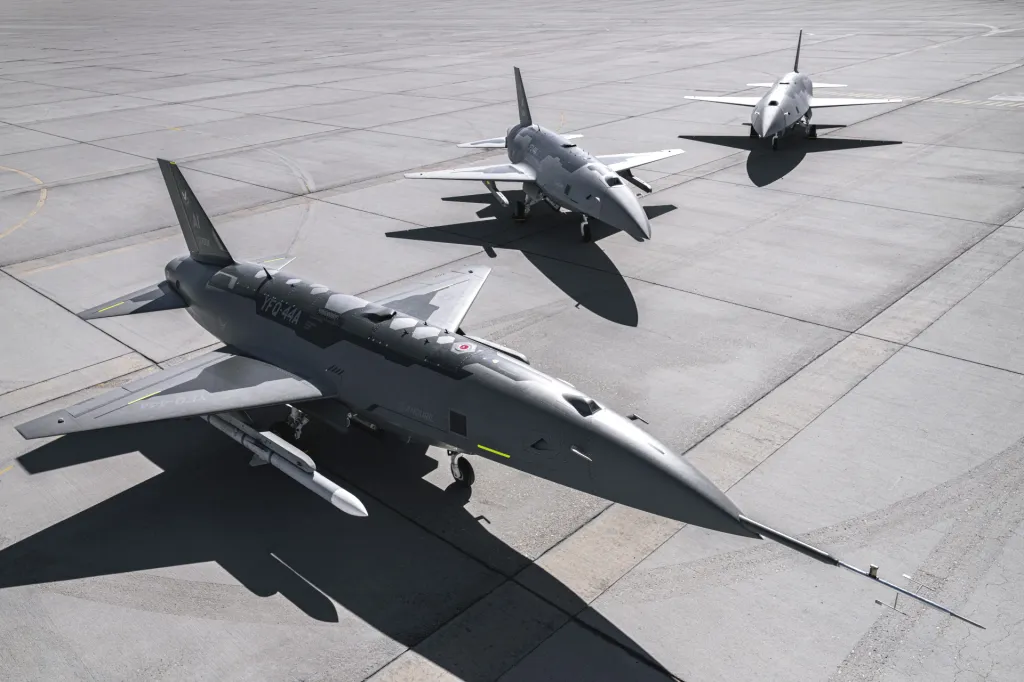
The Air Force down-selected the designs from General Atomics and Anduril to move ahead as part of the first incremental development cycle of its CCA program, or Increment 1, back in 2024. What were originally designated the YFQ-42A and YFQ-44A first flew in August and October 2025, respectively, and have been undergoing further testing since then. Dark Merlin testing was paused earlier this year after one of the drones crashed, but has resumed.
A trio of YFQ-44A drones. AndurilThree YFQ-42As in a row. GA-ASI
“By moving fast from competitive selection into full-scale manufacturing, we position ourselves to field highly credible and combat-ready semi-autonomous systems to stay ahead of the pacing challenge,” Secretary of the Air Force Troy Meink said in a statement today. “These contracts reaffirm our confidence in the strategic path forward for the program to procure over 150 combat capable CCA by the end of the decade.”
The Air Force says these contracts were awarded four months ahead of schedule, reflecting “that the FQ-42 and FQ-44 meet rigorous mission requirements and are ready for full-scale manufacturing.” At the time of writing, the service does not appear to have provided an update on the expected delivery timeline of the first production CCAs, but it has said in the past that it is hoping to have the first examples in operational service toward the end of the decade. Air Force has asked for nearly $1 billion in its 2027 Fiscal Year budget request to begin procurement of these drones.
“Under the contract, Anduril will deliver an initial set of production FQ-44 semi-autonomous fighter aircraft to support continued testing, validation, and, ultimately, operational fielding,” Mark Shushnar, Anduril’s Vice President for Autonomous Airpower, also wrote in a blog post today. “The contract also establishes a structure for the Air Force to buy additional lots of production FQ-44 aircraft across the next several years, providing a clear path for the Air Force to rapidly and affordably expand fighter capacity.”
A Fury drone carrying an inert AIM-120 air-to-air missile during a flight test. USAF
“This is an exciting day for our company and the nation,” David Alexander, President of General Atomics’ Aeronautical Systems, Inc. division (GA-ASI), said in his own statement. “Moving to production on FQ-42A is the result of an extraordinary partnership and many years of investments between General Atomics and the U.S. Air Force. We’ve been preparing for this order, and manufacturing is already well underway.”
A YFQ-42A in flight. General Atomics
A split-buy of Dark Merlin and Fury drones will help drive down risk. The designs are also very different, which opens the door to more operational possibilities for the Air Force right from the start. General Atomics and Anduril can also then focus on refining the respective strengths of their uncrewed aircraft. As noted, TWZ has pointed out on several occasions that a mixture of uncrewed platforms with different attributes would be needed to truly do justice to the CCA concept.
Furthermore, the Air Force making this decision still deep in the developmental phase also underscores how critical the service sees CCAs, and its desire to push ahead with getting at least an early iteration of the capability into service.
“Collaborative Combat Aircraft change how we project power and generate mass in highly contested environments,” Air Force Chief of Staff Gen. Ken Wilsbach said in a statement today. “Delivering this capability to our warfighters faster ensures our forces maintain the tactical edge required to deter and, if necessary, defeat any adversary.”
The Air Force has also further split the CCA effort into hardware and software segments, with airframe development falling into the former category.
“These distinct efforts validate acquisition transformation principles to secure a critical operational advantage: decoupling hardware from software,” according to an Air Force press release today. “By treating mission autonomy as ‘software sold separately,’ the Air Force ensures that the warfighter receives state-of-the-art physical platforms alongside agile, easily updatable software, effectively breaking traditional procurement molds.”
Anduril and General Atomics, as well as Lockheed Martin, Northrop Grumman, RTX Collins Aerospace, and Shield AI form the current vendor pool for the software side of the CCA program. The Air Force announced today that it had awarded additional mission autonomy contracts to Anduril, Collins, and Shield AI. Anduril is notably the only company currently with CCA contracts on the hardware and software sides.
Collaborative Mission Autonomy
“This targeted award, based on the vendors’ ability to meet aggressive schedule and affordability requirements, will fund the first of two six-month competitive phases designed to speed the fielding of operational software to the warfighter,” according to an Air Force release. “While the baseline contract establishes a continuous competitive arena, the competitive awards are designed to deliver capability faster. Following the initial six-month period, the Air Force will evaluate the vendors’ progress and execute a second competitive award period. This performance-based competition will culminate in the selection of a primary mission autonomy provider for CCA Increment 1, with award planned for selection by summer 2027.”
“Furthermore, this software contract leverages a first-of-its-kind award fee exposure strategy, which enables operator feedback and combat performance to determine what the Air Force pays for mission autonomy. The Air Force will only pay the entire licensing fee if a vendor provides a combat capability aligned with warfighter needs and feedback,” the release adds. “The licensing approach also allows the Air Force to award software licenses to any of the six vendors within the pool at any point over the next six years. This approach ensures the Air Force can procure the best-performing and most affordable solutions as technology evolves.”
More government ownership of key intellectual property, and software in particular, has become a central guiding principle for the U.S. military contracting, in general, in recent years. When it comes to autonomy software packages, there is also now a core government-owned Autonomy Government Reference Architecture (A-GRA) that goes beyond the Air Force’s CCA program.
“Today, Lattice for Mission Autonomy is fully A-GRA compliant, ensuring that it can be integrated not only with all Increment 1 CCA, but with the full spectrum of current and future A-GRA compliant aircraft,” Anduril’s Shushnar highlighted in his blog post. “Through the A-GRA, the CCA program has established the foundation that will drive the development of a larger ecosystem of autonomous aircraft.”
Lattice for Mission Autonomy: An Unfair Advantage for Unrivaled Deterrence
“Mission autonomy is the cornerstone of the CCA concept, and leveraging a competitive, multi-vendor environment ensures we capture the latest technology,” Secretary Meink also said today in another statement. “This approach guarantees our Airmen are equipped with state-of-the-art capabilities today but keeps the door open for the breakthroughs necessary to maintain air superiority.”
In general, greater government control over intellectual property rights also helps avoid the potential to be locked into a single vendor. Establishing vendor pools to compete for follow-on contracts also creates opportunities to lower costs and to diversify supply chains, especially when it comes to hardware. That diversification, in turn, can be beneficial when it comes time to scale up production of both key subcomponents and complete systems.
The U.S. Marine Corps and the U.S. Navy are also pursuing their own CCA fleets in very close coordination with the Air Force. The Air Force is very much in the lead in fielding drones in this category, which could factor into future Marine and Navy decisions. The Marines are currently planning for their first tranche of MQ-58 Valkyrie CCA drones from Kratos to arrive in 2029. The Navy’s program is still very much in its infancy.
The Air Force’s CCA program has now taken another major step forward toward an initial fleet of drones that will include both General Atomics Dark Merlin and Anduril’s Fury.
TV presenter Ashley Cain has been accused of using sexual and misogynistic language to describe women in a series of historical social media posts and now the BBC has spoken out on the matter
TV presenter Ashley Cain has been accused of using sexual and misogynistic language to describe women in old social media posts(Image: Ken McKay/ITV/REX/Shutterstock)
The BBC says it is taking accusations that presenter Ashley Cain used explicit sexual and misogynistic language to describe women online in historical social media posts “very seriously”.
The broadcaster is thought to be unaware of the remarks prior to an investigation led by The Guardian which claimed the TV personality frequently referred to women on X, formerly Twitter, using abusive terms and sexualised language, including “sl*gs”, “sl*ts” and “psychos”.
A BBC spokesperson said: “We are very clear we expect the highest standards of behaviour from everyone who works with or for the BBC. “When allegations are brought to our attention we take them seriously. We will consider this information carefully and do not intend to comment further at this stage.”
The former Coventry City football player, 35, is best known for fronting the BBC Three documentary series Ashley Cain: Into The Danger Zone where he explores issues affecting young men born into a life of criminality.
The newspaper reported on Wednesday that before Cain worked for the national broadcaster he was a prolific user of social media. In 2014, in response to a since-deleted tweet he perceived to be homophobic, Cain is accused of telling a woman online that she should “go and choke on a c*** you sl**”.
Cain’s X account appears to have been removed from the platform. The broadcaster is understood to have asked the independent production companies that hired Cain to review the social media checks conducted at the time.
Cain appeared last year on the BBC’s spin off cooking programme, Celebrity MasterChef. Transmission details of Into The Danger Zone series two are yet to be announced.
The star also gained respect from the public following the tragic death of his daughter Azaylia, Ashley and his then-partner, Azaylia’s mum Safiyya Vorajee, documented their extraordinary efforts to try and save her life – including raising £1.5 million to fly her to Singapore for specialist treatment.
But sadly, the child died on April 25, 2021. Ashley and his former partner went on to form The Azaylia Foundation, which supports families dealing with childhood cancer.
Five years on from the devastating day of the youngster’s funeral, dad Ashley shared an Instagram post. Alongside solemn images from the funeral, Ashley wrote: “Today I cried for the first time in a long time. As soon as I turned into the cemetery and saw her resting place, I couldn’t control the emotions that had obviously built up inside me.
“The truth is, I cannot believe it has been 5 years since we laid her to rest, and I still can’t seem to accept it. “But my time spent with her today was peaceful, it was beautiful, and it was one of those moments where time stood still… where I could reminisce about all that she was, and every moment I was privileged and blessed enough to spend with her.”
He went on: “May you continue to rest in eternal paradise my princess, and until we meet again… I will love you with the entirety of my heart, forever and always.”
The Mirror has contacted Ashley’s representatives for comment.
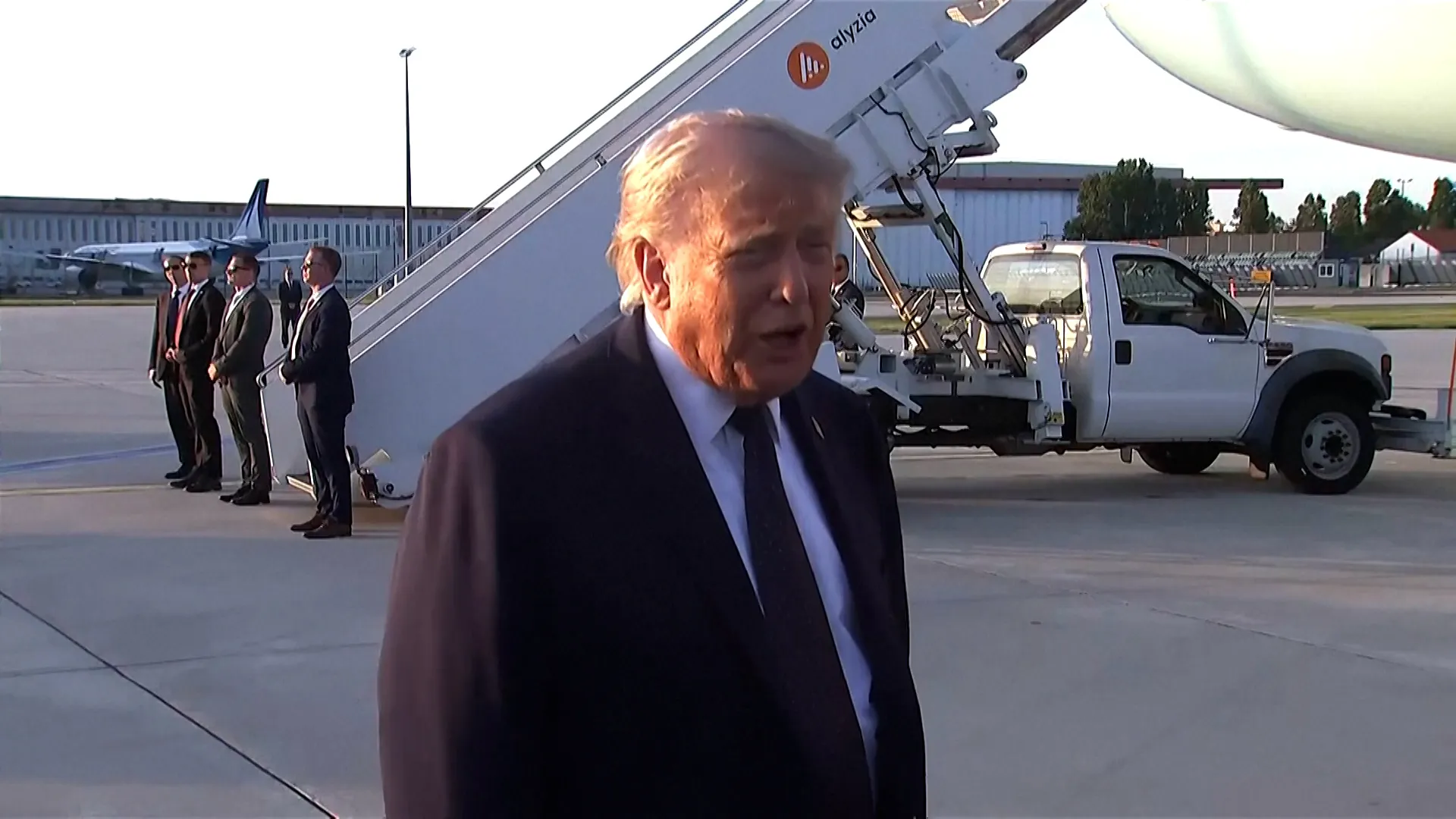
President Donald Trump says it’s ‘unfair’ for Iran to lack ballistic missiles if other regional countries have them. Trump is at the G7 in France where the US-Iran deal has taken centre stage.
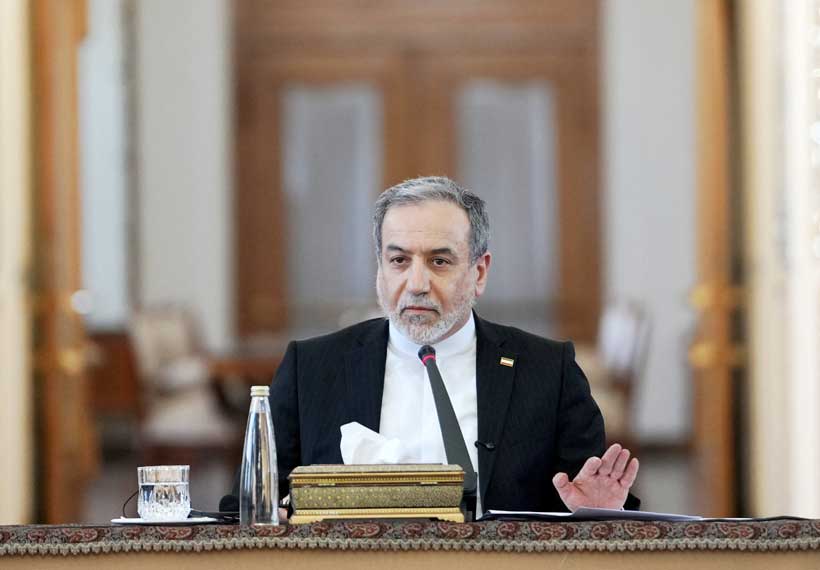
Iran’s Ministry of Foreign Affairs spokesperson, Esmaeil Baghaei, has announced that a memorandum of understanding with the United States has been finalised and signed electronically by both sides.
He added that the agreement has already gone into effect.
Recommended Stories
list of 3 itemsend of list
“The text of the Islamabad Memorandum of Understanding was finalised with the signatures of the presidents,” Baghaei told the news agency IRNA. “Now it is time to test the implementation of the agreement.”
Wednesday’s statement appears to confirm that the US and Iran have agreed to suspend military operations, paving the way for further negotiations.
Given that both sides signed the agreement electronically, Baghaei noted that there would be no signing ceremony on Friday in Geneva, Switzerland, as had previously been expected.
Negotiating teams, however, still plan to be in the Swiss city. A decision on a possible in-person meeting between them is expected in the coming hours, though for now such plans are paused, according to Baghaei.
While the office of US President Donald Trump has yet to issue a formal statement on the signing, Al Jazeera correspondent Mike Hanna explained that a White House spokesperson confirmed earlier in the day that it happened.
But Hanna warned that the memorandum is likely to face domestic backlash in the US, where Trump had been under right-wing pressure to take a hard line against Iran.
“There’s a great deal of dissatisfaction with the memorandum of understanding, as it has been outlined to the public at this particular point, even among some Republicans who have expressed the concern that Iran is being treated leniently,” Hanna said.
He also emphasised the administration’s position that the memorandum is not a full-fledged deal but rather a prelude to more negotiations.
“The administration is fighting hard to persuade the American public and American politicians that this is not a defeat for the United States,” Hanna said.
Since February 28, the US and Israel have been jointly engaged in a war against Iran, though a temporary ceasefire suspended much of the most intense fighting on April 8.
Trump has repeatedly said his goal in launching the war was to prevent Iran from acquiring a nuclear weapon.
Since the memorandum was revealed, he has highlighted the document’s assurances that Iran will not seek a nuclear weapon, though Tehran has long denied any intention of doing so.
But according to a US account, the memo goes beyond the question of nuclear weapons. It sets up a 60-day timeline for a final deal to be struck, and it indicates that the US will rally “regional partners” to create a $300bn for Iran’s reconstruction.
US sanctions would also work towards lifting its sanctions against Iran, and the country would issue waivers for the export of Iranian fuel.
Iran has touted those terms as a victory. On Wednesday, chief negotiator Mohammad Bagher Ghalibaf told Fars, an Iranian state news agency, that the US had failed to achieve its goals with Iran and pointed to the memo as proof.
“The agreement is a record of US failure,” Ghalibaf said. “People will see it and judge.”
He also explained that the Strait of Hormuz would not return to “pre-war conditions” after the 60-day period for negotiations stipulated in the agreement. He suggested that Iran will expect payments for use of the waterway.
“I emphasise again that the Strait of Hormuz will never return to the previous conditions,” Ghalibaf said.
“Iran has the right to sovereignty over the Strait of Hormuz, and of course, we will receive a fee for services.”
That position is likely to put pressure on the Trump administration, which had pledged that the strait, a key waterway for trade, would be “permanently toll-free”.
Since the start of the war, Iran has blocked the waterway, sending global prices for fuel, fertiliser and other goods soaring.
The US had responded with its own blockade of Iranian ports, though that effort is slated to end under the memorandum.
Both sides, however, have emphasised that the memorandum of understanding is not a final agreement on all issues of dispute. More negotiations are expected to resolve lasting impasses.
“It will only become a deal, as such, at the end of the 60-day negotiation period. At least, that’s the intention,” Hanna reported.
THE daughter of a legendary Hollywood director and her husband have been mysteriously found dead inside a running car parked on a highway.
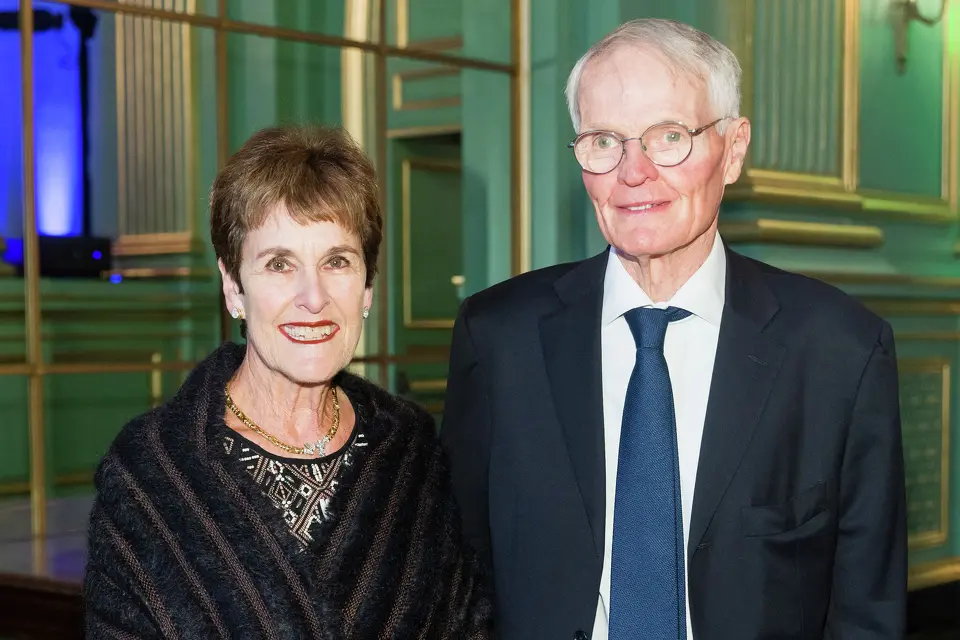
Judith “Judy” Wyler Sheldon, 84, and her husband Wylie Sheldon, 86, were discovered unresponsive in a Jeep Compass on Interstate 5 near Redding, California.
Sign up for the Showbiz newsletter
Thank you!
Judith ‘Judy’ Wyler Sheldon, pictured here in her youth, was found dead inside a running carJudy with Wylie Sheldon, 86, in 2019Credit: Jana Asenbrennerova for Drew Altizer Photography
A California Highway Patrol officer made the grim discovery on the shoulder of the northbound carriageway, just north of Fawndale Road, at approximately 5.46pm on Monday.
Judy, a prominent San Francisco arts patron, is the daughter of famous filmmaker William Wyler.
She was found behind the wheel, while her husband was in the passenger seat.
Despite emergency medical personnel attempting life-saving measures, both were declared dead at the scene.
The circumstances surrounding the tragedy remain unclear, and investigators are working to determine what happened inside the vehicle.
The California Highway Patrol’s Northern Division Investigative Services Unit has taken over the case.
While authorities have not publicly disclosed any indication of foul play or a medical emergency, the deaths occurred during a period of extreme heat.
The National Weather Service had issued a warning for the Redding area, where temperatures soared to 109 degrees Fahrenheit (43C) on the day the couple were found, though investigators have not confirmed if the weather played a role.
Most read in Entertainment
The couple were found dead on Interstate 5 near Redding, California (stock)Credit: GoogleJudy is the daughter of famous Hollywood director William WylerCredit: Getty
The news has stunned California’s arts and film communities, where Judy spent decades championing silent-film preservation.
She was the long-time chair and former president of the San Francisco Silent Film Festival.
Anita Monga, the festival’s artistic director, said the community was “reeling” from the devastating loss.
“Judy and Wylie were very dear to us, supportive and a positive presence at all our events,” she said, recalling how the couple regularly opened their home to visiting film archivists and musicians.
“Judy would allow, actually encourage, our visiting guests to pose for pictures with her father William Wyler’s Oscars.
The perfect hosts.”
Born Judith Wyler in Los Angeles, she briefly appeared on screen during the 1950s with credits in The Errol Flynn Theatre, The Buccaneers, and BBC Sunday-Night Theatre.
However, her lasting legacy was behind the scenes.
Judy’s passion for film preservation intensified after attending a 2007 retrospective of her father’s silent-era films in Pordenone, Italy.
Her cultural influence also extended to other institutions, including serving as a gala co-chair for San Francisco Performances.
The tragedy carries a deep resonance due to Judy’s family’s monumental place in cinema history.
Her father, William Wyler, remains one of the most acclaimed directors in American film, directing classics such as Roman Holiday, Ben-Hur, The Best Years of Our Lives, Mrs. Miniver, and Wuthering Heights.
William won three Academy Awards for Best Director, a feat achieved by only a handful of filmmakers.
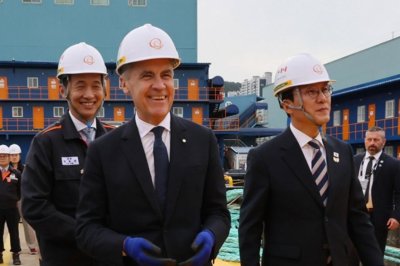
Canadian Prime Minister Mark Carney (C), accompanied by South Korean Prime Minister Kim Min-seok (R) and Hanwha Group Vice Chairman Kim Dong-kwan during their visit to Hanwha Ocean Co.’s shipyard on Geoje Island in South Gyeongsang Province, southeastern South Korea. Photo by YONHAP / EPA
June 17 (Asia Today) — Canada is expected to select a preferred bidder within 30 days for a major submarine procurement program, narrowing the competition to South Korea’s Hanwha Ocean and Germany’s Thyssenkrupp Marine Systems.
The Canadian Patrol Submarine Project calls for the acquisition of up to 12 conventionally powered submarines to replace the Royal Canadian Navy’s four aging Victoria-class vessels.
The acquisition, infrastructure and long-term maintenance program has been estimated by South Korean industry officials at at least 60 trillion won, or about $39.7 billion. Some estimates place its potential value over several decades as high as 120 trillion won, or about $79.4 billion.
Stephen Fuhr, Canada’s secretary of state for defence procurement, said Ottawa expected to choose a preferred bidder within 30 days, according to Politico.
The selection would grant one bidder the right to enter detailed negotiations with the Canadian government, although it would not constitute a final contract award.
Canada previously identified Hanwha Ocean and Germany’s Thyssenkrupp Marine Systems as the two qualified suppliers for the program.
The contest has entered its final stage as South Korea promotes a package combining submarine construction, government-backed financing and broader industrial cooperation.
Canadian procurement chief visits South Korea
Fuhr visited Hanwha Ocean’s shipyard in Geoje, about 205 miles southeast of Seoul, on Feb. 2 with Canadian government and business representatives.
He toured the shipyard’s assembly facilities and automated production equipment and boarded the ROKS Jang Yeong-sil, the first 3,000-ton submarine in South Korea’s Dosan Ahn Changho Batch-II class, while it was undergoing sea trials.
Fuhr was accompanied by Hanwha Ocean Chief Executive Kim Hee-cheul and senior South Korean officials.
He later visited the South Korean Navy’s Submarine Force Command in Jinhae to examine its training, logistics and maintenance systems.
Hanwha Ocean said the visit allowed the Canadian delegation to assess South Korea’s submarine manufacturing capacity and its ability to provide long-term maintenance and operational support.
Canada seeks submarines for three oceans
Canada wants its future fleet to operate across the Atlantic, Pacific and Arctic oceans while maintaining interoperability with the United States and other allies.
Its requirements include long range, extended endurance, under-ice capability and reliable maintenance support.
Hanwha Ocean is offering a version of South Korea’s Dosan Ahn Changho-class submarine, also known as the KSS-III.
The company has emphasized that the platform is already in production and can be delivered more quickly than a newly developed design. It has also proposed cooperation with Canadian universities, shipyards and defense companies.
Thyssenkrupp Marine Systems is offering the Type 212CD submarine, a new design being developed for Germany and Norway.
The German bidder has highlighted its long-standing relationships within NATO, European defense supply chains and proposed investment in Canadian industry.
Germany and Norway have also reportedly examined changes to their own production schedules to make earlier delivery slots available to Canada.
Industrial benefits could determine outcome
Canada has made domestic jobs, industrial investment and long-term economic benefits central elements of the procurement.
The government has said work associated with the submarines should strengthen Canada’s marine and defense industries throughout the fleet’s operational life.
South Korea has therefore sought to expand its proposal beyond the construction of submarines.
Canadian officials have discussed potential South Korean investment in Canada’s automotive and transportation industries, according to people familiar with the negotiations.
South Korean companies have responded by exploring a hydrogen-powered commercial vehicle and fueling network rather than committing immediately to a conventional automobile assembly plant.
Hyundai Translead, Hyundai Motor Group’s North American trailer manufacturing subsidiary, has signed a dealership agreement with Canadian commercial vehicle dealer Breadner Trailers for Hyundai’s XCIENT hydrogen fuel-cell trucks.
The trucks have accumulated more than 1 million miles, or 1.6 million kilometers, of commercial driving in North America, according to Hyundai.
Glenn Copeland, president of Hanwha Ocean’s Canadian subsidiary, previously said Hyundai Motor Group had presented an initial proposal to Canadian officials for a hydrogen freight transportation corridor.
The plan could support Canada’s transportation decarbonization policies while adding a civilian industrial component to South Korea’s submarine offer.
Seoul prepares financial support
The South Korean government and state financial institutions are also preparing export financing to support the bid.
The Korea Trade Insurance Corp. and the Export-Import Bank of Korea have expanded financing programs for major overseas projects in defense, nuclear power and other strategic industries.
South Korean officials have said as much as 100 trillion won, or about $66.1 billion, from a broader export financing initiative could be made available for defense and nuclear energy projects. The amount does not represent financing committed exclusively to the Canadian submarine program.
Hanwha Ocean has also sought to demonstrate the strength of its domestic supply chain.
At the World Defense Show in Riyadh in February, the shipbuilder signed cooperation agreements with 11 South Korean defense and submarine equipment companies, including LIG Nex1, Hanwha Aerospace, Kolon Spaceworks, KTE and Firstec.
Hanwha Ocean says more than 80% of the components used in its proposed submarine can be supplied domestically.
A South Korean defense industry official said the final decision would depend not only on submarine performance but also on financing, delivery schedules, maintenance support and benefits for Canadian industry.
“Canada’s submarine project is more than a weapons sale,” the official said. “The remaining competition will be decided by which bidder can offer the most credible combination of capability, delivery and long-term industrial cooperation.”
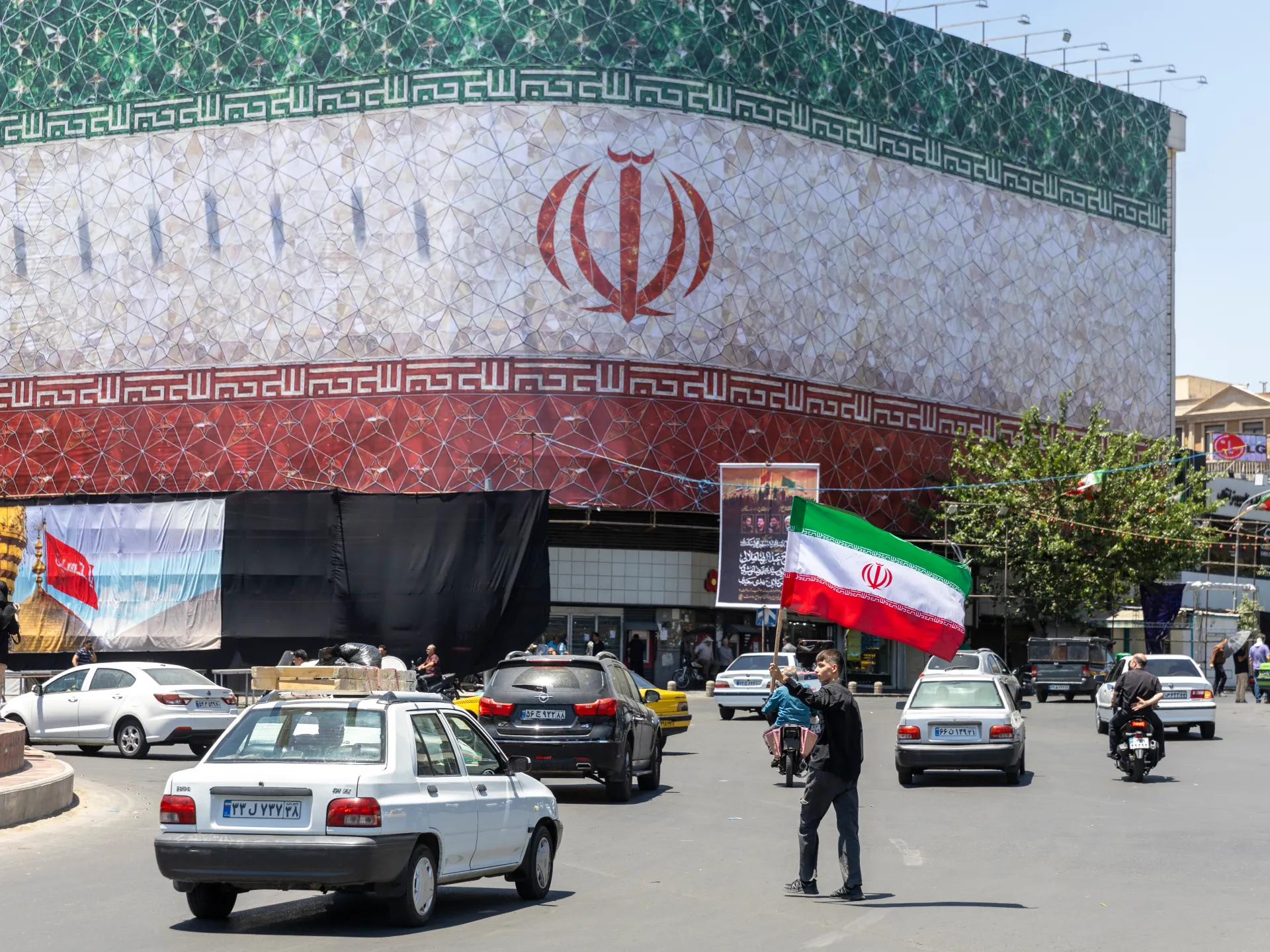
Iran’s government has portrayed the interim agreement with the United States as a victory that ended months of conflict and prevented further escalation. The deal halted a war that saw U.S. and Israeli airstrikes, disruptions to trade, and severe economic damage across Iran.
However, interviews with ordinary Iranians reveal a starkly different picture. Many citizens say years of sanctions, combined with the recent conflict, have left them struggling with rising prices, declining living standards, and deep uncertainty about the future. While the fighting may have stopped for now, many remain unconvinced that the agreement will bring meaningful economic relief or lasting stability.
Economic Hardship Continues to Dominate Daily Life
For many Iranians, the ceasefire has not changed the reality of daily economic struggles.
Business owners, students, and workers interviewed across the country described a population focused on survival rather than recovery. Many reported cutting household spending, reducing social activities, and adjusting to higher living costs. Small businesses continue to face weak consumer demand, while young people increasingly worry about their economic prospects.
The war added another layer of pressure to an economy already weakened by years of international sanctions, inflation, and limited foreign investment. As a result, many citizens see little immediate prospect of improvement even if the ceasefire holds.
Divided Views on the Outcome of the Conflict
The agreement has exposed a clear divide between the government’s narrative and public sentiment.
Supporters of the Islamic Republic view the deal as proof that Iran resisted external pressure and preserved its political system. Some hardliners argue that the country emerged stronger and demonstrated resilience despite military and economic pressure.
Many ordinary citizens, however, are less focused on geopolitical outcomes and more concerned about living standards. For them, the key measure of success is whether the agreement leads to lower prices, economic opportunities, and greater stability. So far, few appear convinced that such changes are imminent.
Concerns Grow Over Political Freedoms
Beyond economic concerns, many Iranians fear that the post war environment could lead to tighter political controls.
Some citizens believe the government may use the conflict and national security concerns to justify stronger oversight and restrictions. These fears are particularly pronounced in regions populated by ethnic minorities, where previous protests have often been met with heavy security responses.
There is also uncertainty about whether public frustration over economic conditions could trigger future demonstrations. While many people remain cautious after previous crackdowns, underlying grievances over jobs, inflation, and political freedoms remain unresolved.
The ceasefire may have reduced the immediate threat of war, but it has done little to address the deeper challenges facing Iran. Public opinion appears increasingly shaped by economic realities rather than political declarations of victory.
The government may benefit in the short term from ending the conflict and avoiding further military escalation. However, lasting stability will depend on whether authorities can deliver tangible economic improvements and restore public confidence.
The biggest challenge for Tehran is that expectations remain extremely low. Many Iranians do not see the ceasefire as a turning point but rather as a temporary pause in a broader cycle of economic hardship and political uncertainty. If future negotiations fail to produce sanctions relief, investment, and economic recovery, public frustration could continue to grow despite the end of active conflict.
Stakeholders
Iranian government and political leadership
Iranian citizens and businesses
United States
Israel
Ethnic minority communities in Iran
International investors and energy markets
Regional governments monitoring stability in the Middle East
What’s Next
Attention will now shift to negotiations aimed at turning the interim agreement into a permanent settlement. Iranian leaders will seek economic benefits and sanctions relief, while Washington is expected to push for further commitments on security and nuclear issues.
Domestically, the government faces the challenge of managing economic expectations and maintaining stability. Whether the ceasefire translates into meaningful improvements for ordinary Iranians may ultimately determine how the agreement is judged inside the country.
In this week’s episode of “The De Los Podcast,” hosts Fidel Martinez and Suzy Exposito sat down with actor Xolo Maridueña to chat about his East L.A. upbringing, the importance of Latino representation in his career and a litany of projects he has in the works.
Born and raised in El Sereno, Maridueña was exposed to the arts at a very young age through local community arts hubs Casa 0101 and the Boyle Heights Art Conservatory, where his mother, Carmelita Ramírez-Sánchez, now serves as executive director.
The 25-year-old actor credited his mom, who also previously worked as a radio DJ for decades in L.A., for encouraging him to explore a creative career.
“She was in the music world at a time when that wasn’t really a thing as a Latina woman,” Maridueña said. “She met so many roadblocks and overcame those that when it came time to for her to eventually raise her own family, she understood the want to try something that was outside of what the education system would deem successful. As a Latina, she also instilled these values of remaining curious, questioning certain traditions and the ways our experiences are affected by some systems that are larger than ourselves.”
He also touched on what it was like being the first Latino lead in a live-action superhero film in “Blue Beetle” — and the importance of continued Latino representation in Hollywood.
Xolo Maridueña is featured on “The De Los Podcast.”
(L.A. Times Studios)
“It was such a wild ride doing something like ‘Blue Beetle,’ that was the first in a lot of categories… But once the movie came out, it was so heartwarming to see that there were already like 10 other Latino superheroes that were making their debuts on the screen,” Maridueña said. “[Filming the movie] was the first time I had witnessed some much of the crew being Latino, or just being diverse — there were a lot of women and queer folks on that set.”
Having worked on hit series like “Parenthood” and the Netflix phenomenon “Cobra Kai” in addition to his theatrical roles, Maridueña wants to help provide an avenue for fellow Latino artists to succeed.
“I just hope [that] with this body of work, I can help open the door and prop it open for everyone else,” he said.
The conversation with Maridueña wrapped with him discussing the litany of projects he has coming out in the near future, including a leading role in the film “Dog Years” alongside Xochitl Gomez, a part in the Al Pacino-led movie “Killing Castro” and a spot in the upcoming season of Netflix’s live-action adaptation of “One Piece.”
He will also feature alongside Sandra Bullock and Nicole Kidman in the upcoming sequel to the witchy 1998 film “Practical Magic,” which is set for release Sept. 11.
“It’s been a blessing to expand not only the types of people I’ve gotten to work with, but [also] the genres and types of characters I’ve gotten to bring on to the screen,” said Maridueña. “Projects like ‘One Piece’ are so wonderful for the reach and then movies like ‘Dog Years’ and ‘Killing Castro’ are just as fulfilling in the sense that because they get to be smaller productions, the cast and crew have a bit more ownership of what they’re doing.”
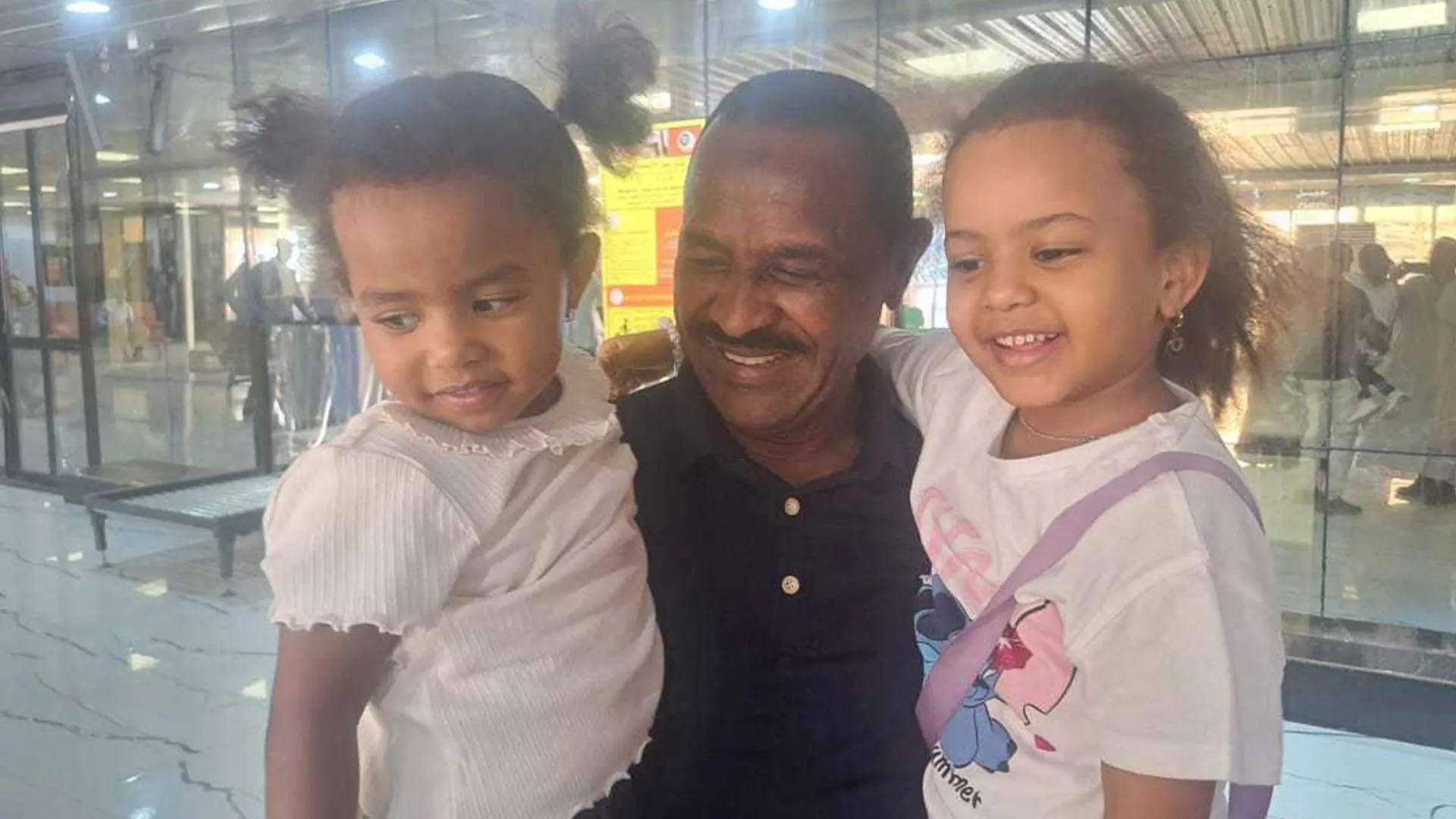
Al Jazeera journalist Al-Tahir al-Mardi has been reunited with his family in Khartoum after three years of separation and forced displacement caused by Sudan’s war.
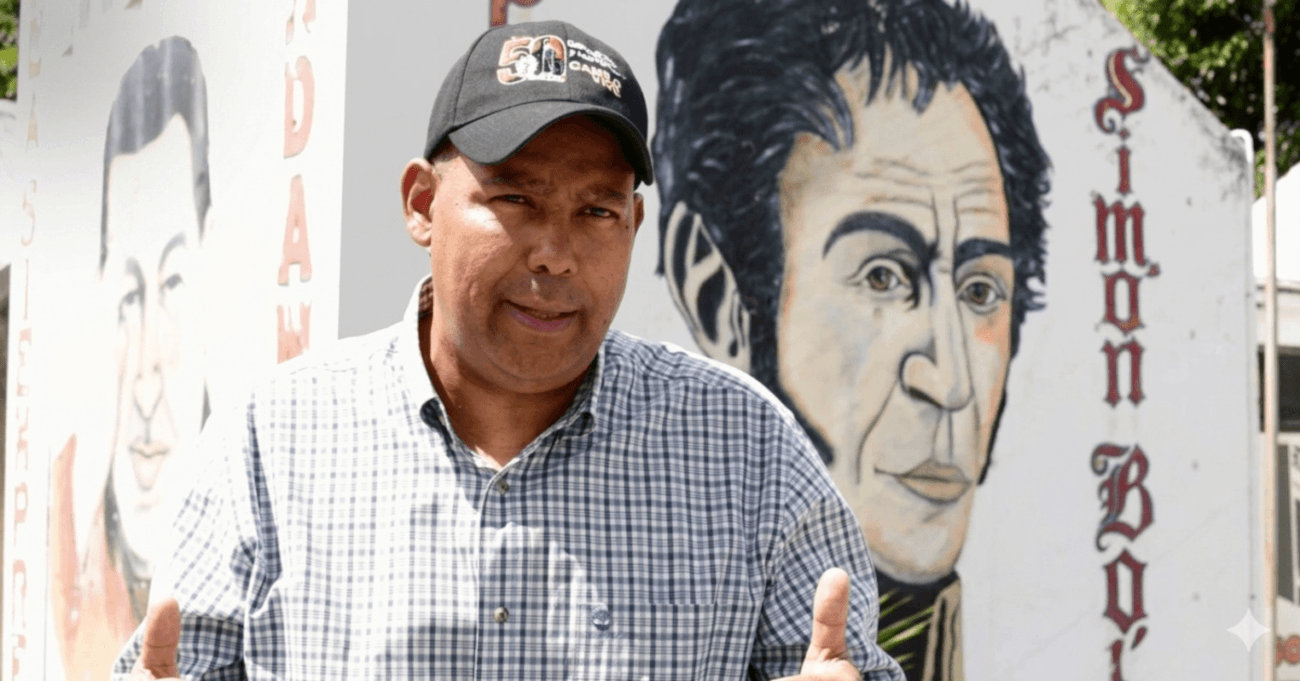
Contreras called for a unified Latin American response against ramped-up US aggression. (Tiempo)
Following the US attack on January 3, Venezuela was left in a state of turmoil and uncertainty that does not rule out further military actions. In recent days, there was “a joint operation between Venezuelan and US security agencies in the southeast of Bolívar state, in which organized crime networks were dismantled,” according to a statement from the Venezuelan government. Days earlier, the Coordinadora Simón Bolívar, a historic Chavista organization, had denounced DEA involvement in planning a repressive offensive with the aim of “decapitating” the popular movement in the iconic 23 de Enero neighborhood, which Juan Contreras describes as “the most important in Caracas.”
A community leader, social work graduate, and president of the Coordinadora, Contreras is a longtime Chavista activist and staunch defender of the Bolivarian Revolution. Today he believes there are “shameful situations that must be denounced,” but he holds the US government – ”our enemy” – responsible. Contreras was born and raised in the densely populated and combative 23 de Enero neighborhood, where he still lives and where he welcomed us to analyze the complex situation facing Venezuela, and in particular the social movements.
How are Venezuelan social organizations responding to what has been happening in the country since the US military attack on January 3?
What happened was an act of aggression, an act of war. They [the US] sought and continue to seek to break our people, but we in the social movements have kept up our efforts because we still believe in the revolutionary process. Our enemy is the US government, which must have realized that the problem wasn’t Chávez, because Chávez died and the revolution continued. President Maduro has been kidnapped, and here we are. What we’re experiencing today is unique in history; I don’t think anything like what’s happening in Venezuela has ever happened anywhere else in the world – the closest thing was in 1989 in Panama, when they kidnapped Noriega. But here, their narrative has fallen apart: it has not been proven that Venezuela is a drug trafficking country, that its government is linked to drug trafficking, or that President Nicolás Maduro was one of the biggest drug lords, as they claimed. On the contrary, today all those narratives have been debunked, and what is clear is that they are coming after our energy reserves. The Venezuelan people are well aware of this.
Is identifying a state of war and an enemy the context for the denunciation you issued about the danger of a DEA-orchestrated attack on 23 de Enero?
This is information we’ve received from a reliable source indicating that a large-scale operation is being planned against 23 de Enero, which is not far-fetched. 23 de Enero, as a barrio, has historical significance dating back to the Fourth Republic, between 1958 after the fall of Pérez Jiménez and the advent of democracy. That threat is very real. I believe that at the time, there was an underestimation of the threats posed by the US empire: the fact that our coasts were blockaded, the fact that our airspace was blockaded… Now, what we’re denouncing here has all the hallmarks of becoming a reality. It’s not just me saying this, nor the source that gave us this information, which is a reliable one. It’s that all the propaganda out there points in that direction, starting with the journalists who now live in Miami and are waging a full-scale campaign against the colectivos. “What’s going on with the colectivos? Why aren’t they attacking the colectivos? Why don’t they disarm the colectivos?” Marco Rubio himself has said it, and just recently one of the top military leaders said it: they’re coming for the “armed groups.” The problem is that, in their narrative, they label social movements as armed groups, accusing them of being armed in order to justify their aggression. Well, today our people are armed with consciousness; today, after 27 years, our people are more Bolivarian than ever. These are the people who placed their trust in Comandante Chávez, who committed to refounding the Bolivarian Republic of Venezuela. That is why we can understand all this cognitive warfare being waged against Venezuela.
There are no guerrillas here; what we have here is a people with a consciousness, a mobilized people, a people who, through culture, through popular education, have managed to advance in building the Bolivarian embryo from the barrio level, with the communal councils and the communes. So, the US seeks to dismantle that organization by employing the tactic of decapitation. They want to destroy the collectives, those who raise their voices against the empire, those who today denounce what is happening in our country, those of us who disagree with what is happening today, and who have maintained a principled and firm stance in the face of that aggression and invasion by the US empire.
Based on the information you have, how would the DEA carry out an attack of that kind on Venezuelan territory?
They have been operating by applying pressure. In all our countries, we have a repressive police force. Perhaps there is a segment of the police ranks – among their core leadership – that understands human rights issues, but there are other segments that are easily co-opted. We have 27 years of experience in which generals, colonels, and captains have turned their backs on us and served the empire’s policies. So, it’s not far-fetched to say that the United States is working with certain police forces, or with specific officials who might be willing to carry out an operation against the most important symbol in Caracas, which is the 23 de Enero parish. From 1958 to 1998, approximately 160 martyrs were killed there by the police. In other words, this is not crazy: it is serious, and as the pressure on our government to move toward an electoral process intensifies, the plan of aggression may also accelerate.
So, of course, it’s entirely possible that they’ll move forward with an action like this to eliminate what they consider “the Bolivarian resistance,” represented by social movements organized into communes, communal councils, and long-standing social organizations such as the Coordinadora Simón Bolívar, which is an expression of the popular power.
Did you receive any show of solidarity from the government?
Someone with influence within the government called us, reached out, we talked, and they agreed to investigate and look into the matter. What they recommended was caution: to steer clear of any provocation. And well, we’re waiting to see if what was discussed will be carried out, that a thorough investigation is conducted into what we’re denouncing. Because up until now, we thought [the US] would never invade, but they did; we underestimated them, and they invaded. And today they have the audacity to sell our oil, manage our finances, provoke us, and say they’re going to turn us into their 51st state. And on top of that, they’ve placed us under tutelage as if they were the owners of our country. This is, of course, shameful, and we must denounce it.
That is why we, as part of the popular movement, remain mobilized and continue to denounce what happened on January 3 and the consequences we are enduring in Bolívar’s homeland.
This situation has not yet had any international repercussions. What message do you have for the social and political forces in Latin America?
It has been 200 years since the Amphictyonic Congress, that call made by the Liberator to build a confederation of nations and defend ourselves against the US empire, which was already showing its claws. What better time to call for a continentalization of the struggle of our social organizations? It is not just Venezuela that is at risk: it is all of Latin America. They are coming for their backyard. Today, brazenly and in an interventionist manner, they are meddling in Colombia’s elections and declaring which candidate they want to win. They did the same in Honduras.
So, in light of these events, the call to expand the struggle across the continent must be a reality today. Latin America’s only chance to escape the aggression of Donald Trump’s administration is through the coordination of the popular and revolutionary movement across the region. We must unite, we must denounce this situation, and we must move forward, because they’re coming for everything. The only way forward is to make the struggle a continental one. This is something that, at one point, was not only stated by Bolívar but also attempted by Comandante Ernesto Guevara. I believe that is where we should focus our efforts: on uniting the popular and revolutionary forces of Latin America and the Caribbean.
Walter Parazaider, the saxophonist and co-founder of the rock group Chicago, has died. He was 81.
Parazaider died June 17 of complications from Alzheimers disease. In a statement posted to social media on Wednesday, the band said that “Chicago is heartbroken at the sad news of Walter Parazaider’s passing this morning. We extend our deepest condolences to his family, friends and countless Chicago fans who are all grieving his loss today.”
His daughter, Felicia Helen Parazaider, also posted on Facebook that “I love you poppy, my Pal…You coloured our world.”
Born in Maywood, Ill., Parazaider began his music career as a clarinetist, before founding Chicago with childhood friends in the group’s namesake city. The band’s pop hits like “25 or 6 to 4” and “Saturday in the Park” were staples of the ‘70s and remain beloved fixtures of classic rock. His diverse woodwind skills helped give the band its regal sound, adding saxophone riffs to hits like “Just You ‘n’ Me” and a poignant flute solo on “Colour My World.”
While Chicago’s lineup changed often, Parazaider remained with the group until retiring in 2018. In April of 2021, Parazaider wrote in a statement on Chicago’s website that “I was diagnosed with Alzheimers disease. Needless to say, my wife, daughters and myself were shocked and devastated. It has taken awhile to process this news and the fact is, we still are. The good news is we have a wonderful medical facility here and I have a very good doctor. I am working hard and not going to give up.”
Chicago gave credit to Parazaider for conceiving of the band’s distinct instrumentation, and the work ethic that made them stars. “A Rock & Roll band with horns was Walt’s idea,” Chicago’s statement continued. “He put the band together and they rehearsed in the basement of his mother’s home. He is also the one who did the hard work to book shows for the young, unknown band, performing top 40 covers at local bars in and around Chicago.
“We are forever grateful for his contribution,” they continued. “Perhaps his greatest gift was bringing people together. This amazing music may have never been heard had it not been for Walt’s vision.”
Parazaider is survived by wife JacLynn and daughters Laura and Felicia.
Brazilian President Luiz Inacio Lula da Silva has warned that the United States should not interfere in his country’s upcoming presidential race, which is being held in October.
Wednesday’s remarks came after both Lula and his US counterpart, Donald Trump, attended the Group of 7 (G7) conference in Evian-les-Bains, France.
Recommended Stories
list of 3 itemsend of list
During a news conference, Lula said Trump was entitled to continue his relationship with the Bolsonaro family, whose patriarch, Jair Bolsonaro, led Brazil as president from 2019 to 2023.
“As far as I’m concerned, he can continue liking Bolsonaro, the father, the son, the grandson,” Lula said. “There is no problem with that. It’s his problem. There’s no accounting for taste.”
But Lula then proceeded to establish a firm red line: no interference in Brazil’s elections.
“Now, don’t meddle in the Brazilian elections, because the Brazilian elections are a Brazilian problem, just as American elections are their business, not mine,” Lula continued.
“All I want is the same respect for Brazil that I have for the United States. That’s it.”
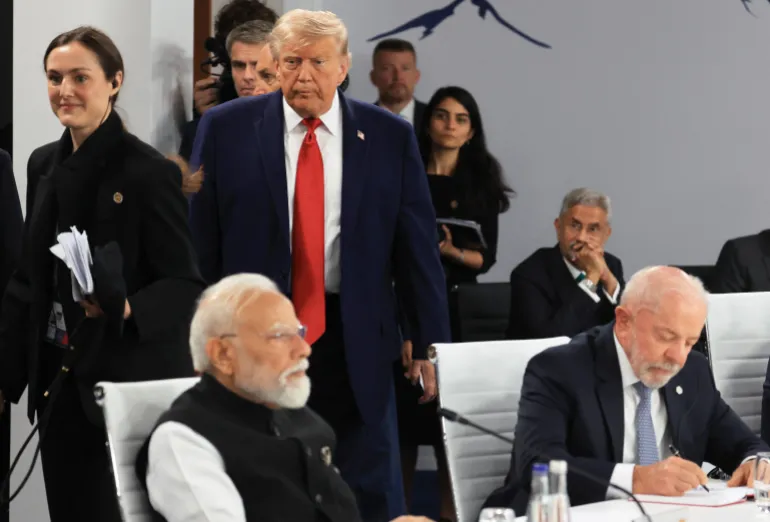
US President Donald Trump arrives on June 17 to a G7 meeting where India’s Prime Minister Narendra Modi, left, and Brazil’s President Luiz Inacio Lula da Silva, right, are already seated [AFP]
A race between Lula and Bolsonaro
Lula is currently a leading contender ahead of October’s race. If the left-wing incumbent wins, it will be his fourth term as president of Brazil. He previously served from 2003 to 2011, before being re-elected to a non-consecutive third term in 2022.
But Lula’s top election rival is a member of the Bolsonaro family: Senator Flavio Bolsonaro, Jair’s eldest son. Flavio is running as the candidate for Brazil’s far-right Liberal Party.
Since returning to office for a second term, Trump has been accused of seeking to sway Latin American elections in favour of right-wing candidates.
But in Brazil, questions have swirled as to whether Trump’s actions have already amounted to illegal intervention in the country’s judicial system.
Trump has made little secret of his support for the Bolsonaro family. Last year, after Jair Bolsonaro was charged with seeking to overturn his electoral defeat in 2022, Trump issued a public letter calling the trial a “witch hunt”.
“The way that Brazil has treated former President Bolsonaro, a Highly Respected Leader throughout the World during his Term, including by the United States, is an international disgrace,” Trump wrote. “This Trial should not be taking place.”
He proceeded to impose tariffs on certain Brazilian goods and sanctions on members of Brazil’s justice system, including Supreme Court Justice Alexandre de Moraes.
In September, Jair Bolsonaro was nevertheless sentenced to 27 years in prison for plotting an alleged coup and seeking to subvert Brazil’s democracy.
World leaders, including Lula (third from left) and Trump (second from right), pose for a group photo at the G7 summit, on June 16 [Julia Demaree Nikhinson/AP Photo]
Trump calls Brazil ‘rough’
But the legal fallout has continued for the Bolsonaro family. After Jair’s third son, Eduardo Bolsonaro, lobbied the Trump administration on his father’s behalf, he was accused of orchestrating US interference in Brazil’s justice system.
Just this week, he was sentenced to four years in prison, after Brazil’s Supreme Court ruled his actions amounted to coercion. Eduardo has denied the charges and called the case a conflict of interest for Brazil’s courts.
Speaking at the G7 summit, Trump tried to address Eduardo’s sentence, though he appeared to mix the younger brother up with his older sibling, Flavio, the presidential candidate.
“ I hear they arrested somebody that’s running for office today,” Trump said. “ I heard that they arrested the Bolsonaro junior, who was doing well in the polls.”
Trump also suggested that Brazil had become “dangerous” for right-wing political views, an idea he has expressed before.
“It’s become a little rough country, right? Politically. A little dangerous, politically,” Trump said at one point.
At another, he appeared to compare the US election system to Brazil’s. “ They play pretty tough, but nobody plays tougher than the United States. Look, our elections are totally rigged. We have rigged elections,” he said.
But at Lula’s news conference, which was held separately, the Brazilian president dismissed concerns about the country’s electronic voting machines.
He called paper ballots a technology “of the last century” and offered to show Trump — a critic of electronic vote tabulation — how the machines work.
Reflecting on Trump’s assessment of Brazil, Lula also questioned the US president’s familiarity with the South American nation.
“I think he doesn’t know Brazil very well,” Lula said. “If he knows Brazil only through his relationship with the Bolsonaro family, then he doesn’t really know Brazil.”
Stephanie Shih, “梅國 (Still life with chamoy and Dirty T Tamarindo),” 2025/2026. Archival pigment print on wood panel, varnish, glue, acrylic, frame. 38.25×48.25×3.75.
(From the artist)
Much has been written about the experience of aimlessness in the new David Geffen Galleries at LACMA, but it is another thing to experience it firsthand. The meandering floor plan, with its rooms of various sizes and orientations alongside their resulting passageways and corners, demands that you wander, not map, your perusal of the galleries. As a result, a visitor can easily feel disoriented, or in my case, a touch deconstructed. A little depersonalized, if you will.
Fortuitously, I was there to meet with multidisciplinary artist Stephanie Shih, whose photo-based compositions have the opposite effect, grounding the viewer in their personhood and experience. Her still lifes are made both beautiful and meaningful through their intentional arrangement of specific food, florals and ephemera, touching on diasporic understandings of self, Western and European appropriations of the “exotic” and the juxtaposition of the natural with the fabricated. In other words, to view a Shih piece is to collaborate with the artist on reconstructing or, in some cases, reclaiming an understanding of place and self.
We were talking about, and in front of, Shih’s new piece, “梅國 (Still life with chamoy and Dirty T Tamarindo),” which was not only commissioned by LACMA, but created in a temporary studio Shih constructed within the gallery itself over the course of two weeks late last year. The image features two ceramic vessels, one slightly in front of the other, within a traditional still life scene. The background jar stands alone, while the piece in the foreground overflows with a rainbow of plants, flowers, fruit, chamoy candies, gummies and a single real butterfly. To get to the small but sunny corridor that houses the work, one might make a few indirect turns and cross the gallery containing Andreas Gursky’s “Ocean” series. Flanked by four wall-size photographs of vast, overhead perspectives of the deep blue Indian Ocean, it’s easy to feel small among the giant panels. Luckily, when I met Shih at LACMA, she intercepted me outside and led us confidently up the Geffen’s dramatic exterior staircase and to “The Global Appeal of Blue-and-White Ceramics” installation — no crossing of oceans necessary.
After our conversation, I stayed to wander the galleries for a few more hours. I am a completist and I wanted, no, needed to see everything. Without the prescribed navigation I was accustomed to in a museum, this became a fool’s errand. I got physically lost and a bit lost to myself. Had I already seen that statue or did it just look like another visage also rendered in marble a few galleries back? I was pretty sure I had already taken these two rights and then a left before, but what if I hadn’t and would then miss a whole other room? The 360-degree curved glass walls encasing the galleries offered many glimpses of a face that belonged to me but somehow wasn’t mine. Who was I? I felt like I would never see everything on display, but also maybe never again exist beyond the funhouse of the Geffen Galleries. In my confusion, I passed by “梅國 (Still life with chamoy and Dirty T Tamarindo)” more than once and was reminded of Shih’s ability to articulate complex reconstructions of self through her exquisite, serene compositions. It was enough to reassure me that I could find myself again, if only I slowed down and considered my context with curiosity instead of fear.
This curiosity led me to “Shaping Dutch Identity: The Mr. and Mrs. Edward Carter Collection.” It was a serendipitous encounter for two reasons: One, the visual and symbolic correlation between Shih’s painterly use of shadow in her food- and floral-centered compositions, and the still life masterpieces of the 17th century Dutch. And two, because much like her work itself, our interview included layered discussion of constructing and shaping identities. Take the new Peter Zumthor-designed building in which we found (and in my case, lost) ourselves, which builds upon the existing galleries of LACMA while redefining the museum’s identity. Or Shih’s in-situ studio, which was created for creation’s sake, then taken down with only a photo of its contents remaining — contents which were constructed by the artist, too.
There was also the progression across cultures and continents of blue-and-white ceramics, which mirrors the evolution of chamoy, a pickled fruit condiment in Mexican cuisine that, along with a blue-and-white Talavera jar, is at the center of Shih’s piece. Both the ceramic and the chamoy traditions symbolize layers of culture as shaped by globalism and localism.
At one point in our conversation, I was momentarily embarrassed when I couldn’t recall the Filipino term for dried sour plums (kiamoy), a precursor to Mexico’s chamoy. It was an aspect of my identity as a third-generation Filipina that was also irretrievable to me that day. Shih was understanding and gracious in her response: “One of the really fun parts of the work I get to do is learning a lot of these histories that get hidden from us.” Given Shih’s academic background — she holds a PhD from Stanford University in linguistics — it makes sense that she brings deep research to her practice. Her art is rich with symbolism and history. But Shih’s work is also playful and, much like her response to me, generous in the invitation it extends to viewers to bring their own identities to her pieces in order to construct meaning for themselves. I may have felt unmoored among the Geffen’s myriad corners and paths, but never when I was standing in front of Shih’s piece.
Installation view of the inaugural presentation in the David Geffen Galleries, April 2026, featuring (top) Stephanie Shih’s 梅國 (Still life with chamoy and Dirty T Tamarindo) (2025- 26) and (bottom) Jar (c. 1700-50).
(Museum Associates / LACMA)
Claire Salinda: Your composition captures flowers, chamoy and other candies and fruit sumptuously arranged in and around a ceramic jar from LACMA’s permanent collection. How did you decide on chamoy as a subject? And how is it contextualized within the new David Geffen Galleries?
Stephanie Shih: “梅國 (Still life with chamoy and Dirty T Tamarindo)” is on display in “The Global Appeal of Blue-and-White Ceramics.” The gallery presents a condensed history of blue-and-white ceramics globally in dishes, starting in the Middle East with a 9th century Iraqi piece. From the Middle East we really got the use of cobalt in designs, and that married with the introduction of porcelain from China. We also have the Iznik kilns in Turkey, which are still operating today, and influences into Southeast Asia, and so on. Later on, the influence spread farther afield into Japan and France, where they started adding even more to it. The blue-and-white tradition has really spread globally, so this gallery is a nice microcosmic story of the effects of globalism before modern globalism.
For a long time I’ve been wanting to make a piece about chamoy and was just waiting for the opportunity to do so. The story of chamoy really parallels this journey of blue-and-white ceramics, which got to Mexico because of Spanish colonialism and then was adopted by local artisans. They really made it their own in the Talavera tradition. Chamoy similarly comes from Asia through pickled plums, particularly China via the Philippines. Filipino laborers came to Mexico via colonialism, and adapted and adopted champoy with spices and chilies from Mexico to become chamoy.
The curator, Susie Ferrell, gave me a whole list of blue-and-white surveys that they were looking at. We went to storage and to the conservation labs to look at all the pieces and we ended up choosing two pieces to work with. The one in “梅國 (Still life with chamoy and Dirty T Tamarindo)” is a Mexican Talavera jar from the 1700s. It’s the first non-Asian origin institutional ceramic I’ve gotten to work with in my career, which is the reason that I gravitated toward it.
Chamoy has been used by a lot of modern day food makers and chefs with American nostalgic candies, like peach rings and gummy worms, and my personal favorite, Gushers. One of these food makers, Alana Solis, who’s based in Tucson, runs Dirty T Tamarindo, a chamoy candy business she started during the pandemic. It was from her that I learned the history of chamoy, and so I wanted to do a piece with her candies for a long time. And this is just a really perfect opportunity with the Talavera jar.
I had pitched to Susie that it might be nice to have a second ceramic in the piece, a companion that demonstrates the origins and precursors of the blue-and-white ceramics in Mexico, a Chinese piece or something. She actually picked the one pictured here, which is also from the LACMA collection. It’s a 12th century Qingbai ware prunus vase, a meiping jar. When Susie pitched it to me, I didn’t even realize how perfect it was: A prunus vase is usually what they put plum blossoms in, and meiping means beautiful plum vase. It just ended up being a really, really good pick from her.
CS: You built a studio space within the gallery to create the piece. I’m curious about the constraints and what was surprising for you.
Artist Stephanie Shih’s makeshift set in the Los Angeles County Museum of Art (LACMA) David Geffen Galleries for her two-week commission project residency; Light test detail.
(Stephanie Shih)
SS: I was here for two weeks. I had a friend build a wall, we painted it downstairs and then brought it in and had it in the gallery with the light coming in through the windows. They gave me a refrigerator to store all the food, because I wasn’t supposed to have it out in the gallery space. We built out work tables too … it’s hard to kind of imagine with all the other stuff here now.
It was in December, and so the building was in several stages of installation with the art. There were just stacks of crates and boxes, which is amazing — it was very cool to just see statues half unpacked.
And actually, seeing everything get installed affected my thinking about the frame. Originally I wasn’t going to do a framed piece, it was just going to be on a panel. But then as I saw everything else go up, there was a weightiness to the way everything was framed and thought about. A lot of the frames are gold gilded, which are incredibly beautiful and historical. I wanted something that played off of that tradition, but using a red frame made it really obvious that it’s not 100% within tradition.
CS: How does this commission fit into your practice?
SS: My work started out really thinking about the artistic references we get as people working in food and still life. So many of the references are of this very Eurocentric art historical tradition. But if you look at that tradition, many things are taken from other cultures and used to symbolize the access and wealth and value that was assigned to these objects from the perspective of European imperialists, to put it nicely. It wasn’t until very recently that people were even thinking, “Well, where are these things from? What other artistic traditions does that mean that we’ve sort of borrowed from?” And so a lot of my work thinks about responding to that, but also taking back some of that tradition to tell stories of diaspora communities today here in the U.S.
From there, I’ve really started thinking a lot about the construction of identity and how we get to the things that symbolize who we are, and how we use symbols as we move through the world. As a cognitive scientist and linguist, a lot of my research training is about symbols and about the construction of identity in that way.
CS: Do you think that this piece could have been made anywhere else?
SS: No, I don’t think so. There’s something so special about the mission with the new building, how it’s so much more fluidly built and how LACMA is trying to think curatorially outside of the silos that have been set up by traditional art history. Thinking about that really, really influenced my approach to these pieces in terms of trying to collapse in each piece the timescales of historical influences and contemporary identity, but also the locality.
There’s stuff in “梅國 (Still life with chamoy and Dirty T Tamarindo)” that’s very global and far away, but also hyper local and here in L.A. For instance, the butterfly was found by my friend just a couple miles north in WeHo while I was working at LACMA. It’s native to California.
Do you know who Rachel Ruysch is? She was one of the big Dutch still life painters and in some of her later work, she was able to access flowers and plants from the American West, which was really rare at that time. She has a piece with prickly pear cactus as well as datura in it, which is crazy. We see those plants right here, but not in England and the Netherlands, where she was working at the time. Seeing that piece was part of the influence as well. In my piece, we have candy stripe ranunculus, which I was able to find for the candy. The cactus is from my backyard. There’s marigold and chamomile for their significance in Mexican culture, and the hibiscus flower, which has a long history across the Pacific Rim, tracing a lot of the places that ended up with chamoy and sour plums. I wanted a little nod to Hawaii with the pineapple because that’s where we also get salted plum culture.
Artist Stephanie Shih poses on set.
(From the artist)
CS: As we stand and chat in front of “梅國 (Still life with chamoy and Dirty T Tamarindo),” I can’t help but notice folks stopping to take it in. How is it being here and seeing people interact with the work?
SS: Oh, really fun!
CS: Do you ever want to interrupt them to answer a question you overhear?
SS: No. I think my favorite part of watching people interact with the pieces is what they bring to it. Some people see the chamoy immediately and they recognize their experiences in it, which is really lovely to see. Like, I can see someone’s been pointing at it, there’s a nice fingerprint mark. That’s funny. Some people recognize the candy in it. Kids often ask me, “How did the gummy butterflies fly?” and that’s really fun to answer. I appreciate that everyone brings their own experiences to it, and that sort of completes the piece for me.
Joao Neves opens the scoring for Portugal with early goal, but Yoane Wissa equalises in first-half injury time.
Published On 17 Jun 202617 Jun 2026
Cristiano Ronaldo’s record-equalling sixth World Cup got off to a disappointing start as the Democratic Republic of the Congo (DR Congo) secured their first-ever point at the football finals, drawing 1-1 with Portugal in their Group K match.
Yoane Wissa’s header cancelled out Joao Neves’s early goal on Wednesday, and the African side – appearing in their first World Cup since 1974, when their country was known as Zaire – more than held their own.
Recommended Stories
list of 4 itemsend of list
Portugal’s Ronaldo, 41, was largely a peripheral figure throughout the match, failing to make the impact his great rival Lionel Messi had achieved on Tuesday in scoring a hat-trick against Algeria.
The DRC’s achievement was even greater, given that their preparations had been disrupted by the Ebola outbreak back in their country.
Some Portugal players were wearing wrist bands, given to them by their Prime Minister Luis Montenegro, in tribute to late teammate Diogo Jota, who was killed in a car crash last year.
Portugal got off to the perfect start, with Neves powering home a header from Pedro Neto’s cross in the sixth minute.
However, despite dominating possession, they lacked a cutting edge, and well into time added on in the first half, their opponents made them pay.
Wissa rose unmarked to head past Diogo Costa in the Portuguese goal, sparking wild celebrations on the pitch, the bench and among the Congolese fans in the stadium as the Newcastle forward registered his country’s first-ever goal at a World Cup.
Former Portuguese defensive bulwark Pepe, watching from the VIP seats, did not look impressed.
Bernardo Silva had started the day by joining Real Madrid on a free transfer, but he ended it by watching from the bench after coach Roberto Martinez took him off at half-time.
He was briefly off his feet celebrating when Joao Cancelo’s overhead kick hit the back of the net – only for it to be ruled out for offside.
The Congolese were matching the Portuguese, though, and 35-year-old veteran striker Cedric Bakambu shrugged aside Bruno Fernandes, but his shot came back off the near post.
Ronaldo finally had a chance to shine when presented with a chance by Francisco Conceicao’s pass. But he fluffed his lines, sending it wide of the post.
The same combination linked up again minutes later, with Conceicao – a far livelier presence than Silva had been – teeing up Ronaldo. But once again the result was the same, and the ball went wide.
Portugal thought they had at least got a corner, but when it was not given, Conceicao slammed the ball into the ground in frustration as his side failed to pick up three points in their opener.
“The number is classified. At the end of June last year, there were as few as 16 in Ukraine’s arsenal,” the publication stated. Given the low supplies and constant Russian bombardment, Ukrainian President Volodymyr Zelensky has frequently requested additional interceptors from the U.S. and allies.
We were receiving PAC-3 missiles from our partners in certain quantities, but later that monthly volume was cut several times over. It wasn’t due to a lack of funding, but because of the war in the Middle East. This affected different types of weapons. Whatever we could, we… pic.twitter.com/qwPFydwAzC
— Volodymyr Zelenskyy / Володимир Зеленський (@ZelenskyyUa) June 3, 2026
SASC said it “recognizes the importance of Patriot air defense systems and Patriot Advanced Capability-3 (PAC-3) interceptors in supporting Ukraine’s self-defense and notes continued concerns regarding interceptor availability, production capacity, and the impact of transfers on United States military readiness.”
“Accordingly, the committee directs the Secretary of Defense, in coordination with the Under Secretary of Defense for Acquisition and Sustainment, to submit a report to the congressional defense committees, not later than October 1, 2026, assessing the feasibility of increasing deliveries of PAC-3 interceptors to Ukraine,” its directive states.
We have reached out to the committee to find out which variant of the PAC-3 they are referring to. Lockheed Martin is boosting production of the more advanced current-generation Patriot PAC-3 Missile Segment Enhancement (MSE) interceptors and it is unclear how many of the other variants are still being made or are in U.S. stockpiles.
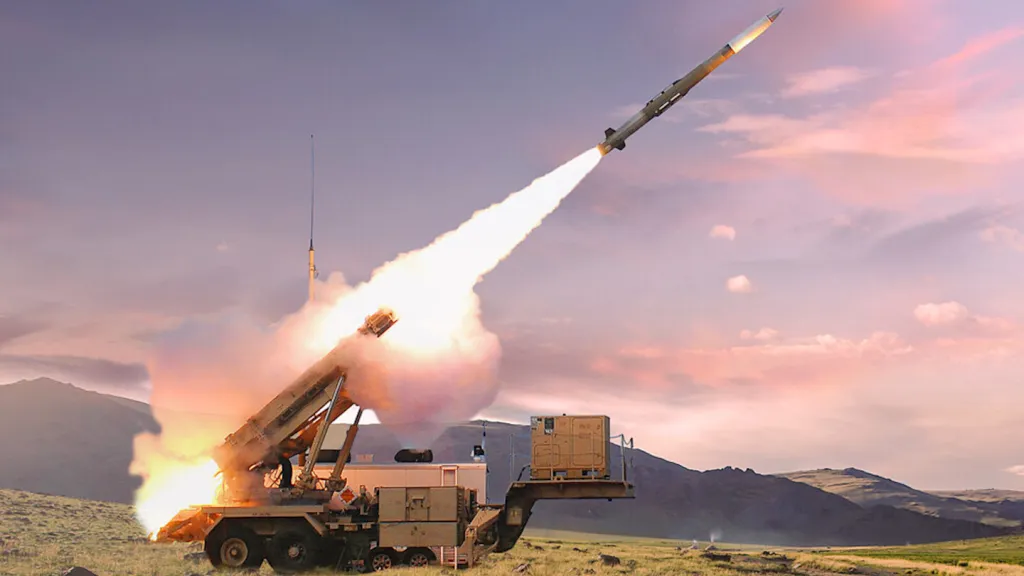
A Patriot Advanced Capability-3 (PAC-3) Cost Reduction Initiative (CRI) missile is launched during an Integrated Battle Command System (IBCS) flight test at White Sands Missile Range in 2021. (Darrell Ames) Darrell Ames
SASC wants the following information from the Pentagon:
“An assessment of current and projected Ukrainian requirements for PAC-3 interceptors over the next 12 months;”
“An assessment of the availability of PAC-3 interceptors from existing Department of Defense inventories for transfer to Ukraine and the impact of such transfers on United States military readiness and operational plans;”
“An evaluation of options to accelerate production of PAC-3 interceptors, including through multiyear procurement authorities, advance procurement, expanded supplier capacity, and other industrial-base investments;”
“An assessment of the feasibility of increasing annual PAC-3 interceptor production and the anticipated timeline for achieving such increases;”
“An identification of any statutory, regulatory, contractual, or supply-chain barriers to increasing interceptor deliveries to Ukraine;”
“An assessment of opportunities for allied and partner nations operating Patriot systems to contribute additional PAC-3 interceptors to Ukraine, including options for United States backfill arrangements;” and
“Recommendations for legislative or administrative actions that would enable increased interceptor deliveries to Ukraine while maintaining acceptable levels of U.S. military readiness.”
In addition, the committee said the secretary should “brief the congressional defense committees on the findings of the report, not later than 15 days after its submission.”
The Pentagon on Wednesday declined comment on the committee’s report, how many interceptors it has provided to Ukraine or whether it has the ability to increase that supply. We have reached out to Lockheed Martin as well and are awaiting a response.
Soldiers from the 11th Air Defense Artillery Brigade conduct a Patriot missile live-fire exercise at MacGregor Range near Fort Bliss, Texas, Aug. 23, 2025. (U.S. Army photo by Sgt. JaDarius Duncan) Sgt. JaDarius Duncan
TWZ recently addressed the supply of these munitions in a story about a new report from the Center for Strategic and International Studies (CSIS).
The report, on the severity of the depletion of U.S. advanced weapons stockpiles, found that current production PAC-3 MSE “is around the baseline rate of 650 interceptors per year, with half the deliveries going to the United States and the rest to allies and partners.”
Lockheed Martin announced Tuesday that it would be increasing its annual production rate of PAC-3 MSE (Missile Segment Enhancement) Interceptors for the MIM-104 “Patriot” Surface-to-Air Missile System from roughly 600, to 2,000 a year, under a new contract with the Department of… pic.twitter.com/aCkVK8xkqx
“Because U.S. procurement in the last decade has averaged 225 missiles per year, deliveries from prior years will not be enough to fully replace expenditures,” CSIS cautioned. “For that, the United States will need to wait for the 3,203 Patriot missiles requested in the Army’s FY 2027 budget. These are projected to start delivery in May 2029.”
As we noted earlier in this story, in addition to the Patriot interceptors already provided to Ukraine, the U.S. used a large amount during the conflict with Iran defending its assets, as well as those of allies.
The CSIS report found that at the start of the war with Iran, “there were about 2,500 Patriot interceptors in the U.S. inventory,” though its accompanying chart does not specify which variant. “During the course of the conflict, between 1,060 and 1,430 Patriots were fired.” We don’t know what that tally includes, but we do know that PAC-2 and PAC-3 series interceptors have been employed in the latest conflict with Iran.
CSIS
Adding to questions about the ability to supply Ukraine with more Patriots, a top official from Lockheed Martin recently warned that the company cannot give U.S. allies any certainty over when they will receive interceptors despite plans to triple capacity, according to Financial Times.
Brian Dunn, vice president for strategy and business development of missiles and fire control, recently said that the company was working hard to scale up production of critical PAC-3 interceptor missiles amid a supply crunch exacerbated by the war in Iran.
But in remarks to journalists at the ILA Berlin Air Show, “he sent a sobering message to American allies including Germany, Japan, Poland, the UAE and Saudi Arabia that operate the Patriot air defense system,” the publication reported.
Dunn said the extra capacity “is obviously going to be able to satisfy multiple user requirements in a faster timeline.” However, he added that Lockheed Martin does not “control what the allocation of those missiles is going to be. We can’t tell anybody where you’re going to be on that [priority list].
“Obviously there’s a lot of rhetoric coming right now from the Department of War . . . about how they’re going to reorder, reorganize, who’s going to get missiles first,” he continued. “We don’t control any of that.”
🇺🇸 American company Lockheed Martin cannot guarantee US allies the delivery of Patriot interceptors, which Ukraine desperately needs, despite plans to triple its production capacity.
This was stated by the company’s vice president, Brian Dunn, according to the Financial Times. pic.twitter.com/fq8QYdtAXR
Meanwhile, for Ukraine, the influx of new Patriot interceptors cannot come soon enough. Two nights ago, for instance, Russian forces launched 70 missiles and over 600 drones in a mass assault, according to the Kyiv Independent.
“Of the 34 ballistic missiles fired, 19 were aimed at the capital,” the publication noted.
You can see a video of one of those strikes below.
The number of Ukrainian cultural sites hit in Russia’s overnight attack on Kyiv continues to rise, with the Mystetskyi Arsenal on fire this morning.
“Kyiv’s beleaguered Patriot batteries did a valiant job, intercepting 15 of them, along with five of the six 3M22 Zircon hypersonic cruise missiles launched in the attack,” the news outlet added. “Still, even layered defenses were stretched beyond the limit.”
A BARRY Manilow fan was banned from meeting his idol after staff called his wig and jacket an insult to the singer.
Wayne Denton, 69, spent £2,400 on VIP tickets, which included an after-show meet-and-greet with the US star.
Sign up for the Showbiz newsletter
Thank you!
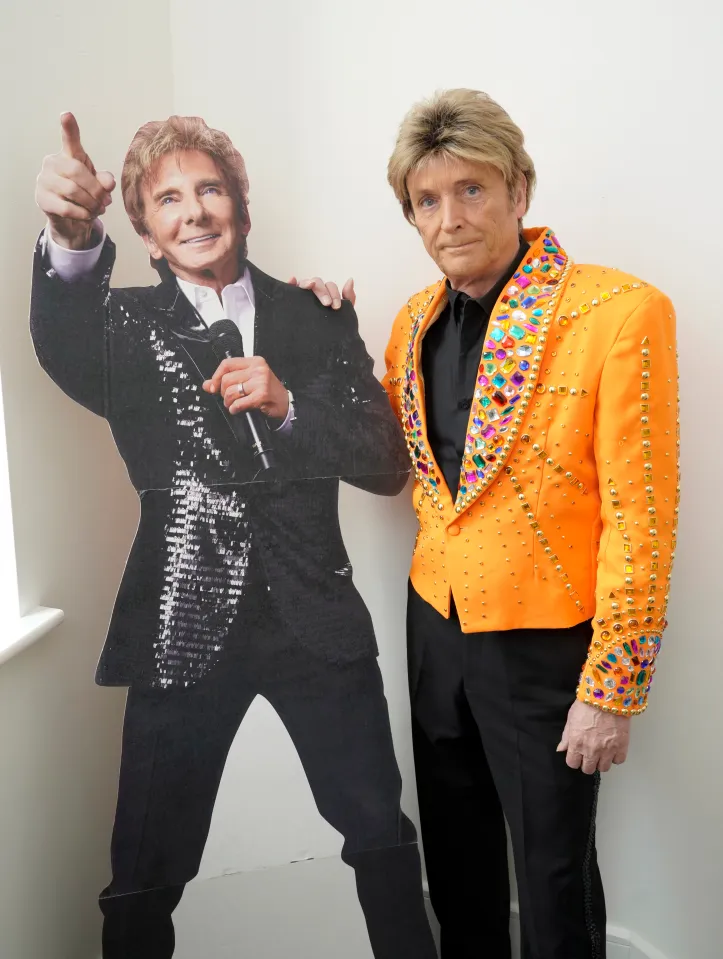
Wayne Denton was banned from meeting his idol after staff called his wig and jacket an insult to the singerCredit: News Group Newspapers LtdHe was wearing the same jacket Barry Manilow has worn on stageCredit: Penske Media via Getty Images
But he was told he would only be allowed in if he removed his wig and orange jacket, similar to one Copacabana hit-maker Barry, 83, has worn on stage.
Wayne, who has a Manilow tribute act called Celebrating Barry, said: “I was humiliated.
“It’s a wig I wear partly because I’ve got no hair.”
Wayne, from Stourbridge, West Mids, watched the show on Saturday at Liverpool’s M&S Bank Arena with pal Janet Martin, 54, a backing singer in the tribute act.
Under the MOU, an initial 60-day negotiation period, which can be extended, will begin once the preliminary agreement is signed.
Published On 17 Jun 202617 Jun 2026
Iran’s Foreign Ministry has said that the signing of a memorandum of understanding in Switzerland, expected to take place on Friday, could take place in the presence of President Masoud Pezeshkian and Donald Trump.
Previously, Iran had said that Washington and Tehran would be represented by Vice President JD Vance and Parliament Speaker and top negotiator Mohammad Bagher Ghalibaf, respectively.
Recommended Stories
list of 3 itemsend of list
On Wednesday, ministry spokesperson Esmaeil Baghaei told reporters that Iran’s plans “for the Swiss summit have not changed”.
“Regarding the manner of signing the memorandum of understanding, one of the ideas is for it to be done by the presidents of the two countries, which is currently being considered,” he added.
Speaking at the G7 summit in France earlier, Trump said he expected the agreement with Iran to be signed “shortly” without specifying the exact date.
“The deal we reached with Iran on Sunday will be signed shortly, tomorrow [Thursday], maybe the next day [Friday],” Trump told a news conference after previous announcements that it would be signed on Friday in Switzerland.
Hormuz to be ‘restored to normal’
In a statement, Baghaei added that maritime traffic in the Strait of Hormuz will be restored to normal within a defined timeframe, while insisting that outside powers will have no role in the process and that managing that process would be handled by Iran alone.
“This is our own task, and we alone will do it, and there will be no need for participation or intervention from other parties,” he stated.
“Iran and Oman will cooperate to develop a mechanism for managing the Strait of Hormuz, and we will exchange views with other countries in the region wherever necessary.
He said that Iran and the US agreed to “negotiate a final agreement within 60 days”, adding that the naval blockade “must end within 30 days.
A senior US official, briefing reporters on Wednesday, said the MOU establishes a new “minimum” threshold for downblending Iran’s stock of highly enriched uranium and contains measures aimed at safeguarding Lebanon’s “territorial integrity” following Israel’s latest strikes on Hezbollah inside the country.
In exchange, Washington would move to waive, though not fully lift, some of its broad sanctions on Iran once the agreement is signed.
The US-drafted text also guarantees toll-free transit through the Strait of Hormuz for a period of just 60 days, and leaves open the possibility that transit fees could be imposed later, the official added on condition of anonymity.
Rangers have appointed Derek McInnes as manager on a three-year contract after agreeing a compensation deal with Scottish Premiership rivals Hearts.
McInnes is the third boss at Ibrox inside a year and replaces Danny Rohl, whose move to Austrian side RB Salzburg was confirmed earlier on Wednesday.
The 54-year-old joined Hearts from Kilmarnock last summer and led the Tynecastle club to a second-placed finish, missing out on the title to Celtic on a dramatic final day, but edging Rangers out of the Champions League qualifiers.
The former Rangers midfielder turned down an approach from the Ibrox club in December 2017 in order to stay at Aberdeen but has now followed Tynecastle captain Lawrence Shankland in moving from Hearts.
“It is a real honour,” McInnes said. “The demands here are clear and our supporters rightfully have high expectations. It is up to me, my staff and my players to meet those expectations, and have this club performing as it should.
“There is a lot of hard work ahead, but already the preparations have begun and I am looking forward to meeting the current squad in the coming weeks and welcoming some new faces.”
Alan Archibald, Paul Sheerin and Craig Clark will assist McInnes.
While Rohl was head coach, McInnes will have the title of manager and was the frontrunner as soon as it emerged that the German was keen to leave for Salzburg.
Chairman Andrew Cavenagh said the Scot is “someone we have always rated highly” and is “exactly what this club needs at this moment in time”.
He added: “His deep Scottish and Rangers experience are important for us. He knows how to win in this league, and he is coming off an extremely strong season with Hearts.”
Rohl, 37, replaced Russell Martin as head coach in October and steered Rangers into a three-way title fight, but a post-split collapse yielded a third-placed finish behind Celtic and Hearts as the Ibrox club ended the campaign without silverware.
Cavenagh – who publicly backed Rohl at the end of the season – thanked him for his “service and commitment to Rangers”.
“He and his staff put in a significant amount of hard work during his time in charge, which we are greatly appreciative of,” he added.
Before the lights dim and the trailers roll, moviegoers will start to see microdrama ads in movie theaters.
National CineMedia (NCM), the company responsible for the pre-show programming on the big screen, announced a new partnership with AI-native microseries studio aTwist on Wednesday. The company will begin advertising aTwist’s upcoming slate of vertical series in theaters later this summer.
“Movie theaters have always been where people go to lose themselves in storytelling,” Mike Rosen, NCM’s chief revenue officer, said in a statement. “This partnership brings new, exciting content to the pre-show experience, and gives brands the opportunity to speak more authentically to an audience that is naturally drawn to compelling, innovative content.”
The partnership was first reported by the Hollywood Reporter.
The deal will feature brand-sponsored series, previews of aTwist originals and a QR code that will take viewers directly to the aTwist platform.
These advertisements will be integrated into NCM’s regular programming, which spans more than 18,500 screens in over 1,650 theaters nationwide. The advertiser works with major movie chains such as AMC, Cinemark and Regal, across 185 markets. NCM was founded in 2002 and is best known for its “Noovie” preshow hosted by Maria Menounos.
ATwist is set to launch later this summer. The Los Angeles-based company, founded by former Hollywood executives Jana Winograde, Susan Rovner and Lloyd Braun, is entering an increasingly competitive format.
Microdramas, which originated in China, have continued to gain traction in the U.S. Some of the industry’s major players include ReelShort and DramaBox. The short-form content, engineered for a vertical phone screen, has drawn comparisons to a new addictive form of soap opera. The vertical video market is expected to generate around $150 billion in revenue this year, according to media consulting firm Owl & Co.
Brands such as Marc Jacobs and Crocs have already positioned the storytelling format as a way to advertise new products and reach new audiences.
By advertising to moviegoers, aTwist is hoping to distinguish itself among its competitors.
“We built aTwist around the belief that great storytelling should meet audiences wherever they are,” Winograde, aTwist’s chief executive officer, said in a statement.
“There is no better partner than NCM to introduce microseries to moviegoers and bring our storytelling into one of the most immersive entertainment environments.”
June 17 (UPI) — Peru’s Ministry of Culture denounced the total destruction of the Triple Spiral pre-Hispanic geoglyph, a figure more than 1,000 years old linked to water worship, located within a protected archaeological zone in the north of the country.
The agency said specialists and National Police officers confirmed the intentional removal of the geoglyph through manual alteration of the terrain in the Quebrada Santo Domingo Archaeological Zone, in the district of Laredo, La Libertad region, about 350 miles north of Lima.
1,000 AÑOS DE HISTORIA BORRADOS EN UN INSTANTE
El geoglifo prehispánico conocido como “Triple Espiral”, un patrimonio cultural con más de 1,000 años de antigüedad, fue destruido de manera intencional en la región de La Libertad, Perú.
“The sequence of events suggests that this attack may constitute retaliation against the recovery and protection actions carried out by the state in defense of cultural heritage,” the ministry said in a statement.
The destruction occurred just days after an operation conducted by cultural, municipal and police authorities to evict illegal occupants who had installed makeshift structures within the Quebrada Santo Domingo Archaeological Zone.
During the operation, authorities removed improvised shacks and fences and detected suspected illegal agricultural activities inside the protected area. They are also investigating the possible clandestine installation of pipelines to extract water from the Chavimochic canal, one of Peru’s most important irrigation and hydraulic infrastructure megaprojects.
Authorities also identified five individuals who claimed to be guarding the land on behalf of an alleged possessor. The Decentralized Directorate of Culture said those individuals are part of the investigation being conducted by prosecutors.
The Triple Spiral was considered one of the principal archaeological symbols of Quebrada Santo Domingo.
The figure measured more than 65 feet meters in length and 19 feet in width and had been associated by researchers with ceremonial practices related to the management and worship of water among pre-Hispanic societies on Peru’s northern coast.
Sandra Barrantes, deputy director of the Decentralized Directorate of Culture of La Libertad, described the incident as an “irreparable loss” for Peru and for the world’s cultural heritage, according to Noticias RPP.
Prosecutors have opened an investigation to identify those responsible and determine possible administrative, civil and criminal penalties.
Quebrada Santo Domingo covers more than 1,500 hectares protected by the state and preserves evidence of human occupation from approximately 11,000 years ago through the 15th century.
#COMUNICADO | El Ministerio de Cultura, a través de la Dirección Desconcentrada de Cultura de La Libertad, expresa su más enérgico rechazo y condena la destrucción total del geoglifo prehispánico Triple Espiral. pic.twitter.com/cEXEeoSFH8— Ministerio de Cultura (@MinCulturaPe) June 15, 2026
The complex contains petroglyphs, ceremonial roads and remains associated with the Cupisnique, Moche and Chimu cultures.
According to the Ministry of Culture, the Triple Spiral was one of the site’s most representative features, and its cultural significance had been compared to that of the famous Nazca geoglyphs in southern Peru. Its destruction completely erased archaeological evidence linked to the worship and management of water in ancient societies on Peru’s northern coast.
Mangione would face lighter sentencing if jury accepts he was in a state of ‘extreme emotional disturbance’ during act.
Published On 17 Jun 202617 Jun 2026
Luigi Mangione, the man suspected of fatally shooting United Healthcare CEO Brian Thompson in New York City, will argue a psychiatric defence during his trial.
Judge Gregory Carro said on Wednesday that Mangione’s lawyers informed him that they will assert that their client was in a state of “extreme emotional disturbance” when he allegedly carried out the shooting in December 2024.
Recommended Stories
list of 3 itemsend of list
New York state allows murder defendants to make the case that they cannot be held fully responsible for their actions because they were in a state of extreme emotional disturbance at the time of the killing.
Thompson’s slaying, which took place outside a hotel in midtown Manhattan, shocked the United States public. Grainy footage of the act quickly spread across social media.
It also drew attention to the widespread anger over sky-high healthcare prices. Police have said that the terms “delay”, “deny”, and “depose” were written on the suspect’s ammunition, a reference to how health insurance companies avoid paying claims.
If the jury concludes that Mangione was emotionally disturbed at the time of the alleged act, it could move to convict him of manslaughter rather than murder. Such a conviction generally results in a lighter sentence.
Relying on a claim of emotional disturbance means that Mangione would effectively admit that he carried out the act, but that he did so under circumstances of impaired judgement. It differs from an insanity plea, which would allow Mangione to serve his sentence in a psychiatric facility rather than a prison.
Mangione, who sat between two of his lawyers dressed in a blue suit, is set to go to state trial on September 8. The 28-year-old has previously pleaded not guilty to state and federal charges in connection to the killing.
His federal trial, which includes stalking charges, is set to begin on October 13. He faces a potential life in prison if convicted in either case.
US District Judge Margaret Garnett, who is overseeing the federal case, threw out murder and weapons charges against Mangione on technical grounds in January. That ruling eliminated the possibility of Mangione facing the death penalty.