TURN back the clock 12 months, and Wynne Evans’ life was falling apart.
Being axed by the BBC from his radio show last May appeared to be the final nail in the Welsh tenor’s career coffin after he was sacked from the Strictly Live Tour over accusations of an inappropriate sexual comment.
Wynne Evans was axed from the Strictly Come Dancing live tour following his crude remark to Janette ManraraCredit: PAWynne was then dropped by the BBC following a four-month investigationCredit: Facebook
Devastated, Wynne, 54, told this newspaper of his anguish and despair at being made a “scapegoat” for yet another BBC scandal – confirming what was pushed as a “vile sexual remark” was actually a joke amongst his one-time friend Jamie Borthwick.
The apology issued at the time for the comment was, Wynne explained, written by the BBC and ultimately ended up being the metaphorical sword he would die on.
Friends furiously rushed to defend Wynne to The Sun, and today still pour scorn on soap actor Jamie for failing to defend Wynne when he knew the truth behind the comment.
Jamie, 31, was later sacked by EastEnders four months after Wynne was given the boot.
Wynne spoke to The Sun after the Strictly chaosCredit: Dan Charity / Newsgroup Newspapers LtdWynne Evans’s latest company accounts show reserves of more than £670,000Credit: PAWynne and Jamie, back left, before the chaos of the Strictly TourCredit: RexFriends say Wynne Evans is focusing on work, family and a fresh startCredit: Instagram
“It felt like karma,” one friend tells The Sun.
“Wynne was hung out to dry, and Jamie, who was at the centre of it all, said absolutely nothing. They both ended up losing everything.”
Broken but not beaten, friends explain Wynne has quietly rebuilt his life – and is slowly carving out a life away from the constrictions of his old BBC paymasters.
His property business, Wildvine Properties, friends say, is starting to take off – allowing Wynne to return to what he loves: performing.
“Wynne is made for radio, and his daily show, broadcast from a studio he built in his home, is doing really well.
“He started working on Radio Dragon last month, too, and his Sunday morning show has been really successful.
“His devoted following, who loved his BBC Radio Wales show, have all followed him there, and the audience research has shown Wynne is beyond loved.
“Last month, he was invited to sing at Wrexham FC too, and the reception was so warm, it was a massive boost for him.
“Quietly, Wynne has built up a property business, which includes a three-bed house in Llansteffan, which is hugely popular on Airbnb.
Wynne could have allowed the BBC to cancel him, but he refused to be cowed.
Insider
“It’s given him a quiet income so he can focus on rebuilding and moving on with his life.
“Wynne was virtually destroyed by the BBC and hung out to dry. But he is proof that once the chips are down, you can turn things around.”
But there is no question that his actions were nothing more than ill-judged.
Wynne said: I realise now you cannot make jokes like that in the workplace – it’s deeply unprofessional.
“I’d be happy to go on any language and behavioural course that the BBC wants to send me on. I’d be thrilled to go on a course that could save me from situations like this.
“Society’s changing so quickly, and I’d be the first to say perhaps I’ve got it wrong on occasion. Unfortunately, I wasn’t offered a course like that.
“All I want now is to focus on performing and get back to my radio show – I can’t quite believe I’ve ended up here, and I just hope everyone can read this and know I’m not a bad guy.”
‘Wynne is a good man’
As he started to move forward with his life, friends explained that the support from his loyal fans, affectionately known as “Wynners”, is the people Wynne feels most grateful for.
“Wynne is a good man who has been through hell,” a pal says.
“The fans who have always supported him stood by him, and that means the world to him.”
Wynne’s personal company finances certainly show things are not as dark as they were this time last year.
The latest report for the firm shows Wynne is sitting on reserves of just over £670,000.
He has taken his time and slowly rebuilt his life. He was totally broken this time last year.His whole world had imploded, and at times he felt like he had nothing to live for.
Insider
And pals explain Wynne is keen to continue carving out a new position for himself in the public domain – starting next with a series of four live shows.
The performances are billed as a mix of stand-up comedy and opera, and Wynne is looking forward to taking another step back into the limelight.
“Wynne could have allowed the BBC to cancel him, but he refused to be cowed,” a friend explains.
“He has taken his time and slowly rebuilt his life. He was totally broken this time last year.
“His whole world had imploded, and at times he felt like he had nothing to live for.
“Wynne took baby steps and got himself back on his feet. Now things are really moving in a positive direction, and the future is looking bright again.
“What happened last year is something that Wynne will never be able to forget, and really, he is still processing that.
“But he wants to show people that no matter how bad things get, no matter how many times your name is dragged through the mud, no matter how many people you thought were friends turn on you, with the love of your family and your friends, you can make it through.
“Wynne’s story is one of salvation, and he will be telling it with brutal honesty and humour.”
The decades-old football book craze will comprise 980 unique stickers, including 68 ‘special’ ones in a 112-page album.
Published On 29 Apr 202629 Apr 2026
For generations of football fans, no World Cup would be complete without the thrill of opening a packet of Panini stickers and discovering Zico, Franz Beckenbauer, Diego Maradona or Lionel Messi staring back.
Since Italian company Panini’s first sticker collection at the 1970 World Cup in Mexico, trying, and usually failing, to complete the set has been an obsession for young fans around the globe, with playground swapping mandatory.
This year’s World Cup in the United States, Canada and Mexico will present the biggest challenge yet, though, and will require a considerable amount of pocket money.
With 48 nations heading for the tournament in June and July – the largest edition ever – 980 unique stickers, including 68 “special” ones, will be required to fill the 112-page album that will be available from Thursday.
Individual packets of seven stickers retail at 1.25 pounds ($1.69) in the United Kingdom, meaning that even with impossibly perfect luck and no duplicates, 140 packets would be required, costing 175 pounds.
Statistically, however, more than 1,000 packets may be required to acquire every player in the album, meaning an outlay in the region of 1,000 pounds ($1,351).
Panini’s biggest-ever collection was launched at a special event at Wembley Stadium on Tuesday, with former England players David James, John Barnes and Gary Cahill reliving their sticker-hunting days.
“As someone who grew up collecting Panini stickers, swapping with friends in the playground and trying to complete the album every tournament, the album has always marked the real start of a World Cup for me!” former Chelsea defender Cahill said.
“Seeing myself in the collection during my playing days was a surreal and proud moment, and a reminder of how these stickers become part of the story of every World Cup.”
Panini say they will be hosting a live “swap shop” in May around the UK, giving collectors the chance to find their must-have players while a “Sticker Box” will travel up and down the country, giving away sticker packets and albums.
When the dust has settled on the World Cup, it might also be prudent to store duplicates in the loft as there is a burgeoning market in vintage stickers.
In 2021, a 1979 Panini sticker of Maradona, then aged 19, sold for 470,000 pounds (about $556,000 at the time) at auction.
Weekly insights and analysis on the latest developments in military technology, strategy, and foreign policy.
The United States Marine Corps on Tuesday gave us our first glimpse of its evolving plan for its ground forces to succeed in the battlefield of the future. Dubbed Ground Combat Element 2040 (GCE 2040), it calls for ensuring that Marines are not just equipped with the latest technology, but that they know how to use it, all while maintaining readiness as they integrate these new systems into their formations. While all the final details remain in flux, we are getting a general idea of some of the elements the plan will include.
A working concept of the plan was presented for the first time today during a panel at the Modern Day Marine Expo held in Washington, D.C. It builds on the vision of former Marine Commandant Gen. David Berger’s Marine Force Design 2030 initiative, according to one of the current Corps leaders working to implement GCE 2040.
“This is really an opportunity for us to describe the future of the ground combat element in the United States Marine Corps,” explained Maj. Gen. Jason Morris, the Corps’ Director of Operations, Compliance, Policies and Operations. We want to “make sure that we have a clear vision of the capabilities required to field the most lethal, survivable ground combat element in the world, and make sure that we’ve got a pathway over the next three fiscal year defense programs that we are keeping our eye on the horizon, staying adaptable and incorporating new technologies into our Marine divisions and those subordinate elements that are a part of it.”
U.S. Marine Corps Lance Cpl. Corey Ashby, a small unmanned aircraft system operator with 3rd Light Armored Reconnaissance Battalion, 1st Marine Division, pilots a first-person view sUAS during a live fire demonstration rehearsal at Marine Corps Base Camp Pendleton, California, Jan. 28, 2026. (U.S. Marine Corps photo by Cpl. Joshua Bustamante) Cpl. Joshua Bustamante
In addition, the Marines are “also continuing to refine the force design vision, to make sure that we are ready to go for any crisis, contingency or conflict in the future,” Morris added.
To better explain the GCE 2040 concept, Morris played a video laying out some of what it entails. The video, which has not been yet been shared online, and a document that will be published in coming weeks, focuses on how the Marine Corps approaches human-centric warfare of the future.
“GCE 2040 is about equipping the Marine, not the machine,” the video stated. “While looking ahead to integrate robotic and autonomous systems into our formations and operationalizing AI at the tactical edge through concepts like Project Dynamis [an integrated battle management system being developed by the Marines], the Marine Corps will enable combat formations to sense, make sense and act with greater speed and precision than any adversary.”
Under GCE 2040, Marines will “integrate advanced sensors and intelligence networks to find and fix the enemy across all domains” while “conducting expeditionary maneuver in contested spaces and sustaining a resilient force through all phases of the operation,” the video stated. In addition, Marines will employ “joint forceful fires and achieve the effects of mass while mitigating vulnerabilities striking adversary targets from land, air and sea,” and establish “persistent, survivable [command and control] networks that enable decision making at machine speed from the strategic level down to the squad.”
The objective “is to generate the tempo of decision and action that allows us to shape, seize and hold key maritime terrain, deter aggression and prevail decisively in any future conflict,” the video explained.
This broadly fits with the U.S. military’s push to create ever larger and faster kill webs, in order to break the enemy’s decision cycle.
A screen cap from the video the Marines used to unveil their new Ground Combat Element 2040 plan. It illustrates a distributed command and control system. (USMC)
When we asked for more details, the Marines told us that the plan includes addressing the need for ground-based air defense down to the squad level.
“The proliferation of inexpensive one-way attack drones is the most significant tactical threat we face,” the Marines told us. “While systems like the Marine Air Defense Integrated System (MADIS) and Medium-Range Intercept Capability [MRIC] are critical for a layered defense at echelon we must continue to thicken the protective layer that cover Marines at all echelons.”
U.S. Marines with Marine Corps Systems Command, fire a Stinger Missile from a Marine Air Defense Integrated System (MADIS) at Yuma Proving Ground, Arizona, December 13, 2023. (U.S. Marine Corps photo by Virginia Guffey)
You can read more about the Marines’ emerging doctrine for devolving air defense down to the individual Marine in our story here.
In a broader context, including air defense and offensive capabilities, the Marines told us “We must increase investment in multi-domain lethality and targeting systems that enable the right weapon to engage the right target at the right time to maximize the efficient use of lethal means against the enemy… The modern battlefield demands that we develop and field dispersed, AI-enabled targeting systems to create a network of sensors across the entire GCE.”
The plan also involves evolving how Marines view technology. Autonomous systems and AI are a central focus of the new plan. The Marines state that these are not just tools, but are members of the team and the Marines are being trained to consciously accept risk with hardware rather than troops.
Both AI and large quantities of autonomous systems will be critical to enabling future kill webs as discussed above. The USMC also says interoperability, both with other U.S. military branches and allies will be more critical than ever to achieving its aims going forward.
Integrating AI into the force will be a big part of GCE 2040. (USMC)
“The fact is that the Marine Corps is focused on the human being, individual, sailor, how we recruit and develop them, and how we build them into lethal combat teams,” proffered Maj Gen. Farrell J Sullivan, Commanding General of the Second Marine Division. “That has always been the case, and that will always be the case in the Marine Corps going forward, but modernization matters, and although we’re doing well, we have a long way to go, and as long as I’m in command of Second Marine Division, I will not be satisfied with where we are”
The GCE 2040 concept, he added, draws on lessons learned from modern combat that has evolved over the past decade into one where unmanned systems – like large drones such as Shahed-136s and smaller, first-person view (FPV) types – have become a major threat in Ukraine, the Middle East and many other places around the world.
The following image shows a U.S. Air Force E-3 Sentry AWACS destroyed in a combined Iranian missile and drone barrage during the now-paused war.
New image reportedly showing the USAF E-3 Sentry destroyed in an Iranian attack at Prince Sultan Airbase on Friday.
The following video shows an Iranian-backed militia using FPV drones to strike a Black Hawk helicopter and a critical air defense radar at an American base in Iraq.
An Iranian-backed militia carried out a successful FPV drone strike on Camp Victory in Iraq yesterday, successfully hitting multiple targets.
The new plan envisions future combat particularly in the Pacific, where Marines would likely have to fight inside the Chinese weapons engagement zone and across wide swaths of ocean. In such a battle, they would face standoff weapons and non-kinetic effects like advanced electronic warfare far more damaging and disrupting than what U.S. forces have faced in the fight against Iran. A Pacific conflict would also strain logistics as like never before.
“When you envision the type of fight we’re preparing for, where we face a peer or near peer adversary in a high-end fight, where all domains are contested, and in some the adversary will have an advantage, that’s not the battlefield we have fought on, at least not since I’ve been in the Marine Corps,” Sullivan stated. “And we see, if you look back over the last 10 or so years, how that manifests itself in places like Ukraine. Again, I don’t want to have a bias towards that conflict and say that all the future will look exactly like that, because it won’t, but we would be criminal not to be paying attention to that.”
Clearly the USMC is painting in very broad strokes at this time as there is still a lot more work to do to hammer out the details of GCE 2040. The Marines say they will provide more details in the next few weeks and we continue to cover this issue as they become available.
Netflix is set to bring this “unsettling” best-selling novel to life sooner than you think.
Hayley Anderson Screen Time TV Reporter
17:35, 29 Apr 2026Updated 17:36, 29 Apr 2026
This Morning: Severance’s Ben Stiller quizzed on season 3 release date
Severance and The Godfather legends are teaming up for a Netflix thriller that will leave your “flesh crawling”.
Based on Alex North’s New York Times best-selling novel of the same name, The Whisper Man is making its way to Netflix on Friday, August 28.
The official synopsis for the upcoming “disturbing” film reads: “When his eight-year-old son is abducted, a widowed crime writer looks to his estranged father, a retired former police detective, for help, only to discover a connection with the decades-old case of a convicted serial killer known as ‘The Whisper Man.’”
What’s even more exciting about The Whisper Man’s pending arrival is its star-studded cast.
While subscribers wait to see how the movie will play out, The Whisper Man already has a loyal fanbase of book lovers ready to watch the adaptation.
Taking to Amazon Prime to sing the book’s praises, a fan shared: “This is one of the most gripping and mind-blowing books I have read this year, and it takes suspense and terror to a whole new thrilling level.”
A second described it as “gripping and flawless”, with another posting: “This book genuinely makes your heart pound.”
Someone else remarked: “Creepy and chilling? Yes! Addictive and clever? Totally!
“It made my skin crawl, it’s sometimes heartbreaking, it’s dark and twisty and just mind-blowingly fabulous!”
“The Whisper Man is one of the best thrillers I have read in years. It is in equal parts gripping and truly terrifying”, a reader commented.
While another added: “I will undoubtedly be keeping my window shut for a little while, and will be obsessively checking on my sleeping children!”
Working behind the scenes as producers are brothers Joe and Anthony Russo, famed for directing Marvel films Avengers: Infinity War and Avengers: Endgame.
The Whisper Man premieres on Friday, August 28, on Netflix
The African island nation also expels French embassy personnel over acts linked to the destabilisation investigation.
Published On 29 Apr 202629 Apr 2026
Madagascar has detained a French serviceman over an alleged plot to destabilise the island and also declared an agent at the French embassy persona non grata over acts linked to the destabilisation investigation.
Deputy Prosecutor Nomenarinera Mihamintsoa Ramanantsoa said in a video statement released late on Tuesday that the former French national serviceman, Guy Baret, had been placed in pretrial detention at Tsiafahy maximum-security prison.
Recommended Stories
list of 3 itemsend of list
A Malagasy army officer, Colonel Patrick Rakotomamonjy, and other alleged accomplices were also implicated, he said.
According to Ramanantsoa, prosecutors have charged the suspects with spreading false information to disturb public order, plotting to sabotage infrastructure including power lines and thermal plants operated by state utility Jirama, harbouring wanted individuals, and criminal conspiracy. Authorities said the group had planned actions initially set for April 18.
Rakotomamonjy is awaiting presentation before an investigating judge. Two other suspects were placed under judicial supervision, with prosecutors saying they did not appear to be the masterminds of the conspiracy
Madagascar is a former French colony that retains close political links to France and has had a history of instability in recent decades.
The country’s military ruler, President Michael Randrianirina, seized power in October last year, after a wave of youth-led protests against his predecessor, Andry Rajoelina.
France helped Rajoelina flee in October as protests over lack of water and energy escalated and ultimately forced him from power.
France said Wednesday that it had summoned the charge d’affaires of the Madagascan embassy in Paris “to vigorously protest” the expulsion of the diplomatic official.
“He was informed that France categorically rejected any accusation of destabilising the Refoundation regime of the Republic of Madagascar,” French Foreign Ministry spokesman Pascal Confavreux said, adding that the official had been summoned on Tuesday.
“Such accusations are not only unfounded, but also incomprehensible.”
The Madagascar Foreign Ministry said French Ambassador Arnaud Guillois had been summoned and informed of the decision over the embassy agent. It did not identify the agent or specify the acts in question.
Tehran, Iran – Iran’s national currency has plunged to new lows as authorities mobilise to dampen the impact of the naval blockade enforced by the United States.
The Iranian rial shot above 1.81 million to the US dollar on the open market by early afternoon on Wednesday before partially recovering. The embattled currency changed hands for about 1.54 million earlier this week, and its rate was about 811,000 per US dollar a year ago.
Recommended Stories
list of 3 itemsend of list
The rial had remained relatively stable over the past two months after experiencing an earlier drop as US forces amassed in the lead-up to the US-Israeli war on Iran, which began at the end of February.
The latest freefall follows on from unchecked inflation, which has been increasingly plaguing the Iranian economy as a result of mismanagement and sanctions, and continues to ravage households. Washington now has three aircraft carriers in the region and is bringing in more troops and equipment as Israel expresses readiness to restart fighting, three weeks after a ceasefire began.
Iran’s authorities this week projected a hardened stance on negotiations with Washington, and pledged to fight the naval blockade of Iran’s southern waters, which the US Central Command insisted on Tuesday had “cut off economic trade going into and coming out of” the country.
Amid threats by US President Donald Trump, the Iranian government has also tried to empower its own border provinces to import essential goods by reducing red tape. It has also allocated $1bn from the sovereign wealth fund to buy food, and made a partial policy U-turn to restart offering a preferential subsidised exchange rate with the goal of reducing prices, despite concerns about corruption.
Non-oil trade takes hit
According to customs data released by state media, Iran’s non-oil trade has been negatively affected after commercial ties were disrupted or cut off as a result of the war, and critical infrastructure was bombed.
Iran’s customs authority put the total value of non-oil trade in the Iranian calendar year that ended on March 20 at close to $110bn, with $58bn going to imports. The figure was about 16 percent lower than the year before.
The volume of non-oil trade was valued at approximately $9bn for the 11th month of the calendar year ending on February 19, and $6.46bn in the final month, indicating a drop of about 29 percent in connection with the war, which started on February 28. The final month was also about 50 percent lower than the more than $13bn estimated value for last year’s corresponding month.
Part of the drop is linked with the fact that shipping has been significantly disrupted through the Strait of Hormuz as Iran and the US spar over control of the strategic waterway. The US and Israel also directed some of their thousands of strikes against ports, naval facilities, airports, and railway networks across the country.
Iran’s top steel and petrochemical producers were also extensively bombed, as were oil and gas facilities, power stations, and major industrial zones. The US and Israel have threatened to take Iran “back to the Stone Age” through systematic bombing of civilian infrastructure like power plants.
To manage the impact and preserve domestic supply, Iranian authorities have imposed temporary restrictions on exports of steel, petrochemicals, polymers and other chemicals.
Oil exports in the crosshairs
The US is using its military capabilities and economic chokeholds to drive down Iran’s oil exports, a goal that it has also pursued over recent years through sanctions.
Since mid-April, the US military has been deploying its soldiers to take over or inspect ships transiting through waterways near Iran, in addition to targeting what is known as a shadow fleet of tankers used by Iran to circumvent sanctions and ship its oil.
Warships and thousands of troops could still launch a ground invasion or destructive aerial attacks against Iran’s Kharg and other critical islands, and the Trump administration expects increased pressure on Iran’s oil sector due to hampered access to export routes and supertankers keeping the oil stored on the water.
The US Treasury has been blacklisting refineries in China, the biggest buyers of Iranian crude oil, and going after the banking and cryptocurrency channels alleged to be facilitating Tehran’s oil trade, and having links to the IRGC – which Washington considers a “terrorist” organisation.
“We will follow the money that Tehran is desperately attempting to move outside of the country and target all financial lifelines tied to the regime,” said US Treasury Secretary Scott Bessent on social media.
Chinese refineries buy roughly 90 percent of Iran’s oil shipments, and imported a record 1.8 million barrels per day in March, according to Vortexa Analytics data cited by the Reuters news agency, which also said purchases were expected to slow due to worsening domestic refining and processing margins.
According to figures released by the General Administration of Customs of China, the volume of the country’s bilateral trade with Iran during the first quarter of 2026 stood at $1.55bn, down 50 percent year-on-year.
In March, the first month of the war, trade stood at $184m, which was nearly 80 percent lower than the year before and 64 percent lower than the month before. China’s imports from Iran and exports to the country were both considerably reduced as a result of the war.
The removal of the United Arab Emirates as a major trade partner and import market for Iran has also significantly affected the country’s economy, increasing its reliance on land neighbours like Turkiye and Iraq to the west and Pakistan to the east.
The UAE, a big part of the Trump-led Abraham Accords that saw multiple countries normalise relations with Israel, was heavily targeted by ballistic missiles and drones launched by Iran.
The UAE has closed down numerous Iranian institutions on its soil over the past two months, including financial facilitators, instructed Iranian citizens to leave, and has said it will take years to restore bilateral relations to previous levels.
BBC fans are urging everyone to watch Half Man with Richard Gadd’s next drama hailed as “phenomenal”.
Hayley Anderson Screen Time TV Reporter
16:26, 29 Apr 2026Updated 16:28, 29 Apr 2026
Half Man: Richard Gadd and Jamie Bell star in trailer
“Gruesomely compelling” Half Man has arrived and it’s already been labelled “incredible” by Baby Reindeer fans.
Richard Gadd ’s new six-part drama Half Man may have made its BBCiPlayer debut last week but many viewers have only just watched the first episode which aired on BBC One last night, Tuesday, April 28.
The gritty series follows the lives of mild-mannered Niall (played by Jamie Bell) and fierce Ruben (Richard Gadd), exploring their complicated 30-year friendship.
Described as an “explosion of violence”, Half Man kicks off with an intense moment between the men at Niall’s wedding before taking fans back to when they were teenagers.
Baby Reindeer creator Gadd not only stars in the drama but is the mastermind behind Half Man with fans loving his latest dysfunctional hit.
“If Baby Reindeer” left us in shock, I think #HalfMan even more so…the first episode was incredible!”, a fan posted on X.
A second echoed: “I’m shocked. If this is just the first episode, I don’t dare to think about what will happen in the others.”
“Gave me a heady mix of revulsion and discomfort… but in a good way?”, a third remarked.
Someone else labelled it “phenomenal”, before writing: “Can’t fault this. The writing, acting and filming are all excellent.
“I’ve only seen one episode so far but I’m totally hooked.”
A user said they were “obsessed” with Half Man and Euphoria season three, another commented, “Can’t wait to go mentally insane over this”, while a fan simply ordered: “Everyone go watch Half Man.”
Scoring 76% on Rotten Tomatoes, the six-part drama will continue to air episodes first on BBC iPlayer every Friday, followed by a BBC One release every Tuesday night.
The official synopsis for episode two reads: “1989. Niall is struggling at university when he invites Ruben to join him and his flatmates for freshers’ week
“ What begins with excitement ends in devastating consequences.”
Half Man is available to watch on BBC One and BBC iPlayer
FAO, WFP and Lebanon’s government say 1.24 million people are ‘expected to face food insecurity’ at crisis levels or worse.
Published On 29 Apr 202629 Apr 2026
More than 1.2 million people in Lebanon are expected to face acute hunger this year due to “conflict, displacement and economic pressures” amid the latest war between Israel and Hezbollah, according to a United Nations-backed report.
The UN Food and Agriculture Organization (FAO), the World Food Programme (WFP) and Lebanon’s Ministry of Agriculture issued a joint statement on Wednesday, saying that 1.24 million people were “expected to face food insecurity” at crisis levels or worse between April and August.
Recommended Stories
list of 3 itemsend of list
The figure, contained in a report conducted by the Integrated Food Security Phase Classification (IPC), a UN-backed group that monitors hunger and malnutrition, marks a “significant deterioration” compared with the outlook before the war erupted on March 2, said the statement.
Prior to March, “an estimated 874,000 people, roughly 17 percent of the population, were experiencing acute food insecurity“, it said. But a “sharp escalation in violence” had “reversed recent food security gains in Lebanon and pushed the country back into crisis”.
“Families who were just managing to cope are now being pushed back into crisis as conflict, displacement and rising costs collide, making food increasingly unaffordable,” said Allison Oman Lawi, the WFP’s country director in Lebanon.
Nora Ourabah Haddad, the FAO representative in Lebanon, said, “Compounded shocks are undermining agricultural livelihoods and impacting food security, highlighting the urgent need for emergency agricultural assistance to support farmers and prevent further deterioration.”
A ceasefire that took effect on April 17 has reduced the intensity of the fighting between Israel and the armed group Hezbollah that has killed more than 2,500 people in Lebanon and displaced more than one million, according to Lebanese authorities.
Israeli forces are operating in south Lebanon near the border, where residents have been warned not to return, and both sides have been trading fire despite the truce.
“Acute food insecurity is likely to deepen without sustained and timely humanitarian and livelihood support,” the statement said.
Weekly insights and analysis on the latest developments in military technology, strategy, and foreign policy.
Sikorsky unveiled a new incarnation of its Armed Black Hawk helicopter at the Army Aviation Warfighting Summit in Nashville last week. TWZ’s Jamie Hunter spoke with Sikorsky’s Matt Isaacson about how this expands mission sets and provides greater flexibility for the Black Hawk, while minimizing the need for separate types with an air arm’s H-60/S-70 fleet.
Check out our full tour of the aircraft and its weapons:
The H-60 Black Hawk Gunship Evolves With New Wings And Weapons
Al Jazeera’s Tohid Asadi has been seeing more flights take off at the main airport in Iran’s capital, where operations resumed on Saturday as the ceasefire with the US and Israel continues.
How to watch Arsenal vs Atletico Madrid: TV channel, live stream and kick-off time – The Mirror
Everything you need to know about Arsenal’s most important game of the season so far
This article contains affiliate links, we will receive a commission on any sales we generate from it. Learn more
Bukayo Saka could be back from injury to help Arsenal during their crunch match with Atletico Madrid(Image: Javier Garcia/Shutterstock)
Kick-off time: Arsenal vs Atletico is scheduled to kick off at 8pm UK time tonight, April 29. It’s the first leg of the UEFA Champions League semi-finals, giving Mikel Arteta’s side their first chance to secure a place in the final, against either Paris Saint-Germain or Bayern Munich, depending on how their matches end. The French and German sides faced off for their first leg last night in a barn storming match which Paris won 5-4.
Match location: Arsenal vs Atletico will take place at the Spanish club’s home ground, the state-of-the-art Riyadh Air Metropolitano in Madrid.
Why is the game important? Despite a packed trophy cabinet, Arsenal has never won the Champions League. Ensuring a good showing away from home will put them in a good position for the second leg, which will be held at the Emirates Stadium in London on Tuesday, May 5 at 8pm.
UK TV channel: Live coverage of the game will be broadcast on TNT Sports 1 and HBO Max. The official broadcast coverage begins at 7pm, with an hour of pre-match analysis and team news before kick off.
Live stream information: TNT Sports is no longer streamed on the Discovery+ app. Instead, viewers who want to stream the game must download the HBO Max app and sign in.
UK radio coverage: Live commentary will be provided by BBC Radio 5 Live on national radio across the UK. Meanwhile, local coverage and fan-focused audio commentary can also be accessed through the official Arsenal app and the club’s website.
Team news is largely based around injuries: Both teams have their own injury worries after intense home league seasons and some full-on games earlier in the tournament. There is a glimmer of hope for the Gunners, with Bukayo Saka potentially fit enough to stage a return, having come off the bench for the team’s recent Newcastle game.Meanwhile Diego Simeone’s men, who knocked out Barcelona to take their place in the semi-finals are no longer in contention for the La Liga title so are expected to be going all out for the trophy here. The side could be without midfield star Pablo Barrios who was injured during a match at the weekend against Athletic Bilbao.
Head-to-head record: On previous form, Arsenal and Atletico Madrid seem fairly evenly matched. In five games played since 2009, Atletico has won one, Arsenal won two and two were draws.
What happens if Arsenal and Atletico tie? Because it’s the first leg there’s no need for extra time if the match ends with one team ahead of the other.
Do away goals count for more? The away goals rule for Champions League games is no longer in effect, meaning there’s no difference when calculating the aggregate depending on where the goal was scored. If at the end of the ninety minutes of the second the teams are equal, this will send the tie directly into extra time. If the aggregate score remains level after thirty minutes of extra time, a penalty shootout will be the final decider on which team advances to the final.
An autonomous forklift operates at Korea Zinc’s smelter in Ulsan, about 250 miles southeast of Seoul, on Wednesday. Photo by Tae-gyu Kim/UPI
ULSAN, South Korea, April 29 (UPI) — Founded in 1974, Korea Zinc began to churn out 50,000 tons of zinc in 1978 at its Onsan smelter about 250 miles southeast of Seoul. Over the next five decades, it expanded annual zinc capacity by more than 11-fold to 560,000 tons.
In addition, Korea Zinc added lead and copper into its production portfolio, a diversified smelting model it says underpins the competitive edge of the world’s largest non-ferrous metal manufacturer.
“In other smelters making just one substance, they have to deal with waste. But we take advantage of them to retrieve other materials,” Korea Zinc engineer Kang Ki-tae said. “That’s why our Onsan smelter is both competitive and environmentally friendly.”
That approach is evident on-site. Korea Zinc is reclaiming a former byproduct storage pond for the construction of a germanium plant targeted for operation in 2028, showing its reduced need for such storage facilities.
As a result, the company’s product portfolio extends beyond the three base metals of zinc, lead,and copper to include such precious and critical metals as gold, silver, indium, bismuth, antimony, gallium and germanium.
Among its customers are Hyundai Motor, Posco, Samsung Electronics, SK hynix and Lockheed Martin. In August, Korea Zinc signed a memorandum of understanding with Lockheed Martin to supply germanium.
Kang said the company aims to replicate those competitive strengths in its U.S. facility to support the efforts of Washington in securing a stable supply chain of critical minerals.
Late last year, Korea Zinc laid out plans to develop an integrated smelter in Clarksville, Tenn., in cooperation with the U.S. government. Called Project Crucible, it will cost up to $7.4 billion.
Groundbreaking is scheduled for next year at a 160-acre site, with the plant targeted to come online in 2029. The complex is slated to produce 13 materials, including 11 designated as critical minerals.
At full ramp-up, Korea Zinc expects the facility to generate about 300,000 metric tons of zinc annually, in addition to 200,000 tons of lead and 35,000 tons of copper, as well as such strategic metals as antimony, indium, bismuth, tellurium and gallium.
China holds a dominant position in the production of rare earths and other critical minerals, often facing criticism for using export controls as leverage in trade tensions, including with the United States.
Amid those concerns, the Trump administration has pushed to develop alternative supply chains for rare earths and other critical minerals beyond China’s influence.
Korea Zinc engineer Lee Sung-jung said that the company also has focused heavily on the environment and automation.
“Autonomous forklifts have already been deployed, and last week we introduced a dozen of fuel-cell forklifts at our facilities,” he said.
Win-win initiative
Korea Zinc Executive Vice President Jimmy Kim said the U.S. investment could also help improve the Onsan smelter.
“We plan to incorporate more advanced technologies, including AI automation and digital twin systems developed by our core engineers, to build an even more sophisticated facility in the United States,” said Kim, who oversees the Onsan plant.
“If AI transformation proves successful there, it could also accelerate AI transformation at our factory here. We believe this could become a win-win opportunity for both countries while helping upgrade Onsan, as well,” he said.
Kim also welcomed the initiative’s selection last week for FAST-41, a federal fast‑track program that accelerates environmental reviews and permitting for major infrastructure projects.
“It shows the project is being highly valued by the U.S. government. We hope that by 2029, this will become an opportunity to further contribute to Korea-U.S. cooperation in technology security and mineral security,” he said.
According to the U.S. Permitting Council, FAST-41 participants have secured federal approvals about 18 months faster on average than comparable developments not covered by the program.
Government says it will run the administrative functions of Sri Lanka Cricket until reforms are implemented.
Published On 29 Apr 202629 Apr 2026
Sri Lanka’s government has taken control of the country’s cricket board, saying it is a temporary measure designed to pave the way for “structural reforms”.
“All administrative functions of Sri Lanka Cricket (SLC) will be temporarily brought under the Ministry of Youth Affairs and Sports, effective today,” the ministry said on Wednesday.
Recommended Stories
list of 4 itemsend of list
A committee will be appointed shortly “to address the current issues in cricket and implement structural reforms”, it added.
SLC is the country’s wealthiest sporting body but has been plagued by allegations of corruption and mismanagement.
The world governing body, the International Cricket Council, suspended Sri Lanka for two months in 2023-2024, citing political interference in the running of the national board.
Four-time SLC President Shammi Silva resigned on Tuesday, along with his entire committee, after the government intervened.
Sri Lanka made an early exit from the T20 World Cup, which it cohosted with India in February-March.
How many episodes are in new series Widow’s Bay and when you can stream them
Content cannot be displayed without consent
The 100% rated horror series has started streaming but fans still face a wait.
Widow’s Bay is the latest title to land on Apple TV+ and be welcomed with rave reviews. Only the first two instalments have premiered so far as of today (April 29).
Rhys takes on the role of Tom Loftis, Mayor of Widow’s Bay, a quaint island town 40 miles off the coast of New England where something lurks beneath the surface. He is desperate to put the place on the map and turn it into one of the must visit locations for tourists in the US.
However, not only does the island have no Wi-Fi, spotty cellular reception and very little to actually do, Tom must also contend with superstitious locals who believe their island is cursed. Unfortunately, it seems the locals were right. After decades of calm, the old stories that seemed too ludicrous to be true start happening again.
The series is only available to those who have access to the Apple TV+ service. This is available either as a standalone subscription via its own dedicated app, or as an add-on through the Prime Video platform.
Get Apple TV free for a week
This article contains affiliate links, we will receive a commission on any sales we generate from it. Learn more
TV fans can get Apple TV free for a week to stream shows like Ted Lasso, Severance and Slow Horses.
Early reviews have been extremely positive for Widow’s Bay. At the time of writing, Widow’s Bay has managed to record a perfect 100% rating on website Rotten Tomatoes against 23 reviews.
But how many episodes are there in the season? And when are each one supposed to arrive on the streaming service? Here’s all you need to know.
How many episodes are in Widow’s Bay and when are they released?
As mentioned, the series has celebrated a two episode premiere that landed today (April 29). Following instalments are expected to drop on a weekly basis each Wednesday.
Although there is one occasion when a couple later parts will arrive one the same day as a double bill. Here is the full schedule including episode titles of when each are expected to release.
Apple have not specified a release time, therefore episodes will be expected to become available at the usual time new titles land which is usually 8am local time.
Episode 1 – Welcome to Widow’s Bay, premiere date – April 29
Episode 2 – Lodging, premiere date – April 29
Episode 3 – The Inaugural Swim, premiere date – May 6
Episode 4 – Beach Reads, premiere date – May 13
Episode 5 – What To Expect On Your Trip, premiere date – May 20
Episode 6 – Our History, premiere date – May 27
Episode 7 – Seasickness, premiere date – May 27
Episode 8 – Your Baggage, premiere date – June 3
Episode 9 – Emergency Shelter, premiere date – June 10
Episode 10 – We Hope You Enjoyed Your Time, premiere date – June 17
The US naval blockade of Iranian ports and the Strait of Hormuz, in place since April 13, has raised concerns that Iran could run out of crude oil storage capacity and be forced to curb production.
Bloomberg reported analysis on Tuesday from the data and analytics company Kpler suggesting Iran could run out of crude storage in 12 to 22 days if the blockade persists.
Last week, United States Treasury Secretary Scott Bessent claimed that storage capacity at Kharg Island, where most of Iran’s oil is exported, would be full “in a matter of days”.
So how quickly could Iran run out of oil storage, and why does it matter?
What is happening in the Strait of Hormuz?
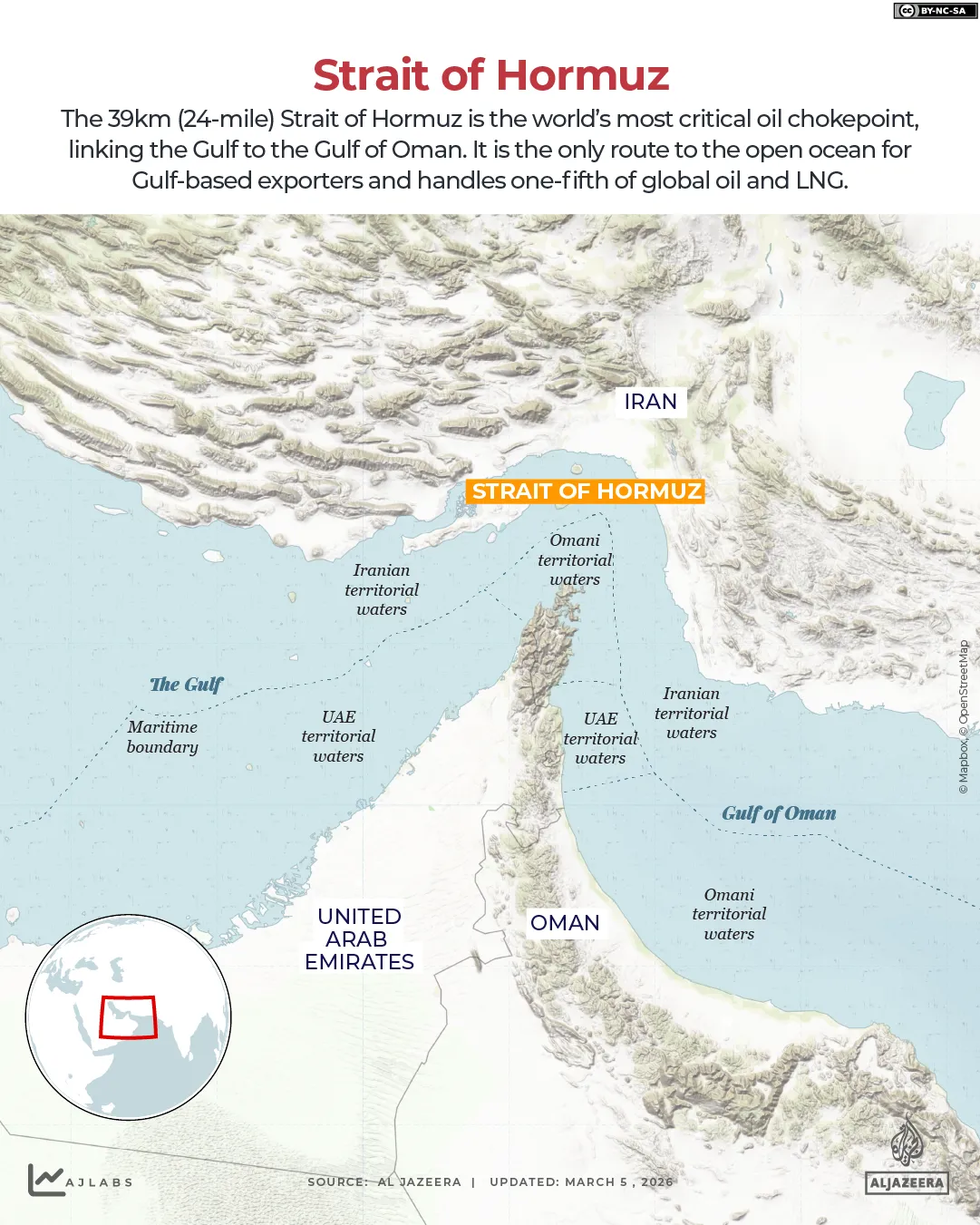
The Strait of Hormuz is a narrow channel that connects the Gulf to the open ocean. It spans the territorial waters of Iran on its northern side and Oman on its southern side. It is not in international waters.
During peacetime, 20 percent of the world’s oil and liquefied natural gas (LNG) supplies are shipped through the corridor.
Two days after the US and Israel launched their first air strikes in their war on Iran on February 28, Ebrahim Jabari, a senior adviser to the commander in chief of Iran’s Islamic Revolutionary Guard Corps (IRGC), announced that the strait was “closed”. If any vessels tried to pass through, he said, the IRGC and the navy would “set those ships ablaze”.
As the war has dragged on and negotiations have failed to achieve a settlement, Iran has at times in the past two months allowed some “friendly” ships and those that pay tolls to pass. It is currently refusing to allow any foreign-flagged ships, including those previously deemed friendly, to pass until the US lifts its own naval blockade.
Iranian First Vice President Mohammad Reza Aref said on April 19 that the “security of the Strait of Hormuz is not free”.
“One cannot restrict Iran’s oil exports while expecting free security for others,” he wrote in a post on X.
“The choice is clear: either a free oil market for all, or the risk of significant costs for everyone,” he added. “Stability in global fuel prices depends on a guaranteed and lasting end to the economic and military pressure against Iran and its allies.”
Since the US naval blockade on the strait began, the US has opened fire on and taken control of an Iranian-flagged tanker near the Strait of Hormuz while also redirecting vessels on the high seas transporting cargo to or from Iran. Iran’s armed forces have denounced these actions as “an illegal act” that “amounts to piracy”.
The US naval blockade of the strait means that Iran might have to store the oil it produces.
Iran is the third largest oil producer in the Organization of the Petroleum Exporting Countries (OPEC) after Saudi Arabia and Iraq and exports 90 percent of its crude oil via Kharg Island in the Gulf for shipping through the Strait of Hormuz.
What has the US claimed?
The US is eager to curb Iran’s oil revenues, which have risen since Tehran closed the Strait of Hormuz to other shipping. This is the primary motive behind Washington’s naval blockade of Iranian ports.
Iran exported 1.84 million barrels per day (bpd) of crude oil in March and shipped 1.71 million bpd in April, compared with an average of 1.68 million bpd in 2025, according to Kpler.
However, the US naval blockade since mid-April now means that most of its exports are having to be stored instead.
Bessent wrote in an X post on April 22: “In a matter of days, Kharg Island storage will be full and the fragile Iranian oil wells will be shut in.”
Iran’s domestic refineries have a production capacity of 2.6 million bpd, according to the energy consultancy Facts Global Energy.
Satellite data show the amount of oil Iran has in storage has risen sharply since the US blockade began, and in the days after the US tightened it, stocks were rising so fast that it appeared Iran had been barely able to export any oil at all.
From April 13 to April 21, data showed that stocks rose by more than 6 million barrels, according to the Columbia Center on Global Energy Policy (CGEP). From April 17 to April 21, the stock increased very rapidly, growing by 1.7 bpd.
As of April 20, the storage tanks at Kharg were about 74 percent full after the island alone had taken on about 3 million extra barrels of oil, the CGEP reported.
Generally, oil companies avoid filling their storage beyond 80 percent capacity to balance safety, emissions control and flexibility.
However, Iran and other oil producing countries have exceeded this limit before, for instance, during the COVID-19 pandemic. In April 2020, Kharg island’s stocks reached close to 90 percent capacity, an all-time high.
Iran also has some crude oil storage capacity in the form of “floating tanks”, or parked ships. About 127 million barrels can be stored in this way, Frederic Schneider, a nonresident senior fellow at the Middle East Council on Global Affairs, told Al Jazeera in an interview on April 14.
Will Iran need to cut oil production?
Muyu Xu, a senior crude oil analyst at Kpler, told Al Jazeera that the blockade could eventually force Iran to cut production.
“However, given there is still available storage capacity onshore (roughly covering 20 days of Iran’s current production), we expect any production reduction to be gradual over the coming week with a higher likelihood of acceleration into May,” she said.
Analysis by CGEP nonresident fellow Antoine Halff echoed this. Halff wrote in an article published by CGEP on Tuesday that it may be some time before the US blockade causes Iran to shut off its production “in a big way”.
However, Halff added, Iran may still choose to halt production “fairly aggressively” but this “would be more by choice than by necessity”.
He explained: “Doing so would have the advantage of providing Iran with relatively ample spare storage capacity after the shutdown and would allow for a smoother restart of operations once conditions permit, and the constraint is relaxed, thus minimising adverse impacts from the blockade on longer-term supply.”
Why does this matter?
Halting oil production risks damaging underground reservoirs by reducing reservoir pressure, allowing water or gas to encroach into producing layers and changing patterns of oil flow. This can make some oil harder or more expensive to recover later, experts said.
Restarting the process of oil production can also be slow and costly, involving repairs of corroded equipment or unclogging pipelines.
Halting production would also cause Iran’s export revenues to drop. However, analysts said that for a few months, Iran can continue to earn revenue from oil that is already in transit at sea.
Kenneth Katzman, former Iran analyst at the Congressional Research Service in Washington, DC, said Iran is not exporting new oil during the US blockade of Iranian ports but Tehran has 160 million to 170 million barrels of oil on ships around the world currently.
It is unclear whether football officials from Iran were issued Canadian visas to attend AFC and FIFA congresses.
Published On 29 Apr 202629 Apr 2026
Representatives from Iran’s football federation were not present at the largest formal meeting of Asia’s football leaders before the World Cup.
In the presence of FIFA President Gianni Infantino, there was no discussion at the Asian Football Confederation (AFC) Congress about Iran’s participation in the tournament or whether the team’s games should be moved out of the United States because of the US-Israeli war on Iran.
Concerns were raised that visa issues could affect the Iranian delegation’s ability to travel to both the confederation meeting in Vancouver and the overall FIFA Congress on Thursday, as well as the World Cup starting on June 11.
The 48-team tournament is being hosted by the US, Canada and Mexico.
It was not clear if visa issues prevented Iranian representatives from attending the AFC Congress. However, as the nine AFC teams that qualified for the World Cup were presented with commemorative gifts, it was announced that Iran would receive their token “once they arrive”.
An Iranian government spokesperson said last week that the national team was preparing for “proud and successful participation” in its World Cup games in the United States.
FIFA, football’s international governing body, has consistently said Iran will stick to the World Cup game schedule decided last December, before the US and Israel launched military attacks on Iran on February 28, and has refused to entertain suggestions that the team’s games be moved to Mexico.
“Now even more, now that the world is going through a very, very delicate, difficult, dangerous time with many conflicts, and many of you are directly affected and involved in these conflicts,” Infantino told the AFC leaders.
“Now even more, we need to find ways to build these famous bridges, or maybe to build football fields instead. And to build competitions where people can join and come together.”
Iran are placed in Group G with Belgium, New Zealand and Egypt.
Team Melli’s planned training camp would be in Tucson, Arizona, and they are scheduled to open their World Cup campaign on June 15 against New Zealand in Inglewood, California, near Los Angeles.
Iran will play Belgium in Inglewood on June 21 before facing Egypt in the final group match in Seattle on June 26.
Designers Jeanine Hattas Wilson and Julie Hattas Kennedy’s magical transformation of a 4-foot-by-4-foot storage closet at this year’s Pasadena Showcase House of Design almost feels like a metaphor for design showcases themselves: not quite real, but pure fantasy.
“It was inspired by our dad, who used to read to us in Woodstock, Ill.,” Wilson says of their immersive storybook escape, which features a delightful hand-painted mural on the walls and tiny lanterns that, when touched, offer a narrated fairy tale. “We wanted to create a special, intimate space for kids.”
61st Pasadena Showcase House of Design
Where: Baldwin Oaks Estate, Arcadia
When: Through May 17
Hours: 9:30 a.m. to 5 p.m. Tuesday-Wednesday, Thursday, Saturday-Sunday; 9:30 a.m. to 6:30 p.m. Friday
Tickets: $38-$75
Parking and shuttle location: Santa Anita Park, Huntington Gate 3, Lot C
Showhouses are always extravagant, and this year’s event takes place inside the 8,000-square-foot former home of Clara Baldwin Stocker, daughter of land investor and racehorse breeder Elias J. “Lucky” Baldwin. Like her father, Stocker was known for her colorful personality and love of lavish things, including parties that lasted for days. (Baldwin Stocker’s 1929 obituary noted that out of her $10-million estate, about $1.5 million was jewelry, “the collection and wearing of which was her hobby.”)
Many of the 30 revamped interior and exterior spaces in the 1907 shingle-style home include details Baldwin Stocker would have loved. The Midnight Garden Dining Room by the House of Pontovi, for example, has an Italian Murano glass chandelier, feminine Art Deco-style swivel chairs with flapper-style fringe and a gold-leaf ceiling that has replaced Calico Corners fabric. The Entertainment Room by Studio Joshua features statement lighting by Los Angeles designer Jason Koharik, an 11 Ravens custom billiards table and a Champagne cooler built into the marble bar.
And the Bloom Lounge by the Art of Room Design is so large that it can accommodate several different seating areas, a game table and a hidden liquor cabinet — another nod to Baldwin Stocker, who was also known as “the Diamond Princess.”
It’s hard to decide what stands out more at the Baldwin Oaks Estate in Arcadia: the layered interiors that look ready for a shelter magazine, or the smaller spaces, like the closets, mudroom and hidden powder rooms that have been transformed into something special.
Here are a few examples of what to expect at the event, which supports youth music programs throughout Los Angeles County.
The Enchanted Room by Hattas Studios
Identical twins Hattas Wilson and Hattas Kennedy of Hattas Studios transformed a small 4-by-4-foot storage closet into a magical forest with their hand-painted mural depicting characters from stories like “Cinderella,” “The Little Mermaid” and “The Frog Prince.” A young Clara Baldwin appears with her dog, Lucky. You can touch the tiny lanterns to hear a story in each scene or simply curl up in the soft green fuzzy chair, close the velvet curtains and let your imagination wander.
Laundry and Craft Room by Arterberry Cooke Architecture
Architect Barrett Cooke turned laundry into a pleasure in this beautiful room, which doubles as a craft room outfitted with new rose-colored cabinets, playful circular Fireclay Tile, quartzite countertops and stunning views of the San Gabriel Mountains. “I straddled making it utilitarian with how beautiful it can be,” Cooke said of the local artists represented, including ceramics by Jen King, stained glass by Molly Miller, oil paintings by Lareina Holsopple and a print by local artist and Jungalow designer Justina Blakeney. “The art ties it all together.”
The vault in the Family Parlor Room by Jamie Loren Home
The family room is the only space with a television, but with a mah-jongg table, the TV hardly seems necessary. “We wanted to create a room where the family can congregate,” said designer Jamie Loren, describing the cozy parlor painted in the color Viridian Odyssey by Dunn-Edwards Paints. She also turned what used to be a gun closet into a “vault” filled with family heirlooms, including a typewriter, perfume, photos, jewelry and a flask. “This is an ode to Clara,” she said.
Powder Room by Rebecca J. Hansen Design Studio
Details make all the difference in the small powder room by Rebecca J. Hansen, who explains that both the room and the nearby vestibule are focused on mixing patterns while keeping a consistent color palette. Hansen chose patterned terra-cotta tile from Foothill Tile & Stone Co. in Pasadena for the walls, and just outside, she used wallpaper from House of Hackney with mythical animals. Brass hardware from Corston Architectural Detail, chalk pastels and bold wood trim painted a marigold color brought everything together. “It feels like I’m in a castle in England,” she said.
The second floor landing by Blue Brick Design
Designer Lara Hovanessian has transformed the foyer walls of both the first and second floors into a striking display for local artists Blakeney, Susanna Speirs Ali and Lareina Holsopple. The spaces feature the newly released Huntington Collection wall covering by Morris & Co. in the iconic Strawberry Thief motif, pink ceilings and Alberto Giacometti-style lighting from Visual Comfort.
The Mudroom by Gex Designs
Inspired by the shingles of the 1907 home, Noelle Gex Djokovich, known for last year’s playful flower-cutting room, has reimagined this space with custom cabinets, patterned floors and charming details such as a dog bed, a Lewis & Wood fabric skirt and a rag rug from Nickey Kehoe. “Adding layers to a small room makes you feel good when you come home,” she said.
The Magnolia Room by Cordrey Collection
Designer Steven Cordrey says the Magnolia wallpaper reflects his Southern roots and the Phillip Jeffries grasscloth on the walls is practical (“It’s easy to clean,” Cordrey says). He also likes to bring the outdoors in, pointing to the views of the estate’s grand oaks and pool from the second-floor bedroom. There’s a hidden touch too: Rock Zehler’s stylish dressing room, inspired by Art Deco and the 1970s, has a secret closet tucked behind a pocket door.
Demis Hassabis, the co-founder and chief executive officer of Google DeepMind (L), shakes hands with South Korea’s legendary Go player Lee Sedol at an event held in Seoul on Wednesday. Photo by Yonhap
Demis Hassabis, the co-founder of Google DeepMind, reunited Wednesday with South Korea’s legendary baduk player Lee Sedol, who went up against the company’s AlphaGo AI in a legendary human-versus-machine match 10 years ago.
“It’s great to be back here kind of the center of where it all started” Hassabis said at the event held by Google in central Seoul, saying that the historic five-game match “signaled the beginning of these incredible advances that happened in the last decade.”
When asked about the Lee-AlphaGo match in 2016, the Google executive pointed to the AI’s move 37 as the “most incredible moment” that demonstrated that AI can show creativity.
During game two of the 2016 match, AlphaGo made an unconventional shoulder hit on the fifth line for its 37th move, widely considered a pivotal move that secured its victory against Lee.
Such AI creativity can usher in a new “renaissance” of humans flourishing in science, he said, as it did in helping him solve the 50-year-old “protein folding problem,” which led to a Nobel prize in 2024.
“I think we could maybe even like solve all diseases in the next 10 to 20 years. We can use these technologies to help the environment and new energy sources,” he said.
The father of AlphaGo also mentioned South Korea’s potential to become one of the leaders in the AI sector.
“It’s amazing at manufacturing from chips to robotics, incredible strength in industry, fantastic universities and research institutes,” he said. “So I think it has all of the ingredients to be one of the world leaders in this technology.”
Hassabis, who has been in Seoul since Monday, has met with President Lee Jae Myung and signed a memorandum of understanding with the science ministry technology partnerships program.
The executive is also said to have held separate meetings with chiefs of local conglomerates, including LG Group and Hyundai Motor Group.
Copyright (c) Yonhap News Agency prohibits its content from being redistributed or reprinted without consent, and forbids the content from being learned and used by artificial intelligence systems.
The U.S. Navy’s Undergraduate Jet Training System (UJTS) competition to replace the T-45 Goshawk is accelerating toward one of the most consequential training decisions in decades. The Navy has now issued its eagerly-anticipated Final Request For Proposals – an inflection point in the long-running effort to field 216 modern jet trainers for the next generation of naval aviators.
Amid this pivotal moment, SNC is leading a powerhouse team that has developed the only clean-sheet design in the running: the Freedom Trainer. Built specifically to address the Navy’s evolving carrierborne training needs, the Freedom Trainer aims to deliver modern capability at significantly reduced lifecycle cost.
An artist rendition of two SNC Freedom Trainers. SNC
SNC is partnering with Northrop Grumman, General Atomics Aeronautical Systems, Inc., and CAE, leveraging advanced production, manufacturing, and synthetic training expertise to create a comprehensive, integrated family of training systems.
“SNC’s Team Freedom brings the agility of a disruptor and the reliability of our well-established defense partners to bear so that we can deliver what the Navy wants, on the aggressive timeline it set,” says Jon Piatt, executive vice president at SNC.
Why the Navy’s training model is changing
Core requirements for the T-45 replacement have shifted dramatically. Advances in automated carrier landing technologies and increasingly capable simulation environments have altered the Navy’s perspective on how student naval aviators should be trained. The service has already removed carrier qualifications from the T-45 syllabus, one of the most significant training changes in decades, and plans for UJTS could further reshape how training occurs ashore.
A major driver of this debate centers around Field Carrier Landing Practice (FCLP), the land-based surrogate for shipboard carrier landings. Traditionally performed to touchdown, these aggressive, un-flared landings, or “bouncing,” replicate the forces and precision required aboard the carrier. But for UJTS, the Navy has removed the requirement for FCLP-to-touchdown, instead calling only for FCLP-to-wave off.
The Freedom Trainer is designed to be able to fly FCLP-to-touchdown. SNC
This change dramatically broadens the aperture for competitors. Trainers designed for land-based operations can meet wave-off profiles without requiring the structural upgrades typical of Navy aircraft. But this also introduces concerns about the long-term impact on aviator proficiency, and whether foundational carrier skills can be taught effectively without actual touchdown repetition.
The FCLP equation and its implications for the fleet
FCLP has long been considered essential for preparing student naval aviators for the demands of carrier aviation. A Navy spokesperson reaffirmed to TWZ in August 2025 that “Field Carrier Landing Practice landings ashore are still required for graduation,” though did not specify whether touchdown was still necessary.
Touchdown landings impose tremendous structural loads on an aircraft, particularly landing gear and associated components. Removing this requirement opens the competition to off-the-shelf trainers such as the T-7 Red Hawk, Korean-built TF-50N, and the Italian M-346N. These jets can perform FCLP-to-wave-off but not repeated unflared touchdowns without extensive structural reinforcement.
SNC argues that this shift elevates readiness and cost risk. “FCLP-to-touchdown is a tried and trusted method to train naval aviators,” says Derek Hess, vice president of strategy at SNC. “Not performing carrier qualification or FCLPs-to-touchdown essentially defers that training to the fleet replacement squadrons with their 4th-, 5th-, and soon, 6th-generation fighters which would be a very expensive use of those precious assets.”
In other words: the Navy can remove the requirement, but the fleet will still pay the bill.
Why a clean-sheet matters
The Navy’s decision not to mandate touchdown capability fundamentally changes the nature of the competition. Legacy trainers can now be offered at lower upfront cost, but at the expense of performance characteristics essential to naval aviation.
SNC is blunt on this point: the Freedom Trainer is the only aircraft in the field that can perform FCLP-to-touchdown without major modification because it is purpose-built to meet Navy training standards. SNC believes this is the defining advantage of a true naval trainer.
Where its competitors adapt land-based jets for a naval training mission, the Freedom Trainer is engineered from inception for the pounding, the control margins, and the durability required for FCLPs-to-touchdown.
A view of the Freedom Trainer’s tandem cockpit arrangement. SNC
Clean-sheet means a whole new approach
The Freedom Trainer offers improvements over the T-45, while delivering dramatically lower lifecycle costs. Hess explains that lifecycle economics are central to SNC’s approach: only about 10 percent of lifecycle cost is tied to research, development, test and evaluation (RDT&E) and 30 percent for procurement, while roughly 60 percent stems from operations and sustainment.
“From a business perspective, you can pay more in the RDT&E phase and still dramatically reduce your lifecycle costs,” Hess says. “We’re employing a more businesslike approach to training that balances training costs holistically across the lifecycle of the aircraft.”
To achieve this, SNC leverages advanced digital engineering to reduce risk and ensure real-world fidelity. “Digital engineering has evolved significantly over the last 10 years,” Hess says, pointing to Northrop Grumman’s work on the B-21 Raider as a benchmark for its modeling environment.
The Freedom Trainer’s mission systems architecture is built using Model Based Systems Engineering (MBSE) and is delivered with full technical and data rights – ensuring the Navy retains long-term control and interoperability.
Designed for the mission: performance and durability
The aircraft’s design reflects a deliberate choice to provide representative fighter performance at dramatically lower cost. The Freedom Trainer’s design reflects a deliberate philosophy: deliver the handling qualities and durability of a fighter‑representative aircraft without imposing fighter‑level sustainment costs. Rather than itemizing features in a list, SNC emphasizes that the jet’s airframe, engines and performance envelope all work together to meet the Navy’s demanding syllabus.
The Freedom Trainer is designed to provide fighter-like performance at lower cost. SNC
At its core, the Freedom Trainer is built around a 16,000‑hour airframe that’s engineered to withstand up to 35,000 carrier‑style landings. This level of durability is essential for repetitive FCLP operations, especially un-flared touchdowns that impose loads far more intense than standard runway operations. By designing the structure from day one to accept these stresses, SNC ensures the aircraft can train pilots to full carrier‑representative standards while avoiding the costly structural fatigue associated with modifying older, land‑based designs.
Power comes from a pair of Williams FJ44‑4M engines, selected not only for reliability but also for their lower operating cost compared to legacy trainer engines. These efficient turbofans help reduce support burdens by an estimated 40 percent relative to the T‑45, while enabling longer sorties on less fuel than the competition.
Performance‑wise, the Freedom Trainer provides the maneuvering capabilities student naval aviators must master before transitioning to fleet aircraft. With a −3 to +8 G envelope and angles of attack (AoA) reaching up to 27 degrees, the aircraft exposes students to the high‑AoA handling characteristics relevant to modern 4th‑ and 5th‑generation fighters. Yet SNC deliberately designed the jet to avoid the transonic regime, which typically demands larger thrust margins and higher fuel consumption to accomplish the same training maneuvers. By staying sub‑transonic, the aircraft maintains fighter‑representative handling qualities while keeping lifecycle costs far below those of high‑performance jets.
“You don’t need a fighter to learn how to fly a fighter,” Hess notes. “You need a trainer engineered for Navy training missions that create graduates who are ready for FRS training and beyond.”
The Freedom Trainer features twin Williams FJ44-4M engines. SNC
LVC: The synthetic backbone of modern training
Live, Virtual, and Constructive (LVC) training is now central to the Navy’s future training enterprise. The service intends to offload many carrier operations scenarios into synthetic environments as part of its modernization journey.
The Freedom Trainer’s LVC environment, developed with CAE, includes synthetic radar, targeting pods, and augmented reality tactical scenarios that replicate beyond visual range (BVR) and within visual range (WVR) engagements. Hess notes that many mission training functions can be downloaded from frontline squadrons, producing far more capable pilots at much lower cost.
“Ultimately, flying 4th- and 5th-gen fighters with modern flight control systems isn’t hard these days,” Hess says. “The tough part is employing the aircraft. That’s where we excel with our LVC capabilities.”
Turning clean-sheet into reality: timeline and industrial base
The final RFP envisions Engineering and Manufacturing Development (EMD) beginning with up to two contract awards in 2027, delivering four EMD aircraft followed by seven low-rate production jets beginning in 2032. The goal is initial operating capability in 2035.
Hess is confident SNC can meet the timeline. With a restructured Navy acquisition enterprise and strong industrial partners, the Freedom Team argues it is well positioned to deliver a future-focused foundation for Navy training.
“Our primary focus is to deliver a trainer that meets the demanding needs of naval aviation with zero compromise,” Hess says. “We believe the next-generation navy trainer must enable efficient sortie generation, evolve with technology, and strengthen the nation’s industrial base.”
The bottom line: improving training while reducing cost
SNC positions the Freedom Trainer as a solution that protects naval aviation’s most critical training standards while delivering significant lifecycle savings. The company argues that deferring essential skills like FCLP-to-touchdown to the fleet imposes an unnecessary cost and readiness burden.
The Freedom Trainer is designed to lower lifecycle costs for the Navy. SNC
“If aviators aren’t learning these key skills while they’re earning their Wings of Gold,” Hess says, “they will have to learn it in a much more complex, more expensive, and more scarce resource – frontline gray jet fleet fighters.”
A compelling candidate for the future fleet
The Navy’s next trainer will shape every aviator who enters the fleet for generations to come. The Freedom Trainer’s clean-sheet approach positions it as a contender capable of improving Naval training capabilities while reducing cost.
For a decision as consequential as UJTS, SNC’s argument is clear: choose a trainer designed for the Navy’s mission – not adapted to it.
TIKTOK star Becki Jones has admitted she “fell out of love with food” after losing a considerable amount of weight.
Becki, 33, has been subjected to countless rumours about how she slimmed down with many of her followers assuming she used fat jabs or opted for weight loss surgery.
Sign up for the Showbiz newsletter
Thank you!
TikTok star Becki Jones has confessed she ‘fell out of love with food’Credit: YouTube/@notmybaggThe star has had a considerable weight loss over the past yearCredit: Instagram
Whilst Becki has stopped short of saying exactly how she managed to lose the pounds, she has previously alluded to withholding some information regarding her weight journey from public view.
Speaking on Not My Bagg, Becki admitted she would not be divulging any further information but revealed she was still going through something in regards to her weight.
Becki Jones shares her transformation after a year of changeCredit: InstagramBecki’s weight loss has been the talk of the internetCredit: Instagram
Becki said: “I’ve been through, this is quite upsetting but I’ve been through quite a bad time with food, and I’ve fell out of love with food.