The staging is simple. A circle of nine stately wood chairs on a bare stage. Four actors, affixed with in-ear monitors, occupy different seats as testimony is elicited, provided and undermined.
The Senate Judiciary Committee is back in session in “The Ford/Hill Project,” now at REDCAT through Saturday. What follows is some of the most riveting and distressing testimony ever delivered in such a setting.
Anita Hill and Christine Blasey Ford are called back to testify under oath about the Supreme Court nominations of Clarence Thomas and Brett Kavanaugh, respectively. This documentary drama, created by Elizabeth Marvel and director Lee Sunday Evans, is composed from the verbatim transcripts of these painful proceedings.
In 1991, Hill testified that Thomas had repeatedly sexually harassed her when he was her supervisor at the U.S. Equal Employment Opportunity Commission and the Department of Education. In 2018, Ford testified that she had been sexually assaulted in 1982 by a 17-year-old Kavanaugh when she was 15.
Marvel and Evans create a double helix from excerpts of these two hearings, which are separated by nearly 30 years yet reveal highly entrenched patriarchal patterns. Two women, summoning the courage to tell what they know about two men who are about to be entrusted with the most consequential governmental power, are put through the wringer as the political machine shifts into gear.
The actors wear in-ear monitors that feed them edited clips from the real audio of the hearings.
(Angel Origgi / REDCAT)
Marvel, one of the treasures of New York theater, takes on the role of Ford at the Brooklyn Academy of Music in a run that ends Sunday. (The piece premiered at Woolly Mammoth Theatre Company in 2024.) At REDCAT, the superb Rosemarie DeWitt assumes Marvel’s place, standing in for Ford but never attempting anything as crass as an impersonation.
The production, under Evans’ precise direction, manages to find a tone that might be paradoxically described as emotionally resonant neutrality. Those in-ear monitors that the actors are wearing feed them edited clips from the real audio of the hearings.
Ford, a psychology professor with an expertise in biostatistics, answers prosecutorial questions about a life-altering trauma in a manner that leans on her scientific training for security. Hill, a Yale-educated lawyer asked to elaborate on the prurient conduct she was chronically subjected to at work, never loses her professional composure.
“Indelible in the hippocampus is the laughter,” Ford tells Sen. Patrick Leahy when asked about the strongest memory she has of the incident. (Ford’s voice, resounding at the start of the production, keeps the brutality of the assault at the forefront of our minds.)
Hill, played by Betty Gabriel, describes the threatening nature of the unwanted advances that created such a toxic work environment. Aware of the damage that Thomas could inflict on her young career, Hill was determined to do what she could to salvage an extraordinary legal opportunity.
At times during Thursday’s performance, Gabriel appeared to stumble on her lines, but it was hard to tell because Hill is speaking extempore in the most difficult of public forums and she doubles back on her sentences, carefully parsing out her words. What both DeWitt and Gabriel honor exquisitely in their performances is the quiet integrity of these women as they willingly expose themselves to political attacks for the sake of causes greater than themselves — the truth, first and foremost, but also gender equality and the Senate’s advisory role as a cornerstone of American democracy.
The actors change not only their seats but also their roles.
(Angel Origgi / REDCAT)
Dulé Hill channels the presence of Thomas, who eventually theatrically hijacks the hearing by referring to the experience as a “high-tech lynching for uppity Blacks.” Rich Sommer gives us the voice of Kavanaugh extolling the pleasures of beer and barking at senators who pointedly ask about the extent of his drinking.
The actors change not only their seats but also their roles. The interrogated become the interrogators in a way that gets a little blurry when the focus initially shifts from Hill and Ford to Thomas and Kavanaugh. But the murkiness doesn’t last long in a production that achieves an admirable balance between objectivity and emotion, abstraction and representation.
The restraint imposed by the production adds to its power. There’s no need to editorialize. The proceedings skewer themselves.
When Sen. Alan Simpson quotes from “Othello” in defense of Thomas, he uses Shakespeare’s lyrical authority but fails to realize that he is in fact invoking the false words of the tragedy’s villain, Iago. Not that the easily impressed senators, eager to exculpate a favored man, took note of the irony.
The patriarchy cares mostly about shoring up its own power. Thomas and Kavanaugh were part of the Supreme Court majority that voted to overturn Roe vs. Wade.
The ending, the only time when Evans’ direction loses its poise, blares “make it right,” performed by the Tune-Yards, as Thomas and Kavanaugh, adorning themselves in black robes, find their seated place according to seniority among the nine chairs. The theatrical flourish seems jarring, but so too is the historic moment.
“The Ford/Hill Project” filled me with sadness but not despair. The bravery of Hill, who educated a nation on sexual harassment, and the emotional strength of Ford, who bared her trauma for public enlightenment, live on in the American consciousness as it progresses, in fits and starts, toward justice.
Imran Khan’s family and PTI officials say three of the jailed former PM’s sisters have been detained in Lahore ahead of a September 27 march on Islamabad demanding his release. Authorities have confirmed Aleema Khan was ordered to be held for 30 days.
The broadcaster has been accused of ‘classic overkill’ after it removed 11 sketches from the comedy duo’s BAFTA-winning television show amid concerns of racism and racial stereotyping
Rachel Vickers-Price UK and World News Reporter and Rachel Vickers-Price
03:01, 21 Sep 2026Updated 03:01, 21 Sep 2026
Removed material included scenes featuring war re-enactors in blackface, a joke about Jimmy Savile and a sketch about a contestant on a makeover show wearing a burka(Image: Channel 4)
The BBC has removed several sketches from That Mitchell and Webb Look on iPlayer after deciding some of the comedy show’s material “no longer works today”.
To celebrate the sketch comedy programme’s 20th anniversary, the national broadcaster added four seasons of the smash-hit show onto iPlayer for fans to enjoy – but with a few notable omissions.
A total of 11 sketches have been edited out amid fears of racism and ethnic stereotyping.
“That Mitchell and Webb Look has been made available on BBC iPlayer,” the British broadcaster said in a statement. “This is a 20-year-old sketch show; in consultation with the programme makers, we have included the ones that still work today and not the ones that don’t.”
As per The Times, material removed from the programme included scenes featuring war re-enactors in blackface, a joke about Jimmy Savile, and an indigenous tribe living in a garden centre.
One now-deleted sketch sees Mitchell play a woman in a burka in a scene sending up reality TV programming.
The sketch then cuts to the pair – as themselves – discussing whether or not the sketch itself is actually offensive.
“I’m not sure we quite know what we’re trying to say,” Webb suggests, asking: “Aren’t we just taking the piss out of people’s sincerely held beliefs?”
Mitchell says: “I think you can worry too much about this kind of thing. I mean, what’s offensive to one person is just good, clean fun to another.”
He then pulls off the burqa to reveal he is wearing blackface underneath.
Comedian Dom Joly told The Times: “I totally get it if the BBC is putting out something really racist, which is laughing at and encouraging other people to feel that it’s OK to do that.”
He dubbed the decision to cut the scenes as “classic BBC overkill” and an act of “hysterical censorship”.
“But it’s so clear that Mitchell and Webb are not doing that. Their intent was not to be racist.”
As a possible alternative solution, broadcasters could put trigger warnings on older programmes if they believed they were necessary, he told The Times.
A smash-hit in its day, the three-season skit show began in 2003, starring David Walliams and Matt Lucas, who also wrote the gags.
But it was later pulled from the BBC’s Player in 2020 due to its offensive content, such as the use of blackface, homophobic jokes, and ablesit humour. The series did return to iPlayer in late 2022, but in an edited format, complete with removed scenes and a trigger warning for audiences.
Measures targeting the court itself could disrupt payments, IT services and investigations.
Published On 21 Sep 202621 Sep 2026
The Trump administration is reportedly preparing sweeping sanctions against the International Criminal Court (ICC) that could disrupt the tribunal’s finances and day-to-day operations.
The US sanctions would prohibit most transactions with the ICC after a grace period of six to seven months, The Wall Street Journal reported on Sunday.
Recommended Stories
list of 2 itemsend of list
The move would mark a sharp escalation in Washington’s campaign against the Hague-based court by targeting the institution itself rather than individual judges and prosecutors.
The Trump administration plans to announce the sanctions soon, according to the Reuters news agency, quoting two sources familiar with the matter.
The Journal, citing anonymous officials, said a decision could be finalised during this week’s United Nations General Assembly gathering in New York or soon afterwards.
If imposed, the measures would generally bar US citizens and companies from providing the ICC with money, goods or services without a licence from the US Treasury.
Banks and other companies often take an especially cautious approach to US sanctions because they rely on access to the American financial system.
The ICC president and registrar have previously warned that sanctions on the organisation as a whole could interfere with its ability to buy information technology and insurance services, hire investigators and make routine payments, including salaries for American employees.
The ICC was created in 2002 to prosecute individuals accused of genocide, war crimes and crimes against humanity when national authorities are unable or unwilling to do so.
Washington has already sanctioned more than a dozen ICC judges and prosecutors under an executive order signed by President Donald Trump in February 2025.
The Trump administration says the court has exceeded its authority by pursuing officials from countries that are not ICC members.
Relations deteriorated sharply after the court issued arrest warrants in November 2024 for Israeli Prime Minister Benjamin Netanyahu and former Defence Minister Yoav Gallant over alleged war crimes and crimes against humanity in Gaza.
Israel, like the US, is not an ICC member and rejects the court’s jurisdiction.
Washington has also objected to an earlier ICC investigation into alleged abuses in Afghanistan involving US personnel.
US Secretary of State Marco Rubio announced a campaign in July to further isolate the court and urged other countries to withdraw from it.
Trump’s move adds to growing opposition to the ICC in recent months.
Chad and Venezuela moved in July to withdraw from the court, following Burkina Faso, Mali and Niger.
Four US-based rights groups sued the Trump administration in August, arguing that existing sanctions obstruct their legal and human rights work.
Lockheed Martin has unveiled a modular airframe concept for its stealthy and combat-proven AGM-158 Joint Air-to-Surface Standoff Missile (JASSM) family that could support multiple configurations, launch methods, and sensor packages while making use of the existing JASSM and Long-Range Anti-Ship Missile (LRASM) production infrastructure. Highly survivable, the missiles are an incredibly important and staple weapon for the U.S. military, and for select export customers.
Called AGM-158 FLEX, the new concept is centered on a common airframe with interchangeable components. Lockheed Martin says it has invested more than $35 million of its funds in the effort so far, including airframe design, testing, prototype production, subsystem qualification, and work with suppliers.
An Air Force load crew member prepares to load an AGM-158 Joint Air-to-Surface Standoff Missile onto the B-2 Spirit weapons load trainer during a weapons load competition at Whiteman Air Force Base, Missouri. U.S. Air Force photo by Airman 1st Class Joel Pfiester/Released Tech. Sgt. Joel Pfiester
The company says the FLEX design will use removable nose sections that can accommodate sensor suites associated with the AGM-158 family. A removable boat tail would allow the same basic airframe to be configured for different launch methods, including air, surface, and subsurface launch. That would open the AGM-158 architecture up to ground-, ship-, and submarine-launched applications, although Lockheed Martin has not provided details on the specific launchers, platforms, or configurations envisioned. It’s worth noting the LRASM has been tested in vertical launch configuration for vessels equipped with the Mk 41 launch system.
A 2016 test of LRASM from a Mk 41 launcher on the Navy’s Self Defense Test Ship. Lockheed Martin
In addition to the Navy vertical launch tests, the idea of moving the JASSM family beyond its traditional combat aircraft launch platforms is not new. The Air Force’s Palletized JASSM concept, better known as Rapid Dragon, has demonstrated the ability to deploy JASSM-ER from palletized launchers carried inside cargo aircraft, using an expendable airdrop system. FLEX takes a different approach by building those kinds of launch options into the airframe architecture itself, with modularity supporting various launch configurations for the same basic weapon.
Rapid Dragon Flight Test
For aircraft-launched weapons, Lockheed Martin says FLEX will retain compatibility with current and future JASSM and LRASM launch platforms.
An F-35B carrying the AGM-158C Long-Range Anti-Ship Missile (LRASM). U.S. Marine Corps Kyra Helwick
The company is also proposing multiple airframe lengths. A 206-inch configuration is associated with the supersized JASSM-XR, while a 168-inch version is consistent with the dimensions of JASSM-ER. Lockheed Martin says JASSM-XR will be the first configuration of the FLEX airframe.
The Brand New AGM-158 Extended Range
The AGM-158 family has already grown well beyond the original JASSM. The AGM-158A is the baseline stealthy air-launched land-attack missile, with a publicly reported range of roughly 230-330 miles, while the AGM-158B JASSM-ER uses a more efficient engine and additional fuel to roughly double that reach, to around 575 miles or more.
Alongside the land-attack variants is the AGM-158C LRASM, which uses the JASSM airframe but substitutes a sophisticated imaging infrared anti-ship seeker, electronic support measures, datalink, and other capabilities, for operations against heavily defended surface combatants.
A B-2 deploys an AGM-158C Long Range Anti-Ship Missile to support a live-fire sinking exercise as part of Valiant Shield 2026 over the Philippine Sea, June 27, 2026. U.S. Air Force photo by Tech Sgt. Thomas Barley Tech. Sgt. Thomas Barley
Finally, the much larger JASSM-XR is being developed with a substantially stretched fuselage to carry more fuel and a larger 1,000-pound-class warhead, with a range expected to approach or exceed 1,000 miles. This would give it a similar striking capability as the Tomahawk cruise missile, although in a stealthier package.
Beyond range and launch options, the company is pitching its new FLEX concept as a way to simplify future upgrades. Components could be replaced as they become obsolete or new capabilities become available without necessarily requiring a completely new missile design.
That approach could have an industrial-base advantage, particularly as the United States seeks to increase production of long-range weapons. Lockheed Martin says FLEX would use the existing JASSM/LRASM production line, supply chain, mission-planning infrastructure, and software ecosystem rather than establishing an entirely new manufacturing and support architecture.
The company says its JASSM/LRASM production infrastructure includes a 225,000-square-foot facility opened in 2022 with increased automation and a robotic paint line.
For example, as part of a slew of low-cost cruise missile offerings, the service has been moving ahead with the Extended Range Attack Munition, or ERAM, a new air-launched missile explicitly intended to provide a relatively low-cost, rapidly producible standoff weapon. The Air Force conducted a live-warhead ERAM test in January of last year, less than 16 months after the program received its initial contract, and described the weapon as a means of generating mass against fixed targets. ERAM is understood to have a range of between 150 and 280 miles, putting it below the reach of the baseline JASSM, let alone the JASSM-ER or XR.
The Extended Range Attack Munition live-fire test on Jan. 22, 2025, at Eglin Air Force Base, Florida. via U.S. Air Force
However, the emerging class of lower-cost weapons are intended very much more to complement than compete with JASSM. While the Air Force plans to buy thousands of the cheaper missile, the JASSM will still be needed to take up the higher end of the cost and capability list.
Lockheed Martin mentions that FLEX should “unlock future cost savings,” but this sounds more about giving customers the ability to swap out components and upgrade capabilities on existing missile rounds, to avoid obsolescence, rather than facilitate mass production.
As it stands, JASSM has evolved into a family of increasingly capable and longer-range weapons, but those capabilities necessarily come with a different set of cost and production considerations than a weapon designed from the outset around large-scale production. Lockheed Martin’s announcement does not disclose a target unit cost for FLEX, nor does it explain how the eventual cost of a FLEX-derived weapon would compare with a baseline JASSM or LRASM. The unit price of the latest subvariants of the JASSM-ER is around $1.2 and $1.5 million, according to official budget documents.
The new weapon is a way of getting more variants and launch options out of the established JASSM/LRASM architecture, potentially with less development work than creating entirely new weapons. Whether that translates into enough savings or production capacity to satisfy the military’s growing demand for large numbers of standoff weapons remains to be seen.
For Lockheed Martin, the proposal also offers a way to extend the relevance of the AGM-158 family as the company and the Pentagon pursue additional range, new launch platforms, and potentially new launch methods.
The flexibility of the missile could be particularly relevant to the Agile Combat Employment concept, and the wider U.S. military in the Indo-Pacific, where forces are expected to operate from a larger number of dispersed and potentially austere locations. A common missile architecture that can be adapted to different launch platforms and different target sets could allow weapons to be positioned and employed across a distributed force rather than tying particular missile variants to particular launchers.
The original JASSM/LRASM has also become a significant export weapon, with Australia, Finland, Poland and several other U.S. allies cleared to acquire variants of the missile. While the advanced capabilities of the weapon have seen its export opportunities carefully controlled, FLEX could potentially open up the market to more customers, including less-advanced, ‘sanitized’ versions.
Pilot and Weapon Systems Officer conduct a pre-flight check on the JASSM-ER loaded to a Royal Australian Air Force F/A-18F Super Hornet at RAAF Base Amberley, Queensland. Australian Department of Defense LAC Campbell Latch
Lockheed Martin’s announcement provides few details on FLEX’s eventual cost, production rate, schedule, or specific performance beyond the stated airframe dimensions. For now, the concept demonstrates that the company is seeking to create a more adaptable architecture around an established missile family, one that has played a critical role in numerous operations since its introduction.
Frankie Muniz had a vulnerable moment on social media Friday, revealing he’s hit rock bottom following the announcement of his split from wife Paige Price.
The “Malcolm in the Middle” star announced he and Price were calling it quits after seven years of marriage in July, and now the actor is revealing he’s experienced some painful introspection in recent weeks.
“The last 6 weeks of my life have been a nightmare I’m praying to wake up from,” he wrote on Instagram. “Everything felt heavy, unclear, and like it was falling apart at the same time. I wouldn’t wish this season on anyone.”
He continued that despite the painful experience, “the unexpected gift in the middle of it is that I’ve had nowhere to hide.”
The actor-turned-race car driver said he’s spent the last several weeks reflecting and can now see the areas of his life where he thinks he can improve.
“I want to become a better version of me. Not the polished version I show the world … the actual one,” he wrote.
“I read that sometimes hitting rock bottom is the thing that wakes you up. It forces the changes you needed to make all along so you can live the best life possible. That idea has been sitting with me. In five years I believe I’ll look back at this exact low point and feel grateful for it, because the high I’ll be standing on then only exists because I went through this.”
He told his followers that this period isn’t the end of the story, but the catalyst for change.
“It’s the part where I start doing the work … the uncomfortable, unglamorous, necessary work. I’m choosing to treat this season as the foundation, not the finish line.”
Shortly after Muniz’s post, Price posted an Instagram story with a message that some followers speculated may be a response to the actor’s admission.
“Life is all about perspective. If you ask the grass, the zebra is the monster and the lion is the protector,” Price wrote.
Muniz is best known for his titular starring role in the beloved Fox sitcom “Malcolm in the Middle,” which ran for seven seasons in the early aughts. In April, the series returned for a four-episode reunion arc on Hulu starring returning fan favorites Bryan Cranston as Hal, Jane Kaczmarek as Lois and a couple of Malcolm’s TV siblings.
In 2006, when “Malcolm in the Middle” wrapped, Muniz transitioned away from acting and pursued race car driving.
U.S. Space Force’s top officer has shared new details about his service’s use of electronic warfare capabilities during Operation Epic Fury against Iran earlier this year. This underscores how space is steadily becoming an arena where conflict actually occurs, and the implications this has for forces operating inside and outside of the Earth’s atmosphere.
Chief of Space Operations Gen. Douglas Schiess highlighted the actions of a member of the 42nd Electromagnetic Warfare Combat Detachment (EWCD) in support of Epic Fury during a keynote speech earlier this morning. Schiess’ remarks came at the Air & Space Forces Association’s (AFA) 2026 Air, Space & Cyber Conference, at which TWZ is in attendance. This is his first major engagement since taking over as head of Space Force less than two weeks ago.
A previously released picture showing a member of the 42nd Electromagnetic Warfare Combat Detachment forward-deployed somewhere in the Middle East in 2024. USAF/Senior Airman Zeeshan Naeem
“During Operation Epic Fury, our components, notably at U.S. Central Command and Space Command, with support from our components at European Command and Pacific Command, demonstrated that Guardians [the official term for uniformed Space Force personnel] are not supporting from the sidelines as a nice-to-have [sic], but we are delivering space power directly into the fight as a need-to-have,” Schiess said. “One of those impressive Guardians is Specialist Gray, who hails from Tampa, Florida. She joined the Space Force just two years ago, but listen to the impact she [has] made in her short term already.”
“She deployed to the CENTCOM AOR [Central Command area of responsibility] as a part of the 42nd Electronic Warfare Detachment [sic], and within hours of OEF kicking off, she received a top priority target package with one critical objective: reconfigure her weapon system and execute critical non-kinetic fires,” he continued. “She locked onto the target, optimized her weapon system, and waged electromagnetic warfare against a determined adversary. Even as ‘Alarm Red’ sirens were blaring, and incoming missiles targeted her site, she courageously held the line, protecting forces, denying adversary capability, and delivering space effects, until her commander had to literally pull her from the console to safety.”
“Specialist Gray is just one of the outstanding members of the entire enterprise of dedicated guardians, including the acquisition professionals that developed and fielded the weapon system that she operated, the intel Guardians that developed the targeting package that she used, and the cyber guardians who ensured communication, connectivity, and network defense for the command and control, the guardian instructors who trained her for combat, and the list goes on and on,” the Chief of Space Operations added.
Schiess did not name the system in question or elaborate further on how it was employed. However, previously released pictures of elements of the 42nd EWCD in the Middle East have shown personnel working with trailer-mounted multi-band antennas that have been associated in the past with variants of the Counter Communications System (CCS). CCS is a family of ground-based electronic warfare jammers primarily designed to disrupt enemy space-based communications capabilities. Prior to yesterday, CCS was the U.S. military’s only publicly acknowledged anti-satellite weapon. Space Force has now confirmed it also has weapons in orbit, which we will come back to later on.
Members of the 42nd EWCD pose in front of a trailer-mounted antenna at an undisclosed location in the Middle East in 2024. USAF/Senior Airman Zeeshan NaeemA picture released in 2020 showing members of the 4th Space Control Squadron standing in front of what is explicitly said to be an element of the Block 10.2 version of the Counter Communications System. USAF
The 42nd Electromagnetic Warfare Combat Detachment has been operating in the Middle East since at least 2024 under the umbrella of Space Force’s main headquarters in the region, U.S. Space Forces – Central (SPACECENT). President Donald Trump briefly called attention to the detachment’s “cutting-edge defense activities” during a Christmas Eve conference call with deployed service members last year.
“Sometimes we have to be within the footprint of the satellite, and so that’s why Guardians go into harm’s way,” Gen. Schiess did tell TWZ and other outlets at a roundtable after his speech this morning when asked for more details about the 42nd EWCD’s role in Operation Epic Fury, and what lessons Space Force has been learning from the conflict more broadly.
“Electromagnetic warfare was a big part of that, but also satellite communications,” he added. “The ability to keep communications, obviously GPS and PNT [positioning, navigation, and timing], were important there.”
“And then, really, missile warning and missile tracking was [sic] incredibly important. Both [Air Force Chief of Staff] Gen. Wilsbach and I talked about ‘Red Alarm’ situations,” the Chief of Space Operations continued. “Being able to tell our forces to be able to take cover was extremely important. And as we’ve seen from Ukraine to Iran, the amount of missiles and the amount of things, the folks that are doing that each and every day are incredible, and they are saving lives.”
Chief of Space Operations Gen. Douglas Schiess. USAF
Gen. Schiess’ anecdote about Specialist Gray and the 42nd EWCD did highlight how Iran, especially in the opening phases of the conflict earlier this year, was able to deal real blows to U.S. and allied facilities and forces across the Middle East. Iranian missiles, drones, and other capabilities were able to damage and/or destroy a variety of high-value assets, including aircraft and radars, and cause hundreds of casualties, as TWZ has drawn attention to on several occasions in the past. This has already been a sobering wake-up call with serious implications for potential future conflicts against larger and even more capability opponents, especially China.
“I think the whole joint force is learning a lot from Operation Epic Fury, the previous operation there, on exactly what needs to be in underground facilities, [and] what maybe can we do from remote locations,” the head of Space Force said at the roundtable today. “You could also look at what can we do from space to do some of those things? And so we’re looking at all those [lessons learned].”
Gen. Schiess mentioning subterranean facilities and remote operations is particularly notable. Even before Operation Epic Fury began, the U.S. Air Force had been working to expand options for directing operations in the Middle East from a command center in the United States. The service had also been looking to push certain command and control functions at Al Udeid Air Base in Qatar underground. Al Udeid was among the many bases Iran subsequently targeted.
For Space Force, operations against Iran have provided a broader opportunity for the service to demonstrate its active role in forward-deployed operations. That, in turn, has generated its own lessons learned beyond just steps needed to help better protect units in the field.
Then-Lt. Gen. Douglas Schiess meets with forward-deployed members of the 42nd Electromagnetic Warfare Combat Detachment in 2025. Schiess was head of US Space Forces – Space (S4S) and the Combined Joint Force Space Component Commander at SPACECOM at the time. Space Force
This extends to “reconstitution [of forces] in a combat environment, the logistics and the importance of that relationship with TRANSCOM [U.S. Transportation Command] and to be able to get supplies and replenishment into the theater,” Chief Master Sergeant of the Space Force John Bentivegna also said today, speaking alongside Gen. Schiess at the roundtable. That is “something we haven’t really worked on before. So definitely, it was a great lesson learned.”
Space-based capabilities including early warning, general intelligence gathering, weapons guidance, near-real-time communications, and more, are already absolutely central to U.S. military operations. America’s long-standing dominance in space is also steadily being eroded, with China, in particular, surging ahead in the deployment of new satellites to support a host of mission requirements, including intelligence-gathering and long-range targeting. The ability to leverage space is also proliferating to smaller adversaries, including Iran.
In addition, as mentioned, the space domain is no longer limited to just supporting operations within the atmosphere, but is a place where real engagements happen. The U.S. military is now capable of generating so-called counter-space effects using forces and assets within the atmosphere as well as in orbit, as was just disclosed yesterday.
Overall, Gen. Douglas Schiess’ comments today about the role played by Specialist Gray and the 42nd EWCD during Operation Epic Fury are indicative of not just what is to come in future operations, but how the Space Force is already engaged in combat missions now.
BBC Radio 2 legend Bob Harris has shared a new health update amid his cancer battleCredit: whisperingbob/ InstagramBob presented The Country Show from April 1999 to April 2026Credit: Instagram/whisperingbob
Bob’s Instagram followers flocked to share their reactions to his newsCredit: whisperingbob/ InstagramLast month, Bob shared an update saying the cancer was “taking more of a hold”Credit: instagram
“I was speaking this morning with my oncologist, the amazing Costi and we are going to continue with my cancer treatment.
“We’re getting back under control, I was a little bit worried a short time ago, but everything is getting back under control now.
“I can see the pathway of my life ahead of me opening up again.”
At this point, Bob revealed he also had a second piece of news to share, but would reveal it on Tuesday at 10am.
One person commented: “Excellent news Bob!!!!”
Another added: “Excellent news Bob, everyone is 100% backing you for your recovery.”
It comes after Bob shared a devastating health update on his cancer battle last month, as he revealed the disease is “taking more of a hold.”
He said: “It has been a while since I last posted a health update and I want to let you know how I’m getting on, because there have been some changes with my cancer diagnosis.
“As regular followers will know, earlier this year I was forced to step back from BBC Radio 2 to concentrate on treatment and rest.
“I have been missing my programmes so much, but this space has given me a most beautiful summer here at home, enjoying a most precious commodity… TIME.“
Bob continued: “I feel very blessed to have been able to spend lovely moments with family and friends (some of which I’ve posted here on Instagram) in the glorious summer sunshine, but during this time my cancer has been getting more of a hold.
“I still feel well but I am now at the start of an intensive course of intravenous radiotherapy which we are confident will keep things at bay. I should know the outcome quite soon.”
Russian President Vladimir Putin has cast the vote as a test of support for his ongoing war in Ukraine.
Published On 20 Sep 202620 Sep 2026
Polls have closed in Russia’s first wartime parliamentary elections, with the ruling United Russia party on course to win the tightly controlled vote.
The Kremlin wants the elections, the first parliamentary vote since the start of the full-scale invasion of Ukraine in 2022, to showcase popular support for the war and legitimise its action.
Recommended Stories
list of 3 itemsend of list
Russian government officials accused Ukraine of trying to disrupt voting after Kyiv launched hundreds of drones at Moscow and other regions in what the TASS state news agency said was the biggest attack of its kind since the war began.
The drone strikes on Sunday killed at least three people in the Moscow region and two more in the Russian-held part of Ukraine’s Kherson region, including an election official, according to the region’s governor and the election commission.
Initial results showed the United Russia party comfortably ahead, and Russia’s Central Election Commission said turnout at the close of polls stood at 56.66 percent.
The first official results and turnout are expected on Monday morning.
Voting in Russian-held Ukrainian areas
The vote, which began on Friday for 111 million eligible voters, included residents of four Ukrainian regions that Moscow illegally annexed after the war began, but still doesn’t fully control, as well as those in Crimea, the Black Sea peninsula that was illegally annexed by Russia in 2014.
Authorities in Kyiv denounced the voting in the Russian-held areas as illegal and urged foreign governments not to recognise the result. The European Union on Friday called the action a “blatant violation of international law”.
Voters cast two separate ballots, filling half of the lower house’s 450 seats by selecting political parties listed on the ballot. The rest are contested in single-seat constituencies, with voters choosing individual candidates.
The main Kremlin party, United Russia, is widely expected to retain its overwhelming control of the State Duma. Several smaller parties of the “systemic opposition” that vote in sync with Putin’s views on all key issues are also expected to maintain their presence.
A massive state media campaign and tight control over the elections in the absence of genuine opposition all but assure the Kremlin will keep tight control of Russian politics amid mounting economic costs and increasing Ukrainian drone attacks deep inside the country.
The liberal Yabloko party, the only registered political entity that dared to publicly criticise the war, was removed from the ballot last month by Russia’s Supreme Court. It only has a few dozen candidates in the single-constituency races.
Additionally, some anti-war politicians were imprisoned or forced to flee abroad ahead of the campaign.
Russia didn’t invite election observers from the Organization for Security and Cooperation in Europe. The Russian Foreign Ministry has accused the body of “double standards” for its criticism of Russia.
A Florida fishing charter boat made a very unusual catch Saturday while operating near Eglin Air Force Base. Located in the western end of the Florida Panhandle, Eglin is home of the U.S. Air Force weapons test wing. Hot Spots Charters pulled a delta-wing aerial drone out of the water during an excursion, according local charter captain Charlie Green. The recovered drone closely resembles a clone of the Iranian Shahed-136 one-way attack weapon, specifically the U.S. military’s Low-Cost Uncrewed Combat Attack System (LUCAS) that took center stage during its first combat use in Operation Epic Fury. The target version of that drone is built by SpecktreWorks and is designated the FLM-136. It was originally designed for mimicking one-way attack munitions, specifically the Shahed-136, which it was reverse engineered from, for testing and training before it was weaponized into LUCAS.
An Eglin AFB spokesperson told us the installation recently lost a drone, but would not confirm it was the same one found by Hot Spots Charters.
“I can confirm that we were doing a test and the test article went down,” the spokesperson told us, declining to provide further details about what kind of drone, when it was lost or the location it went down. They referred us to the Pentagon, which could not immediately provide any additional details.
“The drone was found by local charter Capt. Daniel Arsenault with Hot Spots Charters,” said Green, who is also an aviation photographer whose work can be found at Aquatic Charlie on social media. “He saw the object at a distance and went over to check it out. When he did, he pulled a good size mahi-mahi out from underneath it, complementing his already stocked cooler full of fish from that morning charter. His passengers helped him haul it aboard.”
The drone found by Hot Spots Charters. (Charlie Green)
“Arsenault and his charter company did all the due diligence possible to notify local agencies of the recovery- and was eventually collected by one of them,” Green added. He did not know which agency.
Images taken of the drone shared with us by Green show that it did not have the engine, propeller or the nose cone/seeker intact. Losing these kind of components is common for impacts into water.
(Charlie Green)
While the Eglin spokesperson offered scant details, the host unit at the installation is the 96th Test Wing, which is the “test and evaluation center for Air Force air-delivered weapons, navigation and guidance systems, command and control systems, and Air Force Special Operations Command systems,” according to the wing’s homepage. It oversees the massive Eglin Gulf Test Range, which “provides approximately 120,000 square miles of overwater airspace, covering the eastern third of the Gulf of Mexico from the Florida panhandle to the Florida Keys. The land range covers 724 square miles and contains 70 specific test and training areas, including an approved depleted uranium test range and the only qualified air-to-ground supersonic range east of the Mississippi River.”
Eglin Test Range. (Eglin Air Force Base)
As noted in the opening of this article, the LUCAS drone was used for the first time in combat during the opening day of the Operation Epic Fury war on Iran on Feb. 28.
“Costing approximately $35,000 per platform, LUCAS is a low-cost, scalable system that provides cutting-edge capabilities at a fraction of the cost of traditional long-range U.S. systems that can deliver similar effects,” Navy Capt. Tim Hawkins, a CENTCOM spokesperson, told TWZ when the command stood up Task Force Scorpion Strike (TFSS), the military’s first one-way attack drone unit, back in December. “The drone system has an extensive range and the ability to operate beyond line of sight, providing significant capability across CENTCOM’s vast operating area.”
“LUCAS drones deployed by CENTCOM have an extensive range and are designed to operate autonomously,” CENTCOM added in a press release. “They can be launched with different mechanisms to include catapults, rocket-assisted takeoff, and mobile ground and vehicle systems.”
TFSS falls under the auspices of U.S. Special Operations Command Central (SOCCENT), which oversees U.S. special operations activities across the Middle East.
A LUCAS drone. (NAVCENT/C5F/U.S. Army Spc. Kayla McGuire) NAVCENT/C5F/U.S. Army Spc. Kayla Mc Guire A LUCAS drone. (Courtesy photo/Naval Air Warfare Center Weapons Division)
While we aren’t sure if the drone found by Hot Spots Charters is the one lost by Eglin, it wouldn’t be the first time something like this has happened in Florida. For example, in 2021, beachcombers in Florida’s Palm Beach County found a U.S. Air Force BQM-167A high-performance target drone that washed ashore.
Indeed, the Air Force has a handful of 120-foot boats, the only vessels in its service, to help recover drones after they are shot down during live-fire exercises, or otherwise need to be recovered from these waters. The boats are operated by a contracted crew from Florida Offshore and retrieve around 100 of the drones each year.
The FLM-136’s origins as a target drone are highly relevant here. Counter-unmanned aerial system (C-UAS) capabilities are being hotly pursued on all fronts across the U.S. military as the threat from them has ballooned. During the war in Ukraine and multiple engagements with Iran, including Operation Epic Fury, one-way attack drones have proven to be a massive threat that is heavily influencing how wars are fought. As far as Eglin AFB goes, maybe the most high-profile C-UAS development as of late that has emerged from there has been arming USAF fighters with FALCO APKWS laser-guided rockets to shoot down exactly the same kind of threat that the FLM-136 is meant to emulate. This program began in 2019, which TWZ was first to report on, but was finally rushed into service years later as the standoff with Iran went hot. Now there are many other programs aimed at dealing with these same threats, including a more capable “fire and forget” air-to-air APKWS.
A 2019 test of air-to-air APKWS laser-guided rockets occurred off Eglin AFB. (USAF)
LUCAS development is continuing at a high-pace, with its ability to swarm cooperatively with other LUCAS drones — a feature we reported as central to the LUCAS vision when the existence of the program was disclosed — being worked on now. You can read more about this here. These systems need sanitized airspace for development activities, and the vast ranges over the gulf are some of the best in the country for it.
So, it’s not surprising to see an FLM-136 floating in the waters off Eglin AFB. Even in the war with Iran, there were multiple losses of LUCAS drones where they were found intact. These weapons are produced to be risked in large numbers, and some failing, for whatever reason, is just part of the calculus.
Locals in Iraq appear to have recovered a crashed and almost entirely intact Low-Cost Unmanned Combat Attack System (LUCAS), an American copy of the Iranian Shahed-136 Attack Drone, which is confirmed to have been used recently by Task Force Scorpion Strike during U.S. attacks on… pic.twitter.com/SEqO6627en
We will update this story with any additional details we can find about this drone. Though we don’t yet know for sure where it came from, one thing is for certain, the folks on the Hot Spots Charters boat that found it will always have a good tale about the one that didn’t get away.
Hollywood stars have gathered to pay their respects to Hayden Panettiere at her memorial this weekendCredit: GettyHayden’s Nashville co-star Connie Britton was one of 150 people to attend the eventCredit: �Lionsgate
Hayden’s former co-star Connie Britton was seen arriving at the memorial in Malibu, California, who reportedly had a special role at the service.
According to TMZ, Connie delivered a speech at the wake in addition to fellow Nashville cast member Charles Esten.
Sign up for the Showbiz newsletter
Thank you!
Furthermore, Charles is said to have performed one of Hayden’s character’s song from the hit US show, as fellow Nashville alumni Lennon Stella and Jonathan Jackson watched on.
Connie reportedly gave a speech at the service where white doves were released outside the churchCredit: Channel 4Ruby Rose was another star in attendance who called Hayden her ‘best friend’ days prior in an emotional red carpet momentCredit: Getty
Doves were reportedly released outside of the ceremony, with TMZ claiming a photo of a bikini-clad Hayden smiling on a boat was chosen for the order of service, bearing the line: “Honoring the life & legacy [of] Hayden Panettiere. 8.21.89 – 8.16.26.”
The outlet further states that the memorial for the late star was attended by 150 people in total and was organised by Hayden’s family including her dad Skip Panettiere.
Hayden’s ex-fiancé, Wladimir Klitschko, and their 11-year-old daughter, Kaya, were not photographed at the event.
Notably missing from proceedings was Hayden’s mum Lesley Vogel and her boyfriend Brian Hickerson, plus his brother Zach.
It was previously reported that the trio were not invited to the event.
However, TMZ reported that a source close to Lesley Vogel denied she was not invited, but admitted she did not attend due to a family emergency.
Hayden Panettiere’s mum was not present at the memorialCredit: GettyThe star’s on-and-off again boyfriend Brian Hickerson also didn’t attend the send-off to HaydenCredit: Rex
As The U.S. Sun reported, Hayden was found dead in a Greenville, South Carolina Airbnb on August 16, where she was staying with her on-again, off-again boyfriend Brian.
“Although my daughter and I were estranged, it was not for lack of care or love. It was due to the involvement of a toxic individual who I believe led to her death,” she said, pointing fingers at Brian.
“Hayden was a beautiful and talented young woman who unfortunately became involved with the wrong person, and although her family tried to extricate him from her life, we were unable to be successful.”
Brian and his brother have denied any involvement in Panettiere’s death.
Hayden’s loved ones had been weary of Brian’s presence in her life, after the couple first started dating in 2018.
He had been arrested multiple times for allegedly assaulting her, and even served jail time for the two felony counts, which included punching her in the past.
Iran accuses the French language centre of conducting ‘illegal acts that violated diplomatic conventions’.
Published On 20 Sep 202620 Sep 2026
France will summon Iran’s ambassador and take “appropriate measures” after Iranian authorities closed a French-language centre linked to its embassy in Tehran, according to the French Foreign Ministry.
“This new attack against France’s cultural presence in Iran, following the assault on two staff members of the French embassy last July, is unjustifiable and unacceptable,” Foreign Ministry spokesperson Pascal Confavreux said in a statement on Sunday.
Recommended Stories
list of 4 itemsend of list
Iran announced on Sunday the closure of the centre it accused of conducting “illegal acts that violated diplomatic conventions”.
“Based on the Tehran prosecutor’s office, the illegal centre affiliated with the French embassy in Tehran, which has operated for years under the guise of language instruction, was closed,” the Iranian judiciary’s Mizan news website said, referring to the French Language Centre (CLF).
It said the centre “abused its status as a language training facility” and sought to “identify and build networks among the country’s elite figures while facilitating their departure”.
The French Foreign Ministry said it would “take appropriate measures to respond” and would summon Iran’s ambassador in Paris at the request of French Foreign Minister Jean-Noel Barrot.
Relations between Tehran and Paris have been strained in recent months.
In August, Iran’s Intelligence Ministry said it detained two French diplomats over alleged foreign interference during a national security investigation before handing them over to the French ambassador.
California is considering Proposition 40, which would impose a one-time 5% tax on its billionaires. This initiative is seen as a way to generate funds for healthcare, education, and food assistance, given that California is home to around 250 billionaires worth over $2 trillion. However, political analysts suggest that the proposition’s chances of passing are uncertain, especially with rising debates around income inequality and the implications for the state’s economy.
Opinion polls indicate a divide in support for the tax. A UC Berkeley poll from August showed 48% of likely voters in favor while 41% opposed, and a September poll showed support at 52%. However, historically, California ballot measures need strong initial support to succeed, and undecided voters often lean towards rejecting measures. Critics of the proposition argue it might drive billionaires out of the state, lowering potential tax revenue in the future.
Notable figures, including billionaires like Sergey Brin, are actively campaigning against Proposition 40, with Brin sharing his personal experiences to express concerns about socialism and its effects. Additionally, Governor Gavin Newsom opposes the measure and is advocating for a federal wealth tax instead.
California’s history with ballot initiatives reveals a complex relationship with taxation. While the state has a history of direct democracy, it has only approved about a third of citizen initiatives in the past. A recent attempt to raise taxes on high earners, Proposition 30 in 2022, was rejected, reflecting that even in a predominantly Democratic state, voters may not support aggressive tax increases on the wealthy.
The uniqueness of this initiative lies in its retroactive tax structure, which could limit billionaires’ ability to avoid the tax by relocating. However, supporters like economist Emmanuel Saez argue that the tax will not significantly deter wealthy individuals or tech startups, stressing California’s attractive qualities, such as its universities and infrastructure, which he believes outweigh potential tax burdens.
Overall, Proposition 40 encapsulates the ongoing conversation about wealth inequality in America and the contentious debate surrounding the taxation of the ultra-rich, making it a critical issue for California voters in the upcoming election on November 3.
BBC The Split spin-off The Split Up is here and it features a number of exciting guest stars.
Hayley Anderson Screen Time TV Reporter
21:22, 20 Sep 2026
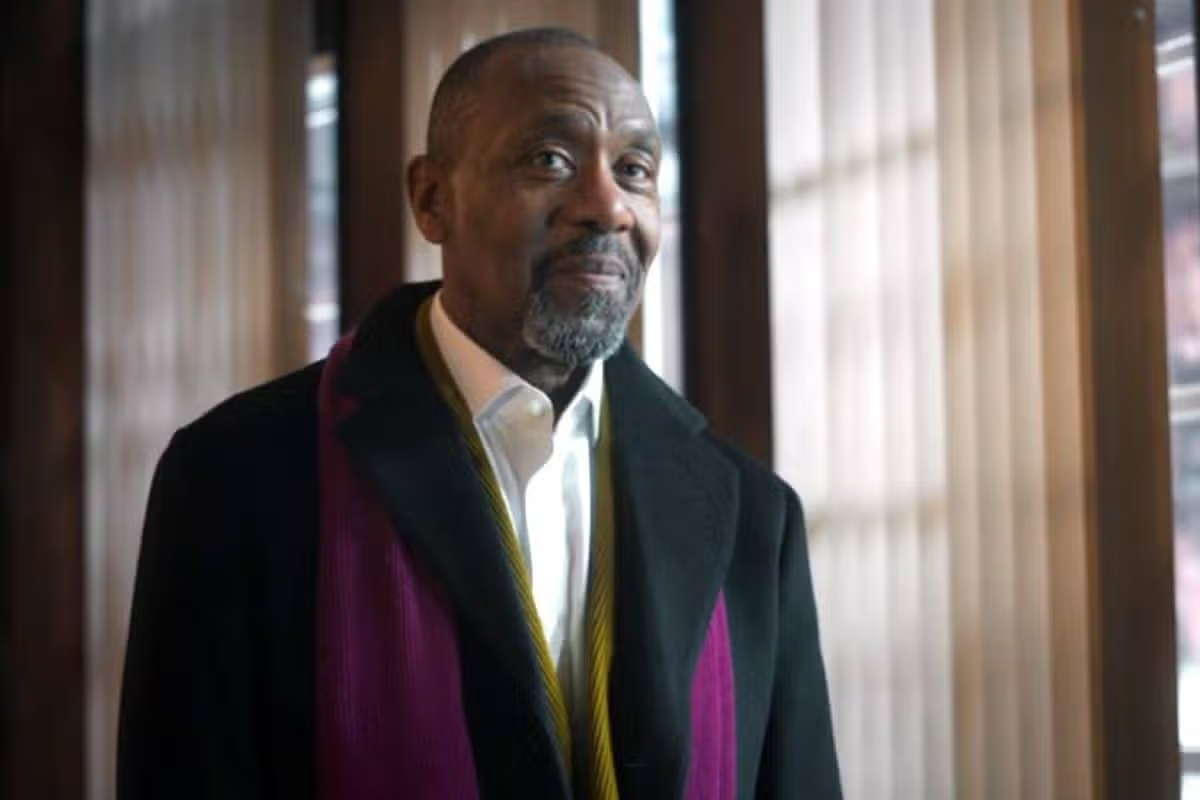
BBC The Split Up stars Sir Lenny Henry in its first episode. (Image: BBC)
Two British comedy icons are taking on rather less cheerful roles in BBC drama The Split Up.
Sir Lenny Henry and Jane Horrocks play a couple whose marriage is falling apart in the Manchester-set spin-off from The Split.
Their characters’ divorce puts them at the heart of a high-profile case for the Kishan family’s law firm.
Comic Relief co-founder Henry appears in the opening minutes as Alex Edwards, an old friend of the Kishans.
Meanwhile, Absolutely Fabulous, Little Voice and Trollied stra Jane Horrocks features later on in the debut episode as his wife Tash Edwards.
Alex decides to end their marriage after photographs emerge suggesting Tash has been having an affair with “someone half your age”, reports Wales Online.
Speaking to lawyer Aria Kishan (played by Ritu Arya), a devastated Alex looks back on the start of their relationship: “We met when I was 19. Working in a chippy.
“I didn’t know what I was doing or where I was going. And then she turned up and just made sense of it all.”
The role also brings Henry into a drama alongside his life-long friend Sanjeev Bhaskar, who plays Aria’s father, Dhruv. Henry previously appeared in Bhaskar’s sitcom The Kumars at No 42.
Bhaskar was full of praise for his friend’s performance when he told Digital Spy: “I saw Lenny last week actually and I told him how brilliant I thought he was in it and I think he was quite surprised at his own performance.
“I think it’s a testament to the writing and to the directing to get that out of him.”
Henry and Horrocks are not the only recognisable names joining the cast either with The Good Place actress Jameela Jamil also set to feature as Nisha Mantri.
Away from Alex and Tash’s marital troubles, the six-part series follows Aria as she prepares to take over the family firm while planning her wedding.
Her mother died six months earlier, and Dhruv, the founder of Kishan Law, is beginning to doubt whether his daughter is ready for the responsibility.
In addition, the return of a former flame adds another complication to Aria’s life.
The Split Up is available to watch on BBC One and BBC iPlayer.
Thousands of protesters took to the streets of Buenos Aires for the ‘March of Anger’, organised largely by left-wing groups opposing the Milei government’s austerity policies. Protesters say the cuts are hurting working families.
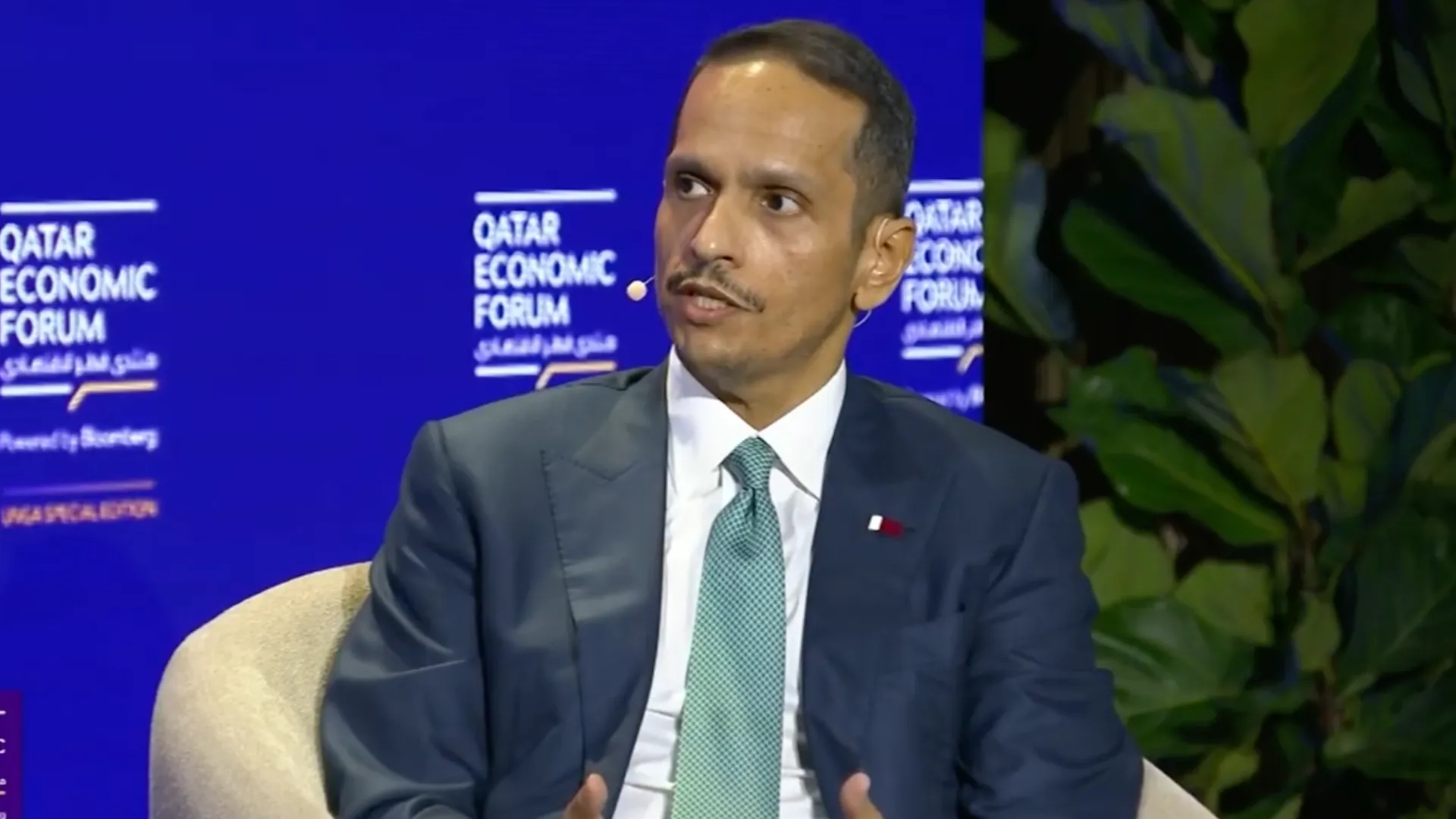
Qatar’s Prime Minister tells Bloomberg, the Gulf won’t be the same as before the war, unless there’s a security framework ensuring no one is a threat to each other. Speaking at the Qatar Economic Forum in New York, Sheikh Mohammed bin Abdulrahman Al Thani says the region needs to have good relations.
That much was clear Saturday at the Lucas Museum of Narrative Art’s opening-night soiree, where the guest list was as celebrity-heavy as any Academy Awards after-party. As the festivities kicked off around sunset in the courtyard under the museum’s towering elliptical oculus, Oprah Winfrey hugged Robert De Niro, and Harrison Ford and Calista Flockhart skipped the red carpet after chatting with Spike Lee. Laura Dern and Greta Gerwig laughed together by the entrance while Samuel L. Jackson plopped down on a curved bench, joking, “Hey, look what I did!”
For the record:
1:22 p.m. Sept. 20, 2026A previous version of this article said James Cameron was photographed along with a large group of directors at the Lucas Museum of Narrative Art. He was not.
He didn’t sit for long because Cynthia Erivo and Andy Garcia showed up and there were more hugs and handshakes and hellos. Owen Wilson, Leonardo DiCaprio, Kim Kardashian, Meg Ryan, Jack Quaid, Gov. Gavin Newsom, Rep. Nancy Pelosi, Justin Trudeau, Mark Hamill and Magic Johnson were there too, and that was just the beginning.
Gov. Gavin Newsom attended the opening-night party for the Lucas Museum of Narrative Art alongside a host of other notable guests and celebrities.
(Carlin Stiehl / For The Times)
After a rousing performance by a white-robe-clad vocal collective called Voices of Fire, co-founded by Pharrell Williams, Lucas’ wife Mellody Hobson noted that, “George kept saying, ‘Will this person come? Do you think this person will come?’”
“I said, ‘They will all come,’” Hobson said as the crowd laughed during opening remarks on a raised platform in the museum’s grand lobby.
And so they did. There was even a banner moment inside the posh fifth-floor Skywalker Grill where a group of directors gathered to be photographed in what could very well become a seminal photo of Hollywood influence in the 21st century. The shot included Lucas, Jon M. Chu, Chris Columbus, Francis Ford Coppola, Lee Daniels, Guillermo del Toro, Jon Favreau, Bryce Dallas Howard, Ron Howard, Peter Jackson, Chris Meledandri, Denis Villeneuve, Christopher Nolan, Spike Lee, Tyler Perry, Steven Spielberg, Frank Miller, Robert Rodriguez, Nathan Fielder and David Benioff.
Organizers were scrambling to find Gerwig, but she had dashed off somewhere else.
“Star Wars” legendMark Hamill and his wife, Marilou York, were guests at the Lucas Museum of Narrative Art opening party.
(Carlin Stiehl / For The Times)
There were artists in attendance too, of course, but not as many. Jeff Koons, Refik Anadol, Judy Baca and Takashi Murakami strolled through the crowd, as did museum directors including the Broad’s Joanne Heyler and Los Angeles County Museum of Art’s Michael Govan, who was relieved to be attending someone else’s party after hosting so many of his own in April and May when the new Geffen Galleries opened.
Lucas and Hobson went to great lengths to explain why the Lucas Museum matters and why it is different from other museums. Their comments, in many ways, sought to address the criticism that has been lobbed at the museum since it held its press preview a few weeks back.
Though it has received a number of rave reviews, critics have called narrative art a false conceit and argued that the juxtaposition of masterworks with pop culture ephemera does not work. Much of the criticism has been focused on a perceived lack of context since there is almost no wall text clarifying why certain curatorial choices were made.
George Lucas and his wife Mellody Hobson hosted an extravagant opening party at the Lucas Museum of Narrative Art.
(Carlin Stiehl / For The Times)
“When I started it, everybody said, ‘You’re crazy. You shouldn’t do it. It’s not going to work. People are going to come after you,’” Lucas said of his plans for the museum. “I said, ‘People have come after me all my life, especially in the movies.’”
Lucas also addressed why he curated the museum’s 100,000 square feet of gallery space on his own, noting that at a certain point plans were “getting off the rails.”
“I’m going to have to take this over because people don’t understand what I’m doing,” Lucas recalled thinking. “The idea that illustration is an art form and illustrators are artists was just too much for somebody who had been taught otherwise by the art schools that they went to and the universities that they went to.”
People with PhDs often can’t see the big picture, Lucas said, “You can’t say ‘This is art. This is not art.’ Art is in the eye of the beholder. If it is emotional to you, then it’s art. And, of course, I’ve been criticized up and down and sideways for that. But I believe it wholeheartedly — that you get to decide what art is.”
Members of the Virginia Beach vocal collective Voices of Fire, co-founded by Bishop Ezekiel Williams and Pharrell Williams perform at the Lucas Museum.
(Carlin Stiehl / For The Times)
Lucas noted that throughout his career he has worked with many illustrators, “and I will tell you, they are as talented as any artist I’ve ever met. This is the way of giving back to them something that they’ve all wanted … inevitably, all of the illustrators say the same thing — everybody from R. Crumb to Rockwell — they all say, ‘I wish I could be in a museum,’ but they can’t. There isn’t a major museum in the world that’ll have this kind of art in it. I’m hoping this will change that.”
Lucas’ comments came after his friend and co-host Queen Latifah noted to the cheering crowd that, “Paris has the Louvre, New York has the Met and now L.A. has the artistic equal.”
Guests mingle at the Lucas Museum of Narrative Art opening party.
(Carlin Stiehl/For The Times)
It took more than a decade for the Lucas Museum to land in L.A. after a search that included Chicago and San Francisco as well as lots of civic pushback and lawsuits over the use of public parkland.
“We did not realize how hard it would be to give a city a museum,” Hobson said during her remarks, later joking: “If your husband or spouse comes home and says they want to build a museum, I suggest your response is a hard no.”
Laura Dern, left, and Greta Gerwig spent the early part of the night chatting and laughing.
(Carlin Stiehl / For The Times)
Hobson went on to extol Lucas’ vision and his ability to never waver from his dream for the museum.
“He was driven to create a space that would showcase the brilliant illustrators that he thought were too often overlooked and ignored,” Hobson said. “And if critics say that a museum of narrative art is too much like a popcorn movie and not enough like an art film, well, we love popcorn movies in our family.”
Like a popcorn movie, the evening ended happily with a drone show in the night sky narrated by Winfrey and Jackson, and featuring images from the museum’s collection including the Cave of Altamira, N.C. Wyeth’s “The Storybook,” Julie Bell’s “The Huntress,” Banksy’s “Girl With Balloon,” the “Star Wars” Millennium Falcon and Maxfield Parrish’s “Ecstasy.”
Afterward the party moved inside from the rooftop terrace for a performance by the Black Eyed Peas.
Qatar’s Prime Minister Sheikh Mohammed bin Abdulrahman bin Jassim Al Thani has called on states to respect sovereignty as a condition for security in the Middle East, warning against “cycles of escalation” after “an earthquake” caused by the US-Israeli war on Iran.
The region needs a “framework in which sovereignty is respected” and no state can pose a “threat to another”, Sheikh Mohammed said on Sunday at the opening of the Qatar Economic Forum’s UN General Assembly-adjacent event in New York City.
Recommended Stories
list of 3 itemsend of list
Sheikh Mohammed – who is also Qatar’s foreign minister – described the economic fallout from the US-Israel war on Iran as “an earthquake” with “its shock waves” reaching far beyond the borders of the Middle East, “challenging assumptions about security and stability”.
“During the crisis, almost every conversation began with security and de-escalation, then turn[ed] to energy supplies, shipping routes, and with our investments, plans will continue. These were different expressions of the same question. When so much is being disrupted, what can still be relied upon?”
He said that Qatar has weathered the test to the “foundations” of the country’s economy and security, but acknowledged that the ongoing conflict in the region is having an impact.
“Permanent security cannot be built through arrangements that leave any state permanently exposed to insecurity,” Sheikh Mohammed said. “We must address the sources of tensions and build confidence.”
Reporting from New York, Al Jazeera’s Kristen Saloomey said that message “no doubt will be repeated” when Gulf leaders meet US President Donald Trump on Tuesday during the UN General Assembly.
Qatar’s $38bn domestic investments
The PM also outlined a domestic shift in Qatar’s investment strategy by pledging more than $38bn in spending on Qatari infrastructure over the next five years.
“That’s meant to attract private investors and send a message of Qatar’s resilience,” Saloomey said, while the PM is nonetheless acknowledging that the ongoing conflict is “having an impact on the region”.
The UNGA starts on Monday and ends on Friday.
The situation in the Middle East and its global ramifications are expected to be high on the agenda during speeches and diplomacy.
Also on Sunday, Qatar’s Foreign Ministry spokesman, Majed Al-Ansari, told US media in New York that the mediation efforts by his government are ongoing to restart talks between Tehran and Washington to end the US-Israel war on Iran.
Scott Bessent and He Lifeng meet in New York for US-China talks ahead of the Trump-Xi meeting later this week.
Published On 20 Sep 202620 Sep 2026
Top economic officials from China and the United States have begun talks in New York City aimed at clearing the way for possible agreements on trade, artificial intelligence and critical minerals ahead of a meeting between US President Donald Trump and Chinese President Xi Jinping later this week.
US Treasury Secretary Scott Bessent and Chinese Vice Premier He Lifeng began talks at JPMorgan Chase’s Manhattan headquarters on Sunday morning, with US Trade Representative Jamieson Greer also taking part.
Recommended Stories
list of 4 itemsend of list
The talks come four days before Trump is due to host Xi at the White House, with both sides looking to ease tensions between the world’s two largest economies.
“I’m looking forward to having focused, fulsome and constructive talks today that will set the stage for our leaders’ meeting,” Bessent told reporters as he arrived.
At the top of the agenda is a fragile US-China trade truce due to expire on November 10.
The agreement, reached in Busan, South Korea, last November, capped US tariffs on Chinese goods at about 20 percent after a tit-for-tat trade fight briefly pushed tariffs into the triple digits.
Washington is also pressuring Beijing over its supply of rare-earth magnets and other critical minerals, crucial to industries ranging from cars to advanced semiconductors.
China promised to restore the flow of critical minerals under last year’s truce, but a senior US official said on Friday that Beijing’s performance had “not been up to par”.
AI enters the talks
Artificial intelligence (AI) is also expected to feature prominently, adding a relatively new issue to negotiations long dominated by trade.
Bessent has said the countries could discuss AI “guardrails” aimed at addressing shared risks, including preventing powerful models from falling into the hands of malign non-state actors.
The talks are expected to cover both open- and closed-weight AI models. Chinese open-weight models have increasingly attracted US companies, in part because they can be cheaper than closed systems developed by US firms such as OpenAI and Anthropic.
“The United States remains the leader in AI,” Bessent said. “And we are open to discussions on avoiding shared risks and avoiding bifurcation of our two systems.”
Another potential point of friction is Iran. China remains one of Tehran’s most important economic partners and buys much of its oil, making Beijing an important target of Washington’s efforts to increase economic pressure on Iran as the US-Israel war on Iran enters its seventh month.
Expectations remain low
Despite the packed agenda, analysts are not expecting a sweeping breakthrough.
“I think there will be some show of deliverables because of the fact that it’s a presidential summit coming, but I don’t feel like we’re on the verge of some sort of breakthrough,” Anna Ashton, a China trade analyst and founder of Ashton Intelligence, told Reuters.
“I think status quo is probably both sides’ general best expectation.”
Former US Deputy Secretary of State Kurt Campbell similarly said the immediate goal may simply be keeping tensions contained.
“One of the only things we can hope for in the short term is a truce, and that this will likely continue through the remainder of this year,” Campbell said.
Sunday’s negotiations are part of a series of meetings between Bessent, He and Greer over the past 16 months aimed at hammering out areas of agreement before Trump and Xi meet face to face.
SHE has faced a tough few years, but standing centre stage in a pop-up stadium built and named in her honour, Shakira has well and truly nailed her big comeback.
Nearly quarter of a century after her debut UK hit Whenever Wherever, she is about to embark on a sold-out residency in Madrid.
Shakira on stage in Madrid on FridayCredit: Nicolas GerardinShakira will perform for more than 600,000 fans after pulling off one of the most impressive career revivals ever over 21 nightsCredit: Nicolas Gerardin
Over 21 nights, she will perform for more than 600,000 fans after pulling off one of the most impressive career revivals ever.
The concerts are the finale to her 127-date Las Mujeres Ya No Lloran World Tour — the highest-grossing Latin tour of all time, and the fifth most lucrative female tour in history.
Sign up for the Showbiz newsletter
Thank you!
And Shakira herself is enjoying it just as much as her rapidly- expanding fan base.
In an exclusive chat, the Colombian superstar — who, despite her age-defying looks, turns 50 in February — said: “I feel more secure and more confident than ever; so much more than when I was in my 20s, which is something I never would have believed or expected.”
She added of her pop renaissance: “I’ve never been more in love with my career, so I’m grateful to still be able to do what I do and just know that people are connecting to that.”
This year has been a game-changer for Shakira. Her World Cup anthem with Burna Boy, Dai Dai, topped charts globally and became one of the biggest hits of 2026 so far.
The video has had more than 1billion views since May, contributing to her becoming the most-watched female artist on YouTube.
The same month, she performed to over 2million people in a single night on Copacabana Beach in Rio De Janeiro — one of the highest- attended concerts ever.
But in Dai Dai, she sings: “You’ve been this brave all along, what broke you once made you strong.”
It is a reflection of her last few years, when life was challenging.
Shakira’s 2017 album, El Dorado, was not received as well as expected, and five years later came her highly-publicised split from Spanish footballer Gerard Pique.
The couple, who never wed but have sons Milan, 13, and Sasha, 11, announced their separation after 11 years together in a public statement.
He was alleged to have moved on with another woman while they were together, although he has not spoken about the circumstances.
Things were made worse when Shakira was dragged into court by Spanish authorities over a tax dispute, in which she claimed she had not spent enough time in the country to pay the taxes they said she owed.
In 2023, she settled on one case of tax evasion, forking out €14.5million in unpaid taxes plus interest, a €7.3million fine and a €432,000 payment to waive a suspended three-year prison sentence.
At the time, things were looking bleak. But she started to turn it around, funnelling her anger into her music, which attracted a whole new generation of fans.
Shakira doing it in style with her countless costumesCredit: Nicolas GerardinShakira performed 12-show Las Mujeres Ya No Lloran European residency at Estadio Shakira (Iberdrola Music) in MadridCredit: Nicolas Gerardin
Then in May, a Spanish court ordered the country’s tax authority to refund €55million of taxes, ruling that the cash was improperly collected during the dispute.
Her epic, two-and-a-half hour concert tells the story of a wronged woman who comes out the other side.
At one point in the show, during song TQG,she is seen trying to reprogramme men’s behaviour.
Later, she is depicted as a lone wolf protecting her cubs, and then duets with her sons, who appear on screens for the track Acrostico.
The message is clear as she tells the crowd: “Love is beautiful. But self-love is more beautiful.”
The gig features a set of some 25 songs, more than a dozen extravagant costumes, fireworks, flamethrowers, twerking and Shakira on the drums and guitar.
It is a triumphant moment of celebration and, during her carnival-inspired, multi-coloured performance of Waka Waka (This Time For Africa), she beams from ear to ear.
Shakira hopes her concerts leave fans, especially women, optimistic about the world, as that’s certainly how she feels after the ordeal she has gone through in recent years.
She told me: “I hope women walk away feeling empowered and excited about what’s ahead of them, knowing that they are the ones who decide how to tell their story and what they want to take away from everything life throws at them.
“It’s been such a revelation to realise that the worst I ever imagined could happen . . . and that I can still find this level of happiness again.”
In Madrid, as well as the temporary stadium built in her honour, there is an entire 30-hectare village of attractions based on the Hips Don’t Lie singer.
And she’s bound to rake it in as there are high-profile sponsorships, including a museum about Shakira in partnership with Amazon.
Shakira at July’s World Cup Halftime Show with Burna BoyCredit: GettyThe star at court in Barcelona accused of tax fraud in 2023Credit: AFP
A whole Disney area inspired by the star’s voice role in Zootropolis 2 is another key attraction, along with a library, in partnership with Penguin, promoting authors from South America.
During the residency, hotel bookings in Madrid are up 15 per cent from 2025, while Ryanair added 225,000 seats on flights to the hotspot ahead of the shows, which are generating hundreds of millions for the city’s economy.
Shakira, who has sold 100million records during her career, has now relocated from Spain to Miami with her sons to start afresh — and she is flying high.
She proved as much on the global stage when an estimated 1.5billion footie fans watched her perform at the inaugural World Cup halftime show in July.
Shakira on stafe playing guitar and rocking outCredit: Nicolas GerardinShakira packing a punch on tour with a wolf propCredit: Nicolas Gerardin
And although she sang alongside acts including Madonna, BTS and Justin Bieber, it was Shakira who stole the spotlight.
Her success is a testament to her grit and temerity, with music insiders revealing she is hands-on with every detail of her career.
A source said: “Shakira has worked harder than anybody for this comeback — it’s taken blood, sweat and tears.
“There have been sleepless nights, relentless workouts and a back-breaking schedule, but she loves it and wants to prove to other women what is possible. She pulled an all-nighter with her band last Wednesday just to rehearse for the show in Madrid, not finishing until 8.30am.
Shakira had a highly-publicised split from Spanish footballer Gerard PiqueCredit: GettyThe Madrid arena ready for the star’s residencyCredit: Chris Cornejo
“This is very serious to her. She wants to stay at the top for years to come.”
Shakira also teamed up with another in-demand pop star, Zara Larsson, earlier this summer for a remix of her song Eurosummer.
And last week, she released a collaboration called Agua with fellow Colombian star Maluma.
Now, all eyes are on what’s next for Shak, who has barely stopped in her quest to win back her superstardom.
Shakira on drums at a gigCredit: Nicolas GerardinShakira with The Sun’s Howell DaviesCredit: Supplied
As for a 13th studio album and future collaborations, she teased: “I’ve definitely chatted with a few people recently who would be really fun and unexpected, but I won’t ruin the surprises . . . ”
Although her tour is coming to an end, Shakira shows no signs of slowing down.
She has hinted that she wants to return to the UK, where she has not performed since 2018.
On the prospect of headlining Glastonbury, where she sang on the Pyramid Stage in 2010, she has said: “It’s such an iconic place to perform.
I’d love to go back to England and perform at Glastonbury.
“That would be like the cherry on top for this amazing year I’ve been having.”
As for a break? I wouldn’t count on it. She said: “I take days here and there to rest, but as long as I still have energy and inspiration, I love to stay working.”