Weekly insights and analysis on the latest developments in military technology, strategy, and foreign policy.
The U.S. military is not limiting its efforts to interdict Iranian vessels to the Middle East. Air Force Gen. Dan Caine, Chairman of the Joint Chiefs of Staff, told reporters today that this is a global campaign.
“Let me be clear, this blockade applies to all ships, regardless of nationality, heading into or from Iranian ports,” he said. “The U.S. action is a blockade of Iran’s ports and coastline, not a blockade of the Strait of Hormuz. Enforcement will occur inside Iran’s territorial seas and in international waters.”
“In addition to this blockade, the joint force, through operations and activities in other areas of responsibility, like the Pacific Area of Responsibility, under the command of Admiral [Samuel] Paparo, will actively pursue any Iranian-flagged vessel or any vessel attempting to provide material support to Iran,” he added. “This includes Dark Fleet vessels carrying Iranian oil. As most of you know, Dark Fleet vessels are those illicit or illegal ships evading international regulations, sanctions or insurance requirements.”
Caine added that no Iranian ships have been boarded in the CENTCOM region so far, but he did not say if any have been interdicted outside the CENTCOM region. We have reached out to his office for more details. It should be noted that early in Epic Fury, a U.S. Navy submarine sunk an Iranian frigate in the Indian Ocean.
.@thejointstaff Chairman Gen. Dan Caine: “Let me be clear: this blockade applies to ALL ships, regardless of nationality, heading into or from Iranian ports. The U.S. action is a blockade of Iran’s ports and coastline, not a blockade of the Strait of Hormuz. Enforcement will… pic.twitter.com/xGIclPQHmi
Caine was one of three top military leaders to brief reporters this morning on the currently paused Operation Epic Fury and the ongoing blockade. Here are some highlights from the press conference, which also included War Secretary Pete Hegseth, and CENTCOM commander, Adm. Brad Cooper.
Caine explaining how the Navy is enforcing the blockade:
“This map is a pull from our common operating picture that we use to allow commanders and key leaders to see what is happening in near real time, we just grabbed screen grabs to highlight the actions and activities,” Caine noted. “What is not shown is how incredibly congested this area is and the incredible work that our sailors are doing to ensure that they can work in and around an incredibly busy water space. What is also not depicted here is the massive, massive force of fighters, intelligence aircraft, helicopters and other embarked forces, to include aerial refueling tankers that are up overhead this blockade area. You’ll note that U.S. forces are in blue. Iranian ships are in red.”
Caine on how the Navy communicates with ships approaching the blockade:
“At each point, the United States Navy will transmit a warning. A young sailor, normally on the bridge of one of those destroyers – a junior officer – picks up that mic and transmits, and I quote, ‘do not attempt to breach the blockade. Vessels will be boarded for interdiction and seizure, transiting to or from Iranian ports, turn around or prepare to be boarded. If you do not comply with this blockade, we will use force,’” the chairman explained. “And as this message is being transmitted…those ship masters can literally see, sense and feel the pressure around them.”
“It’s a finely tuned machine rehearsed multiple times and executed now 13 times since the blockade has begun,” he posited.
Caine on the capabilities of U.S. Navy warships:
“When we talk about an American destroyer, it’s important that you and the American people understand their capabilities. And Arleigh Burke class destroyers are the backbone of the United States Navy surface fleet,” Caine proffered. “Over 500 feet long, they displace 9,000 tons, and it is the sports car of the United States Navy. From the keel to the mast, they stand nearly 10 stories tall, and their four gas turbine engines can drive the ship at 30 plus knots. These ships are armed to the teeth with surface-to-air missiles, land attack cruise missiles, anti ship missiles, anti submarine rockets, torpedoes, five-inch naval guns, multiple electronic warfare systems, embarked helicopters extending the reach and capability of each and every one of these destroyers. But far and away, the most important weapon on board these ships is the American sailor.”
BREAKING: Chairman of the Joint Chiefs of Staff Dan Caine outlines the DEADLY capabilities of American warships:
“These ships are armed to the teeth with surface to air missiles, land attack cruise missiles, anti-ship missiles, anti-submarine rockets, torpedoes, five inch naval… pic.twitter.com/gBTcnnMEqF
Caine on operating a blockade in highly congested waters:
“On that bridge, our sailors maintain a constant watch, maneuvering the ship tactically and safely through always congested water space, and there is a lot out there,” the general pointed out. “It is like driving a sports car through a supermarket parking lot on a payday weekend with thousands of kids in that parking lot as you attempt to maneuver through there to get to that ship that would attempt to run that blockade.”
NOW: Chairman of the Joint Chiefs of Staff Dan Caine reveals what it’s like for American warships enforcing the Middle East naval blockade:
“It is like driving a sports car through a supermarket parking lot on a payday weekend with thousands of kids in that parking lot, as you… pic.twitter.com/Xfh7ngNQBZ
“I assess that our military partnerships are stronger than ever as we continue to maintain a very active defense posture across the region during this ceasefire, and that posture stretches across the entire Arabian Peninsula, and it runs from Northern Iraq all the way down into the northern Arabian Gulf,” according to the admiral. “In creating the largest air defense umbrella in the world, across the Middle East, we invited specially trained U.S. military air defenders alongside our partner nation soldiers side by side, literally side by side.”
“And to give you a sense of their contribution and impact,” he highlighted, “the king and crown prince of Bahrain both personally knew our soldiers by name.”
CENTCOM Commander Brad Cooper:
Bahrain, UAE, Saudi Arabia, Qatar, Kuwait, and Jordan have been exceptional teammates.
I had a chance to meet with both their senior leadership as well as their troops—both equally inspiring and equally committed to mutual defense.
Hegseth on being prepared to resume fighting if needed:
“We can make that transition again very quickly and even more powerfully than ever at the direction of President Trump,” the secretary stated. “The War Department will ensure that Iran never has a nuclear weapon, never. We prefer to do it the nice way, through a deal led by our great Vice President and negotiating team, or we can do it the hard way. We urge this new regime to choose wisely.”
Hegseth on Iranian command and control:
“Their command and control capabilities are highly degraded,” Hegseth noted. “So their ability to talk, see and sense is the worst it’s ever been. But their motivation to want to stay in the ceasefire is very high, because they understand that a violation of that ceasefire means a commencement once again, of Admiral Cooper’s forces, which went very poorly for them. “
“As far as the Houthis, thus far, they have stayed out of it, which, of course, we think is a good decision by them,” Hegseth said. “And I think it is a reflection of the fact that over a year ago, in Operation Rough Rider, we had an ongoing and intense campaign that demonstrated American capabilities, which has them hesitating to want to do something on that Strait, which I think would be a poor choice.”
It is worth noting that USNI reported that the aircraft carrier USS George H.W. Bush, which is heading to the Middle East, did not transit the Strait of Gibraltar, but is instead “operating off the coast of Namibia… The path around Africa allows the carrier and its escorts to avoid transiting the Red Sea and the Bab el-Mandeb, which were both hubs of activity for the Houthis in their drone and missile attacks on U.S. and commercial shipping in 2024 and 2025.”
Hegseth on claims China is helping to arm Iran:
“President Trump has a very strong and direct relationship with President Xi, and they’ve communicated on that, and China has assured us that that indeed is not going to happen,” Hegseth avowed.
Hegseth on the health of Iranian Supreme Leader Mojtaba Khamenei:
He is “believed to be alive, wounded and disfigured,” Hegseth explained. His “status remains the same.”
According to U.S. Secretary of Defense Pete Hegseth, the current assessment on the health of Iranian Supreme Leader Mojtaba Khamenei remains the same, alive, wounded and disfigured. pic.twitter.com/XCuwrz3vZE
The ceasefire in Lebanon earned praise from the U.N. Secretary General and Saudi officials.
“I welcome the announcement of a ceasefire between Israel & Lebanon, and commend the role of the U.S. in facilitating it,” Antonio Guterres said on X. “I hope this will pave the way for negotiations towards a long-term solution to the conflict & contribute to ongoing efforts toward a lasting & comprehensive peace in the region. I urge everyone to fully respect the ceasefire and to comply with international law at all times.”
I welcome the announcement of a ceasefire between Israel & Lebanon, and commend the role of the US in facilitating it.
I hope this will pave the way for negotiations towards a long-term solution to the conflict & contribute to ongoing efforts toward a lasting & comprehensive…
The Saudi Foreign Ministry “expresses the Kingdom of Saudi Arabia’s welcome of the announcement by President Donald Trump of the United States of America, regarding the ceasefire in the Republic of Lebanon,” it stated on X. “The Kingdom commends the significant and positive roles played by the President of the Republic of Lebanon General Joseph Aoun, the Lebanese Government, headed by Prime Minister Nawaf Salam, and the Speaker of Parliament, Nabih Berri.”
#Statement | The Foreign Ministry expresses the Kingdom of Saudi Arabia’s welcome of the announcement by President Donald Trump of the United States of America, regarding the ceasefire in the Republic of Lebanon. The Kingdom commends the significant and positive roles played by… pic.twitter.com/wCxeu5Hi18
Trump took to Truth Social to blast Italy, saying: “Italy wasn’t there for us, we won’t be there for them!”
He included a link to a Guardian story from March about how “Italy has denied the use of an airbase in Sicily to U.S. military planes carrying weapons for the war in Iran after the U.S. did not follow the required authorization procedure.”
UPDATE: 5:59 PM EDT –
Pre-war planning meant Iran’s military “was able to mitigate the impact of U.S.-Israeli strikes on its weapons arsenal and leadership,” Bloomberg reported, citing Western military intelligence assessments — which also say the Islamic Republic retains the ability to respond if the ceasefire fails.
Despite the widespread damage and killings of leadership during the hostilities, operational planning undertaken in anticipation of the conflict was effective in preventing the destruction of its missile and drone capabilities as well as maximizing the impact of its military response, people familiar with the assessments told the news outlet.
Exclusive: Iran Has Limited the Impact of US Strikes, Intelligence Says
Pre-war planning meant Iran’s military was able to mitigate the impact of US-Israeli strikes on its weapons arsenal and leadership, according to Western military intelligence assessments — which also say it…
People in the Lebanese capital of Beirut celebrated by firing flares as the 10-day ceasefire between Israel and Hezbollah went into effect.
UPDATE: 5:48 PM EDT –
Netanyahu says he rejected Hezbollah’s demands for an Israeli withdrawal from all Lebanese territory, and for a ceasefire in the form of “quiet will beget quiet.”
Israeli Prime Minister Netanyahu says he rejected Hezbollah’s demands for an Israeli withdrawal from all Lebanese territory, and for a ceasefire in the form of “quiet will beget quiet.”
In other words, the new ceasefire in Lebanon will be based on the same model as the November… pic.twitter.com/Yn50TCtwSa
— Ariel Oseran أريئل أوسيران (@ariel_oseran) April 16, 2026
UPDATE 5:42 PM EDT –
CENTCOM released a video of a sailor aboard the Arleigh Burke class guided missile destroyer USS Michael Murphy communicating with a merchant vessel during a diversion in the ongoing blockade.
Audio🔊of a Sailor aboard USS Michael Murphy (DDG 112), with video from the guided-missile destroyer’s embarked helicopter flying over the Gulf of Oman, as the U.S. Navy diverts a merchant vessel while enforcing the blockade on ships entering or departing Iranian ports. U.S.… pic.twitter.com/10QxlEoGkk
Trump on Thursday claimed that Iran has agreed to give up its nuclear ambitions. He made that statement during comments to the press outside the White House on Thursday.
“We had to make sure that Iran never gets a nuclear weapon. They’ve totally agreed to that. They’ve agreed to almost everything,” he claimed, despite no deal being reached during Saturday’s U.S.-Iran talks in Pakistan, The Jerusalem Post noted.
In addition, Trump asserted that Iran is willing to do things today “that they weren’t willing to do two months ago,” before the U.S. and Israel launched Operation Epic Fury against Iran.
When asked if it would be acceptable for Iran to agree to a 20-year halt for enriching uranium, Trump said he had received “a very powerful statement” that Iran will not have nuclear weapons for “beyond 20 years.”
It is unclear how Iran has responded.
.@POTUS on whether a 20-year minimum for Iran to stop enriching uranium is acceptable:
“We have a statement, a very powerful statement, that they will not have — beyond 20 years — that they will NOT have nuclear weapons. There’s no 20-year limit.” pic.twitter.com/saqa3DjfYl
An image emerged on social media purporting to show what appears to be an anti-drone cage atop a U.S. radar system in Baghdad. Last month, a radar and a Black Hawk helicopter in the Iraqi capital were damaged during a first-person view (FPV) drone attack by an Iranian proxy militia group. As we have been reporting for years, these so-called cope cages emerged in the battlefields of Ukraine and have become ubiquitous in conflicts around the globe.
Reports are emerging of intense and sustained activity by the IRGC to restore access to Iranian underground missile sites.
“Throughout the early morning (04:15 AM – 06:00 AM local time today), a total of approximately 30 explosions were recorded as crews worked persistently to clear or unseal the blocked tunnel entrances,” according mamlekate, a network of independent journalists covering Iran.
As we have noted, these sites have been targeted multiple times since February 28, the first day of the war.
Reports from Bushehr, Jam, indicate intense and sustained activity by the IRGC to restore access to the underground missile sites. Throughout the early morning (04:15 AM – 06:00 AM local time today), a total of approximately 30 explosions were recorded as crews worked… https://t.co/3t3HIbM5as
During his press conference, Hegseth noted that the U.S. is closely monitoring Iranian efforts to dig out these facilities and said they would be unsuccessful.
“While you are digging out, which is exactly what you’re doing, digging out of bombed-out and devastated facilities,” he posited. “We are only getting stronger. You are digging out your remaining launchers and missiles with no ability to replace them.”
🚨SOW Hegseth: “While you are digging out, which is exactly what you’re doing, digging out of bombed-out and devastated facilities. We are only getting stronger. You are digging out your remaining launchers and missiles with no ability to replace them.” pic.twitter.com/Xdkco9qo5F
As we noted yesterday, CNN reported that Iran appears to be using the time to reopen entrances to underground missile cities damaged during the war. The network published footage showing engineering equipment at the Tabriz South missile base and the Khomein missile base.
The network also noted that, according to U.S. intelligence estimates, about half of the Iranian missile launchers remained intact after a month of fighting, and that many of these launchers could have been buried in underground storage facilities as a result of strikes on the entrances.
CNN published footage showing engineering equipment making use of the ceasefire to reopen the entrances to underground facilities at missile bases that were damaged during the war.
The sites documented include the Tabriz South missile base and the Khomein missile base.
U.S. and Iranian negotiators have scaled back ambitions for a comprehensive peace deal and are instead seeking a temporary memorandum to prevent a return to conflict, two Iranian sources told Reuters.
“A senior Iranian official said the two sides had started to narrow some gaps, including over how to manage the Strait of Hormuz, a vital route for about 20% of the world’s oil and gas needs that has been closed to most ships for weeks,” the news outlet reported.
Iran, which has faced crippling U.S. sanctions for years, “wants a memorandum to include Washington unfreezing some Iranian funds, in return for allowing more ships through the strait,” Reuters added.
However, no dates for a return to talks has yet been set.
The commander-in-chief of the Iranian Army boasted about how his country still has a functional Air Force, as demonstrated yesterday during the escort over its airspace by a visiting Pakistani delegation.
“They say the Iranian Air Force is gone. Yesterday we had a guest (Commander of the Pakistan Army),” proclaimed Gen. Amir Hatami. “As soon as he entered our airspace, we announced that your (Pakistan’s) planes weren’t needed. We escorted our guest with twice the number of planes they wanted to bring for escort.”
🇮🇷🇵🇰⚡️– Commander-in-Chief of the Iranian Army:
“They say the Iranian Air Force is gone.
Yesterday we had a guest (Commander of the Pakistan Army). As soon as he entered our airspace, we announced that your (Pakistan’s) planes weren’t needed.
Hatami’s comments came a day after images emerged on social media purporting to show an IRIAF F-4E and Mig-29A flying over Tehran escorting the Pakistani delegation that arrived today to discuss potential future peace talks.
Despite the ongoing efforts to end the fighting, the U.S. is continuing to flow assets to the region, with transport planes regularly landing in the Middle East from the U.S.
What is a “good faith deal?” U.S. officials say this includes the Iranians understanding they can’t obtain a nuclear weapon, can’t enrich uranium, and must remove already enriched uranium from their country. pic.twitter.com/86XPn0L0cW
Trump said Israel and Lebanon have agreed to a ceasefire.
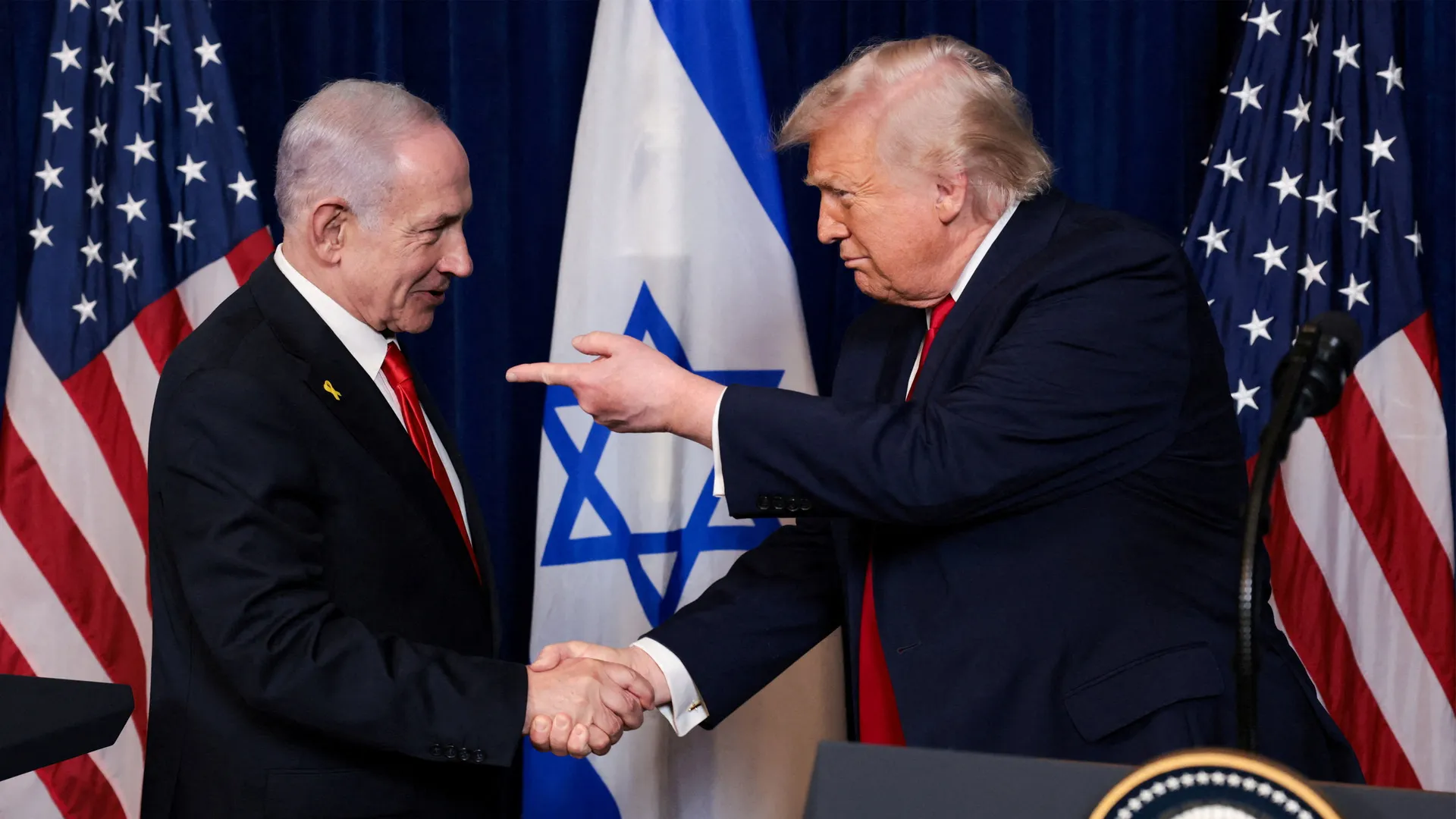
“I just had excellent conversations with the Highly Respected President Joseph Aoun, of Lebanon, and Prime Minister Bibi Netanyahu, of Israel,” the president stated on his Truth Social site. “These two Leaders have agreed that in order to achieve PEACE between their Countries, they will formally begin a 10 Day CEASEFIRE at 5 P.M. EST.”
However, the statement doesn’t mention Hezbollah, which is fighting Israel, so it is unclear what effect this will have.
Trump added that he is “inviting the Prime Minister of Israel, Bibi Netanyahu, and the President of Lebanon, Joseph Aoun, to the White House for the first meaningful talks between Israel and Lebanon since 1983, a very long time ago.”
Prior to Trump’s social media post, Iran’s parliament speaker Mohammad Bagher Ghalibaf told his Lebanese counterpart Nabih Berri that Tehran is pushing for a permanent ceasefire “in all conflict zones” and that a ceasefire in Lebanon is “just as important” as in Iran, according to a statement on Telegram.
BREAKING: Iran’s parliament speaker Mohammad Bagher Ghalibaf tells Lebanese counterpart Nabih Berri that Tehran is pushing for a permanent ceasefire “in all conflict zones” and that a ceasefire in Lebanon is “just as important” as in Iran, according to a statement on Telegram. pic.twitter.com/dLis1PD2xE
Despite Ghalibaf’s comments, Lebanon’s president will not speak to Israel’s prime minister in the near future as anticipated, Lebanese officials said on Thursday, according to Reuters. The move dealt a blow to U.S. efforts to expand contacts between the enemy states as Pakistan said peace in Lebanon was vital to ending the Iran war.
The IDF is setting up more outposts in southern Lebanon, Haaretz reported.
Soldiers serving in Lebanon told the newspaper that the army is “operating in Lebanon using methods similar to those used in the Gaza Strip and that these new outposts are likely to become focal points for friction and ongoing fighting against Hezbollah.”
IDF Setting Up More Outposts in Southern Lebanon: “We’re behaving just like we did in Gaza,” one army source said. “There’s a list of homes to be demolished, and we measure success based on the number of buildings destroyed in a day.”
Select Committee on China Chairman John Moolenaar sent a letter to Hegseth concerning the operations of Airbus Space “due to its role in likely providing satellite imagery of U.S. military assets to MizarVision, a Chinese entity, days before the commencement of Operation Epic Fury,” according a committee press release.
“While commercial satellite imagery may serve public interest purposes in some cases, unconstrained imagery provision exposing U.S. forces to heightened risk crosses a dangerous threshold,” Moolenaar wrote. “Near-real-time publication of precise, annotated imagery identifying the exact type, number, and location of specific high-value military assets at an active forward operating base—while those assets are actively engaged in combat operations—is targeting data for enemy forces.”
As we noted yesterday, VANTOR and Planet Labs, two U.S. satellite firms, have already complied with the Pentagon and have curtailed providing imagery over the Middle East.
A Chinese firm, MizarVision, posted detailed satellite imagery of U.S. forces in the Middle East while not disclosing its data sources.@ChinaSelect analysis found @AirbusSpace satellites had multiple daily windows, up to 10 hours, where they could have captured imagery of U.S.… pic.twitter.com/HywjpstNUb
— Select Committee on China (@ChinaSelect) April 16, 2026
China and the U.S. are maintaining communication on U.S. President Donald Trump’s visit to China, Chinese Foreign Ministry spokesperson Guo Jiakun said on Thursday.
Guo’s statement came in response to a question regarding remarks by President Trump in an interview aired Wednesday on Fox News, in which he said factors including Iran would not change the dynamic of his meeting with the Chinese leader.
#Chinese Foreign Ministry spokesperson Guo Jiakun said on Thursday that China and the #US are maintaining communication on US President Donald #Trump’s visit to China. Guo’s statement came in response to a question regarding remarks by President Trump in an interview aired… pic.twitter.com/S80Mu6XCEH
U.S. Central Command (CENTCOM) clarified its efforts to interdict ships providing support to Iran. All Iranian vessels, those with active Office of Foreign Asset Control (OFAC) sanctions, and ships suspected of carrying contraband are subject to boarding and seizure. The contraband items include weapons, ammunition, fissile materials, equipment for nuclear enrichment, metals, oil and lubricants among others.
The ongoing reduction of oil exports from the Middle East as a result of the war is having dire economic impacts around the globe.
On Thursday, International Energy Agency Chief Fatih Birol stated that Europe has “maybe six weeks of jet fuel left,” and warned of possible flight cancellations, according to Sky News.
BACK in the 80s and early 90s, this movie star was known for huge blockbuster films, and was one of the biggest names in Hollywood.
Sadly, in 1991, the actor’s beloved wife died and he started to take a step back from the limelight and eventually quit fame – but now the 72-year-old star is making his big comeback.
Sign up for the Showbiz newsletter
Thank you!
Hollywood star Rick Moranis is making his return to Hollywood after leaving the spotlight when his wife diedCredit: GettyThis actor has made his comeback to the spotlight after three decadesCredit: GettyRick made a rare appearance at CinemaCon to promote his new movie SpaceballsCredit: GettyLast year it was revealed how Rick had signed on for the new Spaceballs sequel, reprising his role as Dark HelmetCredit: Alamy
Rick Moranis, famed for 80s films like Ghostbusters, thrilled fans when he made a rare appearance at CinemaCon 2026.
It was announced last year that the Canadian actor would be reprising his role as Dark Helmet.
The original movie, which is a spoof of Star Wars, came out in 1987 and starred many notable names, including Mel Brooks, Daphne Zuniga, Bill Pullman, the late John Candy, and Joan Rivers, among others.
Many of Rick’s former co-stars have returned for the sequel, such as Mel, Daphne, Bill, and George Wyner.
There are also several new faces among the cast, including Josh Gad and Keke Palmer.
The cast joined Rick at a panel event to promote the movie at CinemaCon.
Despite the star rarely being seen in the last three decades, the actor hasn’t changed much in appearance.
The Flintstones star wore his trademark round-framed glasses, which he was famed for in his iconic movies.
Other than Spaceballs, Rick starred in many successful films in the 1980s and 1990s, including Honey, I Shrunk the Kids and its sequels, and playing Barney in The Flintstones.
Rick thrilled fans when he stepped out on stage at CinemaConCredit: GettyRick starred in a string of successful films in the 1980s and 1990s – seen here in Little Shop of HorrorsCredit: HandoutRick is probably best known for Honey I Shrunk The KidsCredit: RexRick left Hollywood in the 90s to focus on raising his two kids following his wife’ Anne’s deathCredit: Alamy
Sadly, Rick started to take a step back from Hollywood when his wife, Anne Belsky, passed away from breast cancer in 1991.
During the 90s, he slowly started to quit fame to focus on parenting his two children.
Although Rick hasn’t been seen on screen, he hasn’t entirely distanced himself from acting.
He lent his voice to several animated projects over the years, including Disney‘s Brother Bear in 2003, and its sequel, Brother Bear 2, in 2006.
Rick’s voice also appeared in a 2018 episode of The Goldbergs and a 2020 episode of the Disney+ docuseries Prop Culture.
However, he hasn’t appeared in a live-action film since Disney’s Honey, I Shrunk Ourselves, which was released directly to video in 1997.
But Rick is now set to be back on the big screen, with production for Spaceballs 2 underway.
The hotly-anticipated sequel is set to hit cinemas in 2027.
Rick also starred in 90s movie, The FlintstonesCredit: BBCThe actor was famed for his round glasses back in the 80s and 90sCredit: Getty
Secretary of Health and Human Services Robert F. Kennedy, Jr. speaks during a House Appropriations Subcommittee on Labor, Health and Human Services, Education and Related Agencies, one of seven congressional committees he testified before Thursday. Photo by Bonnie Cash/UPI | License Photo
April 16 (UPI) — Health and Human Services Secretary Robert F. Kennedy, Jr. on Thursday testified before seven congressional committees, often clashing with Democrats about decisions he has made about vaccines and department priorities.
The testimony is Kennedy’s first trip to the Capitol this year and the first time that he has appeared before Congress in more than seven months, The Washington Post reported.
In addition to unilaterally remaking the Center for Disease Control and Prevention’s vaccine advisory committee and the agency’s recommended childhood vaccine schedule — which were blocked by a federal judge in March — he has changed the Food and Drug Administration‘s recommendations on diet and shepherded medications through federal approval processes while allegedly ignoring data on them.
Kennedy also was asked by members of Congress about the Trump administration’s 12.5% budget request decrease, which amounts to about $16 billion that it sought for its fiscal year 2027 budget proposal, NPR reported.
“Our children are the sickest generation in modern history — decades of failed policy, captured agencies and profit-driven systems have caused it,” Kennedy said during a hearing before the House Ways and Means Committee.
“Parents across this country demanded change — and we are delivering it,” he said.
Kennedy said that the measles vaccine “certainly” could have saved the life of a child who died in Texas last year during an outbreak in the state.
More than 1,700 measles cases have been reported through the first 3 1/2 months of 2026, compared to more than 2,200 reported in all of 2025.
He also was asked by Rep. Linda Sanchez, D-Calif., about ending an influenza vaccine public awareness campaign while investing money in marketing efforts for his remade food pyramid.
“You suspended this pro-vaccine messaging campaign, but somehow you’re spending taxpayer dollars to drink milk, shirtless in a hot tub with Kid Rock?” Sanchez asked.
Kennedy also was accused of “diminishing science” by Rep. Bradley Scott, D-Ill., with his support for $5.7 billion in cuts to the National Institutes of Health meant for drug development.
“Nobody wants to make the cuts,” Kennedy said in response to several questions about reducing the HHS budget, but said the nation needs “to tighten our belt” because of the national debt, which he blamed on Congress.
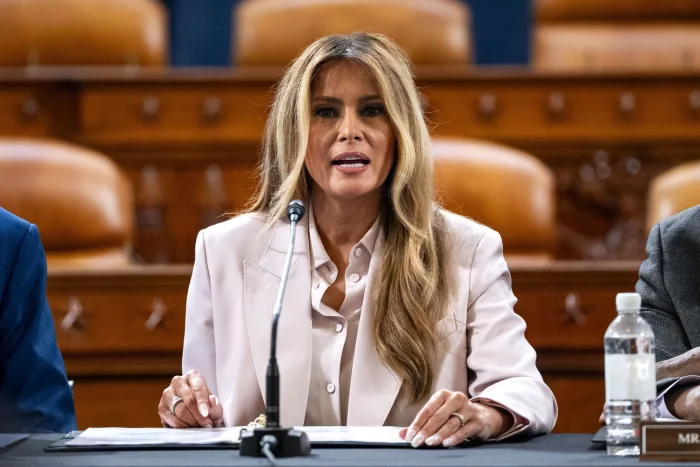
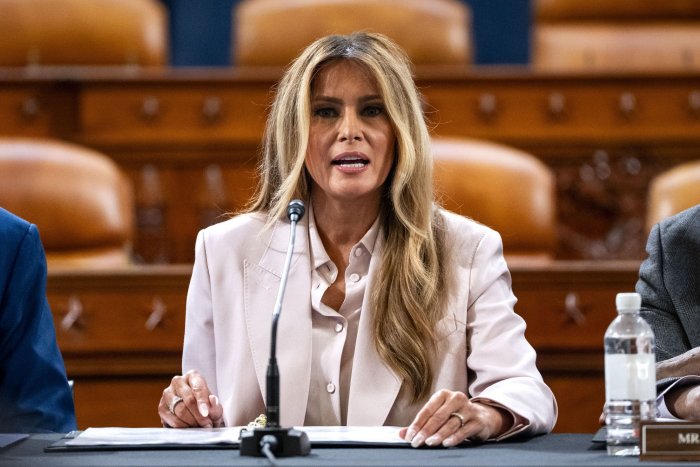
First lady Melania Trump speaks during a House Ways and Means Committee roundtable discussion on protecting children in America’s foster care system in the Longworth House Office Building near the U.S. Capitol on Wednesday. The bipartisan group of lawmakers are looking to address challenges children in foster care face, including barriers to education and educational advocacy, housing, employment opportunities, financial independence, and technology. Photo by Bonnie Cash/UPI | License Photo
Donald Trump has indicated that the conflict with Iran could conclude “soon,” citing progress in negotiations and a possible meeting between the two sides in the coming days. A temporary ceasefire between Israel and Lebanon has added to cautious optimism, though the broader regional situation remains unstable. The war, which began with U.S.-Israeli military action, has had sweeping geopolitical and economic consequences.
Ceasefire in Lebanon: A 10-day truce between Israel and Lebanon has come into effect, offering a brief pause in cross-border hostilities. However, early reports of violations underline the fragility of the arrangement. Hezbollah, aligned with Iran, has been urged by Washington to maintain restraint during this critical window.
Diplomatic Breakthrough Efforts: Backchannel diplomacy, with Pakistan playing a mediating role, has reportedly led to progress on key issues. Talks are expected to produce an initial memorandum of understanding, potentially followed by a comprehensive agreement within weeks. Engagement between U.S. and Iranian officials is likely to intensify in the immediate term.
Global Economic Shock: The conflict has disrupted global energy flows, particularly through the Strait of Hormuz, through which a significant share of the world’s oil supply passes. This has triggered sharp oil price fluctuations and raised concerns about a broader economic slowdown, even as markets show signs of stabilizing on hopes of a resolution.
Nuclear Issue as Core Dispute: Iran’s nuclear program remains the central obstacle in negotiations. Washington is pushing for long-term restrictions, while Tehran seeks shorter commitments and the lifting of sanctions. Bridging this gap will be critical to securing a durable settlement.
Political Pressures and Regional Stakes: The war has created domestic political challenges for Trump, particularly ahead of upcoming elections. At the same time, regional actors are closely watching the outcome, as any agreement will shape the balance of power and security dynamics across the Middle East.
Analysis: Momentum toward a deal is clearly building, but the situation remains precarious. The ceasefire in Lebanon and progress in diplomacy suggest a window of opportunity, yet unresolved issues, especially around nuclear limits and sanctions relief, could still derail negotiations. Trump’s urgency reflects both strategic calculation and domestic political pressure, while Iran appears willing to engage but not at any cost. If a preliminary agreement is reached, it would mark a significant de-escalation, but sustaining peace will require careful management of deep-rooted tensions and competing interests on all sides.
“Well…I’ve decided it’s TIME,” she wrote in the caption of an Instagram reel on Wednesday. “The AI revolution has begun, and I need to learn as much as I possibly can about AI and share it with all of you. Also, FYI: the jobs women hold are 3x more likely to be automated by AI, yet women are using AI at a rate 25% lower than men on average. We don’t want to be left behind. So…do you want to learn with me?”
In the video, which the star shared across social media platforms, Witherspoon said she was with 10 women at a book club this week. “I said to the 10 of them, ‘How many of you guys use AI?’ And only three of them used AI. And then I said, ‘How many of the three of you feel like you really know what you’re doing or using it the right way?’ And there was only one person,” she said.
“So, if three out of 10 women are the only ones using AI, that means 70% of that group is not keeping up. The thing I’ve learned about technology is if you don’t get a little bit of understanding from the very beginning, it just speeds past you. So you have to have little bits of learning just to keep up.”
The “Big Little Lies” star then seemingly put out a feeler for an A.I. learning course saying, “I think we should learn the basics together and learn some really good tools that are going to make our everyday lives easier and better. Do you want me to share what I’m learning with you?”
One group that was especially vocal in their opposition to A.I., was the literary community, and writers and authors across the country didn’t hold back when sharing their two cents.
Bestselling “Bad Feminist” author Roxane Gay chimed in on Threads, writing, “Oh Reese. Absolutely not.”
“This is obviously a scripted ad and it’s genuinely infuriating. Notice how AI’s biggest defenders are the ones cashing checks from it,” wrote screenwriter and director Charlene Bagcal on Threads. “AI isn’t inevitable. Technology follows society. If people stop using it, it dies. We still have agency.”
“Jagged Little Pill” author and literary agent Eric Smith weighed in, “As someone who champions authors and books the way you do, this is so disappointing.”
“AI plagiarized all my books. It seems unlikely that I’ll be ‘left behind’ if I don’t use it, given that it’s trained on work I did years ago,” wrote “Get Well Soon” author Jennifer Wright.
Writer and actor Rati Gupta said, “How am *I* the one being “left behind” by not using AI when *my* cognitive function will remain fully intact and uncompromised?”
And Sophia Benoit posted, “There’s something particularly insidious about seeing that women— the group you have built your brand on— have not adopted something and instead of assuming it’s out of wisdom, infantalizing them with ‘we’re falling behind.’”
In 2021, Witherspoon’s company, Hello Sunshine, partnered with World of Women (WoW), an NFT collective, and the actor similarly caught flak from followers for tweeting “In the (near) future, every person will have a parallel digital identity. Avatars, crypto wallets, digital goods will be the norm. Are you planning for this?”
Representatives for Witherspoon have not responded to the Times request for comment.
‘We can do whatever we want’.
US President Donald Trump has described the war on Iran which has killed more than 2,000 people as a ‘little diversion’. Speaking in Las Vegas, he said it was ‘going swimmingly’ and ‘should be ending pretty soon’.
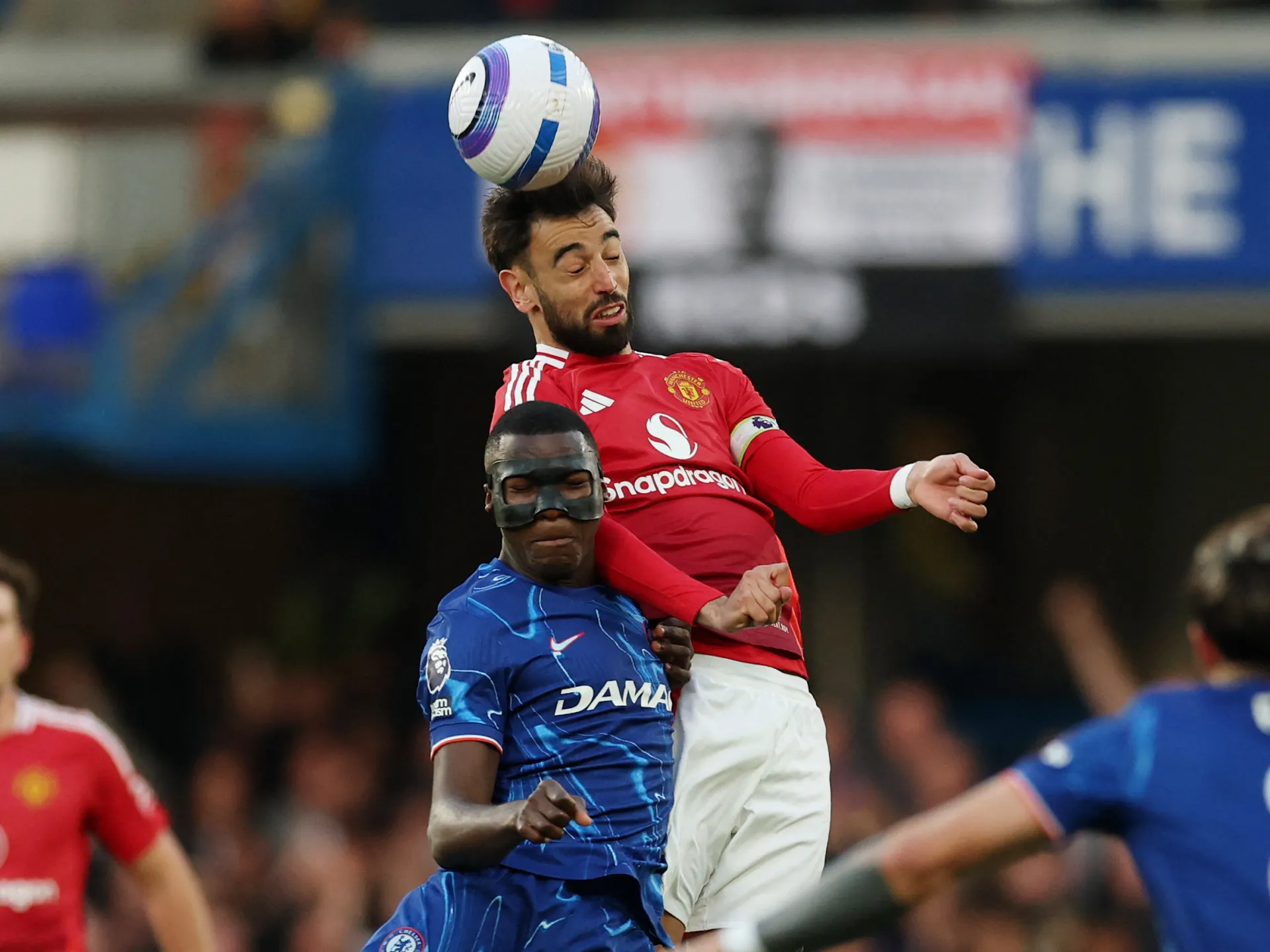
Who: Chelsea vs Manchester United What: English Premier League (EPL) Where: Stamford Bridge, London, United Kingdom When: Saturday, April 18 at 8pm (19:00 GMT) How to follow: We’ll have all the build-up on Al Jazeera Sport from 16:00 GMT in advance of our live text commentary stream.
Chelsea can tighten up the Premier League battle for UEFA Champions League qualification when they host third-placed Manchester United on Saturday, but they will have to reverse a dreadful run of form to do so.
Recommended Stories
list of 4 itemsend of list
The Blues have only won one of their last five Premier League matches, increasing the pressure on manager Liam Rosenior in his first season in charge of the football club.
United suffered a shock home defeat by Leeds United last week and arrive with injuries and suspensions that will leave them feeling vulnerable for the first time under interim head coach Michael Carrick.
Al Jazeera Sport takes a look at a game that could ignite a late-season scrap for the top five finishing spots, which offer the route to Europe’s top table next season.
How does the Premier League race to the Champions League stand?
Third-placed United will arrive at Stamford Bridge with sixth-placed Chelsea seven points behind them.
Fifth-placed Liverpool are four points in front of the Blues, while Aston Villa are fourth, level on points with United but seven down on the Red Devils on goal difference.
With Villa and Liverpool not playing until Sunday – Sunderland at home and Everton away, respectively – a Chelsea win would close the gap between third and sixth to just four points for Saturday at least.
Four clubs, including Sunderland and Everton, sit just two points behind Chelsea. A certain run of results across the weekend means just six points could separate third from tenth by the close of this round of matches.
If fans of a close race were to be particularly greedy, wins for Bournemouth and Fulham – 11th and 12th, respectively – as well this weekend could mean the gap from third to 12th would only be eight points with five games to play.
As the former Manchester United manager Sir Alex Ferguson once said: “It is squeaky bum time”.
Clock ticking on Champions League qualification, admits Chelsea manager
Rosenior has warned Chelsea that their bid to qualify for the Champions League is hanging in the balance.
The Blues are on a dismal run of one win from their last seven Premier League games, placing their hopes of reaching Europe’s elite club competition in jeopardy.
It is more than six weeks since Chelsea last scored a goal in the league, but Rosenior knows there is no time left to feel sorry for themselves after last weekend’s 3-0 home defeat against Manchester City.
“As the season goes on, the less games you have left, the more important the games become,” Rosenior told reporters ahead of the game.
“We have to take advantage of this moment. We’re running out of time.
“We need to show that initiative on Saturday and play on the front foot and make up those points, which is still definitely possible.
“If I look at each game, I think it’s just come down to loss of concentration of focus in a moment that then has snowballed into the rest of the performances.
“What we have to do is manage the margins of the game a little bit better.”
Chelsea braced for fan protest ahead of Man Utd visit
A protest by Chelsea supporters is planned ahead of the United game, reflecting the growing discontent since owners BlueCo took over from Roman Abramovich almost four years ago.
Unless results improve drastically in the next few weeks, this season will be the first under the club’s American owners that the team’s league position has dropped.
Rosenior’s position is also likely to come under scrutiny after a disappointing start to his reign, which started in January when he arrived from Strasbourg to replace Enzo Maresca.
Maresca departed by mutual consent after hinting he did not receive sufficient support from the owners.
Strasbourg are owned by BlueCo, which led some fans to criticise Rosenior’s appointment and claim he would be a puppet for the board, in contrast to the volatile Maresca.
“Every supporter has their viewpoint,” Rosenior said. “Every supporter wants their club to do well and to win games. Our job, my job, is to produce those results in the long term.”
What happened the last time Chelsea played Man Utd?
The reverse fixture at Old Trafford earlier this season resulted in a 2-1 win for the Red Devils at Old Trafford.
Following the sending off of Chelsea keeper Robert Sanchez in the fifth minute, Bruno Fernandes and Casemiro gave the home side a two-goal advantage at the break.
The latter, however, saw red in the last minute of the first half, but Trevor Chalobah’s 80th-minute strike was in vain as United held on for the win.
Head-to-head
This will be the 199th meeting between the clubs, with United winning 81 of the matches and Chelsea emerging victorious on 56 occasions.
Stat attack – Manchester United
United playmaker Bruno Fernandes is just three assists away from equalling the all-time record of 20 in a single Premier League season.
Chelsea team news
Chelsea manager Rosenior says midfielder Enzo Fernandez has returned to full training and is available for selection for the visit of Manchester United after being dropped for disciplinary reasons.
The 25-year-old Argentina World Cup winner was omitted from the squad for the 7-0 win over League One Port Vale in the FA Cup quarterfinals and last week’s 3-0 Premier League defeat by second-placed Manchester City at Stamford Bridge.
Fernandez, who had been wearing the captain’s armband in the absence of the injured Reece James, had previously said he would assess his future after the World Cup and expressed a desire to live in Madrid, comments for which he later apologised.
“Enzo has been with the group and has been training very, very well,” Rosenior told reporters on Thursday. “So, it’s business as usual in terms of selection for the game.
“In terms of his training, his application to training, Enzo has been fantastic as well.”
Rosenior also provided updates on defender Trevoh Chalobah, who has not played since the second leg of Chelsea’s Champions League defeat by Paris Saint-Germain, and on James, who has been sidelined since the loss to Newcastle United also in March.
“Trevoh trained today but not quite fully; it was a modified training,” Rosenior said. “We’ll make a decision on him, but he’s very, very close. Reece is a little bit further away.”
United’s first-choice centre-backs Lisandro Martinez and Harry Maguire are both suspended for the match.
Maguire was set to return from a one-game ban, but has had his suspension extended by an additional game for improper conduct following his sending off against Bournemouth last month.
Fellow centre-back Matthijs de Ligt is still sidelines by a back injury, while Kobbie Mainoo missed the defeat by Leeds with a knock and remains a doubt.
AFTER the whirlwind success of No1 hit Stick Season, Noah Kahan didn’t rush back into the studio.
In fact, he stopped completely. Facing writer’s block and still processing everything that had happened, he stepped away for six months, forced to rethink not just the music, but what success meant.
Sign up for the Showbiz newsletter
Thank you!
Noah Kahan is back with a new album, The Great DivideCredit: Patrick McCormackNoah’s 2022 album Stick Season sold over four million copies and had billions of global streamsCredit: Stephen Keable
His 2022 album Stick Season — rooted in Vermont and exploring mental health, identity and small-town life — transformed the singer from a cult folk artist into a global name.
Topping the charts in the UK, the record was also certified multi-platinum in the US, where it sold over four million copies and had billions of global streams.
Kahan was nominated for a Grammy for Best New Artist and the emotionally raw, nostalgic and deeply personal record was widely seen as one of the defining albums of the decade.
“I just couldn’t write for a while,” he confesses. “When I first got off the road, I didn’t make any music in a long time.
“I spent months not doing anything and it was painful because I like to be busy.
“It took so much strength for me to push that feeling away.
“I’m aware of how rare the moment was, how big the moment was and how lucky and fortunate I was, but my whole life I was trying to prove to people that I had a place here. So when the huge moment was happening, instead of being like, ‘Yeah, I made it’, I was like, ‘Oh my god, how am I going to stay here?’.”
That pressure quickly took its toll. Kahan said: “Writer’s block is such a lonely feeling — it makes you feel like your value’s been taken away. I felt completely unable to open up about it, but I ended up reaching out to friends.
“Marcus Mumford really helped. He understood what it’s like to be under a lot of pressure and afraid of failing and gave me great advice.”
Kahan also had to redefine success. It was not chasing numbers — just being able to make music was enough.
He says: “I learned the hard way about burnout. Success is a double-edged sword. I’ve always said if I had any, or if my tour sells out, I’d be happy. But the second it sells out, you’re looking at the next thing to achieve.
“Starting off this new album was really scary. I had to realise I didn’t need to be the biggest artist in the world or where Stick Season took me. I didn’t need to be successful to be loved.”
Kahan is in London for a few days to promote The Great Divide, his fourth studio album, which is out next Friday.
Taking time off to reset both mentally and emotionally was essential to writing again.
“I’ve struggled with my mental health,” he says candidly.
“But I was struggling more than anybody knew. I’ve struggled with anxiety, depression and body dysmorphia, but it was the OCD that I hadn’t figured out.
“I was diagnosed with OCD last year. It’s not about washing my hands a thousand times — it’s obsessive thinking. I was struggling with a lot of self-esteem and confidence issues, but I’d never dealt with anything so acutely like OCD. I’m supposed to be the singer who’s open about his mental health, but I felt so much shame.
“I needed medical intervention and therapy, and I didn’t want to be open about that because I was afraid. It was frightening as I’d been stripped of
this thing I loved.
“I couldn’t express myself through music any more, and so I didn’t tell anybody and it came to a breaking point.” Through help and time, Kahan started to recognise his disorder in ways he hadn’t before.
“Now I wake up knowing my day is not going to be decided by what I see on my phone,” he says when discussing how therapy has helped him.
“Before, I’d have 700 brilliant words of praise, but it would be the one negative word that would shatter me. For a long time, I thought I was crazy.”
Kahan is focused on bringing his album to the stageCredit: Patrick McCormack
In August 2025, Kahan married his longtime partner Brenna Nolan, bringing a new sense of stability to his life.
The singer has also made a Netflix documentary — Noah Kahan: Out Of Body. It captures this difficult period, which he sees as part of his healing.
He says: “Making the film was a strange but amazing process. Having people follow you around took time to get used to, but they captured a really honest moment for me. Watching it back with my family was emotional. It showed how we really are.
“It was hard seeing how unhappy I was then, but in the end, it told a beautiful story.”
He adds: “My family are on the new record. I love the song American Cars. It’s about my sister.
“Whenever things were tough at home, she’d drive up from New York in a rental car, sunglasses on, just a total badass.
“She’s a surgeon, she just gets things done. She’d come back and help us through it, and the song came from that. Like, you need to come home and help fix this.”
The Great Divide is an album about friendship, miscommunication, regret and personal growth, and the title track became the guiding, emotional “north star” of the record.
He says: “Yeah, The Great Divide is really about a friendship that didn’t work out — one where I wasn’t able to express myself.
“And then there’s a song, Dan, which is about the opposite — being open, telling each other how much you care, facing hard truths. It ends in a way that really encapsulates the whole record. It’s probably my favourite song we made.
“There are a lot of stories,” he adds.
“It’s very emblematic of my childhood and a lot of people’s, young men in particular. Talking about feelings or asking difficult questions can feel like more discomfort than it’s worth, but the consequence is you don’t really know someone as well as you think you do.”
Noah says of his new album: ‘The Great Divide is really about a friendship that didn’t work out — one where I wasn’t able to express myself’Credit: Patrick McCormack
It’s an expansive album with 17 tracks, including the gorgeous We Go Way Back, Willing And Able, Haircut and Porch Light.
He adds: “I can’t wait to see crowds singing back Willing And Able, and Haircut started from that idea of someone coming back to town changed — like they’ve outgrown it. I felt like I’d become that person, only going home for inspiration instead of really being there.
“The song is almost someone singing to me, saying, I’m glad you’ve figured things out, but at least I’m still here and still real. You’ll leave again, and we’ll still be here. That’s what it’s about.
“Then, Porch Light is really about my biggest fear — how I’ve changed.
“I worry about going home and feeling like people see me differently, like I’ve become this ‘Hollywood’ version of myself, too big for where I’m from. That my relationship with Vermont has been changed by success and leaving Vermont for Nashville.
“But my family has always kept me grounded. They’re so happy for me. I wanted to write about that fear you have in your head before you even pick up the phone.
“You’re always anticipating what people might think. But there’s a silver lining in Porch Light. It’s about people saying, ‘We still care about you, we’ll still be here — but you need to figure things out first’.”
And that sense of place runs throughout the album.
“Yeah, the first and last songs really frame the album — I wanted them to feel like an intro and an outro,” Kahan says.
“The first track, End Of August, is this big, building track about that time of year in Vermont . . . It’s that moment when the tourists leave and the people who live there can finally come out of hibernation — like, ‘They’re gone’.”
He’s been working with Stick Season collaborator Gabe Simon, The National’s Aaron Dessner — best known for his work with Taylor Swift, Bon Iver and, more recently, Gracie Abrams — plus Ed Sheeran and Mumford & Sons.
Kahan says: “Gabe and I are really close — we went through a lot making Stick Season, so on this album we leaned on each other. He’s like a brother and the perfect person to go through this with.”
Noah will be in the UK, including three nights at London’s O2 in NovemberCredit: Patrick McCormack
Aaron Dessner brought calm, structure and creative balance to the process.
“Aaron came in early on, but I was intimidated at first,” admits Kahan. “I looked him up on Wikipedia and was terrified of his success. This guy’s a legend.
“This was where Taylor Swift writes and Justin Vernon (Bon Iver), who works with Aaron, is my hero. Aaron has a magic to his music — a real understanding of what an artist is trying to say. But he’s a sweet, calm man who lives a very humble life in upstate New York on a farm.
“I needed him to stabilise me creatively. He is regimented in how he makes music and I need a routine. He is an amazing producer and this album sounds so f*****g cool because of what Aaron did.”
The sound on the new album is more expansive than Kahan’s earlier music and includes horns, guitar and richer production.
He says: “Honing on a sound and a theme started the process. Aaron’s place had dirt bikes, fishing rods and skeet shooting — all the things that I grew up doing.
“We couldn’t make the music in Vermont this time and the setting was really important, feeling connected to nature and beauty.
“It’s hard for me to make music in a city. Whenever I’m in a city, all I write is, ‘Get me out of the city’ songs.”
He adds: “We were also still in the middle of touring and I was over the Stick Season songs.
“There’s a lot of electric guitar on the new record, and bouzouki and mandocello, instruments we haven’t really used before. It’s a new confidence, but having spent three years on the road, I just want to make music that’s exciting to play live.”
It’s the connection with his audience that remains key.
He says: “I love it when I see fans singing back my songs as it means they’re feeling it.
“I’m always honoured when someone says my music has helped them to reach out for help. Though it can be overwhelming when people tell me they’re struggling with difficult thoughts.
“I don’t always feel equipped to handle that and I worry I’m not helping in the way they need. It’s hard when you feel you’re letting someone down.”
Now, his attention is focused on bringing the album to the stage.
He says: “I’m looking forward to playing these new songs. This record tells a story, so we’re working on the stage design, setlist and lighting to tell that story. We’re playing stadiums now, but I want fans to still have an intimate experience.”
April 16 (UPI) — The Trump administration on Thursday announced visa restrictions on 26 people across the Western Hemisphere as the State Department unveiled a “significant expansion” of an existing policy to deny entry to those accused of working with U.S. adversaries to undermine Washington’s interests in the region.
Those blacklisted were not identified in the State Department release, which said they were being punished for destabilizing U.S. regional security efforts, undermining U.S. economic interests, conducting influence operations targeting the sovereignty and stability of nations in the region or enabling adversaries to acquire or control key assets and strategic resources in the hemisphere.
“President Trump’s National Security Strategy makes clear: this Administration will deny adversarial powers the ability to own or control vital assets or threaten the security and prosperity of the United States in our region,” a State Department spokesperson said.
“The Department of State is working to advance American leadership in our hemisphere, protect our homeland and ensure access to vital routes and areas throughout our region.”
The blacklisting was permitted as the State Department said it was announcing “a significant expansion” of an existing visa restriction policy, one first announced in early September, permitting the Trump administration to deny visas to Central American nationals accused of undermining the rule of law in the region on behalf of China.
The move comes as the Trump administration seeks to expand its influence in the Western Hemisphere. Under what some administration officials have called the “Donroe Doctrine,” Trump has sought to reassert U.S. dominance in the region in the Western Hemispher and push back on foreign influence, invoking a modern corollary to the Monroe Doctrine of the 1820s.
That initial policy specifically targeted those in Central America who collaborated with the Chinese Communist Party, while the expansion includes anyone in the Western Hemisphere who aids any of the United States’ adversaries.
China protested the earlier version of the policy in November. In a statement from its embassy in Washington, Beijing said the United States imposed visa restrictions on nationals from Panama and other Central American nations over their ties to China.
“Turning visas into political leverage runs against #UN Charter and the principles of sovereign equality and non-interference,” the embassy said. “Central America is no one’s backyard.”
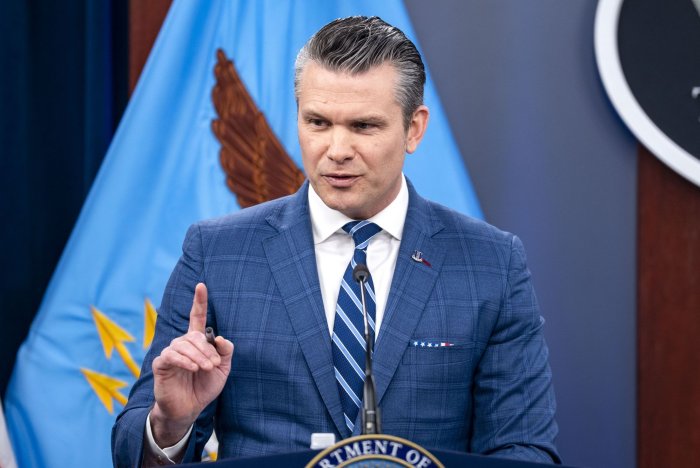
Secretary of Defense Pete Hegseth speaks during a press briefing at the Pentagon on Wednesday. Yesterday, the United States and Iran agreed to a two-week ceasefire, with the U.S. suspending bombing in Iran for two weeks if the country reopens the Straight of Hormuz. Photo by Bonnie Cash/UPI | License Photo
Mahmoud Khader Abed Adra, sought for over four decades, was surrendered by Palestinian authorities
Published On 17 Apr 202617 Apr 2026
A man suspected of organising a deadly attack on a Jewish restaurant in Paris has been arrested and placed in custody in France after being handed over by Palestinian authorities.
Mahmoud Khader Abed Adra, also known as Hicham Harb, arrived in France on Thursday after Palestinian officials surrendered him to French authorities, a handover that French President Emmanuel Macron linked directly to France’s recent recognition of Palestinian statehood.
Recommended Stories
list of 3 itemsend of list
On August 9, 1982, three to five men threw a grenade into Jo Goldenberg, a Jewish-owned restaurant in the Rue des Rosiers, in Paris’s historic Marais district, before opening fire on the street outside.
Six people were killed and 22 wounded in the incident.
The attack was blamed on the Fatah-Revolutionary Council, a Palestinian armed faction that had split from the mainstream Palestine Liberation Organization (PLO).
Adra was arrested in the West Bank by Palestinian security forces in September last year.
French antiterrorism prosecutors filed an extradition request days later, and he was flown to the Villacoublay military airbase outside Paris on Thursday, where he was taken into custody.
His lawyer described the extradition as “a serious violation of Palestinian fundamental law”.
“Forty-four years is too long,” said David Pere, a lawyer representing several families.
Two other suspects are already in French custody, and in February, France’s highest court confirmed that a trial will proceed, a ruling that had been challenged by the defendants.
Macron praised the Palestinian Authority’s cooperation, saying it reflected a commitment by President Mahmoud Abbas to work with France on counterterrorism.
Abbas had told French newspaper Le Figaro late last year that France’s recognition of Palestinian statehood in September 2025 had “created an appropriate framework” for the extradition request.
VICTORIA Beckham has kicked off her early birthday celebrations with a lavish “girls” dinner in Miami after finally breaking her silence on her bitter feud with Brooklyn.
After her eldest son launched a scathing attack on the family with a bombshell Instagram statement back in January, the singer recently addressed the fallout for the first time.
Sign up for the Showbiz newsletter
Thank you!
Leggy Victoria Beckham celebrates her birthday with friends and her daughter HarperCredit: InstagramHarper surprised her mum with a huge cake at her birthday mealCredit: InstagramBrooklyn Beckham launched a scathing attack on his family back in January as he posted a 6 part statement to InstagramCredit: Splash
Since speaking out on the “rift” between her family the fashion designer has been spotted letting loose at her early birthday celebrations.
Stunning Victoria took to her Instagram to show fans the incredible navy blue dress she decided to wear to the dinner.
Posing in the mirror of a huge dressing room, Victoria explained her dress of choice.
She said: “So I’m here in Miami and tonight I’m going out with my girlfriends for my birthday and I’ve got this amazing navy blue jersey dress which I love.
“I love the waist detail here, which really brings the waist in making it look super super toned. It’s got a slit up the side as well… It is the perfect party dress for a night out with my girlfriends.”
The Spice Girls star had her hair styled in natural waves and her makeup was flawless, complete with a very subtle smoky eye.
She accessorised the chic outfit with some blue open toed stilettos, chunky diamond bracelets and an emerald ring.
Victoria and her closet gal pals sat down for a very bougie meal at Italian restaurant Casadonna.
For starters they had focaccia bread, followed by a choice of grilled octopus or a baby gem lettuce caesar salad.
The singer showed fans her incredible outfit as she posed in a mirrorCredit: InstagramVictoria gave fans a sneak peak at her birthday meal menuCredit: Instagram
And for their third and final course the girls had the option to pick between filet mignon, branzino or beef ragu bolognase.
Victoria’s daughter Harper, 14, was also present at the girls dinner as she was seen giving her mum a big hug.
The singer-turned-fashion-designer captioned the snap: “I love you so much @harperbeckham.”
Victoria appeared over the moon as Harper surprised her with a huge birthday cake, which was complete with regal white icing and a singular gold candle.
Earlier this week Victoria broke her silence on her long-running feud with her son, amateur chef Brooklyn, 26.
Speaking toThe Wall Street Journalmagazine, Victoria did not refer to Brooklyn by name when asked about the rift but discussed how she had only ever tried to “protect and love our children”.
The Spice Girls star said: “I think that we’ve always—we love our children so much.
“We’ve always tried to be the best parents that we can be. And you know, we’ve been in the public eye for more than 30 years right now, and all we’ve ever tried to do is protect our children and love our children.
“And you know, that’s all I really want to say about it.”
Victoria Beckham and her family have been putting on a brave face amid the Brooklyn feudCredit: Instagram
There are scenes of celebration on roads in southern Lebanon as people begin driving back to their homes as the ceasefire with Israel takes hold. Israeli forces had continued to bomb the south up until the midnight truce began.
Abed Abou Shhadeh, a political commentator based in Israel, says the ceasefire between Israel and Lebanon is ‘extremely problematic, not only for Netanyahu, but for the Israeli public who were promised for two and a half years now, absolute victory’.
Corrie star Craig Charles took on the Retching Ball challenge with fellow campmate David Haye in a bid to earn food for camp in the latest bushtucker trial
The trial was making Craig throw up but he carried on and they won 7 stars(Image: ITV/Shutterstock)
The latest bushtucker trial left I’m A Celeb star Craig Charles throwing up a mouthful of maggots.
The 61-year-old Corrie star took on the Retching Ball challenge with fellow campmate David Haye in a bid to earn food for camp. The duo were strapped into a revolving ball while having to answer questions directed at them by Ant and Dec.
But of course in true I’m A Celeb style they were not alone in the ball cage, as creepy crawlies were dumped on them to add to their distress. Following a dumping of maggots on the duo, David Haye cried out ‘I’ve got maggots in my mouth’ and it wasn’t long before co-star Craig began throwing up.
David and Craig carried on for another round but the momentum seemed to catch up with Craig. As he threw up Ant quipped “Oh I think we’ve had a vomit. Now Craig you’ve just worked out why it’s called the wretching ball,” he added.
Despite his sickness, he kept going but he ended up being sick again in the final round where they were asked to name Adele songs. Craig looked delighted when time was up and he and David were removed from the retching ball to learn they had secured seven out of a possible 11 stars in total.
In a sneak peek at tomorrow evening’s episode Gemma Collins appears to quit again. She told the cameras: “I’m A Celebrity get me out of here. I am done.”
She looked to be in tears again as a stunned Scarlett watched on. It left fans pondering if she had actually walked again, or if it was another low moment for the reality TV star.
On X, formerly known as Twitter, one user said: “Hope Gemma doesn’t go from that clip! I need misery guts David gone before anyone else in camp!”
April 16 (UPI) — The House on Thursday passed a bill to extend temporary protected status for people from Haiti who are living in the United States through 2029.
Rep. Ayanna Pressley, D-Mass., who is co-chair of the House Haiti Caucus, introduced a discharge petition to advance a bill to extend protection for Haitian nationals.
The legislation was initially introduced by Rep. Laura Gillen, D-N.Y., whose Long Island district — as well as the rest of Long Island and New York City — have large Haitian populations, and is the first bill she introduced after her election to the House.
After the discharge petition succeeded, with bipartisan support, the bill passed the full House with 10 Republicans voting in support of it.
“This is a critical step forward in our fight for immigrant justice and delivering our Haitian neighbors the protections they deserve — and it’s a testament to the strength of our broad, diverse and bipartisan coalition,” Pressley said in a statement after the motion to discharge was agreed to.
“I am grateful to my colleagues on both sides of the aisle who supported our discharge petition,” she said.
After the vote, Gillen in a statement encouraged the Senate “to take up this measure and show the compassion and good sense to protect our Haitian community members.”
“Not only would this threaten the lives of our neighbors, it would also have a devastating effect on our economy,” Gillen said, noting that the extension protects “law-abiding and tax-paying Haitians who would face horrific condition if forced back to Haiti.”
The bill, however, faces a battle in the Republican-run Senate and, if it does get passed, the White House has indicated that it will veto the legislation, reports have said.
Although former Homeland Security Secretary Kristi Noem had attempted to end TPS for at least half a million Haitians last Fall, a judge in February blocked the Trump administration from carrying it out.
As a result of the ruling, TPS for people from Haiti expired on Feb. 3, its original expiration date, according to U.S. Citizenship and Immigration Services, which Pressley said made the discharge petition to force a vote on the bill so crucial.
The Supreme Court also is due to rule on the Trump administrations efforts to end TPS for Haitians, as well as for people from Syria, who have protected status because of the dangerous situation in that country.
First lady Melania Trump speaks during a House Ways and Means Committee roundtable discussion on protecting children in America’s foster care system in the Longworth House Office Building near the U.S. Capitol on Wednesday. The bipartisan group of lawmakers are looking to address challenges children in foster care face, including barriers to education and educational advocacy, housing, employment opportunities, financial independence, and technology. Photo by Bonnie Cash/UPI | License Photo
Weekly insights and analysis on the latest developments in military technology, strategy, and foreign policy.
Merops drones effectively counter Iranian Shahed attacks. The Merops interceptor drones, initially used in Ukraine, have been deployed to protect U.S. troops from Iranian Shahed-136 munitions.
Cost-effective solution against expensive threats. Each Merops drone costs about $15,000, significantly less than the $30,000 to $50,000 Shaheds they intercept, offering a favorable cost ratio.
Potential for further cost reduction with larger orders. Prices could drop to $3,000 to $5,000 per unit with increased production, making them even more economical.
Streamlined acquisition process enabled rapid deployment. The Army’s reorganization of its acquisition process allowed for quick deployment of Merops drones in conflict zones.
Merops drones part of a layered defense strategy. While not as advanced as Patriot missiles, Merops drones can be deployed in large numbers for effective area coverage.
Bottom line: Merops interceptor drones have proven to be a cost-effective and efficient defense against Iranian Shahed drones, protecting U.S. troops and equipment. Their success in Ukraine and streamlined acquisition process suggest a growing role for such low-cost solutions in future military strategies.
The Army’s top official pointed to low-cost interceptor drones first sent to Ukraine as one defense against Iranian barrages of Shahed-136 one-way attack munitions. During Congressional testimony on Thursday, Army Secretary Daniel Driscoll lauded the Merops interceptor and the process to get it quickly into the hands of troops in the Middle East.
The Merops is a small, relatively inexpensive drone built specifically to zip through the skies and intercept long-range one-way attack drones. As we have previously reported, Ukraine has been using several locally produced drones, as well as Merops, to counter Russian Shaheds successfully for some time now, proving-out the concept.
“When the conflict kicked off, within about eight days, we were able to purchase…13,000 Merops, which are incredible,” Driscoll exclaimed. “They’re about $15,000 a piece right now. We think as they scale, they’ll get less than [$10,000] and we’re able to take Shaheds down that cost $30,000 to $50,000, which is amazing because that puts us on the right end of the cost curve, and we will make that trade all day long.”
The U.S. has its own interceptors that have been in service for years, such as Raytheon’s Coyote, but they cost roughly 10 times more.
A new system to identify and take down Russian drones is deployed to NATO’s eastern flank
In a recent interview with Bloomberg, Driscoll said that larger orders could drive that to $3,000 to $5,000 per interceptor. Given the success in Ukraine, it is likely that the Pentagon and other customers would see far less risk when it comes to ordering large numbers.
As we noted in a story last month, the Pentagon sent thousands of these drone interceptors to the Middle East. Iranian strikes on U.S. military facilities killed U.S. troops and caused damage to bases and equipment. Driscoll did not offer more specifics about how often they were used, how many Shaheds they downed or exactly where they were deployed.
Merops was “developed as part of the US-backed Project Eagle initiative, which includes contributions from Swift Beat, a company associated with former Google CEO Eric Schmidt,” according to the Ukraine Defense Tech Community (DTC), a marketplace for modern weaponry. “The system is built around Surveyor drones, which act as airborne interceptors capable of destroying enemy UAVs mid-flight.”
A U.S. Army soldier launches an AS3 Surveyor interceptor drone, part of the U.S. counter-drone system known as ‘MEROPS,’ during a live-fire demonstration at the Deba training grounds in Subcarpathian Voivodeship, Poland, on November 18, 2025. (Photo by Artur Widak/Anadolu via Getty Images) Anadolu
Each Merops unit “includes a command station, launch platforms, and a fleet of Surveyor drones,” DTC explained. “These interceptors can operate autonomously or be remotely piloted and are equipped with onboard sensors for target tracking.”
While full technical specifications remain undisclosed, they can reportedly reach speeds of over 280 km/h (175 mph). “The platform is considered fast enough to intercept jet-powered drones such as the Russian Geran-3, which can exceed 300 km/h,” DTC pointed out.
A Polish soldier launches an interception drone of the American MEROPS counter drone system during tests at the Nowa Deba military training ground, south-eastern Poland, on November 18, 2025. (Photo by Wojtek RADWANSKI / AFP) WOJTEK RADWANSKI
Driscoll said the ability to field Merops so quickly is because the Army streamlined its acquisition process.
“Fundamentally, one of the core problems was our own bureaucracy, our own infrastructure, our own decision-making organizations had decayed from any sort of speed and rationality,” he testified. “The reason we’ve been able to move fast since the conflict in Iran started is because of work 10, 12, 14 months ago to reorganize our acquisitions department.”
“And practically,” he added, “what that did is it took us from a 16-step decision-making process – where each of the bodies along those 16 steps could veto it and start it back over, and it could take two to seven years to purchase something.”
“We put everybody into a group who could make decisions on the fly,” the secretary noted. “And so a lot of the things the Army has worked on in the previous year are paying dividends as we try to make decisions quickly.”
You can watch Driscoll’s testimony on Merops at the 36-minute mark of the video below.
Budget Hearing – The United States Army
In Ukraine, Merops has proven to be a far cheaper alternative to munitions like Patriot interceptors and even far less advanced missiles for downing Shahed drones which have caused widespread destruction across that country. While these drones have neither the payload nor range of the far more expensive Patriot munitions, they can be deployed in great numbers giving them the ability to cover larger geographical areas. That helps keep the magazine depth of more sophisticated effectors from being quickly depleted and turns the disastrous ‘exchange ratio’ between cost of target versus effector on its head. In many cases, these systems would still need to be part of a layered defense, especially when used as point defense at high value installations and infrastructure.
Now that these weapons have helped save American lives and equipment, Merops success means we will likely be seeing more low-cost drone interceptors like it in the future.
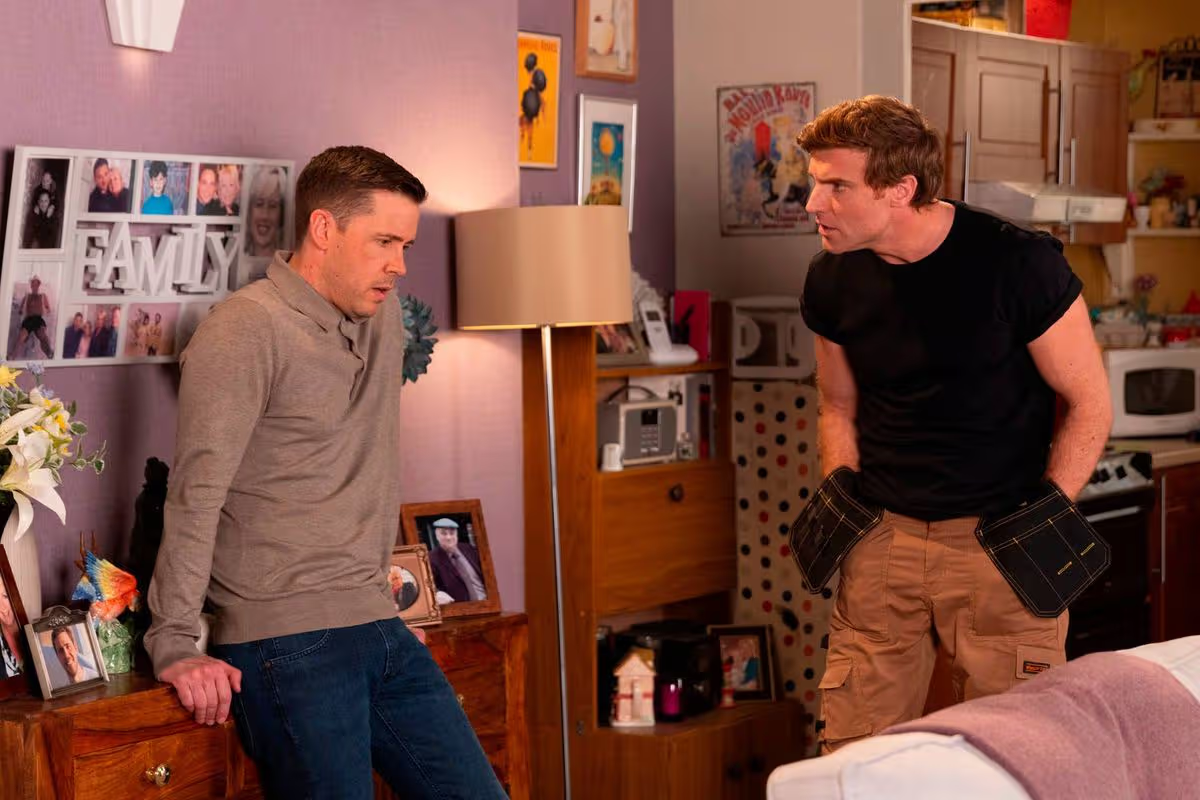
Coronation Street actor Gareth Pierce has been playing Todd Grimshaw since 2020, but fans were shocked to discover his real accent
Angie Quinn Screen Time Reporter
22:58, 16 Apr 2026
Todd has become a victim of abuse at the hands of Theo Silverton
Coronation Street’s Gareth Pierce is well known for his portrayal of Todd Grimshaw, yet in real life, he sounds remarkably different.
Gareth, 45, rose to prominence when he joined the Corrie cast in 2020 as Todd Grimshaw, stepping into the role previously held by Bruno Langley, who departed the show in 2017.
Over the past six years on the long-running soap, Todd has been at the centre of some heartbreaking storylines, including the deaths of his closest friends Billy Mayhew (Daniel Brocklebank) and Paul Foreman (Peter Ash).
Last year, Todd embarked on a relationship with dashing scaffolder Theo Silverton (James Cartwright), who was already married with two children.
Theo, who had kept his sexuality a secret, found himself ostracised by his family when his wife Danielle (Natalie Anderson) uncovered his affair with Todd, reports the Daily Star.
Despite initially pulling away from Todd to concentrate on his family, the pair quickly rekindled their romance, though the road has been far from smooth.
Matters took a darker turn when James Bailey (Jason Callender) drunkenly attempted to kiss Todd at number eleven, prompting Theo to deliver a stark warning. He has since continued to tighten his grip on every aspect of his boyfriend’s life.
For months, Theo has been subjecting Todd to both mental and physical abuse in a deeply disturbing domestic violence storyline. Most recently, Theo launched a brutal attack on Todd, leaving him bloodied and battered in deeply distressing scenes.
The funeral director has been quietly struggling for months, with Todd’s nearest and dearest beginning to notice that something isn’t quite right. Regrettably, their concern about his wellbeing has driven the scheming Theo to resort to increasingly extreme measures.
Theo manipulated Todd into walking down the aisle with him, but his sinister plans didn’t stop there. The conniving villain subsequently schemed to spirit his new husband away to Belfast, far from his loved ones and support network.
Todd informed Theo that he wasn’t prepared to relocate, prompting the villain to confiscate his phone and hold him captive. As a Weatherfield resident is set to meet a grisly end in an upcoming whodunnit, could Theo be next in line?
Away from the Manchester-based soap, Gareth has left fans stunned after revealing his real-life accent. Last year, he took to Instagram to wish the Welsh women’s football team well as they competed in the Euros.
Sporting a Welsh football shirt, Gareth, who hails from Gwynedd in Wales, said: “Massive week ahead in the Women’s Euros. Wales and England both playing today, but also playing each other on Sunday. Big showdown. Obviously, I’m shouting for Wales.”
Speaking in Welsh, he added: “Good luck, Wales. Let’s go. Come on, Wales!”
Soap devotees were left gobsmacked after watching the clip, as Todd’s Mancunian accent on Coronation Street is worlds apart from Gareth’s natural Welsh lilt.
Flocking to the comments, one viewer wrote: “You learn something new every day. Did not know he was Welsh”, while another added: “Love the slight Welsh accent.
“Didn’t know you were Welsh”, a third chimed in as another exclaimed: “Didn’t know he was welsh c’mon Cymru.”
“Are you Welsh, mate?” asked one fan while another stated: “Mind blown!”
A 10-day ceasefire between Israel and Lebanon has gone into effect. It began at midnight local time (21:00 GMT on Thursday), after being announced by US President Donald Trump.
The election victory of Hungary’s Tisza party on April 12 marks the end of the 16 year rule of Viktor Orbán, a figure who has long defined Hungary’s contentious relationship with the European Union. His tenure reshaped Hungary’s domestic institutions and repeatedly placed the country at odds with EU norms, laws, and political consensus.
The incoming leadership under Péter Magyar now inherits not only a domestic mandate for change but also the complex task of rebuilding trust with the EU after years of institutional confrontation.
A fractured relationship with Brussels
Under Orbán, Hungary frequently clashed with EU institutions over rule of law, judicial independence, media freedom, and migration policy. One of the most controversial measures was the lowering of the retirement age for judges and prosecutors, which critics argued enabled political reshaping of the judiciary.
Tensions escalated further after 2022, when Hungary’s stance on sanctions against Russia and support for Ukraine created repeated deadlocks within EU decision making processes.
Financial pressure also became a key tool of EU leverage. The European Commission suspended billions of euros in funding to Hungary, citing concerns over corruption and democratic backsliding, deepening the political divide.
Allegations and escalating mistrust
Relations deteriorated further following leaked reports alleging that senior Hungarian officials coordinated with Russian counterparts during sensitive EU discussions. These claims intensified accusations within parts of the EU that Hungary had undermined collective decision making during a period of heightened geopolitical tension.
While Budapest has rejected many of these allegations, they contributed to a climate of mistrust that severely weakened Hungary’s position within the bloc.
A new government with a reform mandate
The Tisza party’s victory signals a clear domestic demand for change, particularly around governance and corruption. The new administration has strong incentives to restore relations with the EU, not least because of the approximately 17 billion euros in suspended funding that could be unlocked if conditions are met.
EU leaders, however, have made it clear that financial normalization will depend on compliance with a wide set of governance and legal reforms. These include anti corruption measures, judicial independence safeguards, and adjustments to policies affecting migration and minority rights.
Structural constraints on reform
Despite political momentum for rapprochement, significant obstacles remain. Hungarian society remains more socially conservative and more sceptical of the EU than many of its Western counterparts. This limits the political space for rapid liberal reforms, particularly in sensitive areas such as LGBTQ+ rights and asylum policy.
Economic pressures further complicate the situation. The new government will inherit fiscal strain linked to years of disputed EU funding and broader geopolitical uncertainty, including the economic effects of the ongoing war involving Iran, which has disrupted global energy markets and increased financial volatility.
Ukraine and the Russia question
One of the most sensitive areas in Hungary’s future EU relationship will be its position on Ukraine. While Péter Magyar has signaled a willingness to improve relations with Ukraine and align more closely with NATO and EU policy, key ambiguities remain.
His stated openness to continuing Russian energy imports for the foreseeable future, combined with proposals for a referendum on Ukrainian EU membership, suggests that strategic continuity with aspects of the previous government may persist.
Given public scepticism toward Ukraine within Hungary, any referendum could significantly complicate EU enlargement plans.
Analysis
The end of Orbán’s long tenure represents a clear political inflection point in EU Hungary relations. It removes a persistent source of institutional confrontation and opens the possibility of renewed cooperation with Brussels.
However, the assumption that relations will automatically normalize is overly optimistic. The structural sources of tension between Hungary and the EU extend beyond one leader. They include divergent political cultures, competing interpretations of sovereignty, and deep disagreements over migration, rule of law, and foreign policy alignment.
The new government’s dependence on EU funds gives Brussels significant leverage, but also creates domestic political risk if reforms are perceived as externally imposed. This creates a delicate balancing act between compliance and legitimacy.
On foreign policy, Hungary’s position on Russia and Ukraine will remain the most consequential test. Even partial continuity with previous policies could reintroduce friction at a time when EU unity is under pressure from multiple geopolitical crises.
Ultimately, Orbán’s departure may mark the end of one chapter, but it does not resolve the underlying tensions that have defined Hungary’s relationship with the European project. The reset, while possible, will be gradual, conditional, and politically contested.
Dr Xand van Tulleken told viewers ‘it can be like a heart attack for your legs’
Dr Xand van Tulleken told viewers they should ‘never’ just write leg pain symptoms off(Image: BBC)
A BBC doctor has given a worrying update for anyone who has woken up in the morning with a pain in the leg. Appearing on BBC Morning Live, Dr Xand van Tulleken told viewers they should ‘never’ just write symptoms off as what happens due to ageing.
Many people get aches and pains, but specific discomfort in the legs should be investigated, he said. Host Helen Skelton said: “We’re looking at protecting our health now, though. And if you started this morning with a pain in your leg, you’re not alone.
“It’s thought that one in five people over the age of 60 is living with a blood vessel disorder.“ Dr Xand said “It’s really important that no one should ever regard any symptoms they have as just part of getting older. If you have a symptom and you don’t know why you have it, you need to get an explanation.
“Whether it’s shortness of breath or pain in your legs. There are lots of different causes for pain in your legs, but this morning we’re talking about peripheral arterial disease, which is a sort of intimidating medical term, but really we mean just peripheral, meaning it’s at the outside of your body. It’s in your legs rather than being in your heart or your brain.”
Arterial disease might be the cause – and that’s a condition which can mean there are serious health issues at stake beyond just aching legs. Dr Xand said “Arterial disease is the same problems that gives us heart attacks and strokes. Your blood vessels narrow over time. They can calcify, they harden, they clog up with cholesterol, and you are left with a narrower space for blood to flow through and that means that you’re not getting a sufficient blood supply to your legs and that can give you leg pain.
“And you can think of it a little bit like in the same way that some people get angina, they get heart pain when they exercise, when they move around. This is a bit like angina for your legs. And sometimes if those blood vessels completely clog off, it can be like a heart attack for your legs.”
The NHS says many people with PAD have no symptoms. However, some develop a painful ache in their legs when they walk, which usually disappears after a few minutes’ rest. The medical term for this is “intermittent claudication”.
The pain can affect 1 or both legs, range from mild to severe, and usually goes away after a few minutes when the person rests their legs.
Other symptoms of PAD can include:
hair loss on your legs and feet
numbness or weakness in the legs
brittle, slow-growing toenails
ulcers (open sores) on your feet and legs, which do not heal
changing skin colour on your legs, such as turning paler than usual or blue – this may be harder to see on brown and black skin
shiny skin
in men, erectile dysfunction
the muscles in your legs shrinking (wasting)
The NHS adds: “The symptoms of PAD often develop slowly, over time. If your symptoms develop quickly, or get suddenly worse, it could be a sign of a serious problem requiring immediate treatment.”
Dr Xand added: “The quality of the pain is quite specific. I mean, the way that people describe it and it typically wouldn’t be a pain that you’d get when you’re just sitting still, much like angina. It’s the pain that comes from not getting enough oxygen to your muscles. Those blood vessels aren’t working. And so, people tend to describe a kind of deep, heavy ache, like they’re just not, and you can almost feel that thing of just not getting enough.
“It’s a bit like if you’re lifting weights at the gym, if you go beyond your limits, you know, your muscles really start to hurt. It’s a similar thing. The pain is called claudication, but it’s that kind of pain. And typically, if you rest, it’ll go away again. So, that’s the that’s the kind of pain, but there are other changes that you can look for as well.”
He said people might see changes in their legs which could indicate the problem. Dr Xand said: “If you do look at your legs, you may see some changes if you don’t have a good enough blood supply. So, things like loss of hair on your legs would be an examples. The hair the hair can’t grow anymore because you’re not getting enough nutrients to your leg.
“Cold feet, the warm blood from the middle of your body is no longer reaching your feet. Ulcers or cuts are not healing because your immune system carried in your bloodstream is not reaching those and so you’re getting skin breakdown. You’re not getting antibodies and white blood cells and things like that. Changes in skin tone. So, your skin may look kind of mottled and gray as if it’s not getting enough blood. And then your toenails, you may think, I haven’t cut my toenails in a while. Well, are they just simply growing because they’re not getting the nutrients from the bloodstream that they need. So, those are things that might be a clue.”
Tackling the problem
A main cause is smoking, Dr Xand said, and also making sure people get cholesterol, blood pressure measured and check if you have diabetes. He said exercise is a good way of trying to improve the situation: “This may sound a bit a bit paradoxical, may sound like it’s hard to exercise, you’re getting pain when you exercise, but doing some exercise can stimulate the growth of new blood vessels. It can help those blood vessels open up.
“It will lower your cholesterol. It will lower your blood pressure. It will lower your stress. It will improve your blood sugar. You get so many wins from doing a bit of exercise.”
The proposed 76-metre arch would tower over other iconic landmarks in Washington, DC, and has attracted scrutiny.
Published On 16 Apr 202616 Apr 2026
United States President Donald Trump’s goal of erecting a colossal arch in Washington, DC, has taken another step forward, with a key agency approving his proposed design for the monument.
The US Commission of Fine Arts, whose members were appointed by Trump, gave its go-ahead to the president’s design for a lofty 76-metre-high (250-foot) arch.
Recommended Stories
list of 3 itemsend of list
If given final approval, the arch would be built on Memorial Circle, between the Arlington National Cemetery and the Lincoln Memorial. It would tower above other landmarks in the national capital.
White House spokesperson Davis Ingle hailed the commission’s approval as a “step in accomplishing President Trump’s promise to the American people from the campaign trail — to Make America Safe and Beautiful Again”.
But the arch has faced criticism, including for potentially obscuring views of the national cemetery, a resting place for war veterans.
Public Citizen Litigation Group is representing some Vietnam War veterans in a lawsuit against the proposed construction, which they argue needs congressional approval.
Even the vice chair of the Commission of Fine Arts, James McCrery II, suggested that Trump’s proposed “Triumphal Arch” ditch the winged statue and eagles on its top. He also opposed the lions at its base, pointing out that African animals are “not a beast natural to the North American continent”.
The enormous arch is another effort by the US president to leave his mark on the physical landscape of Washington, DC.
In January, he told reporters he wants the arch to be the “biggest one of all”. The commission still needs to vote on final approval for the proposal after reviewing updated designs.
Current plans show the arch would be significantly larger than the Lincoln Memorial, which is 99 feet (30 metres) tall, and about twice as tall as the famous Arc de Triomphe in Paris, which the design resembles.
The phrases “One Nation Under God” and “Liberty and Justice for All” would be written in gold lettering atop either side of the monument.
About three out of every four people who delivered public comments about the project expressed opposition, many of them citing its enormous size.
But the arch is one of several Trump projects that have received public pushback.
Trump has sought to paint the granite of the Eisenhower Executive Office Building white, and his allies plan to close the Kennedy Center for the Performing Arts, a national theatre complex, for two years of renovations, after adding Trump’s name to the exterior.
One of the most permanent changes so far has been the abrupt demolition of the White House’s East Wing, in order to make room for an enormous ballroom, long one of Trump’s priorities.
But that project is likewise entangled in legal battles, with critics arguing that congressional approval is required.
On Wednesday, Judge Richard Leon clarified that construction on underground structures at the ballroom site could continue, as part of an exemption he previously allowed for national security concerns.
But he maintained his short-term injunction against construction on the ballroom itself, batting down Trump’s position that the whole project should proceed.
“Defendants argue that the entire ballroom construction project, from tip to tail, falls within the safety-and-security exception and therefore may proceed unabated,” Leon wrote in Thursday’s ruling.
“That is neither a reasonable nor a correct reading of my Order!”
The president responded on social media by calling Leon an “out of control Trump hating” judge. Leon was appointed in 2002 under Republican President George W Bush.