Month: June 2026

President Trump unveils the new Air Force One, a converted Qatari jet

President Trump on Friday showed off the new Air Force One, a formerly Qatari-owned — and much debated — jumbo jet that has been converted into the official U.S. presidential aircraft.

The new plane — gifted from the Qatari government, raising a host of legal, ethical and security questions — will take on a new look, eschewing the Kennedy-era robin’s egg blue exterior in favor of white on the top half, its underbelly navy blue with a red stripe above it.

“This plane was transformed into a flying White House at a level of luxury that nobody has ever seen before,” Trump said from inside the massive Joint Base Andrews hangar, as a couple of hundred assembled Air Force personnel looked on. He spoke after stepping off the new plane in a dramatic flourish, as his signature tune “God Bless the USA” played.

He confirmed that he would be taking the new jet to the North Atlantic Treaty Organization summit in Ankara, Turkey, next month and indicated that he would be returning to China “at some point,” presumably a reference to the Asia-Pacific Economic Cooperation summit that China is hosting in November. His return from the Group of 7 summit in France this week was the last planned trip aboard the old Air Force One, he said.

“Now, when we land at airports in London and in Germany and different places, nobody tops this one, and that’s the way we have to have it for our country,” Trump said, noting that the colors and the design were to “my taste, I will say.”

He added that the new Air Force One will do a flyover during the July 4 celebrations next month.

The gift from Qatar is serving as a so-called bridge aircraft to carry the president until new planes ordered directly from Boeing arrive. That is currently slated for 2028.

The administration formally accepted a luxury Boeing 747 jet from Qatar last year to be used as the presidential airplane, despite questions about security and the ethics and legality of accepting such an expensive gift from a foreign government. Trump has claimed in the past that he would not fly around in the Qatari jet once he leaves office and said it would instead be donated to a future presidential library.

Trump on Friday said the U.S. was in a “little bit of a logjam” as it awaited the delivery of the new jets directly from Boeing, which had originally been scheduled for 2024 but have been delayed. He recalled asking the emir of Qatar for the use of one of their planes.

“See, a normal president wouldn’t do this. A normal president wants to stay away from aircraft,” Trump said Friday. “But our country has to be represented properly.”

Members of Congress and others have questioned the cost and effort that would be needed to make security modifications to an aircraft from a foreign government.

The Air Force said in a news release Friday that any plane deemed Air Force One “must meet rigorous security requirements” and that the Qatari plane “was modified under a disciplined engineering approach that prioritized these exact core capabilities above all else.” The Air Force also said “much of the previous head of state interior layout” of the plane was kept intact.

The Air Force has said in the past that security modifications to the jet would cost less than $400 million.

Trump’s efforts to reimagine the presidential airplane date back to his first administration, when he directed that an incoming fleet of new jets would adopt a color scheme that was nearly identical to that of his personal airplane. Then-President Biden reversed the decision in March 2023 as an Air Force review suggested that the darker colors could increase costs and delay delivery of the new jets, but once Trump returned to office, he returned to his desired colors for the plane.

Other government jets that carry other top administration officials will use a similar red, white and navy color scheme, the Air Force said earlier this year.

An Air Force spokesperson, who spoke on condition of anonymity to discuss sensitive plans, told the Associated Press that the two current planes, known as VC-25As, will not be retiring. Instead, they will remain in the fleet until the new Boeing planes, referred to as VC-25Bs, come into service, the spokesperson said.

It is unclear how the older jets will be used but the spokesperson said that both the Qatari jet as well as the VC-25As will be available for use and “the Presidential Airlift Group will select the appropriate aircraft for each mission based on operational requirements.”

Kim and Ceneta write for the Associated Press. Kim reported from Washington. AP writer Konstantin Toropin contributed to this report from Washington.

Source link

Moses Itauma to face heavyweight rival Filip Hrgovic in London on 29 August

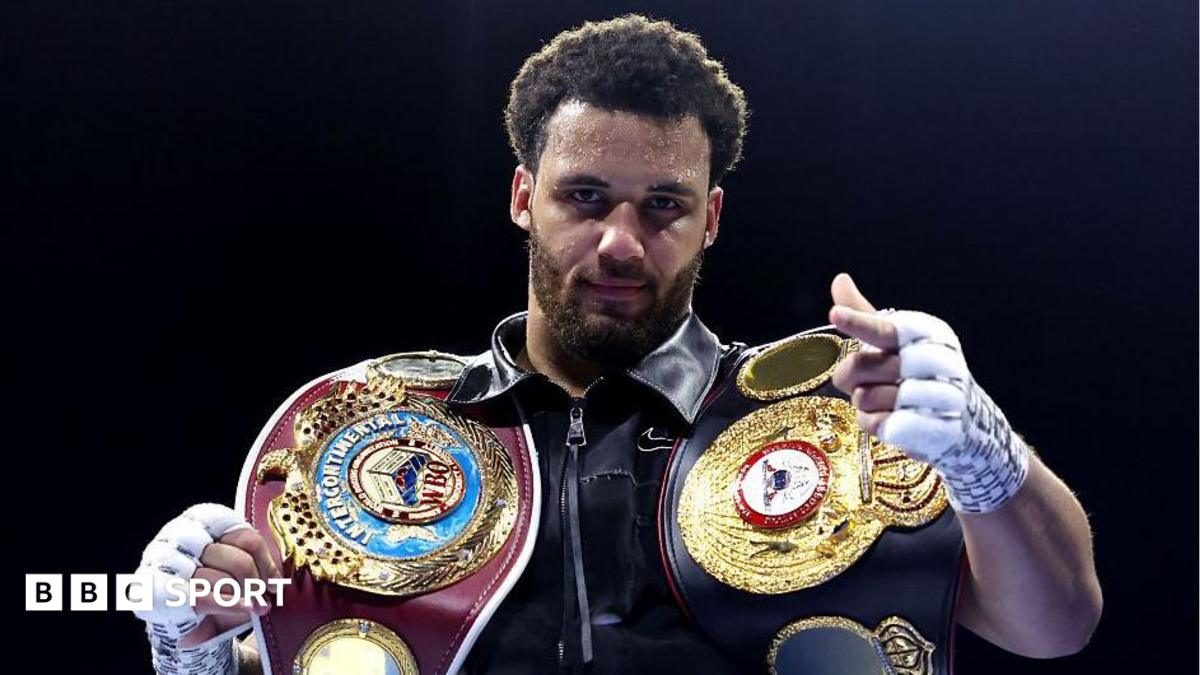
British heavyweight Moses Itauma will return to action on 29 August to face Filip Hrgovic at London’s O2 Arena.

Itauma claimed an impressive win over Jermaine Franklin in March to stretch his unbeaten record to 14-0 and retain the WBA International and WBO Inter-Continental titles.

That has earned the 21-year-old his first headline fight against Hrgovic, who won bronze for Croatia at the 2016 Olympics and now has a 21-1 professional record.

“This fight is the litmus test Moses is ready for and it is the one he wanted,” said promoter Frank Warren.

Hrgovic stopped Dave Allen in Doncaster last month and the 34-year-old then called for southpaw Itauma.

He and Hrgovic are first and second in the WBO rankings, respectively, and the winner at the O2 is set to be first in line for a shot at Daniel Dubois’ WBO belt.

Hrgovic’s only defeat came against Dubois in June 2024 and he has since beaten three British fighters – Joe Joyce, David Adeleye and Allen.

His bout with Itauma had been earmarked for 25 July, until compatriot Anthony Joshua arranged to face Kristian Prenga on that date.

Source link

Passenger trains collide in England, multiple people seriously injured

A train collision on Friday north of London resulted in at least 89 people being injured and Friday commutes into the city halted as emergency services responded to the incident. File Photo by Justin Lane/EPA-EFE

June 19 (UPI) — Two passenger trains collided north of London on Friday evening, snaring commutes as several train lines were closed as emergency services responded to the scene.

The two trains collided in Bedford, one from Corby and the other from Nottingham on the way to London St. Pancras, resulting in rail services to and from London St. Pancras being suspended, ABC News, The BBC and The Guardian reported.

The British Transport Police reported that 89 people were injured in the collision, 11 of whom were being treated for “very serious injuries.”

Officials are asking people to avoid the area, whether they are commuting or looking for a loved one, and local hospitals asked people not to come to the emergency room unless they have a serious emergency.

“I’m grateful to emergency services who are on the scene, attending to those affected,” British Secretary of State for Transport Heidi Alexander said in a statement on X.

“We’re working quickly with the rail industry and local partners to support passengers,” she said.

The collision occurred just after 3:00 p.m. local time on Friday as both trains were headed toward London.

U.K. Prime Minister Keir Starmer called the incident “hugely concerning” as other officials noted that a cause for the collision is not known yet but a full investigation will be conducted.

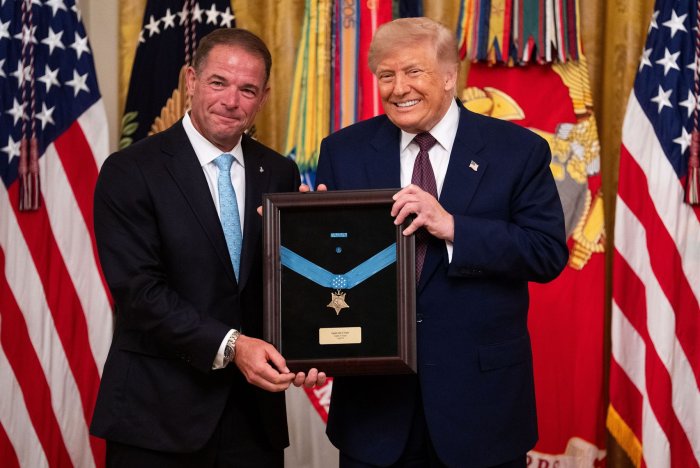
President Donald Trump presents a Medal of Honor to Tom Ripley on behalf of his father, John W. Ripley, during a Medal of Honor award ceremony in the East Room of the White House on Thursday. Photo by Aaron Schwartz/UPI | License Photo

Source link

Celebrity Gogglebox favourites return to Channel 4 show and fans are thrilled

A beloved Celebrity Gogglebox pair have made their return to the Channel 4 show

Celebrity Gogglebox fans were over the moon after two beloved stars made their comeback to the programme.

The Channel 4 spin-off show returned to screens on Friday (June 18) for a brand new episode, welcoming back firm favourites, such as Vernon Kay and Paddy McGuinness, Nick Grimshaw and niece Liv, and Denise Van Outen and Johnny Vaughan.

There are several new additions to the new series too, including Olivia Attwood and her mum Jennifer, Harry and Matt aka Nitro and Legend from Gladiators.

Finishing off the line-up are Strictly star George Clark and content creator Max Balegde comedian and actor, Julian Clary and actor and television presenter, Nigel Havers.

And for the latest instalment, show favourites Stephen Mangan and his sister Anita were back on the sofa – and fans were over the moon. On X, one person declared: “So glad Stephen and Anita are back!” Someone else wrote: “My favourites!” A third chimed in: “Love these two.”

Stephen is a presenter and actor who found fame playing Nathan Stern in The Split, alongside Nicola Walker, Fiona Button, Annabel Scholey, and Barry Atsma.

Beyond his acting credentials, the star also hosts Artist of the Year on Sky Arts. He also fronted the ITV game show The Fortune Hotel. Meanwhile, his sister Anita is an artist, illustrator, and designer. The brother-sister duo frequently collaborate on popular children’s books, with Anita illustrating the stories that Stephen writes

In 2023, Anita opened up about working with her brother on the books. When asked whose idea it was to work together, she told The Bath Magazine: “Mine! I’ve been an illustrator and designer for years and have wanted to work with Stephen for a long time.

“Stephen is brilliant at writing but can’t draw (his words!), so it’s a great match! I convinced him to consider it. Initially he thought we’d be doing picture books, where I did most of the work … but no, I said ‘40,000 word chapter books please!’ I got my way, mwahahahaha.”

Talking about their relationship, Anita added to the publication: “We have always been close and have been making each other laugh since we were children. Now we’re still making each other laugh – and our readers too (hopefully!). I always look forward to reading the first draft of Stephen’s books to see what drawing challenges there will be. I once told him that drawing horses is hard, so he put horses in The Fart that Changed the World, goats in The Unlikely Rise of Harry Sponge and The Great Reindeer Rescue is full of reindeer.”

Stephen added: “Well, I am the big brother – that’s what we do. I love working with Anita. It’s a treat to see how she illustrates my characters, and she always makes me laugh.”

Celebrity Gogglebox airs every Friday at 9pm on Channel 4

Source link

Democrats say money from Trump’s tax cuts bill is paying for White House ballroom project

More than $350 million from President Trump’s “big, beautiful bill” has been quietly directed to White House security, an allotment that Democrats warn appears to be helping fund his new ballroom project — despite the president’s insistence that no taxpayer dollars would be used.

The apportionment of funds, which the White House’s Office of Management and Budget made late Friday, comes from two accounts that were intended to provide the U.S. Secret Service with extra money for hiring and training in the aftermath of last year’s assassination attempts on the president, according to Democrats on the Senate Budget Committee. The shift was made days after Congress rejected a $1-billion request for the White House in a Homeland Security bill that Trump signed into law and as the ballroom project is tangled in legal challenges.

Senate Judiciary Committee chairman Chuck Grassley, whose panel initially drafted the security funding, said Thursday he was unaware of the allocations.

“The president said that it was all going to be paid for with private money,” said Grassley (R-Iowa). “And that’s what the country expects.”

Sen. Jeff Merkley of Oregon, the top Democrat on the Senate Budget Committee, charged that Trump’s actions are potentially illegal.

“After repeatedly telling the American people that zero taxpayer dollars would be spent on his gold-plated ballroom boondoggle, now Trump appears to be using a smoke and mirrors tactic,” Merkley said in a statement.

“Trump has proven that he can’t be trusted to follow the law,” Merkley said. “He only cares about wasting taxpayer money on his vanity projects.”

Ballroom project hits setbacks

Trump has faced setbacks in his attempts to build the ballroom on the White House grounds, where he ordered the demolition of the storied East Wing to make way for it.

Touring the construction site last month, Trump called the development a “gift” to the American people. He has repeatedly said that it is being paid for by donations — which has also run into ethics questions from watchdogs concerned about potential corruption and conflicts of interest.

Congress refused the Trump administration’s request for $1 billion for the ballroom last month. The administration wanted the money as part of a Homeland Security bill, but Republican and Democratic lawmakers rejected efforts to tack it on. It became politically toxic at a time when Americans are reeling from inflationary high costs of living.

The Washington Post reported earlier this week that the price tag for the project has ballooned to $600 million, according to a project summary prepared by the contractor, with more than half of that funding coming from taxpayers. Roll Call first reported on the apportionment of new funds for White House security.

At its core, arguments are swirling over how much of the White House project is to bolster security underground, with bomb shelters and a medical facility, and how much of the costs are related to the president’s promised 999-seat ballroom on top.

White House says Trump and donors are paying for the ballroom

A spokesman for the White House said that Trump and donors are funding some $400 million for the ballroom development, and that the coordination with the Secret Service had been noted in the initial announcement of the project.

“The East Wing Modernization Project is inextricably tied to the security of the President, the White House grounds and the certain security infrastructure assets,” said White House spokesman Davis R. Ingle in a statement.

He said the events over the past weekend, including an alleged attack plan targeting the UFC Freedom 250 event at the White House, proves why the project is needed.

“President Trump and generous American patriots are funding the ballroom to the tune of approximately $400 million, which will be a secure and appropriate venue for Presidents for generations to come,” he said.

Government lawyers have argued that the project includes critical security features to guard against a range of threats, such as drones and missiles.

The White House has said in court documents that the East Wing project would be “heavily fortified,” including bomb shelters, military installations and a medical facility underneath the ballroom. The Secret Service told senators last month that $220 million of the White House’s $1-billion request would go to harden the ballroom addition, with bulletproof glass, drone detection technologies, chemical and other systems.

The rest of the money would go for other security improvements, according to a document provided to Senate Republicans, including $180 million for a new, “long overdue” White House visitors screening facility.

Congress holds power of the purse

The shifting funds are certain to ignite growing concerns in Congress over the separation of powers, and the president’s use of federal funds allocated by lawmakers.

The money comes from Trump’s big tax breaks and spending cuts bill that the president signed into law last summer. It provided more than $1 billion for Secret Service resources, including “personnel, training facilities, programming, and technology; and performance, retention, and signing bonuses.”

The provision was uncontested at the time, even as Democrats voted against the broader bill. Democrats said they did not challenge this section or try to strip it out from the package.

Under the Constitution, only Congress has the specific authority to allocate funds across the federal government, including the executive and judicial branch operations.

While the president holds the power to sign — or veto — those appropriation bills, once the funding becomes law, it largely must stand.

Mascaro writes for the Associated Press.

Source link

U.S. defeats Australia, clinches spot in World Cup knockout round

The World Cup is only a little more than a week old, but it’s already a historic one for the U.S.

With Friday’s 2-0 win over Australia, the U.S. matched its best World Cup performance ever with two victories. Their six goals match the most the U.S. has ever scored in the group stage and its goal differential of plus-five is also its best ever in the tournament. The U.S. also clinched a spot in the round of 32.

Most impressive of all, however, is how the U.S. achieved most of that without their best player, Christian Pulisic, who had an electric first half in the U.S. opener against Paraguay but hasn’t seen the field since. And while Pulisic, who is nursing a calf injury, was missed Friday, he wasn’t needed, with the U.S. outpossessing, outpassing and outshooting Australia by wide margins.

The Americans hardly needed any help, but Australia gifted the U.S. its first goal anyway when defender Cameron Burgess deflected in a cross from Folarin Balogun in the 11th minute. The sequence started with Antonee Robinson pushing the ball forward for Balogun from just inside the halfway line. Balogun ran onto the ball then turned on the jets, making a dash up the left wing before turning toward the penalty area and bending a pass toward Sergiño Dest in the six-yard box.

Australian goalie Patrick Beach, guarding the post, reached out his left hand but missed the ball, allowing it to strike Burgess’ left foot and carom into the roof of the net igniting a red, white and blue-clad crowd of 66,925 inside Seattle Stadium (Lumen Field) and tens of thousands more who gathered outside the stadium and at viewing parties spread throughout the city.

The first U.S. score in its opener with Paraguay came on an almost identical own goal, with Paraguayan midfielder Damián Bobadilla getting his right foot on a pass Weston McKennie had aimed at Balogun.

Australia tried to deal with the Americans’ superior speed and technical abilities by getting physical, rough play that German referee Felix Zwayer largely allowed. But Australia paid dearly for that just before the intermission when Alex Freeman, who was leveled by Australia’s Paul Okon-Engstler moments earlier, climbed off the turf to head in a loose ball to give the U.S. a 2-0 lead at the break.

A look at how the U.S. scored its goals in a 2-0 win over Australia.

That sequence started with a free kick following a foul by Burgess. Robinson left-footed the ball to an unmarked Dest at the top of the box, a shot that was blocked in the wall, then arced toward the goal. Freeman and Balogun raced Beach to the ball, with Freeman getting there just ahead of the Australian goalie to nod it in.

The goal was originally negated by an offside that was quickly overturned by the VAR official.

Australia tried to make a game of it in a second half that turned increasingly chippy, but the U.S. defense held firm.

The U.S. — and Pulisic — have five days to prepare for their group-stage finale with Turkey on Thursday at SoFi Stadium, where the potential for even more history awaits.

U.S. fans react after a 2-0 win over Australia at Seattle Stadium (Lumen Field) on Friday in World Cup Group D play.

U.S. fans react after a 2-0 win over Australia at Seattle Stadium (Lumen Field) on Friday in World Cup Group D play.

(Ted S. Warren / Associated Press)

Source link

Does Trump have to submit the Iran memorandum of understanding to Congress? | US-Israel war on Iran News

Lawmakers and pro-Israel groups have issued calls for United States President Donald Trump to ask Congress to review a recent memorandum of understanding (MoU) designed to end the US-Israeli war with Iran.

They cite the Iran Nuclear Agreement Review Act (INARA) as a precedent. Passed in 2015, the law says any agreements with Iran related to its nuclear programme must be submitted to Congress for review and a possible vote of disapproval.

Recommended Stories

list of 3 itemsend of list

The act came into effect when former US President Barack Obama was negotiating the now-defunct Joint Comprehensive Plan of Action (JCPOA) with Iran, and it remains on the books today.

US Senator Lindsey Graham was among the first lawmakers to invoke the act after this week’s memo was announced.

“Under our law, any nuclear deal with Iran will be sent to Congress for review and a vote. I look forward to reviewing the final product,” Graham, a longtime Iran hawk, wrote in a social media post on Sunday.

Critics, including some Democrats and pro-peace groups, have questioned the newfound interest in Congress asserting its powers, after Republicans repeatedly flouted the legislature’s authority during the war itself.

Some see the push as an effort to give the memorandum greater legitimacy, as Trump comes under fire for its terms. Others question whether Iran hawks are invoking INARA to push for a return to war.

Here’s what to know about the debate:

What does the law say?

INARA creates requirements for any agreement between the US and Iran “related to the nuclear program of Iran”, no matter “the form it takes” or whether the agreement is legally binding.

Ahead of its passage in 2015, it was championed by bipartisan opponents of the JCPOA. That deal, which saw Tehran curtail its nuclear programme and submit to regular inspections in exchange for sanctions relief, was subsequently subject to provisions of the law.

The law requires the president to submit the text of any agreement he strikes with Iran to Congress within five days, along with any related materials. That triggers a 30-day approval period.

During that period, members of Congress can choose to pass a joint resolution of disapproval to scuttle the deal.

Still, such a resolution would be subject to the presidential veto. A successful disapproval resolution would therefore require a two-third majority from both chambers to override any vetoes, an extremely high bar.

During the congressional review period, the president “may not waive, suspend, reduce, provide relief from, or otherwise limit the application of statutory sanctions with respect to Iran under any provision of law or refrain from applying any such sanctions pursuant to [the] agreement”, the law states.

Those terms could limit this week’s memorandum, as it includes sanctions relief for Iran.

Does INARA apply to the memorandum of understanding?

Trump has suggested he was open to sending the US-Iran memorandum to Congress, telling reporters earlier this week: “I like the idea. I mean, who wouldn’t approve it?”

But his administration has not yet done so. Administration officials have also not articulated a stance on whether or not they believes the memo is subject to the law. Trump, after all, has frequently denied needing congressional approval for his actions against Iran.

This week’s memorandum opens the Strait of Hormuz, lifts the US blockade on Iran’s ports, and halts fighting on all fronts, including in Lebanon.

It also immediately lifts US sanctions on Iran’s fossil fuel industry, while launching negotiations on the future of Iran’s nuclear programme, among other issues.

As part of the deal, both countries agree to maintain their nuclear “status quo” during ongoing negotiations, and Iran commits to diluting its highly enriched uranium “on site”, with details to be determined during the negotiations.

While Trump has yet to acknowledge INARA’s authority, legal experts from across the ideological spectrum have argued that his memorandum is subject to the law.

Tess Bridgeman, a legal adviser for the Obama White House, wrote that the law applies to “this new MoU, and any future final agreement that might be negotiated in the coming months”.

But in an article published in the policy forum Just Security, she argues that INARA should be repealed, so as to not impede the ongoing diplomacy.

“INARA was never an appropriate way for Congress to engage on Iran’s nuclear program, and that is even more true today,” Bridgeman wrote.

Jack Goldsmith, a Harvard Law School professor and fellow at the conservative American Enterprise Institute, also believes that the memorandum should trigger an INARA review.

He also notes that Trump’s commitment to “immediately” lift sanctions on Iran’s oil industry appears to run afoul of INARA.

“I don’t think the president has the authority under domestic law to issue these waivers,” Goldsmith wrote on the Executive Functions website.

Still, he anticipates that neither Congress nor the judicial branch will confront Trump over the issue.

Will Trump comply with the law?

Trump’s second term has been defined by a broad interpretation of presidential power.

His administration has previously flouted the US Constitution’s provision that Congress alone has the power to declare war.

Trump has maintained that Iran represented an “imminent threat” to the US, which allowed him to launch defensive strikes without congressional approval.

Administration officials have also argued that the president is not beholden to the legal requirement that he gain congressional approval within 60 days of launching an attack. The war, which started on February 28, has lasted nearly three and a half months.

In an interview with the news outlet Axios on Thursday, Trump mused that the war taught him there are “no limits” to his power as president.

It remains unclear if Trump will change course and embrace the congressional collaboration required for diplomacy under INARA.

In her article, Bridgeman argued that Trump could flout the law in whole or in part, particularly when it comes to the immediate sanctions relief, because his party controls Congress.

Goldsmith, meanwhile, pointed out that the administration could also try to argue that the memorandum only sets out terms to reach an eventual agreement and is not an agreement itself.

While Goldsmith believes that argument is faulty, he noted that “it’s doubtful that any institution will make the president comply with INARA”.

A newfound interest in congressional oversight?

Several pro-Israel groups, including The Jewish Institute for National Security of America (JINSA) and the American Israel Public Affairs Committee (AIPAC), have been among the loudest voices calling for congressional involvement in the deal.

Since the outset of the war, JINSA defended Trump’s claims that Iran represented an “imminent threat” to the US, thereby granting him authority to attack without congressional approval.

However, the group also called on Congress to pass an Authorisation for the Use of Military Force (AUMF) to bolster his actions.

Congress, however, has repeatedly sought and failed to re-assert over its authority to send the US to war.

Since February, several war powers resolutions have been introduced to halt US action against Iran and force Trump to engage with Congress.

Initially, several Democrats backed by AIPAC, including Senator John Fetterman, Representative Jared Moskowitz and Representative Josh Gottheimer, broke from the party to oppose those efforts.

Moskowitz and Gottheimer eventually shifted their stances in March to vote in favour of one of the resolutions. But Congress has yet to pass a bill with enough votes to overcome an eventual Trump veto.

Meanwhile, Republicans in both the House and Senate chose to ignore a 60-day deadline in May that legally required Trump to get congressional approval for continued military operations — or stop fighting.

In a statement on Friday, Democratic Senator Chris Van Hollen characterised the Republican embrace of INARA as evidence of hypocrisy.

“Republican senators who were AWOL [absent without leave] regarding their constitutional duties around STARTING the war against Iran all of a sudden demand that Congress play a role in STOPPING the war,” he wrote.

“A whole lot of warmongering going on.”

Source link

Canada’s Kone undergoes major leg surgery; to miss rest of World Cup | World Cup 2026 News

Kone is expected to make full recovery after breaking his left leg, with multiple fractures, in the match against Qatar.

Canada midfielder Ismael Kone underwent surgery to repair severe fractures in his lower left leg that occurred in Thursday’s match against Qatar.

“Last night, Ismael Kone underwent successful surgery to repair a lower limb fracture,” Canada Soccer said in a statement on Friday. “He is expected to make a full recovery but will miss the remainder of FIFA World Cup 2026.”

Kone underwent surgery to repair the tibia and fibula bones in Vancouver, the site of Canada’s 6-0 victory.

Kone was injured in the 51st minute of the Group B match. Qatar midfielder Assim Madibo attempted a tackle, but his right foot brought Kone to the ground. Trainers were immediately called onto the pitch as Kone was in visible discomfort before being stretchered off moments later.

Sitting up on the stretcher, Kone gave a thumbs-up sign to the fans while taking oxygen.

After the match, Canada coach Jesse Marsch said he “could hear the bone snap.”

On Friday, Marsch described the scene at the hospital.

“By the time we got to him, he’d already had some drugs to help sedate him a little bit,” Marsch said at a news conference. “He was being prepared to go into the operating room. But he was in really good spirits and he was adamant that he’s going to be fine.

“[The surgery] took about an hour and a half and they had three surgeons. I think what happened is the surgeons watched it on TV and they saw what happened and they knew right away. And so they brought their top three surgeons to the hospital immediately to take care of him.

“So by the time he got there, the surgeons were there and they were ready. And then we just had to communicate with our medical team and make sure that the surgery was the best option that we thought. But I could see by meeting them and hearing what they had to say about the situation that they he was in really good hands. So the surgery they said went really well.”

A video review of the play resulted in Madibo being shown a red card, Qatar’s second of the game, leaving the team with nine players to finish the match. Madibo later apologised to Kone.

Canada meet Switzerland in Vancouver on Wednesday, with both teams having four points apiece after their first two fixtures. Their third match will determine the winner of Group B.

Nathan Saliba, who replaced the injured Kone and scored Canada’s fourth goal, celebrated by racing to the sideline to hold up a replica of the stricken Kone’s Canadian shirt and pointing to his shirt number, eight.

Soccer Football - FIFA World Cup 2026 - Group B - Canada v Qatar - BC Place, Vancouver, Canada - June 18, 2026 Canada's Nathan Saliba holds up the shirt of injured player Ismael Kone as he celebrates scoring their fourth goal IMAGN IMAGES via Reuters/Anne-Marie Sorvin
Saliba holds up Kone’s shirt [Anne-Marie Sorvin/Reuters]

Source link

EastEnders’ Gurlaine Kaur Garcha marries her boyfriend a year after romantic engagement

Former EastEnders actress Gurlaine Kaur Garcha, who previously played Ash Panesar on the long-running BBC soap, has married her partner Max after a year-long engagement

EastEnders star Gurlaine Kaur Garcha has married her partner after a year-long engagement. The actress, 32, is best known known for having previously played Ash Panesar on the long-running BBC soap, but she left the programme just over three years ago.

On Friday, she took to social media to announce the news that she and her partner Max had tied the knot. Alongside a selection of snaps from the big day, she wrote on Instagram: “17.6.26.”

A slew of Gurlaine’s former co-stars were quick to congratulate her. Former Strictly Come Dancing star Balvinder Sopal, who plays Gurlaine’s on-screen mum Suki, wrote: “Gorgeous baby. Congratulations.”

Emma Barton, known for her role as Honey Mitchell, wrote: “Gorgeous… congratulations beautiful,” whilst Denis Fox actress Diane Parish simply said; “Congrats”

Last year, the actress, who last year was seen in an episode of the Amazon Prime hit The Girlfriend, shared the happy news of her engagement with fans on Instagram, flashing a huge diamond ring while sipping a cocktail abroad.

“v happy & v engaged!!!!!!” she wrote, keeping the caption short and sweet. Although Gurlaine’s kept her partner’s identity private, she confirmed the romantic proposal took place while on holiday in Ibiza.

Gurlaine made her debut in Albert Square back in 2019 as Ash; a confident, no-nonsense doctor who immediately made an impression. She arrived as the first member of the Panesar clan, with her brothers and mum Suki introduced shortly after.

Her character quickly became a key figure in several dramatic storylines from tense family fallouts and fractured relationships to fast-paced scenes at the hospital. She was also part of a same-sex romance with Iqra, making Ash one of the few LGBTQ+ South Asian characters in soap at the time.

Ash wasn’t afraid to speak her mind, often clashing with her mum Suki, whose controlling nature added even more fuel to their fiery dynamic. Her arrival was also seen as a big moment for representation, with viewers praising EastEnders for spotlighting a British Sikh woman in a lead medical role – something rarely seen on mainstream TV.

Gurlaine took a short break from the show in 2022 before officially bowing out in early 2023. At the time, soap bosses thanked her for her contribution, while the actress told fans she was “excited for what’s to come”.

Since then, Gurlaine’s kept a low profile but still shares snippets of her life online – posting travel pictures, moments with friends, and positive messages with her followers.

And while she’s stayed off-screen for now, fans will no doubt be thrilled to see her celebrating such a personal milestone.

Like this story? For more of the latest showbiz news and gossip, follow Mirror Celebs on TikTok, Snapchat, Instagram, Twitter, Facebook, YouTube and Threads.


Source link

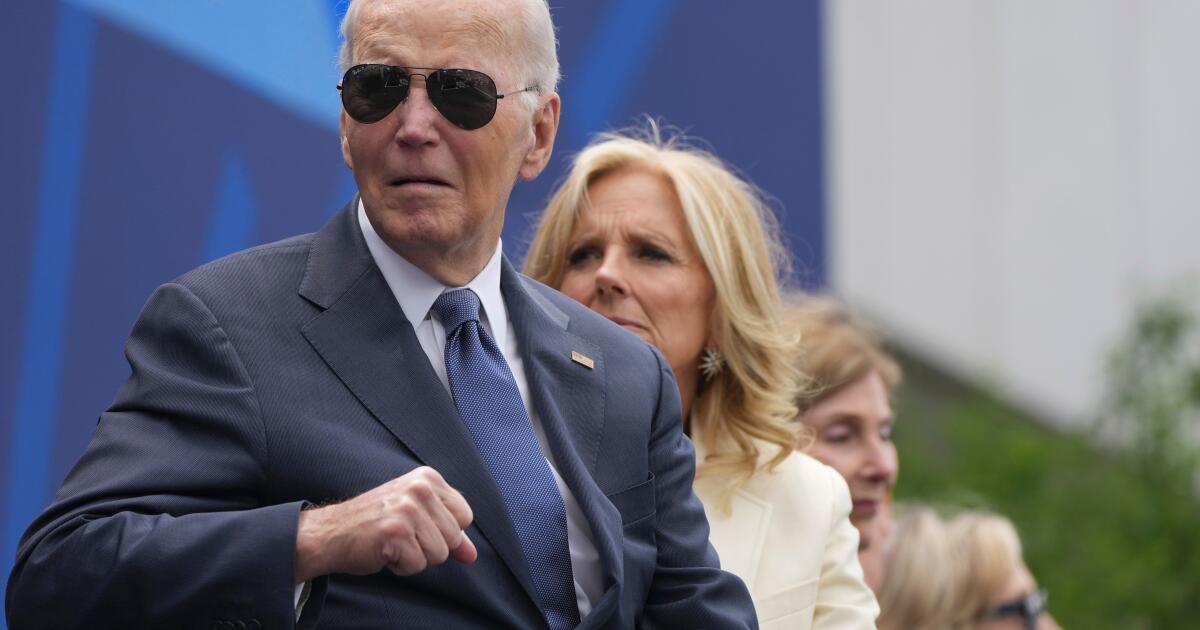
Judge denies Biden’s bid to block release of transcripts linked to special counsel inquiry

A federal judge on Friday rejected former President Biden’s attempt to block the Trump administration from releasing to a conservative group the recordings that Biden made with a ghostwriter.

U.S. District Judge Dabney Friedrich found that the public interest in the material outweighed whatever privacy rights Biden had.

The recordings were obtained by special counsel Robert Hur in the course of his investigation into whether Biden improperly retained classified documents while a senator and vice president. Republicans in Congress demanded them after Hur declined to file charges against the then-president.

Biden’s Democratic administration refused to turn over the 2017 recordings and transcripts, leading congressional Republicans to hold his attorney general, Merrick Garland, in contempt.

President Trump’s Department of Justice authorized the release of the materials. That led Biden last month to sue to seek to block the release to a staffer at the conservative Heritage Foundation who had formally requested the records.

Biden objected to the release as an invasion of privacy, saying the recordings included him discussing sensitive personal matters such as the death of his older son, Beau Biden. But Friedrich found that the administration redacted that material.

The judge wrote that the materials “contain no mention of highly sensitive topics like illness or death, nor do they mention any non-public persons, including members of Biden’s family.”

Representatives for Biden did not immediately comment but asked Friedrich to bar release of the material while they appeal her decision. The Justice Department did not immediately respond to a request for comment.

Friedrich was nominated by Trump, a Republican, in 2017.

Riccardi writes for the Associated Press.

Source link

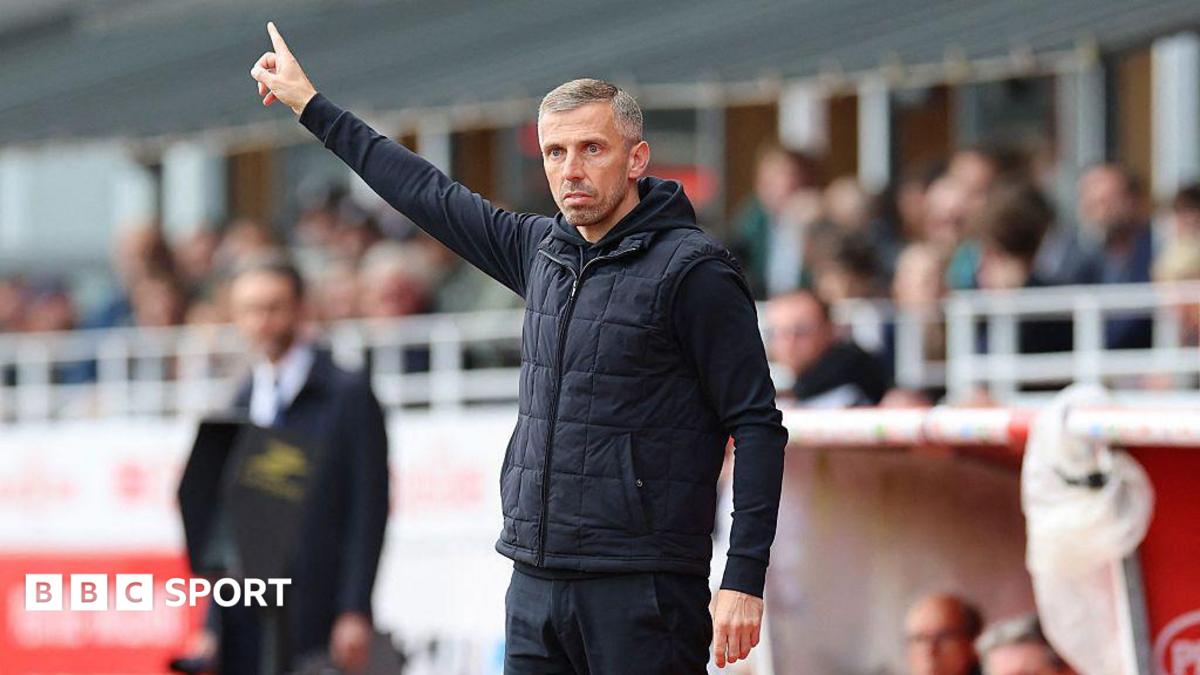
Gary O’Neil: Ipswich Town close in on Gary O’Neil as their new head coach

Ipswich are close to appointing Gary O’Neil as their new head coach.

The 43-year-old is poised to replace Kieran McKenna, who stepped down from the Portman Road post earlier this month.

Compensation with O’Neil’s current club Strasbourg is still to be agreed, but is not expected to be an issue for the Tractor Boys.

Tim Jenkins and Neil Critchley are also expected to move to Suffolk with ex-Bournemouth and Wolves boss O’Neil, having worked with him in France.

Former Manchester United boss Ole Gunnar Solskjaer was also in the running for the job this week.

BBC Sport reported Ipswich’s interest in O’Neil earlier this month and the Strasbourg boss has long been admired by the club’s hierarchy.

His French club finished eighth in Ligue 1 last season and reached the Europa Conference League semi-finals, losing to Rayo Vallacano. It was the first time Strasbourg had reached the last four of a European competition.

O’Neil played at Bristol City when current Ipswich chief executive Mark Ashton held the same role at Ashton Gate.

Strasbourg had initially been confident of keeping him following his January arrival, but O’Neil will return to the Premier League for the first time since leaving Wolves in December 2024.

Ipswich are looking for a new head coach after McKenna stepped down last week, despite leading them back to the top flight by finishing second in the Championship last season.

The 40-year-old took charge of the Tractor Boys in 2021 and led them to three promotions in the past four seasons, two of which have taken the club into the Premier League.

McKenna was linked with the Fulham job after Marco Silva’s departure, but quit Town to take a break from the game and spend more time with his family.

“I feel this is the right time for me to step aside,” he said. “I do so with great pride at the incredible progress we have made and with huge hope and optimism for the future of the club.”

Ipswich open their Premier League campaign at home to Sunderland on 22 August.

Source link

Iran deputy FM says ‘ready to move forward’ in deal with US | Donald Trump News

Khatibzadeh tells Al Jazeera diplomacy is way forward, but US must ensure that Israel stops its attacks on Lebanon.

Iran’s deputy foreign minister says Tehran wants to continue the diplomatic process with Washington, if the United States is serious about respecting their agreement and ensures Israel abides by the terms of the memorandum of understanding (MoU).

“We are ready to move forward step by step, if the other party demonstrates the same seriousness,” Saeed Khatibzadeh told Al Jazeera Arabic in an interview on Friday.

Recommended Stories

list of 4 itemsend of list

His comments came after talks between the US and Iran that were due in Switzerland on Friday were called off, and US Vice President JD Vance cancelled his planned trip there.

Earlier, officials including mediators Pakistan and Qatar said the two sides would meet in Burgenstock to begin negotiations on a host of issues as outlined in the MoU signed between the US and Iran this week.

Reports said the talks may have been called off after intense fighting between Israel and Hezbollah in southern Lebanon on Friday. Lebanon’s health ministry said Israeli attacks killed at least 47 people since midnight.

Speaking to Al Jazeera, Khatibzadeh denounced the latest Israeli attacks in Lebanon, saying Israel’s “continued war-making” would have “serious and immediate consequences”.

He said Iran was seeking “peace on all fronts, including Gaza”, and explained that Lebanon had been included in the MoU because of its direct connection to the conflict.

Article 1 of the MoU explicitly states that ending the war in Lebanon is an integral part of the broader ceasefire arrangement across all fronts.

“There will be no peace or stability in Lebanon and the region without ending the occupation and Israel’s commitment to international law,” Khatibzadeh added.

On the Strait of Hormuz, he said Iran would continue to provide navigation services in coordination with Oman and in accordance with international law.

He added that Tehran would not impose passage fees during the 60-day period outlined by the agreement, but said a new mechanism for managing the waterway would be introduced afterwards and presented to regional countries.

Khatibzadeh also said that any future agreement must include the release of all frozen Iranian funds.

Esmaeil Baghaei, spokesperson for Iran’s ministry of foreign affairs, said on Friday that the necessary consultations involving the US deal are being carried out through mediators, and that if the conditions for starting negotiations are met an official announcement will be made.

Regarding the Lebanon ceasefire required for talks between the US and Iran to continue, a Hezbollah official told Al Jazeera that the ceasefire would hold if Israel abided by it.

Israel’s ambassador to the US Yechiel Leiter said on X: “Israel remains firmly committed to an immediate ceasefire. If Hezbollah honours the agreement and ceases its hostilities, they will be met with quiet”.

Source link

Venezuelan Gov’t Launches US-Backed Dialogue with Hardline Opposition

Rodríguez and Figuera met at the legislative Palace in Caracas on Thursday. (Asamblea Nacional)

Caracas, June 19, 2026 (venezuelanalysis.com) – Venezuelan National Assembly President Jorge Rodríguez held a meeting on Thursday with a US-picked opposition figure to launch a new political dialogue process.

In a statement, Rodríguez, who is also the Venezuelan government’s lead negotiator, disclosed talks with “the representative of the opposition lawmakers from the 2015-2020 period,” Dinorah Figuera, to launch “a joint technical and political working group” with “an agenda containing concrete milestones and timelines” aimed at “strengthening democracy.”

In a separate statement, the expired opposition-controlled 2015 National Assembly explained that the central objective of the process is “the construction of a shared vision for the future.” The communiqué claimed that the dialogue aims to establish a “roadmap for the construction of a democratic scenario” in the country. 

Figuera also met with US Chargé d’Affaires John Barrett in Caracas on Thursday.

For its part, the US State Department welcomed the meeting, describing it as the “first step” toward “a free Venezuela.” The Trump administration has insisted on a “three-phase process” for the Caribbean nation which culminates with a political “transition.”

According to Washington, the proposed agenda includes priorities such as rebuilding democratic institutions, strengthening the National Electoral Council (CNE), restoring guarantees for political participation, and protecting the civil liberties necessary for an open political debate.

“The cornerstone of any transition is inclusive dialogue. We hope that conversations between Venezuelan political parties and the interim government in Caracas continue in the coming weeks so that this work can begin,” stated Thomas Pigott, spokesperson for US Secretary of State Marco Rubio.

Upon arriving at the airport on Thursday, Figuera told reporters that she had traveled to Venezuela at the invitation of the US State Department, with her tasks including the establishment of a “credible” electoral council. She added that her work intends to benefit all political forces while avoiding questions about whether the initiative had been coordinated with far-right leader María Corina Machado.

Figuera was among the lawmakers elected when the opposition won a parliamentary majority in December 2015. Anti-government parties attempted to use the National Assembly to overthrow the Nicolás Maduro government and pushed several laws that were struck down as unconstitutional. It was eventually sidelined after being declared in contempt by the Supreme Court, with the South American country’s legislation taken over by a government-supporting National Constituent Assembly. The ruling United Socialist Party (PSUV) retook control of the legislature in the 2020 and 2025 elections that were boycotted by many opposition sectors.

Though the 2015 National Assembly’s term expired in January 2021, it unilaterally renewed its own mandate for successive one-year periods. The defunct parliament retained US recognition as Venezuela’s legitimate authority, which allowed it to manage Venezuelan assets abroad. Washington’s backing ended in March when Trump recognized Acting President Delcy Rodríguez as Venezuela’s “sole leader.”

Figuera, who has lived in Spain since 2018, took over as president of the opposition-controlled body in January 2023 following the dissolution of the self-proclaimed “interim government” led by Juan Guaidó.

At the time, Venezuelan judicial authorities denounced Figuera’s role in an “illegitimate” parliament that aimed to “plunder Venezuelan assets abroad” and issued an arrest warrant and an Interpol red alert. While several opposition figures have benefited from an amnesty law approved by the present National Assembly in February, it is not known whether Figuera was among those whose legal cases were dropped.

Figuera’s return to Caracas also comes just weeks after the Unitary Platform—the coalition that groups the country’s main opposition parties—agreed during a meeting in Panama that far-right María Corina Machado would “lead negotiations with Chavismo to call elections” and eventually run as a presidential candidate.

Machado and the Unitary Platform have yet to comment on Figuera’s talks with the acting Delcy Rodríguez government, having previously demanded elections within a 40-week timeframe.

Since the January 3 strikes and kidnapping of Maduro, the Trump administration has wielded a strong influence over Venezuelan affairs. US officials have openly participated in legislative initiatives to open the Caribbean nation’s energy and mining sectors to Western companies while also accompanying corporate executives on trips to discuss business opportunities.

US forces likewise conducted an extrajudicial execution in Venezuelan territory earlier this month, with Caracas calling it a “joint operation” against organized crime.

Despite the diplomatic rapprochement and catering to US investment, Venezuelan authorities had previously brushed aside talk of early presidential elections. Maduro’s term, currently held by Delcy Rodríguez in an acting capacity, ends in January 2031. In a February interview with US conservative outlet Newsmax, parliamentary leader Jorge Rodríguez stated that no elections were expected in the short term because the priority was achieving economic stability.

Edited by Ricardo Vaz in Caracas.

Source link

Harry Styles dramatically HALTS Wembley gig mid-song to help distressed fan

HARRY Styles dramatically stopped his Wembley gig midway through a song to help a fan in distress.

The 32-year-old halted singing Taste Back when he realised a concert-goer needed support.

Harry Styles halted his show to help a fan Credit: The Sun
The Watermelon Sugar singer is performing a 12-night Wembley Stadium tour Credit: Shutterstock Editorial

“You can’t find your sister?”, Harry said over the mic as he spoke to a member of the audience.

He then beckoned over security who rushed to their aid.

Harry added: “You looked very concerned.”

Asking if everything was OK, Harry said: “You’re good? We’re good.”

READ MORE ON HARRY STYLES

styles counsel

Insiders reveal the surprising woman shaping Harry Styles’ bold new era


WILDE TIMES

Olivia Wilde breaks silence on Harry Styles romance & says ‘it upset people’

He then made a thumbs up to security.

Harry kicked off a record-breaking 12-night run at Wembley Stadium on Friday for his Together, Together tour.

Harry released his latest album — Kiss All The Time. Disco Occasionally — in March and it immediately shot to No1 in the charts.

Addressing crowds, this week the pop star said: “Just outside of this building 16 years ago, my sister brought me to London for the very first time for my X Factor audition.

“So driving here today, and anytime I come through Wembley, means so much to me.

“It was in that building that I was put into a band, my sister is here tonight. It means a lot to be here tonight.”

He added: “My mum entered me into the X Factor without me knowing and I wouldn’t be here today if she hadn’t done that, so thank you so much.

“You changed my life, all of you, so thank you so, so much.”

He held his hand up in the air as he flagged security Credit: The Sun
The pop star performed in front of 80,000 fans Credit: Shutterstock Editorial

Source link

Democratic socialists surge in mayoral races across the country as anti-Trump fervor rises

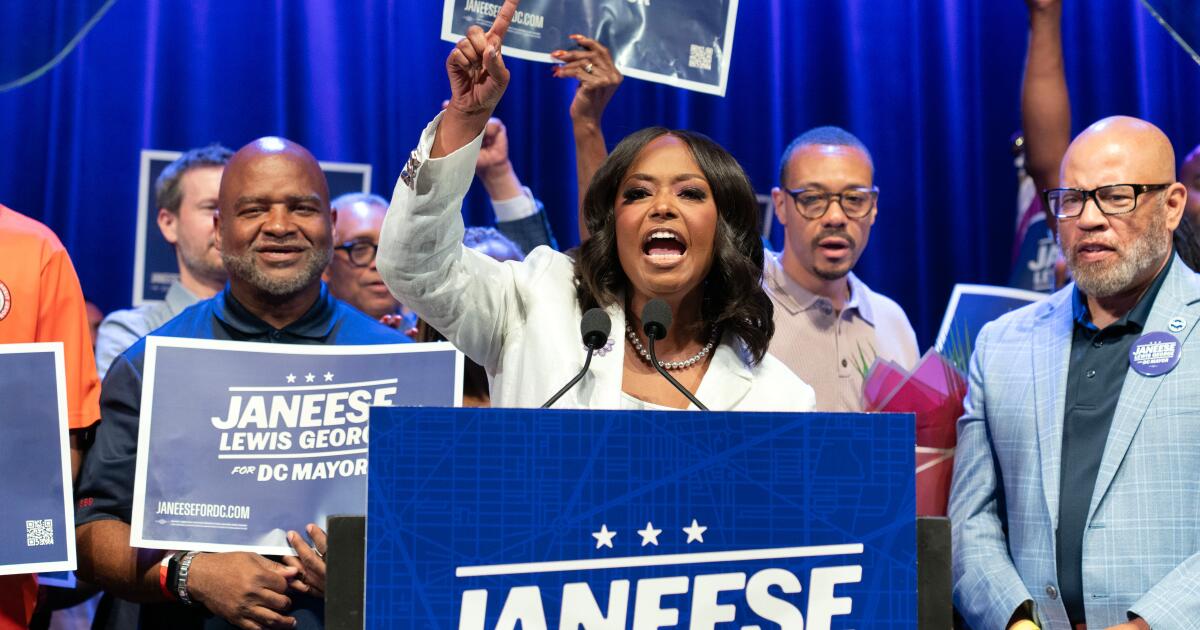
As Janeese Lewis George paves a path to the mayor’s office in Washington, D.C., she’s told voters they could have it all.

Her unapologetically expansive, left-wing agenda includes subsidized or even free childcare, increased down payment assistance for homebuyers and community resources to reduce crime, plus a promise to aggressively confront President Trump’s attempts to reshape the nation’s capital.

“People are tired of hearing what government can’t do. They want to hear what government can do,” Lewis George said in an interview before the city’s primary, where she defeated her Democratic opponents and positioned herself to win the general election in November in a city dominated by Democrats.

Lewis George’s victory signals a break with a quarter-century of centrist governance in Washington, and it puts her in the vanguard of democratic socialists who have ascended in urban politics over the last year. Zohran Mamdani toppled Andrew Cuomo, the scion of a political dynasty, on his way to becoming New York City mayor. Katie Wilson won an upset victory to lead Seattle last fall. And this month, Nithya Raman clinched a spot in the November runoff against Los Angeles Mayor Karen Bass.

All of them are members of the Democratic Socialists of America, or DSA. The political organization has seen its membership ranks swell from a few thousand to more than 100,000 nationwide over the last decade after an influx of younger Americans joined following the presidential bids of Vermont Sen. Bernie Sanders, also a self-described democratic socialist.

There’s little sign of national coordination among the candidates, and it’s unclear whether voters are gravitating toward their promises of improved government services, their vows to fight the Trump administration or their critiques of capitalism.

But from coast to coast, confrontational progressives are advancing in mayoral races. City leaders can draw outsized attention for their successes and failures, and democratic socialists will be under pressure from residents to deliver on their vows for a new kind of governance. Whether that translates to national politics is a next test for their movement.

“They are all channeling a displeasure with a status quo and a serious desire for economic populism that the establishment Democratic Party hasn’t been preaching,” said Eric Stern, a Democratic strategist with Fight Agency, a political consulting firm that strategized Mamdani’s mayoral campaign.

Stern added that Democratic voters appeared more willing to support the most progressive candidate in mayoral races rather than in contests for the U.S. House. Candidates like Mamdani and Raman, Stern said, are “daring voters to dream and fall in love not just with the individual candidates but also the political process as a whole.”

A rising left navigates America’s urban challenges

The trend of progressives surging in urban areas may have limits for its broader impact on Democratic politics. Democratic mayors in cities including Atlanta, Houston, Miami and San Francisco won on relatively moderate platforms in recent years.

Progressive have also faced noteworthy challenges. Chicago Mayor Brandon Johnson was endorsed by the city’s DSA chapter during his 2023 mayoral run but has since faced criticism from both moderate and liberal local leaders on issues such as immigration, the local budget and public safety. Recalls and public pressure ousted progressives elected to district attorney offices in multiple jurisdictions over the last five years, when criminal justice reform efforts ran into dissatisfaction over public disorder following the COVID-19 pandemic.

Trump’s hardline immigration and law enforcement tactics have also become a challenge for liberal cities. The president’s agenda poses an especially serious threat to Washington, D.C., because of its status as a federal territory.

“Maybe we take back Washington and run it on a federal basis,” Trump told reporters this month when asked about the potential election of a democratic socialist as the district’s mayor. “We won’t put up with it.”

But progressives hope the current wave of anti-Trump furor in deep blue cities across the country will help buoy the chances of those on the hard left.

“It’s not folks looking for the leftmost option so much as looking for a candidate who’s gonna be on their side,” said Ravi Mangla, speaking for the left-wing Working Families Party. The party often endorses the same candidates as the DSA and is readying to target more mayoral offices in the country’s biggest metropolises this fall and in 2028.

“It’s less about whether you are on the right or on the left so much as whether you are willing to punch up at the powerful,” he added.

Mamdani and Lewis George are both self-described “sewer socialists” who emphasize the need for responsive government services rather than critiques of market economics. The phrase recalls the socialist Gilded Age mayors whom critics derided as too preoccupied with managing public works projects.

The term’s revival is partly a strategic move to align leftist ideas with concerns over affordability and the economy, voters’ top concern in the midterm elections, and shift the public perception of democratic socialists from firebrands who support radical policies to independent-minded public servants.

“This is absolutely a change election and I’m excited to bring the change that people want, which is really putting people first in the city and having the moral clarity and courage to stand up to Trump,” Lewis George said.

For voters the ‘socialist’ label did not seem to matter

While conservatives have used the “socialist” label to attack Democrats as extreme or incompetent, some D.C. voters appeared ambivalent before Tuesday’s primary.

Several lifelong residents said they believed Lewis George was a “fighter” but didn’t think she’d have much of an impact on the local economy, given the city’s status as a federal district.

“I go back and forth on my own labels and whether I am supportive of that movement or not, but I am supportive of making D.C. more affordable,” Owen Fitzgerald, a University of Maryland graduate student, said of his support for democratic socialism.

Fitzgerald voted for Lewis George because she would stand up to Trump and said he’d first learned of her campaign from friends in his neighborhood. But he didn’t know she was a democratic socialist until he saw news reports describing her with the label.

“It sends a cultural message to this administration that the people who are surrounding them in the capital are opposed to their platform, opposed to their political agenda, and I think that it will send a message, both nationally and internationally,” Fitzgerald said.

Brown writes for the Associated Press.

Source link

An Anaheim vision: The Anaheim Angels in a new stadium, next to a youth sports complex

Civic pride, sure. But what is it really worth to the city of Anaheim to have its name on the hometown baseball team?

Hundreds of millions of dollars, the city has said. As the Angels’ stadium lease approaches its end, and as Anaheim prepares for negotiations either with Arte Moreno or a potential new owner, it’s worth keeping in mind.

So too is a concept floating around City Hall in Anaheim: What if we could put a new stadium and a youth sports complex next to one another?

Nothing is imminent, and even a bill winding its way through the state legislature would not necessarily require the Angels to return Anaheim to the team name.

It’s leverage: If the Angels’ owner wants to build atop the stadium parking lots, the city can pursue an exemption to a state law that currently restricts what can be built there, which could mean more money for the team and its development partners. In exchange for the exemption, the team name would revert to the Anaheim Angels.

If that’s the carrot, this is the stick: The city would have to approve the zoning changes that could make the land “two to three times more valuable than it is as a parking lot,” Anaheim Mayor Ashleigh Aitken said.

Said Aitken: “There are no gifts. For an ownership to truly be a partner to the city in what that property could be, there is going to have to be some realization that Anaheim is not Los Angeles.”

The Angels’ stadium lease expires in 2032, and the team can extend it through 2038. A new owner could move the Angels — or at least leverage the threat of a move — but Anaheim offers a 150-acre site with what every owner in pro sports covets: land around the venue to turn the property into a year-round money-making operation.

The standard ballpark villages include restaurants, shops, hotels, homes, offices and entertainment venues. The Ducks are launching one, called OC Vibe, around Honda Center, and within walking distance of Angel Stadium.

What intrigues the city, for at least part of the parking lots around Angel Stadium: a youth sports park for all those travel ball teams. Ontario is building a 199-acre one around a minor league ballpark; Irvine has a 194-acre one up and running at its Great Park.

Katie Wright, who books sports events for Anaheim’s tourism bureau, said there would be a market if her city built a sports park.

“The demand for, specifically, soccer, baseball and softball is tremendous,” Wright told the Anaheim City Council in April. “They would be filled every single weekend, I think.”

What Anaheim has that Ontario and Irvine do not: Disneyland down the street for visiting families, a variety of restaurants within walking distance, and hotel rooms aplenty. In Anaheim, 40% of the city’s general fund comes from taxes on hotel rooms.

“With Angels baseball right next to a youth sports facility, to have the synergy of hotels and restaurants, and players interacting with the Little League kids and soccer fields,” Aitken said, “I just think it’s a unique opportunity.”

Everything old is new again: In 1996, Anaheim pitched a youth sports center called the “Little A” in part of the stadium parking lots as part of a ballpark village that never materialized.

What might be in the best interest of the city now might not be in that of the developer, whether that turns out to be the Angels or a real estate partner. While a sports park might drive tax revenues to the city, a developer might pay the most for land used for hotel and retail properties, said Louis Tomaselli, the Irvine-based executive managing director at JLL, a nationally prominent commercial real estate brokerage.

“A youth sports complex would likely be at or near the bottom from a land value perspective,” Tomaselli said.

That’s all part of the negotiation, and for now the city of Anaheim has no party with which to negotiate. That leaves room for all sorts of brainstorming, including Aitken’s curiosity about flanking the development with high-rise residential buildings, similar to the condominiums that have risen next to Petco Park in San Diego. In some of them, you can watch the game from your balcony.

But let’s get back to the value of the Anaheim name on the baseball team.

“A lot of times, we get the question, ‘Exactly where is Anaheim?’” Wright, the Anaheim tourism official, told the City Council. “We’re always fighting to say, ‘We’re not L.A.’”

In 2005, when Anaheim sued the Angels after Moreno slapped the Los Angeles label on the team, the city commissioned experts that testified the name change would cost Anaheim nearly $200 million over the following decade and close to $400 million through 2029. The Angels dismissed both numbers as wildly high, but that is what the city presented in court.

I asked Sean Moran of Los Angeles-based Innovative Partnerships Group for an update. Moran estimated the worth of the Anaheim name at $26.5 million per year — or more than $500 million over the life of a 20-year deal — based on the value of references to the city on game broadcasts, digital and social media, highlight clips, betting sites, in fantasy leagues, and more.

“I don’t think you can put a monetary value on civic pride and respecting your fan base,” Aitken said. “So, if a new owner wants to come in and start fresh and really respect the fan base in Orange County, the name should not even be a negotiating point.

“It should be the first thing you do, out of respect for where this team is located, and the fan base that is so loyal in good times and bad.”

Perhaps. But, if I’m the new owner of the Angels and the city is on record saying its name on the team is worth hundreds of millions of dollars, the first thing I say to the city in negotiations is: You can get your name on the team for that $500 million, which would help me build a new ballpark that could cost $1.5 billion.

Who else could benefit from that? Moreno, as the need for a new owner to pay for a ballpark could lower the sale price.

Even without that exemption from state law, a new owner could pursue a fair amount of development on land Anaheim has failed to develop for 60 years, on a site the city’s own land use plan envisions as “an exciting mix of high energy uses while providing additional housing.” Or a new owner could simply inherit the existing lease and deal with potential development later.

You can start to get the shape of what the bargaining might look like. Avelino Valencia (D-Anaheim), the assembly member who introduced the bill in Sacramento intended to spur the return of the Anaheim Angels name, included a provision that says resolution would take precedence over legislation.

“If there is another outcome that takes place, in negotiations or deal-wise, there would be no need for this, right?” Valencia said.

All of that could be years down the road, so no sense arguing all the finer points now. Aitken promises a series of community meetings first, so that Anaheim residents can share how they envision the future of the Angel Stadium property, with or without a baseball stadium.

This should come up for discussion too: The Anaheim Angels name might be ideal for the city, but what, if anything, should the city give up to get it? The last time the city asked, Moreno just said no. If a new owner would be willing, should the taxpayers of Anaheim consider subsidizing the name?

Source link

Cuba’s sweeping economic reforms met with skepticism

President Miguel Díaz-Canel’s package of 174 economic reforms were approved by Cuba’s parliament in just one week. File Photo by Ariel Ley Royero/EPA

June 19 (UPI) — Cuba’s parliament approved a package of 174 economic reforms in just one week, marking the most significant shift in government policy in at least 15 years. Driven by President Miguel Díaz-Canel in response to the country’s deepening economic crisis and mounting pressure from the United States, the plan approved Thursday opens the door to private capital and reshapes the rules governing the island’s economy.

Economists and analysts, however, warned that the real impact of the measures will depend on their implementation and on broader institutional changes that remain absent from the government’s plans.

Cuban economist Alfie Ulloa, a professor at the University of Chile’s Law School, told UPI the reforms represent a significant change in official rhetoric but questioned whether they will translate into meaningful change.

“They are a profound adjustment in discourse and, if implemented, would represent an important adjustment to the model. But for now they are nothing more than another declaration like many made in the past. I do not believe they will be implemented, nor that they will truly free the private sector,” Ulloa said.

The package includes 23 areas of transformation and more than 170 measures aimed at loosening state control over the economy. Among the most significant are allowing direct foreign investment in small and medium-sized private businesses, reviewing activities currently prohibited to the private sector, authorizing direct imports and exports by both state and non-state actors, granting greater autonomy to enterprises and gradually replacing broad subsidies with targeted assistance for vulnerable populations.

The reforms also eliminate broad price controls, a policy Díaz-Canel acknowledged had failed after years of inflation, shortages and expansion of the informal market.

While presenting the plan, the president admitted that part of the country’s current crisis stems from longstanding internal problems.

“There are obstacles that do not come from abroad or from the embargo. There is bureaucracy, delays, regulations that prevent people from producing and decisions that we have postponed,” Díaz-Canel said.

The proposal amounts to an implicit acknowledgment of economic policy failures that Cuban authorities had largely attributed to the U.S. embargo for decades. Analysts noted that several of the measures had been debated previously and rejected by the country’s communist leadership.

Many of the initiatives mirror reforms introduced decades ago in China and Vietnam, although they arrive as Cuba faces one of its worst economic crises since the collapse of the Soviet Union.

Cuban economist Mauricio de Miranda, a professor at the Pontifical Xavierian University in Cali, Colombia, argued in social media posts that the program points toward a transition from bureaucratic socialism to a form of capitalism controlled by political elites.

“It will become the fast track for relatives and close associates of those in power to become shareholders without anyone knowing where their capital came from,” he warned.

De Miranda said Cuba will inevitably need to privatize part of its state-owned assets to attract investment and rebuild its struggling economy. However, he argued that the process lacks the institutional safeguards needed to prevent wealth from being concentrated among groups close to the government.

“Something like this would require a capital market with clear rules, transparency and equal opportunity,” he said.

Questions about legal protections for investors have also emerged as a central criticism.

“None. Cuba is not a state governed by the rule of law. Citizens are completely defenseless before the state,” Ulloa said when asked about protections for potential investors.

He added that investing in Cuba remains highly risky because government power faces few constraints and judicial institutions lack independence.

Cuban economist Pedro Monreal also criticized the process, questioning the secrecy surrounding the package in a lengthy post on X.

“It should not be surprising that the first act of the ‘transformation proposals’ show has reaffirmed public frustration over the secrecy of those proposals,” Monreal wrote.

Monreal also pointed to the failure of the so-called “Monetary Reorganization Task,” a 2021 reform that eliminated the country’s dual-currency system but became associated with surging inflation and declining purchasing power. He argued that experience severely undermines the credibility of the new package.

Despite the skepticism, several specialists acknowledged that some measures could help address urgent problems if fully implemented.

Ulloa said a genuine opening to private investment, particularly from Cubans living abroad, could help revive agriculture, services and food production. He cautioned, however, that critical sectors such as energy, infrastructure, transportation and banking require investment levels that are unlikely to materialize in the near term.

The Cuban government said Thursday that former President Raúl Castro explicitly endorsed the reforms and expressed full support for the package, describing it as what “best serves the Revolution today.”

For critics, that endorsement highlights one of the process’ central contradictions.

The measures acknowledge problems that independent economists have identified for years, yet leave intact the political structure that many blame for creating the crisis.

“The most important point from my perspective is that we are not talking about deep reforms within a new globalized economy. We are simply talking about removing obstacles,” Manuel Cuesta Morúa, vice president of the Council for Democratic Transition in Cuba, told Radio Martí.

He said the reforms arrive too late because Cuba’s economy now operates under extensive U.S. sanctions.

According to Cuesta Morúa, progress will require political and diplomatic negotiations to make the measures viable. He argued that the package merely liberalizes some restrictions but does not yet constitute a genuine economic reform program.

He added that authorities must first address citizens’ immediate needs, create confidence through legal certainty and open Cuban society in broader ways.

Analysts agree that the central question is whether this latest reform effort will produce tangible change or join a long list of initiatives that were announced and later postponed.

Regarding the matter, Vice President JD Vance said, “Right now, we are talking with the Cuban government about how they might change their behavior to achieve that. We’ll see what they do and, obviously, if they do one thing, we’ll do another. If they make smart decisions, we’re going to have a much better relationship with that island.”

Just hours later, details of the measures emerged. For now, however, the White House has remained silent.

Source link

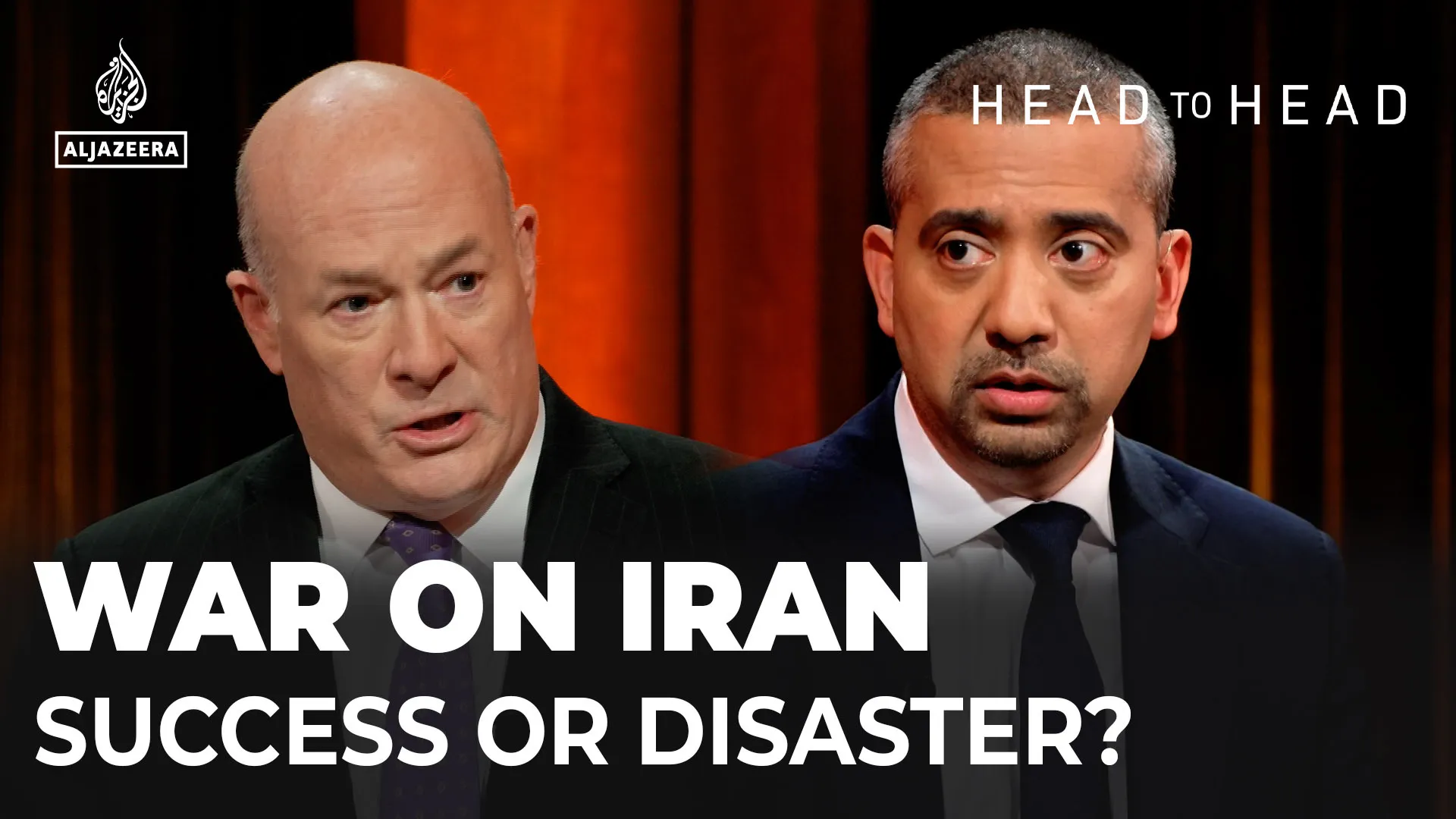
Iran war: Success or disaster? Mehdi Hasan and David Des Roches | TV Shows

Following the US and Israeli airstrikes on Iran in February, reverberations were felt globally. But is the world really safer and Iranians freer or has the war unleashed disastrous consequences?

Mehdi Hasan goes head to head with David Des Roches, retired colonel, former Pentagon official and professor at the National Defense University on the justifications and costs of the war – and whether President Donald Trump sent U.S. troops to fight Israel’s war.

Joining the discussion are:
Sanam Naraghi-Anderlini – founder and CEO of the International Civil Society Action Network
Mohammad Ali Shabani – Middle East scholar and Editor of Amwaj.media, a London-based news outlet focused on Iran, Iraq and Arabian Peninsula countries
Barak Seener – Associate Research Fellow, Henry Jackson Society

Recorded shortly before the announcement of a deal between the US and Iran.

Source link

James Burrows dead: Comedy director of ‘Cheers’ and ‘Friends’ fame

Comedy director James Burrows, the 11-time Emmy-winning director who co-created “Cheers” and helped turn such long-running sitcoms as “Taxi,” “Friends,” “Will & Grace” and “The Big Bang Theory” into fan favorites, has died, his family confirmed to People. He was 85.

“We celebrate the extraordinary life and enduring legacy of James ‘Jimmy’ Burrows, who passed away peacefully today surrounded by his loving family,” his family said in a statement to People. “For more than five decades, Burrows was one of the most influential and beloved directors in television history. As a legendary director, mentor, and creative force, he helped shape generations of comedy and brought immeasurable joy to audiences around the world.”

A master of the multi-camera sitcom, Burrows started his career shooting episodes of “The Mary Tyler Moore Show” in 1974 and “The Bob Newhart Show” in 1975. He soon joined the quality-oriented production company, MTM, which counted James L. Brooks, Steven Bochco and Gary David Goldberg among its alumni.

“They were smart enough to know that it’s better to have a director who can talk to actors rather than a director who can move cameras. You can’t really learn how to make something funny, but you can learn to move the cameras,” Burrows said in a 1995 interview with The Times.

Burrows was born in Los Angeles and later moved to New York with his family where he attended the High School of Music & Art. He graduated from Oberlin College and completed a graduate program at the Yale School of Drama. He worked years as a stage manager with his father, a playwright and director, assisting on shows such as “Breakfast at Tiffany’s” starring Moore and Richard Chamberlain.

He solidified his name in television with “Cheers,” co-creating the lively Boston travern “where everybody knows your name” with Glen and Les Charles. Over its 11 seasons on the air, Burrows directed 237 of its 275 episodes, emerging as a behind-the-scenes comedy legend.

“You bring ‘em in, you sit ‘em down and they talk. That’s all ‘Cheers’ was,” Burrows told The Times. “The word is more important than the goofiness. It was all about the words — which is how I was trained, how my father was trained, how anybody who reads books is trained. It’s the word.”

His father, Abe Burrows, was a Pulitzer Prize-winning playwright, screenwriter and director who performed in radio comedies and co-wrote the books for the Broadway musicals “Guys and Dolls” and “How to Succeed in Business Without Really Trying.” The younger Burrows said that growing up on radio comedies helped him hone his ear for humor.

“I know what’s funny, and I probably know the best way to deliver the joke. Whether it’s walking out of a room, facing that way, facing this way,” Burrows said in a 2010 interview with The Times. “I just have a sense of that.”

Another skill he learned from his dad? was working on his feet.

“He’d run the scenes over and over. He created this wonderful camaraderie, which I always try to do. I love to do ensemble shows because that’s where you get the camaraderie.”

Burrows, often considered a fatherly manager, tried to bridge the gap between actors and writers and notably took the cast of “Friends” on a trip to Las Vegas before directing 15 episodes of the blockbuster comedy. He also threw a party for the “Mike & Molly” cast to build rapport because he believed when everyone liked each other, it showed onscreen.

Actors would know when a joke landed when they would hear Burrows giggle as the scene unfolded.

“I’m the guy that wants you to walk the comic plank for me,” he said. “Take it as far out as you want to take it and I’ll bring it back. Sometimes I’ll take it further. But trust me.”

With his slate of hits — he’s credited for directing several shows in NBC’s primetime “Must See TV” lineup of the 1990s — Burrows amassed sizable wealth and, from an early age, was in constant demand by those seeking his magic touch for their show. However, he also saw his fair share of flops: Henry Winkler’s “Monty, “Cafe Americain” with Valerie Bertinelli and a slew of promising pilots that never got off the ground. He also felt that ABC’s “The Associates” and “The Class” on CBS were canceled too soon.

From 1998 to 2006, Burrows helmed every episode of “Will & Grace,” the Emmy-nominated sitcom about a woman and her gay best friend that aired on NBC for eight seasons during its original run. To Burrows, it was the funniest show he ever worked on. He was also behind the camera for the comedy’s 2017 revival, which brought the envelope-pushing antics of Will, Grace, Jack and Karen back for three more seasons.

“It was a fairytale literally and figuratively,” he said in a 2016 Hypable interview. “It was not of the real world in a strange kind of way. These were exaggerated characters. Although they were grounded with Will and Grace, there was this exaggeration that made the stuff you could do and get away with on that show so extraordinary.”

He won his 11th Emmy Award serving as an executive producer on 2019’s all-star re-staging of “Live in front of a Studio Audience: ‘All in the Family’ and ‘Good Times.’” A year earlier, he was nominated for directing the “‘All in the Family’ and ‘The Jeffersons’” TV special.

James Burrows

James Burrows behind the scenes.

(Chris Pizzello / Invision / Associated Press)

Throughout his career Burrows had a penchant for directing pilots because it meant “you’re better than an episodic director” and could create something new in the writer-driven medium of television. He was also drawn to “more uptown, the more urbane, the more sophisticated” comedies. He tried doing cinema once — 1981’s “Partners” with Ryan O’Neal and John Hurt — and said the result confirmed his belief that he was built for television.

“I’m not a cinematic guy. I’m a theater guy. For what I do, I need a live audience,” he said in a 2016 interview with the Television Academy.

Among his favorite TV moments were the pilots for “Frasier” and “Third Rock From the Sun,” the long-awaited kiss between Sam (Ted Danson) and Diane (Shelley Long) and Woody’s (Woody Harrelson) wedding on “Cheers,” Rev. Jim (Christopher Lloyd) taking his driving test in “Taxi,” Ross (David Schwimmer) being attacked by a cat in “Friends” and Will, Grace, Jack and Karen getting in the shower together on “Will & Grace.”

Late into his career, Burrows continued to work in the multi-camera sitcom format, which is shot in a studio, usually before a live audience. In 2013, he was honored by the Television Academy, and, in 2016, he celebrated directing his 1,000th episode of television programming, crossing the milestone with an episode of “Crowded.” NBC marked the milestone with “Must See TV: An All-Star Tribute” special. According to critics, the show — billed by several outlets as the elusive “Friends” reunion and came off as a living eulogy to Burrows — fell short and did not do the legendary director justice.

In all, Burrows was nominated for 45 Emmy Awards and 17 Directors Guild of America Awards.

Source link

Friction between Trump and Republican senators is growing before the pivotal midterm elections

The relationship between President Trump and Senate Republicans neared a breaking point this week as he upended their efforts to speedily confirm one of his own nominees and said he would not sign the renewal of a key surveillance law unless they agree to new terms.

Trump’s overnight social media post Wednesday that he was delaying Jay Clayton’s nomination to become national intelligence director, just hours before the U.S. attorney’s confirmation hearing, further strained relations between the Senate and White House that have been worsening for weeks. Later that day, some Republican senators who have been hesitant to challenge the president directly on the Iran war were blunt in their criticism of his deal to end it.

“This is the worst foreign policy blunder in decades,” Sen. Bill Cassidy (R-La.) said in a post on X.

The open tensions are an almost complete reversal from a year ago when Senate Republicans worked closely with Trump on a complicated effort to push through his massive package of spending and tax cuts.

At the time, criticism of the president was almost nonexistent among Republicans on Capitol Hill, and they planned to highlight passage of that bill in the midterms. But as the November election draws closer and Republicans are trying to defend their majorities, Trump is instead needling Congress with his demands and reversals, driving several Republican senators to disparage his actions publicly for the first time.

“I think somebody’s not dialing the president into the complexities of what he’s done here,” Sen. Thom Tillis (R-N.C.) said Wednesday after Clayton’s confirmation was postponed. “I mean, my God.”

The slow unraveling of what once seemed like an airtight alliance between the executive and legislative branches in a Republican-led Washington extends to their policy priorities.

Trump appears to have lost interest in most of the GOP agenda and has become almost singularly focused on his voting legislation to require proof of citizenship, which has almost no chance of passing. At the same time, he has asked members of Congress to fund parts of his White House ballroom project, allow a temporary intelligence director that none of them likes and cede their powers on the Iran war.

The growing rift has brought much of the Senate’s business to a halt and put Republicans who are up for reelection this year on the defensive. It has also put pressure on Senate Majority Leader John Thune, who has been upfront with Trump about what he can and cannot do in the Senate.

Trump pressures Thune on voting bill

Trump has pressured Thune (R-S.D.) relentlessly to scrap the filibuster and pass the strict proof-of-citizenship legislation, called the SAVE America Act. Thune has told Trump publicly and privately that the votes are not there for either step. Still, Trump has kept up the push.

In a social media post Thursday, Trump said he would be “the last Republican president” if the voting bill does not pass.

“Senate Majority Leader John Thune, and the Republican Senate, must not let this ‘carnage’ happen,” Trump said. “They will go down on the wrong side of History, as will all Republicans who just stood by and watched.”

Nonetheless, Trump has yet to go after the well-liked Republican leader on a personal basis, as he often did with Thune’s predecessor, Sen. Mitch McConnell (R-Ky.). Trump once called McConnell a “ dour, sullen, and unsmiling political hack.”

Trump and Thune talk frequently, even as Thune is sometimes giving the president news he does not want to hear. As Trump pushed for the voting bill, Thune scheduled weeks of floor time to consider it, an effort to make clear that the Senate was supportive, even if the votes are lacking.

Missouri Sen. Eric Schmitt, one of the president’s closest allies in the Senate, said he has never heard Trump say anything negative about Thune.

“It’s a difficult position,” Schmitt said of Thune’s role in the Senate. “I think they have a good working relationship.”

One of Thune’s closest allies, Republican Sen. Mike Rounds of South Dakota, said the even-keeled leader is the “right person at the right time.”

“In the Capitol today, he is the stable force,” Rounds said. “In Washington, D.C., today, he is the stable force.”

No signs of revolt among Senate GOP

There were no signs of a revolt within the GOP conference, for now, despite Trump’s pressure.

Thune “has managed it better than anyone else could manage it,” said Cassidy, who has become a more frequent Trump critic since a primary loss to a Trump-backed challenger.

Criticism of Trump has at times surfaced even among his closest Senate allies, especially with his proposed $1.776-billion settlement fund for his political allies and his pick for acting intelligence director, Bill Pulte, who has no known intelligence experience.

But the rift with Trump has also stoked some new internal tensions.

Several Republican senators criticized Sen. Mike Lee (R-Utah), who has waged an online campaign to eliminate the filibuster and pass the SAVE America Act, in a private conference lunch this week for stoking dissension within the party in an election year.

Unbowed, Lee has kept up his social media campaign, including a post Friday on X in which he said that giving up because Republicans lack the votes is a “recipe for failure.”

Texas Sen. John Cornyn, one of those who spoke out at the meeting, replied that it is Lee’s job to find the votes, “if you can.”

“Can’t just complain about others,” Cornyn posted. “Prove us wrong.”

Trump’s dwindling number of allies

Some Senate Republicans have made clear they have no plans to separate themselves from Trump.

As several of his colleagues criticized Trump’s agreement with Iran this week, first-term Sen. Bernie Moreno (R-Ohio) aggressively defended it on social media.

“Let’s get the Nobel Peace Prize ready!” Moreno posted on X.

But Trump has far fewer of those Senate allies than he did when they narrowly passed the tax and spending cuts legislation a year ago. That is in part because he has picked off some of the most loyal Republican votes himself.

Cassidy and Cornyn lost in primaries last month after Trump endorsed their opponents. Tillis announced he was not running for reelection last year after Trump repeatedly criticized him on social media.

Now all three have become frequent critics.

Shortly after his election loss, Cornyn posted on social media a fable about a frog and a scorpion. The scorpion asks the frog to carry it across a river, according to the fable, and then stings the frog in the middle of the river, “dooming them both.”

“The dying frog asks the scorpion why it stung despite knowing the consequence,” Cornyn’s post read. “To which the scorpion replies: ‘I am sorry, but I couldn’t help myself. It’s my character.’ ”

Jalonick writes for the Associated Press.

Source link

The joy of Mexico’s soccer triumph in the Trump era

Brenda Jaimes pushed her way through an ecstatic crowd in downtown Santa Ana Thursday night, stopping in the middle of Fourth Street and calling attention to herself by shouting, “Me! Me!”

An hour earlier, Mexico beat South Korea 1-0 in the World Cup. Jaimes, a 22-year-old Santa Ana resident, was one of thousands of people who crowded into the neighborhood’s many bars and restaurants to watch the thrilling victory then spilled onto the streets to party.

Fans blew horns and spun noisemakers, chanting “México!” and “¡Sí se puede!” They brandished the Mexican flag seemingly everywhere: on banners, painted on cheeks, emblazoned on Jaimes’ tube top. They stood on the back of trucks and boogied.

An Orange County Fire Authority truck flashed its sirens to cheers. A line of drivers cruised down Fourth Street — the historic cultural and economic heart of Latino Orange County — to high-five the crowd and let people shake their cars as if everyone was inside a bounce house.

Jaimes wanted something more dramatic.

She lay down in the arms of some men wearing green Mexico soccer jerseys. They counted to three, launched her a good 8 feet upward, then effortlessly caught the laughing Jaimes.

Scenes like this replicated themselves across Southern California after the match, from Koreatown to Boyle Heights to Pacoima to Huntington Park — really, anywhere with a big Latino population. It happens any time Mexico wins big in soccer. But the pachanga was even more pronounced in Santa Ana.

A year earlier, Fourth Street was empty. Federal immigration agents were seizing people across the city. The National Guard set up a roadblock complete with an armed Humvee for over a month, just a block away from where Jaimes and so many others celebrated.

One of the most Latino big cities in the country trembled in fear. On Thursday night, Santa Ana erupted in joy.

“This here is the antithesis of the raids last year,” said Sandra De Anda, who wore a Stetson and a Tigres Mexican soccer club jersey and waved a South Korea flag. She’s the director of policy and legal strategy at the Orange County Rapid Response Network.

Last June, the Santa Ana native joined thousands as they marched down Fourth Street for days demanding that ICE and the National Guard leave town. Through the rest of 2025, she and others in the Rapid Response Network fought la migra in courthouses and through fundraisers for immigrant detainees and their loved ones.

“They tried to take our community down, but they had no chance,” De Anda added as her boyfriend rushed off to join the celebration. “We Mexicans always get beat down, but we have pride. Tonight, you see how we stand up when we need to.”

Jaimes agreed.

“It’s so important to do this especially after last year,” she told me after her short turn as a Cirque du Soleil performer. “We don’t care what Trump can say about this. It was his birthday recently — who cares? This right here is real.”

Another young woman shrieked as she sailed above us. Jaimes pointed at her, then looked at me. “Throw yourself también [also], bro!”

I stuck to slapping the hoods and windows of so many cars that my hand turned black with soot.

Mexico soccer fans shake a car.

Mexico soccer fans shake a car cruising down Fourth Street in downtown Santa Ana after Mexico’s 1-0 World Cup win over South Korea on Thursday.

(Gustavo Arellano / Los Angeles Times)

Seeing Mexico become the first country to win its World Cup group would be thrilling any year. But in 2026, when Trump continues to meddle in Latin American affairs while his migra goons keep launching raids across the country, the satisfaction hits that much more.

Few things irk Trump and his followers more than Mexicans succeeding at anything. Eleven years ago this week, he announced his presidential campaign by stating that Mexico was “not sending its best” immigrants but instead, people he claimed were mostly rapists and drug dealers. Trump has spent his two terms obsessing over the U.S.-Mexico border, attacking anything that reeks of diversity and demeaning Mexican President Claudia Sheinbaum as if she were a junior executive at one of his many failed companies.

Conservatives and more than a few liberals always get furious when Mexican Americans wave the flag of their ancestral homeland — but rooting for Mexico’s soccer team especially brings out the venom. Fans far outnumber supporters of the U.S. soccer team during matches in this country, which brings on accusations of treason against Mexican Americans even though other diasporas do the same, with nowhere near the same opprobrium.

Haters don’t get why so many Mexican Americans root for El Tri. The team embodies what it means to be Mexican: They’re a good group of folks who always seem to get bad breaks and never seem to win against the powers that be — but never stop fighting for a better day, while having fun doing so.

That’s why Americans of all ethnicities should back Mexico along with the U.S. side in this World Cup, which Trump has already sullied. The U.S. Department of Homeland Security denied a Somali referee entry into this country because he allegedly was “talking to some very bad people,” per the White House World Cup task force. The Trump administration is forcing Iran’s squad to base its training camp in Tijuana, which means players have to fly to matches in Los Angeles and Seattle instead of taking every other team’s short bus trip.

Every Mexico victory should give solace to the underdogs of the world and affirm the belief that a communion of nations engaged in friendly rivalries is better than Trump’s proclivity for launching indiscriminate raids and bombings. To cheer for Mexico is about as American as you can get right now.

Sydney Tran took her turn at the Fourth Street procession in a Honda Civic packed with friends. The crowd shook her car with such vigor that the 23-year-old Westminster resident couldn’t turn up the music like people shouted at her to do.

“This is crazy!” yelled Tran, who wore a Mexico soccer jersey. “I’m Vietnamese, but this is wonderful to see my Mexican friends so happy. They deserve to be happy — it’s been rough for them. It’s been rough for all immigrants.”

Mexico fans celebrate a goal

Mexico fans celebrate a goal while watching a FIFA World Cup soccer Group A matchup between Mexico and South Korea in Boyle Heights on Thursday.

(Eric Thayer / Los Angeles Times)

The festivities were still going strong when I left. Restaurants that were usually closed by 10 p.m. had lines out the door. Dance parties sprouted on sidewalks. Rancheras, funk and oldies blasted everywhere. The police were nowhere to be seen, unlike last year, when they broke up the anti-ICE protests with rubber bullets and tear gas.

Cynicism shot through me for a second. Mexico, which won on a fluke goal and two miraculous saves, stands virtually no chance of beating soccer titans like France and Argentina once the knockout stage of the World Cup begins. Trump’s immigration team vows that more raids are forthcoming. And I can only hope that the overwhelmingly young crowd will take the passion they showed for Mexican soccer to the ballot box this November.

Then I chilled out.

Everyone around me got to breathe and scream and let out their frustrations about our nation in the most delightful way imaginable. Reality would return the next morning — but for one night, for a few hours, life was wonderful for Mexican Americans, and better days ahead seemed possible. Sí se puede, indeed.

Source link