Fishing boats drag their nets in the Yellow Sea off Incheon, South Korea, 18 May 2026. Photo by YONHAP / EPA
June 26 (Asia Today) — China said Friday that it remains in close communication with South Korea over fisheries issues after President Lee Jae Myung called for stronger action against Chinese fishing boats accused of operating illegally in the Yellow Sea.
Chinese Foreign Ministry spokesman Guo Jiakun said maintaining stable waters and an orderly fishing environment between the two countries serves their common interests.
China consistently instructs its fishermen to operate in accordance with laws and regulations while also protecting their lawful rights, Guo said at a regular news briefing in Beijing.
“China and South Korea have a relatively mature dialogue mechanism on fisheries issues and maintain close communication on related matters,” Guo said.
He did not directly address whether the Chinese vessels cited by Lee had engaged in illegal fishing.
Lee raised the issue Wednesday during a visit to the Yeonpyeong Peace Observatory, where he received a briefing on waters near the Northern Limit Line, the de facto maritime boundary between South and North Korea in the Yellow Sea.
After being told that Chinese fishing boats had moved south of the maritime line, Lee questioned why they remained there despite being observed by South Korean forces.
He also asked whether South Korea should station enforcement vessels in the area.
“We have officially confirmed that they crossed the NLL,” Lee said. “I do not think we should simply leave this unattended.”
Lee ordered officials to take firm action, saying the visible presence of the boats during daylight hours showed the seriousness of the problem.
The Chinese government’s response largely repeated its previous position, emphasizing lawful fishing, the protection of Chinese fishermen’s rights and continued consultations with South Korea.
Hello! I’m Mark Olsen. Welcome to another edition of your regular field guide to a world of Only Good Movies.
Two of my favorite movies of the year so far are opening in Los Angeles today and they both benefit from being seen with a proper audience. You will find yourself surprised by what you are laughing at, curious about what other people are laughing at and then feel the air in the room collectively shift as both films take unexpected turns toward more genuine emotional moments.
The third feature directed by Olivia Wilde, “The Invite” is a biting look at modern relationships. Wilde stars as one half of a struggling couple, unhappily married to a character played by Seth Rogen. She invites over a couple from the apartment upstairs, played by Penélope Cruz and Edward Norton, and soon all sorts of feelings start flying around.
I reviewed for the paper, noting, “It feels daring for how it wants to actually examine the emotional costs of contemporary grown-up life, bringing wincing laughs of recognition.”
Wilde will be making appearances around L.A. over the weekend, including at the Vista, where the movie is playing in 35mm.
Also opening this weekend is “Maddie’s Secret,” the debut feature as writer-director from comedian and actor John Early, who also stars as the title character, an aspiring L.A. food influencer battling bulimia. It is a truly astonishing performance, one that walks a difficult tightrope between sincerity and parody. Early will appear for Q&As around town this weekend.
I spoke to Early about the film when it played as part of the Los Angeles Festival of Movies about its unusual tone — somehow earnest, tender and very funny all at once. Joshua Rothkopf reviewed the film, which he calls the indie arrival of the year, comparing it to movies by John Waters, Todd Haynes and Douglas Sirk.
Jack meets the maestro
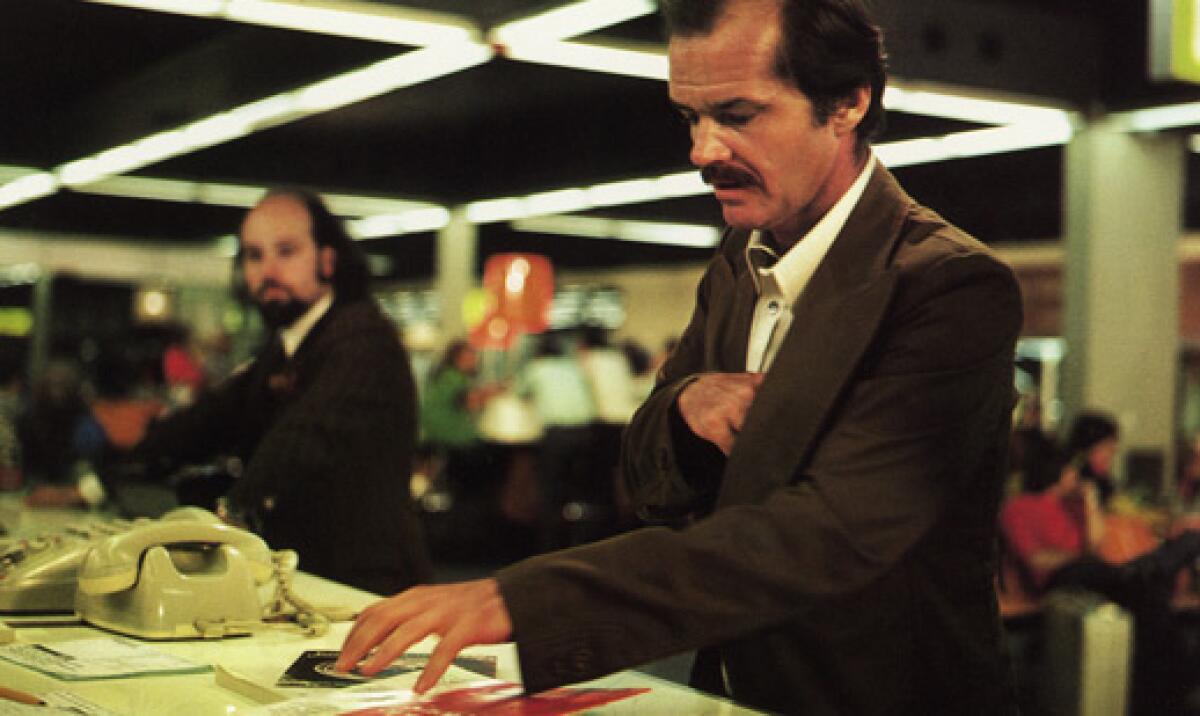
Jack Nicholson in the 1975 movie “The Passenger.”
(Sony Pictures Classics)
One movie I feel obligated to note whenever it plays it Michelangelo Antonioni’s “The Passenger.” Jack Nicholson stars as a disaffected journalist who assumes the identity of a dead man in an attempt to start over, only to find that his new life is even more complicated than his own. It is a powerful examination of middle-aged malaise that has Antonioni’s trademark mystery but, thanks to Nicholson, also has a directness that makes it accessible to wider audiences.
Nicholson made the film in between “Chinatown” and “One Flew Over the Cuckoo’s Nest,” at the height of his fame in the 1970s, a time when going to Europe and Africa to shoot a movie with an esoteric art-house filmmaker was a huge risk. He would personally purchase the rights to the film in the early 1980s and essentially treated it like owning an art object, very rarely allowing it to be shown publicly. It reentered circulation in 2005 with a rerelease but still has a certain air of rarity around it. The film will be showing at the New Beverly in 35mm on Saturday and Sunday.
Nicholson sat for an extended interview with The Times’ Patrick Goldstein around that 2005 reissue of the film, calling the production “the most vivid filmmaking adventure I’ve ever had.” He described his relationship to Antonioni by saying, “He’s been like a father figure to me. I worked with him because I wanted to be a film director and I thought I could learn from a master. He’s one of the few people I know that I ever really listened to.”
When the Italian filmmaker died in 2007, Nicholson got on the phone with us to say, “I don’t know how to put this: He’s just a maestro, and everybody loved him. … He was a man of joy and impeccable taste. His whole life was dedicated to modestly being a brilliant artist.”
Truffaut’s humanist warmth
Delphine Seyrig and Jean-Pierre Léaud in the movie “Stolen Kisses.”
(Janus Films)
Richard Linklater’s “Nouvelle Vague” last year didn’t exactly start a renewed wave of interest in the French New Wave of the 1960s, but then again, those movies never really went away. They’ve been inspirational to generations of film fans for more than 60 years now.
But one French director who has perhaps fallen out of favor slightly is François Truffaut. Long seen as one of the quintessential New Wave filmmakers, he has become taken for granted a little of late. Which is why it is exciting to see Brain Dead Studios showing his 1968 film “Stolen Kisses” in 35mm on Sunday.
The third in the series of films Truffaut returned to throughout his career, including his 1959 breakthrough “The 400 Blows,” the film again stars Jean-Pierre Léaud as Antoine Doinel, Truffaut’s alter ego through the stages of his life. Discharged from the army, Antoine drifts through a series of jobs. His real concern is juggling his busy love life, making the film something of a male-centered rom-com while capturing Truffaut’s warm, humanist worldview.
Rohmer’s caustic cynicism
Jean-Claude Brialy in the 1970 movie “Claire’s Knee.”
(Janus Films)
Conversely, a filmmaker of the French New Wave who has seen his stock rise during the last few years is Eric Rohmer, championed by Noah Baumbach among others. His more caustic view of the world may resonate better with more cynical modern audiences.
The American Cinematheque will begin showing Rohmer’s cycle of “Six Moral Tales” at the Los Feliz Theatre this weekend with a 35mm screening of “My Night at Maud’s” and continuing with other screenings through the end of July. Other films in the series include the sultry, summertime tale “La Collectionneuse,” the ethical dilemma of “Claire’s Knee” and the tale of infidelity “Love in the Afternoon.”
Writing about “Claire’s Knee” in 1971, Charles Champlin noted, “What redeems Rohmer’s films from a defeating sameness is the quite extraordinary charm, believability and complexity of his characters and his meticulous attention to detail and his refusal to go for gross events at the expense of the subtle shadings of human relationships.”
Honestly, if a trip to France isn’t happening for you this summer, this series makes for a not-bad substitute.
Reconsidering ’90s comedy
An image from the 2025 documentary “We Are Pat.”
(The Film Collaborative)
Fresh off its world premiere at the recent Tribeca Film Festival, Ro Haber’s documentary “We Are Pat” will screen at Vidiots on Sunday. Haber will be there along with comedians Julia Sweeney and Harper Steele and, for good measure, Alan Cumming.
“We Are Pat” examines the afterlife of Sweeney’s character from “Saturday Night Live,” a confusingly genderless person who no one can ever quite figure out how to engage with. The way Pat has been picked up by a new generation of genderfluid comedians shows how influence and inspiration can come from the unlikeliest of places, and also how comedic ideas can transform over time.
Ali in Africa
Muhammad Ali fights George Foreman in the 1996 documentary “When We Were Kings.”
(Gramercy Pictures)
Released in 1996, “When We Were Kings” depicts the 1974 boxing match in Zaire between Muhammad Ali and George Foreman known as “The Rumble in the Jungle.” Director Leon Gast was unable to complete the film at the time, so the footage languished for years until he got an assist from filmmaker Taylor Hackford in shooting contemporary interviews with the likes of Norman Mailer, George Plimpton and Spike Lee. “When We Were Kings” would go on to win the Academy Award for documentary feature. It will be screening at Vidiots on Saturday.
The core of the movie is watching the thrilling, inspiring footage of Ali training and interacting with the locals. As Kenneth Turan wrote in his original review, “Because a classic heavyweight championship fight, especially with these protagonists, epitomizes the drama inherent in sport, ‘When We Were Kings’ always compels our interest.”
Johnny Knoxville and friends are back for another round of stunts and pranks in “Jackass: Best and Last.” Age has finally caught up with them, Amy Nicholson laments.
It seems a little odd that a movie starring Angelina Jolie, “Couture,” is just sort of sneaking into theaters, but that’s movie business in 2026. We spoke to Jolie at last year’s Toronto International Film Festival about the film.
Through the first two games of this summer’s World Cup, the U.S. was about as perfect as a team could be. It won both games, never trailed, gave up just a goal and won its group handily, playing with a verve and confidence that erased all the doubts that had shadowed it coming in.
Then came Thursday.
With Mauricio Pochettino making a record nine changes to a lineup that had given the U.S. its most successful start to a World Cup in 96 years, the B team that closed the group stage at SoFi Stadium with a 3-2 loss to Turkey served to remind everyone how flawed this group can be.
The backline was porous, goalie Matt Turner gave up goals on the first two shots he faced and with the exception of midfielder Sebastian Berhalter, who had a goal and an assist, none of the starters really distinguished themselves. Whether any of that matters won’t be known until the U.S. next takes the field in the knockout rounds, facing Bosnia and Herzegovina on Wednesday in Santa Clara, Calif.
For Pochettino, whose contempt for convention has been a hallmark of his team’s World Cup run, clearing his bench and getting a U.S.-record 23 players on the field in the group stage was more more important than the result.
“The objective was to finish first and we are first,” he said. “Now it is the next stage and it is going to be a final. And we are ready. We are much better than before that game because we had players now with 90 minutes in their legs and performing and ready to help if we need from the beginning or from the bench. It’s all positive.”
Maybe. Sure, Christian Pulisic, who hadn’t played since the first half of the first game, got back on the field and looked good in a 32-minute cameo. But other than that the game was meaningless since the Americans had already won the group and qualified for the next round while Turkey was going home no matter the result.
The U.S. came in riding a huge wave of momentum, though, and that’s gone now, erased on Kaan Ayhan’s goal on the last touch of the game.
Does that matter?
“No,” captain Tim Ream said with conviction. “You just turn the page.”
The experience the role players got, he said, is more important than the final score.
“When we say it didn’t mean anything, it’s still a meaningful game, right? It’s a World Cup game,” he said. “So it gives everybody a taste of what life will be like if they are called upon and have to contribute.”
Midfielder Tyler Adams wasn’t so sure.
“I don’t know what it’s going to do,” he said. “I can’t predict the future. I don’t have an eight ball in front of me. We’ll see what happens.”
What Adams can say with certainty, however, is that in the future the U.S. will have no room for error. The games are all elimination matches now and 13 players on the U.S. roster, including Adams, have experienced that first hand, having lost in the round of 16 four years ago in Qatar.
Turner said it’s up to those veterans to impart that wisdom on the 13 who are playing in their first World Cup.
“You need to really take care of the boxes when it comes to knockout round. That’s the biggest lesson that we learned,” said Turner, who started all four games in the last World Cup. “It’s not necessarily how beautiful a style you play. The chances you create is important, [but] the way you defend your box is more important.
“Those games are going to be decided by one goal, they’re going to be narrow, and we’re going to have to be compact and be together, defensively, offensively, and take the chances when they come.”
The U.S. did little of that Thursday.
After a Berhalter corner set up Trusty for the first goal in the third minute, Turkey’s Arda Guler, a Real Madrid midfielder, tied the score seven minutes later, splitting a pair of U.S. defenders and running onto a pass from Kenan Yildiz in the center of the box, then lifting a shot over Turner.
Orkun Kokcu handed the U.S. its first deficit of the tournament when he found another big hole in the U.S. defense, redirecting a cross from Eren Elmali in from the center of the box to give Turkey a 2-1 lead.
Berhalter tied the score again four minutes into the second half, latching onto a loose ball at the top of the penalty area and one-hopping a right-footed shot just inside the near post. The game stayed that way until Ayhan, who came on with two minutes left in regulation, slid between two U.S. defenders to knock in the game-winner eight minutes into stoppage time.
For Berhalter, one of a record 21 Americans to get a start in this World Cup, Pochettino’s decision to clear his bench was not only a reward, it was preparation for what’s to come.
“It’s every little kid’s dream, across the United States of America, to play in a home World Cup. Just in a World Cup in general,” he said. “People made their debuts today, so congratulations everyone. This is what everybody looks forward to.”
More important, he added, “we know everyone’s ready to step up at any moment.”
Which is good because history suggests the road ahead is about the get a lot more challenging. The loss to Turkey was the Americans’ 10th straight to a UEFA team, running their winless streak against European opponents to 13 in a row.
Guess which continent Bosnia and Herzegovina, who the U.S. faces next, is from?
Sports editor Iliana Limón Romero contributed to this story.
June 26 (UPI) — A Federal Emergency Management Agency official who claims he was once teleported to a Waffle House has been ousted from the agency, unnamed sources familiar with the situation told media outlets Friday.
Gregg Phillips, who was appointed to lead the Office of Response and Recovery in December, was asked to vacate his position because of concerns about how he’s publicly perceived, anonymous sources told The New York Times, The Washington Post and CNN.
Phillips, the associate administrator for FEMA’s Office of Response and Recovery, posted on social media in April doubling down on his teleportation claim. He said it really happened and that it is connected to his Christianity.
“God will not be mocked,” Phillips posted on Truth Social. “People can debate me. Question me. Even ridicule what they don’t understand.”
He clarified that it happened while he was heavily medicated during cancer treatment.
“The word ‘teleportation’ was not mine,” Phillips posted on Truth Social. “It was used by someone else in the conversation reaching for language to describe something with no easy name. The more accurate biblical terms are ‘translated’ or ‘transported’ — not new ideas for people of faith.”
The Department of Homeland Security confirmed Thursday that Phillips is leaving the agency, saying he is taking leave for personal reasons. But sources told CNN the departure was not by his choice.
New DHS leadership was tired of his public image and clashes with department leadership, the sources said. David Arnold, a senior official who left FEMA earlier this year, will fill in as an acting leader of the Office of Response and Recovery.
The office has more than 1,000 employees and a budget of nearly $300 million. It’s critical to the mission of responding to disasters.
Phillips was known as a conspiracy theorist, particularly concerning election fraud. He said millions of noncitizens had voted in the 2016 election. Trump also boosted those claims.
Some agency staff were unhappy with his ouster, saying he wanted to help improve the agency.
“He showed interest in preserving the mission of the agency and helping us serve citizens,” one current agency official told The Post.
Another agency official told The Post that Phillips was one of the only political appointees who supported staff and would push back against leadership such as former Homeland Security Secretary Kristi Noem or Karen Evans, who briefly led FEMA.
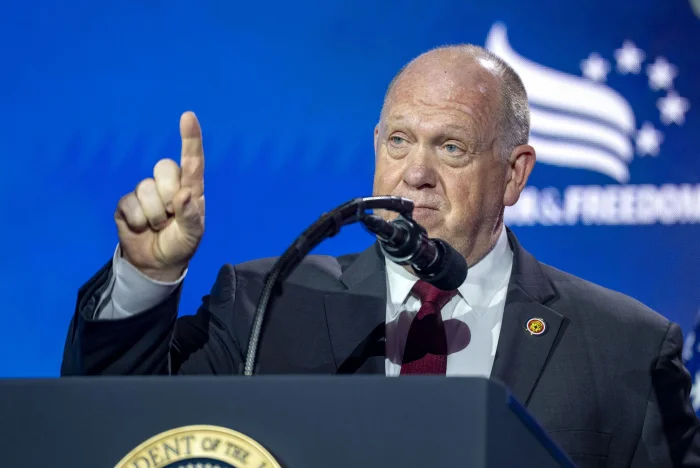
White House Border Czar Tom Homan speaks during the Faith and Freedom Coalition 2026 Road to Majority Policy Conference at the Washington Hilton on Friday. Photo by Bonnie Cash/UPI | License Photo
Deaths of immigrants held in US detention centres have surged during Donald Trump’s second term.
Published On 26 Jun 202626 Jun 2026
The United Nations High Commissioner for Human Rights, Volker Turk, has called for an independent investigation into the severe uptick in deaths in migrant detention centres during President Donald Trump’s second term in office.
In a statement on Friday, Turk expressed concern over the lack of transparency over those deaths, at least 19 of which have occurred so far this year, according to US government statistics.
Recommended Stories
list of 3 itemsend of list
“Those responsible for violations of the law must be held to account, and the rights of the victims’ families to truth, justice and reparation and guarantees of non-recurrence must be upheld,” the UN rights chief said.
Deaths in immigrant detention centres have surged during Trump’s second term in office, a by-product of what rights groups and immigration lawyers have depicted as systematic neglect, inhumane conditions and abuses.
The Trump administration has sought to rapidly expand the network of immigrant detention centres, some operated by private contractors, as it seeks to carry out the mass deportation of immigrants in the US.
Trump stated in a social media post on Friday that his administration has the “Highest Average Daily Arrest Rate by ICE and CBP, including Total Detention, with Final Orders of Removal, than any other president, by far!”
The reported death of a Georgian man, Mamuka Artmeladze, in a detention facility in Louisiana on June 4 increased the number of fatalities so far this year to 19, compared to 33 last year and 11 in 2024.
“The mortality rate of deaths in ICE custody is at its highest level in over a decade and has more than doubled since Trump’s second term began,” the watchdog group Human Rights Watch wrote in a report on detention deaths earlier this month. “The rate is nearly four times that of the Biden administration and more than two and a half times as high as that of the first Trump administration.”
That report said the 52 people who have died in detention during Trump’s second term ranged in age from 19 to 75 and came from 20 different nationalities.
Turk wrote on Friday that there have been “concerning allegations regarding the use of force” at such facilities and that five of the deaths recorded in 2026 were classified as suicides.
He also expressed concern over the reported use of solitary confinement, which is associated with a heightened risk of suicide and considered a form of torture by the UN after a period of 15 days.
“All these factors exacerbate vulnerability and raise serious concerns as to whether some of these deaths in ICE custody could have been prevented,” he said.
In the last decade or so, Angelina Jolie has been on screen less frequently. So when she is — and not in forgettable tentpoles like “Eternals” — it’s worth paying attention. There seems to be a thoughtful intentionality to the roles she now chooses, almost as if this astoundingly famous woman wants to tell us something vital about herself, offering clues into her understandably guarded personal life.
Take 2015’s “By the Sea,” which she wrote and directed. Coincidentally or not, that pained study of marital dissolution, co-starring Jolie’s then-husband Brad Pitt, intersected with the couple’s real-life breakup — not to mention Jolie’s grief over the death of her mother, Marcheline Bertrand. Two years ago, Jolie portrayed a version of the elusive, emotionally closed-off opera singer Maria Callas in “Maria.” The conception of the role, marked by a dim view of stardom’s suffocating alienation, was something Jolie clearly understood. Moviegoers should be careful not to read too much autobiography into an actor’s creative choices, but Jolie makes such speculation tantalizing, adding additional layers of drama to her films.
The intermittently affecting “Couture” feels similarly close to her heart, depicting a filmmaker whose life is interrupted by a cancer diagnosis — a reality Jolie knows all too well. In 2013, she underwent a preventive double mastectomy over concerns of her likelihood to develop breast or ovarian cancer. (Bertrand died of cancer in 2007.) Knowledge of Jolie’s circumstance will inform a viewer’s reaction to her wounded, resilient performance, but our inherent sympathies can only take French writer-director Alice Winocour’s ensemble piece so far.
Jolie plays Maxine, an American indie director hired to create a flashy opening film for Paris Fashion Week. Newly arrived in the City of Light, she has only a few days to put together the short, assisted by her trusted cinematographer Anton (Louis Garrel). As we deduce from the phone calls Maxine makes back home, she’s also going through an acrimonious divorce and has trouble connecting with her blasé teenage daughter. At least this Paris paycheck gig will bolster her finances — and get her ready for the feature film she’s been wanting to make for years.
Just then, though, Maxine’s future gets a rewrite. A French doctor (Vincent London) tells her she has breast cancer and needs a double mastectomy immediately. Maybe she can finish the Fashion Week film, but her passion project must wait. An artist and mother who has spent her adulthood in constant motion will have to learn what it means to stop everything and be still.
The film’s title would appear to be a reference to the story’s setting, but in French, “coutures” can also mean “stitches,” and indeed Winocour sews together three thematically linked story strands. As Maxine wrestles with her cancer diagnosis, an inexperienced South Sudanese model named Ada (Anyier Anei) works Fashion Week so she can send money home to her family. (Ada has no interest in modeling, hoping instead to become a pharmacist.) Meanwhile a makeup artist, Angèle (Ella Rumpf), longs to be an author, although she cannot get anyone interested in her writing. Each one becomes a part of the fabric of Fashion Week, but their disparate problems are a far cry from the glitzy event’s self-importance.
Winocour has often made films about women balancing their public-facing life with their private selves In 2019’s “Proxima,” Eva Green played an astronaut missing her young daughter. In 2022’s “Paris Memories,” Virginie Efira starred as an interpreter recovering from the shock of surviving a terrorist attack. Winocour shows us the intimate, vulnerable spaces within her characters that those on the outside don’t have access to.
“Couture’s” three principals rarely interact with one another, but those meaningful exchanges argue that, amid the mad clatter of the everyday, a brief, unguarded moment with a stranger can be supremely restorative. Unfortunately, the juggling of storylines ends up being more schematic than insightful. Angèle’s narrative never catches fire and while Anei is striking as Ada, that section of the film feels slightly patronizing, reducing this immigrant tale to yet another strained salute to perseverance.
This leaves Jolie as the movie’s magnetic center, with Maxine drifting through despair as she ponders what to do. Her doctor insists that the surgery cannot wait, but putting her ambitions on hold means losing a part of herself — a different kind of death sentence than the one she’s now facing.
The character is underwritten but Jolie picks up much of the slack through her silently shattered expression. As she’s gotten older, the Oscar winner has become more comfortable doing less in her performances, allowing for a fragile serenity that is belied by the anguish and anxiety roiling underneath. It’s not just our recognition of the real-life parallels that make Jolie so touching in “Couture” — it’s that ineffable star power she’s possessed for so long. In a story about a potential tragedy, what’s saddest is that Winocour’s film cannot match its lead’s effortless command.
‘Couture’
In French and English, with subtitles
Rated: R, for language, some sexuality, nudity and brief bloody violence
Los Angeles property owners voted against an increase in an assessment for maintaining streetlights that would have collected an additional $80 million a year, as the city faces a backlog of broken streetlights due to stagnant funding and a rise in vandalism.
The assessment has not changed since 1996. Property owners had until June 2 to submit their votes, which were weighted by the amount of their parcel’s proposed assessment. According to results released Thursday, nearly 80% of the weighted vote went against raising the assessment, which currently generates about $45 million a year.
For the average single-family home, which make up the majority of parcels, the current payment is $58 annually, or about $5 a month, according to Miguel Sangalang, executive director and general manager of the Bureau of Street Lighting. The increase would have brought the average annual bill to $117, or about $10 a month.
The proposed increase would have brought the total amount collected by the assessment to $125 million a year.
In a joint statement Thursday, Mayor Karen Bass, Council President Marqueece Harris-Dawson and City Councilmembers Eunisses Hernandez and Katy Yaroslavsky said that despite the result, the “critical work will continue” to address the broken streetlights that have plunged neighborhoods into darkness across the city.
“Despite this outcome, the City remains committed to improving streetlight reliability, repairing outages faster, and building a sustainable funding path for streetlight operations and maintenance,” the group statement said. “Every Angeleno deserves to feel safe walking their dogs, returning home from work, and parking their cars at night, and the City is committed to delivering the reliable street lighting that makes that a reality.”
The Bureau of Street Lighting owns and operates nearly 225,000 streetlights across the city, which have historically been covered by the assessment. The average repair time for a streetlight was one year, bureau officials said in February.
Without more revenue from the assessment, city officials have been looking for alternative funding. The City Council has said it will finance $65 million for solar-powered streetlights.
Bass recently announced an initiative to repair and replace 60,000 streetlights over the next two years, and several council members have turned to their district’s discretionary funding to fix broken streetlights in their districts.
Hernandez, who chairs the council’s Public Works Committee, said in a statement that the result doesn’t change the fact that the city is trying to maintain a 21st century lighting system with an outdated funding model.
“If this assessment isn’t the path forward, then it’s our responsibility to build one through better leveraging City assets like light poles, exploring new revenue opportunities, and pursuing reforms to outdated state laws like Proposition 218 that make it extraordinarily difficult for cities as large as Los Angeles to maintain basic public infrastructure,” she said.
Broken streetlights have emerged as an issue in the mayoral election, with Councilmember Nithya Raman citing broken lights as an example of how the city “can’t seem to manage the basics.” Raman is facing Bass in a Nov. 2 runoff.
In February, city council members announced a plan to replace streetlights with solar-powered versions, in an attempt to deter copper wire theft. About 1 in 10 streetlights are out of service because of disrepair or copper wire theft, according to the city.
A well-known example is the Sixth Street Bridge, where thieves stole seven miles’ worth of wire.
Maintaining – or not maintaining – his fitness has been a recurring theme in Duckett’s career. As a youngster, he twice missed out on tours for failing to meet conditioning standards – once with England Under-19s in 2013, then a Northants pre-season trip in 2015.
This time, with a Test career on the line, he has worked with England fitness coach Pete Sim and Nottinghamshire counterpart Zac Bess to lose “five or six” kilograms.
Duckett added: “I started running, which was good!
“I had a four-week block when I got back from the winter where I didn’t necessarily hit many balls.
“It’s just really important now that I use that hard work that I’ve done and maintain it.
“It’s something I’ve really enjoyed and it’s been great for my mental space and getting away from the game. I went to the gym, I ran a lot and a bit of weight came off.”
The early signs for Duckett were good. Three half-centuries in his first five innings for Notts this summer were followed by an unbeaten double century against Surrey.
He still needed the international worm to turn. In the context of the snakepit pitch, scores of 19 and 33 in England’s first-Test win over New Zealand at Lord’s were useful, only to be followed by more misfortune in the loss at The Oval.
On the second morning, Duckett dropped a simple and crucial catch off Kyle Jamieson as England surrendered the momentum. When he came to bat, he was in glorious touch for 36 before being run out by a never-there call from new opening partner Emilio Gay.
At Trent Bridge, it could have been a similar story. In perfect batting conditions and with England replying to New Zealand’s 438, Duckett made his intentions known with two driven fours off Nathan Smith’s first over of the innings.
Smith, though, would return to find Duckett’s edge. Henry Nicholls should have pouched a simple catch at third slip. When the ball dropped to the turf, Duckett responded by punching the next delivery for four and did not look back.
“I was chatting to [England fielding coach] Sarah Taylor,” said Duckett. “We were making a bit of a joke about how I’ve got to get some luck eventually and that’s how the game works.
“I’m extremely thankful for Henry Nicholls for doing that to me.
“It’s been a really frustrating time, because I’ve not felt out of nick, I’ve just not got the runs that I really want. ‘Mother Cricket’ was there for me today. I got put down and made them pay for it.”
June 26 (UPI) — The Transportation Security Administration on Friday said that it expects to screen roughly 18.7 million travelers at U.S. airports during the July Fourth holiday week that runs from June 30 to July 6.
The agency said it has prepared itself for the traditionally busy week of travel to be even busier, as this July 4 is America’s 250th birthday amid the FIFA World Cup, which has games in 11 U.S. cities next week.
AAA has projected that this year’s week of holiday travel is set to break records, with roughly 72.2 million Americans expected to travel at least 50 miles from their homes — an increase from the 71.8 million that traveled in 2025.
“TSA security checkpoints are fully staffed and prepared to welcome these travelers and handle the large passenger volumes expected during the Fourth of July holiday period,” Ha Nguyen McNeill, a senior TSA official who is performing the duties of the administrator, said in a press release.
“We’ve implemented significant technology enhancements at key airports for the historic FIFA World Cup 2026, as well as for America 250 celebrations across the country,” McNeill said. “TSA is working closely with federal, state and local partners to safeguard the traveling public and manage security for large-scale public events.”
TSA said it expects that Thursday, July 2, will be the busiest travel day next week, with more than 3 million people moving through U.S. airports.
The Top 10 domestic destinations for Americans during the holiday week for July 4 include Seattle, Orlando, Anchorage and Fairbanks in Alaska, New York City, Chicago, Fort Lauderdale, Denver and Boston,
TSA also has prepared for teams, team staffs and fans to travel to the 11 World Cup host cities in the United States.
The 11 cities have some cross-over with the locations most Americans are expected to travel, which include Atlanta, Boston, Dallas, Houston, Kansas City, Los Angeles, Miami, New York/New Jersey, Philadelphia, the San Francisco Bay Area and Seattle.
A collection of baseballs signed by former United States presidents is on display at a press preview event for Christie’s free “America at 250: Important Artifacts and Documents of History” exhibit in New York City on June 25, 2026. Photo by John Angelillo/UPI | License Photo
An Israeli attack on a vehicle in the central Gaza Strip has killed three Palestinians and injured several more.
Palestine’s Ministry of the Interior and National Security condemned the attack, which took place in Maghazi refugee camp in Deir el-Balah on Friday, saying that the victims were all police officers.
Recommended Stories
list of 4 itemsend of list
“Their vehicle was treacherously bombed by the Israeli occupation forces,” said a ministry statement published on Telegram.
It named the three deceased as Captain Mansour Sami Shahtout, Captain Mohammed Khaled Nofal, and First Sergeant Mahdi Nader Jabr.
Palestine’s Wafa news agency said an Israeli combat drone targeted a vehicle near the entrance of the Maghazi refugee camp, while Anadolu news agency reported that the Israeli drone fired at least two missiles at the vehicle, causing it to catch fire, which resulted in the deaths and injuries.
Witness video accounts showed a civilian vehicle burning after it was struck on Salah al-Din Street at the entrance of Maghazi camp.
The bodies were reportedly taken to Al-Aqsa Martyrs Hospital in Deir el-Balah.
“The Ministry of Interior condemns the heinous crime committed by the occupation in targeting civil police personnel, an act that demonstrates a persistent intent to spread chaos across the Gaza Strip,” the ministry added in its statement.
It reiterated its “call on the international community and the guarantor states of the ceasefire agreement to exert pressure on the occupying forces to cease their repeated targeting of the police force, its personnel and its resources.”
The vehicle in Gaza caught fire as a result of the strike, while medical, civil defence and firefighting teams were dispatched to the area [Adam Bilal/Anadolu Agency]
According to Gaza’s Health Ministry, Israeli violations of the “ceasefire” agreement have killed 1,031 Palestinians and injured 3,309 others as of Thursday. In total, since Israel’s genocidal war began in October 2023, more than 73,000 Palestinians have been killed in Gaza.
Gaza ‘ceasefire’ developments
As attacks on the ground continue, Hamas said that consultations are ongoing with other Palestinian factions and regional mediators to reach understandings that would ensure the full implementation of the Gaza “ceasefire” agreement.
“These discussions concern the full implementation of the ceasefire agreement, including what remains of the first phase and mechanisms for implementing the second phase,” Hamas spokesman Hazem Qassem told Anadolu on Friday.
He added that a delegation from Hamas and other Palestinian factions is expected to visit Cairo in the coming days to deliver its response to newly proposed approaches.
Qassem said Palestinian factions had previously reached understandings that were welcomed by mediators, before Board of Peace envoy Nikolay Mladenov presented what he described as “different approaches” that are currently under final review by Hamas and the factions.
“We hope the efforts of the mediators and Mr. Mladenov will lead to compelling the occupation to implement what was agreed upon, particularly the humanitarian provisions of the first phase, and then move to the second phase with all its complexities,” Qassem said.
Regarding the situation on the ground, Qassem accused Israel of committing major and continuous violations of the ceasefire agreement, including restrictions on humanitarian aid and continued killings.
He told Anadolu more than 1,000 Palestinians have been killed since the ceasefire entered into force, adding that Israel had expanded the “yellow line” into new areas of Gaza, accompanied by displacement and home demolitions.
“These violations require, first, a clear stance from the mediators to pressure the occupation, and second, serious work to bring the national committee into Gaza so a genuine relief and reconstruction process can begin,” he said.
“We do not want the starvation policy imposed on our people to be repeated while the world remains a spectator. Nor should the killing and destruction continue while the world watches,” he added.
TELLY favourites Stacey Solomon and Joe Swash are set to upgrade their Pickle Cottage home for a sprawling mansion set in 30 acres.
The couple have set their sights on an impressive eight-bedroom Victorian mansion, which is said to be central to DIY influencer Stacey’s next renovation project.
Stacey and Joe are set to upgrade Pickle Cottage for a sprawling eight-bedroom mansionCredit: BBCThe Essex property costs almost double the £1.3million price of their current home Pickle CottageCredit: Instagram
A source said the pair “fell in love” with the Essex property after viewing it as a potential new home for their family of eight.
Stacey, 36, will have her work cut out transforming the already-impressive gaff, which costs almost double the £1.3million price of their current home and is more than 7,500 sq ft — complete with a pool and a lake.
Our source said the couple would be sad to leave Pickle Cottage, but are grateful to have the chance to make “new memories” with their brood.
They said: “They viewed the house and fell in love with it. It’s got extra space for the kids.
“Pickle Cottage only has five bedrooms. They have six children and then they need a room for themselves. It gives Stacey a chance to do more of her amazing DIY work as well.
“She has a great eye for interiors. This house needs a bit of love and work to make it the absolute dream home where they can make new memories.”
The family’s current Tudor-style Pickle Cottage, also in Essex, is the setting for their reality TV show, which launched to 4.2million viewers in April last year, with a second series last September.
Our insider revealed the sprawling mansion could be a dream home to make new memoriesCredit: GettyOur source said the couple would be sad to leave Pickle CottageCredit: Getty
The BBC has commissioned a third series of the show, despite scrutiny after The Sun’s revelation that the couple’s lavish 2022 wedding was never made legal.
Following the news, Stacey took to social media to tell her six million followers the pair had always been clear it was a “religious ceremony and blessing” in their garden.
She added that the couple plan to get “legally married at a later point”.
Stacey and Joe, 44, have three kids together — Rex, seven, Rose, four, and three-year-old Belle — while Stacey also has teenage sons Zachary, 18, and Leighton, 14, and Joe has son Harry, 19.
Pickle Cottage only has five bedrooms and the couple have six childrenCredit: StaceySolomon – Instagram
In March, after being pictured multiple times with and without her wedding ring, Stacey addressed speculation about “issues going on” in her marriage on ITV’s This Morning.
She told presenter Ben Shephard: “There’s a new rumour each week. Have I not been wearing my ring? I probably took it off to go to the toilet or something.”
Stacey and ex-EastEnders star Joe have built lucrative careers on their family image after first meeting on ITV’s I’m a Celebrity show in 2010.
McDonald’s (MCD) shares were trading around $268 a share in Friday midafternoon trading, up some 1.4% intraday, but the daily chart still shows a stock under pressure after sliding toward two-year lows.
WASHINGTON — The Democratic National Committee is organizing hundreds of community events across the country this weekend in hopes of harnessing the same concerns about affordability that President Trump capitalized on to return to the White House.
The events include school supply giveaways, food bank drives, neighborhood door knockings and organizer trainings.
“Everything costs too damn much under Donald Trump and the Republicans,” Democratic National Committee Chair Ken Martin said in a statement.
Martin said party members planned “to reach, engage, register, and mobilize voters who will make the difference in races up and down the ballot.”
Two years ago, Democrats were the ones accused of being indifferent to Americans’ anger about rising prices. Now they’re pointing the finger at Trump, who has downplayed the effect of lingering inflation.
He has described affordability concerns as a “hoax” and recently said, “I love the inflation” because he expects costs to drop as he tries to resolve his war with Iran.
About one-third of U.S. adults approve of how Trump is handling the economy, according to an AP-NORC poll from June. That’s down from the start of his second term, when 40% approved.
About 7 in 10 U.S. adults say the country’s economy is “poor,” according to an AP-NORC poll from June. That’s up from 65% in March, and underscores Americans’ ongoing unhappiness with the cost of living, which is being compounded by high gas prices because of the war in Iran.
Slightly more U.S. adults say the Democratic Party would do a better job than the Republican Party in handling inflation and the cost of living, according to a Marquette Law School/SSRS poll from May. Roughly one-third of U.S. adults — 35% — said the Democrats would do a better job, while 28% believe the Republicans would. Roughly one-third say the parties would be the same, or neither would be good.
This weekend’s events vary by region.
In New Mexico, Gov. Michelle Luján Grisham will convene a training for 150 potential campaign staffers. Nevada’s statewide campaigns will knock on doors in rural and working class neighborhoods. Others will call voters in swing districts with competitive U.S. House races to talk about the rising price of gas.
Some events are geared toward directly helping voters to persuade them that Democrats are concerned about affordability.
For instance, the local party in Kenosha County, Wis., plans to collect and distribute school supplies to poor families. And canvassers will fan out to discuss affordability issues in Arizona, Pennsylvania and Wisconsin.
The Republican National Committee dismissed the weekend’s events.
“Despite being millions of dollars in debt, the DNC is choosing to throw pitiful pep rallies to distract from the fact they created the inflation crisis,” said Delanie Bomar, an RNC spokeswoman. “Meanwhile, Republicans are hard at work fixing the economic mess Joe Biden and the Democrats created.”
Democrats hope that the events will show that their time in the political wilderness has made them more serious and effective at tackling kitchen table issues. But some fear their agenda may not be heard by voters in an increasingly fractured media environment.
“One of Donald Trump’s greatest strengths is that he’s so loud,” said Brian Derrick, a Democratic strategist. He said that events like the weekend’s itinerary help Democrats focus on an “Achilles’ heel” issue for Trump, “which right now is his lack of interest in addressing everyday costs for people.”
For the second straight year, the City Section is allowing a pilot program of high schools forming a boys flag football league as its popularity grows.
This year’s group of high school participants is expected to double in size between eight and 16 teams, City Section commissioner Vicky Lagos said. All will be small charter schools. Last year, several teams that temporarily dropped 11-man football, Sotomayor and Torres, had flag teams in a league that was played in the fall. Sotomayor and Torres will have 11-man teams this season.
When Lagos mentioned the pilot boys flag football league at an 11-man coaches meeting this month, there was clear skepticism voiced by coaches. If boys flag football ever gets approved, Lagos said schools would have to choose between having an 11-man team or a flag team. When Lagos mentioned having the flag season in the spring, there was concern it would take away participants from track and field teams.
This issue figures to come up around the state as schools in the California Interscholastic Federation have similar discussions. Flag football is likely to gain a boost in exposure when it is played at the 2028 Olympic Games in Los Angeles.
Lagos points out that boys flag football participants would be different than 11-man. Middle school students engage in flag football and attract students whose parents don’t want them to play 11-man tackle football for fear of head injuries.
Girls flag football is in its fourth year and rising fast. Adding boys flag football is a debate and issue that will need to be addressed in the future.
Ron Nocetti, executive director of the CIF, said a section must first bring up adding boys flag football as a sport before real discussions can begin.
June 26 (UPI) — President Donald Trump said Friday that Iran has attacked ships in the Strait of Hormuz and that it’s a violation of the cease-fire between the United States and Iran.
A cargo ship in the strait was attacked Thursday, but it’s unclear if this is the attack about which the president was speaking.
“The Islamic Republic of Iran shot at least four One Way Attack Drones at Ships transversing the Strait of Hormuz. One of the Drones solidly hit the upper deck of a large and very expensive Cargo Carrying Ship. Damage was done, but the Ship was able to proceed on its way. We knocked down three other Drones. Obviously, this is a foolish violation of our Ceasefire Agreement. President DONALD J. TRUMP,” the post on Truth Social said.
Trump did not address the negotiations with Iran.
Iranian Deputy Foreign Minister Kazem Gharibabadi posted a statement on X Friday emphasizing Iran’s control of the strait.
“Safe passage through the Strait of Hormuz, with ambiguous arrangements, parallel routes, or decision-making outside of Iran’s considerations as the coastal state, cannot be guaranteed. Any credible framework must be based on coordination with Iran and the provisions of paragraph five of the Islamabad Memorandum of Understanding. Otherwise, the outcome will be the suspension of the designated parallel route,” the post said.
The memorandum of understanding that Trump and Iran’s president signed on June 17 established the cease-fire and opened passage through the strait. In the fifth paragraph, it said Iran will use its “best efforts” to ensure the safe passage of commercial vessels with no charge for 60 days, The Hill reported.
On Thursday, the United States issued a joint statement with the Gulf Cooperation Council saying that “free, unconditional, and unrestricted navigation” through the strait is guaranteed under international law.
“The Ministers rejected any tolls, fees, or attempts to assert control over the strait,” the statement said. The council includes Bahrain, Kuwait, Oman, Qatar, Saudi Arabia and the United Arab Emirates.
A missile identified as “Khorramshahr-4” was on display during a public rally in Tehran’s Enghelab Square on April 21, 2026. Photo by Behnam Tofighi/UPI | License Photo
The Supreme Court’s ruling allowing the administration of US President Donald Trump to do away with a special legal status for Haitians and Syrians has sent shockwaves through communities across the country.
Immigration advocates say the 6-3 majority decision allowing the Trump administration to terminate Temporary Protected Status (TPS) will have a resounding impact on nationals of Haiti and Syria, raising the spectre of deportation and family separation, while likely leaving US employers in the lurch.
Recommended Stories
list of 3 itemsend of list
But the ruling is set to have more far-reaching implications, advocates have warned, creating a new tool to “empower Trump’s ICE deportation machine to take away legal protections and work permits from hundreds of thousands of people”, according to Hector Sanchez Barba, the president of the Mi Familia Vota advocacy group.
“This has been a defining element of the Trump- [White House adviser Stephen] Miller campaign of cruelty, revoking legal or temporary status, taking away work permits and forcing immigration judges to dismiss cases to accelerate detentions and deportations,” Barba said in a statement following Thursday’s ruling.
Here’s what to know.
What does the ruling mean for Haitians and Syrians on TPS?
Temporary Protected Status (TPS) was created by Congress as part of the Immigration Act of 1990. It allowed the executive branch, particularly the Secretary of Homeland Security, to declare that it is unsafe for foreigners to return to their home countries in light of extraordinary temporary conditions, such as armed conflict, natural disasters or other internal crises.
When a country is designated under TPS, its nationals are granted temporary legal status to reside and work in the US.
Haiti was first designated for TPS following the devastating earthquake in 2010, which killed over 250,000 people. The status has been repeatedly renewed as the Caribbean nation has suffered overlapping political, security and humanitarian crises.
Syria has been designated for the status since 2012, after the start of the civil war which lasted almost 14 years.
All told, about 350,000 Haitians and about 6,000 Syrians are believed to be in this status.
Immigration advocates say the ruling will send TPS recipients scrambling to find other legal pathways to stay in the US or become deportable under Trump’s mass deportation drive.
Given that both countries have been designated for TPS for over a decade, the decision also raises the spectre of family separation, particularly for parents with children born in the US.
“Ending these protections for hundreds of thousands of Haitians and thousands of Syrians will tear families apart, disrupt workplaces and communities and place vulnerable individuals at risk,” Council on American Islamic Relations (CAIR) national executive director Nihad Awad said.
“Many TPS holders have lived in our nation for years, raised American children, built businesses, contributed to our economy and become integral members of their communities.”
What does it mean for US employers?
Several labour organisations and unions have underscored the impact the sudden change in status could have on US industries.
Neidi Dominguez, the executive director of Organized Power in Numbers, called the ruling a “gut punch that requires workers, immigrant communities and the employers who rely on them to hit back together through our organising”.
“They work in hospitality, food service, education, construction, health care and every industry,” Dominguez said. “These are our coworkers, our neighbours and the backbone of the economy across this country, from service to construction and healthcare.”
The healthcare industry is expected to be particularly hard-hit by the decision, with the Migration Policy Institute finding that Haitian immigrants held over 103,000 healthcare jobs in 2021.
“This unconscionable ruling will leave thousands more immigrants – not just registered nurses and healthcare workers, but also teachers, airport workers, hard-working people – vulnerable to the Trump administration’s deadly, money-making deportation machine,” the National Nurses United union said in a statement.
“This decision will further strain our healthcare workforce and worsen the nurse staffing crisis,” it said.
Why does this extend beyond Haitian and Syrian TPS?
Lower courts had previously ruled that the Trump administration did not follow proper procedures, including conducting an inter-agency review to determine that conditions in both countries had improved, in terminating TPS for Haiti and Syria.
But, as Aaron Reichlin-Melnick, a Senior Fellow at the American Immigration Council, explained, the Supreme Court’s majority ruling did not even address whether the Department of Homeland Security Secretary had followed the legally mandated procedures in terminating TPS.
“Rather, the Court said that questions of whether the DHS secretary followed the law cannot be heard by courts in the first place,” he wrote, “meaning that in the future even an openly unlawful decision to grant or terminate TPS could be entirely insulated from judicial review”.
The ruling will further allow the Trump administration to “return to federal court in other cases and overturn decisions ruling against the termination of TPS for countries such as Venezuela, Somalia, Ethiopia and others”, he added.
Angelica Sedgwick Oun, a US immigration researcher at Human Rights Watch, said the ruling “leaves the DHS secretary with unfettered power to make a life-and-death decision about whether it is safe enough to send someone back to a country facing rampant violence, like Haiti, or conflict, like Syria, without meaningfully consulting on human rights conditions there”.
What comes next?
Because the Supreme Court is the top appellate court in the US, there is little recourse available through the judiciary.
But an array of advocacy groups have called on Congress to intervene.
In a rare bipartisan move on immigration, the US House of Representatives in April passed an extension to Temporary Protected Status for Haitians until 2029. The Senate has not yet taken up the measure.
Others have called on Congress to pass legislation to assert a process for courts to review any TPS terminations.
How well do you remember your U.S. history class from high school or college? Did some of the key moments in America’s 250 years of existence involve Larry David playing a founding father? OK, maybe not, but it’s fun to imagine what that would be like. And that’s precisely what David and Jeff Schaffer have done with their new HBO series “Life, Larry and the Pursuit of Unhappiness.”
The series, premiering Friday, is a timely look at some of America’s big moments in history with a comedic twist that will remind viewers of “Curb Your Enthusiasm,” partly because it also features some cast members from the show. The series arrives on the cusp of the 250th anniversary of America’s founding, and offers an alternative history that’s still steeped in facts. Schaffer stopped by Guest Spot to talk about creating the series with David and what it was like to work with former President Obama.
Speaking of laughter, if you like yours with a whole lot of drama, FX dropped the final season of “The Bear” Thursday on Hulu. The series, which premiered in 2022 and made phrases like “cousin,” “yes, chef,” and “every second counts” memorable, ties up a lot of strings for its crew of chefs. Jeremy Allen White and Ayo Edebiri, the actors who were at the center of the show for five seasons, spoke to us about “The Bear” coming to a close, where their characters end up and what it feels like to leave them behind (be forewarned, the interview has lots of spoilers).
The finale feels like a fitting end to one of the best shows of the past decade (so far) — but we won’t say much more. Enjoy each episode like a multi-course meal at a fine-dining restaurant. You’ll want to savor each bite before it’s over.
You are reading Screen Gab newsletter
Sign up to get recommendations for the TV shows and streaming movies you can’t miss, plus exclusive interviews with the talent behind your favorite titles, in your inbox every Friday
By continuing, you agree to our Terms of Service, which include arbitration and a class action waiver. You agree that we and our third-party vendors may collect and use your information, including through cookies, pixels and similar technologies, for the purposes set forth in our Privacy Policy such as personalizing your experience and ads.
Also in this week’s Screen Gab, our writers recommend an animated series with monsters and mystery and a documentary about one of America’s greatest bands. I’ll get my flags, fireworks and BBQ supplies ready in the meantime. — Maira Garcia
Turn on
Recommendations from the film and TV experts at The Times
Bobby and Romy in Disney+’s “The Doomies.”
(Disney)
“The Doomies” (Disney+)
If you’re missing “Widow’s Bay,” and like cartoons, here’s another tale of monsters loose in a coastal tourist town, with the difference that the town, called “Ouimpre,” is decidedly on the Atlantic coast of northwest France. (It’s a Franglais pun.) There are half-timbered buildings; what used to be a Camembert factory after it was a beret factory; a cafe that serves crepes, not pancakes; and boulangeries, not bakeries. (It’s a French production; Disney encouraged animator Andrés Fernandez to go local.) As in “Stranger Things,” which no one may be missing by now, the protagonists are kids — Romy, who is excitable and impulsive, and Bobby, who is neither — abetted by a formidable female teenage demon slayer and a lighthouse keeper with occult knowledge. The series is energetic, funny and character-driven — even the monsters. The action is well-staged and intense, the color palette moody and evocative, and the design not at all reminiscent of a hundred other cartoons, which makes the show refreshing as well as fun. — Robert Lloyd
Earth, Wind & Fire in HBO’s “Earth, Wind & Fire (To Be Celestial vs. That’s The Weight Of The World)”
(Jeffrey Mayer / HBO)
“Earth, Wind & Fire (To Be Celestial vs. That’s the Weight of the World)” (HBO Max)
Even if you think you don’t know Earth, Wind & Fire, chances are they’ve soundtracked a wedding, bar mitzvah, awkward office party or some other memorable celebration in your life. Somewhere between “Shining Star,” “Let’s Groove” and “September,” the band mastered the art of coaxing three or four generations of a family onto the same dance floor. Questlove’s new documentary explores how that happened. If his recent Sly Stone film examined how genius can curdle into self-destruction, this one asks a different question: How did Earth, Wind & Fire founder Maurice White build something that lasted? Abandoned by his mother as a child, White set out to create not just a band but a family, assembling a sprawling ensemble around a musical and spiritual vision. Questlove is too thoughtful a filmmaker to sand down the rough edges. White emerges as both inspiring and flawed: a gifted bandleader, spiritual seeker and demanding perfectionist whose drive sometimes came at a personal cost. Drawing on interviews with everyone from former bandmates to Stevie Wonder, Lionel Richie and Barack and Michelle Obama, Questlove builds a portrait of White that never shies away from his contradictions. In the process, he shows how White’s fascination with spirituality, Egyptology and the cosmic unknown shaped both the band’s music and mythology. You may occasionally wish the film lingered longer on the performances themselves (for a reminder of what made Earth, Wind & Fire such a formidable live act, start with the 1975 concert album “Gratitude”). But by the end, you have a deeper appreciation for the band’s unlikely feat: turning something so eccentric into something so universal. — Josh Rottenberg
Guest spot
A weekly chat with actors, writers, directors and more about what they’re working on — and what they’re watching
Larry David in “Life, Larry and the Pursuit of Unhappiness.”
(John Johnson / HBO)
Is Larry David about to be the most entertaining (and crankiest) history teacher America has ever had?
To celebrate the arrival of the nation’s semiquincentennial, the comedian teamed up with Barack and Michelle Obama’s Higher Ground Productions to revisit the truth of our history with some comedic chaos. The result is “Life, Larry and the Pursuit of Unhappiness,” a seven-episode sketch comedy series from the mind of David and his longtime “Curb Your Enthusiasm” collaborator Jeff Schaffer that pairs reenactments of seminal milestones from America’s past with David’s misanthropic humor — or, as its creators dub it, “‘Curb’ in costume.” Subtitled “An Almost History of America,” it features a star-studded roster of actors dressing up in period clothes alongside David, including “Curb’s” Jeff Garlin, J.B. Smoove and Susie Essman, as well as Bill Hader, Kathryn Hahn, Jon Hamm and Jerry Seinfeld. The first episode premieres Friday at 9 p.m. ET/PT on HBO and will stream on HBO Max.
Over a video call, Schaffer discussed the show’s genesis, former President Obama’s improv skills and the British TV series that has him entertained. — Yvonne Villarreal
Tell me about getting into business with the Obamas. Their production company approached Larry. How did it evolve into this?
Larry and President Obama know each other a little bit. They really enjoy each other’s company, or at least Larry enjoys needling Obama, and Obama really enjoys needling Larry. The moment that we all met together to have our first meeting, the first thing Obama does — I’ve never met the president [prior]— he starts just ragging on Larry’s golf game, and how he wears so much sunscreen on the golf course. And Larry just goes to President Obama, “Oh, I’m sorry, my dad’s not from Kenya.” And that’s how it started. They have a great rapport and they wanted to do something special for the 250th [anniversary]. Larry says no to everything — his best friend can be having a premiere of a movie, and Larry will go, “Where is it in Hollywood?” But Larry’s not going, that’s too far. When this came around, Larry was like, “Huh, that’s actually pretty interesting.” He responded right away to the historical nature of it because, as he would say, he’s an American history buff.
The genesis for Larry and I is that we had done a tiny test run of this with that FTX ad for the Super Bowl a few years back. I don’t know, whatever happened to those people — I’m sure they’re fine — but he remembered how much fun he had being in costume. And honestly, I think he forgot how much he hated being in a wig. It’s like childbirth, enough time had passed.
Given the sort of tenor of the times, why does this type of comedic look at America’s history feel like the appropriate way to mark this anniversary?
It’s the 250th and I get that celebrating the country right now may feel like throwing a birthday party for your friend who’s in rehab — he’s all f— up — but we still love him, right? There’s a way to look at the country’s history, warts and all, the two steps forward and the one step back. And I think one of the best ways to do that is through comedy.
Going back to President Obama — what are the negotiations to get him to appear in it? Or was that on the table from the beginning?
Once I saw the two of them interact together, that became my primary mission. We’ll write the sketches, and we’ll do the documentary stuff, we’ll make it all historical and fun, whatever, but we have to get you two on screen together. It was also sort of the promise of the show, too. When I originally talked to Amy Gravitt at HBO about it, I remember I said, “What if I could give you a show that brought together two people half of America loves?”
What was it like directing them in a scene together? He gives the opening remarks at the start of the show.
He is a truly inspiring, amazing human being who also happens to have great comedic timing. He and Larry get into a groove immediately, which is very fun, and it was honestly one of the coolest things I’ve ever done in my life, directing them. The president said, “I guess I like being annoyed by Larry. Once we get together, I start sounding like him.” It’s like Larry’s this black hole of negativity that sucked Obama in for these brief periods of time; it was just fun.
Is he good at improv then on the spot like that?
Yes, he is. He’s got some really funny stuff in the sketch they’re in together that is all him — 100% the president.
Do you have a favorite moment from this first episode — it features the Declaration of Independence, segregation and Rosa Parks.
There’s different things in each of them. The thing that I’m most excited about is when you don’t know what the next one’s going to be, and then when the narration for the little documentary section starts, and it starts talking about Rosa Parks, I can just see [viewers] going, “Oh no …” That’s a great “Curb” feeling. It’s a comedy horror film — “Oh no, don’t do that, oh no.” Then you get sucked in.
We tried really hard to make sure that production-wise, there’s historical accuracy, so it really felt like you were in this moment. Then Larry gets dropped in, and all hell breaks loose. Same thing with World War I — I got to shoot a whole bunch of World War I fighting — and there’s Larry pretending to be dead. One of the things that attracted us to it in the very beginning was the idea of the juxtaposition between these big dramatic moments and then Larry. History is writ large, and Larry writes so small and that dynamic is fun for us.
One of the great things about a show like this — or what’s come before, like “Drunk History” — are the lessons that can be learned. Is there something you learned while filming this series or a takeaway you had in looking back at our history?
There are things I did not know. One of the things that was also enjoyable is being able to talk about modern things in a historical context, even with that phone. We don’t write dialog — we write some, but it’s basically like doing “Curb.” Larry knew that people were going to ask some questions about the phone, but I just was peppering these people with questions about all of the modern stuff, and just watching Larry get angrier and angrier at these people. At a certain point, the membrane of actor, of character to real human being was breached. He was so mad at them, but that’s what making the show is. Actually, at the end of the our shoot, President Obama said to me, “I see how it works. Larry makes the world uncomfortable, and you make sure the world makes Larry uncomfortable.” That’s literally how we make the show.
Would this format work for current historical events? How do you think, 250 years from now, a reboot of this show would tackle something like telling the story of the UFC fight on the White House lawn?
That’s the problem — we’ve entered an era of America parodying itself. It’s insane. One of my good friends, Dave Mandel, used to do a “Veep” and he’s like, “What do you do now?” I think what we tried to do, and you’ll see as you go further into episodes, we try to address a lot of things that are happening right now through a historical lens. So we might be back in colonial times, and we might be back in the ‘50s, but we’re actually talking about something that’s happening right now.
Before I let you go, what is the TV show or movie out right now that you’re telling everyone to watch?
I just started watching “Steve and Alice” [Hulu, Disney+]. It’s so well done; it’s so dark and funny and really engaging.
What’s the comfort show or movie you return to again and again?
I can pretty much put on any “Lord of the Rings” [HBO Max] movie anywhere and not be able to get my butt off the seat.
Ecobank is betting that saving African biodiversity is good business — and investors are all in.
In May, Togo’s Ecobank became the first commercial bank in Africa to issue a nature bond, mobilizing $450 million that will primarily be utilized to finance sustainable agriculture, biodiversity, and water infrastructure across sub-Saharan Africa. Floated at the main market of the London Stock Exchange, it is being touted as the world’s first commercial bank-issued nature bond that meets standards set by the International Capital Market Association (ICMA).
The ICMA last year introduced the nature bond label as a secondary designation under its Green Bond Principles framework. Ecobank thus becomes the first commercial bank to issue a green bond with the nature bond label.
The offering creates a new route for investors who want to help protect the continent’s biodiversity. Home to 1.5 billion people — about 20% of the global population — Africa hosts 25% of global biodiversity, although it has lost nearly a quarter of its pre-industrial total, according to a study by the Stockholm Resilience Centre (SRC).
Conflicts, perennial food insecurity, economic instability, and stunted development are among the culprits, and action is only becoming more urgent as the climate crisis worsens, yet Africa receives less than 3% of global nature finance.
Given the challenge, the Ecobank bond has generated unprecedented excitement. The 10.25-year, Tier 2 eurobond was oversubscribed nearly four times, attracting order books in excess of $1.36 billion against an initial target of $350 million. Owing to the overwhelming demand, Ecobank decided to increase the transaction by $100 million and tighten pricing by 50 basis points. Moody’s awarded the transaction its SQS1 Excellent score, the highest possible sustainability quality mark.
“This transaction is a defining moment for African sustainable finance,” said Jeremy Awori, Ecobank CEO. “Investors did not just support this bond. They demanded more of it, allowing us to increase the size and tighten pricing.”
Biodiversity Investors
FMO, the Dutch entrepreneurial development bank, was the anchor investor with a $50 million participation, noting that the bond aligns with its strategy of supporting green and sustainable finance that contributes to biodiversity in sub-Saharan Africa. It was the second time FMO has served as anchor investor for an Ecobank transaction. In 2021, it invested a similar amount in the bank’s inaugural $350 million Tier 2 sustainability notes.
Finnfund was another major investor, with a $15 million ticket; the bond falls in line with the Finnish development financier and impact investor’s broader focus on safeguarding biodiversity.
“By supporting investments that promote sustainable land use and protect natural resources, Finnfund aims to contribute to preserving the natural capital that economies and livelihoods depend on,” said Ulla-Maija Rantapuska, Finnfund’s senior investment manager, in a prepared statement.
For Ecobank, the nature bond’s debut was timely, enabling it to refinance its outstanding $350 million of 8.75% notes, which are due to mature in June 2031. The proceeds of the transaction will be ring-fenced to support smallholder farmers adopting sustainable agricultural practices. Additionally, the funds will back agri-processors with verified deforestation-free supply chains. Funding will also target water infrastructure protecting freshwater ecosystems that millions of people rely upon.
Ecobank operates in 34 sub-Saharan African countries, where it boasts 32 million customers and $801 million in pre-tax profits as of last year; it has identified 24 markets as key for biodiversity lending. Critical lending criteria favor countries where agricultural land-use change is the primary driver of biodiversity loss.
John Njiraini is a contributing correspondent based in Nairobi, Kenya.
Veteran MS NOW anchor Alex Witt is leaving the news network, which is moving away from live programming on the weekends.
The new weekend programming strategy announced Friday is a cost-saving measure that will give parent company Versant more resources for a new direct-to-consumer streaming offering that makes MS NOW available to consumers without a pay-TV subscription. The company is also looking to expand its live event business.
According to a memo from MS NOW President Rebecca Kutler, “The Weekend: Primetime,” a live discussion program launched last year, will have its final airing Saturday.
One of the program’s co-hosts, Antonia Hylton, will take over Witt’s midday shifts later this year. Hylton’s co-hosts Ayman Mohyeldin, Catherine Rampell, and Elise Jordan, will remain with MS NOW and continue to appear on other programs.
Kutler said job losses from the moves are minimal and encouraged staffers who lose their current roles to apply for 40 current job openings at the company with more on the way. MS NOW has been staffing up its news operation since separating from NBC News last year.
Weekends have long been a ratings weak spot for MS NOW, which while a distant second to Fox News, has seen audience growth in 2026 and remains ahead of CNN. The network has started to rely on podcasts such as “Pod Save America, from Crooked Media to fill some hours. The episodes have performed strongly enough for MS NOW to try similar deals with outside podcast producers.
“Throughout the summer, we will expand our taped strategy and announce new content partnerships,” Kutler said in her memo.
With the changes, MS NOW will still have 20 hours of live programming each weekend and will be staffed to handle breaking news.
Witt joined the network formerly known as MSNBC in 1999, long before it began its strong tilt toward progressive political commentary. Over the years, Witt’s weekend newscast became one of the few programs on the network that delivered straight news without opinion.
Kutler called Witt “a beloved longtime member of our MS NOW family” and “a continued, trusted, and steady presence for our audiences.”
Ben Duckett’s scintillating century built on an inspirational bowling spell from Ben Stokes to haul England back into the decisive third Test against New Zealand at Trent Bridge.
In a remarkable turnaround from the Black Caps reaching 317-0 at one stage on the opening day, England took all 10 wickets for 121 runs to dismiss the tourists for 438, then closed the second day on 223-2 – 215 behind.
Captain Stokes, back in the side after the nightclub controversy that led him to miss the second Test, was the catalyst with a typically tireless stint in the sweltering heat.
After England failed to make a breakthrough in the first 40 minutes, Stokes’ eight overs yielded three wickets and a dropped catch.
Shoaib Bashir took two in an over and Jofra Archer one, as well as striking Blair Tickner with a blow that eventually ruled the seamer out of the match with concussion. Overall, from their overnight 361-4, New Zealand lost six wickets for 77 runs on Friday.
Given the conditions and the flat pitch it was a superb effort from England, who set about cutting the deficit despite the loss of Emilio Gay for a duck.
With the support of Jacob Bethell, Duckett took advantage of being dropped on eight to register his first Test hundred since last June.
New Zealand were almost powerless to prevent England’s rapid progress, as the second-wicket pair added 179.
Duckett was eventually out for 113, leaving Bethell to move to an unbeaten 74 – his first half-century at home and in the first innings of a Test. Joe Root, at one of his most fruitful venues, reached 21 not out.
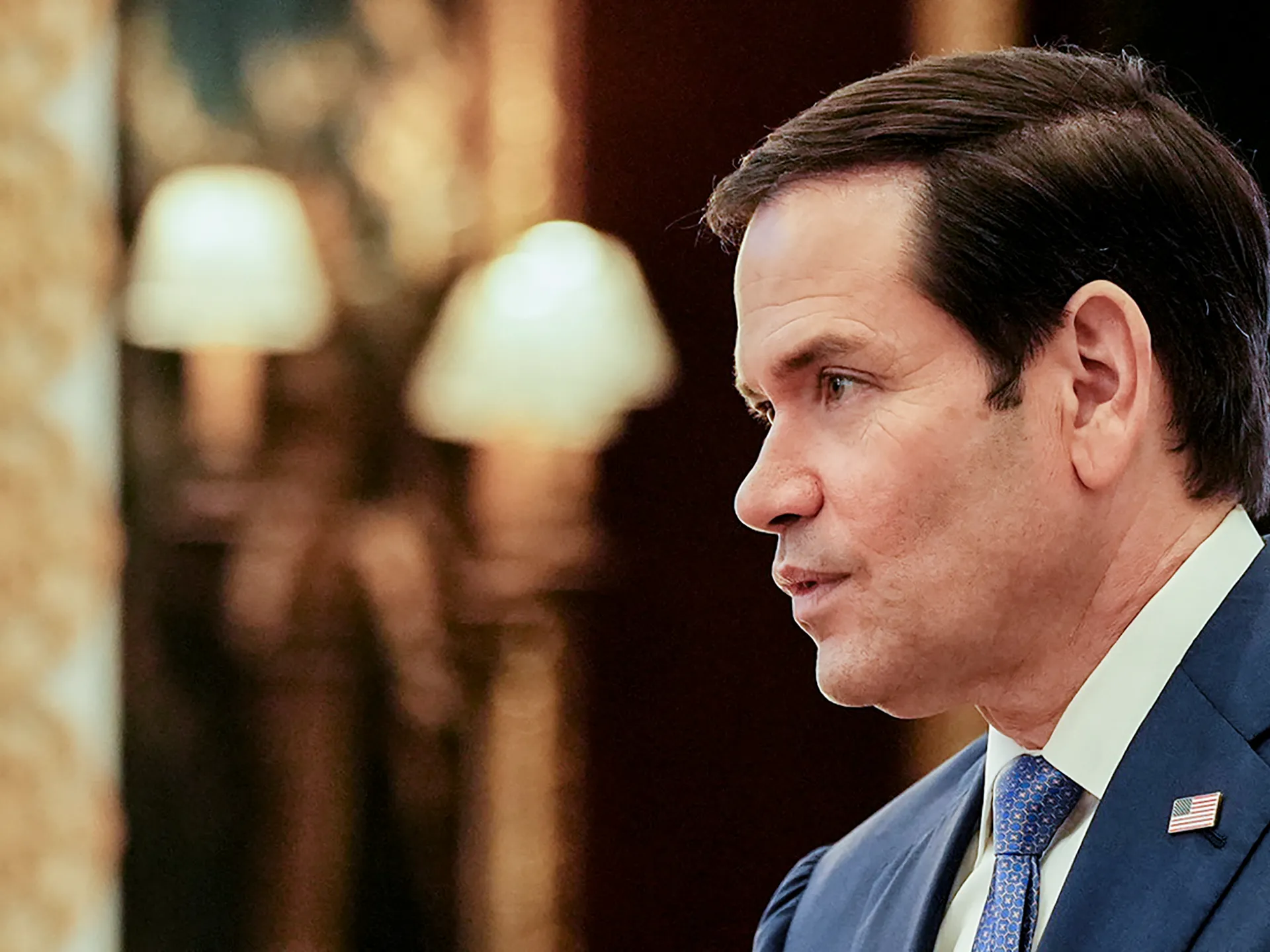
US Secretary of State Marco Rubio has announced the deal after talks unfolded in Washington, DC.
Published On 26 Jun 202626 Jun 2026
United States Secretary of State Marco Rubio has announced a deal framework between Lebanon and Israel after negotiations in Washington, DC.
Details about the agreement remain scarce. But in his remarks on Friday, Rubio made clear that the deal was only the “first step” in further negotiations.
“It’s the beginning of the beginning,” Rubio said, surrounded by representatives from both Lebanon and Israel.
“There’s a lot of work ahead. We don’t in any way underestimate the difficulty of the task ahead, but we understand the importance of it, how vital it is.”
The two sides had gathered in Washington, DC, for three days of US-mediated talks this week, starting on Tuesday.