There she stands, in that iconic hot pink gown, arms thrown open wide as if to both offer herself to the world and embrace what the world offers — love, applause, admiration and diamonds, which are, as she sang from the body-hugging confines of that pink silk in “Gentlemen Prefer Blondes,” a girl’s best friend.
It isn’t her, of course, though it is the dress, designed by William Travilla and now a part of the new “Marilyn Monroe: Hollywood Icon” installation at the Academy Museum of Motion Pictures. Opening Sunday, it is just one of many exhibitions and events timed to celebrate the 100th anniversary of Monroe’s birth.
More than 60 years after her death, Monroe still glows brightly in the Hollywood firmament. Her career only lasted 17 years, but during that time she dazzled so brightly that her image, and all that has been projected onto it, remains burned into our collective line of vision, an unfading afterimage of a bursting star.
As the Academy Museum’s exhibit underlines, Marilyn Monroe was a pioneer in many ways.
(Emily Shur / Academy Museum Foundation)
Her death — at 36 by way of overdose — did much to cement her legacy, generating international headlines and then a multitude of conspiracy theories, many of them involving powerful men, including members of the equally mythic Kennedy family.
Tragedy and mystery are powerful binding agents, but they do not quite explain the tower of books that have been, and continue to be, written about her (including several out this year) or the many films made about her life or the art she has inspired, from Andy Warhol’s iconic silkscreen “Marilyn Diptych” (done a year after her death) to Seward Johnson’s massive statue “Forever Marilyn,” which, after some controversy, made its forever home in Palm Springs five years ago.
Marilyn Monroe’s personal items on display include parts of her makeup regimen.
(Emily Shur / Academy Museum Foundation)
As the Academy Museum’s exhibit underlines, Monroe was a pioneer in many ways. In the repressive ‘50s, she was sex positive and spoke openly about psychotherapy and the vagaries of fame. She often defied studio heads, was one of the first actresses to start her own production company and demanded approval of her many photo sessions.
She had multiple marriages, problems with drugs and alcohol and a reputation for being difficult on set, but she was unafraid to both call out the press and banter with them.
Still, she is not seen by the masses as a pioneer, a term that brings to mind scientists and suffragettes. No, Monroe remains a mesmerizing, radiant symbol — of beauty, glamour, sensuality, a life force so rare that it could not be expected to survive long in a world full of envy and petty demands.
In putting together “Marilyn Monroe: Hollywood Icon,” associate curator Sophia Serrano spoke with many devoted fans, including those whose collections helped build the exhibit, and they all said the same thing.
More than 60 years after her death, Marilyn Monroe still glows brightly in the Hollywood firmament.
(Emily Shur / Academy Museum Foundation)
“Even though she had a tragic ending,” Serrano said, “people would say she is a symbol of resilience. Her story is like a movie — an orphan who makes it big, then loses it all. They see her as battling the studio, wanting to get more nuanced roles and not getting the roles she wanted. … A lot of people latch onto her because she gives them hope.”
In many ways, Monroe is, and was, a piece of art herself, onto which we could project our own longings and adulation. But that art, Serrano says, was created by Monroe, with equal parts natural magnetism and a canny, rigorous sense of her own strengths.
In 1952, when she was a rising star, a journalist realized a nude pin-up being used in calendars and posters was Monroe; she had posed for what is now known as the “Golden Dream” series five years before. Monroe was filming 20th Century Fox’s “Gentlemen Prefer Blondes” at the time and studio head Darryl Zanuck pressured her to deny that the photos were of her.
Monroe did the exact opposite, shrugging it off in an interview, in which she said, “I was broke and I needed the money. … I’m not ashamed of it; I’ve done nothing wrong.”
“Marilyn Monroe: Hollywood Icon” opens Sunday at the Academy Museum.
(Emily Shur / Academy Museum Foundation)
Monroe’s unique, and, to a certain extent, self-constructed combination of vulnerability — the wide eyes, the half-open mouth, the child-like voice — and essential grit is what fuels her continued cultural resonance and what forms the guiding principal for the Academy Museum’s exhibit.
An exhibit on the life and legacy of Marilyn Monroe could fill an entire museum so for purposes of this exhibit, Serrano and her team chose objects that were relevant to her life. This being the Academy Museum, much of it focuses on her career in film. Costumes from her various movies (including the original exhibition copy of the famous white dress from “The Seven Year Itch”) occupy a big portion, in part, Serrano says, because Monroe was so often involved in their design.
“She was so smart, looking at these costumes,” Serrano says. “She was obviously Fox’s star for Cinemascope — she’s how they marketed the new technology and she didn’t like how certain silhouettes looked so she would not wear A-lines in Cinemascope because she thought the effect was unflattering. She really paid attention to how things worked and then knew how to control and edit and manage.”
Costumes from Marilyn Monroe’s various movies.
(Emily Shur / Academy Museum Foundation)
The pink gown from “Gentlemen Prefer Blondes” has its own story. Monroe’s character was originally to appear in bejeweled hot pants (also on display), but when the Golden Dream “scandal” broke, Zanuck demanded that she wear something less revealing.
Many personal items are on display as well, including the shoes she wore to her wedding to Joe DiMaggio, a rare apology from gossip columnist Hedda Hopper, marked-up scripts and parts of her makeup regimen (including a face-slimming mask she wore after being told she had a double chin). The love-hate relationship she had with the press is well represented by newspaper clippings and newsreels.
Marilyn Monroe’s famous white dress from “The Seven Year Itch.”
(Emily Shur / Academy Museum Foundation)
A whole room is devoted to scenes from her more famous films and an entire long wall to countless photographs. “She understood the camera better than anyone,” Serrano says, echoing observations made by photographers and actors who worked with her, including Laurence Olivier, who famously did not get along with Monroe during the filming of “The Prince and the Showgirl.”
Her reputation as being difficult on certain sets is also documented in a rather infuriating series of telegrams between director Billy Wilder complaining to her then-husband, playwright Arthur Miller, and Miller responding in defense of his wife.
It is a well-crafted glimpse at Monroe as a totality, including pieces from her Brentwood home and some of her own clothing, which Serrano says was far simpler than the gowns and suits she was photographed in. “Her persona was carefully constructed. She knew how to give just enough, to create the illusion of something.”
A whole room is devoted to scenes from her more famous films and an entire long wall to countless photographs.
(Emily Shur / Academy Museum Foundation)
And maybe that is the reason why Monroe continues to fascinate. Yes, she owned her beauty and sexuality with a boldness that stands out even now. Her relationship with the camera remains unparalleled — when she is in frame, it is almost impossible to look away. Her hip-swaying walk remains iconic and also, perhaps, revealing. It was achieved by putting one foot directly in front of the other, much like a tight-rope walker.
Which in many ways Monroe was, treading the line, invisible to the rest of us, between innocence and worldliness, between vulnerability and power.
The tension between the human need for both love and self-determination powers both art and madness, but never was it so tangibly brought to life than by Marilyn Monroe. Art and artist, creation and creator, she left behind a now-century-old mystery we’re still trying to unravel.
WASHINGTON — Former Atty. Gen. Pam Bondi is scheduled to meet with the House Oversight Committee on Friday to discuss the Justice Department’s investigations into deceased sex trafficker Jeffrey Epstein and its release of files related to that investigation.
But the circumstances surrounding her meeting with the committee raise questions about how much the committee will actually learn about either.
For one, the former attorney general will not be under oath in a sworn deposition but will provide a transcribed interview, which is voluntary. Bondi’s interview with the committee will happen behind closed doors with members of the committee and staff and will not be filmed. The committee says it plans to release a transcript soon after the hearing.
And Bondi will be represented at her interview by Assistant Atty. Gen. Harmeet Dhillon, which legal experts say raises the prospects that the Department of Justice could direct Bondi to not answer some questions posed by the committee.
Former Atty. Gen. William Barr, former President Clinton and former Secretary of State Hillary Clinton all gave sworn depositions.
Rep. James Comer (R-Ky.), the chair of the committee, rejected the Clintons’ offer to provide a transcribed interview, rather than sit for a deposition, out of concern that someone giving a transcribed interview could “refuse to answer whatever questions he wanted for whatever reasons he wanted.”
Comer’s spokesperson said Bondi was allowed to sit for a transcribed interview, rather than a deposition, because the former attorney general was “cooperative.”
“Unlike the Clintons who defied subpoenas for seven months, former Attorney General Pam Bondi voluntarily and quickly cooperated with the Committee to identify a mutually agreeable date,” spokesperson Austin Hacker said in a statement.
Bondi had, in fact, refused to comply with the committee’s subpoena while she was still in office, and the ranking Democrat on the committee, Rep. Robert Garcia (D-Long Beach), filed a resolution on April 29 to hold Bondi in contempt for not complying with the committee’s subpoena a month earlier. Bondi’s agreement to provide a transcribed interview was announced the same day.
The committee subpoenaed Bondi in March to learn more about the department’s long-running investigations into Epstein — the financier accused of abusing more than 1,000 women and girls and directing some of them to have sex with his high-powered friends — and the department’s release of files in response to the 2025 Epstein Files Transparency Act, which mandated disclosure of the investigative records.
Asked whether Dhillon’s participation indicated that the department planned to invoke privilege and bar Bondi from sharing some information, the department said in a statement that Dhillon and other agency officials would attend Bondi’s interview “solely to ensure accurate representation of Department processes, facilitate any necessary clarifications, and support a complete factual record for the Committee.”
The department added that it “routinely provides staff” to assist with “congressional engagement involving past Department staff actions.”
But a former DOJ ethics official, speaking on the condition of anonymity for fear of retribution, said that Dhillon’s participation in the proceedings was anything but routine.
Typically, this type of work would be handled by a less senior attorney at the department who had more direct involvement with the subject matter at hand, the former official said. Dhillon oversees the department’s civil rights division, while the investigations into Epstein were criminal matters.
“I don’t see where Harmeet Dhillon has the experience or the normal level of authority that this would be delegated to,” the official said. “Everything about this seems unusual.”
Bondi would also need to have submitted a formal request for representation from the department.
“It doesn’t just happen willy-nilly,” the former ethics official said.
The department didn’t say how Bondi came to be represented by the agency’s attorneys. Bondi, who said this week she is being treated for thyroid cancer, didn’t respond to a request for comment.
The presence of Dhillon — a San Francisco attorney and Republican party insider who has been talked about as a potential pick for attorney general — could also present a conflict of interest, experts said.
“It’s unclear if she is representing the interests of Bondi, the department, or herself,” said Dave Rapallo, a former staff director of the House Oversight Committee.
He said that Dhillon would not have been able to represent Bondi if her testimony was provided in a deposition because the committee’s rules prevent agency lawyers from attending depositions.
Bondi was fired by President Trump on April 2. She was dogged by questions about her handling of the Epstein investigation throughout her time in office.
Trump campaigned on the promise of releasing information about the government’s investigation into Epstein in 2024 and in February 2025, Bondi told Fox News that she had on her desk a list of clients of Epstein — who died in federal custody in 2019.
But months later, as questions swirled about Trump’s relationship with Epstein, the Justice Department announced that it was closing its investigation into Epstein and said that, in fact, no such client list existed.
Soon after, Rep. Ro Khanna (D-Fremont) and Rep. Thomas Massie (R-Ky.) introduced the bipartisan Epstein Files Transparency Act, requiring the Justice Department to release all of the records from its investigation into Epstein. Trump initially opposed the legislation but ultimately signed it into law.
The department has released millions of pages of records in response to the law. While Acting Atty. Gen. Todd Blanche said in January that there are millions of additional pages of records that are not yet public, the department has indicated that it doesn’t plan to release these additional files.
There are two doubles wildcards available for the tournament at Queen’s, and one is reserved for a team which includes a former world number one, a Grand Slam champion of the past 10 years or a current top-30 player.
WIlliams has never liked the word retirement, preferring instead to say she was “evolving away” from tennis in 2022.
She lost to Australia’s Ajla Tomljanovic in the third round of the 2022 US Open, in what the world thought would be her final match.
Williams had reached the semi-finals of the Australian Open earlier that year, and won her last Grand Slam singles title in Melbourne in 2017 at the age of 35.
The Lawn Tennis Association has consistently prioritised British players when determining who should receive wildcards at domestic grass court events.
All four available for the singles draw are very likely to go to British players, but the LTA are likely to feel differently about the doubles given the “exceptional circumstances” of a potential Williams return.
“Never say never, and not wanting to speak of any one individual player, but you will have seen over recent years that those wildcard opportunities are afforded to British players – that is absolutely my fundamental personal belief and philosophy,” LTA chief executive Scott Lloyd said at a briefing for journalists in April.
“There might be exceptional circumstances which might influence a unique wildcard, but otherwise those playing opportunities we want to afford to British players.”
The organisation’s performance director Michael Bourne also hinted commercial opportunities could be a factor.
“It’s also really important to remember that we in the performance team understand that players have to earn that right,” Bourne said.
“We don’t take them for granted. If we didn’t think we had a depth of player where it was right for them to take those opportunities, and there was something else that was good for the business, we would hold our hands up.”
The Foreign Office has updated its travel advice for Brits to a number of destinations as a new Ebola outbreak has been declared in the Democratic Republic of Congo
13:15, 28 May 2026Updated 13:15, 28 May 2026
The World Health Organisation has declared Ebola in the Democratic Republic of Congo and Uganda a Public Health Emergency of International Concern(Image: Getty Images)
The Foreign Office has updated its travel advice for a number of countries after an Ebola outbreak earlier this month in the Democratic Republic of Congo (DRC).
On May 15, the country’s Ministry of Health confirmed an outbreak of Ebola Bundibugyo in the North-Eastern Ituri Province, while cases have also been confirmed in Uganda. The World Health Organisation (WHO) has since declared Ebola in the Democratic Republic of Congo and Uganda a Public Health Emergency of International Concern.
As a result, a number of destinations to introduce stricter measures for travellers from health screenings for foreign nationals to quarantine for residents in certain cases.
For example, Kenya has introduced enhanced health screenings for passengers arriving from Uganda, Ethiopia, and DRC, while Tanzania has also introduced increase public health measures for incoming travellers.
Now the Foreign Office has updated its travel advice for Uganda, Angola and the Central African Republic, with warnings around new health screenings and entry requirements for anyone travelling to those destinations.
Due to the outbreak, you may experience heightened health screening at international borders in the region. Check entry requirements for the country you’re travelling to or transiting.”
The Foreign Office has already been advising “against all travel to parts of Central African Republic” before the Ebola outbreak in the DRC and Uganda, but has updated its advice due to the country sharing a border with the DRC.
Virginia Messina, Group CEO of African Travel and Tourism Association (ATTA), said: “Established protocols are in place within countries bordering the DRC and as a result tourism operations and business trips across the wider African continent continue normally. As of 27 May, no other cases have been detected outside of Uganda and DRC. The risk to travellers on standard itineraries outside affected areas remains very low, and it’s important to highlight that Ebola is not easily transmitted through casual contact.
“However, travel rules and screening measures may change quickly. The WHO (World Health Organisation) and the European Centre for Disease Prevention and Control (ECDC) are scaling up efforts to contain the virus but continue to advise against blanket travel restrictions and neither the UK, nor any European country has introduced entry bans.”
THE best beaches in Europe have been revealed and the number one spot is a beautiful escape with super cheap flights.
Dubbed one of Portugal’s ‘Sunset Beaches’, Monte Clérigo sits in the Algarve region, but is much quieter than other crowded resorts.
Sign up for the Travel newsletter
Thank you!
Monte Clerigo Beach has been declared the best in EuropeCredit: AlamyIt has sweeping golden sands and is much lesser-known then other Algarve resortsCredit: Alamy
Follow The Sun’s award-winning travel team on Instagram and Tiktok for top holiday tips and inspiration @thesuntravel.
The Algarve draws in millions of Brits every year wanting to explore its golden sand beaches and bask in its glorious sunshine.
It’s most popular resorts include Albufeira, Vilamoura and Alvor – but that’s not where you’ll find the best beach.
Tucked away on the western coast is Praia de Monte Clérigo which has just been declared the best beach in all of Europe by European Best Destinations.
Beaches across Europe are assessed on aspects like natural beauty to water quality, family-friendliness, available activities, accommodation and overall atmosphere.
The 30 highest-rated beaches are then submitted to an international panel of travellers and tourism enthusiasts who vote to find the ‘Best Beaches in Europe 2026′.
Monte Clérigo Beach was described the beach as having ‘golden cliffs’ and ‘wild Atlantic landscapes’.
The ‘wildness’ of the coastal spot comes from the fact that it forms part of the Southwest Alentejo and Vicentine Coast Natural Park where there’s lots of greenery and plenty of hiking routes.
The beach also has fine sand, low-tide rock pools, is ideal for surfing, and its nearby town of Aljezur is filled with colourful cottages some of which sit up on the cliffside.
Monte Clérigo is considered one of Portugal’s best ‘Sunset Beaches’ too.
Monte Clérigo is considered one of Portugal’s best ‘Sunset BeachesCredit: Alamy
Thanks to its position on the western coast, beachgoers have a clear view of the sun as it sets looking like it sinks into the ocean.
One visitor wrote on Tripadvisor: “Stunning beach on rugged coastline. Visited several times. Away from hectic tourist resorts. This beach is beautiful. It’s well worth waiting for some sunset photos!”
Another added: “I discovered another beautiful beach on the southwest coast of Portugal. Pristine and unspoiled is how I’d describe the place.”
Right on the sands is Restaurant O Sargo which has live music every Friday night and is popular with locals and visitors who enjoy fresh seafood and watch the sunset in the evening.
The beach is easily reachable from the UK – you could be there in five hoursCredit: Alamy
Faro International Airport is an hour and a half drive away from the beach, so from the UK you could be sunbathing on the beach in under five hours.
One-way flights are as little as £13.99 in June flying from London Luton with Wizz Air.
Other beaches that secured a spot on the list were Voutoumi Beach in Antipaxos which came in second place.
Elafonisi Beach which is a rare pink beach in Crete came in fourth place.
One beach in Norway even made it onto the list, Kvalvika Beach has bright blue waters and is backed by enormous mountains – certainly making it one of the most beautiful.
The head office of APR in Seoul. The South Korean beauty company has emerged as a new powerhouse in the country’s cosmetics industry. Photo by APR
May 28 (UPI) — South Korea overtook the United States in 2025 to become the world’s second-largest exporter of cosmetics, according to the Ministry of Food and Drug Safety (MFDS) earlier this month.
The ministry noted that the East Asian country’s cosmetics exports amounted to $11.4 billion in 2025, up 11.8% from a year before, trailing only runaway leader France with $24.3 billion.
The United States ranked third with $10.8 billion, followed by Germany with $9.9 billion, Spain with $9.2 billion, Italy with $9 billion, China with $7.3 billion, and Japan with $3.9 billion.
Meanwhile, South Korea’s 2025 cosmetics imports declined 2.3% year-on-year to $1.29 billion, resulting in a trade surplus of $10.1 billion. It marked the first time Asia’s fourth-largest economy topped $10 billion in the annual cosmetics trade surplus.
By destination, the United States has emerged as the largest overseas market for Korean cosmetics last year as exports jumped 15% year-over-year to $2.2 billion. In contrast, shipments to China plunged 19% to $2 billion.
Demand for Korean cosmetics, widely known as K-beauty products, also increased sharply in Europe and the Middle East. Exports to Poland, in particular, more than doubled from a year earlier to $282 million.
To further beef up the competitiveness of the K-beauty industry, the MFDS pledged to pursue a range of policy initiatives, including expanded regulatory support programs.
“As countries such as the United States and China have recently introduced cosmetic safety assessment systems, we are preparing to implement our own safety evaluation framework in phases,” the MFDS said in a statement.
“To help domestic companies comply smoothly with the new system, the government plans to establish guidelines, provide consulting services, and train professional evaluators,” it added.
New players fueling K-beauty boom
In the past, South Korea’s cosmetics giants relied heavily on China as their primary offshore market. Traditional behemoths, including AmorePacific and LG Household and Health Care, resorted to such a business model for years.
However, a new wave of entrepreneurs has come to the fore with a different approach, reducing dependence on China while tapping aggressively into the United States, Europe, and Southeast Asia.
Leading the shift is APR, which was founded in 2014 and built its growth around online sales channels and beauty devices aimed at international customers.
Last year, APR almost tripled its operating profit to $240 million, which is almost equivalent to that of AmorePacific and well above $113 million of LG Household & Health Care.
APR continued its strong momentum this year as its first-quarter operating profit stood at $101 million, up 173.7% from a year ago, based on robust performance in such major markets as the United States and Japan.
According to U.S. business tracker Navigo Marketing, APR came in third place in Amazon’s beauty category last year with a 7.1% market share. The firm doubled it to 14.1% in the first quarter to claim the top position.
APR has also strengthened its offline presence by entering more than 1,500 Target stores across the United States last month. It plans to expand further into about 3,000 Walmart stores in June.
Meanwhile, first-quarter operating incomes of AmorePacific and LG Household and Health Care fell short of APR with $84 million and $72 million, respectively.
The strong earnings have prompted investors to pile into APR shares on the Seoul bourse.
As a result, APR’s market capitalization jumped 73.59% this year to reach $10 billion as of Thursday. Those of AmorePacific and LG Household & Health Care were $4.49 billion and $2.52 billion, respectively.
“Considering the expansion of offline channels in the United States and accelerating sales growth in Europe, APR’s stock is likely to maintain a medium- to long-term upward trajectory,” Yuanta Securities Korea analyst Lee Seung-eun said in a report.
HMC Investment Securities analyst Ha Hee-ji shared a similar view.
“APR’s growing brand recognition in the United States appears to be spreading across global markets, thus creating a virtuous cycle,” Ha said. “Business-to-business sales in Europe, Latin America, and the Middle East are also showing steep growth trends.”
The Middle East has been a difficult region to deal with in oil markets. When it comes to energy geographies, the region has proven to be a disproportionately significant part of the world’s energy resources, with export facilities traversing a handful of maritime routes and political situations that have been tense, if not outright volatile, at times. The change in 2025 and into 2026 isn’t the nature of the forces but rather the confluence of overlapping pressures: ongoing sanctions enforcement, multiple theaters of conflict, OPEC+ tensions that are more public than ever in previous years, and disruptions to shipping in the Red Sea, which now seem to have become a semi-permanent part of the shipping route landscape.
There is no background information for commodity traders, market analysts, and energy investors. It’s a real-time, constantly evolving dynamic that can make all the difference in the day-to-day performance of prices, and it’s particularly important when prices are sliding around rapidly, and the stories behind them are changing just as fast.
The Behavior of Prices and the Risk of Middle East Supplies
The area is responsible for about one-third of the world’s crude production. That should make it significant in and of itself. What makes matters worse is that export infrastructure is concentrated in a handful of terminals, pipelines, and maritime corridors where a disproportionately large share of oil is exported. The disruption of any of them (even for a moment) reduces a large supply signal to an extremely short time frame.
Traders who follow crude oil price live data are the first ones to witness this. Real-time feeds are a reflection of more than just the fundamental supply-demand elements, but the market’s real-time assessment of the value of geopolitical risk and how much it “should” be worth at any given moment. A news event, which is a minor detail in a more stable environment, can cause future prices to move $5 or more in less than an hour. The consistent and tough question – and it is a tough one – is, which events actually have physical supply implications and which ones are sentiment-driven moves that die in a session or two?
The Strait of Hormuz
About 20-21 million barrels per day of crude oil and petroleum products go through the Strait of Hormuz, which is about 20% of the world’s oil consumption. No readily available bypasses can be found that can absorb that flow at a similar cost. There are partial alternatives, including the IPSA pipeline and Saudi Arabia’s East-West pipeline, but they would not even come close to filling the deficit should the Hormuz be closed en masse.
It is a strait between Oman and Iran. Geography makes it so that any serious disruption in U.S.-Iran relations or of security conditions in the Gulf in general puts Hormuz back on the market’s agenda. Traders are all familiar with this: when there is a lot of Iranian tension, the futures positioning will always reflect the chokepoint risk, even if there is no incident per se.
Production Outages That Don’t Make the Front Page
The issue of the supply is something that generally doesn’t get the same kind of attention it should get, but the clearest example of this recurring issue is Libya. In recent years, internal political squabbles about how to divide up oil revenues have led to several production shutdowns that have temporarily increased the tightness of the light sweet crude grades refined by European and Asian plants. The disruptions are likely to persist when there is no political agreement, and the pattern is robust. In recent years, Iraq’s export pipeline to the North through Turkey has also been down for extended periods of time. These relatively inconspicuous disruptions can add up and impact medium-term supply dynamics, though not necessarily have the same impact as a more conspicuous incident.
Key Risk Factors Shaping Market Sentiment in 2026
The Middle East is a geopolitical risk that has many variables. It’s a combination of interwoven pressures that work in various ways and to varying effects on the length of the price impact. The issues that currently have the greatest attention of serious analysts are generally of three types:
Export infrastructure and production infrastructure are currently under physical threat to production.
Sanctions regimes and the dynamics of their enforcement.
Disruption of shipping routes and attendant disruption of the trade economics.
Everything is unique, and sometimes they are not in the same direction at the same time. That’s part of what makes the current situation more complicated than any one risk headline implies.
Active Conflict Zones and Exposure to Infrastructure
The latest example of large-scale infrastructure targeting is the 2019 attack on Saudi Aramco’s Abqaiq and Khurais facilities in the country, which was carried out using drones and missiles. The loss in output occurred temporarily, amounting to about 5.7 million bpd, the largest sudden supply shock in modern oil market history. The recovery was quicker than many expected, partly because of the operational robustness of Aramco and partly because the situation was swiftly contained diplomatically. But the event has permanently changed the way markets view the vulnerability of infrastructure in the Gulf, and that repricing has not been complete.
The Persistent Iranian Supply Question
Iran’s petroleum sales have also been sustained in the face of sanctions, largely via Asian markets out of reach to Western sanctions. A full-fledged deal between Tehran and Western governments has yet to be hammered out, as of early 2026. That has left volumes of Iranian supply in a limbo of sorts: they could be rapidly reduced by stepped-up enforcement, and they could be dramatically increased by a change in diplomatic circumstances. Both of these results can have significant price consequences, and even the uncertainty can be a factor in the market without a clear decision.
Infrastructure Concentration Risk
The concentration levels in Saudi Arabia’s export system warrant a more significant focus than is generally found outside of export specialist circles. Abqaiq processes and stabilizes a huge percentage of Saudi crude before it is shipped to export terminals, removing the sulfur from it. That kind of ‘single point of failure’ is not typical in most industrial supply chains. In the case of oil, it’s a structural aspect of the market and one that has been proven, not just thought.
OPEC+ Internal Dynamics
However, OPEC+ compliance has been quite lackluster at times, notably from Iraq and Kazakhstan, which have had a history of overproduction. This gives rise to an everlasting discrepancy between OPEC+ declarations and the actual supply data. For analysts, the bottom line is that it is important not to take production decisions at face value but to also consider the track record of implementation once a deal has been agreed on to see what the real supply impact was.
Non-State Actor Activity and Shipping Friction
Since late 2023, the Houthis have started to attack commercial shipping vessels in the Red Sea more frequently, and these attacks have persisted through 2025. What those disruptions drove home is that it’s not necessary to blow a wellhead to impact oil market economics. A round-the-Cape voyage will increase the time in transit by about ten to fourteen days, as well as the fuel costs. During periods of increased Houthi activity, insurance costs for tankers traveling in the Gulf area skyrocketed. Both impacts are not a direct factor in the crude benchmarks, but both impact the effective landed cost of Middle East barrels in destination markets.
How the Market Prices Geopolitical Risk
Knowing the difference is important, as geopolitical events do not affect oil prices in a single manner. Some effects are immediate and visible: a surge in the price of Brent futures within minutes of an incident report. Others come more slowly, via changes in freight rates, changes in the repricing of insurance, and changes in buyer behavior, which may take days or weeks to be reflected in trade flow data. The rate of these impacts varies, and so do their effects.
Then there is the issue of what the market “already” had in place whether there was an event or not. When there is a constant regional tension, there is usually some risk premium in prices. The incremental market move may therefore be less than anticipated when an event then reinforces concerns, the surprise element of the event, which is typically the one that produces the biggest market moves, is already discounted.
Risk Premium in Practice
Geopolitical risk premiums in times of heightened Middle East tension have varied from around $4 to $10 per barrel, depending on the market participants’ views on the probability of actual physical supply disruptions in the case of Brent crude, according to S&P Global Commodity Insights. That’s a fairly broad window for economic trading, and it has a tendency to close up very fast when the tension subsides and without a supply event, which is the more common scenario.
The geopolitical risk premium factors analysts may consider are:
The nearness to active conflict, producing fields, or the working export terminals.
Production capacity that would be available to make up for the loss of production elsewhere.
The availability and magnitude of the IEA’s strategic stockpiles to be tapped.
Current tanker market conditions and the viability of an alternative route.
Diplomatic messages sent by governments in the area, including the United States and other great powers
Past examples of similar events, which have had identifiable supply impacts.
It is not easy to give exact weights to these inputs. Part of the reason for the price action to seemingly be different with comparable geopolitical events can be due to different analysts forming different conclusions from the same events.
Historical Supply Disruptions and Price Responses
The following table shows some of the more significant supply events that took place in the Middle East and the approximate market impact. The trend of most entries was that the first price movement has been greater than the actual physical supply effect, at times much greater, and then it has partially retraced to a more stable situation.
Event
Year
Estimated Supply Impact
Approximate Brent Price Reaction
Abqaiq/Khurais Attacks (Saudi Arabia)
2019
~5.7 mb/d temporary loss
~15% intraday spike
Libyan Civil War Output Collapse
2011
~1.4 mb/d reduction
~$20/bbl over several weeks
U.S. Re-imposition of Iran Sanctions
2018
~1-1.5 mb/d reduction
~15% sustained over several months
Iraq-Northern Field Disruptions
2014
Partial northern output loss
~$10/bbl elevated premium
Houthi Red Sea Disruptions
2023-24
Rerouting; limited direct supply loss
Moderate – primarily freight cost impact
Iran Sanctions + Red Sea Friction
2025-26
~0.8-1.2 mb/d constrained Iranian output
Persistent $4-8/bbl risk premium in Brent
The 2025-2026 entry is a more diffuse form of market pressure than those acute events listed above. It is not one particular incident, but rather sanctions enforcement and Iranian volumes kept low and shipping activity in the Red Sea continuing to cause friction in the transport system, which has kept transport costs elevated. The World Economic Outlook from the IMF pointed out that this type of persistent supply constraint is likely to have a longer-lasting impact on medium-term price expectations than acute supply shocks, which markets have historically been able to absorb and turn around in relatively short periods of time. Thus, a slow-burning risk premium can be more ‘sticky’ than a dramatic risk premium.
Broader Market Implications
Crude oil benchmarks are not the only place where supply risk from the Middle East exists. It extends out to related markets in ways that are not always apparent when the world’s focus is on the Brent or WTI headline price.
The second-order victim is likely to be refined product markets. In times of crude supply shortages or increased uncertainty, refinery margins and regional product availability may be affected to a greater extent, and the effects on end consumers may be magnified, especially in regions where there is little local refining or a high concentration of import logistics. The energy crisis of 2022 in Europe was a prime example of how the upstream pressure to supply energy flows through the downstream more quickly than most market players would have thought.
Other segments of the market that are impacted by increased supply risks in the Middle East are:
Tanker freight rates, which can also rise sharply without reference to crude prices during times of major-scale rerouting.
In oil-dependent economies, currency markets can be affected by changes in the prices of the oil that the state supplies, which change expectations of fiscal revenue and sovereign credit risk.
LNG markets with some short-term fuel switching demand in the exposed economies as a result of regional geopolitical pressure.
In agricultural commodity markets, where there is known overlap between energy input costs and food production, processing, and transport economics
Strategic Reserve Releases (SRRs) as a Counterweight
During the IEA’s coordinated strategic reserve release in 2022, it was seen that policy tools are in place to mitigate short-term supply shocks and that they can be implemented on a material scale when political conditions are right. However, there are drawbacks to those processes. During that time, reservoir levels were lowered significantly, and a rebuild takes time. There are also doubts about the effectiveness as a deterrent because, over time, markets will factor in the possibility of a release during the next big disruption event, effectively canceling the effect of a release in advance.
Geopolitical Risk Analysis: What It Does and Doesn’t Accomplish
It’s easy to fall into the temptation, because of the amounts of money potentially involved, of viewing geopolitical risk analysis as a predictive tool. It generally lacks it there. It’s actually helpful for comprehending markets and its actions, as well as for charting structural weaknesses that are price-relevant. What it doesn’t do well is tell you when an event will happen, or how big the market’s reaction will be when it does.
Instead of getting lost in qualifications, the specific limitations should be called out:
Escalation and de-escalation are non-linear and unpredictable to a great extent. Conflict situations that appear to be intractable can be solved in a flash, and stable times can fall apart in an instant. Both directions remain silent and don’t herald themselves.
When demand for a commodity is the same, the market price may be quite different in the two market conditions. There are interactions between the geopolitical trigger and positioning, sentiment and open interest that are not modelable in advance.
Secondary effects (such as freight repricing, product supply shifts and insurance cost changes) happen at varying rates to the initial crude price move, and thus the total impact of the market is more difficult to gauge in real time.
Analytical path dependency can occur when geopolitical narratives set up a framework that later information gets filtered through, without being recognized as such.
All this does not negate the analysis. It’s about calibration and about honesty when the power of explanation runs out, and speculation sets in.
Conclusion
Middle East supply risk is not a succession of shocks that will come and go and be completely addressed but rather a structural state in global oil markets. The combination of production weight, geographic concentration of export infrastructure, and political complexity of the region always comes with a certain level of supply uncertainty as a base case. The level of that uncertainty and the extent to which that uncertainty is priced into securities on a given day are what change.
The hard part for traders, analysts, and energy investors is not recognizing that there is risk – that’s obvious. It’s gaining a good enough sense of what matters most at a given moment, what the big picture supply-demand dynamics are, and at what point a careful study of the facts begins to look like well-informed guesswork. The clear understanding of that boundary is, in fact, probably more valuable than any single analytical framework that can be applied to the boundary.
Disclaimer
This article is provided for informational and educational purposes only. It does not constitute financial advice, investment advice, or a recommendation to buy, sell, or hold any financial instrument, commodity, or derivative product. Trading in energy markets, including crude oil futures, CFDs, and related instruments, involves substantial risk of loss, including the possible loss of capital invested. Past market behavior and historical price patterns referenced in this article are not reliable indicators of future performance. Geopolitical developments described may not materialize as anticipated or may evolve in ways that differ materially from historical precedent. Readers should conduct their own independent research and consult a qualified financial professional before making any investment or trading decisions. Nothing in this article should be interpreted as a trading signal, directional market recommendation, or endorsement of any specific trading approach.
MSC Cruises has announced its commitment this summer and offers for UK passengers
12:47, 28 May 2026Updated 14:20, 28 May 2026
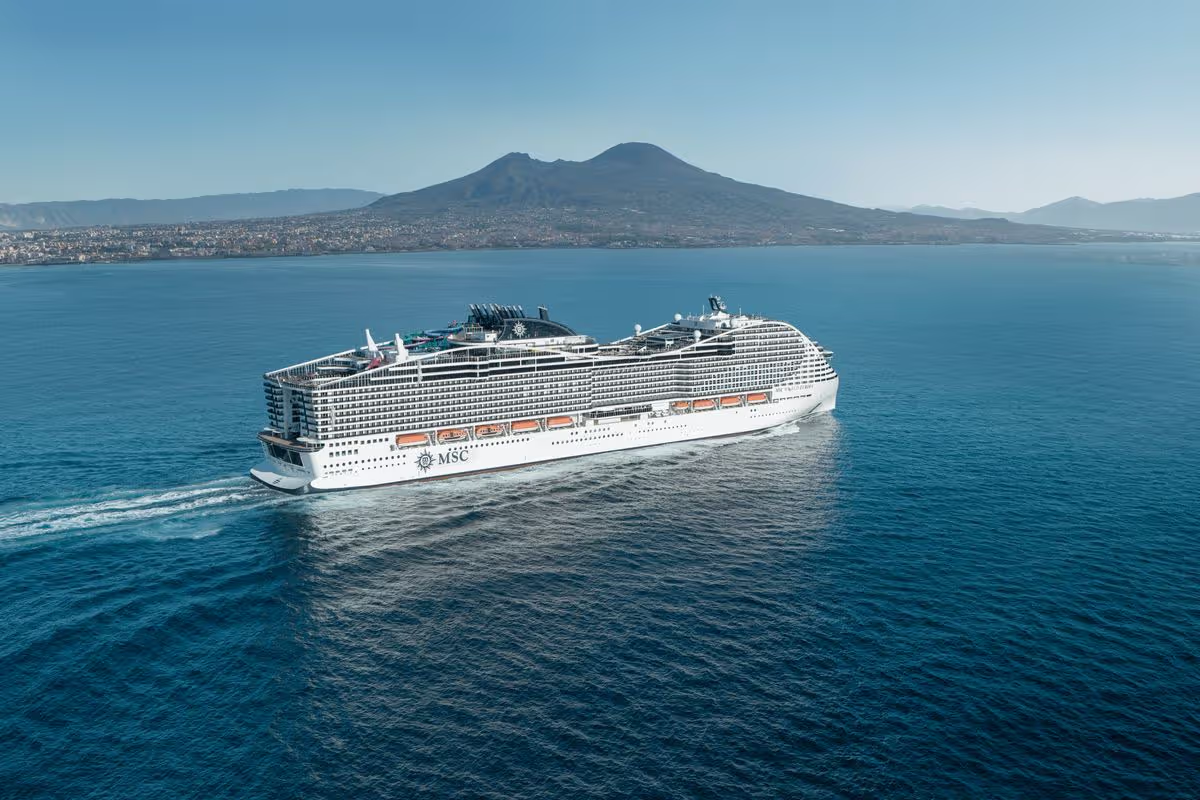
The cruise line shared its announcement on Thursday(Image: MSC Cruises)
MSC Cruises has issued an update today, Thursday, May 28, with bosses announcing a commitment to UK passengers this summer. The cruise line offers various voyages spanning the globe and currently operates a fleet of 23 cruise ships, with plans for further expansion in the coming years.
On Thursday, MSC Cruises said it is inviting guests to experience the ‘best holiday ever’ over the coming months, with the “peace of mind” of no added fuel surcharge for summer 2026 and low deposits until the end of June. Antonio Paradiso, Vice President of International Sales at MSC Cruises, said: “MSC Cruises ‘Best Holiday Ever’ commitment reinforces our position as the leading choice for UK and Irish holidaymakers seeking an effortless, all-in-one travel experience.
“Backed by dedicated support every step of the way, guests can book with confidence and peace of mind in today’s changing travel environment and relax knowing that their holiday is taken care of. With our low deposit of just £50, no-fly cruises from Southampton, Fly and Cruise packages with the reassurance of no added fuel surcharge for 2026, and the option to change your cruise date or destination if required, we are making it easier than ever for guests to secure their next holiday.”
Guests can book a trip with MSC Cruises with a low deposit of £50 per person, extended until the end of June. This applies to all cruises (excluding World Cruise and MSC Yacht Club cabins).
Passengers have a wide variety of amenities on board. There is full-board dining across the main restaurants and buffets, evening shows, multiple swimming pools with aquaparks, fitness facilities and family entertainment programmes.
There are many cabin types to choose from, including comfortable and economic inside cabins and connecting cabins for larger groups, which combine inside and balcony cabins together. Ocean View cabins offer sunset views, or for that sea breeze, opt for a balcony cabin.
A spokesperson added: “An MSC Cruise offers so much in one transparent price and, despite recent increases in global fuel prices, the cruise line will not be introducing a fuel surcharge this summer, giving guests extra confidence there are no unexpected added costs. The price guests see at the time of booking is the price they will pay, part of the best holiday ever commitment, just peace of mind and a seamless holiday experience this summer.”
MSC Cruises offers a range of Fly and Cruise packages that combine flights, transfers, and a cruise into one holiday. Designed to ‘simplify the journey from start to finish’, the cruise line says these packages are built in partnership with some of the world’s most renowned airlines.
Flights align with cruise schedules, with transfers between the airport and the ship included. Guests can select their preferred cruise itinerary, choose the Fly and Cruise fare, and confirm flights during the booking process. Fly and Cruise holidays in 2026 depart from:
Belfast to Palma and Tenerife
Dublin to Barcelona, Rome, Venice and Tenerife
Edinburgh to Rome, Naples and Tenerife
Glasgow to Tenerife
Newcastle to Tenerife
Manchester to Rome and Tenerife
Birmingham to Tenerife
London Heathrow to Seattle and Barbados
MSC Cruises also offers a selection of no‑fly cruises from Southampton year-round. Some standout destinations include the Norwegian Fjords, Northern Europe and the Mediterranean. And on selected dates, well-known TV stars and sports legends are on board, giving guests complimentary classes and talks:
June 6, 2026 – Southampton to Iceland and the Norwegian Fjords (14 nights), with TV personality Anthea Turner onboard.
August 8, 2026 – Southampton to the Canary Islands (12 nights), with Rugby Legends Ben Cohen, Neil Back and Ben Kayplus dance star Kristina Rhianoff onboard.
October 19, 2026 – Southampton to the Netherlands, Belgium and France (5 nights), with Football Legend Gianfranco Zola on board.
Opinions are divided on whether dog owners should allow their beloved pets to lick their faces or not – but Springwatch’s Chris Packham has some strong scientific backing for his take
12:40, 28 May 2026Updated 12:42, 28 May 2026
Chris is shown with his dogs Sid and Nancy(Image: Supplied)
It’s one of those questions that can divide even the closest friends: would you let a dog lick your face? Medical opinions vary.
Professor Graham Roberts, honorary consultant paediatrician in paediatric allergy and respiratory medicine, is quoted in medical journal The Hippocratic Post as saying that that babies brought up in homes with pets are far less likely to suffer from allergies than babies who grow up in pet-free homes. He states: “If you are born into a household where there is a pet, you are less likely to be allergic.”
But others, such as Professor John Oxford, emeritus professor of virology and bacteriology at Queen Mary University of London, is strongly opposed to excessively close contact with dogs.
He points out: “It is not just what is carried in saliva. Dogs spend half of their life with their noses in nasty corners or hovering over dog droppings so their muzzles are full of bacteria, viruses and germs of all sorts.”
But for BBC Springwatch’s Chris Packham, there’s no debate. Speaking on the Oh My Dog podcast, the naturalist told host Jack Dee: “When we cut our finger, what’s the first thing we do? We lick it. And you lick it because there are bacterial fauna in your saliva which have antiseptic and healing properties.”
Similarly, he says, there’s a health benefit to be gained from dogs’ saliva: “In days of old, when they were having medieval battles and doing unspeakable things to one another with swords, there were a lot of wounded people and they would allow the camp dogs to come and lick their wounds. They discovered that if the dog was licking the wound… it would be less less likely to get infected.”
All domestic dogs are ultimately descended from wolves, and Chris says that while a small amount of a dog’s saliva can be good for us, wolves’ saliva has even more healing power: “I’ve been licked by wolves, been kissed by wolves,” he says, “and they have even cleaner, or bacteriologically richer, saliva than than dogs.” They’ve never been treated with antibiotics or other medicines that might compromise their natural state, he says.
Chris adds that when wolves lick each other, it’s part of ensuring the survival of the pack: “When wolves go back to their their den, in order to carry the food which they may have caught many kilometres away, they eat it and swallow it, and partially digest it.
“So when they get back to the den, the pups lick their lips and that stimulates the adult wolves to regurgitate the food.”
“Now obviously,” Chris adds, “dogs have lost that habit – they don’t regurgitate for their young. But that licking is retained into adulthood in dogs because it’s a greeting.”
Similarly, he adds, when dogs eat each other’s poo, there is a valid reason for it. While it might seem disgusting to us – providing support for the opponents of face-licking – this also dates back to wolf behaviour.
“Research has been done recently in California,” Chris explains, “which shows that they will only eat faeces that are between one and two or three days old.”
Chris adds: “It was a relic to wolf behaviour. Because adult wolves will come back and eat all of the faeces in the den area when they’ve got cubs… because it’s a way of reducing parasite load because the eggs of those parasites are in the faeces, and they don’t want their young to get them.
“So that apparently appalling behaviour, because everyone’s nauseated by the fact that their dog eats other dogs’ faeces, that comes from the wolf and it’s about reducing parasites.”
On Wednesday, the US Department of War confirmed it had awarded Dell Federal Systems, the government-focused unit of Dell Technologies, a five-year, $9.7 billion (€8.3bn) contract to supply the Pentagon.
ADVERTISEMENT
ADVERTISEMENT
As part of the Core Enterprise Technology Agreement (CETA), a Pentagon-wide Microsoft licensing and software procurement framework, the company will provide and manage Microsoft software licences, cloud subscriptions and on-premises software licensing across the US military, intelligence agencies and the US Coast Guard.
Dell Technologies’ shares were up around 5% in pre-market to $320 due to the announcement after closing Wednesday’s session at roughly $305.
The company is set to report its earnings for the first quarter of this year on Thursday, with analysts from Zacks Investment Research forecasting revenues of approximately $35 billion (€30bn), representing annual growth of about 50%.
According to US DoW Chief Information Officer Kirsten Davies, who briefed reporters at the Pentagon, the CETA is expected to save the department roughly $422 million (€360.9mn) annually by consolidating fragmented technology budgets from across the military services into a single purchasing structure.
The contract was granted less than three weeks after US President Donald Trump stood at a White House event and urged Americans to “go out and buy a Dell. They’re great.”
Davies and acting US Navy Chief Information Officer Barry Tanner were both clear that the award followed a competitive process.
“The vendors were all evaluated based on competition, comparison to GSA schedule pricing and overall chain of value to the department,” Tanner noted.
Dell holds a long-standing commercial partnership with Microsoft and is one of its major buyers of Windows licences. Nonetheless, the contract arrives at the culmination of a period of visible alignment between CEO Michael Dell and the Trump administration.
In December 2025, Dell and his wife Susan appeared alongside Trump at the White House to announce a $6.25 billion (€5.3bn) donation to “Trump Accounts,” a tax-advantaged investment programme for children created under the “One Big Beautiful Bill”.
The pledge will provide $250 (€214) to roughly 25 million American children aged 10 and under from households with a median income below $150,000 (€129,000) and was described by Invest America, the nonprofit organisation spearheading the initiative, as the largest ever private commitment devoted to American children.
Michael Dell also sits on Trump’s Council of Advisors on Science and Technology, informing public policy regarding the economy, public health, national security, energy and emerging technologies.
The convergence of public presidential endorsements and subsequent federal contract awards is attracting scrutiny beyond Dell.
Financial disclosures released this month by the US Office of Government Ethics showed that investment accounts associated with President Donald Trump held Dell Technologies shares during the first quarter of 2026. The disclosures indicate some purchases were made before Trump publicly praised the company at a White House event.
The Trump Organisation has said the accounts are managed independently by third-party financial institutions and that neither Trump nor his family directs individual trades.
Last week, responding to questions about Trump’s financial disclosures at a White House briefing, Vice President JD Vance said the president’s investments are handled by independent wealth advisers and rejected suggestions that Trump personally directs individual stock trades. “He’s not making these stock trades himself,” Vance said.
Commentators and ethics critics have also pointed to trading activity involving companies such as Intel and Palantir, whose shares have at times moved sharply following public comments by Trump or announcements linked to government technology spending.
The Pentagon has said Dell’s selection followed a competitive procurement process.
Even so, the timing of the award alongside Trump’s public praise of the company and financial disclosures showing investments linked to Dell is likely to draw renewed scrutiny from ethics observers and political critics.
Critics of the current system say it doesn’t reflect reality
The Treasury has issued an update about rule changes affecting air travel(Image: Getty)
The Government has issued an update about tax changes affecting UK air travel. The policy update could impact journeys with major airlines such as Ryanair and EasyJet. The ministerial response comes after major concerns were raised about the current system, which campaigners branded “completely unfair”.
The Treasury has issued a response to a petition to Parliament that garnered more than 10,000 signatures calling for a review of the scale rate expenses paid to employees who travel outside the UK, such as airline cabin crew. These scale rate payments are where a business provides an employee with a set amount of cash, to cover business expenses such as travel and meals, so the worker does not have to provide receipts for each item. The petition called for ministers to “review and increase” the expenses rates. The campaign said: “We feel the rates are not reflective or the real costs for people whose work takes them abroad, and that the way they are put into blocks of 5/10 or 24 hour blocks is completely unfair.
“We want these rates to be reviewed by HMRC so they are up to date with the current cost of living.” These time blocks refer to the fact there are different rates that apply depending on the length of time the expenses relate to. There are different rates for a period of more than five hours but less than 10 hours, another one for more than 10 hours but less than 24 hours, and still another rate for a period of more than 24 hours.
The petition goes on to make the case why the current system is unfair: “If a flight is delayed by an hour this can mean dropping from the 24 hour payment down to the 10 hour payment so essentially working 12 hours without a payment. This is a common occurrence in air travel, hence crew being penalised for something out of their control.
Drivers with older cars may face HMRC struggle
“We believe the scale rates need to provide a wider range of rates and time blocks so that if you fall between rates you are not penalised.” Just over 11,000 people have pledged their support for the petition at the time of writing. If a petition reaches 10,000 signatures, the Government is obliged to pen a response.
You can read the petition in full
Government response
The Treasury has now issued a reply. On the question of whether there could be changes to HMRC’s policies in this area, the group said: “The Government keeps all taxes under review as part of the policy making process.
“Any decisions on future changes in this area will be taken in the context of the wider public finances.” The group also set out the reasoning behind the current scale rates system.
The Treasury said: “Overseas scale rates (OSR) allow employers to reimburse overseas travel costs without receipts. Where costs exceed rates, receipts can be used. The Government keeps OSR under review. The Government recognises that employees who travel overseas for work, including cabin crew, incur additional costs and that employers need practical ways to reimburse those costs fairly.
“HMRC’s overseas scale rate system is intended to support this by providing a consistent, evidence based framework for tax free subsistence payments where employees are travelling abroad as part of their role.” The Government body went on to explain that the scale rates are not intended to reflect a person’s expenses in every case, but instead provide a “standard set of benchmark amounts” that employers and employees can use.
Bespoke rates
Further explaining the rules, the response set out: “Employers are not required to use HMRC’s published scale rates if they believe these do not reflect their employees’ circumstances. Employers can agree bespoke rates with HMRC based on evidence of actual costs, or they can reimburse the actual costs incurred where receipts are available.
“These alternatives allow employers greater flexibility where working patterns, disruption or sector specific issues mean the standard rates are not appropriate.” You can sign the petition on the website.
BAKERSFIELD — The southern Central Valley is home to one of California’s few remaining congressional battlegrounds, where Democrats are itching to oust longtime Republican incumbent Rep. David Valadao.
Last year’s voter-approved Proposition 50 redrew the lines of this Latino-majority district slightly in Democrats’ favor. Two top Democratic candidates are battling over who is the best choice to face Valadao (R-Hanford) in November.
Valadao is particularly vulnerable after he voted last year to cut Medicaid spending, a critical resource for many in this poor, rural area. Two-thirds of residents in the district are enrolled in the federally funded low-income health insurance program, and more than 60,000 are expected to lose coverage when work requirements and other federal rules take effect next year.
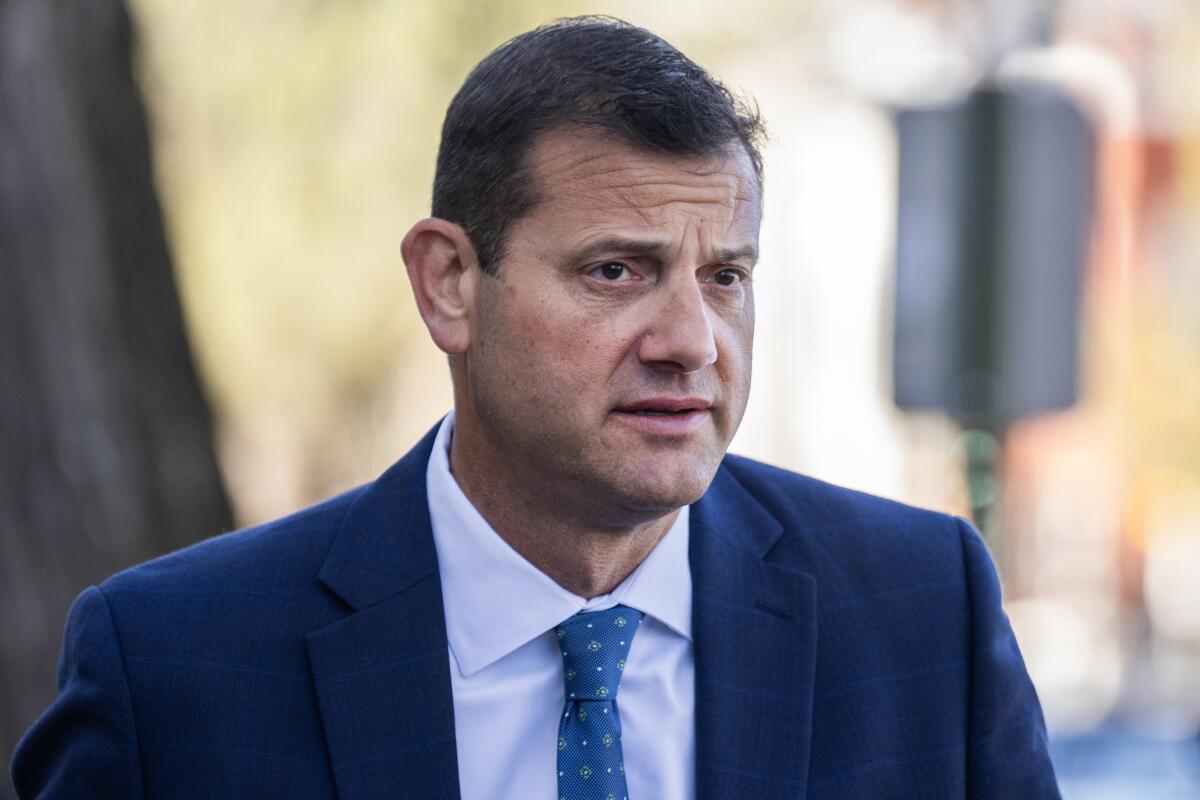
Rep. David Valadao (R-Hanford) leaves a meeting of the House Republican Conference at the Capitol Hill Club on March 17.
(Tom Williams/Getty Images)
National Democratic infighting has overshadowed a classic moderate vs. progressive primary race since House Democrats’ campaign arm threw its support behind one candidate, Assemblymember Jasmeet Bains (D-Delano), over Randy Villegas, a school board trustee backed by progressives including Sen. Bernie Sanders (I-Vt.).
The race was already tense when the Democratic Congressional Campaign Committee added Bains, a family doctor and two-term assemblywoman, to its “Red to Blue” program, which provides staff and fundraising support to Democrats running against vulnerable Republican incumbents. Local party leaders said they had received assurances from national Democrats that they would stay out of the race, which further angered Villegas and his supporters.
“This is another example as to why people’s faith in the Democratic Party and party leadership is at an all-time low,” Villegas said in an interview with The Times. “In many ways, it’s a badge of honor to not be the insider candidate and to say that I’m actually going to fight for community members here and not D.C. elites.”
DCCC chair, Rep. Suzan DelBene of Washington, cited Bains’ background as a family doctor and her track record in the Legislature fighting to expand access to healthcare.
Randy Villegas, running for California’s 22nd Congressional District, said his campaign manager wants him to take frequent selfies for their social media while walking neighborhoods in Bakersfield.
(Myung J. Chun/Los Angeles Times)
“We only weigh in on primaries when we feel that one candidate stands out as the strongest possible nominee to ensure that we win in the general election,” DelBene said in a recent interview on CBS’ “Face the Nation.” “This is a district that has been devastated by cuts to healthcare, a large Medicaid population, so she’s an incredible candidate and definitely can speak to the issues needed on health care.”
Valadao, who was first elected to Congress in 2012, has been a perpetual target for Democrats, who have held a sizable registration advantage in his district. A moderate Republican, Valadao had emphasized his support for immigration reform, a departure from his party. Still, Democrats ousted Valadao in the blue wave of 2018, only for him to win back the seat in 2020 and remain in office ever since.
Both Villegas and Bains promote themselves as the Democrats’ best option to topple Valadao once again.
Villegas, the son of Mexican immigrants, is endorsed by the House Hispanic and progressive caucuses and has painted Bains as a corporate-backed candidate who would bend to special interests.
Jasmeet Bains, running for California’s 22nd Congressional District, speaks with Mary Jimenez during a campaign canvassing walk in Bakersfield.
(Myung J. Chun/Los Angeles Times)
“We can’t just offer that we’re not Trump. The Democratic Party actually needs to stand for something,” he said. “To me that means fighting for universal healthcare, universal childhood education, banning members of Congress from trading stocks, getting rid of corporate PAC money. Those things may make Democratic leadership uncomfortable, and I’m OK with that.”
Bains is campaigning on her experience as a physician in a region known for its poor environmental and health outcomes. After medical school, she returned to Kern County, where she completed her residency and continued working at clinics that primarily serve low-income patients in the region.
“In the Valley, your word is your bond,” she said in a phone interview as she drove the 250-mile journey from her district to the state Capitol in Sacramento. “In the beginning he kept telling everyone that he wasn’t going to vote for it, and I took him for his word.”
Jasmeet Bains brings 8-month-old, Chiquita, as she campaign walks a neighborhood in Bakersfield.
(Myung J. Chun/Los Angeles Times)
Bains is the daughter of Indian immigrants and was the first South Asian woman elected to the California Legislature. She continues to work weekend shifts at a clinic in Delano.
“I thought the healthcare disparities of people losing their private insurance and having to transfer to Medicaid” was bad, Bains said. “With the trillion dollars cut from Medicaid federally, I’m now in a position where I’m transferring my patients from Medicaid to nothing. The problem in the Valley for healthcare has gotten worse and worse and worse.”
It’s the reason labor unions including SEIU Local 521, which represents workers in public, nonprofit and healthcare sectors in Kern and other counties around the state, are backing Bains.
“Within my own union, the members that I represent in Kern County, in certain ZIP Codes they have a 15-year less life expectancy than my union members living in Monterey County, which is a very similar community” with rural agricultural interests, said Riko Mendez, the union’s chief elected officer.
He said Bains understands the region’s unique health challenges and has used her perch in the Legislature to address them, including pushing for funding to research and treat valley fever, an infection caused by fungal spores in the region’s soils.
“We think her experience, her profile, her message is one that we agree with, and that has the best chance of winning in the runoff against Valadao,” he said.
Bains’ time commitments in Sacramento and working at the clinic leave her little time for a traditional campaign knocking doors and showing up to community events. Some voters backing Villegas have noticed.
Randy Villegas takes a phone call in the shade while walking neighborhoods in Bakersfield.
(Myung J. Chun/Los Angeles Times)
“For us, showing up is one of the most important things, and he’s the only candidate who has been doing that consistently,” 18-year-old Vanessa Orozco Romero said after a recent candidate forum in Bakersfield. Though nearly a dozen candidates for various offices were invited, Villegas and two other Democrats running for legislative seats were the only ones to attend.
Orozco Romero called the DCCC’s decision to back Bains “stupid and morally not OK,” especially since neither of the candidates earned enough delegate support to win the state party endorsement earlier this year.
Bains and Villegas have similar backgrounds as children of immigrants who grew up in the southern Central Valley. Though they both went on to earn high-level degrees, each is adamant about staying in Kern County to improve life for its residents.
The district is anchored in the eastern side of Bakersfield, home to California’s once-thriving oil fields, and stretches northward toward Fresno to include swaths of agricultural lands and small farming towns.
While there are more than twice as many registered Democrats in the district as Republicans, Democratic candidates often underperform in the Central Valley and independent voters play a crucial role picking winning candidates. Even under the new Proposition 50 lines that favor Democrats, President Trump would have beat former Vice President Kamala Harris by nearly 2 points.
Though nearly two-thirds of voters in the district are Latino, turnout is usually low among Spanish-speaking voters who are often discouraged by negative attack ads, Democratic activists said.
Save for the 2018 midterms during Trump’s first term, Valadao, a dairy farmer, has frustrated Democrats by continually winning over enough independents to hold onto the seat. Though the three candidates are competing in an open primary, Valadao is expected to advance to the general election as a longtime incumbent and the only Republican on the ballot.
“As he does in every primary election, Congressman Valadao is working hard to earn the vote of all Democrats, Independents, and Republicans,” Robert Jones, a consultant for Valadao’s campaign, wrote in an email. “We trust that the voters of the Central Valley will send the two best candidates to the general election in November.”
A win for Verhoeven would have arguably surpassed James ‘Buster’ Douglas’ shock victory over Mike Tyson in 1990 as the greatest upset in boxing history.
Both corners were given the scores under the open scoring system after round eight, with the contest level. Verhoeven – who felt he should be ahead on the cards – says it took a significant mental toll as the fight moved into the championship rounds.
Coached by Peter Fury for more than a decade, Verhoeven is no stranger to elite-level sparring and preparation.
Fury has since said he was on the same flight back as referee Mark Lyson and that the official told him he did not hear the bell to signal the end of the 11th round.
Verhoeven himself says he did not hear the bell either, only the clapper around 10 seconds before the end of the round.
“I knew Usyk was going to push it and I knew we were already there, so I just got on the defence and tried to ride it out. And then the referee jumps in.
“He did not just take it from me, he took it from Usyk. If he had the chance to knock me out in the 12th round, he would have done it to settle the fight without debate.
“Pretty strange because in other championship fights I’ve been dropped multiple times earlier and still come back to win. I know that’s one of my superpowers. I can get hit, recover, and come back.
“There are so many opinions and things to say – like ‘what if in the 12th round he would have definitely knocked you out?’
“But no, we cannot look into the future. We cannot predict anything. If we listened to all the predictions I wouldn’t have gone past the first half of the fight, and I did.”
WITH the sun shining brightly across the country, many families are itching to get out to a waterpark and cool off from the soaring spring heat.
And there’s no more fun way to cool off than in a waterpark – and the UK is home to plenty of world-class ones, with thrilling slides, rides and even their own spas.
We’ve rounded up the top waterparks for families of all agesCredit: Getty
Whether you want to try an adrenaline-fuelling trap-door waterslide, tackle a Total Wipeout-style obstacle course, or let a lazy river do all the work – we’ve got you covered.
From indoor tropical waterparks with adults-only spas, to the UK’S largest wave pool and water rollercoaster, we’ve rounded up the top waterparks for families of all ages.
And to top it all off, the entry prices start from £5.31pp – proving you can have an action-packed summer day out on a budget.
Here are some of the best on offer across the UK…
Waterworld, Stoke-on-Trent
Have a go on waterslides, Hurricane or Tornado Alley at Waterworld in Stoke-on-TrentCredit: Waterworld
Crowned the UK’s number one indoor tropical aqua park, Waterworld is a massive water wonderland packed with over 30 different rides.
The top attraction for adrenaline junkies is Thunderbolt – the UK’s very first trap-door drop waterslide.
You stand inside a capsule, wait for the floor to drop beneath your feet, and plummet straight down a vertical flume at a staggering 25mph.
For more thrills, you can tackle Hurricane, a high-speed slide that hurls you down at 17mph through glow-in-the-dark neon lighting.
For something a little more family-friendly, the newly refurbished Python ride has plenty of slithery twists and turns that are gentle enough for toddlers.
You’ve also got a classic wave pool and fast-flowing rapids that swirl you around the tropical temperature waters.
Plus, if you visit when the weather‘s hot, you can soak up the sunshine outside.
The park has an outdoor pool and sun loungers where parents can relax while kids splash around.
You can also wind down in the calming bubble pools and relaxation areas, or hit the on-site restaurant to refuel the family on fresh pizza, bubble waffles, and thick milkshakes.
Single tickets start at £17.50 online for adults and children, including spectators. Baby tickets cost £7. Make sure to book online in advance, as walk-in tickets will cost you up to £8.50 extra.
Sandcastle Waterpark, Blackpool
Sandcastle Waterpark in Blackpool is the largest waterpark in the UKCredit: Sandcastle Waterpark
Sandcastle Waterpark is the UK’s largest and home to Britain’s longest indoor water rollercoaster and 18 thrilling rides.
If you want to feel like you’re on holiday abroad, head here for a 29C tropical climate.
The Masterblaster holds the record for the UK’s longest indoor rollercoaster waterslide, with a 200m stretch of water tubing fun.
Meanwhile, the Sidewinder is the world’s first indoor half-pipe waterslide, resembling a giant, slippery skating ramp.
For the little ones, there’s the Treetops Water Chutes, multi-lane slides perfect for racing, and the HMS Thunder Splash – a giant pirate ship packed with water activities.
Another kid-friendly favourite is the Caribbean Storm Treehouse, a massive water climbing frame complete with a giant coconut that dumps 600 gallons of water onto unsuspecting swimmers every few minutes.
If you need a breather from the screaming and splashing, grown-ups can escape to the Sea Breeze Spa.
For an extra £7, adults can spend three hours unwinding in the sauna and steam room while making use of the foot spas and aromatherapy room.
For £60pp, adults get access to a private oasis with their own hot tub, a flatscreen TV, a fridge packed with cold drinks, and a dining and seating area.
You also get full-day admission to the waterpark and a meal deal included in the price.
Tickets start at £25.50 for ages 8+, £16.50 for children aged 3 -7, with under 3s going free. Make sure to book online in advance, as same-day tickets can cost you £2 extra.
Alton Towers Waterpark, Staffordshire
Alton Towers Waterpark at Splash Landings Hotel has Caribbean temperatures and a range of ridesCredit: Alamy
You don’t need to brave the theme park’s rollercoasters for an action-packed day out at Alton Towers.
The Alton Towers Waterpark at the Splash Landings Hotel is a massive, tropical-themed park with Caribbean-type temperatures in the middle of the Staffordshire countryside.
TheWacky Waterworks Treehouse is a sprawling interactive play area packed with more than 70 interactive features, including water cannons, pull-cords, and buckets.
Thrill-seekers can twist and turn down the Rush ‘N’ Rampage waterslides, or slip down the outdoor Flash Floods slides into a giant pool – perfect for a sunny day.
And if you just want to take it easy, you can drift along the lazy river or laze on a lounger while the kids hit the slides.
When you want something to eat, head to the Calypso Cave for lunches like burgers and chicken tenders, or grab an ice cream float or sundae from the Ice Cream Shack.
Tickets start at £18 online for adults and children, with those under 90cm going free. There are also parent and toddler tickets from £23. Make sure to book online for the best rates.
Dorset Adventure Park
Dorset Adventure Park has giant inflatable obstacle courses on lakes beside Corfe CastleCredit: Not known, clear with picture desk
If you prefer muddy knees, fresh air, the sun on your back and giant outdoor obstacles, Dorset Adventure Park is for you.
Set across two massive lakes on the grounds of Corfe Castle, Dorset Adventure Park is home to an action-packed outdoor inflatable course.
The Total Wipeout-style floating playground has huge trampolines, balance beams, wobbly bridges, and high-flying slides that launch you straight into the lake.
Plus, little ones even have their own inflatable, Splash Castle, manned by lifeguards and designed for kids aged 2 to 6.
If that isn’t muddy enough for the kids, the park is also home to a legendary Mud Trail.
On this 2km assault course, you can tackle mud pits, climbing walls, cargo nets, and tyre crawls that guarantee nobody leaves clean.
Back on dry land, the grounds have plenty more to see and do. There’s everything from axe throwing to relaxing woodland sauna pods.
For a bite to eat, the Snack Shack and Watering Hole have hot food, ice-cold drinks and ice creams with views of Corfe Castle.
The park provides wetsuit and buoyancy aid hire too, so you don’t need to worry about bringing anything other than a towel and a change of clothes.
Tickets start at £22pp for waterpark admission, £11 for the Mud Trail and £5 per child for Splash Castle.
The Wave, Coventry
The Wave in Coventry is home to the largest wave pool in the UK, plus plenty of slidesCredit: The Wave
Home to the largest wave pool in the UK which cycles 20 million litres of water per day, The Wave in Coventry is a high-tech indoor waterworld.
Above the huge pool are six speedy waterslides, including the colourful Cascade with its bright lights and The Rapids water coaster, described by the park as the ‘Big Dipper’ rollercoaster on water.
There’s also The Riptide, a rubber-ring ride that launches you down an exhilarating 90-degree angle.
The Cyclone, on the other hand, hurls you around a massive open bowl before dropping you out of the bottom.
Families with toddlers can head straight to The Reef, a colourful splash zone packed with mini-slides and water jets away from the big flumes.
Adults can slip away to the dedicated lane-swimming pool, work out at the fitness centre, or book into the luxurious Mana Spa to use its steam room, sauna, or enjoy a relaxing massage.
Tickets start at £15 per adult, £13 for ages 11 and under with under 1’s going free.
Time Capsule Water Park, Scotland
The Time Capsule Water Park in Lanarkshire has a Tornado Tantrum area with twisting ridesCredit: Time Capsule Water Park
The Time Capsule Water Park in Coatbridge, Lanarkshire is an affordable option with plenty of activities for mixed-age families.
Plus this waterpark is attached to an indoor ice rink, making it an ideal spot to visit and cool off on a hot day.
Inside you’ll find a lazy river, splash zones and waterslides, plus water cannons and a giant tipping bucket.
The most unique attraction here is the Tornado Tantrum – a setup of 10m-high Storm Chasers, thunder and lightning effects and twisting water flumes.
For families with young children, the Cove Island area has plenty of splash play zones for toddlers.
There’s also a Tiny Tots Play Zone on site, a soft play area for children aged 5 and under.
Head to the Tsunami Café for poolside burgers or a sit down with a cold drink.
The Time Capsule Water Park is one of the most affordable on the list, costing £6.50 per adult to enter and £4.50 per child. There is also free parking available.
LC Swansea Waterpark, Wales
Try out surfing on the Boardrider at LC Swansea in WalesCredit: LC Swansea
LC Swansea is Wales‘ biggest water park, packed with exciting rides, relaxing pools and even an indoor surfing machine.
Try out surfing or body-boarding on the Boardrider – a never-ending wave machine built for those who want to learn to ride waves like a pro.
Here you’ll also find the MasterBlaster water coaster, launching rubber ring riders uphill before gravity plummets them back down into the pool.
Younger kids can make a splash at Volcano Bay, an interactive zone with fountains, a smaller slide and tipping buckets.
For a slower pace, you can drift along the peaceful, lazy river or soothe your muscles in the bubbling whirlpool.
There’s a range of sessions to book, including Toddler Splash early mornings, women’s only and evening splash sessions.
To burn off some energy outside of the pool, there’s a water-themed Climb and Play area with four storeys of obstacles plus a 30ft climbing wall.
There’s also a Costa Coffee on site, plus a shop where you can pick up any extras you might need like swim hats and goggles.
Tickets start at £5.31 per adult or child for a General Splash session, with infant tickets for ages 1 to 3 starting at £2.97 and under 1s going free.
A BRAND new aquapark is coming to a UK town just in time for the summer holidays.
Featuring slides, climbing walls and a splash zone, the inflatable waterpark will be open until the autumn.
Sign up for the Travel newsletter
Thank you!
A brand new aquapark will be opening in Cambridgeshire this summerCredit: OneleisureThe inflatable water attraction will be open in time for the summer holidays and be in place till SeptemberCredit: Oneleisure
Located at Hinchingbrooke Country Park in Cambridgeshire, the brand new aquapark will be open to the public from July 18.
The inflatable park promises a day out of full of water-based fun, including slides, balance beams, climbing walls and splash zones.
Aimed at visitors aged six and over, the temporary water attraction will be open in time for the summer holidays and remain in place until September.
Visitors are able to pre-book online now, and the park expects demand to be high throughout the summer.
Tickets cost £19 per person and include a buoyancy aid, helmet and wetsuit hire.
From mid-July, the aquapark will be open from 10am to 5pm, with each session lasting an hour.
The new inflatable is part of a larger ongoing investment into Hinchingbrooke Country Park, improving its leisure activities and encouraging more visitors to the park’s large natural surroundings.
Executive member for Parks and Countryside, Waste and Street Scene, Cllr Julie Kerr, said: “We’re thrilled to be bringing this exciting new attraction to Hinchingbrooke Country Park.
“It’s a fantastic addition for residents and visitors alike, and part of our ongoing commitment to improving and evolving the park to enhance leisure and outdoor opportunities for users now and in the future.”
Hinchingbrooke Country Park even wants the community to get involved in an important aspect of the opening of the park.
In a post on Facebook, the park called upon residents to submit ideas for a new name for the aquapark, with the winner receiving a free visit for the entire family.
“Think adventurous, fun, family-friendly or inspired by Hinchingbrooke and the local area – we can’t wait to see your ideas,” read the post.
Entries for the competition close on Friday, June 5, and the winner will be announced shortly afterwards.
Some concerns were raised on the Hinchingbrooke Facebook post regarding the local wildlife of the area, but the park revealed they had worked “closely with an independent ecologist to understand how this could impact the wider park”.
An Ecological Impact Assessment was conducted and the park confirmed that their project team is now “working closely” with park rangers to “ensure all recommendations and any appropriate ecological mitigation is completed”.
The park will also be designating specific lake zones purely to wildlife and “adding an additional tern raft”.
The nearby car park is also currently undergoing works, but the park has confirmed this is expected to be complete by the time the aquapark opens.
Mel Fielding, who has more than 26,000 followers on Instagram, shared her first solo break on the social media platform and what she had learned from the experience
12:00, 28 May 2026Updated 12:00, 28 May 2026
Mel visited Salcombe (pictured) during her solo trip to Devon(Image: Getty Images/Robert Harding World Imagery)
While going on holiday with your family or best friends can be a lovely experience, sometimes taking a break by yourself can be exactly what you need. One travel influencer took herself on a 24-hour break to one of the most scenic parts of the UK and documented the experience on Instagram.
Mel Fielding, who has more than 26,000 followers on Instagram, shared her first solo break on the social media platform. She said: “Although I’ve done a few solo trips abroad over the years, and love exploring the UK, I’ve never really been on a solo trip in the UK before, so last week I decided to head to Devon for one night on my own.”
First, she visited Hope Cove, five miles west of Salcombe, where she went for a meal, saying she “felt super self-conscious at first”.
“I knew I wanted to watch the sunset but I had two hours to wait, so I headed down to the beach on my own,” she said. “I read my book and felt myself relaxing as I watched the sun go down. I felt so happy that I’d pushed through the awkwardness and stayed until the sun had set.”
Mel was staying in her van overnight, and had booked into nearby Bolberry House Caravan and Camping Park, which she said “felt really peaceful”. She continued: “I survived my first night along in the van and slept surprisingly well!
“It wasn’t as scary as I thought it would be! Isn’t it funny how things usually feel worse in our minds than they actually are.”
The next morning she visited Salcombe, and the Snapes Point viewpoint. “By this point, I felt like I’d relaxed into the trip so I headed on a solo sea swim,” she said.
“No one else was swimming and I did feel a little self-conscious at first, but knew I’d regret not going for a dip on such a beautiful day. I made coffee on the beach afterwards and realised that, although I’d done a few solo trips before, doing stuff solo is a bit like exercising a muscle. You have to keep using it to keep it strong.
“I consider myself a pretty adventurous person, but I also realised it’s okay to feel nervous before doing things you don’t do that often. I ended up having a really wonderful 24 hours and it was a good reminder to feel the fear and do it anyway. Now I’m already planning my next solo overnight adventure.”
Writing in the video description, she added: “I know that to some people this won’t be a big deal, but I also know that to some, it will, so if you’re in the latter group and would also love to go on a solo break in the UK this year, but feel nervous about it, I hope sharing this helps in some way!”
Content cannot be displayed without consent
People in the comments left their own experiences of solo travel. One said: “I have been single for seven years, so I decided a while back to do whatever I wanted to, even by myself. My biggest challenge was camping in my tent in Wales last summer… best thing I ever did.
“I was adopted by a lovely family for drinks around the campfire. You’re never truly alone. But the feeling of accomplishment when you do these things alone, immense! Makes you remember you can conquer anything.”
Another said: “I have never done a solo trip ever. If I ever get better I have promised myself a trip to Florence.
“Not having anyone else dictate where I am going. I always put others first. So it would be an amazing dream. Good on you! More of us need to lead by your example.”
Unification Minister Chung Dong-young, seen here on May 12 at the Catholic Conference of Korea, will face an investigation over allegations that he leaked classified information related to North Korea’s nuclear facilities, prosecutors said Thursday. File Photo by Yonhap
Unification Minister Chung Dong-young will face a prosecution investigation over allegations that he leaked classified information related to North Korea‘s nuclear facilities.
The Seoul Southern District Prosecutors Office said Thursday that it received the case from the Seoul Central District Prosecutors Office on May 21 and assigned it. Chung is accused of violating laws governing the disclosure of official secrets.
During a parliamentary committee session on March 6, Chung said North Korea is operating another uranium enrichment facility in the northwestern region of Kusong, along with previously reported ones in Yongbyon and Kangson.
The government has previously officially identified Yongbyon and Kangson as the main locations hosting the North’s uranium enrichment facilities, with Kusong being identified as a site for the first time.
At the time, the United States was reportedly said to have conveyed its concerns through South Korean diplomatic, security and intelligence agencies.
The unification ministry responded that Chung’s remarks were based on comments by the head of the International Atomic Energy Agency and reports and analyses released by research institutions, as well as media outlets.
The ministry said Thursday the prosecution’s assignment of the case was merely a procedural step following the complaint and should not be interpreted as the formal launch of an investigation.
Copyright (c) Yonhap News Agency prohibits its content from being redistributed or reprinted without consent, and forbids the content from being learned and used by artificial intelligence systems.
Marcelo Bielsa is widely revered as a pioneer of coaching, but his unconventional methods risk ruining Uruguay’s World Cup chances before the tournament has even begun, with rumours of dressing room unrest.
Nicknamed “El Loco”, which means madman, the 70-year-old’s bold, attacking approach has proved an inspiration to a younger generation of coaches, including Pep Guardiola and USA boss Mauricio Pochettino.
Recommended Stories
list of 4 itemsend of list
Yet, his famously demanding standards have often caused friction during a nomadic coaching career, and his stint in Uruguay has been no exception.
The Argentinian’s arrival initially generated huge excitement, which was fuelled by landmark victories over Brazil and Argentina in qualifying.
But they needed that flying start just to make it through after winning just three of their final 12 qualifiers.
The tipping point for many in the squad came at the Copa America in 2024.
Uruguay finished a creditable third, eliminating Brazil along the way, but Bielsa’s intensity during the monthlong tournament did not endear him to his players.
Luis Suarez hit out at Bielsa’s methods after retiring from international football months later, claiming he had reduced former Liverpool striker Darwin Nunez to tears at half-time of a 2-0 win over Argentina, such was the force of his criticism.
Bielsa accepted that after the former Barcelona striker’s backlash, his “authority was affected” with the rest of the dressing room.
Results have also regressed, with Bielsa stating he was “ashamed” by a 5-1 friendly defeat by the USA in November.
Now, as his third World Cup with a third different nation approaches, the question is whether Bielsa can win back the faith of his players for a country so used to punching above its weight on the world stage.
And there are doubts as to how his high-energy style will fare in the gruelling conditions of Miami and Guadalajara, where Uruguay will face Saudi Arabia, Cape Verde and Spain in Group F.
Pochettino hails Bielsa as a ‘genius’
Bielsa made his name winning three league titles in Argentina with Newell’s Old Boys, where the stadium now bears his name, and Velez Sarsfield.
“For me, he’s a person I will always admire,” said Pochettino, whom Bielsa recruited for Newell’s as a 13-year-old.
“He’s a genius. A person with charisma and a personality very different from us, normal coaches, and that’s what makes him special.”
Bielsa’s sides in Bilbao with Athletic Club, where he reached the Europa League and Copa del Rey finals in 2011-12, and Marseille, where he led Ligue 1 at the halfway stage in 2014-15, were also admired but ended up empty-handed as their energy ran out.
In Leeds, murals still bear Bielsa’s face, four years on from his departure, after he led a sleeping giant of English football back to the Premier League for the first time in 16 years in 2020.
His time there ended in familiar fashion with an exhausted squad that was relegated to the second tier the season after he departed.
Yet, the esteem with which he is held for his daring tactical approach endures.
“To be loved is this biggest title, bigger than the Champions League or Premier League or whatever,” said Guardiola, who went to visit Bielsa in Argentina before setting out as a coach at Barcelona.
“To be loved is the most important thing, and I think Marcelo has that more than any other manager in the world.”
Bielsa, who oversaw Argentina’s group-stage elimination in 2002 and Chile’s round-of-16 loss to hosts Brazil in 2014, has already hinted that he may not remain as manager of Uruguay beyond July, saying his job with the team ends with the World Cup.
“Our job ends with the World Cup,” Bielsa said at an event organised by the Uruguayan Football Association last Friday.
Although he did not elaborate on his remarks, local media reported that the Argentinian will not continue once his current contract expires at the end of the June 11-July 19 tournament.
“It is a miracle in any professional’s sporting career to take part in the World Cup,” he said. “I will be forever grateful to Uruguay for allowing me to enjoy a competition like the World Cup.”
Bradley Walsh is put in his place in the upcoming episode of Bradley & Barney Walsh: Breaking Dad
Bradley Walsh is hilariously told ‘do you know what you’re doing’ by an ITV show guest this Friday(Image: ITV)
Bradley Walsh is hilariously told ‘do you know what you’re doing’ by an ITV show guest this Friday.
Bradley, 65, and Barney, 28, are back on the road once in their hit series Breaking Dad as they head down under for a spectacular Australian adventure in the seventh season of their beloved ITV programme.
In this week’s episode, the boys’ Australian adventure continues and they are in the outback, where they meet a group of local farmers and help them muster their cattle.
The pair then make a pit stop at a local bar, where they end up taking part in a pub quiz. The next day it’s competition time as father and son go head to head in a race on lawnmowers.
Bradley and Barney’s trip then takes them back towards the coast and the beautiful Whitsundays, where a trip on a superyacht awaits them. However, in true show style, the boys won’t be doing any relaxing as they’re expected to work onboard.
In an exclusive first look clip of this Friday’s episode, it shows the moment the boys are thrown into a Below Deck style cocktail making challenge, where they have to make beverages for the superyacht’s passengers.
Bradley is tasked with making a margarita while Barney is asked to make a piña colada. However, Bradley’s cocktail making attempts don’t exactly go to plan as he pours Cointreau directly into the glass as opposed to the cocktail shaker. Noticing his blunder, he quips: “I should have done it in this but don’t worry!”
However, the superyacht’s guests are left apprehensive as one of the passengers squeals: “Does he know what he’s doing?” before another guest offers instructions, saying: “Do you need to put the Cointreau in there to shake it?”
To which Bradley insists: “I don’t really because it’s best if you have the Cointreau sitting at the bottom of the glass. That’s the way the pros do it!”
After mixing his drink, Bradley does a taste test as he exclaims: “Wow! I tell you what, you can run this boat on that!”
Meanwhile, Barney serves up the perfect piña colada to which a superyacht guest praises: “Oh my goodness Barney, you are amazing!”
Wanting feedback, Bradley asks: “Out of ten, would you say the piña colada?” to which the guest exclaims: “I give it 12 out of 10!”
A deflated Bradley then asks: “And the margarita?” with the other passengers admitting: “Three!” to which Barney jokes: “Unlucky!”
However, despite losing the cocktail making competition, Bradley soon gets stuck in as he grabs a piña colada to try himself and says: “Cheers to you all!”
The passengers who had the margaritas then put the drink back down on the bar with Barney joking: “Yeah, you best stay clear of that if I was you!”
Breaking Dad airs on Fridays at 7:30PM on ITV1, ITVX, STV and STV Player
A NEW pool is set to open in Warwickshire – and it is on the site of some medieval ruins.
Located at Abbey Fields in Kenilworth, the new multi-million attraction will feature two indoor pools, a changing area and a “conservatory-style” cafe.
Sign up for the Travel newsletter
Thank you!
The new pools will open on July 11Credit: Warwick District CouncilInside, it features two pools – the main pool and a family poolCredit: http://www.everyoneactive.com
Follow The Sun’s award-winning travel team on Instagram and Tiktok for top holiday tips and inspiration@thesuntravel.
One pool will be the main training pool, measuring 25-metres-long and will host most of the swimming lessons, lane swimming, family swimming sessions and aqua fitness classes.
The other pool will be more family-friendly and accessible measuring 15metres by eight metres and will also have a movable floor that reaches a depth of 1.8metres.
For some added family fun, this pool will also have interactive spray and splash features.
In total, at least five buildings were discovered as well as ceramics, both dating back to the 13th century.
The new pool will open to the public on July 11 and be open each Monday to Friday from 7am to 9pm, and 7am to 5pm at weekends.
As for the cafe, visitors will be able to grab a range of drinks, snacks and light meals as well as sit outdoors looking over the parkland.
According to theBBC, Councillor Jim Sinnott said: “Having recently been shown round the new building and having seen the fantastic features and spec, I really can’t wait to see the new pools finally open for all in our community to enjoy.”
A woman has lost a court battle after she claimed that “water is a natural resource and a universal human right” having been refused a glass of tap water by the Hotel Sassongher in Corvara
The Hotel Assongher in Corvara has won the legal case
A hotel has won a legal fight with a tourist who asked for a glass of water.
In the UK, the right to ask for a glass of water from certain establishments is enshrined in the law. Restaurants that serve alcohol are legally required to provide free tap water to paying customers, although they may charge for the glass or service.
The same cannot be said for other countries.
In Italy, the land’s highest court has just ruled that a five-star Dolomites hotel acted lawfully when it refused to provide tap water to a tourist.
Way back in 2019, the woman, from Rome, asked for a glass of H2O, only to be told that she couldn’t have one and that she’d have to make do with a £6 bottle of mineral water instead.
What followed was a legal fight that has run on until this week. Eventually settled in the Italian Supreme Court, the tourist claimed that “water is a natural resource and a universal human right”.
However, such arguments failed, with the five-star Hotel Sassongher in Corvara eventually victorious and the tourist’s request for £2,300 in compensation for emotional distress and economic damage dismissed.
Silvio Belardi, the lawyer representing the hotel, told the Corriere Alto Adige newspaper that the court held that “there is no obligation to supply tap water”.
According to the lawyer, the case had been rejected first by a court in Rome, then by an appeals court and now the Court of Cassation.
The Roman had argued that her consumer rights had been violated. She compared the denial of tap water to a hotel not putting sheets on a bed or soap in the bathroom.
“The woman claimed she had suffered damage, including financial and moral harm. This was rejected for lack of evidence,” Mr Belardi told the BBC.
Supreme Court judges dismissed her claim, eventually ruling that Italian laws and regulations do not require venues to provide tap water to guests. It is up to individual establishments whether they decide to do so.
“We also argued that if a person wanted running water, they could easily get that in the hotel – just not at the restaurant,” the lawyer added
European countries where free tap water is legally required
France: Requires restaurants to provide a carafe of water with every meal at no extra charge.
Spain: Passed a law in 2022 requiring bars and restaurants to offer unpackaged drinking water for free.
Lithuania: Restaurants must give guests tap water if they ask for it.
What about the EYU as a whole?
The EU as a whole has passed no laws requiring establishments to provide free tap water, although that could change soon. The EU’s Packaging and Packaging Waste Regulation, approved by the EU Council, encourages member states to ensure restaurants, bars, cafés, and catering services provide tap water for free or for a minimal service fee, with rules set to take effect in August this year.
When Congress passed the big, ugly bill known as HR 1 last year, most Americans understood it meant cuts to Medicaid, the safety net program millions rely on for medical insurance.
But few Californians realized just how much it will affect the Golden State when its provisions really kick in, starting after the midterms (the Republicans aren’t that dumb) and continuing on in cascading cuts for the next few years.
Millions of Californians — not just low-income folks — are going to feel the effects, whether through a loss of insurance, fewer providers able to keep their doors open, or rising premiums and costs.
“This problem trickles up,” state Senate leader Monique Limón (D-Goleta) told me. “This is not just going to impact the people that have a public healthcare plan. When you see a hospital close, when you see medical providers no longer being able to practice, it is absolutely going to impact everybody, the middle class included.”
Added to the loss of federal funds, Gov. Gavin Newsom’s most recent budget plan (which the Legislature has to debate in coming weeks) includes cuts at the state level. This is in part to contend with the loss of federal money, but also because healthcare costs keep rising and even in this wealthy state, we can’t afford the bills — at least not without some changes.
What those changes are — and who should bear the brunt of them — is a complicated and largely ignored debate happening right now. While our candidates for governor have been grilled on whether they support single-payer healthcare or not, (Becerra is a sort-of, Steyer is a yes) the real question isn’t how is the next governor going to expand access to care — but how are we going to keep the whole system from collapsing right now.
“This is not hypothetical, this is what’s coming down the line,” Limón said.
The problem
About 15 million adults and children, or about 1 in 3 of our state’s residents, rely on Medi-Cal, which is what California calls its Medicaid program.
Through a creative bit of state financing called the Managed Care Organization, or MCO, tax, the federal government has been paying for a big chunk of the costs of that insurance, about $7 billion a year. President Trump’s HR 1 makes that money go bye-bye by greatly reducing the MCO, leaving the state to figure out how to backfill that cash. And that’s just one of the ways the big, ugly bill hurts California. Yes, it’s complicated.
The number of Californians losing health insurance coverage could roughly double in the next four years. Above, a patient undergoes treatment for tongue cancer at Ronald Reagan UCLA Medical Center on March 6, 2026.
(David McNew / Getty Images)
Newsom’s budget plan relies in a not-small way on restructuring the MCO tax to fit HR 1’s new rules. But here’s the problem with that — any fix will require approval from the Trump administration, which has repeatedly shown the welfare of Californians is not a high priority. In fact, the Trump administration in March rejected California’s request to update another fee related to hospitals that also generates billions for Medi-Cal.
So maybe Newsom will be able to negotiate a plan that saves the MCO and California healthcare. But wouldn’t it be much better for the GOP, with a presidential election looming, to watch California (and her presidential-contender governor) tumble off a healthcare cliff? Few states rely on an MCO tax the way ours does, which means our pain is going to be far more visible and profound if we lose this funding.
That means if Newsom’s budget is approved by the state Legislature with the MCO fix, the state is taking a gamble. If the feds don’t approve some new version of the MCO tax, “it would have major implications,” Adriana Ramos-Yamamoto told me. She’s a senior policy fellow with the nonpartisan California Budget and Policy Center.
Sort-of solutions
What’s the fourth-largest economy in the world to do? Limón would like to see the state stop subsidizing corporations who pay so meagerly that their employees qualify for Medi-Cal.
“We don’t have the luxury of being able to provide these tax subsidies,” Limón said.
Turns out, 42% of Medi-Cal enrollees are full-time workers, according to a new report by the UC Berkeley Labor Center. Although most big corporations offer some sort of health insurance, it’s often tied to working a certain number of hours (which they then make sure not to schedule) or it has prohibitive costs or other barriers.
In 2022, the Labor Center found, 34% of low-wage workers received their health insurance through employers, compared with 69% of higher wage workers — meaning California is picking up insurance costs because low-wage employers are finding ways out of them.
“Over the decades, Medi-Cal has really undergone a significant transformation. It’s shifted from a program that primarily served the disabled and indigent and elderly folks to one that largely supports folks that work in low-wage industries,” Tia Orr, the executive director of SEIU California, told me. “Medi-Cal has now become a program where folks that work every single day have to rely on it. The idea that someone can work every day and qualify for food stamps and Medi-Cal, it should be eye-opening to folks.”
Right now, she points out, California taxpayers are paying about $7,800 a year for each person on Medi-Cal.
“The corporations that they work for don’t have to pay one dollar of that, right?”
Limón and her Senate colleagues would like to change that. They have proposed the “Fair Share” plan that would impose a tax on the state’s largest and wealthiest corporations whose employees rely on public assistance. It’s more of an idea than a fleshed-out policy at this point, but as ideas go, it ain’t a bad one. It’s been done in Massachusetts, and New Jersey’s governor has suggested it.
In California, it deserves more attention than it’s currently being given.
To be fair, Newsom’s plan also would also limit state corporate tax credits to $5 million, as my colleague Taryn Luna points out, or 50% of a firm’s tax liability, whichever is greater. That change could bring in $850 million next year to state coffers and grow to $1.8 billion by the end of the decade. That’s still not nearly enough to cover healthcare costs.
To add to the drama, the California Legislative Analyst’s Office predicts all this will get worse — that the number of Californians losing health insurance coverage could roughly double in the next four years. The Newsom administration projects federal Medi-Cal changes could push off 44,000 people in 2026-27, growing to 1.3 million people by 2029-30.
That means more people getting sick and dying because they can’t afford a doctor. It means more doctors, clinics and hospitals losing income vital to keeping their doors open, and more emergency rooms being overloaded because it’s the only option.
“The worst is yet to come,” Rachel Linn Gish, interim deputy director at Health Access California, a consumer healthcare advocacy coalition, told me. “If you wait to take action until it gets bad, it’s already going to be way too late.”
She’s right, and however you look at it, a fix should include corporations paying their fair share.