Repression in Venezuela has continued under interim President Delcy Rodriguez, Amnesty International says. File Photo by Henry Chirinos/EPA
April 22 (UPI) —Amnesty International said Venezuela has not dismantled its “repressive apparatus” nearly four months after former President Nicolás Maduro was arrested in a U.S. military operation.
During the presentation of its annual report in Bogotá, the organization said the country’s system of repression remains fully operational under the interim government led by Delcy Rodríguez.
Valentina Ballesta, research director for the Americas at Amnesty International, said Tuesday that Venezuela’s repressive structure continues to operate despite the political transition, according to reports by Infobae.
According to the report, Maduro’s government maintained a policy of systematic repression throughout 2025, with all branches of the state acting in coordination.
Amnesty International said authorities continue to use arbitrary detentions, forced disappearances and torture as tools of social control.
“These are not isolated incidents, but rather a pattern that amounts to crimes against humanity,” the report said.
The organization documented hundreds of cases in which detainees faced judicial proceedings without basic legal guarantees, including ineffective public defenders, the use of special anti-terrorism courts, lack of access to charges and repeated violations of due process rights.
Amnesty International also criticized the implementation of the Amnesty Law approved in February, saying its enforcement has been arbitrary and selective.
Many requests for relief were rejected without explanation, while some people initially granted benefits later had those measures reversed, according to Venezuelan news outlet Efecto Cocuyo.
While the nongovernmental organization Foro Penal and other groups confirmed the release of 673 political prisoners between Maduro’s capture and mid-April, Rodríguez’s government has reported much higher figures as part of what it described as “peace and reconciliation” measures.
In March 2026, government spokespeople said as many as 7,000 people had been granted full release or alternative legal measures. That figure, however, includes common criminals and people already serving conditional release.
Foro Penal said nearly 500 political prisoners remain in detention.
The Amnesty International report said impunity remains the driving force behind Venezuela’s repressive system and warned that the lack of an independent judiciary prevents victims from obtaining justice inside the country.
Analist also pointed to the recent restructuring of the Attorney General’s Office as an example of political control. The move replaced an official close to Maduro with another figure aligned with the Rodríguez political faction, which currently controls both the interim presidency and the National Assembly.
About 7.9 million Venezuelans have fled the country since 2015. Nearly 2 million people depend on international humanitarian aid, while severe shortages in basic services such as water, electricity and food persist, the report said.
Amnesty International further warned about the growing use of new technologies and artificial intelligence for population surveillance, along with continued harassment of journalists and human rights advocates.
Without a genuine dismantling of coercive state structures, Amnesty International said, Venezuela will not be able to restore fundamental freedoms.
Tehran says all necessary arrangements has been made for participation in the tournament cohosted by the US.
Published On 22 Apr 202622 Apr 2026
Iran says that the country’s institutions are fully prepared for its national football team’s participation in the 2026 FIFA World Cup in the United States, Canada and Mexico.
In a statement made to state broadcaster IRIB, government spokesperson Fatemeh Mohajerani said on Wednesday that the Ministry of Youth and Sports ensured all necessary arrangements for the team’s effective participation in the tournament.
Recommended Stories
list of 4 itemsend of list
She also said the preparations were made under the directive of the sport minister, with a focus on providing the required facilities for a successful performance.
FIFA President Gianni Infantino said on April 16 that Iran is expected to participate in the upcoming World Cup, taking place from June 11 to July 19, noting that the team has qualified and expressed its willingness to compete despite the ongoing US-Israeli war on Iran.
“But Iran has to come, they represent their people, they have qualified, the players want to play,” he said of the Iranian team’s upcoming matches scheduled in the United States in June.
“Sports should be outside of politics,” Infantino said.
Group matches in the US
US President Donald Trump said in March that while Iran’s team would be welcome at the tournament, he questioned whether it would be appropriate for them to attend, citing concerns over their “life and safety”.
Iran is scheduled to play its three Group G matches in the United States – two in Los Angeles, one in Seattle – with their base for the tournament in Tucson, Arizona.
Iran’s participation in the global tournament being cohosted by the three North American countries had been thrown into doubt by the conflict launched by the United States and Israel on February 28.
Iran raised the prospect of a “boycott” of the competition before asking FIFA to move its matches from the United States to Mexico, a request the world governing body rejected.
After several weeks of air strikes on Iran and Iranian reprisals against Israel and other countries in the region, a fragile truce came into effect on April 8.
The announcement of the two-week ceasefire was followed by rare direct talks in Islamabad on April 11–12, which ended without an agreement. The ceasefire was later extended by the US as diplomatic efforts continue.
The World Cup, the first to feature 48 teams, starts on June 11.
THE stars descended on London in force as they put their best fashion foot forward for the star-studded Devil Wears Prada 2 premiere.
Stars of the hit sequel as well as top British talent all turned up for the premiere of the hotly-anticipated film.
Sign up for the Showbiz newsletter
Thank you!
Tasha Ghouri wowed in red at the Devil Wears Prada 2 premiereCredit: GettyThe glam star turned heads in the figure-hugging bodysuitCredit: GettyAmanda Holden looked as stunning as ever in a gorgeous black fishtail dressCredit: APLaura Whitmore flashed her bare baby bump alongside Leomie AndersonCredit: Shutterstock EditorialAnne Hathaway looked a vision on the carpetCredit: ReutersNicky Hilton showed off her enviable figure as she posed for photographersCredit: AP
Making sure not to be missed, former Love Island host Laura Whitmore put her bare baby bump on display.
Laura exposed her expanding stomach in order to show it off in all of it’s glory.
She added a simple black top and a large skirt to ensure she was turning heads at the premiere.
Britian’s Got Talent judge Amanda Holden also made sure to turn heads at the event.
Never one to turn down the chance to show off her age-defying looks, Amanda’s svelte figure was put on full display in a gorgeous black gown.
Featuring a tight-fitting design around her trim waist, complete with lace detail, the fishtail dress commanded attention on the carpet.
Amanda Holden posed with her nepo-baby daughter, model Lexi HughesCredit: PAEmily Blunt posed with Donatella Versace at the London premiereCredit: APThe film’s cast put their best fashion foot forwardCredit: APMeryl Streep beamed at the film eventCredit: Getty
Movie star Anne Hathaway looked divine as she rocked a black number for the film’s celebrations.
The floor-length outfit featured buttons up her front as well as striking cut out details across her stomach and waist.
The dress’ train then ran all the way to the ground as she posed for waiting photgraphers on the red carpet.
Fashion-savvy Meryl rocked a long red trench coat over a silk cream shirt whilst Emily stunned in tight-fitting red trousers which she paired with a very unique corset-esque design which draped down to her feet.
Socialite Nicky Hilton also looked fantastic as she flashed her incredibly toned abs in a cut-out dress.
Her tiny waist was exposed in the summery number which also put her cleavage on full display.
Star of the flick Stanley Tucci was also in attendance as he posed alongside his cast mates on the red carpet.
Singer Jess Glynne also posed up a storm alongside her girlfriend, ex-footballer Alex Scott as The X Factor runner-up and singer Fleur East rocked a mini white suit
Emily Blunt looked incredible at the premiereCredit: APFleur East was also in attendanceCredit: GettyAlex Scott and Jess Glynne looked every inch the loved-up coupleCredit: APFormer Love Islander Uma Jammeh stunned at the eventCredit: Getty
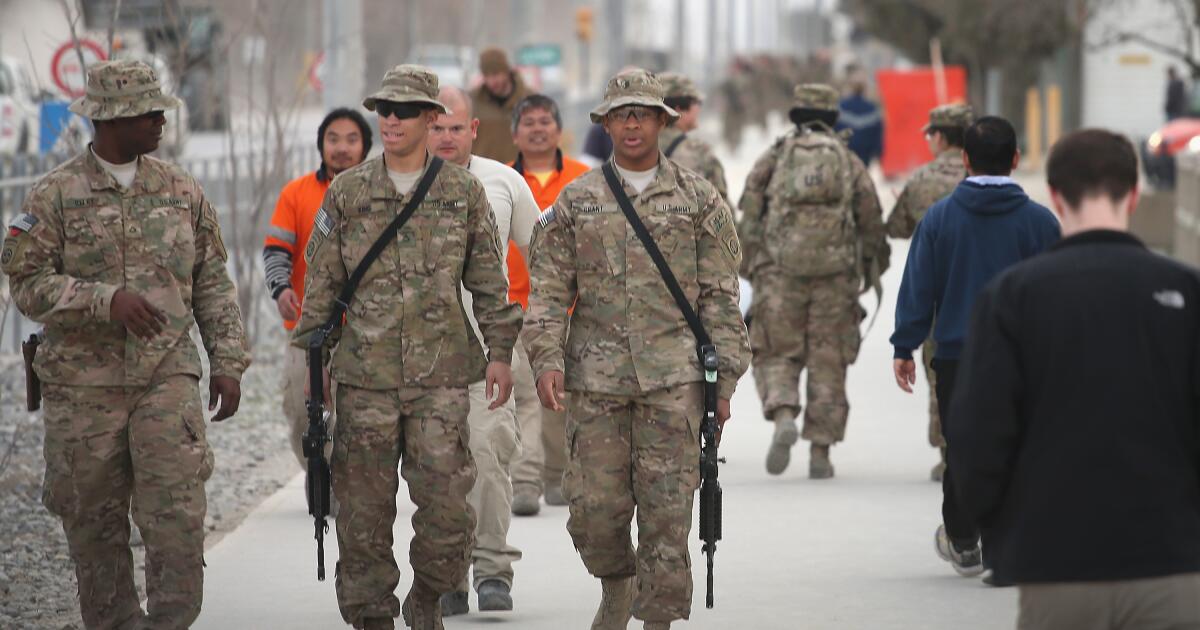
WASHINGTON — The Supreme Court ruled Wednesday that U.S. troops may sue military contractors for their injuries, siding with a soldier who was badly injured when a Taliban operative working at the Bagram Airfield detonated a suicide bomb.
Five soldiers were killed and 17 were wounded, including 20-year-old Winston Henceley, who suffered a fractured skull and brain injuries and is permanently disabled.
In a 6-3 decision, the court ruled that neither federal law nor the Constitution shields military contractors if their mistakes or negligence result in solders being injured in a combat zone.
Justice Clarence Thomas wrote the court’s opinion for an unusual majority that included Justices Sonia Sotomayor, Elena Kagan, Neil M. Gorsuch, Amy Coney Barrett and Ketanji Brown Jackson.
In the past, Thomas has objected to court precedents that prevented troops from suing the U.S. government for their injuries, including from medical practice.
And he said that rule should not be expanded to shield military contractors.
Justice Samuel A. Alito Jr. dissented, along with Chief Justice John G. Roberts and Justice Brett M. Kavanaugh.
“Because the Constitution gives the federal government exclusive authority over foreign affairs and the conduct of wars, federal law preempts all state law that substantially interferes with the Government’s exercise of those powers,” Alito wrote.
Hencely had tried to stop and question Ahmad Nayeb, an Afghan employee, as he walked toward soldiers who had gathered for a Veteran’s Day 5K race in 2016.
The Army concluded that Hencely’s intervention “likely prevented a far greater tragedy,” and its investigation concluded that the Fluor Corporation that had a contract to run operations at the base was primarily responsible for the attack.
The report said Fluor was negligent in hiring an Afghan who had been a Taliban operative, and it failed to closely supervise him.
But Henceley sued Fluor for his injuries; a federal judge in South Carolina and the 4th Circuit threw out his suit.
“During wartime, where a private service contractor is integrated into combatant activities over which the military retains command authority, a tort claim arising out of the contractor’s engagement in such activities shall be preempted,” the 4th Circuit said.
The court agreed to hear his appeal and overturn the 4th Circuit, clearing his suit to proceed.
Sources have told BBC Sport that Bournemouth manager Andoni Iraola, Fulham head coach Marco Silva and former Dortmund boss Edin Terzic are under consideration as possible replacements for Rosenior.
Iraola, 43, announced last week that he will leave Bournemouth at the end of the season, while Silva’s contract at rivals Fulham is due to expire in July. Terzic, meanwhile, was under consideration by Tottenham to replace Thomas Frank when the Dane was sacked earlier this season.
Calum McFarlane will take over as interim manager until the season of the season.
McFarlane, who was Rosenior’s assistant, was in charge for a 1-1 draw against Manchester City and a defeat at Fulham in January after previous boss Enzo Maresca was sacked.
“As the club works to bring stability to the head coach position, we will undertake a process of self-reflection to make the right long-term appointment,” Chelsea added.
Rosenior won five of his 13 games in the Premier League and led the Blues to four victories in the FA Cup – all against lower-league opposition – to reach the semi-finals.
McFarlane’s first game in charge comes on Sunday when Chelsea face Leeds at Wembley for a place in the FA Cup final (15:00 BST).
Chelsea only appointed Liam Rosenior in January, but the FIFA Club World Cup holders have lost their last five games.
Published On 22 Apr 202622 Apr 2026
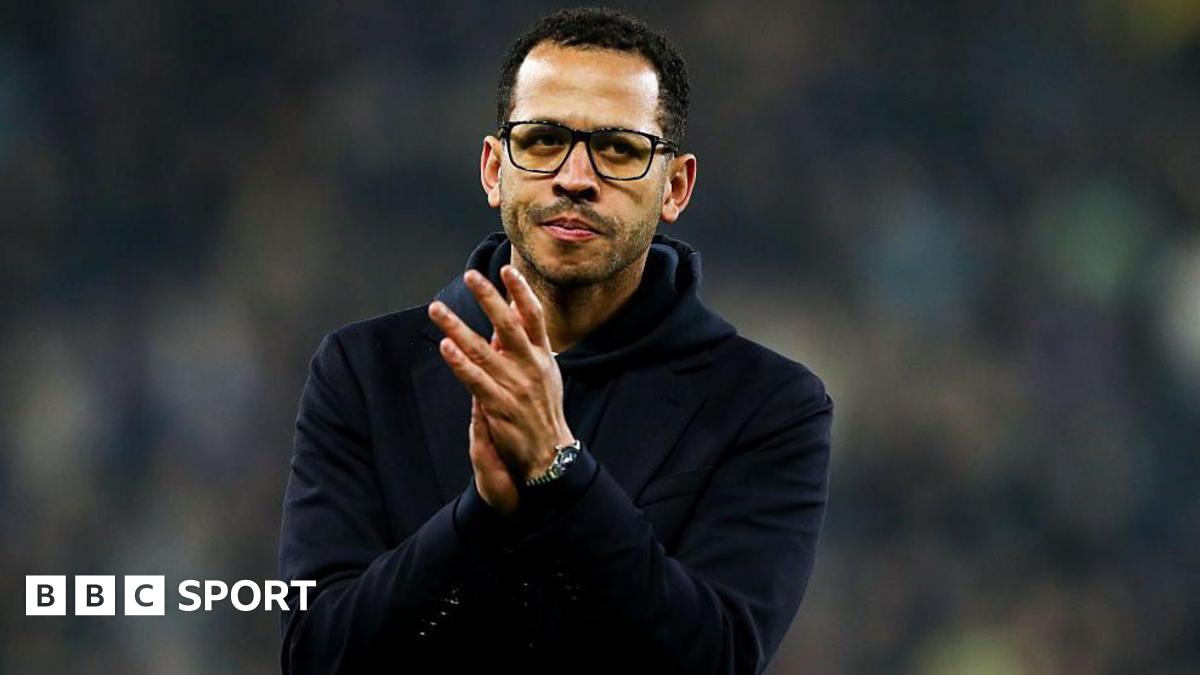
FIFA Club World Cup champions Chelsea have sacked their head coach Liam Rosenior following a run of five consecutive defeats.
The 41-year-old had only been appointed as Enzo Maresco’s permanent replacement in January.
Recommended Stories
list of 4 itemsend of list
Rosenior, who started his managerial career at Derby County and Hull City in England, joined the west London club after two years in the French top flight with Strasbourg, where he won 51 of 63 matches.
Only 11 wins were secured in 23 games in charge of the Blues, however, and the recent run of losses also marked the first time the club had lost that number of games without scoring since 1912.
Tuesday’s 3-0 defeat at Brighton saw the side slip to seventh in the league, a hammer blow in the chance of qualifying for next season’s UEFA Champions League.
“Liam has always conducted himself with the highest integrity and professionalism following his appointment midway through the season,” Chelsea said in a statement.
“This has not been a decision the club has taken lightly, however recent results and performances have fallen below the necessary standards with still so much more to play for this season.”
Rosenior described the performance of his players in his final game in charge as “indefensible” and “unacceptable”.
Advanced artificial intelligence tools could significantly reduce video game development costs, potentially saving nearly half of expenses and unlocking around $22 billion in annual profits for game makers, according to Morgan Stanley analysts. AI can automate tasks like creating game environments, generating dialogue, and testing software, making production faster and cheaper. However, these financial gains may not be evenly spread across the gaming industry.
Morgan Stanley estimates that global spending on video games will reach $275 billion this year, with 20%, or about $55 billion, reinvested into game development and operations. Game development, which is typically costly and labor-intensive, could become more efficient as AI allows for smaller teams and quicker enhancements post-launch. A prime example is Take-Two Interactive’s Grand Theft Auto VI, in development since 2018 and expected to launch in November 2026.
Potential winners from this AI integration include major gaming platforms like Tencent, Sony, and Roblox, along with large publishers such as Take-Two and Electronic Arts, which can utilize AI across multiple titles. Conversely, companies with weaker franchises may struggle, facing increased competition as AI reduces costs for making mid-scale games. The report also discusses how AI could enhance revenue by keeping games engaging, encouraging spending on add-ons, in-game purchases, and subscriptions. Publishers may increasingly focus on enhancing existing franchises rather than relying solely on new game releases.
This 2026 digital digest primarily highlights the national holiday observing the anniversary of the establishment of the State of Israel. The text explains that the celebration marks the 1948 declaration of independence and the subsequent conclusion of the British Mandate. Alongside historical details, the source includes current news headlines involving regional conflicts, such as a ten-day ceasefire with Lebanon and protests regarding military tensions with Iran. Beyond political and historical updates, the publication provides financial data like currency exchange rates and updates on global technology and entertainment. It serves as a comprehensive daily briefing that blends cultural signific …
WHEN Jack Whitehall decided to leave Sky’s A League of Their Own in 2018 to try and crack America, he feared it would leave his friendship with his co-stars James Corden and Freddie Flintoff in tatters.
Fast forward eight years, and it appears Jack’s prophecy may have come true. Both Flintoff and Corden skipped his £250k nuptials on Saturday – with Flintoff posting photos of himself on the golf course in Slough instead.
Freddie Flintoff’s absence from Jack Whitehall’s wedding has raised eyebrows and sparked rumours of a feud between the former best matesCredit: AlamyWhen Jack left A League Of Their Own, he feared his friendships with co-stars would be left in tattersCredit: AlamyJames Corden was at Jack’s stag do, but didn’t make the star-studded weddingCredit: CLICK NEWS – DEAN
Their absence at the bash raised eyebrows – and sparked rumours of a feud between the former best mates.
One guest tells us: “Of course, people noticed that Freddie and James weren’t there. They were huge parts of Jack’s life for so long.
“But Freddie has been through so much over the last few years, and people suspected he just didn’t want to be at such a public event.
“All the guests were photographed for Vogue, and it was actually quite a big spectacle, so it wouldn’t be surprising if Freddie didn’t want to be part of the circus.
“Why James missed it is another matter and very bizarre considering he was at the stag do.”
‘Very bizarre’
Other guests, including Jamie Redknapp, who also worked on the Sky show, shared gushing posts about the nuptials on Instagram. Corden however, is no longer following Whitehall.
Meanwhile, Redknapp certainly made his presence known; he posted his Vogue snaps from the big day and gushed: “Congratulations to Jack and Roxy on your big day. I honestly couldn’t be happier for you both. I think the world of you guys, and I’m so proud to be there to see it all
“Jack, you’re like a little brother to me, although somehow still my favourite man baby. And Roxy, fair play… you’ve taken on a lifelong project there.
“Wishing you both a lifetime of laughs, love, and just enough chaos to keep things interesting. Have the best day, and an even better life together.”
Roxy sent a pointed response, saying: “Thank you so much for being there on our special day x”
His stag do took place at the end of March in London and saw him joined by fellow celebs Jamie Redknapp and James Corden as well as ex-rugby star, Lawrence Dallaglio.
The boozy day out, which Whitehall says started at 11am with a Guinness, ended up getting so rowdy that the comedian can barely remember what happened.
Whitehall tied the knot with Roxy at Euridge Manor over the weekendCredit: anna_longford / InstagramRoxy and Jack’s wedding took place in the grounds of £12million stately home Euridge Manor, near Chippenham, WiltsCredit: Instagram/RoxyhornerJack Whitehall starred alongside James Corden, Jamie Redknapp and Freddie Flintoff on the hit Sky show A League Of Their OwnCredit: Handout
The lads sank pints at The Devonshire pub, before visiting the infamous and very sexy nightclub The Box, which is believed to have put on a private show just for Whitehall and his rowdy group of mates.
They then moved on to mini-golf hotspot, Swingers and ended the night with drinks at the Soho Hotel bar.
Images from the night showed Whitehall staggering down the street with Corden and Redknapp, but Flintoff was absent.
The four mates started working together in 2012, at the time Whitehall was a relative unknown, while Flintoff and Redknapp were sporting legends, and Corden had made his name in comedy Gavin & Stacey.
‘Breaking up the friends’
Whitehall’s career started to take off, and despite League of Their Own being a huge hit, he decided to quit in 2018 to pursue a career in America like Corden.
He admitted at the time he was worried about leaving his mates behind and said: “It was very sad sitting down with Jamie and Freddie and telling James on the phone. Jamie wept.
“I’m the b*****d breaking up the friends. But I think they still like me.
“I think we’re all still pals, it will probably help going forward with our friendship as we won’t see each other all the time.”
His career skyrocketed from there, and a few years later, Corden quit A League of Their Own and then Flintoff left a year later.
Jamie Redknapp, pictured, and James Corden attended Jack’s boozy stag do in London – but Flintoff gave it a missCredit: CLICK NEWS – DEANFlintoff posted photos of himself on the golf course in Slough on Jack and Roxy’s big dayCredit: Instagram
Former cricket star Flintoff landed a place on Top Gear in 2019 but in December 2022, he was involved in a terrifying accident while filming the BBC show.
He was airlifted to hospital after his three-wheeled Morgan flipped, leaving him with devastating facial injuries, which meant he needed reconstructive surgery, as well as suffering some broken ribs.
He became a social recluse, not leaving the house for over six months, and struggled with his mental health, including suffering from PTSD, flashbacks, and anxiety.
Whitehall appeared in Flintoff’s 2025 Disney+ documentary about his accident and recalled their first meeting, he said: “I remember being quite intimidated. I was meeting Freddie Flintoff, who I looked up to a lot as a kid, for the first time.
“So many people think of him as so strong and so alpha, but he’s definitely fragile.”
Asked if he had a message for Flintoff, whose friendship with Top Gear co-host Paddy McGuinness also struggled post-crash, Whitehall replied straight-faced: “Answer my texts.”
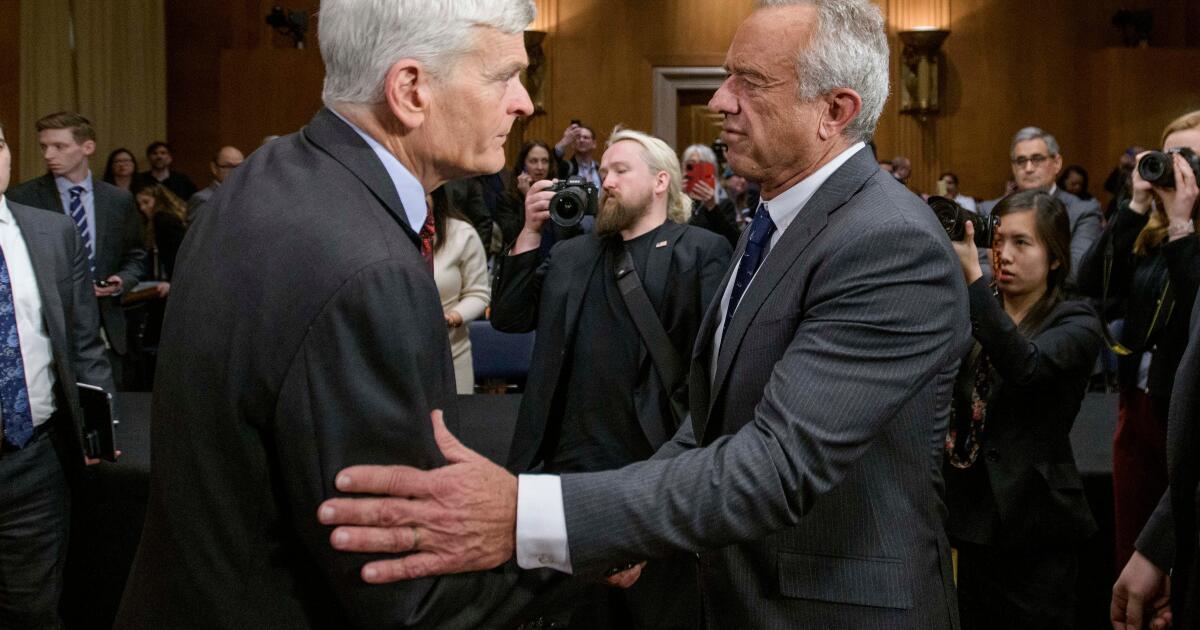
Bill Cassidy’s roles as a lawmaker, a doctor and a political candidate will collide on Wednesday as he questions Health Secretary Robert F. Kennedy Jr. in two high-stakes Senate hearings.
The Louisiana Republican chairs one of the Senate committees that oversees Kennedy’s department and sits on another, giving him two chances to interrogate the secretary about his plans for an agency responsible for public health programs and research. As a doctor, Cassidy has clashed with Kennedy’s anti-vaccine ideas even though he provided crucial support for the health secretary’s nomination last year.
At the same time, Cassidy is fighting for his political future in next month’s primary in Louisiana, where President Trump has endorsed one of his opponents in an unusual attempt to oust a sitting senator from his own party.
How Cassidy handles the hearings could affect his chances at a pivotal moment of his reelection campaign and set the tone for how Congress oversees the nation’s health agenda at a time of rampant distrust and misinformation.
Cassidy hasn’t faced Kennedy in public since September. In the subsequent months, Kennedy has attempted a dramatic rollback of vaccine recommendations that, if not blocked by an ongoing lawsuit, could undermine protections against diseases like flu, hepatitis B and RSV.
After a backlash, Kennedy has also pivoted to spending more time talking about less controversial topics like healthy eating — albeit with his own spin, including sharing exaggerated claims that various ailments can be cured by diet alone.
Cassidy will have to decide on Wednesday whether to grill Kennedy on vaccines, an issue deeply important to him, or put their differences aside and prioritize loyalty to the Trump administration.
“He’s taken a risk showing any sort of resistance to RFK,” said Claire Leavitt, an assistant professor at Smith College who studies congressional oversight. “He may pay an electoral price for that.”
Cassidy has long advocated for vaccines
Cassidy has spent years walking a political tightrope. He’s one of the few Republican senators who voted to convict Trump during an impeachment trial after the Jan. 6, 2021, attack on the U.S. Capitol.
As a liver doctor, he advocated for babies to receive hepatitis B vaccines shortly after birth, a step that could have prevented the disease in his patients. But when Trump nominated Kennedy, a longtime anti-vaccine activist, Cassidy supported him. He did so after securing various commitments, including that Kennedy would work within the current vaccine approval and safety monitoring system and support the childhood vaccine schedule.
The vote for Kennedy did not appear to mollify Trump. The president endorsed U.S. Rep. Julia Letlow, one of Cassidy’s two primary opponents.
Cassidy also faces opposition from Kennedy’s allies in the “Make America Healthy Again” movement, a group that includes both anti-vaccine activists and a wide variety of other crusaders for health and the environment. The MAHA PAC, aligned with Kennedy, has pledged $1 million to Letlow’s campaign. While the organization hasn’t publicly said so, some have questioned whether the support is partly in retaliation against Cassidy for criticizing Kennedy’s vaccine policy agenda.
“I’m not really sure what MAHA’s beef is,” Cassidy told reporters earlier this month. “Let me point out that I am the reason that Robert F. Kennedy is now the secretary of HHS. He would not have gotten there otherwise.”
Cassidy argues that he has “strongly supported” the MAHA agenda, especially when it comes to the fight against ultraprocessed foods. However, the physician-turned-senator acknowledged that he and MAHA have “disagreed on vaccines.”
“We’ve seen, frankly, that I am right,” Cassidy added, pointing to recent measles-related deaths of children who were not vaccinated.
At a hearing in September, he slammed Kennedy’s decision to slash funding for mRNA vaccine development. He interrogated Kennedy over his attempt to replace members of a vaccine committee, suggesting the new members could have conflicts of interest. He also raised concerns that Kennedy’s vaccine policy decisions could be making it harder for Americans to get COVID-19 shots.
Later that month, Cassidy convened a hearing featuring former U.S. Centers for Disease Control and Prevention Director Susan Monarez, who was ousted by Kennedy less than a month into her tenure after they clashed over vaccine policy, and former CDC Chief Medical Officer Debra Houry, who resigned in August citing an erosion of science at the agency.
“I want to work with the president to fulfill his campaign promise to reform the CDC and Make America Healthy Again. The president says radical transparency is the way to do that,” Cassidy said at the time.
Experts say Cassidy’s vaccine stance might not hurt him
Political consultants said they expect Cassidy’s primary opponents, Letlow and Louisiana Treasurer John Fleming, to seize on any sound bites from Wednesday’s hearings that can make Cassidy seem at odds with the Trump administration.
But Dorit Reiss, a vaccine law expert at UC Law San Francisco, said the political risk of advocating for vaccines may not be as strong among Republicans as some people assume.
“He’s probably not alienating voters by focusing on the issue and calling it out,” she said.
Louisiana political consultant Mary-Patricia Wray said she thinks most diehard MAHA voters already know who they are voting for, and it’s probably not Cassidy.
Instead, she said, he may still be able to appeal to Democrats who switch their party registration to vote in the primary, as well as a wide swath of still-undecided Republican voters who care about the same health care affordability issues he advocates for every day in Congress.
“If I was advising Bill Cassidy, I would tell him your goal here is not to get out unscathed,” Wray said. “Your goal is to prove that your consistency on issues regarding public health is an asset in your campaign, not a detriment.”
Election outcome will shape future oversight of HHS
Also at stake if Cassidy doesn’t make it to November’s general election is what will happen to his responsibility to oversee the massive U.S. Department of Health and Human Services as the chair of the Senate Health, Education, Labor and Pensions committee.
Leavitt, the Smith College professor, said seniority typically plays the most important role in who chairs Senate committees. She said another Republican in today’s increasingly hyperpartisan Congress may not be as willing as Cassidy to check Kennedy’s power.
Reiss, the vaccine law expert, said she wishes Cassidy had done more hearings or introduced legislation to rein in Kennedy. And she said the senator bears the blame for allowing Kennedy to bring unfounded vaccine fears into the government in the first place.
“His original sin, of course, was voting for Kennedy at all,” Reiss said.
Swenson writes for the Associated Press. AP writer Sara Cline contributed to this report.
NATIONAL Trust is set to close more than 130 holiday cottages due to falling profits.
The charity said it would cut the properties from its books – with most set to go on the rental market later this year.
Sign up for the Travel newsletter
Thank you!
A total of 137 National Trust properties will be closed as holiday letsCredit: AlamyBird How in Cumbria is one of the holiday lets due to be closedCredit: National Trust
The conservation charity owns more than 500 holiday cottages across the UK – but it is planning on closing down 137 of them this year.
It is understood that most of the cottages will be repurposed as homes and put on the rental market later in the year, according to The Telegraph.
The Trust has not yet issued a list of which properties will be closed and when.
But it is thought the remote Bird How, located on a rough farm track in the Lake District’s Eskdale Valley, is among the many properties earmarked to shut.
Elsewhere in the area, the Trust confirmed to local publication, Cumbria Crack, that it would close six holiday lets in the county.
This comes after the charity experienced a challenging financial period, after it was revealed its investment portfolio had lost millions in recent years.
Membership numbers have also plummeted – declining by 120,000 in the past two years.
Now, it has decided to cull some of its holiday let portfolio to alleviate local housing shortages and “deliver a greater financial return for the organisation”.
A National Trust spokesman confirmed 137 of their cottages would be “repurposed”.
They told The Telegraph: “We have reviewed our holiday accommodation to ensure all holiday cottages are financially sustainable.
“As a result, 137 holiday cottages will be repurposed, with most becoming long‑term rented homes that support local housing needs.”
The decision was “not easy” but was necessary to ensure the Trust could continue its “mission”, they added.
This might be the first time in the NFL’s modern era that Pittsburgh has hosted the draft, but the whole format was actually invented here.
Back in 1935, the league’s founders met at the Fort Pitt Hotel and voted unanimously to put in place a selection process in reverse order of the previous season’s standings. That would promote competitive balance, which has been a hallmark of the NFL ever since.
Ladies and gentlemen, meet the Las Vegas Raiders. The franchise went 21-41 over the past four seasons and its offense scored a league-worst 241 points last season.
Quarterback Fernando Mendoza, who led Indiana to a national championship, won’t be at the draft but almost certainly will hear his name called first. He’s likely to be the only quarterback selected in the opening round.
Indiana quarterback Fernando Mendoza is widely expected to be the No. 1 pick of the NFL draft.
(Eric Thayer/Los Angeles Times)
The rest of the first round figures to be heavy on edge rushers and receivers — the Rams are in the market for a pass catcher — with a couple of Notre Dame running backs who could also make a splash.
Every franchise is looking for that game-changing find. The goal: Be a Pittsburgh stealer.
A look at how the draft could unfold:
1. Las Vegas Raiders: Fernando Mendoza, QB, Indiana — Mendoza gets Tom Brady’s stamp of approval, and Raiders begin yet another reboot.
2. New York Jets: Arvell Reese, Edge, Ohio State — Pie in the sky, but the Jets are praying to find a Micah Parsons of their own.
3. Arizona Cardinals: David Bailey, Edge, Texas Tech — Amid rumblings that Cardinals might take a running back, they grab a pass rusher instead.
4. Tennessee Titans: Jeremiyah Love, RB, Notre Dame — Cam Ward needs help, and Love bolsters that Titans backfield with big-play burst.
Ohio State’s Caleb Downs is projected to be selected No. 5 by the New York Giants.
(Steph Chambers / Getty Images)
5. New York Giants: Caleb Downs, S, Ohio State — John Harbaugh loves those smart safeties who can play quarterback on the back end of the defense.
6. Cleveland Browns: Carnell Tate, WR, Ohio State — The Browns got an up-close look at this guy in college, and they need to score points in the worst way.
7. Washington Commanders: Sonny Styles, LB, Ohio State — The Commanders get a versatile leader in the middle who can play all four downs.
8. New Orleans Saints: Jordyn Tyson, WR, Arizona State — Chris Olave has been great for the Saints, but he’s prone to concussions. Tyson is insurance.
9. Kansas City Chiefs: Rueben Bain Jr., Edge, Miami — If the Chiefs don’t take a receiver, they would be perfectly happy with a do-it-all pass rusher.
LSU cornerback Mansoor Delane is projected to be the Giants’ second pick of the NFL draft.
(Michael DeMocker / Getty Images)
10. New York Giants: Mansoor Delane, CB, LSU — Giants will hold their breath making this pick as they have an illustrious history of drafting busts at corner.
11. Miami Dolphins: Keldric Faulk, Edge, Auburn — Dolphins are a trade-up candidate, but they are sorely in need of pass-rush help. Faulk is a good fit.
12. Dallas Cowboys: Dillon Thieneman, S, Oregon — The Cowboys surrendered a league-worst 30.1 points per game last season and need help all over.
13. Rams: Makai Lemon, WR, USC — The Rams have shown a knack for identifying receivers who will become stars. This would be a great landing spot.
USC receiver Makai Lemon, who made many acrobatic catches during his career with the Trojans, could be selected by the Rams.
(Gina Ferazzi/Los Angeles Times)
14. Baltimore Ravens: Francis Mauigoa, OT, Miami — With the best of the receivers gone, the Ravens look to bolster their offensive line. They need help at guard and tackle.
15. Tampa Bay Buccaneers: Akheem Mesidor, Edge, Miami — The Buccaneers haven’t had anyone with 10 sacks since 2021. Mesidor has that potential.
16. New York Jets: Denzel Boston, WR, Washington — The Jets need a bookend for Garret Wilson, and this gives Geno Smith a big target over the middle.
17. Detroit Lions: Spencer Fano, OT, Utah — Taylor Decker is gone. The Lions get a player who can line up on either side, opposite Penei Sewell.
18. Minnesota Vikings: Emmanuel McNeil-Warren, S, Toledo — Harrison Smith is in the sunset of his career, and if there’s a top-notch safety here, the Vikings need to grab him.
19. Carolina Panthers: Kenyon Sadiq, TE, Oregon — The Panthers take an elite safety if there’s still one around, but a target for Bryce Young would be nice too.
20. Dallas Cowboys: Jermod McCoy, CB, Tennessee — More help for the Cowboys defense. This could be Texas Tech linebacker Jacob Rodriguez as well.
21. Pittsburgh Steelers: Omar Cooper Jr., WR, Indiana — Steelers receivers coach is the brother of Indiana’s head coach. Pittsburgh knows this player well.
Penn State offensive lineman Olaivavega Ioane could be selected by the Chargers in the first round of the NFL draft.
(Michael Conroy / Associated Press)
22. Chargers: Olaivavega Ioane, G, Penn State — The Chargers have huge draft investments in their tackles, but they still need to fortify that offensive line.
23. Philadelphia Eagles: Kadyn Proctor, OT, Alabama — With Lane Johnson near the end of his career, the Eagles need to start developing a huge young successor.
24. Cleveland Browns: Monroe Freeling, OT, Georgia — Thanks to a trade with Jacksonville, the Browns have the draft capital to take a left tackle here.
25. Chicago Bears: Zion Young, Edge, Missouri — Lots of talent on offense, but the Bears need to do everything they can to fortify their defense. Young can get to quarterbacks.
26. Buffalo Bills: Cashius Howell, Edge, Texas A&M — SEC Defensive Player of the Year should be a nice complement to newly-acquired Bradley Chubb off the edge.
27. San Francisco 49ers: KC Concepcion, WR, Texas A&M — This receiver and return specialist fits the mold for Kyle Shanahan. A crisp route runner with speed to get deep.
28. Houston Texans: Kayden McDonald, DT, Ohio State — The Texans need help along the interior of both of their lines. McDonald can make an immediate impact.
29. Kansas City Chiefs: Colton Hood, CB, Tennessee — Chiefs need a corner, and if Jermod McCoy is gone, Hood would be a good alternative.
30. Miami Dolphins: Jacob Rodriguez, LB, Texas Tech — The reliable Rodriguez could go earlier – maybe to Dallas – but would help stabilize rebuilding Dolphins defense.
31. New England Patriots: T.J. Parker, Edge, Clemson — The Patriots have made no secret about their desire to beef up their rush off the edges.
32. Seattle Seahawks: Jadarian Price, RB, Notre Dame — The Seahawks didn’t re-sign Kenneth Walker III, so there’s opportunity for a young running back to fill the void.
Proposed electoral reform revives one of Argentine President Javier Milei’s campaign promises. File Photo by Demian Alday Estevez/EPA
BUENOS AIRES, April 22 (UPI) — President Javier Milei said he will send Congress a bill Wednesday to overhaul Argentina’s electoral system, including eliminating primary elections and changing the way political parties are financed.
The proposal revives one of Milei’s campaign promises and places renewed focus on a contentious issue in Argentina: how candidates are selected and how political campaigns are funded.
Milei announced the initiative on X, where he defended the reforms and intensified his criticism of the country’s traditional political establishment.
“We are eliminating the PASO: enough of forcing Argentines to pay for the internal elections of the political caste,” Milei wrote.
MAÑANA ENVIAMOS LA REFORMA ELECTORAL AL CONGRESO
ELIMINAMOS LAS PASO: basta de obligar a los argentinos a pagar internas de la casta.
CAMBIAMOS EL FINANCIAMIENTO: se termina la política viviendo de tu bolsillo.
PASO, the Spanish acronym for Open, Simultaneous and Mandatory Primaries, is a nationwide system used in Argentina to determine candidates ahead of general elections. Under the current model, all political parties participate in a unified primary election to select candidates for national offices.
The government proposal would eliminate the mandatory national primary process and allow each political party to choose its candidates through its own internal mechanisms.
The PASO system has been in place since the 2011 elections and applies to national offices. The primaries are held every two years in August and determine party lists for congressional races, as well as presidential tickets that compete in the October general elections.
If approved, the reform would mark a significant change to Argentina’s electoral structure. Since its implementation, the PASO system has served both as a mechanism to organize internal party disputes and as an early measure of political strength before general elections.
The government also proposes changes to political financing, an issue that has long generated controversy in Argentina amid concerns over campaign funding sources and the use of public resources. A bill seeks to reduce public financing for political parties and strengthen oversight mechanisms.
Another central component of the proposal is the so-called “Clean Record” initiative, which would bar individuals with final corruption convictions from running for elected office.
In his post, Milei sharpened his confrontational rhetoric.
“Impunity is over. The party is over. Long live liberty, damn it,” he wrote.
According to Argentine newspaper La Nación, the bill also includes broader disqualifications for candidates. Those barred from the electoral registry under existing laws would be ineligible to run, as would people charged with serious crimes that include genocide, crimes against humanity, war crimes and human rights violations.
The proposal also would prohibit members of the armed forces and security services, judges, judicial officials and executives or representatives of companies holding public service concessions or linked to gambling operations from seeking elected office.
The measure further provides that people affected by these restrictions could not hold key executive branch positions, diplomatic posts or leadership roles in state-owned companies.
With the proposal, Milei adds another measure to his broader reform agenda and shifts the debate to Congress, where lawmakers are expected to face intense negotiations in a politically divided environment.
United States President Donald Trump has described the Iranian leadership as “seriously fractured” as he announced an extension to a ceasefire.
Trump said on Tuesday that the ceasefire would be extended to allow more time for negotiations and appeared to be suggesting that Iran’s leadership is in disarray.
Recommended Stories
list of 3 itemsend of list
He added that the US naval blockade on the Strait of Hormuz and Iranian ports would remain in place.
Three weeks ago, Trump claimed the US military campaign had succeeded in its goal of forcing a change in Iran’s government and the US was now dealing with “a whole new set of people” in charge of the country.
On April 11, Iran sent a delegation led by parliament Speaker Mohammad Bagher Ghalibaf to Pakistan’s capital, Islamabad, to begin talks with the US.
So is Iran’s government “fractured”? We take a look at the key Iranian stakeholders and power centres in Iran and how their approach to US negotiations may differ.
Who are the key figures in Iran, and are they ‘fractured’ over talks with the US?
Supreme Leader Mojtaba Khamenei
Khamenei is the second son of former Supreme Leader Ali Khamenei, who was killed in US-Israeli air strikes on Tehran on the first day of the war on February 28. Mojtaba Khamenei was selected as Iran’s new supreme leader on March 8, according to state media reports.
The 56-year old has never run for office or been elected but has for decades been a highly influential figure in the inner circle of his father, cultivating deep ties with the the Islamic Revolutionary Guard Corps (IRGC).
Observers said the younger Khamenei’s ascension is a clear sign that more hardline factions in Iran’s establishment have retained power and could indicate that the government has little desire to agree to a deal or negotiations with the US in the short term.
Since his ascension, however, Mojtaba Khamenei has not been seen in public. On March 13, US Secretary of Defense Pete Hegseth claimed Iran’s new supreme leader had been wounded in US-Israeli strikes.
An April 11, a Reuters news agency report that quoted three people close to the supreme leader’s inner circle said Khamenei was still recovering from severe facial and leg injuries suffered in the air strike that killed his father. The sources were quoted as saying he was taking part in meetings with senior officials through audioconferencing.
Al Jazeera could not independently verify these claims.
According to state media reports, Khamenei has been active in making decisions on the war.
In a message read on Iranian state TV on April 18, Khamenei warned that the Iranian navy was ready to inflict “new bitter defeats” on the US and Israel as tensions escalated in the Strait of Hormuz.
Parliamentary Speaker Mohammad Bagher Ghalibaf
Ghalibaf, 64, has served as Iran’s parliamentary speaker since 2020.
He was commander of the IRGC air force from 1997 to 2000. After that, he served as the country’s police chief. From 2005 to 2017, he was the mayor of Tehran.
Ghalibaf stood in elections for president in 2005, 2013, 2017 and 2024. He withdrew his bid for president before the election in 2017 when Hassan Rouhani won a second term.
Last month in the early days of the US-Israel war on Iran, it was suggested that Ghalibaf was the Trump administration’s “pick” to lead the country after the war ended. He has also been the main Iranian official leading negotiations with Washington since they began on April 11 in Pakistan.
In an overnight post on X on Tuesday, Ghalibaf wrote that Iran is “prepared to reveal new cards on the battlefield” after Trump threatened Tehran with “problems like they’ve never seen before” if the two-week ceasefire ended this week without a deal.
Ghalibaf expressed anger at Trump for “imposing a siege and violating the ceasefire”.
“We do not accept negotiations under the shadow of threats, and in the past two weeks, we have prepared to reveal new cards on the battlefield,” he said.
The ceasefire was supposed to have ended on Wednesday, but shortly before its expiration, Trump extended it until Iran “can come up with a unified proposal”.
Within Iran, however, Ghalibaf’s willingness to engage in negotiations with the US has been criticised by some people who have accused him of “betrayal”.
According to a report on Monday by the Iran International TV channel, some critics of Ghalibaf have said on social media platforms in Iran that the parliamentary speaker’s suggestion that peace talks with the US were progressing was “worrying”.
“There is no good in negotiation except harm,” one critic said.
But Ghalibaf has defended undertaking negotiations with the US. In a televised interview on Saturday, he said diplomacy does not mean “a withdrawal from Iran’s demands” but is a way to “consolidate military gains and translate them into political outcomes and lasting peace”.
Islamic Revolutionary Guard Corps
Iran’s military power structure is often described as opaque and complex.
The nation operates parallel armies, multiple intelligence services and layered command structures, all of which answer directly to the supreme leader, who serves as the commander in chief of all the armed forces.
The parallel armies comprise the Artesh, Iran’s regular army, which is responsible for territorial defence, defence of Iran’s airspace and conventional warfare, and the IRGC, whose role goes beyond defence and includes protecting Iran’s political structure.
The IRGC also controls Iran’s airspace and drone arsenal, which has become the backbone of Iran’s deterrence strategy against attacks by Israel and the US.
After the US and Israel struck Iran and killed Ali Khamenei, the IRGC promised revenge and launched what it called “the heaviest offensive operations in the history of the armed forces of the Islamic Republic against occupied lands [a reference to Israel] and the bases of American terrorists”. Since then, it has struck US military assets and infrastructure across the Gulf region.
Some experts said Iranian officials negotiating with the US are more closely aligned with the IRGC than other leaders and groups.
In an interview with Al Jazeera on March 25, Babak Vahdad, a political analyst specialising in Iran, noted that Iran’s appointment of Mohammad Bagher Zolghadr as secretary of Iran’s Supreme National Security Council suggested Iranian negotiations would become more tightly aligned with the IRGC’s priorities. Zolghadr is a former IRGC commander and has been secretary of the advisory Expediency Council since 2023.
But Javad Heiran-Nia, who directs the Persian Gulf Studies Group at the Center for Scientific Research and Middle East Strategic Studies in Iran, said a divide between the IRGC and Iran’s negotiating team was plain to see.
Iran has attacked three cargo ships in the Strait of Hormuz since Trump announced the ceasefire on April 6 and said the US naval blockade will remain.
“The attack on tankers during the ceasefire demonstrates the IRGC’s dominance over the diplomatic team and its disregard for their positions,” he told Al Jazeera.
IRGC members attend an exercise in southern Iran on February 16, 2026 [Handout/IRGC via West Asia News Agency and Reuters]
Paydari Front
Heiran-Nia pointed to the role of the Paydari Front (Steadfastness Front), whose members are hardliners within Iran’s political structure who are deeply committed to preserving the original principles of the 1979 Islamic revolution and the absolute power of the supreme leader. This group, he said, has been using the negotiations to cement its position within the power structure and among its support base.
He added that the Paydari Front has also been questioning the negotiations.
“In Iran’s current political climate, various groups are trying to raise their weight, both within the power structure and in public opinion. Of course, the Paydari Front’s efforts are more meaningful in relation to their own support base rather than trying to influence other segments of society because their hardline approach holds no appeal for other social classes,” he said.
The influence this group could have over the progress of talks is debatable, however, he added.
“If a deal is reached, it will likely have a sovereign character. The establishment will impose its own narrative, and the IRGC will accept it. In the meantime, the hardliners will attack the administration of [President] Masoud Pezeshkian and Mohammad Bagher Ghalibaf over the deal. However, it is unlikely that this will spread to the decision-making body of the establishment,” he added.
It’s not only easy to get lost in the Los Angeles County Museum of Art’s new David Geffen Galleries, it’s inevitable, intentional — and one of the best things about the place.
The museum has deconstructed the traditional, boxy narrative of art history and rendered the story itself a matter of curves and continuities. Art in the collection is freed from its departmental silos and put into conversation across genre lines, place and time.
The museum has physically invalidated the binaries of center and periphery, major and minor arts. In a startling and largely gratifying way, LACMA has done what the poet Audre Lorde, alluding to a different but not unrelated aspect of patriarchal dominance, deemed impossible: used the master’s tools to dismantle the master’s house.
The change goes far beyond a remodel. It’s a reinvention, a recalibration, a revisionist fever dream.
The vision conceived by museum director and Chief Executive Michael Govan and architect Peter Zumthor is not perfect, and brings with it a modest set of frustrations, but as a whole, the installation registers as ravishing and bracingly fresh. It thrusts us midstream into the ageless, ceaseless flow of makers worldwide reckoning with life, earth and being.
It prompts us, as we bob about, to reflect on our own proclivities and preconceptions, our patterns of reception and perception.
It compels us to recognize that what matters is not just what we see in the museum but how we see, what pulls us close and why, what private histories we bring to the occasion, what expectations, what tools.
Over two visits to the new building, getting my physical bearings mattered less and less as I surrendered to the generative sensations of not knowing. The museum has produced a dense guidebook to the new galleries, whose title, “Wander,” doubles as invitation and imperative. Even at 430 pages, the book is only minimally useful as an orientation device. For help with that internal navigation, Rebecca Solnit’s moving 2005 book, “A Field Guide to Getting Lost,” proved a better compass.
LACMA’s guidebook to the David Geffen Galleries, called “Wander,” doubles as invitation and imperative.
(Museum Associates / LACMA)
Solnit, citing the cultural critic Walter Benjamin, writes, “to be lost is to be fully present, and to be fully present is to be capable of being in uncertainty and mystery.” She goes on to recall how roaming freely as a child was key to developing self-reliance, which feels apt to the LACMA strategy. We are put in charge of making our own way, through tapestries and tea sets, past ancient jug and contemporary sphinx, without heavy-handed authoritative direction.
The history of art reads here as one long, free verse poem-in-progress, gorgeous and absorbing. Even so, many of the most memorable moments come in the form of cogent micro-essays, smartly curated ensembles of work bearing a legible, lucid premise. Some of these are contained within four (rectilinear) walls; some occupy less demarcated spaces. “Tonal Variations: Photography and Music,” for instance, gathers images by Paul Caponigro, William Eggleston, Lisette Model and others. These artists were also serious pianists, attuned, no matter which instrument they were using, to the qualities of rhythm, pattern and progression.
Lisette Model, “Window at 5th Avenue,” 1940, Los Angeles County Museum of Art
(Museum Associates / LACMA)
In a section headed “The Global Appeal of Blue-and-White Ceramics,” a long display case houses a timeline articulated sculpturally. The sequence advances from a 9th century bowl made in Iraq to a 13th century vessel from China, a 14th century example from Thailand, another from 15th century Syria, up to work by a 20th century German artist who transformed a functional vessel into personal adornment by cutting a string of beads out of the planar surface of the bowl.
Dish, Turkey, Iznik, c. 1530-35, Los Angeles County Museum of Art
(Museum Associates / LACMA)
On the wall facing this display is a huge vitrine containing an 18th century Talavera jar from Mexico, paired with a 2025/26 color photograph by Brooklyn-based Stephanie H. Shih. In the still-life composition, a cheeky visual lesson on the collision and convergence of cultures, the jar holds flowers, cactus and edible Mexican treats influenced by Chinese and Filipino flavors.
Top, Stephanie H. Shih, 梅國 “(Still life with chamoy and Dirty T Tamarindo),” (2025- 26); bottom, Jar (c. 1700-50)
(Museum Associates / LACMA)
Shih is one of a handful of artists commissioned to create new work using the museum’s collection as muse. L.A.-based Lauren Halsey is another. Her formidable, untitled 2026 sphinx regally commands its space among ancient Egyptian and Roman sculpture, a marvel of the cross-temporal and cross-spatial, spiked with specific references to Black self-determination.
Setting recent works among older ones is an effective element of LACMA’s overall plan to shed outworn hierarchies. It recasts every piece of art by every artist throughout the single-story space as equally relevant. The seamless integration of old and new feels stealthy, and a touch subversive, a doubling-down on the museum’s approach to time as nonlinear, sinuous and delightfully slippery.
Lauren Halsey’s untitled 2026 sphinx.
(Museum Associates / LACMA)
That said, a few words readily available would help connect the dots without undermining the provocation. Text — where and how it appears, or doesn’t — is my only major complaint about the installation of the new galleries.
Text panels announce, in one or two paragraphs, the themes of each given section: “Images of the Divine in South Asia”; “The Evolution of Abstract Painting in Modern Korea”; “Textile Conversations: Africa and Black America.” Individual object labels are kept minimal, containing only basic identification about each work, no commentary. When asked about this decision during my first walkthrough, Govan replied that more time reading means less time looking — “and we have the internet.” Every thematic text panel has a QR code that links to the Bloomberg Connects app, an aggregate guide to museums and other cultural sites that offers selected, augmented entries.
Determining how much didactic information is insightful and sufficient, and how much constitutes excessive artsplaining, is a delicate, ongoing challenge for museums. Where LACMA landed on this contested plain strikes me as unfortunate and counterproductive.
A few lines of explanation or context on a wall label can add perspective for even the most informed visitor, and provides crucial support to those with less foundational exposure and access to art.
You can take or leave text on a wall without breaking your stride, but text accessed via QR code is another matter. (Never mind that connectivity is spotty inside a sprawling concrete shell, and several times when I tried to get information from the app, I couldn’t.) Encouraging us to shift our gaze from the wall to our devices — to assume that accursed downward tilt of the neck when splendors abound before our eyes — is simply detrimental. It breaks the spell of being fruitfully lost in the present, and retethers us to the digital distractions that dominate our days.
Wall text beside Francis Bacon’s “Three Studies of Lucian Freud” (1969), at Los Angeles County Museum of Art.
(Museum Associates / LACMA)
Shouldn’t the imaginative minds that created this space, this opportunity to revel in direct sensual experience, want us to keep our attention where our bodies are? Why this fallback to current convention, when the rest of the experience is about radical reinvention? This feels like a missed opportunity. I’m hoping a more experimental, exploratory approach to providing information, context and interpretation, in keeping with the rest of the enterprise, might yet come.
Does the new structure serve the art? Mostly, very well.
The lighting is varied, treated as another texture in the space, palpable and rich. There’s a generous amount of natural sunlight, but some spots are noticeably dim. Some gallery walls are glazed in deep hues (reddish and eggplant), and the intensity of the color is jarring at first. But neutral, white-box viewing spaces (with even, predictable lighting) can be found elsewhere on LACMA’s campus and pretty much anywhere art is shown. Here, the very irregularity of the interior environment, including the concrete surfaces — richer and more textured than I expected — heightened my alertness. And keener senses tend to make for more consequential experiences.
In deciding how to organize roughly 2,000 works of art across 110,000 square feet of exhibition space, LACMA devised a conceptual schema that isn’t apparent in the galleries themselves. The “Wander” guide maps out the division of the space into four regions correlating to bodies of water: the Indian, Atlantic and Pacific oceans, and the Mediterranean Sea. While the zones and their boundaries aren’t indicated by obvious signage, and I caught one laughable categorization (Ansel Adams’ photographs of the Pacific shoreline landing in the Atlantic section), this schema at least doesn’t get in the way.
And what does work about the propositional structure is its comprehensive realignment. It moves to retire art historical frameworks of the past, dependent on borders between places and times.
Throughout this installation, we are repeatedly reminded of the impact of trade and migration, the fluid movement of resources and belief systems. We’re reminded of porousness and simultaneity, and that all art histories are, in the end, propositional structures.
Here’s a new one, the Geffen Galleries say. Try it out. You might get lost. Indeed, you will get lost. And what wonders await you in the uncertainty and mystery.
Lori Chavez-DeRemer seemed at first to be a good Trump hire as Labor secretary. Wow, were we wrong
It has long become clear that those of us who saw a glimmer of hope in President Trump’s appointment of Lori Chavez-DeRemer as secretary of Labor got snowed.
It wasn’t just, or even chiefly, the miasma of sleaze and corruption that seemed to surround her wherever she went. Or her slavish sucking up to Trump in public, notably at a Cabinet meeting in which she pleaded with Trump to send his immigration goons into Portland, Ore., to “crack down.” (“Thank you for what you’re doing with your agents on ICE,” she said at the August 2025 session.) Fun fact: She had represented a Portland suburb as a Republican for a single House term.
No. It was the gulf between the expectations, even among Democrats, that she might be a decent pick for the job, and the reality.
We fought against sweatshopsWe took on big co. rporations that were cheating their employees. We kept workers safe.
— Former Labor Secretary Robert Reich, recalling his departments accomplishments under Bill Clinton
After all, she had been one of only three Republicans in the House to vote in favor of the so-called PRO Act, which would significantly strengthen collective bargaining rights. (The measure passed the House in 2019 and 2021 but hasn’t gotten out of committee in the current Congress.)
As I reported after her nomination, labor activists and pro-labor politicians made encouraging noises about her. Among them was Sen. Elizabeth Warren (D-Mass.): “It’s a big deal that one of the few Republican lawmakers who have endorsed the PRO Act could lead the Department of Labor,” Warren said. “If Chavez-DeRemer commits as Labor secretary to strengthen labor unions and promote worker power, she’s a strong candidate for the job.”
Get the latest from Michael Hiltzik
Commentary on economics and more from a Pulitzer Prize winner.
By continuing, you agree to our Terms of Service, which include arbitration and a class action waiver. You agree that we and our third-party vendors may collect and use your information, including through cookies, pixels and similar technologies, for the purposes set forth in our Privacy Policy such as personalizing your experience and ads.
She received an explicit endorsement from Randi Weingarten, president of the American Federation of Teachers. “Her record suggests real support of workers & their right to unionize,” Weingarten tweeted. “I hope it means the Trump admin will actually respect collective bargaining and workers’ voices from Teamsters to teachers.”
The betting was that Chavez-DeRemer would be, at the very least, an upgrade from Trump’s previous appointee as Labor secretary during his first term. That was Eugene Scalia, son of the late Supreme Court justice, who had been a lawyer for big corporations fighting unions and resisting workplace regulations.
The most commonly expressed doubt about Chavez-DeRemer was whether she would have the fortitude to maintain a pro-labor stance in the face of the open hostility to workers displayed by Trump and the rest of his administration.
Within months, the answer was clear, and it was no. In May, she ceased enforcing a Biden administration rule that had discouraged businesses from designating their workers as independent contractors, depriving those workers of the legal protections and wage and hour benefits they would have received as employees.
The budget she submitted to Congress last year would slash her agency’s discretionary funding by more than 35%, to $8.6 billion from $13.2 billion, and cut its workforce by nearly 4,000 full-time workers, or more than 26%. In July she announced a plan to rescind 63 regulations that had been designed to help workers.
With language that sounded cribbed from the MAGA playbook, she said her goal is to “eliminate unnecessary regulations that stifle growth and limit opportunity.” Most of the regulations facing the guillotine related to worker health and safety protections.
Brief as it was, Chavez-DeRemer’s tenure wasn’t the first time that the Department of Labor was ill-served by its management. Republican presidents have displayed a decades-long tendency to fill the top spot with political cronies or pro-business activists masquerading as worker advocates, or worse.
Frances Perkins, Franklin Roosevelt’s Labor secretary, recalled having to clean up the agency — not just morally and ethically, but with broom and bucket, when she took over from William Nuckles Doak, Herbert Hoover’s appointee.
The Labor Department was located in a converted apartment building, its interior dark and foreboding, its shadowy corners occupied by silent, hulking men whom Perkins mentally labeled “cigar in the corner of the mouth types. Stale ashtrays and spittoons were everywhere, along with wastebaskets surrounded by mounds of misaimed and crumpled papers. (Its current Washington quarters are in the Frances Perkins Building.)
Doak didn’t seem inclined to leave the premises. Perkins got rid of him by sending him to lunch and packing up his personal effects while he was out.
Perkins’ first step as secretary was to disband an anti-immigrant squad that shook down foreign-born laborers for cash and helped employers harass labor organizers. She set a high standard for the agency, pushing forward legislation establishing the 40-hour workweek and the National Labor Relations Board — and also creating Social Security.
Many of Perkins’ Democratic successors have watched sadly as their efforts have been undone with a change in administrations. Robert Reich, who served under Bill Clinton (and is now an emeritus professor of public policy at UC Berkeley and an assiduous blogger), wrote Tuesday of having loved the agency’s mission: “to protect and raise the standard of living of working Americans.”
With Reich at Labor, the Clinton administration raised the federal minimum wage in 1997 from $3.35 an hour, where it had been stuck since 1980, to $5.15 (albeit still a cheeseparing $10.69 in today’s buying power). “We fought against sweatshops,” Reich recalled. “We took on big corporations that were cheating their employees. We kept workers safe.”
That the agency has been “treated like crap is an insult to generations of hardworking DOL employees, to American workers, to America,” Reich wrote.
Under Trump, the Department of Labor has become just another pro-business front pretending to advocate for workers. Genuine labor advocates are infuriated by its decline, which has proceeded under Republican and Democratic administrations alike.
The budget for its all-important wage and hour division, which enforces laws governing the minimum wage, overtime and prohibitions on child labor, has shrunk by 26% over a decade, according to David Weil, who headed the division under Obama and whose appointment by Biden to head the division was derailed by opposition from Big Business.
“There were 1,050 investigators working for the agency when I had the honor to lead it in the Obama administration,” Weil, who is a professor of social policy and management at Brandeis University, wrote last year. “It has barely over one-half that number now. The agency had 63 times more investigators per workplace in 1939 than in 2024.”
Trump poses as a pro-worker force, but his policies are atrocious for the laboring class. His Labor Department “walked away from a rule that expanded overtime protections to millions of workers,” Weil observed.
“While Congress’s ‘big beautiful bill’ boasts its worker-friendly removal of taxes on overtime, that provision benefits only a small slice of workers and revoking the overtime regulation further reduces the number of workers eligible for overtime protections when working long hours,” he wrote. “Or take the administration’s attack on low-paid workers whose employers hold federal contracts, by rescinding a $15 minimum wage for contractors covered by a Biden-era executive order, which benefited construction workers, purportedly a key Trump constituency.”
The Labor Department plays a role not only in regulating current workplace conditions but looking ahead at the “long-term prospects of our labor markets,” Weil told me Tuesday. “For example, the discussion of ‘affordability’ is rooted not only in rapidly rising price levels but also the low level of long-term earnings growth. Equally, our beliefs about the future prospects of employment and opportunity for college-educated workers are being upended by the potential impacts of AI.”
He added, “Questions like these require that the Labor Department be led by serious and knowledgeable individuals who place the interests of workers as their focus. So far, this administration has shown contempt for this mission,” as is shown by the decline and fall of Chavez-DeRemer.
Sometimes, the departure of an underperforming executive or official presages improvements ahead. That hasn’t been the pattern under Trump, and sadly, it’s not likely to happen at Labor.
Bethan Lewis will lead Wales against England in the Women’s Six Nations on Saturday (14:15 BST) with fellow back rower Kate Williams ruled out through injury.
Williams came off in the second half of the 38-7 defeat by France last weekend with a leg problem and will miss Wales’ meeting with the world champions at Ashton Gate.
Alex Callender, Williams’ co-captain last year, is still recovering from an ankle injury.
Lewis led Wales against Canada at last summer’s World Cup and said: “It’s always a massive honour to put on the jersey and to be able to lead the girls out against England.”
The England game will come too soon for Wales centre Carys Cox, who was a late withdrawal from the France defeat after taking a knock in training, but head coach Sean Lynn says wing Seren Singleton is fit despite leaving the field with her arm in a sling.
April 22 (UPI) —Federal Reserve Chairman Jerome Powell‘s term is nearing its end and President Donald Trump is pushing for his replacement but an investigation into Powell may hold up the appointment of a new chair.
The Justice Department opened an investigation into Powell over the renovation of the Marriner S. Eccles Federal Reserve Board Building in Washington, D.C., which Trump claims has exceeded $3 billion. The renovation was not the beginning of Trump’s feud with Powell but it has added to his effort to oust the chairman before the end of his term.
Powell’s term as chairman of the Federal Reserve will end in May but he will remain on the Board of Governors until January 2028.
Typically when a Fed chair’s term ends, they resign. However, Powell said he plans to stay put until a replacement is appointed.
At least one lawmaker, Sen. Thom Tillis, R-N.C., said he would not vote on a new chairman until the investigation into Powell is over.
The Justice Department alleges that Powell made false or misleading statements to Congress about the cost of the renovation project at the Federal Reserve headquarters during his testimony to the House Committee on Financial Services in June.
Powell’s testimony was part of his semiannual report to Congress on monetary policy.
Following the hearing, Rep. Anna Paulina Luna, R-Fla., submitted a request to then-Attorney General Pam Bondi for Powell to be investigated for perjury and making false statements. Luna said that Powell denied there would be “luxury features” included in the renovations, including a “VIP dining room, premium marble, water features and a roof terrace garden.”
Luna added that Powell “falsely claimed that the Eccles building ‘never had’ a serious renovation.” She notes that the building underwent renovations in 1999 and 2003.
“These are not minor misstatements,” Luna said. “Chairman Powell knowingly misled both Congress and executive branch officials about the true nature of a taxpayer-funded project. Lying under oath is a serious offense — especially from someone tasked with overseeing our monetary system and public trust.”
No charges have been formally filed against Powell. The challenge the Justice Department faces in convicting Powell of perjury or false statements is in proving that he willfully, knowingly made statements he knew to be false at the time.
Powell, who was Trump’s nominee for chairman in 2017, has said that the investigation into him and the Federal Reserve renovation is “pretext” to punish him for not following Trump’s direction to lower interest rates.
“No one, certainly not the chair of the Federal Reserve, is above the law, but this unprecedented action should be seen in the broader context of the administration’s threats and ongoing pressure,” Powell said in a video message in January. “This is about whether the Feed will be able to continue to set interest rates based on evidence and economic conditions — or whether instead monetary policy will be directed by political pressure or intimidation.”
Last month, federal prosecutor George A. Massucco-LaTaif told Chief U.S. District Judge James E. Boasberg that the Justice Department does not know of any evidence that a crime has been committed in the Federal Reserve renovation project.
“We do not know at this time,” Massucco-LaTaif said. “However, there are 1.2 billion reasons for us to look into it.”
The fissure between Powell and Trump began and has continued over the Federal Reserve’s decision to maintain elevated interest rates in response to inflation. Trump has repeatedly called on the Federal Reserve to lower interest rates, saying the United States should “have the lowest interest rate in the world.”
All along the Federal Reserve continues to hold an elevated interest rate, currently between 3.5% and 3.75%, in an effort to tame inflation. Its target rate of inflation is 2% on an annual basis.
Trump has nominated Kevin Warsh to succeed Powell. Warsh served on the Fed’s board for five years after being appointed by President George W. Bush in 2006.
“I have known Kevin for a long period of time, and have no doubt that he will go down as one of the great Fed chairmen, maybe the best,” Trump posted on social media in January. “On top of everything else, he is ‘central casting,’ and he will never let you down.”
Warsh faced his first hearing on the path toward confirmation on Tuesday when he testified before the Senate Banking Committee. Questions by senators centered on the Federal Reserve’s independence, something Trump’s influence has called into question.
Presidents have butted heads with the Federal Reserve throughout its history, as monetary policy can reflect on how the U.S. population views the president’s performance. A president has never tried to fire the chairman of the Federal Reserve.
The Federal Reserve is a non-partisan, independent agency made up of a board of governors posted in Washington, D.C., and 12 regional banks located across the United States.
Independence is key to the Federal Reserve’s function, keeping it from choosing policy based on the political goals of those occupying the White House and other branches of government.
Trump has not attempted to fire Powell yet but he did attempt to fire Fed board Gov. Lisa Cook. The attempt was unsuccessful as the U.S. Supreme Court intervened in October and ruled that she can remain at her post on an interim basis, at least for 2026.
The president does have some authority over choosing or designating a new Federal Reserve chair, Peter Shane, a constitutional law scholar in residence at NYU Law School, told UPI. However, a president must demonstrate a good reason for doing so.
There are two mechanisms in place that are meant to protect the independence of the Federal Reserve and its chair from political influence.
First, there is Supreme Court precedent. In 1935, the high court made a ruling in the landmark case Humphrey’s Executor vs. the United States. In this case, the court ruled that President Franklin D. Roosevelt could not fire the commissioner of the Federal Trade Commission, another independent agency, without cause.
The ruling affirmed that the authority to remove the head of any independent agency falls to Congress.
Second, there is the Federal Reserve Act. President Woodrow Wilson signed the Federal Reserve Act of 1913 to decentralize the control over monetary policy in the United States. This established the Federal Reserve and set its independence as a foundational feature of its existence.
The Federal Reserve Act makes the Federal Reserve independent in setting monetary policy without the influence of the president or Congress.
Congress has the ability to change the Federal Reserve Act. It did so in 1977 with the Federal Reserve Reform Act.
This amendment, signed into law by President Jimmy Carter, codified the objectives of the agency and established a requirement for the board of governors to report to Congress in hearings twice a year. It also added the requirement of Senate confirmation hearings for the chairman and vice chairman of the board of governors.
Last year, Rep. Thomas Massie, R-Ky., introduced the Federal Reserve Board Abolition Act, calling for the board of governors of the Federal Reserve and all Federal Reserve banks to be abolished.
“Americans have suffered under crippling inflation and the Federal Reserve is to blame,” Massie said in a statement.
Since being introduced in March 2025 the bill has not progressed beyond being referred to the House Committee on Financial Services.
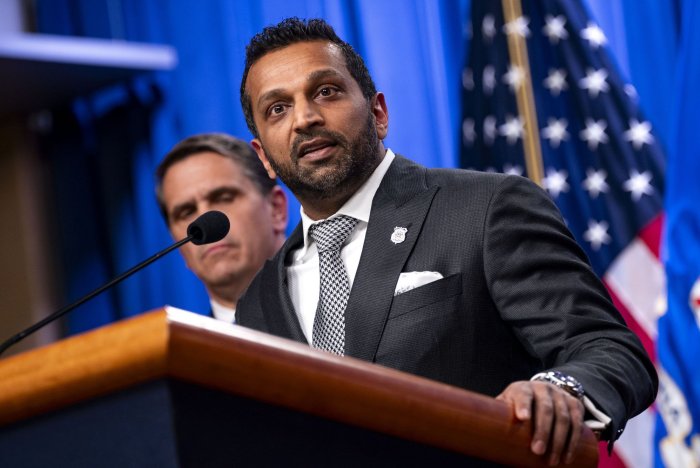
FBI Director Kash Patel speaks during a press conference at Department of Justice Headquarters on Tuesday. The Trump Administration announced charges against the Southern Poverty Law Center, which the government alleges funneled over $3 million toward white supremacist and extremists groups. Photo by Bonnie Cash/UPI | License Photo
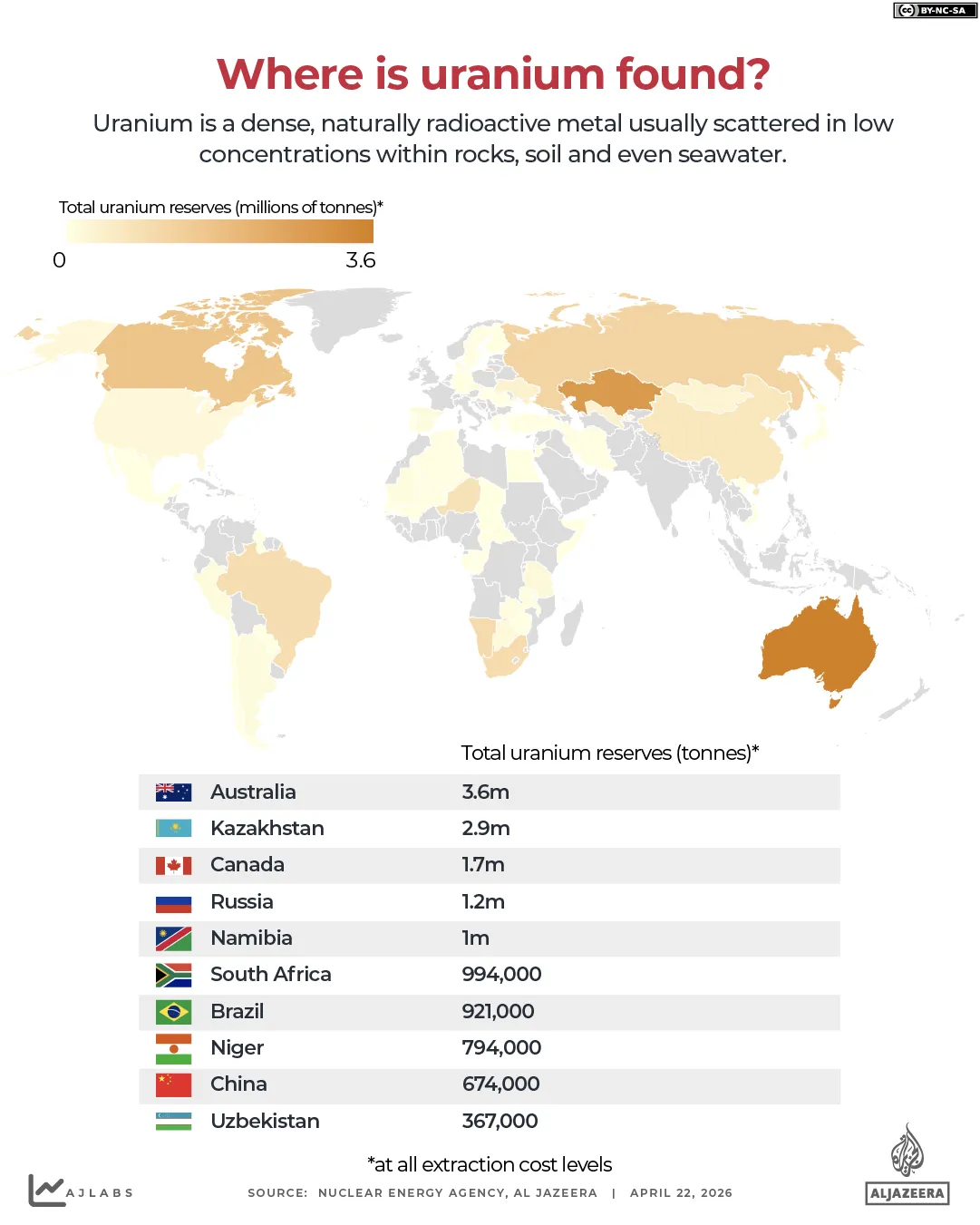
United States President Donald Trump has claimed that a new nuclear deal being negotiated with Iran will be “far better” than the 2015 Joint Comprehensive Plan of Action (JCPOA), which the US withdrew from in 2018 during his first term.
On Tuesday, Trump extended the two-week ceasefire with Iran a day before it was set to expire, with hopes for a second round of talks in Islamabad, Pakistan.
Key among the US demands is that Iran stop all enrichment of uranium.
Iran has always insisted its nuclear programme is for civilian use only, such as for power generation, which requires uranium enrichment of between 3 percent and 5 percent. To build nuclear weapons, uranium needs to be enriched to 90 percent.
In this explainer, we visualise what uranium is, how it is enriched and how long it could take Iran to make a nuclear weapon.
What is uranium, and which countries have it?
Uranium is a dense metal used as a fuel in nuclear reactors and weapons. It is naturally radioactive and usually found in low concentrations in rocks, soil and even seawater. About 90 percent of the world’s uranium is produced in just five countries: Kazakhstan, Canada, Namibia, Australia and Uzbekistan. Reserves of uranium have also been found in other countries.
Uranium is extracted either by digging it out of the ground or, more commonly, through a chemical process that dissolves uranium from within the rock.
Before it can be used as nuclear fuel, uranium is processed through several different forms, including:
Yellowcake: Mined ore is crushed and treated with chemicals to form a coarse powder known as yellowcake, which, irrespective of its name, is usually dark green or charcoal in colour, depending on how hot it has been treated.
Uranium tetrafluoride: Yellowcake is then treated with hydrogen fluoride gas, which turns it into emerald-green crystals known as uranium tetrafluoride or green salt.
Uranium hexafluoride: Green salt is further fluorinated to create a solid white crystal known as uranium hexafluoride. When heated slightly, this crystal turns into a gas, making it ready for enrichment.
Uranium dioxide: The gas is spun in a centrifuge machine, which chemically converts it into a fine, black powder.
Fuel pellets: The black powder is pressed to form black ceramic pellets, which can then be used in a nuclear reactor.
How is uranium enriched?
Natural uranium exists in three forms, called isotopes. They are the same element, with the same number of protons but different numbers of neutrons.
Most naturally occurring uranium (99.3 percent) is U-238 – the heaviest and least radioactive – while about 0.7 percent is U-235 and trace amounts (0.005 percent) are U-234.
To generate energy, scientists separate the lighter, more radioactive U-235 from the slightly heavier U-238 in a process called uranium enrichment. U-235 can sustain a nuclear chain reaction while U-238 cannot.
To enrich uranium, it must first be converted into a gas, known as uranium hexafluoride (UF₆). This gas is fed into a series of fast-spinning cylinders called centrifuges. These cylinders spin at extremely high speeds (often more than 1,000 revolutions per second). The spinning force pushes the heavier U-238 to the outer walls, while the lighter U-235 stays in the centre and is collected.
A single centrifuge provides only a tiny amount of separation. To reach higher concentrations – or “enrichment” – the process is repeated through a series of centrifuges, called a cascade, until the desired concentration of U-235 is achieved.
What are the different levels of uranium enrichment?
The higher the U‑235 percentage, the more highly enriched the uranium is.
Small amounts (3-5 percent) are enough to fuel nuclear power reactors, while weapons require much higher enrichment levels (about 90 percent).
The International Atomic Energy Agency (IAEA) considers anything below 20 percent to be low-enriched uranium (LEU), while anything above 20 percent is considered highly-enriched uranium (HEU).
Low enriched – less than 20 percent
Commercial grade – 3-5 percent: This is the standard fuel for the vast majority of the world’s nuclear power plants
Small modular reactors – 5-19.9 percent: Used in more modern reactors and advanced research reactors
Highly enriched – More than 20 percent
Research grade – 20-85 percent: Used in specialised research reactors to produce medical isotopes or to test materials
Weapons grade – above 90 percent: This is the level required for most nuclear weapons
Naval grade – 93-97 percent: Used in the nuclear reactors that power submarines and aircraft carriers
Depleted uranium, which contains less than 0.3 percent U‑235, is the leftover product after enrichment. It can be used for radiation shielding or as projectiles in armour‑piercing weapons.
How long does it take to enrich uranium?
The effort it takes to enrich uranium is not linear, meaning it is much more difficult to go from 0.7 percent natural uranium to 20 percent LEU than it is to go from 20 percent to 90 percent HEU. Once uranium reaches 60 percent enrichment, it becomes much quicker to reach 90 percent weapons grade.
The effort it takes to enrich uranium is measured in separative work units (SWU).
According to the IAEA, Iran is believed to have about 440kg (970lbs) of uranium enriched to 60 percent – enough to theoretically build 10 or 11 low-technology atomic bombs if refined to 90 percent.
The then-President Mahmoud Ahmadinejad inspecting the Natanz nuclear plant in central Iran, March 2007 [Handout/Iran President’s Office via EPA]
Ted Postol, professor emeritus of science, technology and international security at the Massachusetts Institute of Technology (MIT), told Al Jazeera that before the US attack on Iran’s nuclear facility at Fordow, the country had at least 10 cascades of 174 IR-6 centrifuges in operation – meaning 1,740 IR-6 centrifuges.
The IR-6 is one of Iran’s most advanced centrifuge models. The country also has tens of thousands of older centrifuges.
Little is known about the conditions of these centrifuges or the stocks of uranium hexafluoride, which are still believed to be buried underground.
Postol has calculated that Iran’s cascade of centrifuges could produce 900 to 1,000 SWUs annually.
“Getting from natural uranium to 60 percent enrichment, which Iran has already achieved, takes roughly five years, and about 5,000 SWUs using Iran’s cascades.”
“If I want to go from 60 to 90 percent, I only need 500 SWUs. So, instead of five years, [by] starting with the 60 percent here, this might take me four or five weeks. Because I am already very enriched,” Postol said.
Using an analogy of a clock, Postol explained: “Let’s say it takes seven minutes to get 33 percent enrichment, and then eight minutes to get to 50 percent enrichment. It only takes me one minute to get to total [90 percent] enrichment.”
How easy would it be for Iran to build a nuclear weapon?
Postol said Iran’s stockpile is held underground, meaning a military strike would not necessarily eliminate the nuclear threat.
A single centrifuge cascade capable of enriching weapons-grade uranium could take up “no more floor space than a studio apartment, making it easily hidden in a small laboratory”, he said, estimating the area at 60sq metres (600sq feet).
“A single Prius Compact Hybrid car can produce enough electric power to run four or more of these cascades at a time,” Postol added, meaning “Iran can covertly convert its 60 percent uranium into weapons-grade uranium metal”.
“What they have done is put themselves in a position where anybody who thinks about attacking them with nuclear weapons has to know that they could be sitting in those tunnels after such an attack, refining [and] enriching the final step they need to build atomic weapons and converting it to metal, and building a nuclear weapon, and that they have the means to deliver it,” Postol said.
“They would have all of the technical equipment they need to build the atomic weapons. And they have the missiles, which are also in the tunnels and can be manufactured in addition to what they already have. And the atomic weapon would not need to be tested, because uranium weapons do not need to be tested before they’re used.”
What does the NPT say about enrichment?
The Treaty on the Non-Proliferation of Nuclear Weapons (NPT), established in 1968, is a landmark international agreement aimed at preventing the spread of nuclear weapons and promoting peaceful uses of nuclear energy. Iran is a signatory to this pact.
The treaty supports the right of all signatories to access nuclear technology and enrich uranium for peaceful purposes, including energy, medical or industrial purposes, with precise safeguards to ensure it is not diverted to make weapons.
Under the NPT, nuclear-weapon states agree not to transfer nuclear weapons or assist non-nuclear-weapon states in developing them. Non-nuclear-weapon states also agree not to seek or acquire nuclear weapons.
Despite this, most nuclear powers are currently modernising their arsenals rather than dismantling them.
Most of the countries are signatories, except five: India, Pakistan, Israel, South Sudan and North Korea.
What agreements has Iran made about its nuclear programme in the past?
In 2015, under the Obama administration, Iran struck a deal with six world powers — China, France, Germany, Russia, the United Kingdom and the US — plus the European Union, known as the JCPOA.
Under the pact, Tehran agreed to scale down its nuclear programme, capping enrichment to 3.67 percent, in exchange for relief from sanctions.
“The Iranians agreed to it, and they were following the treaty. There was no problem with the treaty at all, absolutely no problem,” Postol said.
“They were allowed to have 6,000 centrifuges, which, if they had natural uranium, they could probably build a bomb within a year if they were secretly using these centrifuges, but that was all under inspection. They were just simply going to enrich to 3.67 percent, which is for a power reactor. They’re allowed to do that by the Non-Proliferation Treaty.”
But in 2018, Trump pulled out of the deal, calling it “one-sided” and reimposing sanctions on Iran. Iran responded by eventually resuming enrichment at Fordow.
After the US killed Iran’s General Qassem Soleimani in January 2020, Tehran stated it would no longer follow the set uranium enrichment limits.
Former President Joe Biden made attempts to revive the deal, but it never came to fruition due to disagreements over whether sanctions should be lifted first or Iran should rejoin the JCPOA first.
Trump has repeatedly said Iran should not have the ability to produce nuclear weapons. It has been one of Washington’s red lines during talks with Iranian officials over the past year, and was also the central justification that Washington used when it bombed Iranian nuclear facilities during the 12-day US-Israel war on Iran last year.
In the current negotiations, Iran has said it is willing to “downblend” its 60 percent enriched uranium to about 20 percent – the threshold for low-enriched uranium. The process of downblending involves mixing stocks with depleted uranium to achieve a lower percentage of enriched U-235 overall.
“From the point of view of showing goodwill, I think it’s good, it shows that the Iranians are thinking of ways to address what the Americans claim are their concerns,” Postol said.
Which countries have nuclear weapons?
Nine countries possessed roughly 12,187 nuclear warheads as of early 2026, according to the Federation of American Scientists. Approximately two-thirds are owned by two nations – Russia (4,400) and the US (3,700), excluding their retired nuclear arsenals.
Some 9,745 of the total existing nuclear weapons are military stockpiles for missiles, submarines and aircraft. The rest have been retired. Of the military stockpile, 3,912 are currently deployed on missiles or at bomber bases, according to the Federation of American Scientists. Of these, some 2,100 are on US, Russian, British and French warheads, ready for use at short notice.
While Russia and the US have dismantled thousands of warheads, several countries are thought to be increasing their stockpiles, notably China.
The only country to have voluntarily relinquished nuclear weapons is South Africa. In 1989, the government halted its nuclear weapons programme and began dismantling its six nuclear weapons the following year.
Israel is believed to possess nuclear weapons, with a stockpile of at least 90. It has consistently neither confirmed nor denied this, and despite numerous treaties, it faces little international pressure for transparency.
Andrew McClements, customer experience and transformation director at TPE, said, “We’re pleased to be introducing services that give customers more choice, added flexibility, and an improved overall experience when travelling with us.”
Other changes to the TPE timetable will see an update to 08.05am weekday services between Leeds and Manchester Piccadilly come into place.
The regular service will begin to call at Dewsbury.
This is to help commuters and students with early morning commutes and to better connect them to the city.
TPE is also urging customers to check their usual routes to see if they have been impacted by the timetable changes.
It said, “Although most of our services are unchanged, we encourage customers to take a moment to check any journeys they make regularly.”
The airport train service will run through the nightCredit: Alamy Stock Photo
A skincare expert has shared which beauty products are likely to cause problems at airport security due to hand luggage liquid rules – and how to avoid any hold-ups
Certain products can cause delays(Image: PoppyPixels via Getty Images)
With summer getaways fast approaching, countless holidaymakers are gearing up to travel overseas. As skincare continues to surge in popularity, many will be packing their creams and serums – yet skincare specialists are cautioning that transporting these products can prove more complicated than anticipated.
Skincare specialist Rhysa Phommachanh explained: “Many travellers are now packing full skincare routines in their hand luggage, but it can be confusing knowing which products are allowed. As a general rule, if a product can be spread, rubbed, or sprayed, it will usually fall under airport liquid restrictions.”
For instance, numerous skincare products nowadays appear as jellies, balms and sticks.
All of these are classified as liquids by airport security, as are sheet masks and eye patches.
Failing to adhere to airport security regulations could result in travel disruptions or having your belongings seized.
To conserve luggage space, travellers sometimes transfer larger items into smaller containers to meet requirements.
Nevertheless, these unidentified containers can prompt queries at security and trigger manual inspections, which can prove time-consuming.
It’s also probable that any pressurised containers such as facial mists, setting sprays or spray sunscreens will require manual examination and slow down security lines.
It is crucial to familiarise yourself with the regulations at each airport you pass through, as updated liquid rules are gradually being introduced across the country.
Restrictions may vary from one airport to another, so ensure you are fully aware of the specific guidelines before you board your flight.
When it comes to skincare, a minimalist approach often yields the best results.
As reported by the Express, Rhysa said: “A more simplified approach tends to work best for long-haul travel.
“Basic essentials such as lip balm, a lightweight moisturiser, or a facial mist are usually more than enough to maintain hydration without overwhelming the skin barrier.”