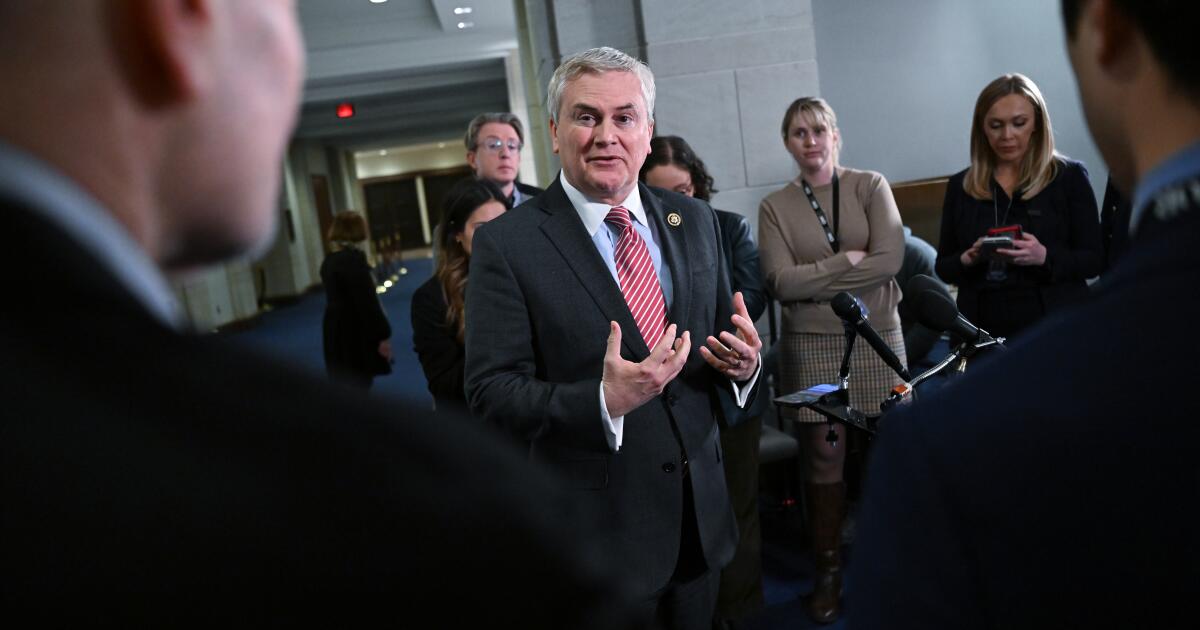
WASHINGTON — The Republican chair of the House Oversight Committee said some of its members would support a presidential pardon for convicted sex trafficker Ghislaine Maxwell in exchange for her assistance in the committee’s investigation into Jeffrey Epstein.
But good luck getting any of them to admit it.
Rep. James Comer (R-Ky.) told Politico Wednesday that “a lot of people” support the idea of Maxwell receiving a pardon from President Trump in exchange for her cooperation in the committee’s investigation.
Although Comer said he opposed a pardon himself — “other than Epstein, the worst person in this whole investigation is Maxwell” — he offered that his committee was “split” on the issue.
Rep. Robert Garcia of Long Beach, the top Democrat on his committee, condemned the idea of a Maxwell pardon and said Democrats on the committee uniformly oppose it.
“It’s outrageous that Republicans on the Oversight Committee are considering a pardon for Ghislaine Maxwell,” Garcia said in a statement. “She is a sexual abuser who facilitated the rape of women and children.”
The Times reached out to all 26 Republicans on the committee to see who, if anyone, supported the idea of a pardon.
Although most didn’t respond, the few who did expressed outrage at the idea.
“I am absolutely not supporting a pardon for her nor have I heard that from anyone else,” said Rep. Anna Paulina Luna (R-Fla.).
“Never in a thousand years,” said Rep. Clay Higgins (R-La.).
Maxwell declined to answer the committee’s questions during a video deposition in February from the Texas federal prison where she is serving her 20-year prison sentence.
She is still challenging her 2021 conviction on five counts related to the sex trafficking of minors for her role in recruiting and grooming girls for Epstein to abuse. She was accused at trial of also participating in the abuse of one victim.
At the time of her February deposition, Maxwell’s attorney David Oscar Markus said she would offer the “unfiltered truth” if granted clemency by Trump.
Attorneys who have represented victims abused by Epstein and Maxwell strongly opposed the idea of a pardon.
“This is a woman who belongs behind bars for the rest of her life for what she did to women,” said Spencer Kuvin, who has represented numerous Epstein victims.
Sigrid McCawley, a managing partner at Boies Schiller Flexner, questioned the value of information Maxwell could provide.
“Ghislaine Maxwell is a proven self-serving liar,” McCawley said in a statement. “There is nothing credible that she will offer the government, and the assertion that she would provide information is simply a smoke screen.”
Trump has not said he is considering a pardon but when asked by reporters he has declined to rule it out.
Epstein abused more than 1,000 girls and young women over the span of decades. He negotiated a lenient deal nearly two decades ago with federal prosecutors in south Florida that allowed him to serve 13 months in a Palm Beach County jail where he was allowed to come and go freely to settle claims that he had abused dozens of high school girls.
Following investigative reporting on that deal by the Miami Herald, federal prosecutors in the Southern District of New York brought new sex charges against Epstein in July 2019. He died in federal custody one month later.
Epstein and Maxwell counted members of the British royal family, multiple presidents and business titans among their friends.
They have been accused of forcing some of their victims to have sex with some of those men. But Maxwell is the only other person who has ever been charged in connection with Epstein’s crimes.
The committee has deposed numerous people who knew Epstein, including Ohio billionaire Les Wexner, who hired Epstein to manage his finances, and former President Clinton and former Secretary of State Hillary Clinton.
The committee has not, however, deposed Trump, who once famously called Epstein a “terrific guy” and said, “I just wish her well,” when told of Maxwell’s arrest in 2020.
The Department of Justice has also released millions of pages of documents from its investigations into the deceased sex offender in response to the bipartisan Epstein Files Transparency Act, which was signed into law last year.
The release of the files has led to criminal inquiries in the United Kingdom into Andrew Mountbatten-Windsor, the former prince, and Peter Mandelson, the former British ambassador to the United States, over allegations that they provided secret government information to Epstein.
So far, the files have not led to any publicly known criminal investigations in the United States.
Enzo Fernandez is wanted by Manchester City, Aston Villa have identified James Trafford as a potential replacement for Emiliano Martinez, Manchester United are keen on Micky van de Ven and Carlos Baleba.
Ivory Coast winger Yan Diomande’s agents have already held discussions with Liverpooland Paris St-Germain, but RB Leipzig are keen on keeping the 19-year-old at the club for at least one more season. (Bild – in German, external)
Brightoncentre-back Igor Julio could be set for a return to Brazil with Cruzeiro exploring the situation of the 28-year-old, who spent the first half of the season on loan at West Ham. (ESPN – in Portuguese, external)
Brentfordhave taken a strong interest in Dynamo Kyiv and Ukraine striker Matviy Ponomarenko, 20, as a potential replacement for 24-year-old Brazilian Igor Thiago, who could be a summer target for Chelseaand Tottenham. (Teamtalk, external)
Nottingham Forestwill attempt to sign Celtic midfielder Arne Engels in the summer after having a bid of £25m for the 22-year-old Belgian rejected by the Scottish club in February. (Teamtalk, external)
Tottenhamare in talks with Sebastian Kehl over becoming their new co-sporting director after the 46-year-old German left Borussia Dortmund last month.(Sun), external
Dozens of mourners, journalists and family attended the funeral of Amal Khalil, a Lebanese journalist who was killed in an Israeli attack in south Lebanon. Heidi Pett breaks down what we know about the incident, and Khalil’s last message to her family.
Rodríguez announced four categories for state assets, with “non strategic” ones destined for privatization or liquidation. (Presidential Press)
Caracas, April 23, 2026 (venezuelanalysis.com) – Venezuelan Acting President Delcy Rodríguez has established a commission to assess the “strategic” value of state-owned assets and their possible transfer to the private sector.
The Commission for the Evaluation of Public Assets held its first meeting on Wednesday. In a short televised message, Rodríguez said the commission had the purpose of bringing “agility and modernity” to the Venezuelan state.
The acting president announced that Venezuelan state assets would be divided into four categories: strategic ones to remain under state control, “strategic alliances” where the state retains ownership but management is turned over to the private sector in concession-type deals, “non-strategic” assets to be fully privatized; and assets to be liquidated or reincorporated elsewhere.
“The purpose of this commission is to elevate Venezuela’s productivity levels, so that the Venezuelan state can be robust and attend to the strategic aspects of the nation,” she said.
The commission includes Economic Sector Vice President Calixto Ortega, Finance Minister Anabel Pereira, Industry Minister Luis Villegas, State Solicitor Arianny Seijo, Communes Minister Ángel Prado, as well as Luis Pisella, former president of industry guild CONINDUSTRIA, representing the private sector.
Former Venezuelan President Hugo Chávez spearheaded a nationalization campaign in the 2000s to impose state control of key economic areas such as oil, electricity, telecoms, banking, and the heavy industries.
In recent years, with the economy heavily targeted by US sanctions, the Nicolás Maduro government expanded “strategic alliances” with the private sector, particularly in the Venezuelan countryside. However, campesino organizations have denounced that the private takeover of companies that formerly supplied seeds, inputs, and tractors has significantly raised costs for small-scale producers. Strategic alliances in sugar mills have also drawn complaints of companies defrauding sugar cane growers.
The Cisneros Group, one of Venezuela’s largest private sector conglomerates, has recently announced plans to raise over $1 billion in funds ahead of potential sell-offs of state assets.
Elias Ferrer Breda, financial analyst and director of Orinoco Research, told Venezuelanalysis that he foresees privatizations in basic industries such as steel and cement.
“In my view, we will see virtually all the industries that are running at low capacity and without turning profits privatized,” he predicted. “We are talking about industries like steel and cement, but also other sectors like hotels or agricultural land.”
Ferrer affirmed that state companies currently under strategic alliances, such as sugar mills or Ferrominera Orinoco, an iron-ore complex presently managed by India’s Jindal Steel, could continue under similar deals as opposed to being sold outright.
“Where investors have mostly expressed an interest is in extractive industries: oil and mining,” he added. Ferrer additionally claimed that US “strategic and business interests” are likely to pursue control over Venezuelan critical mineral reserves, which are not presently certified.
Rodríguez had unveiled the commission to evaluate state assets in an April 9 presidential address. The acting leader also set in motion efforts to reform Venezuela’s labor, tax, and pension legislation. The Venezuelan National Assembly has recently approved pro-business overhauls of the country’s hydrocarbon and mining laws.
Caracas reestablished dealings with the International Monetary Fund (IMF) and the World Bank on April 16. On Wednesday, Rodríguez disclosed a conversation with IMF Managing Director Kristalina Georgieva and stated Caracas’ priority in unblocking around US $5 billion worth of Special Drawing Rights to improve public services such as electricity and water supply.
For her part, Georgieva acknowledged a “very valuable and productive call” and that the next steps include IMF “policy advice and capacity development.”
Venezuelan leaders have vowed that there are no plans to incur IMF debt. However, the Caribbean nation could soon face pressure from creditors looking to collect on a massive external debt, with unpaid loans, defaulted bonds, and international arbitration awards totaling as much as $170 billion with accrued interest.
On April 16, the so-called Venezuelan Creditor Committee held talks with US officials amid efforts to secure a license to engage in debt negotiations with Caracas. The committee includes Fidelity Management & Research Company LLC, Morgan Stanley Investment Management, Greylock Capital Management, and others.
Since the January 3 US military strikes and kidnapping of Venezuelan President Nicolás Maduro, the Trump administration has seized control of Venezuelan oil revenues while issuing licenses to grant Western corporations favorable access to the Caribbean nation’s energy and mining sectors.
MORE than three decades after London helped launch her career, Tori Amos is back in the city, headlining the Royal Albert Hall for a tenth time.
The US singer is chatty and upbeat despite staying up until 5am, still riding the high of her gig the night before.
Sign up for the Showbiz newsletter
Thank you!
Tori Amos is back with her 18th album, In Dragon TimesCredit: Kasia Wozniak.Tori playing London’s Albert Hall on TuesdayCredit: Getty
With her striking red hair falling in waves and her vivid green eye make-up, Maryland-raised Tori, who has called Cornwall home since the late Nineties, looks every inch the star.
“London was the place that gave me my big exposure explosion,” she says.
“It really did shake my life up. And here we are again.
“London broke Silent All These Years in the autumn of 1991, and then launched [debut album] Little Earthquakes, which rippled out to the States and the rest of the world.
“America really discovered me through London, and then the UK did, too. From there, it just kept rippling outwards.”
On her forthcoming 18th album, In Times Of Dragons, Amos turns political dread, female resistance and personal storytelling into something unique and mythic.
She says: “I’m very reclusive at home and I’m not very sociable there so when I’m on tour I go from this insular life, where I do a lot of reading, music and writing, and step into this much more exposed life.”
The contrast between Amos’s secluded home life and her role as a performer feeds directly into an album shaped by both personal reflection and political unease.
The record is a response to the current political climate in America because, as a songwriter “a lot of my work is documenting time,” she tells me.
“That’s what I did with Little Earthquakes, which followed my time of failure after [her synth band] Y Kant Tori Read when I had to go back to play piano bars.
“I have a history of documenting things — my miscarriage in 1998 and that journey, then my 2002 album Scarlet’s Walk which documented 9/11 when I actually wrote some of it on the tour bus.”
The idea for In Times Of Dragons came through the muses — otherworldly entities — that Amos believes bring her music.
She has spoken widely about these guiding forces, which she says have inspired her songwriting since childhood.
And last year she published children’s book Tori And The Muses, all about them.
She says: “This message came to me through the muses that I needed to document America at this pivotal time in history.
“And I had to personalise this.
“It came to me a year ago that I needed to be me in the story and be closely connected to one of these people, and what that would look like, because they are personally affecting us.
“I had to turn the volume on that to create this narrative, whatever turning into a dragon looks like.”
The album follows the story of Tori trapped in a world run by billionaire tech moguls and lizard dragons, who threaten democracy through corporate greed and authoritarianism.
Amos says: “Jane Mayer writes about the genesis of this in Dark Money, which is one of the most important books people need to read if they’re asking, ‘How did we get here?’.
“This has been going on since the Seventies.
“As Mayer documents, figures like the Koch brothers — and I use that as an umbrella term for a wider movement — helped shape it, along with super PACs [organisations that spend millions supporting political candidates] and all the rest.
“It seems there was an understanding that progressive teaching in universities had to be excavated, cut back and penetrated by a very tight right-wing philosophy that is now upon us.
“And I’m not just talking about Republicans and Democrats. I’m talking about tyranny versus democracy.
“If you had asked me about this even around the Scarlet’s Walk era, I was already going after it through that record, and then through [2007 album] American Doll Posse during the Bush-Cheney administration with the wars, the manipulation, all of that.
“Then there was a period of relief, when a different, more inclusive philosophy came in, whatever your politics are.
“For me, it’s about the philosophy.
“As a songwriter, I’ve been tracking that through my career.
“On this record, I had to take a personal journey and look at the effects of what this very small cabal of men is doing — and there are women involved too, we can’t get confused about that.
“There’s Cambridge Analytica, the involvements of the Mercers, Rebekah Mercer [the right-wing US heiress and political donor] and all those interconnections.”
The album’s story sees Amos’s character flee and reunite with her daughter.
This part is played by her real-life daughter Natashya, who co-wrote tracks Veins, Strawberry Moon and Stronger Together — the latter of which she also sings backing vocals on, and is one of the most emotional songs on the record.
“She was in DC at the time, in law school, and she graduates in a few weeks,” says Amos proudly.
“She’s going into criminal law and really had her finger on the pulse.
“On a daily basis she’s seeing things that the wider public probably isn’t, unless you’re a political journalist.
Tori in a shoot for the new album. An actress portrays her daughter, who co-wrote three songs and sings backing vocalsCredit: Unknown
“We’re so inundated that the little freedoms being quietly taken away can be missed.
“Criminal law is her calling.
“So, writing these songs with her, with her understanding of what’s happening in the field she’s chosen, and her exposure to the shock of what is being torn to pieces, was hugely important.
“She says we are past constitutional crisis and what’s going on is absolutely shocking.”
The final song, written last- minute for the album, is Ode To Minnesota — a response to the deaths caused by ICE agents there.
She says: “Heinous, atrocious crimes are being committed and so this is the world of the record.”
Amos, 62, has a long history of addressing America in song, and In Times Of Dragons continues that while exploring wider patterns of male power.
It’s also a reminder of her role as a feminist icon and the influence she’s had on artists such as Lady Gaga, Florence Welch and St Vincent (real name Annie Clark).
“Annie’s one of my dear friends,” she says of St Vincent.
“She’s fabulous. We have a giggle and I’m thrilled for her, for her art, and for the way she’s balancing motherhood so beautifully.
“It’s lovely to see people who came to my shows when they were younger.
“She’s talked to me about Choirgirl [Tori’s 1988 album From The Choirgirl Hotel] and what it meant to her when she first heard it, and we’ve had laughs about that.
“And it’s the same with the guys too.
“I’m off to an event later and the guy doing the Q&A used to stand by the stage door as a teenage gay kid.
“To see these people grow up, and to still be able to bask in their creativity and development, is a beautiful thing to witness.”
But while Amos is moved by the artists and fans who have grown up with her work, she is hesitant to define her own feminist legacy.
She says: “It’s not for me to say, that’s more for other people to decide.
“Believe it or not, I’m a bit introverted about that.
“What I think I’ve tried to do, and what I have done, is there for those who know it.
“What’s important to remember is that there was no social media then.
“When people ask, ‘Was it easier back then?’, well, in some ways no, and in others yes.
“We did have a music business with a few women in record companies, though only a few in executive positions.
“One or two could balls their way through, but you really had to.
“And if you didn’t have that tenacity in the Nineties — especially to get played on radio — it was tough.
“At an alternative station in the States, they might add two women out of 64 slots, and the other 62 would be men.
“I’ve spoken about that with some of my contemporaries over the years, Alanis [Morissette] being one of them, and it was not a good feeling — knowing that talented women with very good records were simply not being added to the station.
“And touring took money.
“That’s why I never had tour support.
“In the early days, I went out with just a piano, my tour manager and a sound guy. That was it.
“We kept the costs down, and luckily the shows sold out, because the Press had really got behind me.”
Today, Amos points to Dolly Parton as proof that women can keep evolving, performing and owning the stage on their own terms as they get older.
“She is fantastic and she’s aware we are a different generation that played this game and played it well,” says Amos.
“There are women who are still playing the game beautifully, and they still have the physicality and the health to do it.
“I used to have a three-and-a-half octave range when I was doing those one-woman shows.
“But with the change of life — becoming a dragon, if that’s the menopause analogy — you adapt or you collapse.
“For me, it wasn’t a crisis in the way it has been for some women we’ve read about in the Press, and I have huge empathy for that.
“But vocally, I did have to make changes.
“I didn’t want to alter the top lines of songs with those very high, wide-ranging melodies, so on the last tour I simply didn’t play them.
“Then I thought, ‘No, that isn’t what I want.
“I want the whole catalogue available to me as a storyteller’.
“So, I decided to bring in backing singers who could hit those notes.
“It was a strategic, compositional choice.
“I didn’t want to be in a position where I could only perform 40 per cent of my catalogue because of range.
Tori at the 1992 MTV Video Music Awards in Los AngelesCredit: Getty
“And we’re having a blast.
“They’re amazing singers.
“I’ve gained four notes at the lower end and I feel like I’m down there rocking with Nick Cave, but that’s the trade-off.
“I gained more on the lower end, while recognising that if I want to play those songs, you can only transpose them down so far before they lose their essence.
“I have so much respect for Nick Cave.
“I used to run into him in the early Nineties.
“His work has always been a beacon of beauty and darkness — expansive work that makes you think.”
Like Cave, Amos remains restlessly creative, and she is already thinking about where to go next.
“After something as demanding as this, I’m doing a prequel to children’s book Tori And The Muses — that will be out next year,” she says.
“Her journey as a little girl with her muses.
“It’s due next April — and there may be music to go with it too.”
In Times Of Dragons is out on May 1.
Tori Amos’ In Times Of Dragons is out on May 1Credit: Kasia Wozniak.
California’s trial attorneys and Uber — longtime courtroom foes — are officially bringing their fight to the November ballot.
A coalition of lawyers and advocates announced Thursday that it has gathered enough signatures to ask voters to support a “first in the nation” law that would make rideshare companies legally responsible for sexual assaults that happen to a driver or customer during a trip. Uber has argued it’s not liable for assaults committed by drivers, who are considered independent contractors.
“We must hold Uber accountable today,” said Danielle Tudahl, who recounted being sexually harassed and chased by an Uber driver after ordering a ride through the app, at a Sacramento news conference. “Californians are finally demanding action to try and close some of these gaps and put people’s safety over corporate profits.”
Uber has described the ballot measure, which is sponsored by the Consumer Attorneys of California, or CAOC, as retaliation for its own November ballot push to cap how much attorneys can earn in car crash cases in California.
“This ballot measure is a cynical ploy by billboard lawyers,” said Nathan Click, a spokesperson for A More Affordable California, an Uber-backed coalition. “CAOC didn’t spend millions to put this on the ballot to protect survivors — their goal is protecting billboard lawyer profits.”
The coalition that supports Uber announced last week it had gathered enough signatures for a measure that would cap attorney fees for car crash cases at 25%, among other changes.
Uber says its ballot measure will give victims a larger cut of their settlement money, rather than the payout getting siphoned off primarily to attorneys and doctors. Attorneys fire back that it will leave thousands of people with small or thorny cases without a lawyer because they won’t have financial incentive to sue.
Both sides are gearing up for an expensive fight. Uber has given more than $77 million. The Alliance Against Corporate Abuse, the CAOC-backed coalition pushing the sexual assault measure, has raised more than $68 million from law firms across the state, according to campaign finance records.
The money has helped pay for billboards that have sprouted across L.A. informing drivers that, according to the New York Times, Uber received a report of sexual assault or misconduct every eight minutes on average between 2017 and 2022. The company was the subject of a series of investigations by the paper into sexual assault by drivers. The company says it has invested billions in keeping riders safe and has “done more than any other company to confront” sexual violence.
The proposed sexual assault measure would require ride-share companies to let riders know if the person picking them up has a history of sexual misconduct and conduct yearly fingerprint and background checks for drivers.
The company is currently fighting more than 3,000 lawsuits from passengers who claim they were sexually assaulted or harassed by Uber drivers. Those cases are being coordinated by a federal judge in California.
The attorney coalition had also pushed an initiative aimed at nullifying Uber’s fee-capping measure if it passed. Alex Stack, a spokesperson for the campaign, said they were “pausing/withdrawing” the measure to “focus the fight on our sexual assault prevention measure and beating Uber’s initiative.”
As many as a dozen letters — including one from the NBA — were submitted by the attorney for Aspiration Partners co-founder Joe Sanberg ahead of his sentencing Monday in an effort to persuade the judge to trim the 17 years prosecutors have requested for each of the two counts of fraud.
Sanberg pleaded guilty in October to the federal charges of conspiring to bilk investors out of $248 million for portraying the now-defunct Aspiration as a “socially-conscious and sustainable banking services and investment products” firm.
Another letter was also submitted, however, and it wasn’t intended to assist Sanberg.
Clippers owner Steve Ballmer’s attorney David N. Kelley of O’Melveny and Myers wrote that Ballmer was defrauded of a $60-million investment in Aspiration and that the harm to his reputation is “immeasurable.”
The five-page Victim Impact Statement concludes: “Mr. Ballmer’s losses are not measured solely, or even primarily, on a balance sheet. They are measured in the reputational damage that will take years to remediate, and in the chilling effect on future endeavors intended to do good at scale.
“We ask the court to impose a sentence that accounts for those harms, promotes respect for the law, and deters those who would seek to appropriate the reputations of others to advance fraudulent aims.”
The letter states that the Clippers lost out on a $300 million sponsorship agreement with Sanberg in exchange for the team to wear Aspiration jerseys patches. Also lost was about $20 million the Clippers paid for carbon offset purchases and the $60 million Ballmer invested in the company.
Ballmer, a former long-time CEO of Microsoft, accused Sanberg of targeting him for his well-known interest in environmental sustainability and exaggerating their relationship to convince others to invest in the fraudulent company. In the letter, Ballmer says he met Sanberg only once.
Ballmer was added in November as a defendant in an existing civil lawsuit against Sanberg and several others associated with Aspiration. Ballmer and the other defendants are accused by 11 investors in Aspiration of fraud and aiding and abetting fraud, with the plaintiffs seeking at least $50 million in damages.
The letter dismisses the allegations in the lawsuit as “nonsense,” stating Ballmer was added as a defendant because of his “visibility and resources,” and reiterates that Ballmer himself is a victim of fraud. The action has damaged his reputation, the letter states, “and has further linked Mr. Ballmer to Sanberg’s fraud in the eyes of the public.”
The letter to the court, however, makes no mention of the $28-million contract Clippers star Kawhi Leonard signed with Aspiration for endorsement and marketing work. Players are allowed to have separate endorsement and other business deals, but at issue is whether the Clippers participated in arranging the side deal beyond simply introducing Aspiration executives to Leonard.
Leonard has addressed the accusations only once, denying wrongdoing and saying, “I understand the full contract and services that I had to do. Like I said, I don’t deal with conspiracies or the click-bait analysts or journalism that’s going on.”
The arrangement could be considered circumventing the NBA salary cap, a serious violation of league rules. Ballmer steadfastly denies arranging the deal between Aspiration and Leonard, who by all accounts performed no duties for Aspiration.
The NBA is investigating the complicated relationships between Ballmer, Leonard and Aspiration. One of the letters submitted by Sanberg’s attorney to the judge is from the law firm conducting the probe, and it states that the disgraced executive provided documentation and information helpful to the NBA investigation during two in-person interviews.
“In all our dealings with Mr. Sanberg, both directly and through his counsel, he provided information that was consistent with our review of contemporaneous documents and other evidence,” wrote Dave Anders of Wachtell Lipton. “Mr. Sanberg’s cooperation substantially assisted our investigation, including our ability to develop a more complete understanding of key events.”
Eventually the ledger will include the results of the NBA investigation into the allegations against Ballmer and Leonard. And that finding might impact the reputation of both more than Sanberg’s fraudulent dealings.
Several Iranian officials have stressed that their country is united, rejecting United States President Donald Trump’s claims of a rift in the leadership in Tehran.
Iran’s President Masoud Pezeshkian, Foreign Minister Abbas Araghchi and Parliament Speaker Mohammad Bagher Ghalibaf all issued statements rejecting the United States president’s assertion.
Recommended Stories
list of 3 itemsend of list
Pezeshkian and Ghalibaf joined the Supreme National Security Council in posting the same message on X.
“In Iran, there are no radicals or moderates,” it said.
“We are all ‘Iranian’ and ‘revolutionary’, and with the iron unity of the nation and government, with complete obedience to the Supreme Leader of the Revolution, we will make the aggressor criminal regret his actions.”
Mohammad Reza Aref, Iran’s first vice president, also shared the statement, adding another note in English.
“Iran is not a land of rifts, but a stronghold of unity,” Aref said. “Our political diversity is our democracy, yet in times of peril, we are a ‘Single Hand’ under one flag. To protect our soil and dignity, we transcend all labels. We are one soul, one nation.”
Iranian Supreme Leader Mojtaba Khamenei has not made a public appearance since replacing his father, Ali Khamenei, who was killed by US-Israeli strikes on February 28.
US officials have said that the younger Khamenei was wounded and “disfigured” in the strike that killed his father.
The New York Times reported on Thursday, citing unidentified Iranian officials, that Khamenei is gravely wounded but remains “mentally sharp”.
Trump and his aides have been reiterating daily over the past week that there are major disagreements among Iranian leaders.
The US president claimed that Iranians are “having a very hard time figuring out who their leader is”, alleging that there is “crazy” infighting between “moderates” and “hardliners” in Tehran.
Citing the supposed rift by Trump could serve to justify the extension of the ceasefire while also putting the blame on Iran for the stalled diplomacy.
Tehran, however, has stressed over the past days that the talks – previously scheduled to take place in Pakistan – are not happening due to the US blockade on its country’s ports.
On Thursday, Araghchi dismissed allegations that the Iranian military is at odds with the political leadership.
“The failure of Israel’s terrorist killings is reflected in how Iran’s state institutions continue to act with unity, purpose, and discipline,” he wrote on X.
“The battlefield and diplomacy are fully coordinated fronts in the same war. Iranians are all united, more than ever before.”
diplomatic impasse with the US, with Trump suggesting that he is comfortable with the status quo of blockading Iran’s ports to inflict economic pain on the country without resuming the war or rushing towards a conclusive deal.
“Iran’s Navy is lying at the bottom of the Sea, their Air Force is demolished, their Anti-Aircraft and Radar Weaponry is gone, their leaders are no longer with us, the Blockade is airtight and strong and, from there, it only gets worse — Time is not on their side!” Trump said on social media on Thursday.
“A Deal will only be made when it’s appropriate and good for the United States of America, our Allies and, in fact, the rest of the World.”
But the truce under the status quo remains tenuous. Air defences were activated over Tehran earlier on Thursday, but there has been no official confirmation of an attack against the country.
Earlier on Thursday, Trump said the US military will “shoot and kill” Iranian laying mines in the Strait of Hormuz, which could spark a response
And oil prices are once again rising due to the uncertainty and the double blockade in the Gulf – Iran closing down Hormuz and the US naval siege on Iranian ports.
Israel also appears ready to rejoin the war. Defence Minister Israel Katz said on Thursday his country is awaiting the green light from Trump to return Iran to the “age of darkness”.
“Israel is prepared to renew the war against Iran. The [Israeli military] is ready in defence and offence, and the targets are marked,” Katz said, according to the Times of Israel newspaper.
From protests to quiet resistance, dissent is rising inside the United States military over the US-Israel war on Iran.
As the US expands its war with Iran, opposition is growing – not just among the public, but inside the military itself. Some service members are questioning orders, exploring conscientious objection, and speaking out. What’s driving this shift, and how far could it go?
In this episode:
Mike Prysner (@MikePrysner), Executive Director of the Center on Conscience & War
Episode credits:
This episode was produced by Marcos Bartolomé, Tamara Khandaker, and Sarí El-Khalili with Spencer Cline, Tuleen Barakat, and our host, Malika Bilal. It was edited by Tamara Khandaker and Noor Wazwaz.
Our sound designer is Alex Roldan. Our video editors are Hisham Abu Salah and Mohannad al-Melhem. Alexandra Locke is The Take’s executive producer.
As Coronation Street’s power couple Swarla tie the knot, British LGBT Awards founder Sarah Garrett says the soap highlights huge progression in the representation of same-sex couples on TV
As Coronation Street’s power couple Swarla tie the knot, British LGBT Awards founder Sarah Garrett says the soap highlights progression in the representation of same-sex couples on TV(Image: ITV)
Lisa Swain and Carla Connor have finally said ‘I do’ on Coronation Street, leaving Swarla fans rejoicing.
The couple got together in 2024, growing closer before realising their feelings for one another. After almost two decades on Corrie, this is Carla’s first same-sex relationship, while it’s certainly not her first wedding.
That said, Carla has finally found her soulmate in Lisa, something agreed on by cast members Alison King and Vicky Myers who play the pair. But it’s not just about the characters and what it means to them.
There’s been a huge shift with how women-loving-women (WLW) romances are presented, and perceived, onscreen in recent decades. When you think back to the first pre-watershed lesbian kiss on UK TV, that aired on former soap Brookside in 1994, it sparked both backlash and praise, while it was historic in that it was something that had never been aired before 9PM until then.
Fast-forward 30 years and we now have Lisa and Carla’s wedding, and the soap’s first WLW wedding that sees both characters actually make it down the aisle. Viewers have backed the couple from the very start, with many fans inspired by their love story.
With the wedding airing during Lesbian Visibility Week, a deliberate choice by the soap, it has to be noted that many viewers feel represented by the characters and their union.
Yes, Swarla have had many obstacles in their time together, and more than most. They’ve had evil wives returning from the dead, killer brothers and a few hiccups along the way, not forgetting the disastrous proposals.
But they’ve made it, and Swarla are here to stay. It’s clear from the love the viewers have for Lisa and Carla that not only are they offering a powerful representation onscreen of a lesbian relationship, but it also shows how far television has come where the visibility of same-sex romance is concerned.
Addressing this progression and what Coronation Street has got right with Carla and Lisa, Sarah Garrett, Founder of the British LGBT Awards, shared her thoughts with The Mirror. She shared how much of an impact Swarla have had, and why it matters.
Sarah also shared what it was about Swarla, and what Corrie have done with the characters, that is so important – and why other TV shows and screenwriters should take note. Sarah told us: “In the 32 years since Brookside first aired a pre-watershed lesbian kiss on British television, same-sex relationships have been portrayed in many ways – the good, the bad and the ugly.
“What makes the portrayal of Carla and Lisa’s relationship so compelling is that it has never been framed as a coming-out story; instead, it is simply a story about falling in love. Their journey centres on two women who know exactly who they are, finding each other and building a relationship marked by compassion, conflict and vulnerability.
“It’s a powerful example of authentic storytelling and one from which screenwriters around the world could take note when depicting healthy, nuanced same-sex relationships.
“Going forward, the industry has the opportunity to build on this by continuing to normalise diverse relationships without sensationalism, investing in layered character development and allowing LGBTQ+ stories the same depth, longevity and ordinariness as any other on screen.”
Two of our esteemed gubernatorial candidates, the cowboy and the dilettante, apparently could not find ties for the first debate Wednesday night, showing up with dress shirts casually unbuttoned.
Mr. Middleground sported a scruffy sorta-beard, apparently unable to pay for a razor in the midst of California’s affordability crisis. It’s a trademark look that always makes me think if this doesn’t work out, he’ll opt to live on a boat in some not-too-expensive slip by the Bay.
The billionaire wore Nikes instead of dress shoes, a sartorial nod perhaps to his bid to be the outsider-fighter. Or maybe his feet just hurt.
The last two contenders were remarkably unremarkable.
Why start with fashion? Honestly, it might be the most interesting, and telling, bit of insight that came from this first (of three) chances for our next governor to let us know who they are and what they’re made of. If the debate showed us anything, it’s that none of these candidates are hiding follow-me charisma or an excitement-inducing political vision for our collective future.
Yes, there were a few decent jabs here and there about Tom Steyer’s money, Katie Porter’s temper, Matt Mahan’s tech ties and Chad Bianco’s far-right world view. But even those were predictable.
Still, in between the yawns, there were a couple of answers worth noting, ones that might actually give us insight into how the Democratic candidates differ (Despite all the hype, it seems increasingly unlikely that two Republicans will come out of the primary, and even more unlikely that in a Democratic vs. Republican race, the Democrat would lose in blue California.)
I’ll start with a surprising place where I agreed with Steve Hilton, the Republican endorsed by President Trump.
The candidates were asked if they would support a ban on social media for kids under age 16. This is a quickly accelerating idea not beloved by tech companies. Australia and Indonesia already have bans in place. Other countries, including France and Portugal, have them in the works. Florida banned children under 14 from opening social media accounts on their own last year.
And a Los Angeles jury last month dealt a blow to Meta and YouTube when it found the platforms had damaged the mental health of a young woman with their addictive features.
Hilton took the ban question a step further, saying it “misses the point.” He has long argued that it isn’t just social media that is the problem, but having kids staring at a digital device for hours a day instead of interacting in the real world. It was one of the most genuine answers of the night.
“We’ve got to get to the heart of the problem, and that’s the devices and the screens,” he said. “I think that every parent in their heart knows that it’s wrong.”
While Steyer and Xavier Becerra, the former California attorney general, both said they would support such a ban, the remaining three candidates hedged or said they would not. Porter said no to a ban under age 16, but said she “might consider a different ban,” without being specific.
Mahan, who is backed by significant tech money, and Bianco both said they believed requiring parental consent was the way to go (though Mahan said he would ban devices in schools).
As Becerra pointed out, “kids have died as a result of their use of social media,” so it’s a place where policy matters. And if a candidate doesn’t see government’s role in controlling the dangers of social media, what will happen with artificial intelligence?
The candidates also had differences in how they would handle homelessness and the related crisis of housing affordability, though the devil was often buried in the details.
At least for Democrats. For Bianco, the difference was stark.
“We are not dealing with homeless. So stop calling it homeless,” he snapped at the moderators. “It has nothing to do with homes. This is drug- and alcohol-induced psychosis, mental illness.”
Of course, this is wrong. Last year, the UC San Francisco Benioff Homelessness and Housing Initiative released the results of the state’s most comprehensive survey of homeless people. It found that for most people living on our streets, “the cost of housing had simply become unsustainable.” It also found an increasing percentage of those folks were older — almost half were over the age of 50 — and had become homeless after a hardship such as an illness or a job loss.
“It’s also families who are fleeing intimate partner and domestic violence,” Porter said. “It’s people who are double and tripled up. It’s people who are living in their cars on our college campuses. Homelessness comes in a lot of different forms.”
Most of the Democratic candidates seemed to understand this and embraced the increasingly popular idea of putting more money into helping people stay housed after a hardship, instead of trying to get them housed after they lose their place.
“How can I help you keep your home?” Becerra said. “Because it costs me so much more money to pick you off the streets, provide you with the assistance in the shelter, than it does to keep you in the home.”
But the issue of homelessness is also where daylight emerged between the candidates. Steyer said he and his wife had helped finance low-barrier homes, not just shelter spaces, where people do not need to be addiction-free and where they can bring pets — two issues that are common hindrances for moving folks off sidewalks voluntarily.
Mahan, the mayor of San José, who often touts his city’s success at moving people indoors, agreed that emergency and interim housing was critical, but also voiced support for forcing folks to accept help. Last year, San José passed an ordinance he backed that some say criminalizes homelessness — a person can be cited twice for refusing shelter, and a third refusal within 18 months can lead to an arrest.
“When shelter was available, we required that people come indoors,” Mahan said, adding, “We have to be able to mandate treatment.”
It’s a controversial position, but also one that is increasingly popular. Gov. Gavin Newsom has backed mandated treatment, in a lighter form, with his CARE Court (which is technically voluntarily). And the movement to require people to accept a shelter space or face arrest is growing on the right and even the Democratic-middle.
But there is a fine and dangerous line with mandated treatment and shelter requirements that is often pushed further and further to the side in favor of the clean, safe streets argument. Whenever we start locking folks up — whether it’s in mental wards or immigration detention centers or jails — we should be careful that expediency isn’t trumping ethics.
Of course, the debate would not be complete without the Democratic candidates’ position on our president, speaking of ethics.
Steyer was gleeful that Trump has come after him on social media, a point of pride that he is a relevant figure in the fight against MAGA. He also said he would abolish Immigration and Customs Enforcement if he could, which he can’t.
Becerra highlighted his many lawsuits as California’s attorney general during Trump’s first term, and pledged to keep fighting. Porter leaned into her time in Congress and her efforts to help Democrats in other races win.
Mahan took a different route, pledging to fight when necessary, but adding, “We need a partnership, and we need to find common ground with this administration on certain issues.”
Newsom learned the hard way that common ground is what Trump says it is, and shifts without warning or reason.
So what’s the takeaway from all this?
Boring dad; feisty mom; rich do-gooder; striving newcomer; MAGA one; MAGA two.
None of them hit it out of the park, but no one struck out. Maybe next time.
Thousand-dollar tickets and hundreds of dollars in fees shocked some hopeful Olympic fans this month, but they did not keep LA28 from boasting strong sales in the committee’s first ticket drop.
LA28 announced Thursday that it sold more than 4 million Olympic tickets during the first ticket drop. The private organizing committee will have a second ticket drop in August with “refreshed inventory across all Olympic sports at a range of price points.”
But after the popularity of the first purchasing period, many of the lower-priced tickets have already been scooped up.
LA28 said roughly half of the total 1 million $28 tickets were sold during the locals presale, which was limited to people living near venue cities in Southern California and Oklahoma City.
The average price per Olympic ticket is less than $200, which includes a mandatory 24% service fee, and LA28 said about 75% of all tickets, including final events, will be under $400. The premier seats at high-demand events command more than $1,000 per ticket, but the highest priced categories make up about 5% of the total ticket inventory.
Artistic gymnastics sold out the quickest in Drop 1. Four Olympic sports — flag football, lacrosse, softball and squash — sold all their available inventory for the first drop. After five days of local presale, global ticket sales opened and drew fans from 85 countries and all 50 states and U.S. territories. The largest international sales came from the United Kingdom, Canada, Mexico and Japan.
For the first female-majority Olympic Games, LA28 reported that women’s Olympic sessions outsold men’s 93% to 88% during the first drop.
“The response to our initial on-sale was nothing short of historic. Fans from near and far have spoken: the world wants to be part of the LA28 Games,” LA28 chief executive officer Reynold Hoover said in a statement. “The success of Drop 1 is about more than momentum — it reflects LA28’s commitment to delivering a fiscally responsible Games that create a lasting legacy for Los Angeles and its communities.”
Drop 2, which will begin in August, will have additional tickets across all Olympic sports, including those that may have sold out during the first purchasing windows. The registration period for Drop 2 opened Thursday at tickets.la28.org and will continue until July 22. Fans who registered for the first drop of tickets but did not receive a time slot and fans who did not buy their maximum 12 general ticket allotment will automatically be entered into the random lottery Drop 2. The new registration period is only required for anybody who did not sign up for the initial drop.
Fans are still limited to 12 Olympic tickets and up to 12 soccer tickets that don’t count toward the general maximum. There is a four ticket per ceremony limit for the opening and closing ceremony that count toward the 12-ticket maximum, which is cumulative across all LA28 presales and ticket drops.
LA28 will have multiple ticket drops with assigned purchasing time slots before ticket sales move to a first-come, first-served format closer to the Games, which open on July 14, 2028. LA28 began its ticketing process earlier than most other Olympic Games with tickets going on sale more than two years in advance of the opening ceremony. The early timeline has created excitement for the first Summer Olympics in the United States since Atlanta 1996, but also prompted concerns about scheduling. Fans clamored for tickets with little information about which teams or athletes would be competing in most sessions.
Tickets are not refundable, but fans can opt for verified resale when LA28 launches its official resale system in 2027. AXS and Eventim is the official secondary ticket marketplace of the LA28 Games and Ticketmaster and Sports Illustrated Tickets have also signed on as additional verified resale platforms.
LA28 will have 14 million tickets available for the Olympic and Paralympic Games, which would eclipse the record of 12 million tickets sold for the Paris Games. Paris 2024 sold an about 9.5 million tickets for the Olympics, but used a different ticket system than LA28. For Paris, 3.5 million tickets were sold during the first phase, during which fans were required to buy tickets to at least three different sports instead of the option for single-event tickets available during LA28’s Drop 1 process.
Tickets for the 2028 Paralympics, which will be the first in L.A.’s history, will go on sale in 2027. Ticket sales and hospitality are expected to cover about $2.5 billion of LA28’s expected $7.1 billion budget for the first Games in L.A. in more than 40 years.
Real Madrid could close gap on La Liga leaders Barcelona to six points on Friday, three weeks shy of a Clasico meeting.
Who: Real Betis vs Real Madrid What: Spanish La Liga Where: Estadio La Cartuja de Sevilla in Seville, Spain When: Friday at 9pm (20:00 GMT) How to follow: We’ll have all the build-up on Al Jazeera Sport from 17:00 GMT in advance of our live text commentary stream.
Real Madrid will continue their pursuit of league leaders Barcelona when they travel to Real Betis on Friday, but the record La Liga winners know that any slip-up now will be terminal for their hopes of lifting silverware this season.
Recommended Stories
list of 4 itemsend of list
Barca play at Getafe on Saturday but only narrowly beat Celta Vigo on Wednesday to respond to Real’s latest win a day earlier.
It has been a turbulent season for Los Blancos on and off the field, but they are still fighting. Al Jazeera Sport takes a closer look at their latest fixture.
How is the La Liga race between Real Madrid and Barcelona looking?
Barcelona are nine points clear of Real after their 1-0 win against Celta Vigo.
The two Spanish giants have been eliminated from the UEFA Champions League, where they both stood as favourites.
The quarterfinal exits for both came as a shock and leave all focus now on the La Liga race, which has only six rounds of matches remaining.
What is Real Madrid’s form before the Real Betis match?
Real’s season has lurched from bad to worse. Their run of 13 wins from the first 14 games of the season under new coach Xabi Alonso is a distant memory.
Barcelona have long since held a grip on the La Liga title, which has been strengthened by Los Blancos winning just one of their last three league matches.
Back-to-back La Liga defeats in March at Osasuna and at home to Getafe handed Barca full control of the league although a run of three wins thereafter kept them on the Catalans’ tails.
There is little doubt, though, that no further points can be dropped from this point forward for the Madrid giants.
Including the Champions League defeats by Bayern Munich, Real’s 2-1 win against Alaves on Tuesday was their first win in five matches, a run that saw them lose three games.
Will Real Madrid play Barcelona again in a Clasico this season?
One of the hopes that Real are clinging to in the final six games of the La Liga season is that they do still have to play Barcelona in a Clasico.
The match on May 10 at Barcelona will offer the chance to trim their rivals lead, if only by three points. Three further rounds of La Liga matches will follow that game.
What happened the last time Real Madrid played Real Betis?
Real Madrid stormed to a 5-1 home win in their previous La Liga meeting this season with Gonzalo Garcia netting a hat-trick in the fixture on January 4.
Raul Asencio and Fran Garcia were also on the scoresheet while Cucho Hernandez scored a consolation goal midway through the second half for Betis.
What happened in the corresponding La Liga fixture last season?
Betis came from behind to win 2-1 at home against Real Madrid in this fixture last season.
Brahim Diaz had given Los Blancos the lead, but Johnny Cardoso and Isco, with a penalty against his former club, turned the game.
Head-to-head
This will be the 143rd meeting between the sides with Real winning 78 of the matches while Real Betis have emerged victorious on 32 occasions.
Real Betis team news
Betis have former Manchester United winger Antony back from a one-match suspension.
Junior Firpo misses out with a knock, but Diego Llorente and Angel Ortiz are still in with a chance of featuring despite ankle and muscle problems, respectively.
Real’s faint hopes of overhauling Barcelona in La Liga suffered a further blow on Thursday with both Eder Militao and Arda Guler ruled out for the rest of the season.
Brazilian defender Militao has a left thigh injury while Turkish attacking midfielder Guler is sidelined with a right thigh problem, the club said.
For now, neither Militao, 28, nor 21-year-old Guler is considered at risk of missing the World Cup finals.
A 10-year-old girl who found an endangered Mexican axolotl while on holiday in Wales has told the BBC about the moment she found and caught the amphibian.
It is the first documented discovery of an axolotl in the wild in the UK, with only 50 to 1,000 left globally, according to experts.
Evie was playing in the shallows of the River Ogmore in Bridgend when she spotted the axolotl nestled in the rocks.
The family decided to cut their trip short to take the animal back to their home in Leicester, naming it Dippy as a tribute to where Evie found it.
“I think it’s a really nice change to the family,” Evie said about having Dippy.
Chris Newman, the National Centre for Reptile Welfare (NCRW) director, said the manner in which Dippy was found suggested its previous owner had released it due to a “change in circumstances”.
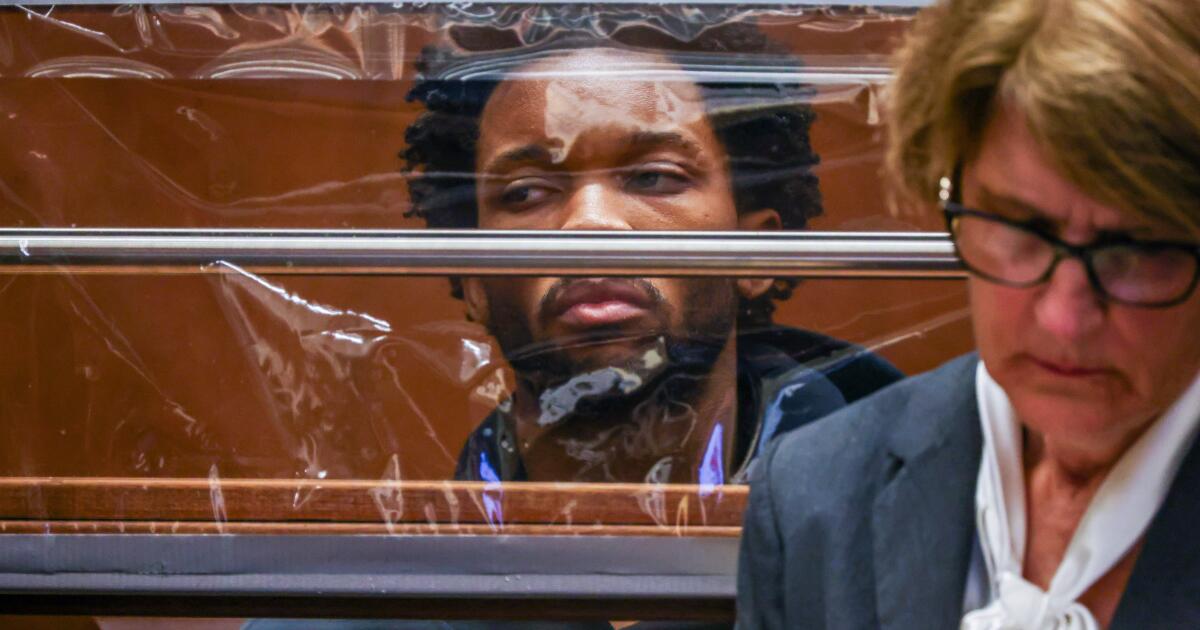
A cellphone belonging to David Anthony Burke, better known as the singer D4vd, contained “a significant amount of child pornography,” a prosecutor said in court Thursday morning.
Los Angeles County Deputy Dist. Atty. Beth Silverman made the claim during a court proceeding to schedule a preliminary hearing on murder charges in the killing of 14-year-old Celeste Rivas Hernandez. The images were uncovered as part of a broad series of search warrants executed on Burke’s phone and iCloud account, Silverman said.
Burke’s attorneys have insisted he is innocent and are demanding his preliminary hearing begin next week, meaning evidence in the closely followed case could become public as soon as May 1. He appeared in court Thursday in an orange jail jumpsuit and walked into court with his hands in his pockets.
A status hearing was set for April 29. Silverman and a district attorney’s office spokesperson declined to comment outside the courtroom. The singer’s attorney, Blair Berk, also declined to comment.
The D.A.’s office spokesperson declined to say if the child sex abuse material allegedly found on Burke’s phone was related to Hernandez or another victim.
Defendants have a right to have a preliminary hearing, in which a judge determines whether prosecutors have enough evidence to bring a case to trial, within 10 business days. But Berk’s push to move quickly is unorthodox. She has publicly grilled Silverman about needing access to more discovery materials, and the medical examiner’s report detailing how Hernandez died was not made public until Wednesday.
Joshua Ritter, a former L.A. County prosecutor, said Berk was playing a “hell of a game of chicken” but she may be aiming to pressure test the prosecution’s case.
“The defense might want to put the D.A. on their heels if they feel for some reason there was a rush to make an arrest. But this case is nearly the opposite of that,” he said. “They’ve had more than adequate time … this does not seem like a situation where the D.A. made a hasty decision to file.”
Silverman said police amassed “40 terabytes” of digital evidence in the case, which has made uploading and transmitting materials to the defense difficult. Silverman also said police had conducted a wiretap operation in the case, but did not disclose the nature of it. The veteran prosecutor said even she had “not received anything” related to that operation.
She also confirmed prosecutors convened three secret grand jury hearings after Hernandez’s death — two in November and December in 2025 and one in February. Those were investigative grand jury hearings, meaning prosecutors could use them to enshrine testimony against Burke, but could not use the proceedings to secure an indictment against Burke. Transcripts from all three hearings will also need to be unsealed.
L.A. County Superior Court Judge Charlaine Olmedo also warned Berk that if she does push for the immediate preliminary hearing, she may not have access to the entire compendium of evidence before May 1.
Ritter also mused that Burke could be pushing his attorneys to fight the case without delay. Beyond that, he said, the approach “makes no sense.”
“The defense is seven months behind the eight ball on this. They not only have the grand jury transcripts to catch up on but who knows what kind of digital forensics and wiretaps and everything else,” he said.
Silverman also seems intent on bringing the case to trial as soon as possible. Silverman noted Thursday marked the one-year anniversary of the date prosecutors believe Hernandez was killed, and said she intended to put the case before a jury within 60 days of the completion of a preliminary hearing.
The singer allegedly began sexually abusing Hernandez in September 2023, when she was just 13. Burke’s attorneys have said the case cannot stand up to scrutiny and pushed for the immediate preliminary hearing.
Hernandez was reported missing from her family’s Lake Elsinore neighborhood three times in 2024, and she was spotted at some of D4vd’s concerts during that time frame.
Prosecutors allege Hernandez was last seen at Burke’s Hollywood Hills residence on April 23. She “threatened to expose his criminal conduct and devastate his musical career,” according to L.A. County Dist. Atty. Nathan Hochman, though the prosecutor has not answered questions about whether Hernandez was going to report Burke to police.
Burke surged in popularity after one of his tracks was included in the wildly popular video game “Fortnite,” and he has also collaborated with artists like 21 Savage. He was beginning to tour in support of his debut album, “Withered,” when reports surfaced linking him to Hernandez’s death. He quickly canceled all shows.
The details of the crime echoed some of the violent imagery associated with Burke’s songs. The Queens-born vocalist has appeared in a music video filled with violent imagery: a young woman with an apparent chest wound lies on a bed as the singer hovers over her, blindfolded, his white shirt spattered with blood. In another video, “One More Dance,” D4vd drags a person — who bears the singer’s likeness — to a car, where a couple stuffs the person into the trunk.
Hernandez’s badly decomposed body was found in the trunk of a Tesla at a Hollywood tow yard last September. An autopsy report made public this week revealed she died from a pair of stab wounds to the chest and abdomen. When police arrived on the scene, they found Hernandez’s body was “dismembered” and two of her fingers had been amputated, according to the medical examiner’s report.
Prosecutors charged Burke with murder with special circumstances, including allegations that Hernandez was a witness to a crime — her own sexual abuse — and that Burke killed her for financial gain to protect his ascendant music career. If convicted as charged, he faces life in prison without the possibility of parole or the death penalty. Prosecutors have yet to decide if they will seek capital punishment in the case.
Xavier Becerra needed to land a knockout punch, even more so than the five other candidates for California governor he was facing at Wednesday night’s debate.
Instead, he fired off some slaps.
He needed to roar about his many accomplishments in his 35-year career in Sacramento and Washington, to distinguish himself from the relative political neophytes around him.
Instead, Becerra recited his resume with the vigor of someone rattling off his LinkedIn page.
Instead, he offered the oratory equivalent of a pat on the shoulder.
No candidate had more at stake that night than Becerra, who went from an afterthought to a contender after Eric Swalwell dropped out and resigned his congressional seat over sexual assault allegations.
Five weeks ago, Becerra and other candidates of color were protesting their exclusion from a USC debate because they were all polling so low. Now, the 68-year-old has a chance to become California’s first Latino governor.
This possibility seems to have uncorked California’s silent majority — the rancho libertarians turned off by hard-right politics but also the wokoso politics they feel have left them behind. The people who yearn for an unglamorous, competent leader after eight years of all-about-me Gavin Newsom and a decade of Donald Trump.
Becerra’s campaign, once as rudderless as a leaf in a river in a race so chaotic for Democrats that many feared two Republicans would win on June 2 and face each other in the general election, suddenly latched onto a palpable wave.
At the Los Angeles Times Festival of Books last weekend, I saw people sporting Becerra campaign buttons who had just come from a rally that was expected to draw a few hundred but instead had over 2,000 RSVPs. On social media, friends who had never especially cared for state politics suddenly declared they were for Becerra and fought off their more lefty pals who think he’s a Latino Ned Flanders not up for this fraught moment.
Unglamorous and competent are Becerra’s middle names, and they were on display at the debate — for better and mostly worse. This was his chance to show both his new followers and undecided voters that they could trust him as California’s next governor.
But where he needed to be limber like a prizefighter, the former California attorney general was as tightly wound as a Rolex.
While the other candidates pressed their palms against the podiums, ready to pounce on every question, Becerra clasped his hands like an altar boy. When he did gesture, his movements never went further than the span of his shoulders.
As the others grinned and grimaced at their rivals’ responses, Becerra was as stone-faced as Buster Keaton. He stumbled more than he should have — how could someone in his position mistake Iraq for Iran when criticizing Trump’s Middle East quagmire? — and rarely seemed at ease, as if the weight of the moment and the good luck of his surge had suddenly hit him at the worst possible time.
Candidates in California’s gubernatorial race, from left, Matt Mahan, Xavier Becerra, Chad Bianco, and Steve Hilton look on during a debate Wednesday, April 22, 2026, in San Francisco.
(Jason Henry / Associated Press)
Becerra’s supporters say a level-headed leader is what California needs. But voters almost never go for what they need — they pick what they want. And California wants someone who’s loud, or at least louder than Becerra. There’s a reason why strident partisans like Republicans Chad Bianco and Steve Hilton and progressives Tom Steyer and Katie Porter have consistently placed high in the polls, while moderates like Becerra, his frenemy Antonio Villaraigosa and San Jose mayor Matt Mahan have lagged.
The weird thing is that Becerra does know how to brawl. Wallflowers don’t go from a working class Mexican immigrant family to Stanford Law School. Wimps don’t survive the ruthlessness of Eastside politics as an outsider to become a congressmember at just 34. Cowards don’t file over 100 lawsuits against the Trump administration as California’s top prosecutor or tackle the coronavirus pandemic as President Biden’s health secretary.
I’ve only encountered the Sacramento native a few times but always came away impressed. In small crowds, he makes people laugh and tear up. He’s quick with ripostes, righteous in off-the-cuff remarks and has a do-gooder aura that never comes off as sanctimonious.
We saw hints of that Becerra at the debate. To Hilton, he quipped, “You can be a talking head and not worry about the consequences of what you do” after the former Fox News host babbled on about how one-party ruled had failed California.
After Porter accused him of not offering hard numbers for his economic plans, Becerra responded that he has balanced federal budgets larger than California’s. “It’s easy to say you haven’t done this; it’s easier to prove that you actually have,” he concluded.
But after Becerra described the evils of racial profiling by law enforcement and Bianco, the sheriff of Riverside County, ranted that California politicians need to stop thinking so much about race, it was Porter who responded with a verbal haymaker as Becerra silently looked on.
You don’t fight as a choirboy in a battle royale. Becerra wasn’t bad at the debate but he also wasn’t great — and that won’t win this race.
Voters want someone who’ll do the job, yes — especially if it comes with no drama. They also want to elect someone they think is a human, not a joyless bureaucrat. So how did Becerra respond to the debate’s last question about what was the last series you’ve streamed?
Becerra flashed his biggest smile of the night. It was such a softball query that even a kindergartener could have slammed it à la Shohei Ohtani.
“I wish I could tell you I had time to watch streaming shows,” he replied.
Dude. We’re all overworked, but everyone I know unwinds by watching mindless drivel (my current obsession is “Vanderpump Villa”). We all need to relax, even for a moment. As my dad says when he sees me filing one columna after another and urges me to take a break, “El trabajo nunca se acaba pero uno sí se acaba.”
Work never ends, but people do.
Xavier, you know you’re on the wrong side of California when the only other candidate with a similar answer was Bianco, who said he doesn’t watch television at all.
Being careful has served you well, but this is the greatest opportunity of your life. You don’t have to suddenly become a flamethrower, but some sparks would help. It’s six weeks until the primary, so time to throw down — channel your inner cholo and go get what should be yours.
A few days ago came the astonishing news that the world record in the half-marathon was obliterated by a 5-foot-5 humanoid robot named Lightning in Beijing.
Now a robot named Ace has achieved another milestone for AI and robotics by defeating expert-level humans at table tennis in Tokyo, according to a study published Wednesday in the scientific journal Nature.
What’s next, a robotic baseball player named Babe that swats 500-foot home runs and throws 120 mph pitches, eclipsing Shohei Ohtani’s real-life achievements and commanding a billion dollar contract?
It’s all fun and games until it isn’t.
Extraordinary athletic achievements by AI robots might seem innocuous, especially compared to far more grave threats described by various experts, including the landmark publication “An Overview of Catastrophic AI Risks” by the Center for AI Safety in 2023.
To name a few: Misinformation and social media manipulation; job displacement and economic inequality; cybersecurity threats; lethal autonomous weapons; environmental impact; psychological dependence; and ultimately, the existential risk to humanity of losing control of rogue AI systems.
For now, let’s get back to ping-pong.
Ace was developed by good, old Sony, the 80-year-old makers of gaming consoles, televisions, smartphones, cameras and audio equipment that we enjoy every day.
Of course Sony has an AI research division, and while most consumers were still going ga-ga over PlayStation 5 Pro 2TB, it developed the first robot to attain expert-level performance in a competitive physical sport that requires rapid decisions and precision execution.
Ace integrates nine synchronized cameras and three vision systems to track the spinning plastic ping-pong ball. Its lightning-fast processing time would be the envy of even Lightning, the humanoid robot that broke the world record in the half-marathon by nearly seven minutes.
“Here we present Ace, to our knowledge the first real-world autonomous system competitive with elite human table tennis players,” the study said. “Ace addresses the challenges of physical real-time interaction through a new, high-speed perception system using event-based vision sensors and a new control system based on model-free reinforcement learning, as well as state-of-the-art high-speed robot hardware.”
Ace showed out in matches that followed International Table Tennis Federation rules and were officiated by licensed umpires. Most of the matches took place in 2025 — before table tennis tale “Marty Supreme” even hit theaters — although Ace defeated professional players as recently as March.
One such human is Mayuka Taira, who said in comments provided by Sony AI to Reuters that the robot’s strengths are what one might expect: unpredictability and an absence of emotion.
“Because you can’t read its reactions, it’s impossible to sense what kind of shots it dislikes or struggles with, and that makes it even more difficult to play against,” Taira said.
Initial real-world applications of Ace-like robots likely would be in manufacturing and service industries, although untapped potential lies across sports, entertainment and safety-critical environments, according to the study.
“These results highlight the potential of physical AI agents to perform complex, real-time interactive tasks, suggesting broader applications in domains requiring fast, precise human–robot interaction,” the study said.
Those domains certainly could include baseball diamonds, basketball courts and gridirons. Hockey rinks could be lumped in provided robots can skate.
AI already is used in MLB. The vaunted Automated Ball-Strike system (ABS) uses AI-powered Hawk-Eye camera technology and computer vision to determine if pitches are strikes or balls. Twelve high-speed cameras track ball flight and AI delivers the definitive call to the scoreboard within seconds of a challenge.
A robotic batter facing a robotic pitcher with calls made by ABS might eliminate any disagreements over balls and strikes.
On the outskirts of Somalia’s southern port city, the land has become an open graveyard for cattle. Some are left where they fell, while others are buried in shallow graves after consecutive failed rainy seasons.
For many families here, pastoralists who rely on livestock for milk, meat, and income, animals were everything, but what was once a lifeline of food and income has now become a stark symbol of loss.
The impact is not just felt in Kismayo, but across the country, with 6.5 million people forced to skip meals and go hungry every day. Drought and rising costs only pushing the country deeper into crisis.
The humanitarian director at Save the Children, Francesca Sangiorgi, says the crisis is being driven by repeated climate shocks that are compounding over time. “We’re seeing multiple rainy seasons that have failed across the country,” she tells Al Jazeera, adding that even when rain arrives, it is often too uneven and too late to restore livelihoods that have already collapsed.
What’s the scale of the crisis?
The scale of Somalia’s hunger crisis is severe and rapidly worsening.
With a third of the population facing severe food insecurity (classified as IPC Phase 3 and above), many households are struggling to get enough food to meet their basic daily requirements (PDF) — and in some cases going without food altogether, leaving them more vulnerable to malnutrition and illnesses such as diarrhoea, measles, and other infections.
Of these, more than 2 million people are in the most critical conditions short of famine (IPC Phase 4 or emergency levels), where families are facing extreme shortages and are increasingly forced into displacement in search of basic needs, moving towards already overcrowded aid camps where resources are rapidly dwindling.
Children are among the most affected. According to the UN, an estimated 1.8 million children under five in Somalia are at risk of acute malnutrition, putting their survival in immediate danger.
Sangiorgi notes that the deterioration has been unfolding rapidly, its effects already evident.
“The situation of children across the country is extremely concerning,” she explains. “We’re seeing the spread of child illnesses across the country. Dropout rates are extremely high right now, and they continue to rise because of the drought. We want to make sure that children have a chance at life—access to the health and nutrition services they need, as well as education.”
According to Doctors Without Borders, known by its French initials MSF, more than 3.3 million people have been displaced, severely straining the already limited resources and basic services in these communities.
What does the crisis look like on the ground?
Near Kismayo, one of Somalia’s largest camps for displaced people has formed, sheltering families who have nothing to eat and have travelled from across Jubbaland.
One woman describes how her herd has fallen from 200 cattle to just four, ending her very livelihood.
Barwaqo Aden, a displaced Jamame resident in Lower Juba, arrived at the camp only recently, but her eight-month-old daughter is already in the local hospital with severe malnutrition due to the lack of resources.
Others arrive after exhausting journeys, fleeing areas controlled by the armed group al-Shabab. A displaced resident, Hodhan Mohamed, walked for days and crossed the River Juba by boat before reaching a crowded settlement, unsure what she would find. Like many new arrivals, she now waits for assistance that is limited and uncertain.
Sangiorgi explains that secondary displacement – when people who have already been forced from their homes are displaced again – is becoming increasingly frequent. “As services and commodities continue to shrink across the country, the prices of essential goods keep rising as well.”
More than 3.8 million Somalis are currently displaced, making up 22 percent of the population. Many have been uprooted multiple times, moving from one settlement to another as aid resources dwindle and access to support becomes more limited.
What’s driving the crisis?
At its core, the crisis is primarily driven by climate shocks.
Somalia has had three consecutive failed rainy seasons in recent years, drying out rivers, wells, and pasturelands.
For livestock-dependent communities, the impact has been immediate: animals are dying, and with them, livelihoods are disappearing.
As local production collapses, families are forced to buy from markets even as food, fuel, and water prices continue to rise. In rural areas, especially, incomes no longer stretch far enough to meet needs.
Insecurity caused by armed conflict adds further strain, displacing communities and limiting access for aid workers in some regions.
Beyond Somalia, the global economic crisis linked to the US–Israeli war on Iran has also played a role in constricting supply chains. A UN aid chief told the Reuters news agency in March that these disruptions are compounding costs and weakening the ability to deliver assistance, as humanitarian systems come under growing strain.
MSF reported last month that transport costs have risen by up to 50 percent in parts of Somalia, making it harder for people to reach health facilities and increasing the cost of delivering care as fuel prices climb.
The organisation also said more than 200 health and nutrition facilities have closed since early 2025 due to sharp funding cuts, leaving critical gaps in already overstretched health services.
What does the aid collapse look like?
As the need for aid rises, humanitarian funding and response capacities are only shrinking.
The UN response plan for Somalia is currently funded at just 20 percent of what is required — with $1.42bn needed but only $288m received. That discrepancy has forced major cuts, reducing the number of people targeted for assistance from 6 million to just 1.3 million.
For Somalia, which relies heavily on imported food and external assistance, the consequences are immediate. Fewer supplies are reaching ports, while the cost of delivering essentials continues to rise, testing an already fragile system.
As UN humanitarian chief Tom Fletcher told Reuters in March, “These [constraints] will damage our humanitarian supply chains, reduce the humanitarian supplies we can get to people who need them, but they’ll also drive up energy costs and food costs across the region, this really is a perfect storm of factors right now, and I’m seriously worried,” he stated.
The humanitarian response has been cut by 75 percent, meaning millions of Somalis are no longer receiving assistance, even as the crisis deepens on the ground.
Iran displayed its strengthened control over the Strait of Hormuz on Thursday by releasing video footage of its commandos boarding a large cargo ship. The video, aired on state television, showed masked troops storming the MSC Francesca and included scenes of another captured ship, the Epaminondas, which Iran accused of trying to cross the strait without proper permits.
As tensions remain high, the U. S. announced that it boarded another tanker, the Majestic, in the Indian Ocean. This was likely a reference to the supertanker, the Phonix, which was carrying 2 million barrels of crude oil off Sri Lanka. Since the start of conflict in February, Iran has effectively restricted access to the strait, asserting control after peace talks between the U. S. and Iran were halted shortly before a ceasefire expired.
Iran’s willingness to re-engage in talks depended on the U. S. lifting its blockade and releasing Iranian ships. In a post on Truth Social, U. S. President Donald Trump indicated that he ordered the Navy to “shoot and kill” Iranian boats that were laying mines in the strait, escalating military actions without addressing other Iranian tactics like speedboats and drones.
Iran’s judiciary chief stated that the merchant vessels attacked by Iran’s forces had faced legal consequences, while Iran’s vice speaker announced that the first toll revenue collected from ships using the strait had been transferred to the central bank, but provided no specifics on payments or amounts.
Tehran proclaimed it would not reopen the strait, which typically handles a significant portion of global oil and gas shipments, until the U. S. lifted the blockade considered a breach of the ceasefire. Although Trump refrained from escalating attacks in the ceasefire’s final hours, he remained firm on not lifting the blockade. There was no formal extension of the ceasefire nor plans for new negotiations.
Iranian citizens faced uncertainty and anxiety in what they termed a state of “neither peace nor war,” fearing potential attacks from the U. S. or Israel. Pakistan, previously facilitating talks, remained in contact with both countries about reviving discussions, but Iranian officials hesitated to commit due to the U. S. blockade.
On the U. S. side, another round of discussions was set for Thursday, focused on Israel and Lebanon, where Lebanon sought an extension of a recent ceasefire amidst continued Israeli airstrikes that resulted in casualties, marking a significant day since the ceasefire began.
In a significant personnel change, U. S. Navy Secretary John Phelan was dismissed amid conflicts over shipbuilding decisions and tensions with high-ranking officials.
The ongoing situation in the Strait of Hormuz has caused volatility in markets, pushing oil prices upward, while stock prices in the U. S. reached record highs despite uncertainty about energy supply. Washington has thus far failed to achieve its stated war goals of limiting Iran’s military capabilities, ending its nuclear efforts, and fostering regime change. Iran maintains its missile and drone capabilities and stockpiles of highly enriched uranium, while its government remains resilient against internal dissent. Despite threats from Trump, Iran’s control over the strait appears to strengthen its position in the conflict.
OLIVIA DEAN stormed the opening night of her debut arena tour – but left fans gutted by not performing No1 hit Rein Me In.
She received a hero’s welcome at Glasgow’s OVO Hydro, fresh from a stellar few months which saw her scoop four Brit Awards, three Mobos and the Grammy for Best New Artist.
Sign up for the Showbiz newsletter
Thank you!
Olivia Dean left fans gutted by not performing No1 hit Rein Me In on the opening night of her debut arena tourCredit: LOLA MANSELLOlivia told the crowd that her whirlwind success over the past 12 months has been a shock, even to herCredit: Getty
But she surprised the audience by deciding not to include her Sam Fender collaboration, which has so far spent eight weeks at the top of the charts, on her 23-track setlist.
So fans had a singalong to it outside the venue afterwards instead.
Rein Me In won the Brit Award for Song of the Year in February, but Olivia had plenty of other brilliant tunes to satisfy the sold-out arena.
As floor-to-ceiling white stage curtains opened to reveal the singer, she looked cool, calm and collected, despite the high expectations on her shoulders.
She breezed out in a pink sequined dress and was greeted with echoing singalongs of utterly joyous tracks Nice To Each Other and So Easy (To Fall In Love).
She then told the crowd that her whirlwind success over the past 12 months has been a shock, even to her.
She explained: “This is crazy. Apologies if I get emotional tonight but I just can’t believe how many people are here. Today we were driving in and I drove past King Tut’s. I played there two years ago, and there was 300 people in the room.
“Now I’m here with all of you, so thank you so much for being here.
“Just enjoy yourselves. Sing, dance, cry, whatever you want. I’ll certainly be having a good time.”
And things got more emotional as she performed UFO, from her 2023 debut album Messy, which she said is about feeling “overwhelmed.”
When the audience spontaneously waved their phone torches in the air to light up the arena, she wiped away tears of joy.
SET LIST
The Art Of Loving (Intro);
Nice To Each Other;
Lady Lady;
So Easy (To Fall In Love);
Close Up; Let Alone The One You Love;
Messy;
UFO;
Touching Toes;
I’ve Seen It;
Carmen;
Echo;
Time;
Loud;
A Couple Minutes;
The Hardest Part;
Baby Steps;
Ladies Room;
Move On Up (Curtis Mayfield cover);
OK Love You Bye;
It Isn’t Perfect But It Might Be;
Dive; Man I Need
One of the set’s unexpected highlights came as she sang Loud live for the first time.
And she did so in a flowing white skirt from a flower-shaped stage in the centre of the room.
Against stripped-back instrumentation, the haunting track showed her vocals at their most powerful.
Back on the main stage, disco balls descended from the ceiling for a more upbeat section which had her skipping and dancing across the stage, along with her nine-piece band.
As she wrapped up the gig, she said: “I never imagined I could have my own headline arena tour. It’s mental.
“Thank you so much for listening and just believing in me.”
And while she didn’t do Rein Me In, she finished her set with fan favourite Dive and her first No1, Man I Need.
She will be back on stage tomorrow at Manchester’s Co-op Live before six nights at London’s O2 Arena, and further shows in Dublin and across Europe.
Olivia is at the top of her game right now and if you want a warm, musical hug, this concert is it.
Duran set for summer
Duran Duran have dropped new single Free To LoveCredit: Stephanie Pistel.The band have worked on a single with Nile RodgersCredit: Alamy
DURAN DURAN have dropped new single Free To Love and have signed up presenter Clara Amfo to appear in the music video.
They gave Radio 2 a first play of the track yesterday morning and it’s a banger, with Simon Le Bon and the band working on the single with Nile Rodgers – 40 years after he produced their Notorious album.
In an exclusive chat after the single dropped, John Taylor told me: “We wanted to write something uplifting for these times we find ourselves in. A feelgood piece for an imaginary dance floor.
“I always want to feel the DNA of classic disco in our music, reframed for now. Nile locks us into that timeless groove, bringing a sense of optimism. It’s a reminder that music can still bring people together.”
If you’ve not heard Free To Love yet, definitely give it a listen. It’s the perfect summer song.
Lady Gaga eyes six second Oscar
Lady Gaga wants an OscarCredit: Splash
LADY GAGA is eyeing up another Best Original Song nomination at the Oscars after recording three songs for Devil Wears Prada 2.
After Gaga, released her Doechii collaboration Runway earlier this month, I told how the superstar had a surprise in store for fans and had contributed more to the film’s soundtrack.
I can reveal that as well as Runway, Gaga has recorded Shape Of A Woman which she performs during the film, plus a third song, which is called Glamerous Life.
It is a stripped-back emotional ballad – similar to her 2022 single Hold My Hand for the Top Gun: Maverick sequel.
On the new song, Gaga sings: “I might need a hero to save me from breaking. Can I be myself in a world that’s just faking it?”
In 2019 Gaga won Best Original Song at the Oscars for A Star Is Born’s Shallow and if Prada 2, which is in cinemas from May 1, takes off like I think it will, she will have another Oscar nomination under her belt.
Gaga co-wrote Shallow with Mark Ronson and performed it at the Oscars ceremony with her movie co-star Bradley Cooper.
Sofa, so good Kylie
Kylie Jenner used her cream sofa as the backdrop for a load of thirsty Instagram snapsCredit: Instagram/kyliejenner
ANYTHING Kylie Jenner touches seems to turn to gold.
So I think sofa superstore DFS should be having a serious think about signing her up, after the American reality TV star turned beauty mogul decided that she would use her cream sofa as the backdrop for a load of thirsty Instagram snaps.
Over two million of her fans have now liked the images, which Kylie captioned: “Can’t a girl have fun?”
I can think of more places to have a laugh than on my sofa wearing a bra, but each to their own.
Ant & Dec go crazy
We revealed back in February that Ant & Dec were in talks for a new ITV show all about crazy golfCredit: Rex
And now I’m told the Geordie duo have had the series green-lit by telly chiefs, and the pair are already busy filming with a host of golf-mad hopefuls.
It is based on US show A Hole In One, where contestants battle it out on a seriously hard silly course for cash.
A source said: “Ant and Dec have been given the nod and they’re preparing to film their new ITV show later this summer.
“Rather than having the public competing like in the US version, they’ve got a load of golf fans to sign up and play.
“It’s going to be the weirdest and wackiest game of crazy golf ever, with some big personalities trying to putt a winner.
“Ant and Dec are huge golf fans so really wanted to get the concept off the ground. ITV loved it and now it’s being pitched for a primetime slot on Saturdays. It’s family-friendly and with the great personalities they’ve got on board, they think it could be a ratings winner.”
Ant and Dec will have a hell of a job fitting this new show into their schedules, with the pair due to jet off to Australia later this year for the next series of I’m A Celebrity . . . Get Me Out Of Here!
But if I was getting paid to spend some days in the sun mucking around on a crazy golf course, I’d definitely make some time in my diary.
Liam bigs up Oasis return
Liam Gallagher is bigging up more Oasis live showsCredit: Getty
LIAM GALLAGHER is fuelling what we all know – Oasis will be coming back with more live shows.
And now the motormouth has sent fans in Italy into overdrive after heading to Rome.
He was mobbed outside his city-centre hotel, where one asked if he and Noel would return to the city.
Liam replied: “Without a doubt. We’re coming next year.”
I revealed the rockers are plotting more reunion dates in 2027 after taking this year to recharge.
A huge run across the UK, Europe and North America is heavily tipped as the brothers celebrate the 30th anniversary of their heyday.
For a man meant to be on holiday, Liam is putting in serious hours in the Oasis promotions department.
Tyla has A* pop lined up
Tyla has announced her second album and when it will dropCredit: Tod Dow Young/ Fallon Tonight
TYLA has announced her second album A*Pop will drop on July 24.
The singer was in New York to dish out copies of her signed i-D Magazine cover and celebrated the release date with her fans, saying: “Initially going into this project, I was nervous – like, ‘Where do we go from here?’
“But I realised that the music really reflects where you are in life, and the way the new album sounds came on its own, it fell into place.
“There are some exciting features but those are all still under wraps for now.”
Reverand And The Makers also have exciting news for fans.
Today they have dropped new single F*ked Up with Robbie Williams.
NICK GRIMSHAW knows an act who has already been booked to headline Glastonbury 2027, after I revealed in January his close pal Harry Styles will top the bill next summer.
On his Sidetracked podcast Nick seemed to confirm my story by saying: “I know someone that’s playing. I can’t say who. So two spots to go . . . Maybe. They might be booked.”
VINYL fans with deep pockets should start saving now, as the White Label Auction is back.
The annual sale in aid of The Brit Trust begins on June 23, with hundreds of rare white label test pressings going under the hammer through Omega Auctions.
Among the hottest lots are signed releases from Sam Fender, The Cure, Roxy Music and Yungblud.
The charity event has already raised more than £200,000.
STRICTLY fans can swap the sofa for the dance floor later this year, with the show’s pros heading to Warner Hotels for a string of star-studded breaks.
Kai Widdrington and Katya Jones will lead the glittery line-up, with guests able to watch live performances, snap photos and even learn a few moves themselves.
And it’s not just sequins on offer.
Singers Chesney Hawkes, Michael Ball, Alexandra Burke, Will Young and Russell Watson are all booked to perform at various locations across the country.
CrowdStrike (NASDAQ: CRWD) dropped 5.55% to $440.78 in Thursday afternoon trading, breaking a six-day rally.
The stock had gained more than 17.11% over that stretch, outpacing the S&P 500’s 2.45% increase. Despite that run, shares are down 4.52% year to date versus the index’s 4.27% rise.
Democrats on Wednesday celebrated an election win in Virginia that could put them slightly ahead in the national redistricting competition that President Trump triggered in an attempt to preserve his party’s House majority in this year’s midterms, but it will not be the final round.
Now that it’s been approved by voters, the new Virginia map will have to clear additional legal hurdles. On Wednesday, the state attorney general’s office said it would immediately appeal a ruling earlier in the day from a judge in rural southern Virginia who ordered that the results of Tuesday’s vote not be certified.
Ultimately, the Virginia Supreme Court will decide whether Democratic lawmakers violated procedural rules when they referred a constitutional amendment to the ballot authorizing the new U.S. House districts that could help Democrats win as many as four additional seats in the state. If so, that could invalidate the map voters narrowly approved Tuesday.
What happens next in Florida also will matter.
The state’s Republican-controlled Legislature is to meet in a special session next week that GOP Gov. Ron DeSantis called in part to draw a new map to expand the party’s congressional majority there. The U.S. Supreme Court is scheduled to issue an opinion by the end of June in a Louisiana case that could overturn a key provision of the Voting Rights Act and lead to redrawn political maps across the South, though almost all of those could not happen until 2028.
After voters passed the Virginia amendment, Democrats could tentatively claim that they netted 10 seats nationally from the mid-decade redistricting, compared with the nine that Republicans claim. Even if things swing again in the GOP’s favor, the net result of Trump’s campaign would be at best an incremental increase in the number of GOP-leaning House seats at a time when his approval rating is dropping and Republican anxiety over losing control of Congress in November is rising.
“We have successfully blunted Trump’s attempt to completely hijack the midterms,” said John Bisognano, president of the National Democratic Redistricting Committee.
Many Republicans agreed.
“The GOP will now lose net seats across the country. If you’re going to pick a fight, at least win it,” Ari Fleischer, who was a spokesman for President George W. Bush, posted on the social media site X after the Virginia vote. “All this was foreseeable and avoidable. We should not have started this fight.”
Adam Kincaid, executive director of the National Republican Redistricting Trust, argued that it is too soon to declare one party a victor.
“It’s an ongoing process with many legal challenges pending, and it’s far too early for sweeping statements on the final outcome,” he said.
Trump on Wednesday tried to undermine the Virginia result by leveling groundless accusations of fraud similar to ones he made after losing the 2020 presidential election. He called the Virginia vote “RIGGED” and “Crooked” in a post on his social media site and added, “Let’s see if the Courts will fix this travesty of ‘Justice.’”
Redistricting spread from Texas to other states
Redistricting is typically done every 10 years after each census, unless ordered by a court. But last summer, Trump pushed a redrawing in Texas, prodding the state’s Republican-controlled Legislature to add up to five winnable House seats for his party. Trump then began pressuring other Republican-run states to follow. Missouri, North Carolina and Ohio have since created more GOP-leaning seats in addition to Texas.
Democrats began to fight back, even though they were more constrained because several Democratic-controlled states had maps drawn by independent commissions rather than lawmakers and governors.
To counter Texas, California’s Democratic governor, Gavin Newsom, pushed the Democratic-controlled Legislature to place a redistricting initiative on last fall’s ballot. After voters overwhelmingly approved it, the measure will replace a commission-approved map with one that could gain Democrats five seats.
Democrats reclaimed the Legislature and governor’s office in November in Virginia and swiftly moved to replicate California’s move with an even more aggressive redistricting plan. It replaces a congressional map imposed by a court after the last census that had resulted in a 6-5 edge for Democrats with one that could allow Democrats to win as many as 10 seats.
“We are not going to let anyone tilt the system without a response,” state Senate President L. Louise Lucas said at a news conference Wednesday.
Courts could still have a say on redistricting
In Washington, U.S. House Democratic leader Hakeem Jeffries of New York warned Florida Republicans, who have been openly nervous about redrawing their district boundaries and potentially spreading their core voters too thin before an election that appears to be trending against them.
“Our message to Florida Republicans right now is, ‘F around and find out,’” Jeffries said.
House Majority Forward, the nonprofit arm of the super political action committee aligned with House Democrats, has spent nearly $60 million to push back against Republicans’ redistricting efforts. Some $40 million of that was on the Virginia campaign.
Another obstacle in Florida is an anti-gerrymandering constitutional amendment that was approved by state voters in 2010. It is likely that any new Florida map would trigger significant litigation, although six of the state Supreme Court’s seven justices were appointed by Republicans.
Nicholas Stephanopolous, a Harvard law professor, said a challenge for DeSantis is that the Florida amendment forbids drawing lines for purely partisan purposes, so he has to find some other excuse for revising the map. “Even with that sort of acquiescent state supreme court, I don’t think it’s a done deal,” Stephanopolous said.
The Virginia move comes with its own legal issues. Republicans have challenged the process that Democrats used to place the measure on the ballot and the state Supreme Court opted to wait for the vote before even scheduling arguments in the case. It is unclear when a ruling could come.
Wednesday’s ruling stopping certification came from a separate case that Republicans filed with the same lower court judge, whose initial ruling against the initiative was put on hold by the state supreme court.
“The ballot box was never the final word here,” Terry Kilgore, the Virginia House Republican leader, said in a statement after Tuesday’s vote. “Serious legal questions remain about both the wording of this referendum and the process used to put it before voters.”
The biggest legal wild card is held by the U.S. Supreme Court. Its conservative majority could throw out a requirement under the Voting Rights Act that in areas with a large minority population, mapmakers draw districts that are more favorable to the election of minority candidates.
That provision has led to the creation of several majority-minority congressional seats, especially in the South. Without it, Republicans in conservative states could shrink the number of U.S. House seats winnable by Democrats even further.
But it’s unlikely that any state other than Louisiana, which brought the lawsuit the high court will rule on, would be able to adjust its congressional lines in time for November even if the court eliminates that provision, known as Section Two. That’s because the November election is already officially underway in most states and candidate filing deadlines — and, in some cases, primary elections — have already passed.
Riccardi and Lieb write for the Associated Press. AP writers Lisa Mascaro and Leah Askarinam in Washington contributed to this report.