The captain of the Iranian women’s football team has withdrawn her bid for asylum in Australia, Iran’s state media says, making her the fifth member of the delegation to change her mind after her team’s participation in the Asian Cup.
Zahra Ghanbari will fly from Malaysia and travel to Iran within the next few hours, the IRNA news agency said on Sunday.
Three players and one backroom staff member had already withdrawn their bids for asylum and travelled to Malaysia from Australia, where the team participated in the AFC Women’s Asian Cup.
Australia’s Home Affairs Minister Tony Burke said his country had offered asylum to all players and support staff members prior to their departure over fears they might be punished upon their return home after the team refused to sing Iran’s national anthem at the tournament.
Iranian state broadcaster IRIB reported on Saturday that the three had “given up on their asylum application in Australia and are currently heading to Malaysia”, posting a picture of the women allegedly boarding a plane.
The news was confirmed by Burke a few hours later.
“Overnight, three members of the Iranian women’s football team made the decision to join the rest of the team on their journey back to Iran,” Burke said.
“After telling Australian officials they had made this decision, the players were given repeated chances to talk about their options.”
Five players took up the offer and signed immigration papers last week, with one more player and a member of staff joining them a day later. It leaves two Iranian players in Australia, where they have been promised asylum and an opportunity to settle.
Iran played their three group games of the Asian Cup at the Gold Coast Stadium in Queensland on March 2, 5 and 8, after the United States and Israel launched their war on Iran on February 28.
The initial attacks killed Iran’s Supreme Leader Ayatollah Ali Khamenei and other leaders.
Overall, an estimated 1,444 Iranians have been killed since the war began, including more than 170 people, mostly schoolgirls, who were inside a primary school in the city of Minab.
After refusing to sing the Iranian national anthem at their first match, players on the Iranian women’s football team were branded “traitors” by an IRIB presenter.
When Iran played their second game of the tournament against Australia three days later, not only did the players sing the national anthem, but they also saluted it, prompting fears that they may have been forced to change their stance after receiving backlash in Iranian media.
While neither the players nor the team management explained why they refrained from singing before the first match, fans and rights activists speculated that it may have been an act of defiance against the Iranian government.
On the day of the team’s departure from Australia, Burke announced his government had offered all players and staff members the chance to stay back in the country.
On Tuesday, Burke told reporters that five Iranian players had decided to seek asylum in Australia and would be assisted by the government.
“They are welcome to stay in Australia, they are safe here, and they should feel at home here,” he said.
A day later, Burke confirmed that an additional player and a member of the team’s support staff had received humanitarian visas in the hours before their departure.
However, one player, who previously chose to stay behind, changed her mind and decided to return to Iran.
The player, who was later identified as Mohadese Zolfigol, changed her decision on the advice of her teammates, Burke told the Parliament of Australia.
“She had been advised by her teammates and encouraged to contact the Iranian embassy,” he said.
The players who managed to escape with the help of Iranian rights activists were taken away by Australian police officials to a safe house, where they met immigration officials and signed the paperwork.
“Our understanding is that every single member of the squad was interviewed independently by the Australian Federal Police,” Beau Busch, the Asia/Oceania president of players’ welfare body FIFPRO told Al Jazeera last week.
“[The players] were made aware of their rights and the support available to them. They certainly weren’t rushed through that process.”
The fixture, part of the Qatar Football Festival, has been cancelled amid the ongoing US-Israeli war on Iran.
Published On 15 Mar 202615 Mar 2026
Share
The ‘Finalissima’ match between Spain and Argentina that was scheduled to be held in Qatar later this month has been cancelled due to the conflict in the Middle East, UEFA said in a statement.
“It is a source of great disappointment to UEFA and the organisers that circumstances and timing have denied the teams of the chance to compete for this prestigious prize in Qatar,” UEFA said in a statement on Sunday.
The US-Israeli strikes on Iran have affected countries throughout the Gulf, disrupting travel in some of the world’s busiest transit hubs and forcing several sporting events to be cancelled due to safety concerns.
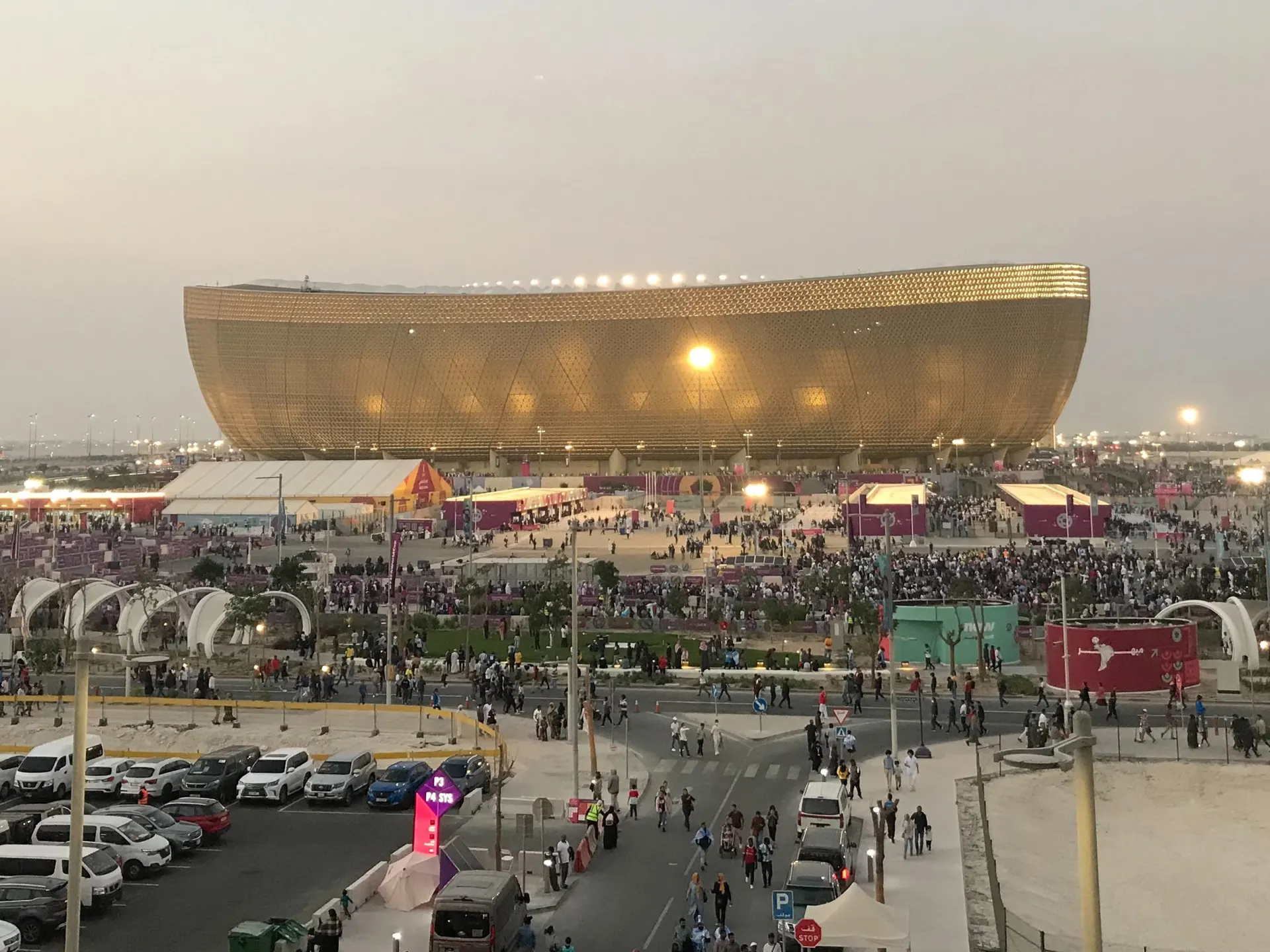
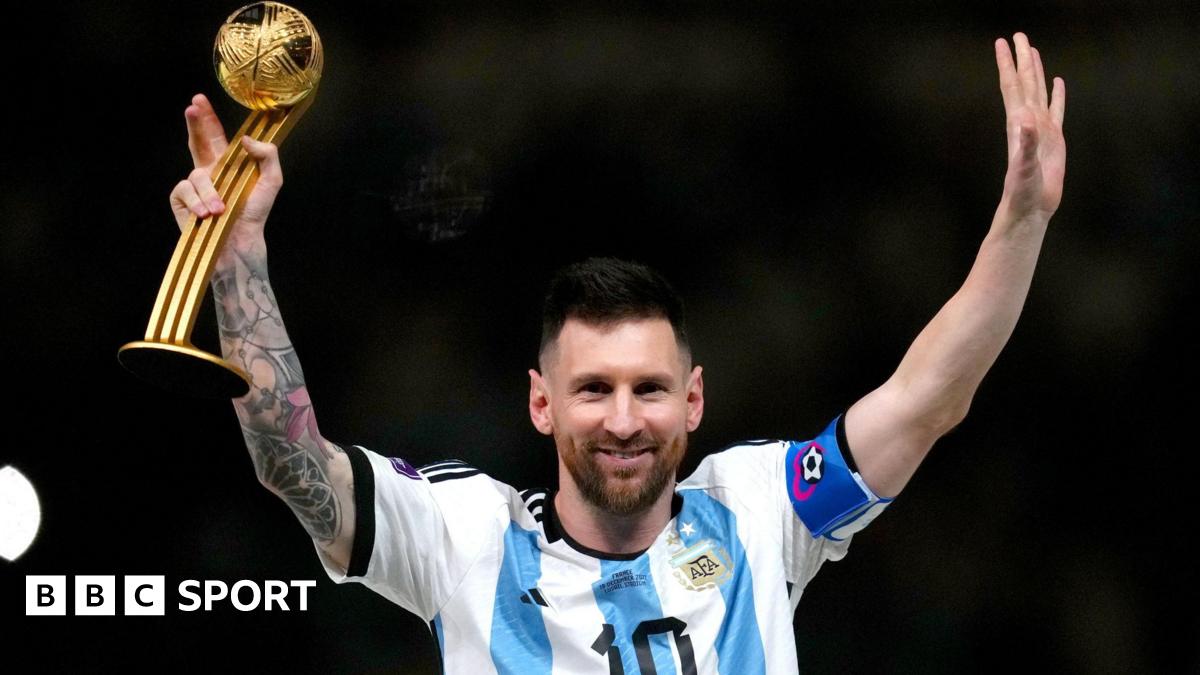
The contest between European champions Spain and Copa America winners Argentina was scheduled for March 27 at Doha’s Lusail Stadium, where fans would have had the opportunity to watch Lionel Messi go head-to-head with Lamine Yamal.
UEFA said they held discussions with the organising authorities in Qatar and concluded that the match could not take place due to the “current political situation” in the region.
The Spain vs Argentina game was part of the Qatar Football Festival, as promoted by local organisers.
The five-day festival also included Egypt vs Saudi Arabia and Qatar vs Serbia on March 26; Egypt vs Spain and Saudi Arabia vs Serbia on March 30 and Qatar vs Argentina on March 31.
Serbia will now play Spain away instead.
“Serbia will face the current European champions, Spain, on away turf on March 27, and four days later they will host the Saudi Arabian national team,” the Football Association of Serbia said in a statement.
UEFA said they explored other feasible alternatives to play the Finalissima but they proved to be ‘unacceptable’ to the Argentinian Football Association (AFA).
UEFA first offered to stage the match at the Santiago Bernabeu with a 50:50 split of supporters in the stadium.
A second option was to stage the Finalissima over two legs – at the Bernabeu on March 27 and the second leg in Buenos Aires during an international window before the next Euros and Copa America.
However, the AFA rejected both options. UEFA said Argentina made a counter offer to play the game after the World Cup but Spain had no available dates.
“Ultimately, UEFA sought a commitment from Argentina that, if a neutral venue in Europe could be found, the game could go ahead on 27 March… or on the alternative date of 30 March. This proposal was also rejected,” UEFA added.
The 2022 edition of the Finalissima was held at Wembley Stadium in London where Argentina beat Italy 3-0.
All the predictions, drama and pageantry of Hollywood’s biggest night will play out at the Dolby Theatre this afternoon as the 98th Academy Awards get underway.
How many awards will “Sinners,” directed by Ryan Coogler, win from its record-setting 16 nominations? And will Coogler win best director? Our critic says, “no.”
Tonight is also a big evening for our entertainment team, which has been producing features, previews, explainers, predictions and so much more.
The 2026 Oscars will air on ABC, and those with cable subscriptions can also watch by logging into the ABC app or abc.com.
The telecast will also stream live on Hulu, YouTubeTV, AT&T TV and FuboTV. Internationally, the ceremony will be broadcast in more than 200 territories. You can check your local listings here.
When the red carpet viewing gets underway
“Chicken Shop Date” host Amelia Dimoldenberg will return, for a third-straight year, as social media ambassador and correspondent for the official red carpet, which will kick off at 3:30 p.m. on ABC and Hulu.
For extended coverage, E! will begin its red carpet broadcast at 1 p.m. ABC’s coverage begins at 12:30 p.m., followed by “The Oscars Red Carpet Show,” hosted by Tamron Hall and Jesse Palmer.
“Sinners” is picking up steam heading into the show
My colleague Greg Braxton wrote about how award prognosticators believe Sinners gained positive press after its stars — Delroy Lindo and Michael B. Jordan — were called a racial slur at the BAFTAs.
Jordan’s and Lindo’s handling of the BAFTA incident, along with warmly received victories for the “Sinners” cast at the Actor Awards on March 1, has given the Warner Bros. release unexpected momentum leading up to Sunday’s Oscars ceremony.
Although it received a record-breaking 16 nominations, the film has been largely overshadowed through much of awards season by Paul Thomas Anderson’s political thriller “One Battle After Another.”
And Timothée Chalamet of “Marty Supreme” had been considered for months as an almost-certain lock for lead actor. But the events in past weeks have seemingly positioned “Sinners” for upset wins in the picture race and lead actor for Jordan.
Every character — from Miles Caton’s rebellious guitarist and Jack O’Connell’s lilting vampire to Wunmi Mosaku’s soulful witch and Michael B. Jordan’s bootlegging twins Smoke and Stack — has been scarred by life in 1930s Mississippi.
She also said the film “Eddington” should’ve been a contender (perhaps a nod to “On the Waterfront”). Ari Aster’s merciless black comedy drags us back to May 2020 when tempers, temperatures and misinformation were heating up across America.
Dueling civic leaders Sheriff Joe (Joaquin Phoenix) and Mayor Ted (Pedro Pascal) agree that COVID has yet to arrive in their New Mexican hamlet.
But with the Oscars, quality is often secondary to an awards narrative. Both movies have cultural relevance.
Both won critical acclaim and, to a degree, commercial success. (Though “One Battle” wasn’t the blockbuster “Sinners” was, it still grossed more than any other movie in Anderson’s career.) “Sinners” scored 16 Oscar nominations, the most in history; “One Battle” was close behind with 13.
There’s much more to read in the above links. Enjoy them and the Oscars.
You’re reading the Essential California newsletter
The week’s biggest stories
(Chris Putnam/FiledIMAGE – stock.adobe.com)
Election news
Oil and the Iran War
Crime, courts and policing
What else is going on
Must reads
Other meaty reads
For your downtime
(Illustrations by Lindsey Made This; photograph by Richard Shotwell / Invision / AP)
Going out
Staying in
L.A. Affairs
Get wrapped up in tantalizing stories about dating, relationships and marriage.
Have a great day, from the Essential California team
Jim Rainey, staff reporter Hugo Martín, assistant editor, fast break desk Kevinisha Walker, multiplatform editor Andrew J. Campa, weekend writer Karim Doumar, head of newsletters
WHITE SALMON, Wash. — Seth McBride’s life was forever changed on a snowy mountainside in British Columbia.
McBride was — and is — a thrill-seeker. Growing up in Juneau, Ala., with the untamed outdoors as his stomping ground, he loved to rock climb, mountain bike and, especially, strap on his skis and fly, soaring headlong off heart-pounding cliffs, crags and cornices.
A few months before his senior year in high school, McBride was at a terrain park at Whistler Blackcomb resort. He was 17. He launched a maneuver he’d completed many times before, a back flip off a steep jump. Only this time, he over-accelerated, over-rotated and came down on his neck. Right away he knew something was wrong.
“As soon as I landed,” McBride recalled more than 25 years later, “I lost all sensation in my legs and my lower back.”
The prognosis was grim; doctors told McBride he probably would never walk again, and he hasn’t.
But that’s scarcely slowed him down.
Views of the 47th president, from the ground up
Before they had kids, McBride and his wife biked 6,500 miles — McBride using a special, hand-cranked cycle — from Portland, Ore., to the southern tip of Argentina. He’s traveled the world as a wheelchair rugby player, winning gold, silver and bronze medals at Paralympic Games in Beijing, Rio de Janeiro and London.
McBride — adventurer, daredevil — appears unflappable. Until it comes to air travel.
It’s not the hassles and aggravation that most people put up with. Every trip requires McBride, 43, to undergo a special regimen, dehydrating himself so he won’t have to use the bathroom in flight. Every excursion includes the likelihood of being uncomfortably jostled or, worse, dropped as he’s being transferred to his seat. He can never be certain his wheelchair, his lifeline, won’t be damaged or missing once his plane lands.
“There are very few places or in my life that I feel less independent” than an airport, said McBride, who still plays competitive rugby at the club level. “None of the systems are set up for wheelchair users to be able to manage things on their own.”
Wheelchairs at Portland International Airport. The all-purpose equipment can’t serve the various needs of disabled travelers.
(Will Matsuda / For The Times)
For a time, as the Biden administration was winding down, it looked as though that was about to change somewhat. The federal government issued a set of regulations that would require airlines, among other things, to assume liability for damaged and delayed wheelchairs and improve training for staff working with passengers facing mobility issues.
But the Trump administration, which has made deregulation one of its highest imperatives, put those requirements on hold while a trade association and several major airlines sue to keep the changes from taking effect.
For McBride and others like him, it’s a disappointing setback that follows years of pressing Washington to make air transit just a bit more decent and humane.
“It sucks,” McBride said of the dignity-deflating status of a wheelchair traveler. “I know quite a few people who simply won’t fly anymore.”
Passengers forced to surrender their wheelchairs “must rely on airline staff and contractors to properly handle a wheelchair or scooter and return it in a timely manner in the condition it was received. Advocates have stressed … that, when an individual’s wheelchair or scooter is damaged by an airline, the individual’s mobility, health and freedom are impacted until the device can be returned, repaired or replaced.”
What’s more, “Advocates note that wheelchairs are often custom fitted to meet the needs and shapes of each user. Spending time in an ill-fitting chair can cause serious injury, such as pressure sores, and even death because of a subsequent infection.”
The Department of Transportation estimated that, in 2024, 1 of every 100 wheelchairs or scooters placed on a domestic flight was lost, damaged or delayed. Which may not seem like a terribly large number, unless you’re the person whose well-being, and even survival, depends on their wheelchair or scooter being at the ready and operational upon arrival.
Mia Ives-Rublee directs the Disability Justice Initiative at the Center for American Progress, a left-leaning think tank. She said airlines, which cater to luxury travelers and treat everyone else like sardines, have long put profit and expedience ahead of the needs of their disabled passengers.
“We’ve seen this tension continue to build as disabled people become more active and the world becomes more accessible. They want to travel, or have jobs that require travel,” said Ives-Rublee. While discrimination is plainly illegal, “Airlines aren’t doing enough to protect our devices,” which has the effect of making it “very difficult for disabled people to travel.”
Ives-Rublee has had nearly a half dozen wheelchairs broken by airlines in the last 20 years, which can be costly as well as life-threatening. A manually operated wheelchair can run as much as $2,000, Ives-Rublee said. A mechanized wheelchair can cost as much as a used car.
McBride mainly travels from Portland’s airport. “There are few places in my life” he feels less independent.
(Will Matsuda / For The Times)
(McBride said he’s suffered nicks and scrapes on his “everyday chair.” Worse, was the damage done to wheelchairs he uses in rugby competition, which “is obviously a big deal” when he’s traveling for a match.)
In their lawsuit opposing the rules change, airlines and their trade group said the Biden administration overstepped its authority and the new requirements were too burdensome. Strict liability for wheelchair damage also could expose air carriers to “unreasonable financial risk,” the suit claimed.
The wheelchair rules were supposed to take effect just before Biden left office. The Trump administration postponed them until March 2025, then pushed implementation to August 2025. Now, the Department of Transportation says it will issue a new rule this coming August, with a 60-day comment period to follow — meaning no change will come until at least 2027.
Ives-Rublee hasn’t much hope for relief.
“Given the nature of the administration right now, I doubt they’re putting much effort into protecting” the Biden-era regulations, she said
::
The last thing McBride wants is anyone feeling sorry for him. He’s no victim.
“It was something s— that happened to me,” he said of the accident that left him paralyzed. “But s— stuff happens to people all the time. What matters is how you move forward and what you can do with your life after that happens.”
McBride was seated at the kitchen table of his custom-built home, two miles above the Columbia River in rural Washington state. The house — one level, bright and airy, with concrete floors to smooth the path of his wheelchair — perches at the end of a steep dirt road. A forest in the backyard gives his children, ages 4 and 8, the same freedom to romp through nature he enjoyed growing up in Alaska. There’s also a climbing wall in his son’s bedroom.
Working remotely, McBride writes for New Mobility, a magazine for wheelchair users, and heads communications and marketing for the United Spinal Assn., a nonprofit advocacy group.
His politics run to the left side of the spectrum. (On a cold, drizzly morning, McBride wore a black Oregon Ducks hoodie, honoring his alma mater, the University of Oregon, and its home in liberal Eugene.) Yet while he’s no Trump fan, McBride doesn’t consider making life easier for wheelchair users to be a partisan issue. After all, he pointed out, it was a Republican president, George H. W. Bush, who signed into law the landmark Americans With Disabilities Act.
“We’ve made a lot of progress as a community working with Republicans, working with Democrats,” he said, as the sun made a brief appearance, illuminating the Douglas firs outside his door. “The basic issues of people being able to access the same services and the same experiences as everyone else shouldn’t be political. … It’s a safety thing.”
He’s not unalterably opposed to deregulation, per se.
“I think it’s a huge issue within systems when it’s overly complex for companies or people to do anything,” McBride said. “But lots of time regulations are there for a reason. It’s when private companies aren’t necessarily doing a good enough job protecting the safety or the rights of all people within a society.”
Given a chance to address Trump or the head of his Transportation Department, Sean Duffy, McBride would say this: Come, let’s take a plane ride.
“Go on a trip with my rugby team and see what it’s like when you have multiple wheelchair users on the same plane,” he said, “and how difficult it is and why we feel like regulations are needed so we can have a modicum of safety and dignity when we’re flying.”
The cost of accommodation might take away some from the airlines’ bottom line. But certain things can’t be priced in dollars and cents.
Though if you want to head to a seaside town without the crowds, the Croatian Tourism Board recommends visiting Komiza on the island, which according to the board is where fishing on the eastern coast of the Adriatic was born.
The town dates back to the 12th century and is surrounded by pretty villages to discover as well.
Stiniva Beach is just an 18 minute drive from the town and is the number one thing to do on the island of Vis, according to TripAdvisor.
The cove has crystal clear waters and pebbles, like many other beaches across the island.
From the road, it is about a 20 minute hike down to the beach, though many visitors note it isn’t easy, so sturdy shoes are recommended.
Boat tours go to the beach too, though, which is probably a better option for the more elderly.
One recent visitor said: “Stiniva Beach is hands down the most beautiful beach I’ve ever seen in my life.
“Tucked away in a secluded cove with crystal-clear water and beautiful high cliffs surrounding you, it feels like stepping into a hidden paradise.
“The atmosphere is peaceful and almost surreal, especially in the early morning when the light is soft and the crowds haven’t arrived yet.”
If you want to head to a more accessible beach, opt for Gusarica Beach which is right by the town centre.
The beach features small pebbles and it is a great spot to go paddleboarding.
The island and Komiža more specifically, was also used as a filming destination for Mamma Mia! Here We Go Again.
The area was also used to film parts of Mamma Mia! Here We Go AgainCredit: Alamy
In the second film, Harry and Bill have dinner in a Greek tavern.
In reality, the tavern is a restaurant called Jastožera and does have the amazing view that you see in the film.
The restaurant is located by a 15th century fortress that connects two cliffs and created an open air sea pool used for lobster breeding.
Since 1883, the restaurant has been owned by the Komizan family Marinkovic-Mestrezane and today you can visit to try fresh lobster dishes.
Komiža is a great base for visiting the Blue Cave on Bisevo island as well, which is an even smaller island.
The “island of peace and purity”, according to BlueCave-Bisevo.com, is known for its Blue Cave, which was revealed by Viennese painter Eugen Baron Ransonnet in 1884.
Since, tourists flock to the cave which has since become protected as a geomorphological natural monument.
What makes the cave so special is that it captures an unusual light phenomenon which gives everything in the cave a blue glow.
In 2019, research revealed that the blue glow is created by morning light hitting the yellow sandy bottom and illuminating the interior of the cave.
Nearby, you can also explore Blue Cave, which ‘glows’Credit: Alamy
Visitors can only head to the cave on an organised trip, which are available between April 1 and November 1.
Tickets to the cove can be purchased in the gift shop in Mezuporat Cove, near the cave entrance.
They cost 75 Croatian kuna (£8.67) per adult and 35 kuna (£4.05) for children, but in the peak season rise to 100 kuna (£11.56) per adult and 50 kuna (£5.78) per child.
If you book a Blue Cave tour from Split, your entrance will be included in your ticket.
The best way to get to Komiža is by flying to Split, with flights usually costing from £24 one-way.
Once in Split, hop on the ferry to Vis which usually costs between €6.50 (£5.66) and €26 (£22.63) per person.
BBC Sport has contacted the Argentine FA for comment.
Uefa said: “Argentina made a counter suggestion to play the game after the World Cup but, as Spain has no available dates, that option had to be ruled out.”
The Spanish FA said, external it had “worked intensively” to get the game on in any format possible, whether in Spain or at a neutral venue.
It said: “Spain was prepared to play as it has always been stated. They set no conditions.
“Spain, together with Uefa, has offered all possibilities.”
On Saturday the Bahrain and Saudi Arabian Formula 1 Grands Prix due to be held in April were cancelled.
Formula 1 said it is not safe to stage the races because of the conflict across the region.
The Finalissima, which is staged every four years and is organised by Uefa and the South American Football Confederation (Conmebol), was last won by Argentina at Wembley in 2022.
“LIGHTS out and away we go!”, the famous F1 cry rang out as we were about to take off from Vegas to fly back to London.
It was a nice touch by the Virgin flight attendant and brought an approving chuckle from a plane packed with motorsport fanatics who had just enjoyed one of the most memorable weekends of their lives.
Every year, the streets of Sin City echo to the sound of F1’s elite machines roaring round a 3.8-mile circuit that takes in the iconic Strip and winds round the jaw-dropping Sphere.
Where else in the world is a more fitting home for the supercharged glam of the F1 circus?
Petrolheads may not be fans of the circuit for its racing quality, but if you want spectacle, well, this is THE place to be.
Whether you’re in one of the many stands dotted around the Sphere or watching the cars whizz by at 230mph on the Strip, it’s an experience like no other.
Those with deeper pockets can take pit lane walks and tours of the track.
For most, however, the only way to get a racer’s eye view of the circuit is at the F1 Arcade in Caesars Palace — one of several worldwide — where you can go wheel-to-wheel with your mates as you blast past all the Vegas landmarks.
If you’re lucky enough to be in town for race week, you can down a beer — or a tequila shot — at the Bellagio Hotel’s legend-ary Shoey Bar.
Named in tribute to Aussie driver Danny Ricciardo’s infamous celebration, when he downed champagne from his shoe, the pop-up bar serves drinks in footwear on a terrace overlooking the hotel’s famous fountains.
One of the best track-side points to watch race action is opposite the Sphere, Las Vegas’s enormous ball of fun that’s become a global phenomenon.
On the inside, it’s currently showing a specially adapted version of The Wizard Of Oz on its 160,000sq ft screen that makes you feel like you’re IN the movie.
As well as the expected special effects like blasts of wind when the hurricane blows in, there are animatronic flying monkeys, apples falling from the ceiling and flurries of snow.
With tickets from $104 (£78), it’s booking until the end of 2026, so there’s plenty of time for you to become the fifth member of Dorothy’s gang of misfits.
Away from the Sphere, another Vegas institution is the gravity-defying Cirque du Soleil — and there are six resident productions to choose from.
Of these, I recommend “O”. It has all the death-defying acrobatics, but with a £100million stage that transforms into a 25ft deep pool in seconds.
With a daredevil cast featuring former Olympic athletes, it’s just another way for Vegas to take your breath away.
The Sun’s Stewart Jackson with a party pair showing off their impressive headwearCredit: SuppliedEnjoy a cocktail with candyfloss at Pinky’s by VanderpumpCredit: Supplied
For a classy dinner after all this fun, head to High Steaks, atop the Rio hotel.
Fifty floors up with 180-degree views from an outdoor terrace, as well as sumptuous steaks, you can gorge on extravagant seafood towers and smoked prime rib.
For something a little more relaxed, how about Pinky’s By Vanderpump at the Flamingo?
It’s no less Instagrammable, due to its sexy Art Deco greenhouse vibe, but with more affordable food.
And I urge you to try the Daddy Issues cocktail (make sure you stir in the candyfloss once you’ve taken a picture!).
For a classier speakeasy experience, The Vault — hidden deep within the sprawling Bellagio casino floor — oozes sophistication. But make sure you book to avoid disappointment.
Then on to a nightclub? Make it Omnia in Caesars Palace. You’ll be captivated by its famous kinetic chandelier that pulsates in time to the music above a dancefloor packed with beautiful people.
Away from the bright lights of the casinos and nightclubs, there is a little gem just off the Strip in karaoke bar Smelly Cat, where you can belt out your chosen anthem with a live backing group.
The resident band can play any tune their super-duper AI gadget can find. They’d never heard of Mardy Bum by Arctic Monkeys when it was requested, but they smashed it out of the park.
You can jump the queue to get up on stage by paying a $100 fee. Depending on how much you would love to sing with your own backing band, that could be an absolute bargain.
After the high-octane fun of casinos, the Strip and all those Daddy Issues, the Arts District is the place to head.
South Main Street, a 15-minute taxi ride from the Strip, is home to chilled bars and cafes, cool vintage stores, antique markets and art galleries.
It’s like an anti-Vegas if you need to decompress, and cafe/bakery 1228 Main is the ideal place to have a relaxed lunch mid-mooch — check out the breakfast burrito. A pit stop, if you will, after all that racing around.
But in Sin City — as in a Grand Prix — pit stops are very much temporary.
Cocktails await, followed by the casino, followed by a club . . .
Lights out and away we go, people!
GO: LAS VEGAS
GETTING THERE: Virgin Atlantic flies direct from London Heathrow to Las Vegas from £835pp return.
March 15 (UPI) — The Department of Defense has identified the six U.S. service members killed during a refueling mission as part of the Iran war as three members of an Air Force refueling wing and three from the Ohio Air National Guard.
The six crew members were aboard a Boeing KC-135 Stratotanker — a refueling aircraft — when it crashed Thursday in western Iraq, which was considered friendly airspace.
Among the dead were four airmen assigned to the 6th Refueling Wing at MacDill Air Force Base in Tampa, Fla.: Maj. John A. Klinner, 33, of Auburn, Ga.; Capt. Ariana G. Sabino, 31, of Covington, Wash.; and Tech Sgt. Ashley B. Pruitt, 34, of Bardstown, Ky. The three were part of the 99th Air Refueling Squadron based out of Sumpter Smith Joint National Guard Base in Birmingham, Ala.
Shortly after their identities were made public, Alabama Gov. Kay Ivey offered her condolences on X.
“Three of the service members who lost their lives in duty to our nation were stationed at the 117th in Birmingham,” she posted. “They were not only outstanding Airmen. They were our neighbors — our fellow Alabamians. May their service and that of their families never be forgot.
Three others were assigned to the 121st Refueling Wing at Rickenbacker Air National Guard Base in Columbus, Ohio: Capt. Seth R. Kobal, 38, of Mooresville, Ind.; Capt. Curtis J. Angst, 30, of Wilmington, Ohio; and Tech Sgt. Tyler H. Simmons, 28, of Columbus, Ohio.
Ohio Gov. Mike DeWine and his wife, Fran DeWine, were mourning the loss of the three airmen who operated out of Ohio and were trained to do work that was “critical in long-distance missions in defense of our nation.”
“Every mission they undertook involved risks that they were willing to take and the courage to put the lives of others above their own,” he wrote in a post on X.
“They served with honor.”
The Pentagon said the crash that led to the service members’ deaths was under investigation. A second Boeing Stratotanker involved in the incident declared an emergency before landing in Tel Aviv with no one on board injured.
Thirteen U.S. service members have died in connection to the Iran war, which began in late February.
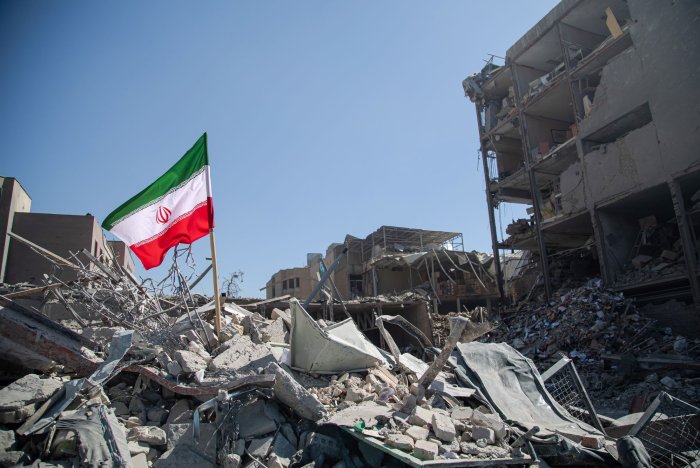
An Iranian flag stands amid the destruction in Enghelab Square following the attacks carried out by the United States and Israel on Tehran, Iran, on March 4, 2026. Photo by Nahal Farzaneh/UPI | License Photo
Japanese football legend says his opinion prompts a US company to cancel an advertising campaign before the FIFA World Cup.
Published On 15 Mar 202615 Mar 2026
Share
Former Japanese footballer Keisuke Honda says he has lost an advertising deal in the United States after voicing support for the Iranian national team’s participation in the upcoming FIFA World Cup.
Without naming the sponsor, Honda revealed on Saturday that an advertisement from a US-based company had been “put on hold” after he posted on X that he wants Iran to compete in the tournament cohosted by the US, Mexico and Canada.
Recommended Stories
list of 3 itemsend of list
“I know it’s a very sensitive thing, but I personally want them to participate in the World Cup,” the 39-year-old wrote in a tweet on Thursday, a day after Iran’s sports minister said the country cannot take part in the World Cup after the US and Israel launched a war on it and killed its supreme leader.
Honda, who represented Japan from 2008 to 2018 and scored 38 international goals for his country, posted a follow-up tweet in which he indicated that the advertisement, which had been expected to be finalised in time for the World Cup, had been shelved due to his earlier post.
“Apparently, this statement caused a US company to cancel an advertisement that was about to be finalised to coincide with the World Cup,” he wrote.
“We don’t want anything to do with companies that ignore the essence of things and make decisions based on rotten thinking.”
Iran’s place at the 48-team tournament is in doubt even after they qualified because of the US-Israeli attacks that began on February 28, following which Tehran responded by launching waves of missiles and drones at Israel, several military bases in the Middle East where US forces operate and infrastructure in the region.
The 23rd edition of the FIFA World Cup will be held in the three host nations from June 11 to July 19, and all of Iran’s group games have been scheduled at venues on the US West Coast.
The former Samurai Blue represented his country at the 2010, 2014 and 2018 World Cups and is among the top 10 most capped players and top five goal scorers for the Asian giants.
Honda was named the most valuable player in Japan’s title-winning run at the Asian Cup in 2011. After representing 11 clubs across five continents, the attacking midfielder hung up his boots in 2024 and switched to coaching.
The golden-haired player enjoys a hero-like status in his home country and is one of Japan’s most recognised international footballers.
He expressed his opinion on Team Melli’s participation amid heightened tensions between the host nation US and Iran.
Honda played club football in South America, North America, Europe, Australia and Asia [File: Pilar Olivares/Reuters]
US President Donald Trump said on Thursday that it would not be appropriate for Iran to participate in the World Cup.
“The Iran National Soccer Team is welcome to The World Cup, but I really don’t believe it is appropriate that they be there, for their own life and safety,” Trump wrote in a social media post without elaborating.
The Instagram account for the Iranian national team quickly responded to Trump’s remarks, questioning whether the US president should be commenting on team participation.
“The World Cup is a historic and international event, and its governing body is FIFA – not any individual country,” it wrote.
The account also criticised Trump for failing to provide adequate security for Iran’s national football players.
“Certainly, no one can exclude Iran’s national team from the World Cup,” the message continued. “The only country that could be excluded is one that merely carries the title of ‘host’ yet lacks the ability to provide security for the teams participating in this global event.”
Trump later posted another message on his social media platform to emphasise that the event would be safe for players and spectators from around the world.
Chase Infiniti has only been in the spotlight for two years but she has already brushed shoulders with Hollywood greats like Leonardo DiCaprio and Jake Gyllenhaal
13:40, 15 Mar 2026Updated 13:44, 15 Mar 2026
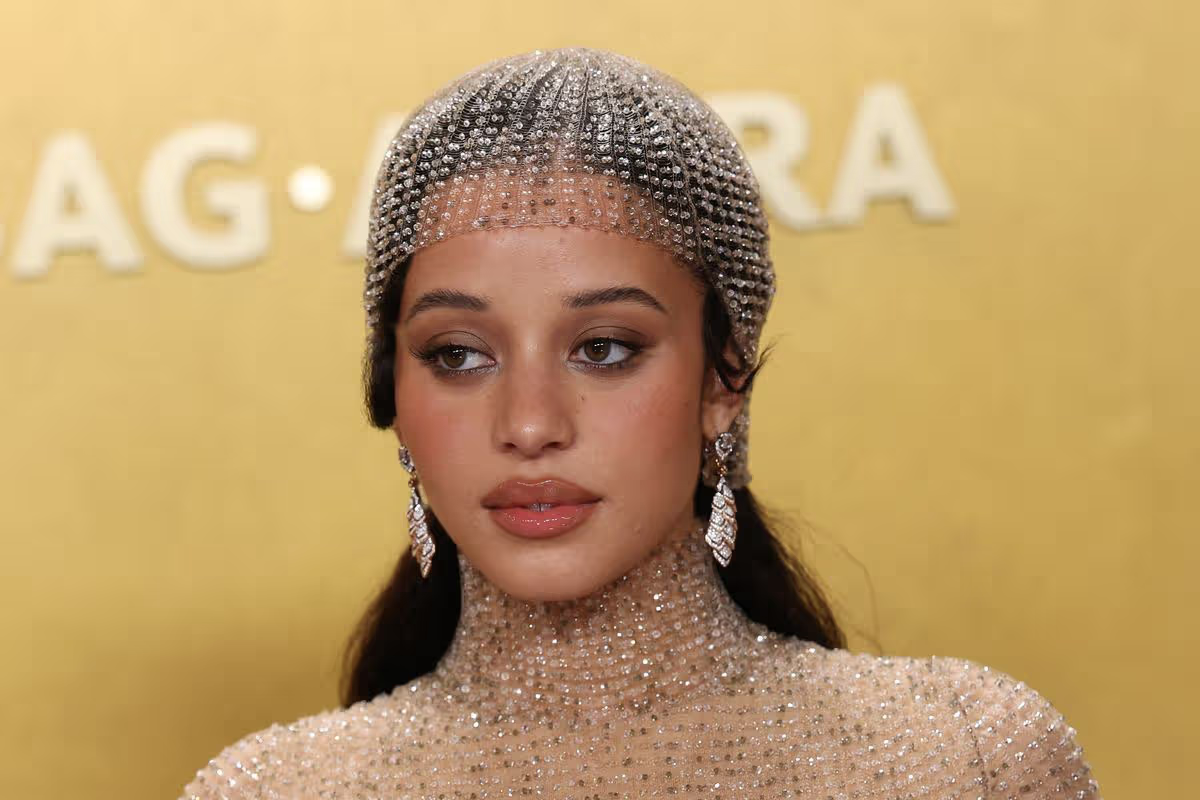
Chase Infiniti is presenting an award at the 2026 Oscars(Image: Getty )
Rising star Chase Infiniti has already become one of Hollywood’s most talked-about stars after just two big roles.
It’s hardly a surprise considering her unique name and stellar leading performance in One Battle After Another alongside industry giant Leonardo DiCaprio.
While Leo and other cast members managed to bag nominations at this year’s Oscars, Chase didn’t receive a nod.
As viewers tune into the long-awaited award show, we’re certain many will be curious to learn more about Chase’s background.
How did Chase Infiniti get her name?
The 25-year-old actress was born Chase Infiniti Payne in Indiana, America. Her name was inspired by legendary films Batman Forever and Toy Story.
She shared in an interview with the Today Show that her parents “had watched Batman Forever and they were obsessed with Nicole Kidman as Chase Meridian”. They decided to name their child, whether it would be a boy or girl, Chase.
When the couple were searching for a middle name, they landed on Buzz Lightyear’s iconic catchphrase from the Toy Story series: “To infinity and beyond!”
Chase has reflected on her parents seemingly predicting she would have a career in movies, telling the Today Show: “It’s really crazy. I’m like ‘How did [they] predict that!'”
Are Chase Infiniti’s parents movie stars?
Content cannot be displayed without consent
Chase’s parents are not movie stars. However, new fans may be confused by chatter on the internet suggesting that she is Kerry Washington and Tony Goldwyn’s daughter.
It is actually a running joke on the internet that Chase is the love child of Kerry and Tony’s characters in Scandal.
The hit political drama followed Tony as President Fitzgerald Thomas Grant III. He sparks a heated affair with former White House Communications Officer Olivia (played by Kerry), which he is determined to hide from the public.
The online joke came after viewers noticed a striking resemblance between Tony and upcoming actor Tyriq Withers, with others later bringing Chase into the conversation.
It went even more viral when leading star Kerry unexpectedly played into the social media discussion last month, sharing a playful selfie with her ‘Scandal children’.
She tagged her co-star in the caption, writing: “It’s a family reunion at the @naacpimageawards (Missing you @tonygoldwyn).”
What else has Chase Infiniti starred in?
The rising star is building an impressive career, having featured in Apple TV’s Presumed Innocence alongside Jake Gyllenhaal in 2024.
She then appeared in One Battle After Another in 2025, and has been nominated for a BAFTA, Critics Choice Award and Golden Globe for her part as Leo’s on-screen daughter, Willa.
Her recognition throughout awards season left film fans stunned when she didn’t earn an Oscar nominations, with many arguing she was ‘snubbed’.
The Gen Z star is also set to feature in The Handmaid’s Tale sequel, The Testaments, premiering on April 8.
The Oscars will air on ITV1 and ITVX tonight (March 15) at 10.15pm.
For the latest showbiz, TV, movie and streaming news, go to the new **Everything Gossip** website
WASHINGTON — The Trump administration is stepping up its ambitious effort to replace about $1.6 trillion in lost tariff revenue that was eliminated by the Supreme Court’s decision to strike down a range of the president’s import taxes.
Recovering that lost revenue, which the White House was counting on to help offset the steep, multitrillion-dollar cost of its tax cuts, is possible but will be challenging, experts say. The administration has to use different legal provisions to impose new import taxes, and those provisions require longer, complex processes that U.S. companies can use to seek exemptions. It could be months or more before it is clear how much revenue the replacement tariffs will yield.
“I wouldn’t bet against this administration being able to get back on paper the same effective tariff rate they had before,” said Elena Patel, co-director of the Urban-Brookings Tax Policy Center. But the new approach will “make it easier for people to contest the tariffs, which is going to put a big asterisk on the revenue until all that is settled.”
On Wednesday, U.S. Trade Representative Jamieson Greer said the administration will investigate 16 economies — including the European Union — over whether their governments are subsidizing excessive factory capacity in a way that disadvantages U.S. manufacturing. The investigation will also cover China, South Korea and Japan, Greer said.
In addition, he said, there would be a second investigation of dozens of countries to see whether their failure to ban goods made by forced labor amounts to an unfair trade practice that harms the United States. That investigation will also cover the EU and China, as well as Mexico, Canada, Australia and Brazil.
Both investigations are being conducted under Section 301 of the 1974 Trade Act, which requires the administration to consult with the targeted countries, as well as hold public hearings and allow affected U.S. industries to comment. A hearing as part of the factory capacity investigation will be held May 5, while a hearing on the forced labor investigation will occur April 28.
It’s a far cry from the emergency law that President Trump relied on in his first year in office, which allowed him to immediately impose tariffs on any country, at nearly any level, simply by issuing an executive order.
Moments after the Supreme Court’s ruling, Trump imposed a 10% tariff on all imports under a separate legal authority, but that duty can only last for 150 days. The president has said he would raise it to 15%, the maximum allowed, but has yet to do so. Some two dozen states have already challenged the new taxes. The administration is aiming to complete its Section 301 investigations before the 10% duties expire.
The effort underscores the importance that the Trump White House has placed on tariffs as a revenue-raiser at a time when the federal government is facing huge annual budget deficits for decades into the future. Previous administrations, by contrast, used tariffs more sparingly to narrowly protect specific industries.
Erica York, vice president of federal tax policy at the Tax Foundation, noted that the first investigation covers roughly 70% of imports, while the second would cover nearly all of them.
“That breadth suggests the goal isn’t to address the issues at hand, but instead to re-create a sweeping tariff tool,” she said.
Trump portrays tariffs as a way to force foreign countries to essentially help pay the cost of U.S. government services, even though all recent economic studies find that American companies and consumers are paying the duties, including analyses by the Federal Reserve Bank of New York and economists at Harvard University. In his State of the Union address last month, Trump even touted his tariffs as a potential replacement for the income tax, which would return the United States’ tax regime to the late 19th century.
Trump also wants tariffs to help pay for the tax cuts he extended in key legislation last year. The tax cut legislation is expected, according to the most recent estimates by the nonpartisan Congressional Budget Office, to add $4.7 trillion to the national debt over a decade, while all Trump’s import taxes, including ones not struck down by the court, were projected to offset about $3 trillion — or two-thirds of that cost.
The high court’s ruling Feb. 20 that he could no longer impose emergency tariffs eliminated about $1.6 trillion in expected revenue over the next decade, according to the CBO.
Some of Trump’s import taxes remain place, including previous tariffs on China and Canada that were imposed after earlier 301 investigations. The administration has also imposed tariffs on some specific products, including steel, lumber and cars. Those, combined with the 10% tariff for part of this year, should yield about $668 billion over the next decade, the Tax Foundation estimates.
“It’s going to take a really big patchwork of these other investigations to make up for the [lost] tariffs,” York said.
The administration’s efforts are also unusual because they reflect an overreliance on tariffs to bring in more government revenue. Trump has also said the import taxes are intended to return manufacturing to the United States — manufacturing jobs, however, are down since he returned to office — and he has used the tariffs to leverage trade deals.
“What makes this really different,” said Kent Smetters, executive director of the Penn Wharton Budget Model, “it is really the first time tariffs have been mainly used as a revenue raiser.”
Patel, meanwhile, argues that raising revenue can be done more reliably and straightforwardly by Congress. Laws like Section 301 are traditionally intended to be used to address specific trade policy concerns in particular countries.
“It’s not supposed to be there to raise revenue,” she said. “If we want to raise revenue through tariffs, then Congress should impose a broad based tariff.”
In late November, Gabriela Jaquez scored 29 points against Tennessee. It wasn’t her career high; that came when she tallied 30 points two years prior.
But that game, when Tennessee had no answers for a player who was then the UCLA women’s basketball team’s fifth offensive option, felt like Jaquez’s coming-out party after years as a quieter cog in the Bruins’ rotation. It changed the way teams had to defend her. Previously known more for attacking the rim than for shooting from outside, Jaquez showcased a different dimension.
Suddenly, one of the best teams in the nation had one of the best breakout stars. Entering the NCAA tournament, the 31-1 Big Ten champion Bruins are relying on Jaquez as one of their super seniors to guide them back to the Final Four.
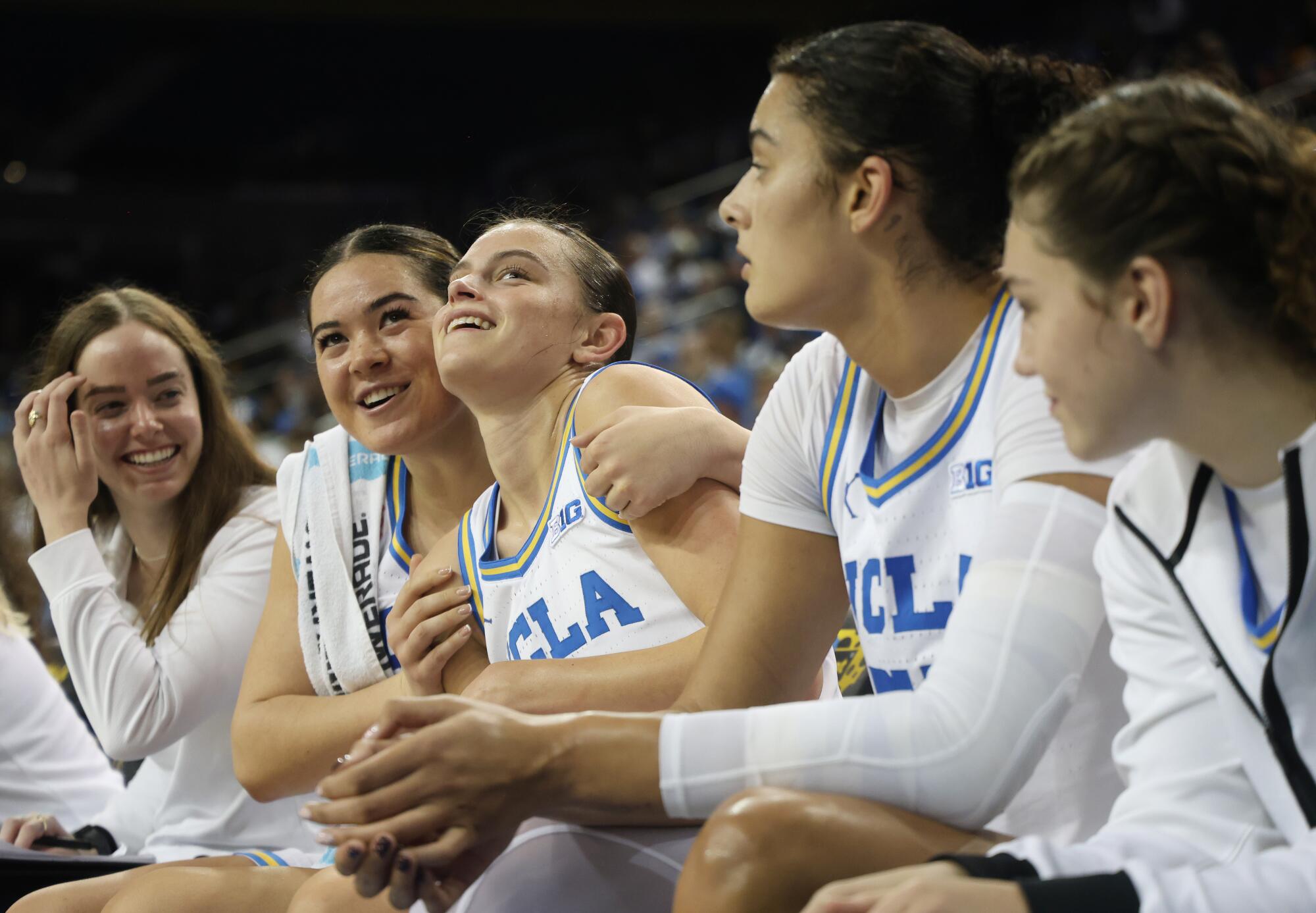
UCLA guard Charlisse Leger-Walker hugs teammate Gabriela Jaquez, who led the Bruins in scoring during a win over Tennessee on Nov. 30 at Pauley Pavilion.
(Luiza Moraes / Getty Images)
“I do think she’s always been that player,” said senior guard Kiki Rice, who has played four seasons with Jaquez. “But I do think she’s had a lot more opportunity to demonstrate that, and you saw that in the beginning of the year. She just started off such a hot shooter, and the way that she’s developed every single year, gotten better and just found a way to impact the team.”
Though she hasn’t reached that same scoring peak again, Jaquez has quietly buoyed UCLA’s dominant run this season as the Bruins have emerged as one of the favorites to win a national title. She ranks second on UCLA (among players with at least 30 attempts) in field-goal percentage at 54.3%, second in three-point shooting at 41.1% and third in scoring.
Jaquez has gotten attention for being part of a family legacy at UCLA and spending an offseason with the Bruins’ softball team. But in the background, even when she hasn’t been the leader for the UCLA women’s basketball team, Jaquez has honed herself into one of just 25 Power Four conference players shooting better than 40% from deep this season.
Jaquez, who tallied her 1,000th career point early this season, is having a career-best season with 13.6 points per game, has added double-digits in 25 of her 31 games this season.
“There’s so much depth to her,” said guard Charlisse Leger-Walker, who often dances alongside Jaquez in videos posted on social media and Leger-Walker’s YouTube video series. “Getting to understand her off the court, I think has really helped our connection on the court, and kind of how her personality is so outgoing. She likes to bring people along. You can see that on the court.”
Jaquez came in as a 5-foot-11 freshman who played primarily as an undersized forward and would crash the net and collect rebounds.
The shooting, though, has been the biggest change this season.
“I think of her as someone who, especially early on, like she doesn’t need to have the ball on hand, she doesn’t need to have plays run for her to impact the game,” Rice said. “But then she’s been shooting so well too.”
Early in the season, teams doubled Lauren Betts, who leads the team with 16.4 points per game as a center, which opened Jaquez to shoot from deep, establishing herself as someone who needed to be keyed on.
UCLA’s Gabriela Jaquez shoots the ball under pressure from Oregon’s Katie Fiso on Dec. 7 at Pauley Pavilion.
(Luke Hales / Getty Images)
Her 107 three-point attempts are a career-high this season, with her shot selection jumping to 32.4% coming from behind the arc. That’s come with a career-high 2.2 assists per game and an 85.2 defensive rating, ranked in the top 20% of the nation.
“She can shoot the ball, she can finish, she defends,” shooting guard Gianna Kneepkens said. “I love playing with Gabs. Sometimes I get caught watching her because she’s just so amazing.”
Now, Jaquez projects as a first-round WNBA pick, in large part because of her versatility on offense. She is listed as a guard on the Bruins’ roster, but often starts at forward, where she can stretch the floor. Her 5.4 rebounds per game are third on the team, thanks in large part because of her ability to fill positions one through five.
During UCLA’s Big Ten semifinal win over Ohio State, Jaquez shot four for 12 but Bruins coach Cori Close noted Jaquez’s importance when her shooting isn’t on target.
“What I liked about that the most is that she struggled a little bit in the middle of the second half,” Close said. “It just showed a lot of her mental toughness that, when we needed her the most, she was going to be there for us on the defensive end and on the rebounding end.”
While all five starters have been mentioned as possible WNBA first-rounders, Jaquez has perhaps made the biggest leap, two WNBA scouts not authorized to publicly discuss prospects said.
UCLA senior Gabriela Jaquez celebrates with the Big Ten tournament trophy after the Bruins beat Iowa in the finals on March 8 in Indianapolis.
(Michael Conroy / Associated Press)
When Rice and Leger-Walker are on the bench, Jaquez has taken on point guard duties.
“She does all those little hustle plays,” Leger-Walker said. “She will score if you need her to, she’ll cut, she’ll rebound, like, she’s so versatile. You know what you’re getting from her, and she’s kind of that person who’s the engine of our team.”
Jaquez hasn’t thought much about what happens after this season. This year’s mantra of joy has resonated after last year’s crushing Final Four loss to Connecticut.
“It’s been fuel,” Jaquez said. “That started [last] spring and into the offseason, knowing exactly what to work on, how to prepare…. But I just love the team aspect of basketball, I love this group of girls specifically and I think having so much fun out there has [been the most important thing] and winning has made it even better.”
The night Jaquez hit five three-pointers against Tennessee may have felt like her arrival. But for the teammates who have watched her develop for four years, it looked less like a breakthrough and more like the rest of the country finally catching up.
The rest of the country may have only noticed this season. But inside UCLA’s locker room, Jaquez has been that player all along.
“Gabs is an extremely confident person, so I feel like if you’d asked her this freshman year, she would have believed that she’d become just the incredible player that she is,” Rice said. “Just the opportunity, her experience at this level these past few years has really helped her develop into what she is.”
The decision by United States President Donald Trump to launch a war on Iran has left many international law experts questioning if the world order established after World War II is actually working.
In his second presidential term, Trump seems to be wielding total power without restraint, and the system of checks and balances enshrined in the US Constitution appears to be failing to limit his power.
Recommended Stories
list of 4 itemsend of list
Since Trump was sworn in in January 2025, he has ordered two unprovoked attacks on independent states, Venezuela and Iran; threatened to annex Greenland; strained traditional alliances with Europe; undermined the United Nations; and rattled international trade with his sweeping tariffs.
Previous constraints set by the UN system and international law appear supplanted by what Trump told reporters in January was a vision of power limited only by his “own morality”.
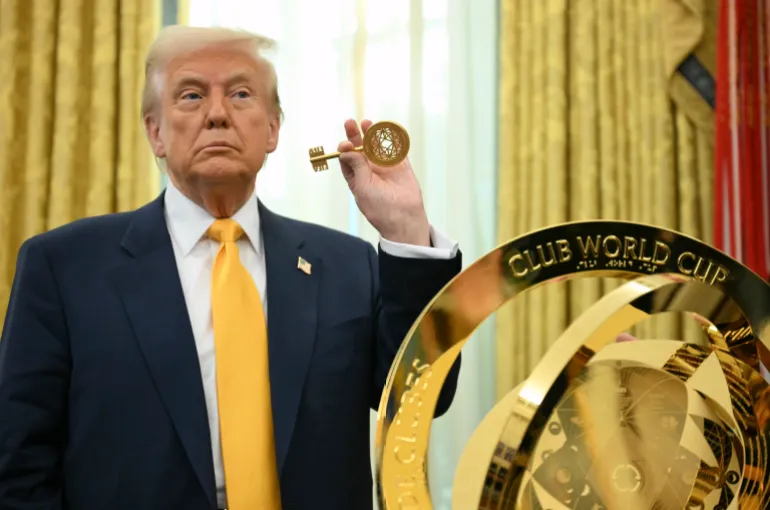
President Donald Trump holds the key to unlock the FIFA Club World Cup trophy, which he said is staying at the White House, requiring a replica to be presented to the tournament’s winners, Chelsea, in July 2025 [File: Pool via AP]
So what checks are there on Trump? Is he really free to attack states, set tariffs at will and, as leader of the world’s most powerful state, essentially dictate global policy? And if so, why are so many observers now saying his war on Iran is faltering?
Has international law put any checks on Trump?
Not so far.
According to analysts, both his attacks on Venezuela and Iran were in clear breach of international law and the UN Charter, principally the prohibition on the use of force under Article 2(4).
Debates about international law, how it has been geared over the decades to underpin the interests of the West and the US specifically, are hardly new. However, experts said, the Trump presidency has seen even the notional restraints of international law trampled underfoot.
Trump himself has brushed aside international law, saying in January that it would be up to him to decide when and how much international law applied to the US and his actions.
“In many respects, international law has historically served US interests, and self-interest should continue to generate US support for a rules-based order organised around the core principles enshrined in the UN Charter,” Michael Becker, a professor of international human rights law at Trinity College in Dublin who previously worked at the International Court of Justice in The Hague, told Al Jazeera, “But finding value in international law often requires adopting a long-term outlook that does not sit easily with short-term political agendas.”
“In the current geopolitical climate, the capacity of international law to provide a meaningful constraint on US action under Donald Trump has proven negligible,” Becker added. “That seems unlikely to change, especially given the failure by other states to strike a united front against Trump’s gangsterism.”
What about the UN?
Not so much.
From its founding, the role of the UN has been to promote dialogue instead of conflict and provide a global response to international challenges. However, Trump’s relationship with the body, like so many of the president’s associations, has rarely been so straightforward. On the one hand, while appearing to try to supplant the body with his members-only Board of Peace as well as sidelining UN aid efforts in Gaza, he has on occasion sought the legitimacy of the UN for a number of his projects, such as his calls in August for the UN to establish a Support Office in Haiti, to help limit migration to the US.
However, while the support of the UN may be helpful, it is clear that Trump has no intention of abiding by its charter, Richard Gowan, the Crisis Group’s UN director from 2019 to 2025, said.
“While other UN members see the US is breaking international law on a regular basis, they often hold back from criticising Washington too loudly in forums like the Security Council because they fear blowback from Trump,” Gowan said. “So Trump is learning he can sidestep the UN when he wants to and get away with it while occasionally using it for instrumental purposes.”
What about other powers?
Up to a point.
Many countries known as “middle powers”, such as Canada, the United Kingdom, France, and other Western and European states, have proven successful so far in pushing back against Trump’s efforts to unilaterally annex Greenland. But European powers have failed to condemn Trump’s unprovoked war on Venezuela and Iran, exposing their double standards in conflicts in the Middle East and the Global South.
Many analysts expect that a withdrawal of investments in the US by Gulf states, which are bearing the brunt of Iran’s retaliation to US and Israeli attacks, may also hasten the war’s end.
“Middle powers can generate friction but not a veto,” HA Hellyer of the Royal United Services Institute for Defence and Security Studies in London said. “Collective action – European governments, Gulf states – can raise costs and extract tactical adjustments. The structural imbalance remains: The US retains decisive military, financial and institutional primacy.”
Smaller states often hedge their bets, follow Washington or look to regional alliances for protection, Hellyer added, continuing that while pressure was strongest in Europe, where the US is no longer seen as a reliable security guarantor, the idea of establishing an alternative continues to be a hurdle. “The logic of an alternative model is accepted; the capacity to execute it quickly is not. A prolonged interregnum follows. The Gulf Arab states are in an analogous position,” he said.
In the meantime, Trump and the US are free to act as they choose. “These are exposure-management strategies, pursued until structural dependence on the US security umbrella can be reduced,” he said.
China and Russia have so far criticised the breaches of international law while avoiding clear escalation, and India and other members of the BRICS bloc have largely stayed silent, suggesting a preference for strategic ambiguity over confronting Washington directly.
Canadian Prime Minister Mark Carney warned Trump of a ‘rupture’ in the Western alliance at the World Economic Forum in Davos, Switzerland, in January 2026 [File: Denis Balibouse/Reuters]
What about domestic restraints?
Not really.
The US Supreme Court was able to block Trump’s use of tariffs to manage large parts of his foreign policy by rewarding allies with lower tariffs and punishing critics with punitive import duties.
But none of the other traditional guardrails – such as Congress; the Department of Justice, which has provided unwavering support to the president; and even the news media – has contained the president’s ambitions. This isn’t entirely new. Previous presidents have ordered wars without congressional approval. However, with Trump, analysts suggested, it has been systematic.
Powerful US institutions have largely failed to hold the Trump administration accountable, analysts, such as Kim Lane Scheppele, a professor of international affairs at Princeton University, said.
“His base of strong supporters are saying that they are willing to experience short-term increases in gasoline prices if it leads to a friendly government in Iran in the long term. His opponents have been his opponents on everything, so he simply ignores and threatens them,” Scheppele told Al Jazeera.
“Trump pays more attention to market performance than to public opinion, so he started saying that he was minimising costs and saying that the Iran war is short term to boost markets again.”
“What the US is spectacularly missing is leadership to oppose Trump. Congress is not doing its constitutional job to constrain him. The Supreme Court is in his pocket because he packed the court in his first term. Lower court judges are heroic and have done amazing work under serious pressures, but they don’t get foreign policy questions, given the difficulty of anyone getting ‘standing’ … in the area of international matters,” she said, referring to the requirement that parties to a lawsuit must show actual or future direct harm to themselves to bring a case to court.
She noted that lower federal courts, although limited on foreign policy, have repeatedly checked executive overreach on immigration, sanctions designations and emergency powers, often under intense political pressure.
A bulk carrier and tanker at anchor in Muscat, Oman, as Iran has essentially closed the Strait of Hormuz by threatening to attack vessels transiting the waterway [File: Benoit Tessier/Reuters]
So why are so many people saying Trump’s war is faltering?
In the eyes of many observers, Trump, with no clear war aims or a defined resolution, is in danger of losing control of a conflict that appears to be both growing and reaching into economic areas apparently unforeseen by his administration, so while traditional restraints don’t apply, market forces, like gravity, always do.
Trump has repeatedly said the war would be over soon despite none of his claimed war aims being achieved.
Oil prices have surged due to his attacks on Iran, Tehran’s counterstrikes and threats to shipping in the Strait of Hormuz, through which about 20 percent of the world’s oil and liquefied natural gas passes.
The International Energy Agency’s decision on Wednesday to release 400 million barrels of oil from international petroleum reserves has failed to tame the prices. Iran has warned that oil could hit $200 a barrel as it continues its stranglehold of the waterway.
“Ultimately, the factors that might be most likely to constrain Donald Trump’s neoimperialist impulses – or his willingness to pursue the policy goals of those who have his ear – are the economic fallout from disrupting global energy markets and a broader disenchantment among US voters with his globe-trotting militarism, his rampant self-dealing and his callous disregard for the human costs of war,” Becker said.
Fine margins are often the difference between a title-winning side and one still building towards it.
Thomas Ramos’ last-gasp penalty to win the championship for France came after a handful of moments England will replay in their minds for a while.
Henry Pollock did brilliantly to steal the ball late on but, instead of taking contact and securing it, he tried to move it and possession was lost.
Ollie Chessum might also look back and think he could have edged a little closer to the posts to make the kick easier for Fin Smith, who himself will be frustrated at leaving points out there.
Those are the moments you write down and burn into your memory, because when they come around again – and they always do in Test rugby – you want the instinct to be automatic.
The best teams make winning those moments a habit.
Just look at South Africa at the 2023 World Cup – three knockout wins by a single point.
That is not luck. That is a team that understand exactly how to manage pressure.
England had been through a sticky spell and this performance gives them something real to build on heading into the summer.
When this squad meet up again for the tour to South Africa, there should be a real sense of belief.
They have shown they can challenge the very best teams in the world. Now it is about learning how to close out those pressure moments when they come.
Another area that will need attention is opposition analysis.
France exposed England a couple of times in the first half with tries straight from set-piece starter plays.
At this level, that is inexcusable. Louis Bielle-Biarrey chasing on to kicks through is something France have done all championship.
Those details matter. Fix them, combine that with the intensity England showed in Paris, and suddenly you have a team not just competing with the best, but capable of beating the best.
BROADCASTER Greg James sobbed as he spoke about his dad’s recent stroke on day two of his 1,000km tandem bike ride for Red Nose Day.
Earlier this month the Radio 1 host, 40, had to cancel his show and rush home after his beloved father Alan Milward suffered a strokeduring a planned heart operation.
Sign up for the Showbiz newsletter
Thank you!
BBC Radio 1 DJ Greg James spoke about getting emotional during his tandem bike rideCredit: Instagram/BBC Radio 1Greg got emotional thinking about his dad who’d just had a strokeCredit: Instagram/BBC Radio 1Alan Milward (L) had the stroke earlier this monthCredit: BBC
Greg, who took off from stormyWeymouthinDorset on Friday will ride solo all the way toEdinburgh by next Friday.
“I feel elated. I feel a bit overwhelmed by all these people who just turned up out of nowhere. I just burst into tears as I was going up to Blaenavon. It was all a bit much,” Greg said on BBC Radio 1 after the second day of his ride.
“Just thought about… I just thought about everything. Just thought about my dad, thought about my mum. It got way too much. It’s so silly. It must have been the altitude.”
Greg continued: “And then someone gave me a Wales flag and I was holding that and I thought about my old nan, and she’s Welsh. And then I just thought about everything and then everything just made me cry, and I just felt really overwhelmed by it all.
“But the day is done, and I actually can’t believe I’ve managed to get to Abergavenny.”
Before heading off on his mammoth mission, Greg opened up to The Sun about his gruelling training regimen.
“I have been training really hard on my bicycle from about Christmas, and every day has been leg day,” he said.
“It’s been a f***ing nightmare. But it’s all for a good cause and totally worth it.
“I have done thousands of miles, either out in the real world or on a bike in the spare room with a laptop propped up watching Heated Rivalry.”
Greg also confirmed he has an upbeat playlist to keep him going.
Greg said he couldn’t stop crying thinking about his familyCredit: Getty
He said: “The song I just can’t stop listening to is Aperture by Harry Styles. I’ve also got a lot of Chemical Brothers because that’s just nice, upbeat, good dance music.”
The provided text is an excerpt from a digital news publication titled “Occasional Digest,” specifically focusing on the date March 15, 2026. The primary article commemorates Hungary’s Revolution Day, detailing how the 1848 uprising against the Austrian Empire remains a cornerstone of Hungarian national identity despite its ultimate military defeat. In addition to this historical retrospective, the source displays a variety of current event headlines involving international diplomacy, such as diplomatic tensions between Hungary and Ukraine and U.S. political interest in Hungarian elections. The document also includes standard media features like global currency exchange rates, regional weather forecasts, and updates from the worl …
In one of his latest missives on social media, President Trump complained that he wasn’t getting enough credit for “totally destroying the terrorist regime of Iran, militarily, economically, and otherwise.”
“We have unparalleled firepower, unlimited ammunition, and plenty of time,” he wrote of a war that has crippled the global supply of oil, sharply increased gas prices, cost U.S. taxpayers billions, left thousands dead and wounded, and so far defied Trump’s own “short term” timetable.
“Watch what happens to these deranged scumbags today,” Trump added. “They’ve been killing innocent people all over the world for 47 years, and now I, as the 47th President of the United States of America, am killing them. What a great honor it is to do so!”
Again and again in recent days, Trump and other top officials in his administration — notably Secretary of Defense Pete Hegseth — have projected confidence and power in Iran in a coarse and triumphant tone that is unprecedented for U.S. wartime presidents and their Cabinet members, according to experts in presidential rhetoric and propaganda.
They have consistently described the war in terms of how hard the U.S. is hitting Iran, rather than why it must do so. They’ve talked of destroying the Iranian navy and air force, wiping out its leadership and making the U.S. “more respected” globally than it has ever been, including by showing no mercy.
“This was never meant to be a fair fight, and it is not a fair fight. We are punching them while they’re down, which is exactly how it should be,” Hegseth said.
Missing is the solemnity of past wartime leaders facing dead U.S. soldiers, a recalcitrant enemy and a precarious tactical position, replaced by a message of U.S. mercilessness — of contempt for Iran rather than concern for its civilians or a focus on the American ideals that U.S. presidents have long tried to rally the world around, especially in times of war.
“At a time when people can see the effects of the war when they fill up their gas tank, and when there have been American casualties, the triumphalist tone is just not something a president normally does,” said Robert C. Rowland, a professor of rhetoric at the University of Kansas and author of the book “The Rhetoric of Donald Trump: Nationalist Populism and American Democracy.”
“Many presidents wouldn’t have that tone for personal moral reasons,” Rowland said, “but they also know that it can backfire when things don’t go well.”
James J. Kimble, a communication professor and propaganda historian at Seton Hall University, said U.S. presidents have “by and large” struck a respectful tone in wartime, though there are some exceptions. President Truman, justifying dropping atomic bombs on Japan, wrote that “when you have to deal with a beast, you have to treat him as a beast,” while the U.S. produced World War II posters designed to “demonize and dehumanize the German enemy,” he noted.
Still, Trump’s messaging — including his “expressing glee at the death of foreign combatants” — has been “much coarser,” Kimble said.
“It’s moving beyond the idea of defeating the enemy on the field of battle, and more into a kind of defeat as humiliation — intentional humiliation,” he said. “It’s schoolyard bullying, along with the physical violence.”
Asked about Trump’s rhetoric, Anna Kelly, a White House spokeswoman, said Trump “will always be proud to recognize the incredible accomplishments of our brave service members.”
“Under the decisive leadership of President Trump, America’s heroic war fighters are meeting or surpassing all of their goals under Operation Epic Fury,” she said. “The legacy media wants us to apologize for highlighting the United States military’s incredible success, but the White House will continue showcasing the many examples of Iran’s ballistic missiles, production facilities, and dreams of owning a nuclear weapon being destroyed in real time.”
Trump has built his political career around blunt rhetoric, and his messaging on Iran has drawn applause from his supporters. Polling has shown the public is heavily divided on the war — drawing far less public support than past wars, but broad support from Republicans.
White House Press Secretary Karoline Leavitt has accused the media of ignoring “clear” objectives that the president and others have set for the war effort, including wiping out Iran’s missile systems, preventing it from developing a nuclear weapon and stopping what Trump had a “feeling” was a coming attack on the U.S.
However, Trump and Hegseth have themselves strayed from that framework with their brash rhetoric, and their focus on the killing of Supreme Leader Ayatollah Ali Khamenei and other Iranian leaders.
Trump has dismissed reports that the U.S. bombed an Iranian school full of children by suggesting that Iran may actually have been responsible, despite reported findings by U.S. intelligence that it was an American attack.
Hegseth has added to concerns about careless U.S. bombing by expressing disdain for wartime rules designed to limit civilian casualties, calling them “stupid rules of engagement.”
“Our war fighters have maximum authorities granted personally by the president and yours truly,” Hegseth said. “Our rules of engagement are bold, precise and designed to unleash American power, not shackle it.”
The White House has also pushed out a wave of wartime propaganda on social media, often striking the same irreverent, bullish tone, experts noted.
One video interspersed movie clips of superheroes and soldiers with real footage of Iranian targets getting blown up, under the words, “JUSTICE THE AMERICAN WAY.” The clip drew condemnation, including from the actor Ben Stiller, who objected to the inclusion of footage from his film “Tropic Thunder,” saying, “War is not a movie.”
Hegseth’s bravado has also been caricatured on “Saturday Night Live,” which opened two weeks in a row with a satirical portrayal of him as angry, dimwitted and hyped up on the violence of war.
All of it has come against a backdrop of Islamophobic remarks from members of Congress on X, with Rep. Andy Ogles (R-Tenn.) writing that “Muslims don’t belong in American society” and Sen. Tommy Tuberville (R-Ala.) posting a picture of the 9/11 terrorist attack next to an image of New York City Mayor Zohran Mamdani, who is Muslim, and writing “the enemy is inside the gates.”
Certainly Iranian leaders have expressed similar contempt for the U.S. for years. Khamenei, killed at the start of the war, was known for stoking anti-American sentiment, speaking to crowds amid chants of “death to America.”
However, U.S. presidents have traditionally spoken with more reserve. They have slammed U.S. enemies, but often by drawing a contrast between them, the U.S. and the values the U.S. purports to defend globally. They have expressed confidence in past U.S. missions, but been wary of taking a celebratory or triumphant tone — especially at the start of a war, amid intense fighting, as American troops are still dying.
Not so with Trump, who on Wednesday said, “You never like to say too early you won. We won. We won … . In the first hour, it was over.”
He also said, “Over the past 11 days, our military has virtually destroyed Iran,” and “they don’t have anything.”
On Thursday, six U.S. service members were killed when a refueling aircraft crashed in Iraq. On Friday, the U.S. military announced it was sending 2,500 Marines and an additional U.S. warship to the conflict.
Kimble said there are several ways to view Trump’s war rhetoric. One is “through the lens of PSYOPS, or psychological operations” — or intentional messaging aimed at discouraging the enemy, akin to the U.S. dropping leaflets in World War II telling foreign combatants that they must surrender or die. In that view, Trump is speaking directly to the Iranians, trying to get them to “perceive victory as impossible.”
Another is to view Trump and Hegseth as projecting a tough image for their MAGA base, their Democratic rivals and any other nations they might be preparing to challenge, such as Cuba.
Rowland said Trump “always has to be the big dog in the room,” and his war messaging should be viewed in that context.
“A lot of the rhetoric is performative cruelty,” Rowland said. “It’s more about him coming across as dominant than it is about making a case that the war has been good for the U.S. and the region and the West and the world.”
Ohtani began the World Baseball Classic in Tokyo for Team Japan with a double on the first pitch he saw and then, one inning later, a grand slam … of course he did.
It continued with an espresso shot …
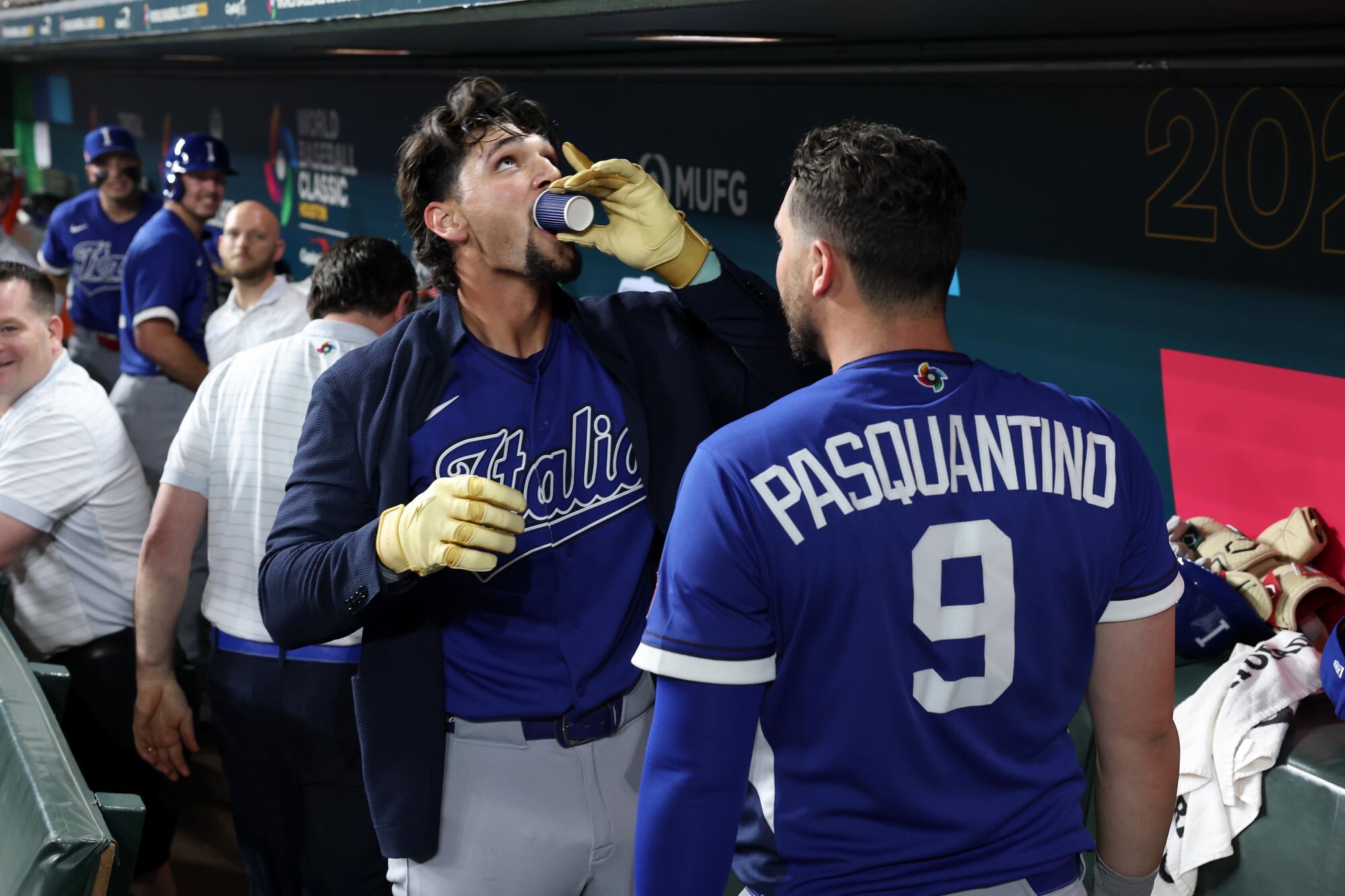
The hitters of lovable Team Italy celebrated home runs with shots of Italian espresso in a dugout dripping with cheek kisses and caffeine.
After hitting three homers against Mexico, Italy’s Vinnie Pasquantino told Fox that he was, “beaned up.”
Truly, this blip of a tournament has been beaned up, a glorious 10 days of deafening cheers and eye-blacked tears, fans dressed like discount popes and bald eagles, TV ratings through the roof, baseball at its October best … in the middle of spring training?
Italy’s Jac Caglianone takes a shot of espresso as he celebrates with teammate Vinnie Pasquantino after hitting a solo home run against the U.S. during the World Baseball Classic on Tuesday in Houston.
(Kenneth Richmond / Getty Images)
What a thing! What a treat!
All hail the WBC, 20 years old and all grown up, its sixth incarnation stealing the stage in a sweet spot during NBA doldrums and before March Madness.
Have you watched any of it? Have you been energized by all of it? It’s been like two weeks of All-Star games, only the players are serious. It’s been like when baseball was part of the Olympics, only the players are all truly the best in the world.
In the middle of the most boring part of the Cactus and Grapefruit Leagues, it’s like a Superhero League. Two weeks before opening day, it’s like the final week of a pennant race.
It’s competitive, and it’s crazy, and Friday’s quarterfinals were filled with both.
There was giant Vladimir Guerrero Jr. going airborne to score a run for the Dominican Republic against Korea, and then leaping up and pumping his fist as if he had just won the World Series.
There was Juan Soto flying home to score an inning later, his head-first dive celebrated by Soto doing a swim move in the dugout.
Then there was Team USA’s David Bednar, screaming along with the chanting crowd as he worked out of a seventh-inning jam in a win over Canada.
In a tournament filled with equal parts emotion and edginess, Team USA now plays the Dominican Republic Sunday in Miami in a semifinal that could be the most-watched game of this season before the season starts.
Paul Skenes versus a lineup so deep Julio Rodriguez bats seventh? A team led by Aaron Judge and Bryce Harper versus a team featuring Manny Machado and Fernando Tatis Jr?
Dominican Republic’s Vladimir Guerrero Jr. dives past South Korea catcher Park Dong-won to score on a double by Junior Caminero during the World Baseball Classic on Friday in Miami.
(Lynne Sladky / Associated Press)
“I expect it to be one of the best games of all time,” said Team USA Manager Mark DeRosa.
No, the WBC isn’t as big as the World Series. One notable player said it’s even bigger.
“The Classic kind of feels above the World Series,” Kiké Hernández told reporters earlier this spring. “Maybe it’s because of what we have on the chest,”
Hernández, who didn’t play for his home country Puerto Rico because he is recovering from elbow surgery, nonetheless showed up in San Juan for the pool-play games.
He was so excited when Puerto Rico beat Panama on a walk-off home run, he texted Dodgers baseball president Andrew Friedman and asked if he could accompany the team to Houston for the knockout round. Friedman of course said yes.
Yes, yes, yes, more, more, more.
Before this spring, I had watched exactly one WBC at-bat. The entire deal felt cheesy and contrived. American players didn’t appear to care. American players would rather lounge through the final days of spring training in occasional games and on countless golf courses
Other countries loved it. Other countries caused a ruckus. The fan experience was highlighted by a memorable and deafening 2009 final at Dodger Stadium featured a Japan victory over South Korea in a game that many observers said was the loudest they ever attended.
Not me. Didn’t care. I pretty much ignored the whole thing until stumbling upon that one at-bat, the final out in the 2023 title game, that stunning dramatic strikeout of Mike Trout by then-Angel teammate Ohtani to give Japan the title.
Ohtani threw his cap and glove in a rare show of emotion, setting off a wild and sincere celebration as my ignorant self finally realized, “Hey, this is a thing.”
Three years later, the American players have agreed, stacking the roster with stars like Judge and Harper, kids like Pete Crow-Armstrong, vets like Kyle Schwarber and Big Dumpers named Cal Raleigh, all transforming this occasional baseball oddity into must-see TV.
You know how one can tell it’s real American baseball? The team spent its first week mired in social media drama and a second-guessing controversy.
American right fielder Aaron Judge celebrates his team’s win over Canada during a World Baseball Classic quarterfinal game on Friday in Houston.
(David J. Phillip / Associated Press)
Tarik Skubal, the game’s best pitcher, found himself defending his patriotism after leaving the tournament early to better prepare for his opening day start with the Detroit Tigers.
First, he admitted he was surprised at how bad he felt about abandoning Team USA. That seemed to be a theme in a clubhouse that has been stunned at how much this matters.
“I totally misread how I would feel,” he said.
Then, he seemed genuinely hurt that people think he is turning his back on the flag.
“It’s just not fair,” he told the Athletic, later adding, “If they know me, though, and they know me on a personal level and they know what my peers think of me, I don’t think it’s fair to say those things.”
Also finding himself in hot water was USA manager Mark DeRosa, who nearly allowed his team to be eliminated in pool play because he didn’t know the rules.
When Team USA played Italy on Tuesday night, DeRosa rested most of his starters, nearly used retired Clayton Kershaw and basically managed the game as if he thought they didn’t need to win to guarantee advancement to the next round.
Guess what? They needed to win. But they didn’t win, losing 8-6 in a shocking upset. So they were forced to sweat out the Italy-Mexico game on Wednesday, where another Italian upset allowed them to back into the quarterfinals.
DeRosa claimed he knew the rules all along, which he clearly did not.
Before the game against Italy, in an interview on the MLB Network, he said, “Our ticket’s punched to the quarterfinals.”
After the game, DeRosa claimed he just, “misspoke”
And then Thursday he told the media, “I was well aware that we had to win the game.”
The 16-year journeyman clearly messed up, and then tried to cover up, and here’s guessing even if Team USA wins this tournament, he won’t be managing them in the 2028 Olympics or in any future WBC events.
Meanwhile, one American player had a dissenting view about the status of this tournament, Harper offering a tired argument.
“Obviously, the WBC has been great, but it’s not the Olympics, right?” he told reporters. “That’s no disrespect to the WBC or anything, but everybody knows that when the Olympics are on, everybody’s watching. It doesn’t matter what sport it is; it could be the most random sport, and it’s got all the fans watching it.”
Wrong. Here’s guessing more fans will be watching Sunday night in a matchup for the ages. Then, imagine if Team USA wins and plays Japan on Tuesday night for the championship?
With the sport headed toward a seemingly inevitable work stoppage this winter, this could be the sweet beginnings of a long farewell. Soak it in. Enjoy the buzz. Get all beaned up. March madness indeed.
Ebrahim Zolfaghari, spokesperson for Iran’s Khatam al-Anbiya Central Headquarters, accused the US and Israel of orchestrating a ‘diabolical plot’, claiming they copied Iran’s Shahed-136 drone design and repurposed it as a modified ‘Lucas’ drone to falsely blame Tehran for drone attacks across the region.
The 98th Academy Awards, known as the Oscars, will celebrate some of the top films released in 2025 on Sunday.
The ceremony will take place in Los Angeles with actors, directors and filmmakers from around the world competing for Hollywood’s most prestigious prizes.
Recommended Stories
list of 3 itemsend of list
But this year’s ceremony comes at a time of global tension, with the ongoing war in Iran serving as a sombre backdrop to Hollywood’s annual celebration.
“My job is always to try to walk a very thin line between entertaining people and also acknowledging some of the realities,” host Conan O’Brien said during a Wednesday news conference with the Oscars creative team.
Here is what we know about the upcoming ceremony:
Where will the Oscars be held?
The 98th Academy Awards will take place at the Dolby Theatre at Ovation Hollywood in Los Angeles on March 15.
The ceremony will start at 4pm West Coast time in the United States (23:00 GMT), with official red carpet coverage beginning at 3:30pm (22:30 GMT).
Where can I watch the ceremony?
The 2026 Oscars will be broadcast in the US on the TV channel ABC. Viewers with a cable subscription can also watch online by signing in through the ABC app or ABC.com.
The ceremony will also be streamed live on the video platform Hulu.
Those without traditional cable can access the broadcast through live TV streaming services that carry ABC, including Hulu + Live TV, YouTube TV, AT&T TV and FuboTV.
But the Oscars’ ties with ABC may soon be at an end. Last year, the Academy announced that, beginning in 2029, the Oscars will sever its decades-long relationship with ABC and stream exclusively on YouTube.
The shift to an online-only platform is a big shake-up for the Academy Awards, ending a tradition more than half a century old.
ABC began broadcasting the Oscars in 1976, and before that, it aired on a rival channel, NBC, starting in 1953.
Who is hosting the Academy Awards?
O’Brien is hosting the 98th Academy Awards, marking his second consecutive year emceeing the ceremony.
“This year, I know where the doughnuts are. I know my way around a little bit, and so, I think that’s going to be fun,” Conan said.
In remarks this week, the comedian explained he believes the key to success on the Oscar stage is having a good time and staying in the moment.
He added that he and his writing team are still refining the material ahead of the show, to keep it as current as possible.
“What’s happening in the world will be reflected in the show,” he said.
How can I watch the red carpet?
The Oscars red carpet is broadcast several hours before the ceremony, as filmmakers and other celebrities arrive for the ceremony.
The red carpet has long served as a stage for Hollywood’s best fashions, and actors often pause for interviews with social media and television hosts to discuss the awards and what they’re wearing.
Several shows will broadcast from the red carpet:
The official Oscars red carpet (“On the Red Carpet at the Oscars”): 20:30 GMT, hosted by Tamron Hall and Jesse Palmer
Streaming services: Viewers without cable can watch through platforms that carry ABC, including Hulu + Live TV, YouTube TV, fuboTV and Sling TV.
E! Live from the Red Carpet: 21:00 GMT
Streaming services: The E! network will carry the live coverage, as will the streaming platform Peacock and live TV service providers like Roku, Hulu + Live TV, YouTube TV and more.
British comedian Amelia Dimoldenberg also returns for the third year as the official Oscars social media correspondent.
Who is presenting?
As is tradition, last year’s acting winners will return to present awards at the ceremony. They include Adrien Brody (The Brutalist), Kieran Culkin (A Real Pain), Mikey Madison (Anora) and Zoe Saldana (Emilia Perez).
They will be joined by a wide range of actors and filmmakers presenting throughout the night, including Javier Bardem, Chris Evans, Chase Infiniti, Demi Moore, Kumail Nanjiani, Maya Rudolph, Will Arnett, Priyanka Chopra Jonas, Robert Downey Jr, Anne Hathaway, Paul Mescal, Gwyneth Paltrow, Rose Byrne, Nicole Kidman, Jimmy Kimmel, Delroy Lindo, Ewan McGregor, Wagner Moura, Pedro Pascal, Bill Pullman, Lewis Pullman, Channing Tatum and Sigourney Weaver.
Top row from left: Rose Byrne, Nicole Kidman, Delroy Lindo, Ewan McGregor and Wagner Moura. Bottom row from left: Pedro Pascal, Bill Pullman, Lewis Pullman, Channing Tatum and Sigourney Weaver [AP]
Who is performing at the Oscars?
This year’s show will feature two musical performances tied to the Best Original Song nominees.
Rei Ami, EJAE and Audrey Nuna are set to perform the hit single Golden from the animated film KPop Demon Hunters, and actor Miles Caton will reprise the song he sang in the movie Sinners, called I Lied to You, alongside songwriter Raphael Saadiq.
Like the film itself, the Sinners musical performance at the Oscars will serve as a tribute to Black artistry across generations and genres.
As such, it will include an array of artists, from ballerina Misty Copeland to rocker Brittany Howard to blues and jazz musicians like Eric Gales, Bobby Rush and Alice Smith, among others.
What movies have the most nominations?
Sinners is the most-nominated film in Academy Award history with 16 nominations.
That tally broke the previous record of 14 nominations, which was held by three films: All About Eve (1950), Titanic (1997) and La La Land (2016).
Ryan Coogler’s feature mixes supernatural horror, romance and blues culture. Set in 1932 Clarksdale, Mississippi, the story centres on a community opening a juke joint that soon finds itself under siege by vampires.
“I wrote this script for my uncle who passed away 11 years ago,” Ryan Coogler said in an interview with The Associated Press. “I got to imagine that he’s listening to some blues music right now to celebrate.”
One Battle After Another follows with 13 nods at this year’s Oscars, while Frankenstein, Marty Supreme and Sentimental Value each secured nine nominations.
The Academy also continued its tilt towards international films with this year’s lineup of nominees. Every major acting category, for instance, included at least one international nominee.
Is there any Arab representation at this year’s Oscars?
Arab cinema had a strong presence during the awards season. Several films from the region were shortlisted for Best International Feature Film, including:
The Voice of Hind Rajab (Tunisia)
Palestine 36 (Palestine)
All That’s Left of You (Jordan)
The President’s Cake (Iraq)
One of them, The Voice of Hind Rajab, ultimately secured an Oscar nomination, marking a significant moment for Arab cinema.
Actors Nesbat Serhan, Motaz Malhees, Saja Kilani and Clara Khoury play first responders from the film The Voice of Hind Rajab [CineCanibal/AP]
What is the Voice of Hind Rajab?
The Voice of Hind Rajab is a 2025 docudrama directed by Kaouther Ben Hania.
It dramatises the final hours in the life of five-year-old Palestinian girl Hind Rajab, who was killed by Israeli forces in Gaza in 2024. But the film weaves in real-life recordings of Rajab’s desperate phone calls to emergency personnel from the Red Crescent group.
“The arrival of Hind Rajab’s voice to these platforms — and its ability to break through the indifference that exists there — is in itself something extremely valuable,” Gaza-based filmmaker Mohammed al-Sawwaf told Al Jazeera’s journalist Maram Humaid.
To al-Sawwaf, the film’s Oscar nomination means that Rajab’s death is no longer a passing news item or a single tally in a growing death toll. It is a cultural event, a memorial that forces viewers to confront the horrors facing Gaza’s young children.
“A story of a human being from Gaza has been presented as the story of a person with a life and meaning, rather than the image of a Palestinian appearing as a number on news screens,” he said.
“Palestinians have tried for many years to tell their stories and to be visible, but they were often met with rejection, doubt, or barriers placed in front of them.”
Al-Sawwaf believes Hind Rajab’s story can help illuminate the humanitarian crisis facing thousands of other Palestinians suffering in Gaza.
“A story like Hind Rajab’s represents a symbol of thousands of other stories,” he said. “There are thousands of women and men who had full lives, details, and dreams that are no less human than hers.”
Why was an Iranian film submitted by France?
It Was Just an Accident, directed by Iranian filmmaker Jafar Panahi, is also among the nominees on Sunday night, competing in two categories: Best International Film and Best Original Screenplay.
Though It Was Just an Accident was a co-production from several countries, France ultimately submitted the film as its entry in the Best International Feature competition.
Panahi’s work is often critical of the Iranian government, and in the past, he faced prison time and a ban on his filmmaking as a result. It was not considered as Iran’s entry.
France instead has championed the film as evidence that the country is a safe haven for “singular and courageous cinema”.
But Panahi said his thoughts remain focused on those back home in Iran.
“I am constantly thinking about them,” he told Bloomberg from New York, four days after the US and Israel launched their offensive against Iran.
Panahi shot the film clandestinely in Iran without government approval.
What are the best picture nominees?
Ten films are in competition in the Best Picture category:
Bugonia: A science-fiction story about two men who kidnap a powerful executive, believing she is an alien threatening Earth.
F1: A sports drama starring Brad Pitt as a veteran Formula One driver who returns to racing to mentor a promising young teammate.
Frankenstein: Guillermo del Toro’s adaptation of Mary Shelley’s novel, following scientist Victor Frankenstein and the tragic creature he brings to life.
Hamnet: A historical drama focusing on the grief of Agnes and William Shakespeare following the death of their 11-year-old son, Hamnet.
Marty Supreme: A sports drama starring Timothee Chalamet as an ambitious table tennis player determined to prove he is the greatest at his sport.
One Battle After Another: A dark action-comedy directed by Paul Thomas Anderson, following a father and daughter on the run from a racist military leader intent on tracking them down.
The Secret Agent: A political thriller about a widowed college professor on the run from a vengeful government minister during Brazil’s dictatorship in the 1970s.
Sentimental Value: A drama exploring grief, memory and complicated relationships in a family of artists in modern-day Oslo.
Sinners: A supernatural thriller about twin brothers who return to their hometown to found a juke joint, only to be confronted by past relationships, racism and a gang of vampires.
Train Dreams: A portrait of a railroad worker on the Idaho frontier at the start of the 20th century, questioning whether his past decisions may have doomed him to a life of heartbreak.
Who are the nominees for the Best Director category?
Chloe Zhao for Hamnet
Josh Safdie for Marty Supreme
Paul Thomas Anderson for One Battle After Another
Joachim Trier for Sentimental Value
Ryan Coogler for Sinners
Joachim Trier, Josh Safdie, Chloe Zhao, Ryan Coogler and Paul Thomas Anderson are in competition in the Best Director category [Mike Blake, Benoit Tessier, Mario Anzuoni, Mario Anzuoni and Mario Anzuoni/Reuters]
Who are the nominees for best actor?
Timothee Chalamet for Marty Supreme
Leonardo DiCaprio for One Battle After Another
Ethan Hawke for Blue Moon
Michael B Jordan for Sinners
Wagner Moura for The Secret Agent
Ethan Hawke, Leonardo DiCaprio, Michael B Jordan, Wagner Moura and Timothee Chalamet face off in the Best Actor category [Mario Anzuoni, Daniel Cole, Mario Anzuoni, Mike Blake and Daniel Cole/Reuters]
Who are the nominees for Best Actress?
Jessie Buckley for Hamnet
Rose Byrne for If I Had Legs I’d Kick You
Kate Hudson for Song Sung Blue
Renate Reinsve for Sentimental Value
Emma Stone for Bugonia
Rose Byrne, Emma Stone, Jessie Buckley, Renate Reinsve and Kate Hudson have been honoured as Best Actress nominees [Daniel Cole, Mario Anzuoni, Daniel Cole, Mike Blake and Daniel Cole/Reuters]
What are the biggest surprises and snubs?
This year’s nominations included several unexpected picks and notable omissions.
Among the biggest surprises was Delroy Lindo’s first-ever Oscar nomination for his supporting role in Sinners, a recognition many felt was long overdue.
“The best part of this process has been that people are so genuinely happy for me,” Lindo, 73, told The New York Times.
“It’s not an ego thing. It’s nothing to do with that. It has everything to do with affirmation.”
Another unexpected nod came in the Best Picture category for the racing drama F1, an action-packed summer blockbuster.
In an interview with the racing tournament Formula 1, director Joseph Kosinski explained that the team created an entirely new filming system to capture the kind of visuals he had imagined.
“We had to develop a new camera system, taking everything we learned on Top Gun: Maverick and pushing it much further,” Kosinski said.
Actress Kate Hudson was also a surprise in the highly competitive Best Actress category, earning her first Oscar nod in 25 years for the musical drama Song Sung Blue.
She said the film offered a rare opportunity to portray a mature female character with depth and ambition. Her role is based on the real-life story of Claire Sardina, who performed as part of a Neil Diamond cover band.
“I got to play the comedy, some sense of humour. I got to play the love story, the desire. I got to play being a mother, and then I got to go into a place of where my life force is taken out of me,” Hudson said in an interview with NPR’s Fresh Air with Terry Gross.
Among the most notable snubs was the sequel Wicked: For Good, which received no nominations amid mixed reviews. The first Wicked film earned a whopping 10 nominations last year, winning two Oscars, for Best Costumes and Best Production Design.
Actor Paul Mescal also missed out on a nomination for his performance as William Shakespeare in Hamnet, while director Guillermo del Toro was overlooked in the Best Director category for Frankenstein.
Other notable omissions included Chase Infiniti (One Battle After Another) and Jesse Plemons (Bugonia).
What are the predictions for the winners?
For months, One Battle After Another was considered the clear favourite for Best Picture and Best Director. But in the final stretch of the awards season, the competition has tightened, with Sinners gaining momentum.
Jessie Buckley is widely expected to win Best Actress for Hamnet. Michael B Jordan, meanwhile, is predicted to win Best Actor for Sinners, overtaking stiff competition from Timothee Chalamet, star of the film Marty Supreme.
In the supporting actor categories, Teyana Taylor (One Battle After Another) is considered a strong contender for Best Supporting Actress, and Sean Penn (One Battle After Another) is favoured for Best Supporting Actor.
Harry Styles is no stranger to “Saturday Night Live,” having performed multiple times with his former boy band One Direction and more recently as a solo artist. But this isn’t his first time as host either.
Styles has a knack for radiating charm, honed after years in the spotlight as a musician, and now with some notable acting roles under his belt, he’s more than primed for the stage. And the timing is perfect, considering many actors are in Hollywood this weekend for the Oscars.
He also excelled in parts where he could show off his vocals and dancing, like in “Sparkle of the Sea,” an infomercial about a German cruise line, and another pretaped sketch, “She’s an Irish Dancer,” where guys find out just how Irish their dates are in a nod to St. Patrick’s Day on Tuesday. Flatter, though, were sketches about a pair of Best Buy workers, and one where Styles played a drive-thru worker at a White Castle, but that’s because Jane Wickline and Veronika Slowikowska stole the skit as a pair of nerdy girls trying to ask him out to the school dance.
Styles performed his new single, “Dance No More,” after last week’s host Ryan Gosling introduced him, a fitting appearance since Styles crashed his monologue. And Paul Simon also stopped by to introduce Styles before his second song, “Coming Up Roses.”
This week’s cold open touched on the ongoing war in Iran. The patriarch (Mikey Day) of a family at a gas station says he needs to fill up their car. As a piano begins to play, his wife (Ashley Padilla) says, “Fill up? Not all the way, right?” “We have to,” Day replies emphatically. “But it’s $5 dollars,” she says before turning to her two children (Marcello Hernández and Sarah Sherman) to say they have to leave one of them behind because gas is too expensive. Why? “The Epstein files,” exclaims President Trump (James Austin Johnson), who jumps into the scene. “It’s called butterfly effect. Epstein was the first domino,” he says, miming dominoes falling. Trump goes on to introduce himself by saying we might remember him from campaign promises such as “lower gas prices” and “no more wars” (“Psych!”). “We love to make promises because a promise is a lie that just hasn’t happened yet.” As for the stock market, he puts it in a way that Harry Styles fans might understand — it’s going in one direction, garnering loud cheers and applause. He jokes about Iran’s age, saying it is old and nobody likes them, “Iran is like ballet and opera and weird Timothée Chalamet,” referring to the actor’s comments that have caused an uproar.
But Trump says he has everything under control, meeting with top minds including influencer and boxer Jake Paul, who he says was booed “very badly” at his fight against Mike Tyson. “Did someone say booze?” Department of Defense Secretary Pete Hegseth (Colin Jost) says as he emerges from the family’s car and dozens of cans fall to the ground. (“It was just a couple of road sodas, chill.”) He then thanks Trump for the “beautiful, size 16 Florsheim shoes,” a reference to the Wall Street Journal report that they are the president’s gift of choice to close friends and advisors. Hegseth goes on to say that they are “hashtag winning” the war with Iran, and as for the Strait of Hormuz, he advises that the tankers moving oil should just do what he does at a DUI checkpoint: “Close your eyes and gun it.”
In his monologue, Styles, dressed in a grey pinstripe suit and bright blue tie, said he couldn’t resist hosting when he heard they booked his favorite-ever musical guest. After his tour ended in 2023, he took a lot of time off, realizing he’d spent much of his life on the road and “making songs about fruit that people think were about sex.” He just really likes fruit — and sex. He also said a lot of people pay attention to the clothes he wears (true, see above), with some people accusing him of “queerbaiting,” to which he responded, “Maybe you don’t know everything about me, dad.” But as far as what he did in his time off, he took up boring things, like jogging (his sub-three hour marathon in Berlin was the buzz of the running world). It’s better than the alternative, he says, as the screen flashed to an image of the former Prince Andrew. But now he’s promoting his new album, “Kiss All the Time. Disco, Occasionally.”, because what’s better than kissing? He actually doesn’t want to kiss all the time, leading to a brief appearance and disappearance of cast members Chloe Fineman and Sherman, unless its Ben Marshall. He complimented Marshall’s backside, and gave him a smooch on the lips: “Now that’s queerbaiting.”
Best sketch of the night: I don’t know if your dad did this, but my dad used to pop it twice
The first sketch of the night took us into a courtroom, where a New Jersey prosecutor (Styles) rose to present his case against the defendant, Mr. Donovan (Tommy Brennan), who didn’t have an attorney. So the judge (Kenan Thompson) appointed one: comedian Sebastian Maniscalco (Hernández). It’s the second time Hernández has played the comedian, whose caricature of Maniscalco in a red blazer and black turtleneck is at turns spot on, exaggerated and completely hilarious. He chimed with retorts as the prosecutor explained the charges of stealing $5,000 in merchandise, including a belt. “Let me tell you something about a belt. When I was a kid, the belt wasn’t to keep the pants up, it was to keep the volume down,” Maniscalco says, motioning to his waist and explaining how his dad would use it. Maniscalco’s manic energy was too much for the courtroom sketch artist, though, who complains to the judge about having to draw him, showing a sketch of a blurred, multi-limbed man. Kudos to Styles who managed to mostly keep his composure as Hernández glided around him. But Styles had the last laugh with his own impression of Maniscalco, before a final sketch of him was revealed. Put it in the Lourve!
Also good: Why get real healthcare when you’ve got ‘Mahaspital’
“The Pitt,” one of the buzziest TV shows in America, has been lauded for its realistic portrayal of emergency rooms and the stresses that medical workers endure on a regular basis. So when the opening scenes of this pretape began playing, the crowd went wild. But this isn’t “The Pitt,” it’s “Mahaspital,” brought to you by producer Robert F. Kennedy Jr. and the team behind Make America Healthy Again. Styles channels Noah Wyle’s Dr. Robby, marching toward an incoming patient on a gurney as she’s pushed through the ER hallway. “What she needs is a steak,” he says. “Give me beef tallow and six raw eggs, too.” The sketch touches on many of the hallmarks of the MAHA movement: healing crystals, vaccine skepticism, raw milk and lots and lots of protein. And we can’t forget that Central Park bear.
‘Weekend Update’ winner: Battle of the heart (emojis)
“Update” anchors Michael Che and Jost focused most of their attention on the Iran war this week, but they also touched on another event happening this weekend: the Oscars. They brought in Tucker Carlson (Jeremy Culhane) to talk about the best picture nominees. Culhane’s impression of the conservative pundit was pretty impressive, capturing his cadence and habit of using rhetorical questions — I hope we see it again.
But it was Day and Hernández who stole the segment as emojis aerial tramway and heart, respectively, who joined to comment on Apple’s addition of eight new emojis. Heart emoji on the new additions: “All I know is they’re all going to be more popular than this loser,” pointing to Day. “I’m No. 1 because I’m useful. People use me for everything.” But you can’t put an aerial tramway down, who tried to explain other ways to use the emoji somewhat unsuccessfully. At least he has a solid crew of bangers: orange square, division sign, snorkel and “my boy, the goat” building with a horn on it. Day was dedicated to the bit, making Hernandez crack with muffled laughter. Don’t be surprised if you see a lot more of aerial tramway (and his girlfriend, on with two arrows) in your texts.
WASHINGTON — After two weeks of war with Iran, the Trump administration is being forced to temper its expectations of a swift end to the conflict, with U.S. intelligence and defense officials expressing doubt it can achieve the overthrow of Iran’s government and the destruction of its nuclear program through military means.
It was an outcome forewarned by analysts at the State Department, the CIA and the Pentagon, who together alerted the administration to the pitfalls full-scale war with Iran would bring before President Trump decided to proceed, two U.S. officials told The Times, granted anonymity to speak candidly.
Certain military goals of Operation Epic Fury laid out at the start of the war are still seen as achievable at the Pentagon, with U.S. and Israeli strikes making steady progress degrading Iran’s ballistic missile infrastructure, its drone program and its navy.
But a prewar U.S. intelligence assessment, that an air assault was unlikely to topple the Islamic Republic, still holds, with the intelligence community now casting doubt the assault had any more political effect than to radicalize a government already devoted to the destruction of Israel and harming the United States.
A military procession in Tehran carries the casket of Ali Shamkhani, political advisor to Iran’s last Supreme Leader Ayatollah Ali Khamenei, who was also killed in U.S.-Israeli attacks.
(Atta Kenare / AFP/Getty Images)
Concern has only grown that Iran’s new government will make the fateful strategic decision to build a bomb after the war, unless Trump decides to escalate the conflict with a perilous ground invasion. And the White House now contends with a new mission imperative, created by its decision to launch the war itself, of reopening the Strait of Hormuz to vital shipping traffic that carries 20% of the world’s daily oil and liquid natural gas supply.
The foreign policy strategy Trump publicly laid out as his playbook for the conflict — to come down hard on the government, decapitating its leadership, and hope the remnants would seek mercy — has not worked, with Tehran looking for new ways to expand the war and maximize pain for the U.S. administration.
Trump has minimized the conflict as an “excursion” that would end “very soon,” while also calling it a war, vowing to take the time he needs to “finish the job.” He says it will conclude whenever he decides to end it.
It remains possible that a declaration from Trump that the fighting is over results in a ceasefire, as it did in June of last year, when Trump demanded an end to 12 days of war between Iran and Israel. But the Iranians have a vote, too — and senior leadership in the Islamic Republic have made plain they plan to continue fighting this time whether Trump likes it or not.
On Friday, the Pentagon announced that an additional expeditionary unit of 2,500 Marines was being deployed to the region to support the effort.
“Starting wars is an easy matter,” Ali Larijani, secretary of Iran’s Supreme National Security Council, wrote on social media. “Ending them does not happen with a few tweets.
“We will not leave you until you admit your mistake and pay its price,” he added.
It is a sore lesson for a president whose decade in public life has been distinguished by an exceptional ability to warp reality to his liking.
“The White House has created a dilemma for America: If it declares victory and ends the war, it leaves in place a weakened Iranian government with the means and renewed motivation to pursue nuclear weapons,” said Reid Pauly, a professor of nuclear security and policy at Brown University.
“If it presses on with the war,” Pauly added, “it risks the kind of mission creep that may eventually find American boots on the ground.”
In a news release last week, the White House said that, “from the opening hours of this historic campaign, the objectives were clear: obliterate Iran’s ballistic missile arsenal and production capacity, annihilate its navy, sever its support for terrorist proxies, and ensure the world’s leading state sponsor of terrorism will never acquire a nuclear weapon.”
Yet, at the start of the operation, Trump issued a promise to the people of Iran that, at the end of the U.S.-Israeli campaign, Iran’s military and paramilitary infrastructure would be so badly hobbled that a rare, generational opportunity would emerge for them to take their government back.
“To the great proud people of Iran, I say tonight that the hour of your freedom is at hand,” Trump said. “Stay sheltered. Don’t leave your home. It’s very dangerous outside. Bombs will be dropping everywhere. When we are finished, take over your government. It will be yours to take. This will be probably your only chance for generations.”
Trump said in the days that followed he would need to have a say over the next ruler, after assassinating the country’s longtime supreme leader, Ayatollah Ali Khamenei. But the Iranian system of clerics and militants defied the president, selecting in Khamenei’s son a man viewed as even more hostile to the West than his father was.
Israeli leadership, too, set out regime change as a goal of the war. Yet even their officials now say that a substantial leadership change in Tehran is an unlikely result.
Trump would go on to insist on the “unconditional surrender” from the Iranian government, a demand that he later said would be satisfied by the incapacitation of Iran’s military.
Repeating his conviction that the war will end soon, Trump told Fox News’ Brian Kilmeade in an interview Friday that he would order an end to the fighting “when I feel it. When I feel it in my bones.”
“The problem with the administration’s approach is that it has constantly shifted its goals. Some are achievable, such as degrading Iran’s conventional force. Others are not, such as picking the next leader of Iran,” said Ray Takeyh, a scholar on Iran at the Council on Foreign Relations.
“The mixed messages have led to confusion at home,” Takeyh added, “and lack of planning for oil shortages and getting the Americans out of the region shows that process and personnel can actually matter.”
Mark Dubowitz, CEO of the Foundation for Defense of Democracies, said the joint U.S.-Israeli campaign was always designed to unfold in three phases: degrading Iran’s ability to wage war, reducing Iran’s ability to repress democratic forces inside the country, and finally, encouraging the Iranian people to rise up.
“The president controls the strategy, but no president fully controls the endgame because the regime gets a vote,” Dubowitz said. “The endgame is not a scripted political transition directed from Washington. It is a regime under simultaneous military, economic, and internal pressure — to strip of its war-making and repression capabilities — and whether that produces succession, fracture, or collapse will ultimately be decided in Tehran.”
Whether the conflict will achieve the destruction of Iran’s nuclear program is an equally grave question in Washington, where officials are debating over a list of stark options on how to physically destroy, bury or retrieve the fissile material that Tehran could use to build a nuclear weapon — a threat seen as only more grave under the stewardship of an angry and vengeful government.
“The war was publicly justified, to the extent it was justified at all, in terms of destroying Iran’s nuclear program. Very few strikes have been directed against nuclear-related targets, however — almost certainly because those that survived last June’s attacks are invulnerable to air attack,” said James Acton, co‑director of the nuclear policy program at the Carnegie Endowment for International Peace.
“Unless the U.S. and Israel attempt high-risk special forces operations or a ground incursion,” he added, “Iran will end the war with its surviving nuclear infrastructure largely intact and greater incentives to build the bomb.”
Pauly agreed it is unrealistic to expect the United States and Israel can destroy Iran’s nuclear program through air power alone. The U.N. International Atomic Energy Agency believes Iran has roughly 440 kilograms — about 970 pounds — of 60% highly enriched uranium, possibly spread across multiple facilities.
“Securing this material will require either U.S. ground troops or, after some coercive bargain is reached, international inspectors,” Pauly said.
In an exchange with reporters last week at the Pentagon, Defense Secretary Pete Hegseth had few details to offer on what U.S. options were to remove or eliminate an accessible uranium stockpile, enriched to near weapons grade, that had been buried in a U.S. operation last year intended on obliterating the nuclear threat.
Diplomacy, he suggested, might be required to secure the material.
“I will say we have a range of options, up to and including Iran deciding that they will give those up,” he told reporters, “which of course we would welcome.”