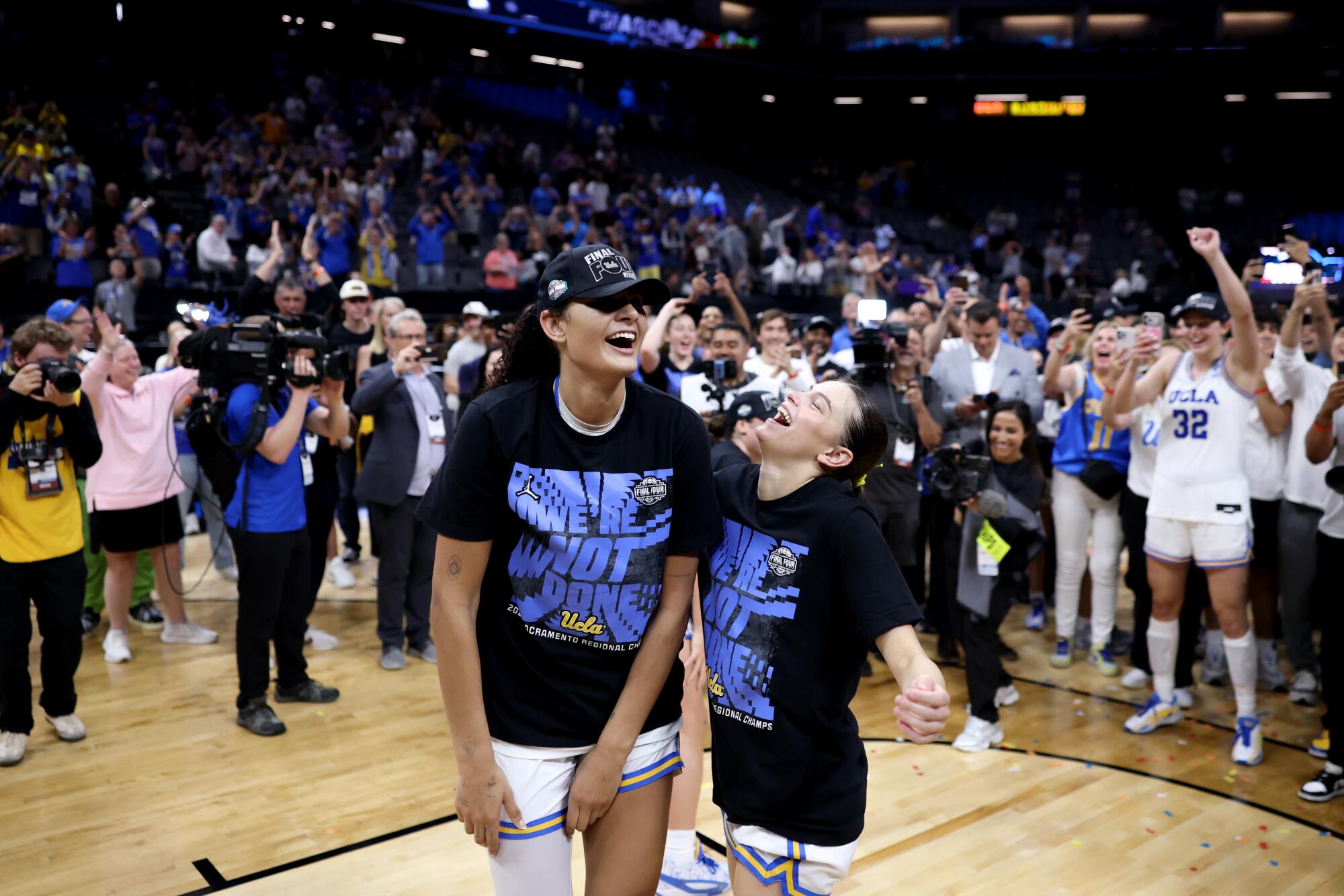
Yes, the Bruins (35-1), barely challenged all season and always dancing and smiling, could actually deal with adversity after all.
UCLA earned its second straight Final Four berth despite trailing at halftime for the second time all season and coming from behind to win while down in the second half for the first time.
They will face the winner of Monday’s game between No. 1 Texas and No. 2 Michigan.
“That was definitely adversity,” said Gianna Kneepkens, who scored seven points. “We regrouped, and the way we were talking to each other gives me so much confidence.”
UCLA trailed Duke 39-31 at the half after missing all four three-point attempts and committing 12 turnovers.
UCLA center Lauren Betts drives to the basket over Duke forward Toby Fournier in the first half of the Bruins’ win in the Elite Eight of the women’s NCAA tournament Sunday.
(Eric Thayer / Los Angeles Times)
“We really didn’t execute our game plan very well,” UCLA coach Cori Close said of the first half. “We didn’t control rebounds. We weren’t the aggressors in creating catches. We didn’t go strong to the rim and execute our stuff.”
But they turned on the aggression early in the third quarter, taking deeper shots and forcing three jump-balls and four turnovers as the Bruins rallied from a deficit in the second half for the first time all season. UCLA outscored Duke 20-8 in the third quarter.
“We were really reactive in that first half and let the game come to us,” said Leger-Walker, who finished with five points and six assists. “We let them dictate what was going on out there. It’s not how we’ve played in the season, when we’ve been up and feeling good. So, you know, we could feel that coming into halftime, and we all kind of took a breath, reset, and a lot of that was on the defensive side.”
Betts was also activated late, with 15 of her 23 points and eight of her 10 rebounds coming in the second half while she matched a season high five blocks.
“I was pretty mad,” Betts said of her emotions at halftime. “I just didn’t like how that first half happened. I know that I could have been a lot more aggressive. I think going into a game like this, sometimes you just take yourself out of your head and you realize, oh, this is the Elite Eight and my season is on the line. So I’ve got to wake up a little bit. Going into the locker room, I was just pretty certain that I wanted to win this game.”
Angela Dugalic shot four of eight with four rebounds and two steals in the second half and was the catalyst for many big moments, including a buzzer-beating floater to end the third quarter and a lead-extending layup and free throw off an offensive rebound to create separation in the fourth. She finished with 15 points off the bench.
Dugalic and the other veterans led a halftime conversation before Close came into the locker room.
“When Cori came in, she was super steady, and I think that gave us a sense of calm,” Dugalic said. “We still were pretty neutral. We understood that the first half wasn’t a good representation of how we want to play basketball. But Cori came in and what she said right now is, like, ‘How do we stick back to our values and stay neutral, focus on next-play speed?’”
Duke forward Delaney Thomas, left, tries to draw a foul against UCLA forward Angela Dugalic during the first half Sunday.
(Eric Thayer / Los Angeles Times)
Duke (27-9) scored 18 points off the Bruins’ 18 turnovers, tied for the most UCLA has committed all season. Twelve of them came in the first half. But UCLA turned it around in the second half with 18 points off 13 Duke turnovers.
The Blue Devils entered the game limiting opponents to 26.8% from three-point range, ranking 15th nationally, and aggressively challenged the Bruins’ offense. UCLA responded by becoming one dimensional, solely trying to get the ball to Betts in the post.
But Gabriela Jaquez, who finished with nine points and five rebounds, hit a three-pointer early in the third quarter to get UCLA back within five, and Duke missed six consecutive shots while the Bruins narrowed the gap. Toby Fournier (10 points) also committed her third foul early in the quarter, forcing the Blue Devils’ center off the floor.
Both offenses stalled for a period in the third quarter, but consecutive Duke turnovers led to a Leger-Walker fast-break layup and a Kneepkens three-pointer for UCLA’s first lead since the opening seconds of the game.
Duke didn’t score for 5:40 during the third quarter until Taina Mair (team-high 21 points) made a free throw with 32 seconds remaining. The eight Blue Devils’ points were tied for the fewest they’ve scored in a quarter this season.
“You can only learn from moments like this, which is a really positive thing,” said Leger-Walker, with one piece of the NCAA tournament net tied to her Final Four hat. “Definitely not something we want to have as a pattern, though.”
The Bruins held the ball with the clock running down, and Leger-Walker dribbled it to around the top of the three-point line and stopped. Her teammates surrounded her and the group huddled around each other as time expired.
“I just said, ‘I love you guys,’” Betts said of the moment. “That was it. I said, ‘I love you guys.’”
They’ll dance on down to Phoenix next, looking not to avenge the Final Four defeat to UConn a year ago, but ready to prove they have grown to be a championship team.
“Now we really know what it takes to build a rally too,” Rice said.
UCLA center Lauren Betts holds up a piece of the net after the Bruins’ win over Duke in the Elite Eight of the NCAA women’s basketball tournament Sunday.
Pakistan Super League has been jolted by the ball-tampering accusation against Zaman, which allegedly occurred on Sunday.
Published On 30 Mar 202630 Mar 2026
Lahore Qalandars batter Fakhar Zaman has been charged with ball-tampering in Sunday’s Pakistan Super League (PSL) match against Karachi Kings, the Pakistan Cricket Board (PCB) said in a statement.
The incident occurred in the final over, with Karachi needing 14 runs to win. Fakhar, Lahore captain Shaheen Afridi, and fast bowler Haris Rauf were involved in a brief discussion, during which Fakhar and Rauf passed the ball between them.
Recommended Stories
list of 4 itemsend of list
The umpire then approached Rauf and asked to see the ball. Following consultations with the square-leg umpire, the officials awarded five penalty runs to Karachi and ordered the ball to be changed.
The penalty proved costly, as Karachi went on to chase down a target of 129 with three balls to spare, and Abbas Afridi hitting a four and a six to seal a four-wicket victory.
“Fakhar denied the charge levelled against him during a disciplinary hearing led by the match referee Roshan Mahanama,” the PCB said.
“Another hearing is set to take place within the next 48 hours after which the match referee will share his verdict.”
Afridi said they would look at video footage of the incident.
“I don’t know about this, and we’ll see if it’s there in the camera and discuss it,” he said at the post-match presentation ceremony.
Fakhar, 35, could face a ban of one or two matches if found guilty of ball tampering for a first offence in the PSL.
Australian trio David Warner, Steve Smith and Cameron Bancroft were handed lengthy bans by Cricket Australia following a 2018 ball-tampering scandal in South Africa.
Zaman plays a shot for his Lahore Qalandars side during a Pakistan Super League T20 match against Hyderabad Kingsmen at Gaddafi Stadium in Lahore, Pakistan, on March 26, 2026 [Arif Ali/AFP]
Kicking off the upcoming season at the Mark Taper Forum — which recently celebrated its top-grossing musical ever with “Here Lies Love” — is the world premiere of Zack Zadek’s original musical “The Turning,” a folk thriller set in California’s Sequoia groves.
The show, said Center Theatre Group’s artistic director Snehal Desai as the company announces its 2026-27 slate of performances, has a “very L.A. vibe.”
Next up is a batch of shows meant to provide audiences some comedic relief amid a midterm season that’s sure to sow anxiety: Karen Zacarías’ “Destiny of Desire,” Cole Escola’s “Oh, Mary!” and the family-favorite “Dog Man: The Musical.” Then in the spirit of springtime renewal, thought-provoking plays like “John Proctor Is the Villain” and “Fences” will leave audiences in contemplation before festive summer item “Boop! The Musical” swoops in to lift spirits.
When Desai plans the company’s season lineup, he always surveys the year ahead — literally.
“I look at the calendar a lot as to, where do we think we’re gonna be a year from now? Six to eight months from now?” Desai said in a recent interview at his office in downtown L.A.
Some entries in Center Theatre Group’s upcoming season are scheduled intuitively, like the Mischief Comedy team’s “Christmas Carol Goes Wrong,” running in the thick of the holiday season. But with others, Desai said he orchestrated the lineup to tell a programmatic story, like an artist might order tracks on an album.
As an artistic director, Desai said, he always encourages visitors: “Join us all season, versus just coming for the things you like,” and maybe you’ll be pleasantly surprised.
This year as Desai consulted his calendar, he looked even farther ahead than usual, toward Center Theatre Group’s 60th anniversary season (2027-28) and the L.A. Olympics in 2028.
“We were having conversations of, what are the plays that we want to do or we want to bring back,” Desai said, when the theater company’s associate artistic director Lindsay Allbaugh suggested “Fences,” the final play of August Wilson’s acclaimed Century Cycle to be staged at Center Theatre Group.
“I said, ‘Oh, that’s what we want,’” Desai said, “both to end this season and kick off our 60th.”
The artistic director could not yet confirm who would direct the Pulitzer Prize-winning drama about a former Negro League baseball player and his family navigating life in 1950s segregated Pittsburgh.
Desai, who has not shied away from politically charged material during his tenure at the theater company, said Wilson’s play aligned with his intent this season to platform work “asking who we are as a country and as a community and society.”
“I wanted voices that felt bold and fearless, that were both outspoken and unafraid in a world where, right now, it feels like there’s a lot of things that are trying to stifle us from speaking out or coming together,” he said. To him, presenting “Fiddler on the Roof” in Yiddish is revolutionary, as is “John Proctor Is the Villain’s” dissection of a classic through a feminist lens.
Desai added that he planned to balance that rabble-rousing spirit with productions that leaned more “celebratory and communal” and provided “different ways of having catharsis.”
“Oh, Mary!” offers riotous fun, and “Destiny of Desire” is an homage to an oft-dismissed yet widely consumed medium, the telenovela.
“With ‘Destiny,’ you’re able to take that format of something that people often watch in isolation at home, and enjoy it together,” Desai said.
Regional theater faces a slew of challenges: rising production and personnel costs, post-pandemic audience declines and competition from digital media. The situation has felt particularly bleak in L.A., Desai said, as seeming moments of recovery in the past year or so were squashed by the L.A. wildfires, then last summer’s immigration crackdown and associated civil unrest.
“We just constantly live in this time period that feels like we’re on shifting sands,” Desai said. Nonetheless, the company is finding paths through the desert, including with alternative programming through CTG: FWD.
The CTG: FWD initiative this season will bring “Riverdance 30 – The New Generation,” “Clue” and “The Music Man” to the Ahmanson Theatre, and “Dog Man” to the Kirk Douglas Theatre.
Another strategy Desai said the theater company has employed is heavy investment in new works development, particularly new musical development. New works are time-and resource-intensive, Desai said, but they’re also good investments, offering the best chances at longevity and commercial prospects.
With “The Turning,” Center Theatre Group spotlights an emerging voice that Desai said represents “the future of American theater.”
After Desai was introduced to Zadek’s folksy musical “The Turning,” he said, “I just kept listening to it over and over again. I was like, ‘I can’t wait for the cast recording of this to be on Spotify.’”
The artistic director was also thrilled to find an ultra-rare gem in Zadek’s piece: a truly original story.
“A lot of things are adaptations these days: adaptations of films, of TV shows,” Desai said. “So to get a world premiere musical that is based on its own original concept — that, I found, was really compelling.”
Following back-to-back seasons of directing his own productions, Desai is taking a breather this go-around to focus on broader administrative duties. But he still hopes to be a resource for visiting directors learning how to navigate the “special space” that is the Mark Taper Forum — and its neighbors the Ahmanson Theatre and the Kirk Douglas Theatre, which will get its own season announcement in the spring or early summer.
WASHINGTON — Buried in the fine print of the massive deficit-reduction bill is–of all things–a brand new social program.
The new program will cost $1 billion over the next five years–somewhat less than the Clinton Adminstration had requested, but still a substantial sum in this era of tight budgets.
Supporters, including Health and Human Services Secretary Donna Shalala, insisted that some provisions in the new program actually would save the government money in the long run. Even many of the program’s supporters questioned that assertion, however, although they insisted that the money is worth spending in any case.
The family preservation and support program–along with expanded spending for childhood immunization, tuberculosis prevention, food stamps, “empowerment zones” intended to help inner cities and the earned income tax credit for low-income workers–represents the flip side of the massive budget cutting and tax-raising efforts of the bill. All told, those social programs–aimed in large part at helping families with children–will receive an additional $29 billion from the bill.
“The President’s long-term investments for kids and families have been very well supported by this bill,” said Shalala.
The social-program funds not only were key to keeping some of President Clinton’s policy initiatives alive, they were crucial to winning support for the budget in the heavily Democratic House, where liberal Democrats and members of the Congressional Black Caucus had threatened to vote against the budget bill unless it contained money to back up at least part of Clinton’s promise to “invest” in programs for the poor.
“There are a number of important features in this bill that represented the basis for many liberal and progressive Democrats to feel they could support the overall budget,” said Rep. Henry A. Waxman (D-Los Angeles).
The survival of the family preservation program, which at several points during the long budget negotiations seemed likely to die, would mark the end of a long legislative road. The program would give money to the states for early intervention and support programs for troubled families. It has passed the House three times and was approved by both chambers last year as part of another piece of legislation ultimately vetoed by then-President George Bush.
Supporters of the program argued that, by intervening early, social workers can help troubled families before their situations deteriorate so much that the state has to place children in costly foster care programs.
Skeptics, including Senate Finance Committee Chairman Daniel Patrick Moynihan (D-N.Y.), argued that the ability of social workers to accomplish those goals has never been proven. At one point during budget talks, Moynihan derided the program as “welfare for social workers,” several participants said.
But other legislators argued that, even if the program does not save money by avoiding foster-care placements, it will provide badly needed help for children. “This creates early intervention to keep children from being abused,” said Rep. Robert T. Matsui (D-Sacramento), who was the program’s chief sponsor in the House.
The program “has been pared down a good deal, but at least we got it,” Matsui said.
The birth of this new program is an object lesson in how legislators and Administration officials can use the arcane rules of the budget-cutting process to advance other items on the legislative agenda.
Over the years, Waxman has become a master at that art. This time around, he engineered a new $200-million program to expand the number of tuberculosis patients who can receive federal Medicaid benefits over the next five years. He also played a key role in winning money for the Administration’s proposed child immunization program, which would receive $585 million under the budget bill.
Although immunization has been a high priority for Clinton and First Lady Hillary Rodham Clinton, Waxman and other supporters of the program had to overcome opposition not only from congressional conservatives but from some White House officials who were willing to accept much lower dollar amounts for the program as they sought to hit their deficit-cutting goals, according to Administration and congressional sources.
Under the tuberculosis program, people who are poor but not otherwise eligible for Medicaid–primarily single men without children–and who have active tuberculosis can receive government-supplied out-patient services if the state they live in decides to participate. Public health officials said they hope that the additional money will reduce the rapid spread of the disease by targeting a group of people who often do not receive care.
The immunization program has two major components. The first part will provide $500 million over the next five years to pay for vaccinations for 2.6 million children whose families lack insurance. The money also will cover the 6.5 million children now covered under Medicaid, relieving the states of a financial burden.
The second part of the bill, which has drawn howls of outrage from drug manufacturers, would allow all states to buy vaccines in bulk at the price manufacturers provide to the federal Centers for Disease Control and Prevention–something 11 states now do. The CDC has negotiated steep discounts from the prices that drug companies charge private pediatricians.
HOUSTON — Isaac Paredes hit a tiebreaking two-RBI double with two outs in the eighth inning to help the Houston Astros to a 9-7 win over the Angels on Sunday despite a disappointing major league debut from starter Tatsuya Imai.
There were two outs in the eighth when the Angels intentionally walked Yordan Alvarez to give Houston runners at first and third. Alvarez stole second before Paredes hit a line drive off Drew Pomeranz (0-1) to put Houston on top 8-6.
Jose Altuve followed with a double to push the lead to 9-6.
Imai gave up three hits and four runs with four walks and four strikeouts in 2⅔ innings.
The Astros (2-2) are banking on him to have a big year after signing the right-hander to a three-year, $54-million contract following a stellar career in Japan where he was a three-time All-Star in eight seasons with the Pacific League’s Seibu Lions.
The Angels (2-2) had two on with one out in the ninth when Bryan King took over for Bryan Abreu. Nolan Schanuel hit an RBI single to cut the lead to two, but King struck out the next two batters for his first save.
Jorge Soler drove in three runs and Zach Neto hit a two-run homer for the Angels as they split the season-opening series.
The score was tied with one on and one out in the fourth inning when Neto made it 6-4 with his shot to the seats in left field.
Christian Walker’s two-RBI double with two outs in the fifth inning tied it 6-6.
Christian Vázquez drove in two runs with a single in Houston’s four-run second inning to give the Astros an early lead.
There was one out in the third when Imai walked Neto before he moved to third on a single by Mike Trout. Schanuel walked to load the bases and Soler cleared them with his double to the corner in left field to get the Angels within one.
Jo Adell’s two-out RBI single tied it at 4-4 and chased Imai.
Angels starter Jack Kochanowicz yielded four hits and six runs with five walks in four innings.
Veron Mosengo-Omba’s resignation follows the fallout over the CAF board’s decision to strip Senegal of the AFCON title, Africa’s showpiece football tournament.
Published On 30 Mar 202630 Mar 2026
The Confederation of African Football (CAF)’s general secretary, Veron Mosengo-Omba, resigned on Sunday after repeated calls for his removal and at a turbulent time for the game on the continent.
Mosengo-Omba said he was retiring, but his departure comes amid a crisis of confidence in the organisation’s leadership, with a growing fallout over the decision to strip Senegal of the Africa Cup of Nations (AFCON) title and calls for an investigation into alleged corruption at African football’s governing body.
Recommended Stories
list of 4 itemsend of list
There has been a swell of recent criticism of his staying on as general secretary well past the organisation’s mandatory retirement age of 63, largely on social media but also from members of CAF’s executive committee.
“After over 30 years of an international professional career dedicated to promoting an ideal form of football that brings people together, educates, and creates opportunities for hope, I have decided to step down from my position as Secretary General of CAF to devote myself to more personal projects,” Mosengo-Omba said in a statement.
“Now that I have been able to dispel the suspicions that some people have gone to great lengths to cast on me, I can retire with peace of mind and without constraint, leaving the CAF more prosperous than ever.
“I sincerely thank the CAF’s President Dr. Patrice Motsepe, my teams, and all those who, directly or indirectly, have enabled CAF and organised African football to make real and remarkable progress. Let us hope that the progress made will last and be sustained,” he concluded.
Senegal won the 2025 Africa Cup of Nations in January but were later stripped of the crown by the Confederation of African Football board [File: Amr Abdallah Dalsh/Reuters]
Accused of creating toxic atmosphere
Mosengo-Omba has been a divisive figure at CAF, accused by some employees of creating a toxic atmosphere at the workplace, although an investigation conducted after the staff complaints cleared him of any wrongdoing.
The 66-year-old is of Congolese origin, but he is a Swiss citizen and former FIFA employee who was a university friend of FIFA president Gianni Infantino.
Although he said he was retiring, Mosengo-Omba is expected to run for the post of president of the Democratic Republic of the Congo’s football federation in elections in the coming months, sources told the Reuters news agency.
If successful, that would thrust him into contention for CAF’s top job should Motsepe resign to enter politics in his native South Africa, where he is being touted as a possible successor to President Cyril Ramaphosa. Motsepe has, however, denied this.
Earlier this month, Motsepe admitted that CAF was struggling with questions over its integrity and, in the wake of the Cup of Nations final controversy, Senegal’s government has called for an international investigation into the running of the organisation.
Stripping Senegal of the Cup of Nations title was a decision made by CAF’s Appeals Board, but as a result, there has been a heavy toll on the image of the African game.
CAF said later on Sunday that its competitions director, Samson Adamu, would take over as acting general secretary.
The Italian wins his fifth straight Grand Prix to take control of the world championship standings after three rounds.
Published On 30 Mar 202630 Mar 2026
Aprilia’s Marco Bezzecchi extended his perfect start to the year by winning the United States Grand Prix in Austin on Sunday for his third consecutive win of the year and fifth straight dating back to last season.
Bezzecchi led all 20 laps at the Circuit of the Americas, where he crossed the line 2.036 seconds ahead of teammate Jorge Martin. Pedro Acosta, who finished third in Saturday’s sprint before a penalty dropped him to eighth, rounded out the podium.
Recommended Stories
list of 4 itemsend of list
Bezzecchi, racing a day after he failed to finish a sprint for the second time this season after a crash, also reclaimed the lead in the MotoGP standings with 81 points, four points clear of Martin, who won Saturday’s sprint race.
With the win, Bezzecchi became the third Italian rider to win five in a row after Hall of Famers Valentino Rossi and Giacomo Agostini. He is also the first rider to win the first three grands prix of the season since Marc Marquez in 2014.
“This is amazing. I mean, I wasn’t expecting a day like this after yesterday, because it wasn’t easy, and I made a mistake, and it was important to bounce back,” said Bezzecchi.
“Luckily, my team, my squad, was very close to me, and they gave me the motivation to try to bounce back.
“But anyway, I wasn’t expecting a race like this, and I’m so happy – I really can’t describe my emotion right now. Very, very happy and proud.”
Polesitter Fabio Di Giannantonio of VR46 Racing finished fourth, while defending Austin champion Francesco Bagnaia of the Ducati Lenovo Team was 10th.
Bezzecchi took the lead after an opening lap clash with Pedro Acosta, right, in Sunday’s USA MotoGP [Jerome Miron/Imagn Images via Reuters]
Following her huge success on The Traitors, Claudia Winkleman started her own chat show, The Claudia Winkleman Show, but it’s future is uncertain after it received a cool reception
Future of Claudia Winkleman’s chat show hangs in the balance after cool reaction
Claudia Winkleman‘s new chat show is facing an uncertain future amid low viewing figures and little reaction from social media. The show has only aired three episodes, but a source has said the highly anticipated series has not reached the heights the BBC may have hoped, causing a stir behind the scenes.
The Claudia Winkleman Show began on 13 March, where the star was joined by Jeff Goldblum, Vanessa Williams, Jennifer Saunders and Tom Allen. The show follows Claudia’s huge success as the host of The Traitors, which catapulted her into being one of the most sought-after presenters in the UK. It also comes after she and Tess Daly decided to step down as the hosts of Strictly Come Dancing after over 20 years at the show.
Talking to the Daily Mail, a source explained how The Claudia Winkleman Show failed to rank among the most watched programmes on the BBC and has had little reaction on social media, making the chances of a second series slimmer.
“You’d think it would be guaranteed for a second series at the end of this run,” the source said. “It probably will get one, but the chatter is that it may not be such a certain prospect.”
They added that everyone at the BBC was “excited” about the show but that while usually “everything she touches turns to gold” but this time, “it simply isn’t the case here”. They pointed out that Claudia was “the star” of both The Traitors and Strictly, making the cold reaction to her new show would be “new territory” for her.
The Claudia Winkleman Show is currently midway through its initial run and is due to run for six weeks. It airs in the same slot that The Graham Norton Show, which is created by the same company as Claudia’s chat show, ordinarily occupies.
Ensure our latest headlines always appear at the top of your Google Search by making us a Preferred Source. Click here to activate or add us as your Preferred Source in your Google search settings.
The source told the Daily Mail that one of the reasons Claudia’s show has not matched the heights of Graham’s may be because of the guests she’s had on. While Graham’s red sofa has attracted the likes of Taylor Swift, Tom Cruise, Madonna and Paul McCartney, Claudia’s show has so far featured less well-known faces, such as Niall Horan, Rachel Zegler and Guz Khan.
Next week, Claudia will be joined by James McAvoy, Gugu Mbatha-Raw, Rita Wilson and Russell Howard. Actor James has appeared on The Graham Norton Show multiple times, and Gugu was on the show a year ago. Russell Howard has been on the show as well, but Rita Wilson has not.
The BBC and Claudia Winkleman’s representatives were contacted for comment.
SACRAMENTO — In an unusual post-election attack, Carson’s Democratic Assemblyman Richard E. Floyd has sent 100,000 letters asking voters in Republican Assemblyman Pat Nolan’s Glendale-area district whether they would back a recall of the GOP lawmaker, who is a target of an FBI investigation into Capitol corruption.
Peter Kelly, state Democratic Party chairman, said Saturday that the party-financed letters were sent to counter a direct-mail campaign orchestrated by Assembly Republican Leader Ross Johnson of La Habra and five dissident Democrats known as the “Gang of Five.”
Johnson’s efforts are aimed, in part, at pressuring four other Democrats who won close elections last month in conservative and moderate districts to oppose Assemblyman Willie Brown’s reelection as Speaker when the Legislature reconvenes Monday.
Cost About $100,000
The mailers, sent out early last week at a cost of about $100,000, were highly critical of Brown and urged voters to tell their legislators to “pull the plug” on the San Francisco Democrat.
Kelly said the Republican direct-mail effort “is clearly an escalation of normal political battling in the state.” Democrats, he said, “can’t sit back and let people take shots without retaliating.”
Typically after the fall campaigns, there is a lull in partisan political activity. It is rare, if not unprecedented, for a personal attack to be mounted by an incumbent against a colleague, especially less than a month after the Nov. 8 election.
Floyd’s letter is the latest maneuver in the jockeying that has followed an election in which Republicans lost three Assembly seats, prompting Nolan to step down as GOP leader. The lineup in the 80-member Assembly is 46 Democrats and 33 Republicans with one vacancy.
Despite Republican losses in the election, the post-election warfare may mean that Brown clings to his speakership by a slim margin.
Floyd and Nolan have been at odds since 1986 when Nolan and others allegedly prepared phony endorsement letters from President Reagan and sent them out on behalf of six Republican Assembly candidates, including Floyd’s GOP challenger.
Charges Not Sought
In September, Sacramento County Dist. Atty. John Dougherty announced he would not seek criminal charges against Nolan. But Dougherty said Nolan had asked his staff to lie to White House officials about how the letters were prepared. Atty. Gen. John K. Van de Kamp said last week that he is still reviewing the case–a process which could take several more months.
Meantime, Nolan has been among five elected officials who are targets of the FBI’s sting investigation into political corruption at the state Capitol.
Floyd, in his letter, noted that Nolan has “been making a lot of headlines lately” regarding the sting and the presidential endorsement letters. As a result, he said in the letter, there have been calls by voters “for Nolan to step down from his Assembly seat.”
Bob Haueter, a Nolan aide, said he is unaware of any recall movement, noting that Nolan won reelection last month with 58% of the vote in the heavily Republican 41st District.
“It’s obvious that this is Willie Brown reacting through Richard Floyd to the attempts of the Republican leadership to deny him the speakership on Monday,” Haueter said.
Johnson, through his press secretary, described the letter as “an incredible act of weakness and desperation for Willie.”
Reforms Urged
“Even if you assume Willie Brown’s best scenario, he’s hanging on by his fingernails, and there will be no peace until we get some reforms” in the way business is conducted in the Assembly, Johnson declared.
Kelly said that if Republicans continue to blast Democrats in campaign-style mailings, Democrats would step up the fight, including pursuing the Nolan recall or other actions against GOP lawmakers.
“We’ll leave it to them to figure out who’s going to be next,” Kelly said.
Nine years on, Flynn is anxiously watching on as a fan, having left the world of football for a new job in media and marketing in the Newport office of CDM Media, his city centre base just across the River Usk within spying distance of his old club.
Christian Fuchs’ team are two points above the relegation zone after Saturday’s crucial 1-0 win over Shrewsbury Town and, with six games to go, Flynn hopes there will be no need for a repeat of his final-day rescue act.
“I hope Christian can keep them up because there will be a big after-effect if things go wrong,” said the 45-year-old, who was born in the city and played for County before managing them from 2017 to 2021.
“My son is in the academy at Newport and if we go down… that could go. That would be catastrophic in terms of how we’re going to bring young players through.
“I think football in the city will drop. It would hit hospitality around match days. It’s going to leave a bad aftertaste.
“If they go down, I think it could be a long, long road back.If they get back.”
Flynn, though, is optimistic about their survival hopes. After all, they’re not 11 points adrift of safety as his 2017 side were after he accepted what looked an impossible survival mission by replacing the sacked Graham Westley as boss.
March 29 (UPI) — Amid growing chaos at airports during the 44-day Department of Homeland Security shutdown, Immigration and Custody Enforcement agents have been deployed to airports to help Transportation Security Administration agents — and they may be in for an extended stay.
As Congress has not been able to agree on a bill to fund DHS because of disagreements about ICE unrelated to air travel, TSA agents who have not gotten paid are increasingly calling out of work or quitting their jobs.
White House border czar Tom Homan on Sunday told CNN and CBS News that whether ICE retains a presence at airports will depend when “airports feel like they’re 100% in a posture where they can do normal operations.”
The White House on Monday deployed ICE to airports around the country, where they received training to use TSA equipment and standard operating procedures.
By Wednesday, they could be seen screening travelers, checking documents and assisting TSA agents move lines of people through security, The New York Times reported.
Thursday, Senate Democrats again blocked a bill to fund DHS because it does not include new guardrails for ICE agents carrying out the Trump administration’s immigration crackdown.
As a result, President Donald Trump said that he would pay TSA agents out of funds approved in last year’s One Big Beautiful Bill, in addition to sending ICE to assist at airports.
Over the last 44 days, thousands of TSA agents have called out sick and nearly 500 have quick their jobs during the second shutdown in a year that has prevented them from being paid on time, The Boston Globe reported.
Homan said Sunday that how long and how many ICE agents will continue to work at airports will depend on how many TSA agents come back, and that he is working with TSA to determine what level of staffing they need as time goes on.
“In an increased threat posture, we need to secure those airports,” Homan said. “ICE is there to help our brothers and sisters in TSA. We’ll be there as long as they need us, until they get back to normal operations and feel like those airports are secure.”
After failing to pass a bill funding any part of DHS, Congress left Washington, D.C., for a two-week recess.
President Donald Trump stands with U.S. Secretary of Agriculture Brooke Rollins during an event celebrating farmers on the South Lawn of the White House on Friday. Photo by Aaron Schwartz/UPI | License Photo
The UN’s nuclear watchdog says Iran’s Khondab heavy water production plant is no longer operational after suffering severe damage in an Israeli strike on March 27. The reactor, which contains no declared nuclear material, was hit along with other key infrastructure sites.
“Kim’s Convenience” may not win points for originality, but originality isn’t really the point of an immigrant family drama meant to be instantly, one might say universally, recognizable.
The play, which opened Tuesday at the Ahmanson Theatre, was a runaway hit at the 2011 Toronto Fringe Festival. That success led to a larger production at Toronto’s Soulpepper Theatre that brought more attention to the show, paving the way for runs off-Broadway, in London’s West End and Washington, D.C.
The story is set in Toronto, and the Kim family (owners of the titular convenience store) is of Korean background. But immigrants from Ireland, Italy, Latin America, India and Eastern Europe and their more assimilated children won’t have any problems relating to the generational conflicts at the heart of this gentle comedy.
Author Ins Choi, who once played the role of the prodigal son, has matured into the part of Appa, the patriarch who left Korea with his wife, Umma (Esther Chung), to start a new life in Canada. He opened a 7-Eleven-style shop, which he once considered calling 7-12, and has been living above the store with his family in what has been an all-hands operation.
Appa made sacrifices to give his son and daughter a better life — and he’s more than happy to tick off a list of what everyone owes him. He’s a mostly benevolent tyrant, but his crotchety side can get ugly and he’s not always in control of his temper. His son Jung (Ryan Jinn) ran away at 16, absconding with money from the store safe, after one of Appa’s flare-ups sent him to the hospital.
Janet (Kelly Seo), Appa’s 30-year-old unmarried daughter, bears the brunt of being the adult child who remained at home. She still works at the store, though her true calling is photography. Her father considers this just a hobby, a weekend recreation that shouldn’t interfere with her taking over the store one day. But she has other ideas for her future.
Change is coming whether Appa likes it or not. A Walmart is heading to the area, and with this news comes an unexpected offer for the shop that would allow him to comfortably retire. But selling the store is tantamount to discarding his story.
Brandon McKnight, left, and Kelly Seo in “Kim’s Convenience.”
(Dahlia Katz)
He explains this to Janet, hoping that she’ll continue his legacy. But she’s put her life on hold for too long. Both her parents never let her forget that she still doesn’t have a husband. But how can she get married when her father subjects any man she dates to the third degree?
Alex (Brandon McKnight), the police officer who answers the 911 call Appa had Janet place to report a Japanese car parked illegally by the store (he still hasn’t forgiven Japan for its invasion of Korea), turns out to be a childhood friend of Jung’s — and someone Janet used to have a crush on. The sparks between them are obvious, and Appa, the soul of indiscretion, can’t help meddling in his overbearing way.
Choi isn’t averse to shtick, if the result is an explosion of audience laughter. One comic gimmick involves Appa’s superhuman grip that can subdue even the mightiest of men. A shoplifter (also played by McKnight, who portrays all the customers and passersby) learns the hard way that Appa is not to be underestimated.
Esther Chung, left, and Ins Choi in “Kim’s Convenience” at the Ahmanson.
(Dahlia Katz)
The scene involves an unsavory routine on how to recognize a shoplifter. Janet challenges Appa’s racist assumptions, but father knows best and no one can convince him otherwise. Janet can’t win with him, but don’t count Appa’s daughter out.
Or his son, for that matter. Jung, who had a stint in rehab, hasn’t had an easy path in life, but he’s stayed in touch with his mother and eventually he and his dad will have their dramatically inevitable reckoning. There’s something determinedly hopeful about “Kim’s Convenience,” which like the store it’s named after, wants its patrons to leave satisfied.
The cast members, under the direction of Weyni Mengesha, all deserve high customer ratings. Choi’s Appa is impossible to stay mad at even when he’s said or done something unforgivable. He doesn’t mean to offend, though other people’s feelings are a luxury he has never been able to afford.
Still, his paternal bluntness is not without its infuriating charm, as when he informs his headstrong daughter, “You have to understand, now is desperation time for you. Sudden death, overtime, penalty kick shoot out. Expiration date is over. Take over store is only choice you having.”
Esther Chung and Ryan Jinn in “Kim’s Convenience” at the Ahmanson.
(Dahlia Katz)
Seo’s Janet is as feisty as she is loyal, making it easy to root for her and her quickly budding romance with McKnight’s worthy Alex. Chung’s Umma doesn’t take up a lot of room in the play, but her maternal presence registers sharply nonetheless. Jinn endows Jung with hidden dimensions of pain and regret.
But the most vivid performance might in fact be the convenience store itself, brought to fluorescent, sanitized, colorful life by scenic designer Joanna Yu and lighting designer Wen-Ling Liao. Nicole Eun-Ju Bell’s video and projection designs subtly transpose the setting when, for instance, Umma meets up with her son at church. The production seems right at home at the Ahmanson, a function of both the broad sitcom-friendly style and the warm Korean American reception that was audible at Tuesday’s opening.
“Kim’s Convenience” has an eager-to-please TV sensibility that can seem formulaic at times. But representation, particularly these days, can be a radical act, and there’s something heartening at the sight of the Kim family enjoying their turn in the mainstream spotlight.
‘Kim’s Convenience’
Where: Ahmanson Theatre, 135 N. Grand Ave., L.A.
When: 7:30 p.m. Tuesdays-Thursdays, 8 p.m. Fridays, 2 and 8 p.m. Saturdays, 1 and 7 p.m. Sundays. Ends April 19
After a wearying 24 hours at work in the midst of chaos over last week’s presidential election, an exhausted Florida Secretary of State Katherine Harris took a moment to reflect on her role in the process.
“I feel so historic,” she said. Little did she know.
By ruling Monday that all of Florida’s 67 counties would have to complete their ballot recounts by 5 p.m. EST today–a move backed by the campaign of GOP Texas Gov. George W. Bush–the 43-year-old Republican became an unlikely pivotal player in the closest balloting in America’s history.
Harris contended she had no discretion to extend the deadline, except in the case of a natural disaster. “But a close election, regardless of the identity of the candidate, is not such a circumstance,” she said.
This, from a woman who once told an interviewer that she didn’t like “gamesmanship” in politics. A multimillionaire whose state position is due to be eliminated in 2002, Harris has spent much of her time in office as an influential patron of the arts.
In taking her hard line against time-consuming hand recounts sought by the presidential campaign of Democratic Vice President Al Gore, Harris incurred the icy disdain of former Secretary of State Warren Christopher, who accused her Monday of a “move in the direction of partisan politics.”
Republicans say otherwise. Former Florida Secretary of State Sandra Mortham, who lost to Harris in a recent primary battle, insisted “she’s doing exactly what her constitutional duties require, no more, no less. To me, this isn’t a political issue. This is whether someone is doing her job.”
The job requires oversight of Florida’s arts, libraries, historical sites and international trade, and supervision of corporate registration, business licensing and elections. It has been largely ceremonial–until now.
“It’s an extraordinary responsibility,” Harris said of her mandate to oversee the recount. “I’m very anxious. The process is so important here.”
Harris has won high marks from both Republicans and Democrats for her support of the arts. There has been speculation in political circles here that Harris might win an ambassadorship or arts post in a Bush administration, whose candidacy she supported.
Harris campaigned for Bush in New Hampshire, was a Florida delegate to the Republican National Convention in Philadelphia and was one of eight co-chairs of his Florida campaign.
“She was a diligent member of the Florida Senate and has been a fairly active secretary of state, from both a cultural and arts perspective as well as a foreign trade perspective,” said Florida lobbyist Ron Book, a Democrat, who helped raise money for Harris when she ran for the statewide office.
Harris’ short term has not been without criticism. She has flown around the world to promote Florida trade, but critics note she has spent more money on travel than Florida Gov. Jeb Bush. “I’m not abusing anything,” she said last month. “I’m working my heart out for the state of Florida.”
Harris grew up in Bartow, a small rural Florida town not far from Tampa. Her grandfather was the late Ben Hill Griffin Jr., a citrus and cattle baron who served in the state Senate.
After graduating from Agnes Scott College in Decatur, Ga., and studying art in Spain and philosophy and religion in Switzerland, she went into business as a marketing executive for IBM, then sold commercial real estate in Sarasota. Later, she earned a master’s degree in international trade at Harvard.
After the late Democratic Florida Gov. Lawton Chiles appointed her to the board of trustees of the Ringling Museum of Art, she sought more state money for the institution.
Disgusted with Sarasota politicians who did not have her commitment to cultural issues, she ran for the state Senate in 1994, collecting more than $20,000 in campaign contributions from a Florida insurance company called Riscorp. The firm would later be indicted in federal court for making illegal contributions to 23 candidates for state and federal offices, Harris among them. Harris, who was not charged, said she felt unfairly tainted by the scandal.
“If somebody hands you counterfeit money, how are you supposed to know it’s counterfeit?” she said.
As a state senator, she sponsored a bill that would have required parental notification before girls under 18 could get an abortion. But it was vetoed by Chiles.
Dubbed one of Sarasota’s “most prominent bachelorettes” by the local newspaper, her marriage in December 1996 to businessman Sven Anders Axel Ebbeson made headlines. They married at the Charlotte County government center, where she made her first campaign appearance. Then they flew to Paris.
Harris is worth about $6.5 million, mostly from stock in her family’s agricultural interests–she used $23,000 of her own money to run for secretary of state.
After one term as a state senator, Harris decided to run for statewide office, raising more than $1.5 million.
Harris won the 1988 GOP primary after a hard fight, then defeated her Democratic opponent.
Her first term will be her last. Harris will be Florida’s last elected secretary of state. Voters approved a change in the state Constitution that eliminates the position in 2002.
SACRAMENTO — The team that can’t stop dancing won’t stop dancing.
The top-seeded UCLA women’s basketball team beat Duke 70-58 in the Elite Eight. It wasn’t balletic, but beautiful.
Sunday’s game at Golden 1 Center in Sacramento wasn’t a fun, free-flowing joy ride that so many of the Bruins’ wins have been this season.
It was a rattling, teeth-gritting, heart-thumping roller-coaster ride — weeeeee!
The Bruins weren’t having fun, exactly. They were having the time of their lives.
And in the end, they shoved their way to the front of the stage — and back to the Final Four.
Now the TikTok countdown is on before final exams in Phoenix, where redemption and legacy and a rematch await with either winner of the No. 1 Texas vs. No. 2 Michigan tussle in the Fort Worth Regional final.
And any questions — ahem, mine — about how the barely-battled-tested boogie-down Bruins respond to a significant stress test were answered.
The Bruins are built for this.
They’re not just talented. And they’re not just talented dancers (and postgame, Lauren Betts, Charlisse Leger-Walker and Gabriela Jaquez reprised the routine that went viral when they did it with the UCLA Dance Team during halftime of a men’s game this season).
They’re tough. And they’re locked in.
And unlike last season, when their program’s Final Four debut ended in a 85-51 national semifinal blowout loss to eventual champion Connecticut, they’re ready for what comes next.
They let us know in the second half Sunday.
Duke came floating in, still buzzing from Friday’s buzzer-beater in the Sweet 16. That slow-motion-in-real-time three-pointer by Ashlon Jackson that rolled around and around the rim as though the basketball gods needed just a little more time to determine UCLA’s opponent Sunday.
UCLA’s Lauren Betts, left, Gabriela Jaquez celebrate after the Bruins defeated Duke on Sunday to advance to the Final Four.
(Eric Thayer / Los Angeles Times)
It was to be Duke, who proved a dangerous No. 3 seed. The Bruins weren’t prepared for the Blue Devils to be so prepared for them, trailing at the break for just the second time this season. The first time was in November against Texas, when the Bruins — now a program-record 35-1 — suffered their only loss this season.
Still their only loss.
Even a fool could read the determination on the Bruins’ faces as they roared back from a 39-31 halftime deficit; they’d come so far together, but they so badly wanted to go further.
No one was ready to get off the ride, not least the six seniors who played the entirety of the second half, seizing momentum and the moment and hitting the Blue Devils (27-9) with a white-knuckled flurry of activity.
“Compliment them,” Duke coach Kara Lawson said, “for turning up their defensive intensity.”
There were 50-50 balls in name only, because UCLA seemed to be winning 100% of them.
UCLA players were ripping away passes. They were diving all over the floor and were all over the boards. They ratcheted up the intensity so much it spread into the stands, where the largely pro-Bruins crowd of 9,627 cheered deliriously.
Shots started falling. Turnovers stopped cascading. UCLA found its rhythm.
And UCLA’s 6-foot-7 star center Betts did what she does, with 15 points, eight rebounds and two blocks in the second half, of which she played all 20 minutes.
“I was just pretty mad,” she said. “You know, my senior season is on the line, so I kind of got to wake up a little bit.”
Angela Dugalic continued to be the matchup nightmare she has been all March; the 6-4 sixth woman scored 15 timely points to take some pressure off Betts.
UCLA coach Cori Close watches play during the Bruins’ win over Duke on Sunday.
(Eric Thayer/Los Angeles Times)
“I’m just so proud of her,” Betts said. “The confidence and her poise … you could get in your head in moments when we’re down … but she did all the right things and what we needed at the time.”
It was an entertaining Elite Eight clash that was brought to you by two coaches who staged, like up-and-coming chefs, under two of the greatest leaders the sports world has known.
UCLA coach Cori Close and Lawson committed to making sure we won’t lose John Wooden’s and Pat Summitt’s recipes — never mind all the seismic, disorienting shifts happening in college sports.
A former Tennessee star, Lawson brings Summitt’s brand crackling intensity to Duke, a mindset that she’s said calls for supreme confidence, chasing excellence and holding oneself to an all-around standard of success.
UCLA’s bench was uplifted all season by Close’s warm intentionality, learned from years of mentorship from Wooden. The main ingredients, she’ll tell you, requiring a dollop of growth, gratitude, of giving and not taking.
“[Our] team culture is not this nebulous thing or phrases on a wall,” Close said. “It’s a group of people that are willing to be committed to the hard, right behaviors over and over again. I cannot tell you how many times throughout that game we referred to our values, who we are, what our identity was, what we had to get back to.
“… I’m just really humbled and thankful to be a part of a team and staff that cares about things from the inside out. What you saw on the court is a reflection and a byproduct of what’s happened on the inside.”
Israeli Prime Minister Benjamin Netanyahu has ordered the military to expand its invasion in southern Lebanon, pushing deeper to extend what he calls a ‘buffer zone’. As Israeli forces advance towards the Litani River, an explosion at a UN position in southern Lebanon killed a peacekeeper.
A post-doctoral fellow in Tehran has told Al Jazeera there was no warning before US-Israeli strikes hit the Iran University of Science and Technology on March 28. Helyeh Doutaghi says the attack reflects a wider pattern and raises questions about what defines ‘legitimate retaliation’.
Within the first 72 hours of a 26-day game, “Survivor 50,” featuring 24 veteran players, had already delivered feuding, anguish and heartbreak. Legendary rivals Ozzy Lusth and Benjamin “Coach” Wade appeared to bury the hatchet, only for their conflict to reignite soon after. Kyle Fraser was forced out due to injury, and Jenna Lewis-Dougherty, who competed in both the show’s inaugural season and “All-Stars,” was the first person voted out after more than two decades away from the game.
Yet there were also moments of nostalgia, connection and excitement as returning players arrived on the beach, grateful to be part of the show’s landmark 50th season.
This raw display of humanity has kept the show’s torch burning for over 25 years. “‘Survivor’ is built on a timeless idea because human nature doesn’t change,” says Jeff Probst, the host, executive producer and showrunner of the reality competition series. “It’s essentially behavioral psychology in the wild.”
Back in Fiji’s Mamanuca Islands for “Survivor 50: In the Hands of Fans,” the show has added a novel element. Fans were given a say in key decisions, voting online to shape production and game mechanics, from choosing tribe colors to requiring castaways to earn rice and supplies instead of receiving them at the start.
“What a great twist,” says Wade in an interview over Zoom. “‘In the Hands of Fans’ transforms the game. Instead of it being, ‘They are playing,’ it’s ‘We are playing.’”
Though he was disappointed to be deprived of staples upon his arrival, he smiles and says that if he were watching at home rather than competing, he also would have wanted players to start with nothing.
Singer-songwriter and “Survivor” superfan Zac Brown coooked and performed for contestants on the show.(Robert Voets/CBS)
“Survivor” has also leaned into its famous fan base this season, bringing in self-proclaimed superfans, including Grammy-winning singer-songwriter Zac Brown — who appeared in Episode 4 as a reward for a winning tribe for whom he spearfishes, cooks and performs. The show also nods to Billie Eilish via the Billie Eilish Boomerang Idol featured in the season premiere. The game piece was handpicked by the Oscar- and Grammy-winning pop star — whose 2022 song “TV” references “Survivor” — and accompanied by a letter in which she outlined its instructions.
But Mike White, creator of “The White Lotus,” represents the show’s most intertwined cultural crossover. He drew inspiration for his hit HBO series from “Survivor” and cast several former tribemates in cameos. “Survivor 50” also features “The White Lotus” Easter eggs.
Returning to the franchise for the first time since he finished as runner-up in 2018, in the Season 50 premiere he says, tearfully, “There are times in ‘White Lotus’ where I’m so fried … it’s a 129-day shoot, but I look back on my ‘Survivor’ experience, and I’m like, ‘Dude, I did that and I can do this.’” Yet White’s hard-won resilience couldn’t protect him from being voted out in a blindside in Episode 4, proving that fame offers no immunity.
And that is the point. At its core, “Survivor” is about watching people from all walks of life dropped into a remote, unforgiving landscape where they must outwit, outplay and outlast one another for a $1 million prize — hungry, exhausted and sore, roasting in the blazing sun or shivering through rainstorms, and enduring grueling physical competitions. They must cooperate with the very people they’re competing against. And as alliances form and fracture, each day grows more fraught.
Former “Survivor” contestants Mike White, left, and Quintavius “Q” Burdette in Season 50.
(Robert Voets/CBS)
“It’s very simple but very deep,” Probst says. “The goal is not to get voted out, but the strategy in achieving that goal is infinite, so the game’s easy to understand, but it’s impossible to master. That’s why it’s so much fun to watch. You’re constantly asking yourself, ‘What would I do?’”
It’s one thing to ask from the comfort of home, but another to live it out, and on national television to boot, says Wade. Coach “When you step on that beach, the stakes are so much higher,” he explains. “Nobody really thinks about the million dollars. They’re thinking about surviving, not getting voted off.”
“Most people would be able to do it,” he continues. “But what you’d realize is what happens to your character and your facade when you’re deprived of everything — food, comfort, reaching out to your friends and having a support system that you know and trust. When you strip all of that away, this stops being a game, and your character will be forged, revealed or shattered.”
A four-time player, Season 23 runner-up and 2015 Survivor Hall of Fame inductee, Coach is one of the show’s most legendary figures. Known as the Dragon Slayer, he’s often shown meditating, praying, waxing philosophical, and pontificating on nobility, integrity and honor. His grandiose persona rubbed many the wrong way early on, earning him a villain label.
Reflecting on his legacy, Wade partly blames the edit but acknowledges he often took himself too seriously, was arrogant, and tried too hard to be larger than life, yet he stresses his authenticity. “The way I look, dress and talk — I’m polarizing,” he says. “That’s who I am in my real life, so that’s who I am out there.”
Probst affirms that what you see is what you get. “Coach shows up authentically every day,” he says. “He wears his mythology on his sleeve and has it tattooed on his body. When he pulls back his hair into a ponytail and quotes Magellan, that’s Coach: ‘I’m the guy with quotes about war and victory and fearlessness and courage. That’s actually who I am.’”
This season, Wade calls himself “Coach 4.0,” but Probst remains skeptical. “Every time he plays, Coach refers to himself as the new version of Coach,” Probst says. “But the minute he starts talking, everybody thinks the same thing: ‘Coach, you may have some more maturity and life experiences now that you’re married and have kids, but you’re exactly the same.’”
That’s not a critique of Coach. After observing more than 750 players over 25 years, Probst believes, “We are capable of much more than we think we are, and simultaneously, at our core, we generally are who we are. It doesn’t mean you can’t change or become a better version of yourself, but you’re going to have some core instincts.”
Benjamin “Coach” Wade in “Survivor 50.” (Robert Voets/CBS)
Coach in 2011’s “Survivor: South Pacific,” the show’s 23rd season. (Monty Brinton/CBS)
The show’s unflinching exploration of human nature traces back to visionary British television producer Charlie Parsons. He conceived the social experiment based on a combination of his curiosity about people, the influence of “Lord of the Flies” and “Robinson Crusoe,” and his boarding school experience.
“It was an all-boys school and quite a competitive place, so there was an element of survival in that,” Parsons says over Zoom. “It wasn’t a bad experience, but if you’re 13 and you’ve never lived away from home before, it can be quite a wrench to live for a month at a time away from your parents. On one occasion I called my parents and said, ‘Will you rescue me?’ And they didn’t.”
In 1988, Parsons turned his concept into “The Castaways,” a three-part documentary for a magazine-style television program he was showrunning.
Several years later, he was approached by Disney’s Buena Vista Productions to make an American version of a successful British morning show he created. When that didn’t pan out, he pitched what would eventually become “Survivor,” developing it with Buena Vista in hopes of selling it to ABC.
But, he says, the radical concept didn’t fit neatly into existing TV genres, and the network balked. “It’s difficult to imagine, but back in the ‘90s this idea of reality TV basically didn’t exist,” Parsons says. “Television was reasonably siloed … ABC took a long time deciding because they could see that there was something about it, but in the end they passed.”
In 1997, however, the concept found immediate success in Sweden with “Expedition Robinson,” leading to expansion in more Scandinavian countries.
The leap to America required a new alliance. During Parsons’ development process with Buena Vista, he’d met fellow British TV producer Mark Burnett at a party in Los Angeles where he’d told him about the reality competition format he was building. Burnett then called every six months pressing to produce it until Parsons finally agreed to grant him the American licensing rights.
“Mark had an incredible energy and presence, which meant that he could go and sell the s— out of it,” Parsons says. “He could persuade the networks to take a risk on something risky.”
Even so, as Burnett relayed in a comprehensive 2010 Television Academy interview, he faced a difficult pitching process. But after every major network passed, he re-approached CBS, where then-CEO and President Les Moonves was game to try original programming during summertime when reruns caused dwindling viewership. But when Moonves commissioned a pilot, Burnett said a stand-alone episode was too costly and couldn’t capture the show’s slow-burn endgame.
Instead, he proposed a sponsorship model built on integrating products into the game, pitching the value of a castaway using a branded cellphone to call home, or the desperation for a slice of pizza and a beer. After Burnett secured corporate sponsors, Moonves greenlighted “Survivor.”
Though firmly embedded in the culture today, “Survivor” was revolutionary when it debuted May 31, 2000, quickly becoming a cultural phenomenon. The Season 1 finale averaged 51.7 million viewers, surpassing both the Academy Awards and Grammys that year. Time magazine featured Lewis-Dougherty on its late June 2000 cover, and “The Late Show With David Letterman” featured a “Survivor”-themed Top 10 list presented by the show’s 16 castaways.
From its exotic location to the now-iconic buffs, “Survivor” established a world all its own, complete with a unique lexicon of immunity challenges, tribal council and Probst’s signature catchphrase, “The tribe has spoken.” As the enduring face of the show, Probst is central to its legacy, earning four Emmys for his role as host.
But even Probst’s survival wasn’t guaranteed. About 15 years ago, the relentless travel and schedule left him so depleted that he briefly quit the show. A few months of rest, however, allowed him to reevaluate. “It really was, ‘I don’t know if I have anything left in my tank to bring to the game.’ That might be what partly influenced Mark to make me showrunner even faster,” Probst says. “I needed to be more of a storyteller on this show.”
The cast of “Survivor” Season 1, standing from left: Ramona Gray, Dirk Been, Gretchen Cordy, Richard Hatch, Sonja Christopher, Susan Hawk, Kelly Wiglesworth, Sean Kenniff, B.B. Andersen and Rudy Boesch. Seated from left: Gervase Peterson, Jenna Lewis, Joel Klug, Stacey Stillman, Greg Buis and Colleen Haskell.
(Monty Brinton/CBS)
He’s quick to note the show’s collaborative ethos, however. “The term ‘showrunner’ is pretty misleading at this point. We make this as a team,” Probst says. Under his stewardship, “Survivor” is more cinematic, reimagined through the lens of Joseph Campbell’s “The Hero’s Journey,” and family friendly. Probst also notes the necessity of continually evolving game design, creating unexpected twists and advantages to keep players on edge and never knowing whom to trust.
The pandemic brought changes as well. With production shut down amid a world in turmoil, Probst felt “Survivor” needed more levity. When filming resumed, due to the 14-day quarantine requirement, back-to-back seasons were shot and the format was shortened from 39 days to 26. The faster-paced “New Era” that began with Season 41 also coincided with CBS’s 2020 diversity mandate requiring at least 50% of the cast to be nonwhite, and Probst dropped his longtime catchphrase “Come on in, guys” in favor of more inclusive language.
By Season 45, in keeping with Probst’s narrative-driven vision, the previously hourlong episodes expanded to 90 minutes.
Television habits have also changed since viewers once dissected tribal council proceedings at the office the next morning. Streaming breathed new life into “Survivor,” with younger viewers discovering it during the pandemic, while its cross-generational appeal keeps it a broadcast powerhouse. The Season 50 premiere drew 9.1 million viewers across live broadcast and delayed streaming, and in the weeks leading up to the launch, viewers revisited older seasons, boosting streaming numbers ahead of the anniversary.
According to Mitch Graham, CBS executive vice president of alternative programming, “Survivor” ranks No. 1 in the coveted 18 to 49 demographic, and the Season 50 launch generated the biggest social media engagement in the franchise’s history.
Even as the reality TV landscape has grown crowded, Probst remains unfazed. “It’s a show like no other,” he says. “It’s adventure, survival, strategy, interpersonal relationships, social politics. … This multi-layered storytelling gives it durability because any given week you have no idea what you’re going to watch.”
Meanwhile, as Season 50 continues to unfold, no one knows who will be crowned “Sole Survivor” on May 20 in Los Angeles, the show’s first live finale since 2019. But rest assured, by then they’ll have revealed exactly who they are.
Gov. Gavin Newsom’s ascent to the top of California’s political pyramid did not happen overnight. It’s been 23 years since he entered public life as a San Francisco parking and traffic commissioner and more than a decade since first saying he wanted to be governor.
But through an alchemy of hard work, lucky breaks and larger demographic and electoral shifts, Newsom has hit his stride at a unique moment in California. And it is hard to argue with the observation that he is now the most powerful person in California politics.
How long the moment lasts depends on what happens next. Newsom must choose which battles to fight, and which causes to champion. The size of his list seems equal to his enthusiasm.
“The world is waiting on us,” he said after taking the oath, pausing briefly for maximum impact. “The future depends on us. And we will seize this moment.”
That Newsom managed to win the job as the presumptive favorite from wire to wire of the 2018 campaign was, in part, due to his own decision to seize the opportunity four years ago this week. It was then, in the wake of a surprise announcement by Sen. Barbara Boxer that she would not seek reelection, that several prominent Democrats wrestled with whether to jump at the chance that appeared.
For Newsom, that day in 2015 was serendipitous. He had been on a collision course to the gubernatorial election for three years with another political heavyweight, then-state Atty. Gen. Kamala Harris. It wasn’t clear he would win such a showdown. And so four days after Boxer stepped aside, Newsom stepped forward to decline a Senate race and — in effect — announce his intentions to run for governor.
The next day, Harris did just the opposite. Newsom simultaneously encouraged his most powerful rival to switch gears and launched his 2018 campaign — all with a speed that meant his political machine would be fully operational months and years before others decided if they wanted to run.
The move also allowed Newsom to take the job of lieutenant governor and expand it from a nothing-to-do way station into a legitimate role of California governor-in-waiting. In 2015, he dug into the policy debate over legalizing marijuana, helping craft the following year’s successful ballot measure, Proposition 64. He challenged the National Rifle Assn. to fight against Proposition 63 and its requirement of new background checks before buying ammunition for guns — even though it crossed paths with a similar effort by his fellow Democrats in the Legislature.
More recently, Newsom used his de facto role as California’s political heir apparent to ramp up his criticisms of President Trump. And he expanded his base of friends in politics, campaigning last fall for the party’s challengers in battleground congressional and legislative races. Some of those new members of Congress left Washington in the middle of a tense federal government shutdown to celebrate his inauguration.
Only a gubernatorial candidate ahead in the polls and confident of victory would have diverted that much time to other efforts. But Newsom likely knew how helpful it could be in the long run. He can count among his assets a handful of important IOUs on Capitol Hill, ones that could pay off long after House Speaker Nancy Pelosi — a longtime friend — relinquishes her own place of power.
What California’s 40th governor does with his newly expanded influence is one of the new year’s most fascinating questions. History will remind him that there’s a very real chance of overplaying his hand: Former Gov. Gray Davis famously told a newspaper editorial board that legislators must “implement my vision,” and former Gov. Arnold Schwarzenegger lurched so far to the right in his first two years that it took twice as long to regain his political footing.
But in an era of indisputable Democratic dominance — Republicans have failed for three consecutive elections to win a statewide race — Newsom’s prowess seems especially important. No one is better positioned to singularly determine the path forward for major public policies, to play political kingmaker or to go toe-to-toe with the president of the United States.
The kingmaker role could prove especially interesting as California’s early presidential primary next March could feature a number of Newsom’s fellow Democrats in the state — including one-time rival Harris — who hope to challenge Trump. An endorsement from Newsom, now the state party’s nominal leader, could carry real weight in a crowded field.
Less likely, but always possible if Democrats are divided by a wide field of candidates: Newsom could put his own name on the ballot using an old power move called the “favorite son” strategy. There, a home state leader pledges to later throw all of California’s delegates toward one of the hopefuls at the national convention. It would be controversial — but conceivable — if his political power endures.
The presidential machinations might not end there. Legislative Democrats were unable to get Brown to sign a law requiring a presidential candidate to release his or her tax returns before being placed on California’s ballot. The bill was squarely aimed at Trump, who has steadfastly refused to do so. Would Newsom agree to put the squeeze on the president and sign the bill?
Newsom could also take a much more active role in bringing lawsuits against the Republican president and his administration. His predecessor left much of the political rhetoric over California’s four dozen Trump-related lawsuits to state Atty. Gen. Xavier Becerra. Or Newsom could simply ratchet up his critiques of Trump, whom he’s called a “disgrace” with a “limited attention span.”
In his inaugural speech, the new governor singled out a host of bogeymen, including pharmaceutical companies and the pay-day lending industry.
“Here in California, we have the power to stand up to them,” he said. “And we will.”
Waging those kinds of battles could further grow Newsom’s political influence, bringing along with it more television interviews, talk show segments and speaking invitations in Washington and beyond.
Still more significant uses of his newfound political power could be on the horizon. Sen. Dianne Feinstein, who will turn 86 in June, could decide to retire before the end of her newly won six-year term. Newsom would pick her successor, a weighty decision given the Democrats’ lock on statewide races.
Nor is it out of the question that Newsom himself could develop a case of what’s politely been called “Potomac Fever.” The last four governors have all either run for president — Gov. Pete Wilson and Brown — or been talked up as having what it takes to win the White House on the strength of California’s electoral college heft. Depending on what happens in 2020 and whether he’s reelected in 2022, Newsom could use his political muscle to launch a presidential campaign in 2024 at age 57.
Should he choose to remain focused on Sacramento, Newsom will still have enormous political potential. More Democrats than any other time in modern history hold seats in the Legislature, but they all must lobby for the governor’s signature on their bills. Newsom also has line-item veto authority over the state budget. In general, vetoes by the state’s chief executive have become sacrosanct; none has been overturned by lawmakers since 1980.
And if lawmakers don’t bend to his will, Newsom can go around them and take proposals directly to the ballot. The recent record of governors promoting such measures is mixed — Brown won all of his efforts over the last eight years while Schwarzenegger bombed in 2005 only to return with success in 2006 and 2010.
The arrival of each new governor resets the state’s political compass, and some of the resulting dominance — the power of the executive branch — is institutional. But few moments have seemed to find more stars aligned for a single figure to dominate the state than this one.
Braylon Mullins sank a desperation three-pointer with 0.4 seconds left to give Connecticut an astonishing 73-72 victory over top-seeded Duke on Sunday, earning the Huskies a spot in the Final Four after they rallied from a 19-point first-half deficit.
The Blue Devils led by three before UConn’s Silas Demary Jr. made one of two free throws with 10 seconds left. With Duke playing keep-away to prevent the Huskies from fouling, Cayden Boozer’s pass near midcourt was deflected, and after UConn came up with the ball, Demary made a shot from well behind the three-point line.
It’s the second straight season to end in a huge collapse for Duke, which was the top overall seed in this year’s tournament. The Blue Devils led by six with 1:14 remaining before falling to Houston in last year’s national semifinals.
UConn missed 18 of its first 19 attempts from three-point range and finished five for 23. The fifth will be remembered in Connecticut for generations.
llinois will face UConn and Michigan will take on Arizona next Saturday, with the winners squaring off two nights later for the national title.
The Arizona-Michigan game is a matchup of top seeds. UConn is seeded second and will play No. 3 seed Illinois.
Arizona is the early favorite to take the title next Monday night in Indianapolis, listed at 19-10 odds by BetMGM Sportsbook, followed closely by the Wolverines — coming off a 95-62 drubbing of Tennessee on Sunday — at 2-1.