“YOU, with me.” The pilot pointed at the cockpit of the two-seat-wide propeller plane and I obediently clambered in.
The tiny aircraft rattled along the runway, and I took a deep breath, only to let out a gasp after take-off as I looked down.
Sign up for the Travel newsletter
Thank you!
Meads Bay has been named in global top 50 beachesCredit: SuppliedFrangipani Beach Resort will give you a chance to visit Little BayCredit: SuppliedMy lavish ocean-view room at Zemi Beach House, set right on the sandCredit: Supplied
The crystalline Caribbean sea glittered below us, and as far as the eye could see the waters were peppered with sandy cays and islands — one of which was to be my home for the next few days.
Anguilla is just a 45-minute flight from the more-visited Antigua — and despite the island being so small that it only needs six traffic lights, it’s home to not one, but two of the best beaches in the world.
One of these is the breathtaking Shoal Bay, which I got to marvel at from my lavish ocean-view room at Zemi Beach House, set right on the sand.
You won’t see any cruise ships, jet skis or thumping beach clubs here.
This unspoiled stretch of pristine sand is lined with swaying palm trees on one side and soft, turquoise waves on the other, both a welcome presence in the 30C heat.
The upscale hotel has an elegant open-plan layout, two infinity pools (including one that’s child-free), a walkaround bar service and a spa, which sits inside a 300-year-old authentic Thai house, transported and reconstructed piece by piece.
Lounging in the spa’s quiet zone post-massage as I listened to the sounds of the island with an iced drink, I understood why Anguilla prides itself on the slogan “Tranquility wrapped in blue”.
An entire holiday could easily be spent without leaving Zemi — after all, it also has its own tennis court, gym, boutique, bars and restaurants.
But Anguilla’s magic is not confined to the famous Shoal Bay.
Orange-flowered flamboyant trees (flamboyant by name and by nature) and colourful bungalows lined the roads as an enthusiastic local named Kelvis guided us round his home island. A short drive brought us to The Arch, a doorway-shaped rock formation over the ocean that wouldn’t look out of place in the Algarve.
Elvis beach bar is a favourite watering hole among the localsCredit: Supplied
Years of footfall by tourists wanting THE Instagram shot have made walking onto it now unsafe, but I was more than happy to forgo that and simply take in the vista, something I also did at the impressive Sandy Ground viewing platform.
Inland, we admired the striking architecture of the island’s Catholic church and visited Wallblake House, Anguilla’s only surviving plantation building, which now serves as a museum.
There was one spot, however, that Kelvis couldn’t take us: Little Bay. The smallest of Anguilla’s 33 beaches, this cove is only accessible by hanging onto a rope and climbing down a cliff face, or via the water.
None of us fancied going home with crutches and a cast, so we kayaked from the nearby Crocus Bay in transparent boats which allowed us to spot a couple of sea turtles underwater as we paddled.
If kayaking isn’t your thing, don’t fret — a stay at the Frangipani Beach Resort will give you a chance to visit Little Bay on their very own catamaran, the FrangiCat.
The pastel pink resort sits on Meads Bay — Anguilla’s other world-class beach that made the global top 50 — and has an intimate atmosphere without compromising on luxury in its enormous suites.
We spent the second half of our trip at Frangipani gazing out to sea from the quiet shore while petting the resort dog, Sunny, and sipping on generous rum punches.
And there is certainly no shortage of rum in Anguilla. A tasting session with Glo’s Flavoured Rums allowed us to try the locally crafted spirit on the beach while Gloria’s (Glo’s) own daughters talked us through the range of tropical options.
I’ve never been much of a rum fan, but sampling banana, sorrel, guava berry, cinnamon and ten more flavours had me asking “Why is the rum gone?” faster than you could say “Jack Sparrow”.
Luckily, lining your stomach on this island is just as exciting for the taste buds.
Modest beach shacks serve up the freshest grilled seafood with rice and peas, plantain and Johnny cakes, a delicious fried bread.
The skewered mahi-mahi at Madeariman, the spicy lobster at Mango’s Seaside Grill and the barbecued shrimp tacos at Da’Vida Beach Club are must-trys for a sit-down meal with a view, though many Anguillians will just fire up their own roadside BBQs to enjoy the catch of the day.
Rendezvous at Tasty’s is also excellent. The restaurant runs on “Caribbean time” so don’t expect your crayfish in a hurry, but it’s an excuse to spend time sipping a Carib beer on the dreamy Rendezvous Bay.
On our final evening, Kelvis suggested we head to Elvis beach bar, a favourite watering hole among the locals.
The owner was, of course, Elvis — who one minute was serving drinks from the boat-shaped bar and the next was on stage with the band singing some Bob Marley.
Swinging in a hammock as the words to Three Little Birds echoed around me, I could tell that, like its rum, this island was going to stay with me for a good while.
The Sun’s Naria on a plane over the islandCredit: Supplied
GO: ANGUILLA
GETTING THERE: British Airways flies from Gatwick to Antigua from £476 return. See britishairways.com. Island transfers between Antigua and Anguilla are available with Trans Anguilla Airways from $400 return. See transanguilla.com.
STAYING THERE: Ocean-view rooms at Zemi Beach House start at £220pp, per night, based on two sharing. See zemibeach.com. Prices at Frangipani Beach Resort start at £141pp, per night. See frangipaniresort.com.
OUT AND ABOUT: Frangipani Beach Resort offers catamaran day trips from £73pp including drinks. SeaBleu provides kayak rentals for the same price. See @seableu.ai on Instagram.
MORE INFO: More experiences, including rum tastings, can be organised through the Anguilla Tourist Board. See ivisitanguilla.com.
FANCY swapping the springtime showers for scorching temperatures, sandy beaches and a fruity cocktail? Of course you do.
But if all that sounds like it might break the bank, then The Sun’s travel team is here to help. Going abroad for some sun this March or April doesn’t have to be expensive or involve a long flight. Here, we take a look at some bargain options for you and your family.
You could stay at a stylish resort by Cala D’or Bay this Easter for just £210ppCredit: Alamy
Some mid-haul destinations are truly the sweet spots for warm temperatures and affordable prices in spring.
Plus, being all-inclusive means there’s no need to worry about splurging on random snacks or meals whilst you’re away.
With that in mind, we’ve rounded up some of the most affordable all-inclusive sun holidays out there, ready to book for Easter 2026 – and you won’t believe what’s included in some of these amazing packages.
Catty Cats Garden Hotel, Side, Turkey
This colourful hotel is just as fun as it sounds, with three swimming pools and several water slides to entertain the whole family.
If zipping down slides wasn’t enough to tire out the children, they can enjoy the kids club and mini discos, whilst adults can unwind in the on-site spa, with its steam room and Turkish bath.
Choose between a standard, large or family room, all of which are spacious options. Plus, the family room feels more like an apartment, as it comes with a handy kitchenette too. Great for cooking up cheaper meal options.
And if you choose to venture out into Side, history lovers will have a field day soaking up the sights of the Roman amphitheatre and Temple of Apollo.
Plus temperatures in Side can reach 24°C in April, meaning you can swap the downpours back home for an Easter break spent sunbathing.
On the Beach offer a 7-night stay from 10 April including return flights from London Luton from £212pp.
The Catty Cats Garden Hotel in Side, Turkey is a fantastic choice for familiesCredit: On The Beach
El Mouradi Club Kantaoui, Tunisia
This hotel is situated on Tunisia’s Port el Kantaoui, where a vibrant marina features upmarket shopping, cafes, and restaurants.
This pretty port is also home to plenty of beach bars and nightclubs, making it a lively spot to visit in the evenings.
The El Mouradi Club Kantaoui hotel has 456 rooms, each of which has a large comfy bed, air con and many come with a private terrace or balcony.
There are also four restaurants to pick from, including a pizzeria and a beachside dining option.
Cool off in one of two large outdoor pools, or take a swim in the sea – it’s right on the hotel’s doorstep.
Loveholidays offer a 5-night stay from 26 March including return flights from Edinburgh from £259pp.
Port El Kantaoui is one of Tunisia’s most stylish beach resorts and has a luxurious marinaCredit: Alamy
El Pueblo Tamlelt, Agadir, Morocco
Just a 15-minute hop from the airport, El Pueblo Tamlelt is tucked away in 11 acres of lush, tropical gardens in Agadir.
This Moroccan gem sits right on the southern coast, where you can spend your days lazing on the crescent-shaped beach or taking in the views from the fascinating Agadir Oufella Ruins.
With year-round sunshine and a prime location near the coastal city‘s vibrant centre, it’s the ideal pick for a spot of sun that’s easy to reach.
And with temperatures reaching 23C during the day, you can explore all the coastal resort has to offer with the warmth of the sun on your back.
Loveholidays offer a 5-night stay from 29 March including return flights from Glasgow from £239pp.
Agadir has high temperatures during the spring months, making it perfect for an Easter getawayCredit: Alamy
Broncemar Beach Suites, Fuerteventura
These bright white, stylish apartments are laid out as a small village, centred around three swimming pools and two hot tubs.
These spacious apartments boast large beds, kitchenettes, living areas and balconies, plus there are bars, restaurants and shops to make use of during your stay.
Just a few minutes’ walk will take you to Caleta de Fuste Beach, where you can lie back on soft sands or search for sea creatures in crystal-clear rock pools.
Alternatively, stroll into the fishing town of Caleta de Fuste to stroll its picturesque marina and dip in and out of independent shops.
And with this Canary Island’s climate reaching 23C in April, you can finally trade those wellies for some flip flops.
Jet2holidays offer a 5-night stay from 10 April including return flights from London Stansted from £587pp.
Plus, you can currently save an extra £100pp off all holidays before June using code EXTRA100 at checkout.
Fuerteventura, in the Canary Islands, has long been a favourite with BritsCredit: Getty
Gavimar Cala Gran Costa Del Sur Hotel & Resort, Majorca
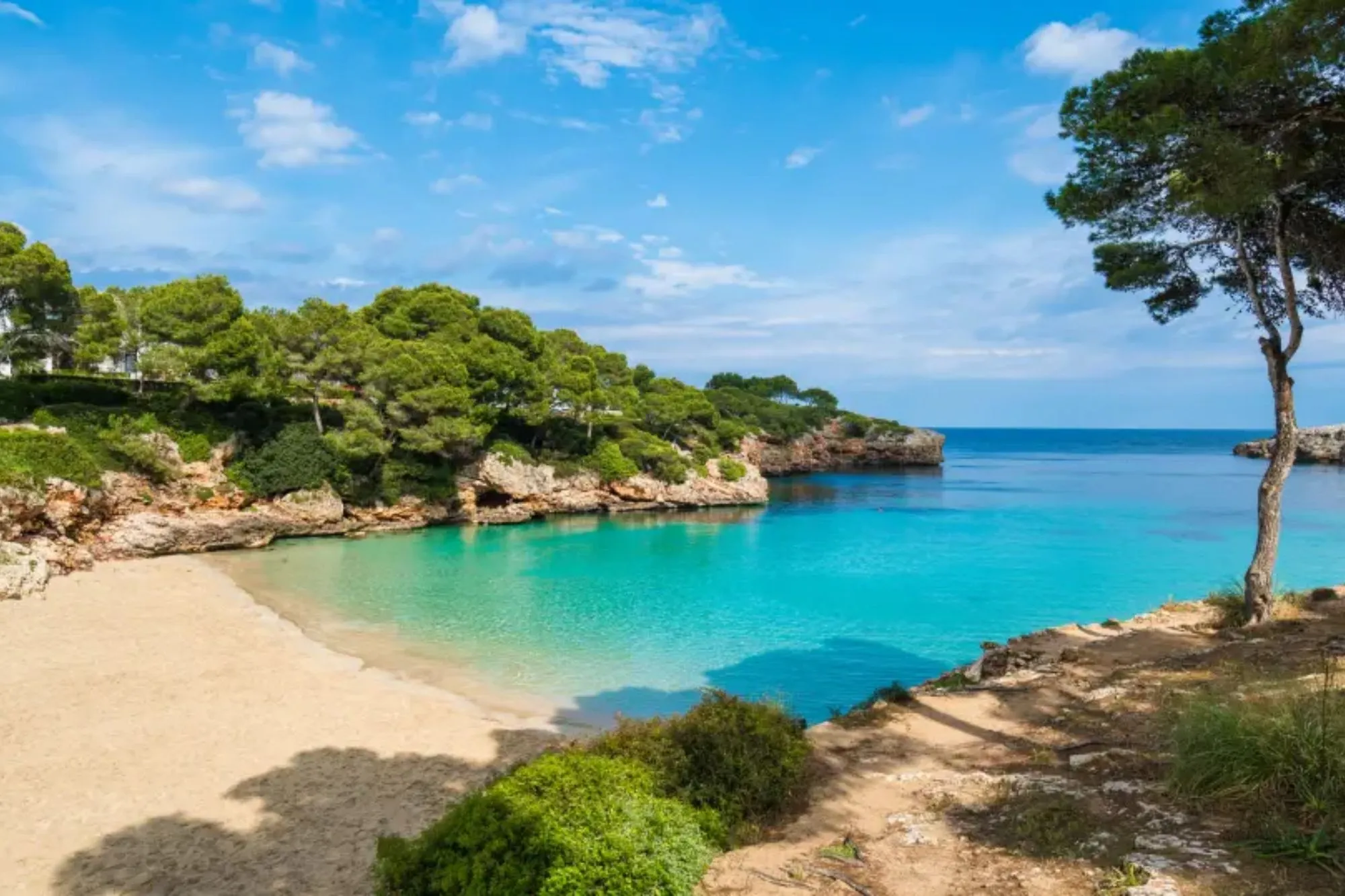
This hotel sits on Majorca‘s Cala Gran Beach, where shallow turquoise waters are backed by hills of Mediterranean pine trees.
Cala Gran is the largest beach in Cala d’Or, a beautiful cove just a short drive away from the coastal town centre, with its trinket shops and relaxed bars.
The hotel itself has all the activities and entertainment you’d expect, including bingo and live music – as well as some unique extras like mini golf and archery.
Loveholidays offer a 4-night stay from 29 March including return flights from Exeter from £179pp.
The 4-star Broncemar Beach Suites are close to the clear waters of Caleta de Fuste BeachCredit: Jet2Holidays
Maxeria Blue Didyma, Bodrum, Turkey
Holidaying at this super affordable five-star all-inclusive will leave you wondering how you’ve managed to bag such a bargain.
This modern hotel has entertainment and activities galore, including a mini cinema, arcade room, basketball and volleyball courts.
You can really make the most of the food in this all-inclusive package, grabbing late-night treats from the main restaurant or desserts from the resort’s very own patisserie.
Throw in a giant waterpark and beach just a stone’s throw away, and you’ve got yourself a bargain family resort nearing perfection.
Loveholidays offer a 7-night stay from 27 March including return flights from London Stansted from £344pp.
The Maxeria Blue Didyma in Bodrum has its own 24-hour snack bar and patisserieCredit: On The Beach
Htop Olympic, Costa Brava, Spain
This Calella hotel is the perfect base for a cheap and cheerful sun holiday, with comfy air-conditioned rooms just a few minutes’ walk from the bustling bars of Costa Brava.
Make use of three delicious meals a day with this all-inclusive package, where you can enjoy a varied buffet stocked with plenty of family favourites like fresh salads, grilled meats and chips.
Choose to make use of the hotel gym, pool and daytime entertainment activities, or head out to a range of affordable bars, shops and restaurants within walking distance.
On the Beach offer a 7-night stay from 27 March including return flights from London Luton from £297pp.
Costa Brava is a short flight from the UK, making it a popular tourist destination for BritsCredit: Getty
Mitsis Messonghi, Corfu
This Corfu resort was built for families and is buzzing with a whole host of entertainment and activities.
With four adult pools, three kids pools, a mini waterpark and a beach on your doorstep, there’s plenty of spots for you to stretch out on a sun lounger and for the kids to splash around.
When it comes to rooms, choose anything from a standard room all the way up to a beachfront superior bungalow, which swaps a standard balcony with a beachfront terrace.
Dining also goes down well, with a beachfront restaurant serving family favourites and a main buffet restaurant offering rainbow salads and international cuisine.
And as the day winds down to a close, the party starts with mini discos, Greek dancing, lively quiz nights and karaoke.
Loveholidays offer a 5-night stay from 29 March including return flights from East Midlands from £289pp.
Take a visit to the old town of Kerkyra in Corfu to explore its colourful cobbled streetsCredit: Getty
El Mouradi El Menzah, Hammamet, Tunisia
This four-star all-inclusive option in Tunisia’s Hammamet doesn’t disappoint, with multiple pools, an extensive buffet restaurant and its own private beach.
Plus, day temperatures in April sit in the 20s, with 9 hours of glorious Tunisian sunshine per day.
This resort is an ideal option for families, with a dedicated kids pool, kids club, sports and crafts options, as well as evening discos to keep children entertained.
Head out to the water to try your hand at kayaking, windsurfing or jet-skiing.
Or if you prefer to completely chill out, there’s a spa with a sauna and hammam to make use of, as well as a range of beauty treatments and massages.
Loveholidays offer a 5-night stay from 28 March including return flights from Glasgow from £369pp.
Mitsis Messonghi is a family-friendly hotel option with a mini waterpark on the resortCredit: Loveholidays
Bellevue Club, Alcúdia, Majorca
There are more pools than days of the week at the Bellevue Club in Alcudia.
With 11 swimming pools, a 24-hour bar and a garden theatre offering evening entertainment, you’ll hardly want to leave this resort once you arrive.
There’s seven tennis and squash courts plus a gym here, too – just in case you’ve still got some energy after all that swimming.
Nearby, there’s the family-friendly Alcudia Beach as well as the historic old town and promenade of Port D’Alcudia to explore.
The weather in April is pleasant and mild, reaching temperatures of 21C – perfect for playing out in the sun without getting too hot and bothered.
On the Beach offer a 7-night stay from 29 March including return flights from Exeter from £251pp.
Alcudia in Mallorca, Spain, has perfect temperatures for those who don’t like getting too hot and botheredCredit: Alamy
Hotel Palia Don Pedro, Costa Del Silencio, Tenerife
Club Palia Don Pedro is a top choice for families, with plenty of activities as well as spacious family suites available.
Rent a bike, try your hand at tennis, or simply get set up for a day’s relaxation on a couple of comfortable poolside loungers.
Plus, this hotel is situated 20 minutes from Playa de las Americas, meaning you’re in a quiet, scenic spot away from large resorts, with the option to taxi to the strip if you do fancy a busier day out.
Temperatures sit at a warm 22C, with bright, sunny days and cooler, comfortable nights.
First Choice offer a 7-night stay from 29 March including return flights from Glasgow Prestwick from £351pp.
Tenerife is a great destination for sunshine and activitiesCredit: Getty
RR Club Amarilis, Praia Da Rocha, Algarve, Portugal
The RR Club Amarilis aparthotel sits on the Algarve’s Praia da Rocha, a large and lively beach framed by dramatic limestone cliffs.
If you want to soak up the exciting holiday atmosphere, there’s a variety of affordable bars, restaurants and nightclubs within walking distance of this comfortable base.
Or for a more peaceful Portugal trip, simply explore the expanse of rugged coastline by foot or bike, as this hotel offers bicycle rental.
This hotel certainly isn’t short of sporting facilities, with a pool, gym, tennis courts, fitness classes and even a diving station offered within the complex.
First Choice offer a 7-night stay from 29 March including return flights from Newcastle from £420pp.
The cliffs of Portugal’s Praia da Rocha overlook a soft sand beach with turquoise watersCredit: Getty – Contributor
Blue Bay Beach Resort, Rhodes, Greece
Lalyssos in Rhodes is a traditional Greek resort town with plenty of charming tavernas to dip into and a beautiful mixed sand and pebble beach.
The four-star Blue Bay Beach Resort sits a stone’s throw away from this beach, and has its own pools, splash park and water slides.
There’s also a hotel spa and sauna to unwind in, offering massages and beauty treatments at an additional cost.
Here you’re only a 15-minute drive away from Rhodes Old Town, where UNESCO-listed medieval streets wind through castle-like architecture.
Make sure to check out the Street of the Knights, one of the best-preserved medieval streets in Europe.
Loveholidays offer a 5-night stay from 29 March including return flights from Bristol from £289pp.
Blue Bay Beach Resort in Rhodes comes with some seriously stunning views over the MedCredit: On The Beach
Magic Cristal Park, Benidorm, Spain
For a Benidorm holiday more luxurious than the norm, try a stay at Magic Cristal Park.
This hotel is packed with entertainment from day to night, which ranges from an arcade room and three kids’ clubs to evening karaoke and performances.
There’s also plenty of perks, such as a kids stay free policy – but by far the best of which is their “ultra all inclusive” package.
This includes premium drinks, a beachfront brunch and even excursions for guests staying over four nights.
Excursion options include the Medieval Magic Robin Hood Challenge, Princesses and Knights show, and a trip to see a Magic Show.
Plus, if you’re staying at least seven nights, you’ll even get entry to Terra Natura Animal Park and Aqua Natura Water Park included.
On the Beach offer a 7-night stay from 28 March including return flights from Newcastle from £311pp.
Benidorm is just a short trip away for an Easter breakCredit: Alamy
Xafira Deluxe Resort & Spa, Antalya, Turkey
The Xafira Deluxe Resort & Spa is stunning to look at – and you’ll feel a bit like royalty staying here, too.
Spend days hopping between a heated indoor pool, spa, outdoor pool and waterpark, or simply walk down to the beach to enjoy the 22C Easter sun.
The main buffet restaurant serves up a banging breakfast as well as a range of international foods at lunch and dinner, whilst a la carte options include Italian, BBQ and seafood restaurants.
There are also seven bars to try out, so you’re never far from a refreshing cocktail.
Choose to sip your drink at the beach, by the pool or in the nightclub at the disco bar.
On the Beach offer a 7-night stay from 10 April including return flights from London Luton from £218pp.
Antalya is a stunning holiday destination with year round sunshineCredit: Getty
Outside a hall where Southern California Edison was celebrating Black History Month on Friday, a group of Altadena residents stood on the sidewalk, waving signs and talking of the homes and family members they lost in last year’s Eaton fire.
“They’re in there celebrating Black history and they’ve destroyed a Black town,” said Nicole Vasquez of My Tribe Rise, which helped organize the protest.
The Jan. 7, 2025 fire destroyed thousands of homes, including the majority of homes in west Altadena, a historically Black community. All but one of the 19 people who died were in west Altadena.
“If Edison’s tower did not ignite the fire, Altadena would still be there,” said Trevor Howard Kelley, who lost his 83-year-old mother, Erliene, in the fire.
Kelley, his daughter and two granddaughters had been living with his mother before her home was destroyed, he said.
The Black Altadena residents are part of a larger coalition that is asking Edison to advance each family who lost their home $200,000 in emergency housing assistance. They say that more than a year after the blaze many wildfire survivors are running out of the funds they had received from insurers.
The group protesting Friday also called for transparency from Edison. The company has said it believes it is likely its equipment caused the fire but has continued to deny it did anything wrong.
“We just want the truth,” said Felicia Ford, who lost her house in the fire. “What’s wrong with saying, ‘We got this wrong.’”
Scott Johnson, an Edison spokesperson, said Friday that the company continued to believe its voluntary compensation program was the best way to help victims of the fire. Edison has promised to quickly review each victim’s claim and pay it swiftly if approved.
Families who lost their homes can receive hundreds of thousands of dollars under the program, while those with damaged homes receive lesser amounts.
But many survivors say they don’t believe the offered amounts fully compensate their losses. And to receive the money, victims must agree not to sue — which many are not willing to do.
“We recognize the incredible struggles the community has faced,” Johnson said. “The intent of the program is to reach final settlements to allow the community to rebuild and move on.”
The investigation into the cause of the fire has not yet been released. Edison has said a leading theory is that its century-old transmission line in Eaton Canyon, which had not carried electricity for 50 years, somehow became reenergized and sparked the fire.
Company executives said they did not remove the old line because they believed it would be used in the future.
Tru Williams said he just wants to get his parents back home.
(Myung J. Chun / Los Angeles Times)
In December, state regulators ordered Edison to identify fire risks on its 355 miles of out-of service transmission lines located in areas of high fire risk and tell regulators how executives planned to use the lines in the future.
Team GB face an uphill task to win an Olympic medal in the four-man bobsleigh as they sit seventh at the halfway point.
Pilot Brad Hall had showcased why the British team are medal contenders in Cortina with a brilliant first run of 54.39 seconds, which left them in third place.
But they dropped off the pace in the second, clocking 55.04secs – the 12th-quickest time in heat two – to lose four places in the standings before Sunday’s medal-deciding heats.
The three German teams remain the ones to beat and they occupy the top three spots with Johannes Lochner, who won two-man gold earlier this week, leading the charge with an overall time of 1:48:61.
There was a long delay to competition at the Cortina sliding track after Austria suffered a crash during heat two, with one of the athletes treated for a lengthy period on the ice before being stretchered off.
Action resumed after about a 20-minute delay but, with the track now slower because of the rising temperature, the British team were unable to find the speed of their first run and currently sit on 1:49:43.
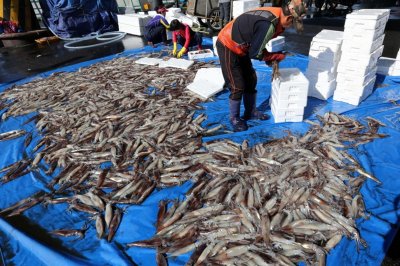
Fishermen pack squid into boxes at Jumunjin Port on South Korea’s east coast, 04 June 2015, as the busy squid-fishing season gets under way. File. Photo by YONHAP / EPA
Feb. 20 (Asia Today) — The number of fishing vessels over 10 tons in North Gyeongsang Province has fallen nearly 16% over the past five years as squid stocks along South Korea’s East Sea coast continue to decline, government data show.
According to the Ministry of Oceans and Fisheries’ fisheries statistics portal, 369 vessels exceeding 10 tons were registered in Gyeongbuk in 2024, down from 438 in 2020, a 15.7% decrease.
Local fishermen have long relied on squid as a primary source of income. In 2020, catches of Pacific flying squid in the region reached 20,653 tons, accounting for more than half of total production. By 2023, that figure had plunged to 2,793 tons, an 86% drop in four years.
Analysts attribute the decline in part to rising sea temperatures that have pushed spawning and feeding grounds northward, causing juvenile squid to remain longer in northern Gangwon Province and waters near North Korea.
Some observers also point to large-scale fishing activity by Chinese vessels in North Korean waters. In 2020, Global Fishing Watch, a nonprofit monitoring group, reported that squid populations in South Korean and Japanese waters had fallen about 80% since 2003, linking the decline to foreign fishing in North Korean waters.
The group said more than 900 large Chinese vessels were found operating in the area in violation of U.N. sanctions and estimated they harvested more than 160,000 tons of Pacific flying squid worth roughly $500 million between 2017 and 2018 – an amount comparable to the combined annual catch of South Korea and Japan.
As nearshore squid stocks dwindle, distant-water fishing has expanded. In Busan, the number of vessels over 200 tons rose 18%, from 273 in 2020 to 321 in 2024, even as mid-sized vessels declined.
Overall registered fishing vessels in Busan remained relatively stable at 3,339 in 2024, compared with 3,333 four years earlier, but the fleet composition shifted toward larger ships.
Government data show distant-water squid production nearly doubled from 31,500 tons in 2023 to 63,200 tons in 2024.
Industry groups said a recently passed amendment to the Coastal and Inshore Fisheries Structural Improvement Act could provide a more stable exit path for fishing households facing financial strain.
Tehran, Iran – The Iranian government has again blamed “terrorists” for the killings of thousands during last month’s nationwide protests after United States President Donald Trump and human rights experts weighed in.
Foreign Minister Abbas Araghchi said on Saturday that the government has released a list of 3,117 people, whom he described as “victims of recent terrorist operation”, including about 200 security personnel.
Recommended Stories
list of 3 itemsend of list
“If anyone disputes accuracy of our data, please share any evidence,” the diplomat, who has previously stated that 690 people on the list were “terrorists” armed and funded by the US and Israel, wrote on X.
Araghchi’s comments come hours after the US president told reporters that 32,000 people were killed during the protests, adding that “the people of Iran have lived in hell” under the theocratic establishment.
The Iranian foreign minister has also been speaking with multiple US media outlets to advocate for a “fair” agreement with Washington over Iran’s nuclear programme.
The threat of war looms increasingly large over the country and potentially the region, with Serbia on Saturday becoming the latest country to call on all its citizens to immediately leave Iran.
‘Majority of those killed are ordinary people’
Mai Sato, United Nations special rapporteur on human rights in Iran, has said more than 20,000 civilians may have been killed, but information remains limited amid heavy internet filtering by the state, six weeks after a nationwide communications blackout was imposed.
The US-based HRANA says it has documented more than 7,000 people killed during the nationwide protests, and is investigating nearly 12,000 more cases.
Sato was among 30 special rapporteurs and international human rights experts who signed a joint statement on Friday calling on Iranian authorities to fully disclose the fate and whereabouts of tens of thousands arrested, forcibly disappeared or missing in the aftermath of the nationwide protests, and to halt all related death sentences and executions.
“The true scale of the violent crackdown on Iranian protesters remains impossible to determine at this point,” the experts said. “The discrepancy between official figures and grassroots estimates only deepens the anguish of families searching for their loved ones and displays a profound disregard for human rights and accountability.”
The international experts added that “the vast majority of those detained or killed are ordinary people, including children, from all provinces and diverse ethnic and religious backgrounds, as well as Afghan nationals”, in addition to lawyers representing protesters, medical professionals who treated the wounded, journalists and writers, artists and human rights defenders.
Iranian state media were accused of regularly broadcasting what the experts said are “widely regarded as forced confessions”.
The latest such incident came on Saturday, when the official Mizan news agency of the Iranian judiciary released footage from a court session for three men who said they regret setting fire to motorcycles, a mosque and copies of the Quran in Tehran during the unrest.
Also on Saturday, some students in Tehran and across the country returned to university campuses for the first time, as authorities kept universities closed and took some classes and exams online in the aftermath of the protests.
In Tehran’s Sharif University, one of the most prestigious in the country, students clashed after two separate demonstrations. Videos circulating online showed students shouting “dishonourables” at a group of paramilitary Basij students affiliated with the Islamic Revolutionary Guard Corps (IRGC), who chanted back in favour of the establishment.
The clashes come amid a heightened security atmosphere in Iranian schools and university dormitories. Teachers and schools in a number of cities near the capital went on strike last week to protest the killing of at least 230 children and teenagers, as well as increased presence of security forces in classrooms.
Families dance in defiant grief
The Iranian government held mourning events on Tuesday and Wednesday in Tehran, with some officials in attendance.
Culture Minister Reza Salehi-Amiri announced on Saturday that the government has decided to call the upcoming ceremonies around Newroz, the new Iranian year starting in late March, an exercise in “unity and empathy” with the aim of “getting past the grief” of thousands killed.
But numerous families have been holding defiant commemoration events of their own over the past week to mark 40 days since the killing of their loved ones during the anti-establishment protests.
Footage from many ceremonies across the country this week showed family members, and large crowds gathered to support them, proudly holding up images of those killed and celebrating their shortened lives.
Many chose to clap, play traditional drums and cymbals, and even dance in symbolic shows of resistance and defiance that heavily clash with religious rituals favoured by the theocratic state.
“May your pen break, O fate, if you do not write about that which befell us,” the father of Abolfazl MirAeez, a 33-year-old killed in the city of Gorgan in the northern province of Golestan, told crowds gathered at a ceremony on Thursday.
“My son was neither a rioter, nor an embezzler nor an aghazadeh [child of an elite]. He was the son of a farmer.”
Director Sang-il Lee sets his epic-scaled “Kokuho” in the vivid world of kabuki theater, but it’s not just the movie’s milieu that distinguishes it. Spanning 50 years and running nearly three hours, “Kokuho,” which has become Japan’s biggest live-action hit ever, evinces intensely mixed feelings about its two main characters’ quest for greatness. Kabuki is presented as an art form of balletic skill, but it can never fully redeem or repair the film’s central figures, who once were friends before ambition got in the way.
In 1964 Nagasaki, 14-year-old Kikuo (Soya Kurokawa) performs at a New Year’s event, impressing Hanjiro (Ken Watanabe), a beloved kabuki legend. But after Kikuo’s father, a yakuza crime boss, is murdered, Hanjiro takes the grieving teen under his wing. Soon, Hanjiro is training Kikuo and his own son Shunsuke (Keitatsu Koshiyama) in his Osaka studio to become “onnagata” — male kabuki actors who portray female characters. Both sweet and bashful, Kikuo and Shunsuke quickly grow close, enduring Hanjiro’s exacting requirements as he shapes them to be graceful, disciplined performers.
“Kokuho” then fast-forwards to the early 1970s as we meet the grown-up versions of Kikuo (Ryo Yoshizawa) and Shunsuke (Ryusei Yokohama). Now practically brothers, the young men are making their name as a well-regarded kabuki duo, but their personalities have begun to diverge. Kikuo remains soft-spoken, while Shunsuke is more of a partier and big talker, dominating their interviews with local journalists. Hanjiro still thinks highly of them both, although each pupil faces disadvantages. Kikuo is more gifted but in this nepotistic art form, being part of a respected kabuki lineage is crucial, something this yakuza scion doesn’t possess. Shunsuke, meanwhile, lacks his friend’s formidable technique, but because he’s Hanjiro’s son, his future prospects are practically assured. Kikuo and Shunsuke complement one another as performers but a shocking turn of events will sever their bond.
Adapting a novel by Shuichi Yoshida, Lee maps the arc of a friendship while exploring the minutiae of kabuki, both on stage and behind the scenes. (The movie’s Oscar-nominated makeup is an acknowledgment of the blinding-white face paint and bright red lipstick that kabuki actors wear to transform into their roles.) Much like ballet, kabuki necessitates precise choreographed actions: Not only does “Kokuho” provide generous samples of different kabuki pieces but also includes captions that list the title of the individual works and a brief synopsis. Rarely do these pieces directly echo the two men’s interpersonal drama, but the information adds context to the actors’ enchanting movements, which are backed by gorgeous outfits and striking set design that accentuate the mythical tales being played out.
Kikuo and Shunsuke’s fortunes shift over the decades — one of them will literally be kicked when he’s down on two separate occasions — but Lee doesn’t let us settle on a definitive impression of either performer. Our sympathies change as we witness both men’s failings as well as their enduring virtues. “Kokuho” is a hearty melodrama with a little bit of everything — sex scandals, betrayals, unlikely comebacks, health scares — but the film’s gaudy plot twists (which shouldn’t be spoiled) belie the filmmaker’s unsentimental attitude regarding stardom’s perils. Refreshingly, “Kokuho” is that rare film to be un-awed by talent alone. Both Kikuo and Shunsuke will enjoy high highs and low lows, but it’s their perseverance that ultimately means more than arbitrary benchmarks like “genius” or “brilliance.”
The film’s title translates to “national treasure,” another clichéd term thrown around when trying to categorize greatness. Kikuo and Shunsuke revere kabuki’s bygone giants, who are affixed with that moniker. But as “Kokuho’s” characters seek such an accolade for themselves, they come to realize how misleading it is. Yoshizawa and Yokohama bring abiding tenderness to their characters’ friendship while refusing to allow either protagonist to be reduced to a simple set of qualities. Kikuo’s delicate features suggest a pure soul, but Yoshizawa gradually reveals other sides to this gifted, haunted performer. And Yokohama ably depicts a privileged young man who rightly views his good fortune as both blessing and curse.
Their lives intersect, then disentangle, then return to each other’s orbit again. That elegant dance matches what we see on stage, the kabuki performances melding melancholy and beauty, anguish and catharsis.
That is how the president of the United States, a man convicted of fraud, described his new team focused on international relations. A team that does not include representatives from our closest neighbors — Mexico and Canada — but did save room for leaders accused of war crimes by the International Criminal Court.
Now, we do not know whether President Trump created his “Board of Peace,” which this week held its first meeting, specifically to undermine the authority of the United Nations. But we do know that the president has pledged $10 billion in tax dollars to the board’s mission while still owing the U.N. half that amount in back payments. We do not know whether Trump, who is indefinitely the leader of this peace board, intends to relinquish that power after he leaves the White House. But we do know he is still trying to overturn the results of the 2020 election. Whether the “Board of Peace” is the most prestigious panel ever assembled is debatable. What is not debatable is that it was conceived by an adjudicated sexual abuser who is referenced in the released Epstein files some 38,000 times.
That is not my take.
That is simply what is happening.
Which is why the president encourages his supporters to ban books and reject journalism. He doesn’t want voters to pay attention. He doesn’t want voters to understand his actions.
Ten years ago this month — after his Nevada caucus victory speech — Trump said, “I love the poorly educated.” And his reliance on this base is why, over the past decade, he and other conservatives have purposely misconstrued the term “woke” as a catch-all slur toward progressive and far-left policies. It used to mean “aware” and “informed.” The term was not born out of modern politics but rather the need to understand the history of the social economic systems we all are living in. The alternative is to be blindly led by an unscrupulous leader most concerned with his own well being.
Being “woke” is why the Boston Tea Party happened in 1773; it is why Thomas Paine published “Common Sense” in 1776; it is why Republicans formed the Wide Awakes to help get Abraham Lincoln elected in 1860. When voters understand the context in which decisions are made, we are better equipped to address shortcomings at the ballot box and in our daily lives.
Trump’s self-proclaimed love for the poorly educated has nothing to do with progressive policies or college degrees and everything to do with whom he can convince to believe him. And by making “woke” an insult, Trump and other conservatives have politicized the very tool necessary to help the country fulfill its promise: information.
This threat is the reason his administration attacks, and even arrests, journalists; the reason he refers to reports he doesn’t like as “fake news”; the reason he fired the labor statistics chief after an unflattering jobs report last year. He’s waging a war on information.
When Trump returned to the White House, he made lowering the U.S. trade deficit a key component to his economic policy. In 2024, the deficit was $903.5 billion. In 2025, it was $901.5 billion — and America’s families paid $230 billion more for goods because of his yo-yo tariff policies.
Just as the saga of the Epstein files reveals he is not the protector of women and young girls that he claimed to be.
Just as his recent attacks on the 1st, 2nd, 4th and 14th Amendments show he was never the defender of the Constitution he took an oath to be.
Acknowledging the laundry list of untruths tied to his promises and presidency is not political or a symptom of “Trump Derangement Syndrome.” It’s simply having information: the one thing that helps voters understand why things are the way they are. The one thing the president hopes his supporters never wake up to see for themselves.
The following AI-generated content is powered by Perplexity. The Los Angeles Times editorial staff does not create or edit the content.
Ideas expressed in the piece
The Board of Peace, while described by the president as the most prestigious ever assembled, excludes the country’s closest neighbors in Mexico and Canada while creating space for leaders accused of war crimes by the International Court[2][3].
The administration is pledging $10 billion in tax dollars to the board’s mission while the United States still owes the United Nations $5 billion in back payments, raising questions about priorities and institutional commitment.
The board represents a potential threat to the UN’s authority and the multilateral international order, with the president positioned to lead indefinitely without a clear succession mechanism independent of his personal tenure.
The use of the term “woke” as a political slur by the president and conservatives serves to discourage informed and critically aware voters from engaging with factual information and journalism, undermining democratic participation.
The administration’s economic policies have demonstrably failed, including tariff strategies that burdened American families with $230 billion in additional costs while the trade deficit marginally decreased from $903.5 billion to $901.5 billion, a result inconsistent with promised outcomes.
The president’s record of attacks on the press, dismissal of unfavorable reporting as “fake news,” and removal of officials for releasing unflattering data represents a broader assault on the free flow of information essential to accountability.
Different views on the topic
The Board of Peace represents a vital step in implementing the president’s 20-point plan for Gaza, which was endorsed by United Nations Security Council Resolution 2803 and initially received broad international support from Western democracies[1][3].
More than two dozen nations have signed on as founding members of the board, with member countries pledging $5 billion toward Gaza’s reconstruction, demonstrating substantial international engagement with the initiative[2].
The Executive Board comprises leaders with expertise across diplomacy, development, infrastructure, and economic strategy, positioning the mechanism to provide strategic oversight and mobilize international resources for Gaza’s stabilization[1].
The board functions as an overarching body designed to implement demilitarization and reconstruction efforts through subsidiary mechanisms including the Gaza Executive Board and the National Committee for the Administration of Gaza, with operational structures intended to deliver governance and development outcomes[1][3].
The initiative was conceived as a focused mechanism to support stabilization and reconstruction in Gaza within the framework of the UN-endorsed 20-point plan, anchoring its original purpose in internationally recognized diplomatic processes[3].
Sunday’s live TV and streaming broadcasts for the Milan-Cortina Olympics unless noted (subject to change). All events stream live on Peacock or NBCOlympics.com with a streaming or cable login. All times Pacific. 🏅 — medal event for live broadcasts.
CLOSING CEREMONY 11:30 a.m. — NBC
MULTIPLE SPORTS 2 p.m. — Best of the 2026 Milan-Cortina Olympic Games | NBC 9 p.m. — “Primetime in Milan” (delay): Closing ceremony, bobsled, cross-country skiing, curling, hockey. | NBC
BOBSLED 1 a.m. — Four-man bobsled, Run 3 | Peacock 3:15 a.m. — 🏅Four-man bobsled, final run | Peacock 3:35 a.m. — 🏅Four-man bobsled, final run (in progress) | USA 4:15 a.m. — Four-man bobsled, final run (delay) | NBC 8 a.m. — Four-man bobsled, runs 3-4 (re-air) | NBC
CROSS-COUNTRY SKIING 1 a.m. — 🏅Women’s 50-kilometer mass start classic | USA 4 a.m. — Women’s 50-kilometer mass start classic (re-air) | USA 8:45 a.m. — Women’s 50-kilometer mass start classic (re-air) | NBC
CURLING 🏅Women’s gold-medal match 2:05 a.m. — Switzerland vs. Sweden | Peacock 4 a.m. — Switzerland vs. Sweden (delay) | USA, NBC 10:30 a.m. — Switzerland vs. Sweden (re-air) | USA
HOCKEY 🏅Men’s gold-medal match 5:10 a.m. — United States vs. Canada | NBC 1:30 p.m. — United States vs. Canada (re-air) | USA
When it comes to travelling on a long-haul flight, many people turn to comfort items such as neck pillows, blankets and eye masks, but one frequent flyer says most are making a major mistake
Many people can often make the same flight mistake (stock image)
Before setting off on a long-haul flights, most travellers know to wear comfortable clothes to make their journey more easy and relaxing. Beyond this, many passengers also bring along comfort items like neck pillows, blankets and eye masks.
Yet, according to traveller @epthelatino, countless people are making a same mistake with their neck pillows when it comes to flights – and it’s costing them precious sleep. In his clip, he suggests that most long haul flight passengers position their neck pillows with the opening at the front, which fails to adequately support the neck when the head drops forward.
Instead, he says they should rotate it so the gap sits at the back, which he says enables you to rest your head in various positions whilst maintaining proper support.
Reacting to his clip, one viewer said: “I think the inventor should make a doughnut pillow instead.” Another viewer added: “You are doing it all wrong – try sideways.”
A third commented: “I wear my neck pillow sideways. It’s more comfortable… thank me later.” One more person said: “Ooooh! Okay. That’s why it’s called a neck pillow.”
Whilst another added: “I’ve used it this way – it’s way better than how it was meant to be used.”
Content cannot be displayed without consent
Offering their perspective, the experts at Travel Sentry stated: “Once you have chosen the right pillow, it’s crucial to place it correctly for maximum comfort.
“Many people make the mistake of placing the pillow behind their head, which can cause their head to fall forward, leading to neck pain.
“Instead, place the pillow on your shoulder and lean your head towards it. This position will support your neck and keep your head from falling forward.”
They suggest that getting to grips with a neck pillow properly “takes practice”, noting: “Like any skill, mastering the art of travel pillow comfort takes practice.
“Don’t get discouraged if you don’t get it right on your first try. Keep experimenting with different positions and adjustments until you find what works best for you.
“With time, you will become a pro at using a travel pillow and enjoy a comfortable journey every time.”
However, if you’re still finding it difficult to settle in, travellers are advised to explore additional comfort aids.
They continued: “If you have trouble finding a comfortable position with just a travel pillow, you can use additional support.
“For example, use a blanket or scarf to support your lower back. Alternatively, place a small pillow or a rolled-up jacket under your knees to relieve pressure on your lower back.”
Who: Tottenham Hotspur vs Arsenal What: English Premier League Where: Tottenham Hotspur Stadium, London, UK When: Sunday, February 22 at 4:30pm (16:30 GMT) How to follow: We’ll have all the build-up on Al Jazeera Sport from 13:30 GMT in advance of our live text commentary stream.
Arsenal will look to banish their untimely bout of title race anxiety as the wobbling Premier League leaders head to bitter rivals Tottenham for the north London derby.
Recommended Stories
list of 4 itemsend of list
Mikel Arteta’s men are in danger of blowing a commanding position in the title race after successive draws against Brentford and Wolves left them with just two wins in their last seven league matches.
The Gunners squandered the lead in both matches, with Wednesday’s 2-2 draw at bottom-of-the-table Wolves especially galling as they conceded a stoppage-time equaliser having led 2-0.
Pep Guardiola’s Manchester City side will move two points behind Arsenal if they beat Newcastle at the Etihad Stadium on Saturday.
Meanwhile, Tottenham’s new coach, Igor Tudor, faces a baptism of fire in his first game in charge of the club as he is tasked with steering Spurs out of a relegation battle.
Thomas Frank was sacked as Tottenham manager following the defeat to Newcastle earlier in February, as a dire domestic campaign has left Spurs in 16th place going into the weekend, just five points above the relegation zone.
Saka urges Arsenal to ‘get over the line’
On February 7, Arsenal players walked off the field after a convincing 3-0 home win against Sunderland with their lead in the Premier League at nine points. Then things started to go wrong.
Defiant Arsenal forward Bukayo Saka is adamant his side will eventually “get over the line” and end their trophy drought.
After allowing City to overhaul them in the 2023 and 2024 title races, the north Londoners, who have not won silverware since the 2020 FA Cup, face pointed questions about their ability to handle the mounting tension.
Saka said Arsenal must silence the doubters by getting back on track at archrivals Tottenham on Sunday.
“I believe the next few years are going to be the years that we get over the line, and we’re able to win trophies and make history for this club,” Saka said. “We’re back where we belong, fighting for everything.”
Saka in action against Wolves at Molineux on February 18 [Carl Recine/Getty Images]
Arteta dismisses ‘bottlers’ talk
Arsenal’s boss rejected the term “bottlers’ ahead of Sunday’s Premier League visit to Tottenham Hotspur.
“It’s not part of my vocabulary and I don’t see it like this because I don’t think anybody wants to do that as an intention,” Arteta told reporters on Friday, when asked about the term being used regarding their latest wobble in the title race.
“That’s individual opinion, perspective. You have to respect that. That’s what I said after in the press conference. You lose two points against Wolves in the manner that the game played out, you have to take it on the chin. It’s part of our role.”
“What I’m very interested in is the next one, what we are made of, what we love about this and how we write our own destiny from here.”
‘No time to find excuses’
Tottenham Hotspur’s new interim head coach Tudor says instilling the players with confidence is his most urgent task.
“First priority is to give everything the team needs in these moments. The team need, I believe, first of all, to get some confidence, to get some courage, but also, in same way, the concrete things in the pitch,” Tudor told Spursplay.
“Of course, I’m coming here knowing that situation is not easy. There is no time to find excuses. What I said from the first day here, each of us, need to give something more, something extra.”
He added: “The position of the club in this moment is one that nobody can accept. Every Tottenham fan cannot accept the situation. We are aware of that. But it’s not enough to just be aware of that.”
The 47-year-old former Juventus coach Igor Tudor has been brought in until the end of the season [File: AFP]
Tudor wants a team prepared to ‘suffer’
While Tudor is aware of the significance of a derby win over Arsenal, he is more concerned with building a strong team spirit to help fuel their survival bid.
“I understand the importance of this game. This is a derby, a north London derby,” he said.
“This is a team that is full of quality, full of talented players, with good motor engines. But my goal in these first training sessions is that we become a team, with a really right way of going to war.
“A team who want to suffer. To fight, to run, to have the right mentality. This is the start.”
Head-to-head
Tottenham Hotspur and Arsenal have locked horns on 212 occasions; Arsenal won 90 of the games, while Spurs won 67, and 55 were draws.
Arsenal are now unbeaten against Spurs in their last seven games. Earlier this season, Eberechi Eze scored a hat-trick in November as the Gunners thrashed Tottenham 4-1 at the Emirates.
Arteta’s side also did the double over their bitter local rivals in 2024-25, winning 1-0 at Tottenham and earning a 2-1 victory at home.
Tottenham’s team news
Spurs were dealt a big blow when promising young winger Wilson Odobert ruptured his anterior cruciate ligament against Newcastle.
He joins a long injury list of players who will miss the derby, including James Maddison, Ben Davies, Dejan Kulusevski, Rodrigo Bentancur, Mohammed Kudus, Destiny Udogie, Kevin Danso and Lucas Bergvall.
Cristian Romero will serve the second of his four-game suspension after the Spurs captain was sent off in the defeat to Man United earlier this month.
Brazilian forward Richarlison is back in training after a knock and could be available for selection, while Pedro Porro faces a late fitness test as he looks to return from injury.
Predicted starting XI:
Vicario (GK); Palhinha, Dragusin, Van de Ven; Gray, Gallagher, Sarr, Spence; Kolo Muani, Simons; Solanke
Arsenal’s team news
Versatile midfielder Mikel Merino has undergone surgery for a stress fracture in his right foot, an injury sustained in January, and could miss the rest of the season.
Leandro Trossard is a serious doubt for the derby after he went off injured in stoppage time against the Wolves.
But Arteya has said he hopes to have captain Martin Odegaard and Kai Havertz available for selection after they were struggling with injuries, and youngster Max Dowman has returned to training after an ankle problem.
And while Saka also limped off against Wolves, he is expected to be declared fit for this match.
The former Top Gear presenter admits he was blindsided by what he now sees as one of the gravest dangers facing young people, confessing “I simply had no idea”
11:08, 21 Feb 2026Updated 11:09, 21 Feb 2026
Jeremy Clarkson(Image: PA)
Jeremy Clarkson has confessed he was caught off guard by what he now considers one of the greatest threats to young people today, admitting, “I simply had no idea.” In his column for The Sun, the former Top Gear host revealed that while he previously worried about conventional teenage dangers, he overlooked the fact that the most damaging influences were already accessible through their mobile phones.
Looking back on his time as a father, Clarkson explained: “When my kids were teenagers, I worried about them taking drugs and going on motorbikes, and I simply had no idea that the real danger was lurking in their telephones.”
His remarks follow the Government’s plans to strengthen laws targeting the distribution of non-consensual intimate images online. Earlier this week, Sir Keir Starmer announced intentions to bolster legislation requiring tech firms to delete such content within 48 hours of being flagged.
However, Clarkson maintains that the rapid pace of online sharing renders that timeframe impractical. “This is laughable because if someone uploads a topless picture of you, all your friends will see it within 48 seconds,” he stated. “Forty-eight hours on the internet is about four million years,” reports the Express.
The Prime Minister has positioned the proposed reforms as a key element of a wider effort to tackle online abuse directed at women and girls. Through an amendment to the Crime and Policing Bill, social media companies that don’t meet the two-day deadline for removing content could be hit with substantial fines or potentially banned from operating in the UK.
Starmer, who previously held the role of director of public prosecutions, said his past work gave him insight into the “unimaginable, often lifelong pain and trauma violence against women and girls causes.” He added: “As Prime Minister, I will leave no stone unturned in the fight to protect women from violence and abuse.”
Characterising the internet as an emerging frontline, Starmer stated: “The online world is the front line of the 21st century battle against violence against women and girls. That’s why my government is taking urgent action: against chatbots and ‘nudification’ tools. Today we are going further, putting companies on notice so that any non-consensual image is taken down in under 48 hours. Violence against women and girls has no place in our society, and I will not rest until it is rooted out.”
Clarkson, 65, doesn’t question the gravity of the problem. In fact, he believes it goes even deeper than politicians realise. He highlighted the HBO drama Euphoria, featuring Zendaya and Sydney Sweeney, as a stark illustration of the challenges confronting today’s teenagers. “What Starmer needs to do is watch a TV show starring Zendaya and Sydney Sweeney. It’s called Euphoria and God knows what possessed me to tune in — teenage angst and a lot of male nudity is not my thing normally — but Lord, I’m glad I did,” Clarkson remarked. “I know it’s a drama but if only half of the issues are real, society has a serious problem.”
For Clarkson, the programme highlighted how online culture has amplified adolescent experiences. He outlined the troubling aspects he believes have become widespread: “The bullying. The d*ck pics. The revenge porn threats. And a very real sense that if you say or do something that is considered out of line by an ‘unseen woke police force,’ that’s you done.”
While he acknowledges that Starmer is correct to concentrate on social media’s effect on teenage girls, he doubts whether a 48-hour takedown requirement is adequate in reality. “Starmer is right to be thinking about the effect social media has on teenage girls. But suggesting that a platform must take down revenge nudes and deep fake pictures within two days demonstrates he does not understand the scale of the problem.”
Polish short track speed skater Kamila Sellier has undergone surgery after she was struck in the face by a blade in a serious crash at Milan-Cortina 2026.
Sellier was racing in the quarter-finals of the women’s 1500m on the final night of short track competition at the Milano Ice Skating Arena.
She was brought down along with 14-time Olympic medallist Arianna Fontana of Italy and American Kristen Santos-Griswold, who was penalised for attempting an illegal pass that contributed to the crash.
As Santos-Griswold fell, her skate caught Sellier and sliced her under her left eye.
Racing was paused while Sellier received attention behind the privacy of a white sheet. She was then stretched off the ice, managing to give a thumbs up to the crowd as she left.
In 1878, the New Haven, Conn., Telephone Co. published the first phone directory. It listed 50 subscribers.
In 1885, the Washington Monument, a 555-foot-high marble obelisk built in honor of America’s revolutionary hero and first president, was dedicated in Washington.
File Photo by Pat Benic/UPI
In 1916, Germans launched the Battle of Verdun. More than 1 million soldiers in the German and French armies were killed in nearly 10 months of fighting. It was the longest battle of World War I.
In 1925, the first issue of The New Yorker was published.
In 1934, Nicaraguan guerrilla leader Cesar Augusto Sandino was killed by members of the country’s national guard.
In 1953, Francis Crick and James D. Watson discovered the double helix structure of the DNA molecule. It took another three decades for scientists to produce a clear, direct picture of the DNA molecule.
The Francis Crick Letter titled “Secret of Life” is on display at Christie’s in New York City on April 5, 2013. The letter from Francis Crick to his son dated March 19, 1953, outlines the revolutionary discovery of the structure and function of DNA. File Photo by John Angelillo/UPI
In 1965, Black Muslim leader Malcolm X was assassinated at a rally in New York.
In 1994, longtime CIA counterintelligence officer Aldrich Ames and his wife, Maria, were arrested and charged with selling information to the Soviet Union and Russia. Ames was sentenced to life in prison; his wife got a five-year term.
In 1995, a Russian commission estimated up to 24,400 civilians died in a two-month uprising in the separatist republic of Chechnya.
In 2007, nuclear neighbors India and Pakistan signed a treaty in New Delhi aimed at preventing the accidental use of atomic weapons.
In 2014, U.S. President Barack Obama met the Dalai Lama, Tibet’s exiled spiritual leader, at the White House after the Chinese government warned the meeting would damage U.S.-China relations. A White House statement said Obama “reiterated the U.S. position that Tibet is part of the People’s Republic of China and that the United States does not support Tibet independence.”
In 2019, the Japanese Space Agency’s Hayabusa-2 probe touched down on asteroid Ryugu. It was the first probe to deploy working rovers onto an asteroid.
In 2022, Russian President Vladimir Putin ordered “peacekeeping” troops into two separatist regions of eastern Ukraine under new decrees recognizing them as independent republics. Three days later, Russia invaded Ukraine.
“For the last 12 months his yearly income was around £34,000.
“As often said there is the Instagram world and the reality. Mr Timlin’s bank statements make it very clear the lifestyle he lives in the public eye is not the lifestyle he actually does lead.”
She said he relies on extra money sent by his mother.
Scotty T’s finances have been revealed – as it’s claimed he relies on money from his mumCredit: Instagram/@scottgshore
She continued:”He made his name on Geordie Shore and won Celebrity Big Brother but that was as far back as 2016.
“Although he’s done some TV work since Geordie Shore ended in 2019 those were the programmes he made his name from.
“He now relies extensively on the promotional world being paid to attend bars and nightclubs for events.”
She said his opening and closing balances for the last three months “make for bleak reading”.
Timlin has recently become a father, and opened up to The Sun about how his son has changed his life.
He joined Geordie Shore in 2012 and gained himself the nickname Turbo T for his womanising ways.
Admitting he was out seven days a week doing cocaine as he opened up about his drug-drive arrest for the first time, he told us: “I felt like I was just getting drunk and I was on coke and all sorts,” he admits.
“It was just like every night getting drunk, waking up and then going out again.”
Timlin, 37, was fined £938, Oukhellou £975 and Clayton was given a £820 fine. All the celebs will pay a £1,000 contribution to prosecution costs.
BARCELONA is a fun city to visit, but have you heard about its cool neighbour?
El Poblenou sits just outside Barcelona in Spain but has far fewer crowds.
Sign up for the Travel newsletter
Thank you!
The neighbourhood has its own Rambla, a pedestrian-friendly street modelled on the famous one in the Old CityCredit: AlamyPoblenoui is nicknamed the Catalan ManchesterCredit: AlamyThe former factories resemble those in the UK city (pictured)Credit: Alamy
And according to Meet Barcelona, the area is known as ‘Catalan Manchester‘ what with the industrial factories that remain.
The name emerged at the start of the 20th century, when textile factories and engineering plants filled the area and played a vital part in Barcelona‘s industrialisation.
During the 60s and 70s, the local government decided that having an industrial area so close to the city wasn’t the best and moved it further away.
Many of the factories became empty until a revamp plan called ’22@’ revitalised the area to what it is today.
When it comes to visiting today, the trendy neighbourhood has fewer of the factories it once used to – though chimneys still litter the skyline – and instead lots of cosy cafes and vibrant tapas bars.
The neighbourhood even has its own Rambla, a pedestrian-friendly street modelled on the famous one in the Old City.
Much quieter than the one in central Barcelona, it stretches from Diagonal Mar shopping centre to Avinguda Diagonal to the seaside.
This is where you will then find Platja de la Nova Mar Bella – a popular Mediterranean beach.
The beach stretches for 420 metres and boasts golden sand.
In fact, it was revitalised for the 1992 Olympic Games and is today known for its calm, shallow waters.
If you happen to be in the neighbourhood during the first weekend of the month, then head to Palo Alto Market where you will find an array of street food as well as fashion and homeware stalls.
Spread across three galleries, the market also has outdoor stages with live music throughout the day.
There’s also Can Framis Museum, which is home to an array of Catalan artworks from the 1960s to present day.
Though it might seem morbid, you can also explore Cementiri de Poblenou, which is a sprawling cemetery with artistic tombs including a winged skeleton that is known as the ‘Kiss of Death’.
Many people head to Cementiri de Poblenou, which is a sprawling cemetery with artistic tombs including a winged skeleton that is known as the ‘Kiss of Death’Credit: AlamyThe cemetery is known for having lots of sculptures and statuesCredit: AlamyIt still has an amazing beach you can go toCredit: Alamy
If you happen to be in the area during the first part of July, you will be able to visit La Fira del Poblenou – also known as Poblenou Craft Beer Festival – which is a three-day festival with 45 to 50 brewers, street food stalls and live music.
Ciutadella Park then sits just outside the neighbourhood, which is a park that opened back in the late 1800s and features a zoo, boating lake, museums and walking trails inside.
Flights to Barcelona cost as little as £13 each way in April.
To get from the airport to the neighbourhood, it’s a 20 minute drive or 50 minutes on public transport.
AS an ignorant southerner, I barely believed the idyllic world I had seen on TV of Cumbria’s lakes, valleys and mountains could truly exist here in Britain.
And even as I gazed across the shimmering Ullswater lake, with the sun setting over the trees, I had to pinch myself.
Sign up for the Travel newsletter
Thank you!
I barely believed the idyllic world I had seen on TV of Cumbria’s lakes, valleys and mountains could truly exist here in BritainCredit: GettyDave took his family to the Lake DistrictCredit: Supplied
I was so mesmerised I even tried to get the kids (aged five and seven) to stop fighting with sticks to take in the view with me. It didn’t work.
Even if it was a slightly different holiday to the one we’d taken in 2017BK (Before Kids), the 328-mile journey from East Sussex to the Lake District sure was worth it.
The drive even felt like part of the adventure, travelling in Skoda’s fully electric 2025 Elroq SportLine 85, complete with heated seats.
We only needed to stop to charge once, which gave us a welcome coffee and toilet break.
Known as England’s official “Book Town”, thanks to the high number of book shops here, its Emmerdale-esque scenery inspired my first attempt to get my children to “just look at the views”.
But like all later efforts to get them to marvel at, arguably, Britain’s greatest natural landscapes, it failed miserably.
I was told by my son that “I don’t really do views, I prefer doing things, like knee slides”.
The drive even felt like part of the adventure, travelling in Skoda’s fully electric 2025 Elroq SportLine 85, complete with heated seatsCredit: Skoda
Fair enough, and luckily for him there was plenty to keep him and his sister happy other than the scenery.
There’s lots for adults too, not least the food.
Cumbria claims to have the most Michelin stars outside of London, but my partner and I left the fine dining for a trip without youngsters.
Cumbria claims to have the most Michelin stars outside of London, but my partner and I left the fine dining for a trip without youngsters.
Instead, we spoiled ourselves in top-notch pubs, enjoying delicious, hearty grub.
Our local, The Dalesman, dished up beautiful pies by a roaring fire.
A delicious pie at the Punch Bowl InnCredit: suppliedWe enjoyed fireside meals at the The DalesmanCredit: supplied
And the nearby Black Bull cooked up a stupendous full English and the biggest bacon sandwich I’ve ever seen, setting us up nicely for a day exploring.
Choosing where to eat is almost as important as picking which lake or waterfall to visit.
But while the Elroq features a smart windscreen display and huge navigation screen, I didn’t find cruising around narrow country lanes on a dark night that much fun.
They didn’t waste a penny on tarmac when they built the roads.
So we were lucky the 17th century Punch Bowl Inn in Crosthwaite was nearby and that its renowned cheese souffle lived up to the billing.
We also made use of the brilliant local produce by raiding the nearby Meat Hook butchers for fire-side steak and sausages at home.
While our electric Skoda may be the future of travel, we still enjoyed heading back in time with an unmissable trip on the steam train from Haverthwaite to Lakeside.
It is a great way to see some of the area and we combined it with a boat ride up the mighty Lake Windermere to Bowness where, once again, the views are jaw-dropping.
Bustling Bowness boasts a huge choice of pubs and shops, but we spent the afternoon in the magical, and reasonably priced, World Of Beatrix Potter Attraction.
As well as a Peter Rabbit cafe selling home-made cakes and afternoon tea, there is a free activity trail and interactive videos showing yet more cracking Lake District views, except on a screen.
The kids loved completing the puzzles about Peter Rabbit, Jemima Puddle-Duck and Co.
And while that kept their little minds entertained, the best way to burn off energy was climbing through the trees and adventure playgrounds of Brookhole on Windermere.
There, you can brave tree-top adventures in Zip World, try axe-throwing or take a boat out on the lake, among other activities.
We left there with the kids suitably exhausted and ready for an eight-hour drive home.
Luckily, they slept the entire way, tucked up in the back of the car, while I soaked up the last of those views.
GO: Lake District
GETTING THERE: The all-electric Skoda Elroq SportLine 85 starts from £41,610 or £412.67 per month.
In Dyche’s case, a dressing room can be lost very quickly, after succeeding Ange Postecoglou to become Forest’s third permanent manager this season.
Dyche’s reign went downhill after a good start, with BBC sources suggesting he struggled to bond with some players who questioned his methods and tactics, as he focused on the squad’s physicality.
Players’ opinions were also canvassed after defeat at Leeds United and they did not give Dyche their full backing.
So how quickly can a dressing room turn against a manager – and could it even happen before he steps through the door?
Sutton said: “Players talk when a new manager comes in. Some players may have experienced that manager before, or there may have been fall-out. I think instant impact is important.
“Certain managers will go into a club and want to do things their own particular way. They may leave out a club legend who’s already there, or a strong character, then that person won’t be happy and might be influential in the dressing room.”
Murphy believes every manager gets a chance, but warned: “It can change within three or four games.
“It can happen after a few bad results and performances, when you feel like you’re really struggling, getting beaten heavily, not competing in games.
“So maybe a month. One of the difficulties is when you have a dressing room where there is a little bit of pushback because some players are OK with the manager.
“This can become toxic as well because what you don’t want is a group of players who feel differently, because then you don’t have that cohesion and togetherness.
“But I would suggest when it starts going wrong it becomes a majority quite quickly.”
The Gaza Strip – As soon as the “ceasefire” in Gaza began in October, Palestinian farmer Mohammed al-Slakhy and his family headed straight for their farms in the Zeitoun area of Gaza City.
After more than two years of Israel’s genocidal war on Gaza – and despite ongoing Israeli attacks – it was finally safe enough to return, and attempt to rebuild and restore.
Recommended Stories
list of 3 itemsend of list
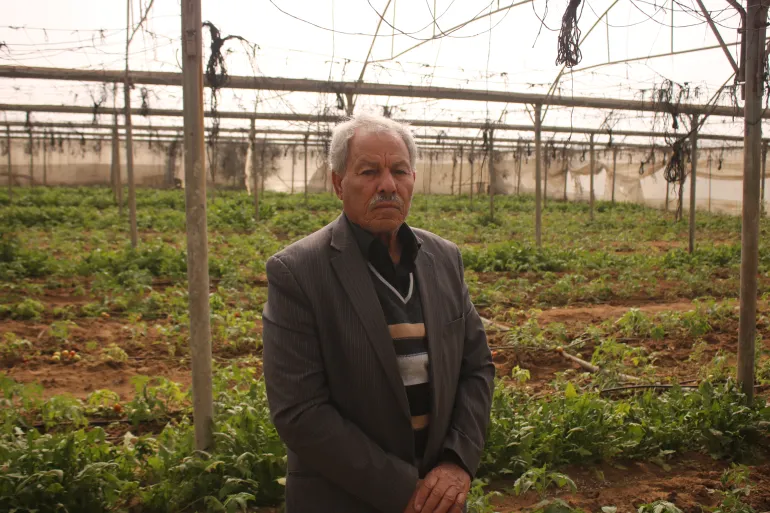
Mohammed and his family spent months clearing rubble from the ground and whatever was left of their greenhouses, which were flattened during the fighting, like many of the buildings in Gaza.
With very limited resources, they prepared the soil and planted the first courgette crop, hoping it would be ready to harvest by early spring.
But even this limited attempt to bring the family’s land back to life is not without risk. As Mohammed explains, every time he goes to tend to his field, he is risking his life. A few hundred metres away sit Israeli tanks, and the sound of bullets flying by is common.
Before the war, Mohammed’s farm produced large quantities of vegetables.
“I learned farming from my father and grandfather,” he told Al Jazeera. “Our farm used to produce abundant, high-quality crops for the local market and for export to the [occupied] West Bank and abroad. Now, everything we had has been destroyed in the war.”
Levelled to the ground
More than three hectares (7.5 acres) of Mohammed’s greenhouses were levelled to the ground. The destruction also included his entire irrigation network, all nine of his wells, two solar power systems, and two desalination plants.
Mohammed’s losses reflect the wider extent of the damage to the agricultural sector in Gaza. According to a July 2025 report by the United Nations Food and Agriculture Organization (FAO), more than 80 percent of cropland was damaged, and less than 5 percent remained available for cultivation.
And even with the “ceasefire”, the losses have not stopped for Gaza’s farmers, as Israel expands a so-called buffer zone, within which its forces are based.
In fact, many Palestinians fear that Gaza’s agricultural lands will be forcibly taken by Israel if the buffer zone becomes a permanent fixture. Blueprints released as part of United States President Donald Trump’s “Board of Peace” plan for Gaza show many agricultural areas erased.
Eid al-Taaban, a 75-year-old farmer in Deir el-Balah [Abdallah al-Naami/Al Jazeera]
Expanding buffer zones
Israel still controls about 58 percent of the Gaza Strip, calling it a security buffer zone in the east, north, and south of the Gaza Strip. The majority of that buffer zone is Palestinian agricultural land.
Mohammed has only been able to return to one hectare (2.5 acres) of the more than 22 hectares (54 acres) of farmland his family had cultivated in Gaza City before the war. The other 21 hectares lie within the Israeli buffer zone, and he cannot access them.
The solitary hectare is only about 200 metres (650 feet) from the “yellow line”, which marks the border between the buffer zone and the rest of Gaza. Mohammed says that Israeli tanks frequently approach and fire randomly.
One such incident occurred on February 12, when Israeli tanks advanced into Salah al-Din Street and opened fire. Two Palestinians were killed, and at least four others were reported wounded. Mohammed was in his farmland, close to the Israeli tanks.
“We were working in the field when suddenly a tank approached and opened fire towards us. I had to take cover behind a destroyed building and waited there for more than an hour and a half before I could escape west,” Mohammed said.
The dangers to Mohammed’s farm are mirrored in central Gaza, where 75-year-old Eid al-Taaban is increasingly worried.
His land in Deir el-Balah lies only about 300 metres (980 feet) from the yellow line and the Israeli areas of control.
“We planted eggplants in an open field after the ceasefire. Now, we can’t reach it and harvest the crop because of the expansion of the buffer zone,” Eid told Al Jazeera.
“The sounds of Israeli heavy machineguns are heard every day in our area. Every time my sons go to irrigate the crops in the greenhouses, I just pray that they come back alive,” he added.
On February 6, the Palestinian news agency Wafa reported that the Israeli army killed Palestinian farmer Khaled Baraka while he was working on his land in eastern Deir el-Balah. Khaled was Eid’s neighbour and friend.
“Khaled Baraka was a great farmer,” Eid said. “He dedicated his life to cultivating his land and teaching his sons and daughters about farming.”
Israeli blockade
According to Palestinian farmers, the Israeli blockade of Gaza is one of the biggest challenges they face in their efforts to reclaim agricultural land.
Since October 7, 2023, Israel has largely prevented the entry of any agricultural equipment or supplies, such as seeds, pesticides, fertilisers, irrigation networks, or tractors.
That has led to a huge shortage, with what is available still liable to being damaged in bombing, or in the case of seeds, pesticides, and fertilisers, reaching expiry. The prices of what little is available have also skyrocketed due to the Israeli restrictions.
And even when the materials can be obtained, they do not guarantee a return.
Eid said that he had planted tomatoes in his greenhouses to harvest in the spring, paying an exorbitant amount to acquire the seeds, fertilisers, and pesticides.
After 90 days of costly care for the plants, and when it was time to start harvesting, the entire crop was ruined because the pesticides and fertilisers he had bought turned out to be ineffective. He was forced to replant the crop.
Israeli produce has flooded Gaza, often at lower prices than locally sourced produce [Abdallah al-Naami/Al Jazeera]
Market difficulties
Eid noted that the current economic conditions in Gaza mean that it is hard to find customers for the produce.
“Even when we manage to keep the plants alive and harvest the crop, we don’t know if we’ll be able to sell it,” Eid said.
The instability of the market in Gaza is causing heavy losses for local farmers.
Waleed Miqdad, an agricultural produce wholesaler, explained that Israeli authorities sometimes close the crossings and at other times flood the market with various goods, causing significant losses for Palestinian farmers.
He added that Israeli goods are usually of a lower quality and are priced more cheaply.
“Our local produce, although much fewer in quantity than before the war, still has a distinctive quality and taste. Many of our customers prefer local produce,” Waleed told Al Jazeera.
But many residents of Gaza, whose economy has been devastated as a result of the war, do not have the money to be able to choose the higher-priced items.
The competition from Israeli produce is therefore making it difficult for Palestinian farmers to market their produce and make a profit.
“I was recently forced to sell large quantities of my produce for less than the cost of production because of the competition from imported goods that are widely available in the market,” said Mohammed, the farmer from northern Gaza. “I had to sell and lose or watch my produce rot. And of course, we haven’t received any compensation or support.”
Despite the challenges facing the farmers in Gaza, they remain determined to reclaim agricultural fields across the Gaza Strip. These areas have always been adored by Palestinians in Gaza, where most had lived in the built-up cities. The farms provided a respite from Israel’s control over the territory and its constant wars.
“Agriculture is our life and our livelihood,” said Mohammed. “It is an important part of our Palestinian identity. Despite the destruction and danger, we will remain steadfast on our land and will replant all the land we can reach. Our children will continue after us.”
For Eid, farming is a continuation of the work of his ancestors – in towns that are now in Israel, and where he can never set foot.
“I’m 75 years old, and I still work in the fields every day,” Eid said. “My grandfather was a farmer in our hometown of Beersheba before the [1948] Nakba.”
“He taught my father, my father taught me, and today I’m passing on my agricultural expertise to my grandchildren,” Eid added. “The love of the land and agriculture is passed down from generation to generation in our family, and it can never be taken away from us.”