A passenger survey has found the short-haul airline that was ranked as the lowest for its overall customer satisfaction, including for the boarding process and value for money
A passenger survey on airline experiences has some revealing results (Image: Getty Images)
The airline with the worst customer satisfaction in the UK has been revealed, and it’s not Jet2, Wizz Air or easyJet.
In a lot of circumstances, the airline we fly with can depend on the most affordable ticket available at the time of booking, with competition rife among major budget airlines like Jet2, Wizz Air, Ryanair, and easyJet for short-haul flights. But depending on the airline we choose for our journey, it can severely impact our overall travel experience, from the booking and boarding processes to the customer service onboard.
Now, an annual customer satisfaction survey of more than 5,500 travellers by Which? found that Ryanair was the worst-performing short-haul airline.
A Ryanair spokesperson told the Mirror: “Neither we nor our 208m passengers pay any attention to these made-up manufactured surveys or their fake results. Every passenger booking a flight has a choice and last year 208m consumers chose Ryanair, while nobody reads or pays any attention to Which? fake surveys.”
In the Which? ratings, Ryanair secured a mere one star for seat comfort, while it scored two out of five stars for its booking process, boarding, customer service and cabin environment.
When it comes to value for money on short-hauls, the airline earned a three-star rating, the same as easyJet and Wizz Air, but fell behind carriers, Jet2, Lufthansa, TUI and Aer Lingus. Overall, Ryanair received a customer satisfaction score of 55 per cent in the short-haul survey and ranked bottom on a list of 24 airlines. Just in front of Ryanair on the customer survey, with a total score of 59 per cent, was Wizz Air.
The budget carrier, which had 259 passengers included in the Which? survey, received two stars for its booking process, boarding, customer service, and cabin environment. However, it was awarded three stars for its value for money.
A Wizz Air spokesperson also shared: “Once again, Which’s survey relies on a tiny sample size. It surveyed 259 people, which is only 0.002% of the 12 million passengers carried on our UK flights in 2025. No credible organisation can claim that such a sample is representative.
“Our strong passenger numbers – which rise every year – clearly show that travellers value WIZZ’s low prices and industry-leading operational performance. We’re continuing to deliver against the commitments outlined in our £12 billion Customer First Compass initiative. From October 2024 to December 2025, customer satisfaction rose by eight percentage points. At the same time, our flight completion rate in the UK was 99.7% – consistently among the best in the industry – while our on-time performance increased by 14% year-on-year.
“This year, we look forward to welcoming even more passengers on board Europe’s youngest and most modern fleet, taking advantage of our low prices on our biggest ever summer leisure network to many new destinations in Spain, Greece, and France.”
In stark contrast, Jet2 topped the list with 76 per cent, receiving a four-star rating for its booking process, customer service and value for money. One customer said: “Compared with other budget airlines, they give you a generous luggage allowance, which makes such a difference.”
Have you had a complaint-worthy flight? Email webtravel@reachplc.com
Ensure our latest lifestyle and travel stories always appear at the top of your Google Search by making us a Preferred Source. Click here to activate or add us as your Preferred Source in your Google search settings.
Weekly insights and analysis on the latest developments in military technology, strategy, and foreign policy.
With the U.S. Air Force now in the process of transitioning from the aging EC-130H Compass Call to the brand-new, bizjet-based EA-37B Compass Call, TWZ caught up with top executives from the two co-primes on the electronic attack aircraft program. In the process, we learnt more about its capabilities, related platforms, and other prospects for the future. We spoke with Jason Lambert, president of the intelligence, surveillance, and reconnaissance sector (ISR) at L3Harris Technologies, and Dave Harrold, who leads the Countermeasure & Electromagnetic Attack (CEMA) Solutions business area at BAE Systems.
EA-37B Compass Call (USAF) U.S. Air Force
TWZ: Can you give us a better understanding of what the EA-37B Compass Call does conceptually? There are clearly a lot of different parts to its mission, so I am just interested to hear that in your words.
Dave Harrold: This aircraft is the Department of War’s only long-range, electromagnetic spectrum aircraft. Interestingly enough, it used to be called the EC-37B until it was formally changed to the EA-37B, signifying that it is a dedicated electronic attack platform.
When I say electronic attack, what we’re talking about is really degrading, denying, and disrupting adversary communications. It’s about causing havoc in their command-and-control system, so that adversary leaders are unable to make clear decisions. So that’s about integrated air defense systems [IADS] and disruptions there. It’s about [disrupting] different communication nodes. This really is a dedicated counter-C5ISRT [command, control, communications, computers, cyber, intelligence, surveillance, reconnaissance, and targeting] platform. We’ve been doing this mission set for over 40 years with the EC-130H workhorse starring in every conflict since it was put in the inventory, particularly in the Global War on Terror.
We saw the need to be able to do that at a higher altitude, longer range, higher speed, if we were going to turn this capability toward other regions. And so the challenge was really around: how do you take all of that stuff on an EC-130H and package it down to an EA-37B? That has been a challenge of innovation and technology, for us to reimagine: how do you take that size and weight and reduce it, but not reduce the power? Because we need that power to be able to execute the kinds of techniques that we’re doing on the system. So really, it’s about controlling the electromagnetic spectrum, making sure we can enable our side and disable the other side.
Electromagnetic warfare, evolved
Jason Lambert: The EA-37B does that really on a theater level. There are other capability sets that the Department of War has in their inventory that are more of a point solution, whereas this is really a theater-level, strategic solution, dominating the electromagnetic spectrum and being able to defeat what’s happening on our adversary’s side, while our forces continue to operate in full, with what they need to do for their communications, with what they need to do with their command and control systems. Other systems out in the world are broad jammers. This is not that; this enables our assets to be able to continue to do their job in a non-degraded manner.
Dave Harrold: Yeah, this is really important. One of the strengths of the EA-37B is the simultaneity. What that means is we’ve got the power and the capability. We’re not in a one-versus-world anymore, or using a point solution: here’s a threat, here’s a technique. The threat environment is getting more and more sophisticated and challenging, and so it’s really about how many different techniques can you run at one time to neutralize or disrupt or deny how many different threats that are out there? That’s what’s important about the power and what distinguishes this platform from point solutions.
The 43rd Electronic Combat Squadron (ECS) took its final flight in the EC-130H Compass Call aircraft on February 15, 2024, at Davis-Monthan Air Force Base, Arizona. The 43rd ECS is the first squadron under the 55th Electronic Combat Group to move itself away from the EC-130H Compass Call aircraft to the new EA-37B Compass Call. U.S. Air Force photo by Airman 1st Class William Finn Charles Haymond
Jason Lambert: And it is all software-defined, which is a very important thing. The threats are evolving, and we’ve got the capability, and our Department of War has the capability, for some of our other platforms, our ISR platforms, specifically, to go out and collect on what those potential threats might look like and how those threats evolve over time. That information is able to be configured within the mission system that BAE Systems produces to be able to go and defeat those threats. It’s not like a one-off solution that’s going to be made obsolete. It’s a solution today that’s built for tomorrow and beyond, because it can continue to evolve based on the threats.
TWZ: Can you kind of indulge us in terms of what could it do? What’s a tangible thing this could actually go and do? Could it go and shut down a big part of an integrated air defense system [IADS] for example?
Jason Lambert: I’m gonna go back to one of the things I’ve already said: sophisticated comms networks. Our enemy adversaries have more and more sophisticated comms networks. We have to affect those comms networks in order to affect their overall capability. And, you know, you mentioned IADS, that is an original mission of the Compass Call platform, to disrupt the IADS.
Dave Harrold: Exactly, this is designed to break the kill chain. If there’s no command and control system to process the information for the kill chain, it won’t work. And you can do that significant range. That’s what it does.
U.S. airmen assigned to the 43rd Electronic Combat Squadron pose for a group photo before boarding the EA-37B Compass Call aircraft for its first official mission training sortie flight at Davis-Monthan Air Force Base, Arizona, May 2, 2025. U.S. Air Force photo by Airman Samantha Melecio Airman Samantha Melecio
TWZ: Can you explain a bit more about what you have to do to port these systems and capabilities from the EC-130H into the EA-37B?
Jason Lambert: L3Harris is the integrator. We purchase the aircraft either directly from Gulfstream or from the VIP market. Then we work with Gulfstream to do the conversion of the aircraft. We essentially time it back to what the plane was when it initially left the production line. Then we go and do the outer mold line shape; Gulfstream provides that to us at our facility in Waco, Texas. Then we do the integration of the BAE Systems mission system that Dave and his team provide.
Dave Harrold: We’re the prime mission equipment provider, so that’s our co-prime split, and we build all of that up in Nashua, New Hampshire. We build that equipment, we test it, we lay it out. We have an integration lab up there, where we actually lay it out as if it were in the aircraft, and then we ship that off to Jason’s team, who then lay it out to make sure it all fits again before they put it on the actual aircraft. It’s a very choreographed way to make sure that we’re hand in hand about building the equipment, that the cabling is all appropriate, and all that kind of stuff, so that Jason’s team can integrate it on the aircraft.
An unpainted EC-37B Compass Call arrives at Davis-Monthan Air Force Base, Arizona, August 17, 2022. U.S. Air Force photo by Airman 1st Class Vaughn Weber Senior Airman Vaughn Weber
Jason Lambert: The EC-130H is still in service today, but it is obviously a very different airplane in terms of the capability set. We think about it, we think about the SWAP — size, weight, and power are three constraints or criteria that we look at. Obviously, they are very different on a business jet platform, but we’ve successfully done that integration on the new system. Now we can, of course, put that all on an aircraft that’s got a much larger range, time on station, and altitude to be able to perform this mission.
The EC-130 Crew
TWZ: Returning to the EC-130H comparison. Can you compare the performance of the two platforms? How does that affect survivability?
Jason Lambert: From a speed perspective, the EA-37B flies at Mach 0.82… versus 300 miles an hour for the EC-130H. For altitude, the EC-130H flies at 20,000 feet. The EA-37B is going to be north of 40,000 feet. So we have double the altitude. And when we think about time on station, it’s not comparable. I mean, from a range perspective, we have more than double. We have around 2,300 nautical miles on the EC-130H and 4,400 nautical miles on the EA-37B. Couple that with additional content that can be put on from defensive perspective, and it’s far more survivable, no question about it. In terms of how it operates, the altitude it operates, the standoff range it can operate at, it’s a different plane
TWZ: Does greater altitude improve your ability to do this missions with greater standoff?
Dave Harrold: It actually does. Just the geometry of being at that higher altitude, you can get a far greater view to the horizon, and and not just on the ground, but communication at large. So think what might be above you as well as below you.
Returning to survivability, I think the other thing to remember is that the mission here is to degrade, disrupt, and deny the adversary’s ability to communicate. And so by doing that, we’re contributing to the survivability of the whole campaign, and by itself, also the platform itself, right? If I’m out there disabling different comms networks that are integral to threats actually being successful, the platform is making itself much more survivable through its actual core mission.
Turkish Air Force airmen receive a tour of a U.S. Air Force EA-37B Compass Call aircraft, assigned to the 55th Electronic Combat Group, Davis-Monthan Air Force Base, Arizona, at Ramstein Air Base, Germany, January 26, 2026. U.S. Air Force photo by Senior Airman Edgar Grimaldo Senior Airman Edgar Grimaldo
TWZ: Could it go and operate as an escort jammer? I mean, could it go and follow a package to a certain point to protect it?
Jason Lambert: I mean, I guess. I guess we use the word jammer. But it’s not just a simple jammer. It’s a very different mission set, a very discrete set of techniques. But it is absolutely essential to the overall strike package to make sure that that the goals of that package are achieved.
TWZ: Can we just talk a little more about some of the improvements in the EA-37B version of Compass Call? I guess one of the big improvements is the ability to rapidly insert new capabilities in the form of upgrades. Is there anything you can say about that?
Dave Harrold: I think as we move forward, the original baseline was really about just cross-decking the capability from the EC-130H. Now we’re moving into a much more software-defined radio architecture, an open systems architecture. The whole point there is that we go from SABER [BAE Systems’ Small Adaptive Bank of Electronic Resources], which is sort of what I would call Baseline 3.5, interim, the bridge, to get to Baseline 4, which is the fully open software-defined radio architecture. The whole point there is that it used to take months or longer to find a threat, get a new technique, and figure out how to put it on the hardware. Hardware now is all about adaptability and speed, and, more importantly, it’s not just about BAE Systems’ techniques that this open architecture allows for. Anybody who has the right technique can come and plug into our system. We’ve got a development kit that people can get access to, and they can write new skills that we can rapidly insert into the open architecture. As the threat environment gets more sophisticated, we have to get more sophisticated with how rapidly we can come forward with something to counter those threats.
A U.S. Air Force EA-37B Compass Call assigned to the 55th Electronic Combat Group lands at Kadena Air Base, Japan, September 27, 2025. U.S. Air Force photo by Senior Airman Melany Bermudez Senior Airman Melany Bermudez
TWZ: Just in terms of the CONOPS, does this airplane follow a scripted battle plan? Or can it do real-time adjustments, performing more dynamically?
Dave Harrold: It’s a sophisticated system that is adaptable and flexible to the combatant commanders’ needs, so it can be tasked in that way, to be used optimally, for whatever the commander needs. I also think the exploitation that the system needs to do is flexible enough to be able to change depending on if we are pre-war or at war.
TWZ: How do the mission players actually see the data? Is it processed on board, or can it be worked offboard as well?
Jason Lambert: We’ve got a crew of up to nine people on the aircraft. Of course, the pilot and co-pilot are responsible for the flying, but there are an additional seven members in the back that operate and employ the electronic attack mission system and equipment that’s permanently integrated into the mission and cargo compartment. That crew can include a mission crew commander, which would be an electronic warfare officer, and a weapon system officer. There are experienced cryptologists, linguists, analyst operators, and airborne maintenance technicians. So it’s an entire team that’s up there. The aircraft can process that work onboard, or it can send signals and content to other aircraft in the network.
BAE Systems Compass Call Jammer
TWZ: Can a ground operating team manipulate the Compass Call system? Or does it have to be done airborne?
Jason Lambert: I’m a little cautious on how to answer that question, just in terms of the nature of the classification. I’ll just say it is set up to operate in theater and on a network and so also autonomously. As we continue to evolve our solution set, not just for Compass Call, but what we’re doing on our other ISR platforms, AI is becoming a big part of that in terms of operator workload and being able to do more of the mission set with fewer individuals on the plane. That is evolving as the threat goes up.
TWZ: I think that’s an obvious thing, isn’t it, to want to have fewer operators on board?
Jason Lambert: It helps with weight. If you take out a member of the personnel and a mission crew station, now you can do the same on either a smaller platform, or you can bring more gear onto the same aircraft. There’s always that tradeoff.
An EC-130H Compass call aircraft, at left, alongside the initial EA-37B/EC-37B. L3Harris
TWZ: Can we go back very briefly to the point about reducing the personnel on board. How will you harness AI to do that?
Jason Lambert: It’s really through AI decision content provided to the operator. So think about it in terms of an AEW&C [airborne early waring and control] equation, and a little bit different in terms of what would happen in Compass Call. But in the AEW&C equation, your operators are looking at the number of assets to track. Think of aircraft, airborne assets. They could be ballistic threats, anything that’s been launched and in the sky. There’s a certain number per operator and that number is typically classified. But if you think about it in terms of the things that the human in the system can actually manage at any one point in time, the AI will help that human be able to do a lot more of that by giving the information, compacting the information, and the decision tools to enable them to do more. That’s really what AI does. It’s not a supplement. It’ss an enhancement for the operators.
TWZ: In terms of expandability, the nose and the tail are currently empty. Are you looking at putting anything in there? Is there a need for that? Could you add additional cooling, for example, in the future?
Jason Lambert: We have expansion options for additional content. So we’re continuing to look at that in terms of what you mentioned on the nose. In terms of cooling, there’s both air cooling and liquid cooling on the platform, and so we typically operate in both environments. More broadly, though, about expandability, we talk a lot with our customer about what a roadmap to additional capabilities might look like. Whether that’s new techniques because of emerging threats, prime mission equipment itself, or other capabilities that might take advantage of real estate on the platform. So we’re executing an existing program and at the same time talking about what incremental upgrades might look like in the future.
A U.S. Air Force EA-37B Compass Call aircraft sits on the flightline at Davis-Monthan Air Force Base, Arizona, May 2, 2025. U.S. Air Force photo by Airman Samantha Melecio Airman Samantha Melecio
TWZ: Could you expand the mission set by adding new sensors?
Jason Lambert: It’s actually not so much the hardware, it’s the software, right? And it’s all software defined. The expandability in the mission packages is really designed to evolve based on what the threat package looks like. And so the threat identification is more and more about the adversary, then we can involve the system through the software integration on the platform. It’s already like it’s designed to be self-expanded. Again, that’s why this simultaneity thing is really important, it’s because as new mission sets come on board, I don’t have to sacrifice one mission for another mission and I can simultaneously execute.
TWZ: The first export customer for the EA-37B is Italy, with two jets on order. Can you talk about those aircraft?
Jason Lambert: They will be the same. Italy may use a different nomenclature when the aircraft are delivered, but they will be EA-37B aircraft. We both co-prime this program for the U.S. Air Force. We also do that for Foreign Military Sales [FMS]. Italy is our first international customer, and there is some additional interest beyond that.
A rendering of an EA-37B Compass Call in Italian Air Force markings. L3Harris
TWZ: So you are going to build additional sets of the Compass Call kit to go in that?
Jason Lambert: We are. That particular contract, and the way we execute these programs on an international basis, is we do a hybrid contract. We do a direct commercial sale, typically on the airplanes, and then the mission system and integration are done on an FMS case through the U.S. Air Force. Of course, this has to go through U.S. government approvals with the State Department in terms of policy release and whatnot, for the technology, which has been approved for Italy. There are additional customers that are also interested on the international front.
TWZ: Presumably the benefit there is that the Italians already have G550s and the associated infrastructure?
Jason Lambert: We have an ISR program known as JAMMS [Joint Airborne Multi-Mission Multi-Sensor System]. When you think about a country that wants to go take on an electronic attack capability, the precursor to that is, typically, an ISR capability. They’ve got an aircraft known as JAMMS. We have a legacy program called SPYDR that we’ve done with the Italians. Understanding the signals that you want to go and eventually exploit and get dominance over in terms of the electromagnetic spectrum, having that understanding of them first through the ISR path is typically the starting point. In recent news you might have seen we have also successfully delivered MC-55A Peregrine to the Australians. That’s their foray into this space as well. And they’ve got interest in potentially looking at the EA-37B Compass Call downrange. But to start right now, it’s the ISR capability that’s been delivered.
The first MC-55A arrived at RAAF Base Edinburgh, South Australia, earlier this year. @airman941
TWZ: And so do other export customers for the EA-37B get a U.S.-standard Compass Call, or is it going to be a slightly different standard? How will they work alongside the U.S. Air Force jets?
Jason Lambert: It’s all subject to releaseability in the U.S. Air Force. But they will be getting the same capability. It’s helpful for the United States, because you want to have your partners involved in this. In an unclassified realm, right now, the need from the U.S. Air Force is over 20 planes. We’re currently under contract, in terms of the mission system, for 10. There are congressional plus-ups that have been looked at for FY 26. The budget’s been increased, and it looks like there’s going to be another two aircraft placed on order for this fiscal year. We’re excited about that. As industry, we’re always looking at how we can expand capacity to go address that need. But you think about a need of 20-plus aircraft in an unclassified space with 10 under contract, soon to be 12. Partners are a big part of how we can go address that global challenge, for the global threat. Italy is the foray into doing that in the EUCOM theater, and what could be done in the eastern realm of NATO. Now, potentially, we’re working with partners from PACOM.
Dave Harrold: The RC-135 Rivet Joint is another aircraft in the U.S. Air Force asset base. That is our intelligence, surveillance, and reconnaissance asset employed by the United States and United Kingdom. Again, that works hand in hand and collaboratively with the EA-37B feet. They will combine, and they can also provide information to each other.
A U.S. Air Force RC-135 Rivet Joint. U.S. Air Force photo by Staff Sgt. William Rio Rosado (U.S. Air Force photo by Staff Sgt. William Rio Rosado)
TWZ: In terms of the airframes, the G550 program has come to an end. Where will you source new aircraft from?
Jason Lambert: The G550 is currently out of production. Right now, on any given day, there are roughly a dozen aircraft that are available for sale. Think of it as high-net-worth individuals or corporations that want to trade up or trade in their business jet fleet. So we would go procure those aircraft as they were looking to go buy another asset from Gulfstream or another partner, and we would take those aircraft and work with Gulfstream to do that modification work and get ready to go host the BAE Systems mission kit. That’s how we grow the current G550 base with the used assets on the market.
Additionally, the U.S. Air Force has got 16 C-37 or G550 aircraft that they operate. There are discussions right now on a recap program. Not all those aircraft are a perfect fit for the mission system. They have to be above a certain serial number in terms of how they were produced. Five of the 16 are potential candidates that could be converted to Compass Call. That’s incremental, of course, on top of dozen or so the VIP market. But there are planes available for us to do the expansion. When Dave and I look out and we get the question from Air Force about how do we grow and expand, industry is ready to go do that. We know the need is for greater numbers and we have plans to be able to go execute that.
The C-37 variant of the Gulfstream 5 series in U.S. Air Force colors. U.S. Air Force
TWZ: So the extra two EA-37Bs for the Air Force will be existing airframes that you will harvest from somewhere else?
Jason Lambert: We will purchase those from the market. We’ve already identified owners and tail numbers. We’re ready to go.
We want to thank Jason Lambert and Dave Harrold for taking the time to answer our questions about the EA-37B and share their passion for the aircraft with our readers.
NEW data has revealed the best – and worst – airlines in the UK.
In a new Which? report, Jet2 has been named the best airline in the UK, based on the responses of 5,500 travellers.
Sign up for the Travel newsletter
Thank you!
Jet2 has been named the best short-haul airline by Which?Credit: Getty – Contributor
The airline – which was the only airline with short-haul flights to be named a Which? Recommended Provider – achieved an average score of 76 per cent based on several categories including boarding, customer service and seat comfort.
Last year, Jet2 cancelled fewer flights last minute than its biggest rivals.
This helped the airline to hold on to four stars for its booking process, customer service and value for money.
One customer said: “Compared with other budget airlines they give you a generous luggage allowance, which makes such a difference.”
And unlike other budget airlines, Jet2 allows passengers to take on board one piece of hand luggage – as long as it weighs no more than 10kg and isn’t bigger than 56cm x 45cm x 25cm – free of charge, each.
And you can also bring a small, under-seat bag as long as it is not bigger than 40cm x 30cm x 20cm.
More than 76 per cent agreed they hadn’t had any problems with their flight, whilst only 63 per cent said this about Ryanair.
When it comes to other short-haul airlines that performed well, Lufthansa and Norwegian scored 73 per cent satisfaction, British Airways, TUI and KLM each scored 72 per cent, Aer Lingus scored 71 per cent and Air France scored 69 per cent.
At the other end of the table, it might not come as a surprise that Ryanair finished bottom, achieving a satisfaction score of just 55 per cent.
The airline, which is often called out for having hidden fees, scored two stars for its booking process, boarding, customer service and cabin environment.
It then also achieved just one star for seat comfort, with one customer commenting: “The plane is dirty and the seats are awful.”
And even though the airline did get three stars for value for money, another customer added: “It is billed as a budget airline but they make money from extras which far outweigh price savings on other flight companies.”
In total, over a third of Ryanair’s customers said something went wrong with their journey.
A spokesperson for Ryanair said: “Neither we nor our 208million passengers pay any attention to these made-up manufactured surveys or their fake results.
At the other end of the table, Ryanair came in at the bottomCredit: AFP
“Every passenger booking a flight has a choice and last year 208million consumers chose Ryanair, while nobody reads or pays any attention to Which? fake surveys.”
Wizz Air also didn’t do too great, scoring just 59 per cent for customer satisfaction.
The budget airline achieved two stars in most categories and then three stars in the value for money category, with one customer remarking that the airline is “consistently terrible and overpriced”.
Passengers also noted how the airline has poor customer service and lack of communication around delays.
A spokesperson for Wizz Air said: “Once again, Which’s survey relies on a tiny sample size.
“While the total number of passengers surveyed was 5,500 – only 259 of those actually flew with Wizz Air.
“That’s less than five per cent of those surveyed, and only 0.002 per cent of passengers carried on WIZZ flights to and from the UK in 2025.
“This tiny sample size of Wizz customers is a point we’ve raised with Which for the last three years, which has also been echoed by other airlines.
“Despite raising our concerns about how misleading this figure is, there have been no major improvements, and the survey remains entirely unrepresentative of what the vast majority of customers have experienced – and therefore an inaccurate source of information for the British public.”
Wizz Air also scored low with d two stars in most categoriesCredit: Getty
EasyJet did slightly better, scoring 67 per cent overall, with three stars for its booking process and value for money and two stars for its customer service, seat comfort and cabin environment.
The budget airline also improved its punctuality over the past two years with fewer cancelled flights.
A spokesperson for easyJet said: “With around 40 per cent of our customers choosing to travel with just the fare and our customer satisfaction scores at a ten year high, it’s clear that customers continue to value this choice and our service.
“Given this survey is not weighted, it simply isn’t representative when comparing with airlines who carry far fewer passengers.”
Which? also found that the price for flights with low-cost airlines often shoots up once you add cabin bags to your booking.
The budget airline also improved its punctuality over the past two years with less cancelled flightsCredit: Getty
And these prices usually don’t become clear until towards the end of the booking process.
Rory Boland, editor of Which? Travel said: “It’s outrageous to see Ryanair and Wizz Air openly scoff at the poor experiences of their own customers.
“They love to blow their own trumpet about the number of passengers who fly with them, but on many routes, there is simply no other choice.
“Many other passengers fly with them because of the enticingly low headline fares.
“But ridiculously expensive charges for baggage and other add-ons mean they are no longer guaranteed to be the cheapest option.
“We’ve repeatedly found that airlines that include baggage and seat allocation in their fares can actually work out cheaper overall.
“Fly with anyone else, if you can.”
Sun Travel has also contacted the airlines mentioned for comment.
The best long-haul airlines according to Which?
When it came to long-haul operators, Singapore Airlines came out on top with a customer satisfaction score of 81 per cent.
The airline also gained five stars for its cabin environment and customer service.
One customer said: “Cabin staff were very kind and accommodating. Food was excellent and the whole cabin environment was comfortable.”
However, the airline did miss out on a Which? Recommended Provider endorsement as it has a policy that means if you miss your outbound flight they will cancel your return ticket or charge you extra to amend your trip.
Other long-haul providers that scored well include Emirates (80 per cent), Virgin Atlantic (79 per cent), Qatar (78 per cent), Air Canada (77 per cent), KLM (75 per cent) and Etihad Airways (74 per cent).
British Airways also scored 72 per cent in the long-haul category, with four stars for customer service.
At the other end of the table, Aer Lingus scored the lowest for long-haul travel – 65 per cent.
A number of US airlines also scored low, such as Delta (70 per cent), American Airlines (69 per cent) and United Airlines (68 per cent.
JESSIE Buckley has a clear vision for success — wearing a sheer gown over a corset for the premiere of her new film.
The 36-year-old, named Best Actress at Sunday’s Baftas for her role in Hamnet, stars with Christian Bale, 52, in The Bride!.
Sign up for the Showbiz newsletter
Thank you!
Jessie Buckley wearing a sheer gown over a corset for the premiere of her new filmCredit: GettyJessie stars with Christian Bale in The Bride!Credit: Getty
The pair posed together last night on the red carpet at Cineworld in London’s Leicester Square.
Based on the Bride of Frankenstein, the movie is described as a Gothic horror-romance and is set in 1930s Chicago.
Warnings include one for nude scenes — which may explain why Jessie was dressed to thrill.
Irish star Jessie is the red-hot bookies’ favourite for Best Actress at the Oscars.
Accepting her award at the 79th Baftas at London’s Royal Festival Hall, she said: “When I first came to London, I had nuclear-bad fake tan on, white hoopy earrings, polka-dot red skirt and dress.
“I don’t know how she thought that was even possible.
“But thank you, Lindy, for always encouraging me to be disobedient and curious and human.
“This is nuts. This really does belong to the women past, present and future that have taught me.”
She dropped the F-bomb at one point, saying she “should’ve brought my f***ing thing up here” — meaning her notes.
Jessie choked up as she thanked her daughter, who was born last year, saying: “It’s the best role of my life being your mum.”
Actress Jessie on the red carpet at Cineworld in London’s Leicester SquareCredit: Getty
Over 32.6 million viewers watched President Trump address the nation on Tuesday night, according to Nielsen data.
It’s both the smallest audience Trump has received for the annual speech to a joint session of Congress, and the longest State of the Union address in recent history.
This was the president’s first State of the Union address of his second term. Previously, his addresses scored 45.5 million in 2018, 46.8 million in 2019 and 37.1 million in 2020, the Nielsen data show.
This year’s speech clocked in at 107 minutes, topping the previous record set by President Clinton in 2000.
Facing low approval ratings, Trump played up positive economic numbers, some of which were misstated, and the administration’s aggressive crackdown on undocumented immigrants, drawing polarized reactions in the chamber.
The U.S. Olympic men’s ice hockey team arrives for the State of the Union address .
(Kenny Holston / Pool, Getty Images)
There were 15 networks that televised the speech. Fox News had the largest audience with 9.1 million viewers. ABC was second with 5.1 million, followed by NBC‘s 3.6 million, CBS’ 3.3 million, MS NOW’s 2.4 million, CNN’s 2.2 million, and the Fox broadcast network’s 2.1 million.
Stephen Bunting silenced his critics as he inflicted a third final defeat of the season on Gian van Veen to win night four of the Premier League in Belfast.
The 40-year-old has seen his place in the tournament questioned by spectators after he failed to win a game in the first three weeks.
That followed ‘the Bullet’ taking nine weeks to register a point in last year’s event – his first involvement since being a challenger in 2020.
Bunting, who has come off social media because of the criticism, registered his highest Premier League average (106.63) in his 6-4 quarter-final win over defending champion Luke Humphries.
He backed that up with another 106 average in a 6-0 clean sweep against current league leader Jonny Clayton in the semi-finals, before a clinical 6-2 win over Van Veen in the final.
“I do believe I am one of the best players in the world – I deserve to be in the Premier League,” Bunting told Sky Sports.
“Everyone was writing me off, people saying I should not be in it, but I know how hard I work behind the scenes. These are the nights I play for.
“Losing seven or eight on the bounce last year really helped me, gave me a lot of experience in this field. When you play in the Premier League, you’re playing against the best of the best. This ranks up as one of the best wins of my career.”
Van Veen, who is playing in the tournament for the first time, has impressed in making three finals in four weeks but is struggling to get over the line.
Northern Ireland’s Josh Rock, who is the other debutant in this year’s field, lost 6-2 to Van Veen in the quarters, but delighted the home crowd with the first nine-darter of this year’s tournament.
Elsewhere, there was more disappointment for world number one Luke Littler, who lost 6-3 to Clayton in the quarter-finals, meaning he has only won one game in four weeks.
The Ecuadorian government has declared that it will significantly raise tariffs on imports from Colombia, increasing the rate from 30 percent to 50 percent starting March 1.
The decision, announced on Thursday, represents a major escalation in the intensifying trade and security dispute between the two neighbouring Andean countries.
Recommended Stories
list of 3 itemsend of list
Ecuador’s right-wing president, Daniel Noboa, has been pressuring his left-wing counterpart in Colombia, Gustavo Petro, to crack down on border security.
Since the start of the COVID-19 pandemic in 2020, Ecuador has seen a surge in violence linked to the expansion of organised crime in the country.
Noboa, echoing President Donald Trump in the United States, has blamed Petro for not acting aggressively enough to combat narcotics trafficking. Colombia has, for many years, been the world’s largest source of cocaine.
And like Trump, Noboa has increasingly relied on tariffs against Colombia to force adherence to Ecuador’s national security strategy.
His government has accused Petro’s of failing to cooperate with border security measures. The two countries both sit on the Pacific coast, and they share a land border that stretches roughly 586 kilometres, or 364 miles.
Questions about electricity
Thursday’s announcement follows an initial 30 percent tariff imposed by Quito in early February.
Ecuadorian officials have also justified the protectionist measures by citing a growing trade deficit.
According to the Observatory of Economic Complexity, a data analysis firm, nearly 4 percent of Colombian exports go to Ecuador, worth roughly $2.13bn. Ecuador imports significant quantities of medicines and pesticides from Colombia.
Fewer exports go from Ecuador to Colombia, though. Roughly 2.3 percent of Ecuador’s exports abroad go across the shared border, amounting to a value of $863m.
Ecuador’s trade deficit with Colombia sits at roughly $1.03bn through 2025, according to government data, excluding oil.
But in spite of the anticipated tariff hike, it is unclear whether Ecuador will apply the new tariffs to Colombian electricity — a critical resource for the country.
In a retaliatory move following the initial tariffs, Colombia suspended all energy sales to its neighbour.
That suspension risks fuelling tensions in Ecuador against Noboa’s government. Recent droughts have created disruptions to Ecuador’s hydroelectric dams, which provide nearly 70 percent of the country’s power.
Those disruptions have caused widespread power outages in recent years, which in turn have prompted antigovernment protests. In the past, Noboa has responded by buying electricity from Colombia.
Pipeline standoff
The transportation of fossil fuels has also become a flashpoint between Ecuador and Colombia in the aftermath of February’s tariffs.
Noboa’s government has hiked fees for Colombian crude delivered through the Trans-Ecuadorian System Oil Pipeline (SOTE) by 900 percent.
That raises the cost to approximately $30 per barrel. Colombia has responded by halting all oil shipments through the line.
Despite high-level diplomatic efforts, tensions between the neighbouring countries remain at an impasse.
Officials representing foreign policy and security held a meeting this month in Ecuador, but the gathering concluded without a breakthrough.
In announcing the latest tariff hike, Ecuador’s Ministry of Production and Foreign Trade levelled criticism at Colombia for failing to implement “concrete and effective” measures to curb drug trafficking along the border.
Once considered a bastion of stability, Ecuador has seen a spike in homicide and other violent crimes.
According to the Geneva-based Organized Crime Observatory, the Andean nation recorded a homicide rate of approximately one murder every hour last year.
TV presenter Ant McPartlin shares the real reason he won’t be returning to host a major show
22:28, 26 Feb 2026Updated 22:30, 26 Feb 2026
Anthony McPartlin has opened up on the one show he’s done with hosting(Image: Getty Images for BAFTA)
Anthony McPartlin has opened up on the one show he’s done with hosting as he admitted it can get too hard to control the crowd.
The TV star is well known for presenting a number of shows alongside hosting partner Declan Donnelly and among the many is the iconic BRIT Awards.
The duo have fronted the prestigious music ceremony on three occasions and Ant, 50, has since revealed the evening proves enjoyable for those up for gongs and their plus ones, but can be tricky for those presenting. Ant and Dec hosted the BRITs in 2001, 2015 and 2016.
During their podcast, Hanging Out with Ant & Dec, the duo seemed genuinely thankful they won’t be taking the reins at this weekend’s ceremony.
Ant stated: “[We’ve hosted it] three times, never again. And the reason why we always say, ‘oh, never again’, it’s not because we don’t believe in the awards. I really do. I think they’re really good for British music.
“It’s actually a really good night if you’re there as somebody who’s been nominated, because we’ve been nominated for a BRIT back in the day. That was a fun night. We didn’t win that night.”
The duo first crossed paths as young performers on CBBC drama Byker Grove, later pursuing pop stardom as PJ & Duncan, notably with their chart success Let’s Get Ready to Rhumble, which debuted in 1994.
In 1995, they competed for the BRIT award for best British newcomer but were beaten by the legendary Oasis.
Ant explained: “It’s a fun night if you’re nominated, it’s a fun night – not necessarily if you’re hosting it though because everybody in the room just wants to get drunk and have a good time and you’re trying to wrangle the whole crowd.
“You are also trying to present a TV show and also all the artists and bands who said they would happily do an interview with you before the show starts always change their mind.”
The Geordie presenting pair are renowned for fronting ITV’s I’m A Celebrity… Get Me Out Of Here!, Britain’s Got Talent and the quiz show Ant And Dec’s Limitless Win.
Comic Jack Whitehall will take the helm at the BRIT Awards on Saturday in Manchester.
Chart-topper Harry Styles features amongst the impressive line-up of performers set to grace the stage during the ceremony, alongside Raye, Olivia Dean, Sombr, Mark Ronson and Wolf Alice.
For the latest showbiz, TV, movie and streaming news, go to the new **Everything Gossip** website.
Ensure our latest headlines always appear at the top of your Google Search by making us a Preferred Source.** Click here to activate**** or add us as your Preferred Source in your Google search settings.**
WASHINGTON — Warner Bros. Discovery is switching gears, announcing Thursday that Paramount Skydance’s revised bid tops the one on the table from Netflix.
The move is the latest twist in Hollywood’s biggest auction in years — and five months after Paramount Chairman David Ellison began his dogged pursuit of the larger media company. Netflix now has four business days to regroup and potentially submit a higher offer.
Warner Bros. Discovery said its board, in consultation with its bankers and lawyers, determined Paramount’s most recent offer constitutes a “superior proposal,” compared to the Netflix deal.
Paramount on late Monday bid to buy all of Warner Bros. Discovery for $31 a share in cash. Paramount had previously offered $30 a share.
Netflix has offered $27.75 a share — but the streaming giant only wants Warner’s HBO, HBO Max and the Warner Bros. film and television studios in Burbank. Concerns have been growing that Netflix would face push-back from regulators as it seeks to swallow one of Hollywood’s historic film studios behind “Superman,” “Casablanca” and “The Matrix.”
Paramount’s offer includes acquiring Warner’s cable television channels like CNN and HGTV.
“We are pleased WBD’s Board has unanimously affirmed the superior value of our offer, which delivers to WBD shareholders superior value, certainty and speed to closing,” said David Ellison, the chairman and chief executive of Paramount.
The new wrinkle comes as Netflix Co-CEO Ted Sarandos met with White House staffers on Thursday at a pivotal moment for the streaming giant, which has been navigating the high-stakes bidding war to acquire Warner Bros. Discovery.
Sarandos met with White House staff members and Justice Department officials, according to two people familiar with the meeting. The visit was arranged more than two weeks ago and President Trump was not scheduled to attend.
Trump warned that if Netflix did not fire Rice, the company would “pay the consequences.”
The president’s demands to fire Rice marked a shift in the president’s involvement with Netflix’s business as it seek to acquire Warner Bros — a bid that is being countered by Paramount.
In December, Netflix won the bidding for the storied studio and HBO, prompting Paramount executives to launch a multi-pronged strategy to scuttle the Netflix deal.
The Department of Justice has since opened an investigation to determine whether to try to block Netflix’s proposed $82.7-billion deal to take over Warner Bros. Discovery. Netflix has more than 300 million subscribers worldwide, and the addition of Warner’s HBO Max would make the streaming giant even more dominant.
Sarandos’ trek to the White House comes as the auction has taken on political dimensions. Paramount has refused to abandon its campaign to buy Warner, which owns HBO and such popular franchises as Harry Potter, Superman and “Game of Thrones.”
Paramount — which is controlled by the family of billionaire Larry Ellison, a Trump friend — has been angling to thwart Netflix.
During a Senate hearing this month, some Republican lawmakers blasted Sarandos, raising questions about potential antitrust concerns and some of Netflix’s programming. Paramount Chief Executive David Ellison declined an invitation to participate in the Feb. 3 hearing.
This week, he was at the Capitol as a guest of Sen. Lindsey Graham (R-SC) for Trump’s State of the Union address. The two men were pictured giving a thumbs-up in a photo circulating on social media.
Trump has said he would stay out of the Netflix-versus-Paramount battle, but over the weekend he demanded, in a social media post, that Netflix “IMMEDIATELY” fire Rice from its board.
It was not known if the topic of Rice came up Thursday.
Sarandos has sought to downplay the controversy, saying during a BBC interview: “This is a business deal, it’s not a political deal.” Paramount has enlisted a former Trump administration official, the lawyer Makan Delrahim, who served as Trump’s antitrust chief during the president’s first term.
One killed and 29 others wounded in latest Israeli attack in violation of ceasefire.
Published On 26 Feb 202626 Feb 2026
Share
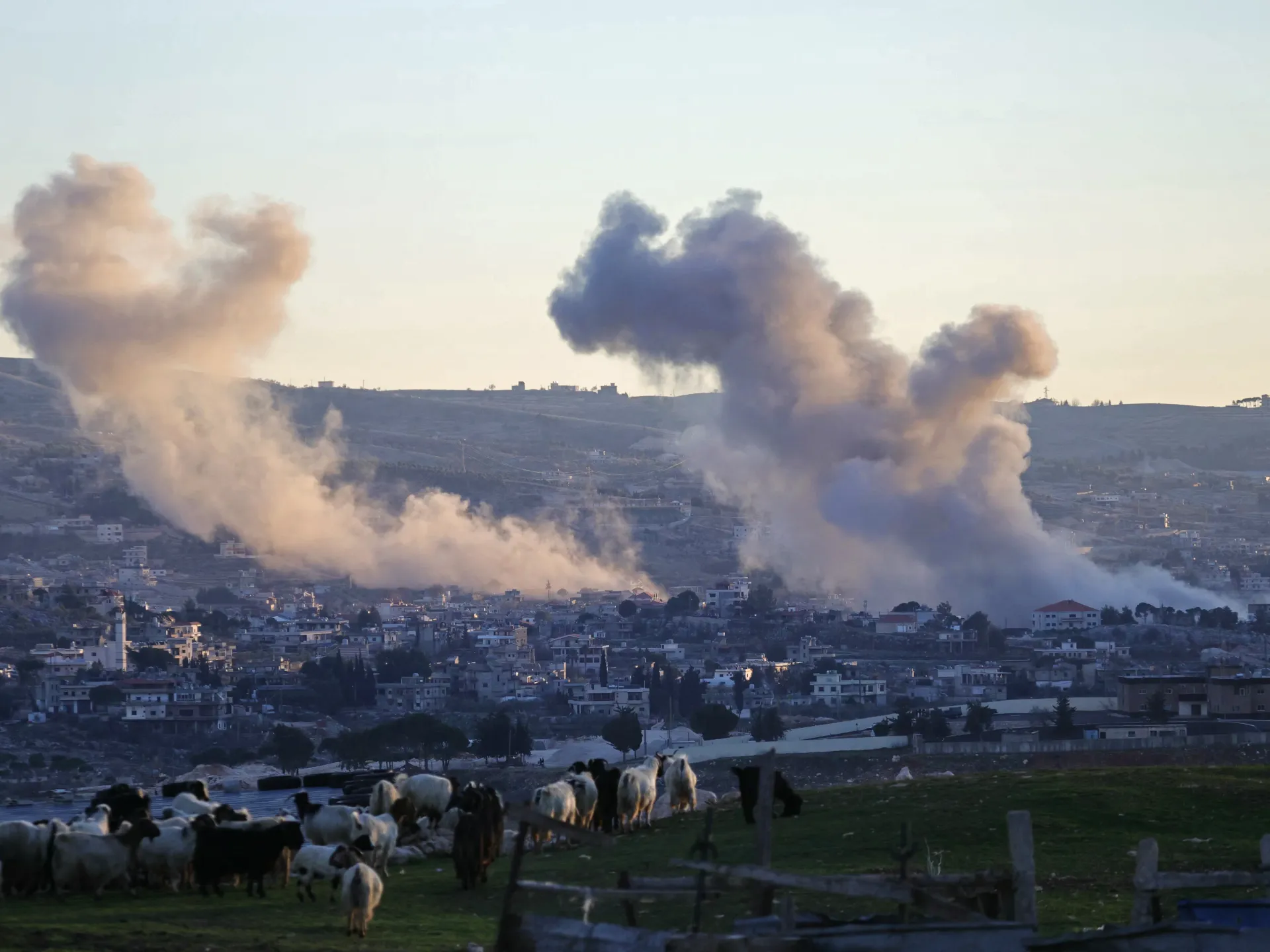
Israeli strikes on Lebanon’s Bekaa Valley have killed one person and wounded 29 others, the latest in a series of ceasefire violations.
Lebanon’s Ministry of Health announced that a “16-year-old Syrian boy was killed”, the National News Agency (NNA) reported on Thursday. He was named as Hussein Mohsen al-Khalaf and was killed in a strike on Kfar Dan near Baalbek, the L’Orient news outlet reported.
Recommended Stories
list of 3 itemsend of list
At least 13 air strikes were recorded, four in Shmestar, five in Boudai, two in Harbata and two in the Hermel and Nabi Chit mountains, according to NNA. Several shops were damaged in the Baalbek Souk in Tallet al-Ajami.
The Israeli military said it targeted eight camps belonging to Hezbollah’s special operations unit, the Radwan Force. It said weapons and missiles were stored there and training was conducted “as part of preparations for emergency situations, and to plan and execute terrorist plots”. It said this activity was a “violation of the understandings between Israel and Lebanon”.
Ceasefire violations
Israel’s military has continued to carry out attacks in Lebanon, despite a November 2024 ceasefire with the Lebanese armed group Hezbollah that sought to bring an end to more than a year of fighting. More than 300 people have been killed since then, including 127 civilians, according to the United Nations.
Last week, at least 12 people were killed in Israeli strikes on the Bekaa Valley and the Ein el-Hilweh Palestinian refugee camp near the city of Sidon. Israel said it was targeting Hezbollah and Hamas command centres.
Lebanon filed a complaint with the UN in January, detailing a total of 2,036 Israeli violations between October and December 2025 alone. It called on the UN Security Council to compel Israel to end these actions and to fully withdraw from its borders.
Israel continues to occupy parts of Lebanon, blocking the reconstruction of border villages and preventing people from returning to their homes.
Lebanon’s government has said it has almost completed its ceasefire commitment to disarm Hezbollah south of the Litani River. It said it will need four months to complete the second phase.
However, Hezbollah has rejected this, saying it believes the disarmament in the ceasefire agreement only applies to areas south of the river.
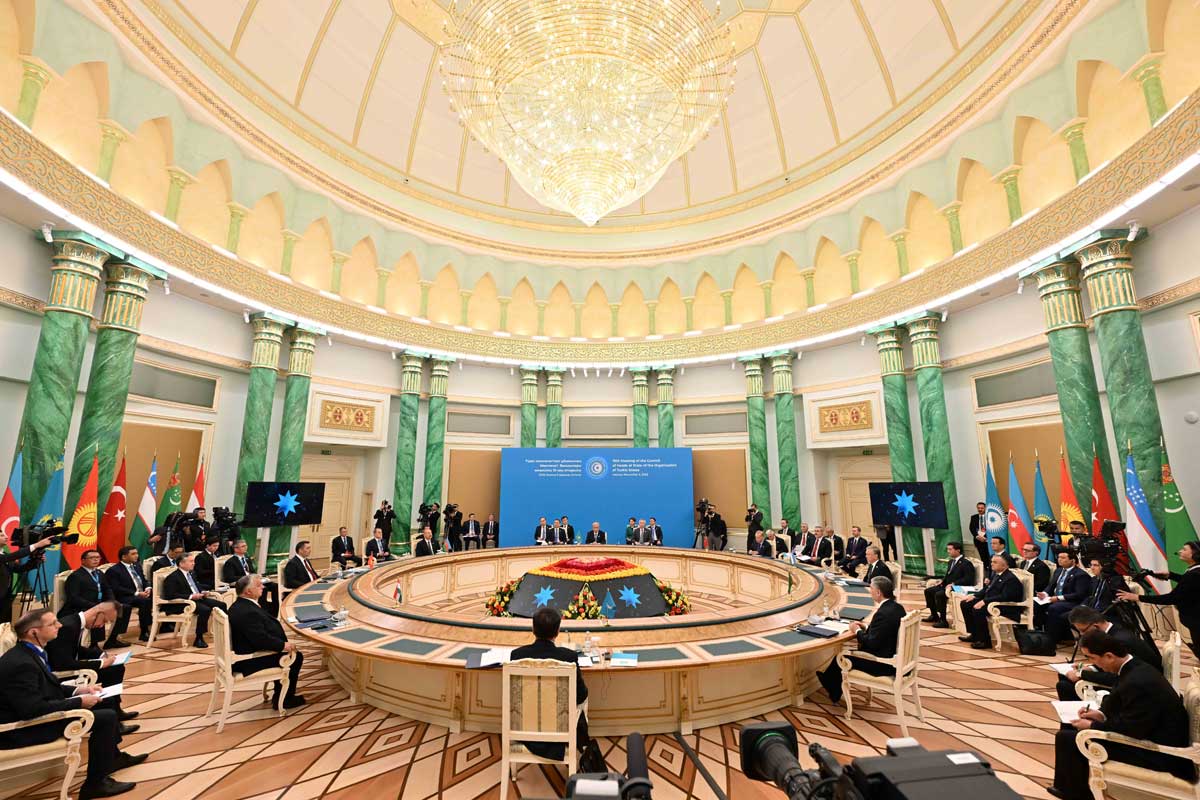
The 10th summit of the Organization of Turkic States (OTS) was held on November 3 in Astana, the capital of Kazakhstan. The main theme of this year’s summit was ‘Turk Time’. The organization, which has set goals such as the long-term Vision of the Turkic World 2040 and the short-term Strategic Roadmap of the OTS 2022-2026, has added a new vision with ‘Turk Time’. So, is the Turk Age possible in the 21st century? Could Turks become an effective political center in the new era? Is Turk Time just a slogan? Or is it based on reality?
Turmoil in the Current Global System gave birth to the Organization of Turkic States
The 2008 economic crisis, the COVID-19 pandemic, and the weakening of United States (US) hegemony that emerged with its military withdrawal from Afghanistan and Iraq left great chaos and a vacuum in international order.[1] Especially with the COVID-19 pandemic and the US debt ceiling crisis, the US hegemony tool, dollar hegemony, has suffered a major shake-up and has become controversial.[2] This vacuum and chaotic environment triggered an effort to build a new alternative order for countries that were uncomfortable with the existing international order, and to gain a position in the new order to be established. As the rise of Asian economies continued in the global economy, organizations such as the Shanghai Cooperation Organization and BRICS accelerated the construction of an alternative multipolar order. The world was divided into two camps: defenders of the old unipolar world order and proponents of the new multipolar world order. The weakening of US hegemony and global chaos paved the way for the OTS. The transformation of the organization in 2021 coincided with the US troop withdrawal from Afghanistan and Azerbaijan’s victory in the Second Nagorno-Karabakh War.
Turkey, in particular, plays a decisive role in the OTS. In recent years, Turkey has experienced sharp ruptures in its relations with the US, EU, and NATO. The weakening of Turkey’s relations with the West is a reflection of the decline of US hegemony in the global order. At the same time, Turkey’s increasing cooperation and friendship with Russia and China played a positive role in the establishment of the OTS. The organization should be seen as an attempt to become part of a multipolar world order. For example, Turkish President Recep Tayyip Erdogan’s statement that the world is bigger than five is an expression of the need to build a just multipolar world order. As the Turkic states increase cooperation, trade, and prosperity among themselves, they serve regional peace and the establishment of a just order. With the OTS, Turkey aims to increase prosperity in the region, improve infrastructure, maintain a common culture, and increase its defense and counter-terrorism cooperation capabilities. Turkey’s objectives in the OTS in Central Asia are an effort to take part in a multipolar world that will strengthen peace and prosperity. President Recep Tayyip Erdogan aims to continue the Turk Time with Turkey and for the Turkic world to become the world’s rising power.[3] Turkey wants to be a subject, not an object, in the multipolar order. In sum, Turkey is trying to play a stronger role in the new international system to be established by establishing good relations with the advocates of the multipolar world order.
Organization Strengthens by Institutionalizing
After the transformation of the Cooperation Council of Turkic Speaking States into the OTS with the Istanbul summit in 2021, the organization entered the process of building a stronger institutional infrastructure. Analyzing the outcomes of the Astana Summit, efforts to complete the institutionalization of the organization stand out. This year, the organization continued to increase institutionalization in areas such as the Civil Protection Mechanism, the Turkic Judicial Training Network, the Union of Notaries of the Turkic World, the Turkic Investment Fund, and the Organization of Trade Unions of Turkic States. The final declaration expresses satisfaction with the activities carried out within the framework of the organization in one year.[4] For example, the Alliance of Turkic News Agencies (ATNA) was established after the summit between Turkey’s news agency Anadolu Agency (AA), Azerbaijan State News Agency (AZERTAC), Kyrgyz National News Agency (Kabar), Uzbekistan National News Agency (UzA), and Kazakhstan’s news agency Qazcontent. After the establishment of ATNA, Binali Yıldırım, Chairman of the OTS Council of Elders, said: “We aim to bring the truth to the people in the fastest way and to prevent colonialist countries from covering the events. Serdar Karagöz, who was elected president of ATNA, emphasized the importance of combating disinformation.[5] In short, in the field of media, OTS has placed establishment of a media network that will challenge the media of the unipolar world and represent the oppressed at its center. During the next few years, it is possible to predict that the organization will institutionalize in various fields.
The organization Aims to Strengthen Trade
There are two important cooperation areas between the member states of the OTS. The first is the development of cooperation in the energy field. Turkic states are rich in valuable minerals such as energy, natural gas, oil, and uranium. Therefore, the member states of the organization tend to deepen their cooperation in the field of energy. The second meeting of the OTS Working Group on Energy Cooperation of the Ministers Responsible for Energy of the OTS was held on September 28, 2022, in Almaty, Kazakhstan. The parties adopted the OTS Energy Cooperation Program and the related action plan for 2023-2027, which includes the exchange of information and ideas on legislation and national programs in the energy sector, renewable and alternative energy sources, fossil fuel energy, nuclear energy, energy efficiency, dissemination of new technologies, capacity-building programs, and enhancing cooperation in the international arena. Turkish Foreign Minister Hakan Fidan emphasized the importance of making efforts to make the Middle Corridor even more attractive for investment and to transport trans-Caspian resources, particularly Turkmen gas, to Turkey and Europe. Strategic energy infrastructure projects such as the Organization, Baku-Tbilisi-Ceyhan, Baku-Tbilisi-Erzurum, Southern Gas Corridor, Trans Anatolian Natural Gas Pipeline Project (TANAP), and Trans Adriatic Pipeline Project (TAP) contribute to the prosperity of Turkic states and European and global energy security. [6]
The second is to take steps to strengthen trade along the Silk Road belt. The member states of the OTS had a trade volume of $ 700 billion. However, only $ 18 billions of this trade volume is carried out among the member states themselves. This situation is the main driving factor in the establishment of the organization. Because Turkey and the member states are determined to develop trade among themselves. The member states of the organization focus on removing or facilitating trade barriers among themselves. Eliminating trade barriers and providing infrastructure investments on roads. In this respect, there is no other way but to work in harmony with the Belt and Road Initiative of the OTS. The implementation of the Action Plan for the Implementation of the 2023-2027 OTS Transport Connectivity Program adopted at the Astana summit is expected to significantly increase the transit potential of the Middle Corridor and make Caspian transits smoother.
The establishment of the Turkish Investment Fund was on the agenda at the Istanbul Summit. During the two-year period of the organization, sub-commissions carried out infrastructure work to establish the Turkish Investment Fund. On March 16, 2023, the Agreement on the Establishment of the Turkish Investment Fund was signed at the Extraordinary Summit of the OTS held in Ankara. Before the Astana summit, Turkey voted the proposal for the establishment of the Turkish Investment Fund as a law in its parliament: “The capital participation commitment of the Republic of Turkey to the Turkish Investment Fund and the payments to be made within the framework of this commitment cannot exceed the equivalent of USD 100,000,000.[7] The President is authorized to increase the amount up to five times. Thus, the OTS has gained an institutional structure to finance its investments among itself. All of these developments are efforts to increase the economic trade volume of the organization and strengthen economic cooperation.
Russia, Iran, and China should be part of the OTS
The fate of Turkic states depends on the revival of the Silk Road and the Belt and Road Initiative. Historically, trade flowing from China to Europe via the Silk Road played an important role in enriching Turks and building powerful states. Today, China, the world’s second-largest economy, has regained its historical position. The revival of the historical Silk Road plays an important role in the revival of the Turkic world. There must be an air of unity in Eurasia in order for the OTS to succeed. In this respect, the accession of Iran, Russia, and China, which have Turkic-speaking peoples, to the OTS will add significant strength to the organization. There is already such an expectation in the OTS. Chairman of the Council of Elders of the OTS Binali Yıldırım stated that China and Russia are natural members of the OTS.[8]
The sanctions against Russia in the aftermath of Russia’s operation in Ukraine have highlighted the strategic importance of the Middle Corridor.[9] Moreover, although 96 percent of the trade from China to Europe is by sea, the US continues to blockade the South China Sea. Currently, the Middle Corridor is the safest port for trade flow. The most important goal of the OTS is to make the Middle Corridor more active. “We should also pay special attention to the development of transport networks between our countries. With this understanding, we continue our efforts to activate the Caspian Trans-Caspian East-West Middle Corridor. We should strengthen our cooperation in removing obstacles to transportation and trade, enriching transportation networks, facilitating border crossings, and visa procedures”.[10]
Conclusion
The world is on the brink of a global rupture, and OTS is an organization that emerged on the brink of this global rupture. Shortly after the Republic of Turkey celebrated its 100th anniversary on October 29, the OTS organized a summit with the theme of ‘Turk Time’, which reflects the expectation of Turks to become a global actor for the 200th year. To achieve this goal, the Organization of Turkic States must unite in Eurasia. In this respect, it is vital for the OTS to strengthen its cooperation with China, Iran, and Russia. These states are the leading powers of Asia and home to Turkic-speaking peoples. Economically, the Middle Corridor is vital for the OTS. Trade between China and Europe passes through Central Asia via railroads, which indicates the revival of the historic Silk Road. Controlling the Silk Road, the OTS can regain its historical role, gain a geopolitical advantage, and become an important figure in world politics. Turks have always had their own special goals, called the ‘Red Apple’. The Ottoman Sultan Mehmet the Conqueror set the conquest of Istanbul and the establishment of a new Roman Empire as the Red Apple. In the 16-18th centuries, the Ottoman Sultans identified the conquest of Vienna and Rome as the Red Apple. In the 20th century, Turkist ideologues had the Red Apple of establishing a Turan State. In the 21st century, it is clear that the Turks’ Red Apple is the greatest ideal to be a center in the multipolar world order under the slogan of ‘Turk Time’.
The views contained in this article are the author’s alone and do not represent the views of Shanghai University.
[1] Francis Fukuyama, Francis Fukuyama on the end of American hegemony, 8 November 2021, https://www.economist.com/the-world-ahead/2021/11/08/francis-fukuyama-on-the-end-of-american-hegemony
[2] CFR, The Future of Dollar Hegemony, 22 August 2023, https://www.cfr.org/blog/future-dollar-hegemony
[3] Türkiye Yüzyılı’nda ‘Türk Devri’ başlıyor, 3 November 2023, https://www.trthaber.com/haber/gundem/turkiye-yuzyilinda-turk-devri-basliyor-809286.html
[4] Organization of Turkic States, “Declaration of the Tenth Summit of the Organization of the Turkic States”, 3 November 2023, https://www.turkicstates.org/assets/pdf/haberler/astana-declaration-3113-215.pdf
[5] AA, “Türk Haber Ajansları Birliğinin ilk genel kurulu yapıldı”, 6 November 2023, https://www.aa.com.tr/tr/kurumsal-haberler/turk-haber-ajanslari-birliginin-ilk-genel-kurulu-yapildi/3045736#
[6] Türkiye İletişim Başkanlığı, 21. Yüzyılın Parlayan Yıldızı: Türk Devletleri Teşkilatı, İstanbul, Cumhurbaşkanlığı İletişim Başkanlığı Yayınları: 2023
[7] Resmî Gazete, Türk Yatırım Fonu Kuruluş Anlaşmasının Onaylanmasının Uygun Bulunduğuna Dair Kanun, 11November 2023, https://www.resmigazete.gov.tr/eskiler/2023/11/20231111-1.htm
[8]Sputnik, Aksakallılar Konseyi Başkanı Yıldırım: Rusya ve Çin Türk Devletleri Teşkilatı’nın doğal üyesidir, https://tr.sputniknews.com/20211126/aksakallilar-konseyi-baskani-yildirim-rusya-ve-cin-turk-devletleri-teskilatinin-dogal-uyesidir-1051186836.html
[10] Türkiye Cumhuriyeti Cumhurbaşkanlığı, “Türk dünyasının barışı, refahı ve güvenliği yönünde adımlar atmayı sürdüreceğiz”, 3 November 2023, https://www.tccb.gov.tr/haberler/410/150055/-turk-dunyasinin-barisi-refahi-ve-guvenligi-yonunde-adimlar-atmayi-surdurecegiz-
At the Royal Festival Hall she wore a figure-hugging red satin gown with a silhouetted cape and a fan-like neckline for the ultimate sexy senorita look.
Maura’s career is on the up and she’s been making big waves in America.
The 35-year-old hosts the Love IslandUSA spin-off show Aftersun and is in the final of Celebrity Traitors, where she struck up a friendship with Real Housewife Lisa Rinna.
She recently attended an event celebrating Lisa’s new book, You Better Believe I’m Gonna Talk About It.
The former reality TV bombshell, who shot to fame in 2019 with her razor-sharp one-liners and no-filter flirting, is fast becoming a US sensation.
While his relationship drama played out publicly, trolls piled into Maura online, landing the blame firmly at her door.
For a short while, she went quiet — but instead of retreating, she soon landed a spot on The Traitors US, which is hosted by actor Alan Cumming.
And what looked like a reputational wobble in the UK has since become a full-blown American reinvention.
A source said: “When the Traitors came knocking, she knew it could turn things around for her. Maura jumped straight into action. She was a woman who had something to prove.”
After filming wrapped on the US series at Ardross Castle in Scotland last June, Maura walked away feeling confident that she had smashed it, according to pals.
She has now signed up with top-tier agency Align PR, whose clients include Madonna and Hollywood stars Matthew McConaughey and Bryce Dallas Howard.
She has even been doing some acting herself, landing a role in an Irish buddy movie, The Spin, due to be released later this month.
She was a sexy senorita at the Baftas on SundayCredit: GettyMaura is taking the US by stormCredit: Getty
Now 17, Westlake has been included in an England training camp in preparation for a warm-up match against France next month and April’s U18 Six Nations Festival in Vichy, France.
“England Rugby was always a massive thing for me growing up,” says Westlake, looking back.
“I just loved England and I’m very patriotic.
“I remember getting into the tunnel and asking Chris Robshaw if he was ready.
“Then we cracked on, went out and I think I thought I was going to play!
“You see me walking out and almost staring everyone down.
“Before it, my mum had said to me, ‘Make sure you sing it loud and sing it proud’.
“So I just thought, ‘All right, I’ll do that’.”
Westlake was playing for Devonport Services under-7s at the time, but already had his eyes on the big stage, with plans to become England fly-half or centre.
That part probably won’t come to pass.
Westlake, who plays in Exeter’s academy, is now a hard-running back row, channelling the energy and drive of Ben Earl and Henry Pollock, even if he does cite childhood hero Owen Farrell as the embodiment of the mentality he aspires to.
Westlake has already had to show resilience to keep pursuing his dream.
“Rugby has always been the focus, even if the ride hasn’t necessarily been as smooth as it could have been,” he says.
Westlake has Crohn’s disease, a chronic gut inflammation.
“I’m on medication which I take every eight weeks, which sort of ticks me over and gets me through,” he explains.
“There was a two, three, four-year period where it was pretty tough, but we’re getting through it now.
“It affects energy levels so for two or three days before my medication is due, I’ll struggle and then a day after I’ll struggle as well.”
Harry’s anthem moment was not his even his first experience meeting the England squad.
After using an image of Harry on father Kevin’s shoulders at a match the previous year in publicity material, the Rugby Football Union (RFU) had brought both into the team hotel to meet the players and coach Stuart Lancaster.
1 of 5 | Kilmar Abrego Garcia delivers remarks during a rally before his check in at the ICE Baltimore Field Office in Baltimore Md., in August. Federal prosecutors must defend their prosecution Thursday in the case against him for human smuggling in Tennesssee. File Photo by Shawn Thew/EPA
Feb. 26 (UPI) — In a court hearing Thursday, the Justice Department must convince a judge that it didn’t prosecute Kilmar Abrego Garcia as retaliation for fighting his deportation.
Assistant U.S. Attorney Robert McGuire, based in Nashville, secured an indictment in 2025 against Abrego Garcia, who is undocumented and married to an American citizen, for human trafficking from a 2022 traffic stop in Tennessee. Abrego Garcia had nine passengers in the vehicle, and he was not arrested or given a ticket for the stop.
The government alleges he was the driver in a human smuggling conspiracy, but only after he was mistakenly deported to El Salvador in April 2025. The government returned him in May after court rulings demanded it and McGuire got the indictment.
Abrego Garcia’s lawyers have argued that the prosecution is in retaliation for challenging his deportation. While vindictive prosecution is difficult to prove, U.S. District Judge Waverly D. Crenshaw has signaled that he may agree with Abrego Garcia’s lawyers.
Crenshaw pointed to comments made by Deputy Attorney General Todd Blanche in a Fox News interview the day Abrego Garcia was brought back to the United States.
Blanche said that the Justice Department began its investigation into the traffic stop after the federal court in Maryland determined that it had no right to deport Abrego Garcia, The Washington Post said.
“What should we do as the Department of Justice when a judge is accusing us of doing something wrong?” Blanche said. “We have an obligation … to investigate it, and that’s exactly what we did.”
McGuire has said in court that he alone made the decision to prosecute Abrego Garcia, but messages between him and the DOJ have contradicted that claim, The Post reported.
Associate Deputy Attorney General Aakash Singh told McGuire in an April 27 message in the court filings that prosecuting Abrego Garcia should be considered a “top priority.”
“The only ‘independent’ decision Mr. McGuire made,” Abrego Garcia attorney Sean Hecker said in a Dec. 19 court filing, “was whether to acquiesce in [the Office of the Deputy Attorney General’s] directive to charge this case, or risk forfeiting his job as Acting U.S. Attorney — and perhaps his employment with the Department of Justice — for refusing to do the political bidding of an Executive Branch that is avowedly using prosecutorial power for ‘score settling.'”
McGuire has also argued that the reason he didn’t prosecute Abrego Garcia earlier is that he didn’t know about the traffic stop. But the judge disputed that claim.
“Cases do not magically appear on the desks of prosecutors,” Crenshaw wrote in October. “The motivations of the people who place the file on the prosecutor’s desk are highly relevant.”
On Thursday, McGuire and two agents from the Department of Homeland Security are expected to testify. Abrego Garcia’s attorneys have tried to subpoena Blanche and Singh, but Crenshaw has said their testimony isn’t necessary.
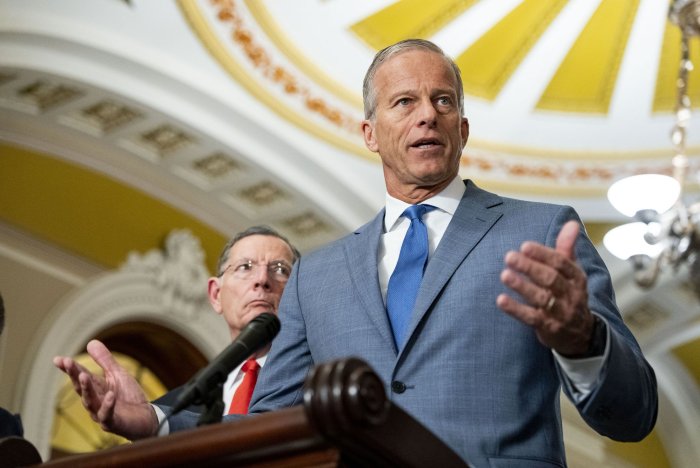
Senate Majority Leader John Thune, R-S.D., speaks during a press conference after the weekly Republican Senate caucus luncheon at the U.S. Capitol on Wednesday. Photo by Bonnie Cash/UPI | License Photo
Tehran, Iran – Another round of indirect talks between Iranian and United States officials ended with a mediator claiming “significant progress” but still no clear evidence that either side was willing to concede enough on their positions to avoid war.
After the conclusion of the talks in Geneva on Thursday, Iranian Foreign Minister Abbas Araghchi said further technical talks would be held next week in Vienna and progress had been “good”.
Recommended Stories
list of 3 itemsend of list
“These were the most serious and longest talks,” Araghchi said.
Omani Foreign Minister Badr bin Hamad Al Busaidi, who mediated the talks, said Iranian and US diplomats would consult with their governments before the Vienna talks.
Few details have emerged about the discussions, but Araghchi was reported to have met US envoy Steve Witkoff – if only briefly, according to Iran’s Tasnim news agency.
The Iranian team, led by Araghchi, handed over on Wednesday night Tehran’s written proposals to Al Busaidi, who also mediated previous rounds of talks in Geneva and Muscat.
The Omani diplomat then met with the US delegation on Thursday, led by Witkoff and US President Donald Trump’s son-in-law Jared Kushner. Al Busaidi mediated between the two teams throughout the day, and the US delegation also held separate talks over Ukraine.
Also taking part in the talks was Rafael Grossi, the director general of the International Atomic Energy Agency (IAEA), which will have to undertake nuclear monitoring and verification duties in Iran in case of any agreement.
The UN watchdog will hold several days of board meetings starting on March 6, which is around the 10- to 15-day deadline floated by Trump last week for Iran to reach a deal.
Western media outlets have suggested the board could once again consider a move to censure Iran depending on the results of the Geneva talks. Iran has accused Grossi of taking politicised action and criticised the IAEA after Israel attacked Iran in June, one day after the agency passed a resolution saying Tehran was not complying with its commitment to nuclear safeguards.
The US Navy aircraft carrier USS Gerald R Ford departs Souda Bay on the island of Crete on February 26, 2026, for the coast of Israel, leading a second US carrier strike group to take up positions against Iran [Costas Metaxakis/AFP]
Fundamental differences
The two sides have been at odds over key issues, including uranium enrichment and missiles.
Washington has repeatedly emphasised, in lockstep with Israel, that it will not accept any nuclear enrichment taking place on Iranian soil, even at civilian-use levels agreed during the 2015 nuclear deal that Iran agreed with world powers. Trump unilaterally abandoned that deal in 2018.
In the days leading up to the Geneva talks, US officials increasingly focused on Iran’s ballistic missile programme, saying the missiles threaten US military bases across the Middle East as well as Israel. Iran has refused to entertain any talks on its conventional weapons. Iranian officials, including President Masoud Pezeshkian, have repeatedly said they will never develop nuclear weapons.
Speaking to local officials during a provincial visit, Pezeshkian also shot back at Trump’s assertion during a lengthy State of the Union speech that Iran was “the world’s number one sponsor of terror”.
Pezeshkian said numerous Iranian officials and nuclear scientists have been assassinated over the decades, particularly in the immediate aftermath of the country’s 1979 Islamic revolution.
“If the realities are seen fairly, it will become clear that Iran is not only not a supporter of terrorism, but one of the main victims of terror in the region and across the world,” he said.
The Iranian government’s IRNA news agency said Tehran’s proposal was expected to gauge US “seriousness” in the talks because it contained “win-win” offers.
Iranian officials have not publicly discussed all the details of their proposals, but they are believed to include diluting part of the country’s 60-percent enriched uranium and keeping the uranium inside the country. Iranian authorities envisage that could be paired with economic opportunities for the US related to Iranian oil and gas and the purchase of airplanes.
People shop at Tajrish bazar in Tehran on February 21, 2026 [Majid Saeedi/Getty Images]
Supreme Leader Ali Khamenei has maintained his tough rhetoric against the US as well, casting doubt on the chances of any agreement. He also said Trump would be unable to overthrow Iran’s government after the US president said regime change would be “the best thing that could happen” in Iran.
Araghchi said during an interview on Wednesday that even if Khamenei is killed, the theocratic establishment in Iran would carry on because it has legal procedures in place to appoint a successor. Pezeshkian added on Thursday: “They can eliminate me, eliminate anyone. If they hit us, a hundred more like us will come up to run the country.”
Double-digit inflation as Iran braces for war
Iranian and US officials have been hailing supposed “progress” in the indirect talks this month, but many Iranians continue to prepare for war.
In Tehran and across the country, people are buying bottled water, biscuits, canned foods and other essentials in case of a war.
“A few days ago, I bought a power bank to keep the electronics charged. Now I’m looking for a short-wave radio so we can hear the news if the state shuts down the internet and electricity infrastructure is bombed,” said a 28-year-old resident of the capital who asked not to be named.
As bombs fell during the 12-day war with Israel in June, Iranian authorities cut off almost all internet access for several days, followed in January by an unprecedented 20-day total blackout imposed on about 92 million people as thousands of people were killed during nationwide protests.
The Iranian government, which blames “terrorists” armed and funded by the US and Israel for the protests, has rejected Trump’s claim that 32,000 Iranians were killed during the demonstrations. It said more than 3,000 people were killed, and rejects documentation by the United Nations and international human rights organisations that its security forces were behind the killings.
As the threat of war intensifies, not all Iranians are capable of stocking up on food and other necessities due to rising inflation that has gripped the country for more than a decade as a result of a mix of chronic local mismanagement and US and UN sanctions.
According to separate reports by the Statistical Centre of Iran and the Central Bank of Iran released on Thursday, inflation has now shot beyond 60 percent.
The Statistical Centre put annual inflation in the Iranian month of Bahman, which ended on February 19, at 68.1 percent, while the Central Bank said it was 62.2 percent.
Food inflation was by far the strongest driver at a whopping 105 percent. That included a 207-percent inflation rate for cooking oil, 117 percent for red meat, 108 percent for eggs and dairy products, 113 percent for fruit and 142 percent for bread and corn.
Iran’s national currency, the rial, stood at about 1.66 million rials to the US dollar on Thursday, near an all-time low.
Coronation Street viewers are worried for Bernie Winter’s marraige after she was arrested on Thursday night’s episode of the ITV soap following a mysterious attack
Coronation Street viewers say ‘it’s over’ after fan favourite is arrested
Coronation Street fans are worried for Bernie Winter after she was arrested on Thursday night’s episode of the ITV soap. The café waitress, who has been played by Jane Hazlegrove since 2019, has become the victim of stalking in recent weeks after she met the mysterious Mal Roper in a hotel room some weeks ago.
Bernie had turned to drugs following the death of her son-in-law Billy Mayhew (Daniel Brocklebank), which came just a couple of years after her son Paul passed away, and met Mal in the Chariot Square Hotel, spending some time in his room before passing out in a nightclub toilet.
Mal had arrived claiming to be the husband of a woman called Alice, whom Roy Cropper thought he had developed a penpal-type relationship with over their love of literature, and quickly got a job at Roy’s Rolls before setting his sights on Bernie. Viewers will know that earlier in the week, he locked her in the cafe and when she eventually made it home, she realised her own face had been cut out of her wedding photo.
Ensure our latest headlines always appear at the top of your Google Search by making us a Preferred Source.Click here to activateor add us as your Preferred Source in your Google search settings.
Things only got worse for Bernie on the latest instalment of the world’s longest-running TV soap as her husband Dev, who already knew about the drugs, and recently she had kissed Mal on that fateful night, delivered some home truths to Bernie.
He said: “Where was your honesty the morning after you betrayed me? Or every day since? Hmm? Because it seems to me, honey, that honesty’s all well and good when it’s convenient.
“It’s not about what you did any more. Yes, it hurts and I hate it! But I’ve been around the block, I can see how it could happen. No, it’s this slow drip of the truth as and when it suits you. This, is how it ends with your lies and your dishonesty.”
Just moments later, a patient was revealed being rushed to Weatherfield General, and it was indeed Mal, with medics speculating that some sort of attack had taken place. A nurse explained to DC Kit Green, Bernie’s long-lost son, that he had suffered a cardiac arrest when he hit his head on the pavement and was in critical condition in intensive care.
Dev later called round to the cafe to reassure Bernie that didn’t want to split up with her, having realised that she just needed to grieve. He begged: “No more sorries. And no more secrets, please. If you love me half as much as you say you do, then we don’t need them, do we?” and they shared a tearful embrace.
But Bernie’s troubles were far from over, as Detective Constable Browning marched into the café, looking for Bernie. He said: “Bernadine Winter-Alahan, I am arresting you on suspicion of assault…” before Bernie pleaded her innocence, to no avail. She begged: “Can you just tell me who I’m meant to have assaulted?” and she told that was a matter that would be discussed at the station.
This all comes after Bernie had some cross words with Mal in the street on Wednesday night, where he insulted her and taunted her over her grief. She warned him to stay away and said if she didn’t she would kill him, but walked away as Mal stood there chuckling.
Fans were convinced that all of this will ultimately spell the end for Bernie and Dev as a couple, who only got married towards the end of last year. One said: “Dev surely can’t forgive Bernie again. Her behaviour was terrible. He doesn’t deserve that.” Another wrote: “No don’t let it be the end of Dev and Bernie” whilst a third wondered: “Is Bernie and Dev over?”
Saracens have rejected “disrespectful” reports that they have offered Ireland head coach Andy Farrell a coaching role for after the 2027 Rugby World Cup.
The club said “no offer has been made” after the Irish Independent reported that Farrell has been approached with a deal worth more than £1m per year to return to Sarries following next year’s tournament in Australia.
Brendan Venter will return to the director of rugby role at the Premiership club when long-serving Mark McCall steps down at the end of the season.
“Andy has not discussed his future with anyone on the board or ownership group of Saracens and we can categorically state, despite numerous reports to the contrary in the press, that no offer has been made to Andy,” the club statement read.
“The misguided reporting is disrespectful to Brendan Venter who will be assuming the DOR [director of rugby] responsibilities from Mark McCall at the end of the 25-26 season. It is also disrespectful to Andy and the IRFU.”
Farrell was a Saracens player between 2005 and 2009, also winning eight England caps, having switched to union after a long and successful career in rugby league with Wigan, during which he also captained Great Britain. After retiring as a player, he took his first steps into coaching with Saracens.
The 50-year-old – whose son Owen rejoined the Premiership outfit last summer after a season in France with Racing 92 – took over as Ireland head coach in 2019 from Joe Schmidt, stepping up from an assistant role he took up in 2016.
In 2023, he led Ireland to a Six Nations Grand Slam and the championship title the following year.
He then turned his attention to the British and Irish Lions, guiding them to a 2-1 series victory over Australia last year, before returning to the Ireland role.
“Given Andy’s close relationship with Saracens, the club looks forward to welcoming him to more home fixtures once the Six Nations Championship has concluded,” the Saracens statement concluded.
Feb. 26 (UPI) — Former Secretary of State Hillary Clinton said she has “no knowledge” that would assist the House Oversight Committee in its investigation involving late sex offender Jeffrey Epstein in her opening statement before the panel Thursday.
Clinton posted the prepared statement on her social media account ahead of the closed-door deposition.
She said the committee didn’t ask President Donald Trump under oath about his appearances in the Epstein files or demand information from Florida or New York prosecutors about the plea deal Epstein made in 2008 that allowed him to avoid federal sex trafficking charges.
“Instead, you have compelled me to testify, fully aware that I have no knowledge that would assist your investigation, in order to distract attention from President Trump’s actions and to cover them up despite legitimate calls for answers,” Clinton said, according to the statement she posted on X.
“This institutional failure is designed to protect one political party and one public official, rather than to seek truth and justice for the victims and survivors, as well as the public who also want to get to the bottom of this matter,” Clinton said. “My heart breaks for the survivors. And I am furious on their behalf.”
Clinton gave a sworn declaration to the Oversight Committee on Jan. 13 in which she said she had no knowledge of crimes committed by Epstein and Ghislaine Maxwell, his convicted accomplice, and said she did not remember ever meeting Epstein.
The testimony Thursday at the Chappaqua, N.Y., Performing Arts Center, was interrupted during the first hour after right-wing influencer Benny Johnson shared an image on X from the closed-door proceedings.
“This is the first time Hillary has had to answer real questions about [Jeffrey] Epstein,” Johnson wrote on the post with the photo, which he attributed to Rep. Lauren Boebert, R-Colo. “Clinton does not look happy.”
Nick Merrill, a Clinton adviser, told reporters that the post caused the testimony to go off the record, “while they figure out where the photo came from and why possibly members of Congress are violating House rules,” Politico reported.
Before the testimony began, Rep. James Comer, R-Ky., gave a press conference outside of the venue.
“No one’s accusing, at this moment, the Clintons of any wrongdoing. They’re going to have due process,” The Hill reported Comer said
“But we have a lot of questions,” Comer said. “And the purpose of the whole investigation is to try to understand many things about Epstein. How did he accumulate so much wealth? How was he able to surround himself with some of the most powerful men in the world? Was he an asset for our government or any other government?”
Clinton and her husband, former President Bill Clinton, initially said they would testify in a public hearing, but committee chair Comer said the committee’s practice is to do interviews behind closed doors first, then hold hearings.
The House of Representatives was close to holding a bipartisan vote to hold them in contempt for ignoring a subpoena when the Clintons relented and agreed to be questioned in private.
Bill Clinton’s deposition is scheduled for Friday. Neither Clinton has been accused of any crimes, and both have called for the full release of the Epstein files.
At least 10 Republican members and nine Democrats were expected to attend the event, which was in the town where the Clintons now live, CBS News reported.
Clinton has said that she and her husband have little information to offer the committee.
“Other witnesses were asked to testify. They gave written statements under oath. We offered that,” she told the BBC last week. “Why do they want to pull us into this? To divert attention from President [Donald] Trump. This is not complicated.”
There are undated photos of Bill Clinton in the Epstein files with Epstein, who died by suicide in prison in 2019.
Bill Clinton’s spokesperson, Angel Ureña, has said he flew on Epstein’s plane four times in 2002 and 2003. The flights were for trips for the Clinton Foundation.
Hillary Clinton has said she doesn’t believe she ever met Epstein, but she was familiar with Maxwell. Maxwell is serving 20 years in prison for her sex trafficking conviction.
Maxwell told Deputy Attorney General Todd Blanche last year that, “President Clinton was my friend, not Epstein’s friend,” NBC News reported. She said she offered the plane to the former president. She also said that Bill Clinton was a close friend of billionaire Ted Waitt, founder of Gateway computers, whom she dated from 2003 to 2010. Maxwell and Waitt attended Chelsea Clinton’s wedding in 2010.
Senate Majority Leader John Thune, R-S.D., speaks during a press conference after the weekly Republican Senate caucus luncheon at the U.S. Capitol on Wednesday. Photo by Bonnie Cash/UPI | License Photo
Venezuelanalysis editor Ricardo Vaz joined Ileana Chan on the Global Majority for Peace podcast to take stock of Venezuela’s political reality following the January 3 US attacks and kidnapping of President Nicolás Maduro.
The discussion focuses on the long history of imperialist attacks against the Bolivarian Revolution and the US’ efforts to take control of the Venezuelan oil industry.
“The Gray House,” a limited series now streaming on Prime Video, purports to tell the fact-based story of Elizabeth Van Lew, who spied for the Union in the Civil War while living in the midst of Southern society in Richmond, Va. And in very broad terms it does, though it fills up the space within those outlines with an army of imagined details and melodramatic plots and subplots.
It is not the first work for the screen that betrays history by attempting to make it more exciting than it already is, and if you go in ready not to wonder or care what did or did not actually happen, and which characters are real or invented, you may make out alright. (If you do care, there is Gerri Willis’ 2025 volume “Lincoln’s Lady Spymaster: The Untold Story of the Abolitionist Southern Belle Who Helped Win the Civil War.”)
So I will not ring a bell every time the miniseries, which admittedly bills itself as “inspired by a true story,” diverts from the record, even though in my head it may be clanging.
It’s July 4, 1860, nine months before the beginning of the Civil War. Elizabeth (Daisy Head) lives in a mansion in Richmond with her mother Eliza (Mary-Louise Parker), and the two are throwing a party. Guests, including the historical Swedish novelist and social reformer Fredrika Bremer (Oxana Moravec), congressman Sherrard Clemens (Ionut Grama), Virginia Gov. Henry Wise (Mark Perry) and his awful son Obie (Blake Patrick Anderson), unload expository dialogue and provide a primer for anyone not acquainted with the roots of the Civil War. Meanwhile, a runaway slave shows up out back, pursued by hounds, having heard that the Van Lew house is the place to run for help. The women, who are against secession and for abolition but are practiced in the art of deceiving their neighbors, are involved with the Underground Railroad in some way that’s not exactly clear.
Among their servants — the Van Lew slaves were (secretly) freed upon the death of Elizabeth’s father — are head porter Isham, played by Ben Vereen, who it is a pure pleasure to see back on screen, and Mary Jane (Amethyst Davis). A well-educated, determined young woman who is just back from Liberia, which did not suit her — she calls it a “tricky little way of ridding America of free Blacks” — the series gives her a lot of agency and makes her a virtual partner in the spy ring. White and Black, they live as much like a family as is possible when some people are labor and others are management and it’s the antebellum, then the wartime South.
Also involved in Elizabeth’s tradecraft are Scottish baker Thomas McNiven (Christopher McDonald) and Clara Parish (Hannah James), a beautiful prostitute who dreams “of Bronte’s moors” and gets, of all things, a big musical number in an out-of-place Western saloon, like Marlene Dietrich in “Destry Rides Again.” (The saloon is a standing set at Castel Film Studios in Romania, where the production was based; their backlot Western street, too, makes an implausible appearance.)
Ben Vereen as Isham Worthy, a porter in the Van Lew home.
(Bogdan Merlusca/Prime Video)
Out of the loop are Elizabeth’s brother, John (Ewan Miller), whose heart is in the right place, but who’s married to Laurette (Catherine Hannay), whose heart is not. An avaricious, envious flirt on the undisguised lookout for something better, she is angry that John wouldn’t use slave labor to build their house. She’s Scarlett O’Hara, minus the intelligence and charm.
Calling roll on the enemy, we find present Confederate President Jefferson Davis (Sam Trammell), in whose house — the eponymous Gray House — Mary Jane will be embedded, with a cocked ear and a photographic memory, to gather intel; Secretary of War (and then State) Judah P. Benjamin (Rob Morrow), who has a thing for Clara, to whom he opines on property rights while they share a bathtub; and a pip-squeak John Wilkes Booth (Charles Craddock), popping in and out no reason, unless it’s to foreshadow the death of Lincoln (who makes a rearview cameo), or just because everybody’s heard of him. Below them, but more in the action, are the nasty, thuggish Sheriff Stokely Reeves (Paul Anderson) and slave hunter Bully Lumpkin (Robert Knepper); and while thuggery and violence were endemic in a racist South, caricature and cliche do your history lesson no favors, however valuable it is.
Because Hollywood hates, let’s call it a love vacuum when it comes to screen heroines, Elizabeth will find herself the object of not one, not two, but (at least) three admirers, who prize her brains and spirit and talent for conversation. (She is no frilly, fizzy, fuzzy Southern belle, like the mean girls around her sister-in-law.) There is Hamton Arsenault (Colin Morgan), a sort of Rhett Butler lite, visiting from New Orleans with a huge live alligator, because I guess that’s something you could manage in 1860 just to make a splash at a party a thousand miles away. Capt. William Lounsbury (Colin O’Donoghue) is a dashing Union officer, escaping a Confederate prison, who passes through the Van Lew house on the way to freedom; they click together like Legos. Finally, there’s shy puppy dog Erasmus Ross (Joshua McGuire), who works at the Van Lew’s hardware store and will later have a post at a prison for captured Union soldiers, which the Van Lews will turn to their advantage.
“The Gray House” isn’t all bad, and its intentions are good, but it’s dramatically predictable and at eight episodes, some over an hour, goes on much, much longer than it needs to, letting scenes play out past profitability and wasting time on extraneous subplots involving minor characters — and minor minor characters — that do nothing to enrich the fabric of the show. A duel between two characters with no significant connection to the rest of the story exists here seemingly just because their historical counterparts did fight one, and gives the filmmakers the chance to add a duel — on horseback, like jousting with guns — to the show.
Parker is always fine, though the part requires a bit too much Southern breathiness. Davis and Head make strong impressions, masking the pedestrian, sometimes cornball dialogue. (The miniseries was written by Leslie Greif and Darrell Fetty, who collaborated on “Hatfields & McCoys”, with an undiscernable assist from John Sayles.) Keith David, who plays real-life activist minister Henry H. Garnet, gives a seven-minute speech on education as if he’s performing a Shakespearean monologue, after which he faces down a murderous sheriff like he’s Shaft. It’s a high point of the series, and the one scene I was happy to see go long.
Directed by Roland Joffé, who four decades ago was Oscar-nominated for “The Killing Fields” and “The Mission,” the production is a mixed bag; much care has been lavished on the costumes; the crowd scenes are well populated; printed material is done really well. (It matters.) Battle scenes — including Bull Run, where picnicking tourists are accurately shown in attendance — are convincingly rendered. But Romania, whether on or off the studio lot, only occasionally musters a decent impression of 19th century Virginia, reminding you, as “The Gray House” often does, that this is only a movie.