











Month: February 2026

Claims Swirl Around Government’s Response To Cartel Drone Threat That Prompted El Paso Airspace Closure

Drones operated by Mexican drug cartels flying across the border prompted a major clampdown in air traffic over El Paso, Texas, earlier today, a Trump administration official has told TWZ. The airspace restrictions appeared without warning and created still lingering confusion. Cross-border cartel drone operations are a chronic issue, and we have been calling attention to the growing dangers they pose for many years now.

New details can be found in an update at the bottom of this story.

“Mexican cartel drones breached US airspace. The Department of War [DOW] took action to disable the drones,” the administration official told us. “The FAA [Federal Aviation Administration] and DOW have determined there is no threat to commercial travel.”

“The FAA and DOW acted swiftly to address a cartel drone incursion,” Secretary of Transportation Sean Duffy has also said in a statement. “The threat has been neutralized, and there is no danger to commercial travel in the region. The restrictions have been lifted and normal flights are resuming.”

The FAA and DOW acted swiftly to address a cartel drone incursion.

The threat has been neutralized, and there is no danger to commercial travel in the region.

The restrictions have been lifted and normal flights are resuming. https://t.co/xQA1cMy7l0

— Secretary Sean Duffy (@SecDuffy) February 11, 2026

“The temporary closure of airspace over El Paso has been lifted,” according to an earlier post from the official FAA account on X. “There is no threat to commercial aviation. All flights will resume as normal.”

The temporary closure of airspace over El Paso has been lifted. There is no threat to commercial aviation. All flights will resume as normal.

— The FAA ✈️ (@FAANews) February 11, 2026

Reuters had earlier reported that the FAA’s action was “tied to the Pentagon’s use of counterdrone technology to address Mexican drug cartels’ use of drones,” citing anonymous “airline sources.” Politico had also reported a link to counter-drone testing, citing an unnamed aviation industry source. Coordination problems between the FAA and the military may have created a disconnect. An unnamed U.S. official reportedly told The Atlantic that the “FAA reopened the air space after talking to officials at Fort Bliss,” as well. Fort Bliss lies adjacent to El Paso International Airport.

Airline sources told Reuters the grounding of flights in El Paso was believed to be tied to the Pentagon’s use of counterdrone technology to address Mexican drug cartels’ use of drones of the U.S.-Mexico border. @davidshepardson

— Idrees Ali (@idreesali114) February 11, 2026

Hearing the same. FAA reopened the air space after talking to officials at Fort Bliss (which is in El Paso), a US official tells me. https://t.co/thMobka11v

— Nancy Youssef, نانسي يوسف (@nancyayoussef) February 11, 2026

TWZ has reached out to the White House, the FAA, the Pentagon, U.S. Northern Command (NORTHCOM), Fort Bliss, and the El Paso County Sheriff’s Office for more information about the circumstances surrounding the airspace closure.

The FAA had issued the temporary flight restrictions suddenly and without apparent warning to various federal, state, and local authorities, causing immense confusion, which is clearly continuing to a degree. The airspace closure centered on El Paso International Airport, and extended 10 miles in all directions and up to an altitude of 17,999 feet. This led to a ground stop at the airport and a total shutdown of air traffic within the affected zone, which was declared to be “national defense airspace.” Warnings that intruders could face the risk of deadly force if deemed to be an “imminent security threat,” as well as the possibility of being “intercepted, detained, and interviewed,” were issued. Even military, police, and medical evacuation aviation activities were impacted. The only explanation given initially for the airspace closure, which was originally slated to last 10 days, was unspecified “special security reasons.”

Odd national security pop-up TFR in El Paso, Texas

The control power just informed a southwest flight. They just got noticed that a TFR ha gone into effect for 10 days for national security reasons. The airport has been shut down for 10 days. 👀🤔

Via @theATCapp pic.twitter.com/r96MrpRiXx

— Thenewarea51 (@thenewarea51) February 11, 2026

Similar airspace restrictions were also imposed overnight over an area around Santa Teresa, New Mexico, to the west of El Paso, the current status of which is unclear.

In connection with the NOTAM closing the airspace over El Paso, the FAA has also prohibited all flight operations in the nearby Santa Teresa area, citing special security reasons. The same validity period and altitude parameters apply. pic.twitter.com/ooOAnBSBR1

— Flightradar24 (@flightradar24) February 11, 2026

“We were just as surprised as anyone that the NOTAM was imposed and just as surprised that it was lifted,” U.S. Army Maj. Will McGehee, a spokesperson for the 1st Armored Division at Fort Bliss, told TWZ this morning after the flight restrictions over El Paso were lifted. “We are trying to figure out what is going on and referring all calls to the FAA. We don’t have any information about why the FAA did this.”

In addition to the 1st Armored Division, Fort Bliss is home to a significant portion of the Army’s air defense units, which are increasingly charged with the counter-drone mission. The base is also a major hub for border security operations, which the U.S. military often conducts in cooperation with law enforcement agencies, as well.

A no drone zone warning sign at Fort Bliss. US Army

“From what my office and I have been able to gather overnight and early this morning there is no immediate threat to the community or surrounding areas. There was no advance notice provided to my office, the City of El Paso, or anyone involved in airport operations,” Veronica Escobar, the Democrat who currently represents the El Paso area in the House of Representatives, wrote earlier on X. “We have urged the FAA to immediately lift the Temporary Flight Restrictions placed on the El Paso area.”

“Nobody local got advance notice. And I mean nobody – neither civilian or military leadership,” El Paso City Councilmember Chris Canales also said, according to Blake Spendley (who goes by the handle @OSINTtechnical on X).

We have urged the FAA to immediately lift the Temporary Flight Restrictions placed on the El Paso area.

I will continue to make information public as I learn it.

— Rep. Veronica Escobar (@RepEscobar) February 11, 2026

As noted, cross-border drone activity linked to Mexican drug cartels is not new and happens routinely, historically as a means of smuggling illicit narcotics. However, cartels in Mexico have been expanding their drone capabilities in recent years to include the use of weaponized commercial types. These are developments that TWZ highlights regularly, including in a detailed feature last year about the prospect of U.S military action against the cartels and the ramifications thereof, which you can find here.

“Drones crossed over but the reason why they used a counter-unmanned aerial system (CUAS) was because they were extremely aggressive and put helicopters at risk,” Stefano Ritondale, chief intelligence officer for Artorias, an artificial intelligence-driven intelligence company specializing in cartel violence in Mexico, Latin American affairs, and trade/organized crime, told TWZ. “Drones cross over all the time.”

“Based on the area in which the TFRs are located and who we have seen operate in that area, the most likely culprit would be La Línea/Cartel de Juárez,” a spokesperson for a team of open source analysts with a focus on cartels & other non-state actors, who goes by the handle @natsecboogie on X, also told us. “We have documented some of their drone use along the border for smuggling.”

Last year, the U.S. military did announce the deployment of additional counter-drone capabilities as part of a larger buildup along the border with Mexico. This is known to have included radars and other sensors just to help better monitor for potential threats.

A US Army AN/MPQ-64 Sentinel radar seen deployed near the southern border with Mexico in 2025. US Army

The action taken today also follows a string of announcements from the Pentagon recently about new authorities to respond to drone threats in the U.S. homeland. Last year, U.S. Air Force Gen. Gregory M. Guillot, head of NORTHCOM, had openly advocated for these authorities in part to address cartel drones along the southern border.

What happened today is evidence of the new counter-drone response mechanisms in place now. NORTHCOM has now established a rapidly deployable counter-drone capability, though it’s unclear if it was employed in this case. At least on the part of the U.S. military, the ability to decide to act seems to be much clearer-cut, in general. At the same time, what happened overnight underscores the importance of interagency coordination and communication, especially with the public and among stakeholders, which seems to still be sorely lacking.

General concerns about drone threats to the U.S. homeland, especially to military assets and other critical infrastructure, have been steadily building up for some time now, as well. This has included collisions and near-misses with U.S military aircraft flying over training ranges, as well as incidents involving U.S. naval forces offshore. Reported drone incursions over nuclear power plants and other facilities have spiked in recent years.

In many instances, drone concerns have become intertwined with claimed sightings of what are often now referred to as unidentified aerial phenomena (UAP), or what used to be more commonly called unidentified flying objects (UFO).

Altogether, questions do still remain about what exactly prompted the airspace restrictions around El Paso today, but they do serve to underscore real concerns about drone threats that have been growing for some time.

Update: 1:55 PM EST –

CBS News and CNN have both now reported that a breakdown in coordination between the U.S. military and the FAA over the employment of a counter-drone system armed with a laser directed energy weapon contributed to the imposition of the flight restrictions around El Paso.

“Meetings were scheduled over safety impacts, but Pentagon officials wanted to test the technology sooner,” according to CBS News, citing multiple unnamed sources. “Airlines were also aware of the apparent impasse between the FAA and Pentagon officials over the issue because the Pentagon has been using Fort Bliss for anti-cartel drone operations without sharing information with the FAA.”

SCOOP: The unexpected airspace closure in El Paso stemmed from disagreements over drone-related tests, sources told @CBSNews. Pentagon had undertaken extensive planning on use of military tech near Fort Bliss. Two sources identified the technology as a high-energy laser.
Earlier…

— Jennifer Jacobs (@JenniferJJacobs) February 11, 2026

“It’s unclear if the presence of [cartel] drones might have led to the acceleration of the deployment of the laser system,” per CNN‘s report, which also cites multiple anonymous sources.

CBS News‘ report also says the same “anti-drone technology was launched near the southern border to shoot down what appeared to be foreign drones” earlier this week, but what was ultimately shot down “turned out to be a party balloon.” The story separately says that “one official said at least one cartel drone was successfully disabled,” but it is unclear when that engagement may have occurred.

Questions remain about the exact chain of events that led the FAA to impose the temporary flight restrictions around El Paso.

“The statement by the administration that this shutdown was linked to a Mexican cartel drone that came into US airspace — that is not my understanding,” Rep. Escobar said at a press conference today.

”What happened in El Paso last night is unacceptable,” Rick Larsen and Andre Carson, Democratic Party representatives from Washington State and Indiana, respectively, also said in a joint statement. ”While we’re not happy with the disruption, we commend the FAA for taking swift action to protect travelers and ensure the safety of U.S. airspace.”

Larsen and Carson both sit on the House Committee on Transportation and Infrastructure.

“This chaotic outcome is the result of hamhanded language forced into the NDAA [the National Defense Authorization Act, the annual defense policy bill] by the White House that allowed the Pentagon to act recklessly in the public airspace,” their statement added. “We look forward to pursuing a bipartisan solution that strengthens interagency coordination and ensures that the Department of Defense will not jeopardize safety and disrupt the freedom to travel.”

Author’s note: The headline to this story was changed to reflect new information.

Contact the author: joe@twz.com

Joseph has been a member of The War Zone team since early 2017. Prior to that, he was an Associate Editor at War Is Boring, and his byline has appeared in other publications, including Small Arms Review, Small Arms Defense Journal, Reuters, We Are the Mighty, and Task & Purpose.


Howard is a Senior Staff Writer for The War Zone, and a former Senior Managing Editor for Military Times. Prior to this, he covered military affairs for the Tampa Bay Times as a Senior Writer. Howard’s work has appeared in various publications including Yahoo News, RealClearDefense, and Air Force Times.


Source link

Commentary: Boston Irish punk band the Dropkick Murphys could pass for Proud Boys. But look again.

The Dropkick Murphys’ have been “Fighting Nazis Since 1996.” Ken Casey, singer of the Boston Irish punk band, says don’t believe it when Republican politicians “cosplay” as working-class white males.

For three decades, the Dropkick Murphys have played their riotous brand of Boston Irish Celtic punk for legions of tattooed, mosh-pitting fans, but it wasn’t until last month that they found a new following among an unlikely demographic: C-SPAN viewers.

Washington policy wonks and political junkies who tuned in to watch former Justice Department special counsel Jack Smith testify before the House last month were treated to lurid details about President Trump’s alleged involvement in 2020 election meddling and the Jan. 6 insurrection. What they didn’t bargain for were the animated actions of former D.C. cop Michael Fanone, who was in the chamber wearing a Dropkick Murphys T-shirt that read “Fighting Nazis Since 1996.”

Fanone, who was brutally attacked by a pro-Trump mob while defending the Capitol in 2021, was impossible to miss. He was seated directly behind Smith and the only guy visible in a band T-shirt. Also notable were his reactions to GOP suggestions that the attack on the Capitol never happened, or was everyone’s fault but Trump’s: He coughed out expletives and flashed colorful hand gestures. Dropkick Murphys T-shirt sales spiked.

“It was this crazy, organic thing,” says Ken Casey, lead singer of the band. “We never put up a poster saying, ‘Hey, wear our shirt!’ But over the course of the next week, we sold like 6,000 of those shirts.” And for those who want one now? The shirt is on back order.

Casey, who speaks in a thick, working-class Boston accent (think “The Departed” meets a Ben Affleck Dunkin’ Donuts commercial), isn’t a stranger to mixing music and politics. He has been outspoken onstage and in the recording studio about his opposition to MAGA’s immigration policy, racist rhetoric and war on the working class. And the band announced Tuesday they’re parting ways with the Wasserman Music agency because the namesake of the agency turned up in the Epstein files.

Casey spoke with The Times about challenging MAGA through the rebellion of punk rock.

The Dropkick Murphys’ “Fighting Nazis Since 1996” T-shirt is a hot item now thanks to its appearance on Capitol Hill, via Fanone. He’s been very active and adamant about countering MAGA’s Jan. 6 narratives, including testifying with his colleagues in front of the House select committee investigating the insurrection.

Ken Casey: “Michael is an old friend. He was at our very first Dropkick show in D.C. in 1996, so it’s not like he’s some kind of jump-on-the-bandwagon guy. I appreciate just how vocal he is. It’s one thing to talk the talk, but it’s another to walk the walk and be showing up at all those events, and really putting himself out there.

But why is it important for the Dropkick Murphys to speak out? You’ve no doubt lost fans.

I hate to say it, but in some ways, MAGA needs to be countered with a mirror of them, like in physical appearance. They love painting themselves as righteous warriors and the rest of the country as immigrants, or whatever other stupid s— they come up with. But it seems to trigger them more when someone like Michael Fanone and the Dropkick Murphys speak up to them because it just like explodes their mind. It’s like, “You’re supposed to be on my side!” It’s like no, remember when you were on our side? Before you got twisted up by this lying con man?

In some ways, no band has more to lose because our fan base is the population that might jump into MAGA. But there is that middle ground — the people who don’t have time for politics. Who don’t follow it as closely as you or I do. They hear things about Biden, hear things about Trump, and it’s like “I don’t know what to believe.” That’s where voices like [mine] are important. You’re hearing it from someone who really doesn’t have skin in the game. I’m an American citizen, not a politician. I don’t have corporate interest involved in this.

And then there’s the new interest in your band, from folks who are just discovering you, or maybe just know your material from film soundtracks like “The Departed” (“I’m Shipping Up to Boston”).

It’s also brought back fans and there’s this [renewed] punk rock urgency and importance to our shows. It’s gained us a lot of new fans, in theory, like people who don’t necessarily listen to punk rock, or who wouldn’t listen to our music or come to our shows, they now speak out and say, “I support Dropkick Murphys for what they’re doing.” It’s support in solidarity. For the [longtime] fans, it’s rekindled this new dedication. It’s reconnected us with some old fans who had drifted away.

What do you say to other music artists who are afraid to speak out against what they see as an injustice or wrongdoing?

We’ve already had every death threat, every friggin’ cancellation threat. So what would we say to other bands and other people who are keeping their head down because they don’t want to deal with all the drama that comes along with speaking up? Come on in. The water is great. There’s nothing to worry about. The [trolls] are a vocal minority — online is bots and paid influencer types. Don’t let anybody silence you.

At this year’s Grammy Awards ceremony, every other acceptance speech contained anti-ICE sentiment, so it does appear that more musicians are speaking out against Trump’s policies.

Listen, if executions in the streets of your citizens [by ICE agents] doesn’t get people to speak out, then nothing will. But it’s nice to finally see there’s a wave starting to peak, out of frustration and realization. I can also tell from the amount of attacks we get that there’s some backpedaling. Obviously, there’ll always be the die-hards — Trump could be molesting someone in front of their eyes, and they’d still stick with him. But there’s a lot of people trying to quietly distance themselves.

Ken Casey of Dropkick Murphys

Ken Casey of Dropkick Murphys

(Riley Vecchione)

If we’re being historically accurate, the Dropkicks have always had something to say about what’s going on in this country.

The very first line sung on our very first album was in regards to how Reagan started the dismantling of unions and [created a] wealth gap, so we’ve been about it the whole time. We’ve been showing up on picket lines the whole time. Social justice, we’ve always been about it. But before Trump, we weren’t necessarily having to make it a social media presence type of thing. But we’re in a different time now.

The Republicans started to cosplay as working-class white males, and people bought right into it. There’s a portion of this country that is sick and twisted and MAGA has been a great vehicle for them, but then there’s also a big portion of the country that just got caught up in the lies and the bull— and the rhetoric.

Your band is part of a new initiative aimed at getting more punk bands to speak truth to power.

The Dropkick Murphys and Michael Fanone, along with the guys in Rise Against, have started a collaborative called Down for the Cause. It’s basically going to be kind of a punk rock collaborative because years from now, we don’t want punk rock to be disgraced by the silence. Just kind of get involved, not necessarily supporting candidates but more like taking back the air waves let people know that we don’t have to accept this unacceptable behavior. Also reminding people to vote, because if all those people didn’t stay on the sidelines in the last election, we probably wouldn’t be in the mess we’re in now.

Your band just released a new song, “Citizen I.C.E.” But is it new?

The song is actually 20 years old. It was called “Citizen CIA.” It was basically a mock recruitment song for the CIA, poking fun at the damage the CIA has done around the world. Now we flipped it to a mock ICE recruitment song, with lines like “Too scared to join the military, too dumb to be a cop.” It’ll be out on a split album, “New England Forever,” that we did with a younger Boston band called Haywire. We’re touring with them now [ on the “For The People…In the Pit St. Patrick’s Day Tour”].

What do you say to people who say shut up and sing.

I get that even people who aren’t necessarily MAGA don’t want to listen to someone [on a] soapbox. But I view where we are as five-alarm fire, and if you got a microphone in front of your mouth, you better damn well be talking into it.

Source link

One Month That Lasted a Year, in Under an Hour

“Hi, I think we’re under attack.”

This movie begins with the relatable sense of astonishment the people in Caracas and La Guaira felt as US helicopters hit the ground to whisk away Nicolas Maduro and Cilia Flores to a Brooklyn jail. A proper opening to a situation that has not ceased to dazzle us and to overwhelm with more questions than answers: Venezuela at the wee hours of January 3. 

Frontline, a multiawarded PBS channel specialized in documentaries, came back to Venezuelan recent history to provide a hot take, a bit shorter than an hour, that covers all you need to know from the military incursion to the release and re-arrest of Juan Pablo Guanipa, and the painful wait for the Amnesty Law. Crisis in Venezuela: An Uncertain Future is perfect to gather the most relevant facts of the new context if you are Venezuelan and drowning in a sea of information, or if you are not and need a good synthesis of this mess.

This is the same team that made A Dangerous Assignment, the documentary about Alex Saab and the journalistic research that led to the arrest of Maduro’s moneyman in Cape Verde. Venezuelan filmmaker Juan Ravell directs again, and we get the AP’s Joshua Goodman as a traveling companion, narrating crazy developments like their scoop of the DEA’s investigation into Delcy Rodriguez. The documentary is packed with characters from the Maximum Pressure to Donroe including Biden’s negotiating table. A synthesized pill of Venezuelan contemporary history, with enough time to pack the events of Venezuela’s January in detail—like having professor Francisco Monaldi explain how the reform of the hydrocarbon law means the dismantlement of Hugo Chavez’s oil policy, despite the BS Delcy’s telling the chavista grassroots.

Some scenes about political prisoners and how all this is felt on the terrain will shock you, in a good way. With so many stories and interviews imposing predetermined readings on our country as if it was an empty canvas to project someone’s ideology or stance, this documentary shines with its accuracy and access to sources. Don’t miss it.

Source link

Struggling to get by: Behind the US underemployment crisis | Unemployment News

New York City, United States – For 14 years, BC Dodge built a career telling other people’s stories as a marketing and communications professional in the nonprofit sector in the Washington, DC area in the United States. But in late 2024, that stable career hit a speed bump.

He was laid off from his job amid a round of restructuring. The news landed without warning. One day he had a job, and the next he was sitting at home, staring at the numbers, trying to figure out how to keep paying the mortgage and putting food on the table.

Recommended Stories

list of 4 itemsend of list

He is married, and his partner is a teacher, but the math did not work. One salary might cover things for a little while, but not long enough to maintain long-term stability.

So he started applying for new work immediately. Over three months, he submitted 350 job applications. He got six interviews.

After months of searching, something moved.

He advanced in the hiring process for a Washington, DC–based nonprofit, making it far enough to sit across from senior leadership. It felt like he finally caught a break.

Then the ground shifted again. As Dodge was interviewing for a new job, Elon Musk, the world’s richest man, was advising the administration of US President Donald Trump on how to shrink the federal government, and that meant cutting funding to agencies that provide contracts and funds to swaths of nonprofit organisations around the country. The effects rippled outward, and Dodge was caught in the crosshairs.

Contracts were cancelled and funding streams dried up. Nonprofits that depend on government support had to pull back and scale down ambitions — those very same nonprofits from whom Dodge sought employment.

“I got a call from HR saying they weren’t going to hire for the position, and that all hiring was on hold. I couldn’t argue with them, because I’d been hearing the same thing from organisations I’d spoken to since I started applying. ‘We were relying on federal funds, and now they’re gone,’” Dodge said.

Then it was back to the drawing board. He began searching yet again, but this time with a cloud of uncertainty looming over the entire industry he works in. Dodge finally took what he could get — part-time work in his field. The pay was well below what he had been earning before, but he accepted it anyway. Some income, he reasoned, was better than none.

The result is underemployment. Underemployment can manifest in several ways, often when workers are seeking full-time work but can only find part-time positions, or when the jobs they work do not fully utilise their skills and training. It is generally associated with industries like restaurants or retail, but it also reaches into fields with fewer resources and shrinking opportunities, including the nonprofit sector, where jobs are increasingly precarious and full-time stability is harder to find because of the wave of government funding cuts in 2025.

The upshot is lower incomes for underemployed workers, sometimes below the cost of living or even pushing them into the ranks of the working poor.

Underemployment has been on the rise, according to the Economic Policy Institute, which has tracked the rate of underemployment since 1978. Today, 8 percent of the US population is underemployed, up 0.5 percent from 2024 and it is up 1.1 percent from 2023.

At the same time, many in the US are seeing their expenses increase.

The impact of tariffs has hit low-to-middle-income earners harder than others. Analysis from the Yale Budget Lab found that lower-income households are paying a higher percentage of their post-tax income on goods subject to tariffs as opposed to higher-income households, all while costs for necessities like healthcare are increasing.

Earlier this year, Congressional leaders failed to extend Affordable Care Act subsidies. Premiums increased by an average of 144 percent, according to analysis from the Kaiser Family Foundation.

“Some people have lost their jobs and found new ones that pay less, but others have kept their jobs, but their healthcare premiums have increased. Their electric bills have also gone up. Their salaries no longer cover basic living costs,” Jillian Hishaw, a personal bankruptcy lawyer in Charlotte, North Carolina, said.

She said that because of increased costs like these and a stalling job market, she is seeing an increase in inquiries about personal bankruptcy filings in efforts by potential clients not to lose their homes to foreclosure.

“In one day last week, 85 foreclosures were filed in Mecklenburg County [where Charlotte is located]. Foreclosures happen daily, but 85 in a single day is unusually high. Two years ago, the daily average was 10 to 20, but now filings are approaching triple digits each day,” Hishaw said.

Shrinking options

The surging economic pressures hit workers across various sectors, including financial and administrative services. An Ohio-based accountant who did not want his name to be published, has worked a patchwork of accounting and administrative jobs over the past few years. In March, he was laid off from a research organisation in central Ohio.

After months of searching, he found new work, but not as an accountant, and the pay falls far short of covering his cost of living.

“I’m working as a sales coordinator, which I really don’t want to be doing, but it was the only thing I could land with how bad things are. It’s not enough to live on,” he said.

The labour market is under strain. Layoffs reached more than 1.1 million in 2025, according to Challenger, Gray & Christmas, while job creation failed to keep pace, with just 584,000 jobs added. As a result, more workers are settling for underpaid or part-time work that does not meet basic living expenses, including Dodge and the accountant.

Michele Evermore, senior fellow at the National Academy of Social Insurance, says that economic uncertainty driven by tariffs and developments in artificial intelligence has put businesses across a wide set of sectors essentially on pause — maintaining the status quo or scaling back.

“People who are already at the margins are getting kicked out entirely, and that’s placing pressure on everyone who is clinging to a job,” Evermore told Al Jazeera.

In January, one of the key measures of underemployment, the number of people who work part-time for economic reasons, such as an inability to find full-time work or had their hours reduced, hit 4.9 million. It was a 453,000 decline from the month before, but is up 410,000 from this time last year, according to the January jobs report released by the Bureau of Labor Statistics on Wednesday.

Long-term unemployment jumped 386,000 from this time a year ago to 1.8 million, although it remains unchanged compared with the previous month.

The nonprofit sector has been hit particularly hard in the last year, losing 28,729 jobs in 2025, up sharply from 5,640 losses the year before, according to Challenger, Gray & Christmas.

Like the Ohio accountant, Dodge has been searching for new opportunities since he lost his full-time role a year and a half ago. He has applied for 460 jobs and only landed a handful of interviews.

Working weekends, washing dishes

The market is only getting tighter. US employers cut more than 108,000 jobs in January, while employers only announced intentions to hire 5,300 new roles for the month, the lowest on record since Challenger, Gray & Christmas started tracking that in 2009.

“Employers aren’t wanting to make any big investments right now, including increasing salaries to their workforce,” Evermore, who served as a policy adviser in the US Labor Department during the administration of former US President Joe Biden, added.

In December, labour market turnover remained stagnant. Amid economic uncertainty and a slowdown in new job growth, many Americans are hanging on to the jobs they already have. Job openings fell to 6.5 million, down 386,000 from the previous month, according to the Bureau of Labor Statistics’ Job Openings and Labour Turnover Survey (JOLTS).

Hiring and separations, which include layoffs and firings, were unchanged. That followed November’s report, which similarly showed little movement in both new hiring and the number of workers leaving their jobs.

Combined, that means that for the underemployed, finding a new role, either part-time to augment their existing income, or to replace it altogether, is increasingly difficult for people like the accountant.

“I’m also working weekends at a friend’s cafe, washing dishes, and I’m still applying and interviewing for other opportunities. But it’s the same story, no offers. At the same time, I’m debating whether to switch professions or even go back to school, even though I already have a master’s degree,” he said.

That shared distress has also created an unlikely sense of camaraderie among those struggling to get by, even as the outlook remains bleak.

Dodge finds it in late-night scrolls through Reddit, watching strangers narrate versions of the same stalled search.

“I doomscroll a lot,” he said, “getting depressed about the state of politics and the global economy, and taking some solace in knowing I’m not the only one struggling to find viable employment after 12, 13, 14, even 15 months.”

For now, that recognition of others stuck in the same place, hitting the same walls, is enough to keep him moving forward, submitting applications and waiting for a response that might not even come.

Source link

CBO: US Federal deficits and debt to worsen over next decade | Government News

The nonpartisan Congressional Budget Office’s 10-year outlook projects worsening long-term United States federal deficits and rising debt, driven largely by increased spending, notably on Social Security, Medicare, and debt service payments.

Compared with the CBO’s analysis this time last year, the fiscal outlook, which was released on Wednesday, has deteriorated modestly.

Recommended Stories

list of 4 itemsend of list

The CBO said that the deficit for fiscal 2026 – President Donald Trump’s first full fiscal year in office – will be about 5.8 percent of GDP, about where it was in fiscal 2025, when the deficit was $1.775 trillion.

But the US deficit-to-GDP ratio will average 6.1 percent over the next decade, reaching 6.7 percent in fiscal 2036 – far above US Treasury Secretary Scott Bessent’s goal to shrink it to about 3 percent of economic output.

Major developments over the last year are factored into the latest report, including Republicans’ tax and spending measure known as the “One Big Beautiful Bill Act,” higher tariffs, and the Trump administration’s crackdown on immigration, which includes deporting millions of immigrants from the US mainland.

As a result of these changes, the projected 2026 deficit is about $100bn higher, and total deficits from 2026 to 2035 are $1.4 trillion larger, while debt held by the public is projected to rise from 101 percent of GDP to 120 percent — exceeding historical highs.

Notably, the CBO says higher tariffs partially offset some of those increases by raising federal revenue by $3 trillion, but that also comes with higher inflation from 2026 to 2029.

Rising debt and debt service are important because repaying investors for borrowed money crowds out government spending on basic needs such as roads, infrastructure and education, which enable investments in future economic growth.

CBO projections also indicate that inflation does not hit the Federal Reserve’s 2 percent target rate until 2030.

A major difference is that the CBO forecasts rely on significantly lower economic growth projections than the Trump administration, pegging 2026 real GDP growth at 2.2 percent on a fourth-quarter comparison basis, fading to an average of about 1.8 percent for the rest of the decade.

Trump administration officials in recent weeks have projected robust growth in the 3-4 percent range for 2026, with recent predictions that first-quarter growth could top 6 percent amid rising investments in factories and artificial intelligence data centres.

CBO’s forecasts assume that tax and spending laws and tariff policies in early December remain in place for a decade. The government’s fiscal year starts on October 1.

While revived investment tax incentives and bigger individual tax refunds provide a boost in 2026, the CBO said that this is attenuated by the drag from larger fiscal deficits and reduced immigration that slows the growth of the labour force.

Jonathan Burks, executive vice president of economic and health policy at the Bipartisan Policy Center said “large deficits are unprecedented for a growing, peacetime economy”, though “the good news is there is still time for policymakers to correct course.”

‘Urgent warning’

Lawmakers have recently addressed rising federal debt and deficits primarily through targeted spending caps and debt limit suspensions, as well as deploying “extraordinary measures” when the US is close to hitting its statutory spending limit, though these measures have often been accompanied by new, large-scale spending or tax policies that maintain high deficit levels.

And Trump, at the start of his second term, deployed a new “Department of Government Efficiency”, which set a goal to balance the budget by cutting $2 trillion in waste, fraud and abuse; however, budget analysts estimate that DOGE cut anywhere between $1.4bn to $7bn, largely through workforce firings.

Michael Peterson, CEO of the Peterson Foundation, said the CBO’s latest budget projection “is an urgent warning to our leaders about America’s costly fiscal path.”

“This election year, voters understand the connection between rising debt and their personal economic condition. And the financial markets are watching. Stabilising our debt is an essential part of improving affordability, and must be a core component of the 2026 campaign conversation.”

Source link

Bondi clashes with Democrats over Epstein, political retribution claims

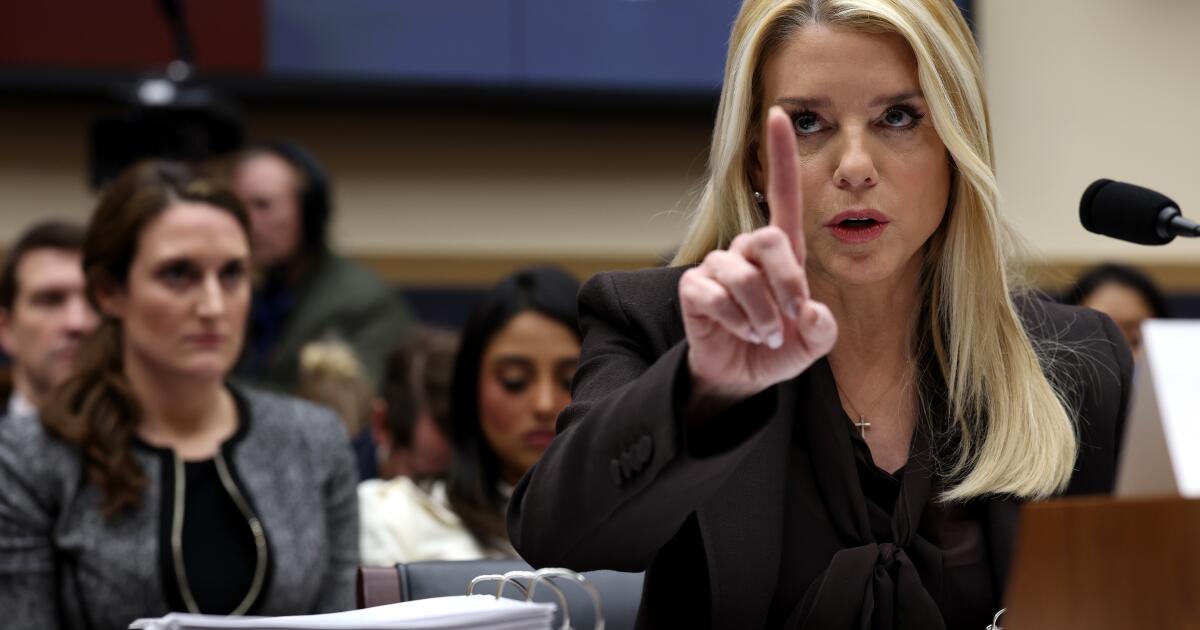
U.S. Atty. Gen. Pam Bondi repeatedly sparred with lawmakers on Wednesday as she was pressed over the Justice Department’s handling of the Jeffrey Epstein investigation and faced demands for greater transparency in the high-profile case.

Bondi accused Democrats and at least one Republican on the House Judiciary Committee of engaging in “theatrics” as she fielded questions about redaction errors made by the Justice Department when it released millions of files related to the Epstein case last month.

The attorney general at one point acknowledged that mistakes had been made as the Justice Department tried to comply with a federal law that required it to review, redact and publicize millions of files within a 30-day period. Given the tremendous task at hand, she said the “error rate was very low” and that fixes were made when issues were encountered.

Her testimony on the Epstein files, however, was mostly punctuated by dramatic clashes with lawmakers — exchanges that occurred as eight Epstein survivors attended the hearing.

In one instance, Bondi refused to apologize to Epstein victims in the room, saying she would not “get into the gutter” with partisan requests from Democrats.

In another exchange, Bondi declined to say how many perpetrators tied to the Epstein case are being investigated by the Justice Department. And at one point, Rep. Thomas Massie (R-Ky.) said the Trump administration was engaging in a “cover-up,” prompting Bondi to tell him that he was suffering from “Trump derangement syndrome.”

The episodes underscore the extent to which the Epstein saga has roiled members of Congress. It has long been a political cudgel for Democrats, but after millions of files were released last month, offering the most detail yet of Epstein’s crimes, Republicans once unwilling to criticize Trump administration officials are growing more testy, as was put on full display during Wednesday’s hearing.

Among the details uncovered in the files is information that showed Commerce Secretary Howard Lutnick had closer ties to Epstein than he had initially led on.

Rep. Becca Balint (D-Vt.) asked Bondi if federal prosecutors have talked to Lutnick about Epstein. Bondi said only that he has “addressed those ties himself.”

Lutnick said at a congressional hearing Tuesday that he visited Epstein’s island, an admission that is at odds with previous statements in which he said he had cut off contact with the disgraced financier after initially meeting him in 2005.

“I did have lunch with him as I was on a boat going across on a family vacation,” Lutnick told a Senate panel about a trip he took to the island in 2012.

As Balint peppered Bondi about senior administration officials’ ties to Epstein, the back and forth between them got increasingly heated as Bondi declined to answer her questions.

“This is not a game, secretary,” Balint told Bondi.

“I’m attorney general,” Bondi responded.

“My apologies,” Balint said. “I couldn’t tell.”

In another testy exchange, Rep. Ted Lieu (D-Torrance) pressed Bondi on whether the Justice Department has evidence tying Donald Trump to the sex-trafficking crimes of Jeffrey Epstein.

Bondi dismissed the line of questioning as politically motivated and said there was “no evidence” Trump committed a crime.

Lieu then accused her of misleading Congress, citing a witness statement to the FBI alleging that Trump attended Epstein gatherings with underage girls and describing secondhand claims from a limo driver who claimed that Trump sexually assaulted an underage girl who committed suicide shortly after.

He demanded Bondi’s resignation for failing to interview the witness or hold co-conspirators to account. Other Democrats have floated the possibility of impeaching Bondi over the handling of the Epstein files.

Beyond the Epstein files, Democrats raised broad concerns about the Justice Department increasingly investigating and prosecuting the president’s political foes.

Rep. Jamie Raskin of Maryland, the top Democrat on the House Judiciary Committee, said Bondi has turned the agency into “Trump’s instrument of revenge.”

“Trump orders up prosecutions like pizza and you deliver every time,” Raskin said.

As an example, Raskin pointed to the Justice Department’s failed attempt to indict six Democratic lawmakers who urged service members to not comply with unlawful orders in a video posted in November.

“You tried to get a grand jury to indict six members of Congress who are veterans of our armed forces on charges of seditious conspiracy, simply for exercising their 1st Amendment rights,” he said.

During the hearing, Democrats criticized the Justice Department’s prosecution of journalist Don Lemon, who was arrested by federal agents last month after he covered an anti-immigration enforcement protest at a Minnesota church.

Bondi defended Lemon’s prosecution, and called him a “blogger.”

“They were gearing for a resistance,” Bondi testified. “They met in a parking lot and they caravanned to a church on a Sunday morning when people were worshipping.”

The protest took place after federal immigration agents fatally shot two U.S. citizens, Renee Good and Alex Pretti, in Minneapolis.

Six federal prosecutors resigned last month after Bondi directed them to investigate Good’s widow. Bondi later stated on Fox News that she “fired them all” for being part of the “resistance.” Lemon then hired one of those prosecutors, former U.S. Atty. Joe Thompson, to represent him in the case.

Bondi also faced questions about a Justice Department memo that directed the FBI to “compile a list of groups or entities engaged in acts that may constitute domestic terrorism” by Jan. 30, and to establish a “cash reward system” that incentivizes individuals to report on their fellow Americans.

Rep. Mary Gay Scanlon, (D-Pa.) asked Bondi if the list of groups had been compiled yet.

“I’m not going to answer it yes or no, but I will say, I know that Antifa is part of that,” Bondi said.

Asked by Scanlon if she would share such a list with Congress, Bondi said she “not going to commit anything to you because you won’t let me answer questions.”

Scanlon said she worried that if such a list exists, there is no way for individuals or groups who are included in it to dispute any charge of being a domestic terrorists — and warned Bondi that this was a dangerous move by the federal government.

“Americans have never tolerated political demagogues who use the government to punish people on an enemy’s list,” Scanlon said. “It brought down McCarthy, Nixon and it will bring down this administration as well.”

Source link

Isaiah Stewart, three others suspended after Pistons-Hornets brawl

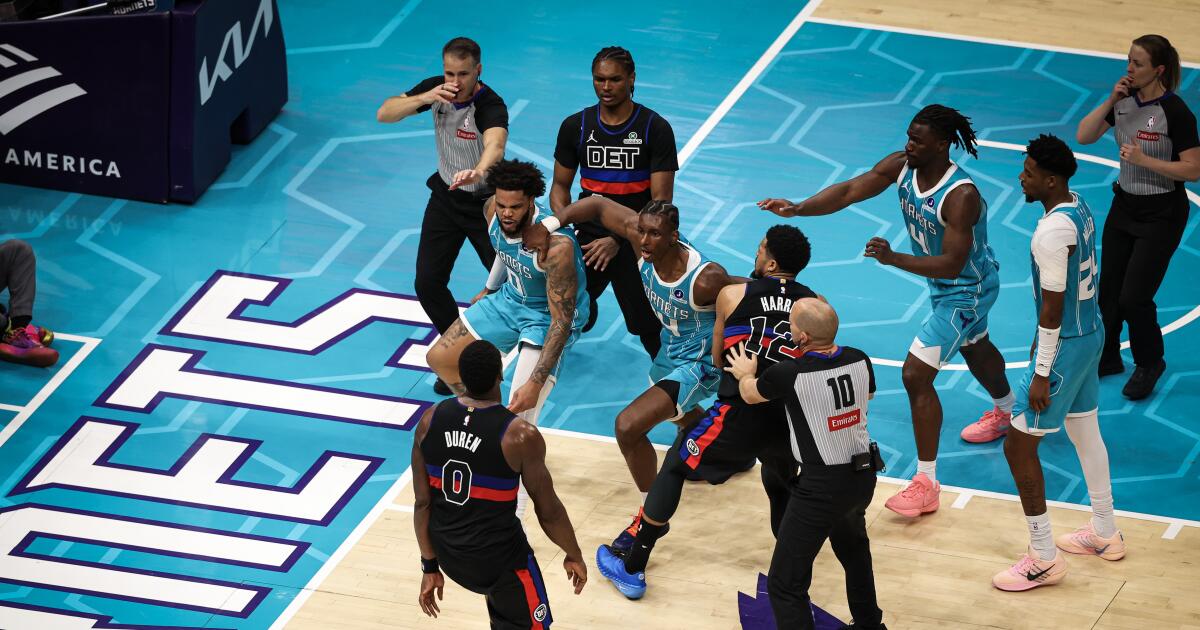
Four players have been suspended by the NBA in connection with a brawl that broke out during the Detroit Pistons-Charlotte Hornets game Monday night, the league announced Wednesday.

It was the same four players that were ejected during the Pistons’ 110-104 victory at Spectrum Center in Charlotte, N.C.

Detroit center Isaiah Stewart was suspended seven games for leaving the bench area, aggressively entering an on-court altercation and fighting. This is Stewart’s fifth suspension in his six-year NBA career. One resulted from an altercation with the Lakers’ LeBron James in 2021 and another from an altercation that spilled into the stands during a game against the Minnesota Timberwolves last year.

“The length of Stewart’s suspension is based in part on his repeated history of unsportsmanlike acts,” the NBA said in a statement.

Charlotte forwards Miles Bridges and Moussa Diabaté were each suspended four games for fighting and escalating the altercation. Detroit center Jalen Duren received a two-game suspension for initiating the altercation and fighting.

The incident took place midway through the third quarter after Duren was fouled by Diabaté while driving toward the basket. Duren approached Diabaté and the two men appeared to bump into each other. Duren then appeared to hit Diabaté in the face with an open hand to ignite a brawl that lasted more than 30 seconds.

Bridges and Duren exchanged punches at one point, and Stewart left the bench and fought with Bridges.

The suspensions begin Wednesday, when the Pistons play the Raptors in Toronto and the Hornets host the Atlanta Hawks.

Soon after the punishments were announced, Diabaté posted an apology to “the Hornets coaches, staff, front office, teammates, and best fans in the NBA” on his Instagram Story.

“As a player, I pride myself on my passion and my commitment to giving everything on the court during every possession,” he wrote. “However, in the heat of a highly competitive and physical matchup, I allowed my emotions to get the better of me, and for that, I am truly sorry.

“I understand the responsibility I carry as a professional athlete and as a role model. I view this as a learning experience and am fully committed to growing from it both as a player and a person. … Thank you for your understanding and continued support.”

The Associated Press contributed to this report.

Source link

Russian drones kill 3 toddlers, father in Ukraine

Local people clear debris at the site of a Russian airstrike in the Sloviansk, Donetsk region, on Wednesday after Russia resumed its attacks on Monday. Photo by Tommaso Fumagalli/EPA

Feb. 11 (UPI) — Local officials said a Russian drone strike on Ukraine‘s northeastern Kharkiv region killed three toddlers and their father, and injured their pregnant mother Wednesday.

The family was spending its first night in their new home in Bohodukhiv when it was struck during a drone and missile attack, regional leader Oleh Synegubov announced, the BBC reported.

The attack killed 2-year-old twins Ivan and Vladislav, their 1-year-old sister, Myroslava, and their father, Gryhoriy, 34.

The family’s 35-year-old injured mother, Olha, was 35 weeks pregnant and sustained burns and head injuries as the home was completely destroyed, local officials said.

Bohodukhiv Mayor Volodymyr Belyi called the aerial attack a “crime that is beyond human comprehension,” as reported by CNN.

“We lost the most precious thing we had — our future,” Belyi added.

The family recently evacuated the town of Zolochiv, which is located near the Russian border, due to ongoing shelling and sought refuge in Bohodukhiv, which is located 38 miles west of Kharkiv.

The attack shows that Russia has no intention of ending the war that it started by invading Ukraine on Feb. 24, 2022, Ukrainian President Volodymyr Zelensky said.

“Each Russian strike undermines confidence in everything that is being done diplomatically to end this war,” Zelensky said in a statement.

He said Russia deployed 129 attack drones during the overnight hours that struck Kharkiv, Dnipropetrovsk, Poltava and Zaporizhzhia.

The aerial attacks carried into the daytime hours on Wednesday and included a strike on a medical vehicle that was carrying five healthcare professionals and civilians. One woman died in that attack.

Russian forces also launched two ballistic missiles that targeted the area near Lviv on Wednesday afternoon, but Ukrainian aerial defenses intercepted and destroyed them.

Russia had paused the aerial attacks for a week amid extremely cold weather, but Monday’s resumption killed a 10-year-old boy and a 41-year-old woman in Bohodukhiv.

The town has been targeted every day so far this week as Russian forces seek to damage energy and transport infrastructure with drones and ballistic missiles.

The strikes caused Ukrainian officials to declare a state of emergency due to the effect on local energy sources.

Tens of thousands of Ukrainians are without power and lack heat and running water during the frigid winter weather.

Russia’s resumption of attacks comes as Ukrainian and Russian officials are considering meeting in Washington, D.C., to further discuss a potential cease-fire and plan for peace.

Source link

T20 World Cup: West Indies beat England by 30 runs to lead Group C | ICC Men’s T20 World Cup News

Rutherford’s 76 and spinners’ control help the two-time champions beat the 2022 winners at the Wankhede Stadium.

Sherfane Rutherford struck ‌a belligerent half-century and Gudakesh Motie produced a brilliant display of spin bowling ⁠as West Indies ⁠thumped England by 30 runs in T20 World Cup Group C.

Rutherford smacked seven sixes in his unbeaten 76 off 42 deliveries to provide ⁠the bedrock of his team’s imposing total of 196-6 at the Wankhede Stadium in Mumbai on Wednesday.

Recommended Stories

list of 4 itemsend of list

Twice champions West Indies returned to choke their opponents with spin and bundled out England for 166 in 19 overs ⁠to top the group with their second successive victory.

England slipped to third place, behind Scotland, after their first defeat in the tournament.

“Disappointing. It’s never nice to lose a game, but West Indies played outstanding,” England captain Harry Brook said.

“We thought it was a chaseable total for ‌sure but it didn’t dew up as much as we expected and didn’t skid onto the bat.”

Put into bat, West Indies lost both openers in the first seven deliveries of their innings.

Shimron Hetmyer (23) and Roston Chase (34) steadied the ship before Rutherford walked in to light up the Wankhede Stadium.

He shared a 61-run stand with Jason Holder, who struck four sixes in his 33 off 17 balls, to take West ⁠Indies close to 200.

Leg-spinner Adil Rashid excelled for England, conceding only ⁠16 runs in his four overs and claiming the wickets of Chase and Rovman Powell.

England made a flying start before losing Phil Salt (30) in the fourth over.

Chase removed Jos Buttler for 21 and left-arm spinner Motie ⁠produced a double strike to turn the heat on England, who slumped to 93-4 at the halfway stage of their innings.

The ⁠situation demanded caution and Brook duly curbed his normal ⁠aggression but the West Indian spinners would not be denied.

Motie (3-33) caught Brook off his own bowling and Chase trapped Will Jacks lbw to further turn the screw.

Sam Curran made a valiant 43 not out down the order ‌but lacked support.

“I have put in a lot of work coming into the World Cup,” Rutherford said.

“I trust my process and I can score runs in the end when ‌I ‌play with a clear mind. We were maybe 10 runs behind what we wanted given England’s powerful batting but the guys bowled well.”

INTERACTIVE -WINNERS- T20 MEN'S CRICKET WORLD CUP - 2026 - FEB3, 2026 copy-1770220851
(Al Jazeera)

Source link

BBC Radio 1 star reveals when she’ll return to the air nine months after giving birth

BBC Radio 1 presenter Roisin Hastie has shared when she’ll be coming back on air after giving birth.

The radio star welcomed her second child in May of last year with her husband Jimmy blake.

Roisin shared a carousel of images reintroducing herself and her career journey to followersCredit: Instagram
Her sweet second child also made an appearanceCredit: Instagram
The final photo revealed Roisin plans to come back to BBC Radio 1 in April of this yearCredit: Instagram

But nine months on Roisin is gearing up for her big return to the studio.

Roisin shared a carousel of captioned images to her Instagram account this morning, reintroducing herself since exiting the airwaves.

The first snap shows a smiling Roisin in a selfie, with “it’s been a while so thought I’d say hi and introduce myself” penned over the top.

Roisin then shared a throwback snap of herself with a mic in a booth, detailing how she’s been “a journalist for 14 years!”.

BABY JOY!

BBC Radio 1 star gives birth to second child as she reveals adorable name and pic


live on air

BBC R1 reveal ANOTHER presenter re-shuffle as Love Island & TikTok stars join

More picture to follow showed Roisin with friends, the love of her life, and of course her newborn baby.

The last photo, however, got fans especially excited.

She wrote over a photo of the iconic BBC News red microphone, Roisin shared: “But making this ]post] has reminded me there’s a whole part of myself I’m excited to get back to.

“I’ll be back on air from April.

“Feels so strange to be thinking about work when I’ve spent the last 9 months in my baby bubble.

Roisin is loved for her cracking sense of humour on airCredit: Instagram

“Keen to jump into this new chapter with both feet.

“DM’s are always open so say hi.”

Fans were thrilled by the news and took to the comment section, with one writing: “Love you! So fab, the best of us.”

“Love this and miss hearing you on R1!,” said a second.

A third added: “ICONIC.”

Rosie works alongside Radio 1 DJ Greg James, who congratulated her live on the radio when she announced the birth of her second baby.

He shared: “We’ve got some breaking news, we’ve got breaking news.

“I’ve just heard from her wonderful husband Jimmy Blake that Roisin has given birth to her wonderful little baby boy Arlo.

“Lovely Arlo finally arrived at 4.55 this morning.

“Lovely Rosie who is still going to be doing the breakfast news when she’s back off maternity leave.

“A 37 hour labour. 37 hours! I want to big up the midwives, Eve and Gemma who were apparently there the whole way through.

“And I’m going to make Arlo star listener!”

Roisin first joined Radio 1 in 2018 as a newsreader.

She gave birth to her son in May of last yearCredit: Instagram

Source link

L.A. County labor coalition backs Karen Bass, slams Raman as a ‘political opportunist’

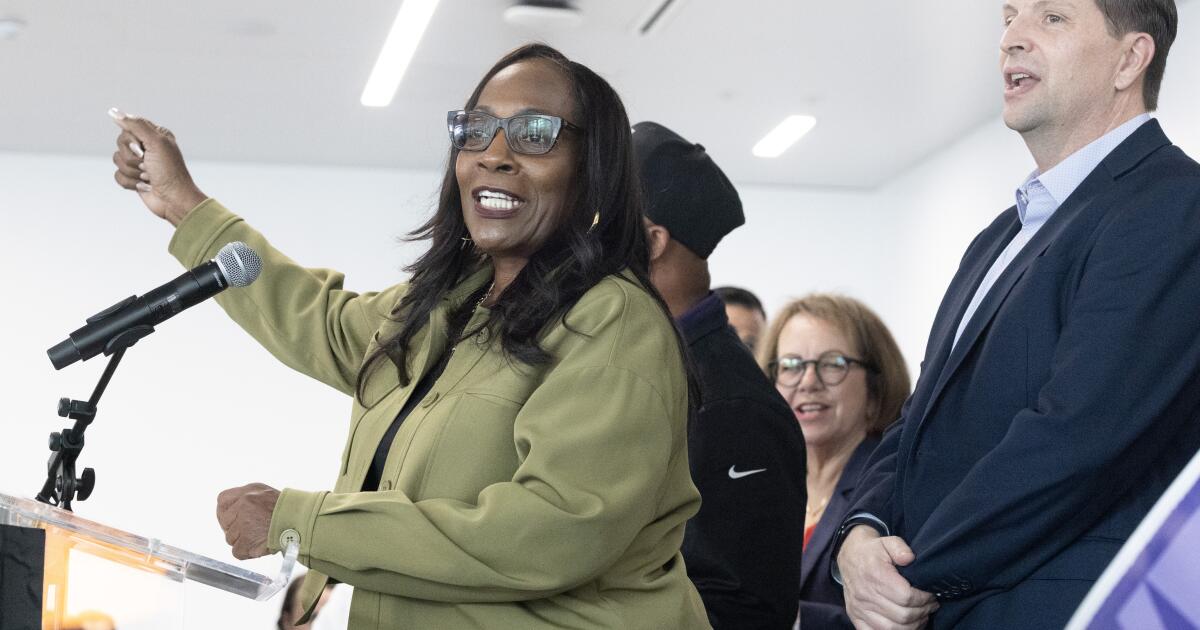
The head of the powerful Los Angeles County Federation of Labor, AFL-CIO, blasted Nithya Raman on Wednesday, calling the city council member an “opportunist” for launching a campaign to unseat Mayor Karen Bass after previously signaling her support for Bass.

Federation president Yvonne Wheeler said in a statement that her organization, which represents an estimated 800,000 workers, will “use every tool” in its arsenal to get Bass reelected.

“With Donald Trump’s ongoing war against the people of Los Angeles, our working families and immigrant communities, now is not the time for distractions from a political opportunist — especially one who backed the Mayor’s re-election campaign just weeks ago,” Wheeler said.

Raman, whose district stretches from Silver Lake to Reseda, was announced as one of the mayor’s endorsers on Jan. 27 in a campaign press release listing Bass’ San Fernando Valley supporters. Two days later, she appeared in a second campaign press release as one of Bass’ female endorsers.

Raman launched her own last-minute mayoral bid on Saturday, saying that City Hall is unable to “manage the basics.”

The primary election is June 2, followed by a November runoff if no candidate secures a majority of the vote.

Raman’s campaign team did not immediately respond to Wheeler’s assertions after being contacted by The Times.

In her statement, Wheeler described Bass as a “lifelong progressive” while suggesting that Raman, whose council campaigns were backed by the Democratic Socialists of America and several other progressive groups, falls short on that front.

“You can’t truly be progressive unless you are a true champion of working people,” she said. “Karen Bass is the only candidate in this race who meets that criteria.”

The federation represents about 300 labor organizations in L.A. County, including unions representing teachers, social workers, construction trades and entertainment industry workers. In previous city elections, the group has spent big on its favored candidates, paying for campaign materials, door-to-door canvassers and other expenses.

Raman broke with the labor federation and her colleagues in September, voting against the $2.6-billion expansion of the Los Angeles Convention Center.

Before that vote, labor unions said the upgrade would generate much-needed construction jobs at a time when housing production has been down. Raman and Councilmember Katy Yaroslavsky warned the project was too financially risky and would saddle the city with significant budget shortfalls starting in 2031 — after Bass is out of office.

“What I fear is that we’re going to have a beautiful new Convention Center surrounded by far more homelessness than we have today, which will drive away tourists, which will prevent people from coming here and holding their events here,” Raman said at the time.

Bass supported the project, as did a majority of the council.

Raman also drew the ire of some construction union leaders last month by drafting a last-minute proposal to ask voters to change Measure ULA, a tax on property sales of $5.3 million and up. Raman, who described herself as a supporter of Measure ULA, brought her proposal to the council floor one day before the deadline to take action.

Raman, who backed Measure ULA in 2022, said she now believes it has had unintended consequences, putting a major damper on real estate development and inhibiting the production of much-needed housing.

Source link

T20 World Cup: England batters too ‘careful’ in defeat by West Indies, says Harry Brook

Brook’s assessment is a familiar one.

After England were bowled out for 131 in a one-day international against South Africa last year, he said his could have “gone a little bit harder with the bat”.

When they lost an ODI in New Zealand before Christmas, Brook asked, “Can we go harder?”.

Against the impressive Windies, Tom Banton also chipped a catch to extra cover pushing a drive off Motie, while Jacob Bethell and Will Jacks were bowled and pinned lbw respectively playing from the crease.

“Chasing nearly 200 is always a big ask and we thought the pitch would get a little bit better and it would slide on to the bat a little bit more, but that didn’t happen,” Brook said.

“We were probably a little bit careful, myself included.”

In the absence of dew, which makes it harder for bowlers to grip the ball, the pitch at Wankhede Stadium offered more turn than any other at this World Cup so far.

England played spin well on their recent tour of Sri Lanka, where they won a T20 series 3-0, but here familiar issues resurfaced.

“I thought we played spin outstanding in Sri Lanka and we’ve just had a bad day today,” Brook said.

“We didn’t manage to get over the line and they bowled well.”

Brook also backed leading pace bowler Jofra Archer, who conceded 48 runs from his four overs after being hit for 42 in the win over Nepal on Sunday.

“Everybody knows how good Jof is,” Brook said.

“He’ll bounce back for sure. He’s bowling rapid and I’m sure he’ll execute better in the coming games.”

England face Scotland on Saturday before their final Group C match against Italy on Monday, with both games taking place in Kolkata.

Source link

Libya issues rare oil exploration licences to foreign firms | Energy News

Winning bidders include Chevron, Eni, QatarEnergy and Aiteo.

Libya has assigned new oil and gas exploration rights to foreign firms, aiming to revamp the sector after years of civil strife.

The country’s National Oil Corporation (NOC) announced the results of its first licensing round since 2007 on Wednesday. Winners included US oil giant Chevron and Africa’s largest privately-owned energy company, Nigeria’s Aiteo.

Recommended Stories

list of 3 itemsend of list

Other winning bidders were consortia: Spain’s Repsol with British Petroleum, Eni North Africa with QatarEnergy, and Repsol with Hungary’s MOLGroup and Turkiye Petrolleri.

The licensing awards signal some renewed interest in Libya’s oil sector, which foreign investors had long been wary of after the country erupted into conflict in 2011 with the overthrow of longtime ruler Muammar Gaddafi. But experts said the response was smaller than expected.

“It is likely that lingering uncertainty over Libya’s political dysfunction and insecurity in the areas around the blocks on offer were factors in the underwhelming response,” Hamish Kinnear, an analyst with UK-based risk consultancy Verisk Maplecroft, told the AFP news agency.

Masoud Suleiman Musa, acting chairman of Libya's National Oil Corporation (NOC), and other corporate represntatives pose for a family photo during a conference announcing the first new grants of oil exploration and production licences in 17 years, in Libya's capital Tripoli on February 11, 2026. The hydrocarbon-rich country is seeking to draw major global energy companies back, while boosting daily oil production by 850,000 barrels over the next 25 years. The winners of the latest bidding round included US oil giant Chevron and Nigeria's Aiteo. (Photo by Mahmud Turkia / AFP)
Masoud Suleiman Musa, acting chairman of Libya’s National Oil Corporation, and other corporate representatives attend a conference announcing grants of oil exploration and production licences, in Tripoli, Libya, February 11 [Mahmud Turkia/AFP]

Libya remains politically divided between rival administrations in the east and west, and disputes over the central ‌bank and oil revenues often disrupt production at key oil fields.

‘Return of trust’

The licensing round, in which five of 20 blocks on offer were awarded, follows a $20bn deal last month with France’s TotalEnergies and ConocoPhillips to boost oil production over 25 years.

Prime Minister Abdelhamid Dbeibah, who announced the deal, said the goal was to increase daily oil production by 850,000 barrels within that timeframe. Libya currently produces approximately 1.4 million bpd.

The round used a new, more investor-friendly contract model to replace the rigid terms that previously deterred investment.

NOC chief Masoud Suleman said a committee will be created to further “improve the terms” of the bidding system and negotiate with candidates to grant unallocated blocks.

Speaking at the bid’s announcement ceremony, he said “a return of trust and resuming institutional work in one of the country’s most important sectors after a long period of pause and challenges.”

“They are part of a broader national path that aims for prosperity, growth, the return of normalcy,” he added.

Source link

Venezuela: Oil Production Recedes Under US Blockade, Gov’t Denies Israel Shipment

The US Treasury has issued a license allowing the export of goods and technology for oil exploration in Venezuela under strict conditions. (Reuters)

Caracas, February 11, 2026 (venezuelanalysis.com) – Venezuela’s oil output contracted to a two-year low following  Washington’s month-long naval blockade against the Caribbean nation’s crude exports.

The latest OPEC monthly report placed Venezuela’s January production at 830,000 barrels per day (bpd), down from 917,000 bpd in December, according to secondary sources. The figure is the lowest since May 2024. 

For its part, state oil company PDVSA reported 924,000 bpd produced in January, down from 1.12 million bpd the prior month. The direct and secondary measurements have differed over the years due to disagreements over the inclusion of natural gas liquids and condensates.

The output contraction was a result of the US Navy imposing a blockade on Venezuelan oil exports and seizing several tankers allegedly involved in Venezuelan crude shipments. The exhaustion of storage capacity forced PDVSA and partners to cut back production.

The blockade came on top of draconian sanctions that have stymied the Venezuelan oil industry for years. Since 2017, Washington has levied financial sanctions, an export embargo, secondary sanctions, and a host of other coercive measures aimed at strangling the country’s main source of foreign revenue.

Following the January 3 US military strikes and kidnapping of Venezuelan President Nicolás Maduro, Venezuelan oil began to flow once more under an arrangement imposed by the Trump administration. Commodity traders Vitol and Trafigura have been lifting Venezuelan crude, depositing proceeds in White House-administered bank accounts in Qatar, and offering cargoes to customers all over the world.

On Tuesday, the Venezuelan government denied a Bloomberg report that the country had shipped crude to Israel. According to the business outlet, the shipment would be delivered to the Bazan Group, Israel’s largest refiner. Bloomberg did not specify whether the Venezuelan crude cargo was purchased from Vitol, Trafigura, or another source. As part of the new US-imposed arrangement, the sale marks the first time Venezuelan oil will reach Israel since at least 2020, per Bloomberg. 

The Trump administration has sought to leverage its influence over the Venezuelan oil sector to pressure allies such as India to replace imports from US geopolitical rivals, including Russia and Iran. Indian public companies Indian Oil and Hindustan Petroleum are set to join private refiner Reliance Industries in purchasing Venezuelan oil, with 2 million barrels of Merey crude expected to be delivered in the coming weeks. Nevertheless, Venezuelan supplies are not expected to significantly alter global demand given the present output and the extra-heavy nature of Venezuelan crude blends.

US and European firms have likewise acquired Venezuelan cargoes in recent weeks.

For their part, Venezuelan acting authorities have courted foreign investment and enacted a pro-business overhaul of the country’s oil legislation. The reform offers lower taxes and royalties, as well as increased control over operations and sales, to private corporations, reducing the role played by the Venezuelan state.

Trump administration officials praised the oil reform for “eradicating restrictions” on private investment, while the US Treasury Department has issued several sanctions exemptions to boost US corporate involvement in the Venezuelan oil industry.

A January 29 license allowing US companies to purchase and market Venezuelan crude was followed up with a waiver on diluent exports to Venezuela on February 3. On Tuesday, the US Treasury published General License 48 permitting US exports of goods, technology and software for oil exploration to Venezuela.

The sanctions waivers demand that contracts be subjected to US law and forbid any transactions with companies from Russia, Iran, Cuba, North Korea, and China. They also mandate that payments be deposited in accounts determined by the US Treasury.

In early February, US officials confirmed that US $500 million from crude sales had been rerouted to the South American country, to be offered in foreign currency auctions by public and private banks. A further $300 million is expected in the coming days. 

However, the initial deal announced by Trump comprised 30-50 million barrels and an estimated $2 billion. Venezuelan authorities have not disclosed what portion of revenues the country will receive, while Trump has said the US will “keep some” of the income. 

Senior Trump administration officials have vowed to maintain control over Venezuelan oil exports for an “indefinite” period, with Secretary of State Marco Rubio claiming that the Venezuelan acting government headed by Delcy Rodríguez needs to submit a “budget request” before accessing the country’s oil proceeds.

Source link

Bridgerton star lands new role worlds away from period drama character

Bridgerton star Claudia Jessie has landed a leading role in an upcoming Channel 4 drama.

Bridgerton season four part two teased in trailer

Bridgerton’s Claudia Jessie has secured a leading role in an upcoming Channel 4 drama, where she’ll star alongside Glenn Close.

Known for her portrayal of Eloise, the sharp-tongued and defiant fifth child in Netflix’s popular period drama Bridgerton, Jessie is set to take on a contrasting role in Up To No Good. The six-part series marks the television writing debut for playwrights Nina Raine and Moses Raine, who have adapted Helen Tursten’s short story collections An Elderly Lady Is Up to No Good and An Elderly Lady Must Not Be Crossed.

A press release teasing the forthcoming series reveals that Fatal Attraction star Glenn Close will portray Maud Oldcastle, described as “a hilariously brusque, cantankerous, ruthless older woman-and those are her nice qualities”.

The synopsis continues: “She is also a killer. Determined to break from a lifetime spent caring for her sister, Maud sets out to claim a long-overdue second act, but when a suspicious young detective investigating a death in Maud’s building starts to believe there is more to her than meets the eye, Maud is forced to reckon with her crimes, present and past.”

Toxic Town’s Jessie will be stepping into the shoes of young detective Hannah, with Andor’s Gloria Obianyo portraying Astrid, EastEnders‘ Anita Dobson as Elsa, Game of Thrones’ Ben Crompton playing Barry, and The Wheel of Time’s Meera Syal taking on the role of Margaret. Rounding off the star-studded cast announcement, Downton Abbey’s Penelope Wilton will be seen as Charlotte, reports the Manchester Evening News.

Rebecca Holdsworth, Commissioning Editor for Drama at Channel 4, expressed her excitement in a statement: “Nina and Moses Raine’s deliciously dark and witty world has drawn together a truly fantastic line-up, and we’re excited for audiences to be introduced to Maud Oldcastle and the unforgettable characters surrounding her. UP TO NO GOOD promises a bold, razor sharp and wickedly entertaining series that feels undoubtedly Channel 4.”

Scott Huff, Joint Managing Director, Playground, also shared his enthusiasm, saying: “We are thrilled to have brought together this extraordinary group of artists for UP TO NO GOOD. A cast of this calibre is a testament to Nina and Moses’s brilliant scripts, our casting director Robert Sterne’s exceptional taste and Glenn Close’s legendary talent. We can’t wait for audiences to see this group of actors together on screen.”

Andrew Plotkin, EVP of Drama Development at Sony Pictures Television, commented: “We are thrilled to have Lee Haven Jones directing the series, not only setting the tone, but immersing himself on the ground throughout production. With a standout cast joining Glenn to bring Nina and Moses’ brilliantly crafted scripts to life, their collaboration further elevates the storytelling at the heart of UP TO NO GOOD. What’s coming together is remarkable, and audiences are in for something truly special.”

The new series will see Claudia in a character completely different from her present role as an outspoken and curious Bridgerton daughter, who desperately resists societal pressures and would rather immerse herself in books than attend balls, showing minimal interest in marriage or potential suitors.

The current season follows Benedict Bridgerton (Luke Thompson) as he searches for a mysterious woman, Sophie Baek (Yerin Ha), whom he met at a masquerade ball. It’s also building towards Eloise’s storyline, with Claudia having previously hinted at what lies ahead for her character when her moment in the spotlight eventually arrives.

The Shonda Rhimes production, based on Julia Quinn’s novels, first graced our screens in 2020, tracing the romantic journey of Daphne Bridgerton (Phoebe Dynevor) and Simon Basset (Regé-Jean Page). The following two series then saw the eldest Bridgerton sibling Anthony (Jonathan Bailer) tie the knot with Kate Sharma (Simone Ashley), and third Bridgerton son Colin’s (Luke Newton) passionate affair with the true author of Lady Whistledown, Penelope Featherington (Nicola Coughlan).

Discussing how the current series is paving the way for her own season, Claudia shared with RadioTimes.com: “Eloise is desperately trying to find her way of doing it, right? That’s what I’ve always been excited to be able to one day do, is to show love or romance or whatever her journey is in the most Eloise way possible. I think she’s just trying to find out her way of doing it.”

For the latest showbiz, TV, movie and streaming news, go to the new **Everything Gossip** website

She further added: “That’s what I think the set-up is until ultimately we see what her way of doing it is, her version of it. I’m buzzing to one day do it. I love this show with my whole heart.”

Discussing the future of her character, she previously shared with Netflix Tudum: “I like the idea of her becoming political. Obviously, romance is a very important part of the show, but out of all of the characters, Eloise is the one you’d like to see go a slightly different route. Because we see it in Season 2 where she’s meeting different people in different parts of society and reading new things, so I’d like to see that continue. Right now, she’s young and she’s just taking everything in. But I’d like her to have a really clear purpose, something that she really desires.”

Bridgerton is available to watch on Netflix.

Source link

SpaceX IPO Would Set Record As First Trillion‑Dollar Offering As More Giants Line Up

Home News SpaceX IPO Would Set Record As First Trillion‑Dollar Offering As More Giants Line Up

OpenAI, Anthropic, and Databricks lead a new class of super-sized private companies eyeing public markets.

The US IPO market has never seen a trillion-dollar debut. That may soon change as a wave of mega-valued private companies considers tapping public markets, which are eager for fresh stock.

Behind the headlines about the potential Elon Musk IPO from the newly merged SpaceX and xAI is a class of potential mega-sized deals currently valued in the hundreds of billions, supported by a thriving ecosystem for funding big companies in private markets.

SpaceX’s private market valuation is estimated at $1.25 trillion, placing it ninth in the S&P 500. That’s just below Tesla’s $1.5 trillion valuation and ahead of Warren Buffett’s Berkshire Hathaway ($1.1 trillion) and Walmart ($1.05 trillion).

If Musk succeeds in taking SpaceX public this year, it will likely sell about 10% of its equity in the IPO, raising $125 billion. That figure would handily exceed Saudi Aramco’s IPO proceeds of $29.4 billion, the largest global IPO ever, and Alibaba’s IPO proceeds of $21.8 billion, still the largest ever in the US since its 2014 debut.

“There is no precedent for an IPO this large,” Morningstar passive strategies analyst Zachary Evens said in an email to Global Finance. “I am interested to see if index providers make exceptions for mega IPOs since they will instantly reshape the market.”

Nasdaq is considering a special “fast entry” rule that would allow a company to join its flagship index after its first 15 trading days, he said.

Meanwhile, OpenAI is currently valued at about $500 billion. That’s roughly double Alibaba’s $236 billion enterprise value, the current record holder for a US IPO, when it went public in 2014.

Anthropic, the company behind the Claude AI service, is valued at about $374 billion — also bigger than Alibaba — and business software specialist Databricks tips the scales at $134 billion.

These companies also dwarf the $81 billion valuation of Facebook at its 2012 IPO or the $75.5 billion market cap of Uber Technologies at its 2019 IPO.

To be sure, it’s possible that the sky-high valuations of these private companies could take a big hit amid uncertainty on Wall Street about whether unprecedented spending on AI will pay off. The window to take companies public slammed shut in April of last year after the launch of the US’s Liberation Day tariff regime. And it could do so again if the recent tech selloff driven by AI jitters continues.

While the companies are part of an ecosystem that developed and grew in the years following the Financial Crisis, they’ve never experienced a severe recession or a bubble burst, such as the dot-com meltdown of 2000-2001.

Still, after a sluggish IPO market in recent years and the dwindling number of listed companies due to take-private and other merger deals in the marketplace, brokers remain hungry for more public stock, said Mark Lehmann, vice chair of the commercial bank at Citizens Financial Group.

“There’s a whole host of people who will want exposure to these companies,” he said, including institutions, wealthy individuals, and retail investors.

Kaush Amin, managing director and head of private market investing at US Bank, said that valuations of some AI companies assume widespread use of their products within five to ten years. That’s much faster than the 70 years it took for the Industrial Revolution to diffuse across the U.K. and the 25 years it took for the internet to take hold across the economy.

Some pockets of the tech sector are very overvalued because the numbers may not reflect the infrastructure support AI needs and how long it may take to build and be adopted across the economy. There’s a need for capex funding, data centers, chip purchases, and power purchases. This all takes time and money.

Other than Nvidia or other large strategic players – maybe Softbank, for example – there aren’t many players out there that can write big enough checks, Amin said.

While the debate continues over how these and other unicorns will fare after going public, the private capital ecosystem continues to grow.

Morgan Stanley acquired EquityZen, a private markets brokerage, and folded the business into its investment portfolio for its wealthy clients. The deal will also enable the bank to help sell private stock earned as part of a client’s compensation package. Charles Schwab has similar plans with its acquisition of Forge Global.

David Shapiro, co-founder and CEO of OpenVC, which helped create the NYSE OPEN Venture Capital Unicorn Index, said investors are eager to secure stakes in companies before they go public – but they should be aware that fees may be much higher in some cases and that once an IPO debuts, it may fall flat.

“Sometimes, by the time these companies go public, all the juice has already been squeezed for investors,” said Shapiro. This is a reason to invest in companies before they go public — to realize bigger gains. The companies in the index alone add up to an addressable market of about $2 trillion or more, at last check. 

“People are hungry for these assets,” he said.

Source link

One elected to our Dodgers Dugout Hall of Fame and Ben Rortvedt is back

Hi, and welcome to another edition of Dodgers Dugout. My name is Houston Mitchell and pitchers and catcher have their first workout Friday!

Last month I asked you to vote from a list of candidates in our annual Dodgers Dugout Dodgers Hall of Fame. And, proving that you are the best newsletter readers in the universe, I received 29,213 ballots, the most we have gotten. Some cities don’t get that many votes in elections.

And after all the ballots were counted, one person was named on more than 75% of the ballots and are inducted into the 2026 class.

Remember, there was a players list, where you could vote for up to 10, and a nonplayers list with a limit of three votes.

So, without further ado, let’s look at the results. The number in parentheses is what percentage of ballots the candidate was on last year.

Elected

x-Clayton Kershaw, 94.7%: A no-brainer selection. I’m just surprised so many people left him off the ballot.

Just missed (50%-74.9%)

Jaime Jarrín, 71.8% (65.8%): Really, should have been a first-ballot Hall of Famer. A big oversight.

Peter O’Malley, 63.5% (65.1%): The last owner who cared about keeping prices down for fans.

Steve Garvey, 60.9% (64.4%): Either Garvey or Gil Hodges is the best first baseman in Dodgers history. Freddie Freeman is closing fast though.

Ron Cey, 58.3% (61.6%): One of the most underrated players in baseball history.

Don Newcombe, 52.9% (62.1%): His work to help Dodgers struggling with substance abuse is almost enough to get him in before you even consider his greatness as a pitcher.

Best of the rest (30%-49.9%)

Red Barber, 42.1% (45.4%): Vin Scully before there was a Vin Scully.

Mike Piazza, 41.5% (50.3%): What would Dodgers history look like if he hadn’t been traded?

Manny Mota, 39.3% (46.7%): Best pinch-hitter ever. He would stay on the roster the whole year and only pinch-hit.

Davey Lopes, 38.1% (47.1%): Best base stealer in Dodgers history.

Kirk Gibson, 37.4% (40.6%): One amazing season gets him almost 40% of the vote.

Dusty Baker, 35.4% (47.7%): Remember throwing bubble gum to him in left field? His support declined a great deal this year.

Jim Gilliam, 34.4% (40.5%): Jack of all trades who hated his “Junior” nickname.

Mike Scioscia, 32.5% (39.7%): Another what if: What if he had been named Dodgers manager instead of Angels manager?

Ross Porter, 32% (35.3%): Pioneered using more obscure stats before it became popular.

Tommy Davis, 31.9% (42.5%): Last Dodger to win a batting title before Trea Turner, and I’m not sure Turner counts.

Zack Wheat, 30.1% (28.9%): He should be in. The first truly great Dodgers position player.

Everyone else

Willie Davis, 28.2% (33.9%): People seem to prefer Tommy Davis.

Bill Russell, 28% (29.5%): Longtime Dodger draws the least support among “The Infield.”

Eric Karros, 25% (34.1%): This is all you get after hitting the most homers in L.A. history?

Johnny Podres, 24.9% (36.7%): The 1955 World Series MVP.

Carl Furillo, 23.2% (27.9%): Best arm in team history?

Eric Gagne, 22.8% (28.2%): Would he receive more support if not for his PED use?

Dazzy Vance, 21.5% (23.3%): Another guy who should be in. The Drysdale of his era.

Jerry Doggett, 21.8% (29.8%): Complemented Scully beautifully on radio and television.

Bottom 10, removed from ballot for at least two years

Buzzie Bavasi, 21.4% (32.1%): GM of Dodgers’ first four World Series title teams.

Rick Honeycutt, 20.9% (26.7%): Longtime pitching coach (and pitcher).

Carl Erskine, 20.2% (23.7%): Key member of 1955 title team.

John Roseboro, 19.5% (26.1%): The key catcher for Sandy Koufax and Don Drysdale.

Tommy John, 18% (23.3%): He should be in the real Hall of Fame.

Andre Ethier, 17.7% (23.1%): Doesn’t look like many from Ethier’s prime era will make it.

Pedro Guerrero, 16.6% (25.3%): You could argue that he is the best hitter in L.A. history.

Steve Yeager, 14.8% (20.6%): He blocked the plate as well as anyone ever.

x-Joe Kelly, 6.8%: I guess wearing a Mariachi jacket can get you only so far.

x-Alex Wood, 0.9%: He’ll have to settle for his World Series ring instead of our Hall honors.

x-first time on ballot.

The Dodgers Dugout Dodgers Hall of Fame

People inducted, with year (and percentage of vote)

Walt Alston, 2022 (86.5%)

Roy Campanella, 2021 (84.7%)

Don Drysdale, 2021 (90%)

Orel Hershiser, 2021 (75.1%)

Gil Hodges, 2022 (75.3%)

Clayton Kershaw, 2026 (94.7%)

Sandy Koufax, 2021 (95.6%)

Tommy Lasorda, 2022 (87.7%)

Walter O’Malley, 2024 (79.4%)

Branch Rickey, 2022 (72.1%)

Pee Wee Reese, 2024 (76.3%)

Jackie Robinson, 2021 (88.9%)

Vin Scully, 2021 (92.7%)

Duke Snider, 2021 (78.2%)

Don Sutton, 2025 (75.7%)

Fernando Valenzuela, 2022 (80.6%)

Maury Wills, 2022 (76.6%)

Listed in order of percentage:

Sandy Koufax, 2021 (95.6%)

Clayton Kershaw, 2026 (94.7%)

Vin Scully, 2021 (92.7%)

Don Drysdale, 2021 (90%)

Jackie Robinson, 2021 (88.9%)

Tommy Lasorda, 2022 (87.7%)

Walt Alston, 2022 (86.5%)

Roy Campanella, 2021 (84.7%)

Fernando Valenzuela, 2022 (80.6%)

Walter O’Malley, 2024 (79.4%)

Duke Snider, 2021 (78.2%)

Maury Wills, 2022 (76.6%)

Pee Wee Reese, 2024 (76.3%)

Don Sutton, 2025 (75.7%)

Gil Hodges, 2022 (75.3%)

Orel Hershiser, 2021 (75.1%)

Branch Rickey, 2022 (72.1%)

Note: In 2022, you had to be named on only 65% of the ballots to be inducted. It has been 75% all other years.

Ben is back

Remember Ben Rortvedt, who became a fan favorite as the backup catcher to Will Smith at the end of last season? The Dodgers signed him to a $1.1 million deal after the season, then soon after removed him from the 40-man roster. That meant other teams could claim him, and the Dodgers apparently hoped the $1.1 million price tag would scare teams off. It didn’t scare Cincinnati, which took him.

Last week, the Reds signed Eugenio Suárez, and to make room for him on the 40-man roster, they removed Rortvedt. And the Dodgers snatched him up quickly.

So Rortvedt is back with the team, and will compete with Dalton Rushing to be the backup catcher.

To make room for Rortvedt, the Dodgers removed left-handed reliever Anthony Banda from the roster. They signed Banda to a $1.625-million deal last month, so perhaps they are hoping no team will take him. In two seasons with the Dodgers, Banda is 8-3 with a 3.14 ERA and two saves in 119 games, including 71 games last season, so he was a workhorse. However, his strikeout rate declined last year while his walk rate increased, a troubling sign. The Dodgers have a lot of left-handed options, so he was the odd man out this time.

Bad news for Yasiel Puig

Former Dodger Yasiel Puig was found guilty Friday of obstruction of justice and making false statements to investigators. Puig was alleged to have lied about gambling on sports.

Puig faces a maximum of 20 years in prison. At one point, he was offered a plea deal where he would plead guilty to one count of lying to federal authorities and would have served no jail time while paying a $55,000 fine. He accepted the deal, then backed out of it because “I want to clear my name.”

In case you missed it

Yasiel Puig found guilty in gambling case, faces up to 20 years in prison

Terrance Gore, former Dodgers player and three-time World Series champ, dies at 34

Plaschke: Just say no! Dodgers players should decline White House visit

Dodgers plan to visit White House to celebrate latest World Series championship

And finally

Miguel Rojas discusses his memorable World Series moments. Watch and listen here.

Until next time…

Have a comment or something you’d like to see in a future Dodgers newsletter? Email me at houston.mitchell@latimes.com. To get this newsletter in your inbox, click here.

Source link

Russia says it will stick to limits of expired nuclear treaty if US does | Nuclear Weapons News

Foreign Minister Sergey Lavrov did not say why he believed the US would respect the limits set out in New START.

Russia has said it will abide by limits on its nuclear weapons as set out in a lapsed arms control treaty with the United States, as long as Washington continues to do the same.

The New START agreement expired earlier this month, leaving the world’s two biggest nuclear-armed powers with no binding constraints on their strategic arsenals for the first time in more than half a century and sparking fears of a new global arms race.

Recommended Stories

list of 3 itemsend of list

In an address to parliament on Wednesday, Russian Foreign Minister Sergey Lavrov said that Moscow was in no rush to start developing and deploying more weapons – backtracking on comments made by his ministry last week that said Russia considered itself no longer bound by the treaty’s terms.

“We proceed from the fact that this moratorium, which was announced by our president, remains in effect, but only while the United States does not exceed the outlined limits,” said Lavrov.

“We have reason to believe that the United States is in no hurry to abandon these limits and that they will be observed for the foreseeable future,” he said, without explaining the basis for that assumption.

US President Donald Trump rejected an offer from Russian President Vladimir Putin to voluntarily abide by the limits set out in New START for another year, saying he wanted a “new, improved and modernised” treaty rather than an extension of the old one.

Russia has also indicated it wants to strike a new arms control agreement.

Washington is pushing for China to be included in the talks, pointing to its growing nuclear arsenal.

According to the Stockholm International Peace Research Institute (SIPRI), China’s nuclear arsenal is growing faster than that of any other country by about 100 new warheads a year since 2023.

However, Beijing refuses to negotiate with the US and Russia because it says it has only a fraction of their warhead numbers – an estimated 600, compared with about 4,000 each for Russia and the US.

As the treaty expired, Chinese Foreign Ministry spokesperson Lin Jian said that China would not be joining the bilateral arms-reduction talks.

Moscow says if China is brought into a new deal, then so too should the US’s nuclear allies, the United Kingdom and France, which have 290 and 225 warheads, respectively.

New START, first signed in Prague in 2010 by the then-presidents of the US and Russia, Barack Obama and Dmitry Medvedev, limited each side’s nuclear arsenal to 1,550 deployed strategic warheads – a reduction of nearly 30 percent from the previous limit set in 2002.

Deployed weapons or warheads are those in active service and available for rapid use as opposed to those in storage or awaiting dismantlement.

It also allowed each side to conduct on-site inspections of the other’s nuclear arsenal, although these were suspended during the COVID-19 pandemic and have not resumed since.

Russia in 2023 rejected inspections of its nuclear sites under the treaty, as tensions rose with the US over its nearly four-year war in Ukraine.

But it said it had remained committed to the quantitative limits set down.

Source link

India vs Namibia – ICC T20 World Cup: Match time, teams, how to stream | ICC Men’s T20 World Cup News

Who: India vs Namibia
What: ICC Men’s T20 World Cup 2026 – Group A
When: Thursday, February 12 at 7pm (13:30 GMT)
Where: Arun Jaitley Stadium, New Delhi, India
How to follow and stream: Al Jazeera’s live text and photo stream begins at 10:30 GMT

Namibia will look to make the most of an illness-and-injury-plagued Indian side when they meet the defending champions in their Group A match on Thursday.

Recommended Stories

list of 4 itemsend of list

India are likely to take the field without their swashbuckling opener Abhishek Sharma after he was hospitalised with an upset stomach on Tuesday.

While Sharma was discharged on the eve of the match, his presence in the playing XI is doubtful.

The world’s top-ranked T20I batter struggled in India’s opening match against the United States.

“He has been discharged today, and he is doing well,” Indian batter Tilak Varma told reporters.

“We have got one more day for the game. Hopefully, we decide by tomorrow on how he feels, and we go with it.”

In better news for the world champions, pace spearhead Jasprit Bumrah is expected to return after he missed the opener due to a fever.

INTERACTIVE -TEAMS- T20 MEN'S CRICKET WORLD CUP - 2026 - FEB3, 2026-1770220849
(Al Jazeera)

Namibia expect ‘great spectacle’

Namibia, meanwhile, will be looking to move past their heavy loss against the Netherlands on Tuesday and register a shock win over the two-time world champions.

The African team’s coach, Craig Williams, admitted his side faces a stiff challenge against India, but they would like to pose a challenge against the pre-tournament favourites.

“Playing India in India – it’s going to be a great game for us and the spectacle is going to be fantastic for everyone back home as well,” Williams said before the match.

“As a professional team, we want to put on a good show, and hopefully, we’re going to stick to our game plan, and then we’ll see what happens at the end of the day.”

Williams said the key to Namibia’s chances will be a strong batting performance at the top of the order.

“We need someone in our top four to bat for a prolonged period of time, and then you need partnerships,” the former cricketer said.

“Playing against India won’t be easier, but if we can stick to our game plan, and take one ball at a time, hopefully, the result will then go our way.”

INTERACTIVE -STADIUMS- T20 MEN'S CRICKET WORLD CUP - 2026 - FEB3, 2026-1770220847
(Al Jazeera)

Form guide: India

India are on an eight-game unbeaten run in the T20 World Cup, carrying on from their title-winning campaign in 2024.

They lost one of their five T20Is against New Zealand last month.

Last five matches (most recent first): W W L W W

Form guide: Namibia

One of the biggest results in Namibian cricket history came in October, when they beat 2024 finalists South Africa by four wickets.

They have not been lucky enough to play international fixtures regularly, but can pose a challenge if one of their key players makes an impact.

Last five matches (most recent first): L W L W W

Team news: India

India’s squad has been hit by a range of illnesses and injuries, but Suryakumar Yadav’s team have plenty of power on the bench to grab another win.

Bumrah could return to the XI, replacing his stand-in Mohammed Siraj, and Sanju Samson could take Sharma’s place at the top of the order.

Predicted XI: Sanju Samson, Ishan Kishan (wicketkeeper), Tilak Varma, Suryakumar Yadav (captain), Hardik Pandya, Rinku Singh, Shivam Dube, Axar Patel, Jasprit Bumrah, Arshdeep Singh, Varun Chakravarthy

Team news: Namibia

Namibia could field the same XI that lost to the Netherlands, hoping that the result goes the other way this time.

Predicted XI: Louren Steenkamp, Jan Frylinck, Jan Nicol Loftie-Eaton, Gerhard Erasmus (captain), JJ Smit, Zane Green (wicketkeeper), Dylan Leicher, Willem Myburgh, Ruben Trumpelmann, Bernard Scholtz, Max Heingo

INTERACTIVE -WINNERS- T20 MEN'S CRICKET WORLD CUP - 2026 - FEB3, 2026-1770220856
(Al Jazeera)

Source link

Moment shopper accidentally STEALS superstar’s trolley in supermarket

A SUPERSTAR was out grabbing some groceries in Los Angeles when a fellow customer started to wheel her trolley away.

The moment left them both laughing, and didn’t deter the undercover icon from continuing her browse the produce section.

A shopper was spotted grabbing a superstar’s trolley at a supermarketCredit: BackGrid
Megastar Rhianna took it in good humour and was seen laughing after it happenedCredit: BackGrid
The hitmaker was seen doing her grocery shopping with her security teamCredit: BackGrid

Wearing a large pair of shades and an all black outfit, the huge hitmaker was seen chuckling to herself after the incident.

But have you worked out who is is yet?

It was none other than US pop megastar Rihanna.

She spotted bagging up some loose potatoes with her trolley parked next to her.

A security guard was stood near the singer, but it wasn’t obvious that he was part of her security until he approached the customer.

Both the guard and Rihanna dressed in all black, Rihanna in a maxi dress with cut out details and the guard in a sweater and trousers.

But suddenly a woman standing between them started to wheel Rihanna’s trolley forwards.

The security guard promptly stopped her by putting his hand on the side of the trolley to prevent it from moving.

Most read in Entertainment

He then informed the woman that it wasn’t her trolley, which left her in stitches.

The guard added “it’s all right”, beginning to laugh himself and rubbed her briefly on the back.

Rihanna laughed and echoed: “It’s alright girl”.

Videos of the interaction have been circulating online, with some fans believing the woman knew it was Rihanna and wanted an excuse to talk to her.

“She was planning that lmao,” said one user on X.

“She just wanted to interact with Rih,” noted a second.

A third added: “Accidentally?”

Though other social media users thought if the interaction was real, Rihanna would have loved being treated like a “normal” person who wasn’t instantly recognised as a star.

“Omg I’m cackling. Rihanna really out here doing her own grocery runs like a regular person, so you KNOW she was living for that random old lady accidentally snatching her cart,” pondered a forth.

Billionaire Rihanna is a famous singer, businesswoman and actress with an endless sea of awards under her belt.

From Grammys to accolades from Billboard, MTV and more, bumping into her at the grocery store is truly a once in a lifetime moment.

Some fans thought the shopper knew it was Rihanna and wanted an excuse to talk to the starCredit: Getty

Source link

Best Trade Finance Bank In Latin America: BBVA

Global Finance is proud to announce the winners of the Best Trade Finance Banks for 2026.

This year’s recipients—Standard Bank, DBS, Banreservas, Raiffeisen Bank International, BBVA, Bank ABC, BNY Mellon, and UniCredit—distinguished themselves by leveraging innovative digital platforms, expanding global and regional connectivity, and developing specialized solutions to navigate increasingly complex trade environments. From supporting key economic corridors in Asia-Pacific to pioneering sustainable finance across Africa and the CEE, these institutions are setting the standard for efficiency, compliance, and client service in the global trade ecosystem.

Best Trade Finance Bank in Latin America

BBVA has consistently been recognized as the Best Trade Finance Bank in Latin America due to its comprehensive strategy, strong regional network, and commitment to digital innovation. BBVA’s strategic goal is to become a gateway to Latin America, focusing on SMEs by leveraging its connections between the region, Europe, and Asia. As the leading trade finance bank in this area, covering Mexico, Venezuela, Colombia, Brazil, Peru, Chile, Argentina, and Uruguay, BBVA maintains local Trade Finance units in each country. The bank also employs structuring experts for implementation, client support, advice, and after-sales management, alongside a central execution office.

BBVA NY’s centralized trade finance team handles global transactions for Corporates and Financial Institutions throughout the Latin American (Latam) region. They provide a comprehensive range of trade finance products. These include traditional trade products such as international guarantees, letters of credit (e.g., UPAS), silent guarantees, import and export financing, and trade loans. They also offer Receivable/Supply Chain Finance, which covers factoring, reverse factoring, vendor factoring, and forfaiting.

Finally, their Structured & Syndicated Finance offerings encompass A/B Loans and other syndicated loans, as well as structured products like prepayment, borrowing base facilities, and inventory finance.

In recent years, BBVA has invested in enhancing the DIY traceability of its trade finance products in the Latam Region, which is further supported by digital advancements, such as the deployment of Pivot, a global BBVA platform divided into Pivot Net (a web channel and app) and Pivot Connect (direct channels including API, H2H, and Swift).

Both platforms are designed to offer consistent services to clients across all corresponding countries. The platform provides direct access to the digital interfaces for cash management, global trade finance, and Comext Online, and a substantial volume of transactions are executed through these channels.

table visualization

Source link