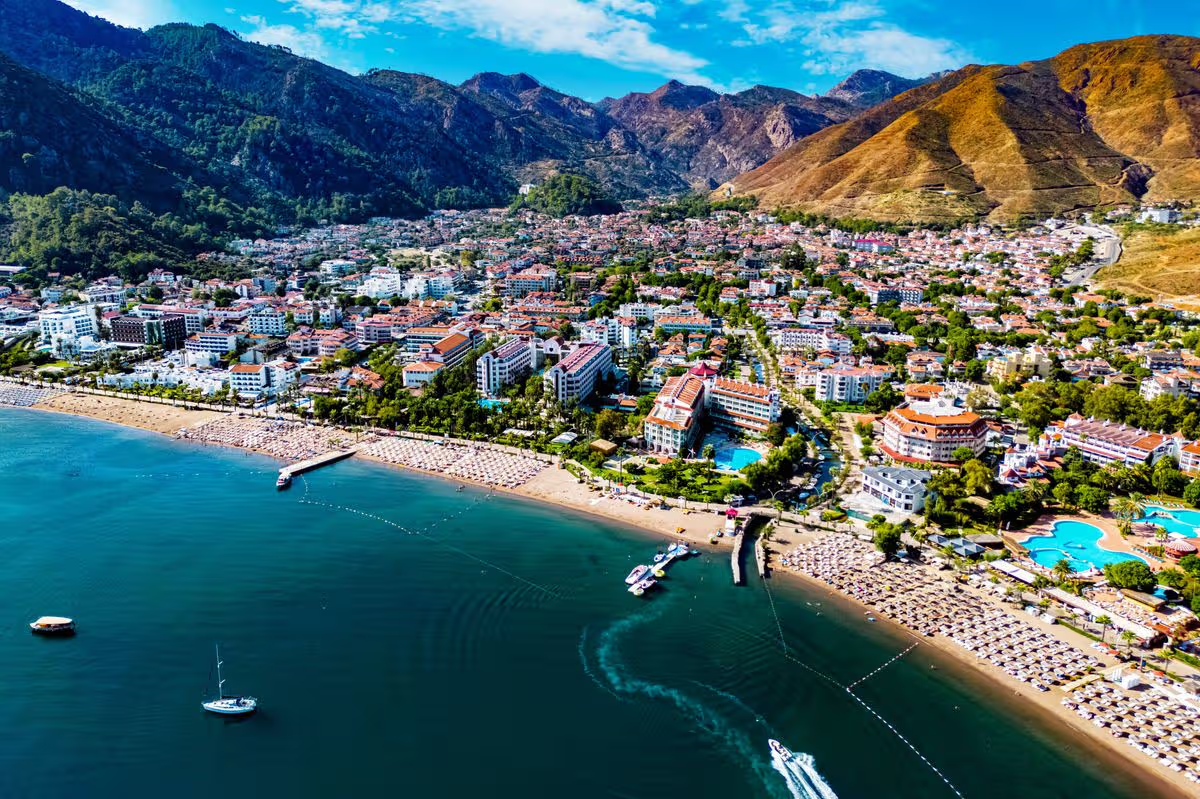
A leading travel journalist who visited 27 Greek islands has concluded which three are their favourite and which two they would not return to again with popular islands like Crete and Mykonos ignored
A travel writer has talked about their favourite Greek islands(Image: Getty)
A travel writer who visited 27 Greek islands has concluded which of the islands she has visited are her favourites.
Hannah Logan, a full time travel writer, travelled the length and breadth of the islands to ascertain which they would return to and which they would avoid.
After much consideration, they identified three they’d try again and two they would skip. The three islands in question were Symi, Milos, and Skiathos.
Writing in Business Insider Hannah praised Symi because it felt “more lowkey” than other places such as Mykonos and Santorini. She described it as “the perfect place to relax”.
Meanwhile, Milos was highlighted for having “some of the most stunning beaches in Greece” with Sarakiniko Beach standing out. Hannah added: “Several tiny fishing villages also add a unique factor to this island. In some of them, traditional boathouses have been renovated into cozy, waterfront villas and hotels.”
The third island Hannah took a shine to was Skiathos which she described as “charming” with a “lively” nightlife element and some of the greatest food Hannah had experienced on her travels. Also noted was the open air screenings of Mamma Mia, as some parts of the iconic film were shot on the island.
Whilst Symi, Milos, and Skiathos were favoured by Hannah, she noted that Kos and Mykonos was not to her liking as much. She described Mykonos as “overhyped” and said she wouldn’t return to Kos because “it didn’t feel special” to her.
Hannah isn’t the only individual to comment on the beauty and majesty of some of Greece’s islands with Crete also attracting positive attention.
Recently, Elafonisi beach came second in Tripadvisor’s survey of the world’s best beaches with visitors entranced by its ‘pink sand’.
Although it was beaten by Mexico’s Isla Pasion beach, it was the highest placed in Europe in the table with users praising the area for its “natural beauty, crystal clear waters and unforgettable views”.
However, the beach’s prowess has come at a cost. Despite averaging 4.4/5 across 16,000 reviews holidaymakers have been advised to time their visit right to avoid the crowds with 8am to 11am the best window of time.
Even the official page on Tripadvisor warns visitors, it said: “The amount of pink on display varies with conditions and the season. Regardless, the crystal clear waters make this a popular summer vacation spot, attracting sunbathers and water sport enthusiasts alike.
“Visit in the morning to beat traffic and secure a chair and umbrella before the crowds arrive. Or come in the evening for a stunning sunset when most people have left.”
Feb. 27 (UPI) — The Justice Department has sued another five states, including three led by Republicans, for their unredacted voter registration lists, amid the Trump administration’s the information ahead of November’s midterms.
The Trump administration has now sued 29 states and the District of Columbia for voter information, heightening Democrats’ concerns that it is seeking to meddle in the elections.
The five states sued Thursday were Utah, Oklahoma, Kentucky, West Virginia and New Jersey. The litigation effort has so far disproportionately targeted Democratic-led states, with Utah, Oklahoma and West Virginia among the few GOP-led states sued for their voter registration lists.
Attorney General Pam Bondi argues she is charged by Congress with authority to request the sensitive election data under the Civil Rights Act of 1960, though courts have ruled against the government in the three cases that have reached decisions: California in mid-January and Michigan and Oregon earlier this month.
Courts that have so far rejected Bondi’s argument found either that she lacks the authority to compel disclosure of the unredacted voter lists, as in Oregon, or the laws she cites do not permit the government to obtain them, as in Michigan. The judge in the California case also ruled her demand “stands to have a chilling effect on American citizens like political minority groups and working-class immigrants” worried about how their information will be used.
“As several courts have already held, the Department of Justice’s request for voters’ personal information, including their driver’s license numbers and Social Security numbers, is baseless,” New Jersey Attorney General Jennifer Davenport said in a statement Thursday rejecting the Trump administration’s lawsuit.
“We are committed to protecting the privacy of our state’s residents, and we will defend against this lawsuit in court.”
Lt. Gov. Deidre Henderson of Utah said the Justice Department sued her state after federal prosecutors declined Utah’s previous offer to share publicly available lists with them. The Trump administration’s lawsuit was expected, she said.
“Neither state nor federal law entitles the Department of Justice to collect private information on law-abiding American citizens,” she said in a statement. “Utahns can be assured that my office will always follow the Constitution and the law, protect voters’ rights and administer free and fair elections.”
Attorney General Gentner Drummond of GOP-led Oklahoma even responded to the lawsuit by stating that they are willing to “fully cooperate with any lawful requests related to voter fraud.”
“Oklahomans should have confidence that their state remains firmly committed to both election integrity and the protection of personal information,” he said in a statement.
The Trump administration has argued it requires the lists for election integrity purposes, raising concerns from Democrats already concerned about Trump attempting to interfere in the midterm elections as he has repeatedly expressed worries that he will be impeached if his Republican Party loses control of Congress.
Democrats and civil rights organizations, including the American Civil Liberties Union, Common Cause and the NAACP, have each echoed warnings that the Trump administration wants to use voter registration lists to undermine the upcoming election.
Assistant Attorney General Harmeet Dhillon of the Justice Department’s Civil Rights Division acknowledged Thursday that many states are choosing to fight them in court, but they will not be dissuaded.
“We will not be deterred, regardless of party affiliation, from carrying out critical election integrity legal duties,” Dhillon said in a statement.
The latest tranche of documents released by the United States Department of Justice on the convicted sex offender and financier Jeffrey Epstein has caused an uproar and a slew of resignations by senior officials and businesspeople across the US and Europe.
In Africa, the more than three million emails, photos, and videos released on January 23 are also causing some aftershocks as they reveal the extent of Epstein’s connections with prominent African figures, though appearing in the Epstein files does not automatically indicate a crime or wrongdoing.
Recommended Stories
list of 3 itemsend of list
According to the documents, Epstein had ties with former South African President Jacob Zuma; Karim Wade, a politician and son of Senegal’s ex-president Abdoulaye Wade; and deceased Zimbabwean President Robert Mugabe.
The new files also shed more light on Epstein’s connections to a relative of Ivory Coast President Alassane Ouattara, who appeared to connect the two men. This connection reportedly opened the door for a friend of Epstein’s, Israeli Prime Minister Ehud Barak, to propose a mass surveillance system to Ouattara that would work in the West African country. It is unclear if such a system is in place now.
Epstein’s possible fixing role culminated in a formal 2014 security deal between the two countries, although the details of it are scant.
The revelations, in general, underscore the range of Epstein’s influence on powerful figures across continents.
Epstein, who was first convicted in 2008 on charges of sex trafficking, was found dead by suicide in his prison cell in 2019 while awaiting a trial on sex trafficking charges. His ex-girlfriend and co-conspirator, Ghislaine Maxwell, was convicted and sentenced in 2021.
Here’s what we know about the Ivory Coast deal and his ties to Africa’s political elite:
A balloon bearing the image of President Alassane Ouattara floats above supporters during a campaign rally in Koumassi, Abidjan, Ivory Coast, before the 2025 election [File: Misper Apawu/AP]
Israel and Ivory Coast: The context
Discussions between Ouattara and Barak appeared to start in mid-2012, after the Ivorian president travelled to Jerusalem for talks with Israeli leaders, presumably in hopes of striking a security agreement. Ouattara met Barak, who was then the Israeli defence minister, and Prime Minister Benjamin Netanyahu.
Five days before the trip, on June 12, 2012, exiled military officials linked to the Ivory Coast’s former president had attempted to overthrow Ouattara’s government.
Ouattara’s predecessor, Laurent Gbagbo, had refused to hand over power to Ouattara, and a civil war that killed at least 3,000 people ensued. The fighting had only ended about a year before when UN and French forces intervened and arrested Gbagbo.
Ouattara’s son, Dramane, and niece, Nina Keita, also met Epstein in New York on the same day, according to the Epstein files. It’s unclear what the parties discussed.
Keita, a former model, was friends with Epstein and travelled regularly on his private jet, according to the documents. She appeared to have connected Epstein with her uncle, as well as other highly placed Ivorian politicians, according to the documents.
The files showed that on September 12, three months after Epstein met Ouattara’s son, he again met Keita in New York.
He met Barak immediately after in a private meeting at the Regency Hotel in New York, according to a schedule published in the files. It’s not known what was discussed.
In November, Drop Site News reported that Epstein referred to a trip to the Ivory Coast, Angola and Senegal in a note to his assistant, but that there are no flight records to confirm the travels.
What did Israel propose to Ouattara?
A month after Ouattara’s travel to Jerusalem, an Israeli delegation visited Abidjan.
At the meetings, Ouattara reportedly asked about Israeli defence systems to overhaul security in his country, according to reporting by Calcalist, an Israeli publication that covered the exchanges at the time.
In late 2012, Ivorian Interior Minister Hamed Bakayoko travelled to Tel Aviv for a meeting with Barak, where they discussed a cybersecurity deal, Drop Site News found.
Then, in spring 2013, Barak, who had now left office as defence minister, travelled to Abidjan himself to converse with Ouattara in what would be their second meeting.
Barak presented an expensive security defence plan to the president, Calcalist reported. The $150m proposal encompassed border security, army training, and strategic military consulting, the publication said.
Drop Site News, in an investigation in November, added that the proposal included a mobile and internet surveillance centre, as well as a video monitoring centre.
The publication cited two sets of documents: an archive of leaked emails released by the Handala hacking group and hosted by nonprofit whistleblower site, Distributed Denial of Secrets, as well as earlier Epstein-linked documents released by the US House Oversight Committee in October 2025.
Barak’s surveillance centre was to be developed by the French-Israeli private security company, MF-Group, which specialises in surveillance systems, and was to be located in Abidjan, Drop Site News reported.
Email logs showed Epstein introduced Barak to Ouattara’s chief of staff later in September 2013, and planned a meeting in New York where the two men met.
Although Ouattara was pleased with the plan, he ultimately did not sign the deal because of the price tag, Calcalist reported.
Barak, in a response to Calcalist at the time, denied that he offered to build the Ivory Coast an intelligence apparatus. “The claims about establishing an intelligence apparatus and price offers are incorrect. These are private conversations, and the public has no interest in them,” he was quoted as saying.
Ivory Coast’s President Ouattara being sworn in for another term at the Presidential Palace in Abidjan on December 8, 2025 [File: Sia Kambou/ Reuters]
What was the final agreement?
Although the plan appeared to be rejected, both countries continued to forge friendly ties.
In June 2014, then-Israeli Foreign Minister Avigdor Liberman was welcomed in Abidjan on a state visit.
Liberman had travelled to the country along with 50 Israeli businesspeople who were interested in investing in the Ivory Coast.
In a news release at the time, the Ivorian government said two agreements were signed: “One concerning regular consultations between the two countries and the other on defence and internal security.”
No details were provided. It is not known if Abidjan is using Israeli surveillance security systems.
Nevertheless, the Israeli-Ivorian security relationship has continued, with the latter buying military vessels, aircraft, and armoured tanks from Israeli weapons companies.
In 2016, a United Nations report found that Israeli firm Troya Tech Defence had sold weapons and night vision goggles to Ivory Coast in 2015, violating a UN arms embargo that was in place at the time.
In 2018, an investigation into Israeli spyware Pegasus, developed by the NSO Group, revealed that the malware had targeted journalists’ phones in the Ivory Coast. Pegasus, believed to be used by governments, was found to be operating in 45 countries.
In March 2023, privately owned Israel Shipyards, which builds naval vessels, delivered two offshore patrol vessels (OPVs) to Abidjan.
Critics of President Ouattara say the Ivory Coast has slid further from democracy under his rule and point to incidents like the Pegasus scandal, among other issues.
Former Israeli Prime Minister Ehud Barak in 2019 [Corinna Kern/Reuters]
Did Epstein and Barak strategise about other African countries?
Barak also tried to leverage the Boko Haram crisis in Nigeria for a security deal, according to Drop Site News, citing the new documents.
Epstein was aware of Barak’s business deals and advised him on doing business in Nigeria between 2013 and 2020, according to email exchanges.
Both saw the escalating violence in the West African nation not as a humanitarian crisis, but as a business opportunity, the publication found.
In June 2013, Barak attended a cybersecurity conference in Abuja, which organisers said privately was a pretext to meet Nigeria’s then-President Goodluck Jonathan.
It came after Nigeria awarded Israeli firm, Elbit Systems, a controversial contract to surveil digital communications in the country. Public outrage caused Jonathan to consider cancelling the project, but the government never announced that it was withdrawn.
Barak continued leveraging his access in Nigeria to promote Israeli products and services. In 2015, he facilitated the sale of Israeli biometric surveillance equipment to a private Christian university in Nigeria, Drop Site News found. The university, in a statement, denied the sale.
In 2020, the World Bank selected Barak’s intelligence firm, Toka, and the Israeli National Cyber Directorate to advise Nigeria on designing its national cyber-infrastructure.
Epstein, meanwhile, also facilitated high-level access for Sultan Ahmed bin Sulayem, ex-chairman of the Emirati firm DP World. In 2018, Epstein connected bin Sulayem with Jide Zeitlin, then-chair of Nigeria’s sovereign investment fund, for discussions on securing port ownerships in Lagos and Badagry.
Bin Sulayem, last March, visited Nigeria and proposed that DP World establish industrial parks at Nigerian ports. The proposal has not been approved.
Former South African President Jacob Zuma in 2025 [File: Rogan Ward/Reuters]
Which other African leaders had links to Epstein?
Jacob Zuma
The new files revealed that Epstein had some relations with former South African President Jacob Zuma, who led the country from 2009 until 2018.
Epstein appeared to arrange a “small dinner” on behalf of Zuma in March 2010 at the Ritz Hotel in London.
It’s unclear what the purpose of the dinner was, but emails released as part of the Epstein files seemed to show that a Russian model was invited. The model was told her presence would “add some real glamour to the occasion”, according to emails sent by Epstein’s planner, whose name was redacted in the files.
In a different email, Epstein appeared to share that information with British politician Peter Mandelson, who is now under investigation for his links to Epstein. A host, whose name was redacted “is having dinner for zuma tomorrow night at the ritz„ i have invited a beautiful russina named (redacted) to attend,” he wrote.
It’s unclear if Mandelson responded.
After the dinner appeared to have taken place, one email sender whose name was redacted wrote to Epstein: “(Redacted name) was a delight last night and enchanted all those she met…By the way, Jacob Zuma was much more impressive and engaging than I thought he would be!”
Karim Wade
Politician and son of Senegal’s ex-President Abdoulaye Wade, Karim Wade’s name appeared 504 times in the released files.
Wade, under his father, was a minister with an open-ended portfolio, and was so powerful that he was nicknamed “minister of heaven and earth”.
His relationship with Epstein began in 2010, according to an investigation by the Organised Crime and Corruption Reporting Project (OCCRP), which cited the newly released files.
In an email to an unnamed contact in November of that year, Epstein wrote: “the President of Senegal is sending his son to see me in paris,” the publication noted. Over the years, they planned trips in Africa along with Emirati businessman, bin Sulayem. They also discussed business ideas, the files showed.
In 2015, after Wade was convicted on corruption charges by a new administration, records show Epstein approaching Norwegian leader of the Council of Europe, Thorborn Jagland, to ask about possibly filing an appeal at the European Court of Human Rights. Wade’s lawyers regularly updated Epstein on efforts to free him, according to OCCRP.
Senegal pardoned Wade in 2016, after which he went into exile in Qatar. Keita, niece to Ivory Coast’s President Ouattara, who appeared to play some role in the efforts to free Wade, texted Epstein: “Thank you for everything you have done for him!!!!”
Robert Mugabe
The Epstein documents revealed that the sex trafficker planned to meet then-President Mugabe to propose a new currency for Zimbabwe amid that country’s hyperinflation crisis.
In email exchanges back in 2015, Japanese financier Joi Ito recommended to Epstein that they both approach Mugabe to discuss the currency after the Zimbabwean dollar lost its value. It’s unclear if the meeting ever took place.
Released along with the emails were FBI documents from 2017, which appeared to show unverified testimony from a “confidential source” who said Epstein was a wealth manager for Russian President Vladimir Putin, as well as Mugabe.
THERE’S still time to take advantage of the ‘stay for a night, play for a year’ theme park offer for huge savings.
The deal means that my family can visit theme parks and attractions like Alton Towers and Legoland all year round, plus enjoy an overnight stay and breakfast for less than it would normally cost for two annual passes.
Sign up for the Travel newsletter
Thank you!
The offers means you pay for a one-night stay and get year-long theme park accessCredit: Alton TowersMajor theme parks and attractions around the country are included in the offerCredit: Catherine Lofthouse
We’re avid fans of rollercoasters and rides and last year visited Alton Towers, Chessington, Thorpe Park and Warwick Castle, so I couldn’t believe my eyes when this offer popped up.
I paid less than £250 for an overnight stay at Thorpe Park, which includes breakfast and free parking during your stay, and now have four Merlin passes that I can use all year round.
An essential pass is normally £139, so it’s a massive saving just on the passes alone.
You need to be clever about how you use the deal, which ends this weekend, to get the most for your money.
First of all, try to find a midweek date for your theme park stay by checking out if you have a school inset day during the promotion period, which runs until June.
If you go in the school holidays or on a Saturday night, an overnight stay will invariably cost more.
Luckily we have an inset day in May, which is the perfect time to make the most of this offer.
Secondly, take a look at all the different Merlin attractions that offer accommodation, as there’s often a huge difference in room prices.
In general, I’ve found Thorpe Park to be the cheapest and Legoland or Alton Towers the most expensive.
Don’t forget to check out Warwick Castle as it’s easy to overlook that as a place that offers overnight stays and the rooms there tend to be good value for money, especially if you’re visiting with small children.
My friend found a room for her family of four for just £219.
My third tip would be to think carefully about what combination of people you’ll book for.
We have two adults and three children in my family and if I book an overnight stay for all of us, that rules out some of the cheaper accommodation options because the camping pods at both Alton Towers and Legoland can only sleep four.
Warwick Castle is included in the offer dealCredit: Catherine LofthouseAn essential Merlin pass is normally £139, so it’s a massive savingCredit: Alamy
There’s more choice for a smaller family, so it could be more cost-effective to choose that, especially if some of your family won’t be available for the overnight stay anyway.
I have children at both primary and secondary schools now, so they don’t all have the same inset days.
If you go down that route, you won’t then have free passes for all your family members.
But an easy hack to sort that is to sign up for Sun Club membership, as you get two free tickets to many Merlin attractions like Chessington and Alton Towers with that.
So you can book your pair of free tickets when they are on offer with Sun Club and then use your annual passes for entry for the rest of your party on the same day.
There are a few pitfalls you need to watch out for – some dates are excluded from the essential pass, but maybe not as many as you might expect.
The 25 days you can’t use your pass mainly fall on bank holiday weekends and Saturdays in August. I was pleasantly surprised by how many dates were included.
Remember that you’ll need to pay for parking each visit as that’s not covered by the essential pass.
If you’re going to be visiting a lot, a gold pass costing £239 does include parking, so it may be worth grabbing one for a single family member to use alongside your essential passes.
Parking at Alton Towers has risen to £13 this year and the other parks aren’t far behind, so it can quickly add up if you visit multiple times over the year.
It’s not just theme parks that are covered – you get free entry to 20 attractions like Cadbury World in Birmingham, the London Eye and the Legoland Discovery Centres in Birmingham and Manchester with the pass.
One notable exception is the Alton Towers waterpark, but you do get discounted entry with your annual pass.
So don’t miss out – book before this bargain ends for a full year of family fun.
Lorraine Kelly stopped her ITV daytime TV show to deliver some breaking news about this year’s Eurovision Song Contest
Lorraine Kelly abruptly halts ITV show with ‘breaking news’ announcement(Image: ITV)
The ITV show Lorraine was abruptly interrupted by its host, as Lorraine Kelly delivered a “breaking news” announcement. She interrupted her conversation abut spring dresses with Mark Heyes as she received breaking news through her ear piece.
While they spoke, the host’s hand flew to her ear. “Mark, they’ve just said ‘breaking news’,” she said. She spoke quickly to the person talking to her to say that she had stopped the show and then revealed the news to the audience.
“Boy George is not Italy,” Lorraine said. Earlier in the day, it had been revealed that Boy George was make a surprise bid with an Italian singer to compete for a European nation in the Eurovision Song Contest, but the country he was hoping to compete for was not known, until Lorraine’s announcement. “It’s not us either, it’s San Marino.”
Ensure our latest headlines always appear at the top of your Google Search by making us a Preferred Source.Click here to activateor add us as your Preferred Source in your Google search settings.
San Marino is a small nation in Europe that is landlocked by Italy. It is situated on Mount Titano and is one of the world’s oldest republics. As of 2024, it’s population was said to be only around 34,000. The nation has competed in Eurovision 15 times, debuting in 2008 and making its first appearance in the final in 2014. The nation has never won.
After revealing the news, Lorraine seemed nonplussed by it. Shrugging, she said to the camera: “He’ll win.” Mark then added that he was “glad” that Boy George would not be performing for the UK, as “we never win”. Lorraine added: “Yeah its a bit embarrassing.”
The UK is always in the final of the contest, as we are one of a few nations whose financial contribution guarantees them a place. However, the last time we won was over 20 years ago, in 1997 with Katrina and the Waves’ Love Shine A Light.
Ordinarily, the UK finish near the bottom of the leaderboard but in 2022, Sam Ryder’s Space Man got the UK to second place, finishing behind Ukraine. Due to the Russian invasion of Ukraine, the nation was unable to host the following year’s contest. As such, the UK was able to host for the first time since 1998.
This year, Youtuber Look Mum No Computer will compete for the UK at the contest in Vienna. This is the third time the city will host Eurovision and comes after Austria’s JJ won the competition last year.
There are several countries that will not compete this year. Five have decided to boycott the competition over the continued allowance of Israel to take part. These countries are Iceland, Spain, Ireland, Slovenia and the Netherlands, all of whom have said that they do not think it is appropriate to take part if Israel are.
Israel’s participation in Eurovision has been a source of tension due to the war in Gaza. The war has resulted in the deaths of at least 50,000 children and is widely considered a genocide of the Palestinian people, including by the International Association of Genocide Scholars.
Four years ago, Boyle Heights and Skid Row had something to celebrate: state grants to build new sidewalks and protected bike lanes.
But now, more than $100 million from the state for the transportation projects in some of the neediest parts of Los Angeles is in jeopardy because city officials say they don’t have enough staff to complete the projects.
The issue is part of the continuing fallout from a $1-billion budget shortfall the city faced last year. Officials avoided mass layoffs but closed the gap with budget cuts to city departments, including the Bureau of Engineering, Department of Transportation, Bureau of Street Lighting and Bureau of Street Services. Those cuts included eliminating open positions, resulting in smaller staffs.
“To know that the funding is there and that we have to give it back because the city says it can’t find the bodies to do the work is a scandal,” said Estela Lopez, executive director for the L.A. Downtown Industrial District Business Improvement District. She has long advocated for more resources on Skid Row, including improved accessibility for pedestrians.
“It would be transformative in a way that wasn’t just in spirit,” she said.
On Monday, the Bureau of Street Services confirmed that it will apply with the state for a two-year extension to allow more time to begin the transportation projects in Boyle Heights, Skid Row and Wilmington.
The move came after L.A. City Councilmembers Ysabel Jurado and Tim McOsker introduced a motion to cancel the state funds, citing “staffing, funding, and implementation constraints.” Jurado said that plan is “now on hold.” McOsker, whose district includes the Wilmington project, also confirmed his support for an extension.
“After hearing directly from my constituents, I urged the Bureau of Street Services to explore every option to keep these projects moving forward,” Jurado said in a statement this week.
TheBoyle Heights project would enhance bike lanes and pedestrian-level lighting, as well as extend street curbs and plant more than 300 shade trees. OnSkid Row, existing bike and pedestrian pathways would be connected through downtown L.A. to schools, health facilities and job centers. InWilmington, near the busiest port in the country, crumbling sidewalks would be fixed and a new traffic signal and high-visibility crosswalks would be added.
The city must contribute about $23 million in matching funds.
Jurado, whose district includes Boyle Heights and Skid Row, said the two areas “have waited too long for these investments for them to slip away.” Her predecessor, Kevin de León, and his staff pitched the projects and spent about $250,000 in discretionary funds to hire consultants to put together the applications for both projects.
Dan Halden, director of external relations for the Bureau of Street Services, said in a statement that the agency acknowledges the challenges ahead, including resources, cost and timeliness, and would work to identify a path forward.
De León said in an interview this week that now is not the time for the city to return state dollars.
“It would be at best, political malpractice, at worst, criminal, if the city made the decision to return the money in a time when we need every imaginable dollar for the well-being of Angelenos,” De León said. “This is not the moment to return dollars back to the state government, especially for historically under-served and under-invested communities.”
Michael Schneider, founder and chief executive of the bicyclist and pedestrian advocacy group Streets for All, said that losing the projects would be “heartbreaking.” He said he was involved in one of the grant applications two years ago and saw the amount of resources that went into it.
“This is that times three. It’s beyond the pale,” Schneider said. “This is a lot of money for those projects that are not that complicated, already designed.”
Schneider said he is concerned that if L.A. backs out this time, the state would prioritize other jurisdictions for future funding. An extension could be putting off the inevitable unless something changes and the projects become a priority for the city, he said.
“If it goes away, all it means is that some of the most dangerous streets that we’re aware of in the city are going to remain dangerous for decades,” he said. “The projects have merit. They were chosen for a reason.”
In a video posted online last week, City Controller Kenneth Mejia highlighted the budget cuts that are jeopardizing the state grants, including a 26% cut, or $61 million, to the Bureau of Street Services, the lead agency for the projects.
“The city is actually very successful in securing these large grants,” Mejia said in the video. “However, departments are constrained by the budget and staffing cuts, which makes the city unable to deliver all of them within the deadline required by the grants.”
Lopez of the business improvement district said the state money would fund a crosswalk in front of the Union Rescue Mission on Skid Row, where pedestrians now resort to jaywalking and where she has witnessed accidents.
She said she has been in touch with Jurado’s office to offer her help in keeping the projects alive.
“The city of Los Angeles can do more than one thing at a time,” she said. “We can figure this out.”
Times staff writer David Zahniser contributed to this report.
The Chicago area native previously lived in New York — where he first found fame as Conan O’Brien’s sidekick on “Late Night” — before moving to Los Angeles in 2001. Three years ago, he moved to Pasadena. “Now that I live here, I would not live anywhere else,” he says.
There are some practical benefits to the city. “I am such a crabby old man now, but it’s like, there’s parking, you can park when we have to go out,” Richter says. “The notion of going to dinner in Santa Monica just feels like having nails shoved into my feet.”
In Sunday Funday, L.A. people give us a play-by-play of their ideal Sunday around town. Find ideas and inspiration on where to go, what to eat and how to enjoy life on the weekends.
But he mostly appreciates that Pasadena is “a very diverse town and just a beautiful town,” he says.
For Richter, most Sundays revolve around his family. In 2023, the comedian and actor married creative executive Jennifer Herrera and adopted her young daughter, Cornelia. (He also has two children in their 20s, William and Mercy, from his previous marriage.)
Additionally, he’s been giving his body time to recover. Richter spent last fall training and competing on the 34th season of “Dancing With the Stars.” And though he had no prior dancing experience, he won over the show’s fan base with his kindness and dedication, making it to the competition’s ninth week.
He hosts the weekly show “The Three Questions” on O’Brien’s Team Coco podcast network and still appears in films and TV shows. “I’m just taking meetings and auditioning like every other late 50s white comedy guy in L.A., sitting around waiting for the phone to ring.”
This interview has been lightly edited and condensed for length and clarity.
7:30 a.m.: Early rising
It’s hard for me at this advanced age to sleep much past 7:30. I have a 5 1/2-year-old, and hopefully she’ll sleep in a little bit longer so my wife and I can talk and snuggle and look at our phones at opposite ends of the bed, like everybody.
Then the dogs need to be walked. I have two dogs: a 120-pound Great Pyrenees-Border Collie-German Shepherd mix, and then at the other end of the spectrum, a seven-pound poodle mix. We were a blended dog family. When my wife and I met, I had the big dog and she had a little dog. Her first dog actually has passed, but we like that dynamic. You get kind of the best of both worlds.
8 a.m.: Breakfast at a classic diner
Then it would probably be breakfast at Shakers, which is in South Pasadena. It’s one of our favorite places. We’re kind of regulars there, and my daughter loves it. It’s easy with a 5-year-old, you’ve got to do what they want. They’re terrorists that way, especially when it comes to cuisine.
I’ve lived in Pasadena for about three years now, but I have been going to Shakers for a long time because I have a database of all the best diners in the Los Angeles metropolitan area committed to memory. There’s just something about the continuity of them that makes me feel like the world isn’t on fire. And because of L.A.’s moderate climate, the ones here stay the way they are; whereas if you get 18 feet of winter snow, you tend to wear down the diner floor, seats, everything.
So there’s a lot of really great old places that stay the same. And then there are tragic losses. There’s been some noise that Shakers is going to turn into some kind of condo development. I think that people would probably riot. They would be elderly people rioting, but they would still riot.
11 a.m.: Sandy paws
My in-laws live down in Long Beach, so after breakfast we might take the dogs down to Long Beach. There’s this dog beach there, Rosie’s Beach. I have never seen a fight there between dogs. They’re all just so happy to be out and off-leash, with an ocean and sand right there. You get a contact high from the canine joy.
1 p.m.: Lunch in Belmont Shore
That would take us to lunchtime and we’ll go somewhere down there. There’s this place, L’Antica Pizzeria Da Michele, in Belmont Shore. It’s fantastic for some pizza with grandma and grandpa. It’s originally from Naples. There’s also one in Hollywood where Cafe Des Artistes used to be on that weird little side street.
4 p.m.: Sunset at the gardens
We’d take grandma and grandpa home, drop the dogs off. We’d go to the Huntington and stay a couple of hours until sunset. The Japanese garden is pretty mind-blowing. You feel like you’re on the set of “Shogun.”
The main thing that I love about it is the changing of ecospheres as you walk through it. Living in the area, I drive by it a thousand times and then I remember, “Oh yeah, there’s a rainforest in here. There’s thick stands of bamboo forest that look like Vietnam.” It’s beautiful. With all three of my kids, I have spent a lot of time there.
6:30 p.m.: Mall of America
After sundown, we will go to what seems to be the only thriving mall in America — [the Shops at] Santa Anita. We are suckers for Din Tai Fung. My 24-year-old son, who’s kind of a food snob, is like, “There’s a hundred places that are better and cheaper within five minutes of there in the San Gabriel Valley.” And we’re like, “Yeah, but this is at the mall.” It’s really easy. Also, my wife is a vegetarian, and a lot of the more authentic places, there’s pork in the air. It’s really hard to find vegetarian stuff.
We have a whole system with Din Tai Fung now, which is logging in on the wait list while we’re still on the highway, or ordering takeout. There’s plenty of places in the mall with tables, you can just sit down and have your own little feast there.
There’s also a Dave & Buster’s. If you want sensory overload, you can go in there and get a big, big booze drink while you’re playing Skee-Ball with your kid.
9 p.m.: Head to bed ASAP
I am very lucky in that I’m a very good sleeper and the few times in my life when I do experience insomnia, it’s infuriating to me because I am spoiled, basically. When you’ve got a 5 1/2-year-old, there’s no real wind down. It’s just negotiations to get her into bed and to sleep as quickly as possible, so we can all pass out.
Now you can pair your big show with dinner and a more intimate listening experience. The Hollywood Palladium, an Art Deco music venue graced by performers like Frank Sinatra, Richard Pryor, Jimi Hendrix, Lady Gaga and Jay-Z since 1940, has debuted a swanky lounge known as Vinyl Room.
Inspired by 1970s Japanese high-fidelity (hi-fi for short) listening rooms and operated by entertainment company Live Nation, it’s a space where concertgoers can have dinner, grab drinks and catch a vinyl DJ set before or after their ticketed event in the same venue.
With a name like Vinyl Room, you can expect to see vinyl records everywhere.
“You’re in [for] a whole night of music,” says Geni Lincoln, president of the California region for Live Nation, adding that her team put “so much thought” into the sound and design of the space, which was in development for more than two years.
“I’ve been coming to the Palladium since I was a teenager, so it’s really special to see,” she says.
Entering Vinyl Room feels like you’re stepping into a secret speakeasy for music lovers, one with iconic music memorabilia, a thoughtful food menu and premium sound quality. Want to check it out? Here are five things to know.
Everything inside of Vinyl Room is inspired by the sounds and the musicians who’ve played at the Hollywood Palladium since 1940.
1. Vinyl Room is exclusively open to members and concertgoers with an upgraded ticket
Vinyl Room is open only on Hollywood Palladium show nights, starting 90 minutes before doors open, and remains open one hour after the concert. Admission is limited to concertgoers who purchase a ticket upgrade, which starts at $35. Early reservations are recommended.
Vinyl Room also offers annual membership packages, which start at $2,000 and come with various benefits such as complimentary guest passes to Vinyl Room, access to an exclusive menu, valet parking, table reservations inside the lounge, a dedicated private entry, complimentary coat check and concert ticket credits.
Tip Dunn, also known as DJ tenSpeed, played records during opening night at Vinyl Room at the Hollywood Palladium.
2. Hi-fi is having a moment in Los Angeles — and Vinyl Room delivers on sound quality
From Common Wave Hi-Fi in Boyle Heights to Slow Jamz Gallery in the Arts District and Gold Line bar in Highland Park, hi-fi — a 1950s term used to describe the high-quality reproduction of sound — venues and experiences have been slowly popping up around L.A. over the last few years. Vinyl Room joins a short list of places where audiophiles can go to listen to music on hi-fi equipment, which many argue is the best way to experience it.
Much like the Hollywood Palladium, which is known for its top-tier sound, Vinyl Room also makes sound a priority. The lounge utilizes hi-fi sound equipment including Master Sounds Clarity-M speakers to ensure that the records sound as crisp as possible. Live DJs spin records on a set of turntables, which helps to create a richer and more analog sound that is closer to the original track than compressed versions such as MP3s.
Ruthie Embry, vice president of architecture and design at Live Nation, says the records and other memorabilia inside the space “connects you directly to the venue’s history the second you walk in the door.”
3. All of the decor ties back to music and the Hollywood Palladium’s rich history
With a name like Vinyl Room, you can expect to see vinyls everywhere. Records line most of the walls and shelves, drinks are served on vinyl-shaped coasters and tables and light fixtures are designed to the theme. There’s even vinyl wallpaper in the photo booth. In one corner of the lounge, you can dig through records under a neon sign that reads, “But have you heard it on vinyl?”
Ruthie Embry, vice president of architecture and design at Live Nation, says the records and other memorabilia inside the space “connects you directly to the venue’s history the second you walk in the door.”
Some standout items include a Red Hot Chili Peppers show flier, a Hollywood Palladium postcard signed by late musician and host Lawrence Welk and a photo of late singers Bonnie Baker and Orrin Tucker at the venue. Even the bathroom creates a memorable photo moment: The stalls are filled with photos of musicians and an “on air” studio sign lights up when a stall is occupied.
Vinyl Room’s menu, created by Chef Ryan DeRieux, is inspired by Asian flavors and includes items like the “Vinyl Roll,” which is made with spicy tuna.
4. Don’t worry about dinner plans before or after the show. Vinyl Room has got you covered
Eliminating the need to find a pre- or post-show restaurant, Vinyl Room has a full Asian-inspired menu created by Chef Ryan DeRieux.
Think sushi tots (like crispy tuna but with tater tots instead of rice), tuna poke nachos, chili crunch chicken wings and shiitake tempura burgers. There’s also a mouth-watering 100-ounce American wagyu skirt steak served with shishito peppers, pickles and charred carrots. For dessert, try the taiyaki, a popular fish-shaped Japanese street food, which is served with a delicious passion fruit cream that I wanted to take to go because I liked it so much.
Signature cocktails at Vinyl Room, inspired by popular songs, include the Superfly, Escape (if you like piña coladas) and Smoke on the Water.
5. The craft cocktails aren’t just delicious — they each have a story
Vinyl Room’s old-fashioned is made with Nikka Yoichi whisky, which is made in Japan.
The cocktail program, developed by third-generation bartender Sean Kenyon, is inspired by the songs created by musicians who’ve graced the Hollywood Palladium stage. A nod to the 1970s, the Superfly is a fizzy, citrus-forward play on Curtis Mayfield’s 1972 track and is made with Roku Gin and yuzu and sencha syrup. Other signature drinks include the rum-based Escape (if you like piña coladas) with coconut oolong syrup, pineapple juice and miso, and the tart yet sweet Smoke on the Water, which is reminiscent of Deep Purple’s 1972 song. The bar also offers an espresso martini (called the MT Joy), a signature old-fashioned (made with Nikka Yoichi whisky) and a Japanese whiskey highball (made with Hibiki Harmony whisky). The bar offers a number of non-alcoholic options as well.
Head coach Eddie Howe has urged Anthony Gordon to stay “fully focused” after the Newcastle United forward was linked with a move to Arsenal.
Gordon is the latest key figure at the club to have been subject of reported interest elsewhere.
This is despite the England international dismissing such talk as “a load of rubbish” in an interview with reporters just last week.
Newcastle sold Alexander Isak to Liverpool for a British record £125m fee last summer – after the Swede went on strike – and Howe was asked how he could avoid a repeat of a similar saga.
“I’m not sure there’s a lot I can do about that,” he said. “I’ve not seen the story, so it’s news to me.
“But we’re mid-season, we’re in the middle of some of the biggest games of his career, and who knows what’s going to happen internationally with Anthony in the summer as well.
“He’s not got time to look left or right. He’s got to be fully focused on straight ahead and the next game, and trying to be as good as he can be.”
Gordon, Sandro Tonali and Tino Livramento are just some of the Newcastle players who have been touted with moves away in the media in recent months.
But Howe said it comes with the territory.
“It’s your industry that is creating those stories,” he added. “I’m slightly secluded from it.
“If you don’t read it you don’t know who has been linked to who. Is it not just part of modern day football that everyone is just linked with moves these days, not just Newcastle players, but potentially a lot of other clubs have the same issues.
“It’s irrelevant really. It’s how the players react to that. If they absorb it and it affects them, then that’s a negative. But i think our players are robust enough to ignore it.”
Foreign Office continues to warn about Turkey travel(Image: monticelllo via Getty Images)
The Foreign, Commonwealth and Development Office (FCDO) continues to issue warnings for those travelling to Turkey following the deaths of several UK nationals. The FCDO is responsible for issuing regular travel guidance covering roughly 226 countries and territories worldwide.
Many Brits travel to Turkey to for medical treatment, with the most popular procedures being cosmetic surgery, cardiac surgery, and dental care. The FCDO warns: “The standard of medical facilities and available treatments can vary widely globally and also within countries.”
The department confirmed it is aware of 7 British nationals having died in Turkey in 2025 following medical procedures, and guidance reads: “Some British nationals have also experienced complications and needed further treatment or surgery following their procedure”.
Those thinking about a trip to Turkey for medical, surgical or dental procedures are strongly advised to consult with your UK doctor, clinician or dentist beforehand. It’s also recommended that you conduct thorough independent research, as “private companies have a financial interest in booking your treatment and their literature should not be your only source of information”.
The Turkish Ministry of Health maintains a register of approved medical providers on the HealthTurkiye website. The FCDO emphasises it “cannot usually help if you have travelled abroad for medical treatment, for example if you have issues with the care received or costs involved”.
This is due to the fact that planned medical treatment is viewed as a commercial arrangement.
Ensure our latest headlines always appear at the top of your Google Search by making us a Preferred Source.Click here to activate or add us as your Preferred Source in your Google search settings.
Alzheimer’s disease researchers say they have developed a way to predict when a unimpaired person may develop dementia symptoms within three to four years through a single blood test. File Photo by EPA
ST. PAUL, Minin., Feb. 27 (UPI) — A team of U.S.-based scientists say they have developed a model using a “biological clock” to predict — with just a simple blood test — when someone is likely to develop symptoms of Alzheimer’s disease.
The results of a study published this month in the journal Nature Medicine demonstrate how, by measuring blood plasma levels of a protein in people who are not yet impaired by Alzheimer’s symptoms, researchers can predict when cognitive decline will begin within a margin of three to four years.
While there is no single, stand-alone test to diagnose Alzheimer’s today, the new method works by leveraging how levels of the protein “p-tau217” in the blood closely reflect how much amyloid plaque has built up in the brain over time. This provides doctors with a “clock” that points to when a patient may begin to experience symptoms.
Amyloid buildup in the brain may begin up to 20 years before a person starts to experience symptoms of memory and thinking issues. The plaques are a key pathological hallmark and contributing factor in Alzheimer’s disease, and, much like looking at the rings of a tree, p-tau217 levels can reveal the age of the buildup.
The authors, based at the Washington University School of Medicine in St. Louis, say their new blood test method will have immediate applications in ongoing clinical trials seeking answers to the vexing questions about what causes and what can prevent Alzheimer’s and dementia, which affect more than 7 million Americans at an estimated cost of nearly $400 billion in 2025.
Eventually, with further refinement, researchers hope the blood test could one day be used in clinical settings to easily and quickly provide predictions about the timeline of symptom onset for individual patients. The only feasible ways of doing so now are through costly brain imaging scans and invasive spinal fluid tests.
The study was part of a project headed by the Foundation for the National Institutes of Health Biomarkers Consortium, a public-private charitable partnership established by Congress in 1990 whose roster includes schools such as Washington University, life science companies including Johnson & Johnson and the Alzheimer’s Association.
Dr. Suzanne Schindler, senior author of the study and associate professor in the WashU Medicine Department of Neurology, said that while current blood tests for p-tau217 are already capable of identifying cognitively unimpaired people who might develop Alzheimer’s symptoms, they have no ability to estimate when.
Thus, they are used only for research studies and clinical trials due to legal and ethical considerations, such as the risk of causing undue stress from uncertain results.
“Our study, however, suggests it’s possible to predict when symptoms might develop using blood p-tau217,” she told UPI. “The prediction is very rough and so is still only useful in research or trials.
“We believe these predictions can be refined, but it’s unclear if they’ll become reliable enough for individual guidance without more invasive tests like spinal fluid analysis,” she cautioned.
Still, the potential of uses of the blood test are immediate when it comes to Alzheimer’s research. For instance, they could allow clinical trials of potentially preventive treatments to be performed within a shorter time period.
“Clinical trials are currently underway that are treating cognitively unimpaired individuals who test positive for blood p-tau217,” Schindler noted. “We must wait to see if these treatments delay or prevent symptom onset, but I’m hopeful based on our understanding of the disease’s biology.”
Beyond clinical trials, the blood test will aid broader Alzheimer’s research “by linking p-tau217 levels to specific brain changes, helping us disentangle whether those changes are driving cognitive impairment amid its overall complexity,” she added.
The new study “provides evidence that plasma p‑tau217 may be a reliable tool for estimating the future onset of Alzheimer’s disease symptoms,” agreed Rebecca Edelmayer, vice president of scientific engagement for the Alzheimer’s Association.
“This could transform how researchers design clinical trials and, eventually, how clinicians identify people at highest risk for cognitive decline associated with Alzheimer’s years before decline begins,” she told UPI.
While the blood test method represents a “very intriguing discovery,” it’s important to note it is not yet ready for everyday use by doctors or patients, Edelmayer cautioned, noting that its three- to four-year margin of error effectively rules out its utility for individual decision-making.
Broadly speaking, blood tests are not yet recommended for cognitively unimpaired individuals outside research settings, but even so, “this finding is an important research step because a blood test is generally much less expensive and easier to administer than a brain scan or spinal‑fluid test,” she said.
“In the future, it could help doctors and researchers identify people who may benefit from early treatments, and make clinical trials for new Alzheimer’s therapies run faster and more efficiently.”
The possibility of making a difference in the long-running battle against one of the most feared and intractable diseases in the world holds a special meaning for Schindler.
“As a memory specialist, I’ve diagnosed over 1,000 people with Alzheimer’s and witnessed firsthand its devastating effects on patients and families,” she said. “These results make me hopeful, and it’s rewarding to think this research could improve diagnosis and treatment of Alzheimer’s.”
Unity Holidays in Brean has been undergoing £10.2million expansion and refurbishmentCredit: Unity HolidaysIt’s recently updated it’s new pub, sports bar and pavilionCredit: Unity Holidays
In time for the summer holidays, will be a new lido surrounded by private cabanas and outdoor dining area.
The existing flumes and water rides will remain, and the outdoor pool is expected to open in July 2026.
Other plans included in the development are a trampoline park, bandstand, boardwalk, landscaped gardens and a dog agility area.
There will also be an outdoor activity centre where guests can have a go at archery, axe throwing and rifle shooting.
Unity Beach Resort Director Jonny Green said: “These are exciting times for our owners, our holidaymakers and the local community.
“Our improved pool facilities will help us sustain and grow participation in swimming lessons and recreational activity — not only for guests staying on the park, but also for the wider community across Somerset.”
The new outdoor facilities are part of the huge refurbishment of the site that has been underway throughout the winter months.
The site has been upgrading its soft play, changing rooms, the Wave Café and gym.
Other improvements have been to the 25-metre indoor pool and the addition of poolside showers.
A new indoor Splash Pad will replace the baby pool so that children of different ages can swim and play in the same space.
The unisex changing rooms have been upgraded with larger family cubicles – with space for up to four.
For accessibility, a new lift and pool hoist have been installed, as well as a refreshed accessible changing area.
The Wave Café has also been refurbished and will continue to serve meals throughout the day.
Visitors can enjoy sweet treats like cookies and donuts to breakfast options, sandwiches and paninis.
The site recently renovated its Wonky Donkey cafeCredit: unity holidays
At Unity Play, children can explore different soft play zones; Ocean World for under-4s, the main soft play area for ages 4 to 11, and Ninja Warrior zone for ages 7 to 11.
There is also a new reception area with a dedicated buggy park for families.
The refurbished indoor facilities are due to reopen shortly.
Previously, the site underwent a £15million upgrade with a new Wonky Donkey pub and restaurant, with a new pavilion, sports bar and arcade.
The Wonky Donkey serves up traditional pub food like mac n’ cheese and scampi and chips.
Inside the Pavilion Theatre, there’s plenty of family entertainment and shows as well as silent discos and movie sing-along challenges.
As well as the 2025 additions, the park is home to a theme park with 40 rides and attractions from rollercoasters to dodgems and a ghost train.
“Our eight-man Platinum lodge at Unity Beach in Somerset has a hot tub — and it comes complete with undisturbed views of Brean’s windswept coastline and a clear sky at night.
“Everything inside is sleek and stylish, with a statement electric fireplace in the centre and Scandi-style wooden furniture that makes the place look more like a fancy prize draw house than a holiday park lodge.
“I was staying there with my partner Bianca and two little ones, Frank, six, and Pearl, four. The lodges are really close to most of the activities and restaurants, too.
“These include the new Wonky Donkey, which serves brekkie and pub grub such as scampi, lasagne and burgers, and the Sports Cafe, where kids can play arcade favourites and cutting-edge VR games in between bites of pizza, while adults watch live sport on the large screens.
“There’s also the revamped Pavilion Theatre, where guests can tuck into wings, loaded fries and kid-sized lighter bites all while watching live game shows and tribute acts.
“The pre-booked 90-minute pool sessions were just enough for our two, although bigger kids, who can go on all the flumes, might want to stay longer.
“Despite tearing around the pool for an hour and a half, Frank and Pearl couldn’t wait to go straight to Brean Play indoor soft play afterwards.
“If one thing’s guaranteed to tire them out, it’s soft play. The area includes the Ninja Zone, with a challenging obstacle course for older kids, and a state-of-the-art ball court with an interactive screen that lets kids play all manner of games.”
Weekly insights and analysis on the latest developments in military technology, strategy, and foreign policy.
Though no deal was reached to end Iran’s nuclear arms ambitions, U.S. and Iranian officials both expressed cautious optimism after the third round of negotiations between the two nations concluded today. Even as the talks were underway in Geneva, more American military assets pushed toward the Middle East. On Thursday, the aircraft carrier USS Gerald R. Ford left Souda Bay on the Greek-owned island of Crete and will reportedly arrive off the Israeli coast as early as Friday. In addition, more F-35A Lighting II stealth fighters and F-15E Strike Eagle multirole fighters are on their way across the Atlantic for likely deployment to the region.
You can get a good sense of the state of play in this situation in our deep dive here.
The third round of indirect talks between the U.S. and Iran in Geneva ended inconclusively Thursday.
“We have finished the day after significant progress in the negotiation between the United States and Iran,” Omani Foreign Minister Badr Albusaidi, who is moderating the talks, stated on X. “We will resume soon after consultation in the respective capitals. Discussions on a technical level will take place next week in Vienna. I am grateful to all concerned for their efforts: the negotiators, the IAEA, and our hosts the Swiss government.”
We have finished the day after significant progress in the negotiation between the United States and Iran. We will resume soon after consultation in the respective capitals. Discussions on a technical level will take place next week in Vienna. I am grateful to all concerned for…
At issue is the future of Iran’s nuclear weapons program, but the negotiations do not involve Iran’s ballistic missile program, which the Trump administration is now saying could threaten the U.S. homeland in the near future. More about that later in this story. The U.S. is reportedly demanding that Iran destroy its Fordow, Natanz and Isfahan nuclear sites, deliver all enriched uranium to the U.S., agree to zero enrichment of its uranium, but can keep the Tehran reactor. In addition, the Trump administration is demanding that any deal be permanent and is offering Iran minimal sanctions relief, with more if the country is compliant with these demands.
Here the demands US brought to Iran in Geneva:
1) Destroy all 3 nuclear sites: Fordow, Natanz, Isfahan
2) Deliver all enriched uranium to US
3) No sunset clauses
4) Zero enrichment, but can keep Tehran reactor
5) Minimal sanctions relief up front; more if Iran compliant
For its part, Iran “is unwilling to transfer any enriched uranium outside the country,” the official Iranian Press TV news outlet reported on Thursday. While the U.S. delegation demands all existing stockpiles be handed over, Iran insists that the enriched uranium should remain safeguarded within its borders.
“Foreign Minister Abbas Araghchi has said Iran remained ‘crystal clear’ that it would ‘under no circumstances ever develop a nuclear weapon,’ while also recognising the right of Iran’s people to the benefits of ‘peaceful nuclear technology,’” Al Jazeera reported.
The negotiations are taking place in the wake of statements by Trump and Secretary of State Marco Rubio laying out the administration’s case against Iran. Both warned that Iran is developing weapons that can strike the U.S. and has the means and intent to strike its assets, and those of allies, in the Middle East.
PRESIDENT TRUMP on IRAN: My preference is to solve this problem through diplomacy, but one thing is certain: I will NEVER allow the world’s number one sponsor of terror to have a nuclear weapon.
SECRETARY RUBIO on IRAN: For a country facing sanctions, whose economy is in tatters, whose people are suffering, somehow they still find the money to invest in missiles of greater capacity every year. This is an unsustainable threat. pic.twitter.com/LGZJxPG33w
Meanwhile, the Trump administration reportedly would like to see Israel attack first to give the U.S. political cover.
“There’s thinking in and around the administration that the politics are a lot better if the Israelis go first and alone and the Iranians retaliate against us, and give us more reason to take action,” Politico stated.
“The argument in Israel is that this would be a terrible strategic mistake, as it creates a lose-lose situation: if the strike fails, Israel would be blamed for dragging the United States into the conflict,” a high-ranking IDF official told us. “Israel would be accused of being a warmonger, a source of destruction and regional war, rather than a country seeking to reach an agreement. Israel could find itself completely isolated. This reflects the general discourse on the issue.”
This issue should be taken with a degree of skepticism since much of the behind-the-scenes reporting has been highly inaccurate.
Report: White House insiders say a first strike by Israel on Iran might create the optics needed to justify US military action.https://t.co/EszY1krx5r
“Many actions are being carried out on the home front, among civilians, in order to protect them from missile strikes,” the IDF official added. “At the same time, there is very significant military readiness along the borders.”
While the Trump administration is pushing Iran to accept the deal or risk an attack, Democrats in the U.S. House of Representatives pledged Thursday “to force a vote next week on legislation to restrict President Donald Trump from attacking Iran without congressional approval,” Politico pointed out, adding that “the White House is already mobilizing to try and defeat it.”
The move by Minority Leader Hakeem Jeffries and his leadership team “will compel a tough and close vote for lawmakers as the Trump administration ramps up pressure on Tehran,” the outlet added.
JUST IN: House Dem leaders say the plan to force a vote on bipartisan Iran war powers legislation from Ro Khanna and Thomas Massie “as soon as Congress reconvenes next week.” pic.twitter.com/IxO7DSwQAT
The sabre rattling and internal political machinations come as the U.S. has built up a massive force that includes two aircraft carrier strike groups and several other warships.
There are reports that the Ford, on a twice-extended deployment that has seen it enter the Mediterranean for the second time since departing Norfolk on June 24, 2025, will dock in Haifa, Israel. However, that seems dubious given that placing an aircraft carrier at a fixed location like that would make it a very attractive and high-volume target for an Iranian attack. The carrier would not benefit from its own defenses, and to a lesser degree, that of its escorts, when in port, as well.
There have been suggestions that the Ford’sArleigh Burke class guided missile destroyer escorts will help provide protection for Israel against anticipated Iranian barrages. The Ford’s F/A-18E-F Super Hornets and E/A-18G Growler electronic warfare jets could also be used to attack Iran, but would have to fly across Israel or Lebanon, Syria or Jordan, and Iraq, to reach Iranian territory.
Haifa “suffered significant damage” during the 12-Day War in June, “with dozens injured from missile fire and structural damage to homes and municipality buildings,” the Jerusalem Post reported. “Haifa is home to the Israel Navy headquarters and the largest oil refinery in Israel, which was hit during the war, forcing a partial, temporary shutdown of some secondary facilities.”
The Pentagon’s first kamikaze drone unit is ready to participate if Trump decides to launch strikes on Iran, Bloomberg News reported, citing U.S. officials and analysts. The drone unit is known as Task Force Scorpion. It’s now ready for operations, U.S. Central Command spokesman Capt. Tim Hawkins told the news outlet in an emailed statement.
“We established the squadron last year to rapidly equip our warfighters with new combat drone capabilities that continue to evolve,” he said.
The U.S. military set up Task Force Scorpion late last year as the first operational unit armed with Low-Cost Uncrewed Combat Attack System (LUCAS) kamikaze drones, a design reverse-engineered from the Iranian-designed Shahed-136, in the Middle East. The establishment was seen as a major development, and offers a way “to flip the script on Iran,” according to a U.S. official. Last year, TWZ laid out a detailed case for why America’s armed forces should be investing heavily in rapidly-produced Shahed-136 clones as an adaptable capability that could be critical in future operations globally, as you can read here.
Just in: The Pentagon’s first kamikaze drone unit is ready to participate if President Donald Trump decides to launch strikes on Iran, according to US officials and analysts. https://t.co/DOPGwxi339
In addition to the ships, scores of tactical jets, refuelers, airborne control planes, and other aircraft have already surged to the Middle East and Europe, with more on the way. At least another 12 F-35As from Hill Air Force Base in Utah, and six F-15Es each from Mountain Home Air Force Base in Idaho and Seymour Johnson Air Force Base in North Carolina are heading to Europe. That’s ahead of a likely deployment to the Middle East.
Aviation photographer Acr Explorer was kind enough to share images of F-35As and F-22s seen at Lakenheath Air Base in the U.K. on Thursday.
F-22 Raptor stealth fighters seen Thursday at Lakenheath Air Base in the U.K. (Acr Explorer) F-22 Raptor stealth fighters seen Thursday at Lakenheath Air Base in the U.K. (Acr Explorer) F-22 Raptor stealth fighters seen Thursday at Lakenheath Air Base in the U.K. (Acr Explorer)
The large influx of U.S. airpower has left U.S. bases in the region crowded and is one reason that F-22 Raptor stealth fighters have been deployed to Israel. Another is the likelihood that Israel will be fully integrated into any U.S. attack on Iran.
Beyond the Middle East and Europe, the U.S. is also building up forces at Diego Garcia, its Indian Ocean island outpost, which has been used as a bomber base in previous conflicts. As we noted yesterday, F-16CM fighters from the 35th Fighter Wing recently arrived on the island from Misawa Air Base in Japan. These would be key assets in defending the island from a possible Iranian attack. There is also indications that a bomber deployment to the base could be imminent. However, there are political questions to be solved before the base can be used for a strike on Iran. As we reported last week, the United Kingdom has apparently said it would not allow the use of the island for strikes on Iran, although Prime Minister Keir Starmer could still change his mind. You can read more about the force-protection mission at Diego Garcia — increasingly threatened by Iranian long-range attack drones and missiles — in our previous reporting.
While the talks between Washington and Tehran are scheduled to resume next week, remember that three days before the Operation Midnight Hammer strike on Iranian nuclear facilities last June, the White House said Trump would decide “within two weeks” about whether to strike or keep negotiating.
Though more negotiations are scheduled, Trump has acted militarily ahead of planned talks in the past. Regardless, with the Ford arriving very soon and other assets trickling into place, and fitting our own stated timeline, the window for strikes appears to be cracking open now, and will only get wider with each passing day.
A beloved BBC expert made a heartbreaking admission during Friday’s episode of Morning Live
BBC expert opens up ‘devastating’ trauma that left him with nothing(Image: BBC)
A BBC expert has revealed a “devastating” childhood trauma that left him with nothing.
During Friday’s (February 27) edition of Morning Live, hosts Louise Minchin and Greg Rutherford updated viewers on the latest news from across the UK.
At the start of the show, Louise and Greg introduced a segment on electric blankets, after many have failed basic standards with “serious consequences”.
In a pre-recorded segment, consumer expert Harry Kind, who regularly offers advice on the show, shared his own personal trauma, after a fire destroyed his childhood home.
“They’ve become a popular staple in British homes during the winter months, being both cheap and run and cosy to snuggle up into. But across the UK every year, dozens of domestic fires are caused by faulty, damaged, and incorrectly used electric blankets,” Harry began.
“I know from personal experience just how devastating a house fire can be. When I was 14, our family home completely burnt down, and we lost pretty much all of our possessions.
“In my case, the fire started in the chimney, but last year, house fires caused by electric blankets in England hit a five-year high.”
This is a breaking showbiz story and is being constantly updated. Please refresh the page regularly to get the latest news, pictures and videos.
You can also get email updates on the day’s biggest stories straight to your inbox by signing up for our newsletters
Connor McDavid secured his ninth 100-point season with a goal and an assist, Leon Draisaitl had a goal and three assists, and the Edmonton Oilers snapped their four-game skid with an 8-1 victory over the Kings on Thursday night.
McDavid scored his 35th goal and Draisaitl got his 30th during his fourth four-point game of the season as the Oilers again routed the opponent they’ve knocked out of the first round of the Stanley Cup playoffs in each of the past four seasons.
The game marked the biggest margin of defeat against the Kings this season.
Jake Walman scored two goals, Zach Hyman had a goal and two assists, and Ty Emberson, Vasily Podkolzin and Andrew Mangiapane also scored in Edmonton’s impressive rebound from a painful loss against the Ducks. Connor Ingram made 22 saves for the Oilers (29-23-8), who have returned from the Olympic break with 13 goals in two games.
Warren Foegele scored for the Kings (23-21-14), who have lost five straight games since January. The Kings’ humiliating third-period collapse against Vegas one night earlier bled into this game: When Hyman scored on a power play midway through the second period, the Kings had surrendered 10 goals in their past 41 minutes of play.
Darcy Kuemper gave up four goals on 15 shots before getting pulled early in the second period for Anton Forsberg.
Some Kings fans targeted coach Jim Hiller for the struggles, repeatedly chanting “Fire Hiller!” in the third period.
Emberson opened the scoring with his first goal since Oct. 28. Podkolzin scored 54 seconds later on another shot that could have been stopped by Kuemper.
Mangiapane beat Kuemper cleanly on an odd-man rush early in the second, and McDavid made it 4-1 when Kuemper comically fell down six feet outside his crease to leave an open net for the NHL’s top scorer.
Up next for the Kings: vs. Calgary at Crypto.com Arena on Saturday.
Airbnb has gained popularity over the years for its cozy and unique places to stay across the world, but one user of the app is ‘begging’ hosts to stop using 1 thing
Abigail Nicholson Content Editor
09:50, 27 Feb 2026
Airbnb can be a more personalised experience(Image: Getty Images)
An Airbnb user is “begging” hosts to stop using 1 thing in their rooms, calling it “weird” and “uncomfortable”.
When visiting new towns, cities or countries, people have different ideas of where they would like to stay.Some people prefer the convenience of a well-placed hotel where you know you’re going to get a comfy and clean room with a number of amenities, such as a hairdryer and even a kettle for hot drinks.
Others, however, prefer to stay in an Airbnb, which are homely and often have even more perks, such as an entire kitchen, a hot tub or even a balcony, depending on where you stay.
There is no right or wrong way to travel, but one Airbnb user is asking hosts of properties and rooms to stop using one thing in their bedrooms that they find ‘weird’.
The user took to Reddit to write the post titled “Hosts: please, for the love of five stars and good repeat guests….”
The post read: ” Don’t use microfiber bedsheets. They don’t stay put. Unless you get into bed and immediately become corpse-like, the whole thing gets wrinkled and baggy almost immediately.
“They don’t breathe. No matter how nice and cool the ambient temperature is, inside the sheets is uncomfortable.
“It’s weirdly warm on the skin in the same way sleeping in a thin plastic bag is. Actually, that’s exactly what sleeping in microfiber sheets feels like, minus the crinkly sounds.
“They feel cheap. Yes they don’t wrinkle, yes they’re smooth to the touch, but so is a painter’s tarp. Basic cotton sheets—they don’t even have to be of a high thread count—will fix this! That is all.”
Dozens of people agreed with the poster after noticing a number of hotels also moving away from cotton sheets.
One person said: “Plastic sheets are the worst! Cotton sheets. Hell, most hotels only have 350 threadcount cotton sheets. All you “need” per say.
“I’m with you though. I cannot stand microfiber, anything with polyester or rayon or any of that plastic rooted fibers.”
A second added: “I am a host and sometimes a guest and fully agree, nothing worse than microfiber or polyester sheets, I only use linen or cotton.“And for pillows and duvet cover just feather and down. They can actually be washed and drycleaned and are so much more comfortable.”A third said: “I totally agree. I recently stayed at a VERY expensive AirBnB in Sonoma, CA and they had microfiber sheets! I hate them. Automatic deduction of a star in the review.”
This photo taken on Friday shows the trading room of Hana Bank in central Seoul, with the benchmark Korea Composite Stock Price Index down 1 percent to close at 6,244.13. Photo by Yonhap
Seoul shares closed lower Friday, snapping a six-session winning streak as investors locked in profits in technology and other large-cap stocks following recent gains. The Korean won sharply fell against the U.S. dollar.
The benchmark Korea Composite Stock Price Index (KOSPI) fell 63.14 points, or 1 percent, to finish at 6,244.13. The index still enjoyed a weekly gain of 7.5 percent.
Trading volume was heavy at 1.14 billion shares worth 52.94 trillion won (US$36.8 billion), with decliners far outnumbering gainers 625 to 264.
The KOSPI has remained in a bullish phase since the start of the year, surpassing the 4,500-point level for the first time on Jan. 6 and crossing the 5,000-point mark on Jan. 27. It broke through the 6,000-point level Wednesday, less than a month later.
On Thursday, the index jumped 3.67 percent to finish at a record high of 6,307.27.
Institutional and retail investors purchased a net 491.99 billion won and 6.08 trillion won worth of shares, respectively, while foreign investors sold a net 6.83 trillion won.
Analysts said the decline mirrored overnight losses in U.S. technology stocks, where investors engaged in profit-taking despite strong earnings from Nvidia Corp.
The tech-heavy Nasdaq Composite fell 1.18 percent, while the Dow Jones Industrial Average edged up 0.03 percent.
“Some investors sold shares to lock in profits after the market had rallied sharply over the past six sessions,” Lee Seong-hoon, an analyst at Kiwoom Securities Co., said.
Technology stocks led the declines.
Market bellwether Samsung Electronics fell 0.69 percent to 216,500 won, and its chipmaking rival SK hynix declined 3.46 percent to 1,061,000 won.
Leading shipbuilder HD Hyundai dropped 1.02 percent to 292,500 won, and leading shipping firm HMM shed 4.26 percent to 21,350 won.
Among gainers, top carmaker Hyundai Motor jumped 10.67 percent to an all-time high of 674,000 won, and defense firm Hanwha Aerospace climbed 0.08 percent to 1,195,000 won.
Leading steelmaker POSCO Holdings jumped 1.35 percent to 413,000 won, and No. 2 steelmaker Hyundai Steel surged 19.85 percent to 46,500 won.
The Korean won was quoted at 1,439.70 won against the U.S. dollar at 3:30 p.m., down 13.9 won from the previous session.
Bond prices, which move inversely to yields, closed higher. The yield on three-year Treasurys fell 2.1 basis points to 3.041 percent, and the return on the benchmark five-year government bonds declined 3.6 basis points to 3.278 percent.
Copyright (c) Yonhap News Agency prohibits its content from being redistributed or reprinted without consent, and forbids the content from being learned and used by artificial intelligence systems.
Artificial intelligence could deliver the productivity surge policymakers have been hoping for since the global financial crisis. But even if it does, economists caution that faster growth will not be enough to solve the mounting debt burdens weighing on advanced economies.
Public debt already exceeds 100% of GDP across most rich nations and is projected to rise further as ageing populations strain pension and healthcare systems, interest bills climb and governments ramp up defence and climate spending. Against that backdrop, AI is increasingly being framed as a potential fiscal lifeline.
The reality is more complicated.
Productivity: The “Magic” Ingredient-With Limits
Economists broadly agree that sustained productivity growth can dramatically improve fiscal dynamics. Higher output boosts tax revenues without raising tax rates, makes existing debt easier to service and reassures bond investors worried about long-term solvency.
At the Organisation for Economic Co-operation and Development (OECD), modelling suggests that if AI meaningfully raises labour productivity and if employment also expands public debt across member countries could be about 10 percentage points lower by the mid-2030s than otherwise projected. Even then, debt would still climb to roughly 150% of GDP on current trajectories, up from around 110% today.
In the United States, best-case projections from several economists suggest debt could rise more gradually, to roughly 120% of GDP over the next decade rather than accelerating more sharply. But that still represents historically elevated levels.
As one economist put it, productivity is “like magic” for fiscal sustainability yet today’s debt challenges are too large for productivity gains alone to offset.
Demographics: The Structural Headwind
The fundamental constraint is demographic.
Ageing populations mean fewer workers supporting more retirees, pushing up pension and healthcare costs. In the United States, Social Security alone accounts for roughly one-fifth of federal spending, and benefits are indexed to wages. If AI lifts wages, it may simultaneously increase future benefit obligations.
Slowing immigration in some countries, particularly the U.S., compounds the issue by limiting labour force growth. If AI boosts output per worker but the total number of workers stagnates or declines, overall fiscal relief may be limited.
In short, AI may buy time but it does not reverse the demographic arithmetic driving long-term deficits.
Growth vs. Interest Rates: A Delicate Balance
For debt sustainability, what matters is not just growth, but the relationship between growth and borrowing costs.
If AI-driven productivity pushes economic growth above interest rates for a sustained period, governments can stabilise or even reduce debt ratios more easily. But if faster growth also lifts real interest rates for example, because higher productivity raises returns on capital then debt servicing costs could rise in parallel.
This debate is already unfolding among policymakers at the Federal Reserve, where officials are assessing whether AI could permanently raise the economy’s potential growth rate.
Bond markets will be decisive. Since the pandemic, investors have shown a willingness to punish governments perceived as fiscally profligate. Higher yields can quickly offset any growth dividend from technological gains.
Employment and Wages: The Distribution Question
Much depends on how AI reshapes labour markets.
If AI complements workers and creates new categories of employment, tax revenues may rise meaningfully. But if automation displaces workers faster than new jobs are created, or if profits accrue disproportionately to capital rather than labour, fiscal gains could disappoint.
Capital income is often taxed more lightly than wages. A productivity boom concentrated in corporate profits rather than payrolls may widen inequality without generating proportionate public revenue.
On the spending side, governments might benefit from efficiency gains in public administration. Yet history suggests higher growth can also lead to higher spending demands from infrastructure upgrades to social transfers.
No Substitute for Fiscal Reform
Even in optimistic scenarios where AI lifts U.S. growth closer to 3% annually for an extended period, debt ratios are projected to stabilise at elevated levels rather than return to pre-crisis norms.
In pessimistic scenarios where AI disappoints or a recession strikes before productivity gains materialise debt trajectories could worsen significantly, potentially reaching levels that trigger market instability.
The consensus among economists is clear: AI can ease fiscal pressure, but it cannot substitute for structural reforms. Addressing entitlement sustainability, improving tax efficiency and managing spending priorities remain central.
A Race Against Time
There is also a sequencing risk. If financial markets grow nervous about fiscal trajectories before AI-driven gains are realised, borrowing costs could spike. In that case, the productivity dividend may arrive too late to calm bond investors.
Technological revolutions historically take time to diffuse across economies. Infrastructure, regulation, workforce training and corporate adoption all shape how quickly productivity benefits materialise.
For debt-laden economies, the gamble is that AI’s boost will be large, broad-based and timely. That is possible but far from guaranteed.
AI may help governments breathe easier. It will not absolve them of the harder political choices required to put public finances on a sustainable path.
From March to November, costume characters Burrow and Buddies host dance and sing-a-long performances onstage.
And with Segways, go karts, pottery painting, an arcade and heated swimming pool with a waterslide, you won’t get bored finding things to do as a family.
Plus for the grown-ups there’s Link-up Bingo, comedy and cabaret to enjoy in the evenings – and there’s even bingo with prizes up to £20,000.
Accommodation ranges from the standard Gold Caravans with fully-equipped kitchens and comfy, modern lounges, to Platinum Lodges with sun decks and luxury bedding.
Food and drink comes as un-fussy classics like burgers, pizza and salad options served up in the main restaurant – as well as food trucks and takeaway service options available in peak seasons.
Nearby you can visit one of Yorkshire’s most magnificent country houses, Burton Constable Hall, or visit renowned aquarium The Deep in Hull.
Sand le Mere in Yorkshire has an indoor pool with a splash park and slide for kidsCredit: park holidays ukWatch the sunset from your private hot tub at St Ives Bay Beach ResortCredit: st ives bay beach resort
St Ives Bay Beach Resort, Cornwall
This beachfront resort in St Ives, Cornwall is a true beach bum’s paradise – whether you want to laze out on the sand, or take to the waves for some surfing.
Just steps from a 3 mile-long sandy shore with its own surf school, St Ives Bay Beach Resort is perfect for getting out and exploring the great outdoors.
Activities include disc golf, a Nerf challenge and an outdoor cinema, as well as indoor activities for the colder months like karaoke, bingo and DJ sets.
Stay in dreamy Stargazer caravans or sea-view lodges with large dining tables where you can enjoy a family meal with a view.
Plus it’s well worth taking a day-trip out from the resort into the local town to do some sightseeing.
The picturesque town of St Ives has long been popular among holidaymakers thanks to its postcard-perfect harbour and artsy streets with quirky shops.
Billing Aquadrome Holiday Park, Northampton
Spread across 235 acres of land and lake, Billing Aqudrome in Northamptonshire is top of the list when it comes to adventure activities and things to do for kids.
This newly-upgraded park has loads of unique activities on offer include a TikTok dance masterclasses, alpaca feeding, a pump track for BMX riding, and taking a ride on the resort’s very own miniature railway.
Throw in bug hotel and den building, pond dipping, survival skills workshops and a lake for paddleboard and pedalo hire, and you’ve got yourself a great mix of activities to pick from.
Choose to stay in a lakeside pod by the glossy Kingfisher Lake for calming views over the water, or bring a tent and pitch up in family camping for a true back-to-basics experience.
Top picks for food and drinks include the Bak’D & Swirls sweets and dessert shop and Smash’d Town burger joint – but there’s healthier options like grazing boards available, too.
Evening entertainment includes all the usual singing and dancing shows, as well as silent discos and an outdoor amphitheatre with performances in the warmer months.
Billing Aquadrome in Northampton is action-packed with family activitiesCredit: meadow bay resortsParkdean Resorts Camber Sands is located right by the popular East Sussex beachCredit: parkdean resorts camber sands
Parkdean Resorts Southview, Lincolnshire
Southview Holiday Park is close to seaside resort Skegness, popular for its traditional pier, rollercoasters and rides at Fantasy Island.
Whilst Skegness is brilliant for family days out, this resort itself has plenty to do to keep the whole family entertained.
On site you can have a go at pirate mini golf, climb an outdoor adventure playground, go head-to-head in a gaming arena and more.
There’s some unique activities available here too, like underwater aqua jets and a Bear Grylls Survival Academy.
Plus if you prefer to relax, there’s a large indoor pool with a sauna and steam room to unwind in.
Lodges and caravans are tiered from Bronze through to Gold and even upwards to Prestige, but even the most basic accommodation comes stylishly-decorated and fully-equipped.
Food options include the popular Thunderbird Fried Chicken, as well as several family restaurants and the colourful Scoops ice cream parlour.
Hendra Holiday Park, Newquay
Hendra Holiday Park in Newquay, Cornwall is perfect for explorers of all ages.
Exciting activities available here include the Hendra’s Superheroes training, kid-sized 4X4 off-roading and a mini jet ski course.
Evening entertainment takes place in The Venue, where you can expect to see everything from acrobatics to magicians – plus you may even get to meet mascots Henry and Henrietta Hippo.
Caravans are clean, comfortable, and well-located, so you won’t have to walk too far to get to all of the activities.
Alternatively, there’s an exclusive area of the park called Meadow Retreat. Here, Meadow Lodge residents can make use of Oasis – one of the largest indoor fun pools in south west England.
Outside of the resort, there’s the popular Camel Creek Adventure Park with plenty of rides, as well as a local Lobster Hatchery and Cyder Farm.
Plus with Fistral Beach and the resort town of Newquay on your doorstep, there’s endless options for family days out.
Sand le Mere holiday park has top-quality children’s entertainmentCredit: park holidays ukParkdean Resorts Cayton Bay offers high ropes as just one of the adventurous kids’ activitiesCredit: parkdean resorts cayton bay
Parkdean Resorts Camber Sands, Sussex
Camber Sands Holiday Park in East Sussex is a popular choice thanks not only to its beachfront location, but the exciting family atmosphere of the resort itself.
Here you’ll see families pedalling past your caravan on fun carts, dancing to evening entertainment or building sandcastles and paddling in the sea on Camber Sands beach.
If you’re not up to swimming in the sea, there’s four fantastic pools here, as well as water flumes, underwater jets, inflatable jet skis and kayak races.
Plus if you’ve got any little fans of Paw Patrol or Milkshake!, you’ll be glad to know there’s Milkshake! Mornings and Paw Patrol Mighty Missions to keep your tots entertained.
Accommodation comes as brand new, dog-friendly caravans and lodges just steps away from the beach.
And as for food and drinks, you can choose between Parkdean Resorts favourites like the Pizza Box container and the Fish & Chippery.
Nearby, there’s a seven-mile stretch of golden sand to explore, plus the medieval town of Rye is only a 10-minute drive away.
Golden Coast, Devon
Golden Coast Holiday Park in Woolacombe, Devon is set amongst rolling green fields and is just two miles away from the award-winning Woolacombe Beach.
Choose to stay in relaxing Driftwood, Ocean Breeze or Seascape Villas – each of which comes with large comfy beds, multiple TVs and a spacious decking area.
There’s also the budget-friendly Surf Wave and Shoreline Apartments, which have plenty of bedrooms for large families and fully-equipped kitchens.
When it comes to things to do, thrill-seekers can have a go at the high ropes course and climbing wall, or you can take it easy with mini golf and bowling.
The park’s evening entertainment program is packed with game shows, musical bingo, and top-quality tribute acts.
And as for food, the Beach House Restaurant serves up everything from full English breakfasts to tasty chicken burgers and roast dinners.
Plus The Old Mill Pub is a dog-friendly watering hole on site with a spacious beer garden and outdoor playground.
Parkdean Resorts Cayton Bay, Scarborough
Cayton Bay Holiday Park in North Yorkshire is just a stone’s throw away from the beach, and a few minutes’ drive to the seaside towns of Scarborough and Filey.
This resort is built for families – with hoverboards, bumper zorbs, karting and a soft play available.
Plus the Starland Krazy and Professor Slime activities make for even more fun additions on top of the already action-packed activity program.
Stay in a budget-friendly 2 bed camper with all the facilities you’d need, or splash out on a lodge with a hot tub for some added luxury.
Food and drinks on offer are familiar Parkdean favourites, including great-value Street Eats and BBQ favourites at Joe’s American Grill.
And if you fancy a day out, there’s plenty of family-friendly attractions nearby. Meet the animals at Playdale Farm Park, jump on rides at Flamingo Land, or check out the historic Scarborough Castle.
Unity Beach in Somerset has its own outdoor splash park as well as an 18-hole golf courseCredit: unity beach somersetHendra Holiday Park in Newquay is the perfect base to explore the Cornish coastal townCredit: hendra holiday park newquay
Unity Beach, Brean Sands, Somerset
Somerset‘s Unity Beach remains a consistent top choice for £9.50 holidaymakers, and it’s clear to see why.
If you’re looking for a park with lots to do, you can take your pick from rifle shooting, archery, games of Padel and burning off energy in the site’s new trampoline park.
There’s also an 18-hole golf course and sports pitches, plus there’s even discounts to be had at nearby Brean Theme Park for the adrenaline junkies.
Alternatively, make a splash at the indoor pool, outdoor heated pool, waterslides and toddler splash park. Plus bumper boats are an adorable away for tots to get used to the water.
There’s plenty of unique spots to eat like the Wonky Donky family restaurant, plus the Breakers Bar is the perfect place to relax with a drink after an action-packed day.
Make sure to explore the nearby beaches and scenery of Brean Down by bicycle or simply by heading out on a walk, as it would be a shame to not make the most of the breath-taking nature here.
Parkdean Resorts Trecco Bay, South Wales
Parkdean Resorts Trecco Bay in Porthcawl sits within our top ten most-booked UK holiday parks for families over at Sun Hols from £9.50.
This resort is one of the largest holiday parks in Europe, and it’s very hard to get bored or run out of things to do at this giant site.
Pirate crazy golf, an arts and crafts den, a sports dome, VR experiences and a colourful splash park – this is just the start of activities on offer at this resort in South Wales.
Plus if you visit when it’s hot there’s an outdoor wet play zone to cool off in, or if it’s chilly outside you’ve got bowling, amusements and more indoors.
The best in food and drinks include the site’s island-themed cocktail bar Aloha, as well as an on-site Burger King and Papa Johns.
And if you set off to explore the local area, there’s a range of award-winning beaches to explore nearby.
In fact, Trecco Bay Beach itself has just been awarded Blue Flag status for the 14th year in a row.
After almost two decades, a brand new season of Scrubs has finally been released to Disney Plus. Fans saw the return of familiar faces such as Zach Braff as John ‘J.D’ Dorian, Donald Faison as Christopher Turk and Sarah Chalke as Elliot Reid.
Despite only two episodes being released so far, the Scrubs reboot has delivered bombshell moments such as the revelation that JD and Elliot are now divorced with two kids, with Carla and Turk, who remain happily married, have four children.
However, it was the end of the first episode that left viewers stunned after Dr Cox’s unexpected revelation. After convincing JD to return to Sacred Heart, he revealed he would not be working with his mentor, but instead will be replacing him.
In emotional scenes Dr Cox said: “You’re not going to be working with me. You’re going to be me.”
He continued: “This particular world has passed me by. You are the only one I trust to do better and try harder.”
Fans were worried what this means for Dr Cox now as they took to social media to ask what will happen to the favourite character. One person wrote on X: “Wait Dr. Cox isn’t going to be regular, or Carla? Oh, no.”
Another said: “If Dr. Cox comes back to #Scrubs as a patient I will riot!!!”
A third penned: “I really enjoyed the revival #scrubs on Wednesday night. Was it perfect? Hardly. Did I feel jaded when Dr. Cox disappeared after episode 1? Yes. But watching the premiere felt nostalgic from a time where we could just watch a comedy and chuckle.”
A fourth worried: “They took Dr. Cox picture down. @scrubsabc DO NOT do us dirty and kill him off or something. He needs to be around.”
One person simply added: “I feel robbed of Dr Cox oh well.”
Over on Reddit, one worried user asked: “Is Cox going to retire, or is he going to get a new job in the show?” However, many agreed they would see Cox “retire” as they “demand answers”.
In an interview with Deadline, creator Bill Lawrence previously spoke about Cox’s retirement adding: “Dr. Cox is a huge character on the show. He comes back at the end of the year and will continue on next year.”
As the brand new series returned, many fans have been “in tears” as one person wrote: “I’m not ashamed to say I cried a few tears in the first episode.”
Another said: “I missed seeing JD day dream #Scrubs shedding tears as I’m watching.” A third replied: “Just watched the first episode. It was great. Got me right in the feels..”
Scrubs is available to stream on Disney Plus. For the latest showbiz, TV, movie and streaming news, go to the new **Everything Gossip** website.
Ensure our latest headlines always appear at the top of your Google Search by making us a Preferred Source.Click here to activate or add us as your Preferred Source in your Google search settings.
QUEEN of Sun Holidays from £9.50 Tracy Kennedy is back to answer all your burning questions on booking your break
The £9.50 holiday deal is the ultimate steal, but with hundreds of parks and dates to choose from, how do you make sure you’re bagging the best of the bunch?
Sign up for the Travel newsletter
Thank you!
Tracy Kennedy owns Facebook group £9.50 Sun Holidays with nearly 300,000 followersCredit: Paul Tonge
Having taken Sun holidays for the past 30 years, our expert Tracy Kennedy has plenty of experience when it comes to Holidays from £9.50.
So whether you’re looking for the holiday parks with the most beautiful beaches, or the very best in entertainment, Tracy is here to answer your questions and help you find the perfect park.
This week, Sun readerMaureen Findleyhas been awarded best question of the week – which means she’s been selected to win a£100 Amazon voucher. Congratulations, Maureen!
If you’re planning a holiday in the winter, I’d recommend looking for somewhere with a lot of indoor things to do.
Start by checking the websites of parks you’re interested in to see what activities they have that take place indoors.
And if you don’t mind going out for a brisk winter walk, a lot of places look really pretty in the snow, too.
Scotland and North Wales are beautiful in winter. From some sites in North Wales you can see the top of Mount Snowdon, and it looks so lovely in the snow.
Which holiday is suitable for a mixed age family?
Maureen Findley
I’d recommend somewhere like Billing Aquadrome in Northampton. That site truly has everything for all ages.
You can go fishing or swimming, plus you’ve got arcades and a ball pit for the little ones.
There’s lots of walks all around the area and the lakes too, if the older members of the family want to get some peace and quiet.
Plus they have an outdoors amphitheatre with entertainment for all sorts of different age groups.
HOW TO BOOK A 9.50 HOL WITH SUN CLUB
There’s multiple ways to get access to £9.50 holidays, including collecting tokens from the newspaper to enter online to unlock the deal.
However the fastest and easiest way to gain access is by joining Sun Club.
Once you’re a member, go to the Sun Club Offers hub and find the Hols From £9.50 page – book your break from midnight on Sunday March 1.
This gets you ahead of those collecting codes, who have to wait until morning to purchase a newspaper to find the final code.
Tracy recommends a stay at Billing Aquadrome for families of mixed agesCredit: Meadow Bay VillagesLower Hyde Holiday Park ranks among Tracy’s top picks for entertainmentCredit: Parkdean Resorts
Is there a specific week in the year that is less popular and therefore easier to book?
Ceri Mullen
This depends on if you’re bringing children on your holiday. But if you’re going as a couple or group of adults, you should definitely book during term time.
I’d say the best week to go would be when the kids go back to school in early September.
You get some really good deals and nice weather then, too. Early June just before the schools break up is another good time.
If you’ve bringing the kids, then October is less busy than summer, but still packed with activities and things to do for Halloween.
Sometimes the half term dates are different throughout the UK, so if you live in a different part of the country to your holiday park, then you might be able to go the week before or the week after their half term.
Which park has the best evening entertainment for families?
Nikki Lewis
I’ve always loved the entertainment at Parkdean Resorts holiday parks.
I found Lower Hyde on the Isle of Wight had some fantastic entertainment.
You had bingo and quizzes which were both great for mums, dads and kids to all join in together.
Then you’ve got discos and character meet and greets, which are great for the kids.
Some of us adults then stayed up and watched a couple of comics, and they were absolutely fantastic. They had some hilarious jokes which I definitely can’t repeat!
Trecco Bay Holiday Park in Porthcawl remains a popular choice among £9.50 holiday parksCredit: Parkdean ResortsLyons Robin Hood Holiday Park in Rhyl, North Wales is one of Tracy’s favourites to visitCredit: Tracy Kennedy
What are some of the most popular locations?
Rebekah Lewington
I see the names of lots of popular parks pop up over and over again.
Seal Bay in West Sussex is one of the top parks and for good reason, it speaks for itself. There’s loads to do on that park, it’s massive!
There’s a free bus that picks you up and takes you where you want all around the park – which is especially great if you’re not so mobile.
Trecco Bay in Porthcawl is another popular one. The whole park is absolutely gorgeous, and people always recommend it after going there.
Lyons Robin Hood in Rhyl is also very popular. There’s loads to do on that site, with family entertainment all through the day into the evenings.
There’s a fantastic arcade, a soft play and even a train on site that takes you for a little ride around the park.
Now they’e building a high ropes course, so if you’ve got kids that enjoy adventurous activities then I’d recommend it!
Plus you’ve got the beach across the road where you can go seal spotting.
Before I book a location, can I find reviews to see what other families made of the park?
Graeme Sutherland
There’s lots of reviews online for the holiday parks, and you can check Google reviews to see what other people thought about their stay.
But I’d also recommend searching the park name on Facebook. People in my Facebook group put their photos and reviews up all the time from their £9.50 holidays.
It’s also a good way to see what’s on at each park, and get some extra tips and tricks on what people enjoyed doing there.
There’s also people in the Facebook group who post about what’s going on in their area, so you can get clued up before you go!
Seal Bay ranked at no.1 in the most booked Hols from £9.50 holiday parks last yearCredit: Caravan CloudTracy says Towan Beach in Newquay is the best beach she has visited whilst on a £9.50 holidayCredit: Getty
Which park would you say has the best beach?
Lisa Evans
I’ve stayed in a lot of coastal resorts and love visiting beaches, so this is a really difficult one!
But I think the best beach I’ve found would be Towan Beach in Newquay, as well as Fistral Beach.
They’re both absolutely stunning, clean beaches in Cornwall with clear water.
There’s also surf schools, cafes, ice cream shops, restaurants and more nearby – Newquay has everything you’d want from a beach.
SUN Holidays from £9.50 is back with a restock of brand new breaks to book.
Thousands of new breaks have been added across over 300 holiday parks over at Sun Hols from £9.50 – but which resort is the most popular?
Sign up for the Travel newsletter
Thank you!
This holiday park in Selsey, West Sussex is the most popular one to book among Sun readersCredit: Destination Selsey
Some of the most popular resorts to book include Unity Beach in Somerset and Hendra in Cornwall, but one park consistently comes out on top.
Seal Bay in Chichester, West Sussex is an award-winning holiday park that tops the list of both our most popular parks for families and most popular holiday parks in general.
And with its range of activities for all ages and setting smack-bang on the sands of Selsey, it’s easy to see why this resort is such a big hit among holidaymakers.
When picking a place to stay, you can choose from simple seaside caravans to beachfront pods or glamping options.
All stays come with kitted-out kitchens, bed linen, as well as access to swimming pools and entertainment – so there’s no need to fork out on costly entertainment or linen passes.
The most simple option is camping, where you can pick between grass, electric or serviced pitches – each with room to park your car and access to hot shower facilities.
Plus the best part is you can pitch up just steps from the beach, whether you’re bringing a pop-up tent, your own caravan or giving a luxurious pre-pitched Safari Tent a go.
Caravans, on the other hand, range from comfy Bronze bases where six to eight guests can sleep comfortably, to Platinum caravans that feel more like a homely countryside cottage than a static.
Lodges are larger, starting at a 20ft-width minimum with private decks to enjoy your morning coffee or evening cocktail. Some luxury lodges even come with a private hot tub.
Beachfront pods, on the other hand, are cosy hideaways facing the sea with mezzanine and fold-out double beds to retreat to, as well as private decking to enjoy that sea breeze.
HOW TO BOOK A 9.50 HOL WITH SUN CLUB
There’s multiple ways to get access to £9.50 holidays, including collecting tokens from the newspaper to enter online to unlock the deal.
However the fastest and easiest way to gain access is by joining Sun Club.
Once you’re a member, go to the Sun Club Offers hub and find the Hols From £9.50 page – book your break from midnight on Sunday March 1.
This gets you ahead of those collecting codes, who have to wait until morning to purchase a newspaper to find the final code.
Beach pods come with a mezzanine and fold-out bed to maximise the space insideCredit: Seal Bay, Cove UKWave Rider surfing is a fun activity suitable for beginners through to seasoned surfersCredit: Seal Bay, Cove UK
Or if you’re visiting as a large party, you can even book an entire self-catering house to turn your holiday park stay into more of a coastal cottage retreat.
There’s accessible and dog-friendly options too – just make sure to seek out these options specifically when booking.
When it comes to entertainment, you’re absolutely spoilt for choice at Seal Bay.
There’s all the usual options such as pool activities and a soft play, but this adventure-driven resort also offers axe throwing and a surfing simulator.
Families with young children can enjoy a create-your-own teddy bear factory, as well as sand art sessions and mini archery for ages 2 – 5.
Plus the beloved Cove Crew, made up of characters Sandy the seal, Fisher the penguin, Luna the wolf and Laurel the otter, are never too far away to meet and greet.
And if you’ve got older kids that need to burn off some energy, they can run around zorbing or have a go at climbing or laser tag.
There’s plenty for adults and couples too, like live music and comedy nights, as well as the park’s twist on classic holiday activity: Big Red Button Bingo.
If you can manage to drag yourself away from this award-winning holiday park, the local area of Selsey has plenty to see and do, too.
Wall climbing is just one of many adventurous activities on offer at this holiday parkCredit: Seal Bay, Cove UKSeal Bay has a heated pool, lazy river, waterslide Splash Pad and cabanas to chill out inCredit: Seal Bay, Cove UK
This park has its own private beach, so if you visit in the warmer months make sure to pack your buckets and spades.
Plus there’s a reason this resort is named Seal Bay – stroll down to the shores and you may spot adorable seals and even dolphins popping up out of the water.
But the best way to explore the local area is by picking one of its walking trails to explore.
Take the aptly-named Seal Art Trail and stop by artsy seal sculptures where signposts with QR codes will teach you all about the local wildlife and history.
Or head to the nearby high street, where there’s quirky cafes and fish and chip shops to check out, as well as colourful independent shops.
But there’s no need to spend money on dining out – the food and drink at Seal Bay offers something for everyone.
Executive Chef Jason is Michelin Star-trained, and put together a high-quality menu that really makes this holiday park’s food and drinks stand out.
Grab a proper burger or a sizzling steak from Smokey’s BBQ Kitchen, or sit down to hand-crafted cocktails in the Secret Garden.
Smokey’s BBQ kitchen serves up grilled meats and diner-style dinnersCredit: Seal Bay, Cove UKThe Secret Garden is an outdoor bar serving delicious cocktailsCredit: Seal Bay, Cove UK
The Viking pub is designed with sports fans in mind, with plenty of screens for you to catch the big game, and if you fancy a takeaway treat there’s a Greek Street Food Box and a Papa John’s on site.
There’s even Millie’s Cookies and the Box Treats sweets and desserts shop to satisfy those with a sweet tooth.
If all this sounds up your street, you’ll be glad to know that new breaks have been added to Sun Hols from £9.50 website – including stays at Seal Bay.
Plenty of other popular parks are being updated with extra availability too, such as Parkdean Resorts Trecco Bay in Wales and Golden Coast in Devon.
There’s even holiday parks abroad in countries like Spain and Italy being topped up with extra breaks, so if you fancy heading overseas make sure to check out the European resorts.
New breaks will be added from midnight on Sunday 1 March, so make sure to hop on to the Hols from £9.50 website fast with Sun Club access to secure your stay.
Seal Bay in Chichester, West Sussex is the most-booked holiday park for Sun Hols from £9.50Credit: Seal Bay, Cove UK







![Former Israeli Prime Minister Ehud Barak gestures after delivering a statement in Tel Aviv, Israel June 26, 2019. [Corinna Kern/Reuters]](https://i0.wp.com/www.aljazeera.com/wp-content/uploads/2026/02/2019-06-26T153913Z_1424687355_RC17C8B80DA0_RTRMADP_3_ISRAEL-POLITICS-BARAK_cropped-1770216915.jpg?w=640&ssl=1)