George Skelton and Michael Wilner cover the insights, legislation, players and politics you need to know in 2024. In your inbox Monday and Thursday mornings.
SACRAMENTO — When a California governor goes to Europe and lectures world leaders that they must “grow a spine” and “stand tall” against the American president, I wince.
Not that they shouldn’t, nor that President Trump doesn’t deserve almost any nasty thing said about him. It just seems a tad arrogant.
A world stage in the Swiss Alps is not the proper place for a state governor to be scolding leaders of foreign nations about how they should deal with the U.S. president, no matter how despicably Trump behaves.
Gov. Gavin Newsom is merely the top elected official of one state, even if he can boast that it’s the fourth- or fifth-largest economy in the world. It still doesn’t have a seat at the United Nations or an awesome military that is the heart of NATO and the Western alliance.
Contrary to hackneyed bragging points, California is not a “nation state.” We’re a state — highly populated, but one of 50.
At the World Economic Forum in Davos, Switzerland, last week, Newsom was like the lightweight boxer trying to punch far above his class.
And that’s fine for here in the U.S. This is the arena where it belongs.
One can argue that Newsom overdoes it, reaching for all the national exposure he can grab and not focusing enough on the job Californians hired him for at the state Capitol. But there’s no disputing his political success nationally. He’s leading the early polls of potential contenders for the presidential nomination.
But that was probably of little concern for the foreign leaders and other global elites attending the prestigious annual World Economic Forum.
Newsom was given two speaking slots, presumably to inform international movers and shakers about California’s golden investment opportunities. But after arriving, he began blathering about the evil American president, Trump’s threats to hike tariffs and seize Greenland and how European leaders are allegedly cowering before him.
The governor soon after was disinvited to speak at one event, a series of interviews hosted by Fortune magazine at USA House, the Trump administration headquarters.
Newsom blamed Trump for blocking his participation, accusing White House staffers of pressuring the event sponsors.
Well, duh! You can’t shoot spit wads like a little kid at a big meanie and not expect some to be shot back.
“No one in Davos knows who third-rate governor Newscum is or why he is frolicking around Switzerland instead of fixing the problems he created in California,” asserted White House spokeswoman Anna Kelly, using the classless president’s oft-repeated derogatory name for the governor.
Whatever. Snatching Newsom’s mic was probably the right decision. Davos delegates didn’t need to hear a political stump speech attacking the American president or be berated by a governor for also not beating up on him.
This was some of the fiery, expletive-laced stuff the governor had been telling reporters, referring to European leaders:
“Wake up! Where the hell has everybody been? Stop this bullshit diplomacy of sort of niceties. … Have some spine, some goddamn balls ….
“The Europeans should decide for themselves what to do, but one thing they can’t do is what they’ve been doing. … And it’s embarrassing. Just, I can’t take this complicity, people rolling over. I should have brought a bunch of knee pads for all the world leaders. … I mean, it’s just pathetic.
“And I hope people understand how pathetic they look on the world stage.”
The leaders of Canada and France demonstrated how to make the same point — but with dignity — about standing firm against bullying.
French President Emanuel Macron said, “We do prefer respect to bullies. And we do prefer rule of law to brutality.”
Newsom was allowed to keep one speaking slot: an interview on the forum’s main stage with Ben Smith, editor in chief of the news outfit Semafor.
“Is it surprising the Trump administration didn’t like my commentary and wanted to make sure that I was not allowed to speak? No,” Newsom said. “It’s consistent with … their authoritarian tendencies.”
There’s something distasteful — perhaps even unpatriotic — about an elected American official, regardless of party, vilifying a U.S. president when among allied leaders abroad. Even if it is the dreadful Trump.
But American politics has changed greatly for the worse in recent years, as evidenced by the Newsom-Trump spitball flinging.
California Gov. George Deukmejian spoke at the 1989 Davos forum and was a model of civil diplomacy, promoting the state’s trade and investment opportunities and laying off demagoguery.
Of course, Deukmejian and President Bush were both Republicans. So the Duke didn’t assail the president, not that he would have anyway. He had too much respect for the presidential institution when traveling abroad.
But unlike today’s top elected Republicans, Deukmejian didn’t shy away from giving the president advice. At Davos, the governor urged Bush not to renege on his “read my lips, no new taxes” pledge that got him elected. To reduce the federal deficit, cut spending, the governor cautioned.
Bush ignored such advice and raised taxes — and lost his 1992 reelection bid to Democrat Bill Clinton.
Clinton’s campaign motto is still a classic: “It’s the economy, stupid!”
Newsom needs to pick up on that. Or at least work it into his anti-Trump rant.
Ranked 27th in the world, Jovic is playing her first Grand Slam as a seeded player.
Just 12 months ago, she was 191st in the rankings.
She won a first WTA Tour-level title at Guadalajara in Mexico during a breakthrough 2025 season, while she also won her first WTA 125 title at the Ilkley Open.
And she started 2026 on the front foot – reaching the semi-finals in Auckland before a run to the Hobart International final, where she lost to Italy’s Elisabetta Cocciaretto.
“She is like a shining light, she’s burst on to the scene, she’s risen up so quickly but she brings a sense of purpose every single time she hits the ball, and you just watch the intensity of the footwork and there’s purpose behind every single ball she’s hitting,” former British number one Annabel Croft told BBC Radio 5 Live.
Jovic has won 11 matches already this year – more than anyone else on the WTA Tour.
“This is such great news for women’s tennis and I’m so excited every time she steps on the court because she brings so much sunshine and so much light, a beautiful energy,” former world number five Daniela Hantuchova added.
“She is the ultimate professional, super disciplined and committed and her technique is unbelievable.”
Jan. 26 (UPI) — French President Emmanuel Macron wants children under the age of 15 off of social media by the start of the next school year and lawmakers are ready to consider it on Monday.
Parliament member Laure Miller will bring a bill to the table on Monday that would bar children under 15 from using social media. The bill would also ban smartphones from all high schools.
Miller headed the parliamentary committee that investigated the psychological effects of social media on children last year. The committee determined that exposure to social media can have an affect on mental health.
Macron has asked lawmakers to move quickly on the bill, hoping to see it in effect by the start of the next school year.
“Our children and teens’ brains are not for sale,” Macron said in a video statement. “Our children and teens’ emotions are not for sale or to be manipulated. Not by American platforms or Chinese algorithms.”
If the law passes, France would join Australia in restricting children’s access to social media. Australia enacted a social media ban for children under 16 years old in December.
Similar measures are being discussed throughout Europe.
Under France’s proposed law, its media regulators would draft a list of social media platforms to be banned outright for children under the age of 15. These would be the platforms that regulators consider the most harmful to the mental and emotional health of children.
Regulators would draft a second list of platforms that they consider less harmful. These sites would be accessible with the permission of a parent.
The bill’s first test is in parliament, which must approve the text. If the text passes, it will move to the Senate chamber in February.
France mulled a similar social media ban in 2023 but the courts ruled it did not comply with the laws of the European Union, specifically the Digital Services Act.
The guidelines of the Digital Services Act were loosened last year, giving governments more leeway to set age limits for social media use.
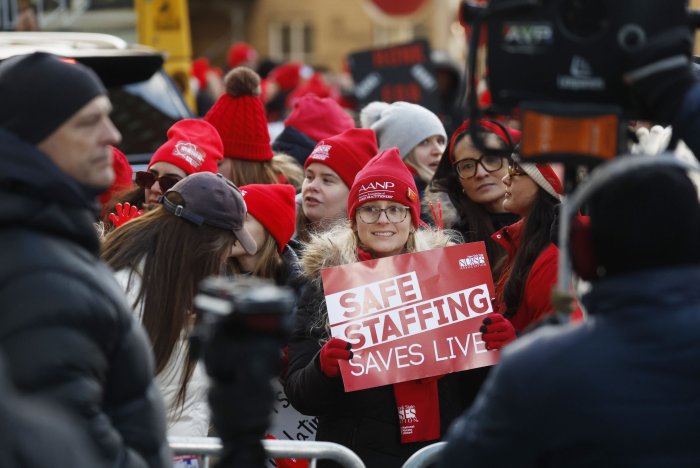
Picketers hold signs outside at the entrance to Mount Sinai Hospital on Monday in New York City. Nearly 15,000 nurses across New York City are now on strike after no agreement was reached ahead of the deadline for contract negotiations. It is the largest nurses’ strike in NYC’s history. The hospital locations impacted by the strike include Mount Sinai Hospital, Mount Sinai Morningside, Mount Sinai West, Montefiore Hospital and New York Presbyterian Hospital. Photo by John Angelillo/UPI | License Photo
In 2007, Gustavo Petro was visiting Washington, DC, when he made an unusual request: to accompany his host’s friend on a school pickup run.
At the time, Petro was a rising star in the Colombian Senate who was in the United States to receive the Letelier-Moffitt Human Rights Award for exposing politicians’ ties to paramilitary groups. His host was Sanho Tree, director of drug policy at the Institute for Policy Studies (IPS).
“That’s something I can’t do in Colombia,” Tree remembered Petro telling him. “If your assassins know you’re going to pick up your kid at a certain time, that’s extremely dangerous.”
Such dangers were not new to Petro.
He began his career being hunted by soldiers as an armed rebel with the M-19, an underground student movement that sought a fairer, more democratic Colombia. After laying down his rifle, he became a whistleblowing senator, holding hearings on the shadowy alliance between politicians and paramilitary groups that reached the highest echelons of power – and earned him a price on his head from a paramilitary leader.
Throughout, he has pursued the same issues in a country torn apart by decades of armed conflict and where land has long been concentrated in the hands of the wealthy few.
“One thing we can say about Petro is that he’s been consistent,” said Alejandro Gaviria, Petro’s former education minister, who has been both a critic and ally of the president.
“If you watch an interview of his 20 years ago, he has exactly the same ideas. Then he was talking about peace, land reform; he was even ahead of his time talking about environmental issues.”
In 2022, Petro was elected the first left-wing president of the South American country and entered the presidential palace with promises to lead Colombia in a more equitable, eco-friendly direction.
On the international stage, he has been a rare figure among Latin American leaders as an outspoken critic of US President Donald Trump. After the US attacked Venezuela in early January and abducted the country’s leader, Nicolas Maduro, Trump threatened military action against Colombia. The former rebel responded by saying he would “take up arms” again to defend Colombia. A detente soon followed after a phone call between the leaders.
As Petro has struggled to put his ideas into practice throughout his term and faced tensions with Trump, what drives Colombia’s president?
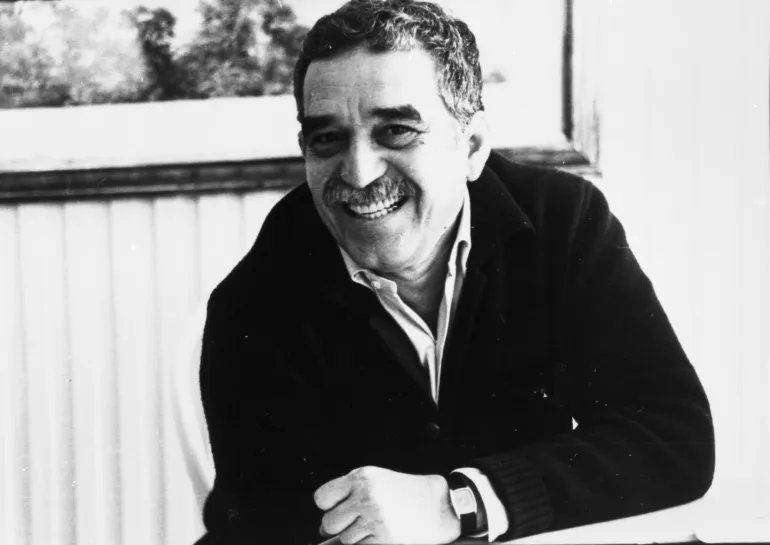
Gabriel Garcia Marquez, who won the 1982 Nobel Prize in literature, celebrated the 20th anniversary of his novel One Hundred Years of Solitude in June 1987. His novel has greatly influenced Petro [File: Reuters]
Bookish rebel
Petro was born in 1960 to a middle-class family in the Caribbean coastal town of Cienaga de Oro, but spent much of his childhood in the rainy capital, Bogota, and his teenage years in the city of Zipaquira.
From a young age, he questioned authority.
“He likes discussion, but not dogma,” his father, Gustavo Petro Sierra, once said in an interview where he recalled an incident when his son was three. He had tried to punish his son by slapping his hand, but missed and accidentally struck his face. Petro had looked his father in the eye and yelled, “Don’t hit me in the face, Dad!”
Petro’s father, a teacher, inspired his son’s love of reading, and Petro was particularly influenced by the celebrated novel, One Hundred Years of Solitude, by the Colombian author Gabriel Garcia Marquez. His father gave him a copy as a birthday gift when he was a child, according to former Culture Minister Juan David Correa, who met Petro in 2021 as the editor of his memoir.
The magical realism epic immortalises Colombia’s civil wars and class struggles through the saga of the Buendia family through the 19th and early 20th centuries. After independence from Spain in 1810, Colombia experienced intermittent warfare between its two main political factions: the secular, reformist Liberals and the Conservatives, who wanted to maintain the Catholic, colonial status quo.
“That was a book that was definitive in our lives as Colombians,” explained Correa, noting Petro’s belief that Colombians must know their history.
“We have to know who these oligarchies or aristocracies are that ruled the country over the past 200 years of solitude [since independence], as [Petro] called it.”
In the colonial era, the Spanish oversaw a feudal-like system in which landless campesinos (rural workers) toiled for a pittance on behalf of wealthy landowners. In the Colombia that Petro grew up in, this system persisted. Even at the dawn of the new millennium, only 1 percent of landowners possessed half the arable land.
As a boy, Petro’s mother, Clara Nubia Urrego, would tell him stories about the turmoil in the country, including the assassination of Jorge Eliecer Gaitan. Gaitan, a presidential candidate for the Liberals, called for reforms, including land distribution, which landowners fiercely opposed. His murder in 1948 kicked off a decade of bloodshed, known as La Violencia, between Liberal armed rebels and the Conservative government.
A truce in 1958 led to a power-sharing arrangement between the Liberal and Conservative parties, known as the National Front. Things had seemingly calmed by the early 1960s, but in 1964, inspired by the Cuban Revolution, the remaining Liberal rebels roaming the countryside came together as the communist Revolutionary Armed Forces of Colombia (FARC) and the smaller National Liberation Army (ELN).
Meanwhile, the National Front blocked any legitimate alternatives, going so far as to rig the election on April 19, 1970 against the populist ANAPO (National Popular Alliance), which attracted people fed up with the two-party system, including Petro’s mother, who had joined the party. Seeing his mother’s sadness at the election results became Petro’s political awakening. He was 10.
At his Catholic school in Zipaquira, Petro and three other friends formed a study group and pledged to dedicate their lives to a better Colombia. They read Alternativa, a left-wing magazine founded by Garcia Marquez, which ran interviews with Chilean and Argentinian rebels and criticised the US sway over Latin America. They became involved with local unions, bringing together workers, salt miners and teachers.
In his memoir, Petro recalls his “communist” beliefs did not make him popular with priests or his classmates whose parents hung portraits of Spain’s fascist dictator General Francisco Franco on their walls. But he credits his high school as the place where he learned about liberation theology, a strand of Catholicism that advocates uplifting the oppressed.
“Since then, love for the poor has remained by my side,” he wrote.
“I didn’t learn that from Marxism, but from liberation theology.”
FARC rebels enter a small town near Miranda, Colombia, on April 17, 1996, two days after the group ambushed a military convoy, killing 31 soldiers and wounding 18 outside the town of Puerres [Ricardo Mazalan/AP Photo]
Occupying a hillside
In 1978, after enrolling at university in Bogota to study economics, Petro was handed a document by Pio Quinto Jaimes, a teacher involved in activist circles. It outlined the goals of an underground student movement known as the 19th of April Movement or M-19, named after the 1970 election. Jaimes was impressed by Petro’s work with the unions and considered him a worthwhile prospect for the group.
Although often described as “urban guerrillas”, M-19 was distinct from the uniformed rebels of the FARC or the ELN. Whereas the FARC recruited from rural workers and wanted a Cuban-style Marxist revolution, M-19 mainly consisted of politicised students who sought social democracy, denied by the two-party system.
Unlike the FARC’s camouflaged commandos, who would raid army outposts before disappearing into the jungle, M-19 operated in the cities and preferred symbolic stunts such as stealing the sword of Simon Bolivar, Colombia’s 19th-century liberation hero, from a Bogota museum.
“Bolivar has not died,” read a note they left behind. “His sword continues his fight. It now falls into our hands, where it is pointed at the hearts of those who exploit Colombia.”
The M-19 hijacked milk trucks to redivert the goods to poorer neighbourhoods, and orchestrated kidnappings targeting Colombia’s wealthy elite.
Petro read the document from cover to cover.
“The movement connected me with the reality of the country, with my mother’s stories about Gaitan, Bolivar, and the ANAPO,” he wrote in his memoirs. “It was as if it had struck a chord that intensely stirred some fibres within me.”
Petro, along with two of his high school study group friends, joined the M-19.
Although he learned to use a gun, he did not take part in armed operations. He was instead tasked with disseminating propaganda. He took on the nom de guerre Aureliano, after a rebel leader in Marquez’s novel.
After graduation, Petro returned to Zipaquira and was elected an ombudsman, a public advocate, in 1981, to hear residents’ complaints about the local government.
In the early 1980s, Petro edited a newsletter – Letter to the People – where he called on readers to occupy a hillside on the outskirts and turn it into a housing project for poor people. Some 400 impoverished families answered the call and found 22-year-old Petro and a group of young activists measuring out 6-by-12 metre (19.7×39.4 feet) plots. There were no wells or sewage, and residents had to collect rainwater.
The squatters were eventually granted permission to stay by the mayor, and the community evolved into a neighbourhood named Bolivar 83.
Colombian presidential candidate Carlos Pizarro of the M-19 group surrenders his gun in Bogota in March 1990. The following month, Pizarro, 39, was assassinated by an armed man during a commercial flight [File: Zoraida Diaz/Landov via Reuters]
‘My youth was over’
By 1984, as peace negotiations between the government and M-19 gained momentum, Petro publicly acknowledged his involvement in the group.
“I did so at a demonstration that was one of the largest in the municipality’s history,” he said in an interview. “From then on, my life changed. My youth was over.”
After telling the crowd he belonged to M-19, Petro stepped back to applause.
But not everyone was pleased.
Petro’s father, who had no idea about his son’s secret life, was shocked by the risks he had been taking.
The talks with the government soon fell apart, meaning M-19 members were once again targets for arrest. Petro was forced to go underground.
He lay low in Bolivar 83, sleeping in different beds each night, and wore a disguise, a yellow dress and a wig, pretending to be a woman.
Around this time, Petro had a psychedelic revelation under the guidance of a shaman on a sacred mountain. Drinking ayahuasca, a powerful Amazonian brew, he experienced intense visions. The first showed an Indigenous princess descending from above as he was enveloped by roots.
“What does this mean?” he asked the shaman.
“Well, you are like a spirit taking care of nature,” the spiritual healer replied.
Petro, who recounted this experience in the book Children of the Amazon (2023), said this was the moment he realised his responsibility towards the environment. His second vision was more troubling: he saw his own death during an ambush.
In October 1985, soldiers poured into Bolivar 83, scouring the neighbourhood for M-19 rebels and intimidating residents. A terrified boy revealed the secret tunnels where Petro was hiding.
Petro was arrested, tortured for four days in a military barracks, and imprisoned. He served 16 months for possession of weapons, which he claimed were planted.
While imprisoned, he missed the birth of his first son, Nicolas. Katia Burgos, his wife, who he had known since childhood, was also with M-19.
Meanwhile, Colombia’s internal armed conflict escalated beyond the rebels and the government.
A Colombian soldier watches as cocaine seized in a raid is burned in 1989 [File: Zoraida Diaz/Reuters]
The rise of narcos
The emergence of drug cartels or narcotics traffickers, aka narcos, added another dimension to the conflict.
Cocaine, a white powder refined from coca leaves, gained popularity in the 1970s, fuelled partly by US disco culture. Initially, Colombia was mainly a transit point for cocaine smuggled from Peru or Bolivia, but it was not long before coca cultivation expanded within Colombia, soon becoming the most viable livelihood in rural areas.
Cocaine barons and other wealthy businessmen began bankrolling private armies and paramilitaries to protect their families and property from armed rebels.
Although both were engaged in criminal activities, the rebels sought to overthrow the ruling elite, but the narcos wanted to become part of it, pitting them on opposite sides of the conflict.
After his release from Bogota’s La Modelo prison in 1987 at age 26, the unease of Petro’s rebellion days stuck with him, and he even took to sleeping with an assault rifle under his bed.
The following year, he met Mary Luz Herran, an ardent M-19 member since she was 14. They would go on to marry and have two children, a daughter named Andrea and a son named Andres, before splitting.
Soon after they met, in 1990, the M-19 became the first significant rebel group to demobilise, transforming into the M-19 Democratic Alliance party.
But it was a dangerous time to be in Colombian politics.
In the 1980s and 90s, some 6,000 members of the left-wing Patriotic Union party were killed by narcos, paramilitaries and the security services.
M-19 were not spared, either. In 1990, their presidential candidate, Carlos Pizarro, was shot on board a passenger plane mid-flight.
While serving a term in Congress, Petro began receiving death threats from a paramilitary group called Colsingue, or Colombia Without Guerrillas, and for his and his family’s safety, he agreed to a diplomatic posting in Belgium in 1994. While there, he studied environmentalism and economics at the University of Louvain, and he became deeply interested in the work of Romanian economist Nicholas Georgescu-Roegen, who warned that while the global economy relies on constant growth, the Earth cannot be exploited forever.
But Petro grew restless in Brussels. “I felt bored, nostalgic, and eager to return to the political arena,” he writes in his memoirs.
He returned to Colombia, where he was re-elected to Congress in 1998. Two years later, he met his third wife, then a 24-year-old law student named Veronica Alcocer. They soon married, and despite initial tension with Veronica’s father — whom Petro described as an “almost fascist” in an interview with a Colombian magazine — Petro and his father-in-law grew close through their shared love of reading and intellectualism. His funeral in 2012 was one of the few times Petro cried in public. They have two daughters, Sofia and Antonella.
Meanwhile, in a bid to start peace talks in 1998, then-President Andres Pastrana conceded territory roughly the size of Switzerland to Colombia’s largest armed group, the FARC. It was meant to be neutral ground, but the rebels used it to recruit and train child soldiers, grow coca, hold captives and enforce their own brand of justice.
Enter Alvaro Uribe. A right-wing hardliner, Uribe won the 2002 presidential election by promising to quash the rebels with an iron fist.
With US support, Uribe’s beefed-up military inflicted devastating defeats on the FARC. Washington had an interest in stopping the flow of cocaine from the source to the US, and in the 2000s and 2010s, Colombia was the third-largest recipient of US military aid after Israel and Egypt.
Petro (C), then in Congress, talks with police during a protest in Cartagena on May 18, 2004, as Colombia hosts the launch of Andean free trade negotiations with the US [Eliana Aponte EA/Reuters]
Defying death squads
Overall, security improved, but the Uribe era revealed that the authorities had been colluding with paramilitaries for years. While presenting themselves as anti-communist vigilantes, the paramilitaries were responsible for the lion’s share of civilian deaths, terrorising vast swaths of the country.
In one particularly brutal episode in 1997, a band of armed men descended on the village of El Aro in Antioquia. Villagers were brutally tortured and raped, and up to 17 people were killed. The paramilitaries burned the village down as they left, and witnesses reported seeing a helicopter circling above — a yellow aircraft belonging to the Antioquia governor’s office, which at the time was occupied by Uribe.
The ghosts of El Aro were reawakened in the parapolitica (para-politics) scandal of 2006 after journalists and prosecutors revealed that several lawmakers were in league with far-right paramilitary groups, allowing them to murder and intimidate opponents while enriching themselves through bribes and illegal land grabs.
What happened next became one of the defining periods of Petro’s career. He held public hearings and accused the perpetrators of the El Aro massacre of operating with Uribe’s blessing while he was governor, such as by helping establish civilian “self-defence” groups as a front for the militias.
“Why the silence, Mr President?” Petro pressed him at a hearing. “Or does the government accept that violent narcoterrorists have a presence in its ranks?”
The then-president fired back, calling the senator a “terrorist in civilian clothes”. Uribe’s alleged paramilitary ties later landed him in a years-long court case from 2012, ending in his conviction for witness tampering last year, which was soon overturned on appeal.
Having lost comrades like Pizarro to the bloody purges of the 1980s and 90s, Petro knew all too well what he was up against. The scandal established him as a fearless crusader, but won him few friends.
“He was the one to [expose the paramilitaries] at a time when it was incredibly dangerous,” said Gimena Sanchez-Garzoli, a human rights advocate at the Washington Office on Latin America (WOLA).
“The impunity was so rampant … he was speaking to a Congress where 30 percent of it was linked to these groups.”
Tree, who nominated Petro for the human rights award in DC, remembered how the senator was on edge during this period.
“When I would meet with him in the mid-2000s in Bogota, he couldn’t stand near a window, and every night he had to go home by a different route,” Tree recalled.
Petro’s paranoia about standing near windows was not unwarranted; Salvatore Mancuso, the strongman behind the El Aro massacre, later confirmed that Petro’s name had indeed been on his hit list.
Petro gestures to supporters as he celebrates winning Bogota’s mayoral race, October 30, 2011 [Fernando Vergara/AP Photo]
Mayor of Bogota
In 2010, Petro launched his first presidential bid but found himself at odds with his own party, the Democratic Pole, which sidelined him in favour of another candidate. Petro ran anyway and came in third overall.
He founded a new party, Humane Colombia, and successfully ran for mayor of Bogota in 2011.
While the previous mayor and his brother profited from corruption, Petro implemented many progressive reforms. A ban on brandishing firearms in public saw murder rates plunge to a three-decade low. Petro’s administration addressed animal cruelty, stopping the practices of using horse-drawn carts for rubbish collection and bullfighting, and pioneered mobile clinics for homeless drug users, treating addiction as a matter of public health.
“We were the first organisation to propose these [drug] reform ideas,” said Julian Quintero, director of Social Technical Action (ATS), a Bogota-based NGO focused on harm reduction and drug policy reform.
“Petro participated with us, and he sort of embraced the proposals we made to him.”
But Quintero noted that Petro’s governing style was also uneven, characterised by a rapid turnover of staff – a preview of his presidential years.
“Petro did very well as a senator because he’s a very good analyst who trembles with accusations when he’s in the opposition,” Quintero said.
“But when he takes office, he doesn’t stand out for his bureaucratic and technical skills. He’s not a good administrator. He changes teams very quickly, not allowing for continuity in his projects.”
Moreover, he added, in Colombia, “the left isn’t used to governing”.
Quintero noted that deeply entrenched right-wing interests also made Petro’s job more difficult. A failed attempt to overhaul the capital’s waste management system in 2013 ignited a political battle that saw Petro ousted from office by the arch-conservative Attorney General Alejandro Ordonez. That decision drew mass protests, and Petro was reinstated a month later – a sign that his brand of politics was gaining momentum.
Petro (C) and his running mate Francia Marquez, at his left, with the Historical Pact coalition, stand before supporters with Petro’s wife Veronica Alcocer, second from left, and their daughter Andrea on election night in Bogota on May 29, 2022 [Fernando Vergara/AP Photo]
Path to victory
In 2010, Petro had lost his presidential bid to Juan Manuel Santos, Uribe’s defence minister, who oversaw his campaign against the FARC in the 2000s. But it was Santos who – to Uribe’s dismay – brokered peace with the rebels in 2016.
When Uribe’s protege Ivan Duque took office in 2018, however, the government largely abandoned that agreement, and violence surged.
“[The Uribe faction] wanted a candidate, basically a puppet, who was to rip up the peace agreement and not let it advance,” WOLA’s Sanchez-Garzoli explained.
Armed groups, including rogue FARC commanders, drug cartels and paramilitaries, rushed to fill the power vacuum, where they once held sway.
Then, in 2021, Duque’s attempt to raise taxes prompted mass protests that were met with police brutality and dozens of deaths. The unrest and growing public disillusionment with the status quo, now fully exposed by the collapsing peace process and the pandemic-ravaged economy, meant Colombia finally had an opening for its first progressive president; a break from the conservative elite such as Uribe and Duque, who came from, and represented the interests of, the wealthy landowning class.
A leftist coalition called the Historic Pact rallied behind Petro for the 2022 elections.
Eager to include Liberals as well, Petro reached out to economist and former government official Gaviria.
“It’s kind of funny because when you see him at a rally, he’s really energised, but in a one-on-one interaction, he is timid, he is quiet, he is difficult to engage in conversation,” Gaviria said, recalling Petro’s visit to his home as he tried to build a coalition.
“When he visited my apartment, I was trying to ask him questions, and he never said anything to me. He stayed silent for five minutes.”
The presidential hopeful eventually proposed that Gaviria, then the Liberals’ presidential candidate, ally with his progressive forces.
Ultimately, in the second round of the election, Gaviria threw his support behind Petro, who offered him a place in his new cabinet as education minister when he took office that August.
Petro addresses the 77th session of the United Nations General Assembly in 2022 [File: Brendan McDermid/Reuters]
International stage
As president, Petro took his message to the world. At his first United Nations speech, he warned, “the jungle is burning” while global powers were fighting over drugs and resources. He highlighted what he saw as the hypocrisy of vilifying cocaine while protecting coal and oil.
“What is more poisonous for humanity, cocaine, coal or oil?” he asked. With Colombia’s cocaine industry having fuelled decades of civil war, Petro has called for cocaine legalisation, calling the so-called war on drugs a failure.
“Cocaine is illegal because it is made in Latin America, not because it is worse than whisky,” he told a broadcast government meeting in February 2025.
In confronting the climate crisis, he has halted fracking and new gas projects to shift Colombia towards clean energy. In an economy reliant on fuel exports, however, this decision has been met with fierce scrutiny.
Petro has also sought to address the country’s armed conflict.
Influenced by French philosopher Jacques Derrida, who believed true forgiveness meant forgiving the unforgivable, Petro presented Congress with a plan to bring all remaining cartels, armed rebels and paramilitaries to the table, including by suspending arrest warrants and empowering local leaders as mediators.
The plan was called “Total Peace”.
Petro, left, and his running mate Francia Marquez, celebrate before supporters after winning a run-off presidential election in Bogota on June 19, 2022 [Fernando Vergara/AP Photo]
‘A dream’
Petro’s peace initiative was put to the test in Buenaventura, a key Colombian port on the Pacific Coast. The port had long been a strategic hub for cocaine smugglers loading cargo onto ships bound worldwide.
Then, in 2019, a deadly turf war exploded. Residents were terrified to leave their homes. In desperation, local archbishop Ruben Dario Jaramillo performed a mass exorcism of the city by spraying the streets with holy water from a convoy of vehicles.
But in October 2022, the leaders of two rival gangs met and shook hands at a church service, thanks to a truce brokered by Jaramillo, building on the Total Peace initiative. The following six weeks saw only one killing, compared with the previous monthly death toll of 25.
The broader peace plan, however, has had flaws. Anticipating a deal, armed groups consolidated their positions to get the upper hand in negotiations while taking advantage of ceasefires to recruit and resupply.
As Quintero observed, the groups calling themselves “guerrillas” today are mostly criminal gangs using the label to legitimise their actions. “There are no guerrillas with the ideology to overthrow the state,” he said.
“[Instead], today there are gangs of very well-armed drug traffickers posing as guerrillas.”
The two most problematic ones are the Gulf Clan and the ELN. The Gulf Clan is a powerful narco-paramilitary crime syndicate demanding talks to negotiate their surrender while aggressively expanding its empire. The ELN continues to carry out attacks and kidnappings and is battling a renegade FARC faction in the dense jungles of Catatumbo, a fertile coca-growing region near Venezuela, displacing tens of thousands of people and prompting Petro to declare a temporary state of emergency last January.
Gaviria said that while reining in heavily armed drug dealers hiding in mountains and jungles would be challenging for any government, Petro has not really had a plan.
“He thought political will was enough to achieve Total Peace, which is completely wrong,” Gaviria said.
He compared Petro’s approach with Santos’s.
“Santos had a strategy, a group negotiating with the FARC. He met with that group every week, having conversations with his experts around the world … he was very disciplined in the way he was conducting this difficult topic.
“Petro was just completely different. No strategy at all,” Gaviria added. “Big announcements and political will. [Petro] thought that was enough, and now we know that no, it was not enough, especially if you’re dealing with such a complex problem.
“Total Peace was not a strategy. Total Peace was an idea, a dream.”
The chaotic nature of Petro’s cabinet has also complicated matters. The turnover rate is high, averaging a new minister every 19 days. Gaviria resigned in early 2023, along with three other ministers, during a fallout over health reforms. And 13 ministers lost or left their jobs in just three months between late 2024 and early 2025.
“I think this is a direct result of his style of policymaking,” said Gaviria, describing it as “undisciplined”.
Petro tends to replace ministers with loyalists and former members of the M-19, while publicly squabbling with former staff and accusing them of disloyalty. Some connect Petro’s perilous past to this governing style.
“Petro has a paranoid style of government that almost defines him,” said Gaviria.
“He is always thinking that there is a conspiracy against him. And probably this idea is related to being a former guerrilla member and living [in hiding].”
Correa agreed, noting that Petro does not trust many people.
The replacements he selects, too, are not necessarily the best-qualified.
For example, Sanchez-Garzoli believes the ELN peace process collapsed because Petro appointed “an ideologue and less of a real negotiator”.
“They basically blew apart a process that could have demobilised thousands,” she explained.
For Gaviria, Petro is these days more interested in ideological battles on social media than in leading the country. “I think he knows that he has not been an effective president,” he said. “Governing a country can be difficult, boring … [and to be successful] you have to engage in difficult conversations. You have to change your mind.”
Petro, he believes, has struggled to accept that “tragic destiny”.
Petro speaks during a protest against Trump’s comments, accusing him of drug trafficking, and a court ruling that overturned convictions against former President Alvaro Uribe in Bogota on October 24, 202 [Luisa Gonzalez/Reuters]
Legacy
Petro’s advocacy on Palestine – and the severing of diplomatic ties with Israel over its genocidal war on Gaza – the climate crisis, drug reform and willingness to confront Trump have won him international praise. Trump, without any evidence, has accused Petro of running cocaine mills and called him a “sick man” on several occasions.
Back home, Petro points to having reduced poverty and infant mortality rates, increased agricultural production, and provided greater access to education, but his criticised peace strategy has failed to deliver broad demobilisation, and stark inequality persists. His approval rating has dropped from 56 percent when he took office to almost 36 percent.
Petro’s presidency has been overshadowed by scandals, including his eldest son Nicolas’s arrest for alleged money laundering linked to narco campaign funding. He calls such attacks targeting his inner circle “lawfare”, aimed at weakening him, something he experienced when he was briefly ousted as mayor of Bogota.
“The first thing they tried to destroy was my family,” he told Spanish daily El Pais last February. “They wanted to destroy the emotional ties because a man without emotional ties becomes hard, bad, and errs.”
He conceded that the presidency is a role that brings him “absolute unhappiness”.
As Petro faces the end of his presidency this year, his legacy may be that of a polarising figure, a revolutionary who tried to overthrow the system from within — yet was unable to solve Colombia’s toughest challenges.
Still, Petro’s supporters see his presidency as the start of a social transformation.
“Our country is a very conservative society; our values, our classism are very, very evident,” said Correa.
“I think that it will take two generations to reconstruct the society … And I think that this government represents only a beginning, a seed for the new generation.”
The Scenic Eclipse II had to call on the help of Us Coast Guard, Polar Star, to help after it became trapped in pack ice in the Ross Sea
The Scenic Eclipse II had to be cracked free from pack ice in Antarctica (Image: O2C Christopher Bokum/USCG / SWNS)
A cruise ship was rescued by a 50-year-old US Coast Guard vessel after it reportedly became trapped in pack ice in Antarctica – as those onboard sipped Champagne and watched the action.
The Scenic Eclipse II sent a distress call out at around 11pm local time on Friday, January 16, after it became stranded in the Ross Sea near McMurdo Sound, approximately 810 miles from the South Pole, it has been reported.
The cruiser liner – which was launched in 2023 and carries 200 guests and around the same number of crew in 114 suites – was freed by the coast guard and escorted for four hours to open water, Cruise Industry News reported.
Its passengers were given Champagne and guided onto the observation deck so they could get a first-hand view as the ice was cleared.
The ship and its passengers are currently on a 23-day one-way trip from Hobart, Tasmania, in Australia to Dunedin in New Zealand, calling in at the Balleny Islands and Ross Island in Antarctica on the way.
As a Polar Class 6 vessel, Scenic Eclipse II is well able to handle Antarctic ice, but due to pack changes during the day, the captain requested help to avoid a longer sailing pace at a reduced speed.
The natural movement of the ice changed the following day and the ship was able to carry on as normal. According to a Jan. 23 press release detailing the incident, the U.S. Coast Guard helped “free and escort” the cruise ship that was “trapped in pack ice.”
Thanking the USCG Polar Star for their help, Captain James Griffiths, Scenic Group’s General Manager Ocean Operations said: “ We were grateful for the professionalism and co-operation of the crew of USCG Polar Star during our operations in the Ross Sea. While Scenic Eclipse II was never in need of rescue services, the co-ordination between both vessels ensured we could navigate the changing pack ice safely and efficiently.
“This is a great example of the practical, respectful co-operation that exists in the polar regions, where safety, seamanship and shared responsibility always come first.”
The Polar Star is the USA’s only active heavy icebreaker and has been in service for five decades.
Commander. Samuel Blase, Polar Star’s executive officer said: “At 50 years old, Polar Star remains the world’s most capable non-nuclear icebreaker. That’s a testament to the crews that have maintained it over the decades. With years of service left to give, Polar Star will continue to guide the way in the high latitudes well into the future.”
Despite passengers paying large sums of money to travel to the world’s least visited continent, Antarctica cruise lines rarely give detailed itineraries as the harsh weather conditions and propensity of the sea to suddenly freeze means they are difficult to stick to.
Fans of supernatural mysteries should add it to their watchlist immediately
Fans of K-dramas and supernatural mysteries have a new show to look forward to(Image: Netflix)
An ‘unnerving’ historical drama is coming soon to Netflix and fans of K-dramas, supernatural mysteries and historical period shows are sure to want to add this upcoming title to their watchlist immediately.
Netflix’s Tudum website has confirmed that The East Palace will be released on the streamer some time this year. While there is no confirmed release date just yet, filming finished last summer and it is expected later in 2026.
There’s no official word on how many episodes it will consist of either but its expected to consist of eight parts. However, we do know that The East Palace follows Gu-cheon, who moves between the realms of the living and the dead, and Saeng-gang, a lady of the court guarding a secret of her own.
When the king calls on them to unravel the mysteries of the palace, they’re drawn into a world where power, hidden histories, and restless spirits are bound together by a dangerous curse.
Fans are also awaiting the first official trailer to be released by Netflix. It is set to be just part of an impressive K-dramas making their debut this year.
For the latest showbiz, TV, movie and streaming news, go to the new **Everything Gossip** website
Gu-cheon investigates unnerving incidents at the palace with a blade that can cut down ghosts. While Saeng-gang holds the ability to hear the voices of the dead aids Gu-cheon as they navigate the palace’s long-buried secrets.
Quietly watching their every move from the throne is the king, played, whose motives are complex and hard to ascertain. The show comes from writers Kwon So-ra and Seo Jea-won, who have previous experience of examining Korean occultism in their previous work which includes Bulgasal: Immortal Souls and The Guest.
They are joined on the creative team by director Choi Jung-kyu (The Devil Judge, Children of Nobody) to bring the supernatural drama to life. While Netflix has so far confirmed the stars taking on the three main roles in the cast.
Nam Joo Hyuk plays Gu Cheon. The actor has previously starred in three Netflix K-dramas, Twenty-Five Twenty-One, Start-Up, and The School Nurse Files. In 2023, he also starred in the Disney+ K-drama Vigilante.
Roh Yoon Seo plays Saeng Gang. The actress was recently featured in a guest role on Netflix’s The Frog and Love Next Door. She also starred in supporting roles in Black Knight and a Crash Course in Romance. Her role as Saeng Gang is her second lead role in a K-drama, following her starring role in 2022’s Our Blues.
Cho Seung Woo plays the King. The actor has starred in several Netflix projects such as Divorce Attorney Shin, Sisyphus: The Myth, Stranger, and Life.
The East Palace is streaming on Netflix some time in 2026.
Riders’ legs will dangle giving them the feeling of flying.
With its gigantic pendulum finally hanging in place, the structure is starting to look like a finished ride.
Frames are popping up to create the loading area where the first brave riders will eventually wait for their turn.
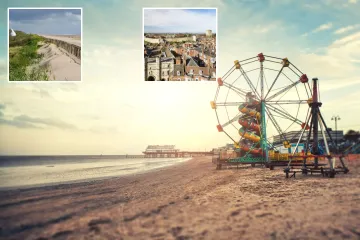
The latest crowd-pleaser will drastically change the way the seaside resort’s coastline will look.
While an exact opening date has not yet been confirmed, the ride is expected to welcome its first passengers later in 2026.
Amanda Thompson OBE, CEO of Pleasure Beach Resort previously teased: “This ride will be colossal, daunting, exhilarating and an incredible addition to the town.”
The Aviktas will be the tallest of its kind in the UKCredit: SWNSThe mega-ride is set to tower over similar rides across the country by almost double their heightCredit: SWNSThe £8.7million ride will open later this year at Blackpool Pleasure BeachCredit: Alamy
Valentine’s Day may be coming up, but we think romance should be year round! We want to hear about a favourite romantic place you’ve discovered on your travels in Europe (including the UK), whether it was a fairytale city, a remote mountain refuge, a beautiful hotel or a romantic restaurant.
The best tip of the week, chosen by Tom Hall of Lonely Planetwins a £200 voucher to stay at a Coolstays property – the company has more than 3,000 worldwide. The best tips will appear in the Guardian Travel section and website.
Keep your tip to about 100 words
If you have a relevant photo, do send it in – but it’s your words we will be judgingfor the competition.
We’re sorry, but for legal reasons you must be a UK resident to enter this competition.
The competition closes on Monday 2 February at 10am GMT
Your responses, which can be anonymous, are secure as the form is encrypted and only the Guardian has access to your contributions. We will only use the data you provide us for the purpose of the feature and we will delete any personal data when we no longer require it for this purpose. For alternative ways to get in touch securely please see our tips guide.
If you’re having trouble using the form click here. Read terms of service here and privacy policy here.
FORGET everything you know about holiday parks – as a new age of caravans could change them entirely.
Caravan holidays have been a popular, and low cost, alternative to holidays abroad, for the last 100 years.
Sign up for the Travel newsletter
Thank you!
The new caravan designs last decades longer than standard designsCredit: WNSHe said they feel more like luxury hotel roomsCredit: WNSThey are also more insulated so can be stayed in all year roundCredit: WNS
Yet new designs could change the design of them, with many having not changed in decades.
Welsh designer Craig Ledwards has revealed his own creations, likening to them a luxury hotel room instead.
He told local media: “Caravans haven’t changed over the past 70 years.
“They’re exactly the same style as they’ve always been – no insulation so there’s always condensation in it, smell damp, and the layout is the same.
“But this is totally different, it’s open-plan living. It feels like you’re entering a luxury hotel room.”
Like hotels, guests can access them using key cards which are then slotted in for the electricity.
Inside are marble bathrooms and projectors in the ceiling, as well as full glass walls.
Small balconies are also part of the outdoor space, as well as a rooftop window for stargazing while inside.
He has already introduced them to north Wales last year.
He added: “It’s as far away from a static caravan as you can get – the only thing that’s the same is the size, we’ve designed it to be the same size so it can replace an old one without having to change the footprint or service connections.”
Each one, costing around £35,000 to build, is fully insulated so they can be stayed in all year round.
Not only that, but he says they have a lifespan of 50 years – much longer than standard caravans which is between 15 and 20 years.
They have been met with some skepticism, however.
Some have said that the all-glass models may not retain heat during the colder months, even if well insulated.
And a National Caravan Council spokesperson said: “New designs such as ones imported from China may appeal to a niche audience, drawn to contemporary styling and different layouts,” they said.
“But widespread appeal will depend on how well they meet the expectations of the UK holiday park market, the access to spare parts, the availability of reliable and timely after-sales service and those who are responsible for licensing their use.”
President Trump has an army of bootlickers that seems to stretch to the sunset. Many of them creep around on social media and almost certainly legions of them come from bot accounts on X.
Then there’s Bill Essayli. When it comes to saying anything to please a president with autocratic dreams, the former Assembly member is a bootlicking All-Star.
Att. Gen. Pam Bondi appointed him as the top prosecutor for the Central District of California in April with the explicit mandate to do Donald J. Trump’s will. His record so far has been unsurprisingly embarrassing and outlandish.
The guy can’t even call himself acting U.S. attorney anymore after a judge ruled in October he was “not lawfully serving” in the position since he was never formally appointed in the first place. So you’d think Essayli would hear the music and go back to being an inconsequential California legislator, but no! If there’s one thing Trumpworld has shown, it’s that once you’ve knelt to offer the Dear Leader a lick-and-shine, you better keep it up until your tongue’s as dry as Death Valley.
Which leads us to this weekend. And Essayli’s bootlicking-gone-wrong.
On Saturday morning, Border Patrol agents in Minneapolis shot and killed 37-year-old Alex Jeffrey Pretti after they gang-tackled him. He had tried to help a woman shoved to the ground by a federal immigration officer; an officer maced him and he soon collapsed — and shortly after, was dead. A Department of Homeland Security social media post justified what happened by saying Pretti seemed intent on “want[ing] to do maximum damage and massacre law enforcement” because he was in possession of a legally registered handgun. He never brandished it though. In fact, multiple videos showed Pretti clearly holding what looked like a phone as agents swarmed him.
Even though the incident was thousands of miles away from Los Angeles, Essayli had to flick his tongue — it’s the bootlicker way, after all.
“If you approach law enforcement with a gun, there is a high likelihood they will be legally justified in shooting you,” he snickered on social media hours after Pretti died. “Don’t do it!” He also reshared the posts of right-wing social media influencers Jack Posobiec and Andy Ngo who claimed Pretti, an intensive care unit nurse at a Department of Veterans Affairs hospital, was following “antifa” tactics.
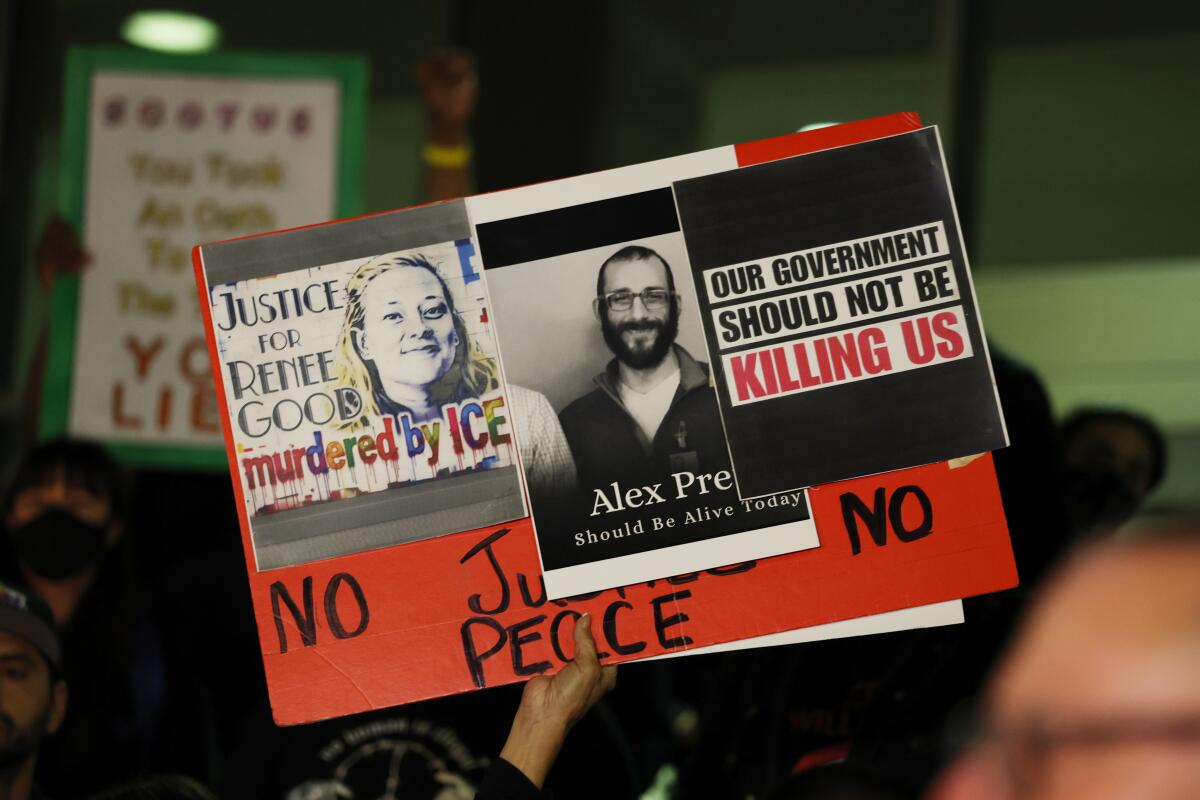
A sign is raised in support of Renee Good and Alex Pretti at a candlelight vigil during a peaceful protest at the federal building in Los Angeles on Saturday.
(Gina Ferazzi / Los Angeles Times)
It blasted his rant as “dangerous and wrong” on social media, adding that “responsible public voices should be awaiting a full investigation, not making generalizations and demonizing law-abiding citizens.”
The Gun Owners of America, a group that’s even more conservative than the NRA, called Essayli’s comments “untoward,” leading to the first assistant U.S. attorney — because bootlickers love their titles — to whine about the nonprofit “adding words to mischaracterize my statement” even though they directly quoted him.
When history looks back at all the cowards, sycophants, apologists, enablers, henchmen and other miscreants that made Trump possible, the bootlickers will have a starring role. The “I voted for this” tribe — even when this is cruelty and actions that are more those of a Macbeth than an American president.
The bootlicker is a universally reviled archetype. Their bread-and-butter is comforting the most comfortable by afflicting the most afflicted. They try to top fellow bootlickers with even more obsequious acts of flattery, hellbent on making the most damning line of Orwell’s “1984” come to life: “The Party told you to reject the evidence of your eyes and ears. It was their final, most essential command.”
The bootlicker’s moral compass is malleable. Wherever the Big Boss has moved the goal posts, that’s where he or she will kick the ball. If all goes to hell and America devolves into a rank dictatorship, beware the bootlicker.
The Trump regime currently has a lineup of them that’s like the bootlicking version of the 1927 Yankees.
In addition to Essayli, you have Stephen Miller, who kept calling Pretti an “assassin” and “domestic terrorist” on social media as if repeating the slurs would make them true. Vice President JD Vance, who described Renee Good, a woman shot and killed on Jan. 7 by an Immigration and Customs Enforcement agent in Minneapolis after she tried to drive away from him, as a “deranged leftist.”
Repeating what the big bootlickers say is a character trait. Call it the bootlicking trickle-down-effect.
There’s Border Patrol chief at large Gregory Bovino, a migra man a federal judge accused of “outright lying” during depositions over the actions of his team in Chicago this fall. During a news conference about the death of Pretti, Bovino claimed that the victim looked like he “wanted to do maximum damage and massacre law enforcement” — the exact same language used in the original Department of Homeland Security social media post on the killing. Hours later, Homeland Security Secretary Kristi Noem also impersonated a macaw, parroting Miller by accusing Pretti of “domestic terrorism.”
On Fox News on Sunday, FBI Director Kash Patel — the agency that in ye olden days would be leading an impartial investigation into what happened to Good, Pretti and other victims of la migra — told host Maria Bartiromo that “No one who wants to be peaceful shows up at a protest with a firearm. That led a skeptical-looking Bartiromo, who’s about as liberal as the Spanish Inquisition, to ask, “And how was he using that handgun in terms of threatening Border Patrol?”
A wide-eyed Patel could only say he trusted Noem’s version of the events.
Homeland Security Secretary Kristi Noem speaks during a news conference on Saturday to address an incident where federal immigration agents shot and killed Alex Pretti during operations in Minneapolis.
(Al Drago / Getty Images)
These are just some of the most prominent, powerful bootlickers stumbling right now on their own deceit and desperation.
Space prohibits me from quoting all the Republicans who last week were stalwart 2nd Amendment fans now saying Pretti had no right to carry his legally registered firearm to a protest even though they cheered on Kyle Rittenhouse when the Wisconsin teen showed up at one very openly carrying an AR-15, which he ended up using to fatally shoot two people who tried to assault him. There’s no evidence Pretti ever handled his firearm during the protest, let alone threatened federal agents with it.
Then there’s the bootlickers who cheered on the Jan. 6 rioters for rising up against what they saw as government tyranny, who insist the dozens of law enforcement officers injured that day were just deep-state agents. Today, those bootlickers are telling folks pushing back against Trump’s police state to respect it.
Obey or die.
The Roman philosopher Plutarch described flatterers in his immortal essay on the subject as “the plague in kings’ chambers, and the ruin of their kingdoms” that “prey upon a noble quarry.” So to Essayli, Patel, Noem and all the other bootlickers in Trump’s orbit, and to the relatively anonymous legions beyond, I’ll leave you with the warning that I saw in a meme that I’m sure Plutarch would endorse:
No matter how hard you lick it, the boot will never love you.
Hi, and welcome to another edition of Prep Rally. I’m Eric Sondheimer. It was a historic weekend for coach Harvey Kitani, who became only the third high school basketball coach in state history to reach 1,000 wins.
Get our high school sports newsletter
Prep Rally is devoted to the SoCal high school sports experience, bringing you scores, stories and a behind-the-scenes look at what makes prep sports so popular.
Harvey Kitani is surrounded by his players after earning his 1,000th career victory on Friday night at Mater Dei in Rolling Hills Prep’s 60-45 win over Bishop Gorman.
Many of his victories came during a 35-year stay as head coach at Fairfax. Let me offer some of the most memorable moments covering him since 1979.
No. 1 is when his star player, Sean Higgins, called a news conference in 1987 to announce his college choice. He signed with UCLA. But Higgins didn’t show up to the news conference. Sitting in the principal’s office and waiting and waiting for Higgins to arrive was so strange. Then word came that Higgins was pressured to sign with UCLA by his stepfather. He ended up getting released from his letter of intent and enrolling at Michigan.
The Fairfax vs. Westchester rivalry became one of the best in the Southland. Westchester coach Ed Azzam, who is the City record holder for most career wins, always got along with Kitani, who hired Azzam to teach middle school students when he retired. Their teams played for City titles against each other in 2002, 2003, 2005, 2007, 2015. Those were the days. Besides playing two league match-ups they’d face off again in the playoffs.
He retired from teaching in the Los Angeles Unified School District in 2016 and decided to accept the coaching position at Rolling Hills Prep, which is 15 minutes from his home and where two of his sons attended.
“If Fairfax was here, I’d still be at Fairfax,” he said.
He’s won four Southern Section titles. He truly has a body of work to admire.
“Unbelievable,” he said of staying in coaching for 46 years.
Boys basketball
Sherman Oaks Notre Dame’s NaVorro Bowman scored 26 points in a win over Harvard-Westlake on Saturday.
(Craig Weston)
NaVorro Bowman, a junior guard for Sherman Oaks Notre Dame, has thrust himself into consideration for Mission League MVP. He had 26 points Saturday in Notre Dame’s 71-66 win over Harvard-Westlake. The Knights are on the verge of finishing second in the regular season and clinching a playoff spot before the Mission League tournament begins Thursday.
Sierra Canyon, led by Brandon McCoy and Brannon Martinsen, a pair of former Trinity League all-stars, defeated Harvard-Westlake to lock up the No. 1 seed for the Mission League tournament. Here’s the report.
Former Notre Dame star Monte Marcaccini has returned to high school basketball as an assistant coach at Oaks Christian, where his son, James, is a promising freshman. Here’s the report.
Palisades, which hasn’t played a basketball game or any sporting event on its campus since the Palisades fire in January of 2025, will hold its first home basketball game Thursday against Fairfax at 6 p.m. Classes return to the campus Tuesday. Palisades (11-11) has emerged as the favorite to win the City Open Division basketball title.
L.A. Southwest College and Pasadena City College are expected to be the championship sites for the City Section basketball finals Feb. 27 and 28.
Cleveland won an important West Valley League game against rival Birmingham. Here’s the report.
The City Section’s top four teams have become real clear: Palisades, Cleveland, Birmingham and Washington Prep.
Second-year coach Leon Jacob has turned around the Angelou program. Here’s the report.
Aryanna Reyes of Pioneer set a school record with a 52-point performance against Artesia.
🏆 ⚡️RECORD BREAKING SENIOR NIGHT ⚡️ 🏆
A night she’ll never forget. A performance for the history books. 💐🐐 Aryanna Reyes made history with a career-high & school record 52 POINTS 🤯 ➕ 11 REBOUNDS | 6 ASSISTS in a win over Artesia. Built for the moment. Destined for… pic.twitter.com/EpAkeTO6TI
Changes are coming in the Southern Section power rankings. No. 2 JSerra lost to Santa Margarita in a Trinity League game. Mater Dei upset highly regarded Bishop Gorman from Las Vegas. Etiwanda routed No. 5 Rancho Christian 104-73.
For some reason, the rankings always ignore Etiwanda in the early going even though the Eagles always contend for Southern Section and state titles. Sierra Canyon is 21-2 and headed for another unbeaten Mission League season. The Trailblazers have never lost a Mission League game.
Harvard-Westlake, led by freshman Lucia Khamenia, has moved into a tie for second place with Marlborough in the Mission League.
Ontario Christian remains No. 1 with a 25-1 record.
Reagan Enright from Rolling Hills Prep scored the 1,000th point of her career.
Westchester is 17-3 and 6-0 in the Western League behind the City Section’s best player, Savannah Myles, averaging 22.1 points. Here’s the report.
Wrestling
Abraham Datte of Monroe is the two-time City Section heavyweight wrestling champion and wants to be a paramedic.
(Eric Sondheimer / Los Angeles Times)
Abraham Datte is a two-time City Section heavyweight wrestling champion from Monroe who wants to become a paramedic. He chose Monroe because of its Fire Academy. Here’s a profile.
The Southern Section Divisional championships are set for Feb. 13-14.
Here are the boys’ sites.
Central — Westminster High
Coastal — Fountain Valley High
Eastern — Canyon Springs High
Inland — Great Oak High
Northern — Moorpark High
Southern — Glenn High
Here are the girls’ sites.
Central — San Dimas High
Eastern — Roosevelt High
Northern — Adelanto High
Southern — Marina High
The Masters Meet is Feb. 20 for boys and Feb. 21 for girls.
The state championships are Feb. 26-28 at Dignity Health Arena in Bakersfield.
Soccer
South East (16-1-3) and El Camino Real (12-3-1, 5-0-1) are looking like the teams to beat in City Section boys soccer. El Camino Real plays at Birmingham on Wednesday.
Servite handed Mater Dei its first defeat 2-1 to move ahead of the Monarchs in the Trinity League standings.
Cathedral is 12-2-1 and 4-0-1 in the Del Rey League heading into a big match Friday at Bishop Amat.
In girls soccer, Santa Margarita is ranked No. 1 in the Southern Section power rankings and is 13-0-2.
Baseball
Chatsworth coach Marcus Alvarado has resigned.
(Nick Koza)
Marcus Alvarado, who coached Chatsworth to a 2022 City Section Open Division championship, said he resigned on Friday, saying he had lost his love for baseball after repeated complaints from parents. Here’s the report.
Gabe Cerna, the baseball coach at Sun Valley Poly since 2009, has been replaced by his assistant, Freddy Flores, who will be an interim coach. Cerna also was the school’s athletic director. Cerna is now teaching at Fulton Prep. He said the school decided to go in “a different direction.”
Pete Crow-Armstrong, Jack Flaherty, Nik Turley and Josh Satin were on hand on Saturday for a ceremony. Meanwhile, the baseball team played teams from Las Vegas, and No. 1 pitcher Justin Kirchner, a Yale commit, struck out 10 in four innings.
Notes . . .
There was an altercation Friday night at the conclusion of the Chatsworth at Taft girls’ basketball game involving the Chatsworth coach and a relative of one of his players. L.A. School Police are investigating. Here’s the report.
Oaks Christian has hired Rudy Carlton as its new football coach. He was an assistant coach at JSerra last season and has extensive college coaching experience from his days at Azusa Pacific. Former Oaks Christian standout Ron Pitts is becoming the general manager and the school is creating an advisory council of former NFL players. . . .
Matt Villasenor has resigned as football coach at Nogales to become head coach at Muir. . . .
Dujuawan Jones is the new football coach at San Marino. . . .
Former Corona del Mar and UCLA quarterback Ethan Garbers has been hired to coach quarterbacks at Corona del Mar. . . .
A lawsuit targeting St. John Bosco football coach Jason Negro has misfired after a judge’s rulings. Here’s the report. . . .
Kevin Encinas is the new football coach at Nogales. . . .
The Southern Section Council will discuss a proposal Tuesday that would allow football at-large playoff berths for teams with a .300 or better overall record. It’s currently .500 or better. The aim is not to allow teams with 1-9 or 2-8 records. It’s a non-action item. . . .
Jaden Soong competes at the Southern California Golf Assn. Amateur Championship at Saticoy Club in Somis.
(Courtesy of SCGA)
Sophomore golfer Jaden Soong of St. Francis will try to qualify for the PGA’s Farmer’s Insurance Open on Monday in Mission Viejo. He needs to finish in the top four. He turns 16 on Monday. . . .
After only one season as coach, Doug Bledsoe said he has resigned as football coach at Narbonne. He took over the program after numerous rules violations resulted in a three-year postseason ban by the City Section and an exodus of players. Narbonne went 0-10. . . .
Garfield running back Ceasar Reyes set a school record with 420 yards rushing and four touchdowns in win over South Gate
Shortstop Bobby Brooks from La Habra has committed to Sacramento State. . . .
Even though Morningside High has closed, former Morningside basketball star Stais Bozeman had his jersey retired Friday.
From the archives: Ryan Turell
Yeshiva’s Ryan Turell brings the ball up court against St. Joseph’s Anton Jansson.
(Joe Bednarsh / Yeshiva Athletics)
Former Valley Torah basketball star Ryan Turell is playing for Haifa in Israel’s second division pro basketball league. He entered this week averaging 13.3 points.
He became a standout college player at Yeshiva. He had one game in which he scored 51 points.
🚨 **STATE RECORDS + NATIONAL SOPHOMORE RECORDS ALERT! 🚨 Servite High sophomore twin speedsters Jorden and Jace Wells break the U.S sophomore class and California indoor records at 60 meters & 200 meters, respectively! 🔥 It’s January! This is crazy!! 📸: @Wellstwins28… pic.twitter.com/z9eSjaJwti
Have a question, comment or something you’d like to see in a future Prep Rally newsletter? Email me at eric.sondheimer@latimes.com, and follow me on Twitter at @latsondheimer.
Did you get this newsletter forwarded to you? To sign up and get it in your inbox, click here.
The head office of Home Plus in Seoul. The troubled discount chain has asked for
emergency operating funds from its shareholder and creditor. Photo courtesy of Home Plus
SEOUL, Jan. 26 (UPI) — South Korea’s cash-strapped discount chain Home Plus said Monday that it was waiting for an infusion of $210 million emergency operating funds from its stakeholders and state-run Korea Development Bank.
The retailer requested its shareholder, MBK Partners, creditor Meritz Financial Group, and KDB each to provide $70 million to help the company stay afloat while it searches for a new owner.
MBK Partners has pledged to offer its share of the funding, but Meritz and KDB have yet to disclose their positions, according to Home Plus.
Speaking at a National Assembly meeting last Wednesday, Home Plus CEO Joh Joo-yun said that the company is in a grave situation.
“Deliveries to Home Plus stores have plunged to about half their previous levels,” she said. “If emergency funding is not secured within January, we may be unable to pay employee wages or even settle payments for merchandise.”
Under such circumstances, Joh worried that it might be impossible to achieve a turnaround.
Meanwhile, the Seoul Central District Court earlier this month rejected prosecutors’ requests for arrest warrants for MBK Partners Chairman Michael Byungjoo Kim and other executives from the private equity fund and its portfolio company Home Plus.
Prosecutors sought to detain them in connection with asset-backed bonds issued by Home Plus in February, shortly before the firm filed for court receivership in early March.
They argued that such conduct may have exposed investors to potential losses, constituting fraud and violations of the relevant laws.
However, the court stressed the need to ensure that the suspects have sufficient opportunity to defend themselves without being held in custody.
In 2015, MBK took over Home Plus from Tesco in a deal valued at roughly $5 billion. In recent years, the retailer has faced mounting difficulties due to the fallout from the COVID-19 pandemic and intensifying competition from e-commerce rivals.
Against this backdrop, Home Plus has sought to find a new buyer, but such efforts have so far made little progress.
The medical charity Doctors Without Borders says it will provide Israeli authorities with the personal details of some of its Palestinian and international staff working in Gaza and the rest of the occupied Palestinian territory.
But critics warn Israel, whose army has killed more than 1,700 health workers – including 15 employees of the charity, also known by its French initials MSF – during the genocide in Gaza, could use the information to target more humanitarian workers in the besieged Strip and the occupied West Bank, including East Jerusalem.
Recommended Stories
list of 4 itemsend of list
MSF said it faced an “impossible choice” to either provide the information or be forced by Israel to suspend its operations.
On January 1, Israel withdrew the licences of 37 aid groups, including MSF, the Norwegian Refugee Council and International Rescue Committee and Oxfam, saying they failed to adhere to the new “security and transparency standards”.
The measure could exacerbate an already dire humanitarian situation for people in war-shattered Gaza, as they endure continued attacks.
Here’s what you need to know:
Why did Israel corner NGOs?
Last year, Israel said it would suspend aid groups that did not meet new requirements on sharing detailed information about their employees, funding and operations.
According to rules set out by Israel’s Ministry for Diaspora Affairs, the information to be handed over includes passports, CVs and names of family members, including children.
It said it would reject organisations it suspected of inciting racism, denying the state of Israel’s existence or the holocaust. It would also ban those it deems as supporting “an armed struggle by an enemy state or a terrorist organisation against the State of Israel”.
The measures were roundly condemned, given that Israel has weaponised aid throughout the genocide and falsely accused the United Nations humanitarian agencies of working with Hamas fighters and sympathisers.
Israel has also accused MSF – without providing evidence – of employing people who fought with Palestinian groups.
MSF said it would “never knowingly” employ people engaging in military activity.
Why did MSF agree to Israel’s demands?
MSF runs medical services in Gaza as well as the occupied West Bank, providing critical and emergency medical care, including surgical, trauma, and maternal care. It also helped run field hospitals in Gaza during two years of Israeli genocide.
In a statement on Saturday, MSF said following “unreasonable demands to hand over personal information about our staff”, it has informed Israeli authorities that, as an exceptional measure, “we are prepared to share a defined list of Palestinian and international staff names, subject to clear parameters with staff safety at its core”.
It said MSF’s Palestinian employees agreed with the decision after extensive discussions.
“We would share this information with the expectation that it will not negatively affect MSF staff or our medical humanitarian operations,” MSF said. “Since 1 January 2026, all arrivals of our international staff into Gaza have been denied and all our supplies have been blocked.”
How have observers reacted?
MSF’s decision was condemned by some doctors, activists and campaigners, saying it could endanger Palestinians.
A former MSF employee, who requested to remain anonymous, told Al Jazeera, “It is extremely concerning, from a duty of care perspective, from a data protection perspective, and from the perspective of the most foundational commitment to humanity, that MSF would make a decision like this.”
“Staff are extremely concerned for their wellbeing and futures. Other NGOs have been in uproar, since it further exposes their decision not to concede to Israel’s demands,” they said. “MSF faces profoundly difficult decisions – concede to the demands of a genocidal regime, or refuse and face complete expulsion and an abrupt end to all health activities in the coming weeks. But what is humanitarianism under genocide? There must be alternatives – alternatives that demand a much bolder and more disruptive approach to humanitarianism amid such brutal political decline.”
Ghassan Abu Sittah, a British surgeon who has volunteered in Gaza several times, said, “The moral bankruptcy lies in the implication that during a genocide, Palestinians are capable of making free consent. Their employees have as much choice as the Palestinians who knowingly went to their death at the feeding stations to feed their families.”
He added that the decision was “in clear contravention” of European Union data protection laws.
Hanna Kienzler, a professor of global health at King’s College London, said on X, “MSF, you have withdrawn your teams from war-affected settings before when you felt a mission’s integrity and/or safety were compromised. What makes you think Palestinian staff can be treated like cannon fodder so you can continue your mission in Gaza?”
Have other groups heeded Israel’s demands?
Israel says 23 organisations have agreed to the new registration rules. The others are understood to be weighing their decisions.
Al Jazeera contacted Oxfam and is awaiting a response.
Is aid being delivered to Gaza?
Gaza has been pulled back from the brink of famine, but needs far more aid to support the population amid continued Israeli attacks – more than 400 people have been killed since a fragile ceasefire came into place in October, large-scale displacement and a healthcare crisis.
Food shortages persist.
Israel said it would commit to allowing 600 aid trucks per day to enter the Strip, but in reality, only 200 or so are being let in, locals say.
Vienna has topped the Global Liveability Charts for three years in a row – and with return flights from the UK costing as little as £35, Austria’s capital makes the perfect affordable weekend break
13:51, 26 Jan 2026Updated 13:51, 26 Jan 2026
Vienna is regularly named as one of the UK’s best cities(Image: Getty)
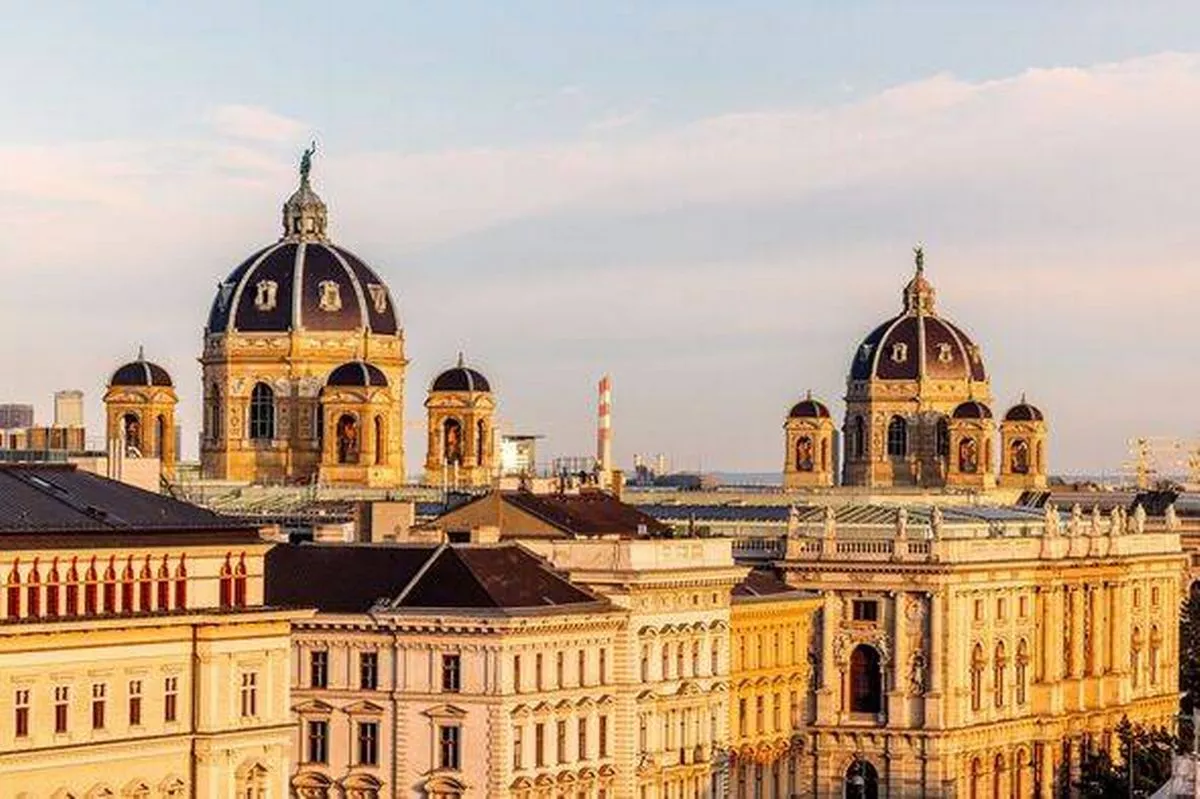
A breathtaking European capital has been crowned the continent’s “best” city, and it’s just a short three-hour flight from Britain. Even better news for budget-conscious travellers – you can jet off to this stunning destination for as little as £35 return.
Vienna, the Austrian capital, has claimed the top spot in the Global Liveability Charts for three consecutive years. The city of approximately two million residents outranked popular destinations including Copenhagen, Zurich, and Geneva, earning top marks for its stability, cultural offerings, and excellent local infrastructure.
The city is also a cultural treasure trove, celebrated for its musical heritage, exquisite art scene, and charming coffee houses.
YouTuber Ed Chapman made the journey to discover whether it truly deserved its reputation as “the greatest city in the world”. His itinerary included the Danube Tower, which boasts Europe’s tallest slide, a round-the-clock amusement park, and the internationally renowned Cafe Central.
Situated in Vienna’s Innere Stadt district, this historic establishment once welcomed legendary figures including Sigmund Freud, Leon Trotsky, and Josef Stalin. The venue earned the nickname “Chess school” due to its popularity amongst elite chess players who used it as their gaming headquarters, reports the Express.
Ed sampled beef goulash, hot chocolate, and cake during his visit. Reflecting on his meal, he remarked: “That is beautiful, what a delight, lovely and warm, great flavours. Proper hearty food.”
When asked whether Vienna deserves its crown as the world’s finest city, Ed remarked: “It’s a beautiful place. It’s lovely. Buildings are amazing, astonishing. It’s got some history knocking about. Mozart is, you know, his place is out here somewhere. There’s something to walk past. All sorts of museums.”
He continued: “I’m very impressed by this place. But is it the greatest city in the world that I’m not sure about. It’s a very, very good city. I can absolutely see why it’s been given the most livable tag in both Europe and the world. And I could absolutely imagine living here myself.”
Beyond the celebrated coffee house scene that Ed experienced in Vienna, visitors will find no shortage of attractions throughout the city. Austria’s capital boasts an array of stunning Baroque churches alongside architectural gems such as the vibrant Hundertwasserhaus and the Wiener Riesenrad, an impressive 64-metre-high Ferris wheel.
Travel expert Mark Wolter, from Wolter’s World, was full of praise for Vienna’s culinary offerings. He explained: “The cakes, the food, yeah you have your Wiener Schnitzel and your hot dogs but there’s so many great foods, pork, duck, all this food from all over the holy Roman empire, because you have Hungarian goulash or pasta from those times.”
Mark describes Austria as a “really cool” tourist destination, particularly highlighting the quality of accommodation and transport links. He noted: “Whether it’s trains, buses or trams they have this all out there, which is really cool to use as a tourist.
“The museums will have things usually in German but they’ll have cards in English to help you.”
Beyond Austria’s charming historic towns, Mark urges visitors to explore the country’s rich cultural offerings and stunning natural landscapes. “I like to tell people, if you want to get cultured come to Austria, because there’s so much of the museums, architecture and history,” Mark added.
Flight comparison site Skyscanner reveals that travelling to Vienna can be remarkably affordable, with one-way tickets from Manchester Airport starting at just £19, whilst return flights from Bristol can be snapped up for around £35.
Jesy Nelson showed off her stunning glam makeoverCredit: InstagramIt comes after Jesy recently split from her fiance, Zion FosterCredit: instagram/jesynelsonJesy and Zion’s twins have been diagnosed with Spinal Muscular Atrophy Type 1.Credit: Instagram/Jesynelson
But today the mum-of-two showed off her glam makeover, as she enjoyed some pamper time after a gruelling month.
Jesy looked incredible in the photo, which she posted on her Instagram.
The singer had her trademark curly hair styled to perfection, and her make-up had been expertly applied.
The star completed her sexy look with a lowcut black crop top.
Symptoms of SMA depend on which type of condition, but the most common include floppy or weak arms and legs, as well as swallowing and breathing problems.
If untreated, the life expectancy of a baby with SMA Type 1 is two years.
Early intervention is considered critical in limiting long-term impacts.
If the twins had been tested and treated in time, there is a chance they would have avoided disability.
It is now unlikely they will regain their neck strength after the disease caused nerve cells to die, leading to progressive muscle weakness.
Ocean and Story are under the care of Great Ormond Street Hospital in central London and have received treatment, including a one-off gene-therapy infusion approved by the NHS.
Jesy and Zion are committed to co-parenting their twin girlsCredit: Shutterstock
It came following the release of the first trailer for the singer’s new Amazon Prime docu-series; Jesy Nelson: Life After Little Mix, Zion has shared an insight into what went on behind the cameras.
Sharing the trailer, Zion wrote: “It’s finally here, coming to your screens via @primevideouk & @navybee.tv.
“The past year and a half has been a rollercoaster. When @jesynelson and I started this project we couldn’t see the road ahead, but to see how it all played out and having it filmed simply feels like God’s plan. The show is raw, authentic and honest.”
He said: “As a new family we were under immense pressure and stress. Alot of traumatic moments but nonetheless we made it here today. I believe this is only the beginning of our journey.
“Praying for clarity, peace and growth so we can continue to navigate the challenges we face; and give Ocean and Story the best support system possible. God’s in control”.
Jesy is unleashing her new documentary, Jesy Nelson: Life After Little MixCredit: Ruckas
HAMNET, the new Shakespearean film starring Jessie Buckley and Paul Mescal is thrusting this lesser-known UK county into the spotlight.
Herefordshire stood in for Stratford-upon-Avon in the new film and it’s predicted that people will soon be visiting its pretty villages over that of its popular neighbour.
Sign up for the Travel newsletter
Thank you!
Hamnet is set to put Herefordshire on the map after using it for filmingCredit: AlamyThe half-timbered houses make the perfect period backdropsCredit: Alamy
The Independent called Herefordshire the ‘quiet corner of England’ and explained that the county hoping for more tourists with what they’re calling the ‘Hamnet effect’.
In 2024, cast and crew descended on a small Herefordshire village to transform it into looking like Shakespeare’s Stratford.
The hope is that the county will become popular like its neighbour – the Cotswolds which is just 25 miles down the road.
As we all know the Cotswolds is known for its charming villages with cottages built from limestone brick that sit along cobbled streets around winding rivers.
Well, you can still get such charm in Herefordshire, and it sees much fewer visitors – around six million each year compared to the Cotswolds’ 25million.
One of Herefordshire’s villages that appeared heavily in Hamnet was Weobley, which is nicknamed a ‘black and white’ village thanks to its many half-timbered houses.
The Hollywood production transformed the village into one from the 1500s, which was done fairly easily thanks to its old buildings.
While you won’t find many shops in Weobley, there are a few places to have a bite to eat like The Green Beach Cafe, or the local Indian restaurant, Lal Bagh which has a TripadvisorTravellers‘ Choice Award and 375 five-star reviews.
Most read in Best of British
Weobley also has two pubs, Ye Old Salutation Inn and The New Unicorn Inn.
But fans of Hamnet should head into The Wobbly Badger cafe which took centre stage for the exterior of Shakespeare’s family home in the film.
There are lots of other villages that are part of Herefordshire’s ‘black and white villages’ – and there’s even a dedicated tour route to see them.
One of the other villages in the trail is Pembridge, or Eardisland, which sits on the banks of the River Arrow – and looks similar to Bourton-on-the-Water.
Even smaller villages include Eardisley, Dilswyn, Leominster and Kingsland.
It’s not just Hamnet that was filmed in Herefordshire, as one very famous Netflix series also made its home there.
The recognisable red and white chalet where Otis and Jean live sits high above the River Wye.
Eardisland in Herefordshire sits on the banks of the River ArrowCredit: AlamyIt’s riverside location makes it similar to Bourton-on-the-water in the CotswoldsCredit: Alamy
It’s the UK’s fifth longest river and has an incredible backdrop of rolling green hills – and getting onto the water is one of the best ways to see it.
There are plenty of companies offering kayaking, canoeing or stand up paddleboard sessions for around £60 per person along the river.
Herefordshire is also well regarded for its cider production thanks to its acres of orchards that cover the countryside – it’s been made there since the 17th century.
Scattered around the county are orchards and breweries that you’re welcome to pop into.
VisitHerefordshire even has ‘Cider Circuits’ with dedicated cycling loops to see as many as possible.
If you head to Westons Cider Mill in Ledbury, you can sample the latest flavours – tours of the cider mill cost just £15 for adults.
If you go there with the family, there’s an outdoor play park with slides and tyre trails to entertain the kids.
If you need a place to stay, Gwatkin even has its own campsite with pitches from £9pppn.
Just outside Lyonshall village is the White Heron Estate where they make their own signature blackberry liqueur – British Cassis and British Framboise.
Taking a walking tour and tasting is £25pp (for groups of 10+).
SWANSEA is getting a massive revamp and new plans for its ‘waterfront district’ have now been revealed.
Renders show off what the Swansea Civic Centre area could look like in a matter of years with plans for a saltwater lido and even a pier.
Sign up for the Travel newsletter
Thank you!
Ambitious development plans for the Civic Centre site in Swansea have been revealedCredit: Swansea CouncilIn a matter of years, the waterfront area could completely transformCredit: Alamy
Plans created by Urban Splash, a regeneration company, include the addition of new waterfront cafes, bars, beach sports shops and even what appears to be a new pier.
Other attractions will be an aquarium and a new saltwater lido – which will be a first for the city.
The plans have been developed by Urban Splash which was appointed by Swansea Council as part of a 20‑year regeneration partnership covering key sites around the city.
The company has described the ‘waterfront district’ as being a place “where the city truly meets the beach”.
Cllr Rob Stewart, Swansea Council Leader, said: “These emerging proposals for the Civic Centre mark another important chapter in Swansea’s ongoing regeneration story.
“This site has the potential to become a vibrant new focal point on our waterfront, bringing together homes, leisure, culture and public spaces in a way that complements the huge investment already transforming our city.
“By reimagining how this area can be used, we can support local jobs, boost our economy and create new opportunities for residents and visitors.
The plans are not final and have been released ahead of a public consultation at the end of the month where residents will get a chance to give feedback.
Other areas around the city set to be regenerated by Urban Splash include the Hafod Copperworks and Porth Copr.
Urban Splash initiatives, including the unveiling last autumn, of plans for a riverside site in St Thomas.
In autumn, the company revealed its plans for the riverside site in St Thomas where it plans to build a six-storey building, as well as a central green street, shared gardens and improved river walkways.
The waterfront area of Swansea isn’t the only part of the city getting a new look as revamped Castle Square is expected to be completed by late 2026.
Work began in summer 2025 to transform the square with much more usable public space along with new cafes with shaded areas for families.
Work is currently going ahead to transform Castle SquareCredit: Unknown
There will be new water jets with mini-fountains from the paved area which will take the place of the popular water features.
On another level is a viewing platform across the square, along with a large screen showing live sporting events.
Below will be a bandstand-style stage with a large screen for public events, new seating areas and upgraded paving.
These works form a wider part of the regeneration project in Swansea costing £1billion.
WASHINGTON — The crisis touched off by President Trump’s demand to take ownership of Greenland appears over, at least for now. But the United States and its European allies still face a larger long-term challenge: Can their shaky marriage be saved?
At 75 years old, NATO has survived storms before, from squabbles over trade to estrangement over wars in Vietnam and Iraq. France, jealous of its independence, even pulled its armed forces out of NATO for 43 years.
But diplomats and foreign policy scholars warn that the current division in the alliance may be worse, because Trump’s threats on Greenland convinced many Europeans that the United States has become an unreliable and perhaps even dangerous ally.
The roots of the crisis lie in the president’s frequently expressed disdain for alliances in general and NATO in particular.
Long before Trump arrived in the White House, presidents from both parties complained that many NATO countries weren’t pulling their weight in military spending.
But earlier presidents still considered the alliance an essential asset to U.S. foreign policy and the cornerstone of a system that prevented war in Europe for most of a century.
Trump has never seemed to share that view. Even after he succeeded in persuading NATO members to increase their defense spending, he continued to deride most allies as freeloaders.
Until last year, he refused to reaffirm the U.S. commitment to help defend other NATO countries, the core principle of the alliance. And he reserved the right to walk away from any agreement, military or commercial, whenever it suited his purpose.
In the two-week standoff over Greenland, he threatened to seize the island from NATO member Denmark by force, an action that would have violated the NATO treaty.
When Britain, Germany and other countries sent troops to Greenland, he threatened to hit them with new tariffs, which would have violated a trade deal Trump made only last year.
Both threats touched off fury in Europe, where governments had spent most of the past year making concessions to Trump on both military spending and tariffs. When Trump backed down, the lesson some leaders drew was that pushing back worked better than playing nice.
“We do prefer respect to bullies,” French President Emmanuel Macron said.
“Being a happy vassal is one thing. Being a miserable slave is something else,” Belgian Prime Minister Bart De Wever said.
The long-term danger for the United States, scholars said, is that Europeans might choose to look elsewhere for military and economic partners.
“They just don’t trust us,” said Richard N. Haass, a former top State Department official in the George W. Bush administration.
“A post-American world is fast emerging, one brought about in large part by the United States taking the lead in dismantling the international order that this country built,” he wrote last week.
Some European leaders, including Macron, have argued that they need to disentangle from the United States, build military forces that can defend against Russia, and seek more reliable trade partners, potentially including India and China.
But decoupling from the United States would not be easy, fast or cheap. Europe and Canada still depend on the United States for many of their defense needs and as a major market for exports.
Almost all NATO countries have pledged to increase defense spending to 5% of gross domestic product, but they aren’t scheduled to reach that goal until 2035.
Meanwhile, they face the current danger of an expansionist Russia on their eastern frontier.
Not surprisingly for a group of 30 countries, Europe’s NATO members aren’t united on the question. Macron has argued for more autonomy, but others have called for caution.
“Despite all the frustration and anger of recent months, let us not be too quick to write off the transatlantic partnership,” German Chancellor Friedrich Merz said at Davos.
“I think we are actually in the process of creating a stronger NATO,” said Finnish President Alexander Stubb. “As long as we keep doing that, slowly and surely we’ll be just fine.”
They argue, in effect, that the best strategy is to muddle through — which is what NATO and Europe have done in most earlier crises.
The strongest argument for that course may be the uncertainty and disorder that would follow a rapid erosion — or worse, dissolution — of an alliance that has helped keep its members safe for most of a century.
The costs of that outcome, historian Robert Kagan warned recently, would be borne by Americans as well as Europeans.
If the United States continues to weaken its commitments to NATO and other alliances, he wrote in the Atlantic, “The U.S. will have no reliable friends or allies, and will have to depend entirely on its own strength to survive and prosper. This will require more military spending, not less. … If Americans thought defending the liberal world order was too expensive, wait until they start paying for what comes next.”
When it comes to improved teams, the girls’ basketball team at St. Monica Academy in Montrose has had a big turnaround under first-year coach Vic Karapetian.
The team is 15-3 and 10-1 in the Heritage League after going 1-26 in league play the previous two years.
There are no seniors on the roster, and three freshmen have been making major contributions.
Karapetian had previous success coaching at AGBU and Mesrobian.
Mary Tomooka and Victoria Grigsby, the freshman backcourt duo, have been key players.
This is a daily look at the positive happenings in high school sports. To submit any news, please email eric.sondheimer@latimes.com.
Malik from Gaza had just graduated from high school when an Israeli air strike killed him and more than 20 of his relatives during the war. Over 2,700 Palestinian families have been wiped out in 27 months by Israel’s genocide.
At least five health centres in the Lubero territory of the North Kivu region were shut down following persistent attacks and civilian killings by the Ugandan Allied Democratic Forces (ADF) rebels in the Democratic Republic of Congo (DRC).
On the night of Jan. 21, the rebels killed five civilians, injured many others, and destroyed at least ten houses during an attack that took place in the Mavwe-Mavwe village.
Congolese officials revealed that the health centres recently shut down include Mausa, Pombi, Mandelya, Musenge, and the Masoya referral health facility, which was closed last week. The awful situation intensifies the dire humanitarian crisis in the region, which is heavily impacted by insecurity.
Some civil society organisations have expressed concerns over the authorities’ silence amid persistent insecurity, which has paralysed all socio-economic activities within the Baswagha chiefdom, leaving the people feeling completely abandoned.
“In view of the situation we are passing through, we think the nurses have very much helped the population. Already, members of armed groups and their wives receive medical treatment free of charge. The pressure on the Biambwe health centre has forced our nurses to close down our structure. That complicates the lives of the population, because all the health facilities have closed their doors in Mandelia, Pombi, Mausa, Masoya, and Musenge. They have locked themselves everywhere,” said Kambale Muthano, the leader of the Congolese New Civil Society.
Kambale noted that the civil society community has no issues with health agents. He said their main demand from the government is to guarantee the safety of the populations, including healthcare facilities, so that health professionals can work under suitable conditions.
Amid the ongoing crisis, however, health professionals have made an urgent appeal to military authorities to intervene and reactivate “Operation Shujaa”, a joint military effort between the Congolese army and the Uganda People’s Defence Forces (UPDF).
Since 2024, the Mwenye tribal group in the North Kivu region has been gripped by chronic instability marked by the massacre of civilians, massive displacement of populations, the closure of schools, and health facilities. A similar incident occurred in 2022 when eighteen healthcare facilities in Kamango were shut down due to repeated attacks by the Allied Democratic Forces (ADF) rebels, leaving civilians at risk.
At least five health centers in the Lubero territory of North Kivu, DRC, were shuttered due to attacks by the Ugandan Allied Democratic Forces (ADF), intensifying the region’s humanitarian crisis. The closures followed a violent attack on January 21, resulting in five civilian deaths and many injuries. Local civil society organizations criticized the government’s silence on the insecurity that has paralyzed socio-economic activities.
Kambale Muthano of the Congolese New Civil Society highlighted the community’s dependence on health professionals who offer free medical care but are now forced to close due to safety concerns. An urgent plea was made for military intervention to ensure safety under “Operation Shujaa,” a joint effort with the Ugandan forces. Since 2024, chronic instability, including prior incidents in 2022, has plagued the region, disrupting essential services.
Katie Price’s new mother-in-law Trisha has broken her silence on the star’s marriage to her son Lee AndrewsCredit: Facebook / Trisha MediumThe pair tied the knot in a shock ceremony in DubaiCredit: BackGrid
Now Lee’s mum Trisha has spoken out for the first time and revealed she knew the two were going to be getting hitched.
The clairvoyant from Nottingham told the Mirror: “As long as they are happy I am happy.
“There’s a lot of lies going around about Lee and that’s made me really upset. He’s not been married twice. I just want to defend my son, but I can’t say much more until I know everything.
“He did tell me that the wedding was happening. He spoke to me and if he is happy, I am happy – he’s my son, and that’s all that matters.”
Speaking about her new famous daughter-in-law, Trisha continued: “Of course, I know who Katie is.
“I’ve always been very neutral about her. Everyone deserves a chance, you should never judge anyone in life.”
She joked: “You can ask what it’s like to have a famous daughter-in-law, but she’s got a famous mother-in-law!”
On Friday, the reality star took to her Instagram stories to share a series of engagement pictures, sending fans into a frenzy.
In one photo, the mum-of-five was seen standing beside rose petals that were arranged to read ‘will you marry me’ before she showcased her huge diamond engagement ring.
However, just 48 hours later, she announced the pair had tied the knot in a quickie ceremony in Dubai, a move which has reportedly left her closest family and friends shocked.
In the pictures, the 47-year-old was seen beaming from ear to ear and locking lips with her new husband shortly after the ceremony.
Katie was seen in a cut-out, white bodycon dress while Lee wore white linen trousers and a taupe shirt.
The leggy dress displayed the reality TV legend’s toned abs and tattoos as she showed off her huge diamond ring.
The Sun understands Katie’s family were not aware of the wedding taking place and were not given prior warning it was happening.
An onlooker said: “Katie and Lee had no one with them when they got married. It was just the two of them.
“Katie couldn’t stop smiling, she seemed so taken with Lee. They said their vows and then kissed, it was sweet to watch.”
An officiator was seen in front of the pair reading from a script as they stood together in the sunshine saying their vows.
A family friend added: “Kate’s family are dumbstruck. To see she had got engaged after flying to Dubai – literally just after she had arrived was crazy.
“The fact she has now married him the following day is even more shocking.”
“No one knows who Lee is, they know nothing about him. Kate’s mum, her children, no one knew about the wedding.
“She has a lot of questions to answer when she comes home.”