While tickets are much less cheaper than UK alternatives, this festival has a line-up packed with incredible big name acts, and you’re much less likely to be wading through mud in this sunny city
Leave your wellies at home and opt for a festival in sunny Spain(Image: Daily Record)
Festivalgoers will have a Glastonbury-shaped hole in their hearts in 2026 as the world-famous festival takes a year off. The festival’s tradition of having a “fallow year” every few years is designed to let Worthy Farm’s land recover and regenerate from the huge event.
But music lovers need not despair, there are lots of Glastonbury alternatives out there both in the UK and beyond. One in particular that’s popular with Brits thanks to its affordable ticket prices and lack of mud has a great line-up for 2026, and flights take just under 2.5 hours from London.
FIB Benicàssim – often simply known as Benicàssim – takes place in Castelló de la Plana, just north of the city of Valencia. Its location close to the sunny Spanish coast and July dates mean that you’re practically guaranteed sunny days, so no need to pack your wellies for this one.
Taking place between July 16 and 18, the festival has an incredible line-up for fans of all sorts of genres, and includes performances from The Prodigy, Biffy Clyro, The Kooks, Kaiser Chiefs, and Tinie Tempah among the big names. There are also lots of punk and indie acts to look out for such as DEADLETTER, Circa Waves, and RATA.
Ticket prices are much lower than UK festivals. In 2025, Glastonbury tickets cost £373.50 plus a £5 booking fee. FIB Benicàssim tickets start at just €55, about £48 for general admission, which gives you access to the site and all stages for four days.
For €135 (approximately £117), there are also VIP tickets which include access to VIP bars and food options, exclusive toilets, preferential access lanes into the festival, plus three pints of beer. Golden VIP tickets cost from €245, around £213, and come with all the advantages of VIP as well as front stage access to the Main Stage and nine drinks.
However, it’s worth noting that unlike Glastonbury, camping isn’t included. This is because many people choose to stay in nearby hotels or glampsites. A basic camping pitch on the festival grounds costs €27, about £23, and for another £9 you can buy a voucher that gives you unlimited access to showers. Summer camping can be a sweltering experience, so large tarps are installed to shade the tents underneath and cool things down.
If you don’t fancy taking all your camping gear on the plane, there are glamping options that also give you a more comfortable experience. While these aren’t yet available to buy, there will reportedly be a range of bell tents and other pre-pitched options so you can leave your bulky camping kit at home.
Many festivalgoers skip the tent entirely and stay in nearby Castellón or Oropesa. The festival offers the option of an official shuttle bus from towns close to the festival site, so you pay for the wristband once and don’t need to worry about transport. Staying in a hotel means you can enjoy air conditioned nights in a proper bed, charge your phone, and get ready for the day ahead.
You could even combine your festival trip with a beach holiday, and a couple of days in sunny Valencia will soon help you recover from any party excesses. Nearby Grau de Castelló is a charming port town with Mediterranean beaches, Valencian restaurants, and the beauty of the mountains in Desert de les Palmes.
Brits travelling to Benicàssim have two options for airports. The closest one is Castellón–Costa Azahar Airport, about half an hour from the festival site. However, flights from the UK are limited to a Ryanair services from London-Stansted and Manchester. Valencia Airport is just over an hour from Benicàssim and offers a wide range of flights including an easyJet route from London-Gatwick, and Ryanair services from regional airports including Birmingham, East Midlands, Bristol, and more.
Have a story you want to share? Email us at webtravel@reachplc.com
Barcelona come from behind to beat Slavia Prague 4-2 to maintain their hopes of a top eight finish in the league phase.
Published On 21 Jan 202621 Jan 2026
Share
Barcelona came from behind to defeat Slavia Prague 4-2 on a freezing night in the Champions League, with Fermin Lopez scoring twice and Dani Olmo and Robert Lewandowski adding second-half goals to secure the victory.
The win on Wednesday lifts Barcelona to ninth place in the standings with one game remaining on 13 points, level with seven other teams vying for a top-eight finish and direct qualification for the round of 16. Slavia languish third from bottom with just three points.
Recommended Stories
list of 4 itemsend of list
On a bitterly cold evening in Prague, with temperatures dropping to -8 degrees Celsius (17.6 degrees Fahrenheit), Slavia stunned the visitors with an early lead.
A cleverly worked corner in the 10th minute saw Tomas Holes flick a delivery from the near to the far post, where Vasil Kusej bundled the ball across the line under pressure from Frenkie de Jong.
Barcelona levelled in the 34th minute through Lopez, who unleashed a sharp, angled strike from inside the box, squeezing the ball past keeper Jindrich Stanek at the near post after a faint deflection off the Slovak’s shoulder.
Lopez doubled his tally and gave Barcelona the lead in the 42nd minute with a fine effort from the edge of the box. The attacking midfielder found the bottom right corner with precision, leaving Stanek no chance.
Barca’s advantage lasted just two minutes as an unfortunate defensive mishap saw Slavia equalise. Under pressure defending a corner, Lewandowski inadvertently deflected the ball off his shoulder and into his own net to send the teams into half-time level at 2-2.
After regrouping at the break, Barcelona took control of the game in the second half, relentlessly attacking Slavia’s defence.
Raphinha, Pedri and Lopez all squandered good opportunities before substitute Olmo produced a moment of magic. In the 64th minute, he hammered an unstoppable strike from the edge of the box into the top corner, restoring Barcelona’s lead in emphatic style.
Lewandowski atoned for his earlier own goal by sealing the victory in the 70th minute.
Marcus Rashford – another second-half substitute – went on a blistering run down the left flank and delivered a cross into the box. Although Lewandowski initially struggled to control the pass, he reacted quickly to poke the ball past Stanek and give Barcelona a two-goal cushion.
“We knew it would be a difficult match with the cold weather, they’ve put a lot of pressure on us, it was tough … My feet and hands hurt, can barely feel them … It was tough, but we managed to come back and win,” Lopez told Movistar Plus.
“We were aware that goal difference was something important. Looking to secure a top-eight finish, we wanted to keep a clean sheet, but it was difficult. Good thing we managed to play well and got the win.”
The administration of United States President Donald Trump has announced its latest immigration enforcement operation, this time in the northeastern state of Maine.
On Wednesday, the Department of Homeland Security confirmed that immigration raids had begun a day earlier, under the name “Operation Catch of the Day”.
Recommended Stories
list of 3 itemsend of list
In a statement, a Trump administration spokesperson appeared to signal that targeting Maine was a political response to the ongoing feud between the president and the state’s governor, Democrat Janet Mills.
“Governor Mills and her fellow sanctuary politicians in Maine have made it abundantly clear that they would rather stand with criminal illegal aliens than protect law-abiding American citizens,” said spokesperson Tricia McLaughlin.
But rumours have swirled that Maine was singled out for its significant Somali American population in the cities of Portland and Lewiston. Estimates put the total number of Somali Americans in the state at about 3,000.
Trump has repeatedly denounced the Somali community over the past several months, comparing its members to “garbage” at a December cabinet meeting. As recently as Tuesday, he used his White House podium to call Somalis and Somali Americans “ a lot of very low IQ people”.

Racist and anti-immigrant rhetoric has been a trademark of Trump’s campaigns for public office, and he has repeatedly singled out specific groups – including Haitians and Mexicans – to falsely tie their immigrant identity to pervasive criminal activity.
Mayor Mark Dion of Portland, Maine, speaks at a news conference on January 21 [Patrick Whittle/AP Photo]
Parallels with Minnesota
Trump’s focus on the Somali community comes after a handful of members were implicated in a fraud scandal in Minnesota, a midwestern state where immigration enforcement operations were launched in December.
Those efforts have been marked by violent clashes between federal agents and protesters, and one woman, 37-year-old Renee Nicole Good, was shot dead in her car after an interaction with Immigration and Customs Enforcement (ICE).
Fears that those tensions could spill into Maine dominated a Wednesday news conference with city officials in Portland.
Mayor Mark Dion told reporters that immigrant communities in the region felt “anxious and fearful” as ICE agents began their crackdown.
“They see this action as unpredictable and a threat to their families,” he explained.
He also questioned whether a heavy-handed operation was necessary to address immigration infractions in the area, and he called on ICE to adopt different tactics than it had in Minnesota.
“I want to underscore one important point: While we respect the law, we challenge the need for a paramilitary approach to the enforcement of federal statutes,” Dion said.
“Federal immigration law is lawful. Its administration and enforcement is lawful,” he added. “What we’ve been concerned with, as a council, is the enforcement tactics that ICE has undertaken in other communities, which to our mind appear to threaten and intimidate populations.”
Nevertheless, Dion expressed optimism that ICE would adopt a more tailored approach to apprehending local suspects.
While the city of Minneapolis, Minnesota, has seen nearly 2,000 immigration officers flood its streets, the mayor predicted that Maine would not see the same “massing of federal agents”.
“We’re seeing very individualised activity by ICE. A person here, a neighbourhood there,” he said. “Their conduct, at least as it is current in Maine, seems to be focused, which would indicate to me – and this is the speculation – that they’re functioning on the basis of an actual court warrant.”
That, he said, marked a departure from the “random, show-me-your-papers kind of experience” that residents had experienced in Minnesota.
Well-wishers on January 20 visit a makeshift memorial for Renee Nicole Good, who was fatally shot by an ICE officer in Minneapolis [Angelina Katsanis/AP Photo]
Outrage at ICE operations
Still, while Dion advocated for a wait-and-see approach to the ICE operation, other city officials took a harder stance.
One Portland city councillor, Wesley Pelletier, described the unfolding raids as part of “an agenda of white nationalism and might makes right”.
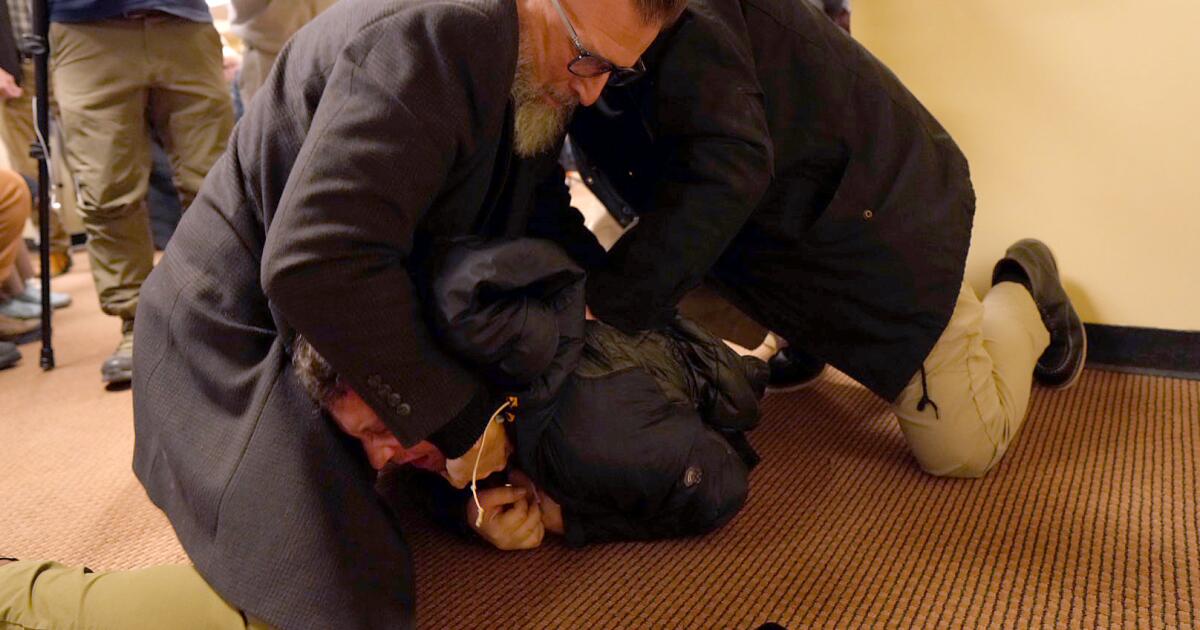
“This is a war of terror that’s being waged on our city by the federal government,” Pelletier said. “We’ve seen people of all ages getting thrown on the ground and getting thrown into trucks.”
So far, Fox News quoted ICE Deputy Assistant Director Patricia Hyde as saying the agency had made 50 arrests so far as part of operation “Catch of the Day”. Hyde added that ICE had identified nearly 1,400 individuals to detain in Maine.
Wednesday’s statement from the Department of Homeland Security highlighted four arrests as examples, showing people from Sudan, Guatemala, Ethiopia and Angola.
It described the four individuals as “the worst of the worst” and accused them of crimes ranging from aggravated assault to endangering the welfare of a child, though it was unclear in one case if the accusation had resulted in a conviction.
“We are no longer allowing criminal illegal aliens to terrorize American citizens,” McLaughlin said in the statement.
But Democratic officials in the state suggested that the Trump administration had refused to coordinate in the lead-up to “Catch of the Day”, heightening anxiety on the local level.
On January 14, nearly a week before the operation was launched, Governor Mills posted on social media that she had “attempted, unsuccessfully thus far, to confirm” the upcoming surge in federal immigration enforcement.
In a video statement, she said the state had reached out to local governments in Portland and Lewiston to prepare. She added that she too felt “angry” about the expected surge.
“Our goal, as always, will be to protect the safety and the rights of the people of Maine,” Mills said.
“To the federal government, I say this: If your plan is to come here to be provocative and to undermine the civil rights of Maine residents, do not be confused. Those tactics are not welcome here to the people of Maine.”
She also took a jab at the trend of federal agents using masks and other facial coverings to conceal their identities.
“Look, Maine knows what good law enforcement looks like because our law enforcement are held to high professional standards,” Mills said. “They are accountable to the law. And I’ll tell you this: They don’t wear a mask to shield their identities, and they don’t arrest people in order to fill a quota.”
Democratic Governor Janet Mills has openly opposed Trump administration policies [File: Robert F Bukaty/AP Photo]
A political rivalry
Mills and Trump have long been political adversaries, with their feud erupting in a public forum. In February last year, shortly after Trump returned to office for a second term, he hosted a White House gathering for governors, where he called out Mills personally.
“Is Maine here? The governor of Maine?” Trump said while outlining policies barring transgender athletes from sporting events. “Are you not going to comply with it?”
“I’m complying with state and federal law,” Mills responded. The tension escalated from there.
“You’d better comply because otherwise you’re not getting any, any federal funding,” Trump shot back.
“See you in court,” Mills replied.
“Good. I’ll see you in court. I look forward to that. That should be a really easy one. And enjoy your life after, governor, because I don’t think you’ll be in elected politics,” he said.
The interaction made national news and cemented the frosty relationship between the two leaders, with Trump demanding an apology and slamming the Democratic governor for months afterwards.
His administration also took a series of escalating actions designed to target Mills, including launching an education probe in her state, suspending a marine research grant and freezing other federal funds to Maine.
In response to this week’s ICE deployment, Mills issued a short statement acknowledging the Trump administration’s latest efforts.
“Together, we will continue to place the safety and civil rights of Maine people above all else, and remain vigilant in our defense of due process and the rule of law,” she wrote.
Maine is set to hold its next gubernatorial race in 2026, as part of the year’s midterm election cycle.
Having served two terms as governor, Mills is not eligible for re-election and will instead be making a run for the US Senate, challenging Republican incumbent Susan Collins.
The UK is home to breathtaking destinations, from natural wonders to vibrant cities that will transport you somewhere abroad – from Italy and France to New Zealand and Japan
A “brujo,” a “magician,” “a social arsonist” and the “father of Chicano Theater” — these are just a few of the monikers that have been bestowed upon Luis Valdez over the course of his decades-long career. The 85-year-old filmmaker and playwright is responsible for “La Bamba” and “Zoot Suit,” films that raised a generation of Latinos and are now upheld as classics — both were inducted to the National Film Registry of the U.S. Library of Congress.
Valdez awakened a movement, bringing Chicanos from the California fields he grew up working in to stages and screens all over the world. His stories shifted the frame, placing us at the forefront of the American story, allowing us to see our dreams, anxieties and struggles reflected back at us. In David Alvarado’s upcoming documentary, “American Pachuco: The Legend of Luis Valdez,” it’s the celebrated storyteller’s turn to be on the other side of the lens.
The film traces Valdez’s beginnings as the son of migrant farmworkers in Delano, Calif., to his early days in theater helming El Teatro Campesino — a traveling performance troupe who worked alongside Cesar Chavez to mobilize farmworking communities, raising awareness about strikes and unions through skits and plays. Incorporating folk humor, satire and Mexican history, their work later evolved to include commentary on the Vietnam War, racism, inequality and Chicano culture more broadly.
Narrated by Edward James Olmos, who broke out as the enigmatic pachuco with killer style and a silver tongue in 1981’s “Zoot Suit,” the documentary was awarded the Library of Congress Lavine/Ken Burns Prize for Film last year.
De Los spoke with Olmos and Alvarado ahead of the film’s world premiere on Thursday at the 2026 Sundance Film Festival.
This interview has been lightly edited for clarity.
David, what was your introduction to Luis’ work? And how did it influence you as a filmmaker?
David Alvarado: I grew up watching things like “La Bamba” with my dad, and it made a huge impression on me, but at the time, as a kid, I didn’t really know the name Luis Valdez. Then in 2006, I was an undergrad at the University of North Texas, and I got a Hispanic Scholarship Award. At the celebration, Luis gave a speech and I was just blown away. I was a young wannabe filmmaker trying to learn how to make movies, and somebody like me was up there onstage telling a story about how he got there. I felt really inspired and I always carried that with me. Then in 2021, I was at a juncture in my career where I had told these science and technology stories, and I loved it, but I wanted to do something more personal. I thought back to Luis Valdez. Where was his story? So I reached out to him and that’s where this all started.
Mr. Olmos, your breakthrough came from playing El Pachuco in “Zoot Suit,” first in the play and then the film. What was your first impression of the story?
Edward James Olmos: I remember I had been doing theater for years, and I was walking out of an audition for another play at the Mark Taper Forum when I heard someone say, “Hey, do you want to try out for a play?” And I said, “Excuse me?” And she said, “Well, do you or don’t you?” And I said, “OK, what do you want me to do?” I didn’t know who she was, or what the play was about, but the next day, I was standing there with 300 other guys getting handed a little piece of paper with the opening monologue [for “Zoot Suit.”] I knew from reading it that this was serious, really serious, so I just became the character immediately.
I remember when they called me and asked me to do the role, it was on a Friday night, around 8 o’clock, and they were going to start rehearsals on Monday morning. I hadn’t gotten any phone calls, so I thought [the part] was gone. Then all of a sudden, the phone rang and they asked me if I wanted the role of El Pachuco. I said it would be my honor, my privilege. I hung up the phone and I slid down the side of the wall crying. I just completely lost it.
DA: Eddie really stole the show. I mean, it’s just undeniable. What he brought [to the production] was exactly what Luis was looking for, and I think it’s what Chicanos wanted to see and hear at the time. He really struck a nerve, and that was a huge part of the success of “Zoot Suit.” What Luis tapped into with this collaboration with Eddie, with the Teatro Campesino, or later with “La Bamba,” that was his gift: finding people who could represent the true nature of what it means to be Chicano.
(Elizabeth Sunflower / Retro Photo Archive / Sundance Institute )
There’s so much incredible archival footage here from the Teatro Campesino. What was your reaction to seeing some of that early work?
EJO: That footage is priceless, and that’s one of the reasons this movie is really important, because Luis is truly someone that has given our culture a voice. He gave me my voice. When you want to learn about a culture, you try to study what’s been written about them, any documentation or books, but nothing compares to their art. Right now, I’m working on a piece with Luis called “Valley of the Heart,” a play that he wrote over the last 12 years. It’s a never-been-told love story between a Mexican American and a Japanese American in an internment camp during World War II. It’s been difficult to make, but once people see it, they’re going to be thankful because it doesn’t matter what culture you are, the humanity of it comes through. That’s how people will feel after seeing David’s documentary, too. It’s inspiring.
DA: I think people are ready for the real story of America. I mean, the documentary and “Valley of the Heart” are part of American history, they talk about a real American experience, and it’s not the kind that people hear anymore. People are thirsty for that kind of authenticity, and to re-evaluate what the American story really is.
One of the core themes within the documentary is how we as Chicanos view the American Dream: Can we achieve it by being ourselves, or do we have to assimilate? We see that identity struggle play out as Luis and his brother, Frank, take different approaches in their lives, and it’s later paralleled in the story of “La Bamba.”
DA: That’s such a core pillar of the film. We all want the American Dream, but what that dream is confusing to a lot of people. The quest to get there through assimilation is something that Chicanos, Latinos and other immigrants have tried at the expense of their own heritage and identity. They give it all up and lay it at the altar of the American Dream. They try to fit in, and be this other thing, and so often, that doesn’t work. In his own life, Luis’ answer to that was if America is supposed to be this multicultural beacon of democracy, then let’s have a space for Chicanos to play a role there. I’ll retain my culture and be an American.
He and his brother tried to make it together, but they weren’t taking the same approach. In Frank’s story, that caused him a lot of pain, and he never quite made it that way. Luis, in very important ways, did make it. The fact that his work speaks to those themes, and was part of his personal life, I couldn’t leave that on the editing room floor.
In the documentary, we see the triumph of “Zoot Suit” being the first Chicano production on Broadway, and then the crush of it being panned by critics who didn’t seem to get it. Mr. Olmos, you say that the reaction wasn’t a loss for you all, it was a loss for America. What did you mean by that?
EJO: Well, because it wasn’t going to be spread around the country and understood. To me, the theater is magic. When it really works, it’s amazing. But [those negative reviews] stopped us from that growth process. There was one critic from the New York Times, Richard Eder, who said it was street theater on the wrong street.
I have to tell you, though, the people who were given the opportunity to see that play in New York, even after the critics panned it, always gave us a cheering standing ovation at the end. They burned the house down every single night. Even in L.A., that play was monumental. But that criticism hurt Luis badly, it hurt us all. I think if we’d gone through Arizona, Texas, Chicago, Miami before hitting New York, we would’ve been a powerhouse that would still be running today. It’s one of those stories that deserves to be revived over and over again.
The story of “Zoot Suit” is set in the 1940s, during a time of intense scrutiny and discrimination for Mexican Americans. How did the story resonate in the 1980s, and what do you think it has to tell us now?
EJO: People came from all over the world to watch the play, but Latinos kept coming back. Some of them had never been to a theater before in their lives, and they were bringing in family, friends to come and see it every weekend. It was a beautiful experience, one that was like giving a glass of water to somebody in the middle of the desert. They cherished us for giving them the opportunity. Now, we’re needed more today than we were even then. Today’s time is uglier than almost any time.
DA: It’s ugly, and it’s crass. We’ve had so long to try to figure out racism and get the American experiment back on track, and yet it just feels so depressing. Like when is the cycle going to end? At the same time, I hope that there’s a little bit of optimism in the film that the community can come together, and that we can find a way through this.
The documentary does a great job of showcasing the power of art. The performances from the Teatro de Campesinos allowed the farmworkers to really see themselves in a way that helped build a movement and made for a successful collective action. What do you hope this documentary can teach a new generation of Latinos today?
DA: For me, it’s to understand who you are, and to do what it takes to make it work here in America. When Luis spoke to me from that lectern, the thing that really got me going was that he said, “Whatever it is that you’re trying to do, whatever your project is, just stop doubting yourself and do it.” I remember thinking, “Oh my God. Maybe I can be a filmmaker. Maybe I could tell stories for a living.” So I hope that that’s clear in the film: that if you believe in yourself, you can fit into America, you can make a place for yourself.
But also, know that creation is an act of joy, and that the whole point of life is to find happiness and share it with other people. Despite all the heavy things we’ve talked about so far, I do want to point out the film is a joyful one of exploration. Luis has his moments when the world pushes back on him so hard, and it’s painful, but he just has so much love to give, and that’s the point of making art. I want people to walk away thinking that they can do it too.
WASHINGTON — President Trump delivered a sharp critique of U.S. allies and rivals alike during a speech at the World Economic Forum in Switzerland on Wednesday, questioning Europe’s political direction, casting down on NATO’s reliability and reiterating his intent to push to acquire Greenland.
Speaking before an audience of global political and business leaders, Trump said European countries are “not headed in the right direction” in part because of what he described as bad immigration policies while asserting that the United States is a “great power” that needs to have outright ownership of Greenland in order to properly defend itself.
The remarks echoed his long-standing complaints that the North Atlantic Treaty Organization has taken advantage of the United States, and questioned whether the allied countries would support the U.S. if the country needed them.
Here are some of Trump’s most notable remarks:
Renewing demands for Greenland: “It’s the United States alone that can protect this giant mass of land, this giant piece of ice, develop it and improve it and make it so that it’s good for Europe and safe for Europe and good for us. And that’s the reason I’m seeking immediate negotiations to once again discuss the acquisition of Greenland by the United States. Just as we have acquired many other territories throughout our history.”
Military invasion ruled out: “We never asked for anything, and we never got anything, we probably won’t get anything unless I decide to use excessive strength and force where we would be, frankly, unstoppable, but I won’t do that, OK? That’s probably the biggest statement I make because people thought I would use force. I don’t want to use force. I don’t want to use force. I won’t use force.”
Outright ownership sought: “All we are asking for is to get Greenland, including right, title and ownership because you need the ownership to defend it. You can’t defend it on a lease. No. 1, legally it is not defensible that way, totally. And No. 2, psychologically.”
On European immigration: “Certain places in Europe are unrecognizable. Frankly, they are not recognizable. We could argue, but there’s no argument. Friends come back from different places — I don’t want to insult anybody — and they say, ‘I don’t recognize it.’ And that is not in a positive way. That’s in a very negative way. And I want to see Europe go good, but it’s not heading in the right direction.”
U.S. power: “The United States is keeping the whole world afloat. Without us, most of the countries don’t even work. And then you have the protection factor. Without our military — which is the greatest in the world by far — without our military, you’d have threats that you wouldn’t believe. You don’t have threats because of us and that’s because of NATO.”
On World War II impact: “After the war, which we won — we won it big. Without us, right now you’d all be speaking German and a little Japanese, perhaps.”
On NATO reliance: “The problem with NATO is that we’ll be there for them 100%. But I’m not sure that they’d be there for us if we gave them the call. … I’m not sure that they’d be there. I know we’d be there for them. I don’t know that they’d be there for us. With all the money we expend, with all of the blood, sweat and tears, I don’t know that they’d be there for us.”
Confusing Greenland for Iceland: “They are not there for us on Iceland, that I can tell you. I mean, our stock market took the first dip yesterday because of Iceland. So Iceland has already cost us a lot of money.”
A nod to California Gov. Gavin Newsom (who was at the forum): “We’re going to help the people in California. We want to have no crime. I know Gavin was here. I used to get along so great with Gavin when I was president. Gavin is a good guy. And if you needed it, I would do it in a heartbeat. We did help them a lot in Los Angeles, a lot early in my term when they had some problems. But we would love to do it. I would say this, if I was a Democrat governor, I would call up Trump. I would say come on in, make us look good, because we are cutting crime down to nothing and we are taking people out — career criminals — who are only going to do bad things and we are bringing them back to their countries.”
Especially in the huddle. Especially at decibel-delirious Lumen Field in Seattle.
“He’s screaming,” tight end Davis Allen said Wednesday, chuckling. “He’s not talking normal, that’s for sure… He does a great job making sure guys are where they need to be.”
Since joining the Rams in 2021, Stafford is 3-1 at Lumen Field, where the Rams will play the Seahawks on Sunday in the NFC championship game.
Asked how he thought he had played in Seattle, Stafford instantly ticked through all of the Rams’ performances.
“I think that gives a calm in the midst of some of those chaotic moments,” Coach Sean McVay says of Matthew Stafford.
(John Froschauer / Associated Press)
Stafford, 37, aims to continue what has been an MVP-level season with a victory that would give him a shot at a second Super Bowl title.
Two weeks ago, Stafford engineered a game-winning touchdown drive in a wild-card victory over the Carolina Panthers in Charlotte, N.C.. Last Sunday, he led a game-winning field-goal drive in overtime to beat the Chicago Bears in Chicago.
Stafford, who suffered a sprained right index finger against the Panthers, was not at his best for most of the game against the Bears.
On a cold, snowy and windy night at Soldier Field, Stafford completed only 20 of 42 passes for 258 yards, with no touchdowns.
His 47.6% completion percentage was the lowest of his 12-game playoff career, and the lowest since a 48.3% performance in a 2023 victory over the Pittsburgh Steelers at SoFi Stadium.
But Stafford is expected to bounce back against the Seahawks.
In four games at Lumen Field, he has passed for 1,454 yards and six touchdowns, with two interceptions.
On Dec. 18, he completed 29 of 49 passes for 457 yards and three touchdowns in a 38-37 overtime defeat.
The Rams had the ball in the fourth quarter but failed to move into field-goal range.
In overtime, Stafford connected with receiver Puka Nacua for a 41-yard touchdown pass. Seahawks quarterback Sam Darnold answered with a touchdown pass, and then converted a two-point conversion pass for the victory.
“Didn’t play up to our standard in some areas, and had chances to finish that game,” Stafford said. “But didn’t.”
The Rams and Stafford closed the deal in their divisional-round victory over the Bears.
As he did in the 2021 playoffs — when he engineered a 42-second, game-winning drive against the Tampa Bay Buccaneers — Stafford came up big in the divisional round when the Rams needed him most.
The Rams had the ball late in the fourth quarter but were forced to punt — and Bears quarterback Caleb Williams sent the game into overtime with a spectacular touchdown pass.
In overtime, after Rams safety Kam Curl intercepted a pass, Stafford completed passes to tight end Colby Parkinson and receivers Davante Adams and Nacua during a drive that ended with a 42-yard, game-winning field goal by Harrison Mevis, putting the Rams in the NFC championship game for the third time under coach Sean McVay.
The top-seeded Seahawks are coming off a 41-6 rout of the San Francisco 49ers, a dominating performance that began with a kickoff return for a touchdown and did not let up in any phase.
Matthew Stafford lines up under center against the Carolina Panthers during a wild- card playoff game this month.
(Brian Westerholt / Associated Press)
McVay is confident that Stafford will once again handle the environment at Lumen Field.
“Just that command, that confidence, that poise, that ability to love those pressure-filled moments,” McVay said, “I think that gives a calm in the midst of some of those chaotic moments, and I think that resonates with his teammates, and it creates a belief that’s not exclusive to the offense.
“That’s our whole football team, coaching staff included.”
Center Coleman Shelton said because of the noise at Lumen Field, players lower their heads in the huddle to hear Stafford.
“You can hear the play-call the lower you go,” he said.
The plays are being delivered by a quarterback who “always rises to the occasion,” Shelton said.
“The harder the environment,” he said, “it almost seems like the more he thrives.”
United States President Donald Trump has said he would not take over Greenland by force, but he stuck firmly to his demand for control over the Danish territory during a speech in Davos, Switzerland. He also hinted at consequences if his ambitions were thwarted.
“People thought I would use force, but I don’t have to use force,” Trump said at the World Economic Forum annual meeting.
Recommended Stories
list of 3 itemsend of list
He announced afterwards on his Truth Social platform that he had arrived at a “framework of a future deal” with respect to claiming Greenland, after meeting with NATO Secretary-General Mark Rutte.
The details of that framework remain unknown, but Trump agreed to lift the tariffs he had threatened to slap on European allies starting February 1.
Here are the key takeaways from his Davos speech:
‘Would you like me to say a few words on Greenland?’
Trump opened his remarks about Greenland with an attempt at humour.
“I was going to leave it out of the speech, but I think I would have been reviewed very negatively,” he quipped.
After a lengthy critique of Denmark, which he claimed was too weak to protect Greenland, Trump repeated his key position on the territory.
“We need it for strategic national security and international security. This enormous, unsecured island is actually part of North America. That’s our territory,” he said.
Trump proceeded to assert that no nation other than the US can secure Greenland, and that it was therefore essential for European leaders to turn the self-governing island over to US control.
“I’m seeking immediate negotiations to once again to discuss the acquisition of Greenland by the United States,” Trump said.
He proceeded to describe the NATO alliance as a money sink for the US, one that failed to offer the country any benefits.
“We never asked for anything, and we never got anything,” Trump said.
The president’s remarks failed to acknowledge NATO’s assistance after the attacks on September 11, 2001, when the US invoked the alliance’s collective defence clause and member states sent military air defence in response.
Still, Trump continued to portray NATO as a moot investment, one that would not yield benefits unless forced.
“We probably won’t get anything unless I decide to use excessive strength and force, where we would be, frankly, unstoppable. But I won’t do that,” he said.
“That’s probably the biggest statement I made because people thought I would use force. I don’t have to use force. I don’t want to use force. I won’t use force.”
Earlier this month, White House officials said Trump was considering “a range of options” for acquiring Greenland, including military action. At Davos, Trump again issued a warning to Denmark, setting an ultimatum to hand over Greenland.
“We’ve never asked for anything else. And we could have kept that piece of land, and we didn’t. So they have a choice. You can say yes, and we will be very appreciative. Or you can say no, and we will remember,” he said.
Hours later, the US president announced the “framework” for a Greenland deal, though it is unclear to what extent Denmark or Greenland had input or what the deal might look like.
Rutte later told Fox News that the issue of Greenland’s sovereignty did not come up in their conversation.
Residential houses stand next to a fjord on January 21, 2026, in Nuuk, Greenland [Sean Gallup/Getty Images]
‘You follow us down, and you follow us up’
Speaking about the US economy and its global influence, Trump described the US as the driving force of global growth.
“The USA is the economic engine on the planet. And when America booms, the entire world booms. It’s been the history,” Trump said.
“When it goes bad, it goes bad,” he added. “You all follow us down, and you follow us up. And we’re at a point that we’ve never – I don’t believe we’ve ever been. I never thought we could do it this quickly.”
Trump, who returned to the White House for a second term in 2025, said he had expected economic improvements to take longer.
“My biggest surprise is I thought it would take more than a year, maybe like a year and one month. But it’s happened very quickly.”
He then turned his attention to Europe, offering a bleak assessment of the continent’s trajectory. Trump blamed the continent’s challenges on policies related to green energy and migration, without providing evidence to support the claim.
“Certain places in Europe are not recognisable, frankly, any more. They’re not recognisable,” Trump said, echoing anti-immigrant rhetoric.
“I want to see Europe go good, but it’s not heading in the right direction.”
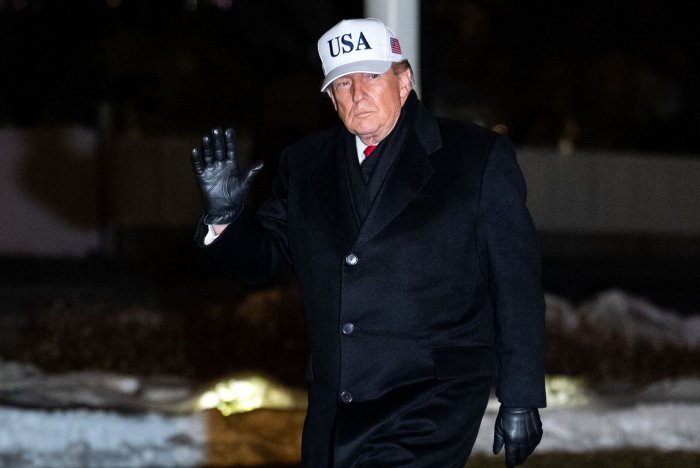
US President Donald Trump gestures during the 56th annual World Economic Forum [Jonathan Ernst/Reuters]
Tariffs and the trade deficit
Defending his prolific use of tariffs and other protectionist trade policies, Trump credited the measures with chipping away at the US’s trade deficit and boosting domestic production.
“With tariffs, we’ve radically reduced our ballooning trade deficit, which was the largest in world history. We were losing more than $1 trillion every single year, and it was just wasted. It was going to waste,” Trump said.
“But in one year, I slashed our monthly trade deficit by a staggering 77 percent. And all of this with no inflation, something everyone said could not be done,” he added.
Trump also pointed to what he described as gains in exports, manufacturing and industrial capacity as evidence of the policy’s success.
“During the process, we’ve made historic trade deals with partners covering 40 percent of all US trade, some of the greatest companies and countries in the world. We have countries as our partners, too. The European nations, Japan, South Korea, they’re our partners,” he said.
Trump on Venezuela: ‘Going to do fantastically well’
Speaking about Venezuela’s economy and oil sector, Trump said the country had suffered a sharp decline because of past policies under socialist leaders like Nicolas Maduro and the late Hugo Chavez.
But he forecast that the South American country is now poised for a rapid turnaround, driven in part by cooperation with the US and international energy companies.
Trump has taken an active interest in Venezuela’s governance since a January 3 military operation to abduct Maduro and transport him to the US to face criminal charges. He has since confirmed that the US has extracted 50 million barrels of oil from Venezuela following Maduro’s ouster.
“Venezuela has been an amazing place for so many years, but then they went bad with their policies,” Trump said.
“Twenty years ago, it was a great country, and now it’s got problems. But we’re helping them. And those 50 million barrels, we’re going to be splitting up with them, and they’ll be making more money than they’ve made in a long time.”
Trump proceeded to praise the interim government of President Delcy Rodriguez, Maduro’s former vice president, for cooperating with his ambitions in Venezuela.
“Venezuela is going to do fantastically well,” Trump said.
“We appreciate all of the cooperation we’ve been given. We’ve been given great cooperation. Once the attack ended, the attack ended, and they said, ‘Let’s make a deal.’ More people should do that.”
He went on to predict a dramatic economic recovery for the oil-rich nation, citing renewed foreign investment and support from major energy firms.
“Venezuela is going to make more money in the next six months than they’ve made in the last 20 years,” he said.
“Every major oil company is coming in with us. It’s amazing. It’s a beautiful thing to see. The leadership of the country has been very good. They’ve been very, very smart.”
Onto the topic of energy
Trump then turned to energy policy, highlighting a shift in his stance on nuclear power and reiterating his longstanding criticism of renewable energy.
“We’re going heavy into nuclear. I was not a big fan because I didn’t like the risk, the danger, but the progress they’ve made with nuclear is unbelievable, and the safety progress they’ve made is incredible,” Trump said.
“We’re very much into the world of nuclear energy, and we can have it now at good prices and very, very safe.”
His statements follow a news release from the US Department of Energy on Tuesday that announced Trump would be “unleashing America’s next nuclear renaissance” by expanding infrastructure to create such energy.
Trump has also grown his personal business ties with private nuclear power firms. In December, the Trump Media and Technology Group, of which Trump is the majority owner, announced a $6bn merger with TAE Technologies, a fusion energy company.
While Trump has warmed to nuclear power, he doubled down on his opposition to green energy initiatives designed to combat climate change. Calling such efforts the “Green New Scam” – his spin on the “Green New Deal” – he blamed Europe’s economic wobbles on efforts to embrace renewable technology.
“There are windmills all over Europe. There are windmills all over the place, and they are losers. One thing I’ve noticed is that the more windmills a country has, the more money that country loses and the worse that country is doing,” he told his audience at Davos.
The leader of Canada’s Liberal Party, Carney had encouraged world leaders to prepare for a future without US leadership and warned that the “great powers” of the world appeared to be abandoning “even the pretence of rules and values for the unhindered pursuit of their power”.
While Carney did not explicitly mention Trump, it was clear his remarks were aimed at the US leader. Trump replied more directly during his turn at the Davos podium.
“Canada gets a lot of freebies from us,” Trump said.
“They should be grateful. But they’re not. I watched your prime minister yesterday. He wasn’t so grateful. Canada lives because of the United States. Remember that, Mark, the next time you make your statements.”
Trump says he is meeting Zelenskyy
Trump also spoke about the war in Ukraine, and his efforts to mediate between Russian President Vladimir Putin and his Ukrainian counterpart, Volodymyr Zelenskyy.
“I’m dealing with President Putin, and he wants to make a deal,” Trump said.
“I believe I’m dealing with President Zelenskyy, and I think he wants to make a deal. I’m meeting him today. He might be in the audience right now.”
A post on Zelenskyy’s social media account, however, showed the Ukrainian leader at his presidential office in Kyiv on Wednesday, holding a meeting on the energy situation following Russian strikes. His office confirmed he is in Ukraine, not at Davos.
Still, Trump insisted that he would help navigate Ukraine and Russia to an end to their war, which began nearly four years ago in February 2022.
“They’ve got to get that war stopped. Because too many people are dying, needlessly dying. Too many souls are being lost. It’s the only reason I’m interested in doing it. But in doing it, I’m helping Europe. I’m helping NATO,” he said.
‘Those beautiful sunglasses’
At one point in his meandering speech, Trump stopped to poke fun at French President Emmanuel Macron, mocking the aviator sunglasses he wore to Davos.
“I watched him yesterday with those beautiful sunglasses. What the hell happened?” Trump asked.
Macron’s office said the choice to wear sunglasses during his speech, which took place indoors, was to protect his eyes because of a burst blood vessel.
France’s President Emmanuel Macron attends the 56th annual World Economic Forum [Denis Balibouse/Reuters]
Watch: The BBC’s Faisal Islam on how Trump’s Davos speech was received
President Donald Trump says the US is exploring a potential deal on Greenland after talks with Nato as he backed off plans to impose tariffs on European allies that had opposed his plans for America to acquire the island.
On social media, Trump said a “very productive meeting” with Nato’s leader had led to the “framework” of a potential agreement over Greenland and the Arctic. He offered few details.
Nato also described the meeting as “very productive” – and said discussions on the framework mentioned by Trump would focus on ensuring Arctic security.
Earlier, Trump told the World Economic Forum in Davos that he would not use military force but wanted talks to secure ownership of the territory.
On Truth Social on Wednesday, the US president said: “We have formed the framework of a future deal with respect to Greenland and, in fact, the entire Arctic Region.
“This solution, if consummated, will be a great one for the United States of America, and all Nato Nations.”
He did not say if the proposal included American ownership of the autonomous Danish dependent territory, but told a US cable network the plan might involve mineral rights.
Further information would be made available “as discussions progress”, Trump said on Truth Social.
Secretary of State Marco Rubio and Special Envoy Steve Witkoff would “report directly” to him, he added, as negotiations continued.
Danish Foreign Minister Lars Løkke Rasmussen said in a statement: “The day is ending on a better note than it began.”
He added: “Now, let’s sit down and find out how we can address the American security concerns in the Arctic while respecting the red lines of the Kingdom of Denmark.”
In the hours that followed, some details trickled out.
Trump told CNBC that the possible deal could last “forever” and might involve mineral rights and the planned Golden Dome missile defence system, which Trump has envisioned as a shield of interceptors and detectors spanning land, sea and space to protect the US from long-range missile strikes.
Along with Greenland’s strategic location, the Trump administration has spoken about its vast – and largely untapped – reserves of rare earth minerals, many of which are crucial for technologies including mobile phones and electric vehicles.
Ros Atkins on… Trump’s Davos speech claims
Trump also told CNN in Davos, Switzerland, that the deal framework for Greenland was “pretty far along” and “gets us everything we needed to get”, especially “real national security and international security”.
Nato Secretary General Mark Rutte said he had not discussed the key issue of Danish sovereignty over Greenland in his meeting with Trump.
He told Fox News the “issue did not come up anymore in my conversations tonight with the president”.
Trump had previously dismissed the idea of leasing Greenland, saying that “you defend ownership. You don’t defend leases.”
Swedish Deputy PM: EU and US relationship “has been damaged” by Greenland pursuit
Nato spokeswoman Allison Hart said in a statement that during the meeting, Trump and Rutte had “discussed the critical significance of security in the Arctic region to all Allies, including the United States”.
“Discussions among Nato Allies on the framework the President referenced will focus on ensuring Arctic security through the collective efforts of Allies, especially the seven Arctic Allies,” she added.
“Negotiations between Denmark, Greenland, and the United States will go forward aimed at ensuring that Russia and China never gain a foothold – economically or militarily – in Greenland.”
According to the New York Times, the potential plan could grant the US ownership of small pockets of the territory’s land, where American military bases could be built.
Officials who attended a Nato meeting on Wednesday told the newspaper the suggested arrangement would be similar to UK bases on Cyprus, which are part of British Overseas Territories.
Under existing agreements with Denmark, the US can bring as many troops as it wants to Greenland. It already has more than 100 military personnel permanently stationed at its Pituffik base in the north-western tip of the territory.
Watch: Trump takes aim at world leaders in Davos speech
Trump had been threatening to place a 10% tariff “on any and all goods” sent from the UK to the US from 1 February, increasing to 25% from 1 June, until a deal was reached for Washington to purchase Greenland from Denmark.
The same would apply to goods from Denmark, Norway, Sweden, France, Germany, the Netherlands and Finland – all of which are members of Nato, the defence alliance founded in 1949.
The US president dropped that threat on Wednesday after the talks with Rutte, saying in his post on Truth Social that he would cancel imposing the new levies.
“Based upon this understanding, I will not be imposing the Tariffs that were scheduled to go into effect on February 1st.”
In his speech to the World Economic Forum in Davos on Wednesday, Trump said he was “seeking immediate negotiations” to acquire Greenland, but insisted the US would not take the territory with force.
“We probably won’t get anything unless I decide to use excessive force. We’d be unstoppable, but we won’t do that,” Trump said. “I don’t have to use force. I don’t want to use force. I won’t use force.”
He also urged world leaders to allow the US to take control of Greenland from Denmark, saying: “You can say yes and we will be very appreciative. Or you can say no and we will remember.”
In his own speech at Davos a day earlier, French President Emmanuel Macron criticised Trump’s previous threat of import taxes.
He said an “endless accumulation of new tariffs” from the US was “fundamentally unacceptable”.
Macron was among those urging the EU to consider retaliatory options against new US levies.
In his speech, Trump took aim at Macron, saying France had been “screwing” the US for decades.
The US president also took a swipe at Canadian Prime Minister Mark Carney, who urged “middle powers” such as Australia, Argentina and his own country to band together when he spoke at Davos a day earlier.
In response, the US president accused Carney of being ungrateful to the US.
“Canada lives because of the United States,” Trump said. “Remember that, Mark, the next time you make your statements.”
Antoni Porowski has addressed the supposed “backstage drama” at Queer Eye as cast members continue on a press tour ahead of the last season
Queer Eye is coming to an end (Image: )
Antoni Porowski has addressed the “backstage drama” on Queer Eye. The reality star, 41, is the food and wine expert on the hit Netflix series but fans have rumbled that there is something going on with the atomphere on set,
As Antoni joined cast members Tan France, Jonathan Van Ness and Jeremiah Brent for the rollout of their tenth and final season Karamo Brown was notably absent from multiple public appeareances designed to promote the last run of episodes to be released on the streaming service.
Fans were quick to notice that Karamo has unfollowed his co-stars on social media, and CBS Mornings host Gayle King was informed just half an hour before the cast were scheduled to be interviewed that he would not be able to join because he was struggling with his mental health.
In a statement provided to CBS Mornings, representatives for Karamo said: “I hope everyone remembers the main theme I have tried to teach them over the past decade, which is to focus on and to protect their mental health/peace from people or a world who seek to destroy it; which is why I can’t be there today.”
One fan was quick to voice their opinion, and took to the comments section of a post Anton had made on Instagram on Wednesday. They wrote: “Ngl the backstage drama kinda kills the vibe of the show. I’m not motivated to watch you all portray to be a big happy family on every episode knowing it’s all fake. If you can’t work out your own mess, how can you be in charge of fixing someone else’s life?
Antoni was quick to respond to the comment, noting that everyone comes from a different sort of background but he wants to present something “authentic” with the show.
He said: “a lot of us come from complicated families and still have jobs and positive things we’re passionate about. Authenticity is about being honest about the complexities of life and knowing two things can exist at the same time!”
Throughout its run, Queer Eye has been nominated for 37 Emmys, winning six between 2018 and 2023. The series underwent a major change however in 2023, when Bobby Berk announced that he was leaving the show.
The star, who was the show’s interior design expert, later said that he stepped down from the show to work on “multiple other projects”. When asked about a rumoured fall-out between him and co-star Tan, he told the Mail Online: “There was a situation, and that’s between Tan and I, and it has nothing to do with the show.”
The series launched on Netflix in 2018 as a reboot of Bravo’s 2003 series Queer Eye for the Straight Guy.
Over the last nine seasons, fans have watched the stylish gang as they’ve transformed the lives of men and women in need of a makeover.
WASHINGTON — Lindsey Halligan, who, as a hastily appointed Justice Department prosecutor, pursued indictments against a pair of President Trump’s adversaries, is leaving her position as her months-long tenure has now concluded, Atty. Gen. Pam Bondi said Tuesday night.
Halligan’s departure from the role of interim United States attorney for the Eastern District of Virginia came as multiple judges were casting doubt on her ability to legally remain in the job after a court ruling two months ago that declared her appointment illegal. She was appointed in September to a 120-day stint, which concluded Tuesday.
“The circumstances that led to this outcome are deeply misguided,” Bondi said in a social media post on X announcing Halligan’s exit. “We are living in a time when a democratically elected President’s ability to staff key law enforcement positions faces serious obstacles. The Department of Justice will continue to seek review of decisions like this that hinder our ability to keep the American people safe.”
The move brings an end to a brief but tumultuous tenure. Trump tapped Halligan, a White House aide who had served as his personal lawyer but had no prior experience as a federal prosecutor, to lead one of the Justice Department’s most important and prestigious offices. She quickly secured indictments at Trump’s urging against former FBI Director James Comey and New York Atty. Gen. Letitia James. But a judge later concluded that her appointment was unlawful and that the two indictments must therefore be dismissed.
The Trump administration had kept Halligan in place despite that ruling, but on Tuesday, two judges made clear that they believed it was time for her tenure to end. Hours later, Halligan became the latest Trump ally to give up her title amid scrutiny from judges about the administration’s maneuvering to install the president’s loyalists in key posts. Last month, for instance, another of Trump’s former personal attorneys, Alina Habba, resigned after an appeals court said she, too, had been serving in her position unlawfully.
It was not immediately clear who would now lead the U.S. attorney’s office in the Eastern District of Virginia, which has been buffeted by resignations and leadership turnover since last September when the Trump administration effectively forced out the veteran prosecutor who had been leading the office, Erik Siebert, and replaced him with Halligan.
Halligan’s departure followed orders Tuesday from separate judges that marked a dramatic new front in an ongoing clash between the Trump administration and the federal court over the legitimacy of her appointment.
In one order, M. Hannah Lauck, the chief judge of the Eastern District of Virginia and a nominee of President Obama, directed a clerk to publish a vacancy announcement on the court’s website and said she was “soliciting expressions of interest in serving in that position.”
In a separate order, U.S. District Judge David Novak said he was striking the words “United States Attorney” from the signature block of an indictment in a case that was before him as well as barring Halligan from continuing to present herself with that title. He said he would initiate disciplinary proceedings against Halligan if she violated his order and persisted in identifying herself in court filings as a U.S. attorney, and said other signatories could be subject to discipline as well.
“No matter all of her machinations, Ms. Halligan has no legal basis to represent to this Court that she holds the position. And any such representation going forward can only be described as a false statement made in direct defiance of valid court orders,” Novak wrote. “In short, this charade of Ms. Halligan masquerading as the United States Attorney for this District in direct defiance of binding court orders must come to an end.”
Novak, who was appointed to the bench by Trump during the Republican president’s first term in office, chided Justice Department leadership for what he suggested was an improperly antagonistic defense of Halligan by Bondi and Deputy Atty. Gen. Todd Blanche in an earlier court filing.
“Ms. Halligan’s response, in which she was joined by both the Attorney General and the Deputy Attorney General, contains a level of vitriol more appropriate for a cable news talk show and falls far beneath the level of advocacy expected from litigants in this Court, particularly the Department of Justice,” Novak wrote.
“The Court will not engage in a similar tit-for-tat and will instead analyze the few points that Ms. Halligan offers to justify her continued identification of her position as United States Attorney before the Court,” he added.
Halligan was thrust into the position amid pressure by Trump to charge Comey and James, two of his longtime perceived adversaries. Trump made his desire for indictments clear in a Truth Social post in which he implored Bondi to act swiftly.
Halligan secured the indictments, but the win was short-lived. In November, U.S. District Judge Cameron McGowan Currie ruled that Halligan had been illegally appointed and dismissed both cases. The Justice Department has appealed that ruling.
In her own statement, Halligan acknowledged that her 120-day tenure had come to an end on Tuesday. She also lamented the legal limbo she said she had been left in by Currie’s opinion, noting that judges in the district over the last two months had “repeatedly treated my appointment as disqualifying” without actually removing her from the role.
“The court’s remedy did not match its rhetoric. It treated me as though I had been removed from office — declaring my appointment unlawful and striking my name from filings — while never taking the single step Judge Currie identified as the consequence of that conclusion: appointing a replacement U.S. attorney,” she said.
Tucker writes for the Associated Press. AP writer Alanna Durkin Richer contributed to this report.
It has taken Wissa time to deliver such performances.
Wissa, who had already had a disrupted pre-season, following his protracted departure from Brentford, has only scored three goals since making his debut for Newcastle last month.
The forward has looked rusty at times, failing to take a big chance to open the scoring in the defeat against Manchester City in the Carabao Cup semi-finals last week.
But Wednesday night showed what he can bring to this side.
Howe had called on Wissa to “max out” before the game, and he led the press effectively against a naive PSV side, who repeatedly played out from the back.
That certainly did not go unnoticed by fellow goalscorer Harvey Barnes.
“He’s had a tough start since he’s come here,” he told TNT Sports.
“Obviously injured for a long time. I had a similar start here. I know how tough it is just watching from the stands, so I know how delighted he will be.
“A first Champions League goal. I thought he played really well so I’m buzzing for him.”
The challenge for Wissa, of course, is to start scoring more regularly.
But he is a poacher in a differing mould to the towering Nick Woltemade, who likes to come in deep.
Of those forwards to have played a minimum of 250 minutes in the Premier League this season, Wissa ranks first for cross option runs per game.
These are defined by Opta as runs to get into the penalty area to make yourself available for a cross while your team-mate has the ball in a wide area.
Wissa also ranks 15th for runs in behind.
Given their differing qualities, Howe felt it was “transformative” to have Wissa available after Woltemade had to shoulder the burden up front in his absence.
It had always been the plan for the pair to share the load after Newcastle lost top scorer Alexander Isak to Liverpool last summer, and Wissa’s Premier League experience helps explain why Newcastle paid such a hefty £55m fee.
“Yoane’s career at Brentford was brilliant to watch from afar because I thought he was outstanding for them, scoring a number of massive goals,” Howe said.
“I loved his attitude and the way that he played, the determination and aggression that he played with.”
In 2005, Evo Morales won the Bolivian general election and became the first President to come from the indigenous population. His inauguration was on January 22nd 2006.
In 2009, a change to the constitution of Bolivia was promulgated by President Morales, recognising in statute the multi-cultural nature of modern Bolivia.
The new constitution changed the official name of the country to the Plurinational State of Bolivia.
The new constitution was enacted on January 22nd 2010, when President Morales was inaugurated for a second term as President.
On the same date, Morales also signed a decree declaring January 22nd as the Plurinational State Foundation Day and a national holiday to be celebrated annually.
President Morales resigned on November 10th 2019 following weeks of protests organized by opposition political organizations.
The government announced that it will stay open during the holiday when Interim President Jeanine Áñez is expected to give a management report on government activities.
Jan. 21 (UPI) — Federal law enforcement can use force while enforcing federal immigration laws in Minnesota amid a roundup of those who illegally are in the country, a federal appeals court ruled.
A panel with the Eighth Circuit Court of Appeals in St. Louis on Wednesday issued a one-sentence ruling staying a lower court’s injunction against the use of force or crowd dispersal munitions, such as tear gas and pepper spray, against protesters who are not engaged in violence, according to The New York Times.
U.S. District Court of Minnesota Judge Katherine Menendez on Friday imposed the restrictions and another preventing Immigration and Customs Enforcement officers and others from making traffic stops of people who are not “forcibly obstructing or interfering” with federal officers.
The Trump administration appealed the ruling, arguing that it amounted to a “broad injunction regulating [Department of Homeland Security] officers’ operations” and “harms DHS officers’ ability to protect themselves and the public in very dangerous circumstances.”
Wednesday’s appellate court ruling only applies to the use of force and does not regard the merits of the federal government’s appeal, which is yet to be decided.
The American Civil Liberties Union filed the federal lawsuit on behalf of protesters and after Renee Good was shot and killed while hitting an ICE officer with her vehicle on the morning of Jan. 7.
Good was trying to flee the scene after ICE officers tried to detain her for using her SUV to block ICE vehicles in a Minneapolis neighborhood.
Sreenivasan Jain speaks with Sajeeb Wazed Joy about whether it sees any political future for itself in Bangladesh.
The Awami League is barred from upcoming elections in Bangladesh. Former Prime Minister Sheikh Hasina is in exile. Sreenivasan Jain asks Hasina’s son Sajeeb Wazed Joy what future the party has.
Bangladesh is heading into a historic election, with the Awami League barred from contesting and its leader, Sheikh Hasina, living in exile after her overthrow in August 2024.
In this interview, Sreenivasan Jain speaks with Sajeeb Wazed Joy — Hasina’s son and a senior Awami League figure — about whether the party has confronted public anger over years of repressive rule, and whether it sees any political future for itself in Bangladesh.
Guest:
Sajeeb Wazed Joy – Bangladeshi politician and businessman
Love Island: All Stars contestants Charlie and Scott got into a heated argument on Wednesday’s episode of the ITV2 dating show as everything bubbled over from love triangle drama
Charlie got into a row over his behaviour regarding Millie and Jess on Love Island (Image: ITV/Shutterstock)
Love Island: All Stars contestants Charlie and Scott got into a heated argument on Wednesday’s episode of the ITV2 dating show. The two reality stars are back in the villa for another shot at love, but Charlie has got himself into a love triangle with Millie and Jess, a drama that has been bubbling away for the past few days.
Scott raged: “You admitted to me, you said you wanted Millie to open up her feelings to you via the situation with Jess!” “I just wanna drop it, it’s so annoying!” “Well it’s uspet me, you said it out of passing comment and it’s really f****** upset me!”
Scott and Charlie then began to talk over each other and demanded that Sean come over to put his two pence into the whole dramatic situation.
He said: “You said it and I f***** agreed, don’t give me that b*******” ” Charlie then went back to his friends to vent about the situation.
He said: “He’s basically saying that I’ve said that I’m trying to make Millie jealous but I’m just following my genuine feelings. It’s constantly Scott though, why is he in my business?”
Fans instantly took to social media to react to the whole blow up, with one writing: “Scott do need to mind his business but he’s right about Charlie and he been right about him sorry not sorry!”
Another said: “Scott should just give up on those two, Charlie can finish them off…” and a third wrote: “Scott needs to defend Millie & Jess less they made their Charlie bed now they can lie and be miserable in this little cr***y love triangle”
A fourth wrote: “with how good charlie is at lying, i can see why scott has been on the attack!”
Fans have watched as Charlie started up a romance with Millie Court but then shared a kiss with Jess. It seemed as if Jess had been expecting Charlie to couple up with her, but he chose Millie. Jess was then left furious with Tommy, despite his decision to couple up with her
Before the recoupling had taken place, it had all kicked off with Scott getting involved in the drama. Millie was then seen telling her fellow Islanders to “drop it” and insisting that she, Charlie, and Jess were all “moving on”.
On the verge of tears, Jess raged: “Everyone is putting their f****** two pence in! I don’t get it. At the end of the day, I’m here for myself, and I do carry some guilt on my shoulders. It’s just the way that I’ve spoken to every single boy, and they all agree. Scott is supposed to be my f****** friend.”
Love Island: All Stars airs weeknights at 9pm on ITV2 and ITVX.
Last month, the council bumped the number of hires up to 280 after the LAPD said it had already hired its 240 allotted officers just halfway through the fiscal year. But the council still declined to fully fund up to 410 positions, which the mayor had called for in a letter.
On Wednesday, the council finally approved the hiring of up to 410 officers this year after hearing back from the city administrative officer that the money used to fund the positions this year will come from the LAPD’s budget, and not from the city’s general fund.
The hiring of the officers delivers a modest victory to Bass, who promised she would find the money for additional police hires when she signed the budget in June. Bass said the additional hires — which would bring the police force to around 8,555 officers by the end of the fiscal year — still would not match the number of officers lost through attrition this year.
“The second largest city in the United States cannot have an effective police department when it is operating with the lowest staffing levels in years,” she said. “And with only five months until Los Angeles welcomes tens of thousands of fans from around the world for the FIFA World Cup, investing in more police officers is critical to public safety.”
Still, the mayor’s victory comes after months of tension, with some council members questioning the fiscal wisdom of hiring more officers than the city budgeted for during a time of fiscal crisis.
“An overwhelming majority of us support additional… hiring,” said Councilmember Katy Yaroslavsky, who chairs the council’s powerful Budget and Finance Committee. “My concern has been and continues to be the fiscal impact to next year.”
While Yaroslavsky said she would have preferred to stick to the original council plan of 240 hires this year, she thanked the city administrative officer and the police department for finding funds to hire the additional 130 officers for the rest of the fiscal year.
The motion to continue hiring up to 410 officers passed in a nine to three vote.
The funding for the hires, which is about $2.6 million in total for this fiscal year, will come from pots of money within the police department, including a tranche from the “accumulated overtime,” bucket, which is used to pay out overtime to officers who are retiring. The city found the $12 million allotted for that was not being fully drawn down this year.
Some on the council took issue with the additional hiring, saying the city did not know how it would pay for the ongoing cost of the hired officers, which will grow to about $25 million in the next fiscal year.
“How are we going to pay for the ongoing cost?” asked Councilmember Hugo Soto-Martínez, who voted against the new plan. “We are sort of back to where we were in December where we are committing ourselves to a $25 million price tag with no plan for where that’s going to come from.”
In a report, the city administrative officer said the $25 million should be found in “ongoing reductions with the Police Department” that would not result in layoffs to civilian staff at the department or take from the city’s general fund.
“This is robbing Peter to pay Paul,” said Councilmember Monica Rodriguez about the funding decision.
Police Chief Jim McDonnell, who attended the city council meeting, took issue with councilmembers criticizing the increased hiring.
“We’re working on a skeleton crew,” he said. “This department is doing amazing things for the residents of this city, but it doesn’t seem to be appreciated.”
The dispute between the state and Santa Anita Park over the use of a new betting machine was ratcheted up Wednesday when four major trade unions sent a letter to Rob Bonta, the California attorney general, urging the state to return the terminals it confiscated on Saturday. Santa Anita filed suit against the state on Tuesday seeking the same.
Collectively, the Service Employees International Union, the Teamsters, California State Pipe Trades Council and the State Assn. of Electrical Workers created a special letterhead with all their logos to show their solidarity on the issue. The two-page letter, obtained by The Times, was stinging and pointed, calling the state’s removal of Racing on Demand machines as “not only misguided but reckless.”
It went on to say: “By removing these terminals, your agency has introduced unnecessary uncertainty into an industry already confronting significant economic challenges. This decision undermines innovation, discourages investment and jeopardizes the more than $1.7 billion in annual economic impact that California horse racing generates for local communities, workers and the state as a whole.”
The seizing of the 26 Racing on Demand machines and the money within the machines by 21 state Department of Justice employees and two Arcadia Police personnel on Saturday is forcing those in the horse racing orbit to take sides.
The state, by virtue of the raid, seems to be siding with the California tribes, who have purview over almost all non-pari-mutuel gambling in the state and oppose the machines. It includes casinos, table games and slot machines among other forms of gambling.
Santa Anita, and by extension Del Mar and Los Alamitos, contend the game, played on a machine that has the look and feel of a slot machine, say the betting is conducted between patrons in a commingled pool and paid out based on how much money is bet on each combination. The house, in this case Santa Anita, does take money off the top to run the game but is not involved in determining the payoffs.
The stated goal of the tracks is to use some of the money generated by the machines to increase purses, which is a huge liability in California racing now. A lot of states, most notably Kentucky and New York, use money from casino racing to help their race purses.
The current takeout on the 3 X 3 game, the one used on the machines where you pick first, second and third in three different races, is 22%, meaning the return to bettors is 78% of the money bet.
Jan. 21 (UPI) — The House Oversight and Government Reform Committee on Wednesday okayed contempt of Congress resolutions for Bill and Hillary Clinton for refusing to testify about Jeffrey Epstein.
The committee voted 34-8 to approve the contempt resolution against former President Bill Clinton and 28-15 in favor of the contempt resolution for former Secretary of State Hillary Clinton.
Both resolutions received bipartisan support, with nine Democrats voting for the former president’s contempt resolution and three for the former Secretary of State’s contempt resolution.
All Republican members of the committee voted in favor of both contempt resolutions.
The nine Democrats who voted in favor of Bill Clinton’s contempt resolution include Reps. Maxwell Frost of Florida, Summer Lee of Pennsylvania, Raja Krishnamoorthi of Illinois, Lateefa Simon of California and Emily Randall of Washington.
Also supporting that resolution were Reps. Rashida Tlaib of Michigan, Ayanna Pressley and Stephen Lynch of Massachusetts, and Melanie Stansbury of New Mexico. Two, Reps. Dave Min of California and Yassamin Ansari of Washington voted “present.”
Tlaib, Stansbury and Lee also voted in favor of the resolution against Hillary Clinton, while Min voted “present.”
Committee chairman Rep. James Comer, R-Ky., was pleased with the bipartisan support for both resolutions.
“I’m very happy that we had a bipartisan vote today to hold the Clintons in contempt of Congress,” Comer said, as reported by The Hill. “This shows that no one’s above the law.”
He said that he anticipated some bipartisan support from committee Democrats and is “very, very proud of the ones who did.”
The former president did not show up for a scheduled deposition regarding his relationship with Epstein on Jan. 13, and neither did any of the committee’s Democratic Party members.
Hillary Clinton did not show up for her scheduled deposition on Jan. 14.
The committee had given both Clintons several months of advance notice for their respective hearings at the Rayburn Office Building in Washington, D.C., but Bill Clinton rescheduled his deposition twice before not appearing last week.
The former president appears in photos with Epstein and others.
Epstein was a financier and convicted sex offender who hung himself while jailed in New York City in 2019 and awaiting a federal trial on child sex trafficking charges.
The Clintons recently wrote Comer to say the subpoenas issued for each of them are not “legally valid” and they won’t appear at any deposition hearings.
The measures go to the House floor for consideration and, if passed, could result in charges against both Clintons and time in jail if they are found guilty.
U.S. President Donald Trump has doubled down on his long-standing ambition to bring Greenland under U.S. control, declaring there was “no going back” on the issue and refusing to rule out the use of force. His remarks, accompanied by leaked private messages and AI-generated images shared on social media, have triggered alarm across Europe and raised fears of a renewed transatlantic crisis.
Greenland is an autonomous territory of Denmark and a strategic Arctic location rich in minerals and critical for missile defence and shipping routes. Trump has repeatedly argued that U.S. control of the island is essential for global security, a claim Denmark and European allies strongly reject.
Trump’s Message: Security First, Allies Second
Trump said Greenland was “imperative for National and World Security” after speaking with NATO Secretary General Mark Rutte. To underline his stance, he shared AI-generated images portraying Greenland and Canada as part of the United States, signalling that the issue is not symbolic but strategic.
He also leaked private texts from European leaders, including French President Emmanuel Macron, who questioned Trump’s intentions. Trump responded by renewing threats of massive tariffs on French wines and champagne, intensifying fears of economic retaliation.
NATO and Europe Under Pressure
Trump’s comments have placed NATO under severe strain, with Denmark warning that the crisis threatens core principles of sovereignty and democracy. Danish Prime Minister Mette Frederiksen told parliament that “the worst may still lie ahead,” rejecting any negotiations over national borders.
European Commission President Ursula von der Leyen used the World Economic Forum in Davos to call for a “new independent Europe,” signalling that European leaders increasingly see Trump’s America as an unreliable security partner.
Trade War Fears Resurface
Trump’s Greenland rhetoric has revived memories of last year’s trade tensions. The European Union has warned it could reactivate tariffs on €93 billion worth of U.S. imports as early as February 6. Brussels is also considering deploying its powerful Anti-Coercion Instrument, which could target U.S. services, technology firms, and investment access.
U.S. Treasury Secretary Scott Bessent attempted to calm markets, dismissing fears as “hysteria” and urging patience. However, financial markets reacted sharply, with global stocks sliding, gold hitting record highs, and U.S. stock futures falling to one-month lows.
Russia Enters the Narrative
Russia has seized the moment to question Danish sovereignty over Greenland. Foreign Minister Sergei Lavrov described Greenland as a “colonial conquest,” a comment that further complicates Arctic geopolitics. While Moscow denied seeking control of the island, its remarks underline how Trump’s stance is opening space for rival powers to challenge Western unity.
Public Backlash and Global Anxiety
Protests erupted in Switzerland ahead of the Davos forum, with demonstrators denouncing Trump’s policies as imperialistic. Investors, meanwhile, are reviving the so-called “Sell America” trade, signalling declining confidence in U.S. political stability and predictability.
Implications
Trump’s Greenland push risks reshaping transatlantic relations in three major ways:
Security: It weakens NATO cohesion at a time of rising global instability.
Economics: It threatens another U.S.–EU trade war, with serious consequences for global markets.
Geopolitics: It accelerates European efforts to reduce dependence on U.S. security guarantees while giving rivals like Russia diplomatic leverage.
Analysis
Trump’s insistence on Greenland reflects a transactional and power-centric worldview where sovereignty is negotiable and alliances are conditional. By framing territorial acquisition as a security necessity, he is blurring the line between strategic competition and outright coercion.
While the administration portrays the dispute as manageable, the reaction from Europe suggests a deeper rupture. The crisis is less about Greenland itself and more about whether the U.S. under Trump still respects the norms that underpin the Western alliance. If this approach continues, Europe’s push for strategic autonomy may shift from rhetoric to reality permanently altering the balance of power within the transatlantic relationship.
Amanda Holden has revealed that she once prepared a Sunday roast in front of her family — while nakedCredit: InstagramAmanda said she stripped off because it was a hot dayCredit: Instagram
And she added that her two daughters Lexi, 19, and Hollie Rose, 13, were used to seeing her without clothes.
She told the Table Manners podcast: “You know on the cusp between winter and summer where you have to give up roast dinners and turn it into a barbecue?
“My whole family moan about Sunday roast, but I make them have it, and then this one particular Sunday it was boiling hot so I did just strip off and cook everything naked.”
After a dawn briefly interrupted by the explosions of missiles fired from MH-60L helicopters, there was a silence greater than the one traditionally accompanied by the crickets in Caracas: uncertainty about what the target had been. Social media users posted different images from their homes in which the fires resulting from the explosions rose in columns of uncertainty.
That uncertainty lasted a few hours, initially with a statement from the Foreign Ministry stating that Nicolás Maduro, in the exercise of his duties, had activated all the necessary defense protocols and plans to protect the nation, while also announcing the state of national emergency. Hours later, through a voice note recorded by Vice President Delcy Rodríguez, it was announced that the whereabouts of Nicolás Maduro and Cilia Flores were unknown. At the same time, Defense Minister Vladimir Padrino López warned of a further escalation of violence, said that the attacks had included civilian sites, and called for the consolidation of a wall of resistance made up of civilians and military forces in the face of the “invasion.”
A wall that no one saw erected before, in his statement from his Mar-a-Lago resort, Trump said that cordial talks had been established with Delcy Rodríguez and that she was completely willing to work. A microphone became a dagger for the official narrative in less than 24 hours. Since July 28, 2024, the government’s ability to manage the media agenda had been undermined by a “data-beats-narrative” premise, which was validated by official voting records. Any attempt at explanation was no longer credible. Dissociation became a way of continuing to govern without legitimacy.
Since January 3, the Venezuelan government has had to juggle between showing that there is collaboration with the US and defending two central figures, such as Maduro and Flores. “It’s nothing personal, it’s just business” is one of the lessons that chavismo seems to have learned from Michael Corleone. As of today, even the son of Nicolás Maduro (“Nicolasito” Maduro Guerra) has said that he feels it’s necessary to reopen the US embassy in Caracas and even the Israeli one, which was closed long before.
Jorge Rodríguez: “If we are going to promote peaceful coexistence, we have to rectify, we have to look for mechanisms where there is calm (parsimonia), engagement (encuentro), and where we can tone down the arrogance (soberbia) a bit, but you (the opposition) have to tone down the pettiness (mezquindad).”
While the chavista leadership seeks to please the interests of the Trump administration and position itself as an indispensable ally for foreign investment, the grassroots support of the ruling PSUV party chants and performs choreographies on social media saying that it will rescue Maduro and Flores from an “illegal” imprisonment. In the meantime, it is at least interesting that those regime groups that have the most to lose from this sudden rapprochement with Washington are the most loyal ones, while the leadership in Caracas receives the CIA director.
Watching a spokesman as radical as Diosdado Cabello say that he wants the opening of the Venezuelan embassy in Washington is a sign that something has changed. In his words: “We are not afraid to sit down and talk to whoever we have to talk to. Doubting is betrayal. Unity turns us into a single body, there are no free agents here.”
Cabello has also accepted the (very slow and selective) release of political prisoners in these terms: “It has to do with a process of national reconciliation that the acting president has announced. Those who have cases of drug trafficking, rape, attacks on children, and murder are excluded.” But neither repression nor the verbal attacks on NGOs have ceased. Not even by Jorge Rodríguez, who on January 13 said that Foro Penal were petty and self-interested. Cabello said that “the so-called NGOs are charging families, saying that detainees are released thanks to them. Thanks to them? If NGOs do anything, it’s to slander detainees, because they receive money from abroad.”
Meanwhile, the “workers’ president” now shares prison with the world’s most famous criminals. Chavismo can try to turn the man who ordered mass kidnappings into a poor hostage of the US imperialism, while Delcy says that if she has to go to Washington, she will do so accompanied by the spirit of a brave people. The most reasonable scenario is that the legal battle over Maduro’s release will take years, along with an artificial anti-imperialist narrative.
Cabello tries to compensate for the impact of January 3 by claiming that nothing has really changed.
The Rodríguez siblings have already toned down the level of conflict. Addressing non-chavista lawmakers in the National Assembly, Jorge Rodríguez said: “If we are going to promote peaceful coexistence, we have to rectify, we have to look for mechanisms where there is calm (parsimonia), engagement (encuentro), and where we can tone down the arrogance (soberbia) a bit, but you (the opposition) have to tone down the pettiness (mezquindad).”
It is necessary to highlight that historically, in the official narrative, the opposition is an extension of Washington’s interests. That rectification has also become evident in the claims of international sectors of the left that have shifted from the term “invasion” to “intervention” to sum it up as an “illegal” detention. Nicolasito has framed it that way on a podcast tour, where he downplays the importance of the new Miraflores–White House relationship and instead focuses on the conditions under which his father and stepmother are being held..
The removal of Alex Saab and Freddy Ñáñez from the cabinet can also be considered a gesture to the Trump administration—the former for being Maduro’s financial operator (imprisoned by the US and later released by the Biden administration), and the latter for being in charge of the Venezuelan government’s “communications guerrilla” during moments of greatest tension between Miraflores and the White House.
Between biting their tongues and appealing to selective memory, the regime now seems focused on appropriating the narrative and confronting disputes over the truth. Cabello tries to compensate for the impact of January 3 by claiming that nothing has really changed: “the only thing that didn’t work out for them is that the Bolivarian Revolution is still governing and the country is at peace.”
But still, “data beats narrative.” Starting with Delcy Rodríguez, in this provisional government that Trump says is obeying him, there are actors indicted and under investigation for crimes related to money laundering and drug trafficking. Not to mention the cases of human rights violations, which do not expire.